#help-13
1 messages · Page 96 of 1
 runic garnet
Nice
Now we have two equations with x and y in them
16 - x^2 = 25 - y^2
x + y = 5
Solve for x and y
runic garnet
Keep going, ur on the right track 👍
 junior timber
its 8/5
junior timber
or 1.6
runic garnet
=?
junior timber
3.4
 junior timber
okk
runic garnet
Then solve for area
junior timber
okok tytyy
junior timber
.close
 cedar kilnBOT
Channel closed
Closed by @junior timber
Use .reopen if this was a mistake.
 granite eagle

cedar kilnBOT
 Available help channel!
Send your question here to claim the channel.
Remember:
• Ask your math question in a clear, concise manner.
• Show your work, and if possible, explain where you are stuck.
• After 15 minutes, feel free to ping <@&286206848099549185>.
• Type the command .close to free the channel when you're done.
• Be polite and have a nice day!
Read #❓how-to-get-help for further information on how to ask a good question, and about conduct in the question channels.
 supple forum
how is this solved? didnt come across anything similar yet

 red pumice
taylor series most likely
 mighty drift
it says deduce, show what's before it
supple forum
red pumice
taylor series most likely
thats why
we didnt take taylor and maclaurin yet
.close
cedar kilnBOT
Channel closed
Closed by @supple forum
Use .reopen if this was a mistake.
Available help channel!
Send your question here to claim the channel.
Remember:
• Ask your math question in a clear, concise manner.
• Show your work, and if possible, explain where you are stuck.
• After 15 minutes, feel free to ping <@&286206848099549185>.
• Type the command .close to free the channel when you're done.
• Be polite and have a nice day!
Read #❓how-to-get-help for further information on how to ask a good question, and about conduct in the question channels.
 oak imp
first degree inequalities with two unknowns
cedar kilnBOT
oak imp
first degree inequalities with two unknowns
oak imp
if i do a inequality with 2 unknows
do the graphic
and check the inequation if it corresponds or not
how do i know if the solution is the upper part of the graphic or the other one
here i got confused about the solution
granite eagle
do u have a specific problem?
oak imp
yh idk why it isn't uploading
granite eagle
well assuming ur doing all this in a cartesian plane;
just take a point thats distinctly in one one those areas, check...
oak imp
 granite eagle
theres a more intuitive idea but cant really explain it without seeing the graph myself
oak imp
i got confused here
granite eagle
ok first off express that in terms of y
oak imp
and checked with 0,0 points
granite eagle
granite eagle
5x-6y less than 0
lets just ignore the equal to part it just means the boundry line is a valid set of points too
if 5x-6y is less than 0
5x must be less than 6y
5x/6 must be less than y
now think of a extreme point
say 0,100
5*0/6 =0
its certainly less than 100
granite eagle
yes 0,100 and by extension the values above the line are valid
just exclude the line
oak imp
oh so this with every inequality?
granite eagle
sure
oak imp
i pick one value of the other line and one from other
and check
if it's true
oh kk
tysm
.close
cedar kilnBOT
Channel closed
Closed by @oak imp
Use .reopen if this was a mistake.
Available help channel!
Send your question here to claim the channel.
Remember:
• Ask your math question in a clear, concise manner.
• Show your work, and if possible, explain where you are stuck.
• After 15 minutes, feel free to ping <@&286206848099549185>.
• Type the command .close to free the channel when you're done.
• Be polite and have a nice day!
Read #❓how-to-get-help for further information on how to ask a good question, and about conduct in the question channels.
 desert zephyr
P (A) ∩ P (B) = P (A ∩ B)
how do i prove thi
cedar kilnBOT
desert zephyr
P (A) ∩ P (B) = P (A ∩ B)
how do i prove thi
desert zephyr
s
 grand shale
what
desert zephyr
how do i prove that
P (A) ∩ P (B) = P (A ∩ B)
 foggy merlin
what is P
 tropic oxide
^
grand shale
your left hand side is a set and right hand side is a number , if p means probability
 desert zephyr
foggy merlin
what is P
desert zephyr
foggy merlin
what is P
parts
foggy merlin
what ?
 tropic oxide
this is called the power set.
but the "parts" you are talking about are properly called subsets.
tropic oxide
desert zephyr
oh ok in my nat lang its called parts of a set
what is your native language?
cedar kilnBOT
@desert zephyr Has your question been resolved?
desert zephyr
tropic oxide
what is your native language?
portuguese
 dusk willow
What have u tried yet
desert zephyr
I tried this

what u think?
im not sure abt the first move
but i came up with this
@dusk willow
cedar kilnBOT
Channel closed
Closed due to timeout
Use .reopen if this was a mistake.
Available help channel!
Send your question here to claim the channel.
Remember:
• Ask your math question in a clear, concise manner.
• Show your work, and if possible, explain where you are stuck.
• After 15 minutes, feel free to ping <@&286206848099549185>.
• Type the command .close to free the channel when you're done.
• Be polite and have a nice day!
Read #❓how-to-get-help for further information on how to ask a good question, and about conduct in the question channels.
 rich haven
How do I rewrite this using z
 cedar kilnBOT
rich haven
How do I rewrite this using z
cedar kilnBOT
rich haven
How do I rewrite this using z
@rich haven Has your question been resolved?
cedar kilnBOT
@rich haven Has your question been resolved?
cedar kilnBOT
Channel closed
Closed due to timeout
Use .reopen if this was a mistake.
Available help channel!
Send your question here to claim the channel.
Remember:
• Ask your math question in a clear, concise manner.
• Show your work, and if possible, explain where you are stuck.
• After 15 minutes, feel free to ping <@&286206848099549185>.
• Type the command .close to free the channel when you're done.
• Be polite and have a nice day!
Read #❓how-to-get-help for further information on how to ask a good question, and about conduct in the question channels.
 solid latch
Hey, how would I prove this?
 cedar kilnBOT
solid latch
Hey, how would I prove this?
cedar kilnBOT
solid latch
Hey, how would I prove this?
 cerulean sail
alt: complete the square
 livid hound
*discriminant
red pumice
oh lord
 cedar kilnBOT
Channel closed
Closed by @solid latch
Use .reopen if this was a mistake.
Available help channel!
Send your question here to claim the channel.
Remember:
• Ask your math question in a clear, concise manner.
• Show your work, and if possible, explain where you are stuck.
• After 15 minutes, feel free to ping <@&286206848099549185>.
• Type the command .close to free the channel when you're done.
• Be polite and have a nice day!
Read #❓how-to-get-help for further information on how to ask a good question, and about conduct in the question channels.
Channel closed
Closed by @unique stratus
Use .reopen if this was a mistake.
Available help channel!
Send your question here to claim the channel.
Remember:
• Ask your math question in a clear, concise manner.
• Show your work, and if possible, explain where you are stuck.
• After 15 minutes, feel free to ping <@&286206848099549185>.
• Type the command .close to free the channel when you're done.
• Be polite and have a nice day!
Read #❓how-to-get-help for further information on how to ask a good question, and about conduct in the question channels.
 river topaz
how do i answer these two questions?

 cedar kilnBOT
river topaz
how do i answer these two questions?
cedar kilnBOT
river topaz
how do i answer these two questions?
 gentle flower
!status
cedar kilnBOT
What step are you on?
1. I don't know where to begin
2. I have begun but got stuck midway
3. I got an answer but I'm told it's wrong
4. I got an answer and would like my work checked
5. I have a question about someone else's worked solution
6. None of the above
 zenith stag
for the first one, what are the width, height and length
river topaz
ah, i think i understand what you mean
so 5 times 3 times 3
?
what abotu the second one tho
gentle flower
what is the surface area of a cuboid?
zenith stag
that's volume
gentle flower
how many surfaces does a cuboid have?
river topaz
6
gentle flower
what is the area of each face?
gentle flower
what will be the formula for your surface area then
gentle flower
is each face the same length and width?
river topaz
ok wait
length times width times 4 +
length and height times 2
because 4 rectangles and 2 cuboids
?
gentle flower
2lw + 2lh + 2hw
gentle flower
what values are given to you?
gentle flower
plug those in
gentle flower
length is 5 width and height are 3
river topaz
right
gentle flower
yes
river topaz
so its 78?
gentle flower
let me calculate it wair
gentle flower
 river topaz
alright hold on let me redo it then
gentle flower
2(5)(3) + 2(5)(3) + 2(3)(3)
river topaz
alr awesome thanks alot
do you by any chance know how to do the second one

i figured out how to do the surface area but not the volume
 lofty flame
I can help just give me a sec
gentle flower
do you know the formula for the volume of a triangular prism?
river topaz
what is bx supposed to be
oh
alr wait time to use my brain
i can figure it out give me a hot second
gentle flower
1/2 bh is the area of a ____?
river topaz
trianglle
but just wait give me a second
i have the question i just need to find the measurements
alr i have no clue
all i know is the square base at the bottom is 30.59 cm
not sure how that helps me tho
zenith stag
The volume of a prism = base area × height
The base area in this case would be the area of the triangle as there is another triangle parallel to it
and the height is CF
zenith stag
any
they have the same dimensions
let's consider triangle ABC for now
how would you find its area
zenith stag
yea
 spiral reef
zenith stag
The volume of a prism = base area × height
spiral reef
zenith stag
The volume of a prism = base area × height
Prism volume (V) = B × h, where, B is the area of the base and h is the height of the prism.
zenith stag
spiral reef
Prism volume (V) = B × h, where, B is the area of the base and h is the height o...
oh wait yea, i messed up
river topaz
like 5.00000025162162612
zenith stag
it's 3 am here 
spiral reef
No problem haha it happens to all of us
zenith stag
river topaz
like 5.00000025162162612
let's just say it's 5
so you can find the area now
river topaz
5 times 13.3 right?
zenith stag
the base and the height are perpendicular
zenith stag
yea it's not
river topaz
OH WAIT IT CLICKED IN MY HEAD WHAT THAT MEANS
OK SO
THE BASE AND THE HEIGHT
HAVE TO JOIN TOGETHER
TO MAKE A 90 DEGREE ANGEL
ANGLE
?
right?
zenith stag
yes you are
zenith stag
ok so now u can find the ans using the values
zenith stag
yew
river topaz
volume of prism is
zenith stag
yea*
zenith stag
2.3
river topaz
69.575
THATS THE ANSWER
I FEEL THE BRAINPOWER SURGING THROUGH ME
thank you so much fo r the help
runic garnet
river topaz
I FEEL THE BRAINPOWER SURGING THROUGH ME
Wow
What a feeling

Synapses firing
cedar kilnBOT
@river topaz Has your question been resolved?
cedar kilnBOT
Channel closed
Closed due to timeout
Use .reopen if this was a mistake.
Available help channel!
Send your question here to claim the channel.
Remember:
• Ask your math question in a clear, concise manner.
• Show your work, and if possible, explain where you are stuck.
• After 15 minutes, feel free to ping <@&286206848099549185>.
• Type the command .close to free the channel when you're done.
• Be polite and have a nice day!
Read #❓how-to-get-help for further information on how to ask a good question, and about conduct in the question channels.
 bold needle
Am I wrong in believing the triangles in the illustration are not similar but congruent?
 cedar kilnBOT
bold needle
Am I wrong in believing the triangles in the illustration are not similar but co...
cedar kilnBOT
bold needle
Am I wrong in believing the triangles in the illustration are not similar but co...
 crimson delta
Well depends on which ones. But congruent implies similar
bold needle
DGE is congruent do DGF, no?
crimson delta
There is also DEF
bold needle
Well.. yes actually
crimson delta
But there is nothing wrong with calling triangles similar even if they are more than just similar
bold needle
They're similar because although they're different in size their angles are equal, right?
It's just DEF would be much larger than DEG
bold needle
Right
And then, if segment EG = 2 and segment EF = 8, what steps would I have to take to find the length of segment ED
crimson delta
Wait what? Those aren't supposed to be right angles at G?
bold needle
what?
crimson delta
Those lengths don't fit at all with the sketch. I hate sketches that are drawn as if certain angles are right angles even if they aren't necessarily
bold needle
Yeah the lengths are not accurate
It's just like filler numbers
That's how most of it is layered the inaccuracy is tricky
bold needle
crimson delta
Those lengths don't fit at all with the sketch. I hate sketches that are drawn a...
But even then, how would I go about finding the length of the segment ED
crimson delta
Without more information this is then impossible
bold needle
That's where I get lost
crimson delta
I think
bold needle
Do I know thales?? 🤣 no..
crimson delta
The theorem
bold needle
In geometry, Thales's theorem states that if A, B, and C are distinct points on a circle where the line AC is a diameter, the angle ∠ ABC is a right angle.
crimson delta
Yes google
bold needle
ok Im imagining
crimson delta
And it would give a right angle
And the length of ED could be essentially anything
cedar kilnBOT
@bold needle Has your question been resolved?
Channel closed
Closed by @bold needle
Use .reopen if this was a mistake.
Available help channel!
Send your question here to claim the channel.
Remember:
• Ask your math question in a clear, concise manner.
• Show your work, and if possible, explain where you are stuck.
• After 15 minutes, feel free to ping <@&286206848099549185>.
• Type the command .close to free the channel when you're done.
• Be polite and have a nice day!
Read #❓how-to-get-help for further information on how to ask a good question, and about conduct in the question channels.
 dreamy zenith
$-2x=\sqrt{{\frac{48-20x}{2}}$ solve
cedar kilnBOT
dreamy zenith
$-2x=\sqrt{{\frac{48-20x}{2}}$ solve
 wraith daggerBOT
putridplanet
 dreamy zenith
$x=-10+- \frac{\sqrt{10^2-4\cdot4\cdot-28}}{2\cdot4}$
wraith daggerBOT
putridplanet
 dreamy zenith
$x=-10+- \frac{\sqrt{100+448}}{8}$
wraith daggerBOT
putridplanet
 wraith daggerBOT
putridplanet

putridplanet
Compile Error! Click the  reaction for more information.
(You may edit your message to recompile.)
 dreamy zenith
<@&286206848099549185>
lofty flame
Alright let me solve
lofty flame
wraith dagger
**putridplanet**
This one?
cedar kilnBOT
@dreamy zenith Has your question been resolved?
dreamy zenith
lofty flame
Alright let me solve
yes
lofty flame
X = aprox -12.925
cedar kilnBOT
Channel closed
Closed due to timeout
Use .reopen if this was a mistake.
Available help channel!
Send your question here to claim the channel.
Remember:
• Ask your math question in a clear, concise manner.
• Show your work, and if possible, explain where you are stuck.
• After 15 minutes, feel free to ping <@&286206848099549185>.
• Type the command .close to free the channel when you're done.
• Be polite and have a nice day!
Read #❓how-to-get-help for further information on how to ask a good question, and about conduct in the question channels.
 crimson sedge
so, i got this fun question
cedar kilnBOT
crimson sedge
so, i got this fun question
crimson sedge
<enumitem>
Let $(X,\AA)$ be a measurable space. Let $\eta: \AA \longrightarrow [0,\infty)$ be a set function such that
\begin{enumerate}[i.]
\ii $\map \eta{\emptyset} = 0$
\ii $\map \eta{X} < \infty$
\ii for all $U \subseteq V$ in $\AA$ we have $\map \eta U \le \map \eta V \le \map \eta U +\map \eta{V\setminus U}$
\end{enumerate}
Let use define [
\map{\eta^*}Z =\inf\set{\sum_i \map \eta {U_i}: \bigcup_{i=0}^\infty U_i \supsete Z}
]
for every $Z \subseteq X$
\vs{3 mm}
Show that $\map \eta U = \map {\eta^*}U$ for every $u \in \AA$
wraith daggerBOT
 crimson sedge
I managed to prove that $\eta$ is finitely subadditive, but i am unsure on how to proceed
wraith daggerBOT
 crimson sedge
Any ideas?
crimson sedge
wraith dagger
Let us define*
cedar kilnBOT
@crimson sedge Has your question been resolved?
Channel closed
Closed by @stray spruce
Use .reopen if this was a mistake.
Available help channel!
Send your question here to claim the channel.
Remember:
• Ask your math question in a clear, concise manner.
• Show your work, and if possible, explain where you are stuck.
• After 15 minutes, feel free to ping <@&286206848099549185>.
• Type the command .close to free the channel when you're done.
• Be polite and have a nice day!
Read #❓how-to-get-help for further information on how to ask a good question, and about conduct in the question channels.
 charred beacon
hi! can someone help me to check if this is right? thanku!

 flat harbor
hey mate
not sure if there is enough information here
are there other parts we should be aware of
what is h(x) and k(x)
cerulean sail
Assuming the context is #help-27 message
flat harbor
id copy it here mate
charred beacon
so h x = what i said and k x is just h x dialated by 5/4
thats all the information just dialating the h (x) by 5/4
i just dont know if i did it right
flat harbor
ill be honest im not the right person here
bit above my paygrade in undrestanding
thought i could help
sorry mate
charred beacon
allg
crimson sedge
charred beacon
hi! can someone help me to check if this is right? thanku!
You just take the reciprocal of it and do $\map h {\f 45 x}$ I believe
So like
wraith daggerBOT
 crimson sedge
,w simplify h(x) = ((4x/5)/800)(4/5 x-20)(4/5 x +20)
wraith daggerBOT


 Requested by ♡Lixera♡#5050
crimson sedge
Requested by ♡Lixera♡#5050
crimson sedge
So what u did seems to be right!
Although I haven't quite seen someone do the steps you did before
cedar kilnBOT
@charred beacon Has your question been resolved?
charred beacon
OH OK THANKU!
crimson sedge
charred beacon
OH OK THANKU!
No problemm
cedar kilnBOT
Channel closed
Closed due to timeout
Use .reopen if this was a mistake.
Available help channel!
Send your question here to claim the channel.
Remember:
• Ask your math question in a clear, concise manner.
• Show your work, and if possible, explain where you are stuck.
• After 15 minutes, feel free to ping <@&286206848099549185>.
• Type the command .close to free the channel when you're done.
• Be polite and have a nice day!
Read #❓how-to-get-help for further information on how to ask a good question, and about conduct in the question channels.
 royal light
can anyone help me find this as a definite integral?
 cedar kilnBOT
royal light
can anyone help me find this as a definite integral?
cedar kilnBOT
royal light
can anyone help me find this as a definite integral?
@royal light Has your question been resolved?
 drifting marlin
have you rewritten it in the requested notation?
drifting marlin
alright, what does a riemann sum look like in general?
 drifting marlin
alright, now identify your f(x) and your delta x
royal light
i understand 2/n is my delta x
but i dont understand the f(x)
ik that xi = a + i(delta x)
but theres no i values
@drifting marlin how would i know f(xi)
drifting marlin
there are "i values," they just don't have i in this form
royal light
i understand in xi = a + i(delta x) the a is 1
drifting marlin
remember i is nothing more than the index of summation
drifting marlin
alright, so what do you think is your f(x_i)
royal light
f(2/n + 1)?
drifting marlin
ok but what's f?
royal light
that i dont know
drifting marlin
when i = 1, f(x_i) = 2/n + 1
when 1 = 2, f(x_i) = 4/n + 1
figure out the pattern
drifting marlin
so what's f(x_i) for a general i?
royal light
2i/n + 1?
drifting marlin
there we go
drifting marlin
f(x_i)
royal light
so then whats f(x)
drifting marlin
something that won't contain i
royal light
so just 2/n + 1
drifting marlin
no
there will be no n either
recall what the definition of x_i is, and see if you can rewrite f(x_i) in terms of x_i instead of i and n
royal light
how do i find f(x) from f(xi)
drifting marlin
by replacing x_i with x
royal light
so f(x) = 2i/n + 1
drifting marlin
again, no
royal light
how do i get a fucntion that doesnt have n or i in it tho
drifting marlin
drifting marlin
recall what the definition of x_i is, and see if you can rewrite f(x_i) in terms...
why haven't you done this?
royal light
so 2xi/xi + 1
royal light
ok
drifting marlin
so then what is f(x_i), in terms of x_i and not i and n?
royal light
what do i replace i and n with
drifting marlin
what do you mean replace?
you're aggressively overthinking this
you've previously found f(x_i) = 2i/n+1
you've also identified that x_i = 2i/n + 1
so then what is f(x_i)? (do not say 2i/n+1, say something that contains x_i)
royal light
i dont understand what the function surronding xi is
royal light
f is 1
royal light
there the same
royal light
xi
drifting marlin
so what is f(x)?
royal light
the same as x?
drifting marlin
so f(x) =
royal light
x?
drifting marlin
yes
you've identified a already, now identify b and you can evaluate the integral
royal light
ok
royal light
@drifting marlin is this how i would evaluate the integral?
 drifting marlin
yes
cedar kilnBOT
Channel closed
Closed by @royal light
Use .reopen if this was a mistake.
Available help channel!
Send your question here to claim the channel.
Remember:
• Ask your math question in a clear, concise manner.
• Show your work, and if possible, explain where you are stuck.
• After 15 minutes, feel free to ping <@&286206848099549185>.
• Type the command .close to free the channel when you're done.
• Be polite and have a nice day!
Read #❓how-to-get-help for further information on how to ask a good question, and about conduct in the question channels.
 vagrant hamlet
 cedar kilnBOT
vagrant hamlet
vagrant hamlet
cedar kilnBOT
vagrant hamlet
vagrant hamlet
how do i find c
tropic oxide
your graph depicts 1 period of the cosine wave, and c is the length of said period.
vagrant hamlet
so i sub y = 4 into the equation
but i cant get the answer
i only got 0
i mean
0
livid hound
wdym you only got 0
oh
your graph depicts 1 period of the cosine wave, and c is the length of said period.
try identifying the period of the cosine wave from the equation
cedar kilnBOT
@vagrant hamlet Has your question been resolved?
livid hound
the period is 1/2
no
livid hound
the coefficient of x isn't the period
livid hound
but you can use that to get the period
i'd recommend looking up period of a trig function
livid hound
yes
livid hound
your graph depicts 1 period of the cosine wave, and c is the length of said period.
you've found the period,
which means you've just found the value of c
cedar kilnBOT
Channel closed
Closed by @vagrant hamlet
Use .reopen if this was a mistake.
Available help channel!
Send your question here to claim the channel.
Remember:
• Ask your math question in a clear, concise manner.
• Show your work, and if possible, explain where you are stuck.
• After 15 minutes, feel free to ping <@&286206848099549185>.
• Type the command .close to free the channel when you're done.
• Be polite and have a nice day!
Read #❓how-to-get-help for further information on how to ask a good question, and about conduct in the question channels.
 sick ledge
Hello! I wanted to ask a question regarding this problem
 sick ledge
I want to consider a choice of x here because we have two cases
 south tundra
But you should say it's the y = 0 case
sick ledge
The non zero case and the zero case
What should I put in the final answer then ? Sorry I think I might still be confused
Because I’m one case the statement is false and the other is true
In*
south tundra
The statement is false because for y = 0 there is x such that y = x^2 (it's x = 0), but y would not be positive in that case
sick ledge
They makes more sense because if you write the truth table out P is true and Q is false which means p-> q is false
Yeah
One last thing, to write the inverse of the statement, would I need to invert everything, including the = sign to not equal to? I know to write an inverse statement you have to write the negation of both sides of the statement
cedar kilnBOT
@sick ledge Has your question been resolved?
cedar kilnBOT
Channel closed
Closed by @sick ledge
Use .reopen if this was a mistake.
Available help channel!
Send your question here to claim the channel.
Remember:
• Ask your math question in a clear, concise manner.
• Show your work, and if possible, explain where you are stuck.
• After 15 minutes, feel free to ping <@&286206848099549185>.
• Type the command .close to free the channel when you're done.
• Be polite and have a nice day!
Read #❓how-to-get-help for further information on how to ask a good question, and about conduct in the question channels.
crimson sedge
can line of reflection vary depending on an object and an image or line of reflection is always in b/w obejct and image?
 cedar kilnBOT
crimson sedge
can line of reflection vary depending on an object and an image or line of refle...
cedar kilnBOT
crimson sedge
can line of reflection vary depending on an object and an image or line of refle...
 short blade
well you could have the image be on the line
crimson sedge
im talking about line of reflection
short blade
can you clarify your question
crimson sedge
i am not able to understand what is line of reflection
 plain plover
crimson sedge
can line of reflection vary depending on an object and an image or line of refle...
plain plover
crimson sedge
can line of reflection vary depending on an object and an image or line of refle...
Well, it's maths so yh ...
If we we're to talk bout image formed in Physics in lens or mirror then the image might even be on the side of the object
short blade
plain plover
Well, it's maths so yh ...
If we we're to talk bout image formed in Physics in l...
well no, the line doesn't have to be between the image and object
the image and object could be on the line
crimson sedge
im trying to understand line of reflection
short blade
plain plover
But i think he meant as in both being on same side
if you reflect a line , it is possible to have part of the image on the same side as part of the original line
short blade
crimson sedge
im trying to understand line of reflection
it's what we reflect over
take the original point, and draw a line directly to the line of reflection
it should make a right angle with the line of reflection
then continue that line over the line of reflection to be the same distance as the first half (i'll draw an image in a sec)
that's where the reflection lies
crimson sedge
right
short blade

the red line is the line of reflection
think of the left as the original object
we draw a line directly to the red line from the object (this is the green line)
then we continue and draw the blue line until it is as long as the green line
that is where the image is
(the right dot)
think of it as mirroring the original object
cedar kilnBOT
Channel closed
Closed by @tender sundial
Use .reopen if this was a mistake.
Available help channel!
Send your question here to claim the channel.
Remember:
• Ask your math question in a clear, concise manner.
• Show your work, and if possible, explain where you are stuck.
• After 15 minutes, feel free to ping <@&286206848099549185>.
• Type the command .close to free the channel when you're done.
• Be polite and have a nice day!
Read #❓how-to-get-help for further information on how to ask a good question, and about conduct in the question channels.
 queen horizon
What is 5^2022 + 11^2023 mod 64
cedar kilnBOT
queen horizon
What is 5^2022 + 11^2023 mod 64
crimson sedge
queen horizon
What is 5^2022 + 11^2023 mod 64
Use mathway calculator... It will answer it
queen horizon
Uh i need the way not the result
short blade
queen horizon
What is 5^2022 + 11^2023 mod 64
have you learn about the totient function?
queen horizon
short blade
have you learn about the totient function?
Euler?
crimson sedge
queen horizon
Uh i need the way not the result
It also gives steps bro
short blade
queen horizon
Euler?
yes
short blade
crimson sedge
It also gives steps bro
pls don't outright suggest using a calculator
it's not helpful
crimson sedge
short blade
pls don't outright suggest using a calculator
See bro you get whatever you want in every way possible.... Saying it's not useful is something people say who have not tried it or lack the knowledge of finding and understanding the answer...
queen horizon
short blade
yes
no
short blade
that's why people are here, to get help in finding the answer
short blade
queen horizon
no
so you haven't heard of the euler totient function?
 royal loom
crimson sedge
See bro you get whatever you want in every way possible.... Saying it's not usef...
royal loom
crimson sedge
See bro you get whatever you want in every way possible.... Saying it's not usef...
helpers are here to help people learn math, understand math, and know how to do their problems. Not to hand out solutions and teach people how to use calculators
queen horizon
short blade
so you haven't heard of the euler totient function?
yes
crimson sedge
royal loom
helpers are here to help people learn math, understand math, and know how to do ...
I am pretty much familiar with that ... But look at its question bro ... It's lot easier to understand there .... And it's not just a calculator it's more like a solution book
short blade
queen horizon
yes
this is the general idea

use this to compute 5^2022 mod 64 and 11^2023 mod 64 separately, then add their remainders and mod it by 64
$\phi(n)$ here is the euler totient function
wraith daggerBOT
maximo
 queen horizon
So its 5^6 mod 64 + 11^7 mod64?
queen horizon
the answer is 70?
cedar kilnBOT
@queen horizon Has your question been resolved?
cedar kilnBOT
Channel closed
Closed due to timeout
Use .reopen if this was a mistake.
Available help channel!
Send your question here to claim the channel.
Remember:
• Ask your math question in a clear, concise manner.
• Show your work, and if possible, explain where you are stuck.
• After 15 minutes, feel free to ping <@&286206848099549185>.
• Type the command .close to free the channel when you're done.
• Be polite and have a nice day!
Read #❓how-to-get-help for further information on how to ask a good question, and about conduct in the question channels.
 clever basalt
i need help with this grade 8 geometry problem

 hushed spoke
!status
cedar kilnBOT
What step are you on?
1. I don't know where to begin
2. I have begun but got stuck midway
3. I got an answer but I'm told it's wrong
4. I got an answer and would like my work checked
5. I have a question about someone else's worked solution
6. None of the above
 spare fiber
clever basalt
i need help with this grade 8 geometry problem
spare fiber
clever basalt
i need help with this grade 8 geometry problem
you should approach this by focusing on triangles ABC and XAY
clever basalt
what next do i do?
hushed spoke
You have to first show us what you’ve done so far?
 hushed spoke
Drawing it out like that, is unlikely to be very useful
Okay look at the AD/DB part and locate it on your diagram
clever basalt
yes?
hushed spoke
Now are you aware of the Basic proportionality theorem?
clever basalt
i am not
 clever basalt
oh yea that makes sense
hushed spoke
You have another name for this theorem?
clever basalt
no but we learnt something very similar
hushed spoke
Okay now
Can you apply this in this problem for AD/DB part
What is AD/DB equal to?
( DE|| BC )
hushed spoke
clever basalt
ad/db is the same length as ae/ec?
This ratio is same
Length might not be the correct term
Okay so now you have AD/DB = AE/EC, yes?
clever basalt
yes
 civic eagle
maybe this helps? I found it in a pdf and there's a problem that is similar to yours in the same pdf.

 clever basalt
thankk youu but i still have no idea how to prove it😭
civic eagle
through the properties of complementary angles and knowing which lines are parallel to each other, you can prove these relationships.
clever basalt
how?
civic eagle
corresponding angles and parallel lines will proportionately dissect triangles. look at triangle ABC, and see how angle ADE and angle ABC will be the same. i tried to mark what angles are the same similarly.

the double hash mark one is wrong, my b. but i found a khan video to help explain https://www.youtube.com/watch?v=L1c0SP4W4ro
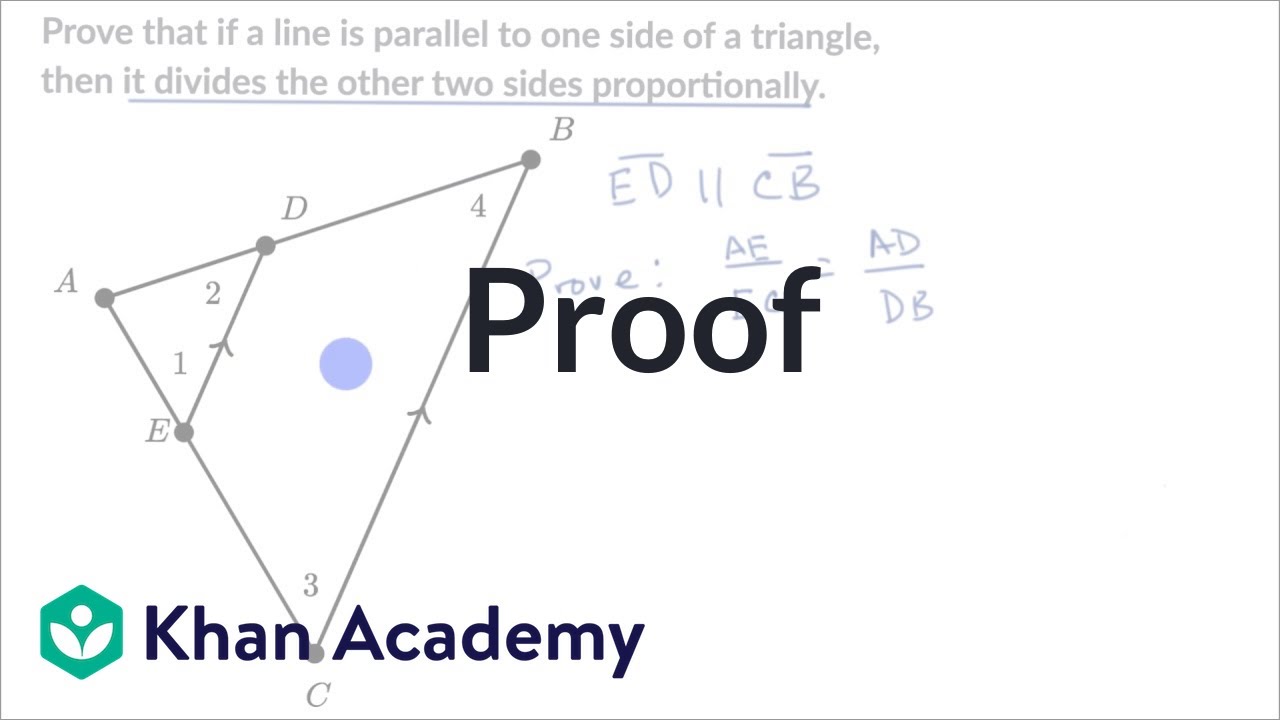
Prove that a line parallel to one triangle side divides other sides proportionately.
View more lessons or practice this subject at https://www.khanacademy.org/math/geometry/hs-geo-similarity/hs-geo-proving-relationships-using-similarity .
Khan Academy is a nonprofit organization with the mission of providing a free, world-class education for a...
cedar kilnBOT
@clever basalt Has your question been resolved?
clever basalt
so how do i prove that ex/ey = ad/db?
because segment ex and ey and ad db do not make a triangle so how do i prove that theyre the same?
 clever basalt
but how about the ad/db?
civic eagle
AD/DB = AE/EC
theres still more to the problem, but do you understand the reasoning yet?
clever basalt
OHHH yea
clever basalt
how do you prove so?
clever basalt
no i dont know
civic eagle
two triangles, with angles ∠ADE = ∠ABC, ∠AED = ∠ACB. because they are "similar," in that they share at least two angles, proven by properties of parallel lines producing similar angles with triangles.
you can draw conclusions such as AD/AB = AE/AC = DE/BC
you can even break these up into more segments
AD + DB = AB and so on
we need to use algebraic reasoning to prove AD/DB = AE/EC
this isn't even the original ratio you were tasked to prove. but knowing how to prove one allows you to prove all of them.
clever basalt
so then how do i prove my original ratio knowing this
civic eagle
you take all the ratios you can prove from parallel lines and similar triangles, and you should have enough evidence to algebraically manipulate ratios to get the result you want.
EX/EY = AD/DB
AY || XC means ΔAYE ~ ΔCXE. DE || BC means ΔABC ~ ΔADE
knowing these facts, you can produce a lot of ratios
also like i said, you can break larger segments into its smaller components within these ratios
AD/AB = AD / (AD + DB)
AY || XC means ΔAYE ~ ΔCXE this fact is super important for proving the ratio you want
ΔAYE ~ ΔCXE means we can derive 3 ratios. these three ratios and their manipulation can bring you to your answer.
clever basalt
what are the ratios?
civic eagle
can you guess
clever basalt
no?
civic eagle
why not
clever basalt
i know that theyre similar bc they have the same paralel side nd a fixed angle but idk the ratios we can derive out of them
civic eagle
similar triangles are when they share two angles, which guarantees the third angle is also similar. since no matter how long the sides of a triangle are, they are governed by ratios of these angles, we can produce ratios without knowing the true lengths of the sides.
when a segment of one triangle has the same angles as a segment of another, they are similar.
similarity provides us reasoning to derive ratios. in this case DE || BC means ΔABC ~ ΔADE, which would mean AD/AB=AE/AC=DE/BC. three ratios of each corresponding segment of the triangles.
now you can try applying the same logic to the other set of similar triangles and derive their ratios.
clever basalt
so if AY||XC then it means that ΔAYE ~ ΔCXE and means that CX/AY = CE/AE = XE/YE?
civic eagle
good
now take a look at the answer we need again
how do we get there?
starting from CX/AY = CE/AE = XE/YE and AD/AB=AE/AC=DE/BC
how do we manipulate these ratios to make EX/EY = AD/DB
clever basalt
i dont know
civic eagle
CX/AY = CE/AE = XE/YE this already has one piece of the puzzle
XE/YE is there already
can we manipulate the other two ratios to be AD/DB
clever basalt
yes? although i dont know how
clever basalt
so AD = AC +CD?
civic eagle
CD?
civic eagle
we already know the ratio of ad and db
clever basalt
AB = AD+DB?
clever basalt
@civic eagle ?
civic eagle
i feel like your original problem might've been copied wrong? should be EY/EX = AD/DB not EX/EY = AD/DB
im going to bed, but look at this. i tried explaining it to you. idk what else to do. good luck.
 clever basalt
oh thank you so much.
cedar kilnBOT
@clever basalt Has your question been resolved?
cedar kilnBOT
Channel closed
Closed by @clever basalt
Use .reopen if this was a mistake.
cedar kilnBOT
Available help channel!
Send your question here to claim the channel.
Remember:
• Ask your math question in a clear, concise manner.
• Show your work, and if possible, explain where you are stuck.
• After 15 minutes, feel free to ping <@&286206848099549185>.
• Type the command .close to free the channel when you're done.
• Be polite and have a nice day!
Read #❓how-to-get-help for further information on how to ask a good question, and about conduct in the question channels.
 steel mica
In a coordinate system where the origin is at the top left. how would i translate it into a coordinate system where the origin is the center.
cedar kilnBOT
steel mica
In a coordinate system where the origin is at the top left. how would i translat...
steel mica
.close
cedar kilnBOT
Channel closed
Closed by @steel mica
Use .reopen if this was a mistake.
Available help channel!
Send your question here to claim the channel.
Remember:
• Ask your math question in a clear, concise manner.
• Show your work, and if possible, explain where you are stuck.
• After 15 minutes, feel free to ping <@&286206848099549185>.
• Type the command .close to free the channel when you're done.
• Be polite and have a nice day!
Read #❓how-to-get-help for further information on how to ask a good question, and about conduct in the question channels.
crimson sedge
 cedar kilnBOT
crimson sedge
crimson sedge
cedar kilnBOT
crimson sedge
crimson sedge
total (T) = 20 choose 3
right triangles (R) = (20 choose 1) times 2 times 1
but the probability is not coming out to be 40/1140
 fair geyser
i don't know how you did the right triangles, but it looks too small
crimson sedge
fair geyser
i don't know how you did the right triangles, but it looks too small
choose a vertex, pick its neighbour, connect to its opposite
fair geyser
why a neighbor
crimson sedge
im actually using an octagon as a reference which could be why its wrong
fair geyser
as long as you connect to the opposite, you get a right triangle
what you actually do is pick a diameter, and then any third point works
crimson sedge
fair geyser
what you actually do is pick a diameter, and then any third point works
it doesnt seem to work on an octagon
fair geyser
paint doesn't have an octagon shape 😦
crimson sedge
yeah 
crimson sedge
fair geyser
paint doesn't have an octagon shape 😦
oh nvm im dum
 crimson sedge
yeah my drawing was terrible that i thought it was wrong lmaoo
i realized that it will be right triangle because of the umm central angle theorem
i forgot the name
subtended arc theorem?
something like that
thanks so much :)
now im getting 6/19 as answer
,w (20 * 18)/(1140)
fair geyser
there's 10 diameters, not 20
wraith daggerBOT

 Requested by ! LaV.#7677
cedar kilnBOT
Requested by ! LaV.#7677
cedar kilnBOT
Channel closed
Closed by @mild tartan
Use .reopen if this was a mistake.
Available help channel!
Send your question here to claim the channel.
Remember:
• Ask your math question in a clear, concise manner.
• Show your work, and if possible, explain where you are stuck.
• After 15 minutes, feel free to ping <@&286206848099549185>.
• Type the command .close to free the channel when you're done.
• Be polite and have a nice day!
Read #❓how-to-get-help for further information on how to ask a good question, and about conduct in the question channels.
crimson sedge
.close
 lavish plank
 cedar kilnBOT
lavish plank
cedar kilnBOT
lavish plank
 cedar kilnBOT
@lavish plank Has your question been resolved?
cedar kilnBOT
@lavish plank Has your question been resolved?
cedar kilnBOT
Channel closed
Closed due to timeout
Use .reopen if this was a mistake.
Available help channel!
Send your question here to claim the channel.
Remember:
• Ask your math question in a clear, concise manner.
• Show your work, and if possible, explain where you are stuck.
• After 15 minutes, feel free to ping <@&286206848099549185>.
• Type the command .close to free the channel when you're done.
• Be polite and have a nice day!
Read #❓how-to-get-help for further information on how to ask a good question, and about conduct in the question channels.
Channel closed
Closed by @mortal ether
Use .reopen if this was a mistake.
cedar kilnBOT
Available help channel!
Send your question here to claim the channel.
Remember:
• Ask your math question in a clear, concise manner.
• Show your work, and if possible, explain where you are stuck.
• After 15 minutes, feel free to ping <@&286206848099549185>.
• Type the command .close to free the channel when you're done.
• Be polite and have a nice day!
Read #❓how-to-get-help for further information on how to ask a good question, and about conduct in the question channels.
 tender imp
 cedar kilnBOT
tender imp
tender imp
cedar kilnBOT
tender imp
tender imp
can someone help with this question 😅
So, the idea I thought for it is that the rock has to cover 8 squares in 2 dimensions in 4 moves
so there are 3 possible cases for that
Case 1: 1 Vertical move and 3 horizontal moves
Case 2: 2 Vertical moves and 2 horizontal moves
Case 3: 3 Vertical moves and 1 Horizontal moves
 frozen valve
I was going to say to look at cases, so 1 move up then 3 sideways, or 2 up 2 sideways, or 3 up 1 sideways
but i feel like theres another way to do it
oh you had the same idea as me
tender imp
yeah
frozen valve
well 3 horizontal and 1 are equal no?
tender imp
but the permutations for move was going harder
frozen valve
actually no...
tender imp
to be exact
frozen valve
you may have cases where one horizontal move reaches the corner
in a 3 horizontal
case
you have to exclude those
tender imp
like 3 horizontal and 1 vertical will have same as 1 horizontal and 3 vertical
tender imp
frozen valve
you have to exclude those
no I solved for those
frozen valve
well if its one vertical, you need that vertical to reach the top, but what if one of the horizontal reaches the edge, that will be a dq case
thats what i was saying
tender imp
like the equation will be
x + y + z = 8
tender imp
frozen valve
well if its one vertical, you **need** that vertical to reach the top, but what ...
yes so only 1 case
tender imp
I will write my idea down on a notebook so that you will be understand it clearly
frozen valve
then you have x + y <= 7
21 cases that are right
for 3 horizontal
x2 for 1 horizontal
so solve for 2 horizontal 2 vertical
there are 49 cases for 2 horizontal 2 vertical
i think
tender imp
yes
mighty drift
frozen valve
there are 49 cases for 2 horizontal 2 vertical
just arrived, but how is that not an even number when you have symmetry between the directions
 frozen valve
mighty drift
just arrived, but how is that not an even number when you have symmetry between ...
frozen valve
mighty drift
just arrived, but how is that not an even number when you have symmetry between ...
ok well lets look how many possible ways you can cover 8 squares in 2 moves
although now that i think about it, its not 49 but 56
but ill get to that later
for horizontal you can have x and y 1 to 8
tender imp
we can't have zero though
frozen valve
yeah right
tender imp
yeah
frozen valve
but i thought about vertical first
and thought we could not have 8
actually no we cant have 8
man tricked me
right so x and y 1 to 7 right?
tender imp
yeah
mighty drift
frozen valve
ok well lets look how many possible ways you can cover 8 squares in 2 moves
|{(a, 8-a), a in {1, 7}}| = 7
frozen valve
and we need their sum to be 8, so by x, y is fixed
frozen valve
mighty drift
|{(a, 8-a), a in {1, 7}}| = 7
yeah so horizontal 7, so is vertical 7, so their product is the # of ways no?
mighty drift
order matters
frozen valve
OH nevermind
mighty drift
(h h v v), (h v h v) etc
mighty drift
mighty drift
just arrived, but how is that not an even number when you have symmetry between ...
that's where my symmetry argument comes in
it has to be even because of that factor
frozen valve
right lol, this was a brainfuck
forgive me for misleading you
I feel like we can still solve this problem by looking at cases
mighty drift
mighty drift
(h h v v), (h v h v) etc
which is 4C2 = 6
h h v v, h v h v, h v v h and the symmetrics
frozen valve
3 cases include: 1 horizontal move, 2 horizontal moves, 3 horizontal moves
And by simetry, the #of ways in 1 horizontal move and 3 horizontal moves should be the same
mighty drift
frozen valve
I feel like we can still solve this problem by looking at cases
of course you can
just better do it in a smart way that minimizes actual case counting
frozen valve
mighty drift
just better do it in a smart way that minimizes actual case counting
Right, idk what happened with me that caused me to mess up so bad
mighty drift
idk because I barely read anything before correcting you
fair geyser
it's just 6×6 yes?
mighty drift
what is "it" ?
fair geyser
it is the answer
mighty drift
mighty drift
which is 4C2 = 6
h h v v, h v h v, h v v h and the symmetrics
I already had 7*7*6 with a specific case
fair geyser
yeah, you divide a move of 7
frozen valve
So for 2 horizontal moves, we get 7 possibilities, as well as vertical moves
So shouldnt the # of cases for 2 horizntal moves be 49*42?
fair geyser
and there's 6 spots where 7 can be divided
frozen valve
42x6x6 variations for 2 horizontal
mighty drift
fair geyser
and there's 6 spots where 7 can be divided
there's this thing in chess where pieces can go backwards
mighty drift
say k in [1, 8] is the first step
Then you want (a, 8-k-a) with a in [-k, 7-k]
right
giving sum for k in [1, 8] of (8) = 64 ?
no
should be 7*6
mighty drift
mighty drift
say k in [1, 8] is the first step
Then you want (a, 8-k-a) with a in [-k, 7-k]
r...
say k in [1, 7] is the first step
Then you want (a, 7-k-a) with a in [-k, 7-k] \ {0}
giving 7 * 6
alright
hence 7*6 * 8 + 7²*6 = 630
tender imp
the answer is between 500 and 600
mighty drift
damn
mighty drift
mighty drift
hence 7\*6 \* 8 + 7²\*6 = 630
it's 7*6 * 8 + 6²*6
552
made the same mistake on the 1st one as the 2nd
noticed on the 2nd one, didn't correct the 1st one
mighty drift
6^3: 2 horizonal 2 vertical
for each direction, 6 intermediate stops
6 permutations of the directions
7*6*8: 3 and 1
for the direction that has 3 moves:
choose a 1st stop, then a 2nd, then it's forced
then there's 8 permutations and symmetries
the details of the counting are left as an exercise to the reader
cedar kilnBOT
Channel closed
Closed by @tender imp
Use .reopen if this was a mistake.
Available help channel!
Send your question here to claim the channel.
Remember:
• Ask your math question in a clear, concise manner.
• Show your work, and if possible, explain where you are stuck.
• After 15 minutes, feel free to ping <@&286206848099549185>.
• Type the command .close to free the channel when you're done.
• Be polite and have a nice day!
Read #❓how-to-get-help for further information on how to ask a good question, and about conduct in the question channels.
 prime lily
 cedar kilnBOT
prime lily
prime lily
cedar kilnBOT
prime lily
prime lily
what does the nCr mean in the binomial distribution formula
tender imp
mighty drift
say k in [1, 7] is the first step
Then you want (a, 7-k-a) with a in [-k, 7-k] \...
sorry, I didn't get this one
can you explain that?
mighty drift
prime lily
what does the nCr mean in the binomial distribution formula
the ways of choosing which trials are successes, in r among n
which is by definition, nCr options
mighty drift
tender imp
sorry, I didn't get this one
that's the complicated version
actually enumerate and detail which values are allowed at each step
which is any but the first for k
any but the current one and the last for a+k
tender imp
ohh
prime lily
hey
why is the probability of event A occuring then event B P(A) * P(B)
why is * and not some other operation
mighty drift
prime lily
why is the probability of event A occuring then event B P(A) * P(B)
intuitively or rigorously ?
prime lily
intuitively
mighty drift
look at examples
it's like making a table of outcomes
what are the odds of the die being 4 on the first throw then 3 ? make a table
it has 6*6 = 36 entries
only 1 matches that, the entry (4, 3)
so it's naturally 1/36
which is (1/6) * (1/6)
P(4) * P(3)
prime lily
what about the rigorous one
mighty drift
you're not satisfied ?
mighty drift
I suppose you're a high schooler ?
prime lily
yeah
mighty drift
I'm going to try and get rid of some of the unnecessary rigor to make this a bit more approachable
Since they're different events, we're looking at the space of outcomes S², set of all pairs of events of S (where A, B are sets of events in S)
then we take an event of this space, (w1, w2), representing a pair of individual events
We want P((w1, w2) in A * B) = P((w1 in A) and (w2 in B))
Then we use conditional probabilities: given 2 events E and F (to avoid reusing A and B)
P(E | F) = P(E and F) / P(F)
Hence P(E and F) = P(E | F) P(E), which is just P(E) P(F) since we said our events are independant
Hence, taking E = (w1 in A) and F = (w2 in B), we get
P((w1, w2) in A * B) = P(w1 in A) P(w2 in B)
therefore the question has been transferred to the understanding of Bayes's formula and conditional probabilities
cedar kilnBOT
@prime lily Has your question been resolved?
Channel closed
Closed by @prime lily
Use .reopen if this was a mistake.
Available help channel!
Send your question here to claim the channel.
Remember:
• Ask your math question in a clear, concise manner.
• Show your work, and if possible, explain where you are stuck.
• After 15 minutes, feel free to ping <@&286206848099549185>.
• Type the command .close to free the channel when you're done.
• Be polite and have a nice day!
Read #❓how-to-get-help for further information on how to ask a good question, and about conduct in the question channels.
 warm tree
 warm tree
why is this wrong
actually i see what i did
so same answer but not negative
2 + sqrt3
i used 60 - 45 instead
i guess it was 2 - sqrt3
<@&286206848099549185>
i can get -2 + sqrt3 and 2 + sqrt3 but i dont know how the answer is 2 - sqrt3
.close
cedar kilnBOT
Channel closed
Closed by @warm tree
Use .reopen if this was a mistake.
Available help channel!
Send your question here to claim the channel.
Remember:
• Ask your math question in a clear, concise manner.
• Show your work, and if possible, explain where you are stuck.
• After 15 minutes, feel free to ping <@&286206848099549185>.
• Type the command .close to free the channel when you're done.
• Be polite and have a nice day!
Read #❓how-to-get-help for further information on how to ask a good question, and about conduct in the question channels.
 marsh pond
 cedar kilnBOT
marsh pond
marsh pond
cedar kilnBOT
marsh pond
marsh pond
I can’t figure out what step I did wrong
Using e^x as an example of how to differentiate an exponential
I messed up something to do with tanx right?
drifting marlin
comparing against e^x is probably not great here since your base is also a function of x
though logarithmic differentiation seems to be the way to go, on the topic(-ish) of e
 dull oxide
$f(x)=e^{\tan{x} \ln(1+x^2)}$
wraith daggerBOT
SWR

 violet night
pretty ugly final answer
drifting marlin
such is life
dull oxide
The final answer to life is indeed quite ugly
marsh pond
.close
cedar kilnBOT
Channel closed
Closed by @marsh pond
Use .reopen if this was a mistake.
Available help channel!
Send your question here to claim the channel.
Remember:
• Ask your math question in a clear, concise manner.
• Show your work, and if possible, explain where you are stuck.
• After 15 minutes, feel free to ping <@&286206848099549185>.
• Type the command .close to free the channel when you're done.
• Be polite and have a nice day!
Read #❓how-to-get-help for further information on how to ask a good question, and about conduct in the question channels.
 lament linden
Exercise: Find the following derivative:
 cedar kilnBOT
lament linden
**Exercise:** Find the following derivative:
cedar kilnBOT
lament linden
**Exercise:** Find the following derivative:
Please don't occupy multiple help channels.
 bright bridge
uh
 dense nacelle
lament linden
**Exercise:** Find the following derivative:
dense nacelle
lament linden
**Exercise:** Find the following derivative:
Can you translate in english plz?
gentle flower
he did already
lament linden
For the following functions, calculate the derivative indicated
dense nacelle
lament linden
**For the following functions, calculate the derivative indicated**
Ok
dense nacelle
gentle flower
he did already
Didn't see that
lament linden
lament linden
**Exercise:** Find the following derivative:
Whats the approach here? @mighty drift
dull oxide
Induction may be the way to go
Look for a pattern after applying derivative a few times
cedar kilnBOT
@lament linden Has your question been resolved?
cedar kilnBOT
Channel closed
Closed due to timeout
Use .reopen if this was a mistake.
cedar kilnBOT
Available help channel!
Send your question here to claim the channel.
Remember:
• Ask your math question in a clear, concise manner.
• Show your work, and if possible, explain where you are stuck.
• After 15 minutes, feel free to ping <@&286206848099549185>.
• Type the command .close to free the channel when you're done.
• Be polite and have a nice day!
Read #❓how-to-get-help for further information on how to ask a good question, and about conduct in the question channels.
 granite crystal
 cedar kilnBOT
granite crystal
granite crystal
cedar kilnBOT
granite crystal
granite crystal
stuck on part b
i have absolutely no clue where to start
part a was fine
c = 6, b=3, a =2
drifting marlin
X1 = X2 if they both equal a, or they both equal b, or they both equal c
cedar kilnBOT
@granite crystal Has your question been resolved?
granite crystal
ok
i alr knwe that
thats their distribution
im just confused on what to do next
sorry i wasnt clear
thats my fault
cedar kilnBOT
Channel closed
Closed due to timeout
Use .reopen if this was a mistake.
Available help channel!
Send your question here to claim the channel.
Remember:
• Ask your math question in a clear, concise manner.
• Show your work, and if possible, explain where you are stuck.
• After 15 minutes, feel free to ping <@&286206848099549185>.
• Type the command .close to free the channel when you're done.
• Be polite and have a nice day!
Read #❓how-to-get-help for further information on how to ask a good question, and about conduct in the question channels.
 hollow garnet
 cedar kilnBOT
hollow garnet
hollow garnet
cedar kilnBOT
hollow garnet
hollow garnet
So here if we take the limit it's 1/1 or just 1 because the powers are the same