#help-13
1 messages · Page 93 of 1
 wary anchor
but i got it wrong for question B
 subtle raven
You only got it wrong because you had B and C in the wrong fractions. Part A should be correct with your ordering
Just follow through with it in part B
Instead of using the form you were given in the question
 wary anchor
im gonna try again
subtle raven
Not sure how you got from line 5 to line 6 in your second image
wary anchor
subtle raven
Not sure how you got from line 5 to line 6 in your second image
i did 3(-1/3) -2 which is -3
2/3 ln(-3) = ln(-3^2/3)
but ln(-3) gives me undefined
wary anchor
so its just 3?
wary anchor
right okay
thats prob where i went wrong
yep that was it
thanks!! :)))))
.close
 cedar kilnBOT
Channel closed
Closed by @wary anchor
Use .reopen if this was a mistake.
subtle raven
No worries
cedar kilnBOT
 Available help channel!
Send your question here to claim the channel.
Remember:
• Ask your math question in a clear, concise manner.
• Show your work, and if possible, explain where you are stuck.
• After 15 minutes, feel free to ping <@&286206848099549185>.
• Type the command .close to free the channel when you're done.
• Be polite and have a nice day!
Read #❓how-to-get-help for further information on how to ask a good question, and about conduct in the question channels.
 cedar kilnBOT
 untold locust
untold locust
untold locust
this is all new to me i only know how to solve right triangles
 dusk finch
do you know cosine law?
 dusk finch

Khan Academy
Trigonometric ratios are not only useful for right triangles, but also for any other kind of triangle. In this unit, you will discover how to apply the sine, cosine, and tangent ratios, along with the laws of sines and cosines, to find all of the side lengths and all of the angle measures in any triangle with confidence.
this is whole about non-right triangles and applications of sin, cos etc
untold locust
nice
dusk finch
You are particularly interested in law of cosines now, but I also recommend law of sines
cedar kilnBOT
Channel closed
Closed by @untold locust
Use .reopen if this was a mistake.
dusk finch
untold locust
is there also a law of tan
with law of sine and cosine, you can solve for all sides and angles in all the side-side-side, angle-side-angle etc. triangles
I dont think there is law of tan
oh, there is
this one
 cedar kilnBOT
Available help channel!
cedar kilnBOT
Available help channel!
Send your question here to claim the channel.
Remember:
• Ask your math question in a clear, concise manner.
• Show your work, and if possible, explain where you are stuck.
• After 15 minutes, feel free to ping <@&286206848099549185>.
• Type the command .close to free the channel when you're done.
• Be polite and have a nice day!
Read #❓how-to-get-help for further information on how to ask a good question, and about conduct in the question channels.
 crimson sedge
Hello, so I'm facing another problem now :
A regular pentagon with apothem length 3.24m and the radius of its circle is 4m.
I know that A=1/2(nsa)
N being number of sides
s being side length
a being apothem
and I also know that perimeter is p=ns, how does one solve this exactly?
cedar kilnBOT
crimson sedge
Hello, so I'm facing another problem now :
A regular pentagon with apothem lengt...
crimson sedge
I know I have to use pythagoreas theorem to get the side length
but how will I get the number of sides?
dusk finch
didnt you say it's pentagon?
sorry if I misunderstood, but since it's pentagon it should have 5 sides
crimson sedge
Sorry I meant polygon
 tropic oxide
radius of its circle...? which circle
circumscribed or inscribed?
ah, wait. no.
it can only be the former.
crimson sedge
tropic oxide
radius of its circle...? which circle
Doesn't say it anywhere
 opaque root
Apothem = radius * cos(a); where a=360º/n; where n = number of sides.
apothem = radius * cos(π/n)
3.24m = 4m * cos(π/n)
now solve for n, and you will get the number of sides
if the number you get is not integer, you always raise the number up
so if you get x,0001 it will be x+1
number of side
cedar kilnBOT
Channel closed
Closed by @shrewd fractal
Use .reopen if this was a mistake.
Available help channel!
Send your question here to claim the channel.
Remember:
• Ask your math question in a clear, concise manner.
• Show your work, and if possible, explain where you are stuck.
• After 15 minutes, feel free to ping <@&286206848099549185>.
• Type the command .close to free the channel when you're done.
• Be polite and have a nice day!
Read #❓how-to-get-help for further information on how to ask a good question, and about conduct in the question channels.
 thorny granite
how to show that a sequence is cyclic? and know its period T?
(in my case i have the relation between two consecutives terms U(k+1) = (U(k)+STEP)%MOD and U(0) = some integer (can be anything) )
- well, i knw that bcz it has % MOD in it then it must be cyclic but is there a way in general to show that a sequence is cyclic (or not).
- also another question : the period T can't possibly exceed MOD value right?
*STEP and MOD are const parameters
cedar kilnBOT
thorny granite
how to show that a sequence is cyclic? and know its period T?
(in my case i hav...
thorny granite
this is the whole problem : (it's cp) :
 cedar kilnBOT
@thorny granite Has your question been resolved?
thorny granite
<@&286206848099549185>
cedar kilnBOT
@thorny granite Has your question been resolved?
cedar kilnBOT
Channel closed
Closed due to timeout
Use .reopen if this was a mistake.
cedar kilnBOT
Available help channel!
Send your question here to claim the channel.
Remember:
• Ask your math question in a clear, concise manner.
• Show your work, and if possible, explain where you are stuck.
• After 15 minutes, feel free to ping <@&286206848099549185>.
• Type the command .close to free the channel when you're done.
• Be polite and have a nice day!
Read #❓how-to-get-help for further information on how to ask a good question, and about conduct in the question channels.
 queen sonnet
-9+6 is -3.
This is because when you add to a negative number, its like subtracting from it as you move up in the numberline.
Try using the same principle.
If adding makes the negative closer to 0, subtracting should do the opposite.
 cold briar
?
queen sonnet
You can make a ticket anytime, but I won't be available any time.
cold briar
random question, how old are you?
if you don't mind me asking
<@&268886789983436800>
you can't be below 13 to use discord bro
oh he's gone
.close
cedar kilnBOT
Channel closed
Closed by @cold briar
Use .reopen if this was a mistake.
cedar kilnBOT
Available help channel!
Send your question here to claim the channel.
Remember:
• Ask your math question in a clear, concise manner.
• Show your work, and if possible, explain where you are stuck.
• After 15 minutes, feel free to ping <@&286206848099549185>.
• Type the command .close to free the channel when you're done.
• Be polite and have a nice day!
Read #❓how-to-get-help for further information on how to ask a good question, and about conduct in the question channels.
 jagged parrot
Hi, I’m having problem with this improper integral. How do we use the comparison test for this? Appreciate any help!
 cedar kilnBOT
jagged parrot
Hi, I’m having problem with this improper integral. How do we use the comparison...
cedar kilnBOT
jagged parrot
Hi, I’m having problem with this improper integral. How do we use the comparison...
 west gazelle
maybe try factoring e^4x in the denominator
then you’ll get an integral of a sum
the term are positive and the sum converges so you can switch the integral and the sum
then you calculate the integral and you sum the result
@jagged parrot
jagged parrot
I’m currently using the same integral, but wth in 3e^x
It’s troubling
Factoring of e^4x gives the correct answer which is divergent, but my school website does not accept that
.close
cedar kilnBOT
Channel closed
Closed by @jagged parrot
Use .reopen if this was a mistake.
Available help channel!
Send your question here to claim the channel.
Remember:
• Ask your math question in a clear, concise manner.
• Show your work, and if possible, explain where you are stuck.
• After 15 minutes, feel free to ping <@&286206848099549185>.
• Type the command .close to free the channel when you're done.
• Be polite and have a nice day!
Read #❓how-to-get-help for further information on how to ask a good question, and about conduct in the question channels.
wary anchor
 cedar kilnBOT
wary anchor
cedar kilnBOT
wary anchor
 west gazelle
what’s the question
 wary anchor
the answer is 8/3 and they used a different method
crimson sedge
,w graph x(4-x^2)^(1/2)
 wraith daggerBOT


 Requested by Renegade#4545
crimson sedge
Requested by Renegade#4545
crimson sedge
how can we find the area from 0 to 2 of f(x)
 cinder urchin
wary anchor
the answer is 8/3 and they used a different method
cinder urchin
wary anchor
the answer is 8/3 and they used a different method
they might have used integration
wary anchor
cinder urchin
they might have used integration
thats what i did
 wild spear
wary anchor
the answer is 8/3 and they used a different method
wild spear
wary anchor
the answer is 8/3 and they used a different method
i believe the integral of -1/2 u^1/2 is not -3u^3/2
wary anchor
its all integration
 fringe nest
is there even a different way to do it instead of integration?
fringe nest
crimson sedge
how can we find the area from 0 to 2 of f(x)
put limits from 0 to 2
wary anchor
wild spear
i believe the integral of -1/2 u^1/2 is not -3u^3/2
oh yeah its 1/3
wild spear
-1/3
crimson sedge
fringe nest
put limits from 0 to 2
I was asking the OP
cinder urchin
fringe nest
is there even a different way to do it instead of integration?
if we know the exact geometry then maybe
crimson sedge
but yes, that's correct
fringe nest
crimson sedge
I was asking the OP
i thought you were the op lol
 cedar kilnBOT
Channel closed
Closed by @wary anchor
Use .reopen if this was a mistake.
Available help channel!
Send your question here to claim the channel.
Remember:
• Ask your math question in a clear, concise manner.
• Show your work, and if possible, explain where you are stuck.
• After 15 minutes, feel free to ping <@&286206848099549185>.
• Type the command .close to free the channel when you're done.
• Be polite and have a nice day!
Read #❓how-to-get-help for further information on how to ask a good question, and about conduct in the question channels.
 south remnant
what is e^2?
cedar kilnBOT
south remnant
what is e^2?
south remnant
is it just e*e?
 ancient lodge
Yes, $e^2=e \cdot e$.
wraith daggerBOT
Civil Service Pigeon
 ancient lodge
@south remnant
crimson sedge
$e^x = e \cdot e \cdot \hdots \cdot e$, $x$ times.
south remnant
i thought i heard something about exp(x) related to e^x in the past
wraith daggerBOT
null
 ancient lodge
south remnant
i thought i heard something about exp(x) related to e^x in the past
ancient lodge
south remnant
i thought i heard something about exp(x) related to e^x in the past
They're the same thing
south remnant
ye but exp(x) is a infinite series or something
south remnant
oh really?
crimson sedge
yeah, it's just a matter of notation
south remnant
i thought it was 1/1!+...
crimson sedge
well, $e^x = 1 + x + \frac{x^2}{2} + \frac{x^3}{3!} + \hdots$, yes.
wraith daggerBOT
null
 crimson sedge
this is just the Maclaurin series for e^x
it approximates the behavior of e^x near zero
crimson sedge
yes
crimson sedge
that's how e^x is defined as a polynomial
well, Taylor series is a generalized version of the Maclaurin series
the Maclaurin series is centered at x = 0
south remnant
ok
crimson sedge
The Taylor series, say for $e^x$, is $\sum_{n=0}^\infty \frac{(x-a)^n}{n!}$
wraith daggerBOT
null
 cedar kilnBOT
Channel closed
Closed by @south remnant
Use .reopen if this was a mistake.
Available help channel!
Send your question here to claim the channel.
Remember:
• Ask your math question in a clear, concise manner.
• Show your work, and if possible, explain where you are stuck.
• After 15 minutes, feel free to ping <@&286206848099549185>.
• Type the command .close to free the channel when you're done.
• Be polite and have a nice day!
Read #❓how-to-get-help for further information on how to ask a good question, and about conduct in the question channels.
crimson sedge
Hello, I have another question, so I know that bN=2, BL=2.5,NL=1.5,KL=3, but in this triangle, how does one get MT, MN, and TC?
cedar kilnBOT
crimson sedge
Hello, I have another question, so I know that bN=2, BL=2.5,NL=1.5,KL=3, but in ...
crimson sedge
 crimson sedge
Yep
crimson sedge
 supple forge
alright
supple forge
alright
I'm stuck in getting MT, MN and TC
supple forge
No any ideas how to start?
crimson sedge
None
supple forge
crimson sedge
are you sure KL is 3?
crimson sedge
supple forge
are you sure KL is 3?
the two parts are 1.5 so I added them to make the whole thing 3 (MN is the perpindicular bisectors)
supple forge
is there more info to this task
crimson sedge
Nope
crimson sedge
supple forge
is there more info to this task
Not anything else
only everything I've said
supple forge
hmm, I will let you know if I will know how to
supple forge
crimson sedge
Is LC equal to KL?
crimson sedge
supple forge
Is LC equal to KL?
Doesn't specify it.
crimson sedge
supple forge
by pencil
Oh yeah, that was to show LC=CM
supple forge
do you have answers, by any chance?
crimson sedge
supple forge
do you have answers, by any chance?
No idea where to start
supple forge
NT is 1:3 of MN
We should work with NL and LC
because it's the only triangle who has known 2 lengths
if we will get NT we could multiply it by 2 and we will get MT
cedar kilnBOT
@crimson sedge Has your question been resolved?
cedar kilnBOT
Channel closed
Closed by @shrewd fractal
Use .reopen if this was a mistake.
cedar kilnBOT
Available help channel!
Send your question here to claim the channel.
Remember:
• Ask your math question in a clear, concise manner.
• Show your work, and if possible, explain where you are stuck.
• After 15 minutes, feel free to ping <@&286206848099549185>.
• Type the command .close to free the channel when you're done.
• Be polite and have a nice day!
Read #❓how-to-get-help for further information on how to ask a good question, and about conduct in the question channels.
 spark kiln
help
cedar kilnBOT
spark kiln
help
spark kiln
.close
cedar kilnBOT
Channel closed
Closed by @spark kiln
Use .reopen if this was a mistake.
spark kiln
.reopen
cedar kilnBOT
✅
spark kiln

$[
f(x) = \sum_{n=0}^{\infty} c_n x^n = \sum_{n=0}^{\infty} (1^{(1-n\mod 2)}\cdot9^{n\mod 2}) x^n
]$
wraith daggerBOT
MHuseyin
Compile Error! Click the  reaction for more information.
(You may edit your message to recompile.)
 spark kiln
simply my question is how to define alternation of 9 and 1 into the geometric series representation of the function ?
 modern compass
cedar kilnBOT
modern compass
cedar kilnBOT
Channel closed
Closed by @spark kiln
Use .reopen if this was a mistake.
Available help channel!
Send your question here to claim the channel.
Remember:
• Ask your math question in a clear, concise manner.
• Show your work, and if possible, explain where you are stuck.
• After 15 minutes, feel free to ping <@&286206848099549185>.
• Type the command .close to free the channel when you're done.
• Be polite and have a nice day!
Read #❓how-to-get-help for further information on how to ask a good question, and about conduct in the question channels.
 crystal raptor
test
cedar kilnBOT
crystal raptor
test
crystal raptor
.close
cedar kilnBOT
Channel closed
Closed by @crystal raptor
Use .reopen if this was a mistake.
crystal raptor
.reopen
cedar kilnBOT
✅
 cedar kilnBOT
Channel closed
Closed by @crystal raptor
Use .reopen if this was a mistake.
cedar kilnBOT
Available help channel!
Send your question here to claim the channel.
Remember:
• Ask your math question in a clear, concise manner.
• Show your work, and if possible, explain where you are stuck.
• After 15 minutes, feel free to ping <@&286206848099549185>.
• Type the command .close to free the channel when you're done.
• Be polite and have a nice day!
Read #❓how-to-get-help for further information on how to ask a good question, and about conduct in the question channels.
 frigid sierra
im blank
k^2 = 64
Square root
isnt it
±k = ±8
so k = 8 because ± the ' - ' will cancel out ( the " + " cannot ? )
cedar kilnBOT
frigid sierra
im blank
k^2 = 64
Square root
isnt it
±k = ±8
so k = 8 because ± the ' - ' ...
 bright bridge
no?
 royal loom
No
 upper garnet
No
 south tundra
Just one plus or minus
cedar kilnBOT
@frigid sierra Has your question been resolved?
frigid sierra
south tundra
Just one plus or minus
So ± does not go to both sides of the equation?
Oh i see
thanks everyone
cedar kilnBOT
Channel closed
Closed due to timeout
Use .reopen if this was a mistake.
Available help channel!
Send your question here to claim the channel.
Remember:
• Ask your math question in a clear, concise manner.
• Show your work, and if possible, explain where you are stuck.
• After 15 minutes, feel free to ping <@&286206848099549185>.
• Type the command .close to free the channel when you're done.
• Be polite and have a nice day!
Read #❓how-to-get-help for further information on how to ask a good question, and about conduct in the question channels.
spark kiln
Help
cedar kilnBOT
spark kiln
Help


 crude chasm
 cedar kilnBOT
Channel closed
Closed by @spark kiln
Use .reopen if this was a mistake.
Available help channel!
Send your question here to claim the channel.
Remember:
• Ask your math question in a clear, concise manner.
• Show your work, and if possible, explain where you are stuck.
• After 15 minutes, feel free to ping <@&286206848099549185>.
• Type the command .close to free the channel when you're done.
• Be polite and have a nice day!
Read #❓how-to-get-help for further information on how to ask a good question, and about conduct in the question channels.
 warm vector
 cedar kilnBOT
warm vector
cedar kilnBOT
warm vector

 cosmic steppe
Identify the type of curve it is
Sure
But be aware of the t-bounds
Is it parametrized clockwise or anticlockwise
cosmic steppe
x = a cos(t), y = b sin(t) -> anticlockwise
x = a sin(t), y = b cos(t) -> clockwise
cosmic steppe
warm vector
Its a circle right
No
warm vector
Oh
cosmic steppe
It's an ellipse
warm vector
I see
warm vector
cosmic steppe
Is it parametrized clockwise or anticlockwise
But how will this help in the question?
Like what’s the point of it
cosmic steppe
It tells you that the t-bounds simply just follows the direction of the unit circle
Starts on the positive x axis
warm vector
Oh
cosmic steppe
And because t goes from 0 to pi, it'll end on the negative x axis
cedar kilnBOT
Channel closed
Closed by @warm vector
Use .reopen if this was a mistake.
Available help channel!
Send your question here to claim the channel.
Remember:
• Ask your math question in a clear, concise manner.
• Show your work, and if possible, explain where you are stuck.
• After 15 minutes, feel free to ping <@&286206848099549185>.
• Type the command .close to free the channel when you're done.
• Be polite and have a nice day!
Read #❓how-to-get-help for further information on how to ask a good question, and about conduct in the question channels.
 night finch
I have to graph f(x) = 4 times 2 to the power of x, How do I do that?
upper garnet
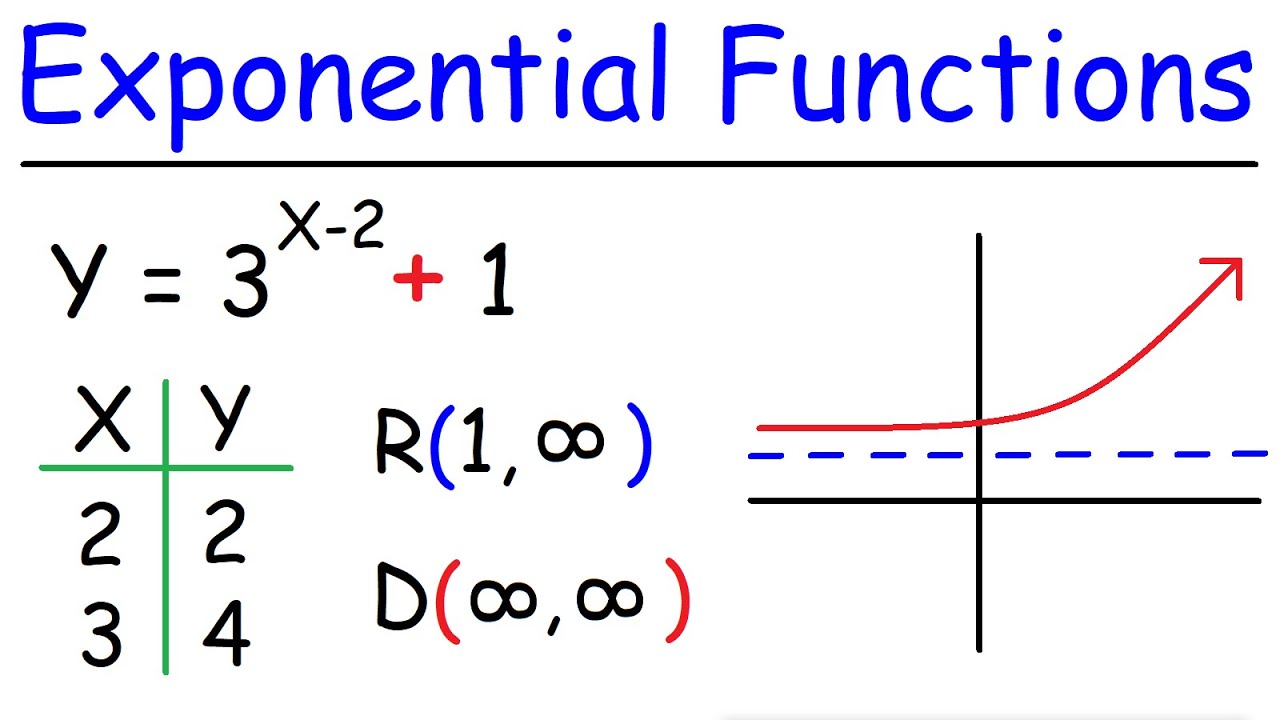
This algebra video tutorial explains how to graph exponential functions using transformations and a data table. It explains how to identify the horizontal asymptote as well. This video contains plenty of examples and practice problems. It also explains how to identify the domain and range in interval notation.
My Website: https://www.video-...
cosmic steppe
Just choose random points
Random x values
Plot them
Connect the dots
Yield to the horizontal asymptote
night finch
upper garnet
https://www.youtube.com/watch?v=DASfP8KAyvs
Ive watched this but it doesnt rlly help
night finch
cosmic steppe
Just choose random points
what about the times four?
cosmic steppe
You consider that
Like
Here
What would f(1) be
f(0)
f(2)
And what's the horizontal asymptote
night finch
0
cosmic steppe
I would get the y-intercept, 2 other points , and the asymptote
cedar kilnBOT
Channel closed
Closed by @night finch
Use .reopen if this was a mistake.
Available help channel!
Send your question here to claim the channel.
Remember:
• Ask your math question in a clear, concise manner.
• Show your work, and if possible, explain where you are stuck.
• After 15 minutes, feel free to ping <@&286206848099549185>.
• Type the command .close to free the channel when you're done.
• Be polite and have a nice day!
Read #❓how-to-get-help for further information on how to ask a good question, and about conduct in the question channels.
 gilded rain
have a question to share.... A transporter company has THREE 30-passenger busses and NINE 15-passenger buses. The company contracts to transport more than 120 passengers a day to national parks. it costs 3000 dollars per day to run each 15 passenger bus ( for example) and the company must spend less than 12000 dollars per day in order to meet costs. If x and y are respectively the number of 30-passenger and 15-passenger buses used each day i. show that 2x+y>8 ii. write down three other inequalities involving x and y iii. illustrate the solution set of the four inequalities on a graph paper and shade the unwanted region
cedar kilnBOT
gilded rain
have a question to share.... A transporter company has THREE 30-passenger busse...
bright bridge
!status
cedar kilnBOT
What step are you on?
1. I don't know where to begin
2. I have begun but got stuck midway
3. I got an answer but I'm told it's wrong
4. I got an answer and would like my work checked
5. I have a question about someone else's worked solution
6. None of the above
6
cedar kilnBOT
@gilded rain Has your question been resolved?
gilded rain
cedar kiln
<@1091770412318339103> Has your question been resolved?
nop
cedar kilnBOT
@gilded rain Has your question been resolved?
cedar kilnBOT
Channel closed
Closed due to timeout
Use .reopen if this was a mistake.
Available help channel!
Send your question here to claim the channel.
Remember:
• Ask your math question in a clear, concise manner.
• Show your work, and if possible, explain where you are stuck.
• After 15 minutes, feel free to ping <@&286206848099549185>.
• Type the command .close to free the channel when you're done.
• Be polite and have a nice day!
Read #❓how-to-get-help for further information on how to ask a good question, and about conduct in the question channels.
 sweet moss
I didn’t get the same answer for x and y… anyone know what I did wrong?
 cedar kilnBOT
sweet moss
I didn’t get the same answer for x and y… anyone know what I did wrong?
cedar kilnBOT
sweet moss
I didn’t get the same answer for x and y… anyone know what I did wrong?
Please don't occupy multiple help channels.
@sweet moss Has your question been resolved?
 carmine bronze
sweet moss
I didn’t get the same answer for x and y… anyone know what I did wrong?
carmine bronze
sweet moss
I didn’t get the same answer for x and y… anyone know what I did wrong?
For "with x", you did not change the bounds for x. You have two different variables, x and u at the end.
sweet moss
carmine bronze
For "with x", you did not change the bounds for **x**. You have two different v...
oh right thank you!
cedar kilnBOT
Channel closed
Closed due to timeout
Use .reopen if this was a mistake.
Available help channel!
Send your question here to claim the channel.
Remember:
• Ask your math question in a clear, concise manner.
• Show your work, and if possible, explain where you are stuck.
• After 15 minutes, feel free to ping <@&286206848099549185>.
• Type the command .close to free the channel when you're done.
• Be polite and have a nice day!
Read #❓how-to-get-help for further information on how to ask a good question, and about conduct in the question channels.
 stark lily
 cedar kilnBOT
stark lily
https://i.imgur.com/cwyezfA.png
stark lily
cedar kilnBOT
stark lily
https://i.imgur.com/cwyezfA.png
stark lily
is this $9 * 10^4 - 9^5$?
wraith daggerBOT
Suro

 mental trail
Yeah it isn't the correct answer
mental trail
stark lily
is this $9 * 10^4 - 9^5$?
What is your reasoning behind this?
stark lily
the first digit can't be 0, so 9 choices
then rest of the 4 digits can be 0-9 so 10 choices each
that's how we get 9 * 10^4 total possible 5 digit numbers
then if we want numbers that don't have any 0s
we pick 1 of 9 numbers 5 times
so 9^5
mental trail
Yes, correct!
stark lily
then the question just wants the difference no?
mental trail
Oh I thought the question was asking for all numbers below 100000, instead of 5 digit numbers
Mb
stark lily
oh so its correct?
mental trail
It is xd
cedar kilnBOT
Channel closed
Closed by @stark lily
Use .reopen if this was a mistake.
Available help channel!
Send your question here to claim the channel.
Remember:
• Ask your math question in a clear, concise manner.
• Show your work, and if possible, explain where you are stuck.
• After 15 minutes, feel free to ping <@&286206848099549185>.
• Type the command .close to free the channel when you're done.
• Be polite and have a nice day!
Read #❓how-to-get-help for further information on how to ask a good question, and about conduct in the question channels.
Channel closed
Closed due to the original message being deleted
Available help channel!
Send your question here to claim the channel.
Remember:
• Ask your math question in a clear, concise manner.
• Show your work, and if possible, explain where you are stuck.
• After 15 minutes, feel free to ping <@&286206848099549185>.
• Type the command .close to free the channel when you're done.
• Be polite and have a nice day!
Read #❓how-to-get-help for further information on how to ask a good question, and about conduct in the question channels.
 jade stag
how would you find a's formula using p_o e ^-tk ?
 cedar kilnBOT
jade stag
how would you find a's formula using p_o e ^-tk ?
cedar kilnBOT
jade stag
how would you find a's formula using p_o e ^-tk ?
 leaden snow
what the heck is "a"
 lethal jackal
part a I think
jade stag
a_0 is original amount invested
 halcyon marlin
so p_0?
halcyon marlin
i dont think -0.99021 is correct
also its a function of t
but you put no t?
first, how did you find -0.99021
jade stag
ln(2) / .7
halcyon marlin
ok but where did that come from
jade stag
the formula
for doubling time
at decrease
is ln2/0.7
which you agree with correct
? @halcyon marlin
halcyon marlin
that would be the halving time if 0.7=k
jade stag
-0.99021
halcyon marlin
you are trying to find k
you are mixing things up i think
you found the halving time using the variable you are trying to find
and then put the halving time equal to it
just do one of the things two things i suggested
$T_{1/2}=\frac{ln(2)}{k}$
wraith daggerBOT
Køter
 halcyon marlin
i mean you can see here that its not very useful to use this no?
when you dont know T or k yet
halcyon marlin
k is what youre trying to find
if you knew it was 0.7
your answer would just be 8400e^(-0.7t)
you wouldnt need to do anything
and the 2nd problem is thinking k is somehow equal to T_1/2
just do one of the 2 things i suggested 💀
jade stag
one of two things u suggested...? where
 halcyon marlin
jade stag
8400(.70) ^ 9
halcyon marlin
jade stag
8400(.70) ^ 9
yes and what is this equal?
halcyon marlin
jade stag
8400e^-.70(9) ?
no.
jade stag
halcyon marlin
yes and what is this equal?
338
halcyon marlin
ok, so you have
338=p_0e^(-kt)
we know the value of 2 of the variables
p_0=?
t=?
jade stag
oops im going far ahead
myb
i was solving for c
i told u
how i got 338 man
just plugged it in
halcyon marlin
but your answer for t
jade stag
using the other doubling formula
halcyon marlin
shows me you dont understand
jade stag
8400(0.8)^t t=9
jade stag
bro im trying to be a good mood today. legit my neck doctor fucked me up real good
like 3-4 months ago
now i gota hump on my neck
i look like a lama
jade stag
0.342192472
halcyon marlin
sure its a bit inaccurate i think cause 338 is rounded
using 5880 at t=1 would be 100% accurate
halcyon marlin
8400*0.7^1=5880
jade stag
why 1
jade stag
o.o
halcyon marlin
,w 5880=8400e^(-k)
wraith daggerBOT

 Requested by Køter#5504
halcyon marlin
Requested by Køter#5504
halcyon marlin
,w ln(10/7)
wraith daggerBOT
 Requested by Køter#5504
halcyon marlin
Requested by Køter#5504
halcyon marlin
$8400e^{ln(0.7^t)}=8400e^{ln(0.7)t}$
wraith daggerBOT
Køter
 halcyon marlin
jade stag
c
halcyon marlin
jade stag
c
do you need to do it by hand and can you?
is just algebra
i think we did it once before
halcyon marlin
ok, well you have your answer here
jade stag
idk how ima pull it off
halcyon marlin
for furture just do e^(ln()) method its so much easier imo
than solving an equation
jade stag
wraith dagger
**Køter**
answer is here?
jade stag
wraith dagger
**Køter**
why is ln up there
halcyon marlin
no that was the alternative way of doing it
jade stag
and t as exponent on the left
cedar kilnBOT
@jade stag Has your question been resolved?
 neat forum
hey can someone help me with my math
cedar kilnBOT
Channel closed
Closed due to timeout
Use .reopen if this was a mistake.
Available help channel!
Send your question here to claim the channel.
Remember:
• Ask your math question in a clear, concise manner.
• Show your work, and if possible, explain where you are stuck.
• After 15 minutes, feel free to ping <@&286206848099549185>.
• Type the command .close to free the channel when you're done.
• Be polite and have a nice day!
Read #❓how-to-get-help for further information on how to ask a good question, and about conduct in the question channels.
 brittle field
 cedar kilnBOT
brittle field
cedar kilnBOT
cedar kilnBOT
brittle field
cedar kilnBOT
@brittle field Has your question been resolved?
Channel closed
Closed by @brittle field
Use .reopen if this was a mistake.
Available help channel!
Send your question here to claim the channel.
Remember:
• Ask your math question in a clear, concise manner.
• Show your work, and if possible, explain where you are stuck.
• After 15 minutes, feel free to ping <@&286206848099549185>.
• Type the command .close to free the channel when you're done.
• Be polite and have a nice day!
Read #❓how-to-get-help for further information on how to ask a good question, and about conduct in the question channels.
brittle field
.close
 coral surge
help
cedar kilnBOT
coral surge
help
 subtle raven
Well you've done one case, namely x <= -4
And your working seems okay
You gotta do the other case now
Namely x > 4
You haven't done anything wrong so far
subtle raven
You're taking -ve 4 since that will make the expression x + 4 zero or negative
The absolute value function is defined in cases
Or in a piecewise manner
If x + 4 is negative
Then the only way to make it positive again using the absolute value is to take - (x+4)
coral surge
subtle raven
Namely x > 4
then why again I will take positive 4?
it won't make the expression zero this time
subtle raven
It will make the expression positive
I.e: x + 4 is now positive
This is not the same as taking -(x + 4)
In other words, |x + 4| = x + 4
If x > -4
On the other hand, if x <= -4 we have |x + 4| = -(x + 4)
cedar kilnBOT
@coral surge Has your question been resolved?
cedar kilnBOT
@coral surge Has your question been resolved?
cedar kilnBOT
Channel closed
Closed due to timeout
Use .reopen if this was a mistake.
Available help channel!
Send your question here to claim the channel.
Remember:
• Ask your math question in a clear, concise manner.
• Show your work, and if possible, explain where you are stuck.
• After 15 minutes, feel free to ping <@&286206848099549185>.
• Type the command .close to free the channel when you're done.
• Be polite and have a nice day!
Read #❓how-to-get-help for further information on how to ask a good question, and about conduct in the question channels.
 inland creek
help
cedar kilnBOT
inland creek
help
inland creek

 wet bay
ok
royal loom
Which question?
wet bay
inland creek
i dont get
lets do an easy one first, $x/2+x/3$
wraith daggerBOT
Helen Granda Musa
 wet bay
do you know how to solve it
royal loom
you can input fractions like this btw helen $\frac{x}{2}$
wraith daggerBOT
AustinU
 wet bay
inland creek
i dont get
wet bay
inland creek
i dont get
$\frac{x}{2}$+$\frac{x}{3}$
wraith daggerBOT
Helen Granda Musa
 inland creek
what
inland creek
wraith dagger
**Helen Granda Musa**
uhh
wet bay
inland creek
uhh
try solve for the question i provide
royal loom
yes, and what process did you use to figure that out
if you could write them out step by step
inland creek
uhh
i made the denominators
the same
like
2x3 and 3x2
and the the numerators would be liek
royal loom
Yes, I get what you are saying
royal loom
What is stopping you from doing the same for the questions above?
wraith daggerBOT
AustinU

 cedar kilnBOT
@inland creek Has your question been resolved?
Channel closed
Closed by @inland creek
Use .reopen if this was a mistake.
Available help channel!
Send your question here to claim the channel.
Remember:
• Ask your math question in a clear, concise manner.
• Show your work, and if possible, explain where you are stuck.
• After 15 minutes, feel free to ping <@&286206848099549185>.
• Type the command .close to free the channel when you're done.
• Be polite and have a nice day!
Read #❓how-to-get-help for further information on how to ask a good question, and about conduct in the question channels.
 final lily
 cedar kilnBOT
final lily
final lily
cedar kilnBOT
final lily
final lily
How do I find a and b
wet bay
what you get
 wet bay
do the same things
you will get 2 functions contain a and b
i think you are able to solve it when i saying that
wet bay
show me your work
final lily
 final lily
wet bay
show me your work
final lily
wet bay
show me your work
Looks correct?
wet bay
looks decent, anything else that has question?
final lily
wet bay
looks decent, anything else that has question?
Only this question for now
Tysm
.closed
.close
cedar kilnBOT
Channel closed
Closed by @final lily
Use .reopen if this was a mistake.
Available help channel!
Send your question here to claim the channel.
Remember:
• Ask your math question in a clear, concise manner.
• Show your work, and if possible, explain where you are stuck.
• After 15 minutes, feel free to ping <@&286206848099549185>.
• Type the command .close to free the channel when you're done.
• Be polite and have a nice day!
Read #❓how-to-get-help for further information on how to ask a good question, and about conduct in the question channels.
 exotic verge
Quick rref question
cedar kilnBOT
exotic verge
Quick rref question
lethal jackal
that is the rref
exotic verge
Well
When u have a row of all zeros
I only have 1 pivot
which is in column 1
so like.. now i'm done?
why?
lethal jackal
if you compute the rref of the original matrix, you get that matrix
exotic verge
yes
lethal jackal
not sure what you're asking
cedar kilnBOT
Channel closed
Closed by @exotic verge
Use .reopen if this was a mistake.
Available help channel!
Send your question here to claim the channel.
Remember:
• Ask your math question in a clear, concise manner.
• Show your work, and if possible, explain where you are stuck.
• After 15 minutes, feel free to ping <@&286206848099549185>.
• Type the command .close to free the channel when you're done.
• Be polite and have a nice day!
Read #❓how-to-get-help for further information on how to ask a good question, and about conduct in the question channels.
 long swan
so what is the significance of the trace of a matrix? like i get that it's the sum of diagonal elements (or sum of eigenvalues) but i don't see the significance
cedar kilnBOT
long swan
so what is the significance of the trace of a matrix? like i get that it's the s...
royal loom
the significance is all in its connections to other topics
like you said that it is the sum of the eigenvalues
It's properties are what are important
long swan
so?
royal loom
So?
 buoyant latch
i mean that's like asking what's the significance of the determinant of a matrix
royal loom
^
buoyant latch
it relates a bunch of the properties of said matrix together
royal loom
All that matters are the properties and the things that it tells you
buoyant latch
that's what's important about it
long swan
yeah and i have a pretty good answer for that. it's the signed volume of transformation
but what does the trace tell you
buoyant latch
matrices dont have to be from R3 to R3 though
long swan
just using the word 'volume' generally speaking
royal loom
In linear algebra, the trace of a square matrix A, denoted tr(A), is defined to be the sum of elements on the main diagonal (from the upper left to the lower right) of A. The trace is only defined for a square matrix (n × n).
It can be proved that the trace of a matrix is the sum of its (complex) eigenvalues (counted with multiplicities). It can...
This tells you a ton of properties about the trace of a matrix
tropic oxide
trace doesn't have a geometric meaning does it
buoyant latch
i mean if u rref it it relates to the det which does have a geometric meaning
royal loom
the trace is the infinitesimal version of the determinant.
 solid juniper
it's used in a formula for characteristic polynomials
long swan
i'm not seeing it
cedar kilnBOT
@long swan Has your question been resolved?
 clear berry
Trace has some interesting invariant properties
for example, trace(AB) = trace(BA)
it doesn't change during transpose, conjugation etc.
long swan
yeah but like why does it matter
i think ann was onto something mentioning the geometric interpretation (if there is any?)
cedar kilnBOT
Channel closed
Closed due to timeout
Use .reopen if this was a mistake.
Available help channel!
Send your question here to claim the channel.
Remember:
• Ask your math question in a clear, concise manner.
• Show your work, and if possible, explain where you are stuck.
• After 15 minutes, feel free to ping <@&286206848099549185>.
• Type the command .close to free the channel when you're done.
• Be polite and have a nice day!
Read #❓how-to-get-help for further information on how to ask a good question, and about conduct in the question channels.
cosmic steppe
Wondering why they let 0 <= t <= 2
 cedar kilnBOT
cosmic steppe
Wondering why they let 0 <= t <= 2
cedar kilnBOT
cedar kilnBOT
cosmic steppe
Wondering why they let 0 <= t <= 2
cedar kilnBOT
Channel closed
Closed by @cosmic steppe
Use .reopen if this was a mistake.
cosmic steppe
Real genius moemnt
 mighty drift
Umbra > Feynman
cedar kilnBOT
Available help channel!
Send your question here to claim the channel.
Remember:
• Ask your math question in a clear, concise manner.
• Show your work, and if possible, explain where you are stuck.
• After 15 minutes, feel free to ping <@&286206848099549185>.
• Type the command .close to free the channel when you're done.
• Be polite and have a nice day!
Read #❓how-to-get-help for further information on how to ask a good question, and about conduct in the question channels.
 plush tartan
So, I'm working on a math paper about how derivatives can be used to maximize the surface area to volume ratio of a cell to optimize the efficiency in which substances can travel across the cell membrane. The scope of my paper only covers a perfect sphere so I'm using derivatives to find a radius that gets me the largest surface area to volume ratio possible of that sphere. My constraint is 100 micrometers since that's the largest a cell can get (an ovum).
So far, I've taken the formula for the surface area of a sphere (4πr^2) and divided it by the formula for the volume of a sphere (4/3*πr^3). From there, I got my new formula (A/V) and that was 3/r. Then, I found the first derivative and found it to be -3/r^-2. After, I set that equal to 100, which is my constraint, and now my radius is going to end up being the square root of a negative number.
Now, I'm not sure how to fix that and where I am to go from there.
cedar kilnBOT
plush tartan
So, I'm working on a math paper about how derivatives can be used to maximize th...
@plush tartan Has your question been resolved?
crimson sedge
I'm using derivatives to find a radius that gets me the largest surface area to volume ratio possible of that sphere.
Why use derivatives to find that? The theoretical largest surface area to volume ratio in a sphere would be just when radius approaches 0. It's equal to 3/r as you said. Essentially, the smaller your sphere is, the higher the A/V ratio. So A/V will be largest at the smallest possible cell radius i guess
plush tartan
That's what I've been noticing but my paper requires me to use some sort of calculus. And this topic was suggested to me by my teacher and now it's too late to go back. But I get what you're saying. Is there anyone to fix this? Do you suggest something else other than derivatives?
Sorry if my questions are vague I just really don't know what to do
crimson sedge
I don't understand where your teacher wanted you to use calculus in this case. I think he was referring to a different problem entirely?
plush tartan
Well for these papers we need to choose a topic. Each class we have has like a big paper and we choose a topic. But since this paper is for my math class, I need to do math that is included in the curriculum of our class, not something easier. She thought it would be good to optimize a cell's surface area to volume ratio using derivatives since that's what we are currently learning.
crimson sedge
plush tartan
Well for these papers we need to choose a topic. Each class we have has like a b...
https://www.khanacademy.org/science/ap-biology/cell-structure-and-function/cell-size/v/surface-area-to-volume-ratio-of-cells
I found this. I hope this helps.
plush tartan
Let me check it right now
crimson sedge
I think your teacher rather wanted you to prove that a sphere has the highest S/V ratio, compared to other symmetric 3d shapes with equal volume and no holes.
plush tartan
tbh i think she just didnt check that this wouldnt rlly work out in the end
the video you sent kind of just confirmed that i did 3/r right but
crimson sedge
yeah
plush tartan
like you said before i dont think there's much i can do other than show what happens when the radius increases and decreases
i saw smthn that said i could make estimates with the newton-raphson method or the bisection method but that doesn't seem like it'll work since a smaller radius is just better all the time
crimson sedge
yeah smaller is always better in this case
the smallest cell radius possible, is the solution
plush tartan
So to make sure my paper at least looks good should I just show how the derivative doesn't do much and show some kind of graph or?
i just need to finish the paper and ive basically run out of time
crimson sedge
crimson sedge
I think your teacher rather wanted you to prove that a sphere has the highest S/...
I think you should try showing this if you want to
crimson sedge
plush tartan
So to make sure my paper at least looks good should I just show how the derivati...
yeah
plush tartan
crimson sedge
I think you should try showing this if you want to
is there anyway to use calculus to do that?
crimson sedge
plush tartan
is there anyway to use calculus to do that?

Mathematics Stack Exchange
I know the problem is traditionally solved via the isoperimetric inequality, but I was hoping to solve it by minimizing a surface of revolution subject to a volume constraint.
The surface area of a
check this out
crimson sedge
plush tartan
So to make sure my paper at least looks good should I just show how the derivati...
you can just do this instead
goodluck with your paper
cedar kilnBOT
@plush tartan Has your question been resolved?
Channel closed
Closed by @plush tartan
Use .reopen if this was a mistake.
Available help channel!
Send your question here to claim the channel.
Remember:
• Ask your math question in a clear, concise manner.
• Show your work, and if possible, explain where you are stuck.
• After 15 minutes, feel free to ping <@&286206848099549185>.
• Type the command .close to free the channel when you're done.
• Be polite and have a nice day!
Read #❓how-to-get-help for further information on how to ask a good question, and about conduct in the question channels.
coral surge
help
cedar kilnBOT
coral surge
help

 frosty ocean
Yes
coral surge
frosty ocean
Yes
what should I do with the denominator?
 dull oxide
Cross multiply
coral surge
no
i mean i don't know if the denominator is positive or negative so how can I cross multiply
@dull oxide
coral surge
yeah...
cedar kilnBOT
@coral surge Has your question been resolved?
cedar kilnBOT
Channel closed
Closed due to timeout
Use .reopen if this was a mistake.
cedar kilnBOT
Available help channel!
Send your question here to claim the channel.
Remember:
• Ask your math question in a clear, concise manner.
• Show your work, and if possible, explain where you are stuck.
• After 15 minutes, feel free to ping <@&286206848099549185>.
• Type the command .close to free the channel when you're done.
• Be polite and have a nice day!
Read #❓how-to-get-help for further information on how to ask a good question, and about conduct in the question channels.
 sick flame
how do I start?
 cedar kilnBOT
sick flame
how do I start?
sick flame
cedar kilnBOT
sick flame
how do I start?
sick flame
I know that I have to split up the polynomial but I don't know how
 radiant topaz
What have you tried
sick flame
I don't know
 crimson delta
Try polynomial division
radiant topaz
Yeah
sick flame
how
radiant topaz
Divide x²-8x+3 by x+2
sick flame
I don't know how to do that
radiant topaz
Search how to do that
 gritty galleon
sick flame
my test is in an hour💀
gritty galleon
sick flame
my test is in an hour💀
can u factorize the numerator
oh shit its not possible
radiant topaz
Polynomial division does it
cedar kilnBOT
@sick flame Has your question been resolved?
cedar kilnBOT
Channel closed
Closed by @sick flame
Use .reopen if this was a mistake.
Available help channel!
Send your question here to claim the channel.
Remember:
• Ask your math question in a clear, concise manner.
• Show your work, and if possible, explain where you are stuck.
• After 15 minutes, feel free to ping <@&286206848099549185>.
• Type the command .close to free the channel when you're done.
• Be polite and have a nice day!
Read #❓how-to-get-help for further information on how to ask a good question, and about conduct in the question channels.
 last prairie
bruh
 cedar kilnBOT
last prairie
bruh
cedar kilnBOT
cedar kilnBOT
last prairie
bruh
cedar kilnBOT
Please only use the <@&286206848099549185> ping once if your question has not been answered for 15 minutes. Please do not ping or DM individual users about your question.
last prairie
oh mb
tropic oxide
you know the 3 roots of your cubic
and you know its leading coefficient (4)
this means you can just write down the equation of the cubic and read the values of p and q from it (after expansion)
last prairie
.close
cedar kilnBOT
Channel closed
Closed by @last prairie
Use .reopen if this was a mistake.
Available help channel!
Send your question here to claim the channel.
Remember:
• Ask your math question in a clear, concise manner.
• Show your work, and if possible, explain where you are stuck.
• After 15 minutes, feel free to ping <@&286206848099549185>.
• Type the command .close to free the channel when you're done.
• Be polite and have a nice day!
Read #❓how-to-get-help for further information on how to ask a good question, and about conduct in the question channels.
 wanton summit
how do i make a new polynomial with roots alpha squared beta squared and gamma squared
cedar kilnBOT
wanton summit
how do i make a new polynomial with roots alpha squared beta squared and gamma s...

 livid hound
can you show the full question
last prairie
so wdym make a new polynomial
wanton summit
the question asks to resconstruct a polynomial with roots alpha squared beta squared and gamma squared
we already did the -b/a part
the addition
but struggling with the addition of two roots
last prairie
wait is alpha, beta, and gamma the coefficients
soz im australian i just use a b and c
wanton summit
so are we
last prairie
bruh
wanton summit
alpa beta nd gamma are the roots
a b and c are the coefficients
of the polynomial
livid hound
get expressions for sum of roots,
sums of products
product of roots
for your original polynomial
wanton summit
yes but struggling iwth sum of products
livid hound
you'll get a few equations from those
wanton summit
livid hound
you'll get a few equations from those
please give more detailed help
livid hound
can you show ALL the work you've done so far?
wanton summit
none
for this part
we worked out that b of the polynomial is -62
which is the x square term
livid hound
ALL the work you've done for the entirety of this question,
ALL parts
livid hound
are you saying that you erased the stuff concerning
$$\alpha + \beta + \gamma = , ?$$
$$\alpha\beta + \alpha\gamma + \beta\gamma = , ?$$
$$\alpha \beta\gamma = , ?$$
wraith daggerBOT
ℝamonov
 livid hound
ALL the work you've done for the entirety of this question,
ALL parts
from the very beginning
or everything that you currently still have on your whiteboard
wanton summit
ok

this is for the addition of roots
the concept
thats the full working
!!
last prairie
lol
cedar kilnBOT
Channel closed
Closed by @wanton summit
Use .reopen if this was a mistake.
Available help channel!
Send your question here to claim the channel.
Remember:
• Ask your math question in a clear, concise manner.
• Show your work, and if possible, explain where you are stuck.
• After 15 minutes, feel free to ping <@&286206848099549185>.
• Type the command .close to free the channel when you're done.
• Be polite and have a nice day!
Read #❓how-to-get-help for further information on how to ask a good question, and about conduct in the question channels.
 real crag
Hey
cedar kilnBOT
real crag
Hey
tropic oxide
 real crag
I’m not sure what to do
 stone flame
first whats $sinx$ geometrically
wraith daggerBOT
Tangerine
 upper garnet
u know the pythagorean identity?
real crag
Yes but
tropic oxide
technically insufficient info here.
unless we know for a fact that x lies between 0 and 90°.
real crag
I always get the wrong answer
livid hound
show your attempt
tropic oxide
real crag
I always get the wrong answer
do you have some work to show?
real crag
Wait let me get my pen out
tropic oxide
if we see your work we can try to diagnose what goes wrong
real crag
livid hound
show your attempt
Because I do online school this was from Friday
Give me a sec to write it
Wait

 stone flame
real crag
I’m back. So this is my work
stone flame
real crag
I’m back. So this is my work
just keep doing this part?
 stone flame
real crag
I ended up with 53/3
stone flame
real crag
I ended up with 53/3
the power 2 should be outside the bracket btw
because everything in the bracket is squared
 latent bloom
Wait
livid hound
you're not respecting the order of operations
latent bloom
Wait
real crag
And I’m nervous because I still have 5 more questions left
livid hound
and also vanishing expressions
real crag
Of the same
stone flame
$1 - (\frac{8\sqrt{7}}{23})^{2} = \sin^2{x}$
latent bloom
Wait though
livid hound
firstly as mentioned
the power 2 should be outside the bracket btw
you want the square the hold thing, not just the last component of the numerator
also the original denominator is 23, not 3
latent bloom
Do you really need pythagoras here?
real crag
latent bloom
Do you really need pythagoras here?
That’s what it said
livid hound
you apply pythag in some form
stone flame
$\frac{81}{529} = sin^2x$
livid hound
also the original denominator is 23, not 3
latent bloom
You have two ways to do this problem
wraith daggerBOT
Tangerine
 real crag
Ok so let me try again
wraith daggerBOT
Tangerine
 stone flame
$sinx = \frac{9}{23}$
wraith daggerBOT
Tangerine
 stone flame
$1 - (\frac{8\sqrt{7}}{23})^{2} = \sin^2{x}$\
$\frac{81}{529} = sin^2x$\
$sinx = \frac{9}{23}$
wraith daggerBOT
Tangerine
 livid hound
!nosols
cedar kilnBOT
As a helper, please do not give out answers that could be copied as a homework solution. Have the student work through the problem themselves and guide them along the way.
real crag
This still comes out as 56
 latent bloom
Hmm
stone flame
he already did half of it
latent bloom
@real crag are you aware of this property
stone flame
@real crag just keep going from here
 latent bloom
$(a\sqrt b)^2 = a^2 b$
wraith daggerBOT
VulcanOne
 stone flame
real crag
Is where I’m at
stone flame
real crag
Is where I’m at
look at the picture above you
 real crag
 latent bloom
Yep
stone flame
next time be more careful while writing things like exponents
livid hound
remember parentheses around that $\red{(}\sin (x)\red{)}^2$ or write it as $\sin^2(x)$
wraith daggerBOT
ℝamonov
 livid hound
show the full equation you have
stone flame
real crag
Ok now I’m at 81/529
What does that equal to
livid hound
an expression by itself is meaningless
stone flame
In your equation
real crag
9/23 ?
livid hound
show the full equation you have
where's 81/529 in your equation
what's that supposed to be equal to
.
where's 9/23 in your equation
what's that supposed to be equal to
livid hound
if i just say the number 420,
what does that tell you
stone flame

real crag
 livid hound
can you please address those issues with notation that i've been mentioning
and no, that equation is invalid
livid hound
you should've made a new line of work
stone flame
Dont just write whatever you think
livid hound
where upon subtracting 448/529 from both sides, you'll no longer have 448/529 on the left side
real crag
😓
Srry guys I’m very slow
i got to do to do something with my mom right now
But thank u so much
I’ll be telling her how much y’all helped
cedar kilnBOT
@real crag Has your question been resolved?
Channel closed
Closed by @real crag
Use .reopen if this was a mistake.
Available help channel!
Send your question here to claim the channel.
Remember:
• Ask your math question in a clear, concise manner.
• Show your work, and if possible, explain where you are stuck.
• After 15 minutes, feel free to ping <@&286206848099549185>.
• Type the command .close to free the channel when you're done.
• Be polite and have a nice day!
Read #❓how-to-get-help for further information on how to ask a good question, and about conduct in the question channels.
 fresh loom
 cedar kilnBOT
fresh loom
fresh loom
cedar kilnBOT
fresh loom
fresh loom
.close
cedar kilnBOT
Channel closed
Closed by @fresh loom
Use .reopen if this was a mistake.
Available help channel!
Send your question here to claim the channel.
Remember:
• Ask your math question in a clear, concise manner.
• Show your work, and if possible, explain where you are stuck.
• After 15 minutes, feel free to ping <@&286206848099549185>.
• Type the command .close to free the channel when you're done.
• Be polite and have a nice day!
Read #❓how-to-get-help for further information on how to ask a good question, and about conduct in the question channels.
 slate pasture
i need to find SA of a regular triangular pyramid when base sides are a and the length of pyramid is H
cedar kilnBOT
slate pasture
i need to find SA of a regular triangular pyramid when base sides are a and the ...
slate pasture
i thought i did it right but apparently i didnt
livid hound
and the length of pyramid is H
which length?
was a diagram provided to you?
can you show the work you did
slate pasture
length of pyramid. not apothem and not the length of base
1sec ill take a picture of my work rq

well its bad quality but basically i can get what the length of base is and from that i can get area of base
or rather, from that i can get what apothem is, not base length
base length is (a/2)^2 + h^2 = a^2
and h^2 is 3a^2/4, so h is a* sqrt(3)/2
livid hound
length of pyramid. not apothem and not the length of base
still doesn't answer my question

 livid hound
proper term would be altitude
slate pasture
ye i dont know the english terms
but i know the base area, so now i just need area of side right? and then triple that
SA is base area plus area of sides right
<@&286206848099549185>
livid hound
consider properties of medians of a triangle
slate pasture
which triangle ?
livid hound
 slate pasture
yeah
livid hound
did you get an expression for the length of that (in terms of side length a)
slate pasture
length of base?