#help-13
1 messages · Page 66 of 1
 ashen kite
 azure horizon
ok so firstly
if you look at the graph of cos(x), you can see that it's symmetric vertically across the y-axis
mathematically that means that cos(x) = cos(-x)
and therefore cos(-2x/3) = cos(2x/3)
ashen kite
mhm
azure horizon
and then cos(2x/3) just goes 2/3 times as fast as cos(x), right
so that's like before
like
cos(x) goes from 1 to -1 between 0 and pi
cos(2x/3) does it two-thirds as fast
it goes from 1 to -1 between 0 and 3pi
 azure horizon
no
@ashen kite
so you can see it's squished, right
it goes to 0 fast, and then it goes to -1 slower
that's not right
it should take the same amount of time to get to 0 as it does to get to -1
ashen kite


 azure horizon
yes
ashen kite
says it was incorrect
azure horizon
well you didn't do the -2cos thing
you didn't do the amplitude
you shifted it down correctly
 ashen kite
whats the difference?
azure horizon
shift it back up, it's easier
azure horizon
ashen kite
ok so starting from here
ok so basically cos(x) is like, you go down and then you go up
-cos(x) is you flip it across the x-axis
you go up and then you go down
ashen kite
so flip the whoel thing?
azure horizon
starting from -1 at x = 0 and going up to 1 and then going back down
yeah basically
but unshift it first
the -2 flips the cos but not the shift
ashen kite
 azure horizon
right yeah so that'd be just -cos(whatever)
so you want -2cos(whatever), so also stretch it again
ashen kite
by 1?
azure horizon
double it
ashen kite
 azure horizon
yeah
adding 1 is the wrong way to think about it because you're multiplying
so yeah it's like that
and then just vertically shift
 azure horizon
so yeah we can test it by putting a random value in
so at x = 0 i said it should be -sqrt(2) - 2
and that looks like it agrees with this graph
so it's probably right
 ashen kite
dang it

 azure horizon
np
 cedar kilnBOT
@ashen kite Has your question been resolved?
Channel closed
Closed by @ashen kite
Use .reopen if this was a mistake.
 Available help channel!
Send your question here to claim the channel.
Remember:
• Ask your math question in a clear, concise manner.
• Show your work, and if possible, explain where you are stuck.
• After 15 minutes, feel free to ping <@&286206848099549185>.
• Type the command .close to free the channel when you're done.
• Be polite and have a nice day!
Read #❓how-to-get-help for further information on how to ask a good question, and about conduct in the question channels.
 crimson sedge
 cedar kilnBOT
crimson sedge
cedar kilnBOT
crimson sedge


 cerulean sail
!status
cedar kilnBOT
What step are you on?
1. I don't know where to begin
2. I have begun but got stuck midway
3. I got an answer but I'm told it's wrong
4. I got an answer and would like my work checked
5. I have a question about someone else's worked solution
6. None of the above
@crimson sedge Has your question been resolved?
cedar kilnBOT
Channel closed
Closed due to timeout
Use .reopen if this was a mistake.
cedar kilnBOT
Available help channel!
Send your question here to claim the channel.
Remember:
• Ask your math question in a clear, concise manner.
• Show your work, and if possible, explain where you are stuck.
• After 15 minutes, feel free to ping <@&286206848099549185>.
• Type the command .close to free the channel when you're done.
• Be polite and have a nice day!
Read #❓how-to-get-help for further information on how to ask a good question, and about conduct in the question channels.
 queen dome
would this be 2^20
 cedar kilnBOT
queen dome
would this be 2^20
queen dome
cedar kilnBOT
queen dome
would this be 2^20
queen dome
<@&286206848099549185>
cedar kilnBOT
@queen dome Has your question been resolved?
 regal bridge
P(axb)= P(A)xP(B)
cedar kilnBOT
Channel closed
Closed by @queen dome
Use .reopen if this was a mistake.
Available help channel!
Send your question here to claim the channel.
Remember:
• Ask your math question in a clear, concise manner.
• Show your work, and if possible, explain where you are stuck.
• After 15 minutes, feel free to ping <@&286206848099549185>.
• Type the command .close to free the channel when you're done.
• Be polite and have a nice day!
Read #❓how-to-get-help for further information on how to ask a good question, and about conduct in the question channels.
 remote nymph
 cedar kilnBOT
remote nymph
remote nymph
cedar kilnBOT
remote nymph
remote nymph
help
 fading summit
notice that you have 3 right triangles there
let's name the unnamed sides

start by using Pythagorean's theorem on all 3 triangles
 steady oracle
remote nymph
help
steady oracle
remote nymph
help
hmm
regal bridge
First of all the smaller triangle is a right angle triangle
remote nymph
its square root of 25 x is equal to 10
square both sides and you get 25x = 100
x=4
thanks though
regal bridge
And then you use use similar triangles to solve it
regal bridge
Okay
cedar kilnBOT
@remote nymph Has your question been resolved?
cedar kilnBOT
Channel closed
Closed due to timeout
Use .reopen if this was a mistake.
cedar kilnBOT
Available help channel!
Send your question here to claim the channel.
Remember:
• Ask your math question in a clear, concise manner.
• Show your work, and if possible, explain where you are stuck.
• After 15 minutes, feel free to ping <@&286206848099549185>.
• Type the command .close to free the channel when you're done.
• Be polite and have a nice day!
Read #❓how-to-get-help for further information on how to ask a good question, and about conduct in the question channels.
 dull wraith
 cedar kilnBOT
dull wraith
dull wraith
cedar kilnBOT
dull wraith
dull wraith
Could someone explain this step by step
 tame wraith
dull wraith
tame wraith
dull wraith
use the sin^-1 in your calculator
 clear berry
find 0 <= x <= 360 such that sin(x) = 0.34
tame wraith
also if you draw a sin graph
you can see that there are multiple x coordinates
that will satisfy sinx = 0.34
clear berry
I don't think there's a well known value for this so just use a calculator
tame wraith
 cedar kilnBOT
@dull wraith Has your question been resolved?
cedar kilnBOT
Channel closed
Closed due to timeout
Use .reopen if this was a mistake.
Available help channel!
Send your question here to claim the channel.
Remember:
• Ask your math question in a clear, concise manner.
• Show your work, and if possible, explain where you are stuck.
• After 15 minutes, feel free to ping <@&286206848099549185>.
• Type the command .close to free the channel when you're done.
• Be polite and have a nice day!
Read #❓how-to-get-help for further information on how to ask a good question, and about conduct in the question channels.
 swift zodiac
how do I calculate a norm of a line segment using the starting point and ending point
cedar kilnBOT
swift zodiac
how do I calculate a norm of a line segment using the starting point and ending ...
 south tundra
By norm you mean the distance, right?
swift zodiac
yes
crimson sedge
swift zodiac
how do I calculate a norm of a line segment using the starting point and ending ...
I assume the coordinates are under the form (x,y), right? In that case, just use Pythagoras
swift zodiac
oh yeah, alrighty Ty bro
crimson sedge
Namely: $\sqrt{(x_1-x_2)^2+(y_1-y_2)^2}$
 wraith daggerBOT
Labyrinth
 swift zodiac
thanks
crimson sedge
@swift zodiac Once you're done with a channel you can close it with .close
swift zodiac
.close
cedar kilnBOT
Channel closed
Closed by @swift zodiac
Use .reopen if this was a mistake.
cedar kilnBOT
Available help channel!
Send your question here to claim the channel.
Remember:
• Ask your math question in a clear, concise manner.
• Show your work, and if possible, explain where you are stuck.
• After 15 minutes, feel free to ping <@&286206848099549185>.
• Type the command .close to free the channel when you're done.
• Be polite and have a nice day!
Read #❓how-to-get-help for further information on how to ask a good question, and about conduct in the question channels.
 thorn path
given a bag of 5 unique marbles, draw and replace marbles continuously, how many times must you have drawn from the bag to say with 80% confidence that you have drawn at least 20 of each marble```
the solution I arrived at was to use a binomial survival function
k = 20, p = 0.2
I then started with n = 100, and incremented by +1
the answer I arrived at was 122, resulting in a probability of ~0.81, is this correct?
I was also wondering how I might find the inverse of this function
such that given a confidence interval, k, and p, it would output n
Unless incrementing n until the target confidence interval is reached is the only solution@thorn path Has your question been resolved?
cedar kilnBOT
@thorn path Has your question been resolved?
cedar kilnBOT
@thorn path Has your question been resolved?
cedar kilnBOT
@thorn path Has your question been resolved?
cedar kilnBOT
@thorn path Has your question been resolved?
 lethal jackal
since you're drawing with replacement, can't you just consider drawing each marble as its own separate binomial thingy
oh wait no
I swear I'm suffering from cognitive decline already
ultimately you could eventually use a normal approximation
but hmm
you might just be stuck doing binary search on computing probabilities for the given n
cedar kilnBOT
@thorn path Has your question been resolved?
 mortal beacon
.close
cedar kilnBOT
Channel closed
Closed by @mortal beacon
Use .reopen if this was a mistake.
Available help channel!
Send your question here to claim the channel.
Remember:
• Ask your math question in a clear, concise manner.
• Show your work, and if possible, explain where you are stuck.
• After 15 minutes, feel free to ping <@&286206848099549185>.
• Type the command .close to free the channel when you're done.
• Be polite and have a nice day!
Read #❓how-to-get-help for further information on how to ask a good question, and about conduct in the question channels.
Channel closed
Closed due to the original message being deleted
Available help channel!
Send your question here to claim the channel.
Remember:
• Ask your math question in a clear, concise manner.
• Show your work, and if possible, explain where you are stuck.
• After 15 minutes, feel free to ping <@&286206848099549185>.
• Type the command .close to free the channel when you're done.
• Be polite and have a nice day!
Read #❓how-to-get-help for further information on how to ask a good question, and about conduct in the question channels.
 kindred hornet
i got AOD ~ BOC, AOF ~ COE and BOE ~ DOF. but i am not sure what to do next

 cedar kilnBOT
kindred hornet
i got AOD ~ BOC, AOF ~ COE and BOE ~ DOF. but i am not sure what to do next
cedar kilnBOT
kindred hornet
i got AOD ~ BOC, AOF ~ COE and BOE ~ DOF. but i am not sure what to do next
 fair lynx
rearrange the first equation to get CF = BD * BC / AB, and the second equation to get BC = AD * CF / AC.
 nimble veldt
kindred hornet
i got AOD ~ BOC, AOF ~ COE and BOE ~ DOF. but i am not sure what to do next
nimble veldt
kindred hornet
i got AOD ~ BOC, AOF ~ COE and BOE ~ DOF. but i am not sure what to do next
how do you argue this? (i think it is not true in the general case of a trapezoid - but maybe i have a different understanding of a trapezoid)
fair lynx
Substituting the expression for CF from the first equation into the second equation, BC = AD * BD * BC / (AB * AC)
simplifies to: AB * AC = AD * BD
kindred hornet
fair lynx
rearrange the first equation to get CF = BD * BC / AB, and the second equation t...
i dont understand how you got this
cedar kilnBOT
@kindred hornet Has your question been resolved?
fair lynx
In a pair of similar triangles, the corresponding sides are in proportion. So, we can write:
AB/BC = BD/CF and AD/BC = AC/CF
We want to express CF in terms of AB, BC, AD, and AC, so we can rearrange the first equation to solve for CF:
CF = BD * BC / AB
Similarly, we can rearrange the second equation to solve for BC: BC = AD * CF / AC
Substituting the expression for CF from the first equation into the second equation, we get:
BC = AD * BD * BC / (AB * AC)
which can be simplified to:
AB * AC = AD * BD
nimble veldt
fair lynx
In a pair of similar triangles, the corresponding sides are in proportion. So, w...
which similiar triangles are you using for AB/BC = BD/CF? ABD and BCF or what?
cedar kilnBOT
Channel closed
Closed due to timeout
Use .reopen if this was a mistake.
kindred hornet
.reopen
cedar kilnBOT
✅
kindred hornet
fair lynx
In a pair of similar triangles, the corresponding sides are in proportion. So, w...
why CF
are you talking about this orange line?
 fair lynx
yes, but now I have to go so I can not continue to help you, sry
 half forge
i'll continue
so this is a question using similarity ratios
you can tell that ABO and COD are similar
therefore AO:CO=x:y
you can also tell that COE and CAB are similar, therefore BE:EC=AO:OC=x:y
@kindred hornet still there?
kindred hornet
half forge
you can also tell that COE and CAB are similar, therefore BE:EC=AO:OC=x:y
oh right yes
i agree
half forge
great
so your goal here is to express each FO and EO using x and y

just focus on the triangles out lined in blue
like I said earlier, COE and CAB are similar
and their ratio is CE:CB = y:x+y
nimble veldt
half forge
and their ratio is CE:CB = y:x+y
you had BE:EC=x:y earlier.
half forge
oh sorry I meant CB
I'm running out of time so
since the similarity ratio is y:x+y, OE:AB=y:x+y
so OE=ABy/(x+y) = xy/(x+y)
following the same steps, find OF (use the similarity between DOF and DBA)
cedar kilnBOT
@kindred hornet Has your question been resolved?
kindred hornet
half forge
and their ratio is CE:CB = y:x+y
oh thats useful
i see what to do now
thanks!
cedar kilnBOT
@kindred hornet Has your question been resolved?
Channel closed
Closed by @kindred hornet
Use .reopen if this was a mistake.
Available help channel!
Send your question here to claim the channel.
Remember:
• Ask your math question in a clear, concise manner.
• Show your work, and if possible, explain where you are stuck.
• After 15 minutes, feel free to ping <@&286206848099549185>.
• Type the command .close to free the channel when you're done.
• Be polite and have a nice day!
Read #❓how-to-get-help for further information on how to ask a good question, and about conduct in the question channels.
 coral helm
can we get help if we in 6th primary???
cedar kilnBOT
coral helm
can we get help if we in 6th primary???
 inland ocean
south tundra
coral helm
can we get help if we in 6th primary???
inland ocean
south tundra
coral helm
can we get help if we in 6th primary???
Anyone can post questions here, go ahead
 mortal yarrow
Tu es francais ?
coral helm
oui
 vagrant elbow
Go ahead and ask
coral helm
comment on fait la roation sur cadrillé facilement avec un rapporteur ou équaire ou compas
how to rotate on a grid easily with a protractor or square or compass
coral helm
mortal yarrow
Tu ne sais pas ton age
non je n'aime pas dire dsl
vagrant elbow
coral helm
how to rotate on a grid easily with a protractor or square or compass
Not sure what you mean
mortal yarrow
Je ne comprends pas ta question
vagrant elbow
Protractors are used for measuring angles
mortal yarrow
Comment ça faire la rotation ?
coral helm
oui
coral helm
vagrant elbow
Protractors are used for measuring angles
to do rptation 2
gtg srry thx 4 ur help!
mortal yarrow
?
mortal yarrow

coral helm
😂
coral helm
well if u find a answer tell me pls
cedar kilnBOT
@coral helm Has your question been resolved?
cedar kilnBOT
@coral helm Has your question been resolved?
cedar kilnBOT
Channel closed
Closed due to timeout
Use .reopen if this was a mistake.
Available help channel!
Send your question here to claim the channel.
Remember:
• Ask your math question in a clear, concise manner.
• Show your work, and if possible, explain where you are stuck.
• After 15 minutes, feel free to ping <@&286206848099549185>.
• Type the command .close to free the channel when you're done.
• Be polite and have a nice day!
Read #❓how-to-get-help for further information on how to ask a good question, and about conduct in the question channels.
 acoustic nest
i honestly dont get what im reading
 cedar kilnBOT
acoustic nest
i honestly dont get what im reading
cedar kilnBOT
acoustic nest
i honestly dont get what im reading
@acoustic nest Has your question been resolved?
acoustic nest
<@&286206848099549185>
cedar kilnBOT
@acoustic nest Has your question been resolved?
cedar kilnBOT
@acoustic nest Has your question been resolved?
acoustic nest
.close
cedar kilnBOT
Channel closed
Closed by @acoustic nest
Use .reopen if this was a mistake.
Available help channel!
Send your question here to claim the channel.
Remember:
• Ask your math question in a clear, concise manner.
• Show your work, and if possible, explain where you are stuck.
• After 15 minutes, feel free to ping <@&286206848099549185>.
• Type the command .close to free the channel when you're done.
• Be polite and have a nice day!
Read #❓how-to-get-help for further information on how to ask a good question, and about conduct in the question channels.
 quaint agate
prove that there is only one right triangle which sides are NEXT even numbers
cedar kilnBOT
quaint agate
prove that there is only one right triangle which sides are NEXT even numbers
quaint agate

i did the quadratic formula and calculeted roots but there has to be only one triangle with next even numbers
but there are two roots that meet the assumption
 earnest pollen
n2=-1 you can't have a triangle with negative sides
cedar kilnBOT
Channel closed
Closed by @quaint agate
Use .reopen if this was a mistake.
Available help channel!
Send your question here to claim the channel.
Remember:
• Ask your math question in a clear, concise manner.
• Show your work, and if possible, explain where you are stuck.
• After 15 minutes, feel free to ping <@&286206848099549185>.
• Type the command .close to free the channel when you're done.
• Be polite and have a nice day!
Read #❓how-to-get-help for further information on how to ask a good question, and about conduct in the question channels.
 little trellis
A pond grows over with algae. The surface covered by algae doubles every day. After 17 days, half of the pond is covered with algae.
After how many days will the lake be completely covered with algae?
cedar kilnBOT
little trellis
A pond grows over with algae. The surface covered by algae doubles every day. Af...
little trellis
how to approach these type of problems?
tame wraith
So you can start with the form that these equations will take @little trellis
Which will be
y = e^ax
little trellis
may i ask why a ?
tame wraith
Well we don't know what a is
It may be 1
It may be 5
It may be ln(2)
But we do know it's an exponential growth
little trellis
i thought its something like the factor for growing ^time
like 1,04^10 for 4% on the 10 year timespan
or is this something different?
tame wraith
tame wraith
y = e^ax
Acc this should be y = a e^bx
little trellis
tame wraith
Acc this should be y = a e^bx
do you have an idea on how to solve this
i wrote a bunch of equations but didnt really get a result
tame wraith
You just need to use the information you have
You have 2
Pieces of information
Which you can use to make 2 equations
Which you will use to find a and b
One is that it doubles every x increment
The other is that it's half the pool at x = 17
little trellis
tame wraith
The other is that it's half the pool at x = 17
so would you begin by finding the factor of growth?
tame wraith
Yes
This would be finding out what b is
You can use the information that it doubles every x increment
tame wraith
Wait 1,5?
tame wraith
little trellis
my try would be 1,5 = 1*x^17
Also no no.
keep it as y = a*e^bx
This will cover everything
You merely need to find out what b is firstly
I'll give you the starter
if x = c.
And we get
d = a*e^bc
And since it doubles every increment
Then that means x = c + 1
Should give us
2d = a*e^b(c+1)
Now find out what b is
From those 2 equations I've just listed
@little trellis
little trellis
i can try but im having big difficulty because of all the letters
tame wraith
little trellis
i can try but im having big difficulty because of all the letters
To not confuse you. You can replace c with x. And d with y
So
y = a*e^bx
And
2y = a*e^b(x+1)
little trellis
tame wraith
To not confuse you. You can replace c with x. And d with y
i didnt manage to calculate but i was wondering... is the factor of growth just 2?
tame wraith
Yh lmao
little trellis
so after 17 days half of the pond is covered and after 18 days 100% is covered?
tame wraith
The reason why i made you do this in a roundabout way
tame wraith
little trellis
so after 17 days half of the pond is covered and after 18 days 100% is covered?
Yh
But questions are usually never that straight forward
You need a rigorous approach
That will always work
Regardless of complexity
little trellis
man im struggling with the formula
tame wraith
Which parts
Remember that e^ax is the same as (e^a)^x
And so e^a
Can be any number
If a is ln3 then e^a is 3. And so e^ax is 3^x
This formula is not special or anything
It's just the most general formula there is
For exponential growth
little trellis
im not sure what its called in english but in german we call it "stetiges Wachstum" or "diskretes Wachstum"
stetig is like continuous
tame wraith
This is diskretes wachtsum i assume
little trellis
and diskret means like every day/week/year i guess
little trellis
so we just used that one for our calculation i guess?
tame wraith
We can use the continuous one
Works here
Usually continuous can work for discrete. But not the other way round.
we use y = ae^bx. But we just say that x will only be 1 2 3 and 4 ....
little trellis
but why does this one just have ^t and not 2 numbers as in ^bx like in yours?
t stands for the time
tame wraith
Remember that
e^bx
Can be written as
(e^b)^x
And e^b is Ultimately just another number
It could even be 3
Or 4
We can write this as lets say C
Then we'd have
e^bx = C^x
little trellis
may i ask how you would have solved this problem number wise? like what would your equation have looked like with input numbers?
tame wraith
well we'd have y = a*e^bx
2y = a*e^b(x+1)
Then we'd divide equation 2 by equation 1
And so
2 = e^b
b = ln2
So e^(ln2 x) = 2^x
Then we'd have y = a*2^x
We'd substitute x = 17
And y = 0.5P
So we'd have
0.5P = a2^17
a = 2^-18 * P
And so
y = P*2^(x-18)
When y = P
2^(x-18) = 1
So
x - 18 = 0
x = 18
@little trellis
You could skip the first part by immediately realising e^b should be 2
Since the equation needs to be a*2^x
But other questions wont make it so obvious
little trellis
thank you a lot for all the help
cedar kilnBOT
@little trellis Has your question been resolved?
cedar kilnBOT
Channel closed
Closed due to timeout
Use .reopen if this was a mistake.
cedar kilnBOT
Available help channel!
Send your question here to claim the channel.
Remember:
• Ask your math question in a clear, concise manner.
• Show your work, and if possible, explain where you are stuck.
• After 15 minutes, feel free to ping <@&286206848099549185>.
• Type the command .close to free the channel when you're done.
• Be polite and have a nice day!
Read #❓how-to-get-help for further information on how to ask a good question, and about conduct in the question channels.
 hollow garnet
 cedar kilnBOT
hollow garnet
cedar kilnBOT
hollow garnet

 violet night
all good
they simplified 3/81 to 1/27 and used the fact that cos = 1/sec
there is a pretty big lack of dx and d theta 
 gleaming cloud
The d is lacking in this one.
violet night
it absolutely is 
cedar kilnBOT
@hollow garnet Has your question been resolved?
hollow garnet
violet night
there is a pretty big lack of dx and d theta <:hmmCat:831508801646755850>
I forget those a lot
But that explanation makes sense thank you for helping me
violet night
all good
hollow garnet
.close
cedar kilnBOT
Channel closed
Closed by @hollow garnet
Use .reopen if this was a mistake.
Available help channel!
Send your question here to claim the channel.
Remember:
• Ask your math question in a clear, concise manner.
• Show your work, and if possible, explain where you are stuck.
• After 15 minutes, feel free to ping <@&286206848099549185>.
• Type the command .close to free the channel when you're done.
• Be polite and have a nice day!
Read #❓how-to-get-help for further information on how to ask a good question, and about conduct in the question channels.
 solemn bronze
can anyone help me understand how we got $
cedar kilnBOT
solemn bronze
can anyone help me understand how we got $
solemn bronze
square root of 26 from here? https://i.imgur.com/RTmDlfT.png

the answer is https://i.imgur.com/nUROZHC.png

my answers were all relative
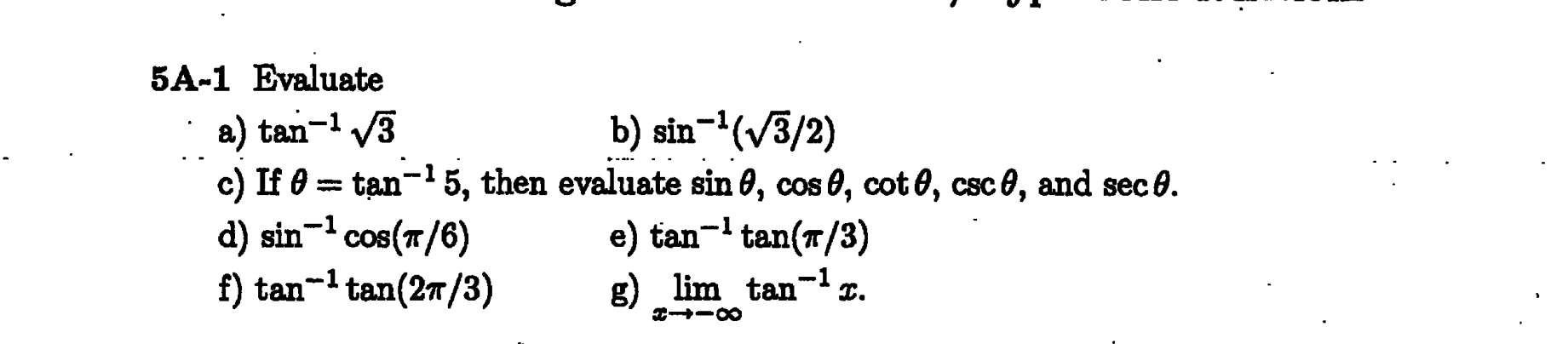
so like tan theta = 5, sin theta/ cos theta = 5, so sin theta = 5 cos theta
and cos theta = sin theta / 5
all of that is right but cos theta is supposed to evaluate to 1/square root of 26
how am I supposed to get that without a calculator?
no my full prompt is to evaluate https://i.imgur.com/zBOJPHg.png
 hollow garnet
Oh I see
So you used different trig properties
But there is actually a way we can draw a triangle to figure out all of our side lengths
And then use our new triangle to figure out what is cos of our angle theta
So if tan of theta is 5 for example
Tangent is opposite over adjacent (from soh cah toa)
So if we draw a right triangle, we can choose either of the non-right angles to be theta
5 is the same as 5/1, so if tangent is opposite over adjacent, the opposite side will be 5, and the adjacent side will be 1
Do you know how we can find the third side length (the hypotenuse)?
hollow garnet
That's ok, I've had problems where I had to draw a triangle like this too and I didnt think of it at all until i've seen it at least once
Did you figure out how to get the answer they got now?
hollow garnet
For sure
solemn bronze
.close
cedar kilnBOT
Channel closed
Closed by @solemn bronze
Use .reopen if this was a mistake.
Available help channel!
Send your question here to claim the channel.
Remember:
• Ask your math question in a clear, concise manner.
• Show your work, and if possible, explain where you are stuck.
• After 15 minutes, feel free to ping <@&286206848099549185>.
• Type the command .close to free the channel when you're done.
• Be polite and have a nice day!
Read #❓how-to-get-help for further information on how to ask a good question, and about conduct in the question channels.
Channel closed
Closed due to the original message being deleted
Available help channel!
Send your question here to claim the channel.
Remember:
• Ask your math question in a clear, concise manner.
• Show your work, and if possible, explain where you are stuck.
• After 15 minutes, feel free to ping <@&286206848099549185>.
• Type the command .close to free the channel when you're done.
• Be polite and have a nice day!
Read #❓how-to-get-help for further information on how to ask a good question, and about conduct in the question channels.
 tired inlet
hey guys can someone help me graph this
cedar kilnBOT
tired inlet
hey guys can someone help me graph this
tired inlet
$$f\left(x\right)=\cos\left(x-\frac{\pi}{3}\right)$$
wraith daggerBOT
Lex1729
 tired inlet
from 0 to 2pi
Here is my working

basically I know the amplitude is 1, and I found the period by using the formula above
I also know that the phase shift is pi/3, when finding this out I added it on to my period.
although I'm just confused about the "from 0 to 2pi" part what does this really mean?
is it just asking for one period?
cedar kilnBOT
@tired inlet Has your question been resolved?
cedar kilnBOT
Channel closed
Closed due to timeout
Use .reopen if this was a mistake.
Available help channel!
Send your question here to claim the channel.
Remember:
• Ask your math question in a clear, concise manner.
• Show your work, and if possible, explain where you are stuck.
• After 15 minutes, feel free to ping <@&286206848099549185>.
• Type the command .close to free the channel when you're done.
• Be polite and have a nice day!
Read #❓how-to-get-help for further information on how to ask a good question, and about conduct in the question channels.
 glossy apex
 cedar kilnBOT
glossy apex
glossy apex
cedar kilnBOT
glossy apex
glossy apex
How do I do this?
 livid hound
apply parallel line theorems
glossy apex
What does that mean. I’m sorry this is a new unit and I have been trying to figure it out
 eager kiln
few ways to solve this
livid hound
The are theorems related to parallel lines cut by a transversal
eager kiln
glossy apex
What does that mean. I’m sorry this is a new unit and I have been trying to figu...
are u familiar with corresponding angles?
livid hound
look them up, these should have been taught to you if you've been given this question
cedar kilnBOT
@glossy apex Has your question been resolved?
cedar kilnBOT
Channel closed
Closed due to timeout
Use .reopen if this was a mistake.
Available help channel!
Send your question here to claim the channel.
Remember:
• Ask your math question in a clear, concise manner.
• Show your work, and if possible, explain where you are stuck.
• After 15 minutes, feel free to ping <@&286206848099549185>.
• Type the command .close to free the channel when you're done.
• Be polite and have a nice day!
Read #❓how-to-get-help for further information on how to ask a good question, and about conduct in the question channels.
tired inlet
how do I graph this?
cedar kilnBOT
tired inlet
how do I graph this?
tired inlet
 livid hound
consider the parent function cos(x)
and then apply the appropriate graph transformation
 tired inlet
How so?
livid hound
are you implying that
cos(-pi/3) is equal to 1?
and that cos(x) exceeds 1 for values of x between 0 and pi/3
and that
cos(2pi - pi/3) is 0?
tired inlet
Cause cosine graphs start at the top I assumed it would start at the amplitude right?
livid hound
the normal cosine graph yes,
but the end goal isn't to graph that
tired inlet
So the amplitude is one, there is no vertical shift, but how come the y-intercept is wrong?
My initial graph was this
 livid hound
well it was wrong because you assumed without any work that the y-int would be the same as the graph of cos(x)
consider how you'd find the y-intercepts of any function
tired inlet
I would set x=0
livid hound
yes
livid hound
nope to both double edits
firstly your calculator is in degrees when it should be in radians
secondly you shouldnt be using your calculator as pi/3 is special angle
livid hound
no
well the first thing you should do is to simplify the 0-pi/3 inside to just -pi/3 giving
cos(-pi/3)
tired inlet
Yes and what would I do next?
livid hound
evaluate that without a calculator
considering properties of cosine and special angles
tired inlet
I’m not sure how to do that
livid hound
are you more comfortable working with degrees?
i.e if I gave you
cos(-60°)
would you be able to evaluate that without a calculator
livid hound
so you don't know the special angles and their respective ratios?
tired inlet
Nope
livid hound
you should learn those
tired inlet
Ok but can we just do this first
livid hound
for now just use your calculator
so
cos(-pi/3) = 1/2,
and that will be your y-int, (not 1)
tired inlet
Ok so cos(-pi/2) = 0.5 radians
tired inlet
*-pi
livid hound
it's still equal considering cos is an even function
tired inlet
Ok so after writing 1/2 as my y-intercept what is my next step?
cedar kilnBOT
@tired inlet Has your question been resolved?
livid hound
find all the x-intercepts between 0 and 2pi
cedar kilnBOT
Channel closed
Closed due to timeout
Use .reopen if this was a mistake.
Available help channel!
Send your question here to claim the channel.
Remember:
• Ask your math question in a clear, concise manner.
• Show your work, and if possible, explain where you are stuck.
• After 15 minutes, feel free to ping <@&286206848099549185>.
• Type the command .close to free the channel when you're done.
• Be polite and have a nice day!
Read #❓how-to-get-help for further information on how to ask a good question, and about conduct in the question channels.
 calm hedge
side ways parabola
cedar kilnBOT
calm hedge
side ways parabola

 rocky wave
$x=2y^2$
wraith daggerBOT
The Impostor
 rocky wave
or $y=\pm\sqrt{\frac{x}{2}}$
wraith daggerBOT
The Impostor
 cedar kilnBOT
@calm hedge Has your question been resolved?
 calm hedge
ooh shi-
cedar kilnBOT
Channel closed
Closed due to timeout
Use .reopen if this was a mistake.
Available help channel!
Send your question here to claim the channel.
Remember:
• Ask your math question in a clear, concise manner.
• Show your work, and if possible, explain where you are stuck.
• After 15 minutes, feel free to ping <@&286206848099549185>.
• Type the command .close to free the channel when you're done.
• Be polite and have a nice day!
Read #❓how-to-get-help for further information on how to ask a good question, and about conduct in the question channels.
cedar kilnBOT
Channel closed
Closed due to the original message being deleted
cedar kilnBOT
Available help channel!
Send your question here to claim the channel.
Remember:
• Ask your math question in a clear, concise manner.
• Show your work, and if possible, explain where you are stuck.
• After 15 minutes, feel free to ping <@&286206848099549185>.
• Type the command .close to free the channel when you're done.
• Be polite and have a nice day!
Read #❓how-to-get-help for further information on how to ask a good question, and about conduct in the question channels.
 undone basin
Hi everyone! A proof I'm reading looks to evaluate $\frac{d}{d t} \int_{-\infty}^{+\infty}|\Psi(x, t)|^{2} d x$. First it starts off by moving the derivative inside the integral $$\frac{d}{d t} \int_{-\infty}^{+\infty}|\Psi(x, t)|^{2} d x=\int_{-\infty}^{+\infty} \frac{\partial}{\partial t}|\Psi(x, t)|^{2} dx$$ and simplifies $\frac{\partial}{\partial t}|\Psi|^{2}$, which is $$\frac{\partial}{\partial t}|\Psi|^{2}=\frac{i \hbar}{2 m}\left(\Psi^{} \frac{\partial^{2} \Psi}{\partial x^{2}}-\frac{\partial^{2} \Psi^{}}{\partial x^{2}} \Psi\right)=\frac{\partial}{\partial x}\left[\frac{i \hbar}{2 m}\left(\Psi^{} \frac{\partial \Psi}{\partial x}-\frac{\partial \Psi^{}}{\partial x} \Psi\right)\right].$$ But then they use this to evaluate the integral, by which I mean they state $$\frac{d}{d t} \int_{-\infty}^{+\infty}|\Psi(x, t)|^{2} d x=\left.\frac{i \hbar}{2 m}\left(\Psi^{} \frac{\partial \Psi}{\partial x}-\frac{\partial \Psi^{}}{\partial x} \Psi\right)\right|_{-\infty} ^{+\infty}$$.
My question is: where did the $\frac{\partial}{\partial x}$ from $\frac{\partial}{\partial x}\left[\frac{i \hbar}{2 m}\left(\Psi^{} \frac{\partial \Psi}{\partial x}-\frac{\partial \Psi^{}}{\partial x} \Psi\right)\right]$ go? Why are we able to use $\frac{i \hbar}{2 m}\left(\Psi^{} \frac{\partial \Psi}{\partial x}-\frac{\partial \Psi^{}}{\partial x} \Psi\right)\right$ directly?
cedar kilnBOT
undone basin
Hi everyone! A proof I'm reading looks to evaluate $\frac{d}{d t} \int_{-\infty}...
wraith daggerBOT
quevorak
LaTeX source sent via direct message.
```Compilation error:```! Missing delimiter (. inserted).
<to be read again>
                   $
l.59 ...l \Psi^{*}}{\partial x} \Psi\right)\right$
                                                   directly?
I was expecting to see something like `(' or `\{' or
`\}' here. If you typed, e.g., `{' instead of `\{', you
should probably delete the `{' by typing `1' now, so that
braces don't get unbalanced. Otherwise just proceed.
Acceptable delimiters are characters whose \delcode is
nonnegative, or you can use `\delimiter <delimiter code>'.```
 long swan
the intuitive explanation is that the dx cancels in the numerator and denominator
undone basin
ah i see
thanks!
since this is physics, i feel like that's all i really need haha
.close
cedar kilnBOT
Channel closed
Closed by @undone basin
Use .reopen if this was a mistake.
long swan
yeah i mean you can make it rigorous through infinitesimal arithmetic or cotangent vectors or whatever
but it works haha
cedar kilnBOT
Available help channel!
Send your question here to claim the channel.
Remember:
• Ask your math question in a clear, concise manner.
• Show your work, and if possible, explain where you are stuck.
• After 15 minutes, feel free to ping <@&286206848099549185>.
• Type the command .close to free the channel when you're done.
• Be polite and have a nice day!
Read #❓how-to-get-help for further information on how to ask a good question, and about conduct in the question channels.
 waxen crater
 cedar kilnBOT
waxen crater
half forge
cedar kilnBOT
waxen crater
half forge
!status
cedar kilnBOT
What step are you on?
1. I don't know where to begin
2. I have begun but got stuck midway
3. I got an answer but I'm told it's wrong
4. I got an answer and would like my work checked
5. I have a question about someone else's worked solution
6. None of the above
can you expand the exponents of the numerator?
 half forge
what do you think it would be?
waxen crater
x⁴?
waxen crater
²
half forge
what do you think it is?
 lavish harbor
multiply
half forge
is (2²)⁸ the same as 2^10 ?
half forge
lavish harbor
multiply
let them figure it out on their own
waxen crater
half forge
is (2²)⁸ the same as 2^10 ?
no
half forge
so what do you think (x⁴)² would be?
lavish harbor
half forge
let them figure it out on their own
yeah but they have to knew the rules first then try to solve problems
waxen crater
half forge
so what do you think (x⁴)² would be?
x⁸
waxen crater
half forge
can you prime factorize 36^2 ?
factorize after squaring 36?
half forge
since the question wants us to express it using 2 and 3 (and x, of course)
waxen crater
waxen crater
factorize after squaring 36?
or factorize 36
half forge
waxen crater
factorize after squaring 36?
you can factorize 36 first, then square it, using the power of product rule I sent you
actually I should've told you to factorize the whole thing first, mb
waxen crater
2² × 3²
half forge
yes
so the numerator would be
( 2² × 3² × x⁴ ) ^2
now apply the power of product rule
waxen crater
4⁴×9⁴×x⁸?
half forge
no
consider 2 and 3 variables if this confuses you
2 and 3 should not change- only the exponents should
waxen crater
2⁴×3⁴×x⁸?
half forge
yes
so now we've factorized the numerator, let's focus on the denominator
can you factorize 8x^2 ?
waxen crater
8²x²?
half forge
you should keep in mind that 8x² and (8x)² are different
right now you're doing 8x²
can you prime factorize 8 first?
waxen crater
2
half forge
2 is a prime factor of 8, but 8≠2
waxen crater
2³
half forge
great
so 8x² would be 2³x²
now we need 2³x² × 3x
ill seperate it into 2³ × x² × 3 × x
do you know what x² × x would be?
waxen crater
x³
half forge
good
 cedar kilnBOT
Channel closed
Closed by @waxen crater
Use .reopen if this was a mistake.
Available help channel!
Send your question here to claim the channel.
Remember:
• Ask your math question in a clear, concise manner.
• Show your work, and if possible, explain where you are stuck.
• After 15 minutes, feel free to ping <@&286206848099549185>.
• Type the command .close to free the channel when you're done.
• Be polite and have a nice day!
Read #❓how-to-get-help for further information on how to ask a good question, and about conduct in the question channels.
crimson sedge
 cedar kilnBOT
crimson sedge
crimson sedge
cedar kilnBOT
crimson sedge
crimson sedge
How do I get the angle from 3pi/5 to 2pi/5 for part b
tame wraith
crimson sedge
There is no way anyone can read that
 tame wraith
WTF, this isn't even any better
cedar kilnBOT
@crimson sedge Has your question been resolved?
crimson sedge
.close
cedar kilnBOT
Channel closed
Closed by @low wadi
Use .reopen if this was a mistake.
 cedar kilnBOT
Available help channel!
cedar kilnBOT
Available help channel!
Send your question here to claim the channel.
Remember:
• Ask your math question in a clear, concise manner.
• Show your work, and if possible, explain where you are stuck.
• After 15 minutes, feel free to ping <@&286206848099549185>.
• Type the command .close to free the channel when you're done.
• Be polite and have a nice day!
Read #❓how-to-get-help for further information on how to ask a good question, and about conduct in the question channels.
 tame depot
I am a little confused, lets say my probability density function is x/2, and it asks me to find PDF of Y
cedar kilnBOT
tame depot
I am a little confused, lets say my probability density function is x/2, and it ...
tame depot
is there any way to find it other than finding the CDF first and then taking the derivative of it?
 flint plinth
well how is Y defined
 flint plinth
can you express Y in terms of X?
tame depot
in books solution it got it from finding the CDF first and then getting the PDF, which i understand and makes sense, but how would i find it if i didnt have the CDF
tame depot
flint plinth
can you express Y in terms of X?
60X?
flint plinth
there's a formula for getting the pdf of Y directly from the pdf of X, does this look familiar?

that's assuming Y is a monotonic function of X
it gets more complicated otherwise
flint plinth
tame depot
60X?
right
tame depot
oh i am not familiar with that formula
flint plinth
in this case you would have Y = g(x) = 60x
so g^-1(y) = y/60
and you can compute the derivative yourself haha
tame depot
ah i see
tame depot
not as complicated as it looks
flint plinth
so no time lost
tame depot
.close
cedar kilnBOT
Channel closed
Closed by @tame depot
Use .reopen if this was a mistake.
Available help channel!
Send your question here to claim the channel.
Remember:
• Ask your math question in a clear, concise manner.
• Show your work, and if possible, explain where you are stuck.
• After 15 minutes, feel free to ping <@&286206848099549185>.
• Type the command .close to free the channel when you're done.
• Be polite and have a nice day!
Read #❓how-to-get-help for further information on how to ask a good question, and about conduct in the question channels.
 rigid sentinel
o
 cedar kilnBOT
rigid sentinel
o
rigid sentinel
cedar kilnBOT
rigid sentinel
o
rigid sentinel
i know the area is 1/2 x b x h for the unshaded sector, but idk how to find the height
nor can i find the length of the curved side
i mean idk how to
 still frost
Do you know the formula to find the area of a not right angle triangle?
 still frost
alright np
still frost
so do you know what one angle in an equilateral triangle is
rigid sentinel
60
rigid sentinel
1/2 x 2 x 2 sin 60
still frost
yeah and what do you get
rigid sentinel
wait why are there 2 formulas btw
still frost
wdym
still frost
it’s the diagram that they had, they labelled it differently so they just changed the layers of the formula
does that make sense?
rigid sentinel
yea
rigid sentinel
rigid sentinel
1/2 x 2 x 2 sin 60
so this should be
2 times sin 60

is this correct?
@still frost
cedar kilnBOT
@rigid sentinel Has your question been resolved?
Channel closed
Closed by @rigid sentinel
Use .reopen if this was a mistake.
cedar kilnBOT
Available help channel!
Send your question here to claim the channel.
Remember:
• Ask your math question in a clear, concise manner.
• Show your work, and if possible, explain where you are stuck.
• After 15 minutes, feel free to ping <@&286206848099549185>.
• Type the command .close to free the channel when you're done.
• Be polite and have a nice day!
Read #❓how-to-get-help for further information on how to ask a good question, and about conduct in the question channels.
 upbeat lotus
 cedar kilnBOT
upbeat lotus
upbeat lotus
cedar kilnBOT
upbeat lotus
upbeat lotus
If time increases then the distance decreases
Can we use v=s/t
Cause it's 1d motion
 crimson delta
yes
cedar kilnBOT
@upbeat lotus Has your question been resolved?
cedar kilnBOT
Channel closed
Closed due to timeout
Use .reopen if this was a mistake.
Available help channel!
Send your question here to claim the channel.
Remember:
• Ask your math question in a clear, concise manner.
• Show your work, and if possible, explain where you are stuck.
• After 15 minutes, feel free to ping <@&286206848099549185>.
• Type the command .close to free the channel when you're done.
• Be polite and have a nice day!
Read #❓how-to-get-help for further information on how to ask a good question, and about conduct in the question channels.
 ashen field
can anyone help with part 3?
 cedar kilnBOT
ashen field
can anyone help with part 3?
cedar kilnBOT
ashen field
can anyone help with part 3?
 lyric narwhal
the question essentially asks you to prove Goldbach's weak conjecture, taking the main conjecture as a theorem
what have you tried
ashen field
I tried making 2n = one prime + another prime and then making 2n +1 = the sum of 3 primes but didn't get anywhere
where n >= 3
lyric narwhal
well
what if you take 2n + 3?
for an odd number
instead of the traditional 2n + 1
ashen field
thank you I rly should have thought of that
lyric narwhal
no worries
ashen field
.close
cedar kilnBOT
Channel closed
Closed by @ashen field
Use .reopen if this was a mistake.
cedar kilnBOT
Available help channel!
Send your question here to claim the channel.
Remember:
• Ask your math question in a clear, concise manner.
• Show your work, and if possible, explain where you are stuck.
• After 15 minutes, feel free to ping <@&286206848099549185>.
• Type the command .close to free the channel when you're done.
• Be polite and have a nice day!
Read #❓how-to-get-help for further information on how to ask a good question, and about conduct in the question channels.
 swift moth
Given that y = p and dp/dx = 1.
What is integration of y in terms of x?
 gentle heron
Prove it as i shall learn from you
 swift moth
Um im asking a question currently?
 swift moth
Given that y = p and dp/dx = 1.
What is integration of y in terms of x?
swift moth
swift moth
Given that y = p and dp/dx = 1.
What is integration of y in terms of x?
Anyway, do i just let p = x and make y = x?
I have no idea how to solve tbh
vagrant elbow
swift moth
Given that y = p and dp/dx = 1.
What is integration of y in terms of x?
Differentiate the first expression wrt x
y = p
What would you get?
swift moth
dy/dp = 1
vagrant elbow
Wrt to x not p
swift moth
What is wrt
vagrant elbow
With respect to
vagrant elbow
Yeah that works as well I suppose
swift moth
Owh
Then y = x + c, then integrate y in term of x = x²/2 + cx + C?
@vagrant elbow
If it is correct, then what happen if y = p² and dp/dx = 1?
dy/dp = 2p, so dy/dx = 2p
But then when I integrate dy/dx, what should I do with p?
<@&286206848099549185>
 tender linden
swift moth
Owh
Then y = x + c, then integrate y in term of x = x²/2 + cx + C?
tender linden
swift moth
Owh
Then y = x + c, then integrate y in term of x = x²/2 + cx + C?
what with the cx?
swift moth
When u integrate u will have constant c
If u integrate again, that c will become cx
Is there anything wrong?
vagrant elbow
swift moth
Owh
Then y = x + c, then integrate y in term of x = x²/2 + cx + C?
No it's just y = x + c
swift moth
vagrant elbow
No it's just y = x + c
Eh??
Integrate y again will still be x + c??
vagrant elbow
You need to find y(x) right
swift moth
I need to find integral of y
vagrant elbow
Ah then yeah integrate it again
swift moth
vagrant elbow
Ah then yeah integrate it again
So integral y = y²/2 + cx + C
Correct?
If it is correct, then what happen if y = p² and dp/dx = 1?
dy/dp = 2p, so dy/dx = 2p
But then when I integrate dy/dx, what should I do with p?
cedar kilnBOT
@swift moth Has your question been resolved?
swift moth
swift moth
If it is correct, then what happen if y = p² and dp/dx = 1?
dy/dp = 2p, so dy/dx...
<@&286206848099549185>
 hexed orbit
bro
swift moth
What
Initially y = p
For 2nd question, y = p²
@hexed orbit
I really need some help
tender linden
swift moth
When u integrate u will have constant c
If u integrate again, that c will become...
No the constants will become 0
hexed orbit
plz help me
hexed orbit
swift moth
I really need some help
what do u need
tender linden
hexed orbit
hey guys i forgot whats y
Y is just like a function , f(x) = x^2 + C etc
hexed orbit
thx
tender linden
Like a axis of xOy
swift moth
I mean integrate of y?
swift moth
swift moth
If it is correct, then what happen if y = p² and dp/dx = 1?
dy/dp = 2p, so dy/dx...
Then how about this?
How to solve this when p is right there?
@tender linden in case u missed the msg ima ping u first
 slow socket
Umm.. buddy
I dunno if I'm being dumb or anything
But ig u gotta integrate dp/dx=1
Which gives p = x + c
Then substitute y=p
Which gives y=x+c
Hence, its integral will be (x^2)/2 + cx?
swift moth
Owhhhhhh
swift moth
slow socket
But ig u gotta integrate dp/dx=1
If using this method, can i do this:
Question: Find integral of y where y = p² and dp/dx = 1.
Solution:
dp/dx = 1, p = x + c
Substitute ±sqrt(y) = p:
±sqrt(y) = x + c, y = x² + 2cx + c²
Hence, integral of y = x³/3 + cx² + c²x + C
Is this correct?
swift moth
swift moth
If using this method, can i do this:
Question: Find integral of y where y = p² a...
<@&286206848099549185> last helper ping
swift moth
 limpid plume
Are there any boundary conditions?
limpid plume
Are there any boundary conditions?
So far no
Thanks for verify tho!!!
If there is some condition i will just substitute in the value to find c and C
.close
cedar kilnBOT
Channel closed
Closed by @swift moth
Use .reopen if this was a mistake.
Available help channel!
Send your question here to claim the channel.
Remember:
• Ask your math question in a clear, concise manner.
• Show your work, and if possible, explain where you are stuck.
• After 15 minutes, feel free to ping <@&286206848099549185>.
• Type the command .close to free the channel when you're done.
• Be polite and have a nice day!
Read #❓how-to-get-help for further information on how to ask a good question, and about conduct in the question channels.
crimson sedge
 cedar kilnBOT
crimson sedge
cedar kilnBOT
crimson sedge
 cosmic steppe
Factor out x from the denominator and then factor 16-x using difference of squares
limpid plume
Hint: use a^2 - b^2 = (a+b)(a - b)
cosmic steppe
Well yeah that's the difference of squares, which I just told them to use lol
 cosmic steppe
x(16-x)
Is right
Then factor 16-x using difference of squares
Note that you'll get square roots
tender linden
cosmic steppe
Is right
wait it isnt? x(16-x^2)
tender linden
and that would be -x(x^2 - 4^2) = -x(x-4)(x+4)
cosmic steppe
crimson sedge
im confused
Anyways notice how b^2 = x
That should help you with the difference of squares issue
Once you do that, you can start cancelling factors to simplify the fraction
Because there's a removable discontinuity at x = 16
crimson sedge
tender linden
oh then he wrote it wrong soz
whatd i write wrong?
tender linden
crimson sedge
whatd i write wrong?
the x(x-4)(x+4) ?
crimson sedge
oh yea
tender linden
 tender linden
crimson sedge
oh yea
tender linden
crimson sedge
oh yea
just take x(4-sqrt(x))(4+sqrt(x)) instead
then they would simplify and the limit will be 1/x(4+sqrt(x) = 1(16(4+ 4) = 1/16 * 8
Something like this lol
crimson sedge
yea i was going the wrong way ill do that now

 crimson sedge

much better
so for difference of squares i square the bottom left which gives me x(4+sqrtx)(4-sqrtx)

like this?
thx
.close
cedar kilnBOT
Channel closed
Closed by @warm palm
Use .reopen if this was a mistake.
Available help channel!
Send your question here to claim the channel.
Remember:
• Ask your math question in a clear, concise manner.
• Show your work, and if possible, explain where you are stuck.
• After 15 minutes, feel free to ping <@&286206848099549185>.
• Type the command .close to free the channel when you're done.
• Be polite and have a nice day!
Read #❓how-to-get-help for further information on how to ask a good question, and about conduct in the question channels.
 left night
need help integrating, i don’t know how the answer outcomes to 2 in front of ln
 cedar kilnBOT
left night
need help integrating, i don’t know how the answer outcomes to 2 in front of ln
left night
cedar kilnBOT
left night
need help integrating, i don’t know how the answer outcomes to 2 in front of ln
left night
yes and thanks 🙂
 surreal aurora
So what do we have here? Seems like an nice integral.
Ok and you want to use u-substitution, ok.
left night
yes
 reef crown
If you have substituted u as x-1, so x+1 wouldn't be (u +2)?
surreal aurora
Gaming, I do agree with this.
A great way to avoid errors is practicing clean notation. It may take several tries on some scratch paper.
left night
im so confused on where the +2 comes from, like how does that come about?
I thought id need to get a negative out of the numerator?
surreal aurora
So, it seems gaming was ineffective as I estimated. Let's start over.
Tell me. What's was your thought process?
left night
i thought to take out a negative (-1)and get an x-1 in the numerator
surreal aurora
Then what?
left night
well, i did my math wrong, because if I acually took out a -1 properly, id be left with just u/u
surreal aurora
???
left night
the numerator would be -(-x-1)
wraith daggerBOT
drsleep
 surreal aurora
You sau we pull out a negative one. So, let's try that.
wraith daggerBOT
drsleep
 crimson sedge
$\frac{x-1+2}{x-1}$
wraith daggerBOT
hibyehibye
 crimson sedge
split into two fractions, makes this rly easy
surreal aurora
There is something you're not getting, @crimson sedge. Which I believe our friend does not know what to substitute. So, this point in the explanation is ahead of the position they're in.
crimson sedge
I guess, I just think they should have done this before substituting in the first place
left night
wraith dagger
**drsleep**
the equation, so itle be -(x+1)/ -(-x-1)
crimson sedge
wraith dagger
**drsleep**
like I dont see the point of this, seems overly complicated
but i might just be missing something didnt rly read the question properly
surreal aurora
What does it mean to pull -1 from x+1?
This is a critically vague word. We must use mathematical words.
This word pull or take out, as you said?
When I say pull I mean reverse distribute.
left night
okay, yea
surreal aurora
That is, if ab+ac, then a(b+c)
But do you mean subtract?
I wouldn't suggest subtraction.
Now that I am on my laptop, I can better help.
Hello, @wraith dagger bot, Are you awake?
wraith daggerBOT
drsleep
 surreal aurora
You would like to use u-subsitution, right?
left night
yes
left night
x-1?
surreal aurora
What about x-1?
left night
wanna substitute x-1 so, id like to get it in the numerator aswell'
surreal aurora
So, let us now define u as x-1 with the statement u=x-1.
And you say you wan to get it in the numerator? So you want to replace something in the numerator?
Unfortunately, we have x+1 and not x-1? how do you intend to use u=x-1 to get it in?
left night
well i thought taking a -1 out would get that but I'm starting to think thats not the right direction


 surreal aurora
And then, -x-1 not equals x-1
wraith daggerBOT
drsleep
 surreal aurora
what are we trying to do anyways?
what's the process called?
It's called...
...
left night
are you talking about taking the derivative?
surreal aurora
no
what integrating process are we doing here?
what is the name of the process?
left night
u-subsitution?
left night
to get the integral
surreal aurora
we are substituting for the variable x
because these variables x are too are to integrate as far as we know
we need to remove every instance of x
into something in terms of u
we handled the denominator. now we need to some how rewrite the numerator.
how can we rewrite x+1 into terms of u with the definition u = x-1
we cant substitute the whole x+1 away. so can we just replace x on its own?
that would have to require that we define x
but we dont have a definition for x?
we do have a definition for u and we could use it to define x
left night
make it contain x-1?
surreal aurora
what i am saying is equivalent to: how can I get x alone in u=x-1?
surreal aurora
so if you do something to one side....
for the equation to be equal, for it to be balanced, we must...
left night
add 1 to the bottom?
wait, to make things simple, I could've just done (x-1)+2 because that is equal to x+1
surreal aurora
so if we have u=x-1, and we add 1 on the left side, what do we do to the right?
we can do that too
but it would also mean, u+1 = x
and we sub that in to get, x+1=(u+1)+1
=u+2
wraith daggerBOT
drsleep
 left night
yes, it all makes sense now, ty
its so simple now that I udnerstand that I couldve done it that way, thanks
.close
cedar kilnBOT
Channel closed
Closed by @left night
Use .reopen if this was a mistake.
Available help channel!
Send your question here to claim the channel.
Remember:
• Ask your math question in a clear, concise manner.
• Show your work, and if possible, explain where you are stuck.
• After 15 minutes, feel free to ping <@&286206848099549185>.
• Type the command .close to free the channel when you're done.
• Be polite and have a nice day!
Read #❓how-to-get-help for further information on how to ask a good question, and about conduct in the question channels.
 hot cloak
