#help-13
1 messages · Page 39 of 1
 undone sage
 drowsy glen
man you are exposing
undone sage
No need to bother about such things
undone sage
Just tell already
drowsy glen
i am very tensed for exam bcuz in last semester i got degraded performance in math
can you help me out?
undone sage
Yes
drowsy glen
any tips?
undone sage
Go and study properly
Solve more and more questions
Don't panic
Be calm
Think logically
That's it
 hollow kiln
drink water and sleep 8h
drowsy glen
undone sage
Think logically
i am not able to solve questions ine exam but when i take a look at paper at home and i can solve them!
drowsy glen
hollow kiln
drink water and sleep 8h
what?
 sand meadow
don't study new topics
hollow kiln
that's 80% of the work
undone sage
drowsy glen
i am not able to solve questions ine exam but when i take a look at paper at hom...
Your heartbeat normal when you give exam?
hollow kiln
20% is you putting that work in
hollow kiln
"dont panic" sometimes doesnt just work, so i would recommend you meditating for 5 mins before the exam
undone sage
Wether u will pass fail score good marks etc.
hollow kiln
just close your eyes and try to focus as much on your breath as possible
sand meadow
what exam is it
 crimson sedge
also do mock tests
sand meadow
like University or school?
undone sage
breath slowly and calmly for 2 mins when you start to panic
crimson sedge
crimson sedge
also do mock tests
if school
drowsy glen
sand meadow
what exam is it
math
drowsy glen
undone sage
breath slowly and calmly for 2 mins when you start to panic
okay
drowsy glen
sand meadow
like University or school?
school
undone sage
And drink water too
drowsy glen
undone sage
Wether u will pass fail score good marks etc.
🙂
drowsy glen
undone sage
And drink water too
plenty?
undone sage
Yes
drowsy glen
is there a square for 28?
undone sage
How much you feel like drinking
crimson sedge
drowsy glen
is there a square for 28?
root?
drowsy glen
not like 2*2=4 like this
crimson sedge
root 28 = 5.29150262213
hollow kiln
,tex 28² ?
 wraith daggerBOT
haygiya
 drowsy glen
nope
drowsy glen
crimson sedge
root 28 = 5.29150262213
bruh
hollow kiln
,tex \sqrt{28} ?
drowsy glen
got it
hollow kiln
:sadge:
hollow kiln
woman
hollow kiln
ye
im also a man
and non binary
and ask pronouns
thanos basically
i have all the crystals
drowsy glen
if i become good at math can i also become a helper here?
undone sage
drowsy glen
if i become good at math can i also become a helper here?
Yes boi you can even become now
hollow kiln
joined yesterday
drowsy glen
undone sage
Yes boi you can even become now
im not good in math so i wont help out people lol
hollow kiln
im kinda good at latex thats why i help people out
sand meadow
how can i learn latex?
undone sage
.close
 cedar kilnBOT
Channel closed
Closed by @undone sage
Use .reopen if this was a mistake.
hollow kiln
idk i just started typing and learned it
sand meadow
.reopen
undone sage
lol
hollow kiln
maybe try ,help if you want to learn faster
sand meadow
i dont know a thing
hollow kiln
type whatever you want to type between $ symbols
sand meadow
i am currently preparing for exam... i will learn latex in june
hollow kiln
$hi$
cedar kilnBOT
 Available help channel!
Send your question here to claim the channel.
Remember:
• Ask your math question in a clear, concise manner.
• Show your work, and if possible, explain where you are stuck.
• After 15 minutes, feel free to ping <@&286206848099549185>.
• Type the command .close to free the channel when you're done.
• Be polite and have a nice day!
Read #❓how-to-get-help for further information on how to ask a good question, and about conduct in the question channels.
wraith daggerBOT
haygiya

 short dome
cuz f(x) = f(-x)
cedar kilnBOT
short dome
cuz f(x) = f(-x)
short dome
aint 6 supposed to be even
cuz f(x) = f(-x)

 earnest socket
looks like it
short dome
so the answer key is wrong?
crimson sedge
yeah
though it might also be a typo in the question, because there are two constant terms
maybe it should be -5x, in which case the answer would be right
cedar kilnBOT
Channel closed
Closed by @short dome
Use .reopen if this was a mistake.
Available help channel!
Send your question here to claim the channel.
Remember:
• Ask your math question in a clear, concise manner.
• Show your work, and if possible, explain where you are stuck.
• After 15 minutes, feel free to ping <@&286206848099549185>.
• Type the command .close to free the channel when you're done.
• Be polite and have a nice day!
Read #❓how-to-get-help for further information on how to ask a good question, and about conduct in the question channels.
 lavish jolt
 cedar kilnBOT
lavish jolt
lavish jolt
cedar kilnBOT
lavish jolt
lavish jolt
why did they add that term below
isn't Γ (p+u+1) enough to desribe whats in the denomenator up there

 mighty drift
There's no reason for the product to stop at 1+mu
lavish jolt
so we want it to stop at 1
so we multiplied then devided by Γ(u+1)
if thats right than that equality isn't correct
wait i'll write what i understood
wait no

it did stop at 1+mu
wraith daggerBOT
Mehdi_Moulati
 lavish jolt
i don't understand the bounds
we didn't learn gamma function using the product so im not very familiar with it

 soft owl
lavish jolt
soft owl
lavish jolt
(p+u)! = (p+u) * (p-1+u) * (p-2 + u) * ...* 3 * 2 * 1
lavish jolt
wouldn't it only end to 1 if we add u!
soft owl
but you made a mistake in the numerator
lavish jolt
i forgot the first term
wraith daggerBOT
Mehdi_Moulati
 lavish jolt
yes
this is what we got
so in order to write (p+u)! as Γ(p+ u+1)
it must end at 1
soft owl
lavish jolt
it must end at 1
yeah , Γ(p+ u+1) is the product of numbers from 1 to p+u
soft owl
lavish jolt
Thank you a lot
anytime
lavish jolt
.close
cedar kilnBOT
Channel closed
Closed by @lavish jolt
Use .reopen if this was a mistake.
Available help channel!
Send your question here to claim the channel.
Remember:
• Ask your math question in a clear, concise manner.
• Show your work, and if possible, explain where you are stuck.
• After 15 minutes, feel free to ping <@&286206848099549185>.
• Type the command .close to free the channel when you're done.
• Be polite and have a nice day!
Read #❓how-to-get-help for further information on how to ask a good question, and about conduct in the question channels.
 autumn notch
given these
 cedar kilnBOT
autumn notch
given these
autumn notch
cedar kilnBOT
autumn notch
given these
autumn notch
are the vectors orthagonal, also is the family ortonormal
autumn notch
A set of vectors S is orthonormal if every vector in S has magnitude 1 and the set of vectors are mutually orthogonal.?
and i just realized that is is orthogonal, so disregard that question.
my book, says that it is orthonormal if the set of vectors are orthogonal with regards to the inner product and consists of unity vectors with regards to the inner product
 crimson delta
Well what are their magnitudes
 cedar kilnBOT
Channel closed
Closed by @autumn notch
Use .reopen if this was a mistake.
crimson delta
With the usual dot product this is just the standard formula for length of a vector
cedar kilnBOT
Available help channel!
Send your question here to claim the channel.
Remember:
• Ask your math question in a clear, concise manner.
• Show your work, and if possible, explain where you are stuck.
• After 15 minutes, feel free to ping <@&286206848099549185>.
• Type the command .close to free the channel when you're done.
• Be polite and have a nice day!
Read #❓how-to-get-help for further information on how to ask a good question, and about conduct in the question channels.
crimson delta
I.e. sqrt(sum of squares of entries)
cedar kilnBOT
crimson delta
I.e. sqrt(sum of squares of entries)
 bright agate
cedar kilnBOT
bright agate
cedar kilnBOT
Channel closed
Closed by @crimson delta
Use .reopen if this was a mistake.
Available help channel!
Send your question here to claim the channel.
Remember:
• Ask your math question in a clear, concise manner.
• Show your work, and if possible, explain where you are stuck.
• After 15 minutes, feel free to ping <@&286206848099549185>.
• Type the command .close to free the channel when you're done.
• Be polite and have a nice day!
Read #❓how-to-get-help for further information on how to ask a good question, and about conduct in the question channels.
 abstract abyss
need help idk
cedar kilnBOT
abstract abyss
need help idk

 limpid agate
I think the question is incomplete
Find the direction and magnitude of... What exactly
 lyric jungle
u + v... maybe?
abstract abyss
of the vector maybe
abstract abyss
 abstract abyss
wat it needs
 cosmic steppe
I think your teacher forgot to put down the resultant vector lol
 empty pike
Lol
abstract abyss
yeah i'm sure it's resultant vector
cosmic steppe
I mean your teacher's gotta specify the resultant vector
It could be u+v, v-u, u-v, 2u + 627272v
Etc etc
 upbeat lotus
abstract abyss
oh it's u+v
upbeat lotus
abstract abyss
oh it's u+v
Use parallelogram law
$|{R}|=\sqrt{A²+B²+2AB cos\theta}$
wraith daggerBOT
Arnab Pal
 cedar kilnBOT
@abstract abyss Has your question been resolved?
 upbeat lotus
wraith dagger
**Arnab Pal**
upbeat lotus
wraith dagger
**Arnab Pal**
Put the values in
abstract abyss
wraith dagger
**Arnab Pal**
y i need the equation here
isn't it pythagoras theorem
upbeat lotus
abstract abyss
y i need the equation here
You need equation to find v+u
upbeat lotus
abstract abyss
isn't it pythagoras theorem
Nah
Pythagoras theorem was a²+b²=c²
$|{R}|=\sqrt{A²+B²+2AB cos\theta}$
wraith daggerBOT
Arnab Pal
 abstract abyss
wat u got there is the law of cosines
upbeat lotus
abstract abyss
wat u got there is the law of cosines
$C=\sqrt{A²+B²-2AB cosC°}$
wraith daggerBOT
Arnab Pal
 upbeat lotus
Law of cosine is this
abstract abyss
wraith dagger
**Arnab Pal**
so wat equation is here
i need to know the point so i can work it out again
upbeat lotus

The parallelogram rule says that if we place two vectors so they have the same initial point, and then complete the vectors into a parallelogram, then the sum of the vectors is the directed diagonal that starts at the same point as the vectors.
You should watch it
Duration of the video is 2 min
abstract abyss
alright
upbeat lotus
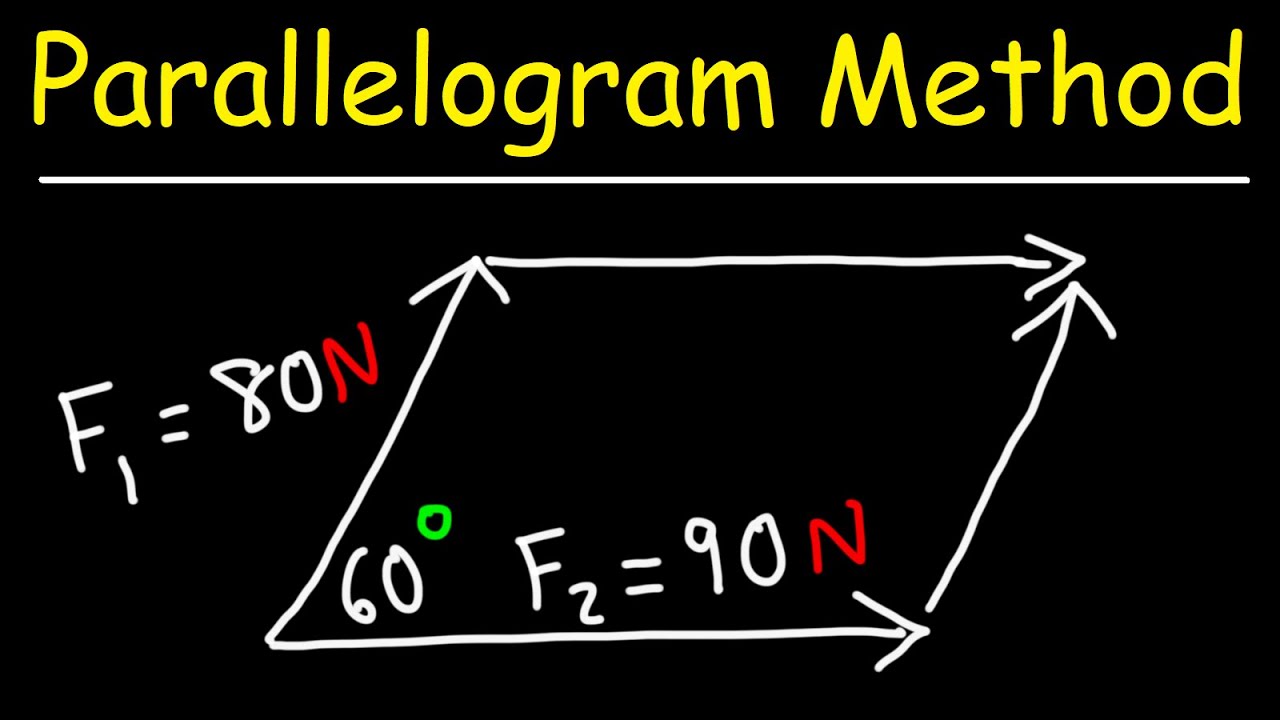
This video explains how to use the parallelogram method to find the resultant sum of two vectors. You need to be familiar with law of cosines formula in order to make this work.
You could also watch this
You would know everything about parallelogram law
That you need to know
abstract abyss
it's got the magnitude but not the length 😦
upbeat lotus
What length?
upbeat lotus
abstract abyss
and btw y he made it a triangle from a parallelogram
Yupp
upbeat lotus
abstract abyss
wat is the point
To make the thing easy
You could use triangle law
I have to go for dinner
Ask anyone else for help
abstract abyss
ok eat well
cedar kilnBOT
@abstract abyss Has your question been resolved?
 upbeat lotus
upbeat lotus
https://byjus.com/question-answer/derivation-of-triangle-law-of-vector-addition-...
upbeat lotus
upbeat lotus
upbeat lotus
https://byjus.com/question-answer/derivation-of-triangle-law-of-vector-addition-...
Should watch this derivation
Wait
upbeat lotus
abstract abyss
,w √(6²+10²+2×6×10×cos(50))
upbeat lotus
abstract abyss
i know i need help w the law of sines now pls
Ok
Law of sine is
$\frac{sin (a°)}{a}=\frac{sin (b°)}{b}=\frac{sin (c°)}{c}$
wraith daggerBOT
Arnab Pal

 upbeat lotus
wraith dagger
**Arnab Pal**
upbeat lotus
wraith dagger
**Arnab Pal**
This is law of sine
abstract abyss
 upbeat lotus
abstract abyss
upbeat lotus
abstract abyss
Yeah you could use law of cosine for angles
upbeat lotus
abstract abyss
No no no
You couldn't use exterior angles
You have to use int angles
abstract abyss
i wanna know y it's 15 and 130 degrees and 6 and 50 degrees
oh ok
but the side is fine
but y is the 130 degrees not the angle of b or c idk
upbeat lotus
You know what I was thinking
abstract abyss
wat
upbeat lotus
abstract abyss
In your question v=6 and u=10
abstract abyss
yeah
upbeat lotus
abstract abyss
And in this question one side is 1 and the other is 6
abstract abyss
maybe it's a 10 just mistake
abstract abyss
bro y is sinA/a = sin130/15
wraith daggerBOT


 Requested by 𝓐𝓡𝓝𝓐𝓑 𝓟𝓐𝓛#6985
upbeat lotus
abstract abyss
bro y is sinA/a = sin130/15
Requested by 𝓐𝓡𝓝𝓐𝓑 𝓟𝓐𝓛#6985
upbeat lotus
abstract abyss
bro y is sinA/a = sin130/15
Yeah
upbeat lotus
wraith dagger
If you use parallelogram law you will end up with same ans
upbeat lotus
abstract abyss
dunno wat one is a b or c
You have to assume it in your mind
abstract abyss
but i don't know
upbeat lotus
If you take a side then you have to take opposite angle
abstract abyss
cause corresponding angles
upbeat lotus
abstract abyss
cause corresponding angles
Not really
abstract abyss
upbeat lotus
If you take a side then you have to take opposite angle
all i needed to know ty
upbeat lotus
abstract abyss
all i needed to know ty
Yeah
abstract abyss
i'm just a bit confused here as well

to inverse it
and 6/5(sin130) isn't 18 degrees anyway
upbeat lotus
 abstract abyss
ah ok
upbeat lotus
abstract abyss
and 6/5(sin130) isn't 18 degrees anyway
,w sin^-1(6/5×sin130°)
abstract abyss
yeah and my teacher said it's 18 wat
upbeat lotus
abstract abyss
yeah and my teacher said it's 18 wat
Wait
wraith daggerBOT
 Requested by 𝓐𝓡𝓝𝓐𝓑 𝓟𝓐𝓛#6985
abstract abyss
Requested by 𝓐𝓡𝓝𝓐𝓑 𝓟𝓐𝓛#6985
abstract abyss
see ugh
upbeat lotus
Result in radian
abstract abyss
wat is he on
abstract abyss
nah bro radian is -0.372
upbeat lotus
 abstract abyss
not 18 again
abstract abyss
wat
 upbeat lotus
 upbeat lotus
abstract abyss
he is just full of mistakes
upbeat lotus
abstract abyss
he is just full of mistakes
Everybody makes mistakes
upbeat lotus
upbeat lotus
18 is right
abstract abyss
i don't know wat i need to inverse it for
upbeat lotus
abstract abyss
i don't know wat i need to inverse it for
You need to inverse it for theta
Like suppose
x=6/15×sin 130°
AND
abstract abyss
um 6/15
upbeat lotus
$c=\theta$
wraith daggerBOT
Arnab Pal
 abstract abyss
yes
upbeat lotus
Here
And if you want to take out the c
so you have to move the sin to the RHS
RHS = right hand side
When you will do that
abstract abyss
alright so x/c
upbeat lotus
No no you don't have to move the c
abstract abyss
c = sin/x sry
upbeat lotus
You have to move sin
abstract abyss
x/sin
upbeat lotus
Not sin/x
upbeat lotus
abstract abyss
x/sin
Yeah but we don't write sine function like this
We use ^-1
For sin
Or any other Trigonometric functions
So
$sin^{-1}(x)$
wraith daggerBOT
Arnab Pal
 upbeat lotus
Inverse Trigonometry is another level of thing
abstract abyss
right so to got sin u just need to divide by theta
upbeat lotus
abstract abyss
right so to got sin u just need to divide by theta
You got inverse sin you got theta
And you don't need anything else
upbeat lotus
Yeah
upbeat lotus
abstract abyss
trigonometry is well confusing
Maybe
upbeat lotus
abstract abyss
trigonometry is well confusing
But not more than "her"
abstract abyss
so true my friend
upbeat lotus
🥲
abstract abyss
ty so much bye
wraith daggerBOT
 Requested by 𝓐𝓡𝓝𝓐𝓑 𝓟𝓐𝓛#6985
abstract abyss
Requested by 𝓐𝓡𝓝𝓐𝓑 𝓟𝓐𝓛#6985
abstract abyss
.close
cedar kilnBOT
Channel closed
Closed by @abstract abyss
Use .reopen if this was a mistake.
Available help channel!
Send your question here to claim the channel.
Remember:
• Ask your math question in a clear, concise manner.
• Show your work, and if possible, explain where you are stuck.
• After 15 minutes, feel free to ping <@&286206848099549185>.
• Type the command .close to free the channel when you're done.
• Be polite and have a nice day!
Read #❓how-to-get-help for further information on how to ask a good question, and about conduct in the question channels.
 zenith fiber
Hey, so I had more of a quick question. This isn't specifically to this picture but whenever a set is defined like this I don't really get why it's written in this format. Could someone explain it?
 cedar kilnBOT
zenith fiber
Hey, so I had more of a quick question. This isn't specifically to this picture ...
zenith fiber
cedar kilnBOT
zenith fiber
Hey, so I had more of a quick question. This isn't specifically to this picture ...
zenith fiber
Another example would be
A = {x | x is every positive integer}
don't really get the x | x
part
zenith fiber
crimson sedge
so "all x such that x is in A or x is in B"
What does all x mean?
crimson sedge
zenith fiber
What does all x mean?
its a placeholder variable
here its an element of either A or B
crimson sedge
np
zenith fiber
.close
cedar kilnBOT
Channel closed
Closed by @zenith fiber
Use .reopen if this was a mistake.
cedar kilnBOT
Available help channel!
Send your question here to claim the channel.
Remember:
• Ask your math question in a clear, concise manner.
• Show your work, and if possible, explain where you are stuck.
• After 15 minutes, feel free to ping <@&286206848099549185>.
• Type the command .close to free the channel when you're done.
• Be polite and have a nice day!
Read #❓how-to-get-help for further information on how to ask a good question, and about conduct in the question channels.
 royal river
i need to solve this differential equation with substitution, i feel like i’ve solved it properly but my answer is wrong, i can’t spot my error, can someone please help? i’m lost and exhausted
 cedar kilnBOT
royal river
i need to solve this differential equation with substitution, i feel like i’ve s...
royal river
cedar kilnBOT
royal river
i need to solve this differential equation with substitution, i feel like i’ve s...
royal river
initial conditions are y(0)=1
p.s. i know it’s seperable but the question asks to solve it with substitution
hollow kiln
elalem nelerle ugrasiyo allahim
cedar kilnBOT
@royal river Has your question been resolved?
royal river
hollow kiln
elalem nelerle ugrasiyo allahim
eyv.
cedar kilnBOT
@royal river Has your question been resolved?
cedar kilnBOT
@royal river Has your question been resolved?
cedar kilnBOT
@royal river Has your question been resolved?
soft owl
what's the equation ?
 vernal shell
royal river
i need to solve this differential equation with substitution, i feel like i’ve s...
vernal shell
royal river
i need to solve this differential equation with substitution, i feel like i’ve s...
Hello, do you have the correct answer?
royal river
nope
vernal shell
Oh I wanted to check my answer, nvm
Substitution method to solve differential equations is what you do in i). Then in ii) you don't have to just use substitution all the time, that's substitution for solving integrals which is not what they mean
Well that's what I think
Otherwise the solution is too tedious, sorry I couldn't follow it 😵💫
cedar kilnBOT
@royal river Has your question been resolved?
royal river
vernal shell
Substitution method to solve differential equations is what you do in `i)`. Then...
yes, i end up with an annoying integral so i have to do lots of u substitutions, but i’m still using substitution to solve the differential equation
vernal shell
royal river
yes, i end up with an annoying integral so i have to do lots of u substitutions,...
I forgot to add that the integral in the fifth line can be solve by partial fractions
I've already checked my answer with wolfram alpha 🤔
 shadow kite
 cedar kilnBOT
Channel closed
Closed due to timeout
Use .reopen if this was a mistake.
Available help channel!
Send your question here to claim the channel.
Remember:
• Ask your math question in a clear, concise manner.
• Show your work, and if possible, explain where you are stuck.
• After 15 minutes, feel free to ping <@&286206848099549185>.
• Type the command .close to free the channel when you're done.
• Be polite and have a nice day!
Read #❓how-to-get-help for further information on how to ask a good question, and about conduct in the question channels.
 tulip river
It's asking me to find the value of x for which i have the min and max of the function
 cedar kilnBOT
tulip river
It's asking me to find the value of x for which i have the min and max of the fu...
tulip river
cedar kilnBOT
tulip river
It's asking me to find the value of x for which i have the min and max of the fu...
tulip river
If i do the derivative of the function i find x > -24 as
yet when my teacher does the same he finds x < -24
why is that?
 mental trail
can you show your work?
 mental trail
Be careful, as the derivative of |(x+3)(x-4)| has discontinuity points
tulip river
x= -3 and x= +4?
mental trail
There are three cases you need to distinguish:
x < -3
-3 < x < 4
4 < x
tulip river
Okay, how should i do so?
This is the answer i got from my teacher, i don't understand what he does either
 mental trail
so, by intuition, since f(x) >= 0, the only minimums you can ever hope to find are f(x) = 0
since f(x) = g(x) for x>4 and x<-3, (and f(x) = -g(x) for -3<x<4), you study g(x) instead
since g(-3) = 0 = g(4), those are the only global minimums you can find
tulip river
I see, now its much more clear thank you
mental trail
finally, since g'(-24) = 0, -24 is either a local minimum or maximum of g
so in any case, it's gonna be a local maximum for f
cedar kilnBOT
Channel closed
Closed by @tulip river
Use .reopen if this was a mistake.
cedar kilnBOT
Available help channel!
Send your question here to claim the channel.
Remember:
• Ask your math question in a clear, concise manner.
• Show your work, and if possible, explain where you are stuck.
• After 15 minutes, feel free to ping <@&286206848099549185>.
• Type the command .close to free the channel when you're done.
• Be polite and have a nice day!
Read #❓how-to-get-help for further information on how to ask a good question, and about conduct in the question channels.
 low wagon
can i show someone in vocal a few analysis 1 exercises i made for training? there's some tricky stuff my teacher put i think i didn't get right
cedar kilnBOT
low wagon
can i show someone in vocal a few analysis 1 exercises i made for training? ther...
low wagon
i have a laptop im using to write exercises on with my pen that's y i'd rather screenshare than send the pics here
to give context it's about the convergence of some series, continuity and derivability
and a limit that i have to do with either taylor or de l'Hopital
im in the 384kbps channel waiting if anyone is up
<@&286206848099549185>
also one thing i just found out is can't screenshare in any voice channel so if u could help me with that tho that'd be awesome

italian real analysis (that's y i wanted to do voice call)

 wraith daggerBOT
♡LexQa♡

 sacred grail
i only use log 
low wagon
 sacred grail
yeah i think we can just use L'H
wraith daggerBOT
 low wagon


 wraith daggerBOT
 sacred grail
actually you dont need the >0


 sacred grail
[ a \textqq{text} b ]
wraith daggerBOT
 sacred grail
[ a \textQQ{text} b ]
wraith daggerBOT
 sacred grail
[ a \textlq{text} b ]
wraith daggerBOT
 sacred grail
[ a \textqr{text} b ]
wraith daggerBOT
 low wagon
.close
cedar kilnBOT
Channel closed
Closed by @low wagon
Use .reopen if this was a mistake.
sacred grail

low wagon

crimson sedge
(i swear snow wasnt talking to herself)
sacred grail

cedar kilnBOT
Available help channel!
Send your question here to claim the channel.
Remember:
• Ask your math question in a clear, concise manner.
• Show your work, and if possible, explain where you are stuck.
• After 15 minutes, feel free to ping <@&286206848099549185>.
• Type the command .close to free the channel when you're done.
• Be polite and have a nice day!
Read #❓how-to-get-help for further information on how to ask a good question, and about conduct in the question channels.
 raven sandal
Directional derivatives - In understand the entire initial solution for the first example, but in the second example, where and why do you need the unit vector in the direction of A
 cedar kilnBOT
raven sandal
Directional derivatives - In understand the entire initial solution for the firs...
raven sandal
cedar kilnBOT
raven sandal
Directional derivatives - In understand the entire initial solution for the firs...
raven sandal
Like in this example, we do not use the unit vector
 wraith daggerBOT

 Requested by ♡LexQa♡#5050
crimson sedge
Requested by ♡LexQa♡#5050
crimson sedge
Anytime
raven sandal
.close
cedar kilnBOT
Channel closed
Closed by @raven sandal
Use .reopen if this was a mistake.
cedar kilnBOT
Available help channel!
Send your question here to claim the channel.
Remember:
• Ask your math question in a clear, concise manner.
• Show your work, and if possible, explain where you are stuck.
• After 15 minutes, feel free to ping <@&286206848099549185>.
• Type the command .close to free the channel when you're done.
• Be polite and have a nice day!
Read #❓how-to-get-help for further information on how to ask a good question, and about conduct in the question channels.
 toxic flame
please can I get some help finishing this proof?
 wraith daggerBOT
Max..
 toxic flame
so suppose m and n are odd?
 random shale
Your next step is then correct but from there I think there is an easier route.
Our goal is to show both m and n are multiples of 3. Which contradicts that the gcd(m,n)=1
Can you show that m is a multiple of 3?
toxic flame
Something using this?

or something like: m has to be a multiple of 3 because of the factor 3^x
 toxic flame
random shale
Can you show that m is a multiple of 3?
toxic flame
random shale
Can you show that m is a multiple of 3?
something like this^?
cedar kilnBOT
@toxic flame Has your question been resolved?
cedar kilnBOT
Channel closed
Closed due to timeout
Use .reopen if this was a mistake.
cedar kilnBOT
Available help channel!
Send your question here to claim the channel.
Remember:
• Ask your math question in a clear, concise manner.
• Show your work, and if possible, explain where you are stuck.
• After 15 minutes, feel free to ping <@&286206848099549185>.
• Type the command .close to free the channel when you're done.
• Be polite and have a nice day!
Read #❓how-to-get-help for further information on how to ask a good question, and about conduct in the question channels.
 grim lantern
can someone explain to me how the 5 disappeared in the first line and where did the +1 come from in the second line
 cedar kilnBOT
grim lantern
can someone explain to me how the 5 disappeared in the first line and where did ...
cedar kilnBOT
cedar kilnBOT
grim lantern
can someone explain to me how the 5 disappeared in the first line and where did ...
cedar kilnBOT
Channel closed
Closed by @grim lantern
Use .reopen if this was a mistake.
cedar kilnBOT
Available help channel!
Send your question here to claim the channel.
Remember:
• Ask your math question in a clear, concise manner.
• Show your work, and if possible, explain where you are stuck.
• After 15 minutes, feel free to ping <@&286206848099549185>.
• Type the command .close to free the channel when you're done.
• Be polite and have a nice day!
Read #❓how-to-get-help for further information on how to ask a good question, and about conduct in the question channels.
 marble ermine
Hello, if $n \geqslant 2$ integer, $f: [1, + \infty[ \mapsto \mathbb{R}$ such as $f_n (x) = x^n - x - 1$; $a_n$ is the solution to $f_n(x) = 0$; what is the limit of $(a_n)_{n}$ ?
cedar kilnBOT
marble ermine
Hello, if $n \geqslant 2$ integer, $f: [1, + \infty[ \mapsto \mathbb{R}$ such a...
marble ermine
approach infinity
wraith daggerBOT
Max..

 patent cape
yeah ik that
random shale
and yea as n approaches infinity
 crystal raptor
Probably useful to note that $a_n^n = a_n + 1$
wraith daggerBOT
ΣAC
 marble ermine
crystal raptor
Probably useful to note that $a_n^n = a_n + 1$
marble ermine
crystal raptor
Probably useful to note that $a_n^n = a_n + 1$
really, how so?
marble ermine
patent cape
(a_n)n maybe
yes
crystal raptor
Why is it true?
wraith daggerBOT
lilisworld
 crystal raptor
Or why is it useful? (I don't know)
marble ermine
why is it useful
crystal raptor
No idea, but it's the only info you have about an
marble ermine
i also know that $(a_n)_n$ is a decreasing sequnce srry i forgot
wraith daggerBOT
lilisworld
 crystal raptor
Well then it's almost certain the limit is 1
marble ermine
crystal raptor
Well then it's almost certain the limit is 1
whyy
crystal raptor
Your sequence is decreasing and bounded below by 1
A good guess is 1
Happens to be correct
marble ermine
crystal raptor
Try show 1 is the inf or smth
ok so a_n is never 1 for sure
so it's not the min(a_n)
@crystal raptor could u give me a hint
<@&286206848099549185>
crystal raptor
crystal raptor
Try show 1 is the inf or smth
.
marble ermine
crystal raptor
.
how do i do that
crystal raptor
No idea, give it a try
 gleaming cloud
wraith dagger
**lilisworld**
gleaming cloud
wraith dagger
**lilisworld**
There can be multiple solutions to f_n(x)=0
marble ermine
gleaming cloud
There can be multiple solutions to f_n(x)=0
yes and now we need to prova that these solutions are never smaller than 1 
no wait
of course it is but why 1 and not 1.2 for example that's my problem
crystal raptor
gleaming cloud
There can be multiple solutions to f_n(x)=0
Domain of fn is restricted
marble ermine
i dont get it 
<@&286206848099549185>
in order to find the solution of x^n - x - 1 = 0 when n is very big;
that slution is bigger than 1
not bigger than 1.61...
1 < a_n <= 1.61
<@&286206848099549185>
<@&286206848099549185>
cedar kilnBOT
@marble ermine Has your question been resolved?
marble ermine
@crystal raptor what's the link with this: a_n ^n = a_n + 1 ??
cedar kilnBOT
@marble ermine Has your question been resolved?
cedar kilnBOT
Channel closed
Closed due to timeout
Use .reopen if this was a mistake.
Available help channel!
Send your question here to claim the channel.
Remember:
• Ask your math question in a clear, concise manner.
• Show your work, and if possible, explain where you are stuck.
• After 15 minutes, feel free to ping <@&286206848099549185>.
• Type the command .close to free the channel when you're done.
• Be polite and have a nice day!
Read #❓how-to-get-help for further information on how to ask a good question, and about conduct in the question channels.
 oblique lynx
when i have vectors v,w and metric tensor G, does the metric tensor also applies while calculating the norm such that:
$$\langle\vec{v}|\vec{v}\rangle=\vec{v}^TG\vec{v}$$
cedar kilnBOT
oblique lynx
when i have vectors v,w and metric tensor G, does the metric tensor also applies...
wraith daggerBOT
marejak023
 oblique lynx
.close
cedar kilnBOT
Channel closed
Closed by @oblique lynx
Use .reopen if this was a mistake.
cedar kilnBOT
Available help channel!
Send your question here to claim the channel.
Remember:
• Ask your math question in a clear, concise manner.
• Show your work, and if possible, explain where you are stuck.
• After 15 minutes, feel free to ping <@&286206848099549185>.
• Type the command .close to free the channel when you're done.
• Be polite and have a nice day!
Read #❓how-to-get-help for further information on how to ask a good question, and about conduct in the question channels.
 steady fossil
How would I calculate the cartesian equation of a plane through the point (2,3,1), when the plane is equidistant/the same distance from the 3 points (1,3,5) (1,1,1) and (3,1,3)?
cedar kilnBOT
steady fossil
How would I calculate the cartesian equation of a plane through the point (2,3,1...
@steady fossil Has your question been resolved?
 dull oxide
Do you know vectors at all?
dull oxide
If the plane is equidistant from 3 points, then the plane is parallel to the plane described by those 3 points
steady fossil
ah, I get it now ty
it means they have the same direction vector right @dull oxide ?
dull oxide
the two planes?
steady fossil
ye
cedar kilnBOT
@steady fossil Has your question been resolved?
steady fossil
.close
cedar kilnBOT
Channel closed
Closed by @steady fossil
Use .reopen if this was a mistake.
Available help channel!
Send your question here to claim the channel.
Remember:
• Ask your math question in a clear, concise manner.
• Show your work, and if possible, explain where you are stuck.
• After 15 minutes, feel free to ping <@&286206848099549185>.
• Type the command .close to free the channel when you're done.
• Be polite and have a nice day!
Read #❓how-to-get-help for further information on how to ask a good question, and about conduct in the question channels.
 plucky holly
 cedar kilnBOT
Channel closed
Closed due to timeout
Use .reopen if this was a mistake.
Available help channel!
Send your question here to claim the channel.
Remember:
• Ask your math question in a clear, concise manner.
• Show your work, and if possible, explain where you are stuck.
• After 15 minutes, feel free to ping <@&286206848099549185>.
• Type the command .close to free the channel when you're done.
• Be polite and have a nice day!
Read #❓how-to-get-help for further information on how to ask a good question, and about conduct in the question channels.
 sand cradle
When we want the Taylor expansion of $\ln(1 + \frac{1}{x})$, we can substitute $u = \frac{1}{x}$, then take the Taylor expansion of $\ln(1 + u) = u - u²/2 + u³/3 - ...$ and substitute back $\frac{1}{x}$.
Why are we allowed to do that? We are taking derivatives to get the Taylor expansion, and
$f(x) = \frac{1}{x} + \frac{1}{x^2} = u + u^2$ for $u = \frac{1}{x}$, then $f'(x) = 1 + 2u = 1 + \frac{2}{x}$, but that is not correct
cedar kilnBOT
sand cradle
When we want the Taylor expansion of $\ln(1 + \frac{1}{x})$, we can substitute $...
sand cradle
 sand cradle
sacred grail
that's a laurent expansion
sand cradle
sacred grail
that's a laurent expansion
It's the Taylor expansion at a = 0, so the Maclaurin series
sand cradle
sacred grail
there isn't one for ln(1 + 1/x)
There is no Maclaurin series for that, yes, there are Taylor series for it though, where a is not equal to 0
sacred grail
then why are you saying a = 0
sand cradle
For ln(1 + u) = u - u²/2 + u³/3 - ..., that is the Maclaurin series, so the Taylor expansion at a = 0
sand cradle
sacred grail
then why are you saying a = 0
By substituting 1/x = u, we can get the Taylor series of ln(1 + 1/x) at a = infinity, but my question is, why is that allowed?
$f(x) = \frac{1}{x} + \frac{1}{x^2} = u + u^2$ for $u = \frac{1}{x}$, then $f'(x) = 1 + 2u = 1 + \frac{2}{x}$, but that is not correct

When finding the Maclaurin series of ln(1 + u), we are taking derivatives too
And substituting back in the end is still valid, but why?
sacred grail
it should read f'(u) not f'(x)
the expansions for these functions are usually unique
so you can find them in whatever fashion you'd like
you're guaranteed by uniqueness to get the same result
cedar kilnBOT
Channel closed
Closed by @sand cradle
Use .reopen if this was a mistake.
cedar kilnBOT
Available help channel!
Send your question here to claim the channel.
Remember:
• Ask your math question in a clear, concise manner.
• Show your work, and if possible, explain where you are stuck.
• After 15 minutes, feel free to ping <@&286206848099549185>.
• Type the command .close to free the channel when you're done.
• Be polite and have a nice day!
Read #❓how-to-get-help for further information on how to ask a good question, and about conduct in the question channels.
crimson sedge
 cedar kilnBOT
crimson sedge
cedar kilnBOT
crimson sedge
 ionic finch
The first step is to understand your function f and g
crimson sedge
Okay
ionic finch
given here is f and g as a set of ordered pairs
where the ordered pair (a,b) can be viewed as an input, output pair
so, if you want to evaluate f(18), by definition of the function it's f(18)=-12
because (18,-12) is an element of the set f
crimson sedge
Right
ionic finch
so when you have an inverse function by definition, you have the output of the function f and you are tracing back to it's input
i'm wording it in a way that it gives intuition first
or say f(18)=-12
f^-1(12) means, for what output of f does the input is 12
so clearly we can refer the ordered pair for it's mapping
crimson sedge
Yeah
ionic finch
if f(18)=-12 then f^-1(12)=18
crimson sedge
Yeah that's the inverse
ionic finch
inverse function is the mapping from the set of outputs of function f to it's input
crimson sedge
Oh right now I see what your saying
ionic finch
Great, so I think you have a start now
ionic finch
so clearly now you can figure out f^-1(77)
crimson sedge
It's 23
ionic finch
Think about it
ionic finch
Just a point, if you have two inputs mapping to single output, then the inverse will not exist
because it breaks the condition of being a function when considering f^-1
the first condition is that all the inputs must have distinct, unique ouput
crimson sedge
Yeah, i first thought I'd have to sub in 77 for every x value and solve
ionic finch
or for inverse to exist for f, f must be a bijection
crimson sedge
But I figured that wouldn't make sense
ionic finch
Great
ionic finch
Good job.
crimson sedge
.close
cedar kilnBOT
Channel closed
Closed by @slim viper
Use .reopen if this was a mistake.
cedar kilnBOT
Available help channel!
Send your question here to claim the channel.
Remember:
• Ask your math question in a clear, concise manner.
• Show your work, and if possible, explain where you are stuck.
• After 15 minutes, feel free to ping <@&286206848099549185>.
• Type the command .close to free the channel when you're done.
• Be polite and have a nice day!
Read #❓how-to-get-help for further information on how to ask a good question, and about conduct in the question channels.
cedar kilnBOT
 dull dawn
,rotate
wraith daggerBOT
 dull dawn
you can use the Pythagorean theorem to find the hypotenuse of the triangle
and to find the distance, you can add up the two streets
wraith daggerBOT
FinnaganFox
 dull dawn
this is for helping, instead of doing the work for you
 cerulean sail
In particular, how comes the friend can't make the post here themselves?
 obsidian coral
No
obsidian coral
dull dawn
you can use the Pythagorean theorem to find the hypotenuse of the triangle
.
Right there
Have you ever seen that equation?
That's a geometry related equation
So you're saying you haven't done geometry?
No one is here to do work for others
Also, why are you asking for help for another person? If it's their work, they should be the one to do it
you can use the Pythagorean theorem to find the hypotenuse of the triangle
and to find the distance, you can add up the two streets
That's what you need

With that
dull dawn
 obsidian coral
If you don't recall Pythagorean theorem, then two things, either look up videos or don't do the work for other people and let them do it on their own
They are going to learn if you do their work
dull dawn
obsidian coral
Then the real question is, how can you teach it to someone else if you don't know it yourself?
dull dawn
dull dawn
https://www.khanacademy.org/math/cc-eighth-grade-math/cc-8th-geometry/cc-8th-pyt...
this video can teach it to you, these channels are more for helping with specific problems
 dire geode
obsidian coral
Then the real question is, how can you teach it to someone else if you don't kno...
dire geode
obsidian coral
Then the real question is, how can you teach it to someone else if you don't kno...
Sounds like you teaching but with extra steps
dire geode
You watched the entire video in 2 minutes?
obsidian coral
You have fingers and a wifi, you can look up Pythagorean theorem
obsidian coral
That's other videos, key word other. Maybe this video will help
dire geode
If you can't explain why you're lost then how do you expect people to help
Did you tho
obsidian coral
It's a 10 minute video, I literally just scrolled through it and it explains it really well
And is not complicated at all
And pretty neat
It's "complicated" due to the fact you don't know what Pythagorean theorem is in the first place
crystal raptor
Just get your friend to ask on here themself
obsidian coral
So if you, yourself, can't recognize those terms, then you're going to have trouble yourself
Hence why the video would help you understand it
You don't understand it due to the fact you don't know what Pythagorean theorem is in the first place
So back to this statement
If you don't recall Pythagorean theorem, then two things, either look up videos or don't do the work for other people and let them do it on their own
The video explains it
dull dawn
dull dawn
https://www.khanacademy.org/math/cc-eighth-grade-math/cc-8th-geometry/cc-8th-pyt...
^
obsidian coral
dull dawn
https://www.khanacademy.org/math/cc-eighth-grade-math/cc-8th-geometry/cc-8th-pyt...
.
No
Then look up other videos
We're not google
You didn't look hard enough

This geometry video tutorial provides a basic introduction into the pythagorean theorem. It explains how to use it to find missing sides and solve for x. In addition, it provides examples of solving word problems using pythagorean theorem for shapes such as right triangles, squares, rhombuses, and trapezoids. This video explains how to calcul...
Ace your next test: https://bit.ly/2VAnjTb
---RECOMMENDED STUDY RESOURCES---
Genetics: https://amzn.to/2BzK1S2
Biology I: https://amzn.to/2SasaIl
Biology terminology: https://amzn.to/2BBHuXo
How to Become a Straight-A Student: https://amzn.to/2VCfWdG
---DIVE IN---
Follow me on Twitter: https://twitter.com/2MinuteClasroom
Get Involved with...
Literally multiple resources I just provide using google
dull dawn
what
pftt if your going to harrass me im going to block you
im sorry, but I cannot help you any further, please dont contact me further.
obsidian coral
<@&268886789983436800>
cedar kilnBOT
Channel closed
Closed by @peak relic
Use .reopen if this was a mistake.
dull dawn
thank you!
cedar kilnBOT
Available help channel!
Send your question here to claim the channel.
Remember:
• Ask your math question in a clear, concise manner.
• Show your work, and if possible, explain where you are stuck.
• After 15 minutes, feel free to ping <@&286206848099549185>.
• Type the command .close to free the channel when you're done.
• Be polite and have a nice day!
Read #❓how-to-get-help for further information on how to ask a good question, and about conduct in the question channels.
cedar kilnBOT
Channel closed
Closed by @dire geode
Use .reopen if this was a mistake.
 lusty grotto
,rotate
wraith daggerBOT
 crystal raptor
.reopen
cedar kilnBOT
✅
crystal raptor
Are you the other guys friend?
9A, most likely you're them again
Well you've just sent the exact same question so don't feign ignorance
Unlikely
dire geode
Wow such insight
lusty grotto
u didnt have to repost the quesion then
crystal raptor
<@&268886789983436800> possibly ban evasion?
 peak relic
Lol
peak relic
crystal raptor
<@&268886789983436800> possibly ban evasion?
it's actually the same question, huh?
cute
dire geode
"just cuz I'm black"
peak relic
let's not even get into that one
dire geode
Ty ryc
 cedar kilnBOT
Channel closed
Closed by @peak relic
Use .reopen if this was a mistake.
cedar kilnBOT
Available help channel!
Send your question here to claim the channel.
Remember:
• Ask your math question in a clear, concise manner.
• Show your work, and if possible, explain where you are stuck.
• After 15 minutes, feel free to ping <@&286206848099549185>.
• Type the command .close to free the channel when you're done.
• Be polite and have a nice day!
Read #❓how-to-get-help for further information on how to ask a good question, and about conduct in the question channels.
 blissful pagoda
Hi guys. I'm a bit unsure about eigenvectors and how to determine them.
cedar kilnBOT
blissful pagoda
Hi guys. I'm a bit unsure about eigenvectors and how to determine them.
blissful pagoda

 signal yoke
So for your matrix A, an eigenvector v will be a vector such that Av = λv for some scalar λ
From this definition & what the question's asking, would you have ideas about how to proceed?
blissful pagoda
Would we substitute what we know into the formula and solve for the Scalar?
signal yoke
Well the idea is you test whether for each of these vectors v, Av returns a scalar multiple of v
So you'd try A times each of these vectors and see which outputs a scalar multiple of the vector in question
blissful pagoda
I see
Should we know what the scalar multiple is?
Or would any constant it spits out work?
(Constant which is a multiple of the vector)
Or should I find λ given a vector
Oh hang on I've worked it out
Using the characteristic polynomial, it says it on the bottom there
Thank you for the kickstart tho!!
.close
cedar kilnBOT
Channel closed
Closed by @blissful pagoda
Use .reopen if this was a mistake.
Available help channel!
Send your question here to claim the channel.
Remember:
• Ask your math question in a clear, concise manner.
• Show your work, and if possible, explain where you are stuck.
• After 15 minutes, feel free to ping <@&286206848099549185>.
• Type the command .close to free the channel when you're done.
• Be polite and have a nice day!
Read #❓how-to-get-help for further information on how to ask a good question, and about conduct in the question channels.
 vivid cargo
i dont really understand why she shaded the left, like what was the reason to do so, and what does it mean to “shade above” or to “shade below”
 cedar kilnBOT
vivid cargo
i dont really understand why she shaded the left, like what was the reason to do...
crimson sedge
cedar kilnBOT
vivid cargo
i dont really understand why she shaded the left, like what was the reason to do...
crimson sedge
You want the region where y≥7x+4, so you take the line y=7x+4 and shade the region above that line (you could get confused if you say right/left, it's better to say above/below) since you have to find where the y is greater than or equal to that expression
Every point that is above that line satisfies the condition
Because taking a point above that line is like taking a point which has the same x as one of the points of that line, but has a greater y
vivid cargo
So being “above the line” would mean to shade where though
Thats what I dont get
because its not really “above” the line
crimson sedge
If the line was less steep you would get it
Try imagining a line that's almost horizontal, there you can distinguish better between above and below
vivid cargo
ohhh okay, i see
crimson sedge
vivid cargo
i dont really understand why she shaded the left, like what was the reason to do...
Here the line is steeper but the concept is the same
 vivid cargo
oh no, im not confused about the graphing
 fast sundial
initial meaning when the line touches the y coordinate when x is 0
vivid cargo
just the above and below part
fast sundial
wym
cedar kilnBOT
Channel closed
Closed by @vivid cargo
Use .reopen if this was a mistake.
Available help channel!
Send your question here to claim the channel.
Remember:
• Ask your math question in a clear, concise manner.
• Show your work, and if possible, explain where you are stuck.
• After 15 minutes, feel free to ping <@&286206848099549185>.
• Type the command .close to free the channel when you're done.
• Be polite and have a nice day!
Read #❓how-to-get-help for further information on how to ask a good question, and about conduct in the question channels.
 hollow sleet
hel
cedar kilnBOT
hollow sleet
hel

 tropic oxide
,rccw
wraith daggerBOT
 tropic oxide
1. I don't know where to begin
2. I have begun but got stuck midway
3. I got an answer but I'm told it's wrong
4. I got an answer and would like my work checked
5. I have a question about someone else's worked solution
6. None of the above
which stage are you on?
||this problem, taken at face value, contradicts itself. if MNOPQR really was a regular hexagon, then NQ would be exactly twice as long as OP, but it is explicitly stated not to!||
@hollow sleet
hollow sleet
I am not on any stage
hollow sleet
tropic oxide
||this problem, taken at face value, contradicts itself. if MNOPQR really was a ...
chapter is about trapeziums
tropic oxide
hollow sleet
I am not on any stage
by "stage" i mean "one of the 6 items on the list i just posted"
i.e. how far along you are with solving the problem
tropic oxide
okay
right
yeah, then the first step would be to point out the self-contradiction in this problem.
i'd skip it outright and tell your teacher that the problem is screwed up.
hollow sleet
tropic oxide
i'd skip it outright and tell your teacher that the problem is screwed up.
I have bought a book to practice so i am teacher 😂
 clear berry
I think the point of regularity was that the two triangles were supposed to have equal sides and hence equal area
tropic oxide
well, then you should have no qualms with skipping the problem @hollow sleet
tropic oxide
clear berry
I think the point of regularity was that the two triangles were supposed to have...
i don't think a hexagon that isn't regular should ever be called regular.
if triangles MNO and RQP were supposed to be congruent, then the problem should've stated that outright, or provided us with the data necessary to conclude it.
clear berry
clear berry
I think the point of regularity was that the two triangles were supposed to have...
True, ture they could have explicitly mentioned if this were the case
fast sundial
Alright.. so evidently the problem is messed up
cedar kilnBOT
@hollow sleet Has your question been resolved?
hollow sleet
fast sundial
Alright.. so evidently the problem is messed up
it is 8th class problem
 slow sphinx
Well according to the contradiction you are right an NQ should be 26 cm instead of 23 cm. Then whatever you can correct it since you are a teacher and at sometimes people do make mistakes when typing
 wraith crypt
And some questions are just wrong, like this one
Take it from us and change the question so it has accurate phrasing if you're giving it to students
undone sage
wraith crypt
And some questions are just wrong, like this one
What is wrong here please make some effort to explain
wraith crypt
A regular hexagon cannot have the lengths as stated
undone sage
On what basis you are saying please explain that too
wraith crypt
Because all internal angles are 120 degrees, drawing a vertical NQ intersecting MO at a point (call it A) means that triangle MNA is a 30-60-90 triangle
This implies NA is precisely half of MN
But the same argument can be done for the bottom triangle, which means NQ must be twice of any edge length, so twice of MR
undone sage
wraith crypt
Because all internal angles are 120 degrees, drawing a vertical NQ intersecting ...
I see you joined NQ it intersects MO at A, how is MNA 30-60-90, i get that angle NMA= 30 but how did you conclude the others?
As 60,90
Is NA perpendicular to MO
If yes then prove it beforehand
wraith crypt
it has to bisect MNO, standard property for regular hexagons
cedar kilnBOT
@hollow sleet Has your question been resolved?
undone sage
wraith crypt
it has to bisect MNO, standard property for regular hexagons
Yes you are correct i didn't check that I calculated it earlier the area and it matched with the answer ,by basics of congruency and Pythagoras. When i see now yes it's incorrect sin theta =5/12 (theta=MNA in your case), it should be 1/2
cedar kilnBOT
Channel closed
Closed due to timeout
Use .reopen if this was a mistake.
Available help channel!
Send your question here to claim the channel.
Remember:
• Ask your math question in a clear, concise manner.
• Show your work, and if possible, explain where you are stuck.
• After 15 minutes, feel free to ping <@&286206848099549185>.
• Type the command .close to free the channel when you're done.
• Be polite and have a nice day!
Read #❓how-to-get-help for further information on how to ask a good question, and about conduct in the question channels.
 meager glade
If i sqrt 4p^4 it would be 2p^2 right?
cedar kilnBOT
meager glade
If i sqrt 4p^4 it would be 2p^2 right?
 ebon burrow
meager glade
If i sqrt 4p^4 it would be 2p^2 right?
ebon burrow
meager glade
If i sqrt 4p^4 it would be 2p^2 right?
yes
cedar kilnBOT
Channel closed
Closed by @meager glade
Use .reopen if this was a mistake.
hollow sleet
cedar kiln
<@961224547305144320> Has your question been resolved?
no
cedar kilnBOT
Available help channel!
Send your question here to claim the channel.
Remember:
• Ask your math question in a clear, concise manner.
• Show your work, and if possible, explain where you are stuck.
• After 15 minutes, feel free to ping <@&286206848099549185>.
• Type the command .close to free the channel when you're done.
• Be polite and have a nice day!
Read #❓how-to-get-help for further information on how to ask a good question, and about conduct in the question channels.
crimson sedge
good morning, i've a question
How can i proof that the graphs 0!/(x! * (-x)!) and sin(pi * x)/(pi * x) have the same graphics?
cedar kilnBOT
crimson sedge
good morning, i've a question
How can i proof that the graphs 0!/(x! * (-x)!) an...
tropic oxide
rewrite 1/(x! (-x)!) in terms of the Gamma function and apply the gamma reflection formula
crimson sedge
i was thinking in something about prod
because in some place i've seen a sin definition using this
ebon burrow
Yk what. a sin graph looks like
crimson sedge
tropic oxide
rewrite 1/(x! (-x)!) in terms of the Gamma function and apply the gamma reflecti...
i'll try this
ty
.close
cedar kilnBOT
Channel closed
Closed by @bitter panther
Use .reopen if this was a mistake.
Available help channel!
Send your question here to claim the channel.
Remember:
• Ask your math question in a clear, concise manner.
• Show your work, and if possible, explain where you are stuck.
• After 15 minutes, feel free to ping <@&286206848099549185>.
• Type the command .close to free the channel when you're done.
• Be polite and have a nice day!
Read #❓how-to-get-help for further information on how to ask a good question, and about conduct in the question channels.
 rose dragon
the quistion is to intergrate using cylindrical coardinates i understand how this is done but i dont know how to get the lower and upper bounds for dr d_theta
 cedar kilnBOT
rose dragon
the quistion is to intergrate using cylindrical coardinates i understand how thi...
cedar kilnBOT
rose dragon
the quistion is to intergrate using cylindrical coardinates i understand how thi...
@rose dragon Has your question been resolved?
rose dragon
<@&286206848099549185>
rose dragon
.close
cedar kilnBOT
Channel closed
Closed by @rose dragon
Use .reopen if this was a mistake.
cedar kilnBOT
Available help channel!
Send your question here to claim the channel.
Remember:
• Ask your math question in a clear, concise manner.
• Show your work, and if possible, explain where you are stuck.
• After 15 minutes, feel free to ping <@&286206848099549185>.
• Type the command .close to free the channel when you're done.
• Be polite and have a nice day!
Read #❓how-to-get-help for further information on how to ask a good question, and about conduct in the question channels.
 tender cobalt
claimed
cedar kilnBOT
tender cobalt
claimed
tender cobalt
How do i take the inverse laplace of this?

I know the answer but just not how to get there
crystal raptor
Use a table of transforms
tender cobalt
Highlighted prt is what i dont understand
 crystal raptor
They've times by 1=3/3 to make it look like a familiar transform
tender cobalt
how do you know to do this?
crystal raptor
You look at your table and see which it's most similar to and then get it in the right form
tender cobalt
Yeah i see that is sin(at), What i'm trying to say is how do i step by step change 1/s^2+9 into 1/3*3/s^2+3^2
crystal raptor
Times by 3/3
tender cobalt
All of it? some of it?
wraith daggerBOT
ΣAC
 crystal raptor
Replace x with whatever you want
 cedar kilnBOT
@tender cobalt Has your question been resolved?
Channel closed
Closed by @tender cobalt
Use .reopen if this was a mistake.
Available help channel!
Send your question here to claim the channel.
Remember:
• Ask your math question in a clear, concise manner.
• Show your work, and if possible, explain where you are stuck.
• After 15 minutes, feel free to ping <@&286206848099549185>.
• Type the command .close to free the channel when you're done.
• Be polite and have a nice day!
Read #❓how-to-get-help for further information on how to ask a good question, and about conduct in the question channels.
 dreamy fern
how can i solve this
 cedar kilnBOT
dreamy fern
how can i solve this
cedar kilnBOT
dreamy fern
how can i solve this
 inner glacier
Have you done any working?
obsidian coral
ebon burrow
I can show you step by step with drawing
Step by step is still doing it
ebon burrow
no
undone sage
dreamy fern
how can i solve this
sec(x-y)=1/cos(x-y)
ebon burrow
obsidian coral
Step by step is still doing it
no not show anything
undone sage
Now solve further by yourself
ebon burrow
just instruction one at a time
dreamy fern
idk what else to do
 ebon burrow
ill give you 1 step but you do it ]
dreamy fern
ok
ebon burrow
show me it and if its correct we go next step if it aint ill tell you where you went wrong
 brisk dirge

dreamy fern
ebon burrow
show me it and if its correct we go next step if it aint ill tell you where you ...
show u what ?
 spark widget
HELLO
inner glacier
dreamy fern
ok
Hint: can we divide and multiply with something?
crimson sedge
ayyyo
ebon burrow
dreamy fern
show u what ?
ill give you the step
then you do what it says
and see if you do it correctly
inner glacier
Both numerator and denominator
spark widget
1+1=11?
dreamy fern
inner glacier
Hint: can we divide and multiply with something?
idk
obsidian coral
spark widget
1+1=11?
Don't troll
dreamy fern
ebon burrow
and see if you do it correctly
ok give me the step
spark widget
oki xc
ebon burrow
so try get the L.H.S and R.H.S to = a number
inner glacier
what should you divide sinx siny to make tanx tany?
dreamy fern
ebon burrow
so try get the L.H.S and R.H.S to = a number
dude thats what im trying to do
ebon burrow
by giving x and y a value
 frosty ocean
Just divide the numerator and denominator by cos(x).cos(y)
undone sage
dreamy fern
idk what else to do
Think of dividing by some term here
inner glacier
inner glacier
what should you divide sinx siny to make tanx tany?
.
undone sage
frosty ocean
Just divide the numerator and denominator by cos(x).cos(y)
Nicely spitted
ebon burrow
sec(?) = 2
dreamy fern
inner glacier
what should you divide sinx siny to make tanx tany?
we can divide it by cos x cos y
inner glacier
dreamy fern
we can divide it by cos x cos y
Yes
undone sage
Control ur urges
dreamy fern
ebon burrow
sec(?) = 2
nah we cant do that
dreamy fern
inner glacier
And see what is happening
i tried that
ebon burrow
i gac
inner glacier
Hence proved
undone sage
frosty ocean
Just divide the numerator and denominator by cos(x).cos(y)
Just try what he said here
undone sage
inner glacier
I feel the best way is to multiply lhs and rhs by 0
No shit sherlock