#help-10
1 messages · Page 589 of 1
 obtuse pebbleBOT
@timid silo Has your question been resolved?
Channel closed
Closed by @solar pivot
Use .reopen if this was a mistake.
Please take a minute to participate in [our survey](#changelog message) if you haven't already!
obtuse pebbleBOT
 Available help channel!
Send your question here to claim the channel.
Remember:
• Ask your math question in a clear, concise manner.
• Show your work, and if possible, explain where you are stuck.
• After 15 minutes, feel free to ping <@&286206848099549185>.
• Type the command .close to free the channel when you're done.
• Be polite and have a nice day!
Read #❓how-to-get-help for further information on how to ask a good question, and about conduct in the question channels.
 lavish schooner
i dont understand this question as i do not know what to do because of the word "minimize wastage."
what am i suppose to do for this question?
 obtuse pebbleBOT
lavish schooner
i dont understand this question as i do not know what to do because of the word ...
obtuse pebbleBOT
obtuse pebbleBOT
lavish schooner
i dont understand this question as i do not know what to do because of the word ...
obtuse pebbleBOT
@lavish schooner Has your question been resolved?
lavish schooner
.close
obtuse pebbleBOT
Channel closed
Closed by @lavish schooner
Use .reopen if this was a mistake.
Please take a minute to participate in [our survey](#changelog message) if you haven't already!
Available help channel!
Send your question here to claim the channel.
Remember:
• Ask your math question in a clear, concise manner.
• Show your work, and if possible, explain where you are stuck.
• After 15 minutes, feel free to ping <@&286206848099549185>.
• Type the command .close to free the channel when you're done.
• Be polite and have a nice day!
Read #❓how-to-get-help for further information on how to ask a good question, and about conduct in the question channels.
 half valve
hello
obtuse pebbleBOT
half valve
hello

 hybrid gull
half valve
For #2 is it good to start off with something like a/b - c/d = (ad-bc)/bd?
hybrid gull
half valve
For #2 is it good to start off with something like a/b - c/d = (ad-bc)/bd?
I'd say so
half valve
hybrid gull
I'd say so
is there another way of doing this
just curious idk if u can think of one lol
hybrid gull
Another way of doing #2? I can't think of any other way
 slim cove
half valve
For #2 is it good to start off with something like a/b - c/d = (ad-bc)/bd?
slim cove
half valve
For #2 is it good to start off with something like a/b - c/d = (ad-bc)/bd?
that's the answer yes
half valve
hmm it says to find atleast two possible solutions
cant think of another one
well not on the image i shared but he emailed us saying so haha
 steep pond
anyone good in advanced functions? need help with a question
slim cove
half valve
hi btw eric
slim cove
ask in a separate help channel, this help channel is for that question ^
half valve
xD
slim cove
yo lol
half valve
professor eric
slim cove
yeah idk what your teacher wants
half valve
a happy marriage
me either
oh well
can i use numbers?
like 3/5-1/5 = 2/5
something along the lines of that lol
half valve
slim cove
yeah idk what your teacher wants
how could i explain this a/b -c/d = (ab-bc)/bd part though. It follows a subtraction rule or something right
or operation of subtraction
dont really know how to word this out
hybrid gull
half valve
how could i explain this a/b -c/d = (ab-bc)/bd part though. It follows a subtrac...
You're finding a common denominator
a/b - c/d = ad/bd - cb/db
slim cove
technically speaking, this wouldn't be something you would have to prove, it would be more like "define subtraction of rational numbers"
for a more rigorous course
half valve
but in terms of "math english" how would this prove that the difference of two rational numbers is rational
like because we found a common denominator of two rational numbers?
slim cove
because (ad-bc)/bd is rational
so you showed when you subtract the two numbers, you get another rational number
obtuse pebbleBOT
@half valve Has your question been resolved?
obtuse pebbleBOT
Channel closed
Closed due to timeout
Use .reopen if this was a mistake.
Please take a minute to participate in [our survey](#changelog message) if you haven't already!
Available help channel!
Send your question here to claim the channel.
Remember:
• Ask your math question in a clear, concise manner.
• Show your work, and if possible, explain where you are stuck.
• After 15 minutes, feel free to ping <@&286206848099549185>.
• Type the command .close to free the channel when you're done.
• Be polite and have a nice day!
Read #❓how-to-get-help for further information on how to ask a good question, and about conduct in the question channels.
 timid silo
Help, I need proof that 0/0 is not 1
obtuse pebbleBOT
timid silo
Help, I need proof that 0/0 is not 1
timid silo
Because if you divide 0 by 0, you'll have 0 groups of 0.
So how much 0 is in each group?
1, right?
 stoic shell
It's not 1, it's undefined.
timid silo
Therefore 0/0 = 1.
timid silo
stoic shell
It's not 1, it's undefined.
I beg to differ.
What stops 0/0 from going along with the patterns of 1/1=1, 2/2=1, and so on?
timid silo
Stop getting 1/0 into this
timid silo
0=1*0
timid silo
Math is based on patterns
timid silo
Why would 0/0 disrupt a pattern
 reef grotto
because it creates messes
timid silo
It's nonsensical
reef grotto
it makes sense
stoic shell
timid silo
Math is based on patterns
And there are exceptions to patterns too. Let me find that youtube video showing why you can't divide by 0.
reef grotto
 timid silo
Absurd
reef grotto
look
this is the graph of
0x
dividing by 0 should be the inverse of this
right
well
it can't have an inverse
because it's a line
if you reflect
it
timid silo
What if 1/0 is infinity
reef grotto
then you wouldn't have a function
reef grotto
timid silo
What if 1/0 is infinity
no
stoic shell
timid silo
What if 1/0 is infinity
Using limits it is which doesn't make sense. That's why it's UNDEFINED
reef grotto
stoic shell
Using limits it is which doesn't make sense. That's why it's UNDEFINED
not even
stoic shell
1/x where x approaches 0
timid silo
stoic shell
Using limits it is which doesn't make sense. That's why it's UNDEFINED
Because
stoic shell
Exactly, but it approaches infinity
timid silo
1/5=.2
reef grotto
the left hand limit approaches -inf
timid silo
1/4=.25
stoic shell
reef grotto
the left hand limit approaches -inf
This too, so undefined
timid silo
1/3=.3_
reef grotto
timid silo
1/4=.25
1/0.1
timid silo
1/2=.5
timid silo
1/1=1
stoic shell
This guy is honestly just wasting time.
reef grotto
yes
timid silo
Until it reaches infinity
reef grotto
yes
stoic shell
timid silo
So it keeps going up
And if you go from the opposite side, it keeps going down. So undefined.
reef grotto
 timid silo
Huh
reef grotto
this is 1/x
timid silo
Oh crap
I'm dumb
Forgot to factor in the negatives
New question: how do I unlock this channel
reef grotto
you mean lock?
timid silo
Idk for unoccupation
timid silo
.close
obtuse pebbleBOT
Channel closed
Closed by @fathom bolt
Use .reopen if this was a mistake.
Please take a minute to participate in [our survey](#changelog message) if you haven't already!
Available help channel!
Send your question here to claim the channel.
Remember:
• Ask your math question in a clear, concise manner.
• Show your work, and if possible, explain where you are stuck.
• After 15 minutes, feel free to ping <@&286206848099549185>.
• Type the command .close to free the channel when you're done.
• Be polite and have a nice day!
Read #❓how-to-get-help for further information on how to ask a good question, and about conduct in the question channels.
timid silo
 obtuse pebbleBOT
timid silo
timid silo
obtuse pebbleBOT
timid silo
timid silo
3rd row to 4th row confuse me
Why can we say that a product of a nonzero vector with a matrix in a lower dimension is equal to zero
DISCLAMER - i alredy asked this in another channel but question was missunderstood and it wouldnt let me reopen the channel
 fathom wren
timid silo
Why can we say that a product of a nonzero vector with a matrix in a lower dime...
fathom wren
timid silo
Why can we say that a product of a nonzero vector with a matrix in a lower dime...
Remember, the "zero" is really the zero vector in this case. So the equation is saying the product between a matrix and a vector yields the zero vector.
^ That's for the 3rd row, the 4th row is the ordinary 0 we're used to.
 brave bramble
Okay so you do understand how we've arrived to the third row?
brave bramble
If a matrix sends any non-zero vector to 0, then that matrix is not invertible and has zero det.
As we can see from the third row, A - λI will send v to 0.
So A - λI has 0 determinant
brave bramble
Np, feel free to ask if you need anything else!
hybrid gull
Alternatively, if you're done, use .close
obtuse pebbleBOT
Channel closed
Closed by @compact laurel
Use .reopen if this was a mistake.
Please take a minute to participate in [our survey](#changelog message) if you haven't already!
Available help channel!
Send your question here to claim the channel.
Remember:
• Ask your math question in a clear, concise manner.
• Show your work, and if possible, explain where you are stuck.
• After 15 minutes, feel free to ping <@&286206848099549185>.
• Type the command .close to free the channel when you're done.
• Be polite and have a nice day!
Read #❓how-to-get-help for further information on how to ask a good question, and about conduct in the question channels.
 kind drum
I have this game where you merge balls to make higher level balls.
If a level 1 balls merges with a level 1 ball it makes a level 2 ball.
I understand how it works, I'm just stumped on how I can turn this into an equation. A level 4 balls requires 8 level 1 balls. I'm trying to figure out the equation for how many level one balls it would take to make a level 100 ball, for example.
 obtuse pebbleBOT
kind drum
I have this game where you merge balls to make higher level balls.
If a level 1 ...
obtuse pebbleBOT
kind drum
I have this game where you merge balls to make higher level balls.
If a level 1 ...
 royal basin
to make a level n ball out of level 1 balls you need 2^(n-1) of the latter
 fierce lagoon
You would have 1 -> 2, 4-> 3, 8 -> 4
And it becomes the general term for what Ann said
obtuse pebbleBOT
Channel closed
Closed by @kind drum
Use .reopen if this was a mistake.
Please take a minute to participate in [our survey](#changelog message) if you haven't already!
Available help channel!
Send your question here to claim the channel.
Remember:
• Ask your math question in a clear, concise manner.
• Show your work, and if possible, explain where you are stuck.
• After 15 minutes, feel free to ping <@&286206848099549185>.
• Type the command .close to free the channel when you're done.
• Be polite and have a nice day!
Read #❓how-to-get-help for further information on how to ask a good question, and about conduct in the question channels.
 half nacelle
can someone start me off I completely forgot how to solve these

 void pelican
if nobody responds here for another 10 or so minutes then probably ask in #odes-and-pdes
obtuse pebbleBOT
@half nacelle Has your question been resolved?
obtuse pebbleBOT
Channel closed
Closed due to timeout
Use .reopen if this was a mistake.
Please take a minute to participate in [our survey](#changelog message) if you haven't already!
obtuse pebbleBOT
Available help channel!
Send your question here to claim the channel.
Remember:
• Ask your math question in a clear, concise manner.
• Show your work, and if possible, explain where you are stuck.
• After 15 minutes, feel free to ping <@&286206848099549185>.
• Type the command .close to free the channel when you're done.
• Be polite and have a nice day!
Read #❓how-to-get-help for further information on how to ask a good question, and about conduct in the question channels.
 acoustic trellis
Can anyone temme how to simplify the D one ?
 obtuse pebbleBOT
acoustic trellis
Can anyone temme how to simplify the D one ?
acoustic trellis
acoustic trellis
Can anyone temme how to simplify the D one ?
obtuse pebbleBOT
acoustic trellis
Can anyone temme how to simplify the D one ?
acoustic trellis
acoustic trellis
Can anyone temme how to simplify the D one ?
The one with logs
 high lily
the question is cut off
acoustic trellis
No dude the middle one
high lily
like i said, the question is cut off


 teal prawn
,rotate
 warm shaleBOT
 high lily
apply sum to product law for logs
high lily
have you learned about logs yet?
do you know the laws?
do a quick search on sum to product or product to sum law for logs
obtuse pebbleBOT
@acoustic trellis Has your question been resolved?
obtuse pebbleBOT
Channel closed
Closed due to timeout
Use .reopen if this was a mistake.
Please take a minute to participate in [our survey](#changelog message) if you haven't already!
obtuse pebbleBOT
Available help channel!
Send your question here to claim the channel.
Remember:
• Ask your math question in a clear, concise manner.
• Show your work, and if possible, explain where you are stuck.
• After 15 minutes, feel free to ping <@&286206848099549185>.
• Type the command .close to free the channel when you're done.
• Be polite and have a nice day!
Read #❓how-to-get-help for further information on how to ask a good question, and about conduct in the question channels.
timid silo
If a is rational and if x is irrational, prove that a + x is irrational and if a =/= 0, that ax is irrational.
obtuse pebbleBOT
timid silo
If a is rational and if x is irrational, prove that a + x is irrational and if a...
timid silo
How do I prove this?
 wooden cipher
Do you know what "closed under addition" means
wooden cipher
Yup!
And then you can show the consequences of that
Do you want me to show you with the addition one and you work on the multiplication one?
Theyre relatively similar
timid silo
Yes
wooden cipher
Ok so we assume a+x is in Q
Since a is in Q and Q is closed under addition/subtraction, we know a+x-a=x is also rational
This contradicts the statement that x is irrationam
timid silo
I see
wooden cipher
You only really have to change a few words to make it work for multiplication
timid silo
ax is in Q and a is in Q. Q is closed under multiplication, therefore ax(1/x) = a is also rational
I don't know if this is correct
wooden cipher
You have to assume ax is in Q since it is not actually
Also it would be ax/a=x since we are trying to rpove the irrationality of x
Otherwiss i believe it is fine
timid silo
I see
How do we make sure that x is irrational with this proof
If it is not rational it will always be irrational?
wooden cipher
Yes
timid silo
Show that between any two rational numbers there exists at least one irrational number and, consequently, infinitely many.
How can I prove this?
wooden cipher
Im not sure
timid silo
timid silo
Show that between any two rational numbers there exists at least one irrational ...
consider $x$ and $y$ to be two rational numbers. Then from the density of rational numbers, there has to be a rational number $r$ such that $\frac{x}{\sqrt2} < r < \frac{y}{\sqrt2}$ hence $ x < r\sqrt2 < y$ and since $r\sqrt2$ is irrational, this proves the statement. QED.
warm shaleBOT
AimaneSN
 timid silo
why did you divide by sqrt2
timid silo
timid silo
why did you divide by sqrt2
because $\sqrt2$ is irrational, the proof above exploits this fact
warm shaleBOT
AimaneSN
 timid silo
you can divide by any other irrational number and the proof still works
Yes but why does it work like that
I just don't understand it
x and y are rational right?
timid silo
timid silo
Yes but why does it work like that
notice in the end I got $ x < r\sqrt2 < y$ which means we found the irrational number $r\sqrt2$ between $x$ and $y$
warm shaleBOT
AimaneSN
 timid silo
x and y are rational right?
timid silo
timid silo
x and y are rational right?
yes
So diving them by an irrational number yields an irrational number
timid silo
timid silo
So diving them by an irrational number yields an irrational number
yes
How do I prove there are infinitely many irrationals between x and y
timid silo
timid silo
How do I prove there are infinitely many irrationals between x and y
since $x$ and $y$ are rational numbers, $\frac{x+y}{2}$ is also a rational number, and therefore there is an irational number between $x$ and $\frac{x+y}{2}$, and again between $x$ and $\frac {x + \frac{x+y}{2}}{2}$, ad infinitum.
warm shaleBOT
AimaneSN
 timid silo
$\frac{x+y}{2}$ is the midpoint of the interval $[x;y]$
warm shaleBOT
AimaneSN
 timid silo
How do I prove there are infinitely many irrationals between x and y
timid silo
timid silo
How do I prove there are infinitely many irrationals between x and y
another proof I just thought about : assume there are only finitely many irrationals between $x$ and $y$, $q_1, ... q_n$ then set $q=max(q_i)$. by density of rational numbers there exists a rational number $r$ such that $q < r <y$. hence there exists an irrational number $q_{n+1}$ such that $r<q_{n+1}<y$ which means $q_{n+1} > q$ but that's impossible since q is the biggest irrational number between $x$ and $y$
warm shaleBOT
AimaneSN
 timid silo
let me know what you think
that is similar to a proof that includes the supremum but I don't remember the core idea exactly
Interesting
timid silo
timid silo
that is similar to a proof that includes the supremum but I don't remember the c...
yeah probably the same idea
So by the density of the rationals you always find a greater r and therefore between that rational and y there exists an irrational number, therefore there are infinitely many irrationals between x and y
obtuse pebbleBOT
@timid silo Has your question been resolved?
Channel closed
Closed by @echo ginkgo
Use .reopen if this was a mistake.
Please take a minute to participate in [our survey](#changelog message) if you haven't already!
Available help channel!
Send your question here to claim the channel.
Remember:
• Ask your math question in a clear, concise manner.
• Show your work, and if possible, explain where you are stuck.
• After 15 minutes, feel free to ping <@&286206848099549185>.
• Type the command .close to free the channel when you're done.
• Be polite and have a nice day!
Read #❓how-to-get-help for further information on how to ask a good question, and about conduct in the question channels.
 acoustic pawn
i've seen a bunch of notations for matrices, whats the difference between A, A_ij, (A)_ij, a_ij and (a)_ij
obtuse pebbleBOT
acoustic pawn
i've seen a bunch of notations for matrices, whats the difference between A, A_i...
 kind hawk
$A$ is the matrix. $A_{ij}=A_{i, j}=a_{ij}=a_{i,j}$ is the entry at position $(i,j)$ of the matrix $A$. $(A){ij}=(a){ij}$ tells you that the indices of the matrix run over $i$ and $j$. sometimes that is also written as for example $(A)_{i,j=1, \ldots, n}$
warm shaleBOT
Denascite
 obtuse pebbleBOT
Channel closed
Closed by @acoustic pawn
Use .reopen if this was a mistake.
Please take a minute to participate in [our survey](#changelog message) if you haven't already!
Available help channel!
Send your question here to claim the channel.
Remember:
• Ask your math question in a clear, concise manner.
• Show your work, and if possible, explain where you are stuck.
• After 15 minutes, feel free to ping <@&286206848099549185>.
• Type the command .close to free the channel when you're done.
• Be polite and have a nice day!
Read #❓how-to-get-help for further information on how to ask a good question, and about conduct in the question channels.
acoustic pawn
The index k in the summation is random right? I can pick any letter instead right?
 obtuse pebbleBOT
acoustic pawn
The index k in the summation is random right? I can pick any letter instead righ...
acoustic pawn
obtuse pebbleBOT
acoustic pawn
The index k in the summation is random right? I can pick any letter instead righ...
acoustic pawn
In my book they use j but they define matrix A as (A)ij and B as (B)kp Then they sum over aij.bjl. Is the choice of j based on (A)ij or can i still just use anything for the summation index. Rly tripped me out that they use the j for both (A) and the index in the sum idk if theyre related
kind hawk
I would call that bad form but it's fine
you just can't use i or l in that context
because those are already used in the other indices
acoustic pawn

So in this picture i can change the j's used in the sum for z's and it would still make sense?
kind hawk
yes
acoustic pawn
Okey cool thanks
im worried im missing something tho bcs this book is not the type to use bad form
and has explicitely stated to not use the same letter for different indices in the same equation/context etc
kind hawk
it's not that bad
actually now that I see it I misinterpreted your message
it's fine that way
acoustic pawn
Oh im still confused then, how do the two j's relate. It'd make sense to me if B = (bjl) but its b(bkl)
kind hawk
you mean the j from (a_ij) and the j from the summation?
they don't
they don't have to
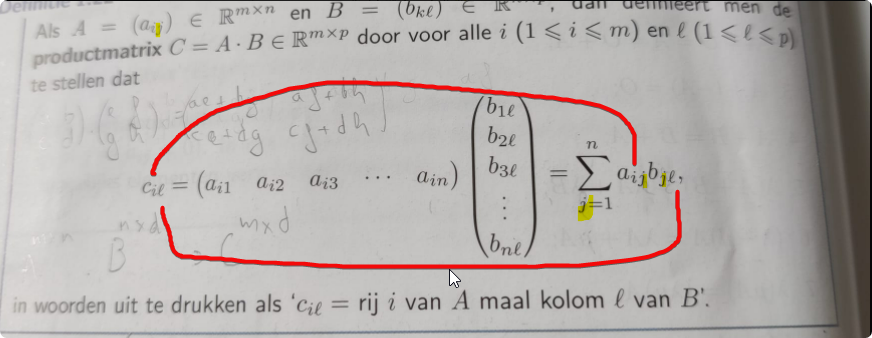
the i and l are because we called it c_il
we could have also called it c_xy or something and then the sum would go over a_xj b_jy
acoustic pawn
My confusion comes from the j used in A = (aij) but also being used in the summation as an index. In the first case, j is an index meaning the jth column. In the sum j is simply and nothing more than the index which is summed over
acoustic pawn
Sooo the j in the summation can be interchanged for any other letter?
kind hawk
yes
acoustic pawn
okey okey awesome, ty for the patience
Ig in the end its still bad form bcs damn that confused me
he couldve litteraly chosen any other letter in the alphabet and chose one already used for something ese
anyway, thanks again !!
.close
obtuse pebbleBOT
Channel closed
Closed by @acoustic pawn
Use .reopen if this was a mistake.
Please take a minute to participate in [our survey](#changelog message) if you haven't already!
Available help channel!
Send your question here to claim the channel.
Remember:
• Ask your math question in a clear, concise manner.
• Show your work, and if possible, explain where you are stuck.
• After 15 minutes, feel free to ping <@&286206848099549185>.
• Type the command .close to free the channel when you're done.
• Be polite and have a nice day!
Read #❓how-to-get-help for further information on how to ask a good question, and about conduct in the question channels.
 gleaming oak
Hello,
The final value of a multiple rate investment is calculated using the following formula (image)
In this formula, PV is the initial value of the investment, Tj is the interest rates, and Nj is the time in years (divide by 12 for months).
An initial amount (PV) of $5,000 was invested at an annual rate of 8% (T1) for 3 months (N1), then at 9% (T2) for 2 months and (N2) finally at 6% (T3) for 1 month (N3).
I have answered $5202.38, but the right answer is $5200... not sure to understand how I got this number.
 obtuse pebbleBOT
gleaming oak
Hello,
The final value of a multiple rate investment is calculated using the f...
gleaming oak
obtuse pebbleBOT
gleaming oak
Hello,
The final value of a multiple rate investment is calculated using the f...
gleaming oak
Sorry - I do my homework in French so maybe it can be a bit confusing for you all.
obtuse pebbleBOT
@gleaming oak Has your question been resolved?
gleaming oak
<@&286206848099549185> could anyone please help me to understand my mistake?
 solar trellis
My guess is that your answer is right and the answer you checked with is just an approximatation
slim cove
yeah I haven't tried it, but the "right answer" is probably just rounded
gleaming oak
It's a question with choice of answers

The right answer is A, but I answered B so not sure to understand why I got B in my calculations.
slim cove
ah okay
lemme see
I also got 5202.38... do you know how often it's compounded?
is it compounded every month
gleaming oak
I think so... not sure
slim cove
I'm not sure how they got 5200, does the question say to round?
gleaming oak
No I copied pasted the question and it doesn't say to round
 gleaming oak
Ohh!! I got it now. Thank you for your help 🙂
 gleaming oak
what is the app you used to make it?
slim cove
wolframalpha
gleaming oak
cool thank you !!! much appreciated
obtuse pebbleBOT
@gleaming oak Has your question been resolved?
Channel closed
Closed by @gleaming oak
Use .reopen if this was a mistake.
Please take a minute to participate in [our survey](#changelog message) if you haven't already!
Available help channel!
Send your question here to claim the channel.
Remember:
• Ask your math question in a clear, concise manner.
• Show your work, and if possible, explain where you are stuck.
• After 15 minutes, feel free to ping <@&286206848099549185>.
• Type the command .close to free the channel when you're done.
• Be polite and have a nice day!
Read #❓how-to-get-help for further information on how to ask a good question, and about conduct in the question channels.
timid silo
This is one of my sample paper questions.
Question is, both B and C must be unit vectors right (because their magnitude is 1)
The answer key says only b.
Is there any other definition of unit vector (formal or conventional) am I missing?
 obtuse pebbleBOT
timid silo
This is one of my sample paper questions.
Question is, both B and C must be unit...
timid silo
obtuse pebbleBOT
timid silo
This is one of my sample paper questions.
Question is, both B and C must be unit...
timid silo
Sorry for messed up alignment
Options:
(A) i+j
(B) cos(theta)i - sin(theta)j
(C) cos(theta)i + sin(theta)j
(D) (1/√3)(i+j)
 warm canopy
You're correct, not sure why theyd leave out C
obtuse pebbleBOT
Channel closed
Closed by @steady imp
Use .reopen if this was a mistake.
Please take a minute to participate in [our survey](#changelog message) if you haven't already!
Available help channel!
Send your question here to claim the channel.
Remember:
• Ask your math question in a clear, concise manner.
• Show your work, and if possible, explain where you are stuck.
• After 15 minutes, feel free to ping <@&286206848099549185>.
• Type the command .close to free the channel when you're done.
• Be polite and have a nice day!
Read #❓how-to-get-help for further information on how to ask a good question, and about conduct in the question channels.
 restive ridge
what sub do you do to go from $\frac{1}{1+x^2}$ to $\sqrt{1-x^2}$ while keeping the bounds $\int\limits_0^1$
obtuse pebbleBOT
restive ridge
what sub do you do to go from $\frac{1}{1+x^2}$ to $\sqrt{1-x^2}$ while keeping ...
warm shaleBOT
illuminator3
 obtuse pebbleBOT
@restive ridge Has your question been resolved?
 wanton violet
What context is this in?
It seems oddly specific
restive ridge
wanton violet
What context is this in?
It seems oddly specific
no context
it must be possible
$$\int \limits_0^1 \frac{4}{1+x^2}dx = \pi$$
$$\int \limits_0^1 4\sqrt{1-x^2}dx = \pi$$
$$\therefore \int \limits_0^1 \frac{1}{1+x^2}dx = \int \limits_0^1 \sqrt{1-x^2}dx$$
warm shaleBOT
illuminator3
 restive ridge
maybe a trig sub?
wanton violet
Oops I'm just dumb
 cedar lichen
Perhaps you can do something akin to this:
Do the substitution x = f(u) --> dx = f'(u) du.
Thus the integral $\int \frac{1}{1 + x^2} dx = \int \frac{1}{1 + (f(u))^2} f'(u) du = \int \sqrt{1 - u^2} du$
$\therefore \frac{y'}{1 + y^2} = \sqrt{1 - u^2}$, y(0) = 0, y(1) = 1
warm shaleBOT
Gamer Dio
 cedar lichen
I think the u and x is the wrong way around
Actually, I got 2 arctan(x) = u √(1 - u²) + arcsin(u)
wanton violet
Ah possibly, although since they used x for both in the question it doesn't really matter
cedar lichen
But on the flipside, I have an arctan instead of a tan
cedar lichen
I see
wanton violet
Can't really edit so I will delete
restive ridge
solved
 fickle turret
restive ridge
solved
fickle turret
restive ridge
solved
Hello, there
restive ridge
$\frac{1}{1+u^2}du = \sqrt{1-x^2}dx$
warm shaleBOT
illuminator3
 restive ridge
$\implies \tan^{-1}(u) = \frac{1}{2} x\sqrt{1-x^2} + \frac{1}{2}\sin^{-1}(x)$
warm shaleBOT
illuminator3
 wanton violet
cedar lichen
Actually, I got 2 arctan(x) = u √(1 - u²) + arcsin(u)
wanton violet
cedar lichen
Actually, I got 2 arctan(x) = u √(1 - u²) + arcsin(u)
Yes, that's how we came up with this
restive ridge
$\therefore u = \tan\left(\frac{1}{2} x\sqrt{1-x^2} + \frac{1}{2}\sin^{-1}(x)\right)$
warm shaleBOT
illuminator3
 obtuse pebbleBOT
Channel closed
Closed by @restive ridge
Use .reopen if this was a mistake.
Please take a minute to participate in [our survey](#changelog message) if you haven't already!
Available help channel!
Send your question here to claim the channel.
Remember:
• Ask your math question in a clear, concise manner.
• Show your work, and if possible, explain where you are stuck.
• After 15 minutes, feel free to ping <@&286206848099549185>.
• Type the command .close to free the channel when you're done.
• Be polite and have a nice day!
Read #❓how-to-get-help for further information on how to ask a good question, and about conduct in the question channels.
 fierce nexus
Came across this problem, not really sure how to begin.
 obtuse pebbleBOT
fierce nexus
Came across this problem, not really sure how to begin.
timid silo
obtuse pebbleBOT
fierce nexus
Came across this problem, not really sure how to begin.
timid silo
definition of $(a_n)$ can be rewritten as $a_{n}a_{n-1}=1+a_ {n-1}a_{n-2}$ this allows us to have a general expression of the sequence $u_n=a_{n}a_{n-1}$ not sure how to proceed from here though
warm shaleBOT
AimaneSN
 obtuse pebbleBOT
@fierce nexus Has your question been resolved?
fierce nexus
slim cove
I think you can do something with generating functions
How
slim cove
oh wait no the 1/a_(n-1) makes it kinda difficult nvm
 plain owl
By induction, one can show $a_n=\frac{n!!}{(n-1)!!}$
warm shaleBOT
Euclid31415
 timid silo
fierce nexus
So a_n = n/(a_n-1)
timid silo
fierce nexus
So a_n = n/(a_n-1)
so the desired limit is of $\frac{a_n^2}{n}$ if we can somehow prove that $(a_n)$ is bounded (is it even bounded?) we're done.
warm shaleBOT
AimaneSN
 timid silo
yeah not bounded because if it were, the sequence $(a_na_{n-1})$ would be bounded, but it's equal to $n$
warm shaleBOT
AimaneSN
 fierce nexus
plain owl
By induction, one can show $a_n=\frac{n!!}{(n-1)!!}$
fierce nexus
plain owl
By induction, one can show $a_n=\frac{n!!}{(n-1)!!}$
wow you're right
plain owl
timid silo
so the desired limit is of $\frac{a_n^2}{n}$ if we can somehow prove that $(a_n)...
I think you meant to say the desired limit is of $\frac{n}{a_{n-1}^2}$
warm shaleBOT
Euclid31415
 fierce nexus
but how did you realize it was $\frac{n!!}{(n-1)!!}$
warm shaleBOT
Artee
 plain owl
Just continuing the recurrence pattern for a3, a4 it becomes immediately obvious
fierce nexus
ohh so you're familiar with the sequence
so the limit is equal to $\frac{{n!!}\cdot(n-2)!!}{{(n-1)!!}^2}$
warm shaleBOT
Artee
 fierce nexus
timid silo
yeah not bounded because if it were, the sequence $(a_na_{n-1})$ would be bounde...
fierce nexus
timid silo
yeah not bounded because if it were, the sequence $(a_na_{n-1})$ would be bounde...
Right but a_n being unbounded doesn't imply an^2/n is not bounded
timid silo
plain owl
I think you meant to say the desired limit is of $\frac{n}{a_{n-1}^2}$
the same thing since $a_na_{n-1}=n$
warm shaleBOT
AimaneSN
 timid silo
fierce nexus
Right but a_n being unbounded doesn't imply an^2/n is not bounded
timid silo
fierce nexus
Right but a_n being unbounded doesn't imply an^2/n is not bounded
yes true, but no idea how to proceed now
plain owl
timid silo
the same thing since $a_na_{n-1}=n$
Yeah true
timid silo
warm shale
**Euclid31415**
we can get rid of the double factorial but I don't remember how, the same expression appears in the recurrence relation of Wallis integrals

this should be more manageable (or not?)
notice how they got rid of double factorial in RHS
plain owl
So I suppose we could consider different cases for "n" being even or odd separately and write it completely in terms of regular factorials. Then I hope Stirling's approximation should suffice
obtuse pebbleBOT
@fierce nexus Has your question been resolved?
plain owl
So, if n=2k+1 we have\\$\frac{(2k+1)!!(2k-1)!!}{[(2k)!!]^2}=\left(\frac{(2n+1)!}{2^{2n}(n!)^2}\right)^2\cdot\frac{1}{2n+1}$
warm shaleBOT
Euclid31415
 plain owl
And then, similarly dealing with the case of even n
fierce nexus
Does the limit help to get rid of the double factorial
timid silo
warm shale
**Euclid31415**
this probably converges to 0, but a bit messy to prove
 edgy hare
Hi arthur
fierce nexus
<@&286206848099549185>

i found, with a lotof help, the explicit formula is $a_n=\frac{{n!!}\cdot(n-2)!!}{{(n-1)!!}^2}$ but don't know how to proceed
warm shaleBOT
Artee
 obtuse pebbleBOT
@fierce nexus Has your question been resolved?
obtuse pebbleBOT
Channel closed
Closed due to timeout
Use .reopen if this was a mistake.
Please take a minute to participate in [our survey](#changelog message) if you haven't already!
obtuse pebbleBOT
Available help channel!
Send your question here to claim the channel.
Remember:
• Ask your math question in a clear, concise manner.
• Show your work, and if possible, explain where you are stuck.
• After 15 minutes, feel free to ping <@&286206848099549185>.
• Type the command .close to free the channel when you're done.
• Be polite and have a nice day!
Read #❓how-to-get-help for further information on how to ask a good question, and about conduct in the question channels.
 scenic sable
hi!
obtuse pebbleBOT
scenic sable
hi!

 devout solar
how did you do the others
scenic sable
the others were easy
scenic sable
2x-7+2x+5=90 ??
devout solar
ye
scenic sable
wait how would i do #19 tho
scenic sable
ohh
devout solar
you do the same shit you did on 16 and plug in for x
devout solar
ye
obtuse pebbleBOT
Channel closed
Closed by @scenic sable
Use .reopen if this was a mistake.
Please take a minute to participate in [our survey](#changelog message) if you haven't already!
Available help channel!
Send your question here to claim the channel.
Remember:
• Ask your math question in a clear, concise manner.
• Show your work, and if possible, explain where you are stuck.
• After 15 minutes, feel free to ping <@&286206848099549185>.
• Type the command .close to free the channel when you're done.
• Be polite and have a nice day!
Read #❓how-to-get-help for further information on how to ask a good question, and about conduct in the question channels.
 spare orchid
very simple question: I have $B(s,s) = \int_0^1 x^{s-1} (1-x)^{s-1} dx$ with $u = (1-2x)^2$ substitution. I need to show $B(s,s) = 2^{1-2s} B(s,1/2)$, but I can't figure out how to get the $2^1$ part, I only have the $2^{-2s}$ part.
obtuse pebbleBOT
spare orchid
very simple question: I have $B(s,s) = \int_0^1 x^{s-1} (1-x)^{s-1} dx$ with $u ...
warm shaleBOT
Tubular Cat
 spare orchid
it should be a simple mistake somewhere in the computation but i cannot find it
wooden cipher
Why is it B(s,s) not B(s) lol
spare orchid
wooden cipher
Ah
spare orchid
what I am trying to show reduces down to this part
but im dumb and can't find my error
wooden cipher
Anyway, when you have $a^x×b^x$ you get $(ab)^x$ so i believe your usub is not right
warm shaleBOT
GarlicBredFries
 wooden cipher
Lemme step back, how did you get u=(1-2x)^2?
wooden cipher
Ah
spare orchid
the error lies in the computation, not in what is given
wooden cipher
Can you take a picture of your work pls
spare orchid
 spare orchid
wait
i forgot to change the limits of integration
but also i end up with 1 to 1
as limits
uhh
wooden cipher
OH
You have the integral from 0 to 1/2 and then 1/2 to 1
Thats double the integral
And in turn your factor of two
spare orchid
how?
wooden cipher
You split the integral in half
spare orchid
no i mean how are you getting that
wooden cipher
I was thinking about how to get 0
So i set 1-2x=0 and got x=1/2
So i thought about splitting the integral in half
spare orchid
no i mean how are you getting those limits of integration
warm shaleBOT
GarlicBredFries
 wooden cipher
We split it into
$\int_0^{1/2}+\int_{1/2}^1$
warm shaleBOT
GarlicBredFries
 wooden cipher
Would you believe me if i said that two are the same?
The rest proceeds as you did before
obtuse pebbleBOT
Channel closed
Closed by @spare orchid
Use .reopen if this was a mistake.
Please take a minute to participate in [our survey](#changelog message) if you haven't already!
spare orchid
.reopen
obtuse pebbleBOT
✅
spare orchid
lookingat it again i don't think that solves it
spare orchid
even if i have $\int_0^{1/2} + \int_{1/2}^{1}$
warm shaleBOT
Tubular Cat
 spare orchid
the substitution gives me $\int_1^0 + \int_0^1$
warm shaleBOT
Tubular Cat
 warm shaleBOT
Tubular Cat
 wooden cipher
You still get 0
spare orchid
this should give $1/2$, but yeah
warm shaleBOT
Tubular Cat
 wooden cipher
Maybe bc the ^2 makes a plus minus
So sqrt(u)=|1-2x|
Yeah that should work
Somehow
Theres some absval shenanigans but i cant justify it sorry
obtuse pebbleBOT
@spare orchid Has your question been resolved?
spare orchid
although i guess this example doesn't really work since u isn't differentiable at 0
but this also seems to apply to the original problem
which also has sqrt(u)
wooden cipher
Technically thats an edge case so we can take the limit of an integral from d to 1 where d approaches 0
So we dont need to worry about it
obtuse pebbleBOT
@spare orchid Has your question been resolved?
obtuse pebbleBOT
@spare orchid Has your question been resolved?
Channel closed
Closed by @spare orchid
Use .reopen if this was a mistake.
Please take a minute to participate in [our survey](#changelog message) if you haven't already!
Available help channel!
Send your question here to claim the channel.
Remember:
• Ask your math question in a clear, concise manner.
• Show your work, and if possible, explain where you are stuck.
• After 15 minutes, feel free to ping <@&286206848099549185>.
• Type the command .close to free the channel when you're done.
• Be polite and have a nice day!
Read #❓how-to-get-help for further information on how to ask a good question, and about conduct in the question channels.
 high snow
How do I do this?
 obtuse pebbleBOT
high snow
How do I do this?
high snow
obtuse pebbleBOT
high snow
How do I do this?
high snow
so b and c?
high snow
fierce lagoon
Because the signum of any negative number is -1
okay
fierce lagoon
$$(x+d)(x+e) = x^2 + (d+e)x + de$$
$$\text{sgn}{(b)} = \text{sgn}{(d+e)}$$
$$\text{sgn}{(c)} = \text{sgn}{(de)}$$
Bruh
Hold on idk if Latex likes Signum
warm shaleBOT
Umbraleviathan
 fierce lagoon
@high snow there
high snow
what sgn?
fierce lagoon
signum (tells you whether the number is positive, negative, or neither$
In other words, the sign of b is equal to the sign of quantity d + e
high snow
So it would be negative
fierce lagoon
Yeah
high snow
okay tysm
fierce lagoon
b would be negative
obtuse pebbleBOT
@high snow Has your question been resolved?
Channel closed
Closed by @high snow
Use .reopen if this was a mistake.
Please take a minute to participate in [our survey](#changelog message) if you haven't already!
obtuse pebbleBOT
Available help channel!
Send your question here to claim the channel.
Remember:
• Ask your math question in a clear, concise manner.
• Show your work, and if possible, explain where you are stuck.
• After 15 minutes, feel free to ping <@&286206848099549185>.
• Type the command .close to free the channel when you're done.
• Be polite and have a nice day!
Read #❓how-to-get-help for further information on how to ask a good question, and about conduct in the question channels.
 rocky cosmos
Let $p(x) = 2x^{3} + 5x^{2} - 28x - 15$ and atleast one of the integers $-3, -2, -1, 1, 2, 3$ are roots of $p(x)$. For which values of x does $p(x)>0?$
obtuse pebbleBOT
rocky cosmos
Let $p(x) = 2x^{3} + 5x^{2} - 28x - 15$ and atleast one of the integers $-3, -2,...
warm shaleBOT
AuHasard
 rocky cosmos
$p(3) = 2(3)^{3}+5(3)^{2}-28(3)-15 = 54+45-84-15 = 99-99 = 0$
warm shaleBOT
AuHasard
 royal basin
,calc 2 * 3^3 + 5 * 3^2 - 28 * 3 - 15
warm shaleBOT
Result:
0
LD?
rocky cosmos
long div
rocky cosmos
$\begin{gathered}\ \ \ \ \ x-3)\overline{\ \ \ 2x^{3}+5x^{2}-28x-15} \ -2x^{3}-6x^{2}\ \ \ \ \ \ \ \overline{\ \ \ \ \ \ \ \ \ -x^{2}-28x} \ \ \ \ \ \ \ \ \ \ \ \ \ \ \ +x^{2}+3x\ \ \ \ \ \ \ \ \ \ \ \ \ \ \ \overline{25x-15} \ \ \ \ \ \ \ \ \ \ \ -25x-75\ \end{gathered}$
warm shaleBOT
AuHasard
 rocky cosmos
anyone know what i got wrong here?
it should be 2x^2 + 11x + 5
i get the 2x^2 right, but the other two no
i assume it's because it should be +6x^2
royal basin
yes it should
rocky cosmos
let me try again
$\begin{gathered}\ \ \ \ \ x-3)\overline{\ \ \ 2x^{3}+5x^{2}-28x-15} \ -2x^{3}+6x^{2}\ \ \ \ \ \ \ \overline{\ \ \ \ \ \ \ \ \ \ \ \ \ \ 11x^{2}-28x} \ \ \ \ \ \ \ \ \ \ \ \ \ \ \ \ \ -(11x^{2}-33x)\ \ \ \ \ \ \ \ \ \ \ \ \ \ \ \overline{\ \ \ \ \ \ \ \ \ \ \ \ \ \ \ \ \ 5x} -15\ \ \ \ \ \ \ \ \ \ \ \ \ \ \ \ \ \ \ \ \ \ \ \ \ \ \ \ \ -\left( 5x-15\right) \ \overline{\ \ \ \ \ \ \ \ \ \ \ \ \ \ \ \ \ \ \ \ \ \ \ \ \ \ \ \ \ \ \ \ \ \ 0\ \ \ \ \ \ } \end{gathered}$
warm shaleBOT
AuHasard
 rocky cosmos
is this better
royal basin
sure does take some dedication to write this out in latex with manual spacing
rocky cosmos
not when you use xFormula trolololo
royal basin
,w simplify (2x^2 + 11x + 5)(x-3) - (2x^3 + 5x^2 - 28x - 15)
warm shaleBOT


 royal basin
ok yeah checks out
rocky cosmos
Do you know what the next part of the solution is?
We should simplify 2x^2 + 11x+5 further?
royal basin
we should factor it further
 idle shoal
rocky cosmos
idle shoal
rocky cosmos
”We do a sign analysis and because p (x)> 0 if and only if none of the factors is zero and exactly one or three are positive, ie p (2)> 0 if -5 <x <-1/2 or 3 <x.”
I don't understand what they meant by this
I am not sure if you call it sign analysis, here in sweden we just say ”teckenanalys”
royal basin
sign analysis is fine
the real line is broken into intervals by the roots of the polynomial
you look at the sign of each factor in each interval
so you have... what, 3, -5 and -1/2 as roots
rocky cosmos
$\begin{gathered}\underline{\ \ \ \ \ \ \ \ \ \ \ \ \ \ \ \ \ \ \ \ \ \ \ \ \ \ \ \ \ \ \ \ \ \ \ \ \ \ \ \ \ \ -\ 0\ +\ 0\ -\ 0\ +\ 0} \ (2x+1)\ \mid \ \left( x+5\right) \ \ \mid \ \left( x-3\right) \ \ \mid \end{gathered}$
warm shaleBOT
AuHasard
 rocky cosmos
i've done sign analysis just a few times before
royal basin
\begin{tabular}{c|cccc}
Factor & $(-\infty, -5)$ & $(-5, -1/2)$ & $(-1/2, 3)$ & $(3, +\infty)$ \
\hline
$x+5$ & $-$ & $+$ & $+$ & $+$ \
$2x+1$ & $-$ & $-$ & $+$ & $+$ \
$x-3$ & $-$ & $-$ & $-$ & $+$ \
\hline
$p(x)$ & $-$ & $+$ & $-$ & $+$
\end{tabular}
warm shaleBOT
Ann
 royal basin
looked up "how to make tables in latex" once
rocky cosmos
i see, i practice sometimes on overleaf or w/e
royal basin
the syntax for tables is similar to that of matrices
& for new entry, \\ for new line
\hline gives you a horizontal line, and at the start of the thing you specify alignment and vertical lines
rocky cosmos
i see, thanks
obtuse pebbleBOT
@rocky cosmos Has your question been resolved?
obtuse pebbleBOT
Channel closed
Closed due to timeout
Use .reopen if this was a mistake.
Please take a minute to participate in [our survey](#changelog message) if you haven't already!
Available help channel!
Send your question here to claim the channel.
Remember:
• Ask your math question in a clear, concise manner.
• Show your work, and if possible, explain where you are stuck.
• After 15 minutes, feel free to ping <@&286206848099549185>.
• Type the command .close to free the channel when you're done.
• Be polite and have a nice day!
Read #❓how-to-get-help for further information on how to ask a good question, and about conduct in the question channels.
 granite nimbus
 obtuse pebbleBOT
granite nimbus
https://cdn.discordapp.com/attachments/268882317391429632/995955774331289660/unk...
granite nimbus
obtuse pebbleBOT
granite nimbus
https://cdn.discordapp.com/attachments/268882317391429632/995955774331289660/unk...
granite nimbus
can u guys pls help me w these q's?
obtuse pebbleBOT
@granite nimbus Has your question been resolved?
obtuse pebbleBOT
Channel closed
Closed due to timeout
Use .reopen if this was a mistake.
Please take a minute to participate in [our survey](#changelog message) if you haven't already!
obtuse pebbleBOT
Available help channel!
Send your question here to claim the channel.
Remember:
• Ask your math question in a clear, concise manner.
• Show your work, and if possible, explain where you are stuck.
• After 15 minutes, feel free to ping <@&286206848099549185>.
• Type the command .close to free the channel when you're done.
• Be polite and have a nice day!
Read #❓how-to-get-help for further information on how to ask a good question, and about conduct in the question channels.
 flat apex
How this sign is called? and how it differs from such sign <?
 obtuse pebbleBOT
flat apex
How this sign is called? and how it differs from such sign <?
royal basin
obtuse pebbleBOT
flat apex
How this sign is called? and how it differs from such sign <?
royal basin
$\preceq$
warm shaleBOT
Ann
 royal basin
and this sign has no set in stone meaning other than to be the symbol for an order relation and evoke graphical similarity to $\leq$ while not being the same symbol as $\leq$
warm shaleBOT
Ann
 obtuse pebbleBOT
Channel closed
Closed by @flat apex
Use .reopen if this was a mistake.
Please take a minute to participate in [our survey](#changelog message) if you haven't already!
Available help channel!
Send your question here to claim the channel.
Remember:
• Ask your math question in a clear, concise manner.
• Show your work, and if possible, explain where you are stuck.
• After 15 minutes, feel free to ping <@&286206848099549185>.
• Type the command .close to free the channel when you're done.
• Be polite and have a nice day!
Read #❓how-to-get-help for further information on how to ask a good question, and about conduct in the question channels.
obtuse pebbleBOT
@crisp vapor Has your question been resolved?
obtuse pebbleBOT
Channel closed
Closed due to timeout
Use .reopen if this was a mistake.
Please take a minute to participate in [our survey](#changelog message) if you haven't already!
Available help channel!
Send your question here to claim the channel.
Remember:
• Ask your math question in a clear, concise manner.
• Show your work, and if possible, explain where you are stuck.
• After 15 minutes, feel free to ping <@&286206848099549185>.
• Type the command .close to free the channel when you're done.
• Be polite and have a nice day!
Read #❓how-to-get-help for further information on how to ask a good question, and about conduct in the question channels.
 odd arch
I don't understand this working...
from the first pic to the 2nd

 high lily
consider formula for arithmetic serires
 next reef
Sum upto $n$ natural numbers is,
$$\frac{n\cdot(n+1)}{2}$$
warm shaleBOT
QuantumBee
 obtuse pebbleBOT
Channel closed
Closed by @odd arch
Use .reopen if this was a mistake.
Please take a minute to participate in [our survey](#changelog message) if you haven't already!
Available help channel!
Send your question here to claim the channel.
Remember:
• Ask your math question in a clear, concise manner.
• Show your work, and if possible, explain where you are stuck.
• After 15 minutes, feel free to ping <@&286206848099549185>.
• Type the command .close to free the channel when you're done.
• Be polite and have a nice day!
Read #❓how-to-get-help for further information on how to ask a good question, and about conduct in the question channels.
 storm wing
So here is some work I recently did related to my calculus II course.
 storm wing
I understand the steps up until the very last step where we find the answer.
how does intcsc^2theta - 1 become -1/sqrt{x^2-1}-sec^-1(x)
I understand that the. original triangle is set up for sec
<@&286206848099549185>
.close
obtuse pebbleBOT
Channel closed
Closed by @storm wing
Use .reopen if this was a mistake.
Please take a minute to participate in [our survey](#changelog message) if you haven't already!
Available help channel!
Send your question here to claim the channel.
Remember:
• Ask your math question in a clear, concise manner.
• Show your work, and if possible, explain where you are stuck.
• After 15 minutes, feel free to ping <@&286206848099549185>.
• Type the command .close to free the channel when you're done.
• Be polite and have a nice day!
Read #❓how-to-get-help for further information on how to ask a good question, and about conduct in the question channels.
 jaunty dew
Hey can someone help me with this question?
 obtuse pebbleBOT
jaunty dew
Hey can someone help me with this question?
obtuse pebbleBOT
obtuse pebbleBOT
jaunty dew
Hey can someone help me with this question?
obtuse pebbleBOT
Channel closed
Closed by @jaunty dew
Use .reopen if this was a mistake.
Please take a minute to participate in [our survey](#changelog message) if you haven't already!
Available help channel!
Send your question here to claim the channel.
Remember:
• Ask your math question in a clear, concise manner.
• Show your work, and if possible, explain where you are stuck.
• After 15 minutes, feel free to ping <@&286206848099549185>.
• Type the command .close to free the channel when you're done.
• Be polite and have a nice day!
Read #❓how-to-get-help for further information on how to ask a good question, and about conduct in the question channels.
 sonic dragon
Hello this is kinda a mixed maths with programming, i need to implement an algorithn that finds the intersection between two 3d lines . https://gist.github.com/soulslicer/26c4d6d36407e37c21cdf033c532a9ca 2Dlines(basically start and end vector give me the line) in the code i try to set both of them startVector[1] ,endVector[0] to have the same point so I wll get it back as intersection but it is not working any ideas??
                    startVector[0] = new Vector3(3, -2, 5);
                    startVector[1] = new Vector3(1, 1, 1);
                    endVector[0] = new Vector3(1, 1, 1);
                    endVector[1] = new Vector3(6,-3 , 4);
                    //Direction vectors
                    Vector3 DP = endVector[0] - startVector[0];
                    Vector3 DQ = endVector[1] - startVector[1];

                    //start difference vector
                    Vector3 PQ = startVector[1] - startVector[0];
                    float a = Vector3.Dot(DP, DP);
                    float b = Vector3.Dot(DP, DQ);
                    float c = Vector3.Dot(DQ, DQ);
                    float d = Vector3.Dot(DP, PQ);
                    float e = Vector3.Dot(DQ, PQ);
                    float DD = a * c - b * b;
                    float tt = (b * e - c * d) / DD;
                    float uu = (a * e - b * d) / DD;

                    Vector3 Pi = startVector[0] + tt * DP;
                    Vector3 Qi = startVector[1] + uu * DQ;
                    double dist = Math.Sqrt(Math.Pow(Pi.x - Qi.x, 2) + Math.Pow(Pi.y - Qi.y, 2) + Math.Pow(Pi.z - Qi.z, 2));

                    print("length" + dist);
                    print("x" + Pi.x + "y" + Pi.y + "z" + Pi.z);
 obtuse pebbleBOT
sonic dragon
Hello this is kinda a mixed maths with programming, i need to implement an alg...
obtuse pebbleBOT
sonic dragon
Hello this is kinda a mixed maths with programming, i need to implement an alg...
@sonic dragon Has your question been resolved?
 knotty wadi
sonic dragon
Hello this is kinda a mixed maths with programming, i need to implement an alg...
knotty wadi
sonic dragon
Hello this is kinda a mixed maths with programming, i need to implement an alg...
I don't know much about programming so...
sonic dragon
knotty wadi
I don't know much about programming so...
does this approach seem mathematically correct to you?
 knotty wadi
sonic dragon
does this approach seem mathematically correct to you?
knotty wadi
sonic dragon
does this approach seem mathematically correct to you?
<@&286206848099549185>
obtuse pebbleBOT
@sonic dragon Has your question been resolved?
 zinc crag
Anyone free to help me on b)iii)
 obtuse pebbleBOT
Channel closed
Closed due to timeout
Use .reopen if this was a mistake.
Please take a minute to participate in [our survey](#changelog message) if you haven't already!
Available help channel!
Send your question here to claim the channel.
Remember:
• Ask your math question in a clear, concise manner.
• Show your work, and if possible, explain where you are stuck.
• After 15 minutes, feel free to ping <@&286206848099549185>.
• Type the command .close to free the channel when you're done.
• Be polite and have a nice day!
Read #❓how-to-get-help for further information on how to ask a good question, and about conduct in the question channels.
 uneven trellis
it keeps saying i’m wrong just screen sHot it and reflect it to show me please
 obtuse pebbleBOT
uneven trellis
it keeps saying i’m wrong just screen sHot it and reflect it to show me please
obtuse pebbleBOT
uneven trellis
it keeps saying i’m wrong just screen sHot it and reflect it to show me please
 nocturne minnow
uneven trellis
it keeps saying i’m wrong just screen sHot it and reflect it to show me please
nocturne minnow
uneven trellis
it keeps saying i’m wrong just screen sHot it and reflect it to show me please
What did you try?
 nocturne minnow
What's the gray spots?
nocturne minnow
The red lines are is the shape that you created over the line y = x?
uneven trellis
yes
nocturne minnow
Well, first off, does that shape you drew look like the given shape?
 lusty scroll
Hi I need help
 nocturne minnow
lusty scroll
Hi I need help
uneven trellis
nocturne minnow
lusty scroll
Hi I need help
uneven trellis
it says it’s still wrong
nocturne minnow
Do you know what it means to be reflected over y = x?
 nocturne minnow
So if an object is reflected over y = x, what happens to the coordinates?
uneven trellis
switch
nocturne minnow
Meaning?
Let's take a point on the given shape, (1, -2), if that was reflected over y = x, what should the new coordinates be?
nocturne minnow
Yes
So here's what I want you to do, erase the attempt you have, write out all the vertex coordinates of that shape, and reflect them over y = x, then plot the points and connect the dots
 nocturne minnow
Yes
uneven trellis
i get what i did wrong
obtuse pebbleBOT
@uneven trellis Has your question been resolved?
obtuse pebbleBOT
Channel closed
Closed due to timeout
Use .reopen if this was a mistake.
Please take a minute to participate in [our survey](#changelog message) if you haven't already!
Available help channel!
Send your question here to claim the channel.
Remember:
• Ask your math question in a clear, concise manner.
• Show your work, and if possible, explain where you are stuck.
• After 15 minutes, feel free to ping <@&286206848099549185>.
• Type the command .close to free the channel when you're done.
• Be polite and have a nice day!
Read #❓how-to-get-help for further information on how to ask a good question, and about conduct in the question channels.
 devout sable
Idk but i’d try and move the powers up
Like instead of $a_n, a_(n-1) and a_( n-2) i’d do it first for a_(n+2), a_(n+1), a_n$
warm shaleBOT
Deep.
 devout sable
Well discord is dumb but you get my point?
See $a_{(n+2)} = 8. 3^{(n+2)}-5.2^{(n+2)}$
warm shaleBOT
Deep.
 devout sable
So $a_{(n+2)} = 9.8.3^n - 4.5.2^n$
warm shaleBOT
Deep.
 devout sable
Thats $a_{n+2} = 72 .3^n - 20. 2^n$
warm shaleBOT
Deep.
 devout sable
Similarly $a_{n+1}= 24. 3^n - 10 .2^n$
warm shaleBOT
Deep.
 warm shaleBOT
Deep.
 warm shaleBOT
Deep.
 devout sable
Therefore
24x + 8 y =72; 10x +5y =20
Solve it
Now
I’m finished
Once you get x,y
You can reduce power
Because we took n without loss of generality *
@slow timber ?
Yes two equations 2 unknowns
Idk I’m lazy to solve
But did you get the process?
Thats whats imp
Wait something’s wrong ig
I’m getting-5,-6
Fuck I’m dumb
Nvm you got ur answers correctly
,w 24x + 8 y =72; 10x +5y =20
warm shaleBOT


 Requested by Deep.#0001
devout sable
Requested by Deep.#0001
devout sable
Yup I’m lame
Yeah it matches with key too I suppose so yeah I’m safe
Idk but it’d be fun challenge to do without moving powers up
It’d go into fractions and stuff
Yeah but it should be doable
Did you get it?
Well the above ones easier imo
Same logic, try and find 2 equations 2 unknowns
Moving powers up always helps to avoid negative powers of 2 and 3 which means no fractions
timid silo
I don't know if this was mentioned already, but this is a recurrence relation that is generally solved by solving a characteristic polynomial.
devout sable
Like instead of 72 it’d be 8, instead of 20 it’d be 5 instead of 24x + 8y=72 it’d be 8/3x +8/9 y =8 I believe if I’m not wrong
devout sable
timid silo
I don't know if this was mentioned already, but this is a recurrence relation th...
Well whats that?
 devout sable
Hmm well i didn’t knew about that, new stuff to learn
Its pretty easy to understand tho
timid silo
yeah it's easy, I am not sure I can prove that though, but whatever
devout sable
Lol don’t know, need to try to find out
timid silo
yes ofc, wolfram can solve any equation of this kind
timid silo
devout sable
Lol don’t know, need to try to find out
it's a second degree equation, if wolfram can't solve it it's useless lol
which part exactly
devout sable
Umm well yeah ig
timid silo
for his sake he should
the numbers powered to n in the closed form are the solutions of the characteristic polynomial
start by getting this polynomial
and then use it to get the recursive formula
devout sable
timid silo
Wow now i need to find proof of it, can’t sleep until then
timid silo
lol me too
devout sable
Well idk but need to check by induction ig
timid silo
induction seems promising here
@slow timber it's probably faster to just calculate the first terms of the sequence from closed formula, like $(a_3)$ and $(a_4)$ and see which reccurent relation gives the same values
warm shaleBOT
AimaneSN
 devout sable
timid silo
<@739900597393817750> it's probably faster to just calculate the first terms of ...
devout sable
timid silo
<@739900597393817750> it's probably faster to just calculate the first terms of ...
Hmm well but it’s not very lengthy for the above 2 methods mentioned
I mean ur formula solves it in 2 steps or so
timid silo
devout sable
I mean ur formula solves it in 2 steps or so
yeah but the problem is they're asking for recurrent relation
not the closed formula
it's like the inverse problem
not sure which method is faster
timid silo
$(a_0)=3$ and $(a_1)=14$ and $(a_2)=196$
warm shaleBOT
AimaneSN
 timid silo
devout sable
Does the converse hold true?Earlier I assumed so lol
timid silo
devout sable
Does the converse hold true?Earlier I assumed so lol
probably true but not sure
devout sable
timid silo
probably true but not sure
Well it does for this question in particular
devout sable
devout sable
And its given that (x-r1) (x-r2) = x^2 + αx+β
Therefore α=-5 & β=6
@slow timber
warm shaleBOT
AimaneSN
 timid silo
devout sable
Well it does for this question in particular
timid silo
devout sable
Well it does for this question in particular
yeah probably true
@slow timber just check which recurrent relation gives the value of a2 above
that's it
a_0=3 and a_1=14
I checked
the right answer is
$5a_{m-1}-6a_{m-2}$
warm shaleBOT
AimaneSN
 timid silo
devout sable
Therefore α=-5 & β=6
timid silo
devout sable
Therefore α=-5 & β=6
that seems too long to verify
for each recurrent relation
checking values like above works faster here
otherwise you have to solve a polynomial for each answer
might as well do simple additions for each answer
devout sable
@slow timber you get it?
warm shaleBOT
AimaneSN
 devout sable
Thats what I did expect i did it for __ $a_{m+2} a_{m+1} & a_m$
warm shaleBOT
Deep.
Compile Error! Click the  reaction for more information.
(You may edit your message to recompile.)
 devout sable
But moving powers up helps
m+2 m+1 m
I dk the term
Yes
Lol ur writing with mouse is way good tbh
obtuse pebbleBOT
@slow timber Has your question been resolved?
warm shaleBOT
AimaneSN
 obtuse pebbleBOT
@slow timber Has your question been resolved?
obtuse pebbleBOT
@slow timber Has your question been resolved?
obtuse pebbleBOT
Channel closed
Closed by @slow timber
Use .reopen if this was a mistake.
Please take a minute to participate in [our survey](#changelog message) if you haven't already!
Available help channel!
Send your question here to claim the channel.
Remember:
• Ask your math question in a clear, concise manner.
• Show your work, and if possible, explain where you are stuck.
• After 15 minutes, feel free to ping <@&286206848099549185>.
• Type the command .close to free the channel when you're done.
• Be polite and have a nice day!
Read #❓how-to-get-help for further information on how to ask a good question, and about conduct in the question channels.
 plain grove
what identities would i have to use to reach this?
 obtuse pebbleBOT
plain grove
what identities would i have to use to reach this?
wooden cipher
obtuse pebbleBOT
plain grove
what identities would i have to use to reach this?
wooden cipher
i think you square it then squareroot it
brave bramble
Consider the summation identity
wooden cipher
oh that, right
plain grove
brave bramble
Consider the summation identity
using the summation identity but im still getting stuck
nvm
obtuse pebbleBOT
@plain grove Has your question been resolved?
obtuse pebbleBOT
Channel closed
Closed due to timeout
Use .reopen if this was a mistake.
Please take a minute to participate in [our survey](#changelog message) if you haven't already!
obtuse pebbleBOT
Available help channel!
Send your question here to claim the channel.
Remember:
• Ask your math question in a clear, concise manner.
• Show your work, and if possible, explain where you are stuck.
• After 15 minutes, feel free to ping <@&286206848099549185>.
• Type the command .close to free the channel when you're done.
• Be polite and have a nice day!
Read #❓how-to-get-help for further information on how to ask a good question, and about conduct in the question channels.
 elfin tangle
 obtuse pebbleBOT
elfin tangle
obtuse pebbleBOT
elfin tangle
 slim cove
that's correct
it is equivalent to one of the answers that they list
try to figure out which one by process of elimination
elfin tangle
how 
slim cove
easiest thing to do is to plug in x=0 to all of them
see which one gives you the same value as yours
elfin tangle
am so confused
nocturne minnow
elfin tangle
What did you have before this?
Because notice how the choices all have a 4 while in your answer, you have a 2
 cerulean tulip
elfin tangle
how <:sobbing:856930905440387073>
cerulean tulip
elfin tangle
how <:sobbing:856930905440387073>
try solving for x in the function
elfin tangle
i had x=4y^2+7
nocturne minnow
notice how the choices all have a 4 while in your answer, you have a 2
You simplified your answer more then needed
elfin tangle
oh oops
nocturne minnow
You just need to manipulate your answer, before you simplified it
elfin tangle
so it would be this one?
 nocturne minnow
elfin tangle
nocturne minnow
elfin tangle
As I asked, what did you have before this?
And it can't be x = 4y^2 + 7
nocturne minnow
elfin tangle
Because there is no way you decided to skip from x=4y^2+7 to that in one step
elfin tangle
nocturne minnow
Because there is no way you decided to skip from x=4y^2+7 to that in one step
i just solved for y
like dragging the numbers over
idk if im doing this right LOL
nocturne minnow
As I mentioned, you probably did not go from $x=4y^2+7$ straight to $\pm \frac{\sqrt{x-7}}{2}$ in one step
warm shaleBOT
dldh06
 nocturne minnow
You had a step by step process to get there, did you not?
 nocturne minnow
I wasn't asking for an example from your teacher
I was asking for your step by step work for that problem
elfin tangle
so i just got rid of the squared sign
by adding a radical after i drgaged the numbers over to the other side
nocturne minnow
elfin tangle
Because the step before you got this, you need to manipulate the expression
elfin tangle
can we redo this whole question LOL
nocturne minnow
So are you saying that you $x=4y^2+7$ straight to $\pm \frac{\sqrt{x-7}}{2}$ in one step?
warm shaleBOT
dldh06
 nocturne minnow
Like there was no work you did in between?
elfin tangle
tbh no my friend gave me the answer LOl but idk how to get there
nocturne minnow
Then that's the issue
elfin tangle
so can we do the question?
nocturne minnow
You should have done it yourself
Make an attempt at it and come back with some work
nocturne minnow
This algebra 2 and precalculus video tutorial explains how to find the inverse of a function using a very simple process. First, replace f(x) with y. Next, switch x with y. Finally, solve for the y variable and that's it. This video contains examples and practice problems that include fractions, radicals, square roots, cube roots, linear fun...
elfin tangle
cuz ive been struggling eith the example
elfin tangle
im telling you ive watched every video LOL 😭 i dont get how they added the radical
i know it has to do with the squared sign
nocturne minnow
Because that's how you get rid of the squared
You want to use the square root to remove the squared
It's based on exponent properties
Where you want the power to be 1
nocturne minnow
Are you not paying attention? That's not the issue the OP is having
nocturne minnow
elfin tangle
x-7=4y^2
What's the next step?
elfin tangle
add the radical and divide by 4 to both sides?
nocturne minnow
No
You want to isolate the variable first
Think of it as reverse PEMDAS
To isolate for a variable, you what to add/subtract first
Then divide/multiply
nocturne minnow
Then handle exponents, and finally parentheses
elfin tangle
okay so it becomes (x-7)/4=y^2
elfin tangle
then the radical gets added
nocturne minnow
Yes


 nocturne minnow
Yes
elfin tangle
do i keep the brackets
nocturne minnow
And yes, keep the brackets
nocturne minnow
There is a difference between $\sqrt{\frac{1}{4}x - 7}$ and$\sqrt{\frac{1}{4}(x - 7)}$
warm shaleBOT
dldh06
 elfin tangle
what would i do in this situation
 nocturne minnow
Same process, reverse PEMDAS
nocturne minnow
No
elfin tangle
then
nocturne minnow
Because the x + 5 is in parentheses
nocturne minnow
And if you did reverse PEMDAS, parentheses would be the last thing to handle
elfin tangle
so x-7=(y+5)^2
nocturne minnow
Then?
elfin tangle
x-7 under the radical = (y+5)
elfin tangle
thenoh oopos
nocturne minnow
elfin tangle
x-7 under the radical = (y+5)
And second, you mean $\sqrt{x-7} = y + 5$?
warm shaleBOT
dldh06
 elfin tangle
yes
nocturne minnow
What's the next step?
nocturne minnow
No