#help-10
1 messages · Page 548 of 1
 rain socket
 timid silo
rain socket
yeah but do i have to use the "𝜃 is small enough to regard 4𝜃 as small" anywhe...
timid silo
rain socket
yeah but do i have to use the "𝜃 is small enough to regard 4𝜃 as small" anywhe...
Yes
If they have said $4 \theta$ to be small and i hope we are talking about radians what do you think $sin(4 \theta)$ will be
 warm shaleBOT
Frustrated Cat
 rain socket
$sin(4 \theta)$ would be equal to $\theta$ right?
warm shaleBOT
Danielll
 rain socket
4 theta*
timid silo
rain socket
4 theta*
Yup
How will you approximate it without knowing
That 4 theta is small
rain socket
ah so that line is just saying that 4 theta is small
timid silo
rain socket
ah so that line is just saying that 4 theta is small
Ya
Yup
If theta is very small
And in radians
 obtuse pebbleBOT
@rain socket Has your question been resolved?
Channel closed
Closed by @rain socket
Use .reopen if this was a mistake.
 Available help channel!
Send your question here to claim the channel.
Remember:
• Ask your math question in a clear, concise manner.
• Show your work, and if possible, explain where you are stuck.
• After 15 minutes, feel free to ping <@&286206848099549185>.
• Type the command .close to free the channel when you're done.
• Be polite and have a nice day!
Read #❓how-to-get-help for further information on how to ask a good question, and about conduct in the question channels.
 sleek sinew
 obtuse pebbleBOT
sleek sinew
sleek sinew
obtuse pebbleBOT
sleek sinew
sleek sinew
I think the answer is 300
Because P = 10
And 10 × 30 = 300
But wouldnt some of the quilts overlap, so we dont need the inbetween threading...?
Or are the quilts basically just "glued" onto each other?
 twin sapphire
well the problem is not well defined imho

but among the answers
300 is what makes the most sense i think
you could argue that if the rectangles pave the whole quilt
then each edge is shared by 2 rectangles
so you need twice as less thread
but then what about the edges of the pattern?
sleek sinew
Yeah I think it is not worded well
Because if you stack 30 rectangles horizontally, P = 60 + 60 + 3 +3 if we assume the quilts overlap
If we do a different configuration, we get different perimeters
twin sapphire
yep
twin sapphire
that they are not
if they are not glued
its 300
w/e just write 300 and maybe explain why its ill worded quickly underneath your answer
sleek sinew
Oh as in I meant we get 3 x 2 rectangles and "glued" them to each other
Like separate 3x2 rectangles
So we have to count 10 for each rectangle perimeter
obtuse pebbleBOT
@sleek sinew Has your question been resolved?
obtuse pebbleBOT
Channel closed
Closed due to timeout
Use .reopen if this was a mistake.
obtuse pebbleBOT
Available help channel!
Send your question here to claim the channel.
Remember:
• Ask your math question in a clear, concise manner.
• Show your work, and if possible, explain where you are stuck.
• After 15 minutes, feel free to ping <@&286206848099549185>.
• Type the command .close to free the channel when you're done.
• Be polite and have a nice day!
Read #❓how-to-get-help for further information on how to ask a good question, and about conduct in the question channels.
 near shadow
hi how can i show that the range of this function is 0 to 1
 obtuse pebbleBOT
near shadow
hi how can i show that the range of this function is 0 to 1
near shadow
obtuse pebbleBOT
near shadow
hi how can i show that the range of this function is 0 to 1
near shadow
without just looking at the graph
 vernal wren
Find the range for e^(-x²)
near shadow
yes, i tried to differentiate e^(-x²)
got, 2xe^-x^2
but dont know how to determine the range from that
 covert sparrow
(1/2)+(1/2)sin(2pi*x) would work
near shadow
huh?
 lethal sand
near shadow
but dont know how to determine the range from that
lethal sand
near shadow
but dont know how to determine the range from that
can you determine the trends of the function from this piece of information?
near shadow
i dont know what you mean by that sorry
are you referring to the picture as the piece of information?
lethal sand
no, the trends as in how the function behaves
i.e, on which interval is it increasing? how about decreasing?
does it have any extremas
either global or local
near shadow
not sure sorry
lethal sand
revise your theory about derivatives
derivative of a function can you show you how the function behaves, based on the slope of the tangents at various points on the function
and more to that in your textbook, i assume
covert sparrow
near shadow
huh?
Okay my bad I should've explained it much more clearly... and also I just saw the graph so sorry. The range is the outputs, the numbers that you get back out of the function; on a graph these are your y-coordinates.
Most of the functions we deal with are well-behaved continuous functions. For these nice functions, your domain and range are usually intervals, or a union of intervals. For example, if you pull up a graph of y = x2, you will see that the parabola extends to the left and right infinitely far, so the domain is all real numbers: (-∞, ∞). That's because the points on the parabola hit every possible x-coordinate. The range however is only [0,∞), because all the y-coordinates of the points on the parabola are greater than or equal to 0.
near shadow
covert sparrow
Okay my bad I should've explained it much more clearly... and also I just saw th...
yep i follow that
near shadow
covert sparrow
(1/2)+(1/2)sin(2pi*x) would work
are you saying this is the range?
covert sparrow
near shadow
are you saying this is the range?
Oh nooo sorry that isn't the range btw...
near shadow
sorry then what is it?
covert sparrow
near shadow
sorry then what is it?
Okay so it took me a while to find the range sorry... Find the domain by finding where the equation is defined. The range is the set of values that correspond with the domain.
x∈[0,1》👈 range
y∈R 👈 Domain
I hope you understood
near shadow
oki thank u
obtuse pebbleBOT
@near shadow Has your question been resolved?
Channel closed
Closed by @near shadow
Use .reopen if this was a mistake.
Available help channel!
Send your question here to claim the channel.
Remember:
• Ask your math question in a clear, concise manner.
• Show your work, and if possible, explain where you are stuck.
• After 15 minutes, feel free to ping <@&286206848099549185>.
• Type the command .close to free the channel when you're done.
• Be polite and have a nice day!
Read #❓how-to-get-help for further information on how to ask a good question, and about conduct in the question channels.
 austere hound
Wondering if someone can hold my hand through drawing phaseplots for systems of differential equations
obtuse pebbleBOT
austere hound
Wondering if someone can hold my hand through drawing phaseplots for systems of ...
austere hound
Task is:
Draw the phaseplot for the system $Ay = y'$ and explain how the eigenvalues affect the image when $A=\begin{bmatrix}2&3\-1&-2\end{bmatrix}$
warm shaleBOT
Joachim
 austere hound
I have calculated the eigenvalues and eigenvectors, and drawn the eigenvectors as continuous lines
My textbook then states I should look at the eigenvalues to see how "a particle would move over time"
I.e. for $\lambda > 0$ $e^{\lambda t}$ increses and $ve^{\lambda t}$ moves away from origin
warm shaleBOT
Joachim
 austere hound
As well as the opposite for lambda < 0
I just don't see how these things give me enough information to sketch a full phaseplot
<@&286206848099549185>
obtuse pebbleBOT
@austere hound Has your question been resolved?
austere hound
<@&286206848099549185> any1?
austere hound
.close
obtuse pebbleBOT
Channel closed
Closed by @austere hound
Use .reopen if this was a mistake.
Available help channel!
Send your question here to claim the channel.
Remember:
• Ask your math question in a clear, concise manner.
• Show your work, and if possible, explain where you are stuck.
• After 15 minutes, feel free to ping <@&286206848099549185>.
• Type the command .close to free the channel when you're done.
• Be polite and have a nice day!
Read #❓how-to-get-help for further information on how to ask a good question, and about conduct in the question channels.
timid silo
\begin{align*}
t = \sin 2x\
\text{dt} = 2\cos 2x \text{ dx}\
\text{dx} = \dfrac{\text{dt}}{2\cos 2x}\
\int \sin^2(2x) \cos^{11}(2x) \text{ dx} &= \int t^2\cos^{11}(2x)\dfrac{\text{dt}}{2\cos 2x}\
&= \int t^2\cos^{10}(2x)\dfrac{\text{dt}}{2}\
&= \int t^2 (1 - \sin^2 2x)^5 \dfrac{\text{dt}}{2} &\sin^2{\alpha} + \cos^2{\alpha} = 1\
&= \int t^2 (1 - t^2)^5 \dfrac{\text{dt}}{2}\
\end{align*}
obtuse pebbleBOT
timid silo
\begin{align*}
t = \sin 2x\\
\text{dt} = 2\cos 2x \text{ dx}\\
\text{dx} =...
warm shaleBOT
mahmooz
 timid silo
is integration by parts the only way to continue?
 finite vector
timid silo
is integration by parts the only way to continue?
finite vector
timid silo
is integration by parts the only way to continue?
u can probably expand it and continue though it would still be some effort..
timid silo
expand the fifth power?
finite vector
ye
timid silo
how would i even do that lol
finite vector
binomial expansion
 strong sinew
timid silo
how would i even do that lol
strong sinew
timid silo
how would i even do that lol
Distribute it
timid silo
Its easy
timid silo
:/
finite vector
actually u can get a general term from the binomial expansion
timid silo
finite vector
binomial expansion
hmmm not sure i should be using something my professor didnt even mention
strong sinew
,w calculate (1-t^2)^5
timid silo
(1-t²)(1-t²)(1-t²)(1-t²)(1-t²)
warm shaleBOT


 Requested by idk7#4410
strong sinew
Requested by idk7#4410
strong sinew
Didn't asked the indefnite integral
timid silo
but wouldnt it be better to just use integration by parts?
timid silo
and i have to pick t^2 = v right?
finite vector
$t^2(1-t^2)^5=\sum_{r=0}^{5}\binom{5}{r}(-1)^rt^{2r+2}$
timid silo
cuz otherwise ill be stuck in a loop or am i wrong
What
i meant if i choose $v = (1 - t^2)^5$ it wouldnt help

 finite vector
timid silo
hmmm not sure i should be using something my professor didnt even mention
finite vector
timid silo
hmmm not sure i should be using something my professor didnt even mention
ur not allowed to use binomial expansion?
obtuse pebbleBOT
@timid silo Has your question been resolved?
obtuse pebbleBOT
Channel closed
Closed due to timeout
Use .reopen if this was a mistake.
Available help channel!
Send your question here to claim the channel.
Remember:
• Ask your math question in a clear, concise manner.
• Show your work, and if possible, explain where you are stuck.
• After 15 minutes, feel free to ping <@&286206848099549185>.
• Type the command .close to free the channel when you're done.
• Be polite and have a nice day!
Read #❓how-to-get-help for further information on how to ask a good question, and about conduct in the question channels.
@wide brook Has your question been resolved?
finite vector
 wide brook
@finite vector ok
obtuse pebbleBOT
Channel closed
Closed due to the original message being deleted
timid silo
finite vector
<#268882317391429632> or <#716264872018706443>
Why don't I have acces to book-reccomendation :/
obtuse pebbleBOT
Available help channel!
Send your question here to claim the channel.
Remember:
• Ask your math question in a clear, concise manner.
• Show your work, and if possible, explain where you are stuck.
• After 15 minutes, feel free to ping <@&286206848099549185>.
• Type the command .close to free the channel when you're done.
• Be polite and have a nice day!
Read #❓how-to-get-help for further information on how to ask a good question, and about conduct in the question channels.
 crude gate
let's say I have an equation like x^y=y^x. If I'm only interested in values that aren't x=y, how can I express this in the equation? I'm using desmos to help me visualize
 obtuse pebbleBOT
crude gate
let's say I have an equation like `x^y=y^x`. If I'm only interested in values th...
obtuse pebbleBOT
crude gate
let's say I have an equation like `x^y=y^x`. If I'm only interested in values th...
 versed turret
You can just split it into two
 crude gate
oh ok, so curly brackets is how you typically add a condition for accepted values?
thanks
.close
obtuse pebbleBOT
Channel closed
Closed by @crude gate
Use .reopen if this was a mistake.
Available help channel!
Send your question here to claim the channel.
Remember:
• Ask your math question in a clear, concise manner.
• Show your work, and if possible, explain where you are stuck.
• After 15 minutes, feel free to ping <@&286206848099549185>.
• Type the command .close to free the channel when you're done.
• Be polite and have a nice day!
Read #❓how-to-get-help for further information on how to ask a good question, and about conduct in the question channels.
 half marsh
hi I was wondering, how come the solution to cos(x) = 0 is pi/2 + kpi and not pi/2 + 2kpi
obtuse pebbleBOT
half marsh
hi I was wondering, how come the solution to cos(x) = 0 is pi/2 + kpi and not pi...
 high lily
pi/2 isn't the only solution to cos(x) = 0 for 0<=x<2pi
half marsh
what else is there then ?
high lily
you could consider the unit circle
half marsh
i have trouble visualizing it on the circle since to me it looks like cos(x) = 0 only when x= pi/2 or 3pi/2 ...
 uncut obsidian
obtuse pebbleBOT
uncut obsidian
obtuse pebbleBOT
Channel closed
Closed by @half marsh
Use .reopen if this was a mistake.
Available help channel!
Send your question here to claim the channel.
Remember:
• Ask your math question in a clear, concise manner.
• Show your work, and if possible, explain where you are stuck.
• After 15 minutes, feel free to ping <@&286206848099549185>.
• Type the command .close to free the channel when you're done.
• Be polite and have a nice day!
Read #❓how-to-get-help for further information on how to ask a good question, and about conduct in the question channels.
 ashen sierra

 obtuse pebbleBOT
ashen sierra
ashen sierra
obtuse pebbleBOT
ashen sierra
ashen sierra
Can someone tell me what I did wrong with 7b? My working is there.
obtuse pebbleBOT
@ashen sierra Has your question been resolved?
ashen sierra
<@&286206848099549185>
obtuse pebbleBOT
@ashen sierra Has your question been resolved?
obtuse pebbleBOT
@ashen sierra Has your question been resolved?
ashen sierra
.close
obtuse pebbleBOT
Channel closed
Closed by @ashen sierra
Use .reopen if this was a mistake.
Available help channel!
Send your question here to claim the channel.
Remember:
• Ask your math question in a clear, concise manner.
• Show your work, and if possible, explain where you are stuck.
• After 15 minutes, feel free to ping <@&286206848099549185>.
• Type the command .close to free the channel when you're done.
• Be polite and have a nice day!
Read #❓how-to-get-help for further information on how to ask a good question, and about conduct in the question channels.
 vagrant compass
 obtuse pebbleBOT
vagrant compass
vagrant compass
obtuse pebbleBOT
vagrant compass
vagrant compass
struggling so much with this q
 restive ridge
what do you think
vagrant compass
ive drawn 2 points on an argand diagram
at
(-2,1)
and (4,1)
drawn the 2 arguments from (-2,1)
and not sure what to do from there
obtuse pebbleBOT
@vagrant compass Has your question been resolved?
obtuse pebbleBOT
@vagrant compass Has your question been resolved?
obtuse pebbleBOT
@vagrant compass Has your question been resolved?
obtuse pebbleBOT
@vagrant compass Has your question been resolved?
obtuse pebbleBOT
Channel closed
Closed due to timeout
Use .reopen if this was a mistake.
Available help channel!
Send your question here to claim the channel.
Remember:
• Ask your math question in a clear, concise manner.
• Show your work, and if possible, explain where you are stuck.
• After 15 minutes, feel free to ping <@&286206848099549185>.
• Type the command .close to free the channel when you're done.
• Be polite and have a nice day!
Read #❓how-to-get-help for further information on how to ask a good question, and about conduct in the question channels.
obtuse pebbleBOT
Channel closed
Closed due to the original message being deleted
Available help channel!
Send your question here to claim the channel.
Remember:
• Ask your math question in a clear, concise manner.
• Show your work, and if possible, explain where you are stuck.
• After 15 minutes, feel free to ping <@&286206848099549185>.
• Type the command .close to free the channel when you're done.
• Be polite and have a nice day!
Read #❓how-to-get-help for further information on how to ask a good question, and about conduct in the question channels.
 agile whale
hi
obtuse pebbleBOT
agile whale
hi

 warm canopy
what have you tried?
warm canopy
if cotA = 11/60, then what does tanA equal??
agile whale
60/11?
agile whale
ok so am i doing pythagorean theroem
warm canopy
not quite
agile whale
😳
agile whale
nah u good shawty
warm canopy
draw a right angled triangle with angle A, and remember than tanA = opp/hyp = 60/11
 warm canopy
ah okay!
sorry i didnt think the answer would be the same as the number in the question
but that looks good
agile whale
i think the num in the question was 10/60
but is that simplest radical form using a rational denominator?
thats what im confsed on
kinda
 obtuse pebbleBOT
@agile whale Has your question been resolved?
Channel closed
Closed by @agile whale
Use .reopen if this was a mistake.
Available help channel!
Send your question here to claim the channel.
Remember:
• Ask your math question in a clear, concise manner.
• Show your work, and if possible, explain where you are stuck.
• After 15 minutes, feel free to ping <@&286206848099549185>.
• Type the command .close to free the channel when you're done.
• Be polite and have a nice day!
Read #❓how-to-get-help for further information on how to ask a good question, and about conduct in the question channels.
 solar abyss
help
obtuse pebbleBOT
solar abyss
help

 forest sinew

 grave berry
Tips : what's the height of grey water?
grave berry
solar abyss
can someone solve it
 obtuse pebbleBOT
@solar abyss Has your question been resolved?
obtuse pebbleBOT
Channel closed
Closed due to timeout
Use .reopen if this was a mistake.
obtuse pebbleBOT
Available help channel!
Send your question here to claim the channel.
Remember:
• Ask your math question in a clear, concise manner.
• Show your work, and if possible, explain where you are stuck.
• After 15 minutes, feel free to ping <@&286206848099549185>.
• Type the command .close to free the channel when you're done.
• Be polite and have a nice day!
Read #❓how-to-get-help for further information on how to ask a good question, and about conduct in the question channels.
 frozen wadi
 obtuse pebbleBOT
frozen wadi
frozen wadi
obtuse pebbleBOT
frozen wadi
frozen wadi
but what is b???
 nocturne minnow
Oh wait, hang on, I was looking at the general sine form it was presenting at the top
The period should be pi
Did you input pi or $\pi$?
warm shaleBOT
dldh06
 frozen wadi
$???
nocturne minnow
It should be pi
frozen wadi
the amplitude is correct right?
nocturne minnow
Sure
frozen wadi
sweet i got it thanks man
obtuse pebbleBOT
@frozen wadi Has your question been resolved?
obtuse pebbleBOT
Channel closed
Closed due to timeout
Use .reopen if this was a mistake.
Available help channel!
Send your question here to claim the channel.
Remember:
• Ask your math question in a clear, concise manner.
• Show your work, and if possible, explain where you are stuck.
• After 15 minutes, feel free to ping <@&286206848099549185>.
• Type the command .close to free the channel when you're done.
• Be polite and have a nice day!
Read #❓how-to-get-help for further information on how to ask a good question, and about conduct in the question channels.
 stiff cosmos
 obtuse pebbleBOT
stiff cosmos
obtuse pebbleBOT
stiff cosmos
 fierce lagoon
Well
Think about h(x) for a sec
If h'(x) < 0 for all x
Then what is h(x) doing?
 gilded needle
it's a question of whether the tops of the rectangles are above or below the function's graph
stiff cosmos
its decreasing
gilded needle
i could be wrong but the fact that h has a continuous second derivative (or even a second derivative at all) seems irrelevant
stiff cosmos
yea i was thinking that
stiff cosmos
gilded needle
it's a question of whether the tops of the rectangles are above or below the fun...
what do u think it is
personally i think J < A
but idrk
gilded needle
first derivative exists everywhere and is negative everywhere, that's enough to conclude that h is strictly decreasing
which in turn is enough to answer the question
fierce lagoon
Well think about it
It's adding up h(3), h(4), h(5)
But the integral is [2, 5]
What kind of Riemann approximation is A?
stiff cosmos
always decreasing
timid silo
Yes
gilded needle
so divide the interval [2,5] into three
namely [2,3], [3,4], and [4,5]
and draw your riemann sum rectangles
timid silo
stiff cosmos
always decreasing
U want to find if it overestimates Or underestimates right?
stiff cosmos
timid silo
U want to find if it overestimates Or underestimates right?
yes
fierce lagoon
Well okay so
timid silo
stiff cosmos
yes
Give it a thought yourself now notice the function is strictly decreasing
stiff cosmos
aight sure
fierce lagoon
So
gilded needle
do you know the terms "upper riemann sum" and "lower riemann sum"?
fierce lagoon
Well
gilded needle
so draw a figure involving three rectangles whose area equals h(3) + h(4) + h(5)
fierce lagoon
Yeah I guess. I was more thinking that this was a Right Riemann Sum
gilded needle
rectangles of unit width
stiff cosmos
gilded needle
so draw a figure involving three rectangles whose area equals h(3) + h(4) + h(5)
idk the graph
it just says f(x)
gilded needle
all you need is that f is decreasing
stiff cosmos
oh any graph
fierce lagoon
Since its h(3) + h(4) + h(5), A is a right Riemann sum
gilded needle
but try a concrete function like h(x) = 10 - x or something like that
just to see what happens
timid silo
fierce lagoon
Well I just gave that away lol
How did you know that tho it's not stated
timid silo
Oh lol it's given
fierce lagoon
With uniform width of 1 with starting height h(3), and 3 is to the "right" of 2
Then it's a right riemann sum
But the problem is that h'(x) is always negative
Which is okay cool
But we don't know if A under or over approximates due to a lack of concavity
Wait
We do know
Weell no
We don't, nvm
We don't know whether or not h'(x) is increasing or decreasing, we just know it's less than 0
So we cannot determine concavity from [2, 5]
So I'm thinking there's not enough info
timid silo
that means h(x) is always decreasing right and we are evaluating a right riemann sum?
timid silo
And seeing if it over estimates or underestimates
fierce lagoon
Yeah
It'll overestimate if it is concave down (and decreasing)
Under if it concave up (and decreasing)
We don't know concavity
So we don't have enough info
stiff cosmos
yeah gotcha
fierce lagoon
That is a tricky problem lol
stiff cosmos
so we must know the concavity too to know whether it's right or left riemann
fierce lagoon
You really need to know your Left, Right, Mid, and Trapezoidal Riemann Approximations lol
timid silo
fierce lagoon
But we don't know if h(x) is concave up or down on [2, 5]
Oh ya
gilded needle
wait, why do you need to know concavity?
fierce lagoon
Took me a bit
stiff cosmos
gilded needle
wait, why do you need to know concavity?
overestimation
fierce lagoon
gilded needle
wait, why do you need to know concavity?
We know that A is a right Riemann approximation
gilded needle
if the function is decreasing and you use the right endpoint for the rectangle height, then the entire top of the rectangle is below the function graph
stiff cosmos
A = h(2.5) + h(3.5) + h(4.5)
what if it was this
would we still have not enough info
fierce lagoon
We also know that h(x) is decreasing on [2, 5]
fierce lagoon
stiff cosmos
would we still have not enough info
Nope
stiff cosmos
right
fierce lagoon
With A being a Right Riemann and h(x) decreasing, we don't know whether or not A is overestimating or underestimating without knowing concavity
gilded needle
I disagree
timid silo
Well its a right riemann sum on a stristcly decreasing function
gilded needle
knowing that h is decreasing is enough
timid silo
so ofc it underestimates
fierce lagoon
Lemme show you
gilded needle
you will underestimate
timid silo
gilded needle
knowing that h is decreasing is enough
Exactly
gilded needle
because your rectangle heights are below the function graph
regardless of concavity
fierce lagoon
Concave Down
 timid silo
fierce lagoon
Lemme show you
timid silo
fierce lagoon
Lemme show you
h(x) cannot form a concave but h'(x) can form something like a concave
 gilded needle
the second derivative in the problem statement is a complete red herring
fierce lagoon
You know what I did a big dumb dumb moment
gilded needle
the function doesn't even need to have a second derivative
timid silo
fierce lagoon
You know what I did a big dumb dumb moment
Lol
fierce lagoon
I got it mixed up with something else
Right Riemann Approx. always underestimates on decreasing domains
I had to like
 fierce lagoon
Reavulate my drawing
timid silo
fierce lagoon
Right Riemann Approx. always underestimates on decreasing domains
Exactly
fierce lagoon
Because dear god I can't draw for shit lol
timid silo
No debate on that
timid silo
fierce lagoon
Because dear god I can't draw for shit lol
Why do you cuss so much btw
fierce lagoon
Personality
timid silo
fierce lagoon
Personality

fierce lagoon
And also I listen to too much NWA
gilded needle
btw, it's true regardless of whether the function is above or below the x axis (in the latter case the rectangles point down instead of up)
fierce lagoon
timid silo
No debate on that
Yeah okay but I drew left Riemann sums and then switched to right 💀
When trying to think about rights
timid silo
stiff cosmos
h' is unspecified and h''=0
That means the rate of change does not change
fierce lagoon
For some reason I decided to say "yeah let's do left" for no reason lmao
gilded needle
stiff cosmos
h' is unspecified and h''=0
h'' = 0 everywhere? then h' is constant but you don't know if it's positive or negative or zero
timid silo
so the function is linear
stiff cosmos
gilded needle
h'' = 0 everywhere? then h' is constant but you don't know if it's positive or n...
yep
timid silo
fierce lagoon
h(x) is linear then
Dude what
stiff cosmos
so overestimation?
timid silo
h(x) is linear
gilded needle
stiff cosmos
yep
so you can't conclude in that case (assuming the question is the same)
timid silo
h'(x) is constant
gilded needle
h(x) could be x, in which case you'll overshoot, or 1-x in which case you'll undershoot
timid silo
fierce lagoon
I meant h(x)
Oh
gilded needle
both have second derivative equal to zero
stiff cosmos
so not enough information ig
timid silo
stiff cosmos
so not enough information ig
Not for this one ig
gilded needle
yeah, if there's no other information about h' then it could go either way
timid silo
gilded needle
yeah, if there's no other information about h' then it could go either way
Ya
gilded needle
h' = 0 is sufficient
h'' < 0 is irrelevant
h' = 0 means the function is constant
stiff cosmos
oh what
gilded needle
so all the rectangles exactly match the function
gilded needle
you neither overestimate nor underestimate
i.e. every riemann sum equals the integral
that's similar to the h'' < 0 case (except the function can be concave down even if the 2nd derivative doesn't exist in some places)
concavity alone isn't enough to tell you the answer
gilded needle
(interesting follow-up question, can a function be concave if the 2nd derivative exists nowhere?)
stiff cosmos
when would it exist nowwhere
gilded needle
take some function that is continuous everywhere but differentiable nowhere
(e.g. the weierstrass function)
stiff cosmos
interesting
gilded needle
integrate that function and you get an h that is differentiable everywhere but twice differentiable nowhere
stiff cosmos
hmm interesting
fierce lagoon
At that point of nonexistency?
Neither
I'm pretty sure it's neither
If you think about it
gilded needle
if its 2nd derivative exists nowhere, is it possible to be concave?
I think not but I'm not sure offhand
gilded needle
yeah individual points of non differentiability can be ok
like abs(x) is convex even though it is not differentiable at x=0
obtuse pebbleBOT
@stiff cosmos Has your question been resolved?
Channel closed
Closed by @stiff cosmos
Use .reopen if this was a mistake.
Available help channel!
Send your question here to claim the channel.
Remember:
• Ask your math question in a clear, concise manner.
• Show your work, and if possible, explain where you are stuck.
• After 15 minutes, feel free to ping <@&286206848099549185>.
• Type the command .close to free the channel when you're done.
• Be polite and have a nice day!
Read #❓how-to-get-help for further information on how to ask a good question, and about conduct in the question channels.
 worn sentinel
 obtuse pebbleBOT
worn sentinel
worn sentinel
obtuse pebbleBOT
worn sentinel
worn sentinel
<@&286206848099549185>
obtuse pebbleBOT
@worn sentinel Has your question been resolved?
 civic zealot
worn sentinel
civic zealot
worn sentinel
set up a system of equations
obtuse pebbleBOT
@worn sentinel Has your question been resolved?
Channel closed
Closed by @worn sentinel
Use .reopen if this was a mistake.
Available help channel!
Send your question here to claim the channel.
Remember:
• Ask your math question in a clear, concise manner.
• Show your work, and if possible, explain where you are stuck.
• After 15 minutes, feel free to ping <@&286206848099549185>.
• Type the command .close to free the channel when you're done.
• Be polite and have a nice day!
Read #❓how-to-get-help for further information on how to ask a good question, and about conduct in the question channels.
 gilded forge
 obtuse pebbleBOT
gilded forge
gilded forge
obtuse pebbleBOT
gilded forge
gilded forge
I have attempted doing the cross product, and ended up with -2u, -2v, 1
but I am not sure where to go from there
 wanton violet
gilded forge
I have attempted doing the cross product, and ended up with -2u, -2v, 1
wanton violet
gilded forge
I have attempted doing the cross product, and ended up with -2u, -2v, 1
thats correct
gilded forge
How would I go about solving part b?
wanton violet
first you need to find the magnitude of <-2u, -2v, 1> to finish off part a
gilded forge
sqrt(4u^2+4v^2) correct?
wanton violet
+1 inside the sqrt
gilded forge
ah okay
wanton violet
$$|<-2u, -2v, 1>| = \sqrt{(-2u)^2 + (-2v)^2 + 1^2} = \sqrt{4(u^2 + v^2) + 1}$$
warm shaleBOT
Nathan_
 wanton violet
now you need to compute $$\int \int _{0\le u^2+v^2 \le 1} \sqrt{4(u^2+v^2) + 1} dudv$$
warm shaleBOT
Nathan_
 gilded forge
.close
obtuse pebbleBOT
Channel closed
Closed by @gilded forge
Use .reopen if this was a mistake.
Available help channel!
Send your question here to claim the channel.
Remember:
• Ask your math question in a clear, concise manner.
• Show your work, and if possible, explain where you are stuck.
• After 15 minutes, feel free to ping <@&286206848099549185>.
• Type the command .close to free the channel when you're done.
• Be polite and have a nice day!
Read #❓how-to-get-help for further information on how to ask a good question, and about conduct in the question channels.
gilded forge
 obtuse pebbleBOT
gilded forge
gilded forge
obtuse pebbleBOT
gilded forge
gilded forge
I was mistaken, I am still confused
wanton violet
how far have you got with the integral?
gilded forge
using polar coordinates in this case would be using the "u^2+v^2" =r^2?
wanton violet
yep
gilded forge
would i need to change the boundaries?
wanton violet
yes
since you want the unit circle in polar coordinates that is where the radius is from 0 to 1 and theta is from 0 to 2pi
wanton violet
correct
gilded forge
with the first r being the jacobian
wanton violet
i believe so
gilded forge
okay im going to give it another shot, thanks
wanton violet
np
gilded forge
.close
obtuse pebbleBOT
Channel closed
Closed by @gilded forge
Use .reopen if this was a mistake.
Available help channel!
Send your question here to claim the channel.
Remember:
• Ask your math question in a clear, concise manner.
• Show your work, and if possible, explain where you are stuck.
• After 15 minutes, feel free to ping <@&286206848099549185>.
• Type the command .close to free the channel when you're done.
• Be polite and have a nice day!
Read #❓how-to-get-help for further information on how to ask a good question, and about conduct in the question channels.
gilded forge
Same question as previously
obtuse pebbleBOT
gilded forge
Same question as previously
wanton violet
where are you up to
gilded forge
I worked my way through the integral and got the answer 6pi
wanton violet
ok, give me a sec to do it
wanton violet
gilded forge
I worked my way through the integral and got the answer 6pi
im not getting 6pi
did you get the integral $$\int_0 ^{2\pi} \int_0 ^1 r\sqrt{4r^2 + 1} dr d\theta$$ after converting to polar?
warm shaleBOT
Nathan_
 gilded forge
i did
wanton violet
can you show your working for evaluating it and i can try and see where you went wrong

 earnest elk
,rotate
warm shaleBOT
 gilded forge
oh i didnt know that was possible sorry
wanton violet
how did you get from $$r\sqrt{4r^2 + 1}$$ to $$3r+1$$
warm shaleBOT
Nathan_
 earnest elk
gilded forge
took the sqare root of the sqrt(4r^2+1) giving me 2r+1
earnest elk
gilded forge
took the sqare root of the sqrt(4r^2+1) giving me 2r+1
it doesnt look right
wanton violet
sqrt(4r^2 + 1) isnt 2r+1
earnest elk
^^
wanton violet
you cant simplify the expression in the integral
r sqrt(4r^2 + 1) has to stay as it is
gilded forge
hmm
wanton violet
try using a substitution
gilded forge
if you mean u sub, ill get even more confused ngl
warm shaleBOT
Nathan_
 wanton violet
(using w instead of u since u was used earlier in the question)
gilded forge
gotcha
would that give me 1/3x (4x^2+3)
(sorry i dont know how to use the bot yet)
gilded forge
r^
wanton violet
im not sure exactly what you have done but you should have found dr in terms of dw
$$w = 4r^2 + 1$$
$$\frac{dw}{dr} = 8r$$
$$\frac{1}{8r} dw = dr$$
warm shaleBOT
Nathan_
 gilded forge
hm, then i take 1/8r in replace of the 4r^2+1?
wanton violet
then you have $$\int ^{2\pi}_0 \int ^5 _1 r\sqrt{w} \frac{1}{8r} dw d\theta$$
and then the r cancels out just leaving
$$\int^{2\pi} _0 \int ^5 _ 1 \frac{1}{8} \sqrt{w} dw d\theta$$
warm shaleBOT
Nathan_
 wanton violet
yep
gilded forge
and w^(5/2)/30 for the second?
wanton violet
the 2nd one is wtr theta remember, not w
gilded forge
ah yes
wanton violet
first you need to substitute in the bounds on the inner integral to w
gilded forge
im confused on wym
wanton violet
so you have $$\int ^{2\pi} _ 0 \left[ \frac{w^{\frac{3}{2}}}{12}\right]^5 _1 d\theta$$
$$=\int ^{2\pi} _ 0 \frac{5^{\frac{3}{2}}}{12} - \frac{1^{\frac{3}{2}}}{12} d\theta$$
$$= \int^{2\pi} _ 0 \frac{5\sqrt{5} - 1}{12} d\theta$$
warm shaleBOT
Nathan_
 gilded forge
would i get pi(5sqrt5 - 1)/6?
wanton violet
yep
gilded forge
would that be the final answer?
wanton violet
yep
gilded forge
thank you so much, i really needed the help
wanton violet
np
gilded forge
.close
obtuse pebbleBOT
Channel closed
Closed by @gilded forge
Use .reopen if this was a mistake.
Available help channel!
Send your question here to claim the channel.
Remember:
• Ask your math question in a clear, concise manner.
• Show your work, and if possible, explain where you are stuck.
• After 15 minutes, feel free to ping <@&286206848099549185>.
• Type the command .close to free the channel when you're done.
• Be polite and have a nice day!
Read #❓how-to-get-help for further information on how to ask a good question, and about conduct in the question channels.
 rocky cosmos
Year 1980, the price of an item was 900 and the index was 75. 10 years later, 1990, the price was 1200 and index was 100. How do we find the index 75 if we only knew the price? This is what I did, 900-1200/900 ≈ -0.33. But 100-33 is 67 and not 75. Right?
obtuse pebbleBOT
rocky cosmos
Year 1980, the price of an item was 900 and the index was 75. 10 years later, 19...
@rocky cosmos Has your question been resolved?
obtuse pebbleBOT
@rocky cosmos Has your question been resolved?
obtuse pebbleBOT
@rocky cosmos Has your question been resolved?
obtuse pebbleBOT
@rocky cosmos Has your question been resolved?
 tardy epoch
rocky cosmos
Year 1980, the price of an item was 900 and the index was 75. 10 years later, 19...
tardy epoch
rocky cosmos
Year 1980, the price of an item was 900 and the index was 75. 10 years later, 19...
What's the formula for index
rocky cosmos
tardy epoch
What's the formula for index
Idk
tardy epoch
rocky cosmos
Idk
look in your book or notes then
rocky cosmos
@tardy epoch I was told to do new value - old value / new value to find percentual increase.
and that percentual increase is equivalent to the index.
tardy epoch
rocky cosmos
<@261933205387477002> I was told to do new value - old value / new value to find...
is that from your notes and/or textbook?
rocky cosmos
tardy epoch
is that from your notes and/or textbook?
That's not from my notes or textbook. That's from another textbook about an exam we do twice annually.
It's like a SAT exam
tardy epoch
don't use definitions from one book for another
at least not for vague terms like index
where there are multiple definitions
rocky cosmos
hmm
i'll ping you in 5 if i couldn't find it
they talked about index earlier in first year of high school
@tardy epoch so x = new value/old value, where x is the changing factor
so if an index increases from 228 to 245, then x is 1.0745. therefore we can find out the new price with the index 107.5 if the base index was 100, right? what if the base index was 90, would the new price then have the index 97.5?
tardy epoch
do you know how base index works with new prices?
tardy epoch
when would the base index ever not be 100
rocky cosmos
when we're going backwards from the base year
tardy epoch
description
rocky cosmos
in my original question, it says base index 90
sorry
not 90

price: 900
index: 75
year: 1980
my question was, how do we get the index 75
@tardy epochbut you're right, the base index is always 100
it says so right above the table
tardy epoch
rocky cosmos
when we're going backwards from the base year
work backwards
rocky cosmos
We could just as easily have chosen another year as our base year. A base year is always given an index value of 100. If, for example, we choose the year 1990 as our base year, the table will instead be:

see what they did here?
so i'm not sure how we get the base index 75
@tardy epoch
timid silo
rocky cosmos
Year 1980, the price of an item was 900 and the index was 75. 10 years later, 19...
100/1200 * 900 = 75
rocky cosmos
timid silo
100/1200 * 900 = 75
what's the formula for this
rocky cosmos
why do we write as index/price = index_1/price_1?
tardy epoch
rocky cosmos
why do we write as index/price = index_1/price_1?
it's just a definition/reference point the author chose
rocky cosmos
tardy epoch
it's just a definition/reference point the author chose
Someone told me:
My guess is the intent is that the price, corrected for index, in 1980 and 1990 has not changed. Thus we let x be the unknown index, and we have x/900 = 100/1200
x = (900)(100/1200)
x = 75I found out that the index tracks the scale of prices over time. Prices go up, so the index goes up. To compare prices in different years, we divide a year's price by the year's index to get a "true" price.
If we're told the "true" price is the same in both 1980 and 1990, then we know that price in 1980/1980 index = price in 1990/1990 index. This is the same as above, but I flipped the fractions to the unknown on top.
But we've the prices in the bottom in the solution. And we also know the prices were not the same for 1990 or 1980, so why do we still write ”price in 1980/1980 index = price in 1990/1990 index.”
obtuse pebbleBOT
@rocky cosmos Has your question been resolved?
obtuse pebbleBOT
Channel closed
Closed due to timeout
Use .reopen if this was a mistake.
Available help channel!
Send your question here to claim the channel.
Remember:
• Ask your math question in a clear, concise manner.
• Show your work, and if possible, explain where you are stuck.
• After 15 minutes, feel free to ping <@&286206848099549185>.
• Type the command .close to free the channel when you're done.
• Be polite and have a nice day!
Read #❓how-to-get-help for further information on how to ask a good question, and about conduct in the question channels.
 lavish grotto
What was the technical term for "eigen stuff" of a matrix?
obtuse pebbleBOT
lavish grotto
What was the technical term for "eigen stuff" of a matrix?
@lavish grotto Has your question been resolved?
obtuse pebbleBOT
@lavish grotto Has your question been resolved?
 wary vigil
gilded needle
wary vigil
gilded needle
i'm not aware of a term that encompasses both the eigenvectors and the eigenvalues, but there are a few terms that may be relevant:
spectrum = the set of eigenvalues
eigenspace = the set of eigenvectors (along with zero) corresponding to a given eigenvalue
 eternal bloom
lavish grotto
What was the technical term for "eigen stuff" of a matrix?
eternal bloom
lavish grotto
What was the technical term for "eigen stuff" of a matrix?
eigensystem
obtuse pebbleBOT
@lavish grotto Has your question been resolved?
lavish grotto
eternal bloom
eigensystem
That shall do, thanks
obtuse pebbleBOT
Channel closed
Closed by @lavish grotto
Use .reopen if this was a mistake.
obtuse pebbleBOT
Available help channel!
Send your question here to claim the channel.
Remember:
• Ask your math question in a clear, concise manner.
• Show your work, and if possible, explain where you are stuck.
• After 15 minutes, feel free to ping <@&286206848099549185>.
• Type the command .close to free the channel when you're done.
• Be polite and have a nice day!
Read #❓how-to-get-help for further information on how to ask a good question, and about conduct in the question channels.
 static patio
Suppose we have non-negative numbers $d$ and $s$. How many d-digits numbers have sum of its digits equal to $s$. You can represent you result using summation.
obtuse pebbleBOT
static patio
Suppose we have non-negative numbers $d$ and $s$. How many d-digits numbers have...
warm shaleBOT
Michal
 static patio
any ideas ?
 royal basin
let the digits of your number be $x_1+1, x_2, \dots, x_d$ with $x_1 \in 0:8$ and $x_i \in 0:9$ for $i \geq 2$
warm shaleBOT
Ann
 royal basin
then a $d$-digit number whose digit sum is $s$ is a solution to the equation $x_1 + x_2 + \dots + x_d = s-1$ subject to the constraints $$0 \leq x_i \leq \begin{cases} 8 & i=1 \ 9 & \text{otherwise}\end{cases}$$
warm shaleBOT
Ann
Compile Error! Click the  reaction for more information.
(You may edit your message to recompile.)

Ann
 royal basin
some massive incl-excl shit, i would imagine
versed turret
@static patio What theorems/resources are you given?
static patio
this is combinatorics class, this excercise is meant for to principle of inclusion and exclusion
@versed turret
 dusk turret
If I may: this seems like a problem that generating functions can resolve, if you know them.
@static patio, can you use generating functions?
static patio
dusk turret
<@692635975678951464>, can you use generating functions?
i dont know what is it, probably not...
dusk turret
I see.
versed turret
I tried generating functions, got nowhere. Perhaps you have more insight?
dusk turret
Sure, let me give it a try myself.
Actually, have I been overcomplicating this? @versed turret, is this problem equivalent to the problem of putting n balls in d jars such that the first jar has at least one ball?
If so, this is not complicated at all, and reduces to a simple Bose-Einstein counting problem.
No summation necessary. The argument proceeds as follows:
...and falls apart when I realise that there's a limit on the integers I forgot about. Never mind.
versed turret
dusk turret
Actually, have I been overcomplicating this? <@446704648485863436>, is this prob...
Essentially.
dusk turret
No, I made a mistake.
You can't put as many balls in a jar as you want.
There's a limit of 9.
The generating function method would probably work, but its terms are incredibly hideous.
versed turret
Wait, we just need to find the partitions of s such that each term > 0 and <= 9 (except the first, which is >= 1 and <= 9)
And the number of terms = d
dusk turret
Order is important too, right?
dusk turret
Mhm, I think you're right.
static patio
hint in excercise is that i should try it for finite values
for example d = 5, s = 8
versed turret
There's probably a generating function for the number of partitions, but the question only wants you to use incl/excl I think
dusk turret
It's actually not a problem at all for s<=9.
static patio
dusk turret
It's actually not a problem at all for s<=9.
how ?
obtuse pebbleBOT
@static patio Has your question been resolved?
dusk turret
static patio
how ?
If you've learnt the idea of "combinations with repetitions allowed", it's a standard result that $a_1+a_2+....+a_n=k$ can be written in ${n+k-1\choose k}$ ways, where $a_i$ and $k$ are integers.
warm shaleBOT
Wishes
 dusk turret
The problem here is that there's a constraint on the a-values; they cannot be more than 9.
static patio
yes i have learnt this
dusk turret
If s<=9, then there's no problem.
static patio
but i dont get the fact why we use combinations with repetetion when order is important
static patio
dusk turret
If s<=9, then there's no problem.
got it
obtuse pebbleBOT
@static patio Has your question been resolved?
static patio
.close
obtuse pebbleBOT
Channel closed
Closed by @static patio
Use .reopen if this was a mistake.
Available help channel!
Send your question here to claim the channel.
Remember:
• Ask your math question in a clear, concise manner.
• Show your work, and if possible, explain where you are stuck.
• After 15 minutes, feel free to ping <@&286206848099549185>.
• Type the command .close to free the channel when you're done.
• Be polite and have a nice day!
Read #❓how-to-get-help for further information on how to ask a good question, and about conduct in the question channels.
timid silo

 obtuse pebbleBOT
timid silo
obtuse pebbleBOT
timid silo
 obtuse pebbleBOT
@timid silo Has your question been resolved?
obtuse pebbleBOT
@timid silo Has your question been resolved?
 echo heron
Probably a typo…
timid silo
.close
obtuse pebbleBOT
Channel closed
Closed by @storm path
Use .reopen if this was a mistake.
obtuse pebbleBOT
Available help channel!
Send your question here to claim the channel.
Remember:
• Ask your math question in a clear, concise manner.
• Show your work, and if possible, explain where you are stuck.
• After 15 minutes, feel free to ping <@&286206848099549185>.
• Type the command .close to free the channel when you're done.
• Be polite and have a nice day!
Read #❓how-to-get-help for further information on how to ask a good question, and about conduct in the question channels.
 vast scarab
.reopen
 viral forge
 obtuse pebbleBOT
viral forge
viral forge
obtuse pebbleBOT
viral forge
viral forge
can someone help me understand how they got 1 in the numerator
 brave bramble
You'll actually get x - 2
 grizzled eagle
2x - (x + 2) is the same as x - 2, which cancels out with the one in the denominator.
brave bramble
Note that cancels
grizzled eagle
Ah, beat me to it haha.
obtuse pebbleBOT
Channel closed
Closed by @viral forge
Use .reopen if this was a mistake.
obtuse pebbleBOT
Available help channel!
Send your question here to claim the channel.
Remember:
• Ask your math question in a clear, concise manner.
• Show your work, and if possible, explain where you are stuck.
• After 15 minutes, feel free to ping <@&286206848099549185>.
• Type the command .close to free the channel when you're done.
• Be polite and have a nice day!
Read #❓how-to-get-help for further information on how to ask a good question, and about conduct in the question channels.
timid silo
 timid silo
<@&286206848099549185>
 whole scroll
@timid silo Could you describe which step you are stuck on?
timid silo
I tried simplifying the cos146 but I'm not sure what else to do
whole scroll
What did you simplify cos(146) to?
timid silo
-cos34
whole scroll
What rule did you use to simplify it to -cos34?
timid silo
Cos180-x =-cosx
whole scroll
Cool; so, let's say that we simplified it to -cos(34), what would this help us with?
$$cos(56)cos(26)-cos(34)sin(-26)$$
warm shaleBOT
Mosrod
 timid silo
It's no longer obtuse?
whole scroll
Yes, that would be one way to simplify it; however, do you recall any other formula that can allow us to simplify the following type of expression?: $cos(x)cos(y)-sin(x)sin(y)$
warm shaleBOT
Mosrod
 whole scroll
When simplifying, you should look at the general structure and try to find some pre-existing rules that allow you to shrink the expression
timid silo
Cos rule?
whole scroll
Yes!; I believe that's what it is called
Now, our structure doesn't exactly match the rule
The two possible formulas are listed below:

Do you have any suggestions on what we can do to convert the above expression into an expression that matches the cos(a+b) formula?
timid silo
Uh I'm not sure
whole scroll
Ok, so first we need to identify the differences in our expression and the given formula
(1) if we want to convert our formula to the sin rule, we would need to convert either the first or second cos in our formula with a sin
(2) if we want to convert our formula to the cos rule, we would need to convert our third cos to a sin
which one of the above paths do you want to try out?
timid silo
whole scroll
(1) if we want to convert our formula to the sin rule, we would need to convert ...
2
 open sorrel
whole scroll
$$cos(56)cos(26)-cos(34)sin(-26)$$
open sorrel
whole scroll
$$cos(56)cos(26)-cos(34)sin(-26)$$
you can add \ in front of an elementary function to get it upright.
say $$\cos(56^\circ)\cos(26^\circ)-\cos(34^\circ)\sin(-26^\circ).$$
warm shaleBOT
vin100
 open sorrel
timid silo
Cos rule?
open sorrel
timid silo
Cos rule?
cosine rule refers to an identity about the three sides of a triangle and the cosine of an angle
the ones that mosrod have cited are actually called compound angle formula
 obtuse pebbleBOT
@timid silo Has your question been resolved?
obtuse pebbleBOT
@timid silo Has your question been resolved?
obtuse pebbleBOT
@timid silo Has your question been resolved?
open sorrel
lemme "mark" your WS
open sorrel

let's start from the basics:
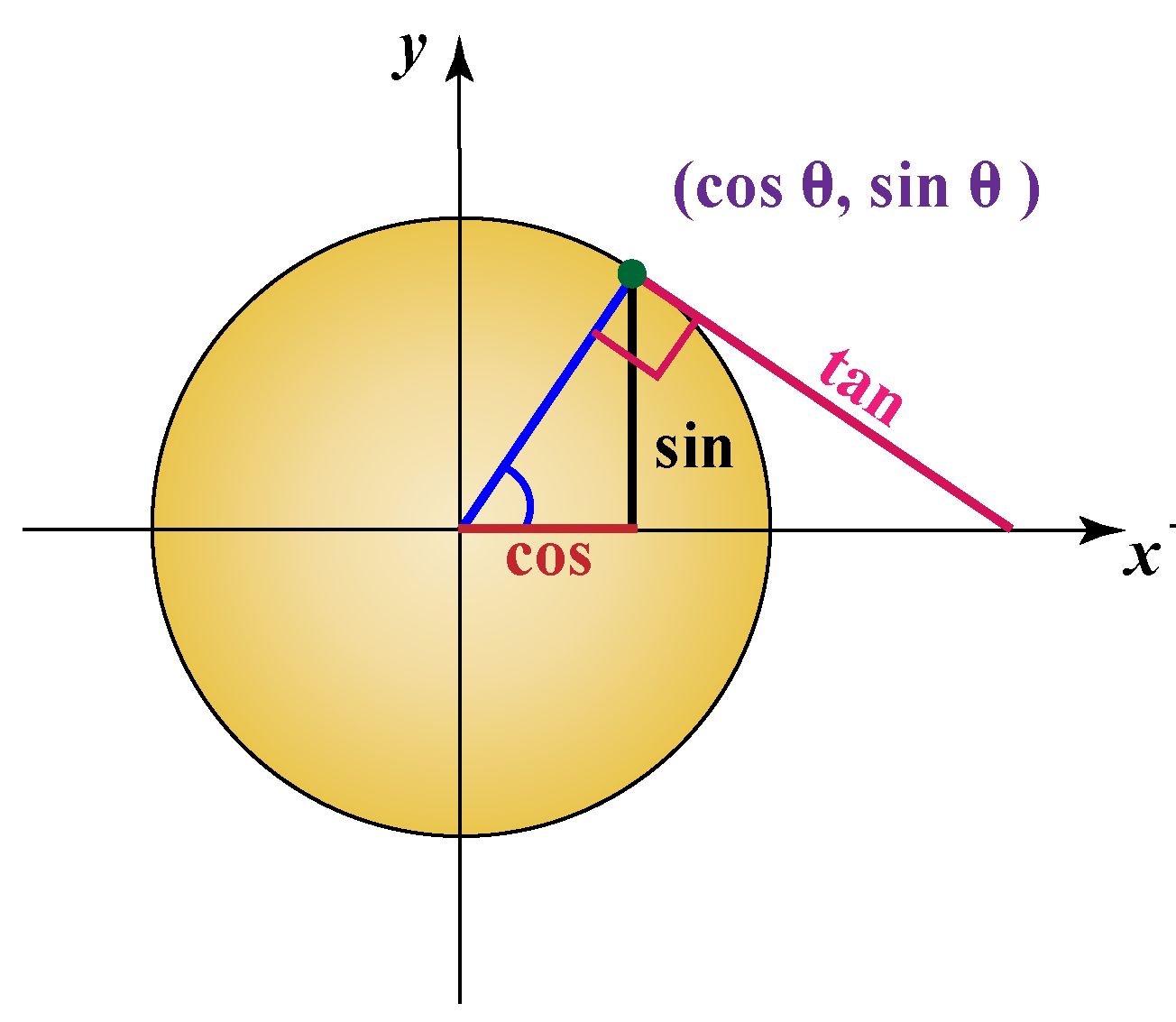
https://d138zd1ktt9iqe.cloudfront.net/media/seo_landing_files/hema-unit-of-circle-02-1599214053.png

Suppose that we have a unit circle centered at the origin with radius 1, and we have a radius making an angle $\theta$ with the $x$-axis as shown above.
warm shaleBOT
vin100
 open sorrel
Then at the end of the radius touching the circumference, its $x$ and $y$-coordinates are $\cos\theta$ and $\sin\theta$ respectively.
warm shaleBOT
vin100
 obtuse pebbleBOT
Channel closed
Closed due to timeout
Use .reopen if this was a mistake.
Available help channel!
Send your question here to claim the channel.
Remember:
• Ask your math question in a clear, concise manner.
• Show your work, and if possible, explain where you are stuck.
• After 15 minutes, feel free to ping <@&286206848099549185>.
• Type the command .close to free the channel when you're done.
• Be polite and have a nice day!
Read #❓how-to-get-help for further information on how to ask a good question, and about conduct in the question channels.
 remote dragon
11 part iii) I tried all the integration techniques but am unable to get the answer.
 obtuse pebbleBOT
remote dragon
11 part iii) I tried all the integration techniques but am unable to get the ans...
tardy epoch
obtuse pebbleBOT
remote dragon
11 part iii) I tried all the integration techniques but am unable to get the ans...
tardy epoch
show your work?
remote dragon

Basically i wasn't reaching anywhere with any of these methods be it substitution, Feynman..
 sonic fog
,rccw
warm shaleBOT
 open sorrel
 remote dragon
Is it relevant to my question?
obtuse pebbleBOT
@remote dragon Has your question been resolved?
tardy epoch
i guess residue formula is the way to go
remote dragon
Can you solve it for me i have no idea how to use the residue theorem.
tardy epoch
remote dragon
Can you solve it for me i have no idea how to use the residue theorem.
not what this server's for
just here to help, not give answers
remote dragon
I mean i don't know how to apply residue theorem.
Maybe somewhere i can read about it?
remote dragon
Nvm, sorry i don't think it'll use residue theorem, this book has no mention of it.
remote dragon
.close
obtuse pebbleBOT
Channel closed
Closed by @remote dragon
Use .reopen if this was a mistake.
Available help channel!
Send your question here to claim the channel.
Remember:
• Ask your math question in a clear, concise manner.
• Show your work, and if possible, explain where you are stuck.
• After 15 minutes, feel free to ping <@&286206848099549185>.
• Type the command .close to free the channel when you're done.
• Be polite and have a nice day!
Read #❓how-to-get-help for further information on how to ask a good question, and about conduct in the question channels.
timid silo
hi
obtuse pebbleBOT
timid silo
hi
timid silo
im given a function s'(t) as the rate which the height of the water is rising in a cylinder
im trying to find the rate that the volume of water in the can is changing at t = 7
is that just s''(t)?
i forgot how cylinder relates with volume, height, and derivation
 keen cave
Volume of a cylinder is V = (pi) * r^2 * h.
Where h is the height and r is the radius.
timid silo
yea
brave bramble
That's how
obtuse pebbleBOT
Channel closed
Closed by @broken vapor
Use .reopen if this was a mistake.
Available help channel!
Send your question here to claim the channel.
Remember:
• Ask your math question in a clear, concise manner.
• Show your work, and if possible, explain where you are stuck.
• After 15 minutes, feel free to ping <@&286206848099549185>.
• Type the command .close to free the channel when you're done.
• Be polite and have a nice day!
Read #❓how-to-get-help for further information on how to ask a good question, and about conduct in the question channels.
open sorrel
remote dragon
11 part iii) I tried all the integration techniques but am unable to get the ans...
i wonder if the question is correct: https://math.stackexchange.com/q/550145/290189

Mathematics Stack Exchange
Prove that $\displaystyle \int_{0}^{1}\frac{\sqrt{1-x^2}}{1-x^2\sin^2 \alpha}dx = \frac{\pi}{4\cos^2 \frac{\alpha}{2}}$.
$\bf{My; Try}::$ Let $x = \sin \theta$, Then $dx = \cos \theta d\theta$
$\
obtuse pebbleBOT
open sorrel
i wonder if the question is correct: https://math.stackexchange.com/q/550145/290...
@open sorrel Has your question been resolved?
obtuse pebbleBOT
Channel closed
Closed due to timeout
Use .reopen if this was a mistake.
Available help channel!
Send your question here to claim the channel.
Remember:
• Ask your math question in a clear, concise manner.
• Show your work, and if possible, explain where you are stuck.
• After 15 minutes, feel free to ping <@&286206848099549185>.
• Type the command .close to free the channel when you're done.
• Be polite and have a nice day!
Read #❓how-to-get-help for further information on how to ask a good question, and about conduct in the question channels.
remote dragon
@open sorrel yes i think it's a printing error in the book tysm.
obtuse pebbleBOT
remote dragon
<@701077747887243354> yes i think it's a printing error in the book tysm.
remote dragon
.close
obtuse pebbleBOT
Channel closed
Closed by @remote dragon
Use .reopen if this was a mistake.
Available help channel!
Send your question here to claim the channel.
Remember:
• Ask your math question in a clear, concise manner.
• Show your work, and if possible, explain where you are stuck.
• After 15 minutes, feel free to ping <@&286206848099549185>.
• Type the command .close to free the channel when you're done.
• Be polite and have a nice day!
Read #❓how-to-get-help for further information on how to ask a good question, and about conduct in the question channels.
 inner raft
 obtuse pebbleBOT
inner raft
inner raft
obtuse pebbleBOT
inner raft
inner raft
Work is the one near the top
 inner raft
no solution?
inner raft
so it would be
(DNE, DNE, z) ?
warm canopy
What does it say to do if there is no solution
inner raft
 warm canopy
Oh apparently there are solutions
Ahhh
Look at how you rearranged the third equation
inner raft
y-z=1 ?
warm canopy
Check it again
inner raft
y-z= -1?
warm canopy
Yeah
inner raft
so the answer would be
(7+z, -1+z, z)
inner raft
which website
nocturne minnow
The one you are doing the work for
obtuse pebbleBOT
Channel closed
Closed by @inner raft
Use .reopen if this was a mistake.
Available help channel!
Send your question here to claim the channel.
Remember:
• Ask your math question in a clear, concise manner.
• Show your work, and if possible, explain where you are stuck.
• After 15 minutes, feel free to ping <@&286206848099549185>.
• Type the command .close to free the channel when you're done.
• Be polite and have a nice day!
Read #❓how-to-get-help for further information on how to ask a good question, and about conduct in the question channels.
 finite flame
 obtuse pebbleBOT
finite flame
finite flame
obtuse pebbleBOT
finite flame
finite flame
What to begin
nocturne minnow
finite flame
Just to ask, what is N.O.T?
finite flame
- how to i convert those equations into standard equations
finite flame
nocturne minnow
Just to ask, what is N.O.T?
None of them
Just tell me how to convert those into symmetrical form
Hello anyone there?
obtuse pebbleBOT
@finite flame Has your question been resolved?
obtuse pebbleBOT
@finite flame Has your question been resolved?
tardy epoch
finite flame
What to begin
figure out how to get a line from this

and similarly for L2
finite flame
tardy epoch
figure out how to get a line from this
Ya thats what my question is buddy
tardy epoch
finite flame
Ya thats what my question is buddy
Where did you ask that question
tardy epoch
finite flame
Just tell me how to convert those into symmetrical form
This?

 tardy epoch
"symmetrical form" isn't standard jargon
 copper latch
@finite flame look up online there are many videos
tardy epoch
Did you just make that up?
finite flame
tardy epoch
Did you just make that up?
Idk but thats what my teacher said
tardy epoch
finite flame
Ya thats what my question is buddy
So what have you tried
finite flame
tardy epoch
So what have you tried
Idk what to do where to begin
Tell me how to convert that into form like this

I can do rest from there
tardy epoch
tardy epoch
figure out how to get a line from this
Solve for one variable in one equation and put into the second equation
obtuse pebbleBOT
@finite flame Has your question been resolved?
Channel closed
Closed by @finite flame
Use .reopen if this was a mistake.
Available help channel!
Send your question here to claim the channel.
Remember:
• Ask your math question in a clear, concise manner.
• Show your work, and if possible, explain where you are stuck.
• After 15 minutes, feel free to ping <@&286206848099549185>.
• Type the command .close to free the channel when you're done.
• Be polite and have a nice day!
Read #❓how-to-get-help for further information on how to ask a good question, and about conduct in the question channels.
 last basalt
I am studying some Calculus of Variations...does anyone know how to set up this problem so that it can be solved with Euler-Lagrange,
\[\text{maximize} \; \; \int_{0}^{25} -\rho(t) \log(\rho(t)) \; dt \]
subject to,
\[\int_{0}^{25} \rho(t) \; dt = 1 \]
\[\int_{0}^{25} t\rho(t) \; dt = 15 \]
I am trying to find $\rho(t)$, a probability density function. I figured,
\[J = \int_{0}^{25} (-\rho(t) \log(\rho(t)) + \lambda \rho(t) + \theta t\rho(t))  \;dt  \]
but I am not sure that this will yield a solution.
Skid
 obtuse pebbleBOT
@last basalt Has your question been resolved?
last basalt
.close
obtuse pebbleBOT
Channel closed
Closed by @last basalt
Use .reopen if this was a mistake.
Available help channel!
Send your question here to claim the channel.
Remember:
• Ask your math question in a clear, concise manner.
• Show your work, and if possible, explain where you are stuck.
• After 15 minutes, feel free to ping <@&286206848099549185>.
• Type the command .close to free the channel when you're done.
• Be polite and have a nice day!
Read #❓how-to-get-help for further information on how to ask a good question, and about conduct in the question channels.
 karmic moon
Can someone help me
 obtuse pebbleBOT
karmic moon
Can someone help me
obtuse pebbleBOT
karmic moon
Can someone help me
 obsidian isle
So D = 4
Alright let's start out by making a table that maps each letter of the alphabet to its numerical position
A = 1
B = 2
...
Continue it
karmic moon
C=3
D=4
like that?
karmic moon
E=5
F=6
G=7
H=8
I=9
J=10
K=11
L=12
M=13
N=14
O=15
P=16
Q=17
R=18
S=19
T=20
U=21
V=22
W=23
X=24
Y=25
Z=26
obsidian isle
Alright
Let's look at the numerator
We have MATH
MATH = 13×1×20×8
Let's write this as primes
karmic moon
Okay
obsidian isle
13^1 × 10^1 × 2^4
So our value for the sum of powers is 6
Can you do the same for the denominator?
obtuse pebbleBOT
@karmic moon Has your question been resolved?
Channel closed
Closed by @karmic moon
Use .reopen if this was a mistake.
Available help channel!
Send your question here to claim the channel.
Remember:
• Ask your math question in a clear, concise manner.
• Show your work, and if possible, explain where you are stuck.
• After 15 minutes, feel free to ping <@&286206848099549185>.
• Type the command .close to free the channel when you're done.
• Be polite and have a nice day!
Read #❓how-to-get-help for further information on how to ask a good question, and about conduct in the question channels.
 strong vale
,,,
obtuse pebbleBOT
strong vale
,,,
strong vale

Bit of a long question, so I am not expecting any replies
but
In order for geometric, I said that $\frac{u_{2n}}{u_{2n-1}} = l \implies \frac{(\frac{bc}{a})^{n-1}b}{(\frac{bc}{a})^{n-2}bc}=l \implies \frac{b}{a}=l$
warm shaleBOT
azeem321
 strong vale
As the ratio does not depend on n, then this must be a geometric series for all values ?
I am not seeing how to get k involved
Our expression for $u_{2n}$ and $u_{2n-1}$ does not rely on k
warm shaleBOT
azeem321
 strong vale
Nevermind. I'll ask this question another time when I am clear about what I'm stuck on
.close
obtuse pebbleBOT
Channel closed
Closed by @strong vale
Use .reopen if this was a mistake.
 hushed moat
.reopen
hushed moat
strong vale
Our expression for $u_{2n}$ and $u_{2n-1}$ does not rely on k
you also need to find a constraint on c
which depends on a,b,k
strong vale
.reopen
obtuse pebbleBOT
✅
hushed moat
(as found in the previous part of the question)
i mean the constraint on c is pretty trivial
anyway thats just my (quick) interpretation of the question
hushed moat
warm shale
**azeem321**
this is only for the ratio of $\frac{u_{2n}}{u_{2n-1}}$
warm shaleBOT
Frosty
 strong vale
hushed moat
anyway thats just my (quick) interpretation of the question
strong vale
hushed moat
anyway thats just my (quick) interpretation of the question
oki, thanks again!
.close
obtuse pebbleBOT
Channel closed
Closed by @strong vale
Use .reopen if this was a mistake.
Available help channel!
Send your question here to claim the channel.
Remember:
• Ask your math question in a clear, concise manner.
• Show your work, and if possible, explain where you are stuck.
• After 15 minutes, feel free to ping <@&286206848099549185>.
• Type the command .close to free the channel when you're done.
• Be polite and have a nice day!
Read #❓how-to-get-help for further information on how to ask a good question, and about conduct in the question channels.
 naive lintel
Can someone explain why x is the inverse of 13 mod 36 in 13x = 1 mod 36
obtuse pebbleBOT
naive lintel
Can someone explain why x is the inverse of 13 mod 36 in 13x _=_ 1 mod 36
naive lintel
🥸
eternal bloom
naive lintel
Can someone explain why x is the inverse of 13 mod 36 in 13x _=_ 1 mod 36
It's by definition. The inverse of 13 mod 36 is the number $x$ such that $13x \equiv 1 \pmod{36}$
warm shaleBOT
1345631
 naive lintel
eternal bloom
It's by definition. The inverse of 13 mod 36 is the number $x$ such that $13x \...
naive lintel
eternal bloom
It's by definition. The inverse of 13 mod 36 is the number $x$ such that $13x \...
what definition?
eternal bloom
naive lintel
what definition?
definition of inverse
naive lintel
You mean $13^-1$ mod 36 or $(13 mod 36)^-1
warm shaleBOT
ElevatedElmo
Compile Error! Click the reaction for more information.
(You may edit your message to recompile.)
 royal basin
it doesn't matter how you write it (but in latex you need ^{-1} for the superscript to show up properly)
but it is just like multiplicative inverses in the real numbers
$a^{-1}$ is the number $x$ such that $ax = 1$
warm shaleBOT
Ann
 naive lintel
$a^{-1}$ is the same as $x^{-1}$ right
warm shaleBOT
ElevatedElmo
 naive lintel
$\frac {1}{x}×x$ = 1.
warm shaleBOT
ElevatedElmo
 royal basin

but yes...
$x^{-1} \cdot x = 1$ is the equation that defines the inverse of a real number $x$
warm shaleBOT
Ann
 naive lintel
ok but how by definition of inverse is x= 13 mod 36
naive lintel
Definition of inverse is 1/x
warm canopy
naive lintel
ok but how by definition of inverse is x= 13 mod 36
Also in the question you sent x was not 13 mod 36, it was the inverse of 13
naive lintel
Oh yea my bad
obtuse pebbleBOT
@naive lintel Has your question been resolved?
obtuse pebbleBOT
Channel closed
Closed due to timeout
Use .reopen if this was a mistake.
Available help channel!
Send your question here to claim the channel.
Remember:
• Ask your math question in a clear, concise manner.
• Show your work, and if possible, explain where you are stuck.
• After 15 minutes, feel free to ping <@&286206848099549185>.
• Type the command .close to free the channel when you're done.
• Be polite and have a nice day!
Read #❓how-to-get-help for further information on how to ask a good question, and about conduct in the question channels.
 wanton dagger
I want help with this part of the question:
 obtuse pebbleBOT
wanton dagger
I want help with this part of the question:
wanton dagger
obtuse pebbleBOT
wanton dagger
I want help with this part of the question:
wanton dagger
This is part 1 of the question
 wanton dagger

 robust sleet
whats it equal to