#help-10
1 messages · Page 530 of 1
 eternal bloom
 obtuse pebbleBOT
Channel closed
Closed due to timeout
Use .reopen if this was a mistake.
 knotty light
eternal bloom
You could also show try to show that a_n is bounded and monotone [didn't verify]...
knotty light
eternal bloom
You could also show try to show that a_n is bounded and monotone [didn't verify]...
alright, will try this and see what it comes to
.reopen
obtuse pebbleBOT
✅
obtuse pebbleBOT
@knotty light Has your question been resolved?
knotty light
say we were tackling this
we will basically need this

and if we can say the limit is 0 then the whole thing is solved
where should i start?
<@&286206848099549185>

for the boundary this is all i managed to find
eternal bloom
knotty light
for the boundary this is all i managed to find
Not sure, sorry about that. Only had some ideas on how it might go, but didn't verify if it works or not

 eternal bloom
It's a challenging one. I apologise for being unable to help further and for giving ideas which did not bear fruit.
obtuse pebbleBOT
Channel closed
Closed by @knotty light
Use .reopen if this was a mistake.
 Available help channel!
Send your question here to claim the channel.
Remember:
• Ask your math question in a clear, concise manner.
• Show your work, and if possible, explain where you are stuck.
• After 15 minutes, feel free to ping <@&286206848099549185>.
• Type the command .close to free the channel when you're done.
• Be polite and have a nice day!
Read #❓how-to-get-help for further information on how to ask a good question, and about conduct in the question channels.
 carmine bear
 obtuse pebbleBOT
carmine bear
carmine bear
obtuse pebbleBOT
carmine bear
carmine bear
What are the steps to solve this?
W being a wiener process
I know the solution is this but I don't get how it got derived

 thick fog
That's just the Ito Isometry, there isn't much to derive
obtuse pebbleBOT
Channel closed
Closed by @carmine bear
Use .reopen if this was a mistake.
Available help channel!
Send your question here to claim the channel.
Remember:
• Ask your math question in a clear, concise manner.
• Show your work, and if possible, explain where you are stuck.
• After 15 minutes, feel free to ping <@&286206848099549185>.
• Type the command .close to free the channel when you're done.
• Be polite and have a nice day!
Read #❓how-to-get-help for further information on how to ask a good question, and about conduct in the question channels.
 sacred root
Hj
obtuse pebbleBOT
sacred root
Hj
 warm shaleBOT
BASU
 warm shaleBOT
BASU
 warm shaleBOT
BASU
 obtuse pebbleBOT
@sacred root Has your question been resolved?
obtuse pebbleBOT
Channel closed
Closed due to timeout
Use .reopen if this was a mistake.
Available help channel!
Send your question here to claim the channel.
Remember:
• Ask your math question in a clear, concise manner.
• Show your work, and if possible, explain where you are stuck.
• After 15 minutes, feel free to ping <@&286206848099549185>.
• Type the command .close to free the channel when you're done.
• Be polite and have a nice day!
Read #❓how-to-get-help for further information on how to ask a good question, and about conduct in the question channels.
 fading birch
so apparently this is the newton leibniz formula, how is this different from the fundamental theorem of calculus?
 obtuse pebbleBOT
fading birch
so apparently this is the newton leibniz formula, how is this different from the...
fading birch
obtuse pebbleBOT
fading birch
so apparently this is the newton leibniz formula, how is this different from the...
fading birch
To give some context, this was introduced to establish how integrals have a finite/infinite value depending if the original function converges/diverges, but like, why couldn't this be explained with the ftom?
 tardy epoch
Different in what way? Looks the same
 worthy comet
(at least at wikipedia), there are two parts of the fundamental theorem of calculus, and one of these parts is the newton leibniz formula. There is no real difference
fading birch
I guess it's easier to show this instead?

"discuss if the following equation diverges/converges"
like, why is this all this even necessary 🤔
So they're the same, got it o7
(I'm studying again today so I may send more questions)
Yeah, just checked the examples, the teacher only uses it when one of the bounds would cause a division by 0, so it's more of a correct notation thing
tardy epoch
fading birch
like, why is this all this even necessary 🤔
why is what even necessary?
tardy epoch
fading birch
Yeah, just checked the examples, the teacher only uses it when one of the bounds...
did you answer your own question?
fading birch
I think?
tardy epoch
👍🏻 .close
fading birch
I'm specifically referring to the lim(μ->0+) and 1+μ
Would it be alright to occupy this channel until I finish studying? I may have more questions and it may be easier for staff to answer it if they know what I've been talking about rather than have questions in disparate channels
tardy epoch
there's no point in keeping it open for hours at a time
fading birch
If it's interfering with the rules then alrighty o7
tardy epoch
just open a new one when you have a new question
fading birch
.close
obtuse pebbleBOT
Channel closed
Closed by @fading birch
Use .reopen if this was a mistake.
obtuse pebbleBOT
Available help channel!
Send your question here to claim the channel.
Remember:
• Ask your math question in a clear, concise manner.
• Show your work, and if possible, explain where you are stuck.
• After 15 minutes, feel free to ping <@&286206848099549185>.
• Type the command .close to free the channel when you're done.
• Be polite and have a nice day!
Read #❓how-to-get-help for further information on how to ask a good question, and about conduct in the question channels.
 soft temple
 obtuse pebbleBOT
soft temple
soft temple
obtuse pebbleBOT
soft temple
soft temple
Help plz
obtuse pebbleBOT
@soft temple Has your question been resolved?
eternal bloom
The integral diverges [sponsored by WolframAlpha]
soft temple
Yeah this formula includes the exponential integral function so I'm not too worried about it.
.close
obtuse pebbleBOT
Channel closed
Closed by @soft temple
Use .reopen if this was a mistake.
Available help channel!
Send your question here to claim the channel.
Remember:
• Ask your math question in a clear, concise manner.
• Show your work, and if possible, explain where you are stuck.
• After 15 minutes, feel free to ping <@&286206848099549185>.
• Type the command .close to free the channel when you're done.
• Be polite and have a nice day!
Read #❓how-to-get-help for further information on how to ask a good question, and about conduct in the question channels.
 neat briar
Find the equation of the line of symmetry for the equation of the graph below.
y=12x-4x^2
obtuse pebbleBOT
neat briar
Find the equation of the line of symmetry for the equation of the graph below.
y...
 idle thunder
in a quadratic where is the line of symmetry?
obtuse pebbleBOT
@neat briar Has your question been resolved?
obtuse pebbleBOT
Channel closed
Closed due to timeout
Use .reopen if this was a mistake.
obtuse pebbleBOT
Available help channel!
Send your question here to claim the channel.
Remember:
• Ask your math question in a clear, concise manner.
• Show your work, and if possible, explain where you are stuck.
• After 15 minutes, feel free to ping <@&286206848099549185>.
• Type the command .close to free the channel when you're done.
• Be polite and have a nice day!
Read #❓how-to-get-help for further information on how to ask a good question, and about conduct in the question channels.
 frosty nimbus
why is set (b,b) never checked? isnt a reflexive relation supposed to have the elements (a,a) and (b.b)?
 obtuse pebbleBOT
frosty nimbus
why is set (b,b) never checked? isnt a reflexive relation supposed to have the e...
frosty nimbus
obtuse pebbleBOT
frosty nimbus
why is set (b,b) never checked? isnt a reflexive relation supposed to have the e...
frosty nimbus
it sees that a,a belongs to r and automatically goes to the answer that it is reflexive, why so?
<@&286206848099549185>
tardy epoch
obtuse pebble
read this
frosty nimbus
ive done everything thats stated there
tardy epoch
and for this question how is the relation reflexive if
{(1,1) (2,2)...(6,6)} are not present
 obtuse pebbleBOT
@frosty nimbus Has your question been resolved?
frosty nimbus
a little help here
frosty nimbus
tardy epoch
```• After 15 minutes, feel free to ping @Helpers.
```
<@&286206848099549185>
.close
obtuse pebbleBOT
Channel closed
Closed by @frosty nimbus
Use .reopen if this was a mistake.
Available help channel!
Send your question here to claim the channel.
Remember:
• Ask your math question in a clear, concise manner.
• Show your work, and if possible, explain where you are stuck.
• After 15 minutes, feel free to ping <@&286206848099549185>.
• Type the command .close to free the channel when you're done.
• Be polite and have a nice day!
Read #❓how-to-get-help for further information on how to ask a good question, and about conduct in the question channels.
 cursive coyote
 obtuse pebbleBOT
cursive coyote
cursive coyote
obtuse pebbleBOT
cursive coyote
cursive coyote
when trying to find the limit of the sequences

not sure how to visualize letter q.
also this diverges as well

 cedar lichen
Well, what have you tried?
cursive coyote
well i was just thinking it would be like the other problems, cos(inf) diverges
because 2pi times infinity is infinity
 gloomy valve
think about the unit circle and cosines period
cursive coyote
so since its 2pi it always falls at the start of the cos function?
 cedar lichen
Yes. For integer n, cos(2npi) is always 1
 obtuse pebbleBOT
@cursive coyote Has your question been resolved?
Channel closed
Closed by @cursive coyote
Use .reopen if this was a mistake.
Available help channel!
Send your question here to claim the channel.
Remember:
• Ask your math question in a clear, concise manner.
• Show your work, and if possible, explain where you are stuck.
• After 15 minutes, feel free to ping <@&286206848099549185>.
• Type the command .close to free the channel when you're done.
• Be polite and have a nice day!
Read #❓how-to-get-help for further information on how to ask a good question, and about conduct in the question channels.
Channel closed
Closed due to the original message being deleted
Available help channel!
Send your question here to claim the channel.
Remember:
• Ask your math question in a clear, concise manner.
• Show your work, and if possible, explain where you are stuck.
• After 15 minutes, feel free to ping <@&286206848099549185>.
• Type the command .close to free the channel when you're done.
• Be polite and have a nice day!
Read #❓how-to-get-help for further information on how to ask a good question, and about conduct in the question channels.
 timid silo
 obtuse pebbleBOT
timid silo
timid silo
obtuse pebbleBOT
timid silo
timid silo
Hi can i please get help on explaining why C is a subspace?
I understand it needs to meet the 3 axioms of closure under addition, scalar multiplication and zero vector
But I need help with proving it
 haughty coyote
what is P3 ? Polynomials of degree 3 ? Of degree 2 ?
timid silo
degree 3
timid silo
 spiral maple
ok well trivially 0 is in it
spiral maple
ok well trivially 0 is in it
Yeah i understand that, does that mean it already meets 1 of the 3 axioms as it is a zero vector?
spiral maple
yes
spiral maple
the naive test is that 0 in U, a,b in U means a+b in U, and a in U and k in K means ka in U
definition
pick 2 vectors from the set, show their sum is in the set
haughty coyote
timid silo
how would you prove it under closure under addition?
you can show a linear combination of elements of C is still in C, proving both addition and multiplication at the same time
spiral maple
to which yes, you can prove it in 2 tests, 0 is in it, and it closed under linear combinations
haughty coyote
haughty coyote
you can show a linear combination of elements of C is still in C, proving both a...
for simpler cases like that it avoids having to do twice almost the same thing
timid silo
haughty coyote
you can show a linear combination of elements of C is still in C, proving both a...
Ahh okay thank you
I will try do this question again
@spiral maple thank you for your help also
.close
obtuse pebbleBOT
Channel closed
Closed by @untold juniper
Use .reopen if this was a mistake.
Available help channel!
Send your question here to claim the channel.
Remember:
• Ask your math question in a clear, concise manner.
• Show your work, and if possible, explain where you are stuck.
• After 15 minutes, feel free to ping <@&286206848099549185>.
• Type the command .close to free the channel when you're done.
• Be polite and have a nice day!
Read #❓how-to-get-help for further information on how to ask a good question, and about conduct in the question channels.
 violet mulch
hello
obtuse pebbleBOT
violet mulch
hello
 haughty coyote
You're supposed to recognise this as the Taylor series of (1+x/2)^-2 and use that to compute it
obtuse pebbleBOT
@violet mulch Has your question been resolved?
Channel closed
Closed by @violet mulch
Use .reopen if this was a mistake.
Available help channel!
Send your question here to claim the channel.
Remember:
• Ask your math question in a clear, concise manner.
• Show your work, and if possible, explain where you are stuck.
• After 15 minutes, feel free to ping <@&286206848099549185>.
• Type the command .close to free the channel when you're done.
• Be polite and have a nice day!
Read #❓how-to-get-help for further information on how to ask a good question, and about conduct in the question channels.
 jagged edge
 obtuse pebbleBOT
jagged edge
jagged edge
obtuse pebbleBOT
jagged edge
jagged edge
idk how to move ahead
So, 2a(da/dt) + 2b(db/dt) = 2c(dc/dt ) So,i have 2 ( 12) (da/dt) + 2 (5) (0.5) = 2(13)(dc/dt)
theres 2 variables thats why
how do i find the dc/dt
spiral maple
how much is the length of a solid ladder changing?
jagged edge
thats 0.5 feet per sec
spiral maple
no
spiral maple
the length of the ladder is c
jagged edge
ye
jagged edge
the physical length of ladder doesnt change?
spiral maple
....
jagged edge
thats the length of the ladder?
spiral maple
The length of the ladder does not change with time
jagged edge
ye
spiral maple
so dc/dt is clearly 0
spiral maple
cause... the length doesn't change
jagged edge
dang the whole RHS would be 0 then?
spiral maple
yes.
spiral maple
idk, cba to do the entire computation rn
jagged edge
oh lol
would the 0.5 be positive or negative?
db/dt = -0.5 or 0.5?
@spiral maple
spiral maple
down is negative
obtuse pebbleBOT
@jagged edge Has your question been resolved?
Channel closed
Closed by @jagged edge
Use .reopen if this was a mistake.
Available help channel!
Send your question here to claim the channel.
Remember:
• Ask your math question in a clear, concise manner.
• Show your work, and if possible, explain where you are stuck.
• After 15 minutes, feel free to ping <@&286206848099549185>.
• Type the command .close to free the channel when you're done.
• Be polite and have a nice day!
Read #❓how-to-get-help for further information on how to ask a good question, and about conduct in the question channels.
 leaden minnow
Rotate L and determine the coordinates of L’
obtuse pebbleBOT
leaden minnow
Rotate L and determine the coordinates of L’
 warm shaleBOT
 obtuse pebbleBOT
@leaden minnow Has your question been resolved?
gloomy valve
Let the angle between L and the x-axis be $\theta$. Let the angle between L' and the x-axis be $\theta'$. Denote the length of L and L' by $l$.
warm shaleBOT
Navix
 gloomy valve
$$\sin \theta = \frac{2}{l}$$
$$\cos \theta = \frac{3}{l}$$
warm shaleBOT
Navix
 gloomy valve
Now consider $\sin \theta'$ and $\cos \theta'$ and use the identities $$\sin(90 , \mathrm{deg} - \theta) = \cos \theta$$
$$\cos(90 , \mathrm{deg} - \theta) = \sin \theta$$
warm shaleBOT
Navix
 gloomy valve
If that doesn't tell you much, another simple way is to look at this red triangle:

you can argue that the drawn angle is the same as the angle that L forms with the x-axis
obtuse pebbleBOT
@leaden minnow Has your question been resolved?
obtuse pebbleBOT
Channel closed
Closed by @leaden minnow
Use .reopen if this was a mistake.
obtuse pebbleBOT
Available help channel!
Send your question here to claim the channel.
Remember:
• Ask your math question in a clear, concise manner.
• Show your work, and if possible, explain where you are stuck.
• After 15 minutes, feel free to ping <@&286206848099549185>.
• Type the command .close to free the channel when you're done.
• Be polite and have a nice day!
Read #❓how-to-get-help for further information on how to ask a good question, and about conduct in the question channels.
 novel rover
 obtuse pebbleBOT
novel rover
novel rover
obtuse pebbleBOT
novel rover
novel rover
Could someone please help with this
obtuse pebbleBOT
@novel rover Has your question been resolved?
obtuse pebbleBOT
Channel closed
Closed due to timeout
Use .reopen if this was a mistake.
Available help channel!
Send your question here to claim the channel.
Remember:
• Ask your math question in a clear, concise manner.
• Show your work, and if possible, explain where you are stuck.
• After 15 minutes, feel free to ping <@&286206848099549185>.
• Type the command .close to free the channel when you're done.
• Be polite and have a nice day!
Read #❓how-to-get-help for further information on how to ask a good question, and about conduct in the question channels.
 eternal nova
can I get some help please
obtuse pebbleBOT
eternal nova
can I get some help please
eternal nova

 junior inlet
can you write the curved surface area in terms of r and h?
then substitute r for 12-h
spiral maple
Post your working
eternal nova
i didnt do any
spiral maple
so go attempt the problem
spiral maple
so post your work then
spiral maple
Ok, so describe what you tried then?
eternal nova
i searched up the surface area of clynder
and then i tried to plug in
but it was only rh not r+g
r+h i mean
junior inlet
well
imagine this as a hollow cylinder
cut off the top and bottom
unwrap the remaining area to form a rectangle (the area of this rectangle is the curved surface area)
find the sides of this rectangle.
obtuse pebbleBOT
@eternal nova Has your question been resolved?
Channel closed
Closed by @eternal nova
Use .reopen if this was a mistake.
Available help channel!
Send your question here to claim the channel.
Remember:
• Ask your math question in a clear, concise manner.
• Show your work, and if possible, explain where you are stuck.
• After 15 minutes, feel free to ping <@&286206848099549185>.
• Type the command .close to free the channel when you're done.
• Be polite and have a nice day!
Read #❓how-to-get-help for further information on how to ask a good question, and about conduct in the question channels.
 woven parcel
If to find maximum, we set differential of an equation = to 0.
How to find minimum?
obtuse pebbleBOT
woven parcel
If to find maximum, we set differential of an equation = to 0.
How to find minim...
 forest sinew
woven parcel
If to find maximum, we set differential of an equation = to 0.
How to find minim...
forest sinew
woven parcel
If to find maximum, we set differential of an equation = to 0.
How to find minim...
which diff eq?
but youre talking about the first derivative test, right?
woven parcel
Yes, finding the max/min
forest sinew
well its a polynomial so
woven parcel
i know how to find max, but dont know to find min
forest sinew
odds are youll only get one or the other
but the same way
this function wont have a global minimum
only local
woven parcel
Global? Local?
warm shaleBOT


 Requested by jan Niku#2119
forest sinew
Requested by jan Niku#2119
forest sinew
imagine what is happening to the left and to the right
this thing is shooting off to upper or negative infinity
woven parcel
Ye
woven parcel
Oh
forest sinew
but within a small region, if we restrict ourselves
we can find locally maximum places
so the first derivative test doesnt find if something is a max or a min or neither
it just finds where the rate of change is 0
it will find maxes, mins, and neithers, equally as well
second derivative test works okay
woven parcel
forest sinew
it just finds where the rate of change is 0
This refers to the turning point right?
forest sinew
yea
but it may not turn, too
consider x^3
neither max nor min at x=0
globally or locally
but first derivative test will return it
forest sinew
you should look it up
its pretty straightforward
well it deals with concavity which is harder to picture
but its more or less the same as first derivative test
take a derivative, set it equal to something, find the place
etc
obtuse pebbleBOT
Channel closed
Closed by @woven parcel
Use .reopen if this was a mistake.
Available help channel!
Send your question here to claim the channel.
Remember:
• Ask your math question in a clear, concise manner.
• Show your work, and if possible, explain where you are stuck.
• After 15 minutes, feel free to ping <@&286206848099549185>.
• Type the command .close to free the channel when you're done.
• Be polite and have a nice day!
Read #❓how-to-get-help for further information on how to ask a good question, and about conduct in the question channels.
 frail anchor
could someone explain how the equations at the bottom were obtained?
 obtuse pebbleBOT
frail anchor
could someone explain how the equations at the bottom were obtained?
frail anchor
frail anchor
could someone explain how the equations at the bottom were obtained?
obtuse pebbleBOT
frail anchor
could someone explain how the equations at the bottom were obtained?
frail anchor
frail anchor
could someone explain how the equations at the bottom were obtained?
Formation of a PDE(partial differential equation) by elimination of arbitrary constants.
Let f(x,y,z,a,b) = 0
where a and b are arbitrary constants
Differentiate equation 1 partially w.r.t x and y respectively
we get:
This is what is written, in case you're having trouble reading the handwriting
obtuse pebbleBOT
@frail anchor Has your question been resolved?
frail anchor
<@&286206848099549185>
obtuse pebbleBOT
@frail anchor Has your question been resolved?
frail anchor
<@&286206848099549185>
obtuse pebbleBOT
@frail anchor Has your question been resolved?
obtuse pebbleBOT
@frail anchor Has your question been resolved?
frail anchor
<@&286206848099549185>
obtuse pebbleBOT
@frail anchor Has your question been resolved?
frail anchor
.close
obtuse pebbleBOT
Channel closed
Closed by @frail anchor
Use .reopen if this was a mistake.
Available help channel!
Send your question here to claim the channel.
Remember:
• Ask your math question in a clear, concise manner.
• Show your work, and if possible, explain where you are stuck.
• After 15 minutes, feel free to ping <@&286206848099549185>.
• Type the command .close to free the channel when you're done.
• Be polite and have a nice day!
Read #❓how-to-get-help for further information on how to ask a good question, and about conduct in the question channels.
 nimble kindle
 obtuse pebbleBOT
nimble kindle
nimble kindle
obtuse pebbleBOT
nimble kindle
nimble kindle
how am i supposed to know the formula if its not geometric or arithmetic
the sequence just goes up by 4 each time but every other number is negative
 valid zephyr
so every term is a multiple of 4
that's the first part right'
and now you need a way to alternate the signs
any idea on how to do that?
nimble kindle
wouldnt that be a negative number raised to a power
valid zephyr
yap
but it can't just be any negative number
because it can't interfere with the 4
so you need a number that when multiplied by the other one does not change the result
what would that bE?
nimble kindle
ohhhhhhh
obtuse pebbleBOT
@nimble kindle Has your question been resolved?
obtuse pebbleBOT
Channel closed
Closed due to timeout
Use .reopen if this was a mistake.
obtuse pebbleBOT
Available help channel!
Send your question here to claim the channel.
Remember:
• Ask your math question in a clear, concise manner.
• Show your work, and if possible, explain where you are stuck.
• After 15 minutes, feel free to ping <@&286206848099549185>.
• Type the command .close to free the channel when you're done.
• Be polite and have a nice day!
Read #❓how-to-get-help for further information on how to ask a good question, and about conduct in the question channels.
 surreal inlet
hello
obtuse pebbleBOT
surreal inlet
hello

 hybrid gull
Idk if that can be factored
surreal inlet
ikr
hybrid gull
I think you have to use QF
obtuse pebbleBOT
Channel closed
Closed by @surreal inlet
Use .reopen if this was a mistake.
Available help channel!
Send your question here to claim the channel.
Remember:
• Ask your math question in a clear, concise manner.
• Show your work, and if possible, explain where you are stuck.
• After 15 minutes, feel free to ping <@&286206848099549185>.
• Type the command .close to free the channel when you're done.
• Be polite and have a nice day!
Read #❓how-to-get-help for further information on how to ask a good question, and about conduct in the question channels.
 rich holly
c and d are both integers, which means $\frac{3x^2+6x+C}{(x-2)(x+d)}$ is an integer. What's the value of $C+2d$
obtuse pebbleBOT
rich holly
c and d are both integers, which means $\frac{3x^2+6x+C}{(x-2)(x+d)}$ is an inte...
warm shaleBOT
hyperlix26
 rich holly
x can't be 2 and -d
warm shaleBOT
hyperlix26
 rich holly
so

 rich holly
now what
tardy epoch
where's the original question
rich holly
rich holly
c and d are both integers, which means $\frac{3x^2+6x+C}{(x-2)(x+d)}$ is an inte...
@tardy epoch
find the value of C + 2d
tardy epoch
that's your latex. show the original problem
rich holly
tardy epoch
that's your latex. show the original problem
wdym? That's the original problem
find the value of C + 2d from this
$\frac{3x^2+6x+C}{(x-2)(x+d)}$
warm shaleBOT
hyperlix26
 rich holly
where both C and d are integers
tardy epoch
did you invent this problem yourself? no right?
rich holly
no
tardy epoch
show the source of the problem
rich holly
like, a screenshot?
tardy epoch
sure
 tardy epoch
warm shale
**hyperlix26**
tardy epoch
warm shale
**hyperlix26**
is this your remainder?
rich holly
tardy epoch
is this your remainder?
that's just this, after I cancelled some terms
 tardy epoch
those two are not equal
tardy epoch
show your work
rich holly
@tardy epoch my guess what I did wrong has something to do with the dx
 tardy epoch
that's not how fractions work
studylib.net
Free essays, homework help, flashcards, research papers, book reports, term papers, history, science, politics
rich holly
tardy epoch
that's not how fractions work
hmmm, so it's the dx
$\frac{3+6x+c}{dx-2x-2d}$
warm shaleBOT
hyperlix26
 tardy epoch
you need to learn how to manipulate fractions
you can't just cancel common terms in fractions like (a + b + c)/(a+b+d)
that is not the same as c/d
obtuse pebbleBOT
@rich holly Has your question been resolved?
 tardy epoch
rich holly
what should I do from here?
tardy epoch
rich holly
what should I do from here?
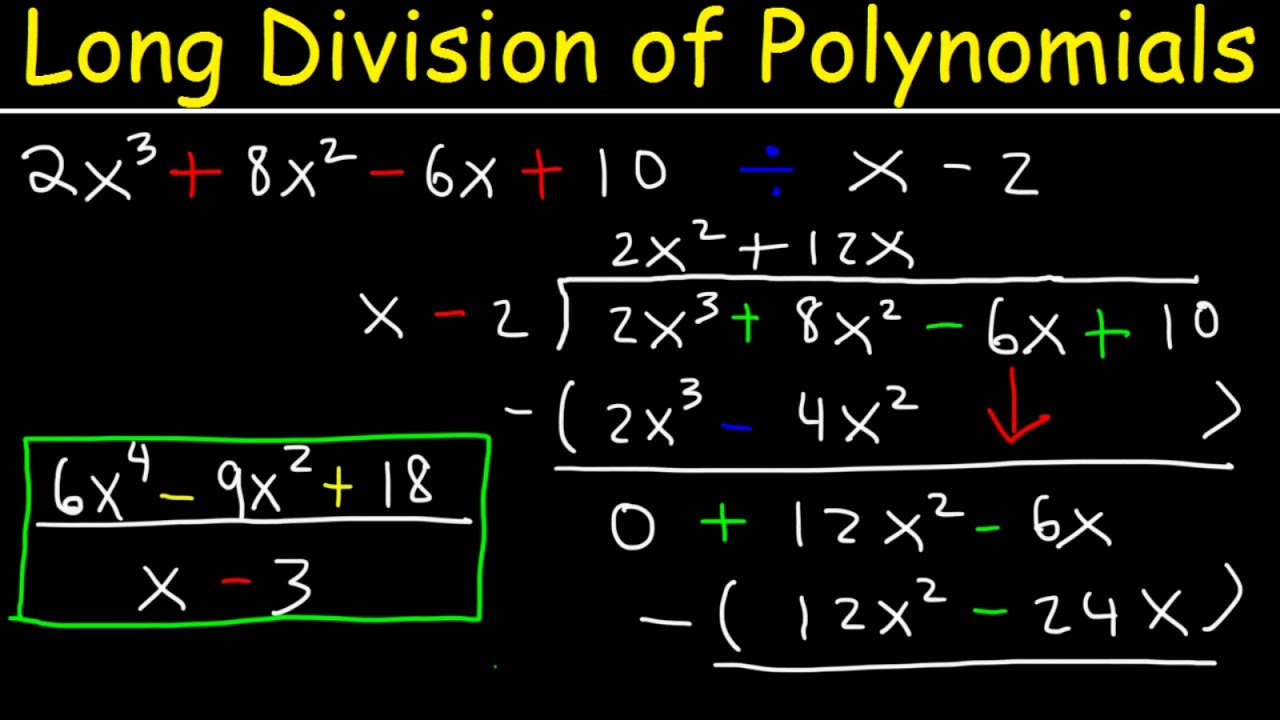
This video tutorial explains how to perform long division of polynomials with remainder and with missing terms. It's explains how to do long division easily and it provides the step by step process to get it done. Basically, there are 3 steps that you have to repeat. 1. Divide 2. Multiply 3. Subtract This video contains plenty of ex...
obtuse pebbleBOT
Channel closed
Closed due to timeout
Use .reopen if this was a mistake.
Available help channel!
Send your question here to claim the channel.
Remember:
• Ask your math question in a clear, concise manner.
• Show your work, and if possible, explain where you are stuck.
• After 15 minutes, feel free to ping <@&286206848099549185>.
• Type the command .close to free the channel when you're done.
• Be polite and have a nice day!
Read #❓how-to-get-help for further information on how to ask a good question, and about conduct in the question channels.
rich holly
tardy epoch
https://youtu.be/_FSXJmESFmQ
holy shit I forgot it's the same as $3x^2+6x+c$ divided by $x^2+dx-2x-2d$
 obtuse pebbleBOT
rich holly
holy shit I forgot it's the same as $3x^2+6x+c$ *divided by* $x^2+dx-2x-2d$
warm shaleBOT
obtuse pebbleBOT
rich holly
holy shit I forgot it's the same as $3x^2+6x+c$ *divided by* $x^2+dx-2x-2d$
warm shaleBOT
hyperlix26
 obtuse pebbleBOT
@rich holly Has your question been resolved?
rich holly
tardy epoch
https://youtu.be/_FSXJmESFmQ
$3x^2+6x+c=(3)(x^2+dx-2x-2d)-3dx+12x+c+6d$
warm shaleBOT
hyperlix26
 warm shaleBOT
hyperlix26
 rich holly
.close
obtuse pebbleBOT
Channel closed
Closed by @rich holly
Use .reopen if this was a mistake.
Available help channel!
Send your question here to claim the channel.
Remember:
• Ask your math question in a clear, concise manner.
• Show your work, and if possible, explain where you are stuck.
• After 15 minutes, feel free to ping <@&286206848099549185>.
• Type the command .close to free the channel when you're done.
• Be polite and have a nice day!
Read #❓how-to-get-help for further information on how to ask a good question, and about conduct in the question channels.
 wicked holly
Can someone please help me start this? My prof said to do column operations but I don’t know how that helps cause I can’t figure out which operation
 obtuse pebbleBOT
wicked holly
Can someone please help me start this? My prof said to do column operations but ...
obtuse pebbleBOT
wicked holly
Can someone please help me start this? My prof said to do column operations but ...
 royal basin
you can't figure out the operations that will take you from A to B?
wicked holly
Why go from A to B? I thought it was B to A?
Oh wait, i need the operations to go from A to B
 compact shadow
det(AC)=det(A)det(C)
wicked holly
Thank you but how does that help in this case?
spiral maple
Doesn't matter what way you go, so long as you correct the det correctly
wicked holly
Okay thanks Mosh
Looking at B and going to A, can I do v2 - v1? Then v3 of B - v2? Etc
royal basin
wicked holly
Why go from A to B? I thought it was B to A?
doesn't matter
wicked holly
I see thank u
royal basin
i mean tbh like, if you use operations that preserve the determinant, i.e. no col swaps or col scales
compact shadow
$C=\begin{pmatrix}1&1&0&……&0\0&1&1&……&0\0&0&1&……&0\…&…&…&……&…\0&0&0&…….&1\end{pmatrix}$
wicked holly
That means the det doesn’t change
warm shaleBOT
Cogwheels of the mind
 royal basin
then you can give no shits at all about the direction
but also instead of dumping this big ass matrix on you like CotM did
what with their love of overcomplicating things
wicked holly
Okay thank you. But if those operations don’t change doesn’t that mean the det will be the same?
Lol appreciate the help tho cogwheels
royal basin
wicked holly
Okay thank you. But if those operations don’t change doesn’t that mean the det w...
yes, because you can do this with only col additions, you will get that det(B) = det(A)
wicked holly
I’m confused
royal basin
no, it's the fact that you thrust this big ass matrix that is meant to encapsulate all of your row operations in one go
wicked holly
I think I’ll just do those operations and show it’s the same det
compact shadow
Column operation I think
royal basin
subtract col 1 from col 2
then subtract col 2 from col 3
etc.
up to: subtract col n-1 from col n
with these n-1 operations B will become A
wicked holly
That’s right thank you, then I can just show that det is preserved?
wicked holly
Sorry I meant if I can make B look like A, then I can say det(B) = 10 as well?
But that just seems way too easy
timid silo
hello can i get help with something??
idle thunder
timid silo
hello can i get help with something??
check out #❓how-to-get-help
spiral maple
wicked holly
Sorry I meant if I can make B look like A, then I can say det(B) = 10 as well?
Well did the operations done change the det?
timid silo
idle thunder
check out <#488120190538743810>
thank you, it says that i have to find an unoccupied channel, how do i do that?
spiral maple
Look at the ones that are available
idle thunder
obtuse pebbleBOT
@wicked holly Has your question been resolved?
spiral maple
wicked holly
Makes sense thank you
So yeah the det is the same
timid silo
idle thunder
<#903427206980714507>
okay thank you:)
obtuse pebbleBOT
Channel closed
Closed due to timeout
Use .reopen if this was a mistake.
Available help channel!
Send your question here to claim the channel.
Remember:
• Ask your math question in a clear, concise manner.
• Show your work, and if possible, explain where you are stuck.
• After 15 minutes, feel free to ping <@&286206848099549185>.
• Type the command .close to free the channel when you're done.
• Be polite and have a nice day!
Read #❓how-to-get-help for further information on how to ask a good question, and about conduct in the question channels.
 tardy basin
Heey sooo
obtuse pebbleBOT
tardy basin
Heey sooo
tardy basin
I did an analasys of some data and found this corrolation
summary(mdl4)

Call:
lm(formula = y ~ poly(x, 3), data = df)

Residuals:
     Min       1Q   Median       3Q      Max
-0.76558 -0.46323 -0.09172  0.34950  0.97851

Coefficients:
            Estimate Std. Error t value Pr(>|t|)
(Intercept)   9.3150     0.2435  38.252 2.13e-08 ***
poly(x, 3)1 -17.3223     0.7701 -22.495 5.05e-07 ***
poly(x, 3)2   4.8193     0.7701   6.258 0.000772 ***
poly(x, 3)3  -1.2224     0.7701  -1.587 0.163524
---
Signif. codes:
0 ‘***’ 0.001 ‘**’ 0.01 ‘*’ 0.05 ‘.’ 0.1 ‘ ’ 1

Residual standard error: 0.7701 on 6 degrees of freedom
Multiple R-squared:  0.9892,    Adjusted R-squared:  0.9837
F-statistic: 182.6 on 3 and 6 DF,  p-value: 2.772e-06
And i would love to turn this data into a function
What i belive it corrolates to is something like
warm shaleBOT
Drillenissen
$-17.32\cdot x^3+4.81\cdot x^2-1.22\cdot x+9.315$
 tardy basin
(looking at the estimates)
            Estimate Std. Error t value Pr(>|t|)
(Intercept)   9.3150     0.2435  38.252 2.13e-08 ***
poly(x, 3)1 -17.3223     0.7701 -22.495 5.05e-07 ***
poly(x, 3)2   4.8193     0.7701   6.258 0.000772 ***
poly(x, 3)3  -1.2224     0.7701  -1.587 0.163524
This is the analasys ran
mdl4 <- lm(y ~ poly(x, 3), data = df)
Where df is the dataframe and i belive poly(x, 3) corrolates to a third degree function
This is the plot im trying to find the formula of
 thick fog
Your coefficients are in the wrong order
warm shaleBOT
Drillenissen
 tardy basin
Because like, its still not giving a good output

(purple line on the right)
It might be that my analasys is wrong
thick fog
Yes, but whether it gives a good output is another story without knowing more about the data.
You are trying to fit a third degree polynomial to a curve that is approximately concave up everywhere, it's not really a surprise the result looks bad
tardy basin
What type of curve would you map to it?
thick fog
I don't know? A straight line? It really depends on the problem and what you are trying to achieve
 thick fog
That information is already in the previous two images and the problem statement is really meaningless.
If this is just a class, it probably just wants you to fit it to a straight line, a negative exponential or something and make up some conclusion about the data decaying to zero or something
The result will probably be terrible, but it's practice and it doesn't matter
tardy basin
Yeah
thick fog
If it's some specific use case beyond "we want to model it, so lets do that", the problem statement means a lot
tardy basin
Fair
thick fog
Like, our insurance team needs to model how much the company loses in top 10% extreme cases, we need to approximate the value of this particular input to tell how much to charge for insurance on this asset or if we need to refuse signing a contract at all.
That tells you a lot about what you are doing
tardy basin
Makes sense
thick fog
Honestly, I hate classes that do this.
You should have a problem you want to investigate, you formulate a hypothesis, then you test the hypothesis and write down some conclusions.
Just "Explain with a mathematical model" comes up way too much.
obtuse pebbleBOT
@tardy basin Has your question been resolved?
Channel closed
Closed by @tardy basin
Use .reopen if this was a mistake.
Available help channel!
Send your question here to claim the channel.
Remember:
• Ask your math question in a clear, concise manner.
• Show your work, and if possible, explain where you are stuck.
• After 15 minutes, feel free to ping <@&286206848099549185>.
• Type the command .close to free the channel when you're done.
• Be polite and have a nice day!
Read #❓how-to-get-help for further information on how to ask a good question, and about conduct in the question channels.
fading birch
mostly a theory question today
obtuse pebbleBOT
fading birch
mostly a theory question today
fading birch
"If there are two static points A and B, and a moving point M, such that the distance of |AM| = |BM|, then the movement of M can be described as a
spiral maple
static as in not moving?
 warped rivet
straight line that bisects the line segment AB
fading birch
a) flat plane
b) a point
c) a curve
d) a straight line
It's in 3d space so I think a plane also works?
I'm mostly wondering if A and D are both valid answers, just that A probably is more sound if I had to choose one
warped rivet
Yep. I was thinking 2D
fading birch
a plane works right? My 3d imagination is just bad
compact shadow
You just let A=(0,0,…,0,1) and B=(0,0,…,0,-1) and let P=(x_1,x_2,…,x_n) be a point such that |PA|=|PB| you will find that it’s equivalent to x_n being 0
fading birch
oh so sort of like to pyramids with their bases joined together?
So the two tips would always be equidistant to the base?
compact shadow
It’s just a WLOG process. Any two points in that Euclidean space you can always let the midpoint be origin, the line passing throw two points be x_n-axis
obtuse pebbleBOT
Channel closed
Closed by @fading birch
Use .reopen if this was a mistake.
Available help channel!
Send your question here to claim the channel.
Remember:
• Ask your math question in a clear, concise manner.
• Show your work, and if possible, explain where you are stuck.
• After 15 minutes, feel free to ping <@&286206848099549185>.
• Type the command .close to free the channel when you're done.
• Be polite and have a nice day!
Read #❓how-to-get-help for further information on how to ask a good question, and about conduct in the question channels.
 gilded tree
 gilded tree
<@&286206848099549185>
obtuse pebbleBOT
@gilded tree Has your question been resolved?
 swift marsh
He saved $4.55 on just one shirt
You have $19.95 on sale
Do you know how to calculate percentage change?
obtuse pebbleBOT
Channel closed
Closed due to timeout
Use .reopen if this was a mistake.
Available help channel!
Send your question here to claim the channel.
Remember:
• Ask your math question in a clear, concise manner.
• Show your work, and if possible, explain where you are stuck.
• After 15 minutes, feel free to ping <@&286206848099549185>.
• Type the command .close to free the channel when you're done.
• Be polite and have a nice day!
Read #❓how-to-get-help for further information on how to ask a good question, and about conduct in the question channels.
 inland valve
i set v1 + v2 + v3 + v4 + v5 = 0 and wrote it into an augmented matrix and row reduced it
 obtuse pebbleBOT
inland valve
i set v1 + v2 + v3 + v4 + v5 = 0 and wrote it into an augmented matrix and row r...
inland valve
obtuse pebbleBOT
inland valve
i set v1 + v2 + v3 + v4 + v5 = 0 and wrote it into an augmented matrix and row r...
inland valve
and found that v1 and v2 are the leading ones and pivot columns
but im not sure why the answer is wrong
😦
forest sinew
its kuri
obtuse pebbleBOT
@inland valve Has your question been resolved?
inland valve
forest sinew
its kuri

forest sinew
trying to install stuff in matlab to see if i can do this
inland valve
ok np tyt~
forest sinew
you in college? you should try matlab


test =

[ 14, -4, -4, -2, -18]
[  3,  9, -3, -3,  -9]
[-11, 13,  1, -1,   9]
[ 17,  5, -7, -5, -27]
[  9,  5, -9,  3, -15]

>> colspace(test)

ans =

[ 1, 0, 0]
[ 0, 1, 0]
[-1, 1, 0]
[ 1, 1, 0]
[ 0, 0, 1]
yes
matlab 
forest sinew
matrix laboratory
its free if youre in college
its purpose built for stuff like this
inland valve
oh ill look into it
forest sinew
if youre allowed to use whatever you want
if youre not then you have to use python and honestly probably using python is better experience
what were you supposed to do in python?
inland valve
ive been just using RREF calculators i find online XD
forest sinew
did you have to write your own program?
inland valve
forest sinew
did you have to write your own program?
i dont think you need to do anything on python
its just for copy and pasting im guessing
inland valve
i dont think so?
these are practice problems from previous professors
that my current professor posted
so i'm not sure if im supposed to use python ig 
forest sinew
,w column space [14,-4,-4,-2,-18],[3,9,-3,-3,-9],[-11,13,1,-1,9],[17,5,-7,-5,-27],[9,5,-9,3,-15]
warm shaleBOT
 Requested by jan Niku#2119
forest sinew
Requested by jan Niku#2119
forest sinew
wew
,w span [14,-4,-4,-2,-18],[3,9,-3,-3,-9],[-11,13,1,-1,9],[17,5,-7,-5,-27],[9,5,-9,3,-15]
warm shaleBOT
 Requested by jan Niku#2119
forest sinew
Requested by jan Niku#2119
forest sinew
lol
forest sinew
yea i like the matlab answer
test =

[ 14, -4, -4, -2, -18]
[  3,  9, -3, -3,  -9]
[-11, 13,  1, -1,   9]
[ 17,  5, -7, -5, -27]
[  9,  5, -9,  3, -15]

>> colspace(test)

ans =

[ 1, 0, 0]
[ 0, 1, 0]
[-1, 1, 0]
[ 1, 1, 0]
[ 0, 0, 1]```see if u can get your answer from this
od
oh
wait
idk i still dont trust this

i like the first one better
yea
the first one
sorry if i totally confused you
inland valve
np idk what those numbers are
forest sinew
could also try this
The calculator will find the column space of the matrix, with steps shown.
theyre the column space
forest sinew
a hint is given in your question about this
obtuse pebbleBOT
Channel closed
Closed due to timeout
Use .reopen if this was a mistake.
obtuse pebbleBOT
✅
inland valve
forest sinew
a hint is given in your question about this
its saying that the span is = to the col(A)?
Col(A) is the column space?
what exactly is the column space? (is it just the number of columns in A)?
forest sinew
so span is the collection of all places you can hit by combining a collection of vectors
column space is a type of span, it talks about a matrix
inland valve
forest sinew
so span is the collection of all places you can hit by combining a collection of...
This i understand
inland valve
forest sinew
column space is a type of span, it talks about a matrix
idk this
its a type of span that talks about a matrixX?
forest sinew

im still not sure how matlab is doing this and if i need a transpose
this is why id use a calculator
The calculator will find the column space of the matrix, with steps shown.

 forest sinew
it talks about a matrix
but yea
its a type of span
i have to go but
if you do not figure this out
inland valve
thi does look like the definition of span
 inland valve
forest sinew
sorryi i just realized how late it is
i think that link i linked is good
that very last one
screw matlab its confusing me
inland valve

 inland valve
uh okok
obtuse pebbleBOT
Channel closed
Closed by @inland valve
Use .reopen if this was a mistake.
Available help channel!
Send your question here to claim the channel.
Remember:
• Ask your math question in a clear, concise manner.
• Show your work, and if possible, explain where you are stuck.
• After 15 minutes, feel free to ping <@&286206848099549185>.
• Type the command .close to free the channel when you're done.
• Be polite and have a nice day!
Read #❓how-to-get-help for further information on how to ask a good question, and about conduct in the question channels.
 ivory spoke
In this isosceles trapezoid, <ABD & <BDC are congruent because side AB || side DC?
 obtuse pebbleBOT
ivory spoke
In this isosceles trapezoid, <ABD & <BDC are congruent because side AB || side D...
obtuse pebbleBOT
ivory spoke
In this isosceles trapezoid, <ABD & <BDC are congruent because side AB || side D...
 acoustic cobalt
side AB isn't equal to side DC
 fallen flower
They put parallel
ivory spoke
yes, they're parallel
acoustic cobalt
oh right sorry
fallen flower
They’re congruent because “If two parallel lines are cut by a transversal alternate interior angles are congruent “
ivory spoke
oh i see
fallen flower
DB is a transversal
ivory spoke
does that work only on isosceles trapezoid or it would also work on regular trapezoids
fallen flower
Since the two bases would always be parallel, it will always work for any trapazoid
 obtuse pebbleBOT
Channel closed
Closed by @ivory spoke
Use .reopen if this was a mistake.
Available help channel!
Send your question here to claim the channel.
Remember:
• Ask your math question in a clear, concise manner.
• Show your work, and if possible, explain where you are stuck.
• After 15 minutes, feel free to ping <@&286206848099549185>.
• Type the command .close to free the channel when you're done.
• Be polite and have a nice day!
Read #❓how-to-get-help for further information on how to ask a good question, and about conduct in the question channels.
 ocean rampart
/latex 4\pi \int_{h}^{h + 2r} x\sqrt{(x-h)(2r-(x-h))} ; dx
ocean rampart
huh
4\pi \int_{h}^{h + 2r} x\sqrt{(x-h)(2r-(x-h))} ; dx
ermmmm, sorry bout that, one sec
How would I solve this?

(this isn't homework or for a class)
it's equivalent to this, in case that's easier
 obtuse pebbleBOT
@ocean rampart Has your question been resolved?
ocean rampart
<@&286206848099549185>
 leaden ibex
$4\pi \int_{h}^{h + 2r} x\sqrt{(x-h)(2r-(x-h))} ; dx$
warm shaleBOT
Remavas
 obtuse pebbleBOT
@ocean rampart Has your question been resolved?
Channel closed
Closed by @ocean rampart
Use .reopen if this was a mistake.
Available help channel!
Send your question here to claim the channel.
Remember:
• Ask your math question in a clear, concise manner.
• Show your work, and if possible, explain where you are stuck.
• After 15 minutes, feel free to ping <@&286206848099549185>.
• Type the command .close to free the channel when you're done.
• Be polite and have a nice day!
Read #❓how-to-get-help for further information on how to ask a good question, and about conduct in the question channels.
 serene summit
 obtuse pebbleBOT
serene summit
serene summit
obtuse pebbleBOT
serene summit
serene summit

i need some help with these questions
i really dont know what to do
<@&286206848099549185>
 astral ivy
serene summit
astral ivy
serene summit
@serene summit do you understand this explanation here
These are pretty cool questions, is this analysis?
obtuse pebbleBOT
@serene summit Has your question been resolved?
serene summit
astral ivy
<@!432216491983765509> do you understand this explanation here
yeah i think so
astral ivy
serene summit
yeah i think so
I would recommend graphing it and then it will be clear — do you know what an invertible function looks like graphically?
 obsidian isle
another hint: a parabola is symmetric about its vertex.
obtuse pebbleBOT
@serene summit Has your question been resolved?
serene summit
serene summit
my problem is mostly with this question
 frail fable
@serene summit it's a complete guess
obsidian isle
ok. are you familiar with the concept of an "injective function"?
no complete guessing required sir
frail fable
But if you inverse it don't you get the same thing
frail fable
Mmm
frail fable
obsidian isle
ok. are you familiar with the concept of an "injective function"?
Is it injective because 0 -> infinity
Does infinity have a zero ???
frail fable
frail fable
Does infinity have a zero ???
No because 0 is the smallest number and infinity can't just be 0 of else it would not equal anything
serene summit
obsidian isle
ok. are you familiar with the concept of an "injective function"?
not really
i cant do math
forget it
.close
obtuse pebbleBOT
Channel closed
Closed by @serene summit
Use .reopen if this was a mistake.
obtuse pebbleBOT
Available help channel!
Send your question here to claim the channel.
Remember:
• Ask your math question in a clear, concise manner.
• Show your work, and if possible, explain where you are stuck.
• After 15 minutes, feel free to ping <@&286206848099549185>.
• Type the command .close to free the channel when you're done.
• Be polite and have a nice day!
Read #❓how-to-get-help for further information on how to ask a good question, and about conduct in the question channels.
serene summit
its intermediate algebra
obtuse pebbleBOT
serene summit
its intermediate algebra
serene summit
and inverse functions
astral ivy
Algebra? You’re in high school?
serene summit
yes
serene summit
im taking an online class
taking geometry at my school, learned jackshit for algebra 1
no thinking at all
all memorization in school
astral ivy
Dude, just don’t worry
idle thunder
astral ivy
Did they teach you what sets and functions actually are
they dont teach functions until algebra 2
and they dont even talk about sets at all in hs
astral ivy
This is early undergraduate work, so if you’re struggling its not your fault
Anyway
Can you explain to me what a function is
serene summit
serene summit
i need to have a written solution to this by 11:59 pm tonight
 slow skiff
Do you know what it means for a function f to be an injection?
astral ivy
slow skiff
Do you know what it means for a function f to be an injection?
They don’t know what a set is, or a function
astral ivy
Exactly
No
Well, it is, but that’s not what injections are about
Do you understand intuitively what an inverse function does
slow skiff
astral ivy
They don’t know what a set is, or a function
Ah well... This is an unfortunate question then :/
serene summit
astral ivy
Do you understand intuitively what an inverse function does
yeah
astral ivy
What does it do?
serene summit
its like reversing the function
undoing it?
i think the textbook mentioned like ctrl z
yeah so undoing
serene summit
+-sqrt(x)?
astral ivy
Yep
Those are two functions, really
+sqrt x and -sqrt x
If x is positive, the inverse of x^2 would be +sqrt x. If x is negative, the inverse would be -sqrt x.
And so that’s the issue with x^2 — it has no singular inverse function that works for every number x. You have to restrict the domain of x^2 into “positive” or “negative” to get a single inverse function.
Are you following so far? This is just what the first screenshot was saying
astral ivy
Yes
So one fundamental property of inverse functions is the following: if f and g are inverse functions, when you take the output of f (which is f(x)) and put it into g, it should give you x back. In other words, g(f(x)) = x, for any number x.
@serene summit still following?
serene summit
alright
astral ivy
Btw dude you’re not dumb - the fact that you understand this already is great
Anyway
So I was thinking about the fact that 0 isn’t in the domain of f
astral ivy
So to prove that it doesn’t have an inverse, we really want to find a number in g that “should” map to 0
But that isn’t really working
Hmm
serene summit
well
let me get this right
a function has no inverse when there are 2 inputs that give the same output right
astral ivy
Yeah that works too
You could go that route, maybe it’ll lead to something
I was thinking, if f doesn’t have an inverse, there could be some number which f doesn’t map to
astral ivy
Oh wow
@serene summit I just graphed it in Desmos

Oh wait I’m stupid
1 and -1 both map to 0
That’s much easier
Boom, you’re done
astral ivy
You can see the “horizontal line test” checks if a function has an inverse
serene summit
yeah
how do i prove it doesn't have an inverse then?
when the domain is set to 0 < inf
astral ivy
U mean that it does have an inverse
serene summit
yeah sorry
astral ivy
Well you can see it passes the horizontal line test — but of course that isn’t convincing enough
Hmm
Maybe we could construct the inverse function and show that it has domain R and range (0, inf)
Do you know what I mean by that
serene summit
astral ivy
Maybe we could construct the inverse function and show that it has domain R and ...
yeah we could set up so its x = y - 1/y right?
and then solve for y
i need to get this done pretty soon
astral ivy
Yeah exactly
Sorry I’m at dinner lol
Ok here’s the trick
Square both sides
@serene summit
serene summit
okay
astral ivy
Tell me what you get
serene summit
when i square x = y - 1/y?
astral ivy
Yeah, both sides
serene summit
x^2 = y^2 - 1/y^2
astral ivy
Here
astral ivy
serene summit
x^2 = (y^4-2y^2+1)/y^2
From this, you have $$x^2 = y^2 - 2 + \frac 1{y^2}$$
warm shaleBOT
abs_0
 astral ivy
I divided each term on the right by the y^2
astral ivy
warm shale
**abs\_0**
You can rewrite this as $$x^2 = \left(y^2 + \frac 1{y^2}\right) -2,$$ and then substitute $x$ for the parentheses to get $$x^2 = x - 2$$
Oh…
warm shaleBOT
abs_0
 serene summit
what happened?
astral ivy
The y disappeared
So we can’t really solve for it any more… lol
Gimme a sec maybe I messed up smth
serene summit
we're running out of time
slow skiff
I found the potential inverse functions
But gave up trying to show that only 1 makes sense for the given domain
astral ivy
Hmm
warm shaleBOT
.nai
 serene summit
howd u get that
slow skiff
serene summit
when i square x = y - 1/y?
Solve the quadratic you get by multiplying by y in terms of y
serene summit
warm shale
**abs\_0**
this one @slow skiff ?
slow skiff
No
slow skiff
serene summit
when i square x = y - 1/y?
This one
serene summit
slow skiff
Solve the quadratic you get by multiplying by y in terms of y
multiply y in terms of y?
slow skiff
 slow skiff
serene summit
multiply y in terms of y?
slow skiff
serene summit
multiply y in terms of y?
multiply by y, then solve quadratic
astral ivy
@slow skiff I have an idea. I want to prove that for any c, there is exactly one positive x such that c = x - 1/x. Playing around with this equation:
cx = x^2 - 1
x^2 - cx - 1 = 0
If this quadratic has exactly one positive root, we’re done. Right?
$$\frac{c \pm \sqrt{c^2 + 4}}{2}$$ are the roots
warm shaleBOT
abs_0
 slow skiff
astral ivy
<@!197677205382365184> I have an idea. I want to prove that for any c, there is ...
slow skiff
astral ivy
<@!197677205382365184> I have an idea. I want to prove that for any c, there is ...
I think so...
astral ivy
The logic is “this equation has exactly one positive solution, thus the original equation has exactly one positive solution, thus it is bijective”
slow skiff
Yeah seems right
But if you're going in this direction, it'd be easier to just derive injectivity from the definition of an inverse
astral ivy
But aren’t we proving a left and right inverse? So it must be surjective as well as injective?
serene summit
guys im willing to put down any answer at this point
slow skiff
warm shale
**.nai**
Just write it out until this
I can't think of a way that doesn't involve injectivity
serene summit
how does that prove there is an inverse?
serene summit
somebody had posted on the message board this initially
 slow skiff
astral ivy
But aren’t we proving a left and right inverse? So it must be surjective as well...
slow skiff
astral ivy
But aren’t we proving a left and right inverse? So it must be surjective as well...
I've never really seen calc care about surjectivity for inverses, but then again I haven't done much on this topic
serene summit
serene summit
somebody had posted on the message board this initially
some of their points got redacted, but do u think this works?
astral ivy
Hmm
I don’t really get what they’re saying
I think they’re saying if g(a) = g(b) then a = b
a - 1/a = b - 1/b
astral ivy
Hmm
I don’t really know how they got to the first equation
And what this contradiction mess is
astral ivy
astral ivy
<@!197677205382365184> I have an idea. I want to prove that for any c, there is ...
@serene summit I would write this, and then the next equation
And if you really have no time then just claim “obviously there is no way for both of these numbers to be positive. Thus this quadratic has exactly one positive root, and so our original equation has exactly one positive solution.”
slow skiff
a²b-b=b²a-a
a²b-b^2a-b+a=0
ba²-(b²-1)a-b=0
a=(b²-1±sqrt(b⁴-2b²+1+4b²)/2b
a=(b²-1±sqrt(b⁴+2b²+1)/2b
a=(b²-1±(b²+1)/2b
a=-1/b
2)
a=b²
Phone sucks
@astral ivy this look ok to you?
astral ivy
Yep
That’s how they got that first equation
Wow
But what did they do with that? Seems like they derived some sort of contradiction here
astral ivy
Dude take a step back and realize they’re expecting high schoolers to do this problem
Lmao
slow skiff
So from the domain of the function* we know that both a and b are positive
which is a contradiction with 1) because 1) shows them to be negative, let alone equal
astral ivy
But doesn’t that imply the second case?
slow skiff
How so?
astral ivy
slow skiff
a²b-b=b²a-a
a²b-b^2a-b+a=0
ba²-(b²-1)a-b=0
a=(b²-1±sqrt(b⁴-2b²+1+4b²)/2b
a=(b²...
I thought 1) and 2) were cases of the last equation. Ie 1) is true or 2) is true
slow skiff
Fuck 5am brain
serene summit
 slow skiff
astral ivy
But doesn’t that imply the second case?
slow skiff
astral ivy
But doesn’t that imply the second case?
Ok no, my bad. I don't see the contradiction
serene summit
thanks for all ur guys help
even if its not right
im okay with it
have a great rest of ur day/night
tyvm again
.close
obtuse pebbleBOT
Channel closed
Closed by @serene summit
Use .reopen if this was a mistake.
astral ivy
Why does calculus only care about left-invertibility (i.e. injection) when considering inverses of functions
Yeah
obtuse pebbleBOT
Available help channel!
Send your question here to claim the channel.
Remember:
• Ask your math question in a clear, concise manner.
• Show your work, and if possible, explain where you are stuck.
• After 15 minutes, feel free to ping <@&286206848099549185>.
• Type the command .close to free the channel when you're done.
• Be polite and have a nice day!
Read #❓how-to-get-help for further information on how to ask a good question, and about conduct in the question channels.
obtuse pebbleBOT
astral ivy
Why does calculus only care about left-invertibility (i.e. injection) when consi...
astral ivy
Why does calculus only care about left-invertibility (i.e. injection) when considering inverses of functions
slow skiff
right limit 
astral ivy
Wait @slow skiff isn’t this problematic? He assumed there was an inverse and then showed that it didn’t lead to any contradictions
Isn’t that a circular argument?
astral ivy
I suppose one could argue that the function he got at the end was a valid inverse, so technically the proof “starts” with that
But yeah there’s no roadmap or anything
slow skiff
Either way this was kinda fun ngl x)
astral ivy
Yeah lol
slow skiff
also, just now I realised
astral ivy
This dude should really edit his proof tho, I don’t think enough people do that. Just because it might be technically correct doesn’t mean it’s good or even readable
slow skiff
x-sqrt(x^2+a)<0 for any a>0
astral ivy
Why
slow skiff
Sometimes I wonder how I passed calc 1...
slow skiff
astral ivy
How do you deal with absolute value though
u dont think about it
astral ivy
Lmao they’re so annoying to deal with
astral ivy
Oh it doesn’t matter
If x is positive, we’re good
If x is negative, sqrt(x^2 + a) is positive which is obviously bigger than x which is negative
slow skiff
yeah, exactly
astral ivy
Lit
 astral ivy
Dude I just feel incompetent
This is a high school calc class, or maybe even algebra 2
slow skiff
The problem is that once you learn more advanced stuff, you forget to use the simpler things
astral ivy
Yeah
slow skiff
At least for me
astral ivy
I was excited to find some cool way to prove bijectivity
But the best answer was so much simpler
slow skiff
An amazing comparison: limits before and after l'hopital
astral ivy
Wdym