#help-10
1 messages · Page 524 of 1
 spiral maple
The probability it's marked A isn't .92
that's P(A|Orange)
You want to look at all the A marbles
 pearl rune
so it would b .92*.13?
pearl rune
P(Green A)=.13*.22
spiral maple
Yes.
spiral maple
yes.
pearl rune
so it will be .9622 at the end?>
oh nvm It's still wrong because it's not on the option 😦
pearl rune
omg... im so sorry
one of the option was .96
it was a scrolling answer so I didnt see 😦
sorry about that!
thank you so much for helping me!
.close
 obtuse pebbleBOT
Channel closed
Closed by @pearl rune
Use .reopen if this was a mistake.
 Available help channel!
Send your question here to claim the channel.
Remember:
• Ask your math question in a clear, concise manner.
• Show your work, and if possible, explain where you are stuck.
• After 15 minutes, feel free to ping <@&286206848099549185>.
• Type the command .close to free the channel when you're done.
• Be polite and have a nice day!
Read #❓how-to-get-help for further information on how to ask a good question, and about conduct in the question channels.
 subtle quiver
my brain is not working right at 1am I have no idea where to even begin, I think its neutons first law but with vectors but I am unsure
 obtuse pebbleBOT
subtle quiver
my brain is not working right at 1am I have no idea where to even begin, I think...
obtuse pebbleBOT
subtle quiver
my brain is not working right at 1am I have no idea where to even begin, I think...
@subtle quiver Has your question been resolved?
subtle quiver
.close
obtuse pebbleBOT
Channel closed
Closed by @subtle quiver
Use .reopen if this was a mistake.
Available help channel!
Send your question here to claim the channel.
Remember:
• Ask your math question in a clear, concise manner.
• Show your work, and if possible, explain where you are stuck.
• After 15 minutes, feel free to ping <@&286206848099549185>.
• Type the command .close to free the channel when you're done.
• Be polite and have a nice day!
Read #❓how-to-get-help for further information on how to ask a good question, and about conduct in the question channels.
 tawdry pewter
 obtuse pebbleBOT
tawdry pewter
tawdry pewter
obtuse pebbleBOT
tawdry pewter
tawdry pewter
I'm a little lost as to why you cant just times a11 by B11
 misty terrace
wdym times a11 by B11
tawdry pewter
so 1 times 2
ab11=2
Times the corresponding numbers with the corresponding locations
misty terrace
that's not how we define matrix multiplication
tawdry pewter
I know but, why because i'm really having hard time wrapping my head around it
 jagged dagger
if the matrices aren't the same dimensions, that logic fails
imagine a=3x2 matrix
b=2x3 matrix
there's no b3,2
tawdry pewter
Yes fair, but even if it was the same dimensions we cant do it
misty terrace
i think fighterman0 is asking about why we define matrix multiplication the way it is
jagged dagger
exactly so it won't work
tawdry pewter
misty terrace
i think fighterman0 is asking about why we define matrix multiplication the way ...
Yea
jagged dagger
eh thats a bit deeper. You might just want to look up a proof about matrix multi
i think axler has a few
 jagged dagger
Matrix vector multiplication
tawdry pewter
How do you this? I got the answers but i still cant wrapp my head around it
isnt it 2*1?
jagged dagger
?? A = 2x3 but B = 2x1
tawdry pewter
yet some how my tutur got 3*1
 jagged dagger
I mean he says it DNE in your first pic
tawdry pewter
yea but he still works it out??
jagged dagger
Look, the first picture has A as a 2x3 matrix
your second picture has A as a 3x2 matrix
The matrices aren't even the same
tawdry pewter
ooo yea, I think he just rearranged it?
jagged dagger
no, they are completely different questions
 jagged dagger
look at the numbers
jagged dagger
tawdry pewter
This rule defines matrix multiplication
tawdry pewter
oooo yes yes, you right
Just to clarify we always times rows by columns?
like there is no exception to that rule?
 junior inlet
tawdry pewter
like there is no exception to that rule?
junior inlet
tawdry pewter
like there is no exception to that rule?
yep. if you want the reason matrix multiplication is defined like this, maybe watch https://www.youtube.com/playlist?list=PLZHQObOWTQDPD3MizzM2xVFitgF8hE_ab. (it's also much easier to remember LA formulas with this intuition)
obtuse pebbleBOT
Channel closed
Closed by @tawdry pewter
Use .reopen if this was a mistake.
obtuse pebbleBOT
Available help channel!
Send your question here to claim the channel.
Remember:
• Ask your math question in a clear, concise manner.
• Show your work, and if possible, explain where you are stuck.
• After 15 minutes, feel free to ping <@&286206848099549185>.
• Type the command .close to free the channel when you're done.
• Be polite and have a nice day!
Read #❓how-to-get-help for further information on how to ask a good question, and about conduct in the question channels.
 dreamy ember
 obtuse pebbleBOT
dreamy ember
dreamy ember
obtuse pebbleBOT
dreamy ember
dreamy ember
how can i get the period
 nocturne minnow
dreamy ember
how can i get the period
nocturne minnow
dreamy ember
how can i get the period
Period is the peak to peak or trough to trough measurement
obtuse pebbleBOT
@dreamy ember Has your question been resolved?
dreamy ember
so what is the period here
nocturne minnow
dreamy ember
so what is the period here
You can determine that. I told you what you needed to know
dreamy ember
ohhh
 main lodge
nocturne minnow
Period is the peak to peak or trough to trough measurement
main lodge
nocturne minnow
Period is the peak to peak or trough to trough measurement
Can I get a source for that pls
main lodge
Because what you've stated sounds like wavelength
And im wondering why its the same as period
nocturne minnow
You can look up period of sine/cosine and it'll say what I stated
nocturne minnow
main lodge
Because what you've stated sounds like wavelength
And FYI, period is the time it takes to complete a cycle, and wavelength is the distance during one period
main lodge
I was confusing physics terminology where the wavelength is the distance from peak to peak or trough to trough and the period is wavelength/velocity
nocturne minnow
Wavelength is distance, period is time
obtuse pebbleBOT
@dreamy ember Has your question been resolved?
nocturne minnow
dreamy ember
ohhh
Were you not able to determine period with the info I gave?
obtuse pebbleBOT
@dreamy ember Has your question been resolved?
obtuse pebbleBOT
Channel closed
Closed due to timeout
Use .reopen if this was a mistake.
Available help channel!
Send your question here to claim the channel.
Remember:
• Ask your math question in a clear, concise manner.
• Show your work, and if possible, explain where you are stuck.
• After 15 minutes, feel free to ping <@&286206848099549185>.
• Type the command .close to free the channel when you're done.
• Be polite and have a nice day!
Read #❓how-to-get-help for further information on how to ask a good question, and about conduct in the question channels.
 neat dust
I'm having trouble with solving this AOPS question: If a^3 - b^3 = 24 and a - b = 2, then find all possible values of a + b.
obtuse pebbleBOT
neat dust
I'm having trouble with solving this AOPS question: `If a^3 - b^3 = 24 and a - b...
neat dust
so far I've tried factoring a^3 + b^3 into (a-b)(a^2+ab+b^2
jagged dagger
well its a^3-b^3
 pine sail
Oh wait
neat dust
yes, but the book tells me a different answer
pine sail
neat dust
and then I get `(a-b)^2 + ab = 12`
True.
neat dust
I get (a+b)^2 -ab = 12
pine sail
From here, you can get the value of ab.
pine sail
ab is 8, yes.
Now you have
(a-b)^2=a^2-2ab+b^2
Get the value of a^2+b^2
Then use it to calculate (a+b)^2
neat dust
neat dust
I get `(a+b)^2 -ab = 12`
can't I just use this tho?
pine sail
How'd you get that?
pine sail
neat dust
`(a+b)^2 - ab = (a-b)^2 + ab`
What no.
neat dust
but the answer in the book doesn't match my answer
pine sail
$$(a+b)^2 -ab = a^2+ab+b^2$$
$$(a-b)^2+ab=a^2-ab+b^2$$
neat dust
ah
 warm shaleBOT
Sakata Yaksha
 pine sail
Uh huh.
neat dust
thank you
pine sail
You're welcome.
neat dust
.close
obtuse pebbleBOT
Channel closed
Closed by @neat dust
Use .reopen if this was a mistake.
Available help channel!
Send your question here to claim the channel.
Remember:
• Ask your math question in a clear, concise manner.
• Show your work, and if possible, explain where you are stuck.
• After 15 minutes, feel free to ping <@&286206848099549185>.
• Type the command .close to free the channel when you're done.
• Be polite and have a nice day!
Read #❓how-to-get-help for further information on how to ask a good question, and about conduct in the question channels.
obtuse pebbleBOT
 lone blade
how to do the induction? or is this correct/enough?
@compact shadow lmao last one last one
obtuse pebbleBOT
@lone blade Has your question been resolved?
 compact shadow
lone blade
<@!826318983413366824> lmao last one last one
compact shadow
lone blade
<@!826318983413366824> lmao last one last one
It is already written in your picture
lone blade
so it is correct?
compact shadow
Yes
obtuse pebbleBOT
Channel closed
Closed by @lone blade
Use .reopen if this was a mistake.
Available help channel!
Send your question here to claim the channel.
Remember:
• Ask your math question in a clear, concise manner.
• Show your work, and if possible, explain where you are stuck.
• After 15 minutes, feel free to ping <@&286206848099549185>.
• Type the command .close to free the channel when you're done.
• Be polite and have a nice day!
Read #❓how-to-get-help for further information on how to ask a good question, and about conduct in the question channels.
 lusty palm
 obtuse pebbleBOT
lusty palm
lusty palm
obtuse pebbleBOT
lusty palm
lusty palm
circles have radius 1
how do i find the length of the square
the line is straight, top 2 points are tangent
compact shadow
(a,2a) is on the cycle (x-1)^2+(y-1)^2=1
(a-1)^2+(2a-1)^2=1, quadratic, solve a, the answer is 2a
Two roots then rule out one root
compact shadow
Edited
compact shadow
👍
pine sail

obtuse pebbleBOT
@lusty palm Has your question been resolved?
lusty palm
all good
lusty palm
compact shadow
(a,2a) is on the cycle (x-1)^2+(y-1)^2=1
wait wdym
compact shadow
Use coordinates
obtuse pebbleBOT
@lusty palm Has your question been resolved?
obtuse pebbleBOT
Channel closed
Closed by @lusty palm
Use .reopen if this was a mistake.
Available help channel!
Send your question here to claim the channel.
Remember:
• Ask your math question in a clear, concise manner.
• Show your work, and if possible, explain where you are stuck.
• After 15 minutes, feel free to ping <@&286206848099549185>.
• Type the command .close to free the channel when you're done.
• Be polite and have a nice day!
Read #❓how-to-get-help for further information on how to ask a good question, and about conduct in the question channels.
 timid silo
Yo I have a physics question I dont get
obtuse pebbleBOT
timid silo
Yo I have a physics question I dont get
timid silo
‘An object (with mass 40 kg) is lifted through a rope. Its acceleration is 2 m/s^2 (to the bottom). What is the force that the rope applies to the object?’
And the answer is 232 N. Im not getting it tbh
What I did is
Fy = (40*2) - (40*9.81)
But its completely wrong 
yo what does it mean by the acceleration is 2ms^-2 downwards
isnt the downwards acceleration the weight force
as the mass is being lifted shouldnt it mean that the net acceleration of the body is 2 ms^-2 upwards
I have no idea
I thought that just meant that the lifting is getting slower but idk
hmm
ah ok i got it
so you need to use two formulae
when it says the acceleration is downwards that is your first formula
You know that the net vertical force is equal to the tension in the rope minus the downwards force.
Meaning you have two unkowns
$F_y=T-ma$
you need to derive another formula to find the tension force in the string
timid silo
timid silo
‘An object (with mass 40 kg) is lifted through a rope. Its acceleration is 2 m/s...
note: the downwards acceleration took into account weight, that is why you can safely say the net force equals the tension take away the downwards force (F = ma) of the object, where a is given
timid silo
timid silo
I have no idea
does that make any sense 🤔, there is just one more formula you need to find T
warm shaleBOT
OGC
 obtuse pebbleBOT
@timid silo Has your question been resolved?
timid silo
Im not sure why we need to remove ma from the found Tension
So what I did is
Fy = ma
Which means
F + 392,4 = -80
Where -80 is ma and 392,4 is 40*9.81
In which case I get F = 312
And 312 - 80 is indeed the solution
Tho I dont understand this last step
Ye, so this problem was set such that it directly gave you the net upwards force (the unkown) and the net downwards force... You know this, because when it says string attached to a mass, you clearly know tension is the only force up, however, when it gives you the acceleration it refers to the net downawards acceleration as the problem specifiically referred to. Given Newton's second law, you know that this net force can be expressed as F=ma
So you only have two forces to work with in the vertical direction, and taking the vector sum you end up with Fy = T - ma.
timid silo
timid silo
So what I did is
`Fy = ma`
Which means
`F + 392,4 = -80`
Where -80 is ma and 39...
In this scenario you didnt take into account the tension force acting in the vertical direction.
you considered the net force as the net force of the entire system, whereas the question refers to the downward acceleration as downwards, hence, opposing the tension.
The difference between these forces is what generates the upwards force, so if the forces were equal you would have an equilibrium
Brb 5 min ill try to read everything very carefully lol
Thanks meanwhile btw very helpful 🙂
ye np take ur time 👍
just try to consider that there are only two forces: the tension and the downwards force, and the question made it easier for you in giving you the net acceleration, which allows you to find the net downwards force
obtuse pebbleBOT
@timid silo Has your question been resolved?
timid silo
timid silo
just try to consider that there are only two forces: the tension and the downwar...
Oh wait I think I can see it now
Because the question wants us to find the force that is applied, which is the summ of all forces on the y axis
So since the acceleration is negative F == 40*-2 which is -80
But the weight force downwards is still the same as I calculated, which is 40*9.81
So the sum between -80 and (40*9.81) and then remove 80
$F_y=T-ma$
warm shaleBOT
OGC
 timid silo
this is the net vertical force ye
Yeah that
so u have everything except T
find one more equation
it also would have ma in it
its a more general equation which u may be used to in tension/pulley problems
Got it now, thanks again 👍
obtuse pebbleBOT
Channel closed
Closed by @willow trout
Use .reopen if this was a mistake.
timid silo
ye all good
obtuse pebbleBOT
Available help channel!
Send your question here to claim the channel.
Remember:
• Ask your math question in a clear, concise manner.
• Show your work, and if possible, explain where you are stuck.
• After 15 minutes, feel free to ping <@&286206848099549185>.
• Type the command .close to free the channel when you're done.
• Be polite and have a nice day!
Read #❓how-to-get-help for further information on how to ask a good question, and about conduct in the question channels.
tawdry pewter
 obtuse pebbleBOT
tawdry pewter
tawdry pewter
obtuse pebbleBOT
tawdry pewter
tawdry pewter
Who do you do b) it makes little sense. What I did was I found 2A, 3C and 4B
when By the look of it if i add 2A+3C it doesnt = 4B
 fallen mantle
Subtract the multiplication of 4 with B and multiplication of 2 with A
The divide the whole thing with 3
tawdry pewter
but why?
fallen mantle
(4B-2A)/3
fallen mantle
Firstly, the C that you calculated in question a or c is not applicable for b
fallen mantle
the Matrix C in all the 3 questions a, b and c have different values
tawdry pewter
Okay I thought C would be the same for whatever reason. Thanks for clarifying
fallen mantle
Since 2A+3C = 4B,
By solving algebraically,
3C = 4B-2A
C = (4B-2A)/3
obtuse pebbleBOT
Channel closed
Closed by @tawdry pewter
Use .reopen if this was a mistake.
Available help channel!
Send your question here to claim the channel.
Remember:
• Ask your math question in a clear, concise manner.
• Show your work, and if possible, explain where you are stuck.
• After 15 minutes, feel free to ping <@&286206848099549185>.
• Type the command .close to free the channel when you're done.
• Be polite and have a nice day!
Read #❓how-to-get-help for further information on how to ask a good question, and about conduct in the question channels.
 misty temple
How does this converge at .75
 obtuse pebbleBOT
misty temple
How does this converge at .75
misty temple
obtuse pebbleBOT
misty temple
How does this converge at .75
misty temple
I understand that the limit is 0 and therefore the numbers added get smaller
But I’m lost on how the numbers sum to 3/4
obtuse pebbleBOT
@misty temple Has your question been resolved?
tawdry pewter
Thats really strange, I dont know if thats right.
but then again I'm not the brightest in math so
 frosty trench
I’m guessing that the summation series goes:
1/3 + 1/8 + 1/15 + 1/24 …
Right?
 potent dagger
misty temple
But I’m lost on how the numbers sum to 3/4
potent dagger
misty temple
But I’m lost on how the numbers sum to 3/4
u can split that expression and express in terms of two partial fractions and proceed from that stage, it'll become more clear to you
 misty temple
potent dagger
u can split that expression and express in terms of two partial fractions and pr...
misty temple
potent dagger
u can split that expression and express in terms of two partial fractions and pr...
But I’m not sure what to do next
potent dagger
my handwriting sucks so I can't send a pic
misty temple
Aw :/
 novel knoll
\begin{align*}\sum_{n=2}^\infty\frac{1}{n^2-1}&=\frac{1}{2}\sum_{n=1}^\infty \frac{1}{n}-\frac{1}{n+2} \
&=\frac{1}{2}\sum_{n=1}^\infty \left(\frac{1}{n}+\frac{1}{n+1}\right)-\left(\frac{1}{n+1}+\frac{1}{n+2}\right)\end{align*}
misty temple
How did you get the 1/n - 1/n+2? Thank you btw
warm shaleBOT
ScapeProf
 novel knoll
warm shale
**ScapeProf**
novel knoll
warm shale
**ScapeProf**
Telescoping now
misty temple
novel knoll
Index shift
What changes when we do this?
Other than n
I’m not sure where the 1/n is from
novel knoll
If you plug in n=2 in 1/(n-1) it is the same as plugging in n=1 in 1/n?
misty temple
Ohhhh yes thanks
obtuse pebbleBOT
@misty temple Has your question been resolved?
obtuse pebbleBOT
Channel closed
Closed due to timeout
Use .reopen if this was a mistake.
Available help channel!
Send your question here to claim the channel.
Remember:
• Ask your math question in a clear, concise manner.
• Show your work, and if possible, explain where you are stuck.
• After 15 minutes, feel free to ping <@&286206848099549185>.
• Type the command .close to free the channel when you're done.
• Be polite and have a nice day!
Read #❓how-to-get-help for further information on how to ask a good question, and about conduct in the question channels.
timid silo
Can someone help me? How can I write the Euler-Lagrange equation in terms of generalized coordinates and velocities?
obtuse pebbleBOT
timid silo
Can someone help me? How can I write the Euler-Lagrange equation in terms of gen...
 brave bramble
Question is very general
obtuse pebbleBOT
@timid silo Has your question been resolved?
obtuse pebbleBOT
Channel closed
Closed due to timeout
Use .reopen if this was a mistake.
Available help channel!
Send your question here to claim the channel.
Remember:
• Ask your math question in a clear, concise manner.
• Show your work, and if possible, explain where you are stuck.
• After 15 minutes, feel free to ping <@&286206848099549185>.
• Type the command .close to free the channel when you're done.
• Be polite and have a nice day!
Read #❓how-to-get-help for further information on how to ask a good question, and about conduct in the question channels.
timid silo
 obtuse pebbleBOT
timid silo
timid silo
obtuse pebbleBOT
timid silo
timid silo
How should I do this?
obtuse pebbleBOT
@timid silo Has your question been resolved?
obtuse pebbleBOT
@timid silo Has your question been resolved?
obtuse pebbleBOT
@timid silo Has your question been resolved?
 tardy epoch
.close
obtuse pebbleBOT
Channel closed
Closed by @tardy epoch
Use .reopen if this was a mistake.
obtuse pebbleBOT
Available help channel!
Send your question here to claim the channel.
Remember:
• Ask your math question in a clear, concise manner.
• Show your work, and if possible, explain where you are stuck.
• After 15 minutes, feel free to ping <@&286206848099549185>.
• Type the command .close to free the channel when you're done.
• Be polite and have a nice day!
Read #❓how-to-get-help for further information on how to ask a good question, and about conduct in the question channels.
 lost radish
Hi
obtuse pebbleBOT
lost radish
Hi
 lost radish
lost radish
lost radish
In the point of inflection I
it has the abscissa x = -2
and what is y?
Does it f''(-2) ???
 fervent cradle
yes
let the point where the abcissa is be (x, y)
then at that point, f''(x) = 0
then, for that x, y = f(x)
 lost radish
So it should be f(-2) not f''(-2)
lost radish
lost radish
So it should be f(-2) not f''(-2)
@fervent cradle is this true?
fervent cradle
that's what i said
lost radish
Ok thank you @fervent cradle
How to give an feedback? @fervent cradle
t!rep @fervent cradle
 sinful lightBOT
 Mahdi has given @fervent cradle a reputation point!
obtuse pebbleBOT
Channel closed
Closed by @lost radish
Use .reopen if this was a mistake.
Available help channel!
Send your question here to claim the channel.
Remember:
• Ask your math question in a clear, concise manner.
• Show your work, and if possible, explain where you are stuck.
• After 15 minutes, feel free to ping <@&286206848099549185>.
• Type the command .close to free the channel when you're done.
• Be polite and have a nice day!
Read #❓how-to-get-help for further information on how to ask a good question, and about conduct in the question channels.
timid silo
Good afternoon folks
 obtuse pebbleBOT
timid silo
Good afternoon folks
obtuse pebbleBOT
timid silo
Good afternoon folks
 past ore
Hello guys
growth of a spherical tumor modeled as a function of the population of germs (g in Million) in tumor, v(g) = 1.5 g?, When the diameter of the tumor is 2V15 , and population of germs is 20m and it is growing at a rate of 2m /day. How fast is the diameter of the tumor changing at that time?
My brain froze
timid silo
1: Why did we need to calculate all those derivatives when we could just insert a = 1 into the taylor summation formula.
2: How did we go from the left side of the summation equation to the series?
past ore
Any help?
timid silo
past ore
Any help?
Sir this is wendy's
fervent cradle
past ore
Hello guys
bruh
get outta here, someone else got here first
one question per channel at a time
past ore
K thx
fervent cradle
timid silo
1: Why did we need to calculate all those derivatives when we could just insert ...
what do you think the taylor summation formula is
timid silo
you sum up all the derivatives?
fervent cradle
??
timid silo
 fervent cradle
yeah so you need the derivatives to calculate it
timid silo
How can you capture the range (0 to infinity) with just 4 derivatives tho?
timid silo
timid silo
Good afternoon folks
^
fervent cradle
the zeroth derivative was 1
the first derivative was -1
the second derivative was 2!
the third derivative was -3!
the fourth derivative was 4!
so they say that the nth derivative is gonna be (-1)^n * n!
if you have the nth derivative, the general derivative for any n, then you can get all of them
timid silo
Ok, so the point of derivatives is to see what values they return at a given x = a point
fervent cradle
sure
fervent cradle

you want to work out this

and you know this
so if you just substitute that into the first thing
then you get
 timid silo
so doing the derivatives lets you find out this component of the taylor series, correct?
 fervent cradle
yes
timid silo
@fervent cradle sorry im jut lost on where each component fits
timid silo
my line of thinking is
Given a fn and x =a, find the first nth derivative to find the circled component in blue, and use that to find the Taylor series of the fn.
fervent cradle
yes
 timid silo
like you figured this out > (-1)^n * n!
timid silo
no i don't understand the process rn
fervent cradle
timid silo
but how do we systematically figure out what those series of numbers equal?

so this is the end result
this is still a series
the end result is a series
you're not finding an answer that doesn't have a sigma in it
like, there isn't gonna be any nice answer to 'what does this series of numbers equal'
there's not gonna be a more nice form than this last series
timid silo

I guess my question is how the dude on the left became the dude on the right
I don't follow how the blue line happened

How are you able to just come up with an algebraic form like that
fervent cradle
timid silo
I don't follow how the blue line happened
ok well if you ignore the minus signs
then it's just 1, 1, 2!, 3!, 4!
so it's just gonna be n!, right
now, considering the minus signs
it goes like +, -, +, -, +...
so that's gonna be (-1)^n
fervent cradle
because (-1)^0 = 1, positive
timid silo
I get the -1 part
fervent cradle
(-1)^1 = -1, negative
timid silo
but why ^n?
fervent cradle
so yeah it's just a thing that works
timid silo
right
this is why I get hooked on calc

the dopamine kick I just got from figuring out (-1)^n is better than cocaine caffeine
timid silo
fervent cradle
so yeah it's just a thing that works
What about n!?
Who says that's true for all n?
fervent cradle
they just took it for granted bc the pattern is so obvious
they just assumed
you can probs prove it explicitly
induction
timid silo
Right but I'm a noob so I don't understand why it's taken for granted
like, I wouldn't be able to figure this out on an exam
fervent cradle
well it's taken for granted bc it fits lol
timid silo

fervent cradle
because the 0th one is 0!
the 1st one is 1!
the 2nd one is 2!
the 3rd one is 3!
so they just assume it's gonna be like that always
 fervent cradle
yes
they just evaluate those at 1
they put 1 in, and it comes out as
0!
-1!
2!
-3!
4!
so they just assume it's gonna be (-1)^n * n! the whole time
obtuse pebbleBOT
Channel closed
Closed by @weak quarry
Use .reopen if this was a mistake.
Available help channel!
Send your question here to claim the channel.
Remember:
• Ask your math question in a clear, concise manner.
• Show your work, and if possible, explain where you are stuck.
• After 15 minutes, feel free to ping <@&286206848099549185>.
• Type the command .close to free the channel when you're done.
• Be polite and have a nice day!
Read #❓how-to-get-help for further information on how to ask a good question, and about conduct in the question channels.
 humble wind
sin(180-2x) times 7.5 = 9 times sin (x)
obtuse pebbleBOT
humble wind
sin(180-2x) times 7.5 = 9 times sin (x)
humble wind
how would i solve that?
obtuse pebbleBOT
@humble wind Has your question been resolved?
obtuse pebbleBOT
Channel closed
Closed due to timeout
Use .reopen if this was a mistake.
Available help channel!
Send your question here to claim the channel.
Remember:
• Ask your math question in a clear, concise manner.
• Show your work, and if possible, explain where you are stuck.
• After 15 minutes, feel free to ping <@&286206848099549185>.
• Type the command .close to free the channel when you're done.
• Be polite and have a nice day!
Read #❓how-to-get-help for further information on how to ask a good question, and about conduct in the question channels.
timid silo
 obtuse pebbleBOT
timid silo
timid silo
obtuse pebbleBOT
timid silo
timid silo
i got up to:
2^2x - 18^x = -8
wait im stupid its just a quadratic nvm
sorry
.close
obtuse pebbleBOT
Channel closed
Closed by @nova hemlock
Use .reopen if this was a mistake.
Available help channel!
Send your question here to claim the channel.
Remember:
• Ask your math question in a clear, concise manner.
• Show your work, and if possible, explain where you are stuck.
• After 15 minutes, feel free to ping <@&286206848099549185>.
• Type the command .close to free the channel when you're done.
• Be polite and have a nice day!
Read #❓how-to-get-help for further information on how to ask a good question, and about conduct in the question channels.
 urban glen
How would you draw the point of, on a graph, something like..
Y is bigger than or equal to -2
× > 3
Y > 3x + 1
obtuse pebbleBOT
urban glen
How would you draw the point of, on a graph, something like..
Y is bigger than ...
 true rain
 gloomy valve
Also, because x > 3 and y > 3x + 1, you automatically get y > 10, which makes the y >= -2 condition redundant
obtuse pebbleBOT
@urban glen Has your question been resolved?
urban glen
gloomy valve
Also, because x > 3 and y > 3x + 1, you automatically get y > 10, which makes th...
I'm confused lol
I think I get it nvm
obtuse pebbleBOT
Channel closed
Closed by @urban glen
Use .reopen if this was a mistake.
Available help channel!
Send your question here to claim the channel.
Remember:
• Ask your math question in a clear, concise manner.
• Show your work, and if possible, explain where you are stuck.
• After 15 minutes, feel free to ping <@&286206848099549185>.
• Type the command .close to free the channel when you're done.
• Be polite and have a nice day!
Read #❓how-to-get-help for further information on how to ask a good question, and about conduct in the question channels.
 left needle
Find solutions for 11x+7y=200 in set of natural numbers, i got:
(x,y)=(400+7k,-600-11k);keZ
but how do i make it be in set of natural numbers
obtuse pebbleBOT
left needle
Find solutions for 11x+7y=200 in set of natural numbers, i got:
(x,y)=(400+7k,-6...
compact shadow
11 and 7 are coprime
There is a result about solutions of ax+by=c where a and b are relatively prime
if you find one solution (x_0,y_0) then all solutions are (x_0+bt,y_0-at) for all integers t. Use this
compact shadow
400+k>=0,-600-11k>=0
compact shadow
I see, so 0 isn’t in your version
left needle
wdym my version?
compact shadow
left needle
400+7k>0 => k>-57
-600-11k>0 => k<-54
k e {-56,-55}
Wrong, k>=-57
k>-57,1428… right? So k>=-57
left needle
left needle
400+7k>0 => k>-57
-600-11k>0 => k<-54
k e {-56,-55}
oh yes correct, i tought that it was -7k my bad
compact shadow
So -57,-56,-55
left needle
so that it would be negative
compact shadow
Yeah negative
left needle
thanks
compact shadow
Np
left needle
could you also help me with this (4x+10y)(8x+7y)=86, i have no idea how to do it
i can only think of writing 86 as a product of whole numbers
but thats too much work, there has to be a "smarter" way to do it
compact shadow
left needle
i can only think of writing 86 as a product of whole numbers
Thought the same
But don’t worry for each linear system there will be only one solution (x,y)
Because
(4 10
8 7)
is invertible
But yeah.,, still so much work😂
So 4 solutions
left needle
i solved it, you get 8 systems of equations but since its a diophantine equation only 2 valid solutions, rest arent integers

i wrote it in paint
obtuse pebbleBOT
@left needle Has your question been resolved?
Channel closed
Closed by @left needle
Use .reopen if this was a mistake.
Available help channel!
Send your question here to claim the channel.
Remember:
• Ask your math question in a clear, concise manner.
• Show your work, and if possible, explain where you are stuck.
• After 15 minutes, feel free to ping <@&286206848099549185>.
• Type the command .close to free the channel when you're done.
• Be polite and have a nice day!
Read #❓how-to-get-help for further information on how to ask a good question, and about conduct in the question channels.
obtuse pebbleBOT
compact shadow
You know sum of C(n,k) k from 0 to n is 2^n right?
The first equation, the left hand side, is half of the total sum
- is trivially just solve it
No
2^26
compact shadow
compact shadow
You know sum of C(n,k) k from 0 to n is 2^n right?
(1+x)^n=ΣC(n,k)x^k we just let x=1
Yeah
Just by definition I think, it holds for any c actually
d>=x^2+42-c right
You can always find such d, no matter what x and c are
Make d larger than the right hand side
Yeah
👍
obtuse pebbleBOT
Channel closed
Closed by @topaz scaffold
Use .reopen if this was a mistake.
obtuse pebbleBOT
Available help channel!
Send your question here to claim the channel.
Remember:
• Ask your math question in a clear, concise manner.
• Show your work, and if possible, explain where you are stuck.
• After 15 minutes, feel free to ping <@&286206848099549185>.
• Type the command .close to free the channel when you're done.
• Be polite and have a nice day!
Read #❓how-to-get-help for further information on how to ask a good question, and about conduct in the question channels.
 coarse tapir
Just wanted to check my method and answer
 obtuse pebbleBOT
coarse tapir
Just wanted to check my method and answer
coarse tapir
obtuse pebbleBOT
coarse tapir
Just wanted to check my method and answer
coarse tapir
I've calculated the perpendicular distance to be 4sin(3) x 80N
and the other force should just be x100N
and equating the two together
I have x = 1.6
am I missing something?, and also which distance have I just calculated?, the distance from wall to x or from x to the point at the end of the rod
seems to simple to be true 🚟
brave bramble
Perpendicular distance? Perpendicular to what?
There's an N in your distance
You are confused about whether your equation represents a force, or a distance. 4sin(30) is the height of the wall section, why are we multiplying that by 80N?
Wait, no it isn't even that. What is 4sin(30) here?
Make sure to draw an FBD and split it into components
obtuse pebbleBOT
@coarse tapir Has your question been resolved?
coarse tapir
brave bramble
There's an N in your distance
Sorry should have clarified
The moment of the tension force is perpendicular distance x force
Distance is 4sin(30) and force is 80N
coarse tapir
brave bramble
You are confused about whether your equation represents a force, or a distance. ...
The 4sin(30) is also the perpendicular distance if you make another triangle
Sorry im on phone but I'll try to draw it
 brave bramble
That blue line is 4sin(30) indeed
brave bramble
Why is that important?
Seeing as gravity acts directly downward, I don't see what you gain from picking a weird frame of reference
coarse tapir
brave bramble
Seeing as gravity acts directly downward, I don't see what you gain from picking...
Its about the tension... When I'm resolving forces tension acts anti clockwise while gravity acts clockwise
And it says they are in equilibrium
coarse tapir
brave bramble
Why is that important?
How would you solve it?
brave bramble
There's forces holding up the left and right side of the rod. Having the tension of the cable is enough to get the force on the right using an FBD. Then check the moment at the left side.
obtuse pebbleBOT
@coarse tapir Has your question been resolved?
obtuse pebbleBOT
Channel closed
Closed due to timeout
Use .reopen if this was a mistake.
Available help channel!
Send your question here to claim the channel.
Remember:
• Ask your math question in a clear, concise manner.
• Show your work, and if possible, explain where you are stuck.
• After 15 minutes, feel free to ping <@&286206848099549185>.
• Type the command .close to free the channel when you're done.
• Be polite and have a nice day!
Read #❓how-to-get-help for further information on how to ask a good question, and about conduct in the question channels.
 glossy wharf
suppose you have n dice. every time you roll all of them, you remove every die that shows a 6. for example, if 2 show up as 6s, you remove them and then roll n-2 dice, etc. (the original problem was with 25 dice)
what is the probability that it will take N rolls to eliminate all the dice?
obtuse pebbleBOT
glossy wharf
suppose you have n dice. every time you roll all of them, you remove every die t...
glossy wharf
i started by just looking at n=2 but i wasnt able to figure out a pattern
 river tree
well maybe the first step to solving this problem could be observing each individual probability in the first trial/roll.
let's say you roll all N dice, with an even 1/6 chance of rolling a six for each individual die. Then the probability of rolling x sixes is equal to the binomial pdf of x, given that p=1/6 and n=N
in the second trial, the probability of rolling x sixes is equal to the binomial pdf of x, given that p=1/6 and n= the amount of dice remaining from the first trial
i can't think of where to go from here though; my method might lead to nowhere. i'm thinking about it
obtuse pebbleBOT
@glossy wharf Has your question been resolved?
 drifting wraith
it's that thing where you go in circles
river tree
?
drifting wraith
what if n = 1
river tree
then P=1-(5/6)^N), where N is the amount of trials/rolls
river tree
yea sorry for the confusing variables im tired
drifting wraith
it's 5/6 × [same problem with N = 9]
river tree
probability is equal to 1-(5/6)^N, N rolls for n=1 die
drifting wraith
we're probably not seeing the same problem
river tree
how so
river tree
are you saying i'm thinking about a cumulative probability?
drifting wraith
not really
i don't know
1-(5/6)^N is not(die lives for N rolls)
so N or less
river tree
For one die, P(rolling a six in N rolls) = 1-(5/6)^N, correct?
drifting wraith
yes
fervent cradle
it's a branching process except no branching
drifting wraith
that's N or less
fervent cradle
gimme a sec, this is semi-advanced probability theory
drifting wraith
yeah
river tree
it is a difficult problem but i believe it can probably be solved with simple probability math
fervent cradle
nope
river tree
hopes=crushed
fervent cradle
it's a branching process, you want to bring in the heavyweight stuff, gimme a sec
drifting wraith
river tree
it is a difficult problem but i believe it can probably be solved with simple pr...
you;re answering a different question
it asks not more and not less than N
and you're only doing not more
river tree
you're right, i'm doing it cumulatively when it should probably be considered individually
fervent cradle
wait i'm a fool
yeah it's simple enough that you can do it with basic prob
ok so
drifting wraith
oh?
fervent cradle
probability that it lives through 24 rolls is (5/6)^24
probability that it dies on the 25th roll is 1/6
so probability that it survives 24 rolls but dies on the 25th is just gonna be (1/6) * (5/6)^24
fervent cradle
we know that at least one is like this
drifting wraith
tru
fervent cradle
the rest can be anything, they can live to 25 or less
ok so really we want the probability that none live to 26
minus the probability that none live to 25
fervent cradle
no i'm erratic
i'm changing it up
this is not what i was originally saying
i'm starting over
probability that none live to 26 is (1 - P)^n
where n is the number of dice, P is the probability that any single one makes it to 26
P is (5/6)^26
so it's (1 - (5/6)^26)^n
then the probability that none live to 25 is just
(1 - (5/6)^25)^n
so the probability that at least one lives to 25 is 1 - (1 - (5/6)^25)^n
wait, bugger
conditionals
end me
river tree
this is killing me
so the probability that it ends after N trials is equal to (1-(5/6)^N)-(1-(5/6)^(N-1)) or is that not true
fervent cradle
ok it's fine
river tree
have you solved the problem o great statistical problabilical genius
fervent cradle
the probability that none make it to 26 is (1 - (5/6)^26)^n
the probability that at least one lives to 25 is 1 - (1 - (5/6)^25)^n
drifting wraith
and you can do it for every number
fervent cradle
so the probability that at least one makes it to 25 but none make it to 26 is the second minus the first
river tree
substitute 26 for N and 25 for N-1 so that we can get a true representation of the variables initially presented in the problem
drifting wraith
and kill them off at the last moment
drifting wraith
it rings tru
fervent cradle
no
river tree
maybe
fervent cradle
it's gibberish
river tree
yea
river tree
i put it in desmos
fervent cradle
it's too complicated
drifting wraith
(1 - (5/6)^26)^n − (1 - (5/6)^25)^n
just an extra 1 -
all die minus all die too early
fervent cradle
P(A) = P(a single one reaches 25) = (5/6)^25
P(B) = P(a single one reaches 26) = (5/6)^26
P(C) = P(none of the n dice reach 25) = (1 - P(A))^n
P(D) = P(none of the n dice reach 26) = (1 - P(B))^n
||P(C' and D) = P(at least one die reaches 25 but none reach 26) = P(D) - P(C and D) = P(D) - P(C) = (1 - P(B))^n - (1 - P(A))^n = (1 - (5/6)^26)^n - (1 - (5/6)^25)^n
ok done
that looks more reasonable now
drifting wraith
but 26 should be before
drifting wraith
oh
fervent cradle
i goofed it
river tree
other than that, though, would it be correct
fervent cradle
ok fixed
wait
ok so 26 > 25
so (5/6)^26 < (5/6)^25
so 1 - (5/6)^26 > 1 - (5/6)^25
drifting wraith
no, that's larger
fervent cradle
fixed already
so (1 - (5/6)^26)^n > (1 - (5/6)^25)^n
so (1 - (5/6)^26)^n - (1 - (5/6)^25)^n > 0
which is what we want to see
done
river tree
yea i believe that would be the correct solution
considering the integral of f(n) on the interval zero to infinity would obviously be equal to one i don't see anything wrong with these numbers
drifting wraith
fervent cradle
done
awesome
river tree
finally i can rest in peace knowing the answer to a silly little probability problem
river tree
glossy wharf
suppose you have n dice. every time you roll all of them, you remove every die t...
does this satisfy the answer you needed?
glossy wharf
river tree
does this satisfy the answer you needed?
still trying to understand what was done
so it sort of looks like instead of viewing it as one big system, we look at each die individually since each roll is independent.
glossy wharf
fervent cradle
P(A) = P(a single one reaches 25) = (5/6)^25
P(B) = P(a single one reaches 26) =...
im a bit confused here though. the original problem was starting with 25 dice (a particular case of n=25 dice), and seeing if it takes N rolls to eliminate all of them, but it looks like this is solving for n dice and 25 rolls.
fervent cradle
am i the biggest fool in existence
sorry
i'm sleep deprived
P(A) = P(a single one reaches n) = (5/6)^n
P(B) = P(a single one reaches n+1) = (5/6)^(n+1)
P(C) = P(none of the 25 dice reach n) = (1 - P(A))^25
P(D) = P(none of the 25 dice reach n+1) = (1 - P(B))^25
P(C' and D) = P(at least one die reaches 25 but none reach 26) = P(D) - P(C and D) = P(D) - P(C) = (1 - P(B))^25 - (1 - P(A))^25 = (1 - (5/6)^(n+1))^25 - (1 - (5/6)^n)^25
swapped everything around
glossy wharf
fervent cradle
P(A) = P(a single one reaches n) = (5/6)^n
P(B) = P(a single one reaches n+1) = ...
im guessing it should be N instead of n here?
river tree
fervent cradle
i'm sleep deprived
arent we all
fervent cradle
sure whatever
river tree
yea in place of n, they use 25 and 26 to represent the probability at n=26
drifting wraith
glossy wharf
im guessing it should be N instead of n here?
yeah
glossy wharf
P(A) = P(a single one reaches N) = (5/6)^N
P(B) = P(a single one reaches N+1) = (5/6)^(N+1)
P(C) = P(none of the 25 dice reach N) = (1 - P(A))^25
P(D) = P(none of the 25 dice reach N+1) = (1 - P(B))^25
P(C' and D) = P(at least one die reaches N but none reach N+1) = P(D) - P(C and D) = P(D) - P(C) = (1 - P(B))^25 - (1 - P(A))^25 = (1 - (5/6)^(N+1))^25 - (1 - (5/6)^N)^25
fervent cradle
same difference
glossy wharf
just making sure
river tree
also wouldnt you want to use (n-1) and (n) instead of (n) and (n+1), respectively?
river tree
oh never mind we have a different interpretation of what n means
glossy wharf
wait is that last line actually correct?
fervent cradle
no i think you're right
drifting wraith
wouldn't you do minus 1?
fervent cradle
oh i copypasted something without changing it
river tree
n is the amount of rolls where there are no more dice
fervent cradle
ok lemme rego
P(A) = P(a single one reaches n-1) = (5/6)^(n-1)
P(B) = P(a single one reaches n) = (5/6)^n
P(C) = P(none of the 25 dice reach n-1) = (1 - P(A))^25
P(D) = P(none of the 25 dice reach n) = (1 - P(B))^25
P(C' and D) = P(at least one die reaches n-1 but none reach n) = P(D) - P(C and D) = P(D) - P(C) = (1 - P(B))^25 - (1 - P(A))^25 = (1 - (5/6)^n)^25 - (1 - (5/6)^(n-1))^25
_ _
third time lucky
drifting wraith
(5/6)^N → a die lives for N rolls
1 - (5/6)^N → a die dies at some point before N+1
(1 - (5/6)^N)^25 → they all die before N+1
(1 - (5/6)^(N-1))^25 → they all die before N
you want them all to die before N+1 but not too early
glossy wharf
okay that makes a lot of sense actually
river tree
yea im pretty sure this is correct. like 95% sure
fervent cradle
the amount of time it took me to do that
i am unfit for any task beyond making simple gruel
river tree
well look on the positive side. you can feel satisfied now that you've synthesized a coherent and logical answer to the problem you've been analyzing for about half an hour at least
 high tiger
is this a geometric distribution?
fervent cradle
surely not
glossy wharf
close to at least
fervent cradle
it's the difference between geometric distributions
the difference between n and n-1
glossy wharf
i was kinda of thinking a geometric distribution might come up here since it deals with how many failures before a success
fervent cradle
glossy wharf
i was kinda of thinking a geometric distribution might come up here since it dea...
for each individual die it's clearly geometric
overall, no
more complicated
glossy wharf
yeah
thats what i meant
alrighty neat
thank you guys so much for the help. that was a doozy to be sure.
.close
obtuse pebbleBOT
Channel closed
Closed by @glossy wharf
Use .reopen if this was a mistake.
Available help channel!
Send your question here to claim the channel.
Remember:
• Ask your math question in a clear, concise manner.
• Show your work, and if possible, explain where you are stuck.
• After 15 minutes, feel free to ping <@&286206848099549185>.
• Type the command .close to free the channel when you're done.
• Be polite and have a nice day!
Read #❓how-to-get-help for further information on how to ask a good question, and about conduct in the question channels.
 void plover
 obtuse pebbleBOT
void plover
obtuse pebbleBOT
void plover

 void plover
How did you get to 4(13-x)=5(11-x)?
timid silo
void plover
How did you get to 4(13-x)=5(11-x)?
U crossed multiply
obtuse pebbleBOT
Channel closed
Closed by @void plover
Use .reopen if this was a mistake.
obtuse pebbleBOT
Available help channel!
Send your question here to claim the channel.
Remember:
• Ask your math question in a clear, concise manner.
• Show your work, and if possible, explain where you are stuck.
• After 15 minutes, feel free to ping <@&286206848099549185>.
• Type the command .close to free the channel when you're done.
• Be polite and have a nice day!
Read #❓how-to-get-help for further information on how to ask a good question, and about conduct in the question channels.
 low fossil
 obtuse pebbleBOT
low fossil
low fossil
obtuse pebbleBOT
low fossil
low fossil

Can anyone help me to show this?
I checked in the Wikipedia, they used the young’s inequality
But I didn’t learn that in my courses
Is there any ways to start the proof?
Originally I want to try the mathematical induction
But since it is not proving for integers only, so I am not sure about that
Can I just use basic knowledge of vectors and Cauchy Schwartz inequality to prove it?
novel knoll
Can be done with Jensen’s also
low fossil
Umm sorry I didn’t learnt that as well
Can I develop the inequality only by Cauchy?
I know it is quite impossible since Cauchy is the special case of holder
novel knoll
Uh
Sounds weird you are asked to prove it then to me
Claims to only use CS (haven’t checked its valid)
low fossil
Umm sorry for the confusion, but when I search in the web, I always find the integration version of the Holder’s inequality
And idk how to proceed
novel knoll
Sums are just integrals
low fossil
Oh
So they use the integral sign to replace the sigma
Seems we have to use Jensen’s anyway

 obtuse pebbleBOT
Channel closed
Closed by @low fossil
Use .reopen if this was a mistake.
Available help channel!
Send your question here to claim the channel.
Remember:
• Ask your math question in a clear, concise manner.
• Show your work, and if possible, explain where you are stuck.
• After 15 minutes, feel free to ping <@&286206848099549185>.
• Type the command .close to free the channel when you're done.
• Be polite and have a nice day!
Read #❓how-to-get-help for further information on how to ask a good question, and about conduct in the question channels.
timid silo
 obtuse pebbleBOT
timid silo
obtuse pebbleBOT
timid silo
 robust sleet
partial decompisition
 short spruce
what
timid silo
my friends been stuck on this question for awhile
short spruce
tell your friend to google partial fraction decomposition
obtuse pebbleBOT
Channel closed
Closed by @oblique gulch
Use .reopen if this was a mistake.
Available help channel!
Send your question here to claim the channel.
Remember:
• Ask your math question in a clear, concise manner.
• Show your work, and if possible, explain where you are stuck.
• After 15 minutes, feel free to ping <@&286206848099549185>.
• Type the command .close to free the channel when you're done.
• Be polite and have a nice day!
Read #❓how-to-get-help for further information on how to ask a good question, and about conduct in the question channels.
 thin torrent
 obtuse pebbleBOT
thin torrent
thin torrent
obtuse pebbleBOT
thin torrent
thin torrent
would i substitute x = au, y=bv, z=cw. Get boundaries for z between -1 and 1. Get the first jacobian to be abc
then substitute further into polar
and get another boundary
0 to sqrt(1+w^2) for w
and 0 to 2pi for theta
obtuse pebbleBOT
@thin torrent Has your question been resolved?
obtuse pebbleBOT
Channel closed
Closed due to timeout
Use .reopen if this was a mistake.
Available help channel!
Send your question here to claim the channel.
Remember:
• Ask your math question in a clear, concise manner.
• Show your work, and if possible, explain where you are stuck.
• After 15 minutes, feel free to ping <@&286206848099549185>.
• Type the command .close to free the channel when you're done.
• Be polite and have a nice day!
Read #❓how-to-get-help for further information on how to ask a good question, and about conduct in the question channels.
 gloomy tusk
anyone help? how to find Θ
 obtuse pebbleBOT
gloomy tusk
anyone help? how to find Θ
gloomy tusk
obtuse pebbleBOT
gloomy tusk
anyone help? how to find Θ
gloomy tusk
idk why i find the slant height but my goal is to find Θ
timid silo
angle formula
gloomy tusk
which one?
can we like determine the Θ at the 3d cone? not the one that's been deform
maybe that'll help
obtuse pebbleBOT
@gloomy tusk Has your question been resolved?
gloomy tusk
<@&286206848099549185>
obtuse pebbleBOT
@gloomy tusk Has your question been resolved?
 high lily
theta is defined to be the angle of the sector of the unfolded cone, dunno why you're trying to get it from the 3d form
consider the which parts of the 3d cone correspond to the unfolded cone
obtuse pebbleBOT
@gloomy tusk Has your question been resolved?
gloomy tusk
.close
obtuse pebbleBOT
Channel closed
Closed by @gloomy tusk
Use .reopen if this was a mistake.
Available help channel!
Send your question here to claim the channel.
Remember:
• Ask your math question in a clear, concise manner.
• Show your work, and if possible, explain where you are stuck.
• After 15 minutes, feel free to ping <@&286206848099549185>.
• Type the command .close to free the channel when you're done.
• Be polite and have a nice day!
Read #❓how-to-get-help for further information on how to ask a good question, and about conduct in the question channels.
 desert sparrow
How do I show $X_{n} \overset{L^{r}}{\longrightarrow} X$ and $Y_{n} \overset{L^{r}}{\longrightarrow} Y$ implies $X_{n} + Y_{n} \overset{L^{r}}{\longrightarrow} X + Y$? I am confused when $0 < r < 1$. For $r\geq 1$, Minkowski inequality works
obtuse pebbleBOT
desert sparrow
How do I show $X_{n} \overset{L^{r}}{\longrightarrow} X$ and $Y_{n} \overset{L^{...
warm shaleBOT
pepper
 desert sparrow
Doesn't seem to be qualified in my homework
 royal basin
might at least be worthwhile to consider convergence towards zero to have less moving parts
obtuse pebbleBOT
@desert sparrow Has your question been resolved?
obtuse pebbleBOT
@desert sparrow Has your question been resolved?
obtuse pebbleBOT
Channel closed
Closed due to timeout
Use .reopen if this was a mistake.
Available help channel!
Send your question here to claim the channel.
Remember:
• Ask your math question in a clear, concise manner.
• Show your work, and if possible, explain where you are stuck.
• After 15 minutes, feel free to ping <@&286206848099549185>.
• Type the command .close to free the channel when you're done.
• Be polite and have a nice day!
Read #❓how-to-get-help for further information on how to ask a good question, and about conduct in the question channels.
 autumn patrol
 obtuse pebbleBOT
autumn patrol
https://i.imgur.com/dzwVGhJ.png
autumn patrol
obtuse pebbleBOT
autumn patrol
https://i.imgur.com/dzwVGhJ.png
autumn patrol
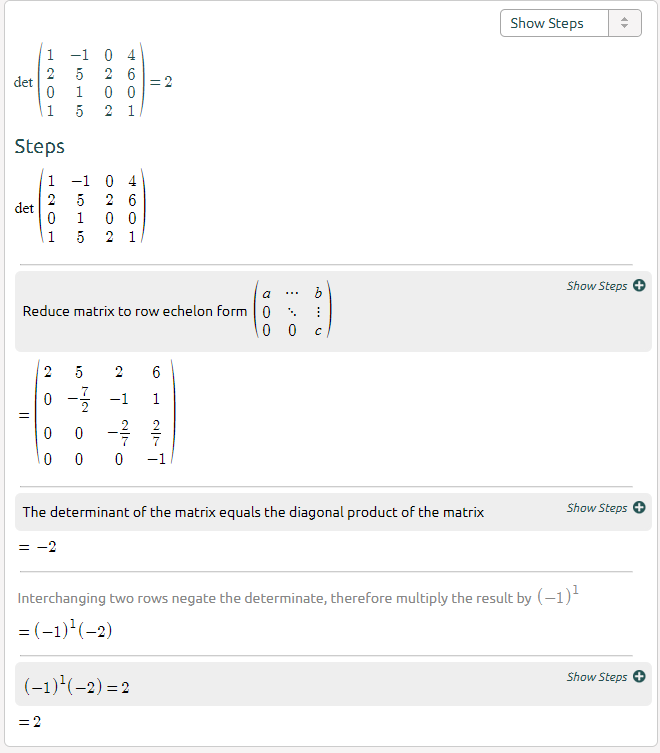
After reducing the matrix to row ech form and doing the diagonal product, why isnt the determinant -2?
I dont understand the last step of (-1)^1 * -2 = 2
Why interchange rows? Which rows are being interchanged? and why does it negate the determinant
obtuse pebbleBOT
@autumn patrol Has your question been resolved?
robust sleet
it doesn't matter which rows are interchanged
you can find out why it negates by doing a trivial example
obtuse pebbleBOT
@autumn patrol Has your question been resolved?
autumn patrol
robust sleet
you can find out why it negates by doing a trivial example
im not following
robust sleet
take a trivial 2x2 matrix
solve its determinant
then change the rows
what do u get
autumn patrol
1 2
3 4
4-6
6-4
hmm ok makes sense now
but why interchange rows anyways? what does it achieve?
robust sleet
I think when making the matrix into diagonal form and taking its det
u have to swap 2 rows then, to get the det of the 'actual' matrix
obtuse pebbleBOT
Channel closed
Closed by @autumn patrol
Use .reopen if this was a mistake.
Available help channel!
Send your question here to claim the channel.
Remember:
• Ask your math question in a clear, concise manner.
• Show your work, and if possible, explain where you are stuck.
• After 15 minutes, feel free to ping <@&286206848099549185>.
• Type the command .close to free the channel when you're done.
• Be polite and have a nice day!
Read #❓how-to-get-help for further information on how to ask a good question, and about conduct in the question channels.
 scarlet silo
Hi, how to find the cumulative frequency for Q2 and Q1?
obtuse pebbleBOT
scarlet silo
Hi, how to find the cumulative frequency for Q2 and Q1?
scarlet silo

 obtuse pebbleBOT
@scarlet silo Has your question been resolved?
scarlet silo
<@&286206848099549185>
obtuse pebbleBOT
@scarlet silo Has your question been resolved?
obtuse pebbleBOT
@scarlet silo Has your question been resolved?
obtuse pebbleBOT
Channel closed
Closed due to timeout
Use .reopen if this was a mistake.
obtuse pebbleBOT
Available help channel!
Send your question here to claim the channel.
Remember:
• Ask your math question in a clear, concise manner.
• Show your work, and if possible, explain where you are stuck.
• After 15 minutes, feel free to ping <@&286206848099549185>.
• Type the command .close to free the channel when you're done.
• Be polite and have a nice day!
Read #❓how-to-get-help for further information on how to ask a good question, and about conduct in the question channels.
 toxic canopy
Prove that the diagonal of the 3D parelelogram ( not a native english speaker ) ABCDA1B1C1D1 cuts through the center of the triangle BDA1
 obtuse pebbleBOT
toxic canopy
Prove that the diagonal of the 3D parelelogram ( not a native english speaker ) ...
obtuse pebbleBOT
toxic canopy
Prove that the diagonal of the 3D parelelogram ( not a native english speaker ) ...
 fringe cedar
toxic canopy
Prove that the diagonal of the 3D parelelogram ( not a native english speaker ) ...
fringe cedar
toxic canopy
Prove that the diagonal of the 3D parelelogram ( not a native english speaker ) ...
Hm
Let's see 
toxic canopy
we are working with vectors btw!
fringe cedar
The triangle inscribed inside is an isosceles triangle
As far as I can tell because all 3 sides r equal
toxic canopy
i just drew the sketch to make it easier for people to visualize
fringe cedar
The center of the tringle is also the midpoint
fringe cedar
toxic canopy
we are working with vectors btw!
What grade math is this
toxic canopy
college math
fringe cedar
fringe cedar
The center of the tringle is also the midpoint
the incenter
toxic canopy
analytical geometry
fringe cedar
toxic canopy
analytical geometry
im in middle school
thats way but i'll try to help
toxic canopy
i need to prove it tho 
fringe cedar
toxic canopy
i need to prove it tho <:thinkies:827642567775748163>
yes
toxic canopy
u learn this stuff in middle school?
fringe cedar
toxic canopy
u learn this stuff in middle school?
no
 fringe cedar
i think you should start by proving its an isosceles triangle
fringe cedar
toxic canopy
i know what vectors are? <:thinkingbread:586238982636044289>
yes at least i think
uh
hm
because
if u slice the thing in half
u would have like a trianglular thing
2
no not like that
fringe cedar
toxic canopy
and see why that is the case u know
go for it
toxic canopy
but i need to write it on the paper
fringe cedar
i-my brain's stuck with colege math
toxic canopy
yeah yeah ahahahaha
toxic canopy
yeah you probably should avoid doing that
fringe cedar
toxic canopy
yeah you probably should avoid doing that
mk doing these
i want challenges cus middle school stuff easy for me
toxic canopy
i wish i was thinking like that during my highschool days
i went to the easiest highschool i could find cause why not
and then i went on to go to the hardest university in serbia lmao
Prove that the diagonal of the 3D parelelogram ( not a native english speaker ) ABCDA1B1C1D1 cuts through the center of the triangle BDA1
 obtuse pebbleBOT
@toxic canopy Has your question been resolved?
toxic canopy
<@&286206848099549185>
compact shadow
You let A=0
You have three vectors
a=AB
b=AD
c=AA_1
So AC_1=a+b+c
On the other hand
The center is P, AP=(1/3)(a+b+c)
So P is on the line AC_1
obtuse pebbleBOT
@toxic canopy Has your question been resolved?
Channel closed
Closed by @toxic canopy
Use .reopen if this was a mistake.
toxic canopy
thanks!!!
obtuse pebbleBOT
Available help channel!
Send your question here to claim the channel.
Remember:
• Ask your math question in a clear, concise manner.
• Show your work, and if possible, explain where you are stuck.
• After 15 minutes, feel free to ping <@&286206848099549185>.
• Type the command .close to free the channel when you're done.
• Be polite and have a nice day!
Read #❓how-to-get-help for further information on how to ask a good question, and about conduct in the question channels.
 runic arrow
You randomly take a card from a well-shuffled deck of cards and then put them back.
- What is the probability that after 100 times you have not drawn an ace of hearts.
- What is the probability that after 20 times you drew an ace at least once.
obtuse pebbleBOT
runic arrow
You randomly take a card from a well-shuffled deck of cards and then put them ba...
runic arrow
I don’t really have any work bc I don’t know how to start and we use this formula called la place or whatever
 drowsy girder
Well in theory if you got 1/54 chance to draw ace of hearts you should draw at least 1 in 100 drawns. But thats not true
runic arrow
Well yeah obviously, but that’s the whole point of this exercise it’s to go beyond that logic
drowsy girder
@runic arrow ok after a bit of search
I found out the formula
$$(1 - p)^n$$ to be true
warm shaleBOT
Pluton
 drowsy girder
p being probability n being tries
runic arrow
Yea
drowsy girder
Well a deck has 54 cards
And 4 aces
Probability it wont happen
$$(1 - p)^n$$
Probability it will happen
$$1 - (1-p)^n$$
warm shaleBOT
Pluton
 drowsy girder
Just plug in second formula
runic arrow
But then I get one as the answer
oh wait I got it
But the n is supposed to be only for p
Not one
drowsy girder
,w 1 - (1 - 4/54)^20
warm shaleBOT


 Requested by Pluton#6301
drowsy girder
Requested by Pluton#6301
drowsy girder
Seems correct to me
runic arrow
Not if u do the first one lol
drowsy girder
What do you mean
warm shaleBOT
 Requested by Pluton#6301
drowsy girder
Requested by Pluton#6301
drowsy girder
Basically 0
obtuse pebbleBOT
@runic arrow Has your question been resolved?
obtuse pebbleBOT
Channel closed
Closed due to timeout
Use .reopen if this was a mistake.
Available help channel!
Send your question here to claim the channel.
Remember:
• Ask your math question in a clear, concise manner.
• Show your work, and if possible, explain where you are stuck.
• After 15 minutes, feel free to ping <@&286206848099549185>.
• Type the command .close to free the channel when you're done.
• Be polite and have a nice day!
Read #❓how-to-get-help for further information on how to ask a good question, and about conduct in the question channels.
 gritty dragon
Hey i am in 8th grade and I tried everything i just don’t get the question
 obtuse pebbleBOT
gritty dragon
Hey i am in 8th grade and I tried everything i just don’t get the question
fallen mantle
gritty dragon
Hey i am in 8th grade and I tried everything i just don’t get the question
obtuse pebbleBOT
gritty dragon
Hey i am in 8th grade and I tried everything i just don’t get the question
fallen mantle
gritty dragon
Hey i am in 8th grade and I tried everything i just don’t get the question
solve for x and y first
do you know how to solve?
gritty dragon
no sorry
fallen mantle
have you learnt solving simultaneous linear equations?
gritty dragon
yes but we got a really bad teacher so I asked about it be she couldn't really help me so i thought I would aks here
gritty dragon
I think you should trace
fallen mantle
For the equation 3y - 2x = 12, express y as the subject in terms of x
fallen mantle
fallen mantle
For the equation 3y - 2x = 12, express y as the subject in terms of x
i hope you know how to do this
gritty dragon
yeah i think so
fallen mantle
try it now, and let's see what you get
gritty dragon
i will
hey i am back
i dont have the answer yet
I tried but I just get stuck
<@&286206848099549185> can you help me i don't understand the question
drowsy girder
fallen mantle
solve for x and y first
I dont think thats how its supposed to be solved
gritty dragon
oh
drowsy girder
Normally when i see this type of questions you need to manipulate somehow both equations
 trim oasis
I think for an 8th grader, the most straightforward solution would be to solve for x and y
fallen mantle
trim oasis
I think for an 8th grader, the most straightforward solution would be to solve f...
I agree with you
drowsy girder
@gritty dragon do you know quadratic formula
gritty dragon
yeah I think so but i am not relly good at math
fallen mantle
fallen mantle
For the equation 3y - 2x = 12, express y as the subject in terms of x
have you tried this?