#help-10
1 messages · Page 511 of 1
 obtuse pebbleBOT
 timid silo
@sterile wyvern
so i i write out 38.8x+(-151.9)
just making sure
yea it correct
.close
obtuse pebbleBOT
Channel closed
Closed by @hushed plinth
Use .reopen if this was a mistake.
 Available help channel!
Send your question here to claim the channel.
Remember:
• Ask your math question in a clear, concise manner.
• Show your work, and if possible, explain where you are stuck.
• After 15 minutes, feel free to ping <@&286206848099549185>.
• Type the command .close to free the channel when you're done.
• Be polite and have a nice day!
Read #❓how-to-get-help for further information on how to ask a good question, and about conduct in the question channels.
 warm thorn
.close
obtuse pebbleBOT
Channel closed
Closed by @warm thorn
Use .reopen if this was a mistake.
Available help channel!
Send your question here to claim the channel.
Remember:
• Ask your math question in a clear, concise manner.
• Show your work, and if possible, explain where you are stuck.
• After 15 minutes, feel free to ping <@&286206848099549185>.
• Type the command .close to free the channel when you're done.
• Be polite and have a nice day!
Read #❓how-to-get-help for further information on how to ask a good question, and about conduct in the question channels.
timid silo
can someone tell me what the remainder of -30/7 is? im having a brain fart
obtuse pebbleBOT
timid silo
can someone tell me what the remainder of -30/7 is? im having a brain fart
@timid silo Has your question been resolved?
 nocturne minnow
timid silo
can someone tell me what the remainder of -30/7 is? im having a brain fart
nocturne minnow
timid silo
can someone tell me what the remainder of -30/7 is? im having a brain fart
You can use a calculator
obtuse pebbleBOT
Channel closed
Closed by @idle pecan
Use .reopen if this was a mistake.
Available help channel!
Send your question here to claim the channel.
Remember:
• Ask your math question in a clear, concise manner.
• Show your work, and if possible, explain where you are stuck.
• After 15 minutes, feel free to ping <@&286206848099549185>.
• Type the command .close to free the channel when you're done.
• Be polite and have a nice day!
Read #❓how-to-get-help for further information on how to ask a good question, and about conduct in the question channels.
 dry shard
can someoen help me out with this
 obtuse pebbleBOT
dry shard
can someoen help me out with this
obtuse pebbleBOT
dry shard
can someoen help me out with this
 tardy epoch
which one
1st one's a well known problem

Mathematics Stack Exchange
Just wanted some input to see if my proof is satisfactory or if it needs some cleaning up.
Here is what I have.
Proof
Suppose $A$ is square matrix and invertible and, for the sake of contradic...
obtuse pebbleBOT
@dry shard Has your question been resolved?
dry shard
tardy epoch
which one
all 3 preferably, I just looked at that mathexchange link and undertand 1 now
obtuse pebbleBOT
@dry shard Has your question been resolved?
 mental solstice
For the second, as a hint, consider the characteristic polynomial
obtuse pebbleBOT
@dry shard Has your question been resolved?
dry shard
yea i dont really understand what to do with the hints 
 slate zephyr
More hint: det(AB) = det(A)det(B)
 spiral maple
Gershgorin Theorem 
 gilded needle
Maybe more simply for the second, let $k$ be the smallest positive integer such that $A^k = 0$. If $A$ is invertible then you can multiply both sides by $A^{-1}$ and conclude what?
 warm shaleBOT
OurBelovedBungo
 gilded needle
For the third, you can find the inverse to prove it's invertible. Hint, by analogy consider that $\frac{1}{1-x}$ is a closed-form expression for the series $\sum_{n=0}^{\infty}x^n$.
warm shaleBOT
OurBelovedBungo
 obtuse pebbleBOT
@dry shard Has your question been resolved?
obtuse pebbleBOT
Channel closed
Closed due to timeout
Use .reopen if this was a mistake.
Available help channel!
Send your question here to claim the channel.
Remember:
• Ask your math question in a clear, concise manner.
• Show your work, and if possible, explain where you are stuck.
• After 15 minutes, feel free to ping <@&286206848099549185>.
• Type the command .close to free the channel when you're done.
• Be polite and have a nice day!
Read #❓how-to-get-help for further information on how to ask a good question, and about conduct in the question channels.
 jolly hill
 obtuse pebbleBOT
jolly hill
https://media.discordapp.net/attachments/894614705266638938/944200241358442506/I...
obtuse pebbleBOT
jolly hill
https://media.discordapp.net/attachments/894614705266638938/944200241358442506/I...
 brittle swan
consider the ways you can write 11 as the sum of two one digit numbers
obtuse pebbleBOT
@jolly hill Has your question been resolved?
obtuse pebbleBOT
Channel closed
Closed due to timeout
Use .reopen if this was a mistake.
obtuse pebbleBOT
Available help channel!
Send your question here to claim the channel.
Remember:
• Ask your math question in a clear, concise manner.
• Show your work, and if possible, explain where you are stuck.
• After 15 minutes, feel free to ping <@&286206848099549185>.
• Type the command .close to free the channel when you're done.
• Be polite and have a nice day!
Read #❓how-to-get-help for further information on how to ask a good question, and about conduct in the question channels.
 gloomy trellis
dt[r(t) × r(t)] = 0 is not possible. We know dt(r(t)) can't equal to 0 because r'(t) is a tangent vector at the point corresponding to r(t)
obtuse pebbleBOT
gloomy trellis
dt[r(t) × r(t)] = 0 is not possible. We know dt(r(t)) can't equal to 0 because r...
@gloomy trellis Has your question been resolved?
obtuse pebbleBOT
@gloomy trellis Has your question been resolved?
gloomy trellis
<@&286206848099549185>
gilded needle
r(t) x r(t) is always zero. I'm not sure what the notation dt[r(t) x r(t)] means.
gilded needle
Did you mean dt[r(t)] x r(t) instead of dt[r(t) x r(t)] ?
Because the second one is definitely zero
gloomy trellis
Dt[r(t)xr(t)]
gilded needle
r(t) x r(t) itself is identically zero, so its derivative is also zero.
gloomy trellis
But I thought r'(t) can't equal to 0?
gilded needle
How does r'(t) relate to this?
gloomy trellis
How do you prove it then?
gilded needle
Prove what? What is the problem statement?
gloomy trellis
Prove derivative [r(t) cross product r(t)] = 0
gilded needle
Like I said, [r(t) cross product r(t)] itself is always zero (the cross product of any vector with itself is zero). So of course its derivative is also zero.
 gilded needle
I don't understand why you think the two facts are a contradiction.
Why would dt[r(t) x r(t)] = 0 imply that r'(t) is zero?
r'(t) can be anything
Moreover, the textbook doesn't say that r'(t) is nonzero, it says PROVIDED that it is nonzero, then r'(t) is called a tangent vector.
obtuse pebbleBOT
Channel closed
Closed by @gloomy trellis
Use .reopen if this was a mistake.
obtuse pebbleBOT
Available help channel!
Send your question here to claim the channel.
Remember:
• Ask your math question in a clear, concise manner.
• Show your work, and if possible, explain where you are stuck.
• After 15 minutes, feel free to ping <@&286206848099549185>.
• Type the command .close to free the channel when you're done.
• Be polite and have a nice day!
Read #❓how-to-get-help for further information on how to ask a good question, and about conduct in the question channels.
 cloud spear
 obtuse pebbleBOT
cloud spear
cloud spear
obtuse pebbleBOT
cloud spear
cloud spear
This is a practice problem I did with a tutor
I don’t understand why the Ln doesn’t disappear
On the right side of the equation
Shouldn’t it just become (sin(4x))x
obtuse pebbleBOT
@cloud spear Has your question been resolved?
obtuse pebbleBOT
Channel closed
Closed due to timeout
Use .reopen if this was a mistake.
Available help channel!
Send your question here to claim the channel.
Remember:
• Ask your math question in a clear, concise manner.
• Show your work, and if possible, explain where you are stuck.
• After 15 minutes, feel free to ping <@&286206848099549185>.
• Type the command .close to free the channel when you're done.
• Be polite and have a nice day!
Read #❓how-to-get-help for further information on how to ask a good question, and about conduct in the question channels.
 plucky ether
Need help with these two
 obtuse pebbleBOT
plucky ether
Need help with these two
obtuse pebbleBOT
obtuse pebbleBOT
plucky ether
Need help with these two
obtuse pebbleBOT
@plucky ether Has your question been resolved?
plucky ether
<@&286206848099549185>
 alpine raven
sec x - tan x = 1/cos(x) - sin(x)/cos(x) = (1-sin(x))/cos(x) = (1-sin(x))/sqrt(1-sin^2(x))
= (1-sin(x))/(sqrt(1-sin(x))*sqrt(1+sin(x)))
$\sec(x) - \tan(x) = \frac{1-\sin(x)}{(1-\sin(x))^{1/2} \sqrt{1+\sin(x)}}$
warm shaleBOT
Herels
 plucky ether

alpine raven
just tell what you don't understand in this
alpine raven
you agree that sec(x) = 1/cos(x) and tan(x) = sin(x)/cos(x) ?
plucky ether
Yep
alpine raven
the rest is just algebra and playing with trig formula
plucky ether
How did you bring the sqrt
alpine raven
cos^2 x + sin^2 x = 1
plucky ether
So...cosx=√1-sin^2x ?
alpine raven
yea
plucky ether
Wait what did you do in the last line?
alpine raven
where
plucky ether
warm shale
**Herels**
This
alpine raven
nothing, sqrt(x) is the same as x^{1/2}
plucky ether
Where did you get that sqrt(1+sinx)
alpine raven
basic algebra
(a^2 - b^2) = (a-b)(a+b)
alpine raven
sqrt(ab) = sqrt(a)sqrt(b)
alpine raven
again basic algebra
a^m/a^n = a^{m-n}
alpine raven
np
plucky ether
No.3
plucky ether
plucky ether
Need help with these two
@alpine raven can you do no.3?
 jagged swallow
Use the sec^2 a= 1+tan^2 a identity
plucky ether
On the left hand side or right hand side?
jagged swallow
Left
plucky ether
Ok
plucky ether
jagged swallow
Use the sec^2 a= 1+tan^2 a identity
I get, 1 + 2tan^2x + 2tan^4x
Do I break them to sin and cos?
jagged swallow
u should rewrite the left side as sec^2 a(sec^2 a) + tan^2 a(tan^2 a)
and then sub one of the sec^2 a with the identity, and one of the tan^2 a with the identity
so sec^2 a (1+ tan^2 a) + tan^2 a (sec^2 a -1)
 obtuse pebbleBOT
Channel closed
Closed by @plucky ether
Use .reopen if this was a mistake.
Available help channel!
Send your question here to claim the channel.
Remember:
• Ask your math question in a clear, concise manner.
• Show your work, and if possible, explain where you are stuck.
• After 15 minutes, feel free to ping <@&286206848099549185>.
• Type the command .close to free the channel when you're done.
• Be polite and have a nice day!
Read #❓how-to-get-help for further information on how to ask a good question, and about conduct in the question channels.
 mighty ether
 obtuse pebbleBOT
mighty ether
plucky ether
obtuse pebbleBOT
mighty ether
plucky ether
 obtuse pebbleBOT
Channel closed
Closed by @mighty ether
Use .reopen if this was a mistake.
obtuse pebbleBOT
Available help channel!
Send your question here to claim the channel.
Remember:
• Ask your math question in a clear, concise manner.
• Show your work, and if possible, explain where you are stuck.
• After 15 minutes, feel free to ping <@&286206848099549185>.
• Type the command .close to free the channel when you're done.
• Be polite and have a nice day!
Read #❓how-to-get-help for further information on how to ask a good question, and about conduct in the question channels.
 restive ridge
how would I compute $$\lim_{x \to \infty} e^{bxi}, b \in \mathbb{R}$$
obtuse pebbleBOT
restive ridge
how would I compute $$\lim_{x \to \infty} e^{bxi}, b \in \mathbb{R}$$
warm shaleBOT
illuminator3

 junior inlet
warm shale
**illuminator3**
junior inlet
warm shale
**illuminator3**
wouldnt converge according to euler's formula?
restive ridge
junior inlet
wouldnt converge according to euler's formula?
so I'd have different cases?
because what if b = 0 or b < 0
 balmy mortar
Think visually - you're just spinning around the unit circle on the argand plane
b = 0 is indeed a separate case
restive ridge
balmy mortar
Think visually - you're just spinning around the unit circle on the argand plane
but it would diverge then, would it?
because how would I know at what point I'm stopping if I'm infinitely spinning around the circle
balmy mortar
Ill explain it visually
or try
So say you have a complex sequence (note this works for a real sequence too, ofc)
We pick a point P on the plane
If we keep revisiting P, then P is an 'accumulation point' (i will say ap from now on)
The definition of ap is slightly broader than this, but I will stick to this basic example for now
restive ridge
balmy mortar
If we keep revisiting P, then P is an 'accumulation point' (i will say ap from n...
in our case
wouldn't every point on the unit circle be an ap
balmy mortar
not necessarily
Let b = pi
Then what will our AP's be?
oh wait
aaaaa
x is real?
restive ridge
yes
balmy mortar
ahaha then indeed
that is true
But for a second, suppose x is integer
so we have a sequence of points e^{bi}, e^{2bi}, e^{3bi}, ...
restive ridge
because sine and cosine have an interval of 2pi
restive ridge
balmy mortar
(-1)^n is our sequence
wdym
restive ridge
yes
balmy mortar
Theta is the argument
restive ridge
cos(theta) + i * sin(theta)
warm shaleBOT
Shuri2060
 balmy mortar
Its actually this, but r = 1 for us
But think about just theta
we go 0, pi, 2pi, 3pi, ...
ie. we flip between 0 degrees and 180 degrees
Which is 1 and -1 on the argand plane
hence, I get (-1)^n as our sequence
balmy mortar
If theta = pi/2
We have 4 AP
1, i, -1, -i
I'm trying to get the point - if we have a rational multiple of pi, our AP will be finite
And in fact, the roots of unity for some n
restive ridge
roots of unity?
balmy mortar
$z^n=1$
warm shaleBOT
Shuri2060
 restive ridge
hm
balmy mortar

Visually, the points will lie on the unit circle
equally spaced out
so if you join them up, you get a regular polygon
with n sides
restive ridge
so every point on the unit circle is a root of 1?
balmy mortar
Not quite
You can have an 'irrational' point
If you see what I mean
If you have like $\pi\sqrt 2$
warm shaleBOT
Shuri2060
 balmy mortar
As your angle
No matter how much you exponentiate the number (ie. add the angle to itself)
you won't get to 1
restive ridge
that makes sense
balmy mortar
So back to AP
The definition is broader
If I have a point P
It is an AP if we get arbritrarily close to it an infinite number of times in our sequence
We don't actually have to hit it - we have to get as close as we like
This is slightly harder to understand
restive ridge
what does arbitrarily close in this context mean
balmy mortar
So... its like this
You tell me a point P
Then I draw a circle around P, any size I want
Then if an infinite number of points in the sequence lie inside that circle, you 'win'
If you win no matter what circle I draw,
P is an accumulation point
restive ridge
so if we draw a circle around 1 with radius h as h -> 0, it would be an ap when talking about our sequence ((-1)^n)?
balmy mortar
indeed
This is an obvious case because we keep hitting the point 1 itself
$e^{i(\pi\sqrt2)n}$
warm shaleBOT
Shuri2060
 balmy mortar
For this sequence where n is an integer
We don't actually necessarily hit every point of the unit circle
But we do get arbritarily close
So for this example, the entire unit circle is a set of accumulation points
Well anyways --- this kinda detracts from your original question where we don't have a sequence
But a function
x -> infinity, so x is allowed to be real
In which case you do visit every point
===
So how do limits and AP relate? When there is exactly 1 AP, then a limit exists.
If there are more than 1, no limit exists (divergence)
If the AP is infinity, then the limit also doesn't exist in C, and we consider it to diverge, too
restive ridge
wait
restive ridge
warm shale
**illuminator3**
it converging depends on what b is?
balmy mortar
 restive ridge
because if b is e.g. 1 we have infinitely many aps
restive ridge
then it's just 1 yeah
restive ridge

so with 1
we'd have infinitely many aps
because 1*x (x in R) never hits a multiple pi?
as pi is irrational
?
balmy mortar
well it does
cus x is real
not integer
But that doesn't matter, because we will keep spinning around the circle
restive ridge
balmy mortar
cus x is real
I always confuse things lol
I thought x is rational for a second
balmy mortar
Thats partially my bad
You will hit every point on the unit circle a infinite number of times
Since x is real
So they are definitely AP for sure.
One way to think of this is b describes the speed at which you spin
If b is positive, then you spin anticlockwise
If b is negative, clockwise
Let's say your x is increasing at a constant rate (let's say 1 per second)
b = 1 vs b = 2
You spin twice as fast with b = 2
Handwavy explanation for the visualisation
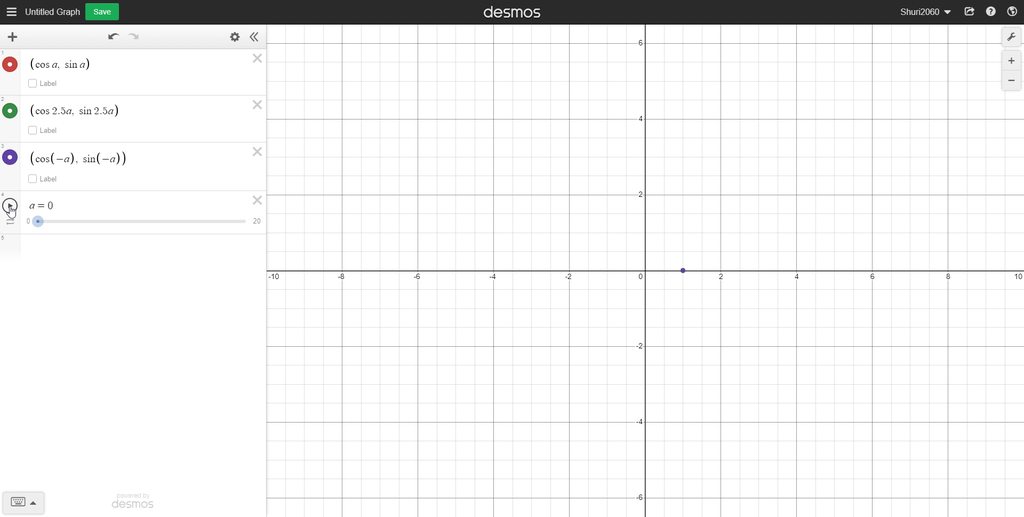
b = 1, 2.5, -1 for those examples
You can see those dots will never converge to any point as a (a in desmos, x in your question) goes to infinity
The only case they could converge is when your spinning speed is 0
restive ridge
so the limit is non determinate
warm shaleBOT
Shuri2060
 balmy mortar
Can you imagine what this will look like?
restive ridge
0?
restive ridge
$$\lim_{x\to\infty}\frac{1}{x}e^{ix} = \lim_{x\to\infty} \frac{1}{x} \cdot \lim_{x\to\infty} e^{ix} = 0 \cdot n = 0$$
 pulsar epoch
how is that 0?
balmy mortar
Sure that's how to work it out algebraically
warm shaleBOT
illuminator3
 balmy mortar
But there is something to visualize too
restive ridge
hm
balmy mortar
warm shale
**illuminator3**
also thats not 0 . n
lim x -> infty e^ix
is not convergent (as we just worked out now)
pulsar epoch
this is not 0 man
pulsar epoch
e is exponential
restive ridge
@pulsar epoch you're not being helpful. shuri is already helping me
balmy mortar
pulsar epoch
e is exponential
e is exponential yes
but are you familiar with complex exponential
i is sqrt -1, so this is different
balmy mortar
restive ridge
right
So algebraically, this is a slight pain
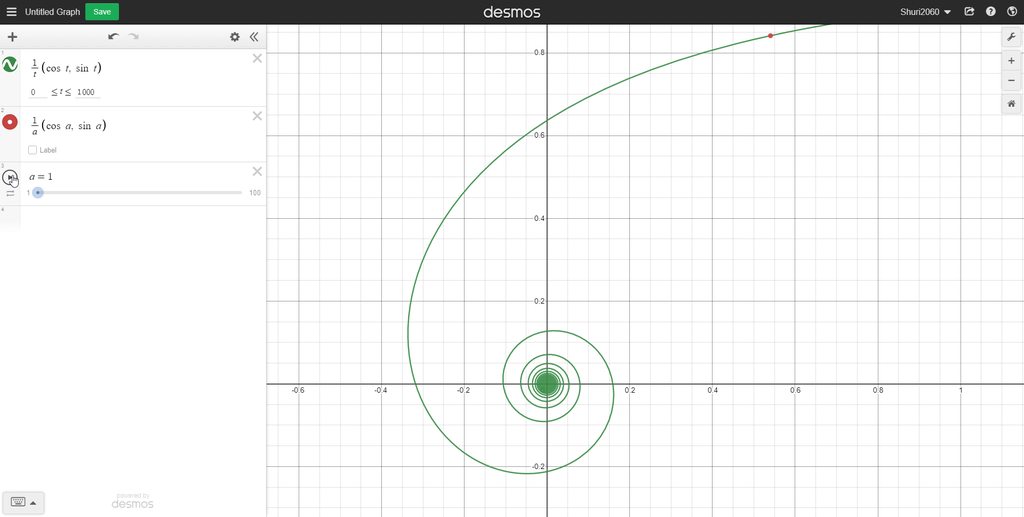
You might justify it by saying the modulus goes to 0
therefore, the limit must be 0 regardless of what the argument is doing

But you can also visualize what this is doing as x changes
balmy mortar
balmy mortar
https://i.imgur.com/myto5TA.gif
in the same way as we did here
 restive ridge
never really thought about solving problems visually hm
balmy mortar
Where possible, it is usually helpful to try thinking about these limits geometrically
restive ridge
yeah
balmy mortar
Sometimes you get an ugly expression and you can't, ofc
obtuse pebbleBOT
Channel closed
Closed by @restive ridge
Use .reopen if this was a mistake.
Available help channel!
Send your question here to claim the channel.
Remember:
• Ask your math question in a clear, concise manner.
• Show your work, and if possible, explain where you are stuck.
• After 15 minutes, feel free to ping <@&286206848099549185>.
• Type the command .close to free the channel when you're done.
• Be polite and have a nice day!
Read #❓how-to-get-help for further information on how to ask a good question, and about conduct in the question channels.
 rotund ingot
Hello
obtuse pebbleBOT
rotund ingot
Hello
rotund ingot
Let $h: \mathbb{R}^4 \to \mathbb{R}$ be a function with the following properties: the domain of h is $\mathbb{R}^4$ and all partial derivatives of h from of 2 or lower exist and have the same domain as h. Let $H: \mathbb{R}^2 \to \mathbb{R}$ be a function defined by $H(x,y) = h(-3, e^{xy}, x^2 + y^2, y-x)$.
How can I prove that the partial derivative $\frac{\partial H}{\partial x}$ exists?
warm shaleBOT
veganlatina
 rotund ingot
My idea was to prove $\lim_{h \to 0} \frac{H(x+h,y) - H(x,y)}{h}$ exists, but I don't know how I can prove this limit exists

 rotund ingot
<@&286206848099549185>
obtuse pebbleBOT
@rotund ingot Has your question been resolved?
rotund ingot
<@&286206848099549185> anyone?
 worthy comet
use the chain rule
rotund ingot
But how?
worthy comet
write H as the composite of two partial differentiable function, then H has also a partial derivative ||one is the two functions is h||
rotund ingot
So something like $\frac{ \partial H}{\partial x} = \frac{ \partial H}{\partial h} \frac{\partial h}{\partial x} + \frac{\partial H}{\partial ?} \frac{\partial ?}{\partial x}$?
warm shaleBOT
veganlatina
 worthy comet
if H(x,y)=h(g(x,y)) with $g(x,y)=(g_1(x,y),g_2(x,y),g_3(x,y),g_4(x,y))$, then $\frac{ \partial H}{\partial x} = \frac{ \partial h}{\partial g_1} \frac{\partial g_1}{\partial x} + \frac{\partial h}{\partial g_2} \frac{\partial g_2}{\partial x}+\frac{ \partial h}{\partial g_3} \frac{\partial g_3}{\partial x} + \frac{\partial h}{\partial g_4} \frac{\partial g_4}{\partial x}$
warm shaleBOT
Alexander42
 rotund ingot
.close
obtuse pebbleBOT
Channel closed
Closed by @rotund ingot
Use .reopen if this was a mistake.
Available help channel!
Send your question here to claim the channel.
Remember:
• Ask your math question in a clear, concise manner.
• Show your work, and if possible, explain where you are stuck.
• After 15 minutes, feel free to ping <@&286206848099549185>.
• Type the command .close to free the channel when you're done.
• Be polite and have a nice day!
Read #❓how-to-get-help for further information on how to ask a good question, and about conduct in the question channels.
 hasty linden
not quite sure why q = f(p)
 obtuse pebbleBOT
hasty linden
not quite sure why q = f(p)
obtuse pebbleBOT
obtuse pebbleBOT
hasty linden
not quite sure why q = f(p)
obtuse pebbleBOT
Channel closed
Closed by @hasty linden
Use .reopen if this was a mistake.
 silver zephyr
I'm trying to understand the derivation of the Length of the spiral formed within a regular polygon https://mathworld.wolfram.com/PolygonalSpiral.html. Does the equation of the total length of the spiral $L=\frac{1 }{ 2}s\sum_k \cos^k(\pi/n)$ immediately follow from the previous step on the ratio $r/R$? Or are there various steps hidden away?
warm shaleBOT
tuturuuu
 obtuse pebbleBOT
Available help channel!
obtuse pebbleBOT
Available help channel!
Send your question here to claim the channel.
Remember:
• Ask your math question in a clear, concise manner.
• Show your work, and if possible, explain where you are stuck.
• After 15 minutes, feel free to ping <@&286206848099549185>.
• Type the command .close to free the channel when you're done.
• Be polite and have a nice day!
Read #❓how-to-get-help for further information on how to ask a good question, and about conduct in the question channels.
 nimble cliff
Problem 1 :
The input is 2 values, that can be in a scale between [-3.89, 10.66]
And i need to compare the difference between an oldValue (A) and a newValue (B).
So i want to create a variable that express this difference.
Let say :
A = -2
B = 3
diff = ?
If i do a simple substraction it doesn't capture the fact that it switches side from negative to positive.
For example if A=2 & B=7, it shouldn't give the same "difference" than the case mentionned above, since it stays positive.
What formula should i use ?
Problem 2 :
Problem 2 is similar as problem 1 but a bit more tricky.
I have :
- M is the mean of multiple values in this scale (probably not normally distributed)
- S is the standard deviation of the multiple values
- X which is a new value i want to compare to the mean/std of other values.
M and X can be treated as A and B in Problem 1. But i also want to use the standard deviation S.
The "difference" variable between X and M should be reduced by the standard deviation :
Logically, the greater is the standard deviation, the lower is this "distance" variable of X.
So I was thinking of something like :
Distance = diff(X,M) - weight(S,X,M)
But i can't find a good formula.. My mathematics and statistics knowledge are lacking. Maybe i'm overthinking and missing a simple solution.
Hope i was clear enough about the issue and thank you in advance for your help!
obtuse pebbleBOT
nimble cliff
**Problem 1 :**
The input is 2 values, that can be in a scale between [-3.89,...
nimble cliff

Background of this problem :
I want to use machine learning on a set of data.
The scale mentioned above is the IDP-hydropathy scale of amino acids (AA), or simply put : their affinity with water (see pic above)
I have an alignment of proteins, and at each position on this alignment, i captured the different amino acids, and their hydropathy scores.
For example :
Position  : 1-2-3-4-5-6-7
Protein 1 : A-L-Y-V-I-A-A
Protein 2 : A-I-Y-V-I-A-A
Protein 3 : A-I-Y-V-I-V-A
...
So for example let say there is a mutation on Protein 1 at position 6 :
A > P
The hydropathy score changes from A(0.91) to P(-3.89).
And let say the mean of all hydropathy scores at this consensus position ((A(0.91)+A(0.91)+V(4.64)+..)/number_of_AAs) = 1.2.
I want to create a variable that captures the change of hydropathy from the old AA to the new AA, and another variable comparing the new AA to the mean of all AA at the consensus position, then insert these 2 values as features for a machine learning model.
obtuse pebbleBOT
@nimble cliff Has your question been resolved?
obtuse pebbleBOT
@nimble cliff Has your question been resolved?
obtuse pebbleBOT
@nimble cliff Has your question been resolved?
 foggy marsh
I might be misunderstanding your question. A variable that captures the change of hydropathy from the old AA to the new AA could simply be the difference of their hydropathy values, right?
nimble cliff
foggy marsh
I might be misunderstanding your question. A variable that captures the change o...
Yes, but i have the impression i would miss some information
Like :
** Case 1 : **
oldAA score = -2
newAA score = 3
Then difference = 5
Case 2 :
oldAA score = 1
newAA score = 6
difference = 5
the difference is the same in both case
But in case 1 the newAA changes the direction of hydropathy, it goes from hydrophilic to hydrophobic
While in case 2 it stays hydrophobic (or goes from ~neutral hydrophobic to hydrophobic++)
I went the variable to emphasize the "switch" while also giving info on the difference
foggy marsh
Ah, OK, so you want to capture sign changes
nimble cliff
Yes exactly
and maybe the "neutral" (close to 0) ? but thats maybe too much to ask xD
foggy marsh
This is a crude example: the difference if there's no sign change, but double the difference if there's a sign change? Something like that?
nimble cliff
Actually yes maybe that could work, i was actually trying to work my mind around this
I don't want to involve too much arbitrary values like saying x2 when opposite sign
but i guess thats the easiest way to do it
foggy marsh
Yeah, I don't like it either
How important is the flip, as compared to the absolute difference?
foggy marsh
nimble cliff
and maybe the "neutral" (close to 0) ? but thats maybe too much to ask xD
Also what do you mean by this?
nimble cliff
This is hard to tell, i supposed it depends on where the amino acid is located
the protein is located in the membrane so part of it is hydrophobic, while some are hydrophilic
an hydrophobic amino acid in the external part of the membrane might have more impact
neutral is close to 0, it doesnt have much relation with water
foggy marsh
On second thought, taking all of this into account might make the model a bit too complicated 
Like maybe stick with a simplistic idea first and see how the results are, and refine it as you go on
nimble cliff
i tried, i'm at the stage where i try to improve the model 😄
And the hydropathy of amino acid is known to be important for the structure of the protein, especially for proteins located in the membrane, that's why i want to make use of this feature
foggy marsh
Aha I see that's cool
foggy marsh
Okay so let's say the old and new values are x and y. We want a function that increases with their difference, but is weighted higher if they are of different signs, ie in quadrants 2 and 4. How about a 2d sigmoid kind of thing to accomplish this?
nimble cliff
i'm afraid you're mentioning things out of my scope of knowledge haha
Let me google that one second
(thanks for the help btw! )
ok, so i should create a function that transform my data through a sigmoid function ?
nimble cliff
Plotting ? you have a specific tool for that? with which data?
Sorry im a bit confused
foggy marsh
Sorry, gimme a couple minutes
nimble cliff
im a big noob in maths so bare with me, i just copied your formula but i have no idea what it does lol
It seems something might be wrong though
I don't know if it's what you suggested me to do, but i did that :
 foggy marsh
Yo I am so sorry that was a fool's errand I had no idea what I was doing
please forget about it
nimble cliff
Ok np 😄
foggy marsh
Okay, so what I'm suggesting, after more experimentation, is that for the difference, instead of using |x-y|, you could use |x-y|*((1-1/(1+exp(-2x)))*(1/(1+exp(-2y)))+(1-1/(1+exp(-2y)))*(1/(1+exp(-2x))))
The '2' inside the exp represents how strongly you want the flips to matter
you could make it more or less
nimble cliff
ok thx im gonna try plotting that 😄
foggy marsh
basically it takes the absolute difference and boosts its importance if the two numbers have different signs
which would help if paying attention to hydrophobic to hydrophilic changes
foggy marsh
nimble cliff
How did you come up with that formula ? 😄
uhh... trial and error, let's say 😅
nimble cliff
?
About my current problem ? go ahead 😄
Or do you mean a new question for your own math problem ?
timid silo
nimble cliff
About my current problem ? go ahead 😄
Or do you mean a new question for your ow...
sec ome
one*
nimble cliff
check the "available" channels section to ask a new question
nimble cliff
foggy marsh
uhh... trial and error, let's say 😅
it looks beautiful but i got no idea how that works haha
I recognize some logistic function ( i just googled them)
Im gonna test in the machine learning model later after diner, see if it improves it, thanks a lot for your help, will keep you in touch
foggy marsh
nimble cliff
**Background of this problem :**
I want to use machine learning on a set of da...
I think the two features can basically be built with the same idea, only difference is y=old AA or y=mean of AA, yeah?
nimble cliff
right
but there's also the standard deviation giving a good info on the spread of data
the more spread = the less conserved = the less impact of a mutation
foggy marsh
wait, wouldn't more spread mean the mutation is more impactful?
nimble cliff
no
foggy marsh
like it can do more stuf.. idk..
nimble cliff
no it's like the evolution kept things really specific for important things
foggy marsh
oh i think i see what you mean
nimble cliff
if one amino acid is hydrophobic and among all related proteins it is also hydrophobic, that means this amino acid has a specific role and must remain hydrophobic
nimble cliff
thats why if the mean is hydrophobic++ or hydrophilic++ and has a really low standard deviation, there's a high chance that a mutation changing the hydro score will have a bad impact so we want to capture that
nimble cliff
foggy marsh
so basically, if the variance is more, the "difference" is less?
yes 🙂
foggy marsh
nimble cliff
thats why if the mean is hydrophobic++ or hydrophilic++ and has a really low sta...
this is some big brain logic here
foggy marsh
nimble cliff
yes 🙂
hm okay then. Let x=newAA, y=mean of old AA, s=stdev or variance of the old AAs. Then you could just use the formula from earlier, but throw in an additional factor of 3*(1-1/(1+exp(-2s) ))
the 3 and 2 are just parameters you can adjust to your liking
nimble cliff
Sounds good yes :) thank you i will test that
foggy marsh
cool then! i hope it works
obtuse pebbleBOT
@nimble cliff Has your question been resolved?
obtuse pebbleBOT
Channel closed
Closed due to timeout
Use .reopen if this was a mistake.
Available help channel!
Send your question here to claim the channel.
Remember:
• Ask your math question in a clear, concise manner.
• Show your work, and if possible, explain where you are stuck.
• After 15 minutes, feel free to ping <@&286206848099549185>.
• Type the command .close to free the channel when you're done.
• Be polite and have a nice day!
Read #❓how-to-get-help for further information on how to ask a good question, and about conduct in the question channels.
 versed cave
How many complex roots does a polynomial of degree 2.5 (or more generally a polynomial of non-integer degree) have? (Sorry for the bad english)
obtuse pebbleBOT
versed cave
How many complex roots does a polynomial of degree 2.5 (or more generally a poly...
balmy mortar
A polynomial has non-negative integer degree by definition.
balmy mortar
$z^{2.5} = a$
warm shaleBOT
Shuri2060
 versed cave
warm shale
**Shuri2060**
versed cave
warm shale
**Shuri2060**
Yeah, something like that
balmy mortar
Well this should have 5 roots
I will ignore the modulus
$$e^{i \frac{a}{b}\theta} = e^{i(\phi + 2n\pi)}$$
warm shaleBOT
Shuri2060
 balmy mortar
We perhaps have something like this?
You exponentiate both sides by b/a
This should result in a roots mod 2pi
If you don't have a rational power... I'm not so sure.
It feels like you have infinite roots.
obtuse pebbleBOT
Channel closed
Closed by @versed cave
Use .reopen if this was a mistake.
Available help channel!
Send your question here to claim the channel.
Remember:
• Ask your math question in a clear, concise manner.
• Show your work, and if possible, explain where you are stuck.
• After 15 minutes, feel free to ping <@&286206848099549185>.
• Type the command .close to free the channel when you're done.
• Be polite and have a nice day!
Read #❓how-to-get-help for further information on how to ask a good question, and about conduct in the question channels.
 meager kernel
Hey @oblique glacier Can you help me with my homework plz
 short spruce

 warped agate
obtuse pebbleBOT
warped agate
obtuse pebbleBOT
@meager kernel Has your question been resolved?
 oblique glacier
obtuse pebbleBOT
oblique glacier
obtuse pebbleBOT
Channel closed
Closed by @oblique glacier
Use .reopen if this was a mistake.
Available help channel!
Send your question here to claim the channel.
Remember:
• Ask your math question in a clear, concise manner.
• Show your work, and if possible, explain where you are stuck.
• After 15 minutes, feel free to ping <@&286206848099549185>.
• Type the command .close to free the channel when you're done.
• Be polite and have a nice day!
Read #❓how-to-get-help for further information on how to ask a good question, and about conduct in the question channels.
 obtuse pebbleBOT
 cerulean trout
can someone help me out with this problem
tardy epoch
cerulean trout
can someone help me out with this problem
tardy epoch
Pick a specific problem and show what you've tried
obtuse pebbleBOT
@cerulean trout Has your question been resolved?
obtuse pebbleBOT
Channel closed
Closed due to timeout
Use .reopen if this was a mistake.
obtuse pebbleBOT
Available help channel!
Send your question here to claim the channel.
Remember:
• Ask your math question in a clear, concise manner.
• Show your work, and if possible, explain where you are stuck.
• After 15 minutes, feel free to ping <@&286206848099549185>.
• Type the command .close to free the channel when you're done.
• Be polite and have a nice day!
Read #❓how-to-get-help for further information on how to ask a good question, and about conduct in the question channels.
Channel closed
Closed due to the original message being deleted
 haughty stratus
delete 
obtuse pebbleBOT
Available help channel!
Send your question here to claim the channel.
Remember:
• Ask your math question in a clear, concise manner.
• Show your work, and if possible, explain where you are stuck.
• After 15 minutes, feel free to ping <@&286206848099549185>.
• Type the command .close to free the channel when you're done.
• Be polite and have a nice day!
Read #❓how-to-get-help for further information on how to ask a good question, and about conduct in the question channels.
Channel closed
Closed due to the original message being deleted
Available help channel!
Send your question here to claim the channel.
Remember:
• Ask your math question in a clear, concise manner.
• Show your work, and if possible, explain where you are stuck.
• After 15 minutes, feel free to ping <@&286206848099549185>.
• Type the command .close to free the channel when you're done.
• Be polite and have a nice day!
Read #❓how-to-get-help for further information on how to ask a good question, and about conduct in the question channels.
gloomy trellis
If I find AB and AC. Do cross product AB and AC? I got 12,0,0. How does that describe the intersection curve of the surface and the plane
 obtuse pebbleBOT
gloomy trellis
If I find AB and AC. Do cross product AB and AC? I got 12,0,0. How does that des...
obtuse pebbleBOT
gloomy trellis
If I find AB and AC. Do cross product AB and AC? I got 12,0,0. How does that des...
@gloomy trellis Has your question been resolved?
gloomy trellis
<@&286206848099549185>
obtuse pebbleBOT
@gloomy trellis Has your question been resolved?
gilded needle
Do you know how to find an equation for the plane passing through those points?
 obtuse pebbleBOT
Channel closed
Closed by @gloomy trellis
Use .reopen if this was a mistake.
obtuse pebbleBOT
Available help channel!
Send your question here to claim the channel.
Remember:
• Ask your math question in a clear, concise manner.
• Show your work, and if possible, explain where you are stuck.
• After 15 minutes, feel free to ping <@&286206848099549185>.
• Type the command .close to free the channel when you're done.
• Be polite and have a nice day!
Read #❓how-to-get-help for further information on how to ask a good question, and about conduct in the question channels.
 finite gate
-3x - -x?
obtuse pebbleBOT
finite gate
-3x - -x?
gloomy trellis
finite gate
-3x - -x?
???
finite gate
gloomy trellis
???
negative three x minus negative x
gloomy trellis
Ye that should obvious. If you have negative and negative.
finite gate
gloomy trellis
Ye that should obvious. If you have negative and negative.
so it's either -2x or -3 (i think)
am dumb
gloomy trellis
I mean where you get-3 from?
finite gate
gloomy trellis
I mean where you get-3 from?
wait I'll type the whole problem
(x^2 - x - 12 ) divided by ( x + 3 )
gloomy trellis
Okay what did you do?
finite gate
I put x above the dividing house and give it to 3
so it became +3x
so then i canceled out both of the x^2
and now im stuck with -x - +3x
finite gate
gloomy trellis
Are you just simply the equation?
simplify till none of the numbers have the same variable or they're not the same
like the answer should look like x + 2
gloomy trellis
Okay if you simply x^2-x-12 what did you got?
 flat anvil
my recommendation would be factoring the quadratic first
finite gate
gloomy trellis
Okay if you simply x^2-x-12 what did you got?
uhm..
my teacher didn't teach me that yet...
sorry
flat anvil
you know how to do polynomial long division but not factor a quadratic?
finite gate
flat anvil
you know how to do polynomial long division but not factor a quadratic?
ya
i guess
flat anvil

finite gate
flat anvil
you know how to do polynomial long division but not factor a quadratic?
wait what
is a quadratic
warm shaleBOT
Shuri for honorable
 warm shaleBOT
Shuri for honorable
 finite gate
uhm
flat anvil
what would this be equal to if you factored it
finite gate
gloomy trellis
It was -12. Are you giving him example?
flat anvil
i am
gloomy trellis
Oh 👍
gloomy trellis
Huh?
flat anvil
anyways
can you take a picture of your work
and send it here
so i can see what you are doing (and if you are doing anything wrong)?
gloomy trellis
I recommend you practice first before going any further https://youtu.be/ZaXaBcZxhq4

This precalculus video tutorial provides a basic introduction into solving polynomial equations. It explains how to solve polynomial equations by factoring by grouping and factoring by substitution. It also contains plenty of examples and practice problems on solving polynomial equations using synthetic division. You need to know how to facto...
finite gate

 raven spire
I'm confoozled
finite gate
raven spire
I'm confoozled
that makes the two of us 🗿
 flat anvil
yep
raven spire
wait  I don't think you've got the thing correctly here
finite gate
raven spire
wait <:thinkies:827642567775748163> I don't think you've got the thing correctl...
wait
yes thanks for help giga chad
.close
obtuse pebbleBOT
Channel closed
Closed by @finite gate
Use .reopen if this was a mistake.
obtuse pebbleBOT
Available help channel!
Send your question here to claim the channel.
Remember:
• Ask your math question in a clear, concise manner.
• Show your work, and if possible, explain where you are stuck.
• After 15 minutes, feel free to ping <@&286206848099549185>.
• Type the command .close to free the channel when you're done.
• Be polite and have a nice day!
Read #❓how-to-get-help for further information on how to ask a good question, and about conduct in the question channels.
raven spire
finite gate
yes thanks for help giga chad
.here's the thing and how it's done but it's great if you understood! You change the signs before doing the calculation for the next step

 rich holly
wait I don't get it
 obtuse pebbleBOT
rich holly
wait I don't get it
warm shaleBOT
obtuse pebbleBOT
rich holly
wait I don't get it
warm shaleBOT
hyperlix26
 rich holly
I don't get the g(x) one
warm shaleBOT
hyperlix26
 rich holly
I mean, zero
obtuse pebbleBOT
@rich holly Has your question been resolved?
obtuse pebbleBOT
Channel closed
Closed due to timeout
Use .reopen if this was a mistake.
rich holly
.reopen
obtuse pebbleBOT
✅
obtuse pebbleBOT
@rich holly Has your question been resolved?
obtuse pebbleBOT
Channel closed
Closed due to timeout
Use .reopen if this was a mistake.
Available help channel!
Send your question here to claim the channel.
Remember:
• Ask your math question in a clear, concise manner.
• Show your work, and if possible, explain where you are stuck.
• After 15 minutes, feel free to ping <@&286206848099549185>.
• Type the command .close to free the channel when you're done.
• Be polite and have a nice day!
Read #❓how-to-get-help for further information on how to ask a good question, and about conduct in the question channels.
 tranquil rivet
from 2014 to 6999, how many numbers have a sum of digits divisible by 5
obtuse pebbleBOT
tranquil rivet
from 2014 to 6999, how many numbers have a sum of digits divisible by 5
balmy mortar
attempt?
 delicate parrot
I’m not very good at math but I think maybe this?
 balmy mortar
we dont give answers
@tranquil rivet I have an idea
how about thinking of the process as
picking each digit 1 at a time.
balmy mortar
i know you dont
tranquil rivet
and wdym pick each digit 1 at a time
balmy mortar
thats why I hinted
tranquil rivet
wdym though
delicate parrot
tranquil rivet
there are 4986 numbers
“Divisible by 5”
This means they end in either 5 or 0.
Find the first number after 2014 that ends in either a 5 or 0 , and then the last number before 6999 that ends in a 5 or 0.
then big number minus small number /5
balmy mortar
delicate parrot
“Divisible by 5”
This means they end in either 5 or 0.
Find the first number a...
read the question.
But do note
we dont give answers
obtuse pebbleBOT
Channel closed
Closed by @tranquil rivet
Use .reopen if this was a mistake.
Available help channel!
Send your question here to claim the channel.
Remember:
• Ask your math question in a clear, concise manner.
• Show your work, and if possible, explain where you are stuck.
• After 15 minutes, feel free to ping <@&286206848099549185>.
• Type the command .close to free the channel when you're done.
• Be polite and have a nice day!
Read #❓how-to-get-help for further information on how to ask a good question, and about conduct in the question channels.
 compact vector
can someone help me with lagrange mutiplier here in b)
obtuse pebbleBOT
compact vector
can someone help me with lagrange mutiplier here in b)
compact vector

i keep just getting values that interest the x+y=2pi line
i came to
if i set up
f_x=lambda *g_x
f_y=lambda *g_y
and take one minus the other i end up with
cos(x-y)=0
and this is correct expression for max min variables, but without looking graphicially it doesnt seem to be enough to actually give me max min values in the region
<@&286206848099549185>
i keep on getting min max values of the intersection of the line with the graph not total
obtuse pebbleBOT
@compact vector Has your question been resolved?
obtuse pebbleBOT
@compact vector Has your question been resolved?
 royal solar
compact vector
royal solar
compact vector
x^2 + y^2 = 1
then x and y are sin and cos theta
like you can directly sub in y = sin theta and x = cos theta
compact vector
but x^2+y^2=1 is question a), im asking about b) lol
compact vector
its ok
royal solar
x = 2pi - y
cos(y) = cos(x)
sin(x)cos(x) = sin(2x)/2
min and max values of that perhaps
@compact vector
compact vector
where did cosy=cosx come from
raven spire
how would you explain the optimal values happening at the plane x + y = 2π
royal solar
cos(2pi-y) = cos(y)
raven spire
?
royal solar
raven spire
how would you explain the optimal values happening at the plane x + y = 2π
idk that part, i’d say math intuition but idk how to justify it. it’s been a while since i did stuff like this
but trust me
compact vector
i looked at it graphicially, the intersection line is not where the max min values exist
raven spire
Also, ngl I want the formal solution of a) as well
raven spire
well of course smh
the partial derivatives getting zero gives you
cos(x - y) = 0, cos(x + y) = 2t
compact vector
what
royal solar
i should revisit partial differentials again, at least i learnt that now.
raven spire
royal solar
it’s not?
x = π/2, y = 0 gives max, not on the line though
compact vector
raven spire
cos(x - y) = 0, cos(x + y) = 2t
2t? u mean 2pi
raven spire
nope, 2t
royal solar
raven spire
x = π/2, y = 0 gives max, not on the line though
yeah. that’s 1
raven spire
I'm doing Lagrange's here (@_@;)
royal solar
you’re right
raven spire
lambda yeah
compact vector
so solving this as a set of two variables should give me the anwser for x and y?
raven spire
not really
raven spire
compact vector
so solving this as a set of two variables should give me the anwser for x and y?
here's the thing:
All I know is
you take the partial derivatives
and find the critical points
but that's only if it were an equality constraint
however, here it's an inequality constraint so I'm kinda stuck
compact vector
huh
royal solar
you’ll get more than one critical value, in the end you just need to see which one of the critical points gives you the max value
raven spire
maybe this'd work 🤔
raven spire
royal solar
you’ll get more than one critical value, in the end you just need to see which o...
would it be fine if you equate the partial derivatives w.r.t. x and y to 0 (to get the gradient to zero) and then maximize/minimize the function in this plane?
compact vector
wait i found something
if i take
cos(x-y)=0
cos(x)cos(y)=0
-sin(x)sin(y)=0

i get expression for saddle max min points looks like
royal solar
compact vector
cos(x-y)=0
you can expand that
royal solar
compact vector
cos(x)cos(y)=0
to get this
raven spire
Like ( x - y ) = π/2 is one such plane where cos( x - y ) = 0
And, f(x, y) = (sin x)^2 in this plane
maximize this and you have 1 as maximum value
now pick (x - y) = 3π/2
you'll have f(x, y) = - (sin x)^2 in this plane
minimize and you have -1 (@_@;)
royal solar
get a load of you matey
compact vector
raven spire
you'll have f(x, y) = - (sin x)^2 in this plane
what did those sinuses come from
raven spire
optimizing the function in the plane where gradient of curve zero
compact vector
😳
compact vector
I understood nothing
raven spire
z = f(x, y) is the 3-D thingy right?
compact vector
ye
raven spire
so, the minimum/maximum value occurs at z = z_0 right ✓
at this point the gradient = 0 ✓
compact vector
yeah
raven spire
that's why I used the condition
and optimised the function on places where gradient = 0? 🤔
compact vector
hmm ait
so in the end how was i supposed to use it
cuz there was a lot of back and forth and i got sompletely confused sry lol
raven spire
no worries (ヘ・_・)ヘ┳━┳ I don't know the answer to that either
maybe time to call the <@&286206848099549185>

how to use the method of Lagrange Multipliers with inequality constraints?
or
solve this one in general
 hushed moat
cos(x-y) =0 looks right
Now just like x-y= +/- pi/2 or 3pi/2, and substitute into x+y= 2pi
compact vector
this gives coordinates on the intersection
hushed moat
You plug those back to get the values
compact vector
what
 hushed moat
There are 3 other cases
hushed moat
hushed moat
Now just like x-y= +/- pi/2 or 3pi/2, and substitute into x+y= 2pi
^
Actually you can ignore the negative ones I think
So 3pi/2
compact vector
none of those are correct
raven spire
Yeah, optimizing along the line doesn't give the max or min
Anyways
I got this

:o
compact vector
yeah i used it on previous questions but it just helps to identify what a set point is
we dont even get the correct points
warm shaleBOT
 hushed moat
Honestly id just put y=2pi-x and differentiate
raven spire
which would again, give you the wrong answers...
I said, solving along the line isn't giving the correct answer
smh
hushed moat
Oh wait it's the bounded region
raven spire
Yes
hushed moat
I'm dumb
compact vector
i guess i will just ask the lecturer
 warm shaleBOT
 compact vector
i have to wait untill wednsay to ask him doe, annoying i wanted to be done early
raven spire
so either $\cos x = 0, \sin y = 0$ or $\sin x = 0, \cos y = 0$
warm shaleBOT
 raven spire
This gives 8 pairs of critical points
compact vector
i mean yeah, i found the critical points like this
but then theyre not bound
and if i get a question like this i cant really look at the graph and shuffle thru points to check which ones fit my constraint
warm shaleBOT
 raven spire
AND
warm shaleBOT
 raven spire
They're all the critical points within the bound
compact vector
what how did you find them
raven spire
partial derivative w.r.t. x and y equal zero 
compact vector
but how did you only get the ones that are bound??
raven spire
Handpicked them?
compact vector
well the whole reason i wanted to do lagrange is so i wouldnt have to handpick then when i have little time on the exam 🙃
raven spire
lmfao
takes only 10 secs max to reject solutions not within the bound
there's only two points out of bound anyways
compact vector
hm i guess so
raven spire
ALSO if you're ONLYYYYY interested about the optimization thingy for MCQs
You could now just plug in the values ✓
Note: x = 0 would give f(x, y) = 0 which is not really the min / max
reject the whole second solution set where sin x = 0, cos y = 0
evaluate at first set of points and you have your critical points where min. and max. occurs
compact vector
eh i guess i will just handpick them
let me ask something else doe


does my solution look correct
obtuse pebbleBOT
@compact vector Has your question been resolved?
 radiant pine
compact vector
does my solution look correct
radiant pine
compact vector
does my solution look correct
It looks close
compact vector
close?
radiant pine
Almost correct
compact vector
yeah, but what is wrong
 sterile wyvern
Shouldn't it be $$(J_{(u,v)}(x_0, y_0))^{-1} = J_{(u^{-1}, v^{-1})}(u(x_0, y_0), v(x_0, y_0)) $$ $$ = J_{(x,y)}(u(x_0, y_0), v(x_0, y_0))$$ ?


 sterile wyvern
@compact vector
sterile wyvern
The inverse of the Jacobian of f at a point (x_0, y_0) is the Jacobian of the inverse function of f at the image of (x_0, y_0) under f, namely f(x_0, y_0), not at (x_0, y_0) itself
sterile wyvern
warm shale
**Mat**
That is what I meant here
compact vector
hm
Mathematics Stack Exchange
If $x=u^3+v^3$ and $y=u*v-v^2$ are solved for $u$ and $v$ in terms of $x$ and $y$, evaluate $\partial u/\partial x$ at the point where $u = 1$ and $v = 1$.
It also asks me to evaluate $\partial u/\
but on this question they just flipped it
compact vector
sterile wyvern
That is what I meant here
Mathematics Stack Exchange
If $x=u^3+v^3$ and $y=u*v-v^2$ are solved for $u$ and $v$ in terms of $x$ and $y$, evaluate $\partial u/\partial x$ at the point where $u = 1$ and $v = 1$.
It also asks me to evaluate $\partial u/\
compact vector
warm shale
**Mat**
so i have to solve the equations for x and y?
sterile wyvern
Mm, or maybe your solution could be correct, the text is just sort of vague. If with "compute .. near (x_0, y_0)" they mean "at the point where (x, y) are (x_0, y_0)", as in your liked problem, then you are correct. If they instead mean where (u, v) are (x_0, y_0) then you'd have to take the path I was mentioning
But probably it's the first case, which would make sense the most, so you're actually good as you did I'd say!
compact vector
uff ait thx for the explanation doe

 surreal mason
@compact vector they differentiated the top two equations I tlooks like
compact vector
damn my book doesnt have a chapter on implicit differentiatin
surreal mason
for example, d(xu)/dx = dx/dx*u + x*du/dx
which is how the 'xu' part in the first equation
is related to the x(du/dx) + u in the second
compact vector
hm ait imma try figure it out
surreal mason
basically it's normal differentiateion
but if f(x) = x then f'(x) = dx/dx
and dx/dx = 1
but then if f(x, u) = u, then f'(x) = du/dx
compact vector
so implisit derivation with regard to x of u^2 would be (du/dx)2u ?
surreal mason
yes
compact vector
wait so what would xy^2+zu+v^2 with regard to u
2y * dy/du + dz/du + 2v * dv/du?
wait no
just xy^2
would it be
y^2 dx/du + 2y dy/du x
sterile wyvern
Also note that the "implicit differentiation" idea should be part of the statement of the implicit function theorem
If you have seen a theorem by that name
sterile wyvern
mm no I don't think
 sterile wyvern
compact vector
y^2 dx/du + 2y dy/du x
sterile wyvern
compact vector
y^2 dx/du + 2y dy/du x
Ah yes yes the second line you wrote here is correct
I was reading the first line
compact vector
nicee
compact vector

wait how do they not get dy/dx anywhere
am i supposed to look at it as a confstant
tardy epoch
compact vector
am i supposed to look at it as a confstant
Yes. Unless you're calculating du/dy. Then you treat y as a variable and x a constant
compact vector
nice ait
obtuse pebbleBOT
@compact vector Has your question been resolved?
Channel closed
Closed by @compact vector
Use .reopen if this was a mistake.
Available help channel!
Send your question here to claim the channel.
Remember:
• Ask your math question in a clear, concise manner.
• Show your work, and if possible, explain where you are stuck.
• After 15 minutes, feel free to ping <@&286206848099549185>.
• Type the command .close to free the channel when you're done.
• Be polite and have a nice day!
Read #❓how-to-get-help for further information on how to ask a good question, and about conduct in the question channels.
timid silo
Could someone check these?

 obtuse pebbleBOT
timid silo
Could someone check these?
obtuse pebbleBOT
timid silo
Could someone check these?
 coarse tapir
timid silo
Could someone check these?
coarse tapir
timid silo
Could someone check these?
so for the first part, horizontal compression inside is already a reciprocal
so it would actually be 10x inside the bracket
and that would compress it
the rest of it seems right
obtuse pebbleBOT
@timid silo Has your question been resolved?
Channel closed
Closed by @rapid hemlock
Use .reopen if this was a mistake.
obtuse pebbleBOT
Available help channel!
Send your question here to claim the channel.
Remember:
• Ask your math question in a clear, concise manner.
• Show your work, and if possible, explain where you are stuck.
• After 15 minutes, feel free to ping <@&286206848099549185>.
• Type the command .close to free the channel when you're done.
• Be polite and have a nice day!
Read #❓how-to-get-help for further information on how to ask a good question, and about conduct in the question channels.
timid silo
 obtuse pebbleBOT
timid silo
timid silo
obtuse pebbleBOT
timid silo
timid silo
the question is as follows
how many numbers of 3 DISTINCT digits can be formed with the numbers 1,2,3,4,5,6,7,8,9
I answered 9x8x7 which is 504 and the book says it’s correct
the following two questions are the ones I can’t solve
“how many of these are even”
“how many of these are odd”
Here I tried to add the possible cases, for example when we have 2 evens and 1 odd, 1 even and 2 odds, and 3 odds
the book says 280 odd 224 even
idk how to reach those answers
nvm I figured it out
.close
obtuse pebbleBOT
Channel closed
Closed by @small matrix
Use .reopen if this was a mistake.
Available help channel!
Send your question here to claim the channel.
Remember:
• Ask your math question in a clear, concise manner.
• Show your work, and if possible, explain where you are stuck.
• After 15 minutes, feel free to ping <@&286206848099549185>.
• Type the command .close to free the channel when you're done.
• Be polite and have a nice day!
Read #❓how-to-get-help for further information on how to ask a good question, and about conduct in the question channels.
 lucid perch
 lucid perch
<@&286206848099549185>
obtuse pebbleBOT
@lucid perch Has your question been resolved?
Channel closed
Closed by @lucid perch
Use .reopen if this was a mistake.
Available help channel!
Send your question here to claim the channel.
Remember:
• Ask your math question in a clear, concise manner.
• Show your work, and if possible, explain where you are stuck.
• After 15 minutes, feel free to ping <@&286206848099549185>.
• Type the command .close to free the channel when you're done.
• Be polite and have a nice day!
Read #❓how-to-get-help for further information on how to ask a good question, and about conduct in the question channels.
 vestal niche
 obtuse pebbleBOT
vestal niche
obtuse pebbleBOT
vestal niche
 hexed plank
Google such questions for solutions bruh
junior inlet
vestal niche
sin a+b = sin a cos b + cos a sin b
hexed plank
These are simple and I’ll get the answer fast
junior inlet
hexed plank
Google such questions for solutions bruh
bad advice
junior inlet
hexed plank
These are simple and I’ll get the answer fast
dont do that please
vestal niche
Thanks RYC
hexed plank
There is no difference between what U wrote and the solution
vestal niche
So will my answer be route 6 + route 2 over 4?
junior inlet
vestal niche
Thanks RYC
I'm not RYC. He's much better at math, and I'm just voting him for mod...
hexed plank
It’s just a one step solution


 hexed plank
junior inlet
sin a+b = sin a cos b + cos a sin b
hexed plank
junior inlet
sin a+b = sin a cos b + cos a sin b
I meant after this there’s nothing to it
vestal niche
Then why am I being told to simplify my answer including radicals
hexed plank
Yes darling I expect u to solve the math right
The trig was the crux
Now I didn’t know u had problem in the math of it, solving the radicals
My bad
vestal niche
I don't understand any of it, I don't get whats being asked
If this is simple stuff and I got it I probably wouldn't be asking simple questions lol
vestal niche
Isn't every person that's coming here for math question advice/help?
hexed plank

 warm elm
hexed plank
Yes ofc. Looks like it is not simple for YOU.
warm elm
hexed plank
Yes ofc. Looks like it is not simple for YOU.
why are you being rude?
let them ask their questions bruh
why are you making the feel bad about
it
hexed plank
hexed plank
Not a big solution
hexed plank
warm elm
why are you making the feel bad about
I meant that in a very neutral tone
hexed plank
warm elm
why are you making the feel bad about
Which is also why I said: cause ur learning
vestal niche
The questions is Determine of the values of the given function, sin75, by using 75 = 45 + 35
and the answer is asked Sin 75 = ?
So I don't get how it's simple
hexed plank
45 + 30 not 35
hexed plank
Which is the exact thing used in the ima I sent right?
Image*
The same thing that RYC told you
vestal niche
Yeah I guess so? I'm not sure man I don't know what I'm doing, I don't remember ever seeing sin a cos b = cos a sin b
or +
All my buddies doing it got the answer Root 6 + root 2 over 4
so clearly we're in the dark doing this
It's alright sorry for bugging everyone
.close
obtuse pebbleBOT
Channel closed
Closed by @vestal niche
Use .reopen if this was a mistake.
Available help channel!
Send your question here to claim the channel.
Remember:
• Ask your math question in a clear, concise manner.
• Show your work, and if possible, explain where you are stuck.
• After 15 minutes, feel free to ping <@&286206848099549185>.
• Type the command .close to free the channel when you're done.
• Be polite and have a nice day!
Read #❓how-to-get-help for further information on how to ask a good question, and about conduct in the question channels.
 tepid talon
Hi
obtuse pebbleBOT
tepid talon
Hi
tepid talon
I need help
The question i got is
"You toss a fair coin 10000 times. What are the odds of obtaining more than 5100 tails, approximately?"
It's 51% right?
balmy mortar
really?
tepid talon
Yeah
balmy mortar
Take a look at what the central limit thm says
spiral maple
That's P(getting 5100 tails)
balmy mortar
Well thats the odds of obtaining exactly 5100 tails i guess
Have you done the central limit thm?
it should give you an intuition what the answer should be.
tepid talon
I do not recall actually
 chrome mesa
Order doesn't matter, so intuitively you would know the chance of getting 5000 tails is higher than getting 1 tail
tepid talon
Hmmm
balmy mortar
One way to look at this is you seem to be assuming a uniform distribution
I think
But that would not make sense.
tepid talon
Aw shucks