#help-10
1 messages · Page 499 of 1
 mental solstice
 astral ivy
Hold up
mental solstice
so in terms of an integral $f(x) = \int_a^x f'(t) ,dt$, you're adding all the infinitesimal increases from $a$ to $x$, which ends up as the total increase from $f(a)$ to $f(x)$
astral ivy
By “the function” you mean any general function f, or the derivative function?
mental solstice
ah damn
 warm shaleBOT
Camilleone
 mental solstice
there we go
 raven spire
ohhh right! I was at the point >_< but I took f'(x).dx to be ∆x instead of ∆y 🤦♂️
got it!
astral ivy
I don’t really get this - how is adding infinitesimal increases equivalent to adding little rectangles under f’?
raven spire
it's basically the rd(theta) argument lol
mental solstice
astral ivy
I don’t really get this - how is adding infinitesimal increases equivalent to ad...
maybe we look at a simple picture to get the intuition
if that's alright with you i'll make a lot of simplifying assumptions, and then we'll see it extends generally?
raven spire
hmm?
 brittle swan

so here, t and v multiply out to be s
this is why wiki had a whole section about ‘physical intuition’
is there some other intuition other than physics
that tells us ‘ftc1 = integral is inverse of differentiation’
raven spire
what we do in physics is agreed by mathematics +_+ but mathematics is rigorous and physics only basically uses the definition and the intuition behind it
brittle swan
brittle swan
that tells us ‘ftc1 = integral is inverse of differentiation’
that doesn’t only prove the theorem but tells us this too
mental solstice
well, the problem is kind of one that admits the physical intuition as the most convenient one
after all, calculus was invented based on physical intuition
brittle swan
mental solstice
well, the problem is kind of one that admits the physical intuition as the most ...
it’s ‘convenient’ but not ‘general’
i’m looking for a general one
astral ivy
Generality is a monster
raven spire

mental solstice
so what, you want to study measure theory?
brittle swan
what’s that
brittle swan
i’m just looking to understand why integration is reverse of differentiation
mental solstice
once you hit that level, you can basically differentiate functions by another function
astral ivy
Generally speaking, continuous functions are differentiable nowhere
That’s not fun is it
raven spire
wait... why is the "general" intuition stronger than the "physical" one? (@_@;)
I don't get it
Is there something that the physical intuition doesn't account for?
or is lacking in some way?
raven spire
wdym "it's so specific"
brittle swan
after all i get the physics intuition and still not mathematical one
raven spire
what is it specific to?
mental solstice
raven spire
or is lacking in some way?
it doesn't account for things like the popcorn function, but for sufficiently nice functions which everyone deals with before real analysis it works
raven spire
how do you even classify them as physics intuition and mathematical Intuition.. like what's the basis?
brittle swan
it’s easy to understand area under curve = distance, because the units in x y axes happen to cancel out into distance
raven spire
huhhhh? wdym happens to cancel out...
mental solstice
raven spire
how do you even classify them as physics intuition and mathematical Intuition.. ...
honestly i prefer to think of it as the ideas we have before introducing measure theory, and after redefining the whole thing using lebesgue
mental solstice
HAHAHAHA oh my god
raven spire
perfect sticker moment
mental solstice
brittle swan
it’s easy to understand area under curve = distance, because the units in x y ax...
what i just talked about is unit independent though???
i didn't specify velocity
brittle swan
wait where lol
mental solstice
i just used 'rate of change' which works in general
raven spire
Were you following right now?
mental solstice
warm shale
**Camilleone**
.
brittle swan
is your explanation the one from this
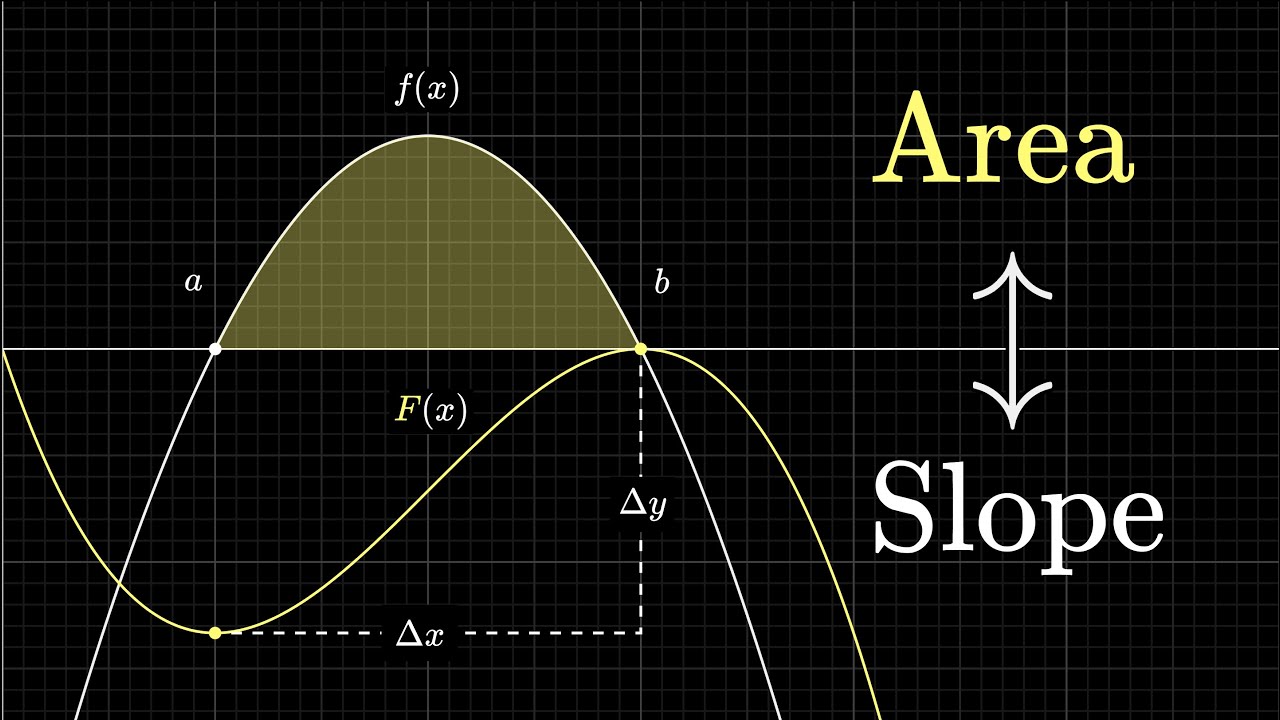
One view on why integrals and derivatives are inverses.
Help fund future projects: https://www.patreon.com/3blue1brown
An equally valuable form of support is to simply share some of the videos.
Special thanks to these supporters: http://3b1b.co/lessons/area-and-slope#thanks
Full series: http://3b1b.co/calculus
3blue1brown i...
astral ivy
mental solstice
honestly i prefer to think of it as the ideas we have before introducing measure...
Physical, intuitive ideas precede the abstract generalizations
That’s the most natural way to learn it, in my opinion
Because it includes the original motivation and context, which is very important
raven spire
Well it's the $\Delta y = \Delta x \theta$ argument tbh
astral ivy
What is that argument
mental solstice
Ignore the scratch, you want the graphs
 raven spire
where you use the limit definition of derivative of f(x) for the d(theta)
warm shaleBOT
Ansh
 brittle swan
mental solstice
Ignore the scratch, you want the graphs
brittle swan
mental solstice
Ignore the scratch, you want the graphs
i still don’t get it
raven spire
mental solstice
Ignore the scratch, you want the graphs
All I see r probability ;-;
mental solstice
ignore that scratch lol
raven spire
that's SCRATCH? >_<
i feel like the actual argument in concern is the scratch here xD
astral ivy
Makes sense
Hahaha this is possibly the most simple function you could start with
Ok but
brittle swan

if you add up
all the tangents between a and b
you get the average rate of change?
astral ivy
It almost seems coincidental that the area from 0 to 2 = 2c is the same as f(2)
I don’t think I’m thinking hard enough
brittle swan
brittle swan
you get the average rate of change?
this doesn’t make sense to me
at least intuitively
astral ivy
Not avg rate of change
mental solstice
astral ivy
It almost seems coincidental that the area from 0 to 2 = 2c is the same as f(2)
that's because it's not, it's strictly speaking f(2) - f(0)
astral ivy
You add up the slopes of the tangent lines, and you get the value of the function where you stopped
raven spire
btw am I right with my understanding?
We use the limit definition of derivative to define f' = theta as the slope of the secant from (a,f(a)) to (a+h,f(a+h)) and use the "for h small" to conclude ∆y = (∆x)( theta ) so we're ultimately left with int(f'(x)dx) = f(x) ?
mental solstice
mental solstice
that's because it's not, it's strictly speaking f(2) - f(0)
you need to account for the initial value f(0)
astral ivy
raven spire
btw am I right with my understanding?
>>> We use the limit definition of derivat...
What’s theta and delta tho
raven spire
there's no delta -_- delta(z) is the change in "z"
theta is well defined above ^ I suppose.. the angle between the +ve x-axis and the secant
astral ivy
Well like
The slope of the secant is delta y over delta x
So then delta y = that stuff
Oh that is what you’re saying
Lol
mental solstice
maybe someone can draw and illustrate with a piecewise linear function and its derivative
raven spire
Shuri ...
mental solstice
i'm out of paper space
raven spire
raven spire
btw am I right with my understanding?
>>> We use the limit definition of derivat...
Camilleone?
mental solstice
i use three colours to use the same paper three times, but i doubt it'll be clear in any sense of the word to anyone
mental solstice
raven spire
btw am I right with my understanding?
>>> We use the limit definition of derivat...
yeah, you can use this, it's effectively the same argument but imo viewed from a slightly different angle
it ends up the same anyhow
brittle swan
astral ivy
You add up the slopes of the tangent lines, and you get the value of the functio...
wdym
brittle swan
brittle swan
so after adding these all up, what should you get..?
raven spire
nothing >_< lmaooo, abs added something later
brittle swan
by ftc2, it should be f(b) - f(a), right..?
mental solstice
you're adding up the infinitesimal increments at each point, and you get f(b) - f(a), or the increase of f from a to b
brittle swan
brittle swan
the expression of adding these up is integral of f’(x) from a to b
brittle swan
mental solstice
you're adding up the _infinitesimal_ increments at each point, and you get f(b) ...
why
i don’t see how that’s intuitive
mental solstice
that's perfectly intuitive
brittle swan
not to me lol
astral ivy
Oops sorry yeah that was a bad explanation
mental solstice
(you can replace 0 and 1 with arbitrary values but not the point)
mental solstice
mental solstice
take a rectangle
do you agree that this rectangle, which is really a function y = c from 0 to 1, makes its antiderivative increase by c between 0 and 1?
astral ivy
brittle swan
makes sense but only after evaluation
Good way of putting it
mental solstice
and this is where acceleration and velocity makes it dead useful to understand intuitively, and we're back to physics intuition
astral ivy
Lol
mental solstice
you accelerate at rate c for all of one second, which means you end up with an increase of velocity by c at the end of that one second
but okay, since you hate physics
and sometimes after my physics class i can't blame you for it
the idea is that the antiderivative changes at a constant rate of c per unit over one unit, and so over that same one unit must increase by a value of c
brittle swan
mental solstice
the idea is that the antiderivative changes at a constant rate of c per unit ove...
wdym
mental solstice
the rate of change is c per unit
it literally means over one unit, the increment is c
this is by definition
 obtuse pebbleBOT
@brittle swan Has your question been resolved?
brittle swan
(i’ll come back later)
obtuse pebbleBOT
Channel closed
Closed by @brittle swan
Use .reopen if this was a mistake.
 Available help channel!
Send your question here to claim the channel.
Remember:
• Ask your math question in a clear, concise manner.
• Show your work, and if possible, explain where you are stuck.
• After 15 minutes, feel free to ping <@&286206848099549185>.
• Type the command .close to free the channel when you're done.
• Be polite and have a nice day!
Read #❓how-to-get-help for further information on how to ask a good question, and about conduct in the question channels.
 timid silo
how would i take the laplace G(s) of this thing?
 obtuse pebbleBOT
timid silo
how would i take the laplace G(s) of this thing?
raven spire
obtuse pebbleBOT
timid silo
how would i take the laplace G(s) of this thing?
raven spire
You mean, it's Laplace transform?
timid silo
yes
raven spire
Let $f(t) = t \sin(40t)$, then by IBP, you'll have \ $\mathcal{L}{g(t)} = \mathcal{L}{f"(t)} = s^2\mathcal{L}{f(t)} - sf(0) -f'(0)$
warm shaleBOT
Ansh
 timid silo
warm shale
**Ansh**
timid silo
warm shale
**Ansh**
Yes ^^
raven spire
You could also totally differentiate it twice, and then do the transform
timid silo
It would be a lot complicated tho
raven spire
Exactly
 alpine raven
raven spire
You could also totally differentiate it twice, and then do the transform
alpine raven
raven spire
You could also totally differentiate it twice, and then do the transform
pain
timid silo
Like you get g(t) as 40(sin(40t) - 40cos(40t))
And doing Laplace Transform of this is.... Just no
obtuse pebbleBOT
@timid silo Has your question been resolved?
raven spire
kek
obtuse pebbleBOT
Channel closed
Closed by @hallow dock
Use .reopen if this was a mistake.
Available help channel!
Send your question here to claim the channel.
Remember:
• Ask your math question in a clear, concise manner.
• Show your work, and if possible, explain where you are stuck.
• After 15 minutes, feel free to ping <@&286206848099549185>.
• Type the command .close to free the channel when you're done.
• Be polite and have a nice day!
Read #❓how-to-get-help for further information on how to ask a good question, and about conduct in the question channels.
 jade sail
Hello!
obtuse pebbleBOT
jade sail
Hello!
jade sail
Would anyone happen to have a clue if I did this question correctly?


I just don't know if for part b, I used the right n. Like if n should be 4 because I used the first four terms of the series
obtuse pebbleBOT
@jade sail Has your question been resolved?
 mental cloak
jade sail
mental cloak
jade sail
if this is your result for a it is not correct. you need to a partial fracture disassembly i guess.
obtuse pebbleBOT
@jade sail Has your question been resolved?
raven spire
jade sail
I've never heard of a partial fracture disassembly before
:p A partial fracture disassembly, although probably not even a proper English term, should be referring to disassembling of a bone that's partially been fractured( the crack hasn't reached across the width of the bone ), maybe for some medical purposes, like reassembling when misconfigured... or stuff
Anyways
For your question, if you're interested in R4, you should stick to the formula and plug n = 4, to both sides of the inequality
raven spire
So your inequality would look like $|R_4| < \qty|\frac{(-1)^{5+1}}{4(5)^2 -3}|$
warm shaleBOT
Ansh
 jade sail
I’m not sure if it’s n=4 or 5 that I should use
Oh
I did the RHS wrong
Thank you, that was very helpful
Though what do you think of part a?
Sparky said it was incorrect earlier
I thought it was okay
Don’t you just find each of the four terms individually then add them up?
raven spire
jade sail
Don’t you just find each of the four terms individually then add them up?
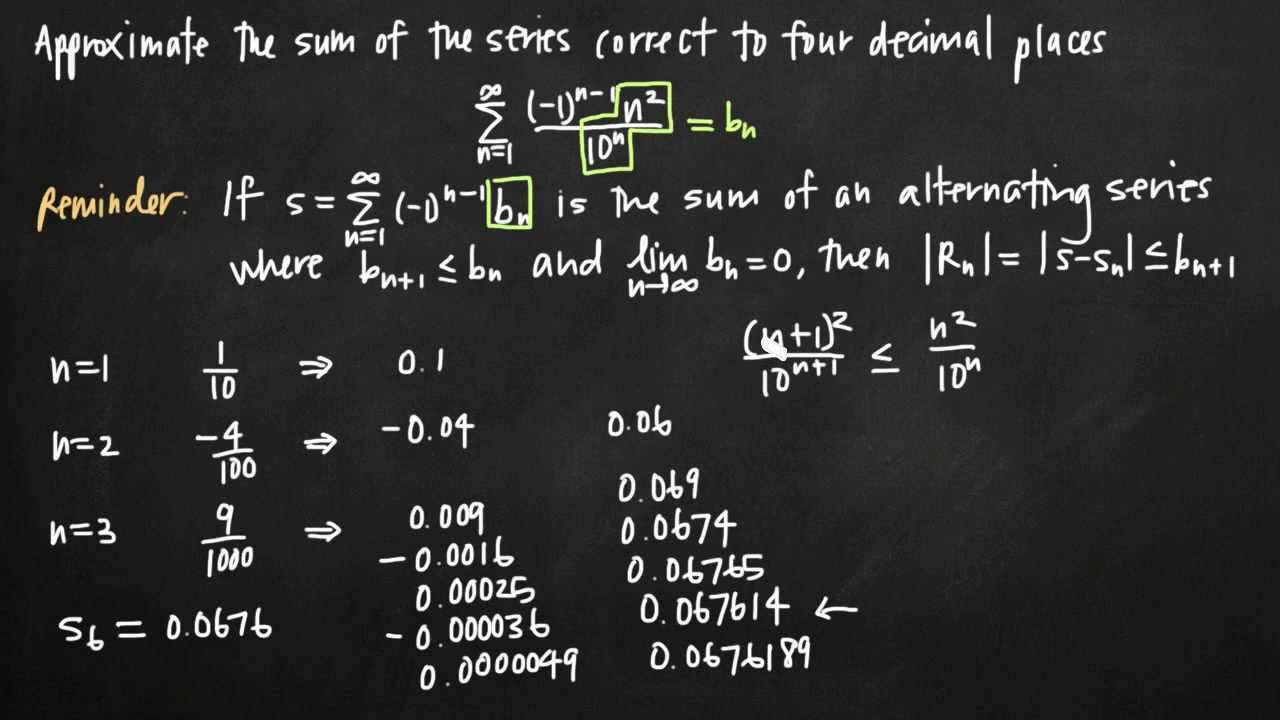
► My Sequences & Series course: https://www.kristakingmath.com/sequences-and-series-course
Learn how to use the alternating series estimation theorem to estimate the sum of a series and find the remainder term, which is the difference between the estimation and the exact sum of the series.
● ● ● GET EXTRA HELP ● ● ●
If you could use some extr...
 watch once and you'll know
raven spire
mmm
jade sail
Wow that really opened my eyes
I wish that was stated clearer in my lecture notes
I'm going to see if it said it any where
This is the closest I could get
 raven spire

raven spire
jade sail
I can see that the method I was doing was wrong
She also just added them, up to 6 terms, no?
Like .1 - .04 + .009 - .0016 + .00025 - .000036 is what she did in the video
there's nothing wrong with your first part.. and logically, since the sum is convergent, and as n increases, each successive S_n value should be converging to the limiting value, S_4 is indeed what you want tbh
brittle swan
(ansh, could you verify my statement in math discussion after helping janet?)
jade sail
Okay so what I did was okay?
Except hers was more accurate?
The question just was the first four terms
wants*
raven spire
jade sail
Except hers was more accurate?
no yeah, what she did was actually just to explain how the thing works... that's why she took n = 6 to explain
jade sail
Okay so should I leave my working out like that?
raven spire
Your solution was perfectly fine. except you need to go: |R4| < a_5
jade sail
So part a is correct and part b, I'll use what you did
raven spire
Yeah
 obtuse pebbleBOT
Channel closed
Closed by @jade sail
Use .reopen if this was a mistake.
obtuse pebbleBOT
Available help channel!
Send your question here to claim the channel.
Remember:
• Ask your math question in a clear, concise manner.
• Show your work, and if possible, explain where you are stuck.
• After 15 minutes, feel free to ping <@&286206848099549185>.
• Type the command .close to free the channel when you're done.
• Be polite and have a nice day!
Read #❓how-to-get-help for further information on how to ask a good question, and about conduct in the question channels.
 arctic tusk
i completely guessed, but how would i solve a problem like this
 arctic tusk
well, you're missing the fact that it's some solution to a differential equation such that the graph is the second derivative
 spiral maple
arctic tusk
well, you're missing the fact that it's some solution to a differential equation...
spiral maple
arctic tusk
well, you're missing the fact that it's some solution to a differential equation...
no, it's the graph of the soln
 balmy mortar
that doesnt stop what i said being true
y(-1)= -2
and then you check the slopes for y'
arctic tusk
i still don't entirely understand what the question's frame is
like okay i have some second order ODE
spiral maple
You have a DE and the graph is a sketch of a soltion
arctic tusk
i have to match the solution curve to the ICs
spiral maple
yes
arctic tusk
am i overcomplicating it
spiral maple
Yes
As was pointed out, you just look and see what values the graph takes
as well as the slope at the indicated points
arctic tusk
oh.... and i missed the fact that i could select multiple answers
first thought was that, but i saw there were two answers, then proceeded to overcomplicate it
but thank you that's.... elementary level....
.close
obtuse pebbleBOT
Channel closed
Closed by @arctic tusk
Use .reopen if this was a mistake.
Available help channel!
Send your question here to claim the channel.
Remember:
• Ask your math question in a clear, concise manner.
• Show your work, and if possible, explain where you are stuck.
• After 15 minutes, feel free to ping <@&286206848099549185>.
• Type the command .close to free the channel when you're done.
• Be polite and have a nice day!
Read #❓how-to-get-help for further information on how to ask a good question, and about conduct in the question channels.
 grave oyster
hey
obtuse pebbleBOT
grave oyster
hey
grave oyster
can somebody help me write a program that calculates f999(5) with f(x)=x+1/x
f999(5)=fofo..............of(5) 999 times
 cedar lichen
What coding language?
grave oyster
python
cedar lichen
I have a habit of making inefficient programs, but I would do this by defining a variable, say, x to represent our input (starting with 5), then loop 999 times to insert x into the equation, then redefine x to be our output
grave oyster
okayy would it be a bit hard to write it down ?
i got the idea but idk how to start
cedar lichen
I don't think so. It shouldn't take too many lines with how I'm imagining it
grave oyster
can you do it ?
cedar lichen
I don't think this sub looks fondly on just giving answers, but then again, this is a coding problem, not math
grave oyster
it is maths
i worked on a problem
so i have to calculate this thing
i'm not familiar with codes that much

here it is
cedar lichen
Well, here's what I would do. I hope it works and I'm not being stupid.
x = 5
for i in range(999):
y = x + (1/x)
x = y
print(x)
grave oyster
tyy so much it worked

but i have to solve it without calculator
i have to show f999(5)>45 if f(x)=x+1/x
heyy?
cedar lichen
I dunno how to do it without a calculator, sorry
grave oyster
okayy thank you so much
obtuse pebbleBOT
@grave oyster Has your question been resolved?
obtuse pebbleBOT
Channel closed
Closed due to timeout
Use .reopen if this was a mistake.
obtuse pebbleBOT
Available help channel!
Send your question here to claim the channel.
Remember:
• Ask your math question in a clear, concise manner.
• Show your work, and if possible, explain where you are stuck.
• After 15 minutes, feel free to ping <@&286206848099549185>.
• Type the command .close to free the channel when you're done.
• Be polite and have a nice day!
Read #❓how-to-get-help for further information on how to ask a good question, and about conduct in the question channels.
 blazing meteor
I need help with trigonometry.
obtuse pebbleBOT
blazing meteor
I need help with trigonometry.
blazing meteor
The height in meters of a water wheel's paddle is below the water as a function of time:
h(t) = -4sin(pi/4(t-1)) + 25
When is the paddle below the water in the first 24 seconds
I believe below the water means under y=0
I have attempted it
 inland matrix
$h(t)=-4sin(\frac{\pi}{4(t-1)})+25$
blazing meteor
-4 sin (pi/4(t-1))=-2.5

pi/4(t-1) = sin^-1(2.5/4)

t=1.859
allarkvarkk
 blazing meteor
$h(t) = -4sin(\frac{\pi}{4})(t-1)+2.5$
warm shaleBOT
Looking123
 blazing meteor
I got 1.859 that is correct
inland matrix
thats not the same thing u wrote
blazing meteor
idk, this is how the textbook question looks like
yes
It enters the water at 1.859 seconds, I know
When does it leave the water?
The answers say 6 - 1.859 = 4.141
So it is in the water from 1.859 to 4.141 seconds
 pallid sun
What's the question?
blazing meteor
I have no idea where they got the 6 tho
blazing meteor
blazing meteor
The answers say 6 - 1.859 = 4.141
here
does it have something to do with the period?
inland matrix
blazing meteor
The height in meters of a water wheel's paddle is below the water as a function ...
this is the question but the equation is wrong
blazing meteor
blazing meteor
The height in meters of a water wheel's paddle is below the water as a function ...
I think I wrote the equation wrong there, the real equation looks like this
$h(t) = -4sin((\frac{\pi}{4})(t-1))+2.5$
warm shaleBOT
Looking123
 blazing meteor
b = pi/4
pallid sun
Okay, let me try
inland matrix
wait the (t-1) is in the sin??
blazing meteor
😅 yeah sorry, i don't use latex much
inland matrix
can u send a picture of the equation
pallid sun
^
blazing meteor
warm shale
**Looking123**
this is how it looks 1:1
inland matrix
ok
raven spire
$h(t) = -4\sin \qty(\frac{\pi}{4}(t-1)) + 25$?
warm shaleBOT
Ansh
 pallid sun
What did you get when you set it = 0?
raven spire
or \
$h(t) = -4\sin \qty(\frac{\pi}{4(t-1)}) + 25$?
warm shaleBOT
Ansh
 raven spire
which one
blazing meteor
warm shale
**Ansh**
this one
raven spire
$h(t) = -4\sin \qty(\frac{\pi}{4}(t-1)) + 25$?
warm shaleBOT
Ansh
 blazing meteor
pallid sun
What did you get when you set it = 0?
blazing meteor
pallid sun
What did you get when you set it = 0?
1.859
raven spire
Okay, this is the height of the water wheel whatever above the water surface as a function of time "t"
blazing meteor
below the water surface
it is below from 1.86 to 4.14,
I know how to get 1.85, I do not know how to get 4.14
raven spire
 blazing meteor
raven spire
blazing meteor
raven spire
ohh that is cause I'm blind.....lol
raven spire
Now, your question says.. that at a certain point of time, in the first 24 seconds( since t = 0 ), say at time t = k seconds, your h(k) = 0
blazing meteor
here I'll post an image, of what I don't understand]
raven spire
SO basically, you solve for h(k) = 0
blazing meteor
 raven spire
Yeah I thought so
blazing meteor
How do I algebraically find the circled
raven spire
there's many more out there lol
So, $h(t) = -4\sin \qty(\frac{\pi}{4}(t-1)) + 2.5$
but this just pure blasphemy smh
warm shaleBOT
ItzKar4n
 raven spire
okay wait 🤦♂️
blazing meteor
it is 2.5

 blazing meteor
yes
raven spire
$4\sin \qty(\frac{\pi}{4}(k-1)) = 2.5$
warm shaleBOT
Ansh
 raven spire
$\implies \sin \qty(\frac{\pi}{4}(k-1)) = \frac{2.5}{4}$
warm shaleBOT
Ansh
 warm shaleBOT
Ansh
 raven spire
then, $\frac{\pi}{4}(k-1) \in \qty[-\frac{-\pi}{4}, \frac{23\pi}{4}]$
warm shaleBOT
Ansh
 raven spire
@blazing meteor Any doubts so far?
blazing meteor
Nope, I'm following
raven spire
Perfect
Note
we had the equation:
$\implies \sin \qty(\frac{\pi}{4}(k-1)) = \frac{2.5}{4}$
warm shaleBOT
Ansh
 raven spire
which is basically $\sin \theta = \frac{2.5}{4}$ where $\theta \in \qty[-\frac{-\pi}{4}, \frac{23\pi}{4}]$
warm shaleBOT
Ansh
 raven spire
Notice, sine actually has a period of 2pi, so any solution you get for arcsin of something, is only a solution you got in the principal range of arcsin which is [ -pi/2 , pi/2 ]
But here, you're interested in all solutions of theta for which this equation holds true, and not only those particular theta values between [-pi/2, pi/2]
So, for starters
You have: $\sin \theta = \frac{2.5}{4}$
warm shaleBOT
Ansh
 raven spire
First, consider a $\theta \in [-\frac{\pi}{2}, \frac{\pi}{2}]$ which is a solution of the given equation
warm shaleBOT
Ansh
 raven spire
if theta lies in that interval, then you're safe to write down the next step: $\theta = \sin^{-1} \qty(\frac{2.5}{4})$
find this theta
warm shaleBOT
Ansh
 raven spire
,w arcsin(2.5/4)
warm shaleBOT


 Requested by Ansh#3502
raven spire
Requested by Ansh#3502
raven spire
You have this
So, now you have a solution $\theta \in \qty[-\frac{\pi}{2}, \frac{\pi}{2}]$ to the above equation
warm shaleBOT
Ansh
 raven spire
But who said this is the only solution to your original equation?
blazing meteor
I don't think 0.675132 is a solution
raven spire
uh,
we are not finding "t" here
we're just finding a solution to arcsin theta = 2.5/4
Yes you're misinterpreting lol
Our "theta" is the term: $\qty(\frac{\pi}{4}(k-1))$
blazing meteor
ohh ok, lol. So do I need to add the period to 0.67
warm shaleBOT
Ansh
 raven spire
blazing meteor
ohh ok, lol. So do I need to add the period to 0.67
raven spire
blazing meteor
ohh ok, lol. So do I need to add the period to 0.67
Not only the period tbh
Instead
you notice that, for any equation $\sin x = c$
warm shaleBOT
Ansh
 raven spire
$\sin (\pi - x) = c$ also holds
warm shaleBOT
Ansh
 raven spire
because $\sin (\pi - x) = \sin x = c$
warm shaleBOT
Ansh
 blazing meteor
yeah, I think
raven spire
yeah so
the fault in your solution was
you didn't account for these solutions of theta
$\sin \theta = \frac{2.5}{4}$ where $\theta \in \qty[-\frac{-\pi}{4}, \frac{23\pi}{4}]$
warm shaleBOT
Ansh
 blazing meteor
So using theta how would I get the solution now?
raven spire
For $\theta \in \qty[-\frac{\pi}{2}, \frac{\pi}{2}], \theta = 0.675$
warm shaleBOT
Ansh
 raven spire
And for other intervals similarly, you use: $\theta, \pi - \theta, 2\pi + \theta, 3\pi - \theta, \dots$ until you reach the end of your interval of $\theta$ defined in the equation
warm shaleBOT
Ansh
 raven spire
Now, you set aside these values and assume these solutions are just $\theta$
warm shaleBOT
Ansh
 raven spire
Now, you can go ahead and solve for "t" in terms of this \theta
$\theta = \qty(\frac{\pi}{4}(k-1))$
warm shaleBOT
Ansh
 raven spire
$\implies k = 1+ \frac{4\theta}{\pi}$
warm shaleBOT
Ansh
 raven spire
All that's left now really, is to plug in your respective values of theta
For example, for theta = 0.675 from earlier, k = 1 + 4(0.675)/pi
,calc 1 + 4*0.675/pi
warm shaleBOT
Result:
1.8594366926962
which is what you got for your first value of t
similarly, use pi - theta
,calc 1 + 4*(pi - 0.675)/pi
warm shaleBOT
Result:
4.1405633073038
Result:
9.8594366926962
ohhh I see, thank you very much.
blazing meteor
Yeah, trigonometry is very confusing at times for me
raven spire
Go over everything we did once again if you must, and lmk if there's any doubts
blazing meteor
Ok, thanks again for the help
raven spire
^^"
blazing meteor
,calc 1 + 4*(4pi + 0.675)/pi
blazing meteor
raven spire
^^"
So to get the intervals I would start with
- theta
- pi -theta
- 2pi + theta
- 3pi - theta
Is this pattern the same for all sin
raven spire
"to get the intervals"?
blazing meteor
yes
warm shaleBOT
Ansh
 raven spire
Do you mean, to get the *solutions?
blazing meteor
warm shale
**Ansh**
yeah like from this
warm shaleBOT
Result:
17.859436692696
,calc 1 + 4*(5pi - 0.675)/pi
warm shaleBOT
Result:
20.140563307304
.close
obtuse pebbleBOT
Channel closed
Closed by @blazing meteor
Use .reopen if this was a mistake.
Available help channel!
Send your question here to claim the channel.
Remember:
• Ask your math question in a clear, concise manner.
• Show your work, and if possible, explain where you are stuck.
• After 15 minutes, feel free to ping <@&286206848099549185>.
• Type the command .close to free the channel when you're done.
• Be polite and have a nice day!
Read #❓how-to-get-help for further information on how to ask a good question, and about conduct in the question channels.
timid silo
hey guys, so theres 1062 students in a school? how many are there per grade? theres 265 but realistically how would u try to find it? its a problem that my friend has
obtuse pebbleBOT
timid silo
hey guys, so theres 1062 students in a school? how many are there per grade? the...
 pallid raft
I don't understand the question
timid silo
so i need to know how many students are her at my school per grade for student council and theres a 1062 students and in order to find how many students are per grade, i divided it by 4. it got 265. and basically thats not as accurate. is there any way to get the answer more accurate?
 hazy marlin
timid silo
so i need to know how many students are her at my school per grade for student c...
hazy marlin
timid silo
so i need to know how many students are her at my school per grade for student c...
what is per grade.. ?
how many grades are there ?
timid silo
4 grades
pallid raft
Without more data, no
hazy marlin
1062/4 would give you an equal dsitribution of students per grade
but you're not specifying what exactly it is you want to count
timid silo
i want to count how many students are at my school per grade
not with equal distribution
hazy marlin
then the only way of doing that is by manually counting them
timid silo
oh ok, makes sense
hazy marlin
is this an exercise?
timid silo
no it a real life scenario sadly, im apart of student council and needed a little help
hazy marlin
oh...
then.. the only way of knowing how much of something there is in real life is by.. measuring it..
timid silo
like wdym? like just count every class ?
timid silo
yea exactly but realisitically, the school would probably not allow that
anyways, i dont wanna keep u here so, feel free to close this um questin thing
!close
hazy marlin
.close
obtuse pebbleBOT
Channel closed
Closed by @empty steeple
Use .reopen if this was a mistake.
obtuse pebbleBOT
Available help channel!
Send your question here to claim the channel.
Remember:
• Ask your math question in a clear, concise manner.
• Show your work, and if possible, explain where you are stuck.
• After 15 minutes, feel free to ping <@&286206848099549185>.
• Type the command .close to free the channel when you're done.
• Be polite and have a nice day!
Read #❓how-to-get-help for further information on how to ask a good question, and about conduct in the question channels.
timid silo
cool so im doing practice for math analysis and have this problem
 timid silo
my question is this
would i be correct in saying tge above is equal to what I've written here

like is there a minus im missing in front of 1/x^2
bc im supposed to test if a, b exist such that the above function is class c1
however I've not encountered absolute values in these problems before
 tardy epoch
Can you translate the question
timid silo
determine a, b such that the function (pictured above) is of the class c1
the one in the photo, to be clear
tardy epoch
There is no missing minus sign. What you've circled is equivalent to the image
You should get two equations for your two unknowns a and b
timid silo
ah, right. because if i solved this right then the function isn't of the class c1, but the prof said these tasks are usually "rigged" such that they should be
c1
and we just have to find the proper a and b

ne postoje means "don't exist"
basically im getting f(-2)=f(2)=1/4
but that doesn't agree with the last assessment because
so this is why i didnt go to a high school that focused on math 🤔
oh im a university 1st year
physics to be clear
ur amwrican right?
nope im croatian
ah ok
life in the balkans is pretty fun i tink
i know my region is being widely memed about right now. i enjoy it
yh
either way, it doesn't fit because (-2*2)/16=-1/4
tardy epoch
Oh so if you show that for the a and b values determined from the continuity requirements prove that the derivatives are discontinuous at those points then you're done?
timid silo
which is obviously not equal to 1/4
timid silo
tardy epoch
Oh so if you show that for the a and b values determined from the continuity req...
1st check is continuity, second is derivability, third is if they are c1

in the 3rd step i differentiate/derive (whatever is the proper English word) immediately. hope that's nit confusing
 civic zealot
Uh, in your left and right limit at -2, you said 1/4 = 4a => a = -1/16
timid silo
yh i fixed that later srry
basically i forgot - 2^3 is - 8 and not 8
but yes a is - 1/16
civic zealot
Ah, i see the correction
tardy epoch
,w plot -1/16 * x^2 +1/2 for -2.5<x<2.5
warm shaleBOT

 Requested by riemann#2529
timid silo
Requested by riemann#2529
timid silo
hmmm so what does this tell me
civic zealot
Wait, is the goal to show continuity or to show differentiable?
timid silo
goal is to find a, b such that the function is c1
or rather to check if such a, b exist
however prof said that they should exist
we just gotta find them
then again if i remember correctly absolute functions are non-differentiable so. I have no idea if that plays anything into this
civic zealot
absolute value functions aren't differentiable at 0, this function avoids that point.
tardy epoch
The domain is absolutely value. Your functions are quadratic and 1/quadratic
civic zealot
oh yeah, that too
timid silo
so should a,b exist for this problem? im finding it hard to see if I missed anything
tardy epoch
I think you've proven that it's not C1
obtuse pebbleBOT
@timid silo Has your question been resolved?
obtuse pebbleBOT
Channel closed
Closed due to timeout
Use .reopen if this was a mistake.
Available help channel!
Send your question here to claim the channel.
Remember:
• Ask your math question in a clear, concise manner.
• Show your work, and if possible, explain where you are stuck.
• After 15 minutes, feel free to ping <@&286206848099549185>.
• Type the command .close to free the channel when you're done.
• Be polite and have a nice day!
Read #❓how-to-get-help for further information on how to ask a good question, and about conduct in the question channels.
 vocal tree

 obtuse pebbleBOT
vocal tree
obtuse pebbleBOT
vocal tree
 true rain
Which line exactly
vocal tree
 true rain
That’s just an identity
Foil
Oh like where?
Look at the visual of the square in the first page
Length is a+b
 burnt jungle
true rain
Look at the visual of the square in the first page
burnt jungle
true rain
Look at the visual of the square in the first page
i dont understand his question?
obtuse pebbleBOT
@vocal tree Has your question been resolved?
obtuse pebbleBOT
Channel closed
Closed due to timeout
Use .reopen if this was a mistake.
Available help channel!
Send your question here to claim the channel.
Remember:
• Ask your math question in a clear, concise manner.
• Show your work, and if possible, explain where you are stuck.
• After 15 minutes, feel free to ping <@&286206848099549185>.
• Type the command .close to free the channel when you're done.
• Be polite and have a nice day!
Read #❓how-to-get-help for further information on how to ask a good question, and about conduct in the question channels.
 wicked plank
Is anyone able to rephrase this question?
 obtuse pebbleBOT
wicked plank
Is anyone able to rephrase this question?
wicked plank
obtuse pebbleBOT
wicked plank
Is anyone able to rephrase this question?
wicked plank
I guess I don't get it?
obtuse pebbleBOT
@wicked plank Has your question been resolved?
wicked plank
I ended up just sorting the prices low-high, then using =AVERAGE to get the above answer, but was obviously wrong. So I'd imagine the question was just worded horribly?
obtuse pebbleBOT
@wicked plank Has your question been resolved?
obtuse pebbleBOT
Channel closed
Closed due to timeout
Use .reopen if this was a mistake.
Available help channel!
Send your question here to claim the channel.
Remember:
• Ask your math question in a clear, concise manner.
• Show your work, and if possible, explain where you are stuck.
• After 15 minutes, feel free to ping <@&286206848099549185>.
• Type the command .close to free the channel when you're done.
• Be polite and have a nice day!
Read #❓how-to-get-help for further information on how to ask a good question, and about conduct in the question channels.
 glossy ridge
I understand why 6(7^k) is divisible by 6, but i dont understand why 3(4^k) is divisible by 6. could someone please clarify?
 obtuse pebbleBOT
glossy ridge
I understand why 6(7^k) is divisible by 6, but i dont understand why 3(4^k) is d...
tardy epoch
obtuse pebbleBOT
glossy ridge
I understand why 6(7^k) is divisible by 6, but i dont understand why 3(4^k) is d...
tardy epoch
4 = 2^2 and k should be >0
obtuse pebbleBOT
@glossy ridge Has your question been resolved?
obtuse pebbleBOT
Channel closed
Closed due to timeout
Use .reopen if this was a mistake.
Available help channel!
Send your question here to claim the channel.
Remember:
• Ask your math question in a clear, concise manner.
• Show your work, and if possible, explain where you are stuck.
• After 15 minutes, feel free to ping <@&286206848099549185>.
• Type the command .close to free the channel when you're done.
• Be polite and have a nice day!
Read #❓how-to-get-help for further information on how to ask a good question, and about conduct in the question channels.
 hot zealot
Can someone help me understand open sets? If I have a set A in R^3 where for every element x of A has a surrounding "area" of other elements within a certain distance of x, does this mean there are no limits to the domain of A?
obtuse pebbleBOT
hot zealot
Can someone help me understand open sets? If I have a set A in R^3 where for eve...
hot zealot
(ignoring complex numbers etc.)
please ping me if you respond, I need to get ready for bed
balmy mortar
A very handwavy description
is just like you have a closed set
and subtract the borders
$${(x, y) : x^2+y^2 \leq 1}$$
warm shaleBOT
Shuri2060
 balmy mortar
This is closed in R^2
everything within radius 1 inclusive of the origin
$${(x, y) : x^2+y^2 < 1}$$
warm shaleBOT
Shuri2060
 hot zealot
sorry, the script of my math lecture was confusing
balmy mortar
open sets in R aren't JUST open intervals
hot zealot
in 2 dimensions it would be any shape excluding the borders right?
balmy mortar
as a very vague description, yes.
You realise the entire set is open
(0, infinity) is also open
hot zealot
sure
balmy mortar
The idea of boundaries is v. useful
Is this metric or topological spaces you're doing?
metric i assume
balmy mortar
Well all metric spaces are topological spaces
hot zealot
ah I see
so if I have a way to define distance (continuously)
it's metric
but if I just have some criterion to say whether or not something is close
balmy mortar
What is the subject you are studying?
hot zealot
Analysis 1
balmy mortar
🤔
balmy mortar
hmmm ok ok
then 'open' is quite important
but not the focus
'does not include boundaries = open'
Is good enough
hot zealot
yeah, I understood that it's just the difference between including an infinitesimal border area vs a explicitly defined boundary
still feel very out of my depth though ^^
thanks for the help :)
!close
.close
obtuse pebbleBOT
Channel closed
Closed by @hot zealot
Use .reopen if this was a mistake.
Available help channel!
Send your question here to claim the channel.
Remember:
• Ask your math question in a clear, concise manner.
• Show your work, and if possible, explain where you are stuck.
• After 15 minutes, feel free to ping <@&286206848099549185>.
• Type the command .close to free the channel when you're done.
• Be polite and have a nice day!
Read #❓how-to-get-help for further information on how to ask a good question, and about conduct in the question channels.
timid silo
Is there any resources for geometry?
obtuse pebbleBOT
timid silo
Is there any resources for geometry?
@timid silo Has your question been resolved?
timid silo
<@&286206848099549185>
tardy epoch
timid silo
Is there any resources for geometry?
Can you be more specific
timid silo
Like videos to watch, or papers, am starting geometry this year, want a head start
 zenith dove
here is an entire playlist: https://www.youtube.com/watch?v=il0EJrY64qE&list=PL26812DF9846578C3&index=2
Before learning any new concept (mathematical or otherwise), it's important we learn and use a common language and label concepts consistently.
Watch the next lesson: https://www.khanacademy.org/math/geometry/intro_euclid/v/lines-line-segments-and-rays?utm_source=YT&utm_medium=Desc&utm_campaign=Geometry
Missed the previous lesson?
https://www...
timid silo
zenith dove
here is an entire playlist: https://www.youtube.com/watch?v=il0EJrY64qE&list=PL2...
Thankyou
obtuse pebbleBOT
@timid silo Has your question been resolved?
Channel closed
Closed by @coral smelt
Use .reopen if this was a mistake.
Available help channel!
Send your question here to claim the channel.
Remember:
• Ask your math question in a clear, concise manner.
• Show your work, and if possible, explain where you are stuck.
• After 15 minutes, feel free to ping <@&286206848099549185>.
• Type the command .close to free the channel when you're done.
• Be polite and have a nice day!
Read #❓how-to-get-help for further information on how to ask a good question, and about conduct in the question channels.
 vagrant obsidian
Name : Brayden C
Grade Level : 9th Grade , Highschool Freshmen
Topic : Geometry , Similar Figures / Direct Scale
Timezone : EST , New York City
Website : Deltamath
*** Question : Quadrilateral GHIJ is dilated by a scale factor of 2 to form quadrilateral G'H'TJ. What is the measure of side GH?***
——————
*** Extra Info ***
Gender & Pronouns: Male / He , Him , His
Did you try & What did you try?
*** I tried Finding the scale factor of it & also tried looking at the examples but they didn’t seem to help at all and I’ve gotten the question wrong several times before asking for help . ***
What do you need help with?
*** I need help with finding the measure of IJ / With solving the equation ***
————————————
IMAGE DOWN BELOW 👇🏼
obtuse pebbleBOT
vagrant obsidian
Name : Brayden C
Grade Level : 9th Grade , Highschool Freshmen
Topic : Geometr...
 vagrant obsidian
Name : Brayden C
Grade Level : 9th Grade , Highschool Freshmen
Topic : Geometr...
vagrant obsidian
vagrant obsidian
Name : Brayden C
Grade Level : 9th Grade , Highschool Freshmen
Topic : Geometr...
The Information You Need !
PING 🚨
Hey! Good Morning , Afternoon or night I’m having problems with my homework / assignment can you help me ? Thanks !
<@&286206848099549185>
 short spruce
like i told you last time not only do we not need all your information, it is not a smart idea to publish your information to a discord server with 17,000+ people
also, 15 minutes before a helper ping
short spruce
i'm just someone on this server, but i remember you doing this last time i saw you ask a question
vagrant obsidian
Cool
I just write this much cause I don’t need to type all the rest of the information after
short spruce
what answer did you get for side GH that was incorrect
vagrant obsidian
I got the last question wrong and if you get a question wrong it gives you a new question
So I didn’t get GH wrong yet
short spruce
what would your steps be in getting the side length here
vagrant obsidian
Multiply?
short spruce
what would you be multiplying
short spruce
you don't know what GH is
short spruce
G'H' but yes
vagrant obsidian
How do I solve that
I’ve been looking at the example but it doesn’t state how to solve it
short spruce
use knowns to solve for unknowns
 obtuse pebbleBOT
@vagrant obsidian Has your question been resolved?
obtuse pebbleBOT
@vagrant obsidian Has your question been resolved?
obtuse pebbleBOT
@vagrant obsidian Has your question been resolved?
obtuse pebbleBOT
Channel closed
Closed due to timeout
Use .reopen if this was a mistake.
obtuse pebbleBOT
Available help channel!
Send your question here to claim the channel.
Remember:
• Ask your math question in a clear, concise manner.
• Show your work, and if possible, explain where you are stuck.
• After 15 minutes, feel free to ping <@&286206848099549185>.
• Type the command .close to free the channel when you're done.
• Be polite and have a nice day!
Read #❓how-to-get-help for further information on how to ask a good question, and about conduct in the question channels.
 frozen cave
need help
 frozen cave
<@&286206848099549185>
obtuse pebbleBOT
Channel closed
Closed by @frozen cave
Use .reopen if this was a mistake.
obtuse pebbleBOT
Available help channel!
Send your question here to claim the channel.
Remember:
• Ask your math question in a clear, concise manner.
• Show your work, and if possible, explain where you are stuck.
• After 15 minutes, feel free to ping <@&286206848099549185>.
• Type the command .close to free the channel when you're done.
• Be polite and have a nice day!
Read #❓how-to-get-help for further information on how to ask a good question, and about conduct in the question channels.
 sour fox
 obtuse pebbleBOT
@sour fox Has your question been resolved?
Channel closed
Closed by @sour fox
Use .reopen if this was a mistake.
Available help channel!
Send your question here to claim the channel.
Remember:
• Ask your math question in a clear, concise manner.
• Show your work, and if possible, explain where you are stuck.
• After 15 minutes, feel free to ping <@&286206848099549185>.
• Type the command .close to free the channel when you're done.
• Be polite and have a nice day!
Read #❓how-to-get-help for further information on how to ask a good question, and about conduct in the question channels.
timid silo
This is a huge one but im just trying to assure myself i got the right answers
 obtuse pebbleBOT
timid silo
This is a huge one but im just trying to assure myself i got the right answers
timid silo
obtuse pebbleBOT
timid silo
This is a huge one but im just trying to assure myself i got the right answers
timid silo
For a) i got pi/6 - arctg (sqrt12)/2
For c) i got -1/2
For d i got 0
For e) i got 1/4
For f) i got 3/2
For h) i got +- 1/7
Am i off or correct?
Lim stands for limit
Arc tg = arc tangent, arc sin = arc sinus etc
raven spire
timid silo
Am i off or correct?
check with calculator no? You'd trust them more than you'd us
timid silo
i am on a phone right now it'd take a while
raven spire
,w limit arccos x - 2arcsin x + arctan 2x as x tends to -√3/2

 raven spire
7π/6 for "a"
timid silo
There s no arctg for sqrt3/2
So i left it like that
I mean there is
I just simplified
Arctg 2* sqrt(3)/2
= arctg 2sqrt(3)/2 = - arctg sqrt12/2
And ofc with a -
obtuse pebbleBOT
@timid silo Has your question been resolved?
obtuse pebbleBOT
Channel closed
Closed due to timeout
Use .reopen if this was a mistake.
Available help channel!
Send your question here to claim the channel.
Remember:
• Ask your math question in a clear, concise manner.
• Show your work, and if possible, explain where you are stuck.
• After 15 minutes, feel free to ping <@&286206848099549185>.
• Type the command .close to free the channel when you're done.
• Be polite and have a nice day!
Read #❓how-to-get-help for further information on how to ask a good question, and about conduct in the question channels.
 hardy blade

 obtuse pebbleBOT
hardy blade
brittle swan
obtuse pebbleBOT
hardy blade
brittle swan
if this had less pixels it would be radio
obtuse pebbleBOT
@hardy blade Has your question been resolved?
obtuse pebbleBOT
Channel closed
Closed due to timeout
Use .reopen if this was a mistake.
Available help channel!
Send your question here to claim the channel.
Remember:
• Ask your math question in a clear, concise manner.
• Show your work, and if possible, explain where you are stuck.
• After 15 minutes, feel free to ping <@&286206848099549185>.
• Type the command .close to free the channel when you're done.
• Be polite and have a nice day!
Read #❓how-to-get-help for further information on how to ask a good question, and about conduct in the question channels.
 tawdry vortex
i need help
 obtuse pebbleBOT
tawdry vortex
i need help
obtuse pebbleBOT
tawdry vortex
i need help
 sage geode
Which part?
tawdry vortex
a
sage geode
If you apply Pythagoras' theorem here, would you be able to get an expression of d^2 in terms of w?
tawdry vortex
so far i have $w= \sqrt{48^{2} - d^{2}}$
warm shaleBOT
breadiculous
 sage geode
Well they're asking you to show that s = kw(2304 - w^2)
tawdry vortex
$s= kw \sqrt{2304 - w^{2}}^{2}$
warm shaleBOT
breadiculous
 tawdry vortex
the the root cancels out
i got it
what about part b
do i differentiate that function?
but how would i if there are 3 variables
 royal basin
no, there is only one variable
w
k is a constant and s is the name of your function
tawdry vortex
can i use chain rule in this situation or product rule
i got dS/dW = w + 2304
but when i equal it to zero, i get a negative
w = - 2304
@royal basin
@sage geode
tawdry vortex
i used product rule
royal basin
show your work
royal basin
SHOW your work
or say explicitly "i found a mistake, let me redo it and give you my new answer"
 tawdry vortex
ye ik
sage geode
And derivative of kw isn't 1
sage geode
Yes that's why derivative of kw is k
tawdry vortex
oh it is cause they are mulitplying
let me find the actual derivative now

Now what
Idk what to do next
royal basin
why did kw become w
also is there a mysterious force stopping you from expanding w(2304-w^2) into 2304w - w^3
to make your own life simpler
tawdry vortex
?
tawdry vortex
sage geode
Yes that's why derivative of kw is k
^
sage geode
Btw you forgot about the minus sign again, in front of 2w
Idk they want to do this the product rule way
tawdry vortex
if u use the chain rule u get $\frac{dS}{dw} = -2kw^{2}$
warm shaleBOT
breadiculous
 tawdry vortex
@royal basin @sage geode im still confused
royal basin
tawdry vortex
?
you seemed reluctant to make your own life easier by expanding w(2304 - w^2) into 2304w - w^3
and i am trying to figure out why that is
tawdry vortex
but kw becomes k when derive
sage geode
She's asking you why you chose to do product rule instead of expanding brackets and just doing power rule alone
sage geode
I genuinely do not understand what's confusing you
 sage geode
Yeah you could do it that way
royal basin
yes sure


 ruby finch
tawdry vortex
ruby finch
tawdry vortex
768 is 16 * 16 * 3
tawdry vortex
oh nvm
i plugged it in but i got a diffrent answer on the first try, i must of miss typed
alr thanks guy and girls*
.close
obtuse pebbleBOT
Channel closed
Closed by @tawdry vortex
Use .reopen if this was a mistake.
Available help channel!
Send your question here to claim the channel.
Remember:
• Ask your math question in a clear, concise manner.
• Show your work, and if possible, explain where you are stuck.
• After 15 minutes, feel free to ping <@&286206848099549185>.
• Type the command .close to free the channel when you're done.
• Be polite and have a nice day!
Read #❓how-to-get-help for further information on how to ask a good question, and about conduct in the question channels.
 hollow sun
$$ (3^{n+1} + 4^{n+1}) / ( 3^n + 4^n) $$
obtuse pebbleBOT
hollow sun
$$ (3^{n+1} + 4^{n+1}) / ( 3^n + 4^n) $$
sage geode
Use {n+1}
warm shaleBOT
Big xdddd
 sage geode
What's the question?
warm shaleBOT
Big xdddd
 sage geode
You mean whether this is equal to 3 + 4?
hollow sun
yes
sage geode
No
Even when n = 1 lol
But if I was asked to somehow simplify
Then what I'd do is
hollow sun
sage geode
Even when n = 1 lol
yea i want to know this
sage geode
 sage geode
hollow sun
yea i want to know this
sage geode
hollow sun
yea i want to know this
Oh you want to know for which n is that true?
 uneven flicker
n=0
hollow sun
no i just wanted to know how to simplify it
hollow sun
sage geode
so is this as much simplified as possible?
sage geode
For n = 0 it's just 1
sage geode
hollow sun
so is this as much simplified as possible?
I guess you could also divide top and bottom by 4^n
uneven flicker
so we get 3+4)/1
hollow sun
sage geode
I guess you could also divide top and bottom by 4^n
so then i got $$ 3 + 1/((3/4)^n+1) $$ ?
warm shaleBOT
Big xdddd
 obtuse pebbleBOT
Channel closed
Closed by @hollow sun
Use .reopen if this was a mistake.
Available help channel!
Send your question here to claim the channel.
Remember:
• Ask your math question in a clear, concise manner.
• Show your work, and if possible, explain where you are stuck.
• After 15 minutes, feel free to ping <@&286206848099549185>.
• Type the command .close to free the channel when you're done.
• Be polite and have a nice day!
Read #❓how-to-get-help for further information on how to ask a good question, and about conduct in the question channels.
 edgy veldt
How can I read those numbers? <@&286206848099549185>
 obtuse pebbleBOT
edgy veldt
How can I read those numbers? <@&286206848099549185>
obtuse pebbleBOT
edgy veldt
How can I read those numbers? <@&286206848099549185>
 ionic heart
Wym?
 ionic heart
How to read them?? Aren't you supposed to change them to base 10?
But that's basically 34 base 5
edgy veldt
ionic heart
But that's basically 34 base 5
Oh that’s how we read. Thank you.
edgy veldt
ionic heart
How to read them?? Aren't you supposed to change them to base 10?
Your right. How did you know that
ionic heart
It's been written there
edgy veldt
Oh yeah
ionic heart
So your question was how to read it?
edgy veldt
Yes. Now I’m fine. Thank you for your support.
ionic heart
Welcome
obtuse pebbleBOT
Channel closed
Closed by @edgy veldt
Use .reopen if this was a mistake.
edgy veldt
.reopen
obtuse pebbleBOT
✅
ionic heart
But the ones in base 2 are binary
edgy veldt
Ok. I’ll note that
obtuse pebbleBOT
Channel closed
Closed by @edgy veldt
Use .reopen if this was a mistake.
Available help channel!
Send your question here to claim the channel.
Remember:
• Ask your math question in a clear, concise manner.
• Show your work, and if possible, explain where you are stuck.
• After 15 minutes, feel free to ping <@&286206848099549185>.
• Type the command .close to free the channel when you're done.
• Be polite and have a nice day!
Read #❓how-to-get-help for further information on how to ask a good question, and about conduct in the question channels.
sage geode
What are you asked to do?
obtuse pebbleBOT
@echo summit Has your question been resolved?
obtuse pebbleBOT
Channel closed
Closed due to timeout
Use .reopen if this was a mistake.
Available help channel!
Send your question here to claim the channel.
Remember:
• Ask your math question in a clear, concise manner.
• Show your work, and if possible, explain where you are stuck.
• After 15 minutes, feel free to ping <@&286206848099549185>.
• Type the command .close to free the channel when you're done.
• Be polite and have a nice day!
Read #❓how-to-get-help for further information on how to ask a good question, and about conduct in the question channels.
 gloomy juniper

 obtuse pebbleBOT
gloomy juniper
gloomy juniper
obtuse pebbleBOT
gloomy juniper
gloomy juniper
teach never posted an answer key
just wanted to ask if this looks right before our test tomorrow
sage geode
Yeah seems about right
obtuse pebbleBOT
@gloomy juniper Has your question been resolved?
Channel closed
Closed by @gloomy juniper
Use .reopen if this was a mistake.
Available help channel!
Send your question here to claim the channel.
Remember:
• Ask your math question in a clear, concise manner.
• Show your work, and if possible, explain where you are stuck.
• After 15 minutes, feel free to ping <@&286206848099549185>.
• Type the command .close to free the channel when you're done.
• Be polite and have a nice day!
Read #❓how-to-get-help for further information on how to ask a good question, and about conduct in the question channels.
pallid sun
How do you integrate $e^(-x)$?
obtuse pebbleBOT
pallid sun
How do you integrate $e^(-x)$?
warm shaleBOT
ItzKar4n
 timid silo
substitute -x = u
$$-x = u$$
$$dx = -du$$
$$\int e^{-x}dx = \int e^u (-du)$$
$$ = -\int e^u du$$
warm shaleBOT
Orbeshunon
 timid silo
@pallid sun
obtuse pebbleBOT
Channel closed
Closed by @pallid sun
Use .reopen if this was a mistake.
obtuse pebbleBOT
Available help channel!
Send your question here to claim the channel.
Remember:
• Ask your math question in a clear, concise manner.
• Show your work, and if possible, explain where you are stuck.
• After 15 minutes, feel free to ping <@&286206848099549185>.
• Type the command .close to free the channel when you're done.
• Be polite and have a nice day!
Read #❓how-to-get-help for further information on how to ask a good question, and about conduct in the question channels.
 pastel forum
how to do part b
 obtuse pebbleBOT
pastel forum
how to do part b
pastel forum
obtuse pebbleBOT
pastel forum
how to do part b
pastel forum
not sure since can't use remainder theorem
timid silo
pastel forum
not sure since can't use remainder theorem
(x^2-1) = (x+1)(x-1)
means (x+1) and (x-1) are factors of f(x)
timid silo
pastel forum
not sure since can't use remainder theorem
Why can't u use remainder theorem?
so at x =1, -1 f(x)=0
pastel forum
timid silo
Why can't u use remainder theorem?
nvm i forgot that u can make it into 2 linear
.close
obtuse pebbleBOT
Channel closed
Closed by @pastel forum
Use .reopen if this was a mistake.
Available help channel!
Send your question here to claim the channel.
Remember:
• Ask your math question in a clear, concise manner.
• Show your work, and if possible, explain where you are stuck.
• After 15 minutes, feel free to ping <@&286206848099549185>.
• Type the command .close to free the channel when you're done.
• Be polite and have a nice day!
Read #❓how-to-get-help for further information on how to ask a good question, and about conduct in the question channels.
 prime rapids
I have a quick question I think
Is sin(90°+ α) -cos(α)
If not what is it
obtuse pebbleBOT
prime rapids
I have a quick question I think
Is sin(90°+ α) -cos(α)
If not what is it
timid silo
prime rapids
I have a quick question I think
Is sin(90°+ α) -cos(α)
If not what is it
do you mean sin(90+a) = cos(a)
then yes its correct
timid silo
its not -cos(a)
prime rapids
.close
obtuse pebbleBOT
Channel closed
Closed by @prime rapids
Use .reopen if this was a mistake.
 terse stump
Triangle WXY where w=120m, x=77m, y=115m
obtuse pebbleBOT
Available help channel!
Send your question here to claim the channel.
Remember:
• Ask your math question in a clear, concise manner.
• Show your work, and if possible, explain where you are stuck.
• After 15 minutes, feel free to ping <@&286206848099549185>.
• Type the command .close to free the channel when you're done.
• Be polite and have a nice day!
Read #❓how-to-get-help for further information on how to ask a good question, and about conduct in the question channels.
 sly kindle
 obtuse pebbleBOT
sly kindle
obtuse pebbleBOT
obtuse pebbleBOT
sly kindle
obtuse pebbleBOT
Channel closed
Closed by @sly kindle
Use .reopen if this was a mistake.
obtuse pebbleBOT
Available help channel!
Send your question here to claim the channel.
Remember:
• Ask your math question in a clear, concise manner.
• Show your work, and if possible, explain where you are stuck.
• After 15 minutes, feel free to ping <@&286206848099549185>.
• Type the command .close to free the channel when you're done.
• Be polite and have a nice day!
Read #❓how-to-get-help for further information on how to ask a good question, and about conduct in the question channels.
 eager blade
 obtuse pebbleBOT
eager blade
eager blade
obtuse pebbleBOT
eager blade
eager blade

This is what I did but the answer is not tallying with the answer key, the answer is (A).
obtuse pebbleBOT
@eager blade Has your question been resolved?
civic zealot
Your bounds don't make sense
Where does $1/4\leq [\sqrt{4x}]<1$ comes from? because it isn't true.
warm shaleBOT
Zybikron
 civic zealot
Or wait, maybe i'm confusing myself. hang on
civic zealot
eager blade
This is what I did but the answer is not tallying with the answer key, the answe...
You're right, the key is wrong
,w sum from k=1 to 10 of 1/10*floor{root{4k/10}}
warm shaleBOT

 Requested by Zybikron#5611
civic zealot
Requested by Zybikron#5611
civic zealot
,w sum from k=1 to 100 of 1/100*floor{root{4k/100}}
warm shaleBOT
 Requested by Zybikron#5611
civic zealot
Requested by Zybikron#5611
civic zealot
,w sum from k=1 to 1000 of 1/1000*floor{root{4k/1000}}
warm shaleBOT
 Requested by Zybikron#5611
civic zealot
Requested by Zybikron#5611
civic zealot
It's getting smaller each time and approaching 3/4
obtuse pebbleBOT
@eager blade Has your question been resolved?
obtuse pebbleBOT
Channel closed
Closed due to timeout
Use .reopen if this was a mistake.
Available help channel!
Send your question here to claim the channel.
Remember:
• Ask your math question in a clear, concise manner.
• Show your work, and if possible, explain where you are stuck.
• After 15 minutes, feel free to ping <@&286206848099549185>.
• Type the command .close to free the channel when you're done.
• Be polite and have a nice day!
Read #❓how-to-get-help for further information on how to ask a good question, and about conduct in the question channels.
 warm lance
Which of the 2 is correct?
obtuse pebbleBOT
warm lance
Which of the 2 is correct?
 civic zealot
The rule is $\log_b(M^N) = N\log_b(M)$. So the entire exponent.
warm shaleBOT
Zybikron
 obtuse pebbleBOT
Channel closed
Closed by @warm lance
Use .reopen if this was a mistake.
Available help channel!
Send your question here to claim the channel.
Remember:
• Ask your math question in a clear, concise manner.
• Show your work, and if possible, explain where you are stuck.
• After 15 minutes, feel free to ping <@&286206848099549185>.
• Type the command .close to free the channel when you're done.
• Be polite and have a nice day!
Read #❓how-to-get-help for further information on how to ask a good question, and about conduct in the question channels.