#help-10
1 messages · Page 489 of 1
 hushed moat
 dull forge
 obtuse pebbleBOT
Channel closed
Closed by @dull forge
Use .reopen if this was a mistake.
obtuse pebbleBOT
 Available help channel!
Send your question here to claim the channel.
Remember:
• Ask your math question in a clear, concise manner.
• Show your work, and if possible, explain where you are stuck.
• After 15 minutes, feel free to ping <@&286206848099549185>.
• Type the command .close to free the channel when you're done.
• Be polite and have a nice day!
Read #❓how-to-get-help for further information on how to ask a good question, and about conduct in the question channels.
 timid silo
 obtuse pebbleBOT
timid silo
timid silo
obtuse pebbleBOT
timid silo
timid silo
I don't understand the third line
third fourth and the rest
how do we derive it for theta?
like when we take the derivative of f_x for theta what do we get?
<@&286206848099549185>
obtuse pebbleBOT
@timid silo Has your question been resolved?
obtuse pebbleBOT
@timid silo Has your question been resolved?
 warm shaleBOT
Cüneyt
 timid silo
I couldn't type it but
you got it
Ok yeh
relations are given as you see
I see
z=f(x, y) etc
One sec
I don’t understand lol
okay I understand it until the part $\pdv{f}{r}$
warm shaleBOT
Cüneyt
 timid silo
but how do we take the derivative of "df/dr" for theta
teacher has got f_xx and stuff like that
where did they come from
I guess I better rephrase the whole question in latex
Is this partial differential
Cause I don’t know that
I cannot type it properly
but I will
just wait
warm shaleBOT
Cüneyt
 obtuse pebbleBOT
Channel closed
Closed by @true tendon
Use .reopen if this was a mistake.
Available help channel!
Send your question here to claim the channel.
Remember:
• Ask your math question in a clear, concise manner.
• Show your work, and if possible, explain where you are stuck.
• After 15 minutes, feel free to ping <@&286206848099549185>.
• Type the command .close to free the channel when you're done.
• Be polite and have a nice day!
Read #❓how-to-get-help for further information on how to ask a good question, and about conduct in the question channels.
 cunning citrus
i need help with this
 obtuse pebbleBOT
cunning citrus
i need help with this
cunning citrus
obtuse pebbleBOT
cunning citrus
i need help with this
cunning citrus
idk how to explain this to my friend
 mental cloak
If the oil price is 100€ and the price goes up by 20% it now cost 120€. But if it goes back down to 100€ you have only a decrease by 17%. since the difference of 20€ is less percent of 120 then of 100
obtuse pebbleBOT
@cunning citrus Has your question been resolved?
Channel closed
Closed by @cunning citrus
Use .reopen if this was a mistake.
obtuse pebbleBOT
Available help channel!
Send your question here to claim the channel.
Remember:
• Ask your math question in a clear, concise manner.
• Show your work, and if possible, explain where you are stuck.
• After 15 minutes, feel free to ping <@&286206848099549185>.
• Type the command .close to free the channel when you're done.
• Be polite and have a nice day!
Read #❓how-to-get-help for further information on how to ask a good question, and about conduct in the question channels.
 fervent axle
How would I solve this?
 obtuse pebbleBOT
fervent axle
How would I solve this?
fervent axle
obtuse pebbleBOT
fervent axle
How would I solve this?
fervent axle
I assume I use 1-cos^2x instead of sin^2x
And then at Cos^3x-Cos^5x I'm not sure what to do
 nocturne cloak
Nope, use the other one
1-sin^2(x)
That way you have a cos(x) left over that the u substitution will get rid of
fervent axle
Ah ok ty. Might be back with more qs on thyis topic cos I haven't fully grasped it.
.close
obtuse pebbleBOT
Channel closed
Closed by @fervent axle
Use .reopen if this was a mistake.
timid silo
Hmm
obtuse pebbleBOT
Available help channel!
Send your question here to claim the channel.
Remember:
• Ask your math question in a clear, concise manner.
• Show your work, and if possible, explain where you are stuck.
• After 15 minutes, feel free to ping <@&286206848099549185>.
• Type the command .close to free the channel when you're done.
• Be polite and have a nice day!
Read #❓how-to-get-help for further information on how to ask a good question, and about conduct in the question channels.
obtuse pebbleBOT
 hot gust
.close
obtuse pebbleBOT
Channel closed
Closed by @hot gust
Use .reopen if this was a mistake.
Available help channel!
Send your question here to claim the channel.
Remember:
• Ask your math question in a clear, concise manner.
• Show your work, and if possible, explain where you are stuck.
• After 15 minutes, feel free to ping <@&286206848099549185>.
• Type the command .close to free the channel when you're done.
• Be polite and have a nice day!
Read #❓how-to-get-help for further information on how to ask a good question, and about conduct in the question channels.
 blissful sonnet
hey can someone help me with this please:
Let p be an integer greater than 3, show that if p and (p + 2) are prime numbers then (p + 1) is divisible by 6
11 and 13
blissful sonnet
yea i made a mistake srry its p and p + 2
 silk galleon
ah the classic 6n-1 6n+1
blissful sonnet
if p is greater than 3 so and prime so p must be an odd number so we can write it as p = 2k + 1 and p + 2 will equal to 2k + 3
but what do i do next
.close
obtuse pebbleBOT
Channel closed
Closed by @blissful sonnet
Use .reopen if this was a mistake.
Available help channel!
Send your question here to claim the channel.
Remember:
• Ask your math question in a clear, concise manner.
• Show your work, and if possible, explain where you are stuck.
• After 15 minutes, feel free to ping <@&286206848099549185>.
• Type the command .close to free the channel when you're done.
• Be polite and have a nice day!
Read #❓how-to-get-help for further information on how to ask a good question, and about conduct in the question channels.
 shadow trellis
what does it mean for this expression inside the limit to “not be differentiable at 0”
 obtuse pebbleBOT
shadow trellis
what does it mean for this expression inside the limit to “not be differentiable...
obtuse pebbleBOT
shadow trellis
what does it mean for this expression inside the limit to “not be differentiable...
 rustic harbor
To not be differentiable at 0 doesn't mean to not be defined at 0
An interval where the function is differentiable and an interval where the function is defined is very distinguishable
In fact, the function f(x)=|x| is differentiable at everywhere, except 0, so its interval of differentiability would be R*=R\{0}
But its definition set is all R
Well here, for any x different than 0, you have x/x = 1
Since the limit when x goes to a is about looking at a function infinitely close to the a value, but not exactly on it
You'll never be on 0
So by simplifying ln(x²)/ln(x²)
You're getting a constant
That doesn't vary with respect to x
So it's the limit you are searching for
 high lily
that's not what they asked
 balmy mortar
u are only referring to the fraction, ignoring limit?
shadow trellis
yeah
balmy mortar
Definition of differentiable?

huh, why isn't it differentiable at 0 🤔
I'm not rlly with it today
I'm guessing there's a discontinuity there
balmy mortar
balmy mortar
Oh right, the limit doesn't exist because f(a) doesn't even exist
f(0) is undefined
shadow trellis
f(0) gives infinity/infinity
timid silo
If $800 is deposited in an account that pays 9% annual interest, compounded semiannually, find the balance after 10 years.
Need help with this
I got 1929.37122 this I’m not sure if it’s right
timid silo
?
 mental wren
f(0) gives nothing because ln(0) is not defined
obtuse pebbleBOT
@shadow trellis Has your question been resolved?
shadow trellis
so simply if a function’s not defined at a value, it’s derivative doesn’t exist?
because the function doesn’t exist?
shadow trellis
mental wren
contrary |x| is defined at 0 but also not differentiable
why’s this not differentiable?
mental wren
it's not differentiable in 0 because there are multiple tangents to that point
obtuse pebbleBOT
Channel closed
Closed by @shadow trellis
Use .reopen if this was a mistake.
Available help channel!
Send your question here to claim the channel.
Remember:
• Ask your math question in a clear, concise manner.
• Show your work, and if possible, explain where you are stuck.
• After 15 minutes, feel free to ping <@&286206848099549185>.
• Type the command .close to free the channel when you're done.
• Be polite and have a nice day!
Read #❓how-to-get-help for further information on how to ask a good question, and about conduct in the question channels.
timid silo
 obtuse pebbleBOT
timid silo
timid silo
obtuse pebbleBOT
timid silo
timid silo
How do i solve this?
I figured out that the center of the circle is (2,-1)
but radius is not known so i tried using the distance formula and got

and then powered it by 2 to get r^2 which is 40
but that looks wrong
i got radius 5
by just using completing like square
obtuse pebbleBOT
@timid silo Has your question been resolved?
obtuse pebbleBOT
Channel closed
Closed due to timeout
Use .reopen if this was a mistake.
Available help channel!
Send your question here to claim the channel.
Remember:
• Ask your math question in a clear, concise manner.
• Show your work, and if possible, explain where you are stuck.
• After 15 minutes, feel free to ping <@&286206848099549185>.
• Type the command .close to free the channel when you're done.
• Be polite and have a nice day!
Read #❓how-to-get-help for further information on how to ask a good question, and about conduct in the question channels.
timid silo
 obtuse pebbleBOT
timid silo
timid silo
obtuse pebbleBOT
timid silo
timid silo
How do I approach this problem?
timid silo
 nocturne minnow
<@456226577798135808>
nocturne minnow
<@456226577798135808>
No I'm going through last years exam
I start the class in a week

nocturne minnow
General form, Ax = b and it's an overdetermined system
You do $$A^{T}Ax = A^{T}b$$
warm shaleBOT
dldh06
 timid silo
 nocturne minnow
Then $x = (A^{T}A)^{-1}A^{T}b$
timid silo
Is what I did so far
warm shaleBOT
dldh06
 nocturne minnow
So do $$A^{T}Ax = A^{T}b$$ first
warm shaleBOT
dldh06
 nocturne minnow
timid silo
. Close
nocturne minnow
timid silo
. Close
.close
timid silo
.close
obtuse pebbleBOT
Channel closed
Closed by @mighty junco
Use .reopen if this was a mistake.
 arctic tusk
timid silo
How do I approach this problem?
arctic tusk
timid silo
How do I approach this problem?
i think we can use an augmented matrix to represent a system of equations and use gaus-jordan elimination to find the solutions
oh sorry it's been closed
nocturne minnow
arctic tusk
i think we can use an augmented matrix to represent a system of equations and us...
It's overdetermined
obtuse pebbleBOT
Available help channel!
Send your question here to claim the channel.
Remember:
• Ask your math question in a clear, concise manner.
• Show your work, and if possible, explain where you are stuck.
• After 15 minutes, feel free to ping <@&286206848099549185>.
• Type the command .close to free the channel when you're done.
• Be polite and have a nice day!
Read #❓how-to-get-help for further information on how to ask a good question, and about conduct in the question channels.
 stray elk
how do i draw a graph for f'
 obtuse pebbleBOT
stray elk
how do i draw a graph for f'
obtuse pebbleBOT
stray elk
how do i draw a graph for f'
 nocturne minnow
balmy mortar
nocturne minnow
balmy mortar
How did you number so fast?
balmy mortar
ShareX?
stray elk
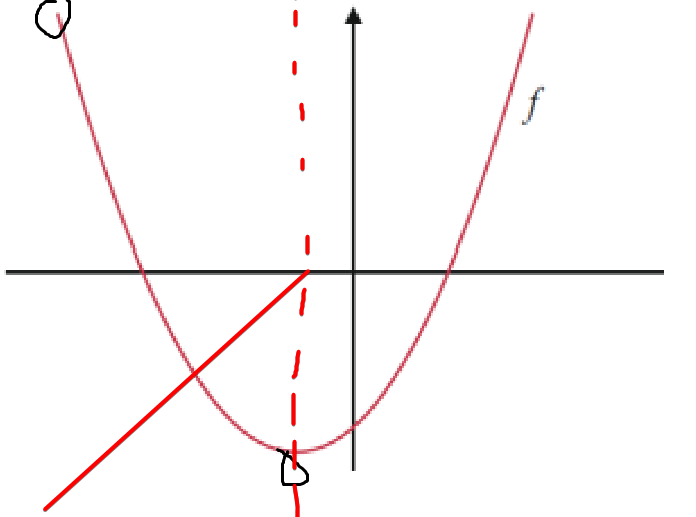
its decreasing in 1, at a stop in 2 and rising in 3
balmy mortar
ok
So what u just said
will describe how f' acts
have u heard of sign diagrams?
stray elk
no
balmy mortar
stray elk
its decreasing in 1, at a stop in 2 and rising in 3
Could you try to draw a graph of f' based on what u said? try
f' represents the slope
stray elk
alright, but wint it just look like the other graph
balmy mortar
Lets start with (1)
You said 'decreasing'
That means f' is negative
So for starters, that doesn't match up
stray elk
 balmy mortar
 stray elk
what?
balmy mortar
balmy mortar
The bit where I've marked 1
I'm commenting about this
You drew that bit positive (when it should be negative)
balmy mortar
stray elk
yeah that makes sense
ignore if u get it 😅
 stray elk
yes
balmy mortar
Think about which part of it has negative slope
stray elk
the part under the x-axis
 balmy mortar
yes
Do you also notice how the slope
is getting less and less negative
until its 0
Hope that helps you draw the graph of f' left of that point
balmy mortar

Ok so if you have a graph of f'
The line you draw
Can only be in the bit I colored in
for the left part
Do you agree?
stray elk
yes


 balmy mortar
stray elk
how about this
balmy mortar
stray elk
how about this
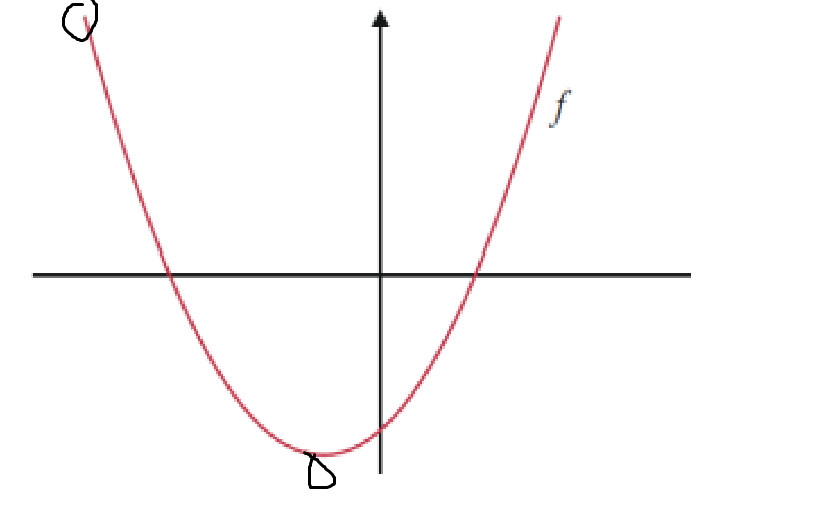
This cannot be it. You have f' positive in bits where it should be negative
stray elk
so i need to draw a graph that decreases until it hits the bottom part, and then i will star to increase
balmy mortar
Do you see how the line I've draw corresponds to f'
stray elk
its negative
balmy mortar
Not only that
the slope gets steeper and steeper for the original function
so f' is decreasing as you towards the left
 balmy mortar
what you've drawn is correct
If you have a quadratic
ie. parabola
it turns out the line is straight
f = x^2
f' = 2x
balmy mortar
balmy mortar
your answer isn't wrong.
the graph doesnt have to be a quadratic
obtuse pebbleBOT
@stray elk Has your question been resolved?
Channel closed
Closed by @stray elk
Use .reopen if this was a mistake.
Available help channel!
Send your question here to claim the channel.
Remember:
• Ask your math question in a clear, concise manner.
• Show your work, and if possible, explain where you are stuck.
• After 15 minutes, feel free to ping <@&286206848099549185>.
• Type the command .close to free the channel when you're done.
• Be polite and have a nice day!
Read #❓how-to-get-help for further information on how to ask a good question, and about conduct in the question channels.
timid silo
how to transform expression in first image to second image for group theory

 obtuse pebbleBOT
timid silo
how to transform expression in first image to second image for group theory
obtuse pebbleBOT
timid silo
how to transform expression in first image to second image for group theory
 spiral maple
associativity it looks like
obtuse pebbleBOT
Channel closed
Closed by @timid glacier
Use .reopen if this was a mistake.
obtuse pebbleBOT
Available help channel!
Send your question here to claim the channel.
Remember:
• Ask your math question in a clear, concise manner.
• Show your work, and if possible, explain where you are stuck.
• After 15 minutes, feel free to ping <@&286206848099549185>.
• Type the command .close to free the channel when you're done.
• Be polite and have a nice day!
Read #❓how-to-get-help for further information on how to ask a good question, and about conduct in the question channels.
 sour lantern
does this notation mean that I should calculate the derivative while treating y as a constant and instead of x take x^2 and after all that square it?
obtuse pebbleBOT
sour lantern
does this notation mean that I should calculate the derivative while treating y ...
sour lantern
 silk galleon
$$ \frac{d^2f}{dx^2} = \frac{d}{dx} \left( \frac{df}{dx} \right)$$
warm shaleBOT
xdk1235
 obtuse pebbleBOT
Channel closed
Closed by @sour lantern
Use .reopen if this was a mistake.
sour lantern
silk galleon
$$ \frac{d^2f}{dx^2} = \frac{d}{dx} \left( \frac{df}{dx} \right)$$
how would $\frac{d^2f}{dx}$ look like?
warm shaleBOT
Erzis エルジス
 sour lantern
.reopen
obtuse pebbleBOT
✅
silk galleon
that's not a thing
$\frac{d^2f}{dx^2}$ is just a special way of writing a second order derivative
warm shaleBOT
xdk1235
 warm shaleBOT
xdk1235
 balmy mortar
$$\dv{x}$$
warm shaleBOT
Shuri2060
 balmy mortar
This 'thing' is an operator
that acts on functions
Consider it as one object
$$\dv{x}\dv{x} = \left(\dv{x}\right)^2 = \frac{d^2}{(dx)^2} = \frac{d^2}{dx^2}$$
This is shorthand for applying the operator twice
warm shaleBOT
Shuri2060
 warm shaleBOT
Shuri2060
 sour lantern
ahhh
amazing notation
really intuitive
thank you all

There are many ways to take a "second partial derivative", but some of them secretly turn out to be the same thing.
About Khan Academy: Khan Academy offers practice exercises, instructional videos, and a personalized learning dashboard that empower learners to study at their own pace in and outside of the classroom. We tackle math, science, com...
glad I'm not alone
.close
obtuse pebbleBOT
Channel closed
Closed by @sour lantern
Use .reopen if this was a mistake.
Available help channel!
Send your question here to claim the channel.
Remember:
• Ask your math question in a clear, concise manner.
• Show your work, and if possible, explain where you are stuck.
• After 15 minutes, feel free to ping <@&286206848099549185>.
• Type the command .close to free the channel when you're done.
• Be polite and have a nice day!
Read #❓how-to-get-help for further information on how to ask a good question, and about conduct in the question channels.
 old night
 old night
i dont know why they doing that
i tried to convert 50 sec to h
and then just times the velocity by time
and then convert to meters
but its not working
spiral maple
d=vt, however you need to convert km to m and h to s
old night
yeah
spiral maple
that's all they did
old night
i converted to hours all units
ohh
omg
omggggg

sometimes i go blind mode
thanks for the help
.close
obtuse pebbleBOT
Channel closed
Closed by @old night
Use .reopen if this was a mistake.
Available help channel!
Send your question here to claim the channel.
Remember:
• Ask your math question in a clear, concise manner.
• Show your work, and if possible, explain where you are stuck.
• After 15 minutes, feel free to ping <@&286206848099549185>.
• Type the command .close to free the channel when you're done.
• Be polite and have a nice day!
Read #❓how-to-get-help for further information on how to ask a good question, and about conduct in the question channels.
 halcyon creek
I can't figure out why this question involves the second equation which includes f(3)
 obtuse pebbleBOT
halcyon creek
I can't figure out why this question involves the second equation which includes...
obtuse pebbleBOT
halcyon creek
I can't figure out why this question involves the second equation which includes...
 tardy epoch
halcyon creek
I can't figure out why this question involves the second equation which includes...
tardy epoch
halcyon creek
I can't figure out why this question involves the second equation which includes...
That's one definition of the difference quotient
halcyon creek
Isn't the difference quotient a forumla:
(f(x+h) - f(x))/h?
halcyon creek
Okay give me a second to write it through
I ended up with
= (x^2 -5x+6) / (4x+4)
hang on that can be simplified right?
= ((x-5) (x-1)) / (4(x+1))
NVM not any cleaner 😦
2 things: System says it's not right and I don't understand how h = 3-x
tardy epoch
halcyon creek
Isn't the difference quotient a forumla:
(f(x+h) - f(x))/h?
This is the one for h going to zero. The other is x going to 3.
 storm peak
or x+3/(x-3)(x+1)
halcyon creek
Isn't the Difference Quotient supposed to end with something linear?
storm peak
nope
halcyon creek
System is saying none of the answers found have been correct
storm peak
now plug into difference quotient term
halcyon creek
the (x+h) formula?
storm peak
yes
halcyon creek
Ok computing...
obtuse pebbleBOT
@halcyon creek Has your question been resolved?
halcyon creek
its a long boi bot give me time
 dusk nexus
halcyon creek
Isn't the difference quotient a forumla:
(f(x+h) - f(x))/h?
dusk nexus
halcyon creek
Isn't the difference quotient a forumla:
(f(x+h) - f(x))/h?
theres two different types of difference quotients, one of them is this and the other is simply just
∆f(x)/∆x
or
f(x)-f(a)/x-a
you get the x+h difference quotient formula by substituting h=x-a
both are equivalent
if you take the limit as h->0 and as ∆x->0, you'll see that the derivatives are equivalent too
it's just that the x+h formula is easier and more convenient for calculations at times
since everything usually cancel
s
halcyon creek
I think I took a step out of line somewhere
very little cancelled when combining
= ((hx^2+h^2x-2hx-3h^2-3h) / (x+h-3)(x+h+1)(x-3)(x+1) ) / h
I feel like I made some computation error early in combing and have 6 variables too many
but this whole process is kind of breaking my brain as it's been years since I studied this previously
Help! I got stuck again; because inputting h = 3 - x gets me to an incorrect answer
tardy epoch
halcyon creek
Help! I got stuck again; because inputting h = 3 - x gets me to an incorrect ans...
Why are you using h at all?
halcyon creek
because I don't know how to use the second equation given in the prompt
inputting f(x) straight gets me to (f(x) -2)/x-3
and I'm lost
tardy epoch
halcyon creek
inputting f(x) straight gets me to (f(x) -2)/x-3
Plug in the definition of f in this expression and you'll get your answer
halcyon creek
halcyon creek
(-x^2 +6x -9 ) / (x+1)
but it didn't 😦
tardy epoch
$$[(x+5)/(x+1) - 2] / (x-3)$$
warm shaleBOT
riemann
 halcyon creek
to simplify you multiply -2 by x+1 /x+1
and end up with -2x -2+x+5
or -x+3
so (-x+3 / x +1) / x-3
but I don't know where from there because multipling by the reciprocal didn't work
tardy epoch
halcyon creek
but I don't know where from there because multipling by the reciprocal didn't wo...
a/b/c is the same as a/(bc)
halcyon creek
so -x+3 / (x+1)(x-3)?
tardy epoch
Do you see the cancellation
tardy epoch
halcyon creek
so -x+3 / (x+1)(x-3)?
I would put extra parentheses to be careful
halcyon creek
so -(x-3) cancels with the x-3 on the bottom
leaving -1/(x+1)?
Yes!
Thank you @tardy epoch for your time and paitence
obtuse pebbleBOT
@halcyon creek Has your question been resolved?
obtuse pebbleBOT
Channel closed
Closed by @halcyon creek
Use .reopen if this was a mistake.
obtuse pebbleBOT
Available help channel!
Send your question here to claim the channel.
Remember:
• Ask your math question in a clear, concise manner.
• Show your work, and if possible, explain where you are stuck.
• After 15 minutes, feel free to ping <@&286206848099549185>.
• Type the command .close to free the channel when you're done.
• Be polite and have a nice day!
Read #❓how-to-get-help for further information on how to ask a good question, and about conduct in the question channels.
 stable kernel
How would I graph f(x) = (x-3)(x^2 +x+1) ? I know that there's an x-intercept at (3,0) but how would I deal with the second part since there are no real solutions?
obtuse pebbleBOT
stable kernel
How would I graph f(x) = (x-3)(x^2 +x+1) ? I know that there's an x-intercept at...
 autumn adder
If youre graphing it on a real plane. An XY plane. Then the graph would intersect the X axis at only one point.
,w graph (x-3)(x^2 + x + 1)
warm shaleBOT


 Requested by Muhammad Hussaini#5967
stable kernel
Requested by Muhammad Hussaini#5967
stable kernel
Ohh so there'd be additional curves but they'd be below the x-axis that makes sense
Tyy!
.close
obtuse pebbleBOT
Channel closed
Closed by @stable kernel
Use .reopen if this was a mistake.
Available help channel!
Send your question here to claim the channel.
Remember:
• Ask your math question in a clear, concise manner.
• Show your work, and if possible, explain where you are stuck.
• After 15 minutes, feel free to ping <@&286206848099549185>.
• Type the command .close to free the channel when you're done.
• Be polite and have a nice day!
Read #❓how-to-get-help for further information on how to ask a good question, and about conduct in the question channels.
old night
 old night
how did they go from 1 to 2
did they just take the common factor t
but its not working with me
 undone geyser
old night
did they just take the common factor t
undone geyser
old night
did they just take the common factor t
yes
old night
how is that so if i multiply step 2 by t i wouldnt get step 1
 brittle swan
they skipped trivial steps like this
 obtuse pebbleBOT
Channel closed
Closed by @old night
Use .reopen if this was a mistake.
Available help channel!
Send your question here to claim the channel.
Remember:
• Ask your math question in a clear, concise manner.
• Show your work, and if possible, explain where you are stuck.
• After 15 minutes, feel free to ping <@&286206848099549185>.
• Type the command .close to free the channel when you're done.
• Be polite and have a nice day!
Read #❓how-to-get-help for further information on how to ask a good question, and about conduct in the question channels.
old night
 old night
how do we use product rule for this one
 timid silo
Yep that’s ur answer
timid silo
When u see something like x.sinx
Use product
When u see something like x/sinx use quotient rule
When sin(x^2)
Use chain
old night
so if we have power is chain, if we have AxB thats product and if we have fraction that quotient
timid silo
Chain rule is used when ur variable in caught inside another function
For example
Sin(x^2 +1)
This is where u use chain rule
U can say x is chained inside sin

obtuse pebbleBOT
Channel closed
Closed by @old night
Use .reopen if this was a mistake.
obtuse pebbleBOT
Available help channel!
Send your question here to claim the channel.
Remember:
• Ask your math question in a clear, concise manner.
• Show your work, and if possible, explain where you are stuck.
• After 15 minutes, feel free to ping <@&286206848099549185>.
• Type the command .close to free the channel when you're done.
• Be polite and have a nice day!
Read #❓how-to-get-help for further information on how to ask a good question, and about conduct in the question channels.
 karmic herald
This is the rule for complex numbers equation, can in some how tow solution for deffir k have the same answer for example
z_0=i
z_1=i
 obtuse pebbleBOT
karmic herald
This is the rule for complex numbers equation, can in some how tow solution for ...
obtuse pebbleBOT
karmic herald
This is the rule for complex numbers equation, can in some how tow solution for ...
 dusky zinc
Hello is there anyone here that could help me?
karmic herald
<@&286206848099549185>
obtuse pebbleBOT
@karmic herald Has your question been resolved?
karmic herald
.close
obtuse pebbleBOT
Channel closed
Closed by @karmic herald
Use .reopen if this was a mistake.
obtuse pebbleBOT
Available help channel!
Send your question here to claim the channel.
Remember:
• Ask your math question in a clear, concise manner.
• Show your work, and if possible, explain where you are stuck.
• After 15 minutes, feel free to ping <@&286206848099549185>.
• Type the command .close to free the channel when you're done.
• Be polite and have a nice day!
Read #❓how-to-get-help for further information on how to ask a good question, and about conduct in the question channels.
 misty wigeon
struggling abit on my hw for centroids any help would be good thank you
obtuse pebbleBOT
misty wigeon
struggling abit on my hw for centroids any help would be good thank you
misty wigeon
 autumn adder
@timid silo #❓how-to-get-help
obtuse pebbleBOT
@misty wigeon Has your question been resolved?
misty wigeon
<@&286206848099549185>
 faint flower
centroid is like center of mass from physics
$$X_c = \frac{\int dm * x}{\int dm} $$
warm shaleBOT
Dev Shah
 faint flower
Now, did you try and graph the curves? @misty wigeon
misty wigeon
yeah graphed the curves and added the range
faint flower
Cool, so now, did you get what you need to integrate?
for an x between 0 to 1, you'll have to integral for dm first
For any x, $$ \frac{dm}{dx} = \int_{-y}^{y} (x+t)*dt $$
warm shaleBOT
Dev Shah
 misty wigeon
kind of, just need to process it
faint flower
I basically changed mass/area to mass/length, because we need dm to only be dependant on x for the original integration
A disclaimer though, idk any theory for centroids specifically, so there might be an easier method than this for parabolas, but this works for any function where area is defined
misty wigeon
2/3 for top section?
misty wigeon
okay let me know when you can if possible but i think i know how to do it now thank you for your help:)
faint flower
Nw! It'll take some time to check tbh, hopefully someone else can do it before me!
obtuse pebbleBOT
@misty wigeon Has your question been resolved?
Channel closed
Closed by @misty wigeon
Use .reopen if this was a mistake.
Available help channel!
Send your question here to claim the channel.
Remember:
• Ask your math question in a clear, concise manner.
• Show your work, and if possible, explain where you are stuck.
• After 15 minutes, feel free to ping <@&286206848099549185>.
• Type the command .close to free the channel when you're done.
• Be polite and have a nice day!
Read #❓how-to-get-help for further information on how to ask a good question, and about conduct in the question channels.
timid silo
How do you simplify $-\frac{\ln{\frac{3}{4}}}{2}$ to $\ln{\frac{2}{\sqrt{3}}
obtuse pebbleBOT
timid silo
How do you simplify $-\frac{\ln{\frac{3}{4}}}{2}$ to $\ln{\frac{2}{\sqrt{3}}
warm shaleBOT
ZED_118
Compile Error! Click the  reaction for more information.
(You may edit your message to recompile.)
 timid silo
warm shale
**ZED\_118**
Compile Error! Click the <:errors:504266556054962196> reaction for ...
timid silo
warm shale
**ZED\_118**
Compile Error! Click the <:errors:504266556054962196> reaction for ...
This is it, idk why it’s not compiling but whatever
dusk nexus
put the 1/2 back into the ln
timid silo
dusk nexus
put the 1/2 back into the ln
Wait
Do you mean log((3/4)^(1/2))?
I see
Thanks
Yes
Should I close
How do you get rid of the negative sign?
dusk nexus
put it back into the ln
timid silo
timid silo
Should I close
Yep
dusk nexus
$\ln{3/4^{-1/2}}$
warm shaleBOT
sean
 timid silo
.close
obtuse pebbleBOT
Channel closed
Closed by @gritty idol
Use .reopen if this was a mistake.
Available help channel!
Send your question here to claim the channel.
Remember:
• Ask your math question in a clear, concise manner.
• Show your work, and if possible, explain where you are stuck.
• After 15 minutes, feel free to ping <@&286206848099549185>.
• Type the command .close to free the channel when you're done.
• Be polite and have a nice day!
Read #❓how-to-get-help for further information on how to ask a good question, and about conduct in the question channels.
 nocturne shoal
how do you do this question
obtuse pebbleBOT
nocturne shoal
how do you do this question
nocturne shoal
 faint flower
left the original number of boys, girls and adults be 5x, 8x and 2x resp.
so 5x+8x+2x=150
or x=10
so boys:girls:adults = 50:80:20
after k girls leave, the ratio is 10:9:4, so 50:80-k:20 :: 10:9:4
divide the right ratio by 5, 10:16-(0.2k):4 :: 10:9:4
16-0.2k = 9
k = 35
obtuse pebbleBOT
Channel closed
Closed by @nocturne shoal
Use .reopen if this was a mistake.
Available help channel!
Send your question here to claim the channel.
Remember:
• Ask your math question in a clear, concise manner.
• Show your work, and if possible, explain where you are stuck.
• After 15 minutes, feel free to ping <@&286206848099549185>.
• Type the command .close to free the channel when you're done.
• Be polite and have a nice day!
Read #❓how-to-get-help for further information on how to ask a good question, and about conduct in the question channels.
 violet radish
We hv
Mn = 128
Mk = 64
Nk = 8
Calculate m n k
obtuse pebbleBOT
violet radish
We hv
Mn = 128
Mk = 64
Nk = 8
Calculate m n k
violet radish
I dont have
 warped agate
violet radish
We hv
Mn = 128
Mk = 64
Nk = 8
Calculate m n k
warped agate
violet radish
We hv
Mn = 128
Mk = 64
Nk = 8
Calculate m n k
hmm alright
divide 1st eqn by 2nd
u get n/k = 2
from this u get n =2k
sub this into 3rd eqn
u get k=2
therefore n=4
and m=32
therefore mnk will be 32x4x2 = 256
@violet radish
violet radish
warped agate
hmm alright
divide 1st eqn by 2nd
u get n/k = 2
from this u get n =2k
sub this i...
Tysm
warped agate
np
obtuse pebbleBOT
@violet radish Has your question been resolved?
Channel closed
Closed due to timeout
Use .reopen if this was a mistake.
obtuse pebbleBOT
Available help channel!
Send your question here to claim the channel.
Remember:
• Ask your math question in a clear, concise manner.
• Show your work, and if possible, explain where you are stuck.
• After 15 minutes, feel free to ping <@&286206848099549185>.
• Type the command .close to free the channel when you're done.
• Be polite and have a nice day!
Read #❓how-to-get-help for further information on how to ask a good question, and about conduct in the question channels.
sour lantern
 obtuse pebbleBOT
sour lantern
warm shaleBOT
obtuse pebbleBOT
sour lantern
warm shaleBOT
Erzis エルジス
 high lily
you messed up a sign near the end
-(-1) is +1
i.e you should have +1 instead of -1 after evaluating the bounds
sour lantern
high lily
you messed up a sign near the end
is the limit of ln part zero?
high lily
the difference of the lns with the ts, yes
it'll be clearer if you consider the difference to quotient law
sour lantern
yes lim at inf of $ln|\frac{1+t}{t}|$ is $0$
warm shaleBOT
Erzis エルジス
 obtuse pebbleBOT
Channel closed
Closed by @sour lantern
Use .reopen if this was a mistake.
Available help channel!
Send your question here to claim the channel.
Remember:
• Ask your math question in a clear, concise manner.
• Show your work, and if possible, explain where you are stuck.
• After 15 minutes, feel free to ping <@&286206848099549185>.
• Type the command .close to free the channel when you're done.
• Be polite and have a nice day!
Read #❓how-to-get-help for further information on how to ask a good question, and about conduct in the question channels.
Channel closed
Closed due to the original message being deleted
Available help channel!
Send your question here to claim the channel.
Remember:
• Ask your math question in a clear, concise manner.
• Show your work, and if possible, explain where you are stuck.
• After 15 minutes, feel free to ping <@&286206848099549185>.
• Type the command .close to free the channel when you're done.
• Be polite and have a nice day!
Read #❓how-to-get-help for further information on how to ask a good question, and about conduct in the question channels.
 upbeat bloom
@flat anvil
 obtuse pebbleBOT
upbeat bloom
<@!328662734008745984>
upbeat bloom
obtuse pebbleBOT
upbeat bloom
<@!328662734008745984>
upbeat bloom
I can solve a summation with i^2 in it like this
 upbeat bloom
<@!328662734008745984>
upbeat bloom
upbeat bloom
<@!328662734008745984>
but how do I factor out the other elements in this case?
obtuse pebbleBOT
@upbeat bloom Has your question been resolved?
 thick fog
Was this an actual exercise? I don't see a path to computing this sum without going beyond the scope of your course.
upbeat bloom
thick fog
Was this an actual exercise? I don't see a path to computing this sum without go...
ok then I may have done something wrong
the original exercise is this one
 thick fog
I think the intention is for you to just do integration using the fundamental theorem of Calculus and not evaluate that limit at all.
upbeat bloom
thick fog
I think the intention is for you to just do integration using the fundamental th...
oh ok, thx
.close
obtuse pebbleBOT
Channel closed
Closed by @upbeat bloom
Use .reopen if this was a mistake.
obtuse pebbleBOT
Available help channel!
Send your question here to claim the channel.
Remember:
• Ask your math question in a clear, concise manner.
• Show your work, and if possible, explain where you are stuck.
• After 15 minutes, feel free to ping <@&286206848099549185>.
• Type the command .close to free the channel when you're done.
• Be polite and have a nice day!
Read #❓how-to-get-help for further information on how to ask a good question, and about conduct in the question channels.
timid silo
 obtuse pebbleBOT
timid silo
timid silo
obtuse pebbleBOT
timid silo
timid silo
How do you complete the square here?
high lily
the same way you'd complete the square in other questions
timid silo
Ok
high lily
consider the part you want to complete the square for, in this case the
x^2 - 4x
and add/subtract/manipulate appropriatrly
which they actually showed in the the work
timid silo
.close
obtuse pebbleBOT
Channel closed
Closed by @mighty junco
Use .reopen if this was a mistake.
Available help channel!
Send your question here to claim the channel.
Remember:
• Ask your math question in a clear, concise manner.
• Show your work, and if possible, explain where you are stuck.
• After 15 minutes, feel free to ping <@&286206848099549185>.
• Type the command .close to free the channel when you're done.
• Be polite and have a nice day!
Read #❓how-to-get-help for further information on how to ask a good question, and about conduct in the question channels.
 old saddle
Hello can somebody please help me
obtuse pebbleBOT
old saddle
Hello can somebody please help me
old saddle
Sorry
timid silo
You need to ask first
As in
Put the problem you need help with
So people who do know how to solve it can help
obtuse pebbleBOT
@old saddle Has your question been resolved?
old saddle
It’s being resolved
silk galleon
you have three channels open
high lily
.close
obtuse pebbleBOT
Channel closed
Closed by @high lily
Use .reopen if this was a mistake.
Available help channel!
Send your question here to claim the channel.
Remember:
• Ask your math question in a clear, concise manner.
• Show your work, and if possible, explain where you are stuck.
• After 15 minutes, feel free to ping <@&286206848099549185>.
• Type the command .close to free the channel when you're done.
• Be polite and have a nice day!
Read #❓how-to-get-help for further information on how to ask a good question, and about conduct in the question channels.
 acoustic mountain
clai
obtuse pebbleBOT
acoustic mountain
clai
acoustic mountain
How do you draw a sketch of a graph from a derivative
 short spruce
do you have an example? it kinda depends
acoustic mountain
Because you can not know the y-coördinate
Does that mean that you do not draw the x-axis?
In my head it should
 sage geode
If you aren't given at least one value of the function at some point, you can't really graph it
But if you are
acoustic mountain
We know that a negative parabola has (a, 0) and (b,0)
a and b are given but I forgot
sage geode
Oh, so you know the roots?
acoustic mountain
acoustic mountain
We know that a negative parabola has (a, 0) and (b,0)
i.e. a parabola with a mininum
acoustic mountain
sage geode
Oh, so you know the roots?
I do
This parabola is the derivative of the graph I should draw
sage geode
Oh
acoustic mountain
So my question is: how do you draw the x-values without an x-axis
what is the normal way?
sage geode
I guess what you can do it just draw the graph go up where the derivative is positive (the bigger the absolute value, the steeper) and go down where the derivative is negative (same thing here)
acoustic mountain
True
sage geode
That's all I can say
acoustic mountain
But do I still draw the axis?
sage geode
Yeah I guess
acoustic mountain
Because I can not say if the graph is negative or positive
 flat anvil
what
yeah you can
if f(x) is decreasing, then f'(x) is negative
***most of the time
acoustic mountain
But I only know f'(x)
acoustic mountain
And need to know f(x)
flat anvil
given f'(x)?
acoustic mountain
Yes
flat anvil
well there are an infinite set of solutoins
acoustic mountain
So you know the shape of the graph
flat anvil
all you really need to know is the shape
acoustic mountain
Yes
flat anvil
cuz all of the graphs are just off by a constant
so it doesn't really matter--you don't need to draw specific values of y
flat anvil
yeah cuz the x's will always be the same
acoustic mountain
Because I can not say if it is above or below the formula?
flat anvil
acoustic mountain
Because I can not say if it is above or below the formula?
wym by this
acoustic mountain
If I draw the x-axis so that the graph is negative
That could be incorrect
Because I do not know for certain that is the case
flat anvil
how would you draw the x-axis so the graph is negativE?
oh i c what u mean
well for ur purposes it doesn't really matter
acoustic mountain
I hope it doesn't
flat anvil
you can just assume that the constant would be 0
for the purpose of drawing it
and then say somewhere else that the graph could be shifted up/down any amount
if you wanted to be really specifiuc
flat anvil
you're welcome
acoustic mountain
.close
obtuse pebbleBOT
Channel closed
Closed by @acoustic mountain
Use .reopen if this was a mistake.
Available help channel!
Send your question here to claim the channel.
Remember:
• Ask your math question in a clear, concise manner.
• Show your work, and if possible, explain where you are stuck.
• After 15 minutes, feel free to ping <@&286206848099549185>.
• Type the command .close to free the channel when you're done.
• Be polite and have a nice day!
Read #❓how-to-get-help for further information on how to ask a good question, and about conduct in the question channels.
 gleaming hare
 obtuse pebbleBOT
gleaming hare
gleaming hare
obtuse pebbleBOT
gleaming hare
gleaming hare
how to do
nocturne minnow
Solve by factoring
nocturne minnow
Is that 3 times -36?
gleaming hare
then i didnt know what number multiplied to get -108 and adds to get -3
gleaming hare
nocturne minnow
Is that 3 times -36?
yes
flat anvil
gleaming hare
you should first (to make it easier) divide everything by 3
to get:
$x^2-x-12 = 0$
warm shaleBOT
Yottachad
 flat anvil
and this is much easier to factor than the last one
nocturne minnow
Then you can do the method you were doing
flat anvil
yep
gleaming hare
ok
nocturne minnow
Or quadratic formula
flat anvil
$(3x+a)(x+b) = 0$
warm shaleBOT
Yottachad
 flat anvil
then you would try to find a and b
flat anvil
mayb
nocturne minnow
Fyi factors of 108: 1, 2, 3, 4, 6, 9, 12, 18, 27, 36, 54 and 108
gleaming hare
warm shale
**Yottachad**
wait how did u get this
nocturne minnow
(1, 108), (2, 53), (3, 36), so on
That's the general form because you know if there was no leading coefficient, the form is $(x + a)(x + b) = 0$
warm shaleBOT
dldh06
 nocturne minnow
But there is a coefficient of 3, meaning that when you FOIL, there has to be a 3x
gleaming hare
ok
nocturne minnow
To obtain 3x^2
gleaming hare
so where are we so far
nocturne minnow
You just factor $x^2-x-12 = 0$
warm shaleBOT
dldh06
 gleaming hare
$(x + 1) (x - 11)?$
warm shaleBOT
BlzrdStrike
 nocturne minnow
No
gleaming hare
then what is it
nocturne minnow
Does -11 * 1 equal 12? And does it add up to -1?
gleaming hare
$(x - 1) (x + 11)??$
warm shaleBOT
BlzrdStrike
 gleaming hare
wait
nocturne minnow
If you FOIL, does the math check out, to make $x^2-x-12 = 0$?
warm shaleBOT
dldh06
 gleaming hare
$(x - 1) (x + 12)$
warm shaleBOT
BlzrdStrike
 nocturne minnow
But does that sum to -1?
gleaming hare
$(x + 1) (x - 12)$
warm shaleBOT
BlzrdStrike
 warm shaleBOT
dldh06
 gleaming hare
idk
nocturne minnow
Did you try to expand $(x + 1) (x - 12)$?
warm shaleBOT
dldh06
 gleaming hare
no
nocturne minnow
So then expand it
warm shaleBOT
BlzrdStrike
 nocturne minnow
Is that the same as the original problem, $x^2-x-12 = 0$
warm shaleBOT
dldh06
 gleaming hare
no
nocturne minnow
So then what does that mean you should do?
gleaming hare
hm
nocturne minnow
What are the factors of 12?
nocturne minnow
All the factors of -12
nocturne minnow
12, -1
nocturne minnow
Yes
gleaming hare
wAYYYYYYYAYYYY
nocturne minnow
Because that adds up to -1 and multiplies to -12
warm shaleBOT
BlzrdStrike
 warm shaleBOT
BlzrdStrike
 gleaming hare
so now ZPP
nocturne minnow
That's when you expand, but don't forget it's in the form (x + a)(x + b) = 0
gleaming hare
what about zero product property
nocturne minnow
Where a and b where the factors you found
nocturne minnow
gleaming hare
$x - 3x - 4x = 0$
This isn't correct yet
nocturne minnow
gleaming hare
$(x + 1) (x - 12)$
Should look like this
gleaming hare
$(x - 3) (x - 4)$
warm shaleBOT
BlzrdStrike
 gleaming hare
= 0
gleaming hare
$(x + 3) (x - 4)$
warm shaleBOT
BlzrdStrike
 nocturne minnow
$(x + 3) (x - 4) = 0$
warm shaleBOT
dldh06
 nocturne minnow
To make it more proper
gleaming hare
yes
nocturne minnow
So zero product property, states that if given AB = 0, then either A = 0 or B = 0
gleaming hare
$x + 3 = 0, x = -3/
x - 4 = 0, x = 4$
warm shaleBOT
BlzrdStrike
 nocturne minnow
You can just close each one with $
gleaming hare
ok
nocturne minnow
$$x + 3 = 0, x = -3$$
$$x - 4 = 0, x = 4$$
warm shaleBOT
dldh06
 obtuse pebbleBOT
@gleaming hare Has your question been resolved?
Channel closed
Closed by @gleaming hare
Use .reopen if this was a mistake.
Available help channel!
Send your question here to claim the channel.
Remember:
• Ask your math question in a clear, concise manner.
• Show your work, and if possible, explain where you are stuck.
• After 15 minutes, feel free to ping <@&286206848099549185>.
• Type the command .close to free the channel when you're done.
• Be polite and have a nice day!
Read #❓how-to-get-help for further information on how to ask a good question, and about conduct in the question channels.
 narrow fable
I have a simple question about this pde. Why is there no resonance in the ansatz?
 obtuse pebbleBOT
narrow fable
I have a simple question about this pde. Why is there no resonance in the ansatz...
narrow fable
obtuse pebbleBOT
narrow fable
I have a simple question about this pde. Why is there no resonance in the ansatz...
narrow fable
The thing I don't understand is in b, why they don't use the ansatz te^(t)(ACos(t)+BSin(t))

instead of what they do, which is just (ACos(t)+BSin(t))
spiral maple
narrow fable
instead of what they do, which is just (ACos(t)+BSin(t))
cause the forcing function doesn't have e^t
cos(t) is just trig, so your guess for underdetermined coefficients is a linear combination of cos and sin
obtuse pebbleBOT
Channel closed
Closed by @narrow fable
Use .reopen if this was a mistake.
Available help channel!
Send your question here to claim the channel.
Remember:
• Ask your math question in a clear, concise manner.
• Show your work, and if possible, explain where you are stuck.
• After 15 minutes, feel free to ping <@&286206848099549185>.
• Type the command .close to free the channel when you're done.
• Be polite and have a nice day!
Read #❓how-to-get-help for further information on how to ask a good question, and about conduct in the question channels.
 karmic vapor
i just need to know if my answer is correct
 obtuse pebbleBOT
karmic vapor
i just need to know if my answer is correct
karmic vapor
obtuse pebbleBOT
karmic vapor
i just need to know if my answer is correct
karmic vapor
i did 14 x 12 x 10 x 8
is that correct^
could i get steps on how to do this question please
karmic vapor
is it 13440?
karmic vapor
yes
karmic vapor
oh my bad
balmy mortar
You count how many
are
🟥 ⚫
THEN
You count how many are
⬛ 🔴
Then you add the 2 together. For the total.
karmic vapor
so 44?
karmic vapor
oh
balmy mortar
Firstly
Tell me how many are this
🟥 ⚫
Red square, Black sphere
How many ways can she result in this
karmic vapor
14 red square and 8 black spheres
karmic vapor
ok
balmy mortar
Or maybe, each of these are labelled
A B C D E ...
So they are different
Now how many choices can she make?
balmy mortar
Yes, she is choosing 1 red square and 1 black sphere
yes, 112.
Now for the other case?
⬛ 🔴
karmic vapor
112 + 120
balmy mortar
👌
karmic vapor
232
balmy mortar
Do you understand the process?
balmy mortar
👌
karmic vapor
.close
obtuse pebbleBOT
Channel closed
Closed by @karmic vapor
Use .reopen if this was a mistake.
obtuse pebbleBOT
Available help channel!
Send your question here to claim the channel.
Remember:
• Ask your math question in a clear, concise manner.
• Show your work, and if possible, explain where you are stuck.
• After 15 minutes, feel free to ping <@&286206848099549185>.
• Type the command .close to free the channel when you're done.
• Be polite and have a nice day!
Read #❓how-to-get-help for further information on how to ask a good question, and about conduct in the question channels.
obtuse pebbleBOT
 sweet edge
I was wondering how I'd extend this to R3
sweet edge
sweet edge
I was wondering how I'd extend this to R3
sweet edge
ah
uhm

Am I expected to use that to solve this question?
(solving for tensions)
balmy mortar
Whats the Q
sweet edge
sweet edge
(solving for tensions)
this
balmy mortar
I have doubts you need it
sweet edge
Ah, okay
hm
I can do this when the scenario is flat
but I'm not sure how to translate that into when the situation is 3D
nocturne minnow
Find the x, y, z components of each tension, then equilibrium concept
sweet edge
what is an equilibrium concept(constant)?
nocturne minnow
Sum of forces equals 0
sweet edge
yes*
but I'm not sure how to make them so it's like
T1<cos(x), sin(x)> and T2<cos(x), sin(x)> etc.
and this is for x,y only ^
nocturne minnow
Trying to recall how to do it
sweet edge
okie, n
np*
@ me if u figure it out
I'll just be working on other problems for the moment
nocturne minnow
sweet edge
@ me if u figure it out
Find the unit vector of each tension
nocturne minnow
sweet edge
@ me if u figure it out
I figured out what to do
 nocturne minnow
How did you get that as the unit vector?
sweet edge
well
nocturne minnow
Let's take T1
sweet edge
okay
<5, -5, 5>
so that's 5 < 1, -1, 1>
and that vector left over is the unit vector?
nocturne minnow
Not exactly what I was trying to get you to do
sweet edge
ahh
sweet edge
using i j and k?
nocturne minnow
Yes
nocturne minnow
Not exactly, that's just the distance
nocturne minnow
You understand what the unit vector does, right?
sweet edge
It describes the direction as a unit length
nocturne minnow
It's a mag of 1, meaning if you took some other vector and multiplied it, it doesn't scale it
Right?
sweet edge
Yes
nocturne minnow
So we what to find the i, j, k form of each T1
I'll walk you through the first one

 nocturne minnow
Not exactly
nocturne minnow
That's the unit vector
sweet edge
alright
sweet edge
nice
nocturne minnow
So T1 time that unit vector, is what you need
Do the same process for all of the other tensions
sweet edge
so that calculation I did, that's correct so far then
nocturne minnow
Yes
nocturne minnow
Yep
nocturne minnow
So for T1, it's $T1\left[\frac{5 \hat{i} - 5 \hat{j} + 5 \hat{k}}{\sqrt{75}}\right]$
warm shaleBOT
dldh06
 sweet edge
yes
nocturne minnow
So that's T1 in i, j, k form
sweet edge
Is this what normal vectors are?
sweet edge
Okie
anyways, we have our Force for the first tension
and also the other 3
when we sum these, they're equal to the force of gravity (since they need to cancel each other out)?
sweet edge
that's..
nocturne minnow
warm shale
**dldh06**
I just expanded this
sweet edge
I'd prefer leaving it as $\frac{5}{\sqrt{75}}\hat{i}...$
warm shaleBOT
Jukelyn
 nocturne minnow
That works too
sweet edge
yesh
in any case, we have these unit vectors which lets us construct a representation of the forces of tension
sweet edge
now we would add all 4 of them and that should be equal to the force of gravity?
or rather, I guess it depends on the POV
nocturne minnow
So T1 + T2 + T3 + T4 - 150(9.81) = 0
sweet edge
they sum to 0, but grav is neg so it's 0+ 150 (g) = tensions
sweet edge
nocturne minnow
So T1 + T2 + T3 + T4 - 150(9.81) = 0
yes
wouldn't this lead to a system of 4 equations though?
nocturne minnow
Sorta
sweet edge
hmm
nocturne minnow
$T1\left[\frac{5}{\sqrt{75}}\hat{i} - \frac{5}{\sqrt{75}}\hat{j} + \frac{5}{\sqrt{75}}\hat{k}\right] + T2 ... - 150(9.81) k = 0$
warm shaleBOT
dldh06
 sweet edge
why the k at the end?
nocturne minnow
Because that force is in the k direction
sweet edge
oh right,
nocturne minnow
The weight
nocturne minnow
Now, system of equations for x, y, z directions