#help-10
1 messages · Page 404 of 1
 fathom kindle
no vertical one?
i thought it just goes up infinitely
or it still like goes to the right
ye
.close
 obtuse pebbleBOT
Channel closed
Closed by @fathom kindle
Use .reopen if this was a mistake.
obtuse pebbleBOT
 Available help channel!
Send your question here to claim the channel.
Remember:
• Ask your math question in a clear, concise manner.
• Show your work, and if possible, explain where you are stuck.
• After 15 minutes, feel free to ping <@&286206848099549185>.
• Type the command .close to free the channel when you're done.
• Be polite and have a nice day!
Read #❓how-to-get-help for further information on how to ask a good question, and about conduct in the question channels.
 tribal bloom
 obtuse pebbleBOT
tribal bloom
tribal bloom
obtuse pebbleBOT
tribal bloom
tribal bloom
I don't understand this one at all
Do I multiply each coordinate of the vertex?
Which is (8,-6)?
.close
obtuse pebbleBOT
Channel closed
Closed by @tribal bloom
Use .reopen if this was a mistake.
Available help channel!
Send your question here to claim the channel.
Remember:
• Ask your math question in a clear, concise manner.
• Show your work, and if possible, explain where you are stuck.
• After 15 minutes, feel free to ping <@&286206848099549185>.
• Type the command .close to free the channel when you're done.
• Be polite and have a nice day!
Read #❓how-to-get-help for further information on how to ask a good question, and about conduct in the question channels.
 strong kestrel
s
 obtuse pebbleBOT
strong kestrel
s
obtuse pebbleBOT
strong kestrel
s
 latent walrus
hm?
strong kestrel
ik a
but some guy was helping me out with the following
but b is what got me the most
latent walrus
whats up with b
strong kestrel
so I know that g(a) is 4, however it isn't define in this case. but limg(x) is. So I am confused into like finding the limit of this
or the point
or whatever Im looking for
 restive gorge
strong kestrel
so I know that g(a) is 4, however it isn't define in this case. but limg(x) is. ...
restive gorge
strong kestrel
so I know that g(a) is 4, however it isn't define in this case. but limg(x) is. ...
there is no g(a) is 4
i also dont know why the channel got closed lol
restive gorge
for b) in simple terms look for a value of x where from both sides you approach the same limit, but at that limit the value has a circle
restive gorge
strong kestrel
G(4)
for b) no
strong kestrel
a I mean
strong kestrel
restive gorge
for b) in simple terms look for a value of x where from both sides you approach ...
idk but is it still 4?
restive gorge
No
strong kestrel
or 2
restive gorge
yes
but explain

i cannot make it more simpler
limit exists if from both sides your approach the same value
restive gorge
what
strong kestrel
my professor hasn't told me that
restive gorge

strong kestrel
ok so im getting it know
the fact that its 5 is due to the fact that both sides meet up at a undefined point
restive gorge
brain sparked
strong kestrel
I mean yeah
restive gorge
well then c)
strong kestrel
its 2 and 4
2 is the one coming from the left, while 4 is the one coming from the right
or 2 is the minus and 4 is the plus
restive gorge
yes you are right
strong kestrel
i have a question tho
restive gorge
sure
strong kestrel
oh wait nvm
restive gorge
brain sparked again
strong kestrel
I was about to ask why couldn't it be a singular value since their coming from both ways
restive gorge
what
strong kestrel
but lim g(x) DNE
restive gorge
ah
restive gorge
strong kestrel
I was about to ask why couldn't it be a singular value since their coming from b...
If you also didn't know
strong kestrel
is 4
restive gorge
yea
strong kestrel
because it's a plus and g(4)
strong kestrel
restive gorge
If you also didn't know
yeah wsp
 warm shaleBOT
bacc
 restive gorge
in case your professor has another profession
restive gorge
strong kestrel
then its DNE
yea
strong kestrel
dam well thank you man
restive gorge
thank yourself
strong kestrel
I appreciate your help
restive gorge
thanks
strong kestrel
wait btw
 strong kestrel
cause I have a calc exam next week. Do you know any good youtube videos about calculus
restive gorge
uhm
strong kestrel
or any other resources
restive gorge
calculus is kinda big and vague
strong kestrel
ok
restive gorge
is it calc 1 or calc 2?
restive gorge
oh
strong kestrel
Im like in the intro of calculus
restive gorge
The Organic Chemestry is good
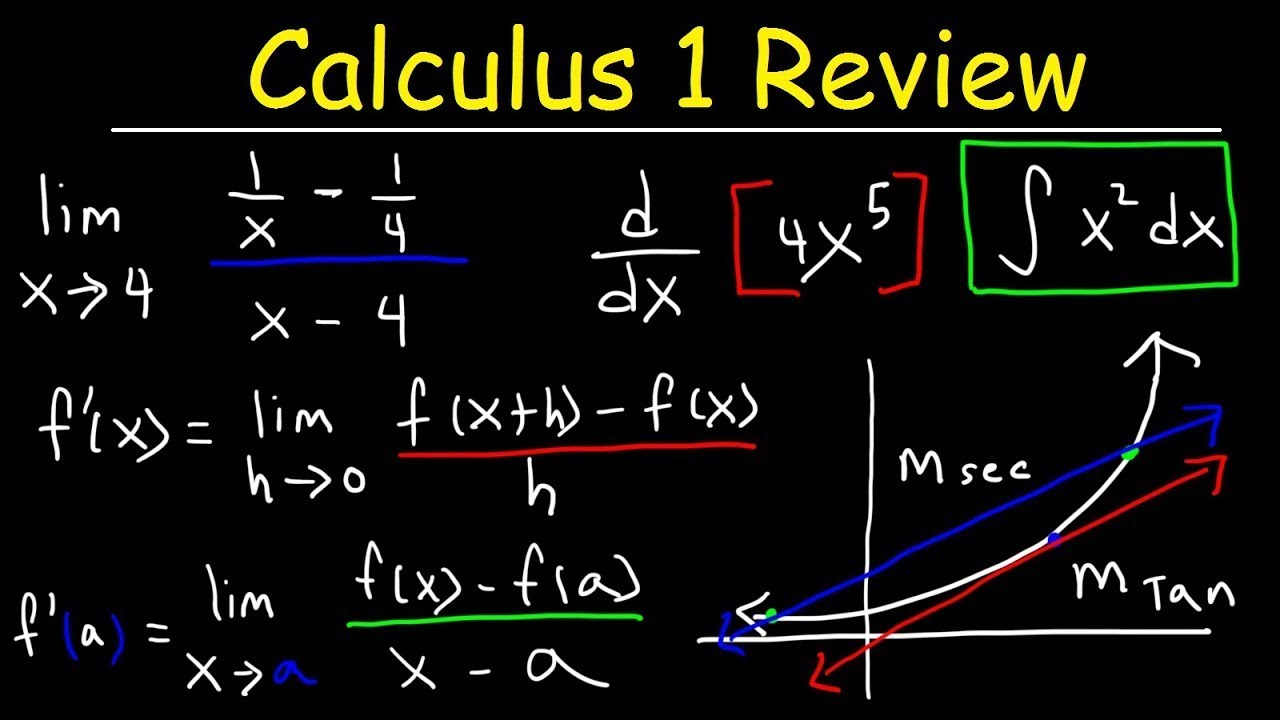
This back to school calculus 1 review video tutorial provides a basic introduction into a few core concepts taught in a typical AP calculus ab course or a first semester of college calculus.
Full 1 Hour 30 Minute Video: https://www.patreon.com/MathScienceTutor
Direct Link to Full Video:
https://bit.ly/3sYVl4y
_...
restive gorge
you too
obtuse pebbleBOT
@strong kestrel Has your question been resolved?
obtuse pebbleBOT
Channel closed
Closed due to timeout
Use .reopen if this was a mistake.
Available help channel!
Send your question here to claim the channel.
Remember:
• Ask your math question in a clear, concise manner.
• Show your work, and if possible, explain where you are stuck.
• After 15 minutes, feel free to ping <@&286206848099549185>.
• Type the command .close to free the channel when you're done.
• Be polite and have a nice day!
Read #❓how-to-get-help for further information on how to ask a good question, and about conduct in the question channels.
 rich dust
hello
obtuse pebbleBOT
rich dust
hello
rich dust
i need help
on epsilon delta proofs
i am very lost
i have not begun this problem

<@&286206848099549185>
obtuse pebbleBOT
@rich dust Has your question been resolved?
rich dust
someone pls help me
rich dust
<@&286206848099549185> someone pls
obtuse pebbleBOT
@rich dust Has your question been resolved?
obtuse pebbleBOT
@rich dust Has your question been resolved?
obtuse pebbleBOT
Channel closed
Closed due to timeout
Use .reopen if this was a mistake.
Available help channel!
Send your question here to claim the channel.
Remember:
• Ask your math question in a clear, concise manner.
• Show your work, and if possible, explain where you are stuck.
• After 15 minutes, feel free to ping <@&286206848099549185>.
• Type the command .close to free the channel when you're done.
• Be polite and have a nice day!
Read #❓how-to-get-help for further information on how to ask a good question, and about conduct in the question channels.
 primal moon
can someone help me
obtuse pebbleBOT
primal moon
can someone help me
primal moon


i know this is really easy, i kinda forgot if the answer would be 3 or dne(does not exist) since the points arent touching

 copper bough
yes
 prime swallow
Yes
 terse pivot
this is a peicewise funciton, as we approach from the left, negative values, we approach 5, as we approach from the right we approach -2, so DNE
primal moon
ty ty this is review and i forgot the case for these
copper bough
if the graph approaches different values from each side it is DNE
terse pivot
hehe wait until you get to multi variable with limits, im stuck on a problem right now
infinitely many ways you can approach a point
obtuse pebbleBOT
@primal moon Has your question been resolved?
Channel closed
Closed by @primal moon
Use .reopen if this was a mistake.
Available help channel!
Send your question here to claim the channel.
Remember:
• Ask your math question in a clear, concise manner.
• Show your work, and if possible, explain where you are stuck.
• After 15 minutes, feel free to ping <@&286206848099549185>.
• Type the command .close to free the channel when you're done.
• Be polite and have a nice day!
Read #❓how-to-get-help for further information on how to ask a good question, and about conduct in the question channels.
 odd plover
 obtuse pebbleBOT
odd plover
odd plover
obtuse pebbleBOT
odd plover
odd plover
Yo help pls how do I solve question 21?
copper bough
JH bisecting WJM means WJH and JHM will be the same angle
copper bough
which also means 2(HJM)=WJM
since it gives you HJM and WJM you can just plug in each
2(4x-19)=2x+7
and go from there
odd plover
You’re very intelligent and bright
Let me try this out rq
One question
Would the x= 15/2?
copper bough
yes i think so
obtuse pebbleBOT
Channel closed
Closed by @odd plover
Use .reopen if this was a mistake.
obtuse pebbleBOT
Available help channel!
Send your question here to claim the channel.
Remember:
• Ask your math question in a clear, concise manner.
• Show your work, and if possible, explain where you are stuck.
• After 15 minutes, feel free to ping <@&286206848099549185>.
• Type the command .close to free the channel when you're done.
• Be polite and have a nice day!
Read #❓how-to-get-help for further information on how to ask a good question, and about conduct in the question channels.
 vale vapor
 obtuse pebbleBOT
vale vapor
obtuse pebbleBOT
vale vapor
 gaunt helm
do u see any right triangles
 gaunt helm
u can find DE as well

 brazen viper
Consider DCP and CPE would be the next thing I tried
Because DP + PE = 10
So you can get two equations and two unknowns
PE and CP
vale vapor
then how to get CP
brazen viper
You have a^2 + b^2 = c^2 for Pythagorean theorem on both triangles DCP and CPE.
These are your two equations.
You know all data except for DP, PE, and CP. But you also know that DP + PE = 10
So you have:
DP^2 + CP^2 = DC^2 = 8^2 = 64
EP^2 + CP^2 = CE^2 = 6^2 = 36
DP^2 - EP^2 = 64-36 = 28
DP^2 - (DP - 10)^2 = 28
Etc
 surreal forge
vale vapor
surreal forge
vale vapor
 brazen viper
Huh TIL
surreal forge
it is not very well known theorem ye
vale vapor
brazen viper
So you have:
DP^2 + CP^2 = DC^2 = 8^2 = 64
EP^2 + CP^2 = CE^2 = 6^2 = 36
DP^2 ...
thank you, ill try to finish this
.close
obtuse pebbleBOT
Channel closed
Closed by @vale vapor
Use .reopen if this was a mistake.
obtuse pebbleBOT
Available help channel!
Send your question here to claim the channel.
Remember:
• Ask your math question in a clear, concise manner.
• Show your work, and if possible, explain where you are stuck.
• After 15 minutes, feel free to ping <@&286206848099549185>.
• Type the command .close to free the channel when you're done.
• Be polite and have a nice day!
Read #❓how-to-get-help for further information on how to ask a good question, and about conduct in the question channels.
 dusk coyote
 obtuse pebbleBOT
dusk coyote
dusk coyote
obtuse pebbleBOT
dusk coyote
dusk coyote
How many pairs of internal "parallel" diagonals does a "Rhombicosidodecahedron" have?
<@&286206848099549185>
surreal forge
that seems unfortunate
obtuse pebbleBOT
@dusk coyote Has your question been resolved?
obtuse pebbleBOT
Channel closed
Closed due to timeout
Use .reopen if this was a mistake.
obtuse pebbleBOT
Available help channel!
Send your question here to claim the channel.
Remember:
• Ask your math question in a clear, concise manner.
• Show your work, and if possible, explain where you are stuck.
• After 15 minutes, feel free to ping <@&286206848099549185>.
• Type the command .close to free the channel when you're done.
• Be polite and have a nice day!
Read #❓how-to-get-help for further information on how to ask a good question, and about conduct in the question channels.
 spice chasm
how do u come up with the answer
 obtuse pebbleBOT
spice chasm
how do u come up with the answer
obtuse pebbleBOT
spice chasm
how do u come up with the answer
@spice chasm Has your question been resolved?
Channel closed
Closed by @spice chasm
Use .reopen if this was a mistake.
Available help channel!
Send your question here to claim the channel.
Remember:
• Ask your math question in a clear, concise manner.
• Show your work, and if possible, explain where you are stuck.
• After 15 minutes, feel free to ping <@&286206848099549185>.
• Type the command .close to free the channel when you're done.
• Be polite and have a nice day!
Read #❓how-to-get-help for further information on how to ask a good question, and about conduct in the question channels.
 velvet sparrow
I've watched quite a few videos explaining the Monty hall problem and I genuinely cannot seem to understand it.
To me the information that there were prior doors dosent practically change anything, at the end it's always a simple 50/50 chance, it's whether you pick one door or another, can anyone try and explain why the fact there were prior doors matters?
In the example where there are a 100 doors I understand that the first time you picked a door you had a 1% chance but that's irrelevant to the fact that you now only have two doors to choose from is it not?
obtuse pebbleBOT
velvet sparrow
I've watched quite a few videos explaining the Monty hall problem and I genuinel...
velvet sparrow
Is there any actual proper maths to back it up?
To me it seems more psychological than statistical
 obtuse pebbleBOT
@velvet sparrow Has your question been resolved?
obtuse pebbleBOT
Channel closed
Closed due to timeout
Use .reopen if this was a mistake.
Available help channel!
Send your question here to claim the channel.
Remember:
• Ask your math question in a clear, concise manner.
• Show your work, and if possible, explain where you are stuck.
• After 15 minutes, feel free to ping <@&286206848099549185>.
• Type the command .close to free the channel when you're done.
• Be polite and have a nice day!
Read #❓how-to-get-help for further information on how to ask a good question, and about conduct in the question channels.
 hollow adder
i need help with 10th grade eu Arrays
obtuse pebbleBOT
hollow adder
i need help with 10th grade eu Arrays
hollow adder
i need to do this without a calculator

 worthy birch
does the comma denote decimals
hollow adder
yes

 hollow adder
thanks
worthy birch
did you get it?
hollow adder
i got 3*10^-6 which is correct
worthy birch
yep
hollow adder
i think i have one more
worthy birch
alr
hollow adder

I dont quite get what i am supposed to do.
the sqrt of 5 is 2.236067978 and then where is it in the 1 and 0.1 unit lengths
worthy birch
hollow adder
I dont quite get what i am supposed to do.
Looks like you have to find square root of 5 and then show where it is in the number line
do you know any ways to calculate approx values of square root of any number
obtuse pebbleBOT
@hollow adder Has your question been resolved?
Channel closed
Closed by @hollow adder
Use .reopen if this was a mistake.
obtuse pebbleBOT
Available help channel!
Send your question here to claim the channel.
Remember:
• Ask your math question in a clear, concise manner.
• Show your work, and if possible, explain where you are stuck.
• After 15 minutes, feel free to ping <@&286206848099549185>.
• Type the command .close to free the channel when you're done.
• Be polite and have a nice day!
Read #❓how-to-get-help for further information on how to ask a good question, and about conduct in the question channels.
 sterile kayak
for positive integers m and n is the following true: $\exists m \quad \forall n \quad m<n$
obtuse pebbleBOT
sterile kayak
for positive integers m and n is the following true: $\exists m \quad \forall n ...
warm shaleBOT
syecko
 sterile kayak
this would be false yes
 shadow dagger
yeah (as in it's false)
sterile kayak
because i can choose n = 1
thus there are no such positive integers m
that are less than 1
ok thank you
.close
obtuse pebbleBOT
Channel closed
Closed by @sterile kayak
Use .reopen if this was a mistake.
obtuse pebbleBOT
Available help channel!
Send your question here to claim the channel.
Remember:
• Ask your math question in a clear, concise manner.
• Show your work, and if possible, explain where you are stuck.
• After 15 minutes, feel free to ping <@&286206848099549185>.
• Type the command .close to free the channel when you're done.
• Be polite and have a nice day!
Read #❓how-to-get-help for further information on how to ask a good question, and about conduct in the question channels.
 wise sluice
 obtuse pebbleBOT
wise sluice
wise sluice
obtuse pebbleBOT
wise sluice
wise sluice

theres a relative extrema around this interval
how do i solve for this?
should i do derivative test
restive gorge
Do y' = 0
obtuse pebbleBOT
@wise sluice Has your question been resolved?
obtuse pebbleBOT
Channel closed
Closed due to timeout
Use .reopen if this was a mistake.
Available help channel!
Send your question here to claim the channel.
Remember:
• Ask your math question in a clear, concise manner.
• Show your work, and if possible, explain where you are stuck.
• After 15 minutes, feel free to ping <@&286206848099549185>.
• Type the command .close to free the channel when you're done.
• Be polite and have a nice day!
Read #❓how-to-get-help for further information on how to ask a good question, and about conduct in the question channels.
 waxen swan
hi, does anyone know how to use the TI-84 Plus CE Python Calculator? I have a question about normal distribution
obtuse pebbleBOT
waxen swan
hi, does anyone know how to use the TI-84 Plus CE Python Calculator? I have a qu...
waxen swan
I'll just ask it first:
for the normalcdf function
when entering lower and upper limits, how do I factor in <= or >=
because for P(a<X<b) you use normalcdf(a,b,mean,standard deviation)
so I'm confused how to add "=" into the limits
But in here it just ignores the “=“
 obtuse pebbleBOT
@waxen swan Has your question been resolved?
obtuse pebbleBOT
Channel closed
Closed due to timeout
Use .reopen if this was a mistake.
Available help channel!
Send your question here to claim the channel.
Remember:
• Ask your math question in a clear, concise manner.
• Show your work, and if possible, explain where you are stuck.
• After 15 minutes, feel free to ping <@&286206848099549185>.
• Type the command .close to free the channel when you're done.
• Be polite and have a nice day!
Read #❓how-to-get-help for further information on how to ask a good question, and about conduct in the question channels.
 scenic lake
 obtuse pebbleBOT
scenic lake
restive gorge
scenic lake
obtuse pebbleBOT
scenic lake
restive gorge
scenic lake
you cooked
scenic lake
How did I get the wrong answer when I kept u and changed the limits? Only got the question correct when I subbed x^2+1 back in
scenic lake
Oh I’m a little special. I must’ve thought 1+4 in my head and wrote 5 instead of 1
restive gorge
yep
scenic lake
This is why I should probably use a calculator for everything lol
restive gorge
no
scenic lake
Thank you bacc!
scenic lake
.close
obtuse pebbleBOT
Channel closed
Closed by @scenic lake
Use .reopen if this was a mistake.
obtuse pebbleBOT
Available help channel!
Send your question here to claim the channel.
Remember:
• Ask your math question in a clear, concise manner.
• Show your work, and if possible, explain where you are stuck.
• After 15 minutes, feel free to ping <@&286206848099549185>.
• Type the command .close to free the channel when you're done.
• Be polite and have a nice day!
Read #❓how-to-get-help for further information on how to ask a good question, and about conduct in the question channels.
 uneven otter
I dont fully understand the lipschitz continuity mathematical definition $|f(x_1) - f(x_2)| \leq L|x_1 - x_2|$. This is what I understood so far:
If the function doesnt change too quickly (small changes in the input => small changes in the output) then the function is lipschitz continuous. What I dont understand is since L isnt bounded how do I tell if L is too big or if L is too small.
obtuse pebbleBOT
uneven otter
I dont fully understand the lipschitz continuity mathematical definition $|f(x_1...
warm shaleBOT
Calc III Victim (Pt. 2)
 uneven otter
brah
 icy wren
uneven otter
icy wren
uneven otter
all good lmao
 tardy epoch
warm shale
**Calc III Victim (Pt. 2)**
tardy epoch
warm shale
**Calc III Victim (Pt. 2)**
too big or too small for what
tardy epoch
that's gonna change depending on the inputs x1 and x2
uneven otter
I still dont understand
tardy epoch
the lipschitz constant depends on the function
uneven otter
Say for some function if we took two inputs x_1, x_2 that resulted in
|f(x1) - f(x2)| <= 50|x1 - x2|
how would I tell
tardy epoch
tardy epoch
the lipschitz constant depends on the function
did you read this?
uneven otter
I didnt really understand mb
tardy epoch
depends on the function mean you need to give the function to find the lipschitz constant
uneven otter
so something like f(x) = 100x wouldnt be lipschitz continous?
tardy epoch
wot
all differentiable functions are lipschitz continuous, at least locally
read the examples https://en.wikipedia.org/wiki/Lipschitz_continuity

In mathematical analysis, Lipschitz continuity, named after German mathematician Rudolf Lipschitz, is a strong form of uniform continuity for functions. Intuitively, a Lipschitz continuous function is limited in how fast it can change: there exists a real number such that, for every pair of points on the graph of this function, the absolute valu...
uneven otter
alr
tardy epoch
tardy epoch
all differentiable functions are lipschitz continuous, at least locally
ah shit what i said above is wrong
 dapper sedge
they have to be C1
tardy epoch
Yea C^1 is what i was thinking of. thanks
dapper sedge
all good mane
 zenith raft
uneven otter
Say for some function if we took two inputs x_1, x_2 that resulted in
|f(x1) -...
zenith raft
uneven otter
Say for some function if we took two inputs x_1, x_2 that resulted in
|f(x1) -...
i’m not sure exactly what the confusion is, but do note the quantifiers here
 tardy epoch
oh yes that's why locally is important
should also depend on X the set where the inputs come from. thanks stranger.
zenith raft
stranger? damn
uneven otter
Ah so its not a lipschitz cont function if there is no single finite constant L that could control the rate of change for the whole function?
zenith raft
never dming you again
zenith raft
uneven otter
Ah so its not a lipschitz cont function if there is no single finite constant L ...
sure
obtuse pebbleBOT
Channel closed
Closed by @uneven otter
Use .reopen if this was a mistake.
Available help channel!
Send your question here to claim the channel.
Remember:
• Ask your math question in a clear, concise manner.
• Show your work, and if possible, explain where you are stuck.
• After 15 minutes, feel free to ping <@&286206848099549185>.
• Type the command .close to free the channel when you're done.
• Be polite and have a nice day!
Read #❓how-to-get-help for further information on how to ask a good question, and about conduct in the question channels.
 calm hornet
can anyone help with some stats
obtuse pebbleBOT
calm hornet
can anyone help with some stats
 obtuse pebbleBOT
@calm hornet Has your question been resolved?
obtuse pebbleBOT
@calm hornet Has your question been resolved?
obtuse pebbleBOT
Channel closed
Closed due to timeout
Use .reopen if this was a mistake.
obtuse pebbleBOT
Available help channel!
Send your question here to claim the channel.
Remember:
• Ask your math question in a clear, concise manner.
• Show your work, and if possible, explain where you are stuck.
• After 15 minutes, feel free to ping <@&286206848099549185>.
• Type the command .close to free the channel when you're done.
• Be polite and have a nice day!
Read #❓how-to-get-help for further information on how to ask a good question, and about conduct in the question channels.
 scenic ledge
obtuse pebbleBOT
scenic ledge
-
scenic ledge
scenic ledge
obtuse pebbleBOT
scenic ledge
-
scenic ledge
alright so

for this

prior they had added one in order to make a perfect square
what confuses me is
scenic ledge
scenic ledge
in the ending they removed it
they removed the power of 2
isolating X
and solving for ONLY x alone
scenic ledge
scenic ledge
i am assuming that this is indeed the root i.e. zero
and that by solving for that you would get the answer
so what im guessing is they
then use that root and put it into the original equation
and that what this is saying
is that you dont need any of the other X
if you can manage to remove them and just solve for one X that is fine
because you can still use that root for all of them
is this true?
well i mean this must be true as they did square it in the end
but something that doesnt make sense to me and this is probably an identity issue
is
scenic ledge
scenic ledge
so yes they squared and divided the problem up
but
theres a kind of an issue in that
well
5 + 10 = x (x is 15)
5 + 10 = 15
5^2 + 10^2 = 25 + 100 = 75
this then leads me to
well the answer that
scenic ledge
scenic ledge
```lua
5 + 10 = x (x is 15)
5 + 10 = 15
5^2 + 10^2 = 25 + 100 = 75
```
they dont really seem equal
in the sense that if you did the sqrt to all operations the result drastically changes and trying to find a very specefic result of zero would not seemingly work since all operations would differ in result and equivalency
scenic ledge
scenic ledge
```lua
5 + 10 = x (x is 15)
5 + 10 = 15
5^2 + 10^2 = 25 + 100 = 75
```
mmmmmmmm... continuing attempts
if you were trying to isolate X....
scenic ledge
scenic ledge
```lua
5 + 10 = x (x is 15)
5 + 10 = 15
5^2 + 10^2 = 25 + 100 = 75
```
25 + 100 = 75 sqrt them for 5+10 = 15```well i forgot that 15 w a s X now that i think about it err
and thatit was separate
what a mess
ill make a new channel
.close
obtuse pebbleBOT
Channel closed
Closed by @scenic ledge
Use .reopen if this was a mistake.
obtuse pebbleBOT
Available help channel!
Send your question here to claim the channel.
Remember:
• Ask your math question in a clear, concise manner.
• Show your work, and if possible, explain where you are stuck.
• After 15 minutes, feel free to ping <@&286206848099549185>.
• Type the command .close to free the channel when you're done.
• Be polite and have a nice day!
Read #❓how-to-get-help for further information on how to ask a good question, and about conduct in the question channels.
 timid silo
hi
obtuse pebbleBOT
timid silo
hi
timid silo
is A^2 + B^2 equals to (A+B)^2 ?
 junior granite
timid silo
is A^2 + B^2 equals to (A+B)^2 ?
junior granite
timid silo
is A^2 + B^2 equals to (A+B)^2 ?
generally no
 opaque dome
Only if a or b is zero
timid silo
opaque dome
Only if a or b is zero
comon
timid silo
junior granite
generally no
okay
opaque dome
Otherwise you have to add 2AB
timid silo
now i am doign some weird questions,
and getting condused between
opaque dome
opaque dome
Otherwise you have to add 2AB
To get it
opaque dome
timid silo
a^2-b^2
and (a-b)^2
Same only if a or b is zero
timid silo
timid silo
is A^2 + B^2 equals to (A+B)^2 ?
it is not allowed to do something like that lol?
timid silo
opaque dome
Same only if a or b is zero
no, i am not saying those are equal or anything but, what i am trying to say is, how do i understand which one to use
opaque dome
!original
obtuse pebbleBOT
Please show the original problem, exactly as it was stated to you, with the entire original context. A picture or screenshot is best. If the original problem is not in English, then post it anyway! The additional context might still be helpful. Do your best to provide a translation.
opaque dome
It depends the context for sure
timid silo
opaque dome
!original
i am solving some inverse trigo ques
the question is totally unrelated
i am not able to get the idea of which one to use
i faced this issue in calculus as well
probably some learning gap
opaque dome
But it just depends on how its written
timid silo
yeah that's what i am asking
opaque dome
And we can't help you since we don't see how its written
Like if you have (a+b)^2 = a^2 + b^2 + 2ab
But if you have a^2 + b^2, theres a specific but useless one identity
Involving the one above
timid silo
opaque dome
But if you have a^2 + b^2, theres a specific but useless one identity
tell?
timid silo
opaque dome
Like if you have (a+b)^2 = a^2 + b^2 + 2ab
that i know
okay
how about this
(a+b) * (a-b)
can i call this (a-b)^2
opaque dome
timid silo
tell?
a^2 + b^2 = (a+b)^2 /2 + (a-b)^2 / 2
opaque dome
timid silo
(a+b) * (a-b)
can i call this (a-b)^2
No
Develop both and see
(a-b)^2 = a^2 + b^2 -2ab
timid silo
yeah we are getting extra 2 ab
 pallid orbit
1+1=2
timid silo
a^2 - b^2 it is then
opaque dome
timid silo
a^2 - b^2 it is then
For the other one
So you have 2ab in more and a b^2 changing sign
timid silo
opaque dome
For the other one
yup
opaque dome
Stop
pallid orbit
ok
pallid orbit
lol
timid silo
actually, that shit makes sense now, i need a break
opaque dome
Fine, have a good break then
timid silo
opaque dome
Fine, have a good break then
thx, you too
hi
guys wait
one last thing
pallid orbit
ngl I am so bad at math
opaque dome
timid silo
one last thing
Yes
timid silo
sqrt a+b * sqrt a-b
pallid orbit
bruh
timid silo
pallid orbit
bruh
i wanna finish this lol
opaque dome
timid silo
sqrt a+b * sqrt a-b
Nothing to do further with this
pallid orbit
timid silo
i wanna finish this lol
lol
opaque dome
Oh wait
timid silo
opaque dome
Nothing to do further with this
yes this can be simplifed
timid silo
opaque dome
Only if a>b
not really, who told you that?
in some cases my b will be lower than a

something like this it will be
yeah
i got it
thanks everyone
i am an idiot
opaque dome
timid silo
in some cases my b will be lower than a
So you will have to treat it different way
pallid orbit
My 13 year old brain might just die 💀
pallid orbit
timid silo
nah it is easy stuff
EASY????
timid silo
opaque dome
So you will have to treat it different way
nope we don't have to, what makes you think we have to?
timid silo
pallid orbit
EASY????
yeah, soon you will learn it too buddy
opaque dome
timid silo
nope we don't have to, what makes you think we have to?
Ohterwise negative sqrt
timid silo
opaque dome
Ohterwise negative sqrt
hmm
pallid orbit
timid silo
yeah, soon you will learn it too buddy
ok because I just joined today 💀
timid silo
opaque dome
Ohterwise negative sqrt
good point
opaque dome
timid silo
hmm
And multiplicity doesnt apply to negative
opaque dome
Thats why
timid silo
pallid orbit
ok because I just joined today 💀
hahahah, you are looking for firends here? lmao
ask some maths questions here
pallid orbit
If there is a black hole then should there be a white hole to?
pallid orbit
timid silo
hahahah, you are looking for firends here? lmao
IDK 😭 I want to get smarter
timid silo
pallid orbit
If there is a black hole then should there be a white hole to?
okay, do not ever ask questions again.
thank you
timid silo
hahaha jk
pallid orbit
hello spider
 feral ember
from alvin and the chimpmunks
pallid orbit
💀
obtuse pebbleBOT
@timid silo Has your question been resolved?
obtuse pebbleBOT
Channel closed
Closed due to timeout
Use .reopen if this was a mistake.
obtuse pebbleBOT
Available help channel!
Send your question here to claim the channel.
Remember:
• Ask your math question in a clear, concise manner.
• Show your work, and if possible, explain where you are stuck.
• After 15 minutes, feel free to ping <@&286206848099549185>.
• Type the command .close to free the channel when you're done.
• Be polite and have a nice day!
Read #❓how-to-get-help for further information on how to ask a good question, and about conduct in the question channels.
 dawn falcon
 obtuse pebbleBOT
dawn falcon
obtuse pebbleBOT
dawn falcon
What step are you on?
1. I don't know where to begin.
2. I have begun but got stuck midway.
3. I got an answer but I was told that it's wrong.
4. I got an answer and would like my work checked.
5. I have a question about someone else's work/solution.
6. I have completed the problem and don't need help anymore. Thank you.
7. None of the above
1
 hidden compass
If you had to find the vertical asymptotes of that function, how would you do it?
dawn falcon
u set the denominator to = 0 ?
but arent the asymptotes already given to me
oh wait i got it
.close
obtuse pebbleBOT
Channel closed
Closed by @dawn falcon
Use .reopen if this was a mistake.
obtuse pebbleBOT
Available help channel!
Send your question here to claim the channel.
Remember:
• Ask your math question in a clear, concise manner.
• Show your work, and if possible, explain where you are stuck.
• After 15 minutes, feel free to ping <@&286206848099549185>.
• Type the command .close to free the channel when you're done.
• Be polite and have a nice day!
Read #❓how-to-get-help for further information on how to ask a good question, and about conduct in the question channels.
 naive kindle
max(0,x) can someoen explain how this is equivalent to the relu
naive kindle
how would i read this
tardy epoch
what's the definition of relu
 radiant oxide
who here knows their combinatorics very well
 wary badger
radiant oxide
who here knows their combinatorics very well
wary badger
radiant oxide
who here knows their combinatorics very well
!occupied
obtuse pebbleBOT
radiant oxide
who here knows their combinatorics very well
Someone else is already using this help channel. If you need help with a question, please open your own help channel/thread (see #❓how-to-get-help for instructions).
radiant oxide
wary badger
!occupied
oh sorry
naive kindle
$$\text{ReLU}[x]=\begin{cases}
0 ~~~~~~\text{if }x<0
\
x ~~~~~~\text{if }x\geq0
\end{cases}$$
warm shaleBOT
pyrate
 wary badger
if x>0 then max(0,x) is just x
zenith raft
you asked why
naive kindle
yee im just trying to understand the notation
wary badger
wary badger
if x>0 then max(0,x) is just x
since x is positive it’s going to be greater than zero
zenith raft
🥩
wary badger
🥩
naive kindle
so for the max function, you pass x in and it compares the two (0 and x)
and returns whichever is max
or greater
tardy epoch
indeed
zenith raft
so many  s
s
obtuse pebbleBOT
Channel closed
Closed by @naive kindle
Use .reopen if this was a mistake.
tardy epoch
zenith raft
so many <:bending_skull:1209510064860438538>s
could be more if you changed your username
zenith raft
tardy epoch
could be more if you changed your username
it would be less
tardy epoch


 obtuse pebbleBOT
Available help channel!
obtuse pebbleBOT
Available help channel!
Send your question here to claim the channel.
Remember:
• Ask your math question in a clear, concise manner.
• Show your work, and if possible, explain where you are stuck.
• After 15 minutes, feel free to ping <@&286206848099549185>.
• Type the command .close to free the channel when you're done.
• Be polite and have a nice day!
Read #❓how-to-get-help for further information on how to ask a good question, and about conduct in the question channels.
 shrewd comet
 obtuse pebbleBOT
shrewd comet
shrewd comet
obtuse pebbleBOT
shrewd comet
shrewd comet
help check if correct
 unreal musk
shrewd comet
help check if correct
unreal musk
shrewd comet
help check if correct
You didn't quotient rule right here 

 unreal musk
shrewd comet
unreal musk
shrewd comet
Yep 
Then of course, you can (re)do the tangent and normal gradient from there  just multiply them both by -1, cause that's the only difference between them
unreal musk
Yep, which visually matches up, as per yesterday's comment 
The normal is going down so should have negative gradient, the function at P is increasing so should have positive gradient there
 unreal musk
It seems they want you to do this one by working out the area under the curve, so this blue area, first - do you know how to find that?

The area under y = 8/(1 - 3x) and above the x axis between x = -1 and x = 0
 unreal musk
shrewd comet
unreal musk
shrewd comet
Yep, that gets you the area  do you know how to integrate 1/x?
(this one is a little bit special  )
)
shrewd comet
lnx
unreal musk
Yep, though keep absolute values just in case, ln|x|
So you can work out that integral $\int_{-1}^0 \frac8{1 - 3x} \dd x$ fine?
warm shaleBOT
@unreal musk
 shrewd comet
 unreal musk
You just need to work out that $-\frac83 \ln\abs{1 - 3x}$ between the limits of 0 and -1 now! (you don't need a $+c$ for definite integrals, they'll cancel out anyway!)
warm shaleBOT
@unreal musk

 unreal musk
The limits are 0 and -1, aren't they?
unreal musk
shrewd comet
where did i get that
Happens sometimes 
shrewd comet
 unreal musk
Number seems about right you don't need the outer absolute value bars here, and the line above it is 0 + (8/3)ln(4) anyway 
 unreal musk
shrewd comet
ok so eqn would be y=-2/3x +4/3
unreal musk
shrewd comet
ok so eqn would be y=-2/3x +4/3
Anyways, once you found that, they want you to get the area of this trapezium, the area under that normal (with equation here!) between x = -1 and x = 0

Hopefully that's easier to find

 unreal musk
There you go well done 
 unreal musk
shrewd comet
do i just equate the LHS to the A earlier
unreal musk
shrewd comet
do i just equate the LHS to the A earlier
Basically they've already given you the start of the question, you're starting off with this, the integral on the right representing that area B


Just work the integral out and find out what the bottom limit needs to be 
 unreal musk
,rccw
warm shaleBOT
 shrewd comet
how do i get the Q
unreal musk
The x coordinate of Q is the value for x you'll find when you work the integral out
shrewd comet
erm
 unreal musk
Yep 
Then expand both sides, that should be nice to solve, $\frac83 \ln(4) = \frac83 \ln(4) - \frac83 \ln(1 - 3x)$ (the absolute values removed because $1 - 3x$ would be positive when $x < -1$)
warm shaleBOT
@unreal musk
 shrewd comet
unreal musk
Then expand both sides, that should be nice to solve, $\frac83 \ln(4) = \frac83 ...
shrewd comet
unreal musk
Then expand both sides, that should be nice to solve, $\frac83 \ln(4) = \frac83 ...
huh
what do u mean expand
unreal musk
shrewd comet
what do u mean expand
Distribute that 8/3 to all terms here
 shrewd comet
isnt it already the 2nd line
unreal musk
Oh yeah, so it is  then just simplify the insides of the log and don't factor it
shrewd comet
 unreal musk
Yep
shrewd comet
erm whats after
unreal musk
And that's all equal to $\frac83 \ln(4)$, that is:
[
\frac83 \ln(4) = -\frac83 \ln(4) + \frac83\ln(1 - 3x)
]
warm shaleBOT
@unreal musk
 unreal musk
So solve that for x
unreal musk
Don't factor the right hand side it makes it easier to move stuff around now to get the stuff that has x in it by itself!
shrewd comet
unreal musk
Don't factor the right hand side <a:nyaNana:586338925983957009> it makes it easi...
i dont get it
unreal musk
shrewd comet
i dont get it
Alright, let me give you a new question: do you know how to solve the equation 59 = 69 + 4u, for the variable u?
unreal musk
Noooo you're just solving an equation here, rather than proving they're equal
shrewd comet
 unreal musk
,rccw
warm shaleBOT
 unreal musk
shrewd comet
unreal musk
shrewd comet
Yep you take the x = -5 one here of course, because if you look at the graph, you "clearly" want x to be less than -1
 unreal musk
shrewd comet
its the same
unreal musk
shrewd comet
its the same
Oh  I wonder why they even gave that to you, they really tried to make your life so easy
You can ignore that cause you ended up with that before anyway
(also ping replies please  just in case I don't see them
  )
)
obtuse pebbleBOT
@shrewd comet Has your question been resolved?
obtuse pebbleBOT
Channel closed
Closed due to timeout
Use .reopen if this was a mistake.
Available help channel!
Send your question here to claim the channel.
Remember:
• Ask your math question in a clear, concise manner.
• Show your work, and if possible, explain where you are stuck.
• After 15 minutes, feel free to ping <@&286206848099549185>.
• Type the command .close to free the channel when you're done.
• Be polite and have a nice day!
Read #❓how-to-get-help for further information on how to ask a good question, and about conduct in the question channels.
 tulip zodiac
Hello, I was trying to solve the birthday problem, and my intuition was: Since we want to find the probability of at least one match, then I could find the probability of each pair of people P(A intercept B) = 365/(365*365) multiplied by nCr(n, 2) minus all the times the interception has been taken into account which would be (n-1) (365/365^n) so the whole formula would be
but this doesn't match with the results ive seen online
 obtuse pebbleBOT
tulip zodiac
Hello, I was trying to solve the birthday problem, and my intuition was: Since w...
obtuse pebbleBOT
tulip zodiac
Hello, I was trying to solve the birthday problem, and my intuition was: Since w...
@tulip zodiac Has your question been resolved?
obtuse pebbleBOT
@tulip zodiac Has your question been resolved?
obtuse pebbleBOT
@tulip zodiac Has your question been resolved?
tulip zodiac
Update: I have been using this formula because I noticed some flaws in my train of thought
for n = 4:
$\operatorname{nCr}\left(4,2\right)\cdot365\cdot\frac{364\cdot363}{365^{4}}+\operatorname{nCr}\left(4,3\right)\cdot365\cdot\frac{364}{365^{4}}+\frac{365}{365^{4}}$
warm shaleBOT
Edsel Di Meo
 tulip zodiac
This almost matches the calculation
$1-\frac{\left(365\cdot364\cdot363\cdot362\right)}{365^{4}}$
warm shaleBOT
Edsel Di Meo
 tulip zodiac
There's some combination I'm not taking into account in my formulation
but they are reaaaaally close
My formula yields 0.01633345586 the correct one 0.01635591247
for n = 5, it's the same thing
my formula: 0.02702411102 the correct one 0.0271355737
obtuse pebbleBOT
@tulip zodiac Has your question been resolved?
obtuse pebbleBOT
Channel closed
Closed due to timeout
Use .reopen if this was a mistake.
Available help channel!
Send your question here to claim the channel.
Remember:
• Ask your math question in a clear, concise manner.
• Show your work, and if possible, explain where you are stuck.
• After 15 minutes, feel free to ping <@&286206848099549185>.
• Type the command .close to free the channel when you're done.
• Be polite and have a nice day!
Read #❓how-to-get-help for further information on how to ask a good question, and about conduct in the question channels.
 crude cape
 obtuse pebbleBOT
Channel closed
Channel closed due to the original message being deleted.
If you did not intend to do this, please open a new help channel,
as this action is irreversible, and this channel may abruptly lock.
 obtuse pebbleBOT
Available help channel!
obtuse pebbleBOT
Available help channel!
Send your question here to claim the channel.
Remember:
• Ask your math question in a clear, concise manner.
• Show your work, and if possible, explain where you are stuck.
• After 15 minutes, feel free to ping <@&286206848099549185>.
• Type the command .close to free the channel when you're done.
• Be polite and have a nice day!
Read #❓how-to-get-help for further information on how to ask a good question, and about conduct in the question channels.
timid silo
 obtuse pebbleBOT
timid silo
obtuse pebbleBOT
timid silo
 last pilot
what exactly is your question @timid silo
timid silo
last pilot
what exactly is your question <@456226577798135808>
I don't get the formula
last pilot
for derivatives?
last pilot
i can
timid silo
last pilot
for derivatives?
I dont understand
last pilot
okay
so the top
i.e. f(n + delta n) - f(n)
is simply the change that occurs in f(x)
when you change x by delta n
and delta n is simply the change in x
so this is really just (change in y)/(change in x)
aka slope
it's just that we add a limit
to get instantaneous slope
timid silo
Slope means
last pilot
...
 boreal cliff
...
boreal cliff
$\frac{\text{Rise}}{\text{Run}}$?
warm shaleBOT
Percy

 amber snow
warm shale
**Percy**
amber snow
warm shale
**Percy**
tangent ryt
boreal cliff
not me latexing that for no reason
boreal cliff
amber snow
tangent ryt
no a tangent is a line
boreal cliff
yes
amber snow
boreal cliff
no a tangent is a line
rise/run = tanx = slope
i mean am i right
last pilot
warm shale
**Percy**
this is slope @timid silo
last pilot
amber snow
rise/run = tanx = slope
i mean am i right
...
again, don't go off topic here
and no not always
i think op is indian
timid silo
last pilot
this is slope <@456226577798135808>
Rise and run !?
 iron edge
How steep a slope is
boreal cliff
last pilot
i think op is indian
I don't wanna be assuming stuff but I sus that too lmao
amber snow
last pilot
i think op is indian
negativen't
boreal cliff
op are you indian and if so in what class
last pilot
amber snow
negativen't
what...?
dude stay on top please
amber snow
boreal cliff
op are you indian and if so in what class
11 rn
last pilot
main hindi bol sakta hu agar aapko vo aur aache se samaj aayega
timid silo
last pilot
yes...?
So confusion
boreal cliff
bro thinks he's op ;-;
last pilot
timid silo
So confusion
what?
amber snow
last pilot
you aren't OP... <@456226577798135808> is
thought you were talking about my post lol
boreal cliff
boreal cliff
op are you indian and if so in what class
@timid silo
timid silo
last pilot
you aren't OP... <@456226577798135808> is
Op ??
boreal cliff
original poster.
last pilot
*sighs*
timid silo
boreal cliff
<@456226577798135808>
Yoss
last pilot
amber snow
thought you were talking about my post lol
oh ok
amber snow
last pilot
main hindi bol sakta hu agar aapko vo aur aache se samaj aayega
mere hindi bhot bakhwaas h
boreal cliff
timid silo
Yoss
what class
obtuse pebbleBOT
Please read the channel description before posting, and stay on topic.
last pilot
@amber snow
timid silo
boreal cliff
what class
Class 11
boreal cliff
timid silo
Class 11
...the 'm' in y=mx+b is the slope?
ykwim
except here it need not be a line.
last pilot
^
boreal cliff
just the rise over the run
timid silo
boreal cliff
...the 'm' in y=mx+b is the slope?
😭 that's new for me i ma weak in maths but i get ur point 🤧
boreal cliff
you're an indian in 11th grade
last pilot
okay percy
boreal cliff
dhikkar /lh
boreal cliff
im joking obvs
last pilot
timid silo
😭 that's new for me i ma weak in maths but i get ur point 🤧
that's perfectly fine, we're here to help
timid silo
boreal cliff
you're an indian in *11th grade*
I ma from nepal
boreal cliff
ah
timid silo
last pilot
that's perfectly fine, we're here to help
Thx 😢🥹
last pilot
do you understand the basic concept of slope
timid silo
last pilot
do you understand the *basic* concept of slope
Noi 🤧
last pilot
timid silo
Noi 🤧
okay
slope is basically how steep a graph is
if a graph has very high slope
that means the "y" of the graph increases very quickly
if you increase the x only a little
if a graph has low slope that means that the graph's y value changes slowly in comparision
a graph with 0 slope is a flat graph--the y doesn't change; it's a constant graph
and a graph with negative slope decreases with increases in x
timid silo
Oh ok ty i understand some point
last pilot
good
i suggest you get a bit comfortable with slope
before you do derivatives
because derivatives really require you to fully understand slope
timid silo
Can u teach me slope
last pilot

This algebra video tutorial provides a basic introduction into the slope formula. It also explains how to use it to calculate the slope of the line that passes through two points.
Algebra For Beginners: https://www.youtube.com/watch?v=MHeirBPOI6w
How To Solve Linear Equations: ...
tbh im not a very good teacher
this guy is tho
iron edge
I was about to send this 🤣
last pilot
watch it and lmk if you need help
last pilot
iron edge
I was about to send this 🤣
lol sniped
timid silo
last pilot
watch it and lmk if you need help
Tysm 😭🥹
last pilot
timid silo
Tysm 😭🥹
no worries lol
timid silo
last pilot
no worries lol
Yepp 😭
last pilot
timid silo
Yepp 😭
did you watch it?
obtuse pebbleBOT
@timid silo Has your question been resolved?
obtuse pebbleBOT
Channel closed
Closed due to timeout
Use .reopen if this was a mistake.
obtuse pebbleBOT
Available help channel!
Send your question here to claim the channel.
Remember:
• Ask your math question in a clear, concise manner.
• Show your work, and if possible, explain where you are stuck.
• After 15 minutes, feel free to ping <@&286206848099549185>.
• Type the command .close to free the channel when you're done.
• Be polite and have a nice day!
Read #❓how-to-get-help for further information on how to ask a good question, and about conduct in the question channels.
 lone bobcat
What am I doing wrong?
 obtuse pebbleBOT
lone bobcat
What am I doing wrong?
lone bobcat
obtuse pebbleBOT
lone bobcat
What am I doing wrong?
lone bobcat
 obtuse pebbleBOT
@lone bobcat Has your question been resolved?
obtuse pebbleBOT
Channel closed
Closed due to timeout
Use .reopen if this was a mistake.
obtuse pebbleBOT
Available help channel!
Send your question here to claim the channel.
Remember:
• Ask your math question in a clear, concise manner.
• Show your work, and if possible, explain where you are stuck.
• After 15 minutes, feel free to ping <@&286206848099549185>.
• Type the command .close to free the channel when you're done.
• Be polite and have a nice day!
Read #❓how-to-get-help for further information on how to ask a good question, and about conduct in the question channels.
 lament iron
Honestly no idea what this even means? Big ask but can someone help my explain this as I don't even know what to search up to learn this?
 obtuse pebbleBOT
lament iron
Honestly no idea what this even means? Big ask but can someone help my explain t...
lament iron
obtuse pebbleBOT
lament iron
Honestly no idea what this even means? Big ask but can someone help my explain t...
lament iron
like I vaguely understand what one-to-one/onto mean, what a modulus is but as a whole idk
 solar meadow
It said here that M(x) is a function such that if x is an integer, M(x) is also an integer
 vale pelican
M is an integer-valued function, taking an integer x and computing the remainder of (2x+5)/7
a function is called one-to-one (injective) if every input corresponds to a unique output, i.e. M(x) = M(y) implies that x = y
solar meadow
(2x + 5) (mod 7) is the remainder when 2x + 5 is divided by 7 (Number Theory).
vale pelican
a function is onto (surjective) if for every element z in the codomain, there is some x in the domain for which M(x) = z
to show that M is indeed a function, it must provide only one output for each input, i.e. if x = y, then M(x) = M(y)
solar meadow
vale pelican
a function is called one-to-one (injective) if every input corresponds to a uniq...
But Since (2x + 5) (mod 7) belongs to {0, 1, 2, 3, 4, 5, 6}, It is not a one to one function.
vale pelican
solar meadow
But Since (2x + 5) (mod 7) belongs to {0, 1, 2, 3, 4, 5, 6}, It is not a one to ...
I know
solar meadow
vale pelican
I know
I was explaining it to her.
vale pelican
solar meadow
I was explaining it to her.
well I thought about that afterward but still we don't need to jump ahead lol
lament iron
ok so it's the domain stuff that's confusing me rn
m(x) is a function that calculates the modulus of the sum (2x+5)?
vale pelican
mod 7, yeah
solar meadow
lament iron
and there's a certain amount of ouputs that map to something?
There's only 7 available outputs and there are infinitely many integer inputs
lament iron
right right I think I'm getting it
so there's 2 "fields", inputs and outputs? and each input maps to a certain output?
vale pelican
yeah
lament iron
and I assume I'm trying to prove that that there's a limited amount of outputs?
vale pelican
inputs live in the domain, outputs live in the codomain, and the function maps each input to one output
lament iron
okok
vale pelican
lament iron
and I assume I'm trying to prove that that there's a limited amount of outputs?
that's a large part of it, yes
solar meadow
lament iron
and I assume I'm trying to prove that that there's a limited amount of outputs?
Do you know why there is only a limited amount of outputs?
lament iron
lament iron
I would assume since there's only a limited amount of answers the mod can be
so I assume I'd be sayign something to that effect, that there's a limited codomain and infinite domain?
then I'm just trying to prove that it's either one-to-one or onto? or are those different things
vale pelican
lament iron
then I'm just trying to prove that it's either one-to-one or onto? or are those ...
they are different things
1-to-1 says that each output is reached at most once
whereas onto says that each output is reached at least once
lament iron
aaah
vale pelican
actually I don't mean "output" here
I mean each element in the codomain really
so each codomain element is an output for at most one / at least one input, respectively
lament iron
ok right I think I got it
so would I not just assume that it's onto? given there's an infinite domain?
how would I figure that out?
vale pelican
vale pelican
a function is called one-to-one (injective) if every input corresponds to a uniq...
the useful definitions are here and below
M is onto if for every z in the codomain, there is some x in the domain for which M(x) = z
in this context, for every integer z, there is an integer x so that M(x) = (2x + 5) mod 7 = z
and you must determine if this is true or false
lament iron
riiiight I think?
uhhfgjhjkf
ok I think I understand conceptually at least, but idk how I'd do that mathematically
my first instinct of understanding is that I'd solve for x = 1 in the original formula or something, then find the output?
then like throw both the input and output into those formulas or something?
solar meadow
1: 7 inputs has to have 7 unique outputs
2: 8 inputs has to have 8 unique outputs|
3: infinity > 8
4: take out any 8 inputs from the infinitely many integer inputs
5: Notice you need 8 outputs but you only have 7
6: QED
lament iron
right I understand that. but how should I demonstrate that? do I literally just type something to that effect? Do I manually test the case for 8 inputs? or is that something I'm demonstrating with the formulas above?
solar meadow
Just prove it logically with the statements
- 7 inputs has to have 7 unique outputs
- 8 inputs has to have 8 unique outputs
- infinity > 8
lament iron
okok gotcha
 rocky goblet
i mean tbh what i'd do here is just
"onto" means for each element of the codomain, there's some element of the domain that gets mapped there
so to show it's not onto, find some element of the codomain, and show that no element of the domain is mapped there
we know that the only possible outputs are 0, 1, 2, 3, 4, 5, 6, so you can just give like, 7, as an example, and prove that M(x) can never be 7
and then that implies M isn't onto
solar meadow
solar meadow
Just prove it logically with the statements
1. 7 inputs has to have 7 unique ou...
???
lament iron
Alright this is what I've written as my answer:
As the function m(x) = (2x + 5) mod 7 always returns values between the set (0, 1, 2, 3, 4, 5, 6) we know that there’s a limited codomain.

We can also understand that there’s an infinite domain, as the input, x, is not restricted.

Logically, one-to-one demonstrates that for each element of the codomain it matches to exactly one element of the domain. Automatically, we can understand that M is not one-to-one, as there’s far greater elements in the domain than elements in the codomain. This mean that M is onto.
Would this work?
rocky goblet
solar meadow
???
...well that's valid if you've proven all of the facts about cardinality that you're implicitly invoking there, although my way does actually seem like a shorter proof and also follows directly from the definitions
rocky goblet
lament iron
Alright this is what I've written as my answer:
```
As the function m(x) = (2x ...
also you're getting confused here between "range" and "codomain"
they said M : Z -> Z, so the codomain is Z
the set of outputs that the function actually has, which in this case is {0, 1, 2, 3, 4, 5, 6}, is called... ok well i call it "range", but according to wikipedia people sometimes use that to mean the codomain, and the people who do that instead call it the "image", which i use to mean something else, ok so basically the terminology is a mess actually
but it's definitely a different thing
lament iron
lmao
rocky goblet
by your logic here all functions would be onto
lament iron
hmmm
rocky goblet
but the fact that its range (or whatever we're calling it), {0, 1, 2, 3, 4, 5, 6}, isn't the same as its codomain, Z, ...is just what it means for it to not be onto, so
lament iron
so my assumption is that there's 2 seperate things, codomain and range? but in this scenario they both just have the same values?
and you're saying I can't equivocate them?? or something?
I'm kinda lost
rocky goblet
no in this case they're completely different
one is {0, 1, 2, 3, 4, 5, 6} and the other is Z
lament iron
sooo
rocky goblet
"M : Z -> Z" means its domain and codomain are both Z
a function is onto iff its range is equal to its codomain
lament iron
aah right ok
rocky goblet
the range of this particular function is {0, 1, 2, 3, 4, 5, 6}, which is not Z, therefore it's not onto
rocky goblet
yes
lament iron
but it can't be one-to-one either?
logically one-to-one is that one element map to another, but with infinite inputs and finite outputs, that can't be possible?
rocky goblet
yep, it's not one-to-one either
(i don't know why you're specifying "logically" here)
for instance M(0) = M(7)
wait it's called M why did they call it M
lament iron
I say logically, cause that's how my brain is doing it logically, I literally have only learnt of these concepts 30 mins ago lol, I could be entirely wrong :P
but regardless, doesn't it have to be one of the two?
the question itself states onto OR one-to-one
rocky goblet
lament iron
but regardless, doesn't it have to be one of the two?
...no
 round rock
A function in general doesn't have to be either even if the question implies it is
rocky goblet
as an even simpler example, the function f : Z -> Z defined as f(x) = 0 is not one-to-one and is not onto
it sends everything to one value, so it's not one-to-one, and it doesn't send anything to any of the other integers, so it's not onto either
and yeah the phrasing of the question is maybe not ideal but they just meant it as two separate questions
- is it one-to-one
- is it onto
lament iron
yeah true I guess
it says "determine IF IT IS one-to-one or onto"
mb
so how do I actually go about solving this then
rocky goblet
...well we just did?
it's not onto, because it can only ever output values in {0, 1, 2, 3, 4, 5, 6}, which isn't all of Z
it's not one-to-one, because M(0) = M(7) but 0 is not 7
lament iron
suuuuure ⁉️
lament iron
rocky goblet
it's not onto, because it can only ever output values in {0, 1, 2, 3, 4, 5, 6}, ...
and it's not all of z because z also had to include all the inputs given M: Z > Z?
rocky goblet
...no, i have no idea what you're talking about
i meant that {0, 1, 2, 3, 4, 5, 6} and Z are different sets
lament iron
https://cdn.discordapp.com/attachments/198793672119156737/1275514671272693845/ezgif-5-0360d2c3e3.gif
 rocky goblet
for instance 7 is in Z, but it is not in {0, 1, 2, 3, 4, 5, 6}
also 8, 9, 10, 11, 12, 13, 14, 15, 16, 17, 18, 19, 20, etc., are all in Z and are not in {0, 1, 2, 3, 4, 5, 6}
so they're different
lament iron
and I'm tryna ask what z is
rocky goblet
it's the set of all integers
lament iron
wha
rocky goblet
...if you didn't know that then that explains a lot of why you've been finding this confusing
lament iron
ok now sure maybe I get it
rocky goblet
$\mathbb{Z}$
warm shaleBOT
bee [it/its]
 round rock
Iconic symbol
lament iron
yah
like I said I've never learnt of any of this stuff till now, I just assumed z was standard notation for domain/codomain, like x or y, like I originally thought that I was trying to find the (co)domain and that's what the (0, 1, 2, 3, 4, 5, 6) was
or i,j, k
round rock
Imagine X & Y in this picture are both Z
 lament iron
yeah yeah
round rock
And f(x) is your M(x)
The picture would have an infinite amount of dots pointing in the red section to the yellow section (ie, many to one)
And no dots in the red pointing to anything in the blue (not all onto)
lament iron
as in the yellow section would be in the red section?
round rock
No, the yellow section represents the set {0,1,2,3,4,5,6}


 round rock
Red section is Z and blue section is also Z
Yellow section is inside the blue section bc {0,1,2,3,4,5,6} is a subset of Z
lament iron
sure
 As the function m(x) = (2x + 5) mod 7 always returns values between the range (0, 1, 2, 3, 4, 5, 6).

We can also understand that there’s an infinite domain as the input, x, is not restricted. And as M: Z > Z, we understand that there’s also an infinite codomain.

Logically, one-to-one demonstrates that for each element of the codomain it matches to exactly one element of the domain. Automatically, we can understand that M is not one-to-one, as there the set of answers is only 7. However, it’s also not onto as not every codomain is in use either, as the set of answers is far smaller than the codomain.
Revising my previous asnwer, does this sound vaguely correct
ignoring my incomplete sentences
smh
round rock
Adding examples for your reasoning would be good too
lament iron
but it's vaguely correct?
round rock
However, it’s also not onto as not every codomain is in use either,
"not every element in the codomain is in the range"
lament iron
aah that would prob be better wording yeah
round rock
Domains and codomains are usually defined depending on what type of numbers you are "playing with"
In this case all the numbers we are using are integers which is why they both Z
If I were to make a function that turns an integer into decimal then it would be like f: Z -> Q
And what's Q?
round rock
Yeah so you need to learn your definitions for sets of numbers
lament iron
I only remember R cause Real numbers
round rock
it's rational aka quotients (hence the Q)
lament iron
ah gotcha
round rock
You'll be seeing them a lot so it's good to remember
lament iron
yeah nah I learnt that stuff like 3 years ago in late high school lol
round rock
Well good is an understatement, it's necessary
lament iron
right
round rock
Yeah sometimes things you think aren't helpful pop up years later
round rock
I did computer science and switched to maths actually haha
Preferred the maths side of it
lament iron
that's kinda real tbh
learning maths beats my ass but once I've learnt it or just learning certain fields in general are really interesting to me
coding/network side is boring asf though :(
took a coding class and hated it in high school but I just thought it was cause the teacher sucked </3
BUT REGARDLESS
Thanks for the help the four of you :3
.close
obtuse pebbleBOT
Channel closed
Closed by @lament iron
Use .reopen if this was a mistake.
obtuse pebbleBOT
Available help channel!
Send your question here to claim the channel.
Remember:
• Ask your math question in a clear, concise manner.
• Show your work, and if possible, explain where you are stuck.
• After 15 minutes, feel free to ping <@&286206848099549185>.
• Type the command .close to free the channel when you're done.
• Be polite and have a nice day!
Read #❓how-to-get-help for further information on how to ask a good question, and about conduct in the question channels.
 idle plume
 obtuse pebbleBOT
idle plume
obtuse pebbleBOT
idle plume
 median dome
so we wish to find $\lim_{n\to\infty}\sqrt[n]{5^n+3^n}$
warm shaleBOT
kheerii
 median dome
first what do you feel like the limit should be?