#help-10
1 messages · Page 337 of 1
 twilit meteor
twilit meteor
twilit meteor
 timid silo
yeah
timid silo
yeah
btw are u a jee aspirant?
timid silo
twilit meteor
btw are u a jee aspirant?
💀
twilit meteor
timid silo
asian ?
my queston prolly answered urs
twilit meteor
timid silo
bhai ye dekh ke samaj gaya tha vese bhi
lol
timid silo
any guess ?
twilit meteor
12th
timid silo
bruh how ?
timid silo
🤔 which coaching
twilit meteor
timid silo
🤔 which coaching
allen. wbu?
twilit meteor
timid silo
ho gaya hai mera lol
whch year
twilit meteor
timid silo
kota ?
no no im not that stupid
timid silo
😆 btw 11th me int ?
twilit meteor
timid silo
last
how much did u get in mains
timid silo
twilit meteor
how much did u get in mains
bruh any guess ?
twilit meteor
teeachers are pretty good
timid silo
twilit meteor
yea
good
twilit meteor
timid silo
bruh any guess ?
idk bro after this years mains predictions mean ntg
timid silo
it was just bad giving this year again 💀
twilit meteor
250 marks gettng just slightly more than 99 percentille
timid silo
i messed up
twilit meteor
u took drop ah?
timid silo
solved integers and ruined
its just depressing ugh
anyways gonna get 99 atleast this time for sure
twilit meteor
timid silo
solved integers and ruined
wdym
timid silo
twilit meteor
wdym
nothing long story xd
twilit meteor
timid silo
anyways gonna get 99 atleast this time for sure
ATB bro
twilit meteor
timid silo
you done with trigono ?
yea but prolly dont remember shit
twilit meteor
sure
timid silo
close this one
twilit meteor
.close
 obtuse pebbleBOT
Channel closed
Closed by @twilit meteor
Use .reopen if this was a mistake.
obtuse pebbleBOT
 Available help channel!
Send your question here to claim the channel.
Remember:
• Ask your math question in a clear, concise manner.
• Show your work, and if possible, explain where you are stuck.
• After 15 minutes, feel free to ping <@&286206848099549185>.
• Type the command .close to free the channel when you're done.
• Be polite and have a nice day!
Read #❓how-to-get-help for further information on how to ask a good question, and about conduct in the question channels.
 terse obsidian
does anyone know how they got di² in this correlation task?
 terse obsidian
i dont know how to get di² in this.
: (
<@&286206848099549185> idk how to describe my problem better if thats what is keeping people from answering. if you need more infos from me i can give them. I basically have the problem that i dont know how they got that di² in the screenshot. the 1, 16 and 0. its from my statistik class
timid silo
@terse obsidian egonimo more like ni||gomino||
terse obsidian
timid silo
<@440071160579883009> egonimo more like ni||gomino||
?
so i have these tabels for corellation questions. and before i need to get stuff like Pearson's correlation coefficient i need to get di²
timid silo
terse obsidian
?
If u send me ur pfp I will solve problem for u
obtuse pebbleBOT
Channel closed
Closed by @terse obsidian
Use .reopen if this was a mistake.
obtuse pebbleBOT
Available help channel!
Send your question here to claim the channel.
Remember:
• Ask your math question in a clear, concise manner.
• Show your work, and if possible, explain where you are stuck.
• After 15 minutes, feel free to ping <@&286206848099549185>.
• Type the command .close to free the channel when you're done.
• Be polite and have a nice day!
Read #❓how-to-get-help for further information on how to ask a good question, and about conduct in the question channels.
 snow meteor
can you help me with some math ? i dont understand and i need it quickly
obtuse pebbleBOT
snow meteor
can you help me with some math ? i dont understand and i need it quickly
 rotund bolt
what is it?
snow meteor
where i can show you this ?
 versed stratus
what's the rush?
snow meteor
im doing my homework and i cant do this , i tried like 20 times and it just wrong answer
please i really need it
rotund bolt
you can send a picture of the question or type it
snow meteor
sure
rotund bolt
picture preferred
 rotund bolt
wtf is this
snow meteor
i dont know my math teacher did that
versed stratus
You're missing a lot of brackets
rotund bolt
did he just send you this?
snow meteor
different shit
snow meteor
rotund bolt
did he just send you this?
yes
thats stupid
if you answer this for me i will give you bułka
are you there ?
rotund bolt
the 2 consecutive "/" are killing me
obtuse pebbleBOT
@snow meteor Has your question been resolved?
obtuse pebbleBOT
Channel closed
Closed due to timeout
Use .reopen if this was a mistake.
obtuse pebbleBOT
Available help channel!
Send your question here to claim the channel.
Remember:
• Ask your math question in a clear, concise manner.
• Show your work, and if possible, explain where you are stuck.
• After 15 minutes, feel free to ping <@&286206848099549185>.
• Type the command .close to free the channel when you're done.
• Be polite and have a nice day!
Read #❓how-to-get-help for further information on how to ask a good question, and about conduct in the question channels.
 vast echo
struggling with this a lot, i tried getting y and z in terms of x and r and plugging that into the arithmetic series but that gives me a series of 2 equations with 3 unknowns and im not sure if thats possible
 obtuse pebbleBOT
vast echo
struggling with this a lot, i tried getting y and z in terms of x and r and plug...
vast echo
obtuse pebbleBOT
vast echo
struggling with this a lot, i tried getting y and z in terms of x and r and plug...
vast echo
the book gives this hint which seems to suggest using some kind of substitution but i cant see how to make it work

<@&286206848099549185>
 minor nexus
Write your equations
vast echo
x + d = 2xr
x + 2d = 3xr^2
been playing around with these but i cant figure out how to get r
wait i have an idea
i might have 0 = 3xr^2 - 4xr - 2x but i dont think that helps either
wait i have something
nvm that doesnt work
 brittle topaz
vast echo
i might have 0 = 3xr^2 - 4xr - 2x but i dont think that helps either
brittle topaz
vast echo
i might have 0 = 3xr^2 - 4xr - 2x but i dont think that helps either
here you can divide by x since x not = 0
rotund bolt
if x , 2y , 3z is an Arithmetic sequence , 2y-x = 3z-2y
=> 4y = x+3z
x , y , z is a Geometric sequence
y = rx , z = r^2x
4rx = x +3r^2 x
x gets cancelled out
you have a quadratic in r
r = 1 , 1/3
brittle topaz
dont post solutions
vast echo
rotund bolt
r = 1 , 1/3
i dont think thats correct
rotund bolt
hm?
minor nexus
Can you verify?
For example if I wanted you to be more fancy, can you tell me for what x you can use? Can you verify your solution(s) for r?
vast echo
?
rotund bolt
vast echo
since x != y
ye then it's 1/3 , sorry I didn't read that x!=y
vast echo
i think i got 1/3 with a slightly different answer
i got d = 2xr - x, so -x + 4xr = 3xr^2, divide by x and thats the same quadratic
rotund bolt
I got the same quadratic
minor nexus
None of that is surprising because similar logic should lead to similar conclusions
Both of you are using the same basis, AP and GPs
minor nexus
minor nexus
For example if I wanted you to be more fancy, can you tell me for what x you can...
But if there are any doubts, this should be answered
vast echo
.close
obtuse pebbleBOT
Channel closed
Closed by @vast echo
Use .reopen if this was a mistake.
Available help channel!
Send your question here to claim the channel.
Remember:
• Ask your math question in a clear, concise manner.
• Show your work, and if possible, explain where you are stuck.
• After 15 minutes, feel free to ping <@&286206848099549185>.
• Type the command .close to free the channel when you're done.
• Be polite and have a nice day!
Read #❓how-to-get-help for further information on how to ask a good question, and about conduct in the question channels.
 obtuse pebbleBOT
 strange fiber

 errant hemlock
vast echo
<@&286206848099549185>
errant hemlock
vast echo
<@&286206848099549185>
Any math problems we can solve together?
obtuse pebbleBOT
@strange fiber Has your question been resolved?
 tardy epoch
strange fiber
how is this step crucial?
tardy epoch
strange fiber
how is this step crucial?
It's used in the lines below it
obtuse pebbleBOT
@strange fiber Has your question been resolved?
obtuse pebbleBOT
Channel closed
Closed due to timeout
Use .reopen if this was a mistake.
Available help channel!
Send your question here to claim the channel.
Remember:
• Ask your math question in a clear, concise manner.
• Show your work, and if possible, explain where you are stuck.
• After 15 minutes, feel free to ping <@&286206848099549185>.
• Type the command .close to free the channel when you're done.
• Be polite and have a nice day!
Read #❓how-to-get-help for further information on how to ask a good question, and about conduct in the question channels.
 obtuse pebbleBOT
 regal sequoia
Can someone check my proof
regal sequoia
regal sequoia
Can someone check my proof
regal sequoia
Is it accruate
obtuse pebbleBOT
@regal sequoia Has your question been resolved?
obtuse pebbleBOT
@regal sequoia Has your question been resolved?
 low ravine
<@&286206848099549185>
 hollow glacier
EF and DF should be (sqrt(2) x a) and rest of the proof is correct
as you calculate ED it is 2a
obtuse pebbleBOT
@regal sequoia Has your question been resolved?
regal sequoia
hollow glacier
as you calculate ED it is 2a
Okay thabks
obtuse pebbleBOT
Channel closed
Closed by @regal sequoia
Use .reopen if this was a mistake.
Available help channel!
Send your question here to claim the channel.
Remember:
• Ask your math question in a clear, concise manner.
• Show your work, and if possible, explain where you are stuck.
• After 15 minutes, feel free to ping <@&286206848099549185>.
• Type the command .close to free the channel when you're done.
• Be polite and have a nice day!
Read #❓how-to-get-help for further information on how to ask a good question, and about conduct in the question channels.
 next magnet
hello
obtuse pebbleBOT
next magnet
hello
next magnet

trying to solve this problem
turning quadtratic to standard form
what do i do with the -3x when i factor?
 static furnace
probably should've factored it out beforehand no?
next magnet
static furnace
probably should've factored it out beforehand no?
I am watching yt vid on how to do it
Sorry didnt mean to tag
Just natural to “reply” to ppl
static furnace
no you're good. you replied to my comment
next magnet
But im kinda just following how he did it in examples
next magnet
static furnace
no you're good. you replied to my comment
Shoulda told that to the other guy who lost his beans over me tagging him in a reply ☠️
Do u have a vid u’d recommend or maybe if ur able to walk me through?
next magnet
Yes
static furnace
okay so from the very beginning of the problem then I would first start by factoring out the coefficient of x
proceeding how you normally would from there will get you where you need to be
next magnet
Okay i’ll try
static furnace
alright let me know what you get
next magnet
Dude i had a pre calc exam on Thursday and i think i failed
Might have to drop the course ..
next magnet
static furnace
alright let me know what you get
Im a lil preoccupied gimme 10 mins or so
static furnace
no worries
next magnet
ok lemme get cracking at this shit
next magnet
static furnace
okay so from the very beginning of the problem then I would first start by facto...
im sorry what exactly does this mean
static furnace
so factor out 3 from (3x^2+24x)
the number in front of the x^2 is its coefficient
we dont want a coefficient directly in front of x in standard form
static furnace
static furnace
a(x-h)^2+k?
but it is normal to have one outside of the parentheses as seen here
static furnace
i'll try to find you a video too
next magnet
nah i got it now
so it would be
x^2+8x-16
then i do what i was doing before
so
(8/2)^2 then +16-16 to the equation
static furnace
well you currently should have something like -3(x^2+8x+16-16)-48 right?
static furnace
oh
next magnet
i tht when we divide the 24 and 48 by -3 it cancels it?
static furnace
you're not trying to cancel anything, just moving things around
static furnace
static furnace
a(x-h)^2+k?
that -3 becomes a in this
so factoring it out gives you -3(x^2+8x)-48 right?
static furnace
okay so then you "perfect square" the inside
next magnet
how does the 48 stay???
static furnace
it's not inside the parentheses
static furnace
lol
next magnet
static furnace
so factoring it out gives you -3(x^2+8x)-48 right?
shouldnt this be -3(x^2+8x-16)-48
or is it bc u already did the +16-16
static furnace
the +16-16 was the next step. the 16 isn't there naturally
static furnace
static furnace
so factoring it out gives you -3(x^2+8x)-48 right?
so basically from here, you need to make (x^2+8x) a perfect square. just focus on that part
next magnet
so now i just factor 8x - 48?
next magnet
static furnace
so basically from here, you need to make (x^2+8x) a perfect square. just focus o...
nvm i see wym
shit
dude
i suck at this wtf
static furnace
nah you don't suck at this
just takes practice
What do you get inside the parentheses? Don't simplify anything yet
next magnet
static furnace
What do you get inside the parentheses? Don't simplify anything yet
holdon im gonna run out real quick
is this chat gonna close
i'll try to like text so it stays active
static furnace
If it closes, I'll reopen it
But I've seen channels open here for a full day as long as you respond to the bot so
And if no one responds, including me, feel free to dm me
 iron edge

obtuse pebbleBOT
@next magnet Has your question been resolved?
next magnet
static furnace
And if no one responds, including me, feel free to dm me
Thank you sir
Im active otp !!
next magnet
static furnace
What do you get inside the parentheses? Don't simplify anything yet
okay
so
as it stands
i have
-3(x^2+8x)-48
next magnet
hi @static furnace sorry dont mean to be annoying
obtuse pebbleBOT
@next magnet Has your question been resolved?
static furnace
yea so -3(x^2+8x) needs to be turned into a perfect square
how would you go about doing that
@next magnet
next magnet
Im not sure, idk what i need to distribute
static furnace
you dont need to distribute anything yet
just make x^2+8x into a perfect square
so (8/2)^2=16 right
so -3(x^2+8x+16-16)-48
next magnet
Yeah hold on im sorry
next magnet
static furnace
following so far?
okay yes
following
i got it
but idk what im supposed to do with
-3(x^2+8x)-48
static furnace
what happened to the +16-16?
static furnace
but i put them there to make a perfect square
static furnace
you see what i'm saying?
static furnace
okay so -3(x^2+8x+16-16)-48
then -3((x^2+8x+16)-16)-48
and -3((x+4)^2-16)-48
is that legible? i can send it through a bot to make it look cleaner
next magnet
so -16 - 48
static furnace
what about -3
next magnet
divide?
next magnet
uh
right
wait
ohhhh
ok ok i see
holdon
brain is slow rn
so it should be
-3x+4^2-16+144
static furnace
you forgot parentheses somewhere
but i dont think thats it
should have -3(x+4)^2-3*(-16)-48
next magnet
dont i factor -3 ((x+4)^2 - 16) then -3(-48)
static furnace
-3*-16?
next magnet
i tht that was already in w the x+4
static furnace
hmm?
static furnace
parentheses?
where's your perfect square?
remember we want it in the form a(x-h)^2+k
next magnet
oh wait
-3(x+4)^2-48-48
meant to do that
woops
so then
i do
-48 - 48
which would be
+48
so
-3(x+4)^2+48
cengage just said im wrong....
gonna go fuck myself
static furnace
when you multiply the -3 by the -16 what do you get
next magnet
48
static furnace
right and 48-48 is
next magnet
0
static furnace
mhmmmm
 static furnace
standard form
 static furnace
hmmm
static furnace
do not use chat gpt
next magnet
o
uh
yeah
right
lmaooooooo i am trying not to anymore
but anywho chat gpt got it wrong too
i actually wanna learn man
i enjoy math
but not this math
i like finance related stuff
next magnet
i went wrong when my parents decided to have me
static furnace
when I factored out a -3 in the very beginning I forgot a negative
should've been -3(x^2-8x)-48
not +8x
you see what i mean?
static furnace
we originally had (-3x^2+24x)-48
taking out a -3 would give us -3(x^2-8x)-48
from there we go about the same way we did originally
but one of our +'s is now a -
 next magnet
static furnace
as long as that second to last line is +48-48 yes
next magnet
static furnace
as long as that second to last line is +48-48 yes
it was -48
static furnace
-3*-16
next magnet
static furnace
-3*-16
its right
we good w that now
thank god
thank you
bro
really appreciate it
static furnace
yeah no problem!
static furnace
what is the vertex
 static furnace
yes
static furnace
what is 4
next magnet
x = h
static furnace
so x=4
next magnet
hm
static furnace
yes
static furnace
y=4
static furnace
the vertex is (4,0)
static furnace
no?
next magnet
cengage still saying wrong
static furnace
it says (4,0) is wrong?
static furnace
would it?
static furnace
im looking at a graph of it right now and it's (4,0)
next magnet
why is cengage saying its wrong then wtf
static furnace
unsure. but it says that your equation is correct so
static furnace
at least there's that
next magnet
thank you again bro
next magnet
im gonna continue this tmr 🙏
obtuse pebbleBOT
Channel closed
Closed by @static furnace
Use .reopen if this was a mistake.
Available help channel!
Send your question here to claim the channel.
Remember:
• Ask your math question in a clear, concise manner.
• Show your work, and if possible, explain where you are stuck.
• After 15 minutes, feel free to ping <@&286206848099549185>.
• Type the command .close to free the channel when you're done.
• Be polite and have a nice day!
Read #❓how-to-get-help for further information on how to ask a good question, and about conduct in the question channels.
 fathom kindle
 obtuse pebbleBOT
fathom kindle
obtuse pebbleBOT
fathom kindle
 dusk widget
are you familiar with the rule that sqrt(ab) = sqrt(a)*sqrt(b)?
fathom kindle
yes
dusk widget
okay
fathom kindle
i just learned it
dusk widget
so the issue is this sqrt(32)
fathom kindle
ya but its connected to 4
dusk widget
dusk widget
are you familiar with the rule that sqrt(ab) = sqrt(a)*sqrt(b)?
let's use this fact to make it nicer
what can we factor 32 into?
fathom kindle
16 and 2
fathom kindle
4
dusk widget
right
fathom kindle
so its 4√2
dusk widget
so 4sqrt(32) - 3sqrt(2) = 4[4sqrt(2)] - 3sqrt(2) = 16sqrt(2) - 3sqrt(2)
and you have your answer!
does that make sense?
fathom kindle
wait so what about the very start
the 4 at the begining
because instead of 4√32 it changed to 4√2 (which I understand how we got the 4√2)
fathom kindle
righttt
dusk widget
so then 4sqrt(32) = 4[4sqrt(2)]
obtuse pebbleBOT
Channel closed
Closed by @fathom kindle
Use .reopen if this was a mistake.
Available help channel!
Send your question here to claim the channel.
Remember:
• Ask your math question in a clear, concise manner.
• Show your work, and if possible, explain where you are stuck.
• After 15 minutes, feel free to ping <@&286206848099549185>.
• Type the command .close to free the channel when you're done.
• Be polite and have a nice day!
Read #❓how-to-get-help for further information on how to ask a good question, and about conduct in the question channels.
 late zephyr
I understand the derivation leading to the memoryless property, but I cant seem to understand its application in a real scenario.
Let say we have a period $P$, in which no event occurs, if the memoryless property is true, it seem to me that the probability that an event occur at any instance $i$ in $P$ is a constant.
The memoryless property is defined as:
$$\mathbb{P}(T> s+t \vert T > s) = \mathbb{P}(T> t)$$
In case of that $t$ is approaching $0$ (i.e the very next instance).
$$\mathbb{P}(T> s+0 \vert T > s) = \mathbb{P}(T> 0)$$
Meaning, the probability that an event occurs in the very next instance equal to the probability that an event occurs the very next moment after initial time. And you can do the same thing for every instance $i$ during $P$.
Meaning, during period $P$ in which no event occurs, the probability of an event occur in any instance $i \in P$ is equal to $\mathbb{P}(0)$.
If that is true, why even has a CDF or PDF, as the value is equal to the CDF at time $0$ anyway.
This has been bugging me several days now, can someone explain it to me ?
obtuse pebbleBOT
late zephyr
I understand the derivation leading to the memoryless property, but I cant seem ...
 warm shaleBOT
andy

 vague spindle
late zephyr
I understand the derivation leading to the memoryless property, but I cant seem ...
vague spindle
late zephyr
I understand the derivation leading to the memoryless property, but I cant seem ...
I may be misunderstanding your confusion, but you seem to be unclear on what CDFs over time tell us; they are the probability that an event has happened by now starting from some initial time. Thus "cumulative" probability. So if we have constant probability density, our CDF is increasing.
late zephyr
Sorry i meant the PDF in my last sentence
vague spindle
ah
well the PDF just retains its value
However, over time, as the CDF increases, it eventually hits 1; and by that time the event has to have occurred
So it cannot continue past that
late zephyr
yeah, but considering period $P$ in which no event occur. The memoryless property seem to suggest that the probability of event occuring at any instance $i$ is the same. Which seem weird to me.
warm shaleBOT
andy
 vague spindle
It's a bit fallacious to think about the PDF telling us about instantaneous probability
The probability of an event happening at an instant is always 0
late zephyr
yeah that why i used probability, not PDF
vague spindle
But there is no probability of an event occurring at an instant...
There is only the probability of an event occurring during an interval
late zephyr
okay what if the interval is very very small
vague spindle
There's still a probability, just a very very small one (unless of course the PDF is very very large in that interval)
Are you familiar with integral calculus?
late zephyr
yeah
vague spindle
The probability of an event happening during an interval is the integral of the PDF with respect to time over that interval
late zephyr
i meant if i chop the periof $P$ into various interval $i$. The memoryless property seem to suggest that the probability of event occuring in all these invertal $i$ is the same
warm shaleBOT
andy
 vague spindle
That is only true if all the intervals are of the same length
vague spindle
Well, you can chop it up into a lot of small intervals...
late zephyr
am i missing something here ?
vague spindle
alright
late zephyr
Memoryless property: waiting does not help, the probability of an event occuring during some interval $s$ does not depend on its past, given that the event hasnt occured in the pass
warm shaleBOT
andy
 late zephyr
Given a period $P$, chopped into various interval $i$, whose length approching $0$
warm shaleBOT
andy
 late zephyr
Let $s$ be some time between $0$ and $P$.
warm shaleBOT
andy
 late zephyr
the memoryless property suggest: $P(T > s + i \vert s) = P(i)$
warm shaleBOT
andy
 vague spindle
warm shale
**andy**
vague spindle
warm shale
**andy**
However, this has a conditional; it's the probability given that it hasn't happened yet
meaning we are constantly updating the PDF to account for the fact that it has not yet occurred; which makes sense as a "memoryless property" if you look at the PDF as scrolling past a fixed playhead (the current time) rather than a playhead moving across the PDF
late zephyr
Does that also meant $P(T> s + 2i \vert T > (s+i)) = P(i)$
warm shaleBOT
andy
 late zephyr
yeah you get what I'm saying right
its constant given that an event has not happened
vague spindle
yes
late zephyr
yeah, maybe i shouldnt have given it the condition "had not happended"
vague spindle
But it can also make sense; think of it as you're constantly stuck at t=0
vague spindle
Right now, we can expect events in the future to follow this PDF
But in two seconds, we will expect events in the future to follow the PDF shifted over by 2 seconds, assuming nothing happens
This is a bit of a Bayesian way of looking at it; that probability is the level to which you expect something to happen
late zephyr
okay okay, so you also agree that the is no loop hole in my initial proposition right
yeah after the first event happen, it kinda make sense
vague spindle
yeah your initial proposition is fairly correct, i think the confusion was how you were looking at PDFs as fixed
or at least intuitively expected them to be
does it make more sense now?
late zephyr
I understand PDF and CDF just fine. It just a bit weird when thinking about the interval before the first event happen.
so i brought that cursed intuition to this forsaken land.
anyway, thanks man.
vague spindle
anytime
vague spindle
late zephyr
so i brought that cursed intuition to this forsaken land.
yeah, probability and intuition do not get along...
obtuse pebbleBOT
@late zephyr Has your question been resolved?
Channel closed
Closed by @late zephyr
Use .reopen if this was a mistake.
Available help channel!
Send your question here to claim the channel.
Remember:
• Ask your math question in a clear, concise manner.
• Show your work, and if possible, explain where you are stuck.
• After 15 minutes, feel free to ping <@&286206848099549185>.
• Type the command .close to free the channel when you're done.
• Be polite and have a nice day!
Read #❓how-to-get-help for further information on how to ask a good question, and about conduct in the question channels.
 chilly scroll
a dice thrown three times chance that sum of three numbers appearing is less than 11
obtuse pebbleBOT
chilly scroll
a dice thrown three times chance that sum of three numbers appearing is less tha...
chilly scroll
so whatim doing
late zephyr
how many faces ?
late zephyr
dont do that
late zephyr
no, i meant what does it meant
chilly scroll
oh
mb
I took
x+y+z = 11
then i gave
111
So i can use the
Bars formula
Thingy
n+r-1Cr-1
late zephyr
you know latex ?
late zephyr
to write mathematic like this $\mathbb(P)(X)=1/2$
warm shaleBOT
andy
 chilly scroll
oh this bot
late zephyr
did you write down your approch on the paper
chilly scroll
yes
late zephyr
you can capture it and send it to me
 late zephyr
okay
x+y+z = 11 , what does that meant ?
you trying to find number of cases where the sum of the rolls is 11 ?
 late zephyr
okay
let answeer this first
ill write down 3 number, which is 3 of my rolls
so the first roll i got is 443
the second roll i got is 344
does they count as the same roll ?
chilly scroll
same thing
chilly scroll
yes
late zephyr
okay what is the set of possible value ?
chilly scroll
6^3
late zephyr
you sure ?
chilly scroll
is it not
late zephyr
i dont know haha
chilly scroll

late zephyr
okay let count the case in which the sum is 3
chilly scroll
216 is right ithink
late zephyr
only 1 case right {1,1,1}
chilly scroll
yes
late zephyr
how many if the sum is 4 ?
late zephyr
does {1,1,2} and {2,1,1} different ?
chilly scroll
aah
late zephyr
if they are the same then there only 1 case
chilly scroll
I think if you see it
Pnc way the order does matter
but the qn just meeds the sum to be 11
So ig that way it counts 1
chilly scroll
o
chilly scroll
ye
late zephyr
so for the two rolls: there sum will be from 2->10 right ?
chilly scroll
Can be 12 11 too?
late zephyr
okay for 2 dices, can you calculate the probability of its sum equal 2 ?
chilly scroll
1/36
late zephyr
it sum equal 3
late zephyr
and from these, can you count the number of occurences, in which the first roll is 1, sum with the other two less than 11 ?
chilly scroll
Imma try
chilly scroll
@late zephyr also is there a formula for that series
late zephyr
im not aware of that, im just counting cases here
late zephyr
my hints is, count the number of cases so that two dices sum up to a certain number, then for each value of the third dice. Sum it with the acceptable number of cases in the two dices.
remember to multiply by 3, as the third dice can be anywhere in the sequence
if you want to use undergraduate formula, look up multinomial distribution
But I want to help you build an intuition before using formula.
chilly scroll
damn thanks ye
@late zephyr i found no of cases
For 2 rolls
sum
From 2 to 10
late zephyr
sum = 2, sum =3, ..., sum =10 right ?
late zephyr
try it
late zephyr
yup there are formula to delete these repititions
for example in case of sum of two dice
equal 2 we got 1 case right ?
equal 12 we got how many ?
chilly scroll
1 ye
late zephyr
equal 3 and equal 11 ?
late zephyr
this is what called a normal distribution
chilly scroll
ahh
late zephyr
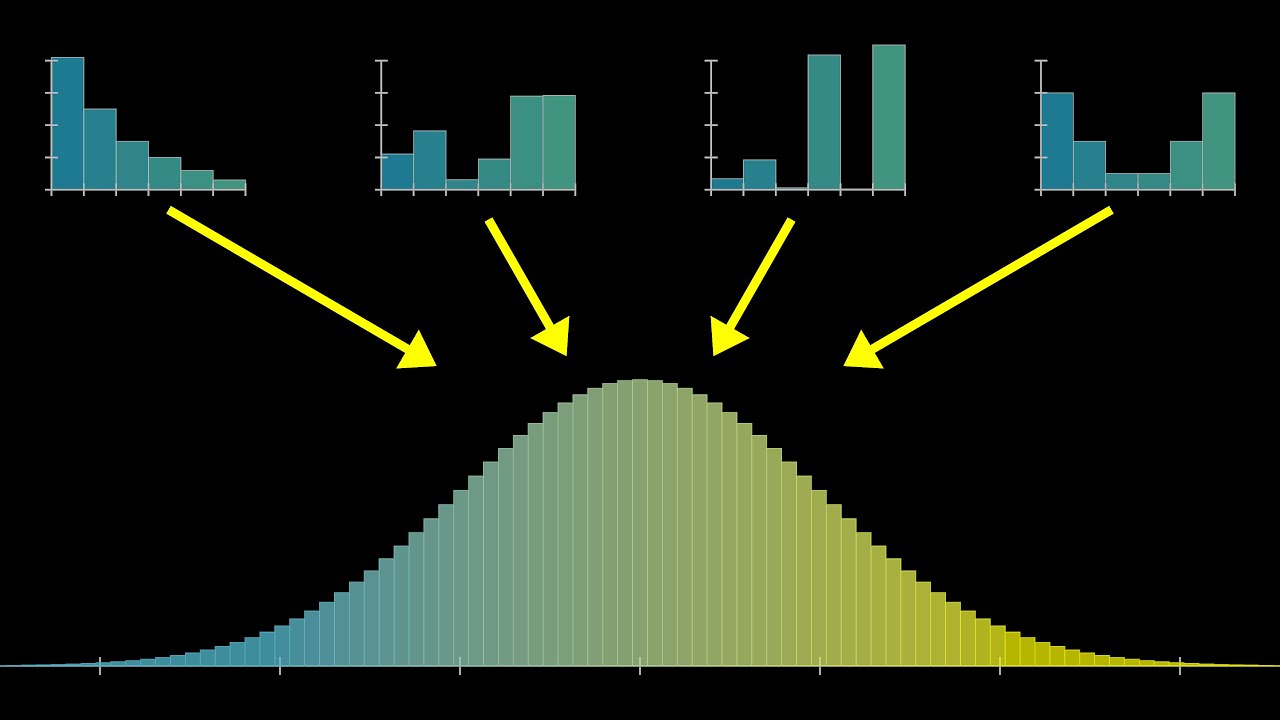
A visual introduction to probability's most important theorem
Help fund future projects: https://www.patreon.com/3blue1brown
Special thanks to these lovely supporters: https://www.3blue1brown.com/lessons/clt#thanks
An equally valuable form of support is to simply share the videos.
Galton board shown in the video: https://amzn.to/3ZJK8nY
------...
watch this later
now let go back to our problem
chilly scroll
okok
late zephyr
which sum have the most cases (two dice)
late zephyr
is it symmetric with the center at 7 ?
chilly scroll
late zephyr
continue
chilly scroll
is it not?
late zephyr
its 2+12/2 -1
late zephyr
okay
chilly scroll
yeye
late zephyr
let step back form our problem a bit
how many number are between the interval 1-10 contain
only integer
10 number right ?
chilly scroll
Ye
chilly scroll
Ye
chilly scroll
yes i know that rule for counting we subtract the extreme and add 1 rigg
late zephyr
the interval and the actual 'mark' is a bit different
chilly scroll
Oh
late zephyr
on your hand, there is 5 number
chilly scroll
yes
late zephyr
but 4 interval right ?
chilly scroll
interval?
late zephyr
the gap between your finger
 chilly scroll
Icic
chilly scroll
okay
late zephyr
if the thrid roll is 1
you sum up the cases for 2-10 right
thrid roll is 2
you sum up for 2-9
chilly scroll
ok
late zephyr
thrid rolls 2
you sum up for the cases 2-8
do the same thing for all third roll
and sum them all up
chilly scroll
ok wait
obtuse pebbleBOT
@chilly scroll Has your question been resolved?
obtuse pebbleBOT
Channel closed
Closed due to timeout
Use .reopen if this was a mistake.
Available help channel!
Send your question here to claim the channel.
Remember:
• Ask your math question in a clear, concise manner.
• Show your work, and if possible, explain where you are stuck.
• After 15 minutes, feel free to ping <@&286206848099549185>.
• Type the command .close to free the channel when you're done.
• Be polite and have a nice day!
Read #❓how-to-get-help for further information on how to ask a good question, and about conduct in the question channels.
 blissful bane
is the reason rolle’s theorem requires continuity on closed interval [a,b] is to have extremum value property of continuous functions on compact sets?
obtuse pebbleBOT
blissful bane
is the reason rolle’s theorem requires continuity on closed interval [a,b] is to...
blissful bane
like we can always guarantee existence of maximum/minimum with in the set unlike (a,b)
<@&286206848099549185>
 fathom flicker
blissful bane
is the reason rolle’s theorem requires continuity on closed interval [a,b] is to...
fathom flicker
blissful bane
is the reason rolle’s theorem requires continuity on closed interval [a,b] is to...
Do you have a proof of Rolle's theorem?
obtuse pebbleBOT
@blissful bane Has your question been resolved?
blissful bane
@fathom flicker yes my proof uses extremum value theorem of compact sets and interior extremum value
fathom flicker
blissful bane
<@779131727338930196> yes my proof uses extremum value theorem of compact sets a...
Well then there you have it
Examine what would go wrong in the proof if there was not guaranteed an extreme value
obtuse pebbleBOT
Channel closed
Closed due to timeout
Use .reopen if this was a mistake.
obtuse pebbleBOT
Available help channel!
Send your question here to claim the channel.
Remember:
• Ask your math question in a clear, concise manner.
• Show your work, and if possible, explain where you are stuck.
• After 15 minutes, feel free to ping <@&286206848099549185>.
• Type the command .close to free the channel when you're done.
• Be polite and have a nice day!
Read #❓how-to-get-help for further information on how to ask a good question, and about conduct in the question channels.
 summer sentinel
 obtuse pebbleBOT
summer sentinel
summer sentinel
obtuse pebbleBOT
summer sentinel
summer sentinel
!status
obtuse pebbleBOT
What step are you on?
1. I don't know where to begin.
2. I have begun but got stuck midway.
3. I got an answer but I was told that it's wrong.
4. I got an answer and would like my work checked.
5. I have a question about someone else's work/solution.
6. I have completed the problem and don't need help anymore. Thank you.
7. None of the above
 ember frost
how did you arrive to your answer?
ember frost
what was the original blood value?
summer sentinel
60/11
ember frost
what was the new blood value?
summer sentinel
6
ember frost
so how did you find the percent change?
ember frost
hm, it is 0.1 indeed
but the question asks for the percent
not the ratio
so what do you do?
summer sentinel
times 100?
ember frost
summer sentinel
their given answer is 10.09
the reason they gave this answer was because they didnt use 60/11 as its initial value
but rather its rounded-to-two-decimal-places value: 5.45

hence, 10.09%
ember frost
the more you know
since the problem asks the value be rounded to two decimal places, i suggest you obey it and dont use 60/11
obtuse pebbleBOT
Channel closed
Closed by @summer sentinel
Use .reopen if this was a mistake.
obtuse pebbleBOT
Available help channel!
Send your question here to claim the channel.
Remember:
• Ask your math question in a clear, concise manner.
• Show your work, and if possible, explain where you are stuck.
• After 15 minutes, feel free to ping <@&286206848099549185>.
• Type the command .close to free the channel when you're done.
• Be polite and have a nice day!
Read #❓how-to-get-help for further information on how to ask a good question, and about conduct in the question channels.
fathom flicker
 obtuse pebbleBOT
fathom flicker
fathom flicker
obtuse pebbleBOT
fathom flicker
fathom flicker
I have a question about my proof for this because it feels wrong but I can't find any issues
Let v1, ... vn be a basis of V since it is finite-dimensional, and let 1 be a basis of F.
Then I have a theorem that says there exists a unique linear map phi:V->F such that
phi(v_i)=w_i
and in this case since there is only one w_i and it is 1, we have a unique linear map phi:V-<F such that
phi(v_1)=1
So, my proof states that since v is non-zero, we can use it as the first basis vector of V, so letting v_1=v, and we can extend this to a basis
so we have phi(v)=1
Does that work?
 dense imp
can I ask some questions about this since I haven't taken LA since the age of dinosaurs? :p
fathom flicker
Sure
dense imp
what is V' ? and also what is F in the proof?
fathom flicker
every field is a vector space
and in our class F is either C or R, so 1-dimensional
dense imp
it doesn't seem that surprising that there would be such a function
fathom flicker
fathom flicker
Then I have a theorem that says there exists a unique linear map phi:V->F such t...
this theorem nessecitates that V and the space you're mapping on have the same dimension
so it breaks there
fathom flicker
dense imp
it doesn't seem that surprising that there would be such a function
no not at all, but my proof just feels way off
and it is so
any better ideas?
dense imp
isn't V' a vector space too
 wild swallow
i mean its not unique right
like if you set phi(v_1) = 1, you could also set phi(v_2) = whatever
wild swallow
well it actually does
fathom flicker

wild swallow
but you just stated some details which arent quite right
fathom flicker
the theorem I used is false here
 haughty coyote
fathom flicker
haughty coyote
fathom flicker
My idea:
||Complete v into a basis then let phi be the projection on the first coordinate||
 polar fossil
fathom flicker
Then I have a theorem that says there exists a unique linear map phi:V->F such t...
polar fossil
fathom flicker
Then I have a theorem that says there exists a unique linear map phi:V->F such t...
what exactly does this theorem state
wild swallow
the uniqueness is false
fathom flicker
polar fossil
what exactly does this theorem state
if v1, ..., vn a basis of V, and w1,... wn a basis of W, then there exists a unique linear map T:V->W such that T(v_i)=w_i
timid silo
@fathom flicker
The answer is literally simple
Think harder
Lol
It way easier than you think
wild swallow
Blud...
timid silo
I figured it out in less than 1 minutes
haughty coyote
haughty coyote
My idea:
||Complete v into a basis then let phi be the projection on the first c...
He's already aware that it fits in 2 lines
timid silo
In my head
haughty coyote
timid silo
I figured it out in less than 1 minutes
This isn't a lemme-flex-my-math-speed server
timid silo
haughty coyote
This isn't a lemme-flex-my-math-speed server
No i'm just sayings its easier
Hopefully it helps
dense imp
if you have any linear map T that has some vector v1 that isn't in the nullspace then T(v1) = f where f is nonzero right, then wouldn't the linear map 1/f T(v1) = 1
timid silo
ok
wild swallow
timid silo
I figured it out in less than 1 minutes
i figured it out in less than -2 years
haughty coyote
For anyone familiar with linalg, the answer should be "yeah it's obvious" in 5 seconds so you can process the question
Let's end this
polar fossil
 that theorem only guarantees uniqueness if they have the same dimensions but if one is lower dimension than the other it should still work right?
timid silo
@fathom flicker i'm assuming you're a beginner since you posted a very basic question. i didnt mean to come off as rude, sorry
polar fossil
timid silo
<@779131727338930196> i'm assuming you're a beginner since you posted a very bas...
you are not being helpful.
 zenith raft
who is this clown
fathom flicker
timid silo
<@779131727338930196> i'm assuming you're a beginner since you posted a very bas...
@polar fossil They're obviously trolling look at message history, do I need to tag mods or just you
haughty coyote
zenith raft
who is this clown
A newcomer that doesn't quite understand how positive helping works
zenith raft
i doubt he knows any linear algebra either
polar fossil
timid silo
please elaborate
no. leave this channel.
timid silo
haughty coyote
A newcomer that doesn't quite understand how positive helping works
im being falsely accused of trolling
timid silo
polar fossil
no. leave this channel.
ok
dense imp
@fathom flicker also if you wanna use that theorem you mentioned, could you consider the span(v1) as a 1 dim subspace of V and consider then the linear transformation that the theorem guarantees from span(v1) -> F then extend it into a LA defined on all of V
fathom flicker
timid silo
<@779131727338930196> i'm assuming you're a beginner since you posted a very bas...
 haughty coyote
dense imp
<@779131727338930196> also if you wanna use that theorem you mentioned, could y...
haughty coyote
dense imp
<@779131727338930196> also if you wanna use that theorem you mentioned, could y...
That's my proof but longer
timid silo
fathom flicker
it was a theoretical question.
please read the context before using any of my messages against me
polar fossil
you can pick where each basis vector ends up, right?
like independently of each other
dense imp
i think so?
wild swallow
this has a fancy name called the "universal property of vector spaces"
zenith raft
wild swallow
this has a fancy name called the "universal property of vector spaces"
that edit changed nothing
polar fossil
it actually changed two words
fathom flicker
Okay
so albeit with some inspiration from everyone
I have a new proof
Which hopefully works
fathom flicker
definitely not
Since v is in V and v !=0 span(V) is a 1D subspace of V with basis v. We can let 1 be a basis of F. Then by previously mentioned theorem there exists a unique linear map phi:span(v)->F such that phi(v)=1. Now we can extend v into a basis of V using w1, ... wn. Then we can extend phi to map all w_i ->0 and we have that phi:V->F has phi(v)=1.
This seems better, does it work?
wild swallow
idk why you want to use uniqueness
the question doesnt say that phi needs to be unique
fathom flicker
okay but using this theorem I dont have to justify thats a linear map
wild swallow
that theorem is specifically for vector spaces of the same dimension
fathom flicker
span(v) and F have the same dimension
wild swallow
you should know that for vector spaces, specifying where the basis maps to defines a unique linear map
polar fossil
wild swallow
you can just map v to 1
i mean that's exactly what the proof is asking
polar fossil
so you clearly can't assume it...
haughty coyote
fathom flicker
This seems better, does it work?
It's my proof yes
fathom flicker
why can u map v to 1
wild swallow
because its part of the basis
polar fossil
fathom flicker
Since v is in V and v !=0 span(V) is a 1D subspace of V with basis v. We can let...
this is basically what i was thinking, map one basis vector to 1 and the rest to 0
fathom flicker
why can u map any part of the basis to 1
haughty coyote
haughty coyote
My idea:
||Complete v into a basis then let phi be the projection on the first c...
Because there's a map made specifically for that purpose
wild swallow
because thats what vector spaces are
a map of vector spaces is uniquely determined by what happens on the basis
fathom flicker
so my answer should be "this is what vector spaces are, let phi(v)=1 q.e.d"
wild swallow
thats why matrices work
dense imp
@fathom flicker what about this:
extend v to a basis for V: {v, v2, v3...v_n}
for some vector w in V let {c1, c2,...c_n} be the unique coefficients of the linear combination of w in terms of the basis: i.e. w = c1(v)+c2(v2)+...c_n(v_n)
define phi(w) be the function where phi(w) = c1
you can verify this is a linear transformation V -> F so it is in V' and it fulfills the property phi(v) = 1
wild swallow
it pretty much should be
fathom flicker
dense imp
<@779131727338930196> what about this:
extend v to a basis for V: {v, v2, v3......
I think that also works
fathom flicker
haughty coyote
It's my proof yes
But Bezier thinks mine works too
so we're all having fun proving this
except Snow
dense imp
😄
wild swallow
this is all just spelling out the fact that a linear map is determined by its values on a basis
dense imp
isnt linear algebra all about expressing the same thing in like a zillion ways
fathom flicker
No it is about y=mx+b
haughty coyote
dense imp
<@779131727338930196> what about this:
extend v to a basis for V: {v, v2, v3......
We call those projections
haughty coyote
fathom flicker
No it is about y=mx+b
That's affine algebra
wild swallow
note that phi doesnt need to be 0 elsewhere