#help-10
1 messages · Page 278 of 1
 obtuse pebbleBOT
 keen bobcat
i can only get that theyre equal but the condition says they cant be
no calculator allowed
obtuse pebbleBOT
@keen bobcat Has your question been resolved?
obtuse pebbleBOT
@keen bobcat Has your question been resolved?
Channel closed
Closed by @keen bobcat
Use .reopen if this was a mistake.
 Available help channel!
Send your question here to claim the channel.
Remember:
• Ask your math question in a clear, concise manner.
• Show your work, and if possible, explain where you are stuck.
• After 15 minutes, feel free to ping <@&286206848099549185>.
• Type the command .close to free the channel when you're done.
• Be polite and have a nice day!
Read #❓how-to-get-help for further information on how to ask a good question, and about conduct in the question channels.
 obtuse pebbleBOT
 timid silo
timid silo
timid silo
Help me !!
 robust sleet
,rotate
 warm shaleBOT
 timid silo
?
 median dome
pretty sure you can u sub after diving numerator and denominator by sin^2(x)
median dome
timid silo
Nahh bro not helping
i just solved it using that
timid silo
Send pls
median dome
$\int\frac{3+2\cos(x)}{(2+3\cos(x))^2} dx = \int\frac{3\csc^2(x)+2\csc(x)\cot(x)}{(2\csc(x)+3\cot(x))^2} dx$
warm shaleBOT
kheerii
 median dome
now just substitute $u=2\csc(x)+3\cot(x)$ to get $du=2\csc(x)\cot(x)+3\csc^2(x)$
warm shaleBOT
kheerii
 timid silo
Thanks u mate
obtuse pebbleBOT
@timid silo Has your question been resolved?
obtuse pebbleBOT
Channel closed
Closed due to timeout
Use .reopen if this was a mistake.
Available help channel!
Send your question here to claim the channel.
Remember:
• Ask your math question in a clear, concise manner.
• Show your work, and if possible, explain where you are stuck.
• After 15 minutes, feel free to ping <@&286206848099549185>.
• Type the command .close to free the channel when you're done.
• Be polite and have a nice day!
Read #❓how-to-get-help for further information on how to ask a good question, and about conduct in the question channels.
Channel closed
Closed by @torpid dagger
Use .reopen if this was a mistake.
Available help channel!
Send your question here to claim the channel.
Remember:
• Ask your math question in a clear, concise manner.
• Show your work, and if possible, explain where you are stuck.
• After 15 minutes, feel free to ping <@&286206848099549185>.
• Type the command .close to free the channel when you're done.
• Be polite and have a nice day!
Read #❓how-to-get-help for further information on how to ask a good question, and about conduct in the question channels.
 neat bobcat
How do u diffrentiate H = 2.5x(2-x)
obtuse pebbleBOT
neat bobcat
How do u diffrentiate H = 2.5x(2-x)
 wooden cipher
With respect to?
obtuse pebbleBOT
@neat bobcat Has your question been resolved?
neat bobcat
wooden cipher
With respect to?
Wdym
neat bobcat
 empty cypress
you can just multiply it out then do power rule, if thats teh case
empty cypress
you can just multiply it out then do power rule, if thats teh case
Yea i did that but hte answer is 2 apparntly and i got 1
wooden cipher
!original
obtuse pebbleBOT
Please show the original problem, exactly as it was stated to you, with the entire original context. A picture or screenshot is best. If the original problem is not in English, then post it anyway! The additional context might still be helpful. Do your best to provide a translation.
 obtuse pebbleBOT
@neat bobcat Has your question been resolved?
 fallen inlet
obtuse pebbleBOT
fallen inlet
obtuse pebbleBOT
@neat bobcat Has your question been resolved?
obtuse pebbleBOT
@neat bobcat Has your question been resolved?
obtuse pebbleBOT
Channel closed
Closed by @neat bobcat
Use .reopen if this was a mistake.
obtuse pebbleBOT
Available help channel!
Send your question here to claim the channel.
Remember:
• Ask your math question in a clear, concise manner.
• Show your work, and if possible, explain where you are stuck.
• After 15 minutes, feel free to ping <@&286206848099549185>.
• Type the command .close to free the channel when you're done.
• Be polite and have a nice day!
Read #❓how-to-get-help for further information on how to ask a good question, and about conduct in the question channels.
 full oar

 quartz girder
Do you know the definition of being perpendicular?
quartz girder
negative reciprocal right?
full oar
doesn’t that depend on the number tho?
like it was already -2
I would change it into 2
quartz girder
If m = x then m perpendicular = -1/x
full oar
oh ok
full oar
quartz girder
If m = x then m perpendicular = -1/x
what if it was m = -x tho?
would it be X?
full oar
yea
quartz girder
There ya go that should be enough to solve every question
full oar
so it’s just -(1/-x)
quartz girder
Which would be 1/x
full oar
ok
full oar
quartz girder
I'd think infinity but honestly depends on the teacher
btw could u check this for me?
quartz girder
but technically the slope of perpendicular to a horizontal line would have infinite slope
full oar
 full oar
quartz girder
but technically the slope of perpendicular to a horizontal line would have infin...
full oar
quartz girder
but technically the slope of perpendicular to a horizontal line would have infin...
can u double check for me pls?
.close
obtuse pebbleBOT
Channel closed
Closed by @full oar
Use .reopen if this was a mistake.
Available help channel!
Send your question here to claim the channel.
Remember:
• Ask your math question in a clear, concise manner.
• Show your work, and if possible, explain where you are stuck.
• After 15 minutes, feel free to ping <@&286206848099549185>.
• Type the command .close to free the channel when you're done.
• Be polite and have a nice day!
Read #❓how-to-get-help for further information on how to ask a good question, and about conduct in the question channels.
 fathom flicker
 obtuse pebbleBOT
fathom flicker
fathom flicker
obtuse pebbleBOT
fathom flicker
fathom flicker
I was hoping someone could double check my proof for this
warm shaleBOT
Austin
 fathom flicker
So we can write for all x in R, g(x)=C
then applying the MVT instead to f, tells us for all alpha, beta in R, there exists a gamma such that
f'(gamma)=g(gamma)=((f(alpha)-f(beta))/(alpha-beta)
but, g(gamma)+C for all gamma in R, so in other words,
the slope between any two points alpha, beta of our function f, is always C. So f is linear
 frank dome
fathom flicker
then applying the MVT instead to f, tells us for all alpha, beta in R, there exi...
frank dome
fathom flicker
then applying the MVT instead to f, tells us for all alpha, beta in R, there exi...
yep, this proof seems pretty correct to me
fathom flicker
I am mostly wondering about that last line. Is it reason enough to show that the secant line between any two points always having constant slope implies a function is linear? It seems like it should
Maybe that also requires proof
I don't have a definition for a function being linear so that doesn't necessarily help
frank dome
it really doesnt, since if slope is constant, let the slope be m, then the function has to be f(x) = mx + b
the degree of the polynomial has to be 1, otherwise you wouldnt have constant slope
fathom flicker
Well
who knows we are dealing with polynomials here?
and also that is sort of what I am trying to prove no?
TY Nalin, I've got it sorted out
.close
obtuse pebbleBOT
Channel closed
Closed by @fathom flicker
Use .reopen if this was a mistake.
Available help channel!
Send your question here to claim the channel.
Remember:
• Ask your math question in a clear, concise manner.
• Show your work, and if possible, explain where you are stuck.
• After 15 minutes, feel free to ping <@&286206848099549185>.
• Type the command .close to free the channel when you're done.
• Be polite and have a nice day!
Read #❓how-to-get-help for further information on how to ask a good question, and about conduct in the question channels.
obtuse pebbleBOT
@grizzled geyser Has your question been resolved?
Channel closed
Closed by @grizzled geyser
Use .reopen if this was a mistake.
Available help channel!
Send your question here to claim the channel.
Remember:
• Ask your math question in a clear, concise manner.
• Show your work, and if possible, explain where you are stuck.
• After 15 minutes, feel free to ping <@&286206848099549185>.
• Type the command .close to free the channel when you're done.
• Be polite and have a nice day!
Read #❓how-to-get-help for further information on how to ask a good question, and about conduct in the question channels.
 gaunt walrus
Math concept problem: Can I visualize a quadratic equation with complex roots?
obtuse pebbleBOT
gaunt walrus
Math concept problem: Can I visualize a quadratic equation with complex roots?
gaunt walrus
I know the curve doesn't intersect with x-axis
But what about complex plane?
Can I visualize it in complex plane?
empty cypress
<@&268886789983436800>
gaunt walrus
So it is possible?
for three dimentional (x,y,i) ?
<@&286206848099549185>
<@&286206848099549185>
Am I correct with the concept?
obtuse pebbleBOT
@gaunt walrus Has your question been resolved?
 tiny seal
gaunt walrus
Am I correct with the concept?
tiny seal
gaunt walrus
Am I correct with the concept?
if you mean what i think you do, youd need 4 dimensions
so, you could, it just wouldnt make too much sense
just do (x,y,i), then you are viewing everything as a slice of 4d space
just vary the other value with time
obtuse pebbleBOT
Channel closed
Closed due to timeout
Use .reopen if this was a mistake.
obtuse pebbleBOT
Available help channel!
Send your question here to claim the channel.
Remember:
• Ask your math question in a clear, concise manner.
• Show your work, and if possible, explain where you are stuck.
• After 15 minutes, feel free to ping <@&286206848099549185>.
• Type the command .close to free the channel when you're done.
• Be polite and have a nice day!
Read #❓how-to-get-help for further information on how to ask a good question, and about conduct in the question channels.
 runic void
$z_n = Arg \left( -1 +\frac{1}{n} \right)$
obtuse pebbleBOT
runic void
$z_n = Arg \left( -1 +\frac{1}{n} \right)$
warm shaleBOT
.doc
 runic void
I'm asked to find the limit of this sequence
$\lim_{n \to \infty} zn = Arg \left( \lim_{n \to \infty}-1 +\frac{1}{n} \right)$ Is this notation correct?
timid silo
i see the helper needs help
runic void
i'm helpful, not a helper
timid silo
how did you get the helpful role?
 royal basin
you've got some missing underscore issues
royal basin
timid silo
how did you get the helpful role?
!redir
obtuse pebbleBOT
timid silo
how did you get the helpful role?
This channel is only for on-topic discussion. Please take casual conversation to #discussion or #chill.
warm shaleBOT
.doc
 warm shaleBOT
AnnGhost
 royal basin
for all n
runic void
i can just take the limit inside the argument right?
sort of felt little off to do so
obtuse pebbleBOT
Channel closed
Closed by @runic void
Use .reopen if this was a mistake.
Available help channel!
Send your question here to claim the channel.
Remember:
• Ask your math question in a clear, concise manner.
• Show your work, and if possible, explain where you are stuck.
• After 15 minutes, feel free to ping <@&286206848099549185>.
• Type the command .close to free the channel when you're done.
• Be polite and have a nice day!
Read #❓how-to-get-help for further information on how to ask a good question, and about conduct in the question channels.
 lime sphinx
 obtuse pebbleBOT
lime sphinx
lime sphinx
obtuse pebbleBOT
lime sphinx
lime sphinx
Is there a formula to find this without drawing the graph
lime sphinx
lime sphinx
Is there a formula to find this without drawing the graph
The range
tiny seal
for 7?
the radicand must be positive, and we cannot divide by 0
so, if you see
$$\sqrt{g(x)}$$
then
$$g(x)\geq 0$$
warm shaleBOT
Cycadellic
 tiny seal
likewise,
$$\frac{1}{g(x)}$$
then
$$g(x)\neq 0$$
warm shaleBOT
Cycadellic

 tiny seal
no
tiny seal
use
$$\sqrt{g(x)}\geq 0$$
warm shaleBOT
Cycadellic
 tiny seal
for d, b, and e, use
$$\frac{1}{g(x)}\neq 0$$
warm shaleBOT
Cycadellic
 tiny seal
im not sure how to explain d without the limit, but ill try
$\frac{1}{\sqrt{x}}>0$ can be taken as a rule
warm shaleBOT
Cycadellic
 tiny seal
intuitively, (this is a big abuse in notation)
$$\sqrt{x} < \infty$$
$$\frac{1}{\sqrt{x}}>\frac{1}{\infty}$$
$$\frac{1}{\sqrt{x}}>0$$
warm shaleBOT
Cycadellic
 tiny seal
maybe somebody else can explain it better, but this should work fine
obtuse pebbleBOT
@lime sphinx Has your question been resolved?
obtuse pebbleBOT
Channel closed
Closed due to timeout
Use .reopen if this was a mistake.
Available help channel!
Send your question here to claim the channel.
Remember:
• Ask your math question in a clear, concise manner.
• Show your work, and if possible, explain where you are stuck.
• After 15 minutes, feel free to ping <@&286206848099549185>.
• Type the command .close to free the channel when you're done.
• Be polite and have a nice day!
Read #❓how-to-get-help for further information on how to ask a good question, and about conduct in the question channels.
lime sphinx
tiny seal
maybe somebody else can explain it better, but this should work fine
Oh okay
obtuse pebbleBOT
lime sphinx
Oh okay
lime sphinx
I think i kijda get it
Tyanks

Also isnt the domain for this x is real numbers cuz like i said this and someone else said it was wrong
But im pretty sure its correct
 high lily
how are you getting all real numbers for this
tiny seal
lime sphinx
its not because, remember how if $\sqrt{g(x)}$
then $g(x)\geq 0$
warm shaleBOT
Cycadellic
 lime sphinx
tiny seal
its not because, remember how if $\sqrt{g(x)}$
then $g(x)\geq 0$
lime sphinx
tiny seal
its not because, remember how if $\sqrt{g(x)}$
then $g(x)\geq 0$
This is what I did but im kinda confused

Is the vertext bit corect?
obtuse pebbleBOT
@lime sphinx Has your question been resolved?
tiny seal
sorry about the late reply
we dont care about the vertex, but you are very close
we are trying to solve the inequality
$(x+4)(x+2)>0$
warm shaleBOT
Cycadellic
 tiny seal
its very important to note though that when x<-4, x+2 is negative, so the ineq should flip when solving for this term
tiny seal
lime sphinx
This is what I did but im kinda confused
but youre almost done with this one
obtuse pebbleBOT
Channel closed
Closed due to timeout
Use .reopen if this was a mistake.
Available help channel!
Send your question here to claim the channel.
Remember:
• Ask your math question in a clear, concise manner.
• Show your work, and if possible, explain where you are stuck.
• After 15 minutes, feel free to ping <@&286206848099549185>.
• Type the command .close to free the channel when you're done.
• Be polite and have a nice day!
Read #❓how-to-get-help for further information on how to ask a good question, and about conduct in the question channels.
lime sphinx
tiny seal
sorry about the late reply
Its Okay thanks for trying yo help
obtuse pebbleBOT
lime sphinx
Its Okay thanks for trying yo help
lime sphinx
tiny seal
its very important to note though that when x<-4, x+2 is negative, so the ineq s...
Eait sorry i dont get this
tiny seal
we have $(x+4)(x+2)>0$
warm shaleBOT
Cycadellic
 tiny seal
we can divide (x+2) or (x+4) on both sides
treat (x+2) as you would a negative number
following
$$-a>b$$
$$1<\frac{b}{-a}$$
warm shaleBOT
Cycadellic
 tiny seal
treat (x+4) as you would a positive number
which just means we can divide both sides by (x+4) and the inequality does not change
obtuse pebbleBOT
@lime sphinx Has your question been resolved?
obtuse pebbleBOT
Channel closed
Closed due to timeout
Use .reopen if this was a mistake.
Available help channel!
Send your question here to claim the channel.
Remember:
• Ask your math question in a clear, concise manner.
• Show your work, and if possible, explain where you are stuck.
• After 15 minutes, feel free to ping <@&286206848099549185>.
• Type the command .close to free the channel when you're done.
• Be polite and have a nice day!
Read #❓how-to-get-help for further information on how to ask a good question, and about conduct in the question channels.
 toxic elm
For this question where is the point E?
 obtuse pebbleBOT
toxic elm
For this question where is the point E?
toxic elm
obtuse pebbleBOT
toxic elm
For this question where is the point E?
toxic elm
<@&286206848099549185>
obtuse pebbleBOT
toxic elm
<@&286206848099549185>
Please only use the <@&286206848099549185> ping once if your question has not been answered for 15 minutes. Please do not ping or DM individual users about your question.
 dark stirrup
toxic elm
For this question where is the point E?
dark stirrup
toxic elm
For this question where is the point E?
That's what you are tasked with finding out
obtuse pebbleBOT
@toxic elm Has your question been resolved?
Channel closed
Closed by @toxic elm
Use .reopen if this was a mistake.
Available help channel!
Send your question here to claim the channel.
Remember:
• Ask your math question in a clear, concise manner.
• Show your work, and if possible, explain where you are stuck.
• After 15 minutes, feel free to ping <@&286206848099549185>.
• Type the command .close to free the channel when you're done.
• Be polite and have a nice day!
Read #❓how-to-get-help for further information on how to ask a good question, and about conduct in the question channels.
 crystal shoal
need help with this

 obtuse pebbleBOT
crystal shoal
need help with this
crystal shoal
obtuse pebbleBOT
crystal shoal
need help with this
crystal shoal
this is what i came up with
 obtuse pebbleBOT
@crystal shoal Has your question been resolved?
crystal shoal
<@&286206848099549185> ping
obtuse pebbleBOT
@crystal shoal Has your question been resolved?
 warm dome
crystal shoal
need help with this
warm dome
crystal shoal
need help with this
What’s the task? Feel free to also post in German
crystal shoal
warm dome
What’s the task? Feel free to also post in German
ich soll zeigen, obdie rekursive funktion T(n) in einer der 3 ordnungen liegt per vollständige induktion
warm dome
crystal shoal
ich soll zeigen, obdie rekursive funktion T(n) in einer der 3 ordnungen liegt pe...
Steht dieses O bei der 1 für die Menge aller n^2?
crystal shoal
ja theta(n^)
warm dome
crystal shoal
need help with this
Sieht für mich so aus als wäre T(2)=10, was zu keinem passt. Oder hab ich da was übersehen?
warm dome
Jo dann hab ich das theta falsch interpretiert. Ich Google es mal kurz
crystal shoal
theta heißt dass t(n) für große n genauso schnell wächst wie die ordnung
warm dome
Ahhhh okay
crystal shoal
als eingabe sollen halt nur die zweierpotenzen n = 2^k angeschaut werden meint mein prof, das reicht für diese das zu zeigen
warm dome
Jap
crystal shoal
ich check halt nur gar nciht was ich machen soll
ich kenn halt Induktion nur anhand dieser kack summenformeln
und das man zeigt n -> n+1
jz is aber n = 2^k
warm dome
Ganz ehrlich, ich Checks auch nicht 😅 aber ich versuch’s noch zu verstehen
crystal shoal
lieb von dir
ich bräuchte halt nur ein beispiel wie man sowas angeht, aber da findet man im netz gar nix und der prof ist so asi und macht auch nix dazu
warm dome
Also die Idee ist dass theta(n^) gleich schnell steigen muss wie t(n)?
crystal shoal
umgekehrt
die rekursive funktion wächst für genug große n ind er ordnung theta(1. 2. oder 3.)
 crystal shoal
warm dome
Okay Ich glaub ich hab ne Idee <@653351602983272459>
crystal shoal
warm dome
Okay Ich glaub ich hab ne Idee <@653351602983272459>
das wäre coool 😭
warm dome
Ich hab mir grad das hier angeschaut
Wie wäre es, wenn wir konstanten c1 und c2 festlegen und schreiben dass
c1*n^2<=T(n)<=c2*n^2
Und dann zeigen dass das gleiche dann auch für T(n+1) gelten muss
Keine Ahnung ob das klappt
Aber wir sollten es mal versuchen
$$c_1n^2\leq T_2(n)\leq c_2n^2\Rightarrow c_14n^2\leq T_2(2n)\leq c_24n^2$$
Das müssen wir zeigen oder zeigen dass es nicht zutrifft
warm dome
Ja stimmt
warm shaleBOT
FirstNameLastName
 crystal shoal
wenn n = 2^k ist, dann müsste man 2^k+1 zeigen
warm dome
Genau
crystal shoal
ich versuch mal den ansatz
crystal shoal
ich komm nur auf salat
man müsste ja für jede ordnung zeigen, das es für >= und <= gilt
für jeden fall dann eine vollständige induktion
warm dome
Ja
crystal shoal
ich glaube das war nicht vom prof so vorhergesehen
man müsste sofort die vollstädnige induktion anwenden und käme dann auf eine ordnung
aber verstehen tue ich deinen ansatz
oh mann
warm dome
$$T_2(8n)=4T_2(4n)+8n$$
$$T_2(8n)=256T_2(n/2)+120n$$
$$T_2(4n)=4T_2(2n)+4n$$
$$T_2(4n)=64T_2(n/2)+28n$$
$$T_2(2n)=4T_2(n)+2n$$
$$T_2(2n)=16T_2(n/2)+6n$$
$$T_2(n)=4T_2(n/2)+n$$
crystal shoal
check ich nicht xd
warm shaleBOT
FirstNameLastName
 warm dome
Vielleicht ist es doch n^2
Man hat das alte mal 4
Und dann + das in den Klammern vom neuen
$$T_2(2n)=4T_2(n)+2n$$
warm shaleBOT
FirstNameLastName
 warm dome
$$(2n)^2=4n^2$$
warm shaleBOT
FirstNameLastName
 warm dome
@crystal shoal wie findet man denn die Ordnung normalerweise
crystal shoal
bei ner normalen funktion kann man den limit berechnen
also sagen wir zb 2n^2 + n + 3 element O(n^2), dan bildet man den grenzwert 2n^2 + n + 3 / n^2 und je nachdem wie das ergebnis ist liegt das in der ordnung
oder man zeigt halt dass es ein c gibt sodas 0 < f(x) < c* g(x)
warm dome
crystal shoal
oder man zeigt halt dass es ein c gibt sodas 0 < f(x) < c* g(x)
Okay ich glaube das lässt sich für c=3 machen
Ach was weiß ich
crystal shoal
xd
crystal shoal
warm dome
Ach was weiß ich
trotzdem danke für deine mühe
warm dome
Kein Ding. Bisschen frustrierend dass ich’s nicht gelöst kriege
Poste die Aufgabe vielleicht nochmal auf englisch in nem neuen Channel, ich glaub hier kriegst du keine Hilfe mehr
crystal shoal
ist für mich auch frustrerend weil wir einfach keine hilfe vom prof kriegen
.close
obtuse pebbleBOT
Channel closed
Closed by @crystal shoal
Use .reopen if this was a mistake.
Available help channel!
Send your question here to claim the channel.
Remember:
• Ask your math question in a clear, concise manner.
• Show your work, and if possible, explain where you are stuck.
• After 15 minutes, feel free to ping <@&286206848099549185>.
• Type the command .close to free the channel when you're done.
• Be polite and have a nice day!
Read #❓how-to-get-help for further information on how to ask a good question, and about conduct in the question channels.
 split furnace
These equations are certain to have the solution x = y = 0. For which values of 'a' is there a whole line of solutions?
ax + 2y = 0,
2x + ay = 0.
obtuse pebbleBOT
split furnace
These equations are certain to have the solution x = y = 0. For which values of ...
split furnace
The instructor has marked the answer as a = 0.
But I don't quite get it.
If a=0, the equations become,
y = 0,
x = 0
And they only have a unique solution at (x, y) = (0, 0).
How's it the case then, they have a whole line of solutions?
 minor belfry
hmm
lemme read
does x=y always?
are we assuming that?
if x=y=0, a can be anything
split furnace
minor belfry
are we assuming that?
Nope, we aren't assuming that.
minor belfry
okay im not sure exactly what this question is asking
but
if a = 0
then u get the equations 2y = 0
2x = 0
which means both are always true
if u take a = 1
u get x + 2y = 0
2x + y = 0
if u rearrange
u get x = -2y
-4y + y = 0
-3y = 0
y = 0
a = 5
2x + 5y = 0, 5x + 2y = 0
x = -(5/2)y
if u sub in, y = 0 again
split furnace
minor belfry
2x + 5y = 0, 5x + 2y = 0
Yeah, these too intersect at (0, 0)
median dome
split furnace
The instructor has marked the answer as a = 0.
But I don't quite get it.
If a=0...
a=0 is incorrect
you want the two lines to be coinciding basically
minor belfry
so i guess for all a values, x = y = 0
median dome
minor belfry
so i guess for all a values, x = y = 0
no
median dome
it is correct, but that's not what's being asked
for there to be a whole line of solutions, the two lines must be coinciding
minor belfry
ohh thats what it means
split furnace
minor belfry
okay im not sure exactly what this question is asking
If I may reframe it for you, the question is - find a value of 'a' such that the system,
ax + 2y = 0
2x + ay = 0,
Has infinitely many solutions.
median dome
i.e the two equations are equal or proportional to one another
split furnace
median dome
a=0 is incorrect
Okay
split furnace
median dome
for there to be a whole **line** of solutions, the two lines must be coinciding
Yes
minor belfry
split furnace
If I may reframe it for you, the question is - find a value of 'a' such that the...
yes this makes more sense now
split furnace
median dome
i.e the two equations are equal or proportional to one another
Ohh, then a = 2?
minor belfry
sorry when u said line, i didnt realise u meant a literal line
median dome
split furnace
Ohh, then a = 2?
yep
split furnace
minor belfry
sorry when u said line, i didnt realise u meant a literal line
Hehe, I see
split furnace
median dome
yep
Nice..
I assumed the instructor's answer was true, and was worried how.
split furnace
minor belfry
yea sorry, a=2 is definitely the answer
Yeah
median dome
minor belfry
there are 2 solutions
how's that?
split furnace
minor belfry
there are 2 solutions
Which ones?
median dome
oh yea
median dome
+-2
minor belfry
what else could there be
minor belfry
split furnace
Which ones?
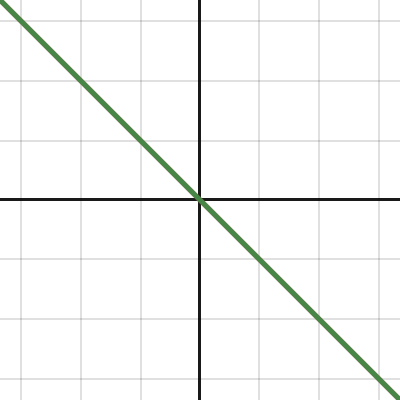
Desmos
split furnace
Oh right. a = ± 2, that's what you guys mean..?
minor belfry
try moving the slider, it might be interesting for u to see why this question is like it is
minor belfry
split furnace
Oh right. a = ± 2, that's what you guys mean..?
yep
split furnace
minor belfry
try moving the slider, it might be interesting for u to see why this question is...
Okay!
minor belfry
then ull get y = x
minor belfry
split furnace
Okay!
its not necessary, but i think visually having an understanding is good, and something like -2 is easy to miss
split furnace
minor belfry
its not necessary, but i think visually having an understanding is good, and som...
True.
minor belfry
if u look algebraically, -2x + 2y = 0 => -(2x-2y) = 0 => 2x-2y=0 {u can just divide out the -1}
just something to look out for
im assuming u havent done polynomials yet
ull learn eventually that $x^2 = 4 \implies x = \pm 2$
split furnace
minor belfry
im assuming u havent done polynomials yet
😭i have
This was a question from Strang's book on Linear Algebra
warm shaleBOT
shavet
 minor belfry
split furnace
This was a question from Strang's book on Linear Algebra
minor belfry
split furnace
This was a question from Strang's book on Linear Algebra
oh wow i see
good on u aha
split furnace
I mean, I'm familiar with a good amount of math stuff, like group, rings, fields, metric spaces, etc.
But I suck at visualising and solving things.
minor belfry
ah yea thats alright
median dome
minor belfry
im assuming u havent done polynomials yet
I would recommend not passing these types of comments to OP.
split furnace
warm shale
**shavet**
Yes
minor belfry
median dome
I would recommend not passing these types of comments to OP.
yea fair enough lmao
minor belfry
split furnace
Yes
sorry ahah, i thought u hadnt done polynomials
split furnace
minor belfry
sorry ahah, i thought u hadnt done polynomials
No no, it's fine lol.
I'm redoing a lot of forgotten stuff rn
Anyway, thanks @minor belfry and @median dome !
minor belfry
all good lol
split furnace
.close
obtuse pebbleBOT
Channel closed
Closed by @split furnace
Use .reopen if this was a mistake.
Available help channel!
Send your question here to claim the channel.
Remember:
• Ask your math question in a clear, concise manner.
• Show your work, and if possible, explain where you are stuck.
• After 15 minutes, feel free to ping <@&286206848099549185>.
• Type the command .close to free the channel when you're done.
• Be polite and have a nice day!
Read #❓how-to-get-help for further information on how to ask a good question, and about conduct in the question channels.
 dense tinsel
How do I do this
 obtuse pebbleBOT
dense tinsel
How do I do this
minor belfry
obtuse pebbleBOT
dense tinsel
How do I do this
minor belfry
what are you trying to do
minor belfry
okay so you assume they are similar?
dense tinsel
I have to do something with k^2
 alpine bison
what's your elo?
dense tinsel
minor belfry
okay so you assume they are similar?
Book says they are
dense tinsel
alpine bison
what's your elo?
1400 usually why
minor belfry
??
minor belfry
alpine bison
what's your elo?
bruh
minor belfry
dense tinsel
Book says they are
okay great
dense tinsel
minor belfry
??
Chess stuff
minor belfry
if i have a line thats 3cm
alpine bison
i think it was higher because there is GM in your nick...nvm just curious
minor belfry
thats why he is asking ahahhha
okay now
if u have a line thats 3cm, vs a line thats 2cm
dense tinsel
Oh haha i do it cuz it looks nice
minor belfry
whats the reduction in size
dense tinsel
Dude i did 3/2
dense tinsel
holdup
dense tinsel
Oh you take off a 3rd?
alpine bison
wow dennis do you know italian ..me too
minor belfry
yea, same as multiplying by 2/3
dense tinsel
alpine bison
wow dennis do you know italian ..me too
Ho capito vai via sto studiando
minor belfry
subtracting isnt ideal when u are going between stuff like this, its all about proportions
now
if i have a square thats 2x2 whats the area
dense tinsel
4
alpine bison
sorry
minor belfry
if i halve the lengths of each side what do i get
dense tinsel
alpine bison
sorry
👍💀
minor belfry
if i multiply by 1/2
dense tinsel
2?
dense tinsel
Oh wait no 1
minor belfry
yea
dense tinsel
Ok
dense tinsel
4?
minor belfry
1x1 square
dense tinsel
sorry im a poor learner
dense tinsel
ok
minor belfry
1x1 square area?
dense tinsel
= 1
minor belfry
if i triple the length of each side, what is the length of each side
dense tinsel
it becomes 9?
minor belfry
yea
whats the correlation
ill give a hint
what unit do u use for a length vs area
dense tinsel
meters?
dense tinsel
^2
minor belfry
yep exactly
minor belfry
meters ^ 2
dense tinsel
im cooking rn gimme a sec
 dense tinsel
right well i was cooking but i made some inedible steak
i have no idea what to do with the ^2
minor belfry
 minor belfry
dense tinsel
i have no idea what to do with the ^2
minor belfry
dense tinsel
i have no idea what to do with the ^2
lets look at the square example
1x1 = 1
3x3 = 9
i triple the side length
dense tinsel
wait a second
minor belfry
and the area is x9
warm shaleBOT


 minor belfry
thats an awfull decimal
minor belfry
but the fraction is way nicer
dense tinsel
LADIES AND GENTLEMEN
minor belfry
dense tinsel
HOLY SHIT
yes lo
minor belfry
alright brother
alpine bison
dense tinsel
WE MCFUCKING GOT EM
gg dennis
 minor belfry
okay
dense tinsel
so we know that the scale factor is
minor belfry
lets first see what we can work out
dense tinsel
holdup
dense tinsel
alright
that would be 5/3?
like we root the top and bottom
or we can't do that?
dense tinsel
idk cuz i feel like simplyfying
minor belfry
we are comparing the two areas
we are going from big to small
so the big number on top
25/9
dense tinsel
right my simplifying got us nowhere forget it
dense tinsel
25/9 = 8/x
minor belfry
but 16/9 -> 16/9
dense tinsel
cross multiplication
dense tinsel
alright
dense tinsel
yes
dense tinsel
you make 1 = 3 and square that
dense tinsel
1 * 9
minor belfry
x9
great
now
i know that my small square has side length 1
but my big square, has side length x
and i wanna work out what to do
before, i was using length to work out area right?
dense tinsel
yes'
minor belfry
in the previous question
so i was going
m -> m^2
when comparing areas
im going m^2 -> m
right?
minor belfry
dense tinsel
what if x = 9
in ur question?
dense tinsel
forget that i spoke
minor belfry
minor belfry
im going m^2 -> m
is this true?
dense tinsel
well yes
minor belfry
when i went m -> m^2, what did i do to the scaling factor
minor belfry
dense tinsel
dude im stupid this math unit is a bitch fr ong
its alright we get this bread
dense tinsel
minor belfry
when i went m -> m^2, what did i do to the scaling factor
your smartass squared it
minor belfry
okay
so
if im going
m^2 -> m, (to use area to find length), what do u think i do to the scaling factor
dense tinsel
u rooted it
minor belfry
yea
so
what do u think u do in ur question
u wanna try and cook
ive got cm^2, and im trying to work out x cm
any ideas?
dense tinsel
do we square root 8
minor belfry
not quite
ill make a quick question
if i have a square thats 16 cm^2 and 4 cm^2
how do i go from 16 -> 4
minor belfry
yep divide by 4
dense tinsel
dude you wanna go in a vc
dense tinsel
ok
minor belfry
and what area gives u 4 cm^2
dense tinsel
minor belfry
okay what length square gives u 16cm^2
4
dense tinsel
minor belfry
and what area gives u 4 cm^2
2
dense tinsel
yes
minor belfry
one is cm^2
one is cm
when we went from cm -> cm^2, we squared the scaling factor
so if we go from cm^2 -> cm, what do we do to scaling factor
dense tinsel
@minor belfry
minor belfry
okay ill give u the rule
minor belfry
dense tinsel
damn bro was here the whole tike
nah im just watching utube on my laptop
when u are converting between different types of units
i.e.
length -> area -> volume
u need to square, or cube, or the opposite if ur doing backwards
cube root, or square root
dense tinsel
ok
seeing as im doing backwards
please
tell me what i have to root
i do not understand
minor belfry
so u find a ratio between the lengths, then scale UP (length to area)
so now uve got areas and looking for length
so u find a ratio between areas (25 and 9)
then scale DOWN
(what would u have to do to change the ratio from area to length?)
dense tinsel
so i square ROOT 25/9 (2.777777778)?
 dense tinsel
 minor belfry
$\sqrt{\frac{25}{9}} = \frac{\sqrt{25}}{\sqrt{9}}$
warm shaleBOT
shavet
 minor belfry
dense tinsel
5/3
minor belfry
dense tinsel
5/3
perfect!
okay now
u can multiply the length u have by ur scaling factor
length * scaling factor = x
dense tinsel
and 5/3 being the scale factor?
minor belfry
yep
minor belfry
1 sec
ahh
so u did ur ratio wrong
so
when ur going from 25 -> 9
what do u multiply by
25 * something = 9
u can rearrange for that something
something = 9/25
dense tinsel
3.24
dense tinsel
0.36
is the answer
there is
absolutely no way x = 0.36
bcuz the answer is 4.8, i just dk how to reach it
minor belfry
3/5 is ur scaling factor
minor belfry
dense tinsel
3.24
i dont know what this is
dense tinsel
i thought it was 25/9
minor belfry
dense tinsel
i thought it was 25/9
no u got it back to front
dense tinsel
minor belfry
i dont know what this is
forget it
dense tinsel
minor belfry
no u got it back to front
oh yeah
minor belfry
 dense tinsel
ok so to get from 25 to 9 we multiply 25 by 0.36
dense tinsel
0.36 = 9/25...
dense tinsel
ok
minor belfry
then u do the stuff u do for
dense tinsel
oh yeah that becomes 3/5 ok
minor belfry
cm^2 -> cm
yep
then thats ur scaling factor
so x = length * scaling factor
sqrt(9/25) = 3/5
dense tinsel
x = 8 * 3/5?
minor belfry
$\sqrt{\frac{9}{25}} = \frac{\sqrt{9}}{\sqrt{25}} = \frac{3}{5}$
minor belfry
dense tinsel
x = 8 * 3/5?
yep
warm shaleBOT
shavet
 dense tinsel
NAH BRO COOKED A WHOLE BANQUET
minor belfry
ez
dense tinsel
IGHT
we got three more buckaroo
:)
#4

Rotate it somehow idk
@minor belfry
what im doing first is
minor belfry
three more??
dense tinsel
im detailing everything
dense tinsel
minor belfry
three more??
yeah it's gonna get easier dw
i know some of this stuff better
minor belfry
okay go ahead
dense tinsel
ill send another pic
wait hold it
alright so

letter A for #4 is easy
i just say they share angle A
now nto letter B
scale factor is...
scale factor is 24
deal?
minor belfry
are you working out CD
minor belfry
depends what ur working out
minor belfry
are we working out the area of the big triangle?
dense tinsel
now we are
minor belfry
okay
minor belfry
do u have the actual solution?
minor belfry
okay
dense tinsel
is 24 the scale factor or the area of the entire triangle
it's gotta be the scale factor right
minor belfry
okay so what do we have from both triangles
and what are we missing from one triangle
alpine bison
gmdennis i have to go, good luck for your chess career! ciao
dense tinsel
ciao fra
dense tinsel
minor belfry
what do we have that we can compare between triangles
hmm
they're both similar
well
we know that length AD = 10
minor belfry
aka, side length of big triangle
dense tinsel
and that CD and BE are parallel
minor belfry
what else do we have
dense tinsel
dense tinsel
and that CD and BE are parallel
?
minor belfry
dense tinsel
?
not what im looking for
a number
something to compare
we have big side length = 10
dense tinsel
triangle ABE = 16cm^2
minor belfry
okay
anything elsle
one more thing
something to compare from small triangle to big triangle
minor belfry
thats okay
so
we know that the small triangle is length 4
right?
and the big triangle is length 10
dense tinsel
yes
dense tinsel
oH WAIT
minor belfry
what do u do
dense tinsel
BOTH SIDES ARE ALSO 6 AND 4
minor belfry
dense tinsel
BOTH SIDES ARE ALSO 6 AND 4
nono, 6 is the trick number
dense tinsel
minor belfry
to go from 4 -> 10
- 2.5?
minor belfry
do not use 6
dense tinsel
THAT'S THE SCALE FACTOR THAT'S WHAT THE BOOK GOT
minor belfry
yes
dense tinsel
LETSSE GO
minor belfry
okay now
we have a length
and we want to scale an area
i.e.
cm -> cm^2
so what do we do to the scaling factor
{cm -> cm^2}
minor belfry
dense tinsel
so 5/2 is the scale factor
5/2 is how u go from length on small triangle to big triangle LENGTH
and AREA is LENGTH SQUARED
so u do 5/2 squared
i.e. 6.25
minor belfry
its tricky to get working in ur head
minor belfry
did it work
okay im gonna say something, and i want you to really think about it
if i have a length on a small object
and am scaling it up by a factor of 3, then i just multiply the length
if im comparing lengths, then want to find an area
minor belfry
then i need to multiply by the factor used by length squared
since area is length squared
minor belfry
dense tinsel
I GOT ALL OF IT
bet
minor belfry
yes
minor belfry
bruh alright
 minor belfry
yes
dense tinsel
by close you mean 170 units off but ok
 minor belfry
try comma rotate
dense tinsel
 dense tinsel
there we go
minor belfry
minor belfry
what unit is length, what unit is volum
this
dense tinsel
lemme draw it real quick
minor belfry
draw what?
minor belfry
how do u go from cm to cm^3
dense tinsel
in my notes
minor belfry
u cube it right?
dense tinsel
you cube
minor belfry
dense tinsel
in my notes
bet
minor belfry
dense tinsel
you cube
perfect