#help-10
1 messages · Page 235 of 1
 meager elm
 meager elm
Can I show you a table and lmk if it's the same one as the one above
 hollow dove
sure
 hollow dove
yeah
the table I gave is basically just the 5 rightmost columns
they have the same values
meager elm
I used this table and did the formulas but I didn't get the same answer as the answer key (18.9 mpg to 20.9 mpg)
hollow dove
what did you get instead?
hollow dove
yeah
hollow dove
is there 83 on your table?
hollow dove
meager elm
this one
meager elm
Nope
hollow dove
I guess it wanted you to look it up then
since it says "use technology" in the question
I'm trying to find a table with it lol
meager elm
This is what it shows near the end of the table
 hollow dove
yeah, found a calculator for it, it should be 1.6634
which just about agrees with that table
meager elm
I don't want to use technology because I want to be able to use the table only since we can't use technology on future tests LOL
hollow dove
I don't think they'd ask you for a value not on the table then
meager elm
I hope not omggg😭
So it would be impossible to do a question that's not on the table, right
hollow dove
yeah, I don't think doing the integral to find the t-values would be reasonable, or expected of you
hollow dove

T TABLE
Find in this t table (same as t distribution table, t score table, Student’s t table) t critical value by confidence level & DF for the Student’s t distribution.

the calculator takes the significance level in terms of the area outside
so 0.1 rather than 0.9 for the 90% significance in the question
meager elm
Could you explain again why it would be 0.1 instead of 0.9
My dumb ass would put 0.9 LOL
Will it always be 0.1?
hollow dove
that's reasonable, it's just how they designed it
so, we're looking for the values where the area under the pdf of the t-distribution is 0.9
but they've made the calculator such that you give it the area outside the region instead
meager elm
Ah, I see! Is there another calculator I could use where I wouldn't have to put 0.1 and would just type in what's given in the question (e.g., 0.90 confidence level and 83 degrees of freedom)? Is the calculator on AlphaWolf the same? Would I have to put 0.1 as well?
hollow dove
oh, actually, it's a phrasing thing
90% confidence interval is the same thing as the 10% significance level on the two tails
that's why
meager elm
If I put 0.90 instead, I'd get the wrong answer right lolll
meager elm
Can I think of it as 10% because 90+10 = 100
hollow dove
yeah, that's exactly why
we have a pdf of the t-distribution, and we're looking for two values (marked in blue)

such that the area between them is 0.9
that's the same as finding the values such that the areas on the outside is 0.1
that's all that's happening
meager elm
Could I just double check something and if I'm confused, I'll ask a quick question?
hollow dove
sure
meager elm
I'm sorry for being slow lolll
Ohhh, thank you for the visuals!! It really helps a lot
hollow dove
I'm very much not a probabilist/statistician, so that's fine
meager elm
But you're smart so hehe
Also, for this question, how do I know if it's one-tailed or two-tailed?
hollow dove
confidence interval indicates two-tailed
because it's like
interval is something on both sides
meager elm
What would be the key word in the question if it was one-tailed?
hollow dove
uhh
can't think of a sensible example right now, but if the question was on like, dice throws or something
and you have an outcome that's either unusually small or unusually large
then that would indicate one-tailed
since you're testing only for small/large (but not both)
it'd be that kind of thing, rather than specific wording I think
meager elm
Oh, I see!
Thank you again
I did the same method but with diff data and I got it wrong
I'm not sure what I'm doing incorrectly

I also used the website you shared with me
Df = 92 and significance lvl = 0.1
Two-tailed = 1.6616
hollow dove
what is it supposed to be?
ah wait
significance level is 0.05
it's a 95% confidence interval, not 90%
 obtuse pebbleBOT
@meager elm Has your question been resolved?
meager elm
Confused where and how they got > or equal to 5 from
 hollow dove
to approximate something with a normal distribution, you need np > 5 or so
or the approximation isn't very good
meager elm
Will it always be > or equal to 5 for every normal distribution
meager elm
Thank youuu
How do we know that it's greater than 5
Is there an instance where it could be less than or equal to 5
hollow dove
you should have both n and p
just multiply them
you also require nq > 5 as well, where q is the probability of the event not happening, or (1-p)
these conditions are basically because the normal distribution is symmetric
so if p is too small (or large), the distribution is too lop-sided to be approximated well, unless n is sufficiently large
obtuse pebbleBOT
@meager elm Has your question been resolved?
obtuse pebbleBOT
Channel closed
Closed due to timeout
Use .reopen if this was a mistake.
obtuse pebbleBOT
 Available help channel!
Send your question here to claim the channel.
Remember:
• Ask your math question in a clear, concise manner.
• Show your work, and if possible, explain where you are stuck.
• After 15 minutes, feel free to ping <@&286206848099549185>.
• Type the command .close to free the channel when you're done.
• Be polite and have a nice day!
Read #❓how-to-get-help for further information on how to ask a good question, and about conduct in the question channels.
obtuse pebbleBOT
@timid silo Has your question been resolved?
 wary vigil
hey
i can explain how they got dV/dx
they grabbed 125000
cube root of that
then input that into dV/dx
3x^2
50^2 = 2500
3*2500 = 7500
$V = 125000 \
V = x^3 \
x = 50 \
\frac{d V}{d x} = 3x^2 \
\frac{d V}{d x} = 3 \cdot 50^2 = 7500$
 warm shaleBOT
Katharine
 wary vigil
i don't know how that answers the question they asked though sorry
yes but this formula only applies when x = 50
so any small change around x = 50
results in a change in volume that is multiplied by 7500
,w 40^3
warm shaleBOT


 wary vigil
i guess what they're doing
is they're taking the change to be -10 in x
and multiplying that by the factor that V changes as x changes
$\Delta V = 75000 $ if $\Delta x = -10$ when $x = 50$
warm shaleBOT
Katharine
 wary vigil
but that's a rought approximation
anyway
i'm glad i could help a bit
yeah that's what they seem to want
i don't think i understand the question honestly
because what i read is not what they want
obtuse pebbleBOT
@timid silo Has your question been resolved?
obtuse pebbleBOT
Channel closed
Closed due to timeout
Use .reopen if this was a mistake.
Available help channel!
Send your question here to claim the channel.
Remember:
• Ask your math question in a clear, concise manner.
• Show your work, and if possible, explain where you are stuck.
• After 15 minutes, feel free to ping <@&286206848099549185>.
• Type the command .close to free the channel when you're done.
• Be polite and have a nice day!
Read #❓how-to-get-help for further information on how to ask a good question, and about conduct in the question channels.
 timid silo
How do I prove the linearity of the function $\R^n \to \R$ [
\vb x \mapsto \bmap\det{\vb{a_1} \quad \vb{a_2} \quad \hdots \quad \vb x \quad \hdots \quad \vb{a_{n-1}} \quad \vb{a_n}}
]
obtuse pebbleBOT
timid silo
How do I prove the linearity of the function $\R^n \to \R$ \[
\vb x \mapsto \bma...
warm shaleBOT
 timid silo
Basically, how do I prove that the determinant function is linear 
 trail musk
Those are column vectors?
 royal basin
what defn of the determinant are you using
timid silo
Hmmm
I suppose we derived it using row reduction on an invertible matrix of size nxn A such that the a_(nn) = det(A)
Otherwise all we had learnt are just algebraic manipulations of that fact
trail musk
It suffices to look at the case of a non singular matrix. Every such matrix can be reduced through a series of reversible operations to the identity matrix, which is diagonal. The det of a diagonal matrix is the product of its elements, so scaling any row or column by a non zero factor scales the determinant up by the same factor
timid silo
trail musk
It suffices to look at the case of a non singular matrix. Every such matrix can ...
Can we assume wlog that it is non singular?
timid silo
royal basin
if you dont have a definition you cant prove shit
Well I guess they either won't mention it in this textbook or will do later on. I guess for now we are rather talking about what you can do with it while taking it as fact?
timid silo
trail musk
It suffices to look at the case of a non singular matrix. Every such matrix can ...
I have a feeling this will also require a proof of the co-factors expansion of a determinant rightm
From your statement "the det of a diagonal matrix is the product of its elements"
timid silo
Well I guess it's not necessary because there are other means than co-factor expansion
Like simple row reduction
trail musk
Also think geometrically
If a box is 1 inch wide, 2 inches long, and 3 inches tall, what is its volume?
timid silo
6 inches cube
trail musk
Are width, length, and height not perpendicular?
timid silo
They're
trail musk
Right
 tardy epoch
timid silo
Well I guess they either won't mention it in this textbook or will do later on. ...
tardy epoch
timid silo
Well I guess they either won't mention it in this textbook or will do later on. ...
Have you taken linear algebra
If you have, use that book's definition
If not, use Wikipedia
timid silo
tardy epoch
Have you taken linear algebra
I'm taking it right now
timid silo
tardy epoch
If you have, use that book's definition
Alright then will do
Thanks
.close
obtuse pebbleBOT
Channel closed
Closed by @brave kite
Use .reopen if this was a mistake.
Available help channel!
Send your question here to claim the channel.
Remember:
• Ask your math question in a clear, concise manner.
• Show your work, and if possible, explain where you are stuck.
• After 15 minutes, feel free to ping <@&286206848099549185>.
• Type the command .close to free the channel when you're done.
• Be polite and have a nice day!
Read #❓how-to-get-help for further information on how to ask a good question, and about conduct in the question channels.
 rain loom

 ripe terrace
Find the lowest common multiple of 210 and 240
 cinder lintel
ripe terrace
cinder lintel
ripe terrace
Yes both these prime factorization are correct
How do you find lcm using prime factorization?
ripe terrace
No , you forgot to consider the terms 3 and 5
ripe terrace
Highest power of 3 and 5 is 1 here
ripe terrace
Yep
rain loom
now what do I do with this value
ripe terrace
This is the solution
rain loom
but for each pen
ripe terrace
Yes 1680 blue pens and 1680 red pens
ripe terrace
Ohh yes right
ripe terrace
rain loom
so I divide?
Yes
obtuse pebbleBOT
Channel closed
Closed by @rain loom
Use .reopen if this was a mistake.
obtuse pebbleBOT
Available help channel!
Send your question here to claim the channel.
Remember:
• Ask your math question in a clear, concise manner.
• Show your work, and if possible, explain where you are stuck.
• After 15 minutes, feel free to ping <@&286206848099549185>.
• Type the command .close to free the channel when you're done.
• Be polite and have a nice day!
Read #❓how-to-get-help for further information on how to ask a good question, and about conduct in the question channels.
 storm bay
 storm bay
From top to bottom
why do they take the limits on the first bottom part
it's integration by parts

this is the formula for integration by parts
it says u * v
but it doesn't say anything to take the limits of u * v
like it's done here:
 timid silo
storm bay
timid silo
storm bay
Because u have an indefinite integral in here
You're dealing with a definite integral
storm bay
timid silo
You're dealing with a definite integral
so when it's definite u have to do that?
hm
timid silo
You have two choices
 shadow tangle
<@&268886789983436800> dont troll
timid silo
\begin{align*}
\int_a^b u v' \dd x &= \eval*{u v}_a^b - \int_a^b u' v \dd x \
\int_a^b u v' \dd x &= \eval{uv - \int u' v \dd x}_a^b
\end{align*}
warm shaleBOT
 timid silo
Choose either
obtuse pebbleBOT
Channel closed
Closed by @storm bay
Use .reopen if this was a mistake.
Available help channel!
Send your question here to claim the channel.
Remember:
• Ask your math question in a clear, concise manner.
• Show your work, and if possible, explain where you are stuck.
• After 15 minutes, feel free to ping <@&286206848099549185>.
• Type the command .close to free the channel when you're done.
• Be polite and have a nice day!
Read #❓how-to-get-help for further information on how to ask a good question, and about conduct in the question channels.
 pale drift
This is the mgf of Negetive Binomal Distribution..... Please exlain the last 2step .
I am not getting how negetive binomal expansion had been used here.
 obtuse pebbleBOT
pale drift
This is the mgf of Negetive Binomal Distribution..... Please exlain the last 2st...
tardy epoch
pale drift
This is the mgf of Negetive Binomal Distribution..... Please exlain the last 2st...
obtuse pebbleBOT
pale drift
This is the mgf of Negetive Binomal Distribution..... Please exlain the last 2st...
tardy epoch
pale drift
This is the mgf of Negetive Binomal Distribution..... Please exlain the last 2st...
Do you know the probability mass function of Neg Binom
pale drift
tardy epoch
Do you know the probability mass function of Neg Binom
Yes ...
This is the pmf
 obtuse pebbleBOT
@pale drift Has your question been resolved?
obtuse pebbleBOT
Channel closed
Closed by @pale drift
Use .reopen if this was a mistake.
Available help channel!
Send your question here to claim the channel.
Remember:
• Ask your math question in a clear, concise manner.
• Show your work, and if possible, explain where you are stuck.
• After 15 minutes, feel free to ping <@&286206848099549185>.
• Type the command .close to free the channel when you're done.
• Be polite and have a nice day!
Read #❓how-to-get-help for further information on how to ask a good question, and about conduct in the question channels.
obtuse pebbleBOT
Channel closed
Closed due to the original message being deleted
Available help channel!
Send your question here to claim the channel.
Remember:
• Ask your math question in a clear, concise manner.
• Show your work, and if possible, explain where you are stuck.
• After 15 minutes, feel free to ping <@&286206848099549185>.
• Type the command .close to free the channel when you're done.
• Be polite and have a nice day!
Read #❓how-to-get-help for further information on how to ask a good question, and about conduct in the question channels.
 fair notch
why is the integrals 1 and sqrt x when inner integral is with respect to y?
 obtuse pebbleBOT
fair notch
why is the integrals 1 and sqrt x when inner integral is with respect to y?
obtuse pebbleBOT
fair notch
why is the integrals 1 and sqrt x when inner integral is with respect to y?
 urban patrol
inner and outer integral can be switched
 inner spear
draw the region and go along y first instead of x
fair notch
.close
obtuse pebbleBOT
Channel closed
Closed by @fair notch
Use .reopen if this was a mistake.
Available help channel!
Send your question here to claim the channel.
Remember:
• Ask your math question in a clear, concise manner.
• Show your work, and if possible, explain where you are stuck.
• After 15 minutes, feel free to ping <@&286206848099549185>.
• Type the command .close to free the channel when you're done.
• Be polite and have a nice day!
Read #❓how-to-get-help for further information on how to ask a good question, and about conduct in the question channels.
 main sparrow
I need the general form for a recursive sequence $a_n$ where $a_n = \frac{a_{n-1}}{1+a_{n-1}}$. So far I've tried making a generating function but I haven't had much luck with that
obtuse pebbleBOT
main sparrow
I need the general form for a recursive sequence $a_n$ where $a_n = \frac{a_{n-1...
warm shaleBOT
nanojumper
 obtuse pebbleBOT
Channel closed
Closed by @main sparrow
Use .reopen if this was a mistake.
Available help channel!
Send your question here to claim the channel.
Remember:
• Ask your math question in a clear, concise manner.
• Show your work, and if possible, explain where you are stuck.
• After 15 minutes, feel free to ping <@&286206848099549185>.
• Type the command .close to free the channel when you're done.
• Be polite and have a nice day!
Read #❓how-to-get-help for further information on how to ask a good question, and about conduct in the question channels.
 uneven otter
Should I use the euclid algo for this?
 obtuse pebbleBOT
uneven otter
Should I use the euclid algo for this?
obtuse pebbleBOT
uneven otter
Should I use the euclid algo for this?
 polar fossil
try it and see
uneven otter
$n + 1 = (2 - n)(-1) + (3) \$
$2 - n = (3)(1) + (-1 + n) \$
$3 = (-1 + n)(-3) + (-n) \$
$-1 + n = (-n)(-1) + (-1) \$
$-n = (-1)(n) + 0$
then it would be -1 but that isnt a natural number
warm shaleBOT
Calc II Victim

 hidden compass
uneven otter
Should I use the euclid algo for this?
hidden compass
uneven otter
Should I use the euclid algo for this?
Hint: think about even/odd
uneven otter
mhm alright
hidden compass
I mean, your solution is ok in my opinion (instead of -1 you can pick 1, it's actually the same)
uneven otter
wait how so
 glacial obsidian
uneven otter
$n + 1 = (2 - n)(-1) + (3) \\$
$2 - n = (3)(1) + (-1 + n) \\$
$3 = (-1 + n)(-3) ...
glacial obsidian
uneven otter
$n + 1 = (2 - n)(-1) + (3) \\$
$2 - n = (3)(1) + (-1 + n) \\$
$3 = (-1 + n)(-3) ...
The second and the third line are wrong
uneven otter
oh shit -1 - n for second line
glacial obsidian
uneven otter
$n + 1 = (2 - n)(-1) + (3) \\$
$2 - n = (3)(1) + (-1 + n) \\$
$3 = (-1 + n)(-3) ...
In my opinion you should only use the first line
hidden compass
But the quickest way is to notice that n + 1 and 2 - n are of different parity @uneven otter
uneven otter
hidden compass
But the quickest way is to notice that n + 1 and 2 - n are of different parity <...
wdym parity
uneven otter
glacial obsidian
In my opinion you should only use the first line
but wont I have to keep goin until r = 0
glacial obsidian
uneven otter
but wont I have to keep goin until r = 0
You can do that, but you can stop before too
Remember that what the theorem says is that gcd(a,b) = gcd(a,b-ka) for all k
And a consequence of that is the whole algorithm
hidden compass
uneven otter
wdym parity
Even & odd
uneven otter
alr ill try even n odd
hidden compass
I just realized I told you something that isn't true 😅🙈
uneven otter
Case 1: $n$ is even
Then $n = 2k$ where $k \in \mathbb{Z} \$
Then $n + 1 = 2k + 1$ and $2 - n = 2 - 2k = 2(1 - k) \$
Euclidean Algorithm
$\ 2k + 1 = (1)(2k - 2) + (3) \$
$2k - 2 = (k - 1)(3) + (-k + 1) \$
$k - 1 = (-k + 1)(-1) + 0 \$
Therefore, gcd$(n + 1, 2 - n) = -k + 1$
brah so this is wrong?
warm shaleBOT
Calc II Victim
 hidden compass
I just realized I told you something that isn't true 😅🙈
hidden compass
hidden compass
I just realized I told you something that isn't true 😅🙈
So please ignore my messages completely
hidden compass
hidden compass
So please ignore my messages completely
Sorry for that 😫
uneven otter
2k - 2 instead of 2 - 2k
uneven otter
hidden compass
Sorry for that 😫
all good but r u suggesting that I shouldnt divide it into two cases
odd n even
hidden compass
I don't think that helps
I was thinking about another thing but figured out it doesn't hold
glacial obsidian
glacial obsidian
Remember that what the theorem says is that gcd(a,b) = gcd(a,b-ka) for all k
Try this
uneven otter
glacial obsidian
Try this
I dont rlly understand that
glacial obsidian
uneven otter
I dont rlly understand that
If you have two numbers a and b (like for example n+1 and 2-n), then gcd(a,b) equals gcd(a,b+a) and gcd(a,b+2a) and gcd(a,b+3a) et cetera
gcd(a,b) = gcd(a,b+ka) for all k
uneven otter
so basically gcd(n + 1, 2 - n) = gcd(n + 1, 2 - n + k(n + 1)) ?
glacial obsidian
Yes
uneven otter
and then I should use the euclid algo on that?
glacial obsidian
First find what is 2 - n + k(n + 1) for some values of k
uneven otter
glacial obsidian
First find what is 2 - n + k(n + 1) for some values of k
k is a natural number right?
or any integer?
glacial obsidian
Any integer
uneven otter
so k = 2k + (k-1)n ?
If $k = 0$ then $2 - n + k(n + 1) = 2 - n$
$\$
If $k = 1$ then $2 - n + k(n + 1) = 3$
$\$
If $k = 2$ then $2 - n + k(n + 1) = 4 + n$
$\$
If $k = 3$ then $2 - n + k(n + 1) = 5 + 2n$
$\$
If $k = 4$ then $2 - n + k(n + 1) = 6 + 3n$
warm shaleBOT
Calc II Victim
 uneven otter
i meant (2 + k) + (k-1)n
glacial obsidian
uneven otter
so k = 2k + (k-1)n ?
I don't understand
uneven otter
wait what did u want me to do
glacial obsidian
uneven otter
If $k = 0$ then $2 - n + k(n + 1) = 2 - n$
$\\$
If $k = 1$ then $2 - n + k(n + 1...
One of these is very interesting
uneven otter
shit
glacial obsidian
Well, if d = gcd(a,b), then d divides both a and b right?
uneven otter
because I cant say 3 what if n = 1
glacial obsidian
So the answer must divide 3
(And n+1, but let's forget that)
And what numbers divide 3?
uneven otter
3,, 6, 9, 12, ....
glacial obsidian
uneven otter
3,, 6, 9, 12, ....
3 divides these numbers
glacial obsidian
But what numbers divide 3?
uneven otter
lol
uneven otter
then n + 1 should be a multiple of 3
glacial obsidian
Not necessarily
Remember, we want to find gcd(n+1,2-n) = gcd(n+1,3)
And we know it is a divisor of 3
glacial obsidian
glacial obsidian
And we know it is a divisor of 3
So what numbers could it be?
uneven otter
1 or 3?
glacial obsidian
uneven otter
1 or 3?
Yes
uneven otter
omg wait
i rhought
the question
was askion for what values could n be
my fault
.close
obtuse pebbleBOT
Channel closed
Closed by @uneven otter
Use .reopen if this was a mistake.
Available help channel!
Send your question here to claim the channel.
Remember:
• Ask your math question in a clear, concise manner.
• Show your work, and if possible, explain where you are stuck.
• After 15 minutes, feel free to ping <@&286206848099549185>.
• Type the command .close to free the channel when you're done.
• Be polite and have a nice day!
Read #❓how-to-get-help for further information on how to ask a good question, and about conduct in the question channels.
uneven otter
@glacial obsidian i did what u said for another question
 uneven otter
is it correct
glacial obsidian
uneven otter
is it correct
Yes
obtuse pebbleBOT
Channel closed
Closed by @uneven otter
Use .reopen if this was a mistake.
Available help channel!
Send your question here to claim the channel.
Remember:
• Ask your math question in a clear, concise manner.
• Show your work, and if possible, explain where you are stuck.
• After 15 minutes, feel free to ping <@&286206848099549185>.
• Type the command .close to free the channel when you're done.
• Be polite and have a nice day!
Read #❓how-to-get-help for further information on how to ask a good question, and about conduct in the question channels.
 frozen talon
@timid silo needs help with this
obtuse pebbleBOT
frozen talon
<@456226577798135808> needs help with this
frozen talon

 random rose
it doesn't look like your solution is in the form it is asking for?
kinda hard to read tho
!show
obtuse pebbleBOT
Show your work, and if possible, explain where you are stuck.
frozen talon
random rose
it doesn't look like your solution is in the form it is asking for?
yea idk man😭😭
i’m not even at the level for doing that math yet
random rose
well either take a clear picture of the question or type it
I can't read from that image
 static beacon
frozen talon
static beacon
frozen talon
me when i wake up in the car after a long trip and i look at the car infront of me and the backlights
frozen talon
LMFAO SO REAL
 haughty coyote
frozen talon
haughty coyote
frozen talon
You didn't evaluate the derivative at t=1
random rose
thats what I was thinking lol
frozen talon
ohh
 hexed gull
frozen talon
ohh
hexed gull
frozen talon
ohh
do you know what the tangent represents? it describes the line that passes through a certain point with the same derivative as the original function (in this case 3d function)
in this context
frozen talon
.close
obtuse pebbleBOT
Channel closed
Closed by @frozen talon
Use .reopen if this was a mistake.
Available help channel!
Send your question here to claim the channel.
Remember:
• Ask your math question in a clear, concise manner.
• Show your work, and if possible, explain where you are stuck.
• After 15 minutes, feel free to ping <@&286206848099549185>.
• Type the command .close to free the channel when you're done.
• Be polite and have a nice day!
Read #❓how-to-get-help for further information on how to ask a good question, and about conduct in the question channels.
 inland thicket
 obtuse pebbleBOT
inland thicket
inland thicket
obtuse pebbleBOT
inland thicket
inland thicket
Guys, I fear that I won't be able to have capacity to realise this myself during test
nor can i comprehend why xi and p1 didnt simply change places
as is always done in inverse of function up untill I saw this
is this some sort of a rule?
 grizzled shore
f(x) and x(f)
inland thicket
fr
grizzled shore
The left side are functions
First one says what is x in terms of p?
The second one says what is p in terms of x?
inland thicket
no like
i just say
we just looking for p(x)
in this task
but first we get x(p)
so end of the task is transform x(p) to p(x)
but in this case
I dont understand the transformation
because always variables simlpy change place
grizzled shore
Give me a moment
grizzled shore
 inland thicket
hmmmm
grizzled shore
x is in terms of p
But if you look closely from p’s perspective
It’s in terms of x

Like this, y is still a function of x
Even though y isn’t by itself
inland thicket
Hmmmmm
grizzled shore
grizzled shore
Just like here, p is a function of x even though it’s got a bunch of other stuff around it
inland thicket
Im low inteligence quality
so i might not have understood the thing
i mean i get it
what u say
but not understand whole picture

I meant; why after making an inverse of x(p), why didn't x and p simply change places
instead of adding the square
and removing sqrt
is it just simplification?
 inland thicket

ok so--------- x(p) = 8 / sqrt(p(x))
OH
The point is simply
to isolate p(x)
and perform math
grizzled shore
 grizzled shore
inland thicket
to isolate p(x)
grizzled shore
inland thicket
to isolate p(x)
Yes!
inland thicket
but
I saw so many times
when inverse function was made
2 variables simpy changed place
so i thought this is the point
🇮🇱⚔️Spiritual Warfare⚔️🇷🇸
grizzled shore
Yeah because you’re looking for the inverse in terms of the same thing
Here you aren’t
inland thicket
im not from US&A
so i might not understand what in terms means
i learn math in croatian accent
grizzled shore
f(x) and f^-1(x) are both in terms of x
Here you’ve just swapped x and p completely
Notice they aren’t in terms of the same variable
That’s actually a subtle difference I never thought about either
obtuse pebbleBOT
@inland thicket Has your question been resolved?
Channel closed
Closed by @inland thicket
Use .reopen if this was a mistake.
obtuse pebbleBOT
Available help channel!
Send your question here to claim the channel.
Remember:
• Ask your math question in a clear, concise manner.
• Show your work, and if possible, explain where you are stuck.
• After 15 minutes, feel free to ping <@&286206848099549185>.
• Type the command .close to free the channel when you're done.
• Be polite and have a nice day!
Read #❓how-to-get-help for further information on how to ask a good question, and about conduct in the question channels.
 stray merlin
How would I go about solving by factoring x^2 - 1 = 0
obtuse pebbleBOT
stray merlin
How would I go about solving by factoring x^2 - 1 = 0
stray merlin
$x^2 - 1 = 0$
warm shaleBOT
Gauge12
 grizzled shore
Difference of 2 squares
stray merlin
?
hexed gull
stray merlin
How would I go about solving by factoring x^2 - 1 = 0
whenever you only have two terms, you can use the third rule:
grizzled shore
Have you heard of difference of 2 squares before?
hexed gull
(a+b)*(a-b) = a²-b²
stray merlin
1 is a square?
 fiery shell
stray merlin
1 is a square?
fiery shell
stray merlin
1 is a square?
take the square root and see what happens
grizzled shore
1 is the square of sqrt1
grizzled shore
You might notice this method doesn’t work when you have a² + b²
There’s another trick but you probably won’t see it for a while
grizzled shore
No no
stray merlin
x-1+1 so its x = 1
grizzled shore
You need the form $a^2-b^2$
warm shaleBOT
Frosst
 grizzled shore
You have $x^2-1$
warm shaleBOT
Frosst
 grizzled shore
Turn it into $(x)^2-(\sqrt 1)^2$
warm shaleBOT
Frosst
 grizzled shore
hexed gull
`(a+b)*(a-b) = a²-b²`
grizzled shore
hexed gull
`(a+b)*(a-b) = a²-b²`
Then apply this formula
warm shaleBOT
Gauge12
 stray merlin
1
hexed gull
stray merlin
1
if you want to apply (a+b)*(a-b) = a²-b² and you have the term x²-1, then you can directly get a and b since a²-b² = x²-1, therefore a=x and b=1
x²-1 = (x)²-(1)² = (x+1)*(x-1)
as Frosst mentioned
obtuse pebbleBOT
Channel closed
Closed by @stray merlin
Use .reopen if this was a mistake.
Available help channel!
Send your question here to claim the channel.
Remember:
• Ask your math question in a clear, concise manner.
• Show your work, and if possible, explain where you are stuck.
• After 15 minutes, feel free to ping <@&286206848099549185>.
• Type the command .close to free the channel when you're done.
• Be polite and have a nice day!
Read #❓how-to-get-help for further information on how to ask a good question, and about conduct in the question channels.
 empty sky
have to solve this question, would I just set up the change of variable by doing this?

 obtuse pebbleBOT
empty sky
have to solve this question, would I just set up the change of variable by doing...
empty sky
obtuse pebbleBOT
empty sky
have to solve this question, would I just set up the change of variable by doing...
empty sky
images kinda weird you gotta actually click on them to see properly
obtuse pebbleBOT
@empty sky Has your question been resolved?
obtuse pebbleBOT
@empty sky Has your question been resolved?
obtuse pebbleBOT
@empty sky Has your question been resolved?
Channel closed
Closed by @empty sky
Use .reopen if this was a mistake.
Available help channel!
Send your question here to claim the channel.
Remember:
• Ask your math question in a clear, concise manner.
• Show your work, and if possible, explain where you are stuck.
• After 15 minutes, feel free to ping <@&286206848099549185>.
• Type the command .close to free the channel when you're done.
• Be polite and have a nice day!
Read #❓how-to-get-help for further information on how to ask a good question, and about conduct in the question channels.
 short hemlock
I'm having a lot of trouble here. I'm trying to use induction but run into the following problem: Suppose $x_n^2\geq 2$. Then $x_{n+1}^2=\frac{1}{4}x_n^2+1+\frac{1}{x_n}^2$
 obtuse pebbleBOT
short hemlock
I'm having a lot of trouble here. I'm trying to use induction but run into the f...
obtuse pebbleBOT
short hemlock
I'm having a lot of trouble here. I'm trying to use induction but run into the f...

 short hemlock
I think one of the problems is that since we have terms that are increasing and decreasing with respect to xn, we aren't able to get a good bound for all the terms at once
obtuse pebbleBOT
@short hemlock Has your question been resolved?
short hemlock
<@&286206848099549185>
short hemlock
Not sure how to do it inductively but Desmos shows that x_n^2\geq 2 for all x_n in R
.close
obtuse pebbleBOT
Channel closed
Closed by @short hemlock
Use .reopen if this was a mistake.
Available help channel!
Send your question here to claim the channel.
Remember:
• Ask your math question in a clear, concise manner.
• Show your work, and if possible, explain where you are stuck.
• After 15 minutes, feel free to ping <@&286206848099549185>.
• Type the command .close to free the channel when you're done.
• Be polite and have a nice day!
Read #❓how-to-get-help for further information on how to ask a good question, and about conduct in the question channels.
 gleaming rose
 obtuse pebbleBOT
gleaming rose
gleaming rose
obtuse pebbleBOT
gleaming rose
gleaming rose
is there reason theres the 10^-2 so that the cm's are turned into meters
royal basin
you will need to supply the original problem statement
as-is we cannot tell you where any of the numbers in the second line came from at all
gleaming rose
 royal basin
oh god low quality
ok alright
yes
the 10^-2 is there so that the cm are turned into m
 coral anvil
Assume that the force of a bow on an arrow behaves like the spring force. In aiming the arrow, an archer pulls the bow back 43.8 cm and holds it in position with a force of 173 N. If the mass of the arrow is 50 g and the "spring" is considered to be massless, what is the speed of the arrow immediately after it leaves the bow?
there u go
 sage geode
That has nothing to do with what they asked though
gleaming rose
wait wym?
royal basin
sage geode
That has nothing to do with what they asked though
it's a transcription of the problem
gleaming rose
dont i need to find k?
sage geode
Ah, alright
sage geode
gleaming rose
dont i need to find k?
Apparently no
gleaming rose
once i find k i use it in this formula right?
 sage geode
Yeah
royal basin
why the inconsistent capitalization
gleaming rose
sorry i apologize
obtuse pebbleBOT
@gleaming rose Has your question been resolved?
Channel closed
Closed by @gleaming rose
Use .reopen if this was a mistake.
Available help channel!
Send your question here to claim the channel.
Remember:
• Ask your math question in a clear, concise manner.
• Show your work, and if possible, explain where you are stuck.
• After 15 minutes, feel free to ping <@&286206848099549185>.
• Type the command .close to free the channel when you're done.
• Be polite and have a nice day!
Read #❓how-to-get-help for further information on how to ask a good question, and about conduct in the question channels.
 patent imp
Hello all, I have trouble with proving part (b).
 obtuse pebbleBOT
patent imp
Hello all, I have trouble with proving part (b).
royal basin
obtuse pebbleBOT
patent imp
Hello all, I have trouble with proving part (b).
royal basin
do you know how to write down a generic linear transformation from R^n to R?
patent imp
I'm actually struggling with that a bit XD. I think you'd pick a basis for R^n, define what the image of each of the basis vectors is, and then express the image of a generic vector in R^n as the linear combination of the images of the basis vectors.
royal basin
well yes
like
$T(\mathbf{x}) = a_1 x_1 + a_2 x_2 + \dots + a_n x_n$ is in fact how EVERY linear transformation from $\bR^n$ to $\bR$ looks...
warm shaleBOT
Ann
 patent imp
Oh I think I got it now, with the way that you wrote this (and with the hint given in the question stem XD)
Define the basis for R^n to be the standard basis, and define their images to be the components of y. Then any x in R^n can be expressed as a linear combination of the standard basis vectors with its coordinates as weights. Then, if you plug in x in T(x), the rest follows.
patent imp
royal basin
$T(\mathbf{x}) = a_1 x_1 + a_2 x_2 + \dots + a_n x_n$ is in fact how EVERY linea...
since every linear transformation from R^n to R arises by this definition, with just the a's changing, then we have proven that every linear transformation from R^n to R arises in the manner mentioned in the question stem.
royal basin
yeah sure
obtuse pebbleBOT
Channel closed
Closed by @patent imp
Use .reopen if this was a mistake.
Available help channel!
Send your question here to claim the channel.
Remember:
• Ask your math question in a clear, concise manner.
• Show your work, and if possible, explain where you are stuck.
• After 15 minutes, feel free to ping <@&286206848099549185>.
• Type the command .close to free the channel when you're done.
• Be polite and have a nice day!
Read #❓how-to-get-help for further information on how to ask a good question, and about conduct in the question channels.
 sage dagger
How can I differentiate ln(ln(3x))
obtuse pebbleBOT
sage dagger
How can I differentiate ln(ln(3x))
 worn yoke
have to do multiple levels of chain rule
sage dagger
I’m aware I have to use chain rule here but how? Would it be 1/ln(ln(3x))
To start off with
hexed gull
sage dagger
I’m aware I have to use chain rule here but how? Would it be 1/ln(ln(3x))
well start with describing the outer and inner function
the outer function is u(v) = ln(v)
and the inner function is v(x)=ln(3x)
chain rule says u'(x) = u'(v)*v'(x)
sage dagger
So outer is ln?
royal basin
sage dagger
I’m aware I have to use chain rule here but how? Would it be 1/ln(ln(3x))
$[\ln(\ln(3x))]' = \frac{1}{\ln(3x)} \cdot [\ln(3x)]' = \frac{1}{\ln(3x)} \cdot \frac{1}{3x} \cdot [3x]'$
warm shaleBOT
Ann
 hexed gull
@sage dagger and then as shown above you differentiate the inner
ln(3x)
which you can again do via chain rule
outer is ln(v), so it becomes 1/v
and the inner 3x becomes 3
therefore 1/ln(3x) * 1/3x * 3
sage dagger

So you are multiplying by the derivative of the denominator or inner function ln(3x)?
royal basin
what's with this black band that is 5 times taller than the image itself
yes i am multiplying by the derivative of the inner function
sage dagger
royal basin
what's with this black band that is 5 times taller than the image itself
Don’t ask
royal basin
as one ALWAYS does with the chain rule
ALWAYS, NO EXCEPTIONS, THAT'S HOW THE CHAIN RULE WORKS.
hexed gull
sage dagger
I think here is the step that's unclear
 sage dagger
Isn’t the derivative of ln3x = 1/x and not 1/3x * [3x]’
hexed gull
sage dagger
Isn’t the derivative of ln3x = 1/x and not 1/3x * [3x]’
well just apply chain rule
outer function is ln(v)
inner is 3x
royal basin
sage dagger
Isn’t the derivative of ln3x = 1/x and not 1/3x * [3x]’
do you claim these are not the same thing? yes/no
sage dagger
royal basin
do you claim these are not the same thing? yes/no
i haven’t done the math of it yet
royal basin
well then do it
hexed gull
therefore: [ln(3x)]' = 1/3x * 3
sage dagger
Ok I checked and it is
royal basin
ok, do you still want to go pedant on me for not writing it as 1/x immediately
 hexed gull
sage dagger
so it’s 1/xln(3x) as the final answer
hexed gull
sage dagger
so it’s 1/xln(3x) as the final answer
yop
hexed gull
sage dagger
so it’s 1/xln(3x) as the final answer
integrate it if you don't trust us ;)
sage dagger
i would if I knew integration 
ln(sec(x) + tan(x)) what about this one how should I approach this
I have an idea maybe
ln(sec(x)) + ln(tan(x))
separate it into that and differentiate from there
Idk if that would help me or make it easier
But maybe I think it will
warm shaleBOT
riemann
 sage dagger
tardy epoch
Use log rules
sage dagger
tardy epoch
Use log rules
ln(secx*tanx(x))
royal basin
congratulations you made an even worse mistake
sage dagger

royal basin
no, $\sec(x) + \tan(x) \neq \sec(x) \cdot \tan(x) \cdot x$
warm shaleBOT
Ann
 royal basin
@tardy epoch confusing directions
sage dagger
I put ln
royal basin
ln is a one-to-one function.
sage dagger
But log rules says
royal basin
log rules says what
tardy epoch
You want more logs actually
sage dagger
ln(x) + ln(y) = ln(x*y)
royal basin
do you or do you not want to double down on your claim that
ln(sec(x) + tan(x)) = ln(sec(x) * tan(x) * x)?
"Yes, I am doubling down" or "No, I am backing off"
sage dagger
Yes double down 100%
royal basin
ok, you claim that you are applying the rule ln(x) + ln(y) = ln(x*y) to the expression ln(sec(x) + tan(x))
what are your x and y?
sage dagger
sec and tan
royal basin
but ln(sec(x) + tan(x)) is not the same thing as ln(sec(x)) + ln(tan(x))
sage dagger
but I’m just reversing the process from ln(secx+tanx) so it becomes ln(secx) + ln(tanx)
sage dagger
What
sage dagger
Hm.
warm shaleBOT
Result:
0.69314718055995
,calc log(1)+log(1)
warm shaleBOT
Result:
0
does this convince you
sage dagger
I guess
royal basin
yes or no
sage dagger
yes
royal basin
k
sage dagger
so then we can’t use any log laws on this
royal basin
we cannot
unless we engage in stupid tricks
but we do not need to do that anyway
chain rule works just fine
as long as you know how to differentiate sec(x) and tan(x)
$[\ln(\sec(x)+\tan(x))]' = \frac{[\sec(x)+\tan(x)]'}{\sec(x) + \tan(x)}$
warm shaleBOT
Ann
 sage dagger
1/secx+ tanx then
urban patrol
chain rule
sage dagger
But I don’t get where the numerator comes from
royal basin
would you be more happy if i had written $$[\ln(\sec(x)+\tan(x))]' = \frac{1}{\sec(x) + \tan(x)} \cdot [\sec(x)+\tan(x)]'?$$
warm shaleBOT
Ann
 sage dagger
Actually I would have
royal basin
urban patrol
have you ever seen chain rule before
yes they have
royal basin
sage dagger
Actually I would have
ok but do you agree or disagree that $\frac{1}{b} \cdot a = \frac{a}{b}$
warm shaleBOT
Ann
 sage dagger
agree
royal basin
then what is your issue
royal basin
you should be working towards making yourself fluent in algebra imo
sage dagger
royal basin
you should be working towards making yourself fluent in algebra imo
I understood that operation I just don’t like the way it looks
Is this correct
 sage dagger
Was that illegal
sage dagger
Why
royal basin
would you like me to illustrate with a simpler example of the same kind of illegal cancellation
sage dagger
I could’ve sworn I did this with first principles and it worked
royal basin
$\frac{13}{11} = \frac{\cancel{10}+3}{\cancel{10}+1} \wtfeq \frac{3}{1} = 3$
warm shaleBOT
Ann
 royal basin
sage dagger
I could’ve sworn I did this with first principles and it worked
royal basin
sage dagger
I could’ve sworn I did this with first principles and it worked
you may have mistaken it for something else
either way you have to go back to algebra because this is an algebra error
sage dagger
no I’m not going back there
royal basin
then you will suffer eternally
royal basin
you will suffer eternally never able to comprehend anything anyone ever does in math
no this is not a simple misinput.
royal basin
what never happens to you?
royal basin
sage dagger
I never do illegal cancellations
false
you've done a lot of them on my memory alone
 manic gust
yo just did dawg
sage dagger
royal basin
you've done a lot of them on my memory alone
That was awhile ago when I was algebraically mentally inept
sage dagger
manic gust
yo just did dawg
Misinput
manic gust
blud needs to redo fractions
sage dagger
manic gust
blud needs to redo fractions
Hush
royal basin
you are spending more time being contrarian than you could've already spent reviewing algebra
obtuse pebbleBOT
Channel closed
Closed by @sage dagger
Use .reopen if this was a mistake.
Available help channel!
Send your question here to claim the channel.
Remember:
• Ask your math question in a clear, concise manner.
• Show your work, and if possible, explain where you are stuck.
• After 15 minutes, feel free to ping <@&286206848099549185>.
• Type the command .close to free the channel when you're done.
• Be polite and have a nice day!
Read #❓how-to-get-help for further information on how to ask a good question, and about conduct in the question channels.
timid silo

UNIVERSITY PHYSICS WITH MODERN PHYSICS
obtuse pebbleBOT
timid silo
https://www.amazon.com.au/UNIVERSITY-PHYSICS-MODERN-HUGH-YOUNG/dp/9353949297
timid silo
does anyone know how much this book would actually be worth for a paperback version?
 errant lark
Depends where you are.
timid silo
australia
errant lark
Also, it's not a maths doubt. You might get in trouble. Lol
timid silo
do you think it should be worth more?
errant lark
than $48.01 ?
timid silo
yea
errant lark
Umm... Probably not. At least in India.
In India, it's just $16.37. I checked.
I can't know about Australia. Lol. Why am i even entertaining you? 😶
timid silo
lol dw
obtuse pebbleBOT
@exotic sluice Has your question been resolved?
obtuse pebbleBOT
Channel closed
Closed due to timeout
Use .reopen if this was a mistake.
obtuse pebbleBOT
Available help channel!
Send your question here to claim the channel.
Remember:
• Ask your math question in a clear, concise manner.
• Show your work, and if possible, explain where you are stuck.
• After 15 minutes, feel free to ping <@&286206848099549185>.
• Type the command .close to free the channel when you're done.
• Be polite and have a nice day!
Read #❓how-to-get-help for further information on how to ask a good question, and about conduct in the question channels.
 harsh remnant
$\int \left(\frac{d}{dx}\left(2^x\right)\right)dx\ne 2^x+C$
warm shaleBOT
LE SSERAFIM
 harsh remnant
Maybe it's just because I didn't learn it yet, but why doesn't this equal?
 knotty crow
why do you think it's not
 harsh remnant
Derivatives are the opposite of integrations
So I thought it should become the original expression
knotty crow
you're going to evaluate integral of ln^2(2) * 2^x * x
according to the pic
and derivative of 2^x isn't not ln^2(2) * 2^x * x
it's ln(2) * 2^x
,w int (d/dx (2^x)) dx
warm shaleBOT


 Requested by modus7591
knotty crow
warm shale
**LE SSERAFIM**
Requested by modus7591
knotty crow
warm shale
**LE SSERAFIM**
^
knotty crow
I mean what you posted first and the picture from the calculator aren't same
this is why result is different
 knotty crow
okay
I see
notice that
x * d/dx (2^x) = ln(2) * 2^x * x
and so
x * d/dx (2^x) - ln(2) * 2^x * x = 0
and you'll stay with just 2^x + C
 harsh remnant
Ohhh I see
knotty crow
2^x = exp(xln(2))
obtuse pebbleBOT
Channel closed
Closed by @harsh remnant
Use .reopen if this was a mistake.
obtuse pebbleBOT
Available help channel!
Send your question here to claim the channel.
Remember:
• Ask your math question in a clear, concise manner.
• Show your work, and if possible, explain where you are stuck.
• After 15 minutes, feel free to ping <@&286206848099549185>.
• Type the command .close to free the channel when you're done.
• Be polite and have a nice day!
Read #❓how-to-get-help for further information on how to ask a good question, and about conduct in the question channels.
timid silo
How do I prove that the co-factor expansion of any row or column is equal to the determinant? Meaning, how do I prove that, for a nonsingular matrix $A$ of size $n\by n$: [
\det A=\sum_{j= 1}^n C_{aj}a_{aj} = \sum_{i= 1}^n C_{ib}a_{ib}
]
For any fixed $a$ and $b$, with $1\le a,b \le n$ and [
C_{aj} = (-1)^{a+j} A_{aj} \textss{and} C_{ib} = (-1)^{i+b} A_{ib}
]
obtuse pebbleBOT
timid silo
How do I prove that the co-factor expansion of any row or column is equal to the...
warm shaleBOT

 warm canopy
What is your definition of determinant?
timid silo
warm canopy
What is your definition of determinant?
The Leibniz formula is the only definition I would say I know
warm canopy
Did you prove that det is the only multilinear alternating function wrt columns of matrices s.t. applying it to I gives you 1?
timid silo
warm canopy
Did you prove that det is the only multilinear alternating function wrt columns ...
No but I just looked it up. Also by alternating u just mean whenever we swap any of the columns right?
warm canopy
Yeah you swap two inputs you pick up a factor of -1
So that's one way to show they're the same just show laplace expansion satisfies the same properties
Showing it directly is probably a pain, I imagine it's easier to go from laplace to leibniz
timid silo
(those dudes actually did fucking everything wtf) but I'll look up Laplace expansion
warm canopy
Oh laplace expansion is just another name for your cofactor one
timid silo
Ohh okay
Btw @warm canopy
Do the Laplace and Leibniz expansions count as definitions for what a determinant is?
warm canopy
Sure if you want them to be
timid silo
Alright sick
. close
.clos3
.clos3
.cloe3
.clos3
.clos3
.clos3
.clos3
.close
obtuse pebbleBOT
Channel closed
Closed by @brave kite
Use .reopen if this was a mistake.
timid silo
Holy shit wtf
obtuse pebbleBOT
Available help channel!
Send your question here to claim the channel.
Remember:
• Ask your math question in a clear, concise manner.
• Show your work, and if possible, explain where you are stuck.
• After 15 minutes, feel free to ping <@&286206848099549185>.
• Type the command .close to free the channel when you're done.
• Be polite and have a nice day!
Read #❓how-to-get-help for further information on how to ask a good question, and about conduct in the question channels.
 hearty osprey
How can I tell that the radius of this circle is 4?
obtuse pebbleBOT
hearty osprey
How can I tell that the radius of this circle is 4?
hearty osprey

The first line is what was given to me and I got the center point of the circle from that
but how does the +1 indicate that the radius is 4 i dont get it
 wanton hull
Make perfect squares on the lhs
hearty osprey
what is lhs
hearty osprey
oh yeah
now I maybe figured it out
wait a sec ill try i think I was just being dumb
 nocturne minnow
hearty osprey
but how does the +1 indicate that the radius is 4 i dont get it
nocturne minnow
hearty osprey
but how does the +1 indicate that the radius is 4 i dont get it
It doesn't, when you complete the square, you have to add that extra value to both sides of the equation. So be you did x^2 + 4x + ___, you added 4 on the left side, so you need to add 4 on the right side
Same logic with the y
obtuse pebbleBOT
Channel closed
Closed by @hearty osprey
Use .reopen if this was a mistake.
Available help channel!
Send your question here to claim the channel.
Remember:
• Ask your math question in a clear, concise manner.
• Show your work, and if possible, explain where you are stuck.
• After 15 minutes, feel free to ping <@&286206848099549185>.
• Type the command .close to free the channel when you're done.
• Be polite and have a nice day!
Read #❓how-to-get-help for further information on how to ask a good question, and about conduct in the question channels.
 quaint acorn
 obtuse pebbleBOT
quaint acorn
timid silo
obtuse pebbleBOT
quaint acorn
timid silo
Do you know binomial theorem
quaint acorn
yeah
timid silo
Okay state it
quaint acorn
what do u mean state it
timid silo
Write down the formula for the binomial theorem
quaint acorn
how
sage geode
Didn't you say you know the theorem a minute ago?
quaint acorn
yeah but how do i write it on discord?
sage geode
Ah, right
timid silo
You can write it on paper if you want
quaint acorn
Its like ncr then the first term with the power of n-r then then second term builds up from the power of zero
if that helps
quaint acorn
What the hell is that
warm shaleBOT
A Lonely Bean
 quaint acorn
I haven't seen that before
quaint acorn
okay
warm shaleBOT
A Lonely Bean
 sage geode
Yeah, just expand (2 + 1)^n
quaint acorn
its just a way of proving it
sage geode
No substitution is needed though, weird
Maybe they meant substituting into the formula or smth
a = 2 and b = 1
quaint acorn
@timid silo
timid silo
What?
obtuse pebbleBOT
@quaint acorn Has your question been resolved?
quaint acorn
hell nah
obtuse pebbleBOT
Channel closed
Closed due to timeout
Use .reopen if this was a mistake.
obtuse pebbleBOT
✅
 frozen thistle
you can do a proof by induction
obtuse pebbleBOT
@quaint acorn Has your question been resolved?
obtuse pebbleBOT
Channel closed
Closed due to timeout
Use .reopen if this was a mistake.
Available help channel!
Send your question here to claim the channel.
Remember:
• Ask your math question in a clear, concise manner.
• Show your work, and if possible, explain where you are stuck.
• After 15 minutes, feel free to ping <@&286206848099549185>.
• Type the command .close to free the channel when you're done.
• Be polite and have a nice day!
Read #❓how-to-get-help for further information on how to ask a good question, and about conduct in the question channels.
 north anchor
why i cant solve complate square
obtuse pebbleBOT
north anchor
why i cant solve complate square
nocturne minnow
north anchor
why i cant solve complate square
What do you mean? Do you have an example?
north anchor
 sage geode
Try sending 'Complete the square in ax^2 + bx + c' together; Also, can't you just google it anyway?
 north anchor
this is true?
 nocturne minnow
No, where are those powers coming from
north anchor
that not
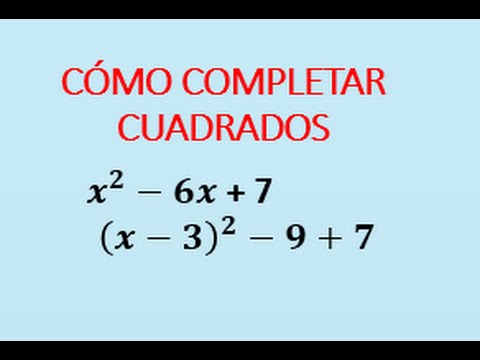
Se explica como completar cuadrados, para trinomio cuadrado perfecto TCP, parábola, circunferencia, elipse e hipérbola.
Vídeos de cómo completar cuadrados (Nuevo 2022): https://youtu.be/s70Fa8OpFn8
Blog de funciones de R en R: https://bit.ly/2Vy1eUJ
Vídeos de funciones en YouTube: https://bit.ly/2VzB2cr
Matemática Secundaria y superior: https:...
nocturne minnow
It still doesn't explain why you have b^4/b^4
north anchor
What would be the square of that exercise?
obtuse pebbleBOT
@north anchor Has your question been resolved?
obtuse pebbleBOT
Channel closed
Closed due to timeout
Use .reopen if this was a mistake.
Available help channel!
Send your question here to claim the channel.
Remember:
• Ask your math question in a clear, concise manner.
• Show your work, and if possible, explain where you are stuck.
• After 15 minutes, feel free to ping <@&286206848099549185>.
• Type the command .close to free the channel when you're done.
• Be polite and have a nice day!
Read #❓how-to-get-help for further information on how to ask a good question, and about conduct in the question channels.
 remote timber
This one is triggering me
 obtuse pebbleBOT
remote timber
This one is triggering me
remote timber
obtuse pebbleBOT
remote timber
This one is triggering me
remote timber
I also tried arctan(y/x) = 5pi/6
 slate kayak
remote timber
This one is triggering me
slate kayak
remote timber
This one is triggering me
isn't that just the slope?
remote timber
I'm honestly not really sure; The rest of my homework makes sense but I didn't even really understand what this is asking like they never really explaiend what polar coordinates even are
I thought it was just like r = distance from origin and theta is the angle
so like how can we just not get the distance of that?..
remote timber
oo
oml that worked lmao
I've been so confused
so is that just tangent equation?..
slate kayak
no it's just a radial line from the origin, as you correctly identified (?)
the slope of that line is tan(...) part
then it's just expressing it in slope intercept form
passes through origin -> y intercept = 0
so just y = slope * x
which is what u did
you basically just rotate an angle theta (5pi/6 ccw) and then draw a straight line
obtuse pebbleBOT
@remote timber Has your question been resolved?
Channel closed
Closed by @remote timber
Use .reopen if this was a mistake.
Available help channel!
Send your question here to claim the channel.
Remember:
• Ask your math question in a clear, concise manner.
• Show your work, and if possible, explain where you are stuck.
• After 15 minutes, feel free to ping <@&286206848099549185>.
• Type the command .close to free the channel when you're done.
• Be polite and have a nice day!
Read #❓how-to-get-help for further information on how to ask a good question, and about conduct in the question channels.
timid silo
 obtuse pebbleBOT
timid silo
obtuse pebbleBOT
obtuse pebbleBOT
timid silo
obtuse pebbleBOT
@timid silo Has your question been resolved?
obtuse pebbleBOT
@timid silo Has your question been resolved?
timid silo
.close
obtuse pebbleBOT
Channel closed
Closed by @thorn jacinth
Use .reopen if this was a mistake.
obtuse pebbleBOT
Available help channel!
Send your question here to claim the channel.
Remember:
• Ask your math question in a clear, concise manner.
• Show your work, and if possible, explain where you are stuck.
• After 15 minutes, feel free to ping <@&286206848099549185>.
• Type the command .close to free the channel when you're done.
• Be polite and have a nice day!
Read #❓how-to-get-help for further information on how to ask a good question, and about conduct in the question channels.
 prisma glacier
 obtuse pebbleBOT
prisma glacier
obtuse pebbleBOT
prisma glacier
 slim cove
can you post the actual question
prisma glacier
 prisma glacier
 slim cove
ah okay
so they want you to use stokes's theorem, I see
and they want you to find the surface integral of the curl
prisma glacier
Mhmm
prisma glacier
 slim cove
can you write down the equation
prisma glacier
 slim cove
uhhh
that's one side of the equation
what does stokes's theorem say that that integral is equal to?

 prisma glacier
X squared plus z squared = 16