#help-10
1 messages · Page 234 of 1
 fervent scaffold
ah
 slim cove
Lol
fervent scaffold
any advice on j simple sketching the surfac
like something that someone grading could see
and interpet as correct
slim cove
I'd say maybe start by sketching z = sqrt(x^2 - 1)
and then to sketch z = sqrt(r^2 - 1), take that sketch and sort of rotate it around the z-axis if you know what I mean
slim cove
yeah like I like to imagine one of those pottery lathes
fervent scaffold
but what about for x^2+y^2-z^2=1
 fervent scaffold
ohh
slim cove
fervent scaffold
but what about for x^2+y^2-z^2=1
That was for that
 slim cove
haha
 slim cove
yeah!
fervent scaffold
and then rotate that around
slim cove
idk whether it's concave up or concave down but I don't care enough to check
slim cove
fervent scaffold
and then rotate that around
yup
slim cove
slim cove
idk whether it's concave up or concave down but I don't care enough to check
if you wanted, you can check by taking the second derivative
no problem!
do you have any other questions?
I think I have to go now
but someone else can probably help
slim cove
awesome!!
fervent scaffold
.close
 obtuse pebbleBOT
Channel closed
Closed by @fervent scaffold
Use .reopen if this was a mistake.
 Available help channel!
Send your question here to claim the channel.
Remember:
• Ask your math question in a clear, concise manner.
• Show your work, and if possible, explain where you are stuck.
• After 15 minutes, feel free to ping <@&286206848099549185>.
• Type the command .close to free the channel when you're done.
• Be polite and have a nice day!
Read #❓how-to-get-help for further information on how to ask a good question, and about conduct in the question channels.
 spice chasm
Is it true that f(some limit)=lim f(inside)
obtuse pebbleBOT
spice chasm
Is it true that f(some limit)=lim f(inside)
spice chasm
where f is a function
 hollow dove
only if f is continuous
spice chasm
hollow dove
only if f is continuous
does it only have to be continuous at the limiting point
slim cove
Yes
obtuse pebbleBOT
Channel closed
Closed by @spice chasm
Use .reopen if this was a mistake.
Available help channel!
Send your question here to claim the channel.
Remember:
• Ask your math question in a clear, concise manner.
• Show your work, and if possible, explain where you are stuck.
• After 15 minutes, feel free to ping <@&286206848099549185>.
• Type the command .close to free the channel when you're done.
• Be polite and have a nice day!
Read #❓how-to-get-help for further information on how to ask a good question, and about conduct in the question channels.
 gritty drum
I’m getting different y values depending on how I calc them
 obtuse pebbleBOT
gritty drum
I’m getting different y values depending on how I calc them
gritty drum
obtuse pebbleBOT
gritty drum
I’m getting different y values depending on how I calc them
gritty drum
I feel like this shouldn’t be happening is my math going wrong somewhere or I need to understand this?
 candid yarrow
gritty drum
I’m getting different y values depending on how I calc them
candid yarrow
gritty drum
I’m getting different y values depending on how I calc them
(i) and (ii) not equivalent
candid yarrow
gritty drum
I feel like this shouldn’t be happening is my math going wrong somewhere or I ne...
Yes
gritty drum
Ok but can u explain further?
 scarlet gale
Neither one of those equations are correct for temperatures.
 balmy mortar
typographical thing - please don't write 9's like g's.
gritty drum
balmy mortar
typographical thing - please don't write 9's like g's.
ohk
Yea conversion went wrong

when I write g, I put it on the line (w/ cursive which ik I shouldn't be doing)
scarlet gale
If you want to test whether equations work for temperatures, try 0°C -> 32°F, 32°F -> 0°C, 100°C -> 212°F, and 212°F -> 100°C. If all four of those don't work, you don't have the right equations.
gritty drum
scarlet gale
If you want to test whether equations work for temperatures, try 0°C -> 32°F, 32...
Yea I may have flipped the operators 😅
I tend to mess up notations
quite a bit
.close
obtuse pebbleBOT
Channel closed
Closed by @gritty drum
Use .reopen if this was a mistake.
Available help channel!
Send your question here to claim the channel.
Remember:
• Ask your math question in a clear, concise manner.
• Show your work, and if possible, explain where you are stuck.
• After 15 minutes, feel free to ping <@&286206848099549185>.
• Type the command .close to free the channel when you're done.
• Be polite and have a nice day!
Read #❓how-to-get-help for further information on how to ask a good question, and about conduct in the question channels.
 karmic hedge
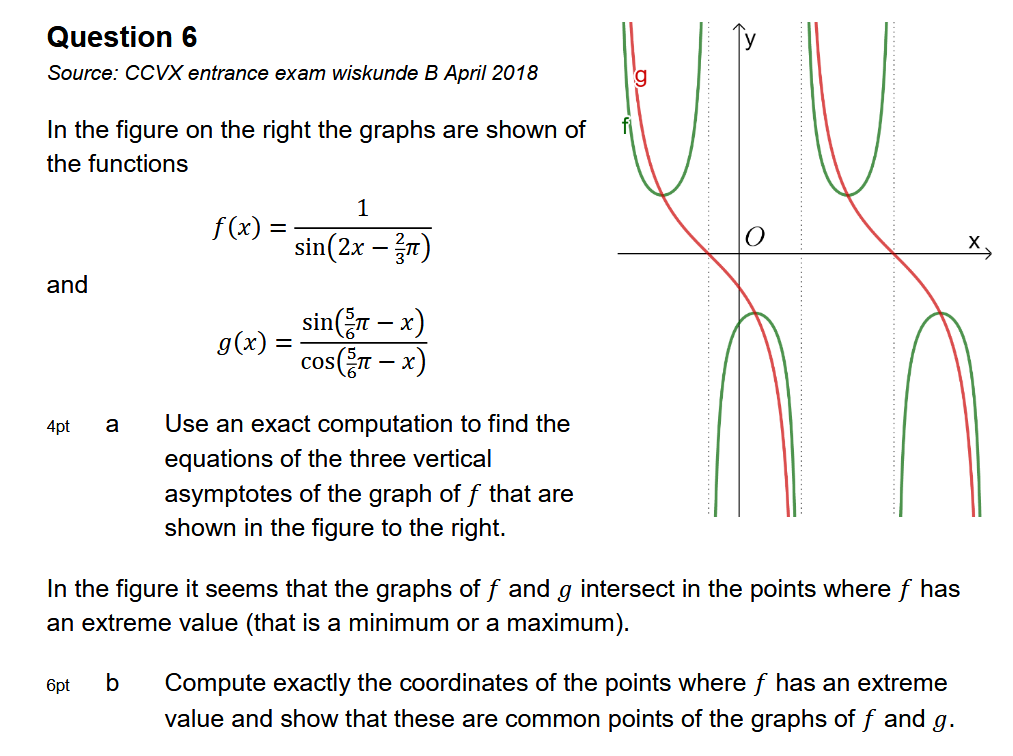 obtuse pebbleBOT
karmic hedge
https://i.imgur.com/EoIEINz.png
karmic hedge
obtuse pebbleBOT
karmic hedge
https://i.imgur.com/EoIEINz.png
karmic hedge
I got the derivative of 1/sin(2x - 2pi/3) and set it equal to zero to get x = pi(k)/4 + pi/3, what do i sub in for k this time?
Is it still the first negative value and first 3 positive values?
hollow dove
leave k as a variable
karmic hedge
Ah oke
1 moment I will try to finish this
How do I even solve sin(2x-2pi/3)*sin(5pi/6-x) = cos(5pi/6-x) 
hollow dove
I mean, it just says to show that these extreme points are common points
not to prove that they're the only ones
so you could substitute in the points
and show they satisfy both functions
karmic hedge
Oh so just sub in pi(k)/4 + pi/3 for x and I should get the same number on each side?
hollow dove
yeah
karmic hedge
Oke seems easy enough
I think I know what im doing now but this will take a long time so I will close this thread haha
But thank you!
Again
❤️
.close
obtuse pebbleBOT
Channel closed
Closed by @karmic hedge
Use .reopen if this was a mistake.
obtuse pebbleBOT
Available help channel!
Send your question here to claim the channel.
Remember:
• Ask your math question in a clear, concise manner.
• Show your work, and if possible, explain where you are stuck.
• After 15 minutes, feel free to ping <@&286206848099549185>.
• Type the command .close to free the channel when you're done.
• Be polite and have a nice day!
Read #❓how-to-get-help for further information on how to ask a good question, and about conduct in the question channels.
 sullen burrow
Hi, how we could evaluate $\lim_{x \to 0^{+}} (e^x)/x$ systematically ? I know that the limit of denominator is 0, so the solution is infinity, but how to solve it mathematically using limit theorem?
obtuse pebbleBOT
sullen burrow
Hi, how we could evaluate $\lim_{x \to 0^{+}} (e^x)/x$ systematically ? I know ...
 warm shaleBOT
Fikri Mulyana Setiawan
 scarlet gale
What limit theorem are you referring to?
sullen burrow
I don't know. I mean, is there any limit theorem that we can use to evaluate that limit instead of just solving it intuitively?
scarlet gale
You can probably use the squeeze theorem.
sullen burrow
Can you explain more?
scarlet gale
Do you know the squeeze theorem?
If you don't, you can probably turn it into the limit for eˣ times the limit for 1/x.
sullen burrow
Yes, i know. The theorem say that if $f(x) < g(x) < h(x)$ and $lim \ f(x) = lim \ h(x) = k$, then $lim \ g(x) = k$, right?
scarlet gale
Well, less than or equal, but yes.
warm shaleBOT
Fikri Mulyana Setiawan
 warm shaleBOT
Chai T. Rex
$\lim h(x)$
 obtuse pebbleBOT
@sullen burrow Has your question been resolved?
obtuse pebbleBOT
Channel closed
Closed due to timeout
Use .reopen if this was a mistake.
Available help channel!
Send your question here to claim the channel.
Remember:
• Ask your math question in a clear, concise manner.
• Show your work, and if possible, explain where you are stuck.
• After 15 minutes, feel free to ping <@&286206848099549185>.
• Type the command .close to free the channel when you're done.
• Be polite and have a nice day!
Read #❓how-to-get-help for further information on how to ask a good question, and about conduct in the question channels.
 inner spear
 obtuse pebbleBOT
inner spear
inner spear
obtuse pebbleBOT
inner spear
inner spear
imagine a 3d surface
the gradient and u will be on a 2d Plane

let's just say this graph with origin at the minimum
u can be pointed anywhere, and del f is in "a certain direction"
the proof above says that by letting del f and u be in the same direction, it gives the direction of steepest ascent. Why? To me, this is circular reasoning and seems to assume the direction of del f gives the biggest change in the function to start with.
i.e. how do you know the direction of del f is giving the biggest change in f? How do you know there is not other vector that moving in another direction that might lead to a steeper change?
 lost tree
inner spear
i.e. how do you know the direction of del f is giving the biggest change in f? H...
lost tree
inner spear
i.e. how do you know the direction of del f is giving the biggest change in f? H...
assume there were such a vector in another direction leading to a steeper change, (the vector u)
find the change along that direction
ig
lost tree
inner spear
the vector u is a unit vector
yes, which points in a certain direction
 lost tree
yes so assume there is a direction that is indicated by the unit vector u such that the directional derivative along that direction is maximum
inner spear
which seems like they are already assuming direction of gradient of f gives biggest change in f
inner spear
lost tree
yes so assume there is a direction that is indicated by the unit vector u such t...
but when people "prove" this, they just say that "u and grad f are in the same direction!!"
lost tree
inner spear
but when people "prove" this, they just say that "u and grad f are in the same d...
well we are changing the direction of u and looking at the derivatives along those different directions
lost tree
well there is a way of calculating del f right
ig it has as its components the partial derivaties along the axes
inner spear
lost tree
well there is a way of calculating del f right
ok, this is true, but we can't assume its direction for a general proof
lost tree
inner spear
the gradient and **u** will be on a 2d Plane
so in a case like this, del f at a certain point would be a vector with components partialz/partialx and partialz/partialy
inner spear
and if we assume its direction to be the direction of steepest ascent, then thats my point
lost tree
inner spear
and if we assume its direction to be the direction of steepest ascent, then that...
we do not assume this
it is just something we calculate and later find out is indeed the direction of steepest ascent
inner spear
hmm
lost tree
coz we see that if we take the derivative along any direction other than along del f, then the change is lesser
inner spear
yes, i see what you mean if we had a specific example

but let's say this proof is "in general"
what does proving "u" and gradf point in the same direction do?
*if we dont assume gradf points to direction of biggest change in f
lost tree
okay so we are standing on some terrain. i do some analysis or whatever, and point to a direction ( i do not tell u it is the direction of steepest ascent; i just show u this direction )
how would u know if the direction i pointed is the direction of steepest ascent or not?
inner spear
hmm I would probably try it and time myself 😄
lost tree
u cud look in all possible directions from where we are standing, and find the derivatives along all those directions
yeah?
inner spear
yes
lost tree
and find which direction gives the maximum change?
okay so u look in some direction that makes an angle theta from the direction that i pointed
inner spear
the one that looks the steepest
lost tree
lost tree
okay so u look in some direction that makes an angle theta from the direction th...
and then in terms of the derivative along the direction that i pointed and theta u can find the derivative along this new direction
inner spear
and it will be less
lost tree
inner spear
and it will be less
yes, u will find out that it will be when theta is 0 that u find a maximum change
inner spear
but in this scenario, i know the steepest ascent from looking. i dont have that in maths
lost tree
inner spear
but in this scenario, i know the steepest ascent from looking. i dont have that ...
lets say u dont know that
u just have to calculate it
u cant just look and tell
u must maybe take some measurements
inner spear
so partial z with x and partial z with y is a vector (i and j) that gives the direction of steepest ascent is what we are trying to prove
if i calculate the gradient, i am maybe assuming the above
lost tree
if ur calculating the gradient, u r just calculating partialz/partialx and partialz/partialy
u know nothing about whether this is the dir of steepest ascent or not
lost tree
if u know the derivative along some direction (not necessarily of steepest ascent or anything; just some arbitrary direction), and u wanted to find the derivative along some other direction that made some angle theta to this first direction
u can do that by taking the dot product between the derivative along the first direction, and a unit vector pointing along the second direction
are u okay with that?
inner spear
yes
so we then say that if they point in the same direction, the change in f is biggest
along that arbitrary direction
lost tree
well i would put it this way
so our first direction is fixed. we are only changing our second direction (that is theta)
using our first (arbitrary) direction as a reference we can find the derivative along any other direction
okay?
inner spear
yes
lost tree
well so we can take the direction of grad f to be arbitrary and then vary theta around it
im kinda starting to realize that something is wrong in what im saying (like any arbitrary direction can be called the dir of max ascent)...u might need to wait for somebody who knows more about this than myself...
🥲
sorry if i took ur time for nothing 😅 😕
inner spear
xD all good, this thing has been stuck in my head for days
inner spear
inner spear
whenever i ask or look around i just see people rattle off this proof
hollow dove
I think the point is that grad f gives a method of picking some direction vector
we don't know a priori that this is the dir of max ascent
but we can compare any vector pointing in any other direction to this specific vector that grad f gives us
and we find that this comparison using a dot product means that it's proportional to the cosine of the angle between them
you're basically showing that a vector pointing in any other direction is going to be at most this particular choice of vector that grad f gives us
if you can show that some vector v has the property that the derivative in the direction of any other vector u is at most the derivative in the direction of v, then v is the direction of steepest ascent; this doesn't really rely on grad f or anything, it's just from the definition of maximal.
The proof is then that the vector given by grad f always has this property.
silver's analogy is right
the terminology is just a bit confusing since we have so many vectors about 😭
lost tree
suppose we start with the derivative along a different direction than the direction of grad f
how would we use this to find the derivative along grad f?
inner spear
hollow dove
you're basically showing that a vector pointing in any other direction is going ...
could I also argue this: imagine i give you something called "grad f (that is not the real grad f)" which is not pointed in the direction of steepest ascent. Then I revolve some vector u in a circle around that. If u and the fake grad f are in the same direction, it maximises the change of f the most, right? (Due to costheta)
hollow dove
you need the real grad f to calculate the change of f though
and if the fake grad f isn't aligned with grad f, then the angle which maximises the change in f from u will be exactly the angle between the fake and real grad f
the costheta relation is coming from grad f
inner spear
hollow dove
and if the fake grad f isn't aligned with grad f, then the angle which maximises...
that was also my thought but fake grad f dot u cos theta, if theta is let's say 30 degrees, it decreases the change in f
hollow dove
but that equation only works for the real grad f
the definition of directional derivative (which is where that equation is from) is defined in terms of the real grad f
it doesn't hold for arbitrary vectors, even if you call it "fake grad f"
inner spear
hollow dove
but that equation only works for the real grad f
the equation is from dot product though, "fake" dot u
hollow dove

you're just dotting two arbitrary vectors
the directional derivative in the direction of u is specifically the dot product of u and grad f
not just the dot product of anything
you're comparing the components of the vector u in the direction of fake grad f
but that has nothing to do with the directional derivative
if we go back to this for a second,
if you can show that some vector v has the property that the derivative in the direction of any other vector u is at most the derivative in the direction of v, then v is the direction of steepest ascent
to calculate the derivative in the direction of v or u, we do grad f dot v and grad f dot u
the point is that if we pick v to be grad f, then v always has this property
inner spear
what if v isnt grad f
hollow dove
then it won't have this property (and proving this is kinda just the contrapositive of the proof you linked)
inner spear
so this all comes back to the definition of the directional derivative
fxi + fyj
so the proof is true because it has to be the gradient you are dotting u with?
hollow dove
uh, well
that's what the proof is showing
if you want a vector with this property, it has to be the gradient
the directional derivative is defined by dotting with grad f; the fact that grad f then has this property is kind of a side effect of this, if that helps
I am not a calculus person, so I might not be explaining super clearly
obtuse pebbleBOT
@inner spear Has your question been resolved?
Channel closed
Closed by @inner spear
Use .reopen if this was a mistake.
obtuse pebbleBOT
Available help channel!
Send your question here to claim the channel.
Remember:
• Ask your math question in a clear, concise manner.
• Show your work, and if possible, explain where you are stuck.
• After 15 minutes, feel free to ping <@&286206848099549185>.
• Type the command .close to free the channel when you're done.
• Be polite and have a nice day!
Read #❓how-to-get-help for further information on how to ask a good question, and about conduct in the question channels.
 timid silo
I'm really not familiar with differentials, so I wanted to ask if this substitution is "proper"?
 obtuse pebbleBOT
timid silo
I'm really not familiar with differentials, so I wanted to ask if this substitut...
timid silo
obtuse pebbleBOT
timid silo
I'm really not familiar with differentials, so I wanted to ask if this substitut...
timid silo
Like I am guessing constant factors don't affect anything here?
$\dd t \overset ? = \dd{(t-c)}$
warm shaleBOT

 royal basin
if $\sigma = t - c$ then $\dv{\sigma}{t} = 1$ yes
warm shaleBOT
Ann
 obtuse pebbleBOT
Channel closed
Closed by @brave kite
Use .reopen if this was a mistake.
Available help channel!
Send your question here to claim the channel.
Remember:
• Ask your math question in a clear, concise manner.
• Show your work, and if possible, explain where you are stuck.
• After 15 minutes, feel free to ping <@&286206848099549185>.
• Type the command .close to free the channel when you're done.
• Be polite and have a nice day!
Read #❓how-to-get-help for further information on how to ask a good question, and about conduct in the question channels.
 high ferry
hi im recreating a landmark for my own personal entertainment but ive hit a snag
how do i find out the radius of these circles? been too long since i did any geometry to remember a good way to do it
 obtuse pebbleBOT
high ferry
hi im recreating a landmark for my own personal entertainment but ive hit a snag...
obtuse pebbleBOT
high ferry
hi im recreating a landmark for my own personal entertainment but ive hit a snag...
 obtuse pebbleBOT
@high ferry Has your question been resolved?
 trail cloak
Hmm
The easiest way I know is to measure the diameter with a ruler and see if you have a scale in the image
Or a given dimension
And from there you can work out the approximate radius
A more precise way is to measure the pixels and then work out from there
Or you can use a program like AutoCAD or LibreCAD to measure the circles
 pulsar oriole
Here is a quick method:
1: Construct chord BC
2: find perpendicular bisector and let it intersect the curve at D.
3: diameter = h+BC^2 / 4h
 obtuse pebbleBOT
Channel closed
Closed due to timeout
Use .reopen if this was a mistake.
obtuse pebbleBOT
Available help channel!
Send your question here to claim the channel.
Remember:
• Ask your math question in a clear, concise manner.
• Show your work, and if possible, explain where you are stuck.
• After 15 minutes, feel free to ping <@&286206848099549185>.
• Type the command .close to free the channel when you're done.
• Be polite and have a nice day!
Read #❓how-to-get-help for further information on how to ask a good question, and about conduct in the question channels.
 simple cloak
could someone help me understand how these two areas made up by the graphs on the picture have the same area? https://gyazo.com/94b085cdc424759eeafb35c0a89e86b8
 obtuse pebbleBOT
simple cloak
could someone help me understand how these two areas made up by the graphs on th...
obtuse pebbleBOT
simple cloak
could someone help me understand how these two areas made up by the graphs on th...
 tardy epoch
Did you try doing the integrals
simple cloak
yes. It make sense mathematically, although I can not visualize it in my head
like I do not understand how the area is the same, when clearly the area on the left has a much larger positive part than the area on the right
tardy epoch
simple cloak
like I do not understand how the area is the same, when clearly the area on the ...
Why is that clear
tardy epoch
simple cloak
yes. It make sense mathematically, although I can not visualize it in my head
Write out the math that you found
simple cloak
tardy epoch
Write out the math that you found
 tardy epoch
simple cloak
could someone help me understand how these two areas made up by the graphs on th...
tardy epoch
simple cloak
could someone help me understand how these two areas made up by the graphs on th...
Areas are not the same as integral
Integral means signed area
simple cloak
Iknow and that is what confuses me
tardy epoch
That means area underneath the x axis is negative
 pearl bison
which area are you even trying to find? Above x axis?
tardy epoch
So what's confusing then
simple cloak
simple cloak
could someone help me understand how these two areas made up by the graphs on th...
IG it is not that clear, although the two areas are not equally much over the x axisis, so how do they have the same area?
simple cloak
pearl bison
which area are you even trying to find? Above x axis?
the area between the two graphs
pearl bison
then wdym by they have the same area
tardy epoch
simple cloak
the area between the two graphs
IntegralBetween does not give you a positive number so it's not the right answer to this question
simple cloak
the question in the books says: show that the two areas made up by the two graphs have the same area for every k>0
pearl bison
ah nvm i see
the 4th block should have IntegralBetween(g,f,...) instead of (f,g), no? Since g > f
likewise for the other, you should swap them i think
simple cloak
true
thx
hmmm I do not really understand how you can show that the area is equal by using integration, becuase integration
an area is always positive
pearl bison
you can always do the parts with positive and negative y separately
Reverse the sign of the negative part and sum both parts up
simple cloak
yeah, I guess that would be more visually clear
obtuse pebbleBOT
@simple cloak Has your question been resolved?
Channel closed
Closed by @simple cloak
Use .reopen if this was a mistake.
Available help channel!
Send your question here to claim the channel.
Remember:
• Ask your math question in a clear, concise manner.
• Show your work, and if possible, explain where you are stuck.
• After 15 minutes, feel free to ping <@&286206848099549185>.
• Type the command .close to free the channel when you're done.
• Be polite and have a nice day!
Read #❓how-to-get-help for further information on how to ask a good question, and about conduct in the question channels.
timid silo
\textbf[Question:] Find the solution to the initial value problem: [
y'' + 2y' +2y = \map \delta{t-\pi}, \quad \map y 0 = 1, \map{y'}0=0
]
\textbf{My attempt:}
\vs{3 mm}
We take the Laplace of both sides to get: [
(s^2 +2s +2)\map Y s -(s+1)\map y 0 - \map{y'} 0 = e^{-\pi s}]
Where $\ds \cmap{\mathcal L}{\map f t} = \map Y s$
\vs{3 mm}
Solving for $\map Y s$:
\begin{align*}
\map Y s &= \f{e^{-\pi s}}{s^2+2s+2} + \f{s}{s^2+2s+2} + \f1{s^2+2s+2}\
&= \f{e^{-\pi s}}{(s+1)^2+1} + \f{s}{(s+1)^2+1} + \f1{(s+1)^2+1}\
&= \f{e^{-\pi s}}{(s+1)^2+1} + \f{s+1}{(s+1)^2+1} \underbrace{-\f1{(s+1)^2+1}+\f1{(s+1)^2+1}}{=0}\end{align*}
By considering both terms separately:
\begin{align*}
\map{Y_1}s &= \f{e^{-\pi s}}{(s+1)^2+1} \implies \map{u{\pi}}t e^{-(t-\pi)} \map \sin{t-\pi} = -\map{u_{\pi}}t e^{-t}e^{\pi}\map \sin t = \map {f_1}t\
\map{Y_2}s &= \f{s+1}{(s+1)^2+1} \implies e^{-t}\map \cos t = \map {f_2} t
\end{align*}
Which means:
[
\map f t=e^{-t}\map \cos t-\map{u_{\pi}}t e^{-t}e^{\pi}\map \sin t ]
obtuse pebbleBOT
timid silo
\textbf[Question:] Find the solution to the initial value problem: \[
y'' + 2y'...
timid silo
My question is whether my working and logic here are complete
warm shaleBOT
 obtuse pebbleBOT
@timid silo Has your question been resolved?
obtuse pebbleBOT
@timid silo Has your question been resolved?
 fathom flicker
DM me this and I can check it when I get home in an hour or two
timid silo
Ok
 ornate oar
I think it should be -(s+2)y(0) after taking Laplace transform
,wolf y'' + 2y'+2y=delta(t-pi), y(0) = 1, y'(0)=0
warm shaleBOT


 timid silo
ornate oar
,wolf y'' + 2y'+2y=delta(t-pi), y(0) = 1, y'(0)=0
timid silo
ornate oar
,wolf y'' + 2y'+2y=delta(t-pi), y(0) = 1, y'(0)=0
Ahhh that explains why I have been missing that extra sin
Okay
Thank you so much
.close
obtuse pebbleBOT
Channel closed
Closed by @brave kite
Use .reopen if this was a mistake.
obtuse pebbleBOT
Available help channel!
Send your question here to claim the channel.
Remember:
• Ask your math question in a clear, concise manner.
• Show your work, and if possible, explain where you are stuck.
• After 15 minutes, feel free to ping <@&286206848099549185>.
• Type the command .close to free the channel when you're done.
• Be polite and have a nice day!
Read #❓how-to-get-help for further information on how to ask a good question, and about conduct in the question channels.
 urban patrol
 obtuse pebbleBOT
urban patrol
urban patrol
obtuse pebbleBOT
urban patrol
urban patrol
why are these bounds just known?
this is for spherical coordinates
it was just introduced and im not too sure why any of this is given just with the information that E is a hemisphere
except theta
i also looked online about the spherical coordinate system and it doesnt make much sense
 stiff umbra
youre only looking at values inside the sphere with radius 1 so 0<p<1 is the radius, theta you understood, and for phi you "sweep across" the z axis getting only the part of the sphere above the [xy] plane

shitty image
 stiff umbra
because then youre counting everything twice
urban patrol
why is 0 to pi/2 counting everything once?
stiff umbra
the point at phi+pi/2 is like at phi with theta+pi
setting phi constant is like integrating over a circle in 2 dimensions right? so you want to integrate all the "layers" by integrating over phi from the top at pi/2 to 0
if theta was between 0 and pi, yeah you could do phi between 0 and pi too
urban patrol
ill try to find a calculator to play around with to see how phi changes
 nocturne minnow
urban patrol
why would it not be pi?
nocturne minnow
urban patrol
why would it not be pi?
The other thing to note to the problem says it's a upper half of a sphere, and phi is measured from the z axis. Since the upper half stops where the xy plane is, from the z axis to the xy plane is 90 degrees or pi/2
urban patrol
OH I thought it would be like the curvature of the sphere
alright that makes sense i was completely misinterpreting it
thank you guys
.close
obtuse pebbleBOT
Channel closed
Closed by @urban patrol
Use .reopen if this was a mistake.
obtuse pebbleBOT
Available help channel!
Send your question here to claim the channel.
Remember:
• Ask your math question in a clear, concise manner.
• Show your work, and if possible, explain where you are stuck.
• After 15 minutes, feel free to ping <@&286206848099549185>.
• Type the command .close to free the channel when you're done.
• Be polite and have a nice day!
Read #❓how-to-get-help for further information on how to ask a good question, and about conduct in the question channels.
 river pivot
I am struggling with getting correct signs for this type of calculation, for derivatives
 obtuse pebbleBOT
river pivot
I am struggling with getting correct signs for this type of calculation, for der...
urban patrol
obtuse pebbleBOT
river pivot
I am struggling with getting correct signs for this type of calculation, for der...
urban patrol
how so
river pivot
so when I expand the brackets, for the value 2x (keep in mind divided by h so 2xh becomes 2x):
i get 2x - 4x
correct should be positive 2x
lemme take a pic of calc

think my problem is related to not treating the right term as a parenthesis
sorry for messy calculations
 polar fossil
$-(x^2 - 2x + 7) = -x^2 \green{+}2x - 7$
warm shaleBOT
Hayley
 nocturne minnow
river pivot
nocturne minnow
river pivot
You didn't distribute the negative to all the terms in the parentheses
The -(x^2 - 2x + 7) part
river pivot
oh
okay
i see
-2x should be flipped
and aahhhhhhh
-7 too
thats why they cancel
polar fossil
yea
river pivot
makes much more sense
polar fossil
the book didn't even bother writing the +7
river pivot
exactly
i wasnt 100% sure why they cancelled i just accepted it
in general , is there a nice way i can think of negative signs like this. Okay, i understand if negative sign in front of parenthesis it should be distributed. but how can i conclude that the right term should be treated as parenthesis in the first place
is this just based on the derivative definition of f(x+h) - f(x) and thus the negative sign in front of f(x) and thus we can think (f(x+h)) - (f(x))
maybe its related to some laws of functions i guess, that makes sense
polar fossil
erm  yeah i mean you treat f(x) as a unit, you subtract the whole thing
obtuse pebbleBOT
@river pivot Has your question been resolved?
obtuse pebbleBOT
Channel closed
Closed due to timeout
Use .reopen if this was a mistake.
Available help channel!
Send your question here to claim the channel.
Remember:
• Ask your math question in a clear, concise manner.
• Show your work, and if possible, explain where you are stuck.
• After 15 minutes, feel free to ping <@&286206848099549185>.
• Type the command .close to free the channel when you're done.
• Be polite and have a nice day!
Read #❓how-to-get-help for further information on how to ask a good question, and about conduct in the question channels.
river pivot
Yes
obtuse pebbleBOT
river pivot
Yes
fathom flicker
no
high ferry
pulsar oriole
Here is a quick method:
1: Construct chord BC
2: find perpendicular bisector and...
tyvm that was perfect
obtuse pebbleBOT
Channel closed
Closed by @tardy epoch
Use .reopen if this was a mistake.
nocturne minnow
tardy epoch
.close
.reopen
obtuse pebbleBOT
✅
obtuse pebbleBOT
Channel closed
Closed by @nocturne minnow
Use .reopen if this was a mistake.
 native inlet
nocturne minnow
.close
native inlet
nocturne minnow
.close
.reopen
obtuse pebbleBOT
✅
obtuse pebbleBOT
Channel closed
Closed by @native inlet
Use .reopen if this was a mistake.
nocturne minnow
native inlet
.close
.reopen
obtuse pebbleBOT
✅
obtuse pebbleBOT
Channel closed
Closed by @nocturne minnow
Use .reopen if this was a mistake.
native inlet
nocturne minnow
.close
.reopen
obtuse pebbleBOT
✅
obtuse pebbleBOT
Channel closed
Closed by @native inlet
Use .reopen if this was a mistake.
tardy epoch
nocturne minnow
.reopen
I get no satisfaction
obtuse pebbleBOT
Available help channel!
Send your question here to claim the channel.
Remember:
• Ask your math question in a clear, concise manner.
• Show your work, and if possible, explain where you are stuck.
• After 15 minutes, feel free to ping <@&286206848099549185>.
• Type the command .close to free the channel when you're done.
• Be polite and have a nice day!
Read #❓how-to-get-help for further information on how to ask a good question, and about conduct in the question channels.
 fiery shell
bit of a weird question, but are there some derivatives of functions that are impossible
obtuse pebbleBOT
fiery shell
bit of a weird question, but are there some derivatives of functions that are im...
fiery shell
for example if the derivative is discontinous at a point I feel like it also has to be undefined at that point
even though you can generally define functions that are defined at points where they're discontinous
native inlet
fiery shell
bit of a weird question, but are there some derivatives of functions that are im...
Riemann function is differentiable almost no where
not zeta, there's another one
$\sum_{n=0}^{\infty}\frac{\sin(xn^2)}{n^2}$
warm shaleBOT
MrFancy
 fiery shell
that doesn't really answer my question, I'm familiar with the idea of non-differentiable functions
native inlet
then what do you mean by derivatives that are impossible? 
fiery shell
my question is more like, is there any function f such that f'(x) = 2 for all x > 0 and f'(x) = 1 for all x <= 0
emphasis on <= as opposed to <
because my thinking is if the derivative jumps from one value to another then the function must be non-differentiable at that point
native inlet
$[\begin{cases}2x,&x>0\x,&x\leq0\end{cases}]$
warm shaleBOT
MrFancy
Compile Error! Click the  reaction for more information.
(You may edit your message to recompile.)
 native inlet
wouldn't that be the function?
fiery shell
lemme go graph it rq
ok but at x = 0 the function is non-differentiable, right?
cause the tangent line doesn't really exist
so the derivative would be 2 for x>0 and 1 for x<0, but it couldn't be 1 for x<=0 cause it's not defined at 0
obtuse pebbleBOT
@fiery shell Has your question been resolved?
 tight thunder
fiery shell
so the derivative would be 2 for x>0 and 1 for x<0, but it couldn't be 1 for x<=...
tight thunder
fiery shell
so the derivative would be 2 for x>0 and 1 for x<0, but it couldn't be 1 for x<=...
The derivative doesn't exist at 0 but the function is certainly defined at 0
tight thunder
warm shale
**MrFancy**
Compile Error! Click the <:errors:504266556054962196> reaction for m...
Look at the condition that f(x) = x for x <= 0. this implies f(0) = 0
fiery shell
tight thunder
The derivative doesn't exist at 0 but the function is certainly defined at 0
when you say "the function", do you mean f or f'?
fiery shell
because I was talking about f'
tight thunder
fiery shell
for example if the derivative is discontinous at a point I feel like it also has...
Referring to this..
You said "it" also has to be undefined?
What's "it"
tight thunder
Right
Lets think about an ordinary function
f(x) =
0, x < 0
1, x = 0
2, x > 0
Is this continuous at 0?
fiery shell
I would say not
fiery shell
yes
tight thunder
Indeed
tight thunder
fiery shell
for example if the derivative is discontinous at a point I feel like it also has...
So let's say this random function is your derivative
It certainly can be discontinuous but still defined
fiery shell
so what I'm suggesting is that f(x) as you defined it can not be the derivative of another function
fiery shell
because the tangent line at 0 wouldn't exist for that function
tight thunder
fiery shell
so what I'm suggesting is that f(x) as you defined it can not be the derivative ...
maybe your correct I'll actually have to think this through
fiery shell
so the derivative can't be defined at that point
furthermore I'm pretty sure any f'(c) is undefined if f' is discontinous at c
for any f
tight thunder
I think you're right
I think
Sorry my brain wasn't working haha
But maybe I'll wait for someone cuz I'm not sure I'm p sure ur right tho
fiery shell
ok sure
slim cove
fiery shell
my question is more like, is there any function f such that f'(x) = 2 for all x ...
Yes, the derivative has to satisfy an intermediate value property
This is called Darboux's theorem
 slim cove
fiery shell
my question is more like, is there any function f such that f'(x) = 2 for all x ...
slim cove
fiery shell
my question is more like, is there any function f such that f'(x) = 2 for all x ...
In particular this isn't possible because f'(-1) = 1 and f'(1) = 2, so there needs to be some x in between -1 and 1 so that f'(x) = 1.5
Does this answer your question?
If the function is continuous on [a,b] though, there's always some function which has it as its derivative (just take the integral)
fiery shell
That's gonna take me a second to parse
slim cove
feel free to ask any questions!
fiery shell
Hmm
So it seems like what this is saying is basically, if f is differentiable over a whole interval, f' must be continuous over that interval?
slim cove
fiery shell
So it seems like what this is saying is basically, if f is differentiable over a...
Not quite
It doesn't have to be continuous, but it does have to satisfy the intermediate value property (it turns out that this doesn't imply that it's continuous)
There are some cursed functions which satisfy the intermediate value property but aren't continuous 
But you can think of this requirement as having to be at least almost continuous, maybe?
fiery shell
slim cove
There are some cursed functions which satisfy the intermediate value property bu...
Do you have an example?
slim cove
fiery shell
Do you have an example?
this one is pretty terrible https://en.wikipedia.org/wiki/Conway_base_13_function
The Conway base 13 function is a function created by British mathematician John H. Conway as a counterexample to the converse of the intermediate value theorem. In other words, it is a function that satisfies a particular intermediate-value property—on any interval (a, b), the function f takes every value between f(a) and f(b)—but is not continu...
fiery shell
Gimme a sec
slim cove
That wikipedia article also links to this stackexchange post https://math.stackexchange.com/questions/75589/open-maps-which-are-not-continuous/2933144#2933144

Mathematics Stack Exchange
What is an example of an open map $(0,1) \to \mathbb{R}$ which is not continuous? Is it even possible for one to exist? What about in higher dimensions? The simplest example I've been able to think...
but yeah it's messed up and not easy to visualize
fiery shell
That is a pretty cursed function
slim cove
xD
so basically the answer to your question is: any continuous function can occur as a derivative, and any other non-continuous functions that occur as a derivative are cursed
fiery shell
Would sin(1/x) also be an example of a function that isn't continuous that follows the intermediate value property?
slim cove
fiery shell
Would sin(1/x) also be an example of a function that isn't continuous that follo...
You mean on the interval [-1,1]? I think it would be yeah
Assuming you define the value at x=0 to be something like 0
fiery shell
But the whole point is that it's undefined at x=0 which makes it discontinuous
fiery shell
Is f(x) = x/x continuous?
slim cove
fiery shell
Is f(x) = x/x continuous?
yes
well, on what domain?
I assume the domain you mean is R minus {0}?
If so then yes it's continuous on that domain
fiery shell
Cause I thought having a point where f(x) isn't defined is like one of the main ways a function can be discontinuous
slim cove
fiery shell
Cause I thought having a point where f(x) isn't defined is like one of the main ...
This is a common misconception
fiery shell
Like a point discontinuity, it's in the name
slim cove
fiery shell
Like a point discontinuity, it's in the name
A point discontinuity doesn't happen because a function is not defined
It happens because it's defined, but not in the place that you'd expect
So for example if (f : \bR \to \bR) is defined by [f(x) = \begin{cases}1&x\ne 0\0&x=0\end{cases}] then (f) has a discontinuity at (0)
warm shaleBOT
eir
 slim cove
A function can only have a discontinuity at a point where it's defined
fiery shell
Huh ok
slim cove
For example if (f : \bR \setminus {0} \to \bR) is defined by (f(x) = \frac1x), then (f) is continuous
warm shaleBOT
eir
 slim cove
Because it's continuous at every point in its domain
If you try to assign f a value at 0, oops it's no longer continuous because it's not continuous at 0
fiery shell
Does the blackslash mean "excluding"?
Also, would you still say f(x) is continuous over say, [-1, 1]?
slim cove
fiery shell
Does the blackslash mean "excluding"?
Yes
slim cove
fiery shell
Also, would you still say f(x) is continuous over say, [-1, 1]?
No, that doesn't make sense because 0 is not in the domain of f
fiery shell
So the function is continuous over it's domain, but not for all real numbers?
Or would you say the question of whether it's continuous or not is unanswerable somehow?
slim cove
fiery shell
So the function is continuous over it's domain, but not for all real numbers?
yes, it doesn't make sense to say that it's continuous at a point not in its domain
it's just not a logical question
it's like asking for example "is B less than 76"
It doesn't make sense because you can only compare numbers, not letters
fiery shell
Hmm
I feel like it's a question you need to ask sometimes though? Like there are properties which apply to functions that are continuous over an interval
Idk if what I'm saying makes sense
slim cove
fiery shell
I feel like it's a question you need to ask sometimes though? Like there are pro...
This only makes sense if the function is defined on that interval
Like for example if I have (f : \bR_{\ge 0} \to \bR) defined by (f(x) = \sqrt x)
warm shaleBOT
eir
 slim cove
Then I don't ask something like "is f continuous at -1?"
Like it's a meaningless question
fiery shell
Ig that makes sense
slim cove
yeah, sometimes people learn the informal definition of continuous as "you can draw it without lifting up your pen" and it can be misleading once you work with the actual definition
fiery shell
The formal definition is that the limit as x approaches c of f(x) is equal to f(x) for all c in the domain of f, right?
slim cove
fiery shell
The formal definition is that the limit as x approaches c of f(x) is equal to f(...
is equal to f(c), yes 
fiery shell
Oh right
Anyway I'm gonna go to bed now, thank you for answering my question! (And then some)
This has been very enlightening
fiery shell
.close
obtuse pebbleBOT
Channel closed
Closed by @fiery shell
Use .reopen if this was a mistake.
obtuse pebbleBOT
Available help channel!
Send your question here to claim the channel.
Remember:
• Ask your math question in a clear, concise manner.
• Show your work, and if possible, explain where you are stuck.
• After 15 minutes, feel free to ping <@&286206848099549185>.
• Type the command .close to free the channel when you're done.
• Be polite and have a nice day!
Read #❓how-to-get-help for further information on how to ask a good question, and about conduct in the question channels.
 slate kayak
 obtuse pebbleBOT
slate kayak
https://cdn.discordapp.com/attachments/238956921581862913/1140156716307185725/im...
slate kayak
obtuse pebbleBOT
slate kayak
https://cdn.discordapp.com/attachments/238956921581862913/1140156716307185725/im...
slate kayak
i don't know graph theory, but i looked up adjacency matrix
and then i think i had to square it to get 2 stage matrix right?
is this correct for this undirected graph?

the adjacency matrix, that is
polar fossil
that's not symmetric
slate kayak
undirected graphs have to be symmetric?
polar fossil
but also i kinda feel like you're overthinking this
slate kayak
stiff umbra
because an edge from i to j is the same as from j to i
ah i see
slate kayak
polar fossil
but also i kinda feel like you're overthinking this
really?
I'm not sure how to fix it tbh and i've not learnt this yet
polar fossil
you're just trying to do (a) right?
slate kayak
I just figured it out by googling
stiff umbra
nah youre thinking correctly
slate kayak
No b)
polar fossil
oh then yes carry on
slate kayak
stiff umbra
nah youre thinking correctly
Hmm okay, so could you help me with what values i might have to change
All the diagonals are correct right?
A-> A, B-> B, C-> C, and D-> D = 0
polar fossil
yeah
stiff umbra
yeah
polar fossil
i think it's just row 1 col 2
stiff umbra
the adjacency matrix would be uh [[0 2 2 0],[2 0 1 1],[1 2 0 1],[0 1 1 0]]
i believe
polar fossil
A->C also needs 2 paths
slate kayak
stiff umbra
the adjacency matrix would be uh [[0 2 2 0],[2 0 1 1],[1 2 0 1],[0 1 1 0]]
okay thanks i'll cross check with what i fix
oh wait
after fixing A-> B and A-> C it is symmetric

I have this but i don't think it's right
because A-> D should be 7
iirc
slate kayak
polar fossil
what about 3 step
is 3 step supposed to be 3 stages?
polar fossil
yeah like going A->C->B->D
slate kayak
polar fossil
yeah like going A->C->B->D
ah okay makes sense
would i have to make an adjacency matrix for that?
or is there a way to get to 3 step from the 1 step
since i got 2 stage path from adjacency matrix without manually computing
so i'm guessing there's a way to get 3 stage path from adjacency as well
slate kayak
polar fossil
yeah like going A->C->B->D
there's 8 3-step paths from A-> D right?

I just assumed if A is the adjacency matrix then A^n is the n step path lol
hopefully that's correct
slate kayak
stiff umbra
yes
what do i do now?
stiff umbra
sum the answrs
slate kayak
i have the 2 stage path and the 3 stage path
stiff umbra
maybe the graph is just shit - try turning the twos into ones and see if you get 7
slate kayak
stiff umbra
maybe the graph is just shit - try turning the twos into ones and see if you get...
ah okay let me try
it probably would

yeah no
it's 2 for 2 and 3 path
so 4 not 7
 stiff umbra
are you 100% its 7?
slate kayak
it's not really my question
I just wanted to learn how to do it
the OP said it was 7
stiff umbra
which OP
slate kayak
If you guys are sure it isn't 7, i can live with it
stiff umbra
12 seems like your best answer
slate kayak
stiff umbra
which OP
OP as in it was somebody else's question but i wanted to learn so i was just using their question
slate kayak
stiff umbra
12 seems like your best answer
Ah makes sense
slate kayak
stiff umbra
12 seems like your best answer
btw since we did B
I guess A is easy to do right
it's just the adjacency matrix
row 1 column 4
stiff umbra
yep
slate kayak
thanks~
slate kayak
stiff umbra
are you 100% its 7?
do you think it has to do with the question being "trails" and not paths?
stiff umbra
uhhh not sure what the difference would be
slate kayak
stiff umbra
uhhh not sure what the difference would be
okay i used dfs
and the answer is 7 at least on my program
so i guess it has to be 7
i think A^n gives n step paths
but it can cross same edge multiple times
i think for trails, we don't want to cross the same edge multiple times
stiff umbra
id trust dfs more but weird because i cant see any paths that cross the same edge twice from A to D with3 steps
slate kayak
stiff umbra
id trust dfs more but weird because i cant see any paths that cross the same edg...
indeed
i think the answer is most likely 7 now that i checked
idk how we convert to trails from paths mathematically though
slate kayak
stiff umbra
id trust dfs more but weird because i cant see any paths that cross the same edg...
oh
anyway thanks @polar fossil and @stiff umbra
.close
obtuse pebbleBOT
Channel closed
Closed by @slate kayak
Use .reopen if this was a mistake.
Available help channel!
Send your question here to claim the channel.
Remember:
• Ask your math question in a clear, concise manner.
• Show your work, and if possible, explain where you are stuck.
• After 15 minutes, feel free to ping <@&286206848099549185>.
• Type the command .close to free the channel when you're done.
• Be polite and have a nice day!
Read #❓how-to-get-help for further information on how to ask a good question, and about conduct in the question channels.

 obtuse pebbleBOT
Available help channel!
obtuse pebbleBOT
Available help channel!
Send your question here to claim the channel.
Remember:
• Ask your math question in a clear, concise manner.
• Show your work, and if possible, explain where you are stuck.
• After 15 minutes, feel free to ping <@&286206848099549185>.
• Type the command .close to free the channel when you're done.
• Be polite and have a nice day!
Read #❓how-to-get-help for further information on how to ask a good question, and about conduct in the question channels.
 keen hill
need help with part (ii)

 obtuse pebbleBOT
keen hill
need help with part (ii)
obtuse pebbleBOT
keen hill
need help with part (ii)
 timber island
keen hill
need help with part (ii)
timber island
keen hill
need help with part (ii)
u need to find k so that f(x)=g(x), not g(x) > f(x)
warm shaleBOT


 Requested by itzkraken.
keen hill
Requested by itzkraken.
keen hill
function h? make a new function?
 trail musk
find when the discriminant of h is positive
trail musk
keen hill
function h? make a new function?
yea
keen hill
then find the discriminat of f(h)?
keen hill
so i got k^2+12k+36-16+4k
trail musk
b^2 - 4ac should give you
(k+6)^2 - 4(4-k)
yeah looks good
and you need to find when this is positive
keen hill
k^2+16k+20
keen hill
trail musk
and you need to find when this is positive
what does that mean?
trail musk
keen hill
k^2+16k+20
solve:
k^2+16k+20 > 0
keen hill
i cant use factorization
should i use the quadratics formula?
wait im gonna use completing the square
trail musk
sure
keen hill
is it plus minus root 44?
trail musk
yea
keen hill
and then minus 8?
trail musk
so you should have:
k + 8 > sqrt(44)
AND
k + 8 < -sqrt(44)
trail musk
yep
keen hill
thats the final answer?
trail musk
yea
obtuse pebbleBOT
Channel closed
Closed by @keen hill
Use .reopen if this was a mistake.
Available help channel!
Send your question here to claim the channel.
Remember:
• Ask your math question in a clear, concise manner.
• Show your work, and if possible, explain where you are stuck.
• After 15 minutes, feel free to ping <@&286206848099549185>.
• Type the command .close to free the channel when you're done.
• Be polite and have a nice day!
Read #❓how-to-get-help for further information on how to ask a good question, and about conduct in the question channels.
fathom flicker
 obtuse pebbleBOT
fathom flicker
fathom flicker
obtuse pebbleBOT
fathom flicker
fathom flicker
Okay so a few things here
first I was hoping someone could let me know if my negation is correct
$f(x) \not \to L \in \mathbb{R}$ as $x\to \infty$ if $\exists \varepsilon >0$ s.t $\forall M \in \mathbb{R} \hspace{15pt} \exists x \geq M$ where $$|f(x)-L| \geq \varepsilon$$
warm shaleBOT
Austin

 wooden cipher
notation soup O-|-(
 fathom flicker
is that early?
fathom flicker
i need to add a for all L in R at the beginning instead of just writing L in R where I did in the few words
wooden cipher
Im just stupid
polar fossil
your negation is correct
i use colons : to separate my existence / universal clauses, you might try that
instead of janky hspace
fathom flicker
I don't know what a universial clause is
wooden cipher
santa?
polar fossil
the forall and eixsts
wooden cipher
fathom flicker
really have no idea how to do this though
me neither, dw
fathom flicker
f(x) is an epsilon ball of L
polar fossil
think more about the meanings of the words than the symbols
fathom flicker
and we wish to show that there exists a ball of some kind of radius
that where we can go along however far we want
there will be an x a little bit farther
okay nvm
maybe I just try it
let epsilon=1/4
then anywhere we are M in R
we need to show there is an x greater than or equal to M
such that |sin(x)-1/4|>=1/4
and this is obvious
because we can find a point where sin(x)=1
anywhere
nooooooo
polar fossil
fathom flicker
such that |sin(x)-1/4|>=1/4
|sin(x) - L| >= 1/4
polar fossil
i tend to think of these proofs like a two-player game where one person produces an L, the other produces an epsilon, the first one produces an M, etc
fathom flicker
anywhere we are x=M in R
we need to show there is an x>=M
such that |sin(x)-L| >= 1/4
wooden cipher
Sounds right to me
 zenith raft
@fathom flicker
 heavy shore
yeah
fathom flicker
L-1/4 <= sin(x) <= L+1/4
polar fossil
it needs to be outside the box
wooden cipher
the ball
polar fossil
|sin(x)-L| >= 1/4
polar fossil
no, you just flipped the direction of the ineq
heavy shore
fathom flicker
-1/4 < sin(x)-L < 1/4
nah it would be from (-infinity,-1/4) U (1/4,infinity)
 grizzled shore
.coose
wooden cipher
froose
grizzled shore
sorry im late
polar fossil
.foose
fathom flicker

wooden cipher
what
polar fossil
,w |x| > 1/4
fathom flicker
anywhere we are x=M in R
we need to show there is an x>=M
such that |sin(x)-L| >= 1/4
warm shaleBOT

 Requested by kitten.in.a.teacup
fathom flicker
Requested by kitten.in.a.teacup
fathom flicker
bro
polar fossil
fathom flicker
anywhere we are x=M in R
we need to show there is an x>=M
such that |sin(x)-L| ...
yes, we need to show that no matter how big our x's get, it will still leave the ball again at some point
fathom flicker
1/4+L <= sin(x) <= L-1/4
heavy shore
either less than (-1/4 + L) or greater than (1/4 + L)
wooden cipher
not and
fathom flicker
o
heavy shore
yeah "or"
 polar fossil
okay, remember that the abs val thing is what you have to show
polar fossil
ya
fathom flicker
one of those has to be true
I'm not sure how to continue
there are just too many things that can change
L can change
M can change
showing an x>=M
it justs seems like a lot
fathom flicker
-1<=sinx<=1
polar fossil
why did you pick epsilon = 1/4?
fathom flicker
I thought it would be useful
polar fossil
it should be
fathom flicker
I thought it would give me enough wiggle room because it is an 1/8th of the range of sin(x)
like 1 or 1/2 would be nice too but just wanted to try to be safe
polar fossil
so if i pick an L to be, say, 1/2
fathom flicker
it has to be the top ineq
 fathom flicker
so how is that a failure
fathom flicker
❔
polar fossil
okay sorry i was still thinking of "fail" as in "fail to be within the bounds given"
they will both *work
polar fossil
yep
ornate oar
Now take L arbitrary
polar fossil
you can split it up into cases if you want
fathom flicker
so for us
well
heres the thing
looking at
sin(x)<=L-1/4
sin(x) max is 1
so
1<=L-1/4
5/4<=L
and the other case
sin(x)>=L+1/4
sin(x) min is 1
so
L+1/4<=-1
ornate oar
Just saying that sin(x) max is 1 is not sufficient, you have to show that there exists a value no matter how big your M is such that the max is attained
fathom flicker
L<= -5/4
fathom flicker
ornate oar
Just saying that sin(x) max is 1 is not sufficient, you have to show that there ...
because sin(x) is periodic
for all x in M
there exists an x >= M
such that sin(x) achieves its maximum
because
sin(x)=0 when x=pi *n
and we can make this big n as needed
and use min/max theorem
polar fossil
fathom flicker
such that sin(x) achieves its maximum
this is the core idea
obtuse pebbleBOT
Channel closed
Closed by @fathom flicker
Use .reopen if this was a mistake.
obtuse pebbleBOT
Available help channel!
Send your question here to claim the channel.
Remember:
• Ask your math question in a clear, concise manner.
• Show your work, and if possible, explain where you are stuck.
• After 15 minutes, feel free to ping <@&286206848099549185>.
• Type the command .close to free the channel when you're done.
• Be polite and have a nice day!
Read #❓how-to-get-help for further information on how to ask a good question, and about conduct in the question channels.
 zealous stag
idk what im doing, can someone help🥲
 obtuse pebbleBOT
zealous stag
idk what im doing, can someone help🥲
obtuse pebbleBOT
obtuse pebbleBOT
zealous stag
idk what im doing, can someone help🥲
obtuse pebbleBOT
@zealous stag Has your question been resolved?
Channel closed
Closed by @zealous stag
Use .reopen if this was a mistake.
obtuse pebbleBOT
Available help channel!
Send your question here to claim the channel.
Remember:
• Ask your math question in a clear, concise manner.
• Show your work, and if possible, explain where you are stuck.
• After 15 minutes, feel free to ping <@&286206848099549185>.
• Type the command .close to free the channel when you're done.
• Be polite and have a nice day!
Read #❓how-to-get-help for further information on how to ask a good question, and about conduct in the question channels.
 dry egret
Is this mathematically acceptable?
 obtuse pebbleBOT
dry egret
Is this mathematically acceptable?
dry egret
obtuse pebbleBOT
dry egret
Is this mathematically acceptable?
dry egret
 knotty crow
(unless they both exist)
knotty crow
(unless they both exist)
is it because of the 1?
knotty crow

in your case
M, L -> inf (not real numbers)
so what you did doesn't follow the limit law
knotty crow
furthermore application of L'Hospital is wrong, limit of "x" isn't 0/0 or inf/inf
dry egret
if I just did (x^2+1)^1/2 I would just get x/(x^2+1)^1/2 again
knotty crow
in order to solve this problem I recommend taking out x^2 inside the square root
it is going to cancel out with the upper one
dry egret
how can I just do that tho
dry egret
bro whaaaaat
thats a hack
so if I just apply the limit I get 0
i got 1 more question though
knotty crow
dry egret
so if I just apply the limit I get 0
0 is wrong
dry egret
knotty crow
0 is wrong
1, sorry
knotty crow
okay
knotty crow
dry egret
so if I just apply the limit I get 0
if you need help feel free to ask
dry egret
knotty crow
if you need help feel free to ask
can I split up the limit like this?
 knotty crow
remember that infinity is not a number
dry egret
no it is not
knotty crow
so according to the limit laws, no - you can't do that
knotty crow
Look at this once again, slowly

to split limits
(use these laws)
some conditions have to be satisfied
dry egret
Oh
the limit of f(x) must exist
but since infinity isnt a real number, it doesnt exist
knotty crow
the main one is that both limits exists (results are real numbers), not infinity or -infinity !!!
knotty crow
yes, multiply by conjugate
dry egret
knotty crow
yes, multiply by conjugate
however, the limit laws dont apply after that
knotty crow
thing is we often use them subconsciously without even realizing it
knotty crow
dry egret
however, the limit laws dont apply after that
but they do
knotty crow
what did you get after simplification?
knotty crow
okay,
dry egret
what I had before, but both radicals are added together instead
knotty crow
$$\lim_{x \to \infty} \frac{x^2-x}{\sqrt{x^2+1}+\sqrt{x+1}}$$
warm shaleBOT
Modus
 dry egret
yep
knotty crow
now you can take out x^2 under both square roots in the denom
but bruh
this wasn't necessary I realized
we could take out x^2 at the beginning
dry egret
knotty crow
we could take out x^2 at the beginning
so l'hopitals rule isnt even needed
obtuse pebbleBOT
@dry egret Has your question been resolved?
knotty crow
not zero
$$\lim_{x \to \infty} \Big(\sqrt{x^2+1}-\sqrt{x+1}\Big)=$$
$$=\lim_{x \to \infty}x\Big(\sqrt{1+\frac{1}{x^2}}-\sqrt{\frac{1}{x}+\frac{1}{x^2}}\Big)$$
warm shaleBOT
Modus
 knotty crow
now you can "plug" infinity and you'll see it is
inf * (sqrt(1 + 0) - sqrt(0 + 0)) = inf * (1 - 0) = inf * 1 = inf
obtuse pebbleBOT
@dry egret Has your question been resolved?
obtuse pebbleBOT
Channel closed
Closed due to timeout
Use .reopen if this was a mistake.
Available help channel!
Send your question here to claim the channel.
Remember:
• Ask your math question in a clear, concise manner.
• Show your work, and if possible, explain where you are stuck.
• After 15 minutes, feel free to ping <@&286206848099549185>.
• Type the command .close to free the channel when you're done.
• Be polite and have a nice day!
Read #❓how-to-get-help for further information on how to ask a good question, and about conduct in the question channels.
 meager elm
 obtuse pebbleBOT
meager elm
meager elm
obtuse pebbleBOT
meager elm
meager elm
I'm unsure how to get the answers of 18.9 to 20.9 using the t distribution table
Because there's only 80 on the t distribution table and no 83
Also, is there a table like this but for t? I'm looking for it on my e-textbook and on Google but I can't seem to find it
 hollow dove
you usually use a table yeah, let me see if I can find one
meager elm
Thank you so much!
meager elm
Will keep that in mind
hollow dove
especially if you use standardised normal distributions
meager elm
My prof. said I can have these tables on the formula sheet in future tests
hollow dove
yeah, they're not super easy to calculate
meager elm
Noted hehe


 hollow dove
ah, z is t
they're called z-values or t-values
but more commonly z-values in the context of standardised normal distributions
p is the probability
meager elm
meager elm
Also, is there a table like this but for t? I'm looking for it on my e-textbook ...
Is there a chart like this except replace the z with t under the critical value column