#help-10
1 messages · Page 230 of 1
 hidden compass
And then transform one of them by shifting the argument by π
Unless you have already tried something else
 wet moss
there is a nice trick you can use, and it is pretty easy to derive with the compound angle formula
 fossil spoke
oh ok
hidden compass
wet moss
there is a nice trick you can use, and it is pretty easy to derive with the comp...
You mean prostapheresis?
wet moss
yeah
hidden compass
Mmh do they help here? I would need to try
wet moss
yeah it really helps
hidden compass
Oh Yeah you're right
Then you just make one of the factors = 0 and you're done
Nice tip👍
wet moss
however its only useful is OP knows the compound angle formula
fossil spoke
hidden compass
And then transform one of them by shifting the argument by π
how to tranform exactly?
 obtuse pebbleBOT
@fossil spoke Has your question been resolved?
obtuse pebbleBOT
Channel closed
Closed due to timeout
Use .reopen if this was a mistake.
 Available help channel!
Send your question here to claim the channel.
Remember:
• Ask your math question in a clear, concise manner.
• Show your work, and if possible, explain where you are stuck.
• After 15 minutes, feel free to ping <@&286206848099549185>.
• Type the command .close to free the channel when you're done.
• Be polite and have a nice day!
Read #❓how-to-get-help for further information on how to ask a good question, and about conduct in the question channels.
 timid silo
 obtuse pebbleBOT
timid silo
timid silo
obtuse pebbleBOT
timid silo
timid silo
should be h just because it is the orthogonal projection of f onto the space of trignometric polynomials of order 2, right?
hidden compass
fossil spoke
how to tranform exactly?
Using cos(π - a) = -cos(a)
obtuse pebbleBOT
@timid silo Has your question been resolved?
fossil spoke
hidden compass
Using cos(π - a) = -cos(a)
am I looking for a quadratic when I expand out
timid silo
open your own help channel please
obtuse pebbleBOT
@timid silo Has your question been resolved?
 tardy epoch
timid silo
should be h just because it is the orthogonal projection of f onto the space of ...
tardy epoch
timid silo
should be h just because it is the orthogonal projection of f onto the space of ...
Your guess is right, but I don't think the reasoning is.
Closer usually implies some type of distance. I don't think orthogonal projection is a distance
Do you know Parseval's theorem
obtuse pebbleBOT
@timid silo Has your question been resolved?
 ornate oar
Personally I think your original answer is ok as long as you specify why orthogonal projection leads to smallest distance
tardy epoch
timid silo
please do elaborate tho
Plug in f-g and f-h for f
 obtuse pebbleBOT
@timid silo Has your question been resolved?
obtuse pebbleBOT
Channel closed
Closed due to timeout
Use .reopen if this was a mistake.
Available help channel!
Send your question here to claim the channel.
Remember:
• Ask your math question in a clear, concise manner.
• Show your work, and if possible, explain where you are stuck.
• After 15 minutes, feel free to ping <@&286206848099549185>.
• Type the command .close to free the channel when you're done.
• Be polite and have a nice day!
Read #❓how-to-get-help for further information on how to ask a good question, and about conduct in the question channels.
Channel closed
Closed due to the original message being deleted
obtuse pebbleBOT
Available help channel!
Send your question here to claim the channel.
Remember:
• Ask your math question in a clear, concise manner.
• Show your work, and if possible, explain where you are stuck.
• After 15 minutes, feel free to ping <@&286206848099549185>.
• Type the command .close to free the channel when you're done.
• Be polite and have a nice day!
Read #❓how-to-get-help for further information on how to ask a good question, and about conduct in the question channels.
 opaque galleon
 obtuse pebbleBOT
opaque galleon
opaque galleon
obtuse pebbleBOT
opaque galleon
opaque galleon
I need help to find the restriction on phi
I can do everything else except that
how do I do that?
 onyx sentinel
I do not know the answer to your question but what concepts are required ro solve this?
*to
opaque galleon
BRUH
 lethal sand
you can either
- Graph everything onto the xyz space
or - Graph out a slice of the solid, more preferably, graph out the slice on xz or yz-plane
after graphing it out, you'll see a clear bound for what phi needs to be
onyx sentinel
opaque galleon
BRUH
Mb sorry
opaque galleon
yeah but
I need to show it algebraically
i know its pi/4
but
can I do it like this
lethal sand
hmm
lethal sand
in that case, I suppose then just change everything to spherical coordinates and solve for the intersection
opaque galleon
lethal sand
in that case, I suppose then just change everything to spherical coordinates and...
I got this:
cos phi = sin phi
opaque galleon
opaque galleon
z=sqrt(x^2+y^2)
from this
opaque galleon
what r
lethal sand
the rho that is
opaque galleon
oh why
 abstract flame
opaque galleon
I got this:
cos phi = sin phi
abstract flame
opaque galleon
I got this:
cos phi = sin phi
so you know that it is pi/4 right
lethal sand
basically you are supposed to find the intersection between rho^2(cos(2phi))=0 and rho^2=1, this gives you the intersection between the cone and the sphere of radius 1
now, you can indeed cancel out the rho in rho^2(cos(2phi))=0
then, you would do the same thing for the sphere of radius, and you'll see that the bounds for phi is the same for both intersections
when you cancel out the rho in rho^2(cos(2phi))=0, what happened is you just simplified this down to show you a surface represented by rho!=0, theta is any angle and phi is any angle that satisfies cos(2phi)=0. It doesn't really give you much information about the intersection.
lethal sand
rho^2(cos^2(phi))=rho^2(sin^2(phi))
just pull everything to one side and you'll get cos^2(phi)-sin^2(phi) which is just cos(2phi)
opaque galleon
oh ok
obtuse pebbleBOT
@opaque galleon Has your question been resolved?
obtuse pebbleBOT
Channel closed
Closed due to timeout
Use .reopen if this was a mistake.
Available help channel!
Send your question here to claim the channel.
Remember:
• Ask your math question in a clear, concise manner.
• Show your work, and if possible, explain where you are stuck.
• After 15 minutes, feel free to ping <@&286206848099549185>.
• Type the command .close to free the channel when you're done.
• Be polite and have a nice day!
Read #❓how-to-get-help for further information on how to ask a good question, and about conduct in the question channels.
 coarse comet
 obtuse pebbleBOT
coarse comet
coarse comet
obtuse pebbleBOT
coarse comet
coarse comet
please ping me
coarse comet
?
timid silo
Like where are you stuck
 crisp forum
!status
obtuse pebbleBOT
What step are you on?
1. I don't know where to begin
2. I have begun but got stuck midway
3. I got an answer but I'm told it's wrong
4. I got an answer and would like my work checked
5. I have a question about someone else's worked solution
6. None of the above
What step are you on?
1. I don't know where to begin
2. I have begun but got stuck midway
3. I got an answer but I'm told it's wrong
4. I got an answer and would like my work checked
5. I have a question about someone else's worked solution
6. None of the above
ah
timid silo
crisp forum
!status
Thanks 😭
coarse comet
I guess 1
timid silo
Hmm okay
coarse comet
I understand the problem
timid silo
So prerequisite knowledge
coarse comet
but dont know how to approach it
timid silo
Yeah
timid silo
Can you find a relation between a and b?
coarse comet
a+b=180 I believe yes
timid silo
Yep
Now
Do you know that property where
An exterior angle of a triangle is equal to the sum of opposite two angles
coarse comet
oh I did not know that, thats a geometry concept no? The year I had geometry covid scuffed it up
coarse comet
thats why im tryna build up my geometry and algebra foundation
please and thank you!
 timid silo
You can also prove it using Angle sum property of triangle , to find the angle besides Angle 1 on teh line, then use Angl 1 + that angle = 180
Will give you the same result
timid silo
Can you just remind me what its called when to angle makes 180° on a line, I frogot the name
timid silo
coarse comet
trying to undersatnd hahah
No worries
coarse comet
timid silo
Can you just remind me what its called when to angle makes 180° on a line, I fro...
uh
supplementary
idk
i think thats it
timid silo
Aye aye
coarse comet
timid silo
No worries
kk!
 timid silo
It's been like 3 years since I last studied it so I have forgotten the exact names
I'm sorry
timid silo
timid silo
So this one, can you similarly apply to our question?
coarse comet
c + the other angle = a
coarse comet
<2?
timid silo
I mean
coarse comet
or you talking about D
timid silo
Yes
coarse comet
oh so
timid silo
Cuz making a forumal with C wouldn't work well
coarse comet
D = B+C?
timid silo
So you see Angle D and try something with it
coarse comet
since b is a vertical angle
coarse comet
haha lol
timid silo
And also
Now something between b , c and the new angle you found?
Angle sum property
timid silo
Like ykr All angles of triangle adds up to 180°
timid silo
Yeah
Do it
With b , c and b+c , you just found
See they are all interior angles of a triangle??
coarse comet
yes
timid silo
So what do they add up to?
coarse comet
one second lol
coarse comet
kk
coarse comet
yes
coarse comet
yes
timid silo
The angle b can be brought INSIDE the triangle?
Like to the right side of a
Correct?
coarse comet
yes
 coarse comet
hold up
timid silo
Yeah
coarse comet
wait give me exactly 1 min
timid silo
Lemme check
coarse comet
kk
timid silo
How did you come to that?
coarse comet
so
in the problem
it says a= 2c
and using the angle thingy
from the top + angle c we counclude thats a
timid silo
It's no property it's just given
coarse comet
so thats C
ya
but thats how I got c on the top
and in the problem it also said b=c-15
so instead of putting b in the triangle i put c-15
so I would get
c-15+c+c=180 for the inside
of the triangel

in the bottom
timid silo
Good
timid silo
That's the correct method man 😭
timid silo
Like there are multiple ways
And I would have never seen that coming
Nvm
Now
You get C as?
coarse comet
65
coarse comet
ya
timid silo
Good work
timid silo
😂😂
timid silo
coarse comet
can u help me with more
Sure
coarse comet
say less let me take some quick pic
coarse comet
timid silo
Sure
 timid silo
Okay so in these questions , key word - MUST be true
coarse comet
ya
coarse comet
alr lol
coarse comet
idk 💀
timid silo
Anyway
coarse comet
probs not
timid silo
So let's start
timid silo
Don't make the angle signs dw
timid silo
coarse comet
<R=<U
U *
timid silo
coarse comet
and all of them must add up to 360
Yeah
coarse comet
and half of it adds up to 180
coarse comet
q+u=s+v
coarse comet
yes
coarse comet
kk
timid silo
Yeah?
coarse comet
but if s+v= q+u does that mean s+v=t+r?
timid silo
Yeah
coarse comet
is that any use to us
timid silo
That's correct
Yep for the third one
But to develop a thinking you must
Like Trynna think FOR the quesntion and not randomly
timid silo
Like see what's given and try to find something related to it
timid silo
So now what would you write ?
coarse comet
oh
timid silo
Like substitute s with v, as we already know s=v
timid silo
See
- Trynna make things in less variables
2.Trynna substitute some variable with values given in question, like straight line is there make it 180 - Sometimes just keep things as they are for future use,
coarse comet
ya
coarse comet
yes i would be able to find it
timid silo
Yeah
coarse comet
if you give me v
timid silo
Now you have to find v
Now
This one is not so easy to think, you'll get it with practice
But yeah
In teh question can you see q+u+v
What is it equal to ?
coarse comet
180
coarse comet
wiat
timid silo
Sure
coarse comet
could you just explain from the top you did that last time and I got it super easily lol
it lowkey helps a lot
timid silo
coarse comet
it lowkey helps a lot
From the top?
timid silo
Yeah
timid silo
Except the angle you wrote equal
That's correct
Also we are given q + u = s + v
Now you knew, s = v
coarse comet
ya
timid silo
Can I write v anywhere s appears
coarse comet
ya
coarse comet
yep
coarse comet
ya
timid silo
Rn were solving for question 1
Which wants us to get something in terms of q and u
So now , how do you get q and u from this ?
timid silo
Just wait a sec I'll be back
coarse comet
kk
timid silo
coarse comet
ya i dont know, is it a type of rule or smt
No
coarse comet
nah you good
timid silo
I told you it would be hard to think of as a beginner
Uhh
Yeah
q + u = 2v
Sure?
coarse comet
wait could you explain that
coarse comet
on why q + u = 2v
timid silo
coarse comet
on why q + u = 2v
Okay
q + u = s + v
s = v
Therefore
q + u = v + v
q + u = 2v
Understood?
coarse comet
ya
timid silo
Hmm good
Now find for me
Some relation between q and u
Like find some straight line or something
coarse comet
line C?
timid silo
Umhmm
coarse comet
wait
timid silo
Yeah
coarse comet
hold up my brain is thinking rn
timid silo
Ikr
coarse comet
oh my goodness
so
would r and u be equal to 90?
idk if my brain is thinking right
timid silo
Hwo did you get to that?
coarse comet
so i imagined there not being a middle line
timid silo
coarse comet
just for convenience
coarse comet
so just lines D and A
timid silo
coarse comet
so i imagined there not being a middle line
Umhm
timid silo
Yeah
coarse comet
ya im just totally lost on this question
coarse comet
 timid silo
We still good on that!
coarse comet
180
timid silo
Good
So can I not just add v , on both sides of q + u = 2v
To get
q + u + v = 2v + v
180 = 3v
v = 60
coarse comet
wait why
timid silo
Any questions?
coarse comet
oh
timid silo
From where?
timid silo
Yeah
coarse comet
i would have never thought of that
coarse comet
ya
timid silo
coarse comet
i would have never thought of that
See I asked you to find a relation between q and u
If you had done that on Line B
You would have thought of that
You see?
coarse comet
if u want lol
timid silo
I'll write it's 1 am you say
timid silo
You can ?
timid silo
Nah
coarse comet
dam
thats unfortunate
lol
its fine
ya but i think i can solve the problem
from there
since i can find eveyr value
timid silo
Accept friend req
coarse comet
cant
timid silo
Aye
coarse comet
ya
coarse comet
ya
timid silo
q + u + v = 180°
coarse comet
ya
timid silo
We just had q + u
And in the other side v
Now if you had written , q + u = 180 - v
That would have been correct too
timid silo
timid silo
So can I not just add v , on both sides of q + u = 2v
And also we knew q + u = 2v
timid silo
coarse comet
of 180 being 3v
Yeah but now you know?
timid silo
Still this isn't what the question 1 asked right
coarse comet
ya
timid silo
So subbing that
timid silo
Yep
coarse comet
ya
timid silo
Yeah you can
timid silo
No worries
coarse comet
is it 60 for all of them
coarse comet
i see
timid silo
They can be, but can't say for sure
coarse comet
is there a way to actually solve for all the values of the angles
with only knowing
timid silo
Nah
coarse comet
v is 60
timid silo
Nah
timid silo
You can't get the values , only relations
timid silo
😂😂, cya
coarse comet
cya
coarse comet
.close
obtuse pebbleBOT
Channel closed
Closed by @coarse comet
Use .reopen if this was a mistake.
coarse comet
kk
timid silo
Gn
obtuse pebbleBOT
Available help channel!
Send your question here to claim the channel.
Remember:
• Ask your math question in a clear, concise manner.
• Show your work, and if possible, explain where you are stuck.
• After 15 minutes, feel free to ping <@&286206848099549185>.
• Type the command .close to free the channel when you're done.
• Be polite and have a nice day!
Read #❓how-to-get-help for further information on how to ask a good question, and about conduct in the question channels.
 sage dagger
 obtuse pebbleBOT
sage dagger
sage dagger
obtuse pebbleBOT
sage dagger
sage dagger
I know they used the chain rule here but how did they get e^x(ln a) from e^(ln a)x
 hollow dove
multiplication is commutative
 wooden cipher
${(a^b)}^c=a^{bc}$
 warm shaleBOT
GarlicBredFries
 sage dagger
could you texxit that
sage dagger
The derivative of e^x is e^x
warm shaleBOT
GarlicBredFries
 wooden cipher
By chain rule
sage dagger
Shouldn’t this be the final answer then

 frank monolith
whats wrong in the last one
sage dagger
It doesn’t make sense why does the power of ln a disappear and why does it be rearranged to a^x where did e^x•ln(a) go
wooden cipher
$(e^{ln(a)})^x=a^x$
warm shaleBOT
GarlicBredFries
 wooden cipher
$x^{log_x(y)}=y$
warm shaleBOT
GarlicBredFries
 wooden cipher
$ln=log_e$
warm shaleBOT
GarlicBredFries
 sage dagger
Ok I sorta get it
 royal basin
$\ln$ and $\log_e$, y'all.
warm shaleBOT
Ann
 obtuse pebbleBOT
@sage dagger Has your question been resolved?
Channel closed
Closed by @sage dagger
Use .reopen if this was a mistake.
Available help channel!
Send your question here to claim the channel.
Remember:
• Ask your math question in a clear, concise manner.
• Show your work, and if possible, explain where you are stuck.
• After 15 minutes, feel free to ping <@&286206848099549185>.
• Type the command .close to free the channel when you're done.
• Be polite and have a nice day!
Read #❓how-to-get-help for further information on how to ask a good question, and about conduct in the question channels.
 karmic hedge
If I have 1/(3x^2 + 1) I should make u = (√3)x but what do I do if I have 1/(x^2 + 3)
obtuse pebbleBOT
karmic hedge
If I have 1/(3x^2 + 1) I should make u = (√3)x but what do I do if I have 1/(x^2...
karmic hedge
Cause I can take out 1/3 and put it in front of the integral, but then I need to multiply by 3 because of du, right? Which goes in front of the integral too, but that cancels out the 1/3? This doesnt seem right....
tardy epoch
Factor out a 1/3 first
karmic hedge
tardy epoch
Factor out a 1/3 first
Oke so 1/3 ∫ 1/((x^2)/3 + 1)
karmic hedge
karmic hedge
If I have 1/(3x^2 + 1) I should make u = (√3)x but what do I do if I have 1/(x^2...
This one
∫ 1/(x^2 + 3)
tardy epoch
karmic hedge
Oke so 1/3 ∫ 1/((x^2)/3 + 1)
Yes then this is the right next step
Do u sub now
karmic hedge
1/3 ∫ 1/((x^2)/3 + 1)
u = x/3, du = 1/3, dx = 3
1/3 ∫ 1/(u^2 + 1)(3)
(1/3)(3) ∫ 1/(u^2 + 1)
∫ 1/(u^2 + 1)
arctan(u)
arctan(x/3)
Is this correct?
tardy epoch
x^2 / 3 does not become u^2 if u = x/3
karmic hedge
tardy epoch
x^2 / 3 does not become u^2 if u = x/3
u = x/√3?
tardy epoch
Yes
karmic hedge
Ah oke
1/3 ∫ 1/((x^2)/3 + 1)
u = x/3, du = 1/3, dx = 3
1/3 ∫ 1/(u^2 + 1)(√3)
(1/3)(√3) ∫ 1/(u^2 + 1)
∫ 1/(u^2 + 1)
√3arctan(u)
√3arctan(x/√3)
Correct now?
tardy epoch
,w diff sqrt(3) arctan(x/sqrt(3))
warm shaleBOT


 obtuse pebbleBOT
Channel closed
Closed by @karmic hedge
Use .reopen if this was a mistake.
obtuse pebbleBOT
Available help channel!
Send your question here to claim the channel.
Remember:
• Ask your math question in a clear, concise manner.
• Show your work, and if possible, explain where you are stuck.
• After 15 minutes, feel free to ping <@&286206848099549185>.
• Type the command .close to free the channel when you're done.
• Be polite and have a nice day!
Read #❓how-to-get-help for further information on how to ask a good question, and about conduct in the question channels.
karmic hedge
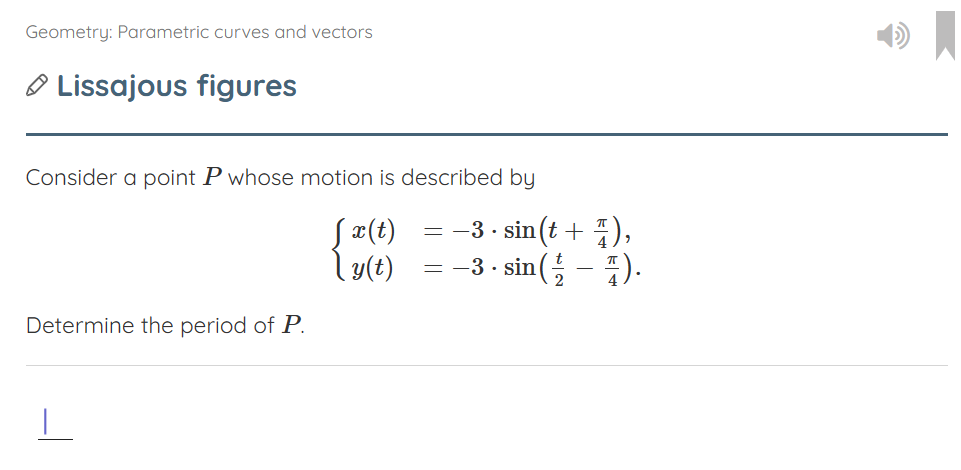 obtuse pebbleBOT
karmic hedge
https://i.imgur.com/mQ8jjPq.png
karmic hedge
obtuse pebbleBOT
karmic hedge
https://i.imgur.com/mQ8jjPq.png
karmic hedge
I know that when lissajous figures are in the form Asin(B(t+C))+D that I can take 2pi/B to get the period, but the periods are different, the period of x(t) is 2pi, the period of y(t) = 4pi. What do I do to get the period of them together?
karmic hedge
How often it repeats
 haughty coyote
More rigorously
karmic hedge
(not me googling rigorously)
I dont really know haha its just how long the function goes before it repeats itself
haughty coyote
a function with domain D is said to be T-periodic iff for all x in D, x+T is in D and f(x+T) = f(x)
Then, "the" period of f is the smallest T such that f is T-periodic
(ignore the case where this min doesn't exist)
karmic hedge
1 moment I need to read this a few times to make sure I understand haha
haughty coyote
karmic hedge
https://i.imgur.com/mQ8jjPq.png
Here you have a function from R to R^2, f(t) = (x(t), y(t))
karmic hedge
By R^2 do you mean like the 2nd value of k?
haughty coyote
What's k ?
haughty coyote
An integer
karmic hedge
oh
haughty coyote
karmic hedge
like sin^-1(0) is pi(k)
sin^-1({0}) = pi Z
haughty coyote
karmic hedge
By R^2 do you mean like the 2nd value of k?
Never seen Cartesian products ?
karmic hedge
Ah I thought k was to do with the period haha
karmic hedge
haughty coyote
Never seen Cartesian products ?
Maybe but I dont recognise the name I will google them
haughty coyote
Cause then the notation of powers makes a lot of sense
karmic hedge
karmic hedge
Maybe but I dont recognise the name I will google them
No I dont think so
haughty coyote
But otherwise no, R^2 is just the set of all pairs of real numbers, i.e. 2D space
karmic hedge
haughty coyote
Then, "the" period of f is the smallest T such that f is T-periodic
I think I get what you mean by this tho
Like I just take the lowest common multiple of 2pi/B, right?
haughty coyote
karmic hedge
I think I get what you mean by this tho
Cause you don't say sin is 42pi periodic, even though it is
 karmic hedge
I know that when lissajous figures are in the form Asin(B(t+C))+D that I can tak...
karmic hedge
karmic hedge
I know that when lissajous figures are in the form Asin(B(t+C))+D that I can tak...
This trick saves so much time
haughty coyote
karmic hedge
Like I just take the lowest common multiple of 2pi/B, right?
You want a period of x and y at the same time
karmic hedge
Yeye
haughty coyote
karmic hedge
This trick saves so much time
I wouldn't call that a trick
karmic hedge
I didnt understand how to get both together but now its kinda obvious haha
karmic hedge
haughty coyote
I wouldn't call that a trick
oh
Well whatever it is its handy 😅
Thanks again!!
❤️
.close
obtuse pebbleBOT
Channel closed
Closed by @karmic hedge
Use .reopen if this was a mistake.
Available help channel!
Send your question here to claim the channel.
Remember:
• Ask your math question in a clear, concise manner.
• Show your work, and if possible, explain where you are stuck.
• After 15 minutes, feel free to ping <@&286206848099549185>.
• Type the command .close to free the channel when you're done.
• Be polite and have a nice day!
Read #❓how-to-get-help for further information on how to ask a good question, and about conduct in the question channels.
 still badger
If $x+\frac{1}{x} = 4$ what is $x^6+\frac{1}{x^6}$?
obtuse pebbleBOT
still badger
If $x+\frac{1}{x} = 4$ what is $x^6+\frac{1}{x^6}$?
warm shaleBOT
babario
 frank monolith
use $a^3 + b^3 = (a+b)(a^2-ab+b^2)$
warm shaleBOT
Dissrupt
 still badger
@timid silo
timid silo
oh right okay
okay i think
so
Uh, okay, we have this equation, like x plus one over x equals four. And we need to find x to the power of six plus one over x to the power of six. To get that, we use this expression with x squared plus one over x squared, which is, umm, (x plus one over x) squared minus two, I think. So, that's like 16 minus two, which is, umm, 14, I guess.
Now, we can use 14 in the main expression, which is x squared plus one over x squared whole cubed minus three times x squared plus one over x squared. Let me plug in 14 and see what we get. So, it's 14 cubed minus three times 14. Doing the math, it's, umm, 2,744 minus 42, maybe?
So, the final answer is, 2,744 minus 42, which might be, 2,702. Yeah, I think that's it, but not entirely sure.
took me time that
and dont lecture me that i cant explain well
i already know
still badger
you can do stuff like this here actually $x + \frac{1}{x}$
warm shaleBOT
babario
 still badger
just make sure u wrap the latex round $$
timid silo
hmmm okay
timid silo
yeah alr, i was unsure throughout as i dont usually write out my whole thought process
as i think i may actually be getting some parts wrong
frank monolith
your answer is correct
timid silo
@frank monolith i got it correct?
still badger
timid silo
Uh, okay, we have this equation, like x plus one over x equals four. And we need...
uhh so ur main expression is ${(x^2 + \frac{1}{x^2})}^3 - 3x^2 - \frac{1}{x^2} = x^6 + \frac{1}{x^6}$?
warm shaleBOT
babario
 frank monolith
oh wait, whose question is this?
still badger
mine
frank monolith
confused screaming
still badger
warm shale
**babario**
this is correct right?
timid silo
still badger
uhh so ur main expression is ${(x^2 + \frac{1}{x^2})}^3 - 3x^2 - \frac{1}{x^2} =...
hmmm im not sure
im pretty sure its
$x^6 + \frac{1}{x^6} = \left(x^2 + \frac{1}{x^2}\right)^2 - 2$
warm shaleBOT
Avaaaa
 frank monolith
no
still badger
nah
timid silo
dam
frank monolith
warm shale
**babario**
you are missing a 3 with -1/x^2
still badger
u said cube previously
still badger
warm shale
**Avaaaa**
tats squared
frank monolith
but your expression wont be much useful
still badger
oh
timid silo
hmmm right
timid silo
frank monolith
you are missing a 3 with -1/x^2
so this then
$x^6 + \frac{1}{x^6} = \left(x^2 + \frac{1}{x^2}\right)^2 - 2$
warm shaleBOT
Avaaaa
 frank monolith
nope
timid silo
wait no
i did the wrong thing again
dam i got it before
now its just
well i got it right the first time so, oh well
still badger
warm shale
**Dissrupt**
so in the end its $x^6 + \frac{1}{x^6} = (x^2 + \frac{1}{x^2})(x^4 + \frac{1}{x^4} - 1)$?
warm shaleBOT
babario
 warm shaleBOT
Dissrupt
 obtuse pebbleBOT
Channel closed
Closed by @still badger
Use .reopen if this was a mistake.
Available help channel!
Send your question here to claim the channel.
Remember:
• Ask your math question in a clear, concise manner.
• Show your work, and if possible, explain where you are stuck.
• After 15 minutes, feel free to ping <@&286206848099549185>.
• Type the command .close to free the channel when you're done.
• Be polite and have a nice day!
Read #❓how-to-get-help for further information on how to ask a good question, and about conduct in the question channels.
fossil spoke
i expanded the LHS and also worked from RHS but got stuck
 obtuse pebbleBOT
fossil spoke
i expanded the LHS and also worked from RHS but got stuck
obtuse pebbleBOT
fossil spoke
i expanded the LHS and also worked from RHS but got stuck
 tight thunder
can you show your work
obtuse pebbleBOT
@fossil spoke Has your question been resolved?
fossil spoke
tight thunder
can you show your work
 tight thunder
FLASHBANG
obtuse pebbleBOT
Channel closed
Closed by @fossil spoke
Use .reopen if this was a mistake.
Available help channel!
Send your question here to claim the channel.
Remember:
• Ask your math question in a clear, concise manner.
• Show your work, and if possible, explain where you are stuck.
• After 15 minutes, feel free to ping <@&286206848099549185>.
• Type the command .close to free the channel when you're done.
• Be polite and have a nice day!
Read #❓how-to-get-help for further information on how to ask a good question, and about conduct in the question channels.
 novel grotto
Square the sum and simplify, then noting that the original sum is positive you can take square root again
There is no need for trigonometry
tight thunder
you mustve done something wrong
1/sqrt(2)-1 is not equal to sqrt((1/sqrt(2)-1)^2)
@digital jay
obtuse pebbleBOT
@digital jay Has your question been resolved?
Channel closed
Closed by @digital jay
Use .reopen if this was a mistake.
Available help channel!
Send your question here to claim the channel.
Remember:
• Ask your math question in a clear, concise manner.
• Show your work, and if possible, explain where you are stuck.
• After 15 minutes, feel free to ping <@&286206848099549185>.
• Type the command .close to free the channel when you're done.
• Be polite and have a nice day!
Read #❓how-to-get-help for further information on how to ask a good question, and about conduct in the question channels.
 pastel sluice
 obtuse pebbleBOT
pastel sluice
pastel sluice
obtuse pebbleBOT
pastel sluice
pastel sluice
HELP can someone show me working out
 weary vortex
Do you know basic trigonometry?
weary vortex
Can you show your work? 🙂
pastel sluice

 weary vortex
🙂
weary vortex
no worries! 🙂
 wind scaffold
find the length of the adjacent first forgive my possible spelling error
obtuse pebbleBOT
@pastel sluice Has your question been resolved?
Channel closed
Closed by @pastel sluice
Use .reopen if this was a mistake.
obtuse pebbleBOT
Available help channel!
Send your question here to claim the channel.
Remember:
• Ask your math question in a clear, concise manner.
• Show your work, and if possible, explain where you are stuck.
• After 15 minutes, feel free to ping <@&286206848099549185>.
• Type the command .close to free the channel when you're done.
• Be polite and have a nice day!
Read #❓how-to-get-help for further information on how to ask a good question, and about conduct in the question channels.
 steady lodge
“graph the function y=4(cosX)^2 from -2(pi)<_X<_2(pi)
obtuse pebbleBOT
steady lodge
“graph the function y=4(cosX)^2 from -2(pi)<_X<_2(pi)
 grizzled shore
Usually we use <= and >=
grizzled shore
Can you graph just y = cos(x) from -2pi to 2pi?
steady lodge
tell me if this looks right let me try
so 4 is a stretch factor
does that effect magnitude?
steady lodge
 frank monolith
so can (cosx)^2 be negative?
frank monolith
no
steady lodge
so does it like bounce off 0 or something?
steady lodge
either 4 or 1
steady lodge
yeah, like it only goes that high
isn’t that the default
but there is a 4
so it goes higher than default
perhaps, up to 4?
steady lodge
so would the equilibrium be 2?
frank monolith
so 4cos^(x) has max of 4*1 = 4
steady lodge
ohhh okay
that makes sense cause it is just stretching it vertically
i’m trying to think, if the middle line isn’t 0, is it just the average of 4 and 1?
so 5/2
frank monolith
why?
frank monolith
frank monolith
can cosx be zero?
.
steady lodge
I think so yes
let me think
no because that would mean a side length would be 0
and that’s not possible
but I feel like i’ve seen 0 in a calc after putting in cos(x)
frank monolith
,w plot cosx
warm shaleBOT


 frank monolith
is cosx zero somewhere?
steady lodge
yes
frank monolith
so will cos^2(x) be zero?
steady lodge
why is that?
frank monolith
you havent studied cosx?
steady lodge
isn’t taking like cos(90) like not allowed?
because the opposite is the hypotenuse?
frank monolith
steady lodge
isn’t taking like cos(90) like not allowed?
why is that
steady lodge
steady lodge
because the opposite is the hypotenuse?
.
frank monolith
i dont think i understand that?
steady lodge
like
say you have a triangle right
if you put yourself in the 90* corner
the hypotenuse is always the greatest side of the triangle, and there id no greater angle than 90, therefore, the opposite side of the 90* angle would always be the hypotenuse
frank monolith
do you know the quadrants?
steady lodge
yes
obtuse pebbleBOT
@steady lodge Has your question been resolved?
obtuse pebbleBOT
@steady lodge Has your question been resolved?
Channel closed
Closed by @steady lodge
Use .reopen if this was a mistake.
Available help channel!
Send your question here to claim the channel.
Remember:
• Ask your math question in a clear, concise manner.
• Show your work, and if possible, explain where you are stuck.
• After 15 minutes, feel free to ping <@&286206848099549185>.
• Type the command .close to free the channel when you're done.
• Be polite and have a nice day!
Read #❓how-to-get-help for further information on how to ask a good question, and about conduct in the question channels.
 inner spear
in this video professor leonard posts about this "figure 8" shape and says that greens theorem is not applicable to this case because it is not a "simple curve". Why must the curve be simple?
obtuse pebbleBOT
inner spear
in this video professor leonard posts about this "figure 8" shape and says that ...
inner spear

I know that green's theorem only works on "simple curves", but why?
the curve still encloses a region (2 regions)
 polar fossil
it's because the curve is going around one region clockwise and one region counterclockwise
it's for morally the same reason that this integral is 0, even though it looks like the area enclosed is > 0
 obtuse pebbleBOT
@inner spear Has your question been resolved?
inner spear
polar fossil
it's because the curve is going around one region clockwise and one region count...
I'm a bit uncertain - do you mean that they will have opposite signs of magnitude?
warm shaleBOT
Hayley
 polar fossil
you're effectively reversing your bounds
obtuse pebbleBOT
Channel closed
Closed by @inner spear
Use .reopen if this was a mistake.
Available help channel!
Send your question here to claim the channel.
Remember:
• Ask your math question in a clear, concise manner.
• Show your work, and if possible, explain where you are stuck.
• After 15 minutes, feel free to ping <@&286206848099549185>.
• Type the command .close to free the channel when you're done.
• Be polite and have a nice day!
Read #❓how-to-get-help for further information on how to ask a good question, and about conduct in the question channels.
 fervent stump
is it possible to numerically/algebraically show that 1. as x increases y increases; 2. as x increases y increases at an increasing rate for the following equation. The domain is restricted to Pi/2
 obtuse pebbleBOT
fervent stump
is it possible to numerically/algebraically show that 1. as x increases y increa...
fervent stump
obtuse pebbleBOT
fervent stump
is it possible to numerically/algebraically show that 1. as x increases y increa...
fervent stump
The domain is restricted to (0;Pi/2)
polar fossil
sure, take the derivative
fervent stump
i tried and got the following expression -3/8 (sinθ/θ)^((-11)/8) ( cos(θ)θ-sin(θ))/θ^2
polar fossil
yeah now show that's > 0
fervent stump
this looks better
 polar fossil
for your domain
fervent stump
and you get as far as i got it x<tan x
and then i am stuck
and taking a second derivative of this hell doesn't look plausible
so perhaps there is a different way or am i missing something?
polar fossil
well
it might be possible to prove something about sinx/x
and apply that to your function
fervent stump
