#help-10
1 messages · Page 228 of 1
 forest sinew
forest sinew
forest sinew
you said 10/9 is bigger than 1?
 warped violet
yes
forest sinew
what happens if you multiply something by a number thats bigger than 1
warped violet
grows
warped violet
yes
warped violet
yes
forest sinew
is it still bigger than 1?
warped violet
yes
warped violet
so it’s a solution?
forest sinew
whats necessary for a number to be a solution to that inequality?
it looked like it was $0 < x \leq 1$?
 warm shaleBOT
jan Niku
 warped violet
less than or equal to 1
forest sinew
so the number must be bigger than 0, but no bigger than 1
warped violet
oh
forest sinew
is (10/9)^2 no bigger than 1?
warped violet
i don’t know
forest sinew
is (10/9)^2 bigger than 1?
forest sinew
okay
a number thats a solution to that inequality has to be positive, but cant be bigger than 1
warped violet
so it’s not a solution?
forest sinew
if you have a number than is 0, negative, or bigger than 1, its not a solution
forest sinew
warped violet
so it’s not a solution?
you tell me 
warped violet
it’s not
forest sinew
right
does that give you an idea of how to solve the rest of them?
i guess maybe you can use a calculator, but its not necessary


 errant lark
warped violet
i need help with this one though
errant lark
warped violet
i need help with this one though
What have you tried?
 obtuse pebbleBOT
@warped violet Has your question been resolved?
obtuse pebbleBOT
Channel closed
Closed due to timeout
Use .reopen if this was a mistake.
 Available help channel!
Send your question here to claim the channel.
Remember:
• Ask your math question in a clear, concise manner.
• Show your work, and if possible, explain where you are stuck.
• After 15 minutes, feel free to ping <@&286206848099549185>.
• Type the command .close to free the channel when you're done.
• Be polite and have a nice day!
Read #❓how-to-get-help for further information on how to ask a good question, and about conduct in the question channels.
warped violet
 obtuse pebbleBOT
warped violet
warped violet
errant lark
What have you tried?
obtuse pebbleBOT
warped violet
warped violet
errant lark
What have you tried?
i’ve tried to but i really don’t understand it
sorry for late reply
 upbeat gazelle
Which ones are problematic?
warped violet
upbeat gazelle
Which ones are problematic?
the question
obtuse pebbleBOT
@warped violet Has your question been resolved?
forest sinew
warped violet
the question
you still here?
obtuse pebbleBOT
Channel closed
Closed due to timeout
Use .reopen if this was a mistake.
Available help channel!
Send your question here to claim the channel.
Remember:
• Ask your math question in a clear, concise manner.
• Show your work, and if possible, explain where you are stuck.
• After 15 minutes, feel free to ping <@&286206848099549185>.
• Type the command .close to free the channel when you're done.
• Be polite and have a nice day!
Read #❓how-to-get-help for further information on how to ask a good question, and about conduct in the question channels.
 vast crow
 vast crow

I’m not sure if 1. My model is correct, and 2. How I can find the angles
<@&286206848099549185>
 foggy idol
vast crow
foggy idol
vast crow
not good
vast crow
i have like a a week and a half to complete half a semester of precalc cus i put it off lol
vast crow
well i hope its the prior rather than the latter
 fiery nacelle
vast crow
i have no idea what the first step would be in finding the angles
fiery nacelle
vast crow
i have no idea what the first step would be in finding the angles
Split diagonally?
Triangles
And
Calculate angles
📐

 obtuse pebbleBOT
@vast crow Has your question been resolved?
Channel closed
Closed by @vast crow
Use .reopen if this was a mistake.
Available help channel!
Send your question here to claim the channel.
Remember:
• Ask your math question in a clear, concise manner.
• Show your work, and if possible, explain where you are stuck.
• After 15 minutes, feel free to ping <@&286206848099549185>.
• Type the command .close to free the channel when you're done.
• Be polite and have a nice day!
Read #❓how-to-get-help for further information on how to ask a good question, and about conduct in the question channels.
 remote timber
 obtuse pebbleBOT
remote timber
remote timber
obtuse pebbleBOT
remote timber
remote timber
Sorry I totally forgot to respond, I was wondering if I could get help on like understanding this problem?..
obtuse pebbleBOT
@remote timber Has your question been resolved?
obtuse pebbleBOT
Channel closed
Closed due to timeout
Use .reopen if this was a mistake.
Available help channel!
Send your question here to claim the channel.
Remember:
• Ask your math question in a clear, concise manner.
• Show your work, and if possible, explain where you are stuck.
• After 15 minutes, feel free to ping <@&286206848099549185>.
• Type the command .close to free the channel when you're done.
• Be polite and have a nice day!
Read #❓how-to-get-help for further information on how to ask a good question, and about conduct in the question channels.
 ionic summit
This might be a silly question, but.. when exactly do you know when to set for example two functions of z equal to eachother to find the projection on the xy plane. Sometimes you don't need to do that and you can just set z = 0 or and get the region immediadtly. Im having a hard time picking up when to do/not do to so
obtuse pebbleBOT
ionic summit
This might be a silly question, but.. when exactly do you know when to set for e...
ionic summit
To find volumes with tripple integrals

there was this textbook problem (25) and I could not properly figure out the bounds
obtuse pebbleBOT
@ionic summit Has your question been resolved?
ionic summit
<@&286206848099549185>
 spring fractal
 hot sonnet
ionic summit
hot sonnet
ionic summit
Hello. Well in these problems the figures show that the lower bound for z is 0 🤔
hot sonnet
When the lower bound (floor) is not constant, you usually have to find the intersection with the ceiling function
(in case you want to find the volume between them)
ionic summit
ionic summit
This might be a silly question, but.. when exactly do you know when to set for e...
this bit then the q
feel free to ping if u have an explination
well i dont actually really wanna be checking back here so
.close
obtuse pebbleBOT
Channel closed
Closed by @ionic summit
Use .reopen if this was a mistake.
Available help channel!
Send your question here to claim the channel.
Remember:
• Ask your math question in a clear, concise manner.
• Show your work, and if possible, explain where you are stuck.
• After 15 minutes, feel free to ping <@&286206848099549185>.
• Type the command .close to free the channel when you're done.
• Be polite and have a nice day!
Read #❓how-to-get-help for further information on how to ask a good question, and about conduct in the question channels.
 timid silo
is it enough for a) to just say any dot product w_j * v_j is 0?
 timid silo
i also have no clue how to do b and c
oh decomposition theorem for b
and i needed to say w_i * v_j for all i != j
.close
obtuse pebbleBOT
Channel closed
Closed by @astral night
Use .reopen if this was a mistake.
Available help channel!
Send your question here to claim the channel.
Remember:
• Ask your math question in a clear, concise manner.
• Show your work, and if possible, explain where you are stuck.
• After 15 minutes, feel free to ping <@&286206848099549185>.
• Type the command .close to free the channel when you're done.
• Be polite and have a nice day!
Read #❓how-to-get-help for further information on how to ask a good question, and about conduct in the question channels.
 stoic elm
is my answer right lol
 obtuse pebbleBOT
stoic elm
is my answer right lol
obtuse pebbleBOT
stoic elm
is my answer right lol
 slim cove
stoic elm
is my answer right lol
slim cove
stoic elm
is my answer right lol
how'd you get it?
stoic elm
idk i was hoping someone would explain 😦 my brother told me the answer but he didnt have time to explain it
 forest glade
BRO
we r doing the exact same assignment
i can help u dm me
r u also doing accelerate
stoic elm
.close
obtuse pebbleBOT
Channel closed
Closed by @stoic elm
Use .reopen if this was a mistake.
obtuse pebbleBOT
Available help channel!
Send your question here to claim the channel.
Remember:
• Ask your math question in a clear, concise manner.
• Show your work, and if possible, explain where you are stuck.
• After 15 minutes, feel free to ping <@&286206848099549185>.
• Type the command .close to free the channel when you're done.
• Be polite and have a nice day!
Read #❓how-to-get-help for further information on how to ask a good question, and about conduct in the question channels.
 hushed gust
Hi guys! I have some questions regarding 3, 4, and 5
 obtuse pebbleBOT
hushed gust
Hi guys! I have some questions regarding 3, 4, and 5
hushed gust
obtuse pebbleBOT
hushed gust
Hi guys! I have some questions regarding 3, 4, and 5
hushed gust
3(a)
y is not divisible by 4 for all possible values of y. For example if x and y are both 2, x is not divisible by 4 but xy (2 * 2 = 4) is divisible by 4.
I'm not sure about 3(b)
 civic zealot
if y is not divisible by 2, but xy is divisible by 4, then what does x have to be divisible by?
hushed gust
civic zealot
if y is not divisible by 2, but xy is divisible by 4, then what does x have to b...
x would have to be divisible by 2?
civic zealot
more than that...
hushed gust
if y is not divisible by 2 but xy is divisible by 4, x must be divisible by 4?
if y is not div by 4 (y=3) but xy % 4 = 0, x % 4 = 0
.close
obtuse pebbleBOT
Channel closed
Closed by @hushed gust
Use .reopen if this was a mistake.
Available help channel!
Send your question here to claim the channel.
Remember:
• Ask your math question in a clear, concise manner.
• Show your work, and if possible, explain where you are stuck.
• After 15 minutes, feel free to ping <@&286206848099549185>.
• Type the command .close to free the channel when you're done.
• Be polite and have a nice day!
Read #❓how-to-get-help for further information on how to ask a good question, and about conduct in the question channels.
 brisk arrow
 obtuse pebbleBOT
brisk arrow
brisk arrow
obtuse pebbleBOT
brisk arrow
brisk arrow
Given f(x) is polynomial
brisk arrow
brisk arrow
I wonder whether it is true
 sage geode
$\dv{}{x}f(6) \ne f'(6)$
warm shaleBOT
A Lonely Bean

 wooden cipher
e.g. x^2
sage geode
Well, the case f'(6) = 0 would be an exception
sage geode
Generally $\dv{}{x}f(a) = 0$ given $a$ is a constant
warm shaleBOT
A Lonely Bean
 sage geode
Is 6 a constant?
brisk arrow
It is
sage geode
So $\dv{}{x}f(6) = 0$
warm shaleBOT
A Lonely Bean
 sage geode
And not f'(6)
sage geode
Right
brisk arrow
Well
I wonder what’s the difference between f’(6) and d/dx f(6)
In meaning and definition
Not just the mathematical results
 brisk arrow
 tame dock
any random polynomial can be taken also
tame dock
any random polynomial can be taken also
For sure
brisk arrow
brisk arrow
I wonder what’s the difference between f’(6) and d/dx f(6)
Like how to understand it generally
wooden cipher
$\frac{d(f(x))}{dx} \vert_{x=6}$
warm shaleBOT
GarlicBredFries
 tame dock
brisk arrow
*
tame dock
brisk arrow
*
look in the case of f(6) the value of x is already assigned which will yield a constant value whose derivative is 0
if the polynomial is differentiated first and then the value is taken the anser will be differnt
wooden cipher
Lol little vertical bar
brisk arrow
warm shale
**GarlicBredFries**
Can I understand that d/dx as a word which have the meaning of “I’m about to derive the f(x)”
tame dock
brisk arrow
For sure
can you tell me if i were wrong or is it explanatory
wooden cipher
warm shale
**GarlicBredFries**
This is different from $\frac{d(f(6))}{dx}$
warm shaleBOT
GarlicBredFries
 brisk arrow
tame dock
can you tell me if i were wrong or is it explanatory
brisk arrow
tame dock
can you tell me if i were wrong or is it explanatory
No I think it’s not what I’m searching for
I’m asking for the difference between d/dx f(6) and f’(6)
In meaning
What does these implied?
 brisk arrow
 tame dock
like what happened
tame dock
ohhh i am really sorry
i just differentiated the equation first and then i substituted the value of x which comes out to be 15
 tardy epoch
brisk arrow
I can’t comprehend
These green underlined and circled contexts
tardy epoch
brisk arrow
I can’t comprehend
These green underlined and circled contexts
The notation is poor
tardy epoch
warm shale
**GarlicBredFries**
This is better
tardy epoch
warm shale
**A Lonely Bean**
Because
obtuse pebbleBOT
@brisk arrow Has your question been resolved?
Channel closed
Closed by @brisk arrow
Use .reopen if this was a mistake.
Available help channel!
Send your question here to claim the channel.
Remember:
• Ask your math question in a clear, concise manner.
• Show your work, and if possible, explain where you are stuck.
• After 15 minutes, feel free to ping <@&286206848099549185>.
• Type the command .close to free the channel when you're done.
• Be polite and have a nice day!
Read #❓how-to-get-help for further information on how to ask a good question, and about conduct in the question channels.
 sage dagger
Find an equation for the tangent line to sin^2(x) at x = π/3
sage dagger
How does this work?
So I have it’s derivative 2sinxcosx
Do I just substitute in pi/3 now?
sage dagger
Yes many times
sage dagger
oh
sage dagger
sage dagger
Do I just substitute in pi/3 now?
Do I do this though?
 royal basin
would you do that in any other tangent line problem
sage dagger
if I was asked to find something like f’(3) and I have a function like f(x) = x^2 + 3x then yeah if I recall correctly
Wait
No
No
no
I know what to do with pi/3
that’s my x1
royal basin
i think you've confused yourself by not using proper notation here
sage dagger
y-y1=m(x-x1)
royal basin
like you didn't give the function a name
 royal basin
ok fine
sage dagger
Don’t sully me
royal basin
bob(x) = sin^2(x)
sage dagger
royal basin
bob(x) = sin^2(x)

royal basin
$y - bob(x_1) = bob'(x_1) (x - x_1)$, or something.
warm shaleBOT
Ann

 tight thunder
royal basin
bob(x) = sin^2(x)
tight thunder
royal basin
bob(x) = sin^2(x)
i love you
sage dagger
oh is sin^2(x) my y value
royal basin
...
i mean
yes? but also you should understand one basic thing
the tangent line GOES THRU a point on your graph.
 fathom flicker
define thru
sage dagger
yeah
royal basin
like if you dont understand this simple thing then wtf is the point!
royal basin
fathom flicker
define thru
through, with lazy spelling.
 tardy epoch
warm shale
**Ann**
tardy epoch
warm shale
**Ann**
x1 is different from x
tardy epoch
sage dagger
that’s my x1
.
 royal basin
o
ver
thin
king
also bad
the fact your equation is nonlinear is a huge red flag
sage dagger
It has sin terms in it how is it gonna end up straight line
royal basin
you're writing down a tangent LINE
bob(pi/3) = sin^2(pi/3) = (sqrt(3)/2)^2 = 3/4
bob'(pi/3) = 2 sin(pi/3) cos(pi/3) = 2 * sqrt(3)/2 * 1/2 = sqrt(3)/2
your equation should have been
$y - \frac{3}{4} = \frac{\sqrt{3}}{2}(x - \pi/3)$
warm shaleBOT
Ann
 sage dagger
How did you get square roots
royal basin
sin(pi/3) = sqrt(3)/2
sage dagger
oh
sage dagger
Wait so I was supposed to substitute pi/3
sage dagger

royal basin
the tangent at x=c to the graph of a differentiable function y = f(x)
is the line which goes through the point (c, f(c)) with slope f'(c)
calculating f(c) and f'(c), if you should desire to have that be stated explicitly, requires substituting c for x in the formulas for f(x) itself and f'(x) respectively.
royal basin
you had the right idea but you phrased it in D-tier terms
royal basin
i maintain my point that your wording was D-tier.
royal basin
no...
y1 is the y coord of the point of contact...
its not supposed to depend on anything...
its not supposed to be a function...
its supposed to be a number for gods sake...
(x1, y1) is your point of contact
its the point on the fucking graph
whose x coordinate, x1, is given
and whose y coordinate, y1, is immediately calculable
and you're supposed to calculate it
not BLINDLY mind you
sage dagger
Yeah so how do I know what my y1 is
royal basin
ITS ON THE BLOODY GRAPH
sage dagger
What
royal basin
IF YOU KNOW A POINT LIES ON y=f(x) AND YOU KNOW ITS X COORD HOW DO YOU FIND ITS BLOODY Y COORDINATE
THE FORMULA OF THE GRAPH LITERALLY FUCKING TELLS YOU
sage dagger
tight thunder
ann chill
royal basin
IT LIES. ON. THE. GOD. DAMN. GRAPH.
its such BASICS that you should KNOW already by the time you're doing calculus for FUCKS sake
sage dagger
So do I substitute in 0 for sin^2(x)
 royal basin
BUT WHY DO YOU TAKE X=0
AND NOT X=PI/3 THATS GIVEN TO YOU
EVERY BLOODY DAY YOU CHOOSE TO THROW STONES DIRECTLY IN MY FACE
this is like
at least 5 puppy deaths in one go
 royal basin
yes
 polar fossil
this sketch may be helpful here to visualize what's going on
fathom flicker
maybe just refresh point-slope form of a line?
I mean if you can find the derivative, which is the slope of your desired tangent line, then all you need is a point, and I mean like it's very simple from there
unless of course you are not familiar with point-slope form
in which case you should get familiar
royal basin
polar fossil
this sketch may be helpful here to visualize what's going on
bob(x) is sin^2(x) not the tangent line tho
 obtuse pebbleBOT
@sage dagger Has your question been resolved?
royal basin
no of fucking course it hasnt who are we kidding
sage dagger
fr
ok and then I plug in pi/3 into my derivative?
for the m part of the tangent line eq
polar fossil
the derivative of your function at pi/3 will be the same as the slope of your line
 dusk widget
sage dagger
for the m part of the tangent line eq
dusk widget
sage dagger
for the m part of the tangent line eq
yes
then you can use f(π/3) = m(π/3) + b
and solve for b
which would yield your tangent line
sage dagger
But isn’t it y-y1=m(x-x1)
dusk widget
sage dagger
But isn’t it y-y1=m(x-x1)
what is this
sage dagger
It’s the tangent line equation
dusk widget
oh, you're using point-slope form?
sage dagger
polar fossil
the derivative of your function at pi/3 will be the same as the slope of your li...
What about for x1
sage dagger
dusk widget
oh, you're using point-slope form?
Well that’s what the tangent line equation is
sage dagger
eh
sage dagger
y-y1=m(x-x1) is how it was taught to me so that’s what I’m gonna stick with
sage dagger
That’s x1 right
polar fossil
yes, (x1, y1) is the point
polar fossil
wdym that's not linear
sage dagger
Doesn’t it have to be a straight line equation
 warm shaleBOT
Result:
0.86602540378444
seems like a number to me
sage dagger
royal basin
the fact your equation is nonlinear is a huge red flag
Here
polar fossil
m is just a number
y = mx + b is the equation of a line
$y - y_1 = m(x - x_1)$ is also the equation of a line
warm shaleBOT
Hayley
 polar fossil
in both of these equations, m is a real number
which describes the slope of the line
sage dagger
Since m is 2sin(pi/3)cos(pi/3) then it has to be 2sin(pi/3)cos(pi/3)(x - pi/3) no?
sage dagger
sage dagger
I did something similar here and Ann said it was wrong
polar fossil
what you did there was confusing
because you conflated x and x_1
in particular you had the name x meaning two different things at once
sage dagger
sage dagger
Since m is 2sin(pi/3)cos(pi/3) then it has to be 2sin(pi/3)cos(pi/3)(x - pi/3) n...
Do I expand this
polar fossil
if you'd like
but again you should write both sides of the equation before you do that
sage dagger
Wdym
polar fossil
sage dagger
Since m is 2sin(pi/3)cos(pi/3) then it has to be 2sin(pi/3)cos(pi/3)(x - pi/3) n...
what you have written here does not have an equals sign
sage dagger
Oh right
obtuse pebbleBOT
@sage dagger Has your question been resolved?
obtuse pebbleBOT
Channel closed
Closed due to timeout
Use .reopen if this was a mistake.
Available help channel!
Send your question here to claim the channel.
Remember:
• Ask your math question in a clear, concise manner.
• Show your work, and if possible, explain where you are stuck.
• After 15 minutes, feel free to ping <@&286206848099549185>.
• Type the command .close to free the channel when you're done.
• Be polite and have a nice day!
Read #❓how-to-get-help for further information on how to ask a good question, and about conduct in the question channels.
 rare estuary
My question is: Find all numbers $r$ such that $$ \begin{bmatrix} 2 & 4 & 2 \ 1 & r & 3 \ 1 &2 & 1 \end{bmatrix}$$ is invertible
obtuse pebbleBOT
rare estuary
My question is: Find all numbers $r$ such that $$ \begin{bmatrix} 2 & 4 & 2 \\ 1...
warm shaleBOT
April | Koi of Mahjong
 rare estuary
I know that can easily be done with determinants
however at this point in class, we have not talked about determinants and thus we can not use that method to determine $r$
warm shaleBOT
April | Koi of Mahjong

 fresh nymph
ok so how would you go about inverting a matrix ?
rare estuary
set up an augmented matrix, and try to put the left hand side of it in row-echelon form
so $$ \left[ \begin{array}{ccc|ccc} 2 & 4 & 2 & 1 & 0 & 0 \ 1 & r & 3 & 0 & 1 & 0 \ 1 & 2 & 1 & 0 & 0 & 1 \end{array} \right]$$
warm shaleBOT
April | Koi of Mahjong
 fresh nymph
yes exactly
so you need to do operations on columns for example to obtain identity on left side
try first to get the first and last column right and this will probably give you a condition on r
rare estuary
It can't be inverted no matter the value $r$ since performing $R_{3} \rightarrow R_{3} - \frac{1}{2} R_{1}$ results in $$ \left[ \begin{array}{ccc|ccc} 2 &4 & 2 & 1 & 0 & 0 \ 1 & r & 3 & 0 & 1 & 0 \ 0 & 0 & 0 & -\frac{1}{2} & 0 & 1 \end{array} \right] $$ right?
fresh nymph
yep
warm shaleBOT
April | Koi of Mahjong
 rare estuary
I should of thought of that lol. Thank you :))
fresh nymph
np
rare estuary
.close
obtuse pebbleBOT
Channel closed
Closed by @rare estuary
Use .reopen if this was a mistake.
Available help channel!
Send your question here to claim the channel.
Remember:
• Ask your math question in a clear, concise manner.
• Show your work, and if possible, explain where you are stuck.
• After 15 minutes, feel free to ping <@&286206848099549185>.
• Type the command .close to free the channel when you're done.
• Be polite and have a nice day!
Read #❓how-to-get-help for further information on how to ask a good question, and about conduct in the question channels.
 cyan geyser

 lusty goblet
!status
obtuse pebbleBOT
What step are you on?
1. I don't know where to begin
2. I have begun but got stuck midway
3. I got an answer but I'm told it's wrong
4. I got an answer and would like my work checked
5. I have a question about someone else's worked solution
6. None of the above
I can do i, ii but not the rest.
lusty goblet
Think of adding tiles as state transition.
First, you have tile [E/ZZZE]. You can't add more of this tile, so let's start with initial state ZZZ
Then think something like tile [X/Z] as popping the tile Z at the front and adding X at the back.
obtuse pebbleBOT
Channel closed
Closed by @cyan geyser
Use .reopen if this was a mistake.
obtuse pebbleBOT
Available help channel!
Send your question here to claim the channel.
Remember:
• Ask your math question in a clear, concise manner.
• Show your work, and if possible, explain where you are stuck.
• After 15 minutes, feel free to ping <@&286206848099549185>.
• Type the command .close to free the channel when you're done.
• Be polite and have a nice day!
Read #❓how-to-get-help for further information on how to ask a good question, and about conduct in the question channels.
 rotund arch
j(x) = 2^x
obtuse pebbleBOT
rotund arch
j(x) = 2^x
rotund arch
jj(x) = 2^2x?
royal basin
if by jj(x) you mean j(j(x)) then no.
rotund arch
ok
 ruby path
if you mean j(x)*j(x) you're right
rotund arch
question only show jj(x)
sage geode
The book should somewhere define what fg means when f and g are functions
obtuse pebbleBOT
@rotund arch Has your question been resolved?
Channel closed
Closed by @rotund arch
Use .reopen if this was a mistake.
obtuse pebbleBOT
Available help channel!
Send your question here to claim the channel.
Remember:
• Ask your math question in a clear, concise manner.
• Show your work, and if possible, explain where you are stuck.
• After 15 minutes, feel free to ping <@&286206848099549185>.
• Type the command .close to free the channel when you're done.
• Be polite and have a nice day!
Read #❓how-to-get-help for further information on how to ask a good question, and about conduct in the question channels.
 forest quartz
Alright, the question is this
 obtuse pebbleBOT
forest quartz
Alright, the question is this
forest quartz
obtuse pebbleBOT
forest quartz
Alright, the question is this
forest quartz
I want to know how negative powers work

We got given this sheet and the proof is confusing
 leaden ginkgo
which part do you find confusing?
forest quartz
How does a^0 ÷ a^n proof negative powers becoming 1/a^n
More like
Why is a^0 there
Like I don't see who it wouldn't be let's say a^1
leaden ginkgo
a^0 is just 1, any number raised to the power of 0 is 1
forest quartz
We got told that anything raised to a power, eg: 3^3 = 3x3x3
So why isn't 3^-1, -3
 tacit scarab
that definition only work for positive integers
tacit scarab
because it makes no sense talking about -1 three's multiplied together
It's a little hard subject
but sometimes in math we extend the definition
forest quartz
Because i understand I have to do a,b,c to get an answer but I like knowing why that happens
tacit scarab
ok now let's think of only positive integers
forest quartz
Alright
tacit scarab
and with those we have our rules about index
forest quartz
I don't remember them all but I know what you're taking about
tacit scarab
now we want to understand negative powers
and when doing it
we want them to follow the pre existing rules
ok?
forest quartz
Yup
forest quartz
Yo what that's cool
warm shaleBOT
WhereWolf
 tacit scarab
what would it become
forest quartz
Yea
tacit scarab
we have $x^{-1}\times x^1 = 1$
warm shaleBOT
WhereWolf
 tacit scarab
now we can solve for x^-1
forest quartz
1/x^1 = x^-1
tacit scarab
that's how negative powers work
tacit scarab
math is super logical so if you see the reasoning everything is easy
tacit scarab
yep
forest quartz
9^-1 = 1/9
tacit scarab
any other questions?
forest quartz
forest quartz
Alright, the question is this
So for this question
This has multiple powers
tacit scarab
in this case you can use the fact that $(a^b)^c=a^{bc}$
warm shaleBOT
WhereWolf
 tacit scarab
you can skip this once you are comfortable with indices
forest quartz
Skip what?
tacit scarab
warm shale
**WhereWolf**
this process
forest quartz
The question
tacit scarab
first
in math we like improper fractions cause they are easier to calculate
second -3 = -1*3
tacit scarab
forest quartz
1*-3 also equals -3 doesn't it?
but this won't help
forest quartz
Sorry I meant like using the (a^b)^c = a^bc
tacit scarab
so when you have negative powers
like x^-2
you can kind of seperate the negative
$x^{-2}=(x^2)^{-1}=\frac{1}{x^2}$
warm shaleBOT
WhereWolf
 tacit scarab
yes
tacit scarab
we notate that as ((7/5)^3)^-1 btw
forest quartz
And so solve 7/5^3
With these questions do u turn it into a number or stay as a fraction?
tacit scarab
?
forest quartz
Like does the final answer become like 3.5 or smth
tacit scarab
tacit scarab
you can use decimal if you like
it's like 10000 times harder to calculate
with decimal
forest quartz
Why is that?
tacit scarab
umm you'd understand if you try
tacit scarab
you do
forest quartz
Why D:
Always wondered that with factions aswell
When do u change the bottom or not
tacit scarab
remember $(ab)^c=a^cb^c$
warm shaleBOT
WhereWolf
 tacit scarab
and $\frac{a}{b} $ is really just $a\times\frac{1}{b}$
warm shaleBOT
WhereWolf
 forest quartz
So 7/5 is just 7×1/5
tacit scarab
yeah
forest quartz
W
So it becomes
7^3 = 343
1/5^3
How would you figure this out?
I would turn it into a decimal
But how do you keep it in fraction fom
Form
tacit scarab
$(\frac{1}{a})^b=\frac{1}{a^b}$
warm shaleBOT
WhereWolf
 tacit scarab
I think this is pretty intuitive
forest quartz
Well not proof
But like
This would be using what logic?
Trying to do this all in your head and on your phone it's hard to keep track of everything established so far
tacit scarab
think of b as positive integers then $(\frac{1}{a})^b=(\frac{1}{a})(\frac{1}{a})...$
with b 1/a multiplied together
forest quartz
I need a sec to gothrough this
warm shaleBOT
WhereWolf

 lavish creek
Whats the question here?
tacit scarab
no
tacit scarab
lavish creek
Whats the question here?
learning index here
lavish creek
Oh, okay
forest quartz
Don't bully me
lavish creek
I guess I can help a little, I'm pretty good at it
forest quartz
:,(
tacit scarab
no one is bullying you
lavish creek
Its just something you learn over trial
You'll get it
It soon becomes a natural thing you will do
Just keep the work up
lavish creek
And where are you struggling on?
forest quartz
So (7/5)^-3
= ((7/5)^3)^-1
And then u solve 7/5^3
Wait I think I'm missing a step
Wait no
Yea where does this ^-1 go to
lavish creek
it just makes a fraction which I am pretty sure is x/1
forest quartz
it just vanishes because it's just multiplying itself or smh
forest quartz
Ok
lavish creek
yeah
forest quartz
And then (343/125)^-1
lavish creek
Ohhh
Noo
I'm wrong
Sorry
Its 1/x
The x being (343/125) in this case
It is just how much you multiply it buy
forest quartz
It's also 9 forcmr so we're both having aneurysms
tacit scarab
btw $\frac{1}{\frac{a}{b}}=\frac{b}{a}$
warm shaleBOT
WhereWolf
 forest quartz
Hold on so that ^-1 becomes that top one because of that proof we established at the very beginning right
tacit scarab
yes
forest quartz
Nice
lavish creek
So it starts as this: (7/5)^3
forest quartz
-3
tacit scarab
or you can think of it as $(\frac{a}{b})^{-1}=\frac{a^{-1}}{b^{-1}}=\frac{b}{a}$
warm shaleBOT
WhereWolf
 forest quartz
Yea we got told it's reciprocal
But reciprocals are so bum
They do so many weird stuff
We have a teacher that basically only copies text books
So our foundation is just copy paste words
lavish creek
Start: (7/5)^-3
Then [(7/5)^3]^-1
Then (343/125)^-1
It then flips to 1/(343/125)
Which changes to 125/343 (I think)
forest quartz
Yea
forest quartz
Bro I just go sqrt lol
lavish creek
Alr
forest quartz
Sqrt(9)
lavish creek
That would be 3
forest quartz
Mhm
lavish creek
And did you learn that x^(1/2) = (sqrt)x
Since if you haven't that would likely be next
tacit scarab
I don't think they started learning that
lavish creek
Oh, okay
Its fine I guess
But if you want to learn more about it I would be happy to help
obtuse pebbleBOT
@forest quartz Has your question been resolved?
obtuse pebbleBOT
Channel closed
Closed due to timeout
Use .reopen if this was a mistake.
Available help channel!
Send your question here to claim the channel.
Remember:
• Ask your math question in a clear, concise manner.
• Show your work, and if possible, explain where you are stuck.
• After 15 minutes, feel free to ping <@&286206848099549185>.
• Type the command .close to free the channel when you're done.
• Be polite and have a nice day!
Read #❓how-to-get-help for further information on how to ask a good question, and about conduct in the question channels.
 spring lantern
Diana was stacking dominos at a constant rate. In 1 minute, she stacked 2 dominos, in 2 mintues she stacked 4 domins and in 3 she stacked 8 dominos. (a) find an equation that shows how many dominos were stacked as a function of time. Answer: y=2^(t). (b) the equation was then modified such that diana had already stacked A domines before continuing at a constant rate described above. Find the value of A if at the 10 minute mark there was 1030 dominos stacked
obtuse pebbleBOT
spring lantern
Diana was stacking dominos at a constant rate. In 1 minute, she stacked 2 domino...
spring lantern

 atomic bobcat
spring lantern
Diana was stacking dominos at a constant rate. In 1 minute, she stacked 2 domino...
atomic bobcat
spring lantern
Diana was stacking dominos at a constant rate. In 1 minute, she stacked 2 domino...
at this rate Diana would be dead in 10 minutes
royal basin
Diana was stacking dominos at a constant rate. In 1 minute, she stacked 2 dominos, in 2 mintues she stacked 4 domins and in 3 she stacked 8 dominos.
...
royal basin
this problem contradicts itself.
"dominos are stacked at a constant rate" and "2 dominos at t=1, 4 dominos at t=2, 8 dominos at t=3" cannot coexist.
spring lantern
 royal basin
wtf
spring lantern
I need help with part (C)
royal basin
where do you keep getting these nonsense questions from...
i mean, non-realism aside
spring lantern
royal basin
where do you keep getting these nonsense questions from...
Australian year 10 curriculum
polar fossil
charitably I guess it's a consistent rate but whatever
royal basin
you cannot have a function both "grow at a constant rate" and not be linear.
tacit scarab
Diana is going to exceed light speed lol
spring lantern
tacit scarab
Diana is going to exceed light speed lol
remember me where wolf
like last week
tacit scarab
no
spring lantern
cmon
spring lantern
atomic bobcat
a part is fairly straightforward
ive done a-b
royal basin
it's also withheld from us whether c is meant to be a continuation of b or its own thing
so you're fucked on that front too
polar fossil
i don't think that will change the answer
polar fossil
tbh I'd say just make a table, it grows so fast that it won't take that many entries
atomic bobcat
if c is independent of b then it is2^t <1000000
but main question here is why does Diana need so many Dominos
spring lantern
tacit scarab
Diana is going to exceed light speed lol
fr
royal basin
polar fossil
i don't think that will change the answer
it will, log_2(1,000,000) ≠ log_2(999,994)
the difference is small but not zero
and it is withheld from us how many decimal places we are supposed to round to, if we are supposed to at all.
polar fossil
it won't if t is discrete
royal basin
who said it was
atomic bobcat
they should use multiplication of bacteria as realistic example
spring lantern
I thought this question would be straighfoward 😵💫
polar fossil
royal basin
who said it was
I did 
no but the question seems to imply it because it says "over one million" and the answer to b was an integer
atomic bobcat
tbh I don't even understand b part of this question
spring lantern
'A' is number of dominos
atomic bobcat
nvm i got it
spring lantern
u still there @atomic bobcat
atomic bobcat
yeah
spring lantern
have you thought of question c?
atomic bobcat
ohhh you are still stuck
spring lantern
yes
atomic bobcat
i thought Ann told you ans
spring lantern
no not really
spring lantern
oh ok
obtuse pebbleBOT
Channel closed
Closed by @spring lantern
Use .reopen if this was a mistake.
Available help channel!
Send your question here to claim the channel.
Remember:
• Ask your math question in a clear, concise manner.
• Show your work, and if possible, explain where you are stuck.
• After 15 minutes, feel free to ping <@&286206848099549185>.
• Type the command .close to free the channel when you're done.
• Be polite and have a nice day!
Read #❓how-to-get-help for further information on how to ask a good question, and about conduct in the question channels.
 inland thicket
 obtuse pebbleBOT
inland thicket
warm shaleBOT
obtuse pebbleBOT
inland thicket
warm shaleBOT
WhereWolf

 kind hawk
how much what
inland thicket
🇮🇱 🤝 🇷🇸
obtuse pebbleBOT
@inland thicket Has your question been resolved?
Channel closed
Closed by @inland thicket
Use .reopen if this was a mistake.
obtuse pebbleBOT
Available help channel!
Send your question here to claim the channel.
Remember:
• Ask your math question in a clear, concise manner.
• Show your work, and if possible, explain where you are stuck.
• After 15 minutes, feel free to ping <@&286206848099549185>.
• Type the command .close to free the channel when you're done.
• Be polite and have a nice day!
Read #❓how-to-get-help for further information on how to ask a good question, and about conduct in the question channels.
timid silo
 obtuse pebbleBOT
timid silo
timid silo
obtuse pebbleBOT
timid silo
timid silo
Someone recently helped me with this problem, but I wanted to ask if this is also a way to solve this: If AE/BD = CA/BA = CE/DE = 31/19 THEN CE must equal 31 and CD must equal 19. Therefore, DE must equal 12. 19/12 is our answer.
I just wanted to ask if thats a logical way of solving.
 prisma pasture
If AE/BD = CA/BA = CE/DE = 31/19 THEN CE must equal 31 and CD must equal 19
I am not sure about this one
 prisma pasture
You don't know CE is 31
You know it's 31x when x can be any number
And I am not sure about this one either AE/BD = CA/BA = CE/DE, lemme check that
timid silo
prisma pasture
You know it's 31x when x can be any number
So since the ratio of the side of big triangle to small triangle is 31/19, can we represent each side of the big triangle as 31x?
prisma pasture
timid silo
So since the ratio of the side of big triangle to small triangle is 31/19, can w...
Wait what
timid silo
prisma pasture
First it's AE/BD = CA/BA = CE/CD
Yeah that’s what I wrote on the image
prisma pasture
timid silo
Yeah that’s what I wrote on the image
Oh yea
polar fossil
<@&268886789983436800>
prisma pasture
<@&268886789983436800>
timid silo
No one gives a fuck about your dc server
prisma pasture
timid silo
So since the ratio of the side of big triangle to small triangle is 31/19, can w...
No
You can do this
timid silo
.close
obtuse pebbleBOT
Channel closed
Closed by @lean forge
Use .reopen if this was a mistake.
Available help channel!
Send your question here to claim the channel.
Remember:
• Ask your math question in a clear, concise manner.
• Show your work, and if possible, explain where you are stuck.
• After 15 minutes, feel free to ping <@&286206848099549185>.
• Type the command .close to free the channel when you're done.
• Be polite and have a nice day!
Read #❓how-to-get-help for further information on how to ask a good question, and about conduct in the question channels.
 clear kraken
 obtuse pebbleBOT
clear kraken
clear kraken
obtuse pebbleBOT
clear kraken
clear kraken

Can someone please explain how they got the formula for the longitude!??>!

Why can't they do the same for $v(\theta)$ then? i.e., $v(\theta)=d\theta$ for some constant $d>0$
warm shaleBOT
Kalgar
 obtuse pebbleBOT
@clear kraken Has your question been resolved?
 warm canopy
by design of the map we choose the spacing of u proportional to that on the equator of the sphere
obtuse pebbleBOT
Channel closed
Closed due to timeout
Use .reopen if this was a mistake.
obtuse pebbleBOT
Available help channel!
Send your question here to claim the channel.
Remember:
• Ask your math question in a clear, concise manner.
• Show your work, and if possible, explain where you are stuck.
• After 15 minutes, feel free to ping <@&286206848099549185>.
• Type the command .close to free the channel when you're done.
• Be polite and have a nice day!
Read #❓how-to-get-help for further information on how to ask a good question, and about conduct in the question channels.
timid silo
<tikz>
Write a recurrence relation to represent the amount of ways to make a chessboard of size $2\by n$ with the shapes
[
\hspace{1 cm}
\begin{tikzpicture}[scale=1]
\draw (4,4) -- (5,4) -- (5,5) -- (4,5) -- cycle;
\end{tikzpicture}
]
obtuse pebbleBOT
timid silo
<tikz>
Write a recurrence relation to represent the amount of ways to make a che...
warm shaleBOT
 timid silo
unsure on how to do this tbh
kind hawk
well first, examples
timid silo
yes so like
for a_1 you really only have
<tikz>
\begin{tikzpicture}
\draw (0,0) -- (1,0) -- (1,1) -- (0,1) -- cycle;
\draw (0,1) -- (1,1) -- (1,2) -- (0,2) -- cycle;
\end{tikzpicture}
warm shaleBOT
 timid silo
so there is only way for that
for a_2 you can have like
okay tikzing will be pain
like
kind hawk
paint
kind hawk
I mean it doesnt have to be a good drawing
kind hawk
can you rotate the L piece?
 thin hare
think about how many ways you can cover up the first col
the first 2 cols
and so on
oh yeah you said that
looks to me like a_2 should be 4:?
kind hawk
5
timid silo
 timid silo
a_3 is not finished
thin hare
id think that would be contained within the a_1 case
timid silo
there are still more of them i think
thin hare
so you'd be double counting
kind hawk
by a_3 now you should be thinking about how you can use 2x1 and 2x2 as starting blocks
and then extending them
you want a recurrence
timid silo
well a_3 seems peculiar tho
because like
you can have something like this

and i have no idea how u can build that from a_1 or a_2
thin hare
i feel like a_3 is 2 for some reason
thin hare
okay wait hear me out on why a_2 should be 4 instead of 5
the last case, where the square is formed only from singletons, can be achieved from a_1
a_1 already accounts for that configuration
so by considering it in a_2 then adding (which ur gonna do, f(n) = f(n-1) + c * f(n-2) ...)
ur double counting
kind hawk
there are still 5 ways to make a 2x2
kind hawk
whether its included in the recurence relation is a different question
thin hare
oh
yeah ig u can do the check after you construct all possible ways
but thats just painful
especially for a3
thin hare
im pretty sure it is...
kind hawk
just when you try to find a_3 you see how you build it from the other blocks
kind hawk
ah well then its needed
thin hare
yeah theres no way to build a3 from the other ones
 thin hare
whats ur plan now
timid silo
clueless, as i was in my exam
thin hare
hmm okay, i'll explain my way which i think is clearer than others
timid silo
go for it haha
thin hare

so this is a_1
notice that after we place the 2 singletons in the first column
the problem basically repeats
we need to fill in a 2x(n-1) board now
so if we define a mysterious magical function f(n) that finds the number of ways to fill a 2xn board
timid silo
hold up
thin hare
yea
kind hawk
timid silo
did i miss any?
yes. two L's
warm shaleBOT

 thin hare
im ngl the way of exhaustively listing out all possible combinations is really painful
timid silo
agreed
kind hawk
its good tho. to get a feel for whats going on
what are the things that keep repeating
what is the pattern
timid silo
a column of squares
and
L + square in the other edge
and two L's
so we have to account for all three
kind hawk
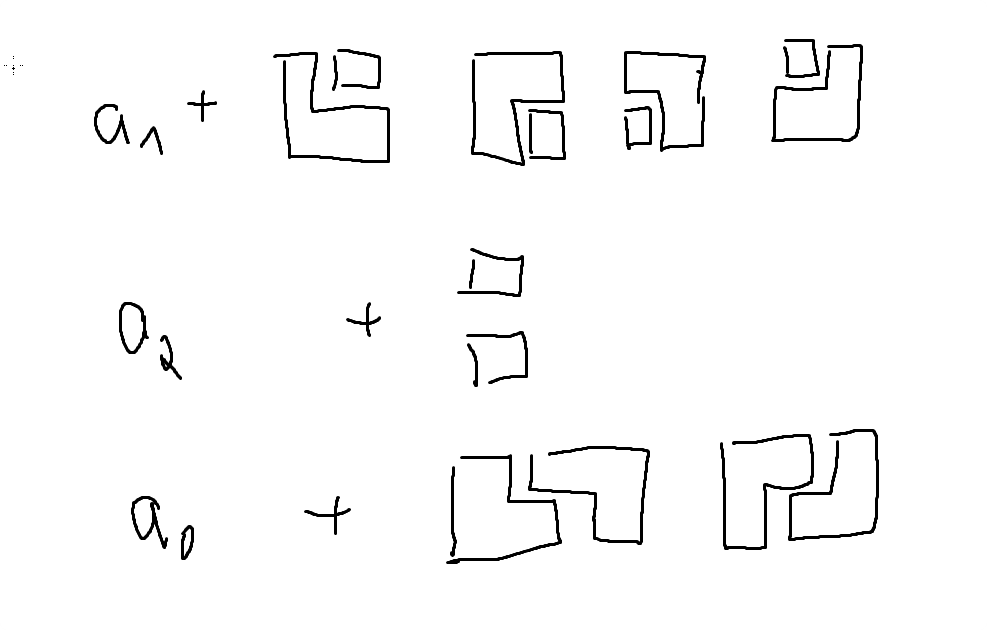 thin hare
timid silo
thin hare
timid silo
anyway if we are gonna go with the exhaustive method
you cant just use all the numbers as they are given in the recurrence
warm shaleBOT
 thin hare
this is wrong
timid silo
yeah it probably is
thin hare
do you see why?
timid silo
kind hawk
https://i.imgur.com/hTPUDQm.png
now hmm 
timid silo
thin hare
do you see why?
its probably overcounting is it not
thin hare
yeah it is
do you see why though
if you do then you can eliminate the extraneous combinations
and you'll be left with the correct coefficients
timid silo
well like
 viral blade
i mean it has to end with exactly one of these patterns right
timid silo
yeah i think instead of looking at what they begin with, lets just look at what they end with because thats more intuitive for me anyways
timid silo
thin hare
do you see why though
hmm i think its best if we rebuild that so i can get an idea?
so like
it ends with a column of squares: then you have n-1 stuff left to deal with
so a_n = a_(n-1) +... for now
next: it ends with one of the L shapes + a square in one of its corners
thin hare
yep exactly
thin hare
☑️
timid silo
hmmm
thin hare
how many ways are there to cover 3 columns without being achievable from a2 or a1
timid silo
but now it seems like we need to split up that a_(n-1) into cases?
timid silo
thin hare
how many ways are there to cover 3 columns without being achievable from a2 or a...
oh
thrice, from the weird triple 0's and the double L's?
thin hare
timid silo
but now it seems like we need to split up that a\_(n-1) into cases?
the nice thing is we dont need to worry
thin hare
timid silo
thrice, from the weird triple 0's and the double L's?
hm that covers 4 cols tho doesnt it
wait where are you seeing triple 0's
timid silo
oh wait this is achieveable by a_(n-1)

never mind
okay so simply the weird double L's? we havent represented those yet i believe
thin hare
yep
timid silo
so
viral blade
ye if we do that we run into the same overcounting problem from before
timid silo
2\
thin hare
bingo
viral blade
yeah
thin hare
✅
timid silo
so overall
viral blade
we want to split all the possible combinations into separate categories based on how they end
we dont want the categories to overlap at all and we want every possibility to be in some pattern
timid silo
[
a_n = a_{n-1}+4a_{n-2}+2a_{n-3}
]
warm shaleBOT
 timid silo
viral blade
we dont want the categories to overlap at all and we want every possibility to b...
timid silo
viral blade
we dont want the categories to overlap at all and we want every possibility to b...
yep i feel like im finally starting to understand how recurrence relations really work
thin hare
yep thats it
viral blade
warm shale
yeah that should be right
timid silo
you are just trying to build off every possible combination from the initial values until you cover anything, and make sure you dont have overlap
thin hare
otherwise ur recurrence is undetermined
timid silo
hmm
may i ask if you guys have/can think of a similar question that is more difficult
thin hare
yea
timid silo
it does seem kind of interesting to understand in a better way
thin hare
i have a really good one
timid silo
drop it haha
kind hawk
3xn
 viral blade
oh boy
thin hare

viral blade
timid silo
this seems interesting though
It's sort of fundamentally harder though
timid silo
i mean what are the pieces we can use?
viral blade
The cases dont split anymore
timid silo
the same set?
timid silo
viral blade
The cases dont split anymore
oh elaborate?

 warm shaleBOT
 kind hawk
make it a bigger L piece. then I think it still works
viral blade
Like
O
O
OOO