#help-10
1 messages · Page 220 of 1
 shy wasp
if you calculate the area between 0 to 2s, what do you think that'd give us?
 halcyon hull
the area of the top triangle
shy wasp
Yes and what physical quantity does that represent?
halcyon hull
but since its under the graph
shy wasp
so that means we moved 5 m ahead
halcyon hull
wouldnt it be -5
shy wasp
the v is always positive in the first 2 seconds if you notice
the area we are calculating is over the x-axis
shy wasp
so now you know what to do next
calculate the area
from 2s to some t second such that the area cancels out our current displacement
halcyon hull
by under the graph, do we mean under the slope/line?
like, the region under it?
or does it mean under the x axis
shy wasp
yes the region bound by the x-axis and the line/graph
sorry if my language wasn't clear earlier
halcyon hull
shy wasp
yes the region bound by the x-axis and the line/graph
so would it mean something like this?

heres a better picture
 shy wasp
yes exactly, A1 is the area under the graph from 0 to 2s
halcyon hull
shy wasp
from 2s to some `t` second such that the area cancels out our current displaceme...
cna it be any t value? after 2?
can*
halcyon hull
shy wasp
do you need another hint?
before that,
to find the position or displacement that makes t=0, should the area after t=2 be the t value that cancels out the area between t=0 and t=2?
halcyon hull
halcyon hull
heres a better picture
in other words, should it be the value that cancels out the area of a1 in this image?
in other words*
shy wasp
YESSS
halcyon hull
ooo i see
shy wasp
after t = 2 the displacement should be -5
since after t = 2s, the v is always negative, that means that the penguin is returning
halcyon hull
shy wasp
after t = 2 the displacement should be -5
why -5?
shy wasp
so after some time it will cross the original starting position
halcyon hull
i see
shy wasp
halcyon hull
why -5?
Because we calculated A1 = 5, that's why
halcyon hull
ohh and its -5 because it cacels out the max displacement of 5?
shy wasp
YESSS
halcyon hull
shy wasp
Because we calculated A1 = 5, that's why
ok
between t=2 and 3, the area is -2.5
so should i add another 2.5s to balance it out?
shy wasp
so there goes our -2.5
halcyon hull
since a1 is 5
shy wasp
this means that between 2s to 3s, then penguin travelled 2.5 m towards the starting position
what would adding 2.5s mean now?
halcyon hull
shy wasp
what would adding 2.5s mean now?
he goes back to the starting pos?
shy wasp
after 3s our velocity is constant and it is equal to -5
how much time will the penguin take to travel -2.5m?
halcyon hull
1 second
shy wasp
it is travelling at -5 meters per second
shy wasp
yes
shy wasp
yes please
halcyon hull
so basically, first we find the area under the graph
so from t=0 to t=2
that area was 5m/s
but then it goes constant at t=3
between t=2 and 3, the area is -2.5m/s
after that, the velocity is 5m/s constantly
shy wasp
halcyon hull
that area was 5m/s
that area was 5 meters, the units
halcyon hull
and since is 5 m in 1 second, then id have to do have a second for it to be -5m/s
and -5m/s cancels out 5m/s
so the answer is 3.5s
shy wasp
yes perfect explanation
shy wasp
so next time you can just calculate the area
and if the area is under the x-axis, that area would be negative, ie negative displacement, otherwise positive
then proceed according to the question
shy wasp
halcyon hull
have a nice day/night
you too
also don't forget to .close if your query has been solved
halcyon hull
.close
 obtuse pebbleBOT
Channel closed
Closed by @halcyon hull
Use .reopen if this was a mistake.
 Available help channel!
Send your question here to claim the channel.
Remember:
• Ask your math question in a clear, concise manner.
• Show your work, and if possible, explain where you are stuck.
• After 15 minutes, feel free to ping <@&286206848099549185>.
• Type the command .close to free the channel when you're done.
• Be polite and have a nice day!
Read #❓how-to-get-help for further information on how to ask a good question, and about conduct in the question channels.
 celest zodiac
is the symbol in front of ((x,y),(a,b)) a d?
 obtuse pebbleBOT
celest zodiac
is the symbol in front of ((x,y),(a,b)) a d?
celest zodiac
obtuse pebbleBOT
celest zodiac
is the symbol in front of ((x,y),(a,b)) a d?
celest zodiac
also what does s represent and d?
 royal shard
could also be a $\partial$
 warm shaleBOT
martin3125
 royal shard
since the thing on the right of ((x,y),(a,b)) is a delta
this "partial" (which is also kinda a delta i think) can mean partial differentiation, but also the "bound" of something as Toby said
for example $\partial M$ would be the "edge" or "bound" of the set M
warm shaleBOT
martin3125

 sacred lichen
royal shard
but in this case i think Toby is right
sacred lichen
royal shard
but in this case i think Toby is right
definitely since this is the epsilon delta definition, so we require a metric d
celest zodiac
ahh okay
also what does the upside down A and backwards 3 represent
does the backwards 3 mean all real numbers
royal shard
the A means "For all"
the 3 means "There exists"
there is also an option for the 3 with a "!" behind it
that means "There exists exactly one"
oh wait
i meant $\exists$
celest zodiac
in this case since its A3>0, its for all what?
warm shaleBOT
martin3125
 royal shard
but i think you mean the $\varepsilon$
warm shaleBOT
martin3125
 royal shard
so here we could also write: $\forall\varepsilon >0\exists\delta >0: (0<d((x,y),(a,b))<\delta)=>|f(x,y)-L|<\varepsilon$
warm shaleBOT
martin3125
 royal shard
which would mean:
"For every epsilon greater 0 we can find a delta greater 0 such that |f(x,y)-L|<epsilon is true for every x,y that satisfy 0<d((x,y),(a,b))<delta"
obtuse pebbleBOT
@celest zodiac Has your question been resolved?
Channel closed
Closed by @celest zodiac
Use .reopen if this was a mistake.
Available help channel!
Send your question here to claim the channel.
Remember:
• Ask your math question in a clear, concise manner.
• Show your work, and if possible, explain where you are stuck.
• After 15 minutes, feel free to ping <@&286206848099549185>.
• Type the command .close to free the channel when you're done.
• Be polite and have a nice day!
Read #❓how-to-get-help for further information on how to ask a good question, and about conduct in the question channels.
 timid silo
f(x) = 2/x
is it correct to say that
f c R² (c means "is a subset of")
If we look at the definition of a function, then it's not. It would mean that every element in R is related to exactly one element in set R.
But zero is not related to any element, so this is not true.
This is true:
f c R\{0}xR
but R\{0}xR is a subset of RxR, and f is a subset of R\{0}xR, then f is a subset of RxR. This is transitive property of "c" (is subset) relation.
But because of the definition of a function we can't say that f is a subset of RxR.
Or is it that, f is a subset of RxR but f is no longer a function because the definition is not satisfied, so it is just a relation.
So, for f(x) = 2/x , is this true or not:
f c R²
TLDR: Anyway... the thing that bothers me is this
If this is a function f(x) = 2/x
is it true that f is a subset of RxR?
If not, then it seeems to me that "transitive property" of "subset relation" is broken.
some set f is a subset of R\{0} xR, and R\{0} xR is a subset of RxR, then f is a subset of RxR.
obtuse pebbleBOT
timid silo
f(x) = 2/x
is it correct to say that
f c R² (c means "is a subset of")
If we...
 warm canopy
what definition of function are you looking at that is making you think f cant be a subset of RxR
particularly, what is it about the definition that is making you think it cant be a subset of RxR
timid silo
it can't be a subset of RxR, because in definition we say that every element from the first set must be related to exactly one element of the other set.
If we say that f is a subset of RxR, then it must (by definition) have all real numbers related to exactly one element. But zero is not related, so f is not a subset of RxR.
... or f is a subset of RxR but it's not a function, just a relation.
warm canopy
so the definition is telling you it must be a subset of R/{0} x R, which is a subset of RxR, i dont see the issue here
f being a subset of RxR doesn't mean you now must have (0,something) in its definition
obtuse pebbleBOT
@timid silo Has your question been resolved?
obtuse pebbleBOT
Channel closed
Closed due to timeout
Use .reopen if this was a mistake.
Available help channel!
Send your question here to claim the channel.
Remember:
• Ask your math question in a clear, concise manner.
• Show your work, and if possible, explain where you are stuck.
• After 15 minutes, feel free to ping <@&286206848099549185>.
• Type the command .close to free the channel when you're done.
• Be polite and have a nice day!
Read #❓how-to-get-help for further information on how to ask a good question, and about conduct in the question channels.
 sage dagger
I know this is a simple question but I get confused with what goes where, I would like some help with a couple of questions in 6 and 7
 obtuse pebbleBOT
sage dagger
I know this is a simple question but I get confused with what goes where, I woul...
timid silo
obtuse pebbleBOT
sage dagger
I know this is a simple question but I get confused with what goes where, I woul...
timid silo
Okay what's troubling you
sage dagger
I’m fairly new to this log stuff and I often forget what stuff goes where in log form
like for example part a
Does that mean log base y = 3^x or is it the other way around I don’t quite understand
@timid silo
warm shaleBOT
 sage dagger
ah
okay
So 6a) log base 3 of y = x?
and for y= x^2 would be log base x of y = 2?
 restive acorn
Ln is log base e
Just a different notation for that one
So
lnQ = x
In that case
sage dagger
Ah okay that makes sense
And for question 7 it’s just reverse engineering and doing the opposite
restive acorn
Yes the reverse of taking a logarithm is "exponentiation by the same base"
Thats the way i describe it
So problem 7a
5 = 3^x
3^[logbase3(x)] = x
In the nitty gritty of the algebra
sage dagger
Where does the 5 go?
restive acorn
restive acorn
So problem 7a
5 = 3^x
This is the answer
sage dagger
I have a question, why does the 3 get raised to the log? I’ve seen that form before but I don’t understand why we do it
restive acorn
Because to cancel out the log
You have to raise it as a power
You exponentiate it by the same base
sage dagger
Alright that makes sense
restive acorn
The reason you show that is understand what you did mechanically to get from one line to the next
You raised both sides up as exponents
obtuse pebbleBOT
Channel closed
Closed by @sage dagger
Use .reopen if this was a mistake.
obtuse pebbleBOT
Available help channel!
Send your question here to claim the channel.
Remember:
• Ask your math question in a clear, concise manner.
• Show your work, and if possible, explain where you are stuck.
• After 15 minutes, feel free to ping <@&286206848099549185>.
• Type the command .close to free the channel when you're done.
• Be polite and have a nice day!
Read #❓how-to-get-help for further information on how to ask a good question, and about conduct in the question channels.
sage dagger
 obtuse pebbleBOT
sage dagger
obtuse pebbleBOT
sage dagger
 late stump
sage dagger
I’m not sure how to start
late stump
sage dagger
I’m not sure how to start
which question in particular are you stuck on?
sage dagger
Just in general
I haven’t done this type of question before
Where I solve for x in a log form equation
late stump
sage dagger
Do I have to get this in index form first?
okay this would be a good start
especially for the more concise problems like a and b
late stump
well, how did you get the index form for question a?
you used the base of the log as the base of the index, right?
sage dagger
Yeah
late stump
so the same reasoning applies here
late stump
sage dagger
<@159004388944379905> 64 = x^6?
yes! now, you can just take the 6th root of both sides
obtuse pebbleBOT
@sage dagger Has your question been resolved?
obtuse pebbleBOT
Channel closed
Closed due to timeout
Use .reopen if this was a mistake.
Available help channel!
Send your question here to claim the channel.
Remember:
• Ask your math question in a clear, concise manner.
• Show your work, and if possible, explain where you are stuck.
• After 15 minutes, feel free to ping <@&286206848099549185>.
• Type the command .close to free the channel when you're done.
• Be polite and have a nice day!
Read #❓how-to-get-help for further information on how to ask a good question, and about conduct in the question channels.
 icy viper
Hello, I'm a Chilean student. I apologize in advance if my English is bad. I'm seeking help to solve the following problem (it's translated into English, I hope I did it well... :c)

 obtuse pebbleBOT
icy viper
Hello, I'm a Chilean student. I apologize in advance if my English is bad. I'm s...
icy viper
obtuse pebbleBOT
icy viper
Hello, I'm a Chilean student. I apologize in advance if my English is bad. I'm s...
icy viper
While doing some research to solve the problem, I came across graphs (not sure if they are called the same in English), Eulerian and Hamiltonian paths, but I still can't solve the problem.
 polar fossil
yes they're called graphs in English as well
and a hamiltonian path is what you want
icy viper
It really is like a combination of a Hamiltonian and an Eulerian path. I need to go through all the points and lines.
polar fossil
you don't need to go through all the lines if i'm reading that correctly
icy viper
between each point if there are stations, in the image only the terminals and the combinations are considered, but in between there are more stations.
polar fossil
oh right
technically you don't need to travel from Puente Cal y Canto to Santa Ana
or a few others
obtuse pebbleBOT
@icy viper Has your question been resolved?
icy viper
I talked to my teacher and he told me that the answer is 6 paths, but I still don't know why. He also told me that connections can be made from any station (not just combinations or terminals)
<@&286206848099549185>
 jovial lynx
de que universidad es
icy viper
uc
jovial lynx
suerte si alguien te responde wn, sigo con lo mio
icy viper
😭
obtuse pebbleBOT
@icy viper Has your question been resolved?
 obtuse pebbleBOT
@icy viper Has your question been resolved?
jovial lynx
@icy viper
icy viper
Perdón
icy viper
jovial lynx
asi amix?
Si así es el mapa
jovial lynx

The blossom algorithm, sometimes called the Edmonds’ matching algorithm, can be used on any graph to construct a maximum matching. The blossom algorithm improves upon the Hungarian algorithm by shrinking cycles in the graph to reveal augmenting paths. Additionally, the Hungarian algorithm only works on weighted bipartite graphs but the blossom a...
obtuse pebbleBOT
@icy viper Has your question been resolved?
obtuse pebbleBOT
Channel closed
Closed due to timeout
Use .reopen if this was a mistake.
Available help channel!
Send your question here to claim the channel.
Remember:
• Ask your math question in a clear, concise manner.
• Show your work, and if possible, explain where you are stuck.
• After 15 minutes, feel free to ping <@&286206848099549185>.
• Type the command .close to free the channel when you're done.
• Be polite and have a nice day!
Read #❓how-to-get-help for further information on how to ask a good question, and about conduct in the question channels.
 rough nexus
Is there an algebraic way to form a quadratic equation such that:
- There are two positive integers as solutions when the equation is equal to 0;
- There are two positive integers as solutions when the equation is equal to -1
obtuse pebbleBOT
rough nexus
Is there an algebraic way to form a quadratic equation such that:
1. There are t...
rough nexus
I've tried to form two equations with 4 different roots and tried to solve for anyone of them, but in the end I made no progress and it's just a mess and a bunch of identities.
 static furnace
i'm not sure about the second one off the top of my head, but the first one should be straight forward right?
polar fossil
i think the idea is to make it satisfy both conditions at once
polar fossil
you need $\sqrt{b^2 - 4ac} \in \Z$ and $\sqrt{b^2 - 4a(c+1)} \in \Z$ if I understand this right
warm shaleBOT
Hayley

 zenith raft
warm shale
**Hayley**
zenith raft
warm shale
**Hayley**
you need more than that i think
 elfin burrow
rough nexus
Is there an algebraic way to form a quadratic equation such that:
1. There are t...
elfin burrow
rough nexus
Is there an algebraic way to form a quadratic equation such that:
1. There are t...
what about $-\frac{1}{3}x^2+\frac{1}{3}$?
warm shaleBOT
tushar
 static furnace
both roots there are not positive. you're left with x^2=1 which has -1 and +1 as roots
elfin burrow
oh, i thought they just wanted integer roots
you can just translate it to the right though
static furnace
both positive unfortunately
elfin burrow
simply $-\frac{1}{3}(x-3)^2+\frac{1}{3}$
warm shaleBOT
tushar
 static furnace
wait this works though
obtuse pebbleBOT
@rough nexus Has your question been resolved?
Channel closed
Closed by @rough nexus
Use .reopen if this was a mistake.
Available help channel!
Send your question here to claim the channel.
Remember:
• Ask your math question in a clear, concise manner.
• Show your work, and if possible, explain where you are stuck.
• After 15 minutes, feel free to ping <@&286206848099549185>.
• Type the command .close to free the channel when you're done.
• Be polite and have a nice day!
Read #❓how-to-get-help for further information on how to ask a good question, and about conduct in the question channels.
 fallen needle
how would I solve this question?
 obtuse pebbleBOT
fallen needle
how would I solve this question?
obtuse pebbleBOT
fallen needle
how would I solve this question?
 grizzled shore
fallen needle
how would I solve this question?
grizzled shore
fallen needle
how would I solve this question?
what have you tried
fallen needle
grizzled shore
what have you tried
I'm confused with where to go
I know that there needs to be more than 12 days in this sample of rainy days
grizzled shore
how did you get 12
fallen needle
0.4 times 30
grizzled shore
right
grizzled shore
fallen needle
I know that there needs to be more than 12 days in this sample of rainy days
if i write it as P(rainy days > 12) are you comfortable with this notation?
fallen needle
👍 '
grizzled shore
are you also comfortable with saying that rainy days are bernoulli trials with parameter (probability) = 0.3?
fallen needle
not rlly
grizzled shore
have you heard of bernoulli trials?
fallen needle
now i do haha
grizzled shore
ok um
bernoulli trials just means they are binary
so either it rains or it doesn't
fallen needle
understandable
grizzled shore
if we have a collection of n independent bernoulli trials we call it a binomial distribution
which is what you have here
we would say find P(X > 12), given X ~ B(30, 0.3)
fallen needle
ahh ok ok
grizzled shore
do you see where they all come from
fallen needle
umm number of trials = 30, probability = 0.3?
grizzled shore
yeah
if we have n bernoulli trials with probability k
then the number of "successes" can be described by a binomial distribution written as B(n, k)
obtuse pebbleBOT
Channel closed
Closed by @fallen needle
Use .reopen if this was a mistake.
Available help channel!
Send your question here to claim the channel.
Remember:
• Ask your math question in a clear, concise manner.
• Show your work, and if possible, explain where you are stuck.
• After 15 minutes, feel free to ping <@&286206848099549185>.
• Type the command .close to free the channel when you're done.
• Be polite and have a nice day!
Read #❓how-to-get-help for further information on how to ask a good question, and about conduct in the question channels.
 granite notch
I have a function, f(x), which must contain the point (0, pi/2) and have a horizontal asymptote at y = 1. However, I want to change it so that f(x) approaches y = 1 faster. Any ideas how I can do this? (ideally by adding a constant variable I can tweak)
 obtuse pebbleBOT
granite notch
I have a function, f(x), which must contain the point (0, pi/2) and have a horiz...
granite notch
obtuse pebbleBOT
granite notch
I have a function, f(x), which must contain the point (0, pi/2) and have a horiz...
granite notch

 night moth
granite notch
I have a function, f(x), which must contain the point (0, pi/2) and have a horiz...
night moth
granite notch
I have a function, f(x), which must contain the point (0, pi/2) and have a horiz...
make it something like f(nx) probably? where n is greater than 1
 rigid pine
I don't know if this is cheating but:
f(x) = 1, x ≠ 0
= π/2, x = 0.
 rich silo
night moth
make it something like f(nx) probably? where n is greater than 1
rich silo
night moth
make it something like f(nx) probably? where n is greater than 1
Yes
You see those two 2's, the greater the value the faster the decay/damping
night moth
mhm
rich silo

 night moth
the factor n essentially changes the rate of change of the function by a factor of n (when you differentiate f(nx), it is n * f' (nx) )

 night moth
granite notch
fyi, I'm trying to fit a curve to arctan
night moth
granite notch
fyi, I'm trying to fit a curve to arctan
maybe you could use taylor series to approximate tan and then switch out the x and y?
granite notch
I was actually just trying to do an approximation using just the function 3x^2 - 2x^3, but it involves me solving for y in this equation

the results are quite good if I do manage to get it working tho
 night moth
granite notch
I was actually just trying to do an approximation using just the function 3x^2 -...
night moth
granite notch
I was actually just trying to do an approximation using just the function 3x^2 -...
wow how did you come up with that?
granite notch
night moth
wow how did you come up with that?
starting from the smoothstep function (modified to be from -1 to 1)

this can be chained together and stretched some more to create false sin and cos


then I divided fsin by fcos to get ftan
 granite notch
I was actually just trying to do an approximation using just the function 3x^2 -...
granite notch
granite notch
I was actually just trying to do an approximation using just the function 3x^2 -...
after expanding and simplifying, I got this
obtuse pebbleBOT
@granite notch Has your question been resolved?
obtuse pebbleBOT
@granite notch Has your question been resolved?
obtuse pebbleBOT
Channel closed
Closed due to timeout
Use .reopen if this was a mistake.
Available help channel!
Send your question here to claim the channel.
Remember:
• Ask your math question in a clear, concise manner.
• Show your work, and if possible, explain where you are stuck.
• After 15 minutes, feel free to ping <@&286206848099549185>.
• Type the command .close to free the channel when you're done.
• Be polite and have a nice day!
Read #❓how-to-get-help for further information on how to ask a good question, and about conduct in the question channels.
 worthy dagger
I’ve been given homework involving sequences and series, and financial mathematics, and this questions, specifically the last part has stumped me
obtuse pebbleBOT
worthy dagger
I’ve been given homework involving sequences and series, and financial mathemati...
worthy dagger

This is what I’ve got thus far

I’ve got the answer to the last questions within the questions, but I need help on how to actually figure that out
 obtuse pebbleBOT
@worthy dagger Has your question been resolved?
obtuse pebbleBOT
@worthy dagger Has your question been resolved?
obtuse pebbleBOT
Channel closed
Closed due to timeout
Use .reopen if this was a mistake.
Available help channel!
Send your question here to claim the channel.
Remember:
• Ask your math question in a clear, concise manner.
• Show your work, and if possible, explain where you are stuck.
• After 15 minutes, feel free to ping <@&286206848099549185>.
• Type the command .close to free the channel when you're done.
• Be polite and have a nice day!
Read #❓how-to-get-help for further information on how to ask a good question, and about conduct in the question channels.
 slow phoenix
 obtuse pebbleBOT
slow phoenix
slow phoenix
obtuse pebbleBOT
slow phoenix
slow phoenix


btw these are the workings
i feel like i went wrong somewhere in the first picture & ill appreciate your patience and guidance helping me ^^
 buoyant ingot
Sup
slow phoenix
3 hours TvT
buoyant ingot
Get a calculator
slow phoenix
help me TvT i wanna sleep i wanna finish this qn and set myself freeeee
slow phoenix
buoyant ingot
Get a calculator
really i alr have one
is there any actual helpers here ?????
i saw 3 ppl typing and someone here said get a calculator TvT
buoyant ingot
TvT
slow phoenix
buoyant ingot
TvT
uk how to solve?
buoyant ingot
TvT
obtuse pebbleBOT
@slow phoenix Has your question been resolved?
 vapid hamlet
TvT
obtuse pebbleBOT
Channel closed
Closed due to timeout
Use .reopen if this was a mistake.
Available help channel!
Send your question here to claim the channel.
Remember:
• Ask your math question in a clear, concise manner.
• Show your work, and if possible, explain where you are stuck.
• After 15 minutes, feel free to ping <@&286206848099549185>.
• Type the command .close to free the channel when you're done.
• Be polite and have a nice day!
Read #❓how-to-get-help for further information on how to ask a good question, and about conduct in the question channels.
timid silo
Hello, I have this question here that I could use some help with. It's just a substitution problem:
 obtuse pebbleBOT
timid silo
Hello, I have this question here that I could use some help with. It's just a s...
timid silo
obtuse pebbleBOT
timid silo
Hello, I have this question here that I could use some help with. It's just a s...
timid silo
Oh.
I realized that I need to try again before asking. Found an error in my work.
.close
obtuse pebbleBOT
Channel closed
Closed by @acoustic lynx
Use .reopen if this was a mistake.
Available help channel!
Send your question here to claim the channel.
Remember:
• Ask your math question in a clear, concise manner.
• Show your work, and if possible, explain where you are stuck.
• After 15 minutes, feel free to ping <@&286206848099549185>.
• Type the command .close to free the channel when you're done.
• Be polite and have a nice day!
Read #❓how-to-get-help for further information on how to ask a good question, and about conduct in the question channels.
 echo gazelle
I'm rlly confused about lower and upper RHS and LHS estimates
echo gazelle
So RHS is always upper/overestimate and LHS is always lower/underestimate?
late stump
echo gazelle
I'm rlly confused about lower and upper RHS and LHS estimates
is this for riemann sums?
echo gazelle
yes
late stump
echo gazelle
So RHS is always upper/overestimate and LHS is always lower/underestimate?
then not necessarily
look at this example
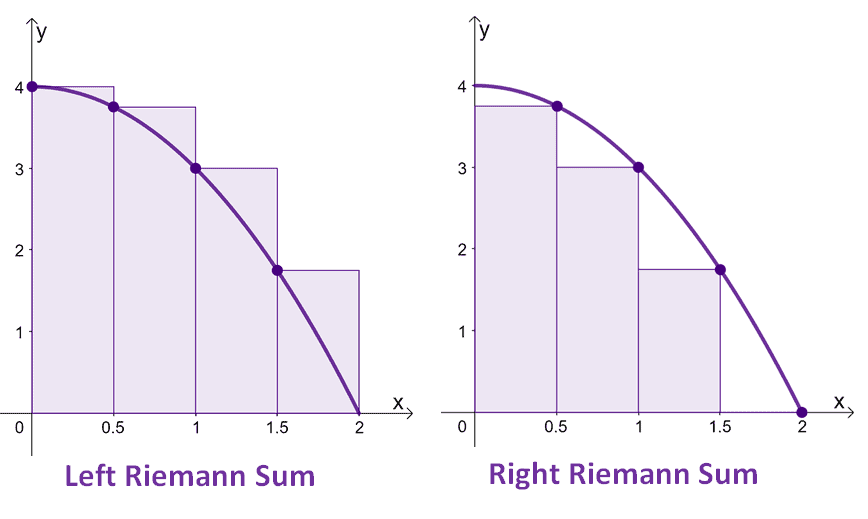
the left and right only really denote which corner is touching the graph
echo gazelle
ah
echo gazelle
I'm getting confused whether over or underestimate starts at the beginning of the chart when t=0 For ex this chart
t | 0 2 4 6 8 10
v | 0 1 3 4 4 6
if it was n=5, △t = 2 in my notes i have RHS = upper estimate LHS = lower
LHS = △t (v(0)+v(2)+v(4)+v(6)+v(8)) and
RHS = △t (v(2)+v(4)+v(6)+v(8)+v(10))
but for all the practice problems i've done i've followed that generally and keep having to swap my answers for LHS and RHS for the correct answer. How do you know which formula to use? Are those formulas correct for RHS and LHS or are they swapped?
What im trying to get at is how do you know which formula to use for upper or lower estimate? Is lower estimate always v(0) + ...
late stump
echo gazelle
What im trying to get at is how do you know which formula to use for upper or lo...
if the function is decreasing over the interval, left would be overestimating
if it’s increasing, then right is overestimating
echo gazelle
okay
echo gazelle
late stump
if the function is decreasing over the interval, left would be overestimating
which formula is for overestimating and which is for under?
late stump
echo gazelle
which formula is for overestimating and which is for under?
again, depends on the graph you’re dealing with
late stump
 quaint lily
right would be overestimating for increasing functions
quaint lily
right would be overestimating for increasing functions
look at what tan and i said
echo gazelle
Okay
ty for helping me understand it better i watched a video and i get what you're saying better now
.close
obtuse pebbleBOT
Channel closed
Closed by @echo gazelle
Use .reopen if this was a mistake.
Available help channel!
Send your question here to claim the channel.
Remember:
• Ask your math question in a clear, concise manner.
• Show your work, and if possible, explain where you are stuck.
• After 15 minutes, feel free to ping <@&286206848099549185>.
• Type the command .close to free the channel when you're done.
• Be polite and have a nice day!
Read #❓how-to-get-help for further information on how to ask a good question, and about conduct in the question channels.
 undone sentinel
 obtuse pebbleBOT
undone sentinel
undone sentinel
obtuse pebbleBOT
undone sentinel
undone sentinel
how do i solve this
obtuse pebbleBOT
@undone sentinel Has your question been resolved?
 glossy basalt
undone sentinel
glossy basalt
undone sentinel
I have read this a few times and i still don't get it, is that the whole question or am i missing something?
undone sentinel
glossy basalt
I have read this a few times and i still don't get it, is that the whole questio...
this is the entire question
these are the choices
 glossy basalt
sorry, i really don't know, wish that i can help😔
undone sentinel
its an sat question if that does anything
undone sentinel
glossy basalt
sorry, i really don't know, wish that i can help😔
this is their explanation if you can understand it
 glossy basalt
back, now reading
oh......... i think i get it now
the wordings are so... ambiguous
glossy basalt
undone sentinel
i think the point is
"8 kilometers in one hour"
argh, it's so weird
okay, i give up, this is so weird
obtuse pebbleBOT
@undone sentinel Has your question been resolved?
obtuse pebbleBOT
@undone sentinel Has your question been resolved?
timid silo
.close
obtuse pebbleBOT
Channel closed
Closed due to timeout
Use .reopen if this was a mistake.
obtuse pebbleBOT
Available help channel!
Send your question here to claim the channel.
Remember:
• Ask your math question in a clear, concise manner.
• Show your work, and if possible, explain where you are stuck.
• After 15 minutes, feel free to ping <@&286206848099549185>.
• Type the command .close to free the channel when you're done.
• Be polite and have a nice day!
Read #❓how-to-get-help for further information on how to ask a good question, and about conduct in the question channels.
 tight patio
If the 2nd term of an arithmetic sequence is 10 and the 7th term is 35, find the 11th term.
obtuse pebbleBOT
tight patio
If the 2nd term of an arithmetic sequence is 10 and the 7th term is 35, find the...
obtuse pebbleBOT
Show your work, and if possible, explain where you are stuck.
 errant lark
So that we can point you where you went wrong.
tight patio
a11 = 10 + (11 - 1) * 25
a11 = 10 + 10 * 25
a11 = 10 + 250
a11 = 260
tight patio
errant lark
So that we can point you where you went wrong.
i did this
errant lark
What is the formula for $a_n$ ?
warm shaleBOT
.enemagneto
 tight patio
a11 = a1 + (n - 1) * d
?
a11 is the 11th term of the sequence,
- a1 is the 1st term of the sequence,
- n is the position of the term,
- d is the common difference between consecutive terms.
I have notes
 north smelt
yes must be Like thay
errant lark
tight patio
a11 = a1 + (n - 1) * d
a11 ? or an ?
 brave bramble
So worth saying that a2 and a7 are not consecutive.
errant lark
tight patio
the formula is an
Okay.
tight patio
brave bramble
So worth saying that a2 and a7 are not consecutive.
wdym?
errant lark
tight patio
a11 = 10 + (11 - 1) * 25
a11 = 10 + 10 * 25
a11 = 10 + 250
a11 = 260
But here, you used a2 in place of a1. That's wrong.
tight patio
errant lark
But here, you used a2 in place of a1. That's wrong.
we dont have the 1st term???
what?
errant lark
tight patio
we dont have the 1st term???
You aren't given the first term.
You can calculate it though.
north smelt
d is not 25?
tight patio
north smelt
d is not 25?
diff is 25
errant lark
No.
north smelt
a11 = 5+50 = 55
north smelt
you are welcome
tight patio
.close
obtuse pebbleBOT
Channel closed
Closed by @tight patio
Use .reopen if this was a mistake.
north smelt
tight patio
how did u get a1 tho?
a1+d = 10
a1+6d = 35
5d = 25
d = 5
and a1 = 5 too
if a2 = 10, then a2 = a1+d = 10
if a7 = 35, then a7 = a1+6d = 35
obtuse pebbleBOT
Available help channel!
Send your question here to claim the channel.
Remember:
• Ask your math question in a clear, concise manner.
• Show your work, and if possible, explain where you are stuck.
• After 15 minutes, feel free to ping <@&286206848099549185>.
• Type the command .close to free the channel when you're done.
• Be polite and have a nice day!
Read #❓how-to-get-help for further information on how to ask a good question, and about conduct in the question channels.
obtuse pebbleBOT
north smelt
if a7 = 35, then a7 = a1+6d = 35
@north smelt Has your question been resolved?
Channel closed
Closed by @north smelt
Use .reopen if this was a mistake.
Available help channel!
Send your question here to claim the channel.
Remember:
• Ask your math question in a clear, concise manner.
• Show your work, and if possible, explain where you are stuck.
• After 15 minutes, feel free to ping <@&286206848099549185>.
• Type the command .close to free the channel when you're done.
• Be polite and have a nice day!
Read #❓how-to-get-help for further information on how to ask a good question, and about conduct in the question channels.
sage dagger
I’m trying to solve for x, is this right so far
 obtuse pebbleBOT
sage dagger
I’m trying to solve for x, is this right so far
timid silo
sage dagger
I’m trying to solve for x, is this right so far
obtuse pebbleBOT
sage dagger
I’m trying to solve for x, is this right so far
timid silo
sage dagger
I’m trying to solve for x, is this right so far
yes
sage dagger
And all I have to do now is square root both sides right
 shadow tangle
x^(1/2)=sqrt(x)
sage dagger
But don’t I have to get x on it’s own
timid silo
sage dagger
But don’t I have to get x on it’s own
yes
shadow tangle
yep :)
shadow tangle
np
sage dagger
.close
obtuse pebbleBOT
Channel closed
Closed by @sage dagger
Use .reopen if this was a mistake.
obtuse pebbleBOT
Available help channel!
Send your question here to claim the channel.
Remember:
• Ask your math question in a clear, concise manner.
• Show your work, and if possible, explain where you are stuck.
• After 15 minutes, feel free to ping <@&286206848099549185>.
• Type the command .close to free the channel when you're done.
• Be polite and have a nice day!
Read #❓how-to-get-help for further information on how to ask a good question, and about conduct in the question channels.
 stoic elm
how do i do this one?
 obtuse pebbleBOT
stoic elm
how do i do this one?
obtuse pebbleBOT
stoic elm
how do i do this one?
 fathom flicker
what is the missing angle
stoic elm
62
fathom flicker
!nosols
obtuse pebbleBOT
As a helper, please do not give out answers that could be copied as a homework solution. Have the student work through the problem themselves and guide them along the way.
fathom flicker
stoic elm
62
does this give you any information about the triangle?
stoic elm
<C and <b are the same
fathom flicker
Sure
and does that give you any info about the type of triangle?
or about the possible side lengths?
stoic elm
its isosceles?
stoic elm
2 equal sides and 2 equal angles?
stoic elm
ac and ab?
obtuse pebbleBOT
Channel closed
Closed by @stoic elm
Use .reopen if this was a mistake.
obtuse pebbleBOT
Available help channel!
Send your question here to claim the channel.
Remember:
• Ask your math question in a clear, concise manner.
• Show your work, and if possible, explain where you are stuck.
• After 15 minutes, feel free to ping <@&286206848099549185>.
• Type the command .close to free the channel when you're done.
• Be polite and have a nice day!
Read #❓how-to-get-help for further information on how to ask a good question, and about conduct in the question channels.
 minor parcel
 obtuse pebbleBOT
minor parcel
minor parcel
obtuse pebbleBOT
minor parcel
minor parcel
I need help with a
obtuse pebbleBOT
@minor parcel Has your question been resolved?
obtuse pebbleBOT
@minor parcel Has your question been resolved?
Channel closed
Closed by @minor parcel
Use .reopen if this was a mistake.
Available help channel!
Send your question here to claim the channel.
Remember:
• Ask your math question in a clear, concise manner.
• Show your work, and if possible, explain where you are stuck.
• After 15 minutes, feel free to ping <@&286206848099549185>.
• Type the command .close to free the channel when you're done.
• Be polite and have a nice day!
Read #❓how-to-get-help for further information on how to ask a good question, and about conduct in the question channels.
 slim garnet
Can someone help me with 10a? I have done a little bit so far but It’s a little messy and I don’t know where to continue
 obtuse pebbleBOT
slim garnet
Can someone help me with 10a? I have done a little bit so far but It’s a little ...
slim garnet
obtuse pebbleBOT
slim garnet
Can someone help me with 10a? I have done a little bit so far but It’s a little ...
slim garnet
 warm shaleBOT
 obtuse pebbleBOT
@slim garnet Has your question been resolved?
slim garnet
<@&286206848099549185>
 main elm
 untold trail
 obtuse pebbleBOT
@slim garnet Has your question been resolved?
 slim garnet
Yup
The angle on the top is 115
Because they are supplementary
I got my teacher to do it
Thanks for your time
.close
obtuse pebbleBOT
Channel closed
Closed by @slim garnet
Use .reopen if this was a mistake.
Available help channel!
Send your question here to claim the channel.
Remember:
• Ask your math question in a clear, concise manner.
• Show your work, and if possible, explain where you are stuck.
• After 15 minutes, feel free to ping <@&286206848099549185>.
• Type the command .close to free the channel when you're done.
• Be polite and have a nice day!
Read #❓how-to-get-help for further information on how to ask a good question, and about conduct in the question channels.
 vivid cedar
 obtuse pebbleBOT
vivid cedar
vivid cedar
obtuse pebbleBOT
vivid cedar
vivid cedar
am lost on how to do this
i have 0 clue
well i know that radius of circle=sqrt(13) and center is 3,-4
but beyond that idk
OH WAIT
no wait
its tangent
so you have to take a pointon the circle
but
hmm
yea im lost
 violet sentinel
I'm assuming that you haven't worked with derivatives yet?
there's an easier geometric way anyways 🙂
ok so how do we find the slope between the two points?
vivid cedar
violet sentinel
ok so how do we find the slope between the two points?
slope formula
y2-y1 over x2-x1
vivid cedar
(3,-4)
vivid cedar
but its tangent right so we cant use the cneter
violet sentinel
no you'll see what we do
violet sentinel
just the process 🙂
vivid cedar
its ok take ur time
warm shaleBOT
mellowdramallama
 violet sentinel
so the slope is 2/3
vivid cedar
but $m = \frac{-4-2}{3-6} = \frac{6}{3}$
warm shaleBOT
a_cheesefox
 violet sentinel
vivid cedar
im dumb
violet sentinel
vivid cedar
im dumb
not dumb, just learning!

 tardy epoch
not dumb, just exploding
violet sentinel
ok so, for now don't worry about how we found this secant line, but this is the line that connects the two points, right?

pop quiz, what does a tangent point to a line mean?
vivid cedar
violet sentinel
pop quiz, what does a tangent point to a line mean?
its the point where the line touches the circle
violet sentinel
exactly
vivid cedar
yay
violet sentinel
it only touches that point specifically
something like this, right?

now what do you notice about the lines? 🙂
vivid cedar
they are perpindicular
violet sentinel
😮 😮 😮
wow
holy crap
we have the slope
rest is easy peasy
so now we just use the point slope formula with our given point on the circle?
warm shaleBOT
a_cheesefox
 vivid cedar
violet sentinel
now put that into `y = mx + b` form
vivid cedar
violet sentinel
now put that into `y = mx + b` form
$y=-3/2x-8$
warm shaleBOT
a_cheesefox
 violet sentinel
close but your b is wrong
warm shaleBOT
a_cheesefox
 vivid cedar
oh yea
violet sentinel
remember to distribut the negative
vivid cedar
$y=-3/2x+7$
warm shaleBOT
a_cheesefox
 violet sentinel
bingo!
vivid cedar
violet sentinel
remember to distribut the negative
but hsould i put it in point slope form
cause the thigngie asks for point slope
 obtuse pebbleBOT
Channel closed
Closed by @vivid cedar
Use .reopen if this was a mistake.
 vivid cedar
yay
obtuse pebbleBOT
Available help channel!
Send your question here to claim the channel.
Remember:
• Ask your math question in a clear, concise manner.
• Show your work, and if possible, explain where you are stuck.
• After 15 minutes, feel free to ping <@&286206848099549185>.
• Type the command .close to free the channel when you're done.
• Be polite and have a nice day!
Read #❓how-to-get-help for further information on how to ask a good question, and about conduct in the question channels.
 lyric iron
Linear Algebra 2:
 obtuse pebbleBOT
lyric iron
Linear Algebra 2:
lyric iron
obtuse pebbleBOT
lyric iron
Linear Algebra 2:
lyric iron
I'm completely lost lol. Brain is fuzzy from doing this assignment all day xD
I'll take any help I can get
fathom flicker
start with the properties of a linear transformation
what are they?
can you verify them for both pieces of your piece-wise function?
that'd sort out 1.
fathom flicker
Well I'd need you to explain what those are
how could you verify something is additive or homegeneous
lyric iron
additivity: f(u+v) = f(u) + f(v)
fathom flicker
mhm
lyric iron
homogeneity: f(ku) = kf(u)
fathom flicker
f?
lyric iron
sorry, accidentally hit enter
fathom flicker
aha
yes that looks good to me
so now verify that your transformation here satisfies both those properties
lyric iron
I've never had to do this with a piecewise before, so this is kind of a scary question to me
 shell wave
which bit do u need help with
fathom flicker
start with evaluating case 1
u, v, are in M_2(R)
then evaluate case 2
u, v are M
then case 3 is...
?
u in M_2(R), v is M (note that this is without loss of generality the same as a potential case 4 of v in M_2(R) and u is M)
lyric iron
wait, what is case 2?
fathom flicker
u=v=M
lyric iron
where are you getting those cases from, I'm confused, sorry
fathom flicker
well they are the cases from the piecewise function are they not?
you have to different input options
either your input is M_2(R)
or M
now if you want to verify these for two different inputs, u, and v
what are all the possibilities of where u, and v can come from?
well they can both come from M_2(R)
or they can both come from M
or one can come from M_2(R) and the other from M
 brave bluff
I don't think that is a piecewise function. I think it the function that sends the matrix M \in the set of 2x2 matrices to AM (in the set of 2x2 matrices)
fathom flicker
ohhhhh
 gilded needle
brave bluff
I don't think that is a piecewise function. I think it the function that sends t...
gilded needle
brave bluff
I don't think that is a piecewise function. I think it the function that sends t...
i was about to comment the same thing
fathom flicker
Okay well you can remember the part about evaluating if the function is additive/homgeneous, but forget the part about the cases
because our function isn't piece-wise
so ignore most of what I said
gilded needle
it's a bit weird to use the brace like that, hence the confusion
fathom flicker
that's what I thought
warm shaleBOT
Bungo
 gilded needle
it's saying, f maps from domain M2(R) to codomain M2(R), and is defined by f(M) = AM
yep
lyric iron
ohhh okay i see
fathom flicker
new notation unlocked
cool
well anyways, now that you know what the function is actually saying, just verify those two properties
i.e take two arbitrary matrices from the domain
etc...
lyric iron
So, would i do something like f(M1+M2) = f(M1) + f(M2) where M1 and M2 are arbitrary matrices
gilded needle
side note and unpleasant memory, i had an analysis prof who used the same $\to$ arrow to mean both things, it was confusing as hell sometimes, ok end side note and thanks for reading haha
warm shaleBOT
Bungo
 gilded needle
lyric iron
So, would i do something like f(M1+M2) = f(M1) + f(M2) where M1 and M2 are arbit...
gilded needle
lyric iron
So, would i do something like f(M1+M2) = f(M1) + f(M2) where M1 and M2 are arbit...
yep
and then check scalar multiplication as well
fathom flicker
warm shale
**Bungo**
I'd cry
lyric iron
sigh... my profs notes are so poorly written, i have no idea what im doing
fathom flicker
lyric iron
So, would i do something like f(M1+M2) = f(M1) + f(M2) where M1 and M2 are arbit...
just so we are clear here, writing it isn't enough. you have to show that this equality is true
gilded needle
btw, what this problem is hinting at is that we often don't even bother making a distinction between a matrix M and the linear map that it induces
lyric iron
fathom flicker
just so we are clear here, writing it isn't enough. you have to show that this ...
yeahh i know, but I just don't know how to prove this in detail
fathom flicker
pick $$A=\begin{bmatrix} a & b \ c & d \end{bmatrix}$$ and $$B=\begin{bmatrix} e & f \ g & h \end{bmatrix}$$
warm shaleBOT
austinu
 fathom flicker
now what is $$A+B$$?
warm shaleBOT
austinu
 fathom flicker
now transform A+B
lyric iron
A+B
a+e b+f
c+g d+h
fathom flicker
verify that it is the same as transforming A, added to transforming B
see how that works?
gilded needle
fathom flicker
now transform A+B
that is a superhuman effort, i'd just write "by the rules of matrix multiplication" haha
fathom flicker
gilded needle
that is a superhuman effort, i'd just write "by the rules of matrix multiplicati...
it is a proofs class after all though I am guessing XD
lyric iron
no it isnt even a proofs class
fathom flicker
lyric iron
A+B
=
a+e b+f
c+g d+h
okay, so take f(A+B)
gilded needle
no i agree, it's safer and quite likely what is intended, to do what you said
lyric iron
its supposed to be lin alg 2
lyric iron
I got a B in lin alg 1 last sem
and this is making no sense to me hahaha
different profs though
fathom flicker
there's always time to turn it around
lyric iron
yeah, im hoping so
fathom flicker
Okay so I'll try to sum up what I meant earlier in a hopefully clearer way that you can try out on your one
lyric iron
so, f(A+B) do i apply M -> AM?
gilded needle
in fact, part (a) of this problem notwithstanding, you've graduated from boring calculation shit to fun conceptual shit
lyric iron
is M the same thing as F(A+B)?
fathom flicker
We take our arbitrary matrices $A$ and $B$. $\newline$ We find $f(A)$ and $f(B)$. Then we can find $f(A)+f(B)$.$\newline$Now seperately we take our matrices $A$ and $B$ and we add them. Then we find $f(A+B)$. $\newline$Now take these two pieces you did seperately, and show they are equal. i.e showing that $f(A+B)=f(A)+f(B)$
warm shaleBOT
austinu
 lyric iron
So, I think im struggling with what the stuff inside the curly brace means
fathom flicker
Still not understanding what the function is you mean?
lyric iron
yeah, like what does the mapping stuff mean
 lyric iron
inside the f:{
fathom flicker
yes
top line is telling you that
that our function takes 2x2 matrix and transforms it to a 2x2 matrix
does that make sense to you?
lyric iron
yep!
fathom flicker
the second line tells you how it transforms it
lyric iron
that makes sense
fathom flicker
it says that it takes this 2x2 matrix, and left multiplies it by A
that is the transformation
lyric iron
okay, so it takes a 2x2 and multiplies it by A
lyric iron
okay, that makes sense
that help a lot
I just had no idea what the function was saying lol
fathom flicker
Yes, so now hopefully what you should be able to do here is (first just be able to see that this is clearly a linear transformation) but secondly verify it on your own with 2 arbitrary matrices.
obtuse pebbleBOT
Channel closed
Closed by @lyric iron
Use .reopen if this was a mistake.
Available help channel!
Send your question here to claim the channel.
Remember:
• Ask your math question in a clear, concise manner.
• Show your work, and if possible, explain where you are stuck.
• After 15 minutes, feel free to ping <@&286206848099549185>.
• Type the command .close to free the channel when you're done.
• Be polite and have a nice day!
Read #❓how-to-get-help for further information on how to ask a good question, and about conduct in the question channels.
 pearl charm
I have a matrix question
obtuse pebbleBOT
pearl charm
I have a matrix question
pearl charm
 gilded needle
do you have any thoughts on how to proceed?
gilded needle
ok, do you know the concept of calculating a normal vector by using a cross product?
gilded needle
well given any two vectors in the plane, if you take their cross product, you get a vector that is normal to the plane
does this sound familiar?
pearl charm
yes, yes
how does that relate to this problem
or like
how do i solve the problem using that
<@&286206848099549185>
.close
obtuse pebbleBOT
Channel closed
Closed by @pearl charm
Use .reopen if this was a mistake.
obtuse pebbleBOT
Available help channel!
Send your question here to claim the channel.
Remember:
• Ask your math question in a clear, concise manner.
• Show your work, and if possible, explain where you are stuck.
• After 15 minutes, feel free to ping <@&286206848099549185>.
• Type the command .close to free the channel when you're done.
• Be polite and have a nice day!
Read #❓how-to-get-help for further information on how to ask a good question, and about conduct in the question channels.
 royal basin
you're supposed to post your question first and only THEN ping helpers
and that only after 15 minutes pass without a response
grizzled shore
Do you have any ideas how you might approach this?
Do you perhaps have some better idea than just brute force
Do you know the Chinese remainder theorem?
 rocky goblet
how many solutions are there to 4A+8B = 2 where A and B are natural numbers between 1 and 100?
grizzled shore
@tidal heart stop disrupting other people.
rocky goblet
(yeah my idea is that he's going to get completely the wrong answer)
grizzled shore
Bee he’s just trolling
grizzled shore
<@&268886789983436800> @tidal heart


 grizzled shore
Anyway @sleek snow I don’t know the CRT so I’ll let bee help you
rocky goblet
rocky goblet
https://cdn.discordapp.com/attachments/903430332324405288/1133291076229267456/im...
alright so
(i... don't really see how this solution is using CRT?)
grizzled shore
Personally I’d equate them (not 2) then try find pairs that are close to Integers and check
But idk how good this method is
But I’m sure there’s a better method
 clear tinsel
 rocky goblet
13A-18B = 2, so 13A=18B+2, which means 18B + 2 must be divisible by 13
...oh i see the relevance of CRT
we're looking for a number that's equal to 2 mod 5, and equal to 0 mod 13
rocky goblet
rocky goblet
...oh i see the relevance of CRT
we're looking for a number that's equal to 2 mo...
so 52
clear tinsel
Ya I know
rocky goblet
...wait hang on i'm now not sure if that's actually true
ah yes it is
so
13A = 18B + 2
if we subtract 13B from both sides
13(A-B) = 5B + 2
so whatever this number is, it's divisible by 13 because it's 13(A-B), and it's equal to 2 mod 5 because it's 5B+2
it's 5B+2
if you look at 5B+2 mod 5, the 5B disappears, but the 2 is still there
obtuse pebbleBOT
@sleek snow Has your question been resolved?
obtuse pebbleBOT
Channel closed
Closed due to timeout
Use .reopen if this was a mistake.
obtuse pebbleBOT
Available help channel!
Send your question here to claim the channel.
Remember:
• Ask your math question in a clear, concise manner.
• Show your work, and if possible, explain where you are stuck.
• After 15 minutes, feel free to ping <@&286206848099549185>.
• Type the command .close to free the channel when you're done.
• Be polite and have a nice day!
Read #❓how-to-get-help for further information on how to ask a good question, and about conduct in the question channels.
timid silo
 obtuse pebbleBOT
timid silo
timid silo
obtuse pebbleBOT
timid silo
timid silo
where did i go wrong
when i plug in my values they're true to the equation
but the answer sheet is different

this ist he equation they gave
obtuse pebbleBOT
@timid silo Has your question been resolved?
obtuse pebbleBOT
Channel closed
Closed due to timeout
Use .reopen if this was a mistake.
obtuse pebbleBOT
Available help channel!
Send your question here to claim the channel.
Remember:
• Ask your math question in a clear, concise manner.
• Show your work, and if possible, explain where you are stuck.
• After 15 minutes, feel free to ping <@&286206848099549185>.
• Type the command .close to free the channel when you're done.
• Be polite and have a nice day!
Read #❓how-to-get-help for further information on how to ask a good question, and about conduct in the question channels.
obtuse pebbleBOT
Channel closed
Closed due to the original message being deleted
Available help channel!
Send your question here to claim the channel.
Remember:
• Ask your math question in a clear, concise manner.
• Show your work, and if possible, explain where you are stuck.
• After 15 minutes, feel free to ping <@&286206848099549185>.
• Type the command .close to free the channel when you're done.
• Be polite and have a nice day!
Read #❓how-to-get-help for further information on how to ask a good question, and about conduct in the question channels.
 vital star
How to do this question?
Use fraction to represent 0.202323232323...
royal basin
do you know in general how to convert from repeating decimals into fractions?
vital star
I know the answer but i need the step to solve this question
Does it has any step to solve it?
Or we could just writing the answer down?
Could i solve like this?
x=0.202323232323...
100x=20.2323232323...
99x=20.03
x=20.03/99
=2003/9900
 high lily
,calc 2003/9900
warm shaleBOT
Result:
0.20232323232323
@vital star Has your question been resolved?
Channel closed
Closed by @vital star
Use .reopen if this was a mistake.
Available help channel!
Send your question here to claim the channel.
Remember:
• Ask your math question in a clear, concise manner.
• Show your work, and if possible, explain where you are stuck.
• After 15 minutes, feel free to ping <@&286206848099549185>.
• Type the command .close to free the channel when you're done.
• Be polite and have a nice day!
Read #❓how-to-get-help for further information on how to ask a good question, and about conduct in the question channels.
 rose tinsel

 grim nexus
can you use calculator ?
obtuse pebbleBOT
@rose tinsel Has your question been resolved?
obtuse pebbleBOT
Channel closed
Closed due to timeout
Use .reopen if this was a mistake.
obtuse pebbleBOT
Available help channel!
Send your question here to claim the channel.
Remember:
• Ask your math question in a clear, concise manner.
• Show your work, and if possible, explain where you are stuck.
• After 15 minutes, feel free to ping <@&286206848099549185>.
• Type the command .close to free the channel when you're done.
• Be polite and have a nice day!
Read #❓how-to-get-help for further information on how to ask a good question, and about conduct in the question channels.
echo gazelle
is F(3) just -9?
 obtuse pebbleBOT
echo gazelle
is F(3) just -9?
obtuse pebbleBOT
echo gazelle
is F(3) just -9?
 wooden cipher
Explain your thought process
echo gazelle
Bc the area between 2 and 3 is 9 and negative
wooden cipher
Not quite
echo gazelle
Would it be 0 then bc its at y 0?
wooden cipher
So whats your answer for (a)? (Trust me, it will make sense)
echo gazelle
-2
wooden cipher
How can you rewrite the expression in (a) using fundamental theorem of calculus
echo gazelle
3
| f(x)dx = -2
0
wooden cipher
Thats the integral
echo gazelle
oh
echo gazelle
wooden cipher
How can you rewrite the expression in (a) using fundamental theorem of calculus
oh uh F(B)-F(A)
wooden cipher
what are B and A?
echo gazelle
B is 3 A is 0
echo gazelle
-2
wooden cipher
You can find F(3) because you know F(0)
echo gazelle
5
wooden cipher
Yup!
wooden cipher
Yeah whats up
echo gazelle
when writing out the steps to solve it
would i write it out as
0 2
| f(x)dx + | f(x)dx
2 3
then write 0|2 out as
0 1
| f(x)dx + | f(x)dx
1 2
3 + 4
=7
or just as 3+4
 rough stratus
😳
wooden cipher
Your bounds are flipped but yeah
echo gazelle
wait what
wooden cipher
integral from 0 to 2 is positive 7, integral from 2 to 0 is negathve 7
rough stratus
You wrote the limits the wrong way round
rough stratus
Why?
echo gazelle
i thought i wrote it as 0 to 2?
rough stratus
Np*
obtuse pebbleBOT
@echo gazelle Has your question been resolved?
Channel closed
Closed by @echo gazelle
Use .reopen if this was a mistake.
obtuse pebbleBOT
Available help channel!
Send your question here to claim the channel.
Remember:
• Ask your math question in a clear, concise manner.
• Show your work, and if possible, explain where you are stuck.
• After 15 minutes, feel free to ping <@&286206848099549185>.
• Type the command .close to free the channel when you're done.
• Be polite and have a nice day!
Read #❓how-to-get-help for further information on how to ask a good question, and about conduct in the question channels.
 flint hull
Am I on the right track? This is a memory less property for Gamma Distribution problem
 obtuse pebbleBOT
flint hull
Am I on the right track? This is a memory less property for Gamma Distribution p...
royal basin
obtuse pebbleBOT
flint hull
Am I on the right track? This is a memory less property for Gamma Distribution p...
royal basin
what's the distribution of Y and how are you given it
polar fossil
presumably Y is a random variable that follows an exponential distribution with parameter lambda?
obtuse pebbleBOT
@flint hull Has your question been resolved?
obtuse pebbleBOT
Channel closed
Closed due to timeout
Use .reopen if this was a mistake.
obtuse pebbleBOT
Available help channel!
Send your question here to claim the channel.
Remember:
• Ask your math question in a clear, concise manner.
• Show your work, and if possible, explain where you are stuck.
• After 15 minutes, feel free to ping <@&286206848099549185>.
• Type the command .close to free the channel when you're done.
• Be polite and have a nice day!
Read #❓how-to-get-help for further information on how to ask a good question, and about conduct in the question channels.
 sacred violet
Hey Guys, calc 2 question: why is this function differntiable in P(0,1,0) df/dx and df/dy has 1/2*(sqrt(abs(x*y))*something else) for me so I would get 1/0 singularity -> so it would be differntiable for me
 obtuse pebbleBOT
sacred violet
Hey Guys, calc 2 question: why is this function differntiable in P(0,1,0) df/dx ...
sacred violet
obtuse pebbleBOT
sacred violet
Hey Guys, calc 2 question: why is this function differntiable in P(0,1,0) df/dx ...
sacred violet
or do I have to check differntiable criteria with this criterium
 obtuse pebbleBOT
@sacred violet Has your question been resolved?
 haughty coyote
sacred violet
or do I have to check differntiable criteria with this criterium
haughty coyote
sacred violet
or do I have to check differntiable criteria with this criterium
That is the definition of differentiability, not a "criterium".
Proving the partial derivatives exist is only enough if they are also continuous functions (in which case f is C^1)
sacred violet
yes you are right
it's the defintion
but how can I show the function is differentiable in a point
sacred violet
haughty coyote
That is the definition of differentiability, not a "criterium".
Proving the part...
.
haughty coyote
haughty coyote
That is the definition of differentiability, not a "criterium".
Proving the part...
Choose a method. It's probably C1 so you can choose
sacred violet
because as stated
haughty coyote
Though then you need to do continuity checks
sacred violet
df isn't defined
for my point
but the solution says it's differentiable
have i taken the wrong partial diff
haughty coyote
sacred violet
Hey Guys, calc 2 question: why is this function differntiable in P(0,1,0) df/dx ...
Actually looks like you have
df/dx = 1/(2 sqrt(|x|) ... not sqrt(|xy|)
But yes that means df/dx is not computable that way
However df/dx = 0 nonetheless by the definition
haughty coyote
Can't differentiate sqrt(x) at 0 anyways
sacred violet
I got it because the y is in the nominator
haughty coyote
haughty coyote
However df/dx = 0 nonetheless by the definition
Since e^z - 1 is still 0
sacred violet
.close
obtuse pebbleBOT
Channel closed
Closed by @sacred violet
Use .reopen if this was a mistake.
Available help channel!
Send your question here to claim the channel.
Remember:
• Ask your math question in a clear, concise manner.
• Show your work, and if possible, explain where you are stuck.
• After 15 minutes, feel free to ping <@&286206848099549185>.
• Type the command .close to free the channel when you're done.
• Be polite and have a nice day!
Read #❓how-to-get-help for further information on how to ask a good question, and about conduct in the question channels.
 mighty carbon
I need help with:
 obtuse pebbleBOT
mighty carbon
I need help with:
royal basin
obtuse pebbleBOT
mighty carbon
I need help with:
royal basin
what do you know about tangents drawn to the same circle from the same point?
royal basin
that is correct by itself but doesn't answer my question
when you have a point and a circle, you can draw two different segments both starting at that point and tangent to the circle,
as DE and DF are in your picture.
what do you know about those two segments?
mighty carbon
are they congruent?
royal basin
i don't know, are they?