#help-10
1 messages · Page 163 of 1
 tall bramble
 trail musk
(a component of CB) / (b component of CB) =
(a component of AB) / (b component of AB)
tall bramble
isnt it gonna be over a component of AB
(a component of CB) / (a component of AB) =
(b component of CB) / (b component of AB)
like this
trail musk
Those are both algebraically equivalent
tall bramble
oh so i can do it my way aswell
trail musk
You can rearrange one equation to get the other
tall bramble
cause thats how i undersntand it
so now ive got 2-9k/2 = -3k/-2
do u cross mutiply?
how do they get 3k/2 then
trail musk
Yep, so then the negative cancels in the right fraction
tall bramble
ohhhhh
trail musk
2 - 9k = 3k
 obtuse pebbleBOT
Channel closed
Closed by @tall bramble
Use .reopen if this was a mistake.
 Available help channel!
Send your question here to claim the channel.
Remember:
• Ask your math question in a clear, concise manner.
• Show your work, and if possible, explain where you are stuck.
• After 15 minutes, feel free to ping <@&286206848099549185>.
• Type the command .close to free the channel when you're done.
• Be polite and have a nice day!
Read #❓how-to-get-help for further information on how to ask a good question, and about conduct in the question channels.
 zenith ibex

 obtuse pebbleBOT
zenith ibex
obtuse pebbleBOT
zenith ibex
 trail cloak

trail cloak
You mean you wanna know if the equations have a common solution or not without solving?
 limber quartz
zenith ibex
How do I differentiate between these two
limber quartz
zenith ibex
How do I differentiate between these two
What is the QUESTION
...that you are trying to answer
zenith ibex
wait 1 sec
zenith ibex
I have this linear ecuation system, and I know that It has only one solution which is (x2,y1)

and that this is the graph that represents the system

 zenith ibex
without solving it, I came to the realization that these 3 weren't parallels or coincidents lines, using this

so I know that they all intersect themselves
limber quartz
Good job
zenith ibex
and since the third equation is the sum of the first two, I know that it passes through the same point as the other two
limber quartz
Ok
So you are onto several things here
For a system to have a single point solution, all the slopes must be different
That doesn't on its own guarantee a single point solution though
You are right about eq3 being a linear combination of 1 and 2
zenith ibex
ok
so when I have systems like this one and I can't solve it, (because the prompt tells me not to) , How do i know that it doesn't have a solution?
 limber quartz
zenith ibex
so when I have systems like this one and I can't solve it, (because the prompt t...
limber quartz
zenith ibex
so when I have systems like this one and I can't solve it, (because the prompt t...
Ah, this is a different question
Just look at it
There are 3 intersections
An independent system of linear equations (a system with ONE solution) has ONE intersection.
 limber quartz
There is no solution to the system because no single point lies on all 3 lines.
limber quartz
zenith ibex
I can't graph and I can't solve
The instructions say not to solve?
zenith ibex
yes
I just have to analize if it is compatible, incompatible and to say how it would be graphed
for example for this one I did this to find out that it is an incompatible system

where two lines are parallels, and there is one that intersects those two
limber quartz
It's easy to weed out parallels and coincident lines
zenith ibex
yes
 zenith ibex
zenith ibex
zenith ibex
but since in this ecuation they all intersect, (but in different points) I don't know how to know that
limber quartz
I wonder if the inconsistent linear combination is all you need?
Since eq1+eq2 != eq3
Specifically, the LHS are the same but the RHS are not
The parts on the left match, but the part on the right does not match.
Implying there is NO linear combination of the first two that will equal the third
zenith ibex
I didn't get that
I if sum equation 1 and equation 2 and it doesn't give me equation 3 then I know that the system doesn't have a solution because they don't intersect in the same point?
limber quartz
zenith ibex
I if sum equation 1 and equation 2 and it doesn't give me equation 3 then I know...
Not quite what I was saying
I said that because the LEFT side of that result did match equation 3, but the RIGHT didn't, that there is not any linear combination of them that will equal equation 3
And that, I think, is the giveaway that this system has no solution
zenith ibex
What is the Left and the Right side
limber quartz
<@&286206848099549185> somebody please confirm this
limber quartz
zenith ibex
What is the Left and the Right side
Equations have left sides and right sides
When you add the first two equations together, they also have a left side and a right side
limber quartz
The left side of that result matched equation 3, but the right did not.
limber quartz
zenith ibex
oh, before the = and after the =
Yes
obtuse pebbleBOT
@zenith ibex Has your question been resolved?
limber quartz
you know @zenith ibex I don't think my idea about linear combinations of equations is correct because I know it doesn't hold for all systems of two linear equations which do have solutions.
zenith ibex
yea i tried to do the math and I can't do it
maybe this exercise just isn't meant to be done
limber quartz
zenith ibex
maybe this exercise just isn't meant to be done
Read your notes and the chapter, it will tell you what to look for and can't be more than 4-6 pages long
(The examples/ definitions)
obtuse pebbleBOT
@zenith ibex Has your question been resolved?
zenith ibex
limber quartz
Read your notes and the chapter, it will tell you what to look for and can't be ...
yeah ill try that
obtuse pebbleBOT
@zenith ibex Has your question been resolved?
obtuse pebbleBOT
Channel closed
Closed by @zenith ibex
Use .reopen if this was a mistake.
Available help channel!
Send your question here to claim the channel.
Remember:
• Ask your math question in a clear, concise manner.
• Show your work, and if possible, explain where you are stuck.
• After 15 minutes, feel free to ping <@&286206848099549185>.
• Type the command .close to free the channel when you're done.
• Be polite and have a nice day!
Read #❓how-to-get-help for further information on how to ask a good question, and about conduct in the question channels.
 quaint crescent
Does there exist a continuous map [0, 1] -> [0, 1] such that the pre-image of every point is infinite? I've been stuck thinking about this for a while...
obtuse pebbleBOT
quaint crescent
Does there exist a continuous map [0, 1] -> [0, 1] such that the pre-image of ev...

 upbeat gazelle
xsin(1/x) is continuous
quaint crescent
Yeah but not every pre image is infinite
In fact it looks like all pre images are finite for xsin(1/x)
My feeling at the moment is that no such function exists but I can't prove it
 high pivot
upbeat gazelle
xsin(1/x) is continuous
high pivot
upbeat gazelle
xsin(1/x) is continuous
it is not continuous, it is only connected
we need (0,0) to be united to the region
quaint crescent
I think xsin(1/x) is continuous, but it doesn't work for my problem because the pre image of some (all?) points in [0, 1] are finite
upbeat gazelle
Do you want f to be surjective ?
Because otherwise 0 works
I know it's a trivial solution
quaint crescent
Empty pre images are still finite
upbeat gazelle
If you want to prove it does not exist if f takes more than one value, you can maybe build a sequence of values such that f(x_n) has multiple adherence points
quaint crescent
Eg with 0, the pre image of 1 is empty which is finite
quaint crescent
upbeat gazelle
If you want to prove it does not exist if f takes more than one value, you can m...
Yeah I mean f must take every value infinity often, so something like this might work, but I haven't been able to put it all together yet
obtuse pebbleBOT
@quaint crescent Has your question been resolved?
obtuse pebbleBOT
Channel closed
Closed due to timeout
Use .reopen if this was a mistake.
obtuse pebbleBOT
Available help channel!
Send your question here to claim the channel.
Remember:
• Ask your math question in a clear, concise manner.
• Show your work, and if possible, explain where you are stuck.
• After 15 minutes, feel free to ping <@&286206848099549185>.
• Type the command .close to free the channel when you're done.
• Be polite and have a nice day!
Read #❓how-to-get-help for further information on how to ask a good question, and about conduct in the question channels.
 still oxide
(not sure if I can ask about logic equivalency questions here)
Prove that (~p ^ q ^ r) v (p ^ ~q ^ ~r) and (p (+) q) ^ (q <-> r) are logically equivalent. Start from the left side.
obtuse pebbleBOT
still oxide
(not sure if I can ask about logic equivalency questions here)
Prove that `(~p ...
still oxide
I'm dumbfounded because i can't seem to apply any of these rules here
 obtuse pebbleBOT
@still oxide Has your question been resolved?
obtuse pebbleBOT
@still oxide Has your question been resolved?
high pivot
i assume we are doing analysis instead of a truth table
lets start with $(\neg p\land q\land r)\lor(p\land \neg q\land\neg r)$
 warm shaleBOT
ThisGuy
 high pivot
we can use distributivity of and through or
just like you would with multiplication
show me your work when you get there
high pivot
still oxide
I'm dumbfounded because i can't seem to apply any of these rules here
@ me when you get there if youre still on
still oxide
i have no clue
high pivot
still oxide
i have no clue
i take it (+) is xor?
its not on the table but ~(a(+)b) <-> (a<->b)
that one is useful in this problem
can you show me what you have?
obtuse pebbleBOT
@still oxide Has your question been resolved?
obtuse pebbleBOT
Channel closed
Closed due to timeout
Use .reopen if this was a mistake.
obtuse pebbleBOT
Available help channel!
Send your question here to claim the channel.
Remember:
• Ask your math question in a clear, concise manner.
• Show your work, and if possible, explain where you are stuck.
• After 15 minutes, feel free to ping <@&286206848099549185>.
• Type the command .close to free the channel when you're done.
• Be polite and have a nice day!
Read #❓how-to-get-help for further information on how to ask a good question, and about conduct in the question channels.
 worthy moss
Guys how 2 * 2 = 5? My teacher give a project that we should give him the reason why 2 * 2 =5
obtuse pebbleBOT
worthy moss
Guys how 2 * 2 = 5? My teacher give a project that we should give him the reason...
worthy moss
Yep
 oak bear
anything that is a x a = wrong answer there would be a 0/0 somewhere
Ur gonna divide something there by 0
worthy moss
I done this trick and he said no
I told this trick already 🫤
Is there any other trick that he could accept
?
 wanton hull
mathematically it will have an exeption for some rule like dividing by zero
oak bear
I only know that one, have u tried making 2 = a variable and 5 into something
worthy moss
oak bear
I only know that one, have u tried making 2 = a variable and 5 into something
can you explain more?
oak bear
like a x a = (a+1) or something
worthy moss
Yes yes I done that but he stills says know
oak bear
or sometimes they do
a x b = b+1
and then make
a = b or something
oak bear
I found it
worthy moss
He gives A+ on our math exam if I find this
 worthy moss
I will try this one
oak bear
The mistake there is b-a-c
sine it would be 5-4-1
which is 0
they divided it by 0 on both sides
But yeah, u can also look up for the proof of 2 + 2 =5
By proving that,
u also get 4 = 5
which is 2 x 2 =5
worthy moss
Ok I try it tomorrow
oak bear
yeah u can probably look for the proof of 2 + 2 first
u gotta prove that 4 = 5 then u can do 2 x 2
since 2 x 2 =4
U can probably use a better solution than the one I've sent
obtuse pebbleBOT
@worthy moss Has your question been resolved?
obtuse pebbleBOT
Channel closed
Closed due to timeout
Use .reopen if this was a mistake.
obtuse pebbleBOT
Available help channel!
Send your question here to claim the channel.
Remember:
• Ask your math question in a clear, concise manner.
• Show your work, and if possible, explain where you are stuck.
• After 15 minutes, feel free to ping <@&286206848099549185>.
• Type the command .close to free the channel when you're done.
• Be polite and have a nice day!
Read #❓how-to-get-help for further information on how to ask a good question, and about conduct in the question channels.
 sinful kraken
What is the vector equation for the tangent line of the intersection of x2+y2=25 and y2+z2=20 at the point (3,4,2)?
obtuse pebbleBOT
sinful kraken
What is the vector equation for the tangent line of the intersection of x2+y2=25...
 jolly ginkgo
sinful kraken
What is the vector equation for the tangent line of the intersection of x2+y2=25...
jolly ginkgo
sinful kraken
What is the vector equation for the tangent line of the intersection of x2+y2=25...
their gradient should be in same direction
sinful kraken
im supposed to use parametric equations
trail musk
Δ • f = k Δ • g
jolly ginkgo
trail musk
Δ • f = k Δ • g
what is the dot about?
obtuse pebbleBOT
@sinful kraken Has your question been resolved?
sinful kraken
i need vector equation
jolly ginkgo
sinful kraken
i need vector equation
say one thing
sinful kraken
???????
jolly ginkgo
find both gradients, then the plane normal to gradient passing through (3,4,2) and finally their intersection
obtuse pebbleBOT
@sinful kraken Has your question been resolved?
obtuse pebbleBOT
Channel closed
Closed due to timeout
Use .reopen if this was a mistake.
obtuse pebbleBOT
Available help channel!
Send your question here to claim the channel.
Remember:
• Ask your math question in a clear, concise manner.
• Show your work, and if possible, explain where you are stuck.
• After 15 minutes, feel free to ping <@&286206848099549185>.
• Type the command .close to free the channel when you're done.
• Be polite and have a nice day!
Read #❓how-to-get-help for further information on how to ask a good question, and about conduct in the question channels.
 warm harbor
 obtuse pebbleBOT
warm harbor
obtuse pebbleBOT
warm harbor
 rain meadow

 next reef
@rain meadow, don't keep posting the image in other's channels, read #❓how-to-get-help
obtuse pebbleBOT
warm harbor
What step are you on?
1. I don't know where to begin
2. I have begun but got stuck midway
3. I got an answer but I'm told it's wrong
4. I got an answer and would like my work checked
5. I have a question about someone else's worked solution
6. None of the above
 torpid forum
warm harbor
torpid forum
warm harbor
ok
 hasty salmon
warm harbor
is f(x) = dy/dx
and f'(x) = d²y/dx²
i am confused
hasty salmon
warm harbor
is f(x) = dy/dx
and f'(x) = d²y/dx²
i am confused
f’(x) is Lagrange notation for the derivative of f(x).
df/dx or dy/dx is Leibniz notation for the derivative of f(x).
So f’(x) = df/dx = dy/dx (Derivative)
And f’’(x) = d²f/dx² = d²y/dx² (Second Derivative)
And derivative is just the function representing rate of change of a function with respect to some variable.
warm harbor
hasty salmon
`f’(x)` is Lagrange notation for the derivative of `f(x)`.
`df/dx` or `dy/dx` is...
thanks so f(x) = y??
f'(x) = y'
f''(x) = y''
warm harbor
right
warm shaleBOT
Blissful
 obtuse pebbleBOT
@warm harbor Has your question been resolved?
Channel closed
Closed by @warm harbor
Use .reopen if this was a mistake.
Available help channel!
Send your question here to claim the channel.
Remember:
• Ask your math question in a clear, concise manner.
• Show your work, and if possible, explain where you are stuck.
• After 15 minutes, feel free to ping <@&286206848099549185>.
• Type the command .close to free the channel when you're done.
• Be polite and have a nice day!
Read #❓how-to-get-help for further information on how to ask a good question, and about conduct in the question channels.
 balmy crescent
 obtuse pebbleBOT
balmy crescent
balmy crescent
obtuse pebbleBOT
balmy crescent
balmy crescent
hello im having trouble finding n
i know that the value is 0.364 or something tried learning through photomath but they offered no explanation
 sage geode
Tried dividing both sides by 1.08^n ?
balmy crescent
how would that help?
 royal basin
do it and see
balmy crescent
ok
 viral knot
balmy crescent
viral knot
balmy crescent
how do i divide 1.08^2n with 1.08^n
sage geode
$\frac{a^b}{a^c}=a^{b-c}$ so $\frac{1.08^{2n}}{1.08}=1.08^{2n-n}$
warm shaleBOT
A Lonely Bean
 sage geode
Had a typo there
obtuse pebbleBOT
@balmy crescent Has your question been resolved?
obtuse pebbleBOT
Channel closed
Closed due to timeout
Use .reopen if this was a mistake.
obtuse pebbleBOT
Available help channel!
Send your question here to claim the channel.
Remember:
• Ask your math question in a clear, concise manner.
• Show your work, and if possible, explain where you are stuck.
• After 15 minutes, feel free to ping <@&286206848099549185>.
• Type the command .close to free the channel when you're done.
• Be polite and have a nice day!
Read #❓how-to-get-help for further information on how to ask a good question, and about conduct in the question channels.
 spark vector
 obtuse pebbleBOT
spark vector
spark vector
obtuse pebbleBOT
spark vector
spark vector
Larger triangle with hypotenuse length 15
Smaller triangle with hypotenuse length 5
Am I right in saying that the other legs of the smaller triangle are 3 and 4?
obtuse pebbleBOT
@spark vector Has your question been resolved?
spark vector
<@&286206848099549185>
I just see that I could just double the area of the 3 squares?
Seems to fit in half of the large rectangle
<@&286206848099549185>
obtuse pebbleBOT
@spark vector Has your question been resolved?
hasty salmon
spark vector
Seems to fit in half of the large rectangle
well you would have to prove that
spark vector
Yeah that I am not sure of
hasty salmon
spark vector
Yeah that I am not sure of
you know the Pythagorean theorem:
a^2 + b^2 = 15^2 (for the large triangle)
a^2 + b^2 = 5^2 (for the little triangle)
solve for a and b
hasty salmon
and for large one?
spark vector
Not sure
 lusty cave
bro what did i do wrong
hasty salmon
spark vector
Not sure
9 and 12
spark vector
Oh right ya
lusty cave
i drew a line through the 3 squares and got 15.811 as the length of the rectangle
hasty salmon
so the long side of the big box is 12+3
and the small side is 9+4
lusty cave
lusty cave
i drew a line through the 3 squares and got 15.811 as the length of the rectangl...
because sqr(5^2+15^2)
spark vector
Right
lusty cave
hasty salmon
so it wants big box area - small boxes area
it says of the white rectangle that dosent imply that it wants white minus grey
hasty salmon
well in the other case if would just be white
which is 195
195 isnt an answer either
lusty cave
i got 150
hasty salmon
how
hasty salmon
why
lusty cave
that gives you the long side of the rectangle
lusty cave
because it touches with the diagonals
lusty cave
hasty salmon
prove it
i cant

 lusty cave
yes
spark vector
I agree
hasty salmon
how do you get the small side
lusty cave
that is the small side
hasty salmon
without knowing about 150
hasty salmon
how did you get 150
spark vector
I am not sure if decimals should come into the question though
lusty cave
lusty cave
times it by 4 to get 150
^
hasty salmon
why do you times it by 4
lusty cave
because it specifies in the question that the rectangle touches the midpoint
so the line bisects the rectangle
and a triangle is half the area of the rectangle iti is contained in
so times it by 2 to make it the same area of the rectangle
then 2 to be the same area of the entire white rectangle
lusty cave
hasty salmon
big box has width 5*sqrt(10)
thats what i got
lusty cave
hasty salmon
then you do times 8
why
hasty salmon
height of big box is 8
lusty cave
where did u get 4,3 and 12 from
spark vector
Should be 120 right?
hasty salmon
this makes no sense
spark vector
Right
lusty cave
 spark vector
I’m thinking they just want us to prove that the small squares are half the size of the rectangle
lusty cave
lusty cave
is this correct?
 lusty cave
gimme a sec
lusty cave
hasty salmon
 hasty salmon
how is it 4.744
and not 4
we are dealing with right triangles
so a^2 + b^c = 5 so a = 3 and b = 4
 spark vector
I thought it was always given that if the hypotenuse is 5 then the other two legs must be 3 and 4?
lusty cave
14.232
lusty cave
spark vector
I thought it was always given that if the hypotenuse is 5 then the other two leg...
only if the values have to be an integert
lusty cave
 lusty cave
spark vector
I thought it was always given that if the hypotenuse is 5 then the other two leg...
lusty cave
spark vector
I thought it was always given that if the hypotenuse is 5 then the other two leg...
what grade are you in
spark vector
Got it
lusty cave
because this question stumped me for a while
i was sitting on the post for like 20 minutes
spark vector
Grade 7 and 8 math competition paper
lusty cave
alright
lusty cave
spark vector
But we calculators can’t be used
hmm
maybe the question is wrong
ohhhh
no its right
because you only need to find the area
which has no decimals
the area of the triangle is ((5x15)/2)x4
bro
i need to learn how to use the math bot
spark vector
Oh ok
lusty cave
,help
warm shaleBOT
A brief description and guide on how to use me was sent to your DMs!
Please use ,list to see a list of all my commands, and ,help cmd to get detailed help on a command!
spark vector
So we are not expected to use Pythagoras here

 lusty cave
hmm
idk how to prove it
but the equation to a right angle triangle is $bh/2$ and the equation for a rectangle is $bh$
warm shaleBOT
Xav
 spark vector
Yeah
spark vector
?
spark vector
.close
obtuse pebbleBOT
Channel closed
Closed by @spark vector
Use .reopen if this was a mistake.
Available help channel!
Send your question here to claim the channel.
Remember:
• Ask your math question in a clear, concise manner.
• Show your work, and if possible, explain where you are stuck.
• After 15 minutes, feel free to ping <@&286206848099549185>.
• Type the command .close to free the channel when you're done.
• Be polite and have a nice day!
Read #❓how-to-get-help for further information on how to ask a good question, and about conduct in the question channels.
 limber sable
how
 obtuse pebbleBOT
limber sable
how
limber sable
obtuse pebbleBOT
limber sable
how
limber sable
how 4- disappeared, can i get the extended explanation?
 whole dock
$(4 - (2 - x) = 4 - 2 + x$
warm shaleBOT
ColdTee
 limber sable
ik but where did the 4 go
whole dock
$4 - 2 = 2$
warm shaleBOT
ColdTee
 obtuse pebbleBOT
Channel closed
Closed by @limber sable
Use .reopen if this was a mistake.
obtuse pebbleBOT
Available help channel!
Send your question here to claim the channel.
Remember:
• Ask your math question in a clear, concise manner.
• Show your work, and if possible, explain where you are stuck.
• After 15 minutes, feel free to ping <@&286206848099549185>.
• Type the command .close to free the channel when you're done.
• Be polite and have a nice day!
Read #❓how-to-get-help for further information on how to ask a good question, and about conduct in the question channels.
 brazen coral
hey
obtuse pebbleBOT
brazen coral
hey
brazen coral

For the start of this solution, I'm a bit confused where the (1 0), (1 1), (1 -1), and (2 0) are coming from?
obtuse pebbleBOT
@brazen coral Has your question been resolved?
brazen coral
 alpine raven
image of each matrix from the basis B
alpine raven
image of each matrix from the basis B
sorry, but just to make sure i understand it correctly, how would that be done?
brazen coral
in part a and b we found

 brazen coral
alpine raven
not the solution :/
brazen coral
alpine raven
not the solution :/

This is a workshop already completed (not for marks)
alpine raven
so S is an application that takes 2x2 matrix as input and returns a vector
and they gave us how S works
brb rq
so $S\begin{pmatrix}r & s \ t & u \end{pmatrix} = \begin{pmatrix} r+u \s-t \end{pmatrix}$
warm shaleBOT
Herels
 brazen coral
ohhh its found by using that given identity
alpine raven
Now they asked you to find a matrix representation of this application in the basis E
So you should find the image of each matrix in B by S
you have them all but its not done yet
brazen coral
so if that was not given, how would we find the image of each?
alpine raven
you just cant
and how would you find a matrix representation of an application without even giving how that application works
brazen coral
alpine raven
and how would you find a matrix representation of an application without even gi...
well im trying to learn this stuff, so I wasnt sure if there was a general rule
but thx 🙂
.close
obtuse pebbleBOT
Channel closed
Closed by @brazen coral
Use .reopen if this was a mistake.
Available help channel!
Send your question here to claim the channel.
Remember:
• Ask your math question in a clear, concise manner.
• Show your work, and if possible, explain where you are stuck.
• After 15 minutes, feel free to ping <@&286206848099549185>.
• Type the command .close to free the channel when you're done.
• Be polite and have a nice day!
Read #❓how-to-get-help for further information on how to ask a good question, and about conduct in the question channels.
 slim copper
 obtuse pebbleBOT
slim copper
slim copper
obtuse pebbleBOT
slim copper
slim copper
So far what i've done is say we have φ([k]_n)=[k]_m
and because its a homomorphism we have φ([k+l]_n)=[k]_m+[l]_m
but not sure what do next
i think it's along the lines of noting φ([1]_n goes to [1]_m and that by adding [1]_m to itself several times you can get every value in Z/mZ
but not sure how to word it precisely
<@&286206848099549185>
obtuse pebbleBOT
@slim copper Has your question been resolved?
obtuse pebbleBOT
@slim copper Has your question been resolved?
obtuse pebbleBOT
Channel closed
Closed due to timeout
Use .reopen if this was a mistake.
Available help channel!
Send your question here to claim the channel.
Remember:
• Ask your math question in a clear, concise manner.
• Show your work, and if possible, explain where you are stuck.
• After 15 minutes, feel free to ping <@&286206848099549185>.
• Type the command .close to free the channel when you're done.
• Be polite and have a nice day!
Read #❓how-to-get-help for further information on how to ask a good question, and about conduct in the question channels.
sage geode
Tried simplifying f(x)?
 warm canopy
what is it you are trying to prove isn't possible?
probably easier to look at the cubic instead
oh is this f(x) or f(x)-11?
obtuse pebbleBOT
@wintry fable Has your question been resolved?
obtuse pebbleBOT
Channel closed
Closed due to timeout
Use .reopen if this was a mistake.
Available help channel!
Send your question here to claim the channel.
Remember:
• Ask your math question in a clear, concise manner.
• Show your work, and if possible, explain where you are stuck.
• After 15 minutes, feel free to ping <@&286206848099549185>.
• Type the command .close to free the channel when you're done.
• Be polite and have a nice day!
Read #❓how-to-get-help for further information on how to ask a good question, and about conduct in the question channels.
 void chasm
Let a and b be 2 real numbers such that |a| > 0. if the equation ||x-a|-b| = b has 3 distinct roots, find value of b.
obtuse pebbleBOT
void chasm
Let a and b be 2 real numbers such that |a| > 0. if the equation ||x-a|-b| = b h...
obtuse pebbleBOT
@void chasm Has your question been resolved?
obtuse pebbleBOT
Channel closed
Closed due to timeout
Use .reopen if this was a mistake.
Available help channel!
Send your question here to claim the channel.
Remember:
• Ask your math question in a clear, concise manner.
• Show your work, and if possible, explain where you are stuck.
• After 15 minutes, feel free to ping <@&286206848099549185>.
• Type the command .close to free the channel when you're done.
• Be polite and have a nice day!
Read #❓how-to-get-help for further information on how to ask a good question, and about conduct in the question channels.
 river basin
The first files are my answers to the MTH311 practice exam. I need help writing some of the from the practice exam 2 or need help clarifying some of them.
obtuse pebbleBOT
river basin
The first files are my answers to the MTH311 practice exam. I need help writing ...
 tardy epoch
river basin
The first files are my answers to the MTH311 practice exam. I need help writing ...
tardy epoch
river basin
The first files are my answers to the MTH311 practice exam. I need help writing ...
don't make ppl download files to help you. screenshot and upload images
 idle thunder
also be specific
river basin
These are the first three from the 2nd practice exam question MTH311 Intro to higher mathematics and Proofs. I need help with questions 1, 3? and then some others but I need some clarification.

Questions 6 and 7, but mostly 7 because I make making multiple assumptions.

→ MY ANSWER PROOF: We let n be a part of the set containing all positive integers, or ℤ+, where n ∈ {1, 2, 3, 4, 5, 6, 7, 8, 9, 10, …}.
We are asked to prove that the square root(n) ∈ ℚ leads to the square root(n) ∈ ℤ, and vice versa. This means that there exists a square root of any chosen positive integer is a rational number, and that the square root of a chosen positive integer n is any integer. We should know that the set dealing with both positive and negative integers is a proper subset of the set dealing with rational numbers.
For example, √1 = ±1, which shows two rational integers since -1/1 = -1 and 1/1 = 1. (0 already classifies as a rational number and is an integer.)
According to Definition #14.3 from the textbook, -1/1 is described to be an infinite subset of Z x (Z – {0}) and is the equivalence class of (2, 5).
-1/1 = [(-1, 1)] = {(-1, 1), (-2, 2), (-3, 3),…., (1, -1), (2, -2), (3, -3),….}.
Equivalently, -1/5 = [(-1, 5)] = {(a, b) ∈ Z x (Z – {0}): -1 • b = 5 • a}.
√2 is an irrational number, which then leads to √2 not being an integer. This is especially true when we negate the statement "square root(n) ∈ ℚ <==> square root(n) ∈ ℤ" such that n ∈ ℤ+.
√4 = ±2, which shows 2 rational integers since 2/-1 = -2 and 2/1 = 1.
So, if n^(1/2) ∈ ℚ, then n^(1/2) ∈ ℤ such that n ∈ ℤ+. And, if n^(1/2) ∈ ℤ, then n^(1/2) ∈ ℚ such that n ∈ ℤ+.
∴ If n ∈ ℤ+, Then √(n) ∈ ℚ <==> √(n) ∈ ℤ. ☐ㅁ◻ or Q.E.D
I don't know if I'm right.
 tardy epoch
river basin
These are the first three from the 2nd practice exam question MTH311 Intro to hi...
tardy epoch
river basin
These are the first three from the 2nd practice exam question MTH311 Intro to hi...
pick ONE problem
river basin
Question 3 then
PROBLEM #3: Prove that 11│a^20 + a^11 + 9 for any 'a' such that gcd(a, 11) = 1. Answer Proof:
By Bezaut's Lemma, ꓱ x, y ∈ ℤ, such that 1 = a • x + 11 • y since gcd(a, 11) = 1. If gcd(a, 11) = 1, then we can say, by the definition of the greatest common divisor, that a + 11 are coprime (or relatively prime numbers). Meaning a and 11 are coprime (or each prime). For example, since a and 11 are coprime, let's see what happens when we choose a = 1. The gcd(a, 11) = 1, and 11 would be divisible by 11. I have trouble figuring out where to go from thereon.
obtuse pebbleBOT
@river basin Has your question been resolved?
river basin
No, still waiting for clarification.
obtuse pebbleBOT
@river basin Has your question been resolved?
river basin
No
obtuse pebbleBOT
@river basin Has your question been resolved?
river basin
→ PROBLEM #11: Let n be a positive integer.
Then square root(n) ∈ ℚ <==> square root(n) ∈ ℤ.
→ MY ANSWER PROOF: We let n be a part of the set containing all positive integers, or ℤ+, where n ∈ {1, 2, 3, 4, 5, 6, 7, 8, 9, 10, …}.
We are asked to prove that the square root(n) ∈ ℚ leads to the square root(n) ∈ ℤ, and vice versa. This means that there exists a square root of any chosen positive integer is a rational number, and that the square root of a chosen positive integer n is any integer. We should know that the set dealing with both positive and negative integers is a proper subset of the set dealing with rational numbers.
For example, √1 = ±1, which shows two rational integers since -1/1 = -1 and 1/1 = 1. (0 already classifies as a rational number and is an integer.)
According to Definition #14.3 from the textbook, -1/1 is described to be an infinite subset of Z x (Z – {0}) and is the equivalence class of (2, 5).
-1/1 = [(-1, 1)] = {(-1, 1), (-2, 2), (-3, 3),…., (1, -1), (2, -2), (3, -3),….}.
Equivalently, -1/5 = [(-1, 5)] = {(a, b) ∈ Z x (Z – {0}): -1 • b = 5 • a}.
√2 is an irrational number, which then leads to √2 not being an integer. This is especially true when we negate the statement "square root(n) ∈ ℚ <==> square root(n) ∈ ℤ" such that n ∈ ℤ+.
√4 = ±2, which shows 2 rational integers since 2/-1 = -2 and 2/1 = 1.
So, if n^(1/2) ∈ ℚ, then n^(1/2) ∈ ℤ such that n ∈ ℤ+. And, if n^(1/2) ∈ ℤ, then n^(1/2) ∈ ℚ such that n ∈ ℤ+.
∴ If n ∈ ℤ+, Then √(n) ∈ ℚ <==> √(n) ∈ ℤ. ☐ㅁ◻ or Q.E.D
Does this make sense?
 viral blade
Is this just a very long proof that sqrt(n) in Z implies sqrt(n) in Q
obtuse pebbleBOT
Channel closed
Closed due to timeout
Use .reopen if this was a mistake.
Available help channel!
Send your question here to claim the channel.
Remember:
• Ask your math question in a clear, concise manner.
• Show your work, and if possible, explain where you are stuck.
• After 15 minutes, feel free to ping <@&286206848099549185>.
• Type the command .close to free the channel when you're done.
• Be polite and have a nice day!
Read #❓how-to-get-help for further information on how to ask a good question, and about conduct in the question channels.
 serene rain
 obtuse pebbleBOT
serene rain
serene rain
obtuse pebbleBOT
serene rain
serene rain
Question 7
using the 30, 60, 90 degree theorem
(not in decimals please, just leave as radicals)
 oak plover
serene rain
oak plover
serene rain
Since it's looking to the 30 and the bottom is root 3 the left side should be 1.
Two 15s should divide the left side of the big triangle into two pieces.
So we have 0.5 and 0.5 on the left side.
Then you can find the hypotenuse using the Pythagoras Theorem.
Calling the bottom a, splitted left part b and the hypotenuse c.
3 + 0.25 = c^2
3.25 = c^2
a ≈ 1.73205080757
b = 0.5
c ≈ 1.80277563773
serene rain
oak plover
Since it's looking to the 30 and the bottom is root 3 the left side should be 1....
u sure its 0.5? BD is just specified as an angle bisector. doesn't that mean that AB and BC are not necessarily equal to each other?
wouldn't you need to do AD/AB=DC/BC
since all we know is that its an angle bisector
oak plover
serene rain
u sure its 0.5? BD is just specified as an angle bisector. doesn't that mean tha...
Yes that is what I said
serene rain
I thought that was the right way but I'm having trouble getting farther than that
serene rain
oak plover
CD the a and BD the c
no but your saying AC is equal to 1 and that because its an angle bisector (two 15s) it should divide the left side of the triangle into two equivalent pieces, but those two sides might not be equal to one another
all we know is that it equally divides the angles not the segment
oak plover
serene rain
all we know is that it equally divides the angles not the segment
The first thing that came to my mind was the trigonometric values of 15 degrees
serene rain
oh
oak plover
But they are kind of long
So I tried to do it with geometry. Let me send the trigonometric values of it
serene rain
can u substitute one piece for x and another for 1-x instead?
oak plover
Which piece?
oak plover
$sin(15deg) = \frac{\sqrt{3} - 1}{2\sqrt{2}}$
$cos(15deg) = \frac{\sqrt{3} + 1}{2\sqrt{2}}$
$tan(15deg) = \frac{\sqrt{3} - 1}{\sqrt{3} + 1}$
warm shaleBOT
Oğuzhan
 oak plover
But solving it with pure geometry still seems to be a better option
serene rain
yeah cause that was the route I was trying to take and I kept getting confused
i would get to 2/1-x=radical 3/x
I think that simplifies to x=2sqrt3 minus 3
oak plover
It might be
oak plover
serene rain
i would get to 2/1-x=radical 3/x
But how did you get here?
serene rain
and from there I plugged the known values into the Pythagorean theorem
serene rain
oak plover
But how did you get here?
angle bisector theorem? or am I doing it wrong
oak plover
I didn't see a similarity
oak plover
serene rain
angle bisector theorem? or am I doing it wrong
Oh wait, right
We know both sides
That should work?
serene rain
but when I plugged it into the Pythagorean theorem I got like a weird radical in a radical when I tried to simplify
oak plover
serene rain
but when I plugged it into the Pythagorean theorem I got like a weird radical in...
They are tricky and fun to simplify
Let's try
serene rain
I got sqrt(24-12sqrt3)
warm shaleBOT
Oğuzhan
 warm shaleBOT
Oğuzhan
 oak plover
This works if the sign in the middle is plus too. You just have to change the output's sign
oak plover
serene rain
I got sqrt(24-12sqrt3)
But this seems like it's not gonna end well
oak plover
serene rain
It actually only wants the approximation I suppose
oak plover
warm shale
**Oğuzhan**
Also my apologies this was the opposite*
not ab and then a + b
a + b then the ab
Just realised it
serene rain
oak plover
It actually only wants the approximation I suppose
yes, but I might have a similar problem on a future test only instead of decimals it asks me in simplest radical form
oak plover
serene rain
yes, but I might have a similar problem on a future test only instead of decimal...
$\sqrt{24 - 2\sqrt{108}}$
$a + b = 24, ab = 108, b = \frac{108}{a}$
$a + \frac{108}{a} = 24$
$a^2 - 24a + 108 = 0$
$a = 12 +- \sqrt{144 - 108} = 12 +- \sqrt{36} = 18$
warm shaleBOT
Oğuzhan
 oak plover
I meant + or - by typing +-
serene rain
okay
oak plover
So it was simplifiable
oak plover
serene rain
okay
The hypotenuse is $3\sqrt{2} - \sqrt{6}$
warm shaleBOT
Oğuzhan
 oak plover
Because a = 18 and b = 6*
oak plover
You're welcome!
serene rain
is that correct tho?
oak plover
Let's try to calculate?
serene rain
alr
oak plover
warm shale
**Oğuzhan**
This gives: 1.79315094434
serene rain
but like does it work in the problem. hol up
oak plover
warm shale
**Oğuzhan**
Also this might seem kind of long. But you could just seen that 18 * 6 = 108 and 18 + 6 = 24
obtuse pebbleBOT
Channel closed
Closed by @serene rain
Use .reopen if this was a mistake.
Available help channel!
Send your question here to claim the channel.
Remember:
• Ask your math question in a clear, concise manner.
• Show your work, and if possible, explain where you are stuck.
• After 15 minutes, feel free to ping <@&286206848099549185>.
• Type the command .close to free the channel when you're done.
• Be polite and have a nice day!
Read #❓how-to-get-help for further information on how to ask a good question, and about conduct in the question channels.
 golden current
Hi everyone! I need verification if my solution for this problem is logical/correct
obtuse pebbleBOT
golden current
Hi everyone! I need verification if my solution for this problem is logical/corr...
golden current
"Segment RP and segment TP are tangent to circle S and circle W. What is RP?"

First, I marked up the picture using what I know about tangent lines and radii.

Then, I looked at quadrilateral RPTS and quadrilateral QPUW.
I noticed how they are similar to each other by AA~ (both have 90 degree angles and both share angle P)
This means that UP/TP = QP/RP
So first I will solve for UP:
Looking at triangle WPU
(WP)^2 = (WU)^2 + (UP)^2
101^2 = 20^2 + (UP)^2
10,201 = 400 + (UP)^2
9,801 = (UP)^2
Therefore, UP = 99
Also, notice how triangle QPW and triangle UPW are congruent by HL congruency
So this means that QP is congruent to UP
So therefore, QP = 99
golden current
golden current
This means that UP/TP = QP/RP
So now I can subsitute UP, TP, and QP into this proportion
 quick pine
Is this help for geometry
quick pine
Hi I need help like understanding this
quick pine
These problems
quick pine
Ohhh
golden current
golden current
So now I can subsitute UP, TP, and QP into this proportion
99/165 = 99/RP
RP = 99(165)/99
Therefore, RP = 165
So is this solution logical and correct? Please let me know!
Thanks in advance ❤️
<@&286206848099549185>
D:
obtuse pebbleBOT
@golden current Has your question been resolved?
obtuse pebbleBOT
Channel closed
Closed due to timeout
Use .reopen if this was a mistake.
Available help channel!
Send your question here to claim the channel.
Remember:
• Ask your math question in a clear, concise manner.
• Show your work, and if possible, explain where you are stuck.
• After 15 minutes, feel free to ping <@&286206848099549185>.
• Type the command .close to free the channel when you're done.
• Be polite and have a nice day!
Read #❓how-to-get-help for further information on how to ask a good question, and about conduct in the question channels.
 mild cargo
Write Viet's formulas for the polynomial x^3 + ax + b and determine its zeros, if one of them is of the second order.
obtuse pebbleBOT
mild cargo
Write Viet's formulas for the polynomial x^3 + ax + b and determine its zeros, i...
mild cargo
i got system of eqs: $\ 2x1 + \ x3 = 0$
$\ x1^2 + \ 2x1x3 = a$
$\ x1x2x3 = -b$
warm shaleBOT
ghhgjhgjhjgjhjh
 mild cargo
is it even possible to find roots just from that information?
 wispy wadi
use your first equation in the second
mild cargo
x3 = -2x1?
wispy wadi
yes for example
and in last equation, you can sub x2 by x1 since you already assumed one root is of second order (x1 here)
eventually you'll be able to express both x1 and x3 in terms of a and b
and you're done
obtuse pebbleBOT
@mild cargo Has your question been resolved?
Channel closed
Closed by @mild cargo
Use .reopen if this was a mistake.
Available help channel!
Send your question here to claim the channel.
Remember:
• Ask your math question in a clear, concise manner.
• Show your work, and if possible, explain where you are stuck.
• After 15 minutes, feel free to ping <@&286206848099549185>.
• Type the command .close to free the channel when you're done.
• Be polite and have a nice day!
Read #❓how-to-get-help for further information on how to ask a good question, and about conduct in the question channels.
rain meadow
 obtuse pebbleBOT
rain meadow
obtuse pebbleBOT
obtuse pebbleBOT
rain meadow
obtuse pebbleBOT
@rain meadow Has your question been resolved?
 worldly helm
what needs to happen for the product to be divisible by 4?
rain meadow
4, 8, 12, 16, 20 will be divisible by 4
worldly helm
right, but we're picking 3 numbers and multiplying them
rain meadow
20 of 5 selection
worldly helm
if i pick 2, 6, 7 as my three numbers is the product divisible by 4?
rain meadow
Unit place is fix
rain meadow
worldly helm
if i pick 2, 6, 7 as my three numbers is the product divisible by 4?
No
Because there is no factor of 4
worldly helm
yeah
notice what happened, even though none of the numbers were divisible by 4, two of the numbers were divisible by 2
and so the product became divisible by 4
worldly helm
right
but since we are multipliying, two factors of 2 becomes one factor of 4
we want to figure out all the cases that the product might end up as a factor of 4, and then count how many ways there are for the different cases
rain meadow
Okay in this case if i want to find divisibility of 6 I can check out with two divisible of 3 will give divisible of 6
worldly helm
not quite, to check for divisibility by 6 we check for divisibilty by 2 and 3 since 2 * 3 = 6
rain meadow
Oh we needs to multiply
worldly helm
lets think about the problem you posted, we're taking 3 numbers from 1 to 20 and then multiplying them together
if one of the numbers we picked was divisible by 4, then the product definitely will be too
so like if we choose 8, 9, 13
then since 8 is divisible by 4, so is the product 8 times 9 times 13
rain meadow
936 is divisible
worldly helm
another way the product could be divisible by 4 is if two of the numbers we pick are divisible by 2
rain meadow
Yes when we took two numbers divisible by 2 is also divisible by 4
worldly helm
but lets think about the first case for now (where one of the numbers we picked is already divisible by 4), and try to figure out how many ways there are to choose 3 numbers that have a product divisible by 4 in that case
worldly helm
thats the first step, but we need to keep in mind that we are also picking two more numbers and theres lots of ways to do that
rain meadow
We have 20 fir first digit and 20 for second
worldly helm
remember that the numbers also have to be distinct
worldly helm
well we picked one number already, that is one of the 5 numbers divisible by 4
so actually it will 5 choices, then 19 choices, then 18 choices
worldly helm
there are 20 numbers to begin, and we pick one of those 20 that is divisible by 4 (there are 5 of them), then pick two numbers from the 19 remaining (so 19 choices, and then 18 choices)
rain meadow
Ohhhh ok that's 5!, 19!, 18!
mild cargo
There are 20⋅19⋅18 / 3! =1140
combinations of numbers to choose from
rain meadow
mild cargo
There are 20⋅19⋅18 / 3! =1140
combinations of numbers to choose from
This is for choosing three digit number
mild cargo
yes wait
rain meadow
We want divisible by 4 also when multiply
worldly helm
so for this first case it should 5.19.18/3!
dividing by 3! since order doesn't matter
mild cargo
The product P of the three numbers is not divisible by 4 if 2 ∤ P, or 2 ∣ P and 4 ∤ P
first case arises out of choosing all three numbers from the set {1,3,5,…,19}; there are (10, 3)=120 such selections.
second case arises out of choosing two numbers from the set {1,3,5,…,19} and one from the set {2,6,10,14,18}; there are (10, 2)⋅(5, 1)=225 selections.
so n.o divisible = total combinations - case 1 - case 2
rain meadow
mild cargo
The product P of the three numbers is not divisible by 4 if 2 ∤ P, or 2 ∣ P ...
What '∤' symbol means
rain meadow
Okay
rain meadow
mild cargo
first case arises out of choosing all three numbers from the set {1,3,5,…,19}; ...
Why we choose 19 instead 20
mild cargo
#include <stdio.h>
int main(){
int a, b, c, t = 0;
for(a = 1; a<=20; a++)
for(b = a + 1; b<=20; b++)
for(c = b + 1; c<=20; c++)
if(!((abc) % 4)) t++;
printf("%d\n", t);
} try this
rain meadow
We have to remove these odd
mild cargo
yep, total number is 20 * 19 * 18
/ 6
so, the product of three numbers a, b, c is not divisible by 4 if: it is not divisible by 2 (odd* numbers), or it is divisible by 2 BUT not by 4.
- it can be {1,3,5,7...}
rain meadow
See there are 10 odd and 10 even
mild cargo
- pick TWO odd from set {1,3,5,7...19} and ONE from even but not divisible by 4 {2, 6, 10, 14, 18}
that means their product is divisible by 2 but not 4
rain meadow
Then product will not divisible by 4
mild cargo
yes, we solve for total number of numbers that arent divisible by 4
and subtract
total combinations - ways that arent divisible by 4
rain meadow
Multiply
mild cargo
cause for every TWO numbers you pick first choice
i mean every combination
there is also 5 different number you can choose for third
so *
rain meadow
We need to multiply all these or add
mild cargo
45 * 5
rain meadow
225
rain meadow
225 is not divisible
mild cargo
yes yes
rain meadow
By 4
mild cargo
and if you ahve
3 odd numbers they wont be divisible aswell
so c(10,3)
10! / 3! 7!
120
rain meadow
Ok from 10 odd number we select 3
mild cargo
these are combinations that AREN'T divisible by 4
we get the total of combinations from 3 digits
rain meadow
225+120
mild cargo
20 * 19 * 18
yes
now, we SOLVE for cases that AREN'T divisible by 4
so then we can subtract the total with the cases we solved
rain meadow
325 way not divisible by 4
mild cargo
and we get the remaining, which is divisible by 4
yes, but we're solving for ways to arrange 3 numbers from a set of 20 numbers {1,2,...,20}
that means that 325 ways
we dont get divisilbe by 4
rain meadow
1140-325
rain meadow
815
rain meadow
Oh sorry
mild cargo
np did you get it now?
mild cargo
np
obtuse pebbleBOT
Channel closed
Closed by @rain meadow
Use .reopen if this was a mistake.
Available help channel!
Send your question here to claim the channel.
Remember:
• Ask your math question in a clear, concise manner.
• Show your work, and if possible, explain where you are stuck.
• After 15 minutes, feel free to ping <@&286206848099549185>.
• Type the command .close to free the channel when you're done.
• Be polite and have a nice day!
Read #❓how-to-get-help for further information on how to ask a good question, and about conduct in the question channels.
 wind hedge
I'm having trouble figuring out which equations to use for this optimization problem: "Given a square sheet of side a, you want to build a box with it without a lid, cutting equal square corners at its corners and conveniently folding the remaining part. Determine the side of the squares that must be cut so that the volume of the box is the greatest possible."
 obtuse pebbleBOT
wind hedge
I'm having trouble figuring out which equations to use for this optimization pro...
obtuse pebbleBOT
wind hedge
I'm having trouble figuring out which equations to use for this optimization pro...
 frigid prism
wind hedge
I'm having trouble figuring out which equations to use for this optimization pro...
frigid prism
wind hedge
I'm having trouble figuring out which equations to use for this optimization pro...
what equations do you think you could use
there are only so many
how do you optimize something
broo
!nosols
obtuse pebbleBOT
As a helper, please do not give out answers that could be copied as a homework solution. Have the student work through the problem themselves and guide them along the way.
frigid prism
you do all that work but then dont read the server rules
<@&268886789983436800> chatgpt i think
they responded "I hope that helps" oml
wind hedge
lol.
wellz, i still got lost cuz he sent two different responses so.
frigid prism
wind hedge
lol.
wellz, i still got lost cuz he sent two different responses so.
read my original response
frigid prism
wind hedge
yes yes.
i'm using the V = x * (a-2x)^2
thats it
you dont need anything else
if you had another equation you could literally find the number value for x or a
wind hedge
but, don't i need two equations for these types of problems?
frigid prism
but obviously that shouldnt be possible
you are finding x in terms of a
you dont need to find x or a
you cant
wind hedge
and here i thought i needed to find the actual value of x
frigid prism
then you would break math
that would mean:
if I give you a square paper of size anything you would give me the same number to use to get the max volume
wind hedge
ahhhh. So that's why i just leave it in terms of x in terms of a.
it's about finding a general equation
frigid prism
yes
wind hedge
then i just need to find the derivative of V and get x in terms of a
thank you a lot^^
 tough ingot
Hope this helps but I have a list of steps to solve optimization problems:
- Draw a picture to represent the situation
- Assign variables and be specific
- Use the given information to create a function of a one variable whose output is what you're trying to optimize
- Find the applied interval for the optimization function
- Find the absolute maximum and minimum to determine the optimal situation including endpoints
- State your conclusion in a full sentence with units
Use that for future reference
obtuse pebbleBOT
@wind hedge Has your question been resolved?
obtuse pebbleBOT
Channel closed
Closed due to timeout
Use .reopen if this was a mistake.
Available help channel!
Send your question here to claim the channel.
Remember:
• Ask your math question in a clear, concise manner.
• Show your work, and if possible, explain where you are stuck.
• After 15 minutes, feel free to ping <@&286206848099549185>.
• Type the command .close to free the channel when you're done.
• Be polite and have a nice day!
Read #❓how-to-get-help for further information on how to ask a good question, and about conduct in the question channels.
 tough hawk
Hello
obtuse pebbleBOT
tough hawk
Hello
 obtuse pebbleBOT
@tough hawk Has your question been resolved?
obtuse pebbleBOT
Channel closed
Closed by @tough hawk
Use .reopen if this was a mistake.
obtuse pebbleBOT
Available help channel!
Send your question here to claim the channel.
Remember:
• Ask your math question in a clear, concise manner.
• Show your work, and if possible, explain where you are stuck.
• After 15 minutes, feel free to ping <@&286206848099549185>.
• Type the command .close to free the channel when you're done.
• Be polite and have a nice day!
Read #❓how-to-get-help for further information on how to ask a good question, and about conduct in the question channels.
 whole yoke
hi! i’m doing a worksheet on arithmetic and geometric sequences, and i’m stuck on this problem. i think it involves logs (?), but that’s not my strongest suit :/
 obtuse pebbleBOT
whole yoke
hi! i’m doing a worksheet on arithmetic and geometric sequences, and i’m stuck o...
obtuse pebbleBOT
whole yoke
hi! i’m doing a worksheet on arithmetic and geometric sequences, and i’m stuck o...
 ancient crystal
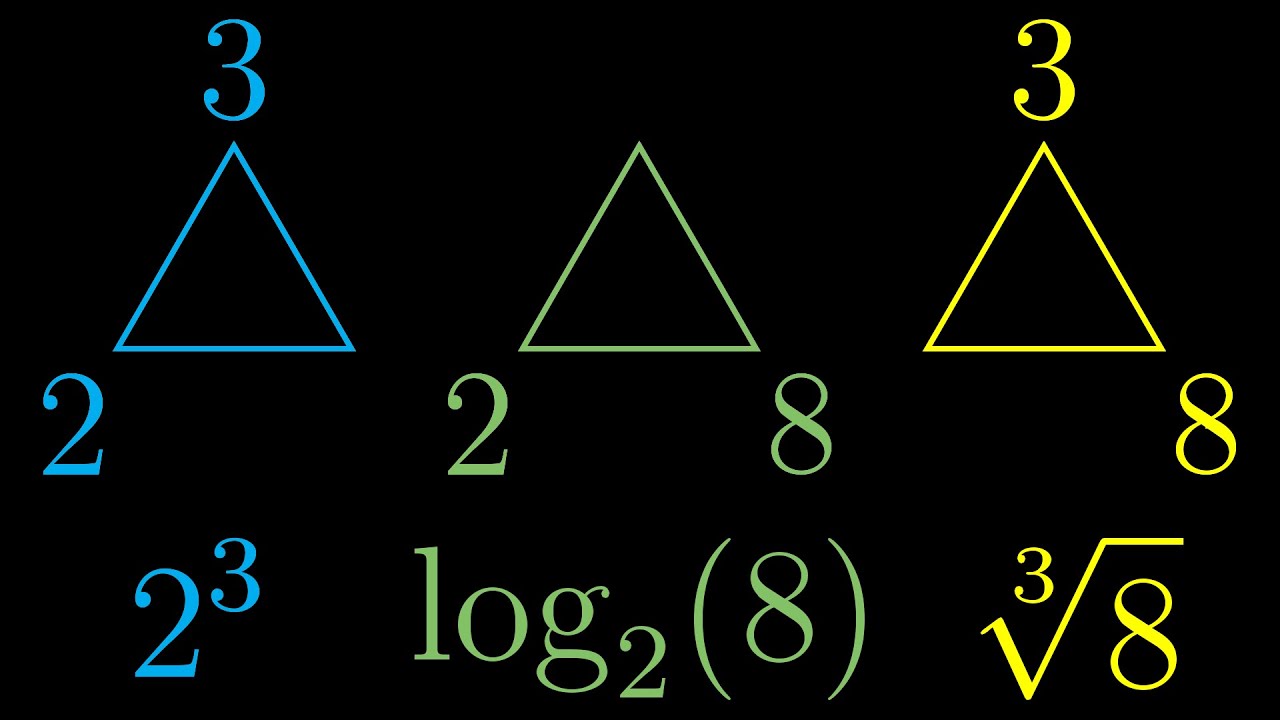
Alternate notation for powers, logs, and roots.
Help fund future projects: https://www.patreon.com/3blue1brown
An equally valuable form of support is to simply share some of the videos.
(This is the corrected version of the one I put out a month or so ago, in which my animation for all the inverse operations was incorrect)
Here's a sketch from...
sage geode
whole yoke
hi! i’m doing a worksheet on arithmetic and geometric sequences, and i’m stuck o...
Firstly you need to spot a pattern, do you see it?
ancient crystal
Yeah, the pattern is there, x3. So, three to the what is 4000. (You're right, it's logs).
sage geode
Right, so you need to solve 3^n being equal to that divided by the initial term
ancient crystal
^smrt
(^smrt meaning the comment above is smart, to the power of smart, and is a Simpson's reference)
obtuse pebbleBOT
@whole yoke Has your question been resolved?
whole yoke
oh wait
whole yoke
sage geode
Right, so you need to solve 3^n being equal to that divided by the initial term
right now i’m at log400,000 = (n-1)log(3) but i’m not sure what to do next
oh wait it’s obvious 😭
thank you guys so much for your help! i got it
obtuse pebbleBOT
@whole yoke Has your question been resolved?
Channel closed
Closed by @whole yoke
Use .reopen if this was a mistake.
Available help channel!
Send your question here to claim the channel.
Remember:
• Ask your math question in a clear, concise manner.
• Show your work, and if possible, explain where you are stuck.
• After 15 minutes, feel free to ping <@&286206848099549185>.
• Type the command .close to free the channel when you're done.
• Be polite and have a nice day!
Read #❓how-to-get-help for further information on how to ask a good question, and about conduct in the question channels.
sinful kraken
 obtuse pebbleBOT
sinful kraken
sinful kraken
obtuse pebbleBOT
sinful kraken
sinful kraken
how do i find the lenght of that curve
r is a vector function equation parametric
0 <= t <= 1
 jolly ginkgo
Find r'(t) then integrate norm{r'(t)} wrt t
sinful kraken
i got this equation but idk how to do the rest
 wooden cipher
Hint: try making a common denominator
jolly ginkgo
Are you sure that's what you got
sinful kraken
sqrt(2)^2=2
jolly ginkgo
Ok
sinful kraken
wooden cipher
Hint: try making a common denominator
wdym ?
sinful kraken
?
jolly ginkgo
Perfect square buddie
sinful kraken
whats that
jolly ginkgo
(Something)²
sinful kraken
wtf
jolly ginkgo
What is (a+b)²
sinful kraken
a^2+2ab+b^2
jolly ginkgo
Oh wait the minus
 jolly ginkgo
If the - was + it would've been perfect
jolly ginkgo
sinful kraken
this ?
Leave it we don't get the (a+b)² form
jolly ginkgo
sinful kraken
Is this right?
sinful kraken
pretty sure
jolly ginkgo
Don't be
sinful kraken
?
warm shaleBOT


 Requested by yes sam#5028
jolly ginkgo
Requested by yes sam#5028
jolly ginkgo
You know what (a+b)² is
sinful kraken
yea
jolly ginkgo
Then do it
sinful kraken
o_o
jolly ginkgo
Do it adam
sinful kraken
my name isnt adam but ok ill do it stay nearby
jolly ginkgo
If you know (a+b)² that means you know how to do maths, so you can solve it
@sinful kraken is it done?
jolly ginkgo
What?
 jolly ginkgo
That's not what you get
sinful kraken
i meant a + instead of a *
jolly ginkgo
So why is that weird
jolly ginkgo
I get e - (1/e)
jolly ginkgo
sinful kraken
im dumb
Yeah
What did you do after square root
What is sqrt(x²) btw
jolly ginkgo
No
jolly ginkgo
After integration
sinful kraken
answer is e^1-e^-1
jolly ginkgo
That question wasn't for you
sinful kraken
?
jolly ginkgo
I didn't ask that to you
sinful kraken
then to who ?
jolly ginkgo
Adam
sinful kraken
who is adam ?
jolly ginkgo
Idk, whoever it is
sinful kraken
wtf
sinful kraken
ugh
jolly ginkgo
You want me to write that integration?
sinful kraken
no
ok il lsend pic but its annoying
wait im doing the intergation
ok works

good ?
jolly ginkgo
sinful kraken
What did you do about sqrt()
obtuse pebbleBOT
Channel closed
Closed by @sinful kraken
Use .reopen if this was a mistake.
Available help channel!
Send your question here to claim the channel.
Remember:
• Ask your math question in a clear, concise manner.
• Show your work, and if possible, explain where you are stuck.
• After 15 minutes, feel free to ping <@&286206848099549185>.
• Type the command .close to free the channel when you're done.
• Be polite and have a nice day!
Read #❓how-to-get-help for further information on how to ask a good question, and about conduct in the question channels.
 timid silo
 obtuse pebbleBOT
timid silo
sinful kraken
obtuse pebbleBOT
timid silo
sinful kraken
i was the previous channel owner faf is talking about my question
timid silo
@jolly ginkgocould you help me
jolly ginkgo
Not free rn
sinful kraken
timid silo
<@350796385525825536>help?
do a graph money in y year in x
timid silo
jolly ginkgo
Not free rn
:C
timid silo
sinful kraken
do a graph money in y year in x
could you do it and show me?
sinful kraken
no
timid silo
o
sinful kraken
sorry
timid silo
ok