Channel closed
Closed by @echo wharf
Use .reopen if this was a mistake.
1 messages · Page 158 of 1
 obtuse pebbleBOT
Closed by @echo wharf
Use .reopen if this was a mistake.
 Available help channel!
Send your question here to claim the channel.
Remember:
• Ask your math question in a clear, concise manner.
• Show your work, and if possible, explain where you are stuck.
• After 15 minutes, feel free to ping <@&286206848099549185>.
• Type the command .close to free the channel when you're done.
• Be polite and have a nice day!
Read #❓how-to-get-help for further information on how to ask a good question, and about conduct in the question channels.
 idle spade
 obtuse pebbleBOT
idle spade
idle spade
obtuse pebbleBOT
idle spade
idle spade
hello, i'm not sure how to do d
obtuse pebbleBOT
@idle spade Has your question been resolved?
idle spade
<@&286206848099549185>
 timid silo
idle spade
hello, i'm not sure how to do d
timid silo
idle spade
hello, i'm not sure how to do d
factorize the x^3 from the numerator
then evaluate the limit
$\frac{1 - 2x^3 + ... +3^4 x^8 -1}{x^3}$
 warm shaleBOT
hannibal
 timid silo
$\frac{- 2x^3 + ... +3^4 x^8}{x^3}$
warm shaleBOT
hannibal
 idle spade
timid silo
$\frac{- 2x^3 + ... +3^4 x^8}{x^3}$
idle spade
timid silo
$\frac{- 2x^3 + ... +3^4 x^8}{x^3}$
so the limit of that?
or simplify then the limit
even then, wouldn't i just get infinity?
timid silo
idle spade
even then, wouldn't i just get infinity?
no, factorize the x^3 first
idle spade
ohhhhh
timid silo
it's a common factor in that sequence
obtuse pebbleBOT
Closed by @idle spade
Use .reopen if this was a mistake.
Available help channel!
Send your question here to claim the channel.
Remember:
• Ask your math question in a clear, concise manner.
• Show your work, and if possible, explain where you are stuck.
• After 15 minutes, feel free to ping <@&286206848099549185>.
• Type the command .close to free the channel when you're done.
• Be polite and have a nice day!
Read #❓how-to-get-help for further information on how to ask a good question, and about conduct in the question channels.
idle spade
 obtuse pebbleBOT
idle spade
obtuse pebbleBOT
obtuse pebbleBOT
idle spade
obtuse pebbleBOT
@idle spade Has your question been resolved?
idle spade
<@&286206848099549185>
idle spade
.close
obtuse pebbleBOT
Closed by @idle spade
Use .reopen if this was a mistake.
Available help channel!
Send your question here to claim the channel.
Remember:
• Ask your math question in a clear, concise manner.
• Show your work, and if possible, explain where you are stuck.
• After 15 minutes, feel free to ping <@&286206848099549185>.
• Type the command .close to free the channel when you're done.
• Be polite and have a nice day!
Read #❓how-to-get-help for further information on how to ask a good question, and about conduct in the question channels.
 true dust
Can system of two linear equations in three variables can have an unique solution
obtuse pebbleBOT
true dust
Can system of two linear equations in three variables can have an unique solutio...
true dust
?
 stoic salmon
I dont think so
 lethal cloud
no
stoic salmon
is it possible for 2 planes to intersect in 3d space in just one point? it'll be either a line(infinite solutions) or not intersecting (no solutions)
obtuse pebbleBOT
@true dust Has your question been resolved?
Closed by @true dust
Use .reopen if this was a mistake.
true dust
Ohk
obtuse pebbleBOT
Available help channel!
Send your question here to claim the channel.
Remember:
• Ask your math question in a clear, concise manner.
• Show your work, and if possible, explain where you are stuck.
• After 15 minutes, feel free to ping <@&286206848099549185>.
• Type the command .close to free the channel when you're done.
• Be polite and have a nice day!
Read #❓how-to-get-help for further information on how to ask a good question, and about conduct in the question channels.
 silent cove
Is E[X-Y] = E[X] - E[Y] in statistics?
obtuse pebbleBOT
silent cove
Is E[X-Y] = E[X] - E[Y] in statistics?
 gilded needle
silent cove
Is E[X-Y] = E[X] - E[Y] in statistics?
gilded needle
silent cove
Is E[X-Y] = E[X] - E[Y] in statistics?
this is true as long as E[X] and E[Y] exist
by linearity of the integral that defines E[]
silent cove
Ah so this would be true in most cases?
gilded needle
yea
silent cove
How can

So this is E[X] but mathematically how can subtracting this from E[Y] be true
gilded needle
yes that's the definition for a discrete random variable
probably easiest to show if you start with the joint distribution, say that's called p(x,y) by abuse of notation
then:
$$\begin{aligned}
E[X-Y] &= \sum_{i,j} (x_i - y_j) p(x_i, y_j) \
&= \sum_{i,j} x_i p(x_i, y_j) - \sum_{i,j} y_j p(x_i, y_j) \
&= \sum_i x_i \sum_j p(x_i, y_j) - \sum_j y_j \sum_i p(x_i, y_j) \
&= \sum_i x_i p(x_i) - \sum_j y_j p(y_j) \
&= E[X] - E[Y]\end{aligned}$$
warm shaleBOT
Bungo
 obtuse pebbleBOT
@silent cove Has your question been resolved?
obtuse pebbleBOT
Closed due to timeout
Use .reopen if this was a mistake.
Available help channel!
Send your question here to claim the channel.
Remember:
• Ask your math question in a clear, concise manner.
• Show your work, and if possible, explain where you are stuck.
• After 15 minutes, feel free to ping <@&286206848099549185>.
• Type the command .close to free the channel when you're done.
• Be polite and have a nice day!
Read #❓how-to-get-help for further information on how to ask a good question, and about conduct in the question channels.
 clever pier
How do I calculate the period of this?
obtuse pebbleBOT
clever pier
How do I calculate the period of this?
clever pier
$\sin{x}+\cos{\frac{x}{2}}$
warm shaleBOT
Raage
 obtuse pebbleBOT
@clever pier Has your question been resolved?
clever pier
<@&286206848099549185>
obtuse pebbleBOT
@clever pier Has your question been resolved?
obtuse pebbleBOT
Closed due to timeout
Use .reopen if this was a mistake.
obtuse pebbleBOT
Available help channel!
Send your question here to claim the channel.
Remember:
• Ask your math question in a clear, concise manner.
• Show your work, and if possible, explain where you are stuck.
• After 15 minutes, feel free to ping <@&286206848099549185>.
• Type the command .close to free the channel when you're done.
• Be polite and have a nice day!
Read #❓how-to-get-help for further information on how to ask a good question, and about conduct in the question channels.
 rapid karma
Hi, i'm just wondering what the point of this question is. And furthermore, how to answer the following statement: "The subspace of matrices that commute with the shift S has dimension__". What does commute mean?
 obtuse pebbleBOT
rapid karma
Hi, i'm just wondering what the point of this question is. And furthermore, how ...
obtuse pebbleBOT
rapid karma
Hi, i'm just wondering what the point of this question is. And furthermore, how ...
 royal basin
we say two matrices commute if the commutative property holds for them
obtuse pebbleBOT
@rapid karma Has your question been resolved?
rapid karma
Oic. So in this case only a 3 by 3 would commute with S?
rapid karma
Which makes it 3 dimensions?
obtuse pebbleBOT
@rapid karma Has your question been resolved?
obtuse pebbleBOT
@rapid karma Has your question been resolved?
obtuse pebbleBOT
Closed due to timeout
Use .reopen if this was a mistake.
obtuse pebbleBOT
Available help channel!
Send your question here to claim the channel.
Remember:
• Ask your math question in a clear, concise manner.
• Show your work, and if possible, explain where you are stuck.
• After 15 minutes, feel free to ping <@&286206848099549185>.
• Type the command .close to free the channel when you're done.
• Be polite and have a nice day!
Read #❓how-to-get-help for further information on how to ask a good question, and about conduct in the question channels.
 elder tulip
,rotate
 obtuse pebbleBOT
elder tulip
,rotate
warm shaleBOT
obtuse pebbleBOT
elder tulip
,rotate
warm shaleBOT
 stoic salmon
looks like you'll need to use sin2x = 2sinxcosx
try it using this
then you'll also need to use double angle identity for cos
obtuse pebbleBOT
@elder tulip Has your question been resolved?
obtuse pebbleBOT
Closed due to timeout
Use .reopen if this was a mistake.
Available help channel!
Send your question here to claim the channel.
Remember:
• Ask your math question in a clear, concise manner.
• Show your work, and if possible, explain where you are stuck.
• After 15 minutes, feel free to ping <@&286206848099549185>.
• Type the command .close to free the channel when you're done.
• Be polite and have a nice day!
Read #❓how-to-get-help for further information on how to ask a good question, and about conduct in the question channels.
 grizzled bramble
hello
obtuse pebbleBOT
grizzled bramble
hello
grizzled bramble
i need help
i just read proof of weierstrass criteria and im confused
is that true or not, that (series is convergent <=> series is uniform convergent)?
 haughty coyote
Uniform convergence is for series of functions
Do you mean absolutely convergent?
grizzled bramble
haughty coyote
Uniform convergence is for series of functions
Do you mean absolutely convergent...
nope, uniform convergent

In the mathematical field of analysis, uniform convergence is a mode of convergence of functions stronger than pointwise convergence. A sequence of functions
    (

      f

        n


    )


{\displaystyle (f_{n})}
converges uniformly to a limiting function
...
haughty coyote
Yes for functions
grizzled bramble
haughty coyote
Uniform convergence is for series of functions
Do you mean absolutely convergent...
u can apply it to partial sums of series
haughty coyote
We talk about uniformity as opposed to nothing for a reason
They're not equivalent
haughty coyote
grizzled bramble
https://en.wikipedia.org/wiki/Uniform_convergence
The very start of the examples already answers your question
 slim leaf
If series of functions is uniformly convergent then obviously the series is convergent so one direction is obvious. (Series of functions converges uniformly if the sequence of partial sums converges uniformly).
However if series of functions is pointwise convergent (This happens when sequence of partial sums converges pointwise) then we don't necessarily have uniform convergence.
If you are talking about Weierstrass' M-test, then yes the series is uniformly convergent if it satisfies the hypotheses in the test
grizzled bramble
slim leaf
If series of functions is uniformly convergent then obviously the series is conv...
why? if series is convergent, then for any eps>0 theres n0, that for every m>n>n0 theres sigma(m, i=n+1) ai < eps
so cauchys condition is fullfiled
slim leaf
This is Cauchy's condition for uniform convergence of series
$\sum_{n=0}^{\infty} x^{n}$ converges pointwise to $\frac{1}{1-x}$ on $(-1,1)$.
grizzled bramble
yeah
grizzled bramble
slim leaf
This is Cauchy's condition for uniform convergence of series
ok but every convergent series fullfill cauchys condition
warm shaleBOT
Sup?
 slim leaf
grizzled bramble
ok but every convergent series fullfill cauchys condition
slim leaf
grizzled bramble
ok but every convergent series fullfill cauchys condition
How are you getting this?
slim leaf
warm shale
**Sup?**
and this convergence is not uniform
grizzled bramble
slim leaf
How are you getting this?
ok so, suppose we have convergent series Sigma(i=1, inf) Ai
right?
get some eps > 0
then, there must be some natural n0 number
that, for every m>n>n0
we have Sigma(i = n, m) Ai < eps
do u agree?
slim leaf
Can you prove this?
Okay nvm, I see what this is, Cauchy criterion for series
@grizzled bramble Okay now what?
@grizzled bramble Okay so I get what your confusion is. Suppose we have a sequence of functions (f_i) : A ---> R.
If for all e > 0, there exists N s.t |sum (i=m+1 to n) f_i (x) | < e, for all x in A and all n > m > N, then we say the series (sum i=1 to infinity f_i (x)) converges uniformly.
Now what you're doing is using the Cauchy criterion for series of fixed real numbers
So what you're doing now is fixing some x in A, say x = x_0
Which means that f_i (x_0) is now a sequence of real numbers
And if this series f_i (x_0) is convergent, then yes for all e > 0, there exists N s.t |sum (i=m+1 to n) f_i (x_0) | < e, for all n > m > N.
But notice that this only happens for one "x" and that "x" is "x_0".
slim leaf
grizzled bramble
ok so, suppose we have convergent series Sigma(i=1, inf) Ai
Whatever you said is true but only when A_i is a fixed number, not a function
grizzled bramble
slim leaf
Whatever you said is true but only when A_i is a fixed number, not a function
but does it work when function depends only from iterator, not some external x?
like sigma(n=1, inf) 1/n^2 ?
slim leaf
Yes obviously because then you are just talking about a series of real numbers
and not series of functions (dependent on x, and as x changes, the series changes)
grizzled bramble
ah, so when i would say: "for every series, where An depends only on n value, series is covergent <=> is uniform covergent" thats true then, right?
slim leaf
When you have this series then there is no notion of uniform convergence
Just convergence, absolute convergence, conditional convergence
When we introduce functions then the notion of uniform convergence is brought up
grizzled bramble
but why it makes difference for, idk An(x)? the base of the proof is that lim (n->inf) n rest of series = 0
slim leaf
When talking about normal series (of numbers), then we have that lim n to infinity must be 0
But when talking about series of functions, we don't talk about lim n to infinity must be 0
Because then the limit can be a function
grizzled bramble
slim leaf
Just convergence, absolute convergence, conditional convergence
ah, cause we dont have x, so we dont have to use diffrentations and stuff
grizzled bramble
slim leaf
Because then the limit can be a function
hm, but what if we are chcecking limit for every x from domain of functions
like, for every x the limes is zero
slim leaf
limes?
slim leaf
you mean limit?
grizzled bramble
mhm
slim leaf
Ah okay so you're saying we fix x, now we get a series of numbers and so lim n to infinity (series) = 0?
grizzled bramble
well, nvmd
thats another problem, gonna think bout it later
well rn i get why what i know is true and what i dont know still, so thank you all for help
/close
eh, how to close session?
.close
obtuse pebbleBOT
Closed by @grizzled bramble
Use .reopen if this was a mistake.
obtuse pebbleBOT
Available help channel!
Send your question here to claim the channel.
Remember:
• Ask your math question in a clear, concise manner.
• Show your work, and if possible, explain where you are stuck.
• After 15 minutes, feel free to ping <@&286206848099549185>.
• Type the command .close to free the channel when you're done.
• Be polite and have a nice day!
Read #❓how-to-get-help for further information on how to ask a good question, and about conduct in the question channels.
timid silo
This a good approach?
 timid silo
.close
obtuse pebbleBOT
Closed by @mighty junco
Use .reopen if this was a mistake.
Available help channel!
Send your question here to claim the channel.
Remember:
• Ask your math question in a clear, concise manner.
• Show your work, and if possible, explain where you are stuck.
• After 15 minutes, feel free to ping <@&286206848099549185>.
• Type the command .close to free the channel when you're done.
• Be polite and have a nice day!
Read #❓how-to-get-help for further information on how to ask a good question, and about conduct in the question channels.
 tawdry meteor
when calculating the comutator of these operators i usually use the method where you do [A,B] f = AB f - BA f
 obtuse pebbleBOT
tawdry meteor
when calculating the comutator of these operators i usually use the method where...
tawdry meteor
obtuse pebbleBOT
tawdry meteor
when calculating the comutator of these operators i usually use the method where...
tawdry meteor
but seeing how the these operators have derivatives to different variables
how do i effectively take the derivatives?
do i just decide that f is a function of x?
do that d/dy (f) = 0?
obtuse pebbleBOT
@tawdry meteor Has your question been resolved?
obtuse pebbleBOT
@tawdry meteor Has your question been resolved?
obtuse pebbleBOT
@tawdry meteor Has your question been resolved?
obtuse pebbleBOT
Closed due to timeout
Use .reopen if this was a mistake.
Available help channel!
Send your question here to claim the channel.
Remember:
• Ask your math question in a clear, concise manner.
• Show your work, and if possible, explain where you are stuck.
• After 15 minutes, feel free to ping <@&286206848099549185>.
• Type the command .close to free the channel when you're done.
• Be polite and have a nice day!
Read #❓how-to-get-help for further information on how to ask a good question, and about conduct in the question channels.
 plush cedar
so using taylor series how do i solve this
obtuse pebbleBOT
plush cedar
so using taylor series how do i solve this
plush cedar
ah
royal basin
x^3/6 - x^3/3 can also be simplified into -x^3/6
so that's the denominator taken care of
now do the numerator
you know you only need terms up to x^3
plush cedar
no i dont , this is the first time using taylor series and I just learn about them today XD
so how can i know that?
is it because the first term is of power 3?
royal basin
it's because the denominator behaves as x^3
plush cedar
does O absorb negitive numbers too?
royal basin
so that's the level of "precision" you want
plush cedar
ah I see
royal basin
yes of course it does
plush cedar
ok
timid silo
just wondering, are u required to solve this using taylor anyways?
because i do see an alternative, potentially less excruciating method
plush cedar
so the numerator would be (x-1)(1 - x^2/2! + O(x^4)) - (1 + x^2/2+...+O(x^4) + 2
royal basin
timid silo
because i do see an alternative, potentially less excruciating method
don't suggest lhop
royal basin
plush cedar
so the numerator would be (x-1)(1 - x^2/2! + O(x^4)) - (1 + x^2/2+...+O(x^4) + 2
missed a term for e^x
e^x = 1 + x + x^2/2 + x^3/3 + O(x^4)
plush cedar
yea I used the dots on porpuse couldnt bother writing it out XD
in any case now what
plush cedar
timid silo
just wondering, are u required to solve this using taylor anyways?
no I am not requried and if there is a better method I am all for it, just that it has to be general purpose for these types of questions, training for an exam...
royal basin
@timid silo so what is the substitution you're talking about
timid silo
royal basin
<@456226577798135808> so what is the substitution you're talking about
u = tan(x)
royal basin
does that help things
plush cedar
so what do I do with this?
 timid silo
i believe so but i will verify with what i think the outcome will be
obtuse pebbleBOT
@plush cedar Has your question been resolved?
plush cedar
side question, is O(x^5) + O(x^4) = O(x^5) because it is way bigger?
plush cedar
then what is the result of this?
 timid silo
xO(x^4) = O(x^5)
obtuse pebbleBOT
Closed by @plush cedar
Use .reopen if this was a mistake.
Available help channel!
Send your question here to claim the channel.
Remember:
• Ask your math question in a clear, concise manner.
• Show your work, and if possible, explain where you are stuck.
• After 15 minutes, feel free to ping <@&286206848099549185>.
• Type the command .close to free the channel when you're done.
• Be polite and have a nice day!
Read #❓how-to-get-help for further information on how to ask a good question, and about conduct in the question channels.
 fathom bridge
is -ln(e) the same as ln(e)
obtuse pebbleBOT
fathom bridge
is -ln(e) the same as ln(e)
fathom bridge
other than they return a -1 rather than 1
fathom bridge
as in do they undo the same way
 minor cypress
wdym undo?
fathom bridge
bro ln(e) undo
minor cypress
ln(e) will undo irrespective of the scalar you multiply it with right
here you're multiplying by -1
minor cypress
yep
 tame narwhal
yes
obtuse pebbleBOT
Closed by @fathom bridge
Use .reopen if this was a mistake.
obtuse pebbleBOT
Available help channel!
Send your question here to claim the channel.
Remember:
• Ask your math question in a clear, concise manner.
• Show your work, and if possible, explain where you are stuck.
• After 15 minutes, feel free to ping <@&286206848099549185>.
• Type the command .close to free the channel when you're done.
• Be polite and have a nice day!
Read #❓how-to-get-help for further information on how to ask a good question, and about conduct in the question channels.
 rough cove
A rope is tied to a heavy box (m = 95 kg) and pulled along the floor. If the rope makes an angle of 41.2° above the horizontal, and the coefficient of kinetic friction between the box and the floor is μ = 0.15, what applied force is needed in order for the box to maintain a constant speed?
please help
obtuse pebbleBOT
rough cove
A rope is tied to a heavy box (m = 95 kg) and pulled along the floor. If the rop...
obtuse pebbleBOT
@rough cove Has your question been resolved?
obtuse pebbleBOT
Closed due to timeout
Use .reopen if this was a mistake.
Available help channel!
Send your question here to claim the channel.
Remember:
• Ask your math question in a clear, concise manner.
• Show your work, and if possible, explain where you are stuck.
• After 15 minutes, feel free to ping <@&286206848099549185>.
• Type the command .close to free the channel when you're done.
• Be polite and have a nice day!
Read #❓how-to-get-help for further information on how to ask a good question, and about conduct in the question channels.
timid silo
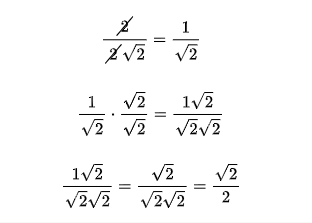
how it works? like, 2 * (2*1.41) is like 5.., how it went to that, and what if it is right, why isnt 8 below? if simplify this, how come to root(2)
 obtuse pebbleBOT
timid silo
how it works? like, 2 * (2*1.41) is like 5.., how it went to that, and what if i...
slim leaf
obtuse pebbleBOT
timid silo
how it works? like, 2 * (2*1.41) is like 5.., how it went to that, and what if i...
slim leaf
$2 = \sqrt{2} \cdot \sqrt{2}$
warm shaleBOT
Sup?
 slim leaf
That's it
timid silo
slim leaf
That's it
?
slim leaf
$\frac{2}{2 \sqrt{2}} = \frac{\sqrt{2} \sqrt{2}}{2 \sqrt{2}} = \frac{\sqrt{2}}{2}$
warm shaleBOT
Sup?
 slim leaf
If you want to simplify further
timid silo
warm shale
**Sup?**
what, isnt 2*root(2)/2*root(2)?
slim leaf
?
obtuse pebbleBOT
Closed by @trail plume
Use .reopen if this was a mistake.
Available help channel!
Send your question here to claim the channel.
Remember:
• Ask your math question in a clear, concise manner.
• Show your work, and if possible, explain where you are stuck.
• After 15 minutes, feel free to ping <@&286206848099549185>.
• Type the command .close to free the channel when you're done.
• Be polite and have a nice day!
Read #❓how-to-get-help for further information on how to ask a good question, and about conduct in the question channels.
 tough hawk
 obtuse pebbleBOT
tough hawk
tough hawk
obtuse pebbleBOT
tough hawk
tough hawk
For c

Am I going in the right direction???
Not sure if I’m doing it richt?
Right
obtuse pebbleBOT
@tough hawk Has your question been resolved?
tough hawk
<@&286206848099549185>
tough hawk
.close
obtuse pebbleBOT
Closed by @tough hawk
Use .reopen if this was a mistake.
Available help channel!
Send your question here to claim the channel.
Remember:
• Ask your math question in a clear, concise manner.
• Show your work, and if possible, explain where you are stuck.
• After 15 minutes, feel free to ping <@&286206848099549185>.
• Type the command .close to free the channel when you're done.
• Be polite and have a nice day!
Read #❓how-to-get-help for further information on how to ask a good question, and about conduct in the question channels.
 smoky tusk
Hello, this is part of my chemistry class. I’ve provided the question the Professor gave as well as their answer. And then my work, I got -312kJ and they got -314kJ. Did I plug into calculator wrong or something? I’ll provide a screenshot of how I plugged it into calculator if needed. Help?

 obtuse pebbleBOT
smoky tusk
Hello, this is part of my chemistry class. I’ve provided the question the Profes...
smoky tusk
obtuse pebbleBOT
smoky tusk
Hello, this is part of my chemistry class. I’ve provided the question the Profes...
smoky tusk

I figure it might be a typo? But just need extra clarification because if I did go wrong somewhere I have no idea where
 slow mango
i get the same answer as u, i think its a typo
obtuse pebbleBOT
Closed by @smoky tusk
Use .reopen if this was a mistake.
Available help channel!
Send your question here to claim the channel.
Remember:
• Ask your math question in a clear, concise manner.
• Show your work, and if possible, explain where you are stuck.
• After 15 minutes, feel free to ping <@&286206848099549185>.
• Type the command .close to free the channel when you're done.
• Be polite and have a nice day!
Read #❓how-to-get-help for further information on how to ask a good question, and about conduct in the question channels.
 mellow compass
I have a jar containing 30 red marbles, 30 green marbles and 30 blue marbles. I reach in
and pull out five marbles. How many ways are there to do this?
obtuse pebbleBOT
mellow compass
I have a jar containing 30 red marbles, 30 green marbles and 30 blue marbles. I ...
 grizzled shore
90! Is much bigger than 43 million
mellow compass
but is the combination correct?
obtuse pebbleBOT
Closed by @mellow compass
Use .reopen if this was a mistake.
obtuse pebbleBOT
Available help channel!
Send your question here to claim the channel.
Remember:
• Ask your math question in a clear, concise manner.
• Show your work, and if possible, explain where you are stuck.
• After 15 minutes, feel free to ping <@&286206848099549185>.
• Type the command .close to free the channel when you're done.
• Be polite and have a nice day!
Read #❓how-to-get-help for further information on how to ask a good question, and about conduct in the question channels.
 regal geyser
hi im doing my mock math ia on statistics, and im modelling temperature values in my city, so ive used r^2 value to check for whether a model is a good fit for simple inear, quadratic, cubic and quartic, but i also want to check sinusoidal but since i cant use r^2 value for it so is there a good way to check for whether its a good model based on a certain data set?
obtuse pebbleBOT
regal geyser
hi im doing my mock math ia on statistics, and im modelling temperature values i...
@regal geyser Has your question been resolved?
regal geyser
<@&286206848099549185>
obtuse pebbleBOT
@regal geyser Has your question been resolved?
obtuse pebbleBOT
Closed due to timeout
Use .reopen if this was a mistake.
Available help channel!
Send your question here to claim the channel.
Remember:
• Ask your math question in a clear, concise manner.
• Show your work, and if possible, explain where you are stuck.
• After 15 minutes, feel free to ping <@&286206848099549185>.
• Type the command .close to free the channel when you're done.
• Be polite and have a nice day!
Read #❓how-to-get-help for further information on how to ask a good question, and about conduct in the question channels.
 runic thunder
 obtuse pebbleBOT
runic thunder
runic thunder
obtuse pebbleBOT
runic thunder
runic thunder
Where does the “2” come from?
runic thunder
When taking the integral of e^.5t when t is 10 would it be e^5 * .5
 fierce lagoon
Where did your t go
e^(0.5t) requires a u-sub (although that can be mentally done)
Start with identifying your antiderivative
stoic salmon
runic thunder
When taking the integral of e^.5t when t is 10 would it be e^5 * .5
limits are from 0 to 10, you gotta plug in both also you're using the chain rule which isn't used like that in integration
$\int f(ax+b) dx = \frac{1}{a}F(ax+b) + c$
warm shaleBOT
roxyit
 runic thunder
Ya so
e^(u)
u’e^u
runic thunder
runic thunder
Ya so
e^(u)
u’e^u
Ok i see ty
fierce lagoon
Latex hurts sometimes 
runic thunder
I just solved the integral by using the e derivative rule instead of the integral one
fierce lagoon
Well it's just a chain rule, although you'll realize it's not much of a hard one
Considering the inner function is a linear function
stoic salmon
yeah so the antiderivate is F(x)=10*2e^(x/2)
now you gotta evaluate the limits so F(10)-F(0)
runic thunder
I used that to solve for b (average number) but what would i use to solve average growth (rate of change)

Wait is this even correct for b

I did this average integral stuff was i meant to do y’ = y(10)-y(0)
obtuse pebbleBOT
@runic thunder Has your question been resolved?
obtuse pebbleBOT
Closed due to timeout
Use .reopen if this was a mistake.
Available help channel!
Send your question here to claim the channel.
Remember:
• Ask your math question in a clear, concise manner.
• Show your work, and if possible, explain where you are stuck.
• After 15 minutes, feel free to ping <@&286206848099549185>.
• Type the command .close to free the channel when you're done.
• Be polite and have a nice day!
Read #❓how-to-get-help for further information on how to ask a good question, and about conduct in the question channels.
Closed due to the original message being deleted
 gusty heron
.close
obtuse pebbleBOT
Available help channel!
Send your question here to claim the channel.
Remember:
• Ask your math question in a clear, concise manner.
• Show your work, and if possible, explain where you are stuck.
• After 15 minutes, feel free to ping <@&286206848099549185>.
• Type the command .close to free the channel when you're done.
• Be polite and have a nice day!
Read #❓how-to-get-help for further information on how to ask a good question, and about conduct in the question channels.
 timber zephyr
 obtuse pebbleBOT
timber zephyr
timber zephyr
obtuse pebbleBOT
timber zephyr
timber zephyr
w1 is correct but I can't get w2
royal basin
wdym by "can't get"?
timber zephyr
the value isn't correct
royal basin
is the output depicted yours or the answer key?
timber zephyr
the output
royal basin
is it YOURS or is it not yours
timber zephyr
royal basin
is it YOURS or is it not yours
mine
royal basin
,calc 0.408^2 + 0.408^2 + 0.816^2
warm shaleBOT
Result:
0.998784
it looks correct to me. what's the issue?
timber zephyr
royal basin
might be code related and not math related
yeah but maybe w2 is calculated incorrectly
idk the method to get w2
i don't know gram schmidt process that much
 leaden ginkgo

Gram-Schmidt Orthogonization using Numpy. GitHub Gist: instantly share code, notes, and snippets.
maybe this will help
timber zephyr
leaden ginkgo
https://gist.github.com/iizukak/1287876/edad3c337844fac34f7e56ec09f9cb27d4907cc7
I tried didn't work
leaden ginkgo
hmm
 frosty spoke
why are your vectors row vectors
timber zephyr
frosty spoke
why are your vectors row vectors
are they not supposed to be row vectors?
frosty spoke
most people would be much more familiar with column vectors
 timber island
Well i don't think numpy has column vectors
frosty spoke
also not sure what your code is actually doing for the projection
like what is all of this tolist() and [0][0] nonsense
timber zephyr
timber island
Also i think i found the issue here
what is it
timber island
timber zephyr
what is it
Can u send me the alg? Haven't used it yet sooo idk about it..
$$ v2 - \frac{a}{b} $$
warm shaleBOT
ItzKraken2
 timber zephyr
timber island
Can u send me the alg? Haven't used it yet sooo idk about it..
timber zephyr
timber island
Can u send me the alg? Haven't used it yet sooo idk about it..
wdym
timber island
warm shale
**ItzKraken2**
R u supposed to do this to calc w2? a and b is the dot product and normalised vector in w2 calc
frosty spoke
the w1 and the w2 are correct
timber zephyr
yea
frosty spoke
timber zephyr
my guess the problem is in this mess
timber zephyr
frosty spoke
the w1 and the w2 are correct
so is the problem for the projection code related?
timber zephyr
frosty spoke
my guess the problem is in this mess
how would this be solved
timber island
W is a Matrix right?
timber island
timber zephyr
In this
frosty spoke
can you at least print the value of Pmv?
frosty spoke
why do you have Pwv in the second cell as opposed to Pmv?
the value for Pmv is what I'd expect
timber zephyr
frosty spoke
why do you have Pwv in the second cell as opposed to Pmv?
?
it's for the check answer
frosty spoke
this is what sympy gives
 frosty spoke
timber zephyr
it's for the check answer
frosty spoke
timber zephyr
it's for the check answer
yeah why are you putting something else into checkanswer than the thing you computed
why does checkanswer say it's testing [-1, 1, 0]
timber zephyr
LMAO
i got
it


I need help on this part
w1, w2 E W
how do you show that
frosty spoke
well, you need to show that w1 can be written as a linear combination of v1, v2
and same with w2
timber zephyr
how would that be done
frosty spoke
the Gram-Schmidt process gives you those coefficients if you look carefully enough
or if you're lazy, just as the computer to solve for those, though you probably will need to use some least-squares thing and show that the distance is very low
because you're doing things with imprecise arithmetic
timber zephyr
frosty spoke
or if you're lazy, just as the computer to solve for those, though you probably ...
so how would that be done
frosty spoke
pretty sure you can look that up
timber zephyr
frosty spoke
pretty sure you can look that up
could u help me on this

it's related to the previous one
timber zephyr
frosty spoke
do you not know the geometric meaning?
nah
timber zephyr
frosty spoke
the Gram-Schmidt process gives you those coefficients if you look carefully enou...
about the coefficients how do u find them?
frosty spoke
for example, if you say that w1 = v1/|v1|, then isn't w1 = 1/|v1| * v1 + 0 * v2?
timber zephyr
frosty spoke
for example, if you say that w1 = v1/|v1|, then isn't w1 = 1/|v1| * v1 + 0 * v2?
yea

how do u do this
this what the prof said to do
for that problem
frosty spoke
likewise, if you say that unnormalized w2 = (v2 - (v2 dot w1)w1), then you can find the coefficients for that too
basically you need to prove that w1 = some linear combination of v1, v2 and same with w2
that's assuming W is defined as span {v1, v2} and not something else, but it's up to you to figure that out
obtuse pebbleBOT
@timber zephyr Has your question been resolved?
Closed by @timber zephyr
Use .reopen if this was a mistake.
Available help channel!
Send your question here to claim the channel.
Remember:
• Ask your math question in a clear, concise manner.
• Show your work, and if possible, explain where you are stuck.
• After 15 minutes, feel free to ping <@&286206848099549185>.
• Type the command .close to free the channel when you're done.
• Be polite and have a nice day!
Read #❓how-to-get-help for further information on how to ask a good question, and about conduct in the question channels.
 spice plank
determine the domain and range of y=2- √(2x+3)
obtuse pebbleBOT
spice plank
determine the domain and range of y=2- √(2x+3)
 prisma hatch
here expression under root must not be negative if we want real solution
warm shaleBOT
Pro_Hecker
 prisma hatch
so the domain of the function is
{ x | x ≥ -3/2 }
here √(2x+3) is being subtracted from 2 ; there is no real way in which √(2x+3) will increase value of y
so, when √(2x+3) = 0
we get y = 2;
so the range of the function is
{ y | y ≤ -3/2 }
obtuse pebbleBOT
@spice plank Has your question been resolved?
Closed by @spice plank
Use .reopen if this was a mistake.
Available help channel!
Send your question here to claim the channel.
Remember:
• Ask your math question in a clear, concise manner.
• Show your work, and if possible, explain where you are stuck.
• After 15 minutes, feel free to ping <@&286206848099549185>.
• Type the command .close to free the channel when you're done.
• Be polite and have a nice day!
Read #❓how-to-get-help for further information on how to ask a good question, and about conduct in the question channels.
 gray nest
 gray nest
How am I wrong?
obtuse pebbleBOT
@gray nest Has your question been resolved?
gray nest
<@&286206848099549185>
timber island
ur application of tan(theta/2) is wrong
gray nest
Why?
gray nest
How can it have 2 diff values?
 ashen nebula
what is the answer?
gray nest
I was solving some other questions which involved computations and the answers differed
ashen nebula
oh wait i see
gray nest
ashen nebula
what is the answer?
The proof?
ashen nebula
gray nest
The proof?
the answer you concluded is just a restatement of the answer given at the top
gray nest
Its a negative reciprocal
ashen nebula
3/(sqrt(7)+4), multiply both numerator and denominator by 4-sqrt(7)
the final answer has a rationalised denominator, yours doesn't
gray nest
Yea
ashen nebula
i guess you better rationalise denominators next time
prisma hatch
no rationalising doesnt work(actually it does)
gray nest
Yea got it
ashen nebula
prisma hatch
no rationalising doesnt work(actually it does)
it gives the final expression that is desired
gray nest
 ashen nebula
yes, that is indeed correct
prisma hatch
my bad i didnt calc properlu
obtuse pebbleBOT
Closed by @gray nest
Use .reopen if this was a mistake.
Available help channel!
Send your question here to claim the channel.
Remember:
• Ask your math question in a clear, concise manner.
• Show your work, and if possible, explain where you are stuck.
• After 15 minutes, feel free to ping <@&286206848099549185>.
• Type the command .close to free the channel when you're done.
• Be polite and have a nice day!
Read #❓how-to-get-help for further information on how to ask a good question, and about conduct in the question channels.
Closed due to the original message being deleted
obtuse pebbleBOT
Available help channel!
Send your question here to claim the channel.
Remember:
• Ask your math question in a clear, concise manner.
• Show your work, and if possible, explain where you are stuck.
• After 15 minutes, feel free to ping <@&286206848099549185>.
• Type the command .close to free the channel when you're done.
• Be polite and have a nice day!
Read #❓how-to-get-help for further information on how to ask a good question, and about conduct in the question channels.
 silver glen
I have an equation like this: x’’ +cx’ + 4225x = 0 and also I know x(0)=x(pi/56)=0. How can I solve this?
obtuse pebbleBOT
silver glen
I have an equation like this: x’’ +cx’ + 4225x = 0 and also I know x(0)=x(pi/56)...
silver glen
I already know the characteristic polynom. And oh btw, I gotta solve c
The task is to find what c is
And between 0 and pi/56, the answer is positive
I ended up that c is +-130 but its wrong..
<@&286206848099549185> help appreciated
obtuse pebbleBOT
@silver glen Has your question been resolved?
silver glen
The english term for this I found was second order differential equation
obtuse pebbleBOT
@silver glen Has your question been resolved?
obtuse pebbleBOT
Closed due to timeout
Use .reopen if this was a mistake.
Available help channel!
Send your question here to claim the channel.
Remember:
• Ask your math question in a clear, concise manner.
• Show your work, and if possible, explain where you are stuck.
• After 15 minutes, feel free to ping <@&286206848099549185>.
• Type the command .close to free the channel when you're done.
• Be polite and have a nice day!
Read #❓how-to-get-help for further information on how to ask a good question, and about conduct in the question channels.
 strong ermine
Jeez Louise
obtuse pebbleBOT
@fluid oak Has your question been resolved?
 crystal solstice
<@&268886789983436800> seems like cheating in exam?
<@&268886789983436800>
Why isn't it pinging 
obtuse pebbleBOT
Closed by @glossy yew
Use .reopen if this was a mistake.
obtuse pebbleBOT
Available help channel!
Send your question here to claim the channel.
Remember:
• Ask your math question in a clear, concise manner.
• Show your work, and if possible, explain where you are stuck.
• After 15 minutes, feel free to ping <@&286206848099549185>.
• Type the command .close to free the channel when you're done.
• Be polite and have a nice day!
Read #❓how-to-get-help for further information on how to ask a good question, and about conduct in the question channels.
fathom bridge
for a) would this be every 1/3 of a year the radioactive substance decreases by 4%
 obtuse pebbleBOT
fathom bridge
for a) would this be every 1/3 of a year the radioactive substance decreases by ...
obtuse pebbleBOT
fathom bridge
for a) would this be every 1/3 of a year the radioactive substance decreases by ...
 glacial obsidian
fathom bridge
for a) would this be every 1/3 of a year the radioactive substance decreases by ...
glacial obsidian
fathom bridge
for a) would this be every 1/3 of a year the radioactive substance decreases by ...
Not exactly
After 1/3 years Q = 20·(0.96)^(1/9)
It decreases by 4% after more time
fathom bridge
so every 3 years
glacial obsidian
Yes
fathom bridge
okay, that makes sense
glacial obsidian
You can also mention in the answer that there are 20 grams at the beginning
fathom bridge
how would i incorporate that
every 3 years starting from 20 grams of radioactive substance it will decrease by 4%
glacial obsidian
Yes
fathom bridge
.close
obtuse pebbleBOT
Closed by @fathom bridge
Use .reopen if this was a mistake.
Available help channel!
Send your question here to claim the channel.
Remember:
• Ask your math question in a clear, concise manner.
• Show your work, and if possible, explain where you are stuck.
• After 15 minutes, feel free to ping <@&286206848099549185>.
• Type the command .close to free the channel when you're done.
• Be polite and have a nice day!
Read #❓how-to-get-help for further information on how to ask a good question, and about conduct in the question channels.
 lofty whale
 obtuse pebbleBOT
lofty whale
slim leaf
obtuse pebbleBOT
lofty whale
slim leaf
@lofty whale I'm thinking H_0 : M_p > M_a and H_A : M_p <= M_a
The null hypothesis is what we want to check, right?
obtuse pebbleBOT
@lofty whale Has your question been resolved?
obtuse pebbleBOT
Closed due to timeout
Use .reopen if this was a mistake.
Available help channel!
Send your question here to claim the channel.
Remember:
• Ask your math question in a clear, concise manner.
• Show your work, and if possible, explain where you are stuck.
• After 15 minutes, feel free to ping <@&286206848099549185>.
• Type the command .close to free the channel when you're done.
• Be polite and have a nice day!
Read #❓how-to-get-help for further information on how to ask a good question, and about conduct in the question channels.
 severe mica
i have a question
obtuse pebbleBOT
severe mica
i have a question
 lost tree
what is it
 clear condor

severe mica
can i ask help for anything
clear condor
math
severe mica
can i have help on indices
 spring trail
clear condor
<:JustAsk:371662163489718273>
spring trail
clear condor
<:JustAsk:371662163489718273>
.
lost tree
yes send ur question
fierce lagoon
...
severe mica
5^5
lost tree
is this trolling
clear condor
uh
severe mica
lost tree
is this trolling
me
lost tree
well what help do u need with 5^5
severe mica
its for a question and if i dont get it and if i dont know what it means i wont be able to join this groupe
hello
need to go
how do i leve
this chat
lost tree
5^5 means multiply 5 by itself 5 times
lost tree
to close this channel type .close
obtuse pebbleBOT
Closed by @severe mica
Use .reopen if this was a mistake.
Available help channel!
Send your question here to claim the channel.
Remember:
• Ask your math question in a clear, concise manner.
• Show your work, and if possible, explain where you are stuck.
• After 15 minutes, feel free to ping <@&286206848099549185>.
• Type the command .close to free the channel when you're done.
• Be polite and have a nice day!
Read #❓how-to-get-help for further information on how to ask a good question, and about conduct in the question channels.
 opaque galleon
How can I show that $0 \le \cos^2(x) \le 1$, I tried something but obviously that' s wrong. So how do I do it properly?
 obtuse pebbleBOT
opaque galleon
How can I show that $0 \le \cos^2(x) \le 1$, I tried something but obviously tha...
warm shaleBOT
obtuse pebbleBOT
opaque galleon
How can I show that $0 \le \cos^2(x) \le 1$, I tried something but obviously tha...
warm shaleBOT
steamhahasteamhaha

 alpine raven
cos^2 x is always positive so its obviously greater than 0
cosx <= 1
so cos²x <= 1² = 1
in conclusion
0 <= cos²x <= 1
opaque galleon
but what about $1 \le \cos^2(x)$
warm shaleBOT
steamhahasteamhaha
 glacial obsidian
opaque galleon
How can I show that $0 \le \cos^2(x) \le 1$, I tried something but obviously tha...
glacial obsidian
opaque galleon
How can I show that $0 \le \cos^2(x) \le 1$, I tried something but obviously tha...
f(x) = x^2 is not an increasing function, so you can't do that
However, f restricted to the positive numbers is an increasing function, so if cos(x) >= 0, then
0 <= cos(x) <= 1 and therefore 0^2 <= cos(x)^2 <= 1^2
On the other hand, f restricted to the negative numbers is a decreasing function, so if cos(x) <= 0, then
0 >= cos(x) >= -1 and therefore (-0)^2 <= cos(x)^2 <= (-1)^2
And in every case you get 0 <= cos(x)^2 <= 1
opaque galleon
,w graph x^2
warm shaleBOT


 Requested by steamhahasteamhaha#0122
alpine raven
Requested by steamhahasteamhaha#0122
alpine raven
-1 <= cos(x) <= 1
|cos(x)| <= 1
|cos(x)|² <= |cos²x| = cos²x <= 1
 half silo
you can use definition of cos = Base/ hypotenuse,
and just constraint base <= hypotenuse, achieving equality when the triangle ->steiaght line
clear condor
cah
half silo
using the unit circle works too
alpine raven
cos is a decreasing function on (-1,1)
so you can never have cos²(x) greater than 1
opaque galleon
Can I cherry pick and just do:
We know that:
$\cos(x) \le 1$
and
$\cos^2(x) \le 1$
$\cos^2(x)$ will never be negative so $\cos^2(x) \ge 0$
thus we have
$0 \le \cos^2(x) \le 1$
bruh
clear condor
there
warm shaleBOT
steamhahasteamhaha
 alpine raven
why do you want to prove that a value squared is greater than 0
I mean its common sense
0 <= cos²(x)
no need to prove it already
opaque galleon
alpine raven
why do you want to prove that a value squared is greater than 0
I mean its commo...
we are kind of required to do it
i don't know why
but we always have to do like proving before doing the tests
half silo
warm shale
**steamhahasteamhaha**
You might also have to show where the equalities are attained
opaque galleon
half silo
You might also have to show where the equalities are attained
you mean like: for all n $\ge 1$?
warm shaleBOT
steamhahasteamhaha
 half silo
Yeah you need to show n=1 for some "n"
alpine raven
In two sentences :
cos²(x) is always positive so 0<= cos²(x).
since -1<= cos(x) <= 1 and cos is a decreasing function on [-1, 1], we have cos²(x) <= 1
In conclusion : 0 <= cos²(x) <= 1
opaque galleon
nice
alpine raven
now you have :
$\frac{\cos²(n)}{3^n} \leq \frac{1}{3^n}$
warm shaleBOT
Herels
 opaque galleon
alpine raven
In two sentences :
cos²(x) is always positive so 0<= cos²(x).
since -1<= cos(x)...
opaque galleon
alpine raven
In two sentences :
cos²(x) is always positive so 0<= cos²(x).
since -1<= cos(x)...
why do I have to say that it's decreasing
alpine raven
its not really required but it can indicated that cos²(x) < cos(x)
so it will never be greater than 1
the fact that -1 <= cos(x) <= 1 is enough to say that cos²(x) <= 1
opaque galleon
okok thank you
obtuse pebbleBOT
@opaque galleon Has your question been resolved?
Closed by @opaque galleon
Use .reopen if this was a mistake.
Available help channel!
Send your question here to claim the channel.
Remember:
• Ask your math question in a clear, concise manner.
• Show your work, and if possible, explain where you are stuck.
• After 15 minutes, feel free to ping <@&286206848099549185>.
• Type the command .close to free the channel when you're done.
• Be polite and have a nice day!
Read #❓how-to-get-help for further information on how to ask a good question, and about conduct in the question channels.
 dry lily
Could I have someone check my work? There is an error somewhere making the initial conditions not check out
 obtuse pebbleBOT
dry lily
Could I have someone check my work? There is an error somewhere making the initi...
dry lily
obtuse pebbleBOT
dry lily
Could I have someone check my work? There is an error somewhere making the initi...
dry lily
This is solving initial value problem with Laplace transform
putting it into a calculator and using a different method shows that the e^-2t sint shouldnt be there but not sure how I have it
obtuse pebbleBOT
@dry lily Has your question been resolved?
obtuse pebbleBOT
Closed by @dry lily
Use .reopen if this was a mistake.
obtuse pebbleBOT
Available help channel!
Send your question here to claim the channel.
Remember:
• Ask your math question in a clear, concise manner.
• Show your work, and if possible, explain where you are stuck.
• After 15 minutes, feel free to ping <@&286206848099549185>.
• Type the command .close to free the channel when you're done.
• Be polite and have a nice day!
Read #❓how-to-get-help for further information on how to ask a good question, and about conduct in the question channels.
timid silo
 obtuse pebbleBOT
timid silo
timid silo
obtuse pebbleBOT
timid silo
timid silo
wsh
I tried expanding 2nd, 3rd, 4th term
was completely wrong
for 2nd term I got
8C1 * (1/2)^7 * (-2/3) (x^2)
which should be 8 / 128
then-16 / 384
completely wrong
nevermind I got it
.close
obtuse pebbleBOT
Closed by @somber hill
Use .reopen if this was a mistake.
Available help channel!
Send your question here to claim the channel.
Remember:
• Ask your math question in a clear, concise manner.
• Show your work, and if possible, explain where you are stuck.
• After 15 minutes, feel free to ping <@&286206848099549185>.
• Type the command .close to free the channel when you're done.
• Be polite and have a nice day!
Read #❓how-to-get-help for further information on how to ask a good question, and about conduct in the question channels.
 woven creek
need help where i went wrong for directional derivitive
obtuse pebbleBOT
woven creek
need help where i went wrong for directional derivitive
woven creek
woven creek
,rotate
woven creek
woven creek
,rotate
warm shaleBOT
 warm shaleBOT
 woven creek
 obtuse pebbleBOT
@woven creek Has your question been resolved?
woven creek
<@&286206848099549185>
obtuse pebbleBOT
@woven creek Has your question been resolved?
frosty spoke
have you checked all of your derivatives with an online calculator?
obtuse pebbleBOT
@woven creek Has your question been resolved?
woven creek
.close
obtuse pebbleBOT
Closed by @woven creek
Use .reopen if this was a mistake.
Available help channel!
Send your question here to claim the channel.
Remember:
• Ask your math question in a clear, concise manner.
• Show your work, and if possible, explain where you are stuck.
• After 15 minutes, feel free to ping <@&286206848099549185>.
• Type the command .close to free the channel when you're done.
• Be polite and have a nice day!
Read #❓how-to-get-help for further information on how to ask a good question, and about conduct in the question channels.
timid silo
Hi, could someone help me with this integral
obtuse pebbleBOT
timid silo
Hi, could someone help me with this integral
warm shaleBOT
CWolf
 timid silo
Or undefined
gilded needle
that doesn't converge
or you could say it's +infinity if working in the extended reals
timid silo
I just started the definite/improper integral chapter , so not too familiar with the rules yet
if it doesn't converge, does that mean it's undefined or non existant?
For that integral between those bounds
gilded needle
it means that the limit which defines the improper Riemann integral is +infinity, in this case
$$\int_a^{+\infty}e^{-x}\ dx$$ exists and is finite
warm shaleBOT
Bungo
 timid silo
And not a finite value
gilded needle
but if you take the limit as $a \to -\infty$, you get $+\infty$
warm shaleBOT
Bungo
 gilded needle
yea, it's either "does not exist" or "+infinity" depending on the context
timid silo
For a bit of context, the exercises do have a bit of text saying "integrate if they exist"
gilded needle
yea, "does not exist" is what you should say in this case
obtuse pebbleBOT
Closed by @flat mason
Use .reopen if this was a mistake.
Available help channel!
Send your question here to claim the channel.
Remember:
• Ask your math question in a clear, concise manner.
• Show your work, and if possible, explain where you are stuck.
• After 15 minutes, feel free to ping <@&286206848099549185>.
• Type the command .close to free the channel when you're done.
• Be polite and have a nice day!
Read #❓how-to-get-help for further information on how to ask a good question, and about conduct in the question channels.
 haughty geyser
Hi, how do you figure out whether this series converges?
 obtuse pebbleBOT
haughty geyser
Hi, how do you figure out whether this series converges?
haughty geyser
obtuse pebbleBOT
haughty geyser
Hi, how do you figure out whether this series converges?
haughty geyser
I was suggested to use comparison test with 2/k^2 but i dont really understand how they got that in the first place
Ratio test for this is inconclusive i believe
obtuse pebbleBOT
@haughty geyser Has your question been resolved?
haughty geyser
<@&286206848099549185>
haughty geyser
im getting infinity but that’s wrong because that series is convergent
according to wolfram alpha
slim leaf
I'm getting 0
warm shaleBOT
Sup?
 haughty geyser
yeah that’s what i got in the beginning too but when i simplify it something goes wrong
$\frac{x^x}{(x+1)^x}
slim leaf
After some simplification, you get $\frac{(x+1) x^x}{(x+1) \cdot (x+1)^{x}}$
warm shaleBOT
Sup?
 haughty geyser
ok so how do you go from there
slim leaf
np
haughty geyser
.close
obtuse pebbleBOT
Closed by @haughty geyser
Use .reopen if this was a mistake.
Available help channel!
Send your question here to claim the channel.
Remember:
• Ask your math question in a clear, concise manner.
• Show your work, and if possible, explain where you are stuck.
• After 15 minutes, feel free to ping <@&286206848099549185>.
• Type the command .close to free the channel when you're done.
• Be polite and have a nice day!
Read #❓how-to-get-help for further information on how to ask a good question, and about conduct in the question channels.
 kindred lichen
anyone know how to solve this?
 obtuse pebbleBOT
kindred lichen
anyone know how to solve this?
obtuse pebbleBOT
kindred lichen
anyone know how to solve this?
@kindred lichen Has your question been resolved?
kindred lichen
.close
obtuse pebbleBOT
Closed by @kindred lichen
Use .reopen if this was a mistake.
Available help channel!
Send your question here to claim the channel.
Remember:
• Ask your math question in a clear, concise manner.
• Show your work, and if possible, explain where you are stuck.
• After 15 minutes, feel free to ping <@&286206848099549185>.
• Type the command .close to free the channel when you're done.
• Be polite and have a nice day!
Read #❓how-to-get-help for further information on how to ask a good question, and about conduct in the question channels.
 hard citrus
Can someone help with question 1?
 obtuse pebbleBOT
hard citrus
Can someone help with question 1?
hard citrus
obtuse pebbleBOT
hard citrus
Can someone help with question 1?
hard citrus
is it the gradient of a point
timid silo
oh do you not know derivatives?
timid silo
like, are those questions meant to be related to differentiation
hard citrus
yeah
timid silo
yeah okay
hard citrus
geometrical applications of differentiation
timid silo
then we are good
anyways, you do kinda need to understand what a derivative is
to understand how those questions are meant to be solved
hard citrus
i kinda get it
timid silo
yeah so what would u say is it
hard citrus
the rate of change between x and y
timid silo
err okay, that's not particularly the full explanation
like
[
\f{\Delta y}{\Delta x}
] is also the rate of change between $y$ and $x$, but it is not a derivative
warm shaleBOT
 hard citrus
oh
timid silo
yes okay, it is just the gradient of the tangent line
hard citrus
so for this we have to derive the first equation?
 timid silo
okay, so for part a) of your question, let's start by figuring out when the gradient is equal to 0
timid silo
hard citrus
so for this we have to derive the first equation?
yes
hard citrus
2x - 2 = 0
hard citrus
x=1
hard citrus
oh do we sub 1 back into the original equatoin
timid silo
yes
hard citrus
thanks 
timid silo
to write the equation of the tangent line, what is the equation of the line
like
just any line
hard citrus
y = x^2 - 2x + 4
hard citrus
y = f(x)
timid silo
no
timid silo
y = mx + b
timid silo
okay so what is the point slope form of the equation of the line
hard citrus
switch the x and y
hard citrus
o
warm shaleBOT
 timid silo
so
timid silo
hard citrus
the rate of change
remember when u said this
hard citrus
yes
timid silo
yes so m is the gradient
and we are talking about the gradient of the tangent line
what does the question tell you it is
timid silo
hard citrus
so y2 - y1 = 0
yes
so (x_1,y_1) are the points u got
from ur calculations earlier
what are they
hard citrus
3, 1
timid silo
other way around haha but yes
just plug it in
and thats ur equation of the tangent line
timid silo
yes
hard citrus
2
timid silo
right
so we want our tangent line to have a slope of 2
so for the tangent line, what is the slope again?
timid silo
hard citrus
so the slope is 0?
no
thats for the previous part
the gradient is not zer0 anymore
just remember that the derivative is the slope
hard citrus
y is 4
timid silo
are u sure
hard citrus
alr
timid silo
warm shale
okay so i want u to try the same idea now, from this
timid silo
yep
hard citrus
y-4 = 2(x-2)
timid silo
yep you got it
obtuse pebbleBOT
Closed by @hard citrus
Use .reopen if this was a mistake.
timid silo
aye have a great day
obtuse pebbleBOT
Available help channel!
Send your question here to claim the channel.
Remember:
• Ask your math question in a clear, concise manner.
• Show your work, and if possible, explain where you are stuck.
• After 15 minutes, feel free to ping <@&286206848099549185>.
• Type the command .close to free the channel when you're done.
• Be polite and have a nice day!
Read #❓how-to-get-help for further information on how to ask a good question, and about conduct in the question channels.
 dry dawn
could someone give me a hint as to how i should approach this problem?
 obtuse pebbleBOT
Closed by @dry dawn
Use .reopen if this was a mistake.
Available help channel!
Send your question here to claim the channel.
Remember:
• Ask your math question in a clear, concise manner.
• Show your work, and if possible, explain where you are stuck.
• After 15 minutes, feel free to ping <@&286206848099549185>.
• Type the command .close to free the channel when you're done.
• Be polite and have a nice day!
Read #❓how-to-get-help for further information on how to ask a good question, and about conduct in the question channels.
 weary barn
 obtuse pebbleBOT
weary barn
weary barn
obtuse pebbleBOT
weary barn
weary barn
having some problems with average velocity and is flat out confused on what to do here
 stone spoke
do you know the definition for average velocity?
weary barn
yes
stone spoke
okay can you tell me what it is?
weary barn
basically how an object changes velocity over a period of time
stone spoke
yes, but can you give it in a mathematical equation?
I think if you write out the definition it'll become much clearer
stone spoke
yup, what do we let f(t) equal here?
weary barn
F(3)=-102
stone spoke
yeah that's right you went ahead of me on this step
weary barn
so we would than do F(.01) ... correct?
weary barn
wouldn't it be .01-3?
weary barn
im lost here based on the question if t=3 and its lasting for .01 seconds wouldn't that make t2=3 and t1=.01 ??
stone spoke
You're confused because you aren't interpreting what t1 and t2 represent.y(t) represents the location of the object at any time t. t1 is the time at the beginning of the motion, and t2 is the time that the motion ends. Try finding t1 and t2 again with this
obtuse pebbleBOT
@weary barn Has your question been resolved?
stone spoke
I had to go for a bit...
weary barn
no worries
stone spoke
did you figure it out?
weary barn
so would it be (3,3.01)
stone spoke
yeah
weary barn
ok so than i would go as normal find F(3.01) and do the formula
stone spoke
yup you got it
weary barn
thanks alot i was really overthinking this
stone spoke
weary barn
-100.22
yup that's what I got too
weary barn
thanks alot
stone spoke
if you want to check for the other parts you can just plug t2 and t1 into this https://www.desmos.com/calculator/fy325axrof
 stone spoke
weary barn
thanks alot
stone spoke
weary barn
thanks alot
np good luck!
obtuse pebbleBOT
@weary barn Has your question been resolved?
obtuse pebbleBOT
Closed due to timeout
Use .reopen if this was a mistake.
Available help channel!
Send your question here to claim the channel.
Remember:
• Ask your math question in a clear, concise manner.
• Show your work, and if possible, explain where you are stuck.
• After 15 minutes, feel free to ping <@&286206848099549185>.
• Type the command .close to free the channel when you're done.
• Be polite and have a nice day!
Read #❓how-to-get-help for further information on how to ask a good question, and about conduct in the question channels.
 strange sphinx
HELP I am freaking desperate right now
obtuse pebbleBOT
strange sphinx
HELP I am freaking desperate right now
@strange sphinx Has your question been resolved?
obtuse pebbleBOT
Closed due to timeout
Use .reopen if this was a mistake.
Available help channel!
Send your question here to claim the channel.
Remember:
• Ask your math question in a clear, concise manner.
• Show your work, and if possible, explain where you are stuck.
• After 15 minutes, feel free to ping <@&286206848099549185>.
• Type the command .close to free the channel when you're done.
• Be polite and have a nice day!
Read #❓how-to-get-help for further information on how to ask a good question, and about conduct in the question channels.
 chilly narwhal
How would I simplify (x+8)(x-4)? Like turn it back into an equation?
obtuse pebbleBOT
chilly narwhal
How would I simplify (x+8)(x-4)? Like turn it back into an equation?
 high lily
you can't turn that back into an equation
royal basin
you cannot "turn it into an equation"
chilly narwhal
Then how did the stupid bot do it 😭
high lily
do what
leaden ginkgo
what are you trying to do with it
chilly narwhal
It took that factor and like
high lily
can you show the full original problem and context
high lily
(x+8)(x-4) isn't equal to x^2 + 3x - 4
leaden ginkgo
chilly narwhal
How would I simplify (x+8)(x-4)? Like turn it back into an equation?
this would become x^2 -4x + 8x - 32
if you were to expand it
chilly narwhal
Update it refreshed and I lost the question


 daring rock



 glossy yew


