#help-10
1 messages · Page 138 of 1
 timid silo
 frosty spoke
then isn't that just the inductive step
timid silo
has 2^n distinct subsets
frosty spoke
huh?
timid silo
huh?
timid silo
any set with exactly n-many distinct elements?
frosty spoke
yeah
so if we say that a set that has (n+1) elements has twice as many subsets as one with n elements
then aren't we really saying that it has 2 x 2^n elements?
timid silo
yes exactly
frosty spoke
there's your inductive step
timid silo
thats all you need to do to prove it
frosty spoke
well you need to actually show that the (n+1) set has twice as many subsets lol
that comes from the argument where you take one element out and consider the subsets that have it or don't
timid silo
out of all the subsets, there will be half which dont include this arbitrary element
frosty spoke
well you'd need to prove that it's half
timid silo
i cant do that without example
frosty spoke
yes you can
you can show that the number of subsets which include it and which don't include it are the same
timid silo
Like this
frosty spoke
hmm no, that's just saying that you can split the subsets into those that don't contain the element and those that do contain it
timid silo
Can I use the definition of a power set then
frosty spoke
I say "disjoint" there because ultimately we're going to add up the counts of both classes
frosty spoke
timid silo
Can I use the definition of a power set then
not sure that would help anything
we're already implicitly talking about the power set, but we don't really have to bring it in
like sure, there's a set of all subsets, and we're talking about the cardinality of the power set, but that's not particularly helpful
timid silo
Okay well if a set has 2^n distinct subsets then for this to be true an arbitrary element would have to be in only half the sunsets
frosty spoke
that's true, but not proven
would be circular logic
Let's say we have a set A of (n+1) elements
we can partition its subsets into sets C and D, C containing all the subsets that contain the element THE_ELEMENT
and D containing all of the subsets that don't contain it
because C and D don't have elements in common (that's what disjoint means), we can claim that the total number of subsets of A = [number of elements in C] + [number of elements in D]
so note that if we show that [number of elements in C] = [number of elements in D], then we're done here, we've shown that [number of subsets of A] = 2 times [number of elements in D]
and D is just really the subsets of A \ {THE_ELEMENT}, which is a set of n elements
timid silo
I think I get this can I try formatting my proof
frosty spoke
yeah sure
timid silo
im still confused about how to prove number of elements in C] = [number of elements in D]
frosty spoke
you can show that the elements in C are just the elements in D with THE_ELEMENT added to them
but this is good progress, you're separating the proof into individual parts that you can then prove
but it's also just kinda obvious lmfao
actually let's not do that subset bullshit
timid silo
btw tysm for helping me
frosty spoke
construct a bijection between C and D, where to get to C from D, you add THE_ELEMENT to the subset
frosty spoke
timid silo
btw tysm for helping me
just trying to keep you from becoming an economics major
and to get from C to D, you remove it
these are f and f^(-1) respectively, and if you show that they're injective
frosty spoke
LMFAO OH WAIT I FORGOT
LOL
you and your struggles with that
honestly
just say "the elements in C are just the elements in D with THE_ELEMENT added to them"
like it's kinda obvious
you can even say
that f(d) = d U {THE_ELEMENT} is a bijection
and therefore the number of elements in C is the same as the number of elements of D
frosty spoke
and literally just don't bother proving that it's a bijection
frosty spoke
let's be honest will an overworked TA really bother with a few little proofs by assertion somewhere
frosty spoke
LOL
timid silo
okay im now confused about which way to do it
i rlly not about the functions life
if u get me
frosty spoke
hmm are you yourself convinced that the elements in C are just the elements in D with THE_ELEMENT added to them?
frosty spoke
well, you can do this: consider an element in D, called d
show that (d u {THE_ELEMENT}) is in C
and then consider an element in C, called c
show that c \ {THE_ELEMENT} is in D
these are all basically just one-sentence justifications
timid silo
so this is not proving bijectivity
frosty spoke
no it doesn't involve constructing the bijection
well it's equivalent to proving surjectivity in both directions of that bijection, but you don't have to think about that
timid silo
are you ukrainian
frosty spoke
no LOL why
frosty spoke
oh no that's just the charity I'll donate to for this year LOL
timid silo
that is nice of you
are you sure i need to prove the above
it just sounds like basic logic
frosty spoke
well yeah it's just a passing remark why these are true
that's basically all proofs, just steps of basic logic
d u {THE_ELEMENT} is in C, because d is a subset of A and so is {THE_ELEMENT}, and therefore d u {THE_ELEMENT} is a subset of A, and since it contains THE_ELEMENT, it's in C
c \ {THE_ELEMENT} is in D, because c is a subset of A, and so subtracting {THE_ELEMENT} still leaves as a subset of A, and since it doesn't contain THE_ELEMENT, it's in D
 brazen belfry
can you write me an essay Saccharine
frosty spoke
brazen belfry
can you write me an essay Saccharine
no I suck at that
brazen belfry
sure
frosty spoke
frosty spoke
c \ {THE_ELEMENT} is in D, because c is a subset of A, and so subtracting {THE_E...
I will leave the caveat that the thing we actually have to show is that every element c can be written as d u {THE_ELEMENT} for some d in D, but this is the same as saying that c \ {THE_ELEMENT} is in D
timid silo
i am loosing the will to live
timid silo
i go to a school filled with masochists
frosty spoke
are you a masochist too
let's define the + operator so when I say $D + k$ I really mean ${d \cup {k}, d \in D}$
 warm shaleBOT
Saccharine
 timid silo
frosty spoke
are you a masochist too
timid silo
frosty spoke
are you a masochist too
yes
frosty spoke
basically just adding k to every set in D
frosty spoke
timid silo
yes
no wonder why you like cs
and systems
lmk how FPGA programming works out
timid silo
i get what youre saying, one set leave arbitrary element, one set take it away, wts they are equal so that
i go to cmu so ill just become a sellout in machine learning alternatively
frosty spoke
so what we're really trying to prove is that $D + {k} = C$
warm shaleBOT
Saccharine
 frosty spoke
i.e. C is just D but with the element added in
to do this, we need to prove $D + k \subseteq C$ and $C \subseteq D + k$
timid silo
isnt this a relation
warm shaleBOT
Saccharine
 frosty spoke
timid silo
isnt this a relation
frosty spoke
timid silo
isnt this a relation
uh the subset relation is a partial order, but let's not talk about that LOL
timid silo
double containment
timid silo
okay hold on
D doesnt have the arbitrary element
thats why we are adding it
to show that it is a subset of C
frosty spoke
the subsets of D do not have that element
we're trying to show that C is basically just the subsets included in D, but with that extra element added
timid silo
this seems so trival
if we know that D doesnt have the element
obviously unioning it will make it have that
and if c has the element
then it is elqual
since the onlky difference between c and d is that d doesnt have one arbitrary element that c has
but we are unioning it which is basically addition
its logical or but whatever
frosty spoke
well, you need to show that if you have an element of C, called c, that it can be obtained by taking something in D and adding the element to it
timid silo
something meaning a subset
frosty spoke
yes
timid silo
but you need to say that c is not in D
frosty spoke
well c is definitely not in D
because c contains the fancy element
but all elements of D do not
timid silo
yeah thats why you use the union of any subset of D with the arbitrary element
frosty spoke
but you need to say that c can be written as a subset without the fancy element + the fancy element
timid silo
subset
frosty spoke
and really, the way you show this is you show that c = c \ {the fancy element} u {the fancy element}
and note that c \ {the fancy element} is an element of D
timid silo
yeah and if D = c \ {the fancy element} then its basically c = D u element
frosty spoke
no
D is the set of all little ds
D is the set of all subsets without the fancy element
C is the set of all subsets with the fancy element
you need to show that C = {d U {the fancy element}, d in D}
timid silo
yes i understand
frosty spoke
the way this is done is you show the double inclusion or whatever it's called
like C is a subset of {d U {the fancy element}, d in D}
and {d U {the fancy element}, d in D} is a subset of C
timid silo
double containment yeah
frosty spoke
the way you show a subset relation
is by picking an arbitrary element in the first set and showing it's in the second set
so to show the first subset thing, we pick an arbitrary element c of C
and we show that it's in {d U {the fancy element}, d in D}
this is basically saying that we have to show that there exists a d in D such that c = d U {the fancy element}
to show this, we simply exhibit the d itself: d = c \ {the fancy element}
this is in D, because the two properties that define whether something is in D are:
- it is a subset of A (the whole n+1 set if you remember)
- it does not contain the fancy element
and therefore we have shown that c is in {d U {the fancy element}, d in D}
that completes the proof of the first inclusion
the proof of the second inclusion is that
if we pick any element of {d U {the fancy element}, d in D}, which we'll call d u {the fancy element}, it's in C, but this is immediately true because d and {the fancy element} are both subsets of A, and therefore their union is a subset of A
and furthermore, d u {the fancy element} contains the fancy element
timid silo
let me try
frosty spoke
also, there's an obvious nit where you might have to show that D and {d U {the fancy element}, d in D} have the same number of elements LMFAO
but this is logically obvious enough that you probably can get away by just saying they do
but if you wanted to rigorously prove it
unfortunately we're going to have to talk about a bijection LOL
in general, the number of elements in a set is defined by bijections so you're going to have to love them one day
timid silo
i think this is mainly confusing because the fancy element is an element and d and c are both subsets and we are just adding or subtracting the element to show it is a subset of whatever
frosty spoke
the fancy element is an element of A
d and c are subsets of A, with special properties of course
we're adding the fancy element to d to get something in C
what's confusing in particular?
timid silo
Show Base case:\
Our base case is when there is a set with $2^0$ distinct subsets, so this corresponds to the empty set.\\
Show inductive Hypothesis:\
Assume that any set with n elements will have $2^n$ distinct subsets and show that any set n + 1 elements will also have $2^{n + 1}$ distinct subsets. For a set that has a size of $n + 1$, if we pick an arbitrary element to be taken out, half of the subsets will have this arbitrary element, half of them wont. Let the set given to us be set A, which contains n + 1 elements. Now let B and C be other sets. B will contain all the subsets with the arbitrary element, and C will contain all the subsets without the arbitrary element. Because sets B and C are disjoint, the total elements in A consist of the total elements in B + the total elements in C. If it is shown that the number of elements in B = the number of elements C, then the number of subsets of A = 2 times the number of elements in B.\\
Lets call this arbitrary element in A, a. Now pick an arbitrary subset $b \in B$ and an arbitrary subset $c \in C$. Recall that subset b will contain a, however subset c will not contain a.\\
WTS $\exists c \in C$ s.t. $c = b \setminus a$. We know that $b = c \setminus a$ and this is in c because it is a subset of A, and it does not contain the arbitrary element a. Thus have shown that $b \in c \cup a$.\\
Next, any element in $c \cup a$ is in B because d and a are both subsets of A, so their union is also a subset a, thus $c \cup a$ contains a.
latex work
warm shaleBOT
dopamine
 timid silo
ayyy
frosty spoke
you can use some notation to shorten the number of words if you want
like "the number of elements in B" is written |B| typically
timid silo
cardinality
frosty spoke
yes
timid silo
is the general idea okay
frosty spoke
this arbitrary element defines B and C, so you need to pick it before you say B and C

and say something like "let B the set of all subsets of A that contain a" and "let C be the set of all subsets of A that do not contain a"
timid silo
a
frosty spoke
{c union {a} for c in C}
timid silo
oh
yeah
pokay
this is gross
this shit doesnt come up in industry
no way ill be at google and they will say prove this line of code with double containment looser
frosty spoke
LMFAOOO
timid silo
but my programming class is actually proof based
frosty spoke
well induction does come up sometimes with weird algorithms
timid silo
yeah we use induction in my programming class
and next sem when i do functional programming
frosty spoke
like you might have to compute something weird with graphs
max-cut problems with graphs are done recursively I think
dynamic programming in general
frosty spoke
warm shale
**dopamine**
also you can't choose b and c simultaneously
you can't say that c u {a} = b, rather you say that c u {a} is in B
timid silo
wait at the end?
 timid silo
so get rid of the whole recal part?
frosty spoke
yeah sure
nobody said that your proof had to be easy to read
just that it has to be valid
timid silo
is that sarcasm
frosty spoke
no it's the truth LOL
timid silo
Use induction to prove for any $n\in\mathbb{N}$, any set with exactly n-many distinct elements has
exactly $2^n$ many distinct subsets.\\
Show Base case:\
Our base case is when there is a set with $2^0$ distinct subsets, so this corresponds to the empty set.\\
Show inductive Hypothesis:\
Assume that any set with n elements will have $2^n$ distinct subsets and show that any set n + 1 elements will also have $2^{n + 1}$ distinct subsets. For a set that has a size of $n + 1$, if we pick an arbitrary element to be taken out, half of the subsets will have this arbitrary element, half of them wont. Let the set given to us be set A, which contains n + 1 elements. Now let B and C be other sets. B will contain all the subsets with the arbitrary element, and C will contain all the subsets without the arbitrary element. Because sets B and C are disjoint, the total elements in A consist of the total elements in B + the total elements in C. If it is shown that the number of elements in B = the number of elements C, then the number of subsets of A = 2 times the number of elements in B.\\
Lets call this arbitrary element in A, a. Let B be the set that contains the subsets that include a, and let C be the set that contains the subsets that do not include a. Now pick an arbitrary subset $b \in B$ and an arbitrary subset $c \in C$.\\
WTS $\exists c \in C$ s.t. $c = b \setminus a$. We know that $b = c \setminus a$ and this is in c because it is a subset of A, and it does not contain the arbitrary element a. Thus have shown that $b \in c \cup a$.\\
Next, any element in $c \cup a$ is in B because d and a are both subsets of A, so their union is also a subset a, thus $c \cup a$ contains a.\\
Thus it has been shown that $c \cup a \forall c \in C = B$.\\
Because B = C, then the sumber of subsets of A = 2 times the number of elements in B. By induction, since the base case and inductive hypothesis are true this implies that any set with exactly n-many distinct elements has
exactly $2^n$ many distinct subsets.

 timid silo
sumber
frosty spoke
well okay that's not exactly done
you need to argue that C is precisely the subsets of A \ {a}
this is not a terribly difficult argument
there are a lot of repeated sentences here; can you take them out, so I know what order you're doing things in?

I'd write something like:
- Let B be the set of all subsets of A that contain a, and let C be the set of all subsets of A that do not contain a.
- Note that B and C are disjoint, so |P(A)| = |B| + |C|
- We will now show that B = {c u {a}, c in C}. To do this, we will show [the double containment]
- Let b an arbitrary element of B. Then we will show that b is in {c u {a}, c in C}, i.e. there exists a c in C such that b = c u {a}. Letting c = b \ {a}, we see that this chosen value is in C, because it is a subset of A and it does not contain a.
- Forgetting the definitions of b and c in step 4, let c u {a} be an arbitrary element of {c u {a}, c in C}. Then, c u {a} is clearly in B, because it is a union of subsets of A, and it contains a.
- Therefore, we have shown [the equality in step 3], which means that |B| = |C|.
- Therefore, |P(A)| = 2 |C|.
- C is further the set of all subsets of A \ {a}, which is of cardinality 2^n
- Therefore, |P(A)| = 2 x 2^n = 2^(n+1)
- Hence, we've proven the inductive hypothesis.
timid silo
frosty spoke
you need to argue that C is precisely the subsets of A \ {a}
this is the definition of C though, A without a
frosty spoke
timid silo
this is the definition of C though, A without a
no the definition of C is the set of all subsets of A that do not contain element a
you need to at least comment that this is the same as the set of all subsets of A \ {a}
Also, I would highly suggest thinking about this in terms of functions, because it's still not completely rigorous in that you can't talk about cardinality without talking about bijections. The proof also gets a little simpler.
Let B be an arbitrary set with (n+1) elements. By the definition of finite set, there exists a bijection f such that f(B) = A = {1, ..., n+1}. Then we partition the subsets into two disjoint sets C and D, such that C = {n+1 \in c, c \subseteq A}, D = {n+1 \not \in d, d \subseteq A}. C and D are disjoint and C U D = P(A). Further, |C| = |D| because we can construct a functions g: C -> D, where g(c) = c \ {n+1} and h: D -> C, h(d) = d u {n+1}. One can check that these are well-defined and are inverses of each other, and therefore g is a bijection. Then, |P(A)| = 2|D|, and we observe that D is the set of all subsets of {1, ..., n} [proof omitted], so the inductive hypothesis follows.
timid silo
I am so bad at functions though
frosty spoke
it's not so bad
like you don't need to prove all the little things that they ask
honestly you could probably even get away with B and C are obviously the same cardinality LOL
like there's a certain level of rigour required for each proof, and nitpicking over all the details is annoying because the proofs get long and boring to read
as long as you get the core idea, it's probably fine
timid silo
im not going to avoid functions forever
this spring break im just going to be doing work in my dorm
frosty spoke
why isn't it possible
frosty spoke
yknow in my second-to-last year I had a similar thing before spring break
but it was like 3 finals, a paper all going to happen the week before spring break
and I actually didn't know anything in all but two of those classes
I was super stressed out
but then I was like "what's going to happen if I fail everything"
and the answer really was life goes on
so I went and got my Cs and B-s and whatever
 spring trench
Can you help me please
frosty spoke
spring trench
Can you help me please
yes
timid silo
do they really care about that gpa
frosty spoke
not employers
timid silo
i just want to be a straight b student
frosty spoke
if you just want to sell your soul to tech
frosty spoke
better check with your degree program though
frosty spoke
timid silo
sell my soul to quant
idk dopamine are you sure you want to keep taking math
oh wait they hire systems people too
timid silo
real
spring trench
I need help finding the side in the middle but idk how to
 timid silo
linux dev for jane street
spring trench
I wanna know how to find it
frosty spoke
timid silo
linux dev for jane street
if you become an awesome coder remember u owe me a lot of debugging of my shitty AI code
timid silo
im rlly good at debugging now
i used to be bad
but now oh only helps if u have multiple failed test cases
frosty spoke
spring trench
I need help finding the side in the middle but idk how to
you have two angles and a side, so use a triangle calculator or the law of sines on the bottom triangle
okay my issue is that I don't really have test cases for my thing
it computes outputs and gradients
but when you train it, it produces garbage results
timid silo
AI is cool but learning how to build a kernal or os or compiler sounds cooler
jk
ai is cool i just get pressured by upperclassmen to not do it tbh
frosty spoke
timid silo
AI is cool but learning how to build a kernal or os or compiler sounds cooler
btw compiler makers have to learn all of this discrete math garbage lmfao
that infix to postfix
timid silo
well
i have to choose between my passions and between paying off a lot of college debt
so in the end ill just pick whichever makes the most money, then i can discover my true passions while making bank
frosty spoke
damn they charge you money for the torture too
timid silo
80k per year
frosty spoke
that's obscene
u must have rich parents
hmm idk though, like I sold my soul into cs and yeah it pays a lot of money
but you miss out on the other things in life while you're studying and you won't get it back
and also it's a little bit of an empty life
timid silo
frosty spoke
u must have rich parents
no
im an international student
so they force me to pay full tuitiojn
frosty spoke
wait what that's weird
also woah where are you from?
I remember the vast majority of intl students at stanford got paid a stipend to go there LOL
timid silo
canada
i go to carnegie mellon
their endowment is so small they must make everyone who attends pay full tuition
frosty spoke
damn why didn't you go to a uni in canada?
timid silo
because why would i not take this opportunity
frosty spoke
imagine having a small endowment but being named after one of the richest people to have ever lived
frosty spoke
timid silo
because why would i not take this opportunity
the opportunity to indulge your masochism and make money after graduating?
timid silo
sure
something like that
i try to not think about the cost because i dont want an aneurysm
frosty spoke
it's okay you can probably pay it off in like 5 years if you work in tech with what they pay now
are you sure you're like mentally okay though
timid silo
uh yeah SURE
frosty spoke
I know a lot of people who got burnt out really quickly
even I burned out in my last year
frosty spoke
timid silo
uh yeah SURE
this smells like sarcasm
frosty spoke
are you taking a decent mix of hard and easy classes
or are all of the classes hard
timid silo
its cmu
every class is hard
even the "Easy" ones
im taking 2 maths, programming in c, some BS writing course, and a neuroscience course
frosty spoke
is the BS writing course easy enough
frosty spoke
im guessing the math ones are hard?
timid silo
every week is the same though
like i have 2 psets due every friday
programming hmwk thursday
programming written hmwk monday
neuro quizzes every class
and they make us write and read material for english
im taking a late day for my programming which sucks so much
frosty spoke
why does it suck
maybe you should do the programming assignments with other people in your class
like not cheat on them, but maybe talk them over or something
it seems like you feel like you're overwhelmed
timid silo
oh no the programming is not a problem
its not easy, but i can figure it out myself
also really strict AIV unfortunately
you cant discuss anything
im overwhelmed by choice
frosty spoke
woah that's kinda dumb LOL
timid silo
i chose to do this to myself
frosty spoke
well you chose to take the classes, but it doesn't mean that they have to be suffering
timid silo
yeah well im take an equivalent of 50 hours per week of work
frosty spoke
are you trying to graduate early or something
frosty spoke
it's really that much? what is this madness
timid silo
i dont have any incoming credits because im canadian and my school didnt have any ap or ib or whatever
frosty spoke
oh yeah that's rough
frosty spoke
but you could probably just take the equivalent classes for APs and breeze them right?
or do you not know calculus and that stuff
timid silo
huh naw in my senior year my highschool didnt cover integration
we just did derivatives
i have to do EVERYTHING from scratch
and its infurating when all your friends have done calc 3 and lin alg in highschool
and you can barely do calc 2 and injectivity
frosty spoke
INJECTIVITY LMFAO
hmm I wouldn't say you're THAT behind though
high school calc 3 and linear algebra is usually poorly taught
obviously it helps when you're retaking the equivalent in university
but it's ok
timid silo
well yeah ofc its ojay
i mean like
this is standard for most people anyways
and i never let anything ever hold me back to begin with
so we are all good
frosty spoke
yeah but you seem really dead inside LOL
timid silo
considering my highschool background, im doing pretty well i guess
yeah well maybe harvard shoulda taken me or something
i was deciding between cmu and uiuc
so like both were pretty masochistic chocies
frosty spoke
interesting, I met a guy from uiuc at a hackathon at berkeley lol
he seemed like he was enjoying life
do you actually like learning math or do you not enjoy it
frosty spoke
hmm maybe you should spend a bit of summer break studying some stuff leisurely
what's your other math class besides this one?
frosty spoke
are you doing okay in that one
timid silo
Calc 2 isn’t hard I just don’t practice enough
timid silo
Uh all calc and Lin alg 2 discrete and like probability
Dude mayh isn’t bad it’s just bad when you haven’t done it before and you’re also taking a bunch of other hard courses
I’m not just going to give up on my dream because it’s hard
Like that’s crazy
frosty spoke
damn dopamine that's very respectable
I gave up on my master's degree because it was one more quarter of work
timid silo
Why did I even work hard in highschool then
frosty spoke
and then I realized I was bored LOL
timid silo
I worked hard in highschool jusy so i coild be here
frosty spoke
yeah that's understandable
frosty spoke
no problem
timid silo
Do you enjoy this type of math or
frosty spoke
hmm well not basic stuff like this because it doesn't have that much insight
but yeah I actually kinda like discrete math, mostly because I'm terrible at it
but then again, all of the stuff involving analysis is neat
timid silo
How do you become good at this
Uh can i ask more questions in this channel too u obviously don’t have to answer
frosty spoke
yeah sure
frosty spoke
timid silo
How do you become good at this
I was much worse than my math major friends freshman year, and I still am
but I think by the end of 3 years, I got as good as my math major friends were freshman year
which was enough to take one or two really hard math classes every quarter
usually these things have a threshold where they just suddenly make much more sense
also, if you've never done proofs before, proof-based mathematics is sometimes really unintuitive and weird, but after you get used to it, it just becomes a mode of thinking
and fwiw, I didn't have the exact wording of the proof immediately from seeing the thing, but you sorta develop an intuition for the key idea and then the rest of it is just formalizing it
frosty spoke
not like blind practice, but yeah you'll learn the ways you formalize certain statements
and tbf you're not that far from it, just being able to recognize what needs to be proven and what a proof is is actually a big hurdle for a lot of people
who are just used to mimicking some procedure
timid silo
im trying to do Prove that every positive integer is either a Fibonacci number or can be expressed as a sum
of distinct Fibonacci numbers.
frosty spoke
hmm
are you supposed to use induction
can't think of a proof for this one off the top of my head
frosty spoke
oh yeah if you use strong induction it seems true
cool argument too
you can think of this a little recursively
frosty spoke
base case doesn't matter that much, you'd probably use something like 1 and 2 satisfy this property LOL
the trick here is to write some sort of recursive thing: for N, you can construct the sum as [biggest fibonacci number less than N] + the fibonacci sum of [N - that number]
and remember that strong induction says that if you assume P(1), ..., P(n), and you show that P(n+1), and you show the base case, then it's true for all natural numbers
one thing you have to show is that [N - that number] < that number, but that's not hard to show
timid silo
this is so painful
frosty spoke
what's painful about it
frosty spoke
yeah basically
let's say you pick a number 155
the first few terms of the fibonacci sequence are here for reference
1, 1, 2, 3, 5, 8, 13, 21, 34, 55, 89, 144, 233, 377, 610,
you can construct the sum as 155 = 144 + 8 +3
where you just pick the largest fibonacci number that's less than the thing
and add it on
your job is to formalize this into an induction proof and also prove that it actually works (think about the case where this might fall apart)
timid silo
eww why is this like programming
frosty spoke
recursion and induction are closely related lmfao
timid silo
but how did you generalize picking 8 and 3
frosty spoke
okay so it goes something like this
155 = 144 + 11, so now we need to find a sum for 11
so we find the highest less than 11
and that's 8
timid silo
i get it
i gotcha
that makes complete sense
155 - 144 = 11, then next biggest num is 8
frosty spoke
yes
timid silo
and we have 11 - 8
frosty spoke
so you know how recursion has the "assume your code will work for everything below this" thing?
same thing here
assuming that you can find a sum for the numbers 1, ..., n, you need to show that it can be found for n + 1
timid silo
so the sum from p(1) to p(k) implies p(k + 1)
frosty spoke
well more like
the collection of statements p(1), p(2), ... p(k) implies p(k+1)
if you can find a fibonacci sum for each of the numbers from 1 through k, then you can find one for the number k+1
where "fibonacci sum" means sum of distinct fibonacci numbers
timid silo
uh taht is weirs
weird
like if you can find the fibonacci sum from numbers 1 to 14 you can also find 15
frosty spoke
yes
the construction amounts to taking 15-13 = 2 and then finding the fibonacci sum for 2 and adding 13
timid silo
so the algorithm is find the fibonacci number that is less than or equal to the number we have
and subtract that number from the original number to get the next number we are looking for
and then sum this
frosty spoke
yes
find a sum for the subtracted number
but you know this exists because you have p(1) through p(k)
frosty spoke
let's say you want to prove p(155), assuming p(1), ... p(154)
I'll select 144 as the fibonacci number next to it
then I say
since p(11) is true, I know I can find a sum of unique fibonacci numbers for 11. Let's call that S_11
Then, S_11 + 144 = 11 + 144 = 155 is a sum of unique fibonacci numbers for 155
^ this last statement has a little piece that you need to prove, which is that 144 is not used in S_11 because then otherwise it wouldn't be true
timid silo
thank you for your patience
frosty spoke
I'm going to go out with some friends, but I wish you luck in your hw
probably will be back in 2 hours or so
timid silo
tysm i appreciate your help again
 obtuse pebbleBOT
@timid silo Has your question been resolved?
obtuse pebbleBOT
Channel closed
Closed due to timeout
Use .reopen if this was a mistake.
 Available help channel!
Send your question here to claim the channel.
Remember:
• Ask your math question in a clear, concise manner.
• Show your work, and if possible, explain where you are stuck.
• After 15 minutes, feel free to ping <@&286206848099549185>.
• Type the command .close to free the channel when you're done.
• Be polite and have a nice day!
Read #❓how-to-get-help for further information on how to ask a good question, and about conduct in the question channels.
 near helm
hihi, I just need help with finding the x-intercepts of a parabola
near helm
ik its really easy but i cant seem to find any clear explanations on how to do it
and my algebra isnt really that great

.close
obtuse pebbleBOT
Channel closed
Closed by @near helm
Use .reopen if this was a mistake.
near helm
nvm, sorry
obtuse pebbleBOT
Available help channel!
Send your question here to claim the channel.
Remember:
• Ask your math question in a clear, concise manner.
• Show your work, and if possible, explain where you are stuck.
• After 15 minutes, feel free to ping <@&286206848099549185>.
• Type the command .close to free the channel when you're done.
• Be polite and have a nice day!
Read #❓how-to-get-help for further information on how to ask a good question, and about conduct in the question channels.
 untold quail
When dealing with estimated frequencies, I am asked to report when the true frequency might be at least 25% and when the true frequency must be at least 25%. What is meant by this? I have an expression for upper and lower bounding the true frequency. Does must refer to a lower bound and might refer to an upper bound?
obtuse pebbleBOT
untold quail
When dealing with estimated frequencies, I am asked to report when the true freq...
 drifting wraith
probably
obtuse pebbleBOT
Channel closed
Closed by @untold quail
Use .reopen if this was a mistake.
Available help channel!
Send your question here to claim the channel.
Remember:
• Ask your math question in a clear, concise manner.
• Show your work, and if possible, explain where you are stuck.
• After 15 minutes, feel free to ping <@&286206848099549185>.
• Type the command .close to free the channel when you're done.
• Be polite and have a nice day!
Read #❓how-to-get-help for further information on how to ask a good question, and about conduct in the question channels.
 gray meadow
Homework help. I'm completely lost and would like some guidance please!
 obtuse pebbleBOT
gray meadow
Homework help. I'm completely lost and would like some guidance please!
obtuse pebbleBOT
gray meadow
Homework help. I'm completely lost and would like some guidance please!
 lean acorn
you find the derivation of that function using implicit differentation
gray meadow
I believe it is x/y correct?
lean acorn
the derivative equals: 2x + 2ydy/dx =0
you minus the 2x to the other side
then divide 2y
 split pulsar
It's -y^2
gray meadow
the problem is -y^2
split pulsar
So the derivative is -2y(y')
gray meadow
so y' = x/y
split pulsar
And x/y is 8/3
gray meadow
so then is it 3 + 8/3(x-8)
gray meadow
so it should be 3 + 8/3x - 64/3
split pulsar
gray meadow
so then is it 3 + 8/3(x-8)
I think that's good as is
It says an equation, not the equation in a specific form
split pulsar
No problem
split pulsar
Yeah implicit differentiation took me a while
obtuse pebbleBOT
Channel closed
Closed by @gray meadow
Use .reopen if this was a mistake.
Available help channel!
Send your question here to claim the channel.
Remember:
• Ask your math question in a clear, concise manner.
• Show your work, and if possible, explain where you are stuck.
• After 15 minutes, feel free to ping <@&286206848099549185>.
• Type the command .close to free the channel when you're done.
• Be polite and have a nice day!
Read #❓how-to-get-help for further information on how to ask a good question, and about conduct in the question channels.
 twin shale
Can anyone help me with these two.
 obtuse pebbleBOT
twin shale
Can anyone help me with these two.
obtuse pebbleBOT
twin shale
Can anyone help me with these two.
 earnest elk
what are you having trouble with?
obtuse pebbleBOT
@twin shale Has your question been resolved?
twin shale
earnest elk
what are you having trouble with?
With the second one.
twin shale
earnest elk
what are you having trouble with?
I used to do this but I forgot I don’t remember completing a model yk like shading the model
<@&286206848099549185>
.close
obtuse pebbleBOT
Channel closed
Closed by @twin shale
Use .reopen if this was a mistake.
Available help channel!
Send your question here to claim the channel.
Remember:
• Ask your math question in a clear, concise manner.
• Show your work, and if possible, explain where you are stuck.
• After 15 minutes, feel free to ping <@&286206848099549185>.
• Type the command .close to free the channel when you're done.
• Be polite and have a nice day!
Read #❓how-to-get-help for further information on how to ask a good question, and about conduct in the question channels.
 burnt blaze
can someone just sanity check this for me
 obtuse pebbleBOT
burnt blaze
can someone just sanity check this for me
burnt blaze
obtuse pebbleBOT
burnt blaze
can someone just sanity check this for me
burnt blaze
ill take a photo of my working gimme a min

because you breath in and out
a breath in would be .25L and a breath out would be .25L
so thats the 1/4 infront of sine
i used sine because breathing is a cycle
and i used t*pi/4 because 4pi/4 is pi where the sine wave meets the origin

so one breathing cycle is 180 degrees
is this reasonable

i think the second one is probably more accurate
because its a full cycle
with airflow in and out
obtuse pebbleBOT
@burnt blaze Has your question been resolved?
obtuse pebbleBOT
@burnt blaze Has your question been resolved?
Channel closed
Closed by @burnt blaze
Use .reopen if this was a mistake.
Available help channel!
Send your question here to claim the channel.
Remember:
• Ask your math question in a clear, concise manner.
• Show your work, and if possible, explain where you are stuck.
• After 15 minutes, feel free to ping <@&286206848099549185>.
• Type the command .close to free the channel when you're done.
• Be polite and have a nice day!
Read #❓how-to-get-help for further information on how to ask a good question, and about conduct in the question channels.
 autumn spade
 obtuse pebbleBOT
autumn spade
obtuse pebbleBOT
autumn spade

 glossy basalt
looks correct
autumn spade
yeah but idk how to proceed further
glossy basalt
thinking
autumn spade
glossy basalt
thinking
sure take your time, im doing other questions in the meanwhile
glossy basalt
numerator: (54)^(n) [(54)^(4m-n)+1]
denominator: (2)^(n-4m) [ (2)^(4m) * (3)^(4m)]
try simplify from that
got sth to do irl ttyl
autumn spade
alr i'll try thx!
glossy basalt
back
autumn spade
okay so two things
glossy basalt
yea?
autumn spade
glossy basalt
numerator: (54)^(n) [(54)^(4m-n)+1]
denominator: (2)^(n-4m) [ (2)^(4m) * (3)^(4m...
1st idk how u got to that
glossy basalt
oh...
autumn spade
2nd i still cant do it from tthat
glossy basalt
hmmm
glossy basalt
glossy basalt
numerator: (54)^(n) [(54)^(4m-n)+1]
denominator: (2)^(n-4m) [ (2)^(4m) * (3)^(4m...
I'll go through it here then,
so,
numerator
(54)^(4m)+(54)^n
factor out 54^n
then, we have
$54^n \left( \frac{54^{4m}}{54^n} + \frac{54^n}{54^n} \right)$
warm shaleBOT
OldBiscuit
 glossy basalt
sorry, slow typer
autumn spade
no its okay
autumn spade
yup makes sense
glossy basalt
glossy basalt
numerator: (54)^(n) [(54)^(4m-n)+1]
denominator: (2)^(n-4m) [ (2)^(4m) * (3)^(4m...
ohhhhh, i got typo on the above
glossy basalt
glossy basalt
now for denominator
anyways let's continue
(2^n)(2^(4m))(2^(-4m)(3^12m)
(2^(n-4m))(2^(4m))(27^(4m))
(2^(n-4m))(54^(4m)
sorry for the typo
autumn spade
glossy basalt
(2^n)(2^(4m))(2^(-4m)(3^12m)
what did you do here?
glossy basalt
autumn spade
what did you do here?
I did times and divided a 2^4m
so basically it's times 1
$\frac{2^{4m}}{2^{4m}}2^n3^{12m}$
warm shaleBOT
OldBiscuit
 glossy basalt
(2^n)(2^(4m))(2^(-4m)(3^12m)
glossy basalt
glossy basalt
(2^n)(2^(4m))(2^(-4m)(3^12m)
which become this
now we have
numerator: 54^n(54^(4m-n)+1)
denominator: (2^(n-4m))(54^(4m))
All good till here?
autumn spade
glossy basalt
that's a very nice habit
thx :D
glossy basalt
glossy basalt
now we have
numerator: 54^n(54^(4m-n)+1)
denominator: (2^(n-4m))(54^(4m))
All go...
let's rearrange all the terms into non fraction way
thats is to add negative to all exponents to the denominator
the whole thing will be
54^n (54^(4m-n)+1) 2^(4m-n) 54^(-4m)
and further simplify to
54^(-(4m-n)) (54^(4m-n)+1) 2^(4m-n)
and i think you get do it from here 🙂
obtuse pebbleBOT
Channel closed
Closed by @autumn spade
Use .reopen if this was a mistake.
Available help channel!
Send your question here to claim the channel.
Remember:
• Ask your math question in a clear, concise manner.
• Show your work, and if possible, explain where you are stuck.
• After 15 minutes, feel free to ping <@&286206848099549185>.
• Type the command .close to free the channel when you're done.
• Be polite and have a nice day!
Read #❓how-to-get-help for further information on how to ask a good question, and about conduct in the question channels.
 wicked current
 obtuse pebbleBOT
wicked current
wicked current
obtuse pebbleBOT
wicked current
wicked current
How to do these ?
glossy basalt
since the options are pointing to when beta is -2,2
you can first try putting beta =2 or -2 in the system and see what happens
timid silo
you can look at it from a matrix perspective and linear Algebre
make the matrix [[1, B-1],[B+1, 3]]
look at this as 2 * 2 matrix
and based on the Cramer( a way for solving this kind of equations) determinant of this matris should not be 0
so B should not be either 2 or -2
for a better explanation you can check this link
obtuse pebbleBOT
@wicked current Has your question been resolved?
 timber island
wicked current
How to do these ?
timber island
wicked current
How to do these ?
I would recommend putting the values given in the option. If you don't have them, then there's a separate way
obtuse pebbleBOT
Channel closed
Closed due to timeout
Use .reopen if this was a mistake.
Available help channel!
Send your question here to claim the channel.
Remember:
• Ask your math question in a clear, concise manner.
• Show your work, and if possible, explain where you are stuck.
• After 15 minutes, feel free to ping <@&286206848099549185>.
• Type the command .close to free the channel when you're done.
• Be polite and have a nice day!
Read #❓how-to-get-help for further information on how to ask a good question, and about conduct in the question channels.
 obtuse pebbleBOT
 rancid wagon
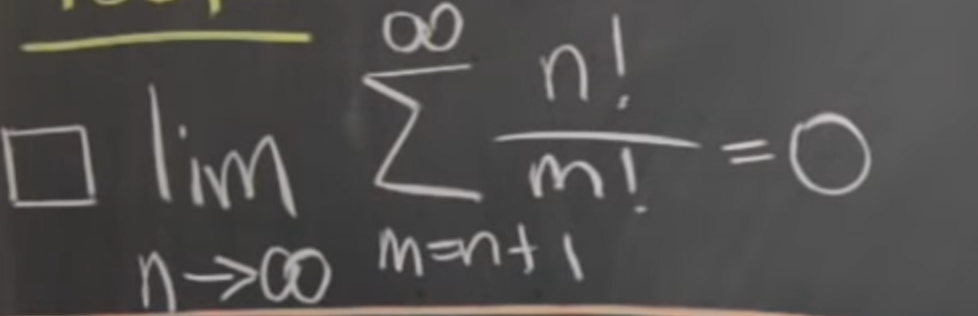
can anyone help me understand how I'd calculate this limit if it wasn't given?
rancid wagon
rancid wagon
can anyone help me understand how I'd calculate this limit if it wasn't given?
rancid wagon
it's being used a a tool for a bigger calculation but I wouldn't guess the lim is 0
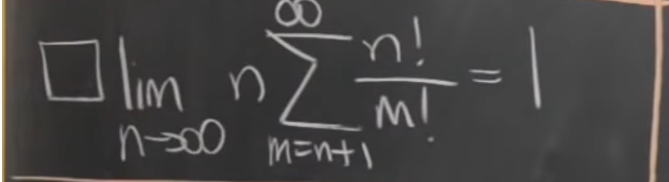
oh wow and this one that is also given
that is just a curveball to me
 rigid lintel
perhaps write $\lim_{n \to \infty} \sum_{m = n+1}^{\infty} \frac{n!}{m!} = \lim_{n \to \infty} \sum_{i = 1}^{\infty} \frac{n!}{(n+i)!}$
warm shaleBOT
heavy
 rigid lintel
$= \lim_{n \to \infty} \sum_{i = 1}^{\infty} \frac{1}{(n+1)} + \frac{1}{(n+1)(n+2)} \ldots$
warm shaleBOT
heavy
 rigid lintel
left of the = sign increments
rancid wagon
so if it wasn't part of a limit
what does n start at?
where does it say it starts at 1?
rancid wagon
so when you did your expansion why is putting 1 there valid?
rigid lintel
also n is a constant, it doesnt start anywhere
rancid wagon
right, it just is
rigid lintel
yes
rigid lintel
rancid wagon
so when you did your expansion why is putting 1 there valid?
if m = n+1 and you increment over n, then replacing m by n + i and incrementing over i from i = 1 is the same thing
m would go from m = n+1, n+2, n+3 ...
n+ i does the exact same thing when incrementing from i = 1
rancid wagon
okay I get the syntax now
but n goes to infinity
in the lim
so we have inf!/(inf + 1)! summed up
rigid lintel
yes
rancid wagon
oh because its a factorial
rigid lintel
exactly
rigid lintel
second limit is a similar sttory
rancid wagon
maybe its a syntax issue
does the 2nd one say
take the sum and then multiply it by n
or is the n somehow part of the sum?
rigid lintel
rancid wagon
take the sum and then multiply it by n
yes
n is a constant so you can bring it inside
rancid wagon
then isn't it indeterminate as n -> inf?
rancid wagon
😭 that's what I was asking about if its legal or not
how would you bring it inside the sum anyway?
rigid lintel
$\forall n \in \mathbb{N}, n \sum_{m=n+1}^{\infty} \frac{n !}{m !} = \sum_{m=n+1}^{\infty} n\frac{n !}{m !}$
warm shaleBOT
heavy
Compile Error! Click the  reaction for more information.
(You may edit your message to recompile.)
 rancid wagon
(n * n!)/m! doesn't seem right
warm shaleBOT
heavy
 rancid wagon
is that... true?
rancid wagon
oh wait is that jus the same thing as n (a/m + b/m + c/m) = na/m + nb/m + nc/m
rancid wagon
I meant like the concept of distributing inside of the sum operator
rigid lintel
warm shale
**heavy**
this is rigorous enough dont worry
rancid wagon
ok it's a little better now like I kind of see it but I'm still not 100% on the 2nd limit goes to 1
the very first element of the sum is just
(inf * inf!)/(inf + 1)! right?
rigid lintel
yes
rancid wagon
just that element by itself what does it equal?
trying to picture infinity factorial is a bit of a mindfuck
warm shaleBOT
heavy
 rigid lintel
this should be easier to think about
rancid wagon
that's what I was thinking about
that's what I meant when I wrote what I wrote lol
just that alone is already tripping me up
it's like (inf * inf * inf - 1 * inf -2 * inf...)/(inf + 1 * inf * inf - 1 * inf - 2...)
rigid lintel
recall that $(n+1)! = (n+1) \cdot n!$
warm shaleBOT
heavy
 rigid lintel
yes thats correct
rigid lintel
warm shale
**heavy**
do it like this
rancid wagon
sry it wouldn't actually cancel to 1 / inf +1
it would cancel to inf / inf + 1
which I would then say = 1
rancid wagon
but in the original limit
we're taking the sum of all of those 1s
as n goes to inf
rigid lintel
not all would be equal to 1
rigid lintel
yes
rancid wagon
2nd elm is (inf * inf * inf - 1 * inf -2 * inf...)/(inf + 2 * inf + 1 * inf * inf - 1 * inf - 2...)
then it cancels to inf/inf + 2 * inf + 1
which is 0
ok I see it
rigid lintel
please dont do arithmetic with infinity though
rancid wagon
how else
would I get to the answr 😭
I only do canceling
or for purposes of canceling
rigid lintel
the whole reason we have limits is to argue with infinity in a good way
rigid lintel
warm shale
**heavy**
like here
rancid wagon
when you say don't do arithmetic
I know inf +/- n = inf
then I basically just cancel out the infinities and see what happens
that is incorrect?
rigid lintel
just dont do arithmetic with infinity lol
rigid lintel
well yes
rancid wagon
that's what I'm saying
rigid lintel
but its bad fashion
rancid wagon
uh
rigid lintel
we have limits for this
take for example $\lim_{n \to \infty} \frac{2n}{n} = \frac{\infty}{\infty}$
warm shaleBOT
heavy
 rancid wagon
yeah I see that limit = 2
pretty clearly lol
I think ik what you mean
alr, thanks for the help m8
rigid lintel
np
rancid wagon
.close
obtuse pebbleBOT
Channel closed
Closed by @rancid wagon
Use .reopen if this was a mistake.
Available help channel!
Send your question here to claim the channel.
Remember:
• Ask your math question in a clear, concise manner.
• Show your work, and if possible, explain where you are stuck.
• After 15 minutes, feel free to ping <@&286206848099549185>.
• Type the command .close to free the channel when you're done.
• Be polite and have a nice day!
Read #❓how-to-get-help for further information on how to ask a good question, and about conduct in the question channels.
 foggy dawn
C(x)=a+b(x) for cost, fixed costs, than unit cost * units made.. However, how can I use it to find the weekly gross pay of an employee
obtuse pebbleBOT
foggy dawn
C(x)=a+b(x) for cost, fixed costs, than unit cost * units made.. However, how ca...
frosty spoke
lol you'd better give much more information than that
I could have high total or fixed costs, and still pay employees nothing
foggy dawn
Hourly rate, and hours worked.. So I suppose the fixed cost is 15 and what changes is the hours worked.. That's really it, I know you can just multiply 15*80 and get the gross pay but I'm curious to know if advance maths can also be used to calculate that
 stable barn
can i get a hint to determine the value of y

 hoary mirage
y=2x
 tranquil quiver
this isn't even your help channel bud
tranquil quiver
frosty spoke
foggy dawn
Hourly rate, and hours worked.. So I suppose the fixed cost is 15 and what chang...
is gross pay not literally just the hourly rate times the hours work
foggy dawn
Yea
I was just curious to see if there were other ways of calculating the same results
So looking online I found that formula
frosty spoke
you need to say what information you have
if you have someone's yearly pay, and you know that they're paid the same every week
then that's another way?
foggy dawn
Actually sounds easier to implement into my code, but yes it is another way.. Thank you I know what I'm asking is sort of an unconventional way of doing things
I'm probably just over thinking everything any way
.close
obtuse pebbleBOT
Channel closed
Closed by @foggy dawn
Use .reopen if this was a mistake.
obtuse pebbleBOT
Available help channel!
Send your question here to claim the channel.
Remember:
• Ask your math question in a clear, concise manner.
• Show your work, and if possible, explain where you are stuck.
• After 15 minutes, feel free to ping <@&286206848099549185>.
• Type the command .close to free the channel when you're done.
• Be polite and have a nice day!
Read #❓how-to-get-help for further information on how to ask a good question, and about conduct in the question channels.
 violet mulch
hello
obtuse pebbleBOT
violet mulch
hello
violet mulch
i have an assignment im having some trouble with
is to find the maclaurin series of a piecewise function
(ln(1+x^2))/x^2 when x is not 0
1 when x is zero
now I have found the maclaurin series of ln(1+x^2)
how do I proceed to 'add' the /x^2 to the series?
 haughty coyote
just decrease each power of x by 2 in the series
obtuse pebbleBOT
Channel closed
Closed by @violet mulch
Use .reopen if this was a mistake.
Available help channel!
Send your question here to claim the channel.
Remember:
• Ask your math question in a clear, concise manner.
• Show your work, and if possible, explain where you are stuck.
• After 15 minutes, feel free to ping <@&286206848099549185>.
• Type the command .close to free the channel when you're done.
• Be polite and have a nice day!
Read #❓how-to-get-help for further information on how to ask a good question, and about conduct in the question channels.
 grizzled robin
can someone help me answer this?
 obtuse pebbleBOT
grizzled robin
can someone help me answer this?
obtuse pebbleBOT
grizzled robin
can someone help me answer this?
@grizzled robin Has your question been resolved?
grizzled robin
<@&286206848099549185>
obtuse pebbleBOT
@grizzled robin Has your question been resolved?
grizzled robin
<@&286206848099549185>
grizzled robin
.close
obtuse pebbleBOT
Channel closed
Closed by @grizzled robin
Use .reopen if this was a mistake.
Available help channel!
Send your question here to claim the channel.
Remember:
• Ask your math question in a clear, concise manner.
• Show your work, and if possible, explain where you are stuck.
• After 15 minutes, feel free to ping <@&286206848099549185>.
• Type the command .close to free the channel when you're done.
• Be polite and have a nice day!
Read #❓how-to-get-help for further information on how to ask a good question, and about conduct in the question channels.
 finite pollen
If x = 9 is the chord of contact of the hyperbola x^2 - y^2 = 9, then the equation of the corresponding pair of tangents is?
I am on laptop rn, so can't like capture my attempts, but here's what i did: I know that combined equation of pair of tangents from a point say h,k which should be outside hyperbola is SS1 = T^2
i just can't find that point h, k , please give me hint, not solution on how can i find the point from where tangents are drawn
obtuse pebbleBOT
finite pollen
If x = 9 is the chord of contact of the hyperbola x^2 - y^2 = 9, then the equati...
 grizzled shore
finite pollen
If x = 9 is the chord of contact of the hyperbola x^2 - y^2 = 9, then the equati...
grizzled shore
finite pollen
If x = 9 is the chord of contact of the hyperbola x^2 - y^2 = 9, then the equati...
at what points does x=9 and x^2 - y^2 = 9 intersect
grizzled shore
what are the tangents to those 2 points
finite pollen
didn't understand? can you elaborate
grizzled shore
what equation is tangent to the 2 intersections
isn't that what the question is asking
finite pollen
it is asking combined equation of pair of tangents from an external point
ok never mind, just got a similar example in my textbook...thanks for your time sir, i appreciate it.
.close
obtuse pebbleBOT
Channel closed
Closed by @finite pollen
Use .reopen if this was a mistake.
Available help channel!
Send your question here to claim the channel.
Remember:
• Ask your math question in a clear, concise manner.
• Show your work, and if possible, explain where you are stuck.
• After 15 minutes, feel free to ping <@&286206848099549185>.
• Type the command .close to free the channel when you're done.
• Be polite and have a nice day!
Read #❓how-to-get-help for further information on how to ask a good question, and about conduct in the question channels.
 shadow lava
is the reciprocal also considered the opposite? x and 1/x
obtuse pebbleBOT
shadow lava
is the reciprocal also considered the opposite? x and 1/x
 fading quest
the inverse?
 latent walrus
the reciprocal is the multiplicative inverse if thats what you mean
fading quest
remember that inverse is not the same
you can call it the multiplicative inverse if you want
but its shorter to say reciprocal
shadow lava
asking because of this: https://youtu.be/GpWCFoCznGI?t=10

► My Derivatives course: https://www.kristakingmath.com/derivatives-course
Most often in calculus, you deal with explicitly defined functions, which are functions that are solved for y in terms of x. In that case, finding the derivative is usually really simple, because you just call the left-side of the equation y', and then you differentiate ...
"implicit is the opposite of explicit", and it shows "1/explicit"
fading quest
ehh, opposite is probably not the wording i would use
shadow lava
the "reciprocal" of explicit would be better wording?
or the "inverse" of explicit would be even better wording?
i thought inverse and opposite are sort of truths, in a way. + is the opposite of -. they cancel each other out.
or they "reverse" each other
fading quest
if you were to find the inverse function of f(x)=x then what would that be?
it would also be x, its just what the meaning inverse means in the context
is x the opposite of x?
fading quest
but implicit and explicit arent even inverses or reciprocals or anything like that, not sure why they would write it that way
shadow lava
passing vertical and horizontal line test
shadow lava
fading quest
but implicit and explicit arent even inverses or reciprocals or anything like th...
oh OK
maybe I should watch 1brown3blue on implicit differentiation?
tends to go a bit overkill, sometimes I get lost watching his videos
 royal basin
you got his name backwards.
fading quest
3b1b is always my go to for understanding subjects but generally the vids are better once uve worked with them a bit
shadow lava
royal basin
you got his name backwards.
it's commutative lol
- 3blue1brown, rather
does anybody know what it means?
royal basin
does anybody know what what means?
shadow lava
3blue1brown
 severe reef
I think colors of the markers he uses
royal basin
you mean the origin of the name?
shadow lava
yes
severe reef
Nvm that was the other guy
royal basin
iirc it's because he has heterochromia, i.e. two different colors in his irises
i remember him talking about it in a q&a somewhere but i cbf to find the link to it
shadow lava
Ohhh I see
fading quest
huh, thats a cool name origin
shadow lava
that makes sense why the logo looks like an eye
royal basin
yeah, that's one of the possible coloration patterns
 royal basin
as it happens, i have some form of it too.
shadow lava


never noticed, the Cosmos title "eye" is kinda 3blue1brown
great TV show btw, I would recommend watching the original series first (PBS) from 1980
.close
obtuse pebbleBOT
Channel closed
Closed by @shadow lava
Use .reopen if this was a mistake.
Available help channel!
Send your question here to claim the channel.
Remember:
• Ask your math question in a clear, concise manner.
• Show your work, and if possible, explain where you are stuck.
• After 15 minutes, feel free to ping <@&286206848099549185>.
• Type the command .close to free the channel when you're done.
• Be polite and have a nice day!
Read #❓how-to-get-help for further information on how to ask a good question, and about conduct in the question channels.
 teal smelt
Is it possible to have a point on a graph where the first derivative is 0 but is not a local maximum or minimum?
obtuse pebbleBOT
teal smelt
Is it possible to have a point on a graph where the first derivative is 0 but is...
warm shaleBOT


 Requested by Duh Hello#3455
fading quest
Requested by Duh Hello#3455
fading quest
i think those are called saddle points, i know they are in 3d but not 100% about 2d graphs
obtuse pebbleBOT
Channel closed
Closed by @teal smelt
Use .reopen if this was a mistake.
Available help channel!
Send your question here to claim the channel.
Remember:
• Ask your math question in a clear, concise manner.
• Show your work, and if possible, explain where you are stuck.
• After 15 minutes, feel free to ping <@&286206848099549185>.
• Type the command .close to free the channel when you're done.
• Be polite and have a nice day!
Read #❓how-to-get-help for further information on how to ask a good question, and about conduct in the question channels.
 untold oasis
 obtuse pebbleBOT
untold oasis
untold oasis
obtuse pebbleBOT
untold oasis
untold oasis
Can someone please confirm I did this correctly?
I am trying to find d/dx of 3xy = 4 with respect to y
obtuse pebbleBOT
@untold oasis Has your question been resolved?
 autumn gale
3xy^2 you mean? you've done derivative with respect to x btw
obtuse pebbleBOT
Channel closed
Closed due to timeout
Use .reopen if this was a mistake.
Available help channel!
Send your question here to claim the channel.
Remember:
• Ask your math question in a clear, concise manner.
• Show your work, and if possible, explain where you are stuck.
• After 15 minutes, feel free to ping <@&286206848099549185>.
• Type the command .close to free the channel when you're done.
• Be polite and have a nice day!
Read #❓how-to-get-help for further information on how to ask a good question, and about conduct in the question channels.
 soft wind
A man can paint a room by himself in 8 hours while his son can can paint the same room in
12 hours. The man works by himself for 3 hours and is then joined by his son. How many
hours will it take them to finish painting?
obtuse pebbleBOT
soft wind
A man can paint a room by himself in 8 hours while his son can can paint the sam...
soft wind
i don't get this one
haughty coyote
look at the percentage of work each one does in 1 hour and figure it out from that
soft wind
soft wind
then i got 7.5 and added 3 so i got 10.5 hours
is this correct?
haughty coyote
haughty coyote
so it isn't x/12
did to take this remark into account ?
haughty coyote
soft wind
then i got 7.5 and added 3 so i got 10.5 hours
father and son working together can't possibly be longer than father alone. Think for a minute
soft wind
(1/8 + 1/12) x-3 = 1?
soft wind
is the final answer 6?
haughty coyote
yes
soft wind
i still don't understand how to get it tho
haughty coyote
soft wind
(1/8 + 1/12) x-3 = 1?
+3/8
soft wind
(1/8 + 1/12) x + 3/8 = 1?
haughty coyote
(x-3) still
3/8 is the work done by the father in the first 3 hours
then they work x-3 hours at a rate 1/8 + 1/12
obtuse pebbleBOT
Channel closed
Closed by @soft wind
Use .reopen if this was a mistake.
Available help channel!
Send your question here to claim the channel.
Remember:
• Ask your math question in a clear, concise manner.
• Show your work, and if possible, explain where you are stuck.
• After 15 minutes, feel free to ping <@&286206848099549185>.
• Type the command .close to free the channel when you're done.
• Be polite and have a nice day!
Read #❓how-to-get-help for further information on how to ask a good question, and about conduct in the question channels.
 boreal sleet
 obtuse pebbleBOT
boreal sleet
boreal sleet
obtuse pebbleBOT
boreal sleet
boreal sleet
Is this right?
 supple granite
absolutely not
boreal sleet
How do we divide then
 high lily
what's the original question, what exactly are you being asked to do
because as is, there isn't much to do with the original fraction
$$\frac{x+1}{18x+8}$$
warm shaleBOT
ℝamonov
 boreal sleet
 high lily
where's your fraction coming from
boreal sleet
u=9x^2+18x