#help-10
1 messages · Page 109 of 1
 finite turret
Makes sense right ?
 royal basin
your teacher told you "you MUST only solve THE LEFT SIDE, and ONLY THE LEFT SIDE, and NOT THE RIGHT SIDE"?
finite turret
Ill@try
 whole dock
Do this
 dapper robin
royal basin
your teacher told you "you MUST only solve THE LEFT SIDE, and ONLY THE LEFT SIDE...
dapper robin
royal basin
your teacher told you "you MUST only solve THE LEFT SIDE, and ONLY THE LEFT SIDE...
+yea yea orry bro
i think i got it
finite turret
royal basin
your teacher told you "you MUST only solve THE LEFT SIDE, and ONLY THE LEFT SIDE...
Both works i mean have to solve one side only to get the answer of the other side
dapper robin
i got cos xsec X
royal basin
meant to ask you not to call me bro
finite turret
 dapper robin
so
im getting
sec X + tan X
we can write cos x as
90 - xec
and then there is some minus law
i gorgot it
whole dock
finite turret
That is correct
finite turret
These r the ones to use
 finite turret
whole dock
That is correct
finite turret
whole dock
That is correct
After
whole dock
Now multiply (1 + sinx) to numerator and denominator
dapper robin
which grade are u bro
finite turret
10
dapper robin
lemme open mine 1 second
finite turret
whole dock
Now multiply (1 + sinx) to numerator and denominator
Eerm them we have to chnage the left one too ryt ?
finite turret
Im sorry i dont get ypu
whole dock
$\frac{1 - sinx}{cosx}*\frac{1+sinx}{1+sinx}$
 warm shaleBOT
ColdTee
 whole dock
$\frac{1+sinx}{1+sinx} = 1$
finite turret
Ohh
warm shaleBOT
ColdTee

 whole dock
Np
finite turret
Well then i have a question
whole dock
Ask
 finite turret
Yeah im just curious to know
whole dock
finite turret
Can i get the upside down answer by multiplying it by the denominator
Im not sure what you mean to say
whole dock
finite turret
This is what you had to prove right
finite turret
 dapper robin
damn that is confusing
whole dock
finite turret
Yes, this is what you did right
dapper robin
bro write it down is lhs = rhs form
finite turret
whole dock
This is what you had to prove right
Is this how u do it when u need the inverse answer
whole dock
finite turret
Is this how u do it when u need the inverse answer
Like you mean a general formula or sth
 whole dock
Yeah
 obtuse pebbleBOT
Channel closed
Closed by @finite turret
Use .reopen if this was a mistake.
 Available help channel!
Send your question here to claim the channel.
Remember:
• Ask your math question in a clear, concise manner.
• Show your work, and if possible, explain where you are stuck.
• After 15 minutes, feel free to ping <@&286206848099549185>.
• Type the command .close to free the channel when you're done.
• Be polite and have a nice day!
Read #❓how-to-get-help for further information on how to ask a good question, and about conduct in the question channels.
 fathom kindle
Help
obtuse pebbleBOT
fathom kindle
Help
 teal turret
!status
obtuse pebbleBOT
What step are you on?
- I don't know where to begin
- I have begun but got stuck midway
- I got an answer but I'm told it's wrong
- I got an answer and would like my work checked
- I have a question about someone else's worked solution
- None of the above
teal turret
Uh Aight so there’s a couple different methods we could use
fathom kindle
mhm
 wooden cipher
what have you tried
teal turret
We could use quadratic formula, completing the square
fathom kindle
ok
no wait
my equation started like this
P = -2x^2 + 20x - 42
P = 6
6 = -2x^2 + 20x - 42
48 = -2x^2 + 20x
teal turret
Ok yea so just move the 48 over for now
fathom kindle
bruh what
isnt there a simplier way
to continue moving everything
until i end with x
teal turret
fathom kindle
to continue moving everything
Not sure what u mean
We could do completing the square or quadratic formula, but with both methods, we should move all terms to one side before proceeding
teal turret
Nice, now which one of the methods would u like to proceed with
fathom kindle
ok just factor it
teal turret
Factoring, sure
So first, we wanna get a coefficient of “1” on the x^2 term, can u do that?
teal turret
Nono don’t factor yet
Just get our x^2 term to have a coefficient of 1
How can we do so
teal turret
Good, and what do we get now
warm shaleBOT
Stephen
 fathom kindle
yeah
teal turret
-10x
teal turret
Now factor
teal turret
Yep
fathom kindle
ok
teal turret
=0
teal turret
Bruh
fathom kindle
LOL
teal turret
Why didn’t u say that at first
fathom kindle
fathom kindle
what do I do now to solve for x
48 = -2x^2 + 20x
!
teal turret
fathom kindle
what do I do now to solve for x
48 = -2x^2 + 20x
So now u want to find vertex from this?
teal turret
Right, now we need to get it into vertex form
fathom kindle
wait
look
P = -2x^2 + 20x - 42
this was my original equation
(x,p)
p is 6
so i plug in p for 6
so whats x
teal turret
Well we alrdy solved that
warm shaleBOT
Stephen
 teal turret
What’s x?
Also, could u share a pic/ss of the original problem that’s asking for the vertex
Tag me if u come back
fathom kindle
um
fathom kindle
warm shale
**Stephen**
but thats two x intercepst
i literally just need one x
at what number will be 6
im just gonna reask my questio because im confused ill make a new channel lol
.clos
.close
obtuse pebbleBOT
Channel closed
Closed by @fathom kindle
Use .reopen if this was a mistake.
Available help channel!
Send your question here to claim the channel.
Remember:
• Ask your math question in a clear, concise manner.
• Show your work, and if possible, explain where you are stuck.
• After 15 minutes, feel free to ping <@&286206848099549185>.
• Type the command .close to free the channel when you're done.
• Be polite and have a nice day!
Read #❓how-to-get-help for further information on how to ask a good question, and about conduct in the question channels.
 narrow dew
 obtuse pebbleBOT
narrow dew
narrow dew
obtuse pebbleBOT
narrow dew
narrow dew
while x=0 I need to examine the differentiability
and continuity as well
I don't if that term is the right one
 fickle turret
What have you tried?
narrow dew
I do not know how to approach this type of question
fickle turret
Do you need to show continuity only at x= 0 or at the full domain?
fickle turret
OK, then note that -1 =< sin x =< 1
narrow dew
noted
fickle turret
Do you know how to show continuity then?
narrow dew
nope
fickle turret
Calculate the lim as x goes to 0
fickle turret
fickle turret
OK, then note that -1 =< sin x =< 1
Using this
And apply sandwich theorem
 narrow dew
I do not understand something
in this part

x cannot be 0
doesn't that mean lim x->0 is null
fickle turret
No
You can go infinitly close to 0 with the upper function
So you need to know the limit of x^2*sin(1/x)
narrow dew
so that means in this point f(x) isn't continuiable
fickle turret
Why?
narrow dew
in the second rule "The function must be defined at this point"
 shell kelp
I think you mean f' right
 fickle turret
Sorry, can we see the lower half of the piecewise function?
 fickle turret
narrow dew
thats the whole
fickle turret
narrow dew
thats the whole
And the hole is filled in by f(0)= 0
 fickle turret
Yes
shell kelp
narrow dew
Is it also asking for turning point
fickle turret
fickle turret
Calculate the lim as x goes to 0
Can you follow this approach now?
narrow dew
nope
narrow dew
fickle turret
Can you follow this approach now?
can you show me how I can do it
fickle turret
-1 =< sin x =< 1
-x^2 =< x^2*sin x =< x^2
You can calculate the lim of -x^2 and x^2 with ez- both are 0
narrow dew
yes
fickle turret
fickle turret
https://tenor.com/view/scooby-doo-sandwich-dogs-dog-lunch-gif-16290238
So following this the original lim needs to be 0, too
obtuse pebbleBOT
@narrow dew Has your question been resolved?
Channel closed
Closed by @narrow dew
Use .reopen if this was a mistake.
Available help channel!
Send your question here to claim the channel.
Remember:
• Ask your math question in a clear, concise manner.
• Show your work, and if possible, explain where you are stuck.
• After 15 minutes, feel free to ping <@&286206848099549185>.
• Type the command .close to free the channel when you're done.
• Be polite and have a nice day!
Read #❓how-to-get-help for further information on how to ask a good question, and about conduct in the question channels.
 unique kettle
WTS: $sup(A \cup B) = max(supA,supB)$
obtuse pebbleBOT
unique kettle
WTS: $sup(A \cup B) = max(supA,supB)$
warm shaleBOT
clip
 unique kettle
Kind of stuck here, I have that for any $a \in A$ it follows that $a \leq sup(A)$ and that for any $b \in B$ it follows that $b \leq sup(B)$
warm shaleBOT
clip
 unique kettle
From this it follows that any $a \in A \cup B$ will have that $a \leq max(supA,supB)$ and the same thing for b, ($b \in A \cup B$ will have that $b \leq max(supA,supB)$)
warm shaleBOT
clip
 unique kettle
Therefore $sup(A \cup B) \leq max(supA,supB)$
warm shaleBOT
clip
 unique kettle
I dont know how to go about showing equality here though
Im thinking I should just show that the max is the least upper bound in this scenario and thus force them to be equal
So do something like For any $\epsilon > 0,\ max(supA,supB)-\epsilon \leq sup(A \cup B)$ and then prove the two cases, one being supA larger sup B and the other being vice versa?
warm shaleBOT
clip
 unique kettle
This would make the max the supremum here and imply that sup(A union B) = max(supA,supB), ???
<@&286206848099549185>
obtuse pebbleBOT
@unique kettle Has your question been resolved?
unique kettle
<@&286206848099549185>
obtuse pebbleBOT
@unique kettle Has your question been resolved?
 dark stirrup

I've encountered this before
Slow replies, but I'll look this over, @unique kettle (if you're still around)
unique kettle
Yes I am thanks
 uncut galleon
warm shale
**clip**
uncut galleon
warm shale
**clip**
Step 1 : show that sup(A U B) >= max(sup A, sup B) (easy)
Step 2 : show that some real number x is below sup(A U B) if and only if it is below sup A or sup B
From step 2 you can deduce that sup(A U B) <= max(sup A, sup B)
@unique kettle
unique kettle
uncut galleon
From step 2 you can deduce that sup(A U B) <= max(sup A, sup B)
I already showed that, would not just then showing that max(…) is the l.u.b. be enough
uncut galleon
unique kettle
I already showed that, would not just then showing that max(…) is the l.u.b. be ...
Well, if you have sup(A U B) <= max(sup A, sup B) and sup(A U B) => max(sup A, sup B) then what's the problem ?
Also, I'm not english native, plz don't use acronyms like l.u.b. 🙂
oh ok lowest upper bound
unique kettle
uncut galleon
Also, I'm not english native, plz don't use acronyms like l.u.b. 🙂
Sorry least upper bound
Yep
uncut galleon
You proved that sup(A U B) <= max(sup A, sup B) right ?
unique kettle
Yes
uncut galleon
Ok. You know that sup A <= sup(A U B) right ?
unique kettle
Yeahsame with supB
unique kettle
Yeah I know that works I am just wondering if the way I did it works because I already have that written down and I don’t see why it wouldn’t
uncut galleon
unique kettle
Yeah I know that works I am just wondering if the way I did it works because I a...
Send what you write
Assuming it's in English or in a language I understand :x
unique kettle
warm shale
**clip**
.
I’m not at home right now but it’s along the lines of what that says
uncut galleon
warm shale
**clip**
hmm
you only have max(sup A, sup B) <= sup(A U B) with that
not max(sup A, sup B) >= sup(A U B)
May I write it my way ?
unique kettle
But that’s with the implication that max is an upper bound and doing the makes it the least upper bound which implies that they are equal right?
unique kettle
uncut galleon
May I write it my way ?
Sure
uncut galleon
Ok, here I go
- You know that $sup A \le sup A\cup B$ and $sup B\le sup A\cup B$. From that, you know directly that $max(sup A, sup B)\le sup A\cup B$\\
- Let $x\in \bR$. $x< sup A\cup B \Rightarrow \exists a\in A\cup B$ such that $a>x \Rightarrow$ we have either $x\le sup A$ or $x\le sup B$. Therefore, $max(sup A, sup B)$ is an upper bound of all these $x$'s. Therefore, it is higher than their lowest upper bound. In other words :
$$max(sup A, sup B)\ge sup A\cup B$$
Finally, by antisymmetry, we know that $max(sup A, sup B) = sup A\cup B$
warm shaleBOT
Silfer
 unique kettle
Ok I understand, would you mind answering a more generalized question that i have
uncut galleon
ok go ahead
unique kettle
Ok so if you know some supT is an upper bound for supS then supT>=supS
uncut galleon
You mean supT is an upper bound for S I guess ? But yes
unique kettle
So if you were to show that supT is the least upper bound for supS is it still supT>=supS or is it now supT=supS
unique kettle
uncut galleon
You mean supT is an upper bound for S I guess ? But yes
Yes that
uncut galleon
unique kettle
So if you were to show that supT is the least upper bound for supS is it still s...
Well, you would need to prove that supT = supS because supS is S's lowest upper bound by definition
unique kettle
Ok thanks for the help
uncut galleon
np
unique kettle
.close
obtuse pebbleBOT
Channel closed
Closed by @unique kettle
Use .reopen if this was a mistake.
Available help channel!
Send your question here to claim the channel.
Remember:
• Ask your math question in a clear, concise manner.
• Show your work, and if possible, explain where you are stuck.
• After 15 minutes, feel free to ping <@&286206848099549185>.
• Type the command .close to free the channel when you're done.
• Be polite and have a nice day!
Read #❓how-to-get-help for further information on how to ask a good question, and about conduct in the question channels.
 next lantern
 obtuse pebbleBOT
next lantern
obtuse pebbleBOT
next lantern
 obtuse pebbleBOT
Channel closed
Closed by @next lantern
Use .reopen if this was a mistake.
obtuse pebbleBOT
Available help channel!
Send your question here to claim the channel.
Remember:
• Ask your math question in a clear, concise manner.
• Show your work, and if possible, explain where you are stuck.
• After 15 minutes, feel free to ping <@&286206848099549185>.
• Type the command .close to free the channel when you're done.
• Be polite and have a nice day!
Read #❓how-to-get-help for further information on how to ask a good question, and about conduct in the question channels.
 wintry shoal
Here is my work and the original question along with the needed resources, I cant seem to figure out where Im going wrong but I know its the wrong answer (sorry for bad handwriting)


 obtuse pebbleBOT
wintry shoal
Here is my work and the original question along with the needed resources, I ca...
obtuse pebbleBOT
wintry shoal
Here is my work and the original question along with the needed resources, I ca...
@wintry shoal Has your question been resolved?
wintry shoal
<@&286206848099549185>
obtuse pebbleBOT
Channel closed
Closed by @wintry shoal
Use .reopen if this was a mistake.
obtuse pebbleBOT
Available help channel!
Send your question here to claim the channel.
Remember:
• Ask your math question in a clear, concise manner.
• Show your work, and if possible, explain where you are stuck.
• After 15 minutes, feel free to ping <@&286206848099549185>.
• Type the command .close to free the channel when you're done.
• Be polite and have a nice day!
Read #❓how-to-get-help for further information on how to ask a good question, and about conduct in the question channels.
 worthy wagon
 worthy wagon
<@&286206848099549185>
 dusk ruin
!status
obtuse pebbleBOT
What step are you on?
- I don't know where to begin
- I have begun but got stuck midway
- I got an answer but I'm told it's wrong
- I got an answer and would like my work checked
- I have a question about someone else's worked solution
- None of the above
dusk ruin
@worthy wagon
worthy wagon
worthy wagon
dusk ruin
do you know what the complement of an interval is?
All the real numbers of an interval?
dusk ruin
isn't that the interval itself?
worthy wagon
No. Thats incorrect. I just tried it
dusk ruin
to my understanding, I thought the complement of an interval B over R would be the set of all other numbers in R not in the interval B
so the complement of (2,∞) would be (-∞,2] to my understanding, no?
 high lily
No. Thats incorrect. I just tried it
what exactly did you try
worthy wagon
high lily
> No. Thats incorrect. I just tried it
what exactly did you try
All i tried so far is what he told me. I tried to use the interval itself but it didint work
dusk ruin
oh whoops you misunderstood me, I apologise
high lily
ofc that won't work
dusk ruin
dusk ruin
isn't that the interval itself?
here, I was attempting to clarify that you thought the complement of the interval is "All the real numbers of an interval?", which I was asking you to confirm you thought the complement of an interval was itself
apologies for any confusion
worthy wagon
thats alright
dusk ruin
well, regardless
it appears your problem is that you do not know what the complement of an interval is.
correct?
worthy wagon
Yes
dusk ruin
excellent
so, the complement of a closed interval over a space, is, effectively, everything outside that interval
so let's say you have the interval (1,2] on R.
your interval is all numbers greater than 1 up to and including 2
this means your complement is all numbers less than 1, including 1, and all numbers greater than 2, not including 2
there is no overlap between intervals, but together they span all of R, all real numbers
@high lily is this correct?
high lily
seems alright
dusk ruin
hooray! that was a wild guess :P (based off what other complements I know are)
anyways, @worthy wagon do you think, with this explanation of what a complement is, you can complete your problem?
worthy wagon
I think soooooo
dusk ruin
I gtg shower, brb
 icy spire
worthy wagon
icy spire
worthy wagon
I need help with another one
 worthy wagon
<@&286206848099549185>
dusk ruin
are you not able to solve it the same way as the last one? @worthy wagon
worthy wagon
I think its confusing me because theres no infinity
worthy wagon
sounds familer
dusk ruin
so for instance
(1,2]U(3,8]
is the set of numbers greater than but not equal to 1, but less than or equal to 2, as well. as the numbers grater than but not equal to 3, but less than or equal to 8
it's just a way of merging two intervals
does this help solve this problem? @worthy wagon
worthy wagon
dusk ruin
does this help solve this problem? <@633048785131667476>
im still having trouble
dusk ruin
with which part, specifically?
worthy wagon
How i'm able to transform that interval
worthy wagon
dusk ruin
with which part, specifically?
I still cant get this
worthy wagon
yes
dusk ruin
so your interval, initially, is all the numbers greater than but not equal to 1, up to and including 6
so your complement is all other real numbers.
that means, your complement holds all numbers 1 and less, and all numbers greater than but not equal to 6.
together, they combine without overlap to cover all real numbers.
with me so far?
worthy wagon
So its basically the opposite?
dusk ruin
I guess, as much as there is such a thing as an opposite interval
you can't really have an interval full of anti-numbers that combined with this cancel each other out
the complement is close enough, as it is everything but the interval
well, anyways
that means, your complement holds all numbers 1 and less, and all numbers greater than but not equal to 6.
how would you turn these words into an interval of your own?
worthy wagon
1 >x>6?
dusk ruin
well, ok, let's break it down farther (since that is very wrong, though surprisingly close)
let's do half of this interval at a time
all numbers 1 and less
how would you turn this into an interval?
worthy wagon
1<x?
dusk ruin
including 1 (1 and less)
worthy wagon
I don't know how to do that on my keyboard
dusk ruin
≤ ≥
for me it's hold the option key
no worries, you can use <= or >= if you want instead
or, even better
use interval notation
that's the next step anyways
dusk ruin
dusk ruin
> all numbers 1 and less
what is this in interval notation?
worthy wagon
1≤x?
dusk ruin
that's x is all numbers greater than or equal to 1
you want all numbers 1 and less
use the form they want on the computer, ie (2,6] or [-3,∞), it'll make things easier later
worthy wagon
[-1,0)
dusk ruin
that would be all numbers greater than or equal to -1, but less than 0 (not including 0)
worthy wagon
(-1,0)
dusk ruin
do you understand how this notation works?
worthy wagon
This is confusing me
dusk ruin
I'm very sorry :/
well ok let's start from the top

you have the interval (1,6]
you need its complement.
tell me, what is interval such that all numbers before (1,6] are contained in it?
the answer is (-∞,1]
(-∞,1] contains all numbers less than or equal to 1
worthy wagon
Oh, because the infinty contains all the previous numbers
dusk ruin
after that, the numbers belong to (1,6], or are bigger than those in (1,6]
dusk ruin
worthy wagon
Oh, because the infinty contains all the previous numbers
yes, an infinity encompasses everything when set as the edge (x<∞ really means x is anything)
well anyways, so we know
worthy wagon
 dusk ruin
well, that's just half the answer
(-∞,1] is all the numbers BEFORE the interval (1,6]
what about after?
worthy wagon
hmm
dusk ruin
the interval (1,6] stops at the number 6
6 is in that interval.
which means all numbers AFTER the interval (1,6] is all numbers greater but not equal to 6
do you think you know what those numbers are?
worthy wagon
[6,infinity)?
dusk ruin
almost
[ is inclusive
we don't want 6 in our range, since it's in the original interval. we don't want any overlap in our complement
worthy wagon
(6,infinity)
dusk ruin
exactly!
so we have all numbers before: (-∞,1], and all numbers after: (6,∞)
now we just have to combine the two
worthy wagon
(-∞,1] U (6,∞)?
dusk ruin
yup
make sure to copy paste the union symbol the website uses
don't use a capital U, I doubt it'll work
worthy wagon
It works.
Now I just need help with like one or two more
 worthy wagon
dusk ruin
let me know what part you need help with
worthy wagon
dusk ruin
let me know what part you need help with
would I solve for T first?

 spice chasm
worthy wagon
This is what I got for T
spice chasm
worthy wagon
This is what I got for T
Um
all you need to do is set it to 28t-16t² ≥ 6
dusk ruin
don't just give people answers, they need to understand how to get them
dusk ruin
worthy wagon
This is what I got for T
so in this case you want when H=6
spice chasm
Mb
dusk ruin
it's ok, it's not an awful thing to do, just not very helpful for learning
worthy wagon
I got it right
spice chasm
worthy wagon
This is what I got for T
wait did you complete the square to get this
worthy wagon
spice chasm
wait did you complete the square to get this
Yes
One more

Ive had this problem before when it was a point and a slope, and between two points, but never between three points
spice chasm
worthy wagon
Ive had this problem before when it was a point and a slope, and between two poi...
and use the last point (1,6) to get the point and slope you’re familiar with
worthy wagon
spice chasm
Find the line through (1,4) and (2,5)
So the slope I got for this is 1
<@&286206848099549185>

 wise talon
!15min
obtuse pebbleBOT
Please only use the <@&286206848099549185> ping once if your question has not been answered for 15 minutes. Please do not ping or DM individual users about your question.
 bronze pumice
What’s a constant function?
worthy wagon
bronze pumice
What’s a constant function?
a constant function is a function whose value is the same for every input value, right?
bronze pumice
Alright, now, with that information, what shall be the rate of change on every interval?
bronze pumice
Why? Consider a constant function, $y=4$
warm shaleBOT
Heisenbug
 bronze pumice
What’s the rate of change? (Plot if you don’t understand)
bronze pumice
worthy wagon
0
Correct.
worthy wagon
 worthy wagon
not really
warm shaleBOT
Heisenbug
 bronze pumice
This is the formula for rate of change, if given in interval, i.e (a, b), where you know a,b. Do you know how to continue from here?
worthy wagon
What confuses me is that im given 2 x's and not a full point
bronze pumice
What confuses you? Consider b=8, a=3.
spice chasm
worthy wagon
What confuses me is that im given 2 x's and not a full point
you can plug in x into f(x) to get a point
 timid silo
worthy wagon
<@&286206848099549185>
timid silo
worthy wagon
<@&286206848099549185>
0
 timid silo
worthy wagon
timid silo
worthy wagon
10
timid silo
worthy wagon
6
worthy wagon
This was has different options so i'll post multiple screen shots of it


Actually nvm, I got this one
Last one. This one is confusing because I have never been given points like this

<@&286206848099549185>
worthy wagon
<@&286206848099549185>
worthy wagon
<@&286206848099549185>
 opal ore
ok hold on there bucko that's enough pinging
opal ore
worthy wagon
This was has different options so i'll post multiple screen shots of it
number of flue cases
opal ore
worthy wagon
day
worthy wagon
opal ore
day
No, I already got that problem.
I'm talking about the last one I posted
opal ore
worthy wagon
Last one. This one is confusing because I have never been given points like this
recall the distance formula: $d=\sqrt{(x_2 - x_1)^2 + (y_2 - y_1)^2}$
warm shaleBOT
messyinterval
 worthy wagon
opal ore
recall the distance formula: $d=\sqrt{(x_2 - x_1)^2 + (y_2 - y_1)^2}$
worthy wagon
opal ore
recall the distance formula: $d=\sqrt{(x_2 - x_1)^2 + (y_2 - y_1)^2}$
The points that I have to use arent clear to me
opal ore
worthy wagon
The points that I have to use arent clear to me
$x_1 = x+ 4y , x_2 = x-4y$
warm shaleBOT
messyinterval
 opal ore
$y_1=4y, y_2 = 4y $
obtuse pebbleBOT
Channel closed
Closed by @worthy wagon
Use .reopen if this was a mistake.
Available help channel!
Send your question here to claim the channel.
Remember:
• Ask your math question in a clear, concise manner.
• Show your work, and if possible, explain where you are stuck.
• After 15 minutes, feel free to ping <@&286206848099549185>.
• Type the command .close to free the channel when you're done.
• Be polite and have a nice day!
Read #❓how-to-get-help for further information on how to ask a good question, and about conduct in the question channels.
 fallow zinc
last page
obtuse pebbleBOT
fallow zinc
last page
 zenith raft
fallow zinc
last page
zenith raft
fallow zinc
last page
people usually prefer screenshots or text over pdfs 🙂
fallow zinc
zenith raft
people usually prefer screenshots or text over pdfs 🙂
Okay i will sc
 obtuse pebbleBOT
@fallow zinc Has your question been resolved?
fallow zinc
.close
obtuse pebbleBOT
Channel closed
Closed by @fallow zinc
Use .reopen if this was a mistake.
fallow zinc
.reopen
obtuse pebbleBOT
✅
 grizzled shore
Have you tried anything
 dense imp
!status
obtuse pebbleBOT
What step are you on?
- I don't know where to begin
- I have begun but got stuck midway
- I got an answer but I'm told it's wrong
- I got an answer and would like my work checked
- I have a question about someone else's worked solution
- None of the above
fallow zinc
1
 trim portal
Do you know what AA similarity test means? @fallow zinc
If 2 triangles have at least 2 angles the same, then they're similar. If you find pair of triangles with 2 angles in common, you can conclude that they're similar.
Another similarity is SSS. Side-side-side. If sides of 1 triangle are 3, 4 and 5 and sides of another triangle are 6, 8 and 10, you can conclude that these 2 triangles are similar, because 3/6=4/8=5/10. For this similarity test, I recommend you to order the side lengths in ascending order so you can compare them.
This is how you do SSS test
 fallow zinc
trim portal
Do you know what AA similarity test means? <@801316377432424459>
fallow zinc
trim portal
Do you know what AA similarity test means? <@801316377432424459>
OH OKAY
THANK YOU SO MUCH
FOR UR HELP
I REALLY APPECIATE IT
WE CAN ALSO USE ANGLE SYMBOL
ANYWAY
THANK YOU SO MUCH FOR YOUR HELP
obtuse pebbleBOT
@fallow zinc Has your question been resolved?
obtuse pebbleBOT
Channel closed
Closed due to timeout
Use .reopen if this was a mistake.
Available help channel!
Send your question here to claim the channel.
Remember:
• Ask your math question in a clear, concise manner.
• Show your work, and if possible, explain where you are stuck.
• After 15 minutes, feel free to ping <@&286206848099549185>.
• Type the command .close to free the channel when you're done.
• Be polite and have a nice day!
Read #❓how-to-get-help for further information on how to ask a good question, and about conduct in the question channels.
 urban ether
 obtuse pebbleBOT
urban ether
urban ether
obtuse pebbleBOT
urban ether
urban ether
(please pin)
 flint tartan
obtuse pebbleBOT
flint tartan
obtuse pebbleBOT
Channel closed
Closed by @urban ether
Use .reopen if this was a mistake.
Available help channel!
Send your question here to claim the channel.
Remember:
• Ask your math question in a clear, concise manner.
• Show your work, and if possible, explain where you are stuck.
• After 15 minutes, feel free to ping <@&286206848099549185>.
• Type the command .close to free the channel when you're done.
• Be polite and have a nice day!
Read #❓how-to-get-help for further information on how to ask a good question, and about conduct in the question channels.
 hard hill
hello, I am having troubles soulving a trignometric equation, I have arrived to this point, is this true?
 obtuse pebbleBOT
hard hill
hello, I am having troubles soulving a trignometric equation, I have arrived to ...
trim portal
hard hill
hello, I am having troubles soulving a trignometric equation, I have arrived to ...
obtuse pebbleBOT
hard hill
hello, I am having troubles soulving a trignometric equation, I have arrived to ...
trim portal
hard hill
hello, I am having troubles soulving a trignometric equation, I have arrived to ...
Hello, is the 30 and 60 in degrees or in radians?
hard hill
in degrees
 elfin belfry
hard hill
hello, I am having troubles soulving a trignometric equation, I have arrived to ...
elfin belfry
hard hill
hello, I am having troubles soulving a trignometric equation, I have arrived to ...
What is the point of the square?
trim portal
And do you know the sin(a+b)=cos(a)sin(b)+sin(a)cos(b) formula?
hard hill
yes
trim portal
Oh you replaced cosines with sines, right?
hard hill
elfin belfry
What is the point of the square?
it is because I have used the sin^2(x) + cos^2(x) = 1 and I substituted the cos(x) = sqrt(1-sin^2(x))
trim portal
you can use the fact that cos(30)=1/2 and sin(30)=sqrt(3)/2 to directly substitute those values
hard hill
okey, thanks, do you see any other error?
elfin belfry
hard hill
it is because I have used the sin^2(x) + cos^2(x) = 1 and I substituted the cos(...
But why?
trim portal
it's not an error, you are just making it harder than it is. I would just keep the cosines there, and replace the sin(30) and cos(30)
elfin belfry
If you really want to do it that way, you need square roots

Here it won't cause any issues, but when the angles go higher than 90 degrees, it will cause issues with signs
obtuse pebbleBOT
Channel closed
Closed by @hard hill
Use .reopen if this was a mistake.
Available help channel!
Send your question here to claim the channel.
Remember:
• Ask your math question in a clear, concise manner.
• Show your work, and if possible, explain where you are stuck.
• After 15 minutes, feel free to ping <@&286206848099549185>.
• Type the command .close to free the channel when you're done.
• Be polite and have a nice day!
Read #❓how-to-get-help for further information on how to ask a good question, and about conduct in the question channels.
 onyx monolith
How to solve this
 obtuse pebbleBOT
onyx monolith
How to solve this
trim portal
onyx monolith
How to solve this
obtuse pebbleBOT
onyx monolith
How to solve this
trim portal
onyx monolith
How to solve this
Small hint: SA+SB+SC is some constant, you will have to find out why
obtuse pebbleBOT
@onyx monolith Has your question been resolved?
obtuse pebbleBOT
Channel closed
Closed due to timeout
Use .reopen if this was a mistake.
Available help channel!
Send your question here to claim the channel.
Remember:
• Ask your math question in a clear, concise manner.
• Show your work, and if possible, explain where you are stuck.
• After 15 minutes, feel free to ping <@&286206848099549185>.
• Type the command .close to free the channel when you're done.
• Be polite and have a nice day!
Read #❓how-to-get-help for further information on how to ask a good question, and about conduct in the question channels.
 rapid quartz
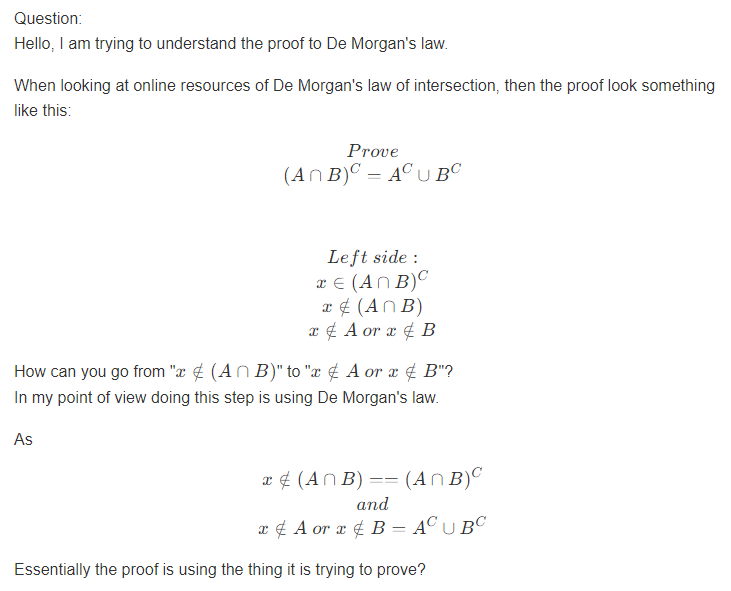 obtuse pebbleBOT
rapid quartz
https://i.imgur.com/uArll0i.png
obtuse pebbleBOT
rapid quartz
https://i.imgur.com/uArll0i.png
 kind hawk
it seems like it's using the logic version of de-morgans law to prove the set version
not sure how much you want to go into logic but proving de-morgans law from nothing is probably quite a bit harder
rapid quartz
Seem to me that proofs should be built from the ground up. All resources (that I can find) show it the same way. Got any other suggestions or resources to check out? Or it is that time of "accept it and move on".
kind hawk
while in principle I agree that proofs should be built from the ground up, not in this particular case
just take the basic laws of logic and accept them
proving them from the ground up is hard
logic in general is very hard
 wintry swift
what is the definition $x \in A \cap B$?
warm shaleBOT
ThM
 kind hawk
x in A and x in B
kind hawk
youre welcome
rapid quartz
.close
obtuse pebbleBOT
Channel closed
Closed by @rapid quartz
Use .reopen if this was a mistake.
Available help channel!
Send your question here to claim the channel.
Remember:
• Ask your math question in a clear, concise manner.
• Show your work, and if possible, explain where you are stuck.
• After 15 minutes, feel free to ping <@&286206848099549185>.
• Type the command .close to free the channel when you're done.
• Be polite and have a nice day!
Read #❓how-to-get-help for further information on how to ask a good question, and about conduct in the question channels.
 acoustic pawn
Is a linear map from R^2 to R^2 given by (x,y) --> (x,0) a linear transformation or just a map?
obtuse pebbleBOT
acoustic pawn
Is a linear map from R^2 to R^2 given by (x,y) --> (x,0) a linear transformation...
acoustic pawn
It maps to R^2 so its a transformation but it feels weird how the map maps all of R^2 onto R^1 so the space isnt rly transformed but changed
zenith raft
have you tried verifying the properties in the def of linear transformation?
acoustic pawn
Well according to the definition its a transformation since it maps to itself
acoustic pawn
acoustic pawn
It maps to R^2 so its a transformation but it feels weird how the map maps all o...
Still confused and looking for some intuition on why that definition makes sense given this example
zenith raft
i said linear transformation tho
wait but you don't even know if it's a linear transformation yet, do you?
zenith raft
zenith raft
have you tried verifying the properties in the def of linear transformation?
sooooo this haha
acoustic pawn
zenith raft
sooooo this haha
The properties being that its a linear map which maps onto itself or?
Bcs thats what i learned a linear transformation is
zenith raft
wait what, linear map and linear transformation are not the same thing for you?
acoustic pawn
No
zenith raft

acoustic pawn
A linear map is a map between vector spaces satisfying certain properties (linearity)
A linear transformation is a linear map from a vector space to itself
Like how a linear form is a linear map from a vector space to its field of scalars
kind hawk
map, function, transformation etc mean essentially the same thing
dw about it too much
zenith raft
apparently not right now
acoustic pawn
Oh we learned that a transformation is on a vector space while a map is between vector spaces
acoustic pawn
kind hawk
map, function, transformation etc mean essentially the same thing
So a map between two different vector spaces would count as a transformation?
kind hawk
I guess apparently not in your course
zenith raft
pretty atypical
acoustic pawn
Oh but i ment according to you guys?
kind hawk
yes
kind hawk
I don't make any distinction between them at all
zenith raft
same loll
acoustic pawn
It sounds usefull tho since you can speak of eigenvectors of a linear transformation but not of a linear map
And linear transformations always have square matrices
As far as i know
zenith raft
linear transformations aren't just matrices when you work with vector spaces in general
acoustic pawn
I ment the corresponding matrix representation is always square
zenith raft
well yes me too
but
linear transformations (or maps whatever you call them lmaoo) don't necessarily have a "matrix representation" with other vector spaces
that aren't like, real number vector spaces
kind hawk
well they do if you pick a basis
that's like half the point of linear algebra. that every linear map on finite dim spaces is essentially a matrix
acoustic pawn
I thought all scalar fields were representable with matrices
Meaning a matrix can consist of scalars from any scalar field so a transform/map between spaces can always be represented by a matrix
timid silo
 acoustic pawn
Girl
timid silo
Can someone help me with this
acoustic pawn
Anyway ill just interpret it as a linear map since thats how my.bo9k defined it and ig it doesnr rly matter to much if its a "good" definition if its atypical
zenith raft
loll
kind hawk
I mean it's still from R^2 to R^2
obtuse pebbleBOT
@acoustic pawn Has your question been resolved?
obtuse pebbleBOT
Channel closed
Closed due to timeout
Use .reopen if this was a mistake.
Available help channel!
Send your question here to claim the channel.
Remember:
• Ask your math question in a clear, concise manner.
• Show your work, and if possible, explain where you are stuck.
• After 15 minutes, feel free to ping <@&286206848099549185>.
• Type the command .close to free the channel when you're done.
• Be polite and have a nice day!
Read #❓how-to-get-help for further information on how to ask a good question, and about conduct in the question channels.
timid silo
how would i work this out? also, any pointers in being able to solve this quickly, like test conditions?

 obtuse pebbleBOT
timid silo
how would i work this out? also, any pointers in being able to solve this quickl...
timid silo
obtuse pebbleBOT
timid silo
how would i work this out? also, any pointers in being able to solve this quickl...
timid silo
also if i have another question do i post it here or?
are you familiar with the area ratio of similar shapes?
knowing the side ratio?
 sage geode
Recall that the ratio of similar figures = the square of the ratio of side lengths
timid silo
timid silo
no
welp it's in the message above
trim portal
timid silo
how would i work this out? also, any pointers in being able to solve this quickl...
By AA similarity, the triangles are similar. Therefore they've same ratio's of heights and sides. Area of triangle is base*height. In the second triangle, base is 1.2*base in first triangle, and height must be 1.2 times as large, as height in first triangle
timid silo
trim portal
By AA similarity, the triangles are similar. Therefore they've same ratio's of h...
yep
is it 30?
timid silo
36?
trim portal
Correct
timid silo
thanks
trim portal
Oh and the factor was derived by 12/10
trim portal
You probably can post it here
 trim portal
So let's mark Item 1 as A, item 2 as B, item 3 as C, and item 4 as D.
timid silo
yep
trim portal
timid silo
im turning 14 this year is it bad that i dont know that?
It's actually really easy
timid silo
trim portal
It's actually really easy
easy as in “wow how tf do u not know that” or “it’s fine you can learn the concept quickly”
 astral dirge
Can someone help me out on this question
trim portal
We can do this 4 equations, right?
 timid silo
trim portal
We can do this 4 equations, right?
timid silo
trim portal
We can do this 4 equations, right?
yep\
it's alr if you are 14 years old and struggling, everyone learns at different speeds.
a is 77
trim portal
timid silo
a is 77
Correct
timid silo
tbh i remember when i was 14 years old, a lot of my classmates struggled with math even easier than this lol
and they are completely fine
trim portal
What else can you do?
 trim portal
Yes! What will 137-88 be equal to?
timid silo
49
trim portal
Okay, and what combination of letters is 49?
timid silo
c and d?
trim portal
Yep, so we have this. What can you do now?
 trim portal
timid silo
divide it by 7?
trim portal
timid silo
divide it by 7?
Correct. By replacing C in first equation with 6*D, you get new equation
 timid silo
is c 42 or am i dumb
trim portal
And by dividing it by 7 you get D
timid silo
yep
trim portal
trim portal
Correct. By replacing C in first equation with 6*D, you get new equation
So you had 4 equation at start, and by replacing the letters with numbers or different letters you got the solution. And that's how you solve system of equations. I told you it's easy :)
timid silo
tysm
trim portal
You are welcome :)
trim portal
.close
timid silo
.close
obtuse pebbleBOT
Channel closed
Closed by @acoustic topaz
Use .reopen if this was a mistake.
Available help channel!
Send your question here to claim the channel.
Remember:
• Ask your math question in a clear, concise manner.
• Show your work, and if possible, explain where you are stuck.
• After 15 minutes, feel free to ping <@&286206848099549185>.
• Type the command .close to free the channel when you're done.
• Be polite and have a nice day!
Read #❓how-to-get-help for further information on how to ask a good question, and about conduct in the question channels.
 merry vault
Hello
obtuse pebbleBOT
merry vault
Hello
merry vault


To calculate sign(sigma), do you use a particular formula?
Or do you just go and figure out all the "errors" (?) and then do sign(sigma) = (-1)^m where m is the number of "errors"?
An "error" is defined as an index-pair (i,j) with 1 <= i < j <= n and sigma(i) > sigma(j)
 elfin burrow
yes
you can count the number of transpositions
alternatively, you can decompose the permutation into disjoint cycles and count the number of even length cycles
 obtuse pebbleBOT
Channel closed
Closed by @merry vault
Use .reopen if this was a mistake.
Available help channel!
Send your question here to claim the channel.
Remember:
• Ask your math question in a clear, concise manner.
• Show your work, and if possible, explain where you are stuck.
• After 15 minutes, feel free to ping <@&286206848099549185>.
• Type the command .close to free the channel when you're done.
• Be polite and have a nice day!
Read #❓how-to-get-help for further information on how to ask a good question, and about conduct in the question channels.
 green magnet
Im dum with math pls help (இдஇ; ). Circular measure
 obtuse pebbleBOT
green magnet
Im dum with math pls help (இдஇ; ). Circular measure
green magnet
obtuse pebbleBOT
green magnet
Im dum with math pls help (இдஇ; ). Circular measure
green magnet
I cant seem to know how to find the angle
trim portal
green magnet
I cant seem to know how to find the angle
What's your progress, have you determined any lengths or something?
green magnet
I only know tht half of the radius is 7🥲😞
trim portal
If half the radius is 7, what wil |OP| be?
green magnet
Tried to do sin cos tan but tht wont find the angle
green magnet
trim portal
If half the radius is 7, what wil |OP| be?
7
trim portal
green magnet
7
Great, now you can find |PR| using pythagoran's theorem
trim portal
Sorry, you don't need it. I misread the question
green magnet
Okayಥ_ಥ
trim portal
you know that cos(QOR)=7/14, right?

Try to think about what I just wrote, does it make sense to you?
7 is the adjacent side, 14 is hypotenuse. Cos is adjacent/hypotenuse
trim portal
You need to use inverse cosine. Or acos
it's the same
You know the cos(QOR)=1/2, so the angle is InverseCos(1/2)
gtg, if you will need more help ping Helpers
sorry, bye
obtuse pebbleBOT
Channel closed
Closed by @green magnet
Use .reopen if this was a mistake.
Available help channel!
Send your question here to claim the channel.
Remember:
• Ask your math question in a clear, concise manner.
• Show your work, and if possible, explain where you are stuck.
• After 15 minutes, feel free to ping <@&286206848099549185>.
• Type the command .close to free the channel when you're done.
• Be polite and have a nice day!
Read #❓how-to-get-help for further information on how to ask a good question, and about conduct in the question channels.
 neat pewter


 obtuse pebbleBOT
neat pewter
neat pewter
obtuse pebbleBOT
neat pewter
neat pewter
I need help with these 3
royal basin
@neat pewter are those answers yours?
neat pewter
Yes
royal basin
do you have work to show how you got them?
maybe you were on the right track but screwed up somewhere
neat pewter
Yes
For the first one
I multiplied 13 12 and bunch of numbers to get
154440
For the second one I meant
royal basin
"13 12 and a bunch of numbers" is not very precise.
royal basin
okay, so you calculated 13 * 12 * 11 * 10 * 9
for what purpose?
what does this product represent?
royal basin
13 * 12 * 11 * 10 * 9 cannot be the probability of anything
it is not a number between 0 and 1
royal basin
and even if it was, i'd then ask you why you are taking its reciprocal...
anyway
for this problem, i'd consider the following:
it does not actually matter how many cd's you have in your library.
it only matters that 5 cd's end up on the rack.
neat pewter
Yes
royal basin
and among all possible permutations of the 5 cd's on the rack, in how many cases are they in alphabetical order?
neat pewter
1
royal basin
that's right
and how many ways are there to place 5 objects in a row?
5 distinct objects i must add
royal basin
how and why did you get 25?
neat pewter
5 times 5
royal basin
ok, why 5 * 5?
neat pewter
I guessed I’m not sure
royal basin
well, your guess was way off the mark.
have you heard of such a thing as factorials?
neat pewter
I think so
royal basin
when calculating how many ways exist to put 5 cd's on a rack,
there are 5 options for what CD will go in the first slot,
4 options for what CD will go in the second slot (do you understand why it isn't 5 again?),
3 options for what will go in the third slot,
2 options for the fourth and finally 1 option for the fifth.
for a total of 5 * 4 * 3 * 2 * 1 options.
you have a lot of combinatorics review to do, that's for sure :P
royal basin
yes, there are 120 ways to place 5 CD's on a rack.
neat pewter
So 1/120
royal basin
so the answer to problem #2 is 1/120, yes.
in general you should never just blurt out numbers.
royal basin
5 cards are drawn randomly from a standard deck of 52 cards. Determine the probability that exactly 3 of these cards are aces.
okay, so...
how did you get the answer that you got
neat pewter
I think I searched it
royal basin
you searched what and where
royal basin
so you tried some steps.
neat pewter
Yea but in my head I don’t have it on paper

 tall tusk
Bonjour Ann
royal basin
that's bad. you should write stuff down on paper more.
anyway, we're gonna need to do some more combinatorics.
neat pewter
Ok
royal basin
we will need to find the following counts:
- the number of ways to deal a hand of 5 cards out of 52
- the number of ways to pick 3 aces out of __ (how many are in a standard deck?)
- the number of ways to pick 2 non-aces out of __ (how many are in a standard deck?)
neat pewter
Ok
royal basin
do you know how to find these counts
neat pewter
No
royal basin
okay then look up "permutations and combinations"
come back here when you have done so and attempted the problem
obtuse pebbleBOT
@neat pewter Has your question been resolved?
obtuse pebbleBOT
Channel closed
Closed due to timeout
Use .reopen if this was a mistake.
obtuse pebbleBOT
Available help channel!
Send your question here to claim the channel.
Remember:
• Ask your math question in a clear, concise manner.
• Show your work, and if possible, explain where you are stuck.
• After 15 minutes, feel free to ping <@&286206848099549185>.
• Type the command .close to free the channel when you're done.
• Be polite and have a nice day!
Read #❓how-to-get-help for further information on how to ask a good question, and about conduct in the question channels.
 daring fjord
I'm in gr 10 so this problem may seem basic to some, but how do I go about solving this?
 obtuse pebbleBOT
daring fjord
I'm in gr 10 so this problem may seem basic to some, but how do I go about solvi...
obtuse pebbleBOT
daring fjord
I'm in gr 10 so this problem may seem basic to some, but how do I go about solvi...
 drifting loom
its
simple
first factorize
the quadratic equation
11x^2-14w+3
and then add the factors
@daring fjord
obtuse pebbleBOT
Channel closed
Closed by @daring fjord
Use .reopen if this was a mistake.
Available help channel!
Send your question here to claim the channel.
Remember:
• Ask your math question in a clear, concise manner.
• Show your work, and if possible, explain where you are stuck.
• After 15 minutes, feel free to ping <@&286206848099549185>.
• Type the command .close to free the channel when you're done.
• Be polite and have a nice day!
Read #❓how-to-get-help for further information on how to ask a good question, and about conduct in the question channels.
 queen osprey
 obtuse pebbleBOT
queen osprey
queen osprey
obtuse pebbleBOT
queen osprey
queen osprey
anyone have any tips on how to start this?
i tried Chinese Remainder theorem but im having trouble because of the left having multiple terms
 viral blade
it is technically factorable
if that would help
otherwise you could do case by case mod 5 and then case by case mod 7
since the entire thing is a function of n^2 you could do case by case on n^2 in which case 0,1,4 are the only possible values
mod 5
(and something similar mod 7)
queen osprey
viral blade
otherwise you could do case by case mod 5 and then case by case mod 7
ohh i see. i would have to go through 12 cases
viral blade
yeah
viral blade
hm
 ancient jacinth
would substituting u for n^2 help
viral blade
isn't Fermat a^(p-1) is equivalent to 1
 faint sphinx
multiply by a
faint sphinx
yep that's what i meant
then you get that 15n^2-n^2=14*n^2 equivalent to 0
do the same with 5
queen osprey
faint sphinx
yep that's what i meant
ill try this way
faint sphinx
and there you go
viral blade
ye that's fastest
faint sphinx
you have to separate two cases tho !!
if p doesn't divides n
you have n^(p-1)==1 [7]
else n==0
viral blade
==0?
viral blade
faint sphinx
you have n^(p-1)==1 [7]
only when p doesn't divide n
faint sphinx
yes, sorry i'm drunk
viral blade
dw lol
queen osprey
viral blade
since the entire thing is a function of n^2 you could do case by case on n^2 in ...
arent 2,3 also possible values?
queen osprey
ah i see
im very new to this, i find it incredible that u guys seem to be comfortable with the world of congruences
queen osprey
viral blade
n^2 == 2 mod 5 isn't satisfyable
and u figure this out by checking n from 0 to 4 right?
because mod 5 is small enough
viral blade
yeah
after 5 they'll start to repeat
important facts about mod theory is that
adding and multiplying residues is "well defined"
in the sense that
a+b mod n will always be determined by a mod n and b mod n
queen osprey
yeah i get u
viral blade
(a+b) mod n = (a mod n + b mod n) mod n
same thing for multiplication
ab mod n is always the same as long as a mod n and b mod n are the same
queen osprey
is that by property of addition?
viral blade
idk
queen osprey
i knew it worked but i couldnt figure out a proof for it
queen osprey
oh right thats nice
queen osprey
yep
viral blade
multiplication is similar
it's worth noting for example that
a == b mod n does not mean
2^a == 2^b mod n
so it's specifically addition and multiplication
queen osprey
viral blade
2^a == 2^b mod n
alright got it. ive yet to encounter this case but ill keep it in mind now
ty for the help btw. i really appreicate it
obtuse pebbleBOT
@queen osprey Has your question been resolved?
queen osprey
to close this question, i said:
every interger n satisfies
n== 0 mod 5
n== 0 mod 7
which implies n == 0 mod 35 (by chinese remainder theorem)
so every n satisfies the congruence
@viral blade @faint sphinx ty <3 (i hope the last conclusion is right)
obtuse pebbleBOT
Channel closed
Closed by @queen osprey
Use .reopen if this was a mistake.
viral blade
yeah it does
obtuse pebbleBOT
Available help channel!
Send your question here to claim the channel.
Remember:
• Ask your math question in a clear, concise manner.
• Show your work, and if possible, explain where you are stuck.
• After 15 minutes, feel free to ping <@&286206848099549185>.
• Type the command .close to free the channel when you're done.
• Be polite and have a nice day!
Read #❓how-to-get-help for further information on how to ask a good question, and about conduct in the question channels.
 indigo inlet
what am i doing wrong in this picture
obtuse pebbleBOT
indigo inlet
what am i doing wrong in this picture
indigo inlet

 warm canopy
what happens to an inequality if you times or divide by a negative?
high lily
also missed a - sign when indicating intention to divide
high lily
well what do you have after fixing your mistake
indigo inlet
i think x<2
high lily
yes,
so overall you have
x<2 or x>=2
trying simplifying that and/or consider what values satisfy that
indigo inlet
so all values are solutions??
high lily
yes
high lily
because its OR and not AND
indigo inlet
oh okay thank you very much
high lily
as long as a value satisfies either of those inequalities, its a solution
obtuse pebbleBOT
Channel closed
Closed by @indigo inlet
Use .reopen if this was a mistake.
Available help channel!
Send your question here to claim the channel.
Remember:
• Ask your math question in a clear, concise manner.
• Show your work, and if possible, explain where you are stuck.
• After 15 minutes, feel free to ping <@&286206848099549185>.
• Type the command .close to free the channel when you're done.
• Be polite and have a nice day!
Read #❓how-to-get-help for further information on how to ask a good question, and about conduct in the question channels.
 stable jacinth
I need the parent function for each of these if possible
 obtuse pebbleBOT
stable jacinth
I need the parent function for each of these if possible
obtuse pebbleBOT
stable jacinth
I need the parent function for each of these if possible
 autumn adder
Uhm the rules pls?
 fierce lagoon
stable jacinth
I need the parent function for each of these if possible
fierce lagoon
stable jacinth
I need the parent function for each of these if possible
The parent functions are basically just the very, very basic form of each of them
But google can easily tell you all of them
autumn adder
Ig if we relied on Google only then the very whole motive of helping would be no more there
high lily
didn't you ask this yesterday?
stable jacinth
I'm trying to clarify, I used what was said yesterday (1/x) and didn't get the right values
autumn adder
Oh yeah he did
autumn adder
stable jacinth
I'm trying to clarify, I used what was said yesterday (1/x) and didn't get the r...
Which one?
Reciprocal function?
fierce lagoon
Maybe it wants x^(-1)
stable jacinth
yeah
fierce lagoon
Which is stupid
stable jacinth
btw
should I always use -3,-2,-1,0,1,2,3
as my x value
or are there ones where this isnt convinent
in a table of vlaues
autumn adder
Table of values for?
stable jacinth
finding the parent graph
autumn adder
Yeah you could use any.
Its just that, it'd be better to keep values small, just to ease your calculations
autumn adder
stable jacinth
should I always use -3,-2,-1,0,1,2,3
These are like optimal values, so that you dont miss on any parts (hopefully) whilst graphing the curve
Negative, zero and positive - make sure to include all of them, as the behavior of the function changes in different places / intervals
stable jacinth
yeah
autumn adder
Yup
obtuse pebbleBOT
@stable jacinth Has your question been resolved?
stable jacinth
.close
obtuse pebbleBOT
Channel closed
Closed by @stable jacinth
Use .reopen if this was a mistake.
Available help channel!
Send your question here to claim the channel.
Remember:
• Ask your math question in a clear, concise manner.
• Show your work, and if possible, explain where you are stuck.
• After 15 minutes, feel free to ping <@&286206848099549185>.
• Type the command .close to free the channel when you're done.
• Be polite and have a nice day!
Read #❓how-to-get-help for further information on how to ask a good question, and about conduct in the question channels.
 rich trout
 obtuse pebbleBOT
rich trout
rich trout
obtuse pebbleBOT
rich trout
rich trout
I dont know where to start
 winter marten

