#help-10
1 messages · Page 95 of 1
 robust sleet
 mellow wraith
What channel was your doubt before in 💀
 obtuse pebbleBOT
@hexed stirrup Has your question been resolved?
obtuse pebbleBOT
Channel closed
Closed due to timeout
Use .reopen if this was a mistake.
 Available help channel!
Send your question here to claim the channel.
Remember:
• Ask your math question in a clear, concise manner.
• Show your work, and if possible, explain where you are stuck.
• After 15 minutes, feel free to ping <@&286206848099549185>.
• Type the command .close to free the channel when you're done.
• Be polite and have a nice day!
Read #❓how-to-get-help for further information on how to ask a good question, and about conduct in the question channels.
 hollow sail
 obtuse pebbleBOT
hollow sail
obtuse pebbleBOT
hollow sail


 warm shaleBOT


 Requested by 𝓐𝓡𝓝𝓐𝓑 𝓟𝓐𝓛#6985
 tawny fog
That also simplify into this
obtuse pebbleBOT
@hollow sail Has your question been resolved?
 frosty pendant
hollow sail
Hi can someone point out where I got wrong for 28e
frosty pendant
hollow sail
Hi can someone point out where I got wrong for 28e
Your teacher simply pulled out the ² from the ln so it becomes ln(cos²(x)) = 2ln|cos(x)|
You're correct
obtuse pebbleBOT
Channel closed
Closed due to timeout
Use .reopen if this was a mistake.
Available help channel!
Send your question here to claim the channel.
Remember:
• Ask your math question in a clear, concise manner.
• Show your work, and if possible, explain where you are stuck.
• After 15 minutes, feel free to ping <@&286206848099549185>.
• Type the command .close to free the channel when you're done.
• Be polite and have a nice day!
Read #❓how-to-get-help for further information on how to ask a good question, and about conduct in the question channels.
 shell prairie
 obtuse pebbleBOT
shell prairie
shell prairie
obtuse pebbleBOT
shell prairie
shell prairie
so k=ln2
obtuse pebbleBOT
@shell prairie Has your question been resolved?
obtuse pebbleBOT
@shell prairie Has your question been resolved?
obtuse pebbleBOT
Channel closed
Closed due to timeout
Use .reopen if this was a mistake.
Available help channel!
Send your question here to claim the channel.
Remember:
• Ask your math question in a clear, concise manner.
• Show your work, and if possible, explain where you are stuck.
• After 15 minutes, feel free to ping <@&286206848099549185>.
• Type the command .close to free the channel when you're done.
• Be polite and have a nice day!
Read #❓how-to-get-help for further information on how to ask a good question, and about conduct in the question channels.
 leaden jetty
Integers (I think)
2 +(1/(a +1/(b + c/d))) = 61/23
a,b,c,d are positive and integers
what is the smallest possible a+b+c+d?
obtuse pebbleBOT
leaden jetty
Integers (I think)
2 +(1/(a +1/(b + c/d))) = 61/23
a,b,c,d are positive and inte...

 tired skiff
you can turn 2 into 46/23
tired skiff
what were your a b c d values
leaden jetty
I found
a=4
b =1
c=2
d=3
tired skiff
that's incorrect unfortunately
leaden jetty
yeah
I'm told that the answer is 17 but I dont know why
2 = 46/23
I need 15/23 but there is 1 not 15 in the top so 23/15 must be the bottom
then a =1
and the top should be 8 but it is 1
so the bottom should be 8/15
 visual plover
try manipulate the denominator using reciprocals
leaden jetty
I was trying to do the same thing
I didnt know the word "denominator" so I used bottom
visual plover
you know what let me try it out now
leaden jetty
okay
 nocturne sun
leaden jetty
nocturne sun
leaden jetty
so after writing 2 as 46/23 as g4j said, you can move it to the other side and cross multiply
15a + 15 / (b + c/d) = 23
this is what you get
leaden jetty
okay
nocturne sun
since a, b, c, d are positive integers, the fraction can't be negative and a must be 1
that leaves
15d / (bd + c) = 8
since 15 has no factor of 2, we want d = 8 and want the denom. to cancel the 15
so bd + c = 15
d was 8 so 8b + c = 15
(1, 7) is the only positive integer solution to this
so a = 1, b = 1, c = 7, d = 8
leaden jetty
You write 61/23 as 2 + 15/23, and the 2s in the equation go from there. You have 15/23 left on the right, but 1/ on the left, so you write 15/23 as 1 over 23/15. So the expression a + 1 over b + c/d is 23/15. You write this expression as 1 full 1 divided by 15/8 and it comes out as 1 because a is the whole part. b + c/d became 15/8. You write it as 1 full 7/8. From here, we get b:1, c:7 and d:8. The answer is 17 from the sum of 1+1+7+8
I think this is the answer
oh
okay thank you
leaden jetty
lol
thanks for helping
I just realised something about maths
every country has their own type of math questions
so some really easy math questions is different for other countries
and other way around
anyways,
thank you both for helpinh
bye
!close
.close
obtuse pebbleBOT
Channel closed
Closed by @leaden jetty
Use .reopen if this was a mistake.
obtuse pebbleBOT
Available help channel!
Send your question here to claim the channel.
Remember:
• Ask your math question in a clear, concise manner.
• Show your work, and if possible, explain where you are stuck.
• After 15 minutes, feel free to ping <@&286206848099549185>.
• Type the command .close to free the channel when you're done.
• Be polite and have a nice day!
Read #❓how-to-get-help for further information on how to ask a good question, and about conduct in the question channels.
 limber eagle

 obtuse pebbleBOT
limber eagle
obtuse pebbleBOT
obtuse pebbleBOT
limber eagle
obtuse pebbleBOT
Channel closed
Closed by @limber eagle
Use .reopen if this was a mistake.
obtuse pebbleBOT
Available help channel!
Send your question here to claim the channel.
Remember:
• Ask your math question in a clear, concise manner.
• Show your work, and if possible, explain where you are stuck.
• After 15 minutes, feel free to ping <@&286206848099549185>.
• Type the command .close to free the channel when you're done.
• Be polite and have a nice day!
Read #❓how-to-get-help for further information on how to ask a good question, and about conduct in the question channels.
 spark shore
I was told to determine $\alpha,\beta,\gamma,\x ( \xi \in]0,1])$ so that the quadrature formula $\int_{-1}^{1} f(x),dx \approx \alpha f(-\xi)+\beta f(0)+\gamma f(\xi)$ is exact for all polynomials with the greatest possible degree n
obtuse pebbleBOT
spark shore
I was told to determine $\alpha,\beta,\gamma,\x ( \xi \in]0,1])$ so that the qua...
warm shaleBOT
planeboi
Compile Error! Click the  reaction for more information.
(You may edit your message to recompile.)

planeboi
 spark shore
but I'm thinking since we're only working with 3 points and two sub-intervals n won't be that big anyway
 tardy epoch
Sounds hard
spark shore
tardy epoch
Sounds hard
oh yeah! but we have the interval and we have h so that should make things easier
creating a system for the error function for each degree would work too no?
tardy epoch
Did you already figure it out for f= x^n
spark shore
tardy epoch
Did you already figure it out for f= x^n
I did it for n=2k and n=2k+1 and it formed a non linear system I wasn't able to solve
obtuse pebbleBOT
@spark shore Has your question been resolved?
 trail musk
spark shore
trail musk
spark shore
I figured it out!
just need to use lagrange base
and calculate weights using this formula: \ $A_i ^{n} = A_{n-i} ^ {n} = \frac{(-1)^{n-i}h}{i! (n-i)!} \int_{0}^{n} \Pi_{j=0_{j\neq i}}^n (u-j)du$
warm shaleBOT
planeboi
 obtuse pebbleBOT
@spark shore Has your question been resolved?
obtuse pebbleBOT
Channel closed
Closed due to timeout
Use .reopen if this was a mistake.
Available help channel!
Send your question here to claim the channel.
Remember:
• Ask your math question in a clear, concise manner.
• Show your work, and if possible, explain where you are stuck.
• After 15 minutes, feel free to ping <@&286206848099549185>.
• Type the command .close to free the channel when you're done.
• Be polite and have a nice day!
Read #❓how-to-get-help for further information on how to ask a good question, and about conduct in the question channels.
 prime kraken
find the domain of the function with equation y = 4x/ln(-4x-4)
 hybrid gull
 tardy epoch
prime kraken
i just dont get what to do and how
tardy epoch
prime kraken
i just dont get what to do and how
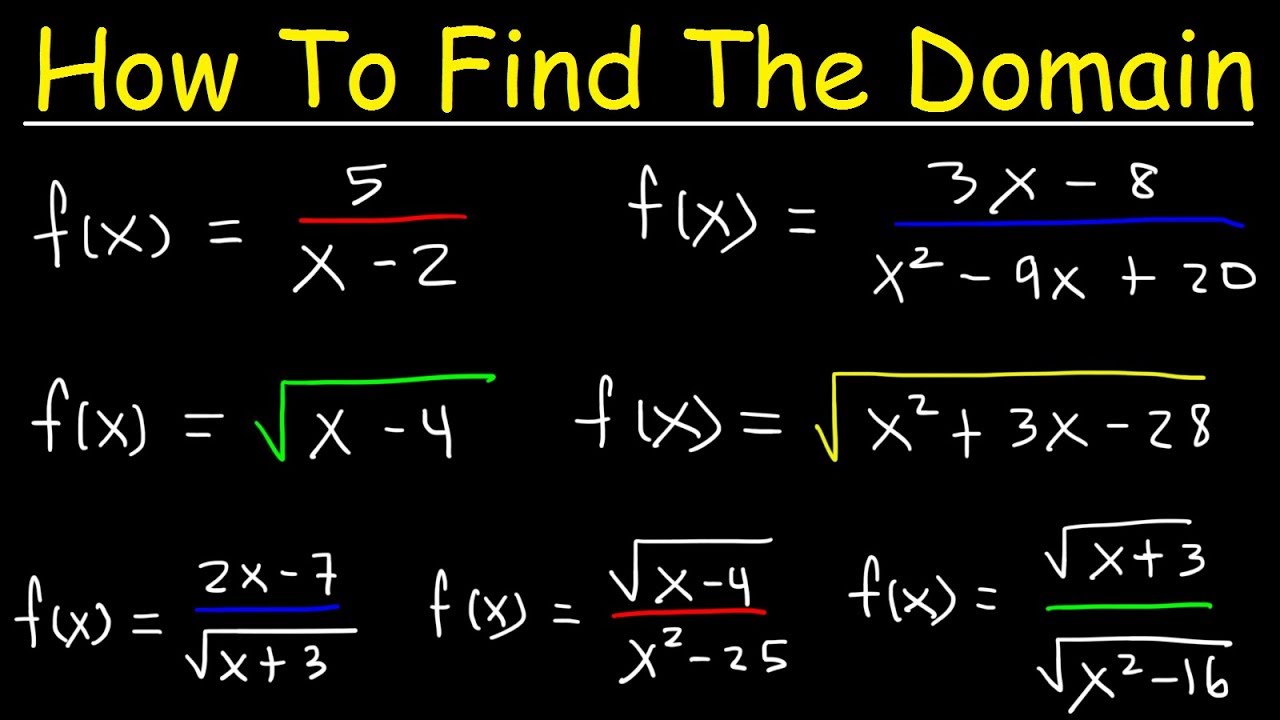
This algebra video tutorial explains how to find the domain of a function that contains radicals, fractions, and square roots in the denominator using interval notation. This video contains plenty of examples and practice problems and is useful for students in algebra and precalculus.
How To Pass Difficult Math and Science Classes:
https://www...
obtuse pebbleBOT
Channel closed
Closed by @prime kraken
Use .reopen if this was a mistake.
tardy epoch

This precalculus video tutorial explains how to find the domain of logarithmic functions. It explains how to use a number line to write the domain in interval notation.
obtuse pebbleBOT
Available help channel!
Send your question here to claim the channel.
Remember:
• Ask your math question in a clear, concise manner.
• Show your work, and if possible, explain where you are stuck.
• After 15 minutes, feel free to ping <@&286206848099549185>.
• Type the command .close to free the channel when you're done.
• Be polite and have a nice day!
Read #❓how-to-get-help for further information on how to ask a good question, and about conduct in the question channels.
 spice chasm
guys
obtuse pebbleBOT
spice chasm
guys
spice chasm
what i do wrong

 dark stirrup
 spice chasm
i put 3 as the base to cancel the log
dark stirrup
a*log(b)=log(b^a)
spice chasm
Why can’t i remove the log by making 3 the base
warm shaleBOT
Mehdi_Moulati
 dark stirrup
a*log(b)=log(b^a)
dark stirrup
dark stirrup
a*log(b)=log(b^a)
You use this exponent property
spice chasm
oops i used the wrong property
dark stirrup
The one you just deleted is wrong
obtuse pebbleBOT
Channel closed
Closed by @spice chasm
Use .reopen if this was a mistake.
Available help channel!
Send your question here to claim the channel.
Remember:
• Ask your math question in a clear, concise manner.
• Show your work, and if possible, explain where you are stuck.
• After 15 minutes, feel free to ping <@&286206848099549185>.
• Type the command .close to free the channel when you're done.
• Be polite and have a nice day!
Read #❓how-to-get-help for further information on how to ask a good question, and about conduct in the question channels.
 nimble harbor
why does the inequality turn into an equality?
 obtuse pebbleBOT
nimble harbor
why does the inequality turn into an equality?
obtuse pebbleBOT
nimble harbor
why does the inequality turn into an equality?
 trim locust
I believe it is because x=11/4 and -0.25 are the critical value, it’s the value from which the function changes signs, it’s easy once you sketch the graph to find the inequality from these 2 points
obtuse pebbleBOT
@nimble harbor Has your question been resolved?
 trail cloak
Also
After finding these values, you still have 2 inequalities to write
To show the values of x that keep y negative
obtuse pebbleBOT
Channel closed
Closed due to timeout
Use .reopen if this was a mistake.
 sly sleet
At the Willowbrook Country Fair, Camille will pay an entrance fee in addition to any tickets she buys for rides. The total amount Camille will pay depends on how many ride tickets she buys.
This situation can be modeled as a linear relationship.
What does the y-intercept of the line tell you about the situation?
A. if camille buys 5 ride tickets, she will pay $25 in all
B. the entrance fee is $15
C. each ride ticket costs $2
D. camille will buy 5 ride tickets
 obtuse pebbleBOT
Available help channel!
obtuse pebbleBOT
Available help channel!
Send your question here to claim the channel.
Remember:
• Ask your math question in a clear, concise manner.
• Show your work, and if possible, explain where you are stuck.
• After 15 minutes, feel free to ping <@&286206848099549185>.
• Type the command .close to free the channel when you're done.
• Be polite and have a nice day!
Read #❓how-to-get-help for further information on how to ask a good question, and about conduct in the question channels.
 cursive arrow
Q: x-y=12 and xy=6. Solve for 'x' and 'y'
obtuse pebbleBOT
cursive arrow
Q: x-y=12 and xy=6. Solve for 'x' and 'y'
cursive arrow
I really can't solve this equation pls help
obtuse pebbleBOT
Channel closed
Closed by @cursive arrow
Use .reopen if this was a mistake.
obtuse pebbleBOT
Available help channel!
Send your question here to claim the channel.
Remember:
• Ask your math question in a clear, concise manner.
• Show your work, and if possible, explain where you are stuck.
• After 15 minutes, feel free to ping <@&286206848099549185>.
• Type the command .close to free the channel when you're done.
• Be polite and have a nice day!
Read #❓how-to-get-help for further information on how to ask a good question, and about conduct in the question channels.
 pulsar breach
 obtuse pebbleBOT
pulsar breach
dark stirrup
obtuse pebbleBOT
pulsar breach
dark stirrup
what have you tried
pulsar breach
i integrated to find velocity
and then made the velocity = 0 and subbed in t=1 to find C
dark stirrup
wdym
pulsar breach
how do i use the t=3 to find out x
 amber meteor
pulsar breach
amber meteor
pulsar breach
Hint: stationary means v=0, at the origin means x=0
dark stirrup
You need to solve for your integration constant first
pulsar breach
i solved to find C and got -1/2
pulsar breach
amber meteor
Hint: stationary means v=0, at the origin means x=0
isnt this same thing
dark stirrup
pulsar breach
i solved to find C and got -1/2
I'm assuming this is your integration constant for your first integral
pulsar breach
yes
dark stirrup
You have one more integral to go
pulsar breach
i integrated again and i have another constant?
amber meteor
pulsar breach
isnt this same thing
No, stationary means not moving, origin means the starting point
dark stirrup
You get a new constant
pulsar breach
do i make the displacement equal to 0 and sub in t=1 to find the new constant
oh
yes
i got the answer
ty
.close
obtuse pebbleBOT
Channel closed
Closed by @pulsar breach
Use .reopen if this was a mistake.
obtuse pebbleBOT
Available help channel!
Send your question here to claim the channel.
Remember:
• Ask your math question in a clear, concise manner.
• Show your work, and if possible, explain where you are stuck.
• After 15 minutes, feel free to ping <@&286206848099549185>.
• Type the command .close to free the channel when you're done.
• Be polite and have a nice day!
Read #❓how-to-get-help for further information on how to ask a good question, and about conduct in the question channels.
 lavish crow
What's the deal with this?
 obtuse pebbleBOT
lavish crow
What's the deal with this?
obtuse pebbleBOT
lavish crow
What's the deal with this?
Please don't occupy multiple help channels.
lavish crow
i don't get what to use to solve this
probably a natural logarithm, but how
just to multiply each side by ln?
 lost tree
what do u want to solve for
lavish crow
lost tree
what do u want to solve for
this G, i know S
but i don't know how to solve this e to this power
especially not how to solve it on a calculator even
lavish crow
but how do i calculate that on a calculator, can i put 2.71 to the 0.3
or do i need to use e
it's a really dumb question
but had to ask someone
obtuse pebbleBOT
Channel closed
Closed by @lavish crow
Use .reopen if this was a mistake.
Available help channel!
Send your question here to claim the channel.
Remember:
• Ask your math question in a clear, concise manner.
• Show your work, and if possible, explain where you are stuck.
• After 15 minutes, feel free to ping <@&286206848099549185>.
• Type the command .close to free the channel when you're done.
• Be polite and have a nice day!
Read #❓how-to-get-help for further information on how to ask a good question, and about conduct in the question channels.
 flat lodge
Determine whether the points A(5; -1; -2), B(-1; -2; -5) and C(-2; -8; -2) are in an equilateral triangle
ABC vertices.
obtuse pebbleBOT
flat lodge
Determine whether the points A(5; -1; -2), B(-1; -2; -5) and C(-2; -8; -2) are i...
flat lodge
I just don't know where to start to complete this task
 royal basin
do you know what an equilateral triangle is?
 gleaming ridge
Use the property of equilateral triangle
flat lodge
royal basin
do you know what an equilateral triangle is?
i know how it looks
royal basin
that doesn't answer my question
do you know the definition of the word "equilateral triangle"?
flat lodge
sorry no
royal basin
an equilateral triangle is, by definition, a triangle in which all sides have the same length.
flat lodge
ohhh
royal basin
in some languages other than english, the word for "equilateral" even translates to "equal-sided" or similar.
that's kind of also the case in english, except it's obscured behind the fact that it's a word made of Latin roots.
anyway, do you understand how to proceed?
flat lodge
thanks for explanation what is a equilateral triangle but i still don't know how to do my task
royal basin
well
again
an equilateral triangle is a triangle in which all sides have equal length.
you have the coordinates of points A, B and C.
 atomic bobcat
do you know distance formula?
royal basin
do you know how to find the side lengths of your triangle?
for example, if i told you to find the length of AB, would you be able to do it? @flat lodge
flat lodge
to find the lenght of ab i need to use
Pythagorean theorem?
royal basin
in some sense, yes.
do you know in general how to find the distance between two points?
(and do you understand that the length of a line segment and the distance between its endpoints are one and the same?)
flat lodge
yes
royal basin
ok,
then you should have no trouble calculating all three side lengths for ABC and telling if they are equal or not
flat lodge
so wait my first step is to find lenght of AB
royal basin
sure if you want
it does not matter which order you do the sides in
if you want to find BC first then you can do that
flat lodge
and i will know all lenghts of tirangle because the lenght of a line segment and the distance between its endpoints are one and the same
royal basin
...why don't you just do it now?
warm shaleBOT
Artutu

 outer maple
(x, y, z) is a vector and not a point
flat lodge
oh so i use this formula on AB
royal basin
@outer maple careful not to cause any more confusion here.
royal basin
flat lodge
oh so i use this formula on AB
again. just do it.
flat lodge
i don't know i think my answer is wrong
nvm i will ask again later i think i know how to do my task
.close
obtuse pebbleBOT
Channel closed
Closed by @flat lodge
Use .reopen if this was a mistake.
obtuse pebbleBOT
Available help channel!
Send your question here to claim the channel.
Remember:
• Ask your math question in a clear, concise manner.
• Show your work, and if possible, explain where you are stuck.
• After 15 minutes, feel free to ping <@&286206848099549185>.
• Type the command .close to free the channel when you're done.
• Be polite and have a nice day!
Read #❓how-to-get-help for further information on how to ask a good question, and about conduct in the question channels.
 tiny flicker
No.3
 obtuse pebbleBOT
tiny flicker
No.3
obtuse pebbleBOT
tiny flicker
No.3
 timber fox
do you know that $\sqrt{x}=x^{\frac{1}{2}}$
warm shaleBOT
Clarkie
 tiny flicker
 tiny flicker
timber fox
do you know that $\sqrt{x}=x^{\frac{1}{2}}$
tiny flicker
timber fox
do you know that $\sqrt{x}=x^{\frac{1}{2}}$
Yes
gleaming ridge
If $x = (-125)^{\frac{1}{3}}$ then this means $x^3 = (-125)$
warm shaleBOT
numbpy
 timber fox
soo if you have x^(1/3) its not asking for the square root but theeee
gleaming ridge
So, you want to find a number where cube is -125
as clarkie said, it is basically the cube root of -125
 fierce lagoon
$x^\frac{1}{n} = \sqrt[n]{x}$
warm shaleBOT
Umbraleviathan
 fierce lagoon
There
timber fox
^^^
gleaming ridge
Do you know how to solve $125^{\frac{1}{3}}$
warm shaleBOT
numbpy
 tiny flicker
I don't think so
 raven knot
So $125=555=5^3$
warm shaleBOT
SmokingPuddle58
 gleaming ridge
okay, are there no examples like this in your book? There should be some lesson on radicals and surds
tiny flicker
3(weird shape) 125?
tiny flicker
gleaming ridge
okay, are there no examples like this in your book? There should be some lesson ...
at this point I don't even know what ur saying

Ignore the other language, I'm forced to learn it at school
fierce lagoon
Well you gotta know your perfect cubes
tiny flicker
fierce lagoon
Well you gotta know your perfect cubes
Sir what cubes.
fierce lagoon
8, 27, 64, 125, 216
gleaming ridge
Do you know $\sqrt[3] {125}$?
fierce lagoon
Those are your perfect cubes
warm shaleBOT
numbpy
 tiny flicker
125 1/3
fierce lagoon
tiny flicker
Sir what cubes.
Perfect cubes are when you take the cube root of them, they output an integer.
1, 8, 27, 64, 125, 316 are perfect cubes. If you take the cube root of each of those numbers, you get:
1, 2, 3, 4, 5, 6
Memorize these because they'll appear a lot more often
 rotund canyon
fierce lagoon
8, 27, 64, 125, 216
rotund canyon
fierce lagoon
8, 27, 64, 125, 216
1^3, 2^3, 3^3, 4^3, 5^3
anything to the power of the three is a cube
tiny flicker
rotund canyon
1^3, 2^3, 3^3, 4^3, 5^3
anything to the power of the three is a cube
Oh yes that
I'm sorry guys I'm trying my best to understand its 1am here😭
tiny flicker
fierce lagoon
Perfect cubes are when you take the cube root of them, they output an integer.
...
Yes I remember that
I'm studying index rn
fierce lagoon
warm shale
**numbpy**
You know what the 3 means here?
tiny flicker
1/3
gleaming ridge
fierce lagoon
You know what the 3 means here?
yeah it's the cube root
gleaming ridge
alright, so if you do $3^3 = 3 * 3 * 3 = 27$ then it's reverse is $\sqrt[3] {27} = 3$
warm shaleBOT
numbpy
 fierce lagoon
$$\sqrt{x} := \text{square root of x}$$
$$\sqrt[3]{x} := \text{cube root of x}$$
$$\sqrt[4]{x} := \text{quartic root of x}$$
$$\sqrt[n]{x} := \text{nth root of x}$$
warm shaleBOT
Umbraleviathan
 gleaming ridge
Do you understand a bit @tiny flicker ?
tiny flicker
warm shale
**numbpy**
Got it
obtuse pebbleBOT
Channel closed
Closed by @tiny flicker
Use .reopen if this was a mistake.
Available help channel!
Send your question here to claim the channel.
Remember:
• Ask your math question in a clear, concise manner.
• Show your work, and if possible, explain where you are stuck.
• After 15 minutes, feel free to ping <@&286206848099549185>.
• Type the command .close to free the channel when you're done.
• Be polite and have a nice day!
Read #❓how-to-get-help for further information on how to ask a good question, and about conduct in the question channels.
 vital rain
is it mathematically acceptable to use this method to solve asymptotes? https://www.youtube.com/watch?v=qJrrZQgSkO8&t=181s&ab_channel=NancyPi

MIT grad shows how to find the horizontal asymptote (of a rational function) with a quick and easy rule. Nancy formerly of MathBFF explains the steps.
For how to find VERTICAL asymptotes instead, jump to the video: https://youtu.be/V137qmDN9Qw
Follow me on Instagram! https://instagram.com/mathnancy
Follow me on Twitter: https://twitter.com/nan...
obtuse pebbleBOT
vital rain
is it mathematically acceptable to use this method to solve asymptotes? https://...
vital rain
because my teacher uses limits, and the method I found on youtube is much less tedious than doing limits?
 fierce lagoon
Well I'm not gonna watch the video but I'm assuming they're comparing the numerator and denominator's leading term's powers, correct?
They're basically doing a limit ... through analysis instead of actually showing the limit
It's what I do anyways, and it can be proven using limits
fierce lagoon
fierce lagoon
They're basically doing a limit ... through analysis instead of actually showing...
@vital rain basically this
vital rain
basically this

but it should be mathematicaly acceptable in exams to do what she just did
 green epoch
 novel knoll
No you shouldn’t do smth you haven’t done in class
fierce lagoon
I mean ... they kinda generalize a "prediction", for lack of a better term and my brain being deep fried
But generally stick to what your teacher shows you, and then verify with whatever tricks you'd like to use on your own
novel knoll
And why exactly is calculating limit so tedious? $$\lim_{x\to \infty}\frac{x+1}{x^2-1}=\lim_{x \to \infty} \frac{(x+1)/x}{(x^2-1)/x}=\lim_{x \to \infty} \frac{1+1/x}{x-1/x}=0$$
fierce lagoon
If you learned about properties of infinite limits, you know you can literally erase low order terms from the numerator and denominator
warm shaleBOT
ScapeProf
 fierce lagoon
If you learned about properties of infinite limits, you know you can literally e...
fierce lagoon
fierce lagoon
If you learned about properties of infinite limits, you know you can literally e...
Perhaps your teacher showed you this?
vital rain
hm true, how would you do for vertical, she was saying that you should try do factor everything out, and then set denominator to = 0.
vital rain
vital rain
this is what my teacher did
novel knoll
Limits like this
Divide through with leading term in num (or denom)
(Or anything in between those)
novel knoll
novel knoll
Divide through with leading term in num (or denom)
Like I did above I divided through with x
vital rain
that s how you calculated horizontal? how would you do for vertical?
novel knoll
Like you said above? What was wrong with that
vital rain
I don't know how would they do vertical asymptote on this using limits, without setting x^2-4 = 0

is it because vertical asymptote is based on the definition of the function?
 civic zealot
sort of, just because the denominator is 0 at certain x values does not mean that there is a vertical asymptote.
for example $\frac{x^2-9}{x-3}$, the denominator is 0 at x=3, but there is no vertical asymptote
warm shaleBOT
Zybikron
 vital rain
but you would need to factor out the function and then you set denom to 0
civic zealot
yes
vital rain
so we can't do denom = 0 because it is 1
but how can we use the limits to find out the vertical
civic zealot
use limits when you can't factor, or when you don't have a polynomial to reduce.
mostly just to verify that they are actually asymptotes
vital rain
but how would I use the limits to find the vertical asymptotes for this one? my teacher says x= 2 when f(x) --> + infinity and x = -2 when f(x) ---> - infinity

 elfin burrow
the rule in the youtube video is an observation about the results that the limits give for various powers of the numerator and denominator
civic zealot
vital rain
but how would I use the limits to find the vertical asymptotes for this one? my...
look at the left and right limit around x=2 and x=-2
because what you said isn't necessarily true.
vital rain
I said wrong
f(x) -->> goes to infinity when x=-2 or x = 2
but that is because there is due to the definition of the function
civic zealot
right
but you're saying f(x) ---> infinity means you're using a limit. You're saying lim_(x -> 2) f(x) = +/- infinity
vital rain
yes true
but that means if we have (sqrt(2-x)/(x-4)) , this is our vertical asymptotes, 2 and 4 right?
civic zealot
basically you're saying 'by the definition of the funciton' because you learned that in algebra. Now in calculus you're learning the reason that it's a rule is because of the limits
civic zealot
vital rain
but that means if we have (sqrt(2-x)/(x-4)) , this is our vertical asymptotes,...
no, there aren't any vertical asymptotes in that function
vital rain
there are for sure vertical asymptotes?
civic zealot
ok, what happens around 4?
vital rain
it is 0, but that's the thing when x -- > 4 the function = infinity
civic zealot
that would require 4 to be in the domain of the function
sqrt(2-x) isn't defined (over the reals) for x>2
civic zealot
just 1
vital rain
why not from sqrt(2-x)
civic zealot
what happens when the numerator is 0?
vital rain
0
civic zealot
ok, doesn't sound like an asymptote to me
vital rain
but I thought of vertical asymptotes is for when x is undefined
when x = 2 it is undefined
f(x) -->> goes to infinity when x=2
obtuse pebbleBOT
@vital rain Has your question been resolved?
obtuse pebbleBOT
@vital rain Has your question been resolved?
 nova stump
sqrt(2-2) = 0
f(x) doesnt go to infinity when x=2, nor does it approach infinity as x approaches 2
obtuse pebbleBOT
@vital rain Has your question been resolved?
 golden cave
Could someone help me with a question on combinations?
obtuse pebbleBOT
Channel closed
Closed due to timeout
Use .reopen if this was a mistake.
Available help channel!
Send your question here to claim the channel.
Remember:
• Ask your math question in a clear, concise manner.
• Show your work, and if possible, explain where you are stuck.
• After 15 minutes, feel free to ping <@&286206848099549185>.
• Type the command .close to free the channel when you're done.
• Be polite and have a nice day!
Read #❓how-to-get-help for further information on how to ask a good question, and about conduct in the question channels.
 silk elk
Two identical circular sheets must be glued together at their edges and blown up to form an ellipsoid balloon, without stretching. the ellipsoid must be 132.2 units in diameter across, and 80.6 units tall when fully expanded.
Find the neccesary radius of each sheet to fulfill this criteria.
obtuse pebbleBOT
silk elk
Two identical circular sheets must be glued together at their edges and blown up...
silk elk
not sure how to go about solving this problem, my professor posed it to us as a challenge for our research topic over the break. any ideas?
silk elk
dark stirrup
What are you trying to find
the radius of each sheet before they're blown up
yeah
dark stirrup
Sorry I'm blind
dark stirrup
Hold on
So when it say circular sheet, does that mean like a hollow cylinder? Like this?

Or is it just a flat circle?

I'm assuming the latter
obtuse pebbleBOT
@silk elk Has your question been resolved?
silk elk
dark stirrup
Or is it just a flat circle?
the latter
 wooden cipher
make an ellipse, then use calculus to find surface of revolution
dark stirrup
You can't really find the analytic surface area of an ellipse though
Also, how does it get stretched?
dark stirrup
Does the joined seem stay a circle, or does it deform to an ellipse?
wooden cipher
yeah i think so
dark stirrup
Approximations may be allowed since the values are just given to 1 decimal
wooden cipher
oh if youre just trying to find the radius, you can find arclength
dark stirrup
surface area of an ellipse can be approximated to ~1%
wooden cipher
calculators are allowed right?
dark stirrup
They have to be
I would never multiply by pi without a calculator
I'm assuming the seem stays circular
And I'm gonna guess the ellipsoid vertically since it mentioned how tall it must be when expanded
So that means the sheets will be horizontal
yeah what class is this for @silk elk, what are you allowed to know?
Cuz this is gonna be a lot of approximations
silk elk
dark stirrup
yeah what class is this for <@488727322921271307>, what are you _allowed_ to kno...
approximate anything
it isn't for a class, it's a puzzle related to a research project my group was working on
obtuse pebbleBOT
Channel closed
Closed due to timeout
Use .reopen if this was a mistake.
dark stirrup
.reopen
obtuse pebbleBOT
✅
dark stirrup
Well then best advice I can offer is this:
The surface area of the ellipsoid must be equal to the area of the two circular sheets
So find the surface area of the ellipsioid
You're given the length of each of its axes
obtuse pebbleBOT
@silk elk Has your question been resolved?
obtuse pebbleBOT
Channel closed
Closed due to timeout
Use .reopen if this was a mistake.
Available help channel!
Send your question here to claim the channel.
Remember:
• Ask your math question in a clear, concise manner.
• Show your work, and if possible, explain where you are stuck.
• After 15 minutes, feel free to ping <@&286206848099549185>.
• Type the command .close to free the channel when you're done.
• Be polite and have a nice day!
Read #❓how-to-get-help for further information on how to ask a good question, and about conduct in the question channels.
 bold siren
I need to figure out how to find the highest common factor and lowest common multiple of 2970, 4950, 6930
I have the answers but i dont know how to get to them
obtuse pebbleBOT
bold siren
I need to figure out how to find the highest common factor and lowest common mul...
 tranquil sonnet
Prime factorize, and compare factors
 loud tangle
pain to do but yeah
bold siren
tranquil sonnet
Prime factorize, and compare factors
Yes i dont know how to do that
 nocturne minnow
Can you prime factorize something like 40?
tranquil sonnet
It’s like how 6=3*2
bold siren
I mean yea, but i dont see how to do that to a number as big as 2970
tranquil sonnet
Do you know divisibility rules?
loud tangle
if you really dont want to could also do euler's alg for lcd and use the fact that lcd*hcm = number productes
nocturne minnow
A trick, just keep dividing by 2
tranquil sonnet
You could use them to see that it’s divisible by 9 and 2
loud tangle
or lcm * hcf
nocturne minnow
Then if it's not even, divide by some other prime, like 3 or 5, etc
loud tangle
you can take 10 out of all of them at the very start then divide by 3
since it works
by 9 actually
all of them
tranquil sonnet
loud tangle
if you really dont want to could also do euler's alg for lcd and use the fact th...
Do you mean Euclidean alg?
loud tangle
euclidian sry
the one that gives lcm
i didnt scroll over computer science in a while and i forgot
bold siren
Never heard of it
loud tangle
its an algorithm that gives the lcm of any numbers
not lcm hcf
ugh i hate this stuff i always mix the terms uppp
bold siren
tranquil sonnet
Do you know divisibility rules?
Not sure, the name doesn't ring a bell
loud tangle
here we say highest common divisor and lowest common multiple not lcm and hcf and jesus christ it gets confusing with abbreviations
tranquil sonnet
bold siren
Not sure, the name doesn't ring a bell
Just keep dividing by 2 and once it becomes odd, divide by 3 or 5 like dldh said
loud tangle
ik for sure you can divide by 2 and 5 once and 3 twice on all of them
bold siren
OH
loud tangle
so hcf has to be a multiple of 90
nocturne minnow
bold siren
Ok that works until i hit 55
Divide by the next prime that goes into it
bold siren
So 5
nocturne minnow
Yes
loud tangle
do say when ur finished
bold siren
Im just checking things to be sure

It says a mark is awarded for showing no common factors
But that seems wrong?
bold siren
Well thats a "duh" why would they award a mark for stating something like that...
nocturne minnow
bold siren
Well thats a "duh" why would they award a mark for stating something like that.....
To make sure you can identify that
bold siren
I feel like im missing something...
loud tangle
it does say show
how woule you prove that
3 5 and 7 are prime in general meaning their only divisors are 1 and themselves
so their highest common factor/divusor would be 1
which stands for every number
nocturne minnow
bold siren
It says a mark is awarded for showing no common factors
Also, it's pointing out those 3 values, since 3, 5, and 7 are alone in each column, hence no common factors, if you were talking about the HCF part
 bold siren
Ok im not quite sure why those numbers are alone in each column?
nocturne minnow
It just organized the factors from here

So 2970 = 2 * 3 * 3 * 3 * 5 * 11
And it just lined up all the factors
bold siren
So becouse 2970 is the only one that has 3x3x3 4950 has 5x5 and 6930 has 7x
You can tell no common factor?
nocturne minnow
Do you see how, here, it lists out the factors of each number?
 bold siren
Yes
nocturne minnow
nocturne minnow
When you line each factor up, you will notice that 3, 5, and 7 are alone, like this
bold siren
Ok?
nocturne minnow
Since 3, 5, and 7, aren't in all three columns, then those aren't common factors to all three numbers
bold siren
Even tho all 3 numbers are all rationally divisible by 3?
nocturne minnow
2970 = 2 * 3 * 3 * 3 * 5 * 11
4950 = 2 * 3 * 3 * 5 * 5 * 11
6930 = 2 * 3 * 3 * 5 * 7 * 11
Do you agree?
bold siren
Yep
nocturne minnow
If you line up each factor, for each number, so the column is filled, it would look like
2970 = 2 * 3 * 3 * 3 * 5 * 11
4950 = 2 * 3 * 3 * 5 * 5 * 11
6930 = 2 * 3 * 3 * 5 * 7 * 11
Do you agree with that?
bold siren
Yes
nocturne minnow
Do you notice how, there is a 3, 5, and 7, in each column that only has one in each?
bold siren
Yes
nocturne minnow
Like there is a column with only one 3, one 5, and one 7
Because there is only one in each column, those three factors are only unique to each number
Because of the column that only has the one factor in each, that's why the key says 3, 5, and 7 aren't common factors to all three numbers
 nocturne minnow
The factors 3, 5, 7, just multiply two of the together in all the possible combinations
Like 3 * 5, 3 * 7, and 5 * 7
bold siren
?
dark stirrup
Late to the party, but did anyone mention the gcd algorithm?
If a>b, then gcd(a, b)=gcd(b, a-b)
You can also do remainders if you're good at division
nocturne minnow
bold siren
Tbh can't really explain that part sorry
bold siren
nocturne minnow
Tbh can't really explain that part sorry
Ok, whats special about 35,21 and 15 that this is pointing them out
dark stirrup
no clue
nocturne minnow
Well, what I'm assuming it's their method to take 3, 5, and 7 and multiply two of those digits in all the possible combinations, then stating that those 3, aren't all factors 2970, 4950, and 6930
bold siren
Ok? Weird...
dark stirrup
Yeah that's nasty
nocturne minnow
Probably just another extra sanity method that is pointless, the first one was good enough, imo
bold siren
Well if it gets me a mark who am i to complain
 dark stirrup
for sure if that's what the assignment wants
nocturne minnow
dark stirrup
Just get the prime factor of each number?
I believe just dividing by 2, then the next divisible prime
dark stirrup
Not great but I can't change that
 dark stirrup
Looks like you need to know how exponents multiply and divide together
bold siren
Uh... No
dark stirrup
Okay well that's what this question is asking
So you will learn
Think of 2^3
That is 2*2*2
And think of 2^4
That is 2*2*2*2
So what is (2^3)*(2^4)?
Why, it's (2*2*2)*(2*2*2*2)
Oops I wrote this wrong. Deleting it
I meant this
 bold siren
Well yea, i know what powers are, but i thought it would be a simple case of applying the powers then multiplying the result
dark stirrup
Nah too much work.
I don't think a calculator could reliably do 7^15 anyway
The trick here is to know how to group exponents together
bold siren
Ok
dark stirrup
Yeah I'm sure you know what powers are, I'm using that knowledge to help you understand how to multiply to powers together
Look at the 2^3*2^4 example
You multiply 2 three times, then again 4 times
So overall, you multiply 2 seven times
dark stirrup
bold siren
So its just 2^3 +2^4
I think you made typo here
 bold siren
I see
So for the question
7^20\7^16
Would be 7^4
Ey
What about the 2nd part where none of the bases are the same
dark stirrup
You need to break each exponent base (15, 3, 2, 10) into its prime factors
bold siren
n>`
 bold siren
So what are the actual steps then, givin 15^4x3^6 / 2^10 x 10^4
I can see 15^4 = 3^4 * 5^4
But that still leaves us with a 5 on top
dark stirrup
That's fine. Is there something saying you need to remove the 5?
dark stirrup
you've done 15, but what about the other numbers in the fraction?
bold siren
Ok so

Why does it become 2^(-14) * 3^(10) tho
Is it just how you write it in the format?
dark stirrup

It comes from how how define a^0
Remember that we found (a^b)*(a^c)=a^(b+c)
So assume b=0
Then we should have (a^0)*(a^c)=a^(0+c)=a^c
So you get a^0=1
bold siren
Uh..
dark stirrup
It's okay, ask questions
bold siren
I just dont get why we are making b=0 and why a^0=1
dark stirrup
Let me format this, hold on
 cobalt acorn
bold siren
I just dont get why we are making b=0 and why a^0=1
cobalt acorn
bold siren
I just dont get why we are making b=0 and why a^0=1
cuz a^0 means a^(1-1) right?
which also means a^1/a^1
and ofc its 1
for all a belongs to Real numbers without 0
cobalt acorn
cobalt acorn
which also means a^1/a^1
cuz u cant divide by zero
dark stirrup

 cobalt acorn
dark stirrup
cobalt acorn
dark stirrup
website name sir? O_O
dark stirrup
Microsoft Word
cobalt acorn
tyy
dark stirrup
 bold siren
Wait i think there's been a misunderstanding
My question was why we are turning 3^(10)/2^(14) into 2^(-14) * 3^(10)
bold siren
Is it that the latter is simply considered simpler?
bold siren
I feel it would be clearer if instead of using a and c you used numbers
dark stirrup
 dark stirrup
bold siren
I feel it would be clearer if instead of using a and c you used numbers
dark stirrup
bold siren
I feel it would be clearer if instead of using a and c you used numbers
Sure let's try it with real numbers
Let's say we want to know what 2^0 is
We know 2^1=2
And we know that (2^0)*(2^1)=2^(0+1)=2^1
So it must be that 2^0=1
bold siren
Ok, kinda makes sense
dark stirrup
In short, you just need to know that a^0=1 and a^-b=1/(a^b)
That's it
I was just trying to give you the motivation behind it
bold siren
OH
OK WRITTEN DOWN IT MAKES SENSE
kinda
Not sure where the 3^10 from the question comes into this but it makes sense on why
/2^(14) = * 2^(-14)
Still not sure why you need to write it like that but whatever
dark stirrup
You're not sure where 3^10 came from?
bold siren
No more where it fits into the formula you just posted
 bold siren
Ok just wondering
Why invert the power
Is it litterly just that its considered more simple that way
dark stirrup
Either way is fine
I suppose it's a requirement of your problem. "form as powers of primes numbers"
obtuse pebbleBOT
Channel closed
Closed by @bold siren
Use .reopen if this was a mistake.
Available help channel!
Send your question here to claim the channel.
Remember:
• Ask your math question in a clear, concise manner.
• Show your work, and if possible, explain where you are stuck.
• After 15 minutes, feel free to ping <@&286206848099549185>.
• Type the command .close to free the channel when you're done.
• Be polite and have a nice day!
Read #❓how-to-get-help for further information on how to ask a good question, and about conduct in the question channels.
obtuse pebbleBOT
 valid dew
so when x is 1, y will be 0
and when y is 2, x will be zero
okay
lets solve it
I will do it for you
oh right
wait
mhm
nocturne minnow
valid dew
I will do it for you
Don't solve the problem for people
nocturne minnow
valid dew
And why is that ?
Because if you read #❓how-to-get-help
• When asking for help, do not insist on getting just the answer; we are here to help you learn, not do the work for you. Likewise, if you are providing help to others, try your best to explain and elaborate instead of simply giving away the answer.
valid dew
but I guess you are a highschooler and you are expected to solve it without derivation ?
nocturne minnow
Meaning don't do the work for people
valid dew
Oh I get it dldh06, thanks!
Okay so you have a problem with it ?
So this solution looks right to me
oh okay.
nocturne minnow
Why not?
valid dew
Okay I have to figure out how to help you out without solving
nocturne minnow
Then sleep
And try again later
Here's the thing, lack of sleep is not good, especially before a test. You need the rest so you aren't fatigued
Better than 0, 1, or 2 hours
valid dew
1 hours of sleep is 1 hours of sleep
nocturne minnow
Yeah... that's not really healthy
Anyways
Find the triangle enclosed by graph of y=-x²-2x+5 ,touching line on x=1 y=2 and coordinate system
Makes no sense, so can you post the actual question? Like is it from a book or review sheet?
valid dew
was about to ask the same thing
so touching the line on x=1 y=2 meaning ?
what line are you talking about
nocturne minnow
Post an image of it, then translate it
nocturne minnow
There's gotta be something that has the proper question
valid dew
nocturne minnow
There's gotta be something that has the proper question
agreed
nocturne minnow
Because x = 1 y = 2 doesn't make sense
valid dew
they can be two seperate functions, a point or like 1000 different things
nocturne minnow
And neither does "find the triangle enclosed" because there isn't a triangle
valid dew
okay what we are going to do is
draw both of the graphs
so you have a line
and a parabol, right ?
and then you can find the area remaining inside
nocturne minnow
Can you please just post the original question, so it can logically make sense?
nocturne minnow
That makes it a bit more clearer because you sayin x = 1 y = 2 made zero sense and seeing that, you're referring to a coordinate point of (1, 2)
Because that's not what the parabola looks like
valid dew

listen dude
there is no triangle
Okay I am glad you figure it out man!
Cause I still have no clue about your question
find the area of the big triangle = A1
then the are of the small triangle=A2
and then A1-A2 will be the yelow area
yellow
okay
I misstyped circles
nocturne minnow
I'm assuming that paper is a review for your exam, was there an answer key for that?
valid dew
alright, I am out of this, sorry.
nocturne minnow
You understand that what you are doing is academically dishonest, right?
obtuse pebbleBOT
Channel closed
Closed by @haughty sable
Use .reopen if this was a mistake.
obtuse pebbleBOT
Available help channel!
Send your question here to claim the channel.
Remember:
• Ask your math question in a clear, concise manner.
• Show your work, and if possible, explain where you are stuck.
• After 15 minutes, feel free to ping <@&286206848099549185>.
• Type the command .close to free the channel when you're done.
• Be polite and have a nice day!
Read #❓how-to-get-help for further information on how to ask a good question, and about conduct in the question channels.
 next reef
Let $V={(a_1,a_2,a_3,\dots,a_n):a_i \in \mathbb{C} \text { for } i=1,2,3,\dots,n}$. Is V a vector space over the field of real numbers with the operations of coordinatewise addition and multiplication?
obtuse pebbleBOT
next reef
Let $V=\{(a_1,a_2,a_3,\dots,a_n):a_i \in \mathbb{C} \text { for } i=1,2,3,\dots,...
warm shaleBOT
 next reef
I see it is a vector space over the field of complex numbers
Does that imply it is a vector space over R as well?
 kind hawk
Yes but why
next reef
It passes all that eight properties to be a vector space
obtuse pebbleBOT
@next reef Has your question been resolved?
 warm canopy
Prove it
obtuse pebbleBOT
@next reef Has your question been resolved?
obtuse pebbleBOT
Channel closed
Closed due to timeout
Use .reopen if this was a mistake.
Available help channel!
Send your question here to claim the channel.
Remember:
• Ask your math question in a clear, concise manner.
• Show your work, and if possible, explain where you are stuck.
• After 15 minutes, feel free to ping <@&286206848099549185>.
• Type the command .close to free the channel when you're done.
• Be polite and have a nice day!
Read #❓how-to-get-help for further information on how to ask a good question, and about conduct in the question channels.
 burnt briar
I need to find median but I forgot the way for it
 obtuse pebbleBOT
burnt briar
I need to find median but I forgot the way for it
obtuse pebbleBOT
burnt briar
I need to find median but I forgot the way for it
 valid crown
4×4sqrt(3) = 8×m
tawny fog
burnt briar
I need to find median but I forgot the way for it
The Size of the half of the hypotenuse is equal to the median
obtuse pebbleBOT
Channel closed
Closed by @burnt briar
Use .reopen if this was a mistake.
Available help channel!
Send your question here to claim the channel.
Remember:
• Ask your math question in a clear, concise manner.
• Show your work, and if possible, explain where you are stuck.
• After 15 minutes, feel free to ping <@&286206848099549185>.
• Type the command .close to free the channel when you're done.
• Be polite and have a nice day!
Read #❓how-to-get-help for further information on how to ask a good question, and about conduct in the question channels.
 stuck pilot
 obtuse pebbleBOT
stuck pilot
stuck pilot
obtuse pebbleBOT
stuck pilot
stuck pilot
The answer is -10, but I can only think of -8
trim locust
What have you done
stuck pilot
With sin being 0 and cos being -1
trim locust
Id turn it into harmonic form
stuck pilot
trim locust
Id turn it into harmonic form
What is harmonic form?
stuck pilot
What is R?
stuck pilot
I think I'm not familiar then
trim locust
Um ok, are you familiar with the formula that lets you rewrite sin (x+a) where a is just some number?
Sometimes called the sin addition formula
trim locust
Perfect
stuck pilot
So how can I use this?
trim locust
Now multiply the entire thing by a constant R (this is so that the coefficients of sin x and cos x aren’t stuck between 1 and 0) and we can represent any combination of sin x + cos x
stuck pilot
trim locust
Now multiply the entire thing by a constant R (this is so that the coefficients ...
Makes sense
trim locust
Ok
So
We need to pick the correct r and a constants to make this woek
R sin(x+a) =R * Cos a * sin x + R* sin a * cos x
I took your expression you put above and multiplied by R
We want 6 sines and 8 cos
Xan you form some expressions for x and a
That would make that be the case
stuck pilot
And how do we do that?
trim locust
R * Cos a * sin x + R* sin a * cosx
6 sin x + 8cos x
I’m not sure if that helps you to see
You need to compare coefficients for sin and cos
stuck pilot
But for that, don't I need to know every single coefficient possible?
Like I think that R should be 2 in this case
And cosa be 3 and sina be 4
trim locust
Can cos a =3
stuck pilot
I went like this:
Rx = 8
Ry = 6
R = G.C.C (8, 6) = 2
stuck pilot
trim locust
What does R sin a need to equal to
6
trim locust
Can you do r cos a
stuck pilot
It should be 6
trim locust
Yep
stuck pilot
No I can't solve it?
stuck pilot
stuck pilot
I went like this:
Rx = 8
Ry = 6
R = G.C.C (8, 6) = 2
I mean I did here, and seemingly went wrong
trim locust
Ok, do you know any formulas that relate sin x and cos x
stuck pilot
And don't we have 3 unknowns?
stuck pilot
trim locust
Ok, do you know any formulas that relate sin x and cos x
I do, but it depends on where a is. If it's been 0-90, 90-180, 180-270 or 270-360
trim locust
No Becsuse don’t forget we want this to be in the form Rsin(x+a) where R and a are constants, forget x for a minute
Also
Your equations are in terms of a
a doesn’t change
Sin a is just a number
Cos a is just a number
Why don’t you rearrange one of them for R?
stuck pilot
😅
trim locust
I normally turn mine into tan but you got there
Tbh
You don’t need to find a
You now have 10 sin(x+a)
Is the same as your original expression
So what is the max value of 10 sin (x+a)
trim locust
Yeh
trim locust
Ofc
stuck pilot
I'll go through the messages rn
trim locust
Ok
stuck pilot
Ah I'm so grateful
Thank you for helping me solve it, being patient and explaining everything fully
🙏🙏🙏
trim locust
Np, there is a quick way for harmonic form I can show you if you like
stuck pilot
Sure!
trim locust
It saves you having to do all the algebra, does r sin a and r cos a remind you of any shapes
stuck pilot
Circle with the radious R?
Okay wow
Ye
Makes sense
I kinda saw it when I solved for R (but didn't realize till now)
stuck pilot
So basically a triangle, and then Pythagorean theorem
trim locust
Then it’s just Pythagorean
stuck pilot
Right?
stuck pilot
Yeah
trim locust
Then a is just arctan (opp/adj) just in case you ever need to do it again
stuck pilot
Haven't learned arctan yet and seems like I don't need it
I'm studying for an exam and I' solving tests for it
stuck pilot
Happens that I come across questions that need me learn something new
If I saw an arc tan, I'll learn it
For now I have learned enough and have enough things to learn (learned Matrix, a lil bit of derivative, need to learn derivative better and learn integral)
Anyways, thank you very much for your help ❤️
stuck pilot
Take care
trim locust
You too
stuck pilot
.close
obtuse pebbleBOT
Channel closed
Closed by @stuck pilot
Use .reopen if this was a mistake.
Available help channel!
Send your question here to claim the channel.
Remember:
• Ask your math question in a clear, concise manner.
• Show your work, and if possible, explain where you are stuck.
• After 15 minutes, feel free to ping <@&286206848099549185>.
• Type the command .close to free the channel when you're done.
• Be polite and have a nice day!
Read #❓how-to-get-help for further information on how to ask a good question, and about conduct in the question channels.
 earnest dagger
Hi
obtuse pebbleBOT
earnest dagger
Hi
lost tree
what is your question
earnest dagger
I need help with a 3d trig question
lost tree
send it here
 lost tree
,rotate
warm shaleBOT
 lost tree
what have u tried
lost tree
can u imagine it in ur head
earnest dagger
Yeah but I have to write working out by drawing
lost tree
u can draw it from three sides
draw the view that a person in the sky would see
and then a view that a person standing would see if they look towards the north/south
and the view a person standing would see if they look towards the east/west
lost tree
earnest dagger
oh separately
yes
obtuse pebbleBOT
@earnest dagger Has your question been resolved?
Channel closed
Closed by @earnest dagger
Use .reopen if this was a mistake.
Available help channel!
Send your question here to claim the channel.
Remember:
• Ask your math question in a clear, concise manner.
• Show your work, and if possible, explain where you are stuck.
• After 15 minutes, feel free to ping <@&286206848099549185>.
• Type the command .close to free the channel when you're done.
• Be polite and have a nice day!
Read #❓how-to-get-help for further information on how to ask a good question, and about conduct in the question channels.
 silver plover
 obtuse pebbleBOT
silver plover
royal basin
obtuse pebbleBOT
silver plover
royal basin
guess they actually meant to take the (n-1)th derivative of 1/(1-x)...?
 unreal musk
Differentiate (1-x)^{-2} for (n-1) times
royal basin
each differentiation lowers the power by 1.
unreal musk
Or equivalently, differentiate (1-x)^{-1} by n times
royal basin
i think sa's point was that this would leave us with (1-x)^(-n-1)
with some coefficients
actually yeah what's going on here? we're supposed to accumulate a factor of (n-1)! there aren't we?
silver plover
tbh im just confused how hes got (1-x)^-n
warm shaleBOT

 silver plover
royal basin
can you talk to the author of this document?
silver plover
royal basin
can you talk to the author of this document?
ok its my lecturer
unreal musk
Yea this is weird actually
unreal musk
Yea scratch what I said earlier, that further doesn’t help in the way they worded it
silver plover
on email
unreal musk
Guessing they meant more to differentiate the original by that amount but it still doesn’t hold
silver plover
unreal musk
Guessing they meant more to differentiate the original by that amount but it sti...
its on a video
and he isnt even sure
if hes correct
he said 'lets come back to it'
💀
lemme see what the rest of the video says
unreal musk
Fair fair 😂 sometimes it happens I guess, even to lecturers
I guess if they make mistakes like that then you can’t feel too bad when you end up making them too(!)
obtuse pebbleBOT
@silver plover Has your question been resolved?
Channel closed
Closed by @silver plover
Use .reopen if this was a mistake.
Available help channel!
Send your question here to claim the channel.
Remember:
• Ask your math question in a clear, concise manner.
• Show your work, and if possible, explain where you are stuck.
• After 15 minutes, feel free to ping <@&286206848099549185>.
• Type the command .close to free the channel when you're done.
• Be polite and have a nice day!
Read #❓how-to-get-help for further information on how to ask a good question, and about conduct in the question channels.
 fluid meadow
 obtuse pebbleBOT
fluid meadow
fluid meadow
obtuse pebbleBOT
fluid meadow
fluid meadow
why are the accelerations different here

but in a system like this theyre the same
trail cloak
Ooo I see now
Okay notice how the string is connected fully between A and B
And A has a bigger mass than B
And M is pulling both A and B
fluid meadow
yea
but i thought since theyre connected
theyll move the same amount in the same time no?
trail cloak
Well A and B have different masses
The forces they have will be different
And M will have to resist a force from A and a force from B
And the result will be an uneven force reaction towards A and B
And so A and B will have different accelerations
@fluid meadow
fluid meadow
hmm
but
say the M goes down by 5 meters
A and B would surely also have to move 5 meters
since its all connected

no?
trail cloak
Since A is heavier than B, M will have to give more effort to push it as far as it will push B
fluid meadow
right
trail cloak
And since mass stays constant, the acceleration result will be different.

 fluid meadow
since tension is the same