#help-10
1 messages · Page 75 of 1
 royal basin
missing parentheses, and this is incomplete.
but yes, you'll get $\frac{2a - bc}{2b}$.
 warm shaleBOT
Ann

 icy cape
les gooo
and that = d
or whatever I wrote
yes d
actually
how abt the x
that we factored out
royal basin
well now we actually write down the equation
and it's not "that = d"
it's $\frac{2a-bc}{2b} \cdot x = d$
warm shaleBOT
Ann
 icy cape
yep
icy cape
x(2a - bc)
2ax - bcx?
royal basin
bad! this doesn't answer my question, is fragmented, and undoes the work that we did.
okay, let me try to put it this way.
if your equation read $mx = d$ and you had to solve for $x$, what would you do?
warm shaleBOT
Ann

 obtuse pebbleBOT
@icy cape Has your question been resolved?
Channel closed
Closed by @icy cape
Use .reopen if this was a mistake.
obtuse pebbleBOT
 Available help channel!
Send your question here to claim the channel.
Remember:
• Ask your math question in a clear, concise manner.
• Show your work, and if possible, explain where you are stuck.
• After 15 minutes, feel free to ping <@&286206848099549185>.
• Type the command .close to free the channel when you're done.
• Be polite and have a nice day!
Read #❓how-to-get-help for further information on how to ask a good question, and about conduct in the question channels.
 simple totem
Im having trouble with this, i dont know where to start
 obtuse pebbleBOT
simple totem
Im having trouble with this, i dont know where to start
obtuse pebbleBOT
simple totem
Im having trouble with this, i dont know where to start
 earnest elk
okay what have you treid?
J is the centre
so start out by marking which angles are given to you
obtuse pebbleBOT
Channel closed
Closed by @simple totem
Use .reopen if this was a mistake.
Available help channel!
Send your question here to claim the channel.
Remember:
• Ask your math question in a clear, concise manner.
• Show your work, and if possible, explain where you are stuck.
• After 15 minutes, feel free to ping <@&286206848099549185>.
• Type the command .close to free the channel when you're done.
• Be polite and have a nice day!
Read #❓how-to-get-help for further information on how to ask a good question, and about conduct in the question channels.
 sinful eagle
 obtuse pebbleBOT
sinful eagle
sinful eagle
obtuse pebbleBOT
sinful eagle
sinful eagle
- What is area abc
- Equation for planet II, with dots a,b,c.
- Volym of pyramid abcd
<@&286206848099549185>
obtuse pebbleBOT
@sinful eagle Has your question been resolved?
obtuse pebbleBOT
Channel closed
Closed due to timeout
Use .reopen if this was a mistake.
Available help channel!
Send your question here to claim the channel.
Remember:
• Ask your math question in a clear, concise manner.
• Show your work, and if possible, explain where you are stuck.
• After 15 minutes, feel free to ping <@&286206848099549185>.
• Type the command .close to free the channel when you're done.
• Be polite and have a nice day!
Read #❓how-to-get-help for further information on how to ask a good question, and about conduct in the question channels.
 uneven night
How to calculate this area
 obtuse pebbleBOT
uneven night
How to calculate this area
uneven night
obtuse pebbleBOT
uneven night
How to calculate this area
uneven night
I know that I should take the lower function minus the over function but what are the bonds?
 compact ermine
you can find the bounds by seeing where they intersect
uneven night
compact ermine
you can find the bounds by seeing where they intersect
Well there isn’t any values written out
compact ermine
You don 't need the values written out, you have to find the point where lines intersect each other, what do you need to do to find a point where two lines intersect?
uneven night
compact ermine
You don 't need the values written out, you have to find the point where lines i...
I need a formula
The distance formula?
 vestal marsh
yes
 pliant compass
Yes
compact ermine
uneven night
The distance formula?
nope, you would need to make the equations equal to each other, and solve for where they both equal the same value
uneven night
Can you please get out @lofty mural
uneven night
compact ermine
nope, you would need to make the equations equal to each other, and solve for wh...
Oh yes ofc
 obtuse musk
taken care of, but please dont remove moderator pings in the future
uneven night
compact ermine
nope, you would need to make the equations equal to each other, and solve for wh...
So when I’m gonna solve this I’m gonna get two roots one positive and one negative, and I will only using the positive right
compact ermine
yh
obtuse pebbleBOT
Channel closed
Closed by @uneven night
Use .reopen if this was a mistake.
Available help channel!
Send your question here to claim the channel.
Remember:
• Ask your math question in a clear, concise manner.
• Show your work, and if possible, explain where you are stuck.
• After 15 minutes, feel free to ping <@&286206848099549185>.
• Type the command .close to free the channel when you're done.
• Be polite and have a nice day!
Read #❓how-to-get-help for further information on how to ask a good question, and about conduct in the question channels.
 proud bobcat
By differentiation etc I can easily get the relation x=2pi. but leaving differentiation, and using pure geometry can you please explain why does this relation hold?
 obtuse pebbleBOT
proud bobcat
By differentiation etc I can easily get the relation x=2pi. but leaving differen...
obtuse pebbleBOT
proud bobcat
By differentiation etc I can easily get the relation x=2pi. but leaving differen...
@proud bobcat Has your question been resolved?
proud bobcat
<@&286206848099549185>
 spiral knot
I guess the sum of the areas of square and circle is minimum when :
$\pi R² = X²$
warm shaleBOT
Mehdi_Moulati
 spiral knot
Right ?
spiral knot
but how did you get it ?
proud bobcat
(hold on, it takes time for me to type in TeXit)
ok so what I did was I took:
$2\pi R= a$
warm shaleBOT
han
 proud bobcat
$4x=2-a$
warm shaleBOT
han
 proud bobcat
(so that sum of both the perimeters are 2)
and then I expressed the area as a function
and differentitated it to find the minima and substituted that value
this relation seems really interesting to me
is there some sort of inequality we can use, like AM-GM?
spiral knot
we can calculate the area then study that function
$A =(\frac{2-a}{4})² + \pi * (\frac{a}{2\pi})²$
$A(a)=(\frac{2-a}{4})² + \frac{a²}{4\pi}$
yep i did the same and differentiated the function here
warm shaleBOT
Mehdi_Moulati
 spiral knot
,w d/dx (2-x)²/4² + x²/(4pi)
warm shaleBOT


 Requested by Mehdi_Moulati#1210
proud bobcat
Requested by Mehdi_Moulati#1210
proud bobcat
what can we deduce from here
proud bobcat
that's what i did too but i meant what can we deduce geometrically
like without calculus and in a pure geometric way
spiral knot
a is always positive
so we will study our function when a >0
X is positive when a<= 2
so a is between 0 and 2
the function A'(a) = 0 when a = 2/(4 + pi)
proud bobcat
yes, as i said that is exactly what i did
i don't need help in finding the answer, i need help in relating this answer geometrically
like what is the significance of x=2r
bro 😂
spiral knot
is that your question 😆 ?
proud bobcat
NO mate
I got the answer. I know how to get the answer the calculus way. What I'm asking is, leaving calculus out of the picture, and taking it in a pure **geometric **sense alone, can we somehow come to the same conclusion?
Do you get what I'm saying
spiral knot
proud bobcat
Do you get what I'm saying
now I understand you
proud bobcat
finally lol
can we apply AM-GM here somehow?
<@&286206848099549185> please refer to the prev chats for context
BROOO
i think i am close
proud bobcat
ok let also think more about my solution and you too do the same, we will discuss
spiral knot
What relationship between x and r did you find?
spiral knot
proud bobcat
I got the answer. I know how to get the answer the calculus way. What I'm asking...
I don't think there is a way geometrically
proud bobcat
oh
spiral knot
I found : $2R = \pi X$
warm shaleBOT
Mehdi_Moulati
 proud bobcat
spiral knot
I found : $2R = \pi X$
proud bobcat
spiral knot
I found : $2R = \pi X$
no the relation will be 2R=X
i think you made some calc mistake somewhere?
yep, the answer key says that too
spiral knot
we found that A(a) is minimum when $a= \frac{2}{(4+\pi)}$
warm shaleBOT
Mehdi_Moulati
 spiral knot
and $R = \frac{a}{2\pi}$
proud bobcat
mate a is not 2/4+pi!
a is 2pi/4+pi
a is the random variable we took
x, the side of square is 2/4+pi
and r is 1/4+pi
spiral knot
yeah
obtuse pebbleBOT
Channel closed
Closed by @proud bobcat
Use .reopen if this was a mistake.
Available help channel!
Send your question here to claim the channel.
Remember:
• Ask your math question in a clear, concise manner.
• Show your work, and if possible, explain where you are stuck.
• After 15 minutes, feel free to ping <@&286206848099549185>.
• Type the command .close to free the channel when you're done.
• Be polite and have a nice day!
Read #❓how-to-get-help for further information on how to ask a good question, and about conduct in the question channels.
 timid silo
 obtuse pebbleBOT
timid silo
timid silo
obtuse pebbleBOT
timid silo
timid silo
So do I times both sides by 10 ?
royal basin
if you wish to do that, there's nothing to stop you.
 dusky slate
royal basin
dusky slate
royal basin
would recommend multiplying both sides by 100 instead to get rid of the decimals though.
@dusky slate please open your own channel. #❓how-to-get-help
timid silo
so are they to the tenths place or the hundredths place ?
royal basin
who are "they"?
timid silo
the decimals
royal basin
the two decimals currently present in your equation are 0.14 and 0.06
and by the way, you should never drop that leading zero when writing such decimals. the decimal point is just begging to get lost!
and yes, they go down to the hundredths place. two places after the decimal point.
timid silo
ok and do you end up multiplying 396 by 100
royal basin
well you multiply both sides by 100 (if you wish to follow my suggestion), so...
timid silo
so yes ?
royal basin
indeed.
timid silo
ok then how do you get rid of the 0.06
royal basin
tell you what: why don't you go through with the multiplication of both sides by 100 and show me what you get?
if you do it correctly, all decimals should go away.
(or transform into much more workable integers)
timid silo
all i have is 14x on the left and 39600 on the right
royal basin
so your equation has become 14x = 39600?
timid silo
no the rest of the equation is the same
royal basin
this is why i said to SHOW what you get... do not give such piecemeal descriptions.
sit down and write out the equation you get, in full, for me to look at and appraise.
timid silo
14x + 0.06(5000-x)=39600
royal basin
okay, see, that's what i was asking for.
now i can tell you where you went wrong.
you multiplied only one term of the LHS by 100, instead of the entire LHS as you were meant to do.
timid silo
if im just multiplying each side how does it get to the rest
royal basin
you are multiplying the entire left hand side by 100.
so what you get, prior to simplification, should be:
100[0.14x + 0.06(5000-x)] = 100*396
timid silo
ok so we see the entire left side as one term ?
royal basin
we see the entire left hand side as the entire left hand side.
timid silo
ok so 14x + 6(5000-x) = 39600
royal basin
exactly.
timid silo
and then
royal basin
do you see how to continue from here?
timid silo
14x + 30000-6x = 39600
royal basin
yes, keep going.
timid silo
do I see the 6x as a + -6x ?
royal basin
it is being subtracted. if you wish to reframe the subtraction of 6x as the addition of -6x, you are free to do so.
timid silo
so I would add 6x to get rid of it
royal basin
if you wish to add 6x to both sides, you don't need to ask me.
i will not tell you that you MUST do this or MUST NOT do that. i will only tell you of any mistakes you make in execution of your ideas.
if you want to know what i would do here, then all you need to do is ask.
timid silo
20x + 30000=39600
minus 30000
20x = 9600
divide by 20
royal basin
ah, but 14x - 6x is not equal to 20x.
timid silo
but i thought i was adding 6x to get rid of it
ok so I subtract -6x from the -6x to get zero ?
wait no
-6x minus 6x would be -12x
for it to work the 6x has to be positive
hello ?
wait since we are treating the entire left side as one term does that mean we can simply combine like terms ?
and simply combine the 14x and -6x to get 8x ?

zamnnnn i figured it out myself i was right you are able to combine the like terms
but why why in this case are you allowed the combine the like terms ?
obtuse pebbleBOT
@timid silo Has your question been resolved?
obtuse pebbleBOT
@timid silo Has your question been resolved?
obtuse pebbleBOT
Channel closed
Closed due to timeout
Use .reopen if this was a mistake.
Available help channel!
Send your question here to claim the channel.
Remember:
• Ask your math question in a clear, concise manner.
• Show your work, and if possible, explain where you are stuck.
• After 15 minutes, feel free to ping <@&286206848099549185>.
• Type the command .close to free the channel when you're done.
• Be polite and have a nice day!
Read #❓how-to-get-help for further information on how to ask a good question, and about conduct in the question channels.
 broken spear
obtuse pebbleBOT
broken spear
broken spear
broken spear
obtuse pebbleBOT
broken spear
broken spear
My problem is, that my calculations are always wrong, but if you multiply the result with the upper interval limit its correct
you can see it in my notes
.close
obtuse pebbleBOT
Channel closed
Closed by @broken spear
Use .reopen if this was a mistake.
Available help channel!
Send your question here to claim the channel.
Remember:
• Ask your math question in a clear, concise manner.
• Show your work, and if possible, explain where you are stuck.
• After 15 minutes, feel free to ping <@&286206848099549185>.
• Type the command .close to free the channel when you're done.
• Be polite and have a nice day!
Read #❓how-to-get-help for further information on how to ask a good question, and about conduct in the question channels.
sinful eagle
Hi How to calculate the pointy angle between planet 3x – 5y + 4z = 5 and line x+1= y−2= z−3
4 −1
obtuse pebbleBOT
sinful eagle
Hi How to calculate the pointy angle between planet 3x – 5y + 4z = 5 and line x...
sinful eagle
My line is not written correct its (x+1)/4=y-2=(z-2)/-1
 alpine raven
 shy chasm
Ohh sorry wrong channel
 loud shell
sinful eagle
Hi How to calculate the pointy angle between planet 3x – 5y + 4z = 5 and line x...
loud shell
sinful eagle
Hi How to calculate the pointy angle between planet 3x – 5y + 4z = 5 and line x...
what have u tried?
obtuse pebbleBOT
@sinful eagle Has your question been resolved?
sinful eagle
loud shell
what have u tried?
Ive written a triangle in a cordinate system with A B C normal vectors .
loud shell
a triangle?
sinful eagle
Yeah basically a R^3
loud shell
sinful eagle
My line is not written correct its (x+1)/4=y-2=(z-2)/-1
and maybe convert the cartersian equation to parametric equation so its easier to understand this line
sinful eagle
loud shell
and maybe convert the cartersian equation to parametric equation so its easier t...
Why does our line have equal ?
loud shell
equal?
sinful eagle
Yeah i dont get our line tbh

 sinful eagle
So we want a table?
loud shell
no
sinful eagle
loud shell
I understand that is our directional vectors from our lengths
sinful eagle
loud shell
What is that A letter?
loud shell
what is the direction vector for the line?
sinful eagle
The start minus the end
sinful eagle
loud shell
As seen at this
loud shell
yea so can you tell me
sinful eagle
V= x+1)4-3x + y-2-(-5) + -z+2
sinful eagle
loud shell
yea so can you tell me
Is this right?
loud shell
no
sinful eagle
What I do wrong
sinful eagle
Ok
loud shell
hi
the direction vector of the line should be (4, 1, -1)
and then you get the normal vector of the plane which is (3, -5, 4)
side note: you are supposed to write them vertically but i forgot latex so sorry.
then you can use this to get the angle between the normal vector and the line

the numerator is the dot/scalar product
the final angle is 90 - the angle you got from the above equation because you took the normal vector (90 degrees to the plane)
@sinful eagle
sinful eagle
No it’s wrong
I say that cus I have the answer it says, 01002 rad or 5.7389* degree
sinful eagle
Oh
sinful eagle
loud shell
the direction vector of the line should be (4, 1, -1)
How did you figure out directional vector
loud shell
sinful eagle
My line is not written correct its (x+1)/4=y-2=(z-2)/-1
this
so in x+1/4
the direction vector for x is 4 and the position vector for x is 1
sinful eagle
loud shell
the direction vector for x is 4 and the position vector for x is 1
How did you know this
I honestly can’t tell.
could you write this as a drawing? This line share the planet right?
sinful eagle
loud shell
the direction vector for x is 4 and the position vector for x is 1
Ugh I don’t understand
Calculate the pointy angle between planet 3x – 5y + 4z = 5 and line (x+1)/4=y-2=(z-2)/-1
sinful eagle
loud shell
the direction vector for x is 4 and the position vector for x is 1
How did you figure out the position vector
.close
obtuse pebbleBOT
Channel closed
Closed by @sinful eagle
Use .reopen if this was a mistake.
Available help channel!
Send your question here to claim the channel.
Remember:
• Ask your math question in a clear, concise manner.
• Show your work, and if possible, explain where you are stuck.
• After 15 minutes, feel free to ping <@&286206848099549185>.
• Type the command .close to free the channel when you're done.
• Be polite and have a nice day!
Read #❓how-to-get-help for further information on how to ask a good question, and about conduct in the question channels.
 hoary raft
How do you convert this expression into closed-form
 obtuse pebbleBOT
hoary raft
How do you convert this expression into closed-form
obtuse pebbleBOT
hoary raft
How do you convert this expression into closed-form
 hybrid gull
It looks like Line 1 = Line 2
hoary raft
Yes they're the same
hoary raft
Yes there is dot between the 2nd and 3rd term
royal basin
also i have a feeling this might not even converge unless a is some particular value tbh
we need $\lim_{n \to \infty} (a - a^{1/n})$ to be 1, and i think this only happens if $a = 2$?
hoary raft
Yeah but I'm concerned with general wether or not its analytic
Is there someway it can be expressed?
To close
royal basin
your infinite product diverges at all points except a single one
hoary raft
You mean at all value of a?
hoary raft
It's my second
royal basin
right. there might be some language barrier going on.
because i think i'm not getting through to you.
hoary raft
I get what u say, u say that this expression is only analytic when it is 2, and the value become zero
But it's not only 2 where it's analytic
royal basin
no, that isn't what i said.
you are misusing the word "analytic"
i did not claim the value of this product at a=2 was zero either.
hoary raft
royal basin
we need $\lim_{n \to \infty} (a - a^{1/n})$ to be 1, and i think this only happe...
U say it here
royal basin
no, i did not.
i did not say "and then the infinite product is zero" or anything synonymous to that.
hoary raft
Okay but 2 is not the only value this expression is convergent
royal basin
is that so?
okay, i guess the product can diverge to zero if a is strictly between 0 and 2.
hoary raft
At zero it would be indeterminate
And at intervals (0,1) it's oscillatory
Would only converge at intervals [1,2]
obtuse pebbleBOT
@hoary raft Has your question been resolved?
obtuse pebbleBOT
Channel closed
Closed due to timeout
Use .reopen if this was a mistake.
Available help channel!
Send your question here to claim the channel.
Remember:
• Ask your math question in a clear, concise manner.
• Show your work, and if possible, explain where you are stuck.
• After 15 minutes, feel free to ping <@&286206848099549185>.
• Type the command .close to free the channel when you're done.
• Be polite and have a nice day!
Read #❓how-to-get-help for further information on how to ask a good question, and about conduct in the question channels.
 grand sable
 obtuse pebbleBOT
grand sable
grand sable
obtuse pebbleBOT
grand sable
grand sable
how do i find this graph without graphing calc?
hoary raft
What question a or b?
Just create a table of values from and plot the points
Oh no no
Just know the value for x and y, at theta=-pi/2, 0, pi/2 and you can determine from there the direction of the parametric curve and which side of the y axis it will go
obtuse pebbleBOT
@grand sable Has your question been resolved?
spiral knot
@grand sable
cos (θ) >= 0 when θ in [π/2 , -π/2] , so :
x is always positive in [π/2 , -π/2]
sin( θ ) >=0 when theta in [π/2 ,0]
obtuse pebbleBOT
Channel closed
Closed due to timeout
Use .reopen if this was a mistake.
obtuse pebbleBOT
Available help channel!
Send your question here to claim the channel.
Remember:
• Ask your math question in a clear, concise manner.
• Show your work, and if possible, explain where you are stuck.
• After 15 minutes, feel free to ping <@&286206848099549185>.
• Type the command .close to free the channel when you're done.
• Be polite and have a nice day!
Read #❓how-to-get-help for further information on how to ask a good question, and about conduct in the question channels.
 willow mantle
How do I find this constant?
 obtuse pebbleBOT
willow mantle
How do I find this constant?
hybrid gull
obtuse pebbleBOT
willow mantle
How do I find this constant?
hybrid gull
Think about evaluating the integral as if you know C
At some point you'll come across a constraint you'll need to satisfy, you can use that constraint to find C
obtuse pebbleBOT
@willow mantle Has your question been resolved?
Channel closed
Closed by @willow mantle
Use .reopen if this was a mistake.
Available help channel!
Send your question here to claim the channel.
Remember:
• Ask your math question in a clear, concise manner.
• Show your work, and if possible, explain where you are stuck.
• After 15 minutes, feel free to ping <@&286206848099549185>.
• Type the command .close to free the channel when you're done.
• Be polite and have a nice day!
Read #❓how-to-get-help for further information on how to ask a good question, and about conduct in the question channels.
 cunning citrus
The product of two whole numbers is 78. The sum of these numbers is 19. Find the larger of the two numbers.
obtuse pebbleBOT
cunning citrus
The product of two whole numbers is 78. The sum of these numbers is 19. Find...
 tawny fog
ab=78
cunning citrus
yeah
 woven crest
personally I would factorise 78 and then see which of the factors add to 19
cunning citrus
how
woven crest
do you know how to factorise a number?
 drifting wraith
woven crest
drifting wraith
woven crest
yeah you could solve the simultaneous equations by substitution and then solve the quadratic with what you get out of that
cunning citrus
yeah i got that but i didnt know how to solve it from there
woven crest
but factorising 78 would probably be the better solution
cunning citrus
woven crest
but factorising 78 would probably be the better solution
yeah ik but i wanna learn the algebraic way
woven crest
you would rewrite it as x^2-19x+78=0
cunning citrus
woven crest
you would rewrite it as x^2-19x+78=0
how
woven crest
at which point you would factorise it by finding two numbers that add to 19 and multiply to 78 anyway
woven crest
cunning citrus
how
I subtracted 19x-x^2 from both sides
If you don’t know how to solve a quadratic and you were given this question, it’s likely that the intended solution was for you to factorise 78
woven crest
yes
cunning citrus
how do i learn to solve quadrativ equations
woven crest
you’ll be taught it eventually as you learn more maths
but you could definitely Google it or something if you’re interested, there’s a couple of different methods
obtuse pebbleBOT
Channel closed
Closed by @cunning citrus
Use .reopen if this was a mistake.
Available help channel!
Send your question here to claim the channel.
Remember:
• Ask your math question in a clear, concise manner.
• Show your work, and if possible, explain where you are stuck.
• After 15 minutes, feel free to ping <@&286206848099549185>.
• Type the command .close to free the channel when you're done.
• Be polite and have a nice day!
Read #❓how-to-get-help for further information on how to ask a good question, and about conduct in the question channels.
 hollow kestrel
 obtuse pebbleBOT
hollow kestrel
hollow kestrel
obtuse pebbleBOT
hollow kestrel
hollow kestrel
not sure how to find the missing intervals, with delta x being 5/2.
obtuse pebbleBOT
@hollow kestrel Has your question been resolved?
obtuse pebbleBOT
@hollow kestrel Has your question been resolved?
hollow kestrel
.close
obtuse pebbleBOT
Channel closed
Closed by @hollow kestrel
Use .reopen if this was a mistake.
Available help channel!
Send your question here to claim the channel.
Remember:
• Ask your math question in a clear, concise manner.
• Show your work, and if possible, explain where you are stuck.
• After 15 minutes, feel free to ping <@&286206848099549185>.
• Type the command .close to free the channel when you're done.
• Be polite and have a nice day!
Read #❓how-to-get-help for further information on how to ask a good question, and about conduct in the question channels.
 solar crow
im doing long division to find the answer to f(x) = 2x^3 - 5x^2 + 6x - 12
f(x) = 3
obtuse pebbleBOT
solar crow
im doing long division to find the answer to f(x) = 2x^3 - 5x^2 + 6x - 12
f(x) ...
solar crow
how do I find what i need to divide the polynomial by?
 high lily
wtr
wtf
why the heck would you close mid convo and reopen with the exact same question
high lily
doesn't even matter if I said anything or not
 knotty crow
wait, u want to solve equation f(x) = 3 or what
high lily
f(x) = 3
and now you have another issue, that seems to be irrelevant to what you were asking before
solar crow
i thought that was the right notation
high lily
Post that link again
solar crow
knotty crow
wait, u want to solve equation f(x) = 3 or what
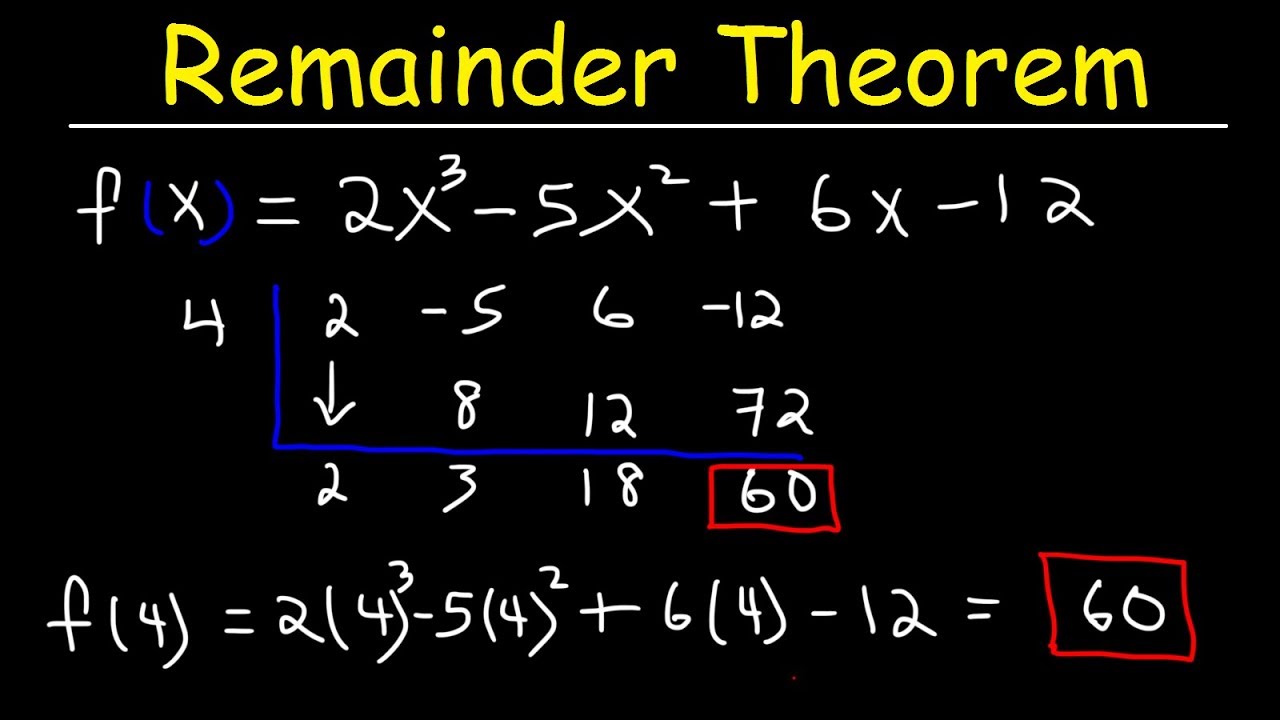
This precalculus video tutorial provides a basic introduction into the remainder theorem and how to apply it using the synthetic division of polynomials. It explains how to evaluate a function using synthetic division. The value of the function is equal to the remainder when f(x) is divided by a linear factor. This video contains plenty of ex...
solar crow
knotty crow
wait, u want to solve equation f(x) = 3 or what
no
high lily
hate having to repeat myself
look at what was written in the bottom line of that preview
knotty crow
f(3) doesn't equal to the original polynomial u need to plug x value in
high lily
again as I mentioned before, bad/wrong notation
solar crow
f(3) = 2(3)^3 - 5(3)^2 + 6(3) - 12
high lily
yes
solar crow
it says 60?
high lily
the WHOLE line
 high lily
focus on the part that isn't 60
solar crow
what about it
high lily
that's the correct notation
solar crow
ok
solar crow
ok
what do I divide f(3) = 2(3)^3 - 5(3)^2 + 6(3) - 12 by when solving it with long division?
high lily
poorly worded
solar crow
thank you
high lily
its all part of what remainder theorem states
f(a) gives the remainder when the polynomial f(x) is divided by (x-a)
solar crow
high lily
f(a) gives the remainder when the polynomial f(x) is divided by (x-a)
what is a?
obtuse pebbleBOT
Channel closed
Closed by @solar crow
Use .reopen if this was a mistake.
Available help channel!
Send your question here to claim the channel.
Remember:
• Ask your math question in a clear, concise manner.
• Show your work, and if possible, explain where you are stuck.
• After 15 minutes, feel free to ping <@&286206848099549185>.
• Type the command .close to free the channel when you're done.
• Be polite and have a nice day!
Read #❓how-to-get-help for further information on how to ask a good question, and about conduct in the question channels.
obtuse pebbleBOT
 fierce lagoon
Means what
It's messy
Doesn't work like that
sin is not a factor; it's a function
$$\sin\left(\frac{θ}{2}\right) = \sqrt{\frac{1-\cos(2θ)}{2}}$$
warm shaleBOT
Umbraleviathan
 fierce lagoon
$$2\sin\left(\frac{θ}{2}\right) ≠ \sin(θ)$$
warm shaleBOT
Umbraleviathan
 fierce lagoon
What if θ = 90°
So does 2sin(45) = sin(90)?
(It doesn't, but that's my point)
Here's a visual, the graphs are in radians

So you can't do what you did
So rsin(θ) ≠ 2b
obtuse pebbleBOT
Channel closed
Closed by @daring whale
Use .reopen if this was a mistake.
obtuse pebbleBOT
Available help channel!
Send your question here to claim the channel.
Remember:
• Ask your math question in a clear, concise manner.
• Show your work, and if possible, explain where you are stuck.
• After 15 minutes, feel free to ping <@&286206848099549185>.
• Type the command .close to free the channel when you're done.
• Be polite and have a nice day!
Read #❓how-to-get-help for further information on how to ask a good question, and about conduct in the question channels.
obtuse pebbleBOT
 royal yarrow
What’s 1 quadrillion divided by 78940
royal yarrow
What’s 1 quadrillion divided by 78940
 tardy epoch
royal yarrow
What’s 1 quadrillion divided by 78940
tardy epoch
royal yarrow
What’s 1 quadrillion divided by 78940
use a calculator
obtuse pebbleBOT
@royal yarrow Has your question been resolved?
obtuse pebbleBOT
Channel closed
Closed due to timeout
Use .reopen if this was a mistake.
Available help channel!
Send your question here to claim the channel.
Remember:
• Ask your math question in a clear, concise manner.
• Show your work, and if possible, explain where you are stuck.
• After 15 minutes, feel free to ping <@&286206848099549185>.
• Type the command .close to free the channel when you're done.
• Be polite and have a nice day!
Read #❓how-to-get-help for further information on how to ask a good question, and about conduct in the question channels.
timid silo
My algebra is failing: Im on part b and just cant do it
 obtuse pebbleBOT
timid silo
My algebra is failing: Im on part b and just cant do it
timid silo
obtuse pebbleBOT
timid silo
My algebra is failing: Im on part b and just cant do it
timid silo
i set this up on desmos and have been just staring at it

you can merge the two equations and get:

but idk how to solve
ok i feel like they just wanted us to use a graphing calculator

ty wolframalpha
.close
obtuse pebbleBOT
Channel closed
Closed by @astral night
Use .reopen if this was a mistake.
Available help channel!
Send your question here to claim the channel.
Remember:
• Ask your math question in a clear, concise manner.
• Show your work, and if possible, explain where you are stuck.
• After 15 minutes, feel free to ping <@&286206848099549185>.
• Type the command .close to free the channel when you're done.
• Be polite and have a nice day!
Read #❓how-to-get-help for further information on how to ask a good question, and about conduct in the question channels.
 white jasper
hello May I ask is orthogonal projection and projection are the same?
obtuse pebbleBOT
white jasper
hello May I ask is orthogonal projection and projection are the same?
fierce lagoon
Wdym orthogonal projection
white jasper
fierce lagoon
Wdym orthogonal projection
like this question

 royal shard
orthogonal projection is the basic standard projection you learn
warm shaleBOT

 Requested by Umbraleviathan#3607
white jasper
Requested by Umbraleviathan#3607
white jasper
the orthogonal projection supposed to be x-x_w but it seems that the answer for this question is just x_w which is only the projection
fierce lagoon
Yeah it's just regular projection it seems
white jasper
fierce lagoon
Yeah it's just regular projection it seems
but I can I define them?
I mean how can I know which is which?
fierce lagoon
Wdym define which is which
royal shard
when we say projection we mostly imply that we mean the orthogonal one
wait, ima draw you a lil diagram
fierce lagoon
$\text{proj}_b(a)$ is "the projection of a onto b", aka:
$$\text{proj}_b(a) = \frac{a\cdot b}{||b||^2} (b)$$
white jasper
white jasper
like this question
like this question ask for the orthogonal projection, but you know the it is just basic projection, how do you know taht?
warm shaleBOT
Umbraleviathan
 fierce lagoon
white jasper
like this question ask for the orthogonal projection, but you know the it is jus...
fierce lagoon
white jasper
like this question ask for the orthogonal projection, but you know the it is jus...
Because of the answer lol
fierce lagoon
warm shale
I look at what the bot did for normal projection
Looked at the answer
And was like "haha yup"
royal shard
here we project the blue onto the red but not orthogonal meaning not with a 90° angle

at least i think that is what it looks like geometrically
fierce lagoon
The projection creates a leg of a right triangle
The one that's projecting onto is gonna be the hypotenuse
And I guess the "orthogonal" comes from the fact that they make a right triangle but like dhducgifhfcyvyufrufuf
 white jasper
royal shard
here we project the blue onto the red but not orthogonal meaning not with a 90° ...
white jasper
royal shard
here we project the blue onto the red but not orthogonal meaning not with a 90° ...
because I think orthgonal means they are perpendicular
white jasper
 obsidian isle
this is a basic projection?
fierce lagoon
Yeah but I guess the right angle is where the "orthogonal" part comes from
white jasper
white jasper
like this question
but why this is orthogonal 😭
fierce lagoon
That's how projection is defined
It's derived from the Pythagorean theorem
And for some reason mathematicians were like "yeah we need this projection shit"
white jasper
fierce lagoon
It's derived from the Pythagorean theorem
because i dot the two vectors and it is not perpendicular
white jasper
fierce lagoon
And for some reason mathematicians were like "yeah we need this projection shit"
LOL
fierce lagoon
white jasper
because i dot the two vectors and it is not perpendicular
You don't dot a and proj_b(a)
white jasper
fierce lagoon
You don't dot a and proj_b(a)
no I dot a and b
fierce lagoon
You wouldn't
white jasper
wait nothing my mistakes
fierce lagoon
It's orthogonal because the projection is orthogonal to (a - projection)
fierce lagoon
obsidian isle
The dashed line up here is (a - projection)
white jasper
actually becuase I watched this youtube so I am so confused
 fierce lagoon
And when you dot that with the projection, it's 0
white jasper
fierce lagoon
And when you dot that with the projection, it's 0
for the x_w and x_w and the x_w perpendicular
fierce lagoon
Hm
Well I haven't learned linear algebra so the stuff I'm saying is based off vector calculus. Perhaps for linear alg it's slightly different
white jasper
fierce lagoon
Well I haven't learned linear algebra so the stuff I'm saying is based off vecto...
I see, I have been asking this question for a few days but no one can help me🥲
do you recognize someone knows this?
<@&286206848099549185>
fierce lagoon
A lotta people know it
But like
Idk help is hard to get now due to thanksgiving holidays and then the help here is 100% voluntary
Perhaps if I can google what Span is I'll figure it out some way or another lol
white jasper
ik🥲
fierce lagoon
Wikipedia gave me an intimidating definition for Span(S)
Yeah no I have a hard time understanding span
So it seems I've hit a dead end with my helpfulness
white jasper
no worries it's not your fault
obtuse pebbleBOT
@white jasper Has your question been resolved?
 raven spire
fierce lagoon
Wikipedia gave me an intimidating definition for Span(S)
raven spire
fierce lagoon
Wikipedia gave me an intimidating definition for Span(S)
span is like you have two vectors x and y, and now you can add ax + by to get any vectors you want
the collection of those vectors together is called the span
these two vectors given is called basis
the two vectors I'm talking here is given in your W = Span{x, y}
obtuse pebbleBOT
Channel closed
Closed due to timeout
Use .reopen if this was a mistake.
white jasper
.reopen
obtuse pebbleBOT
✅
white jasper
raven spire
the collection of those vectors together is called the span
do you know orthogonal projection?
raven spire
think of it as orthogonally throwing light at a vector orthogonal to the vector you wanna take projection on... the projection is the shadow
white jasper
raven spire
think of it as orthogonally throwing light at a vector orthogonal to the vector ...
I want to ask what is the different of orthogoanl projection and projection
raven spire
think about it, when you evaluate the "basic" projection, you draw a perpendicular to the first vector from the tip of the second vector
white jasper
raven spire
think about it, when you evaluate the "basic" projection, you draw a **perpendic...
ya
white jasper
raven spire
think about it, when you evaluate the "basic" projection, you draw a **perpendic...
I have this case that it's ask for the orthogoanl projection but I dont know why the answer is actually projection
 raven spire
that's the difference, suppose you were throwing light at it at some different angle, then 1) it will no longer be an orthogonal projection and 2) the angle with which you're throwing light at the second vector w.r.t. to the first vec. is the angle you'll be drawing the projection at >_< not 90° lol
btw here if you'd notice you have two lines 1) from origin pointing towards (2, -1, 2) and 2) a vector from origin with end at (7, 1, 4)
white jasper
raven spire
that's the difference, suppose you were throwing light at it at some different a...
Oh I see
raven spire
you have to drop a perpendicular from (7, 1, 4) to the line L at say D and evaluate OD which will be your projection
white jasper
so its this true?
 raven spire
ofc.. draw as I said and you'll get the feel yourself
white jasper
raven spire
ofc.. draw as I said and you'll get the feel yourself
OHHHHHH I understand finally 😭
thanks you sooooooooo much
.close
obtuse pebbleBOT
Channel closed
Closed by @white jasper
Use .reopen if this was a mistake.
obtuse pebbleBOT
Available help channel!
Send your question here to claim the channel.
Remember:
• Ask your math question in a clear, concise manner.
• Show your work, and if possible, explain where you are stuck.
• After 15 minutes, feel free to ping <@&286206848099549185>.
• Type the command .close to free the channel when you're done.
• Be polite and have a nice day!
Read #❓how-to-get-help for further information on how to ask a good question, and about conduct in the question channels.
obtuse pebbleBOT
tardy epoch
what is IFT
 hoary trench
here's the theorem
its quite hard to read though 😦
btw that is the beginning of the proof that I posted
for part a)
obtuse pebbleBOT
@hoary trench Has your question been resolved?
hoary trench
<@&286206848099549185>
tardy epoch
can you also show the full statement of what they're proving
tardy epoch
you can think of it as a function of one dimension
say g(y) = F(a, y)
Then the middle translates to $g(y)$ is strictly increasing. Since $g(b) = 0$, $g(b+r_1) > 0$ and $g(b-r_1)<0$
warm shaleBOT
riemann
 tardy epoch
Now fix $x$ and let $g_x(y) = F(x, y)$. So your question is why does there exist $r_0 \le r_1$ such that $g_x(b+r_1) > 0$ and $g_x(b-r_1)<0$ for $|x - a| < r_0$.
warm shaleBOT
riemann
 hoary trench
I see
warm shaleBOT

 Requested by riemann#2529
hoary trench
Requested by riemann#2529
hoary trench
ahh
tardy epoch
no matter how far you zoom into x around x=0, you still have x^3 < 0 for x < 0 and x^3 > 0 for x > 0
hoary trench
so we're like zooming in on a smaller neighbourhood
hoary trench
tardy epoch
no matter how far you zoom into x around x=0, you still have x^3 < 0 for x < 0 a...
right
and it has to be continuous for this to be true?
is it because if we zoom in on a point where the function breaks then
those conditions won't necessarily hold
tardy epoch
there could be counterexamples where continuity isn't required
but that just sounds like a pain to prove
hoary trench
Yeah true
So when we fix 'x' are we really only affecting the 'y' part?
which is why we defined g_x(y)
since its the only moving piece now
warm shaleBOT
riemann
 hoary trench
tardy epoch
$g_x(y)$ is just more friendly notation to highlight what's happening
hoary trench
tardy epoch
$g_x(y)$ is just more friendly notation to highlight what's happening
one last thing
how do we know that F(x, b)=0?
tardy epoch
hoary trench
how do we know that F(x, b)=0?
i don't think that's true in general. only at x=a
hoary trench
so how do we know exactly that g_x(b+r_1)>0? and g_x(b-r_1)<0?
if g_x(b) != 0
unless x=a
tardy epoch
hoary trench
so how do we know exactly that g_x(b+r_1)>0? and g_x(b-r_1)<0?
right. they glossed over that entirely.
tardy epoch
you can prove it using epsilon delta, but the idea is that g_a(y) and g_x(y) don't differ that much as functions of y for x in a delta-ball around a
something painful like this
https://math.stackexchange.com/a/815624

Mathematics Stack Exchange
On account of a SE question , I raised the following question.
Let $f:D \to \mathbb R^2$ be a function in two variables. How would we go about setting up an epsilon-delta proof?
Let $f$ for examp...
 hoary trench
tardy epoch
you can prove it using epsilon delta, but the idea is that g_a(y) and g_x(y) don...
hoary trench
tardy epoch
you can prove it using epsilon delta, but the idea is that g_a(y) and g_x(y) don...
the r_1 ball?
tardy epoch
yea either r1 or r0
hoary trench
yeah hmm
feels handwavy a bit
but i see the idea
since we zoom in quite a bit the points are so close together that we might as well assume g_x(y) approaches 0
so as a result g_x(y+r_1)>0 and g_x(y-r_1)<0
also,
someone had told me to refer to this theorem

but i dont think its related
okay
i think i get it
thank you so much!
.close
obtuse pebbleBOT
Channel closed
Closed by @hoary trench
Use .reopen if this was a mistake.
Available help channel!
Send your question here to claim the channel.
Remember:
• Ask your math question in a clear, concise manner.
• Show your work, and if possible, explain where you are stuck.
• After 15 minutes, feel free to ping <@&286206848099549185>.
• Type the command .close to free the channel when you're done.
• Be polite and have a nice day!
Read #❓how-to-get-help for further information on how to ask a good question, and about conduct in the question channels.
 abstract bear
Hello
obtuse pebbleBOT
abstract bear
Hello

 novel knoll
wdym? How would you continue?
abstract bear
Er... add 10x3 with 8x², and subtract 3x with 7...?
abstract bear
-4x?
novel knoll
lets try with x=2 and plug in shall we?
abstract bear
Okay, okay
 lucid oar
Hi
abstract bear
novel knoll
so clearly they are not equal
Wait, why are they not equal?
novel knoll
if they were equal they would be equal for all values of x
abstract bear
What part of that makes them not equal?
novel knoll
I just showed you they are not equal by picking x=2
lucid oar
R we finding values of x or what
 daring rock
abstract bear
What part of that makes them not equal?
daring rock
abstract bear
What part of that makes them not equal?
You said 3x-7 should equal -4x
But ScapeProf plugged in x=2
3x-7 for x=2 gives 3(2)-7 which equals -1
-4x for x=2 gives -4(2) which equals -8
-1 is not equal to -8
abstract bear
daring rock
You said 3x-7 should equal -4x
But ScapeProf plugged in x=2
3x-7 for x=2 gives...
Okay, give me a few minutes
abstract bear
daring rock
You said 3x-7 should equal -4x
But ScapeProf plugged in x=2
3x-7 for x=2 gives...
OOOOOOOOH
Okay, I get it
@novel knoll so why can't I continue with the 10x³ + 8x² + 3x - 7
abstract bear
daring rock
There aren't any like terms
10x³ can't be added with 8x2 because they're not like terms
Same goes foe 3x - 7, am I right?
daring rock
3x-7x is -4x
3x-7 is just 3x-7
abstract bear
Okay, I get the addition now
Onto subtraction
How?

How did the answer come to 1?
How do you calculate 3(-1)²?
Actually...
Maybe my equation is wrong
daring rock
abstract bear
Maybe my equation is wrong
All the work there is right
daring rock
abstract bear
How do you calculate 3(-1)²?
3 * (-1)^2
= 3 * 1
= 3
obtuse pebbleBOT
@abstract bear Has your question been resolved?
obtuse pebbleBOT
Channel closed
Closed due to timeout
Use .reopen if this was a mistake.
obtuse pebbleBOT
Available help channel!
Send your question here to claim the channel.
Remember:
• Ask your math question in a clear, concise manner.
• Show your work, and if possible, explain where you are stuck.
• After 15 minutes, feel free to ping <@&286206848099549185>.
• Type the command .close to free the channel when you're done.
• Be polite and have a nice day!
Read #❓how-to-get-help for further information on how to ask a good question, and about conduct in the question channels.
obtuse pebbleBOT
timid silo
Yep
obtuse pebbleBOT
Channel closed
Closed by @fluid snow
Use .reopen if this was a mistake.
Available help channel!
Send your question here to claim the channel.
Remember:
• Ask your math question in a clear, concise manner.
• Show your work, and if possible, explain where you are stuck.
• After 15 minutes, feel free to ping <@&286206848099549185>.
• Type the command .close to free the channel when you're done.
• Be polite and have a nice day!
Read #❓how-to-get-help for further information on how to ask a good question, and about conduct in the question channels.
 static patio
@royal basin I have tried to transform the CNF grammar.
static patio
my idea is to add $\epsilon$ to every rule
warm shaleBOT
Michal
 static patio
i think that this should ensure correct order of sequence and it gives us ability to skip some symbols
royal basin
i would not say every rule. just add N -> ε for every nonterminal N, or so i'd think.
static patio
royal basin
i would not say _every_ rule. just add N -> ε for every nonterminal N, or so i'd...
It could be like this. I will try it on more examples.
Thanks for idea.
Do you have any idea how to show this using PDA?
static patio
basically NFA with a stack, it is equivalent to context free grammars
never mind, i will try to think of something
.close
obtuse pebbleBOT
Channel closed
Closed by @static patio
Use .reopen if this was a mistake.
obtuse pebbleBOT
Available help channel!
Send your question here to claim the channel.
Remember:
• Ask your math question in a clear, concise manner.
• Show your work, and if possible, explain where you are stuck.
• After 15 minutes, feel free to ping <@&286206848099549185>.
• Type the command .close to free the channel when you're done.
• Be polite and have a nice day!
Read #❓how-to-get-help for further information on how to ask a good question, and about conduct in the question channels.
 scenic summit
-1,5³×a1=4
obtuse pebbleBOT
scenic summit
-1,5³×a1=4
 strange stump
comma?
 sage geode
strange stump
comma?
sage geode
strange stump
comma?
Seems to serve the purpose of a decimal point
sage geode
scenic summit
-1,5³×a1=4
What's the question?
scenic summit
what is a1
obtuse pebbleBOT
Channel closed
Closed by @scenic summit
Use .reopen if this was a mistake.
sage geode
4/(-1.5³) = -4/1.5³
obtuse pebbleBOT
Available help channel!
Send your question here to claim the channel.
Remember:
• Ask your math question in a clear, concise manner.
• Show your work, and if possible, explain where you are stuck.
• After 15 minutes, feel free to ping <@&286206848099549185>.
• Type the command .close to free the channel when you're done.
• Be polite and have a nice day!
Read #❓how-to-get-help for further information on how to ask a good question, and about conduct in the question channels.
 shell prairie
c
obtuse pebbleBOT
shell prairie
c
warm shaleBOT
dain
Compile Error! Click the  reaction for more information.
(You may edit your message to recompile.)
 shell prairie
<@&286206848099549185>
obtuse pebbleBOT
@shell prairie Has your question been resolved?
obtuse pebbleBOT
@shell prairie Has your question been resolved?
obtuse pebbleBOT
Channel closed
Closed due to timeout
Use .reopen if this was a mistake.
obtuse musk
 arctic oasis
help me pls, im too dumb
arctic oasis
help me pls, im too dumb
read #❓how-to-get-help on how to use the help channels.
obtuse pebbleBOT
Available help channel!
Send your question here to claim the channel.
Remember:
• Ask your math question in a clear, concise manner.
• Show your work, and if possible, explain where you are stuck.
• After 15 minutes, feel free to ping <@&286206848099549185>.
• Type the command .close to free the channel when you're done.
• Be polite and have a nice day!
Read #❓how-to-get-help for further information on how to ask a good question, and about conduct in the question channels.
 haughty onyx
Hello
obtuse pebbleBOT
haughty onyx
Hello


 old dagger
Cross multiplication
haughty onyx
It says hence
 last dove
soooo where are u stuck?
the part i looks fine
last dove
yep i mean u can apply the same way?
haughty onyx
But I need to use my answer in part i
Since the question said hence
But idk how to
last dove
i guess its just telling u to use a similar way to solve it
just like minus the term 1/x on both side
haughty onyx
No
Like
I need to use my part i answer
My teacher said whenever the question says hence, you need to use the answer from the previous part
last dove
hummmmm ok
timid silo
Replace with 1/x
yes
are u from Singapore?
looks like H2 math
Haha
🙂
hehe
which jc if u don’t mind
Bruh
Dm
obtuse pebbleBOT
@haughty onyx Has your question been resolved?
Channel closed
Closed by @haughty onyx
Use .reopen if this was a mistake.
Available help channel!
Send your question here to claim the channel.
Remember:
• Ask your math question in a clear, concise manner.
• Show your work, and if possible, explain where you are stuck.
• After 15 minutes, feel free to ping <@&286206848099549185>.
• Type the command .close to free the channel when you're done.
• Be polite and have a nice day!
Read #❓how-to-get-help for further information on how to ask a good question, and about conduct in the question channels.
 exotic ledge
how can sin6x be written in a simpler way
obtuse pebbleBOT
exotic ledge
how can sin6x be written in a simpler way
exotic ledge
in terms of sin and cos
i managed to go up to 2sin3xcos3x if that is correct
i'm searching to apply landau symbols for x goin to 0
but that's another question
sage geode
Rewrite sin(2x + x) and cos(2x + x) using identities
high lily
sin(6x) is pretty simple,
attempting to manipulate further gets you stuff that's a lot more complicated
exotic ledge
but how can i apply landau symbols so
high lily
landau?
 fossil crag
Yes
exotic ledge
are you sure?
fossil crag
Yes xd
exotic ledge
thanks so
fossil crag
It's composition
exotic ledge
by the way where are you studying?
i've seen very few uni use it so far
this kind of exercises
fossil crag
Um studying in a particular french curriculum
exotic ledge
uh ok
im on italy
but french guys i know here are all very prepared
in terms of algebra and calculus
fossil crag
Is your question about writing sin(6x) in terms of sin(x) and cos(x) or about using landau approximation ?
exotic ledge
landau
but i thought i couldn't do it in this form
so
in this case
cos(x+2)^2 it can be used too?
@fossil crag
fossil crag
exotic ledge
cos(x+2)^2 it can be used too?
You know the landau approximation for cos(x+2) when x approaches -2
But then when you square the cos, you have to square the whole approximation
exotic ledge
lol that s exactly my question
fossil crag
So let's say cos(x+2) = 1 - (x+2)²/2 + o((x+2)²)
exotic ledge
fossil crag
So let's say cos(x+2) = 1 - (x+2)²/2 + o((x+2)²)
i arrived in this conclusion too but in this case how can this be compared to the test function (x+2)^2 would we says that our function is the same order as (x+2)^2
fossil crag
fossil crag
So let's say cos(x+2) = 1 - (x+2)²/2 + o((x+2)²)
First you look for cos², so you square both sides :
cos²(x+2) = (1 - (x+2)²/2 + o(...))²
cos²(x+2) = 1 - (x+2)² + o((x+2)²) because the terms in (x+2)⁴ are negligible
exotic ledge
but why
fossil crag
fossil crag
First you look for cos², so you square both sides :
cos²(x+2) = (1 - (x+2)²/2 + ...
See what I did there, I squared both sides
exotic ledge
i don't really get it
but actually i think it doesn't matter that much in my case
since i need to compare it to (x+2)^2
fossil crag
A factor of 2 really matters
exotic ledge
which leads to alpha =1
jsut to clarify my function is f(x) = cos(x+2)^2 -1
as x=>-1
fossil crag
Suppose you have f(x) = g(x) + o(x)
Then f(x)² = (g(x) + o(x))²
fossil crag
So when you develop, you got f(x)² = g(x)² + 2g(x)o(x) + o(x)²
fossil crag
fossil crag
First you look for cos², so you square both sides :
cos²(x+2) = (1 - (x+2)²/2 + ...
It's just what I did there + regrouped terms negligible
 exotic ledge
i just don't understand where 1/2 went
fossil crag
 grizzled drum
#❓how-to-get-help this channel is occupied pal
exotic ledge
grizzled drum
you need to find an open channel
fossil crag
exotic ledge
i just don't understand where 1/2 went
Let's expand (1 - (x+2)²/2 + o((x+2)²))² together
So, using binomial, this becomes (1-(x+2)²/2)² + 2×(1-(x+2)²/2)o((x+2)²) + o((x+2)²)²
The two last terms are both o((x+2)²) so we disregard them
So we're left with (1-(x+2)²/2)² + o((x+2)²)
Develop the binomial again :
1 - 2×(x+2)²/2 + (x+2)⁴/4 + o(...)
Since (x+2)⁴ is o((x+2)²)
We're left with 1 - (x+2)² + o((x+2)²)
obtuse pebbleBOT
Channel closed
Closed by @exotic ledge
Use .reopen if this was a mistake.
obtuse pebbleBOT
Available help channel!
Send your question here to claim the channel.
Remember:
• Ask your math question in a clear, concise manner.
• Show your work, and if possible, explain where you are stuck.
• After 15 minutes, feel free to ping <@&286206848099549185>.
• Type the command .close to free the channel when you're done.
• Be polite and have a nice day!
Read #❓how-to-get-help for further information on how to ask a good question, and about conduct in the question channels.
 pure heath
Can someone please help me with solving number 3
obtuse pebbleBOT
pure heath
Can someone please help me with solving number 3
 obtuse pebbleBOT
@pure heath Has your question been resolved?
obtuse pebbleBOT
@pure heath Has your question been resolved?
obtuse pebbleBOT
@pure heath Has your question been resolved?
pure heath
<@&286206848099549185>
obtuse pebbleBOT
@pure heath Has your question been resolved?
obtuse pebbleBOT
Channel closed
Closed due to timeout
Use .reopen if this was a mistake.
obtuse pebbleBOT
Available help channel!
Send your question here to claim the channel.
Remember:
• Ask your math question in a clear, concise manner.
• Show your work, and if possible, explain where you are stuck.
• After 15 minutes, feel free to ping <@&286206848099549185>.
• Type the command .close to free the channel when you're done.
• Be polite and have a nice day!
Read #❓how-to-get-help for further information on how to ask a good question, and about conduct in the question channels.
 honest fulcrum
What conditions must a matrix meet so that it only has one eigenvector?
obtuse pebbleBOT
honest fulcrum
What conditions must a matrix meet so that it only has one eigenvector?
 twin sapphire
strictly speaking
you either have 0 eigen vector or an infinity
but if you talk about only one line of eigen vectors
honest fulcrum
yes, i mean a singe vector as a basis
honest fulcrum
twin sapphire
but if you talk about only one line of eigen vectors
I mean this
 kind hawk
twin sapphire
you either have 0 eigen vector or an infinity
kind hawk
twin sapphire
you either have 0 eigen vector or an infinity
well depends on the base field
completely possible to have only one eigenvector over F_2
twin sapphire
complex or real valued matrices?
honest fulcrum
kind hawk
completely possible to have only one eigenvector over F_2
Of R2
twin sapphire
kind hawk
completely possible to have only one eigenvector over F_2
yeah lol
honest fulcrum
Supose R2, what conditions does the matrix need so that it only has one eigenvector?
kind hawk
what kind of conditions are you looking for
I think you need minimal poly = char poly
obviously also only one eigenvalue, so char poly has form (x-lambda)^2
honest fulcrum
kind hawk
what kind of conditions are you looking for
The exercise is Find all matrices 2x2 A ∈ R2 such that vector (1,2) is the only eigenvector of e.value 5
and i don't know how to "impose" the condition of having only 1 eigenvector
kind hawk
well stated like this there is no matrix
cause clearly (2,4) will also be an eigenvector
honest fulcrum
without considering scalar multiples of (1,2)
kind hawk
nothing in that statement says to do that
but well ok, the matrix needs to have the char poly (x-5)^2
for overkill you could probably do jordan normal form
otherwise set A=(a,b;c,d) and then solve the system (A-5I) (1,2) = 0 for the coefficients of A
kind hawk
depends. what do you think D is
honest fulcrum
Scalar matrix with e.values
kind hawk
what is a scalar matrix supposed to be
honest fulcrum
 kind hawk
if A was diagonalizable then it would have a basis consisting of eigenvectors
honest fulcrum
Where each of the landas are e.values
twin sapphire
excuse me if i'm wrong but in dimension 2
couldnt we just say the matrix should be equivalent to a triangular matrix with 5 5 on the diagonal and a non 0 value on the top right
kind hawk
although I guess you don't actually need JNF to justify it here cause it's only dimension 2
kind hawk
kind hawk
obviously also only one eigenvalue, so char poly has form (x-lambda)^2
just this
twin sapphire
yeah
honest fulcrum
twin sapphire
couldnt we just say the matrix should be equivalent to a triangular matrix with ...
could you explain this?
i mean, why would it work?
obtuse pebbleBOT
@honest fulcrum Has your question been resolved?
kind hawk
Let v1=(1,2) and extend this to a basis (v1, v2)
Then write A with respect to that basis
Using that v2 is not an eigenvector and the char poly is what I said earlier, this form follows
twin sapphire
since your matrix has one eigenvector at least
and you are in R2
you can trigonalize it
now for the other value on the diagonal
it must be also 5
since if not that would mean you have 2 different eigenvalues
and thus 2 different eigenvectors
and also the vector space associated to 5 shouldnt be of dimension 2 so the top right value is non 0
obtuse pebbleBOT
@honest fulcrum Has your question been resolved?
obtuse pebbleBOT
Channel closed
Closed due to timeout
Use .reopen if this was a mistake.
Available help channel!
Send your question here to claim the channel.
Remember:
• Ask your math question in a clear, concise manner.
• Show your work, and if possible, explain where you are stuck.
• After 15 minutes, feel free to ping <@&286206848099549185>.
• Type the command .close to free the channel when you're done.
• Be polite and have a nice day!
Read #❓how-to-get-help for further information on how to ask a good question, and about conduct in the question channels.
 glacial widget
Does anyone know how to solve for the amount of quarters, dimes, and nickels? I'm a bit confused on this.
 obtuse pebbleBOT
glacial widget
Does anyone know how to solve for the amount of quarters, dimes, and nickels? I'...
obtuse pebbleBOT
glacial widget
Does anyone know how to solve for the amount of quarters, dimes, and nickels? I'...
 tranquil quiver
glacial widget
Does anyone know how to solve for the amount of quarters, dimes, and nickels? I'...
tranquil quiver
glacial widget
Does anyone know how to solve for the amount of quarters, dimes, and nickels? I'...
first set up equations to represent the given information
glacial widget
alright
tranquil quiver
You can use variables, n, d,q respectively to represent the AMOUNT of coins
glacial widget
okk
tranquil quiver
keep in mind these are the amount of coins when you set up the equation for the total amount of money
tranquil quiver
send them
glacial widget
i can't im on pc sorry 😦
but i got the answer, and i got it right
sooo
thanks for helping me with this 🙂
.close
obtuse pebbleBOT
Channel closed
Closed by @glacial widget
Use .reopen if this was a mistake.
Available help channel!
Send your question here to claim the channel.
Remember:
• Ask your math question in a clear, concise manner.
• Show your work, and if possible, explain where you are stuck.
• After 15 minutes, feel free to ping <@&286206848099549185>.
• Type the command .close to free the channel when you're done.
• Be polite and have a nice day!
Read #❓how-to-get-help for further information on how to ask a good question, and about conduct in the question channels.
 drifting kernel
 obtuse pebbleBOT
drifting kernel
drifting kernel
obtuse pebbleBOT
drifting kernel
drifting kernel
,help
warm shaleBOT
A brief description and guide on how to use me was sent to your DMs!
Please use ,list to see a list of all my commands, and ,help cmd to get detailed help on a command!

 drifting kernel
Id start solving the 2nd equation by
warm shaleBOT
Hadrow
 drifting kernel
But from there on im lost
I dont know how to continue to get the equation
<@&286206848099549185>
obtuse pebbleBOT
@drifting kernel Has your question been resolved?
 mint tendon
i by no means have solved it but i think i've come up with something


 drifting kernel
Interesting
warm shaleBOT
 drifting kernel
The answers are alpha=2 beta=2 btw
mint tendon
isnt alpha a vector
mint tendon
._.
drifting kernel
misrepresentation
drifting kernel
Yeah these are hard
I thought I could go through them in a day
but I keep getting stuck
warm shaleBOT
Hadrow
 drifting kernel
@mint tendon still with me?
@spiral knot you helped me before if you are free can you help now?
drifting kernel
warm shale
**Hadrow**
this da problem
spiral knot
$\overrightarrow{a}$ and $\overrightarrow{b}$ are colinear means that:
$\overrightarrow{c} = K(\overrightarrow{a}+\overrightarrow{b}) $
drifting kernel
Yes
warm shaleBOT
Mehdi_Moulati
 spiral knot
i just give you the expression of vector c
spiral knot
try to multiply this expression by a and by b to find the value of K
drifting kernel
c is collinear with a + b
a and b are not collinear
Then you must decompose c using a and b
spiral knot
if x and y are collinear then
x = alpha y where alpha is a number
x in this situation is c
and y is a+b
drifting kernel
ah
spiral knot
so c = K(a+b)