#help-10
1 messages · Page 66 of 1
 weary canopy
 agile grove
help
weary canopy
But then again, you can have lim(An - Bn) = lim(An) - lim(Bn), right?
<@&286206848099549185>
 royal glacier
weary canopy
Oh wait, it's 2 at the top, not 0.
royal glacier
weary canopy
Oh wait, it's 2 at the top, not 0.
m approaches infty?
weary canopy
Yeah.
weary canopy
Awesome, thanks dude. Just wanted to check.
royal glacier
weary canopy
Awesome, thanks dude. Just wanted to check.
Write down the arrows though
$m \to \infty$
 warm shaleBOT
5lttrz
 weary canopy
In my country, it is standardized to write it like this. But sure, I have to get in the habit of writing it.
royal glacier
Ah
 obtuse pebbleBOT
@weary canopy Has your question been resolved?
obtuse pebbleBOT
Channel closed
Closed due to timeout
Use .reopen if this was a mistake.
 Available help channel!
Send your question here to claim the channel.
Remember:
• Ask your math question in a clear, concise manner.
• Show your work, and if possible, explain where you are stuck.
• After 15 minutes, feel free to ping <@&286206848099549185>.
• Type the command .close to free the channel when you're done.
• Be polite and have a nice day!
Read #❓how-to-get-help for further information on how to ask a good question, and about conduct in the question channels.
 grizzled crystal
Hi I need help with this u substitution
obtuse pebbleBOT
grizzled crystal
Hi I need help with this u substitution
grizzled crystal

 royal basin
you are instructed to calculate the integral $\int_0^{24} \paren{1 + \paren{\frac{-17x+204}{200}}^2} \dd{x}$ specifically using the substitution $u := \frac{-17x+204}{200}$?
warm shaleBOT
Ann

 floral canopy
royal basin
you are instructed to calculate the integral $\int_0^{24} \paren{1 + \paren{\fra...
floral canopy
royal basin
you are instructed to calculate the integral $\int_0^{24} \paren{1 + \paren{\fra...
Just a question how did you get this text
like its white
royal basin
,tex --color grey or something to that effect. it's a config thing.
floral canopy
tysm
grizzled crystal
warm shale
**Ann**
oh mb
i forgot to ad the root
1+u^2 should be square rooted
its less an instruction and more me modelling. im doing this to allow hyperbolic substituitionand avoid integration by parts
floral canopy
grizzled crystal
its less an instruction and more me modelling. im doing this to allow hyperbolic...
you could just integrate this normally but sure
grizzled crystal
floral canopy
you could just integrate this normally but sure
not with the square root
 floral canopy
grizzled crystal
not with the square root
floral canopy
grizzled crystal
not with the square root
👍
grizzled crystal
200 on the bottom if its illegilble mb
obtuse pebbleBOT
@grizzled crystal Has your question been resolved?
grizzled crystal
Hello bumping this
I don't need a solution to the integral, just how to substitute u
And does that affect the bounds
obtuse pebbleBOT
@grizzled crystal Has your question been resolved?
 astral mantle
 obtuse pebbleBOT
@grizzled crystal Has your question been resolved?
obtuse pebbleBOT
Channel closed
Closed due to timeout
Use .reopen if this was a mistake.
Available help channel!
Send your question here to claim the channel.
Remember:
• Ask your math question in a clear, concise manner.
• Show your work, and if possible, explain where you are stuck.
• After 15 minutes, feel free to ping <@&286206848099549185>.
• Type the command .close to free the channel when you're done.
• Be polite and have a nice day!
Read #❓how-to-get-help for further information on how to ask a good question, and about conduct in the question channels.
 real fern
could someone explain to me how i could find m here?
 obtuse pebbleBOT
real fern
could someone explain to me how i could find m here?
real fern
obtuse pebbleBOT
real fern
could someone explain to me how i could find m here?
real fern
tried to solve it as u1 = 150 = 100x1 + 50 but it wouldnt work with u6 which is 600
 earnest elk
It’s an arithmetic progression
real fern
earnest elk
It’s an arithmetic progression
isnt that Un = u1 + (n-1)d?
or is there another equation im missing
or could i rephrase it as d(n-1) + u1
nvm i found it out
both m and n
how do i close the channel?
.close
obtuse pebbleBOT
Channel closed
Closed by @real fern
Use .reopen if this was a mistake.
Available help channel!
Send your question here to claim the channel.
Remember:
• Ask your math question in a clear, concise manner.
• Show your work, and if possible, explain where you are stuck.
• After 15 minutes, feel free to ping <@&286206848099549185>.
• Type the command .close to free the channel when you're done.
• Be polite and have a nice day!
Read #❓how-to-get-help for further information on how to ask a good question, and about conduct in the question channels.
 last sparrow
 obtuse pebbleBOT
last sparrow
last sparrow
obtuse pebbleBOT
last sparrow
last sparrow
I am here to ask if lim will be 3/5
 devout sable
,w lim as x tends to infinity ((3^x+2^x)/(5^x+4^x))^(1/x)
warm shaleBOT


 Requested by deep.#7373
devout sable
Requested by deep.#7373
devout sable
yes
obtuse pebbleBOT
Channel closed
Closed by @last sparrow
Use .reopen if this was a mistake.
Available help channel!
Send your question here to claim the channel.
Remember:
• Ask your math question in a clear, concise manner.
• Show your work, and if possible, explain where you are stuck.
• After 15 minutes, feel free to ping <@&286206848099549185>.
• Type the command .close to free the channel when you're done.
• Be polite and have a nice day!
Read #❓how-to-get-help for further information on how to ask a good question, and about conduct in the question channels.
 golden lynx
hi
obtuse pebbleBOT
golden lynx
hi
earnest elk
Do you have a question to ask?
golden lynx
yes
earnest elk
golden lynx
hello
Hi btw
golden lynx
what is x3+y3+z3=k
devout sable
golden lynx
what is x3+y3+z3=k
an equation?
golden lynx
whats the anwser
devout sable
there is no question to answer
obtuse pebbleBOT
Channel closed
Closed by @golden lynx
Use .reopen if this was a mistake.
obtuse pebbleBOT
Available help channel!
Send your question here to claim the channel.
Remember:
• Ask your math question in a clear, concise manner.
• Show your work, and if possible, explain where you are stuck.
• After 15 minutes, feel free to ping <@&286206848099549185>.
• Type the command .close to free the channel when you're done.
• Be polite and have a nice day!
Read #❓how-to-get-help for further information on how to ask a good question, and about conduct in the question channels.
 warm wadi
how would I work this out
 obtuse pebbleBOT
warm wadi
how would I work this out
warm wadi
obtuse pebbleBOT
warm wadi
how would I work this out
warm wadi
i know the answer but idk how to get to it
 sage geode
Let's say the equation of the line is y = ax + b
The line passes through the points (p, 3), (p + 2, 5) and (1, 2)
So the next equations are true:
3 = ap + b
5 = a(p + 2) + b
2 = a + b
warm wadi
ye
sage geode
So just solve the system of equations
warm wadi
so would I rearrange 2 = a + b and put them into one of the ones above?
sage geode
Yeah I'd do that
obtuse pebbleBOT
Channel closed
Closed by @warm wadi
Use .reopen if this was a mistake.
Available help channel!
Send your question here to claim the channel.
Remember:
• Ask your math question in a clear, concise manner.
• Show your work, and if possible, explain where you are stuck.
• After 15 minutes, feel free to ping <@&286206848099549185>.
• Type the command .close to free the channel when you're done.
• Be polite and have a nice day!
Read #❓how-to-get-help for further information on how to ask a good question, and about conduct in the question channels.
 timid silo
hi again
obtuse pebbleBOT
timid silo
hi again
timid silo
could someone explain wtf is happening here? 😩

isnt |F(w)| just sqrt(a^2 + b^2)
im confused about that step
timid silo
timid silo
isnt |F(w)| just sqrt(a^2 + b^2)
i mean since its a complex i first need to find the real and imaginary part, then do sqrt(a^2 + b^2)
then find the argument of the complex number
and then the relation is F(w) == |F(w)| * e^(i<F(w))
or am I wrong I dont even know
nvm
/close
.close
obtuse pebbleBOT
Channel closed
Closed by @willow trout
Use .reopen if this was a mistake.
Available help channel!
Send your question here to claim the channel.
Remember:
• Ask your math question in a clear, concise manner.
• Show your work, and if possible, explain where you are stuck.
• After 15 minutes, feel free to ping <@&286206848099549185>.
• Type the command .close to free the channel when you're done.
• Be polite and have a nice day!
Read #❓how-to-get-help for further information on how to ask a good question, and about conduct in the question channels.
Channel closed
Closed by @kindred ermine
Use .reopen if this was a mistake.
✅
 rigid fog
Zeros
obtuse pebbleBOT
Channel closed
Closed by @kindred ermine
Use .reopen if this was a mistake.
✅
Channel closed
Closed by @kindred ermine
Use .reopen if this was a mistake.
✅
timid silo
really tho the answer is right there
obtuse pebbleBOT
Please only use the <@&286206848099549185> ping once if your question has not been answered for 15 minutes. Please do not ping or DM individual users about your question.
Channel closed
Closed by @kindred ermine
Use .reopen if this was a mistake.
timid silo
<@&268886789983436800> spammed + said the n word
 hot hazel
dealt with ty
 drifting badger
Weirdo
obtuse pebbleBOT
Available help channel!
Send your question here to claim the channel.
Remember:
• Ask your math question in a clear, concise manner.
• Show your work, and if possible, explain where you are stuck.
• After 15 minutes, feel free to ping <@&286206848099549185>.
• Type the command .close to free the channel when you're done.
• Be polite and have a nice day!
Read #❓how-to-get-help for further information on how to ask a good question, and about conduct in the question channels.
timid silo
How can I approach this?
 obtuse pebbleBOT
timid silo
How can I approach this?
obtuse pebbleBOT
timid silo
How can I approach this?
 drifting wraith
woah
 slim leaf
Maybe theres a pattern? Start from the bottom
 stark ether
drifting wraith
stark ether
drifting wraith
yeah i think you're supposed to solve it normally
 oak bear
timid silo
How can I approach this?
oak bear
timid silo
How can I approach this?
Start from the bottom
it owuld be 7/6
Then the next one will be 8/7
That's the pattern
drifting wraith
why 8/7
oak bear
1+1/7
Wait there's a 4
But that's basically it
Multiply the previous denominator with the whole number, then add 1
 warm canopy
Why are you doing 1 + 1/7?
oak bear
warm canopy
Why are you doing 1 + 1/7?
I mean I started first at the very bottom
1+1/6 = 7/6
at the top of 7 is another 1+1/previous numerator
warm canopy
Yeah so it's 1 + 6/7
oak bear
Wait you got the opposite
I mean, just leave the previous denominator
I'm trying to pick up a pattern
drifting wraith
i bet there's no pattern
warm canopy
The pattern being adding fractions incorrectly?
oak bear
Like all the way to the top, it would be 145/72/71/35/34/33/8/7/6
It just something I thought of
drifting wraith
it's just a test if you know fractions or you're like ↑
oak bear
Maybe lets try to check if it's correct or something
timid silo
Wouldn't it be, for the 2nd one starting at the bottom 1/1+7/6 (the result of the bottom one) and the result would be 13/7?
warm canopy
timid silo
Wouldn't it be, for the 2nd one starting at the bottom 1/1+7/6 (the result of th...
Yes
drifting wraith
I get 1133/465 but my mental arithmetics is a coinflip
oak bear
I mean what I did first is 7/6 at the bottom right?
I just ignored the 6 first and try to find the value of numerator
which is 1+1/7
Then I thought to myself that 1 + 1/7 is just the same earlier with 1+ 1/6
And 1 + 1/7 = 8/7
So Boom, it just clicked through my brain
warm canopy
No one has a clue what you're doing
warm canopy
drifting wraith
I get 1133/465 but my mental arithmetics is a coinflip
Wolfie says 1264
(If I understand how inputting continued fractions into wolfie works)
timid silo
I did it all and the final result was 1264/465
drifting wraith
👍
obtuse pebbleBOT
Channel closed
Closed by @elfin hill
Use .reopen if this was a mistake.
Available help channel!
Send your question here to claim the channel.
Remember:
• Ask your math question in a clear, concise manner.
• Show your work, and if possible, explain where you are stuck.
• After 15 minutes, feel free to ping <@&286206848099549185>.
• Type the command .close to free the channel when you're done.
• Be polite and have a nice day!
Read #❓how-to-get-help for further information on how to ask a good question, and about conduct in the question channels.
 lament orbit
 obtuse pebbleBOT
lament orbit
lament orbit
obtuse pebbleBOT
lament orbit
lament orbit
can someone help me fill out this diagram
because i don’t think I did this correctly and I don’t know what would be the percentage for the outside would be

Would it be like this?
okay then what would it be like
 pure cobalt
its ok
lament orbit
im confused
pure cobalt
about what?
lament orbit
.close
obtuse pebbleBOT
Channel closed
Closed by @lament orbit
Use .reopen if this was a mistake.
Available help channel!
Send your question here to claim the channel.
Remember:
• Ask your math question in a clear, concise manner.
• Show your work, and if possible, explain where you are stuck.
• After 15 minutes, feel free to ping <@&286206848099549185>.
• Type the command .close to free the channel when you're done.
• Be polite and have a nice day!
Read #❓how-to-get-help for further information on how to ask a good question, and about conduct in the question channels.
 vague tundra
I need help with the following discrete mathematics question… we are talking about proofs… Prove or disprove: If a and b are real numbers, then |a| + |b| ≤ |a + b|
obtuse pebbleBOT
vague tundra
I need help with the following discrete mathematics question… we are talking abo...
royal basin
do you think this statement is true or false?
 misty field
I need to find the exact value of this, anyone can tell me how?
 royal basin
@misty field please open your own channel. read #❓how-to-get-help
royal basin
yes you do?
pick a channel in the "Math help (AVAILABLE) category" and just post there.
obtuse pebbleBOT
@vague tundra Has your question been resolved?
royal basin
do the words "triangle inequality" ring any bells to you
vague tundra
No 😦
royal basin
ok well then it's probably impossible to say much else w/o just giving the whole thing away
but try replacing x and y with some simple values
see whether the inequality you get is ever false
vague tundra
Okay, I’ll try and watch some YouTube videos 😦 it’s not making much sense now
obtuse pebbleBOT
Channel closed
Closed due to timeout
Use .reopen if this was a mistake.
Available help channel!
Send your question here to claim the channel.
Remember:
• Ask your math question in a clear, concise manner.
• Show your work, and if possible, explain where you are stuck.
• After 15 minutes, feel free to ping <@&286206848099549185>.
• Type the command .close to free the channel when you're done.
• Be polite and have a nice day!
Read #❓how-to-get-help for further information on how to ask a good question, and about conduct in the question channels.
 dreamy gale
 obtuse pebbleBOT
dreamy gale
obtuse pebbleBOT
dreamy gale
 barren solstice
do I ask for help here
dreamy gale
 dreamy gale
barren solstice
do I ask for help here
dreamy gale
barren solstice
do I ask for help here
go to an open channel
barren solstice
alright
dreamy gale
sorry but this one is occupied
dreamy gale
I don't quite understand the second part of the question (b)
why does N have to be positive?
 clever vigil
Of the solution?
dreamy gale
I'm assuming it's because it has to do with the limit n -> infinity
dreamy gale
clever vigil
Of the solution?
sorry, internet went out for a sec
yeah
|k - k| < epsilon doesn't really give us any info on N like it did in (a) I guess so I don't really get it
are we assuming the sequence starts from zero?
oh i think i get it
clever vigil
I think that as |k-k| doesnt depend of n so it doesnt depend of N so whatever the sign of N is
U do ?
dreamy gale
yes I think so, basically
k will be at L no matter what, the distance will be zero (0 < epsilon) so if we choose any positive N as n approaches infinity, it'll be at L which is k regardless
warm canopy
Your definition of limit should really say N>0
Because n>0 by definition
I.e. there is no a_{-1} etc
obtuse pebbleBOT
Channel closed
Closed by @dreamy gale
Use .reopen if this was a mistake.
Available help channel!
Send your question here to claim the channel.
Remember:
• Ask your math question in a clear, concise manner.
• Show your work, and if possible, explain where you are stuck.
• After 15 minutes, feel free to ping <@&286206848099549185>.
• Type the command .close to free the channel when you're done.
• Be polite and have a nice day!
Read #❓how-to-get-help for further information on how to ask a good question, and about conduct in the question channels.
 tired tiger
 obtuse pebbleBOT
tired tiger
obtuse pebbleBOT
tired tiger
 obtuse pebbleBOT
@tired tiger Has your question been resolved?
 sudden wadi
the error is coming from sin^-1(3)
as sin can never have a value above 1 or less than -1
same with cos
as for the last line im not sure as i typed the same thing in my calculator and it works
obtuse pebbleBOT
Channel closed
Closed due to timeout
Use .reopen if this was a mistake.
Available help channel!
Send your question here to claim the channel.
Remember:
• Ask your math question in a clear, concise manner.
• Show your work, and if possible, explain where you are stuck.
• After 15 minutes, feel free to ping <@&286206848099549185>.
• Type the command .close to free the channel when you're done.
• Be polite and have a nice day!
Read #❓how-to-get-help for further information on how to ask a good question, and about conduct in the question channels.
 torpid egret
can someone help me form this to x?
 obtuse pebbleBOT
torpid egret
can someone help me form this to x?
drifting badger
torpid egret
can someone help me form this to x?
obtuse pebbleBOT
torpid egret
can someone help me form this to x?
drifting badger
torpid egret
can someone help me form this to x?
A good place to start would be to multiply the denominator on both sides
Of the biggest fraction
drifting badger
Yes
 drifting badger
Not before you get rid of the 2
drifting badger
torpid egret
so its 1 = 2 + 1/1-1/x
If you multiply 1 - 1/x onto this, you have to distribute it into both terms on the right-hand-side
Which will only complicate things
 drifting badger
If you multiply 1 - 1/x onto this, you have to distribute it into both terms on ...
drifting badger
drifting badger
If you multiply 1 - 1/x onto this, you have to distribute it into both terms on ...
^
drifting badger
$(2 + \frac{1}{1-\frac{1}{x}})\cdot (1-\frac{1}{x}) \neq 2 + 1$
warm shaleBOT
Mikkel
 drifting badger
$(2 + \frac{1}{1-\frac{1}{x}})\cdot (1-\frac{1}{x}) = 2\cdot (1-\frac{1}{x}) + 1$
warm shaleBOT
Mikkel
 drifting badger
warm shale
**Mikkel**
drifting badger
warm shale
**Mikkel**
You have to get rid of the 2, to avoid this
obtuse pebbleBOT
@torpid egret Has your question been resolved?
Channel closed
Closed by @torpid egret
Use .reopen if this was a mistake.
Available help channel!
Send your question here to claim the channel.
Remember:
• Ask your math question in a clear, concise manner.
• Show your work, and if possible, explain where you are stuck.
• After 15 minutes, feel free to ping <@&286206848099549185>.
• Type the command .close to free the channel when you're done.
• Be polite and have a nice day!
Read #❓how-to-get-help for further information on how to ask a good question, and about conduct in the question channels.
timid silo
hello
obtuse pebbleBOT
timid silo
hello
timid silo
Let $a, b$ et $c$ be real numbers such that:
$$
|a-b| \geq|c|,|b-c| \geq|a| \text { et }|c-a| \geq|b| \text {. }
$$
Show that one of the three numbers a, b or $\mathrm{c}$ is the sum of the other two.
warm shaleBOT
Ame-kun

 gray hamlet
do u need help
timid silo
gray hamlet
do u need help
yeah
gray hamlet
me too
 nocturne token
nah they opened the channel because they felt like it
Crazy that you did the same
timid silo
gray hamlet
me too
lol
timid silo
nocturne token
nah they opened the channel because they felt like it
Crazy that you did the sam...
can you help
nocturne token
Nah sorry
timid silo
np
warm canopy
Assume c<=b<=a for a start to get rid of some absolute values
obtuse pebbleBOT
@timid silo Has your question been resolved?
obtuse pebbleBOT
Channel closed
Closed due to timeout
Use .reopen if this was a mistake.
Available help channel!
Send your question here to claim the channel.
Remember:
• Ask your math question in a clear, concise manner.
• Show your work, and if possible, explain where you are stuck.
• After 15 minutes, feel free to ping <@&286206848099549185>.
• Type the command .close to free the channel when you're done.
• Be polite and have a nice day!
Read #❓how-to-get-help for further information on how to ask a good question, and about conduct in the question channels.
timid silo
integral of 1 to 5 + integral of 5 to 3 is integral of 1 to 3
true or false
obtuse pebbleBOT
timid silo
integral of 1 to 5 + integral of 5 to 3 is integral of 1 to 3
true or false
Please don't occupy multiple help channels.
nocturne token
Might be
 obtuse pebbleBOT
@timid silo Has your question been resolved?
 acoustic pawn
This might help
 obtuse pebbleBOT
Channel closed
Closed due to timeout
Use .reopen if this was a mistake.
Available help channel!
Send your question here to claim the channel.
Remember:
• Ask your math question in a clear, concise manner.
• Show your work, and if possible, explain where you are stuck.
• After 15 minutes, feel free to ping <@&286206848099549185>.
• Type the command .close to free the channel when you're done.
• Be polite and have a nice day!
Read #❓how-to-get-help for further information on how to ask a good question, and about conduct in the question channels.
 vague narwhal
When you're calculating limits, what do you do with square roots? I've tried shifting it to fraction form. But that doesn't give me anything good.
I can't find any good examples online of
obtuse pebbleBOT
vague narwhal
When you're calculating limits, what do you do with square roots? I've tried shi...
vague narwhal
https://i.imgur.com/gHfsZ42.png
I don't want the answer, I just want to know what step I'm missing on what I'm supposed to do with the square roots here. Plugging in 0 gives me zilch. Is this something you factor?
Not sure you convert it to (1+t)^1/2 - (1-t)^1/2 bc that doesn'tgive me much since plugging in, then, gives me /0 as well
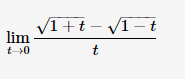
 wispy wadi
multiply by sqrt(1+t)+sqrt(1-t) on both numerator and denominator
vague narwhal
ah
I'll have to look at my notes and book for that method, or I'll try to find that on khan academy or similar.
wispy wadi
I'm not a native English speaker, it should be called multiplication by conjugate or something like that
you have this thing that talks about it
vague narwhal
thanks
Same method for this one? I tried it and think I messed up in my steps, but not sure:
https://i.imgur.com/7EHKx2M.png
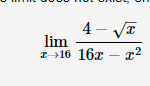
[4-sqrt(x)]*[4-sqrt(x)] ?
 drifting merlin
Multiply the expression with $\frac{4+\sqrt{x}}{4+\sqrt{x}}$
warm shaleBOT
bluepianist
 vague narwhal
Why does it become positive again? Doesn't that just give a 0?
drifting merlin
In limit problems you want things to cancel. Multiplying your expression with this gives you a way to change that $4-\sqrt x$ form into something else. Remember $(x+y)(x-y)=x^2-y^2$
warm shaleBOT
bluepianist
 vague narwhal
ok, gonna go back to my notes for a bit. I'm making a mistake in this process somewhere.
If I do the a-b*a+b thing, it just gives me a^2-b^2 which is 0. which isn't the answer.
'cause it becomes 4^2, minus (sqrt)4^2
drifting merlin
Do you have 16-x for the numerator?
drifting merlin
The numerator is not 4^2+(sqrt(x))^2
$(4-\sqrt x)(4+\sqrt x)=16-x$ according to $(x-y)(x+y)=x^2-y^2$
vague narwhal
don't the square roots just become x
warm shaleBOT
bluepianist
 drifting merlin
right oop typo
now that 16-x will cancel with your denominator
factor out 16x-x^2
vague narwhal
not right tho
drifting merlin
wdym
vague narwhal
I work it out on my sheet to get 16, but that's not the answer
according to my h/w web thing
drifting merlin
it's not 16
drifting merlin
no
1/x
so 1/16
and you still have that left over $4+\sqrt x$ in the denominator
warm shaleBOT
bluepianist
 vague narwhal
oh that's what I forgot
how is the top 1 if it's cancelled out entirely
presumably it'd just be 16+4+sqrt(x)
drifting merlin
The numerator is 1 because 16-x cancels.
and it's not 16 + 4 + sqrt(x)
16 times 4+sqrt(x)
vague narwhal
ahhhh
yeah I realized that writing it out heh
It's so much little techniques like this to remember eh
the class is really good on the theory side of things and how to imagine/think of calc, but it's really lacking on applied/performing it. thanks so much for your help man. appreciate it.
drifting merlin
np good luck
vague narwhal
.close
obtuse pebbleBOT
Channel closed
Closed by @vague narwhal
Use .reopen if this was a mistake.
obtuse pebbleBOT
Available help channel!
Send your question here to claim the channel.
Remember:
• Ask your math question in a clear, concise manner.
• Show your work, and if possible, explain where you are stuck.
• After 15 minutes, feel free to ping <@&286206848099549185>.
• Type the command .close to free the channel when you're done.
• Be polite and have a nice day!
Read #❓how-to-get-help for further information on how to ask a good question, and about conduct in the question channels.
timid silo
Is there something like PEMDAS for set operations?
obtuse pebbleBOT
timid silo
Is there something like PEMDAS for set operations?
timid silo
If there are no parentheses, do we perform the operations from left to right?
 kind hawk
writing set operations without brackets is in most cases a bad idea
can you give a specific example you are thinking of?
kind hawk
well the first one only makes sense in one order
A x (B-B)
or well I guess technically it would make sense in the other order but that would be even more useless
and well I guess you would read the second one from the left but it's awful notation and you should never write it like that
cause it's ambiguous
timid silo
so the convention is always write set operations with brackets?
kind hawk
yes
obtuse pebbleBOT
Channel closed
Closed by @crisp bough
Use .reopen if this was a mistake.
Available help channel!
Send your question here to claim the channel.
Remember:
• Ask your math question in a clear, concise manner.
• Show your work, and if possible, explain where you are stuck.
• After 15 minutes, feel free to ping <@&286206848099549185>.
• Type the command .close to free the channel when you're done.
• Be polite and have a nice day!
Read #❓how-to-get-help for further information on how to ask a good question, and about conduct in the question channels.
 regal tendon
i am supposed to show that $e^{1+\pi*i}=-e$ how do i do that?
warm shaleBOT
erentar2002


 tardy epoch
use exponent rules to split the exponential as a product of two exponentials first
regal tendon
i dont know what that means
an i am bracing myself for the incoming "google it" lecture
 warm canopy
Riemann works for Google, makes commission
kind hawk
regal tendon
yes that one
regal tendon
$e^{1+\pii}=e+e^{\pii}$
kind hawk
and $e^{i\phi} = \cos\phi + i\sin\phi$ from the picture
warm shaleBOT
erentar2002
 regal tendon
the bot is slow today
warm shaleBOT
Denascite
 regal tendon
regal tendon
regal tendon
i will remember this formula that i was meant to know ages ago
kind hawk
warm shale
**erentar2002**
e* e^(pi i)
regal tendon
thanks for teaching
regal tendon
kind hawk
e* e^(pi i)
yeah typo
sorry
thanks for correcting
thanks for the explanation too
have a great day
kind hawk
u2
obtuse pebbleBOT
Channel closed
Closed by @regal tendon
Use .reopen if this was a mistake.
obtuse pebbleBOT
Available help channel!
Send your question here to claim the channel.
Remember:
• Ask your math question in a clear, concise manner.
• Show your work, and if possible, explain where you are stuck.
• After 15 minutes, feel free to ping <@&286206848099549185>.
• Type the command .close to free the channel when you're done.
• Be polite and have a nice day!
Read #❓how-to-get-help for further information on how to ask a good question, and about conduct in the question channels.
 hybrid frost
 obtuse pebbleBOT
hybrid frost
hybrid frost
obtuse pebbleBOT
hybrid frost
hybrid frost
What does it even mean? Like, Z5 is not a subfield of Z7 when in fact I could literally see the values of Z5 inside in Z7
I'm new to linear algebra and I don't understand how 2+3=0. I just don't get it
 civic zealot
subfield and subset are not the same
subfield inherit the operation of the over-field.
which means any subfield of Z_7 would have multiplication and addition mod 7 as its operations
 elfin dune
$5 + 1 = 6 \notin \mathbb{Z}_5$
warm shaleBOT
Kurt
 elfin dune
addition wouldn't be closed
hybrid frost
Closed? Closure property?
elfin dune
yes
also remember it doesn't make sense to compare 5 from Z_5 and 5 from Z_7
they are not the same thing
elfin dune
hybrid frost
I'm new to linear algebra and I don't understand how 2+3=0. I just don't get it
look into modular arithmetic first
hybrid frost
elfin dune
also remember it doesn't make sense to compare 5 from Z_5 and 5 from Z_7
But there is no 5 in Z_5, is there?
hybrid frost
elfin dune
look into modular arithmetic first
Okay
elfin dune
warm shale
**Kurt**
you could do it with 3 + 3 if it bothers you
hybrid frost
2+3 = 0 = mod 5 in Z_5
But 2+3 != 0 = mod 7 in Z_7?
civic zealot
correct
hybrid frost
elfin dune
look into modular arithmetic first
I see. I'm hearing this concept for the first time, it helps though
So, if Z_7 is not a vector space over Z_5, then how would it look like if it is one? I mean, what changes would be done to make Z_7 a vector space over Z_5?
obtuse pebbleBOT
@hybrid frost Has your question been resolved?
Channel closed
Closed by @hybrid frost
Use .reopen if this was a mistake.
Available help channel!
Send your question here to claim the channel.
Remember:
• Ask your math question in a clear, concise manner.
• Show your work, and if possible, explain where you are stuck.
• After 15 minutes, feel free to ping <@&286206848099549185>.
• Type the command .close to free the channel when you're done.
• Be polite and have a nice day!
Read #❓how-to-get-help for further information on how to ask a good question, and about conduct in the question channels.
 river brook
dont even know where to start for this
 obtuse pebbleBOT
river brook
dont even know where to start for this
river brook
obtuse pebbleBOT
river brook
dont even know where to start for this
river brook
yeah i kinda got that far but both values are unknown
 dark mango
solve the set of simultaneous equations
river brook
oh its a simultaneous equation thing
dark mango
yeah
dark mango
how did u get that
river brook
448 - 23
 dark mango
yes
river brook
wait okay
dark mango
a = 1134/(9x)
plug into 1st equation and solve
actually would be easier to do
x = 1134/(9a)
plug into 1st equation and solve for a
 dark mango
river brook
dark mango
river brook
yea thats right
river brook
idk how to simplify
obtuse pebbleBOT
@river brook Has your question been resolved?
Channel closed
Closed by @river brook
Use .reopen if this was a mistake.
Available help channel!
Send your question here to claim the channel.
Remember:
• Ask your math question in a clear, concise manner.
• Show your work, and if possible, explain where you are stuck.
• After 15 minutes, feel free to ping <@&286206848099549185>.
• Type the command .close to free the channel when you're done.
• Be polite and have a nice day!
Read #❓how-to-get-help for further information on how to ask a good question, and about conduct in the question channels.
 gloomy sage
$0.2846={(\frac{6.14 \times h}{6.14 + 2h})}^{\frac{2}{3}} \times h$
warm shaleBOT
sweetpurple3070
 gloomy sage
does anyone know how to solve the h especially with pencil and paper?
 stable rain
 civic hound
gloomy sage
does anyone know how to solve the h especially with pencil and paper?
civic hound
gloomy sage
does anyone know how to solve the h especially with pencil and paper?
Uhhh probably cross multiply and try to get a polynomial equation:
[\frac{0.2846}{h} = \qty(\frac{6.14\cdot h}{6.14+2h})^{\frac23}]
Cube both sides to get rid of the cube root:
[\qty(\frac{0.2846}{h})^3 = \qty(\frac{6.14\cdot h}{6.14+2h})^2]
I believe you can take it from here?
warm shaleBOT
Sid
 gloomy sage
civic hound
Uhhh probably cross multiply and try to get a polynomial equation:
\[\frac{0.284...
gloomy sage
civic hound
Uhhh probably cross multiply and try to get a polynomial equation:
\[\frac{0.284...
well and after from there, then i'll need to use iteration?
civic hound
gloomy sage
well and after from there, then i'll need to use iteration?
Wdym iteration?
I'd just apply the square to the numerator and denominator, expand the denominator, cross multiply yet again and then get a polynomial in h
obtuse pebbleBOT
@gloomy sage Has your question been resolved?
gloomy sage
warm shale
**Sid**
i'm sorry, but i can't do the next step after this, could you show me the next step that it should take?
civic hound
gloomy sage
i'm sorry, but i can't do the next step after this, could you show me the next s...
Ping me next time otherwise I'll just lose track 😅
Either way:
[\frac{0.2846^3}{h^3} = \frac{6.14^2\cdot h^2}{(6.14)^2 + 2\cdot6.14\cdot 2h + (2h)^2}]
And then cross multiply (assuming h is not $0$ or any other value that just makes denominators $0$):
[6.14^2 \cdot h^2 \cdot h^3 = ((6.14)^2 + 2\cdot6.14\cdot 2h + (2h)^2)\cdot 0.2846^3]
warm shaleBOT
Sid
 obtuse pebbleBOT
@gloomy sage Has your question been resolved?
gloomy sage
@civic hound Then the next step is like this?
$37.6996\cdot h^5=0.86904+0.5661h+0.0922h^2$
warm shaleBOT
sweetpurple3070
 civic hound
,w 6.14^2* h^2 * h^3 = ((6.14)^2 + 26.14 2h + (2h)^2)* 0.2846^3
warm shaleBOT

 civic hound
warm shale
**sweetpurple3070**
civic hound
warm shale
**sweetpurple3070**
Yeah that's the polynomial equation assuming you have multiplied everything properly
This is a quintic, so you'd need to solve that next
gloomy sage
alright then, so i think my question cannot be solve manually by only using paper and pencil, it require calculator like WolframAlpha to solve it
civic hound
gloomy sage
alright then, so i think my question cannot be solve manually by only using pape...
You can get to solutions for the quintic by hand and paper (using say something like Newton's method), but it just gets tedious and yknow
But yeah a general algebraic solution to quintics (and anything after) doesn't exist
gloomy sage
civic hound
You can get to solutions for the quintic by hand and paper (using say something ...
okay, thanks for your help
.close
obtuse pebbleBOT
Channel closed
Closed by @gloomy sage
Use .reopen if this was a mistake.
civic hound
gloomy sage
okay, thanks for your help
No probs!
obtuse pebbleBOT
Available help channel!
Send your question here to claim the channel.
Remember:
• Ask your math question in a clear, concise manner.
• Show your work, and if possible, explain where you are stuck.
• After 15 minutes, feel free to ping <@&286206848099549185>.
• Type the command .close to free the channel when you're done.
• Be polite and have a nice day!
Read #❓how-to-get-help for further information on how to ask a good question, and about conduct in the question channels.
 smoky zenith
Is there a rule that says that we cant subtract in the Sum of difference formula?
the Cos theta should be negative theta
 obtuse pebbleBOT
smoky zenith
Is there a rule that says that we cant subtract in the Sum of difference formula...
obtuse pebbleBOT
smoky zenith
Is there a rule that says that we cant subtract in the Sum of difference formula...
@smoky zenith Has your question been resolved?
Channel closed
Closed by @smoky zenith
Use .reopen if this was a mistake.
Available help channel!
Send your question here to claim the channel.
Remember:
• Ask your math question in a clear, concise manner.
• Show your work, and if possible, explain where you are stuck.
• After 15 minutes, feel free to ping <@&286206848099549185>.
• Type the command .close to free the channel when you're done.
• Be polite and have a nice day!
Read #❓how-to-get-help for further information on how to ask a good question, and about conduct in the question channels.
 bleak eagle
 obtuse pebbleBOT
bleak eagle
bleak eagle
obtuse pebbleBOT
bleak eagle
bleak eagle
for proofs like these, where you are proving one function is equal to the other, what is the general approach? Do you have to prove equality both ways like when proving two sets are equal?
 zenith raft
two functions being equal means they evaluate to the same thing for each element in their domain
bleak eagle
so can I just choose an element in A, then plug it into the function on the LHS and show that it must be equal to the RHS?
for part a) that is
zenith raft
sounds good enough to me
obtuse pebbleBOT
Channel closed
Closed by @bleak eagle
Use .reopen if this was a mistake.
zenith raft
yep ^-^
obtuse pebbleBOT
Available help channel!
Send your question here to claim the channel.
Remember:
• Ask your math question in a clear, concise manner.
• Show your work, and if possible, explain where you are stuck.
• After 15 minutes, feel free to ping <@&286206848099549185>.
• Type the command .close to free the channel when you're done.
• Be polite and have a nice day!
Read #❓how-to-get-help for further information on how to ask a good question, and about conduct in the question channels.
timid silo
$$lim_{x->0}\frac{sin(x^{2022})-sin^{2022}(x)}{x^{2024}}=?$$
obtuse pebbleBOT
timid silo
$$lim_{x->0}\frac{sin(x^{2022})-sin^{2022}(x)}{x^{2024}}=?$$
timid silo
$$\lim_{x->0}\frac{\sin(x^{2022})-\sin^{2022}(x)}{x^{2024}}=?$$
warm shaleBOT
𝒶𝓌𝑒𝓈𝑜𝓂𝑒𝓁𝑒𝑜𝓏𝑒𝒿𝒾𝒶
 timid silo
okay finally
so i have this limit
and i have the correct answer from wolfram alpha but i wanna know how to do it (no calculator)
zenith raft
some series expansion might help
 solar trellis
You could do l'hopital 2024 times
timid silo
zenith raft
some series expansion might help
i mean my first idea was somehow using sinx/x identity
but i couldnt figure out how
timid silo
solar trellis
You could do l'hopital 2024 times
LOL but that takes too long this is a 3 minute problem
60 minutes for 20 questions
timid silo
nope just a math competition lol
solar trellis
timid silo
LOL but that takes too long this is a 3 minute problem
You could find a general formula for the nth derivative of the numerator by pattern recognition + induction
timid silo
yeah but you have to do product rule on sin(x^2022)
solar trellis
Or leibniz formula
timid silo
cuz after 1 derivative its 2022x^2021*cos(x^2022)
solar trellis
For many derivatives
solar trellis
I don't mean dutis btw
timid silo
i have no clue what dutis is
timid silo
timid silo
cuz after 1 derivative its 2022x^2021*cos(x^2022)
hmm so after that
its
wait
zenith raft
i still think series could work but i haven't tried it
zenith raft
i mean represent sin with a power series and try some series algebra
zenith raft
timid silo
(also we have same username font)
haha ✨
zenith raft
the only scary part is x^2022's showing up in the numerator but it looks like they cancel
zenith raft
i think all the other terms in sin(x^2022) will be negligible
so basically we just need the x^2024 term in sin^(2022)(x)
timid silo
has to be an easier way
image again

so
thats equal to
$$\lim_{x->0}\frac{\frac{\sin(x^{2022})}{x^{2022}}-\left(\frac{\sin(x)}{x}\right)^{2022}}{x^2}$$
please be right
warm shaleBOT
𝒶𝓌𝑒𝓈𝑜𝓂𝑒𝓁𝑒𝑜𝓏𝑒𝒿𝒾𝒶
 timid silo
now do l'hopital?
derivative of sinu/u is (cosu/u - sinu/u^2)du/dx
so
thats just
limit of
zenith raft
do you have an answer key? can you check if 2022/6 is right?
zenith raft
ok series idea works then haha
zenith raft
but i cheated a little bit and wouldn't have solved it without wolframalpha
timid silo
oh
do you ahve any other possibly easier ideas
lol
if not ill just wait for solution
zenith raft
well it could probably be found by hand but i didn't want to try ☠️
zenith raft
i have no other ideas btw 😵💫
timid silo
:(
solar trellis
That's its solvable by hand/computer straightforwardly is enough for me
zenith raft
 timid silo
solar trellis
That's its solvable by hand/computer straightforwardly is enough for me
timid silo
solar trellis
That's its solvable by hand/computer straightforwardly is enough for me
how?
zenith raft
this is where i got the 2022/6 btw
timid silo
oh
zenith raft
zenith raft
so basically we just need the x^2024 term in sin^(2022)(x)
after getting it down to this
solar trellis
timid silo
how?
Nvm
obtuse pebbleBOT
Channel closed
Closed by @zealous fern
Use .reopen if this was a mistake.
zenith raft
honestly it could be done by hand
obtuse pebbleBOT
Available help channel!
Send your question here to claim the channel.
Remember:
• Ask your math question in a clear, concise manner.
• Show your work, and if possible, explain where you are stuck.
• After 15 minutes, feel free to ping <@&286206848099549185>.
• Type the command .close to free the channel when you're done.
• Be polite and have a nice day!
Read #❓how-to-get-help for further information on how to ask a good question, and about conduct in the question channels.
 prime yacht
According to the fundamental theorem of algebra, an equation, such as x^3, should have 3 roots. But the function only has one x-intercept, which is 0, with a multiplicity of 3.
obtuse pebbleBOT
prime yacht
According to the fundamental theorem of algebra, an equation, such as x^3, shoul...
prime yacht
Does the fundamental theorem of algebra state how many zeroes a function can have AT MOST or the amount of zeroes it will DEFINITELY have, no matter what equation or even if you can't see the zeroes on the graph
 restive acorn
It states the number of roots with the caveat that there is such a concept as a repeated root
So multiplicity of 3 means 3 roots
Just not 3 distinct roots
prime yacht
Oh. So repeated roots also count, it doesn't have to always be 3 different roots?
 trail tiger
it will tell you the exact number of complex roots, and give a maximum for the number of real roots
tardy epoch
The theorem is also stated as follows: every non-zero, single-variable, degree n polynomial with complex coefficients has, counted with multiplicity, exactly n complex roots
prime yacht
And a function with a degree of 3 would imply that it has 2 local extremas right?
obtuse pebbleBOT
Channel closed
Closed by @prime yacht
Use .reopen if this was a mistake.
obtuse pebbleBOT
Available help channel!
Send your question here to claim the channel.
Remember:
• Ask your math question in a clear, concise manner.
• Show your work, and if possible, explain where you are stuck.
• After 15 minutes, feel free to ping <@&286206848099549185>.
• Type the command .close to free the channel when you're done.
• Be polite and have a nice day!
Read #❓how-to-get-help for further information on how to ask a good question, and about conduct in the question channels.
 sharp flume
Physics Question
I know this a maths discord but its a very mathy question, was wondering if someone could help me?
I'm trying to develop a new way to "measure" things - like length, time, mass etc.
I'm trying to figure out what the most "fundamental-natural" way of doing this is.
So for example, it seems "logical" to me that instead of basing our lengths on the circumference of the Earth (as with the metre) it might be more intuitive to base it on the Planck length.
The problem I've got is that I'm not sure what the most "fundamental" way of doing things is...
On wikipedia I see a number of different ways to base natural units on and I'm struggling to understand what would be the best system to base this new system on....
On the chart (attached image) there is a table showing different bases for different systems of Natural units.
I'm wondering: is there any reason we can't have all variables normalised to 1?
Is there a system of Natural units for example that can have all the following normalised to 1, if so (or no) then why?:
- Speed of light
- Reduced Planck constant
- Vacuum Permittivity
- Vacuum Permeability
- Gravitational constant
- Rydberg constant
- Boltzmann constant
In essence, I want to create a system of natural units for the fundamental dimensions that isn't base upon any physical object (like a proton or electron) but only on the fundamental properties of nature.
Any help would be massively appreciated!
 obtuse pebbleBOT
sharp flume
**Physics Question**
I know this a maths discord but its a very mathy question, ...
obtuse pebbleBOT
sharp flume
**Physics Question**
I know this a maths discord but its a very mathy question, ...
 wary lynx
what do you mean by 'fundamental properties of nature'?
aren't protons and electrons 'fundamental' enough?
sharp flume
I mean yes they are but I'm more thinking things like the properties and relations of things - like, I'd rather the Gravitational constant be based on the Newtonian property of gravitation rather than being based on the mass of any particular particle
It's a bit like how we define the second as being based upon the hyper-fine transition of Cesium rather than being derived from constants like the Speed of propogation (/speed of light) which is how Planck derived his Planck unit for time
I'm going for a kind of "purest" derivation - I understand a lot of it based on choice and convention but I'm a little determined here :S
wary lynx
hm. alright, well good luck with that haha! not super into physics. interesting idea, though im not sure how useful it'd be. would be nice to rid equations of pesky arbitrary constants, but i doubt upending current unit systems would do much other than blur existing points of confusion
sharp flume
lol xd yeh thanks ikr
wary lynx
not sure if im qualified enough to help you, but am interested in seeing how this progresses haha
very 'principia mathematica'-esque
sharp flume
I'm not a fan of decimal - I'm making a hexadecimal system (cause why not?) and figured whilst I'm here I might as well get this^ mess sorted too
ty
wary lynx
hahaha very interesting. good luck on your journey! hopefully i read about this at some point 😄
sharp flume
thankyou, if I ever get this finished I'm sure you will (not because famous but because I'll be bragging about it everywhere lol)
obtuse pebbleBOT
@sharp flume Has your question been resolved?
 barren hamlet
I think I kinda get it, I can take a stab lol
barren hamlet
I'm not sure a system can exist with variables normalized to 1 to begin with, not sure how you would ever solve for integrals or derivatives without knowing the constant and it's power

1 to any power will still be 1, but then the equations containing powers of it wouldn't be true
or maybe you set the units themselves to the smallest possible of that unit with dimensions
like maybe instead of meters per second squared you just rewrite the whole relation as Planck Lengths per Planck Times squared and then the constant doesn't have to be in the term itself, the powers can go onto the units
not sure, just throwing stuff out lol
obtuse pebbleBOT
@sharp flume Has your question been resolved?
sharp flume
Hey, sorry be right there, didnt realise your response Danny and got dragged into game of chess, 1 minute :0
They blundered, I won - apologiers
Thats cool @barren hamlet
The idea is to have it be something like Area = Planck Length^2
Mostly its about trying to find the fundamental base units, so things like:
Length
Time
Mass
Temperature
Current (which will probably end up being derived from Charge - dim(Charge) = Current/TIme)
Amount of substance (mols for instance)
Luminous intensity
For all intents and purposes we can ignore Luminous intensity, Amount of substant and Temperature for technical reasons (Temp is based on Boltzmann constant which can be trivially set to 1, Amount of substance is literally just a scalar quantity and Luminous intensity already has a strict rigid definition).
Which means we need to find something that could satisfy us having Time, Mass, Length and Current.
Time, mass and length are fine on their own but judging by the table I saw on wiki as soon as we start trying to derive a "natural" current/charge we run into problems because messing with permittivity and permeability (in order to get charge/current) appears to mess with the other constants in some way (or so my very limited understanding of the problem appears). I'm hoping we can have Permittivity and Permeability normalised but I just dont know if it would work with the other constants. I'm prolly just gonna have to crunch the numbers and learn electromagnetism properly T-T
obtuse pebbleBOT
@sharp flume Has your question been resolved?
timid silo
warm canopy
Assume c<=b<=a for a start to get rid of some absolute values
I did it but it's not working
timid silo
<@&286206848099549185>
obtuse pebbleBOT
@sharp flume Has your question been resolved?
barren hamlet
sharp flume
Thats cool <@321837323023155200>
The idea is to have it be something like Area ...
I think the answer to normalizing variables to 1 is just the Planck Scale itself tbh, because every quanta of energy in the Planck Scale can be converted to any other equivalent quanta amount of another Planck unit with other dimension types and it's "normalized" in that sense
"Unlike the case with the International System of Units, there is no official entity that establishes a definition of a Planck unit system. Some authors define the base Planck units to be those of mass, length and time, regarding an additional unit for temperature to be redundant.[note 1] Other tabulations add, in addition to a unit for temperature, a unit for electric charge, so that the vacuum permittivity {\displaystyle \epsilon _{0}}\epsilon _{0} is also normalized to 1.[12][13] Some of these tabulations also replace mass with energy when doing so.[14] "
sharp flume
barren hamlet
I think the answer to normalizing variables to 1 is just the Planck Scale itself...
I'm getting there (slowly) - I thought so myself actually, problem is on wiki there wasn't any derivation for current - most systems simply use elementary charge based on the charge of an electron/proton - which isn't what I'm looking for.
I might... have something though....
I'm normalising the following:
- Speed of light
- Gravitational Constant
- Reduced Planck Constant
- Boltzmann Constant
(for the classical Planck units) - Vacuum Permittivity (and by extension Permeability)
That's an interesting point to make about replacing mass with energy though - I wonder why and would it impact the units or constants themselves I wonder :S
I'm hoping I don't get a contradiction
Why is trying to standardise the Universe so hard? T-T
barren hamlet
by normalized do you mean its just 1 in the equation?
sharp flume
yep
barren hamlet
hmm
sharp flume
I want the base units of Mass, Length, Time, Temperature and Current to be derived from "Natural forces" and not any physical object (so not based on the actual electron/proton for example)
barren hamlet
almost like a pure geometrical derivation?
sharp flume
exactly!
its how we got Planck units in the first place, then we mixed it with Stoney units because we called the electron the base charge
but thats basing it on an object, and why do that when we can use Permitivitty?
barren hamlet
I have one very stoner theory that may actually be relevant to this lol
barren hamlet
black hole equations seem relevant to this probably
sharp flume
I mean maybe, it's a little "object-y" but if there's something fundamental about all black holes then perhaps
barren hamlet
raw information is probably at the base of some things
sharp flume
go on...
barren hamlet
things like the planck unit must just be some kind of common denominator from whatever geometry dictates the physics we live in
sharp flume
There's something called the Fine-structure constant (~1/137) thats practically everywhere
barren hamlet
If the fine structure constant is dimensionless, I wonder what a unit with ALL dimensions would look like, I think it's called a Planckian sphere or something
googling that now and i guess thats not the name, could invent it i guess lol
momentum is the closest thing off the bat because its Length, Mass, inverse Time
sharp flume
For our purposes, lets ignore Mols and Candella because they're not as important.
Do you mean the illusive
Current-temperature-momentum?
maybe we're digging deep - we'll end up with the higgs boson at this rate
barren hamlet
Temperature and Current are all Mass basically
although I think Mass is a flawed concept to a degree
Some of it could be an issue with human labelling of dimensions, us defining Length and Time separately is more of a convention that's forced out of the equations
im just riffing lol
sharp flume
honestly thats how all the big discoveries are made - that's how Planck came up with quantum mechanics to solve the blackbody problem
barren hamlet
I have a sorta stoner philosophy that all distinctions only exist in our mind and that all math must have some basic principle it all emerges from, which is just symmetry
and entropy must somehow encode the number of symmetries in a system or some similar equation
Noether's theorem says that conserved quantities are the result of continuous symmetries in a physical system
and what's conserved in all interactions is Energy/Mass/Momentum
Also, the pattern I've observed with Forces and Particles is that they seem linked in a specific way by symmetry
Electromagnetism is a U1 symmetry, the weak force is a SU2 symmetry, and the strong force is an SU3 symmetry in the Standard Model
sharp flume
you ever heard of Max Tegmark?
barren hamlet
yep, been watching him a lot recently
sharp flume
Mathematical Universe Hypothesis
barren hamlet
yeah lol
sharp flume
in about 2016 I had this idea the Universe was just a great big maths object, then I walk in a book store and I found he beat me to the punch by 2 years (and far better than I ever could have)

 barren hamlet
Arvin Ash on YouTube

Signup for your FREE trial to Wondrium here: http://ow.ly/EEt930skwLS
BACKGROUND VIDEOS:
How All Fundamental Forces work: https://www.youtube.com/watch?v=xZqID1zSm0k
All Fundamental Particles visualized: https://www.youtube.com/watch?v=TDYex6VSd7o
Maxwell's Equations: https://www.youtube.com/watch?v=FSEJ4YLXtt8
Quantum Electrodynamics (QED): ht...
I'm not sure how neutrinos get their mass because they shouldn't interact with the Higgs Boson according to the standard model lol
but neutrinos also have mass eigenstates / color mixing angles
thats unexplained in physics lol
ive been trying to cook up a quantum symmetry entropy theory
which theres a raw measure of how quanta is confined into symmetries in a system
its a half answer to your question sorta because current can't exist independently necessarily, electricity and magnetism are a broken symmetry because they're the same force conveyed by the same particle
When you move a magnet to induce a current, the force is exchanged by virtual photons
and vice versa when a current creates a magnetic field
sharp flume
wanna know what I'm planning to do with all this^?
I'm making my own math notation. I don't like the conventions we use right now, so I'm having a go at reinventing everything. I need a language that can be used to create messages that can be understood in and of itself (kinda like pioneer plaque or golden record) but a lot more comprehensive to include a lot of math and science ideas.
This is the hexadecimal number system I came up with - the digits are based on the binary representation of each digit

I hate that the language we use to communicate maths is a giant mess. We have so many contradictary practices (like sin^-1 is inverse or to the power of -1 depending on context) and we use the same few letters over and over again to mean completely different things.
Like e being used to mean error/vector/energy/electron/exponential constant.
It bugs me and I can't use the language we have in maths to make what I'm trying to produce because its just not suitable.
Anyway, that's why I'm trying to make "new" units since it seems to me like yet another aspect of science notation and convention that could do with tidying
OMG
I've just realised something,
I've spent the past 2 and a half days on this problem and I've just read this on the wiki page for Planck units:
"The four universal constants that, by definition, have a numeric value 1 when expressed in these units are:
the speed of light in vacuum, c,
the gravitational constant, G,
the reduced Planck constant, ħ,
the Boltzmann constant, kB.
Planck units do not incorporate an electromagnetic dimension. Some authors choose to extend the system to electromagnetism by, for example, adding either the electric constant ε0 or 4πε0 to this list. Similarly, authors choose to use variants of the system that give other numeric values to one or more of the four constants above. "
barren hamlet
exactly lol
sharp flume
ugshauo;sdgkhgfodsahgfiodsfsD
barren hamlet
the concept of Mass is probably flawed in Newtonian assumptions
sharp flume
true yes
barren hamlet
Mass is probably some crazy form of length and time if you break it down somehow
sharp flume
m = e/c^2 :P
barren hamlet
some units may just be other units disguised and some equations probably will be simpler if we find a common constant that unites lower constants
thats how Maxwell figured out that his waves in what he was measuring seemed to be travelling at about 299,000,000 meters per second
aka the photon
sharp flume
bruh I spent two whole days on this to be floored by one sentence I overlooked T-T
barren hamlet
lol thats what i meant by planck units being equivalent even if the dimensions are different
lmao
sharp flume
Say I'm hypothetically making a system of units to rule them all...
What would be better to normalise, Coulombs constant or Vacuum Permittivity (& Permeability)?
I'm relieved but feel like I've just been slapped xd
barren hamlet
I guess Coloumbs lol
sharp flume
ok cool
I'll have to look into it in any case
thanks for the education though
Dipole - ofc your into physics lol
sharp flume
I got into a physics degree cause I watched a lot of pbs spacetime on youtube
its a decent show imo
barren hamlet
found this
on coloumb constant page
n some modern systems of units, the Coulomb constant ke has an exact numeric value; in Gaussian units ke = 1, in Lorentz–Heaviside units (also called rationalized) ke =
1
/
4π
.
Gaussian units even have some conflicting definitions though lol
sharp flume
see this is why we need to Make Arithmetic Great Again
barren hamlet
coloumbs constant is already a rewriting of vacuum permeativity just with a circular distribution
normalizing coloumbs would be the same as normalizing vacuum permeativity
sharp flume
but with a factor of 1/4pi though?
barren hamlet
yep
barren hamlet
lol
the planck scale could still be an imprecise writing of some form of geometry that would encapsulate all of it
In black hole physics and inflationary cosmology, the trans-Planckian problem is the problem of the appearance of quantities beyond the Planck scale, which raise doubts on the physical validity of some results in these two areas, since one expects the physical laws to suffer radical modifications beyond the Planck scale.In black hole physics, th...
sharp flume
omg... xd
barren hamlet
its a rabbit hole, hopefully it'll all be solved one day lmao
obtuse pebbleBOT
@sharp flume Has your question been resolved?
obtuse pebbleBOT
Channel closed
Closed by @sharp flume
Use .reopen if this was a mistake.
Available help channel!
Send your question here to claim the channel.
Remember:
• Ask your math question in a clear, concise manner.
• Show your work, and if possible, explain where you are stuck.
• After 15 minutes, feel free to ping <@&286206848099549185>.
• Type the command .close to free the channel when you're done.
• Be polite and have a nice day!
Read #❓how-to-get-help for further information on how to ask a good question, and about conduct in the question channels.
 tawny flicker
guys i need help with this exercise
 obtuse pebbleBOT
tawny flicker
guys i need help with this exercise
obtuse pebbleBOT
obtuse pebbleBOT
tawny flicker
guys i need help with this exercise
obtuse pebbleBOT
Channel closed
Closed by @tawny flicker
Use .reopen if this was a mistake.
Available help channel!
Send your question here to claim the channel.
Remember:
• Ask your math question in a clear, concise manner.
• Show your work, and if possible, explain where you are stuck.
• After 15 minutes, feel free to ping <@&286206848099549185>.
• Type the command .close to free the channel when you're done.
• Be polite and have a nice day!
Read #❓how-to-get-help for further information on how to ask a good question, and about conduct in the question channels.

 obtuse pebbleBOT
Channel closed
Closed due to the original message being deleted
Available help channel!
Send your question here to claim the channel.
Remember:
• Ask your math question in a clear, concise manner.
• Show your work, and if possible, explain where you are stuck.
• After 15 minutes, feel free to ping <@&286206848099549185>.
• Type the command .close to free the channel when you're done.
• Be polite and have a nice day!
Read #❓how-to-get-help for further information on how to ask a good question, and about conduct in the question channels.
timid silo
 obtuse pebbleBOT
timid silo
obtuse pebbleBOT
obtuse pebbleBOT
timid silo
obtuse pebbleBOT
@timid silo Has your question been resolved?
Channel closed
Closed by @gloomy geode
Use .reopen if this was a mistake.
timid silo
 obtuse pebbleBOT
Available help channel!
obtuse pebbleBOT
Available help channel!
Send your question here to claim the channel.
Remember:
• Ask your math question in a clear, concise manner.
• Show your work, and if possible, explain where you are stuck.
• After 15 minutes, feel free to ping <@&286206848099549185>.
• Type the command .close to free the channel when you're done.
• Be polite and have a nice day!
Read #❓how-to-get-help for further information on how to ask a good question, and about conduct in the question channels.
 inner terrace
 obtuse pebbleBOT
inner terrace
inner terrace
obtuse pebbleBOT
inner terrace
inner terrace
is this unordered with replacement?
 neon tulip
be aware that student 1 and student 2 is the same configuration than student 2 and student 1
inner terrace
wym by that
 wooden cipher
Its unordered without replacement
tardy epoch
 ripe siren
help me
ripe siren
help me
Stop spamming other people's channels and read #❓how-to-get-help
obtuse pebbleBOT
@inner terrace Has your question been resolved?
obtuse pebbleBOT
Channel closed
Closed due to timeout
Use .reopen if this was a mistake.
Available help channel!
Send your question here to claim the channel.
Remember:
• Ask your math question in a clear, concise manner.
• Show your work, and if possible, explain where you are stuck.
• After 15 minutes, feel free to ping <@&286206848099549185>.
• Type the command .close to free the channel when you're done.
• Be polite and have a nice day!
Read #❓how-to-get-help for further information on how to ask a good question, and about conduct in the question channels.
 placid wraith
I don't see how to get the general term
 obtuse pebbleBOT
placid wraith
I don't see how to get the general term
trail tiger
obtuse pebbleBOT
placid wraith
I don't see how to get the general term
trail tiger
add by pairs
1(m) + (m)(1)
2(m-1) + (m-1)2
And so on
Should be a good place to start
obtuse pebbleBOT
@placid wraith Has your question been resolved?
placid wraith
trail tiger
Should be a good place to start
what would you do after this? I don't get it
trail tiger
Ok wait
I didn't understand the question now
There is a pattern in the terms of the sum
The general term is (n+1)(m-n)
obtuse pebbleBOT
@placid wraith Has your question been resolved?
obtuse pebbleBOT
Channel closed
Closed due to timeout
Use .reopen if this was a mistake.
Available help channel!
Send your question here to claim the channel.
Remember:
• Ask your math question in a clear, concise manner.
• Show your work, and if possible, explain where you are stuck.
• After 15 minutes, feel free to ping <@&286206848099549185>.
• Type the command .close to free the channel when you're done.
• Be polite and have a nice day!
Read #❓how-to-get-help for further information on how to ask a good question, and about conduct in the question channels.
timid silo
 obtuse pebbleBOT
timid silo
timid silo
obtuse pebbleBOT
timid silo
timid silo
if i have
this
how do i use -b/a to find sum and c/a to find roots
ive never done it with a non quadratic function
<@&286206848099549185>
 crystal solstice
timid silo
how do i use -b/a to find sum and c/a to find roots
crystal solstice
timid silo
how do i use -b/a to find sum and c/a to find roots
It's very similar, the sum of roots of $ax^n+bx^{n-1}+\dots$ is still -b/a
warm shaleBOT
FLORIDA MAN
 crystal solstice
But if you factor a polynomial like $(x-a)(x-b)(x-c)$ can you see what the product of roots is?
warm shaleBOT
FLORIDA MAN
 timid silo
isnt that already factored
timid silo
uh do you just add the degrees?
crystal solstice
No
You want the product. Which term, when you expand the thing above, is the product of roots abc
timid silo
crystal solstice
You want the product. Which term, when you expand the thing above, is the produ...
whats this tell me
crystal solstice
Can you see that the last term is
-abc
In general the constant term of a polynomial will be the product of roots, but you may need to flip the sign
crystal solstice
It's (-1)^n (k/a) where k is the constant term
timid silo
for non quadratics?
crystal solstice
For any polynomial
timid silo
but i thought it was like sum is -b/a and prod is c/a
crystal solstice
If by c you mean constant term, you're right, but if you mean c in $ax^n+bx^{n-1}+cx^{n-2}+\dots$ then no
warm shaleBOT
FLORIDA MAN
 crystal solstice
For product of roots c HAS to be the constant term of the polynomial
And with that notation you can say the product is $(-1)^n\frac{c}{a}$
warm shaleBOT
FLORIDA MAN
 crystal solstice
For quadratic the 3rd term and constant term is the same, but it is not true for nonquadratics
timid silo

can we go over this please
im sorry
like i get finding a common denominator etc
but to get the individual products and sums we use viettas equations
crystal solstice
Let me hop on my laptop
timid silo
thanks sm!
crystal solstice
ok, so what vieta's formulas tell you is the sum of the roots taken n at a time
so the sum of roots taken 1 at a time is just the normal sum $r_1 + r_2 + r_3+ \dots +r_n$
warm shaleBOT
FLORIDA MAN
 crystal solstice
the sum taken 2 at a time is the sum of all possible results when you multiply 2 roots together, so $r_1r_2 + r_1r_3 + \dots +r_2r_3 + \dots r_{n-1}r_n$
warm shaleBOT
FLORIDA MAN
 crystal solstice
and so on
lets get rid of ambiguity by calling the coefficients of the polynomial $a_nx^n+a_{n-1}x^{n-1} + \dots + a_0$
warm shaleBOT
FLORIDA MAN
 crystal solstice
the sum of roots is $-\frac{a_{n-1}}{a_n}$, the sum of roots taken 2 at a time is $\frac{a_{n-2}}{a_n}$ and so on
warm shaleBOT
FLORIDA MAN
 crystal solstice
timid silo
crystal solstice
timid silo
so in this question specifically, finding the answer reduces to knowing the sum of roots taken 2 at a time and the product of roots
make sense?
crystal solstice
so our polynomial has coefficients $a_n = a_3 = 1$, $a_{n-1} = a_2 = -14$, $a_{n-2} = a_1 = 15$ and $a_0 = -16$
timid silo
right
warm shaleBOT
FLORIDA MAN
 crystal solstice
so the product of roots taken 2 at a time is $\frac{a_{n-2}}{a_n}$, which is what?
warm shaleBOT
FLORIDA MAN
 timid silo
so like 1 - 2 / 1?
crystal solstice
no
timid silo
oh 15 - 2
crystal solstice
whats the -2
crystal solstice
n-2 is the index, not telling you to subtact 2
yeah
15/1= 15
and the same thing for product of roots, which is what?
crystal solstice
same process, not same number
you can think of product as taking the sum n at a time, so we look at $\frac{a_0}{a_n}$
warm shaleBOT
FLORIDA MAN
 timid silo
its just -16 / 1?
crystal solstice
we flip the sign if polynomial degree is odd
timid silo
okay then 16/1
warm shaleBOT
FLORIDA MAN
 timid silo
yes and you can sub in
crystal solstice
so to find the answer we just divide the two
crystal solstice
im not sure if its an issue with notation or they only taught you that for quadratics
-b/a still works for the sum of roots but c/a is wrong
especially cause it doesnt have the (-1)^n factor
crystal solstice
for product of roots, yes
its always $(-1)^n \frac{\text{coefficient of }x^0}{\text{coefficient of }x^n}$
warm shaleBOT
FLORIDA MAN
 timid silo
for product
crystal solstice
yes thats for product ^^
timid silo
what about for sum
crystal solstice
-b/a
or if you want $-\frac{\text{coefficient of }x^{n-1}}{\text{coefficent of }x^n}$
warm shaleBOT
FLORIDA MAN
 timid silo
so n being first and n-1 being second
crystal solstice
for the product?
timid silo
yeah
crystal solstice
well in an even degree polynomial looks like $(x-r_1)(x-r_2)\dots(x-r_n)$ where n is even
warm shaleBOT
FLORIDA MAN
 crystal solstice
the last term in that polynomial is $(-r_1)(-r_2)\dots(-r_n)$
warm shaleBOT
FLORIDA MAN
 crystal solstice
and if you multiply an even number of terms together theres an even number of minus signs so they all cancel and become positive
for odd polynomials there's an extra minus left over so you need to multiply by -1 again to get rid of it


 crystal solstice
yeah
timid silo
5 is the product?
crystal solstice
yeah -7, and odd degree so you make it 7
obtuse pebbleBOT
Channel closed
Closed by @devout tapir
Use .reopen if this was a mistake.
Available help channel!
Send your question here to claim the channel.
Remember:
• Ask your math question in a clear, concise manner.
• Show your work, and if possible, explain where you are stuck.
• After 15 minutes, feel free to ping <@&286206848099549185>.
• Type the command .close to free the channel when you're done.
• Be polite and have a nice day!
Read #❓how-to-get-help for further information on how to ask a good question, and about conduct in the question channels.
 fallen mica
can someone guide me in the right direction for this question? I'm not really sure what to do? Would I have to take the derivative of the equation then plug in the others?
 obtuse pebbleBOT
fallen mica
can someone guide me in the right direction for this question? I'm not really su...
obtuse pebbleBOT
fallen mica
can someone guide me in the right direction for this question? I'm not really su...
 hardy widget
fallen mica
can someone guide me in the right direction for this question? I'm not really su...
hardy widget
fallen mica
can someone guide me in the right direction for this question? I'm not really su...
derivative is correct
Recall parallel lines have the same slope/gradient, so you can ||set the derivative equal to this||
fallen mica
hardy widget
Recall parallel lines have the same slope/gradient, so you can ||set the derivat...
So, I would take the derivative of y^8x^2=5 then set equal to the equation for a?