
#help-10
1 messages · Page 3 of 1
 eternal dome
 kindred oasis
No, it's filled up to 0.25ft from the top, so from the floor up to 1.5-0.25=1.25ft
And it asks you to find the volume of the water, not how much water you need to fill up the pool
eternal dome
so my eq would be V=pi 6^2 x 1.25
eternal dome
and then is that the answer
kindred oasis
Maybe you can convert it to yard³ as you did before, but yeah, that's the answer
eternal dome
ok so just divide by 27 again
 warm shaleBOT
Result:
5.235987755983
Yes
eternal dome
thank you.
kindred oasis
You're welcome
eternal dome
.close
 obtuse pebbleBOT
Channel closed
Closed by @eternal dome
Use .reopen if this was a mistake.
Please take a minute to participate in [our survey](#changelog message) if you haven't already!
 Available help channel!
Send your question here to claim the channel.
Remember:
• Ask your math question in a clear, concise manner.
• Show your work, and if possible, explain where you are stuck.
• After 15 minutes, feel free to ping <@&286206848099549185>.
• Type the command .close to free the channel when you're done.
• Be polite and have a nice day!
Read #❓how-to-get-help for further information on how to ask a good question, and about conduct in the question channels.
 mighty pelican
Is the part I painted yellow correct?
 obtuse pebbleBOT
mighty pelican
Is the part I painted yellow correct?
mighty pelican
obtuse pebbleBOT
mighty pelican
Is the part I painted yellow correct?
mighty pelican
the entire problem is
 obtuse pebbleBOT
@mighty pelican Has your question been resolved?
obtuse pebbleBOT
@mighty pelican Has your question been resolved?
obtuse pebbleBOT
@mighty pelican Has your question been resolved?


 obtuse pebbleBOT
@mighty pelican Has your question been resolved?
mighty pelican
I asked about the part where I found dz/dt @rotund canyon
Oh
Yeah you're right it's the long way
Yess 🥂 😎
I'll be careful:)
@rotund canyon

can you check my solution
 obtuse pebbleBOT
Channel closed
Closed due to timeout
Use .reopen if this was a mistake.
Please take a minute to participate in [our survey](#changelog message) if you haven't already!
Available help channel!
Send your question here to claim the channel.
Remember:
• Ask your math question in a clear, concise manner.
• Show your work, and if possible, explain where you are stuck.
• After 15 minutes, feel free to ping <@&286206848099549185>.
• Type the command .close to free the channel when you're done.
• Be polite and have a nice day!
Read #❓how-to-get-help for further information on how to ask a good question, and about conduct in the question channels.
 heavy summit
just wanted to confirm, it's 20 right?
 obtuse pebbleBOT
heavy summit
just wanted to confirm, it's 20 right?
obtuse pebbleBOT
heavy summit
just wanted to confirm, it's 20 right?
 royal basin
yes
obtuse pebbleBOT
@heavy summit Has your question been resolved?
 proven zephyr
yes
obtuse pebbleBOT
Channel closed
Closed by @heavy summit
Use .reopen if this was a mistake.
Please take a minute to participate in [our survey](#changelog message) if you haven't already!
heavy summit
tytyty
obtuse pebbleBOT
Available help channel!
Send your question here to claim the channel.
Remember:
• Ask your math question in a clear, concise manner.
• Show your work, and if possible, explain where you are stuck.
• After 15 minutes, feel free to ping <@&286206848099549185>.
• Type the command .close to free the channel when you're done.
• Be polite and have a nice day!
Read #❓how-to-get-help for further information on how to ask a good question, and about conduct in the question channels.
 stable hawk
I need help solving an equation math problem
obtuse pebbleBOT
stable hawk
I need help solving an equation math problem
proven zephyr
 timid silo
just ask
 timid silo
 floral canopy
It says 25.
stable hawk
so 25 is the t
floral canopy
Yes.
floral canopy
Why would you do that?
floral canopy
What is t?
stable hawk
25?
mighty pelican
the derivative of sx and this comes from triangle similarity rule
stable hawk
so do I need to divide 35 divide by 25
floral canopy
stable hawk
so do I need to divide 35 divide by 25
Divide 35 by 25.
stable hawk
floral canopy
Divide 35 by 25.
ok
floral canopy
This will be your exponent.
stable hawk
Okay got it
so 2 to the power of 0.71..
I forgot how to solve the next step
Would you multiple 2 by 0.71?
floral canopy
You're allowed to use a calculator, right?
floral canopy
Yea
stable hawk
floral canopy
Yea

this question is almost the same
but its saying how many wolves were present at the beginning
so Idk how to solve the t
what would u do to solve the t
floral canopy
the beginning.
floral canopy
How many years have passed?
stable hawk
none
floral canopy
so what is t?
stable hawk
0?
floral canopy
Yes.
floral canopy
Yep
floral canopy
that's right.
stable hawk
500 wolves were present
alr thx
i got like some few more questions if u dont mind sticking around

so about this graph..
Im not sure how to solve for the x
@floral canopy are u there
<@&286206848099549185> Please help me with this graph and teach me how to solve x
thanks
timid silo
x-intercept is when y=0
timid silo
(0,0), (4, 0)
timid silo
yes
stable hawk
cool, thanks
wow its easier than I thought
anyways I have like 2 or 3 more questions if u dont mind helping me

im not too sure how to solve that by using 10 and 13
stable hawk
timid silo
yes
do u mind helping me on this one
kindred oasis
Pythagoras theorem?
timid silo
u know pythogreas
stable hawk
yes
timid silo
use it
 heavy thicket
stable hawk
like not too familiar with it
heavy thicket
stable hawk
like not too familiar with it
Do you need the formula
kindred oasis
Look at this picture
https://images.app.goo.gl/q3YgX2Q2Wo1y26f96
stable hawk
oh I just searched up pythagorem theorum and it just gives me like a calculator for it
i got the answer, thanks
heavy thicket
stable hawk
i got the answer, thanks
Do you know how to simplify radicals or is your teacher ok with not simplifying them
stable hawk
yeah she wants the simplified form
heavy thicket
Alright so what’s the unsimplified radical
heavy thicket
stable hawk
i meant not simplifying em
So she doesn’t want you to simplify
Ok so what’s the radical
stable hawk
16.4 cm
stable hawk
ye she just wants me to write how much cm is on the other side of the triangle
heavy thicket
stable hawk
ye she just wants me to write how much cm is on the other side of the triangle
How many decimal places
stable hawk
1
heavy thicket
Then you’re fine
 heavy thicket
stable hawk
How do I solve this
heavy thicket
stable hawk
How do I solve this
Pythagorean theorem again
heavy thicket
Where c is hypotenuse
 nocturne minnow
heavy thicket
Pythagorean theorem again
nocturne minnow
heavy thicket
Pythagorean theorem again
Nope
stable hawk
so its 6.3?
nocturne minnow
You need to use trig functions
stable hawk
oh..
nocturne minnow
SOH CAH TOA
stable hawk
Im not too familiar with it
nocturne minnow
Because it's asking for the angle
stable hawk
so what would my first step be in solving it
nocturne minnow
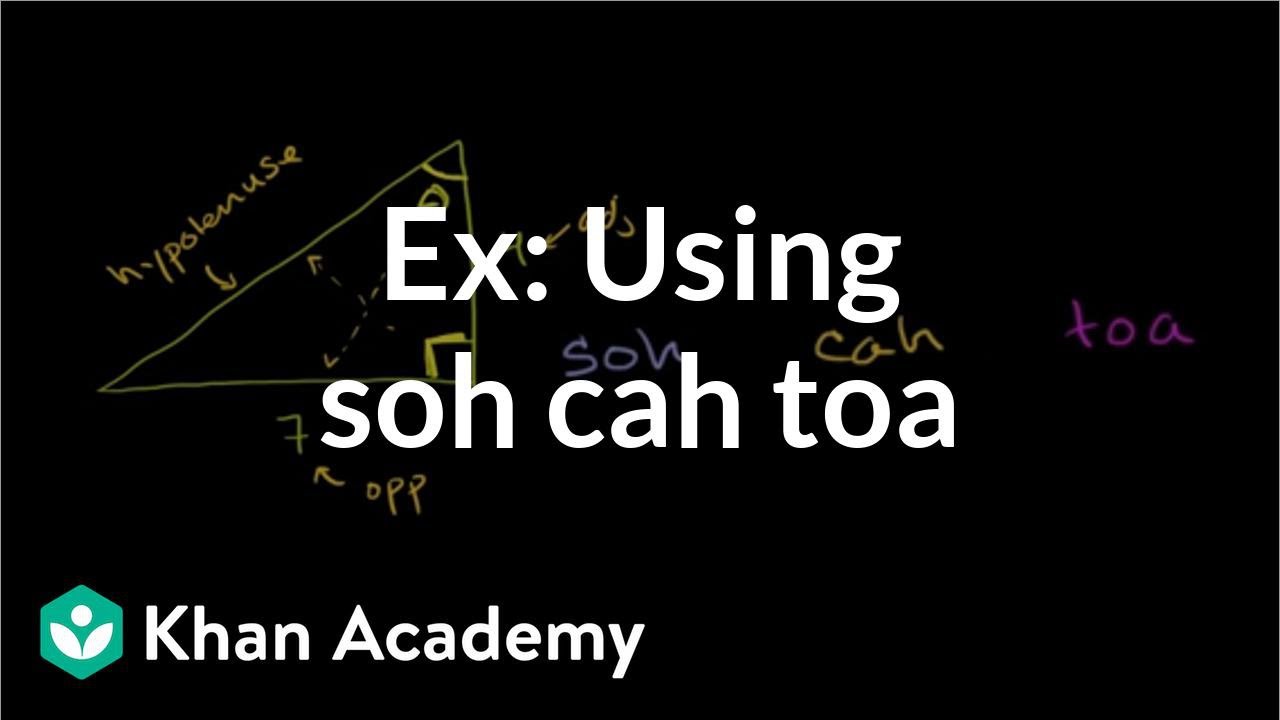
Worked example evaluating sine and cosine using soh cah toa definition.
Practice this lesson yourself on KhanAcademy.org right now:
https://www.khanacademy.org/math/trigonometry/basic-trigonometry/basic_trig_ratios/e/trigonometry_0.5?utm_source=YT&utm_medium=Desc&utm_campaign=Trigonometry
Watch the next lesson: https://www.khanacademy.org/mat...
Watch some videos on that
Here's one
stable hawk
k ty
heavy thicket
@stable hawk sin cos or tan which one to use
stable hawk
heavy thicket
<@544160910932181023> sin cos or tan which one to use
cos?
heavy thicket
stable hawk
cos?
Try again
stable hawk
sin
stable hawk
angle b doesnt have a number
heavy thicket
sin=opposite/hypotenuse
stable hawk
3
heavy thicket
So sin(b) is?
stable hawk
2.3?
heavy thicket
Use fractions
stable hawk
I did 7 over 3
stable hawk
0.42
heavy thicket
Use fractions
heavy thicket
stable hawk
its 0.43 degree
1 more step
Do you know inverse trigonometric functions
stable hawk
nope
warm shaleBOT
% Openglobe %
 heavy thicket
$\theta=sin^-1 (\frac{a}{b})$
warm shaleBOT
% Openglobe %
 heavy thicket
So you calculate sin^-1(3/7)
stable hawk
i dont believe I need to do that extra step, 0.43 is the answer I need
thanks for helping tho
heavy thicket
stable hawk
i dont believe I need to do that extra step, 0.43 is the answer I need
That angle is too small
It’s not an extra step
stable hawk
alr
heavy thicket
It’s a required step
heavy thicket
Yes
stable hawk
i would get the answer?
heavy thicket
stable hawk
i would get the answer?
Yes
stable hawk
heavy thicket
Yes
thats correct right
stable hawk
heavy thicket
Actually

this is the last question I need to do
and im finished for my homework assignment
im not too sure what it means by factored form
stable hawk
ye
stable hawk
2?
heavy thicket
That’s a factor but not the greatest one
stable hawk
im not sure
heavy thicket
Do you know t*t=t^2
heavy thicket
So what’s the GCF of t^2 and t
heavy thicket
Why the -2
stable hawk
im not too sure
heavy thicket
t can be split into t and 1
t^2 can be split into t and t
stable hawk
ok
heavy thicket
Therefore the GCF is?
stable hawk
t
heavy thicket
So it would be 6t()
stable hawk
what would be inside the bracket
heavy thicket
6t^2/ 6t is?
heavy thicket
heavy thicket
6t^2/ 6t is?
This is the first number inside the bracket
stable hawk
um
stable hawk
heavy thicket
6t^2/ 6t is?
i cant calculate this
heavy thicket
Just one t
obtuse pebbleBOT
Channel closed
Closed by @stable hawk
Use .reopen if this was a mistake.
Please take a minute to participate in [our survey](#changelog message) if you haven't already!
obtuse pebbleBOT
Available help channel!
Send your question here to claim the channel.
Remember:
• Ask your math question in a clear, concise manner.
• Show your work, and if possible, explain where you are stuck.
• After 15 minutes, feel free to ping <@&286206848099549185>.
• Type the command .close to free the channel when you're done.
• Be polite and have a nice day!
Read #❓how-to-get-help for further information on how to ask a good question, and about conduct in the question channels.
 jagged arrow
again
obtuse pebbleBOT
jagged arrow
again
 proven zephyr
wait.. is this an exam?
jagged arrow
no
 harsh remnant
Assessment?
harsh remnant
Why is this hard
jagged arrow
harsh remnant
Why is this hard
im young
obtuse pebbleBOT
@jagged arrow Has your question been resolved?
Channel closed
Closed by @jagged arrow
Use .reopen if this was a mistake.
Please take a minute to participate in [our survey](#changelog message) if you haven't already!
Available help channel!
Send your question here to claim the channel.
Remember:
• Ask your math question in a clear, concise manner.
• Show your work, and if possible, explain where you are stuck.
• After 15 minutes, feel free to ping <@&286206848099549185>.
• Type the command .close to free the channel when you're done.
• Be polite and have a nice day!
Read #❓how-to-get-help for further information on how to ask a good question, and about conduct in the question channels.
 hasty crag
$\vec{x} = \sum_{j = 1}^{n} \langle \vec{e_{j}}, \vec{x} \rangle \vec{e_{j}} = \sum_{j= 1}^{n} \left( \sum_{i = 1}^{j} e_i x_{i} \right)\vec{e_{j}}$
obtuse pebbleBOT
hasty crag
$\vec{x} = \sum_{j = 1}^{n} \langle \vec{e_{j}}, \vec{x} \rangle \vec{e_{j}} = \...
hasty crag
am I doing this right? I'm not sure if this is how u expand these fuck you latec
finally omg
 rugged kite
What's your question?
hasty crag
if this expansion is correct
 upbeat plinth
should be e_i*x_i
warm shaleBOT
texaspb :rainbow:
 upbeat plinth
yes
upbeat plinth
wait
hasty crag
okay
upbeat plinth
how many components do these vectors have
hasty crag
I'm just gonna post the entire question
upbeat plinth
are they vectors in R^n
hasty crag
Show that the bilinear form $\langle \vec{x},\vec{y} \rangle = \sum_{j=1}^{n} x_{j}y_{j}$ in $V = \bR^{n}$ is a scalar product in V. If $S ={\vec{e}{1}, \dots, \vec{e}{n}}$ is the standard basis of V and $\vec{x} \in V$, show that we can write: \
$$\vec{x} = \sum_{j=1}^{n} \langle \vec{e}{j}, \vec{x} \rangle \vec{e}{j}$$
royal basin
did you miss a = right after the S
hasty crag
yes thanks ann
warm shaleBOT
texaspb :rainbow:
 upbeat plinth
ok so the inside sum should be up to n
upbeat plinth
and u should write e_{ji} for the ith component of e_j
hasty crag
$\vec{x} = \sum_{j = 1}^{n} \langle \vec{e_{j}}, \vec{x} \rangle \vec{e_{j}} = \sum_{j= 1}^{n} \left( \sum_{i = 1}^{n} e_{ji} x_{i} \right)\vec{e_{j}}$
warm shaleBOT
texaspb :rainbow:
 hasty crag
how does this work tho i'm confused
upbeat plinth
its just using the def of dot product
hasty crag
I don't get the e_ji indexing
upbeat plinth
e_j is the jth basis vector
each vector has n components
so e_{ji} is a way to write the ith component of the jth basis vector
hasty crag
alright
I think I got it, if there's any questions left I'll post in the linagl channel
thank you so much as always
upbeat plinth
np
hasty crag
.close
obtuse pebbleBOT
Channel closed
Closed by @hasty crag
Use .reopen if this was a mistake.
Please take a minute to participate in [our survey](#changelog message) if you haven't already!
obtuse pebbleBOT
Available help channel!
Send your question here to claim the channel.
Remember:
• Ask your math question in a clear, concise manner.
• Show your work, and if possible, explain where you are stuck.
• After 15 minutes, feel free to ping <@&286206848099549185>.
• Type the command .close to free the channel when you're done.
• Be polite and have a nice day!
Read #❓how-to-get-help for further information on how to ask a good question, and about conduct in the question channels.
 fluid meadow
 obtuse pebbleBOT
fluid meadow
fluid meadow
obtuse pebbleBOT
fluid meadow
fluid meadow
How can we be certain pq is tangent to that circle
obtuse pebbleBOT
@fluid meadow Has your question been resolved?
fluid meadow
<@&286206848099549185>
obtuse pebbleBOT
@fluid meadow Has your question been resolved?
 atomic bobcat
 obtuse pebbleBOT
Channel closed
Closed due to timeout
Use .reopen if this was a mistake.
Please take a minute to participate in [our survey](#changelog message) if you haven't already!
Available help channel!
Send your question here to claim the channel.
Remember:
• Ask your math question in a clear, concise manner.
• Show your work, and if possible, explain where you are stuck.
• After 15 minutes, feel free to ping <@&286206848099549185>.
• Type the command .close to free the channel when you're done.
• Be polite and have a nice day!
Read #❓how-to-get-help for further information on how to ask a good question, and about conduct in the question channels.
 smoky panther
 obtuse pebbleBOT
smoky panther
smoky panther
obtuse pebbleBOT
smoky panther
smoky panther
am i correct?
heavy thicket
,w calculate cos(pi)
warm shaleBOT


 Requested by % Openglobe %#3085
heavy thicket
smoky panther
am i correct?
Requested by % Openglobe %#3085
heavy thicket
smoky panther
am i correct?
You got it
obtuse pebbleBOT
Channel closed
Closed by @smoky panther
Use .reopen if this was a mistake.
Please take a minute to participate in [our survey](#changelog message) if you haven't already!
Available help channel!
Send your question here to claim the channel.
Remember:
• Ask your math question in a clear, concise manner.
• Show your work, and if possible, explain where you are stuck.
• After 15 minutes, feel free to ping <@&286206848099549185>.
• Type the command .close to free the channel when you're done.
• Be polite and have a nice day!
Read #❓how-to-get-help for further information on how to ask a good question, and about conduct in the question channels.
smoky panther
 obtuse pebbleBOT
smoky panther
smoky panther
obtuse pebbleBOT
smoky panther
smoky panther
how do i solve this?
 warm canopy
try graphing sin(x)
warm canopy
okay, and roughly plot x=4
smoky panther
okay yup
warm canopy
what on a graph represents instantaneous rate of change
smoky panther
slope of tangent line
warm canopy
right so you're gonna need to eyeball the slope of the tangent line to sin(x) at x=4
luckily the answers to choose from are very different
smoky panther
so then wont it be -0.65?
warm canopy
i would agree with you
smoky panther
great, thanks for helpin
warm canopy
youre welcome!
smoky panther
.close
obtuse pebbleBOT
Channel closed
Closed by @smoky panther
Use .reopen if this was a mistake.
Please take a minute to participate in [our survey](#changelog message) if you haven't already!
Available help channel!
Send your question here to claim the channel.
Remember:
• Ask your math question in a clear, concise manner.
• Show your work, and if possible, explain where you are stuck.
• After 15 minutes, feel free to ping <@&286206848099549185>.
• Type the command .close to free the channel when you're done.
• Be polite and have a nice day!
Read #❓how-to-get-help for further information on how to ask a good question, and about conduct in the question channels.
 jaunty stirrup

 knotty crow
so you have the right triangle with one leg equals 4.5 and hypotenuse equals 5, can you find the another leg?
knotty crow
treat it as a rhombus (every square is a rhombus) and use the formula with the diagonals or find the side length of a base
in order to do that use Pythag or just property of the triangle 45, 45 and 90
knotty crow
what's your diagonal
jaunty stirrup
5
knotty crow
nope, result from a)
knotty crow
let's say, but it's approximate
jaunty stirrup
Yea
warm shaleBOT
Result:
4.3588989435407
ok
knotty crow
so now let's say the side length of the base is equal to x, ok?
jaunty stirrup
Ok
 knotty crow
ok
so the opp and adj is equal to x
basically
x^2 + x^2 = (4.4)^2
can you solve it?
knotty crow
2x^2
jaunty stirrup
Oh
knotty crow
like an apple + apple = two apples
obtuse pebbleBOT
Channel closed
Closed by @jaunty stirrup
Use .reopen if this was a mistake.
Please take a minute to participate in [our survey](#changelog message) if you haven't already!
Available help channel!
Send your question here to claim the channel.
Remember:
• Ask your math question in a clear, concise manner.
• Show your work, and if possible, explain where you are stuck.
• After 15 minutes, feel free to ping <@&286206848099549185>.
• Type the command .close to free the channel when you're done.
• Be polite and have a nice day!
Read #❓how-to-get-help for further information on how to ask a good question, and about conduct in the question channels.
Channel closed
Closed due to the original message being deleted
Please take a minute to participate in [our survey](#changelog message) if you haven't already!
Available help channel!
Send your question here to claim the channel.
Remember:
• Ask your math question in a clear, concise manner.
• Show your work, and if possible, explain where you are stuck.
• After 15 minutes, feel free to ping <@&286206848099549185>.
• Type the command .close to free the channel when you're done.
• Be polite and have a nice day!
Read #❓how-to-get-help for further information on how to ask a good question, and about conduct in the question channels.
timid silo
 obtuse pebbleBOT
timid silo
timid silo
obtuse pebbleBOT
timid silo
timid silo
what gives, why are they dropping the divided by twos but not the + 1?
oh i see, they're adding 0.5cn + 0.5cn
 mint bronze
Would you mind taking an image where the whole sentence above is in it, I'm just wondering what it says
timid silo
 timid silo
that'd be the first thing i'm correct on today
mint bronze
But it is not exactly adding halves but more so that say if n were 13, then it would be adding 6c and 7c
Which gives the 13
timid silo
right right
what about this one:
show that the sltn of T(n) = T(n-1) + n is O(n^2)

.close
obtuse pebbleBOT
Channel closed
Closed by @frank abyss
Use .reopen if this was a mistake.
Please take a minute to participate in [our survey](#changelog message) if you haven't already!
timid silo
i need to understand how to do it
mint bronze
You might want to reopen
timid silo
 timid silo
.reopen
obtuse pebbleBOT
✅
mint bronze
Thanks
timid silo
 mint bronze
Ok, so I'll talk through the inequalities going on here
First we assume that
,,T(n-1) \leq c(n-1)^2
warm shaleBOT
Social Capital Gainer
 warm shaleBOT
Social Capital Gainer
 warm shaleBOT
Social Capital Gainer
 mint bronze
,,T(n-1) +n \leq c(n-1)^2 +n
warm shaleBOT
Social Capital Gainer
 warm shaleBOT
Social Capital Gainer
 warm shaleBOT
Social Capital Gainer
 warm shaleBOT
Social Capital Gainer
 timid silo
you're going much too fast here
timid silo
why do they square the n in c(n-1) term and not the next n
warm shaleBOT
Social Capital Gainer
 mint bronze
That one?
timid silo
yes. i would like you to assume i know nothing and walk me through step by step, if you have the time
i've been studying this stuff for awhile now but it's not clicking
timid silo
i get why the assumption becomes c*n^2
given the definition of O and whatnot
yes sure
so we have T(n) = T(n-1) + n
and our inductive hypothesis is that this will be in O(n^2)
let's set aide the "c is taken to be max(somestuff)" bc i don't understand that
mint bronze
Ok I will address the induction parts
timid silo
why do you not only square the n inside the first term
why do you square the entire (n-1)
mint bronze
Basically we have some statement dependent on integers n which we need to prove is true for all n. That statement is T(n) <= cn^2
I will explain why
Usually in an inductive argument, we assume some step, say n=k, then show that if we assume this, this implies that the next case for n=k+1 must also be true
In this question however
They are assuming the n-1 case
timid silo
i don't think so
the recurrence is just given by T(n) = T(n-1)+n that's just it mathematically before any induction or hypothesis
the assumption is that T(n) <= cn^2
mint bronze
That is the recurrence relation, but given this recurrence relation it is easier to assume n-1 and prove n rather than assume n and prove n+1. They both will give the same result, but assuming n-1 lets us apply the recurrence relation straight away, so that is what they do
They finish by showing that T(n) <= cn^2
 mint bronze
I disagree with what tlu have labelled as the cn^2 expression, that is not the cn^2 expression, that is something we will show is less than or equal to the cn^2 expression
Hence showing that T(n)<=cn^2
timid silo
by transitive property?
warm shaleBOT
Social Capital Gainer
 mint bronze
Now add n to both sides
mint bronze
We assumed the n-1 case
Of the expression we want to prove which is
T(n)<=cn^2
Change n with n-1
timid silo
why is it (n-1)^2, why isn't it c((n^2)-1))
mint bronze
Because n is the variable
Say that n=7
Then
T(7)<=c7^2
Also
T(6)<=c6^2
6 is the n-1, 7 is the n
timid silo
i don't understand
mint bronze
Another way to think about it is like this
Take this as an example, the function f(n)=n^2
Evaluate f(3) for me
timid silo
9
mint bronze
Evaluate f(w) for me, where w is some number
timid silo
w^2
mint bronze
Evaluate f(w-1)
timid silo
ah ok
mint bronze
(w-1)^2
timid silo
bc that variable can be any expression
mint bronze
Yes exactly
timid silo
ok
mint bronze
So we set n to n-1 in
T(n)<=cn^2
To get
T(n-1)<=c(n-1)^2
It's kinda clunky
If i were proving this I would say
Set n=k-1
T(n)<=cn^2
T(k-1)<=c(k-1)^2
So that it flows a bit better
Does that make sense?
timid silo
i mean sort of except that we're replacing n-1 in for n it terms of T on the left and replacing T with c on the right
anyway i guess we now have T(n-1) = c(n-1)^2 + n
timid silo
T (n) = T (n − 1) + n ≤ c(n − 1)^2 + n
to get from the first expression, to the one on the right hand side of the equality, we replace T with c
mint bronze
I think you are confusing the brackets here a bit. The brackets in T(n-1) belong to the function T
Like saying f(3)=9
The brackets in c(n-1)^2 are normal brackets like 3(x+y)=3x+3y
You cant expand T(n-1) into Tn -T
timid silo
oh i thought we were plugging in stuff into the left hand side to get the right, but we're plugging it into the T(n) <= cn^2 statement
mint bronze
Yes, n is a variable and we are plugging stuff into it
mint bronze
Ok, but does that make sense now
timid silo
so we haven't actually done anything yet except taken the original expression and set it less than or equal to cn^2 where n = n-1
mint bronze
Yes that's what we've done so far
timid silo
but just to be clear
mint bronze
We assume the n-1 case and want to use it to prove the n case
timid silo
T(n) = T(n-1) + n is the original recurrence
so there is no n-1 added yet anywhere
no substitutions
mint bronze
Um, yeah not yet
timid silo
all we did was take it as is and set equal to c(n-1)^2
mint bronze
Yeah
timid silo
well less than or equal to
warm shaleBOT
Social Capital Gainer
 timid silo
 mint bronze
We are just about to get that
timid silo
right they are adding +n to both sides I guess.. why
wait no here it's only added to the cn^2 side
mint bronze
It is so that we can form T(n-1) +n, which we recognise is equal to T(n)
That will let us get the left hand side of T(n)<=cn^2 which is what we want. We need to use what we have assumed to get the next case, the n case
timid silo
it looks like all they did so far was square n-1 on the right hand side and then add a (+ n)
mint bronze
mint bronze
,,T(n-1) \leq c(n-1)^2
Yes, they started with this and added n to both sides
To get
mint bronze
,,T(n-1) +n \leq c(n-1)^2 +n
timid silo
that is its native form
warm shaleBOT
Social Capital Gainer
 timid silo
T(n-1) + n is the original recurrence. there has been no +n added
mint bronze
No, we did that, going from left to right in that string of inequalities does not reflect the logical order in which it was obtained
timid silo
otherwise it'd be in the form T(n-1)+2n
mint bronze
So lets follow the train of thought as I am presenting it and it will hopefully become clear
We go from
,,T(n-1) \leq c(n-1)^2
warm shaleBOT
Social Capital Gainer
 warm shaleBOT
Social Capital Gainer
 timid silo
ok
mint bronze
Cool
So now looking at the left hand side of this, we recognise that T(n-1)+n is exactly just equal to T(n), so we can replace the entire left hand side with T(n)
,,T(n) \leq c(n-1)^2 +n
warm shaleBOT
Social Capital Gainer
 mint bronze
This is because T(n-1) +n is exactly the same as T(n) so I can interchange them
mint bronze
timid silo
Yes this is how they got
They tacked on T(n)= onto the left of
What we made
warm shaleBOT
Social Capital Gainer
 mint bronze
You want to expand the quadratic on the right
mint bronze
Ye, and a 2
timid silo
c*(n^2 - n - 1)
mint bronze
Its not just-n
timid silo
ah shit i added the +n in there
mint bronze
Ah
timid silo
c*(n^2 - 2n - 1) + n
mint bronze
Yep
timid silo
ok so now what
mint bronze
Now expand that bracket too so that there is a c on every term that needs one
timid silo
T(n) <= cn^2 - 2cn + c + n
timid silo
actually in the form its in it takes the form of the answer, the cn^2 bit
mint bronze
Yes exactly we have all the pieces we need, and some extra ones too which we have to deal with
timid silo
ah shucks
warm shaleBOT
Social Capital Gainer
 mint bronze
This is where we are
Note that I disagree with the screenshot of the solution you posted
I don't believe what they have written is completely correct
Could you post that screen shot again
timid silo
 mint bronze
Yeah so they say that
timid silo
i mean the book says "show that the solution is O(n^2)"
mint bronze
,, c(n-1)^2+n=cn^2+(1-2c)n+1
warm shaleBOT
Social Capital Gainer
 mint bronze
timid silo
i mean the book says "show that the solution is O(n^2)"
mint bronze
timid silo
i mean the book says "show that the solution is O(n^2)"
That is right, but this step is wrong
As we just showed
It should be +c and not +1
timid silo
ok
timid silo
timid silo
```T(n) <= cn^2 - 2cn + c + n```
well this is where i am
mint bronze
Yep, so factor n from -2cn and +n
timid silo
n(cn - 2c) + c + n
timid silo
n(2c + 1)
warm shaleBOT
Social Capital Gainer
 mint bronze
Is that ok ?
mint bronze
Ye, now factor out n from the second and third terms only
timid silo
i get -n(2c+1)
timid silo
how do you factor cn^2 - 2cn + n + c for just n what happened to the -
warm shaleBOT
Social Capital Gainer
 mint bronze
Yea?
timid silo
yeah i have to write it a different way but yes
mint bronze
Ok, I wrote it that way so it is as close as possible to what your answers have
timid silo
oh i'm not even looking at that
warm shaleBOT
Social Capital Gainer
 mint bronze
What this means is
the value of c will be set to whichever of 1 or T(1) is biggest
Therefore either
c=1, so 1>T(1)
Or
c=T(1), so T(1)>1
timid silo
lol what
oh ok
i mean, it's more helpful to just look at 1 or T(1) and check which is largest, but how do we evaluate T(1)
i don't even know which T we would plug that into or what c would be
mint bronze
We don't, we just have to acknowledge that it can either be bigger or less than 1
We don't even need to know what number it is
You will see why
Lets look at the first possibility, that 1>T(1)
Therefore c=1
We can use that in our inequality
,,T(n) \leq cn^2 +(1-2c)n+c
warm shaleBOT
Social Capital Gainer
 timid silo
wat
mint bronze
It will help us get the result we need
timid silo
cn^2 - n + 1
mint bronze
Yes
Now because we are dealing with natural numbers, what is the smallest value that n could be?
timid silo
1
warm shaleBOT
Social Capital Gainer
 mint bronze
Because n will make the left hand side smaller or at most equal to the right hand side
We are subtracting a number n that is bigger than or equal to 1
timid silo
i cannot look at something with so many variables and inherently know anything. what i said before was a guess. i was lost as soon as we plugged in something for most things but not every term in the expression
mint bronze
Sometimes we can be flexible like that, what we did was not wrong, it is just a slightly different way of writing it
Here is an example
h=5
h+h+h+h+h
Can be written as
5+5+5+5+5
Or
h+h+h+5+5
Is that wrong?
timid silo
no
timid silo
mint bronze
Now because we are dealing with natural numbers, what is the smallest value that...
was this bc 1 is the min of natural numbers or because we evaluated something
mint bronze
Because 1 is the min of the natural numbers
timid silo
ok i think i need to take a break from all this stuff. thank you for your time
timid silo
sure i mean i have other examples we could work.. what time is good for you
mint bronze
I dunno, you take a break and dm me I guess
I can talk for a little longer later on to finish this example, but maybe not for other examples
Just in terms of time
mint bronze
Almost yeah
I actually could have done the very last thing we did a little more simply
I dunno
There are several ways to go about it
I think what I would recommend for you is to practice inequalities questions in general, as I feel that is mkstly what we have been discussing
timid silo
its a bit frustrating for me bc i have this algorithms course coming up and i am focusing on solutions to the book problems found online but i don't know exactly where i should be focusing. i guess i could look over the example homeworks i have access to and try to find similar ones in the book
mint bronze
Well I would still try to practice inequalities questions if you can find any
Bio informatics
That's cool
timid silo
correct. and unfortunately its a little too much like mathe matics 😂
mint bronze
Haha, that's what makes it cool imo
timid silo
no totally just not my strong suit. anyhow, thanks again
mint bronze
No problem, feel free to ping me a message if you have a specific question I might try find some inequalities questions and send them
If you would like
timid silo
ok that's probably a good idea
timid silo
no thanks have a good one
mint bronze
You too
timid silo
.close
obtuse pebbleBOT
Channel closed
Closed by @frank abyss
Use .reopen if this was a mistake.
Please take a minute to participate in [our survey](#changelog message) if you haven't already!
Available help channel!
Send your question here to claim the channel.
Remember:
• Ask your math question in a clear, concise manner.
• Show your work, and if possible, explain where you are stuck.
• After 15 minutes, feel free to ping <@&286206848099549185>.
• Type the command .close to free the channel when you're done.
• Be polite and have a nice day!
Read #❓how-to-get-help for further information on how to ask a good question, and about conduct in the question channels.
 leaden elbow
 obtuse pebbleBOT
leaden elbow
obtuse pebbleBOT
leaden elbow
 fierce lagoon
Alright, so let's set up some dummy variables for the regular and the expanded
I'm gonna use r for regular, p for expanded
You can set up a system of equations from that
$$r + p = 650$$
$$25r + 65p = 21250$$
$$r, p\in\bN$$
warm shaleBOT
Umbraleviathan
 fierce lagoon
You can't sell half a board, r and p must be natural numbers
Just as a reminder in case you somehow get half a board
Or something
 vast wren
I have a question unrelated to the original problem
does the set of natural numbers include zero? or is it included in the set of whole numbers?
fierce lagoon
It does include 0, sometimes
fierce lagoon
$\bN$ is similar to $\bZ^{+}$, sometimes 0
warm shaleBOT
Umbraleviathan
 fierce lagoon
warm shale
**Umbraleviathan**
fierce lagoon
warm shale
**Umbraleviathan**
@leaden elbow
fierce lagoon
I mean it's not much of an interruption
Still I'd rather you make a separate help channel
leaden elbow
yes
leaden elbow
warm shale
**Umbraleviathan**
yea i did thus
this*
but its not giving me the right answer
fierce lagoon
You sure?
fierce lagoon
I got natural number answers
leaden elbow
k im following my teachers steps and let me shoiw u
im confused where she got 43.5 from
 fierce lagoon
This is a different question
fierce lagoon
That's because 0.50 • 87 = 43.5
She distributed the 0.50
And yeah you follow the same
I did it similarly
fierce lagoon
65(650-r) = 65(650) - 65r
leaden elbow
are we substituting it the same bc u said you are doing it similarly
leaden elbow
cause i got 323 and that doesnt seem right
leaden elbow
yea
fierce lagoon
No that's not right
 leaden elbow
mb i was jus following what my teacher was showing
vast wren
we can say
r = 650 - p
so
25(650 - p) + 65p = 21,250
25*650 - 25p + 65p = 21,250
40p + 25 * 650 = 21,250
from here you can find p
vast wren
vast wren
r = 650 - p
then find r
leaden elbow
p=125? r=525?
vast wren
leaden elbow
p=125? r=525?
✅
obtuse pebbleBOT
Channel closed
Closed by @leaden elbow
Use .reopen if this was a mistake.
Please take a minute to participate in [our survey](#changelog message) if you haven't already!
Available help channel!
Send your question here to claim the channel.
Remember:
• Ask your math question in a clear, concise manner.
• Show your work, and if possible, explain where you are stuck.
• After 15 minutes, feel free to ping <@&286206848099549185>.
• Type the command .close to free the channel when you're done.
• Be polite and have a nice day!
Read #❓how-to-get-help for further information on how to ask a good question, and about conduct in the question channels.
timid silo
can someone help please?
 obtuse pebbleBOT
timid silo
can someone help please?
vast wren
timid silo
can someone help please?
obtuse pebbleBOT
timid silo
can someone help please?
vast wren
timid silo
can someone help please?
y = 5x - 3
y = -6x + 8
we can say that 5x - 3 is equal to -6x + 8, can’t we?
since they’re both equal to y
timid silo
do i put that in a calculator?
timid silo
is it 1?
timid silo
i put it in a calculator
 bitter folio
Lol
 uneven palm
timid silo
i put it in a calculator
uneven palm
timid silo
i put it in a calculator
do you know how to solve equations?
timid silo
not really
uneven palm
vast wren
5x - 3 = -6x + 8
alright so do you see how you can add 6x to both sides of this equation?
it cancels the -6x + 6x on the right side
timid silo
im on this now
 vast wren
5x - 3 = -6x + 8
vast wren
vast wren
5x - 3 = -6x + 8
we want to collect the like terms on one side of the equation
please don’t use this thread
timid silo
im really new to algebra, i dont really understand it
uneven palm
hmm
perhaps you should find a youtube video on how to solve basic equations
if you’re not already learning it
uneven palm
it’d odd that you’re doing systems of equations without knowing how to solve a single variable equation first lol
vast wren
then start taking the algebra courses
timid silo
i would really just like to understand this first
uneven palm
yeah and you need a basic knowledge of equations to do this though
like 5x - 3 = -6x + 8
 uneven palm
timid silo
im leaning more towards A
uneven palm
timid silo
im leaning more towards A
how come?
timid silo
wait actually i think B i think the y step goes after that
timid silo
oh
uneven palm
eliminating x^2.. I dunno how you’d even do that
timid silo
okay so this one would be A now
 uneven palm
no
you need a better grasp of algebra.. I can’t really explain everything here lol
but in short, solving a quadratic (with x^2) requires you to set it equal to 0
dividing both sides by x^2 just makes things more complicated
use Khan Academy like headshotcem suggested
timid silo
is it free?
uneven palm
yeah
timid silo
okay
vast wren
https://www.khanacademy.org/math @timid silo

Khan Academy
timid silo
im not sure if its B or not because theres no Y only x
