#serious-discussion
1 messages · Page 487 of 1
 leaden torrent
Sure, but it doesn't have to be
Why make your proof less direct than necessary
When even Euclid didn't do that
 vague lion
for fun
leaden torrent
(admittedly Euclid's original proof was insufficient, he only proved the n=3 case lmao)
(but it obviously generalized)
 dense belfry
I think you can phrase cantor's proof a similar way though
leaden torrent
(mathematical language of that time just couldnt express the notion of "arbitrary list")
vague lion
vague lion
and that's a common alternative formulation
like, it's common to the point that i think that's how i first saw the proof
dense belfry
you can say "If I'm given a countable list of real numbers I can find a real not in the list"
leaden torrent
Sure but that doesn't prove anything unless your list is allowed to be arbitrary
But you need the assumption that R is countable for the list to be arbitrary
dense belfry
what do you mean by that
vague lion
if you have a countable list then if you just find one more
it's still countable
so that sucks
dense belfry
well we are proving for each countable sequence of infinite binary strings that that sequence is not an enumeration of all infinite binary strings
We have a uniform process to find a new infinite binary string not in our list
sounds pretty good to me
leaden torrent
So? You've shown you can't find a list of all reals. So what?
dense belfry
so isn't that what the reals being countable means?
 leaden skiff
that's what the reals being uncountable means
dense belfry
thanks ninja
leaden torrent
No, countability means in bijection with N
If a set is countable we can biject it with N with a list
dense belfry
I'm not sure what your point is here
leaden torrent
Why don't you just add the new element to your list?
dense belfry
well the point is that no lists work
leaden torrent
For finite lists that is convincing
dense belfry
I don't see why it's not convincing for countable lists also
leaden torrent
But for infinite lists, why can't we just repeat the process infinitely and add all the elements?
The answer is because that'd increase the cardinality
And we assumed that R was countable
dense belfry
I don't like that line of reasoning tbh
leaden torrent
Perhaps I'm not expressing it well
FYI you can phrase Cantor's proof in a direct way
You talk about functions instead of lists
And then the direct proof is very natural
dense belfry
lists are functions
dense belfry
tbh I use lists as functions enough that I just use them interchangably
leaden torrent
Okay sure
Then the proof is direct and just an argument about directions
About surjections*
Autocorrect
dense belfry
sure
leaden torrent
Idk id be willing to buy an argument that Cantor's proof is basically a direct one as well
But he phrased it contradictively
Whereas Euclid phrased his directly
(in fairness, proof by contradiction wasn't even accepted in Euclid's time so he was kind of forced to)
(see sqrt(2) stuff)
(but still)
dense belfry
I think I'm happy from just seeing the parallels between the 2 proofs
they feel like they are trying to do the same thing to me now
leaden torrent
They basically are
It's just a phrasing thing
The fact that Euclid's proof is constructive is actually important to logicians
Whereas they don't care so much about whether Cantor's is since, well
If you're working with R
dense belfry
well certain logicians
leaden torrent
You don't care about constructiveness
dense belfry
idk tbh, it just doesn't seem to be something that I've heard many computability theorists talk about
leaden torrent
yeah obviously not all logicians care
 neat lintel
Hi
 fair mural
hello cat
 untold sapphire
dense belfry
idk tbh, it just doesn't seem to be something that I've heard many computability...
untold sapphire
dense belfry
idk tbh, it just doesn't seem to be something that I've heard many computability...
?
 full storm
The shuffle product is the dual of the exterior product and forms an alternating multilinear algebra. https://en.wikipedia.org/wiki/Exterior_algebra#Alternating_multilinear_forms

In mathematics, the exterior product or wedge product of vectors is an algebraic construction used in geometry to study areas, volumes, and their higher-dimensional analogues. The exterior product of two vectors
    u


{\displaystyle u}
and
    v


{\displaystyle v}
, deno...
pages 112-113 touch on this algebra and its relation with products used in clifford algebra and grassmann-cayley algebra
This is just an algebraic approach to defining this product
there is also a combinatorial one that exists but i am not familiar with it
full storm
full storm
The shuffle product is the dual of the exterior product and forms an alternating...
https://people.math.rochester.edu/faculty/doug/otherpapers/weibel-hom.pdf This book also goes much more in depth on the shuffle algebra algebraically
Also called the regressive algebra in different contexts
neat lintel
why did he take down his pure mathematics video? (pardon the ping)
 random kelp
 burnt dune
ahlfors is the best book to exist
neat lintel
Draw the projections of a hexagonal pyramid of base side 25 mm and axis height 60 mm resting on the edges of its
base on HP with its triangular face perpendicular to both HP and VP.
No
neat lintel
Hello everyone, I am gonna leave this server
for like a few months
and then come back
farewell
 vivid halo
they come up a lot in Lie theory since for example the graded dual of the universal enveloping algebra of a free Lie algebra on a finite set is the shuffle algebra on that finite set.
The shuffle product also comes up a lot when you work with iterated integrals and combinatorics of simplices: the product of two simplices is a union of simplices and the combinatorics here is governed by the shuffle product; since iterated integrals are just ordinary integrals over simplices, this tells you that a product of iterated integrals is a sum of iterated integrals over shuffles of the integrands
 obtuse fjord
👍
Thanks! I have seen the terms "free Lie algebras" thrown around quite a lot in this theory more recently. This latter description is where I'm encountering the shuffle product though, in signatures from rough path theory. I think Terry himself has sufficient description of the shuffle algebra in his Saint-Flour notes for what I need, but I will look into the Lie theory if I need more
 opal linden
wow this new help system is cool
vivid halo
@narrow rock okay so let n≥1, let q be a power of a prime p, and let a be in F*_q. Then you can consider the Kloosterman sum:
$\mathrm{Kl}n(a,q)=(-1)^{n-1}\sum{\substack{x_1,\hdots,x_n\in\mathbb{F}q\ x_1\hdots x_n=a}}\exp(\frac{2\pi i}{p}\mathrm{Tr}{\mathbb{F}_q/\mathbb{F}_p}(x_1+\hdots+x_n))$
 fathom swallowBOT
nGroupoid
 vivid halo
these are essentially trigonometric sums
 jovial ember

vivid halo
they show up all over the place (e.g. in spectral theory of automorphic forms, in additive combinatorics, etc)
 narrow rock
hmm
vivid halo
the thing that Katz did that takes up one of these monodromy books is like
vivid halo
yes this is the product = a
jovial ember
Weird
narrow rock
why would it be sum = a
jovial ember
Idk
vivid halo
it just is
narrow rock
then all the terms are the same
narrow rock
what
vivid halo
oh I see what you're saying yea
jovial ember
Swag
vivid halo
okay so like
one can show the following bound |Kl_n(a,q)|≤nq^{(n-1)/2}
moreover this bound is optimal
another thing you can show is that (the angles of) these Kloosterman sums are equidistributed as a ranges over \bar{F}*_p with respect to the Sato-Tate measure
how do you show both of these things
well what Deligne and Katz did was the following. One can define a certain complex of sheaves on G_m over F_p so that by the Grothendieck-Lefschetz trace formula the trace of Frobenius on the stalks of this sheaf are the above Kloosterman sums
narrow rock

vivid halo
one shows that these complexes are concentrated in degree 0 and are local systems of rank n, tamely ramified around 0 with unipotent monodromy with a single Jordan block, and totally wildly ramified around \infty with Swan conductor 1, and pure of weight n-1 (which implies this optimal bound)
Moreover Katz showed the converse: if you have a rank n local system on G_m with these ramification properties, then it is isomorphic to a Kloosterman sheaf up to the translation action on G_m
what Katz then did was the following: since you have a rank n local system on G_m, you get a geometric monodromy representation π_1(G_m/\bar{F}_p)->GL_n(Q_l(µ_p))
let G_geom be the Zariski closure of its image. Katz then shows that G_geom is Sp_n for n even, SL_n for n odd and p odd, SO_n for n\neq 7 odd and p=2, and G_2 for n=7 and p=2
Katz then has all these arguments that let you conclude like, if G_geom is suitably large (as is the case for these Kloosterman sheaves) you can deduce equidistribution theorems for Frobenius traces with respect to the Sato-Tate measure on G#_geom the set of conjugacy classes of G_geom
so the form of the geometric monodromy group constrains your equidistribution results and tells you what measure you're equidistributed with respect to
it's also just very surprising that G_2 comes up in this example like this
narrow rock
what information do these kloosterman sums encode
fair mural
@neat lintel since other people are using this channel now, and your question will get pushed up, it’s best to ask in #math-discussion
vivid halo
yea so these Kloosterman sums come up all over the place, so the general philosophy is you can get results in a lot of areas if you have good geometric control over these kinds of trigonometric sums, which is what these results are telling you
one situation where it comes up is like
if you have a classical cusp form of weight n≥2, how do you prove the Ramanujan conjecture for this? Well, the clean way to do it is you realize this modular form as occurring in the l-adic cohomology of a local system on a modular curve so that the Fourier coefficients match the traces of Frobenius on l-adic cohomology, and then the Weil conjectures tell you that this l-adic local system is pure of weight n-2 which gives you the bounds a(p)≤2p^{(n-1)/2} on the Fourier coefficients
what if you have modular forms of even lower weights than this, for example weight 0 (possibly non-holomorphic) automorphic forms
well, in this case you have the Kuznetsov trace formula which relates some god awful expression involving Kloosterman sums to an integral transform + spectral terms, where the spectral terms are sums of Fourier coefficients taken over spaces of holomorphic and non-holomorphic automorphic forms.
so if you have good bounds on Kloosterman sums, you can get good Ramanujan type bounds in the cases where Deligne's proof doesn't apply

vivid halo
the other thing with Katz's monodromy stuff is like
you can use some of his results about moments and monodromy to prove a good chunk of Weil II
this is what he does in his AWS notes and it's kind of a cool (albeit somewhat unusual) strategy to the proof
 I made a 2-way teleporter
jovial ember
I made a 2-way teleporter
jovial ember
Nope
 fringe needle
But it doesn’t highlight any messages when I transition 🤔
fringe needle
Yeah lol
jovial ember
It should be linking to the message
:(
It should be to that message
Okay I changed the teleporter
fringe needle
Ah someone has revealed your secret
 gentle bay
Ha.
jovial ember
Yeah lol
gentle bay
Easy peasy.
jovial ember
It’s not that complicated
fringe needle
I’m just shtupid
 fringe needle
Yeah I didn’t see it lol
gentle bay
Yeah exactly.
fringe needle
I be turning blind
fringe needle
In 20 years I’ll be blind from computer screens and dead from blasting metal
Deaf *
Hopefully not dead
gentle bay
Ah.
fringe needle
gentle bay
Or are you just tired?
That too lol but not because of studies
Just going to sleep too late
jovial ember

fringe needle
It’s hollow knight’s fault
I cannot sleep until I beat the pantheon of hallownest
Even if it mean not thinking straight on my practice analysis exam and messing up 
gentle bay
fringe needle
It’s hollow knight’s fault
I could not defeat that first big-fat guy.
 toxic schooner

 pale orchid
git --force -gud
 primal crater

 timid spindle
gut push -f professor knife
 snow lintel
timid spindle
gut push -f professor knife
snow lintel
timid spindle
gut push -f professor knife
*git
timid spindle
snow lintel
*git
Nah it was meant to be gory
pale orchid
gut push sounds like bowel movement
 static loom
💩
pale orchid
gut push --force
timid spindle
static loom
don't forget to flush with sudo rm -f /bowl afterwards
Hahah
cat 💩 > /dev/null
pale orchid
i guess this strictly falls under "shitpost" category
timid spindle
pale orchid
gut push --force
That sounds like a horrible idea if there's no white noise
pale orchid
bed
 pale orchid

timid spindle
jovial ember
What rhymes with Edd
sad
pale orchid
i am, but it doesn't rhyme
timid spindle
pale orchid
i am, but it doesn't rhyme
Big fluffy hug
 inner finch
edd more like ded
 devout nacelle
jovial ember
And is something I use everyday
devout nacelle
jovial ember
And is something I use everyday
Would've said head but you don't really use it
jovial ember
Yeah
pale orchid
chmonkedd
primal crater
very enlightening convo
toxic schooner
indeed
timid spindle
points juicing
 strange goblet
schwifty
timid spindle
Let's get scheifty
 stray kite
when defining a function f:X->Y, is there any way to leave Y arbitrary so that it is the "largest set" possible here which would contain all codomains? like, basically so that it doesn't restrict the range of f in any way?
leaden skiff
stray kite
when defining a function f:X->Y, is there any way to leave Y arbitrary so that i...
wdym "all" codomains?
neat lintel
stray kite
when defining a function f:X->Y, is there any way to leave Y arbitrary so that i...
there is no "largest set". see Russel's paradox
but if you are working inside some "universe" set, you could have Y to be that one
stray kite
leaden skiff
wdym "all" codomains?
like say you have f(x) = x, f : R -> Y
Y should be the 'largest' set such that any value from the domain which is valid in the definition can output a value(i.e. here Y = R)
neat lintel
stray kite
like say you have f(x) = x, f : R -> Y
Y should be the 'largest' set such that a...
do you know what a function is?
leaden skiff
stray kite
like say you have f(x) = x, f : R -> Y
Y should be the 'largest' set such that a...
that's what the co-domain is?
like, the image of the function need not be the domain
like for e^x (from R to R)
the domain is R, the co domain is R
the image is (0,R)
stray kite
ok i realise what i was saying doesn't make much sense now lol
there is no "largest" codomain because you can always make a superset of the codomain to get a larger codomain which is still valid
leaden skiff
yes
neat lintel
why would you want to have a largest codomain anyway
leaden skiff
actually, is e^x: R -> R
a different function than e^x: R -> (0,R) ?
neat lintel
yes
leaden skiff
or are they the same function
leaden skiff
so even e^x: R-> R - {-5}
is a different function
neat lintel
the graph of a function is the set of all (x,y) such that f(x)=y
leaden skiff
oh you mean the image?
neat lintel
no
you need the information of about what elements map to which
image alone is not enough
stray kite
neat lintel
why would you want to have a largest codomain anyway
ig i was just looking for a way to say "some arbitrary codomain which is a superset of the range"
neat lintel
you can say that
leaden skiff
neat lintel
the graph of a function is the set of all (x,y) such that f(x)=y
that's just the domain x image
neat lintel
no
leaden skiff
isn't it?
leaden skiff
1 -> 1
2 -> 2
neat lintel
forget the swap
neat lintel
domain x image = {(1,1), (1,2), (2,1), (2,2)}
neat lintel
graph = {(1,1), (2,2)}
leaden skiff
what you've described is the function no?
neat lintel
the graph part yes, the domain x image no
leaden skiff
so the graph is literally just the function?
neat lintel
along with the domain and codomain
a function is a triple (D, C, G) where D is the domain, C the codomain and G the graph
leaden skiff
mm i see 
stray kite
whats a graph
stray kite
right
neat lintel
it needs to satisfy this property: for every x in domain there is exactly one (X,y) in the graph such that X=x
leaden skiff
yeah otherwise it's a relation
neat lintel
it is a relation either way
leaden skiff
otherwise it's just a relation
neat lintel
yea
 tribal dove
prove the pythagorean theorem non-visually
 wild jay
what
tribal dove
do it
wild jay
?????
wild jay
based
tribal dove
as in don't use pictures in your proof
neat lintel
Suppose that x and y are orthogonal. Then ||x+u||¹ = <s+y,x+y = ||x||² + <x.t+y,x+||y||² ? ||x||^2 '||y||^2
it didnt go very well it seems
i'll do it with eyes open now ig
tribal dove
ok
wild jay
neat lintel
Suppose that x and y are orthogonal. Then ||x+u||¹ = <s+y,x+y = ||x||² + <x.t+y,...
you just needed to take the quadruple integral then rotate 270 degrees by the z-axis and finishing with converting to polar form and using arc length integral
or that
 last oxide
 neat lintel
Suppose x and y are orthogonal. Then ||x+y||^2 = <x+y, x+y> = ||x||^2 + <x,y> + <y,x> + ||y||^2$. Since $x$ and $y$ are orthogonal, <x,y>=<y,x>=0, therefore ||x+y||^2 = ||x||^2+||y||^2.
fair mural
is this an actual proof
tribal dove
thank you
neat lintel
wild jay
didn't see it
that's very weird
 neon tundra
But how do you motivate 2-norm unless you already know the Pythagorean theorem holds?
neat lintel
good question
rotations
you have usual norm in R
and extend it to R² in a way to be invariant for rotations
neon tundra
Then you need to define "rotations" first, though.
There's probably some way to get through it purely symbolically if we can show that R² with the 2-norm is the only model (up to such-and-such) of Euclidean geometry with this-or-that nice properties.
neat lintel
yea, now that i think of it might not be so easy, there's a way to do it assuming some this-or-that nice properties tho
neon tundra
Getting all the way will surely take us places along the way, considering e.g. that we need to exclude models that turn out to be hyberbolic geometry instead.
neat lintel
parallel postulate
neon tundra
Yeah.
 honest veldt
Is it normal for topology to feel like we're just defining random stuff at first? Does it start making more sense later? (munkres, by the way)
neat lintel
idk, honestly i didn't like munkres much
i prefer Willard, and i also think its more motivated
 blazing pawn
It is kind of normal because 95% of people dont care about point set
 mild nebula
It does start making more sense later
Like, we don't really care about open sets and closed sets, we care about the topological properties that they can define. At this point, you haven't been taught the "why" yet @honest veldt
untold sapphire
honest veldt
Is it normal for topology to feel like we're just defining random stuff at first...
yeah
 tiny marten
honest veldt
Is it normal for topology to feel like we're just defining random stuff at first...
tiny marten
honest veldt
Is it normal for topology to feel like we're just defining random stuff at first...
it is a very frontloaded field
for something that isn't like, clearly a graduate level topic
i took an elementary topology class, it was a 4th year and one of the most frontloaded undergrad classes i took
it's not really any more frontloaded than measure theory or anything like that tho
also point set topology is great, point set gang
also anything that depends on set operations is kinda flim flam for a while
honest veldt
mild nebula
Like, we don't really care about open sets and closed sets, we care about the to...
Ahhh I see. Lecturer did keep bringing up how the first week or two would be really formal, basically just set theory, and that it gets more interesting when we get to the "properties", whatever those might be
Thanks a bunch, you all, I was getting worried I'd have to deal with just pure set theory for months on end
honest veldt
tiny marten
also point set topology is great, point set gang
What is, generally, the difference between point set and algebraic topology? Is algebraic the one with all the funny looking shapes?
tiny marten
point set topology is a bunch of kajiggering of the definitions of the topology in various sets or spaces that setup what people usually expand on using more sophisticated theories
you study the quality of compactness and continuity by playing with points in the spaces
which is pretty fun imo
and algebraic topology is like, setting up correspondences between algebraic theorems and topological objects with respect to the foundations from the point set stuff
cause algebra is more clear and has all these nice structures
in general it becomes v abstract
honest veldt
Ah, so algebraic topology builds on point set?
tiny marten
yeah tho at times it isnt clear they are the same field tbh
so there is like, algebraic topology and general topology + whatever
it is like connecting the qualities of the space to structures or things that must maintain some specific value due to the topology, then supercharging it with algebra and crazier stuff
honest veldt
That does sound pretty interesting, I'm guessing that's where all the meat of the crop is
In any case, thanks a bunch, you've gotten me a little excited for it again
tiny marten
np also yeah algebraic topology is the real influential one now
btw the point set stuff is important for intuition
 shy pollen
i hate my mindset in regards to work and fun
i have not had fun in years
god i am depressed, i just want to sell my company and not give a fuck about work anymore
shy pollen
it’s that i feel bad abt myself and don’t believe i can be exceptional if i do the parties and all that
idk why i think like that
tiny marten
yeah it's probably not true if you can moderate yourself
 queen urchin
how do you even learn advanced math
I have no idea where to start
I'm trying to learn group theory and i feel like i skipped a few steps
 bronze pelican
What do u know so far
queen urchin
algebra
some linear algebra
calculus
i remember a tiny bit of geometry but not much
i forgot how to do proofs
vague lion
you gotta know how to do proofs
and basic set theory
and that's about it
linear algebra is nice sometimes bc it links back to it a lot
 frozen venture
Given an arbitrary plane in R^3 which goes through the origin, can you find an orthonormal basis for it?
neon tundra
Yes. Gram-Schmidt.
 mellow moon
apply three times the vector product, then divide by the norms
by construction they will be orthogonal to each others
then normed
hence this is an orthonormal basis
frozen venture
Thank you
 devout nacelle
Thanks, dealt with. In future, you may DM @polar panther .
neat lintel
Damn.
 still verge
devout nacelle
Thanks, dealt with. In future, you may DM <@!833145701701124116> .
still verge
devout nacelle
Thanks, dealt with. In future, you may DM <@!833145701701124116> .
Got it thanks
 mint patio
How is it a differential operator if it's defined by an integral?
pale orchid
yep
neon tundra
In functional analysis, "operator" is any linear transformation V->V.
mint patio
Oh
mellow moon
You can define many Differential operators as integral Operators with specific properties
especially their inverse
mint patio
That's a very broad definition
I haven't taken any functional analysis Anatole, in case that comes up
pale orchid
oh that's another interesting bit, yeah. you can usually convert integral expressions into differential ones
that's where "green's functions" pop up
mint patio
Is that like how Maxwell's Laws have an integral & differential form?
mellow moon
no
It is far different
It's more like how Biot-Savart law/Newtonian potential solve some equations
but in a far more general way
mellow moon
mint patio
That's a very broad definition
I haven't taken any functional analysis Anatole, ...
Just in case you will need way more than just Functional Analysis lecture, except if you look at very specific Integral Operator.
mint patio
What else could you need?
mellow moon
Operator Theory and Spectral Theory like Fredholm at least
pale orchid
fredholm 
mint patio
Got it. There's so much aaaaa when am I ever gonna get time to learn it all
pale orchid
these are the topics that made me realize i should've studied math instead of engineering lol
no way to easily handle cool problems without spending months on learning basics
mint patio
Same lol, I wish I knew more about the math career/job scene so I could maybe convince my parents to let me switch]
mellow moon
You have the time, I personally learn about it during my Master Degree
mellow moon
It was
Just there is too much technology to get there before the end of the 4th or 5th year
mint patio
Too much technology?
mint patio
Oh okay
Problem is I'm too busy suffering through engineering (god I suck at physics 😭) to even get through the prerequisites/in between stuff
Semester's almost over though so I will definitely study what I can over break
I am going to review real analysis then move onto complex
mellow moon
I don't know where you live, since as you said "I wish I knew more about the math career/job scene"
mint patio
America 🤠 Texas to be specific
mellow moon
this could be difficult depending on your place
mellow moon
mint patio
America 🤠 Texas to be specific
Austin ?
mint patio
Dallas, three hours away from Austin
mellow moon
I knew Dallas were in Texas, but not that far
pale orchid
texas is big
mint patio
What's in Austin? I heard a lot of companies were moving there but idk any specifics, especially not when it comes to the math scene
Texas is very big :P
mellow moon
Just an my friend's uncle works there, and there are few well known Mathematicians too.
static loom
🤠
mint patio
Hopefully I can do something there someday 😁 I don't know anything about what I'm going to do with my life, not hopeful for engineering. I am about to fail Statics so turbohard
Granted I'm doing a lot better at the end of the semester, I was missing a lot of physics fundamentals when I first started
So maybe when I retake I will have hope
mellow moon
I wish for you
mint patio
Thank you 
mint patio
I think hope is technically right here, but it's all the same lol! You got the meaning across
mellow moon
Okay, thank you !
neat lintel
pale orchid
texas is big
you know what else is big?
neat lintel
tensor bundles
wild jay

mellow moon
tribal dove
sigh my math class is far too easy 😒
tiny marten
which class?
untold sapphire
Uh oh.
tribal dove
Advanced topology
tiny marten
like a second course after an initial topology class?
tribal dove
Uh idk maybe pre calc but def not post calc
neat lintel
bruh math is silu
 ancient flame
silu
neat lintel
why dont they call topology space math
reduce jargon
geometry is study of shapes
topology is study of topologies which are visualizablr
ancient flame
math is just "number theory"
 deep mango
I think topology literally means something along the lines of space math
Why dont you want fancy names for things
ancient flame
bc simple = better
always
no exceptions
algebra should just be "equation math"
calculus should be "fancy squiggle math"
ez
leaden torrent
Topology = topos + ology = "the study of place"
So basically space math, just in Greek
"topography" has a similar etymology, "writing/drawing places"
 vapid phoenix

 mortal igloo
Someone once said topology is fundamentally the study of connectedness
fair mural
as someone who knows nothing about topology, is that really wrong
mortal igloo
Obviously that’s gonna need a disclaimer that “connectedness” isn’t meant to refer to the technical term because obviously that’s a definition within topology
 vagrant kestrel
topology is the study of surface-level understanding
mortal igloo

An actual spherical cow in the topology Wikipedia page
This is gold
Maybe one can say topology is the “graph theory” of continuous spaces
mint patio
any geniuses want to explain how the fuck it became a negative

it's either a typo or I'm a dolt
fair mural
chmonkey uses his chmonkey brain
 nimble shuttle
fair mural
nimble shuttle
fair mural
1 = -1
fair mural
feather is so smart and cute and awesome
mint patio
no u
fair mural
good job feather
fair mural
i’m trying to start linear algebra
mint patio
spectral theorem who ?
have fun it's like the most useful thing ever LMAO
how are you learning ode's without LA?!
fair mural
i didn’t need any LA until systems of odes
even then i didn’t need to actually learn LA
just know a few things
but i wanna be completely ready for pdes
mint patio
oKKKK moving straight into pdes 😎
 thorn brook
yo what can be done to ensure that mathematics leads societal development in a positive direction?
I'm supposed to give a small presentation about this and the topic is malware
I have no idea what to say
static loom
what do you mean the topic is malware?
thorn brook
thorn brook
yo what can be done to ensure that mathematics leads societal development in a p...
and answer this question
yo that was good tho wasn't it
at least it's something
doesn't matter for me lmao, I just want this done
ye okay I will take a note of that 
ye but how can I prove that a system is secure? Is that what you mean?
static loom
you could argue for the creation of malware that uses AI to give math problems of an appropriate level for people to solve before they can access their phones or computers to better ensure society is put towards better mathematical literacy
thorn brook
oh shit lmao
okay so maybe I can say that by investing more in this CS stuff, society would be more secure or something
oh that's a good example
static loom
yeah, I think anything else would not really be bringing a positive societal impact
making better or more secure software doesn't really reach the aim of 'societal development in a positive direction', as it doesn't serve society writ large, but rather maintaining the bourgeoisie's status quo
didn't you ever hear the tale of Robin Hood?
thorn brook
ye true but I just want to have something to talk about
no I don't think so
okay this will get me started. Thank you both so much!
 river linden
static loom
you could argue for the creation of malware that uses AI to give math problems o...
river linden
static loom
you could argue for the creation of malware that uses AI to give math problems o...
chaotic good. based

 vast surge
a\in(0,1)\cup(1,\infty)
 real sigil
log = ln?
jovial ember
leaden torrent
ie a > 0 and a ≠ 1
Wait sorry won’t it hold for a = 1 as well?
Or am I being massively dumb, you should end up with 0 either way?
 wise rose
Any grad students in theoretical CS or pure Math? I'm finishing a BS in EE/CompE, which is a bit more pragmatic. But I'm looking at grad school. What made you decide on choosing your MS or Ph.D.?
I was one of those who was "always good at math" and two grades ahead all through grade school and finished first-year Calculus before I graduated high school (I attended college instead of the second half of high school). But then I stopped doing all math and I worked, where I really used very little math.
But then I fell down the Haskell rabbit hole. It started with "I wonder what this programming language is about" and ended up reading abstract algebra and type theory (TAPL and HoTT) books.
 surreal sapphire
mniip 2.0
wise rose
I went back to university and am finishing an EE/CompE degree, which I considered to be fairly useful. So I had to take a second year of maths (multivariable calc, ODEs, intro linear algebra). My courses are primarily math-based but they're not higher maths.
surreal sapphire
(on a serious note, you might be interested in asking mniip, iirc they also got into math via haskell or functional programming and are currently looking into pure math phds with a degree in physics i think?)
wise rose
interesting. I am new here. I just joined last night as part of my denial about finals this week.
surreal sapphire
mood
i think mniip (the server owner) is fine with being dm'd or you can hope to catch them some time
wise rose
But I'm not surprised. The HoTT book came out and there's been so much discussion about dependent types with Haskell, Agda, Idris, and then Rust which is mainstreaming some type theory stuff into more practical languages.
surreal sapphire
other than that my reason for wanting to do a phd is it being the only way to do more math and not wanting to get a real job 
wise rose
My goal is probably formal verification. I want to make formal verification more accessible.
surreal sapphire
i mean its probably achievable
wise rose
I need to take some more undergrad classes. Unfortunately, you can't go from a BS to MS at my satellite campus. Not only do we not have graduate-level classes, we are missing at least one of the undergrad prereqs for the MS (in any of CS, CompE, EE, or SoftE). So I will transfer to the main campus and talk to professors there.
None of them are really working on the stuff that I want to work on. But everyone says to do a Ph.D. at a different university than your BS anyway. However, there are some that have published some interesting papers on model-checking. I can also speak to the Math professors, as I might take the math proofs class (we do logic and proof-writing in intro to philosophy, discrete math, and intro linear algebra but the math department has their own proofs class) and then some algebra.
My satellite doesn't have a math department. The couple of math courses for engineers are taught remote.
untold sapphire
mortal igloo
An actual spherical cow in the topology Wikipedia page
chef's kiss
untold sapphire
wise rose
I need to take some more undergrad classes. Unfortunately, you can't go from a B...
Recently i've been realizing that the zullip groups for some of these subjects are pretty active. i'm in the HoTT zullip, the categorytheory zullip, the Coq zulip and the agda zullip and they all have lots of people talking about types all day long
good community, and much easier to get involved in than transferring universities
untold sapphire
wise rose
Any grad students in theoretical CS or pure Math? I'm finishing a BS in EE/CompE...
i went to undergrad for EE and then later on decided to get into category theory and type theory and went for a phd in pure math. interesting switch. i'd be happy to discuss it more but i'm heading out for the moment
wise rose
Is that this? https://zulip.com/

Zulip
Zulip combines the immediacy of real-time chat with an email threading model. With Zulip, you can catch up on important conversations while ignoring irrelevant ones.
wise rose
I haven't used it before but I will look into it.
I am also supposed to be finishing a radio assignment.
untold sapphire
wow i don't remember what this is. it has been a while since i earned my degree.
and oof good luck control theory is beautiful but uhhh no subject is beautiful when the final is bearing down on you
wise rose
OFDM (Orthogonal Frequency-Division Multiplexing) is a telecommunications protocol used in 4G and 5G
untold sapphire
orthogonal frequency-division multiplexing? sounds like some wild shit. my textbook for networking was this wild book that went on random tangents about communism
wise rose
it's radio telecommunications, so its rather different than networking
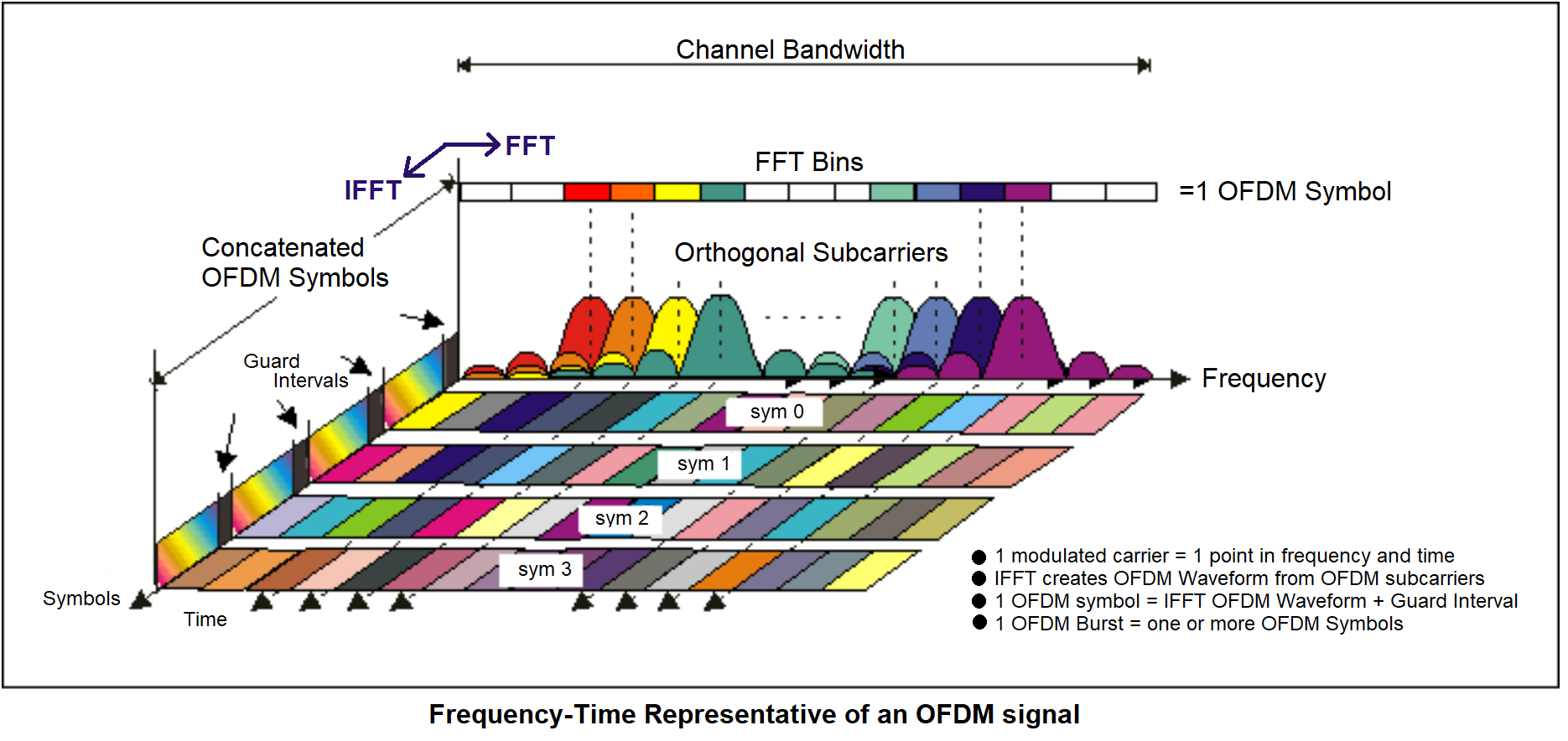
Orthogonal frequency-division multiplexing has become the standard modulation format for 5G New Radio. Lean how OFDM works and how it’s used.
untold sapphire
ok, yeah i just mentioned it because my networking class went a little bit into stuff like that, i guess because they wanted us to get some minimal exposure to it even if we didn't take a whole class
QAM and stuff
wise rose
we did that.
yeah, lots of protocols. I have no idea when I will be able to use it because MATLAB simulations don't seem very pragmatic and I just use a library, not implement a communications protocol on my own.
My electives could have been better this semester -- Controls, Radio, and DSP (plus Ethics and Senior Project)
untold sapphire
Damn i don't remember any of this stuff. guess staying out till 2am and then getting up early for class in college didn't do wonders for my long term retention. I had to learn a little control theory for a power system i was roped into working on
wind turbine generator
wise rose
next semester it will probably be Discrete Math, Automata/Formal Languages, Programming Language theory, and then I have to retake the Assembly programming class because I didn't finish it last year
and senior project -- it works pretty well already. I'm hoping to learn to print PCBs so we don't have a breadboard and do some stuff with outputting data over Bluetooth via an STM32 chip instead of to the Arduino console.
untold sapphire
that stuff sounds like a lot of fun. sounds like you have a lot to look forward to, have you ever flipped through the book by hopcroft and ullman on automata
or sipser's book on the theory of computation
wise rose
Yeah, I'm working on it now.
I also have that.
I haven't heard whether I will be allowed to take the Automata class because Discrete Math is supposed to be a prereq and I filed a petition with the department to take it concurrently.
But it should be fine.
untold sapphire
hopefully
wise rose
I'm doing the 1979 book and watching Ullman's lectures on edX
untold sapphire
oh i didn't realize he had lectures, neato.
wise rose

edX
This course covers the theory of automata and languages. We begin with a study of finite automata and the languages they can define (the so-called "regular languages." Topics include deterministic and nondeterministic automata, regular expressions, and the equivalence of these language-defining mechanisms.
It's running from whenever. So it gives you due dates but unless you pay, nobody grades your homework and you don't take exams. The lectures were recorded a few years ago (he's getting up there) and they're the same lectures from class but done separately in front of a camera, so they're easy to hear.
Watching some lectures online, the camera is kind of far back and you can't hear well and it's hard to make out what is on the board. But this is different.
The course is a sophomore CS course, so I'm sure it's a bit basic but because I am interested in theoretical CS stuff, I want to learn it for real and also chat with a different professor who wrote a lot of papers on automata theory and model-checking.
devout nacelle
Recorded video lectures on Theory of Computation by Sipser are available on the MIT OCW channel btw, he's following his own textbook.
 wild lantern
wise rose
wild lantern
wise rose
I haven't asked the professor which book we're using. I have him for another class this semester (although our lectures have ended, we just have a paper due tomorrow). Syllabus for another professor at the same school says they're using the Cinderella Book but the new 3rd edition (which is what Ullman's lectures also use)
Some people complain that the more advanced stuff isn't in the new edition but I don't know enough about the topic to say. However, it's a classic and it's not exactly something that changes much (unlike, say, compilers)
Another professor's syllabus says they use Sipser with Ullman as additional reference.
pale orchid
you're doing cs?
or electrical eng? kinda hard to tell with the courses you mentioned. the first few things you mentioned were part of some communications courses i took
neat lintel
untold sapphire
orthogonal frequency-division multiplexing? sounds like some wild shit. my textb...
???
 frank orchid
is the server’s minecraft server active?
deep mango
yeah
wise rose
pale orchid
you're doing cs?
I'm EE, CompE minor; Master's will probably be CompE although I'm back and forth with CS. It's the same department but I might have to apply to one or the other.
pale orchid
icic, EE was the impression i got
wise rose
pale orchid
or electrical eng? kinda hard to tell with the courses you mentioned. the first ...
My electives so far have been Instrumentation Design, Control Theory, Radio Telecommunications, and DSP. I try to keep it broad.
I'd basically take the same courses whether my Master's degree is labeled "CS", "CompE", or "EE"
neat lintel
lowkey need some help fr
wise rose
well, depends if I finish this telecom lab report tonight 😅
 wise rose
If you need help with a question, read #❓how-to-get-help
wise rose
pale orchid
i do very similar stuff
I don't know what I want to do exactly. What I'm interested in is more theoretical stuff.
but interests and getting a job are not always the same thing
I'm going to transfer to the main campus and take another year of undergrad classes where there are a lot more options. I have to take undergrad classes anyway even if I start a Master's, so I might as well do it while financial aid is paying my tuition. I will take more CS (system programming and OS), digital design (a second Verilog course, VLSIs and ASICs), more computer architecture (I took one course but there's like three available) and some more math (more proofs, abstract algebra, linear algebra)
we'll see if I go the hardware (HDL) or software route for job but it'll be embedded systems either way
I want to add more of the theory to embedded, doing formal verification to prove that critical systems work.
pale orchid
aha, embedded systems is hot stuff rn. in that regard though, you'll probably end up doing very little telecomm/sigproc. it can still be useful so that you are aware of the types of problems people run into out there, but that's only like a contextual frame
wise rose
I just pretty much took anything that was available that wasn't power.
although in studying for the FE exam, I probably should have taken more power
mint patio
When sketching phase portraits for linear systems
with node points
How do I know how to draw the eigenvectors?

Like how tf were these drawn
deep mango
Do you know how to plot points
They're just the lines through those two vectors
Like
The points (t, 4t) for the (1, 4) vector
And the points (-t, t) for the (-1, 1) vector
They're marking down all the possible eigenvectors (remember that eigenvectors are still eigenvectors when you scale them)
mint patio
I almost typed "oh so you just plot the vector" then realized how 4head that sounded but I think it's right LOL
So you just plot one eigenvector (just taking t = 1), then draw a line through the origin to get all the others?
deep mango
Yes
mint patio
Can you take complex ordered derivatives?
So the ith derivative of a function
Could be real valued or complex or whatever else makes it work
ancient flame
yes you can
ancient flame
idk
probably
but I know you can
not much more than that lol
they can also be fractional or irrational or really whatever you want
vivid halo
mint patio
Can you take complex ordered derivatives?
Yes, one way to do this is the Fourier transform formula for diffintegrals
You can’t really use the Cauchy formula/Riemann-Liouville because it will spit out 0^i for constant functions
mint patio
Why is 0^i undefined?
mint patio
vivid halo
Yes, one way to do this is the Fourier transform formula for diffintegrals
I will search this eventually thank you
Is there any physical or geometretical interpretation of a complex-order derivative?
Holy fuck I butchered that word
Sorry just woke up 💀
deep mango
mint patio
Why is 0^i undefined?
you define powers by complex numbers using the exponential. z^w = e^(w log z) and pick a branch of log. but log 0 is always undefined.
and in fact there's no way to make sense of it at all, even trying to call it -infinity. it's a nonisolated singularity, if you approach from different directions the real part will approach -infinity while the imaginary part can approch anything.
mint patio
deep mango
you define powers by complex numbers using the exponential. z^w = e^(w log z) a...
Ohhh
so 0^z is entirely undefined
mint patio
I never learned about the different types of singularities :sadge:
deep mango
since then it's e^(real * log z) as z approaches 0, but now this limit is 0 from every direction since the real part of the exponent approaches -infinity.
ok this is for positive reals
mint patio
deep mango
since then it's e^(real * log z) as z approaches 0, but now this limit is 0 from...
Interesting, I see it now
Ok so if z has nonzero imaginary part then
mint patio
deep mango
since then it's e^(real * log z) as z approaches 0, but now this limit is 0 from...
Why is it fair to call it 0 since the limit is 0 but we can’t do that with the complex case?
deep mango
it's probably not fair
idk
i'm not sure what you mean
when we're working with natural numbers, 0^n = 0*0*...*0
we extend that to rational numbers
and it's still 0
and then we take limits to extend it to real numbers and it's still 0
mint patio
deep mango
and then we take limits to extend it to real numbers and it's still 0
oh is this cause reals are defined as limits (using cauchy sequences)
deep mango
this just doesn't make sense with the way we define powers of complex numbers
it's mostly just a residue of that
mint patio
reeee how is this supposed to be easier has its own set of new rules
although a lot of things do get easier when it comes to calculus
thonkers
Thank you Ryc
mint patio
If you have two equal eigenvalues how are you supposed to get two eigenvectors
 tall badge
whats ur matrix
mint patio
uhhh I don't have a specific example in mind
mint patio
just 1 right?
tall badge
whats the 1-eigenspace?
mint patio
good question 🥴
so we have Ix = x
wait so is it just every vector lmao
mint patio
well just {(1,0),(0,1)} works right
tall badge
in general u find as many (linearly independent) eigenvectors as u can by finding a basis of each eigenspace
note i say "as many as u can" bc some nxn matrices dont have eigenbases, ie less than n linearly independent eigenvectors
take $\m{2&1\0&2}$
fathom swallowBOT
RokettoJanpu
 pale orchid
you can alternatively reformulate this as finding the general solution of a problem with infinitely many solutions. the general form of these infinitely many solutions has you find basis vectors of the null space, and these are precisely the eigenvectors
whenever these so-called "free parameters" pop up, you're finding a basis for the null space
 cold needle
jcf
pale orchid
jentucky cried ficken
mint patio
Say we're considering a linear system of ODEs (consider only the 2x2 case) where the two eigenvalues are equal but there are two distinct eigenvectors
Then the origin is a proper node, and stability depends on sign of course
But how do you draw it? Do you plot both eigenvectors and then just draw straight lines intersecting the origin between them?
So it looks like a star
It's not clear from the drawing the professor provided

If we have eigenvectors v1, v2, would it be like

I do not like this stuff
😭
All the material on the final takes so long to do
I wish it was 2 hrs 45 mins instead of just 2 hrs
Laplace Transforms of discontinuous function (by far the most time-consuming), power series solutions, linear & nonlinear systems
And the Laplace problems they give are always so much freaking work
mint patio
How would I write a product as a "sequence" of sorts? Or with Pi instead of Sigma? Idk cause it's not got a perfect pattern
The denominator here

Instead of writing that entire thing I'm wondering if there's a way to like write it as a_k or some other compact notation
Then define a_k or whatever off to the side
Or is it not worth it
fathom swallowBOT
✿ Ƹ̵̡Ӝ̵̨̄Ʒ Lepidopterian (◕‿◕✿)
Compile Error! Click the  reaction for more information.
(You may edit your message to recompile.)
 mint patio
Something like that yes! But not sure if that expression exactly, I haven't expanded it
Let's see
What's the starting index?
Wait i = 1
Okay
(3-1)(3) * (6-1)(6) * (9-1)(9) ...
= 23 * 56 * 8 * 9 ...
Yes!!!!!!
Thank you that's exactly what I wanted
mint patio
Ahah yeah but I've never worked with the product symbol before, I guess it's pretty obvious though
Wait
Oh
lol
I thought that was just for the leading coefficient
I'm an idiot
That's perfect
Since the product in the solution uses the same indexing variable as the x terms
Could I not just write it as Pi (3k)(3k-1) within the sum
So $\sum_{k=1} \frac{x^{3k}}{\Pi_{k=1}(3k)(3k-1)}$
fathom swallowBOT
kanga gang bimbo lover feather
 mint patio
Let's see
 prisma burrow
Umm there is a mistake with your notation.
mint patio
What's wrong?
prisma burrow
The iteration variable should not be k again.
 prisma burrow
This is different. This is a product of terms say (3i)(3i-1) with i going from 1 to k.
mint patio
So $\sum_{k=1} \frac{x^{3k}}{\Pi_{i=1}^k(3i)(3i-1)}$
fathom swallowBOT
kanga gang bimbo lover feather
 mint patio
OMG YES
prisma burrow
Yes.
prisma burrow
mint patio
I figured it out right before you typed it poggies
Good for you.
mint patio
I'm confused, how can we start the series at 0? Doesn't that result in the first term being division by 0?
 prisma burrow
mint patio
I'm confused, how can we start the series at 0? Doesn't that result in the first...
prisma burrow
mint patio
I'm confused, how can we start the series at 0? Doesn't that result in the first...
probably a mistake, the denom clearly starts at 3.
prisma burrow
nevertheless there is probably a mistake.
mint patio
Maybe I messed up wait
ok I think they just like
did something weird

For context this is the general solution to a second order ODE
Why can they just pick a_0 = 1 and a_1 = 0
when there were no initial conditions?
I just left them as a_0 and a_1
I got the same y_1 as them in the end

but my y_2 had an x as the first term instead of 1

So I wrote my series as x + ...
and I was just gonna leave the x there then write everything with sigma from x^4 onwards
I think that was their bad
As far as writing y_2 goes
$\sum_{k=1}^{\infty} \frac{x^{3k+1}}{\Pi_{i=1}^k(3i)(3i+1)}$
fathom swallowBOT
kanga gang bimbo lover feather
 fair mural
@mint patio seems correct
jovial ember
You choose to reject non commutatige rings
They do not exist to me
They cannot hurt me
🙉
I do not hear them
🙈
I do not see them
🙊
I do not speak them
jovial ember
Linear algebruh
jovial ember
mint patio
do you chair them.
What are you referring to
I do not know what you are asking if I chose
So I cannot answer this question
fair mural
do you monkey them
mint patio
Do you chair non-commutative rings?
jovial ember
What is “them”
mint patio
jovial ember
All I see you say is
mint patio
OH
jovial ember
“Do you chair ?”
fair mural
does chair monkey chair
jovial ember

 mint patio
what
deep mango
how do you live with it...
without noncommutativity you have to construct pathological rings like Q to get any interesting behavior
mint patio
how is Q pathological
deep mango
idk ask chmonkey
mint patio
I thought pathological meant an example that exists to be counterintuitive
or like
bad behaved
mint patio
that kinda stuff
deep mango
yes it is
jovial ember
As an abelian group it’s kinda whacky
deep mango
it's commutative but it's not a product of Z's
deep mango
how can something be a pathological group but not a pathological ring
rings are supposed to be even better than groups
jovial ember
Because as a ring it’s nice
It’s a fucking field
As a field it’s not too nice because most fields are nicer than it
But it is way better than almost every ring because it’s a field
It’s like literally any group is very nice considered as a monoid because they actually have inverses
But as a group it can start to seem pretty shit because compared to other groups it’s badly behaved
deep mango
😵💫
jovial ember
As a ring the additive structure is way less important
It doesn’t matter if Q looks kinda weird as a Z-module
Because it’s literally a field
deep mango
none of this fits into my perception of math that everything is either trivial or pathological
jovial ember
Lmao
It’s weird because as a field Q starts to seem like shit
Because fields are soooooo fucking nice
But rings are scary beings
They are so fucked up
bronze pelican
Q is the most basic field there ever was
jovial ember
So even being a shitty field is great as a ring
Yeah but PTY there’s a lot of reasons Q is weird as a field i think
fair mural
@mint patio me reading literally everything ryc says
jovial ember
Like from a model theory perspective or something
bronze pelican
jovial ember
Yeah but PTY there’s a lot of reasons Q is weird as a field i think
wfym
mint patio
ryc makes sense I’m just too braindead to follow
mint patio
chmonkey is like ng

 mint patio
saying random words and hoping people believe it’s real math
deep mango
mint patio
ryc makes sense I’m just too braindead to follow
see chmonkey? i do make sense after all.
mint patio
algebra is fake.
bronze pelican
okay then your judgement is invalid
jovial ember
Maybe this is my geometer brain vs your number theory brain
deep mango
yep chmonk is definitely the one making things up. not me
jovial ember
I don’t like that Q isn’t algebraically closed
tiny marten
as an uncountability denialist Q is my favorite set for doing math
rational analysis
tiny marten
that's right, they are all one
jovial ember
Actually maybe PTY is right
deep mango
i'm willing to accept countable infinity and the first uncountable cardinal, but not the cardinality of the continuum
tiny marten
Q is very rich in certain computational methods
fair mural
ryc always makes sense what the heck
bronze pelican
Q is the most basic field you could ever think of
deep mango
Z_2 in shambles
jovial ember
Yeah but is basic = good?
tiny marten
outside of that it is mostly R without its evolution stone
bronze pelican
i dont know what good means
jovial ember
Lmao
bronze pelican
if anything, C is weird as a field because its isomorphic to proper subfields
jovial ember
I think that isn’t too surprising like
Big things tend to be iso to its proper sub things
C is amazing since it’s universal in a sense for almost all char 0 field stuff
deep mango
if you're not isomorphic to a proper subobject then you're totally fucked up IMO
jovial ember
Using some fucking magic over Q
Like if your statements only use like
Countable (or maybe |R|) amount of stuff
bronze pelican
jovial ember
C is amazing since it’s universal in a sense for almost all char 0 field stuff
wdym
jovial ember
So like for statements like that
You can consider the subfield generated by that
Or like
The point is you do stuff with transcendence degree over Q
And you can reduce to proving a statement for C
And then you can use GAGA and stuff
It’s kind of like how you can Freyd-Mitchell almost anything
By taking a subcategory with all the objects you need
Then reduce to R-mod
I don’t remember the specific details but this makes char 0 algebraically closed alg geometry often reduce to complex geometry
bronze pelican
i dont realy follow
jovial ember
It’s because I don’t remember how it works very well
bronze pelican
but imo i think C is only good it you consider it's topology/geometry
jovial ember
But that’s super powerful
I think that’s intimately related to its algebra in a way
Its geometry explicitly
Via alg geo stuff
Then to its topology and analytic stuff via GAGA
Maybe your view on what “as a field” is different than mine
But in my head C exists foremost as a field and also as like the nicest object in the entire world
bronze pelican
as a field, C is isomorphic to C_p = completion of algebraic closure of Q_p, even though they have very different topologies