#book-recommendations
1 messages · Page 265 of 1
 sharp flame
@smoky zephyr okay sorry anyway thank you im just trying to prepare for the SAT
 slender dragon
Yes
 sudden kindle
sharp flame
<@!652336711325712386> okay sorry anyway thank you im just trying to prepare for...
sudden kindle
sharp flame
<@!652336711325712386> okay sorry anyway thank you im just trying to prepare for...
One way to prepare for the SAT is to do practice tests. Go to your local library and take out SAT prep books (Princeton review, etc) and time yourself doing the practice exams. Be consistent with the practice and you'll improve.
 slender mortar
right, so I found myself with around a month of free time. What would be a reasonable ordering for the self-studying of analysis? I have Spivak, Tao, Apostol (I & II), Rudin, and Abbot. I have experience with Math Olympiads, so I'm somewhat comfortable with proof-based math, and have experience with the equivalent of calc 1-3.
 remote ginkgo
slender mortar
right, so I found myself with around a month of free time. What would be a reaso...
remote ginkgo
slender mortar
right, so I found myself with around a month of free time. What would be a reaso...
Rudin
slender mortar
How much time do you reckon it'd take to go through it thoroughly?
remote ginkgo
A few months
But any progress you make at all will benefit you
Particularly chapter 2's intro to metric topology will be helpful
 smoky zephyr
i’ve already asked this too many times, but this is the last time
what are some linear algebra book recommendations
 smoky osprey
refer to previous suggestions?
smoky zephyr
well i forgot that somehow
smoky osprey
use the search feature?
remote ginkgo
smoky zephyr
well i forgot that somehow
Shilov, Strang, Shifrin
 empty mortar
im gonna study 
 fervent lava
Study hard.
empty mortar
thats what I told myself a week ago when my probability book arrived. Didn't make it past 20 pages
 misty wyvern
@main void Foundations of Modern Probability, Kallenberg
It's the bible of mathematical probability theory IMO
 foggy relic
@smoky zephyr you might also find this helpful https://www.youtube.com/playlist?list=PLGAnmvB9m7zOBVCZBUUmSinFV0wEir2Vw

YouTube
 main void
misty wyvern
<@!616627332886560769> Foundations of Modern Probability, Kallenberg
main void
misty wyvern
<@!616627332886560769> Foundations of Modern Probability, Kallenberg
oooh this is exactly what i was looking for, thank you
 ornate shuttle
Imma be real with you chief
reading Rudin is fucking tedious
I would rather read something like Understanding Analysis by Abbot
I think I would enjoy that significantly more
ornate shuttle
remote ginkgo
Particularly chapter 2's intro to metric topology will be helpful
I read through Chapter 2 and understood most of it (except his discussion of the Cantor Set)
But I found most of the exercises extremely dry and tedious
I would rather work in a less abstract metric space
like R with the absolute value metric and nothing else

Can anyone explain why this is true lmao

How does he know "no segment of the form so and so has a point in common with P"?
I don't know if I can understand that
smoky zephyr
no clue what that is but this isn’t a question channel
ornate shuttle
right, I was just trying to express my frustration from trying to read Rudin
but there's probably a better channel for that particular question
 fluid bay
ornate shuttle
Can anyone explain why this is true lmao
fluid bay
ornate shuttle
Can anyone explain why this is true lmao
the algorithm for obtaining E_{n+1} from E_n is to "cut out the middle third" from each interval in E_n. The segments of the form "so and so" are exactly the middle thirds that were cut out
i agree that rudin could have given more explanation here. I like this level of terseness sometimes because it forces me to engage with the material as I'm reading. When I was first learning proof-based mathematics (like a lot of people getting into rudin), I'm sure I wouldn't have liked this though
 robust mortar
ornate shuttle
I would rather read something like Understanding Analysis by Abbot
robust mortar
ornate shuttle
I would rather read something like Understanding Analysis by Abbot
non-standard analysis all the way down :^)
i find it much more eloquent, if anyone is interested
 surreal phoenix
slender mortar
right, so I found myself with around a month of free time. What would be a reaso...
surreal phoenix
slender mortar
right, so I found myself with around a month of free time. What would be a reaso...
A month of freetime + Rudin won't do you much, better start with something like Abbott or Tao if this is your first experience with analysis
You could still get a lot out of it, but I really don't see any reason for someone to put themselves through that tough of a book for a first course. I'd go for Abbott (very well written) and then tackle Rudin as a second look into it, really solidify everything from Abbott and add onto it
robust mortar
I second Abbot if you are not intrigued by non-standard analysis
ornate shuttle
fluid bay
the algorithm for obtaining E_{n+1} from E_n is to "cut out the middle third" fr...
The segments of the form so and so are not exactly the segments that were cut out
There could hypothetically be segments of that form which do in fact intersect the Cantor Set
I tried to explain this in the LaTaX document
Sorry if it's unintelligible lol

I know this isn't the right channel but I thought it was relevant to the discussion
fervent lava
Hey quantum another good linear algebra book is the one called advanced linear algebra by Bruce Cooperstein. I mostly use it as reference for LADW.
 cedar mortar
hi guys m in 12th grade hs and i REALLYYY loved integration would u pls recommend some books so i can learn more abt it ? hope sm1 ll respond . Thank u !
 analog pollen
cedar mortar
hi guys m in 12th grade hs and i REALLYYY loved integration would u pls recommen...
analog pollen
cedar mortar
hi guys m in 12th grade hs and i REALLYYY loved integration would u pls recommen...
What do you already know?
cedar mortar
Well we learned the definition using primitives //areas . Basically high school stuff .but i wanna dive in more ? cuz it really interested me
Also type of problems i need to work on// basically have better understanding abt the whole concept
analog pollen
Oh hmm maybe try something like spivak calculus
cedar mortar
Kay i ll check it out thanks ! y all have more?
analog pollen
P mcuh where you want to start
cedar mortar
Analysis ?
analog pollen
Its just a calc book afaik but but harder
And you want to know abt integration so i don think a plug and chug book will help you
surreal phoenix
It's like halfway between calculus and analysis, it'll help you bridge the gap as well if you're interested in purely doing analysis afterwards
analog pollen
And after you want to try some multivariable calc
surreal phoenix
Or if you just want to compute more integrals, maybe learn the rest of calculus
Yeah, multivariable and vector calc
cedar mortar
So spivak "Calculus" ?
cedar mortar
Sure Thanks a lot !!!!!!
remote ginkgo
ornate shuttle
I would rather read something like Understanding Analysis by Abbot
Abbott doesn't even cover anything.
 sinful glade
Guys i am a highschool freshman and i want to learn calculus rigourously ...btw i already know calculus upto stewarts level and i have covered the differential part of introductory multivariable calculus
Is hardy's course on pure mathematics relevant for me
analog pollen
An analysis text is what you want
surreal phoenix
Not good for a first course, try Abbott, Tao, Apostol, or some of the other you can find above if you scroll up a bit
Way more beginner friendly and can do a better job helping you transition into proof based maths
 broken meadow
abbott is cool i feel
 frosty girder
abbott seems nice yeah
surreal phoenix
It is cool I feel too
frosty girder
apostol feels good as well
 warm glen
where did y'all learn multilinear algebra
im looking at a text called "linear algebra via exterior products" and it seems cool but idk
 gray gazelle
from my differential geometry class
nobody actually learns multilinear algebra for its own sake
warm glen
oh
multilinear stuff doesn't get used outside DG?
i thought u need tensor products for commutative algebra
 stray veldt
you do, but commutative algebra books can just introduce them
stray veldt
i learned it from linear algebra class and the appendix in eisenbud
warm glen
is it harder to motivate without DG or comm alg?
stray veldt
you have to fit it into some class
dont think there are enough results to do a whole class of just multilinear algebra
warm glen
i see
have u by any chance read the sections on ML stuff in loomis and sternberg's advanced calculus book
it seems they teach some of it in that book to set up analysis on manifolds
gray gazelle
surreal phoenix
Not good for a first course, try Abbott, Tao, Apostol, or some of the other you ...
Lmfao Apostol.
frosty girder
gray gazelle
Lmfao Apostol.

gray gazelle
It's my family name. 😀
frosty girder
gray gazelle
It's my family name. 😀

gray gazelle

 bleak hornet
Do you guys have any book recommendation on Differential Geometry and Topology for self-study?
 sinful glade
surreal phoenix
Not good for a first course, try Abbott, Tao, Apostol, or some of the other you ...
sinful glade
surreal phoenix
Not good for a first course, try Abbott, Tao, Apostol, or some of the other you ...
Hmm i looked at tao volume 1 and it seems i already know most of what was in the book
analog pollen
bleak hornet
Do you guys have any book recommendation on Differential Geometry and Topology f...
Lee smooth manifolds, and munkres for topology
sinful glade
But is hardys book any good
surreal phoenix
sinful glade
Hmm i looked at tao volume 1 and it seems i already know most of what was in the...
The book doesn't teach you calculus computational stuff, it's analysis
The contents page looks the same, but it's completely different from a calculus course
bleak hornet
analog pollen
Lee smooth manifolds, and munkres for topology
I saw a video by The Math Sorcerer, he highly recommended this and another one
but I couldn't find the latter
sinful glade
surreal phoenix
The contents page looks the same, but it's completely different from a calculus ...
Oh
analog pollen
bleak hornet
I saw a video by The Math Sorcerer, he highly recommended this and another one
Which one does he recommend
Munkres?
surreal phoenix
Try scrolling through the book a bit and you'll see what I mean
bleak hornet
Topology by Gamelin and Greene
analog pollen
Oh never heard of that
bleak hornet
he said that all the exercises have an answer
analog pollen
The go to text is munkres
bleak hornet
so it'd help a lot
bleak hornet
analog pollen
The go to text is munkres
I got it, will start reading it next weekend
thank you
analog pollen
I also saw a vid on self studying mathematics and this guy recommended some lecture notes from the uni of toronto
It has a ton of problems
Wait
surreal phoenix
To supplement munkres, I found Hatcher's notes and Snoopy notes (notes written by students of a topology course, looked pretty nice) to help a bunch
Check those out too if you'd like, just search on google
analog pollen

This video has a list of books, videos, and exercises that goes through the undergrad pure mathematics curriculum from start to finish.
REAL ANALYSIS
Book: “Understanding Analysis” by Stephen Abbott.
Videos: Lectures by Francis Su (https://www.youtube.com/playlist?list=PL0E754696F72137EC)
LINEAR ALGEBRA
Book: “Linear Algebra Done Right”...
Those lecture notes looked p good
Havent read it yet tho
Lots of problems
@bleak hornet
And lee for diff geo
bleak hornet
great, thank you bro
bleak hornet
The thing is I don't really worry about not learning those subjects for now, even though the graduate course is only 4 years if all goes well
I have an entire life to search and read those
hope I have the tools to be able to understand just the basics
gray gazelle
bleak hornet
Do you guys have any book recommendation on Differential Geometry and Topology f...
tu's "an introduction to manifolds" is a watered down version of lee and a little easier to digest. surprised no one mentioned it so far
that'll teach you the manifold theory you need to go into more geometric stuff
if you want to learn differential topology, guillemin and pollack is the usual recommendation
g&p doesn't require a lot of background compared to lee and tu. lee and tu will require topology beforehand, and i don't think it's wise to start reading either of those if you haven't learned topology at the level of munkres already
bleak hornet
gray gazelle
tu's "an introduction to manifolds" is a watered down version of lee and a littl...
thank you ma fren
fervent lava
Looking up Lee turns out there also another lee who has a differential geometry book. It called manifolds and differential geometry by Jeffery lee.
Pretty sure I spelled the first name wrong.
 mortal pond
Any game theory book recommendations for someone at grad school?
 hollow peak
has anyone used Riemannian geometry and geometric analysis by Jost? Is it any good?
 amber linden
anyone know where I can find a cheap (under 40 bucks) copy of Calculus 9th edition by Stewart?
 novel iris
hollow peak
has anyone used Riemannian geometry and geometric analysis by Jost? Is it any go...
novel iris
hollow peak
has anyone used Riemannian geometry and geometric analysis by Jost? Is it any go...
I've used bits of it as a reference, it's a bit fast but good
author's v much a closeted physicist lol
def don't use it as an introduction to geometry for that reason imo. For eg defines vectors and other bundle sections using transformation laws rather than the more standard geometric definitions (unless you're specifically looking for coordinate-heavy RG books ig)
fervent lava
amber linden
anyone know where I can find a cheap (under 40 bucks) copy of Calculus 9th editi...
I don’t think that possible unless you buy it off someone. That book is expensive for no reason.
Although you can find a free pdf then use the 40 dollars to buy paper to print it out.
amber linden
fervent lava
Although you can find a free pdf then use the 40 dollars to buy paper to print i...
I'm still looking for a free pdf but no luck :/
fervent lava
amber linden
I'm still looking for a free pdf but no luck :/
Try libgen/zlibary.
amber linden
I tried libgen, piratebay, zlib and a bunch of other random sketchy sites but no luck
fervent lava
I found one in zlibrary
amber linden
with this cover? my professor is being super picky for some reason
 fervent lava
Yeah. Not sure why the professor/school wants the 9th edition. It literally has the same content as previous edition.
Probably webassign stuff they do
 loud cradle
Stewart's Calculus is expensive for good reason. The Integral House ain't gonna pay for itself. https://www.fastcompany.com/3052267/the-house-that-calculus-built

Fast Company
The Integral House, a millionaire mathematician’s 18,000 square foot love letter to calculus, is a modern design masterpiece.
loud cradle
"Last year alone, he sold 500,000 books, from which he made around $26 million."
(That was 2014, he's dead now.)
hollow peak
novel iris
def don't use it as an introduction to geometry for that reason imo. For eg defi...
thank you!
 dapper root
Has anyone who does not speak French at all ever tried to use a French textbook to learn math before? If so, did you find that it worked out?
I have read papers in French before and read occasional excerpts from French books, but I've never tried to use a French book as a textbook before.
 marble solar
hollow peak
has anyone used Riemannian geometry and geometric analysis by Jost? Is it any go...
marble solar
hollow peak
has anyone used Riemannian geometry and geometric analysis by Jost? Is it any go...
It's hard to find a good intro Riemannian Geometry book
They're either too low of a level or too high of a level
I'm partial to spivak's first two volumes
Peter Petersen also has a good book on RG, but it's very technical
novel iris
Lee's IRM is quite nice I think
marble solar
I was never too fond of Lee's approaches
They seem like good books, maybe I'm just a spivak simp
gray gazelle
Hello everybody!I found a really nice game that trains your brain!It's called Math Master Riddles and Puzzles😀
novel iris
marble solar
I was never too fond of Lee's approaches
anything in particular that you dislike about them?
gray gazelle
Uhhh
If you want to test your skills,really nice
It's something like math riddles from black games:) the old one,but it's more interesting,more questions:)
dapper root
ok
 restive falcon
any good nonstandard analysis textbooks?
 modern stone
restive falcon
any good nonstandard analysis textbooks?
modern stone
restive falcon
any good nonstandard analysis textbooks?
As a first introduction i’ve heard the standard choices would be Henle’s “Infinitesimal Calculus” or Keisler’s “Elementary Calculus: an Infinitesimal approach”. If you are confident enough in your mathematical abilities you could try reading Abraham Robinson’s “Non-standard analysis” as he is the one who started it all
 hearty steppe
@dapper root what is the benefit of learning another language to learn math?
Especially way later in life when you have neurological conditions impeding that ability?
Considering I’m a late bloomer and started learning math for real a little over a year ago
I’m 32 years old with not much expectation of getting into a PhD program in my 40s but I feel like my neurological capacity to benefit from relationships in an industry/trade skill environment leaves me stranded like a child that peaked in social skills before puberty happened.
Like if I stop learning math, I stop learning period for the most part I feel.
I’ve come to the conclusion that learning mathematics is probably the most important thing for my mindset right now and it has made me feel so much more grounded with my life. It makes so much more sense to me than people do the more time I do math.
dapper root
Sometimes something you want to read only exists in a certain language so you’re forced to either not read it, or struggle to read it in the language it exists in. That being said, reading mathematics is far easier than reading a novel, I think it depends on the language, but for eg French, I am not afraid to read a paper in French even though I don’t speak the language at all.
Nobody really learns a language for the express purpose to learn math, you just learn how to read math in that language
 wise umbra
dapper root
Has anyone who does not speak French at all ever tried to use a French textbook ...
wise umbra
dapper root
Has anyone who does not speak French at all ever tried to use a French textbook ...
I don't think it will be harder than reading a paper
hearty steppe
I wish I could read novels. I can’t. My reading comprehension skills peak when it comes to trying to interpret fiction. It really sucks man. I have a hard time interpreting narratives using vivid imagination
It’s like as if I’m looking at a TV screen full of white noise and static
wise umbra
dapper root
Has anyone who does not speak French at all ever tried to use a French textbook ...
Most textbooks don't use much vocabulary and are really structured, Bourbaki-style
hearty steppe
Like I don’t read fiction at all
dapper root
I guess my main concern is not being able to understand the prose in the text which explains what the math is actually about, but if all French books are devoid of that, then I guess that’s fine lol
hearty steppe
My brain has a hard time interpreting narratives. So even classical philosophy stuff and really old terse writing forget about it. Can’t read it. White noise interpretations of human emotion
Not sure if anyone relates
gray gazelle
@hearty steppe maybe you have Aphantasia?
hearty steppe
It is not something I wish upon my worst enemies
I am clinically diagnosed with high functioning autism
hearty steppe
I have not heard of aphantasia. I have a hard time with interpreting things
wise umbra
dapper root
I guess my main concern is not being able to understand the prose in the text wh...
really depends of the author, most of them don't have much prose, or at most it's a couple of sentences (like «schemes are a generalisation of classical algebraic varieties»)
hearty steppe
I have misophonia tho and that is horrible.
Frequencies that make you feel like your in pain
Noises*
I don’t have a problem visualizing things. I have a problem interpreting things
gray gazelle
I see
hearty steppe
Yea math books are fun to read when you have to go through at least half a dozen reference/supplementary texts to use with the standard text(s) sometimes
That’s my experience of using standard math texts tho. At first I didn’t get the hype but trust me. Make sure you work through the standard texts mentioned here. There’s a certain way to interpret the information that you gotta figure out for yourself to make it click but when it clicks, it’s a great feeling
wise umbra
dapper root
I guess my main concern is not being able to understand the prose in the text wh...
(what do you want to read ?)
dapper root
Simpliciale methodes en algebre homologie et commutatives (or something like that, it’s by Michael André)
And Homologie Des Algebres Commutatives by André as well
Or at least I am considering it
gray gazelle
@dapper root they used different words
hearty steppe
@dapper root have you considered that there is potentially some cross over with other topics? Like from category theory or commutative algebra texts?
dapper root
What?
hearty steppe
Regarding the French texts your looking for that is?
Maybe you haven’t searched for something more niche in English
Or less niche
dapper root
I mean possibly, the latter one sort of exists in the form of a paper by Quillen
But the paper by quillen is way more dense and less friendly
And I want to read these books specifically because I want to read these books
hearty steppe
Oh ok interesting.
wise umbra
I'd say, try it, you'll see pretty quick if you can read it or not
dapper root
gray gazelle
<@146419489083228160> they used different words
Also idk what you mean here lol
gray gazelle
@dapper root you know span right in LA?
dapper root
Yeah Adrien, I realized we have the books in my school library
wise umbra
maybe you'll have some troubles with the introduction and it we'll be easier after
dapper root
Yes I do Halwa
hearty steppe
There also an ocean of linear algebra texts it’s somewhat overwhelming to think of sometimes
So much to learn from so many texts
wise umbra
dapper root
Simpliciale methodes en algebre homologie et commutatives (or something like tha...
(it's probably «Méthodes simpliciales …»)
wise umbra
much of them have the same content
hearty steppe
Well it varies a bit
wise umbra
at least elementary ones
hearty steppe
I didn’t realize how many linear algebra texts I found compared to most other math books. Even analysis texts
wise umbra
dapper root
Yeah Adrien, I realized we have the books in my school library
seems like the first page
 gray gazelle
@dapper root if you have trouble understanding something in french you can ask me
hearty steppe
@dapper root so you are focused on studying homological algebra?
MaxJ goes off the face of the earth at the best times doesn’t he? I’d imagine he know a lot about this stuff
 cinder steeple
Anyone here who has read six of crows?
can i just read six of crows and not crooked kingdom or does six of crows have a cliff hanger ending that will make me want to go for the sequel?
and 2nd question:
IS a man called ove book slow paced/ slow developing?
 mellow bison
cinder steeple
can i just read six of crows and not crooked kingdom or does six of crows have a...
mellow bison
cinder steeple
can i just read six of crows and not crooked kingdom or does six of crows have a...
If I remember six of crows u can read by urself
I forgot the ending tho and didn’t read the sequel
also is steward's calculus book for beginners or for more experienced people?
sinful glade
mellow bison
also is steward's calculus book for beginners or for more experienced people?
Stewart?
Thats introductory
analog pollen
amber linden
with this cover? my professor is being super picky for some reason
This is 9E
cinder steeple
mellow bison
If I remember six of crows u can read by urself
Ook ty
 mystic orbit
cinder steeple
can i just read six of crows and not crooked kingdom or does six of crows have a...
mystic orbit
cinder steeple
can i just read six of crows and not crooked kingdom or does six of crows have a...
Yes it does
 paper stratus
mellow bison
also is steward's calculus book for beginners or for more experienced people?
paper stratus
mellow bison
also is steward's calculus book for beginners or for more experienced people?
intro
it's the standard intro calc book for ap calc and calc 1
if you do want a challenge, you can checkout apostol calc or spivak
mellow bison
paper stratus
if you do want a challenge, you can checkout apostol calc or spivak
whats the specific book by spivak
im not sure i found it
fervent lava
mellow bison
whats the specific book by spivak
It called calculus by micheal spivak.
Not the calculus on manifolds one.
mellow bison
ohk thanks
 serene falcon
does anyone have any experience with fluid dynamics by gk batchelor? how mathematically intensive is it?
gray gazelle
What do you guys think of Tao's Analysis I?
restive falcon
very slow
good if you want lots of detail before you even get to the reals
marble solar
gray gazelle
What do you guys think of Tao's Analysis I?
If you haven't done rigorous calculus, it's better to do spivak's calculus
Do some linear algebra, and a good calc 3 class
Spivak's Calculus on Manifolds
gray gazelle
Ah.
dapper root
did you read any of Lee?
dapper root
how was Spivak different
marble solar
Spivak gives a lot of time to motivate things
and has funny little one liners
That keep me going
dapper root
lol
is it as verbose?
I feel like Lee is...
Idk, he says a lot but then doesn't say muchg
marble solar
Spivak says a lot, and it ties in real well
Sometimes I get tired and try to skip to the point
but then I go back and see I missed something important
he does a lot of back and forth between a "classical" viewpoint, and a more modern research point of view
Trying to motivate where it came from, why we have it, and how we deal with it
restive falcon
I'm currently doing abbott for analysis
dapper root
do you remember roughly how many pages the two are combined?
I'm thinking I'll probably spend a lot of the gap year I plan to take learning diff geo and maybe analysis?
marble solar
The first one is like 700
dapper root
Just like, round myself out, get ready for quals courses
marble solar
But it'll go by quicker than you think
Especially if you have background in diff. geom.
dapper root
I am undecided if I want to just use a really terse book that doesn't have much intuition and motivation
or go really heavy on that
since really I want to learn it to have more intuition for algebraic geometry lol
marble solar
What I started doing is just latexing solutions to problem sets
and I'd make casual notes in the book in pencil as I read
dapper root
ah okay
marble solar
and they are very good
marble solar
There are certainly skippable ones
I made a rule to try 2/3rds, and solve somewhere between 1/3rd to 1/2
dapper root
okay that seems maybe like a D&F level of good exercises
it kinda depends on the book you know
Hartshorne is a you have to do every one book
D&F is definitely not lol
marble solar
I'd put spivak in that category
You certainly don't have to do every single one, but they are good practice
Some of them are very easy, some of them are very difficult
dapper root
cool cool
I'll see if our library has a copy to see how I vibe with it
it does RG too right?
the second volume?
marble solar
Yeah, it gets there
dapper root
cool cool
marble solar
I have volume 2 on PDF
lemme pop'er open
Yeah volume 2 certainly gets into RG
And also explains classical DG, and how it leads naturally to RG concepts
dapper root
naisu
I'm looking through Columbia's modern geo course topics


and there's quite a bit, way more than UW covers
But I think overall it covers a lot of the material here?
dapper root
Yeah, I mean I'll take the course eventually probably
marble solar
but as far as giving you a grounded sense of what's going on in computational problems and theoretical exercises
dapper root
Maybe I'll try to pass one more on arrival, but I am not gonna be able to pass them all on arrival unless I go crazy hard
marble solar
I've been happy with Spivak
dapper root
yeah that's what I'd like
Best way to do well in a hard course is to know what's gonna happen going in lol
marble solar
Yeah, if I get into Irvine, I can pass real & complex on arrival w/ summer prep
But the algebra one is gonna be brutal for me
I never took galois
dapper root
Columbia doesn't even have an algebra grad course lmao
they just have comm alg & AG / NT
marble solar
Honestly, I'd prefer that
dapper root
It just really says that like
they're in a different tier than most schools lol
you pretty much need to have a grad algebra backgroudn going in or you're fucked
unless you just avoid every algebra related course lol, but idk if that's even possible
marble solar
yeah, my friends say at princeton you don't really take courses
It's more seminar style
dapper root
yeah lmao
marble solar
Friend ended up going to MIT, where they make you take 8 classes
marble solar
Nope, just one semester courses
dapper root
ah okay
marble solar
But they're not seminar courses
dapper root
that's more reasonable
marble solar
They have to have some form of problem set, final, or presentation/write up
dapper root
I know my friend at Utah they have like
6 prelims?
But it's like
1 for each semester
dapper root
and they're pretty easy
from what I hear at least
I really need to pass the AG qual on arrival
if I go to columbia
marble solar
UC Riverside has 4 quals you have to pass
dapper root
I mean I'm not worried, but if I don't I am so fucked
marble solar
They're each 1 year long sequence
dapper root
jesus
I think it's kind of funny that Princeton famously "doesn't have quals"
but they have that oral exam at the end of the first year lol
marble solar
That just destroys most people
dapper root
I think most ppl pass but
it's very stressful it seems
and everyone is super fucking nervous
and forgets simple stuff lol
and on the AG side
 rugged maple
just how highly would you guys reccomend pugh's analysis?
would it be the self-study analysis book?
rugged maple
wow, pugh is a rlly good book
i might drop kenneth's book lol
my god, it reads so well, i can basically read it like a novel
 halcyon hornet
Hey. Any book recommendations for Mathematical proofs?
Especially those with relatively less prerequisites(HS Mathematics mostly and some basic Calculus).
 karmic thorn
Proof and the Art of Mathematics by Hamkins
dapper root
I’m of the opinion that you can get by with a linear algebra textbook. I think you can follow how proofs are done because the stuff is quite intuitive
halcyon hornet
I see, never heard of that one lol.
halcyon hornet
dapper root
I’m of the opinion that you can get by with a linear algebra textbook. I think y...
Hmmm.
karmic thorn
There's a newer version with examples and extensions
dapper root
This isn’t the best advice for everyone arguably
halcyon hornet
Mainly heard of Polya's book lol.
karmic thorn
I think lin alg would make more sense to Senku after probably 2 or so years, when he has dealt with a fair bit of linear equations in more than one variable.
halcyon hornet
Proofs come up everywhere and 1 day I will have to do them, so I guess I will start with them soon.
There is no avoiding them.
karmic thorn
Sure
halcyon hornet
karmic thorn
I think lin alg would make more sense to Senku after probably 2 or so years, whe...
Hmmm?
Is not Linear Algebra just on the level of Calculus?
karmic thorn
Have you dealt with solutions of linear equations in 2 or more variables?
halcyon hornet
I am starting with Stewart's Calculus, got the book and will resume after exams.
halcyon hornet
karmic thorn
Have you dealt with solutions of linear equations in 2 or more variables?
Yes.
Of course.
It is basic 9th-10th stuff lol.
karmic thorn
Then linear algebra is fine as well
halcyon hornet
Systems of equations.
karmic thorn
But I'd still insist on checking out Hamkin's book
Just to get a feel for abstract math first
surreal phoenix
Does Apostol's Analytic number theory skip a lot of the stuff you'd find in an elementary NT course? Or does it cover most of that too?
stray veldt
depends on your elementary NT course
apostol probably assumes the content of an elementary NT course
it proves quadratic reciprocity, which is often done towards the end of an introduction to NT i think
it also covers primitive roots from the looks of it but probably assumes the related theorems
nvm, it proves the theorems
(but if you take a good elementary NT course, it will study quadratic number fields)
(also does not cover pythagorean triples/geometry of numbers and pell equation stuff, which is probably pretty standard in elementary NT)
fervent lava
halcyon hornet
Hey. Any book recommendations for Mathematical proofs?
I used Loch intro proof when I was starting, then use other intro proofs books as reference. Here it is, #proofs-and-logic message.
Discord
Discord is the easiest way to communicate over voice, video, and text. Chat, hang out, and stay close with your friends and communities.
fervent lava
Ok.

 hollow dome


 sage kelp
halcyon hornet
Hey. Any book recommendations for Mathematical proofs?
sage kelp
halcyon hornet
Hey. Any book recommendations for Mathematical proofs?
I used Velleman How To Prove It, and found it really helpful. Have heard good things of Book of Proof by Hammack
 ember hearth
any real analysis book from scratch and good for self study?
karmic thorn
Understanding Analysis by Abbott
ember hearth
karmic thorn
_Understanding Analysis_ by Abbott
i will check it out thanks
karmic thorn

 ember hearth
karmic thorn
<:catthumbsup:614540188747563008>
ember hearth
karmic thorn
<:catthumbsup:614540188747563008>
just read a few pages, i am already loving it, cya in maybe a month or two,asking for another
frosty girder
ember hearth
maybe i would learn some topology after that 
frosty girder
 brittle latch
yall know anywhere to buy books like this, besides amazon and B&N
frosty girder
does abbott cover topology?
ember hearth
frosty girder
does abbott cover topology?
no ig
frosty girder
like a little bit of it, thats useful in calc?
ember hearth
frosty girder
search the book for metric spaces
btw, i have just started reading the textbooks because like, i only used to watch some open lectures on yt
and i thought
learning it from a textbook alongside would be better
frosty girder
ember hearth
learning it from a textbook alongside would be better
that would be nice, yeah
ember hearth
just for fun tbh, its a hobby now 
karmic thorn
You essentially learn by solving problems
frosty girder
i myself just started analysis myself
frosty girder
karmic thorn
<:catthumbsup:614540188747563008> You essentially learn by solving problems

ember hearth
karmic thorn
<:catthumbsup:614540188747563008> You essentially learn by solving problems
exactly, thats why i wanted a textbook
ember hearth
frosty girder
i myself just started analysis myself
thats cool
restive falcon
abbott is the real analysis textbook
 lapis sundial
cries in rudin
fervent lava
frosty girder
does abbott cover topology?
Yes, chapter 3. It just topology in R.
I can’t wait till I get too it.
frosty girder
fervent lava
Yes, chapter 3. It just topology in R.
noice
topology stuff is a bunch of definitions
but its fun
intuitive, visual
beautiful
analog pollen
frosty girder
does abbott cover topology?
iirc it also does some at the end
frosty girder
analog pollen
Are metric spaces a part of topology tho
I thought so
And prob something else
Also at the end
frosty girder
analog pollen
Are metric spaces a part of topology tho
yeah
analog pollen
Ok then yea it discusses some of it at the end

 atomic stag
which book is best to understand calc 1 integration?
analog pollen
Stewart
atomic stag
I want to understand 3 concepts
1/integration by trig identies
2/partial integration
2/int by substitution
analog pollen
Partial integration? Do you mean by partial fractions?
Stewart is still good for those
atomic stag
thanks
marble solar
atomic stag
which book is best to understand calc 1 integration?
Spivak's calculus
But that depends on your definition of understand
restive falcon
integration by parts is also key
 tawny copper
ember hearth
any real analysis book from scratch and good for self study?
tawny copper
ember hearth
any real analysis book from scratch and good for self study?
Terence Tao's
The exercises are very good
marble solar
tawny copper
The exercises are very good
Unironically wrong
 hardy junco
any books for mathematics behind graphics programming?
 quick hornet
Might have better luck asking in a CS server
gray gazelle
brittle latch
ive been trying to use baby rudin for this
keep at it, you can do it !!!
brittle latch
isnt tao like super dense
smoky zephyr
gray gazelle
https://www.math.ucdavis.edu/~hunter/intro_analysis_pdf/intro_analysis.html
try...
this seems interesting, thanks
 tulip blade
brittle latch
isnt tao like super dense
tulip blade
brittle latch
isnt tao like super dense
I think its the opposite
tawny copper
marble solar
Unironically wrong
Why
Just the fact that he doesnt prove many of the important results is a good thing
Most books I've found arent like that, though I don't have a lot of experience
marble solar
Big picture gets shrouded by obscure details or technicalities
I think Pugh is a better intro to real analysis
tawny copper
You are correct actually
marble solar
I know, I worked through his analysis volumes extensively
tawny copper
But that doesnt mean the exercises are not good
It's a matter of exposition of the topic
marble solar
The exercises have to be put in context of the material shown
You don't put graduate algebra problem sets in a high school algebra book
tawny copper
And it does that very good
marble solar
So the question then becomes are the exercises good in context of the material of the book
And I'd say no
Because Terry isn't that great at exposition in his analysis volumes
Also, I think there's too few exercises
This becomes apparent in comparison to books like Spivak's Calculus or Pugh's Real
halcyon hornet
marble solar
You don't put graduate algebra problem sets in a high school algebra book

slender dragon
ember hearth
any real analysis book from scratch and good for self study?
I like Steps into Analysis. It's a Inquiry Base Learning book
gray gazelle
hardy junco
any books for mathematics behind graphics programming?
you need linear algebra, calculus, analytical and vector geometry, numerical analysis and some signal processing
there's no one book that is going to cover all of it
you will find these in any standard engineering math book
atomic stag
marble solar
But that depends on your definition of understand
i already have book for practice but i want under diffrent techniques
i want get "experiance"
foggy relic
atomic stag
i want get "experiance"
what do you mean by experience
since you said you have a book for practice, do you mean you know how to do the computaions?
if thats the case, spivak will probably be really good for you
it proves why all those computations work
 foggy relic
frosty girder
spivak does?
foggy relic
frosty girder
spivak does?
at least so far
i havent finished it yet, but it has so far i think
idk if illl ever finish it
why tf are there like so many problems
it takes like a few hours just to do those
frosty girder
hence the halfway between an actual analysis book
foggy relic
yeah
 pulsar geode
does anyone have any stochastic calc book recs? generally looking for good writing quality and exercises, mostly regardless of applications vs theoretical focus
 near spindle
all in one math book
atomic stag
foggy relic
what do you mean by experience
experience means getting to know how to solve questions.
edit: Stewart's book got the thing I needed
 full linden
anyone working with fourier analysis?
 novel mica
does anyone have a recommended, fairly "light" book on algebraic geometry? i'm trying to gauge my interest in the field but i wont have much time this semester for dedicated self-study
background is intermediate-advanced undergrad algebra
marble solar
Fulton's introduction to algebraic curves
novel mica
ty.
 gleaming nova
@azure stratus ey bro are you still offering the OneNote notebook on intro to materials science and ode's?
 azure stratus
Sorry, I'm probably not going to share them with those who don't go to my college
It feels like sharing them with strangers doesn't feel super appropriate for me right now, sorry
gleaming nova
ah no worries
azure stratus
Sorry about that
But if you got individual questions - I can try answering them
And sending individual tidbits of it
gleaming nova
hmmm
do you have a good recommendation for a book for material science?
the one i'm using kinda sucks
 pale scarab
frosty girder
hence the halfway between an actual analysis book
pale scarab
frosty girder
hence the halfway between an actual analysis book
If your able to do the majority of problems you won't have any issues with any typical undergrad analysis class. Most struggle in that class because they learned calculus from an engineering calculus book like Stewart
frosty girder
I am kinda "struggling with analysis" but thats just the proofs part, but i see what u mean
i should do spivak some day
halcyon hornet
😔
gray gazelle
just do the questions
frosty girder
i cant do them right now, but yeah i will
gray gazelle
what multivariable calculus books would u recommend?
"advanced calculus" by folland
near spindle
mathematical analysis rudin or abott
near spindle
what if its for a high schooler friend
surreal phoenix
Abbott for sure then
surreal phoenix
Not complex, it's just a lot harder to read because he skips a lot of details and expects you go he able to fill them in on your own
near spindle
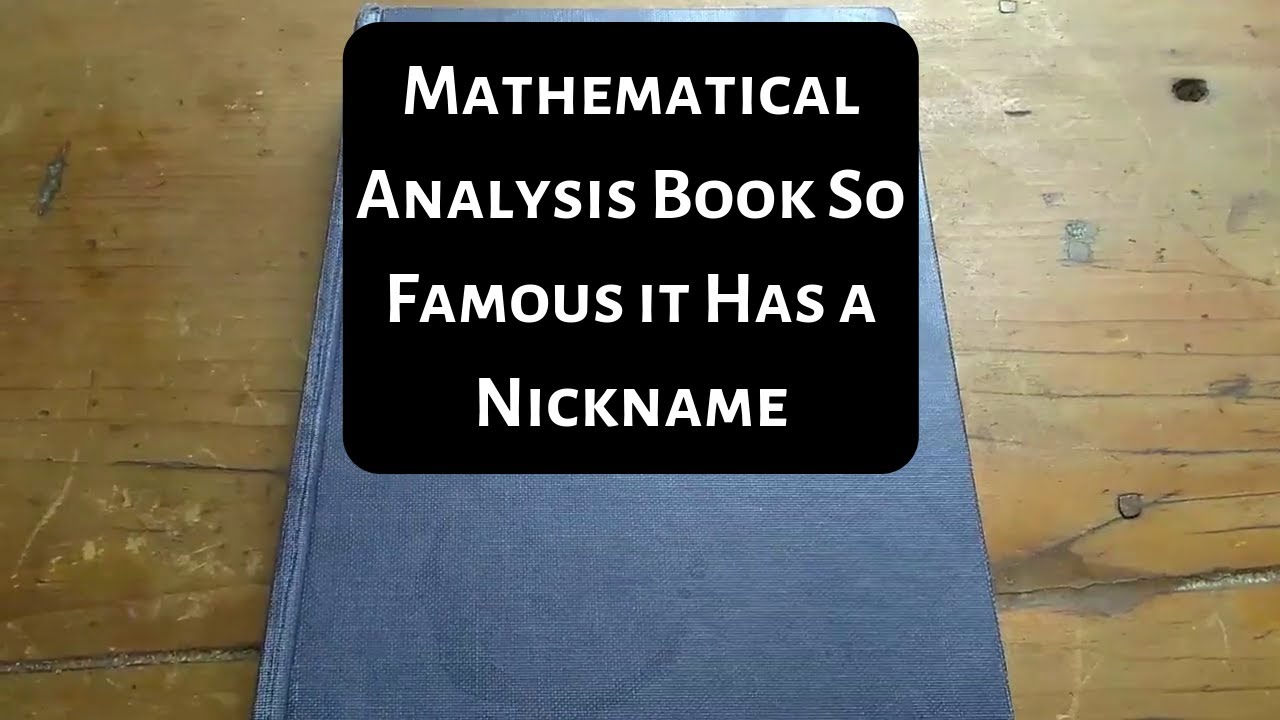
A Mathematical Analysis Book so Famous it Has a Nickname
In this video I go over the famous book "Baby Rudin", also known as "Principles of Mathematical Analysis" written by Walter B. Rudin. This book is notoriously rigorous and has some pros and cons, which I go over carefully in the video. Note this book covers undergraduate mathematical anal...
near spindle
surreal phoenix
Not complex, it's just a lot harder to read because he skips a lot of details an...
oh ic
no then
surreal phoenix
Yeah, Abbott is much better for an introduction
near spindle
ok thanks
surreal phoenix
Np
gray gazelle
Any book that deals specifically with integrals and Taylor series?
 shut lily
Introduction to Applied Linear Algebra Vectors, Matrices, and Least Squares by Boyd and Vandenberghe - has anyone studied this and if so would they recommend it?
https://web.stanford.edu/~boyd/vmls/vmls.pdf
 subtle siren
No clue about that book but Boyd and Vandenberghe's Convex Opti book is a classic
I'm looking through the table of contents and it does feel like it has a stronger applied math or just straight up optimisation vibe to it
shut lily
subtle siren
No clue about that book but Boyd and Vandenberghe's Convex Opti book is a classi...
thats what I've heard too. What would the prerequisites be for working through this?
subtle siren
It's very introductory so hopefully nothing? Perhaps the usual high school/pre-high school math
The book covers less mathematics than a typical text on applied linear algebra. ...
Note this if you want to substitute it for actually learning LinAlg, although tbh if you're into applications, theoretical LinAlg won't come back until possibly grad school
shut lily
subtle siren
It's very introductory so hopefully nothing? Perhaps the usual high school/pre-h...
sounds good, i was hoping to study it because ive heard its good for ML (which I would like to pursue professionally)
subtle siren
If you'd like to go into ML, the book is a starting point but very insufficient
shut lily
subtle siren
If you'd like to go into ML, the book is a starting point but very insufficient
i see
halcyon hornet
Any Resources/Books which make me go "Aha" over Mathematics? Been missing that for some time 😔.
smoky zephyr
the information about sets in book of proof is pretty easy to understand and cool to me
you could try that
halcyon hornet
Is it "Aha-ey"?
smoky zephyr
no clue i just found it cool
halcyon hornet
xD.
ember hearth
halcyon hornet
Any Resources/Books which make me go "Aha" over Mathematics? Been missing that f...
Have you read what is mathematics by courant and ian stewart?
Its quite nice
 still saddle
halcyon hornet
Any Resources/Books which make me go "Aha" over Mathematics? Been missing that f...
still saddle
halcyon hornet
Any Resources/Books which make me go "Aha" over Mathematics? Been missing that f...
Indra's Perals by Mumford et al
halcyon hornet
ember hearth
Have you read what is mathematics by courant and ian stewart?
Nope.
halcyon hornet
still saddle
Indra's Perals by Mumford et al
Which is on?
gray gazelle
halcyon hornet
Any Resources/Books which make me go "Aha" over Mathematics? Been missing that f...
Posamentier's Challenging Problems in Geoemetry is quite a rewarding read.
sage kelp
marble solar
I think Pugh is a better intro to real analysis
I found the opinion about Tao interesting, because I agree with you. Most of the exercises are not in context with the exposed material. I was wondering if you could share your opinion on this matter when comparing Baby Rudin and Pugh
foggy relic
near spindle
mathematical analysis `rudin or abott`
maybe do pugh
frosty girder
near spindle
mathematical analysis `rudin or abott`
apostol ftw
sage kelp
foggy relic
maybe do pugh
Why Pugh instead of Rudin?
foggy relic
its easier to read, better writing style, has good problems
halcyon hornet
gray gazelle
Posamentier's Challenging Problems in Geoemetry is quite a rewarding read.
Oooo!
near spindle
frosty girder
apostol ftw
bro any one
frosty girder
near spindle
bro any one
?
gray gazelle
read all, see which one fits you.
sage kelp
near spindle
abott, apostol, rudin, pugh
I’m currently reading Rudin, but might change my mind to Pugh
Theory in Rudin is amazing, but not sure how I feel with the exercises
near spindle
ic
sage kelp
Plus, Abbott is not at the same level as Rudin or Pugh, so you might want to check that
marble solar
sage kelp
I found the opinion about Tao interesting, because I agree with you. Most of the...
Baby Rudin and Pugh are basically the same, except Pugh actually explains more steps and has more varying exercises
 icy knot
Finally got Pinter’s book on Algebra. Such a fun read.
 odd spade
slender dragon
tulip blade
Dummit and foote>
odd spade
slender dragon
tulip blade
Dummit and foote>
The best book
 terse anchor
Book recommendations for discrete math?
 glad prairie
i used rosen's book and i liked it.
knuth's concrete math is a harder book and doesnt cover everything a discrete math class covers, but it's tremendously high quality.
there's also this 

 marsh skiff
does anybody know where I could buy a solutions manual for "Understanding Analysis" by Stephen Abbott. I want the second edition, not the first.
dapper root
smoky zephyr
like does it actually teach you stuff
Yea
smoky zephyr
wow
tulip blade
glad prairie
knuth's concrete math is a harder book and doesnt cover everything a discrete ma...
Concrete math is epic
near spindle
do you guys know a book in which there is everything from algebra to calculus
tulip blade
near spindle
do you guys know a book in which there is everything from algebra to calculus
No
That would be a lot of information for one book.
near spindle
yes
tulip blade
Calculus books tend to be pretty big on their own. Adding a ton of algebra would make it extremely thick.
near spindle
Synopsis of Pure Mathematics is a book by G. S. Carr, written in 1886. The book attempted to summarize the state of most of the basic mathematics known at the time.
The book is noteworthy because it was a major source of information for the legendary and self-taught mathematician Srinivasa Ramanujan who managed to obtain a library loaned copy fr...
something like this
even without calculus is fine
gray gazelle
that book is only results of a particularly difficult exam
it contains no explanation whatsoever
tulip blade
There are plenty of genuinely good resources available.
near spindle
since i won't be able to use the internet because of unknown reasons
tulip blade
Just buy the princeton companion to math then
gray gazelle
you don't need computers/internet. get a few pdfs and print them
near spindle
tulip blade
Just buy the princeton companion to math then
its a big book
tulip blade
Seriously though what are you going to do w a large book containing high school algebra and calculus?
near spindle
does it have everything in it
tulip blade
Just buy a calculus book and algebra book separately
tulip blade
near spindle
does it have everything in it
It summarizes a lot of ~modern math~.
near spindle
tulip blade
Just buy a calculus book and algebra book separately
i have higher algebra by hall and knight
gray gazelle
that will do for algebra
near spindle
and calculus made easy by silvanus p thompson
gray gazelle
you can do the questions at the back of hall's book for difficult problems

 tulip blade
near spindle
why does the princeton companion book cost 102 USD
tulip blade
near spindle
why does the princeton companion book cost 102 USD
Its huge. And textbooks (books) tend to be expensive
gray gazelle
you are trying to learn math for high school right ?
gray gazelle
ah welp
near spindle
ig i'll go step by step
it'll take me long enough to finish hall and knight
do you think its a bad idea to go beyond school syllabus @gray gazelle
gray gazelle
no
but learn school stuff first since there is no point in compromising scores for the sake of it i guess
near spindle
school stuff is easy
all of school's stuff is like the first page of every chapter in hall's book
gray gazelle
well if you are done with school subjects, then sure move ahead
near spindle
nice
gray gazelle
(have you done questions by the way ?)
gray gazelle
uh
near spindle

Google Books
 brittle breach
might be a good first math book
misty wyvern
Princeton Companion is actually good. So is its ugly sister, Companion to Applied Math.
I wish other fields would get their own Princeton Companion
legit I would kill for a Princeton Companion to Mechanical Engineering or something
 shadow tusk
misty wyvern
legit I would kill for a Princeton Companion to Mechanical Engineering or someth...
shadow tusk
misty wyvern
legit I would kill for a Princeton Companion to Mechanical Engineering or someth...
it's really that good huh
misty wyvern
no
i just think mechanical engineering is just a big collection of random techniques and needs some core structure
shadow tusk
it doesn't?
wow
learning mechanical engineering by yourself would be a nightmare then
misty wyvern
I think the average mechanical engineer basically learns Goldstein and tensor calculus, and that's all they retain. They specialize after that.
There's too much.
shadow tusk
actually, I think learning any field of engineering by yourself would be a nightmare
gray gazelle
Any advice on approaching Spivak for the first time?
calculus or calculus on manifolds?
karmic thorn
The mathematician.
gray gazelle
lmao
 marble prawn
can anyone recommend a good book for number theory?
gray gazelle
elementary ? algebraic ? analytic ?
gray gazelle
oh
Try Modern Olympiad Number Theory by Aditya Khurmi
or Titu Andreescu's Structures and Examples in Number theory
if both of those seem difficult, try Burton
marble prawn
do i get pdfs online?
gray gazelle
gray gazelle
calculus or calculus on manifolds?
Calculus.
halcyon hornet
smoky zephyr
the information about sets in book of proof is pretty easy to understand and coo...
Which book?
karmic thorn
Book of Proof by Hammack
halcyon hornet
still saddle
Indra's Perals by Mumford et al
Sure that is the spelling?
still saddle
halcyon hornet
Sure that is the spelling?
i am sorry i was out
still saddle
halcyon hornet
Sure that is the spelling?
Indra's Pearls my bad
 wintry current
Hello guys, I recently got interested into algebraic geometry and wanted to go deeper into it. I have a large knowledge about algebra and linear algebra and some middle level geometry. I am seeking for a book that is more theory oriented and goes gradually from the basics of the topic to it's advanced level. Thanks !
 regal wasp
Hartshorne is very beginner friendly!
Jokes aside, these (https://www.jmilne.org/math/CourseNotes/ag.html) are probably the only way to get introduced to AG w/ your prereqs
Algebraic Geometry
Assuming by algebra you mean abstract algebra up to commutative algebra
wintry current
regal wasp
Assuming by algebra you mean abstract algebra up to commutative algebra
Yes totally
Okay thanks a lot
I’ll go check it up
shadow tusk
not a book but what's your favorite pdf viewer?
 maiden slate
I just use Firefox
gray gazelle
shadow tusk
not a book but what's your favorite pdf viewer?
Okular is nice
 shy compass
edge
analog pollen
I use google
shadow tusk
analog pollen
I use google
chrome?
analog pollen
Yes
shadow tusk
gray gazelle
Okular is nice
are you using linux?
shadow tusk
damn it supports epub as well
foggy relic
shadow tusk
not a book but what's your favorite pdf viewer?
xodo

Microsoft Store
Xodo PDF - View, Edit and Annotate is an all-in-one PDF reader, PDF editor, and document converter
subtle siren
GitHub
SumatraPDF reader. Contribute to sumatrapdfreader/sumatrapdf development by creating an account on GitHub.
foggy relic
sumatra is ok
mellow bison
What about MacBook preview
shadow tusk
I'm not on mac
shadow tusk
foggy relic
xodo
damn it's beautiful
gray gazelle
is there a first order logic book/lectures(notes if also possible) targeted towards computer scientists ?
i mean first year
 solemn rover
Hartshorne is very beginner friendly!
hahaha. it's not bad but i found it challenging the first time ir ead it
quick hornet
Hartshorne is beginner friendly relative to other texts that existed at the time it was written
"other texts" here means like
Lecture notes from students who took grothendiecks classes
So of course it's beginner friendly in comparison
Nowadays better sources exist
 sage python
The guy who said it's beginner friendly seems to have been joking given the followup message
quick hornet
I'm aware
Im just saying there's historical truth to it
So you might still see some stackexchange users or whatever say that
Since they were raised in a time when it was legitimately the best option pedagogically
"the dark ages"
marble solar
You could always just read EGA
sudden kindle
For some reason I dont like Milne's books
sage python
His NT book I def don't like as much as Neukirch
 foggy fiber
What is a good textbook based on the mathematical parts of Formal Verification? The stuff I'm finding is focused on the actual verification of hardware. None of the books really explore the mathematical side of the subject.
As I posted that, I came across one text Formal Verification of Floating-Point Hardware: A Mathematical Approach that focus on more of the math; however, the book is very hardware centric (not so much software).
quick hornet
@molten wave maybe you have relevant recs?
(though my informal outsider impression is that this particular subniche is often learned in githubs and weird chatroom communities rather than a formal book)
gray gazelle
a calculus book which is not abstract (mostly for engineering & computer science) and has something like application based questions or just applications and has problems/excercises which are harder than stewarts?
I dont like Schuam's outline because its structured in a weird manner and most of the excercises are straight forward with most of them having solutions just after the excercise, I dont like Stewarts & Thomas because the excercises are too easy, and also abundant which makes it difficult to utilize the book without spending 90% of your time doing plug and chug questions
@gray gazelle are lectures OK?
gray gazelle
foggy relic
sumatra is ok
its god level, i used heavy pdf readers earlier but switched to sumatra yesterday and its been awesome ngl
gray gazelle
gray gazelle
<@456226577798135808> are lectures OK?
uh, i kinda dont have a lot of time in a day
It's a full course from MIT
i know about ocw
books help me to consume more content than lectures
pauls notes also has very straight forward excercises, so does khan academy
Spivak and stuff is like hard but for a but wont be helpful in my cs work at all
The problem is that it's hard to find a book with solutions included/solutions manual
I will find the manuals, dw
what book were you going to recommend?
One second
@gray gazelle I forgot it's name, sorry
well
was it hughes-hallet?
or adam & essex?
No
alright those are all the books i know of in calc
gray gazelle
gray gazelle
I dont like Schuam's outline because its structured in a weird manner and most o...
learn concepts from pauls online notes, do questions from spivak
both fit your requirements
 next olive
hey im looking for a text book that can help me with math, im currently in 10th grade highschool we are currently learning about higher than 2 degree polynomials, and i wanted to learn a bit more on my own so i downloaded mathmatical methods for physics and engineering textbook, but its doesnt really explain very well so im looking for a different book anyone have any suggestions?
pale scarab
quick hornet
Nowadays better sources exist
Which do you recommend? I know the rising sea is popular
gray gazelle
@gray gazelle Tried Anton? Iirc exercises harder than Stewart and Thomas but it's still in the same category IMO. Are you checking out the 'Applications and Theory' exercises in Thomas?
Try Lang's calculus too.
Thomas with Analytic Geometry (3rd ed) gets recommended a lot - difficult to find a physical edition though
I have Lang's a First Course in Calculus (2nd ed). It's short (~310 pages). It's very, very concise. It covers a lot of ground but not every topic you will find in Calc 1-2. The exercises are good. Did I say it's concise? Such a difference compared to Anton or even Thomas. It is, however, Lang which might be an acquired taste.
However, it's much closer to typical calculus books than Basic Mathematics is to a typical high school algebra/pre-calculus book.
gray gazelle
next olive
hey im looking for a text book that can help me with math, im currently in 10th ...
Have a look at College Algebra. It's free. If you want it, you can get it through their printer. https://www.stitz-zeager.com/
Free Open Source College Algebra Trigonometry Precalculus Textbooks by Carl Stitz and Jeff Zeager
gray gazelle
gray gazelle
learn concepts from pauls online notes, do questions from spivak
Any advice for transitioning to Spivak? Waiting for my copy to arrive :x
foggy relic
next olive
hey im looking for a text book that can help me with math, im currently in 10th ...
AoPS Introduction to Algebra
halcyon hornet
Also Intermediate algebra.
gray gazelle
gray gazelle
<@456226577798135808> Tried Anton? Iirc exercises harder than Stewart and Thomas...
No lemme have a look at it, as for applications and theory excericses they are pretty easy too you just lay out the information and then its just straightforward then
gray gazelle
gray gazelle
Try Lang's calculus too.
couldnt find a decent pdf so I just decided to not do Lang, will try that after anton
gray gazelle
gray gazelle
I have Lang's a First Course in Calculus (2nd ed). It's short (~310 pages). It's...
I did start Langs Linear Algebra course on OCW and so far I've been liking it
gray gazelle
next olive
hey im looking for a text book that can help me with math, im currently in 10th ...
since the topic your mentioned is very specific, and you are in 10th grade you are better off googling the topic you like, you will find pretty nice explanations
quick hornet
pale scarab
Which do you recommend? I know the rising sea is popular
i will confess that i dont really have much experience with other books besides knowing that they tend to be better than hartshorne
i personally learned out of hartshorne as an undergrad and "turned out fine" fwiw
i have also heard good things about rising sea
so thats probably a safe enough bet
sinful glade
gray gazelle
Spivak and stuff is like hard but for a but wont be helpful in my cs work at all
Try apostol or courant courant especially is suited fr physics and engineering
sinful glade
next olive
hey im looking for a text book that can help me with math, im currently in 10th ...
If u want a classic go wit higher algebra by hall ans knight but its in the general style of a textbook
More of a set of results proved and pondered upon
 south salmon
I’m going to ask here, but the Helgason Diffgeo book was recommended after buying evans PDEs, I’m wondering how the book is?
gray gazelle
Never heard of it
sage python
I've read a shorter thing by Helgason and overall it's not bad
I have the book but haven't read it much. If you diffgeo with a leaning toward like, Lie theory and analysis on symmetric spaces
It's worth checking out
foggy relic
halcyon hornet
Also Intermediate algebra.
Thats probably too hard \
gray gazelle
gray gazelle
I did start Langs Linear Algebra course on OCW and so far I've been liking it
You mean Strang?
I think if you find Theory and Applications type questions are easy, it's worth considering whether it's worth the time to go "deeper" into Calculus 1-2 without actually making the move to Spivak or Apostol or other type of 'Honors Calculus' treatments? If you don't need to treat calculus like a math major does, will you get more mileage from studying a new topic or moving onto new chapters?
What math classes do you need to take in the future?
Have you taken a discrete math class? Have you been introduced to proof writing? Set Theory? Difference between injective, surjective and bijective functions? Etc.
 hollow drum
Is Lang the best algebra book fo grad students?
gray gazelle
gray gazelle
You mean Strang?
oh yes confused the names
gray gazelle
gray gazelle
Have you taken a discrete math class? Have you been introduced to proof writing?...
yeah I have done all this stuff
gray gazelle
gray gazelle
What math classes do you need to take in the future?
i will have to self study all this, mostly because I want to do ML stuff and presently I wont be able to do "real" ML (and already know most of the non-math pre requisites), although math is not a pre-requisite, I will be learning (self-studying) topics from ML like Linear Algebra, Probability & Distributions, Continuous Optimization & Vector Calculus over the course of 2 years
I have 2 options at this point
- Learn essential calculus (till integration) by just learning it, and move on to the other math I need
- Or grind on spivak and then move on to other math
what would you suggest at this point?
i've already started adams & essex
 dull bluff
Anyone have any book recommendations for calculus?
 wheat cargo
dull bluff
Anyone have any book recommendations for calculus?
wheat cargo
dull bluff
Anyone have any book recommendations for calculus?
how rigorous? apostol's book or spivaks book are rigorous and nice, spivak is more difficult than apostol generally though
dull bluff
wheat cargo
how rigorous? apostol's book or spivaks book are rigorous and nice, spivak is mo...
I'd prefer less rigorous, but still a little bit?
Sorry that that is such a bad answer
But, do both of the two cover curriculum from calc 1-3?
smoky zephyr
i’ve never read it but people seem to praise stewarts calculus
wheat cargo
smoky zephyr
i’ve never read it but people seem to praise stewarts calculus
yeah its very standard
i dont like it though
this one is nice
@dull bluff look through it
smoky zephyr
it’s got some odes too
dull bluff
Wait, Nvm it has everything I think
gray gazelle
dull bluff
Anyone have any book recommendations for calculus?
Use your campus library to loan out Stewart, Anton and Thomas. Try them each for a few weeks. They're probably going to service what you need.
But it depends on the class.
Anton introduces epsilon delta early which is nice.
dull bluff
gray gazelle
Use your campus library to loan out Stewart, Anton and Thomas. Try them each for...
If you know, would a public library serve well enough? I'm not at a college
gray gazelle
Yeah these are standard a public library should have them. Maybe not Anton, it's not as common here.
Any year edition is fine.
dull bluff
thank you so much
gray gazelle
What's your goal? Do you need to learn proofs?
dull bluff
One more question, Stewart being james setwart and thomas being george calculus?
dull bluff
gray gazelle
What's your goal? Do you need to learn proofs?
Trying to self teach calculus
I would be able to do some dual enrollment sooner, and it looks good on a college application
gray gazelle
dull bluff
One more question, Stewart being james setwart and thomas being george calculus?
James Stewart and George Thomas, yeah. I prefer Thomas to Stewart and Anton.

there
If your library has old editions of Thomas 'Calculus and Analytic Geometry', check those out. They're well regarded. Obviously, more emphasis on analytic geometry
What major are you intending?
dull bluff
I've got no clue, I'm too young for that
gray gazelle
dull bluff
I'd prefer less rigorous, but still a little bit?
Sorry that that is such a bad ...
Velleman's "Calculus: A rigorous first course" fits the bill
dull bluff
I'm a freshman
dull bluff
gray gazelle
Velleman's "Calculus: A rigorous first course" fits the bill
Thank you so much
gray gazelle
I'd say any of those books + prof leonard + pauls notes + khan academy are fine for self learning. But you might want to clarify rigor.
The transition into Honours calculus / intro analysis is a bumpy road (I'm on it now), and requires multiple references imo
dull bluff
gray gazelle
The transition into Honours calculus / intro analysis is a bumpy road (I'm on it...
Good luck!
gray gazelle
You too
Stewart and the likes are more of an engineering books and has lots of redundant and repetitive problems. A way around it would to follow a course schedule which uses Stewart. But ig you would fare better if you pick up books such as Velleman, Spivak, Courant and the likes.
Whoa Velleman posts on SE

Mathematics Stack Exchange
Daniel Velleman has written Calculus: A Rigorous First Course.
It seems to me that it's questionable whether such a course should be used for all but a small number of students, not just because m...
For many students the investment in a more rigorous calculus course or reading might not be worth it. If they're going into math or physics or econometrics than yeah - CS maybe? Jumping straight into rigorous calculus from plug and chug high school math is challenging because it's a different ballgame.
gray gazelle
dull bluff
Good luck!
Some additional reading: 'How to think about analysis' & 'How to Study for a Mathematics degree' by Lara Alcock are fantastic for helping you understand how to study university level math. They're written conversationally. Totally changed my approach. Richard Hammack 'Book of Proof' or Vellemans 'How to Prove It' supplemented by something like Epp discrete math (chapters pn relations, functions and sets) might help you transition to the more rigorous texts or classes.
dull bluff
These books, would I read them after being somewhat proficient in calculus beforehand? Or would I read them straight out of the gate?
gray gazelle
Alcock: straight out of the gate imo. You can read them in an afternoon and refer back to them as needed.
Hammack, Velleman, and discrete math: if you need it.
Math majors love to recommend Apostol and Spivak to first time learners of calculus for some reason but I'd encourage you to get a basic proficiency in calculus first, with an eye to proofs, definitions, theorems before trying to build calculus from the real numbers first.
No point obsessing about epsilon delta or how to correctly reason about a supremum if you can't use chain rule or integration by parts
dull bluff
That makes sense
I'll start with the more basic stuff for now
but I will save these lists because they look really helpful
gray gazelle
Sure, one suggestion you can get into with the basic stuff: keep a notebook for definitions, theorems and proofs.
gray gazelle
Yes, those properties for rules. If you can, note the proofs used for them because getting into the habit of deriving relationships for yourself is really good.
It will help when you can't remember something
Get the Alcock from a library IMO. They're not technical. They will help you approach your learning with more wisdom.
dull bluff
Should I write the step by step proof, or just a vague way to describe how to derive it?
gray gazelle
Good question. I'm not an expert, I'm also a beginner learner but here's what I've noticed. In early calculus, proofs tend to rely one one trick. So if you can remember the beginning and end of the proof, you can probably remember the middle. If you want to study calculus seriously (not even as a mathematician, let's say in engineering) than knowing the definitions cold is helpful (I memorize them with Anki).
I keep a notebook where I copy a proof line by line, and explain in a different colour pen what is happening.
gray gazelle
Sure. There are also many different ways to skin a cat. A text like Stewart might prove something with the use of a property from a table. It looks almost trivial.
In university math, generally, your teacher will start from some axioms and definitions at the start of semester and then every property will be proved. So the proofs will be more involved and usually come back to the definition of the derivative and of continuity.
Nb not really true for engineering math classes - they cover more techniques in a shorter period so you can start your analog circuits or mechanics classes faster
dull bluff
you've been such a help
I've got to go to bed
because, its 1 am where i'm at
once again
Thank you
i've got all of the resources I need from here out
hopefully
gray gazelle
This is why it's relevant whether you intend to major on math vs engineering btw - different approaches for different curriculums
Good luck
 abstract walrus
Polynomials
 sick wigeon

Is this book a good place to start learning number theory?
I haven't read a lot of number theory
I just know a few results like Euler's totient theorem, Wilson's theorem etc with proof
smoky zephyr
considering that it says elementary i’d say yes


 sick wigeon
smoky zephyr
considering that it says elementary i’d say yes
sick wigeon
smoky zephyr
considering that it says elementary i’d say yes
The table of contents don't seem elementary beyond the third chapter right?
dapper root
smoky zephyr
considering that it says elementary i’d say yes
Bad answer
smoky zephyr
oops i guess
smoky zephyr
well i didn’t know that
dapper root
That’s why this sticker exists, unironically
smoky zephyr
not my fault, seems intentionally misleading
dapper root
I’m just saying that as a like, general warning
sick wigeon
So not so elementary then?
dapper root
I am not sure, I don’t know number theory sadly
The first three are definitely elementary topics, but the treatment of them could be far from elementary if they chose
sick wigeon
Three chapters you mean?
dapper root
I see, this book uses abstract algebra, but I don’t know if it introduces the concepts or assumes you know it
gray gazelle
I'd say a standard like david burton might be good if you are just getting started with nt
dapper root
I think this probably isn’t a good book if you want super duper like, eleementsry number theory
sick wigeon
Nah
dapper root
The kinds done pre 20th century
sick wigeon
Not so elementary...
gray gazelle
yeah the title is Graduate texts in mathematics, so it assumes you know UG math or smth
sick wigeon
Just an undergrad level intro
dapper root
Yeah that’s what I mean by very elementary
sick wigeon
Is what I want
gray gazelle
you are good with burton in my opinion if ug level intro is what you want
sick wigeon
I see
It's fully rigourously written right?
gray gazelle
its a bit casual, not very rigorous
sick wigeon
Hmm
gray gazelle
dapper root
You can never trust a math book’s title for saying elementary or basic or someth...
True.
sick wigeon
gray gazelle
yeah the title is Graduate texts in mathematics, so it assumes you know UG math ...
So like it assumes abstract algebra and analysis i think
Right?
dapper root
Probably
gray gazelle
you can open one of the chapters and go through it, the first one i mean
gray gazelle
I just know UG NT and Combi so I dont know if it is suited to a UG person
gray gazelle
yeah
gray gazelle
any thoughts on müger's Topology for the working mathematician?
 grand thistle
just started "How to prove it" by velleman, and gotta say it's as good as they say
so easy to read and well written
 manic cape

halcyon hornet
grand thistle
just started "How to prove it" by velleman, and gotta say it's as good as they s...
Oohh.
Even I plan to start it soon.
halcyon hornet
grand thistle
so easy to read and well written
Daym that is great!
grand thistle
halcyon hornet
Even I plan to start it soon.
yeah u should
grand thistle
im going through it because ive done very little proof writing and actual rigorous math so i felt like i should have some kinda introduction to it before i progress further through calculus and linear algebra after