#book-recommendations
1 messages · Page 233 of 1
 vapid scroll
nothing is too interesting about solving integrals by hand because computer algebra
 calm crane
like personally i dont find computing integrals too interesting
feels like
a cute pasttime
 calm crane
like if you learn a topic to understand some problem that feels less like a cute past time
at least for me
most of the areas i learn is cuz i have some problem i want to solve
 gray gazelle
ariana ,e you from cs or phy or maff ?
 willow pecan

gray gazelle
oh so you are all in one
willow pecan

willow pecan
"baroque"
gray gazelle
yeah basically a goddess
calm crane
nahh it's more like
being very spread out at this point
tbh at this rate im not going to be solving any actual problems lol
only doing memes
willow pecan
gray gazelle
chad levels of skills
calm crane
tho i may want to give a try at formally analysing some crypto stuff
willow pecan
calm crane
jus a huge PITA unless i find some nicer path tho
gray gazelle
:orz:
calm crane
are we going to have a new emote everytime mniip changes xd
 and
and  calm crane
haha icic
 molten wave
no 
calm crane
sad!
willow pecan

vapid scroll
@willow pecan since you said something about liking applied stuff, do you have any book suggestions on logistics
vapid scroll
pretty sure its one of those thigns that is better to leanr irl then in a bok
willow pecan
You might be interested in optimal transport and optimal control
So you'll want to learn some basic optimization theory/calculus of variations
I don't know of any books though
I am in a class on calculus of variations right now and we aren't using a book
vapid scroll
so statistics
vapid scroll
calculus of variations sounds similar to analysis of variance
willow pecan
No very different
calm crane
wtf is going on
willow pecan
We have class notes
vapid scroll
calm crane
wtf is going on
im asking a question
willow pecan

Mathematics Stack Exchange
I am currently working on problems that require familiarity with calculus of variations. I am fairly new to this field. Please suggest a good introductory book for the same that could help me pick ...
vapid scroll
 willow pecan
MacCluer's book is probably good
calm crane
wdym logistics
vapid scroll
how most people think of it
planning related stuff
business operations?
vaguely though because I dont study it
willow pecan
Optimal transport arises from the problem of
"How can I move things between factories most efficiently"
Soviet mathematicians did this during WWII
Monge Kantorovich
vapid scroll
do mathematicians for companies do this today?
because realistically
my goal is to be a mathematician for a company
willow pecan
Ah
vapid scroll
not sure if school is preparing me for this though
willow pecan
There are computer programs that do this
calm crane
just learn all by yourself school is not needed
gray gazelle
vapid scroll
why do people care about asking silly questions?
if it is silly enough , the person can persumably answer it himself or do a quick search for it
vapid scroll
ya but if ur anonymous on internet no need to take back what you put down
gray gazelle
//
vapid scroll
should i assume thats why all people care about asking silly questions
or is that a bad generalization
gray gazelle
care ?
vapid scroll
yes
gray gazelle
idk what you mean by that tbh
i asked it on a whim
then i searched for the solution , found it and deleted my question
to avoid any unnecessary 'side effects'
 gray gazelle
man i really wish i wasn't so scared of asking silly stuff lol or atleast not deleting them afterwards
 full linden
 gray gazelle
lol
i have transcended the fear of asking stupid questions
i am on a higher level of consciousness
gray gazelle
a
 vague mason
b
gray gazelle
c
 remote ginkgo
i just ask stupid questions and let everyone think im dumb
🐲
cuz i am
(You are, too.)
 frosty girder
remote ginkgo
cuz i am
frosty girder
remote ginkgo
cuz i am
sem
gray gazelle
remote ginkgo
cuz i am
is 180?
gray gazelle
best books for introduction to representation theory?
 flint forge
Fulton Harris
gray gazelle
ty
 restive raptor
flint forge
Fulton Harris
restive raptor
flint forge
Fulton Harris
What prereqs does it have?
flint forge
group theory lin alg
restive raptor
oh hey I know both of those that's convenient
I just came here to ask about books for representation theory, this was very convenient
flint forge
yeah its a pretty accessibly topic
i'd personally replace the last third of algebra (usually reserved for galois theory) with rep theory
 sage python
Fulton-Harris eventually needs a fair bit more right?
@restive raptor basically it's that undergrad algebra is closer to "What everyone needs to know", and there's more of a case that people have to learn rep theory than Galois theory
restive raptor
sage python
<@!423999192122523648> basically it's that undergrad algebra is closer to "What ...
yeah max and I talked about it in #math-discussion and his point makes sense. He also had a really shitty galois theory class
sage python
Yeah lol
 jade bluff
any good layman algebra books to read
 static crest
d&f
calm crane
jacobson
calm crane

gray gazelle

 dense pewter
There’s already this: https://www.amazon.com/Manga-Guide-Calculus-Hiroyuki-Kojima/dp/1593271948
jade bluff
nice
 narrow talon
I’ll write the manga guide to stochastic analysis and it’ll be better than 99% of books on the topic
Low bar tbh
 cerulean hazel
Does anyone have solutions for Kreyszig - Introductory Functional Analysis with Applications, I'm struggling rn
 worthy mesa
dream life
 glad prairie
There are surely plenty of free resources for supplemental stuff / exercises online?
 hasty turret
Why do you think people do DnF
 wooden sparrow
dammit and foot
 pulsar geode
https://www.verifpal.com/ what the hell

Verifpal
Verifpal is free and open source software for the analysis and verification of cryptographic protocols. It uses a new, simple language for modeling protocols, and outputs readable analysis results, making it uniquely suitable as an introduction to cryptographic protocol verification for students and engineers. Learn how to use Verifpal using the...
static crest
what topics are you on
in algebra
I could recommend some of the better exercises
you're on sylow?
so you want sylow exercises?
page 139 is literally sylow, that's why I was asking
static crest
11, 12, 15, 16, pick some from 17-23, 24, 32, 33, 37, 45, 46 50
you can do 52-56 as well, if you don't want to die after doing the ones above
@gray gazelle
you can also do some of the ones from 1-10 as like warmup, they're pretty easy
gray gazelle
no
willow pecan
If you search a bit in this channel, you will find very divided opinions about Burton
There is also some discussion of alternatives
Some people seem to hate Burton
Other people think it's fine
Other recommendations include Andrews
 muted beacon
are there any chapters on modular arithmetic in burton?
willow pecan

 willow pecan
gray gazelle

muted beacon
should i repost it lol
gray gazelle
no
muted beacon
it seemed like a good list of books
muted beacon
i mean alright ig
 warm glen
willow pecan
Other recommendations include Andrews
warm glen
willow pecan
Other recommendations include Andrews
also schriez is a fake author, the recommender was just being stupid
gray gazelle
i will write a better one later
willow pecan
Oh ok
muted beacon
warm glen
also schriez is a fake author, the recommender was just being stupid
yeah i couldn't find it and i was surprised lol
gray gazelle
oh forgot to add @muted beacon some other books to add to the list would be (that are not particularly Elementary)
Edmund Landau (the GOAT)'s ent book - Skips lines between proofs so that is annoying else . the chapter on decompositions is particularly my favourite . Has some ridiculously difficult questions.
Number theory I by Manin - I call this the speedrun book . If you know a bit of NT (or you would like to skip ahead) then this book is for you. It teaches you Fermat's little theorem in page 2 and second chapter is on cryptosystems. Yeah this book doesn't messes around. It covers a LOT of topics quickly covering even very advanced stuff
Equations and Inequalities in nt - Covers topics not seen or found in other books (usually the content that is taken for granted) . Very hard to find online iirc. Some of the proofs are explained a bit too much :P
Irving's book on nt/polynoms - It is a "do it yourself" book. Each theorem is expected to be prooved by you (although you are given a blueprint). Gets seriously difficult to read after ~150 pages. It is more of a introductory nt book for the first 100 pages and then ??? for the later 250 pages.
disquisitiones arithmeticae by Gauss - Fun read , if you plan to stick around in number theory add this to your read list. It is a "historical mathematical" literature so that is fun. This book also serves as a nice support book since it isn't clouded with ridiculous generalizations or plain abstraction. You actually "see" the thing that is being talked about.
G. Hardy's intro to the theory of numbers - Classic book , somewhat like burton . Has a standard textbook style and doesn't fret from showing numbers,,. Nothing much to say except that if you want classical style book that is passed around by tradition , pick this up. It is quite a friendly read!
old deleted comment below :
George Andrews is a very nice read . Clear , concise and has a nice selection (and unique) of topics . The partition chapters and the discussion on selected topics like the gauss problem in circle stand out in this one. Also it is 270 pages and doesn't feel slow at all.
Alan Baker's Comprehensive NT - . Although the name is a misnomer since the book is short like 269 pages , has possibly every topic you would encounter in a standard elementary nt course. Though the discussion is brief but everything is apt and nicely summarised. The Ideals chapter and the chapter touching on some analytic aspects are some that stand out. We used this in my course.
Rosen's (Intro to Modern NT) - Very Very Very Very nice. My personal favourite and covers quite a bit actually. Might be dense since it assumes some math maturity else a solid read. Has good number of questions and the proofs are clear and easy to follow (well sometimes at least )
LeVeque - I used this as a supplement to understand some difficult proofs . The chapter on Gaussian Integers is the stand out here (mainly the chapter i read) . Focusses more on examples etc.
Andreescu's new nt book (not the old "structure .." one ) - Arguably the most comprehensive "question" bank here . You see some questions that blow you right away. This one is very long (700 pages) but touches on most encountered topics you can find. Don't pick this if you cannot spend time on it . But yeah , the main point of this book is questions rather than theory.
Finally , Hua Loo Keng's treatise on nt - Very "unique" proofs and heavy emphasis on building intuition on how to write the proof etc. Touches on a lot of topics but this book is usually known for its discussion on chinese remainder theorem mainly . Might be too dense if you have no previous exposure in the later chapters.
Thats all the book i have encountered so far
oh and , i hate burton
 storm sleet
No mention of H&W?
gray gazelle
o shit
sorry
yea the og books
that and gauss's DA
needlessly to say they are very good
storm sleet
Hardy and Wright
gray gazelle
Hardy and Wright
Some yes , some partially like a chapter or a section
i do mention the parts which i read
storm sleet
my computational number theory course recommended LeVeque, and my mom used Burton in college many years ago
hasty turret
I guess I am going to do the manin one
gray gazelle
i can see why cnt course would recommend LeVeque
storm sleet
I remember when I was like 12 and my mom was like "I took this number theory class and it was amazing but super hard"
gray gazelle
too many numbers
storm sleet
storm sleet
Shoup was ok, did have some insights on computation
gray gazelle
With the advent of powerful computing tools and numerous advances in math ematics, computer science and cryptography, algorithmic number theory has become an important subject in its own right. Both external and internal pressures gave a powerful impetus to the development of more powerful al...
static crest
for the stuff I'm gonna be doing over my internship
gray gazelle
i only reffered this
static crest
it's not the best for like a pure math take on it
gray gazelle
for cnt stuff
storm sleet
computational algebraic number theory damn
static crest
there's a lot of computational algebra
gray gazelle
well the base stuff was covered in notes
gray gazelle
storm sleet
computational *algebraic* number theory damn
oh shoup looks good
storm sleet
Is Cohen good?
Cohen looks like it goes into some computational algebra which is nice
gray gazelle
cohen is more of a algo collection if i am being honest (i only 'referred' to it for specific stuff)
hasty turret
gray gazelle
old deleted comment below :
George Andrews is a very nice read . Clear , concis...
Mods,pin this
 raven glacier
Does anybody know where to get solutions to 2nd Year Calculus by Bressoud?
 spiral night
how is aops' intro to probability book for general probability?
spiral night
i dont really mind either one im mainly looking for a general introduction
not completely for beginners though*
flint forge
Well, I would imagine the biggest possiblw critique of aops would be that it is beginner oriented so you could always just try it
and if its too easy come back
(fwiw if measure theory doesnt mean something to you you probably dont want it yet)
 hearty steppe
I mean aops is sort of deviating away from actual formal maths is it not?
or at least proper formal exposure
for someone who is new*
I guess at this point I'm not terribly new. I'm just about ready to do analysis psets out of an analysis book
gray gazelle
I'm not familiar with aops intro to probability but I recall that aops has some good exercises in their problem solving book
warm glen
i think it also depends on what they mean by probability
at my school there's probability classes that require multivariable calc
and there's the grad level sequence requiring measure theory
obviously aops wont be as advanced as those
isn't probability at that level more like elementary combinatorics
storm sleet
Our schools discrete class taught probability combinatorially, and our senior grad series required multivariable
narrow talon
Typical probability sequence will require real and functional analysis (the more the better but at minimum measures and some basic Hilbert space theory), and ideally some complex analysis and topology (at least as necessary for real and functional analysis)
For aops obviously probably very different prereqs, but these are the prereqs for the graduate sequence in probability at NYU. Usually taken in second year after real, complex, function, and whatever else
 haughty gulch
is reading diary of a wimpy kid still considered cool?
gray gazelle
are you in middle school
haughty gulch
always will be
 broken meadow
h m m
willow pecan

gray gazelle
@Moderators ban ange for multiposting spamming pls
willow pecan

static crest
I also approve
gray gazelle

 hollow current
@gray gazelle privyet
 hollow drum
Any good numerical analysis books?
willow pecan
At what level?
And any specific NA subjects?
I would recommend Demmel's book for NLA
For PDEs, I would recommend Randall LeVeque's Numerical Methods for Conservation Laws as an intro
But it's fairly limited in scope
But it does give good intuition and insight
Iserles also has a numerical methods for pdes book
And LeVeque has another finite difference book
Burden has a numerical analysis book
But it's very bad
hollow drum
I have taken a grad numerical analysis, numerical linear algebra, and fem course.
These all look good and I'm gonna look into them rn 👀. I really just want more exposition to modern topics
willow pecan
Oh
For modern topics
I think the best thing to do
Is read papers
And implement algorithms described
hollow drum
I need to find someone's stash of cool numerical papers
willow pecan
Or even playing around with existing software packages
hollow drum
Where the reading list at
hollow drum
Oh shoot that's a good idea actually
willow pecan
Modern numerical methods topics include FEA, finite volume stuff, discontinuous galerkin for pdes
Randomized algorithms for NLA
As well as communication avoiding algorithms
Of course there's always research into sparse algorithms
If you want papers just look through math.na on arxiv
hollow drum
Oooo communication avoid algorithms sound dope actually.
I'm burnt out on sparse stuff at the moment.
gray gazelle
how to learn numerical LA: read the LAPACK source 
willow pecan
This is a good place to start
The lapack code you find online is very unoptimized
Like it does mat mul in 3 nested loops without further optimizations
This won the best paper prize at SC 2019
If I remember correctly
This is also a good overview
Also
Demmel and co are currently working on a new LAPACK standard
Which will theoretically release soon
With more support for randomized algorithms
Hopefully these papers are good
willow pecan
willow pecan
https://www2.eecs.berkeley.edu/Pubs/TechRpts/2011/EECS-2011-15.pdf
This one won the SIAM linear algebra best paper prize
remote ginkgo
there was a course on combinatorics i wanted to take next fall but it looks like there'll be a scheduling conflict. anybody know of a good text on combinatorics that starts at a fairly basic level (assuming i have only read Rosen's discrete text) and goes through ramsey theory in some detail?
narrow talon
Quite literally the only combinatorics book I know is Stanley’s Enumerative Combinatorics. Not sure if that’s even remotely what you’re looking for, but didn’t want to leave you hanging for so many hours
 karmic thorn
A Walk Through Combinatorics by Miklos Bona.
It does cover Ramsey Theory near the end but I'm not sure about the depth of its contents. It's a really clean book otherwise.
 faint moat
warm glen
faint moat
warm glen
ramsey theory is connected to graph theory isnt it?
maybe a dedicated intro to graph theory would be best for buncho's needs
storm sleet
Valid
calm crane
but yea i heard weibel is the usual recom
gray gazelle
karmic thorn
It does cover Ramsey Theory near the end but I'm not sure about the depth of its...
typos go brrrrr
gray gazelle
it is nice
sage python
@storm sleet Weibel covers a good bit and has good content but is error-ridden
storm sleet
Typographical errors or logical ones
sage python
Typos in the math
And also I think possibly some logical ones?
Basically a lot of things he says are incorrect as stated
gray gazelle
that sounds terrible for a math book no ?
sage python
I'm not sure what the distribution is between statements which are correct modulo indexing or something minor vs "Wtf Weibel"
Honestly it's bad enough in Weibel's case that I wouldn't recommend it
storm sleet
Yikes
sage python
Which is a shame because the exposition is pretty clean and it covers good stuff
I haven't used these myself but
People seem to like Hilton-Stammbach and Gelfand-Manin
storm sleet
Interesting
I found a cheap(er) copy of Wiebel and saw a bunch of people recommend it so I copped a used copy
so we'll see how this goes
Worst case, I can reconcile it against Lang or use it as supplement
sage python
That's reasonable
 ripe granite
gelfand-manin is not a weibel replacement
storm sleet
Why’s that
ripe granite
they don't do the same stuff
warm glen
also in regards to errors im p sure ive seen ppl say gelfand-manin is worse than weibel
ripe granite
the new edition is fine I believe
warm glen
what's the new one? 1994th?
^ that's what comes up when i search the book
also how is rotman's HA book compared to gelfand or weibel
sage python
It seems much lower level
1995 is the newest edition of Weibel but I think Brotivic's "the new edition is fine I believe" refers to G-M
warm glen
sage python
1995 is the newest edition of Weibel but I think Brotivic's "the new edition is ...
yea i think so too, G-M's newest edition is 1994 it looks like
unless i didn't look hard enough
sage python
2003
You want "Methods of Homological Algebra"
Homological algebra first arose as a language for describing topological prospects of geometrical objects. As with every successful language it quickly expanded its coverage and semantics, and its contemporary applications are many and diverse. This modern approach to homological algebra, by two...
warm glen
ohh i thought this was separate from "homological algebra"
the later chapters of the 1994 book are very different from this 2003 one
no homotopical algebra but there's d modules and perverse sheaves
ripe granite
yeah they're completely different books
Kashiwara-Schapira sheaves on mflds is also very good
but it doesnt have any of the commentary that G-M does
 golden bear
What’s the best undergraduate textbook for someone who never took abstract algebra in undergrad but will be taking it this fall as one of the two courses in grad school this August?
The two courses will be abstract algebra 1 and complex analysis 1
 golden bear
Still doesn’t help tho. All I see is reviews of it and how bias some books are. Some say Foote is the worst
gray gazelle
why not try reading some chapters / doing some problems and seeing for yourself ?
 obsidian valley
just pick a book and read it
gray gazelle
i think a lot of people have used D&F for their first course in algebra and have been satisfied
storm sleet
I second this opinion. Finding authors you can read/learn from is a big thing
Once you know a book is a good match for you, physical copies are always nice (imo)
storm sleet
If you prefer to not touch lib gen, google books normally has some semi previews
calm crane
eh djvus smaller and usually download much faster anyways
you can always download to a temporary directory
calm crane
wait wdym by that
karmic thorn
DJVUs are light weight and most ancient books are DJVU
karmic thorn
For new books I definitely prefer good LaTeX PDFs
The ones which have hyperlinks and all
calm crane
karmic thorn
For new books I definitely prefer good LaTeX PDFs
scihub moments
karmic thorn

gray gazelle
calm crane
wait wdym by that
pdf xchange enables you to make your own "content/index" page which you can save and use globally in other pdf readers/ device
sort of like a global bookmark
calm crane
scihub pdfs if exists are usially the latexed ines
gray gazelle
djvus don't have that
karmic thorn
EPUB can suck ass
calm crane
iirc djvu can do it tho?
gray gazelle
no
byfar haven't seen any other pdf reader which can even make global indexes like pdfxchange let alone djvus
calm crane
like do you mean this
 gray gazelle
try to transfer it to a other device and open in a different reader
does it stick ? if yes then that is the functionality , if no then /shrug
calm crane
calm crane
like do you mean this
this was downloaded directly from libgen lol
i didnt touch anything
karmic thorn
I did suggest a collaborative effort from members of this server to create TeXed versions of old books. 
But mods can't allow that to happen.
calm crane
anyways if i want to do funny stuff i would just write some script lol the only reader i have on computer is zathura
gray gazelle
calm crane
like do you mean this
then it is built into it , in most pdfs that i download usually there is no contents page so i have to make my own to save my sanity
calm crane
karmic thorn
But mods can't allow that to happen.
well for obvious reasons
calm crane
gray gazelle
then it is built into it , in most pdfs that i download usually there is no cont...
i do this thing
called jump to page
karmic thorn
gray gazelle
then it is built into it , in most pdfs that i download usually there is no cont...
Just git gud and remember page numbers
gray gazelle
eh
calm crane
like with zathura you can do gg to go up to content page
then do like 507J to jump 507 pages down
karmic thorn
You can check the contents page, then adjust file page numbers accordingly
gray gazelle
ocr on ancient texts is usually a good thing
it's when you replace the text with the shitty ocr
gray gazelle
karmic thorn
You can check the contents page, then adjust file page numbers accordingly
i have feeling you don't get what i am saying btw
that's the problem
calm crane
at this point it is faster for me to keyboard shortcuts instead of looking at content page
karmic thorn
Get this guy a copy of Jacobson already
calm crane
gray gazelle
it's when you replace the text with the shitty ocr
true
that jacobson copy
karmic thorn
gray gazelle
i have feeling you don't get what i am saying btw
What do you need from a DJVU?
gray gazelle
is he the guy who invented jacobson radical
calm crane
yes
gray gazelle
nice
calm crane
nathan jacobson
karmic thorn
 calm crane
gray gazelle
lol
gray gazelle
recommendations for algebra, trigonometry, geometry and calculus 1? 
it's for self studying
 calm crane
narrow talon
Lang Basic Mathematics
calm crane
narrow talon
Lang Basic Mathematics
is it unironically decent actually
restive raptor
calm crane
ms word
several students in my uni discord use word for all their math assignments because they think its easier than latex
willow pecan

gray gazelle
word for math 🤢
karmic thorn
Maybe universities should do minor workshops to introduce students to LaTeX.
 worldly basalt
Or they could just make one hour helping highschoolers on this server mandatory
static crest
it's unironically harder to typeset math in word
 mental cargo
is book discussion for math books?
static crest
than latex
mental cargo
or just general books
karmic thorn
^^^^^
karmic thorn
Manga discussions are on-topic here.
mental cargo
ok good then this is probably the best place to ask my questioon
so I want to prepare for a business statistics course
would you guys recommend a business statistics textbook?
or a normal statistics textbook
I'm unsure
calm crane
restive raptor
several students in my uni discord use word for all their math assignments becau...
dafaq
i almost send [] lmao
mental cargo
"The course focuses on understanding the fundamentals of data analytics as well as to exploring basic analytics skills and tools through a hands-on approach. Topics include data analytics definitions and terminology, platforms, tools, algorithms and statistical models. In this course, students will learn data analytics processes and obtain practical experience in data analytics." - course description
calm crane
but they are indeed []
karmic thorn
If this is a university class, you might want to follow the suggested reading?
static crest
restive raptor
several students in my uni discord use word for all their math assignments becau...
if I'm a prof, I'm mandating latex usage
as in you will actively get deducted marks
for not using latex
mental cargo
karmic thorn
If this is a university class, you might want to follow the suggested reading?
idk what the suggested reading is
and if it's anything like the last statistics textbook I read
it's going to be awful
karmic thorn
mental cargo
"The course focuses on understanding the fundamentals of data analytics as well ...
Maybe check with different books available online? See which one comes closer to the course content and vibes better with you.
mental cargo
a better use of my time is to ask people who have taken the course before
what textbook they used
maybe I should ask my counselor
see if he can get me in touch w someone who's taken the class before
something like that
karmic thorn
Ideally you should ask your instructor haha.
hollow drum
mental cargo
"The course focuses on understanding the fundamentals of data analytics as well ...
The description seems a bit vague. I've taken a course like this before and we barely even used the assigned book, mostly just learned r and notes were provided to us. The book we used was Statistical Modeling: A Fresh Approach. But that was like in 2017-2018
mental cargo
🥴
ok I’ll see what I can do
I don’t even feel like I know basic statistics
They did a terrible job at teaching 🥴
 smoky surge
has anyone here read the world of mathematics by james r newman
i found a copy that had a cool old news clipping at an antique shop and got it on a whim cause i wanted the news clipping
i kinda like it so far
and its a bit dramatic but it has a line i realy like
i have distinguished between "mathematics" the methods used to discover certain truths and "Mathematics" the truths discovered
vapid scroll
no
 raw herald
is anyone trying to slide a pdf of "Counterexamples in analysis" by Gelbaum?
gray gazelle
 timber mesa
I totally don't have a .djvu of it
ripe granite
kashiwara-schapira sheaves on manifolds hardcover is $118 
and the paperback version is $100
gray gazelle
usual springer harcover prices here .jpeg
unless i manage to get my hands on SIEs then it is cheaper but oh well getting it here is still difficult
gray gazelle
Hi I'm bad at math but i know some of the basics. What books would you recommend me to buy? I want to learn algebra all the way up to calculus
 thin widget
currently reading this book called the joy of x by steven strogatz
it has sparked my interest in mathematics
gray gazelle
very cool
karmic thorn
gray gazelle
old deleted comment below :
George Andrews is a very nice read . Clear , concis...
^^^^
@gray gazelle
raw herald
yooo thanks!!!
 buoyant spire
thin widget
currently reading this book called the joy of x by steven strogatz
buoyant spire
thin widget
currently reading this book called the joy of x by steven strogatz
Thank you, this is exactly the kind of book that I have been looking for (and wanted to request a recommendation for)
I wanted to ask more about the history of certain areas/tools in math (as in, what problems they were created to solve), like for example the Hilbert curve, which I think, was invented in order to use a single line to fill as much of a set space as possible?
karmic thorn
J.Stillwell's Mathematics and its History might interest you. I don't know if it covers the Hilbert space filling curves, but it covers the historical development of mathematics and even has exercises.
gray gazelle
Number Theory - A Historical Approach by Watkins comes to mind
it perfectly fits what you are asking for albit a different topic
buoyant spire
Thank you! These look great!
flint forge
Anyone have a favorite reference on chern classes? Trying to compare something I’m reading to a proof read source
 hollow peak
good book to read up on trace operators and sobolev embeddings
i'm thinking "just read evans" and fill in func anal blanks as I go along
willow pecan
Evans reading group this summer?
hollow peak

gray gazelle

willow pecan
Bacono, TTerra, you in?
 marble solar
hollow peak
good book to read up on trace operators and sobolev embeddings
marble solar
hollow peak
good book to read up on trace operators and sobolev embeddings
There's a book by Richard Adams that's a little more indepth than Evans
Evans chapter 5 is a very surface level run through of sobolev spaces
willow pecan
Evans' flavor of pdes is less functional analytic, true
hollow peak
willow pecan
Bacono, TTerra, you in?
what chapters are you considering doing
willow pecan
5 onwards
hollow peak
i don't know how much time I'll have to be consistent with it but I'd be down
marble solar
willow pecan
Evans reading group this summer?
I stopped after doing chapters 2 & 5
gray gazelle
willow pecan
Bacono, TTerra, you in?
i will not commit to anything right now
marble solar
I need to do more
I'd join I guess
I need someone to make me do problems
@willow pecan I'll be down
willow pecan
marble solar
Where do you plan on starting?
willow pecan
I still need to read chapter 5
narrow talon
What to read after a first course in functional? I love Treves but left my copy in the US and lingen has pretty shit printing.
willow pecan
What do you want to do with functional analysis?
narrow talon
Yosida is pretty old fashioned from what I’ve read of it, and I’ve yet to read any of Dunford and Schwartz
willow pecan
Do you want to do more functional analysis?
willow pecan
Ah
narrow talon
In particular I’d like to read this book on Cauchy problems
willow pecan
You might be interested in microlocal analysis then
narrow talon
This monograph gives a systematic account of the theory of vector-valued Laplace transforms, ranging from representation theory to Tauberian theorems. In parallel, the theory of linear Cauchy problems and semigroups of operators is developed completely in the spirit of Laplace transforms. Existence...
Not sure what that is
willow pecan
Microlocal analysis is based on functional/fourier techniques for pdes
narrow talon
Tbh, really have no clue what current functional is other than operator theory
willow pecan
I suppose C* algebras falls under functional analysis
Which has relations to stuff like noncommutative probability/geometry
narrow talon
willow pecan
Microlocal analysis is based on functional/fourier techniques for pdes
Okay definitely sounds interesting, I though microlocal was that area with algebraic geometry shit but also analysis
willow pecan
Ummm somehow it's related? Not quite sure
willow pecan
narrow talon
willow pecan
I suppose C* algebras falls under functional analysis
Yeah, I was asking about Kadison Ringrose here recently because that’s the only real intro to operator theory book I know of
And seemed like a natural next step for functional
But microlocal may be more up my alley. Do you know any intro books on the topic?
willow pecan
Good luck finding someone who does OA here
narrow talon
Haha! Or analysis in general
willow pecan
You may be interested in Zworski's Semiclassical Analysis
narrow talon
Most discord servers I’ve seen are either full AG/NT memes, or full physics
Neither of which I’m into
narrow talon
willow pecan
You may be interested in Zworski's Semiclassical Analysis
I’ll heck it out, thanks!
storm sleet
Is Neukirch worth it?
calm crane
yes
sage python
Honestly I'd like to learn operator algebras at some point @willow pecan
@storm sleet Neukirch is solid
sage python
Are you a uni student?
storm sleet
yep
sage python
You might be able to get a free Springer copy through your school
sage python
Ah you want a hard copy
Hmm I guess what are the alternatives? Maybe if there's a book that's approximately as good but a lot cheaper it could be worth considering
storm sleet
For some context, I'm trying to get a solid enough background in ANT to be able to work my way through Cornell-Silverman-Stevens
I do have Ash, but thats a p small book
sage python
I guess there's Lang
storm sleet
and access to a copy of Marcus
sage python
@dense pewter you might have insight here
calm crane
theres a cheap chinese springer version if you can get it
the text is in english
jus an additional chinese preface
willow pecan
calm crane
and it's super cheap
storm sleet
Any source on where to procure said cheap chinese copy
willow pecan
calm crane
ooft the seller stopped selling
i may have bought 2 copies by accident lul
less than 100 yuen so meh
yea i think you need to get directly from chinese suppliers
willow pecan
storm sleet
👀
willow pecan
calm crane
it is probably easier to ship to a friend in china then to where you are
cuz in theory these arent supposed to be sold outside of mainland china
so cant get in taiwan hongkong macau
gray gazelle
what if i don't have a friend in china
dense pewter
I like neukirch, but if you're trying to work through CSS you probably also want to learn about modular forms. diamond and shurman is a good book for that @sage python @storm sleet
calm crane
gray gazelle
what if i don't have a friend in china
then download wechat
gray gazelle
ah i see
obsidian valley
you need someone on wechat to activate your wechat
at least thats what it was like for me
calm crane
oh wts
ooft
i literally signed up with a fake name to troll a friend
yikes
just vpn into china then
obsidian valley
wtf
they wouldnt let me do anything without getting someone who had been on wechat for 6 months to verify me I think
this was in march 2020
calm crane
maybe cuz of trump
willow pecan
calm crane
can always blame trump when US china do the funny
obsidian valley
they could detect i was white
calm crane
yes
willow pecan
sage python
@dense pewter I guess I was wondering if there were other books that are decent alternatives to Neukirch, since deathcode wants a physical copy and Neukirch is expensive
dense pewter
oh uhh not sure then cuz i dont know hwo much things cost
sage python
I guess what do you think of Lang and Cassels-Frohlich?
Those are the other two I know of
dense pewter
what about ireland-rosen? maybe it's a bit too easy at the beginning
i dont know anything of lang
and cassels-frohlich i think is just super dense
sage python
Ireland-Rosen is close to the same price. Probably the answer is just go with Neukirch lmao
Don't tell Matt I said that
dense pewter
yes hi max i see you :)
storm sleet
dense pewter
I like neukirch, but if you're trying to work through CSS you probably also want...
I have apostol and another for modular forms, and one about EC and modular forms that I intend to use as a reference as well
sage python
Yeah looking back at Kato's class he rec'd Lang and Weil. So maybe those are good too
Speaking of modular forms I should actually figure out how Hecke operators work
Let's go to #advanced-number-theory
storm sleet
dense pewter
what about ireland-rosen? maybe it's a bit too easy at the beginning
Would ash/Marcus make a fair substitute?
dense pewter
not sure what ash is
but i think marcus is good if you can get used to the older typesetting
sage python
New edition of it is out that's tex'd apparently
calm crane
yea it is
 devout anchor
Someone with any reference for Jordan-Dickson Theorem?
If K is any field, than PSLn(K) is simple, except for PSL2(F2) and PSL2(F3)
gray gazelle
@sage python Sorry for the ping, I asked some time ago about discrete math books and you recommended one that had a lot of problems, which I forgot the name of. (and somehow can't find it in the discord search bar) Do you remember which one was it?
 tiny elk
Are the AOPS books as good as they are told they are?
 vernal pilot
can anyone recommend me books on probability and statistics
marble solar
At what level?
vernal pilot
basic
willow pecan
With calculus? Without calculus?
gray gazelle
With analysis? Without analysis?
vernal pilot
willow pecan
With calculus? Without calculus?
Even having knowledge of calculus, I want to opt for one without.
gray gazelle
Is stats without calculus even stats
vernal pilot
gray gazelle
With analysis? Without analysis?
with analysis
gray gazelle
I enjoyed Shiryaev's probability but it doesn't cover statistics.
vernal pilot
gray gazelle
I enjoyed Shiryaev's probability but it doesn't cover statistics.
can be separated
 hushed flint
Alright, ty
willow pecan

 reef oar
So I am looking for a good PDE textbook
I'm not a particularly huge fan of the one my professor chose
willow pecan
Evans
reef oar
Anything in the undergraduate category?
willow pecan
Strauss I guess
There aren't really any good undergrad pde books
Mainly because undergrad pdes is not very good
As a subject
reef oar
Ahh okay
The one my prof picked was by Griffiths and a few others
I might given the two you suggested a closer look this evening
I just want to make sure I do am familiar enough before starting
It's a springer text
Which I have not had good run-ins with
sage python
I haven't used this myself but my undergrad's undergrad PDE course had these notes
reef oar
Oh! I'll give that a look right now
marble solar
reef oar
So I am looking for a good PDE textbook
Stein and shakarchi Fourier Analysis is pretty good
it's not straight PDEs
but it's not bad
reef oar
I'll check it out thanks
restive raptor
tiny elk
Are the AOPS books as good as they are told they are?
Yes, the AOPS books are fantastic for people who are interested in math or getting into contest math
restive raptor
vernal pilot
with analysis
why do you want a stats book with no calculus but with analysis
narrow talon
@vernal pilot without calculus but with analysis is nonexistent. Elements of distribution theory by Severini is a book on probability aimed towards statisticians without measure theory. It’s very challenging, but has all the basic* probability needed
*and many far from basic things of use in statistics
Chapters 1-5, 8, and 12 would constitute an upper undergraduate/intro graduate course on probability theory for stats
gray gazelle
narrow talon
<@732325689197330445> without calculus but with analysis is nonexistent. Element...
Sounds exactly like the book i needed . Thanks !
narrow talon
5 and much of 12 can probably be skipped without much loss for a first pass too (parametric families would be covered lots elsewhere in stats with possibly less pain, and triangular arrays and such are very useful, but not necessarily for a while)
narrow talon
gray gazelle
Sounds exactly like the book i needed . Thanks !
No prob!
 charred estuary
so like

Introduction to Algorithms is a book on computer programming by Thomas H. Cormen, Charles E. Leiserson, Ronald L. Rivest, and Clifford Stein. The book has been widely used as the textbook for algorithms courses at many universities and is commonly cited as a reference for algorithms in published papers, with over 10,000 citations documented on ...
ppl have told me that this is too hard for me rn, but
isnt this introductory level?
also how would i know when i am advanced enough for it?
timber mesa
I'm not a programmer nor a CS guy myself, but if I were you I'd just skim through it and see if I can understand
 lime vigil
i'm an electrical engineer and i use this algorithms book as a reference for algorithms. i don't think it is advanced
charred estuary
timber mesa
I'm not a programmer nor a CS guy myself, but if I were you I'd just skim throug...
ah ok
 quick hornet
CLRS is very famous and intro level
lime vigil
it's supposed to be a good overall book
quick hornet
shouldnt need much more than a bit of experience with proofs + reading pseudocode
charred estuary
thanks!
one last question
wait
i dont really have experience with proofs
like how to write them or anything like that
😦
timber mesa
I think Hammack's Book of Proof is an excelent intro http://www.people.vcu.edu/~rhammack/BookOfProof/
lime vigil
it isn't like a mathematics proofs book. basic induction should suffice
quick hornet
yeah its not heavy on the proofs stuff
 timber mesa
I think Hammack's Book of Proof is an excelent intro <http://www.people.vcu.edu/...
timber mesa
timber mesa
I think Hammack's Book of Proof is an excelent intro <http://www.people.vcu.edu/...
if you don't need much maybe just skim through chaps. 4 and 10 from this to get the gist of it
lime vigil
the book teaches you those
quick hornet
linked lists honestly arent hard to pick up as you go yeah
induction might be a bit weirder since the steps might seem random to the unfamiliar
but like
if you spend a week or two learning induction
youll be fine
charred estuary
ok
so i dont really need
any introductory graph theory or set theory courses
before reading clrs
PHEW
stress level just decreased A LOT
quick hornet
it teaches the graph stuff, and there is no set theory involved
charred estuary
also are there any supplementary courses/youtube vids/otehr books you would recommend as supplements?
 gray gazelle
CLRS is a mixed bag. Majority of its content is aimed at intro level . There are a few chapters which touches grad level stuff as well.
But yeah it is very readable for even a high schooler
 mossy flume
Anyone got any insight as to how much real analysis and measure theory this textbook uses?
It's Lawler's textbook on Introduction to Stochastic Processes
I ask because there's a stats class I want to take but the prereqs are
Undergrad Probability theory
Undergrad Lin Alg
Grad Real Analysis
I have the first two but not the latter
gray gazelle
Step 1 open the book
Step 2 open to a random page and look for words like "measure space, measurable, sigma algebra"
Step 3 if there are none then good
Step 4 repeat step 2 and 3 many times
mossy flume
and I want to take this course so I emailed the prof asking how much real analysis knowledge was needed
and he literally said "idk but we're gonna use this book"
willow pecan
broken meadow
lmao
lol just get an override from someone then and learn the analysis u need on the go
gray gazelle
analysis
broken meadow
algebra 
mossy flume
broken meadow
lol just get an override from someone then and learn the analysis u need on the ...
the second part is what scares me lmfao
UIUC is very very flexible
I can get into the class if I wanted to ez
I already have permission
the hurdle is convincing myself that this is a good idea
marble solar
You should be familiar with measure going into that class
 coral thicket
can you recommend me a logic book?
and sorry, first of all, hello!
im a beginner, and i am looking for sth which has more of numbers, not all philosophy
yeah yeah you are right, what i meant was symbols
 obtuse hull
Springer has yellow sale for mathematic books. Anyone who checked them to see if anything is really worth buying?
willow pecan
You can always get pdfs of springer books via Springer link
coral thicket
yeah, of course there will be philosophy but i dont want too much
and also i am sorry about my english
obtuse hull
I know how to get pdfs, I just prefer the feel of book (also I'm so many hours using the computer I would like to avoid it as much as possible lol)
coral thicket
i actually speak turkish as my main language
calm crane
obtuse hull
I know how to get pdfs, I just prefer the feel of book (also I'm so many hours u...
if you're able to print books cheaply :)
obtuse hull
Yeah I do that when I can't buy a book 😛
but some books are pretty nice to get on hand
Online OCR'D books have their use case as well
calm crane
yea it feels very pleasing to have a physical book
obtuse hull
This textbook offers an introduction to differential geometry designed for readers interested in modern geometry processing. Working from basic undergraduate prerequisites, the authors develop manifold theory and geometry, culminating in the theory that underpins manifold optimization techniques....
I was thinking of getting this
I'm a physicist btw, but I was looking generally for books 😛
Yeah just curious if there are any books you considered worth studying for fun
coral thicket
thank you!
mossy flume
marble solar
You should be familiar with measure going into that class
Hmmmm the book doesn't seem to use measure theory at all but I'm not sure what the prof is looking for in homework
Also the prof isn't sure either, he said he had no idea what level of real analysis was needed
💀
marble solar
yeah, just a warning lol
Stein and Shakarchi is a good intro to measure theory
volume 3
mossy flume
The professor said I could just sit in next semester
But like that means if it ends up being too hard
Then I won't be able to fill that spot with another class most likely
mossy flume
Not sure I can cause I got summer courses and also an internship
And no real analysis background what so ever
 peak sapphire
 dapper root
I wanna see
 willow adder

 gray gazelle
Why is there pear on math book?
molten wave
 storm sleet
Kids these days are spoiled. They get cohomology for free without working for it smh
narrow talon
@mossy flume you do not need measure theory for Lawler, in fact I don’t think think it’d help much. Measure theoretic stochastic processes is almost a totally different subject than what’s presented in Lawler, which expects mostly a good linear algebra and calculus based probability background
mossy flume
I see
That's what I figured
I'm getting that background rn
I just don't know why the official prereq for this class is graduate real analysis
narrow talon
And if it is measure theoretic (ie. if the prof is not actually following Lawler) it’s best to hold off. Measure theoretic stochastic processes require a lot of functional analysis as well
mossy flume
Yea
narrow talon
mossy flume
I just don't know why the official prereq for this class is graduate real analys...
Does seem bizarre
mossy flume
Well the prof says he doesn't know
Which is confusing
Cause he is the one teaching it
narrow talon
Means the prof probably haven’t even started thinking about the class yet
mossy flume
Lemme not dox myself 1 sec

Yea
424 is honors real analysis which is what I'm taking next semester as a first analysis course
But the official prereq is Math 540 which is Graduate Real Analysis
Soooooo
idk
I could just sit in but then if I drop the class my schedule will be really light and it'll be a waste of a semester
gray gazelle
falling cats are really cool

lmfao the description of that book on springer is gold
 crude oracle
e
gray gazelle
Guys, I'm taking right now Discrete Structures.
Which course should I get?
or book?
A good one.
 marble rock
rosen
 compact snow
I went to a high school math summer camp and we had 100s of proofs asked of / presented to us dealing with only topics lower level than calculus. It definitely helped my proof writing ability later on.
Oops jumped to the wrong channel 🙂 -red faced-
hearty steppe
gray gazelle
Which course should I get?
get Knuth
charred estuary
what are the best
like
books for
Modular arithmetic
ENTRY LEVEL
not sepcifically for any field, just in general
charred estuary
khan sucks
obsidian valley
what do you need to be in depth wrt modular arithmetic
charred estuary
wait mod arith is discrete math?
TIL
geez its such a wide topic
ill stick with rosen and clrs
ig
if i dont feel too lazy
obsidian valley
its taught in a discrete math course usually since it lets you give a lot of simple proofs as exercises
its not like discrete math courses are making you do MA lol
 shell grail
can i get a rec for a maximally wordy and intuitive book on set theory, i kinda wanna understand ordinals and cardinals and transfinite induction and suchlike properly
obsidian valley

 mortal ore
hearty steppe
get Knuth
mortal ore
hearty steppe
get Knuth
which Knuth?
obsidian valley
err idk if it's maximally wordy tbh
mortal ore
like the knuth?
obsidian valley
but i dont know any other books lol
obsidian valley
idk im just on the oridnal chapter now and I find it pretty miserable
but set theory is a dry subject for some time I think
shell grail
tbh from what i've heard it is like 100% dry
gives the sahara a run for its money
someone pls correct me
obsidian valley
Ultra says it gets better at filters i think
I believe that sort of
just gotta slog through 3 more chapters 
sage python
Sexy book my advisor sent me which might be one of my next big things to read
"The Spectrum of Hyperbolic Surfaces" by Bergeron
hasty turret
sage python
"The Spectrum of Hyperbolic Surfaces" by Bergeron
Sorry,I thought you were referring to this
obsidian valley
A good few courses in advanced/grad geometry I'd bet
mortal ore
ok
sage python
I think knowing measure theory and functional analysis, algebra, and topology/geometry is good
Basically a first year grad course in each lol


 hasty turret
I guess Spivak com
broken meadow
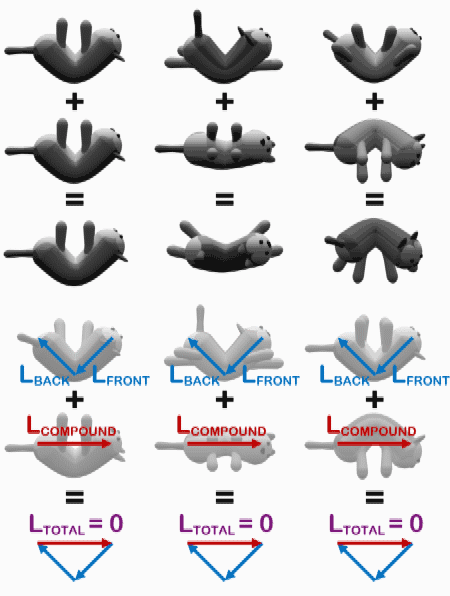
i learned about this in calc 3 and now im taking linear algebra and it makes some more sense but the matrix itself seems contrived
yeah i was thinking it was gonna be com of some kind
broken meadow
been trying to finagle around to try to interpret the matrix as some kind of linear transformation involving differentiation but its wiggity and i don't like it
marble solar
T-r v = 0
So you want the nullspace of that, why not take a determinant?
I wonder how long it took for cayley hamilton to be proved
broken meadow
what even is the matrix of second partial derivatives even supposed to be
like its just the jacobian right
but what
i
pain
hasty turret
Derivative is a linear operator
broken meadow
it's like i learned nothing
marble solar
broken meadow
yeah we learned in linear algebra how to do derivative on space of polynomials up to degree n
marble solar
In mathematics, the Hessian matrix or Hessian is a square matrix of second-order partial derivatives of a scalar-valued function, or scalar field. It describes the local curvature of a function of many variables. The Hessian matrix was developed in the 19th century by the German mathematician Ludwig Otto Hesse and later named after him. Hesse or...
This is also good to review
broken meadow
hmm
maybe i need more linear algebra or something because i don't feel too comfy with seeing everything as a matrix just yet
broken meadow
where would i start if i wanna think of linear maps first and then work with a basis to go to matrix
marble solar
Every vector is a linear combination of basis vectors
broken meadow
ye
marble solar
So you can determine each linear map by where it sends basis vectors
marble solar
A matrix representation is just the image of those basis vectors
It's a vector of vectors
The derivative operator is a linear operator
broken meadow
we learned in class that each column of our matrix is just the result of applying the transformation on each basis vector and expressing it as coordinate in the other basis
marble solar
Therefore it has a matrix representation
broken meadow
yea
so i guess what im asking is like
what are the vector spaces and what are the ordered bases im working with
marble solar
well if you're finite dimensional
All of them are isomorphic
That is you can find a linear, 1-1, and onto map between them
hasty turret
Your vector space is R^2
marble solar
So you can just look at like R^n