#book-recommendations
1 messages · Page 211 of 1
 calm crane
 dapper root
Literally waste of time
You'd be more productive literally sleeping all day
grow up big and strong
 broken meadow
multivariable calc is Bad
or is this a book by lang
i was talking about the class
dapper root
no I'm saying moth should learn multivariable calc before using F'ing Lang
the most evil and sinister book
 sage python
Multivariable calculus is for nerds
 warped cedar
its for engineers 
 marble solar
Mapping class groups
 sage python
Did someone say mapping class groups
calm crane
ism?
dapper root
Intro to Smooth Manifolds by Lee
 sudden kindle
Mapping
 gray gazelle
gray gazelle
gray gazelle
Does someone know of a book containing a detailed solution to the multivariate Ornstein-Uhlenbeck process?
With derivations of it's mean and variance
 sterile pelican
What if you learn multivariable calc from lang? :^)
warped cedar
then ur probably big brain
sterile pelican
Or learn the entire maths degree using only lang from basic maths to gtm from lang?
 hasty turret
I don't think it works that way
sterile pelican
why not just learn differential manifolds instead by lang? :^)
lang has nearly everything you need!
warped cedar
idk about that
 wooden sparrow
Is Lang good at everything?
 elfin glacier
who is Lang?
 karmic thorn
Need some recommendations for a first course in analytic geometry at the undergrad level.
These are the contents of my course.
Will take a look, thanks.
For Units 3 and 4 I could use Burton's ENT textbook, any recs for the units on set theory?
Owww nice, thanks!
dapper root
What?
Munkres doesn’t do cardinal arithmetic
Or Cantor Schroeder Bernstein as far as I know
You can pick up Halmos
It’s really short and literally like 7 bucks or something
gray gazelle
naive set theory by halmos covers all of this iirc
 prisma snow
These look like fun classes. I've never had a NT class :(. Enjoy, Ted!
karmic thorn
Thanks Luna!
karmic thorn
Okay, I'll take a look at both Halmos and the Wikipedia articles haha.
This is the only NT course being offered in 3 years.
prisma snow
I only hate NT because of how simple its problems sound, and then I can't solve any :(
karmic thorn
And maybe an applications of algebra in the 6th semester
 fast portal
Nice
karmic thorn
prisma snow
I only hate NT because of how simple its problems sound, and then I can't solve ...
True, the problems are deceitful.
My course is loaded with DEs though. I'm also looking forward to a course on Automata Theory in the third year.
karmic thorn
A state uni. It has a good math programme.
dapper root
Was that the one you were waiting on?
karmic thorn
Yeah, it was the one I had been waiting to hear back from until two days back haha.
dapper root
Congrats 😁
karmic thorn
Oh, I didn't make the cut into two of the hardcore programmes.
Thanks Chmonkey and Ultra!
I'm really excited to start.
I just hope it doesn't wear out as I progress ahead.
karmic thorn
:(
 static crest
they do be spitting facts
dapper root
My undergrad doesn’t suck...
karmic thorn
Does working hard compensate for a sucky course?
dapper root
At least not any more than grad school I think
static crest
I like my undergrad more or less, but there's low points in all of them
at least from what I've heard
karmic thorn
I see.
static crest
just do what you enjoy, and you should have a decent time
I know people who did certain things for more money
and they're struggling to stay afloat
fast portal
sad!
karmic thorn
I'm driven towards maths not so much by pragmatic considerations as I am by my own interest.
karmic thorn
No matter what it is, it's bad in India XD
dapper root
Just fight bureaucracy and try to get into better classes
Skip stuff you know, email profs
Idk how much you can do in India
I know Europe is pretty stringent on this compared to the US
karmic thorn
I don't even think the uni permits that, the system is too rigid in the present
fast portal
Moonbears say you can skip classes by taking first then informing the staff later 
dapper root
I don’t email my advising
fast portal
His uni also said no skipping but he did it anyway
dapper root
I email professors directly
karmic thorn
A new education policy is underway which could allow flexible selections but it may not come into effect by the time I finish my undergrad.
 hollow current
but what if your prof is ur advisor
karmic thorn
Why skip classes though?
hollow current

fast portal
Saves time
dapper root
If you know analysis at level A
karmic thorn
I see.
fast portal
Also helps avoid bad courses
dapper root
dapper root
Try to surround yourself with great people too
On this point I got to where I am now because I just did what shamrock did
He was in my freshman analysis class and just did whatever to get into better classes and I just followed suit
And I think it worked out well, so I’d recommend you search out similar people
karmic thorn
Your expertise is indeed inspirational for me, ngl.
dapper root
I don’t have expertise lol
fast portal
Wait
hollow current
i mean when i entered my uni i saught that my groupmates were stronger than me if maff
dapper root
I would deny such a claim
karmic thorn
XD
hollow current
now i am the strongest in my group ngl
dapper root
We’re classmates lmao
karmic thorn
Hahaha. That's nice.
fast portal
This is news to me
 frozen tree
hiiii
gray gazelle
me too
dapper root
Anyway I’d prefer to enter a class at like 30th percentile
frozen tree
does anyone have any books for algebraic geometry?
frozen tree
hi ch
hollow current
hollow current
now i am the strongest in my group ngl
and then i found mathematics server...
dapper root
I wouldn’t recommend you learn AG but also I do it
karmic thorn
True. I just hope I'm at the bottom of the pit.
gray gazelle
oops
dapper root
So if you want to start
gray gazelle
self promotion
hollow current
yohan and you read #❓how-to-get-help
fast portal
read #❓how-to-get-help
karmic thorn
hollow current
and then i found mathematics server...
This server is a constant you're-not-smart-enough reminder for me.
fast portal
Damn beaten
hollow current
fast portal
Damn beaten
fastest hand on the wild east
karmic thorn
That's the plan, Ultra.
fast portal
Do bother comparing yourself to people who have been doing math for years if you have a competitive spirit.
karmic thorn
Acknowledging I'm not good enough is step 1, acknowledging I can grind and get good is step 2.
If only I had met more capable peers at school I might have been pushed to work harder and not rely on my "genius" to get away with good score on school tests without working hard.
hollow current
- acknowledging i'm not good enough
- getting deprresed and start drinking
basically my plan
hollow current
 fast portal
I feel like it is given you will never feel competitive against any of those people because you can tell they are out of your league. Me thinks a reasonable and competitive lad would be more interested in beating his upperclassmen but oh well
haha.
karmic thorn
Oh, I wouldn't compare myself to you for the life of me.
dapper root
karmic thorn
If only I had met more capable peers at school I might have been pushed to work ...
This is exactly how i cruised through school
It isn’t uncommon to find some moment where you question everything but pushing through that is important
You’ll feel fucking stupid at times and useless but you just accept that others are where they are and you’re where you are
Look back in two years time and you’ll be surprised
fast portal
~~The past is a spook. Neither accept or deny it, simply live on. ~~
 pearl imp
you can compete with ppl out of your league but always compare yourself with your state 2 weeks/month/years ago
hollow current
hiya woogie
hasty turret
Nothing exists
 true veldt
ultra is free to reject present too
hollow current
i exist outside of space. So I will too.
hasty turret
Are you bounded by time,duke?
true veldt
what is time, without past nor future?
hollow current
Time is subset of space.
hasty turret
true veldt
what is time, without past nor future?
An illusion?
hollow current
A point?
fast portal
I regret shitposting about time
hollow current
you should regret all your shitposting
hasty turret
But,That was in the past
hollow current
what is past
hasty turret
And there is no past
calm crane
imagine having people to compete in in sch 👀
calm crane
hai
 hasty eagleBOT
Commander Vimes:
hollow current
no u
hollow current

fast portal
I had some schoolwork to do here
karmic thorn
dapper root
Look back in two years time and you’ll be surprised
That is so true.
 lusty jacinth
I've bought Calculus:Early Transcendentals by James Stewart was wondering if this was any good for calc 1, 2, and 3. Is there anything in particular that I should know before getting into this book?
yes
I'm in calc 1 rn, I've gotten this book to self study
alright
it seems like it's a comprehensive book
does it cover all of calc 3?
https://www.knewton.com/wp-content/uploads/2020/04/alta-Calculus-Early-Transcendentals-v2-TOC.pdf - I think this is the table of contents
alright cool
thanks
 cold juniper
lusty jacinth
I'm in calc 1 rn, I've gotten this book to self study
cold juniper
lusty jacinth
I'm in calc 1 rn, I've gotten this book to self study
From my experience when reading it, it wasn't the best thing for self studying. It's better for going along with a college course. I would recommend Khan Academy's Calc 3 course, because they got someone to teach it that is actually really good at teaching (Grant Sanderson, 3Blue1Brown)
lusty jacinth
yeah I heard he made the course
with regards to self studying, did you mean it wasn't great for self studying calc 3 or were you saying it isn't great for self studying in general?
warped cedar
multivariable calculus by stewart is good, early transcendentals is pretty good
intro to smooth manifolds by lee if you are into that sort of thing 
 quartz pawn
@lusty jacinth Try Colley or Marsden vector calculus both are very good and are intro books but are also rigorous. But you can try stewart. I'm doing problems out of Colley again and I think it's really good.
lusty jacinth
oh okay
awesome
I'll note these down
Oh, is AOPS Precalculus any good? I'm mainly looking at it for reference but my brother is also studying precalc so I'm wondering if it's good for precalculus.
from the looks of it, the textbooks looks good but I figured asking around wouldn't hurt. This is the table of contents I think https://s3.amazonaws.com/aops-cdn.artofproblemsolving.com/products/precalculus/toc.pdf.
marble solar
I have a copy of fulton Alg. top @sage python I've been mulling it over
It seems to be pretty good
lusty jacinth
what
sage python
Yeah idk it myself but my impression is that it's AT for people who don't do AT
marble solar
I mean, the only real pre-req is like calc 3
SO you can do a low level sophomore junior level course on it
Hi rubidinium, two servers eh?
lusty jacinth
yes
marble solar
Sorry I ignored your question bcuz I have no opinion
lusty jacinth
lol np
lusty jacinth
oh yeah
I'll check that out
but from the reviews I saw a few minutes ago, AOPS precalc looks good so I might just end up getting it
marble solar
@sage python do you think fulton would pair well with hatcher in a course
Like if you do low level fulton
medium level munkres
high level hatcher
Cuz there's interesting things in Fulton that are done at a nice level
sage python
I mean they're sorta all different, it's not just level but goal
Hatcher is very geometric but it's kinda still AT for, at least topologists, including algebraic topologists
Fulton's in a way easier but it's more like, if you do geometry and sorta need AT but need it from the geometry side
So e.g. you're more interested in De Rham cohomology and stuff like that
So there's gonna be a lot of overlap but different takes
Munkres is just point-set so it's kinda its own thing
marble solar
One thing that I like about Fulton is
I can sit down and do every exercise without too much
Thinking
Like I get comfy
Hatcher is not super comfy
sage python
That's fair. I think Rotman's kinda my preferred easy intro to AT
Someone I know gave a good overview of books if you don't like Hatcher
I suggested Rotman, Fulton, Massey, and Bredon in that order
Rotman is for people who will never understand pictures
Fulton is for people who want to do this junk and move on with their lives
Massey is for people who understand squares better than triangles
and Bredon is a good book
lusty jacinth
If you don't mind might I ask what you two were talking about?
marble solar
Algebraic Topology is using algebraic structures like the integers, or more generally abstract algebra, to say things about inherently geometric things
But we have special rules about the geometric things: namely we can slide things around, sometimes we can pinch things, sometimes we can cut things, sometimes we can really distort things
There ends up being a lot one can say about the relationship these things have with inherently algebraic things like polynomials
or numbers
etc.
 valid moth
@sage python Rotman is for people who will never understand pictures Fulton is for people who want to do this junk and move on with their lives Massey is for people who understand squares better than triangles and Bredon is a good book
hatcher is for people who [?]

 obsidian valley
Hatcher is for people who use math discord
marble solar
I'm doing some fulton exercises now sloth king dami
They're comfy. I might just do a few once a week try to get most of the book done
 worldly basalt
elfin glacier
Margaret Hatcher?
worldly basalt
elfin glacier
Margaret Hatcher?
Her name is Margaret Thatcher
calm crane

marble solar
@sage python the other advantage of Fulton is the hints at the back
Y'know I think I'm just gonna work through this for my topology qual
and hope it gives me enough of a foundation to just combine it with other facts of topology I know
to pass
Fuck Hatcher for anything beyond chapter 0 & 1
It just looks like pain
gray gazelle
how to prove it
wooden sparrow
Yes, Godel recommended How to prove it. And I asked you about if the book is a worthwhile read
 hearty steppe
It’s probably the best intro to proofs book out there.
There’s not too many problems in the exercises per section and each problem uniquely challenges the concepts glossed per section
I peaked at Zhang and tbh it seems Zhang doesn’t really have the same flare.
wooden sparrow
Loch told to go with Amann Escher
hearty steppe
Never heard of that one
wooden sparrow
Oh okay
gray gazelle
ok its also pretty good
hearty steppe
I only heard of Escher’s real analysis book
 stray veldt
it's an analysis book, but it has an intro to proofs
hasty turret
hearty steppe
Never heard of that one
It's an analysis book,that does everything an amateur would need
wooden sparrow
Ohh......
wooden sparrow
bruh
stray veldt
i mean, how to prove it is fine
but imo it is too long
and it goes into more set theory than you will need
gray gazelle
false
wooden sparrow
Godel, that's what I was referring to. I'm not biased. I just said what he said
hearty steppe
Idk I don’t think there’s that much set theory involved. It doesn’t go over anything more than power sets and families of sets when it comes to set theory
Yea it is a little longer but more detailed
gray gazelle
it literally covers the most important set theory - relations, functions, induction, infinite sets
Maybe another fun intro to proofs is just solving proof contest problems
gray gazelle
it is
stray veldt
also the order is kinda weird imo
hearty steppe
I mean there is a whole chapter on induction (which seems like a good thing) and the very last chapter is a prelude into real analysis
gray gazelle
yeah relations and functions should be switched but other than that its good
hearty steppe
And there is a chapter on functions which again I think is good exposure
hearty steppe
What about the chapter on relations
stray veldt
yes, i think all of this (minus the last chapter) is important
relations i would do somewhere else
i mean, if you want to see what i would do, just read #book-recommendations message
hasty turret
What's the last chapter?
gray gazelle
@wooden sparrow jsut read how to prove it, there are better analysis books anyways
hearty steppe
Yea that’s a prelude to analysis tho, cantor is definitely brought up on first chapter of Abbott
stray veldt
i would just define cardinality via existence of bijections
do cantors first diagonal argument
show that a function A -> 2^A can't be surjective
and use that to show that R is uncountable
it's like 2 pages
hearty steppe
Well uncountable means infinite right
stray veldt
uncountable means bigger than N
i.e. infinite and no bijection between the set and N
you can essentially do russells paradox to show that any function from a set into the powerset is not surjective
hearty steppe
Err well isn’t there the Aleph Null property of certain kinds of infinite sets
stray veldt
this is the hardest part, but you can just believe it
and then it is very easy to show that R is uncountable
because you go from 2^N to [0, 1] injectively
gray gazelle
btw which intro to proofs course doesnt cover cantor bernstein theorem
stray veldt
most of them
hearty steppe
Why don’t they call it Cantor-Berenstain theorem lmao
stray veldt
cardinality aleph null just means there is a bijection to N
hearty steppe
That’s all it means?
hearty steppe
But doesn’t that mean that it is more finite than other infinite sets
gray gazelle
Wait how come it's not alphabetical order? I thought names in theroems are so
stray veldt
it's the smallest infinite set
hearty steppe
For Aleph Null property
stray veldt
in some sense
hasty turret
stray veldt
cardinality aleph null just means there is a bijection to N
This
stray veldt
it's defined as the cardinality of N
gray gazelle
c4t btw what chapter are you on rn?
wooden sparrow
Soo..... umm... which book did you guys decide is better?
gray gazelle
how to prove it
wooden sparrow
Okay
hearty steppe
Oh I’m on the last couple exercises of 3.6
Pretty much about to be on relations chapter soon
gray gazelle
nice c4t proud of you 
prisma snow
I will give an anti-recommendation to D and F. And a recommendation to Rotman.
gray gazelle
d&f bad
warped cedar
i like the anti-recommendation lmao
is it worth getting a book about ring theory
im just trying to collect books
karmic thorn
||Libgen all of them||
warped cedar
usually i do
but i like physical books too
i have quite a lot of books
i libgen books i dont care to purchase
but if i want them then ill buy them
usually not at full price tho
ill get used copies for ~10$
warped cedar
depends how much i care to get it
karmic thorn
But only after I'm convinced it's good
warped cedar
if i really want it ill buy a new
karmic thorn
As far as abstract algebra goes, Gallian's Contemporary Abstract Algebra is the one I use and I really like it as a first text.
 hollow current
LIBGEN 'EM ALL
dapper root
warped cedar
is it worth getting a book about ring theory
No, but a book on commutative algebra is basically this
As well as module theory
Tbh the theory of rings proper isn’t all that amazing, I mean I’m sure there’s a lot of stuff you can say, and if you look away from commutative stuff more I guess. But rings really come into their own when you consider them in combination with modules
Modules kind of “fix” what’s wrong with rings, and can be stated simply as the fact that the category of rings is trash (kernels aren’t rings if you require a ring to have identity), but modules over a fixed ring is an abelian category
sudden kindle
the purpose of modules is to help study rings
calm crane
warped cedar
anyone have any good abstract algebra book recommendations?
jacobson
fast portal
hungerford
 ancient flare
mandem
So I was looking at some "Elementary Number Theory" books but there are multiple authors.
May someone recommend the most concise for a beginner.
fast portal
Topology of Numbers (Allen Hatcher)
ancient flare
Is Elementary Number Theory by David B good?
ancient flare
you recommend any good combinatoric books for olympiads>
 storm sleet
For Star_, A book of Abstract algebra by Pinter is decent and pretty cheap
warped cedar
that does seem nice but informal
marble solar
@sage python I did all of the first section of Fulton Alg. Top. exercises last night
How can ppl not recommend this book? Even if you want to go onto like Hatcher
This is really good intuition with explicit examples and integrating
All you need is calc 3 and a little bit of brain power
sage python
I mean some people are ready to just start Hatcher
In which case Fulton is an unnecessary diversion
marble solar
I think there are things in there that Hatcher doesn't do
Like Riemann surfaces algebraic curve type stuff
sage python
Sure which can be learned elsewhere
Fulton's probably quite good, especially for certain folk, don't get me wrong
marble solar
I think it's better than Hatcher for my interests right now
sage python
But it's not a holy grail necessarily, and if you wanna continue in algebraic topology other books are better
marble solar
Because I don't need a lot of the fancier topological structures/machinery
A passing familiarity would be fine for now
sage python
e.g. Rotman if you're less geometric, Hatcher if you're more geometric
marble solar
Maybe in the future I'll need more machinery
I've worked through chapter 0 & 1 of Hatcher - it's really good
but it seems overbearing at times
It's also nice seeing how stokes theorem plays a part in alg. top. from the beginning
IDK, I think I've just become a huge fan of this text
Alright - here ye here ye
READ ALL OF FULTON'S WORKS
THEY ARE ALL THAT GOOD
sage python
Fulton's prob the right perspective for you on algebraic topology
sage python
Next you gotta read intersection theory
 ripe granite
heard fulton's intersection theory is hard af lol
3264 and all that seems like a very nice book
marble solar
what a chad name
ripe granite
it's a reference to the number of smooth conics tangent to 5 conics in general position
in P2
but yeah, seems easier to read compared to fulton
marble solar
ahh - I like Fulton smol boi books
Alg. Top., alg. curves, and his rep theory
those are the small mind moon bears ones
ripe granite
i need to read the rep theory book
ripe granite
I've done too many 197s
marble solar
Oh LOL
ripe granite
I dont think I can do anymore
ripe granite
I think you need the graduate vice chair's approval for that lol
ripe granite
gangbo I think
marble solar
Gangbo won't give a fuck
 grand flax
Where can I find the times tables?
ripe granite
uhh, annals of math
elfin glacier
anals of math
grand flax
Where that?
ripe granite
look it up
gray gazelle
@grand flax if you can manage finding the annals of mathematics, you should be able to manage finding a times table
this is a test
grand flax
There is no chart?
gray gazelle
ripe granite
there is
grand flax
Where
ripe granite
look in there
gray gazelle
look harder
grand flax
Confusion.
gray gazelle
as a professional mathematician, i reference the annals times table daily
you should be able to find it
ripe granite
the IUTT papers have them too
grand flax
I mean just a time table chart
grand flax

gray gazelle
author started talking about geodesic polar coordinates so i had to go find those
and then i realized
after avoiding coordinates for so long i forgot how to use them

it's too easy to just say "oh this thing is obviously well-defined if you just write it in coordinates"
a trap i fell in to
pain.
ripe granite
ye lmao
coordinates can be deceiving
I thought you could always write $d = \partial + \bar{\partial}$
hasty eagleBOT
Brofibration
gray gazelle
not to mention the author's curvature convention is different from the one i'm used to 
i'm convinced do carmo smoked a bowl every time he sat down to write a chapter of his RG book
ripe granite
I havent computed the curvature of a non-trivial connection yet
gray gazelle
as they say, write inebriated edit sober
ripe granite
and it's been 6 weeks since we introduced them
gray gazelle
ripe granite
I havent computed the curvature of a non-trivial connection yet
do not, it is not worth it
.
gray gazelle
gray gazelle
as they say, write inebriated edit sober
if you replace inebriated with sleep-deprived, that was me checking over my complex analysis homework earlier
let me find the part where i forgot how inequalities work
|f(z) - g(z)| &= |-z+1| \leq |z|+1 = 2,
|g(z)| &= |z^7-2z^5+6z^3| \leq |z|^7 + 2|z|^5 + 6|z|^3 = 9 > |f(z)-g(z)|
i feel like it's a legitimate strategy, sometimes it's easier to stay undistracted when you're drunk/sleep-deprived/etc. or like not feel so shitty thinking i have to do work, because i can't think anyway
yeah when i'm tired i can put more focus into something; not necessarily productive focus, but focus nonetheless
ah i c

quartz pawn
I understand that completely actually. My ADD does not make my mind wander so off to other places quite as often.
marble solar
Do you take stimulants Don?
I have an ADHD diagnosis, and I'm wondering if stimulants would actually make me not brain fart all the time
sage python
Considering buying Cassels-Frohlich tbh
marble solar
Cassels frohlich?
sage python
Algebraic Number Theory
quartz pawn
No I don't have stimulants. I honestly don't even have a diagonsis but I've been recommended to a clinical pyschologist by my physician to get some testing done @marble solar .
I'm probably gonna get an official diagonsis within the coming month or so; still unsure if I want to take stimulants or not but it probably couldn't hurt to at least try them for a little while.
marble solar
Yeah - all my friends who take prescribed stimulants say it works wonders for them
quartz pawn
Same here.
marble solar
So I've been thinking about it - but alas my spouse is like anti-drug
With good reasons, stimulants can really fuck you up
quartz pawn
Oh yea lots of cardiovascular risk assocaited with them - heart disease from prolonged overruse / reliance.
Not mention neurological issues i.e. depression.
marble solar
Yeah - and my family has history of heart disease/heart attacks
I'm pretty healthy, I exercise mostly regularly
(Or I did before covid)
 queen dove
is there any good place to get math books other than libgen if my library has failed me (other than paying money)
when I'm looking for specific books I mean, not just browsing
marble solar
university library
Usually you can work something out to rent something
Even if you're not a student there
queen dove
hmm, interesting
I'll try that out when stuff reopens for me
is libgen the only main piracy site?
ripe granite
springerlink
I think you could access all springerlink titles for free for a bit
might still be the case
queen dove
doesn't seem free anymore
ripe granite
RIP
If youre enrolled in a university with a university VPN, you might want to try again after connecting to it
some universities give you springerlink access
marble solar
Enjoy your UCLA vpn while it lasts bro
queen dove
in high school, not uni
the stuff on b-ok.cc seems to usually be linked on libgen, I think it's one of the sites libgen links to
calm crane
scihub
lusty jacinth
what are some good books for an intro to linear algebra? I head strangs intro to linear algebra 5th edition was nice but not much about any other books.
sterile pelican
there is lang's intro to LA but if you want a bit more challenge, which I am currently doing, you can try hoffman and kunze's LA
You also have Axler's LA Done Right and Halmos' LA
 obsidian basalt
Best book for Linear Algebra?
hasty turret
Definitely not strang
obsidian basalt
I want to learn something pretty much complete if possible
(sorry for using the word complete, but you know what I mean, something that includes lot of topics if possible)
obsidian valley
Definitely not Axler then
hollow current
Axler is good if you do not need determinants
somehow i wasted 3 hours and read 2 pages
ok lol 1.5 hours from that it was lecture so pdf was just opened
other 1.5 hours i listened to music
obsidian basalt
My university it's making me read a book from Schaum series by Seymour lipschutz.
And I feel it is really... MEH?
if that makes sense
sterile pelican
That either boils down to Hoffman and Kunze or Halmos
but learning LA from Halmos
I would say Hoffman and Kunze but again that varies with everyone here
obsidian basalt
Thanks ❤️
calm crane
h&k tho i havent seen halmos
sterile pelican
Halmos is a really thin book
karmic thorn
Are there any good resources to learn about plotting graphs? I'm not looking for a guide on plotting graphs of elementary functions, but rather understand how loci and curves work in general. (If you know about it already, I want to get good enough to write Batman Equation sort of stuff on my own to describe very arbitrary shapes on the Cartesian plane)


 molten wave
this is fourier yes
calm crane
yea it is literally a fourier transform
molten wave
truncated
karmic thorn
How about basic cycloids, ellipsoids and stuff?
molten wave
also series not transform
calm crane
there isnt really any thing dedicated to teaching how to draw graphs cuz like it isnt interesting and really you can just use functions you already know or like fourier the thing
calm crane
molten wave
you can truncate a fourier series in a useful way idk about an integral
i mean yea but like morally they are the same
molten wave
I mean there's analytic geometry
calm crane
at least to me
molten wave
I had a class that was all about conics and shit
fast portal
screaming
karmic thorn
molten wave
I mean there's analytic geometry
It doesn't go into the level of depth I'm looking for.
@fast portal Hold on I just got something more wack from Wolfram, lemme show you

I was trying to draw a curve and Wolfram won't give it to me
I asked for a solution, and this is what I get.
 karmic thorn
Funny, GeoGebra gave the curve right away
karmic thorn
fast portal
I honestly wonder how old timey people did it without computers
True!
I looked at the book on algebraic curves Ultra suggested
molten wave
just turn the mathematical crank
karmic thorn
It had a shit-tonne of explainations on drawing ellipsoids and stuff manually
fast portal
were they doable without a pc
fast portal
The one I remember the most is diff Eq
molten wave
idk about diff eq
karmic thorn
Oh, okay. I'll have to wait to get to Fourier Analysis, then.
obsidian valley
Like calc 3 no?
molten wave
I think you might be fine with just basic real analysis and a bit of multivariate analysis
obsidian valley
That's when we touch on FS
molten wave
for like the latter bits
our fourier analysis class actually bundled in the topics on parameterized integrals
karmic thorn
Okay.
 wet furnace
what's a good book for probability and statistics at highschool level
 civic carbon
I don't think Fourier stuff ever showed up in a course for me, it just became a thing I needed to know. the discrete fourier transform did come up a lot in my coursework.
 drifting elm
there was a book recommendation on numberphile perhaps but I can't remember the title. something like "pictures of graphs of interesting functions". not sure the name. google can't find it.
drifting elm
karmic thorn
Btw what are the prereqs for fourier analysis?
it is important to know that there are two major areas. the discrete fourier analysis and the discrete-time fourier analysis.
karmic thorn
Oh, okay.
drifting elm
I have the prerequisites lists here in front of me
it depends if you are also doing electrical engineering
or if you are a computer science student
if you are an EE you will study network analysis and filter design first
this includes laplace domain laplace transforms. models of signals and models of systems
stray veldt
i would advise you to at least take real analysis beforehand
and possibly some complex
drifting elm
you definitely need to be up on complex numbers %100
at least the unit circle adding angles
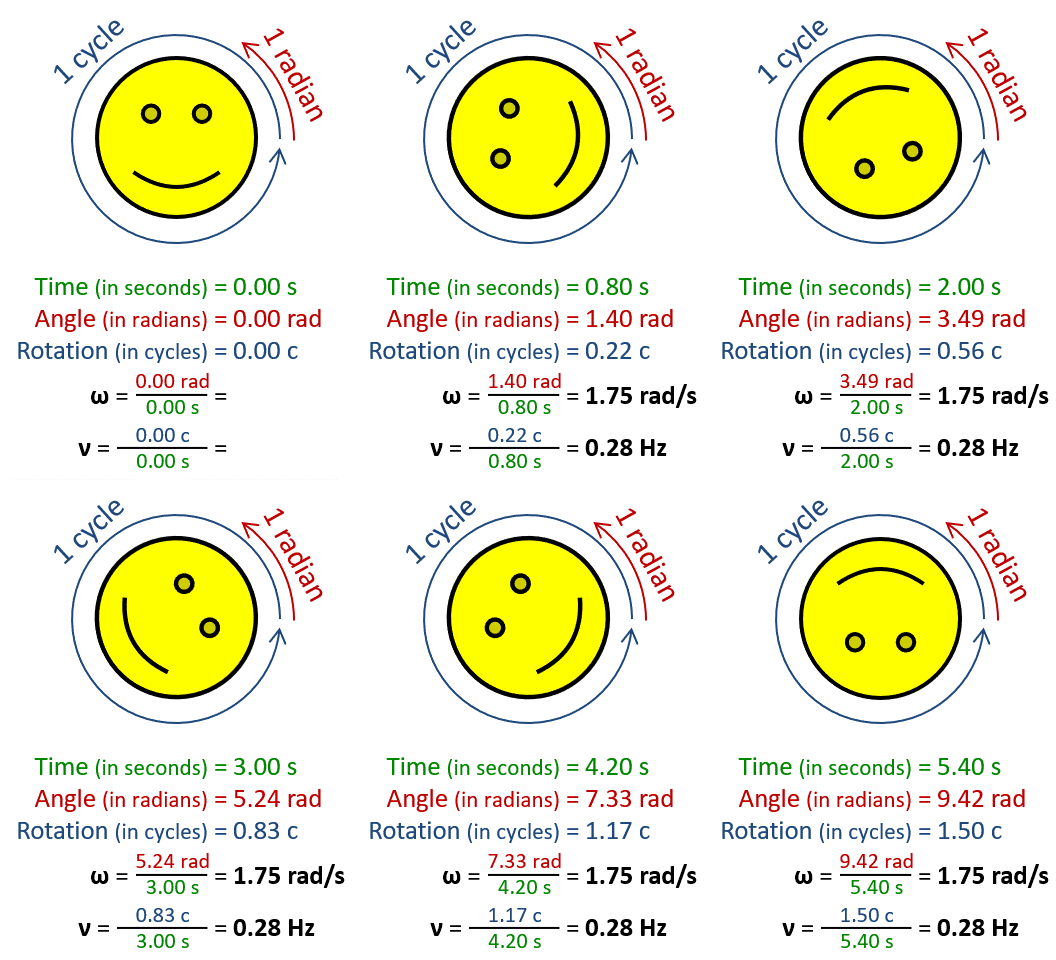
In physics, angular frequency ω (also referred to by the terms angular speed, radial frequency, circular frequency, orbital frequency, radian frequency, and pulsatance) is a scalar measure of rotation rate. It refers to the angular displacement per unit time (e.g., in rotation) or the rate of change of the phase of a sinusoidal waveform (e.g., i...
stray veldt
lmao that gif
karmic thorn
drifting elm
it depends if you are also doing electrical engineering
I'll be starting as a math major soon.
marble solar
Don't do it Ted, it's a tarp
drifting elm
I think if you can do calc 2 then you will probably be ok in FFT
it is not going to be easy
there is an old paper "shannon's sampling theorem" that should help if you study discrete time fourier transform
it was the foundation for everything after it
karmic thorn
marble solar
Don't do it Ted, it's a tarp
Hahaha, analysis you mean?
karmic thorn
drifting elm
I think if you can do calc 2 then you will probably be ok in FFT
Sounds good!
But I guess I'll postpone it till I finish real analysis.
drifting elm
ok I found what I was looking for in the book. you need "solutions to linear differential equations with constant coefficients"
laplace transform, z-transform, euler's formular for complex numbers, geometric series.
@karmic thorn
karmic thorn
Will take a look, thank you.
I'll be taking a differential equations class next year, might be a good idea to get some insight before starting.
drifting elm
this is even more specific than that
all ODE with constant coefficients
you can learn this in 1 day
karmic thorn
Lmao, will take a look right away then.
drifting elm
wet furnace
what's a good book for probability and statistics at highschool level

eBay
This book is in great shape and covers topics such as statistics and probability, Algebra, calculus, and math index. This book was extremely helpful for me In high school and will help you out to!
sterile pelican
What do you guys think of Spivak's Physics for Mathematicians: Mechanics?
marble solar
I think that one is too much
sterile pelican
His manifolds book is not that great though
ripe granite
Arnold's mathematical methods of classical mech is pretty good
marble solar
yA wrOng aboUt tHat nEkO
sterile pelican
I think it is good just not as good as his single variable
gray gazelle
sterile pelican
His manifolds book is not that great though
yeah i'm gonna have to disagree with you on that one
marble solar
yA rIght About thaT
sterile pelican
Like I said it is still quite good just in comparison with his single variable book
gray gazelle
i am going to let you know
if moonbears and i are in the chat
it is spivak CoM fanclub
sterile pelican
so that means you also read his entire differential geometry books?
sterile pelican
:^)
gray gazelle
i'm still a differential geometry baby
ripe granite
his diff geo books do have pretty covers tho
gray gazelle
i know at most the contents of vol 1 and 2
at the absolute most
wtf is 3-5 anyways
sterile pelican
I didn't read them how are they?
gray gazelle

sterile pelican
nani
gray gazelle
i'm still angry about this rg problem
just thought i should bring that up
tfw the only parts of "closed manifold diffeomorphic to even dimensional sphere" you need to solve a problem are "orientable, even dimension"
like bruh
 steel viper
is this spivak
gray gazelle
talk about wasting time
steel viper
i saw 5 volumes
gray gazelle
yes
 steel viper
oh ok
sterile pelican
sterile pelican
What do you guys think of Spivak's Physics for Mathematicians: Mechanics?
I was asking about this particular book
 molten linden
i've read gelfand's algebra should i read his other books as well?
sterile pelican
Sure his Functions & Graphs, and Method of Coordinates are great too
After that you could try some other books like Lang's Short Calculus or Spivak's The Hitchhicker's Guide to Calculus
 runic oar
hallo
gray gazelle
molten linden
sterile pelican
Sure his Functions & Graphs, and Method of Coordinates are great too
okay then thanks
 fossil island
Thoughts on *Matrix Analysis & Applied Linear Algebra * by Meyer for a second course in linear algebra (graduate level)? Should get up to SVD and maybe Jordan form http://www.cse.zju.edu.cn/eclass/attachments/2015-10/01-1446085870-145420.pdf
gray gazelle
tbh that table of contents looks like a first course in linear algebra
but i do like the selection
static crest
graduate level though?
gray gazelle
nah
hearty steppe
Meyer is ok. Go for Friedberg et al “elementary linear algebra - A Matrix Approach”
gray gazelle
oh poros did you know uoft has a grad linalg course now?
static crest
oh really?
gray gazelle
or something like t hat
lemme find
its more on the applied side iirc
nothing about it on the prof's site 
gray gazelle
it's completely new
gray gazelle
hearty steppe
Meyer is ok. Go for Friedberg et al “elementary linear algebra - A Matrix Approa...
isn't this just an easier version of the other linear algebra book by the same authors?
marble solar
Symplectic
gray gazelle
they're asking for a graduate level textbook and the linalg book by FIS is in no way graduate level
gray gazelle

gray gazelle
fossil island
Thoughts on *Matrix Analysis & Applied Linear Algebra * by Meyer for a second co...

fossil island
Thanks
static crest
didn't know the romans did lin alg
fossil island
I'm looking at some of the later stuff in the book and I don't think I learned it in my first course
the meyer book, that is
static crest
oh damn, that actually seems like a nice tb @gray gazelle
fossil island
i do like the springer aesthetic of the roman book
gray gazelle
inb4 "first linalg course" refers to a course where you learn how to row reduce
and only row reduce
fossil island
*learns how to put entries into matrices*
gray gazelle
i am biased but i think the book by friedberg insel spence (NOT the one c4t recommended) is perfect for a 1st course
that, or axler
but that is not the subject here
fossil island
yeah that's the book i learned from
well what would be the key topics in a graduate linear algebra course
gray gazelle
roman's toc
or you'd just have linear algebra in the form of module theory in the core algebra course
fossil island
well some of the topics in roman seem like they'd be covered in functional analysis
gray gazelle
fossil island
yeah meyer seems quite a bit less rigorous
focusing more so on applied stuff, hence the name
matrix stuff
hearty steppe
Meyer just doesn't really have much compared to Friedberg et al
and Friedberg et al has plenty of exercise problems
fossil island
hearty steppe
Meyer just doesn't really have much compared to Friedberg et al
you mean content wise that meyer doesn't cover as much?
gray gazelle
what a shitty table of contents (formatting wise)
is there a better one for the book c4t rec'd?
also uh
those are out of order
i have a strong doubt that meyer covers less than this book and an even stronger urge to confirm that doubt
hearty steppe
fossil island
you mean content wise that meyer doesn't cover as much?
Uh I mean I think Friedberg et al is more organized and obviously covers in better depth.
static crest
gray gazelle
what a shitty table of contents (formatting wise)
why are the author names between every line
lmao?
gray gazelle
no clue
fossil island
hearty steppe
Uh I mean I think Friedberg et al is more organized and obviously covers in bett...
I think they just cover different topics
hearty steppe
TTerra why do you always emoji me like that
xD
definitely pick up a theoretical linear algebra book while going thru an applied book
gray gazelle
such as roman
hearty steppe
I like Lang and Janich
gray gazelle
static crest
how many tbs has lang written
hearty steppe
damn you want to make people go thru hell reading graduate level text don't you lol
gray gazelle
static crest
they literally asked for grad level??
fossil island
yeah i did
hearty steppe
oh shit my bad
gray gazelle
fossil island
Thoughts on *Matrix Analysis & Applied Linear Algebra * by Meyer for a second co...
.
static crest
hearty steppe
yea I mean
I like going off Abhijeets recommendations honestly cause so far they pretty much work 80% of the time
gray gazelle
i'd recommend either freidberg insel spence "linear algebra" or axler for a first course and roman for a second
also
let me post an interesting one
hearty steppe
give me a sec
gray gazelle
static crest
abstract linear algebra
static crest
aren't vector spaces part of like abstract algebra
hearty steppe
ok
hearty steppe
Trich have you tried Berberian and Shilov?
gray gazelle
vector spaces are linear algebra
hearty steppe
yet
gray gazelle
static crest
I know vector spaces are linear algebra
fossil island
yeah i have shilov
gray gazelle
the thing is, "linear algebra" always gets turned into "row reduction course" because of the computational power of matrix stuff
hearty steppe
ok
gray gazelle
but like i know what you mean poros
fossil island
i've tried reading it
static crest
but aren't they technically also part of abstract algebra, which is just the study of algebraic structures (which a vector space is, I think)
gray gazelle
yes
gray gazelle
linear algebra \subset abstract algebra
hearty steppe
in that order
fossil island
oh god that's a lot of linear algebra
fossil island
that is true
static crest
rip
gray gazelle
since it does module theory
fossil island
uoft?
gray gazelle
university of toronto
gray gazelle
poros and i go there
fossil island
ahhh
gray gazelle
squint hard enough and functional analysis can look like linear algebra
 fossil island
see that's what im worried about a bit
like i like computational biology and hence applied math
but i dont want to let go of pure math
static crest
I mean I like what I'm doing right now, but I wish I also could've done pure math on top, but alas
just impossible
fossil island
how didn't i think of that
static crest
unless I do two bachelors
physically impossible to fit any decent amount of pure math courses into the course load
I know a friend of mine is just doing extra years in bachelors
fossil island
you cant study baby rudin on top of a 25 credit semester?
gray gazelle
fucking engineers
hearty steppe
what? engineers don't want to learn theoretical math
static crest
I do
hearty steppe
oh
fossil island
then you're not an engineer
static crest
I'm an engineer, I'm very rare though
hearty steppe
well your special
static crest
I am planning on staying in academia
fossil island
Engineer-Mathematician Theorem
Engineers != Mathematicians
gray gazelle
static crest
my summer research was all about homomorphic encryption, which just used a fuckton of lattice and galois theory
I didn't even feel like it was engineering
fossil island
what year are you?
hearty steppe
its not really engineering mate
static crest
(except the parts where I had to implement parts of it)
hearty steppe
its research
research != engineering
its really research engineering
which is like
static crest
ya, that's what I enjoy
fossil island
that's just throwing two rocks together
hearty steppe
basically research and development
static crest
I don't particularly care for being a wage slave
hearty steppe
lmao
fossil island
but a wage slave mathematician is such an A E S T H E T I C
hearty steppe
I don't think many people on this server want to be wage slave. Have you tried reading Abbott's "Understanding Analysis" it is an amazing book and it really breaks things down for you vs Rudin
fossil island
yeah that's a solid book
hearty steppe
yea I'm gona get through more of it soon
fossil island
oh, the prof responded and said that tensors wont be covered in the class
gray gazelle
fossil island
oh, the prof responded and said that tensors wont be covered in the class
just take diffgeo and have them hammered into your skull
fossil island
precalculus
hearty steppe
lol
wet furnace
lol
gray gazelle
hearty steppe
are there actually pre-reqs for diff geo?
classical: multivariable calculus, probably some linear algebra and diffeq
differential-topological: topology, linear algebra, and the previous stuff
in my experience
hearty steppe
ahh ok i was thinking of learning point-set topology a little and then going ham and trying to jump into Manifolds and other shit
fossil island
good book for self studying diff geo?
gray gazelle
do carmo ig
static crest
hearty steppe
I don't think many people on this server want to be wage slave. Have you tried r...
I have not, but it seems interesting, I'll put it in my tb queue. I have to work through "Computational Number Theory" by Shoup first for my upcoming internship the coming summer
 fluid bay
i wanna read some of lee this christmas
hearty steppe
but people have mentioned also that Cummutative Algebra is important for modern geo stuff?
gray gazelle
LOL

 hearty steppe
err
gray gazelle
classical: do carmo's curves and surfaces
differential-topological:
-lee is the standard recommendation, fantastic book
-tu is also good, but it's a lot easier and covers much less ground
there's also guillemin and pollack if you want to go hard in the topological aspects of the theory
differential-geometrical:
-lee's riemannian geometry book, same quality as his ISM if not better
-do carmo's RG is very "to-the-point"
hearty steppe
yea Commutative algebra, I had to double check
fossil island
thoughts on diff geo for like ai/comp bio stuff?
hearty steppe
some people on this server have mentioned it is a helpful way to get into algebraic topology and algebraic geo stuff
gray gazelle
still not really
hearty steppe
oh, ok good to know i guess?
ripe granite
depends on the kind of algebraic topology
gray gazelle
right
gray gazelle
i'm hesitant to say for certain because my algebraic topology knowledge is bounded above by the second half of munkres' topology book
which is basically nothing in the grand scheme of things
hearty steppe
I might start reading Munkres in a few months. I am a little worried of trying to do too many math subjects at a time too soon
gray gazelle
you can get into basic algebraic topology only needing like, the definition of a group
but past that you definitely need more algebra
hearty steppe
yea
I also want to prioritize linear algebra and real analysis along with passively getting thru the rest of this prob stats book
fossil island
what book are you using?
hearty steppe
for what
fossil island
prob stats
hearty steppe
Walpole et al
fossil island
I've been really liking Hogg et all
hearty steppe
theres like 18 chapters of material so its definitely enough for a foundation to get more into it
and generally a lot of exercises
sage python
Did someone say differential topology earlier?
hearty steppe
Terra did