#book-recommendations
1 messages · Page 56 of 1
 rare estuary
 sage python
You should be good if you also know some linear algebra
rare estuary
Cool.
 misty wyvern
What is the worst, most error-prone math textbook out there
For reference, Janusz is cited in multiple places as being the worst calculus textbook but I'm aiming a bit higher, maybe graduate-level textbooks that everyone hates.
 crimson leaf
While a lot of people use it Royden has an errata of about 13 pages
Introduction to smooth manifolds by Lee does as well but that book is longer iirc
 remote sparrow
misty wyvern
What is the worst, most error-prone math textbook out there
remote sparrow
misty wyvern
What is the worst, most error-prone math textbook out there
Model Theory by david marker is a standard graduate text that's known for having a long errata webpage
i wouldn't know about it being one of the worst
sage python
Weibel is a pain
 molten temple
iirc hubbard vector calc book had a pretty long errata
 median panther
Warrior Cats
 rich prairie
I'm currently reading this. https://en.wikipedia.org/wiki/A_History_of_Vector_Analysis
 narrow relic
Do you have a source for problems to do from that book (Kolmogorov and Fomin, Introductory Real Analysis)?
sage python
Sadly no. Part of my analysis class used it but it was a different translation titled "Elements of The Theory of Functions and Functional Analysis"
And the prof just wrote his own problems
 heady ember
Look in pinned
Personally I'm using Jacobson's Basic Algebra I, its been great so far. But I'll probably get slapped increasingly hard soon
On a side note, its so weird to see sloth as grey lol
 finite gale
Is a gray not a sloth color
heady ember
Its just that I've gotten quite used to sloth being blue/pink lol
 tough moon
Best books to learn and understand Linear Algebra and Multi variable calculus
narrow relic
sage python
Sadly no. Part of my analysis class used it but it was a different translation t...
Okay. Thanks anyway 🙂
Isn't that book extremely terse?
sage python
Probably on the terse end given that it was inspired by Rudin
Honestly I don't dislike Rudin lol
narrow relic
Got it.
Do you have an opinion on Carothers by the way? I spent a decent amount of time on it in 2023 but got kind of burned out
sage python
Glanced at it once way back in the day, seemed decent enough. If you've already started then maybe that's not a bad idea to see it through
Already used to the expo style and whatnot
narrow relic
sage python
Glanced at it once way back in the day, seemed decent enough. If you've already ...
I might pick it back up. I appreciate the advice.
I find the writing style somewhat sloppy and annoying but I end up thinking that about almost every math book I read
narrow relic
sage python
Glanced at it once way back in the day, seemed decent enough. If you've already ...
I actually picked it up for a weird reason: I was looking for a book that had a kind of slick type of notation that I saw a professor using, and it was the only book I could find on analysis at my level that looked like the kind of notation he was using.
sage python
Ah, if you didn't particularly like it then don't bother. I was thinking if you already had some momentum or smth
narrow relic
sage python
Ah, if you didn't particularly like it then don't bother. I was thinking if you ...
I spent 5 months on it or so, working about 1 hour a day, I think
Which is a pretty large amount of momentum for me
I have probably over 100 pages of notes on it in a large font
And I did all of the triangle-marked problems up until where I stopped
sage python
Yeah I guess it depends on you then
Tbh I went off classes more than books, and referenced different books for different parts of the class
narrow relic
sage python
Tbh I went off classes more than books, and referenced different books for diffe...
I think that's probably the best way to go, from my experience now
sage python
My first analysis class used a mix of Rudin and "Fundamentals of Mathematical Analysis" by Sally
Rudin was where I learned most of my metric topology and it was p nice for that. Sally... I think if we had stuck to it and worked linearly it would've made more sense
But we didn't so some stuff was odd. Also it's a quasi-IBL style book
Toward the end we used Buck Advanced Calculus which is dogshit
narrow relic
sage python
Toward the end we used Buck Advanced Calculus which is dogshit
That's funny, I always see older professors recommending that book
sage python
Occasionally for multi stuff I tried to reference Spivak Calc on Manifolds or Munkres Analysis on Manifolds a bit but they were a bit different than Sally and in any event that whole part of the class was a mess. And I think the curves/surfaces bit (where we used Buck) I just gave up on trying to figure out lol
narrow relic
sage python
Occasionally for multi stuff I tried to reference Spivak Calc on Manifolds or Mu...
I try to reference the Spivak one too but it ends up not working
There's a book by Fleming for the multivariable stuff that might be good but I have never had time to read it closely
finite gale
sage python
My first analysis class used a mix of Rudin and "Fundamentals of Mathematical An...
I thought they stopped using Sally after he died
sage python
Soug rediscovered it for a while
Unfortunately
I mean idk maybe if we just stuck to it it would've been fine
narrow relic
sage python
I mean idk maybe if we just stuck to it it would've been fine
I appreciate you sharing your experiences
sage python
But Soug doesn't work well dual wielding books
He kinda does one chapter here one there
And then there's a mismatch
We also had to teach ourselves linear algebra from Hoffman-Kunze
finite gale
Neves just used royden after running down ladw for 4 weeks
sage python
Which didn't get to inner products until quite late in the book. So Sally, which did LA in an appendix
Was willing to use Riesz rep implicitly during the multi bit
To talk about gradients
But we didn't know Riesz rep since we used HK rather than Sally
finite gale
We never did arzela ascoli or omt or the other big one
sage python
So when Sally is saying gradient f(x) . h
We're all like
What is this yappanese
Dot product of a linear map with a vector?
crimson leaf
So what exactly is the point of a book like Carothers compared to just picking up a measure theory book?
sage python
So yeah the mismatch with book juggling coupled with Soug being Soug made that whole class a bit of a shitshow
sage python
narrow relic
There's a book by Fleming for the multivariable stuff that might be good but I h...
I've heard this is good. Does measure theory for multidimensional integration
Which is good because Riemann integral doesn't work nicely after 1-D
finite gale
sage python
So yeah the mismatch with book juggling coupled with Soug being Soug made that w...
What was the worst (math) class you took in undergrad
sage python
As anyone who tried to glance at Munkres Analysis on Manifolds can tell you
sage python
finite gale
What was the worst (math) class you took in undergrad
Hmm... The one I learned the least from was second quarter grad algebra. Prof couldn't decide if he wanted to teach a commalg course, varieties course, or schemes and cohomology course
So the answer was: yes
remote sparrow
crimson leaf
So what exactly is the point of a book like Carothers compared to just picking u...
you can skip the measure theory material in carothers if you want. but it's a good source to go after single-variable analysis from a book like abbott.
basically a pretty leisurely and detailed treatment of metric spaces and function spaces
it would segway nicely into folland
you can read less general treatments of measure theory instead of folland if you want though
 sleek ice
Any decent self study galois theory books?
remote sparrow
sleek ice
Any decent self study galois theory books?

Galois Theory
sleek ice
Damn, these book costs will make me poor 
tough moon
Best books to learn and understand Linear Algebra and Multi variable calculus?
 trim kayak
Any recommendations for interesting math books that aren't too advanced?
trim kayak
I'm interested in learning about theories, anything relating to algebra, geometry, and stats. I got a recommendation last night from somebody here. The first half is good but the last half is very advanced and too in depth
crimson leaf
trim kayak
I'm interested in learning about theories, anything relating to algebra, geometr...
What is your background
trim kayak
I have a BS and MA degree but not in math. I'm currently a Special Education math teacher at the high school level. I don't teach higher level courses but I really like math and want to read more about it
crimson leaf
Are you looking to learn university level math or?
trim kayak
Yeah I suppose. High school and university level
crimson leaf
You should probably learn proofs if you haven't already . Personally I like book of proof my hammock
trim kayak
Oh proofs. I'll look into that one, thanks. Any others?
trim kayak
crimson leaf
You should probably learn proofs if you haven't already . Personally I like book...
I found an online pdf of Book of Proof. I scrolled through it and it looks advanced! I'll try reading through it
crimson leaf
Yeah it's free online by the author
trim kayak
Looks like a hard one to read. I'll check it out
 gray gazelle
Hello guys. I am doing self-study of 5 subjects.
Real analysis, proof writing, abstract algebra, number theory and linear algebra.
I am using
Abbott's book for real analysis
Farleigh's for abstract algebra
Velleman for proofs
Friedberg for linear algebra
James strayer for number theory.
Is this combination fine?
remote sparrow
yeah
heady ember
Doing all 5 at once may be a bad idea though
crimson leaf
Especially if you're taking classes
 molten mason
Read Chapter 1 of all 5 books, then Chapter 2 of all 5 books, then Chapter 3 of all 5 books...

molten mason
gray gazelle
Hello guys. I am doing self-study of 5 subjects.
Real analysis, proof writing, a...
They're fine, but go through the proofs book first. Chapter 7 will set you up to go right into the number theory book.
You'll need a good proofs understanding before you get into real analysis, Abstract, and Friedberg's Linear Algebra
heady ember
Vellemen might not be necessary, you can feasibly hop straight into something like FIS or Abbott if you wanted to
 smoky zephyr
me reading all of book of proof and still not being able to do abbott 
 sudden kindle
What are you struggling with,?
crimson leaf
Honestly something like Lay might be good for this scenario since he starts with proofs. I honestly didn't think I would like this book but it's not bad
molten mason
heady ember
Vellemen might not be necessary, you can feasibly hop straight into something li...
Perhaps, I personally learn from reading more and more proofs in various texts, but if they just read it without spending too much time on exercises it can be a quick read, such as this weekend.
gray gazelle
heady ember
Doing all 5 at once may be a bad idea though
I have some experience with some. Like I have already done the first four chapters of Gallian. For proof writing, I have studied the book "how to think like a Mathematician". And some experience with linear algebra from Howard Anton book
trim kayak
Is Friedberg's Linear Algebra pretty good? I'm interested in reading various books relating to Algebra, Geometry, and Stats. I just don't want anything too dry or advanced.
gray gazelle
crimson leaf
Especially if you're taking classes
Oh yeah. But unfortunately, we don't have any faculty of professors for pure mathematics.
gray gazelle
molten mason
They're fine, but go through the proofs book first. Chapter 7 will set you up to...
I have studied the book "how to think like a Mathematician". And currently on 3rd chapter of velleman's book.
gray gazelle
molten mason
Read Chapter 1 of all 5 books, then Chapter 2 of all 5 books, then Chapter 3 of ...
I have made a schedule. One day I study real analysis, number theory and proof writing. Then, the next day abstract algebra, linear algebra and proof writing. And repeat this cycle.
heady ember
Why do you need to use Velleman if you're doing that
gray gazelle
heady ember
Vellemen might not be necessary, you can feasibly hop straight into something li...
Maybe. But velleman's book had helped me a lot.
heady ember
And doing 6 books concurrently is a bad idea, probably
trim kayak
I want to study some of these but I think they may be too hard 😢
gray gazelle
heady ember
And doing 6 books concurrently is a bad idea, probably
Actually 5. (I have already read the book : how to think like a Mathematician).
But yes you're correct. I can't manage 5 books, but I try to more focus on real analysis, abstract algebra and proof writing
heady ember
Why not just do 2-3 at a time
I don't see the reason for your insistance on doing 5 books at a time
gray gazelle
molten mason
Perhaps, I personally learn from reading more and more proofs in various texts, ...
Oh wao. How do you manage to do those problems that you can't solve? Like today, I was reading abbott (limi of a sequence). I saw some exercises, some were easy. But some exercises doesn't make any scene to me. I give up so quickly (on some). Then I peek at solution manual.
heady ember
If you only do those exercises that are easy you won't learn as much
gray gazelle
But I am trying to do most exercises by own, but sometimes my own proofs and solutions doesn't looks me correct however I can't find any mistake too.
heady ember
If they don't look correct you should find out why.
You shouldn't just leave it hanging
gray gazelle
heady ember
I don't see the reason for your insistance on doing 5 books at a time
I used all 5 because I thought all subjects have some relation with each other. Like number theory is used in abstract algebra Moreover linear algebra too.
gray gazelle
heady ember
If you only do those exercises that are easy you won't learn as much
True.
trim kayak
Are you taking college level classes, Grothendieckfan?
heady ember
I don't see why you can't, for example, learn anal + lin alg first. Then do alg + another book.
Good books will motivate the theory with links to other fields, where relavant.
molten mason
gray gazelle
Oh wao. How do you manage to do those problems that you can't solve? Like today,...
Just keep at it.
gray gazelle
heady ember
If they don't look correct you should find out why.
For example: the first exercise in Abbott 's 2nd chapter is :
" .. def : a sequence (xₙ) is verconges to x if ∃ ε>0 s.t for all N ∈ ℕ it is true that n ≥ N implies |x ₙ -x|<ε... What exactly is being described in this strange definition ".
Here my answer was : in the definition it is described that there is a fix ε s.t for every natural number N, any natural number n s.t n≥N satisfies |x_n − x|<ε. Then the sequence is verconges to x.
But in the solution manual aithor write the definition says any bounded sequence is vercongent
molten mason
trim kayak
Is Friedberg's Linear Algebra pretty good? I'm interested in reading various boo...
Yes. It's the textbook my university uses, so I have no choice
But it's a good book and recommended often by a variety of people in this channel.
It's just more proof heavy, so it can considered dry if that's not what you're into. There's other books that are more like, problem calculation nooks that non-pure math majors would use
heady ember
Are you sure he says any bounded sequence is convergent
gray gazelle
heady ember
Are you sure he says any bounded sequence is convergent
Not convergent, its vercongent.
heady ember

gray gazelle
Lemme send screenshots
heady ember
Eh sure, never heard of that term before
gray gazelle
I can't send pic in this discord?
heady ember
Oh you don't have pic perms then
gray gazelle
Oh
gray gazelle
molten mason
Just keep at it.
Oh. In the hope that you shall try again in future?
gray gazelle
heady ember
Oh you don't have pic perms then
Can I send you in dm?
heady ember
Sorry, I don't accept dms from people I don't know.
gray gazelle
Ok. No problem
heady ember
Ah ok found it
 gray gazelle
Yes this one.
heady ember
Yeah what about it though
I misread what you sent just now. Now that I look at this, yeah it makes sense that such a sequence is bounded.
gray gazelle
heady ember
I misread what you sent just now. Now that I look at this, yeah it makes sense t...
Yes. But when I was answering the question. My answer was totally change.
gray gazelle
And I was in doubt, that whether I am giving the correct answer or not. So I quickly look into solution but my answer was incorrect.
heady ember
gray gazelle
For example: the first exercise in Abbott 's 2nd chapter is :
" .. def : a seque...
You are actually just quoting the definition here
The author wants more depth and insight than that
gray gazelle
heady ember
"totally change"?
Author says : the definition says every bounded sequence is vercongent
My answer was : the definition says we have a fix number ε so that every natural N, if a natural number n≥N then |x_n −x|< ε.
gray gazelle
heady ember
You are actually just quoting the definition here
Sadly, but yes.
That time, I didn't understand what to do other than quoting.
gray gazelle
heady ember
The author wants more depth and insight than that
Oh
heady ember
Yeah its natural when you're starting out. But if it's clear to you that you're not fulfilling the exercise's demands you shouldn't just look at the answer imo.
If you're not sure what the exercise wants, you can ask in this server, for example.
I don't look at solutions. Rather, it's probably better for your learning to look for hints. My personal guideline is that I won't ask for hints not at least untill I exhaust all my ideas, and at least spent a couple of hours thinking about that exercise.
A nice paragraph about the importance of challenging yourself in math.

 young grove
chaos theory and fractals  my work usually includes creating visual graphics. so knowing about these might help. any book recommendations for these
for fractals I think complex analysis are what I need to look into
 dusk wind
@trim kayak is there a particular algebra you want to learn?
theory can often be very dry+advanced but there may be certain subjects you find of interest
trim kayak
dusk wind
<@1192535596254630062> is there a particular algebra you want to learn?
I'm not really sure actually. I took various algebra classes in high school and college. Maybe something slightly more advanced, such as theory. I want something to keep my interest and to avoid things that are dry and hard to understand.
dusk wind
trim kayak
I'm not really sure actually. I took various algebra classes in high school and ...
you're gonna need to accept some of those dry and alien concepts then
there's a reason why stuff like that isn't taught at that level
I wouldn't recommend this but for your case it's probably useful https://venhance.github.io/napkin/Napkin.pdf
trim kayak
dusk wind
I wouldn't recommend this but for your case it's probably useful https://venhanc...
That makes sense. I enjoy algebra and practicing problems every once in awhile. Seems like I should move ahead into something like theory but I'm not sure if that's best. I'll look around for things to read/learn
Thanks
dusk wind
number theory is good, stats is very useful and not too abstract
you might get motivated to branch out into more abstract stuff from the more practical forms
trim kayak
I love stats. Took a few basic stats classes. Maybe I'll look into more advanced stats. That napkin pdf looks tough!
dusk wind
its mostly good to introduce those concepts so you have options of what to study in a better more specialized book
high school teaches with theory removed, so try more theory or a different approach
trim kayak
Have you read through the whole Napkin pdf? It's a long one too!
trim kayak
I'm going to look through that pdf. Any others you could recommend? Are you studying math at all?
dusk wind
just a bunch of diiff subjects
trim kayak
Very cool.
dusk wind
but any book is good in general so just read anything others recommend
trim kayak
Are you a student?
dusk wind
sure
trim kayak
Nice
Sounds like you're studying different subjects but wasn't sure if you're taking classes for a degree or anything
dusk wind
complex motives, off topic
dusk wind
books on math but mostly interested in their history, also with how classical authors wrote you could count those as novels too
trim kayak
Ahh okay. What's your favorite book that you've read about math?
dusk wind
too many, anything that is neutral and to the point probably
this book for example is interesting https://amazon.com/Concrete-Approach-Abstract-Algebra-Mathematics/dp/0486824616
it teaches concepts you already know from algebra but presents them in a very light manner
gray gazelle
heady ember
I don't look at solutions. Rather, it's probably better for your learning to loo...
I am sorry for the late reply (I had an appointment with the doctor that's why I didn't reply).
Oh I understood it.
One more thing. Suppose you have proved some exercises problem. (The book doesn't contain solutions) how you will verify your proof?
Many times I come up with my own proof, and I feel confident about it. But when I look at the solution, I find the author had written the proof in more rigours manners (giving more details and insight).
Sometimes I have some questions, but I have no one who can answer (before this server). Then I gave answer by myself. For example : In Abbott's book theorem 2.2.7 is to prove if limit of a sequence exists its unique (proof is left). My approach was :
Suppose (x_n) be convergent sequence. Let (x_n)→a and (x_n)→b. Suppose ε >0 be arbitrary. Choose N_1,N_2 ∈ N s.t • •• (some steps) •• • |a − b| < ε. Therefore a=b.
Here I have chosen two different N's (N ₁ and N ₂), because if sequence converges to "a" then there must b some N also since sequence converges to "b" so again there must be N , but it isn't necessary that both will be equal so I took two different N's.
But why we are not taking two different ε?
(My ans : because ε is arbitrary, (it is not a fixed number) so we assume the ε is same for both limit points. However taking two ε's doesn't harm the proof, but doing this we have to pick minimum one, [ is it correct answer]).
gray gazelle
heady ember
A nice paragraph about the importance of challenging yourself in math.
This is really impressive. Words of reality. Thank you bro.
(Can I know the name of the book, from which you took a screenshot?)
heady ember
gray gazelle
This is really impressive. Words of reality. Thank you bro.
(Can I know the nam...
Author: Bernd S.W. Schroder
Mathematical Analysis: A Concise Introduction
heady ember
gray gazelle
I am sorry for the late reply (I had an appointment with the doctor that's why I...
how you will verify your proof?
- Read it step by step to yourself, carefully filling in any and all gaps you reasonably left to the reader, and see if you find any logical fallacies. This is what I used to do.
- Ask people here to help you check your proofs.
It takes time and experience (and also feedback) to get better at proofs.
My approach was: ...
This is not exactly the way you write a mathematical proof. After stating the proof you have, you can just exit the room (of course, leaving the latter 2 paras may serve well as a knowledge check)
That is, only this part is necessary before you can \qed
Suppose (x_n) be convergent sequence. Let (x_n)→a and (x_n)→b. Suppose ε >0 be arbitrary. Choose N_1,N_2 ∈ N s.t • •• (some steps) •• • |a − b| < ε. Therefore a=b.
Also, instead of saying "Suppose ε >0 be arbitrary" which is unnecessarily long, consider simply stating "Let e>0". Also, "Choose N_1,N_2 ∈ N" sounds like you're making an arbitrary choice that satifies "..." criterion. Whilst a reader familiar with the material would know you mean to imply the existance of such N's, a good mathematical proof would perhaps opt to use phrases such as "there exists". Lastly, it is reasonable to say "There exist N such that ..." instead of explicitly stating N_1 and N_2. You can expect the reader to know you mean to take N:=max{N_1,N_2}.
 glossy zealot
I have good experience with asking people in this discord to verify my proof
And I learned a lot from it
gray gazelle
heady ember
> how you will verify your proof?
1. Read it step by step to yourself, carefully...
I got it.
So I should be clear at every step.
Proof : Suppose a sequence (x_n) and, (x_n) → a and (x_n) → b. Let ε>0. There exists two natural numbers N_1 and N_2 that satisfies
n≥N₁ implies |x_n −a| < ε/2, and
n ≥ N₂ implies |x_n − b| < ε/2.
Set N:= max{N_1,N_2}. Then, for n ≥ N consider
|a − b| = |a − x_n +x_n − b|
≤ |a − x_n| + |x ₙ −b| < ε/2 +ε/2 = ε.
Therefore, a = b.
gray gazelle
glossy zealot
I have good experience with asking people in this discord to verify my proof
Wao. I shall try too.
gray gazelle
heady ember
> how you will verify your proof?
1. Read it step by step to yourself, carefully...
From the entire conversation I learned :
(1) Instead of studying from 5 book I should use 2 − 3.
[ I shall use 3, real analysis, linear algebra and proof writing]
(2) I shouldn't skip hard problems, instead of this I must spend a reasonable amount of time (like about 2 hours per day).
(3) The initial goal should be to prove/sol the statement by itself. But if all thoughts and ideas do not work. Then I should seek a hint (not solution).
(4) Do more exercises specifically proof base.
(5) The goal is to seek insight of the exercise problem, instead of only throwing solution.
(6) The proofs should be neat and clean.
gray gazelle
glossy zealot
I have good experience with asking people in this discord to verify my proof
Could you please tell me where I should ask for checking my proof?
glossy zealot
There is a channel in this discord called real-complex-analysis
You can post your proofs there and ask for help
gray gazelle
glossy zealot
You can post your proofs there and ask for help
Understood. Thank you man.
glossy zealot
I tagged you in a message in the channel
There are a lot of wise people there, ranging from super smart undergrad, graduate students, and even experienced professors
gray gazelle
Quantum Mechanics by F. Mandl is a great book because one can read it by focusing on the equations. The idea is that eventually one gets used to them, and things start making sense. There is no heavy monologue, "exercises", irrelevant / out of context parts, to distract the flow of my formal thought. I enjoy this book very much.
If you believe you have come across texts (especially about category theory, representation theory, QM / QFM) which / that you think are "similar" please tell me.
gray gazelle
glossy zealot
There are a lot of wise people there, ranging from super smart undergrad, gradua...
Omg wao. I hope I will learn from them. And I will learn as much I can.
heady ember
gray gazelle
I got it.
So I should be clear at every step.
Proof : Suppose a sequence (x_n...
I would probably write something like this:
\begin{proof}
Let ({x_n}_{n=1}^{\infty}) be a sequence converging to both (a) and (b), and (\varepsilon>0). By definition, there exists (N \in \mathbb{N}), so for all (n \geq N), we have (\lvert x_n-a \rvert < \varepsilon/2) and (\lvert x_n-b \rvert < \varepsilon/2). Then,
[\lvert a-b \rvert \leq \lvert x_n-a \rvert + \lvert x_n-b \rvert < \varepsilon/2 + \varepsilon/2=\varepsilon.]
Thus, (a=b).
\end{proof}
In many aspects of proof-writing, there often isn't a hard and fast rule so don't take it as that. For instance, some would prefer to omit "by definition" for conciseness.
oops i forgot to add a line
gray gazelle
heady ember
I would probably write something like this:
\begin{proof}
Let \(\{x_n\}_{n=1}^{\...
Wao. This is so concise. But can I ask, why you took same N for both? However, it isn't necessary that both sequences fall into ε neighborhood after same point.
heady ember
gray gazelle
Wao. This is so concise. But can I ask, why you took same N for both? However, i...
Lastly, it is reasonable to say "There exist N such that ..." instead of explicitly stating N_1 and N_2. You can expect the reader to know you mean to take N:=max{N_1,N_2}.
gray gazelle
heady ember
In many aspects of proof-writing, there often isn't a hard and fast rule so don'...
Ah I understood. Btw was my proof incorrect?
[ sorry, English is not my native language so I make many mistakes]
 hasty eagleBOT
grass
 heady ember
gray gazelle
Ah I understood. Btw was my proof incorrect?
heady ember
gray gazelle
Ah I understood. Btw was my proof incorrect?
Looks fine in terms of rigor
gray gazelle
heady ember
> Lastly, it is reasonable to say "There exist N such that ..." instead of expli...
So I can reduce this too.
heady ember
wdym "this"
gray gazelle
heady ember
Looks fine in terms of rigor
Still need improvement right?
gray gazelle
heady ember
wdym "this"
I mean the sentence " There exists N_1 and N_2..."
heady ember
gray gazelle
From the entire conversation I learned :
(1) Instead of studying from 5 book I s...
Yeah seems about right, but I'm just gonna add a couple things.
- "reasonable amount of time" keyword is reasonable, don't overdo it like I did last time, lest you find yourself unnecessarily exhausted from, say, trying to prove each and every detail by youself.
- "(4) Do more exercises specifically proof base." depends on the goal of your learning. If you want to get into engineering, for example, perhaps proof-based mathematics is relatively unimportant
heady ember
gray gazelle
Still need improvement right?
In terms of phrasing, it can be improved.
heady ember
gray gazelle
I mean the sentence " There exists N_1 and N_2..."
Yeah no need to write that, you can just have a single N and its generally understood
gray gazelle
heady ember
In terms of phrasing, it can be improved.
Noted.
heady ember
Also this is #book-recommendations so reply me in another place if you wanna continue the convo. Say, #math-discussion. Has been getting offtopic for far too long oops. But I gtg anyways bye
gray gazelle
heady ember
Also this is <#716264872018706443> so reply me in another place if you wanna con...
Yes. Your right. Bye and thank you
heady ember
np
 strange vector
does anyone know the level of Foundations of Mathematical Logic by Haskell B. Curry? Is it too hard to read for first course for logic
smoky zephyr
sudden kindle
What are you struggling with,?
i tried chapter 2 like 2 years ago and everything was too hard so i just gave up
sudden kindle
smoky zephyr
i tried chapter 2 like 2 years ago and everything was too hard so i just gave up
Try again
Sometimes when you return to things after some time it turns out that you can do it
tough moon
Books to best learn and understand Linear Algebra and differentiational equations?
trim kayak
tough moon
Books to best learn and understand Linear Algebra and differentiational equation...
This book was recommended to me by somebody in here https://home.cs.colorado.edu/~alko5368/lecturesCSCI2820/mathbook.pdf
Haven't started reading it yet. Looks interesting but hard 😦
tough moon
trim kayak
This book was recommended to me by somebody in here https://home.cs.colorado.edu...
Gonna use it, thx
remote sparrow
dusk wind
more stats https://stat110.net/
that's not a link to more stats, it's probability
remote sparrow
strange vector
does anyone know the level of Foundations of Mathematical Logic by Haskell B. C...
i wouldn't know about it being "too hard" but it seems unsuitable regardless
strange vector
remote sparrow
https://maa.org/press/maa-reviews/foundations-of-mathematical-logic
thank you
 rapid lily
tough moon
Books to best learn and understand Linear Algebra and differentiational equation...
rapid lily
tough moon
Books to best learn and understand Linear Algebra and differentiational equation...
We used this book for my differential equations course: https://www.jirka.org/diffyqs/diffyqs.pdf
Also for linear algebra, Shaum’s linear algebra and applications is like the other book musicmeg23 recommended. There is also linear algebra by Hoffman and Kunze which is more theoretical
remote sparrow
tough moon
Books to best learn and understand Linear Algebra and differentiational equation...
trim kayak
Any book recommendations for data science? I want to read and learn more about it
 opaque ruin
Can u recommend me hard problemset for Linear algebra and probability for Olympiad's and master participating?
rapid lily
trim kayak
Any book recommendations for data science? I want to read and learn more about i...
I got a book recently the video I watched said it is like a standard text for statisticians and data science. “Statistical Inference” by Casella and Berger
trim kayak
rapid lily
I got a book recently the video I watched said it is like a standard text for st...
Ooohh thanks
It looks like a hard one to get through but I will check it out
I think I'm looking for basic stats books. I know some stats, but some books, like the one you shared, look very advanced and may be hard to understand. I don't want anything dry either because I'll be less interested in reading it
rapid lily
Yeah I think that one is like for grad school, and professional level, so if you went into the field that would be a good one to have as reference. I think they said first two chapters is good for applications in other fields
trim kayak
It looks like a good one though. Do you know of any that are slightly more basic than that? So many people here talk about upper level/grad level math and it's way above my knowledge
gray gazelle
beginner friendly integrals/derivatives? preferably cheaper than 30 euro, if anyones from greece then that could help too
dusk wind
what else besides algebra and calculus is taught in high school
application is just watered down theory
trim kayak
dusk wind
what else besides algebra and calculus is taught in high school
Geometry, Stats, Trig
tough moon
remote sparrow
https://discord.com/channels/268882317391429632/716264872018706443/1028376959434...
☑️
dusk wind
trim kayak
Geometry, Stats, Trig
anything that isnt geometry is hard then in that case
trim kayak
dusk wind
anything that isnt geometry is hard then in that case
Kind of, yeah. Solving an equation in algebra isn't too bad
dusk wind
but theres diff algebras
 delicate mango
hey can some of you can recommend any mathbook that is written with passion?
trim kayak
dusk wind
but theres diff algebras
True. I really like the basic stuff. Have to get into more advanced algebra topics sometime
dusk wind
I wouldn't say they are advanced, just different
trim kayak
mhmm
remote sparrow
trim kayak
I think I'm looking for basic stats books. I know some stats, but some books, li...
can you elaborate on what "basic stats" is to you? also, you want to be careful not to conflate probability with stats
what do you mean by knowing "some stats?"
trim kayak
remote sparrow
can you elaborate on what "basic stats" is to you? also, you want to be careful ...
I took a few stats classes in college that seemed basic. Learned about standard deviation, some quantitative and qualitative analysis, the normal curve, statistical inference, various tests such as ANOVA and t-test, and even some probability. To me, that seems basic. I want to learn more about that for now and then maybe move to more advanced topics. I really enjoyed the basic stuff 🙂
dusk wind
I would hope that the typical college course has that
there's probability in stats so it doesn't really matter
however probability theory is important, so good material on it is still worthwhile
trim kayak
Yeah. That's the stats I'm familiar with. I really enjoyed it
ahh okay. Ill look into theory too
dusk wind
also college courses like to blaze through content so sometimes there can be gaps/necessary refreshers
molten mason
Prob/Stats for Math majors and non-Math majors are sooooo completely different, at least locally for me. Two separate worlds.
trim kayak
Makes sense. I just really enjoyed the basic stuff if that's what basic stats is. I don't know
Any recommendations for basic stats books, Salagos?
molten mason
trim kayak
Any recommendations for basic stats books, Salagos?
Nope, sorry. Unless someone else here has a concrete answer, I would say best bet is to search various forums and reddit. You're normally not just using stats for the sake of it, you're going to be using it specifically for something, so I'm sure you could google "statistics for XYZ" such as engineering, biology, psychology, etc. Just googling "statistics books for beginners reddit" popped up a bunch of things.
 slender cargo
trim kayak
I took a few stats classes in college that seemed basic. Learned about standard ...
slender cargo
trim kayak
I took a few stats classes in college that seemed basic. Learned about standard ...
My understanding is that if you want to learn stats at an advanced level, you need to learn Measure Theory
molten mason
The big thing is why do you want to know more about it. What is your purpose and end goal. That will guide you down a better pathway.
dusk wind
the why is more important than the book
trim kayak
Thanks guys. I really enjoyed Stats and have some background in research. I don't want to get another degree but want to keep reading/learning about what I've learned. I should go beyond it but really liked the basic concepts of stats
dusk wind
but if you took it in college then you already have practical knowledge of it
any more advanced than that and you might as well get another degree in it if possible, math is worth pursuing for its own sake
trim kayak
Yeah but I can read various books and things that's more advanced and not have to get another degree
I'm calling the previous concepts mentioned as basic. What's a step farther than that, theory? Or Measure Theory as TopDreg mentioned?
dusk wind
its very difficult to be self taught in those subjects, it can get boring and such very fast
also... many books do not have answer keys
trim kayak
I'm calling the previous concepts mentioned as basic. What's a step farther than that, theory? Or Measure Theory as TopDreg mentioned?
Good point
dusk wind
what is your motivation for these subjects if not as a student?
 grave vapor
delicate mango
hey can some of you can recommend any mathbook that is written with passion?
grave vapor
delicate mango
hey can some of you can recommend any mathbook that is written with passion?
Algebra to Calculus by Mike Goldsmith is a fun and interesting read
slender cargo
dusk wind
what is your motivation for these subjects if not as a student?
Speaking as someone who is going to be a student again, it's fun to learn this stuff for its own sake
I don't think we need to question their motivations
dusk wind
if you just want to know of books on every subject you could just visit https://realnotcomplex.com
dusk wind
slender cargo
I don't think we need to question their motivations
they've inquired on multiple books on multiple subjects
molten mason
trim kayak
Yeah but I can read various books and things that's more advanced and not have t...
100%, you can just do it self-taught. What Renji means is just how much can be required.
For example at my university, before you can even take the first statistics class, it's required to take a semester each in Probability, Calc III, and Proofs.
If you want to learn more about theory, it's going to require a stong math background.
If you want to learn more about application in a certain field such as for work, each field has its own textbook specific to that field at various levels.
trim kayak
dusk wind
what is your motivation for these subjects if not as a student?
Just because I like math and want to read/learn more about it
molten mason
For example there is Introduction to Mathematical Statistics by Hogg, Mckean, and Craig
grave vapor
delicate mango
hey can some of you can recommend any mathbook that is written with passion?
also the illustrated history of mathematics has this massive poster thats a historical timeline of mathematics, figures, discoveries, other historical events that happened alongside the discoveries
rare estuary
molten mason
For example there is *Introduction to Mathematical Statistics* by Hogg, Mckean, ...
I like this book
grave vapor
rare estuary
I like this book
Adding that to my wishlist
dusk wind
trim kayak
Just because I like math and want to read/learn more about it
definitely visit the site I linked for an organized list of recommendations on books most will probably mention here
trim kayak
dusk wind
definitely visit the site I linked for an organized list of recommendations on b...
I will do that. I just bookmarked it. Thx.
molten mason
trim kayak
Just because I like math and want to read/learn more about it
Introduction to Mathematical Statistics by Hogg, Mckean, and Craig
Weighing the Odds: A Course in Probability and Statistics by Williams
Statistics for Mathematicians: A Rigorous First Course by Panaretos
dusk wind
Just pick a book or two for your learning path
trim kayak
molten mason
For example there is *Introduction to Mathematical Statistics* by Hogg, Mckean, ...
That looks like a good one. I just found the pdf. Looks hard but interesting
trim kayak
molten mason
*Introduction to Mathematical Statistics* by Hogg, Mckean, and Craig
*Weighing t...
Thanks
molten mason
trim kayak
That looks like a good one. I just found the pdf. Looks hard but interesting
Yeah we're not trying to discourage you with 100 questions, but there's 100 books out there and we need to know your level of math, your goal, etc to figure out the best one for you.
Hopefully those 3 are a good starting point, the first and third one are more math heavy. The second one might be the most appropriate, but take a look at each one and skim through them and make your own decision and go from there.
No problem, good luck!
trim kayak
I prefer hard copies but have so many books already. PDFs can be nice too. Are you studying math as a student?
 lilac raven
any good recommendations for an intro book on operator algebra/banach algebra?
molten mason
trim kayak
I prefer hard copies but have so many books already. PDFs can be nice too. Are y...
The majority of the people in this server are, including me. This place is full of everyone from high school students to university professors. There's tons of researchers and applied people in here too though.
slender cargo
trim kayak
Just because I like math and want to read/learn more about it
Just to add on to what I mentioned earlier, if you look into how Probability Theory is done, then Measure Theory is generally mentioned as being important. And to get to Measure Theory is its own journey (Measure Theory will usually be part of a graduate Real Analysis course for a Math PhD candidate). So maybe look into that as a possible path?
Perhaps Stats PhD candidates go about a different path though.
I say this as someone who has yet to learn Measure Theory. From what I've seen about Probability Theory, Measure Theory gets listed as being very important.
trim kayak
That's good to know, thanks. I have quite a few recommendations now. Have to look at those and decide which one to start with. Or maybe read a few at the same time
This may be a dumb question and is subjective, but how do all of you read through math books? Do you read a chapter or two at a time every day? Do you read a chapter or two, practice and apply what you've learned, and then move on? I'm guessing it's best to read daily?
gray gazelle
gray gazelle
beginner friendly integrals/derivatives? preferably cheaper than 30 euro, if any...
I dont mind if its in greek nor english id love id anyone could help me find a beginner calc for dummies book thats relatively cheap lol
remote sparrow
trim kayak
I took a few stats classes in college that seemed basic. Learned about standard ...
did your classes involve calculus
trim kayak
remote sparrow
did your classes involve calculus
I took a few calculus classes when I was studying pre-pharmacy. Now that's one branch of math that I just don't understand. I studied like crazy and passed the class, but still just don't understand it at all
trim kayak
gray gazelle
I dont mind if its in greek nor english id love id anyone could help me find a b...
remote sparrow
you don't understand calculus or you don't understand calculus-based stats?
trim kayak
I don't understand calc
remote sparrow
you should refresh your knowledge of calculus
or perhaps learn it again with some fresh eyes

Statistics 110: Probability

In their bestselling title MATHEMATICAL STATISTICS WITH APPLICATIONS, premiere authors Dennis Wackerly, William Mendenhall, and Richard L. Scheaffer present a solid foundation in statistical theory while conveying the relevance and importance of the theory in solving practical problems in the rea...
these books assume you have calculus background
trim kayak
Oh okay, thanks. I'm sure it's easier for others, but it was a hard one for me.
This may be a dumb question and is subjective, but how do all of you read through math books? Do you read a chapter or two at a time every day? Do you read a chapter or two, practice and apply what you've learned, and then move on? I'm guessing it's best to read daily?
dusk wind
100 pages a day
trim kayak
That's a good idea. Do you do that?
remote sparrow
trim kayak
This may be a dumb question and is subjective, but how do all of you read throug...
you should read with a pencil and paper in hand
smoky zephyr
can you not troll when people are asking genuine questions
dusk wind
I'm being serious
remote sparrow
feel free to try some of the examples or fill in gaps between steps
trim kayak
remote sparrow
you should read with a pencil and paper in hand
That was my next question. Would you suggest taking notes even if it's learning just for fun by myself
remote sparrow
i don't take notes personally. but a lot of people do and it works for them
taking/not taking notes is not a matter of "intelligence"
dusk wind
if you take notes that will make it take longer but you can do shorthand
remote sparrow
just want you to know
dusk wind
there are definitely 'intelligent' notes though
remote sparrow
taking notes is just simple, actionable advice
i shouldn't be perceived as "smart" for not taking notes
molten mason
trim kayak
This may be a dumb question and is subjective, but how do all of you read throug...
It depends on the book... some can easily be a chapter or two a day. Some can take an entire day to do a couple of pages.
Set yourself a goal such as an hour a day or whenever your brain is fried. Split it into two, morning and evening.
dusk wind
don't smart people take notes though
 cedar ridge
Why you always in this channel @remote sparrow 💀
remote sparrow
i like this channel
trim kayak
Makes sense. Sour is very helpful
dusk wind
showing up to class is smart actually
molten mason
I have notebooks FULL of notes that I have never looked at after writing them down lmao
remote sparrow
for some people, taking notes is a way to actively engage with the material
dusk wind
better idea, put your feet up on the desk and don't take any notes, get an A
remote sparrow
notes are not necessarily for reviewing
molten mason
In fact I'm filling out one right now, that I will probably never look at again.
molten mason
remote sparrow
for some people, taking notes is a way to actively engage with the material
This
remote sparrow
some people just prefer to listen in lectures
molten mason
It keeps my brain from wandering. Or it helps me visualize something.
dusk wind
yea if you don't take notes you'll start to daydream about that thing you didn't do
molten mason
dusk wind
better idea, put your feet up on the desk and don't take any notes, get an A
I'll never forget this one girl who never ever brought a pen, paper, or even a backpack to class. Sat in middle of class. Stayed quiet and listened. Got an A on her exams.
dusk wind
If your teacher is really good the lecture should be your notes
molten mason
I've been taught and under the assumption that your textbook should be read before class, so when you show up to lecture it's just to review and solidfy the material and answer any questions.
trim kayak
molten mason
I've been taught and under the assumption that your textbook should be read befo...
I agree. I always took notes in college. Helps me remember what was talked about during class and important points to study from for a test or quiz. All of my classes were too much information not to take any notes
 manic cairn
i have never successfully taken notes on most things.
in math, if i don’t remember i just use a reference and do problems until it’s memorized
or use a reference
whereas for literature i have no idea what constitutes “noteworthy”
trim kayak
manic cairn
i have never successfully taken notes on most things.
That makes sense too. I agree. What are important notes for literature. Good point.
manic cairn
trim kayak
That makes sense too. I agree. What are important notes for literature. Good poi...
this probably isn’t something you should emulate
trim kayak
I'm just making a statement and saying I agree?
manic cairn
trim kayak
I'm just making a statement and saying I agree?
i’m not saying that a noteworthy part does not exist or that notes aren’t worthwhile. i’m saying i’m impaired and have poor skill
with regard to notes
gray gazelle
I’m in British sixth form studying maths and further maths a level and I’d like a book that will basically cover all of calculus from my level and beyond.
Anyone know of any
 snow valley
Is the book of proof good for beginners
remote sparrow
yes
 lime sapphire
honestly I'd advise sticking to A level books until after you've covered your syllabus to learn any calculus material that's more advanced
regardless here are a few suggestions
https://archive.org/details/piskunov-differential-and-integral-calculus-volume-1-mir
and
https://archive.org/details/piskunov-differential-and-integral-calculus-volume-2-mir
are freely available volumes of books by piskunov and they're pretty friendly while also teaching you everything you need
spivak's calculus, for an A level student, is useless unless you're some genius and won't knock yourself unconscious by smacking your head against the wall
apostol's calculus also has a rigorous approach but slightly less harder than spivak from what I've heard
differential and integral calculus by courant is pretty good
then you have the stand Thomas's calculus or stewarts calculus
Paul's online maths notes for calculus are greats
gray gazelle
HI guys im looking for a book in topology and 3d spaces, and foundations and chaos and dynamical systems
i want it to abstract the grocery lists as much as possible and sum up materiel and become from beginner to expert
qualitatevly least quantitve as possible, as least verbouse and sperflous
 jaunty quail
I dont know much about chaos and dynamical systems
But steven strogatz as a book on nonlinear dynamics that is popular
gray gazelle
Full math major books list?
jaunty quail
For topology I recommend Munkres’s topology, treat it like a bible
I would first suggest Munkres
While reading munkres go through paul online math notes
And sometime when you feel comfortable enough start with nonlinear dynamics
You dont need to finish any of these books if you dont want
gray gazelle
i looked but it doesnt seem fitting what i mentioned
trim kayak
Where did everyone go?
molten mason
gray gazelle
Full math major books list?
molten mason
trim kayak
Where did everyone go?
Probably #discussion
trim kayak
molten mason
https://raw.githubusercontent.com/TalalAlrawajfeh/mathematics-roadmap/master/mat...
Ooohh that's a cool document. I made it bigger to read the font and now I can't see what it says at the top.
molten mason
trim kayak
Ooohh that's a cool document. I made it bigger to read the font and now I can't ...
When you click it to zoom in, you sould be able to use the scroll bars to move around
molten mason
Springer finally sent me an official invoice right now and adjusted the charge to my card (2 weeks after original online order)
On the invoice I'm missing 2 of the books (equal to the adjustment of charge)
Is it safe to say that Springer canceled a portion of my order, or should I maybe expect them to re-charge and send a second invoice for the other 2 books?
remote sparrow
molten mason
Springer finally sent me an official invoice right now and adjusted the charge t...
have you emailed customer service?
molten mason
remote sparrow
have you emailed customer service?
No this just happened like 90 seconds before I posted in here lol
And I don't feel like dealing with customer service in the middle of the night
Just curious before I call tomorrow
 rose geyser
can anyone recommend a combinatorics book that isn’t targeted for absolute beginners.
I’ve worked through most main problems of chapters 3-8 of A Walk through combinatorics by Miklos Bona. I’m mainly interested in partition problems, problems concerning both kinds of Stirling numbers, and using ordinary/exponential gen functions.
Would of course would appreciate if the book contained other topics.
remote sparrow
rose geyser
can anyone recommend a combinatorics book that isn’t targeted for absolute begin...

Routledge & CRC Press
Introduction to Enumerative and Analytic Combinatorics fills the gap between introductory texts in discrete mathematics and advanced graduate texts in enumerative combinatorics. The book first deals with basic counting principles, compositions and partitions, and generating functions. It then focuses on the structure of permutations, graph enume...

Generating functions, one of the most important tools in enumerative combinatorics, are a bridge between discrete mathematics and continuous analysis. Generating functions have numerous applications in mathematics, especially in - Combinatorics - Probability Theory - Statistics - Theory of Markov...
rose geyser
thank you book-recommendations citizen
rose geyser
remote sparrow
https://www.routledge.com/Introduction-to-Enumerative-and-Analytic-Combinatorics...
Any opinion on A Course in combinatorics by van lint?
remote sparrow
rose geyser
Any opinion on A Course in combinatorics by van lint?
looks okay
but it seems to be an introduction?
actually the exposition seems a little more sophisticated
sure, van lint is a good next step
rose geyser
I stopped bona in the graph theory part because I’m not interested in pure graph theory atm, my university has a good course on it and would rather wait for that first then study from comprehensive book like diestel
remote sparrow
rose geyser
I stopped bona in the graph theory part because I’m not interested in pure graph...
an advanced book series would be Enumerative Combinatorics volumes 1 and 2 by richard stanley
 tawny copper
You can also look at the books of Pranav Sriram and Pablo Soberon
rose geyser
I’d love to use Stanley, if only I could recognise half of the words on the table of contents
 surreal depot
are there any good cheap textbooks on mechanics
tawny copper
What are books that focus specifically on algebras? I am loooking for basic theory (would get over it quickly) and more advanced topics (like Azumaya algebras and co-homological methods). The thing is, I don't really have a picture of the landscape of algebras
 daring lake
will be hard i think
though you can give it a try
read a chapter. If you can comprehend most of it and solve some exercise problems, good, continue. Else, go for something gentler.
gray gazelle
rudin is more of a second course type material
 cunning mirage
hey guys can anyone recommend be books for JEE prep ? maths?
like i have topics such as coordinate geometry , limits derivatives , quadratic , p and C , calculus etc-
the books should contain atleast some topics mentioned above :--) (adv level book 😏 )
strange vector
 golden dagger
giys
golden dagger
giys
i think you should read at least one calculus book before reading rudin, like Spivak or Apostol's calculus. You can do it without them but i think it would be very difficult
 floral quest
strange vector
i think you should read at least one calculus book before reading rudin, like Sp...
floral quest
strange vector
i think you should read at least one calculus book before reading rudin, like Sp...
can you give an example?
 vital bane
strange vector
i think you should read at least one calculus book before reading rudin, like Sp...
vital bane
strange vector
i think you should read at least one calculus book before reading rudin, like Sp...
not really
calculus isn't necessary to study analysis
you learn everything you'd learn in a calculus book from analysis books anyway
it's just that now it's in a mathematically rigorous, step by step manner
strange vector
i said it would be easier if you read some calculus book before rudin. didnt said you can't do it without reading calculus
vital bane
you said it would be "very difficult"
which is very untrue 
my calculus knowledge has NOT helped me in real analysis
it's a completely different skill set
I mean of course it doesn't hurt to know calculus before analysis, but it would certainly not be "very difficult" to study analysis without knowing calculus
 bright vortex
hey so I recently finished watching a youtube course on number theory (As I had no idea where else to go to learn it) But I would like to see if their is a book of some kind that I can read on it because I struggled to retain most of what the guy said. (Sorry didn't mean to interrupt your convo)
strange vector
its not some random analysis book im talking for rudin
and you studied calculus before analysis so idk
jaunty quail
molten mason
https://raw.githubusercontent.com/TalalAlrawajfeh/mathematics-roadmap/master/mat...
This is pretty good
sage python
bright vortex
hey so I recently finished watching a youtube course on number theory (As I had ...
Try "Number Theory for Beginners" by Weil
jaunty quail
I just recognize a lot of names of some of these books
sage python
jaunty quail
This is pretty good
It feels a bit too convoluted somehow. I guess it's like, common math major class dependencies and relevant books
jaunty quail
Oh the dependencies idc about
Its arbitrary
A lot of those books ive seen as standard in courses
Or as suggestions
sage python
gray gazelle
Full math major books list?
What's your current background?
sage python
What math have you done?
remote sparrow
molten mason
Springer finally sent me an official invoice right now and adjusted the charge t...
hmm, i also just received an email from springer last night with an invoice attached, and one of my books is missing
 foggy fiber
gray gazelle
Full math major books list?
foggy fiber
gray gazelle
Full math major books list?
Is there such a thing? We can give you a list of courses / topics most math majors are familiar with, but the books used will be all over the spectrum.
dusk wind
foggy fiber
Is there such a thing? We can give you a list of courses / topics most math maj...
there is https://realnotcomplex.com but varied
 celest bear
Thomas’ calculus or calculus by Stewart?
dusk wind
celest bear
Thomas’ calculus or calculus by Stewart?
try Leithold instead
foggy fiber
celest bear
Thomas’ calculus or calculus by Stewart?
If you're just trying to learn and it's your first exposure, either will work as they have tons of practice problems. Even better is that solutions can be found online for nearly all the problems in those texts. If you want something more rigorous, then look elsewhere.
 graceful moon
remote sparrow
hmm, i also just received an email from springer last night with an invoice atta...
graceful moon
remote sparrow
hmm, i also just received an email from springer last night with an invoice atta...
Happened to me too, there’s apparently massive backlogs at some printers so they’re shipping in like batches
I got 2 of mine and the other will be coming soon apparently
sudden kindle
Any recommendations to learn Patterson-Sullivan theory?
celest bear
foggy fiber
If you're just trying to learn and it's your first exposure, either will work as...
Will do. Thanks
celest bear
dusk wind
try Leithold instead
I’ll look into it
foggy fiber
sudden kindle
Any recommendations to learn Patterson-Sullivan theory?
Without knowing your level of mathematical maturity, start here: https://www.math.u-bordeaux.fr/~jquint/publications/courszurich.pdf
sudden kindle
Thanks
gray gazelle
Any recommendations to learn linear algebra in depth?
remote sparrow
gray gazelle
Any recommendations to learn linear algebra in depth?
how deep are we talking here
and what do you hope to learn
 trail hemlock
remote sparrow
how deep are we talking here
trail hemlock
remote sparrow
how deep are we talking here
"how deep are we talking here" is kinda crazy ngl
oh shit sry for the ping
crimson leaf
remote sparrow
hmm, i also just received an email from springer last night with an invoice atta...
This is how mine went it sucks they don't tell you what's in the package till afterwards lol
crimson leaf
They did all end up coming though

 maiden halo
does it bug anyone else that they keep changing the cover designs (for a given series)
remote sparrow

remote sparrow
maiden halo
does it bug anyone else that they keep changing the cover designs (for a given s...
not really
 left cloud
crimson leaf
They did all end up coming though
left cloud
crimson leaf
They did all end up coming though
damn i have a copy of davenport i'm never going to open i would have given it to you 
crimson leaf
The only thing that bugs me is the spines
gray gazelle
Hello.
I am currently using "How to prove it a structural approach" by velleman book for proof writing. Is it worthy to have a copy of "proofs from The Book"?
crimson leaf
Like on Davenport they the third edition is like halfway on the spine
crimson leaf
gray gazelle
Hello.
I am currently using "How to prove it a structural approach" by velleman...
It's a fun book but you probably won't be learning stuff out of it
remote sparrow
crimson leaf
Like on Davenport they the third edition is like halfway on the spine
show us a picture
crimson leaf
I left davenport at home this semester 
gray gazelle
crimson leaf
It's a fun book but you probably won't be learning stuff out of it
Oh I understood.
Thanks
crimson leaf
remote sparrow
show us a picture
I can show you Humphreys though

 crimson leaf
 gray gazelle
Have you guys really read these books?
Here I can't even do half of Velleman's book hehe
remote sparrow
no he just ordered new books from the sale last month
gray gazelle
remote sparrow
no he just ordered new books from the sale last month
Oh I got it.
crimson leaf
No the only ones I've read parts of or started is complex analysis and algebra by Hungerford I've also read some proofs from THE BOOK
This spine was done very well though
 gray gazelle
Now I understood
crimson leaf
I plan to read part of Humphreys next semester for a direct study in rep theory though
This is like the current stuff I'm reading
 remote sparrow
is that blue book ahlfors
crimson leaf
Yeah
crimson leaf
I got it from a prof who was cleaning out books
remote sparrow
crimson leaf
This is like my at school bookshelf
 rose geyser
crimson leaf
They did all end up coming though
rose geyser
crimson leaf
They did all end up coming though
Damn
what’s your expected duration of reading all those books?
crimson leaf
Probably 1-2 years if I'm lucky lol (Note I do no plan on reading every book cover to cover)
gray gazelle
foggy fiber
Is there such a thing? We can give you a list of courses / topics most math maj...
yeah a list would be great
gray gazelle
sage python
What math have you done?
Not much
Just up to calc 2 like 3 years ago
sage python
Okay so you'll want some proof background, some linear algebra, and real analysis
crimson leaf
Ooo the Dami curriculum, this is gonna be one for the pins right here
gray gazelle
sage python
Okay so you'll want some proof background, some linear algebra, and real analysi...
I want to like make an accelerated plan for completing whole syllabus in a month
gray gazelle
at least half
sage python
Still not likely to happen
gray gazelle
first couple years seems to be easy
gray gazelle
sage python
Still not likely to happen
meh ill try
sage python
I'll give you three books to try
Artin Algebra
Schroder Real Analysis
Just those two for now actually
I was gonna tack on Bredon Topology and Geometry but
crimson leaf
Artin is really a two for one anyways
sage python
That's for after these two
sage python
crimson leaf
Artin is really a two for one anyways
Kinda why I included it
gray gazelle
sage python
I was gonna tack on Bredon Topology and Geometry but
Can I start with that one?
remote sparrow
sage python
Whole math major syllabus in a month?
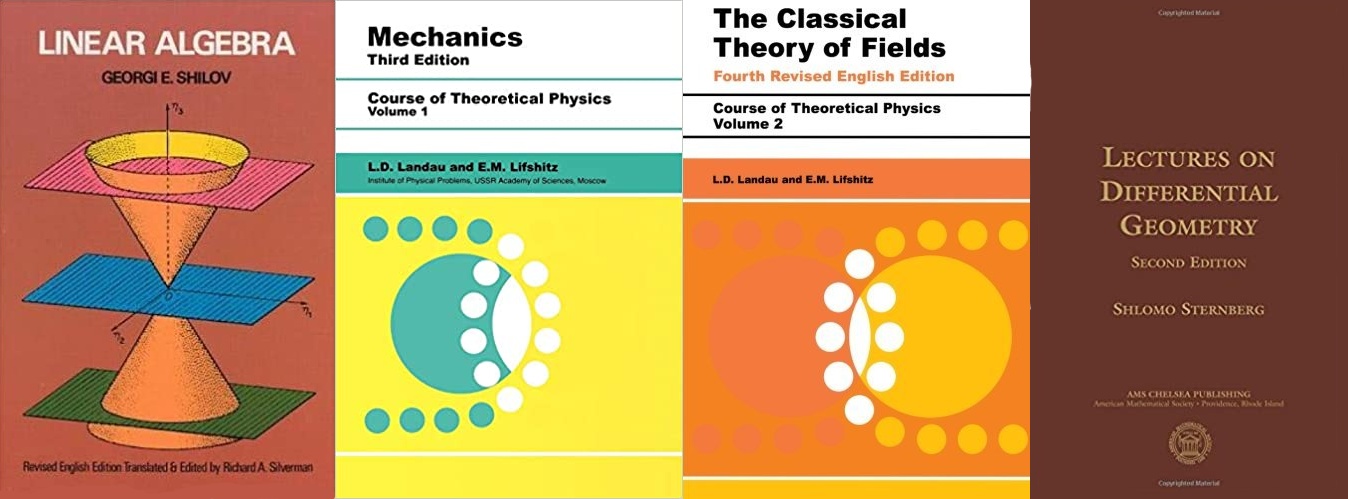
The fast track to differential geometry and theoretical physics
not even the fast track says you can do it in a month
gray gazelle
remote sparrow
https://sheafification.com/the-fast-track/
I was told this is a joke
remote sparrow
and it's a complete joke list
crimson leaf
This list is heavily skewed towards one part of math and makes a lot of non standard choice on how to approach the material
crimson leaf
sage python
I was gonna tack on Bredon Topology and Geometry but
Is Bredon that readable btw?
heady ember
sage python
Artin Algebra
Schroder Real Analysis
I find it difficult to believe one could even finish half of any of these books in a month.
crimson leaf
I could see half of Schroder in a month but Schroder is very kind imo
heady ember
If you think you can complete the whole of a ug math degree in a month, I think that's just extremely unlikely, at the very least.
crimson leaf
It is kinda big though
remote sparrow
that's what she said
gray gazelle
heady ember
If you think you can complete the whole of a ug math degree in a month, I think ...
I kinda have an exam covering it whole in a month lol
sage python
Bredon is decent imo
crimson leaf
gray gazelle
I kinda have an exam covering it whole in a month lol
What exam?
heady ember
crimson leaf
I could see half of Schroder in a month but Schroder is very kind imo
I spent a couple of months on it already and I've still at the chapter on the riemann integral lol
sage python
But yeah Schroder + Artin + Bredon gives you an undergrad math major education modulo maybe some holes
crimson leaf
heady ember
I spent a couple of months on it already and I've still at the chapter on the ri...
I got to chapter 4 in about a month
gray gazelle
crimson leaf
What exam?
It's a national entrance exam
heady ember
To be fair, the way I did it up to this point was to prove every claim the author makes myself + most exercises
remote sparrow
national entrance exam? is this a yearly thing?
crimson leaf
heady ember
To be fair, the way I did it up to this point was to prove every claim the autho...
Yeah I know lol I did not do that obviously
remote sparrow
it would be advisable to wait another year for this sort of thing
gray gazelle
Although I don't wanna get into university i wanna do well
crimson leaf
Idk if I could do that really for most analysis books as there's some weird proofs like that proof I'm currently trying to understand
heady ember
crimson leaf
I got to chapter 4 in about a month
Did you do anal before?
remote sparrow
heady ember
Did you do anal before?
i imagine most people on this server do not have a partner to begin with
crimson leaf
heady ember
Did you do anal before?
No but I had done other math like first 6 chapters of D&F, Graph theory, FIS, and some combinatorics stuff
gray gazelle
remote sparrow
and *what* do you hope to learn
I hope to learn the concepts from zero, i just know about SEL and matrices
heady ember
To complete chapter 4 in a month, 100/30 ~ 3.3 pages a day . Ok that doesn't seem to bad now that I notice this
remote sparrow
gray gazelle
I hope to learn the concepts from zero, i just know about SEL and matrices
what's "SEL?"
heady ember
crimson leaf
No but I had done other math like first 6 chapters of D&F, Graph theory, FIS, an...
I see
crimson leaf
I did not complete Chapter 4
heady ember
My personal background was that I completed the whole of Enderton
crimson leaf
I actually stopped using it because my professor was using a different book and the content did not match up very well so I switched to his book
heady ember
I see
gray gazelle
remote sparrow
what's "SEL?"
Oh I'm sorry, systems of linear equations
crimson leaf
Mainly we were doing topology on R and building everything from that instead of Cauchy sequences
tawny copper
@heady ember is your main focus set theory/logic?
heady ember
tawny copper
<@560392234952818688> is your main focus set theory/logic?
Yes and no. Yes because currently the field/topic I have the most interest in is indeed sey theory. No because I still need and want to explore other areas in math.
remote sparrow
gray gazelle
I hope to learn the concepts from zero, i just know about SEL and matrices
so you've learned some linear algebra before?
heady ember
Like maybe DG or AG, eventually
crimson leaf
What about model theory
remote sparrow
need algebra
heady ember
I'm just gonna learn enough mathematical logic to do more set theory first
crimson leaf
remote sparrow
need algebra
Yeah isn't it based on universal algebra
remote sparrow
i mean i guess there's some ug model theory books like kirby
i heard about it from peter smith's list
gray gazelle
remote sparrow
so you've learned some linear algebra before?
Yup, discuss systems with parameters, etc
The basics
remote sparrow
gray gazelle
Yup, discuss systems with parameters, etc
try Linear Algebra Done Right
heady ember
Friedberg has been good in my exp
tawny copper
crimson leaf
Yeah isn't it based on universal algebra
Model theory? No
heady ember
remote sparrow
try *Linear Algebra Done Right*
Use his latest ed with the updated chapter on  's (dets)
crimson leaf
tawny copper
Model theory? No
Huh, where does it come from then?
remote sparrow
crimson leaf
Yeah isn't it based on universal algebra
i think you may have been thinking of a pithy, but not necessarily very accurate, quote from hodges' model theory book
tawny copper
But algebra is just a very rich source of models, that's what Sour Drop meant presumably
gray gazelle
remote sparrow
try *Linear Algebra Done Right*
Hmm I don't know about vector spaces
crimson leaf
remote sparrow
i think you may have been thinking of a pithy, but not necessarily very accurate...
Maybe, I read it somewhere online one time
heady ember
I stan friedberg (because I used it , but jokes aside its very gentle)
gray gazelle
remote sparrow
these are good beginner books
Thank you!
heady ember
Also check pinned for Dami's lin alg book review
sage python
Yeah FIS seems like the standard pick nowadays
heady ember
Speaking of the devil
crimson leaf
I do really like FIS
sage python
And what I'll probably recommend to that one guy when his plan to learn everything in a month burns to the ground
crimson leaf
It's really good for beginners the writing is very easy to digest and the exercises are a good amount of difficulty
sage python
Yeah FIS might be the best linear algebra book right now tbh
tawny copper
crimson leaf
Huh, where does it come from then?
It simply naturally arises from logical considerations. Like how to prove some propodition is not true "in general" it suffices to show some example (i.e., a model) where it doesn't hold
sage python
From TAing from it once it seems to do both theory and the needed computations
And it's written easily so it can also double on as your first intro to proofs
tawny copper
tawny copper
It simply naturally arises from logical considerations. Like how to prove some p...
In the definition of what it means for a formula to be "true" you already use models, or at least that's what I have seen
crimson leaf
I also TA'd a course using it and yeah the text makes it really easy to explain problems or give hints as well
remote sparrow
most introductions to mathematical logic do a little bit of model theory
crimson leaf
I'm ngl some of the logic stuff seems really cool (like this talk on NSA I went to) but it is probably the quickest thing to lose my interest as well
remote sparrow
crimson leaf
I'm ngl some of the logic stuff seems really cool (like this talk on NSA I went ...
what is NSA
crimson leaf
non standard analysis
heady ember
Ah Sharp's beloved
tawny copper
There is a proof of Szemeredis theorem that uses model theory stuff, although I haven't read it yet. The author claims it's the correct approach.
But I think the model theory going on in such applications is not super sophisticated (compared to "pure" model theory)
crimson leaf
tawny copper
There is a proof of Szemeredis theorem that uses model theory stuff, although I ...
Was it the one by Renling Jin?
It was his talk at Integers I went to actually
tawny copper
crimson leaf
Was it the one by Renling Jin?
Yes
I mean, idk if it uses novel ideas (compared to other proofs) or if it's just using another language. Either way it's interesting
tawny copper
crimson leaf
It was his talk at Integers I went to actually
That sounds cool
crimson leaf
It was on a different topic, https://events.dm.unipi.it/event/151/contributions/339/attachments/79/103/Jin.pdf but he was talking about that paper very excitedly with the additive combinatorics peopel from UGA
tawny copper
Thanks for the link
 signal tiger
Any book recommendation for probability and statistics? I need to learn it as those are basics of machine learning
remote sparrow
signal tiger
Any book recommendation for probability and statistics? I need to learn it as th...
calculus-based?
signal tiger
yes
remote sparrow
Statistics 110: Probability
In their bestselling title MATHEMATICAL STATISTICS WITH APPLICATIONS, premiere authors Dennis Wackerly, William Mendenhall, and Richard L. Scheaffer present a solid foundation in statistical theory while conveying the relevance and importance of the theory in solving practical problems in the rea...
signal tiger
🙏thx
gray gazelle
sage python
Artin Algebra
Schroder Real Analysis
Couldn't find Schroder Analysis book anywhere
heady ember
gray gazelle
Couldn't find Schroder Analysis book anywhere

A self-contained introduction to the fundamentals of mathematical analysis Mathematical Analysis: A Concise Introduction presents the foundations of analysis and illustrates its role in mathematics. By focusing on the essentials, reinforcing learning through exercises, and featuring a unique "lea...
gray gazelle
heady ember
https://www.amazon.com/Mathematical-Analysis-Introduction-Bernd-Schr%C3%B6der/dp...
Is this the correct book?
Doest say Real Analysis
daring lake
mathematical analysis typically covers real analysis in a more general way (and some elements from complex analysis)
i had a look at index and chap 1-7,10,11,12 would typically be done as a first course
dusk wind
Imagine having to hunt down the latest edition of a book
sage python
gray gazelle
Is this the correct book?
Yeah that's the right one
It's about real analysis even if it's called mathematical analysis
 autumn quartz
Recommend books to manipulate others
 marsh ingot
gray gazelle
autumn quartz
Recommend books to manipulate others
11th grade maths book ig
sudden kindle
autumn quartz
Recommend books to manipulate others
Thats a zemon moment
 oblique mica
Any resource recommendations of fine moduli space for researchers in engineering?
 cyan scroll
Hi, everyone can someone recommend a book about field theory and Galois theory? I would like a book that explains the theories and their implecations(or how to use them)
remote sparrow
cyan scroll
Hi, everyone can someone recommend a book about field theory and Galois theory? ...
Galois Theory
 mossy flume
David Cox 💯
cyan scroll
remote sparrow
https://www.amazon.com/Galois-Theory-David-Cox/dp/1118072057
Thx will check it out
 thorn cloak
Has anyone used 'an intro to stochastic modeling' by Taylor? Wondering if it's good for stochastic processes or If there is a good supplement
molten mason
gray gazelle
Any recommendations to learn linear algebra in depth?
+1 to Linear Algebra by Friedberg, Insel, and Spence. 5th edition is $30 USD on Amazon.
Linear Algebra Done Right, 4th edition by Axler is available legally and free online on his website.
Both are great books, recommended by a good majority, feel free to use both.
 cold shore
I am trying to learn real analysis, and my professor told me Rudin's books are good
I found there is 2 of them and which one should I get?
I think one is Principles of Mathematical analysis and the other is Real and complex analysis
sage python
If you're learning undergrad level real analysis
Then "Principles of Mathematical Analysis" is what you want
 lime vessel
cold shore
I think one is Principles of Mathematical analysis and the other is Real and com...
lime vessel
cold shore
I think one is Principles of Mathematical analysis and the other is Real and com...
The order of Rudin's books is PMA -> RCA -> FA
finite gale
 primal mica
I was looking for a book similar to Matrix Analysis by Horn, but since I am a physicist I prefer picture books like Clifford the Big Red Dog. I can already apply many of the concepts covered in this text, but I am trying to rebuild my foundations with more geometric intuition.
Does anyone have a recommendation for a less rigorous and more geometric/pictorial presentation of these topics?
 stark bone
Hello, are there any recommended yt videos or courses on Abstract Algebra?
tawny copper
stark bone
Hello, are there any recommended yt videos or courses on Abstract Algebra?
Benedict Gross
Covers Artin's book (not all) so you could read that book along side
stark bone
Thanks
 autumn relic
Hello, can anyone recommend a book(s) for introductory differential equations suitable for self-study?
stark bone
@tawny copper Is it an introductory course?
tawny copper
stark bone
<@918943681216643094> Is it an introductory course?
yes
I can even tell you that some of the students that actually took that class didn't know vector spaces nor modular arithmetic
graceful moon
Also recommending Artin, a much more enjoyable read than DF imo
finite gale
Anything that isn't d&f is probably a better reading experience than d&f
D&f will cover what you want to cover but do so in a very wordy manner
vital bane
wordy is enjoyable
dusk wind
to the layman
finite gale
Maybe if you have a daily quota of words read
dusk wind
around 100
 gray jungle
stark bone
Hello, are there any recommended yt videos or courses on Abstract Algebra?
gray jungle
stark bone
Hello, are there any recommended yt videos or courses on Abstract Algebra?
Richard Borcherds has multiple incredible series on Algebra
 grim sinew
Percy Jackson
 scarlet steeple
I want to read Advanced Calculus: A Geometric View by James Callahan, is it a good book for those whom read it?
 viscid frigate
Hello! Can I get some Youtube video recommendations on Algebra 1?
 stuck zephyr
khan academy
viscid frigate
stuck zephyr
khan academy
okay, thanks!
 strong stream
has anyone here read Flatland: A Romance of Many Dimensions and how good is it
it's an old fiction apparently
 modern ruin
strong stream
has anyone here read Flatland: A Romance of Many Dimensions and how good is it
modern ruin
strong stream
has anyone here read Flatland: A Romance of Many Dimensions and how good is it
I LOVE THIS BOOK
strong stream
the only thing I know about it is terence tao read it when he was like 9
 strong stream
amazing
vital bane
gray jungle
Richard Borcherds has multiple incredible series on Algebra
Richard Borcherds has a based af channel
so many lecture series on lots of different stuff
undergrad algebra, comm alg, alg geo
number theory
 based
based
 arctic hamlet
Do you guys have any recommendations for calc 2? I need a book has clear explanation and tons of examples. Thank you first.
vital bane
spivak?
scarlet steeple
arctic hamlet
Do you guys have any recommendations for calc 2? I need a book has clear explana...
youtube and khan academy is your best bet
scarlet steeple
vital bane
spivak?
bro
vital bane
spivak's "calculus" lol not his CoM book
vital bane
nah
not too many proofs
Like it's not an analysis book
but it is a bit more rigorous than just a basic calculus course
vital bane
arctic hamlet
Do you guys have any recommendations for calc 2? I need a book has clear explana...
try looking at spivak, it you dont like it then khan academy is very good
it's where I learned calc
even learned calc 3 using that
arctic hamlet
Ty you guys, was lost at my first calc2 class  maybe will try a combination of khan academy and textbook
vital bane
yes that's a good idea
 rigid barn
finite gale
Anything that isn't d&f is probably a better reading experience than d&f
rigid barn
finite gale
Anything that isn't d&f is probably a better reading experience than d&f
Why is D&F so hated on. Granted I never read much of it, but what little i did back when I knew very little felt like a very pleasant, paced read. Wordy is not so bad for a beginner imo. That said I would never personally recommend D&F, I think there are far better alternatives.
finite gale
I used to like d&f but that was because that is what I used to learn in undergrad
Then I tried other texts and found the writing in other books just felt nicer to read
In particular, I think rotman is quite nice
rigid barn
finite gale
Then I tried other texts and found the writing in other books just felt nicer to...
I think you're ignoring the fact that you knew more at that point. D&F very quickly loses relevance once you're past the basics of the subject.
rigid barn
finite gale
In particular, I think rotman is quite nice
I like Rotman too. Not my favourite, but it's pretty well written. If I were doing tier-lists I'd rate it as S or A or w/e.
modern ruin
rigid barn
Why is D&F so hated on. Granted I never read much of it, but what little i did b...
it's BORING
(half joke)
I don't actually hate DF
but it's really fun to hate on because I just love Aluffi so much
rigid barn
modern ruin
but it's really fun to hate on because I just love Aluffi so much
now here's a good target for hate
arctic hamlet
now I wonder what is DF? differentiate function?
strange vector
Aluffi's algebra notes from underground is so wordy tho
strange vector
arctic hamlet
now I wonder what is DF? differentiate function?
Dummit Foote's abstract algebra book
rigid barn
strange vector
Aluffi's algebra notes from underground is so wordy tho
He probably means Meme0
strange vector
i think its good for reference
 loud cradle
mossy flume
very boring to read
loud cradle
mossy flume
very boring to read
i agree, it has many good examples and exercises but the exposition is very dull
makes algebra seem like a very boring subject
mossy flume
it's a great reference for sure
I have a copy for reference
for learning algebra the first time, theres better
rigid barn
I'm not defending D&F because I like it so much, but I do think the haters speak from the vantage of experience (now D&F is boring to us).
mossy flume
yea I mean I didn't use a text when I was first learning algebra (just whatever notes my prof had)
so that is a point
loud cradle
it was the nominal textbook when i first learned algebra but the prof never referred to it once haha
i'm still glad to have it as a reference though
rigid barn
mossy flume
so that is a point
Yep, my entire D&F apologia rests on that.
crimson leaf
We used D&F in our intro algebra it was good enough I do feel like sometimes the examples are a bit too much though like for instance you start Euclidean Domains you get the definition and a bit of motivation then like 2 pages of examples. I also didn't like some of the organization in part 1 such as in chapter 1 they introduce group actions and then pretty much ignore them until chapter 4. This wouldn't have been a problem to except it felt they expected the reader to carry the information from chapter 1 with them iirc they don't even recall what a group action is they just tell you to read 1.7 again which to me just seems like poor planning.
remote sparrow
rigid barn
Why is D&F so hated on. Granted I never read much of it, but what little i did b...
for example?
remote sparrow
mossy flume
for learning algebra the first time, theres better
examples?
rigid barn
remote sparrow
for example?
Isaacs or Jacobson or Rotman or Knapp (admittedly a little tougher than D&F).
mossy flume
Rotman
mossy flume
A first course
rigid barn
I'd actually recommend the "grad" book, Advanced Modern Algebra.
It's a meaningless distinction anyway.
mossy flume
Ehhhh I think that'd be fast for someone who has literally never seen algebra past LA
remote sparrow


This is a self-contained text on abstract algebra for senior undergraduate and senior graduate students, which gives complete and comprehensive coverage of the topics usually taught at this level. The book is divided into five parts. The first part contains fundamental information such as an info...
i heard this was good
rigid barn
mossy flume
Ehhhh I think that'd be fast for someone who has literally never seen algebra pa...
Well it depends who we're advising, for a slightly experienced person I'd recommend what I said.
I'd even recommend Lorenz' Algebra 1, which explicitly assumes nothing beyond LA, same as Jacobson1.
mossy flume
wait we're talking about first algebra texts
rigid barn
But yes, these books are somewhat tougher than Fraleigh or w/e else.
mossy flume
like never seen anything past LA
wait no I forgot my favorite text how could I
Artin
Artin is fantastic
rigid barn
I'd rate it about the same as D&F.
mossy flume
really?
rigid barn
It's shorter, but it covers less too.
mossy flume
it matters alot lol
rigid barn
In any case, if we're talking absolute absolute beginners I'd recommend Vinberg. Like Artin, but cooler.
I do give Artin points for how massively varied he is for an intro book.
molten mason
arctic hamlet
Do you guys have any recommendations for calc 2? I need a book has clear explana...
Howard Anton has a good calc book with tons of examples and problems.
arctic hamlet
molten mason
Howard Anton has a good calc book with tons of examples and problems.
will give it a look, tysm
 autumn spire
hello
can someone recommend me good question bank books for olympiads
for ioqm and stuff
 narrow prairie
vital bane
narrow prairie
vital bane
 silent edge
why is the link called mods
 cold elbow
cuz why not
finite gale
 meager socket
would you all reccomend hall and knight higher algebra for someone who is in pre calc
the second example worked out took me ~45 minutes to figure it out and i think that's way too slow for such a simple problem so i don't know if i'm good enough for the book
molten mason
Lmao I don't have picture privs in this server
My Springer books finally arrived.
My initial review is the Springer hardcover spines aren't even attached to the pages. They're just floating. Which I've read before is a common complaint
remote sparrow
molten mason
My initial review is the Springer hardcover spines aren't even attached to the p...
yes, they basically paperbacks with a cardboard cover
molten mason
remote sparrow
yes, they basically paperbacks with a cardboard cover
Hard to complain for a $20 book
mossy flume
silent edge
why is the link called mods
Math Olympiad Discord Server
What's a representation theory text that covers the Schur-Weyl duality?
It doesn't seem like Serre's lin reps text covers it
Does Fulton, Harris cover it? I don't see Schur-Weyl in the index
crimson leaf
mossy flume
Does Fulton, Harris cover it? I don't see Schur-Weyl in the index
According to wikipedia and ncatlab it should
mossy flume
oh hm ok
crimson leaf
My internet died for a bit but it looks like section 6.1 and 6.2
gray gazelle
meager socket
would you all reccomend hall and knight higher algebra for someone who is in pre...
that's an old and outdated book with no return value whatsoever
pick up a normal and modern pre-calc book and supplement it with khan academy
 vapid sedge
someone have Caluclus 1 from Guidorizzi?
strange vector
meager socket
would you all reccomend hall and knight higher algebra for someone who is in pre...
Yes, it's a nice book but if it takes too long to do exercises, you can read Algebra by Israel M. Gelfand first.
 pliant wadi
Is representation theory for finite groups by Martin Barrow a good book for a beginner who's done courses in group theory, linear algebra and rings and modules?
If not, are there any good alternatives?
 silk apex
I wanna read one or two Sigmund Freud books, if anyone has read, what would you recommend to begin with?
vital bane
molten mason
Hard to complain for a $20 book <:KEK:586240877358350341>
$20 is insane man 💀
that aint cheap
 earnest wolf
 strange vector
any recommendation for rigorous set theory books? I have Thomas, Jech Introduction to set theory and Enderton's elements of set theory but i don't like both
heady ember
strange vector
any recommendation for rigorous set theory books? I have Thomas, Jech Introducti...
What do you not like about them
strange vector
Jech and Thomas lacks formalism
enderton is nice but don't like his style that much
I read Naive set theory by halmos too but looking for more advanced
heady ember
strange vector
enderton is nice but don't like his style that much
Why don't you like his style
heady ember
strange vector
Jech and Thomas lacks formalism
Huh? Wdym
strange vector
Jech and Thomas says even in preface, if you are looking for formal representation, read a logic book
and enderton is not consistent at some places like he says we are dealing only with sets and elements of these sets are themselves sets, then constructs a set like {1,2,3}
vital bane
then read Jech grad book 
heady ember
strange vector
and enderton is not consistent at some places like he says we are dealing only w...
{1,2,3} is a set of sets...
strange vector
we did not defined numbers as sets at that point
strange vector
i guess
heady ember
...
vital bane
heady ember
ch 1 is meant to give a naive intro and provide some motivation...
heady ember
strange vector
Jech and Thomas says even in preface, if you are looking for formal representati...
Why is it not formal enough for your needs
heady ember
On ch 1?
strange vector
i like formalism
heady ember
strange vector
nope it says formal
🗿 Everything else is formal enough, at least to the same degree as jech's ug book.
Using some context should tell you that ch 1 is giving motivation...
strange vector
jech's book is not formal did you read it?
heady ember
strange vector
Jech and Thomas lacks formalism
Have you read a book on mathematical logic? If not I doubt you'd be able to read a grad set theory text.
vital bane
what is not formal about Jech's book?
strange vector
idk authors themselves says its not a formal text
heady ember
vital bane
bruh
heady ember
Bruh
You claim to have seen jech's text & thinks is not formal enough for your needs
Yet you haven't read it
strange vector
i read it
- The treatment is not formal. Logical apparatus is kept to a minimum
and logical formalism is completely avoided
from preface
vital bane
you mean you read the preface
heady ember
vital bane
what is not formal about Jech's book?
Then, do you mind providing an example of why it isn't formal enough for your needs
vital bane
What even is logical formalism? instead of using words using  for and?
heady ember
Initially I thought you read the book and you were referring to something like his use of class functions, e.g. in transfinite recursion. But go into a grad set theory book and you'll find the same paraphrasing.
vital bane
Like principia mathematica proving 1 + 1 = 2?
strange vector
sure
are there anyone who knows what formal book looks like can suggest a set theory book?
heady ember
sigh
strange vector
its book recommendation channel
vital bane
heady ember
_sigh_
now you understand what normal mathematicians feel when talking to set theorists
heady ember
dusk wind
whats set theory
tawny copper
@strange vector I think Tourlakis' books are pretty formal Lectures in logic and set theory, specially the first volume
but I don't see the problem with Jech's third millenium book
molten temple
jech is pretty damn formal
strange vector
tawny copper
but I don't see the problem with Jech's third millenium book
thanks, i was talking about jech's introducrion to set theory
set theory is another book
tawny copper
strange vector
thanks, i was talking about jech's introducrion to set theory
I cannot talk for that one. But the other Jech book is pretty nice I think
heady ember
I think Jech's ug book should be about the same formal as his grad book, in the stuff they cover in common like transfinite recursion.
glossy zealot
I think grass has proven from time to time that he has the credentials regarding book recommendation. Were I to disagree with him, I would try to explain my reasons further because I know he is trying to help. I hope we can all have a positive attitude 
pliant wadi
Is representation theory for finite groups by Martin Burrow a good book for a beginner who's done courses in group theory, linear algebra and rings and modules?
If not, are there any good alternatives?
 steel cloud
Any recommendation for logic and set theory?
molten mason
steel cloud
Any recommendation for logic and set theory?
Have you read Naive Set Theory by Halmos?
Or do you need something more formal
strange vector
steel cloud
Any recommendation for logic and set theory?
for logic im currrently reading principles of mathematical logic by David hilbert, its really good so far. for set theory intro, naive set theory by halmos is nice
remote sparrow
strange vector
Jech and Thomas says even in preface, if you are looking for formal representati...
why make the complaint that hrbacek and jech is "informal" but not make the same complaint about enderton? because one book explicitly states it does not formalize its axioms in first-order logic? neither assume prior study of mathematical logic, which is what makes their treatment "informal." however, both have an axiomatic approach, which sets them apart from books like halmos.
hrbacek and jech is a perfectly acceptable book. you can read kunen or big jech later
strange vector
because jech's book is not formal, even jech says its not a formal treatment
why so mad tho, is not being formal bad?
jech says this at preface: 2. The treatment is not formal. Logical apparatus is kept to a minimum
and logical formalism is completely avoided.
The treatment is not formal
from the book: Our exposition in this section is informal. Readers who would like to see
how this topic can be studied from a more rigorous point of view can consult
some book on mathematical logic
that's so funny that everyone saying the book is formal but writers of the book says it's not
remote sparrow
enderton is not a "formal" treatment either. both enderton and hrbacek/jech are the exact same style of book. they aim to teach axiomatic set theory without requiring prior study of mathematical logic. neither review or introduce any sort of mathematical logic. they both rely on your intuitive notions of logic. but the axioms are all there! hrbacek/jech, to reiterate, is not at all in the same class as a book like Naive Set Theory by halmos. that is what is meant when hrbacek/jech means when they state their book is not "formal" as compared to a book like Basic Set Theory by levy, Set Theory by kunen, or Introduction to Axiomatic Set Theory by takeuti and zaring.
strange vector
yes i'm not saying enderton is formal too but compared to jech, its more formal
jech using almost only english words for definitions and theorems
i'm saying it's not formal i don't know what is the issue here.
remote sparrow
exactly what is your impression based on? you aren't going off of much besides the preface, and you seem to have a very different interpretation of "formal" than the authors and people familiar with how set theory is taught do. what is "formal" to you that makes enderton more formal than hrbacek/jech? that enderton uses unexplained logical symbolism more often?
remote sparrow
steel cloud
Any recommendation for logic and set theory?
A Friendly Introduction to Mathematical Logic by leary and kristiansen and Elements of Set Theory by enderton are good. Classic Set Theory by goldrei is good too
i'd probably read Propositional and Predicate Calculus: A Model of Argument by goldrei if you're curious about propositional logic specifically, since leary and kristiansen jumps right into first-order logic. it's not wrong, since first-order logic subsumes propositional logic, but propositional logic gets more attention from computer scientists than mathematicians give it as far as i've heard. chapter 1 of Introduction to Mathematical Logic by mendelson is pretty decent too.
steel cloud
molten mason
Have you read *Naive Set Theory* by Halmos?
Or do you need something more forma...
No I didn't read Naive set theory
gray jungle
strange vector
jech uses much more english words instead of symbols
What exactly is formal to you ? using more symbols doesn't make something more "formal" , this is not the difference between naive set theory and formal set theory.
any graduate set theory book will be formal
unless we have different definitions for it
strange vector
we have different definitions
using symbols instead of words makes the text more formal look up for the books that accepted as formal
i didnt say anything about naive and formal set theory where that came from?
gray jungle
I suspect what you are looking for is not a "formal set theory" book you are looking for a set theory book that's not verbose, jech grad book is considered formal altho it seems too verbose for you it seems.
strange vector
yes, that is what i'm saying.
its jech's undergrad book btw. The book i'm talking about is intoduction to set theory, not set theory by jech
gray jungle
fair enough, unfortunately i only used halmos for naive set theory so i cant recommend anything else. 
vital bane
naive gang
remote sparrow
i'm rather disappointed that the fourth edition of LADR is perfect bound as a single text block rather than in signatures
my third edition was bound much more nicely
Measure, Integration, and Real Analysis is made much better, as i had hoped
dusk wind
what is set theory?
 woven latch
Looking for books about Digital Signal Processing. I've gone through Discrete-Time Signal Processing by Alan Oppenheim. Seeing if anyone has a good follow up recommendation
heady ember
strange vector
that's so funny that everyone saying the book is formal but writers of the book ...
I think I got a bit irritated because
-
You seemed to ignore what I was saying, just repeating that things aren't formal. E.g. When I told you Enderton's first chapter is meant to provide intuition, you simply restated that it was supposed to be formal.
-
I don't think I said either are formal. Reading carefully, I believe one should find that I used "formal enough".
-
You seem to not know what you want. You keep stating you want a formal treatment, yet you can't give an example of why things aren't sufficiently formal. Similarly, you claimed to have read the books, when it seems you have only read the preface.
-
Your tone didn't seem, at least to me, to be the most polite. E.g.:
ch 1 is meant to give a naive intro and provide some motivation...
nope it says formal
not naive
The way you phrased it makes it seem like you're not even respecting what I'm saying. To an extent, it feels that you aren't even listening.
 candid sequoia
Hi I want to expand my knowledge in maths any book recommendations? Note: I am in 9th grade.
crimson leaf
candid sequoia
Hi I want to expand my knowledge in maths any book recommendations? Note: I am i...
I would recommend Khan academy
crimson leaf
heady ember
I think I got a bit irritated because
1. You seemed to ignore what I was saying...
Well if you keep reading (which I assume you did) you'd notice op was not using formal correctly anyways
candid sequoia
crimson leaf
I would recommend Khan academy
I find the website really confusing
crimson leaf
Which part of it?
vital bane
remote sparrow
i'm rather disappointed that the fourth edition of LADR is perfect bound as a si...
signatures?
remote sparrow
vital bane
signatures?
sometimes a large book is "subdivided" into little booklets. imagine a piece of paper. fold it. get another piece of paper and fold it. put it inside the folds of the previously folded page. repeat this process for some more pages. this is a signature. you can stack other signatures and glue or sew them together.
one of the big advantages of this construction is that the books lay open flat a lot more easily.
vital bane
man I must've gotten scammed cuz the copy of LADR i got (like a year ago) the signatures were all over the place not at all aligned
and it was in black and white 

on amazon
remote sparrow
vital bane
I hope the other books I purchase will actually be a good quality product
heady ember
crimson leaf
Well if you keep reading (which I assume you did) you'd notice op was not using ...
Yeah I had a feeling that he didn't exactly mean formal
 fierce hedge
vital bane
man I must've gotten scammed cuz the copy of LADR i got (like a year ago) the si...
fierce hedge
vital bane
man I must've gotten scammed cuz the copy of LADR i got (like a year ago) the si...
Why not just get it printed, I got it printed on A4 paper and it looks glorious
crimson leaf
fierce hedge
Why not just get it printed, I got it printed on A4 paper and it looks glorious
Well like where would you get it printed and if you did how somewhere how would the legality of that work since it's technically copyrighted right?
fierce hedge
crimson leaf
Well like where would you get it printed and if you did how somewhere how would ...
It doesn't matter in the 3rd world country I and neam live in so it works out but yeah even though 4th edition is open access printing the book is technically piracy.
By doesn't matter I mean the chances of getting prosecuted to that are negligence
gray gazelle
Is Lee a suitable replacement for Munkres for learning point-set topology?
crimson leaf
fierce hedge
By doesn't matter I mean the chances of getting prosecuted to that are negligenc...
Ah yeah, I wish we could do that idek where I would get a book printed and bound to begin with
fierce hedge
crimson leaf
Ah yeah, I wish we could do that idek where I would get a book printed and bound...
There are technical loopholes around this like you can print a part of the book as teaching material and part by part get the whole book printed.
vital bane
fierce hedge
Why not just get it printed, I got it printed on A4 paper and it looks glorious
where
fierce hedge
vital bane
where
Printster
vital bane
gray gazelle
Is Lee a suitable replacement for Munkres for learning point-set topology?
it's more of a topological manifolds book
rather than studying general topological spaces
But if you plan to do diff geo/diff top then lee would be sufficient
vital bane
fierce hedge
Printster
will the police come to my house if I print a pdf
remote sparrow
vital bane
will the police come to my house if I print a pdf <:monkey:651816857153699840>
do the police have the resources to go after someone printing a pdf
you're not running a printing empire
fierce hedge
vital bane
will the police come to my house if I print a pdf <:monkey:651816857153699840>
Lmao no, I once even contacted the authors of a CS book asking if I could print their book cause it was out of print here. They said no but I printed it anyway
tawny copper
remote sparrow
do the police have the resources to go after someone printing a pdf
depends if you are white or not
crimson leaf
Hmmm actually I wonder how expensive it would be to use prinster and some kind of 3rd party shipping agent so have prinster send it to the shipper then to me. Of course I would only do this for books which I am legally allowed to print
fierce hedge
crimson leaf
Hmmm actually I wonder how expensive it would be to use prinster and some kind ...
I can tell u the approximate cost if you really want to know
tawny copper
6.31 dollars?
fierce hedge
crimson leaf
Hard cover 392 pages double side a4 paper
Is this for the basic paper quality
crimson leaf
Yeah 75 gsm normal
tawny copper
A4 books are annoying tho, too big
tawny copper
where is this at? Can you send link
fierce hedge
crimson leaf
A5, A4, and B5 are all I see
Oh yeah mb, I meant B5
gray gazelle
I am using "Understanding Analysis" by Abbott for self study real analysis. But, I wanna ask should I use any other book for supplementary too? If so, then which one will be suitable for me?
rare estuary
gray gazelle
I am using "Understanding Analysis" by Abbott for self study real analysis. But,...
I have been using Spivak's Calculus and Proofs by Cummings along with Understanding Analysis
remote sparrow
gray gazelle
I am using "Understanding Analysis" by Abbott for self study real analysis. But,...
abbott works pretty well by itself, but cummings' Real Analysis: A Long-Form Introduction pairs well with it
rare estuary
gray gazelle
I am using "Understanding Analysis" by Abbott for self study real analysis. But,...
They seem to work well together. Spivak has different sorts of problem (both more elementary and a bit trickier) and doesn't assume that you've had calculus before. In particular, the problems from chapter 1 really got me comfortable with manipulating absolute values and inequalities. I think that's been helping with Understanding Analysis
gray gazelle
rare estuary
I have been using Spivak's _Calculus_ and _Proofs_ by Cummings along with Unders...
I see. How was your experience?
And how you used these two books as supplementary? (Meaning do you use these books for extra problems?)
gray gazelle
remote sparrow
abbott works pretty well by itself, but cummings' *Real Analysis: A Long-Form In...
Yes indeed. Abbott's book is pretty smooth. But I thought maybe having some supplementary books may help me more.
gray gazelle
rare estuary
They seem to work well together. Spivak has different sorts of problem (both mo...
That's amazing. Lemme find pdf and check both the books (because unfortunately in my country these books are not available:(( )
I have also heard about the book "the way of analysis".
remote sparrow
gray gazelle
That's amazing. Lemme find pdf and check both the books (because unfortunately ...
iirc, there is only a really crappy scan available for Real Analysis: A Long-Form Introduction by cummings. but the book is pretty cheap on amazon.
Additional resources for Understanding Analysis by Stephen Abbott
Notes:
https://mileti.math.grinnell.edu/m317f23/Analysis.pdf
Solution manuals:
There is an official partial solutions guide available at the usual place to find free PDFs.
https://github.com/UlisseMini/understanding-analysis-solutions (unofficial full solutions manual)
Lecture playlists following the book:
https://www.youtube.com/playlist?list=PLB-Mc4u93V4WwyRck9HACF2v_Q5V0bdNJ
https://www.youtube.com/playlist?list=PLysi2xmniDSzz6xT7IzOifpoexeKccThh
https://www.youtube.com/playlist?list=PLLFpXNanTP9WGfbjxR5kCMXQgol4bGehz
gray gazelle
remote sparrow
iirc, there is only a really crappy scan available for *Real Analysis: A Long-Fo...
Yes. There is scan available, I am trying to make a print copy of that scan. (Amazon is not available in Pakistan too😭)
remote sparrow
gray gazelle
Yes. There is scan available, I am trying to make a print copy of that scan. (Am...
you could try to email the author about your situation. he seems like a nice guy
gray gazelle
remote sparrow
Additional resources for *Understanding Analysis* by Stephen Abbott
**Notes**:
...
Thank you so much for this. Indeed this is helpful.
gray gazelle
remote sparrow
you could try to email the author about your situation. he seems like a nice guy
Ok I will try. If I am not wrong then the email is
Jay.Cummings@csus.edu
remote sparrow
yeah
gray gazelle
Thank you. I will share my situation with the author
remote sparrow

This book contains a selection of more than 500 mathematical problems and their solutions from the PhD qualifying examination papers of more than ten famous American universities. The mathematical problems cover six aspects of graduate school mathematics: Algebra, Topology, Differential Geometry,...

Berkeley Problems in Mathematics (Problem Books in Mathematics)
neat books containing some qualifying exam questions
molten mason
remote sparrow
neat books containing some qualifying exam questions
There's also a UCLA Analysis Qualifying Exam Solutions pdf. Covers from 2009 to 2020
remote sparrow
molten mason
There's also a UCLA Analysis Qualifying Exam Solutions pdf. Covers from 2009 to ...
title and author?
molten mason
remote sparrow
https://www.amazon.com/Solutions-Mathematics-Universities-Qualifying-Questions/d...
That looks awesome, bit pricey though but I'm sure it's worth it
molten mason
remote sparrow
title and author?
It's the first link if you google it, from the official math.ucla.edu domain, Adam Lott
molten mason
remote sparrow
title and author?
I like that there's multiple solutions given for most problems
gray gazelle
remote sparrow
neat books containing some qualifying exam questions
Is it possible for me to read these books? And solve at least some problems?
I am a beginner in real analysis and proof base mathematics. Currently studying second section of second chapter (Abbott).
strange vector
heady ember
I think I got a bit irritated because
1. You seemed to ignore what I was saying...
It's not even first chapter, its chapter 4 or 5 and not for intuition read the book. and i discussed like 5 people here just tired, if someone says jech's intro set theory book is formal, send message to jech himself and let him fix his preface where he says his book is informal.
people don't even read the full conversation and thinks i'm talking about jech's set theory like wtf
i read almost half of the jech's intro to set theory book and i think i can say its not formally written, look for what formal means if you don't know. You can't write formal book just using words
 sick river
is lee good for a second pass on topology?
vital bane
remote sparrow
https://www.amazon.com/Solutions-Mathematics-Universities-Qualifying-Questions/d...
woahh
vital bane
sick river
is lee good for a second pass on topology?
lee's topological manifolds?
sick river
yeah