#book-recommendations
1 messages · Page 48 of 1
 small cobalt
 there'd be no harm in getting in touch with the department and asking at least
 rustic grove
I probably will nearer the time 🙂
small cobalt
good luck 
rustic grove
thank you, and you too!
 remote sparrow
for pure math, FIS is a good choice. it's not a great choice for those who need matrix theory more (i'm not saying people wouldn't benefit from the conceptual insights an abstract vector space approach gives). horn and garcia has a book which suits this purpose: https://www.amazon.com/Matrix-Mathematics-Cambridge-Mathematical-Textbooks/dp/1108837107. there is also the reference work by horn and johnson: https://www.amazon.com/Matrix-Analysis-Second-Roger-Horn/dp/0521548233.
small cobalt
remote sparrow
for pure math, FIS is a good choice. it's not a great choice for those who need ...
agreed, not personally familiar with the book by Horn and Garcia though. I read some of Meyer's book and liked that
Sutherland, it's decent but not inspiring lol
rustic grove
I am using sutherland, but Idk if you used another one
rustic grove
small cobalt
Sutherland, it's decent but not inspiring lol
Ye, it is so dry
small cobalt
I don't know of many books pitched around the level of that course tbh
rustic grove
What about the Norms part?
small cobalt
just the lecture notes for norms
it wasn't emphasised too much so they were sufficient to get by
rustic grove
I see
small cobalt
working Sutherland did help a lot even if it's not the most fun
rustic grove
Ye I plan to cover it's contents, atleast C5 - finish
remote sparrow
i recently found out about this book
seems good
gamelin and greene's topology textbook isn't precisely what you're after, but it focuses a lot on metric spaces
carothers' Real Analysis is worth looking into too
small cobalt
I like carothers a lot but it's written at a higher level than the NMT course and only covers the metric spaces content iirc
when I took it the majority of the course was really on topological spaces
rustic grove
remote sparrow
https://www.amazon.com/Metric-Spaces-Companion-Undergraduate-Mathematics/dp/3030...
Ill have a look at them thanks, I think for topology I am going to supplement sutherland with Munkres
 manic cairn
Re-reading Lang Part I and Munkres, so I have my basics down before I hopefully go to undergrad next year:

(Also adding the analysis book that I never finished, because that seems really important)
 magic moth
which analysis book?
 mellow wren
manic cairn
Re-reading Lang Part I and Munkres, so I have my basics down before I hopefully ...
mellow wren
manic cairn
Re-reading Lang Part I and Munkres, so I have my basics down before I hopefully ...
you're gonna read lang's algebra before UG
that's a new one
 dusk wind
what are the thoughts on the open logic project?
manic cairn
mellow wren
you're gonna read lang's algebra before UG
Not all of it.
I’ve gone through part 1 and done most of the problems
And I’m going back through it and writing the proofs up again
Because I’m rusty
same thing with munkres
mellow wren
you don't remember the proof of some kummer theory result ofc I would do the same
manic cairn
The kummer theory stuff is later
 tawny copper
manic cairn
Re-reading Lang Part I and Munkres, so I have my basics down before I hopefully ...
tawny copper
manic cairn
Re-reading Lang Part I and Munkres, so I have my basics down before I hopefully ...
Are you in high school?
Reading Lang to prepare for ug sounds so weird to me, since Lang is core undergrad material and also has graduate material
dusk wind
biased comment incoming
manic cairn
That’s the idea. I want to go into undergrad with a strong basic understanding of algebra, topology, and analysis.
 rare estuary
You may be bored when you take calc 1
dusk wind
they might be bored now
manic cairn
And I haven’t sat down and ground out, say, Sylow group calculations in a while
tawny copper
I dont think you will like to be in a class where you know every single aspect of and you find the exercises easy
Unless you go to a good university where the courses are intense and with hard problems
Otherwise, the stuff you are doing is probably more than you will be doing in first year lol. Even later years
small cobalt
tawny copper
I dont think you will like to be in a class where you know every single aspect o...
this, I know someone who went into undergrad at an extremely good university with this kind of prep and they were very bored
especially if you go to uni in a country where it is hard to place out of classes
tawny copper
I mean, I experienced that myself, but the uni I go to is low tier, so would have probably been bored anyway
small cobalt
my recommendation would be to go broader and explore stuff you might not get a chance to cover in your undergrad
you can develop a lot of mathematical maturity doing that which will still transfer anyway
 heady ember
small cobalt
my recommendation would be to go broader and explore stuff you might not get a c...
heady ember
small cobalt
my recommendation would be to go broader and explore stuff you might not get a c...
Set theory 
tawny copper
I am not giving advice, but Im saying that their situation kind of sucks, they should be doing math courses already. When they finally take Lang level algebra courses, they will know the msterial already having had to struggle twice as much to learn it, but it is likely that no one will care
 dire gorge
Hello everyone,
As I am in grade 10, I'm determined to elevate my math skills to new heights. While I currently don't feel entirely confident in my math abilities, I'm eager to change that. My aim is to become adept at mental math, tackle challenging problems well above my current level, and build a solid foundation for advanced learning.
I'm reaching out to this community for guides, resources, and tips that can help me achieve my goal. I'm particularly interested in eventually delving into calculus ahead of schedule. If you have any recommendations – whether it's strategies for enhancing mental math, book suggestions, online courses, or other resources – I'd be grateful for your insights.
My aspiration is to not just catch up but to forge ahead, and excel in math beyond what's expected at my level. Thank you for your time and any support you can provide. I'm excited to learn from your experiences and knowledge as I work towards my goal.
These are also 2 books I found after research. Would they be good?
-
"Discrete Mathematics with Applications" by Susanna Epp
-
"Concrete Mathematics" by Donald Knu
Also to add, the cut off for my knowledge is algebra, my math teacher last year did not teach us much, so I am even not that good at algebra ok my question was anwsred any good textbooks i should please tell me Finish learning algebra
Learn calculus 1/2
Learn any of Linear algebra, calc3, diff eq
Use khanacademy or a textbook, or whatever helps you learn and keeps a structured course
dire gorge
@gray gazelle will that help with the stuff in that step i will only start reading sussan epp once i get algerba one and two down
so the basically the books i already have are good and help get me what i need
these a parts to be spefic
Learn calculus 1/2
Learn any of Linear algebra, calc3, diff eq
what i reading lang?
What is is reading lang
good god
i cant type today
ok
so just to make sure
the books i have are already good
and i thought start reading susasn epp when start calc 3
and then the other book when i do or do lin alg and calc 3 simultaneously
i just want to know what should i start reading when i learning calcul;aus one and 2
ok
how about
with
ah
lin alg and diff eq?
Ok, let me start fresh
So, after I do Alg 1 & 2.
I'll move on, to Calc 3 & Lin Alg simutaleonsly
i want to know whats a good text book
i should get to study and learn it
and get grasp on it
ok
so an all in one book thats even better
and i presume each topic is sepaerted even ebtter
Apostol's 2-volume Calculus
thank you spin now i need to find the book
what is the latest edtion so i know
cause yk what im bout to do 💀
yar ye maties
ok shit
oh shit really?
dang
thats even better
where do i find it online?
i did serch
and came up with nothingg a link?
wow looks overwhealming but it all be worth knowing calcualus and other subjects and young and early age 🤣
also i got time to kill
so ya ya ya
yes ty
first alg bera one and 2
now im ready
@gray gazelle
wait one more question
when does trimontry happen
oh god that looks scary
i guess ill take trig after algbera 2
well simple enough wish me luck!
@gray gazelle one last thing the booj has all that i need to study and practise it
ok sorry i gotta stop overthinking
i dont why i keep overthinking things
I JUST GOTTA DO IT
JUST DO IT
@gray gazelle oh shit
i missworded smth
i said, once i do alg 1 and 2
ill move to calc 3
i meant ill move on to calc 1 and 2
the book covers it right
or you understood what i meant right
so book has everything i need 5 in one package
all in one crazy link
i dont need pull 150 outta my ass now
oh sick so its orginzaed 2
i just gotta read a book and follow along with it, cause it pakced full of practise questions and other things
so i dont even gotta look online for tests and practise
just read the book from my understanding
and ill be good?
after alg 2 then ill do khan trigmontery coruse
and ill be golden
well im set
thank for time, and dealing with my rabbit hole of overthinking
im going to shot myself if i overthink something
 glass badger
Apologies if the following questions are ignorant or if I'm speaking out of my ass, but:
- Is there a list of book recommendations (arranged by topics) that has been compiled somewhere (e.g., maybe a collaborative project of sorts that a community of people have worked on)? Or some book recommendation site that math peeps use?
If not are there thoughts about putting one together? (Not a site, maybe just a doc with a shareable link with recommended titles; no idea how much effort/time/work this would require and I can imagine there might be conflicting opinions, so again, apologies if I'm asking the impossible).
I'm aware that certain recommendations have been pinned, but for people looking to self study I think it'd be neat to have a list of recommendations which one could quickly and easily access or be referred to while using this channel to ask for more in-depth opinions/guidance. If listed by topics, it might also help to give newbies like me an idea of the breadth of mathematics. - Is there a list of recommended topics that should be covered first? While reading some of the posts here I've seen, for instance, topology, linear algebra, analysis, algebra, set theory; I'd imagine it varies depending on mathematical maturity e.g., I mainly see people classified as pre-uni, uni, and grad, so apologies if this is yet another ignorant question.
 magic spade
@glass badger i have a huge personal list, so if you ever have any questions, feel free to message me
small cobalt
glass badger
Apologies if the following questions are ignorant or if I'm speaking out of my a...
Some lists do exist, but they often contained oudated or inferior choices (at least in many people's opinion) for some topics. I could link some if you would like but I don't personally hold any as gospel or even close. There are a lot of textbooks out there and personal taste plays a not insignificant role in which people favour (if they're not just recommending the texts they were assigned in undergrad). There are sites which review books like the MAA and communities where users will discuss and opine on books like stackexchange and reddit. Another possible issue with putting together a sheet is simply that currently recommendations are often tailored to the user asking for them and adapted to information and requirements they provide.
As for a list of topics to cover first, then beyond the highschool level you can basically just look at any Uni's curriculum, many of which are online.
 fierce hedge
glass badger
Apologies if the following questions are ignorant or if I'm speaking out of my a...
fierce hedge
glass badger
Apologies if the following questions are ignorant or if I'm speaking out of my a...
A decent one I've seen is the book list maintained by UChicago Maths
magic spade
fierce hedge
A decent one I've seen is the book list maintained by UChicago Maths
its really good but some of the recommendations are pretty dated, overall good though
remote sparrow
4chan /sci/ wiki
fierce hedge
magic spade
its really good but some of the recommendations are pretty dated, overall good t...
I mean maths is a pretty slow field so usually not much will be changed in like few decades.
I am curious as to what book you found that you felt was dated?
magic spade
fierce hedge
I mean maths is a pretty slow field so usually not much will be changed in like ...
it doesn't really have a good suggestion for multivariable calculus in my opinion. i mean dated in the pedagogical sense
manic cairn
remote sparrow
4chan /sci/ wiki
Unironcially this
manic cairn
fierce hedge
A decent one I've seen is the book list maintained by UChicago Maths
Also, the Chris Jeris “Undergraduate Math Bibliography” is really good too
remote sparrow
recently found out about this book, seems good
nice thing is that it seems to have solutions to most, if not all (haven't checked the entire book yet) the problems at the end of each chapter
glass badger
I appreciate the responses.
Many thanks to all of you!
And if y'all have or come across more feel free to @ me or drop 'em in here. I'll probably be going through more of this channel's past anyhow.
 atomic hemlock
I'm reading Logical Methods - The Art of Thinking Abstractly and Mathematically linked here (https://link.springer.com/book/10.1007/978-3-030-63777-4). Does anyone know where can find solutions to the exercises? I like the book but the inability to check my answers is killing it.
fierce hedge
manic cairn
Also, the Chris Jeris “Undergraduate Math Bibliography” is really good too
Those are the same thing right?
At least this is what I was referring to when I meant UChicago list
manic cairn
fierce hedge
Those are the same thing right?
They are.
 pseudo dust
Any recommendations for algebra 1 and analysis 1?
heady ember
Look in pinned
For alg
For anal, dami recs either Schroder for a gentle intro or browder (rudin but better)
 rustic grove
pseudo dust
Any recommendations for algebra 1 and analysis 1?
rustic grove
pseudo dust
Any recommendations for algebra 1 and analysis 1?
'Introduction to Real Analysis' by Bartle is excellent
 maiden heart
has anyone suggestions the physical math book
 balmy lance
Can’t find a recommendation for an Intro to Probability book anywhere in the channels. Any help?
Context: University student in a pretty competitive environment
 covert zealot
balmy lance
Can’t find a recommendation for an Intro to Probability book anywhere in the cha...
covert zealot
balmy lance
Can’t find a recommendation for an Intro to Probability book anywhere in the cha...
I found "A first course in probability" by Sheldon Ross was very good some decades ago. Typically, it's best to use the course texts and references therein.
balmy lance
covert zealot
I found "A first course in probability" by Sheldon Ross was very good some decad...
Can’t find any references
emailed the professor - no response
Go figure
rustic grove
maiden heart
has anyone suggestions the physical math book
Narrow that down, what field?
covert zealot
balmy lance
Can’t find any references
Your recommended text or texts has no bibliography? Or your course/module has no recommended text? Are your classmates aware of any recommended text or are they also reading nothing?
maiden heart
rustic grove
Narrow that down, what field?
astrophysics
balmy lance
covert zealot
Your recommended text or texts has no bibliography? Or your course/module has no...
Theres a pretty messy syllabus. Nothing beyond that. No contact with classmates as I’m a transfer student at the semester hasn’t started yet
rustic grove
maiden heart
astrophysics
mmm, astrophysics isn't very mathsy* early on, and I am not an astrophysicist, but I have heard 'An introduction to Modern astrophysics' by Bradley W.carrol .... is quite good.
maiden heart
rustic grove
mmm, astrophysics isn't very mathsy* early on, and I am not an astrophysicist, b...
thanks for ur suggestions
 tired smelt
Hi, does anybody know good books for numerical topology? I have advanced in topology and also want to start algebraic topology but my goal is to try and understand numerical topology
 vagrant hamlet
Hello! Does anyone have opinions on Jürgen Elstrodt - Maß- und Integrationstheorie?
All reviews seem to be praising it as one of the best books ever, but there are few reviews because it's in german
balmy lance
balmy lance
Can’t find a recommendation for an Intro to Probability book anywhere in the cha...
Anyone?
 hearty steppe
Looking to start working through Tapp’s Matrix Groups for Undergrads book today.
I was disappointed in the other book I was going through… A. Zee’s Group theory in a nutshell for physicists
rare estuary
balmy lance
Anyone?
I used A First Course in Probability by Ross
I haven't looked at many alternatives, but I found that book pretty readable
 crisp geode
Fine if I skip algebra 2 and jump right to it, and then come back to alg 2 later?
 vital bane
tired smelt
Hi, does anybody know good books for numerical topology? I have advanced in topo...
vital bane
tired smelt
Hi, does anybody know good books for numerical topology? I have advanced in topo...
what is numerical topology?
tired smelt
vital bane
what is numerical topology?
Well this topic doesn't have a clear name, but it's somewhat topological ways of optimization. We have this theme in our university, so I wanted to research about "applied" topology
vital bane
something like topological data analysis?
tired smelt
vital bane
something like topological data analysis?
yes!
small cobalt
balmy lance
Can’t find a recommendation for an Intro to Probability book anywhere in the cha...
Blitzstein and Hwang is highly recommended and has lectures online
dusk wind
+1 to Blitzstein, full youtube with curriculum and everything
but there are plenty of good ones for it
magic spade
 manic tendon
Suggest me a Book for calculus of variations
manic tendon
Suggest me a Book for calculus of variations
What is your math background?
manic tendon
Im a recent graduate, i want to work in Geometric measure theory
I have read apostol's analysis book, and i have read in gareipy and evans book ... But i want to start with the calculus of variations way
 pale pecan
thank you soo much, i just bought it
magic spade
manic tendon
Im a recent graduate, i want to work in Geometric measure theory
I have read ap...
Have you looked at Maggi's book? It has geometric measure theory and variational stuff. Or do you want a book only on calculus of variations?
manic tendon
If there is any book introdues the subject for someone who has no knowledge about it
magic spade
manic tendon
If there is any book introdues the subject for someone who has no knowledge abou...
Check out "Calculus of Variations" by Rindler
manic tendon
Thank you😃
 gray jungle
<@&268886789983436800> ?
 upbeat vine
balmy lance
Anyone?
upbeat vine
balmy lance
Anyone?
Billingsleys probability and measure
remote sparrow
balmy lance
Can’t find a recommendation for an Intro to Probability book anywhere in the cha...
dusk wind
need to fix a PDF is there a server for that
glass badger
Fix? Aren't there tools for that? Why a server?
dusk wind
there are others that can do it more efficiently
for example people that scan tomes better than some publishers and distribute them for free
glass badger
Ooohh, okay. I was assuming minor fixes, but this sounds like an endeavour.
Good luck!
 storm fossil
Are any of Euler's books approachable for a 1st year in college? Not necessarily as a textbook, but just for the interest of reading something by Euler.
 median saffron
pale pecan
thank you soo much, i just bought it
median saffron
pale pecan
thank you soo much, i just bought it
Nice! I hope you enjoy the book
 glass adder
 maiden halo
balmy lance
Can’t find a recommendation for an Intro to Probability book anywhere in the cha...
maiden halo
balmy lance
Can’t find a recommendation for an Intro to Probability book anywhere in the cha...
Blitzstein & Hwang is good
fierce hedge
dusk wind
need to fix a PDF is there a server for that
Use pdftk for editing PDFs
 spring sequoia
does anyone recommend the saxon math textbooks for self study
remote sparrow
dusk wind
need to fix a PDF is there a server for that
there are ways to get adobe acrobat pro for free
 orchid mortar
pdftk does work tho
 wise bobcat
want to be smart like professor phd 70 yrs old ?
ask professor , hey can you look up the names of the textbooks you used to learn math ? id like to read what you used to learn math ... 45 years ago in the 1970/1980s
gray jungle
wise bobcat
want to be smart like professor phd 70 yrs old ?
ask professor , hey can you l...
Bad advice considering some books have better modern/padagogicaly-better versions than what your professor used , not saying books from the 70s are all bad (some are incredible) but sometimes there is better alternatives
 mystic orbit
balmy lance
Can’t find a recommendation for an Intro to Probability book anywhere in the cha...
mystic orbit
balmy lance
Can’t find a recommendation for an Intro to Probability book anywhere in the cha...
What kind?
Measure theoretic, discrete, ...?
 wispy bison
rustic grove
mmm, astrophysics isn't very mathsy* early on, and I am not an astrophysicist, b...
wispy bison
rustic grove
mmm, astrophysics isn't very mathsy* early on, and I am not an astrophysicist, b...
What is the asterisk
rustic grove
wispy bison
What is the asterisk
I was emphasising the fact that whilst it is a good book on astrophys, I wouldn't class it as a maths book. At least considering the sort of maths people are looking at on this discord...
 cyan valve
Anyone have any opinions on Shafarevich's two volume "Basic Algebraic Geometry" series and Bosch's "Algebraic Geometry and Commutative Algebra"?
 olive bloom
If someone has an analysis reading group I'd like to join
dusk wind
remote sparrow
there are ways to get adobe acrobat pro for free
yea just learned this might be the way
it specfically has what I need rip PDF software monopoly
dusk wind
wise bobcat
want to be smart like professor phd 70 yrs old ?
ask professor , hey can you l...
there is no way you will ever catch me using a book pre 2000's unless its some specific material only found there or part of some chain of logic
most modern sources have already done the research for you
rare estuary
dusk wind
there is no way you will ever catch me using a book pre 2000's unless its some s...
No Spivak's Calculus? Baby Rudin?
dusk wind
thats different
but average academic books from the 80s are just that
think about it, if the books assigned to your class suck today, they probably sucked back then too
 sturdy shore
there are so many good math books written in the 90s or before, that is just an ignorant thing to say
(so is the other statement, that you should look up what people used in the 70s as if that is going to give you better books on average)
dusk wind
sturdy shore
there are so many good math books written in the 90s or before, that is just an ...
yeah but there are good books written today which is more important and relevant
rustic grove
dusk wind
yeah but there are good books written *today* which is more important and releva...
From what I have gathered so far, new books tend to 'dumb things down' a bit; where as old books just give it to you how it is 🤣. Maybe I am wrong tho...
dusk wind
rustic grove
From what I have gathered so far, new books tend to 'dumb things down' a bit; wh...
thats true if you want to go on a serious study hunting after chains of logic by all means dig into the past but you might see things differently from those who were spoonfed
of course you could just filter out such books written today as well and hope the nuggets of knowledge are enough for your crusade
rustic grove
I guess so 🙂
sturdy shore
dusk wind
yeah but there are good books written *today* which is more important and releva...
but that is not necessarily true? there are many subjects where the textbooks that get the highest praise are older, and it's not like the praise is unwarranted either
willard is imo the best book on topology. which point set topology book today is "more important and relevant"?
what is a book "more important and relevant" than hoffman & kunze?
heck, folland was first released in 1984 and second edition in 1999
rudin RCA was also released in 1986, rudin and folland together are pretty much the standard references on grad level measure theory/analysis, which books are more important and relevant than those?
it's not like these subjects have evolved at any meaningful level to change what textbooks would look like for them
I'm not sure where this expectation of linear-esque improvements for textbooks comes from
dusk wind
linguistics and the internet
dusk wind
sturdy shore
it's not like these subjects have evolved at any meaningful level to change what...
wonder why this is
fierce hedge
dusk wind
wonder why this is
Cause progress is very slow in mathematics and even then the fundamentals do not change much if any at all. On top of that most of the new research is not within the grasp of a ug student and it remains to see if such things might be too useful to not know.
For example calculus was considered very advanced few decades ago before few people found the pedagogical way to teach them to ug students.
dusk wind
thats not the same in other fields and I wouldn't say topology is reason to jump into older books
for example you can't use Python 2 anymore nor all things associated with it
of course the more difficult or niche something is the chances of it changing are lower, that has nothing to do with progression or linear improvement
given enough time all errors are eventually and hopefully found and corrected, what was true once before simply isn't depending on how much later you want to go
 ancient sand
is there anything i need to know for that popular book on real analysis
or do you know what you need if you've just taken basic calculus
rustic grove
ancient sand
is there anything i need to know for that popular book on real analysis
which book? Rudin?
ancient sand
abbott
 livid lichen
after the book algebra: structure and method method I move on to intermediate algebra
rustic grove
ancient sand
abbott
You don't need much so feel free to dive into it 🙂
ancient sand
thank you
 vivid zephyr
I doesnt seem like abbot's book covers proper and improper limits any reccomendations on handouts or books that might
mellow wren
dusk wind
most modern sources have already done the research for you
have you considered the fact that maybe modern authors don't feel the need to write a book on a subject if there's already a great book on it pre 2000?
like almost all the math books I read on a daily basis were written pre 2000 lol
mellow wren
vivid zephyr
I doesnt seem like abbot's book covers proper and improper limits any reccomenda...
maybe try chapman pugh's book
It goes quite a bit deeper than abbot but I don't think improper limits are a super important concept so idk if there's any book that goes into them that much
vivid zephyr
@mellow wren thanks
livid lichen
Is the revised edition or the student edition better?
 rose lynx
Does anyone have recommendations for reading material on hyperbolic manifolds?
magic spade
rose lynx
Does anyone have recommendations for reading material on hyperbolic manifolds?
What's your background?
Have you looked at "Foundations of Hyperbolic Manifolds" by Ratcliffe?
rose lynx
I'd heard about Ratcliffe and Janich. I thought best to ask for recs before starting since I'll be doing this in my hobby time
I have very limited background in advanced topology mostly from some reading on relativity.
Here I'm looking to study hyperbolic manifolds and preferably it's connections with information theory, which is also why I'm asking for recs xd
rose lynx
magic spade
Have you looked at "Foundations of Hyperbolic Manifolds" by Ratcliffe?
Thanks I'll have a look!
Any recs for papers on representation of high-dimensional spaces with hyperbolic geometry?
magic spade
rose lynx
Thanks I'll have a look!
Any recs for papers on representation of high-dimension...
No I don't, sorry. If you find some good ones let me know, I'm interested too
rose lynx
Sure. And thanks!
 low condor
TN Reveal Math (for students living in Tennessee), this is what my school uses and it is what I recommend, I even got ahead a few lessons in First Quarter before the teacher taught
 gray gazelle
Hey guys is there any book to improve my geometric proofs
that only focuses on geometric proofs
vital bane
complex analysis by gamelin seems really good
 turbid mural
any book recommendations for Lie theory?
 dreamy matrix
any book recoms for diff equations & pde?
maiden heart
rustic grove
mmm, astrophysics isn't very mathsy* early on, and I am not an astrophysicist, b...
ohh man, it's so expensive, I'm living Turkey therefore that book so expensive here, 2,700 lira
 graceful moon
dreamy matrix
any book recoms for diff equations & pde?
graceful moon
dreamy matrix
any book recoms for diff equations & pde?
People seem to like boyce di prima and meede, it’s a pretty comprehensive introductory text.
It’s not my favourite book in all honesty but I do seem to be an outlier, there’s copies of it online so you can have a look and see if it’s to your taste


 sick lark
Any book recommendations for brownian and martingale stochastic Procesee?
magic spade
dreamy matrix
any book recoms for diff equations & pde?
Do you want an introductory book, an advanced book, an applied book, a theoretical book, or something that does a bit of everything?
dreamy matrix
magic spade
Do you want an introductory book, an advanced book, an applied book, a theoretic...
applied
magic spade
dreamy matrix
applied
mainly on pdes? or odes with a little bit of pde?
dreamy matrix
magic spade
mainly on pdes? or odes with a little bit of pde?
pdes
magic spade
@dreamy matrix Applied Partial Differential Equations with Fourier Series and Boundary Value Problems by haberman
magic spade
turbid mural
any book recommendations for Lie theory?
Lie Groups, Lie Algebras, and Representations by Hall for the real deal or Naive Lie Theory by Stillwell for a nice intro
hearty steppe
Do you guys think Devaney’s books on chaos theory and dynamical systems are worth reading? Also what about this book?

Google Books
magic spade
hearty steppe
Do you guys think Devaney’s books on chaos theory and dynamical systems are wort...
Do you want to study dynamical systems for applications or for pure math? And what is your math background?
magic spade
hearty steppe
Do you guys think Devaney’s books on chaos theory and dynamical systems are wort...
Also which devaney books are you referring to? He has at least 4
hearty steppe
I was looking at his whole publication history.
I don’t study pure math. I work on publishing meta-analysis papers but my area of interest that helps guide me is dynamical systems
So applications would be the appropriate route*
magic spade
hearty steppe
So applications would be the appropriate route*
My favorite is "Chaos" by Alligood et al. Take a look at the beginning contents and let me know what you think
hearty steppe
I’ve went through a couple dynamical systems books and a introductory complex systems book already. But it seems like Brin and stuck came out around the time Devaney published his earlier works. Seems worth reading
I haven’t found a dynamical systems book I haven’t enjoyed yet. Although I found Strogatz to be the most underwhelming even though it is very broken down for people with not so great maths background
But Strogatz does not give you a comprehensive picture… it is quite an underwhelming read
Strogatz I definitely would recommend as a first read if your math isn’t great
I consider mine to be good enough. I can get through some challenging books even grad level books but I am not like totally committed to studying maths. I am not so good with proof writing and really obscure rigor.
I couldn’t work through texts like Stein and Shackarchi
magic spade
hearty steppe
I’ve went through a couple dynamical systems books and a introductory complex sy...
Are you recommending me a book or I'm recommending you a book? XD
magic spade
hearty steppe
I’ve went through a couple dynamical systems books and a introductory complex sy...
If you want something serious try Wiggins dynamical systems book
hearty steppe
I am totally gona check out the recommendation you suggested
I think I am just about ready to explore Ergodic theory though so I’ll consider these texts for when I want to take a step back and refine my understanding of dynamical systems
I worked through Brin and stuck many months ago. Which is probably just as hard as Wiggins or harder
magic spade
Hmm I guess I'm pretty confused what you want
hearty steppe
Actually at the moment I’m focusing on some algebra texts for a better understanding of representations and spectral theory
magic spade
You could read about the Conley index and the fundamental theorem of dynamical systems?
hearty steppe
There’s so many books on my reading list that at this point I’m just trying to make a map for to figure out which I should prioritize
And I think within the next couple months I ought to start learning Ergodic theory in better depth
magic spade
Can you be more specific what your goal is? If you know the basics then what you should study next depends on your goal
hearty steppe
I tried going the Fourier series route and my brain just tapped out. Maybe because Fourier series is not as fundamental as Ergodic theory and ergodicity really gets into patterns and pattern breaking more intuitively
But the Fourier texts I tried checking out seemed too vague
Stein and Shackarchi is too rigid. I also tried Tolstov which was jumping around all over the place in exposition
hearty steppe
So the reason as to why I am curious about Fourier series is because I have an interest in understanding harmonics, resonance, and frequency decompositions
hearty steppe
But I am also realizing that maybe just going the Ergodic theory route for now can align my intuition for that better than just jumping straight into Fourier series more deeply if I’m struggling with it
 sage python
hearty steppe
But I am also realizing that maybe just going the Ergodic theory route for now c...
sage python
hearty steppe
But I am also realizing that maybe just going the Ergodic theory route for now c...
They can intersect!
hearty steppe
That’s precisely what I was thinking 🙂
There are a good chunk of Fourier series books I haven’t tried working through yet so I haven’t given up on that journey. I just figured I’d try an alternative path to getting there than just jumping directly into Fourier series
It’s kinda like how much trouble I have jumping directly into spectral theory
When I realize I got to find the right algebra books that cover matrix groups and representations
remote sparrow
dreamy matrix
applied
dreamy matrix
remote sparrow
https://www.amazon.com/Partial-Differential-Equations-Completely-Problems/dp/152...
thx bbg
 narrow relic
livid lichen
Is the revised edition or the student edition better?
narrow relic
livid lichen
Is the revised edition or the student edition better?
I'm not sure, I'm sorry.
 timber holly
Any measure theory books
remote sparrow
Enderton once had a companion website for his logic textbook. The link to that website is dead. In lieu of that link, I have linked an archived copy.
gray gazelle
Do you guys Have any book to improve my geometry pls
Or any book to improve my problem solving skills
 waxen tundra
Hello, I have a book on Discrete Mathematics by Susanna Epp that introduces set theory, logic, and number theory. Do these topics prepare me for a book of proof like Chartrand's and Spivak's calculus, or should I get books like set theory and logic to be more in-depth with the subject?
narrow relic
waxen tundra
Hello, I have a book on Discrete Mathematics by Susanna Epp that introduces set ...
That sort of does, but the logic covered there doesn't tell you how to actually prove things. I recommend you read something that teaches natural deduction like Ch 1-5 (they're short) of http://intrologic.stanford.edu/public/chapters.php
waxen tundra
narrow relic
That sort of does, but the logic covered there doesn't tell you how to actually ...
So, should I skip the logic chapter and read this instead?
remote sparrow
You do not need to study logic in any depth beyond the snippet offered in any discrete math or intro to proof book. You do not need to know the specificities of what natural deduction, Hilbert-style deductive calculi, sequent calculi, or any other proof system are in order to do mathematics. In fact, the previously mentioned proof systems are models (not to be confused with model in the model-theoretic sense) of logic that we informally reason about in basically the same way we reason about things in the rest of mathematics.
 swift blaze
is dummit and foote a bad idea for first time learners in abstract algebra?
i'm currently studying gallian but have heard very good things about d&f
remote sparrow
swift blaze
is dummit and foote a bad idea for first time learners in abstract algebra?
It is generally considered, at minimum, an honors undergraduate textbook. It is a graduate textbook for my college's master's program.
swift blaze
so though it technically is possible, it isn't really recommended right?
maybe i should leave it for later
 dim sierra
i think you could do it, thats personally what i did
 formal bronze
swift blaze
is dummit and foote a bad idea for first time learners in abstract algebra?
formal bronze
swift blaze
is dummit and foote a bad idea for first time learners in abstract algebra?
I'd say it is a great book for first time learners. Don't expect to be able to get through the whole book quickly though.
vital bane
almost 1000 pages 
 peak ledge
I want to learn group theory on my own, can someone please recommend a book regarding this topic?
gray jungle
Artin , very fun book accompanied with benedict gross videos
peak ledge
ty
fierce hedge
gray jungle
Artin , very fun book accompanied with benedict gross videos
How much do the videos cover btw since Artin does Groups, Rings, Fields, Galois theory as well as Linear algebra
gray jungle
groups linear algebra and rings ,mostly following the first edition
he covers everything you will need from the basics
fierce hedge
gray jungle
he covers everything you will need from the basics
That's the thing, I don't want the basics, there's Borechards video but it's straight grad level. Is there some a bit intermediate?
gray jungle
fierce hedge
That's the thing, I don't want the basics, there's Borechards video but it's str...
not that im familiar with , but gross covers a fair bit of groups , he only misses on stuff like solvability/extensions/decomp of finite abelian groups/linear groups
and by the time you finish the rings he cover you are just better off picking up a comm alg book and using borechards videos
tawny copper
fierce hedge
That's the thing, I don't want the basics, there's Borechards video but it's str...
I dont think there is anything susbtantial between Artin and Borcherds tbh
remote sparrow
This lecture playlist has Enderton as a suggested text. The book is not required. The lectures may be useful to those studying from Enderton, though.
A notable aspect is that it gets to Godel's incompleteness theorems, which I haven't found in other lecture playlists.
narrow relic
remote sparrow
You do not need to study logic in any depth beyond the snippet offered in any di...
I was never able to understand proofs in say analysis before learning Fitch natural deduction
narrow relic
waxen tundra
So, should I skip the logic chapter and read this instead?
You can read the logic chapter in Epp too but you could also try the Stanford thing first
narrow relic
waxen tundra
So, should I skip the logic chapter and read this instead?
I also should have said Ch 1-5 instead of 1-12, sorry about that mistake. I forgot that Fitch natural deduction gets introduced in Ch 5, and that's as far as you need to know.
narrow relic
waxen tundra
So, should I skip the logic chapter and read this instead?
5 chapters is a lot less than 12! 😀
 valid dawn
hi, i want to teach myself algebraic geometry from ground up. i'm fascinated by the field and want to at least get a somewhat confident grasp of it. i'm looking for a book that can start from basics and slowly build knowledge, preferably with a lot of exercises, but not too terse.
i have some basic group, ring and field theory covered, but not much linear algebra (will that be an issue?). additionally, are there any recommendations experienced math people have for picking up this subject in math?
(ping when replying)
one source recommended Ideals, Varieties, and Algorithms and from the preview it looks very nice but i wonder if there's any better resource
(if this helps: i am also good with code and i have experience using Sage already)
magic spade
valid dawn
one source recommended Ideals, Varieties, and Algorithms and from the preview it...
Ideals, Varieties, and Algorithms is a good book. you could also check out "Algebraic Geometry: A Problem Solving Approach" by Garrity et al.
graceful moon
A totally introductory book could be Reid algebraic geometry, that’s the book my uni uses for its undergrad course (I’m taking it next semester so Ive not personally read it yet)
Knowledge of rings groups and fields is all my uni requires to take it too so I’m guessing that should be appropriate
valid dawn
thank you!
crisp geode
Need a book that's specifically there for proofs in plane geometry, It makes me anxious to study something without knowing where it came from
 green dagger
I recommend Horrid Henry specifically the one about knickers (forgot the name). Perfect Peter is surprisingly useful
waxen tundra
narrow relic
I also should have said Ch 1-5 instead of 1-12, sorry about that mistake. I forg...
Thank you
 stuck zephyr
what
 trail hemlock
hi yall. Im a HS student currently studying proofs (for linear algebra). I have this book "proofs: a long-form mathematics textbook" by Jay Cummings because people say you need to know how to write proofs for linear algebra.
What linear algebra books do yall recommend for purely self studt (I will take a Uni class on it next year) ?
sorry in advanced if this is the wrong type of question, please lmk
dim sierra
trail hemlock
hi yall. Im a HS student currently studying proofs (for linear algebra). I have ...
Friedberg Insel Spence
remote sparrow
trail hemlock
hi yall. Im a HS student currently studying proofs (for linear algebra). I have ...
trail hemlock
thanks a lot!
 mossy flume
FIS my beloved
 zinc lantern
Does anyone have a good geometry book recommendation for honors geometry in highschool. Specifically ones that go over circumscribed and inscribed circles and polygons. Because I really don’t understand that topic
fierce hedge
tawny copper
I dont think there is anything susbtantial between Artin and Borcherds tbh
I don't think Artin talks about spectral sequences and some other grad topics but that's just a guess since I haven't watched Artin videos.
dusk wind
trail hemlock
hi yall. Im a HS student currently studying proofs (for linear algebra). I have ...
Tim Hefferon
 unkempt gorge
Any book recommendations that help with visualization & interpretation of word problems/real life problems into mathematical expressions or equations?
I find myself still struggling, though not completely failing, with word problems despite having absolutely zero difficulty with the same concept in an equation format 😕
tawny copper
fierce hedge
I don't think Artin talks about spectral sequences and some other grad topics bu...
No, but why would you want to learn spectral sequences to watch Borcherds videos? You are talking about this right https://youtu.be/RnqwFpyqJFw?si=YgnI6To8VdyyvsDq

This is lecture 1 of an online mathematics course on group theory.
This lecture defines groups and gives a few examples of them.
fierce hedge
Huh? I meant that he covers some grad stuff also like spectral sequences
tawny copper
so why would you want to learn spectral sequences beforehand? doesn't look its something central in the course at all
oh maybe I expressed myself wrong, when I said "there is nothing in between" I didn't mean that they are the same, but that going from one to the other does not require like reading a book beforehand
you could read some book like Isaacs "Finite group theory", and whenever you need to brush some of the basics go to Lang or Dummit and Foote
fierce hedge
tawny copper
so why would you want to learn spectral sequences beforehand? doesn't look its s...
Idk if it's central or not, I merely meant that it feels like Borechards covers grad topics while Artin video probably doesn't
(Probably cause I haven't watched the videos)
tawny copper
fierce hedge
Idk if it's central or not, I merely meant that it feels like Borechards covers ...
yeah no Artin does not, but I thought you wanted to go further from the basics
fierce hedge
tawny copper
oh maybe I expressed myself wrong, when I said "there is nothing in between" I d...
True, I think I got confused a bit. This clears it up.
ancient sand
which is better for an intro to real analysis: tao's or cummings'
(please @ me when/if answered)
gray jungle
Not familiar with cummings but tao analysis books are good , thats how i first learned the subject
@ancient sand
timber holly
ancient sand
which is better for an intro to real analysis: tao's or cummings'
I have cummings proofs book but I got bartles real analysis (rec cummings proofs book)
but uhh
tao is what I would choose ig
ancient sand
thank you both
 daring lake
I liked Bartle the most. Cummings is nice, he is very verbose, has many memes, well illustrated, but he covers only the bare bones of an Analysis course. Tao felt like a novel, but covers a lot. Bartle felt like a nice in between spot, its not written in definition-theorem-proof format like Rudin (it gives pretty good coverage with many topics, although it completely avoids Topology over R), easier to read, has many examples and problems too.
heady ember
trail hemlock
hi yall. Im a HS student currently studying proofs (for linear algebra). I have ...
You probably can just jump straight into proof-based LA without an intro to proofs book. As long as you know what are conditionals/biconditionals/quantifiers, etc, you can probably just learn and improve along the way.
I never read anything in particular for those things, except like 50 pages of Rosen discrete math that was so boring I just moved on within a day or two lmao
daring lake
I think Axler starts from scratch
heady ember
Axler's treatment of dets is ass tho, fyi (to the rec requester)
FIS seems to be the common rec in this discord
Which I agree with as a person who has read the first 2 chapters of it.
heady ember
One of my classmates is 'reading' that because he heard it was the hardest one
(Yeah he hasn't gotten very far)
daring lake
might just jump to roman tbh
daring lake
heady ember
One of my classmates is 'reading' that because he heard it was the hardest one <...
i thought hoffman&kunze was easy
heady ember
 idk never tried it before
daring lake
well i did analysis before LA so maybe that's why
heady ember
I picked FIS because I didn't want to overestimate my own abilities lol
heady ember
daring lake
well i did analysis before LA so maybe that's why
Yeah ig
After I read Enderton, FIS has been quite a breeze tbh
When I start learning intro alg, I'll probably have my shit slapped outta me by Jacobson 
That prepares me for more set theory tho
 pliant wadi
heady ember
After I read Enderton, FIS has been quite a breeze tbh
pliant wadi
heady ember
After I read Enderton, FIS has been quite a breeze tbh
FIS?
heady ember
Friedberg Insel Spence
pliant wadi
ah
I am reading H&F but I personally don't like it that much, idk why
hows FIS in comparision
daring lake
heady ember
When I start learning intro alg, I'll probably have my shit slapped outta me by ...
I have only read D&F
Although wasn't a fan of getting slapped by 50 problems every 4 pages
pliant wadi
heady ember
After I read Enderton, FIS has been quite a breeze tbh
I am looking for a more self-contained lin alg book which properly deals with quotient spaces, any recs?
heady ember
pliant wadi
I am looking for a more self-contained lin alg book which properly deals with qu...
Like I said, FIS would be my rec.
But keep in mind that its the only LA book I have read
Though many here share the same opinion as me (FIS being an excellent resource for LA), such as Dami and tera
fierce hedge
daring lake
i thought hoffman&kunze was easy
H&K is kinda the honours maths standard for LA so if that is easy you might wanna try Roman or Greub
fierce hedge
pliant wadi
hows FIS in comparision
Less comprehensive and slower but definitely dry
trail hemlock
heady ember
You probably can just jump straight into proof-based LA without an intro to proo...
Honestly I just love proofs lol.
heady ember
Objectively correct opinion
heady ember
fierce hedge
Less comprehensive and slower but definitely dry
Some ppl don't find it dry, though for me it definitely has been a bit.
But I mean, you can just skip the example they give, at your own risk
Without the bajillion examples provided, the book would be much shorter
daring lake
fierce hedge
H&K is kinda the honours maths standard for LA so if that is easy you might wann...
My learning curve is very weird. Group theory -> Rings -> Real Analysis (baby Rudin) -> Linear Algebra
I am currently reading papa rudin
heady ember
lol learning alg before lin alg 
daring lake
i just intuited Lin alg when ever it was used
heady ember
 idk if that's good or bad
daring lake
well all of this is self study
fierce hedge
daring lake
My learning curve is very weird. Group theory -> Rings -> Real Analysis (baby Ru...
Not too weird, in most Indian universities you'll be expected to learn Groups, LA and analysis all in the first year itself
 lapis sundial
Same here in UK
fierce hedge
That's like analysis 4 I think, upper UG
daring lake
oh
fierce hedge
General sequence is Real Analysis -> Metric spaces -> Multivariate analysis -> Functional
daring lake
I see
heady ember
fierce hedge
Not too weird, in most Indian universities you'll be expected to learn Groups, L...
Meanwhile in Singapore: 

This is their 'special programme'
 fierce hedge
heady ember
Meanwhile in Singapore: <:starebleak:911875700489871380>
fierce hedge
heady ember
Meanwhile in Singapore: <:starebleak:911875700489871380>
Huuuuuh??? We took only 1 humanities course and one other department extra
heady ember
fierce hedge
Huuuuuh??? We took only 1 humanities course and one other department extra
Singapore moment. You're forced to take some annoying number of GEMs (general elective mods)

 keen orbit
pliant wadi
I am looking for a more self-contained lin alg book which properly deals with qu...
keen orbit
pliant wadi
I am looking for a more self-contained lin alg book which properly deals with qu...
https://discordapp.com/channels/268882317391429632/716264872018706443/959370522938974228 check this list maybe you can find what you are looking for there
crisp geode
Need a book about proofs relating to geometry
 spice finch
crisp geode
Need a book about proofs relating to geometry
spice finch
crisp geode
Need a book about proofs relating to geometry
Euclid's elements
crisp geode
spice finch
Euclid's elements
Thank you
gray gazelle
Hello folks, I'm new here, I'm a programmer, looking to widen my knowledge on math for fun.
Uh, to start off, what are some fun introductory books to topics like Discrete Math and Linear Algebra?
I was wondering since I was planning on starting Kenneth Rosen's book and C Lay's on L ALG after finishing my current reads.
Any recommendations are welcome, I'd like to learn more and get a better understanding of these topics.
(context I come from a self-study background so)
heady ember
I got bored af the last time I tried using Rosen's book on discrete math so yeah. I wouldn't say its necessary imo
gray gazelle
It's quite the book.
heady ember
Drier than a desert
gray gazelle
It is
over what? 1k.
but then do you have any better recommendations for Discrete math?
@heady ember
heady ember
gray gazelle
but then do you have any better recommendations for Discrete math?
Haven't been interested in programming so idk. But for math idt there's a need to learn discrete math, in the sense of sitting down and reading a book on it or whatever. As long as you know the basics of what a conditional/bicondition/quantifiers, etc are you should be fine ig
heady ember
Idk about that
gray gazelle
since I"d like to touch upon some competitive programming more in depth
aside from my established interests.
But any books then on Linear/Calc that you'd recommend? I take anything honestly.
as I"d like to explore a bit of math so anything you give me will be a fun teaser
heady ember
I'm more interested in proof-based math so take what I say with a pinch of salt
For LA, FIS (Friedberg, Insel, Spence) has been good in my experience. And is also rec'd by Dami and tera, among others here.
Calc wise it depends on if you want it to be proof based or not. If you just want computations, Khan Academy / Pauls' Online Math Notes may suffice. If you're interested in proofs, Dami stans Schroder and it has been nice in my exp so far. Others like Abbott.
hearty steppe
Any good knot theory texts that aren’t too too rigid in the pure math sense? Trying to scratch my itch for dealing with protein folding and hyperbolic behavior
Doesn’t have to be directly talking about molecular biology applications
gray gazelle
heady ember
Calc wise it depends on if you want it to be proof based or not. If you just wan...
alright I'll check them out and get back to you.
remote sparrow
gray gazelle
But any books then on Linear/Calc that you'd recommend? I take anything honestly...
there are lots of choices for linear algebra and calculus
abbott and schroeder are not calculus books
they are real analysis textbooks
gray gazelle
remote sparrow
https://discord.com/channels/268882317391429632/716264872018706443/1028376959434...
thanks!
Hello
I was wondering what would be a good book to start 'Number Theory'?
Any recommendations for beginners?
gray gazelle
Thanks
 crimson leaf
gray gazelle
I was wondering what would be a good book to start 'Number Theory'?
crimson leaf
gray gazelle
I was wondering what would be a good book to start 'Number Theory'?
I like Niven and Zuckerman
gray gazelle
crimson leaf
I like Niven and Zuckerman
I'll check them out in the morning
keen orbit
gray gazelle
alright I'll check them out and get back to you.
if you want a computational book for calculus i recommend stewart's book and if you want a proof based you can try spivak's
gray gazelle
I'll most likely go through both
gray gazelle
never heard of it.
keen orbit
keen orbit
https://discordapp.com/channels/268882317391429632/716264872018706443/9593705229...
this has linear algebra books with desriptions
keen orbit
keen orbit
https://discordapp.com/channels/268882317391429632/716264872018706443/9593705229...
me too the first time i heard about it was when i read this not long ago
but among the books that i tried it is the toughest tbh
i tried FIS and axler's
but i wanted a more rigorous and absract book
keen orbit
keen orbit
https://discordapp.com/channels/268882317391429632/716264872018706443/9593705229...
i went for this book when i saw its description from here
and i liked it thats why i am using it rn
gray gazelle
I'll have to see, right now I"m going to check with the recommendation lists above and compare them to what I have
I'll most likely read and do these books, but in which order I'll have to check for myself.
keen orbit
i am still in the beginning of it but i went to abstract algebra for a bit to understand quotient/factor spaces more
keen orbit
gray gazelle
I'll most likely read and do these books, but in which order I'll have to check ...
yes sure you have to decide yourself
keen orbit
keen orbit
i am still in the beginning of it but i went to abstract algebra for a bit to un...
when i am done ill move back to greub's book
gray gazelle
Most likely for engineering probably any basic book on LG will suffice
since I assume most of the scientific topics covered are more towards math majors.
But it'll be a fun brain teaser nonetheless for me.
keen orbit
if you dont want to go deep you can go for other books in LA other than greub's
gray gazelle
Oh, don't get me wrong. I'll go deep.
But as far as I'm concerned, for my interview I'll need to revise most of the basic LG stuff.
how do you abbreviate linear algebra?
LA?
VM ? - Vector math?
keen orbit
gray gazelle
how do you abbreviate linear algebra?
do it as you wish i write as LA 😂
gray gazelle
Oh, I see 😆.
Guess there isn't a good book on Discrete math other than Rosens it seems
or no one here atcually does it 🤣
keen orbit
gray gazelle
Guess there isn't a good book on Discrete math other than Rosens it seems
i am not the right person to ask this question to 😂
gray gazelle
don't worry I don't think I'll find a single person here who does it 😂
Anyways, I have to go to sleep and work so good night!
Thanks for the recommendations
keen orbit
np gn
 tame tree
fierce hedge
gray gazelle
Guess there isn't a good book on Discrete math other than Rosens it seems
tame tree
fierce hedge
gray gazelle
Guess there isn't a good book on Discrete math other than Rosens it seems
There's Knuth's Concrete Mathematics but I think it's harder than Rosen's book and a bit more on the applied side.
 distant spear
gray gazelle
Guess there isn't a good book on Discrete math other than Rosens it seems
distant spear
gray gazelle
Guess there isn't a good book on Discrete math other than Rosens it seems
My friend said good things about elements of discrete math by chung laung liu
storm fossil
What I'm asking for might be a bit silly.
Just for fun, I'd like to do some of the calculations that the Ancient Greeks did for measuring the Earth, the distance to the Sun, the Moon, etc. If I'm not mistaken, they had gotten the size and/or distance of the sun wrong, but were very close (given such limited information) to the size of the Earth and the distance to the moon.
They did this with Trigonometry.
Is there any book (or maybe just a section of a book) that goes into showing how to work through these problems the way they would have? (Just trig, nothing else)?
 granite breach
does anyone have any recommendations for intro to logic book, with medium to advance difficulty and depth
 torn hawk
Recommendation for linalg book?
 final swallow
How good is Elementary Number Theory by Rosen?
 quick hornet
fine
if you're a bit more familiar with abstract algebra i'd recommend his other intro NT text, a classical introduction to modern number theory by ireland and rosen
but if you're not super comfortable with terms like "ideal of a ring", then rosen is good
final swallow
I know some basic group theory but it’s not enough though
final swallow
quick hornet
but if you're not super comfortable with terms like "ideal of a ring", then rose...
Is it true that the book is riddled with errors?
remote sparrow
quick hornet
if you're a bit more familiar with abstract algebra i'd recommend his other intr...
different rosens
one is michael h. rosen and the other is kenneth rosen
remote sparrow
granite breach
does anyone have any recommendations for intro to logic book, with medium to adv...
what does "intro to logic" mean here
are you interested in a metalogic textbook?
tawny copper
remote sparrow
one is michael h. rosen and the other is kenneth rosen
The other author is Kenneth Ireland lol
remote sparrow
tawny copper
The other author is Kenneth Ireland lol
i know
but namington said both number theory books were written by the same rosens
that's not true
tawny copper
I was just pointing out that the names are similar, which I found funny
gray gazelle
hey guys ..... can you guys tell me any resources to better understand calculas 3, i was ok with single variable calculas but i think multivariable calc is gonna be big headache
granite breach
remote sparrow
what does "intro to logic" mean here
i was thinking more something stemming from the stuff like "p implies q is equivalent to not p or q"
granite breach
gray gazelle
hey guys ..... can you guys tell me any resources to better understand calculas ...
are you doing analysis or just application
gray gazelle
i dont know. i havent started it yet, basically i just completed cal1,2 , i think just the basic knowledge would be okay
i have an interview in december probally. they wont be asking many questions on cal3.. but i was gonna read it just in case
remote sparrow
granite breach
i was thinking more something stemming from the stuff like "p implies q is equiv...
not sure why this needs a whole textbook
granite breach
im saying more stuff following on from this
i wanna see more
we did that kinda thing in discrete maths, and i enjoyed it way more than group theory or number theory
remote sparrow
granite breach
i wanna see more
well the continuation is to do metalogic
you want a book like enderton, mendelson, van dalen, leary and kristiansen, etc.
 sweet stirrup
Hii everyone, Is there a good alternative for z library or libgen?
fierce hedge
sweet stirrup
Hii everyone, Is there a good alternative for z library or libgen?
Piracy discussion is not allow here
gray jungle
sweet stirrup
Hii everyone, Is there a good alternative for z library or libgen?
As numbpy said piracy is not allowed so we cant discuss alternatives like anna's archive
 spring spoke
Hi everyone, I have read (if I remember correctly in this server) a review of a physicist student about "Quantum Theory, Groups and Representations" of Peter Woit, but he wasn't very happy about it. Does anyone else can give me other information about this book?
manic tendon
Anyone knows a book in combinatorics that contains treatment of sterling numbers?
hearty steppe
So would you guys say that there is a connection between causal set theory (from the perspective of Fay Dowker for instance) and the concept of term rewriting as discussed in this book? https://www21.in.tum.de/~nipkow/TRaAT/
What do you recommend I check out going forward?
 old elk
Hi guys, I would like to know which book do you recommend to study differential geometry for the first time?
It is worth mentioning that I am returning to study linear algebra, real analysis and I am studying a bit of topology.
I would like to prepare myself soon to study Differential Geometry, but I've seen some that are quite complex and I'm a little scared.
heady ember
I seen people here rec
- Toring Lu's, and (or was it Loring Tu, idk always get mixed up lol)
- Lee's (john m lee) books
for diff geo
old elk
heady ember
I seen people here rec
1. Toring Lu's, and (or was it Loring Tu, idk always get...
Loring W. Tu
magic spade
Which kind of diff geo are you wanting to start with? Curves and surfaces or manifolds?
 haughty patrol
guys u should read moby dick
old elk
Curves and surfaces
magic spade
old elk
Curves and surfaces
In that case, I recommend Tapp's book
Differential Geometry of Curves and Surfaces https://g.co/kgs/U4G1G9
gray gazelle
magic spade
Which kind of diff geo are you wanting to start with? Curves and surfaces or man...
I might sound dumb but whats the difference between the two?
 cobalt arch
gray gazelle
I might sound dumb but whats the difference between the two?
cobalt arch
gray gazelle
I might sound dumb but whats the difference between the two?
I guess manifolds are of higher dimension than two or three (curves or surfaces respectively)
gray gazelle
what's the content of a usual undergrad diffgeo course?
 scenic matrix
Any book to learn about mathematics from beginner to advanced?
 finite gale
scenic matrix
Any book to learn about mathematics from beginner to advanced?
finite gale
scenic matrix
Any book to learn about mathematics from beginner to advanced?
both of those are very relative, and for different topics, you'll want different books
so you'll need to specify a bit on what you're interested in learning
scenic matrix
I want to start from scratch to have a solid foundation
finite gale
how from scratch do you want
if for pre-uni stuff, generally khan academy is the default resource
cobalt arch
Maybe specify what your strengths/weaknesses are so that we can give you proper advice
scenic matrix
finite gale
how from scratch do you want
Okay, thank you very much
cobalt arch
Is your elementary algebra good? What about plane trigonometry? Plane and solid geometry? If you answered yes to all of these questions then a calculus book would be a good next point. If you answered no then depending on your weaknesses you can find the corresponding resources to help you out.
For calculus spivak is a good choice if you want to get good at proofs otherwise a more computationally oriented book would be stewart or thomas or velleman
Start with calculus by stewart or thomas or velleman and see if you can do the exercises. If not then you are lacking something in your fundamentals of algebra/trigonometry and maybe geometry (although not as likely due to geometry not being a requirement for getting to calculus)
 rigid shale
Can anyone recommend a well done graph theory book?
Since I'll be doing my preliminary reading for my puzzle game about graph theory
magic spade
rigid shale
Can anyone recommend a well done graph theory book?
Graph Theory by Diestel
rigid shale
How about a more introductionary text?
Seems im not yet proficient in decoding symbols that fast
magic spade
rigid shale
How about a more introductionary text?
A First Course in Graph Theory by Chartrand
 velvet briar
@lilac surge
Imo, worth getting better at linear algebra. It is bae.
Linear algebra done right is an easy to recommend book, if you're looking for a more rigorous treatment
I wish I had a good probability source. But I have read some of "all of statistics" recently and it added a lot for me
fierce hedge
"Probability and Statistical Inference" is a very good for both probability and statistics as recommended by my stat proff
 hollow shore
fierce hedge
"Probability and Statistical Inference" is a very good for both probability and ...
hollow shore
fierce hedge
"Probability and Statistical Inference" is a very good for both probability and ...
author?
fierce hedge
hollow shore
author?
Nitis Mukhopadhyay
 thick quarry
Of mice and men John Stinebeck
gray gazelle
rigid shale
How about a more introductionary text?
can never go wrong with the classic "Introduction to graph theory" by Douglas West, there's also a separate file with all of the solutions of the problems
manic tendon
Hey guys, i want a combinatorics book contains a treatment of sterling numbers
gray gazelle
manic tendon
Hey guys, i want a combinatorics book contains a treatment of sterling numbers
check out "how to count" by Allenby and Slomson
manic tendon
Thanks
 misty mason
hey guys, I am going into college (UK) at the end of the year so I was wondering if you had any recommendations on books so I could start learning sooner. Subjects like proof, complex numbers, matrices, further algebra and functions, further calculus, further vectors, polar coordinates, hyperbolic functions, differential equations, further numerical methods, further mechanics, and further statistics. Really anything to help me get a head start in maths.
manic cairn
misty mason
hey guys, I am going into college (UK) at the end of the year so I was wondering...
“Further?”
Is that a UK thing?
I’d pick up Lang’s Basic Mathematics for most of the non-calculus stuff
misty mason
manic cairn
Is that a UK thing?
ye its just a more advanced version of each topic, its like taking maths for 2 subjects
idk how to describe it really
uh
instead of doing 3 lessons of math a week over 2 years you do 6 lessons over 1 year and then the second year is just higher math
manic cairn
misty mason
hey guys, I am going into college (UK) at the end of the year so I was wondering...
Oh, in America every class is every day for an hour
and you get one math class a year
at least where I was from
misty mason
manic cairn
Oh, in America every class is every day for an hour
for college in uk you pick 3 subjects that you do for like 3 or 4 hours a week each, but further maths is a 4th subject that is literally just extra math. you do your math exam a year early then the second year is further.
manic cairn
is college not university?
misty mason
okie dokie
gray jungle
gray gazelle
what's the content of a usual undergrad diffgeo course?
checkout andrew pressly full book elementary differential geometry, its what was used in my undergrad diff geo (curves and surfaces) altho idk if its "usual" , probably a good amount of places jump straight to manifolds instead
 lyric gate
not really math but anyone know a good intro chemistry book?
rustic grove
Would anyone mind telling me if they have read Gamits' Topology, and is it any good. I plan on reading it as Sutherland is a bit dry (although I will keep it as a reference).
rustic grove
lyric gate
not really math but anyone know a good intro chemistry book?
Ask here #old-network message
graceful moon
gray gazelle
what's the content of a usual undergrad diffgeo course?
My school offers 2, the first one is essentially just an introduction and it covers
The Frenet-Serret frame
K forms and exterior algebra
Fundamental forms
Curvature
Geodesics
Integration
Guass-Bonnet and (briefly) generalised stokes theorem
The follow on full differential geometry course covers
Manifolds and bundles
Submersions
a fuller treatment of tensors
De Rham cohomolgy
A much fuller treatment of integration and stokes theorem
gray gazelle
graceful moon
My school offers 2, the first one is essentially just an introduction and it cov...
that's a lot of content
gray gazelle
graceful moon
My school offers 2, the first one is essentially just an introduction and it cov...
where should I start if I want to gain some basic diffgeo knowledge?
(before I apply for masters)
graceful moon
I mean it’s not so bad, the introductory course does essentially take about 6 weeks to start because you spend about 6 weeks just defining things. The class doesn’t follow a textbook however the professor reccomended, as a secondary source, Kobayashi “differential geometry of curves and surfaces”
The follow on course uses Lee “Introduction to smooth manifolds” but skips a few chapters
gray gazelle
graceful moon
The follow on course uses Lee “Introduction to smooth manifolds” but skips a few...
I hear ppl talk about this book a lot, should I just read it from the beginning?
graceful moon
I mean it’s free online so it’s worth at least having a look and seeing if you follow, assuming you’ve taken the normal undergrad pure maths classes you should get on fine with it
heady ember
Everything is free online if you look in the right place 
gray gazelle
graceful moon
I mean it’s free online so it’s worth at least having a look and seeing if you f...
which undergrad courses u mean?
graceful moon
Some basic topology and some abstract algebra (groups, rings and ideally a more abstract look at linear algebra) should be enough
remote sparrow
rustic grove
Would anyone mind telling me if they have read Gamits' Topology, and is it any g...
i could not find a book written by gamits. do you mean gamelin?
remote sparrow
lyric gate
not really math but anyone know a good intro chemistry book?
when i took AP chemistry, we used brown, lemay, and bursten for part of the semester until we switched over to zumdahl and zumdahl. dunno if one is really better than the other, but the former was older.

Chemistry: The Central Science (MasteringChemistry)

This fully updated Ninth Edition of Steven and Susan Zumdahl's CHEMISTRY brings together the solid pedagogy, easy-to-use media, and interactive exercises that today's instructors need for their general chemistry course. Rather than focusing on rote memorization, CHEMISTRY uses a thoughtful approa...
gray gazelle
rustic grove
remote sparrow
i could not find a book written by gamits. do you mean gamelin?
Ye, I must have been having a stroke when I wrote it -_-
 languid fossil
does anyone know how to check if a book as an edition in another language ?
for example stewart's calculus : early transcendentals has an english and a spanish version
but I can't see other than the english version on the webpage or when I google it
I want to know if it has more versions
 halcyon zephyr
Question: If I'm already familiar with competition math to a certian degree (as in, participated since a young age but never got exceptional results) would it be wise to skip most of the 1st volume of the AOPS book and go to the 2nd one, since it's theoretical contents are more relevant to me right now?
finite gale
Or you could just jump around
No one is forcing you to go in order of volume lol
Read whatever you feel you need
halcyon zephyr
Eh, sure, if I miss anything relevant I'll just flip through the book until I find it
magic spade
What is your opinion of Stewart's Calculus?
 charred osprey
I recommend Thomas' Calculus over Stewart's
If it's your first run through Calculus, then Stewart is okay
 young light
Sirs what is good measure theory book, Axler or Folland.
charred osprey
young light
Sirs what is good measure theory book, Axler or Folland.
I'm biased towards Axler bc of his Linear Alg book so my vote is for Axler lol
New to Folland so I'll check that out too
Doesn't matter, it's all Calculus just start somewhere
It might be helpful to have both Stewart and Thomas as a reference while you move forward if one explains it worse than the other
young light
charred osprey
I'm biased towards Axler bc of his Linear Alg book so my vote is for Axler lol
N...
I also like LADR :)
good book
charred osprey
Thomas' later version for you though
young light
charred osprey
Me too, not finished with it though
I read it all it was good book and nice to read
charred osprey
Imo opinion, Steward gives you a view of Calculus that involves solving questions but not the why, and Thomas' gets closer to the why. Make whichever one that is your priority as the primary one
now to verify my opinion im going to double check my stewart book
charred osprey
yes, closer to it
charred osprey
magic moth
thomas apostol everyday anyday
p much what he said @young light
though take it step by step
young light
charred osprey
p much what he said <@783190731589943306>
I see
charred osprey
magic moth
bartle and sherbert is nice too
Early versions of Thomas are good too
magic moth
apostol is really lightweight analysis
assuming u have taken trig and some shit
i forgot trig so i have not given it a chance but its only needed for understanding some stuff about the archimedian aproximation
or so i was told
charred osprey
trig
sturdy shore
young light
Sirs what is good measure theory book, Axler or Folland.
folland is more advanced, make of that what you will
charred osprey
also need to patch up my trig
sturdy shore
both are great
young light
sturdy shore
folland is more advanced, make of that what you will
I see
charred osprey
young light
I see
lol wrong person
sturdy shore
if you aren't all that confident in your math maturity/analysis, go for axler
charred osprey
charred osprey
p much what he said <@783190731589943306>
@gray gazelle
magic moth
sturdy shore
if you aren't all that confident in your math maturity/analysis, go for axler
this is probably a safe bet
young light
sturdy shore
if you aren't all that confident in your math maturity/analysis, go for axler
ye makes sense
charred osprey
which ones
charred osprey
for LinAlg?
sturdy shore
huh
charred osprey
im going thru Axler for LinAlg
magic moth
ahh
sturdy shore
axler is meant to be read after books like spivak/baby rudin
magic moth
u can do lin algebra with apostol though
sturdy shore
oh this is a different discussion
charred osprey
two diff discussions happening rn
sturdy shore
I was talking about axler/folland measure theory
magic moth
lol
i remember apostol bringing up measurable sets in chapter 2
@gray gazelle thomas apostol
charred osprey
sturdy shore
I was talking about axler/folland measure theory
One was for Measure Theory as @young light was talking about and the other convo was @gray gazelle Is talking about Calc recommendations
young light
sturdy shore
axler is meant to be read after books like spivak/baby rudin
I see ye, I will probably look more into it, but if I don't think I can handle folland i'll go with axler
charred osprey
So which one for Measure theory?
I was referring to George Thomas, but I think @magic moth was talking about Tom. Apostol as referenced a second ago
 cursive orbit
folland has more topics
young light
hi alphyte :)
cursive orbit
that being said, it's debatable whether it's worth learning those topics in folland vs picking up another reference for those topics
magic moth
try apostol imo
charred osprey
I can't vouch for Apostol but I trust @magic moth's opinion, so go for that. I've heard good things about the book as well
sturdy shore
yeah, like there's haar measure on folland but you can learn that from a harmonic analysis book eg
it has a section on topology, but you can just read a topology book for that
everything I've read of folland has been good though
cursive orbit
also, axler's book has the advantage of being legally freely accessible
young light
sturdy shore
yeah, like there's haar measure on folland but you can learn that from a harmoni...
I see
cursive orbit
young light
hi alphyte :)
what's up
magic moth
is calc 1 and linear algebra
young light
cursive orbit
also, axler's book has the advantage of being legally freely accessible
totally legal pdf
cursive orbit
the PDF of folland that you can get online is of worse quality than the PDF for axler
young light
cursive orbit
the PDF of folland that you can get online is of worse quality than the PDF for ...
Ye that's true
charred osprey
sturdy shore
well, axler's actually is legal
Is this for the Measure theory book
sturdy shore
yes
cursive orbit
and arguably axler has a better choice of font than folland
sturdy shore
though I believe the latest version of LADR will be free when it drops?
charred osprey
yes
young light
I heard so
charred osprey
Next month
sturdy shore
imo axler measure theory is the gentlest measure theory book I've read
fierce hedge
Which would have a proper treatment of determinants using multilinear algebra
sturdy shore
just very good exposition for an introduction
cursive orbit
fierce hedge
Which would have a proper treatment of determinants using multilinear algebra
as of a semester ago I'm pretty sure the multilinear algebra section wasn't finished
sturdy shore
gentlest doesn't mean it doesn't cover a fair bit of ground though
and measure theory is inherently not easy ofc
young light
ye I imagine lol
sturdy shore
(from a ug background)
young light
cursive orbit
what's up
nothing much, hbu
charred osprey
measure theory very exciting
You might enjoy Thomas' Calculus more then, that one has a lot more visualizations
charred osprey
Transcendentals are pretty helpful in general so my recommendation is early
It'll give you more examples to refer to during the calculus journey
I don't think this choice makes a major difference, but if you're struggling with stuff like logs and exponentials then switch to late
 coarse arrow
Best books on introduction to proofs and logic also something that is not too long
 broken meadow
hammack book of proof might be good
 dire torrent
coarse arrow
Best books on introduction to proofs and logic also something that is not too lo...
dire torrent
coarse arrow
Best books on introduction to proofs and logic also something that is not too lo...
I've read Hammack's(and only that) and it's damn good.
dire torrent
dire torrent
I've read Hammack's(and only that) and it's damn good.
plus it's free.
 trim estuary
A bit out of the blue for a recommendation, but for anyone interested in developing some elementary mathematical thinking, I highly recommend that you read A View From the Top by Alex Iosevich. Iosevich is one of the most charismatic people I’ve met in the math world, and his ability to teach is unparalleled. Unlike a lot of other math books, this one deliberately goes through the process of developing the methods and techniques taught as though you were the first to prove them.
https://archive.org/details/viewfromtopanaly0000iose/mode/1up
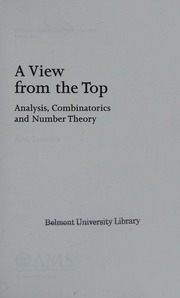
Internet Archive
xiii, 136 p. : 22 cm
graceful moon
coarse arrow
Best books on introduction to proofs and logic also something that is not too lo...
Liebecks “A concise introduction to pure mathematics” would be good, it’s short, enjoyable to read and gives you a taste of lots of different areas of maths but all just to serve improving your proof writing and problem solving
 misty geyser
Any nice books/papers that explain fractal geometry (especially with its applications in Biology)? Thanks.
timber holly
coarse arrow
Best books on introduction to proofs and logic also something that is not too lo...
I would say Jay cummings and How to Prove It: A Structured Approach by daniel J
Love how to prove it
 stray veldt
if you want something that is short, i have written a ~30 page introduction, that is pinned in #proofs-and-logic
timber holly
also yeah pins has amazing suggestions I own some of them
coarse arrow
Thanks for all the suggestions 🙂
gray gazelle
Can someone pls recommended me a good pre calculus book that I can buy?
 slender night
I’m looking for a book that can be used as a refresher of foundational rules/formulas/etc. I’m currently in cal 1 and find myself forgetting what should be simple algebra rules.
 hybrid torrent
slender night
I’m looking for a book that can be used as a refresher of foundational rules/for...
hybrid torrent
slender night
I’m looking for a book that can be used as a refresher of foundational rules/for...
i needed this and ended up getting a few schaums outlines and some older books on ebay. I like the content of the schaums but damn is the paper quality crappy. I would probably get some schaums outlines off ebay or half price books and throw them in the trash when you're done
slender night
hybrid torrent
i needed this and ended up getting a few schaums outlines and some older books o...
Thank you! My gf and I love half priced and I just grabbed 2 books for math the other day.
I am excited to be so into math and reading again
narrow relic
trim estuary
A bit out of the blue for a recommendation, but for anyone interested in develop...
Thanks!
 crimson ravine
what book would you guys reccomend for abstract algebra? im an undergrad and have very little experience with abstract algebra but am comfortable with abstraction, the axiomatic method, etc.
daring lake
crimson ravine
ive heard that it's a bit too tough and i did look at the pdf and didnt like what i saw in the first chapter
formal bronze
crimson ravine
ive heard that it's a bit too tough and i did look at the pdf and didnt like wha...
No, it isn't 'too tough'
It is an introductory text
crimson ravine
ok then im just dumb then
rare estuary
How is it compared to Artin?
hollow shore
gallian is a good gentle text for algebra
crimson ravine
rare estuary
How is it compared to Artin?
ive done the first chapter of artin fully and i seem to prefer it to dummit and foote
formal bronze
rare estuary
How is it compared to Artin?
I'd say Artin is more terse than Dummit and Foote. I found it a bit harder to learn from
hollow shore
no lmao
rare estuary
I was kinda leaning towards it because I wanted something with more LA
formal bronze
crimson ravine
ive done the first chapter of artin fully and i seem to prefer it to dummit and ...
If you're already studying from Artin then I don't think you need to switch books
crimson ravine
hollow shore
gallian is a good gentle text for algebra
yes unfortunately my library does not have gallian (it does, but someone has it on hold or something so i cant borrow it)
crimson ravine
formal bronze
If you're already studying from Artin then I don't think you need to switch book...
i see
so i continue with artin?
formal bronze
Yeah, no reason not to
hollow shore
there is always that library
daring lake
artin is good too
daring lake
i have read a good chunk of both d&f and artin, i like them
daring lake
finite gale
d&f is very wordy
true, also a huge problem set after like every 4 pages 
crimson ravine
finite gale
rotman is nice
oh ive never come across this surprisingly
ill check it out
crimson ravine
hollow shore
this video series follows artin
i suppose ill stick with artin and refer to that video series then
thanks
fierce hedge
hollow shore
https://youtube.com/playlist?list=PLelIK3uylPMGzHBuR3hLMHrYfMqWWsmx5&si=8lDR1YVm...
I have been following them and can vouch for the quality of the videos. By quality I mean quality of the contents cause video quality is garbage asf
hollow shore
I have a thing for old quality videos
 lilac yew
Hello world, can I have some recommendations on integrals calculus theory ?
sage python
Are you just saying theory to mean the subject? Or do you want to see stuff with proofs?
 copper axle
Hi! Can anyone recommend some learning resources that cover conic sections/hyperbolic functions in depth? Thx!
 dense copper
Hello everyone
I need to improve my non-rational maths like number theory, geometry blah blah blah... for advance. Some book recommendations?
Please reply
Pin me if you answer
 rain wren
 graceful moon
$$\pi$$
 hasty eagleBOT
Nope

 marsh pine
Math with irrational numbers
 velvet rose
Hi, I'm in my first year of linear algebra. I'm looking for a good book to study that is beginner friendly and that as answers for the exercises
remote sparrow
velvet rose
Hi, I'm in my first year of linear algebra. I'm looking for a good book to study...
velvet rose
thanks
hearty steppe
velvet rose
Hi, I'm in my first year of linear algebra. I'm looking for a good book to study...
Linear Algebra and it’s Applications by Lay is probably my favorite for the most part when it comes to most broken down linear algebra books
And you only need to go through barely half the book to get the gist of the generalities you need to understand for matrices and systems of equations
remote sparrow
I recently found this book on mathematical logic while browsing through my library; it seems pretty good.

Classical Mathematical Logic: The Semantic Foundations of Logic
orchid mortar
@remote sparrow IDK if I asked you before, but how do you organise your digital library?
remote sparrow
orchid mortar
<@254820329124265984> IDK if I asked you before, but how do you organise your di...
i don't. it's all in a single folder
for the majority of the books anyway
orchid mortar
so you grep or sed or ls + regex?
remote sparrow
some light novels i download from the internet come in folders already so i just leave them there
remote sparrow
orchid mortar
so you `grep` or `sed` or `ls + regex`?
what are those
orchid mortar
linux stuff
remote sparrow
i use windows
orchid mortar
same but 1 massive folder is not searchable tho
remote sparrow
idk windows search is a tad slow but i remember what i'm looking for
orchid mortar
This is my 'matrices' folder
The problem with subfolders is basically there's going to be topic-overlap and then trying to find a primary topic is not always easy or possible

I'm also worried about eventually having multiple copies of one book
remote sparrow
orchid mortar
I'm also worried about eventually having multiple copies of one book
i have never run into this problem
and i have several thousand ebooks
 several thousand
remote sparrow
several thousand
remote sparrow
yeah it's like 35.8 GB of files
orchid mortar
Looks like I'm far behind :P
I'm much more picky on fiction stuff/non-educational books tho
remote sparrow
orchid mortar
This is my 'matrices' folder <:KEK:586240877358350341>
The problem with subfolde...
btw garcia and horn have a recently released second edition. a pdf doesn't exist for it yet.

Using a modern matrix-based approach, this rigorous second course in linear algebra helps upper-level undergraduates in mathematics, data science, and the physical sciences transition from basic theory to advanced topics and applications. Its clarity of exposition together with many illustrations...
orchid mortar

dusk wind
remote sparrow
i use windows
This exchange is quality, it's fine though linux isn't used that much anyway
Only other way you could organize it is by being a keyword God or having some software that categorizes automatically for you somehow but that might be worse than the 1 folder solution. Name and year is enough in most cases
dire torrent
Are MirBooks legit? like are they actually giving e-versions of their books for free? is it their actual website?
magic moth
u mean mir editorial?
theres a editorial from the ancient USSR called MIR with really old books that u can find on ur own (and its pretty much the only way to get them)
 white pilot
I just found this textbooks website: https://math.libretexts.org/. You can view the contents as websites or download them as (beautifuly) formatted books.
trail hemlock
omy i loooove libretexts they have so much not just for math
quick question: are there any books for linear algebra, calc3+ that are similar to how the AOPS books teach u stuff. not really contest prep, just a very intuitive book. im a novice so mb if this question is dumb.
dusk wind
white pilot
I just found this textbooks website: https://math.libretexts.org/. You can view ...
This was posted a few posts up, but yeah the quality of the books are usually pretty good. Not a fan of their strange pdf backlink system, they take open books and point them back to their site
dusk wind
trail hemlock
quick question: are there any books for linear algebra, calc3+ that are similar ...
Try Jim Hefferon and mecmath.net/vectorcalculus
trail hemlock
ty 🙏
remote sparrow
dire torrent
Are MirBooks legit? like are they actually giving e-versions of their books for ...

?
are you talking about this website
you need to link the website
gray jungle
kreyzig book introductory functional analysis should cover normed spaces in a friendly way @lilac yew
and in terms of integration calculus just any calculus book , altho i have to say what a weird request you ask about a advanced topic like topology on normed spaces then integral calculus ? what gives
are you asking about integration in normed vector spaces?
aka vector integration
lilac yew
Yes
gray jungle
lilac yew
Yes
do you know measure theory?
lilac yew
gray jungle
do you know measure theory?
No
gray jungle
im asking because i want to know if you mean the calc 3 vector valued integration or the functional analysis vector valued integrals fron measure spaces to TVS
any calc 3 book should cover integration you need on R^n
beyond that its a bit messy
lilac yew
gray jungle
im asking because i want to know if you mean the calc 3 vector valued integratio...
Ok
lilac yew
magic moth
forget rudin
I don’t understand please
old elk
orchid mortar
This is my 'matrices' folder <:KEK:586240877358350341>
The problem with subfolde...
How can you send a screenshot?
manic cairn
What books on formal logic would be good for a layperson?
Where they would come out being able to prove trivial statements about first-order theories, knowing the difference between syntax and semantics, understanding goedel’s completeness theorem, etc.
hearty steppe
Can someone recommend a representation theory book that doesn’t get too weird or formal with exposition? Something with the flavor of Folland’s real analysis?
It’s like I went thru two books feeling kinda meh about the exposition.
I started going thru Tapp’s matrix groups for undergraduates and the first chapter was a great review of linear algebra concepts but my ass is getting handed to me in the second chapter
remote sparrow
manic cairn
What books on formal logic would be good for a layperson?
a person interested in this material is not likely to be a layperson, if this layperson is, broadly defined, someone who has little to no experience with proof-based mathematics
dire torrent
remote sparrow
you need to link the website
yes and thanks.
manic cairn
remote sparrow
a person interested in this material is not likely to be a layperson, if this la...
interested while reading or interested to start reading
narrow relic
manic cairn
interested while reading or interested to start reading
You might check out Chapters 1-5 of this: http://logic.stanford.edu/intrologic/public/chapters.php
narrow relic
manic cairn
interested while reading or interested to start reading
That book is for a course described as "Appropriate for secondary school students, college undergraduates, and graduate students"
dim sierra
gray jungle
any calc 3 book should cover integration you need on R^n
Ok that’s not true, Stewart doesn’t for example
And that’s one of the most popular ones
 mighty anchor
any engineerring math book recs?
vital bane
mighty anchor
any engineerring math book recs?
sky
mighty anchor
vital bane
sky
Ye
mighty anchor
Hmmm
mighty anchor
I’ll check that
narrow relic
small cobalt
Sutherland, it's decent but not inspiring lol
I just checked this book out today and it looks great. I'm actually probably going to switch to it from Carothers
small cobalt
narrow relic
I just checked this book out today and it looks great. I'm actually probably goi...
Content is good and well treated but the exposition is dry
fierce hedge
small cobalt
Content is good and well treated but the exposition is dry
How dry are we talking about, Rudin dry or Lang dry
small cobalt
Closer to rudin than lang
gray gazelle
gray gazelle
y'all heard of Neural Networks From Scratch?
I saw the video series is also quite helpful! :0
 lean nebula
@stuck zephyr
help
i cant message there anymore
what did i do
how do i stop studying role
,iamnot studying
stuck zephyr
do ,iamnot studying
hasty eagleBOT
Removed the studying! role from you.
lean nebula
too easy
stuck zephyr
ye
gray gazelle
gray gazelle
I saw the video series is also quite helpful! :0
I loved it
gray gazelle
gray gazelle
I loved it
Such a shame the video series was discontinued, though, since it's so well done...
hearty steppe
I don’t mean to be annoying about asking for recs as I can understand other people are getting helped but… when anyone gets around to it… I need recs for these
gray gazelle
gray gazelle
Such a shame the video series was discontinued, though, since it's so well done....
yup but I decided to follow its trail
u knw like went hunting for research papers
and tried to understand them
but exams came so not been able to continue that passion of mine
gray gazelle
gray gazelle
but exams came so not been able to continue that passion of mine
Ahh, that's unfortunate. Hm...
gray gazelle
gray gazelle
Ahh, that's unfortunate. Hm...
man It's my finals tomo
first math paper
day after math is done
by nov 7th all my finals are over so I can resume that
🤓
gray gazelle
gray gazelle
by nov 7th all my finals are over so I can resume that
Ooh, I could recommend some articles I found very helpful on deep learning, for when so!
remote sparrow
manic cairn
interested while reading or interested to start reading

A Study Guide A re-titled, expanded version of the old Teach Yourself Logic study guide. This is a book length guide to the main topics and some suitable texts either for teaching yourself logic by individual self-study, or to supplement a university course. You only need to read just the first half-dozen pages to see … The Study Guide and Book ...

Classical Mathematical Logic: The Semantic Foundations of Logic
gray gazelle
gray gazelle
Ooh, I could recommend some articles I found very helpful on deep learning, for ...
yes pls
gray gazelle
remote sparrow
https://www.logicmatters.net/tyl/
good book?
remote sparrow
it's not a link to a book
gray gazelle
gray gazelle
yes pls
This isn't really an article, but the series from which this lecture was from was up there with the most helpful resources I've come across:
https://www.youtube.com/watch?v=dB-u77Y5a6A
There's also this that I found to be nifty:
https://ai.plainenglish.io/calculus-for-backpropagation-doesnt-have-to-be-scary-16595d76e744
hearty steppe
Maybe I need to spend more time in algebra land… could explain my difficulty with representation theory/spectral theory
I admit I guess I became overconfident going mostly the dynamical systems route and a bit of analysis but did not really take a step back to finish working through some linear algebra and algebra focused books I felt overconfident about
 ionic portal
is basic algebra by knapp good
gray gazelle
does anyone have recommendations for a problem book in abstract algebra?
preferably graduate level
sturdy shore
seems like the latest edition of LADR is finally here, available here online
https://linear.axler.net/
the new section 9 looks good
 remote sparrow
gray gazelle
preferably graduate level
remote sparrow
gray gazelle
preferably graduate level
dummit and foote has a lot of problems in it

/sci/ Wiki
Math at its core is about establishing truths separate from sensual qualities, seeking patterns based upon these truths, systematically removing contradictions/inconsistencies from the patterns...
also check here
also feel free to google qualifying/comprehensive exams in algebra at various graduate institutions
sage python
Okay Axler has gotten rid of one half of the brainworms
The other half is characteristic polynomials
remote sparrow
sage python
The other half is characteristic polynomials

so is ladr just the best book on linear algebra now? i mean, its price is definitely better than friedberg.
sturdy shore
I don't think Dami's criticism about char polys on LADR was about him not talking about it, because they were obviously in the prev edition also
sturdy shore
Both the third and fourth edition initially define the char poly for complex vector spaces in the same way
sage python
Yeah
 sage python
I guess the question becomes, does he attempt to do it in the real case by reducing to the complex case?
sturdy shore
to be clear I don't think there is anything wrong with this definition, but the third edition did some dumb shit to define it in the real case
sage python
Because that's the probably the most moronic choice
sturdy shore
I think this edition waits until the determinant to define it for real vector spaces
finite gale
why does header look like it was pulled out of google translate
 sage python
Okay wait maybe this book is now largely fixed
I wouldn't quite call it the best because it focuses on R and C, and I do think the best book would talk about general fields and give CS applications to stuff over finite fields
Also I do think the characteristic polynomial being product of (t-lambda_i)^{dim generalized eigenspace of lambda_i} conceptually should be a theorem rather than a definition
But this is no longer egregious
 gentle arrow
did axler add a cat with a revision
gentle arrow
WAIT MOON DIED?
gentle arrow
