#book-recommendations
1 messages · Page 35 of 1
 tender river
 gray jungle
exactly , which is why we are saying people should avoid using it
 tulip hearth
Ok bro. I'll keep that in mind, 'is there any I should use'?
gray jungle

tender river
also toma, if just some random person wrote the book then i don't know if it is going to be easy to find its pdf
 tawny copper
ah wait, im beign autistic
tulip hearth
I lost interest to study looking at it price...
I mean... What do u think I wanna buy the book for? I could have just bought vid games if I had that kind of money.
 urban pecan
What the textbooks used for this playlist
https://www.youtube.com/playlist?list=PL4C9296DF81B9EF13
" any book have exercises and practice what I learned "
for more info about my request and what I'm looking for
#1120239861924892763 message
tulip hearth
tulip hearth
Ok bro. I'll keep that in mind, 'is there any I should use'?
I totally didn't use it. That's why I couldn't find it.
Can u guys recommend any books that has short tips and tricks mentioned in it to solve questions faster?
Similar to some mentioning "heavy side coverup method" with integration by parts topic.
or maybe a bunch of books that would contain short tricks from different chapters—
 lime sapphire
tulip hearth
I *totally didn't* use it. That's why I couldn't find it.
lime sapphire
tulip hearth
I *totally didn't* use it. That's why I couldn't find it.
and make sure not to use anna’s archive either
tulip hearth
I'll keep that in mind.
 flat jackal
Is there any books of laplace transforms
I’ve looked through a few complex analysis books and it’s not listed as a topic
Or any good resources for learning it? Because I’m only using madasmaths rn but I need more questions
 orchid mortar
tulip hearth
Ok bro. I'll keep that in mind, 'is there any I should use'?
orchid mortar
tulip hearth
Ok bro. I'll keep that in mind, 'is there any I should use'?
You can always freely use the PDFs of the authors who publicly publish it. For example, a lot of the ML publishers.
tulip hearth
orchid mortar
You can always freely use the PDFs of the authors who publicly publish it. For e...
But pple who include easier and faster methods are rare ._.
orchid mortar
It's better if you ask for a specific subject
tulip hearth
orchid mortar
It's better if you ask for a specific subject
hmm there any book on short tricks for indefinite/definite integration?
tawny copper
tulip hearth
_hmm_ there any book on short tricks for indefinite/definite integration?
Im also interested in that actually. But the best is to try to solve the integrals on your own first, that's how you learn. Of course, you wont be able to solve all, so then you look up some solution and learn a new "trick".
but I cannot give you recommendations. I also need to work on integration. But maybe you can look up Michael Penn's channel? He has many vids on cool integrals
tulip hearth
I'll try that thank you.
 sudden kindle
Can someone recomend a resource that has a SIMPLE and INTUITIVE proof of the UNIFORMIZATION THEOREM
 wispy bison
lime sapphire
and make sure not to use anna’s archive either
wispy bison
lime sapphire
and make sure not to use anna’s archive either
Never heard of it before, now I know where it is so I can avoid it
 mossy comet
In university, I studied probability and statistics, but I found myself relying heavily on memorization rather than truly understanding the concepts. Now, as my interest lies in the field of AI, I'm seeking a comprehensive probability book that provides clear explanations to enhance my understanding. Also thank you for the suggestion!
alright tyy
tender river
i think megumi was trolling with that answer
lime sapphire
mossy comet
just searched it up and its an actual book
its a book with quite a prerequisite
 quartz verge
tulip hearth
I lost interest to study looking at it price...
I mean... What do u think I wan...
quartz verge
tulip hearth
I lost interest to study looking at it price...
I mean... What do u think I wan...
SAME!
except id buy both
good math books appeal to me sexually
cant live without them
 ocean mulch
mossy comet
alright tyy
ocean mulch
mossy comet
alright tyy
Lol, I told you I didn't know how accessible it was
No but srsly, it's not a book for UG. You should look for something else
 storm sage
Hi I was offered principle of mathematics by bertrand russell (not by himself sadly) and wondered whether it is worth reading and if the book is beneficial to the modern mathematician
storm sage
I don’t like anime sorry
quartz verge
theres nothing to be sorry
 gray gazelle
that's injustice why denounce people like that ?
 fast gull
do people exist that read textbooks in entirety/front to back?
 lime vessel
Depends on textbook
 sudden granite
should i read the idiot by dostoevsky first or anna karenina
 burnt geyser
@sudden granite the idiot
gray gazelle
sudden granite
should i read the idiot by dostoevsky first or anna karenina
The Idiot
 scarlet steeple
tulip hearth
Ok bro. I'll keep that in mind, 'is there any I should use'?
scarlet steeple
tulip hearth
Ok bro. I'll keep that in mind, 'is there any I should use'?
use archive.org
tulip hearth
Anyone knows somewhere I can find VKR sir's maths books for free?
 unreal token
would you guys say that stewarts is the best book for someone self-studying engineering math
thats what my courses recommends but i thought maybe theres better ones out there
 thorn cloak
i dont envision you need very rigorous books for engineering so stewarts should be solid. Its a good/standard book in general for calculus
 novel sluice
tulip hearth
Anyone knows somewhere I can find VKR sir's maths books for free?
novel sluice
tulip hearth
Anyone knows somewhere I can find VKR sir's maths books for free?
Wait, who's that
 pseudo oyster
Any reccomendations for a precalculus book to selfstudy or an online course?
 coral prawn
pseudo oyster
Any reccomendations for a precalculus book to selfstudy or an online course?
coral prawn
pseudo oyster
Any reccomendations for a precalculus book to selfstudy or an online course?
Khan academy. Or do you prefer books?
pseudo oyster
coral prawn
Khan academy. Or do you prefer books?
probably want both im asking for a friend
pseudo oyster
coral prawn
for books there's stewart's Precalculus
can you give an amazon link or something of the sort?
coral prawn

Precalculus: Mathematics for Calculus (Standalone Book)
pseudo oyster
thanks
 pure solstice
Has this ever even happened?
gray gazelle
does anyone knows a good book on linear applications with proof for theorems and propositions
thorn cloak
gray gazelle
does anyone knows a good book on linear applications with proof for theorems and...
like linear algebra?
 prisma cliff
more like linear alGAYbra
thorn cloak
...
anyways Lin alg done right by axler i heard recommended a lot to the "advanced" student. linear algebra by strang is prob better for a first introduction
quartz verge
Axler is good as a first introduction too
prisma cliff
why are u doing lin manuel miranda algebra
 lofty agate
Idk I read soviet books which are very interesting to read, I don't think there's an english translation tho
gray gazelle
yea
thorn cloak
quartz verge
Axler is good as a first introduction too
i believe it. I personally havent used it so idk, though i wish my class did
 subtle mango
please please please do not use LADR for a first course
he saves determinants for the end and imo it does more harm than good
theres a good list of lin alg textbooks in #books-old
also see here
quartz verge
i like it from that perspective but yeah thats a good heads up
prisma cliff
Personally this is my favourite piece of literature. I found it to be very informative - would highly recommend! https://www.wattpad.com/story/230339182-baby-daddy-bakugo-x-reader
quartz verge
sus
tender river
@prisma cliff last warning, there's better servers to troll in
quartz verge
its the same thing
thorn cloak
subtle mango
he saves determinants for the end and imo it does more harm than good
really? that is quite interesting to say the least
quartz verge
yeah he mentions why he went down that route and its very interesting
thorn cloak
im not a very advanced algebra student but like i found determinants to be pretty intutive. I dont really get why people dislike it so much
thorn cloak
quartz verge
yeah he mentions why he went down that route and its very interesting
oh, i guess its worth reading why then
quartz verge
absolutely
subtle mango
iirc his whole claim is “determinants are geometrically unintuitive” or something like that
quartz verge
yeah the gist of it is that
subtle mango
quartz verge
yep
subtle mango
heres his little paper
quartz verge
thanks was about to share that
subtle mango
imo determinants arent geometrically unintuitive — see 3B1B’s “Essence of Linear Algebra” series on youtube for visualization
thorn cloak
really? i feel like they are like one of the most intuitive things. aka the scale factor of area/volume of the paralepidid caused by a linear map
quartz verge
well it wasnt as intuitive for me when i started
thorn cloak
i suppose thats fair. i remember my prof just assigned that section to be read instead of motivating it in class
subtle mango
theyre not immediately intuitive based on definition alone
quartz verge
well i self studied most of it and found kinda weird to digest
subtle mango
but to neglect it to the end is quite odd
thorn cloak
subtle mango
theyre not immediately intuitive based on definition alone
hmm thats true. I could not tell you why that definition represents what it does
subtle mango
if you visualize a grid, the determinant of the matrix represents the area of the parallelogram created by the linear transformation
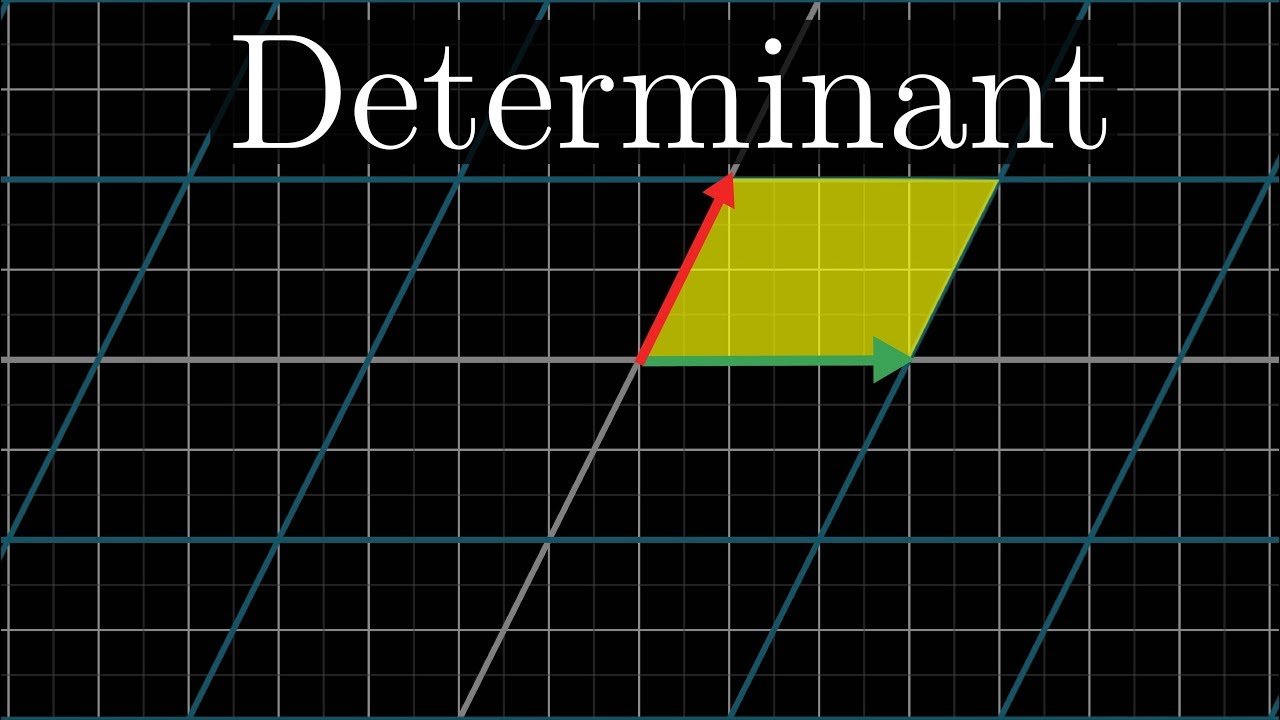
The determinant measures how much volumes change during a transformation.
Help fund future projects: https://www.patreon.com/3blue1brown
An equally valuable form of support is to simply share some of the videos.
Home page: https://www.3blue1brown.com/
Full series: http://3b1b.co/eola
Future series like this are funded by the community, throug...
thorn cloak
yeah that video is amazing. Guess now would be a good time to re watch it 
quartz verge
will need a series on probability soon, been a while since he dropped something of bigger magnitudrle
magnitude
thorn cloak
if i were to do a little self-study for a second course on lin alg is there a certain book you would recommend instead of LADR?
thorn cloak
quartz verge
will need a series on probability soon, been a while since he dropped something ...
i hope soon. Taking prob next sem and really need him to save me again lmao
subtle mango
see the messages i linked above
subtle mango
subtle mango
https://discord.com/channels/268882317391429632/716264872018706443/9593705229389...
^
thorn cloak
hmm i see. is roman's book immediately accessible? as im def not ready for a grad text
thorn cloak
i took a class using lay and lay. we went up to eigenstuff
not very proof based but also not ignored
tender river
was your first course strang level linalg or axler type proof based linalg, if it is the latter then roman is a good reference for quickly reviewing things i think
thorn cloak
yeah def more strang level
quartz verge
thorn cloak
if i were to do a little self-study for a second course on lin alg is there a ce...
friedberg's linear algebra
subtle mango
im biased to hoffman kunze bc that’s what i used
tender river
you can still use roman to surplus the material from a more approachable textbook like hoffman-kunze, axler, ladw, etc nice to get a more advanced perspective on things
subtle mango
its tough but fun, tho i agree w dami wrt the multilinear algebra stuff
thorn cloak
i see. thanks everyone
ocean mulch
thorn cloak
really? i feel like they are like one of the most intuitive things. aka the scal...
It is intuitive until you see various equivalent definitions of it, then it becomes less and less intuitive
Like, the classic "the only multilinear form such that bla bla" or the summation over all permutations of elements in canonical basis are in no way intuitive to me
I have never managed to work with any of these definitions of det, only the derived properties
subtle mango
yeah same tbh
cant remember last time i explicitly used laplace expansion or whatnot
 foggy relic
Does anyone have a pdf of this paper https://www.semanticscholar.org/paper/L'anneau-spectral-et-l'anneau-filtré-d'homologie-et-Leray/64010462b6dd6054d498fe770e9c13a6d88046ff
 lavish pier
if its this then yeah
The spectral ring and the homology filtered ring of a locally compact space and a continuous map
i gotta find it tho
idk if its exactly what you asked
but
foggy relic
no the authors r different
lavish pier
yeah no i cant find the one written my J. Leray
 flint forge
losing my mind at the fact that no native macOS app can open a djvu
 acoustic turret
I am starting functions and vectors next year and want to get a head start in the summer. what books would be good for this? it is grade 11 mathematics
flint forge
khan academy is the standard recommendation for anything before calculus
coral prawn
So I've been looking for an intro to DEs book.
At first I started out with "Elementary DEs with Boundary Value Problems" by William F. Trench, but I had some issues with the "theorems" in the book- they weren't quite well phrased to me.
I looked a bit further and heard of Boyce's (which shares the same name  ). It seems pretty common, so I was thinking of it.
Then I also heard of this ODE book by Marris and Pollard published by Dover, which at first sounded nice due to the some of the additional contents it covered, but unlike the other 2 it didn't have BVP nor PDEs. Furthermore the first few pages threw me off the moment I saw them treating dy-s and dx-es as fractions. "We multiply both sides of the equation by dt/x and integrate...." 💀
- Is it an issue if the book doesn't cover BVP nor PDEs? I've been told that it's fine since they'll be covered in a PDE book like Taylor (...I think?)
- I've always liked rigour, proofs and theorems, but after hearing and looking through a bunch of proofs for uniqueness/existence of solutions and... Boy, they are wild. I'm hoping that there's a book which approaches it from a "pure math" perspective- perhaps not as rigorous as the theorems, but doesn't neglect it either.... around those lines.
- I'm quite against the use of the treatment of the differential forms as fractions and whatnots, so unless the book clarifies what the notation means.... I don't think the book would quite suite me.
Any reccs based on these? Perhaps I should just stick to Boyce?
 remote sparrow
subtle mango
he saves determinants for the end and imo it does more harm than good
remote sparrow
subtle mango
he saves determinants for the end and imo it does more harm than good
i don't think saving the determinant for the end is necessarily a bad idea. however, i can understand if you have a problem with how axler defines them.
like you can show the geometric interpretation of determinants for R^2 and R^3, but it's still not immediately clear how this connects to the determinant's property as an invertibility test
and it can't be much worse than defining the determinant by the permutation formula
 finite gale
remote sparrow
and it can't be much worse than defining the determinant by the permutation form...
finite gale
remote sparrow
and it can't be much worse than defining the determinant by the permutation form...
This is still useful sometimes though
But I guess it's a little unwieldy to prove stuff with that definition
At least you can do computations with it though
remote sparrow
as far as computations go, row reduction is more efficient for applications than determinants. most students taking linear algebra are probably going into some applied field. determinants are still important theoretically, but i'm not sure if it's really worth putting a lot of emphasis on computing numerical values of determinants.
flint forge
as far as computatins go you probably don't really need to compute any determinants at all by hand
maybe one or two to get the feel
remote sparrow
remote sparrow
i don't think saving the determinant for the end is necessarily a bad idea. howe...
meckes is a first course in linear algebra that defers determinants towards the end and defines the determinant as an alternating multilinear function mapping the identity matrix to 1
finite gale
flint forge
as far as computatins go you probably don't really need to compute any determina...
True, I don't think I actually had to compute any determinants in undergrad, or I just forgot, just like everything else I did in my first two years of undergrad 
flint forge
i mean its easy to pick the algo back up
ocean mulch
finite gale
True, I don't think I actually had to compute any determinants in undergrad, or ...
Tf? How come that you didn't have to compute any det?
flint forge
but i can only do the 2x2 case without googling
I don't think I computed any determinants in undergrad
certainly none by hand bigger than 2x2
ocean mulch
Didn't yall have quadratic forms? Or diff geo?
flint forge
no
ocean mulch
Whaaaa 😄
finite gale
Oh wait I might have had to do some in ode class but I'm pretty sure I just chucked everything into wolfram alpha lol
flint forge
I think rep theory was the only place I could imagine I actually took a determinant
and even then I probably put it into wolfram
ocean mulch
Yeah, det in 2D dynamical systems is classic
flint forge
not a diff geo kinda guy
ocean mulch
I wonder what you did, cus you know insanely lot
finite gale
I don't recall taking a determinant in rep theory but I do remember using them
orchid mortar
coral prawn
So I've been looking for an intro to DEs book.
At first I started out with "Elem...
Intro DE books more about solving them than proving things.
ocean mulch
flint forge
too coordinatey for me
Just a bunch of functions, can't be that bad
remote sparrow
coral prawn
So I've been looking for an intro to DEs book.
At first I started out with "Elem...
the dy's and dx's are given a proper definition, not merely treated as fractions
flint forge
its not aesthetically pleasing
remote sparrow
the definition is unwieldy though
and i don't think you should really get too hung up on them
ocean mulch
flint forge
its not aesthetically pleasing
at least it has some aesthetics, lol, unlike algebra
remote sparrow
Taylor's PDE book is a graduate text
and undergrad PDE books like Strauss are still mainly concerned with closed-form solution of PDEs
graduate PDE books have a completely different focus
they're thinking about existence, uniqueness, smoothness, etc. of solutions
there are also graduate texts for numerical solution of PDEs
finite gale
I'm also fairly sure pdes requires quite a bit more analysis background than ODEs
But I'm not sure how much since I never actually took a pdes class
remote sparrow
my undergrad pde class only requires some ODE background
finite gale
Oh
coral prawn
remote sparrow
the dy's and dx's are given a proper definition, not merely treated as fractions
Well they are but its not like I'm anywhere near understanding what a "differential form" is 

coral prawn
orchid mortar
Intro DE books more about solving them than proving things.
Yeah that's what pisses me off but w e l p they're needed before you can go on to proving existence/uniqueness etc....

coral prawn
remote sparrow
graduate PDE books have a completely different focus
Ic... welp long way to go ig
remote sparrow
coral prawn
Well they are but its not like I'm anywhere near understanding what a "different...
no, tenenbaum and pollard actually defines dy's and dx's in an elementary fashion
just a definition you'll likely never see again
 twilit oak
I'm looking for a book ideally avaible in free pdf which covers logic and basic logic proofs. I want it to be as most rigorous as possible (ideally without truth tables) so it should use just rules of inference and maybe some "axioms".
subtle mango
twilit oak
I'm looking for a book ideally avaible in free pdf which covers logic and basic ...
twilit oak
subtle mango
https://discord.com/channels/268882317391429632/716264872018706443/8953217849230...
thx
coral prawn
Still though how'd you go through 2 textbooks covering the same material (one as reference/additional material) at once? Like, how are you juggle between the two and be sure that you aren't missing out on any content? It doesn't seem practical to attempt all the exercises in both books  do you just judge by content page/if you feel that this concept hasn't rlly been explained well enough for you you look it up on the 2nd book?
flint forge
coral prawn
Still though how'd you go through 2 textbooks covering the same material (one as...
normally I would pick one book to be my primary source and go look at other books if i don't like a particular section. you can also cross reference tables of content to see whether or not theres an obvious omission in one of the books
acoustic turret
flint forge
khan academy is the standard recommendation for anything before calculus
is there nothiing written? I was looking for something I would be able to read as opposed to a video
flint forge
khan academy has written versions of the notes, but tbh no one can really recommend a great textbook since the textbook industry for pre-calculus subjects is super cursed
you can probably just use any textbook
coral prawn
acoustic turret
is there nothiing written? I was looking for something I would be able to read a...
If you rlly want book then stewart's precalc would do.
coral prawn
flint forge
normally I would pick one book to be my primary source and go look at other book...
Hm... what abt the exercises? How do you manage/select which ones to do?
flint forge
randomly
remote sparrow
coral prawn
Hm... what abt the exercises? How do you manage/select which ones to do?
just do what looks interesting
also don't worry if you can't solve everything
you don't need to be able to do every exercise to move on
sometimes certain exercises from a prior section are not really necessary to understand later material
coral prawn
remote sparrow
just do what looks interesting
Ig it's like after doing 1-2 of the same qns and you feel like "ok the rest is just the same computation" then just skip ahead 
 mossy flume
coral prawn
Still though how'd you go through 2 textbooks covering the same material (one as...
mossy flume
coral prawn
Still though how'd you go through 2 textbooks covering the same material (one as...
I pick one as my favorite (and that's where I'll do exercises) and only look at the other if I hate a proof in the favorite
gray gazelle
Advanced Engineering Mathematics, 10e by Erwin Kreyszig (2018, Wiley)
coral prawn
mossy flume
I pick one as my favorite (and that's where I'll do exercises) and only look at ...
Right, right (or if content is missing from the favourite ig?)
orchid mortar
gray gazelle
Advanced Engineering Mathematics, 10e by Erwin Kreyszig (2018, Wiley)
What's this about?
mossy flume
coral prawn
Right, right (or if content is missing from the favourite ig?) <:KEK:58624087735...
yea that too
vacuous hatred of a proof for when a proof doesn't exist

coral prawn
gray gazelle
orchid mortar
What's this about?
about advanced math that you will use more often in a day as an engineer or searcher
gray gazelle
orchid mortar
sounds like a block to me
lol you are free to do what you want ^^
tender river
tulip hearth
novel sluice
Wait, who's that
An author, Vinay Kumar sir.
My coching teacher recommend everyone that book cause the author is my teachers teacher, and my teacher knows a lot of short tricks which he said his teacher taught him. So I thought maybe I should try the book. But it's too expensive of a book 💀
 hasty turret
So you won't be finding Indian coaching books on most websites
Because no one cares enough to pirate them
 fervent nova
Can anyone recommend me some book on self learning differential equations and summation?
our school didnt teach them
coral prawn
fervent nova
Can anyone recommend me some book on self learning differential equations and su...
You're talking abt 2 rather different things- one is about summation and the other is about DEs-
For summation, what are you referring to? Geometric, arithmetic etc? Or calculus-type infinite sums, convergence, divergence?
As for DEs-  I asked the same question a few hours back, and decided to stick with Marris and Pollard's ODE book, and use Boyce's elementary DE book to complement stuff which it misses out, such as PDEs, boundary value problems.
fervent nova
i would like to learn those should be taught in high school
there are some ways to solve calculus questions by summation and i would like to know it
thx for your advices!
coral prawn
fervent nova
there are some ways to solve calculus questions by summation and i would like to...
U could check out Paul's online notes for that part
fervent nova
oh thx you very much!
remote sparrow
coral prawn
You're talking abt 2 rather different things- one is about summation and the oth...
it's morris btw
 late plinth
anyone got any recs for more advanced numerical optimization books, i already read Numerical Optimization by Jorge Nocedal Stephen J. Wright and i would like something a bit more advanced
 wraith nova
What book for self study calculus im high school
coral prawn
wraith nova
What book for self study calculus im high school
Stewart if this is your first encounter with calc
 white summit
Any book recomendation for Set Theory , Group Theory
sudden granite
wraith nova
What book for self study calculus im high school
spivak
coral prawn
sudden granite
spivak
personally I'm a fan of it but I feel that it's not a great recommendation for those who are first begin with calc. It's honestly too advanced for the beginner
sudden granite
i shouldnt be trolling in book recs
mb
but yeah i read like the delta epsilon definition for limits in spivak and then checked out
problem sets in like stewarts or whatever is better
coral prawn
you were trolling? I was thinking it was a good recc... But I realised that I didn't consider that others may not have a first hand encounter with calc already so I default to recommending others stewart if it's a first time encounter and spivak if they want a challenge + have some experience already
sudden granite
spivak is just a meme at this point
but yeah the book is good just takes a lot of time to understand if you go line by line trying to self study
each line is super valuable though
coral prawn
imo tho
what's more valuable of spivak
is the exercises
those are the really tough stuff
like he gets you to prove theorems and all
not just blind computation unlike most calc books
 bright stirrup
Looking for a good book on measure theory 
tender river
 shut flame
Can anyone suggest some good calculus practice books to begin with
coral prawn
shut flame
Can anyone suggest some good calculus practice books to begin with
do u have familiarity with calc?
shut flame
coral prawn
do u have familiarity with calc?
high school level
coral prawn
so I'm assuming basic derivative rules all covered? What abt integration? IBP? U sub also covered?
shut flame
coral prawn
<:hmmCat:831508801646755850> so I'm assuming basic derivative rules all covered?...
Yup all basic stuff done for derivatives and integrals and also differential equations
coral prawn
shut flame
Yup all basic stuff done for derivatives and integrals and also differential equ...
damn noice
In that case spivak calc would do just right  it covers a bit of introductory analysis too
shut flame
coral prawn
damn noice
In that case spivak calc would do just right <:realshit:5860787830025...
Okay
wraith nova
Omg stewart book is just so good
wraith nova
Purcell or stewart? there is translated purcell for my native language but not for stewart
 rancid hollow
always thought Purcell was just an E&M book 
honestly I have no opinion since I learned Calc in classes and only ever had to open the textbook to read the homework exercises 
wraith nova
Wow my teacher only attend the class once a month he just give homework
orchid mortar
late plinth
anyone got any recs for more advanced numerical optimization books, i already re...
I never read this myself, but this is the other book I know on Numerical Optimization.
 orchid mortar
late plinth
anyone got any recs for more advanced numerical optimization books, i already re...
orchid mortar
late plinth
anyone got any recs for more advanced numerical optimization books, i already re...
I think you'll easily find advanced math books if you are looking for numerical analysis instead though
novel sluice
hasty turret
Because no one cares enough to pirate them
agreed
thorn cloak
has anyone used Stochastic Processes by ross? it claims to be non-measure theoretic and was wondering if its worth reading before trying stochastic calculus down the line
 chrome yacht
 hot flame
for a 14 year old
hot flame
for a 14 year old
Naomi Klein: The Shock Doctrine 😁
mossy flume
hot flame
for a 14 year old
What sort of math have you done or seen
And what sort of math have you liked / disliked so far
fast gull
hot flame
for a 14 year old
captain underpants
you are too young to read textbooks its probably better if you go through workbooks/khan academy or reading blogs.
textbooks are meant for focused interests so no reason to have one when you are this young and havent had too much math exposure
tender river
hot flame
for a 14 year old
for maths? idk just start off with like one of those discrete math thingys, rosen or scheinermann should be simple enough for 14 year olds, sets you up nicely with a good intro to proofs ig
 minor knot
hot flame
for a 14 year old
minor knot
hot flame
for a 14 year old
Calculus for infants
 idle cairn
tender river
for maths? idk just start off with like one of those discrete math thingys, rose...
idle cairn
tender river
for maths? idk just start off with like one of those discrete math thingys, rose...
i needed this
 ornate haven
Why is Precalc by Stewart so overwhelming? There are too many questions and it makes me dread the act of problem solving itself sometimes. Simply coz I know this book will never get over 😦
mossy flume
ok a couple things
1: Precalc is a bunch of different topics and seems to jump around the place. It's just like an odds-and-ends thing which makes it feel more overwhelming unlike calculus which builds on itself in a semi-linear progression
so if you're overwhelmed it's fine, it happens, that's just how learning is
2: don't do every question. Not every question is worth doing
You're probably noticing alot of questions are similar, just different numbers essentially
so why repeat them over and over again.
the goal is to learn techniques and ideas, not number crunch
3: Why do you feel you dead solving problems?
quartz verge
coral prawn
personally I'm a fan of it but I feel that it's not a great recommendation for t...
why do you think that?
My first course on Calc was done through Spivak
Enjoyed every bit of it
Yes it was a struggle but i dont think theres any better feeling than to complete Spivak as a first encounter to Calculus
Its super intuitive
It wouldnt pack the same punch if you do it as a second course
 mystic blaze
hot flame
for a 14 year old
mystic blaze
hot flame
for a 14 year old
You might be able to read Proofs: A Long-Form Mathematics Textbook, check it out and see if it's any good for you
quartz verge
Itll be similar to like listening to an album that makes you feel like "only if every single listen to it could be my first"
quartz verge
mossy flume
the goal is to learn techniques and ideas, not number crunch
uhh man this brought back some bad memories for me
I had a chapter named Formulae in middle school where they just shoved every types of polynomials you learn i school in exercises with instructions that said "solve for x" and i kept wondering almost my entire life the purpose of having such a useless chapter amongst all other things in that book until recently where i discovered they were meant to provoke a thought process that should somehow lead to make you think of the bifurcation of transcendental and algebraic numbers
and from that very moment, im unsure if anything is even useless anymore
 maiden halo
quartz verge
Enjoyed every bit of it
maiden halo
quartz verge
Enjoyed every bit of it
everyone is different, that's why. not everyone will enjoy it as a first look at calculus
quartz verge
possibly
ornate haven
mossy flume
2: don't do every question. Not every question is worth doing
The way the book's organized is that every chapter has like 5 questions of each topic covered before the exercise. So it's kinda hard to figure out which questions to not solve. Like what if a question actually reaches me something new?
ornate haven
mossy flume
1: Precalc is a bunch of different topics and seems to jump around the place. It...
I wanna reach calc FAST 😭
mossy flume
sure but if you reach it too fast by skipping essential material then you're just going to have a bad time learning calc
then again not all of precalc is essential
late plinth
orchid mortar
I think you'll easily find advanced math books if you are looking for numerical ...
Gotcha any recs?
 fallow cypress
chrome yacht
Naomi Klein: The Shock Doctrine 😁
fallow cypress
chrome yacht
Naomi Klein: The Shock Doctrine 😁
Oh I've heard of this, did you like it?
ornate haven
mossy flume
sure but if you reach it too fast by skipping essential material then you're jus...
Agreed
ornate haven
ornate haven
The way the book's organized is that every chapter has like 5 questions of each ...
Any tips for this? @mossy flume
quartz verge
ornate haven
I wanna reach calc FAST 😭
is this out of excitement or youre tryna speedrunning things?
speedrunning would make zero sense as thatd essentially mean you want to learn and dont want to learn at the same time
 devout shore
Oh this is interesting
I took calculus several years ago and I kinda wanna tackle precalc and trig and geometry etc before running into calc
I'll have to check out that textbook
 vagrant mason
For pre calc do you reccomend James Stewart or Sullivan ? Like which is better
devout shore
I was about to order a book by Simmons
vagrant mason
I can look into Simmons but most schools reccomend James Stewart
I like his book. But it’s always nice to see more options.
Currently looking at this book for basic geometry and it’s amazing when you get a brain fart and forget something. It’s easy to look back and the book can fit in a purse so you can have it anywhere
remote sparrow
axler has written textbooks for algebra, algebra and trig, and precalculus
vagrant mason
If I remember correctly, algebra and trig is relatively the same as pre calculus
remote sparrow
quartz verge
has anyone read Strang's Calculus?
remote sparrow
remote sparrow
https://stitz-zeager.com/
there's also this free precalc book
maiden halo
devout shore
I was about to order a book by Simmons
the "in a nutshell" book? it's pretty short but not bad
devout shore
maiden halo
the "in a nutshell" book? it's pretty short but not bad
Yes! That one
A lotta good resources around here. I really like this server
ornate haven
quartz verge
is this out of excitement or youre tryna speedrunning things?
Excitement. The thing is I've learnt some calc in high school and am heading to college this fall. Just that I wanted to make my fundamental in Precalc strong before going into (hopefully advanced) calc
 wanton spade
I want to get better at combinatorics and probability. Does anyone have a book for this?
Im also very bad at it so im looking at something beginner friendly
orchid mortar
late plinth
Gotcha any recs?
Nope, this is too far into math world for me
 thin hollow
game theory math books
 hallow oriole
thin hollow
game theory math books
hallow oriole
thin hollow
game theory math books
winning ways for your mathematical plays
coral prawn
quartz verge
My first course on Calc was done through Spivak
you were guided by a prof no?
it made things easier since you had a guide
but me and most people I've recommended stewart over spivak to so far are HS-ers who don't have such people to help irl 
- it really is challenging, if you've read it I think you can agree. And if it's your first time reading calc you may not even understand why tf are you doing a good chunk of the content- especially when this book has some intro anal mixed into it. Not everyone wants that
sadly.
 past blade
Does anyone have any good book/paper recoms for
- Fuzzy Logic
- Evolutionary Algorithms? (I already found a few books on EA, but not for Fuzzy Logic since there are more books of different qualities)
Any input is welcomed, and thank you!
 heady ember
coral prawn
+ it really is challenging, if you've read it I think you can agree. And if it's...
heady ember
coral prawn
+ it really is challenging, if you've read it I think you can agree. And if it's...
I think Spivak is doable with some persistence, and some level of challenge is certainly required in proof-based mathematics. At some point or another, one will most probably experience a challenge much greater in difficulty than they had previously
coral prawn
fair enough
quartz verge
coral prawn
you were guided by a prof no?
no
coral prawn
quartz verge
no
wait then how was it a "first course"?
quartz verge
yes
coral prawn
I thought you meant in uni
quartz verge
nope
im still in the process of understanding a decent chunk of after almost spending 3 years reading it
coral prawn
quartz verge
im still in the process of understanding a decent chunk of after almost spending...
exactly
not all students wanna go for the rigour sadly
so they may not find spivak to their liking
quartz verge
i mean theyll immediately get the gist of what theyre gonna be subscribing to after going through the first few pages of the book and i think its better to take a call after doing that instead of just ignoring it altogether
coral prawn
quartz verge
i mean theyll immediately get the gist of what theyre gonna be subscribing to af...
true LOL
in the preface I remember smth aroudn the lines of
in the 2nd edition "this should have been named intro anal but eh it's too late"
around those lines
quartz verge
i still have the preface saved somewhere
my favourite part of the preface to be precise
coral prawn
~~I have permastudying so I can't see it  ~~
~~
but yes
the preface got me hooked the moment I read it
based book
quartz verge
same
quartz verge
coral prawn
~~I have permastudying so I can't see it <:opencryfried:1115546874728939630> ~~
 quartz verge
so eloquently put
past blade
Does anyone have any good book/paper recoms for
- Fuzzy Logic
- Evolutionary Algorithms? (I already found a few books on EA, but not for Fuzzy Logic since there are more books of different qualities)
Any input is welcomed, and thank you!
chrome yacht
fallow cypress
Oh I've heard of this, did you like it?
Thought it was pretty good, yeah. It is as good a critique of neoliberalism as any. Klein's writing evokes genuine emotions and anger, it is a great way to get started with the literature. Definitely recommend, you'd rather read Klein critically than do any of the garbage that comes out of Friedman and his ilk uncritically.
 heavy pelican
I tried to read This Changes Everything and I got bored
It just seems like a ragetext which at this point changes nothing lol
chrome yacht
the shock doctrine does come off as a ragetext too, it's just that when i read it i didn't have as much knowledge regarding the history of the things mentioned in it, at the time it was a great read
heavy pelican
She writes well
I'd much rather read a comic book than the American left frothing at their mouth at how much the corporations need to be held accountable though
gray gazelle
Hello ppl
hasty turret
There's a canonical Christian discord?
Meet Martin Luther and Huldrych Zwingli. These two reformers shared much in common but their differences would lead to a legacy of Christian discord that continues into the present day
 uneven sundial
Does anyone have recommendations for graduate level ODE? I just finished analysis 1 and 2 (single and multivariable functions). The prof lists GTM 182 as a possible reference for the class, but I was wondering if there are other ones I could take a look at during the summer.
quartz verge
hasty turret
There's a canonical Christian discord?
```
Meet Martin Luther and Huldrych Zwing...
Amen
wanton spade
Need a combinatorics book. Any recommendations for a beginner?
 hollow shore
what's your background?
wanton spade
@hollow shore 2nd semester software developer
Ive gone through discrete math and I want more in that area
tender river
i have been following loehr bijective combinatorics and bona's intro to enumerative and analytic combinatorics (not the walk thru combinatorics book) lately and i like them
wanton spade
Is loehrs beginner friendly?
tender river
idk about that i don't consider myself a beginner and i only started with it recently, thought i did pretty well with it
bona i think is friendlier for beginners though
wanton spade
Ill check out bonas then. Ty!
hollow shore
I will second bona
hasty turret
wanton spade
<@930867494212763708> 2nd semester software developer
Like you are doing a degree called software engineering?
 alpine rover
best introductory books on functional analysis?
heavy pelican
Hall, “Quantum mechanics for mathematicians”
 sturdy shore
einsiedler ward functional analysis
 sage python
I'm more team the latter yea
Rudin functional, Einsiedler-Ward, Brezis for what it does
 gusty smelt
Pederson analysis now, you should listen to me as I work in a subfield of functional analysis
 crimson leaf
What are people's thoughts on Conway's book?
 prime pollen
crimson leaf
What are people's thoughts on Conway's book?
prime pollen
crimson leaf
What are people's thoughts on Conway's book?
which one?
 hearty steppe
Any good text recommendations on differential forms that provides a nice angle for dynamical systems, Fourier analysis, with a focused angle on translating physical models?
Rather than something too general and not very motivated in exposition outside pure mathematics
crimson leaf
prime pollen
which one?
functional analysis
hearty steppe
Hopefully there may be some information about langlands program in such a text as well
prime pollen
crimson leaf
functional analysis
oh sorry didnt realise it was related to above
hearty steppe
I have other interests too like exploring motivation of p-Adics to calculate measures in restricted spaces that translates well to physics
Maybe a nice general approach to differential forms that considers the depths of exploring many body interpolations/convolutions of manifolds in physical models is fine
I think I might juggle a couple books that may have some flavor of what I’m looking for that is very general in approach but a little heavy in terseness like Folland’s real analysis which I thought was a really nice general exposition approach to measure theory
Those last three chapters especially man, they are crazy abstract and trippy to think about
sage python
I don't think you understand what differential forms are about
Differential forms are just how you integrate on manifolds
So if you integrate the omega = (-ydx + xdy)/(x^2 + y^2) over a curve
That's a differential form
"General approach to differential forms that considers the depths of exploring many body interpolations/convolutions of manifolds in physics models" feels like you're just sticking words together that don't make sense
hearty steppe
Well so I am thinking in terms of how the manifold takes up and spreads over space
sage python
What does that sentence mean?
hearty steppe
So like thinking about how I have some object in some n-tuple mapping to space where we are working in R^n as well as C^n
sage python
Alright I think I'll just suggest a few books that you might find interesting
hearty steppe
Yea I may be asking for something a bit too rigid like you said
sage python
Not even too rigid I just don't think you have a clear idea lol
Like you're associating things that aren't associated
Anyway I'll give some general pointers
Because you mention physics and dynamics a bunch
Try "Mathematical Methods of Classical Mechanics" by Arnold
hearty steppe
When I say manifold I’m being very general about how I have a collection of points that take up the space with some fundamental topology but then that could mean something else like I get some pattern or some shape where I have a volume that takes up the spaces or spreads over it over time
sage python
Yeah don't do that lol
Manifold is a technical term with a technical definition
To learn about them, try Tu Introduction to Manifolds
It includes differential forms
hearty steppe
Yea it seems like I should think more fundamentally about how a manifold is derived. Jumping from generalizing a measure to the behavior of a manifold is a jump I guess
I am thinking more about onions and how they have layers to them and how I peel the onion as opposed to add another layer to the onion or if I have clay
 still umbra
ogres are like manifolds
 turbid mural
alpine rover
best introductory books on functional analysis?
turbid mural
alpine rover
best introductory books on functional analysis?
i used perderson's book
alpine rover
thanks!
 summer lagoon
Hallo ! I'm looking for books with a lot of exercises while following Lee's book on smooth manifold, there are some exercises but I feel they aren't enough... !
Can be past courses with exercises, I just need a lot of exercises
 grand thistle
the conversation above is so funny to me for some reason
 glacial crypt
exercises
did you do the problems lol
lee has a webpage where he posts the problems he asks his students to do
 stoic nova
<@&268886789983436800>
 primal summit
Ty
 river kernel

 frosty basin
is there anyone who has used serge lang's undergraduate analysis as analysis textbook?
my school uses it but afaik most schools use pma as textbook
 shadow hedge
Do I need to do every exercise in the book of proof by hammack or just the odd ones which have solutions in the back.
frosty basin
shadow hedge
Do I need to do every exercise in the book of proof by hammack or just the odd ...
i recommend just doing like 1/5 of the problmes
no need to spend too much time of the book
coral prawn
it depends on
- the individual
- The quality of the questions
1st point is obvious- it depends on your strengths and weaknesses.
2nd point- Try to run the proof/solution in your head. If you can't do it naturally then work through the question and any other similar ones till you gain familiarity. After that there's no need to repeat those sort of computational qns.
 hazy elk
Anyone here read Vassiliev's Introduction to topology? It seems to cover a startling amount of content in just 160 pages
Chapter 1 . Topological spaces and operations with them 1
§1.1. Topological spaces and homeomorphisms 1
§1.2. Topological operations on topological spaces 4
§1.3. Compactness. 7
Chapter 2. Homotopy groups and homotopy equivalence 9
§2.1. The fundamental group of a topological space 10
§2.2. Higher homotopy groups 12
Chapter 3. Coverings 21
Chapter 4. Cell spaces (CW-complexes) 25
§4.1. Definition and main properties of cell spaces 26
§4.2. Classification of coverings 31
Chapter 5. Relative homotopy groups and the exact sequence
of a pair 35
Chapter 6. Fiber bundles 41
Locally trivial bundles
The exact sequence of a fiber bundle
-
Smooth manifolds
Smooth structures
Orientations
Tangent bundles over smooth manifolds
Riemannian structures -
The degree of a map
Critical sets of smooth maps
The degree of a map
The classification of maps —> The index of a vector field -
Homology: Basic definitions and examples
Chain complexes and their homology
Simplicial homology of simplicial polyhedra
Maps of complexes
Singular homology
Main properties of singular homology groups and
their computation
Homology of the point
The exact sequence of a pair
The exact sequence of a triple
Homology of suspensions
The Mayer—Vietoris sequence
Homology of wedges
§10.7. Functoriality of homology 92
§10.8. Summary 93
Chapter 1 1 . Homology of cell spaces 95
1 1 . Cellular complexes 95
§11.2. Example: homology of projective spaces 97
§11.3. Cell decomposition of Grassmann manifolds 98
Chapter 12. Morse theory 103
§12.1. Morse functions 103
§12.2. The cellular structure of a manifold endowed with a
Morse function 104
§12.3. Attaching handles 106
§12.4. Regular Morse functions 106
§12.5. The boundary operator in a Morse complex 110
§12.6. Morse inequalities 114
§ 12.7. Standard bifurcations of Morse functions 115
Chapter 13. Cohomology and Poincaré duality 119
§13.1. Cohomology 119
§13.2. Poincaré duality for manifolds without boundary 122
§13.3. Manifolds with boundary and noncompact manifolds 124
§13.4. Nonorientable manifolds 125
§13.5. Alexander duality 126
Chapter 14. Some applications of homology theory 129
§14.1. The Hopf invariant 129
§ 14.2. The degree of a map 131
§ 14.3. The total index of a vector field equals the Euler
characteristic 132
x Contents
Chapter 15. Multiplication in cohomology (and homology) 137
§ 15.1. Homology and cohomology groups of a Cartesian
product 137
§15.2. Multiplication in cohomology 140
§15.3. Examples of multiplication in cohomology
and its geometric meaning 142
§15.4. Main properties of multiplication
in cohomology 143
§15.5. Connection with the de Rham cohomology 144
§ 15.6. Pontryagin multiplication 144
Look at this bad boy
Just 144 pgs
Average redpilled Russian topologist
 spark hill
Hi! I am looking for a book on complex analysis. Does anyone here know a good one?
hazy elk
spark hill
Hi! I am looking for a book on complex analysis. Does anyone here know a good on...
I really enjoyed Ulrich's Complex made simple
Possibly one of my fav books of all time
spark hill
oh, cute title too. thank you.
alpine rover
spark hill
Hi! I am looking for a book on complex analysis. Does anyone here know a good on...
i like Zill a lot
can do Bak, Newman for more rigor
there's always Ahlfors as the Rudin-like reference
hazy elk
Ahlfors is nothing like Rudin
Rudin is concise and elegant (and terse)
Ahlfors is confusing, chatty (and still terse)
gray gazelle
how do we explain the 4th Dimension
hazy elk
gray gazelle
how do we explain the 4th Dimension
You can't directly, but you can sort of mimick the situation by using colors (see the first chapter of Pugh "Real mathematical analysis" )
gray gazelle
hazy elk
You can't directly, but you can sort of mimick the situation by using colors (se...
ok i will do that
alpine rover
isn't there some famous video of a high school kid explaining the fourth dimension
summer lagoon
glacial crypt
>exercises
did you do the problems lol
Yeah i do them, not so hard at the moment. I will look on lee’s website then thanks 🙂
 slim bramble
coral prawn
it depends on
1. the individual
2. The quality of the questions
1st point is obv...
slim bramble
coral prawn
it depends on
1. the individual
2. The quality of the questions
1st point is obv...
perfect advice. solving problems in you head even proving things really makes it much faster to go through the problems, it is a good indicator of your understanding and really makes sure you are not skipping anything.
especially with questions that are meant to be build muscles and are not expository.
gray gazelle
ok now i learned how to play chess a little bitt and the book didnt give me the asnwear im searching for but still thankyou
gray gazelle
alpine rover
isn't there some famous video of a high school kid explaining the fourth dimensi...
ima go search for it
 swift cipher
Anyone use the Hungerford text for undergraduate Abstract Algebra? I really liked it.
 rose bridge
I'm looking for resources on SL(2,R), the special linear group of dimension 2. In particular, I want to learn about the classification of its elements. Since I am not familiar with Lie theory, I would like this to be approached assuming only a knowledge of linear algebra. Does anyone know a book/article/page that meets this criteria?
hazy elk
rose bridge
I'm looking for resources on SL(2,**R**), the special linear group of dimension ...
Are you looking for a classification based on the trace of elements or something?
rose bridge
hazy elk
Are you looking for a classification based on the trace of elements or something...
Yes, that sort of thing
hazy elk
It seems like its just a linear algebra excercise, try looking at eigenvalues and JCFs ?
rose bridge
hazy elk
It seems like its just a linear algebra excercise, try looking at eigenvalues an...
Yes, it is. But I want to develop a general familiarity with the specific properties of this group.
I am not looking to prove a specific result.
hazy elk
Would you mind settling for subgroups of $PSL(2,\mathbb{R})$?
 hasty eagleBOT
strugglinggeometer
 hazy elk
Namely, the "discrete" subgroups of $PSL(2,\mathbb{R}$ (cus you can just pull back them to subgroups of $SL(2,\mathbb{R})$)
hasty eagleBOT
strugglinggeometer
 rose bridge
hazy elk
Namely, the "discrete" subgroups of $PSL(2,\mathbb{R}$ (cus you can just pull ba...
rose bridge
hazy elk
Namely, the "discrete" subgroups of $PSL(2,\mathbb{R}$ (cus you can just pull ba...
I don't really understand what you're talking about, so if this relationship between the groups is elucidated in the text, then sure
hazy elk
Okay so $PSL(2,\mathbb{R}$ is just the quotient group of $SL(2,\mathbb{R}$ after identifying +Id and -Id
hasty eagleBOT
strugglinggeometer
 rose bridge
I see, that seems useful
hazy elk
Anyways the book that I had in mind that studies discrete subgroups of $PSL(2,\mathbb{R})$ is "Fuchsian groups" Katok, but maybe you want to study $SL(2,\mathbb{R})$ as just a matrix group? I think Artin and Armstrong both have chapters on matrix groups
hasty eagleBOT
strugglinggeometer
 rose bridge
hazy elk
Anyways the book that I had in mind that studies discrete subgroups of $PSL(2,\m...
rose bridge
hazy elk
Anyways the book that I had in mind that studies discrete subgroups of $PSL(2,\m...
"Groups and Symmetry" by Armstrong
and "Geometric Algebra" by Artin?
hazy elk
The Armstrong book is correct. The Artin book is just called Algebra
rose bridge
Ah, yes I'm familiar with that one
Thank you @hazy elk. I will take a look at your recommendations
quartz verge
is Advanced Calculus by Patrick M Flitzpatrick a bridge between Calculus and Real Analysis or something entirely different?
tender river
looked like an analysis text to me, spivaky but more rigorous and also had some multivar if i recall correctly
tender river
i don't think so, just slightly more advanced than spivak, if anything more like bartle sherbert for the 1var stuff in terms of problems
Babyrudin does metric spaces from the get go, im pretty sure that's not how it's done in fitz
quartz verge
thanks!
 rose geyser
hazy elk
Chapter 1 . Topological spaces and operations with them 1
§1.1. Topological spac...
rose geyser
hazy elk
Chapter 1 . Topological spaces and operations with them 1
§1.1. Topological spac...
wow looks nice
 magic marlin
Hello, I am going to be a sophomore next year and I need a textbook to learn pre-calc over the summer to be prepared for Calculus. I don't need a textbook that goes over algebra 2 and all of the other pre requisites, but rather one that teaches the content of the actual course.
remote sparrow
magic marlin
Hello, I am going to be a sophomore next year and I need a textbook to learn pre...
pre-calc is usually just more algebra and trig content
towards the end of the semester, there may be some coverage of limits
but really it's not a super special class
 weary cape
magic marlin
Hello, I am going to be a sophomore next year and I need a textbook to learn pre...
weary cape
magic marlin
Hello, I am going to be a sophomore next year and I need a textbook to learn pre...
Any precalc textbook will do. If you want a pdf I can give you one
frosty basin
magic marlin
Hello, I am going to be a sophomore next year and I need a textbook to learn pre...
use stewart's
its the best one out there
weary cape
frosty basin
use stewart's
I didn't know stewarts had a precalc textbook. I'd also recommend Larson tho
This one is the one I used
magic marlin
weary cape
This one is the one I used
ty
weary cape
magic marlin
ty
iirc, the exercise problems were challenging so if you want to challenge yourself, theres that
 snow gate
alpine rover
isn't there some famous video of a high school kid explaining the fourth dimensi...
snow gate
alpine rover
isn't there some famous video of a high school kid explaining the fourth dimensi...
good shit
 gentle forge
Can someone suggest some really good and reader-friendly books on beginner calculus, like someone who's ready to move on to calculus after pre calc by self learning
coral prawn
Stewart
quartz verge
Apostol
gentle forge
gentle forge
Am reading Calculus for the Practical Man rn
is it a good book?
 gritty wedge
 tender river
babyrudin stewart's books is readable, try that
 gleaming geyser
I want to start learning math in a systematic way
I could start with algebra. Is there a book that covers most of algebra
 formal bronze
gleaming geyser
I could start with algebra. Is there a book that covers most of algebra
formal bronze
gleaming geyser
I could start with algebra. Is there a book that covers most of algebra
You certainly wouldn't find one book that covers 'most' of algebra.
novel sluice
^^
formal bronze
gleaming geyser
I could start with algebra. Is there a book that covers most of algebra
What sort of algebra are you talking about, linear algebra, abstract algebra, or something else?
gleaming geyser
Where do I start
formal bronze
Depends on what your goal is.
novel sluice
Are you in high school or early university?
gleaming geyser
High school
novel sluice
oh okay then the matter changes a bit
formal bronze
Their role says pre-university
formal bronze
gleaming geyser
High school
Ah
gleaming geyser
My bad
finite gale
I'd say start with linear algebra if you haven't done that yet
Then you can see what you want from there
novel sluice
See, the algebra you see about polynomials in your curriculum - if you want to learn about them systematically - first you gotta learn about Linear Algebra, and then slowly creep in Abstract Algebra
novel sluice
which will take a long time obviously
start with 3b1b's essence of Linear Algebra before picking up a book, it'll help you develop a bit of intuition.
Then maybe uh.... some easy linear algbera book...
I'd have directly said Hoffman Kunze, but I don't know if you'd find that easy given you're just in high school and it might take you a fair amount of time to get used to the idea of writing proofs
novel sluice
actually that's a nice thread
yes, refer to that
I'd recommend Spence and Artin from this list
Artin will be a bit dense though
but it's a favourite of mine
finite gale
I like ladw
finite gale
Just don't use ladr for determinants
novel sluice
for specifically linear algebra though I'd always recommend Hoffman
but lmao the section with Multilinear forms there
novel sluice
it's a pretty cute book
gleaming geyser
I'll keep you guys updated
hollow shore
wish they latexed it
hollow shore
jee junkie 
gleaming geyser
Corny ahh I know
novel sluice
el o el
slim bramble
novel sluice
Artin will be a bit dense though
what do you think of artin as a first time studying linear algebra with formal notation and basically proving everything
also considering that i took a computational linear algebra course which was basically solving systems up until Cramer's method and also watching 3blue1brown series
novel sluice
if you want to focus on specifically linear algebra maybe don't start with Artin
Hoffman is just nice on that regard
frosty basin
slim bramble
what do you think of artin as a first time studying linear algebra with formal n...
artin had linear algebra book?
novel sluice
but if you are just like "ohh algebra" artin is epic
frosty basin
i'm using lang's linear algebra and its pretty good imo
novel sluice
You can also do the easier (lol i mean introductory) version of Serge Lang's LA
Introduction to Linear Algebra
frosty basin
i mean you can directly skip to linear algebra without doing the introduction
but i guess its better to do intro first
novel sluice
frosty basin
i'm using lang's linear algebra and its pretty good imo
Lang's general algebra book though 💀
slim bramble
to be honest i read in that recommendation thread that it would be efficient and since I'm a math major i started with artin but now I'm afraid that the abstract algebra material would take away from my la experience
frosty basin
novel sluice
Lang's general algebra book though 💀
i wont even dare touch that book
novel sluice
ah then I'd just say maybe Lang or just Hoffman
novel sluice
my personal favourite is Hoffman
novel sluice
frosty basin
imho dummit foote is too much for me too
Dummit Foote killed me I passed my Group Theory just because I had Artin with me
slim bramble
frosty basin
artin had linear algebra book?
abstract algebra but la is included there
frosty basin
some people start learning algebra directly with d&f
maybe i'm not as talented as them
novel sluice
frosty basin
some people start learning algebra directly with d&f
our college 💀
novel sluice
(if eric sees this i'm sorry again but really i can't read dnf everytime I do tha i come out more confused)
frosty basin
at least dnf has plenty of resources
novel sluice
it has shit ton of stuff
frosty basin
you must be in a really good college
frosty basin
i don't think that dnf was intended for novices
finite gale
D&f is nice enough
hollow shore
frosty basin
some people start learning algebra directly with d&f
were you self learning or did you take an algebra class?
finite gale
Can be a bit too wordy though
novel sluice
For Group Theory Gallian is just built different, but then again it takes on Sylow so late
frosty basin
hollow shore
were you self learning or did you take an algebra class?
i tried to self learn prior to taking uni classes
via dnf
novel sluice
finite gale
D&f is nice enough
i really believe it's an encyclopedia
then there's Herstein, cryptic ass book
frosty basin
of course it is a very good book
mossy flume
D&F is a reference text
IMO bad for learning
Artin better, heard good things about Hungerford
hollow shore
ig you can download ug psets assigned from d&f and focus on it
frosty basin
hollow shore
ig you can download ug psets assigned from d&f and focus on it
oh thats a way too
solving every problem in d&f is pretty idiotic thing in my opinion
okay not idiotic, but inefficient
mossy flume
Very few texts it's worth solving every problem
Usually you're better off moving a little faster and doing just the interesting problems
mossy flume
I hate D&F as a first text, especially for self study
frosty basin
mossy flume
I hate D&F as a first text, especially for self study
thats exactly what i tried to do
mossy flume
I think Artin is gentler
novel sluice
mossy flume
I hate D&F as a first text, especially for self study
man i had to struggle with it entire last sem
i wanted to die
frosty basin
hollow shore
ig you can download ug psets assigned from d&f and focus on it
mind sending me link?
hollow shore
for me even artin was tough 
mossy flume
Artin is tough still yes
frosty basin
novel sluice
man i had to struggle with it entire last sem
it certainly will pay off
novel sluice
artin is tough but it's pretty good
frosty basin
tbh its better than using rudin as a first text tho
mossy flume
Learning algebra for the first time is tough
novel sluice
frosty basin
it certainly will pay off
😭 I only got 60% in Group theory 😭
hollow shore
frosty basin
mind sending me link?
sure man, just give me some time
frosty basin
thank you so much
frosty basin
novel sluice
😭 I only got 60% in Group theory 😭
how about other students/
novel sluice
frosty basin
tbh its better than using rudin as a first text tho
NO WAY DON'T REMIND ME OF RUDIN PLEASE 😭
frosty basin
i don't think that you are expected to get more than 80% of the problems correct in most math classes
novel sluice
our first year maths has intro analysis on 2nd sem
frosty basin
unless you are a genius
novel sluice
there was this prof who just
came in
with the brown rudin
this
and started copying lines on the board without properly explaining anything
so ofc self study time
frosty basin
self study with rudin lol
frosty basin
even serge langs undergraduate analysis textbook was gentler than rudins one
the profs can't shake off their old ways
novel sluice
I gave up and read Kenneth Ross
I hate Bartle and Sherbert btw
hate is a strong word
frosty basin
like rudin could be used if combined with good professor, lots of resources, and significant amount of effort
novel sluice
i don't like it
hollow shore
I have heard you have to read between the lines with rudin
frosty basin
hollow shore
I have heard you have to read between the lines with rudin
especially chapter 2
people say that it is beautifully written
novel sluice
novel sluice
I gave up and read Kenneth Ross
definitely miles better experience
hollow shore
novel sluice
I hate Bartle and Sherbert btw
SAME!!!!!!!!!!
frosty basin
but in first timer's pov it is just a complete mess
novel sluice
frosty basin
especially chapter 2
Point set topology? i'd say it's pretty decent in that book
frosty basin
like rudin just bombards you with some theorems with no explanations
expecting you to magically 'get' what is occuring behind the scenes
novel sluice
but tbh
frosty basin
novel sluice
Point set topology? i'd say it's pretty decent in that book
really? I hated that part with my passion
but i guess people are different
novel sluice
if that's my first time introduction to topology i'd hate it for the rest of my life
frosty basin
novel sluice
if that's my first time introduction to topology i'd hate it for the rest of my ...
it was for me lol
novel sluice
frosty basin
really? I hated that part with my passion
i didn't read it from there
hollow shore
I think abbott is the best for intro analysis
novel sluice
i read point set topology from Apostol, on R only though
frosty basin
hollow shore
I think abbott is the best for intro analysis
this
novel sluice
(when i mean a book is cute I mean it helped me understand stuff)
novel sluice
SAME I bless my 2nd Year Analysis professor
funniest fact is
he's an AlgGeo guy

our college is nuts
frosty basin
isn't alg geo some kind of nightmarishly difficult subject
novel sluice
yeah most likely
i was reading a bit of commutative algebra as a part of my summerproject and I dabbled only slightly in it
💀
i died
though Zariski Topology on Prime Spectrum was pretty cool
I now know very basic topology :3
mossy flume
frosty basin
isn't alg geo some kind of nightmarishly difficult subject
I think the common advice is that AG is something you get used to
also alot of people do AG, and then commutative algebra, and then go back to AG now with better context
frosty basin
it does seem like an interesting field to me too
novel sluice
if you do the other
frosty basin
tho i don't plan on learning it
novel sluice
i'd probably do it unless I die doing it
mossy flume
Ideals, Varieties, and Algorithms by Cox, Little, and O'Shea
great great book
that I will forever shill
novel sluice
mossy flume
Ideals, Varieties, and Algorithms by Cox, Little, and O'Shea
i know about this oneee
frosty basin
the only book i know about alg geo is hartshorne's
novel sluice
but my luck
mossy flume
you don't need any more prior background to it than basic algebra
frosty basin
my professor warned students that the book is a 'nightmare'
novel sluice
my summer project instructor told me to read Atiyah McDonald 💀
why do I keep getting forced to read the most difficult textbooks for a first timer
frosty basin
are you grad studnet riku?
novel sluice
ye i'm 3rd year now
frosty basin
i've never heard of undergrad reading those books
novel sluice
India
hollow shore
lots of jee heads
frosty basin
i see indians everywhere on interent
tender river
shocking
novel sluice
hollow shore
lots of jee heads
i'm not one, i'll cry if you say that please don't :(
though I did attempt JEE and hated every part of the maths section
alpine rover
any recommendations for algebraic number theory?
hollow shore
novel sluice
i'm not one, i'll cry if you say that please don't :(
I meant in general, not you lmao
sudden kindle
alpine rover
any recommendations for algebraic number theory?
Whats ur background
novel sluice
frosty basin
and told those problems to go f themselves
BASED
i love you
(was a joke btw)
alpine rover
sudden kindle
Whats ur background
Two semesters of algebra, covered field extensions and Galois theory. Also finished Apostol’s Analytic Number Theory.
hollow shore
hollow shore
https://personal.math.ubc.ca/~lior/teaching/1516/322_F15/
@frosty basin
formal bronze
novel sluice
why do I keep getting forced to read the most difficult textbooks for a first ti...
Isn't Atiyah McDonald the standard book for commutative algebra though?
frosty basin
thank you so much
novel sluice
formal bronze
Isn't Atiyah McDonald the standard book for commutative algebra though?
Probably
But it's so. uh. non-detailed
formal bronze
Hmm
formal bronze
novel sluice
but it's cool tbh
Yeah I haven't seen it myself yet, but I've heard good things about it. And I was thinking of starting commutative algebra soon.
 indigo mesa
Consider Gathmanns Comm Alg script
novel sluice
if you already know most things about Rings and Modules I don't think you'd have problems
formal bronze
indigo mesa
Consider Gathmanns Comm Alg script
thanks, I'll check it out
finite gale
Rip blue color
indigo mesa
Liked that one a lot
formal bronze
novel sluice
if you already know most things about Rings and Modules I don't think you'd have...
I see. In any case, it has to wait, because I'm busy with representation theory right now. Also, please don't use words like 'most' in this context, fills me with fear haha
indigo mesa
replace "most" with "basic"
formal bronze
Yeah I figured that was the intended meaning.
sudden kindle
alpine rover
Two semesters of algebra, covered field extensions and Galois theory. Also finis...
Marcus Number Fields
gentle forge
tender river
~~babyrudin~~ stewart's books is readable, try that
james stewart, right?
gentle forge
coral prawn
Stewart
james stewart, right?
alpine rover
sudden kindle
Marcus Number Fields
thanks
coral prawn
Yes
gentle forge
gentle forge
james stewart, right?
the 2nd ed is like more than a 1000 pages!
 nimble gazelle

turbid mural
spark hill
Hi! I am looking for a book on complex analysis. Does anyone here know a good on...
i used stein and shakarchi's book
gray gazelle
spark hill
Hi! I am looking for a book on complex analysis. Does anyone here know a good on...
Freitag is nice as a year-long course, use other books if you want a nice semester though
coral prawn
gentle forge
the 2nd ed is like more than a 1000 pages!
the current ed is more than 1.4k iirc
you don't have to read everything
just the sections taht are relevant to u
novel sluice
formal bronze
Yeah I figured that was the intended meaning.
yes, my bad 😭 I meant to say basic
 eager herald
Hello guys, any recommendations for a high school level math book with challenging geometry problems
novel sluice
Maybe do Excursion in Mathematics? or Challenges and Thrills for Pre-College Mathematics - look at the Geometry Sections here
should be challenging for high school level
eager herald
thanks
frosty basin
damn munkres isn't easy
formal bronze
novel sluice
yes, my bad 😭 I meant to say basic
Haha yeah, that was sort of understood.
formal bronze
novel sluice
Maybe do Excursion in Mathematics? or Challenges and Thrills for Pre-College Mat...
Challenge and Thrill was a great book indeed. A fellow Indian, I'm guessing?
hasty turret
I have the book but never actually used it
formal bronze
hasty turret
I have the book but never actually used it
Ah. I enjoyed the introductory parts, the combinatorics stuff, the additional problems at the end and a bit of the geometry section.
Never managed to make time for the rest.
 meager fossil
partial differential equations?
coral prawn
are you asking for a book on PDEs?
meager fossil
coral prawn
are you asking for a book on PDEs?
yes
 lusty sparrow
Is “Complex Variables with applications” by A. David wunsch a good book to learn complex analysis?
 blissful pulsar
is basic mathematics by serge lang good book if I don't even have high school math or begin math from ground up?
frosty basin
blissful pulsar
is basic mathematics by serge lang good book if I don't even have high school ma...
unless you are extremely dedicated, my answer would be no
its more of a review book
blissful pulsar
so what would you suggest? @frosty basin
frosty basin
from usa perspective: prealgebra-algebra and geometry-precalculus would be the standard course
lusty sparrow
lusty sparrow
Is “Complex Variables with applications” by A. David wunsch a good book to learn...
Pls
hollow shore
blissful pulsar
is basic mathematics by serge lang good book if I don't even have high school ma...
what math do you know so far?
blissful pulsar
learn math even begin from summing/extracting because I don't have previous knowledge of math.
hollow shore
what grade are you in?
ig you can try school books and see how the difficulty level is
if it's too easy then skip it
blissful pulsar
I left high school
I don't go school
I am just a normal man with having no math knowledge
hollow shore
I think khan academy should suffice
blissful pulsar
some people tell khan academy is bad is like w3schools..
blissful pulsar
frosty basin
https://www.youtube.com/watch?v=pTnEG_WGd2Q&ab_channel=TheMathSorcerer
Looking for any good book but yeah this video may also work
hollow shore
khan academy is very good
blissful pulsar
I noted some books that I would look after reading serge lang basic math
hollow shore
what it lacks is exercises. so you can use any book to supplement.
 rough dagger
Book recommendations for self study?
I finished high school
So something for students
tender river
gray gazelle
tender river
Not ideal for people with no experience self studying
I recommend Artin since it is more motivating and covers Linear Algebra, which helps high schoolers (especially those who have seen calculus)
 old hare
gray gazelle
I recommend Artin since it is more motivating and covers Linear Algebra, which h...
old hare
gray gazelle
I recommend Artin since it is more motivating and covers Linear Algebra, which h...
which one is it
gray gazelle
old hare
which one is it
Michael Artin’s Algebra
old hare
ok thanks
gray gazelle
Skip the misc. exercises first time around
old hare
alr
gray gazelle
gray gazelle
Not ideal for people with no experience self studying
It is a good book, just too dry and the number of exercises might demotivate the average student
 hexed basin
Books (I mean resources it shouldn't be only books) recommendations for self-study for beginners in number theory , combinatorics and algebra pls ?
gray gazelle
hexed basin
Books (I mean resources it shouldn't be only books) recommendations for self-st...
Niven Zuckerman and Montgomery are liked by a lot of people and Richard E. Borcherds has a lecture series on it (this is NT)
gray gazelle
gray gazelle
Michael Artin’s _Algebra_
This for Algwbra
As for combinatorics I don’t know much about
chrome yacht
 grand ingot
im looking for a source material for learning AI and ML
grand ingot
im looking for a source material for learning AI and ML
helps in test
you help people during their test or help them prepare for their tests?
gray gazelle
grand ingot
im looking for a source material for learning AI and ML
Elements of Statudtical Leafning
crimson leaf
If elements is too hard try An Introduction to Statstical Learning
grand ingot
chrome yacht
you help people **during** their test or help them prepare **for** their tests?
it was an old click bait joke that i forgot about (i already removed it)
chrome yacht
gray gazelle
Elements of Statudtical Leafning
is that the one by Vapnik?
crimson leaf
chrome yacht
is that the one by Vapnik?
Tibshirani, Hastie, and Friedman
Hastie and Tibshirani also worked on Introduction
chrome yacht
crimson leaf
Tibshirani, Hastie, and Friedman
oh, looks nice i'll give that a try myself, thanks.
 versed magnet
can you recommend book to statistics in data science for beginners?
I'd be great if it covered characteristic functions
orchid mortar
gray gazelle
Elements of Statudtical Leafning
Very disagree.
@grand ingot I'd say standard would more be like Shalev-Shwartz Ben-David or the 2 ultra standard Vershynin/Wainwright. Or even just lecture notes that reference those. I would recommend hard not to go into Boucheron, etc. unless you already know probability.
Then if you want really 'just' ML you can try ML-ish books like Murphy, which is quite comprehensive
gray gazelle
orchid mortar
Very disagree.
<@705151506428461117> I'd say standard would more be like Shalev-...
Listen Watson they know a lot more than I do
orchid mortar
TBH ESL/ISLR are 'okay' but would not be sufficient
orchid mortar
versed magnet
can you recommend book to statistics in data science for beginners?
I'd be great...
Math stats just go with Shao
 loud cradle
orchid mortar
Very disagree.
<@705151506428461117> I'd say standard would more be like Shalev-...
loud cradle
orchid mortar
Very disagree.
<@705151506428461117> I'd say standard would more be like Shalev-...
my only gripe with murphy is that there are an awful lot of results that he just states instead of giving some sort of derivation to show why they're true... but i guess if he did that, he would need even more volumes
orchid mortar
Ya ML books are just like that, it's just 'the thing' you use. It's not how it's derived or really any detail about how it comes about and a lot of the 'why'
versed magnet
orchid mortar
Math stats just go with Shao
loud cradle
the bishop book has a lot of the grungy details for the core material, it's a good supplement for that reason even though its coverage is nowhere near as comprehensive
orchid mortar
versed magnet
https://www.amazon.com/Jun-Shao-Mathematical-Statistics-second/dp/B008UB56YQ thi...
It's not really beginners, but yes. I don't recommend reading anything too beginner tbh since you're mentioning characteristic functions
versed magnet
orchid mortar
It's not really beginners, but yes. I don't recommend reading anything too begin...
i have an exam that includes them in next 2 months, but I cannot get through typical statistic book
my brain just turns off while reading it
loud cradle
characteristic functions are really more of a probability/analysis topic than statistics topic, you can find them in most probability books and some real analysis books.. in case you want to cast your net wider
orchid mortar
uhh I also took a data sci-ish course. I don't recommend it. It's starting from nowhere and has high expectations. It's actually a lot easier to do foundations and work from there
Characteristic functions are just proof-tools in prob/stats. The only thing we care about is that they correspond uniquely with RVs
loud cradle
yep
versed magnet
could you recommend 2 books then, one about usage of statistics in DS, and one that can prepare me to exam with characteristic functions (with questions like: find characteristic function of certain distribution) ?
orchid mortar
That sounds computational. Instead of books you're looking for exercises. Just do exercises if you want to compute.
DS is stats
versed magnet
I want see the actual usage of what i'm learning
orchid mortar
A lot of it has to come from mathematics
weary cape
rough dagger
Book recommendations for self study?
Not a book but a good video if u want to self study pure math
https://youtu.be/byNaO_zn2fI
frosty basin
would herstein's topics in algebra be too difficult for a first time learner?
loud cradle
frosty basin
would herstein's topics in algebra be too difficult for a first time learner?
no, but beware that he often gives exercises which are quite hard to do based on only the material covered up to that point, and which become much easier after you read the next section
so it can be a bit frustrating and time consuming for that reason
frosty basin
loud cradle
no, but beware that he often gives exercises which are quite hard to do based on...
thats the problem i'm currently facing actually
i like the explanations tho
frosty basin
yep
loud cradle
imo there are better books for that purpose (and in general haha)
frosty basin
i've had thoughts of switching to gallian actually
loud cradle
gallian is pretty decent from the bits i've seen but i've never read much of it
frosty basin
which book would you recommend?
i've heard that different books have different strong points, like some books have better coverage of group theory but lack on galois
loud cradle
a relatively recent book which i wish existed when i learned algebra for the first time: Shahriari, "Algebra in Action"
very nice book imo
loud cradle
it's excellent for group theory, i haven't really looked at the rest but at least it looks like it covers more of rings and galois theory than herstein
dummit and foot covers more, but honestly it's just a chore to read
frosty basin
dummit foote is an excellent reference
loud cradle
if D&F had been my first exposure to algebra it probably would have been my last
loud cradle
frosty basin
dummit foote is an excellent reference
yes, also a good source of exercises
loud cradle
frosty basin
but with positive reviews
btw, i forgot to mention, but one reason it's good for self study in particular is that it has hints and answers for many of the exercises
 fierce hedge
@frosty basin There's a new algebra book written by Silverman (of the NT book fame) called Abstract Algebra_ An Integrated Approach and I think it's really well suited for complete beginners. I personally haven't tried it but @hollow shore liked it, you can ask him.
Here's the MAA review if you're interested - https://www.maa.org/press/maa-reviews/abstract-algebra-an-integrated-approach
The only possible downside is that it's slower than Algebra in Action book that Bungo recommended which can be good or bad news depending on how you like the pacing
shut flame
can anyone suggest a good linear algebra book for a CS undergrad
gray gazelle
Anyone have any resource suggestions for complex differential geometry?
Need something covering the basics, potentially some Hodge theory also
 woven thorn
any book recommendation to understand raycasting algorithm
gray gazelle
gray gazelle
Anyone have any resource suggestions for complex differential geometry?
I don't know much about it myself, but the standard references here are Demailly and Griffiths-Harris, for a more Algebraic POV, Voisin and Arapura are highly regarded
There was a good post on r/math about it, but the subreddit is currently down indefinitely.
rancid hollow
shoot I forgot there were good things about r/math 
frosty basin
fierce hedge
<@1122129861557878784> There's a new algebra book written by Silverman (of the ...
thanks for recommendations!
gray gazelle
gray gazelle
I don't know much about it myself, but the standard references here are Demailly...
Thank you!
gray gazelle
frosty basin
thanks for recommendations!
Silverman is generally a very good author and i think it would also do you good to check out his "A Friendly Introduction to Number Theory" who knows you might be converted 
 old elk
fierce hedge
<@1122129861557878784> There's a new algebra book written by Silverman (of the ...
old elk
fierce hedge
<@1122129861557878784> There's a new algebra book written by Silverman (of the ...
yo prefiero contemporary abstract Algebra Joseph
 dense mantle
fierce hedge
<@1122129861557878784> There's a new algebra book written by Silverman (of the ...
dense mantle
fierce hedge
<@1122129861557878784> There's a new algebra book written by Silverman (of the ...
we used that for my course... I liked it more than I have liked poking around most undergrad math books
the exercises are chosen pretty well/ made me feel like there was a consistent theme, whereas others I feel are sometimes just trying to show off breadth for no real reason
quartz verge
thorn cloak
i hope soon. Taking prob next sem and really need him to save me again lmao
wanton spade
any books for a Long airplane trip? I wanna solve some problems
Thinking probability maybe
fierce hedge
dense mantle
we used that for my course... I liked it more than I have liked poking around mo...
Interesting what was the course like? say the coverage, how much material was covered, supplements etc?
quartz verge
wanton spade
any books for a Long airplane trip? I wanna solve some problems
Calculus by Michael Spivak
tender river
tender river
I wanna solve some problems
wanton spade
tender river
> I wanna solve some problems
thanks :D
wanton spade
quartz verge
thats an odd thing to do in a plane
Long plane trip. Have to kill time with something
quartz verge
reading > solving problems to kill time imo
wanton spade
I read enough. I want to do some math I enjoy and not forced to do
dense mantle
fierce hedge
Interesting what was the course like? say the coverage, how much material was co...
no supplements (excluding like lecture notes obviously)... we had access to a draft since this was 2021 (👀)
We got up to chapter 9 -- ie, up to the galois theory chapter
yeah I think chapters 1-7. homework was like 6 required and usually 5-6 optional problems per week
quartz verge
wanton spade
I read enough. I want to do some math I enjoy and not forced to do
gotcha
dense mantle
the undergrad algebra curriculum at my university is two courses... the first covers ^^^ as described and the second usually covers Galois theory up to abel-ruffini and then a topic for the second half of the semester, chosen by interest
e.g. the guy who taught the second semester this past spring taught a bit about modules
fierce hedge
dense mantle
yeah I think chapters 1-7. homework was like 6 required and usually 5-6 optional...
pretty good for a first course. The book seems nice and chatty
dense mantle
yeah I think it's written very well for its intended audience
thorn cloak
quartz verge
on cue https://twitter.com/3blue1brown/status/1673713627038380032?s=20
perfect haha
quartz verge
we do be eating soon™
gray gazelle
if anyone here has read fundamental of mathematics by peter g hinman can he tell me his thought about it?
 hushed stream
gray gazelle
if anyone here has read fundamental of mathematics by peter g hinman can he tell...
hushed stream
gray gazelle
if anyone here has read fundamental of mathematics by peter g hinman can he tell...
why 'his'
 vagrant sedge
Hi. Not really about a book, but video lectures. Are there sets of video lectures (on an advanced undergrad, or graduate level) on numerical analysis for PDEs? I mean talking about FDM or FEM. I mean from a more theoretical numerical analysis point of view. I've looked for those, but wasn't really successful in finding anything.
 clever bough
are there any books on measure theory with an emphasis on pictures/ illustrations?
gray gazelle
clever bough
are there any books on measure theory with an emphasis on pictures/ illustration...
Axler can be considered such
It has a decent amount of pictures, but not of math
Anyway it is an elegant approach you can find it freely online


 rigid barn
clever bough
are there any books on measure theory with an emphasis on pictures/ illustration...
rigid barn
clever bough
are there any books on measure theory with an emphasis on pictures/ illustration...
Schilling's Measures, Integrales and Martingales is pretty visual
gray gazelle
hushed stream
why 'his'
i'm thinking about reading it , there isn't any specific reason
frosty basin
https://www.amazon.com/Real-Analysis-Theory-Measure-Integration/dp/9814578541 has anyone ever used this book for measure theory?
frosty basin
rigid barn
Schilling's Measures, Integrales and Martingales is pretty visual
is the book's coverage as broad as other books like RCA or folland?
subtle mango
frosty basin
is the book's coverage as broad as other books like RCA or folland?
based on the TOC, it looks like it’s a general text on measure theory with a bias towards probability theory
rigid barn
frosty basin
is the book's coverage as broad as other books like RCA or folland?
Yes, it's very broad and the bias @subtle mango talks about is insubstantial, probability almost doesn't enter into it.
subtle mango
jumped to conclusions when i saw “martingales” in the title, my bad
frosty basin
rigid barn
Yes, it's very broad and the bias <@261190376268890123> talks about is insubstan...
okay thanks
sage python
rigid barn
Yes, it's very broad and the bias <@261190376268890123> talks about is insubstan...
Wait what
I thought it literally phrases a lot of theorems in real analysis like Radon-Nikodym using martingales
gray gazelle
what are good analytic geometry books?
 mellow wren
what do people think of the K-book as an intro to algebraic K-theory?
 wooden cedar
Any linear algebra textbook/resources people recommend?
tender river
#book-recommendations message for a review of commonly recommended la texts
 nocturne marsh
is there an algebra workbook that is full of word problems?
gray gazelle
Is Thomas Calculus book good for Multivariable? As introduction. I've done single variable from this book, and think about taking multi
 foggy swift
SAT maths for the clueless is a great book
 visual oasis
What would be some prerequisites to efficiently learning noncommutative geometry ? I'm guessing some operator theory is needed, but is there anything else ? (Conway's book seems to be the reference)
gray gazelle
visual oasis
What would be some prerequisites to efficiently learning noncommutative geometry...
Obviously you need some Noncommutative Algebra to do the Geometry, for that Majid is nice, Etingof seems to be a cool follow-up to really nail in Tensor Categories, but this is only word of mouth (it seems very difficult and fast-pased)
I don't know any operator algebras, but I think from a mathematical physics point of view (that I assume you are coming from) the above and the book titled 'Operator Algebras and Quantum Statistical Mechanics' will help (esp. if you are looking towards Statistical Mathematical Physics ofc, which NCG has a lot of applications to!)
Then, after the volumous prerequisites above, Connes book would be ideal, but there are easier references if you need a little more railway
(wait I'll make a list:
https://arxiv.org/pdf/math/0408416.pdf - A Friendly Semi- Introduction / Moreso Overview, should be accessible if you are asking such a question
Elements of Noncommutative Geometry by several people is considered the pre-Connes for people who aren't ready for such a prose yet
You might also just get farther by going deep into QFT and seeing the need for Noncommutative Geometry, but this is less direct than going straight for NCG (but NCG is of little interest in its own right, atleast relative to the tools it provides for other areas)
Then again, this is for the 'Connes' school of Noncommutative Geometry, there is also Kontsevich's approach, which I feel draws much more from Algebraic Geometry, and there is also this person (https://web.archive.org/web/20181221093452/http://win.ua.ac.be:80/~lebruyn/index.html)
The above references are more so if you're interested in Connes school. I assume for the Kontsevich, or Algebraic Geometry route, you would obviously need to atleast know stacks (and derived stacks), you would also need quite a bit of Homotopy Theory (more so rthan introductory level for sure!) as it is needed a lot in Kontsevich's work. Some people would recommend reading through HTT, HA, but that is the biggest waste of time I can imagine a mathematician can do, I would asy wait until Lurie rewrites this work via Kerodon, and focus on learning w.r.t the geometry you actually need for Kontsevich's use of NCG (which incorporates some of Lurie's work). You can find a good pathway through this stuff by Adeel Khan's response to 'how to reach research level math: derived algebraic geometry' from 2011 or so
Edit: Definitely atleast read DAG 5: Structured Spaces by Lurie. This is important for a lot of later constructions.
NCG is intened to deal with 'wild' quotient spaces, DAG to deal special situations (typically bad intersections, quotients by bad actions,. . . ),so you can see how combined the technology becomes powerful
Some fun readings for motivation:
https://arxiv.org/abs/1401.1044
https://arxiv.org/pdf/hep-th/0003006.pdf
https://www.birs.ca/workshops/2005/05w5035/report05w5035.pdf
etc... (there is too much to link, these should be the most helpful, you can find more)
Speaking of NCG, some undergrad in South America is doing interesting work trying to find the connections between C*-Algebras (and perhaps eventually NCG) and Condensed Mathematics, which is a potentially rich area (but the idea was sort of rejected by Scholze last year)
Read about their question here: https://mathoverflow.net/questions/443059/noncommutative-condensed-sets (they are still working on this, but a less strong assertation than as asked here)
 forest marsh
gray gazelle
Speaking of NCG, some undergrad in South America is doing interesting work tryin...
forest marsh
gray gazelle
Speaking of NCG, some undergrad in South America is doing interesting work tryin...
Is this accessible after Precalc
 dapper root
No
forest marsh
dapper root
No
why?