#book-recommendations
1 messages · Page 22 of 1
 sage kelp
 remote sparrow
vladimir arnold is not a "practical" approach
as in it will not teach you how to solve basic odes
 tender cedar
hey
I'm looking for books to study multivariable calculus but focused around machine learning problems and that sorta thing
bonus if it's a proof based book
but I'd like it to have some applications towards machine learning as well
 pale badge
remote sparrow
as in it will not teach you how to solve basic odes
pale badge
remote sparrow
as in it will not teach you how to solve basic odes
I see, so George Simons is the way, I did read a little of each and I noticed that too, but wanted to ask before committing
remote sparrow
@sturdy shore hrbacek and jech is print-on-demand now

i'm done with buying new books
only gonna buy used now
remote sparrow
i mean if publishers are only gonna sell pods, at least have the decency to sell a softcover edition
at least those are easier to lay flat
 buoyant vessel
|| imagine not pirating||
remote sparrow
remote sparrow
<@142642217150971905> hrbacek and jech is print-on-demand now
ofc one of the fucking pages is loose
guess i'm returning another book

remote sparrow
note: do not buy used books from half-price books via amazon
let's just say their appraisal of a book's condition is a little...generous.
 tepid prairie
All my books have been reused and they always look like they've never been used lol.
remote sparrow
i bought a cheap copy of abramowitz and stegun from HPB, and i won't be returning this one, since the book is bound in signatures, so i could get this sent to a bookbinder to rebind it if i want to, but right now it's good.
remote sparrow
tepid prairie
All my books have been reused and they always look like they've never been used ...
yeah i just got a copy of browder in very good condition and it is sleek af
tepid prairie
They've always been perfect for me.
remote sparrow
good has been anywhere from "good" to "very good" for me
tepid prairie
All of mine (10+) have been excellent. Maybe no one uses Dover books in the Library's or wherever they get the used goods from.
remote sparrow
maybe
a lot of my collection is not dover, though
and i mostly buy dovers new anyway
tepid prairie
Maybe a marketing scheme. They say used for the cheap people and just send you a new one anyway, idk.
 tulip saffron
Does there exist something like a roadmap to statistics or a book list?
I know the basics of mathematical statistics, but when it comes to statistical analysis, statistical computing and so on I know nothing about them
I really want to learn these. And I guess I want to reach the level of a master student in statistics. I do prefer books with R codes but I know it gets harder to find these when the knowledge gets deeper
 little summit
remote sparrow
note: do not buy used books from half-price books via amazon
little summit
remote sparrow
note: do not buy used books from half-price books via amazon
better solution: free pdf /j
 crimson leaf
remote sparrow
note: do not buy used books from half-price books via amazon
crimson leaf
remote sparrow
note: do not buy used books from half-price books via amazon
I got mine on abebooks from them it was much better than expected but probably a crapshoot
The one near my house usually has a few "upper level" math books in stock
remote sparrow
both of my recent books were from hpb
one was the fucked up schroder copy ("""very good""" condition btw) and one is the acceptable abramowitz and stegun copy (also """very good""" condition)
although they definitely misrepresented the condition of the book; it's good condition at most
remote sparrow
crimson leaf
The one near my house usually has a few "upper level" math books in stock
there are no local hpb's near my house
 hollow shore
@remote sparrow do you know where I could get a clean TeXed up digital copy of Hoffman and Kunze?
(if there exists any)
 lime sapphire
 fierce hedge
hollow shore
<@254820329124265984> do you know where I could get a clean TeXed up digital cop...
fierce hedge
hollow shore
<@254820329124265984> do you know where I could get a clean TeXed up digital cop...
The scanned versions are okish enough and you might be able to save a lot by buying the international edition
 karmic thorn
Looking for an introductory textbook on differential geometry that talks about tensor calculus and geometry of curves and surfaces at length, although doesn't necessarily address smooth manifolds or similar in as much depth.
I can find plenty of books that cover the geometry of curves and surfaces but my class is taking an odd/perhaps physics-brained route of going through tensor calculus first, which is not addressed by any of the books I've looked at
 thick sigil
Guys i am having a problem with PDF’s. When i try to download Young and Freedman’s University Physics form libgen on my İPad, throughout the book images and illustrations are missing and blank. But when i download it to my android phone there is no such problem. How can i solve this problem?

Like this, the illustration in the left is missing and just blank
 stable hawk
hello can anyone recommend any books to understand the topology aspect taught in complex analysis/ to better understand complex analysis in general?
 magic raft
stable hawk
hello can anyone recommend any books to understand the topology aspect taught in...
magic raft
stable hawk
hello can anyone recommend any books to understand the topology aspect taught in...
maybe youll find something appropriate there
fierce hedge
thick sigil
Guys i am having a problem with PDF’s. When i try to download Young and Freedman...
Piracy websites are a strict no here. It violates Discord's tos
remote sparrow
hollow shore
<@254820329124265984> do you know where I could get a clean TeXed up digital cop...
i have not seen anything
remote sparrow
karmic thorn
Looking for an introductory textbook on differential geometry that talks about t...
i assume do carmo doesn't fit this bill? i haven't looked thoroughly at tapp's book, but it might interest you
karmic thorn
I'll have to look at do Carmo again maybe, but I don't think he talked much about tensors
I'll look at Tapp, thanks 
 scarlet steeple
hey looking for a book that covers relations, equivalence relations and particularly partitions extensively in any given chapter or section
remote sparrow
scarlet steeple
hey looking for a book that covers relations, equivalence relations and particul...
many intro to proofs books do so
scarlet steeple
perfect
have anyone in mind that is particularly good im not looking for baby explanations but just definitions theorem style with good excercises
@remote sparrow
remote sparrow
maybe chartrand, polimeni, and zhang's book
scarlet steeple
ok gotcha thanks
 elder moth
I'm reading the Group Theory textbook review section of the pinned comments. I have some questions, if anyone would abide.
elder moth
-
Some of these books have "linear algebra knowledge recommended" qualifications, and I'm not sure how much linear algebra is recommended. Are there any more accurate qualifiers? Would vector calculus be sufficient, or are we talking about like a proofs-based Linear Algebra experience being required?
-
I'm trying to build a sort of pyramid to string theory, and my overwhelming urge is to start at group theory and then move through topology and algebraic geometry and then do GR/QFT on the physics side afterwards before touching String Theory. My rationale is that I'd be able to handle the material better when I figure out what some of the more esoteric concepts in QFT imply from a math perspective. Is this a sound procedure?
-
I'm trying to build this pyramid in a way that's robust enough to allow me to push out into some other hobbies, such as jumping into category theory or maybe doing topology-based neural network stuff. Are there any additional recommendations based on this?
Assume I've done your equivalent of the freshman level math proof course and know enough real/complex analysis to not be entirely lost
 narrow fiber
I cant say much about your general plan because im not so deep in physics but sooner or later you will need linear algebra
and my advice is to learn it sooner
elder moth
How much linear algebra?
I'm asking if like, getting up to using it to solve PDEs is sufficient, or if I need an actual linear algebra proofs textbook
Do I just need to know what a matrix is or should I be able to prove things about vector spaces? If it's the latter, how deep do I need to go?
remote sparrow
linear algebra is just extremely useful in general
elder moth
remote sparrow
linear algebra is just extremely useful in general
I understand as a tool it's useful, but do I just need to know how to manipulate the objects to start one of these group theory textbook recommendations that says "linear algebra recommended" or do I need to be able to prove things about these spaces?
Cause if I do need to do proofs and such with linear algebras, I'm just gonna start with Artin, but if I don't need to be able to do that I'm gonna pick one of the ones that just goes in with the assumption I can like Jacobson or Dummit & Foote
elder moth
I'm just gonna do Artin and maybe graze over the obvious parts of chapter 1
@sharp yew You didn't need to delete your stuff, you can have the channel again
 spare ridge
what is the 'morally correct' approach to representation theory, in particular that of lie groups
 sage python
What do you mena by approach here?
 woeful ravine
elder moth
1. Some of these books have "linear algebra knowledge recommended" qualification...
woeful ravine
elder moth
1. Some of these books have "linear algebra knowledge recommended" qualification...
It depends, for basically all advanced math you need a basic foundation of linear algebra
spare ridge
sage python
What do you mena by approach here?
i mean it in the usual sense, i'm not at all familiar with representation theory so i'm guessing there are different approaches e.g. studying representations of algebras before groups and so on
 heady ember
scarlet steeple
hey looking for a book that covers relations, equivalence relations and particul...
heady ember
scarlet steeple
hey looking for a book that covers relations, equivalence relations and particul...
Enderton's Elements of Set Theory  jkjk don't
buoyant vessel
heady ember
Enderton's Elements of Set Theory <:whatcanisay:916931197794394162> jkjk don't
why not
im reading it
rn
woeful ravine
spare ridge
i mean it in the usual sense, i'm not at all familiar with representation theory...
If you are looking for something that gives a good introduction on representation theory, https://math.mit.edu/~etingof/replect.pdf is good
heady ember
buoyant vessel
why not
One doesn't necessarily need to learn axiomatic set theory. I am, but just for fun.
buoyant vessel
heady ember
One doesn't necessarily need to learn axiomatic set theory. I am, but just for f...
ok
clerk recommended em that book
and its fairly basic
@rustic ivyread it now
heady ember
buoyant vessel
clerk recommended em that book
Hm idt Clerk replied to jayz?
buoyant vessel
heady ember
Hm idt Clerk replied to jayz?
no clerk recommended the book to me
months ago
heady ember
Oh I thought you meant the guy I was referring to since you used "em"
buoyant vessel
" I would say look at the book by Enderton on set theory and just skim through it to see how comfortable you are with the ideas, first.
An intermediate book is "A Mathematical Introduction to Logic", also by Enderton, which covers more than just set theory.
If you are able to read the Ebbinghaus, Flum and Thomas book then go for it. Actually, I prefer the book The Foundations of Mathematics by Kenneth Kunen, but they are both good. The book by Kunen has a very heavy focus on set theory but it is still a good introduction to mathematical logic generally.
Another book which you might find more interesting/fun is "Computability and Logic" by Boolos. It's good to mix it up, it goes in a different direction than set theory. "
clerk always responds so much text
cute

heady ember
buoyant vessel
and its fairly basic
In the context of how much set theory there is, yes. However, if one is not interesting in learning foundations, axiomatic set theory is basically unnecessary most of the times.
 heady ember
In the context of how much set theory there is, yes. However, if one is not inte...
heady ember
heady ember
In the context of how much set theory there is, yes. However, if one is not inte...
And also, foundations first is generally regarded as a bad idea.
spare ridge
woeful ravine
If you are looking for something that gives a good introduction on representatio...
can i skip rep theory of finite groups in these notes if i just want to do reps of lie groups
woeful ravine
spare ridge
can i skip rep theory of finite groups in these notes if i just want to do reps ...
well if you currently have very little knowledge on representation theory, i would say no
spare ridge
woeful ravine
well if you currently have very little knowledge on representation theory, i wou...
why
woeful ravine
well what is your goal?
spare ridge
rep theory of lie groups
woeful ravine
i would recommend a foundational knowledge on rep. theory
If you want to focus more on lie groups, i would recommend Fulton and Harris's book on representation theory
but it is not as good as an introductory text
a good percentage of the book is about lie groups
narrow fiber
fulton harris is great yeah
I think it's good to go through at least its first 3-4 full chapters to get a general sense of rep theory
 gusty smelt
I was not a fan of etingof
it was a bit like, unfocused for me imo
lol dami remember etingof
narrow fiber
I have mixed feelings on etingof and by that I mean I'm also not a fan largely
I love the bit where he goes like
Derive the entire rep theory of sl(2) or something in like 7 exercises
gusty smelt
But yeah just like
read any Lie group/algebra book
they have p good stuff on rep theory of it
usually
I learnt a lot from bump "lie group"
narrow fiber
Bump is what my prof says he teaches his more advanced material from
gusty smelt
based
narrow fiber
He likes knapp a lot because like. knapp was his thesis advisor which is a very fair reason lol
gusty smelt
lol nice
elder moth
elder moth
I'm just gonna do Artin and maybe graze over the obvious parts of chapter 1
Yeah, gonna do Artin, then an algebraic geometry text, then a topology text, then Susskind's theoretical minimum to catch up on the bits of physics I'm missing out on

 sturdy shore
zariski rolling in his grave
 foggy relic
elder moth
Yeah, gonna do Artin, then an algebraic geometry text, then a topology text, the...
foggy relic
elder moth
Yeah, gonna do Artin, then an algebraic geometry text, then a topology text, the...
Susskind bad
foggy relic
spare ridge
can i skip rep theory of finite groups in these notes if i just want to do reps ...
In addition to FH, Serre is also good
Hall is OK depending on what you want

 swift dome
any good problem books specially for matrices
scarlet steeple
anyone know any good books that has a chapter on Turing machines?
remote sparrow
scarlet steeple
anyone know any good books that has a chapter on Turing machines?
i think sipser and kozen both should have one
most intro to theory of conputation books should
remote sparrow
swift dome
any good problem books specially for matrices
i don't think there are problem books on matrices per se, but you may be interested in garcia and horn or horn and johnson
scarlet steeple
remote sparrow
i think sipser and kozen both should have one
thanks again
 azure salmon
any recommendations for good beginner calculus (calculus 1) that can help a bit and aren't too hard to understand?
 alpine rover
scarlet steeple
anyone know any good books that has a chapter on Turing machines?
alpine rover
scarlet steeple
anyone know any good books that has a chapter on Turing machines?
Hopcroft, Motwani, Ullman - Introduction to Automata Theory, Languages, and Computation
azure salmon
integrals specially aren't my strong suit
elder moth
remote sparrow
>algebraic geometry before topology
Well that's just more evidence that I need to read the books
sage kelp
azure salmon
any recommendations for good beginner calculus (calculus 1) that can help a bit ...
Thomas’ Calculus
 cinder tundra
swift dome
any good problem books specially for matrices
cinder tundra
swift dome
any good problem books specially for matrices
idk about books, but there are a few resources for those, what do you mean by "matrices problems?" like problem solving, challenging linear algebra problems in matrix form? or just to learn the basics
 cobalt arch
Any axiomatic books on combinatorics?
 ancient grove
Any recommendation for a counting Principles books for beginners that is focusing on the Proofs
azure salmon
sage kelp
Thomas’ Calculus
There are like 15 different editions are they essentially the same?
 solemn rover
No. Calculus is completely reinvented every five years. The calculus taught in 2005 is so obsolete right now that even bringing it up is barbaric
From 2010-2020 we collectively switched from Leibniz differentials to Newton's fluxions
but then that was too confusing so we switched back.
swift dome
cinder tundra
idk about books, but there are a few resources for those, what do you mean by "m...
Challenging linear algebra problems
sage kelp
azure salmon
There are like 15 different editions are they essentially the same?
Yeah, just use any edition
solemn rover
remote sparrow
>algebraic geometry before topology
Topology is fairly unimportant as a prerequisite for basic algebraic geometry of irreducible varieties over an algebraically closed field. It's much more important to know commutative algebra.
 fluid bay
shafarevich is an example of an AG book that doesn't assume any topology
narrow fiber
true but it is very classical and not in line w the modern AG treatment from my understanding
I haven't studied from it at all though
fluid bay
that's true, but its not so classical it doesn't use topology, it just doesn't assume any. It takes an approach like "define a closed subset of affine space to be the vanishing set of some set of polynomials", and "we claim closed subsets are closed under finite union and arbitrary intersection" as opposed to something like "the zariski topology indeed defines a topology on affine space."
i.e. it just tries to be a little more self-contained than other AG texts
cinder tundra
swift dome
Challenging linear algebra problems
you could always look at the berkely prelims, though going through all those papers for specifically matrix qs may be a pain. There's a book literally called "Linear Algebra: Challenging Problems For Students." I have access to some papers in my college that they use to select the best maths undergrads for 5 year scholarships, there are a good few fun matrices problems there.
 hasty turret
Spivak calc
 molten linden
is advanced engineering maths by erwin kreyszig a good book for ODEs?
our instructor is teaching us diff equations from that
hasty turret
I guess depends on your purpose? I suppose it is good for engineering
molten linden
it's a CS degree
hasty turret
Prob overkill
 gray gazelle
swift dome
any good problem books specially for matrices
gray gazelle
swift dome
any good problem books specially for matrices
why do u have my old about me 💀
hasty turret
What is that hex dump about
gray gazelle
i just put it in my about me randomly; idk why people copy my about mes so often
hasty turret
wdym by advanced exactly
heady ember
So, in other words, computations.
 vocal notch
looking for book that will help me understand the methods and stats that are used within studies
remote sparrow

Mathematics Stack Exchange
It's coming up to Christmas so I can ask to have all the books I can't afford from begrudging relatives! I'm really interested (mainly from looking at some of the answers cleo and other fantastic u...
Mathematics Stack Exchange
On this site I usually see very amazing techniques to solve integrals; contour integrals, differentiating under the integral sign, transforming the integral into a series and son on and so forth.
...

This book contains a multitude of challenging problems and solutions that are not commonly found in classical textbooks. One goal of the book is to present these fascinating mathematical problems in a new and engaging way and illustrate the connections between integrals, sums, and series, many of...
 coarse frost
What the hell
 mystic orbit
both real and complex analysis?
see pins, prolly
@gray gazelle actually, mb
those aren't introductory books
those are for measure theory/functional analysis
for intro real analysis there's browder, abott, pugh and ofc rudin
I've only done rudin tbh
gray gazelle
real and complex analysis by Rudin
mystic orbit
but I've heard a lot of good stuff about all of them
abott is more gentle whereas rudin is super terse
pugh is weird but in a good way
gray gazelle
I mean, in what other book do you have both real and complex analysis
I think it's usually split into two books
mystic orbit
I think they wanted recs for both topics
not necessarily a single book for both

I see
I meant principles of mathematical analysis by rudin btw
real and complex analysis isn't an introductory text
gray gazelle
mystic orbit
real and complex analysis isn't an introductory text
why not
I think its fine
mystic orbit
gray gazelle
why not
measure theory isn't typically an intro material
measure theory is like
grad stuff (somehow)
gray gazelle
if its a 3rd course then it'll probably be there anyway
mystic orbit
lmao
yeah
well
I'm getting confused by bonsai's needs tbh
but I think they figured it out 
gray gazelle
mystic orbit
grad stuff (somehow)
I had measure theory in undergrad
it's fine, just a little more abstract course
mystic orbit
gray gazelle
I had measure theory in undergrad
that is indeed a common occurance
but then again
some people do their whole undergrad without seeing general topology so
gray gazelle
I think that's normal
mystic orbit

gray gazelle
general topology was an additional course in undergrad for me
they've done metric spaces
as the standard course
 distant spear
mystic orbit
some people do their whole undergrad without seeing general topology so
distant spear
mystic orbit
some people do their whole undergrad without seeing general topology so
 what does general topology include?
gray gazelle
general and topology
are you asking what it is or what does a standard course consist of
distant spear
latter
is it just a point set topology course
or does it include alg top as well
gray gazelle
yeah general topology and point-set topology are the same thing
it can include some fundamental groups at the end of the course, but not always
so no AT
distant spear
i see
gray gazelle
general topology sounds like a stupid name
because it's "general" but doesn't include point free topology
for example
there's homological algebra 
you have a lot of different kinds of homologies (and cohomologies), some for topological spaces
mystic orbit
gray gazelle
general and topology

mystic orbit

uh
I...
dunno
it's a book
books have PG rating?
wat
who tf is hamza? lmfao
I do no know hamza
I see
I do not want to know hamza
I (unfortunately) have heard about him
no changing that
(unfortunately)
yea
hmm
<@&268886789983436800>
this kid is defenitely younger than 12
 glad prairie
damn darq talking to himself...
glad prairie
glad prairie
my finger was literally on the ban button
gray gazelle
books and chill
 neat spindle
May I know which discussion in books-prototype should I look into if I am studying a course that includes First and second order differential equations, initial value problems, series solutions, Laplace transform, numerical methods, boundary value problems, eigenvalues and eigenfunctions, Sturm-Liouville theory. Or do anyone have any book recommendations? Thx🙇🏻♂️
remote sparrow
neat spindle
May I know which discussion in books-prototype should I look into if I am studyi...
boyce and diprima or most other commercial ode books with bvp
neat spindle
Wait actually I have 3 math course
- Differential Equations
Topics: First and second order differential equations, initial value problems, series solutions, Laplace transform, numerical methods, boundary value problems, eigenvalues and eigenfunctions, Sturm-Liouville theory. - Mathematical Analysis
Topic: Sets and functions, real numbers, limits of sequences and series, limits of functions, continuous functions, differentiation, Riemann integration - Applied statistic
Topic: A systematic introduction to statistical inference, including the necessary probabilistic background, point and interval estimation, hypothesis testing.
I am pretty much f*ked cus my professor notes are bullshit and they don’t even provide textbook recommendation or references
remote sparrow
real analysis look in pins and also here: #book-recommendations message
applied statistics, probably wackerly, mendenhall, and scheaffer
 fallow cypress
neat spindle
May I know which discussion in books-prototype should I look into if I am studyi...
fallow cypress
neat spindle
May I know which discussion in books-prototype should I look into if I am studyi...
If you're okay with websites, then try paul's online notes
(if you're not doing a proof-based course on odes)
neat spindle
fallow cypress
If you're okay with websites, then try paul's online notes
I am okay with anything except notes from my professors
neat spindle
remote sparrow
real analysis look in pins and also here: https://discord.com/channels/268882317...
Thank you
sage kelp
I had never heard of Schroeder. Is it good?
It looks like a lot of content for like 500 pages
remote sparrow
sage kelp
I had never heard of Schroeder. Is it good?
ask daminark
it seems fine
also see here
 narrow relic
sage kelp
I had never heard of Schroeder. Is it good?
narrow relic
sage kelp
I had never heard of Schroeder. Is it good?
I think it's too concise to be really useful but I never actually read it.
sage python
Schroder imo is quite gentle by the looks of it
Like it even has "proof hints" that are rather prevalent in the first few chapters
remote sparrow
it's possible that while it may be handholdy, it may still feel more like lecture notes than a gentle book proper
sage python
Maybe? I wasn't quite responding to anything with that lol, just mentioning to aleps041 that the standout feature to me is that it seems to cover more than almost any other intro analysis book
And arguably starts as easy or easier
sage kelp
remote sparrow
also see here
I have a love hate relationship with the MAA textbook reviews
In a sense it looks kind of similar to the way of analysis, but if I remember correctly that book has something around 700 pages, so kind of similar length
But this book is very attractive indeed because of the number of topics it covers
Are there any other similar intro analysis books?
sage python
Most books that cover this much material I feel like are a good bit harder
sage kelp
remote sparrow
ask daminark
Who is daminark?
remote sparrow
sage kelp
Who is daminark?
look above you
tulip saffron
please recommend me a best textbook for linear algebra
and hopefully I dont need to read a second book after that
 orchid mortar
Friedberg Insel Spence
tulip saffron
is this THE book?
 odd stump
tulip saffron
odd stump
tulip saffron
it doesnt seem to be a very long book?
 wheat remnant
Is there a huge difference from the 3rd Ed to the 4th?
narrow relic
tulip saffron
please recommend me a best textbook for linear algebra
and hopefully I dont need...
It's hard to find one that you wouldn't have to use a second book later, in my opinion
tulip saffron
narrow relic
It's hard to find one that you wouldn't have to use a second book later, in my o...
do you have any recommendations for a book list? it is OK more than one book
narrow relic
tulip saffron
do you have any recommendations for a book list? it is OK more than one book
I got a lot out of this one: https://archive.org/details/linearalgebramod0000pool_s5q6 (Linear Algebra: A Modern Introduction, 3rd edition by David Poole)
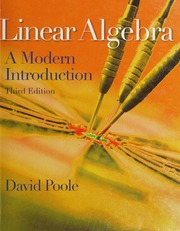
Internet Archive
xxvi, 726 p. : 26 cm
It teaches only the R^n case but that's fine if you are just starting out.
tulip saffron
thank you!
narrow relic
tulip saffron
thank you!
You're welcome, let me know how it goes, I'd love to hear your experience with it
tulip saffron
I will go with friedberg's book tbh
but it seems not longer than linear algebra with applications
so I wonder if it is THE book
narrow relic
Sure, it's more advanced than the one I mentioned I think
You should probably try to avoid finding just one book. One book will never have everything you need that is also presented in the best way for each. It's normal to have to combine multiple sources
sage python
FIS covers a fair bit
narrow relic
Browsing through that book brings back bad memories for me; I first saw it when I didn't have the "mathematical maturity" or whatever to read it
Just saw the typesetting and cringed
So I guess I'm biased against it because of that
I also hate "baby Rudin" for similar reasons
tulip saffron
narrow relic
You should probably try to avoid finding just one book. One book will never have...
yeah thats true
narrow relic
tulip saffron
yeah thats true
Also your view of what books are good at different levels will evolve (at least it has for me)
tulip saffron
Im finding the best book to begin with, actually I have learnt linear algebra before, but I hate my textbook (written in chinese)
narrow relic
Okay I see. I recommend rather than try to plan what you'll use perfectly in advance, you should actually start reading one of these books and see how it goes. Then if it isn't working for you, try another one.
If you are finding a book doesn't work for you, remember that it might not be your fault at all, it has to do with the fit for your way of thinking and also your background, etc.
tulip saffron
tulip saffron
Im finding the best book to begin with, actually I have learnt linear algebra be...
I gave up around jordan normal form of that book I think
narrow relic
Oh, you got pretty far then
The Friedberg book might work well for you then since you already know a lot about what is going on in linear algebra
tulip saffron
thank you!
narrow relic
So just get started on it 😀
tulip saffron
sage python
FIS covers a fair bit
is this book so classic?
I saw all of u discussed about it
narrow relic
I have no idea, it was used in some classes at the university I went to
tulip saffron
thank you! I will give it a try
sage python
@tulip saffron how's your background in proofs actually?
And how much do you already know in linear algebra?
tulip saffron
what do you mean by proof? cause my background was taught in chinese
tulip saffron
sage python
And how much do you already know in linear algebra?
I think I know the matrix, I gave up around jordan normal form, and I think Im pretty weak at linear transformations, linear space etc
or what space it is called
sage python
Like are you used to proving theorems in mathematics
tulip saffron
I welcome proofs very much
tulip saffron
sage python
Like are you used to proving theorems in mathematics
I like it, and have done a lot in analysis

I think I can handle like the first 5 chapters

but get pretty weak at chapter 6 and 7
narrow relic
tulip saffron
This book actually looks better than I remember, heh
Maybe I'll take a look at it again myself sometime this year
Thanks for posting that ToC.
remote sparrow
just found out judson has written a draft of an ODE book
looks like it has a lot emphasis on programming and modeling, which i approve of
there's no damn point in remembering all those silly little tricks
narrow relic
remote sparrow
just found out judson has written a draft of an ODE book
I tried his Abstract Algebra book, I thought it was okay
I hated the way ODE was taught in undergrad
remote sparrow
narrow relic
I hated the way ODE was taught in undergrad
check it out and see if it's interesting
we only need to hear about the trick once and maybe see a worked example, but only enough to know how someone implemented it on a computer
graphs and other qualitative analyses should be emphasized much more
narrow relic
Thanks for the link. I'm a bit too tired to process it right now
remote sparrow
also existence and uniqueness of solutions becomes a much more important result because you aren't going to work with nice toy functions
blanchard, devaney, and hall is another ODE book that emphasizes phase portraits, direction fields, graphs, and other qualitative analyses
i really hope the ODE curriculum gets updated
orchid mortar
Open source 
 fluid harness
I need to prepare for a maths olympiad
gray gazelle
narrow relic
Thanks for the link. I'm a bit too tired to process it right now
eva is based '
gray gazelle
Does anyone know a calculus book that is rigorous enough but not too difficult? I tried Spivak and Apostol but I can't do the exercises in those books at all, exercises in books like Stewart are easier but its lack of rigor creates gaps in my understanding. So is there any books that is between Stewart and Spivak?
heady ember
Schroder might be worth a look
Its an anal book but might be more accessible than Spivak
gray gazelle
thanks
is there any problems with jumping to real analysis without taking calculus?
 tawny copper
gray gazelle
is there any problems with jumping to real analysis without taking calculus?
tawny copper
gray gazelle
is there any problems with jumping to real analysis without taking calculus?
no
calculus courses are usually more computational, while analysis courses are usually more theoretical. But there is no problem in doing more theoretical stuff before doing many computations
you will still do computations in analysis anyway
heady ember
It should be fine for Schroder
Iirc Dami even said that he wouldn't be suprised if a calc I student can read Schroder
However, of course as with any math book, some amount of patience and determination is necessary
gray gazelle
Any small books that are good for some uni level easy math for someone in highschool ? Like group theory and stuff
I have 20 days of school remaining and I am going insane with exams, I need a small math book that isn't from my highschool syllabus but atleast easy to understand 
karmic thorn
@stray veldt v2 when
 formal bronze
gray gazelle
Any small books that are good for some uni level easy math for someone in highsc...
formal bronze
gray gazelle
Any small books that are good for some uni level easy math for someone in highsc...
Algebra by Artin is good
It is a nice book to study group theory from
gray gazelle
 indigo mesa
maybe take a look at Lochs intro to proofs
indigo mesa
maybe take a look at Lochs intro to proofs
OMG!! YES ❤️ thank you
I need to learn how to write proofs before delving into any math theory of sort at higher level like uni
Thank you ❤️
indigo mesa
narrow relic
gray gazelle
eva is based '
Thanks, I liked the original series (didn't like any of the movies).
narrow relic
gray gazelle
Does anyone know a calculus book that is rigorous enough but not too difficult? ...
There's one by Salas and Hille you could take a look at.
 old elk
I think there should be some abstract algebra book that is dedicated to the good solution of exercises because sometimes I feel that there are missing topics to explain examples etc. for example in the case of group I feel that always explains the same as always and I have looked at several books.
old elk
Oooh I don't know if it's just me that I still have a lot to learn.
although basically I think the latter
Sometimes I think that I shouldn't be in mathematics.
 torn valley
any book recommendations on combinatorics ? (any difficulty welcome)
karmic thorn
Bona, A Walk Through Combinatorics
fierce hedge
old elk
I think there should be some abstract algebra book that is dedicated to the good...
Herstein has good exercises (if you excuse some weird notations) and solutions to them are easily available on the internet
 clear peak
I'm looking for a book that is basically full of word problems where I build and solve the equations myself. Most mathematical books I read don't approach math in a real world observable way. At least not when you get into higher level stuff. I don't need to figure out how many apples Susie ate after John took 2 out of 5 apples. Or how many pizza slices there are after 20 kids took a slice from a pizza that feeds 180. Or how much volume there is in a sphere. Do you guys know what I mean?
I will settle for python related math exercises so I can observe and manipulate problems
I'm in college working on calculus, but I also have a cousin who is in high-school who is also interested in math so any book that is not elementary is fine
remote sparrow
gray gazelle
Does anyone know a calculus book that is rigorous enough but not too difficult? ...

Designed for undergraduate mathematics majors, this rigorous and rewarding treatment covers the usual topics of first-year calculus: limits, derivatives, integrals, and infinite series. Author Daniel J. Velleman focuses on calculus as a tool for problem solving rather than the subject's theo...
remote sparrow
clear peak
I'm looking for a book that is basically full of word problems where I build and...
math puzzle books and recreational math books generally have a fair share of word problems
clear peak
Thank you! I'll check em out
remote sparrow
https://www.maa.org/press/maa-reviews/partial-differential-equations-an-introduction
https://www.maa.org/press/maa-reviews/a-first-course-in-partial-differential-equations-with-complex-variables-and-transform-methods
https://www.maa.org/press/maa-reviews/introduction-to-partial-differential-equations-with-applications
some interesting undergrad pde book reviews
gray gazelle
narrow relic
Thanks, I liked the original series (didn't like any of the movies).
i also love depression and the feeling of loneliness
tulip saffron
may I ask why you all recommend Friedberg Insel Spence's linear algebra over Gilbert Strang's linear algebra and its applications?
sturdy shore
one of them actually proves stuff
for an engineer it might be alright (idk), for a mathematician it hides too much abstraction that it could introduce earlier, and books with no proofs are just not okay for obvious reasons
oh mb, the book I'm going off of is his other la book, didn't know he had 2
so what I said might be totally wrong and the book may be alright
 merry sphinx
sturdy shore
oh mb, the book I'm going off of is his other la book, didn't know he had 2
merry sphinx
sturdy shore
oh mb, the book I'm going off of is his other la book, didn't know he had 2
wait he has 2?
sturdy shore
yeah, the one I'm going off of is introduction to linear algebra
sturdy shore
sturdy shore
oh mb, the book I'm going off of is his other la book, didn't know he had 2
update: this book also has 0 proofs
remote sparrow
anyone have thoughts on tao's measure theory book?
tulip saffron
sturdy shore
update: this book also has 0 proofs
thank you!
so I think I'd better go with Friedberg Insel Spence's book
merry sphinx
there's also anton if you want a less rigorous version which still has proofs but also some applications
tulip saffron
thank you!
that book seems to be a very famous one as well
wheat remnant
Is there a major difference between the 3rd and 4th edition?
remote sparrow
of friedberg insel spence? i wouldn't know. you can read some of the introductory remarks in FIS where they mention any changes from previous editions and look at the table of contents, and judge for yourself.
wheat remnant
Yeah only because the 4th edition is floating around 100 and the 3rd is 10$ 😅
narrow relic
tulip saffron
may I ask why you all recommend Friedberg Insel Spence's linear algebra over Gil...
The Strang book is not rigorous
tulip saffron
narrow relic
The Strang book is not rigorous
do you think the same for his another book An introduction to linear algebra?
I see, it is the difference between an engineer oriented and a mathematician oriented
narrow relic
tulip saffron
do you think the same for his another book An introduction to linear algebra?
Both of them are not rigorous. If you want something at that level, you should read the book by Poole that I recommended. If you want something more "advanced" go with the Friedberg one or something else
narrow relic
tulip saffron
I see, it is the difference between an engineer oriented and a mathematician ori...
No, it's just poor writing in my opinion (Strang).
tulip saffron
thank you! since I have taken linear algebra courses before I would go for the more advanced ones
narrow relic
remote sparrow
anyone have thoughts on tao's measure theory book?
It did the whole "R^n first" thing so I wasn't interested in it
wheat remnant
narrow relic
Both of them are not rigorous. If you want something at that level, you should r...
I’m assuming comp sci is going to want the mathematician route yes?
narrow relic
wheat remnant
I’m assuming comp sci is going to want the mathematician route yes?
I'm not sure what you mean
gray gazelle
Absolute beginner in calculus.
High-school level in Algebra.
Can you recommend calculus and algebra books from beginner to advanced.
Like from calculus its like: Pre-calculus ---> Advanced
and Algebra also from just after solving linear equations --> Advanced.
gray gazelle
gray gazelle
Absolute beginner in calculus.
High-school level in Algebra.
Can you recommend ...
So like i want a list of books. I dont mind if they are 10 or 15 or 20.
might as well recommend books for trig (because of pre calculus)
also pls ping me
wheat remnant
narrow relic
I'm not sure what you mean
Engineer oriented vs mathematician oriented
narrow relic
wheat remnant
Engineer oriented vs mathematician oriented
I don't think that is a real distinction. There's writing that makes sense and there's writing that doesn't make sense, that has holes and gaps of logic
Just read quality stuff at whatever level 😀
wheat remnant
Yeah, but the person you responded to had that inclination, I just wanted to know if there was a real preference based on the intended orientation or direction of application
narrow relic
I think the key is what level you are looking for. For example I recommended that Poole linear algebra book. It's an intro and doesn't have anything on e.g. dual spaces
It also mentions some "practical applications" of the subject to give you some real world ideas (although I skipped all those parts I could see how they might be motivating for some people)
wheat remnant
Okay gotcha, and is there gonna be a potentially “deeper breadth but harder” path depending on which book yeah?
Or is there just a more celebrated standard of learning the initial material regardless I.e. FIS
narrow relic
I'm not sure what you mean exactly but I think the answer is yes? 😀
 raven violet
Hi guys, I’m new here. I have covered portions till Calc 2 and wanted a book rec for what I could be learning further. It for my own interest. Could you guys please suggest some books (not bounded just to calc)
alpine rover
raven violet
Hi guys, I’m new here. I have covered portions till Calc 2 and wanted a book rec...
how about Stewart's Multivariable Calculus (overlaps with Calc 3)?
raven violet
Thanks, I’ll check it out, are there any particular topics that you like?
alpine rover
raven violet
Thanks, I’ll check it out, are there any particular topics that you like?
Lagrange Multipliers, Multiple Integrals (Double, Triple Integrals), Vector Calculus (Line Integrals, Green's Theorem, Curl, Divergence, Stokes' Theorem)
remote sparrow
@sage python does browder have material on sequences and series of functions? i looked through the index and found no mention of pointwise convergence or uniform convergence. i saw some material on fourier series but nothing on power series, and i saw the term "converges uniformly" but i haven't stumbled on the phrase "converges pointwise."
sturdy shore
it has a section on analytic functions
remote sparrow
that makes sense
most books tend to be a bit more modular and put all this material into one chapter
though it's weird that browder's index doesn't have uniform and pointwise convergence in there
sturdy shore


 frosty sonnet
my bad
narrow relic
remote sparrow
most books tend to be a bit more modular and put all this material into one chap...
Are you a chronicler of math books?
remote sparrow
narrow relic
Are you a chronicler of math books?
you could say that
narrow relic
remote sparrow
you could say that
That's kind of cool. Are you familiar with Professor Roman's newer 4-volume series?
remote sparrow
The Web Site of Professor Steven Roman
narrow relic
Yup
remote sparrow
him?
narrow relic
Yes. I purchased the first of the new series
It is the only linear algebra manuscript that I have been able to find that I think answers my questions about similar linear transformations in a proper way.
remote sparrow
advanced linear algebra by roman doesn't do that?
narrow relic
remote sparrow
advanced linear algebra by roman doesn't do that?
Oh, not sure! I haven't looked at that one
narrow relic
remote sparrow
advanced linear algebra by roman doesn't do that?
Hard to tell, that book looks more advanced and it might not have time for the things I'm mentioning
remote sparrow
i found another book a while back also called "Advanced Linear Algebra," except the author is nicholas loehr

Routledge & CRC Press
Designed for advanced undergraduate and beginning graduate students in linear or abstract algebra, Advanced Linear Algebra covers theoretical aspects of the subject, along with examples, computations, and proofs. It explores a variety of advanced topics in linear algebra that highlight the rich interconnections of the subject to geometry, algebr...
table of contents available here
seems to also have more material on matrix theory than roman

Advanced Linear and Matrix Algebra
found this recommended to me
this nathaniel johnston also has lecture videos on youtube if anyone is interested

Introduction to Linear and Matrix Algebra
there's also this intro level book
might be worth looking into
remote sparrow
remote sparrow
https://www.routledge.com/Advanced-Linear-Algebra/Loehr/p/book/9781466559011
one of the amazon reviewers said this isn't a sewn book

loehr seems quite comprehensive
abstract algebra and elementary linear algebra seem to be prerequisites

Combinatorics: Discrete Mathematics and its Applications
author works in algebraic combinatorics
possibly an interesting alternative to bona's book?
remote sparrow
remote sparrow
https://www.amazon.com/Combinatorics-Discrete-Mathematics-its-Applications/dp/10...
going through the table of contents, seems to give more topics of an algebraic flavor, which is not surprising
 mossy flume
combo in a more algebraic flavor? 👀
I wanna take algebraic combo (offered at my uni) but the prereq course is hell supposedly
remote sparrow
From the preface to the text:
Part I of the text covers fundamental counting tools including the Sum and Product Rules, binomial coefficients, recursions, bijective proofs of combinatorial identities, enumeration problems in graph theory, inclusion-exclusion formulas, generating functions, ranking algorithms, and successor algorithms. This part  requires minimal mathematical prerequisites and could be used for a one-semester combinatorics course at the advanced undergraduate or beginning graduate level. This material will be interesting and useful for computer scientists, statisticians, engineers, and physicists, as well as mathematicians.

Part II of the text contains an introduction to algebraic combinatorics, discussing groups, group actions, permutation statistics, tableaux, symmetric polynomials, and formal power series. My presentation of symmetric polynomials is more combinatorial (and, I hope, more accessible) than the standard reference work [84]. In particular, a novel approach based on antisymmetric polynomials and abaci yields elementary combinatorial proofs of some advanced results such as the Pieri Rules and the Littlewood–Richardson Rule for multiplying Schur symmetric polynomials. Part II assumes a bit more mathematical sophistication on the reader’s  part (mainly some knowledge of linear algebra) and could be used for a one-semester course for graduate students in mathematics and related areas. Some relevant background material from abstract algebra and linear algebra is reviewed in an appendix. The final chapter consists of independent sections on optional topics that complement material in the main text. In many chapters, some of the harder material in later sections can be omitted without loss of continuity.
mossy flume
ooooo
 weary wigeon
Any good books on topology
 grand thistle
 sterile harness
anyone know where I can get a new hardcover copy of munkres
gray gazelle
is there a good channel for pre-calculus and calculus courses
or should I just follow james stewart books
?
narrow relic
remote sparrow
might be worth looking into
Thanks, I'm going to stick with the Roman thing that I bought from his web site.
But it's nice that you've sort of catalogued all this stuff at least mentally.
 glacial crypt
grand thistle
glacial crypt
grand thistle
pedestrian treatment
weary wigeon
Speaking of which what about munkres book on topology. It's cheaper
 silk arch
Book replacement for University Physics with Modern Physics, Hugh D Young; Roger A. Freedman?
remote sparrow
silk arch
Book replacement for University Physics with Modern Physics, Hugh D Young; Roger...
halliday resnick or serway jewett are common alternatives
they're all quite similar though
pretty sure openstax has calc based physics books
and there are several other free online textbooks
karmic thorn
@orchid ruinI'll have to remove your message, we discourage sharing pirated material and links to access the same here because of Discord regulations
(I'm sure people who have to access those books know about the sources to access them, too 😛 )
remote sparrow
found a page containing some suggested readings for set theory
seems neat
this review also links to some other maa reviews
 gray jungle
why not ? lol
 flat lantern
now I'm gonna have to wait another 3 months
 tepid robin
 karmic thorn

 woven sparrow
I'm looking for a PDF that gives a formal reasoning for these properties below:

Intuitively, I understand that these are true, but I do not know the rigorous, formal, axiomatic approach to prove/assert these.
 humble tusk
currently reading this to prepare for discrete math; lots of exercises and beginner friendly explanations

 dapper root
O C ND E
foggy relic
GIC N SE
 novel obsidian
W grindset more like
solemn rover
Real.
woeful ravine
humble tusk
currently reading this to prepare for discrete math; lots of exercises and begin...
If anyone is looking for a more advanced book on logic and set theory, this one by Yu. Manin is great
 humble tusk
woeful ravine
If anyone is looking for a more advanced book on logic and set theory, this one ...
humble tusk
woeful ravine
If anyone is looking for a more advanced book on logic and set theory, this one ...
would you recommend this book as a companion for a discrete math course?
solemn rover
I don't think this is appropriate for a companion to a discrete math course. It is best for a bit after
woeful ravine
humble tusk
would you recommend this book as a companion for a discrete math course?
No, that book covers topics at a very high level, for an introductory book on discrete math I would recommend V. K. Balakrishnan's "Introductory Discrete Mathematics"
humble tusk
awesome, thanks for the insight :>
woeful ravine
It has tons of applied examples and exercises and is very will written. Plus since it's a Dover book you can get a copy for <10$
humble tusk
my professor gave me a copy of “Discrete Mathematics” by Ross/Wright 2nd Ed, it has a ton of problems but am definitely on the hunt for other texts (discrete math is totally new to me), thanks for the recommendation 🙏🏻
crimson leaf
Concrete mathematics is good for discrete math
woeful ravine
humble tusk
my professor gave me a copy of “Discrete Mathematics” by Ross/Wright 2nd Ed, it ...
Balakrishnan's book (as well as a few other books), imo, cover everything that you need to know for an introductory course. It has set theory & logic, combinatorics, generating functions, recurrence relations, graph theory, and a little bit on computational complexity theory. For something more advanced, there are a lot of good books covering combinatorics and graph theory in more detail that I could recommend
gray jungle
Any good books on banach algebras?
dapper root
<@&268886789983436800>
foggy relic
Banach algebras arent all that bad...
@gray jungle what specifically are you looking for
also what do you know already
gray jungle
foggy relic
<@888859319024648254> what specifically are you looking for
Im currently learning functional analysis , measure theory , general topology and theory of bounded operators , i have taken complex analysis and abstract algebra if its relevant here.
Just looking for a introduction to the subject really.
gusty smelt
gusty smelt
for the basics, i recommend pederson chapter 4
.
pederson's "analysis now"
its a functional analysis book
gray jungle
Dope , ile check it out 
gusty smelt
pederson himself was an operator algebraist so its really good introduction to things like banach algebras and C* algebras
gray jungle
Sounds great , ty for the suggestion
neat spindle
may i ask for suggestion for textbook for a course that includes A systematic introduction to statistical inference, including the necessary probabilistic background, point and interval estimation, hypothesis testing.
here's an pastpaper of midterm and final for reference about what the course is about
no worry the pastpapers is free to download on the internet and it's completely legal and safe
neat spindle
neat spindle
https://www.google.com/url?sa=t&rct=j&q=&esrc=s&source=web&cd=&ved=2ahUKEwju7qeO...
currently i only have this online book but i am not too sure if it's enough for this course
gray gazelle
Quick introduction to proofs I can read with my friend?
crimson leaf
gray gazelle
Quick introduction to proofs I can read with my friend?
If you want something very quick check pins in #proofs-and-logic
narrow relic
woven sparrow
I'm looking for a PDF that gives a formal reasoning for these properties below:
You can prove those yourself using basic logical facts
woven sparrow
elaborate
narrow relic
I'm not sure how to elaborate; have you ever taken for example a discrete math class?
woven sparrow
I can prove the exist ones using forall
woven sparrow
narrow relic
I'm not sure how to elaborate; have you ever taken for example a discrete math c...
nope
Guess I need that
weary wigeon
woven sparrow
nope
There's a discrete maths channel btw
narrow relic
Yes. Chapter 2 of this book has some of the material you will use: Discrete and Combinatorial Mathematics: An Applied Introduction, Fifth Edition, by Ralph Grimaldi
You should also look into something called Fitch Natural Deduction which will show you how to do subproofs
woven sparrow
narrow relic
Yes. Chapter 2 of this book has some of the material you will use: Discrete and ...
Thumbing through this book right now, but not really a fan of how its presenting its statements
narrow relic
woven sparrow
Thumbing through this book right now, but not really a fan of how its presenting...
You might know better; it helped me a lot when I was at the beginner level
woven sparrow
Its rigor feels lacking. Using truth tables to prove statements is pretty beginner level.
Also, my main complaint is here:

It just says this as fact.
narrow relic
Well if you're beyond that, you can look at Fitch natural deduction
woven sparrow
I mean, obviously it makes sense. But I'm a mathematician. Things that are obvious are unacceptable
narrow relic
Erm, well... I'm not sure how you could decompose that statement into something more basic, perhaps you can
woven sparrow
narrow relic
Well if you're beyond that, you can look at Fitch natural deduction
Thanks I'll look a bit deeper into this first book then switch to that one if not satisfied.
narrow relic
Fitch natural deduction isn't actually a book, it' s a technique of writing proofs
I don't know an official book that covers it
woven sparrow
narrow relic
Erm, well... I'm not sure how you could decompose that statement into something ...
It's that it follows from nothing but loose intuition. There's no axiomatic foundation for the reasoning of their statement. Just that it's true.
That's what I meant by lacking in rigor.
narrow relic
I have tried to find better books but I'm not a logic expert.
woven sparrow
I must admit though that this book is better than most, sadly
narrow relic
I learned a lot of this from some notes for some computer science class in Europe
woven sparrow
My search attempts have yielded nothing but cs101 courses which give even weaker detail than this
narrow relic
Here, let me find that link for you if I can
Since you seem to be at the same point I was and I remember how annoying this situation is
woven sparrow
Hah. Found the very thing I was looking for at the start
 narrow relic
Does it prove those?
woven sparrow
checking
nah
Just gives an example of how they're true
But no rigor in derivation
narrow relic
Okay, the course I learned this from has been deleted from the web
woven sparrow
boo
narrow relic
It wasn't perfectly rigorous either though
My best recommendation is to try to find a book that teaches logic and that at least mentions Fitch natural deduction as part of the course
narrow relic
woven sparrow
The hunt continues then
Fitch himself wrote a book but I have not read it: https://archive.org/details/symboliclogicint0000fitc

Internet Archive
238 pages 22 cm
woven sparrow
Okay looked into a bit
Looks like it's just a proof system that contrasts to the "hilbert system" which uses axioms and deductive reasoning
As I look further, it doesn't appear to be what I am searching for
Looks like I'm your average Hilbert system enjoyer
narrow relic
Heh okay!
woven sparrow
At least I know discrete math is one part of this, though
So that's a step forward
narrow relic
I think you are beyond the discrete math part of this though
woven sparrow
ah
narrow relic
You need to pick one of these logic systems and understand it
So in my case I learned one of these "natural deduction" systems
woven sparrow
duh I'll just go into #proofs-and-logic. What's wrong with me
narrow relic
woven sparrow
duh I'll just go into <#328208536029102081>. What's wrong with me
Yeah I am not an expert on any of this! I've seen sequent- based systems as well
Good luck 🙂
 safe nova
Hi could anyone recommend books to self study maths so that I can understand mathematics from Knuth's The Art of Computer Programming? You can assume that I have only basic highschool maths knowledge.
 stray veldt
basic highschool knowledge could actually be enough
alternatively a modern discrete math (for computer scientists) book
stray veldt
maybe rosens discrete mathematics and its applications
 split bluff
@woven sparrow you can prove some if not all of with a proof by contradiction
woven sparrow

split bluff
For the third one, suppose for all x, p(x) and q(x), then (for all x, p(x) and, for all x, q(x)) or ~(for all x, p(x) and, for all x, q(x))
suppose ~(for all x, p(x) and, for all x, q(x)), (get a contraficcion) then it must be the case that (for all x, p(x) and, for all x, q(x))
I'm on the phone and can't write it better but the proof is basically using the principle of bi-valence
Either p(x) or not p(x)
Prove not p(x) is invalid, therefore p(x)
woven sparrow
I can prove third and fourth using first and second, so I'm not worried there
So, say, how would I prove first and second?
Or I guess I could prove first and second using third and fourth
lemme look at your proof
split bluff
I think one can use the method i mentioned,for the first one, let m(x) be the consequent of the implication m(x) = (for some x, p(x), or, for some x, q(x))
_Assume the left side,
--then either m(x) or ~m(x)
--- suppose ~m(x)
---(proof that ~m(x) leads to a contradiction)
-- since ~m(x) is invalid, therefore m(x)
-then left side implies right side (m(x))
~m(x) will be equivalent to two universal quantifiers
So, you will get for x, ~p(x) or, for all x, ~q(x)
 lunar saddle
does anyone have good book recommendations related to learning C as a complete beginner? I realise this might be a bit of a stupid question as there are tons of them out there it's just I have no idea which one is actually worth my money
split bluff
Both are contradictions to the assumption (left side) that for some x, p(x) or q(x) since for every x, ~p(x) or ~q(x)
split bluff
@woven sparrow anyways, i know about thia technique from "how to prove it" by velleman, 3rd edition, page 105

Left side is for some x, p(x) or q(x)
Assuming ~m(x) is a contradiction to this claim
Remember that what you are trying to prove has the form p -> q so you can assume p and try to prove q, since proving q is kind of awkward, we assume ~q to try to get a contradiction with our original assumptions (p) and since ~q leads to a contradiction, then it must be the case that q and the proof is completw
woven sparrow
I'm not seeing the (proof that leads to the) contradiction tbh
 keen kestrel
split bluff
<@374795910032523266> anyways, i know about thia technique from "how to prove it...
keen kestrel
split bluff
<@374795910032523266> anyways, i know about thia technique from "how to prove it...
From which field of math is this?
split bluff
You get a contradiction to the claim that for some x, p(x) and q(x) if you can prove that for every x, ~p(x) or ~q(x) which is precisely what you get when you negate ~m(x) (right side)
@keen kestrel logic
safe nova
lunar saddle
does anyone have good book recommendations related to learning C as a complete b...

C Programming Language, 2nd Edition
lunar saddle
safe nova
`this` -> https://www.amazon.com/Programming-Language-2nd-Brian-Kernighan/dp/013...
have you personally read/used this book?
safe nova
lunar saddle
have you personally read/used this book?
hm not really, but it's better than the ones our uni gave us supposedly
keen kestrel
split bluff
<@600759913882451997> logic
I just don't get what this ~ sign mean so I spent zero time thinking through this proof
split bluff
Negation
Im on the phone and can't use the correct symbol
Once i get some time i'll write the proof of the first exercise
On latex or on paper
woven sparrow
split bluff
You get a contradiction to the claim that for some x, p(x) and q(x) if you can p...
This sounds like a proof using existential quantifier though. I feel like this just leads to circular logic.
woven sparrow
split bluff
Once i get some time i'll write the proof of the first exercise
ping me when you do
split bluff
Will do
cobalt arch
Any axiomatic books on combinatorics?
ancient grove
I would be delighted if someone suggested me a good book to learn on set theory and counting principles
 lunar moon
Anyone got recommandations for books on foundations? General overview works but i would prefer it to specialise in the algebraic geometry aspect of foundations. Thanks!
 weary cape
What is a good book for learning linear algebra?
I don't know calc 3 yet nor did I start real analysis and I only have a very basic understanding of proofs but is that necessary?
remote sparrow
weary cape
What is a good book for learning linear algebra?
remote sparrow
lunar moon
Anyone got recommandations for books on foundations? General overview works but ...
by foundations do you mean axiomatic set theory and mathematical logic?
remote sparrow
cobalt arch
Any axiomatic books on combinatorics?
maybe nicholas loehr's Combinatorics? it doesn't start with a proof of the sum and product rule of counting, but a proof sketch is given in the book using induction and the definition of cardinality
remote sparrow
ancient grove
I would be delighted if someone suggested me a good book to learn on set theory ...
by set theory do you mean naive or axiomatic set theory? and by counting principles, do you mean combinatorics?
ancient grove
remote sparrow
by set theory do you mean naive or axiomatic set theory? and by counting princip...
Naive set theory and combinatorics
crimson leaf
Book of proof starts with both of those things
weary cape
remote sparrow
https://discord.com/channels/268882317391429632/716264872018706443/1028376959434...
Thx! :D
What makes this a good book may I ask?
remote sparrow
besides meckes, they're all cheap or free online
weary cape
Ohh lol okay. Have you read it?
weary cape
Cool
remote sparrow
they both start by showing you how to prove basic stuff
@tame tree likes meckes
i recommended it to them actually
hefferon has a complete solutions manual available plus lectures however
either way both are good
weary cape
hmm okay
I have this really old book on linear algebra and it's digestible...but still find it hard reading it so I wanted a different book to maybe gain a different perspective.
remote sparrow
what's the name of that really old book?
weary cape
It's called "Matrices and Linear Transformations" from Charles G. Cullen at U of Pittsburgh. Addison-Wesley publishing company printed in 1967.
It's supposed to be for sophomores taking linear algebra and matrix theory (says in the preface)
remote sparrow
oh, that's available as a dover edition now
is it a library copy or your parents/guardians'?
weary cape
Bought it at an antique store lol
remote sparrow
ah
it's $18.95 on amazon albeit as a paperback
but yours is probably hardcover and nicely bound
weary cape
Yeah it's a hardcover lol. (Had some inspiration from the Math Sorcerer)
I picked it up for 4$ actually
remote sparrow
nice!
weary cape
Mhm yeah old math books are cool to have around and I enjoy reading them but I also feel more inclined to read more recently printed stuff simply because they are easier to read at least in my case.
weary cape
TRUE
remote sparrow
😡
Free math texts
Free Texts in Mathematics and Computer Science and more, from Jim Hefferon

Linear algebra is perhaps the most important branch of mathematics for computational sciences, including machine learning, AI, data science, statistics, simulations, computer graphics, multivariate analyses, matrix decompositions, signal processing, and so on. The way linear algebra is presented ...

Linear Algebra offers a unified treatment of both matrix-oriented and theoretical approaches to the course, which will be useful for classes with a mix of mathematics, physics, engineering, and computer science students. Major topics include singular value decomposition, the spectral theorem, lin...
anyway here's the links to the books i recommended
weary cape
remote sparrow
https://hefferon.net/
I think I will just order the paperback for 22 it seems worth it (lin alg)
remote sparrow
hefferon? yeah it's not a bad price at all
weary cape
Yeah I first thought it might be in the 50$ before checking the price to my surprise this is a very affordable price for me
grand thistle
anyone know any good resources for and the prerequisites to algebraic geometry from an analytic perspective? I want a good mix of both analysis and algebra, and i've found Miranda's "Algebraic curves and Riemann Surfaces" but it seems way too advanced for me. is there any undergraduate level pathway to books like these?
id assume complex analysis and basic algebra like groups, rings, fields are necessary
and probably galois theory and commutative algebra too
it'd be great if anyone could direct me to any resources for the prerequisites too
i've decided to learn the algebra from Aluffi's book because i've picked it up before and enjoyed his exposition, and now that i know some group theory it should be smoother sailing than just going from scratch
gray gazelle
grand thistle
anyone know any good resources for and the prerequisites to algebraic geometry f...
You mentioned no topology or manifolds, those are important especially for the analytic development
grand thistle
gray gazelle
You mentioned no topology or manifolds, those are important especially for the a...
ah yeah forgot that was very important
gray gazelle
grand thistle
ah yeah forgot that was very important
What I plan on doing is just doing the things I know I am missing then just diving in when I am done with those, then if I notice something wrong (a gap) when reading the material (in this case Geometrically defined Algebraic Geometry) I can just get a supplement on that content with some other book
grand thistle
right right that’s fair
do you have any suggestions on a commutative algebra textbook that is aimed at kind of what i’m looking for?
gray gazelle
grand thistle
right right that’s fair
do you have any suggestions on a commutative algebra tex...
I'm not sure, but everywhere I go recommends "Atiyah-Macdonald" for a concise, but complete course that is precisely enough you need to get into AG; whereas, "Eisenbud" is if you have more time for the details
lunar moon
remote sparrow
by foundations do you mean axiomatic set theory and mathematical logic?
yep, ZFC set theory would be of particular use
mystic orbit
grand thistle
i've decided to learn the algebra from Aluffi's book because i've picked it up b...
Less gooo
Which chapter you at? :3
mystic orbit
grand thistle
anyone know any good resources for and the prerequisites to algebraic geometry f...
You should ask @stray veldt
grand thistle
mystic orbit
Which chapter you at? :3
starting group theory chapter today
im alternating algebra and analysis like day by day so it might go kinda slow
 glossy nova
hello
i need something to read
on unbdd operators
and not just proving the spectral thrm(something more advncd(
does anyone have anything?
cobalt arch
remote sparrow
maybe nicholas loehr's *Combinatorics*? it doesn't start with a proof of the sum...
does it start with the most basic axioms of combinatorics and explicitly deduce everything else (theorems) from them?
like the general topology book by sierpinski
 oblique hatch
Cheap ish first book on differential geometry (I know this may be too low, but soft limit £24, hard limit £30?)
remote sparrow
cobalt arch
does it start with the most basic axioms of combinatorics and explicitly deduce ...
i guess? generally combinatorialists take the sum and product rule of counting as basic axioms even though they can be reduced even further to set cardinality and properties of the natural numbers. things don't need to progress from zfc to be ultimately justified axiomatically.
cobalt arch
I understand that but I would like an axiomatic approach to combinatorics, thank you for your response
 agile patrol
hey guys 🙂 can you recommend a good intro nonlinear optimization textbook?
crimson leaf
cobalt arch
I understand that but I would like an axiomatic approach to combinatorics, thank...
Idk if you'll really find that
cobalt arch
crimson leaf
Idk if you'll really find that
why do you say that?
crimson leaf
Because I've never seen an axiomatic combinatorics book like you're describing
cobalt arch
That doesn't mean it doesn't exist XD. But I understand what you mean, I haven't seen one either
 soft badge
Anyone got calculas book rec that goes ofer university basics?
mystic orbit
glossy nova
and not just proving the spectral thrm(something more advncd(
@gusty smelt do you know smth?
gusty smelt
Hmmm I mean I just use pederson ch4 but that’s bc I have like, limited uses for it ig. I just need spectral theory and stones theorem oof
mystic orbit

gusty smelt
I read a bit of schmudgen though, he prolly covers more advanced topics
And the exposition was fine but I’m an operator algebra person so not my favorite
gray gazelle
any books on computation theory?
good formality and follows definition-theorem-proof
something like that
remote sparrow
lunar moon
yep, ZFC set theory would be of particular use
enderton or goldrei are good baseline choices for zfc. hrbacek and jech is a bit more challenging. for logic, consider enderton plus montalban's yt lectures or mileti's new book.
mossy flume
gray gazelle
any books on computation theory?
the defacto intro book is Sipser's text
I've also heard good things about Arora and Barak's text
gray gazelle
remote sparrow
esp since new books have terrible binding
you say that like, every few days
it feels like
remote sparrow
gray gazelle
any books on computation theory?
i've heard dexter kozen's undergraduate cs theory book is good
it seems to be organized by "lectures" rather than chapters
doesn't seem to have any exercises
a few reviewers say it's a good supplement/complement to sipser
remote sparrow
gray gazelle
you say that like, every few days
people gotta know what they're paying for nowadays

lunar moon
remote sparrow
enderton or goldrei are good baseline choices for zfc. hrbacek and jech is a bit...
ty
 robust robin
glossy nova
gusty smelt
And the exposition was fine but I’m an operator algebra person so not my favorit...
robust robin
glossy nova
gusty smelt
And the exposition was fine but I’m an operator algebra person so not my favorit...
Will check them out! Thanks
glossy nova
WHEN I WAS 13
I COULD SLEEP LIKE
5 HOURS
AND BE FINE
NOW
9 HOURS IS ESSENTIAL
MAYBE THATS WHY I STOPPED GROWING
 sweet wren
glossy nova
MAYBE THATS WHY I STOPPED GROWING
sweet wren
glossy nova
MAYBE THATS WHY I STOPPED GROWING
My sister's 4 years younger than me and almost my height. When I was her age I was much shorter
I am confident she'll grow taller than me in the future  (bc i lacked sleep too)
glossy nova
sweet wren
My sister's 4 years younger than me and almost my height. When I was her age I w...
sad
my brother is taller than me
2 years younger
sweet wren
sage kelp
Intro analysis book that includes topology?
glacial crypt
topology on what
mystic orbit
sage kelp
Intro analysis book that includes topology?
What kind of topology are you looking for?
General topology?
afaik all rigorous analysis books have a chapter on metric topology
sage kelp
Idk 😦
I gather its point set?
mystic orbit
General topology = pointset
sage kelp
Yes! That I knew
 strange bluff
Hi guys. Could someone recommend me book about geometry? I'm on the second year of my studies and just ended a basic cours od geometry and i would like to know more about it. Im intrested im book considering a lot of exercises and I'm more intrested in not-euclidian geometry than euclidian.
mystic orbit
sage kelp
Yes! That I knew
Hmm
You should prolly just choose a good analysis book
As I said, all analysis books got the topology you need for analysis
glacial crypt
rudin
mystic orbit
And if you need any nore pointset for whatever reason you can just use another reference
sage kelp
mystic orbit
You should prolly just choose a good analysis book
I was thinking of an intro analysis book, and then jumping to Rudin but didn’t want to lose the chance of getting exposed to topology
glacial crypt
abbott has chapter 3 (he says everything after compact sets is optional but I'd do it)
ISBN: 1493927116
sage kelp
glacial crypt
abbott has chapter 3 (he says everything after compact sets is optional but I'd ...
Thanks
 fickle coyote
Any books for functions
I like functions
 random sonnet
does anyone have good linear algebra book recs for highshoolers?
dont mind the username/pfp
hasty turret
Friedberg Insel Spencer
random sonnet
how is it?
hasty turret
Good
gray gazelle
fickle coyote
Any books for functions
I like functions
you want an introduction to set theory book
fickle coyote
gray gazelle
you want an introduction to set theory book
yeah
glacial crypt
axler's LADR
theres also something called
linalg done wrong
I think
which is open access
gray gazelle
fickle coyote
yeah
Jech made an introduction

Thoroughly revised, updated, expanded, and reorganized to serve as a primary text for mathematics courses, Introduction to Set Theory, Third Edition covers the basics: relations, functions, orderings, finite, countable, and uncountable sets, and cardinal and ordinal numbers. It also provides five...
with Hrbacek
fickle coyote
thanks
glacial crypt
wheres the rant about bindings
remote sparrow
axler ladr will also be open access by around december 2023
 hasty bay
im looking for a good book or any source for field extensions
we just started it and im kinda lost
 tulip blade
Idk just google field extensions notes
Are you using a book for your class?
Id just look at that or a standard abstract algebra book like algebra by artin
dapper root
I think D&F has a pretty good section on field theory
And Lang's is quite thorough, probably unnecessarily thorough for your class
 warm glen
i heard morandi's field theory book is a gentle read but also very thorough
hasty bay
yes i dont think were gonna do a lot of details
we have polynomials,extension of fields and finite fields
its like an introduction then we will have another module the next semester only on extension of fields
gray gazelle
random sonnet
does anyone have good linear algebra book recs for highshoolers?
If you want to be a Math Major, maybe Artin?
If you don't want to be a Math major, refer to Sour Drop's Rec, I heard similar Recs from John Baez.
Note: You have to be comfortable with proofs, complex numbers, induction, and, ideally, Calculus
For Complex Numbers: ||https://youtu.be/OQz1ydBcQSA| or a good pre-calculus text||
For Proofs: ||Artin has an appendix that goes over some proofs, but you can also use the notes pinned in #proofs-and-logic||
For Calculus: ||Only slightly necessary as a maturity filter from what I can tell (Jacobians mentioned once), but you can pick it up quickly from Khan and Lamar's Notes||

This algebra 2 video tutorial explains how to perform operations using complex numbers such as simplifying radicals, adding and subtracting complex numbers, simplifying it in standard form, graphing complex numbers and calculating the absolute value of complex numbers. This video contains plenty of examples and practice problems. It's useful f...
random sonnet
thanks a lot guys will check em out
gray gazelle
Some good Abstract Algebra books that cover multilinear Algebra that isn't Bourbaki?
sturdy shore
knapp - basic algebra, but I can't speak to the quality of that section specifically as I haven't reached that far yet
gray gazelle
sturdy shore
knapp - basic algebra, but I can't speak to the quality of that section specific...
Is it a terse book or fairly readable, just as a heads up, I'll read anyway
sturdy shore
gray gazelle
Is it a terse book or fairly readable, just as a heads up, I'll read anyway
well, depends on what you are comparing it to, probably reads like a novel if you are comparing it to Bourbaki
from what I've read of it, the book is decently chatty but the proofs themselves can be short and to the point, so you have to pay attention
gray gazelle
That seems good, what are the prereqs? Just Linear Algebra, Proofs, and Maturity?
sturdy shore
it covers linear algebra so not even that is needed, I'd pin it as a graduate level text w.r.t. the required maturity though
narrow relic
sturdy shore
knapp - basic algebra, but I can't speak to the quality of that section specific...
Holy moly, I have an Algebra book by this guy and it's amazing, I had completely forgotten about it
Oh, hey, it's this very book
He doesn't cover similarity of operators as far as I know, though
 minor knot
What is a good source to learn about Affine spaces?
orchid mortar
Is there really such a source that isn't basically linear algebra?
 orchid mortar
Checking my own books, I see a chapter of it in Shafarevich and Remizov
Roman also has a chapter on it
 steep spade
Can anyone recommend a workbook or collection of very challenging problems for calculus 3 (multivariable calculus)?
For reference https://www.amazon.com/Calculus-Multiple-Variables-Essential-Workbook/dp/1941691374 is a level below in difficulty for what I'm looking for

Calculus with Multiple Variables Essential Skills Workbook: Includes Vector Calculus and Full Solutions
woeful ravine
Although it covers more than just introductory multivariable calculus, volume 2 of "Introduction to Calculus and Analysis" by Courant is good. https://www.amazon.com/dp/3540665692

Introduction to Calculus and Analysis, Vol. II/1 (Classics in Mathematics)
It's not a problem book but it has a decent amount of exercises
 mossy shell
What are your guy's opinions on the book a mind for numbers?
oblique hatch
Does CUP have a good introductory book on differential geometry?
heady ember
What's cup? Just curious
karmic thorn
Cambridge University Press, I'm assuming
oblique hatch
karmic thorn
Cambridge University Press, I'm assuming
Yes
heady ember
Ahh I see
 rigid thunder
If I needed to remember all the numerical methods undergrad material that I forgot since my courses were long ago, what book would I be looking for?
For the record - CS undergrad, not Math
gray gazelle
Are there some notes about adjoints in category theory, so that I can learn the definition and equivalent forms of it
 remote slate
can you suggest a book to learn inequalities?
karmic thorn
Cauchy-Schwarz Masterclass is one I've heard about
remote slate
karmic thorn
Cauchy-Schwarz Masterclass is one I've heard about
is it a first course on inequalities?
gray gazelle
gray gazelle
Are there some notes about adjoints in category theory, so that I can learn the ...
I'll use Mac Lane
¯_(ツ)_/¯
woeful ravine
rigid thunder
If I needed to remember all the numerical methods undergrad material that I forg...
https://people.math.ethz.ch/~hiptmair/tmp/NumCSE/NumCSE15.pdf has probably more than you are looking for but I would definitely recommend it.
rigid thunder
at a skim it does have more, but it also seems to have C++ so that will be a very pleasant experience
narrow relic
Is this an appropriate complex analysis book, or are there some issues with it? https://www.book2look.com/book/9781107134829

This userfriendly textbook introduces complex analysis at the beginning graduate or advanced undergraduate level. Unlike other textbooks, it follows Weierstrass' approach, stressing the importance of power series expansions instead of starting with the Cauchy integral formula, an approach that illuminates many important concepts. This view allow...
I know nothing about complex analysis so I'm not sure if "follow[ing] Weierstrass' approach" is good or not
stray veldt
it means that the theory is developed mostly via power series
the content looks fine, it covers a ton of stuff in very little page count
cant comment anything more though
dapper root
I used it, it was fine
steep spade
woeful ravine
Although it covers more than just introductory multivariable calculus, volume 2 ...
It's great! Thanks for the recommendation
 graceful dawn
Suggest me some book
 signal fable
any book?
remote sparrow
graceful dawn
Suggest me some book
kingkiller chronicles by patrick rothfuss
remote sparrow
graceful dawn
No, math
why didn't you say that to begin with
graceful dawn
I thought this is a math channel
remote sparrow
read channel desc
gray gazelle
graceful dawn
No, math
algebra by serge lang
mystic orbit
remote sparrow
kingkiller chronicles by patrick rothfuss
why would you do that to them?
remote sparrow
it's good
 remote sparrow
idc
mystic orbit
oh it's yohan lol
remote sparrow
no manga adaptations at all? can i rec light novels that have manga adaptations?
remote sparrow
emote embed fail
mystic orbit
it was intentional
graceful dawn
Concepts of modern mathematics
narrow relic
dapper root
I used it, it was fine
Oh great, thank you!
narrow relic
stray veldt
cant comment anything more though
It's fine, thank you for your comments!
 glass harness
Any book recommendations foran introduction to elements of set theory?
remote sparrow
glass harness
Any book recommendations foran introduction to elements of set theory?
enderton or goldrei
hrbacek and jech for something a bit more challenging
 analog lava
Hi everyone
im learning about differential manifolds and how to generalize stokes theorems and basically multivariable calculus to manifolds
problem is i do not remember much if any of the intuition of the low lvl calc 3 things
is there any source that i can read /watch to remember the important things so they help when generlizing to manifolds?
ty
just the useful bits that would make me connect the dots
like fundamental theorem of line integrals and so on
foggy relic
What's a good book? Fiction preferably
fallow cypress
foggy relic
What's a good book? Fiction preferably
One Hundred Years of Solitude?
foggy relic
will check out
fallow cypress
Midnight's Children is great
Slaughterhouse Five if you like sci fi and also if you don't
foggy relic
thats Rushdie right?
fallow cypress
Yup Midnight's Children is
graceful dawn
Animal Farm
fallow cypress
Animal Farm is pretty fun
heady ember
Is that the one with like a spider and pig or smt
 iron bay
That’s charlottes web lmaooo
gray jungle
Its a political satire about the Soviet union using a story about animals starting a revolution against there farmer.
graceful dawn
heady ember
Is that the one with like a spider and pig or smt
Spider is in hobbits
Hobbits farm should have both ig
fallow cypress
What people don't remember about Animal Farm is that Orwell was socialist lol
It's so funny when right-wingers invoke Orwell to say that socialism would never work
 grave thorn
Also kind of funny that he's an anarchist, and conservatives still invoke him
To say stuff about social issues
fallow cypress
Was he an anarchist?
I know he sympathized with the anarchists (CNT/FAI), but I thought he was a democratic socialist (in the old sense of the phrase, not the bernie sanders sense)
grave thorn
Okay maybe he wasn't an anarchist, but at the very least he was a libertarian socialist
heady ember
graceful dawn
Spider is in hobbits
I have never read hobbits so its probably not that
remote sparrow
orwell was also a snitch
 runic aspen
guys any book suggestions for a 9th grade, i want to know about calculus and more about geometry proofs, geometry in whole
novel obsidian
fallow cypress
Was he an anarchist?
It could be argued that he was closer to anarchism than being a dem soc. He did fight with the anarchists in Spain after all, unless of course his politics changed in later years
remote slate
which book should I refer?
for the first course in inequalities
i don't have any prior knowledge
remote slate
anyone suggest a book
gray gazelle
Well if you could specify online or offline books. I can suggest both. For the online one I can even upload the pdf.
 ember slate
what are the math needed for this book : "Structure and Interpretation of Computer Programs" ?
heady ember
gray gazelle
Well if you could specify online or offline books. I can suggest both. For the o...
No you can't. It would be against tos and the mods would have to take action
orchid mortar
Uploading of GNU/Open books are probably fine.
gray gazelle
Oh srry if that is so
orchid mortar
A lot of open sources don't mind direct links
gray gazelle
I am new
orchid mortar
But if you don't know what is the legal requirement, don't post anything
orchid mortar
Available online, but do you know how?
By how do you understand what is a license?
gray gazelle
Like getting uploaded on the official website, I guess!
orchid mortar
Not every book has that
orchid mortar
This isn't the place to learn about licences I think
gray gazelle
But if I want to help in this section I gotta have a little bit of idea right?
orchid mortar
If it looks like an author's website you probably can post a direct link