#book-recommendations
1 messages · Page 21 of 1
 onyx wren
 crimson leaf
Yes it's fine if the author post them online (though publishers can get them in trouble if they care to.) But it's against tos for us to post pdfs to copyrighted materials and can get the server shut down
 remote sparrow

/sci/ Wiki
Math at its core is about establishing truths separate from sensual qualities, seeking patterns based upon these truths, systematically removing contradictions/inconsistencies from the patterns, and formulating conjectures with all of the above in mind. It is the one true language apart from reality which makes it ironic that it is so useful. He...
maybe look here?
 karmic thorn
Thanks
 fierce hedge
Most likely Kenshin meant copyrighted material
karmic thorn
That name though 
remote sparrow
If this is a question, then in this case it happens to be that they can be shown to be equivalent, provided all your steps are reversible. However, all you need to prove a value solves a statement involving an algebraic equation, like "Show x = 2 is a solution to 2x = 4", is substitute x = 2 to show it is true.
 sage kelp
Okay I’ll give it a shot. I think it looks interesting. Thanks
 novel obsidian
iirc mit ocw has a course on integral equations, im sure there'll be reading there.
karmic thorn
Oh? I'll check, thanks!
 buoyant vessel
@remote sparrow 
 gray gazelle
Whatever works best for self-study
Spivak is too hard for a self-study student who has never done calculus before I think?
My favorite Tarkovsky is Solaris
Book is written for a course not self-studying
 uncut zealot
Any properly written book can be used for self-studying
Or can be used to accompany a course
gray gazelle
uncut zealot
Any properly written book can be used for self-studying
It's written to be used in a course, which means they assume you have a teacher or something, nothing about this book says self-study or well-written besides your words
Maybe it's well written if you are tutoring

anyone got a book recommendation for group theory
 mossy sedge
anyone knows a good book about the history of mathematics? that doesn't go into proofs and theories, just general history that a middle schooler can understand
or the history of science
crimson leaf
gray gazelle
anyone got a book recommendation for group theory
Check pins for good abstract algebra books
 rich heron
Do you know any good Complex Analysis books?
remote sparrow
rich heron
Do you know any good Complex Analysis books?
undergraduate or graduate
pins are mainly graduate, gamelin excepted (some institutions use stein and shakarchi for honors undergraduates)
 sage python
None of them are like, computational but
Freitag-Busam works for undergrad as well, and my impression of Conway's writing is that it'd be easy for middle schoolers lol
 foggy relic
gray gazelle
anyone got a book recommendation for group theory
foggy relic
gray gazelle
anyone got a book recommendation for group theory
Serge lang algebra
remote sparrow
ruel, brown, and churchill is a common complex variables book. bak and newman is more sophisticated but still firmly undergraduate. ablowitz and fokas is a beginning graduate reference for those who are more interested in an applied perspective.
 glacial crypt
foggy relic
Serge lang algebra
glacial crypt
foggy relic
Serge lang algebra
from what I've been told this feels more like a second course in algebra rather than a first
remote sparrow
someone just saying group theory could either be an undergraduate on a quarter system where they will take abstract algebra for the first time, or they could be a graduate student that needs some advanced literature on group theory
 grand thistle
does anyone have a course or problem list /supplement for lang’s algebra?
i’m talking either like a list specific problems that are good to solve (maybe like from a homework set for a class following the class)
 lean pagoda
George Bergman wrote a lengthy companion to Lang's Algebra
I'm not familiar with it myself and I'm not sure how much additional content it contains, just remember seeing it on his homepage (but if it's anything like his other writings then it's probably worth a look)
 daring ravine
recommended stats texts?
remote sparrow
daring ravine
recommended stats texts?
undergraduate or graduate. what is your background
remote sparrow
daring ravine
I took stats already but kind of goofed off and regret it a bit
wackerly, mendenhall, and scheaffer is a standard rec
tho with how common it is, it might have been your course text
grand thistle
lean pagoda
George Bergman wrote a lengthy companion to Lang's Algebra
oh this is exactly what i was looking for thank you
wait isnt this the guy who also wrote the rudin supplement
bergman saves the day once again
 oblique girder
Any recommendations on books for sheafs/sheaves? Taking a course on sheaves, and the lecturer says that the course syllabus isn't covered by any books, so just looking to see what's out there
foggy relic
glacial crypt
from what I've been told this feels more like a second course in algebra rather ...
rumors
it starts from scratch
exercises can be difficult though
crimson leaf
foggy relic
rumors
The book says in the preface that it expects you to be familiar with some algebra and that reading his other two books would make you very prepared
foggy relic
the prerequisites mentioned in prefaces are not always the actual prerequisites!
all you need is mathematical maturity to stat
 hazy elk
In my experience prerequisites in the preface are usually not enough to have a "good time" reading
 dapper root
U can also put ur hand in an open fire
 indigo mesa
might do that
but if they're worried about prereqs maybe just choose artin instead
seems to be a better option (i haven't really read this one so this is going off of what i heard)
hazy elk
For some reason the problems in Artin never hit the spot for me
The exposition is really nice tho
 heady ember
dapper root
U can also put ur hand in an open fire
heady ember
dapper root
U can also put ur hand in an open fire

sage kelp
daring ravine
recommended stats texts?
DeGroot Probability and Statistics
karmic thorn
Lang's GTM Algebra could only possibly work for a first course if it goes along with a classroom/instructor
It's not a suitable text for a first course in algebra for self-study unless you have substantial mathematical maturity (presumably from other parts of math, or a nonstandard background)
karmic thorn

That's such a bad take lol
I recommend Artin, or even Jacobson if you have seen or done linear algebra
hazy elk
I think giving Herstein a try for intro group theory is cool, it has so many interesting problems and after that you could supplement with something like Hungerford and continue learning more algebra from Hungerford (or even DF)
 blazing canopy
I can give a negative recommendation. My professor used Dummit & Foote as my first abstract algebra course, after I had finished a rigorous linear algebra course, and I would call myself a very strong math student, but I had some difficulties, I think primarily with sections related to finite groups because I did not have a strong background in combinatorics or discrete mathematical thinking. Later I read Artin and would have appreciated his more linear algebraic approach to the subject.
 swift dome
linear algebra is literally a headache for me
 buoyant field
there should be an entire channel for stats 😦
 undone finch
hey, thoughts on friedberg for linear algebra (5ed))? what else should i study to complement its content?
remote sparrow
check pins
also, hoffman-kunze and axler are good to have in your library, even if some people think axler's treatment of determinants and eigenvalues is bad
remote sparrow
although you should probably wait to buy axler if you want the latest edition, coming out august 2023
okay but you don't need to follow one book. doesn't matter if you think axler is lacking some content or not, just use another book to fill in perceived gaps
undone finch
im liking friedberg so far, but i only read the two first chapters and it was mostly content i was already familiar with
the exercises are more on the easy side
foggy relic
Try one of the three I recommended
remote sparrow
shilov is cheap
undone finch
im checking out its summary
yeah shilov sounds good but i doubt i'll have the patience to read it whole
nor do i need to, i think?
im also following dummit and foote for algebra concurrently and i want to finish this in my lifetime
 frosty yarrow
what does rudin cover that isn't covered by introduction to real analysis by trench?
sage python
Trench's order of material is weird
But yeah it seems to cover less topology, less about uniform convergence, no differential forms (though frankly Rudin's treatment of it is utter dogshit), no Lebesgue integration
 atomic hemlock
What do y'all think of Peter Olver Linear Algebra? I have it from the free springer textbook during COVID lockdown, with Axler's (too advanced for me). Is it ok as first book?
 sturdy shore
you can try, but the little I've read of that book suggests me it is about as difficult as Axler's book is
gray gazelle
karmic thorn
It's **not** a suitable text for a first course in algebra for self-study unless...
Which one is suitable for self-study?
For a first course
blazing canopy
gray gazelle
For a first course
I personally think Artin's book is the most suitable, though I personally only read through it later.
 junior isle
Any thought on Jay Cummings proof book? Trying to decide between It or the book of proof by hammack
For self study
remote sparrow
junior isle
Any thought on Jay Cummings proof book? Trying to decide between It or the book ...
both look good
cummings is a lot wordier and more conversational, which is a plus for self-study
remote sparrow
cummings has a corny sense of humor, but it's not terrible
like, dad jokes and stuff
remote sparrow
gray gazelle
Which one is suitable for self-study?
pinter or judson
benedict gross has youtube lectures following artin though
if you do use pinter, make sure you do the exercises
some core material is found there
google some syllabi for suggested exercises to work
 proven copper
does anybody know a book similar to Calculus (Michael Spivak) but for multivariable calculus?
I just finished calc 1, I'm reading the beginning of his book and I REALLY enjoy the way he explains things. He presents things with more rigor than I saw in my course but doesn't make it in a way that is impossible to understand. It's just a satisfying book to read the theory.
sage kelp
junior isle
Any thought on Jay Cummings proof book? Trying to decide between It or the book ...
Check Velleman also
sage kelp
proven copper
does anybody know a book similar to Calculus (Michael Spivak) but for multivaria...
Check out Multivariable Calculus by Theodore Shinfrin
remote sparrow
proven copper
does anybody know a book similar to Calculus (Michael Spivak) but for multivaria...
shifrin is recommended at the back of spivak's book. hubbard and hubbard's book is also good.
remote sparrow
sage kelp
Check out Multivariable Calculus by Theodore Shinfrin
*multivariable mathematics
also hubbard and hubbard is substantially cheaper as a print copy
Matrix Editions is a small publishing firm
specializing in mathematics at the university and research level. It was founded in 2001.
Its primary author is John Hubbard, professor at Cornell University.
don't buy hubbard and hubbard's multivariable calculus book from amazon; they're sold at a substantial markup there. use the authors' website, linked above.
sturdy shore
shifrin also has a complete set of video lectures for the book, up on yt
proven copper
thanks guys
proven copper
proven copper
does anybody know a book similar to Calculus (Michael Spivak) but for multivaria...
are there books with Spivak's type of approach but for linear algebra?
sturdy shore
proven copper
are there books with Spivak's type of approach but for linear algebra?
both hubbard and shifrin are integrated LA + multivar calc books
 lean magnet
hey, just wanna find stuff more rigourous than stewart
I tried spivak but the questions is a bit too much of a challenge
a book geared towards self learning would be appreciated, thanks
 loud cradle
+1 for shifrin's multivariable mathematics. I personally find Hubbard and Hubbard very longwinded and actually harder to understand than Shifrin if you already know linear algebra and want it presented that way
 narrow fiber
hubbard^2 is a wonderful book imo
remote sparrow
proven copper
are there books with Spivak's type of approach but for linear algebra?
remote sparrow
lean magnet
I tried spivak but the questions is a bit too much of a challenge
try velleman's book

Designed for undergraduate mathematics majors, this rigorous and rewarding treatment covers the usual topics of first-year calculus: limits, derivatives, integrals, and infinite series. Author Daniel J. Velleman focuses on calculus as a tool for problem solving rather than the subject's theo...
lean magnet
ty
proven copper
remote sparrow
https://discord.com/channels/268882317391429632/716264872018706443/1028376959434...
thanks
proven copper
remote sparrow
shifrin is recommended at the back of spivak's book. hubbard and hubbard's book ...
I found that this Shifrin also has a linear algebra book, is it good?
proven copper
ok, thanks man
remote sparrow
some advice for buying math textbooks, especially brands like springer which have become notorious for selling shoddily bound books - don't buy new. buy used, and look for books in very good or like new condition. those are books that are more likely to be sewn-bound.
tangentially, i found a 1956 copy of E. L. Ince's Ordinary Differential Equations at a little pop-up shop on campus and paid $9.75 for it. it's a dover book. but man is the quality of its construction amazing by today's standards. the book went for $2.65 back in the day. it's a paperback, naturally, being a dover book, but the pages are sewn in fucking signatures. can you imagine that today in a dover book? though it's possible this is a one-off thing, given that inside the book they mentioned the book was a special collaboration.
loud cradle
remote sparrow
tangentially, i found a 1956 copy of E. L. Ince's *Ordinary Differential Equatio...
my oldest Dover books boast about their binding on the back cover:
“We have made every effort to make this the best book possible. Our paper is opaque, with minimal show-through; it will not discolor or become brittle with age. Pages are sewn in signatures, in the method traditionally used for the best books, and will not drop out, as often happens with paperbacks held together with glue. Books open flat for easy reference. The binding will not crack or split. This is a permanent book.”
they don't say any such thing on the newer ones
 light umbra
Can someone please recommend some good sources to learn discrete mathematics alone
undone finch
light umbra
Can someone please recommend some good sources to learn discrete mathematics alo...
what part of discrete math?
like which topics
light umbra
undone finch
what part of discrete math?
so basics for now I guess.....i havent received a time table yet or a text book
undone finch
are you doing it for an university course? because discrete math courses vary a little on the content
they usually recommend rosen, but i'm not the biggest fan of the book
light umbra
undone finch
are you doing it for an university course? because discrete math courses vary a ...
yes for uni
I didnt learn it hs tho so im quite new to it
 formal bronze
light umbra
I didnt learn it hs tho so im quite new to it
formal bronze
light umbra
I didnt learn it hs tho so im quite new to it
Is it normal where you're from for people to study discrete mathematics in high school?
undone finch
discrete math here for compsci students used to start out with content you'll find on How To Prove It, like mathematical induction, sets and relations
now it's changed completely, so it focuses more on counting, discrete probability and graphs
light umbra
formal bronze
Is it normal where you're from for people to study discrete mathematics in high ...
some kids who study with me told they did study a bit in hs
formal bronze
I see.
You could look at 'Combinatorics: The Art of Counting' by Sagan, for enumerative combinatorics
'Graph Theory' by Reinhard Diestel, and 'Elementary Number Theory' by David Burton.
And see if they fit your needs.
undone finch
also if your goal is algorithm analysis you'll want to learn asymptotic functions too
formal bronze
formal bronze
You could look at 'Combinatorics: The Art of Counting' by Sagan, for enumerative...
Although these seem to be very basic books considering the fact that people there study all this in high school itself.
I didn't even know about these books except Burton until I joined college, I think I started off very late.
undone finch
i recommend diestel for graph theory, i used it. not exactly an easy read, but its pre-requisites are as minimal as it can be
try to at least do the exercises with a "-" next to them if you're using diestel
light umbra
so far its just prepositions,propositions, converse, contropositve and inverse, logic circuits stuff like that rn the stuff im learning
undone finch
ooh yeah how to prove it covers a lot of this, i think?
formal bronze
light umbra
so far its just prepositions,propositions, converse, contropositve and inverse, ...
So set theory and logic? You should check out Kunen's book, although again, it would be elementary if all of this was done in high school.
formal bronze
undone finch
also if your goal is algorithm analysis you'll want to learn asymptotic function...
'Introduction to Algorithms' by CLRS(search the acronym, you will find the book) would be a good book for the analysis of algorithms, but most people I've met say that it is a very basic book that only gives a surface-level treatment of the subject.
undone finch
i know thomas cormen's book, i think a fraction of it is relevant for one semester discrete math schedule
there's also concrete math by knuth.... but i never checked that one out
maybe someone else can say something about it
formal bronze
undone finch
i know thomas cormen's book, i think a fraction of it is relevant for one semest...
I only know of his book on algorithms, does he have another book on discrete math?
undone finch
formal bronze
I only know of his book on algorithms, does he have another book on discrete mat...
no no i was talking about intro to algorithms
formal bronze
Oh ok
formal bronze
undone finch
i know thomas cormen's book, i think a fraction of it is relevant for one semest...
Do you mean that it is too basic for a one semester course on discrete math?
undone finch
formal bronze
Do you mean that it is too basic for a one semester course on discrete math?
no, i mean that most of its content wouldn't fit in a one semester course, and i'd say not for a 1 semester course on discrete math specifically
 manic cairn
and they got National level CS awards
formal bronze
manic cairn
My best friend worked through cormen when they were 13
Yeah, for some reason I find it not that easy to go through, but everyone seems to have done it before even entering college.
Was it part of your school syllabus in CS?
undone finch
i didn't read it before entering college but i was assigned exercises on it regularly during first year compsci
it's got some advanced topics but i find it accessible personally
light umbra
undone finch
i know thomas cormen's book, i think a fraction of it is relevant for one semest...
so thomas cormens book,kunens book
and 'Introduction to Algorithms' by CLRS
light umbra
ohh ok thank u 2 soo much🙏
undone finch
light umbra
ohh ok thank u 2 soo much🙏
np! 😊
 proud gazelle
FIS vs H&K ?
I watched mit's course on linear algebra, I also read an introductory book, but I want a proof-based abstract one
currently Friedberg, Insel, and Spence vs Hoffman and Kunze are the two candidates, I think I'm going with H&K but is there any reason to use one over the other?
also in terms of exercises, are they both good for self study?
glacial crypt
LADR is proof based (although people say they dislike how determinants were treated)
 warm creek
If I wanted to read up on Even Permutation and Odd Permutation where would I look? I have looked into wikipedia and wolfram math world but their explanations left me confused.
grand thistle
warm creek
If I wanted to read up on Even Permutation and Odd Permutation where would I loo...
check out an abstract algebra book and look for stuff on the symmetric group
some linear algebra books discuss it as well when talking about the determinant i think
warm creek
Yeah I figured that out by reverse searching the odd permutation and even permutation in this server 😅
 cinder tundra
are there any good books for analysis on manifolds (aside from Munkres), as i would prefer more options when it comes to reading.
 distant spear
proud gazelle
FIS vs H&K ?
distant spear
proud gazelle
FIS vs H&K ?
friedberg any day for me
crimson leaf
warm creek
If I wanted to read up on Even Permutation and Odd Permutation where would I loo...
CH 3.5 of D&F on alternating groups is about these
remote sparrow
cinder tundra
are there any good books for analysis on manifolds (aside from Munkres), as i wo...
spivak's Calculus on Manifolds is a common choice, though be sure to check the errata. also zorich's Mathematical Analysis II covers this. volume I also treats functions and differentiation in several variables in less generality.
cinder tundra
remote sparrow
spivak's *Calculus on Manifolds* is a common choice, though be sure to check the...
thank you! much appreciated
 simple raven
how much books you should read in calculus or abstract algebra to move on?
 scarlet steeple
well ideally 1 but it all depends, abstract algebra is also a very large subject and not everything you learn in an introductory course is the end all be all of algebra
you should be able to do almost every exercise in the book and many others with ease if you really want to be 'done' with any specific introductory topic.
cinder tundra
unsure what you mean by "move on", it depends on that a lot, no?
gray gazelle
simple raven
how much books you should read in calculus or abstract algebra to move on?
either one or zero for calculus (you can learn this stuff from lectures)
and for abstract algebra it depends on how deep you want to go
 patent anvil
hello I am looking for a good reference book for vector analysis
heady ember
cinder tundra
are there any good books for analysis on manifolds (aside from Munkres), as i wo...
If you want something more than Spivak's Calculus on Manifolds, you can try Lee's Series of 3 books or Loring Tu's book, both on diff geo. These are common recs from what I have heard around here
 agile bone
hello, I'm trying to relearn math from the beginning, what books do you recommend for Basics Mathematics?
Prealgebra
Beginning and Intermediate Algebra
Geometry
Precalculus
Trigonometry
Calculus
and lastly linera algebra
sage python
Idk about book but Khan Academy seems to be the recommendation nowadays for \le high school math
Also for calculus in particular Paul's notes seem to be good
I do know some calculus books but at that point there's some branching depending on whether you want theory or not
remote sparrow
agile bone
hello, I'm trying to relearn math from the beginning, what books do you recomme...
Books are not necessary for pre-algebra and algebra, but if you like books, you can look at some of Gelfand's books. Someone recommended Hung-Hsi Wu's basic math books before. Mostly you can just use Khan Academy, Purplemath, and Paul's Online Math Notes. For geometry, try Kiselev's two volumes in geometry. Most precalculus classes are mainly review of algebra and trig, so precalculus books are often geared that way. So you could buy an all-in-one book like Stewart's precalculus book. A more theoretical precalculus book would be Lang's Basic Mathematics. It teaches you how to prove basic things. Calculus can go off into two tracks - a more theoretical track and a track that focuses more on how to solve computational problems. A firmly theoretical first course in calculus can be found in Spivak or Apostol's calculus books. Note Spivak has a book called Calculus on Manifolds; do not use that book. A book that tries to balance theory and calculation would be Velleman's calculus book. A book that is firmly in the problem-solving side of things would be Stewart's book, even though it does prove some things for completeness. For linear algebra, consider Meckes' linear algebra book. Some free alternatives would be Hefferon or Beezer's books (both are also available as cheap paperbacks). Another low-cost alternative would be Mike X Cohen's Linear Algebra: Theory, Intuition, and Code. It assumes no calculus at all. The other linear algebra books can be read without knowing calculus, of course.
 narrow relic
agile bone
Precalculus
narrow relic
agile bone
Precalculus
For precalculus I recommend this: https://archive.org/details/modernintroducto00dolc
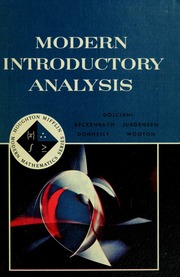
Internet Archive
104, xii, 660, 24 p. 25 cm
agile bone
ty for the responses
sage kelp
sage python
I do know some calculus books but at that point there's some branching depending...
It would be amazing to write down references, you must have some excellent ones
 fallow cypress
light umbra
and 'Introduction to Algorithms' by CLRS
fallow cypress
light umbra
and 'Introduction to Algorithms' by CLRS
oh I like that book :)
remote sparrow
looking at bass' graduate real analysis book
it's only the second edition
he is no longer publishing a paperback copy

well, at least it was very convenient to print with lulu
literally the first book where the project creation process was basically a complete cakewalk
 rancid obsidian
A book about permutations in analysis?
gray gazelle
Guys what would be some good books on topology?
I've heard about Munkres but not sure how it is
heady ember
I have heard people here recommend Lee's intro to topological manifolds
fallow cypress
"The standard textbook here seems to be the one by Munkres, but I’ve never been able to work up any enthusiasm for this rather pedestrian treatment" LOL
sage python
Lee Intro to Topological Manifolds if you want a book
Or chapter 1 of Bredon's Toplogy and Geometry
Hatcher has some notes which seem good too
simple raven
gray gazelle
either one or zero for calculus (you can learn this stuff from lectures)
and for...
as deep as a computer scientist needs
remote sparrow
computer science is super broad
can you narrow down what field of CS you're interested in?
i've only heard of algebraic coding theory, which presumably uses a ton of algebra
but obviously that's just a narrow section of CS
simple raven
AI or cybersecurity
remote sparrow
AI is a lot of stats, so analysis is likely going to much more helpful than algebra
cybersecurity...if you're focused on cryptography, there may be some algebra knowledge required
swift dome
Want some classic book recommendation for real analysis
simple raven
by analysis you mean real analysis and complex analysis right?
swift dome
I'm an undergrad student
swift dome
Real analysis
remote sparrow
stats is pretty much just on real numbers
swift dome
I think complex analysis is not in undergraduate


 remote sparrow
swift dome
I think complex analysis is not in undergraduate <:sully:651816820122189834>
remote sparrow
swift dome
I think complex analysis is not in undergraduate <:sully:651816820122189834>
just depends
gamelin, bak and newman, or ruel, brown, and churchill are all suitable books
sometimes undergrad complex analysis is called complex variables
simple raven
remote sparrow
cybersecurity...if you're focused on cryptography, there may be some algebra kno...
any recommendations for a book to start abstract algebra with?
remote sparrow
pinter or judson
they are both super cheap as paperbacks
judson is legally free online
and both have some computer science applications
judson has some coding exercises too if you care to do them
simple raven
thank you again
 true river
book for definite integration any?
 hasty turret
simple raven
AI or cybersecurity
hasty turret
simple raven
AI or cybersecurity
You want cryptography? Or security?
I think the crypto book is good
heady ember
New profile pic eh
 vocal dragon
does anyone have any recommendations for books to read before taking an olympiad?? high school level
pls dm me thank Uu
 celest mist
Hello can someone suggest some books i can get for free to develop problem solving for a hser
heady ember
What do you want to learn?
I don't think "problem solving for a hser" is specific enough
We have users here varing widely in what they are learning, even at hs
glacial crypt
like for example, grass is giving themselves active mental mutilation with a set theory book
and also a real analysis book
see the pins for book reviews
celest mist
heady ember
What do you want to learn?
Basic hs stuff
grand thistle
celest mist
Basic hs stuff
there's the art of problem solving books if ur looking for stuff like algebra 2, precalc, calculus
also "How to Solve it"
celest mist
Oh ok thx
celest mist
I dont want to do competitions
 mystic orbit
fallow cypress
"The standard textbook here seems to be the one by Munkres, but I’ve never been ...
mystic orbit
fallow cypress
"The standard textbook here seems to be the one by Munkres, but I’ve never been ...
Whatt does pedastrian mean? Lol
This is twice now that I've heard the term
heady ember
celest mist
Basic hs stuff
Khan Academy and Pauls' Online Math Notes are common recs for hs math
gray gazelle
mystic orbit
Whatt does pedastrian mean? Lol
Pedestrian means a person walking on the sidewalk ig ?
fierce hedge
mystic orbit
Whatt does pedastrian mean? Lol
I guess it means dull
crimson leaf
Pretty much unimaginative is another word
 gray jungle
mystic orbit
Whatt does pedastrian mean? Lol
gray jungle
mystic orbit
Whatt does pedastrian mean? Lol
The mathematicians in this pedestrian server
 rapid ruin
Number theory books to prepare for rmo
rapid ruin
rapid ruin
Number theory books to prepare for rmo
.
 pure iris
Any recommendation for numerical analysis books with theory and computational exercises?
swift dome
check out #competition-math they have quite good resource
 proven crown
gray gazelle
proven crown
gray gazelle
i found this on github , what do you think , about the books and the order provided ?

 sudden kindle
Terrible
undone finch
took a rough look at it, don't have much to say about the books but i don't understand many of the dependencies on this chart
novel obsidian
A good rule of thumb to follow is all of these charts are dogshit
undone finch
taking 4 steps in order to get to naive set theory and proofs doesn't sound necessary
this makes topics sound like they have a much higher entry barrier than they do
 fluid skiff
Automorphic forms and representation theory volume 1 seems like a good book
mystic orbit
gray gazelle
i found this on github , what do you think , about the books and the order provi...
Uh... Philosophy?
Who's this roadmap for? Lmao
Artin is there but
Number theory and then abstract algebra?
And also, linear algebra and then artin?
I guess it's trying to be as general as possible
But that comes at the cost of being suboptimal to everyone except a very very very specific demographic
mystic orbit
Any read map that goes through more than 3 topics is useless imo
sage python
And then Narasimhan
mystic orbit
Just ask people here for guidance lel
mystic orbit
 alpine rover
curious about this topic, are there any popular road maps?
alpine rover
curious about this topic, are there any popular road maps?
~~sheafification  ~~
~~
hazy elk
I think roadmaps are stupid for a young person learning math because you should learn what interests you and it's impossible to find that out without reading a bit first, and your interests keep changing as you read more, so a long list of books is pretty pointless
 shadow forum
disgusting name, dude
 lusty trail
Lol
gray jungle
mystic orbit
Any read map that goes through more than 3 topics is useless imo
It could probably be a good idea to just make a roadmap to learn the fundamentals everyone should know (ex: logic and set theory - la- basic number theory - real analysis - intro discrete - abstract algebra - probability - topology - complex analysis etc etc)
And then focus on specialized paths later.
Hard to go wrong with the order unless you are too ambitious
remote sparrow
pure iris
Any recommendation for numerical analysis books with theory and computational ex...
my school uses burden and faires. it looks like a pretty standard book.
remote sparrow
mystic orbit
Number theory and *then* abstract algebra?
my school requires number theory or a second course in linear algebra as a prerequisite for abstract algebra

it doesn't seem super necessary but maybe they don't want students to jump off into the deep end
mystic orbit
remote sparrow
my school requires number theory or a second course in linear algebra as a prere...
Bruh
Wat

I know 15 year olds that didn't do any LA before abstract algebra
remote sparrow
well, most of my classmates only had number theory
i mean everyone had lower-division linear algebra
 dense mantle
anybody know much about percolation theory? reading recommendations?
poking around online, it feels like the subject is either contained in a chapter of a more general book or its coin-flippy as to whether or not its written well or dense asf for no reason
crimson leaf
Percolation by Bollobas is the one a professor recommended to me if I was interested
mystic orbit
mystic orbit
I know 15 year olds that didn't do *any* LA before abstract algebra
@halcyon mesa Why  ? Lol
? Lol
Ofc
lumin isn't the only one lol
 smoky schooner
mystic orbit
~~sheafification <:bleakkekw:913344117981999125> ~~
smoky schooner
mystic orbit
~~sheafification <:bleakkekw:913344117981999125> ~~
whats wrong with sheafication
 quick hornet
remote sparrow
my school requires number theory or a second course in linear algebra as a prere...
quick hornet
remote sparrow
my school requires number theory or a second course in linear algebra as a prere...
probably just a general mathematical maturity requirement rather than a content one
since the only thing in linear algebra U intro number theory is "basic proofs"
and comfort with abstract definitions i suppose
which is an underappreciated skill when teaching at the entry level
foggy relic
sage python
Honestly just do Artin, Schroder, and Bredon
Lang, Browder, May*
/halfjoke
but also half not 🙂
sage python
Well Bredon also does difftop 😛
I'm thinking since Artin covers linear algebra and algebra
Schroder starts from calculus and gets through most of what you need in undergrad analysis
Bredon does the extra point-set you need for metric spaces, then does differential and algebraic topology
gray gazelle
over 12 hours and no one talks in this channel?
I found this cool book about tests of convergence for double series

prerequisites seem to only be some functional analysis
 west topaz
any book recommendations which contain practice questions?
for classes 9 and 10?
formal bronze
west topaz
any book recommendations which contain practice questions?
for classes 9 and 10?
What is your objective here? 'Classes 9 and 10' could mean very different levels of mathematics, depending on the context.
 dense night
formal bronze
What is your objective here? 'Classes 9 and 10' could mean very different levels...
dense night
formal bronze
What is your objective here? 'Classes 9 and 10' could mean very different levels...
im assuming classes 9 and 10 are from the indian school system, which is the same as gcse (year 10 and 11) in the uk or grades 9 and 10 in the us
west topaz
formal bronze
Standard textbooks should do then.
i completed them
so i wanted some more book recommendations
formal bronze
west topaz
i completed them
so i wanted some more book recommendations
Which topics?
west topaz
formal bronze
Which topics?
algebra mainly
 molten linden
good book for probability and stats?
something which preferably builds from the ground up
molten linden
also one for differential equations
 solid laurel
molten linden
good book for probability and stats?
solid laurel
molten linden
good book for probability and stats?
William Feller - An Introduction to Probability Theory and its Applications
gray gazelle
solid laurel
William Feller - _An Introduction to Probability Theory and its Applications_
not sure about that 
it's definitely a good book but does it cover what's in the modern curriculum
 fickle granite
How good is Tenenbaum for ODEs?
Looking through the contents it seems solid (I was specifically looking for a text that discusses series solutions), but now I'm thinking of sitting down with this book for a more rigorous self study of ODEs
crimson leaf
molten linden
good book for probability and stats?
Calculus based probably Ross, measure based there's a lot
remote sparrow
fickle granite
How good is Tenenbaum for ODEs?
it's good
here's a review you might be interested in
 hearty sluice
Resources for learning plumbed manifold theory?
 sharp turtle
hi guys, someone has an exercice book recommendation about analysis ?
remote sparrow
sharp turtle
hi guys, someone has an exercice book recommendation about analysis ?
real analysis?
 ebon marsh
Hi I want to learn measure theory
does anyone have book/class recommendations
I'm not in university
I've had real anaysis
I've been recommended sheldon axler's book. Any yay/nays for that
sage kelp
Is Chartrand Mathematical Proofs book solid for foundations?
remote sparrow
ebon marsh
Hi I want to learn measure theory
does anyone have book/class recommendations
I'...
some suggested books are in pins
axler's book is legally free online if you want to take a look at it
remote sparrow
sage kelp
Is Chartrand Mathematical Proofs book solid for foundations?
like, metamathematics and axiomatic set theory? no
as in preparation for future math classes? yes
sage kelp
Yes, as prep for upper math level classes
remote sparrow
yes it's fine
 sacred swan
Any book recommendations for an introductory text on Delay Differential Equations?
remote sparrow
@fallow cypress ugh, of course mileti's book is a print-on-demand
oh well
still fine with my purchase
 acoustic imp
ebon marsh
Hi I want to learn measure theory
does anyone have book/class recommendations
I'...
acoustic imp
ebon marsh
Hi I want to learn measure theory
does anyone have book/class recommendations
I'...
Cohn’s book was good
fallow cypress
remote sparrow
<@531535537362829315> ugh, of course mileti's book is a print-on-demand
he had a free copy on his webpage at some point
fallow cypress
ah
 vernal compass
ebon marsh
Hi I want to learn measure theory
does anyone have book/class recommendations
I'...
vernal compass
ebon marsh
Hi I want to learn measure theory
does anyone have book/class recommendations
I'...
Terence Tao’s
ebon marsh
vernal compass
Terence Tao’s
Oo
 grave thorn
ebon marsh
Hi I want to learn measure theory
does anyone have book/class recommendations
I'...
grave thorn
ebon marsh
Hi I want to learn measure theory
does anyone have book/class recommendations
I'...
Jacod/Protter
Rudin
(RCA)
I personally also like Malliavin "probability and integration"
sturdy shore
ebon marsh
I've been recommended sheldon axler's book. Any yay/nays for that
the parts I've read of axler were good, yay for that
he definitely pays attention to pedagogy more than most authors do
dapper root

grave thorn
Undergrad analysis should be enough
 cursive orbit
if u don't know any analysis, then pugh has a decent (but not terribly standard) treatment of measure theory once you get to the end
oh wait I misread too
💀
west topaz
@gray herald here book recommendations DAMN
 gray herald
 ikr
ikr
grand thistle
grave thorn
I personally also like Malliavin "probability and integration"
how does this book compare to jacod and protter's?
it's material (judging from the toc) looks like exactly what i want to learn, but ive already started and am on chapter 6 of jacod/protter so not sure if i should change or not
looks like this covers a lot more analysis too, which im a fan of
 orchid mortar
Don't change a book if a book fits you
You can also read more than one book
Jacod Protter will give you more than enough for most probability
grand thistle
orchid mortar
Don't change a book if a book fits you
it kinda doesn't fit me tho i feel like
orchid mortar
RIP
Uhh yeah there are at least 20+ probability books, at least 5 of which I consider 'good' for foundations
find any you like
I mean I don't think anyone reads Kallenberg on first go
grand thistle
i felt like it kinda develops the measure theory "along the way" which i kinda don't like tbh
i feel like having a solid foundation then learning the probability might be better? so books that have measure theory in the first section i prefer i think
orchid mortar
in that case it does sound like the Malliavin one fits better (though I never saw that book before)
Malliavin, from Wiki, comes from harmonic analysis. Definitely a reputable author
I'd personally prefer Jacod since I'm more into applications
grand thistle
orchid mortar
in that case it does sound like the Malliavin one fits better (though I never sa...
do u know if this is the malliavin from "malliavin calculus"?
that field looked really cool even though it's over my head
orchid mortar
Apparently it is
grand thistle
calculus of variations in probability or something
grand thistle
orchid mortar
Apparently it is
oh cool
malliavin's book looks very interesting
i like how he has fourier analysis integrated into the book
has all of the subjects i had been planning to learn since a few months ago
orchid mortar
go for it then
grand thistle
yep will do
grave thorn
grand thistle
how does this book compare to jacod and protter's?
Definitely more abstract
grave thorn
orchid mortar
Malliavin, from Wiki, comes from harmonic analysis. Definitely a reputable autho...
He started in harmonic analysis, then worked mainly on probability
grand thistle
grave thorn
Definitely more abstract
any prerequisites that it has that jacod and protter's book does not have?
i.e. does it assume topology or something
grave thorn
It assumes topology
I would say you could get by with just the topology you learn in real analysis
grand thistle
grave thorn
I would say you could get by with just the topology you learn in real analysis
so would basic knowledge of compactness (heine borel), properties and definitions of open/closed sets, definition of a topology and a hausdorff space be enough?
im pretty iffy on connectedness
also ofc things like characterization of continuity via open sets im familiar with
basically the topology from rudin pma
grave thorn
grand thistle
so would basic knowledge of compactness (heine borel), properties and definition...
That should be good
 rugged seal
Hello I am looking for a book about FDM and FME for (ellitptical) PDEs if possible the book should include:
-Introduction to PDE with examples
-classical solutions
-FDM
-weak solution (Sobolev-Spaces, embedding theorems etc)
-FEM
proud gazelle
what book to read to start with differential equations? I studied multivaraible calculus, linear algebra, and real analysis.
preferably something that has some rigour
remote sparrow
proud gazelle
what book to read to start with differential equations? I studied multivaraible ...
if you've had real analysis, i heard arnold's ODE book could be good
you won't learn how to solve some basic differential equations, but that's what computers are for
i've heard another rigorous book in ODE would be hirsch and smale's (without devaney - only first edition is like this) book. if you are interested in "cookbook" ODE, the best might be morris, tenenbaum, and pollard's or boyce and diprima's book with boundary value problems. morris' book has no bvp, but it does prove existence and uniqueness of solutions. most books nowadays treat ODE similarly to boyce, but boyce and diprima's book is the most comprehensive. a book that emphasizes qualitative and graphical analyses would be blanchard, devaney, and hall's book.
e. l. ince and earl a. coddington also have two elementary ODE books that are more theoretical, but remain elementary in scope. they are often cited as references for certain proofs in modern ODE books. they're cheap dover books, which is a plus.
 pale kite
anyone have a book for learning algebraic number theory that assumes a good comprehension on algebra (i.e. modules)
narrow fiber
I'd say milne's notes are best but I also love marcus' "number fields"
narrow fiber
Neukirch is great as well but markedly harder, dignity ^
sage python
Idk Milne as well so I can't compare the two for you
(And tbh I only know the very first part of Neukirch)
narrow fiber
Idk many people who've gone through more than the first part myself included lol
Milne takes his time across what Neukirch blazes through in like, 40 pages / a typical first course syllabus LOL
narrow fiber
The chmoat
remote sparrow
@stray veldt Since you mention using Amann Escher for undergraduate analysis, what had you taken prior to working through this book? Were proofs or some notion of proof sprinkled throughout your math education? Did you go to a relatively strong university? I know Amann Escher is a standard text for undergraduate analysis in Germany, but are there other standard texts? Or do German undergrads all go through Amann Escher?
indigo mesa
No it's not all german undergrads
I used it as a secondary source but my course was not based on it
prior to it i had taken nothing, that was my uni semester
remote sparrow
what was your pre-university background like?
indigo mesa
other standard texts are the Forster Analysis series for example
indigo mesa
remote sparrow
what was your pre-university background like?
nothing
remote sparrow
no calculus or algebra?
indigo mesa
dunno what that'd include
remote sparrow
did you go to some sort of high school before university?
remote sparrow
well then why would you say your pre-university background is nothing?
remote sparrow
indigo mesa
but i don't know what "algebra" is supposed to mean here
solving polynomials and simple stuff
like stuff on khan academy
indigo mesa
well ok HS education but nothing somehow related to uni stuff
remote sparrow
or paul's online math notes
indigo mesa
remote sparrow
solving polynomials and simple stuff
okay yeah we do that
we also do simple integrals and some differential calculus
but no limits or integration by parts or anything
remote sparrow
would you say you worked through some simple proofs there or was the course mainly about computing derivatives and integrals
i see
indigo mesa
it was nothing that somehow compared to uni maths
that's why i said nothing when you asked about pre uni background
sorry if that was misleading
remote sparrow
my opinion before today was that amann escher might be inappropriate to recommend to american students altogether
indigo mesa
not sure, i don't really get the american math major system
real analysis doesn't seem to be something you take in your first semester there
remote sparrow
american universities emphasize breadth a lot more
so you need to take some general ed. courses
remote sparrow
which i actually approve of
indigo mesa
yeah makes sense
we don't have those here
we just have to take a secondary subject
remote sparrow
people write off the humanities and social sciences and such a lot, but then they turn around and say misogynistic and racist stuff without any semblance of critical thinking
indigo mesa
indeed
maybe we should move this to another channel if we aren't actively discussing amann escher?
remote sparrow
nah it's okay
indigo mesa
but yeah i think amann escher is a great, a bit tricky sometimes, not an easy read but good
narrow fiber
How does amann escher compare to rudin pma
narrow fiber
indigo mesa
other standard texts are the Forster Analysis series for example
Which forster is this btw
pale kite
narrow fiber
Milne takes his time across what Neukirch blazes through in like, 40 pages / a t...
tysm!!! 😄
indigo mesa
narrow fiber
Which forster is this btw
Otto
I haven't read rudin pma so i can't comment on that :/
gray gazelle
best book for a first course in Point set topology?
narrow fiber
Oh yeah i know of otto forster from his riemann surfaces book
 gusty smelt
thats a p good book, the riemann surfaces one
gray gazelle
gray gazelle
best book for a first course in Point set topology?
anyone?
 tulip blade
Munkres is fine
smoky schooner
😩 fr
remote sparrow
got a used copy of schroder's analysis -- it's a gluebound in signatures
the glue is cracked
heady ember
remote sparrow
got a used copy of schroder's analysis -- it's a gluebound in signatures
Gluebound in signatures?
remote sparrow
heady ember
Gluebound in signatures?
signatures just means multiple pages are grouped together like so: there's one page, then stack another page, and so on, then fold them
dense mantle
random ask -- will be in the Comap MCM in a couple of weeks, and was wondering if anybody, well, knows where one might acquire the Mathematical Modeling for the MCM/ICM Contests Voume 1

This book series is a collection and expositions of the ideas, background knowledge, and modeling methodologies for solving the problems for the MCM and the ICM.
remote sparrow
heady ember
Mine seems to be in mostly good shape
send picture
esp of the binding
heady ember


 remote sparrow
yeah your book is gluebound just like mine
not quite print on demand but also seems like some corners were cut in production
the pages aren't truly sewn together
oh well, at least i know i couldn't have gotten a much better copy
amazon vendor said "very good" 🙄 but i don't feel like returning it
remote sparrow
when you open your book is the glue cracked anywhere?
heady ember
Haven't noticed that
remote sparrow


grounds for return? le "very good" condition according to vendor
the pages are fine
no writing
content is good
crimson leaf
Probably could return that lol
heady ember
remote sparrow
Mine's in a much better shape
Glue wise it isn't torn out and stuff
 frail wind
hi
i'd like to start studying math in books
i have some foundation, so i'm searching for something like highschool degree
heady ember
Highschool degree?
Wdym
For highschool stuff people normally rec Khan Academy and Paul's Online Math Notes
frosty yarrow
Any good books for learning series specifically?
heady ember
If you're learning it for the purpose of calc, Paul's Online Math Notes or Khan would probably suffice
frosty yarrow
I meant like, a book focusing on series (more than calc)
heady ember
Hmm
alpine rover
any proof based calculus books (that prove and don't just state the results we see in calculus like chain rule, FTC, ratio test)?
heady ember
Isn't that real analysis?
The closest thing I can think of that fits your description that's not analysis is Spivak
 tepid prairie
alpine rover
any proof based calculus books (that prove and don't just state the results we s...
tepid prairie
alpine rover
any proof based calculus books (that prove and don't just state the results we s...
Advanced Calculus by David V. Widder proves all of these types of things and takes nothing as assumed true.
gray gazelle
Spivak does a bit of both
alpine rover
thanks!
gray jungle
frosty yarrow
Any good books for learning series specifically?
gradshteyn and ryzhik (don't)
heady ember
Just do real analysis 
 tawny copper
frosty yarrow
Any good books for learning series specifically?
tawny copper
frosty yarrow
Any good books for learning series specifically?
Maybe Stromberg intro to classical analysis. The entire book is not entirely focused on series, but it has a chapter or two that covers more than the standard texts. You can look into that maybe. I also like Krantz, a primer on analytic functions. Duren is also nice.
If you are doing series for the first time, its probably better to pick standard books on analysis btw.
I'm pretty sure there must be books that focus entirely on series. Hardy wrote one on divergent series, but I'm not sure how readable it is
@frosty yarrow
 glacial locust
remote sparrow
glacial locust
remote sparrow
what grade is tat
tawny copper
there's a readable pdf of Titchmarsh and it starts with a chater on series, that book is interesting probably. I will look into that
frosty yarrow
Ah okay thanks for all the responses, I'll check them out
dense mantle
 cinder void
Book recommendations for SAT
cinder void
Book recommendations for SAT
certainly you don't mean the Scholastic Aptitude Test, as commonly administered in the United States for the purposes of a college entrance exam?
 sterile harness
cinder void
Book recommendations for SAT
sterile harness
cinder void
Book recommendations for SAT
lol, just use khan academy dont buy anything
also that is not what this channel is, this is for actual math books
 keen orbit
Hi everyone how are y'all
Is linear algebra by Stephen H. Friedberg better than elementary linear algebra,applications version by Howard anton or vice versa
crimson leaf
keen orbit
Hi everyone how are y'all
Is linear algebra by Stephen H. Friedberg better than ...
Two very different books with very different purposes. Friedberg Insel and Spence is a proof based text and anton linear algebra is a much more computational approach
keen orbit
Ohh okk
I think friedberg is better because it's proof based
Better than computational approach
remote sparrow
glacial locust
what grade is tat
usually a university class
foggy relic
alpine rover
any proof based calculus books (that prove and don't just state the results we s...
Loomis Sternberg
sturdy shore
stop giving troll recommendations
rugged seal
I am looking for a book about FDM and FME for (ellitptical) PDEs if possible the book should include:
-Introduction to PDE with examples
-classical solutions
-FDM
-weak solution (Sobolev-Spaces, embedding theorems etc)
-FEM
cinder void
dense mantle
certainly you don't mean the Scholastic Aptitude Test, as commonly administered ...
Yess
dense mantle
cinder void
Yess
just go buy a princeton review book
work through the practice tests (time yourself)
and you're chilling
easy Ws
cinder void
Okay thanks
glacial locust
remote sparrow
usually a university class
holy shit i cannot read any of that crap
sturdy shore
are you gonna major in math? then obviously
dense mantle
glacial locust
and im going to learn this?
that's an early analysis book (usually, you do single variable with rigorous limits, integrals, sums/ series, sequences; then, multivariable, a bit of manifolds, a bit of measure theory)
the more math you see, the easier it becomes
this should be 1st or 2nd year of undergrad mathematics
dense mantle
remote sparrow
schroder goes step by step in the early chapters
I am not familiar with this text, but I did like Understanding Analysis by Stephen Abbott when I read it
remote sparrow
abbott is great
remote sparrow
dense mantle
I am not familiar with this text, but I did like Understanding Analysis by Steph...
it's daminark's recommendation
glacial locust
im in 9th grade and doing algebra with 2 variables now
dense mantle
lmao you've got some time...
glacial locust
yeah i think
dense mantle
most of this discord is high schoolers begging for HW help
glacial locust
im just interested in math
dense mantle
and then a mix of undergrads and grad students in the advanced section
glacial locust
thats why i came here
wanted to ask about some problem that i didn't understand the solution of it
but i unrestood it randomly
and didn't ask finaly
dense mantle
the most accessible and interesting way for you to immediately realize that interest is competition math
glacial locust
dense mantle
the most accessible and interesting way for you to immediately realize that inte...
i can feel that already
dense mantle
otherwise you've got several "layers" of reading to get through before you're anywhere interesting
glacial locust
im laughing at my class that they don't know actuall topic we are doing
dense mantle
that's always going to be the case
glacial locust
🤷♂️
remote sparrow
you don't need to do competition math by the way. it's not representative of what undergrad or graduate math looks like, especially since problems in competition math are meant to be solved by design, just in some tricky way.
dense mantle
^^^^
glacial locust
i just like it
dense mantle
I think it's just a nice way for them to introduce ideas
dense mantle
besides... recreational math is a decent recreation
moving towards research, it is, indeed, not at all similar lol
remote sparrow
if you really want to try learning about proofs in a very gentle manner, jay cummings has a good book on proofs
glacial locust
remote sparrow
if you really want to try learning about proofs in a very gentle manner, jay cum...
bro im 9th grade
didn't finish middle school even
dense mantle
your age doesn't matter bruh
glacial locust
i know
remote sparrow
you've probably had geometry, though? although the way proofs in geometry is taught is quite stale...
dense mantle
if you want to learn, just go read
dense mantle
remote sparrow
you've probably had geometry, though? although the way proofs in geometry is tau...
yeah 🤣 you learn how to write "proofs" in that class
glacial locust
remote sparrow
you've probably had geometry, though? although the way proofs in geometry is tau...
i didn't have since like 2 classes
remote sparrow
you don't need to know much beyond a little algebra
dense mantle
they are just presented as "formally" writing out very obvious steps
dense mantle

glacial locust
dense mantle
if you want to learn, just go read
and its actually imposible to have my personal interests because every week we got at least 3 test or quizes
i want to get a+ in all of them
remote sparrow
just read in the summer
dense mantle
hop off discord and get to work then
glacial locust
remote sparrow
just read in the summer
thats what da dog gonna do
remote sparrow
or talk to an interested teacher if they could mentor you
dense mantle
I promise you, you never start having more free time
glacial locust
dense mantle
hop off discord and get to work then
i already studied 7 hours today
and its 21:45 my brain exploading
dense mantle
the amount of free time you have monotonically decreases year to year
you just get better at using it
glacial locust
remote sparrow
or talk to an interested teacher if they could mentor you
i need to learn at home because my teachers at my school they are not very well understandable
everyone somehow understands them
but i not
dense mantle
what country are you from?
 old elk
Previous topics to study varieties?
glacial locust
poland
dense mantle
ah interesting
glacial locust
but american school
i don't understand just his accent
indian one
its not like im racist
but sometimes i don't understand a single word from his sentences
remote sparrow
jay cummings' Proofs: A Long-Form Mathematics Textbook is a super readable book on how to read and write proofs
dense mantle
old elk
Previous topics to study varieties?
mmm... probably a semester or two worth of algebra and topology would be helpful?
forgive me... alg geo not my forte
only skimmed bits and pieces
glacial locust
but its not like i need to study 8 hours per day to understand what we covered on today's lesson
dense mantle
you could probably get better answers in the alg geo channel than here
glacial locust
im getting that after 15 minutes
dense mantle
glacial locust
but its not like i need to study 8 hours per day to understand what we covered o...
then what are you spending so much time studying
glacial locust
dense mantle
then what are you spending so much time studying
how can i say this
i don't want to sound like an idiot
yhh
stupid human
its gonna be so cringey i don't wanna to say this
i don't want to say why
can we just skip it?
dense mantle
no
old elk
dense mantle
mmm... probably a semester or two worth of algebra and topology would be helpful...
Would you recommend anything else besides that ?
dense mantle
old elk
Would you recommend anything else besides that ?
again... not my thing by any means. I just skimmed parts of harthshorne as it interested me
you should probably just talk to the people in the alg geo channel...
but yeah a full year of algebra definitely (naturally, it's algebraic geometry, right)
topology certainly helpful
at least, you'll see a lot of familiar words
not like point set top words, but all the projective plane shit
glacial locust
dense mantle
no
well after 5th grade i think i stoped studying school things at all, my grades were like d or f or e or what ever is that we don't have the letter rating but the number like 5 or 3. and i didn't study at all until last week when i realised that its the last time i will get comfortable and start actually studying for real because if i don't start now there will be no coming back and now i just needed to give it like 2 or 3 days to study the whole topic and know it perfectly
dense mantle
3rd year college in northeast now
glacial locust
and know everything perfectlyt
dense mantle
yeah uh nothing you cover up to first university is difficult by any means
glacial locust
dense mantle
yeah uh nothing you cover up to first university is difficult by any means
huh?
dense mantle
I think the real goal is to keep you busy and developing the academic skills
some sort of baseline
dense mantle
you have 4 years to figure that out
dense mantle
just read more bruh
dense mantle
on what topics
glacial locust
not for your age
glacial locust
dense mantle
on what topics
algebra
dense mantle
LMAO
glacial locust
🤷♂️
dense mantle
naw bro I'm not gonna slap you with the stat mech shit I am reading
buoyant vessel
polynomials by E.J.Barbeau
glacial locust
dense mantle
naw bro I'm not gonna slap you with the stat mech shit I am reading
yeah don't even show it to me
wait stat mech?
o shit
ok i pulled up?
dense mantle
buoyant vessel
polynomials by E.J.Barbeau
yeah I haven't seen this one before but these problem books are great reads/ things to work through
buoyant vessel
dense mantle
yeah I haven't seen this one before but these problem books are great reads/ thi...
yeh it's for highschool algebra but alot of hard questions, not abstract algebra

glacial locust
but how im gonna have time to read this book
i mean i will have
with no problem
dense mantle
yeah lmao you see algebra in this server and have to discern their age before you know how to answer the question
buoyant vessel
or just read AOPS books
dense mantle
^^^^^^^^^^^^^^^
I was just about to go link AoPS
Talk math and math contests like MATHCOUNTS and AMC with outstanding students from around the world. Join our active message boards now.
dense mantle
remote sparrow
you don't need to do competition math by the way. it's not representative of wha...
bumping this again
 dense mantle
and, once again, it remains a great way to just see a lot of math
 dense mantle
yeah
that's one of several
I think the algebra specific book may be not as interesting
glacial locust
bro i think its even created by polish man
dense mantle
no he's american
glacial locust
ruszczyk is polish name
dense mantle
polish descent sure
sterile harness
Richard Rusczyk has the most entertaining videos
I could watch that guy solve math problems all day
I think it's just "Russick"
 dense mantle
mm I've always read it in my mind with a "richer" sort of "Ruschick"
but I have no idea
sterile harness
glacial locust
thats what im doin
They cover it at a higher level
It's much harder in AoPS books
glacial locust
3 variables?
dense mantle
yeah ahhh "linear equations" go well, well, well beyond y = mx + b
sterile harness
Not necessarily (3 variables, that is)
dense mantle
glacial locust
3 variables?
n variables
glacial locust
dense mantle
n variables
 dense mantle
just go read it
glacial locust
holding hands up
dense mantle
and you'll begin to realize that, indeed, you know nothing
glacial locust
dense mantle
just go read it
 sterile harness
dense mantle
and you'll begin to realize that, indeed, you know nothing
sterile harness
dense mantle
and you'll begin to realize that, indeed, you know nothing
yeah that happened to me lol
dense mantle
honestly
glacial locust
dense mantle
and you'll begin to realize that, indeed, you know nothing
what do you expect from 9th grade
im piece of shit compared to you
dense mantle
your ego with these topics
sterile harness
No he means you don't even really know algebra
dense mantle
is evident in your tone
buoyant vessel

sterile harness
Because school doesn't really teach it
dense mantle
because you have not been ass-blasted yet
glacial locust
what do you mean
glacial locust
of course
dense mantle
I don't really even study algebra apart from using it as a tool for the combo and probability things I really care about
for you its, roughly, "equations and quadratics"
for me its, roughly, "groups, rings/ fields, and polynomials"
sterile harness
no it's "variables"
glacial locust
sterile harness
no it's "variables"
yes
dense mantle

sterile harness
Go read that book
dense mantle
yeah that's what you can do
buoyant vessel

glacial locust
ok
dense mantle
go read those books
we just dropped months and months of good reading on you
go do it
glacial locust
WHAT
glacial locust
how
dense mantle
that's too vague/ broad of a question for me to answer
glacial locust
i just need to whatch some crappy youtube video to understand what is happening while solving things that will be on my test
you need to read books made by albert einsteins
remote sparrow
buoyant vessel
read Basic Algebra by Jacobson
(do not)
dense mantle
unironically
dense mantle
Algebra: Chapter 0 by Aluffi is also a great algebra book
glacial locust
 buoyant vessel
someday read this too
 glacial locust

dense mantle
Jewish Problems
glacial locust
buoyant vessel
it has 6k questions in it
what the fuck?
dense mantle

buoyant vessel
become diligent clerk's apprentice-frepog
glacial locust
wha hapen
dense mantle
@glacial locust just think bro everything you're doing now can be found on chegg/ has youtube videos explaining exactly the method you need for your solution
glacial locust
i can't compliment you?
dense mantle
just wait
glacial locust
dense mantle
<@828031001489178634> just think bro everything you're doing now can be found on...
yes
of co
what do you mean wait
dense mantle
soon enough you'll be working on things that don't even have textbooks written for them
just the papers bro
glacial locust
i think i can imagine it
dense mantle
some half finished codebase for some idea some bro had for some numerical scheme
glacial locust
dense mantle
soon enough you'll be working on things that don't even have textbooks written f...
how do i will know that the answer i will get is the right thing
dense mantle
well
you've seen us talk about proof writing
soon enough you will no longer be working out equations to come to a number
glacial locust
dense mantle
soon enough you will no longer be working out equations to come to a number
what do you mean
dense mantle
you will be writing, for lack of a better word, "short math essays"
dense mantle
for which either your work is obviously correct, has some small errors, or is a completely incorrect direction
glacial locust
how will i know that its going to the right direction
im adding you to friends
you will be my mentor
or book recomender
buoyant vessel
idolize clerk too
dense mantle
lmao aight
glacial locust
i knew it that it will happen some day
dense mantle
I think most of the undergrads
in this server
could drop enough on you to do that
don't limit yourself to pinging me
glacial locust
you are the 1 one that know more than me and helped me
dense mantle
I am far from the local max in this server for any particular topic
 glacial locust
but should i read the book right now?
like i think i don't need it now
my test will be from the book things
dense mantle
yeah why not
glacial locust
and i know the book things
dense mantle
bro if you want to learn something you can just go read about it
you don't need to wait to have a test on it
hell, depending on how large of a university you go to, it could very well be that there is no course pertaining to whatever you're interested in learning
glacial locust
dense mantle
bro if you want to learn something you can just go read about it
i like this things
dense mantle
the moral of the story is to go read more and work on more problems
that is strictly how one gets better at mathematics
glacial locust
i can't even imagine how much power you all guys got
dense mantle
not much
glacial locust
dense mantle
not much
dense mantle
I'm still far asf from writing a paper
glacial locust
do me some problem
rn
maybe not here
because its book recomendation
channel
 fiery radish
ok
 upper wedge
I need a book to help me learn the basics of math again. Like arithmetic and all that stuff. Any recommendations?
frail wind
sterile harness
lol, just use khan academy dont buy anything
also that is not what this channel...
wow, could you be less stupid?
mystic orbit
buoyant vessel
clerk=local max for foundations
Who's local max


 buoyant vessel
sterile harness
frail wind
wow, could you be less stupid?
I’m talking about the SAT
It is not necessary to buy anything to prepare for SAT math
 small lantern
hey guys odd question but is there a resource i can cite to show that 1 can be represented as a fraction?
like is that a polynomial/real number operation?
like in grde 5 u learn that 1/1 = 1
and that 2/2 = 1
then in secondary school u learn that a polynomial over an equal polynomial is 1
but how would u actually cite that?
 pallid frigate
Hey guys 🙂
I'm looking for a Linear Algebra book to use as a reference alongside my books from the university (they're in my native language).
Can you guys recommend me of a book?
I've found "Linear Algebra and its Appliances" and "Linear Algebra Done Right", but as I was looking through their table of contents it didn't cover all of the topics in my Linear Algebra courses.
I have two Linear Algebra courses...
Linear Algebra 1 - Preparatory review; Linear equations and Rn; Matrices and determinants; Fields and the field of complex numbers; Vector spaces; Basis and dimension; Linear transformations; Eigenvalues and eigenvectors; The Euclidean n-space.
Linear Algebra 2 - Inner product spaces; Bilinear and quadratic forms; Canonic forms.
sturdy shore
hoffman kunze, also check pins
pallid frigate
sturdy shore
hoffman kunze, also check pins
Thank you, I'll look at that. And sorry, I'll check the pins.
remote sparrow
The Princeton Companion to Mathematics and The Princeton Companion to Applied Mathematics
 stone orbit
Sequence of books to get me from where I am now to Galois Theory?
I’ve taken Calc 3, ODEs, done some competition math, but i’m completely new to abstract algebra.
fallow cypress
Dummit-Foote maybe? I imagine you're not just literally just looking to get to Galois Theory as fast as possible but want to learn a decent amount of abstract algebra along the way
In which case Dummit–Foote is an excellent resource
remote sparrow
stone orbit
Sequence of books to get me from where I am now to Galois Theory?
I’ve taken Cal...
pinter or judson are good
stone orbit
^thanks to both
dense mantle
stone orbit
Sequence of books to get me from where I am now to Galois Theory?
I’ve taken Cal...

This abstract algebra textbook takes an integrated approach that highlights the similarities of fundamental algebraic structures among a number of topics. The book begins by introducing groups, rings, vector spaces, and fields, emphasizing examples, definitions, homomorphisms, and proofs. The goa...
this is a young book
and I will admit personal interest in plugging it, but I do like it as an undergrad algebra book
I think it's laid out a little more "naturally?" than D&F and some of the others... idk. if you want to have that as an extra resource, it is on libgen etc already
mystic orbit
frail wind
wow, could you be less stupid?
wow, could you be less toxic?
And instead bring something valuable to the conversation?
mystic orbit
sterile harness
lol, just use khan academy dont buy anything
also that is not what this channel...
Read channel description.
 vital bane
mystic orbit
And instead bring something valuable to the conversation?
vital bane
mystic orbit
And instead bring something valuable to the conversation?
he did, he's showing everyone how not to talk to people on the internet 
undone finch
halloooo i've been trying to find good references for exterior algebra, anyone has recommendations? :)
 little summit
im trying to find some analysis books, here are some that were recommended to me, could you add to this list?
Tao's Analysis I & II
Spivak Calc
Pugh
Ethan D.Bloch “the real numbers and real analysis”
Zorich
Parzynski and Zipse
Jay Cummings’ real analysis
Schroder and Browder
Real Analysis by Pons
Basic Analysis I by Lebl
The Way of Analysis by Strichartz
Introduction to Real Analysis by Bartle and Sherbert
glacial crypt
abbott
grand thistle
amann and escher
 grizzled rock
good books to get started on imo prep ?
distant spear
little summit
im trying to find some analysis books, here are some that were recommended to me...
Pugh
gray gazelle
little summit
im trying to find some analysis books, here are some that were recommended to me...
Ethan D. Bloch "the real numbers and real analysis"
if u need a rigorous detailed intro but its a bit dry
little summit
nice thx!
fierce hedge
little summit
im trying to find some analysis books, here are some that were recommended to me...
Zorich
sterile harness
mystic orbit
Read channel description.
right, mb
remote sparrow
little summit
im trying to find some analysis books, here are some that were recommended to me...
my school uses parzynski and zipse. jay cummings' real analysis book is another good choice. daminark recommends schroder and browder. another author is pugh.
 desert thorn
I am looking for an undergraduate Linear Algebra book that is good for learning how to prove "basic" linear algebra stuff. I've passed the courses so i don't really need to do much computation anymore, but my grip on the theory needs to be firmer. I'm awful at proving, i really should've appreciated its importance much earlier - so i want to work on this as well. Trying to kill 2 birds with 1 stone basically. Any recommendations?
crimson leaf
desert thorn
I am looking for an undergraduate Linear Algebra book that is good for learning ...
FIS is my recommendation but in the pins there's good LA books
desert thorn
Friedberg, Insel and Spence? I'll give that a look. Thanks.
 cinder trellis
Does anyone know if Michael Spivak's "Publish or Perish" publishing company has its own website? I've tried to find it online but came up with nothing...
undone finch
desert thorn
Friedberg, Insel and Spence? I'll give that a look. Thanks.
i def had good experiences with it. i think more people use hoffman-kunze though so it's def one to look for. i have the impression that friedberg-insel-spence exercises are easier on average, it's up to you if this is an advantage or not
there's also shilov
haven't read a lot of it because i use it mostly as a companion to FIS. i find it good but it's uhh unorthodox to say the least
remote sparrow
cinder trellis
Does anyone know if Michael Spivak's "Publish or Perish" publishing company has ...

Michael Spivak, Michael D Spivak, Michael David Spivak
Physics for Mathematicians, Mechanics I ,Calculus, 4th edition fourth Edition ,Combined Answer Book For Calculus Third and Fourth Editions first Edition ,Vectors and Transformations in Plane Geometry,A Comprehensive Introduction to Differential Geometry, Vol. 4, 3rd Edition,A Comprehensive I...
desert thorn
undone finch
i def had good experiences with it. i think more people use hoffman-kunze though...
easier is good until it isn't. A challenge is important, but it has to be right for the level you're at - not all study time is good study time.
undone finch
i guess you gotta try. easy is relative too
you can work through chap 1 in a few or one day, and see how you feel about it
desert thorn
Yeah, no other way to find out than just try it. And i feel like a lot of self-study material ends up being a matter of preference. So "best" is always relative.
 pale badge
Vladimir Arnold ODEs or George Simons ODEs? looking for a practical approach