#book-recommendations
1 messages · Page 20 of 1
 gray gazelle
rmo is regional and the syllabus is same
The difficulty level of the examination increases from the Pre-Regional Mathematical Olympiad (PRMO) to International Mathematical Olympiad (IMO).
 shadow tusk
thanks for your contributions @sturdy shore, the description's now been changed https://github.com/ossu/math
GitHub
🧮 Path to a free self-taught education in Mathematics! - GitHub - ossu/math: 🧮 Path to a free self-taught education in Mathematics!
 hasty turret
Why is Geometry and topology an advanced topic?
shadow tusk
hasty turret
Why is Geometry and topology an advanced topic?
I guess that's because topology isn't included in the three content areas that are specifically recommended as required for every mathematical sciences major program
which are Calculus, Linear Algebra, and Applied Statistics and Data Analysis
according to the 2015 CUPM curriculum guide
 narrow fiber
well
I think the genuine reason
is that topology and geometry can get Really Hard
 foggy relic
shadow tusk
thanks for your contributions <@142642217150971905>, the description's now been ...
foggy relic
shadow tusk
thanks for your contributions <@142642217150971905>, the description's now been ...
This list rivals the fast track
 sage python
shadow tusk
according to the 2015 CUPM curriculum guide
sage python
shadow tusk
according to the 2015 CUPM curriculum guide
Looking up what this is I don't think people actually take that seriously
shadow tusk
sage python
Looking up what this is I don't think people actually take that seriously
is it bad?
 uncut zealot
shadow tusk
which are Calculus, Linear Algebra, and Applied Statistics and Data Analysis
uncut zealot
shadow tusk
which are Calculus, Linear Algebra, and Applied Statistics and Data Analysis
Of these the only two I plan to take are calculus and LA, which I've already taken years ago. Data analysis isn't even offered at my school.
Also, I was talking with a friend of mine who wanted to know more about fractals and I realized I literally only know the pop-math version of fractals. What are some recommendations for learning about fractals given a reasonably strong undergrad math background?
 fallow cypress
Yes it's good, really gentle introduction; you might want a more advanced textbook if you have more experience, but other than that, no complaints
shadow tusk
uncut zealot
Also, I was talking with a friend of mine who wanted to know more about fractals...
went to reddit and heard good things about https://www.amazon.com/Fractal-Geometry-Mathematical-Foundations-Applications/dp/111994239X
 random spear
looking for maybe grad level set theory? I'd like to get into ordinals, axiom of choice, etc
 sturdy shore
grad level would assume you already know all those and would skim through them
I assume you are looking for something on the level of jech - introduction to set theory (baby jech)
 quiet shore
anyone have any strong opinions on Stein & Shakarchi b4's treatment of probability? (the funcanal book, ch. 5 titled "Rudiments of Probability Theory") I liked good chunks of b1 and b3 and want to know whether the treatment is too sparse / too dense / etc. given that the topic is only given one chapter
 sullen spruce
yeah, I need resources to learn a few topics which are not provided in NCERT and Aakash modules, for example number theory
 rigid trail
Any recommendations for an introduction to PDEs?
 remote sparrow
rigid trail
Any recommendations for an introduction to PDEs?
remote sparrow
rigid trail
Any recommendations for an introduction to PDEs?
evans is a graduate book. for undergraduate, consider strauss or zachmanoglou
 daring lake
Hi, sorry to interrupt. I am planning to take a course on real analysis this semester and though to get Royden and Fitzpatrick to supplement it. Would that be a good book?
remote sparrow
royden is graduate
rigid trail
remote sparrow
evans is a graduate book. for undergraduate, consider strauss or zachmanoglou
Thank you
remote sparrow
 rigid trail
I'll check them out
random spear
sturdy shore
grad level would assume you already know all those and would skim through them
ah my bad---i'd still be interseting in hearing though. i prefer the slow pace through intro grad texts so long as they have enough content that i can parse through it eventually
daring lake
 orchid mortar
As said, Royden is graduate
orchid mortar
As said, Royden is graduate
Oh, what would be suitable for UG?
remote sparrow
daring lake
Oh, what would be suitable for UG?
baby rudin, abbott, cummings, bartle and sherbert, etc.
there is a wide variety
remote sparrow
baby rudin is likely to be the most difficult if you are studying it completely by yourself, but if you have a mentor or a dedicated study group, it could work
rudin also has the most supplementary resources available
francis su and winston ou have lectures following baby rudin
francis su goes from chapters 1-5
winston ou goes to chapter 7 i think
sturdy shore
random spear
ah my bad---i'd still be interseting in hearing though. i prefer the slow pace ...
kunen is the canonical intro grad text from what I've seen
focused on forcing and independence proofs
sage python
shadow tusk
is it bad?
Idk about bad but departments do what they wanna do based on their internal ideas, resources, etc. Nobody cares about some self-proclaimed governing document
daring lake
remote sparrow
winston ou goes to chapter 7 i think
Okay, I will look through them, tysm
narrow fiber
remote sparrow
https://www.youtube.com/watch?v=-yksoVsb47s
oh interesting to see asmar here lol
my physics prof will draw on parts of it I think
 cedar flume
Hello, can anyone recommend book for differential geometry please
 young cloak
Does there exist a "Bible" of Number Theory?
Just as Algebra has 'Algebra by Serge Lang'.
 frosty yarrow
Anyone?
 hazy elk
frosty yarrow
Anyone?
hazy elk
frosty yarrow
Anyone?
It's a fine book, the subject of cookbook/technique oriented ODEs is boring so can't really comment more. The "theory" is easy to understand and the problems are mostly routine applications of the techniques.
I don't know who needs to learn ODEs like this tho
Cus applied math ppl + scientists and engineers do comp stuff anyways for differential equations and whenever some analytical stuff shows up you can just look up the technique
Waste of time for everyone
But well if you need it for a course, not much you can do.
gray gazelle
young cloak
Does there exist a "Bible" of Number Theory?
Just as Algebra has 'Algebra by Se...
you mean elementary number theory, analytic, or algebraic?
i'm assuming elementary
 grand thistle
daring lake
Okay, I will take a look
grand thistle
daring lake
Okay, I will take a look
also if you use baby rudin there’s a good supplement that tells you what exercises are good to do and even has exercises not in the book
i used it for my first time learning analysis and although it was hard this helped a lot
daring lake
Thank you very much for sharing
young cloak
gray gazelle
you mean elementary number theory, analytic, or algebraic?
Yeah elementary maybe...
If that fulfills.
Though doesn't matter to me, because if any other subfields have prerequisites I'm planning to cover that up too.
gray gazelle
young cloak
Yeah elementary maybe...
If that fulfills.
Though doesn't matter to me, becaus...
try Burton or Dudley
for ENT
young cloak
gray gazelle
try Burton or Dudley
any difference between two?
gray gazelle
young cloak
any difference between two?
dunno, I've only done Burton - but I heard Dudley is good too.
young cloak
gray gazelle
dunno, I've only done Burton - but I heard Dudley is good too.
Because I already took Linear Algebra, Abstract Algebra and Analysis...
gray gazelle
none of that is needed for NT imo
but if you've done algebra i suppose it helps
how far into algebra are you?
young cloak
I was kinda looking for more advanced texts
gray gazelle
hold on, I think I might have what you want
young cloak
gray gazelle
how far into algebra are you?
Just groups
gray gazelle
if you want something advanced, try "ireland/rosen's a classical introduction to modern number theory"
it's a graduate text
young cloak
ok it's more towards analytical ig?
gray gazelle
young cloak
Just groups
probably doesn't matter then
gray gazelle
young cloak
ok it's more towards analytical ig?
it requires you to be familiar with some basic abstract algebra and builds from the ground up
young cloak
@gray gazelle
Thnx - my college math department has scarce pure Number Theorists
young cloak
cool
 spring anchor
Hey. Does anyone have solution manual for the problems in the book on Analysis by N. L. Carothers..
Can you please share the link?
 fluid hull
Hello!
Does anyone have any book/lecture note recommendations on an elementary introduction to formal linguistics? Specially if it does specify connections and inspirations from formal logic?
A history of the subject would also be lovely.
 iron granite
I want all books which will outline how to earn money from a math degree. Please write your recommendations in set builder form.
 real veldt
Become a software developer 🙂
gray gazelle
Is Douglas B West's book good for graph theory?
fluid hull
We do use it for our graduate course on graph theory and have covered almost all the first 5 chapters.
It seems pretty standard and beginner-friendly.
Bondy & Murty is also a good book, so I've heard
gray gazelle
Bondy and murty is too expensive for me to buy physically
Douglas B West's book got an Indian subcontinent edition
So much cheaper
fluid hull
Oh, is having a physical copy something that is necessary?
There are resources for finding PDF files of books that are much too expensive.
 finite thorn
I'm thinking about getting myself a kindle (specifically a kindle scribe whenever that comes out in my region) to read math books, does anyone else think this is a good idea? The tablet itself is expensive but you can write on pdfs so that could work well I suppose
iron granite
real veldt
Become a software developer 🙂
I was setting it up for someone to go {} but this is actual advice.
gray gazelle
fluid hull
Oh, is having a physical copy something that is necessary?
There are resources ...
I personally prefer physical books haha
Just a choice
fluid hull
Haha, of course. That's perfectly valid🌺
Well, I'm from a country that doesn't really provide the resources to buy any books that aren't translated unless you find one luckily in your university library, so getting PDFs and printing them is how I usually get "physical copies".
Maybe you can print it chapter by chapter as you read through the book; it'll also save money if you end up only needing parts of the book, rather than its totality
But West is good too, either way.
 swift dome
any recommendations on linear algebra that are thorough and at a beginner level
 crimson leaf
swift dome
any recommendations on linear algebra that are thorough and at a beginner level
crimson leaf
swift dome
any recommendations on linear algebra that are thorough and at a beginner level
Computational or proof based
 heady ember
Look in pinned
 rigid barn
swift dome
any recommendations on linear algebra that are thorough and at a beginner level
rigid barn
swift dome
any recommendations on linear algebra that are thorough and at a beginner level
Hoffman & Kunze if you want real linear algebra, not just matrices and column vectors
 mossy flume
for something proof based I really liked FIS
crimson leaf
Yeah for proof based FIS is beginner friendly
gray gazelle
swift dome
any recommendations on linear algebra that are thorough and at a beginner level
Serge Lang's Introduction to Linear Algebra
gray gazelle
crimson leaf
Computational or proof based
beginner level LA is usually never proof-based
it's almost always computational
and saturated with determinants
shadow tusk
swift dome
any recommendations on linear algebra that are thorough and at a beginner level
not a book but check this out https://ocw.mit.edu/courses/18-06sc-linear-algebra-fall-2011/

MIT OpenCourseWare
This course covers matrix theory and linear algebra, emphasizing topics useful in other disciplines such as physics, economics and social sciences, natural sciences, and engineering. It parallels the combination of theory and applications in Professor Strang’s textbook Introduction to Linear Algebra.
...
crimson leaf
gray gazelle
beginner level LA is usually never proof-based
That depends on which country you're in and school you go to
sage python
Yeah the reason it's common in America to have this split isn't that it's good pedagogy, as much as many people cope themselves into thinking this
It's that a lot of departments aren't in a position where it makes sense to have a completely separate path through the first two years for future math majors. A lot of people don't come in thinking they'll major in math, and manpower is limited.
So you just put both future math majors and future science/engineering majors through the same first two years
crimson leaf
There also tends to be a lot more engineering+physics+comp sci students who will take LA than math students
sage python
And yeah the needs of science/engineering majors will be prioritized in that case because they're the bulk of the students (and thus of the funding)
Then after second year when you know who your math majors are
You do things right
But in some American universities where there is more manpower and demand, and in many countries (e.g. a good part of western Europe I think) where you apply directly to your major
You can teach linear algebra including the abstraction from the beginning
mossy flume
yea the benefit of going to a large school is that the only LA class I've had was proof based from the beginning
and the computational lin alg course is completely separate
and the university had enough profs to run both separately
but ofc not every university can do this
mossy flume
crimson leaf
There also tends to be a lot more engineering+physics+comp sci students who will...
there tend to be a lot more of people in those majors than math lol
math is relatively unpopular compared to engineering and CS especially
remote sparrow
young cloak
I was kinda looking for more advanced texts
niven, zuckerman, and montgomery may be right for you, while remaining firmly undergraduate.
remote sparrow
swift dome
any recommendations on linear algebra that are thorough and at a beginner level
 hollow hedge
Hi, I am taking a Calc 1000 course and I didn't do so well last time, I ended up dropping the course. Primarily I struggled because I've never done any highschool math/algebra before, to the extent that terms like "distribute x" or "isolate x" were foreign to me, so was the Trig used. I feel fairly confident in those things now, but I'd like to be better prepared this time. I'm looking for any book recommendations. Especially those with lots of examples and practice questions.
There is no textbook required for the course, they base it off this free source: https://openstax.org/books/calculus-volume-1/pages/1-1-review-of-functions
However, they do have an optional recommended textbook "Single Variable Calculus: Early Transcendentals by James Stewart" is that worth it? It's over $100 as most textbooks are, so I'm hesitant.

Given two sets ... and ... a set with elements that are ordered pairs ... where ... is an element of ... and ... is an element of ... is a relation from...
 cursive orbit
hollow hedge
There is no textbook required for the course, they base it off this free source:...
cursive orbit
hollow hedge
There is no textbook required for the course, they base it off this free source:...
no
if you really want a physical copy of a textbook, buy a used version of stewart
or earlier edition
those are often near-identical and are 10% of the price
 loud finch
Any book recommendations for 17 year olds? I’m interested in pure maths and stats. I’m looking for a book which would be suitable for my age and doesn’t have any advanced graduate level mathematics🤞
remote sparrow
loud finch
Any book recommendations for 17 year olds? I’m interested in pure maths and stat...
there is no book suitable to your age specifically (see an exceptional case in lyra), but rather to your background. what have you learned already?
loud finch
remote sparrow
there is no book suitable to your age specifically (see an exceptional case in l...
I’m from the UK (Ik a lot of people here are from America so they have different names for courses). But I’m studying a level maths and further maths. In general some of the topics I’ve done are differentiation, integration, linear algebra, proof by induction, complex numbers
remote sparrow
loud finch
I’m from the UK (Ik a lot of people here are from America so they have different...
some of the recommendations are not relevant. if you have already learned some linear algebra, you can look at the pins.
loud finch
remote sparrow
some of the recommendations are not relevant. if you have already learned some l...
Ok I’ll take a look at them, thank you
real veldt
Complex analysis recommendations?
 hollow peak
stein shakarchi, marsden, ahlfors, and conway are all pretty good
 sage kelp
hollow hedge
Hi, I am taking a Calc 1000 course and I didn't do so well last time, I ended up...
sage kelp
hollow hedge
Hi, I am taking a Calc 1000 course and I didn't do so well last time, I ended up...
Thomas’ Calculus looks really good to me so far! I’m about to finish Chapter 2
 karmic onyx
young cloak
Does there exist a "Bible" of Number Theory?
Just as Algebra has 'Algebra by Se...
karmic onyx
young cloak
Does there exist a "Bible" of Number Theory?
Just as Algebra has 'Algebra by Se...
algebra by serge lang is my least favorite algebra text
 boreal vine
Any calculus introduction book recommendation?
karmic onyx
cursive orbit
<@900170470584889375> ping pong
i'm literally in livermore
hazy elk
loud finch
Any book recommendations for 17 year olds? I’m interested in pure maths and stat...
If I were your age, I'd either read Abbott "Understanding analysis" or Axler "Linear Algebra done right" or Gallian "contemporary abstract algebra". I think all these books are approachable for ppl who haven't studied proofs (and also contain math you definitely need to know if you go into math), alternatively if you have specific interests like number theory you could read any elementary number theory book.
hazy elk
hazy elk
If I were your age, I'd either read Abbott "Understanding analysis" or Axler "Li...
I'd advise against reading an "intro proofs book" unless you are unable to progress through sections despite having read them multiple times (over a week). Simply because there's more fun ways you can learn math
 devout hollow
Hello. Can anyone recommend me a brief introduction to the basics of abstract algebra? To provide some information on my background in algebra, I finished "Introduction to Linear Algebra" by Serge Lang, and have also read up to page 184 of "Linear Algebra" by the same author.
heady ember
hazy elk
If I were your age, I'd either read Abbott "Understanding analysis" or Axler "Li...
Schroder works too
(anal book)
heady ember
The last 2 pages of Enderton's Elements of Set Theory (logic appendix) is also nice for getting an idea of how the flow of trying to prove something goes imo
gray gazelle
does anyone know any good pre-university book?
heady ember
Be more specific, what topic do you want people to give you recs for
gray gazelle
trig and algebra and calculus
heady ember
In that case probably Khan Academy and Pauls' Online Math Notes are common recs, though they are not books but online resources
frosty yarrow
hazy elk
It's a fine book, the subject of cookbook/technique oriented ODEs is boring so c...
ah alright, thanks for the response. do you think getting advanced engineering mathematics by Kreyszig would be better instead, since it has quite a large portion on DEs already (instead of buying a separate book for DEs)?
heady ember
They're free too btw
gray gazelle
oke thank you
sage kelp
boreal vine
Any calculus introduction book recommendation?
Thomas’ Calculus
frosty yarrow
boreal vine
Any calculus introduction book recommendation?
calc made easy, got me into calc in the first place
very simple explanations yet very real concepts
https://www.gutenberg.org/files/33283/33283-pdf.pdf its free aswell
 iron panther
any recomendation for a book on advance calculus
narrow fiber
by advanced calculus do you mean analysis or just more rigorous / broader calc
 tepid prairie
iron panther
any recomendation for a book on advance calculus
tepid prairie
iron panther
any recomendation for a book on advance calculus
Advanced Calculus by David V. Widder. 🙂
 fading wave
anyone have good book for real analysis?
I really want to have practice problems WITH solutions
hazy elk
frosty yarrow
ah alright, thanks for the response. do you think getting advanced engineering ...
Depends on why you wanna learn DE's, like I said it's probably pointless for scientists and engineers to learn a bunch of techniques (which they may or may not need) to solve DE's and instead just learn it when it shows up.
frosty yarrow
Thanks!
 karmic thorn
Introductory textbook for hyperbolic geometry?
Ideally at an advanced undergrad/early grad level
That was a fast react 
I'll take a look, thanks 
It could cover the first bit of the course, so looks good
The stuff beyond is probably more GGT anyway
Geometric Group Theory
sage kelp
narrow fiber
by advanced calculus do you mean analysis or just more rigorous / broader calc
What about a book with more rigorous calculus? Something similar to Spivak or Apostol?
 sick vector
sage kelp
What about a book with more rigorous calculus? Something similar to Spivak or Ap...
sick vector
sage kelp
What about a book with more rigorous calculus? Something similar to Spivak or Ap...
Courant's Intro to Calculus and Analysis.
foggy relic
sage kelp
What about a book with more rigorous calculus? Something similar to Spivak or Ap...
Loomis Sternberg
 alpine rover
devout hollow
Hello. Can anyone recommend me a brief introduction to the basics of abstract al...
alpine rover
devout hollow
Hello. Can anyone recommend me a brief introduction to the basics of abstract al...
gallian's contemporary abstract algebra
if you want something easier (which i doubt), you can do saracino
if you want something harder, you can do artin, fraleigh, or d&f
i absolutely loved gallian though, thought it was the perfect level of instructiveness, readability, and enjoyability
iron panther
tepid prairie
Advanced Calculus by David V. Widder. 🙂
thanks
alpine rover
 glacial crypt
d&f can be quite terse
glacial crypt
d&f can be quite terse
agreed, very dry but good reference
 cold lodge
hello peeps
 solemn rover
We say that a set is of cardinality aleph null if it can be put into one-to-one correspondence with the natural numbers. So for example there is a bijection between Q and N, so Q is of cardinality aleph null. There is a bijection between the algebraic numbers and N, so the set of algebraic numbers is of cardinality aleph null. The set of finite binary strings is of cardinality aleph null.
We know that there are sets which are strictly larger than N in the sense that they cannot be put into one to one correspondence with N. So for example the real numbers are "too big" to be put into one to one correspondence with N.
aleph 1 refers to the smallest set which is strictly larger than N.
any set which is in one to one corresondence with it is said to be of cardinality aleph_1
We don't have any concrete, easy to understand examples of sets which are known to be of size aleph_1, other than "the union of all the countable ordinals"
cold lodge
ive been thinking of buying how to prove it by daniel velleman but the first edition seems to be much cheaper for me than the second or third edition. Are the differences in editing worth paying for?
third edition: £26
first edition: £3
solemn rover
The set of real numbers is strictly bigger than N, so the cardinality of the real numbers is at least aleph_one, but it could be larger - it could be much larger! we don't know.
 dapper root
I don’t think “we don’t know” is the best way to describe it
It kind of suggests that there’s an answer and we could discover it
solemn rover
that's true but they said relatively simple terms. Hahaha.
I believe Woodin thinks the continuum hypothesis has an answer, but I don't know why he thinks that.
sturdy shore
for a platonist it would be normal right? like there exists a true model of set theory in a platonic realm and in it CH is ...
solemn rover
To elaborate, the commonly accepted axioms for set theory do not give us enough information to decide whether the reals are of cardinality exactly aleph_one, just as the axioms of group theory do not allow us to decide on their own whether an arbitrary group is Abelian.
solemn rover
sturdy shore
for a platonist it would be normal right? like there exists a true model of set ...
I feel like there are platonists who believe in multiple equally valid models of set theory tho
sturdy shore
yeah of course, I just said it would be normal
solemn rover
yeah
sturdy shore
not the only platonist take, but one of them
 copper radish
Follow-up: I got the Advanced Calc book based on recommendations here. Thanks
 dreamy fog
Can anyone recommend me a book on advanced calc or YouTubers etc. Riemann integral/double integral/leibniz/laplace transforms. Preferably also loads of practice questions
heady ember
Pauls' Online Math Note probably works, although its not a book
 icy knot
dreamy fog
Can anyone recommend me a book on advanced calc or YouTubers etc. Riemann integr...
icy knot
dreamy fog
Can anyone recommend me a book on advanced calc or YouTubers etc. Riemann integr...
Understanding Analysis or the one by Bartle
foggy relic
copper radish
Follow-up: I got the Advanced Calc book based on recommendations here. Thanks
which book?
 pliant falcon
I recommend Spinors and Spacetime by Roger Penrose for anyone interested in advanced relativity!
 oblique dove
DM if you are interested in reading https://venhance.github.io/napkin/Napkin.pdf (a insight to undergraduate math) with me.
 sterile harness
oblique dove
DM if you are interested in reading https://venhance.github.io/napkin/Napkin.pdf...
sterile harness
oblique dove
DM if you are interested in reading https://venhance.github.io/napkin/Napkin.pdf...
just fyi i tried reading some of that (as a current high schooler)
i feel like it goes too quick and you need more background than he says you do
oblique dove
yeah, i suppose so. it assumes you have experience writing proofs
sterile harness
yeah but not only that
like he says you should do abstract algebra before linear algebra
but gives examples of stuff involving matrices for different kinds of groups
ik you could learn some of that stuff but still
like i went on to the chapter after that (measure theory i think) and it just got way too hard way too fast
 blissful pike
oblique dove
DM if you are interested in reading https://venhance.github.io/napkin/Napkin.pdf...
blissful pike
oblique dove
DM if you are interested in reading https://venhance.github.io/napkin/Napkin.pdf...
I just finished math Math's uni recently and looking to deepen and boarden my background
I painfully realized there were things I could just not get to :'(
copper radish
foggy relic
which book?
 oblique dove
blissful pike
I just finished math Math's uni recently and looking to deepen and boarden my ba...
oblique dove
blissful pike
I just finished math Math's uni recently and looking to deepen and boarden my ba...
What do you mean?
hazy elk
I think napkin is a stupid book, there isn't much value in "getting a general exposure to a lot of different kind of surface level math"
Maybe as a recreational tool, but it shouldn't be a main source of study I feel
Just read a good pedagogical math book
oblique dove
well its def not for self study to actually learn the topics
its more for just getting an overview of what is taught
mossy flume
sterile harness
i feel like it goes too quick and you need more background than he says you do
it's not meant to be a deep textbook
it's meant to be a surface overview
 jagged bloom
any book that covers analytic geometry at more advanced level?
sterile harness
mossy flume
it's not meant to be a deep textbook
ik but its too hard to be like that imo
 ember slate
hello, I am reading book of proof right now and i'm planning on reading a discrete math book afterwards, should i continue reading book of proof or skip directly to the discrete maths book? the discrete math books covers a lot of the same material, that's why i'm asking
solemn rover
I looked up the napkin and it looks like in the most recent draft he took out the part in the intro where he suggested that olympiad math chads need a special book because they can learn 6 times as fast as everyone else
Good stuff
 fervent bolt
Foundation book for IIT JEE? (currently in high school class 10)
solemn rover

 minor knot
fervent bolt
Foundation book for IIT JEE? (currently in high school class 10)
minor knot
fervent bolt
Foundation book for IIT JEE? (currently in high school class 10)
I recommend Pearson's foundational series
fervent bolt
done.
also completed class 11th R.S. agarwal but left geometry cuz i will do it later
solemn rover
It's a 900 page book at this point. At some point past 600 pages, I think it begins to present itself as "an educational thing you learn from".
 coarse frost
Oh come on 
coarse frost
fervent bolt
also completed class 11th R.S. agarwal but left geometry cuz i will do it later

if you want you can try reading the 11th ncert books, they have good intuition sometimes
they are mostly awful tbh but eh
sometimes they can be fun, when they make sense
which is rare
fervent bolt
coarse frost
if you want you can try reading the 11th ncert books, they have good intuition s...
what about chemistry?
I havent started chemistry of the next classes so how and where should i start?
coarse frost
fervent bolt
what about chemistry?
I havent started chemistry of the next classes so how and...
NCERT
hasty turret
You have Claydon, JD LEE and Atkins for theory
hasty turret
I guess Solomon and Fryhl is strictly better from a JEE pov
coarse frost
There are a ton of other books but i havent really tried them so i cant say about them
coarse frost
hasty turret
I guess Solomon and Fryhl is strictly better from a JEE pov
The original edition
the arihant print is dogshit lol
fervent bolt
coarse frost
NCERT
thanks
fervent bolt
my original name is shashwat lmao
fervent bolt
coarse frost
you have completed 11th maths yeah?
yep and physics too
coarse frost
fervent bolt
yep and physics too
Nice
i wish i had done that in 11th
:penzene:
😭
fervent bolt
coarse frost
i wish i had done that in 11th
which class/college are you in rn
coarse frost
fervent bolt
which class/college are you in rn
Im in no class
im a dropper
Yohan the poet in you scares me sometimes
fervent bolt
 coarse frost
fervent bolt
coarse frost
fervent bolt
me:
fervent bolt
coarse frost
me:
JEE Mains is in 10 days
coarse frost
fervent bolt
JEE Mains is in 10 days

fervent bolt
you prepping for MAINs or cleared mains and prepping for adv?
fervent bolt
what is iisc
coarse frost
indian institute of science
coarse frost
8000 is about 120-140 depending on the year
2025 if too far away to say anything really lol
fervent bolt
what is 120-140?
coarse frost
120-140 marks in advanced
 solemn estuary
count me in-
fervent bolt
soka
fervent bolt
वास्तव में
coarse frost
I see
solemn estuary
wbu?
coarse frost
my condolences
fervent bolt
solemn estuary
wbu?
10 days for him
solemn estuary
my condolences comrade
fervent bolt
715 days for me
solemn estuary
365-ish days for me
solemn estuary
mhm
 fervent bolt
solemn estuary
what's ur strongest sub?
fervent bolt
solemn estuary
what's ur strongest sub?
Physics
solemn estuary
sameeee
my dad teaches physics
like
jee prep level
and he's given out decent ranks
fervent bolt
 fervent bolt

 solemn estuary
iit papers are generally considered one of the toughest
fervent bolt
2nd toughest entrance exam after GaoKao in china
solemn estuary
add to that the amount of people prepping to give it and the competition
pushed my mental health off a cliff but we dont talk about that
fervent bolt
Sometimes its even tougher than GaoKao
solemn estuary
fervent bolt
Sometimes its even tougher than GaoKao
^
our coaching is supposed to have a model A, model B and an n120
model B is sometimes tougher than model A 😭
fervent bolt
If you can solve this question your JEE Physics is completed

Toughest question ever in JEE
fervent bolt
It was asked in 2016
Set by guhwati
solemn estuary
was rushed tho so not my strongest area
fervent bolt
solemn estuary
was rushed tho so not my strongest area
try this question
 warm sparrow
toughest exam in the world after the china one
solemn estuary
i have been okay in physics uptill wpe and picked myself up from electrostatics now
warm sparrow
china one is harder only bc of several subjects
fervent bolt
Relatable
solemn estuary
fervent bolt
If you can solve this question your JEE Physics is completed
this seems pretty easy-?
coarse frost
solemn estuary
wbu?
9 days 
warm sparrow
shockshwat which class are you in? 12th?
fervent bolt
solemn estuary
this seems pretty easy-?
try to do it
fervent bolt
warm sparrow
shockshwat which class are you in? 12th?
10th
solemn estuary
alr
warm sparrow
can you do it
solemn estuary
what coaching y'all go to (if ur comf sharing that is)
fervent bolt
warm sparrow
can you do it
ofcourse not 💀
warm sparrow
local coaching + unac
fervent bolt
solemn estuary
what coaching y'all go to (if ur comf sharing that is)
Local coaching by iit graduate (pradeep agarwal )
warm sparrow
unac is pretty wasteful tho nirmaan batch physics teacher is dog
solemn estuary
narayana iit academy
warm sparrow
@fervent bolt r u prepping for ioqm or anything
warm sparrow
solemn estuary
narayana iit academy
rich fuckk
solemn estuary
warm sparrow
rich fuckk
no my dad teaches here so faculty discount
fervent bolt
warm sparrow
<@593770484446003200> r u prepping for ioqm or anything
PRMO kinda
i got rank 3 of state in NSO
solemn estuary
we've got this kid in our class
solemn estuary
fervent bolt
i got rank 3 of state in NSO
what class
fervent bolt
solemn estuary
what class
10th
warm sparrow
sof or actual
fervent bolt
sof
solemn estuary
yeh that too 😭
fervent bolt
actual is out of my league
fervent bolt
warm sparrow
joke of a "olympiad"
exactly
chemistry and physics was easy but biology was NEET level 😭
solemn estuary
y'all know any good servers for phy?
solemn estuary
oh yeah okay this is going offtopic
fervent bolt
solemn estuary
y'all know any good servers for phy?
invite link: Physics
hasty turret
That's the only reputation they have, yes
 fierce hedge
This whole conversation gave me anxiety of the JEE paper I gave in 2015
Especially that Rotational mechanics question
 formal bronze
hasty turret
That's the only reputation they have, yes
formal bronze
hasty turret
That's the only reputation they have, yes
Are you sure about that?

 paper ferry
Working through the first 6-7 chapters of Axler's linear algebra (for context, up to inner product spaces), and it's all getting very abstract. Are there books that mainly cover applied linear algebra?
karmic thorn
Olver, Applied Linear Algebra
Also the more standard recommendations, Strang's Linear Algebra and its Applications and the book by Lay with the same title
alpine rover
paper ferry
Working through the first 6-7 chapters of Axler's linear algebra (for context, u...
I was going to say Strang but better (I think) is Elementary Linear Algebra (Applications Version) by Anton and Rorres
 fossil raft
Can anyone suggest a beginner level book to know about 'Topology' which studies the patterns of closeness.
hasty turret
Munkres is pretty beginner friendly
 honest reef
What are some great books for algebra 1, algebra 2 & Geometry?
 night prairie
Would I need anything past chapter 5 (rings, modules, grassman ring, determinants) of Hoffman Kunze to go through all of Aluffi? I would finish the rest but I would prefer to get to Aluffi as soon as I cover everything from HK that would help with that.
 delicate hemlock
Aluffi is essentially self contained, but yeah going through chapter 5 of Hoffman Kunze should be more than enough
night prairie
delicate hemlock
Aluffi is essentially self contained, but yeah going through chapter 5 of Hoffma...
Yeah I would just like to see certain concepts appear in their most primitive forms or on their own like prime factorization of polynomials (chap 4), all the stuff about rings and modules in chapter 5. Chapters 6-8 cover stuff which mostly seems to apply to analysis but not algebra unless I am mistaken (very, very possible!)
narrow fiber
Chapter 5 from H&K is also generally good to have gone through
None of this is necessarily required for Aluffi bc as walter said the latter is p much self-contained but Aluffi offers a sort of second, more general perspective of what's going on in certain places
 misty geyser
Anyone got recommendations for books that are 'continuations' of GCSE Maths/Further Maths? Thanks
 restive falcon
misty geyser
Anyone got recommendations for books that are 'continuations' of GCSE Maths/Furt...
restive falcon
misty geyser
Anyone got recommendations for books that are 'continuations' of GCSE Maths/Furt...
a level textbooks maybe
gray gazelle
honest reef
What are some great books for algebra 1, algebra 2 & Geometry?
Serge lang's basic mathematics or just do khan academy
gray gazelle
I need your help, is Artin a good book for Linear & Abstract Algebra?
foggy relic
Yeah its good
night prairie
narrow fiber
None of this is necessarily required for Aluffi bc as walter said the latter is ...
Yeah, I wanted to see the specific cases in HK first. I understand Aluffi is self contained and have had no issues at all going through some of the early sections but since I am self studying I prefer to "do it right" rather than rush. Also HK would help with having more confidence with anything with matrices in Aluffi. I did notice that there is some mention of canonical forms in Aluffi so I am wondering if I should go through chapter 7 of HK first or if I can just cover all of chapters 1-5 of HK and then stick to Aluffi.
narrow fiber
I did chapters 1-7 in H&K when studying it with certain parts omitted
narrow fiber
gray gazelle
I need your help, is Artin a good book for Linear & Abstract Algebra?
It's great for abstract algebra but I definitely don't think it's the best for learning linear algebra, especially the first time around
 fluid skiff
Apart from book recommendations, is there a channel for reading groups here?
night prairie
narrow fiber
I did chapters 1-7 in H&K when studying it with certain parts omitted
yeah I'll be doing the same, just following some random syllabus I found online
 slender cargo
fluid skiff
Apart from book recommendations, is there a channel for reading groups here?
slender cargo
fluid skiff
Apart from book recommendations, is there a channel for reading groups here?
This would be a cool implementation
If it was possible to have a channel dedicated to a textbook
crimson leaf
slender cargo
If it was possible to have a channel dedicated to a textbook
I don't think there's anything stopping you from doing a thread in the appropriate topic channel
slender cargo
crimson leaf
I don't think there's anything stopping you from doing a thread in the appropria...
I suppose. I think a neat idea though would be to have a books section, and a book opt-in command so that you can view the channel
sturdy shore
I guarantee you there is not enough demand for many individual books for that to be worth its own section
night prairie
I'm down for Aluffi if anyone else is :>
honest reef
gray gazelle
Serge lang's basic mathematics or just do khan academy
Those are great but i wanna learn using books
crimson leaf
honest reef
Those are great but i wanna learn using books
Lang's basic mathematics is a book..
mossy flume
slender cargo
I suppose. I think a neat idea though would be to have a books section, and a bo...
yea but who is gonna run the reading group and keep it alive
and make sure people actually follow / don't drop off (super common issue)
slender cargo
mossy flume
yea but who is gonna run the reading group and keep it alive
oh I was more so thinking of just having a channel for a book existing in perpetuity
people can simply discuss their progress or ask questions whenever
mossy flume
so the normal topics channels but with artificially focus on some random text?
slender cargo
the downside imo would more so be that it separates help further. questions that could go into real-complex-analysis go into spivak's calculus channel
slender cargo
mossy flume
so the normal topics channels but with artificially focus on some random text?
I guess it could be put that way. I personally thought it'd be fun to talk about progress on a text. It feels awkward to me to just pop into a topic channel and talk about how many pages I got through yesterday, but maybe that's more of a me issue
 molten mason
Do you guys know that website by the author who has the realanal.pdf he wrote available for free
molten mason
I just found it, Lebl, thanks for that link though I'll save that one too
sterile harness
Where can I learn how to solve non-homogoneous linear recurrneces?
fluid skiff
I am planning to start reading topology book from scratch
 lime sapphire
sturdy shore
http://www.math.stonybrook.edu/~aknapp/books.html
lime sapphire
sturdy shore
http://www.math.stonybrook.edu/~aknapp/books.html
this guy's books are nightmarish
teaches you an entire course worth of material before giving exercises that aren't even sorted 😭
sturdy shore
yeah I wish exercises were there after every subsection instead
the books are amazing tho imo, the parts I've read at least
orchid mortar
I wouldn't complain about free books
 light umbra
What are the best resources(Books/Youtube channels/websites) to learn Cal2 and discrete mathematics?
 woven glacier
what are some good online resources for a physics student?
molten mason
light umbra
What are the best resources(Books/Youtube channels/websites) to learn Cal2 and d...
Calc II there's Professor Leonard on YouTube and Paul's Online Notes online
 bleak hornet
You guys think that Rudin or Apostol is a great choice for a first course in Real Analysis?
bleak hornet
molten mason
Calc II there's Professor Leonard on YouTube and Paul's Online Notes online
Paul's Online Notes are simply the best, not only in calculus, but in Diff. Eq as well. Love them!
bleak hornet
sterile harness
Where can I learn how to solve non-homogoneous linear recurrneces?
I'm not really sure, but I think Lovász might be a great deal
sage kelp
bleak hornet
You guys think that Rudin or Apostol is a great choice for a first course in Rea...
Totally depends on your background. Although not sure that Rudin and Apóstol are similar level texts
light umbra
molten mason
Calc II there's Professor Leonard on YouTube and Paul's Online Notes online
Thank youuu Ill check it out
gray gazelle
bleak hornet
You guys think that Rudin or Apostol is a great choice for a first course in Rea...
Rudin is pretty shit for a first course
check out Tao or Abbott
or Elementary Analysis by Ross
 lilac bronze
I'm going through Folland right now for my grad Real Analysis class
It's okay
Makes sense to me anyhow, generally, but real analysis isn't really my field so I'm not sure how much that's worth
sage python
@lilac bronze depending on what your field is, could still be useful to know
lilac bronze
I want to do graph theory
sage python
First off eyyy
lilac bronze
eyyy
I actually got Real Anal in about 10 minutes, and a graph theory course right after that
sage python
Second, some analysis ideas do kick in in graph theory depending on what you're doing
sage python
That but also studying spectral theory of the Laplacian
lilac bronze
Definitely could come in handy, but generally prefer strict graph theory
lilac bronze
sage python
That but also studying spectral theory of the Laplacian
Never really been exposed to that, actually
sage python
In the k-regular case, equivalently of the adjacency matrix
There are some combinatorial properties of graphs that are controlled by spectra
For example, and this is near and dear to my heart
There's something called the Cheeger constant of a graph
Which measures connectivity. It's analogous to a similar constant (also named Cheeger) for surfaces
In both cases, the constant has bounds above and below in terms of the first non-zero eigenvalue of the Laplacian
 turbid mural
what point-set topology books would you recommend
crimson leaf
lilac bronze
I want to do graph theory
graphons are pretty cool
foggy relic
turbid mural
what point-set topology books would you recommend
Munkres, hatcher's notes
bleak hornet
sage kelp
Totally depends on your background. Although not sure that Rudin and Apóstol are...
I am currently having a course in general topology (which in fact requires just a little bit of real analysis), using Munkres. Thank you!
bleak hornet
gray gazelle
Rudin is pretty shit for a first course
funny thing the last teacher that lectured it used Rudin
but the man is so smart that he's bald
bleak hornet
gray gazelle
check out Tao or Abbott
Thank you!
I'm thinking of using Abbott's Understanding Analysis, seems very well written
foggy relic
Munkres dosent have any formal prerequisites
the first chapter is dedicated to naive set theory
 mystic orbit
turbid mural
what point-set topology books would you recommend
mystic orbit
turbid mural
what point-set topology books would you recommend
Hatcher's notes for suuure
It's quite compact and brief
It gives all that you need to get started with the stuff that need pointset
And in practice, you learn any extra pointset that you might need on the go anyhow
mystic orbit
lilac bronze
I'm going through Folland right now for my grad Real Analysis class
Is folland graduate analysis?
sage python
It's measure theory, basic functional, some extra topics
Many undergrads will see it but it's common to not see until grad school
 final sorrel
bleak hornet
I'm thinking of using Abbott's Understanding Analysis, seems very well written
final sorrel
bleak hornet
I'm thinking of using Abbott's Understanding Analysis, seems very well written
That is probably my favorite analysis text. I also am impartial to A Radical Approach to Real Analysis by Bressoud and Analysis by Tao
bleak hornet
I see, I only know one teacher that used Tao, other teachers rather using a book from a author that is from my country, called Elon Lages
maybe because it is not as big as others, has quite good exercises and is not that scary
 sudden kindle
mystic orbit
Is folland graduate analysis?
sudden kindle
mystic orbit
Is folland graduate analysis?
yes
 narrow relic
final sorrel
That is probably my favorite analysis text. I also am impartial to A Radical App...
narrow relic
final sorrel
That is probably my favorite analysis text. I also am impartial to A Radical App...
I liked Methods of Real Analysis by Goldberg although I think some of the definitions are not clear or may be not general enough
 gray zephyr
The first book of the OpenMathBooks series is now available in English. The books are free and you can edit them in whatever way you want. The books range from elementary level to precalculus level.
https://sindrsh.github.io/openmathbooks/
 crimson cipher
Any recent (past 15 years or so) books covering content similar to Hörmander's The Analysis of Linear Partial Differential Operators I: Distribution Theory and Fourier Analysis? Both at the introductory level and at the advanced level would be great.
hazy elk
Does anyone know a decent intro for p adic dynamics?
I found "P-adic Deterministic and Random Dynamics", Khrennikov
 solid wadi
Hello! I am looking for an introduction to Abstract Topology with possibly more examples from Algebraic Geometry, or discrete spaces, or something else similarly exotic, and possibly more abstract nonsense. Is there anything like that out there? I want to understand the topology of algebraic curves (Zariski), various topologies on discrete spaces, simplicial complices, and look for applications to Computer Science.
solid wadi
What I mean is: the definition of topology is abstract and kind of order-theoretic, but the standard introductions hasten to introduce real, infinitesimal, metric, all that stuff. Zariski topology is the first example that comes to mind that breaks this pattern, but I recall seeing similar constructions in discrete spaces and in many other places where intersection and union of stuff can be shown — this stuff will then be called open sets even if it looks nothing like fuzzy balls of analysis. I am looking for more such «unusual» examples, presented in a systematic way. Surely there must be something!
gray gazelle
solid wadi
What I mean is: the definition of topology is abstract and kind of order-theoret...
pointless topology?
solid wadi
gray gazelle
pointless topology?
Any specific book you have in mind?
I am thinking to read some Frames and Locales (seems to be «the» pointless topology book) and some Topology: A Categorical Approach (has a whole chapter of examples).
 brittle breach
what's a good book on Fourier analysis
I have read the better part of SS Fourier analysis
remote sparrow
maybe tolstov's fourier series?
stein has also written some graduate treatments on fourier analysis and harmonic analysis
and there's a book by zygmund that everyone seems to regard as a good reference
old though
sterile harness
I'm not sure if this belongs here but does anyone know a website that offers online accredited math courses beyond Calc III and Linear Algebra? (preferably not a ton of money lol)
 split bluff
Highly doubt
slender cargo
sterile harness
I'm not sure if this belongs here but does anyone know a website that offers onl...
I think The Open University might work. Although I don’t think it’s cheap
 marble solar
brittle breach
what's a good book on Fourier analysis
marble solar
brittle breach
what's a good book on Fourier analysis
There's always Korner's Fourier Analysis book
but in general to go further, you'll have to learn the material of the other stein and shakarchi volumes
sage kelp
sterile harness
I'm not sure if this belongs here but does anyone know a website that offers onl...
The Open University, but not sure it’s cheap either. If you find anything good please let me know as well, it would be interesting
sterile harness
sage kelp
The Open University, but not sure it’s cheap either. If you find anything good p...
I looked into it, I can’t really figure out how to take a single class it seems to be only in modules
sage kelp
sterile harness
I looked into it, I can’t really figure out how to take a single class it seems ...
Well, I’m sorry to say this but I guess there’s always self studying. That’s what I am doing
gray gazelle
solid wadi
Any specific book you have in mind?
No sorry, never read about it
I know one person though so maybe I'll ask them
solid wadi
gray gazelle
I know one person though so maybe I'll ask them
Please ping me if anything comes up!
gray gazelle
solid wadi
Please ping me if anything comes up!
check out Johnstone's "Stone Spaces"
 covert oxide
Hey, are there any books that have/are on functional equations?
gray gazelle
covert oxide
Hey, are there any books that have/are on functional equations?
openstax should have something (it's all free), otherwise any book from libgen is fine, I would take I peek at every book and take the one that I like most
glacial crypt
gray gazelle
openstax should have something (it's all free), otherwise any book from libgen i...
we cant mention that website here I think (discord tos)
 broken meadow
Correct do not talk about using libgen here as it is against tos (i dont know exactly what is and isnt allowed regarding conversation but definitely telling someone to use it is not allowed)
The mathematics server does not endorse piracy because we kind of have to
brittle breach
marble solar
but in general to go further, you'll have to learn the material of the other ste...
I am looking for a graduate book
post Rudin RC
 pseudo forge
karmic thorn
brittle breach
I am looking for a graduate book
pseudo forge
karmic thorn
brittle breach
I am looking for a graduate book
Grafakos?
 forest sleet
I like Grafakos and Duoandikoetxea
marble solar
brittle breach
post Rudin RC
I'm a big fan of Stein's Harmonic Analysis
 hearty steppe
I strongly suggest this paper https://arxiv.org/pdf/2102.12086.pdf
here is the article i found it from, with two more papers https://morioh.com/p/6ddb372549bc?fbclid=IwAR3Tny3Vy2pflfBhyhKLwWEWej5SLDOCsG9PMKTTiV5rYWYTSRPl8dinAVI

Deep Learning to Discover Coordinates for Dynamics: Autoencoders & Physics Informed Machine LearningDiscovering physical laws and governing dynamical...
brittle breach
thank you @karmic thorn @forest sleet @marble solar @hearty steppe , will be checking these out.
SS Fourier analysis got interested in this area
 exotic patio
Hello, I found this book recommendation guide thing on the internet and I'd like to know if it's worth following
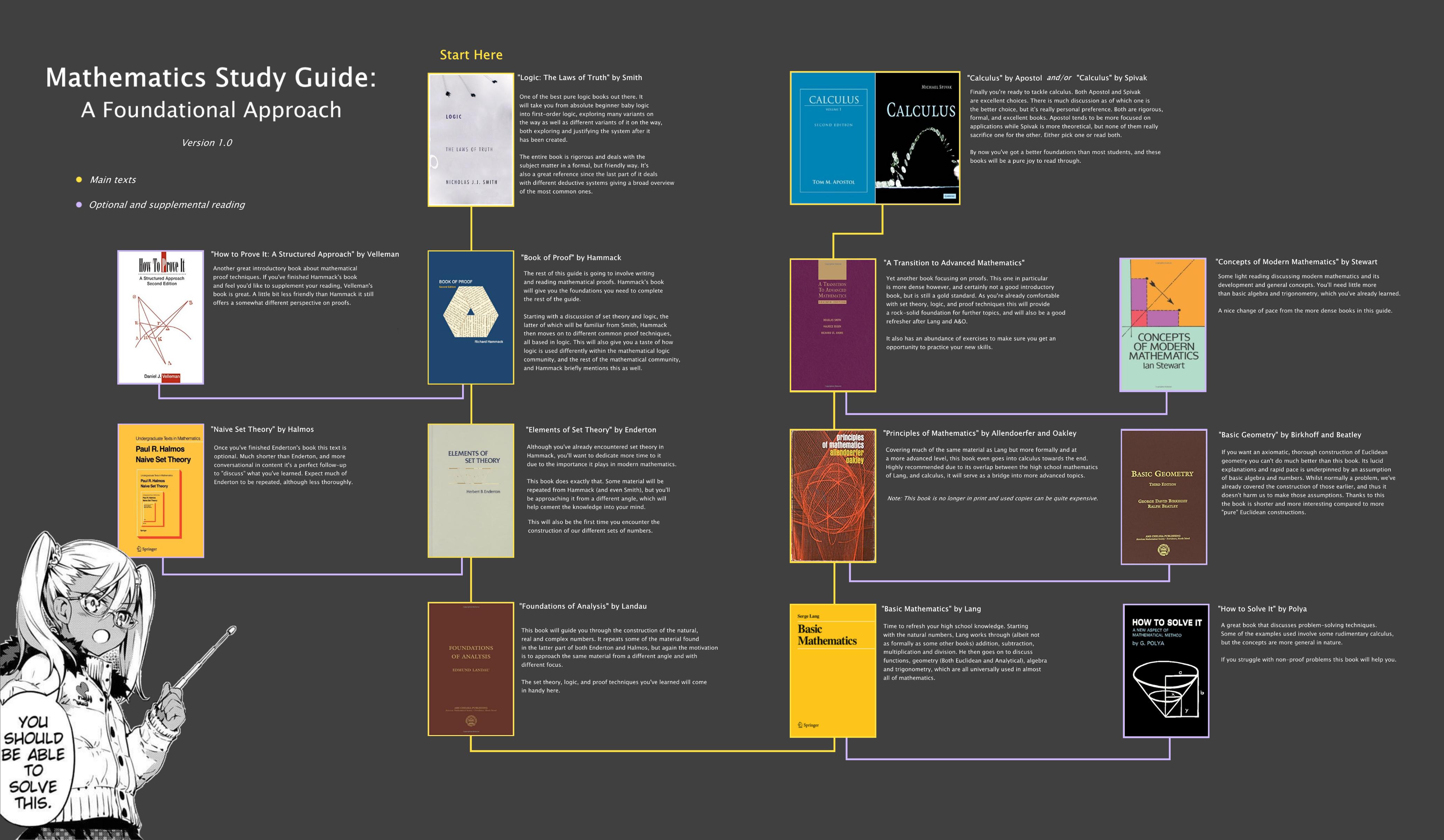
I was mediocre at maths, I finished highschool basic exams, had some more stuff on 1st year universities, teachers always hated me because I kept asking why and why
so I was looking for something different
perhaps there are better "foundational" approaches out there? Or is this just silly
my dream is to do computer science and backend IT
heady ember
"Foundations first is active mental multilation"
You do not need a whole book on set theory to get into math
Also, that image is very unclear and blurry
exotic patio
Yes, you have to open it in browser because discord scales it down in the preview
 lean pagoda
That chart makes no sense whatsoever
dapper root
These get posted every once in awhile and they’re always so dumb
“Do 12 books before you start algebra 2”
heady ember
exotic patio
Yes, you have to open it in browser because discord scales it down in the previe...
Oh yeah sorry. But yeah I agree with neverbloom
exotic patio
I'm really bad at remembering things as they are, I need to understand why something works the way it works, I'm a bit crazy, perfectionist so to speak
heady ember
No reason to read Enderon unless you genuinely are interested in some set theoric stuff, for example
karmic thorn
The only natural list:
- Algebraic Geometry, Hartshorne
- Industrial Society and its Future, Kaczinsky
heady ember
No don't do foundations first
karmic thorn
exotic patio
I'm really bad at remembering things as they are, I need to understand why somet...
Chasing perfection and mastery is highly counterproductive, speaking from my experience
It can make you hate math very quickly
hollow peak
exotic patio
Hello, I found this book recommendation guide thing on the internet and I'd like...
they post this crap on 4chan threads
do not waste your time with this
exotic patio
I don't care, I am in position in my life where my wellbeing does not depend on understanding it, I am in no rush
I just want something from the lowest denominator and work my way up
lean pagoda
I like how the chart ends at Spivak/Apostol but the 4th (apparently required) book is Landau lmfao
karmic thorn
All the more reason to enjoy it thoroughly 
Don't think that doing set theory like a logician first is necessary or sufficient to pursue other math
hollow peak
there's a reason why mathematicians just use naive set theory before returning to it formally later
it's genuinely a pain in the ass to get stuck in the weeds and it shields you from much more interesting stuff
exotic patio
so what would be the best way for someone to start from the bottom and get an all around knowledge
karmic thorn
I was in the same spot as an early undergrad and it took me some time to give up on this bottom-up, foundations-first mentality
hollow peak
of course it's down to personal preference, but you could just do basic mathematics by lang, then book of proof by hammack, then apostol and you'd be golden
karmic thorn
It was a sheer waste of time in retrospect
exotic patio
I'm already halfway through with Laws of Truth and it's been a breeze, a few problems stemming from not being a native speaker but that's it
heady ember
karmic thorn
I was in the same spot as an early undergrad and it took me some time to give up...
Me doing Enderton right now: 
hollow peak
i fucking hated smith
heady ember
But it's fun to me so 
hollow peak
they used it for my logic class in freshman year
karmic thorn
heady ember
But it's fun to me so <:nozoomi:651816986837254148>
It's fine I also had (have?) major issues with consistency and learning discipline so I couldn't make myself stick to anything
Including Enderton
exotic patio
alright so maybe to rephrase my original question, which books are an absolute soul crushers in this list
I recon Landau
lean pagoda
Read any introductory book on whatever topic you're interested in
If you feel like you lack the mathematical maturity to approach any of those books you can read any of the proof books in that chart (velleman, hammack, or that "a transition to advanced mathematics" book)
hollow peak
none of them are soul-crushing per se, but it's pointless doing books that are basically intro to proofs like 4 times
you could get away with reading a total of three books on this list and go on to do productive mathematics
probably less if you pick things up as you go
heady ember
hollow peak
none of them are soul-crushing per se, but it's pointless doing books that are b...
Yeah might as well use smt like Schroder as your intro to proofs and get to learn real analysis simultaenously
exotic patio
I don't even know what are these things
hollow peak
hollow peak
of course it's down to personal preference, but you could just do basic mathemat...
this was essentially my path
exotic patio
I really would like to change jobs and start doing IT, CS, backend, low level, I find it fascinating
I have a massive amount of free time in my current job and nothing to do
so I figured hey let's try maths again
but I don't really have any specific goal in mind, on one hand gamedev is always fascinating, I was very passionate about video games my whole life, but on the other hand computers are no less exciting for me
I had some bad luck in elementary school, I was bullied xdd by my maths teacher
hollow peak
that's very admirable to come back to learn math for fun imo
exotic patio
which resulted in me not learning any maths for majority of my youth
hollow peak
i hope you enjoy what you end up reading, because I know that I at least have found a lot of myself through studying it
 exotic patio
dude doing these IT, CS courses feels like I'm some monkey stacking blocks together hoping for something to happen and it's so frustrating and not fun
alright boys
thanks for thoughts
you didn't change my mind
I will follow this 4chan infographic
I will come back when I will bleed out
hollow peak
if it work it works
I really strongly recommend you feel comfortable with skimming or skipping through parts that you find incredibly tedious or boring and perhaps coming back later
dapper root
Imagine recommending you do a set theory book
hollow peak
chances are with that route it'll come back again at some point
 exotic patio
my elementary maths teacher bullied me to hell
I was attending a private elementary, one of the best in country and I had poor background
hollow peak
hollow peak
I really strongly recommend you feel comfortable with skimming or skipping throu...
also helps avoid burnout from overcommitting to being super thorough
exotic patio
she tried to make me stay 1 year more when I was 13, told everyone I was dumb as bricks
crimson leaf
This graphic makes no sense to me
exotic patio
she made me take a Wechsler Intelligence Scale measure test when I was 13 to prove it, I came back with 146
imagine
heady ember
uno reversed
exotic patio
but now when I think of it perhaps it was all a ploy
I certainly dont feel like 146
dapper root
I think #book-recommendations is not the best time to ponder your elementary school math teachers
 polar elm
exotic patio
I will follow this 4chan infographic
polar elm
exotic patio
I will follow this 4chan infographic
Putting aside the fact that it's too many books with overlapping content, I actually think the infographic is solid if you're doing a foundations-first approach
 "if you're doing a foundations-first approach"
polar elm
"if you're doing a foundations-first approach"
polar elm
Idk lol
crimson leaf
You're like doing a proof book then set theory then you're doing this foundations of analysis book only to go to basic math by Lang?? and then like another two proof books?? Then you're doing spivak/apostol at that point just read some analysis
heady ember
polar elm
Idk lol
I am reading Enderton's Set Theory book right now 
hollow peak
heady ember
Why do foundations first
how else can you do analysis if you don't know the proof of cantor-schroeder-bernstein 
crimson leaf
Also I disliked a transition to advanced mathematics
polar elm
heady ember
I am reading Enderton's Set Theory book right now <:sotrue:826971355542192148>
😂
 narrow oyster
hearty steppe
here is the article i found it from, with two more papers https://morioh.com/p/6...
narrow oyster
hearty steppe
here is the article i found it from, with two more papers https://morioh.com/p/6...
steve brunton my beloved
heady ember
hollow peak
how else can you do analysis if you don't know the proof of cantor-schroeder-ber...
A h y e s
crimson leaf
they are correct that it's not a great first proofs book and is surpassed by things like book of proof but at that point I don't see the value in it
exotic patio
I don't mind re-reading stuff, I read a lot of literature
polar elm
@heady ember I mean, I agree with the general sentiment expressed that foundations-first approach probably isn't best for most people. But it's clear FRANCA has made his mind up on doing it. Chaigenvalue, bacono, etc. told him that they wouldn't recommend it but he said he's cool with foundations-first
exotic patio
so as long as I'm not crunching things in my head it's fast
polar elm
exotic patio
I don't mind re-reading stuff, I read a lot of literature
Oh okay
heady ember
polar elm
<@560392234952818688> I mean, I agree with the general sentiment expressed that ...
The problem is that to read stuff like Enderton's introductory logic book, you already need to know some algebra I think? For the examples
exotic patio
heady ember
The problem is that to read stuff like Enderton's introductory logic book, you a...
You mean Elements of Set Theory?
polar elm
exotic patio
so as long as I'm not crunching things in my head it's fast
The better question is why don't you mind re-reading stuff? Isn't that kind of a waste of time? It's good to revise things But reading "entire books" can't seriously be called revision.
hollow peak
yeah foundations first is generally weird in the sense that the power of abstraction is heightened after you've seen math in context
otherwise it's kind of abstract for abstract sake
heady ember
exotic patio
You mean Elements of Set Theory?
I meant his logic book, if you're gonna legitimately do a deep dive into foundations (which most ppl here, including myself, won't recommend)`
hollow peak
it's like doing category theory before taking abstract algebra
crimson leaf
I would remove logic the laws of truth, elements of set theory, foundations of analysis, basic mathematics (unless you need it but if you need it I'd read that first,) and probably everything between that and spivak/apostol and really at that point you could probably just read something like Schroeder either after book of proof or off the bat and be good
exotic patio
polar elm
The better question is why don't you mind re-reading stuff? Isn't that kind of a...
I don't know what I want to accomplish, I have many points of interest that I always found fascinating, I want to get to know better the science behind them to make a choice, I am not studying maths at any university and if I am ever going to try again I want to know what I'm in for
polar elm
heady ember
The problem is that to read stuff like Enderton's introductory logic book, you a...
I think you could probably learn the necessary algebra in hammock and velleman, no?
polar elm
oh wtf
hollow peak
hammack doesn't have any algebra
heady ember
polar elm
okay that's werid
Pretty sure you need that to understand some examples
exotic patio
heady ember
Pretty sure you need that to understand some examples
That's exactly what I am most afraid of down the road
heady ember
Even when doing Enderton's Set Theory book, the author has introduced the notion of groups, fields, commutative rings with identity, etc
polar elm
@exotic patio you have alot of time on your hands right? How about D&F before Enderton to get your algebra sorted /s
to clarify, don't actually do that
exotic patio
polar elm
<@270858021087870978> you have alot of time on your hands right? How about D&F b...
:D You have to give me the full title
crimson leaf
It's dummit and foote abstract algebra
but if you look up d&f math book it'll probably be the first thing that comes up
heady ember
exotic patio
That's exactly what I am most afraid of down the road
Normally people read Enderton after a course in abstract alg anyways
Also, to be clear, abstract algebra is not highschool algebra
Its quite different I would say
polar elm
Well now that I found out that Enderton requires notions from algebra, I would move Enderton from the list. Or at least not recommend reading all of it.
crimson leaf
A lot of the early stuff is very familiar it's like looking at algebra you've done from a new formal perspective
exotic patio
Alright, anything more that is not that much foundational on this list?
heady ember
polar elm
Well now that I found out that Enderton requires notions from algebra, I would m...
I was referring to his logic book btw. But unless he's seriously interested into set theory, yeah I wouldn't recommend doing his set theory book either (which requires no real prereqs).
exotic patio
There's a big "Start Here" above the Logic Laws of truth"
and then you go down and follow the yellow line
polar elm
heady ember
I was referring to his logic book btw. But unless he's seriously interested into...
Ohhhh
That changes everything then
lean pagoda
Because the chart is generally a complete meme
exotic patio
There's no logic book from Enderton on this list
polar elm
Yeah I was wondering why a book on introductory set theory requires notions of groups and commutative rings
exotic patio
Yeah I was suspecting it to be a complete meme but I picked up Laws of Truth and I really enjoyed it so far, I'm halfway through
heady ember
polar elm
Yeah I was wondering why a book on introductory *set theory* requires notions of...
Enderton's Set Theory book does introduce groups, commutative rings with identity, etc in chapter 5. Its just that, in spite of that, you don't really need much prior knowledge for that chapter
hollow peak
most mathematics doesn't use set theory period
heady ember
Yeah you don't need much beyond naive set theory
polar elm
heady ember
Yeah you don't need much beyond naive set theory
okay yeah
so the chart is good then?
in terms of pre-reqs
heady ember
polar elm
so the chart is good then?
That's a meme chart
hollow peak
i promise you that you are intelligent enough for cat theory
heady ember
hollow peak
i promise you that you are intelligent enough for cat theory
Just go into #cats
There, cat theory
polar elm
heady ember
That's a meme chart
Oh it's meme chart for sure lol
But I think what's interesting is that for @exotic patio it's actually a decent path to follow Assuming he wants to do a foundations-first approach (not commonly done) and doesn't mind re-reading content.
lean pagoda
Reading an elementary set theory text as your first mathematics book (possibly after some kind of transition book/proof book) like the chart suggests is like reading an introductory general topology book as your first book
I'm sure it technically works
heady ember
Honestly, you can probably just start on Spivak straight away
lean pagoda
But it's pedagogically just not very fruitful
heady ember
lean pagoda
Reading an elementary set theory text as your first mathematics book (possibly a...
I'm doing it for fun so
exotic patio
polar elm
But I think what's interesting is that for <@270858021087870978> it's actually a...
I'm 1 month in 200th page of Logic Laws of Truth while working full-time x)
hollow peak
math mastery route: a course on arithmetic -> munkres -> abott understanding analysis -> how to prove it -> homotopy theory of (infinity, 1) categories
exotic patio
hollow peak
math mastery route: a course on arithmetic -> munkres -> abott understanding ana...
I'll write that down
polar elm
hollow peak
math mastery route: a course on arithmetic -> munkres -> abott understanding ana...
Well, I'm happy that you're making good progress
exotic patio
was the man who did this graph joking or not
I understand that asking the question if it's reasonable or not is stupid if the whole idea behind it is stupid
hollow peak
exotic patio
was the man who did this graph joking or not
it looks like a serious attempt to me but again, this is shit they post on 4chan
i've said my piece already
heady ember
exotic patio
was the man who did this graph joking or not
Probably just avoid it
Why are you (seemingly) so adamant about following that particular chart anyways?
exotic patio
there's no alternative, either do this or do elementary to high school to undergrad math courses
lean pagoda
Whatever the motivation behind the chart was, just know that it makes no sense for the most part (and from seeing some other similar charts that seems to be a common theme)
exotic patio
I even searched for foundational approach before posting and didn't find any others
narrow fiber
hollow peak
math mastery route: a course on arithmetic -> munkres -> abott understanding ana...
LMFAO
polar elm
lean pagoda
Whatever the motivation behind the chart was, just know that it makes no sense f...
All jokes aside, it makes sense from his perspective though no?
i.e. explicitly wanting to do foundations-first
heady ember
exotic patio
there's no alternative, either do this or do elementary to high school to underg...
Why do you want to do foundations so badly then? It doesn't seem to me that you have implied an exceptionally strong interest in foundations anyways
exotic patio
I'd like to be ready for whatever comes next and see if I can get comfortable with it
this is why I didn't really choose anything specific
heady ember
exotic patio
I'd like to be ready for whatever comes next and see if I can get comfortable wi...
Unless you're gonna spec into foundations, its probably gonna be near useless to you
hollow peak
well what we're saying is that the chart is excessive for that purpose
heady ember
Doing something like linear alg would probably be more fruitful
hollow peak
^^^^^^^^
exotic patio
on one hand I'd love to change my jobs and do IT related stuff, backend seems mighty interesting, low level aswell, but then there's other stuff that's also very interesting
hollow peak
that a million times over
lean pagoda
There are like 2 foundation related books in that chart and two very elementary one at that so I don't think that chart is trying to depict a road to study foundations
exotic patio
electronics, mechatronics, microcontrollers
so to sum it up, if not this, then what
polar elm
lean pagoda
There are like 2 foundation related books in that chart and two very elementary ...
Right it's not about studying foundations, just about starting from foundations
hollow peak
those topics can be rendered very mathy if you so please
microcontrollers are classic examples of control theory and electronics have differential equations to them behind the seams
exotic patio
I guess statistics, big data is something less interesting for me
polar elm
I don't even think the chart is good for foundations-first because there's way to much overlapping content. But he also said he doesn't mind re-reading content
lean pagoda
polar elm
Right it's not about studying foundations, just about starting from foundations
Well that's fine, but then the chart ends 3 books into it
polar elm
lean pagoda
Well that's fine, but then the chart ends 3 books into it
right
I still think that's fine though? Since the focus isn't foundations per-say
just knowing enough to move forward
exotic patio
I was talking with my friend who's C++ backend something and he tried to show me a bad IF statement that's unreadable, I optimized it and made it readable just from knowing half of that Laws of Truth books and told him about Morgan's Law, guy makes twice the money I do
i just really want to be good at what I do
it feels as if my problem comes from not knowing what I want to do
so from my understanding so far, there is no real foundational approach to a freshman year
I always imagined that the more you would know the faster you could work and the more elegant solutions you could come up with in CS and IT
from a point of view of a complete outsider
Thank you, I apperciate that a lot
Every time I tried to do those entry courses I'd hit the wall at some point, there was something I couldn't do because of my lack of understanding mathematics
and I tried so many
Yeah but now I am at the point in my life when i no longer need to, I am set, so to speak, so I figured
I see
I will write this down and I will go your way if this thing bleeds me to death
anything before precalc that's a requirement
?
Where I live all these jobs always come down to how well can you move your way with social techniques in the end
no matter what you do
unless you run your own thing
I picked a lot of skills up on the way so I'll be fine, did many things in life
polar elm
I thought FRANCA wasn't learning math for career progression, but just because he was curious wanted to explore the beauty math had to offer
exotic patio
polar elm
I thought FRANCA wasn't learning math for career progression, but just because h...
I kind of do but I am probing the options here
exotic patio
polar elm
I thought FRANCA wasn't learning math for career progression, but just because h...
I am in no hurry and I am not dead set on anything
polar elm
Hm that kind of contradicts what I see here: #book-recommendations message
It's probably a little bit of both
career progression and natural curiousity
exotic patio
I secured for myself a situation where my work is very passive, I'm a manager at a hotel and I take night shifts, I get things done in like 2 to 3 hours and then I spend the rest of the night on whatever, the pay is good, the job is fun because you get to talk with interesting people you wouldn't meet in any other way, so I picked up maths because I was always passionate about video games, my end-goal is to provide IT services for many people that I got to know while funding the game project I'd like to work on
polar elm
Btw you should probably move out of #book-recommendations. I think the book discussion part of this thread ended a while back
exotic patio
I just wanted to say that I appreciate everyone's input and time, I think I have a much better understanding now of what I'm doing and I have a back-up line to default to, thanks so much, you guys are the best <3
polar elm

Whatever path you choose to follow, I hope you enjoy it and find what you're looking for
 queen topaz
I want a book to learn algebra basics to advanced. I want to start learning trigonometry. I am looking to strengthen my basics and learn something new. Please recommend a good book.
covert oxide
gray gazelle
openstax should have something (it's all free), otherwise any book from libgen i...
Thanks
gray gazelle
broken meadow
Correct do not talk about using libgen here as it is against tos (i dont know ex...
alright I 'll take note. although it's somewhat weird that libraries are legal, or I guess that's because at the end of the day they are all the same gov related ass* * * * who profit in one way or another over it
mystic orbit
heady ember
Doing something like linear alg would probably be more fruitful
hypocrite 
heady ember
mystic orbit
hypocrite <:pandacop:586201703582400531>
I do set theory for fun lol
I know it won't be that useful in the future
Unless I spec into foundations
orchid mortar
heady ember
Unless I spec into foundations
I'm 95% sure there are 0 logicians in your area
heady ember
orchid mortar
I'm 95% sure there are 0 logicians in your area
Well, if I ever do a PhD in any field of math, I would not want to do it locally
 fiery steppe
Hey everyone. A little back story about me: I am 15 years old from India, and I have a burning passion for math and hope to pursue it as a career one day. I feel like I have a good amount of mathematics knowledge for my age, but most of that comes from videos of channels like 3b1b and numerphile; I haven't really learned any complex topics formally. (Of course, I have done really well in school, but our school curriculum is much more basic than the level of math I am talking about here)
My question is what should I do right now to expand my mathematics knowledge more formally? What should I do before going to college that would help my CV and, more importantly, allow me to be fascinated by math further?
Maybe I am thinking about this in the wrong way, I am also seeking for some form of guidance. Any help would be appreciated!
fallow cypress
fiery steppe
Hey everyone. A little back story about me: I am 15 years old from India, and I ...
Have you tried Khanacademy?
That's usually the recommendation for stuff up to calculus
You can learn a lot on that website
 deep vale
i have been using it and its really nice
fallow cypress
Paul's online notes are good for calculus-sequence classes
remote sparrow
i saw antonio montalban give praise to mileti's logic book, which is pretty nice
not related to above discussion
he made lectures from enderton's set theory and logic books
grand thistle
any good books on information theory from a probabilistic perspective?
 inner token
Functional analysis
swift dome
Linear algebra Recommendation - doing my undergrad
remote sparrow
swift dome
Linear algebra Recommendation - doing my undergrad
hazy elk
fiery steppe
Hey everyone. A little back story about me: I am 15 years old from India, and I ...
- Don't worry about college for now, focus on enjoying math.
- Read a book like "Burton, elementary number theory." Or "Book of proof, Hammock" to see how much you like proof based math.
- If you really liked reading the above books, you should consider preparing for isi/cmi's exams/scb exams for iisers from 11th (while learning the math that you enjoy)
- You can dm me (I'm also from India)
fiery steppe
hazy elk
1. Don't worry about college for now, focus on enjoying math.
2. Read a book lik...
Thanks! But isn't scb exam for banking?
I will check out the books that you recommended
thanks for the help
I have checked out a book of calculus, by michael spivak. I did the first two chapters, which were all about proof based math. It seemed fun, but a little elementary at first so maybe I should keep going with that book?
hazy elk
fiery steppe
Thanks! But isn't scb exam for banking?
No it's the entrance test for iisers
hazy elk
fiery steppe
I have checked out a book of calculus, by michael spivak. I did the first two ch...
Oh yes, then you should definitely continue spivak
fiery steppe
hazy elk
No it's the entrance test for iisers
ahh mb
fiery steppe
hazy elk
Oh yes, then you should definitely continue spivak
okay
fierce hedge
hazy elk
No it's the entrance test for iisers
Do they still ask both Biology and Maths in the exam?
hazy elk
fierce hedge
Do they still ask both Biology and Maths in the exam?
Yes, I'm also hearing rumors that from next admissions cycle they might have subject cutoffs too (all the subjects)
Which kinda sucks
But they want to remedy too many ppl in certain majors or some shit, idk what's up with that
fierce hedge
That's gotta be some bs
Btw do you have an idea about the scholarship/stipend there? @hazy elk
hazy elk
Hopefully
hazy elk
fierce hedge
Btw do you have an idea about the scholarship/stipend there? <@10118121154782209...
You can get inspire if you do well in JEE adv/boards
fierce hedge
I studied in niser and the batch next to ours was the last where everyone got stipend
hazy elk
Then there's kvpy
hazy elk
fierce hedge
I studied in niser and the batch next to ours was the last where everyone got st...
They stopped inspire for everyone 2-3 years ago
That messed the gender ratio apparently
fierce hedge
bruh, that's just sad
hazy elk
Our iiser used to have gender parity, now the ratio is like 1:2 against women
hazy elk
fierce hedge
bruh, that's just sad
Courtesy of the govt
fierce hedge
No surprises there
 junior isle
How to prove It or book of proof?
hasty turret
hazy elk
Then there's kvpy
Wasn't KVPY cancelled?
The KVPY scholarship is now merged with INSPIRE apparently
hazy elk
Yeah you're right, forgot about it for a sec
split bluff
@junior isle how to prove it is good, is the one i'm studying, i've never read the book of proof but i heard it's good
 broken cosmos
Hey
 loud cradle
grand thistle
any good books on information theory from a probabilistic perspective?
loud cradle
grand thistle
any good books on information theory from a probabilistic perspective?
A good intro text is the dover book "information theory" by Robert Ash. Most of the book uses only discrete probabilities, so elementary probability suffices (no measure theory). Primary use case considered is Shannon-style noisy channels
turbid mural
does anyone know a good english translation of Funkcje zespolone by Franciszek Leja
remote sparrow
found some links with brief reviews for complex analysis books (mostly graduate)
sage python
This server's already got the best set of complex analysis reviews
In pins 😛
Though I guess some of these books aren't in mine lol
mystic orbit
sup dami
sage python
Ey how you doing?
mystic orbit
sage python
Ey how you doing?
gud 
loud cradle
that first link is from 1997, it predates stein and shakarchi, marshall, etc
mystic orbit
I just finished exams a couple of days ago so I'm finally free to do math 
haven't seen you discussion in a while 
are you only active in #book-recommendations anymore? lol
sage python
Nah I haven't been active much in general because of traveling but I talk around in places if you can find me


 grand thistle
loud cradle
A good intro text is the dover book "information theory" by Robert Ash. Most of ...
grand thistle
loud cradle
A good intro text is the dover book "information theory" by Robert Ash. Most of ...
ah thank you
 dull summit

Internet Archive
viii, 100 p. : 22 cm
Found this recommended in a book about the 4th dimension

They probably summarize the book better than me
Its pretty interesting thinking about how different objects would look though


the more rapidly the gradient changes the more obviously discernible corners are at larger and larger angles
remote sparrow
Cambridge University Press
looks like garcia and horn's book has a second edition coming up
i have a copy of the first edition (not titled matrix mathematics, although it has a heavy focus on matrix theory)
loud cradle
that is the horn of horn and johnson?
remote sparrow
yup
loud cradle
nice
remote sparrow

The publication of a new linear algebra textbook is not normally a cause for excitement. However, Roger Horn is co-author of two of the most highly regarded and widely used books on matrix analysis…
a couple of reviews of the first edition for those interested
 dense pumice
Where can I learn about the mathematics of like, rhythm? Is that related to combinatorics somehow?
sterile harness
dense pumice
Where can I learn about the mathematics of like, rhythm? Is that related to comb...
Might wanna check out this video: https://youtu.be/cyW5z-M2yzw

A connection between a classical puzzle about rational numbers and what makes music harmonious.
dense pumice
God bless
 verbal grove
Hmm. Is there not a video recommendation channel?
cursive orbit
typically there doesn't exist a lot of videos on more advanced mathematics
at least compared to books
remote sparrow
what are some undergraduate-level category theory books
i know of riehl
leinster and awodey are common recommendations
is that about it?
brief reviews of books would be helpful
remote sparrow
remote sparrow
brief reviews of books would be helpful
and if you could buy just one, what would you choose
 lethal vine
If any one is interested in Physics or is thinking of a career in an area of physics research I recommend reading this:

It touches a lot on pretty modern research, what we know and don't know, which I think is pretty important to know for the future of physics.
remote sparrow
can sipser's book on theory of computation be read by someone with relatively little CS background? just mainly math like myself
or theory of computation in general
ucla teaches an algorithms class in the math department that has no programming required
can clrs be read profitably with little CS background?
besides basic programming skills
 gray agate
remote sparrow
can clrs be read profitably with little CS background?
gray agate
remote sparrow
can clrs be read profitably with little CS background?
I might be naive, but theory of computation doesn't require much CS background necessarily, as long as you're well grounded in graph theory, discrete maths and etc...
This should be fine if you only have a good grounding on Concrete Mathematics (such as Knuth).
Though you can perhaps wait for someone more knowledgable to answer your question.
formal bronze
remote sparrow
can sipser's book on theory of computation be read by someone with relatively li...
Yes, it is fairly accessible, I started with the book when I had very little background in CS(or even math for that matter).
remote sparrow
thanks
my school offers an algorithms class and a cs theory class, but they're locked behind a couple of boring programming classes. i get programming is a useful skill, but that stuff shouldn't really be a mandatory part of the cs curriculum. i can understand putting algorithms behind a programming wall, since while the content is more theoretical than programming, it's directly relevant for programming. but cs theory ehhh
and by programming i mean tries to teach skills relevant to software engineers, like object-oriented programming
formal bronze
remote sparrow
and by programming i mean tries to teach skills relevant to software engineers, ...
At my university, math majors have two compulsory programming courses that are mainly theoretical.
remote sparrow
i have just one
it's just an intro to programming pretty much
software engineering classes shouldn't be a (required) part of CS degrees. idgaf about design patterns or disciplined methods of writing robust code. yes, it's good to learn how not to write spaghetti code. but i feel like this should be something you should teach yourself, or at least not require it.
formal bronze
remote sparrow
software engineering classes shouldn't be a (required) part of CS degrees. idgaf...
Why do you think they shouldn't? Seems like a good thing to know. If you're arguing that this is something that can't really be taught well in a university setting, then that is something I am not knowledgeable enough to comment on.
 honest river
Anyone knows some good books/pdfs on mathematics in automotive industry?
 stray veldt
uh, that sounds very wide i doubt there is a book on that
great book!
i clicked download pdf and it downloaded a docx instead
karmic thorn
I've seen a few Springer series that seem to be devoted to very niche engineering applications of mathematics
stray veldt
i mean i know there is https://link.springer.com/book/10.1007/978-3-030-59897-6

SpringerLink
which isnt precisely math but close enough?
but there are a ton of other aspects of automotive industry that use math
 silver herald
More precisely, automotive is a wide net even in engineering. A better question to ask would be "What type of math should <X> topic in automotive eng. require?"
sage kelp
Any recommendations for Optimization books?
silver herald
sage kelp
Any recommendations for Optimization books?
What is your background and are you looking for an intro. optimization book or something more specialized like Convex Optimization, for instance
gray gazelle
 heady ember
Lol I have the whole set in my bookshelf from years ago
All the printed pages are now all stuck together because I have never opened them for so long tho 
gray gazelle
What do you guys think of the further reading suggested

is there any reason to pick up more logic/proofs/settheory/numbertheory books after reading how to prove it?
heady ember
If you're interested in learning about them sure
But its not really necessary to go read something like either of Enderton's books otherwise
gray agate
What does Sternberg's Advanced Calculus do that I won't find in say Apostol or Rudin? I know he introduces Differential Geometry, but in terms of the Calculus (i.e the chapters on integrals, and differentiation) is there anything novel?
swift dome
PDE and ODE mostly
honest river
Yeah that makes sense. Im looking for some examples of math problems and application of math in automotive industry. Im interested in working in that area and wanna know what kind of math i would be dealing with.
remote sparrow
reddit
78 votes and 41 comments so far on Reddit
@hollow shore this your thread?
 hollow shore
no lmao
remote sparrow
okay lol
hollow shore
why would you think that's me?
remote sparrow
op is thomyorkestan1106
i'm sure thom yorke is some popular celebrity idk who he is
 distant spear
Chitanda we like
remote sparrow
yes
 graceful dawn
Tao's chapters are boring. Is it only for me?
remote sparrow
some people would agree
i don't, but a few would be inclined to feel the construction of the number systems may be unnecessary or long-winded
gray gazelle
remote sparrow
https://www.reddit.com/r/math/comments/10if1sy/most_well_written_textbooks_yall_...
I like how almost no one elaborate on their answers and just post their favorite books
gray gazelle
heady ember
If you're interested in learning about them sure
Would you recommend any of these books?
sturdy shore
they are just standard books on intro number theory, discrete math, logic and set theory
I recommend goldrei's books for a friendly intro to the latter 2 topics
sage kelp
silver herald
What is your background and are you looking for an intro. optimization book or s...
I have taken real analysis, I would like an intro book just to get a hang of it but also, my focus will be on convex optimization
crimson leaf
intro to optimization by Chong and Zak seems good so far
sturdy shore
<@&268886789983436800>
 wispy pebble
ty
crimson leaf
I didn't think this book was that bad
 analog lava
remote sparrow
https://www.reddit.com/r/math/comments/10if1sy/most_well_written_textbooks_yall_...
analog lava
remote sparrow
https://www.reddit.com/r/math/comments/10if1sy/most_well_written_textbooks_yall_...
atiyah mcdonald
 gusty smelt
who owned me smh
mystic orbit
Cope.
analog lava
what did i do
gray gazelle
Best calculus book for self study?
 stone orbit
Anyone got a recommendation for recreational mathematics?
remote sparrow
stone orbit
Anyone got a recommendation for recreational mathematics?
martin gardner has written a number of math puzzle books, several of which are published by dover
remote sparrow
gray gazelle
Best calculus book for self study?
proof-based or not?
stone orbit
remote sparrow
martin gardner has written a number of math puzzle books, several of which are p...
thank you
 onyx wren
anyone have a pdf of FGA explained?
crimson leaf
onyx wren
anyone have a pdf of FGA explained?
Against tos
hollow shore
gray gazelle
Best calculus book for self study?
Spivak.
Btw my fav tarkovsky is stalker :3
very closely followed by the mirror
uncut zealot
gray gazelle
Best calculus book for self study?
openstax is free: https://openstax.org/details/books/calculus-volume-1

OpenStax offers free college textbooks for all types of students, making education accessible & affordable for everyone. Browse our list of available subjects!
remote sparrow
just got a bunch of money from lunar new year
time to burn all of it on math books

orchid mortar
uncut zealot
openstax is free: https://openstax.org/details/books/calculus-volume-1
The calc books are big - I'm not sure who's tried to use them
Sour are you a librarian
grand thistle
has anyone used alekseev's "Abel's theorem in problems and solutions"?
glacial crypt
onyx wren
anyone have a pdf of FGA explained?
have you tried first book of the bible library
 buoyant vessel
does anyone have basic algebra by Jacobson pdf?
 devout silo
Finding the value of an algebraic equation and is proving the value of an algebraic equation the same thing
karmic thorn
Any good sources to learn about integral equations?
Mostly looking at the basics and concerned with some simple linear versions (Fredholm, Volterra)
sage kelp
gray gazelle
Best calculus book for self study?
Thomas’ Calculus
remote sparrow
orchid mortar
Sour are you a librarian
no, if you're asking if i work as one in a professional capacity
sage kelp
crimson leaf
intro to optimization by Chong and Zak seems good so far
Why? What’s your background?
crimson leaf
sage kelp
Why? What’s your background?
My background is proof based linear algebra and graph theory I also know some combinatorics from my research. It has a great chapter 0 to go over what you need and it's what we're using for the optimization course I'm currently in
onyx wren
crimson leaf
Against tos
no it isnt?
pdf versions of books exist online because people are students