#book-recommendations
1 messages · Page 13 of 1
 prime oak
 crimson leaf
I think one of the main issues is also that they were making money off piracy which is a big no no
 sage python
But yeah it was kinda like
 misty wyvern
Well people have different opinions on each of the Rudin books.
For instance a lot of complex analysts don't like RCA.
prime oak
thats the only one ive seen negative opinions about
though i am not at any stage to be able to read it so i cant comment lol
misty wyvern
And not that many people use Rudin's FA.
For courses.
But these are the books I return to so
 regal wasp
If you can read words you can go through an analysis textbook tbh
 gray gazelle
 i do, and seems like theres an anti rudin(PMA) cult in my uni
regal wasp
Itll be difficult but thats really the only prereq
prime oak
start a pro rudin cult
sage python
I guess it was a weird snake between Rudin and Sally but we mostly did multivariable calculus from Sally chapter 5 which was a dumpster fire
 dapper root
Rudin is for babies
sage python
To be fair we did LA from Hoffman-Kunze which doesn't get to inner products until fairly late
dapper root
If ur a grown-up you use mathisfun.com
prime oak
sacrifice apostol every second sunday as a ritual
regal wasp
Umich uses analysis on manifolds by munkres which was pretty sick
prime oak
dapper root
If ur a grown-up you use mathisfun.com
TRRRRRRUE
 willow pecan
Does it
gray gazelle
baby powder is also for babies
sage python
So many of us were confused about why Sally's doing this nonsense about taking gradient dot product f
willow pecan
Do you go to u mich
regal wasp
Yeah
willow pecan

sage python
Like hold up why are we dotting a linear map with a vector wtf
dapper root
willow pecan
<:think2:811271144283832360>
Creep
sage python
We only realized next quarter after we did Riesz rep what that was all about lol
willow pecan
Maybe I've walked by you in one of these hallways
sage python
But still Sally had... more mistakes than is reasonable in a problem-heavy book
gray gazelle
prime oak
start a pro rudin cult
 no im one of them
crimson leaf
My profs I've asked do not like Rudin
sage python
Rudin's mostly fine
regal wasp
Like pedagogical mistakes or content
misty wyvern
I mean where else am I going to review results in analysis I already know? Stein and Shakarchi? Too wordy. Pugh? Basic bitch shit.
sage python
There was one point where he gave this one function and said
Prove directional derivatives exist but the function isn't continuous at 0
regal wasp
Doubt it i skip most of my classes
regal wasp
Stein and Sakarchi is too wordy?
sage python
And it has a problem involving the same function but says "prove it's continuous at 0, but not differentiable"
misty wyvern
Yes? There are literal blocks of text.
sage python
And while thankfully I hadn't even started that part of the pset yet a lot of people were like fuck this shit wasted so much time
misty wyvern
Rudin spends very little time outside direct lemma, theorem, proof statements.
sage python
Also a lot of smaller typos
misty wyvern
Stein's singular integral book is probably worth mentioning but I've only referenced in like twice.
regal wasp
That does suck. Happens to me in all my physics courses though
crimson leaf
He likes the princeton lectures series minus the fourier analysis but he thinks it is "fine" for those who don't know measure
regal wasp
Steins complex and fourier analysis are incredible
sage python
But yeah Rudin is near optimal as a reference, my main issue with it is that chapter 10 is so bad that I genuinely think the man Walter Rudin himself did not understand differential forms at all
 winged gust
sage python
And while thankfully I hadn't even started that part of the pset yet a lot of pe...
winged gust
sage python
And while thankfully I hadn't even started that part of the pset yet a lot of pe...
This is definitely something I worry about as someone trying to learn mathematics on my own...
misty wyvern
If I ever teach analysis I will do the funny thing and teach it out of the appendix of Taylor's PDEs vol 1.
sage python
And also I don't like that in chapter 2 he presents compactness as a property of a subset of a metric space and sorta roundabout says oh it doesn't depend on what space you're in
regal wasp
Thats kinda sick tbh
sage python
In general he could make the whole subspace topology shtick a bit more clear
Also Rudin 8 is just a random hodgepodge of stuff lol. I don't see the point in the Fourier analysis in particular
misty wyvern
Oh I just didn't read Rudin on differential forms.
 cinder trellis
I really don’t get the hype about PoMA to be honest
sage python
(Though it has the best elementary proof of FTA)
Rudin 9 is okay but doesn't do enough
regal wasp
What is Poma
misty wyvern
I actually learned differential forms first from a math phys text lol. Because for some reason math doesn't have multilinear algebra classes in ugrad the way physics likes to.
cinder trellis
regal wasp
What is Poma
Baby Rudin
sage python
Rudin 10 is legendarily fucking stupid
Rudin 11 is kinda pointless
But otherwise Rudin's great
regal wasp
Learning differential forms from algebraic topology is the play
misty wyvern
Learning from Wikipedia is what the Alpha Mathematician does.
cinder trellis
Does anyone know of a good book that covers Newton polygons in depth?
 cedar ridge
misty wyvern
I actually learned differential forms first from a math phys text lol. Because f...
cedar ridge
misty wyvern
I actually learned differential forms first from a math phys text lol. Because f...
armold?
who is ryc, that the name of the Chalk youtuber?
gray gazelle
cedar ridge
who is ryc, that the name of the Chalk youtuber?
@glad prairie this is ryc
cedar ridge
oh
 marble solar
crimson leaf
My profs I've asked do not like Rudin
marble solar
crimson leaf
My profs I've asked do not like Rudin
So the thing is Rudin isn't meant to be a book you read alone
It's meant to be a set of lecture notes for professors to fill in details depending on their students ability
When Rudin's Principles, Real & Complex, or Fcnl is used as a "litmus test" for "math ability" it can create a lot of problems and induce many a student's imposter syndrome
 hallow oriole
'math ability' is bs until a certain level anyways
 grand thistle
rudin pma's kinda fun imo
i enjoy learning from it
though i feel like it's one of those books you really only appreciate after like 5-6 chapters or so
 loud cradle
or after you've already learned some/most of the material before.. in that case rudin is a nice clean reference that's better than most
 forest sleet
I just use stackexchange
if I forget something from real analysis
I never used Rudin PMA but it looks fairly dry, especially with all the tedious results about R
loud cradle
you could always just skip ch 1 and refer back to it as needed (particularly its appendix, which is the only really tedious part, construction of the reals via dedekind cuts)
cinder trellis
cinder trellis
Does anyone know of a good book that covers Newton polygons in depth?
Bumping this
 sudden kindle
hallow oriole
'math ability' is bs until a certain level anyways
sudden kindle
hallow oriole
'math ability' is bs until a certain level anyways
💯
gray gazelle
I do not know you, but this is not very professional behavior. Do some self-reflection, it is subjective anyway.
I would rather be wrong than some loser who tells people they’re wrong without any basis.
Never seen his Calculus book, but the other two are terrible for exposition. Unless you’ve read them yourself, please don’t talk about them.
 fierce hedge
gray gazelle
Never seen his Calculus book, but the other two are terrible for exposition. Unl...
fierce hedge
gray gazelle
Never seen his Calculus book, but the other two are terrible for exposition. Unl...
Isn't lang algebra decent for a second course on abstract algebra? What else would you recommend instead for a second pass on algebra
gray gazelle
fierce hedge
Isn't lang algebra decent for a second course on abstract algebra? What else wou...
It is great for a second course.
I specifically said exposition.
It is concise and gets definitions quickly. I appreciate that.
fierce hedge
Ah, makes sense. I thought it is obvious that it is not intended for first exposure to algebra
gray gazelle
I’ve seen some terrible recommendations by people who have no credentials to give those recommendations. This is a rather pedestrian discord for pedestrian mathematicians it seems.
 cursive orbit
gray gazelle
I would rather be wrong than some loser who tells people they’re wrong without a...
cursive orbit
gray gazelle
I would rather be wrong than some loser who tells people they’re wrong without a...
ah yes very professional
misty wyvern
Believe it or not Rudin was my first introduction to proof-based math. I started undergrad as an English/Bio major.
I took Bioinformatics, got recommended Rudin by the prof (lol), and swapped majors.
It took me a long time to work through it, it was incredibly dense to mathlet me.
It's amusing how trivial it is to me now.
 sturdy shore
savior prof
misty wyvern
It took me the better part of a year to get through PMA, IIRC
But it's absolutely possible without assistance, Rudin is comprehensive. He's just terse.
 hazy elk
(real)
cedar ridge
sage python
Rudin 10 is legendarily fucking stupid
looks to be the same content as spivak calc on manifolds
im guessing shitter tho since it's 40 pages
gray gazelle
cursive orbit
ah yes very professional
I was not talking to you, and this adds no argument, so do not reply.
 hazy elk
gray gazelle
I’ve seen some terrible recommendations by people who have no credentials to giv...
hazy elk
gray gazelle
I’ve seen some terrible recommendations by people who have no credentials to giv...
What recommendations annoy you particularly?
gray gazelle
hazy elk
What recommendations annoy you particularly?
Terse books that no one uses. I did some snooping around and found a website that shows a complete lack of knowledge by people who I assume are highschoolers.
hazy elk
Lots of people use Rudin tho? It works for a few ppl
gray gazelle
Rudin is fine.
cursive orbit
how about lang
forest sleet
lang has a lot of different books
cursive orbit
algebra
gray gazelle
cursive orbit
algebra
Bad for exposition.
hazy elk
gray gazelle
Rudin is fine.
Are you talking about gristles website aka "sheafification"
gray gazelle
hazy elk
Are you talking about gristles website aka "sheafification"
Might be called that.
Not sure. Don’t care.
forest sleet
Lang Algebra is more a reference
hazy elk
Ok
I've got some decent recommendations here, just saying
Some quality content in pins btw
crimson leaf
gray gazelle
Not sure. Don’t care.
You are very upset about something
And very rude as well
gray gazelle
crimson leaf
You are very upset about something
I’m not.
crimson leaf
Clearly are lol
gray gazelle
I know my current feelings lol.
cursive orbit
idk man lang is a standard text for grad courses
hazy elk
Oh btw, are the problems in the ring theory section of DF nice?
cursive orbit
well they're good enough for the graduate algebra course at my university, which is taught by a professor who is far from a "pedestrian mathematician"
gray gazelle
Dummit & Foote exercises are the golden standard for Abstract Algebra exercises
Anyway, practice makes perfect
Abstract Algebra is not something you should spend too much time on, whatever resource you use just master the content.
fierce hedge
gray gazelle
Dummit & Foote exercises are the golden standard for Abstract Algebra exercises
I thought Herstein had that title. I kinda like the book even though it has some weird notations
grand thistle
any opinion on hungerford?
some situation arose where i have to review a lot of algebra i learned last summer (a lot of which i forgot)
and i’m looking for a good review book that starts from the basics but is concise
 quick hornet
gray gazelle
I’ve seen some terrible recommendations by people who have no credentials to giv...
gray gazelle
crimson leaf
And very rude as well
quick hornet
gray gazelle
I’ve seen some terrible recommendations by people who have no credentials to giv...
gray gazelle
crimson leaf
And very rude as well
Yeah, I get a similar feeling about this person. Unfortunately people learning math come from a wide spectrum so it's not uncommon for people to be rude
 vocal panther
Shout out to Gallian for making abstract algebra not suck 😭 😭
 fluid bay
grand thistle
any opinion on hungerford?
fluid bay
grand thistle
any opinion on hungerford?
its okay. i think that in some places (like the rings and modules chapter) the generality is a bit annoyingly excessive for anything the average person cares about.
grand thistle
fluid bay
its okay. i think that in some places (like the rings and modules chapter) the g...
cool, this is hungerford's "Algebra" and not his "Abstract Algebra" right?
grand thistle
great, do you have any recommendations over hungerford you would suggest, or do you think it's fine?
i was kinda drawn to it by how concise it was (seems to be laid out almost identically to lang), but seems to be much more manageable to an average person than lang at the same time
fluid bay
hmm if it looks good to you then i say go for it. The main reason I'm familiar with the book is that my class used it. From the times i have dipped into lang, I didn't find it much less readable than hungerford personally tho
other than hungerford or lang, there's also jacobson. I'm even less familiar with jacobson, but i've heard good things
sage python
cedar ridge
looks to be the same content as spivak calc on manifolds
They're both on differential forms but Rudin's treatment of differential forms makes me almost want to say that he doesn't understand differential forms
quick hornet
to be frank, im not sure spivak's treatment is much better.
i mean, anything's an improvement over rudin ofc
but i would not want to learn forms from either of them
 rich sun
What's your suggestion?
fluid bay
an actual differential geometry text maybe
 heady ember
fluid bay
an actual differential geometry text maybe
heady ember
fluid bay
an actual differential geometry text maybe
Lee? 

 median fossil
Opinions on Barry Simon's Comprehensive Course in Analysis (especially the 1st 2 vols)?
 hearty steppe
Oh boy… this looks like a can of worms I just found https://www.researchgate.net/publication/318786308_Eigenforms_interfaces_and_holographic_encoding_Toward_an_evolutionary_account_of_objects_and_spacetime
ResearchGate
PDF | Context • The evolution of perceptual systems and hence of observers remains largely disconnected from the question of the emergence of classical... | Find, read and cite all the research you need on ResearchGate

So much learn
rich sun
hazy elk
Klaus Janich, Vector analysis <:catKing:812386361297862747>
This is indeed what I started with
hazy elk
Just putting it out there
rich sun
The first chapters are fine
hazy elk
rich sun
This is indeed what I started with
Oh how did it go
rich sun
But when it comes to integration and stokes, I prefer a more to the point exposition
 placid pollen
What about Cartan's forms
 tropic thorn
Hi guys,
I want to learn about LMI to apply in in control theory
Do you know any ressources that can help me
Im just starting out on this.
I went through calculus multivariate calculus some abstract algebra and linear algebra and numerical analysis in prep school.
 vast obsidian
gray gazelle
Never seen his Calculus book, but the other two are terrible for exposition. Unl...
vast obsidian
gray gazelle
Never seen his Calculus book, but the other two are terrible for exposition. Unl...
Of course they are bad for exposition they're not supposed to be a first course are you dumb or some shit?
Are you the type of guy who picks up research papers and GTM books then complain they're not made for first year undergrad? Like stfu lol
cinder trellis
cinder trellis
Does anyone know of a good book that covers Newton polygons in depth?
Still curious…
vast obsidian
gray gazelle
I’ve seen some terrible recommendations by people who have no credentials to giv...
this guy is absolute cancer
gray gazelle
gray gazelle
I’ve seen some terrible recommendations by people who have no credentials to giv...
This is one of the funniest messages I've read on this server.
grand thistle
fluid bay
hmm if it looks good to you then i say go for it. The main reason I'm familiar w...
bruh why does hungerford use $\varepsilon$ instead of $\in$ tho 🤨
 hasty eagleBOT
sean
 grand thistle
i've never seen this type of notation before
 spare ridge
gray gazelle
I’ve seen some terrible recommendations by people who have no credentials to giv...
spare ridge
gray gazelle
I’ve seen some terrible recommendations by people who have no credentials to giv...
silence, aops pfp
tropic thorn
Hi guys,
I want to learn about LMI to apply in in control theory
Do you know any ressources that can help me
I went through calculus multivariate calculus some abstract algebra and linear algebra and numerical analysis in prep school.
cinder trellis
gray gazelle
I’ve seen some terrible recommendations by people who have no credentials to giv...
There are not enough sully emotes in the world for this post.
gray gazelle
The funny thing is that they're not even wrong. They just phrased it in the worst possible way.
fluid bay
grand thistle
bruh why does hungerford use $\varepsilon$ instead of $\in$ tho 🤨
oh yeah AHAHA i forgot
 median fossil
Opinions on Barry Simon's Comprehensive Course in Analysis (especially the 1st 2...
median fossil
median fossil
Opinions on Barry Simon's Comprehensive Course in Analysis (especially the 1st 2...
Bump
 remote ginkgo
gray gazelle
I do not know you, but this is not very professional behavior. Do some self-refl...
remote ginkgo
gray gazelle
I do not know you, but this is not very professional behavior. Do some self-refl...
cope
the back-handed insults are unpleasant, please refrain
i know you are not being honest
it seems that, to you, professionalism is passive aggression and covert politicking
to me, professionalism is working very hard and trying to create things
gray gazelle
I guess roasting someone is societies way of correcting abnormalities.
 viral roost
feedback is important
feedback can come from other people or the real effects of your own work
but the number of people who can just do work that is immediately impactful is small, it is very difficult
 deft bloom
are there any books that can help me do functional equations from basic to advance
 tawny copper
Evan Chen notes or Varderlind are nice
If you mean elementary functional equations
There's not so much content to learn for this type of equations, its just training
The book by small is also nice
 wanton pier
Anyone here read A Mind for Numbers? I binge-read half of it a few years back, but I’m looking for someone to discuss it with
viral roost
Functional equations generalize in a bunch of different ways
Kernels of integral operators usually obey a certain kind of functional equation
Sum formulae like for trig go to coalgebras and representation theory
So it's not clear to me if functional equations as a concept are studied generally
cinder trellis
cinder trellis
Does anyone know of a good book that covers Newton polygons in depth?
I’ve tried looking around online, but have only found short handouts.
 gray jungle
Are these 2 books any good as a introduction to differential geometry?
"Differential Geometry:A First Course in Curves and Surfaces by Shifrin"
"Elementary differential geometry by Andrew Pressley"
My professors recommends both as a reference so i'm just getting some feedback , and which one would you prefare over the other?
hearty steppe
Oh boy another RG article and I just found it
ResearchGate
PDF | There are strong reasons to believe that our conscious inner life is structured, suggested both by introspection as well as scientific psychology.... | Find, read and cite all the research you need on ResearchGate
grand thistle
asked this once before but didn't really get any answers so asking again, any books on interesting series/integration techniques that cover stuff like generating functions, recurrences and recursion, special integration techniques like leibniz's formula, differentiation under the integral sign, series expansion, special functions, etc.?
kinda looking for a book that teaches all those techniques used in the youtube integral videos by michael penn, flammable math, and other similar youtubers
looking for a singular book that covers these subjects together and how they can be used together, rather than i.e. a specific book on generating functions, a specific book on integration, etc.
 steep badger
grand thistle
asked this once before but didn't really get any answers so asking again, any bo...
steep badger
grand thistle
asked this once before but didn't really get any answers so asking again, any bo...
There are various integral books if you search on google. They should contain all the technique solving integrals that has been solved before.
 foggy relic
gray jungle
Are these 2 books any good as a introduction to differential geometry?
"Differ...
foggy relic
gray jungle
Are these 2 books any good as a introduction to differential geometry?
"Differ...
I’ve read the latter and it’s pretty good, only prereq is calc 3
gray gazelle
placid pollen
will there be a second print of Allen Hatcher's book?
quick hornet
its available freely online, you can print it yourself if you have a local printing service https://pi.math.cornell.edu/~hatcher/AT/AT.pdf
no clue whether theres plans for a second print run but i doubt it, hard for a publisher to justify it when its available freely for personal use
 silk axle
Anyone have any insightful math/ML related books I can add to the collection? This is what I already have so far, but looking for some new recommendations.
- Infinite Dimensional Analysis: A Hitchhiker's Guide
- Applied Predictive Modeling, Kuhn, Johnson
- Deep Learning Architectures - A Mathematical Approach, Calin
- Mathematics for Machine Learning
- Probabilistic Numerics - Computation as Machine Learning, Hennig et al.
- High-Dimensional Probability, Vershynin
- Probabilistic Graphical Models Principles and Techniques, Koller, Friedman
- Probability Theory; The Logic of Science
- Advanced Linear Algebra, Loehr
- High-Dimensional Statistics - A non-asymptotic viewpoint
- Statistical Inference, Casella, Berger
- ESL
- Bayesian Data Analysis, Gelman et al.
- Large-Scale Inference; Empirical Bayes Methods for Estimation, Testing, and Prediction
- Convex Optimization, Boyd
```Thanks!I just found another crazy paper on RG
Well… I officially take back what I say about RG being crap
ResearchGate
PDF | Abstract The recent wave of interest to modeling the process of decision making with the aid of the quantum formalism gives rise to the following... | Find, read and cite all the research you need on ResearchGate
gray gazelle
What does RG stand for here?
This doesn't look anything like the RG I know (Riemannian Geometry), so I'm wondering if there's another common use for the acronym.
hallow oriole
in clash royale rg usually stands for royal giant 👍
@surreal phoenix @tardy walrus
you guys should know that
 tardy walrus
Wtf
heady ember
Lmao
 whole wedge
hallow oriole
in clash royale rg usually stands for royal giant 👍
whole wedge
hallow oriole
in clash royale rg usually stands for royal giant 👍
of course
loud cradle
silk axle
Anyone have any insightful math/ML related books I can add to the collection? Th...
i'm surprised not to see these already in your list:
- Bishop, Pattern Recognition and Machine Learning
- Murphy, Probabilistic Machine Learning: An Introduction
- Goodfellow et al, Deep Learning
 crude sage
Does anyone have any thoughts on Poole's intro lin alg book?
 orchid mortar
silk axle
Anyone have any insightful math/ML related books I can add to the collection? Th...
orchid mortar
silk axle
Anyone have any insightful math/ML related books I can add to the collection? Th...
No Shalev-Shwartz & Ben-David?
 devout hollow
Hello, I have a question. Currently, I am up to page 130 of Linear Algebra by Serge Lang. Thus far, I solved around 90% of the exercises (except repetitive or easy, computational ones) and have managed to reproduce the proof of almost every theorem in the book before looking at the proof. And yet, I am still in great doubt of my intuitive understanding of what the book has covered so far; for example, although I can prove that a finite dimensional vector space with a non-degenerate scalar product is isomorphic to its dual space, it feels like I still don't have an intuitive idea of what that statement is about. Is my self doubt reasonable? Or is it merely the imposter syndrome at play? I would appreciate an answer. Thank you.
 stray veldt
orchid mortar
devout hollow
Hello, I have a question. Currently, I am up to page 130 of Linear Algebra by Se...
stray veldt
orchid mortar
devout hollow
Hello, I have a question. Currently, I am up to page 130 of Linear Algebra by Se...
Maybe you can hang out in #linear-algebra and see if you can help us. That sounds like a good yardstick for if you can do it
 blazing canopy
devout hollow
Hello, I have a question. Currently, I am up to page 130 of Linear Algebra by Se...
blazing canopy
devout hollow
Hello, I have a question. Currently, I am up to page 130 of Linear Algebra by Se...
This is very impressive and being able to produce proofs of everything in the book is far more than most good students achieve. But you may be correct that you lack some intuitive understanding, and typically the reason is simple: you just need to see more examples of where many of these results are used (for example, the result you mention can be visualized in terms of geometry). This sort of intuition will come in time and you should not expect to attain it immediately.
loud cradle
devout hollow
Hello, I have a question. Currently, I am up to page 130 of Linear Algebra by Se...
An intuitive idea that may help: the dual space is the set of linear functionals from V to the underlying field. When V is finite dimensional, a linear functional has a matrix representation as a row vector. (Note that row vector times column vector = 1x1 matrix, which is identifiable with a scalar, so that checks out.) It is hopefully clear that the set of column vectors is isomorphic to the set of row vectors, and that can guide your intuition for the more abstract but basically equivalent isomorphism between vectors and linear functionals.
blazing canopy
The result he's describing is slightly different since there is a "natural" isomorphism arising from using the scalar product. As you said, every finite-dimensional vector space is already isomorphic to its dual by choosing a basis representation (column vectors) and then choosing the corresponding dual basis (row vectors), without needing any scalar product structure.
gray gazelle
devout hollow
Hello, I have a question. Currently, I am up to page 130 of Linear Algebra by Se...
In a finite-dimensional space, and more generally in a Banach space, you have the concept of orthogonal system.
It consists of a sequence of pairs of vectors ${(e_i^, e_i): i\in\mathbb{N}}$ and it has to satisfy $\langle e_i^, e_j\rangle = \delta_{i, j}$. Here $e_i\in E, e_i^\in E^$ where $E^*$ is a space of dual vectors of $E$, that is (continuous) linear functionals. What are you concered with is the concept of dual pair - given two spaces $E, F$ we have some way of telling the "scalar product" of $E$ and $F$. This gives us a natural isomorphism between $F$ and the dual space of $E$, for $f\in F$, $e\mapsto \langle e, f\rangle$ is a (continuous) linear functional on $E$.
hasty eagleBOT
Blitz
 gray gazelle
in general there is no way of obtaining an isomorphism of E and E* without some arbitrary choices - the spaces are isomorphic because their dimensions agree (they aren't (algebraically) isomorphic for infinite-dimensional spaces)
But the scalar product already imposes some way of constructing such an isomorphism
alright, and why did I talk about orthogonal systems
Because it's the most natural way of constructing a so called dual basis
 surreal phoenix
hallow oriole
<@305064722225692674> <@830760441209815090>
surreal phoenix
hallow oriole
<@305064722225692674> <@830760441209815090>
this is royal information 👑 Always count on valley to keep ya in the loop
 clear mist
Hey guys, do you guys have a recommendation of euclid geometry book with proof?
 acoustic ridge
Is this book good for senior high school students? Note that I am a 12th grade student and I only have 5 months before the final exam starts but I studied almost nothing so shall I start reading this book for better understanding or read smaller books than it?
 tawny copper
Probability book that touches on measure theory since the begining but not too sophisticated?
gray gazelle
acoustic ridge
Is this book good for senior high school students? Note that I am a 12th grade s...
Written primarily for undergraduate students of mathematics, science, or engineering, who typically take a course on differential equations during their first or second year. The main prerequisite is a working knowledge of calculus.
I think a high school student shouldn't have a problem
silk axle
loud cradle
i'm surprised not to see these already in your list:
```
- Bishop, Pattern Recog...
I do have bishop & murphey, but not goodfellow. Was looking for more grad level books
orchid mortar
Not all of your list is really grad-level
Having strong foundations is essential however
So you don't need a pure grad-level list
silk axle
Yes if there exists a topic im not well versed in then id be interested. But basic undergrad books are something which wont help me
unless someone has an upper level undergrad book that grants some novel insight
gray gazelle
Does anyone have any recommendations for a supplementary book/reference for a course in probability theory with prerequisites assumed to be basic probability theory and measure theory to accompany the book "Probability Essentials" by Jacod and Protter?
(P.s. by basic probability theory I mean that we've done a sort of 'introductory course to probability theory and statistics in our first year' - now I'm in my second year)
 solar mural
hi, i was wondering whats a good book to get for someone who likes mathematical physics and functional analysis?
or anything that has to do with string theory, representation theory, random matrix theory, combinatorics, homological algebra, etc
sage python
@gray gazelle People seem to like Durrett, also check out http://www.math.uchicago.edu/~lawler/probnotes.pdf and from these two courses:
http://galton.uchicago.edu/~lalley/Courses/381/index.html
http://galton.uchicago.edu/~lalley/Courses/383/index.html
sturdy shore
speaking of probability course notes, I know of this absolutely massive one
also has yt vids accompanying it, by "todd kemp"
grand thistle
any opinions on schilling’s ‘measures, integrals, and martingales’?
the only complaint i’ve seen online is the abundance of misprints but that’s been largely corrected in the second edition
do y’all think it’s fine for someone who wants to learn probability but doesn’t know measure theory yet?
acoustic ridge
gray gazelle
> Written primarily for undergraduate students of mathematics, science, or engin...
What will be the best book for giving a fresh start to learn calculus then?
gray gazelle
Thanks a bunch @sage python and @sturdy shore.
sage python
@grand thistle it covers the measure theory from scratch
We should ask a probabilist if it's good for that
 grave thorn
grand thistle
do y’all think it’s fine for someone who wants to learn probability but doesn’t ...
grave thorn
grand thistle
do y’all think it’s fine for someone who wants to learn probability but doesn’t ...
I like it, but I prefer Jacod and Protter
sage python
Meaning is it "a book for real analysts with a side of probability" or is it "a book that's also good for future probabilists"
@forest sleet thoughts?
VMM: Jacod and Protter feels like it gets to Radon-Nikodym wayyyyyy too late
 forest widget
Hi i was wondering if anyone have anyone has recommendations for calculus books, i already completed 2 calc courses but i would like to "relearn" it and plan on spending winter break and possible more if needed on it, any help would be appreciated ^^
sage python
Eleanor do you want to learn calculus with or without proofs?
forest widget
i think i would like to learn with proofs, do you feel like it would help with better understanding the concepts?
If proofs arent really needed for a greater understanding i feel like i wouldnt need it though
gray jungle
If you intend to do more mathematics post calculus you should do it with proofs, if you just want the machinery for something else you could go without them.
sage python
What is your aim in math overall?
Like if you're thinking more engineering and the point in understanding calc is toward the end of engineering
Then proof-based isn't a good idea
forest widget
gray jungle
If you intend to do more mathematics post calculus you should do it with proofs,...
i want to learn more math and i am studying physics and really like the subject and generally just want to learn
sage python
If you wanna do more theoretical math
grave thorn
sage python
VMM: Jacod and Protter feels like it gets to Radon-Nikodym wayyyyyy too late
Yeah that's one of my complaints with the book
sage python
Then that's where proofs come in
grave thorn
grave thorn
Yeah that's one of my complaints with the book
(and w/out radon nikodym their introduction of conditional expectation is just bad)
forest widget
Okay so do you have any good calc books with proofs in mind?
sage python
Maybe try either Spivak Calculus, Tao Analysis, or Schroder Analysis
forest widget
Thank ill look into those ^^❤️
grand thistle
sage python
Meaning is it "a book for real analysts with a side of probability" or is it "a ...
sorry i should have clarified, i’m using this primarily for learning measure theory and real analysis for just the sake of them, probability is just something i wanna do in the future, it doesn’t have to be completely probability based or could just be a normal analysis text liek folland
sage python
Then Schilling is pretty good yeah
grand thistle
that’s why i’m trying to avoid learning measure theory first from a probability text like jacod protter, since it would be my first time learning the subject and i want to have as many viewpoints as posssible
sage python
I think it's one that's good both for future probabilists and analysts, though perhaps one could argue as a corollary that it isn't optimized toward either
forest sleet
Hmm I don't have much experience with reading the measure theory parts of different probability texts, but for just general measure theory I like Teschl real analysis (free on author's website)
 brave yew
what's the best book for someone who wants to get into mathematics?
I've gotten As and A-s in the standard calculus track, but I've had to drop Real Analysis twice
my fundamentals are shaky as all hell
I'd like a book, or maybe books, to start mathematics over again from the very beginning
brave yew
no, but fundamentals, like number theory, proving theorems, basics of mathematics
orchid mortar
I think calculus is a good 'start from scratch'
brave yew
i don't have mathematical maturity, i can't prove stuff
okay, so maybe spivak could work
gray gazelle
forest sleet
Hmm I don't have much experience with reading the measure theory parts of differ...
Schilling is not that much of a probability text
 civic python
brave yew
what's the best book for someone who wants to get into mathematics?
civic python
brave yew
what's the best book for someone who wants to get into mathematics?
Maybe “How to prove it” by velleman
fierce hedge
I am thinking of speedrunning UG maths from MIT OCW, just doing some readings and then jumping onto problem sets. Anyone having experience with ocw maths courses? In particular ug courses
 placid moon
foggy relic
placid moon
foggy relic
@fierce hedge what do you mean learning math from ocw
i used ocw solely for finding which problems to do (i self studied so i didnt know which problems were the most worth and didnt have the patience to do all)
and ocw was very very good for that
fierce hedge
Not learning, I meant revising. Like doing problems and such
fierce hedge
noice
 fickle whale
So I've been asking around for Complex Analysis recommendations, they seem to boil down to Needham, Ahlfors, or Stein and Shakarchi
Is there anything anyone would add or remove to that list?
spare ridge
i love schlag
sage python
I have a list in recommendations where I talk in detail
(Tbh even that's missing stuff that I've heard about recently maybe I should update)
But the gist to me is: Gamelin is good if you don't have much background in real analysis. Freitag-Busam is a better alternative to those you mention. Narasimhan, Marshall, or Schlag if you're cracked at everything other than complex analysis before going into complex analysis
hazy elk
sage python
I have a list in recommendations where I talk in detail
Whyd you say Alhfors has been surpassed, in what respects ?
sage python
Honestly I don't think the book is that special. It has a good amount of material yes, maybe good problems? But its exposition is mediocre imo, he doesn't really section off theorems super well
Rather he chit chats and oh we proved a theorem! Which is fine for flow's sake but less so as a reference. And his chit chat isn't some masterful prose in any event
Wouldn't be surprised if most of its appeal is nostalgia lmfao
quick hornet
My hottest take is that this server cares way too much about prose and not enough about exercise quality
Admittedly the former is easier to judge than the latter
foggy relic
@sage python what does everything other than CA mean lol
 remote sparrow
presumably real analysis, point-set topology, algebra, etc.
sage python
Narasimhan you want some measure theory going in
Schlag you want algebraic topology/differential geometry
But yeah re exercise quality: I guess I am rarely wowed by books in that regard. Tbh I find most complex analysis exercises to be highly obnoxious anyway lol
But even e.g. Rudin doesn't compare to exercises written by profs
So that's why I'd say just teach out of a book that reads moderately well, most importantly is well-organized and good as a reference
Then just write the psets
foggy relic
sure but what about someone who is self studying
then you need to consider ex quality
sage python
Fair I guess I tend to focus primarily on classes rather than self-studying
Though you can still follow online courses
foggy relic
sage python
Though you can still follow online courses
hm tru but it can be hard to find old courses with psets (where the links arent broken) besides whatever is on mit ocw
sage python
For undergrad it's pretty often there. And honestly I prefer class setting 100x over sitting with a book lmfao
 lapis sundial
Fr
gray gazelle
I am reading Velleman currently, it's very good, but I've read Chartrand/Zhang as well and I have to say it's a lot harder than Velleman's and is written more formal
So far at least, Velleman is a lot gentler
Chartrand/Zhang feels like its a lot faster paced, there is little text to explain + some example + solution then straight to exercises
Velleman does a lot more explaining
This is my experience so far
Oh and also, Velleman does not include any Combinatorics which C/Z has (C/Z also has proofs in LA, Topology, RA, GT, RT but that's a bit too advanced and can be ignored)
 icy knot
silk axle
Anyone have any insightful math/ML related books I can add to the collection? Th...
icy knot
silk axle
Anyone have any insightful math/ML related books I can add to the collection? Th...
You could try some coding books. Python for Data Science and Math for Data Science by Oreilly. Also Introduction to Statistical Learning.
cedar ridge
gray gazelle
I’ve seen some terrible recommendations by people who have no credentials to giv...
why is this pinned lol
dapper root
Cuz it’s funny af
quick hornet
cedar ridge
why is this pinned lol
because this is a pedestrian discord for pedestrian mathematicians
forest sleet
yeah no cars allowed
but I do like Stein Shakarchi for a first complex analysis course
it has a few annoying parts/inefficient proofs but overall it is nice to read
 tough zealot
sage python
For undergrad it's pretty often there. And honestly I prefer class setting 100x ...
tough zealot
sage python
For undergrad it's pretty often there. And honestly I prefer class setting 100x ...
agreed
the class setting also helps you set up your own pace, even if it is adjusted by yourself. with a book about something you dont know, it gets kinda complicated
acoustic ridge
Suggest me 5 best books for learning calculus for 11-12th grade students
quick hornet
i doubt there are that many people in the world who are familiar with enough high-school-appropriate calculus textbooks that they would be able to pick out 5 of them to recommend
even lecturers who have been teaching it for their entire lifetime probably only change textbook every decade or so at most, and that's because they think the old one isn't worth using anymore lmfao
and if you do get any such recommendations, i would caution against trusting them — anyone who claims to be that familiar with so many intro books is probably just parroting whatever hot takes they saw on Quora.
acoustic ridge
hallow oriole
just use stewart bro
Ok
acoustic ridge
hallow oriole
just use stewart bro
How many versions does this book has?
 lime sapphire
Many
 mighty marsh
acoustic ridge
Suggest me 5 best books for learning calculus for 11-12th grade students
mighty marsh
acoustic ridge
Suggest me 5 best books for learning calculus for 11-12th grade students
Cengage - Calculus for JEE (Advanced)
acoustic ridge
lime sapphire
Many
Which version should I read first?
acoustic ridge
lime sapphire
Maybe go for early transcendentals
Ok
regal wasp
Nuclear spaces and stuff of that nature
 stiff sentinel
Any book recommendations for cellular automata?
 vital bane
dapper root
Cuz it’s funny af
vital bane
dapper root
Cuz it’s funny af
not on topic but- 

 rose geyser
Hi, any book for Lie Groups similar to Postnikov?
What I don't like in Postnikov is maybe lack of details
whole wedge
i wanna study like group theory? what prereq shld i know first?
ive only done some calc, and complex analysis
dapper root
Honestly not really anything
Most algebra books start with a tiny bit of set theory which you need to know to do it
whole wedge
what book shld i start with
dapper root
And then it helps to know basic basic number theory
Like bezout’s lemma will be used a few times
whole wedge
idk i was jumping into abstract alg and infinite dim analysis
dapper root
But you can just look that one result up and you’re probably pretty fine
whole wedge
they seem to assume a lot of group theory stuff or sets stuff idk
dapper root
whole wedge
what book shld i start with
Any book on abstract algebra probably starts with groups
whole wedge
i shld start on algebra? or what then
dapper root
you can debate what’s the best forever
But honestly I’d just get whatever you can get your hands on and then try a different one if you don’t vibe with it that much
whole wedge
when they got to axiom of choice i was so lost
dapper root
At least early on it doesn’t really matter that much I think
whole wedge
any recommendation on which topic to start with
idk im scared i get into 1 thats too hard and i get demoralised
sturdy shore
dapper root
Any book on abstract algebra probably starts with groups
I think there are some that start with rings, tho it is rare
sturdy shore
whole wedge
they seem to assume a lot of group theory stuff or sets stuff idk
...if a book on abstract algebra assumes group theory it is a graduate level book
whole wedge
sturdy shore
...if a book on abstract algebra assumes group theory it is a graduate level boo...
idk if it does that T.T idk group theory. i just felt it seems like it mayb
anyways any book recommendations?
sturdy shore
a book on abstract algebra is literally where you'd learn group theory, it is a part of abstract algebra?
I think artin is good
but there are many books
whole wedge
ehh so i shld start with group theory?
sturdy shore
what
whole wedge
im so confused
so i can just jump into abstract algebra with no prior knowledge?
or would i need some prerequisite
sturdy shore
if you know what a proof is you can jump in
whole wedge
hm oki thanks
remote sparrow
whole wedge
ehh so i shld start with group theory?
group theory is a concept covered in abstract algebra. the two are not separate.
whole wedge
hm oki ty
spare ridge
sturdy shore
if you know what a proof is you can jump in
nice about me
 turbid surge
is there anything on non-convex optimization?
i have a problem modelled by a bivariate cubic function with 2 unknown coefficients that i want to optimize but can't find closed form solutions for the coefficients, substituting values for 1 of the coefficients yields solutions just fine and it's pissing me off
orchid mortar
turbid surge
is there anything on non-convex optimization?
i have a problem modelled by a bi...
for multivariate cubic doesn't differentiation solve it? Even if you go through all the candidates in a combinatorial manner I don't see how it will be a problem
Unless you need to do this by hand
But you shouldn't be doing anything >degree 2 univariate by hand (i.e., anything with degree >2, any variate should be automatic)
turbid surge
lemme see if i can dig up my notes
i might be misremembering and there might be fractions of polynomials involved but i was banging my head against it and didn't get very far
orchid mortar
I would still do automatic differentiation on rational functions
spare ridge
sturdy shore
credit: Hofstadter - Metamagical Themas
i love hofstadter
i really liked his discussion on superrationality in metamagival themas
sturdy shore
nice, I haven't read that one yet
cedar ridge
where does lang/marsden and hoffman fit
gray gazelle
gray gazelle
Discrete math books?
for what level?
gray gazelle
gray gazelle
for what level?
Im a beginner
University or school?
if University you can start with Differential and integral calculus and analytical geometry of Thomas
gray gazelle
hmm... well I guess they do use some basic stuff like that in combinatorics
I wanted to complain that it's a different thing but maybe it's adequate
 surreal ravine
"winning ways for your mathematical plays". Its a fun read that covers nearly everything about combinatorial game theory, from the ground up
 little rapids
Hay anyone have a good calculus book recommendation?
crimson leaf
Proofs or no proofs
gray gazelle
little rapids
Hay anyone have a good calculus book recommendation?
Differential and integral calculus and analytical geometry of Thomas
little rapids
Thanks man I go get those! Appreciate it!
gray gazelle
little rapids
Thanks man I go get those! Appreciate it!
William Boyce's differential equations and boundary value problems can help you for differential problem
little rapids
I’ll add that too thank you!
This is relatively introductory right?
Because I’m gonna take calculus next year.
So I’m not starting from a whole lot
gray gazelle
little rapids
I’ll add that too thank you!
it's basic book that learned in university for beginner , are you school or university student?
 next thicket
little rapids
Hay anyone have a good calculus book recommendation?
next thicket
little rapids
Hay anyone have a good calculus book recommendation?
Personally found Openstax Textbooks (Calc1 and 2) very helpful, lots of exercises and they're free:
https://openstax.org/subjects/math

OpenStax offers free college textbooks for all types of students, making education accessible & affordable for everyone. Browse our list of available subjects!
 tulip blade
gray gazelle
if University you can start with Differential and integral calculus and analyti...
tulip blade
gray gazelle
if University you can start with Differential and integral calculus and analyti...
that isnt a discrete math book lol
gray gazelle
Hii
Can I get suggestions for real analysis
And functional analysis
Bcz I'm gonna begin analysis in a few days
 sleek hawk
For real analysis I recommend Tao's book
For functional I think Rudins functional analysis is still quite good
gray jungle
 bruh ,DO NOT use rudin if you're new to analysis
Introductory functional analysis with applications by kreyszig is quite good and a friendly read.
I approve of tao if you're new to formal math , you might need to switch for something else for real analysis over metric spaces.
 gusty smelt
hmm my prof says that rudins func anal is a bit outdated so to speak
but for basic analysis id say baby rudin is still as good as ever, ofc depending on tastes
For functional analysis pedersons "analysis now"
Its my fav book, and im an operator algebraist so i have a bais to it.
crimson leaf
You could try Stein Princeton lecture series
You need ug analysis but it covers real and functional
gray gazelle
Redirect me if this isn't the best place but are there any apps you guys would recommend for getting more confident with fundamentals and pre uni stuff (powers, algebra, etc.). I'm not doing mathematics as a major but it has a big part and I get really confused looking at equations, any recommendations?
I use brilliant but I'd like something more like a test to really put my nose to the grindstone
willow pecan
Khan academy
grand thistle
gray jungle
<:sully:651816820122189834> bruh ,DO NOT use rudin if you're new to analysis
I...
tbh rudin is pretty fine and fun once you survive chapter 2 or so
grand thistle
gray gazelle
Can I get suggestions for real analysis
if you're feeling confident and have experience with proofs, rudin is honestly a great option
gray jungle
grand thistle
tbh rudin is pretty fine and fun once you survive chapter 2 or so
I was commenting on rudin functional analysis.
fierce hedge
gray jungle
I approve of tao if you're new to formal math , you might need to switch for som...
For metric spaces I'd recommend Topology of Metric Spaces by S. Kumaresan
marble solar
next thicket
Personally found Openstax Textbooks (Calc1 and 2) very helpful, lots of exercise...
Open stax has lots of teepos
gray gazelle
sleek hawk
For functional I think Rudins functional analysis is still quite good
Dami says Tao's books are ass
gray gazelle
gray jungle
<:sully:651816820122189834> bruh ,DO NOT use rudin if you're new to analysis
I...
I'm using Lang for Complex
Once I'm done with Complex, I'll begin Functional or sth
I also need one for Fourier analysis if I were to be honest
loud cradle
stein and shakarchi vol 1 is very nice for elementary (non-lebesgue) fourier analysis
grand thistle
gray jungle
I was commenting on rudin functional analysis.
ah okay my mistake
remote sparrow
Just curious, has anyone designed a course around Zorich's two analysis volumes as the main text? They're pretty long, but I'd be curious to see some syllabi.
cedar ridge
i doubt it
 upper notch
hiya!!
sorry for this being my first message in this discord U_U
I've enrolled in a math degree, and the set theory course is probing to be complex, furthermore, class materials don't help much
anybody know of a good book for practicing exercises in set theory? no need for much theory, just lots of goods exercises, with a gentle learning curve, and preferably with solutions
heady ember
upper notch
anybody know of a good book for practicing exercises in set theory? no need for ...
Axiomatic or naive?
People normally recommend Halmos for naive set theory
As for Axiomatic set theory, it depends on what level you're studying it at
upper notch
math degree
I don't know the difference between axiomatic or naive
but we're asked to provide proofs in many exercises
so I gues it's axiomatic?
 hollow shore
naive shouldn't require any solid pre-recs right?
upper notch
btw, thanks for helping, guys, I'll make sure to return the favor ❤️
from WIKIPEDIA: Unlike axiomatic set theories, which are defined using formal logic, naive set theory is defined informally, in natural language.
heady ember
heady ember
People normally recommend Halmos for naive set theory
As for Axiomatic set theo...
For an introduction to axiomatic set theory
- Enderton's Elements of Set Theory -- Great for beginners, less mathematical maturity required compared to Jech. In my experience of nearly 100 pages into it I think its pretty good
- Jech's undergrad set theory book -- Excellent if you have some mathematical maturity / familiarity with proofs. Covers some more stuff than Enderton. (Disclaimer: I haven't read this book but I have heard good things about it)
upper notch
yeah, we're doing axiomatic set theory @heady ember
heady ember
If you're doing more advanced axiomatic set theory, like grad level stuff, then look at Clerks recs in pinned

heady ember
Np! : )
upper notch
I'll make sure to return the favor to the community whenever I have the capacity to do so 😂
 hasty turret
<@&268886789983436800>
fierce hedge
remote sparrow
Just curious, has anyone designed a course around Zorich's two analysis volumes ...
Second this, although I don't think Zorich is that popular
 golden moat
Hi
lime sapphire
gray jungle
<:sully:651816820122189834> bruh ,DO NOT use rudin if you're new to analysis
I...
would someone really be new to analysis if they were doing functional analysis
 trail kernel
Are these books:
- Topics in Algebra - Herstein
- Abstract Algebra - Dummit & Foote
good books to teach myself abstract algebra? (starting off as an undergrad)
willow pecan
D&F is a good book
 lean pagoda
Best books on lattice and order theory?
orchid mortar
lean pagoda
Best books on lattice and order theory?
If anyone suggests anything mind pinging me too? I need them for reference, I think.
gray gazelle
lean pagoda
Best books on lattice and order theory?
I was also looking for one, and what I found was book by Birkhoff is one of the recommended ones though it's a bit old
I also browsed through another such book but at some points it felt unclear to me so I stopped reading it
Probably any good book about universal algebra should contain an intro to lattice theory
of course no one recommended me those in person, I just saw a recommendation in another book iirc
@orchid mortar
the other book was Lattice theory: foundation by Grätzer
this was still in the time when I was interested in weird algebra stuff
I suggest to just experiment. Birkhoff is probably nice and kind of diverse
so maybe I'd start with that

 gray gazelle
Birkhoff was the one who "birthed" lattice theory
and the theory is fairly old
maybe there are better books, we'd probably have to look up some professor that specializes in lattice theory and bug them about it
gray gazelle
orchid mortar
1948 <:bleak:877093280905592842>
1967 actually
1948 is second edition
A lattice is an abstract structure studied in the mathematical subdisciplines of order theory and abstract algebra. It consists of a partially ordered set in which every pair of elements has a unique supremum (also called a least upper bound or join) and a unique infimum (also called a greatest lower bound or meet). An example is given by the po...
there are some texts I already mentioned
recommended, and sorted with your level of advancement even/specific topic (!)
I wish I knew about this when I was trying to read about lattice theory. I could have just picked myself something instead of looking it up
orchid mortar
gray gazelle
also see https://en.wikipedia.org/wiki/Lattice_(order)#References
Elementary texts recommended for those with limited mathematical maturity:
UWU
gray gazelle
Difference between JS Calc and JS Calc: Early transcendentals?
grand thistle
gray gazelle
Difference between JS Calc and JS Calc: Early transcendentals?
et introduces trig and exponential/logarithmic functions early
gray gazelle
grand thistle
et introduces trig and exponential/logarithmic functions early
So the non-ET assumes you already know trig and logs?
cursive orbit
gray gazelle
So the non-ET assumes you already know trig and logs?
no, non-ET will present and define the transcedental functions using calculus
gray gazelle
cursive orbit
no, non-ET will present and define the transcedental functions using calculus
And ET version will how?
cursive orbit
gray gazelle
And ET version will how?
they'll present it in a more elementary fashion, but not as rigorously
remote sparrow
has anyone used jay cummings' real analysis book and liked it? i would look for myself but a copy is not lying out there on the internet
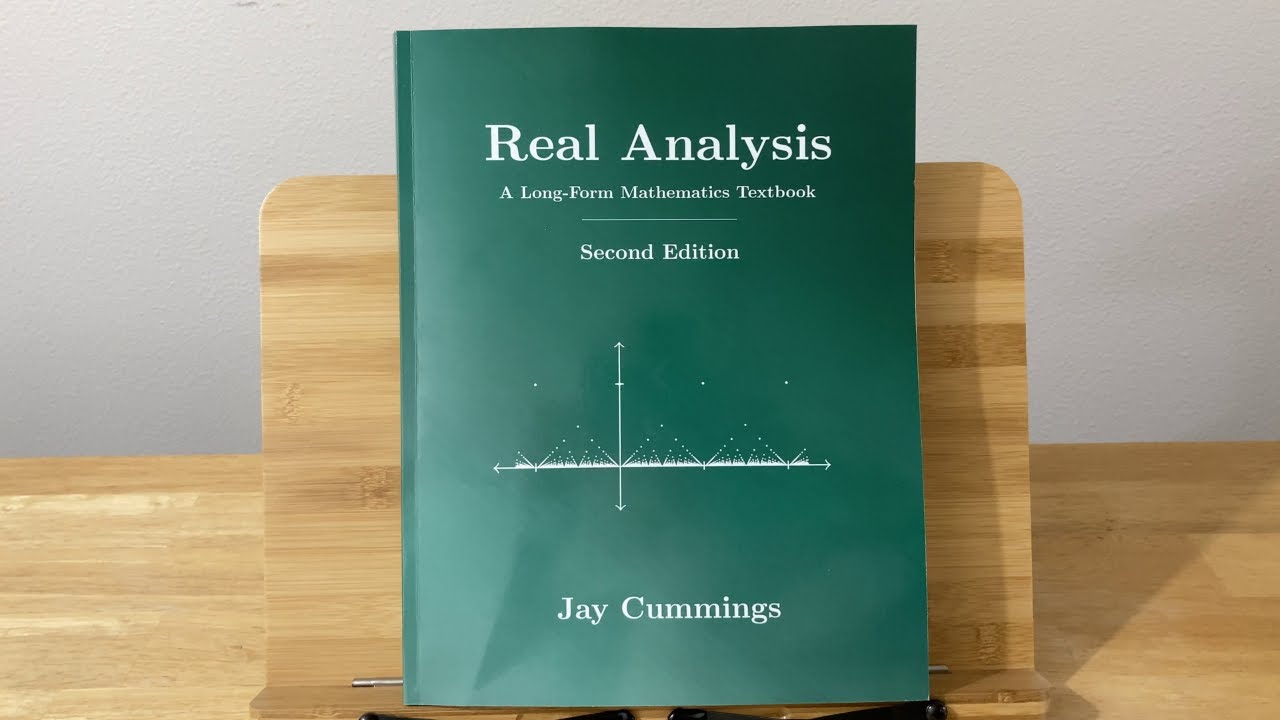
In this video I will show you a very interesting real analysis book. This book is excellent for anyone who wants to learn Real Analysis on their own, or anyone who is taking an Undergraduate level course on Advanced Calculus/Real Analysis. The book is titled Real Analysis: A Long-Form Mathematics Textbook and it was written by Jay Cummings.
Her...
gray gazelle
remote sparrow
has anyone used jay cummings' real analysis book and liked it? i would look for ...
you really like checking out books, huh
remote sparrow
i'm already using another book
heady ember
I have a catalogue of like more than 100 books in a folder
remote sparrow
but i think it's enormously helpful to look around for books and post about them
it will help future users with the same question
and i think it's interesting how different people teach the same topic in different ways
tangentially, i think there's a bit of a spurious conflation between making things "easier to learn" and "lowering standards." the former should be something we should strive for without lowering standards as well.
it's always a good idea to try to figure out how to transmit and receive knowledge more effectively
these new, more friendly and conversational books have yet to prove their worth i'm sure, but i'm particularly biased to them since i enjoy engaging with material in a sort of personal dialogue
 worn oasis
remote sparrow
has anyone used jay cummings' real analysis book and liked it? i would look for ...
worn oasis
remote sparrow
has anyone used jay cummings' real analysis book and liked it? i would look for ...
oh I have this book
remote sparrow
worn oasis
oh I have this book
would you like to give a review?
worn oasis
I haven't gone through it, I am taking analysis in the spring and I bought it as a second resource
The sections I have read were good
its a lot of discussion on the how tos of proofs
gray gazelle
Anyone done C. Pinter's book on AbstractAlgebra?
lean pagoda
gray gazelle
I was also looking for one, and what I found was book by Birkhoff is one of the ...
Thank you for all the suggestions, the book by Grätzer doesn't look too bad but I'll double check with some of the suggestions on the Wikipedia pages
 smoky zephyr
gray gazelle
Anyone done C. Pinter's book on AbstractAlgebra?
smoky zephyr
gray gazelle
Anyone done C. Pinter's book on AbstractAlgebra?
i only read like 100 pages of it but i liked what i saw
gray gazelle
smoky zephyr
i only read like 100 pages of it but i liked what i saw
Would you say it's good for introduction to the topic?
 karmic thorn
Yes
gray gazelle
I am considering between Pinter and Artin, Pinter seems easier
smoky zephyr
pinter just looked nicer to me as well
lean pagoda
lean pagoda
Thank you for all the suggestions, the book by Grätzer doesn't look too bad but ...
Also, and this might also be of interest for @orchid mortar, I came across an introductory Lattice theory text by Steven Roman and it looks pretty good I think (he's a good writer tbh). Unfortunately the typesetting is pretty rough in some spots (no idea why that is, his category theory text also has some horrible formatting in some places)
 lean pagoda
Yes omg, surely someone from Springer could've told him that they look really bad and that doing them in Tikz would be much better
karmic thorn
Right
cinder trellis
Advanced linear algebra by roman has the worst diagrams
his entire book is in LaTeX but his diagrams are garbage
somebody please teach roman tikz
dapper root

loud cradle
roman seems to have squandered an inordinate amount of time and energy on other dubious computer software:
 willow pecan
Oh no
grave thorn
loud cradle
roman seems to have squandered an inordinate amount of time and energy on other ...
On his website there is this video (though I added the text)
He just seems like a Chad
cinder trellis
LOL
remote sparrow
gigaboomer roman
 left cloud
i don't understand memes
remote sparrow

YouTube
¡Hola! Soy el Hechicero Matemático(The Math Sorcerer). Este es mi canal de YouTube en español. ¡Gracias por visitar mi canal!
Mira mis cursos: https://mathsorcerer.com
Hazme una pregunta: https://freemathvids.com/contact
Ayuda gratuita con la tarea: https://mathsorcererforums.com/
Done a través de PayPal: https://paypal.com/donate/?cmd=_s-xc...
math sorcerer has a spanish channel
cinder trellis
His Spanish is pretty good, what on earth
 manic cape
what are the standard texts on distribution theory?
remote sparrow
cinder trellis
His Spanish is pretty good, what on earth
he's of cuban background apparently
lives in florida where there's a lot of cuban americans
grave thorn
manic cape
what are the standard texts on distribution theory?
gelfand generalized functions
grand thistle
prerequisites to and books for p-adic analysis?
 slender rain
can someone pls reccomend me a book that explains laurent series well
gray gazelle
Analytic functions book?
gray gazelle
gray gazelle
Analytic functions book?
I think you want to look for a complex analysis book?
Unless you mean things like real analytic
Yeah
I think real analytic
gray gazelle
gray gazelle
Unless you mean things like real analytic
Basically real analysis extended to multivariable calc
S. Krantz, H. R. Parks, "A Primer of Real Analytic Functions" maybe? 
I just found it

SpringerLink
Definition 2.1.1 Set ℤ+ = {0, 1,2, . . .}. A multiindex μ is an element of (ℤ+)
m
; we will write
$$\Lambda (m) = (\mathbb{Z}^ + )^m ,$$...
They have this chapter for example
It advertises itself as "the only existing monograph devoted to real-analytic functions"
So I guess, it might be your only option
median fossil
I think they're looking for a book on real analysis and multivar calculus, not analytic functions...
median fossil
gray gazelle
Basically real analysis extended to multivariable calc
Given this
gray gazelle
median fossil
I think they're looking for a book on real analysis and multivar calculus, not a...
why don't you ask them then
 solar lake
has anyone ordered books off springer website directly recently?
specifically the hardcovers, do they still have the shitty binding as you would get from amazon
(they're doing a 55% off all books rn)
icy knot
I bought Stillwell’s Real Numbers when they had a sale, has held up well.
 icy knot
solar lake
has anyone ordered books off springer website directly recently?
icy knot
solar lake
has anyone ordered books off springer website directly recently?
I wish you didn’t share this. I’m torn between a PDE book, Axler’s Measure Theory, that well known Cryptography book, and Statistics and Data Analysis for Financial Engineering
 bold knoll
Hi, I want to learn general relativity but I lack background tensor calculus and differential geometry.
Does anyone here have books to recommend on these subjects?
gray gazelle
median fossil
I think they're looking for a book on real analysis and multivar calculus, not a...
Nah. Analytic functions is what I’m looking for
vital bane
bold knoll
Hi, I want to learn general relativity but I lack background tensor calculus and...
Barrett O'Neil "semi-riemannian geometry with applications to relativity" would be good for that
he says all you need is "multivariable calc and some odes"
I assume by that he means analysis in R^n
 sage python
Wald's GR book I think is self-contained relative to manifolds/diffgeo/tensors, and I would wager approaches it from a physicists' angle in case that's a positive
bold knoll
Thanks!
forest sleet
yeah Wald and O'Neill were both books I heard recommended for GR for mathematicians
remote sparrow
solar lake
afaik most springer books are currently print-on-demand glorified paperbacks like the hardcover you showed

solar lake
I bought Eisenbud
If it comes like that again then I’ll just order used books from now on
fluid bay
solar lake
aight thank you good to know
Always buy springer used
Anything 15+ years old is better quality
They went downhill when they were bought by venture capital firm in 2004
forest sleet
^ yeah the new springer books I've received are glue bound
which is fine if you're getting a mycopy paperback for cheap but kinda sucks if you think you're getting a nice hardcover and it's basically a mycopy paperback glued into a hard cover
remote sparrow
strange, i bought zorich's first analysis volume new as a hardcover and it was a crappy gluebound
for his second volume, i got it used and it shipped from the netherlands
but it had much better binding
think it's a sewn binding
btw, these books were published in 2015
axler's LADR also came in new and it had good binding too
forest sleet
the AMS books like Graduate Studies in Mathematics have sewn binding
remote sparrow
it's got some hits and misses for sure though
conway's complex analysis volume was a gluebound
icy knot
As much as I wanted to take advantage of this promotion, I’m just hoarding math books now.
remote sparrow
ugh i also heard dummit and foote is a crappy gluebound now based on amazon reviews
at the very least i've heard of companies that will rebind your books
i think lulu does that?
forest sleet
if it's gluebound they can't really make it sewn though
since you need double size sheets for sewn binding
(if the gluebound is single sheets)
remote sparrow
I HATE CAPITALISM I HATE CAPITALISM

mfw most gluebounds can't even be rebound into better books
forest sleet
maybe they can still do it better than the original binding though
hm maybe there are sewn bindings that can work with single sheets, II'm not sure
normally I think it's double sheets, e.g. on the AMS books if you open to the right pages you can see the stitching and see it's a double size sheet
remote sparrow
foggy relic
both of the GTM books i have are dogshit gluebound but one of my books is UTM and its nicely swen
sewn*
so could depend on series
 rancid bone
What is a great beginner level proof book?
remote sparrow
rancid bone
What is a great beginner level proof book?
 next storm
rancid bone
I’m looking at the hammack one rn
next storm
rancid bone
I’m looking at the hammack one rn
Good book
Has anyone read Serge Lang Algebra?
gray gazelle
next storm
Has anyone read Serge Lang Algebra?
just first chapter but yeah
next storm
gray gazelle
just first chapter but yeah
Okay then I will read it tell you how it is.😁
next storm
gray gazelle
I kind of gave out at rings (second chapter), too much definitions
Aight
I am reading another book but wanted to read something like lang
gray gazelle
I don't think contents of Lang are supposed to be hard
just the exercises
but maybe I'm wrong about that
next storm
Looks pretty cool
 analog lava
rec textbooks for differential geometry
pref one that teaches some algebraic topology too if that exists
 fathom monolith
I’d also be interested in some geometry textbooks. I don’t know anything about geometry, but every textbook I find is for high school.
cinder trellis
Does anyone have any thoughts on Shafarevich’s algebraic geometry books?
I’m thinking of getting copies but I wanted to know of other options, or some honest reviews of it.
grave thorn
cinder trellis
Does anyone have any thoughts on Shafarevich’s algebraic geometry books?
I have the russian version of one of his books, they seem pretty good
though I cant comment on his algebraic geometry book specifically
cinder trellis
I was looking for a gentler introduction than, say, Hartshorne’s book
sudden kindle
fathom monolith
I’d also be interested in some geometry textbooks. I don’t know anything about g...
i like Geometry by Brannan, Esplen and Gray
nice introductory book on various kinds of geometries, like Euclidean, Affine, Projective, Inversive, Hyperbolic, and Spherical
Emphasises the Kleinian pov of geometry, which is that a geometry consists of a space together with its group of symmetries
some familiarity with groups is helpful but not necessary
I believe any high schooler could pick up this book and benefit from it.
fathom monolith
sudden kindle
i like Geometry by Brannan, Esplen and Gray
Yea this looks cool. Its going on the christmas list. Thanks
gray gazelle
Hey does anyone have recommendations for books on algebraic geometry for beginners ?
It could be in both English or French
dapper root
EGA
Just kidding, this is kinda hard to answer to be honest
Common recommendations are like, Shafarevich
Milne’s algebraic curves
And I’ve heard stuff about a book called like “royal road to algebraic geometry” or something like that
gray gazelle
Ok will look up thanks mate
dapper root
For scheme theory, I recommend “Algebraic Geometry and Commutative Algebra” by Bosch
At some point you’ll probably have to work through most of Hartshorne or Vakil, but I like the book above because I think it’s the most detailed in the rudiments of scheme theory
It works out some of the really insanely tedious stuff the other books make you do, but these are some of the most difficult things to do when you’re starting out because you have no ide what to do
Also Mumford’s Red Book seems really nice from what little parts of it I skimmed
gray gazelle
dapper root
It works out some of the really insanely tedious stuff the other books make you ...
Ok good to know thanks a lot man
dapper root
Good luck
gray gazelle
dapper root
Good luck
It’s mostly for my vacation because at the moment I’m wayyyy too busy 😭
So I’ll preserve the luck for my upcoming exam
😂
gray gazelle
analog lava
pref one that teaches some algebraic topology too if that exists

Google Books
 devout sphinx
dapper root
EGA
devout sphinx
dapper root
EGA
someone un-ironically recommended this to me
they said it's easier to understand than hartsthorne
dapper root
I mean…
In some sense?
But it’s a very meme answer
Also hope you are willing to read French lol
devout sphinx
haha no
gray gazelle
dapper root
Also hope you are willing to read French lol
Lmao i am tho 😂😂
Still it is painful to me not being able to access books physically so math books get pretty complicated for me 😭
So I try to get them at libraries but I mean it doesn’t feel the same as having your own and being able to highlight and all 😭
remote sparrow

Modal Logic for Open Minds (Volume 199) (Lecture Notes)
anyone know if this is a good intro to modal logic?
heady ember
analog lava
rec textbooks for differential geometry
The one's I have heard reccomended here before are Lee and Toring Lu
Also, John has shared his notes here before
cursive orbit
Loring Tu*
heady ember
heady ember
cursive orbit
Loring Tu*
Oops sorry
devout hollow
Will Linear Algebra by Serge Lang prepare me enough for more advanced books such as Finite Dimensional Vector Spaces by Halmos? Or will I benefit more from other texts such as LADR by Axler?
willow pecan
You will benefit from a good linear algebra book like Friedberg
LADR is controversial at best
Lang is controversial at best
sturdy shore
LADR is like halmos but worse idk why you'd read it if you want to progress to Halmos
loud cradle
devout hollow
Will Linear Algebra by Serge Lang prepare me enough for more advanced books such...
imo, those three books are at more or less the same level
devout hollow
Thank you all for your reply. I hereby apologise for my ignorance; as I am relatively new to the subject, I don't know much about books, yet.
willow pecan
No need to apologize
loud cradle
hoffman and kunze is also worth a look
sturdy shore
h&k is even more difficult than halmos though, I think FIS is the best recommendation if you aren't so confident on your math
loud cradle
agree, FIS->H&K is probably what i would recommend to most people, although I do like the exposition of the first 2/3 or so of axler
sturdy shore
but you can read all the other greats later, there is genuine worth in reading more than one LA book imo
devout hollow
Okay. Based on the feedback received, I will be sure to check out FIS. Currently, I am halfway through Lang Linear Algebra; should I finish Lang then move on to FIS?
loud cradle
imo if you're enjoying lang and it's not at too high or too low a level, why not continue reading it?
sturdy shore
I've never read lang but if you want to finish it you can then probably jump to halmos/h&k instead, up to you really
devout hollow
Yeah, I thus far managed to do 90% of the exercises and prove almost every theorem before looking at the proof. I think I am happy with my current progress.
loud cradle
maybe chapter 12 of lang is not so important (depending on your interest of course), but the rest of the content seems fine

i think he's missing the SVD, which would definitely be good to learn at some point
but there's no linear algebra book that has everything, so well worth taking a look at several
sturdy shore
oh wait you are that guy that was proving every theorem in lang and insecure about your progress
devout hollow
loud cradle
maybe chapter 12 of lang is not so important (depending on your interest of cour...
I might as well at least try to work through it since I bought the whole book.
devout hollow
sturdy shore
oh wait you are that guy that was proving every theorem in lang and insecure abo...
Yes. It just feels like I don't actually understand what I am proving.
sturdy shore
convex sets are really important for a lot of things, it is just not part of linear algebra proper (generally)
sturdy shore
devout hollow
Yes. It just feels like I don't actually understand what I am proving.
it takes time, nobody develops perfect intuition overnight, you will get better at it too once you start using LA
devout hollow
sturdy shore
it takes time, nobody develops perfect intuition overnight, you will get better ...
Thank you for your encouragement.
loud cradle
and i'm guessing, they're taught better elsewhere, maybe either rockafellar or boyd and Vandenberghe
sturdy shore
but if you are at this level I would advise finishing lang then jumping to halmos or h&k or both, FIS is probably too low level for a second book
loud cradle
if you're interested in exploring the numerical side of LA, there are a number of nice choices there as well
hazy elk
You can also try a different subject other than LA
devout hollow
Okay. Quite conveniently, I already bought Halmos (because it was only 30 dollars for the hard covered version, I couldn't resist it)
hazy elk
I think that's more fruitful tbh
loud cradle
devout hollow
Okay. Quite conveniently, I already bought Halmos (because it was only 30 dollar...
halmos's book is good (like all of his books), that's not wasted money
hazy elk
You really don't have to read like 3 books on LA
sturdy shore
hazy elk
You can also try a different subject other than LA
sort of true, I do think reading a 2nd book on LA is very much worth but at the same time you should start actually using what is in them by now, or else it will feel dry
unless you already do
hazy elk
Artin is an inspiring book but it has its own style
loud cradle
agree, LA is so ubiquitous that it's worth viewing from several perspectives, no one's saying you have to focus on it exclusively though
hazy elk
If DW is going to major in math, they will probably have to do an LA course there as well no? So I'd say it's more profitable to explore new math like analysis and algebra
loud cradle
(and topology)
devout hollow
I want to eventually study differential geometry, as well as abstract algebra. But I've heard that Differential Geometry requires a lot of LA, and that advanced knowledge of LA makes abstract algebra easier. I guess, that is the main motivation behind my study of Linear Algebra.
sturdy shore
have you studied any analysis?
you should start, same with algebra
by now not knowing any algebra is actually gonna make your life harder in LA, both H&K and Halmos assume you know algebra at an elementary level
hallow oriole
sturdy shore
but you can read all the other greats later, there is genuine worth in reading m...
huh, would you say there's not much worth in reading multiple books abt other subjects too? c i kinda wanted to get a few different anal books/algebra books but would that actly help me?
loud cradle
a first course in algebra doesn't require a ton of LA (just enough for field theory and some matrix groups, unless you're covering representation theory as well) but it certainly helps to have seen things like quotient spaces and isomorphism theorems in the LA context
sturdy shore
hallow oriole
huh, would you say there's not much worth in reading multiple books abt other su...
there is definitely worth for those too if you want to solidify your knowledge, it's just that LA is more well-suited to multiple perspectives imo
loud cradle
hallow oriole
huh, would you say there's not much worth in reading multiple books abt other su...
it's worth looking at several books in order to find one whose style and content you like, but then again if you're doing this in the context of a math major, that choice is gonna be made for you by the instructor
hazy elk
devout hollow
I want to eventually study differential geometry, as well as abstract algebra. B...
You might wanna pick up some multivariable calculus (differentiation, chain rule, implicit and inverse function theorems) and read Do Carmo/Pressley
devout hollow
hazy elk
You might wanna pick up some multivariable calculus (differentiation, chain rule...
I did went through some multivariate Calculus, as well as some vector analysis, but not rigorously. Thus, I will probably relearn calculus using two volumes of Apostol Calculus.
devout hollow
thanks 😊
devout hollow
sturdy shore
by now not knowing any algebra is actually gonna make your life harder in LA, bo...
Can you recommend me a good elementary text in Abstract Algebra? For now, I would prefer a short book on the topic. I will commence my thorough study of abstract algebra, but only after I have gained reasonable proficiency in Linear Algebra.
heady ember
You can also see the pinned recs btw
devout hollow
okay I will do that
hazy elk
Armstrong is also a nice book for beginners imo (it's not in pins)
But it's just group theory
sturdy shore
personally not very knowledgeable on elementary AA books
I've read a bit of Fraleigh and thought it was pretty good but that's it
karmic thorn
Judson is nice
 broken meadow
was going to suggest dummit foote but then i saw Short
karmic thorn
In that case I suggest MetalNinja 💟
broken meadow
Short kings rise up
karmic thorn
crimson leaf
Herstein has a short book not topics but the other one
 rugged sable
brief history of violence
 unique ice
rugged sable
brief history of violence
unique ice
rugged sable
brief history of violence
sounds like algebra
 spiral lynx
Any recommendations for complex function books?
broken meadow
Ruel V. Churchill complex variables and applications
soft introduction to material with no proofs, designed for math adjacent students
if you want pure math you will need some more background
gray gazelle
can any one advice a book about modeling with differential and how to make differential eq ?
karmic thorn
gray gazelle
can any one advice a book about modeling with differential and how to make diffe...
I like Mathematical Modelling with Case Studies by Barnes and Fulford
gray gazelle
karmic thorn
I like *Mathematical Modelling with Case Studies* by Barnes and Fulford
is this book help me to percept modeling better? because I want to code(differential modeling) in MATLAB
gray gazelle
thank you a lot , i Certainly check it
karmic thorn
👍
 turbid sequoia
Any good calculus II books for self learning
crimson leaf
Stewart and Thomas for the standard Spivak or Apostol for more rigorous proof based calculus and there's also paul's online math notes not a textbook but you can learn calc 1-3 from there
turbid sequoia
Thanks
spare ridge
broken meadow
Short kings rise up <:catKing:812386361297862747>
what is your height
 undone pine
hi, i'm searching for some litterature on gaussian distribution and it's applications (entropy maximisation, likelihood estimation etc.). If someone could recommend something I would appreciate it, thank you!
tropic thorn
undone pine
hi, i'm searching for some litterature on gaussian distribution and it's applica...
+1
broken meadow
spare ridge
what is your height
,w 5’5” to cm
hasty eagleBOT


 Requested by MetalNinja27#7212
broken meadow
Requested by MetalNinja27#7212
broken meadow
Lmao
broken meadow
I give off average height vibes but im actually a short king
hasty eagleBOT

 Requested by Chmonkey#9767

 sudden kindle
Bro legit added the 0.5 inches to his height
dapper root
Look, the reason for this is because when I was in middle school I said exactly that I want to be 5’10.5
And then I became that height down to the half inch
I shoulda said I wanted to be 6’4 or something fr
willow pecan
Very book recommendation
dapper root
Okay “ange”
vital bane
chmonkey
what are the prereqs for commutative algebra? ring theory?
what's a good comm alg book with low prereqs but also like pushes you towards alg geo towards the end
dapper root
Undergraduate commutative algebra by Miles Reid
vital bane
huh 172 pages quite a short book I suppose
dapper root
It is geometric
vital bane
vital bane
what are the prereqs for commutative algebra? ring theory?
i guess you need some topology as well since apparently people care about the topology of spec(Z)
dapper root
I mean
You need the definition
I’m pretty sure the book includes the definition of a topology
vital bane
oh so they just define the zarski topology on it and that's it? they dont do any topological stuff? (both in the book and in comm alg)
vital bane
I see
dapper root
The Zariski topology is very odd and behaves unlike the things you’d study in a topology class
vital bane
non-hausdroff 
dapper root
So you mostly just need definitions and then develop the properties in a commutative algebra book or AG book
vital bane
ooh okay makes sense
dapper root
If topology is what stops you from learning AG you suck
To be brutal
Like that is by far the least hard part of the subject at an elementary level lol
icy knot
Anyone familiar with Nearing’s Mathematical Tools for Physics? Granted I have Kreyzig’s Advanced Engineering Mathematics, but this looks like a good book on the same topics. I would eventually like to work and get a MS in Applied Math, so I need to learn stuff like PDEs, Complex Analysis, etc.
broken meadow
Huhhh
nuuuuu
im too cute…
anyways its wrong channel we need to stick to Book recs
grave thorn
vital bane
what are the prereqs for commutative algebra? ring theory?
(i could be wrong): most of the topology you use in commutative algebra is definitions; it doesnt seem to use lots of hardcore topology results (urhysohns lemma, tychnoff etc)
 cobalt flume
how many editions does spivak* have?
remote sparrow
i'm not aware of a spavik, but i have heard of a spivak
spivak has written multiple books; which one would you like to know about?

 blazing parcel
What do you think about The Joy of X ?
cobalt flume
remote sparrow
i'm not aware of a spavik, but i have heard of a spivak
sry i misspelled
cobalt flume
remote sparrow
spivak has written multiple books; which one would you like to know about?
i saw it has 2 editions
3rd and 4th. but what abt 1st and 2nd
or am i asking a dumb question?
remote sparrow
i'm sure there's a first and second edition, but i've never bothered to look for those editions
for his calculus book
gray gazelle
cobalt flume
how many editions does spivak* have?
Four editions
Has anyone read this book?

 snow lintel
if it is only mechanics you can choose "Hibbler" more focused on the mechanics
marble solar
gray gazelle
Has anyone read this book?
I've read parts of it
Spivak has sadly passed away so it won't every be complete
gray gazelle
marble solar
I've read parts of it
Who is the book for? Can someone who's never taken course in physics dive in this?
remote sparrow
that's his goal, but one of the prerequisites he stated was differential geometry
spare ridge
marble solar
Spivak has sadly passed away so it won't every be complete
wait what
oh he died in 2020, damn
marble solar
gray gazelle
Who is the book for? Can someone who's never taken course in physics dive in thi...
I don't recommend it
You should know basic physics
I'd say a freshman year of university physics is a pre-req
gray gazelle
But basic physics is incredibly boring
marble solar
Roughly equivalent to Halliday & Resnick, Young and Freedman (Sears & Zemansky) or some other equivalent
gray gazelle
marble solar
Roughly equivalent to Halliday & Resnick, Young and Freedman (Sears & Zemansky) ...
Yeah this ^
marble solar
Halliday & Resnick is a fun book
gray gazelle
Absolutely most boring thing you could ever hope to study
gray gazelle
Programming itself yeah, but computer scientific programming fun
marble solar
To be seen on my end
gray gazelle
marble solar
Halliday & Resnick is a fun book
1200 pages of fun yeah sure )))
Why is this larger than a calculus book
no way highschool physics has this much material
remote sparrow
there's mechanics, e&m, and special topics like qm, optics, thermo, special relativity, etc. to be chosen at an instructor's leisure
mechanics and e&m are pretty standardized
special topics classes are more varied
so 1200 pages is also fitting at least 3 semesters' worth of material like those big calc books
forest sleet
apparently Monday is AMS day so if you are an AMS member you get 40% off many of their books
willow pecan
<@&268886789983436800>
vital bane
such contempt for AMS books...
grave thorn
vital bane
such contempt for AMS books...
Does Springer have Korn & Korn?
 vital bane

 dense glen
gray gazelle
Has anyone read this book?
dense glen
gray gazelle
Has anyone read this book?
No
grand thistle
grave thorn
Does Springer have Korn & Korn?
ams books look so pretty
 balmy isle
Can someone recommend the best financial book for beginners? how to handle money etc
gray gazelle
remote sparrow
so 1200 pages is also fitting at least 3 semesters' worth of material like those...
1200 page calc is done in 1 semester tho right?
is there a difference between mechanics and classical mechanics?
rich sun
classical mechanics is a subfield of mechanics
vital bane
classical mechanics is just what it's called (a branch of physics or one of the 4 pillars), I dont think anyone refers to "mechanics" as a field on it's own
rich sun
mechanics also includes quantum mechanics and relativistic mechanics
vital bane
mechanics is just any physics that quantitatively describes the...well motion of things, i myself have never heard of people refer to "mechanics" as a field
remote sparrow
gray gazelle
1200 page calc is done in 1 semester tho right?
? that's three semesters worth
calc 1, 2, and 3
gray gazelle
vital bane
mechanics is just any physics that quantitatively describes the...well motion of...
So what is the mechanics chapter about in highschool physics books?
remote sparrow
mechanics also covers stuff like energy
and momentum
not just motion and forces
depends on the book but it should take several chapters
vital bane
gray gazelle
So what is the mechanics chapter about in highschool physics books?
newtonian mechanics
basically f = ma or f = dp/dt if it's calculus based and momentum and impluse and of course the rotational equivalent of all that
gray gazelle
thanks guys
forest sleet
vital bane
such contempt for AMS books...
what happened lol?
forest sleet
oh ok I thought someone hated AMS books so much they said something that got deleted
 junior heron
For Christmas I can wish for many books from Springer. Which ones would you recommend?
gray gazelle
junior heron
For Christmas I can wish for many books from Springer. Which ones would you reco...
Introduction to topological manifolds by Lee
 rigid barn
gray gazelle
Introduction to topological manifolds by Lee
rigid barn
gray gazelle
Introduction to topological manifolds by Lee
Followed by Introduction to Smooth Manifolds and Introduction to Riemannian Manifolds
What's a good introductory algebraic geometry book besides Fulton or Cox? Same for commutative algebra that isn't AM/Eisenbud/Reed.
dapper root
Bro
Reid is really elementary
Idk what else exists that’s at that level
It doesn’t even cover the tensor product
next thicket
I'm gonna be studying Ring + Field Theory next semester. Any book recommendations to read over the winter break?
gray gazelle
rigid barn
Followed by Introduction to Smooth Manifolds and Introduction to Riemannian Mani...
I don't think they are a series that you should read one by one, but those are the other options
rigid barn
dapper root
Reid is really elementary
I know, but I simultaneously like and dislike his casual style.
rigid barn
dapper root
It doesn’t even cover the tensor product
I'm fine with tensor products, the book doesn't have to be completely elementary, just not something like Hartshorne that requires all of commutative algebra.
dapper root
You named like 3 entirely different books on commutative algebra
AM Eisenbud and Reid are all very different so idk what to say lol
rigid barn
Shit, you were talking about CA? I thought you meant Reid for AG
rigid barn
dapper root
AM Eisenbud and Reid are all very different so idk what to say lol
Then say nothing 🤐
dapper root
In the CA portion…
rigid barn
I know, but I spaced for a second and thought you meant Reid's AG book
dapper root
Anyway, if you didn’t like AM then idk why you’d like this but if you know a lot of algebra I like Matsumura
There’s also a book by Antoine-Chambert Loir (I think that’s the name) published recently
Idk, maybe that one is good
There’s also Zariski-Samuel, Nagata, Bourbaki but
If you prefer those idk, you’re built different, those books are ancient
rigid barn
Thanks.
 sick river
Any recommendations on birational projective maps?
remote sparrow

This is a newer book that is absolutely amazing for anyone who wants to learn to write proofs. If you are learning on your own then this book is definitely worth picking up. If you are taking a class on proof writing then it's also extremely helpful. Learning to write proofs takes a lot of time and effort, and this book can definitely help you t...
 valid ferry
remote sparrow
https://www.youtube.com/watch?v=M1RrI3gXVsU
valid ferry
remote sparrow
https://www.youtube.com/watch?v=M1RrI3gXVsU
Wow a math socerer
gray gazelle
hello!
What book do you recommend to start with linear algebra from 0?
I am in the first year of my degree, in physics, and I am quite lost
willow pecan
Do you have experience with proofs
marble solar
gray gazelle
What book do you recommend to start with linear algebra from 0?
Schaum's outline to Linear Algebra
Doesn't matter if you're good w/ proofs or not, it will help you
gray gazelle
willow pecan
Do you have experience with proofs
what are proofs?
sorry, I am spanish, my english is not very well
proofs are demostrations?
willow pecan
@broken meadow
gray gazelle
marble solar
Doesn't matter if you're good w/ proofs or not, it will help you
Thank you!
 alpine rover
gray gazelle
What book do you recommend to start with linear algebra from 0?
alpine rover
gray gazelle
What book do you recommend to start with linear algebra from 0?

YouTube
Lecture videos from Gilbert Strang's course on Linear Algebra at MIT.
gray gazelle
alpine rover
https://youtube.com/playlist?list=PL49CF3715CB9EF31D
ohh, thank you!
 terse basin
What books do you recommend to get a grasp of limits in calc1? specially the indeterminate ones that require factorization
gray gazelle
remote sparrow
https://www.youtube.com/watch?v=M1RrI3gXVsU
is this book rly good?
remote sparrow
it seems fine based on an online copy i have
 fast wasp
hey, sorry but do you have a book of integrals?