#book-recommendations
1 messages · Page 10 of 1
 sturdy shore
 blazing jetty
I’m bad at it
blazing jetty
sturdy shore
depends on ur lvl
basic level I would say
 remote ginkgo
u may want kenneth rosen discrete mathematics
sturdy shore
what you are looking for doesn't seem to be set theory
blazing jetty
Yeah, I’m going to see it
blazing jetty
sturdy shore
what you are looking for doesn't seem to be set theory
that was the name of the unit…
idk
sturdy shore
if you really want something just on sets, probably halmos
blazing jetty
yeah that one
sturdy shore
so you are already using halmos?
blazing jetty
bro i don’t even know what’s that
all i know there is something named paul halmos
imma check it
i have to do an essay in only one day
sturdy shore
yes it is the book naive set theory by paul halmos
blazing jetty
nice, math is interesting
 lethal fox
hi, i am looking for books or lectures on graph drawing using force-directed algorithms. Can someone help me out?
 acoustic ridge
Could anyone recommend me a book with tons of geometry problems in it?
 gray gazelle
Nathan Altshiller-Court - College Geometry should keep you busy for a while (i assume you mean hs geometry)
 karmic thorn
acoustic ridge
Could anyone recommend me a book with tons of geometry problems in it?
karmic thorn
acoustic ridge
Could anyone recommend me a book with tons of geometry problems in it?
What kind of geometry?
 lament bear
Guys, can you recommend a book on discrete mathematics? I need to review core concepts and prepare myself for entrance exam by getting good at solving problems, so solutions for said problems are a must. If there would be a transition or short introduction into graph theory, that would be a plus.
(pls don't recommened Concrete Mathematics, I watched it and I need something more elementary, isn't really relevant to my goals)
 heady ember
lament bear
Guys, can you recommend a book on discrete mathematics? I need to review core co...
heady ember
lament bear
Guys, can you recommend a book on discrete mathematics? I need to review core co...
Are you sure you want discrete math? From my experience with like 30 pages of Rosen, its super boring
If you want challenging highschool problems you can try Cambridge's STEP papers (its Cambridge's entrance exam for math)
They're avaliable onliine for free
 signal ferry
Hello does anyone know some book for linear algebra, something that focuses on proofs but isn't Linear Algebra Done Right cause I found it really difficult to understand motivations for lots of concepts?
heady ember
signal ferry
Hello does anyone know some book for linear algebra, something that focuses on p...
Look in pinned
signal ferry
What's pinned, is it a function a tab in this discord?
signal ferry
Found the function
 half hinge
Hello i am second year electrical engineering but love math. Currently we are doing functions with multiple variables, and integrals of the same as well as multiple integrals and similar
Is there some good book or resource where I can read more formally about this topics because at university is too shallow and I would love to know a bit better
karmic thorn
I like Don Shimamoto's Multivariable Calculus. The approach adopted is more mathematical, maybe someone can drop better recommendations from a physics/engineering perspective.
 vast obsidian
I forgot what linear algebra book I was recommended yesterday
Shilov good for beginner?
Friedberg? Lang?
 willow pecan
Friedberg maybe
 crimson leaf
Friedberg and Shilov are good
vast obsidian
@willow pecan@crimson leafthanks
heady ember
Look in pineed for good ol' Dami's review
 royal gale
 finite thorn
Got this book in my uni library, is it good?

 turbid wolf
Does anyone know any cheap pre calculus books I could buy on Amazon?
remote ginkgo
finite thorn
Got this book in my uni library, is it good?
yeah its fine
 tardy walrus
finite thorn
Got this book in my uni library, is it good?
tardy walrus
finite thorn
Got this book in my uni library, is it good?
Yes
Though there is a fourth edition
sturdy shore
tardy walrus
Though there is a fourth edition
I thought 4th ed was considered inferior
 eternal dove
Is Bonjorno a good book?
 sick river
not really a book recc but where would one find open problems sorted by field ideally, to work on?
heady ember
sick river
not really a book recc but where would one find open problems sorted by field id...
Well, Cambridge provides the example sheets to nearly all, if not all, their classes at https://www.maths.cam.ac.uk/undergrad/examplesheets
sick river
i dont think those are open problems
willow pecan
Many mathematical problems have been stated but not yet solved. These problems come from many areas of mathematics, such as theoretical physics, computer science, algebra, analysis, combinatorics, algebraic, differential, discrete and Euclidean geometries, graph theory, group theory, model theory, number theory, set theory, Ramsey theory, dynami...
 quick hornet
to work on
please do not find a problem from a list of unsolved problems and attempt to work on it
this has literally never been productive
even in famous cases like that one "teacher writes unsolved problem on whiteboard, student unknowingly solves it thinking it's a homework problem" story, it was presented in the context of a class built around problems like that
heady ember
sick river
i dont think those are open problems
Oh that's what you meant by "open problems"
sick river
just looking for a problem i can use to get some exposure to the research process
quick hornet
famous unsolved problems are quite unusual examples of the "research process" since they have many many years (in some cases, literal centuries) of hyper-specific work that you need to catch up on
and oftentimes the proposed approaches are highly esoteric
e.g. the program to solve the riemann hypothesis through the geometry of the field of one element
most problems that a researcher tackles do not have nearly the same amount of existing work done on them
in fact, most papers are "we make some minor modifications that allow us to apply technique from [paper x] to [situation y], and describe our results" or something along those lines
that is to say, the flow for MOST problems is:
researcher identifies problem, researcher tries a few techniques, researcher solves problem
whereas the flow for famous unsovled problems is:
researcher identifies problem, a dozen researchers attempt to solve the problem, five different ambitious programs break out attempting to solve the problem, hundreds of researchers now need to catch up on hundreds of papers in order to even understand what needs to be done in order to solve the problem, repeat from step 2
its just a totally different "texture" to the process, and actual research doesnt consist of "attempting to solve the problem" so much as "attempting to slowly develop the theory of a program that some are hopeful will eventually lead to a set of techniques that can approach the problem, but first many holes in this program need to be filled in, and you need to identify that hole and chip away at it"
sick river
i see, so i'm not going to find anything realistic online, so i should probably just ask some faculty for a problem, thank you
quick hornet
right
i dont mean to be discouraging
its just a bad place to find problems that are actually reflective of the research process
asking faculty is a much much better idea
 blazing canopy
Any recommendations for a mathematically-oriented, graduate or professional level signal processing text?
 zealous light
@timber copper would you have any idea?
 timber copper
blazing canopy
Any recommendations for a mathematically-oriented, graduate or professional leve...
timber copper
blazing canopy
Any recommendations for a mathematically-oriented, graduate or professional leve...
through a cursory glance at the contents: mallat's A wavelet tour of signal processing might be of use and the books given on this site: https://fourierandwavelets.org/
blazing canopy
Thanks, I'll check it out. I'm mostly just trying to build out my personal library of references for when I need to look something up for whatever I'm working on
timber copper
Bremaud's Mathematical Principles of Signal Processing also looks good at least from a functional analysis standpoint (This is probably the kind of rigor you're looking for)
blazing canopy
timber copper
Bremaud's Mathematical Principles of Signal Processing also looks good at least ...
I looked at the table of contents and I feel that this is too steeped in Fourier analysis, rather than exploring concepts such as complexity, rigorous numerical error bounds, algorithm analysis, and so forth
In my view signal processing is not Fourier analysis, but developing algorithms that rely on that
blazing canopy
it's on my list of possibilities
timber copper
if you're interested in discrete methods and the analysis of like the fft and fft variants and stuff like that, his book on discrete-time signal processing goes into that
blazing canopy
My main worry was just that that book looks extremely encyclopedic which is a little bit the opposite of what I need, but maybe it's OK
 stray veldt

 acoustic crater
does anyone know any book(s) that's good for people new to calculus?
 alpine orchid
acoustic crater
does anyone know any book(s) that's good for people new to calculus?
alpine orchid
acoustic crater
does anyone know any book(s) that's good for people new to calculus?
My lecturer recommended us to use Thomas calculus
acoustic crater
is there a specific edition?
heady ember
Pauls' Online Math Notes is available online for free by the author
gray gazelle
any book for dynamics available online pdf
remote ginkgo
gray gazelle
any book for dynamics available online pdf
strogatz for intro, kuznetsov for bifurcation theory
acoustic ridge
karmic thorn
What kind of geometry?
2D geometry
 remote sparrow
acoustic crater
does anyone know any book(s) that's good for people new to calculus?
karmic thorn
acoustic ridge
2D geometry
remote sparrow
acoustic crater
does anyone know any book(s) that's good for people new to calculus?
karmic thorn
acoustic ridge
2D geometry
I'm aware of Coxeter's Introduction to Geometry
acoustic ridge
karmic thorn
I'm aware of Coxeter's *Introduction to Geometry*
I will try that out for sure.
 tame sphinx
what's a good book for linear algebra? one that's proper posh, like with proofs and more theory involved?
tame sphinx
I'll look into it when I get time
 modern quarry
Hello, any book recommendations on the subject of "Philosophy of Math"
 lean pagoda
Haven't read the book myself, but I've heard good things about the book Lectures on the Philosophy of Mathematics by Joel David Hamkins
remote sparrow
modern quarry
Hello, any book recommendations on the subject of "Philosophy of Math"
https://www.logicmatters.net/2020/11/16/philosophy-of-mathematics-a-reading-list/
https://math.stackexchange.com/questions/30572/good-books-on-philosophy-of-mathematics
https://plato.stanford.edu/entries/philosophy-mathematics/ (scroll down to the bibliography)
A few people recently have quite independently asked me to recommend some introductory reading on the philosophy of mathematics. I have in fact previously posted here a short list in the ‘Five Books’ style. But here’s a more expansive draft list of suggestions. Let’s begin with an entry-level book first published twenty years ago but not … Philo...

Mathematics Stack Exchange
Where can I learn more about the implications, meta discussions, history and the foundations of mathematics?
Is Russell's Introduction to Mathematical Philosophy a good start?
i also own and have read some of hamkins' Lectures on the Philosophy of Mathematics, it was pretty neat
oh just found this
it has a section on philosophy of math
heady ember
Idk
 glacial crypt
Can I get a recommendation on a good introductory complex analysis textbook? (Assume that real analysis has been taken)
gray gazelle
Ahlfors is the usual recommendation. Gamelin and Stein&Shakarchi are also good.
heady ember
Look in pinned
sturdy shore
lean pagoda
Haven't read the book myself, but I've heard good things about the book *Lecture...
this also has lectures on yt by hamkins himself, which are really good
 placid pollen
glacial crypt
Can I get a recommendation on a good introductory complex analysis textbook? (As...
placid pollen
glacial crypt
Can I get a recommendation on a good introductory complex analysis textbook? (As...
I want to check Nehari Conformal Mappings myself but I've already had some complex variable theory.
I wouldn't recommend Ahlfors because I in general hate the style where the author is talkative enough to skip a bold "Definition" statement, that's more of a thing for a classroom than a book. Not to say that makes it bad, just that it evokes bad memories from other authors or old textbooks which do this a lot.
Gamelin or Stein like @gray gazelle said seem more my taste but I haven't seriously sat through them.
Cartan is interesting to check.
If you took real analysis as in measure theory then check Rudin.
glacial crypt
Have not done measure theory. Thank you for the recommendations yeah
gray gazelle
Is Apostol Calculus good for first time learning Calculus?
 gray jungle
Is kosaku yosida functional analysis book any good for someone interested in getting into operator theory? 
 grand thistle
gray gazelle
Is Apostol Calculus good for first time learning Calculus?
grand thistle
gray gazelle
Is Apostol Calculus good for first time learning Calculus?
yeah it's pretty good
but it's different in the way it covers integration before differentiation
gray gazelle
Which one do you think is better, Apostol or Spivak?
grand thistle
they're both good
spivak should be closer to a more conventional analysis text without the topology
 cobalt arch
any axiomatic books?
gray gazelle
grand thistle
yeah it's pretty good
thanks
heady ember
cobalt arch
any axiomatic books?
Be more specfic
Axiomatic can refer to linear algebra (where vector spaces are defined axiomatically), AA, set theory, etc
acoustic ridge
I want to practice math problems. Can anyone suggest me a book to practice math?
karmic thorn
acoustic ridge
I want to practice math problems. Can anyone suggest me a book to practice math?
Math problems?
Which topics, specifically?
acoustic ridge
Algebra, equations, geometry, combinatorics, number theory etc
cobalt arch
heady ember
Be more specfic
I want a book that treats algebra, analysis, geometry, combinatorics, etc. axiomatically meaning it starts with some axioms and proves every other result based on these axioms
remote sparrow
acoustic ridge
Algebra, equations, geometry, combinatorics, number theory etc
if you know calculus and how to read and write proofs, A Walk Through Combinatorics by Miklos Bona is a neat combinatorics book. The problems are pretty hard, but I think all of the exercises have solutions in the book, minus the supplementary exercises, which are extra problems that aren't supposed to have solutions. Elementary Number Theory by Underwood Dudley (a lot of stuff is left as exercises or done in problems) or Elementary Number Theory by David Burton (more traditional exposition) are good for number theory.
remote sparrow
cobalt arch
I want a book that treats algebra, analysis, geometry, combinatorics, etc. axiom...
well, even going axiomatically, there are different approaches. you can give an axiomatic description of the real numbers, for example, as the unique complete ordered field. or you can start from scratch with the peano axioms and work your way towards constructing the naturals, integers, rationals, and reals, proving that the reals are the unique complete ordered field in the process. i'm not sure if combinatorics has been treated in a bourbakian fashion, but i don't think it would be conducive to learning, and besides that, combinatorics as a field is very broad and diverse. if by geometry you mean euclidean geometry, i'm pretty sure nearly every book echoes euclid's axiomatic approach. as for algebra i can only think of a graduate text, namely lang. i didn't like very axiomatic books; i prefer to be engaged in dialogue with my books. that doesn't mean i have a problem with foundations, i love foundations. i think the construction of the number systems is pretty neat. but i prefer thinking backwards about foundations and axioms in a sense. i try to think about how axioms reflect my common sense, or don't, and transform my understanding accordingly.
 gentle arrow
i need a DE book recommendation, preferably one that covers both ODEs/PDEs
it can be rigorous i dont mind
i didnt expect to see DEs this early in ap physics C 
(i thought it would appear later in the year but turns out were doing air resistance earlier on)
remote sparrow
gentle arrow
i need a DE book recommendation, preferably one that covers both ODEs/PDEs
it ca...
boyce/diprima with boundary value problems i guess
 cursive orbit
gentle arrow
i didnt expect to see DEs this early in ap physics C <:sadcat:547124024585486359...
cursive orbit
gentle arrow
i didnt expect to see DEs this early in ap physics C <:sadcat:547124024585486359...
the only des you need to know for physics c is how to solve separable ones
gentle arrow
cursive orbit
the only des you need to know for physics c is how to solve separable ones
im p sure theres maxwells equations
and id also just like to know more
cursive orbit
maxwell's equations in differential form is not a topic you need to know for physics c
you will only use maxwell's equations in integral form
 dapper root
I don’t think think any book really covers ODEs and PDEs
They’re very different subjects, and also there’s no way you have to know how to solve PDEs for a physics class
 remote sparrow
dapper root
They’re very different subjects, and also there’s no way you have to know how to...
remote sparrow
dapper root
They’re very different subjects, and also there’s no way you have to know how to...
well, not for the equivalent of an introductory calc-based electricity and magnetism class anyway
remote sparrow
gentle arrow
oh i thought they were similar
the theory for each are different
dapper root
You can hope to solve a random ODE that got thrown at you, not the case for a PDE
gray gazelle
The solution is just a matrix exponential plus some other irrelevant stuff.
Throw it out. ODEs is now easy.
cobalt arch
remote sparrow
well, not for the equivalent of an introductory calc-based electricity and magne...
So could you recommend some axiomatic books?
such a book for analysis is landaus' book but its exposition is rather old
even better if it is explicitly stated that a book follows an axiomatic treatment
willow pecan
All modern math is axiomatic
remote sparrow
cobalt arch
such a book for analysis is landaus' book but its exposition is rather old
landau's book is not an analysis book. it's a book constructing the number systems. similar books might be thurston's The Number System, Number Systems and the Foundations of Analysis by mendelson, Number Systems: An Introduction to Algebra and Analysis
remote sparrow
willow pecan
All modern math is axiomatic
yeah but i interpreted it as wanting something bourbakian
just a list of axioms and moving on to definition, theorem, proof, with little to no discussion
or like euclid's elements lol
seems like a harmful way to teach math and get people to think about it but if they really want something bourbakian...
cobalt arch
Are bourbaki's books axiomatic?
Because I have some of them and they don't seem particularly axiomatic
For example the integration books start with some very weird definitions
remote sparrow
exactly what are you thinking of when you want an "axiomatic" book?
cobalt arch
The algebra one is more axiomatic since it starts with binary relations
willow pecan
You want books that start with the very basics of set theory and binary relations?
cobalt arch
I don't know how much more specific I can be
I want books that start from a given set of axioms and build theory upon these axioms
 sage python
Forsaken the Bourbaki books have to be done in order
As far as I know
If you do things ground up basically the "topic order" is
Well it branches but basically the first thing you do is some basic set theory
cobalt arch
I see
sage python
Then you can define the natural numbers set theoretically, from there the integers, the rational numbers
cobalt arch
Another axiomatic book might be grothendiecks algebraic geometry
sage python
You can talk about some number theory and algebra at this stage. Define integers mod n and do modular arithmetic
You can also go the route of ordered fields and construct the real numbers
cobalt arch
or sierpinski's topology
sage python
I would say this is definitely some of the early things you wanna do in math
After that things branch out a fair bit, and tbh the path isn't super linear since there's a lot of interdependency
remote sparrow
does bourbaki do axiomatic set theory and mathematical logic? iirc they actually didn't want to do either of those
sage python
Idk exactly how much they do but there's not a ton of axiomatic set theory that underlies most of what people do
willow pecan
Books do not generally take the desired approach because math is not done this way
sage python
ZFC basically just tells you what sets you're able to build
And you can't exactly "keep defining terms ad nauseam" if you get what I mean, so probably Forsaken can just like
remote sparrow
choosing the minimal set of assumptions that underlies a given field of math has historically been done far later than doing nonrigorous or intuitive investigation first or making some rigorous headway before concerning ourselves with axioms
if you're really interested, just dive into any """non-axiomatic""" book and try making up the axioms yourself after learning all the significant claims
and as an exercise, derive what you "know" from those axioms
cobalt arch
It would be good if I could derive the axioms myself but I don't trust myself enough for such an endeavor. I might as well say nonsense because I don't understand the theory well enough.
I don't know if combinatorics has any axiomatic approach
The tools used are very disjointed
Another axiomatic book might be enderton's set theory
I want such books
For analysis, algebra and number theory
sage python
I mean deriving the axioms yourself doesn't make any real sense
Because you can build any set of axioms and the question is have you developed something people care about
As for combinatorics, that's not really a good example
cobalt arch
It sucks that the axiomatic approach isn't followed that much. It is the most straightforward way to understand a subject.
sage python
I think you have the wrong idea of what axiomatic means
Everything is axiomatic
Even combinatorics
You're studying sets
And counting
cobalt arch
I don't think I have the wrong idea
sage python
It doesn't have a clear boundary of course
cobalt arch
I said earlier and was very specific about what I think an axiomatic book is
sage python
So I can count lots of things and you might think they have little to do with each other
cobalt arch
Something that builds theory based on some given axioms and is self-contained
sage python
But every single combinatorics object can be traced back to set theory
cobalt arch
Yes
sage python
"self-contained"
Nothing's self contained unless you're making almost 0 progress
Like even if you're doing basic algebra/number theory, eventually you start using shit from analysis and geometry
remote sparrow
i mean the logical conclusion to all this axiom and rigor talk is to just redirect them to a metamath/reverse math database /s
sage python
And that's fine even from an "axiomatic" point of view. Because the real numbers are Dedekind cuts of rational numbers, rational numbers are equivalence classes of integers, integers are equivalence classes of natural numbers
cobalt arch
Metamath is cool but not very enlightening
sage python
And N is just {0, 1, 2, ...} where 0 is the empty set, 1 = {0}, 2 = {0,1},...
So yeah real numbers are now fair game
placid pollen
Doing applied calculus and then classical analysis will make you realize why there's a need for theory with axioms. You can't really prove some things without hand waving if you're not using good axioms, constructing the reals is a good exercise, doing some set theory. Some topology. To get a hands on feeling of what are axioms good for and how abstractions can be used go understand concrete situations.
It's basically the fact that they capture the structure of geometry with the least amount of assumptions, then a good chunk of theory ends up being provable and even many algorithms.
Math is almost about making a 1-1 relation of language on geometry
remote sparrow
yes, but what you said is that you did some concrete investigation before thinking about axioms
doing the actual concrete work is what motivates axioms and theory
and it is more interesting and fruitful to look at concrete, well-chosen examples and try to develop a theory based on patterns you see
then extend the theory further
then see how your abstractions are encapsulated in the specific
rinse and repeat
cursive orbit
any book recommendations on representation theory?
 icy knot
Not necessarily what you want but there’s Classical Mechanics by Morin, Introduction to Electrodynamics by Griffiths, and Div, Grad, Curl, and All That by Schey.
Not asking for any recommendations but I just ordered 3 “recreational “ style books and was wondering if anyone has read them before? The Joy of X, Math without Numbers, and Aha! Gotcha by David Gardner (brain teaser/math puzzles).
 long path
I need a book in first order differential equations
remote sparrow
long path
I need a book in first order differential equations
Boyce/diprima with boundary value problems or tenenbaum and pollard
 foggy relic
cursive orbit
any book recommendations on representation theory?
foggy relic
cursive orbit
any book recommendations on representation theory?
do you want anything in specific
or just the general theory
long path
remote sparrow
Boyce/diprima with boundary value problems or tenenbaum and pollard
Thanks!
placid pollen
remote sparrow
Boyce/diprima with boundary value problems or tenenbaum and pollard
I know Boyce/Diprima, how does Tenenbaum compare? Could use a refresh on ODEs
remote sparrow
It's very thorough and step-by-step, so that actually makes it really long. Makes a nice self-study book plus reference.
The application problems are neat
There was a cool discussion on how a certain electrical circuit can be used as an analog calculator for the mechanical spring differential equation
Speaking of which, i wish there were physical replicas of high end slide rules
What if i need to calculate something in the apocalypse and there's no batteries or electricity
😔
I think it proves existence and uniqueness of certain solutions in full using Picard's theorem
cursive orbit
foggy relic
or just the general theory
the general theory
remote ginkgo
cursive orbit
any book recommendations on representation theory?
serre
for finite groups first
then fulton harris after
 devout sphinx
Fulton and Harris
 narrow relic
Has anyone read Goldberg's Methods of Real Analysis?
 nimble ether
hey can any one recommend me a good book to get started with
I learnt math until 12th grade im in 12th grade
I want to learn further but I can't find good books
narrow relic
nimble ether
I learnt math until 12th grade im in 12th grade
I recommend you look at this book: https://archive.org/details/modernintroducto00dolc
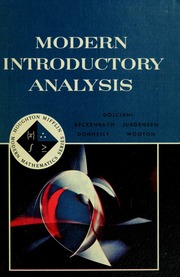
Internet Archive
104, xii, 660, 24 p. 25 cm
(The word "analysis" there is something for American high schools, it's not the "analysis most people in math refer to, so don't worry.)
nimble ether
narrow relic
I recommend you look at this book: https://archive.org/details/modernintroducto0...
why do you recommend this
narrow relic
nimble ether
why do you recommend this
Because I learned a bunch of stuff from it when I was at the same stage as you (12th grade).
nimble ether
narrow relic
Because I learned a bunch of stuff from it when I was at the same stage as you (...
how do you download the book
narrow relic
nimble ether
how do you download the book
You have to make an account with the Internet Archive, then you can log in and read it
The Internet Archive is a library in the United States
nimble ether
narrow relic
You have to make an account with the Internet Archive, then you can log in and r...
dude the book is from 1970
narrow relic
nimble ether
dude the book is from 1970
I would love to link you to the edition I used in high school but unfortunately there isn't a digitized copy. The content is virtually unchanged though
gray gazelle
I wonder how many books got digitalized out of the ones we know exist
narrow relic
gray gazelle
I wonder how many books got digitalized out of the ones we know exist
Yeah.
nimble ether
narrow relic
Yeah.
how am i supposed to finish this it have over 500 pages
narrow relic
You don't have to read the whole thing, I suggested you just take a look at it
heady ember
You can also just take it slow and read a couple pages a day if you like it
500 pages is quite typical for a math book I think
narrow relic
heady ember
You can also just take it slow and read a couple pages a day if you like it
do you have any recommendations for a person (me) who feels pretty unmotivated to learn math better but who feels like he sort of wants to have it done?
heady ember
narrow relic
do you have any recommendations for a person (me) who feels pretty unmotivated t...
Find a topic you like/are interested in?
nimble ether
narrow relic
do you have any recommendations for a person (me) who feels pretty unmotivated t...
I am the same person
narrow relic
heady ember
Find a topic you like/are interested in?
I have things I wish I knew but I feel like if I spend time on them it's literally such a waste. I spent a bunch of time on some silly analysis problem last night and I felt like I just wasted time
It would take me hundreds of hours to finish the 10 chapters of this book I know I should finish to know the material, mostly fiddling around on weirdly worded problems
heady ember
Doesn't matter, I think if you self-study math the point of it should be fun
As a whole
narrow relic
heady ember
Doesn't matter, I think if you self-study math the point of it should be fun
For some reason, it isn't fun for me anymore, I don't know what happened
narrow relic
I think what happened is, I spent a few years trying to learn all this stuff, and it ended up sort of not gelling for me
gray gazelle
heady ember
500 pages is quite typical for a math book I think
well, also not every book is as dense as others
heady ember
gray gazelle
well, also not every book is as dense as others
True
gray gazelle
those 500 pages might be a breeze but they might also be a nightmare
heady ember
Yeah
narrow relic
Like, I spent over a month on some linear algebra last year and I wasted so much time. I then spent about 5 months doing it an hour and a half a day this year and that ended up being mostly a waste of time too
I generated probably about 100 pages of notes but a lot of them are just figuring out stupid stuff that the book didn't define properly or correctly, etc
And I spent months learning analysis from a book that had some other wonky definitions so the end result is I never was able to finish learning what I wanted to because I kept having to redo the definitions over and over again
nimble ether
heady ember
Yeah
yo can you recommend me a book
narrow relic
So the end result is I'm really hesitant to sink any more time into those topics, even though I don't know them very well, even after all this work
gray gazelle
Taking notes about everything is not something I'd recommend to anyone
it's mostly just a waste of time
narrow relic
gray gazelle
Taking notes about everything is not something I'd recommend to anyone
Unfortunately it was necessary because the definitions weren't clear
But that's because the book sucked, but I didn't know that
Doing the analysis stuff I didn't take almost any notes
gray gazelle
I'd just grab a piece of paper and figure it out tbh
narrow relic
Oh, I guess I did because I had to try to fix the definitions, right
narrow relic
gray gazelle
I'd just grab a piece of paper and figure it out tbh
Yeah, that's what I did
Maybe I'm just burnt-out? I don't know
nimble ether
narrow relic
Maybe I'm just burnt-out? I don't know
I have been burnt out of learning for 6 years ever since I became schizo
gray gazelle
I get stuck on things many times, I don't even know what direction I should be following
narrow relic
nimble ether
I have been burnt out of learning for 6 years ever since I became schizo
I don't mean to be weird but how could you be schizo if you're still in high school?
nimble ether
narrow relic
I don't mean to be weird but how could you be schizo if you're still in high sch...
I got diagnosed at 13
narrow relic
(I assume you don't mean literally schizo, you're using it figuratively)
gray gazelle
it's not like schizophrenia is restricted for adults
narrow relic
Oh I'm sorry, I didn't know you literally meant it
nimble ether
narrow relic
(I assume you don't mean literally schizo, you're using it figuratively)
nah I mean literally
gray gazelle
that's what you guys mean by schizo I suppose, since it's not the only thing of this kind
narrow relic
People throw that word around a lot. My bad @nimble ether
@heady ember @gray gazelle How do you recommend getting re-motivated?
gray gazelle
go for walks, start again, be happy you're alive
nimble ether
narrow relic
<@560392234952818688> <@456226577798135808> How do you recommend getting re-moti...
having a structure and routine helps me
narrow relic
@nimble ether maybe check out this thread: http://giftedissues.davidsongifted.org/BB/ubbthreads.php/topics/157738/all/Precalculus_text_for_independe.html
Oh, I'm very motivated to do my own work (job stuff), and I'm sort of motivated to do math on the side, it's just whenever I get stuck now I suddenly think this is a total waste of time
gray gazelle
if you think it's a waste of time then it might just be a waste of time
nimble ether
gray gazelle
if you think it's a waste of time then it might just be a waste of time
dude can you recommend me a book
narrow relic
gray gazelle
if you think it's a waste of time then it might just be a waste of time
I sadly think it probably is. So I spent almost two hours trying to prove this stupid thing about decimal expansions of real numbers. It turned out you had to use a proof technique that wasn't introduced in the chapter, rather the author had been going on about another technique, so I sort of got tricked into trying to apply that one. But it didn't work.
gray gazelle
nimble ether
dude can you recommend me a book
what kind of book
narrow relic
Most people say "it's good to struggle with problems" but all I learned is that the author sort of fooled me into focusing on something the wrong way, and also didn't word the question carefully enough. So I wasted my Friday evening on that
nimble ether
gray gazelle
what kind of book
something that will continue off from year 12
narrow relic
@nimble ether The thread I linked you to is people talking about book recommendations for your situation
gray gazelle
narrow relic
I sadly think it probably is. So I spent almost two hours trying to prove this s...
you should try to follow what you're interested, of course there will be stones there on the road, but if something isn't fun and you don't find motivation for it then you should probably just stop
nimble ether
narrow relic
<@428839034241024031> The thread I linked you to is people talking about book re...
okay
nimble ether
narrow relic
<@428839034241024031> The thread I linked you to is people talking about book re...
but dude its in 2013
narrow relic
gray gazelle
you should try to follow what you're interested, of course there will be stones ...
What about reading a math book but not doing any problems?
narrow relic
nimble ether
but dude its in 2013
The math you are looking to learn has not really changed for over 100 years. You'll be fine.
gray gazelle
That's completely fine of course
narrow relic
Also, if you're in the U.S., you should know that things have gotten significantly dumber in the last decades.
Like, it's unbelievable. The reason I recommended you that book is it's the one my old high school was throwing away, and they were replacing it with garbage. So I got a copy for free and learned a ton of stuff
gray gazelle
no need to do exercises, what's more important is understanding the material
narrow relic
A lot of good math books were written in the U.S. in the 1960's during the Cold War with Russia
But as far as I can tell the curriculum has gone significantly downhill.
narrow relic
gray gazelle
no need to do exercises, what's more important is understanding the material
I have a question about that if I may
gray gazelle
if you're doing something less theoretical then you probably should do some exercises to understand the material though
gray gazelle
narrow relic
I have a question about that if I may
shoot
narrow relic
gray gazelle
if you're doing something less theoretical then you probably *should* do some ex...
Nah, this is "real analysis"
gray gazelle
I mean like, you can't learn how to integrate without doing computations
nimble ether
@narrow relic with the 1970s book I have no idea where to start from
I have no idea what its saying
narrow relic
gray gazelle
shoot
So, I've studied two books on analysis. One was Bartle and Sherbert, where I mostly learned how to manipulate inequalities, absolute values, etc. Doing problems helped I think with that. The second one was Goldberg's Methods of Real Analysis. You can't read that book without doing some of the problems since later sections rely on some of the problem results. Luckily I had a good syllabus to follow, and I did every problem on that syllabus.
narrow relic
nimble ether
<@836391896787320882> with the 1970s book I have no idea where to start from
Did you try starting at the beginning?
I mean like literally the first chapter, first page.
nimble ether
narrow relic
Did you try starting at the beginning?
but dude its 500 pages
narrow relic
nimble ether
but dude its 500 pages
Are you trolling me or are you serious? I already said you don't have to read the entire book
nimble ether
narrow relic
Are you trolling me or are you serious? I already said you don't have to read th...
oh yeah sorry
narrow relic
Just start on the first page and check it out, see how the first few pages go
The first chapter teaches you how to understand statements in mathematics, it's super useful and cool
@gray gazelle So my question is: at what point is it okay to stop doing the problems? Like, this Carothers book seems to say some of the problems are necessary, he even marks them like that
Like that stupid decimal problem I wasted 2 hours on
gray gazelle
like I obviously don't have all the answers but I'll tell you what I'm doing with the current book I'm reading
narrow relic
Great, that's what I'm looking for
gray gazelle
I'm reading about dimension theory, in topology. And what I do is I don't bother with the exercises.
They are theoretical, probably would be interesting, but it's not what I really care about
Sometimes they use the exercises in the proofs etc. though.
What I do is I just go back and solve the exercise whenever I need it
narrow relic
gray gazelle
I'm reading about dimension theory, in topology. And what I do is I don't bother...
That's sweet. Can I ask are you in undergrad? Also are you doing this just for your own interest or does it connect to work, etc.?
gray gazelle
For my own interest. It'd be useful if I ever got to do some research in topology though
narrow relic
gray gazelle
For my own interest. It'd be useful if I ever got to do some research in topolog...
That's cool, maybe I should just do what you're doing. What's with the whole culture of doing all these exercises, is it just for grading people in school? Why does everyone on r/math on reddit insist on learning that way?
gray gazelle
It helps you to develop problem solving skills, or something
narrow relic
gray gazelle
It helps you to develop problem solving skills, or something
Oh like, in general?
gray gazelle
well, in the early stage most of this understanding of the subject you have will probably go to waste
so yeah I guess
narrow relic
I appreciate you sharing your thoughts
You may have found the secret to un-burning me out
I should just learn stuff and stop obsessing with doing all these problems ever-so-perfectly
I feel this horrible internal pressure to do it
gray gazelle
yeah. If you find something interesting then go and do it though.
It's supposed to be for fun, not some kind of chore
narrow relic
gray gazelle
yeah. If you find something interesting then go and do it though.
It's supposed ...
Cool, thank you! 😄 I appreciate you taking the time to discuss it
nimble ether
gray gazelle
yeah. If you find something interesting then go and do it though.
It's supposed ...
dude recommend me a book
narrow relic
nimble ether
dude recommend me a book
Is the Dolciani book not working out?
gray gazelle
nimble ether
dude recommend me a book
I only know books about subjects you do in university
nimble ether
narrow relic
Is the Dolciani book not working out?
I haven't tried it yet but maybe there are better books
narrow relic
OK
nimble ether
gray gazelle
I only know books about subjects you do in university
yeah thats fine
gray gazelle
About something basic, there is always Lang's Basic Mathematics
nimble ether
gray gazelle
About something basic, there is always Lang's Basic Mathematics
what
why basic
nimble ether
gray gazelle
About something basic, there is always Lang's Basic Mathematics
is there anything more advanced
gray gazelle
on what kind of subject
 rich sun
What do you think basic math is?
nimble ether
rich sun
What do you think basic math is?
something they teach for beginners
gray gazelle
here it means things they do in high school for example
nimble ether
gray gazelle
here it means things they do in high school for example
I learnt all of highschool math
gray gazelle
so you just want to learn something new?
nimble ether
gray gazelle
so you just want to learn something new?
yeah
gray gazelle
nimble ether
yeah

Thoroughly revised, updated, expanded, and reorganized to serve as a primary text for mathematics courses, Introduction to Set Theory, Third Edition covers the basics: relations, functions, orderings, finite, countable, and uncountable sets, and cardinal and ordinal numbers. It also provides five...
it'll give you some set theory knowledge which is fundamental to reading and dealing with mathematics in general
you can start reading something more advanced after
nimble ether
gray gazelle
it'll give you some set theory knowledge which is fundamental to reading and dea...
why this though
gray gazelle
because everyone that wants to read about mathematics should know some set theory
nimble ether
gray gazelle
because everyone that wants to read about mathematics should know some set theor...
dude I didn't learn this at school though maybe I don't need it
I learnt stuff like trignometry and geometry why would I need this
rich sun
you wanted to learn something new
gray gazelle

nimble ether
rich sun
you wanted to learn something new
but dude this is too basic
rich sun
nimble ether
but dude this is too basic
you think set theory is too basic?
nimble ether
rich sun
you think set theory is too basic?
its weird I have never heard of it before
gray jungle
If you want to start studying any form of serious mathematics you need to know set theory
nimble ether
gray jungle
If you want to start studying any form of serious mathematics you need to know s...
okay
nimble ether
rich sun
you think set theory is too basic?
is this one book of set theory enough or do I need more after this and do I have to read the whole thing
also why don't they teach it at school
rich sun
nimble ether
is this one book of set theory enough or do I need more after this and do I have...
It's just the beginning, I can recommend you some lecture notes for the first semester in my uni, but they're in German.
gray jungle
Depends on different schools and countries , its often seen in a probability chapter (very briefly) , but if you join any undergraduate math program you'll learn set theory right off the bat
gray gazelle
they do teach set theory in school, but only at a basic level
at least in my school
nimble ether
rich sun
It's just the beginning, I can recommend you some lecture notes for the first se...
nah i am asking If I need to read more set theory books after this one
gray gazelle
you don't need to do anything
and if you're interested then you can read more set theory, it's all optional though
rich sun
I'm not familiar with the book, but reading the description
relations, functions, orderings, finite, countable, and uncountable sets, and cardinal and ordinal numbers
should be enough
gray gazelle
I recommended it because after reading it you'll have more options about what to read further
it doesn't have to be set theory
nimble ether
okay
 blazing forum
Does anyone know any free resources to learn about the following calculus topics? My uni just gives lecture slides which barely have any words to explain whats going on. Thank you!
 gray gazelle
All resources are free if you know where to look.
 orchid mortar
standard for calc
https://tutorial.math.lamar.edu/classes/calci/calci.aspx
Here is a set of notes used by Paul Dawkins to teach his Calculus I course at Lamar University. Included are detailed discussions of Limits (Properties, Computing, One-sided, Limits at Infinity, Continuity), Derivatives (Basic Formulas, Product/Quotient/Chain Rules L'Hospitals Rule, Increasing/Decreasing/Concave Up/Concave Down, Related Rates, ...
Also Strang's (free) book, but it's too big for me to even review at a glance
 hazy elk
Is there any source of math "puzzles" which are easy to understand but lead to some interesting math ?
 eager shoal
Chris McMullen has a book on puzzles
hazy elk
Sort of the kind of things that math circles would use?
Basically for freshmen to get exposed to some cool math
eager shoal
Oh
I know just what you are asking for
Intended for high school people who are highly proficient?
Or like college freshman?
eager shoal
What math are you taking rn
hazy elk
Uhh ok so I want to organize a thing for my juniors
eager shoal
If you want college freshman to look into some "new" math I'd look at discrete math. But for problems solving go to https://artofproblemsolving.com/store/list/all-products and the AMC tests
Browse our math book store for texts that deeply explore challenging mathematics and shows students how to apply their knowledge to difficult problems.
hazy elk
The main idea is for the puzzles to lead to a rabbit hole that would hopefully pique the interest of a few people.
It's not really olympiad stuff that I'm interested in
eager shoal
At that point I'd just go to youtube and watch videos from people like 3blue1brown
vast obsidian
good calculus book that is not stewart or apostol?
too hard, its mor eliek an analysis book
1200 pages in that book
calculus is not a 5 year course subject
who needs 1200 pages wtf
it's just filled with a million exercises and overexplained visuals
but yeah ur right prob
i guess calculus is not for me
 inner token
can anyone provide feedback on this book or recommend another?
 vast obsidian
Has terrible reviews, I'm going to check out serge lang and gilbert strang calc
you're thinking of calculus made easy
inner token
Thanks
vast obsidian
tell me
who hhas time for that
when self studying
8-10 weeks
?
XD
That can only be done by someone who already has done the topic
Not a first timer like me
remote sparrow
why not just follow some online lectures about the length of prof. leonard's videos (i.e. 1 hour plus videos) in tandem with a book?
then you won't have to struggle with a 1200 page book all by yourself
many mainstream textbooks are designed to be used in a classroom, and not as a sole resource (i.e. they're not designed for self-study when used only by themselves)
they're very detailed to account for stuff the lecturer might want to omit or to maintain longevity as a reference in case you forget stuff
sorry, but there is no royal road to science
i'm just quoting marx here, i guess i could have paraphrased it to math
but math is a formal science i guess
just saying there is no easy way to learn math or science
some things can make it easier but it won't be "easy"
and i encourage people to find stuff that works for them
but ultimately learning math and science is hard
i don't agree. studying the best way to study is a time investment that can pay off in less time struggling with material. obviously there's an equilibrium point between hesitating too much before doing any material vs. just blindly going into a subject without even reflecting on how you want to tackle it, but i wouldn't say it's "infinitely worse" to do some introspection on how you want to absorb the material and how you would ideally like it to be taught to you.
one thing you could do is just start self-studying from a mainstream book. if you find you don't like it, you can just change the book and review stuff you have learned so far to get familiar with the new book's overall approach.
gray gazelle
Wissenschaft 
vast obsidian
remote sparrow
then you won't have to struggle with a 1200 page book all by yourself
because I don't want to need 2 years to finish calculus 1
remote sparrow
well no one who has used these books needed that much time even when self-studying.
vast obsidian
Speed I mean between 6-8 months is fine for me, i dont have to finish all calc 1 in 2 weeks
vast obsidian
remote sparrow
well no one who has used these books needed that much time even when self-studyi...
So average person just do 20+ pages a day?
remote sparrow
you're thinking too simplistically. firstly, a good chunk of stewart's calculus is in the appendix, a couple hundred pages or so. the first chapter is mainly review of functions and stuff. also, the book has a lot of fluff that is generally omitted at most high schools and colleges. if you want you could go with stewart's essential calculus, which is much shorter.
sturdy shore
first of all, the calculus books that are over 1200 pages long are not just calc 1 books
remote sparrow
^^^
remote sparrow
besides that, refer to my advice on watching online lectures so you don't have to sit down and just read
sturdy shore
dedicated person can do in much less
remote sparrow
given 16 week semester system, you cover calc 1-2-3 in three semesters
people can do all this stuff in three 10-week quarters
up to you
you should still allot some break time for yourself not just so you don't burn out, but so your brain actually has time to massage and absorb the material
vast obsidian
remote sparrow
given 16 week semester system, you cover calc 1-2-3 in three semesters
even calc 3?????
remote sparrow
i mean yeah
vast obsidian
If I could do calc 1 in 16 weeks I would be in university rn
willow pecan
Yes this is the standard pace that universities cover the material at
remote sparrow
calc 3 isn't that intimidating
willow pecan
AP classes as well
remote sparrow
unless you're gonna go with hubbard and hubbard or something
which you mentioned you didn't really want a rigorous book
vast obsidian
willow pecan
Yes this is the standard pace that universities cover the material at
How much time per day is assumed to in those universities?
vast obsidian
remote sparrow
which you mentioned you didn't really want a rigorous book
I do want a rigorous book but they have too hard problems, I don't know how to write proofs, like Spivak
remote sparrow
calculus sequence is 4 units, so two 1.5 hour lectures per week plus homework
willow pecan
4 hours of class per week and 8 hours of homework was what my undergrad did
I think
remote sparrow
i know people double units for hours but in practice it's not quite true for every college
3 units = two 1.25 hour lectures for example, not two 1.5 hour lectures
vast obsidian
if I was tao-level smart spivak is first book I would pick up, but since you're making calc sound so easy i might try stewart or apostol accompanied by video lectures parallelled with linear algebra if I get bored/unmotivated
 vast obsidian
remote sparrow
apostol and spivak are supposed to be around the same level
vast obsidian
remote sparrow
apostol and spivak are supposed to be around the same level
really didn't know that I thought it was stewart but a bit more rigorous
remote sparrow
in any case learning to read and write proofs is not super hard, but arguably calculus is one of the worst settings to learn it for people who aren't confident in math skills
remote sparrow
stewart has some proofs for completeness, but they can be safely skipped for now
an intro to proof book like hammack, velleman, hamkins, or chartrand are fine choices. or you could go with a discrete math book like rosen or epp.
if you wanna try doing rigorous calculus velleman's book on calculus might work
it's explicitly meant not to be an analysis text, but still emphasizes proofs
it only covers up to calc 2 though
vast obsidian
remote sparrow
an intro to proof book like hammack, velleman, hamkins, or chartrand are fine ch...
dont know what discrete math is
remote sparrow
they are there
remote sparrow
multivariable and vector calculus
vast obsidian
oh okay thanks
last question
who is spivak for? it's insanely difficult for a first-time calculus learner, and not really used for first course in analysis like Tao i.e.
remote sparrow
people that want to learn calculus and how to read and write proofs
vast obsidian
but it teaches you analysis not calculus? right?
remote sparrow
both actually
vast obsidian
and how can you learn to write proofs from a book that assumes you already know proofs
remote sparrow
it's missing some application problems like optimization and related rates though
remote sparrow
vast obsidian
and how can you learn to write proofs from a book that assumes you already know ...
by imitating proofs you've seen in the book or playing around with them
talking to people who are experienced with them
vast obsidian
remote sparrow
by imitating proofs you've seen in the book or playing around with them
This is how I'd end up spending 2 years on a book 💀
vast obsidian
remote sparrow
talking to people who are experienced with them
I tried but they just say I should already know proofs
vast obsidian
i see fair thank you
actual last question: why does no one talk about serge lang calculus?
HAHA why
dapper root
You can look it up
But he was an AIDS denialist, used his position to espouse propaganda that AIDS isn’t real
And I think he was a homophobe
vast obsidian
dapper root
But he was an AIDS denialist, used his position to espouse propaganda that AIDS ...
"his position" what position?
dapper root
Like
Being a professor at Yale
Having incredible clout in the math community
He got some math journal to publish an article basically saying AIDS doesn’t exist lol
vast obsidian
I think even if he was a janitor he would have had the same opinion, I doubt he used his position to espouse that propaganda, he would've done it no matter what position he was in
And also lol
dapper root
You miss the point lol
Some random guy nobody cares about saying AIDS isn’t real and a respected mathematician saying it have different scope
For example, some random guy can’t get a math journal to publish an article about it
vast obsidian
dapper root
Some random guy nobody cares about saying AIDS isn’t real and a respected mathem...
Yeah but it doesn't mean the guy with clout is more of a bad person than some random no one cares about
dapper root
I am just saying what he did lol
sturdy shore
you know that not everyone with opinions is required to be an activist about it
there are loads of math profs some probably with shit beliefs that don't use their reputation to spread their message
vast obsidian
dapper root
I am just saying what he did lol
Yeah but you're also imposing unnecessary "he is powerful man, that makes him extra bad" type thing
vast obsidian
sturdy shore
you know that not everyone with opinions is required to be an activist about it
And not everyone with an opinion is doing it either, just like you said literally next sentence
sturdy shore
okay? I am saying that unlike your claim, there is a difference between having an opinion and using your position of power to spread that opinion onto others
gray jungle
people can have terrible beliefs and not choose to be an activist about it , his choice and ability to publish about it makes his actions quite bad imo
vast obsidian
True, if you're a nobody you can be an activist however you want cause no one cares, but if you are known you should never be an activist of anything.
I guess that concludes this discussion
gray jungle
ye i'm not gonna have this argument
 quick hornet
the criticism is more that he intentionally campaigned against granting academic positions & tenure to people researching fields he personally disagreed with
a lot of stories of him getting involved in faculty meetings to protest against immunology applicants and whatever
generally speaking this is considered a pretty dick move
vast obsidian
quick hornet
the criticism is more that he intentionally campaigned against granting academic...
that is fucked ngl
quick hornet
its not just "influential person had minority opinion", its "influential person had minority opinion and tried to ruin careers over it"
(though afaik most people didnt take him seriously)
vast obsidian
well this is way worse than what we discussed imo, here I would agree w you
quick hornet
dont mean to restart the argument, just clarifying the position
vast obsidian
I still kind of hope to find someone here who've read his calculus book to give me a review
quick hornet
yeah fair, this has no effects on the quality of his book unless you want to avoid the dude on principle
(and like, the guy's dead so i dont really think it matters personally)
vast obsidian
quick hornet
yeah fair, this has no effects on the quality of his book unless you want to avo...
I think Algebra is still pretty popular
But none of his other books seem so
Except maybe Basic Mathematics
willow pecan
Lang did this thing where he wrote one book a summer
Really a quantity over quality approach
And it shows
vast obsidian
If you've read Lang's Calc please contact me :) 👍 
vast obsidian
willow pecan
And it shows
lol
gray jungle
gray jungle
Is kosaku yosida functional analysis book any good for someone interested in get...
Re-asking this just in case someone knows
grand thistle
any concise introductions to game theory?
ive found "Game Theory for Applied Economists" by gibbons
anyone know if it's a good resource?
 hearty turret
whats a good book for calculus practice problems?
 old elk
You are an undergraduate student about to look at the topology course for the first time, you are going to buy a book, you don't know which is the best one
Which book would you recommend to this person?
grand thistle
old elk
You are an undergraduate student about to look at the topology course for the fi...
old elk
grand thistle
what other would you recommend
hazy elk
old elk
what other would you recommend
Allen Hatcher's point set topology notes, (it's good to have done analysis before tho) you can also check out http://www.math.toronto.edu/ivan/mat327/
crimson leaf
People also like mendelson
grand thistle
though if you havent done analysis, it might be good to read through something like rudin chapter 2 first
hazy elk
Chapter 2 of Pugh * 
grand thistle
😭 sometimes i regret doing rudin very much
old elk
I will buy mendelson's jeje
sage python
Chapter 2 of Pugh feels awkward to me
hazy elk
Oh, why?
grand thistle
this is simultaneously my favorite and least favorite page in all of rudin
 old elk
the other week I was going to start reading this chapter
what a pity
gray gazelle
Hi, I want to study geometry and am looking for a proof-based textbook about Euclidean geometry. I would like it to be very comprehensive, preferably with some exercises. Does somebody have a suggestion?
 lusty elk
gray gazelle
Hi, I want to study geometry and am looking for a proof-based textbook about Euc...
lusty elk
gray gazelle
Hi, I want to study geometry and am looking for a proof-based textbook about Euc...
You could check out Hartshorne's Geometry : Euclid and Beyond
https://www.maa.org/press/maa-reviews/geometry-euclid-and-beyond
 carmine summit
gray gazelle
carmine summit
gray gazelle
Thank you both very much. The the books looks precisely like that what I was excepting.
gray gazelle
grand thistle
Well this might be expensive
Especially if you're looking to buy a physical copy
gray gazelle
old elk
You are an undergraduate student about to look at the topology course for the fi...
Hatcher wrote a whole list of topology books recommendations, considering their prices as well
Reading Intuitive topology and Shape of a space is not necessary at all
The first one is informal treatment of some concepts from knot theory
And the second one is more about surfaces and it reads like a pop-science book
I know because I read both
Dugundji is something I personally read, and while it is kind of like a reference book, you can learn a lot from it, though I suppose it's not for a beginner
Jänich is probably a good book (never read it)
Also note that some courses offer only metric space topology
Metric spaces are not the only naturally occuring spaces out there - even in theory
Also this
Also don't neglect the books that your lecturer is recommending for the course
 kind sierra
Hello everyone
Do you have Thomas Calculus notes? If you have can you share with me?
grand thistle
how many chapters of rudin RCA would be covered in say a 1 semester real analysis/measure theory course?
these are the contents


what specific chapters should i cover?
since both complex and real analysis is mixed in, id imagine there would be some chapters that are independent of each other and i could skip
willow pecan
1 to 8 I think
grand thistle
cool
gray gazelle
grand thistle
this is simultaneously my favorite and least favorite page in all of rudin
One more reason Rudin is a reference book and not something great to learn from.
gray jungle
Folland real analysis for MT>>
gray gazelle
gray jungle
Folland real analysis for MT>>
measure theory?
hell no
that's a real analysis book
go read Schilling or something
gray jungle
Im mostly using folland for reference aside lecture notes and i felt like its pretty alright so far 
What makes schilling better ?
gray gazelle
it's a measure theory book while Folland is not
even though there is a lot of measure theory in Folland
I guess, if it suits you then maybe you should ask your lecturer if it's a good complement for the course
since all courses are vaguely similar but different
maybe the course follows more as an extension of a real analysis course
 fickle whale
does anyone know where I can get a copy of "on numbers and games" for less than $160
 left depot
by Conway?
fickle whale
yes
remote sparrow
gray gazelle
Hi, I want to study geometry and am looking for a proof-based textbook about Euc...
kiselev's two geometry volumes
remote sparrow
fickle whale
does anyone know where I can get a copy of "on numbers and games" for less than ...
gibrary lenesis
physical copy you'll just have to look for used copies i guess
fickle whale
Physical is my unfortunate desire
 hardy bough
What is this most rigorous mind blowing book I could get to confuse my friends with?
gray gazelle
gray gazelle
https://pi.math.cornell.edu/~hatcher/Other/topologybooks.pdf
Did Hatcher just throw shade at Munkres 
 fluid bay
munkres kinda overrated tbh
crimson leaf
You can get international editions pretty cheap I think I scored mine for $15
 blissful oyster
I’m looking for a good introduction to the basics of differential geometry, are there any good book recommendations?
remote sparrow
blissful oyster
I’m looking for a good introduction to the basics of differential geometry, are ...
tapp's Differential Geometry of Curves and Surfaces or do carmo's book of the same name
not the most general introduction, but it's a "basic" enough intro
 late kite
Hello everyone. I am a Highschool Junior student and want to dip into the deep qorld of Math. I just dont know where to begin. Are there any good books/textbooks yall can recommend?
blissful oyster
remote sparrow
not the most general introduction, but it's a "basic" enough intro
Ok thank you.
crimson leaf
late kite
Hello everyone. I am a Highschool Junior student and want to dip into the deep q...
Have you done any calculus?
remote sparrow
late kite
Hello everyone. I am a Highschool Junior student and want to dip into the deep q...
try hammack's Book of Proof, which is free on his website or printable for very low cost. alternatives would be How to Prove It by velleman, Foundations of Mathematics by sibley, Mathematical Proofs: A Transition to Advanced Mathematics by chartrand, polimeni, and zhang, or Proof and the Art of Mathematics by hamkins
you can save calculus for later if you want
learning how to read and write proofs is far closer to what math majors actually do past calculus
crimson leaf
Yes, however, I was going to recommend Apostol or Spivak if they had not done calculus and felt good enough at algebra
remote sparrow
they'll need to look back at apostol or a mainstream book for applications like related rates and optimization if they go with spivak
anyway with the lack of any sort of proofs besides a very boring, uninspired class in geometry, learning how to do proofs will make spivak more fruitful
gray gazelle
 gray gazelle
Opinion on arnol'd ODEs??
 drifting elm
fickle whale
does anyone know where I can get a copy of "on numbers and games" for less than ...
drifting elm
fickle whale
does anyone know where I can get a copy of "on numbers and games" for less than ...
conway?
 hallow oriole
fickle whale
does anyone know where I can get a copy of "on numbers and games" for less than ...
hallow oriole
fickle whale
does anyone know where I can get a copy of "on numbers and games" for less than ...
print and bind it yourself, maybe?
there are guides on the internet and it'll be much less than 160$
and not very time consuming
well
a little
but not that long
there's also this ebay link

eBay
Find many great new & used options and get the best deals for On Numbers and Games by John H. Conway (2000, Hardcover, Revised edition) at the best online prices at eBay! Free shipping for many products!
but it could totally be a scame for all i know
 opal ridge
What should I use for studying math 2
remote sparrow
opal ridge
What should I use for studying math 2
what exactly is the content of "math 2?"
opal ridge

Khan Academy
The Mathematics 2 course, often taught in the 10th grade, covers Quadratic equations, functions, and graphs; Complex numbers; Rational exponents and exponential models; Similarity and Trigonometry; Solids; Circles and other Conic sections; and introductory Probability. Khan Academy's Mathematics 2 course is built to deliver a comprehensive, illu...
khan says that is what math 2 is consist of
remote sparrow
opal ridge
What should I use for studying math 2
oh, i did this in high school. i guess you could google a topic in brilliant and stuff. paul's online math notes covers some of the algebra and trig. i feel like khan academy is good enough for this kind of stuff though. i think i had to use a textbook/workbook for this stuff in high school. try to look for such a book.
opal ridge
kk thanks
 next storm
Hey what is a good for for learning ZFC?
remote sparrow
enderton's elements of set theory
or introduction to set theory by hrbacek and jech
are good undergraduate treatments
 marble karma
I want to study linear algebra any recommendations?
blazing canopy
Do you have familiarity with proofs or some other proof-based subject already? If so, I used Friedberg, Insel, and Spence's linear algebra text when I was first learning. But it is not suitable if you are not already familiar with proofs.
sage python
Someone should write a linear algebra book that's simultaneously an intro to proofs tbh
I guess Axler would almost be in that category if not for his determinant/char poly stuff lol
hazy elk
Do the first 4+ chapters of Axler and then migrate to Hoffmann kunze + learn the multilinear algebra for determinants from Sergei Wintzki's book
marble karma
I am fine with proofs
hazy elk
Hoffmann Kunze would be fine for you then
hazy elk
The whole book..?
marble karma
Yes
hazy elk
Under 2 semesters worth of content I'd wager
Too much for a single semester but too little for 2
Don't be too concerned about finishing the book cover to cover, choose the interesting topics wisely
marble karma
Any video lecture or reference book to compliment it ?
hazy elk
That's a more efficient way of learning math
marble karma
Yes 👍
hazy elk
marble karma
Any video lecture or reference book to compliment it ?
Not sure, but there are plenty of lecture series on yt, I bet NPTEL has atleast one proof based LA course.
marble karma
Ok thanks 😊🙏
heady ember
remote sparrow
are good undergraduate treatments
Agree with your recs
gray gazelle
remote sparrow
kiselev's two geometry volumes
Thank you
 cinder trellis
sage python
Someone should write a linear algebra book that's simultaneously an intro to pro...
cinder trellis
sage python
Someone should write a linear algebra book that's simultaneously an intro to pro...
Spivak’s Calculus helped me when I first learned proofs, especially since anyone can read it after or during calculus I-II
 rain birch
Has anyone checked out the introductory elementary mathematics books by I.M. Gelfand?
 lapis steeple
yo can anyone recommend some books for year 8 students?
 vital bane
yes, your year 8 math book 
 storm sigil
does anyone know a good book about cyclic group theory?
quick hornet
what do you mean by that? there isnt that much interesting stuff to say about cyclic groups specifically
like okay that's a lie, there is plenty of interesting stuff to say
but that stuff is usually number-theoretic in nature rather than group-theoretic
and considered the subject of elementary number theory
@storm sigil
storm sigil
quick hornet
what do you mean by that? there isnt that much interesting stuff to say about cy...
i just to explain about the rubiks cube
how does it work
storm sigil
soe of them are
storm sigil
quick hornet
it's not even abelian
really
quick hornet
yeah; FL and LF produce different cubes
(F means "turn the front face clockwise", L means "turn the left face clockwise")
storm sigil
tru
quick hornet
in any case, i am unfamiliar with any sources that deal specifically with the rubik's cube group
it's more of a computational novelty than something actually considered useful afaik
storm sigil
oh wow
quick hornet
google produces this document https://people.math.harvard.edu/~jjchen/docs/Group Theory and the Rubik's Cube.pdf which might be worth a skim
seems well written at first glance at least
storm sigil
quick hornet
seems well written at first glance at least
thxx
but
the moves are consired in z mod 4
right?
quick hornet
in the sense that rotating a face (clockwise) 4 times is the same as rotating it 0 times, yes
this doesnt mean the group itself is Z/4Z
storm sigil
why
quick hornet
because there's more than 4 valid moves?
like if you only cosnider rotations of one FACE, then yeah
that group is Z/4Z
storm sigil
quick hornet
because there's more than 4 valid moves?
but if u consider one type of move its cyclic
quick hornet
but a rubiks cube has 6 different faces with multiple ways to rotate them
 hearty sluice
and nami has 2 faces
quick hornet
and the interaction between these faces is more complex than just (Z/4Z)^6 or whatever
storm sigil
quick hornet
but a rubiks cube has 6 different faces with multiple ways to rotate them
ik but it was just to explain rootations in one face
quick hornet
okay, then yeah; thats just Z/4Z
and there isnt a book dedicated to it because theres nothing interesting to say
if you want some fun facts, you can check https://groupprops.subwiki.org/wiki/Cyclic_group:Z4 i guess
storm sigil
quick hornet
if you want some fun facts, you can check https://groupprops.subwiki.org/wiki/Cy...
kk thank uu
quick hornet
it has normal subgroup {0, 2} i guess lmao
which represents what happens if you consider 180 degree rotations instead of 90
 acoustic glade
Any opinions on Maunder's Algebraic Topology and Wallace's An Introduction to Algebraic Topology as an intro algebraic topology book (aka the two Dover books on the topic)?
remote sparrow
acoustic glade
Any opinions on Maunder's Algebraic Topology and Wallace's An Introduction to Al...
never heard of those, but i'm assuming hatcher's book isn't good enough for you? btw no experience with this topic, but hatcher is a common rec, and i think it's pretty cheap as a hard copy, too. plus hatcher's book is officially available for free in ebook form.
acoustic glade
I've looked at Hatcher, it looks okay but maybe a bit too geometric for my taste (plus it's like double the price not accounting for shipping, I'm looking to get a physical copy this time around)
 red swan
Hello, I have a presentation about the irrationality of zeta(3) due in a few weeks, and even though I get the very basic idea of how the proof works, I severely lack the calculus skills needed to understand the meat of the calculations, do you have any recommendations for resources pertaining to multi variable integration? (I am solely familiar with basic riemann integration techniques and theory)
 finite heath
Can anyone give me a reference for the study of non-commutative rings? Specifically, I want a book that will give the definitions of Euclidean domains and PID's in the non-commutative case. And also prove that Euclidean 'rings' are Principal ideal 'rings'. Thank you 🙂
 sudden kindle
red swan
Hello, I have a presentation about the irrationality of zeta(3) due in a few wee...
sudden kindle
red swan
Hello, I have a presentation about the irrationality of zeta(3) due in a few wee...
What is the proof you are learning?
remote ginkgo
acoustic glade
I've looked at Hatcher, it looks okay but maybe a bit too geometric for my taste...
they are probably nicer reads than hatcher me and all my homies despise hatcher
 manic cairn
red swan
Hello, I have a presentation about the irrationality of zeta(3) due in a few wee...
manic cairn
red swan
Hello, I have a presentation about the irrationality of zeta(3) due in a few wee...
Serge Lang's Undergraduate Analysis covers it, along with a bunch of other stuff, and a review of what you mentioned already learning.
After that, you can move on to Lang's Complex Analysis, which will bring up the necessary complex analysis to understand the zeta function.
Finally, if you're interested in multivariable calculus on shapes, I'd read Munkres' Topology and (afterwards) Lee's Introduction to Smooth Manifolds.
You can probable do the necessary portions of Undergraduate Analysis in a couple weeks (before your presentation), and you can spend the rest of the semester going through the complex analysis and topology, and the second semester and summer on the differential geometry of Lee.
 rich ridge
What’s a good book for review on trigonometry and pre calculus and also what’s a good book for Calculus 1? Would prefer a textbook like format if possible
remote sparrow
rich ridge
What’s a good book for review on trigonometry and pre calculus and also what’s a...
stewart's calculus has diagnostic tests and an appendix that reviews some algebra and trig. stewart also has a precalculus textbook.
 marble solar
:< bleck stewart
rich ridge
remote sparrow
stewart's calculus has diagnostic tests and an appendix that reviews some algebr...
Appreciate it
fluid bay
i don't have a recommendation but I can think of a discord server where your question might get some answers
ill dm an invite to the server im thinking of
red swan
sudden kindle
What is the proof you are learning?
beukers (Apery's seems way harder)
red swan
manic cairn
Serge Lang's *Undergraduate Analysis* covers it, along with a bunch of other stu...
thanks a lot!
gray gazelle
red swan
thanks a lot!
Don't read Munkres
I have enough people talking about the box topology and limit points
 rapid lily
gray gazelle
Don't read Munkres
rapid lily
gray gazelle
Don't read Munkres
What is not good about Munkres? Or why would you not recommend it?
red swan
I was only planning on reading lang
I already have a topology course, even though it mildly sucks
gray gazelle
Go read something from this list if you plan on reading topology
rapid lily
I have the book by Willard but I have barely read it
red swan
I have this more general math book that has a good chapter on topology
it's short but it'll do for now
gray gazelle
It will
red swan
especially since my uni has turned this subject into a massive disappointment so far
but that's besides the point, I checked out the serg lang book, it seems pretty nice, thanks for recommending it!
gray gazelle
rapid lily
I have the book by Willard but I have barely read it
I read a really awful proof in Willard once so I'm not sure about its quality.
rapid lily
Oh
I need to study topology from some book but I haven't done it properly yet
I learned some for functional analysis but that is it
gray gazelle
Munkres mentions box topology and teaches to use limit points to check if a set is closed.
Box topology is a useless topic and the latter is just bad from educational standpoint.
I haven't read it myself but I see people repeating this all the time
It's annoying. Just grab a better less popular book
red swan
gray gazelle
Munkres mentions box topology and teaches to use limit points to check if a set ...
what's wrong with using limit points?
red swan
I mean the way we've done it so far was really stupid, it just felt like a complicated way to say "the inequality in the set definition isnt strict so it's a closed set"
gray gazelle
It does sound stupid if true
gray gazelle
Dugundji is a bit old and is somewhat a reference book
You won't be taken by the hand in that book
Arguments there might be hard to grasp. But it will give you a lot of topology knowledge
rapid lily
Ok thanks. I would be happy with something like that
gray gazelle
Then do try
fluid bay
im so offended rn. the box topology just so happens to be my favorite topology
|| .... /s ||
vital bane
 pseudo coral
im in middle school and i missed algebra is there any recommendations of algebra books for middle school
 golden bear
@gentle arrow damn, that is hrush
 fierce hedge
gray gazelle
Don't read Munkres
fierce hedge
gray gazelle
Don't read Munkres
What would you recommend for a quick but decently broad intro to topology that builds towards AT. I know about Hatcher's notes, other than that what would be a proper book? say Gamelin and Green or something like that? There's also Topology - A categorical approach in the recommendations

 peak ledge
Anyone know any good books on math comp. geom?
Or something that has all the useful theorems one should know to start
willow pecan
comp = competitive or computational?
peak ledge
competitive
willow pecan
Art of problem solving probably
peak ledge
by Sandor lehoczky and richard ruszczyk?
willow pecan
Sounds right
peak ledge
ty
 smoky zephyr
i hope this is just a bad joke
 normal reef
I'm looking for a good biography on Euler, any suggestions?
 dense wren
Anyone know Altman and Kleimans commutative algebra book? How is it compared to atiyah and Macdonald?
 worn bay
Does anyone know good competitive math books in geometry and number theory?
 sleek canopy
aops
there are sections on number theory and geometry in Problem Solving Strategies (engel)
aops has volume 1/2 which are good overall books for contest type problems, their number theory text is very elementary
worn bay
Thank you so much!
gray gazelle
fierce hedge
What would you recommend for a quick but decently broad intro to topology that b...
I don't know
placid pollen
gray gazelle
Don't read Munkres
You're a man of integrity just like me
heady ember
fierce hedge
What would you recommend for a quick but decently broad intro to topology that b...
I have heard Lee's Introduction To Topological Manifolds is a good intro to general topology. You can give it a go and see if you like it I guess? Not sure if it builds towards AT tho
 forest sleet
you can start reading Hatcher's AT book after just some point-set from Munkres
probably not going to be easy
but that's kind of how learning AT for the first time goes
 warm glen
do y'all recommend learning category theory from a book that teaches something categorically or should one learn from a dedicated cat theory book
remote sparrow
warm glen
do y'all recommend learning category theory from a book that teaches something c...
eugenia cheng recently released an introductory category theory book called the joy of cats
warm glen
i have pdfs of topology: a categorical approach and riehls cat theory book and im wondering which one i should learn from
ah yea i saw it recommended here i think not too long ago
 livid ermine
dense wren
Anyone know Altman and Kleimans commutative algebra book? How is it compared to ...
livid ermine
dense wren
Anyone know Altman and Kleimans commutative algebra book? How is it compared to ...
its good
probably better than atiyah macdonald, for self-study
 junior mantle
can someone recommend me a book on euclidean geometry, with lots of problems?
i need to revise the grade school stuff, more in-depth, ofc
gray gazelle
Max always used to recommend Hatcher's notes as an introduction to topology so that'd be my guess on what to read first
gray gazelle
fierce hedge
What would you recommend for a quick but decently broad intro to topology that b...
Dieck also wrote a short introduction to topology with AT in mind, now that I recall
gray gazelle
heady ember
I have heard Lee's Introduction To Topological Manifolds is a good intro to gene...
I mean that's like a book about a different topic. But it might contain just enough.
Still, I don't like this recommendation
heady ember
Well I just said that because it doesn't hurt to take a look, perhaps there could be some content that's useful
gray gazelle
Almost sure there will be since in principle the prerequisites should be around the same
But it's kinda weird
If you're going to read Hatcher's AT you might as well read his notes on general topology
That'll be same style of writing, more or less, and clearly the intended way to go through all of this
That's what the notes are for, I think. To serve as a complement for his book
junior mantle
junior mantle
can someone recommend me a book on euclidean geometry, with lots of problems?
should i just read elements?
gray gazelle
junior mantle
should i just read elements?
Euclid's?
junior mantle
gray gazelle
Euclid's?
yea
gray gazelle
I'd rather go for something modern
junior mantle
can you give me an idea, please?
gray gazelle
There is lots of usage of language in that book that we no longer use in the same way, even in translations
For example 'Euclid's axioms'
junior mantle
gray gazelle
For example 'Euclid's axioms'
we got introduced to birkhoff's system of axioms
but now we are revising the grade school kind of geometry more in-depth and i forgot everything about this kind of stuff
lol
gray gazelle
I don't know any books for Euclidean geometry, I'm just advising against reading Euclid's Elements
junior mantle
gray gazelle
I don't know any books for Euclidean geometry, I'm just advising against reading...
ok then
thanks for the advice
gray gazelle
@junior mantle
 fierce hedge
gray gazelle
Dieck also wrote a short introduction to topology with AT in mind, now that I re...
fierce hedge
gray gazelle
Dieck also wrote a short introduction to topology with AT in mind, now that I re...
Are you referring to his book on Algebraic Topology or his (incomplete) notes on Topology?
gray gazelle
Notes on topology.
His AT book definitely assumes you have some knowledge, both from category and topology
Most of what's there I already had with Dugundji though I admit there were some details I didn't know so it proved useful
Something about perfect maps I think
Not sure why you're calling the notes incomplete?
fierce hedge
gray gazelle
Not sure why you're calling the notes incomplete?
Oh, it's just mentioned in the notes - "Preliminary and Incomplete. Version of November 13, 2011".
Not sure in what sense it means incomplete
fierce hedge
gray gazelle
Notes on topology.
His AT book definitely assumes you have some knowledge, both ...
It says - "I assume that the reader has some experience with point-set topology including the notion of compactness" which doesn't seem like much
In any case I'll just read the notes first
gray gazelle
fierce hedge
It says - "I assume that the reader has some experience with point-set topology ...
No, definitely assumes much more than that
fierce hedge
oh, alright then
remote sparrow
junior mantle
can someone recommend me a book on euclidean geometry, with lots of problems?
maybe kiselev's two geometry volumes?
junior mantle
remote sparrow
maybe kiselev's two geometry volumes?
thanks, ill try
where did you find that?
 thorn cloak
Anyone have a recommendation for a calculus 3 book? I’m going into calc 3 next sem so I’m not the most advanced at calc but I know the basics and stuff from 1/2
I guess just good multi var books
 sage kelp
Any comments on the Feldman,Rechnitzer,Yeager Calculus books? Are they good or still a work in progress?
remote sparrow
thorn cloak
Anyone have a recommendation for a calculus 3 book? I’m going into calc 3 next s...
you can use stewart's calculus textbook
it has a standalone multivariable calculus book
same with larson
although if you're gonna buy, it's much cheaper to just get the book that covers all of calculus 1-3
the calc 3 standalone volumes are basically the same price as the big books
and it also helps to buy older editions, which are also significantly cheaper with essentially identical content
crimson leaf
Good resources on Ramsey theory at the undergraduate level?
 kindred chasm
Hey, has anyone read some of OpenIntro's open statistics textbooks? I've started reading 'Introduction to modern statistics' and then I was informed that they have another edition named 'Openintro Statistics' which I'm not sure whether I should switch to that book. My main goal is to understand the topics at their conceptual level as much as possible, and hoping it should cover most of the introductory college level stats topics or more.
foggy relic
crimson leaf
Good resources on Ramsey theory at the undergraduate level?
Barton IV
Few others I’m not recalling at the top of my head
What do you want to know?
crimson leaf
Just general info we're going over it in class but I don't really like the source my professor is using
 dry elbow
What is a good online book for university level calculus
heady ember
dry elbow
What is a good online book for university level calculus
Depends on what kind of calculus book you want: Single-var? Multi-var? Computation based? (Slightly more) Proof-Based?
gray gazelle
dry elbow
What is a good online book for university level calculus
I'm working through Apostol Calculus, you can get a PDF online.
 pliant girder
 vagrant sedge
Hi. Do you guys know about the three volume set "Applied and Computational Complex Analysis" by Peter Henrici? Is it good? Is it still relevant?
 tawny copper
junior mantle
can someone recommend me a book on euclidean geometry, with lots of problems?
tawny copper
junior mantle
can someone recommend me a book on euclidean geometry, with lots of problems?
A beautiful journey through olympiad geometry by Lozanovski
Or EGMO by Evan Chen
Does someone know any nice video lectures course on algebraic number theory?
Something like this https://www.youtube.com/watch?v=NQM0XNxSkus&ab_channel=GraduateMathematics
A quick proof of the Prime Ideal Theorem (algebraic analog of the Prime Number Theorem) is presented.
In algebraic number theory, the prime ideal theorem is the number field generalization of the prime number theorem. It provides an asymptotic formula for counting the number of prime ideals of a number field K, with norm at most X.
This is an ...
(This is an excerpt from an analytic NT course)
junior mantle
tawny copper
A beautiful journey through olympiad geometry by Lozanovski
Thanks a ton
tawny copper
👍 That text is really nice, I'm enjoying it a lot
It is free on-line btw, the author has a webpage
junior mantle
tawny copper
👍 That text is really nice, I'm enjoying it a lot
Thank you my crocodile friend
Hope you dont bite my leg off
gray gazelle
Are there any nice proof-writing books?
rich sun
gray gazelle
Are there any nice proof-writing books?
See introductory books in #books-old
gray gazelle
Alr ill check that out
icy knot
crimson leaf
Good resources on Ramsey theory at the undergraduate level?
Most combinatorics texts should have a section on it.
gray gazelle
junior mantle
Hope you dont bite my leg off
Thankfully crocodiles don't have such sharp teeth. They'll pull you into the water snd drown you by repeatedly spinning in water

junior mantle
gray gazelle
Thankfully crocodiles don't have such sharp teeth. They'll pull you into the wat...
welp their bite has 3,700 PSI
so my leg would be crunched
its like you biting a potate chip
gray gazelle
Ah
icy knot
What is another recommendation for Algebra text for someone who already has Pinter’s book? I currently have Jacobson’s book in my shopping cart.
remote sparrow
gray gazelle
Are there any nice proof-writing books?
chartrand's Mathematical Proofs: A Transition to Advanced Mathematics, hammack's Book of Proof, hamkins' Proof and the Art of Mathematics, sibley's Foundations of Mathematics, or velleman's How to Prove It are good choices. alternatively you could pick up discrete math books, such as those by rosen or epp.
warm glen
icy knot
What is another recommendation for Algebra text for someone who already has Pint...
artin, herstein, clark are all good
clark's book has barely any exposition though, it's more of a problem book than a textbook but that can be useful
remote sparrow
icy knot
What is another recommendation for Algebra text for someone who already has Pint...
thomas judson's book is very cheap
remote sparrow
gray gazelle
best linear algebra book for a first course?
gray gazelle
remote sparrow
https://discord.com/channels/268882317391429632/716264872018706443/1028376959434...
what would you say about Axler for a first course?
willow pecan
No
gray gazelle
and what would be your own personal recommendation
willow pecan
For a first course?
Well the one I used was not very good so not that one
Lin Nagle and Shaff or whatever
icy knot
warm glen
artin, herstein, clark are all good
Thanks
icy knot
remote sparrow
thomas judson's book is very cheap
Thank you
 hearty steppe
I got a fun paper recommendation https://www.researchgate.net/publication/363307637_Quantum-inspired_cognitive_agents
This is more in line with the direction of my compulsive behavior dynamics publication in terms of where the math is going

ResearchGate
PDF | The concept of intelligent agents is—roughly speaking—based on an architecture and a set of behavioral programs that primarily serve to solve... | Find, read and cite all the research you need on ResearchGate
gray gazelle
remote sparrow
chartrand's *Mathematical Proofs: A Transition to Advanced Mathematics*, hammack...
Ive skimmed over all of them and it seems like Chartand's book takes the cake
 cedar ridge
gray gazelle
Ive skimmed over all of them and it seems like Chartand's book takes the cake
cedar ridge
gray gazelle
Ive skimmed over all of them and it seems like Chartand's book takes the cake
not a particularly interesting/enjoyable book but gives the basic proof methods
gray gazelle
I’ve already received some recommendations but can anyone share the “standard” for a first course in linear algebra
remote sparrow
gray gazelle
I’ve already received some recommendations but can anyone share the “standard” f...
there isn't any, really. linear algebra is such a broad and diverse field some books will omit some topics that others find important. but generally first courses in linear algebra are more concerned about computing matrices and verifying simple properties rather than proving any especially deep theorems. my college uses david lay's Linear Algebra and Its Applications. other schools might use gilbert strang's linear algebra book. there are many others i haven't mentioned.
gray gazelle
remote sparrow
there isn't any, really. linear algebra is such a broad and diverse field some b...
thank you, I’ll check out the one your uni uses
icy knot
Has anyone ever browsed Galois Theory by Edwards? I recently came across a YouTube video from a Math Major as to that being the best introduction to Abstract Algebra rather than the standard textbooks most university use. Then again my Calc/ODE professor recommends Saracino’s book.
remote ginkgo
lang
remote sparrow
icy knot
Has anyone ever browsed Galois Theory by Edwards? I recently came across a YouTu...
you mean daniel rubin? he's a math professor at cornell
icy knot
remote sparrow
you mean daniel rubin? he's a math professor at cornell
Yea. I miss heard. I thought he was just a former grad student. Didn’t realize he teaches now.
fierce hedge
icy knot
Yea. I miss heard. I thought he was just a former grad student. Didn’t realize h...
Same
fierce hedge
icy knot
Has anyone ever browsed Galois Theory by Edwards? I recently came across a YouTu...
If you wanna go deep into the history and need to know how Galois actually thought about the mathematics then it's a great book. It's just not that great as a standard textbook and reference book. Say if you wanna jump into research quickly, you are better off textbooks like D&F, Herstein or Gallian
icy knot
fierce hedge
If you wanna go deep into the history and need to know how Galois actually thoug...
Thanks. I realize that the justification for Algebra came about to be able to solve polynomial equations. What kind of equations? I was mainly looking for an algebra text that expounded upon that to go with my copy of Pinter’s book which is essentially a “problem” book. Basically, all the theory that you learn in a math degree is invaluable, but I want to be able to use it to solve real world problems. But that’s probably idealistic, plus undergrad math just gives you an overview of several topics. One thing I can definitely say is that as I am completing my last semester of undergrad, there has been struggle, a lot of struggle, but I’m a better thinker and problem solver having taken all these math courses. I’ve learned probably that pure math is probably outside of my realm also, lol.
lean pagoda
any good texts on domain theory?
sleek canopy
Recommendations for a Homological Algebra book and an Algebraic Topology book not named Hatcher?
worn bay
remote sparrow
zlibrary got taken down
the onion link is still usable
hallow oriole
remote sparrow
zlibrary got taken down
it's gonna be back
- while there's no zlib im 99% -- still works
censored c discord rules but you can still get any book out there
zealous light

sleek canopy

 brisk ice
remote sparrow
zlibrary got taken down
brisk ice
remote sparrow
zlibrary got taken down
rip ||z-lib|| 🙏
fierce hedge
remote sparrow
zlibrary got taken down
Was zlibrary better than library genesis?
remote sparrow
fierce hedge
Was zlibrary better than library genesis?
it had better UI and searching and stuff
it also had more books than libgen
fierce hedge
More books? Wasn't it just a mirror for libgen
remote sparrow
in some ways, but i definitely found books on zlibrary that weren't on libgen
heady ember
gray gazelle
I’ve already received some recommendations but can anyone share the “standard” f...
I would say perhaps take a brief look through the various book recs in pinned (i.e. Flip through a couple pages of each book) and see which you like best! Personally, I have been using Friedberg, Insel, Spence
remote sparrow
pinned books are mostly for second courses
heady ember
ehh Im not sure if there's a need for that distinction
In the sense that Friedberg, for instance, is pretty doable I think even for someone like me who hasn't done any linear alg before
 violet shuttle
gray gazelle
I’ve already received some recommendations but can anyone share the “standard” f...
violet shuttle
gray gazelle
I’ve already received some recommendations but can anyone share the “standard” f...
LADW, or LADR (Linear Algebra Done Wrong and Linear Algebra Done Right, respectively).
 loud cradle
LADR is explicitly intended as a second course, it omits many first-course topics such as row reduction and other matrix manipulations
violet shuttle
wait what? oops
sleek canopy
"first" course in Linalg axler?
I used LADW in my first semester and went between Roman/Axler for the later linalg class
manic cairn
sleek canopy
Recommendations for a Homological Algebra book and an Algebraic Topology book no...
Lang Part 4 for the first one
sleek canopy
no.
 hollow shore
is it just me or zlibrary is down?
remote sparrow
hollow shore
is it just me or zlibrary is down?
it was seized by the FBI
i mentioned it a little earlier in this channel today
 remote sparrow
something will pop up in the future hopefully
smoky zephyr
remote sparrow
i mentioned it a little earlier in this channel today
woah lol
remote sparrow
can't really keep these sorts of sites down forever
smoky zephyr
ugh wrong message reply
remote sparrow
in the meantime you can still use libgen
hollow shore
there are books in zlib which aren't there in libgen
remote sparrow
yeah i know
fierce hedge
hollow shore
there are books in zlib which aren't there in libgen
What kind of books, like novels or even textbooks? Are these like user uploaded?
hollow shore
I generally download textbooks from there and there are few of em which are there in zlib but not in libgen
same goes for novels too
like I found The Penguin Book of Spanish Short Stories on zlib but it wasn't there in libgen
heady ember
hollow shore
is it just me or zlibrary is down?
Just use their tor domain
hollow shore
bruh zlib has limited downloads per ip