#book-recommendations
1 messages · Page 9 of 1
 lean pagoda
 solemn rover
yeah this is suposed to be pretty good
i've talked to a postdoc who does this stuff and he says it's a solid resource.
 hearty steppe
hey is there other sites you guys recommend besides math.stackexchange for finding more books and resources outside this server and getting in touch with different groups, people, etc?
 remote sparrow
you could try hamkins' Proof and the Art of Mathematics
 sturdy shore
remote sparrow
you could try hamkins' *Proof and the Art of Mathematics*
sturdy shore
remote sparrow
you could try hamkins' *Proof and the Art of Mathematics*
not sure if they need a 5th book
 zealous coyote
Pfft, they're already reading 4 so how much damage can a 5th do(!)
 granite ferry
remote sparrow
you could try hamkins' *Proof and the Art of Mathematics*
granite ferry
remote sparrow
you could try hamkins' *Proof and the Art of Mathematics*
I'll take a look. Thanks for the recommendation.
 flat sand
If you think about exploring a solution space, it might have some applications there. Since the rules always seem to take you back down to 1, maybe there is some application that involves ensuring your path is unique, but always returns to 1, given any starting value.
hearty steppe
flat sand
If you think about exploring a solution space, it might have some applications t...
thanks for getting back to me about this. Fortunately I am having an interesting conversation in the DMs with a PhD so a lot of fun is being had 🙂
 dapper oriole
I really liked Richard Hammack's Book of Proof. But you don't need to buy it, there's a free pdf online https://www.people.vcu.edu/~rhammack/BookOfProof/
 gusty smelt
yeah true, will fix over the weekend
 pale scarab
I have read how to solve it, book of proof, and proofs from the book. How to solve it is as nice easy read but it's focus is more so on how to approach solving problems. Itt is worth the read and could be read in one sitting. Book of proof is free online and a nice easy introduction to proof writing. You can go through it pretty quick and it has solutions to odd problems. Proofs from the book is an amazing collection of proofs but many will be hard to decipher at an intro level but it's one of my favorite textbooks I own. How to prove it and an introduction to higher mathematics are slightly more rigorous versions of book of proof that could be worth getting. Though I think after going through book of proof it's best to just get a real textbook and struggle through some proofs. Linear algebra or an analysis textbook I think is a good place to start.
 broken meadow
 gray gazelle
Im using khanacademy for multi variable calculus
Would supplements be useful, if so what type of supplements
gray gazelle
Paul online math
 cinder shore
Hey folks, what is a good source for learning about free groups with minimal prerequisites? Just upto isomorphism theorems. Our professor jumped to free groups out of the blue.
 hazy elk
cinder shore
Hey folks, what is a good source for learning about free groups with minimal pre...
hazy elk
cinder shore
Hey folks, what is a good source for learning about free groups with minimal pre...
Interesting, is your professor teaching it from (say) Hungerford and Armstrong 
(Totally not doxxed)
 normal reef
problem books reccomendation for undergraduate abstract algebra course?
I don't know about the rest of the world but I'm having an introductory course in abstract algebra during my first year
Does anyone know of a good problem book that doesn't require a lot of theory, just hard problems on introductory material?
 sour saddle
If anyone wants a random book recomendation Lemony snicket's series of unfortunate events is something I think everyone should read. I watched the show first then read the books which o my part was probably a bad idea but the books are fantatstic.
 sudden dock
sour saddle
If anyone wants a random book recomendation Lemony snicket's series of unfortuna...
sudden dock
sour saddle
If anyone wants a random book recomendation Lemony snicket's series of unfortuna...
Is the book related to math?
or is it an inspiring book?
sour saddle
No it’s just a good book series-
 lone sand
I need a book to learn linear algebra (open source). Any idea?
remote sparrow
normal reef
Does anyone know of a good problem book that doesn't require a lot of theory, ju...
pinter's A Book of Abstract Algebra technically is a textbook, but a lot of critical material is left as an exercise. you could use this.

Mathematics Stack Exchange
I am currently self-studying abstract algebra from Artin. In that background, I am looking for a problem book in a spirit somewhat similar to Problems in Mathematical Analysis by AMS so that I have...
this thread seems helpful too
you could also go through old doctoral qualifying exams at your university or others' though the level of the questions asked may vary
remote sparrow
lone sand
I need a book to learn linear algebra (open source). Any idea?
Free math texts
Free Texts Mathematics and Computer Science, and more, from Jim Hefferon
sturdy shore
LADW is free if that is what's meant by open source
 junior isle
Guys is Thomas calculus a good starting calc book?
remote sparrow
junior isle
Guys is Thomas calculus a good starting calc book?
maybe, but the praise i've heard for thomas and finney's book were mainly for the older editions. from a few reviews i can remember, they're about as bloated and expensive as mainstream calculus textbooks with regard to their newer editions. i keep stewart handy as a reference and i really did like it when i used it, but perusing through it i can see why people may not like learning from it.
most commercial calculus textbooks are just alright. can't really go wrong with them, but they aren't necessarily the best choice for your particular needs and wants either
junior isle
I ordered it on eBay for 8$
remote sparrow
eh, i'm sure you'll learn what you need to know from it
junior isle
I also have Stewart on pdf
 heady ember
You can try
- Pauls' Online Math Notes
- Khan Academy (but the complain I have heard is the qns aren't challenging enough)
- Spivak's Calculus (but perhaps not that great if you're starting out, since the qns are more challenging)
remote sparrow
spivak is supposed to be a rigorous introduction to calculus (and could even be considered a basic analysis book). it's an extremely tall order for most people nowadays, though, given that proofs in analysis are pretty tricky for people with little to no background in proofs. velleman's Calculus: A Rigorous First Course might be the better option if you're interested in seeing some rigor but still want the focus to be on what you can do with calculus, rather than building solid foundations for it.
 limpid leaf
What books should I get for gr9 Ontario
I need help with algebra, i'm not very good with math either
 orchid mortar
remote sparrow
https://hefferon.net/linearalgebra/index.html
orchid mortar
remote sparrow
https://hefferon.net/linearalgebra/index.html
None of these seem open source but I'm wondering if there even is one
Both linked are open source, poggers
gray gazelle
I'm obsessed with functions. What are the best texts on the subject of analysis?
 grave thorn
gray gazelle
I'm obsessed with functions. What are the best texts on the subject of analysis?
grave thorn
gray gazelle
I'm obsessed with functions. What are the best texts on the subject of analysis?
What level
gray gazelle
Idk but I feel like I've almost worn out all the fun I can have with Taylor series
I need more power!!
grave thorn
Check Rudin out
gray gazelle
thanks will do
 brittle breach
gray gazelle
I need more power!!
brittle breach
gray gazelle
I need more power!!
Fourier analysis Stein Shakarchi
grave thorn
Fuck it probability essentials Jacod and Protter
cinder shore
hazy elk
Interesting, is your professor teaching it from (say) Hungerford and Armstrong ...
Lmao. I wonder who this is.
 shell valve
Hey guys
 karmic thorn
 keen cipher
EE
keen cipher
EE
Don't spam
 serene shell
Any good book for prealgebra
keen cipher
1+1 = a2
karmic thorn
Probably take a break and don't spam weird messages when you're back
 pure flume
sudden dock
serene shell
Any good book for prealgebra
pure flume
sudden dock
serene shell
Any good book for prealgebra
Pacemaker Pre-algebra by Fearon
serene shell
sudden dock
Pacemaker Pre-algebra by Fearon
Thank you so much bro
serene shell
sudden dock
Pacemaker Pre-algebra by Fearon
How is art of problem solving pre algebra book? Do you know about it
sudden dock
serene shell
How is art of problem solving pre algebra book? Do you know about it
I haven't personally tried it
serene shell
Oh are they good tho?
sudden dock
as far as I have heard, Art of problem solving books are great
serene shell
sudden dock
as far as I have heard, Art of problem solving books are great
Oh they can be used as textbook like for learning? Or more useful for practice and solving problems?
sudden dock
serene shell
Oh they can be used as textbook like for learning? Or more useful for practice a...
for practice and solving problems
they are not good If you don't know the topics already
but I am not sure
serene shell
Okay and text book suggested is good for learning right?
sudden dock
serene shell
Okay and text book suggested is good for learning right?
yeah
serene shell
Thanks sir
 vagrant zealot
can anyone suggest me a precalculus book
 versed fable
can someone suggest me a calculus book (that isnt tarasov calculus)
gray gazelle
there are a lot of books on calculus, a simple search in this channel will give you all sorts of recommendations. You are looking for anything particular?
versed fable
gray gazelle
there are a lot of books on calculus, a simple search in this channel will give ...
nope not looking for anything particular
BUT it must not be tarasov calculus
remote sparrow
vagrant zealot
can anyone suggest me a precalculus book

/sci/ Wiki
Math at its core is about establishing truths separate from sensual qualities, seeking patterns based upon these truths, systematically removing contradictions/inconsistencies from the patterns, and formulating conjectures with all of the above in mind. It is the one true language apart from reality which makes it ironic that it is so useful. He...
GitHub
Info on resources for studying math, stats, CS, etc. - GitHub - nculwell/MathStudy: Info on resources for studying math, stats, CS, etc.
@versed fable
pale scarab
serene shell
How is art of problem solving pre algebra book? Do you know about it
It's good but if your not familiar with contest type math or trying to learn it for the first time you're going to struggle quite a bit with the problems.
 mild yoke
Cheap A level pure maths book that explains deeper than a regular A level pure and SM book?
 jade quiver
Hi I'm new to the server !
I'm a professionnal software-developer, but i'm a self-taught, I was a kind of humanities guy.
Since I have been developing, my interest for math is growing. I want to go through the Algorithm Design Manual, 3rd Edition
Steven Skiena, but my background in mathematics is pretty weak. Do you know some book for people who wants to learn maths for computer science from scratch ?
 cursive orbit
jade quiver
Hi I'm new to the server !
I'm a professionnal software-developer, but i'm a se...
cursive orbit
jade quiver
Hi I'm new to the server !
I'm a professionnal software-developer, but i'm a se...
any introductory-level discrete mathematics book should be pretty accessible and suitable for you rneeds
check out Discrete Mathematics by Rosen
jade quiver
@cursive orbit found it:
https://www.amazon.fr/Discrete-Mathematics-Applications-Kenneth-Rosen/dp/1260091996/ref=tmm_pap_swatch_0?_encoding=UTF8&qid=1665870788&sr=8-1#customerReviews
Have you heard about The Algorithm Design Manual ? There is a lot math in it and I'm trying to have solid foundation to understand it

ISE Discrete Mathematics and Its Applications
remote sparrow
jade quiver
Hi I'm new to the server !
I'm a professionnal software-developer, but i'm a se...
this book might interest you
it's not a math for CS in general (it's specifically for generic programming, something i'm not an expert in, but which has a wikipedia page), so it might not have as much breadth as a discrete math book, but it seems interesting
it also has pretty low prerequisites
as far as math for CS goes, while discrete math is very necessary, you also said your background in math is weak
let us know if you want recommendations for calculus or earlier
 fluid bay
jade quiver
Hi I'm new to the server !
I'm a professionnal software-developer, but i'm a se...
fluid bay
jade quiver
Hi I'm new to the server !
I'm a professionnal software-developer, but i'm a se...
as long as you can do algebra (like "solving for x" kind of stuff), I'd start by trying to crack open a discrete math book.
if there are gaps in your knowledge from algebra or earlier, then start with khan academy
remote sparrow
for discrete math you won't need to know much calculus or omit a few examples that require it
but later classes will involve calculus
 vocal panther
Y'all: I'm trying out Abstract Algebra: An Inquiry Based Approach by Jonathan K. Hodge. I'll post a review about half-way through the book
gray gazelle
Can someone recommend me the hardest book for the hardest subject?
vocal panther
gray gazelle
Can someone recommend me the hardest book for the hardest subject?
The Princeton Companion to Mathematics
read and understand it through and through
I mean it should be easy
 winter ether
can i start spivak's calculus book without knowing any analysis, if not whats an easier calculus book to understand the why of calculus and not how
karmic thorn
Spivak's Calculus does not assume prior knowledge of calculus/analysis
I think it's probably one of the better books for understanding the why; worth struggling with it a bit
karmic thorn
gray gazelle
Can someone recommend me the hardest book for the hardest subject?
I've heard some of the books written by Shelah are insanely tough reads, sometimes to the point where even people working in the field have to bash their heads with them 😛
gray gazelle
karmic thorn
I've heard some of the books written by Shelah are insanely tough reads, sometim...
Ok I’m going to read all of his books in 2 weeks
Ok only 9 books
,w 9/14
 hasty eagleBOT


 Requested by vertigo♱#3495
gray gazelle
Requested by vertigo♱#3495
gray gazelle
I need to read 64.3% of any given book everyday
orchid mortar
orchid mortar
orchid mortar
book has basic in it. worth a read, even if only 64.3%
heady ember

gray gazelle
heady ember
No. Demon Time.

 inland elm
anyone have any good books on tensors? my class is using jeevanjee and supplementing with schaum's but i'm struggling to understand the professor
i don't know if jeevanjee is actually bad or if my professor's teaching style fits me
gray gazelle
inland elm
anyone have any good books on tensors? my class is using jeevanjee and supplemen...
Tensor Geometry by C. T. J. Dodson and T. Poston
sudden dock
What do you do when you get tired of reading one type of book? Do you switch to different type of book? type here means if you were previously reading algebra, you might switch to geometry
jade quiver
@remote sparrow thank you so much, feels good to be supported
gray gazelle
sudden dock
What do you do when you get tired of reading one type of book? Do you switch to ...
I do either that or just do something else and come back later
 vital bane
karmic thorn
I've heard some of the books written by Shelah are insanely tough reads, sometim...
vital bane
karmic thorn
I've heard some of the books written by Shelah are insanely tough reads, sometim...
isnt that just a bad book?
karmic thorn
I'm not sure, Shelah also writes books on subjects/topics that are insanely abstract and (presumably) only a handful of people around the world are working on. Maybe the target audience skews the presentation effort too. 🤷♂️
 grand thistle
is it bad to be unfocused when reading textbooks?
i always seem to be jumping around from one textbook to another then returning about like a week or two later
which means like ive read like the first chapter or so of a lot of textbooks
karmic thorn
I'm guilty of that too but it kind of is what it is, unless you're following a class and can stick to doing certain parts in line with the lecture at a given time
 willow pecan
If the goal is to learn math you will eventually need to go past the first chapter of a textbook
grand thistle
but i barely manage to retain that information, like im able to recognize certain things and go like "ohh so that's what that textbook was talking about" or smth similar but im never able to remember proofs or put any of it into practice really
hm yeah that makes sense
i usually have one main book (baby rudin as of now) but i sometimes get bored or discouraged because of a hard problem or something and go to other books to get me motivated to study from my main book again
i have fun this way and stay motivated so i guess it isnt that bad
heady ember
You can focus on a couple of books at once i suppose
normal reef
guys can you please spam problem books for undergraduates?
the hardest they are the better
karmic thorn
Problems in Mathematical Analysis, Kaczor-Nowak
heady ember
normal reef
guys can you please spam problem books for undergraduates?
Don't multipost
normal reef
yeah sorry I wanted to delete the other in the wrong channel
gray gazelle
Would you guys recommend basic mathematics by lang or the three books by gelfand or khan academy for someone who needs to cover basic maths?
anyone want to join
 smoky zephyr
gray gazelle
anyone want to join
smoky zephyr
gray gazelle
anyone want to join
not the channel for this
 subtle mango
gray gazelle
Would you guys recommend basic mathematics by lang or the three books by gelfand...
subtle mango
gray gazelle
Would you guys recommend basic mathematics by lang or the three books by gelfand...
khan by far
gray gazelle
Problem books for undergraduate maths?
 main void
gray gazelle
Problem books for undergraduate maths?
main void
gray gazelle
Problem books for undergraduate maths?
Gonna have to be more specific than that, undergrad math could mean calc 1 or homological algebra afaik
gray gazelle
main void
Gonna have to be more specific than that, undergrad math could mean calc 1 or ho...
All of that is fine
main void
Well you could do problems in Lang’s Algebra ig
It would be really helpful to know what pevel you are at, what subject you want some exercises in, what subjects you want to learn etc
gray gazelle
main void
Well you could do problems in Lang’s Algebra ig
It would be really helpful to k...
I’ve finished all of math undergrad, just looking for problem books for Putnam
main void
Ah I see
I don’t know any specific books for putnam, sorry
brittle breach
main void
Ah I see
I don’t know any specific books for putnam, sorry
Putnam and beyond
 cinder trellis
Does anyone have any thoughts on Spivak's A Comprehensive Introduction to Differential Geometry: Volume I as a good book for differential topology topics?
 forest sleet
it's differential geometry
although i guess it depends what exactly you mean by diff topology
it has the best covers
cinder trellis
I know that since that is rather obvious from the title, but I saw this link (https://www.math.utah.edu/~bestvina/6510/books.pdf) on the web and was curious.
forest sleet
it'll do smooth manifolds but I think the topic selection will be different that what you would get in a more specifically differential topology text
some overlap though
cinder trellis
Compared to, say, Guillemin-Pollack's Differential Topology, there seems to be quite a bit of overlap. I'm just not sure which is more beneficial to spend my time reading.
 steep badger
Haven't read Spivak but I'm reading Guillemin-Pollack for a second time. Wouldn't say all the transversality/intersection theory stuff is very related to anything I do.
I saw people really like Lee's smooth manifold/topological manifold. Maybe give that a try? Depends on specifically is there anything you want to cover I guess.
Also Guillemin-Pollack may be appear a bit technical on first reads.
cinder trellis
Thank you, Duang. I appreciate the input, Lee’s book sounds interesting.
 plain ravine
hello, what books would you guys recommend for linear algebra assuming i’ve learnt and understood most of early transcendentals by stewart
willow pecan
Friedberg
remote sparrow
plain ravine
hello, what books would you guys recommend for linear algebra assuming i’ve lear...
 tame tree
thoughts on jumping into analysis before reading something like spivak or apostol? 
 glacial crypt
Should I finish my real analysis book before starting topology?
glacial crypt
tame tree
thoughts on jumping into analysis before reading something like spivak or aposto...
calculus 4th edition?
tame tree
yea their single variable calculus texts
glacial crypt
Which analysis book are you looking at
tame tree
terry tao's
glacial crypt
give it a shot, why not?
tame tree
👀 dang everyone giving me hella hope today
glacial crypt
I haven't seen analysis 1 but I am using understanding analysis by abbott
could probably have a look at a couple of analysis texts and see which one you like
heady ember
tame tree
terry tao's
You could also try Schroder
grave thorn
glacial crypt
Should I finish my real analysis book before starting topology?
Depends
tame tree
im a bit decided on tao just because i love his writing style so much
it's like im talking with him whenever i read his work
glacial crypt
grave thorn
Depends
on what?
sturdy shore
imo you should see topological concepts in analysis before beginning topology, it will give more intuition behind the concepts
glacial crypt
ah
 sage python
heady ember
You could also try Schroder
sage python
heady ember
You could also try Schroder
My influence grows
tame tree
why schroder specifically 🤔
 rapid lily
I looked at that book before (Schröder's book) , but to be honest, it appears to be quite expensive compared to other options. Unless there is some way to get that book at a lower price.
It appears to be quite a good book from its contents.
tame tree
grass 🤫
heady ember
tame tree
why schroder specifically 🤔
Search smt like "from: Dami Schroder"
rapid lily
Where can I buy a PDF at a good price?
heady ember
Basically it seems to be rather beginner friendly while still covering lots of content
heady ember
rapid lily
Where can I buy a PDF at a good price?
just get it off the internet for free
rapid lily
I like that it appears to cover calculus in Banach spaces
To me I am put off books that do not to that
rapid lily
heady ember
~~just get it off the internet for free~~
I can't do that
heady ember
Banana 🍌 spaces
rapid lily
Anyway I can use Amann and Escher for free
heady ember
rapid lily
I can't do that
Why
heady ember
rapid lily
It's not ethical
Not sure if book publishers are particularly ethical either
In terms of uni texts anyways
rapid lily
I like the Dover books
I don't buy many others
And usually that is enough
But some are like 200 or more dollars for a book
That is quite harsh to me
Not dover for others
heady ember
Well exactly
Hundreds of dollars for a single book seems rather exorbitant
Some even have poor print quality at that price
tame tree
rapid lily
It's not ethical
forgive me brother for i must nerd react you
rapid lily
The first time I bought maths books, I didn't know what I was doing and bought Baby Rudin for around 100 dollars
And there are printing errors there :/
I like the calculus book by Henri Cartan
tame tree
honestly it might just be time for me to suck it up and read spivak or apostol and become a "pro" on single variable calc before moving on
heady ember
Nah just get shit on by analysis till we get good
I plan to finish Linear Algebra by FIS and hopefully Enderton's Elements of Set Theory then get slapped by Schroder and Jacobson

 rapid lily
That is the important part of maths
heady ember
Is there a book / topic you want to work towards slowly?
tame tree
ye i understand that
rapid lily
But also the hardest
tame tree
just terry tao's analysis by next year probably
heady ember
tame tree
i look forward to the learning but not through the grinding of a bunch of proble...
The pain and suffering is part of the package 
tame tree
the advanced topics are cool in math but i recognize that i have to master the stuff i see as """""boring""""" and basics first
would definitely get me a 5 on the ap exam too lmao
heady ember

tame tree
tame tree
the time scale of learning math is sometimes 😩
rapid lily
If there is a subject you really want to learn, often it's good to try to study that and go back to find about some topic if you need to know that to understand the concepts
Like for example, I tried to learn some functional analysis without knowing any topology and picked up a lot along the way
But you won't have a proper knowledge of topology that way
Then it is easier to go over it quicker after that
I don't know if it is efficient though
remote sparrow
tame tree
thoughts on jumping into analysis before reading something like spivak or aposto...
If you've read an analysis book, there wouldn't be a need to read Spivak or Apostol.
If you've already done calculus, a lot of Spivak and Apostol will be redundant.
remote sparrow
sage python
My influence grows
It seems like it hits all the main points but it doesn't discuss why analysis is important or how it originates. For a reader lacking context, it may seem like analysis is an exercise in pedantry. Some people might enjoy that but I prefer more discursive books.
remote sparrow
rapid lily
I looked at that book before (Schröder's book) , but to be honest, it appears to...
Buy used
remote sparrow
rapid lily
Where can I buy a PDF at a good price?
Don't buy ebooks lol
rapid lily
Ok thanks
sage python
Does it do calc in Banach spaces?
@remote sparrow idk many books which do a very good job at that though
rapid lily
sage python
Does it do calc in Banach spaces?
Which book?
sage python
Analysis origins are very messy, people spent a veeeeery long time doing shit the wrong way before they realized how to do it the right way
Schroder
rapid lily
It has a chapter on differentiation in normed vector spaces from the preview
sage python
I tend to recommend Schroder nowadays mostly because it gets to some good material toward the end but at the beginning is very gentle. Has a lot of side remarks in the first few chapters that's basically commentary on its proofs
rapid lily
Ok I see
sage python
Ohhhh tru I mentally assumed it was just differentiation in R^n
Of course a lot of the stuff is pretty similar but that's good that it phrases it as such
karmic thorn
sage python
Does it do calc in Banach spaces?
Is there a merit to working with such an abstraction on a first go?
remote sparrow
sage python
Analysis origins are very messy, people spent a veeeeery long time doing shit th...
I'm not aware of any good inquiry-based analysis texts but given the history of analysis, it would seem it's fertile ground for it. It would be at once a crash course in math history, philosophy, and math. Quite ambitious now that I think about it.
karmic thorn
Like Amann-Escher uses metric space and Banach space terminology wherever it can in order to simplify the arguments/do things in greater generality
sage python
Manan: So the main complexity between defining a derivative in R^n vs in general normed spaces is that you have to specify in the definition that the derivative in a normed space is an approximation by a continuous linear map
Otherwise it's just that some theorems need "finite dimensional" as a hypothesis
karmic thorn
I see 
 frozen niche
should i get ahead of my class with Main Alegebra rn i am in 7th year
Soo what book Should i read on main algebra cus our library has like very smol fonts
frozen niche
yes my class is on pre algebra
frozen niche
heady ember
Look in pinned
oki
heady ember
nonono
That's highschool algebra
Thought you were talking about AA
In that case Khan Academy I guess
frozen niche
yesh i am on junior hs i just graduated elementary last year
frozen niche
heady ember
In that case Khan Academy I guess
oooh ok
 smoky spruce
what's a good book about tensor math for absolute beginner? any recommendations?
gray gazelle
smoky spruce
what's a good book about tensor math for absolute beginner? any recommendations?
https://books.google.pl/books/about/Tensor_Spaces_and_Exterior_Algebra.html?id=bDkf3W65-GwC&redir_esc=y
This is what I read

Google Books
Lie algebra part was never useful to me personally
The various generalizations of tensor product weren't useful either
But it did help me to see what it is about and how it could be used
And tensor products aren't that much alien to me anymore
Though I'll admit that I don't remember what it means for tensor to be something that acts like a tensor
It talks about cool stuff like Grassmanians which is generally useful
smoky spruce
thanks, ill take a look at it
 remote ginkgo
smoky spruce
what's a good book about tensor math for absolute beginner? any recommendations?
remote ginkgo
smoky spruce
what's a good book about tensor math for absolute beginner? any recommendations?
Goldberg Bishop Tensor Analysis on Manifolds
it's easiest fastest intro
remote ginkgo
gray gazelle
Though I'll admit that I don't remember what it means for tensor to be something...
universal property
remote ginkgo
smoky spruce
thanks, ill take a look at it
use Sternberg Lectures on Differential Geometry as well
sternberg is harder but u will know everything if u just grind it hard af
u may struggle badly but ignore it
gray gazelle
remote ginkgo
universal property
No
remote ginkgo
transformation laws
gray gazelle
Yes
remote ginkgo
silly
gray gazelle
I mean. If they don't want to learn it for manifolds then they might try something else. Because it's used in algebra too
But no harm in either I think
remote ginkgo
its same thing in either case
manifolds r a special case but the general setup is contained in each book
just ignore stuff on connections & beyond
 foggy relic
how good at analysis do u need to be for sternberg
hazy elk
Isn't a tensor just a prototype for a multilinear transformation
remote ginkgo
yes
remote ginkgo
remote ginkgo
universal property
that's what i was saying here
hazy elk
Yes
foggy relic
its not too bad to also construct it explicitly
 weak lake
any good intro analysis books?
willow pecan
Abbott or Pugh
weak lake
thank
solemn rover
smoky spruce
what's a good book about tensor math for absolute beginner? any recommendations?
maybe steve roman's book on advanced linear algebra
hearty steppe
Sternberg is very rigid but kinda self contained, so not docking it. I just didn’t like his dynamical systems text very much.
 gentle arrow
weak lake
any good intro analysis books?
gentle arrow
weak lake
any good intro analysis books?
schroder
gentle arrow
mostly
vital bane
Nice
gentle arrow
have to do series but ill do it later
vital bane
you do it in anal 
how much real analysis have you done?
damn schroder is actually really sick
i mean content wise
i only saw the table of contents 
chmonke stop lurking go read algebraic geometry papers 
 dapper root
OOF
gentle arrow
im on 2.2
hearty steppe
Are there books specifically on the abstraction of eigenstates, eigenvalues, eigenvectors, eigenfunctions, etc
Like general books, I’ll start from order of difficulty and see what I can handle
I could aimlessly look at some of my linear algebra books but probably not that much intuitive info beyond the basics
I think I found some spectral theory books to look at btw
forest sleet
Roman advanced linear algebra
grave thorn
vital bane
chmonke stop lurking go read algebraic geometry papers <:catThink:52698341422674...
Has algebraic geometry cured lupus?
hearty steppe
I have that book. Awesome
vital bane
grave thorn
Has algebraic geometry cured lupus?
yes 
 left ingot
is Michael Spivak's Calculus book covers Cal 1 to 3?
sturdy shore
yeah but that book is for a more mature audience, not meant to be a direct follow up to his calculus
remote sparrow
yeah i was trolling
on a more serious note a book that's pitched at a much lower level would be loomis and sternberg's Advanced Calculus
🧢
gray gazelle
a follow up to spivak calculus is a Linear algebra book
sturdy shore
sternberg has the LA to get you started, other books like shifrin do that too
and then you can head directly to a non-elementary LA book for further treatment
same with apostol vol 2 iirc
remote sparrow
i was capping on the loomis/sternberg recommendation
unless you're harvard math 55 material
willow pecan
Math 50...
 willow pecan
Thinking of cs 50 are you
 eager shoal
Opinions on "Book of Proof" by Hammack?
remote sparrow
it's good
 hallow oriole
10/10
remote sparrow

In this video I will show you how to learn mathematics from start to finish. I will give you three different ways to get started with mathematics. I hope this video helps someone.
Here are the books
Elementary Algebra https://amzn.to/3S7yG0Y
Pre-Algebra https://amzn.to/3TpW8HK
Discrete Mathematical Structures https://amzn.to/3eBYogb
Discrete Ma...

YouTube
Math, Statistics, Physics, Engineering, Computer Science, and Finance Book Reviews
fairly interesting, some reviews aren't very detailed
does give exposure to some less commonly seen books
 dire dagger
remote sparrow
https://www.youtube.com/watch?v=didXE0HkSC8
dire dagger
remote sparrow
https://www.youtube.com/watch?v=didXE0HkSC8
So in the books to begin with I could only find discrete mathematical structures by kolman busby ross to not be expensive
does it contain proof reading and writing aswell?
vital bane
sturdy shore
sternberg has the LA to get you started, other books like shifrin do that too
shiffrin 
 ornate saddle
I have got two definitions that I more or less have an idea of from my linear algebra knowledge: "complete" and "orthogonal" functions. I need some book recommendation(s) that explicitly define(s) these with examples. Can someone refer me to necessary sources? Thanks in advance.
rapid lily
Orthogonal functions may be referring to orthogonality in the sense of an inner product space. You may want to look at books which cover inner product spaces or Hilbert spaces for that. I don't know what would be referred to here as complete functions in this context.
This will often be discussed in the context of something like Fourier series, where an orthonormal basis is frequently used.
Analysis I/II by Amann and Escher will cover this. Another option is Undergraduate Analysis by Lang.
hearty steppe
I am gona peak at the linear algebra books I was looking at to see their overview on eigenvalues and go from there. I’ll probably just jump straight into Roman tbh
ornate saddle
rapid lily
Orthogonal functions may be referring to orthogonality in the sense of an inner ...
Gotcha. As I thought. I come from a non-mathematical background, though I have a keen interest in it. This context refers to a solution to plate equation.

As you can see in the equation in 3.14.
vital bane
hearty steppe
I am gona peak at the linear algebra books I was looking at to see their overvie...
He says you can use it as a first course in linear algebra but already having studied some lin alg would be good
so i dont think you should have a problem with it
vital bane
ornate saddle
Gotcha. As I thought. I come from a non-mathematical background, though I have a...
what's ${\nabla}^4$?
hasty eagleBOT
Neamesis
 willow pecan
Laplacian squared
ornate saddle
True.
ornate saddle
vital bane
what's ${\nabla}^4$?
Twice Laplacian.
vital bane
Like $e_i \frac{{\partial}^4}{\partial {x_i}^4}$?
hasty eagleBOT
Neamesis

 willow pecan
Biharmonic is also a scalar
ornate saddle
Exactly.
willow pecan
Anyways why is this in book recommendations
ornate saddle
He asked and I replied. I asked my question above, anyway.
sturdy shore
vital bane
shiffrin <:hype:484391278704853022> <:hype:484391278704853022> <:hype:4843912787...
shifrin is so good
vital bane
i knoww righttt!!
vital bane
ornate saddle
Laplacian is a scaler-output operator, though.
oh right, lol nvm
ornate saddle
Shifrin was good until I met Pavel Grinfeld's tensor book if speaking of goodness.
remote sparrow
dire dagger
does it contain proof reading and writing aswell?
Discrete math books are supposed to be introductions to proof reading and writing.
hearty steppe
vital bane
so i dont think you should have a problem with it <:catThink:526983414226747393>
I don’t think there are many books as terse as baby rudin
But in terms of graduate level type books, Brin and stuck which sort of starts advanced undergraduate is relatively terse and I’m handling it quite well. That’s a dynamical systems book tho
rapid lily
ornate saddle
As you can see in the equation in 3.14.
Ok I see. Now I recall that complete refers to a certain property of a collection of functions relating to an inner product space.
Here is its definition: https://mathworld.wolfram.com/CompleteOrthogonalSystem.html
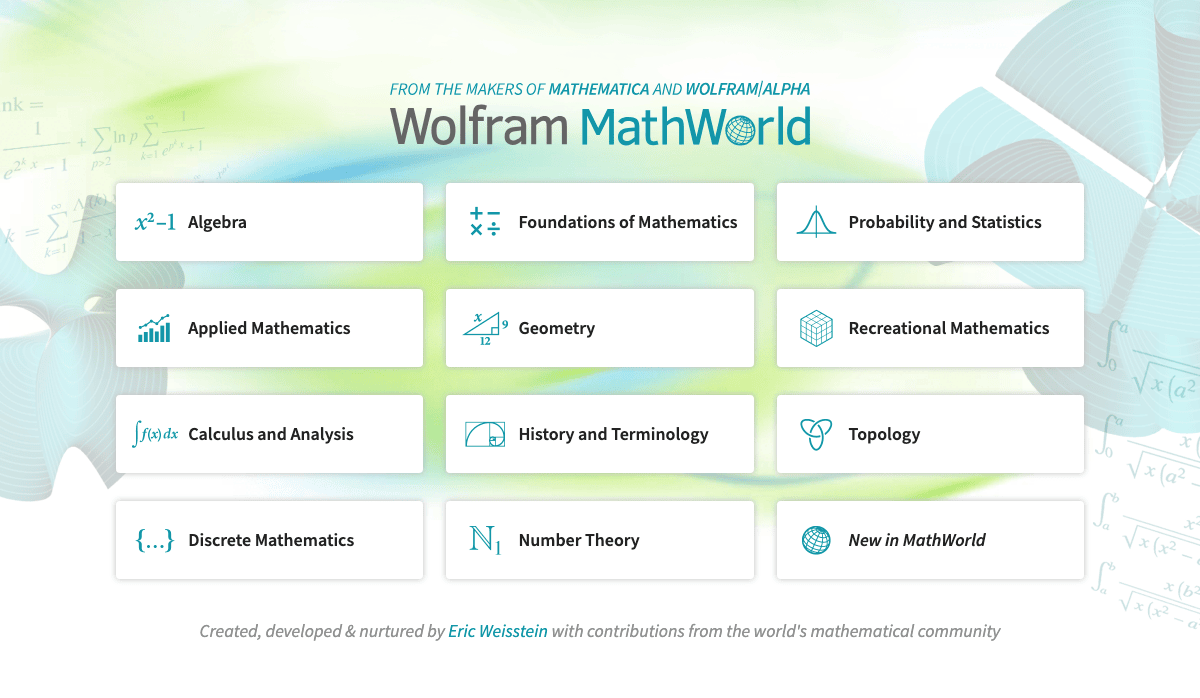
A set of orthogonal functions {phi_n(x)} is termed complete in the closed interval x in [a,b] if, for every piecewise continuous function f(x) in the interval, the minimum square error E_n=||f-(c_1phi_1+...+c_nphi_n)||^2 (where ||f|| denotes the L2-norm with respect to a weighting function w(x)) converges to zero as n becomes infinite. Symbol...
In the book "Banach Spaces of Analytic Functions" by Hoffman, there is a brief introduction to Hilbert spaces which covers all this terminology and shows that some various properties are equivalent to an orthogonal system of functions being complete. However, the rest of the book will most likely not be relevant to what you are looking for.
I believe more is discussed in the context of studying Lebesgue-integrable functions after that. But that is probably more than you need to know for that problem.
gray gazelle
They mean orthogonal basis
This is basic Hilbert space theory @rapid lily
https://en.wikipedia.org/wiki/Orthonormal_basis
@ornate saddle
In mathematics, particularly linear algebra, an orthonormal basis for an inner product space V with finite dimension is a basis for
    V


{\displaystyle V}
whose vectors are orthonormal, that is, they are all unit vectors and orthogonal to each other. For example, the standard basis for a Euclidean space
...
Those books you recommend sound way too advanced and off the topic
rapid lily
gray gazelle
They mean orthogonal basis
Thanks. I don't know why I said orthonormal there.
rapid lily
gray gazelle
Those books you recommend sound way too advanced and off the topic
Only the part about Hilbert spaces would be useful for that book above. It's only a few pages long, but maybe you don't need much more than that to understand the basics. I agree that most of it is not useful or too advanced though.
gray gazelle
I guess people don't actually call it orthogonal basis so that's why. Still, I think the name reflects the meaning
ornate saddle
rapid lily
Ok I see. Now I recall that complete refers to a certain property of a collectio...
I think that Wolfram link suffices. I am surprised that it did not pop up in my search even though I refer to it for definitions most of the time. Thanks for other sources too, by the way!
ornate saddle
gray gazelle
https://en.wikipedia.org/wiki/Orthonormal_basis
<@486268823993974797>
Thank you for that link too!
rapid lily
ornate saddle
I think that Wolfram link suffices. I am surprised that it did not pop up in my ...
You're welcome!
rapid lily
gray gazelle
I guess people don't actually call it orthogonal basis so that's why. Still, I t...
Ok I see what you mean.
remote sparrow
any thoughts on the pde book by zachmanoglou and how it would compare to strauss' pde book?
here's maa's review of strauss' book above
willow pecan
It looks pretty similar to strauss
Actually no
It looks similar to Evans
In terms of content covered
There is value in Strauss
Knowing how to separate variables is still fundamental, even if everyone hates it
remote sparrow
according to this professor zachmanoglou might actually spend too much time on first-order systems and separation of variables
willow pecan
All systems are first order systems in more variables
 placid pollen
remote ginkgo
Goldberg Bishop Tensor Analysis on Manifolds
placid pollen
remote ginkgo
Goldberg Bishop Tensor Analysis on Manifolds
I got filtered hard, what is the prerequisite that would make my experience smoother? I know some topology but maybe I lack advanced multivariable calculus
I don't like that he kinds of defines things but without giving an explicit "Definition 1.1" before every one
remote ginkgo
more linear algebra
try shifrin's multivariable mathematics
has manifold calculus + linear algebra galore
easy af, lots of psets
reads like a novel
placid pollen
has anyone tried this?
 remote sparrow
hubbard and hubbard is also a good alternative to shifrin if you want a cheaper book
dire dagger
remote sparrow
Discrete math books are supposed to be introductions to proof reading and writin...
It says college algebra prereq
Should bernard and child's higher algebra be enough?
 remote sparrow
looks okay
barnard and child seems a fair bit more advanced than the average algebra/trig or precalculus book though, as an older book
probably more stuff than you would need to start working on a fairly modern discrete math book
if you feel like you've got a good handle on algebra already than you can just jump right into any discrete math book
or an intro to proofs book
hearty steppe
So spectral theory books focused on Banach algebras, that’s what I’m gona start looking for more specifically
grave thorn
hearty steppe
So spectral theory books focused on Banach algebras, that’s what I’m gona start ...
why specifically on Banach algebras lmao
like THE hilbert space L2 is not a banach algebra
neither is Lp for p<\infty
dire dagger
remote sparrow
if you feel like you've got a good handle on algebra already than you can just j...
Oh nice
hearty steppe
I’m trying to find a very general angle that won’t make too many assumptions but motivates my interest in understanding how we can make continuous spectra gradient-like projections based off many-body quantum behavior
grave thorn
hearty steppe
I’m trying to find a very general angle that won’t make too many assumptions but...
make precise the notion of "continuous spectra gradient projections"
because i dont see what you mean
hearty steppe
This may perhaps motivate things a little here https://arxiv.org/abs/1111.2810

arXiv.org
We investigate the entanglement spectra arising from sharp real-space
partitions of the system for quantum Hall states. These partitions differ from
the previously utilized orbital and particle...
hearty steppe
I think the abstract does an ok job.
At least for a use case
There’s more but I didn’t want to get a lot of examples rather than one I found interesting enough to look at
forest sleet
you picked vmm's least favorite subject
dire dagger
dapper root
<:flonshed:629835071465062410>
?
 acoustic crater
Can anyone recommend a good book about introduction to statistics?
remote sparrow
acoustic crater
Can anyone recommend a good book about introduction to statistics?
algebra-based or calculus-based
and by statistics, do you mean statistics or are you really talking about probability?
acoustic crater
remote sparrow
and by statistics, do you *mean* statistics or are you really talking about prob...
statistics, not just probability
acoustic crater
remote sparrow
algebra-based or calculus-based
both are fine
remote sparrow
Introduction to Probability by Blitzstein and Hwang is available for free on their website along with tons of resources. It is calculus-based. Mathematical Statistics with Applications by Wackerly, Mendenhall, and Scheaffer contains both sections on probability and statistics. It is also calculus-based.
I would recommend getting these books separately, using the former for probability and the latter just for statistics, but if that is too expensive for you, buying only the latter should be fine. Of course there are other channels to obtain ebooks for free. I simply have a preference for and the fortune to have the means to buy physical copies.
acoustic crater
splendid, thanks!
Also may I ask about statistical software? The examples, I mean.
remote sparrow
Uh, R?
I've never used the R language, frankly. We have a channel for that at #computing-software.
acoustic crater
Oops, sorry. Thanks anyway.
 split basin
hearty steppe
So spectral theory books focused on Banach algebras, that’s what I’m gona start ...
split basin
hearty steppe
So spectral theory books focused on Banach algebras, that’s what I’m gona start ...
i find Rudin's Functional Analysis nice for this and there is also Kaniuth's A Course in Commutative Banach Algebras
gusty smelt
if we are speaking of func anal texts, pederson is the best imo.
(i am an operator theorist so im baised lol)
fluid bay
hearty steppe
So spectral theory books focused on Banach algebras, that’s what I’m gona start ...
i liked "banach algebra techniques in operator theory." Its a short book that assume very little but covers spectral theory and get's into C*-algebras
gray gazelle
hearty steppe
So spectral theory books focused on Banach algebras, that’s what I’m gona start ...
Pedersen's Analysis Now covers this in its fourth chapter.
I got sniped.
gusty smelt
based rakko
gray gazelle
It's a great book for someone with a bit of mathematical maturity. The exposition is crystal clear, the proofs are slick, and there are plenty of great exercises. I couldn't recommend it enough.
It's the kind of book you keep going back to.
gusty smelt
i agree, its the 2nd best book i have ever read, and it also really is what got me into C* algebras which is what i do now lol
 atomic hemlock
Any suggestions for a calculus textbook that is less than 400 pages?
grand thistle
gusty smelt
i agree, its the 2nd best book i have ever read, and it also really is what got ...
what’s the best then?
gusty smelt
Milnor and stasheff characteristic classes
grand thistle
cool
sage python
@gusty smelt what do you think of the second volume of Pedersen?
gusty smelt
I only know of analysis now and his c star automofhoisms book
Do you mean the latter?
orchid mortar
remote sparrow
*Introduction to Probability* by Blitzstein and Hwang is available for free on t...
cool recs, all in all.
fluid bay
@gusty smelt yo i hope u don't mind the ping, but I have a question for an operator theorist: idk any fourier theory, but I read that the fourier transform is the gelfand transform on L^1(G) after making appropriate identifications. do u know of any resources that discuss this approach to the fourier transform? Is there such a thing as "fourier theory for the operator theorist"?
sage python
@fluid bay you probably want an abstract harmonic analysis books. That'll go into the representation theory but probably do a bit on this story
Folland or Deitmar-Echterhoff
fluid bay
thumbing though folland atm. ye, this looks like the kind of thing i was looking for. probably won't start reading this tomorrow or anything () but very cool
ty sloth
hearty steppe
You guys give Reddit, stackexchange, and Quora a good run for their money, hope you know that
Everyone kept recommending reed/simon modern physics book but I’ll peak at that too I guess
fluid bay
im not sure about the books other recommended, but a caveat of the book i recommended is that it doesn't have any physics terminology, in case that is important to you.
hearty steppe
I mean I generally rely on using dynamical systems to get to the physics so, I feel like I pretty much found the more broad sources on that. I prefer leaning more towards the mathematics behind it
Mathematics is like my pair of prescription reality glasses
hazy elk
What's a good set of notes for free groups, preferably with a few solved qs?
vital bane
gusty smelt
i agree, its the 2nd best book i have ever read, and it also really is what got ...
what exactly are C* algebras? (some sort of non-commutative ring of operators i pressume?)
willow pecan
It's a Banach algebra with some additional involution that behaves nicely
Think complex conjugation, which makes C into a C* algebra
But that is not a book recommendation request so either #math-discussion or #advanced-analysis
heady ember
gusty smelt
Milnor and stasheff characteristic classes
No wonder you decided to latex that eh hehe
vital bane
@glad prairie sorry for the ping but perma study please
willow pecan
Very book recommendation
gray gazelle
hi
willow pecan
Hello
 tulip saffron
hi, does anyone know this concept: zero knowledge proof?
 glad prairie
vital bane
<@533879085542146059> sorry for the ping but perma study please
glad prairie
vital bane
<@533879085542146059> sorry for the ping but perma study please
For how long?
I'm not always around, just dm modmail next time
vital bane
glad prairie
For how long?
a month
vital bane
glad prairie
I'm not always around, just dm modmail next time
okay 
gusty smelt
fluid bay
<@476552746581884958> yo i hope u don't mind the ping, but I have a question for...
Harm anal is right, I personally like Deitmer-echteroff
smoky zephyr
gusty smelt
Harm anal is right, I personally like Deitmer-echteroff
this is the most cursed use of the abbreviation i’ve seen
 timber copper
Please do not harm others with anal
gusty smelt
vital bane
what exactly are C* algebras? (some sort of non-commutative ring of operators i ...
i can talk to you about it in some other channel, ping me if you are interested
willow pecan
There was some earlier discussion in #math-discussion
 warped cedar
timber copper
Please do not harm others with anal
warped cedar
timber copper
Please do not harm others with anal
do fun anal instead
 jade saddle
Um, Is there an online resource (book or otherwise) to learn linear algebra along with the formal definations? (need not be easy to understand, looking for something akin to a manual for linear algebra)
willow pecan
I imagine that any resource will include formal definitions?
jade saddle
Not every, I looked on mit open courseware, but what I found was a bunch of lecture notes not particularly easy to navigate and follow
 lime sapphire
friedberg book?
jade saddle
lime sapphire
friedberg book?
I will check that out
"Linear Algebra, 4th Edition" Thanks! I will practice this for a few months
gray gazelle
In uni I never had a fully general LA course, with matrices over PID's and everything. What LA book covers something like that?
sage python
If you've already done some basic linear algebra then maybe Roman's up your alley, or Blythe's "Module Theory: An Introduction to Linear Algebra"
 woven cypress
any calculus workbook recommendation?
gray gazelle
sage python
If you've already done some basic linear algebra then maybe Roman's up your alle...
Thank you
woven cypress
I'd rather like one which is harder and focus more on the quality of questions
 glad stone
does anyone have a ap calc or ap physics me book recommendation or website recommendation for self studying
willow pecan
Khan academy probably
remote sparrow
jade saddle
Um, Is there an online resource (book or otherwise) to learn linear algebra alon...
jim hefferon's website links to his linear algebra book with associated resources
 crimson leaf
glad stone
does anyone have a ap calc or ap physics me book recommendation or website recom...
crimson leaf
glad stone
does anyone have a ap calc or ap physics me book recommendation or website recom...
Paul's online math notes for calc
remote sparrow
woven cypress
any calculus workbook recommendation?
In this video I will show you how to learn mathematics from start to finish. I will give you three different ways to get started with mathematics. I hope this video helps someone.
Here are the books
Elementary Algebra https://amzn.to/3S7yG0Y
Pre-Algebra https://amzn.to/3TpW8HK
Discrete Mathematical Structures https://amzn.to/3eBYogb
Discrete Ma...
somewhere in the video he mentions two calculus workbooks
jade saddle
remote sparrow
jim hefferon's website links to his linear algebra book with associated resource...
Jim hefferon's website?
remote sparrow
Free math texts
Free Texts in Mathematics and Computer Science and more, from Jim Hefferon
jade saddle
Ah thanks, I will check it out
 sleek python
remote sparrow
https://www.youtube.com/watch?v=didXE0HkSC8
sleek python
remote sparrow
https://www.youtube.com/watch?v=didXE0HkSC8
Ah yes the end of mathematics
sturdy shore
sleek python
Ah yes the end of mathematics
it is a well known fact that mathematics ends with serge lang - algebra
 fallow cypress
LOL I like how the last book in that video is "Serge Lang – Basic Mathematics"
 vast obsidian
Is there a good elementary book on statistics (mathematical)?
In highschool the only statistics we did was finding mean value, normal distribution and plotting graphs/bars. What's the next step?
remote sparrow
Have you taken calculus already? Also calculus-based stats is supposed to be taken after calculus-based probability.
You could take a conceptual algebra-based stats class but really the most important thing that you'll learn isn't the math itself but statistical literacy.
vast obsidian
remote sparrow
Have you taken calculus already? Also calculus-based stats is supposed to be tak...
Why do I need probability ?
willow pecan
Because you need probability to do statistics
vast obsidian
willow pecan
Because you need probability to do statistics
can u explain why
sleek python
Statistics use probability
mean value, normal distribution are probability concepts
 sudden kindle
 sterile harness
Anybody know a place where I can take college math classes online and get a certificate
Like abstract algebra, analysis, etc
 stable dagger
Look Coursera, they give certificates
 sage kelp
remote sparrow
https://www.youtube.com/watch?v=didXE0HkSC8
sage kelp
remote sparrow
https://www.youtube.com/watch?v=didXE0HkSC8
Looks like he decided to quite update the book list!
 errant heath
Is there a way to submit book recommendations for this server? I've found a few that I really like but for different subjects in math
hallow oriole
throw em in here lol
also there's this

Google Docs
In this form, you can recommend math textbooks to be listed on the math discord server. You may also recommend books which are already listed there. I will keep track of which books are commonly recommended and move them up in the list. Please read question descriptions carefully.
serene shell
How should I approach maths from scratch to advance? Like pls give me order of books I should read from scratch to advance
Pls
remote ginkgo
serene shell
How should I approach maths from scratch to advance? Like pls give me order of b...
khan academy
serene shell
remote ginkgo
khan academy
Oh which course
remote ginkgo
all
serene shell
And can you suggest me some books as well
serene shell
remote ginkgo
all
Thank you very much
remote ginkgo
serene shell
And can you suggest me some books as well
serge lang basic mathematics
serene shell
Does it contains everything needed
 cedar ridge
do monographs not have exercises
gray gazelle
Some do, some don't
 tiny vale
Do u guys know any easy to understand calculus books or ebooks??
 halcyon scaffold
Are there any books that talk about doing set theory in HOL (encoding sets as predicates)
Simple type theory is what I think they are called. I found a paper called “seven virtues of simple type theory” on this topic but it’s too short.
willow pecan
If you’ve found a paper you can look through the references for more material
 wispy owl
Does anyone know of a complete book on logarithmic density?
sudden dock
Is Conceptual Physics by Paul G Hewitt good book to self study first year high school physics?
willow pecan
This is not the physics server
Do ask your question in the physics server linked in #old-network
sudden dock
math 🤝 physics
woven cypress
sudden dock
Is _Conceptual Physics_ by Paul G Hewitt good book to self study first year high...
Irodov
It's actually good ngl
sudden dock
woven cypress
Irodov
This book of problems is intended as a textbook for student at higher educational institutions studying advanced course in physics from amazon, I need something for self-study.
sudden dock
woven cypress
It's actually good ngl
hewitt?
woven cypress
sudden dock
`This book of problems is intended as a textbook for student at higher education...
Oh I thought you already had some idea
sterile harness
stable dagger
Look Coursera, they give certificates
it doesnt have anything good tho
remote sparrow
tiny vale
Do u guys know any easy to understand calculus books or ebooks??
Easy to understand is fairly subjective. It's also hard to make a recommendation given the plethora of calculus books available. Are you having trouble with mainstream recommendations like Stewart? Do you need a workbook? A calculus for dummies book? Could you need something like Paul's Online Math Notes?
remote sparrow
willow pecan
This is not the physics server
The channel description says, "Use this channel to ask for book recommendations. Tends to be mostly math but feel free to ask about other literature (YMMV)."
gray gazelle
some people know physics here too
I think once there was a person asking about physics book recommendations before, that said they'd rather ask here, even
gray gazelle
I study physics
gray gazelle
Does anyone have a recommendation for a first book on mathematical physics?
forest sleet
What kind?
Like for qm, stat mech, etc?
There's the 4 volume series by reed Simon though that is more math
Like math you will need in math physics
Of the analysis flavor
For specific physics topics sometimes there's book like "this physics topics for mathematicians"
gray gazelle
forest sleet
For specific physics topics sometimes there's book like "this physics topics for...
yeah I meant physics topics for mathematicians, I am now taking a course in E&M and last semester taken a course in Mechanics and haven’t really been able to appreciate the development of the course, a lot of effort is spent trying to develop basic odes / vector calc and almost nothing seems to be (unambiguously) defined. I was hoping for some kind of text which treats e&m (mechanics as well would be nice) sort of axiomatically and includes definitions and proofs to develop the theory
remote sparrow
formalism for formalism's sake runs counter to the goals of physics, which is fundamentally rooted in empirical observation. if a mathematical model doesn't adequately describe physical phenomena, then it will be revised or discarded for a better alternative, regardless of mathematical consistency or unambiguousness
if you're learning physics for the first time, i would strongly suggest learning to think like a physicist, rather than trying to bog yourself down in the math
physical postulates and definitions do not come ex nihilo. the axiomatic treatments that you might see in mathematical physics books are the result of centuries of developments in physics. they are very carefully chosen with respect to empirical observation. proofs that result from these postulates and definitions do not matter if the axioms they rely on don't correspond to reality. the ultimate proof comes from the laboratory.
fluid bay
I think i see where loganb is coming from tho. In technical subjects outside of math, there often seems to be little imprecisions/abuses of language/definitions/assumptions that interfere with understanding. I don’t see why there couldn’t exist a more “bourbakian” treatment of physics that can still qualify as honest physics for people who prefer to organize their ideas that way
vast obsidian
How do you guys finish math books every book is like at least 500 pages ?
 tepid prairie
vast obsidian
How do you guys finish math books every book is like at least 500 pages ?
tepid prairie
vast obsidian
How do you guys finish math books every book is like at least 500 pages ?
I assume most people read them and learn literally nothing.
lean pagoda
any universal algebra texts that also cover lawvere theories in addition to the classic set-theoretical presentation?
forest sleet
gray gazelle
yeah I meant physics topics for mathematicians, I am now taking a course in E&M ...
not sure about E&M but for mechanics there is spivak physics for mathematicians, also the short lecture notes http://alpha.math.uga.edu/~shifrin/Spivak_physics.pdf But part of the problem is that even for mechanics, you're going to quickly need more advanced stuff like differential geometry
gray gazelle
remote sparrow
if you're learning physics for the first time, i would strongly suggest learning...
i can understand this, the problem im seeming to have though is that physicists like to define things through analogy or prove by example and these both leave me with the feeling of being more confused rather than less. In a math class if I cannot rigorously state the definition of something I am studying, I quickly begin to feel uneasy and like there is something I am missing, in physics however you are expected to not know the formal definitions of nearly all the concepts which are routinely calculated. This feels entirely unnecessary though, for instance in mechanics there seems to be real axioms which are assumed (newtons law, the existence of internal frames, etc) from which the entire theory can be derived mathematically
remote sparrow
gray gazelle
i can understand this, the problem im seeming to have though is that physicists ...
could you provide some examples for your E&M class? as far as axioms for classical E&M go, maxwell's equations would fit the bill. as differential equations, however, they're difficult to solve in general. this is why a lot of attention is paid to special cases and approximations. this trend continues even in graduate school, according to people that have read jackson's Classical Electrodynamics.
forest sleet
Fundamentally, the approach in physics is different than in math
You don't start with a set of axioms and see what you can prove
You start with real world phenomena you want to explain
And develop a theory that is consistent with what you see
So at some point you're going to have to accept something as an axiom, "because it gives us the right real world behavior"
For intro mechanics stuff though, the spivak notes I linked might still be helpful
sage kelp
serene shell
How should I approach maths from scratch to advance? Like pls give me order of b...
In this video I will show you how to learn mathematics from start to finish. I will give you three different ways to get started with mathematics. I hope this video helps someone.
Here are the books
Elementary Algebra https://amzn.to/3S7yG0Y
Pre-Algebra https://amzn.to/3TpW8HK
Discrete Mathematical Structures https://amzn.to/3eBYogb
Discrete Ma...
remote ginkgo
gray gazelle
yeah I meant physics topics for mathematicians, I am now taking a course in E&M ...
landau 2 or jackson
for e&m
 viral roost
gray gazelle
yeah I meant physics topics for mathematicians, I am now taking a course in E&M ...
viral roost
gray gazelle
yeah I meant physics topics for mathematicians, I am now taking a course in E&M ...
axiomatically would be variational calculus on jet bundles
gray gazelle
👀
viral roost
some of this is in Olver's book on lie groups applied to PDEs
but the actual laws of EM are somewhat more specific
the point of var calc here would be to formulate least action
and it is, as you can expect, somewhat more involved for fields
but Landau carries it out in the relevant case, mathematics books including and beyond Olver talk about the axiomatization
like Atiyah's Yang-Mills theory book and such
it all comes from diff geo
there is very little physics in Griffiths, just multivariable calculus problems with physics terms
on top of Jackson, there is landau 8 which discusses the EM in materials that is mentioned in jackson briefly, relevant to electrical engineering settings
remote sparrow
remote ginkgo
landau 2 or jackson
Have you ever looked at Smythe's Static and Dynamic Electricity? It's out of print unfortunately but I heard it's harder than Jackson.
remote ginkgo
nope read landau
tiny vale
remote sparrow
Easy to understand is fairly subjective. It's also hard to make a recommendation...
I prefer a calculus book that has an easy explanation on every steps of solving done in a problem
viral roost
tiny vale
I prefer a calculus book that has an easy explanation on every steps of solving ...
that sounds like khan academy
foggy relic
Pauls online notes is the same thing but objectively better
remote sparrow
I'm pretty sure paul's online math notes on calculus can be downloaded as a pdf
smoky zephyr
it can
serene shell
sage kelp
https://www.youtube.com/watch?v=didXE0HkSC8
Thank you so much bro
 tawny jetty
Anyone know university courses that follow pugh analysis closely for the first couple of chapters? Trying to self-teach.
glacial crypt
just learn from rudin
Have you tried understanding analysis by Abbott?
grand thistle
has anyone read do carmo's "Differential forms and applications"?
im looking to read it after i learn a bit of multivariable calculus to get acquainted with diff forms
wondering if it's a good book, it looks really good for me because it's concise yet covers a lot
pretty much just looking to do the first 4 chapters
 vast obsidian
grand thistle
has anyone read do carmo's "Differential forms and applications"?
vast obsidian
grand thistle
has anyone read do carmo's "Differential forms and applications"?
what is a differential form
gray gazelle
vast obsidian
what is a differential form
heady ember
hazy elk
Not always
grand thistle
vast obsidian
what is a differential form
well that's what im tryna figure out from this lmao
solemn rover
vast obsidian
How do you guys finish math books every book is like at least 500 pages ?
Life is long. You have time.
If you're enjoying the book, take your time and enjoy it for itself. If you need its contents for something else, figure out what you strictly need and target that.
You probably do have to work through it slowly and in detail to have good retention. On the bright side, perfect retention is rarely required, it's not a sin to read casually / quickly.
Don't spend so much time on one book that you shut out other parts of math and don't progress forward. Mathematics is broad as well as deep.
woven cypress
heady ember
What's the point of the server then?
zealous coyote
We do a bit more than just define phrases
heady ember
woven cypress
What's the point of the server then?
I just felt that it was perhaps a little unnecessary to place that qns there. A google search could have told him what it was and it doesn't really answer the question the person asked previously. If he doesn't have the prereqs to learn it yet, then I don't think people here can really give him a much clearer explaination either.
Of course, he/she could have asked more about diff forms in #diff-geo-diff-top if he/she was having difficulty understanding what they were when reading something like Lee
Hope Im not coming off as an asshole
gray gazelle
solemn rover
Life is long. You have time.
If you're enjoying the book, take your time and enj...
or just read only the relevant chapters
remote ginkgo
grand thistle
has anyone read do carmo's "Differential forms and applications"?
throw it out
read chapter 8 of shifrin
it's fast and you will immediately understand what you want
then if you want more read bott&tu
shifrin's book is 'multivariable mathematics'
grand thistle
that’s the book i’m reading rn
grand thistle
just thought that maybe it might not have rigorous enough coverage since it’s meant to be just a multi variable calc book
remote ginkgo
everything he has written, shifrin has written something on the same topic easier to read with the same depth
grand thistle
ah i see
remote ginkgo
grand thistle
just thought that maybe it might not have rigorous enough coverage since it’s me...
it does, it has full proofs
grand thistle
hmm i guess i’ll stick w shifrin then
remote ginkgo
remote ginkgo
everything he has written, shifrin has written something on the same topic easie...
only exception to this is riemannian geometry, which you can learn from somewhere else anyway
(do carmo's RG book is not good)
vast obsidian
gray gazelle
or just read only the relevant chapters
every chapter is relevant
remote ginkgo
grand thistle
hmm i guess i’ll stick w shifrin then
if you want applications, try shifrin's differential geometry of curves and surfaces. the last chapter uses them in surface and curve theory
but bott&tu will give you real practice working with them to compute cohomologies
grand thistle
remote ginkgo
(do carmo's RG book is not good)
will probability theory ever use any concepts from differential geometry? it’ll probably just be measure theory no?
remote ginkgo
it does, a lot
in fact, one example is this
look at the space of normal distributions, parametrized by mu and sigma
this forms a hyperbolic riemannian manifold
sleek python
Probability can use concepts from almost any other domain
Depending on what's of interest
grand thistle
huh cool
remote ginkgo
probability theory takes much from linear algebra as well, and bilinear forms also yield these cone like manifold things
grand thistle
so i guess learning just a bit of everything won’t hurt
remote ginkgo
well, geometry makes it easy to see what you can even do
if you can get a good, general picture in your head then you automatically have some roadmap
sleek python
Tbh there are transversal concepts in all domains of mathematics
Not just probability
remote ginkgo
i think geometry probably is the most fruitful study
grand thistle
how is bott tu compared to something like lee’s differentiable manifolds?
remote ginkgo
totally different text
you should skip lee
and just watch schuller
here let me link

the lectures on topological & differentiable manifolds
and basic topology
and then a little about bundles
lee is a reference text and does not really get at the main ideas in proper cadence
the theory is simple
you can literally draw pictures to understand it
as for a textbook on manifolds, if you want extra reading (you shouldnt spend much time here though really) after the 2 shifrin texts, you can look at Tu's intro to manifolds
@grand thistle have you studied tensor algebra/calculus yet
grand thistle
remote ginkgo
as for a textbook on manifolds, if you want extra reading (you shouldnt spend mu...
cool sounds like a plan
remote ginkgo
grand thistle
that’s just like the study of multi linear functions right?
yes, indeed
it turns out
if you take the tensor algebra over a vector space
and you quotient out the 'anticommutators' of that algebra
you get the exterior algebra over the space
and if you do this over cotangent spaces of a differentiable manifold
you get the differential forms
grand thistle
hmm
i have no idea what that means
but sounds interesting
i really wanna learn probability
so what order would you recommend for someone who wants to learn both diff geo and probability?
so many things i wanna learn and such little time
grand thistle
remote ginkgo
you get the differential forms
from some stuff i’ve read differential forms on R^n are like sums of differentiable elements of the dual space of R^n (probably have this wrong but still) how does this relate to that perspective?
sleek python
If you don't know anything about either, then you should learn them separately imo
heady ember
remote ginkgo
lee is a reference text and does not really get at the main ideas in proper cade...
To be clear, I have never read Lee (well, I wish to read it one day), but I have heard great reviews about it. So I guess it wouldn't hurt to take a look to see if you like it
gray gazelle
vast obsidian
every chapter is relevant
not always, in fact I'd argue that a lot of things we read will never be "useful" in the future for some meaning of useful
remote ginkgo
grand thistle
from some stuff i’ve read differential forms on R^n are like sums of differentia...
you need additional context to say something is a 'differential form' namely it being a wedge product of cotangent vectors
remote ginkgo
remote ginkgo
you need additional context to say something is a 'differential form' namely it ...
well, a field of such wedge products over the manifold
grand thistle
alright this is a bit over my head now
i guess i’ll go read shifrin til i understand it
woven cypress
heady ember
Hope Im not coming off as an asshole <:KEK:586240877358350341>
Nah I get it obviously
 hollow peak
grand thistle
how is bott tu compared to something like lee’s differentiable manifolds?
hollow peak
grand thistle
how is bott tu compared to something like lee’s differentiable manifolds?
Bott Tu is explicitly after you've learned the basics of smooth manifolds
It's valuable as a resource for translating a few bedrock ideas in algebraic topology (cech cohomology, spectral sequences, characteristic classes, fiber bundles etc.) into the setting of differentiable manifolds
Would not recommend for learning about smooth manifolds as an introduction
willow pecan
Dummitt and Foote
cinder trellis
Is Advanced Linear Algebra by Roman any good? It seems OK on a first glance, but are there any big issues/cons with it?
hallow oriole
@cinder trellis
sage python
I love that my linear algebra book commentary is so often cited
sturdy shore
it is pretty good commentary especially after the update
foggy relic
ooh never noticed the update!
hearty steppe
What do people think of that 3B1B linear algebra essentials playlist? That might be a good CrashCourse
I just realized it exists 😂
Or I forgot
foggy relic
i mean its not something to learn linalg from
grave thorn
hearty steppe
What do people think of that 3B1B linear algebra essentials playlist? That might...
It's pop math basically
hearty steppe
What if someone doesn’t care about refine holing themselves and they just want a refresher on things
grave thorn
Also not the best refresher
hearty steppe
I’ll just try to skim through various books I was going through to make sure my grasp is more than decent going forward. I don’t feel like I need to twiddle my thumbs in linear algebra land but it’s been a while since I did any stuff with eigenvalues
sage python
Depends on what your goal is. I'd say it's the number one most important topic to have solid in straight up math
But if you're using math to some end like bio
Your strat will be to find a math bio book and either learn linear algebra from there or at least look at the topics it references and learn them elsewhere
hearty steppe
Yea I feel like I’m fine there. I am not trying to be a mathematician. I am a researcher that applies mathematical concepts to areas mainly geared toward cognitive science, molecular biology, a bit of quantum mechanics, a bit of relativity. A little bit of interesting niches sprinkled around
I found all the books I think I’ll find for learning spectral theory
But I can’t go thru a straight up applied book. I need to go through pure books
sage python
Those have different needs I'd wager
hearty steppe
That’s the way I learn most is going thru a pure book that motivates concepts well
I’m a weird character when it comes to understanding stuff because of my medical condition
I still go thru certain physics books but I need math books and resources to accompany them
sage python
Yeah I mean that's a decent overall take, though if you're at linear algebra then what is specifically an effective strategy for you is probably still tbd
Since that comes very early in the game
hearty steppe
Hmm I didn’t really struggle with the texts I was going thru in terms of understanding concepts so I think I’ll just get a feel of where I am at
sage python
Oh I'm not saying you did struggle I just mean like
Linear algebra is one of the first topics you see lol
So you might hit later things and be like well the strat needs to change
hearty steppe
Exactly
sage python
Anyway idk about math bio, again pick up a book on it and find the topics it calls important, then consult another book for those topics
QM and GR... Depends on what you mean by a bit. You probably won't be the first to come up with many new ideas in either, especially new ideas born out of applying math concepts
Since a lot of sophisticated math goes into them already, so the easy stuff has almost surely been done
hearty steppe
Yea that’s what I was thinking.
vital bane
hearty steppe
What do people think of that 3B1B linear algebra essentials playlist? That might...
it's a very good aid to a book
which is what 3b1b literally says
he inuitively explains all the basic lin alg
 languid cypress
What are some good books for Euclidean geometry and coordinate geometry? I want to learn them asap for physics applications and ipho (Competition level)
I have researched about it and i found out for
Euclidean Geometry: College Geometry - An Introduction to the Modern Geometry of the Triangle and the Circle by Nathan Altshiller-Court
sudden dock
languid cypress
What are some good books for Euclidean geometry and coordinate geometry? I want ...
Doing seeing and understanding Geometry
 civic canyon
anything good for like understandinng how to factor polynomials of any degree?
dapper root
there's no general method
willow pecan
If you want to factor the polynomial to find its roots, there are other ways to do that
 royal gale
Can someone tell me excelent books to learn Dynamical Systems?
remote sparrow
royal gale
Can someone tell me excelent books to learn Dynamical Systems?
there are two recommendations in #books
willow pecan
It is currently a work in progress
Progress stalled for a bit but now I am back to bully metal
heady ember
steep badger
royal gale
Can someone tell me excelent books to learn Dynamical Systems?
hmmm what kind of dynamical system?
it is a pretty broad subject.
royal gale
steep badger
hmmm what kind of dynamical system?
I want to learn to use in nanobiotechnology, biophysical and biology in general.
remote sparrow
A textbook for mathematical aspects of Conway's Game of Life and methods of pattern construction.
^ seems like a neat book
bonus is that the ebook is free
royal gale
Thank u ❤️ @remote sparrow
Can you recommend me other books / topics? I love math, and I really want to use it in biophysics.
remote sparrow
royal gale
Thank u ❤️ <@254820329124265984>
no this is not a dynamical systems book
it was a follow-up to a post i made in #chill
royal gale
remote sparrow
no this is not a dynamical systems book
I know, it's a kind of fractals? My friend showed to me some videos about it
steep badger
royal gale
I want to learn to use in nanobiotechnology, biophysical and biology in general.
Did you check out Strogatz's book on nonlinear dynamics? They are tons of examples and applications in that book, and it is undergrad friendly.
 last panther
any books to start learning on math logic for a friend who doesn't know how to think mathematically very well?
remote sparrow
last panther
any books to start learning on math logic for a friend who doesn't know how to t...
forall x: Calgary is an open textbook on formal logic
maybe this?
last panther
thanks ❤️
remote sparrow

 slim peak
grand thistle
pretty much just looking to do the first 4 chapters
slim peak
grand thistle
pretty much just looking to do the first 4 chapters
this is the smoothest and the most elementary introduction ot differential forms I ever see
Thank you
Nice reference
gray gazelle
anyone who’s done a masters in math in Europe, what are the courses you’d typically take in your fourth/fifth year?
 rich sun
gray gazelle
anyone who’s done a masters in math in Europe, what are the courses you’d typica...
rich sun
gray gazelle
anyone who’s done a masters in math in Europe, what are the courses you’d typica...
Depends on your specialization
rich sun
Yeah
rich sun
gray gazelle
Or something more specialised like PDE research?
For PDE, maybe numerical methods for PDEs (elliptic, parabolic, hyperbolic), Sobolev spaces, continuum mechanics
 obsidian sand

This accessible textbook gives beginning undergraduate mathematics students a first exposure to introductory logic, proofs, sets, functions, number theory, relations, finite and infinite sets, and the foundations of analysis. The book provides students with a quick path to writing proofs and a pr...
is this a good book
 rapid lodge
obsidian sand
https://www.amazon.com/Tools-Mathematical-Reasoning-Applied-Undergraduate/dp/147...
rapid lodge
obsidian sand
https://www.amazon.com/Tools-Mathematical-Reasoning-Applied-Undergraduate/dp/147...
u can get it for free
don't even need pay for it
but its an online version
nvm
that specific one is not available
remote ginkgo
royal gale
Can someone tell me excelent books to learn Dynamical Systems?
strogatz to begin, then there are two to continue with:
Andronov's Theory of Oscillators
Kuznetsov's Elements of Applied Bifurcation Theory
gray gazelle
has anyone read Rotmans introduction to the theory of groups?
gusty smelt
Books for dynamics? not interested in like a physical/pde stuff, lets say more topological/geometrical
gusty smelt
hmm i think this is good, ty
 languid crown
I'm looking for a book on a niche interesting maths topic, that isn't very complicated, so a pre uni student could understand pretty much everything
hungry for weird maths
I was looking at non-euclidean geometry before, but it gets very complicated sometimes
willow pecan
All of math gets very complicated
 loud cradle
languid crown
hungry for weird maths
loud cradle
languid crown
hungry for weird maths
maybe something like generatingfunctionology
languid crown
ooh I've heard of generating functions before but don't know anything about them
thanks for the recommendation
loud cradle
iirc it requires a bit of calculus but nothing beyond that
languid crown
ah I'm good with that
loud cradle
freely available from the author as a pdf here: https://www2.math.upenn.edu/~wilf/gfology2.pdf
loud cradle
oh man i didn't realize he had died
crimson leaf
Yeah about 10 years ago
loud cradle
that's nice that his uni has kept his website alive
crimson leaf
https://www2.math.upenn.edu/~wilf/gfologyLinked2.pdf here's the link with a table of contents btw
remote sparrow
Any modal logic book recs?
 cinder tundra
any good reccs for an advanced course on linear algebra
sturdy shore
cinder tundra
any good reccs for an advanced course on linear algebra
check pins
cinder tundra
thank you
gray gazelle
anyone ever read prinicipia mathematica
remote sparrow
which one
 keen orbit
Hello everyone which book is recommended for self studying linear algebra
remote sparrow
keen orbit
Hello everyone which book is recommended for self studying linear algebra
for a first or second course
keen orbit
I am learning calc rn I am near starting to learn techniques of integration and this will be the first time I read about linear algebra
So i am totally new to linear algebra
remote sparrow
keen orbit
I am learning calc rn I am near starting to learn techniques of integration and ...
keen orbit
Is the book linear algebra done right by Sheldon axler considered a good book to self study linear alg?
remote sparrow
you can use it for a first course in linear algebra, but axler designed it for use in a second course after you're done working with more matrix computations and earlier introduction of determinants
keen orbit
keen orbit
Is the book linear algebra done right by Sheldon axler considered a good book to...
I saw someone on yt recommending it so I want to know
keen orbit
remote sparrow
you can use it for a first course in linear algebra, but axler designed it for u...
Oh ok so it's better not to start with it ??
remote sparrow
it will be easier to appreciate if you use it as a second pass through the subject
if you're just self-studying
keen orbit
But If I start with it will I miss ideas that the book doesn't include which should be known before knowing the ideas found in the book??
remote sparrow
i guess you might miss something? you might miss out on the computational aspects of linear algebra. either way, a typical curriculum requires two passes at the subject.
no book is completely encyclopedic; authors make choices about what to include and what not to for various reasons.
if you've got a fear of missing something out, figure out what you're most worried about missing
keen orbit
What I meant is that I want a book that starts from the beginning of the topic
remote sparrow
axler is complete in that sense, it's just that his perspective is different.
you should skim through the books i mentioned and axler and see which one is right for you
willow pecan
Friedberg
 upper stump
Need some real good introductory book on abstract algebra
willow pecan
Dummitt and Foote
upper stump
Mathematical logic & advanced set theory
willow pecan
Enderton is a standard logic book I believe
Jech is the standard set theory book I think?
remote sparrow
upper stump
Need some real good introductory book on abstract algebra
Judson's ebook is free and has a cheap print copy. Pinter's book is a cheap Dover book.
remote sparrow
upper stump
Mathematical logic & advanced set theory
You could use Enderton's set theory book too but i think it's out of print
Nvm elsevier sells a hard copy
Jech's book is graduate level. Hrbacek and Jech's book is undergraduate level.
 lone orbit
What do you guys think about "Quadrivium: The Four Classical Liberal Arts of Number, Geometry, Music, & Cosmology" book ?
sage python
Is it a historical thing or what?
 gray jungle
upper stump
Need some real good introductory book on abstract algebra
gray jungle
upper stump
Need some real good introductory book on abstract algebra
artin book + gross lectures are a great combination, would use something else for exercises.
lone orbit
sage python
Is it a historical thing or what?
I don't know, the book explains the four classical liberal
and some discovers
"From the time of Plato through the Middle Ages, the quadrivium (plural: quadrivia) was a grouping of four subjects or arts—arithmetic, geometry, music, and astronomy—that formed a second curricular stage following preparatory work in the trivium, consisting of grammar, logic, and rhetoric."
cursive orbit
why not use two separate books
ornate saddle
Sheldon Axler's Linear Algebra Done Right is quite a fruitful book in terms of readability of his proofs.
gray gazelle
Too bad he treats determinants in the most insane way possible.
The book is fantastic as long as you cut out the parts about determinants and the characteristic polynomial and replace it with a more sensible treatment.
sage python
Because complex analysis uses ideas from real for the most part.
remote sparrow
gray gazelle
The book is fantastic as long as you cut out the parts about determinants and th...
if you're an instructor, you can receive an electronic copy of his upcoming 4th edition to give feedback based on classroom testing, which will also be available as a free ebook
gray gazelle
Why did you ping me for this?
I learned linear algebra a long time ago and have no plans to teach it.
crimson leaf
I do commend him for making the next edition a free ebook
heady ember
upper stump
Mathematical logic & advanced set theory
Look at Clerk's recs in pinned
heady ember
remote sparrow
You could use Enderton's set theory book too but i think it's out of print
Enderton's Elements of Set Theory is not advanced axiomatic set theory. Its an introductory one.
It only covers the basics like the ZFC axioms, cardinals, ordinals, the Cantor-Schroder-Beinstein theorem, etc. Doesn't cover more advanced stuff like forcing.
sturdy shore
imo baby jech is a better book on introductory (axiomatic) set theory to someone that has mathematical maturity
enderton is for true beginner
but idk what the person means by advanced exactly
heady ember
sturdy shore
but idk what the person means by advanced exactly
Yeah that's rather vague
remote sparrow
enderton would make sense if you've never had exposure to something like halmos' Naive Set Theory but have already done some math already
sturdy shore
I think if you've done a lot of math it's impossible to not know naive set theory on halmos level, you will pick it up here and there
oh you changed it to some, if youve done like 1-2 proof based course then yeah enderton is still a good option
heady ember
I didn't do halmos or pick up any book on naive set theory and I went ahead and did (and am still doing) Enderton
remote sparrow
^ right, that's what i said
heady ember
I tried Rosen discrete math => Got too bored => Enderton looks cool => Pain but fun :D
remote sparrow
my university doesn't offer mathematical logic or axiomatic set theory
 frigid shale
gray gazelle
The book is fantastic as long as you cut out the parts about determinants and th...
frigid shale
gray gazelle
The book is fantastic as long as you cut out the parts about determinants and th...
What was Axler's rationale anyways for absolutely hating determinants?
sturdy shore
frigid shale
What was Axler's rationale anyways for absolutely hating determinants?
he has a paper on it
google axler determinants paper
upper stump
sturdy shore
but idk what the person means by advanced exactly
beyond ZFC stuffs
sturdy shore
then kunen is the standard text I believe
heady ember
heady ember
Look at Clerk's recs in pinned

upper stump
‘large’ cardinals etc.
upper stump
sturdy shore
then kunen is the standard text I believe
K
sage python
@frigid shale he's a functional analyst
 dusk forge
anyone know any good physics books
Thanks, yea I know it's vague because I don't really know exactly what I want to read but I find physics interesting so I'll check it out
what about a book on light, waves and stuff like that
optical lenses
hazy elk
From #books
Topology: A Categorical Approach (Terilla, Bradley, Bryson)
Comfort with Sets and Basic Proof-based mathematics.
This book is quite different from the others on this list, and might best be used in conjunction with one of the others. The book develops basic category theory and point-set topology at the same time, with a different and more modern perspective than point-set is usually introduced. Potentially obscure topological definitions are shown to be very natural and straightforward through their universal properties.
 analog flint
what are some good resources on several complex variable analysis?
analog flint
ah yeah that looks really well laid out, thanks
 wraith shard
You should try "pilgrims progress" I love that book
 clever owl
yall should try the ''dairy of a wimpy kid trilogy''
willow pecan

 distant cloak
Does anyone know of any good trig books that can be taken alongside a trig textbook?
grave thorn
try  trig
trig
remote ginkgo
hazy elk
From <#873809533615628308>
Topology: A Categorical Approach (Terilla, Bradley, ...
i like how u didnt mention how witten wrote this book
hazy elk
remote ginkgo
i like how u didnt mention how witten wrote this book
Huh..?
fluid bay

remote ginkgo
one author (the one with the most famous name) is omitted from your list
ik it was copied from somewhere, but still
fluid bay
witten didn't write that book
remote ginkgo
let me double check
whoa!
then which one am i thinking of
LOL oh it's ISLR that i'm thinking about
nvm sorry
hazy elk
Ye lol
fluid bay
what is ISLR?
remote ginkgo
intro to statistical learning with R
fluid bay
damn not even remotely related to topology or category theory
remote ginkgo
indeed, that's a wild slip
sturdy shore
introduction to topology with category theory
 blazing jetty
book for set theory
 blazing jetty
thanks
sturdy shore
don't listen to that lol