#book-recommendations
1 messages · Page 8 of 1
 terse heron
 neon tiger
any one of you ever participated in ioqm or prmo
neon tiger
any one of you ever participated in ioqm or prmo
Olympiads 
Nope
I gave Kvpy, that's it
 blazing wharf
Kvpy now ded
 vagrant path
Maximum Ride Graphic Novel 👌
 willow pecan
Omniscient Reader's Viewpoint
 glacial leaf
Could I ask for a good introduction to calc 3 book? I've been thinking of getting apostols p2, but I don't know if it's beginner friendly. Thank you.
 foggy relic
Spivak COM
glacial leaf
willow pecan
Do you want a proof based multivariable calc book
I prefer a non proof based, but a proof based one is fine
willow pecan
I think Stewart is the standard non proof based multivariable calc book
glacial leaf
willow pecan
I think Stewart is the standard non proof based multivariable calc book
thank you, I'll look into that
 remote sparrow
glacial leaf
Could I ask for a good introduction to calc 3 book? I've been thinking of gettin...
remote sparrow
glacial leaf
Could I ask for a good introduction to calc 3 book? I've been thinking of gettin...
hubbard and hubbard is also designed to work for honors multivariable calculus classes if, in the author's words, you design your course around omitting some of the more difficult and sophisticated proofs (which are generally relegated to the appendix)
shifrin's multivariable mathematics also works for this purpose, though its hard copy is more expensive than H&H
glacial leaf
remote sparrow
hubbard and hubbard is also designed to work for honors multivariable calculus c...
thank you for the recommendation, hubbard and hubbard definitely seems like a suitable choice
 narrow relic
Has anyone here had experience with the book Measures Integrals and Martingales by Schilling?
 heady ember
Look in pinned
narrow relic
heady ember
Look in pinned
I read that already 🙂 I had a question about it though
heady ember

narrow relic
I'm wondering about how long it would take a normal person to do the first 13 chapters or so, and what kinds of feelings or experiences people have had with it.
For context, I couldn't really make sense of some of the other books I looked at, and this one seemed to make sense and be written well, but it was taking me quite a long time to get through aspects of it
 surreal heart
Hey! Just looking for a book recommendation for a young person. I'm a senior in hs taking a Calc 1 course, and I just want something fun to work through in my free time, I'm happy to hear any and all recs even if they may be slightly too easy/difficult as long as they're interesting and new in content
 agile void
Is this for math books, or just reading in general?
surreal heart
Math books! Something to work through and hopefully improve my skills
Although I guess I would take math-related reading recommendations too but probably wouldn't read them at the moment
 hallow oriole
book of proof
by richard hammack
free on his website
solution to odd exercises are in the back, i think
could be wrong
surreal heart
Ok cool, thanks for the recommendation, it seems like something I'll be very interested in
heady ember
Spivak
heady ember
Enderton is interesting for axiomatic set theory. But tread carefully... this book isn't easy to read at all, at least in my personal experience lol
heady ember
hallow oriole
read book of proof first
Last time I originally tried Rosen discrete math, found it too boring. Then tried Enderton, which is quite spicy lol  . But pretty interesting.
 sturdy shore
axiomatic set theory will feel unmotivated until you have seen some other proof based stuff
something like book of proof or other books of that sort will cover more than enough naive set theory for a beginner
and honestly most people will never have to learn axiomatic set theory anywhere in their undergrad
 frigid flax
Any book for matrices and vectors?
heady ember
sturdy shore
axiomatic set theory will feel unmotivated until you have seen some other proof ...
I just did Enderton for fun lol. I was curious about cardinals, ordinals n stuff
Haven't reached there yet but yeah
sturdy shore
If you are interested for the sake of it, that's great (same for any topic)
but cardinals and ordinals (beyond a basic overview of cardinals given in any proof book) won't be of use to anyone studying math until they at least take introductory courses in fields like analysis algebra etc
heady ember
Yeah i know
 grand thistle
frigid flax
Any book for matrices and vectors?
grand thistle
frigid flax
Any book for matrices and vectors?
literally any linear algebra book
check pins if you want a detailed review on linalg books
 sage python
For what it's worth my books were more theoretical, something like Strang might make more sense in case "matrices and vectors" does in fact suggest, as it seems to, that the aim isn't necessarily that
 tawny copper
Honestly, I don't get the point of reading books about proofs when you have never proven anything
sturdy shore
so that you learn how to prove things?
remote sparrow
tawny copper
Honestly, I don't get the point of reading books about proofs when you have neve...
Was there a misunderstanding here? Seems like no one is talking about proof theory.
tawny copper
hallow oriole
read book of proof first
^
tawny copper
sturdy shore
so that you learn how to prove things?
this is why kids read books about swimming instead of actually swimming when learning to swim
This was just a general comment, this section is about #book-recommendations I don't think this was out of place at all.
sturdy shore
you know book of proof, or any other book that is about transitioning to advanced mathematics, also has plenty of things to prove?
question, have you even glanced at any of these books? lol
tawny copper
remote sparrow
Was there a misunderstanding here? Seems like no one is talking about proof theo...
Also the comment was not about proof theory itself, but rather about methods for basic proofs
instead of like proving stuff
tawny copper
sure lol I'm not an idiot
I just think its completelly unnecesary, you can learn basic proof methods while you are learning from a book that has in the title "calculus" or something like that
 gray gazelle
Thoughts on Euclids writings?
sturdy shore
-
this is the reason why I dislike the nomenclature of these books. They are called "proof books" while the vast majority of the book isn't even about proof methods but about naive set theory, functions, relations, equivalence relations and generally the stuff that is ubiquitous in mathematics
-
it is true that you could technically learn most of these stuff by going through introductions and appendices of other textbooks, but you definitely can't guarantee that your journey will be smooth, and you probably shouldn't have to suffer in your courses because you never learned wtf a preimage is, what equivalence relations are and why rational numbers are countable while the reals are not
going through book of proof (or any equivalent) before any other mathematics is by far the most obvious thing you can do imo
tawny copper
gray gazelle
Thoughts on Euclids writings?
actually readable, but I'd recommend to not only rely on Euclid ofc. The elements look like a problem sheet with solutions, so you can take it as a set of exercises
tawny copper
sturdy shore
1. this is the reason why I dislike the nomenclature of these books. They are ca...
I never learnt what a preimage is from a proof book. The thing is, it might create the wrong impression that proofs require a novel way of thinking, when it's just something very intuitive to do. I'm not saying you shouldn't learn what a function is, or any other basic set theoretic concept... I'm just saying that if you want to learn math, pick a math book on a topic you like and start solving problems. Like, set theory book != introduction to proofs book lol. These type of books seem to make the transition between high school regular mathematics to actual mathematics much harder than it actually is. I just don't think this type of transition should exist in the first place, but whatever. Maybe its all in my imagination.
sturdy shore
tawny copper
I never learnt what a preimage is from a proof book. The thing is, it might crea...
I never learnt what a preimage is from a proof book.
I have book of proof and how to prove it open for reference and they both have it, so maybe whatever book you used was just bad
Like, set theory book != introduction to proofs book
Again, these books are called proof books while the majority of the content isn't about proofs, and they will all contain naive set theory in them which is mandatory for any beginner
These type of books seem to make the transition between high school regular mathematics to actual mathematics much harder than it actually is.
But the transition is hard if you go into a proof based math book while having no knowledge of the things these books cover. As I said, introductions and appendices can cover you but they can also feel terse or lacking
also, nobody is saying you shouldn't read another book concurrently, especially if you feel the transition book is unmotivated
you probably should do exactly that
tawny copper
hallow oriole
read book of proof first
^
sturdy shore
okay, disclaimer the discord user valley doesn't completely represent my own beliefs and if you feel book of proof feels unmotivated you are allowed to read it alongside another math book
tawny copper
sturdy shore
> I never learnt what a preimage is from a proof book.
I have book of proof and...
I meant that I never read an introduction to proofs book, yet I know what a preimage is. I just learn what that was in context.
tawny copper
sturdy shore
okay, disclaimer the discord user valley doesn't completely represent my own bel...
Sure. But I was mainly responding to user valley, and you all thought I was a lunatic or something xD
sturdy shore
I literally said like 5 times you can "pick up" most of the concepts in these books from other books exactly because they are ubiquitous in math but you can't guarantee your learning process will be smooth
tawny copper

You thought I read an intro to proofs book that was bad, then I clarified that that was not what I meant. It was just a clarification.
It's not like I'm trying to convince you of anything.
Have a nice day.
 zealous light
What's a book that covers filters nicely? They're being taught in my topology course and I'd like a supplemental resource
remote sparrow
zealous light
What's a book that covers filters nicely? They're being taught in my topology co...
willard's general topology according to its table of contents
 dense hamlet
For those of you who've worked through folland before, I'm doing the problems listed in problem sets, but I'm also trying to dedicate my limited time for doing extra problems, are the problems in the book with bolded text considered mandatory to do?
this is for his book on measure & integration
zealous light
dense hamlet
For those of you who've worked through folland before, I'm doing the problems li...
Those exercises provide new definitions usually. I wouldn't say they're necessarily required, but at least look through the exercises that provide those new definitions
dense hamlet
zealous light
Those exercises provide new definitions usually. I wouldn't say they're necessar...
thanks
heady ember
sturdy shore
1. this is the reason why I dislike the nomenclature of these books. They are ca...
~~Just do Enderton  ~~
~~
(Joking, of course)
 exotic crow
what's a good book for interesting proofs in mathematics accessible to an undergrad (any subject)
remote sparrow
exotic crow
what's a good book for interesting proofs in mathematics accessible to an underg...
Proofs from THE BOOK by Aigner and Ziegler?
 fierce jungle
Any Indians here who have prepared for ISI?
 hybrid sequoia
fierce jungle
Any Indians here who have prepared for ISI?
hybrid sequoia
fierce jungle
Any Indians here who have prepared for ISI?
Am in 10th, thinking to but parents all want IIT and nothing
I don't even know what I'll do next year
 fierce hedge
fierce jungle
Any Indians here who have prepared for ISI?
fierce hedge
fierce jungle
Any Indians here who have prepared for ISI?
I gave the exam without much prep, I think the TOMATO book should be enough
 west rampart
Guys, what's a good book for practicing data analysis?
like I am well versed with the theory but couldn't find any source to practice...
grand thistle
as a person who wants to get into probability theory mainly, what would be the best order in which to read these books with a background in baby rudin chapters 1-7?
- rudin RCA (big rudin)/ folland real analysis
- jacod protter probability essentials
- spivak calculus on manifolds
 loud cradle
grand thistle
as a person who wants to get into probability theory mainly, what would be the b...
loud cradle
grand thistle
as a person who wants to get into probability theory mainly, what would be the b...
if your goal is probability then imo read the probability book. it covers the needed measure theory albeit in condensed form (but not any more condensed than rudin or folland)
calculus on manifolds seems unnecessary for this
grand thistle
loud cradle
calculus on manifolds seems unnecessary for this
yeah that’s a more general knowledge thing i’m tryna cover bc i never learnt multi variable calc
grand thistle
loud cradle
if your goal is probability then imo read the probability book. it covers the ne...
right, what do you think of covering the measure theory needed concurrently with the probability book from folland or rudin
loud cradle
grand thistle
right, what do you think of covering the measure theory needed concurrently with...
folland and rudin are both good books, no reason you can't use them as supplementary reading
but you don't have to treat them as prerequisites
grand thistle
hmm right sounds good
spivak com could probably be done at any time right?
since it’s mostly disjoint from the other two
grand thistle
alright great thank you
i think i’ll finish chapter 6-7 by the end of the month
so i should be able to start probability soon yay
fierce jungle
fierce hedge
I gave the exam without much prep, I think the TOMATO book should be enough
I am preparing for JEE, how hard was it relatively?
 carmine lintel
hybrid sequoia
Am in 10th, thinking to but parents all want IIT and nothing
I don't even know w...
carmine lintel
hybrid sequoia
Am in 10th, thinking to but parents all want IIT and nothing
I don't even know w...

carmine lintel
fierce jungle
Any Indians here who have prepared for ISI?
i’m preparing, but i don’t think i have a chance 
fierce hedge
fierce jungle
I am preparing for JEE, how hard was it relatively?
These are very different exams. ISI exam is subjective exam and they ask questions close to the level of RMO I guess
 oblique dove

 remote ginkgo
grand thistle
as a person who wants to get into probability theory mainly, what would be the b...
remote ginkgo
grand thistle
as a person who wants to get into probability theory mainly, what would be the b...
id throw away spivak and get shifrin multivariable mathematics instead
covers all same stuff except tensors
which you can just pick up in bishop&goldberg
grand thistle
remote ginkgo
id throw away spivak and get shifrin multivariable mathematics instead
hmm this actually seems like a pretty good idea
i've been wanting to od a down to earth book like shifrin for a while
remote ginkgo
yea shifrins super down to mars.
grand thistle
😂
grand thistle
but really, the last time i did a computational exercise was back when i was learning linear algebra haha
remote ginkgo
more linear algebra is always good
stats surprisingly turns out to be linear algebra under the hood for all interesting results anyway
but in particular. chapter 8 of shifrin is what i mean to suggest
it covers diff forms
stokes theorem on manifolds
grand thistle
mmm all the good stuff
it's in definition theorem proof format right?
i still want it to be rigorous with proofs for everything
remote ginkgo
yes
grand thistle
remote ginkgo
yes
what's the difficulty of the book?
how fast you expect one to finish it if they work on it say, about an hour a day
grand thistle
fair enough
 north hornet
Hello everyone! This is a survey for our research project regarding Investors analysis . Please take 5 minutes out of your time and fill it up. It will be of great help. Thank you for your patience and time https://forms.gle/1XHmT79Bu1ski5DT9

Google Docs
Dear Sir/Madam This research is carried out by Researcher(s), pursuing research in Stock Market area.Researcher(s) are doing a research on the above said topic. We request you to give the opportunity to researcher to share your valuable views regarding the same.
This survey should take only 5-6 minutes to complete. Participation in this researc...
willow pecan
Is this a book recommendation
fierce jungle
carmine lintel
i’m preparing, but i don’t think i have a chance <:sad:532803514892812288>
I felt that
I am able to solve TOMATO subjective questions, but it takes way too frickin long to solve them
 delicate trail
hey guys, any books for a nweebye in math analisys?
i m first year in phys
and i really need to catch back with math
so i need to really set the base
 grave thorn
remote ginkgo
for probability i havent read the book u asked about
grave thorn
remote ginkgo
for probability i havent read the book u asked about
I recommended it (I think?)
In any case Jacod and Protter is a very good book
grand thistle
grave thorn
I recommended it (I think?)
yeah you did
carmine lintel
fierce jungle
I am able to solve TOMATO subjective questions, but it takes way too frickin lon...
the UGB paper is the one i’m most worried
fierce jungle
carmine lintel
the UGB paper is the one i’m most worried <:sad:532803514892812288>
yeah its definitely harder
fierce jungle
carmine lintel
the UGB paper is the one i’m most worried <:sad:532803514892812288>
any books you would recommend
carmine lintel
what grade u in rn?
carmine lintel
fierce jungle
any books you would recommend
i’m the last person to get recommendations from
12th
ayy
i just solve tomato
carmine lintel
fierce jungle
I have Maron and SL Loney
hmm trigo isn’t very hard off isi no?
fierce jungle
carmine lintel
hmm trigo isn’t very hard off isi no?
coordinate geometry
carmine lintel
fierce jungle
apart from that I only do jee stuff
jee
hav you been doing number theory?
carmine lintel
yes
fierce jungle
I love number theory
carmine lintel

fierce jungle
even mathematical induction is not in JEE
fierce jungle
idts
carmine lintel
well it doesn’t matter, its very trivial ig
gray gazelle
fierce jungle
even mathematical induction is not in JEE
what's jee?
fierce hedge
carmine lintel
well it doesn’t matter, its very trivial ig
Induction is pretty non-trivial. You can prove a lot of things using induction, much more than you might initially assume
 hazy elk
Anyone here read Janich's vector analysis?
Is it a pretty dense book? The topic coverage feels like it would be pretty hard for someone who just knows pointset and analysis
sturdy shore
hazy elk
Is it a pretty dense book? The topic coverage feels like it would be pretty hard...
an amazon review
Do not get this book. It is incomprehensible. For each page he introduces a term that is previously undefined. For example, page 1 undefined term: homeomorphism. Page 2: diffeomorphism. Page 3: Hausdorff space, Second countable etc. I have read Walter Rudin's Real and Complex Analysis (measure theory - not even necessarily taken at even the phd level) and that is the only way in which I am familiar with Hausdorff spaces. The other things, I was unaware of. While they are not impossible to comprehend with a quick search, the book is pedagogically unsound as it assumes the reader knows FAR too much.
If you are reading this book as a second year math undergrad: may God have mercy on you because you are in for the struggle of your life.
seems like one of those fake undergrad texts
i.e. german undergrad
hazy elk
sturdy shore
Do not get this book. It is incomprehensible. For each page he introduces a term...
seems like a dumb review tbh
Cus measure theory is not that uncommon for ug
sturdy shore
well here's the description for the book:
The material is accessible to readers and students with only calculus and linear algebra as prerequisites. A large number of illustrations, exercises, and tests with answers make this book an invaluable self-study source.
if u don't think that's misleading idk lol
 sage python
Wait Janich actually looks kinda sexy ngl
fierce hedge
Just get it on libgen and try it for yourself smh
hazy elk
I've tried parsing a couple sections, at least the manifolds ch isn't that hard
hazy elk
sage python
Wait Janich actually looks kinda sexy ngl
Might be too sexy for the average ug 😅
fierce hedge
This book is about manifolds, differential forms, the Cartan derivative, de Rham cohomology, and the general version of Stoke's theorem. This theory contains classical vector analysis, with its gradient, curl, and divergence operators and the integral theorems of Gauss and Stokes, as a special case.
This definitely not for ug
sage python
I mean it looks like it's fine as long as you know multi, in particular if you know measure theory/Lebesgue integration
Will all undergrads know this? No
But many will
hazy elk
Multi meaning implicit, inverse or like proper multi (stokes + other stuff in spivaks calc on manifolds?)
sage python
Calculus on R^n by the looks of it, this handles the Stokes c
fierce hedge
I mean if you're willing to go for it then sure, this looks more or less like spivak's calculus on manifolds
sturdy shore
bro the book says you'd need "a few notes on basic topological concepts" I'd say you need a full course for this
book definitely looks sexy tho
hazy elk
Ill attempt to read it, if I survive, Ill let you guys know how it went😁
willow pecan
Is this a book recommendation
gray gazelle
Can someone get me a good book on Algebraic Number Theory? As a quick introduction to Elliptic Curves. Also, can I get an Arithmetic Geomdtdy book as an introduction to Sheaves & Perfectoid Spaces?
 abstract rapids
how good is topology and geometry and bredon? Should i use it or should i just stick to the classic algebraic topology by hatcher?
 stray veldt
standard book on algebraic nt is neukirch and on elliptic curves is "the arithmetic of elliptic curves" by silverman
i like them both @gray gazelle
sage python
@abstract rapids I like Bredon
 devout sphinx
fierce hedge
```This book is about manifolds, differential forms, the Cartan derivative, de R...
devout sphinx
fierce hedge
```This book is about manifolds, differential forms, the Cartan derivative, de R...
I did this last semester and then forgot all of it. Our textbook in that class was Munkres
 solemn rover
hazy elk
Might be too sexy for the average ug 😅
solemn rover
hazy elk
Might be too sexy for the average ug 😅
It's ok. I think it's probably friendly enough that even if you don't understand it all you'll get exposed to a lot of cool shit
some books are meant to be full comprehensive rigorous treatments of the subject matter and some are more expository
 hearty steppe
Any books on representation theory for dynamical systems?
I need to omega brain 
@solemn rover great to see you. I am still working through your glorious complex dynamics recommendations
Might want recommendations for applied math motivated p-adic stuff as well. Finding some interesting papers on QFT stuff
Sorry quantum mechanics*

arXiv.org
Within the framework of quantum mechanics over a quadratic extension of the
non-Archimedean field of p-adic numbers, we provide a general definition of a
quantum state relying on a general...
Unrelated I guess but this one also tickles my fancy https://arxiv.org/abs/2210.01145v1
arXiv.org
For every local quantum field theory on a static, globally hyperbolic
spacetime of arbitrary dimension, assuming the Reeh-Schlieder property, local
preparability of states, and the existence of an...
If you like what you see, you should follow me on Twitter 😂
solemn rover
no problem boss
 limpid gazelle
What’s a good book on quantum mechanics that assumes that you know linear algebra?
hearty steppe
I really really really like Griffiths
And I only was able to read the first chapter cuz of all the stuff I am trying to do at the same time but also the exercises are so much fun
remote sparrow
limpid gazelle
What’s a good book on quantum mechanics that assumes that you know linear algebr...
maybe shankar's Principles of Quantum Mechanics for an undergraduate treatment?
hearty steppe
Oh here is another taste of what I find on Twitter https://arxiv.org/abs/1704.07764v1
arXiv.org
We study the flow of the special linear group over the p-adics, acting on its
space of types. We determine the minimal subflows as well as the Ellis group.
Motivation with learning more about topological dynamics 🧐
hearty steppe
 forest sleet
I like Shankar
forest sleet
I like Shankar
I’m not sure I have looked at Shankar but I need motivation to learn more about Hilbert spaces
forest sleet
Particle wavefunction lives in a Hilbert space
Bra ket inner product uses riesz rep theorem for Hilbert spaces
 sudden kindle
Anyone know where I can find a proof of Riemann existence theorem?
Esp one that involves pdes
 lavish apex
any book to learn calculus? pls
remote sparrow
lavish apex
any book to learn calculus? pls
do you want proofs or just something intuitive
lavish apex
something intuitive
remote sparrow
generally stewart's calculus is recommended here
physical copies of old editions can usually be found much more cheaply than the latest editoin
narrow relic
lavish apex
any book to learn calculus? pls
There's a neat book by Gilbert Strang called Calculus that I believe is available for free, it has a lot of intuition.
narrow relic
lavish apex
any book to learn calculus? pls
Here I found it for you: https://ocw.mit.edu/courses/res-18-001-calculus-online-textbook-spring-2005/pages/textbook/

MIT OpenCourseWare
Chapters: 1: Introduction to Calculus, 2: Derivatives, 3: Applications of the Derivative, 4: The Chain Rule, 5: Integrals, 6: Exponentials and Logarithms, 7: Techniques of Integration, 8: Applications of the Integral, 9: Polar Coordinates and Complex Numbers, 10: Infinite Series, 11: Vectors and Matrices, 12: Motion along a Curve, 13: Partial De...
remote ginkgo
fierce hedge
```This book is about manifolds, differential forms, the Cartan derivative, de R...
these are all ug topics
remote sparrow
anyone watch the math sorcerer's book reviews?
hearty steppe
forest sleet
Particle wavefunction lives in a Hilbert space
Pretty fundamental stuff. I’m thinking more like Field trajectory projections on spaces tbh when I think of the application of Hilbert Spaces?
Well I haven’t really taken the time to look more into the abstraction of Hilbert spaces but I’ll get there.
 safe relic
Hey guys! I want to learn "mathematical induction" and "recurrence relations" at least to a basic level for a programming book I am reading, however, I can't commit to a full "discrete mathematics" course/book at the moment(still working on my precalculus). However, is there a resource that I can read/watch to at least get the idea of these 2 ideas for someone who sucks at math?
remote sparrow
safe relic
Hey guys! I want to learn "mathematical induction" and "recurrence relations" at...
trefor bazett's discrete math videos
he has a video on induction
somewhat related is this: https://www.fm2gp.com/
safe relic
remote sparrow
trefor bazett's discrete math videos
Thank you, sir/ma'am. I will check these out.
safe relic
remote sparrow
somewhat related is this: https://www.fm2gp.com/
This book looks mad interesting. I guess this is a "learn math for programmers" book?
I will definitely give it a try.
hearty steppe
So hilbert spaces are the glue for representation theory
This stuff is crazy deep man. Good lord. It just goes places
Infinite maths hole
sage python
Pretty important in rep theory yeah. In finite dimensions you can always manufacture some inner product with respect to which your representation plays nicely
(I'm assuming here reps are over C)
 slim peak
sage python
(I'm assuming here reps are over C)
slim peak
sage python
(I'm assuming here reps are over C)
Every sane person do Rep Theory over C
sage python
Tate module does not want to know your location
But yeah in infinite dimensions you often want to assume your representation is unitary
 idle oracle
any recommandation for higher galois theory ? (category theory, galois cohomology, galois reps, alg number theory on global fields too perhaps, things like that)
i’m mostly interested in the study of absolute galois groups if anything comes to mind to anyone
 wooden frost
what are some good trigonometry books that doesnt really dive deep into the geometry aspect of it and just focus on algebric part of it ?
hearty steppe
Dude linear transformations are super meta. I been telling people to pay close attention to them these days while learning linear algebra. Literally one of the most important if not the most important thing linear algebra teaches you.
Linear Transformations still hurt my brain sometimes
sturdy shore
that's like telling people to pay close attention to integration while learning calculus
I guess technically it is good advice
hearty steppe
Dude integration even more meta
Two areas where I feel it’s literally impossible to learn anything remotely close to everything
It’s hard to say how though that’s the problem. That’s how meta they both feel. How do you learn this stuff more intuitively the deeper down the hole you go? 😂
sturdy shore
ok
 broken meadow
Huh
delicate trail
hey guys, any books for a nweebye in math analisys? i m first year in phys and i really need to catch back with math
hearty steppe
A linear transformation really is just a kind of meta in integration itself really. If you break your brain hard enough about it.
That’s my opinion though. I don’t really study math like you guys do.
I can say I barely study it in that sense 😂
If I’m computing a distance function which is most likely a lebesgue integration on a Hilbert space, I am effectively mapping out all potential tensor bundles that give me field-like trajectory projections on an infinite yet also infinitesimal kind of continuum where continuity or discontinuity exists based on converging or diverging factors. Like we have holes, we aren’t differentiable somewhere, we are intractable, etc?
We have non locality that gives us noise that doesn’t make sense maybe, or maybe it does if we can find a pocket to converge on for a computationally reducible outcome? The pockets themselves can exist on a continuum? Uh oh now we talk about rulial spaces again because we have enumerable outcomes to potentially deal with?
 primal summit
hearty steppe
If I’m computing a distance function which is most likely a lebesgue integratio...
primal summit
hearty steppe
If I’m computing a distance function which is most likely a lebesgue integratio...
are you just stringing words together
anyways
sturdy shore
I'm gonna read all this but I gotta smoke a joint first
maybe I will understand meaning of the universe and linear Transformations
 still nebula
What is a good actuarial maths textbook for beginners?
 granite canopy
primal summit
are you just stringing words together
granite canopy
primal summit
are you just stringing words together
theorem by markov chain
delicate trail
hearty steppe
If I’m computing a distance function which is most likely a lebesgue integratio...
Man, it s my first week at university, take me easy
I m an average brained girl, not some geek or nothing special anyway
delicate trail
granite canopy
theorem by markov chain
Something for math analysis? 🥺 please please please
delicate trail
sturdy shore
<#556194300912861205>
Thank you so much
 peak anchor
is this channel for math books only?
or can it be like science communication books also?
sturdy shore
read channel description
peak anchor
thank u
hearty steppe
primal summit
are you just stringing words together
No, this is my interpretation of it? At least to the extent I can make sense of it due to my lack of refinement
I don’t know as much math as any of the regulars here and I’m humble about that but I can understand math in my own way I guess. Take what you will from that. I’m just a master of none.
Like seriously you guys have helped me so much
And I might barely understand what I’m reading but who really understands this stuff with absolute perfect refinement?
I’m only human, I guess
hearty steppe
I also forgot I posted this stuff in book recommendations 😂 well I’ll entertain it somewhere else in a separate thread if people want
gray gazelle
still nebula
What is a good actuarial maths textbook for beginners?
I've liked this one https://books.google.pl/books/about/Actuarial_Mathematics.html?id=Wx2mQgAACAAJ&redir_esc=y

Google Books
But it's also the only one I tried. But hey, I liked it
 jaunty acorn
how good is topic in algebra by I.herstein?
 rapid lily
jaunty acorn
how good is topic in algebra by I.herstein?
rapid lily
jaunty acorn
how good is topic in algebra by I.herstein?
I read a few pages of it in a university library and it motivated the concepts very well and even the importance of algebraic structures. I have heard it has good problems and plan to get it in the future, so it sounds like quite a good book if you want to look at it for group theory.
 sterile harness
how good is grant sanderons course on khan academy?
remote sparrow
thoughts on krantz's and apostol's real analysis books?
fierce hedge
remote ginkgo
these are all ug topics
Manifolds and differential forms in ug  . It might be the case in usa but I was taught these in my masters
 dapper root
Not the case, many (who go into pure math) do see it, but it’s not standard
remote sparrow
multivariable analysis is offered as a 400 (undergrad) and 500 (grad) course at my uni
it's not often taken by ugs though
i'm at a pretty average state school too
fierce hedge
Hmm... well my college definitely had a weird curriculum. Our first calculus course was multivariavte calculus and then the next year we could choose intro to manifolds as extra
still nebula
gray gazelle
I've liked this one https://books.google.pl/books/about/Actuarial_Mathematics.ht...
Thx I was told it was a recommended book by my lecturer but I can’t seem to find a section on nominal interest rates
gray gazelle
looking for some good elementary linear algebra and discrete math books if you guys have any tips
was searching for something introductory but i am not sure
gray gazelle
heady ember
Friedberg and LADR are common recs
Oh interesting!
our required book in the syllabus is "David C. Lay, Linear Algebra and Its Applications, 6th Edition,"
which is probably for the pearson connectivity
 crimson leaf
That book sucks
gray gazelle
crimson leaf
That book sucks
why is that
crimson leaf
Because it barely teaches any of what linear algebra is really about, just useful algorithms. It serves it's purpose of teaching computation but I don't think it offers much in the way of understanding the concepts of linear algebra despite its attempts.
gray gazelle
crimson leaf
Because it barely teaches any of what linear algebra is really about, just usefu...
then what are the other options?
LADR?
heady ember
Yeah so far I like Friedberg too
gray gazelle
still nebula
Thx I was told it was a recommended book by my lecturer but I can’t seem to find...
How I used the book, is I read it until I heard something that I didn't know. Then, after that, I googled it, and tried to understand from the sources I've found.
The book isn't "complete" in this sense, but it's still a very good book to learn from
Of course, you could complement it with another book or maybe a book about finance
It does assume some finance knowledge, but it's all googleable tbh
remote ginkgo
fierce hedge
Manifolds and differential forms in ug <:sully:651816820122189834>. It might be ...
i just learned em
during calc 2
sturdy shore
isnt shilov the book that starts with determinants in the first chapter
I really do not think that is a good idea
sturdy shore
sure but in the first chapter?
remote ginkgo
yes
you would presumably have seen vectors in calculus/physics/trig classes
they don't need an explicit introduction beyond "ok what is a basis"
which he covers when it is necessary
 viral roost
determinants are just sums of products, taken in a very simple way from coefficients of a matrix - the first chapter presents it in a self contained way, tells you how to take these products and stick a + or - in front of them, and immediately shows you how it solves linear equations
sturdy shore
I guess I just prefer a much different pedagogical approach then
viral roost
there isn't a pedagogical approach, you're solving linear equations
there is a meandering and repetitive approach, and an approach that just tells you once
sturdy shore
there is most definitely a pedagogical approach, mentioning systems of linear equations to begin with
compared to halmos it is entirely different at least
I just don't think it feels as self-contained and "worked from ground up" but w/e
from the couple russian/soviet books I've read it seems to be a theme for the book to be information,information,information just getting thrown at you
while halmos book for example is 50% like reading a novel
you start with the humble definition of a vector space and over time build more machinery
viral roost
linear equations are why the subject exists
remote ginkgo
^
viral roost
I don't see what else there is to say
remote ginkgo
halmos is better than LADR so if one is to make recommendations
viral roost
you might prefer pretty pictures, but the application matters
how we come up with math matters
remote ginkgo
id say start with shilov but if you dont then at least dont present ladr
 sharp latch
Friedberg does it best imo as a first or second pass through linalg- you get a very deep understanding of vectors and matrices and how they transform, and then determinants are almost an afterthought of the built up intuition
 golden locust
Determinants are very confusing to students, it seems like you'd lose people quickly if you intro them in the first chapter
viral roost
golden locust
Determinants are very confusing to students, it seems like you'd lose people qui...
not in shilov
remote ginkgo
^
golden locust
lol
remote ginkgo
yea from what ive seen of people reading shilov it doesnt confuse anyone
viral roost
and then solves linear equations
remote ginkgo
presentation is bad elsewhere it seems like
sturdy shore
I'm not sure how we got to pretty pictures but ok
I've also said what I said, I guess the overarching point would be that different people prefer different approaches and you should look at more than 1 book
 karmic thorn
Axler's book feels nice until you realise you effectively can't find eigenvalues of matrices by reading the 5th chapter
The self-imposed handicap is ridiculous
remote ginkgo
yep
viral roost
read a nice blog explaining how Axler isn't a good lin alg book, but it is a good dynamics book
because of his approach to things
viral roost
like iteratively applying maps and such
remote ginkgo
oh lmao
viral roost
the way he proves things
remote ginkgo
goofy
viral roost
well it's something I suppose
anyway I don't see why you wouldn't just learn what is fundamental and useful first
tourism is for weekends
karmic thorn
Yeah it's an "abstract" approach that avoids matrices as far as it can
viral roost
karmic thorn
Yeah it's an "abstract" approach that avoids matrices as far as it can
which is weird because change of basis for matrices is one of the most fundamental things you can do for the abstract approach
which requires knowledge of determinants to fully justify
karmic thorn
Right, I don't think he talks much about that aspect at all
 fickle whale
viral roost
which requires knowledge of determinants to fully justify
fickle whale
viral roost
which requires knowledge of determinants to fully justify
are you the ker? do you know lukyon and cat
fierce hedge
remote ginkgo
shilov
How does shilov compare to Hoffman and Kunze?
viral roost
fierce hedge
How does shilov compare to Hoffman and Kunze?
you can compare page counts, since the contents are similar to a point
twice as efficient
fierce hedge
I am not sure I would say less pages means more efficient plus that could also means shilov is more terse. Shilov does some slightly questionable things.
Like for short book it dedicates a whole chapter to Coordinate Transforms on the other hand a whole chapter on bilinear and quadratic forms seems interesting
Seems like it is designed with physics in mind rather than pure mathematics
 manic cairn
hearty steppe
If I’m computing a distance function which is most likely a lebesgue integratio...
manic cairn
hearty steppe
If I’m computing a distance function which is most likely a lebesgue integratio...
lost you at tensor bundles
also, i think you mean the hilbert space is of lebesgue integrals
remote ginkgo
fierce hedge
I am not sure I would say less pages means more efficient plus that could also m...
imagine not knowing how to do coordinate transforms as a mathematician
hearty steppe
Yes thank you I thought my grammar was screwy
Tensor is some n dimensional arbitrary object
It can be more than n dimensional as it can be a composition of dimensions and other objects (we can have bundles of objects too yes)
remote ginkgo
hearty steppe
Tensor is some n dimensional arbitrary object
infinite dim tensors are fine
fierce hedge
remote ginkgo
imagine not knowing how to do coordinate transforms as a mathematician
Doesn't answer my question but sure if that helps
hearty steppe
I can explain a bundle. Do you know what a partial differential equation is? I think I can explain that too. Well I don’t want to get ahead of myself
remote ginkgo
ker answered it
hearty steppe
So like I have a object differentiable on some infinite/infinitesimal continuum where I have points of convergence or divergence on a surface, or manifold. That is what a PDE represents. You can have compositions of PDEs
A bundle is like imagine a tangent line. Ok now imagine you have PDE derivable tangent lines on a manifold. Kinda a way to think of a bundle I guess. I may be not explaining it well enough
hearty steppe
Oh yea it’s a collection of sets
remote ginkgo
and p : E ->> M is a projection
no
it's a total space, base space, and projection
hearty steppe
Oh so it was more fundamental than I thought 😂
remote ginkgo
yeah
you don't need anything about manifolds
it's kind of a generalization of product spaces
hearty steppe
I think with PDE same thing, we can generalize it to a topological space
hearty steppe
We can’t?
remote ginkgo
you need differentiable structure to talk about differentiability
topo spaces don't have any differentiable structure
hearty steppe
There is differential topology?
Ahh wait that’s still requires geometric characteristics
remote ginkgo
u need to review basics
remote ginkgo
its in every geometry book
hearty steppe
I mean you can have continuity of point sets right?
remote ginkgo
topological spaces come with continuous structure, yes
hearty steppe
Yea I gotta review some of this
remote ginkgo
the category Top has as its objects topological spaces and as its morphisms continuous maps
remote ginkgo
it's fucking crap
remote ginkgo
it's one of only two books that thoroughly just lays out the jargon of topology
hearty steppe
Do you think it’s worth learning about Collatz stuff?
remote ginkgo
what
hearty steppe
Anything pertaining to Collatz Conjecture in particular that can motivate applied use outside of mathematics into domains such as cognitive neuroscience, molecular dynamics maybe?
Seems like people are not very friendly about that stuff 😂
remote ginkgo
what the fuck lol
hearty steppe
Yea some guy was hitting me up about Collatz conjecture and I’m like… alright well, why should I care?
remote ginkgo
just read actual math stop wasting time
hearty steppe
Yes I need to get to my Ergodic theory texts. I might just start looking at them a little just to see if I can understand what’s going on even tho I didn’t really finish my complex dynamics or dynamical systems texts 😂
So much stuff to read
I been handling it decently tho
remote ginkgo
ergodic theory is kind of dead
subject fizzled out
just read
no point in obsessing over little knick knacks
hearty steppe
Why are you not interested in Ergodic theory? Seems quite fundamental
remote ginkgo
it isn't
you just like it because it has a funny name
it's not useful
there was suspicion it might be
but people invested effort into it
and it turned out not to be
many such cases
zealous light
Learn things in a balanced way so then you aren’t accidentally making weird claims about things you know nothing about (aka me in early undergrad)
hazy elk
remote ginkgo
ergodic theory is kind of dead
WHAT
remote ginkgo
yea sorry
hazy elk
Disagree
There are many people doing cool shit in ergodic theory
It's just as active as most fields
remote ginkgo
citation needed
hazy elk
I know a couple of profs who do research on ergodic properties of group actions on homogeneous spaces
Who are pretty active
I don't want to link any academics cus that would sorta dox me
gray gazelle
Alright. I'll just throw out there that we should recommend books here
zealous light
On the topic of books, I’ll just plug Cedric Villani’s topics in optimal transportation again 
hearty steppe
Ergodic theory is all about deterministic behavior that results from iterative state space behavior, which can supposedly arise from arbitrary behavior that is allowed to persist overtime
remote ginkgo
actually this came up yesterday when i was reading about tropical study of wasserstein manifolds
remote ginkgo
zealous light
On the topic of books, I’ll just plug Cedric Villani’s topics in optimal transpo...
this
lemme grab links again
SpringerLink
Information Geometry - We study the problem of optimal transport in tropical geometry and define the Wasserstein-p distances in the continuous metric measure space setting of the tropical...
hearty steppe
So I think Ergodic theory is pretty important especially when we examine stuff like strange attractor behaviors
remote ginkgo
https://zbmath.org/1156.53003 <- cedric
hearty steppe
Nice find I am gona check that out
I am not convinced that we cannot be differentiable in a purely topological space that does not assume geometric properties
crimson leaf
remote ginkgo
many such cases
It has use in additive combinatorics and some Ramsey theory stuff can be proven using that's about all I know
hearty steppe
Like ok we have relativistic frames of reference when we are in topological space no? We are relative to the regions and localities of points
We don’t care about the geometries yet until we need more constraints
hearty steppe
Before we even get to a coordinate space mapping in Euclidean space for instance
remote ginkgo
euclidean space is metrizable even if you throw away the metric
remote ginkgo
zealous light
Why are we back on this, I recommended a book to move topics back on book recommendations
remote ginkgo
read this im not gonna try teaching you topology in a chatroom
thats my book recommendation
hearty steppe
So fundamentally we still have a difference equation because we have distances between points in the point set collections?
Anyway I think I didn’t realize this assumes a geometric projection
dapper root
There’s axioms a space can satisfy which means it’s metrizable
In topology and related areas of mathematics, a metrizable space is a topological space that is homeomorphic to a metric space. That is, a topological space
    (
    X
    ,


        T


    )


{\displaystyle (X,{\mathcal {T}})}
is said to be metrizable i...
hearty steppe
Also again I am not a mathematician and I’m not trying to claim I’m one
But I still go through math books when I can
remote sparrow
gray gazelle
looking for some good elementary linear algebra and discrete math books if you g...
Try Meckes' Linear Algebra. Meckes has answers for odd-numbered problems in the back of the book and a full instructors solutions manual available if you know where to look. For two free ebook alternatives (with low cost physical copies), try Hefferon's Linear Algebra or Beezer's A First Course in Linear Algebra. A promising low cost ebook and paperback would be Linear Algebra: Theory, Intuition, and Code by Mike X Cohen. Coding the Matrix by Philip N. Klein seems particularly slanted to computer science and is available as an affordable ebook and paperback.
Free math texts
Free Texts Mathematics and Computer Science, and more, from Jim Hefferon
Hefferon has a ton more resources than the other books (like a complete solutions manual, lecture videos, slides, and lab manual), but feel free to take a look at the other books as well.
remote ginkgo
hearty steppe
So fundamentally we still have a difference equation because we have distances b...
you need, in a derivative to divide by the difference in a parametrization
the bottom of the difference quotient, that is
you have to have a metric to know what that denominator ought to be
 tacit abyss
has anyone used Deitmar's intro to harmonic analysis to learn harmonic analysis? considering starting it
still nebula
gray gazelle
How I used the book, is I read it until I heard something that I didn't know. Th...
I’ll try doing that thx!
remote sparrow

Mathematician and popular science author Eugenia Cheng is on a mission to show you that mathematics can be flexible, creative, and visual. This joyful journey through the world of abstract mathematics into category theory will demystify mathematical thought processes and help you develop your own...
this book just dropped if anyone is interested in reviewing this
 restive falcon
remote sparrow
https://www.amazon.com/Joy-Abstraction-Exploration-Category-Theory/dp/1108477224
restive falcon
remote sparrow
https://www.amazon.com/Joy-Abstraction-Exploration-Category-Theory/dp/1108477224
yo it's the funny category theory person
 warm glen
would y'all ever recommend the linear algebra parts of artin over a linear algebra book
just curious how good they are i feel bad having a physical copy but only using the parts on groups
fierce hedge
I am going through Artin and I would recommend doing a standard LA book. Artin is a bit too terse for LA
hearty steppe
Dude I found so many math journal accounts on Twitter it’s crazy
Twitter is meta
I love this
 hasty turret
broke: using arxiv for reading papers
Woke: using Twitter
fierce hedge
hearty steppe
Twitter is meta
what does being meta even mean?
hearty steppe
I’m following over 800 accounts rn and I just made an account on Tuesday but I want to follow another 400 accounts rn but Twitter be like “you too new”
I retweeted like over 50 papers 😂
I still gotta look at over 15 but they not pure math papers
remote sparrow
fierce hedge
what does being meta even mean?
it's a gamer word whose acronym (or backronym) is "most effective tactic available"
hearty steppe
I mean I skimmed the ones I didn’t quite look at yet is what I’m saying
fierce hedge
So, like Munkres is meta?
hearty steppe
Definitely
fierce hedge
Got it
hearty steppe
Principles of mathematical analysis and Munkres go together like pb and j
fierce hedge
What's meta for abstract algebra? D and F
hearty steppe
Oh I didn’t really get that deep into abstract algebra tbh. I just kinda spent a little time learning about groups in some detail but not really
Just enough to work with intuitively
Was able to sort of understand a geometric group theory book I skimmed through as a result so I’m happy
But I think it’s nice to spend a little time there and mess around in linear algebra land a bit cuz it helps you better understand being introduced to linear transformations
fierce hedge
Makes sense, what are you using for linear algebra?
hearty steppe
I am not learning math like that anymore. I don’t work through books like that these days. I kinda figured out a way to sorta jump around but also just get knowledge checked in the process in a way that works cuz I’m always talking to people on the internet
Uh, you probably would really enjoy Klaus Janich’s Linear Algebra book. It’s not easy but it’s also really well motivated
On the other hand I was working through Lay’s text as well as Johnston’s first text on linear algebra.
I think Janich is harder but much more motivating in direction. Lay and Johnston have nice illustrations though and some examples might be easier to follow
 upper flicker
fierce hedge
What's meta for abstract algebra? D and F
upper flicker
fierce hedge
What's meta for abstract algebra? D and F
aluffi
D and F is not meta my friend
Can we get a several people are typing 🙏
hearty steppe
Also Lay seems pretty watered down sometimes in terms of really laying out the abstractions
fierce hedge
I mean if you really wanna be quick go for Lang's algebra but aluffi nahh
hearty steppe
Johnston is harder than Lay but more watered down than Janich still
upper flicker
aluffi is the opposite of quick because it's bloated with exposition, but the exposition is good
using lang as a textbook 🤔
 fallow cypress
oh there's a backronym for "meta"? lol
I just think of meta-X as meaning "X about X"
according to wiktionary, meta as slang comes from metagame, i.e. gaming the game
fierce hedge
hearty steppe
I am not learning math like that anymore. I don’t work through books like that t...
I am currently going through Artin for both abstract and linear algebra but artin is a bit too terse for me. Might switch
Although the questions are extremely good albeit a bit frustrating
upper flicker
Operating with knowledge outside the game
hearty steppe
Artin wasn’t a book I didn’t give much of a chance. Also too late for me to care too much now. I don’t have much motivation to want to look at Artin again. I remember Artin being a bit weird in approach
grand thistle
fierce hedge
What's meta for abstract algebra? D and F
lang
fallow cypress
I like Dummit-Foote
grand thistle
i dont like algebra
crimson leaf
I'm interested in Lang's undergrad algebra just because it's so thin
And also because my library has a copy
sturdy shore
aluffi gang
heady ember
Thin often means more difficult. So, timewise you might not save any and you might experience more pain
hearty steppe
I mean like I don’t know how many people have the time to go through so many rigidity based refinement based books. I mean if you got people giving you that time, that’s super amazing. Part of why I keep coming back here is because at some point when you are adulting, you gotta “work” and you might not have the privilege to sit down and spend hundreds of hours going through pure math books and the exercise problems in them.
I know that sounds like a cop out to some people but like… I know I don’t have that time anymore. I’m lucky I can pick things up somewhat the way I do with the help I get from time to time, seriously.
I got a lot of respect for people that been on this server for years and still putting in the hours of work in pure math texts
I mean I might get to spend a good amount of hours here and there with certain books but I have to afford to be much more selective now. That’s why I like to toss around the term “study scoping”
crimson leaf
Idk I feel like unless you have a very solid foundation that could lead to some pretty gaping holes in your knowledge
 orchid cobalt
does anyone here know the book "The Joy of x"?
 cursive orbit
orchid cobalt
does anyone here know the book "The Joy of x"?
cursive orbit
orchid cobalt
does anyone here know the book "The Joy of x"?
what is x?
remote sparrow
orchid cobalt
does anyone here know the book "The Joy of x"?
i've heard of The Joy of Cats (an introduction to category theory) and this recently published book: https://www.amazon.com/Joy-Abstraction-Exploration-Category-Theory/dp/1108477224
Mathematician and popular science author Eugenia Cheng is on a mission to show you that mathematics can be flexible, creative, and visual. This joyful journey through the world of abstract mathematics into category theory will demystify mathematical thought processes and help you develop your own...
 mystic orbit
sturdy shore
aluffi gang
mystic orbit
sturdy shore
aluffi gang
Rise up
 safe aspen
Anyone has a good book on proofs, that explain techniques and things to watch out for?
 vital bane
 topaz rune
Scihub and zlib saved me like $4000 I guess
tawny copper
Thoughts on Bergman's invitation to general algebra and universal constructions?
tawny copper
orchid cobalt
I don't know what math books to buy
You don't need to buy books
orchid cobalt
alright
 tawny crater
i'm browsing for a linear algebra book just to cover over Axler's treatment of characteristic polynomials. Thoughts? Dami doesn't seem to have a specific recommendation
tawny copper
Roman
tawny crater
Dami gave that a 'lol', do you know why?
tawny copper
I don't know who Dami is
tawny crater
o it's this message most people refer to when you ask about linear algebra
tawny copper
I have only read the first chapters of Roman, but the exposition is just so great. The first part is basic linear algebra really, and it covers everything any linear algebra text will cover, but in a much more clearer manner, and not bullying finite fields
ah
Yeah, I have read that. I think the "lol" is because it is very good though I may misinterpret that xD. Or maybe because the later chapters are really advanced linear algebra
tawny copper
It's not that he goes deep into them, not in the first chapters at least, but mentions them and so on.
You will be ok
tawny crater
thanks!
willow pecan
Omniscient Reader’s Viewpoint
 cursive wren
Im suddenly struggling with basic algebra like negative and fraction -exponents and fractions over fractions. Any good algebra books i can buy/download to consult whenever needed
hearty steppe
crimson leaf
Idk I feel like unless you have a very solid foundation that could lead to some ...
I think I have a good enough foundation to work with. I’m not trying to be a mathematician by career here at this point. I already am leaving that in the past. It is not possible for me to learn that much math. It doesn’t stop me from understanding high level math concepts just enough to work with what I’m doing.
That’s why I spent about a little over 2 years just studying math and a bit of a physics/chemistry foundation when I originally joined this server.
I don’t know how many hours that amounts to. I’m going to generously say I probably put about over 150 hours into learning mathematics rigorously without really focusing on much else
I can’t just sit at my desk and look at a book for hours cuz I work in bursts so I’m generously throwing a number I know isn’t too high but maybe low enough
 hearty steppe
Nobody will be able to refine their mathematics knowledge perfectly I don’t think that’s possible.
“Oh well you should have went through these entire books” bro I am not a mathematician 😂
topaz rune
Non mathematicians can read books too
hearty steppe
Yes but the way we digest content like pure math is different and way less refined. My knowledge refinement is limited, which gives me a lot of reasons to come back to this server, obviously
I think humans have an epistemological limitation with knowledge refinement
Let alone the epistemological limitation of knowledge discovery itself which is limited based on perception.
 ember quiver
Hey, anyone know some books/resources in mathematics relating to computer science and trigonometry ?
hearty steppe
I also think that the limitations of epistemology are purely phenomenological fundamentally speaking as verified through what we deem as the scientific method.
 junior isle
good calculus books for someone that is just starting?
 hollow shore

MIT OpenCourseWare
This calculus course covers differentiation and integration of functions of one variable, and concludes with a brief discussion of infinite series. Calculus is fundamental to many scientific disciplines including physics, engineering, and economics.
Course Format
 This course h...
sage python
@tawny copper and @tawny crater that book is much harder, probably the only book on that list (maybe along with Greub but not even sure tbh) that I consider as being necessarily a "Linear Algebra 2" book. So likely a veeeery different audience than the others
tawny crater
sage python
<@918943681216643094> and <@99619627046289408> that book is much harder, probabl...
Understood
What would you say is your recommendation for reading with axler for the parts axler are bad at?
I'm just coming in to the eigenvalues section so
remote sparrow
orchid cobalt
I don't know what math books to buy
some dover books are good if you really want or need physical copies
if you are willing to buy used books, they're also a good way to get your hands on books that are normally more expensive
if you live in a jurisdiction like the u.s. where the supreme court specifically ruled it is in fact legal to buy international editions, buy those (but of course check the reviews with respect to printing quality, whether any content is omitted, etc.)
sometimes, books change very little between editions, but older editions are much cheaper (usually early undergraduate books like calculus textbooks), so you should buy the older editions
a few free open source books like jim hefferon's Linear Algebra have low cost print copies, so you should be on the lookout for those
some books may only have ebook versions, but see if the author would allow you to have their work printed at a print-on-demand service and bookbinder like lulu
sage python
So I updated my book list a good bit if you're interested @tawny crater, though if you've already read a decent subset of Axler then... hmm
 neon abyss
Hi, I finished UG a year and a quarter ago,
favorite course was dynamical systems, I went into the chat and found a book by Robinson but the reviews lead me to believe it's focused entirely on discrete,
Is there any text past UG that goes into depth on things like ergodicity?
neon abyss
Nope, just strogatz
willow pecan
Ok you can try those two
neon abyss
cool ty
gray gazelle
Ok, I need a couple of books to kickstart my math education:
-I need a Probability Book that only requires Multivariable Calculus, and is a gentle, but comprehensive introduction to the subject
-I need a rigorous mathematical analysis book that introduces proofs slightly well (to complement Rudin, I think I heard Tao or Abott was good for this?)
-I need a good Linear Algebra book
-Calculus to PDE book? (I know Single-Variable Calculus very well, but I might need supplements because it was AP, and that was in highschool)
willow pecan
Abbott is good
For linear algebra, try Friedberg
What do you mean by calculus to pde
Like covering everything in between?
gray gazelle
A course that covers Calculus I-III, ODE, and PDEs
gray gazelle
Any book that splits it in two then? Calculus & ODE/PDE
willow pecan
ODEs and PDEs are usually not taught together
dapper root
ODEs is closer to Calculus than PDEs IMO
willow pecan
For calculus do you want a more computational approach or a proof based approach
Also there are no good ODE books
gray gazelle
willow pecan
Also there are no good ODE books
Jack Hale
gray gazelle
willow pecan
Like covering everything in between?
I also see that you have the Applied Mathematics tag, what would you say the prerequisites for a course on Numerical Analysis would be?
gray gazelle
willow pecan
Also there are no good ODE books
 gray gazelle
gray gazelle
gray gazelle
Functional Analysis is a prerequisite for ODE? I guess this isn’t the average course in ODE and rather closer to research?
willow pecan
Ok yeah this is definitely not what chocobon is looking for
gray gazelle
gray gazelle
Functional Analysis is a prerequisite for ODE? I guess this isn’t the average co...
He said there are no good ODE books
I found one
willow pecan
If you want to do a course on numerical analysis, ODEs and linear algebra is sufficient background I think
For a first course that is
gray gazelle
Alrighty, thanks for the help. Lastly, any good calculus-based probability books?
gray gazelle
gray gazelle
Alrighty, thanks for the help. Lastly, any good calculus-based probability books...
Probability and Stochastics by Erhan Cinlar
sturdy shore
gray gazelle
is this ToC for hale? seems neat
gray gazelle
sturdy shore
is this ToC for hale? seems neat
Yes thats just the beginning. I definitely recommend Ordinary Differential Equations by Jack Hale
gray gazelle
gray gazelle
Functional Analysis is a prerequisite for ODE? I guess this isn’t the average co...
Speaking of functional analysis. I discovered this book called Lectures and Exercises on Functional Analysis by Helemskii which uses category theory throughout the book
remote sparrow
gray gazelle
Ok, I need a couple of books to kickstart my math education:
-I need a Probabil...
Introduction to Probability by Blitzstein and Hwang is available for free on their website and has tons of resources, including lecture videos. Mathematical Statistics with Applications by Wackerly, Mendenhall, and Scheaffer is okay to learn probability out of if you can only afford one book (don't buy new, it's a pretty old book so used editions are significantly cheaper). It was used for both my probability and mathematical statistics classes. There is Advanced Engineering Mathematics by Erwin Kreyzsig that really does cover calculus, ODEs, PDEs, complex variables, linear algebra, and more. But it might not be helpful to someone learning this stuff for the first time. I don't think you need supplements for AP Calculus depending partly on whether you were taught the epsilon-delta definition of the limit (which I was not taught when I took AP Calculus), but analysis books should fill the gap. An ODE book that I would recommend would be Ordinary Differential Equations by Tenenbaum and Pollard. You could also look for older editions of Boyce/DiPrima, which includes an introduction to boundary-value problems and partial differential equations if you buy the book labeled "with Boundary Value Problems." I own the 10th edition per the recommendation of my professor. For linear algebra, you could try Meckes' Linear Algebra. A cheap and promising book would be Linear Algebra: Theory, Intuition, Code by Mike X Cohen. Two free alternatives (with cheap hard copies available) would be Linear Algebra by Jim Hefferon or Linear Algebra by Robert Beezer. Jim Hefferon has created a bunch of supplemental resources, including lecture videos and a complete solutions manual, to accompany his books if that is at all relevant to you.
Oh, two more books. Quite a lot of ODE books focus on analytic techniques, but one that deemphasizes this and focuses more on qualitative and graphical analysis would be Differential Equations by Blanchard, Devaney, and Hall. As for PDE, a commonly used book would be Strauss' text.
 tribal coyote
What precalculus book / resource would you guys recommend?
mystic orbit
Khan academy
tribal coyote
mystic orbit
Khan academy
hm... is it better than reading a book?
mystic orbit
I don't know any books about precalc tbh lol
But everyone recommends Khan for precalc so that's what's I'm recommending
 acoustic crypt
have yall read they both die at the end
mystic orbit
I think it's only important to get used to using books to study at the University level
Coz a LOT of resources are available below that
tribal coyote
The good part about books is that they often get in more detail about concepts, and they also give a lot of exercises
Khan Academy seems like it only teaches you how to solve the problems, instead of teaching the concepts of that specific topic
mystic orbit
But I think that's what all pre calc is about lol
tribal coyote
mystic orbit
But I think that's what all pre calc is about lol
hmm
and what about calculus itself, would you still recommend khan academy?
mystic orbit
Not sure
Depends on your familiarity with proofs, whether you wanna do pure maths or just applicable stuff, your grasp on HS algebra etc etc
Precalc isn't even absolutely necessary for calc
tribal coyote
mystic orbit
Depends on your familiarity with proofs, whether you wanna do pure maths or just...
Well, would you mind if I describe my background?
narrow relic
tribal coyote
and what about calculus itself, would you still recommend khan academy?
For Calculus, I recommend the Gilbert Strang book I recommended to someone here the other day: https://ocw.mit.edu/courses/res-18-001-calculus-online-textbook-spring-2005/pages/textbook/
MIT OpenCourseWare
Chapters: 1: Introduction to Calculus, 2: Derivatives, 3: Applications of the Derivative, 4: The Chain Rule, 5: Integrals, 6: Exponentials and Logarithms, 7: Techniques of Integration, 8: Applications of the Integral, 9: Polar Coordinates and Complex Numbers, 10: Infinite Series, 11: Vectors and Matrices, 12: Motion along a Curve, 13: Partial De...
tribal coyote
narrow relic
For Calculus, I recommend the Gilbert Strang book I recommended to someone here ...
Thanks for sharing, Joe
narrow relic
tribal coyote
What precalculus book / resource would you guys recommend?
For Precalculus, I recommend the Dolciani book I recommended the other day: https://openlibrary.org/works/OL19058195W/Introductory_analysis

Open Library
Introductory analysis by Mary P. Dolciani, Robert H. Sorgenfrey, John A. Graham, David L. Myers, unknown edition,
tribal coyote
narrow relic
For Precalculus, I recommend the Dolciani book I recommended the other day: http...
Thank you
tribal coyote
narrow relic
For Precalculus, I recommend the Dolciani book I recommended the other day: http...
Interesting, so Introductory Analysis counts as precalculus?
narrow relic
In the United States at the high school level they sometimes call precalculus "analysis"
gray gazelle
tribal coyote
Interesting, so Introductory Analysis counts as precalculus?
Definitely not.
tribal coyote
tribal coyote
Well, would you mind if I describe my background?
Well, I wouldn't say that algebra is my strong suit. I'd say I'm pretty standard when it comes to mathematics, I don't have much knowledge - I've learned a significant amount of discrete mathematics, so that means I know quite a bit when it comes to proofs, etc.
narrow relic
By the way Bortolotti, it looks like there is a much earlier version of that book available from the Internet Archive: https://archive.org/details/modernintroducto00dolc
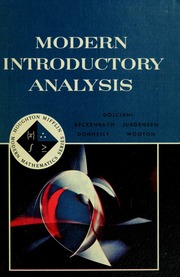
Internet Archive
104, xii, 660, 24 p. 25 cm
I think the content is similar to that 1991 version I recommended. So maybe you could try this one since it is available for free.
gray gazelle
narrow relic
For Precalculus, I recommend the Dolciani book I recommended the other day: http...
This book is pre-calculus, but don’t count the title as a reference for other pre-Calculus texts because Modern Analysis normally refers to something else. However, I still think AoPS’s “Precalculus” is a good course.
tribal coyote
narrow relic
I think the content is similar to that 1991 version I recommended. So maybe you ...
Thanks for sharing
tribal coyote
gray gazelle
This book is pre-calculus, but don’t count the title as a reference for other pr...
I see, ty
narrow relic
tribal coyote
Thanks for sharing
You're welcome. That is the book from which I first started to understand math, back in high school
tribal coyote
narrow relic
You're welcome. That is the book from which I first started to understand math, ...
Sounds like a good place for me to get started then
My goal is to learn calculus, so, after going through one of these books about precalculus, would it be okay for me to start reading a calculus book?
Or should I study something else?
narrow relic
After Modern Introductory Analysis you can read a book like the Gilbert Strang Calculus book just fine
tribal coyote
narrow relic
After _Modern Introductory Analysis_ you can read a book like the Gilbert Strang...
Alrighty, ty for your time 🙂
narrow relic
You're welcome!
warm glen
fierce hedge
I am going through Artin and I would recommend doing a standard LA book. Artin i...
alright thanks, maybe i'll just use artin for LA exercises
tribal coyote
I'll look him up, thx
remote sparrow
tribal coyote
What precalculus book / resource would you guys recommend?

/sci/ Wiki
Math at its core is about establishing truths separate from sensual qualities, seeking patterns based upon these truths, systematically removing contradictions/inconsistencies from the patterns, and formulating conjectures with all of the above in mind. It is the one true language apart from reality which makes it ironic that it is so useful. He...

GitHub
Info on resources for studying math, stats, CS, etc. - GitHub - nculwell/MathStudy: Info on resources for studying math, stats, CS, etc.
i see a lot of people recommend stewart's precalculus book, though
lang's basic mathematics is another common rec for those that want to learn how to do some basic proofs along with basic mechanical precalculus skills
tribal coyote
@remote sparrow, thank you, lovely person
remote sparrow

hearty steppe
Nice books on introducing tropical geometry? Also motivated for data science, working with Feed forward neural networks, econometrics stuff too would be cool. I need a reason to care more about finance
Ahh yes dynamical systems theory focused as well
remote sparrow
tropical geometry? just pack a copy of euclid's elements to the carribean
 hollow peak
applications of tropical geometry
grave thorn
hearty steppe
Nice books on introducing tropical geometry? Also motivated for data science, wo...
Applications of tropical geometry: {}
zealous light
fickle whale
grave thorn
Applications of tropical geometry: {}
are there any applications for subjective geometry
grave thorn
fickle whale
are there any applications for subjective geometry
applications of geometry: {}
fallow cypress
applications of existence:
 pale scarab
Any good recommendations for visually appealing textbooks? I have really been enjoying visual complex analysis and I am looking for other books that are similar. It really doesn't matter the content.
grave thorn

upper flicker
grave thorn
applications of geometry: {}
applications of topology ({}, {{}})
upper flicker
pale scarab
Any good recommendations for visually appealing textbooks? I have really been en...
office hours with a geometric group theorist
lots of diagrams there
 zealous coyote
pale scarab
Any good recommendations for visually appealing textbooks? I have really been en...
zealous coyote
pale scarab
Any good recommendations for visually appealing textbooks? I have really been en...
Indra's Pearls
grand thistle
pale scarab
Any good recommendations for visually appealing textbooks? I have really been en...
hatcher's alg top has some pretty pictures i think
 quasi cave
Can somebody lend me their Math notes? I will do child labour. By supplying you memes.
stray veldt
loud cradle
i already have a battalion of children in poor countries sending me memes for a very good price
 narrow linden
a nice book is "Pegasus novus vocabularium"
remote ginkgo
grand thistle
hatcher's alg top has some pretty pictures i think
don't fall for it!
karmic thorn
pale scarab
Any good recommendations for visually appealing textbooks? I have really been en...
Have you looked at Carter's visual group theory?
hearty steppe
pale scarab
Any good recommendations for visually appealing textbooks? I have really been en...
I thought Ahlfors (what little I skimmed through) seemed really fun to play around with.
Needham is way way more watered down but very visual
fallow cypress
pale scarab
Any good recommendations for visually appealing textbooks? I have really been en...
visual number theory
I forget the exact book name
hearty steppe
Carter’s book seems fun too, I recommend that to a lot of people. I didn’t really play around with it much but it’s a nicely illustrative book
gray gazelle
Hey, besides just looking into Universal Algebra or Category Theory...
Any good texts that get into magmas that are like anti-involutionary, anti-commutative, or maybe anti-associative? Or maybe there's some good stuff on how to handle zero divsors systematically?
gray gazelle
gray gazelle
Hey, besides just looking into Universal Algebra or Category Theory...
Any good ...
What about survey of binary systems by Richard Bruck?
gray gazelle
https://en.wikipedia.org/wiki/Quasigroup?wprov=sfla1
https://en.wikipedia.org/wiki/Isotopy_of_loops?wprov=sfla1
https://en.wikipedia.org/wiki/Moufang_loop?wprov=sfla1
In mathematics, especially in abstract algebra, a quasigroup is an algebraic structure resembling a group in the sense that "division" is always possible. Quasigroups differ from groups mainly in that they need not be associative and need not have an identity element.
A quasigroup with an identity element is called a loop.
In the mathematical field of abstract algebra, isotopy is an equivalence relation used to classify the algebraic notion of loop.
Isotopy for loops and quasigroups was introduced by Albert (1943), based on his slightly earlier definition of isotopy for algebras, which was in turn inspired by work of Steenrod.
In mathematics, a Moufang loop is a special kind of algebraic structure. It is similar to a group in many ways but need not be associative. Moufang loops were introduced by Ruth Moufang (1935). Smooth Moufang loops have an associated algebra, the Malcev algebra, similar in some ways to how a Lie group has an associated Lie algebra.
These topics are part of what's covered in the above book
Since you have nothing helpful or intellectual to contribute, please refrain from engaging with me. Thank you.
gray gazelle
gray gazelle
What about survey of binary systems by Richard Bruck?
Thank you.
gray gazelle
gray gazelle
https://en.wikipedia.org/wiki/Quasigroup?wprov=sfla1
https://en.wikipedia.org/wi...
Right. I'm interested by the Moufang stuff especially as well as where extensions to the reals will get you. Thank you.
gray gazelle
does anyone have any university book recommendations for calculus, algebra, or “logic” type stuff? i’m struggling without having a set textbook or youtube channel to follow
 tame tree
@remote sparrow Yo, sorry for the ping, but I'm getting through Meckes Linear Algebra pretty well, was a good rec. Do you have any suggestions on a second book on linear algebra after im done with this? The subject has surprisingly captured my attention and I'd like to go more in depth, but I don't know which book would be a logical progression after I'm done with Meckes.
remote sparrow
tame tree
<@254820329124265984> Yo, sorry for the ping, but I'm getting through Meckes Lin...
Axler, Friedberg, Hoffman/Kunze, Shilov, Garcia/Horn, Meyer, Shapiro. Depends on what you want. G&H and Meyer are slanted towards results and theory useful for applications. Shapiro is very combinatorial in some parts.
The rest are reviewed by Dami in the pins here.
Axler is controversial here apparently but others really like it.
 orchid mortar
gray gazelle
does anyone have any university book recommendations for calculus, algebra, or ...
orchid mortar
gray gazelle
does anyone have any university book recommendations for calculus, algebra, or ...
Standard proofy-calculus books are Apostol and Spivak. More computational might be Stewart. You might also want to read how to prove it by Velleman, which isn't a textbook but it sounds it could help
remote sparrow
At the very least I got it when it was on the cheap side.
gray gazelle
orchid mortar
Standard proofy-calculus books are Apostol and Spivak. More computational might ...
thank you so much!!
tame tree
remote sparrow
Axler, Friedberg, Hoffman/Kunze, Shilov, Garcia/Horn, Meyer, Shapiro. Depends on...
i assume that i wouldn't have to read each part as if im learning it from scratch either no?
kinda a dumb question lol
remote sparrow
They are logically complete but much less time is spent on material that should be covered more thoroughly in a first course. It's still a good idea to "review" what you already know just so you can get a handle on their notation and get a taste for how they perceive the subject.
There is nothing wrong and it is actually quite beneficial to revisit and massage old material over in your brain. Though if you get stuck, refer back to the old book.
tame tree
yeah ill review and do old material. im kinda a stickler for that
i might vie away from axler as i hear that its treatment of determinants is not so bueno
and also, what would come even after that?
remote sparrow
You might be interested in Axler's essay titled "Down with Determinants" which pretty much lays out why he wrote LADR.
remote sparrow
tame tree
and also, what would come even after that?
Graduate books like Roman's Advanced Linear Algebra for example
Maybe numerical linear algebra or heavy matrix theory as with Horn.
tame tree
actually axler may be the right choice for me here
he even says it's intended as a second course
and the reviews say its more theoretical and abstract
which i like
willow pecan
Axler is not really second course material in my opinion
remote sparrow
Axler has videos to go with his book, though i think he kinda just reads off of it
It's his book tbf, it accurately represents how he thinks about lin alg
Just read a little from the recommendations and see how you feel
You can even mix and match treatments
tame tree
willow pecan
Axler is not really second course material in my opinion
what would be in your opinion?
remote sparrow
remote sparrow
Axler, Friedberg, Hoffman/Kunze, Shilov, Garcia/Horn, Meyer, Shapiro. Depends on...
These books are all theoretical btw. Some emphasize linear transformations, some emphasize matrix results and decompositions.
tame tree
friedberg i've seen criticized for being too spread out and bloated
im currently reading meckes linear algebra
willow pecan
You're not going to see anything in Axler that isn't in Friedberg
tame tree
i see 
remote sparrow
I want FIS on my shelf but it's too damn expensive 
remote sparrow
H&K can be super cheap if you buy an int'l edition. Pretty tough book, it's no joke. Very abstract. Shilov is quite cheap too. Very unique approach by literally beginning with determinants.
dapper root
How tf do you know so many LA books lmao
Did you decide to do every LA book on earth haha
remote sparrow
No, I just read tons of reviews and skim the contents.
I guess I'm an amateur librarian/information services person
 inner token
I love books
 acoustic ridge
Can anyone recommend me a book for learning the core of calculus and graph's?
quasi cave
Can anyone recommend me a book for learning the core of Algebra and Trianometry
fallow cypress
anyone have any book recs for computable analysis?
hallow oriole
fallow cypress
anyone have any book recs for computable analysis?
https://eccc.weizmann.ac.il/resources/pdf/ica.pdf
this pdf has some book recs in it
fallow cypress
yooo ty
tame tree
remote sparrow
I want FIS on my shelf but it's too damn expensive <:blobcry:971797574916907028>
I found a 23 dollar FIS intl ver. On ebay 
remote sparrow
i'll look around
gray gazelle
remote sparrow
I want FIS on my shelf but it's too damn expensive <:blobcry:971797574916907028>
I have had that book on my self for a year now
I already took a course that used ladw but I wanted an actually LA book
gray gazelle
tame tree
Intl versions are the same right?
I think its missing a chapter for that one
I heard someone complaining about it in this server before
warm glen
when ppl here recommend matsumura for commutative algebra r yall talking ab "commutative algebra" or "commutative ring theory"
 tough zealot
its kinda the same thing afaik
the commalg is basically commutative ring and module theory
solemn rover
commutative ring theory, I think

MathOverflow
There are two books by Matsumura on commutative algebra. The earlier one is called Commutative Algebra and is frequently cited in Hartshorne. The more recent version is called Commutative Ring Th...
dapper root
warm glen
when ppl here recommend matsumura for commutative algebra r yall talking ab "com...
Commutative ring theory
heady ember
remote sparrow
I want FIS on my shelf but it's too damn expensive <:blobcry:971797574916907028>
Print and bind it yourself 
heady ember
acoustic ridge
Can anyone recommend me a book for learning the core of calculus and graph's?
Pauls' Online Math Notes
Khan Academy
Spivak's Calculus
gray gazelle
Any calculus PDF ??
 inland raven
Try
 weak nymph
hello, currently i am learning Discrete Mathematics, if anyone can help me with any materials you got(which can help me improve), please send me ❤️ thanks in advance
 stiff sentinel
any recommendations for cellular automata?
 gray gazelle
willow pecan
Discord ToS
inland raven
stiff sentinel
any recommendations for cellular automata?
MIT OCW has a nice course on it and things related to that
stiff sentinel
thanks but im primarily looking for a book
 compact imp
Any recommendations on where to start for learning Bayesian probability?
orchid mortar
compact imp
Any recommendations on where to start for learning Bayesian probability?
http://www.stat.columbia.edu/~gelman/book/
Not really 100% 'to start learning' but it's free and the starting chapters are doable
https://bayesball.github.io/BAYES_NOTES/
and the book https://bayesball.github.io/bcwr/index.html
could be gentler. But the notes are free but the book isn't
Bayesian Computation With R
 haughty vine
does anyone know any good books on mental math? I wanna get good at that before I get to advanced math, someone told me it makes it a million times easier, and just the extra math practice (prefer a dm)
inland raven
haughty vine
does anyone know any good books on mental math? I wanna get good at that before ...
What do you mean by mental math?
 frosty wyvern
Hi! Anyone here who works on incompressible fluids? What book should I read first to understand the incompressible navier-stokes equation?
inland raven
haughty vine
does anyone know any good books on mental math? I wanna get good at that before ...
My advice is that if you wish to get into advanced math, you should do precisely that. What makes studying math easier is not how fast you can add up numbers in your head, but how much you wish to understand the new concepts. As such, develop your interest, and the ability develops throughout the process.
willow pecan
frosty wyvern
Hi! Anyone here who works on incompressible fluids? What book should I read firs...
Acheson maybe
haughty vine
inland raven
What do you mean by mental math?
Just being able to solve large but basic calculations in your head, like big addition subtraction multiplication and division problems
inland raven
I don't think that would be a good use of your time, honestly
haughty vine
Hm
zealous coyote
Gotta say I don't think that's terribly helpful for 'advanced math,' whatever you mean by that
I think most mathematicians can't add two 3-digit numbers in their head.
But if you're interested, that's your perogative
 glacial crypt
I can barely add a two digit number nowadays
haughty vine
Because wouldn't that just help me be able to comprehend more easier, calculate faster and stuff
zealous coyote
I'm also curious if there are any books
zealous coyote
haughty vine
Because wouldn't that just help me be able to comprehend more easier, calculate...
There are rarely calculations like that.
inland raven
Well, advanced math is much less about calculating
haughty vine
Wouldn't that also help with spatial reasoning which can help in math with comprehension
Idk
glacial crypt
If you want to git gud at mental math practice
inland raven
And a lot more about structure, form, concepts
zealous coyote
haughty vine
Wouldn't that also help with spatial reasoning which can help in math with compr...
Not really, no.
Which it to say, just no actually
glacial crypt
If you want to git gud at math math also practice
haughty vine
I dont know much about math I do want to get really good at it though
glacial crypt
Consider why do you want to do it?
inland raven
haughty vine
Wouldn't that also help with spatial reasoning which can help in math with compr...
To get better at that you need to grapple with the very concepts you wish to understand better
glacial crypt
What really is motivating you to do it
haughty vine
Ig being able to do most math in my head
glacial crypt
But why
haughty vine
Save a lot of time
glacial crypt
A calculator is faster
inland raven
I don't know if that's terribly realistic
glacial crypt
And makes almost no mistakes
haughty vine
glacial crypt
A calculator is faster
I want to learn how to think not how to use a damned calculator
glacial crypt
If you want to learn to think pick up a proofs book or something
haughty vine
One thing I do know is that calculators are bad for learning math unless you need one like a graphing calculator
inland raven
One issue is that your motivation for this pursuit will extinguish pretty fast, as it isn't particularly fun to add numbers in your head.
glacial crypt
Mental sums are "trivial"
haughty vine
inland raven
One issue is that your motivation for this pursuit will extinguish pretty fast, ...
Probably true lmao
inland raven
glacial crypt
If you want to learn to think pick up a proofs book or something
Agree with this.
glacial crypt
How to Prove it by velleman is what Im using
haughty vine
The way I see it is that there are a lot of side benefits by being able to comprehend and manipulate large numbers in your head
haughty vine
glacial crypt
How to Prove it by velleman is what Im using
Hm
glacial crypt
Not really
inland raven
That would be a very one sided math development
glacial crypt
If I need to add 2 2-digit numbers im pulling out a calculator
That's just arithmetic
Math is not arithmetic
inland raven
You would probably be better at it at the expense of knowing a lot of other things and of being a lot more creative
glacial crypt
It's a superset rather
haughty vine
I gtg for now, got work, but yeah not sure, I'm just looking to get a big foundation in basic mathematics which will help me a lot in advanced mathematics
Yeah
Ty for your thoughts
Have a good day guys
inland raven
Try how to prove it by polya
glacial crypt
If you want to get a foundation in advanced math you want a proofs book
inland raven
Or he above book
haughty vine
Can u dm me these books
 flat lantern
dunno lol
willow pecan
Lol
 quick hornet
flat lantern
dunno lol
quick hornet
flat lantern
dunno lol
did you set up a calendar notification for this shit
flat lantern
quick hornet
did you set up a calendar notification for this shit
I had a notepad file on my desktop titled "OCTOBER" and it kept reminding me
flat lantern
 smoky zephyr
my god
smoky zephyr
my god
please don't reply to old posts, thank you :)
smoky zephyr

 shy compass
flat lantern
please don't reply to old posts, thank you :)
shy compass
flat lantern
please don't reply to old posts, thank you :)
why is this frowned on
frosty wyvern
willow pecan
Acheson maybe
Hi. Are you referring to this one: https://www.amazon.com/Elementary-Dynamics-Applied-Mathematics-Computing/dp/0198596790

The study of fluid dynamics is a central theme in modern applied mathematics. It is used to model a vast range of physical phenomena and plays a vital role in science and engineering. This textbook provides a clear introduction to both the theory and application of fluid dynamics that is suitable...
willow pecan
Yes
frosty wyvern
Thank you
dapper root
flat lantern
dunno lol
Did you set an event on your calendar or something wtf
flat lantern
dapper root
Did you set an event on your calendar or something wtf
I tried to warn u...

I was a day late 
 plush arrow
A book with a lot of recursive functions
quick hornet
generatingfunctionology
plush arrow
thanks sir
hearty steppe
brought to you by my twitter feed https://www.biorxiv.org/content/10.1101/2022.10.04.510897v1.full

The brain’s anatomy constrains its function, but precisely how remains unclear. Here, we show that human cortical and subcortical activity, measured with magnetic resonance imaging under spontaneous and diverse task-evoked conditions, can be parsimoniously understood as resulting from excitations of fundamental, resonant modes of the brain’s geo...
I reached out to Pang cuz I want to talk to him about this paper.
remote sparrow
The most abstract introductory analysis text I'm able to think of would be Amann and Escher's three analysis volumes.
I don't think much category theory is explicitly used, though. Many connections are made with topology and modern algebra, however.
fallow cypress
you can do something with.. subspace topology having a universal property or something..
hearty steppe
They said ergodicity is dead, I say... Have a taste of my twitter feed... 🤣
arXiv.org
Recent studies of interacting systems of quantum spins, ultracold atoms and
correlated fermions have shed a new light on how isolated many-body systems can
avoid rapid equilibration to their...
oh for eigenstates, I thought this was a pretty satisfying definition https://en.wikipedia.org/wiki/Introduction_to_eigenstates
Because of the uncertainty principle, statements about both the position and momentum of particles can only assign a probability that the position or momentum will have some numerical value. The uncertainty principle also says that eliminating uncertainty about position maximises uncertainty about momentum, and eliminating uncertainty about mome...
hollow peak

tribal coyote
Beginner friendly Calculus I book with lots of exercises
tribal coyote
tribal coyote
Beginner friendly Calculus I book with lots of exercises
Recommendations?
hollow peak
Stewart?
tribal coyote
hollow peak
Stewart?
Is that a question?
hollow peak
There are basically an unlimited number of beginner calc textbooks
Stewart is the one everyone uses
Or at least, its a typical calc 1 textbook
hollow peak
I also like strang's calculus book on MIT OCW
tribal coyote
Does his book has exercises at the end of the chapters?
crimson leaf
Is that the same as the openstax one
hollow peak
Openstax is a different thing
hollow peak
tribal coyote
Does his book has exercises at the end of the chapters?
Tons
hollow peak

crimson leaf
Strang wrote two sets of calculus books geez
hollow peak
And if you're looking for a rigorous, challenging intro calc book, people often recommend apostol or spivak
tribal coyote
hollow peak
And if you're looking for a rigorous, challenging intro calc book, people often ...
Thank you, I'm gonna look them up 🙂
remote sparrow
reddit
116 votes and 5 comments so far on Reddit
 quaint pine
First check if you have the algebraic knowledge needed. If so-just start reading and walk through the problems. @timid pier
 cedar ridge
remote sparrow
The most abstract introductory analysis text I'm able to think of would be Amann...
cedar ridge
remote sparrow
The most abstract introductory analysis text I'm able to think of would be Amann...
used em yourself?
 lime sapphire
cedar ridge
used em yourself?
lime sapphire
cedar ridge
used em yourself?
ik lochverstarker has used them you can ask them
gray gazelle
Any one knows a good book on Riemannian Manifold for self study?
hearty steppe
 timid pier
how does one self study stewart calculus early transcendentals 8th edition
timid pier
how does one self study stewart calculus early transcendentals 8th edition
It’s not a self study book. It’s a book that is meant to complement a standard Calc 1-3 course
forest sleet
gray gazelle
Any one knows a good book on Riemannian Manifold for self study?
Lee and Petersen are pretty standard books
assuming you already know basic manifolds
timid pier
hearty steppe
It’s not a self study book. It’s a book that is meant to complement a standard C...
Wtf
I've heard it is self study
hollow peak
I mean, it technically has all of the content of a calc sequence
You definitely could self study
It is in fact a textbook
gray gazelle
forest sleet
assuming you already know basic manifolds
Yeah that's thing we did have some differential geometry and topological manifold before but I barely passed those uni kinda forced me on reimanian manifolds
forest sleet
Lee has a Smooth Manifolds book if you want to review that before riemannian
gray gazelle
forest sleet
Lee has a Smooth Manifolds book if you want to review that before riemannian
Ok and is Kobayashi good for self study I have heard a lot about it
forest sleet
I'm not familiar with that book sorry
gray gazelle
forest sleet
I'm not familiar with that book sorry
Oh ok thanks anyway
remote sparrow
timid pier
Wtf
It's a great book to have on your shelf regardless as a reference and as a source for problems to work through. I like it, but it's not uncommon for people to call it not ideal for self-study, given the book tries to be a jack of all trades in being both a comprehensive reference and as a learning tool.
remote sparrow
cedar ridge
used em yourself?
Just read some reviews and skimmed the book.
timid pier
I've been self studying from stewart
The proofs allowed me to understand the concepts
And the practice questions are great
hearty steppe
I think Stewart is very rigid in formality still.
Not sure what your background is but that is impressive
stiff sentinel
stiff sentinel
any recommendations for cellular automata?
🙏
 sick river
Anyone have any recommendations for more category theory? My class is using Aluffi so any books with an eye towards the ring and group categories would be awesome
 timber mesa
have you read Riehl
gray gazelle
sick river
Anyone have any recommendations for more category theory? My class is using Aluf...
Mac Lane
timber mesa
yeah these two are the usual intro references
sick river
I’ve tried Riehl but I’ll try Mac Lane, thanks
 dull otter
the way of the superior man is a good book
remote sparrow
sick river
I’ve tried Riehl but I’ll try Mac Lane, thanks
Eugenia Cheng just released her new book The Joy of Abstraction which is supposed to be an introduction to category theory. It's possible that it's pitched too low for you, though. In any case I would appreciate if you or someone else reviewed the book to see if it's worth putting on my shelf.
inner token
Group Theory book
I'm specifically interested in group theory but if it contains other structures that's fine but I need the group theory part to shine
willow pecan
D&F
 brisk ice
@gusty smelt Maybe overlooked but I think you should update your early books your group finished so they don't have "coming soon' in the "More books this series" and now have the available links.
Might just be something you have to add on the "todo list" after you all finish a book.

 orchid mortar
Has anyone taken a look at this?
https://openstax.org/details/books/calculus-volume-1
Wonder how much this can be used instead of the more standard calculus books
remote sparrow
orchid mortar
Has anyone taken a look at this?
https://openstax.org/details/books/calculus-vol...
looks alright. reviews say the problems are a bit too easy, so you can just borrow some problems from stewart to get some practice in. but there are TONS of open source, free calculus ebooks (some with low-cost hard copies too). i don't think there's much of a clear consensus yet.
remote sparrow
i do hope some day these low cost options replace mainstream textbooks
orchid mortar
remote sparrow
looks alright. reviews say the problems are a bit too easy, so you can just borr...
oh, any recs? I don't think I know of a list of FOSS calculus ebooks
 livid ermine
this book doesn't really cover what big rudin does
gray gazelle
That was 2 years ago
But yeah it's a book about measure theory/probability
Rudin takes more functional/complex analysis approach
Rudin's not hard though, imo there's just better books
 woven cypress
orchid mortar
Has anyone taken a look at this?
https://openstax.org/details/books/calculus-vol...
woven cypress
orchid mortar
Has anyone taken a look at this?
https://openstax.org/details/books/calculus-vol...
What is it really?
 willow pecan
You don't need 4 of them
 sleek python
Browse them in a library (or libgen) before choosing which your prefer to buy
crimson leaf
remote sparrow
i do hope some day these low cost options replace mainstream textbooks
Then people would have to actually grade calculus homework
 granite ferry
willow pecan
You don't need 4 of them
granite ferry
willow pecan
You don't need 4 of them
Well.. Proofs from THE BOOK is pretty advanced it sounds like. Book of Proof is entry level and I'm unsure about Foundation of Higher Mathematics.
"How to Solve it:..." is mostly unrelated to actually writing proofs and more about approaching solving unique problems in general.
 fluid bay
what are some good resources for learning about the fourier transform (with emphasis on operator algebraic consequences/interpretations)?
to elaborate on the "()", I've heard for example that the fourier transform is the gelfand transform on the convolution algebra L^1(G) for a L.C. group G. It'd be cool to have an introduction to fourier transform which discusses this approach
 lean pagoda
granite ferry
Thoughts on these books:
lean pagoda
granite ferry
Thoughts on these books:
You already said it yourself, but Polya and Aigner don't really fall into that "Intro to Proofs" category of books. The other two books do fit into that category from what I can tell. Also worth pointing out that Hammack is freely available online
granite ferry
lean pagoda
You already said it yourself, but Polya and Aigner don't really fall into that "...
Thanks. I was hopeful others may have read them.