#book-recommendations
1 messages · Page 7 of 1
 shadow crown
that was just the authors name
how dumb I was
but though
is asimov on numbers a good book
 quaint wraith
Thoughts on Artin’s Algebra?
 fierce hedge
I am assuming you're gonna use for algebra. It is recommended route if you wanna do abstract algebra+linear algebra. For first course in abstract algebra it might not be for you then try Pinter or Gallian
 remote sparrow
chartrand covers more topics than velleman in the ebook, and he also has some pages online specifically dedicated to real analysis. but really either book is fine. you just need to pick up a real analysis book after working your way through either of those books. i also liked hammack, which is pretty similar to velleman. i also really enjoyed sibley's Foundations of Mathematics and Proof and the Art of Mathematics by joel david hamkins (though I read hamkins' book well after my transition to proofs class).
 zinc jewel
thoughts on A survey in modern algebra
 gray gazelle
remote sparrow
chartrand covers more topics than velleman in the ebook, and he also has some pa...
gray gazelle
remote sparrow
chartrand covers more topics than velleman in the ebook, and he also has some pa...
Thank you! I'll pick Velleman (it's cheaper and more compact) and after it start Abbott's Understanding Analysis. I think I need to revise/re-read Spivak's Calculus again as I haven't touched analysis/calculus for a long time.
Unfortunately Foundations of Mathematics and Proof and the Art of Mathematics are very expensive. I'll check my Uni library or get a pdf ;)
remote sparrow
gray gazelle
Thank you! I'll pick Velleman (it's cheaper and more compact) and after it start...
Just checked hamkins' price, it's pretty comparable to velleman in price atm, unless you're looking somewhere i don't know about.
In fact it's cheaper than velleman for me on amazon
You don't have to get his other extensions book, it's a solutions manual basically
 marble solar
AHERM
Knot Knotes by Justin Roberts on his website is free
There's also some good youtube videos out there
You'll have to pick up some algebraic topology and differential topology at some pt or another
If you're learning 3-manifold topology as well, there's no truly good source
Schulten's 3 manifold topology book is a beast to learn from
There's also Bill Thurston's book
 forest sleet
Ooh that reminds me there is a cool YouTube video called Not Knot
Old video made by a geometry center
That has a lot of visualizations
And intro to at/knot theory stuff
gray gazelle
What are the prerequisites for "A course on convex geometry" by hug and weil
 remote ginkgo
gray gazelle
What are the prerequisites for "A course on convex geometry" by hug and weil
remote ginkgo
gray gazelle
What are the prerequisites for "A course on convex geometry" by hug and weil
a zeroth course in convex geometry
 hidden apex
any good book for particle physics?. Easy to understand for high schoolers/beginners
 desert tusk
I found this in my school library, is this a book that would be accessible/comprehensible for someone that just finished calculus

 fluid bay
in general, don't learn from really old stuff like this ^
it probably won't be "accessible/comprehensible" and old books use a lot of antiquated concepts/notation that no one will recognize or be able to help you with these days
desert tusk
Is the material itself outdated or is the problem mostly the notation
I know math moves a lot but since this is an “introduction” I thought it would be fine
fluid bay
im just talking about notation/presentation
 restive falcon
desert tusk
Is the material itself outdated or is the problem mostly the notation
restive falcon
desert tusk
Is the material itself outdated or is the problem mostly the notation
both will possibly be problems
 lone ingot
desert tusk
I found this in my school library, is this a book that would be accessible/compr...
lone ingot
desert tusk
I found this in my school library, is this a book that would be accessible/compr...
bro I tried reading that book
it's painful
im on like chapter 2
restive falcon
the number theory that was important many years ago will be different to the number theory that is important nowadays
lone ingot
restive falcon
the number theory that was important many years ago will be different to the num...
I disagree
fluid bay
ehh
restive falcon
ok fair enough
lone ingot
like elliptic curves
fluid bay
at the introductory level, i expect it covers most of the same stuff
restive falcon
but it'll be hard to get help
fluid bay
im just saying that old books are not a good pedagogical tool. not saying that they contain outdated info, or aren't good books or anything like that
you just won't have a good time trying to learn the material
 tepid prairie
Outdated maths. 🧐
lone ingot
fluid bay
im just saying that old books are not a good pedagogical tool. not saying that t...
I think that applies to new books just as much
restive falcon
well new books will have recognisable notation
lone ingot
hardy wright has good notation
well
they do use (m,n) to mean gcd(m.n)
but still
not that bad
fluid bay
lone ingot
I think that applies to new books just as much
new books have differences in style/exposition that makes them better/worse than others, sure. But clearly this is different
lone ingot
I think hardy wright is wayyyyy to rigorous
fluid bay
lone ingot
they do use (m,n) to mean gcd(m.n)
that's not even uncommon notation
lone ingot
lone ingot
I think hardy wright is wayyyyy to rigorous
so don't use it if you aren't already familiar with nt
restive falcon
hardy 
fluid bay
idk, maybe it is an okay book, but there are many fine options in pinned which are more standard learning resources in the 21st century and a lot of people are familiar with
lone ingot
yeah if you want an actual intro to nt then use silverman's friendly introduction to number theory
or something like that
tepid prairie
That book looks ghetto even to me lol.
Nevermind the PDF just looked terrible. The internet archive copy looks way better.
desert tusk
Alright thx for the feedback
lone ingot
I have a completely legal pdf of it
desert tusk
lone ingot
I have a completely legal pdf of it
Can you send it to me? I’ve been wanting to learn nt for a while
lone ingot
desert tusk
Can you send it to me? I’ve been wanting to learn nt for a while
i dont think i can legally lmao
lone ingot
gj
 remote nova
Guys I need you to recommend to me (reply and leave ping on, or ping me) some really freaking hard math books based on some really complicated math, maybe complex multiplication, or algebraic number theory, or algebraic surgery theory, homotopy theory, etc...
I don't even care if it costs $105 like just send me something to blow money off of
Also make sure the math is cool really sorry to say this, just personal opinion so no books on combinatorics, analytic number theory, logic, etc...
here's a neat example, but the hope is that there's a decent version on Amazon
https://people.math.rochester.edu/faculty/doug/mybooks/aar-green.pdf
lone ingot
remote nova
Guys I need you to recommend to me (reply and leave ping on, or ping me) some re...
harthshorne alg geo is apparently insane
haven't read it
remote nova
I've already got it haha
remote nova
I've got a really good start, as I'm building an Amazon shopping list
parents are gonna browse through it and just choose random crap to buy me
remote sparrow
desert tusk
I know math moves a lot but since this is an “introduction” I thought it would b...
There's a newer edition of this book anyway. Still don't recommend this as a main text since there's no exercises.
remote sparrow
remote nova
Guys I need you to recommend to me (reply and leave ping on, or ping me) some re...
Can you spend money for my undergraduate library instead 🥺 👉 👈
remote sparrow
remote nova
I've got a really good start, as I'm building an Amazon shopping list
Same
remote nova
remote sparrow
Can you spend money for my undergraduate library instead 🥺 👉 👈
ND LKFDS
remote sparrow
I'm kidding...unless? 
remote sparrow
remote nova
ND LKFDS
Idk what that acronym is btw, if it is one
remote nova
that is pure keyboard smash

 lapis oriole
hii! I need help, im going back to school soon (I used to be homeschooled) and I need help on finding some math books (for year 10/9th grade) so I can study maths since im REALLYYY bad at maths😭 so can anyone give any book recommendations please? thank you<3
lapis oriole
remote sparrow
Fanfic website is typing...
YEAH
remote sparrow
lapis oriole
hii! I need help, im going back to school soon (I used to be homeschooled) and I...
What are your needs and background? What have you previously studied?
remote nova
I highly suggest Professor Leonard for your algebra. But maybe you're going into geometry, in which case... uhhhh get a book lmao and use Khan Academy
lapis oriole
remote sparrow
What are your needs and background? What have you previously studied?
I'm not so sure, I've done so many different things, but there are so many things I'm not that good with, like im not that good w %s of a number, algebra or multiplication
remote sparrow
You may want to brush up on some pre-algebra if you're not quite sure what a percent of a number is.
Percents are just numbers from 0-1 multiplied by 100.
restive falcon
remote nova
Guys I need you to recommend to me (reply and leave ping on, or ping me) some re...
ravenel - complex cobordism and stable homotopy groups of spheres
said to be the most difficult algtop book ever written
lapis oriole
remote sparrow
Percents are just numbers from 0-1 multiplied by 100.
ahhh okay
remote ginkgo
remote nova
Guys I need you to recommend to me (reply and leave ping on, or ping me) some re...
buy kirill's physics of finance and send me (in some legally permissible way given our respective jurisdictions) a pdf scan of it
alternatively
may i dm you for a list @remote nova
remote nova

 sudden kindle
remote nova
Also make sure the math is cool ~~really sorry to say this, just personal opinio...
sudden kindle
remote nova
Also make sure the math is cool ~~really sorry to say this, just personal opinio...
You're weird
remote nova
No I just like my epic algebra and my epic topology and whatever the heck happens when you combine them
remote sparrow
Based on the preliminary reviews of eugenia chang's The Joy of Abstraction, do y'all think it could become the pinter of category theory?
 manic cape
what does the pinter of ___ mean?
remote sparrow
As in like pinter's A Book of Abstract Algebra
 fickle whale
Fun book
remote nova
Fair opinion
remote sparrow
remote sparrow
Based on the preliminary reviews of eugenia chang's *The Joy of Abstraction*, do...

Cambridge Core
Cambridge Core - Logic, Categories and Sets - The Joy of Abstraction
here's what i'm talking about
 grave thorn
To me sounds like the opposite of an enjoyable book
grave thorn
Neither finance nor physics has much to do with logic/categories 🤷♂️
remote nova
Not what I was getting at
grave thorn
Then what were you getting at 
remote nova
Unbased opinion regarding math-related interests implies an Unbased opinion regarding math-related interests
grave thorn
"math finance" (aka a branch of math) > "physics" (not a branch of math) is a very based take
remote nova
Wrong
grave thorn
Justify
remote nova
Proof is trivial and left as an exercise
grave thorn
Counterexample: math anything > physics
remote nova
Counter example: physics > probability
grave thorn

remote nova
Physics > combinatorics
grave thorn
Physics does use probability a lot
remote nova
Still cooler than the probability
grave thorn
remote nova
Physics > combinatorics
Combinatorics is used extensively in statistical mechanics
 primal mica
Physics uses most fields of math a lot :)
primal mica
And physical systems motivate answers and new mathematics :)
remote nova
Based
grave thorn
remote nova
Still cooler than the probability
Probably the coolest book I have on any topic
 grave thorn
primal mica
And physical systems motivate answers and new mathematics :)
grave thorn
primal mica
And physical systems motivate answers and new mathematics :)
As does finance
remote nova
Conformal field theory
grave thorn
remote nova
Have you tried quantum field theory
QFT is just the study of Gaussian measures on S'(Rd)
remote nova
Yeah that's a lot more based thst combinatorics
grave thorn
But tbf I could def be better at Gaussian measure theory
(Gaussian measure theory is a branch of probability)
remote nova
How does QFT contain less interesting math when it's just better QM
grave thorn
QM is just noncommutative probability theory
remote nova
Diff eqs is probability theory
grave thorn
QM is not the study of PDEs lol
remote nova
Wot
primal mica
The basis of the theory is physical measurements
remote nova
The basis of abstract algebra is pretty boring but algebra itself is really based
primal mica
Math is just a tool to relate the physical measurements and make predictions
grave thorn
remote nova
The basis of abstract algebra is pretty boring but algebra itself is really base...
But the underlying theory heavily relies on noncommutative probability; note that a wave function is a probability amplitude
primal mica
Once again, just a mathematical descriptor, not the basis of the theory, which is still a topic of speculation.
It’s possible quantum mechanics is entirely non probabilistic
grave thorn
primal mica
Once again, just a mathematical descriptor, not the basis of the theory, which i...
in order to postulate anything about the world you have to make several assumptions
primal mica
Indeed, is the same true for math?
fickle whale
it is true for everything
grave thorn
primal mica
Indeed, is the same true for math?
Many statements in ZFC dont hold in ZF for instance
grave thorn
remote nova
Or uhhhh string theory or uhhhhhh
String theory 🤮
remote nova
This is a lot of work to defend the faulty notion that any sort of finance anywhere can be cooler than physics
grave thorn
More generally I could write mathematical economics
remote nova
That only worsens your case
grave thorn
But why is physics "more cool"?
primal mica
Thermodynamics
grave thorn
primal mica
Thermodynamics
aka statistical mechanics aka combinatorics
remote nova
Suppose that one could define the "silly chain" given by
Biology < Chemistry < Physics < Mathematics. Then it can be trivially shown that if E is any field of economics, mathematical or not, that E < X for all X in the silly chain.
Thus physics is cooler objectively
grave thorn
remote nova
Suppose that one could define the "silly chain" given by
Biology < Chemistry < P...
Mathematical economics is a branch of math
Not economics
remote nova
However it is a study of economics and hence it is a branch of economics
grave thorn
remote nova
However it is a study of economics and hence it is a branch of economics
No. It is math motivated by economic problems. Same thing with mathematical physics: it is a branch of math motivated by physical problems.
primal mica
It’s a weird argument you’re making :“physics is just math so it’s dumb. Economics is just math so it’s better”
remote nova
If mathematical economics did not produce useful or meaningful results to an economist, it would not be called mathematical economics. Economics regards all things that have to do with economics, thus mathematical economics is a subset of economics. Rather, it is an intersection of mathematics and economics.
grave thorn
remote nova
If mathematical economics did not produce useful or meaningful results to an eco...
Mathematical economics rarely produces interesting results to an economist (same thing with mathematical physics: physics people don't care about it)
It has made breakthroughs in math (eg BSDEs, positive operator theory, etc)
 grave thorn
Mathematical economics rarely produces interesting results to an economist (same...
grave thorn
grave thorn
Mathematical economics rarely produces interesting results to an economist (same...
In fact in pretty much every field theorists are disliked
remote nova
Oh and pro tip
If you are a physicist and you don't care about mathematical physics, then all I can say is that you smell like beef
manic cape

forest sleet
grave thorn
In fact in pretty much every field theorists are disliked
i originally read this as no one likes field theorists lol
remote nova
same actually
 wild harness
does anyone have Differential equations short formula pdf?
 sand ingot
Hello! I need a book reference for complex variables.Can anyone suggest me?
Actually I found a book called Complex Analysis by Serge Lang (4th edition) in the library. If anyone knows about the book please let me know about it.
I am a BSc Maths 1st year
 solemn rover
sand ingot
Hello! I need a book reference for complex variables.Can anyone suggest me?
Actu...
solemn rover
sand ingot
Hello! I need a book reference for complex variables.Can anyone suggest me?
Actu...
Ahlfors is a classic. Stein and Shakarchi is very readable
sand ingot
Thank You
 lone wren
Is this a good buy? I have my math finals in spring and thought some extra calc practice would be good

 spiral portal
just use the internet version if there is
u can always copy the problems on a piece of paper
And check solutions online
 heady ember
If you want challenging exercises you can try Spivak. However, they are more proof based. If you need to practice manual derivations and calculations you could try Pauls' Online Math Notes, Khan Academy, Steward.
spiral portal
true I shoulda said that
gray gazelle
sand ingot
Hello! I need a book reference for complex variables.Can anyone suggest me?
Actu...
Check out Visual Complex Analysis by Tristan Needham. It's not super rigorous but is the best complex analysis book I know of when it comes to the presentation of the fundamental ideas
The best combo would be to do Needham's book and read it alongside something more classical like Ahlfors
gray gazelle
remote sparrow
In fact it's cheaper than velleman for me on amazon
Yes, I checked it in my local academic store, expensive but trusted (and helps small businesses/bookstore rather than Amazon)
It's cheaper than Velleman on Amazon for me as well but the seller has low ratings. The one I prefer unfortunately isn't selling it.
 daring rampart
who got coursehero
 stable dagger
what are good books about calculating the fundamental group with many examples?
 proud gazelle
is there a good book about complex numbers?
I don't want a book that states that a complex number is of the form a+bi and starts listing properties and proving theorems
I also don't want a book to define a complex number to be a R×R where addition is such and such and multiplication is such and such so that (0,1) = i and i^2 is (1,0) which we is equivalent to 1
I want some motivation behind the rules and the intuition of extending the numbers not by filling numbers in the numbers line (like the extension to the rationals or to the reals) but by going up a whole new axis and geometric intuition and consequences behind this extension and so on
 wise crater
what do you think the complex numbers are exactly?
proud gazelle
ordered pairs of real numbers where (a,b) + (c,d) is (a+c, b+d) and (a,b) . (c,d) is (a.c - b.d, a.d + b.c) ?
wise crater
if that was the case then you would be happy with any of the things you don't want a book of
maybe learn about the theory of fields in algebra and see why the complex numbers are special there if you're expecting much more than that
proud gazelle
just because I know what something is doesn't I mean understand where does it from and what are its consequences and how was it discovered
 shy compass
do you know what an algebraic closure is?
proud gazelle
closure as in closure under addition and such ?
shy compass
among other reasons, C is very useful and important because it's the algebraic closure of R
I suggest looking this up
wise crater
proud gazelle
just because I know what something is doesn't I mean understand where does it fr...
then yes, take the second thing about learning the theory of fields and specifically field extensions
complex numbers were probably motivated from that sort of thing first before any of the other things we use em for now
proud gazelle
shy compass
I suggest looking this up
I know about this, we C we gain closure for all the operations
I don't want the advanced stuff
I want to motivation and the intuition behind its extension
shy compass
what are "all the operations"
proud gazelle
just because something is presented in a certain order in a book doesn't mean that was the correct order it was discovered with/thought of
proud gazelle
shy compass
what are "all the operations"
roots? mainly that you can solve any polynomials and you gain the fundamental theorem of algebra ?
wise crater
proud gazelle
just because something is presented in a certain order in a book doesn't mean th...
go build yourself a time machine and figure that out then
proud gazelle
have you ever heard of math history ?
wise crater
math history is mostly just talking about peoples names and the problems that were discussed at the time, as an interpretation of some other dude born in the future
proud gazelle
you probably learned history the wrong way
 sick river
Just pick up some complex analysis book and go ham
proud gazelle
proud gazelle
just because something is presented in a certain order in a book doesn't mean th...
an example about this is chapter 18 of calculus by spivak where he explores the exp function, how he starts the motivation by finding a function that can define 10^x where x is a real number, he goes over the properties that we expect from exponentials and then the rule that f(x+y) = f(x) . f(y), then how if we want to find such function we tackle a harder problem which is to find its derivative and arrive to the logarithm and its properties then define the exp as the inverse of log and find its properties mainly exp'(x) = exp(x) and other properties and then find its taylor series and so on, this is contrary to other books which start by defining exp(x) as the taylor series and derives other properties such as exp(a+b) = exp(a) . exp(b) and so on, which is totally true and logical but extremely dry
 vital bane
gray gazelle
Check out Visual Complex Analysis by Tristan Needham. It's not super rigorous bu...
vital bane
gray gazelle
Check out Visual Complex Analysis by Tristan Needham. It's not super rigorous bu...
wdym not super rigrorous?
gray gazelle
vital bane
wdym not super rigrorous?
The proofs mainly consist of an outline of the "correct" ideas. Many technicalities are left out because that's not the focus of the book
vital bane
what is the focus of the book?
gray gazelle
Intuition
vital bane
damn I wish it's focus was both intuition and technicalities
gray gazelle
That's why you read Needham alongside something like Ahlfors
vital bane
what's a good book to go through after VCA to get all the technicalities?
gray gazelle
Read them at the same time
vital bane

gray gazelle
I personally read half of Ahlfors first then a couple years later discovered Needham's book and read it
Were I to study complex analysis again I'd read them concurrently
vital bane
"Complex Analysis: An Introduction to The Theory of Analytic Functions of One Complex Variable" by lars ahlfors?
gray gazelle
Where did you hear about it?
vital bane
I don't remember, must've been in some youtube video or this server
gray gazelle
Right, I had a youtube video in my recommended feed about maths book for self study
vital bane
complex analysis seems fun, but I have to learn intro real analysis for now 
gray gazelle
I think I was bored and clicked it because all the recommeneded books were mainly BSc level and I'm already doing my masters
Glad I was bored that day
vital bane
what are you doing your masters in?
gray gazelle
vital bane
complex analysis seems fun, but I have to learn intro real analysis for now <:ca...
Complex is more algebraic in nature, algebraic in the sense how people in algebra tend to think
gray gazelle
vital bane
what are you doing your masters in?
Diff geo
gray gazelle
I have a love hate relationship with diff geo 
vital bane
Lol why?
gray gazelle
Super messy at times
 indigo mesa
Diff geo kicks your ass regularly
gray gazelle
Is there a field of maths that doesn't
vital bane
indigo mesa
Diff geo kicks your ass regularly

vital bane
gray gazelle
Super messy at times
as in notation?
gray gazelle
The details are a 4 page tensor calculation
vital bane
lmao
indigo mesa
vital bane
as in notation?
Wait i have something for you
gray gazelle
vital bane
as in notation?
Notation, calculations, the objects themselves. It's like you're parsing through a lot of data and suck at book keeping
vital bane
hm I think I might've heard of this, like when you hear "differentiable manifold" you have to remember that it comes with charts and atlases and transition maps and stuff
not sure if that's the kind of stuff you're referring to
gray gazelle
That's the beginning of it
vital bane

vital bane
indigo mesa
Wait i have something for you
yes
indigo mesa
Put it in discussion 2
vital bane
lol I have the perma-study role I can't see discussion 2
indigo mesa
 vital bane

it is pretty messy but to me it also looks super cool
holy crap it's super messy, subscript upon subscript
vital bane
indigo mesa
https://cdn.discordapp.com/attachments/991827364352892938/1001565441744969928/un...
so what is it?
vital bane
that's what I would've done 
gray gazelle
Half of maths is exposition
indigo mesa
vital bane
so what is it?
It’s from a proof around orientations
That closed curves preserving orientation is an equivalent condition something something
gray gazelle
Is an equivalent condition to what?
And what's a closed curve preserving orientation?
indigo mesa
I didn’t go in depth with this on purpose
Here if you’re curious

This is the equivalence I meant
vital bane

restive falcon
could anyone recommend a book on semiring theory?
 wicked osprey
never heard if the semiring theory, interesting
remote ginkgo
rng
remote ginkgo
ahlfors maximalism
 broken meadow
using conway rn 
 jagged zealot
I asked this in #probability-statistics but maybe better suited here: I wonder if anyone can point me at a rigorous epistemic theory in the (introductory!) philosophy literature for frequentism. Like, Bayesian epistemology I have a good intuition for. But the frequentist idea of treating aleatoric and epistemic uncertainty differently is new to me. It has a certain appeal but I don't know how to describe it beyond that.
remote sparrow
jagged zealot
I asked this in <#326138783181438976> but maybe better suited here: I wonder if ...
there are several introductory anthologies on the philosophy of probability. you can google around or ask on r/askphilosophy

Philosophy Stack Exchange
I am interested in reading books and papers regarding the philosophy of probability. I want to know what the correct philosophical interpretation of probability is, and also other topics regarding
reddit
42 votes and 8 comments so far on Reddit
these may be helpful jumping off points
you are likely (no pun or circular reasoning intended) familiar with the basic questions of philosophy of probability, but it also can't hurt to revisit those basic ideas in the following two videos:
In this Wireless Philosophy video, Nina Emery (Mount Holyoke College) explores the nature of chance and probability.
Subscribe!
http://bit.ly/1vz5fK9
More on Nina Emery:
http://bit.ly/1PLgDZZ
Wi-Phi @ YouTube:
http://bit.ly/1PX0hLu
Wi-Phi @ Khan Academy:
http://bit.ly/1nQJcF7
Twitter:
https://twitter.com/wirelessphi
Facebook:
http://...
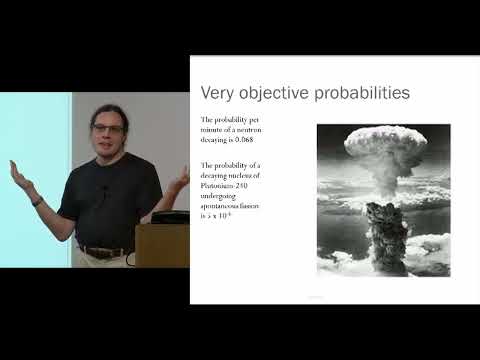
Professor David Wallace discusses the nature of probability and some of the philosophical puzzles that arise regarding how to understand and make sense of probability. He begins by distinguishing between subjective probabilities (which are about our beliefs) and objective probabilities (which are about the world itself). He then goes on to discu...
remote nova
I think I've asked this before, but does anyone know of some solid and brief (self-contained) introductions to number theory? Specifically either for a student who hasn't learned abstract algebra, or one who is willing to learn it within the pages of the book teaching the NT?
I'm talking brief as in sub 150 pages, but also good for getting a grip on the basics.
There is also plan to move on to alg nt or cft
remote ginkgo
remote nova
I think I've asked this before, but does anyone know of some solid and brief (se...
manin
grave thorn
remote nova
There is also plan to move on to alg nt or cft
cft meaning?
remote sparrow
remote nova
I think I've asked this before, but does anyone know of some solid and brief (se...
burton, dudley, or rosen give completely elementary treatments
remote nova
grave thorn
cft meaning?
class field theory
 crimson leaf
What's a good algebra book for someone who doesn't have LA but is (hopefully) going to be learning it at the same time
remote nova
How much algebra do you plan/want to learn?
Like, are you planning to (immediately) go beyond the elementary content (e.g. representation theory, homological algebra, etc...)
 dapper root
crimson leaf
What's a good algebra book for someone who doesn't have LA but is (hopefully) go...
dapper root
crimson leaf
What's a good algebra book for someone who doesn't have LA but is (hopefully) go...
It sounds like Artin may be a good choice
crimson leaf
dapper root
https://discord.com/channels/268882317391429632/716264872018706443/7189314263467...
Yeah I thought about Artin the class I'm hoping to join is using Friedberg for LA so I was worried about overlap. I sat in today and nothing seem too hard to follow
dapper root
I think overlap is a good thing
Like if you learn a concept that you need in order to work through an abstract algebra concept
You can’t really progress until you learn it
¯_(ツ)_/¯
crimson leaf
Fair enough 
 warm glen
has anyone read the book "topology: a categorical approach" that's in books protoype channel
and if so would u recommend it
looking for something to supplement my course notes with, prof suggested munkres but it's boring imo
 woven glacier
any recommendations for books after calculus by gilbert strang
remote sparrow
woven glacier
any recommendations for books after calculus by gilbert strang
I guess intro to proof books if you want to do more math
woven glacier
what are some good books for maths olympiad grade 12
gray gazelle
woven glacier
what are some good books for maths olympiad grade 12
watch flammable maths and blackpenredpen
the tricks you need to solve those problems
otherwise:
The USSR Olympiad Problem Book: Selected Problems and Theorems of Elementary Mathematics (Dover Books) by Shklarsky, Chentzov, and Yaglom
remote sparrow
woven glacier
any recommendations for books after calculus by gilbert strang
discrete math books could also work
gray gazelle
I got a big selection I need to read a book for school assignment I already tried one and didn't like it was as you like it a play I didn't like needing to look on different page to understand I'm giving list of books I can read
Anna Karenina
Atonement
Beloved
The blind assassin
The Bonesetters daughter
The Burgess boys
Catch22
The color purple
Crime and Punishment
The crucible
A doll house
Extremely loud and incredibly close
In the lake of the woods
Invisible man
Jane eyre
Jude the obscure
The kite runner
M.butterfly
Madame bovary
The memory keepers daughter
Middlesex
Much ado about nothing
Never let me go
Oryx and crake
Othello
The picture of Dorian gray
The portrait of a lady
Pride and prejudice
Snow flower and the secret fan
Twelfth night
Who's afraid of Virginia woolf
The women of Brewster place
Wuthering heights
A yellow raft in blue water
What would yall say are the best I should look out for
remote sparrow
what do you like in a book?
i liked catch-22 and crime and punishment when i read it
the crucible was alright when i had it as an assigned reading
gray gazelle
Idk I don't read but I want to
remote sparrow
i tried pride and prejudice and got bored of it, but in fairness i was in junior high then
gray gazelle
What is catch 22 and crime and Punishment about
remote sparrow
well, you could just google their synopses
gray gazelle
OK thanks for the recommendations
remote sparrow
since you're doing this for a homework assignment, i don't really want to be an incidental sparknotes for you
marble solar
gray gazelle
I got a big selection I need to read a book for school assignment I already trie...
Anna Karenina was great; Crime and Punishment is good depending on the translation, the Crucible is kind of boring
gray gazelle
Can someone plug me with a good overview of analysis?
Also, what are some alternatives to Axler?
 zealous coyote
I have a two-word overview of analysis
reaw numbners
Also do you mean Axler's linear algebra?
 west sand
Anyone know any resources for Fourier series and Similarity Solutions?
 median stump
Anybody know any good text to help improve calculation and accuracy in math?
 past linden
median stump
Anybody know any good text to help improve calculation and accuracy in math?
past linden
median stump
Anybody know any good text to help improve calculation and accuracy in math?
wdym
median stump
Any book that has exercises and tricks so that you get much better at calculations in mathematics
Or a book with exercises and strategies to help analyse a problem
past linden
median stump
Any book that has exercises and tricks so that you get much better at calculatio...
calculations such as?
past linden
median stump
Or a book with exercises and strategies to help analyse a problem
what kind of problems?
median stump
past linden
what kind of problems?
Math problems.So hopefully the book explains how to approach to a problem in geometry or algebra.In general, how you should analyse the problem and go about solving it.
past linden
median stump
Math problems.So hopefully the book explains how to approach to a problem in geo...
what kind of math problems?
median stump
Olympiad level
 sudden dock
median stump
Olympiad level
sudden dock
median stump
Olympiad level
Problem Solving Strategies by Arthur Engel is a famous book among students preparing for olympiad, however I haven't read it myself
Another one maybe the Art of Problem Solving vol .1
sudden dock
median stump
Olympiad level
if you don't mind, I may ask which class are you studying?
median stump
sudden dock
if you don't mind, I may ask which class are you studying?
Eleventh grade
median stump
sudden dock
Problem Solving Strategies by Arthur Engel is a famous book among students prepa...
Okay thank you I’ll have a look at them
sudden dock
median stump
Eleventh grade
How you have prepared for olympiad till now
I mean which books have you read
 obtuse ridge
median stump
Eleventh grade
obtuse ridge
median stump
Eleventh grade
Are you preparing for IMO
median stump
Some Evan Chen, intro to number theory by oyestine ore, some geometry revisited, hall and knight, and I was doing polynomials by barbeau
And handouts
median stump
obtuse ridge
Are you preparing for IMO
Yes
obtuse ridge
median stump
Yes
2023
the one which will be held in Japan
nice
i am also trying
but i wont even be able to pass my country first round lol
median stump
Best of luck to you then.
obtuse ridge
ik very little stuff and its gonna be hard to study lots of them before First qualifier round
obtuse ridge
median stump
Best of luck to you then.
same 2 u
sudden dock
median stump
Some Evan Chen, intro to number theory by oyestine ore, some geometry revisited,...
hmmm Did you attempted to solve complete book or few chapters here and there
sudden dock
thanks for your time
median stump
Thanks for the recommendations.
 alpine quarry

can somebody provide a book reference for these topics ?
The prescribed book is Elementary Number theory by Thomas Koshy
i'm looking for book where author speaks to the reader a bit while on the explanation ( hope you get what i mean)
 karmic thorn
@alpine quarry You can look into Elementary Number Theory by Burton
Any standard text on elementary number theory would do the work here, pick one that suits you
 fallow cypress
anna karenina <3333
also this is such a random selection of books what lol
they have like no relation to each other
 ornate sedge
Any recommendations for calculus 1 (analyse 1) preferably in french if possible
remote sparrow
fr*nch 🤬 🤢
remote sparrow
ornate sedge
Any recommendations for calculus 1 (analyse 1) preferably in french if possible

L'art d'enseigner, disait l'crivain Mark Van Doren, est l'art d'aider dcouvrir. James Stewart s'est efforc ici d'crire un livre qui aide les tudiants dcouvrir le calcul diffrentiel, sa puissance pratique et son tonnante beaut. L'auteur aimerait amener les tudiants sentir l'utilit du calcul diffre...
there's a fr*nch edition of stewart's calculus book
not sure about anything else
try looking for whether common english language calculus textbooks are translated to french
remote sparrow
woven glacier
any recommendations for books after calculus by gilbert strang
btw, forgot to mention this, but you could totally do ordinary differential equations right after calculus if you wanted to
 slim peak
ornate sedge
Any recommendations for calculus 1 (analyse 1) preferably in french if possible
slim peak
ornate sedge
Any recommendations for calculus 1 (analyse 1) preferably in french if possible
Depends if you want to buy it, or just study with it
If you can borrow one from your Uni's Library
Mathématiques License 1 Pearson, or Mathématiques MPSI-PCSI Cap Prépa Pearson should be okay
And if the thing is really only about computing weird integrals without any justification
There are thousands of exercises on the internet
 sage python
@muted torrent are you more about proofs or nah?
 muted torrent
i dont rlly need proofs i was just lookign for a book to like learn the concepts or whatever ;-;
or a resource im not sure
sage python
People seem to like books/lectures by Gilbert Strang
muted torrent
i found https://math.mit.edu/~gs/linearalgebra/ online, i'll look at it maybe
:)
dang this guy likes linear algebra a lot
remote sparrow
muted torrent
hello everyone is there a good book for learning linear algebra?

Linear algebra is perhaps the most important branch of mathematics for computational sciences, including machine learning, AI, data science, statistics, simulations, computer graphics, multivariate analyses, matrix decompositions, signal processing, and so on. The way linear algebra is presented ...
this looks promising and cheap
no calculus required at all
fallow cypress
There shouldn't be any calculus required in any linear algebra book lol
remote sparrow
let me rephrase that, does not mention anything about calculus or have any examples that involve calculus
typically first linear algebra books are written with the fact in mind that students have likely seen calculus already
 vagrant sedge
Hi. Has anyone here read Zeidler's functional analysis texts? Are they still good/relevant? I mean the two-volume (not the 5-volume) set.
 snow fiber
hello guys. Does anyone have a pdf file of "THe calculus 7 (TC7) " by louis leithold? Thanks
 hearty sluice
THE calculus
 zealous light
The 7th sequel of Calculus
gray gazelle
Any books for grad level calculus? Like phd level limits and derivatives
 stray veldt
no
gray gazelle
gray gazelle
Any books for grad level calculus? Like phd level limits and derivatives
Based question
 gray jungle
fortunately , math at the higher level isn't simply "harder calculus" , but if you are willing to peak into how its like you could consider a intro to proofs book followed by a subject called real analysis.
altho i dont know your background but i would assume by your question you finished basic calc?
gray gazelle
I was just joking jej
gray jungle

heady ember
gray gazelle
Any books for grad level calculus? Like phd level limits and derivatives
Differential Geometry
 tough zealot
there are multiple ways to generalize the derivative
diffgeo is just one route and even there, there is multiple "paths" (npi)
 grand thistle
tough zealot
there are multiple ways to generalize the derivative
diffgeo is just one route a...
grand thistle
tough zealot
there are multiple ways to generalize the derivative
diffgeo is just one route a...
what are those ways?
ive only heard of stuff like exterior derivative and lie derivatives
think grad div and curl are encompassed in the notion of an exterior derivative? not sure
tough zealot
grand thistle
think grad div and curl are encompassed in the notion of an exterior derivative?...
if you add the hodge star (and possible the covariant derivative of general tensors sure)
already there, youve got multiple, like you mentioned
there is also the frechét derivative in analysis
also, notions of weak derivatives and distributional derivatives there and possibly fractional ones
grand thistle
cool!
it's amazing how you can generalize things like the derivative and integral in so many ways
remote ginkgo
gray gazelle
Any books for grad level calculus? Like phd level limits and derivatives
landau
heady ember
You mean lambda?
remote ginkgo
tf
gray gazelle
@grave thorn any math finance recs?
 hasty turret
gray gazelle
Any books for grad level calculus? Like phd level limits and derivatives
hasty turret
gray gazelle
Any books for grad level calculus? Like phd level limits and derivatives
Ask ryc
gray gazelle
gray gazelle
Any books for grad level calculus? Like phd level limits and derivatives
Spivak's calculus on manifolds I think is quite nice. Not sure what you mean by 'phd level', since these topics are usually covered in undergrad/early grad though.
vagrant sedge
gray gazelle
Any books for grad level calculus? Like phd level limits and derivatives
take a book on sobolev spaces
 sturdy shore
my man said he was joking and still got like 3 serious recommendations for phd level limits and derivatives
vagrant sedge
And, yet, no one mentioned banach limits
https://en.wikipedia.org/wiki/Banach_limit
also, derivatives through densities using measure theory is a thing
In mathematical analysis, a Banach limit is a continuous linear functional
    ϕ
    :

      ℓ

        ∞


    →

      C


{\displaystyle \phi :\ell ^{\infty }\to \mathbb {C} }
defined on the Banach space
...
iirc with banach limits, you can get to things like limit of (1, 0, 1, 0, 1, 0, ...) being 1/2
remote sparrow
besides the cauchy-schwarz master class and hardy, littlewood, and polya's book, what are some other inequality problem books/references? anything from elementary (i.e. using just basic algebra or geometry, little to no calculus) to advanced treatments would be appreciated.
remote ginkgo
remote sparrow
besides the cauchy-schwarz master class and hardy, littlewood, and polya's book,...
go dig up ramanujans notes
 rain dove
Hey, how are you?
I went to a french school
I skipped all my lessons of my last year
And I was a pain to my maths teacher in the last two years
I do not remember anything from the last four years, but I want to learn my maths again
I can do basic algebra with one unknown... I don't remember pythagoras theorem... What should I read?
zealous coyote
People seem to like 'em
 lapis sundial
Nice cliffs too
zealous light
🎸
zealous coyote
Terrible truck traffic though
sturdy shore
remote sparrow
besides the cauchy-schwarz master class and hardy, littlewood, and polya's book,...
evans appendix b
zealous light
Had me take a break from my study playlist to listen to it
grave thorn
gray gazelle
<@966150643993690172> any math finance recs?
"a course in financial calculus" by Etheridge
gray gazelle
Calculus? Sounds suspicious
remote sparrow
what are some old books y'all would like to see published or reprinted by dover (or some other low-cost publisher of your choice)? i think it's high time a book like feller's book on probability deserves a dover edition. or maybe moise's calculus book.
gray gazelle
Can someone recommend me a good geometric topology book?
 pale scarab
Not necessarily a book recommendation but I am looking for magazines similar to chalkdust that has interesting articles and fun problems approachable to someone with just a bachelor's degree so nothing too technical
pale scarab
remote sparrow
what are some old books y'all would like to see published or reprinted by dover ...
Higher math for beginners by Zeldovich and Yaglom is really good book on calculus I would love to own a dover copy of
 rugged sapphire
I've never read a book before but I want to gain some knowledge can someone recommend me a book?
A book that's easy to understand please
 golden locust
I haven't read it myself but I've heard great things about green eggs and ham
 delicate hemlock
I'm more of a Goodnight Moon enjoyer
rugged sapphire
I'll try reading those 2 ty ty
wise crater
rugged sapphire
I've never read a book before but I want to gain some knowledge can someone reco...
A Cohomological Viewpoint on Elementary School Arithmetic
credit to daminark for the fun paper
rugged sapphire
Tysm
 hallow oriole
if you've srsly never read a book before you might find it easier to start with things like audiobooks
hallow oriole
shush
rugged sapphire
hallow oriole
if you've srsly never read a book before you might find it easier to start with ...
Where can I listen to audio books?
i read manga but books that has no pictures feels like it has no feelings into it
hallow oriole
audible and scribd are the most popular places iirc
rugged sapphire
that's why i never got the motivation to read books
hallow oriole
hm
rugged sapphire
hallow oriole
audible and scribd are the most popular places iirc
oh okay okay ill try those
hallow oriole
have funn
rugged sapphire
tyy
 eager jolt
Hi guys! Does anyone happen to have the book "Awesome Polynomials for Mathematics Competitions" in pdf?
I would like to read it, but I can't buy it
wise crater
have you tried the usual places?
wise crater
if its a proper book the usual spot would be libgen, if its an academic paper try scihub
wise crater
can't help ya much more than that bud, good luck searchin
eager jolt
Thanks
 haughty warren
any book recommendation for a senior high student?
(anything that relates to math)
grand thistle
haughty warren
any book recommendation for a senior high student?
what's your background?
 lime sapphire
remote sparrow
what are some old books y'all would like to see published or reprinted by dover ...
lime sapphire
remote sparrow
what are some old books y'all would like to see published or reprinted by dover ...
Galois’ Dream: Group Theory and Differential Equations by Michio Kuga
 valid coral
haughty warren
any book recommendation for a senior high student?
valid coral
haughty warren
any book recommendation for a senior high student?
Stewart’s Calculus idk
 keen orbit
Hi what are the best topology books for a person who wants to newly start learning topology (high school student)
heady ember
Point set or not
 manic seal
I am looking for a book to teach me ordinary differential equations that is not lacking in rigor but does not lose too much on rigor either
keen orbit
heady ember
Point set or not
I am starting from the start so probably point set
grand thistle
keen orbit
I am starting from the start so probably point set
if it’s just metric space theory you’re looking for rudin chapter 2 is pretty good, if you’re looking for general topology, i think munkres or lee topological manifolds are popular
heady ember
Lee 
gray gazelle
keen orbit
I am starting from the start so probably point set
it's not always good to begin from point set topology, you won't get intuition for why some concepts are being introduced
keen orbit
Where do I start from then?
gray gazelle
if you can bear with lack of intuition for some things, then you might start with point set topology
otherwise some books which introduce you to real analysis usually have a chapter about topology
I also read some books about topology which didn't even introduce topological spaces in my early stages of university, but they were in Polish and I don't know their titles
keen orbit
No I like to know where do the things come from
Also aren't there some prerequisites for real analysis and topology ?
What are they can you tell me
I want to know what to self study for now
gray gazelle
you only really need some elementary set theory (elementary meaning it's not advanced set theory)
i.e. manipulating sets etc.
heady ember
~~Enderton ~~
jk you prob shldn't
gray gazelle
knowing what set difference/intersection/union is, knowing what functions are, their preimages, images, things like that
and knowing relations between them like, de Morgan laws, knowing what equivalence relations are
keen orbit
gray gazelle
knowing what set difference/intersection/union is, knowing what functions are, t...
Oh these
Idk I think continuing calc is more interesting
I reached definite and indefinite integrals and I was going to start with techniques of integration but then went to topology
I think I'll continue in calc then move on to linear algebra
I don't know
gray gazelle
The book that I really read most of is Dugundji's Topology but it;s point set topology and some people even say it's more like a reference text
so it won't introduce you to metric spaces until really later on, and the exposition won't really be proper
so it's not a good book to read at this stage
many people say that Munkres is a good book when it comes to topology, it's sort of a standard choice
I don't know how it deals with metric spaces, but supposedly it's good
keen orbit
Ok do you advice me to continue calc then go linear algebra or dive into topology rn?
gray gazelle
you don't need much linear algebra to learn about topology, this appears mostly in real analysis
I don't know, I'd like someone more experienced with teaching process to speak here, I'm not qualified for this
keen orbit
Just give me your opinion if you dont mind
 jade monolith
Hey guys! Could someone recommend me a book about advanced math?
keen orbit
I mean if you were in my place what would you choose
gray gazelle
I'm biased because I really like topology. Usually people learn calculus/linear algebra before things like topology
I think it's good to know some real analysis before topology though
keen orbit
Oh ok tysm for your opinion and help have a very nice day
Real analysis needs calc and linear algebra if I am right so I'll get into these for now prob
gray gazelle
keen orbit
Oh ok tysm for your opinion and help have a very nice day
I hope you have a nice day too
keen orbit
Tysm
 tawny copper
Someone know where I can find "Continuous symmetry" by Barker?
gray gazelle
jade monolith
Hey guys! Could someone recommend me a book about advanced math?
Geometry of cuts and metrics by Michel Marie Deza and Monique Laurent
solemn rover
 regal wasp
Spectral sequences?
regal wasp
Spectral sequences?
I learned spectral sequences out of Godement's wonderful book Topologie algebrique et theorie des faisceaux
A common first spectral sequence to study is the Cech-de Rham spectral sequence which is presented in Bott-Tu.
Chapter 5 of Weibel's book on homological algebra gives some examples and basic theory.
Switzer's book on algebraic topology has a chapter on spectral sequences with a few good examples.
fierce hedge
gray gazelle
Geometry of cuts and metrics by Michel Marie Deza and Monique Laurent
This looks beyond graduate
 tacit ice
Hello people, I am Thomas.
I am trying to find a book that can help me improve my theory about maths.
I am a GCSE student in the 2/8 math set
I am trying to reach number one but I am struggling to improve, If there is anybody with good book recommendations I would be happy.
Thank you 🙂
remote sparrow
haughty warren
any book recommendation for a senior high student?
you can read an intro to proofs book if you want
a discrete math book would also serve the same purpose
usually these books have a chapter dedicated to proofs in calculus but if you haven't had any calculus yet you can skip those chapters
gray gazelle
fierce hedge
This looks beyond graduate
I thought that was the point. To recommend something interesting, but not necessarily easy to read
tacit ice
THX
lime sapphire
tacit ice
I am trying to reach number one but I am struggling to improve, If there is anyb...
You don't really need books at GCSE
I'd recommend doing sheets depending on your level from a website called mathsmadeeasy
And just practice
lapis sundial
Are there any nice/good/canonical/natural/functorial books for learning (topological) K-theory?
Not sure where to begin - kinda working backwards from papers atm
 tropic thorn
I am currently reading mathematics for machine learning has anyone read it ? So i can get some insights on how to read it.
gray gazelle
Mopar: The Performance Years
by Martyn L Schorr
 topaz rune
tropic thorn
I am currently reading mathematics for machine learning has anyone read it ? So ...
topaz rune
tropic thorn
I am currently reading mathematics for machine learning has anyone read it ? So ...
I’ve skimmed through it what you wanna know
It’s basically a compilation of undergrad math that is relevant for ML, might be a good read for people who forgot much math and about to start a ML course
tropic thorn
Im having rought time with vector calculus
I went through multivariate and vector calculus in uni
But we never did anything related to matrices nor tensors
Do i have to understand the details of the computations for ML or is the overall concept/intuition enough?
zealous light
tropic thorn
Do i have to understand the details of the computations for ML or is the overall...
Understanding linear algebra at a strong level is required for ML. I'm not sure the extent to which you understand the overall concept/intuition, but computational details are really nice to know, but a lot of algorithms and decompositions you'll never have to do by hand
fallow cypress
tropic thorn
Do i have to understand the details of the computations for ML or is the overall...
Yes you should understand the details because if you don't understand the computations, then you probably won't understand the overall concept very well
You should understand it to the point that you'd feel comfortable talking to someone about it if they asked you how an algorithm works
tropic thorn
Ok thanks everyone
 acoustic crypt
book recommendations as in reading?
acoustic crypt
remote sparrow
?
no like what is the channel for
remote sparrow
not math?
book recommendations
doesn't have to be math
but being in a math server, you're probably less likely to get book recommendations for non-math topics
acoustic crypt
yea as in reading books
remote sparrow
yeah mainly books or papers i guess
acoustic crypt
k
remote sparrow
you just ask randoms what book should i read for x topic
pretty common question here
acoustic crypt
ok thx
 gray gazelle
gray gazelle
gray gazelle
Crime nad Punishmet
To Kill a Mocking Bird
crimson leaf
No country for old men and things fall apart are good
gray gazelle
@crimson leaf is it similar to the movie
crimson leaf
Yeah the book is by Cormac McCarthy who is a legend and he originally wrote it as a screenplay
gray gazelle
Ah bet hopefully they have it at my school/library if not I'll do Crime and Punishment which I wanted to do last month
broken meadow
King lear, the stranger, a lesson before dying, to kill a mockingbird are nice
zealous light
The Stranger and The Blind Assassin
 timber copper
Things fall apart, native son, and Beloved
zealous light
Oh shoot, yeah things fall apart is good too
timber copper
okonkwo my beloved 🍠
gray gazelle
These are all classics tbh, great book list.
 austere osprey
can someone suggest a easy book to understand these topics for compitition level..
 remote sparrow
i'm not aware of any math competitions that would involve ODE's, PDE's, or numerical analysis
do you mean exams?
in any case, a good first stop for ODE's that includes all the material you're looking for is boyce/diprima
for PDE's strauss is usually the first recommendation
gray gazelle
PDE's for competition math 
heady ember
~~Just do taylor's PDE books ~~ (jk)
 languid cypress
Does anyone have recommendations of books/resources that focus on algebra that is used in physics. Not basic algebra like rearranging equations and quadratic formula, but for solving systems of equations (not linear), as well as a nice amount of factoring for powers in general. I want this book because i am studying for IPHO
austere osprey
remote sparrow
i'm not aware of any math competitions that would involve ODE's, PDE's, or numer...
in my country there is exam for Ph.D.
 pseudo orbit
remote sparrow
pseudo orbit
remote sparrow
some common terms for those doctoral or master's exams would be qualifying exams or comprehensive exams
this looks like undergraduate material though...is this an entry exam?
the books i recommended should be sufficient i think
we don't have entry exams in the u.s.
 lone smelt
Just started reading this book!
 hallow oriole
nice!
lone smelt
hallow oriole
nice!
So far love it!
hallow oriole
i'm glad!
gray gazelle
gray gazelle
PDE's for competition math <:realshit:586078783002509313>
You can do the applied math track for this competition, lols
https://damo.alibaba.com/alibaba-global-mathematics-competition

Alibaba Global Mathematics Competition is jointly organized by the China Association for Science and Technology, the Alibaba Foundation, and Alibaba DAMO Academy. It integrates competition, training and communication, and is open to math enthusiasts all over the world.
tawny copper
What are good sources for getting good at Putnam type problems? I'm weak in most areas, though I especially need to train calculus.
 celest rover
Any non textbook reading book recommendations?
gray gazelle
what does that mean?
 quick hornet
war and peace
 median creek
twilight
zealous coyote
The remains of the day!
 royal gale
Someone can recommend me a good book of physics to math students?
solemn rover
Rosencrantz and Guildenstern are dead was a really good movie, I assume the book is equally good lol
Native Son is gut wrenching
solemn rover
royal gale
Someone can recommend me a good book of physics to math students?
A lot of math students appreciate V I Arnol'd "Mathematical Methods of Classical Mechanics"
royal gale
Oh thank u man
And to learn Multivariable calculus, do you have other recommendation ?
solemn rover
The standard textbook by Stewart is probably suitable.
If you prefer rigorous derivations and want to learn to read and write mathematical proofs, the book by Apostol is good
Multivariable calculus is treated in the second volume
royal gale
Alright, I saw this comment in quora, what do u think about this?
 solemn rover
A lot of math students appreciate V I Arnol'd "Mathematical Methods of Classical...
solemn rover
solemn rover
A lot of math students appreciate V I Arnol'd "Mathematical Methods of Classical...
By the way, a good book is only good if you have the background to read it, you might miss out about it
solemn rover
royal gale
Alright, I saw this comment in quora, what do u think about this?
Hm, I think I agree with Kevin. It is a great idea to learn electricity and magnetism side by side with multivariable calculus.
By the way
I want to change my previous recommendation lol
I think the book by Arnold is advanced
I think an easier book on physics would be a good starting point
When I was in undergrad, I learned basic physics from the book "Physics for Scientists and Engineers" by Randall Knight.
See if you can find a free pdf.
royal gale
solemn rover
I think the book by Arnold is advanced
Alright, so I'll read it later
Thank u very much ❤️
solemn rover
no problem!
royal gale
Is better to learn linear algebra with the volume 2 of apostol or with a specific linear algebra book, like the linear algebra done right ?@solemn rover
solemn rover
royal gale
Is better to learn linear algebra with the volume 2 of apostol or with a specifi...
I would recommend Apostol over Linear Algebra Done Right.
However, both of these give a more theoretical, conceptual treatment of linear algebra, with rigorous proofs.
If you want intuition for the meaning of these constructs, it is helpful to study a computational textbook which has more exercises that involve working things out by hand. I learned "computational" linear algebra out of the book by Lay.
But do not give yourself so many prerequisites that you never learn what you want to learn. Try reading Apostol and look at the book by Lay if you have trouble and want to do some numerical exercises that gain more intuition.
The video lectures by 3blue1brown on linear algebra also help with intuition
royal gale
Alright, thank you ❤️
You really helped me a lot
I'm learning this concepts because I will work with A.I in my lab of bioinformatics, and biophysics. But I love math too, so I like to understand where things come from
 hybrid sequoia
Which one is better for polynomials? https://www.amazon.com/Awesome-Polynomials-Mathematics-Competitions-Xyz/dp/1735831514
Or
https://www.amazon.in/Polynomials-Problem-Mathematics-Edward-Barbeau/dp/0387406271

In the afterglow of their book on polynomials for summer math programs, Andreescu, Safaei, and Ventullo address polynomials for math competitions, which are increasingly including polynomial problems. In eight chapters, they present 252 solved examples, 105 end-of-chapter problems with detailed s...

The book extends the high school curriculum and provides a backdrop for later study in calculus, modern algebra, numerical analysis, and complex variable theory. Exercises introduce many techniques and topics in the theory of equations, such as evolution and factorization of polynomials, solution...
 rugged seal
Is there a book which covers
-Linear programming(Simplex),
-unrestricted nonlinear programming(Gradient decent methods, Newton methods, quasi newton etc...)
-restricted nonlinear programming (Constraint qualifications, Karush-Kuhn-tucker, sequential quadratic programming)
i just threw in some terminology hope that helps
rugged seal
topaz rune
https://www.csie.ntu.edu.tw/~r97002/temp/num_optimization.pdf
thank you very much
topaz rune
rugged seal
thank you very much
Np, it’s a well known and popular reference so definitely a good choice
 brittle breach
royal gale
Someone can recommend me a good book of physics to math students?
brittle breach
royal gale
Someone can recommend me a good book of physics to math students?
Takhtajan Quantum mechanics for mathematicians
grave thorn
royal gale
Someone can recommend me a good book of physics to math students?
Hall "quantum theory for mathematicians"
forest sleet
While we're at it, teschl "mathematical methods in quantum mechanics"
Or Spivak has a classical mechanics math book if you don't want quantum
Also friedli velenik if you want statistical physics
gray gazelle
forest sleet
While we're at it, teschl "mathematical methods in quantum mechanics"
Are these better than math methods that covers both subjects normally?
forest sleet
What do you mean?
Like functional analysis books?
(I'm not sure what"both subjects" refers to)
 misty wyvern
The subjects of Physics 1 and Physics 2, evidently
lime sapphire
forest sleet
Or Spivak has a classical mechanics math book if you don't want quantum
Tfw u need to learn dg for classical mech 😭

This is spivak's btw^
forest sleet
classical mechanics is on symplectic manifolds
they use it in physics classical mechanics class too
just maybe not with all the definitions
However iirc for that book you don't need the diff geo until Part 3
grave thorn
lime sapphire
Tfw u need to learn dg for classical mech 😭
Classic mechanics can get very abstract very quickly
 blazing canopy
There is value in learning the general mathematical concepts in order to understand physics better, but sometimes the general theory obscures the physics making it impossible to really understand what is physical and what is mathematical
misty wyvern
There is no value in learning math, only pain.
 gusty bane
Anyone know any good books for learning trigonometry
remote sparrow
gusty bane
Anyone know any good books for learning trigonometry

/sci/ Wiki
Math at its core is about establishing truths separate from sensual qualities, seeking patterns based upon these truths, systematically removing contradictions/inconsistencies from the patterns, and formulating conjectures with all of the above in mind. It is the one true language apart from reality which makes it ironic that it is so useful. He...

In a sense, trigonometry sits at the center of high school mathematics. It originates in the study of geometry when we investigate the ratios of sides in similar right triangles, or when we look at the relationship between a chord of a circle and its arc. It leads to a much deeper study of period...
try looking through the precalculus section on the wiki
but start first with khan academy
generally you don't need a book-length treatment of this subject to move on
gusty bane
thanks bro ham
 hollow shore
 shut radish
Looking for introductory books to fractals. Always been interested in patterns and chaos theory but didn't learn about the existence (or theory?) of fractals and its relation to chaos and it looks really cool.
A couple I've seen recommended are
https://www.amazon.com/Chaos-Fractals-New-Frontiers-Science-dp-0387202293/dp/0387202293/r
and
https://www.amazon.com/Fractal-Geometry-Mathematical-Foundations-Applications/dp/0470848626/

The fourteen chapters of this book cover the central ideas and concepts of chaos and fractals as well as many related topics including: the Mandelbrot set, Julia sets, cellular automata, L-systems, percolation and strange attractors. This new edition has been thoroughly revised throughout. The ap...

Since its original publication in 1990, Kenneth Falconer's Fractal Geometry: Mathematical Foundations and Applications has become a seminal text on the mathematics of fractals. It introduces the general mathematical theory and applications of fractals in a way that is accessible to students from ...
 hearty steppe
You want to learn dynamical systems theory, which is my area.
Brin and Stuck and Strogatz are your starting points for that, Brin and stuck gona take you time to progress through but you probably will think fractals are less impressive as your working through it
misty wyvern
What's your favorite book on ergodic theory, at a research-level say for PDEs and stochastics people
hearty steppe
I still haven’t started my Ergodic theory reads and probably won’t get to them until next year at the rate of how busy I am 😦
I would recommend what I found for myself but I’m sorry
You can check my thread to see what books I’m interested in checking out in #1019651305947549806
shut radish
hearty steppe
Brin and Stuck and Strogatz are your starting points for that, Brin and stuck go...
Why less impressive? I like the somewhat philosophical side along with the presence of patterns along with it.
hearty steppe
By the way while your working through those Ergodic theory texts, you should be aware of the quantum gravity research resource I posted because that stuff is going to play well with Ergodic behavior when you have to work with more nondeterministic behavior
A lot of the fractal stuff becomes popular attention on a surface level mainly cuz of some of the content that Wolfram put out through his book “A New Kind of Science”
It’s more of an extended look into complex dynamics and dealing with stuff like strange attractors which are key to chaotic behavior
I mean it’s still interesting but your gona find a bunch of other stuff that motivates towards fractals and more or less, past fractals
shut radish
Cool
hearty steppe
So don’t rely on Wolframs book. It’s a good book I think, but it’s loaded and not necessarily what I would call a beginner friendly book to the subject of dynamical systems with more focus toward complex dynamics and strange attractor based behavior
misty wyvern
I am in fact working on some mathy QFT stuff and am struggling with some avenues of argument being totally cut off due to me not knowing enough ergodic theory.
Sads
But that's what specialization means 🎺 can't be good at everything
shut radish
Seems contradictory being a believer in creationism, but the idea behind complex systems which may seem random but are designed through a pattern which was previously designed by an outer pattern which follows another pattern just makes me incredibly excited.
hearty steppe
Complex dynamics is another way of saying we have compounding events that happen at scale when we have a system with rules involved and we let it play out.
You have a lot of stuff dealing with the state space mapping associations to possibility spaces (probabilistic like distribution weighted outcomes). As the behavior scales out in terms of time steps for our system, complexity unfolds
With the Mandelbrot set we have some complex function with a constant that is held at a fixed point. The fractal behavior that gets plotted in our graph is all the possibilities in which our complex function with our fixed constant, is essentially giving us a range of outputs and we get a really trippy looking pattern?
shut radish
I was introduced to the Mandelbrolt set and the Koch snowflake as an example of what fractals are.
hearty steppe
I think Hofstadter’s butterfly may be a more recent one I was introduced to, sort of.
shut radish
Oooooh I like this. The symmetry and congruity.
The outer nodes will also contain the same design on the inside as well repeating consistently with the opposite side. 
hearty steppe
I think Ergodic theory makes fractals more appreciable because you can consider the iterative continuous association of the points being plotted for the fractal patterns
But I don’t suggest jumping straight into Ergodic theory book without going into a more intro level dynamics text
There’s a lot of cool associations you can make… you can dive more into areas of dynamics like percolation theory, bifurcation theory (this is where we learn about attractors, and perturbations btw) to name a couple
 wooden frost
whats a good college algebra book with difficult problems ?
i checked few like Stewart, swokowski and they all seemed to have easy problems
heady ember
Look at pinned
 noble lance
any good books for GSCE revision
math teacher recommended them CGP books, what do yall think
 weak violet
whats an abstract algebra book with good problems
heady ember
heady ember
Look at pinned
 Dami has reviewed some algebra books
weak violet
i dont see anything about problems specifically though
heady ember
Books that are said to be good generally have some decent problems
You can flip through a pdf and see if the problems are challenging/good enough for you
gray gazelle
weak violet
whats an abstract algebra book with good problems
Dummit and Foote has lots of problems
languid cypress
Anyone know good books for geometry that can be used in physics?
zealous light
The book “Linear Programming and Network Flows” by Bazaraa and Jarvis seems to cover most of the topics in the course description if you want to look it over to see what to expect. I haven’t read it, so I can’t comment on how readable it is, but it seems sufficient
For a look at linear programming and convex optimization in general, Boyd and Vandenberghe seems very popular
timber copper
first half of linear and nonlinear programming by Luenberger and Ye should go over the course content
some sections go over network flow problems and there's also an appendix about networks
 viral oracle
Hey, Im thinking about some book for my linear algebra course. I cant decide between Strangs Intro. to lin. alg. and Lin. alg. done right by idk who. The question is which one should I get? I heard that both are great but Ive heard that Strangs is written more to be read as a whole, which is something I dont want, I just want to find things that are interesting for me. Thanks for advice.
zealous light
timber copper
first half of linear and nonlinear programming by Luenberger and Ye should go ov...
Ooh this seems very nice
timber copper
Yup, definitely liked the book! Used it for my optimization course I took in ug
viral oracle
viral oracle
Hey, Im thinking about some book for my linear algebra course. I cant decide bet...
Also thinking about Finite-dimensional vector spaces by Halmos, which seems to be more rigorous
sturdy shore
viral oracle
Hey, Im thinking about some book for my linear algebra course. I cant decide bet...
what is your math background
viral oracle
sturdy shore
what is your math background
1st year of uni, started lin alg course two weeks back
but geniuely enjoy that subject
sturdy shore
halmos will absolutely murder you
arguably axler's book (done right) is also meant to be a 2nd book on lin alg and not a first one, but it is still pretty accessible imo
both halmos and axler focus much more on vector spaces/linear maps instead of matrix computations
I've never read strang's book(s) but I have watched some of his lectures before, felt much more like a "standard" course
focus on echelon form, LU stuff etc
viral oracle
sturdy shore
I've never read strang's book(s) but I have watched some of his lectures before,...
Ive heard that Strang wrote this book in such way, that you must read the whole book, because he uses different approach on teaching it
So what do you think that I should go with? I am studying signal analysis, so I want rigorous approach and truly understand lin alg
 hazy elk
@sturdy shore your about me is very nice
viral oracle
also i only have one course on lin alg
hazy elk
Might steal it
sturdy shore
I stole it from a book myself so I cannot stop you
sturdy shore
viral oracle
So what do you think that I should go with? I am studying signal analysis, so I ...
halmos if you have the guts, otherwise axler
there is also linalg done wrong which I've never read but have heard good things about
tbh a lot of books in that pinned post have their own advantages
viral oracle
sturdy shore
there is also linalg done wrong which I've never read but have heard good things...
also heard of that one but i dont have it in my school library
viral oracle
sturdy shore
it's free online and that's that
Alright, thanks alot👍🏼
gray gazelle
what are the most intensive fastpaced but also rigorous math books.
wooden frost
so i checked pinned comments but couldnt find any college algebra/precalculus book with hard problems
do you recommend any specific college algebra book with challenging problems ?
 granite viper
gray gazelle
what are the most intensive fastpaced but also rigorous math books.
granite viper
gray gazelle
what are the most intensive fastpaced but also rigorous math books.
Fast-paced and rigorous?
brittle breach
gray gazelle
what are the most intensive fastpaced but also rigorous math books.
J.P. serre course on arithmetic
and his other books
remote sparrow
wooden frost
whats a good college algebra book with difficult problems ?
i checked few like S...
maybe basic mathematics by serge lang?
remote sparrow
viral oracle
So what do you think that I should go with? I am studying signal analysis, so I ...
seems like you're taking a first course in linear algebra. try meckes' linear algebra book. for free alternatives, try linear algebra by jim hefferon or linear algebra by robert beezer.
you could also try linear algebra: theory, intuition, and code. i haven't read it myself but there are lots of good reviews for the book.
it's not free, but it's at a very low cost, on par with a print copy of hefferon.
gray gazelle
Any rigorous books on zfc
 jaunty acorn
I am learning real analysis for my graduate level econ course,I do barle sherbet but so i want books which are very rigourous and intresting
forest sleet
any real analysis book should be rigorous
by interesting do you mean interesting topics, or interesting presentation (as in not super dry)?
A natural interesting topic after intro analysis is to continue in real analysis and do some measure theory
or probability theory
remote sparrow
gray gazelle
Any rigorous books on zfc
as in set theory? maybe enderton's Elements of Set Theory could work. hrbacek and jech's Introduction to Set Theory is a common reference as well. these are undergraduate texts.
gray gazelle
Jech's Set theory
For graduates
remote sparrow
oh, and avoid Naive Set Theory by halmos. not that it's a bad book or anything, but it's literally not about axiomatic set theory (you know, like avoiding russell's paradox and stuff).
it's definitely good enough for most math students, but not if you wanna learn the nitty-gritty of set theory
gray gazelle
i want very axiomatic set theory like from scratch
also any very rigorous (famous) logic book
remote sparrow
enderton's introduction to mathematical logic is pretty good as an undergraduate text
you could check out peter smith's logic matters blog
fallow cypress
I've heard enderton is logic for people who already know logic xD
remote sparrow
maybe
there are lectures by antonio montalban for enderton's set theory and logic texts
so at least you won't be completely on your own
heady ember
gray gazelle
i want very axiomatic set theory like from scratch
Enderton Elements of Set Theory
heady ember
gray gazelle
also any very rigorous (famous) logic book
Enderton's A Introduction To Mathematical Logic
grand thistle
viral oracle
Also thinking about Finite-dimensional vector spaces by Halmos, which seems to b...
halmos is really good i like it
but yeah it’s hard
if you’re ready for a rudin like book on linalg then go for it it’s amazing
probably have another book that gives u the basics tho
doesn’t cover matrices until like 100 pages in and that might mess with the pace of your class
fluid bay
also worth pointing out that lang, axler (LADR), and Halmos should all be pretty much equally rigorous
in the sense that there aren't any facts that will be used that you have to take on faith in these books
remote sparrow
umm ackshually axler explicitly says that the real and complex numbers will be assumed and not constructed
🤓
fluid bay
true 🤓
gray gazelle
Hi, can someone recommend Analytic Geometry book please?
 narrow relic
grand thistle
halmos is really good i like it
narrow relic
grand thistle
halmos is really good i like it
Does this book properly do the "square brackets" thing for adjoints or whatever?
I remember glancing over it and thinking it over-simplified things
gray gazelle
gray gazelle
i want very axiomatic set theory like from scratch
Set theory by jech
 proud lantern
Any pdf book that covers the first year linear algebra in university? I can't find any book to buy in pdf as I have impaired vision. Especially ones in Swedish
 hard beacon
proud lantern
Any pdf book that covers the first year linear algebra in university? I can't f...
hard beacon
proud lantern
Any pdf book that covers the first year linear algebra in university? I can't f...
hmm maybe this will help more: https://ocw.mit.edu/courses/18-06-linear-algebra-spring-2010/video_galleries/video-lectures/

MIT OpenCourseWare
This section contains a complete set of video lectures on linear algebra along with transcripts and related resource files.

MIT OpenCourseWare
In this collection of 55 videos, Professor Gilbert Strang explores differential equations and the math formulas behind them.
proud lantern
hard beacon
hmm maybe this will help more: https://ocw.mit.edu/courses/18-06-linear-algebra-...
I looked into it and it seems like my father has an old copy of the book used in the lectures by Professor Strang. I think I might be able to cover it by watching the books and zooming in on the questions with my phone. Thank you ❤️
hard beacon
gray gazelle
Hi, can someone recommend Analytic Geometry book please?
complex analytic variety?
 sinful otter
you guys have any book recommend for getting in myself into learning math?
my native langauge isnt english and I have no idea what or where to start studying math in english
gray gazelle
What grade are you in?
sinful otter
em...
i just finish my 1st term of school.. yea.
i did study vector in 3 dimiansion, complex number and trigonometry at school
stable dagger
what is good algebraic geometry book for complete beginner?
I'm not good at manifold theory yet
marble solar
stable dagger
what is good algebraic geometry book for complete beginner?
Fulton's Algebraic Curves
 hybrid sparrowBOT
Commands:
clopen: .close, .reopen, .solved, .unsolved
consensus: .poll
factoids: .tag
help: .help
Type .help <command name> for more info on a command.
wooden frost
is there any publisher that have good problem books in different mathematic fields like geometry number theory algebra and what not (for high school students ofc)
gray gazelle
hard beacon
complex analytic variety?
Just the thing they cover in normal Calculus book, but M curious whether there are books that cover that specific topic extensively.
quick hornet
analytic geometry as in geometry with coordinates?
any form of geometry that is
- not topological
- not euclidean geometry
will count
"analytic geometry" is kind of a weird label for that reason
maybe you have linear algebra in mind though?
since really analytic geometry as presented by calculus courses is the geometry of ℝ^n
which is a topic in lin alg
crimson leaf
wooden frost
is there any publisher that have good problem books in different mathematic fiel...
For high school you could check out Lang's Basic Mathematics, it covers all of these topics though it is a bit more rigorous than maybe you'd be used to, worth the read though
 gray gazelle
quick hornet
analytic geometry as in geometry with coordinates?
gray gazelle
quick hornet
analytic geometry as in geometry with coordinates?
Apologies, should have given more info. Currently, m taking Calc 1, and during my pre-calc, I was really weak in Parametric, Parabolas, Ellipses..... I was using Stewart's book at the time. So, I hope there are books that cover that topic extensively.
 neon tiger
book on integration for practice with a lot of questions

 pale scarab
Paul J Nahins integration book is good and a bit easier. You could always search through math stack exchange also they have some really wild ones.
neon tiger
topaz rune
this is really advanced i need more elementary high school level stuff
gray gazelle
Anything for 3d geometry and combinatorics
gray gazelle
there are not much differences between edition 2 and 3 right?
gray gazelle
sinful otter
my native langauge isnt english and I have no idea what or where to start studyi...
just read books in English and your (written) English will get better
neon tiger
neon tiger
book on integration for practice with a lot of questions
can someone please suggest something for this
 terse heron
neon tiger
book on integration for practice with a lot of questions
terse heron
neon tiger
book on integration for practice with a lot of questions
JEE Advanced previous year questions on Integration
This one

Or this one (if you really need some tough questions)
 terse heron
neon tiger
this is really advanced i need more elementary high school level stuff
terse heron
neon tiger
this is really advanced i need more elementary high school level stuff
Oh
Then I'd prefer this:- Cengage, it has lots of problems, from very basic to the very advanced level, all were graded
 terse heron
You'll buy or download the pdf?
neon tiger
terse heron
Ok
 blazing wharf
terse heron
Then I'd prefer this:- Cengage, it has lots of problems, from very basic to the ...
blazing wharf
terse heron
Then I'd prefer this:- Cengage, it has lots of problems, from very basic to the ...
You giving him jee advanced in the name of elementary
At least jee main
Blackbook
terse heron
blazing wharf
You giving him jee advanced in the name of elementary
Bruh
blazing wharf
U gave him like it's nothing
blazing wharf
That I agree
But elaborative is a wrong term
It's good for like if you already know the basics
terse heron
neon tiger
g tewani
Caution:- Don't get into JEE advanced exercises for now, Illustrations and Solved examples are sufficient
terse heron
blazing wharf
It's good for like if you already know the basics
You too preparing for JEE?
blazing wharf
Yeah
terse heron
Year?
blazing wharf
Oh this year
terse heron
Yeah
blazing wharf
In January.
neon tiger
blazing wharf
It's good for like if you already know the basics
Actually I do so it's fine
blazing wharf
Ok
blazing wharf
?!
blazing wharf
Yeah main in January
terse heron
No
terse heron
Atleast in Feb 
neon tiger
I'm not even in 11th yet so I have no idea what you're talking about
blazing wharf
There is also a probality for april
terse heron
We're talking about an entrance exam
neon tiger
Are you guys preparing for engineering
terse heron
Yes
blazing wharf
Yes
terse heron
blazing wharf
There is also a probality for april
Yeah, I saw it from unofficial site
terse heron
And I asked my junior about the dates
blazing wharf
Lol
terse heron
He told me in april
blazing wharf
But there is like practicals for state board. So they might shift it to april
neon tiger
What you guys gonna do after doing engineering
blazing wharf
neon tiger
What you guys gonna do after doing engineering
Going for job hunting
terse heron
neon tiger
What you guys gonna do after doing engineering
Become engineer kekw
terse heron
I'll go for research prolly
terse heron
blazing wharf
But there is like practicals for state board. So they might shift it to april
Oh, which state?
blazing wharf
terse heron
I'll go for research prolly
I mean mostly all states having
You asking which state i am from
terse heron
Yes
blazing wharf
UP
terse heron
One of the toughest state boards right?
blazing wharf
Yeah
It was
Actually during my parents era
Rn i don't know it's state of difficulty
terse heron
You'll qualify for jee even if you get 69% or above in 12th
blazing wharf
Which board
neon tiger
Cbse
terse heron
Oh
blazing wharf
Me got 90 in 9th
neon tiger
Are you aiming for iit
blazing wharf
Yeah
terse heron
Scored 100/100 in 10th maths (;
blazing wharf
Hood
terse heron
Yes
neon tiger
Ooh
terse heron
But now my jee maths is screwed
blazing wharf
Lol there is a difference in jee math and board meth
terse heron
Ok