#math-pedagogy
1 messages · Page 53 of 1
 strange bronze
for the class
so a 3.6 gpa average means most students got around an A-, a little under
 long pelican
That's pretty good
 pastel sundial
slow paced compared to actual analysis
Meanwhile my analysis class, intended to be taken 4th-6th semester also didn't get to derivatives until the very end

Also holy shit that's low
That's like C+ to B- average
 tepid smelt
I mean the sad truth is most kids even struggle when spoonfed the material. Icy I agree AOPS is a great resource for k-12 for motivated kids. I teach my own children with that curriculum and I am just as impressed with the elementary curriculum they have. I think mathematical literacy should be emphasized more the issue is as a teacher I have so little time just to cover what's required that I just don't have as much time necessary to develop it for my students
long pelican
Struggle even when spoonfed the material makes sense in the absence of math literacy. You have no recourse but to memorize the spoonfed material at that point, and memorization is hard and not fun.
In fact, I believe if you start the year and spend a month on math literacy, the rest of the curriculum can be learned exponentially faster. You'll be able to teach twice the material in half the time. I've personally witnessed many people struggle with math, learn math literacy, and find it super easy after that.
 winged urchin
I would love to see a not insignificant amount of a math class to not be solving anything, really avoiding the application of math but just grading how well they use the language. Just like in English or other language classes
When I tutor I call it mathematicalization lol
Where you read some statement written in normal language and just want to write the same thing but in symbols and equations
We could go real kooky and be like... If we had the statement "Whales are a part of the animal kingdom" and 'mathematicalizing' that into like... "Let W represent Whales and A represent the Animal Kingdom, then we want to say W is a subset of A"
Just a while year where all they do in class is try to write and understand statements that can be said using mathematical notation
Introduce logic too!
I think even elementary kids could learn it honestly
tepid smelt
long pelican
Struggle even when spoonfed the material makes sense in the absence of math lite...
I don't know about that but I do try to sprinkle it in but the students really need to start seeing it at the elementary level. By the time they get to HS they are just so far behind its a constant game of catch up. The elementary level is where there needs to be a lot more focus in general. I think the whole k-12 curriculum needs to be redone I don't know why there is so much resistance to that though.
long pelican
I'm finding it more and more it's not worth it to talk about anything until they can think mathematically
pastel sundial
how would you say students should be taught to think mathematically
long pelican
My hot take on that is that teachers are already trying to do that, and know how to do that (in a general sense). However, the math they teach, the way they're taught to teach it, is so confusing and unlearnable (in its presentation) that it isn't conducive to students thinking mathematically about it
pastel sundial
so the problem is the curriculum then
long pelican
Yeah I suppose, the alternative is to expect the average teacher to have and teach a more connected understanding of math than the most popular textbooks, which is... a stretch to ask for
pastel sundial
it's an interesting thought
long pelican
https://math.berkeley.edu/~wu/Stony_Brook_2014.pdf here are some slides by Wu who has been writing on this topic for a long time
pastel sundial
ooh this looks very interesting
 pastel horizon
Just read something quite interesting similar to this actually. They suggested something called "number sense", a conceptual understanding of how add, times, divide and subtract work rather than just a procedural understanding. Say for example, working out 21 - 6 as 20 - 5 instead of counting back 6 times
winged urchin
That's something that's been around for a bit I believe. It's kind of at the core of the 'new math' idea. Flexible numeracy
Of course it is useful to be able to see calculations in different ways but how it's done sometimes leaves something to be desired in school, I think
Not that I've spent a whole lot of time looking into that, just I've seen some 'number sense' kind of work for elementary students
long pelican
I watched a teacher try to diagnose why a student wasn't understanding where to put 1 and a fifth on the number line in front of him, and I could immediately tell the teacher wasn't asking the right questions. "Which number goes here? Which number goes here? 2 is bigger than what?"
Asking good questions is like debugging a program. Teachers should be taught debugging... for example, binary search to find the error is one of the first things you learn from debugging
I also noticed that the answer was probably that the student didn't remember an important definition, or never learned it, but the teacher kept asking him questions assuming he knew the definition of things involved
pastel horizon
winged urchin
Not that I've spent a whole lot of time looking into that, just I've seen some '...
I guess the idea is if you can spot patterns in numbers you can understand how they're generalised with algebra. And algebra helps with more topics
winged urchin
Yeah it's certainly useful generally. It's unfortunate that the BEDMAS stuff kinda is counter to the flexibility we want when we move to algebra
A student will see 2*(3+4) and always do the 3+4 first because BEDMAS and may not necessarily think of expanding. Albeit in this case it's probably more efficient to do it with BEDMAS
But then when they see like 2*(3+x) then sometimes they get confused because they can't really 'do' the brackets in BEDMAS way
To what you said Icy, I definitely like the diagnostic feeling of helping a student just asking question after question ahah
Sometimes I will say though, that it isn't them necessarily not knowing a concept it's just them being silly in the moment and forgetting what they're doing or not staying conscious through the problem solving
So sometimes asking really simple obvious questions does help re-align them aha
long pelican
Yea, like 50% of people stuck on an algebra problem don't even know what it means to solve an equation
And every tutor just goes "Do you know the quadratic formula? Do you know how to complete the square?"
Or even worse
"Just use the quadratic formula"
winged urchin
I don't like the quadratic formula, for sure
Any time my students would use that, or the multiplication table or long division, I try to discourage it
Those will obviously work if you do it but they're really not much better than using a calculator
And, usually, the problems are designed so you don't need to use such mechanical processes
Although asking whether they can complete the square, that's a fairer question imo, just personally
long pelican
My point isn't about quadratic formula or completing the square!!
winged urchin
It's good to know whether they've heard of it or remember it, might trigger them into remembering
long pelican
It's the fact that the tutor isn't doing binary search
He's going down the ladder instead of guessing that the student has extremely deep misconceptions off the bat
winged urchin
I mean, I don't know how much I agree with guessing the student has extremely deep misconceptions off the bat
But I will also add
As much as I can talk about education and that sort here, in practice I am a very... in the moment, or 'organic' tutor
I don't necessarily have a plan in my head to help them, or something like that
I just act on my best instincts, and more often than not my students find it helpful and I see them able to do problems they weren't before
And there's always been a disconnect between my like... stated ideology and what I actually do in practice, but that's just me
long pelican
You can see it in #prealg-and-algebra, just ask "Do you know what it means to solve an equation?" and 50% of the people asking for help will have no idea what you're talking about
For those 50%, helping them by reminding them what to do and the correct steps, will not stick
pastel horizon
Oh the tutors asking in this server? Yeah sadly I guess it's an implicit assumption that they should know it
If it was their teacher then it's a bit more complicated maybe they already know the level of their student so they can skip some diagnostic questions
Like with lower ability, you might expect them to have trouble with negative numbers or decimals. You'd just assume someone in a higher set would know that fluently
winged urchin
Could you elaborate on what you mean by using a binary search to help a student, @long pelican ?
Like if someone was like... "Here's my problem, x^2 - 5x + 4 = 0, idk what to do I'm lost help plz!"
long pelican
winged urchin
Could you elaborate on what you mean by using a binary search to help a student,...
It would mean to locate what level is the "last" level the student has high command of, or equivalently which level is the first level the student missed
What happens with linear questioning is that after several failed questions, the student starts to feel bad and try to say what he thinks is the right answer, making the tutor/teacher believe he gets that last question when he in fact is nowhere near that
long pelican
winged urchin
Like if someone was like... "Here's my problem, x^2 - 5x + 4 = 0, idk what to do...
If they're completely lost and don't even know where to begin, there's in my experience about 50% chance they have seriously missing fundamentals such as what is a variable, what is an equation, what does equals sign mean, what is logic
 native hemlock
I think the concept of a variable is genuinely confusing. Things like changes of variable in a summation or limit have never made any sense to me.
But I am also dumb.
Also you never really learn a formal definition of variables in a discrete math/proof writing class, so it’s hard to know precisely how it behaves
long pelican
Ye, variables and functions are like the two things everything else rests on, and the average teaching of variables and functions is so bad
Maybe fixing the way those 2 are taught will have the greatest impact
The concept of variable isn't a mathematical concept either btw; in sentences like "x+3=0 implies x=-3" the x is like a name given to a number that has a quantifier. More explicitly the sentence is "for all real numbers x, x+3 = 0 implies x = -3"
native hemlock
I don’t struggle as much with functions because they have a precise definition: a relation F from a set A to a set B is a function if for all a in A, there’s exactly one b in B s.t. (a, b) is in F. But I haven’t come across anything like that for variables.
long pelican
Heh, teachers often don't teach the precise definition and don't even realize it's needed
native hemlock
I never understood them until I learned the precise definition
long pelican
Bingo! Another statistic in favor of precise definitions for everyone (not just math majors)
native hemlock
Although I do think that precise definitions can be a bit of a double edged sword. I’m currently taking calc 1, and maybe 2 weeks into the course, the professor spent a couple lectures going through the formal definition of the limit and everyone was clearly completely lost. I think it’s a bit of a balancing act trying to be precise, but also accessible
long pelican
The thing with the definition of a limit is that it takes 150 times to read to get it for first-timers
Having an imprecise definition means you can't prove anything (or understand the idea that they have proofs) and have to take a lot of things on faith
native hemlock
I also know literally nothing about pedagogy, so nothing I say has any empirical basis
long pelican
I told calc II students today that having to read everything in math 15 times is normal
And the textbook says the same thing more or less
The definition of limit taking 150 times also sounds normal
since it's the first instance of doubly (or even triply) nested quantifiers
native hemlock
Yeah
It took me well over a week to get the hang of it, and I was lucky enough to have read a book on discrete math/proofs before the class started
long pelican
If I think back to all the nonsensical student responses on exams (e.g. including the screenshots I shared here) I could probably say that the confusions are all traceable back to not being taught functions and variables correctly
I can't really think of any other aspect of what they write that jumps out to that extent
long pelican
Ok after reading some more of that article, I have a hot take which is that we should eliminate the idea of variable altogether (!!!)
"solve x+3=5" --> "Find all real numbers x such that x+3=5" --> no need for the concept of variable here
"There exists a real number a such everyone has at least a pieces of candy" --> no need for the concept of variable here
the x in f(x) is a name given to the input to the function --> no need for concept of variable here
Also completely eliminate the "equivalence" between y and f(x) -- y is only related to f when passing to the graph of f
If x and y are constrained by an equation like x^2+y^2 = 1, this is simply a subset of R^2
If one quantity depends on another quantity, that idea is captured by the concept of a function
tepid smelt
pastel horizon
Just read something quite interesting similar to this actually. They suggested s...
I did a lot of this with my daughter as a game starting in 1st grade. I don't know if it helped her conceptual understanding but her mental math improved tremendously. She can easily hold longer calculations in her head compared to her teachers even in the 4th grade. I think many young kids don't realize how flexible arithmetic can be. They see it as a rigid procedure
pastel horizon
winged urchin
Like if someone was like... "Here's my problem, x^2 - 5x + 4 = 0, idk what to do...
I mean, do they even understand the significance of that question? That a quadratic = 0 implies a curve intersecting the x axis twice, once or not at all
pastel horizon
tepid smelt
I did a lot of this with my daughter as a game starting in 1st grade. I don't kn...
Yeah and that has a knock on effect when they see the rest of mathematics as rigid procedures. It has some benefits for sure
Like even when you talk about proofs there's not necessarily one correct way to prove something
(there are certainly wrong ways though!)
pastel horizon
The most common misconception would you say?
 long pelican
Where's the misconception, the question or the explanation?
My take for the most common misconception is any typical student's idea of variable or function. The whole of their understanding is one giant misconception
pastel horizon
The question I meant, not seeing that actually they are the same number
I feel like on most q and a forums for maths the most common question is related to 0.9999... = 1?
long pelican
It's actually a really subtle question and the mathematical answer to it is that one defines the value of 0.9999..., which is an infinite series (!), to be its limit, or more simply, the least upper bound of the increasing sequence 0.9, 0.99, 0.999, ... As you can see, defining the infinite decimal as the least upper bound is the only true way you have of answering the question of the type "But 0.999... is a process that never ends!"
pastel horizon
Yeah the series is probably my go to answer as well
 quasi musk
For a lot of people that's a little too high powered
For lower level I just do the basic
1 = 3/3 = 3(1/3) = 3(0.3333...) = 0.9999....
It's not entirely "correct" but it's a good reason why one should suspect it to be true
 flat cargo
I tried to explain to some of my non mathy friends and they rejected the 3(1/3) explanation, I then told them 0.999... /= 1 breaks the archimedean property and you get all sorts of contradictions with any other definition, their response was "I'm ok with contradictions"
I think I was getting trolled
quasi musk
How did they formulate their rejection
pastel horizon
They just wouldn't be convinced that they are the same thing
quasi musk
Ask them what amount of evidence would convince them that they are the same thing
Or are they assuming at the outset that they aren't the same thing
And this assumption cannot be changed
long pelican
Zeno's paradox is more or less the same thing
pastel horizon
pastel horizon
The most common misconception would you say?
Well for example here it seems like they're already assuming the two aren't equal
long pelican
They definitely don't look the same... assume unequal until proven otherwise?
quasi musk
I guess the burden of proof is on you
So you provide a proof
Then the burden of proof is on them to show why that isn't a "proof"
long pelican
Can't be proven or disproven until the definitions are clear
 pastel sundial
Yeah seems reasonable
winged urchin
Thanks for explaining your position before Icy, got busy but it helps to see where you're coming from
Now on this...
Hmm
pastel sundial
||Though I am ever so slightly bothered by the use of "he" to refer to everyone||
long pelican
The book was written in 2008 so he can be given some slack
pastel sundial
I don't even think it's unreasonable here. I'm just a bit scarred from reading a board game rulebook yesterday that used "he" exclusively over many pages.
Regarding the actual position though idk
winged urchin
I think I would be happy if the student could make a decent attempt at exploring the possibility of proving sqrt(2) is irrational
Like... if they just said like "I'll try proof by contradiction and assume sqrt(2) = m/n where m,n are integers"
And then just couldnt get anywhere or whatever
I'd be happy with that
The other points, though you didnt underline them, are all really just memorization
pastel sundial
Like a precalc student should definitely know sqrt(2) is irrational, and should have the mathematical maturity to understand a proof, but I'm not sure if they need to be able to recall/rederive the proof off the top of their head.
winged urchin
Whereas the sqrt(2) thing could be memorization sure, but has more play to it
pastel sundial
An instructor should definitely know the proof though
long pelican
Actually the other points are also proofs too, for example, the equation of a line being of the form y = mx + k comes from looking at similar triangles
not immediately obvious
pastel sundial
How is equation of a line memorization?
long pelican
Same with slopes of perpendicular lines (similar triangles)
winged urchin
I mean the equation of a line can definitely just be memorized
You can certain derive it, and that's better
pastel sundial
Yeah but it should be clear why it is what it is
long pelican
Equation of a line is one of the thing Wu slams K-12 textbooks heavily on, namely that they never prove that the graph of a linear function is geometrically a straight line nor even give a suggestion that it's a proposition that needs to be proved
pastel sundial
Icy do you think K-12 could cover more material if it did a better job of it
Like elementary algebra is not a hard subject once you get the concepts down
winged urchin
If it didnt focus so much on the basic operations, for sure
long pelican
Yeah, quite easily
quasi musk
long pelican
Can't be proven or disproven until the definitions are clear
This is true, but most beginning students don't think in terms of definitions
long pelican
There's a point in any math student's journey past which their math learning really accelerates
quasi musk
They just think in terms of the object
long pelican
it's something to do with understanding that things have definitions, that math expressions have meaning, that you can do logical thinking with math expressions
K-12 ought to have students reach that by 6th grade or something
I think 6th grade was my own point
pastel sundial
How much math should the average person learn before they graduate highschool
winged urchin
Instead they have to do three and four and more digit multiplication, addition, division, BLEH
pastel sundial
Like would it be unreasonable for students to have leaned what we now call precalc by the end of 9th grade
The important parts at least
long pelican
I don't think so at all
pastel sundial
Then like have electives in hs
pastel sundial
12th grade homological algebra when
long pelican
When Namington becomes president in 2024
quasi musk
I think math is a waste of time for most high school students
and I think the bar to graduate has been lowered significantly
Like, we don't teach classrooms of 14 year olds algebra because it's likely to benefit most of them
Because by the numbers it doesn't benefit most of them
pastel sundial
When I said intensives I moreso meant like applied mathematical thinking
quasi musk
It benefits a select few of them
long pelican
I could agree it's a waste of time in the sense that they're trying to get high school students to think critically and logically using math and never succeeding because of lack of logical reasoning instilled by teachers
quasi musk
I don't know if it's due to a lack of logical reasoning instilled by teachers
pastel sundial
Where students could choose to take computer science, statistics, calc (with a focus on physics/engineering, or pure math)
long pelican
I've seen the reality of how teachers teach sadly
quasi musk
I am the reality of how teachers teach, I just think that regardless of how well you teach, prepare, etc.
Students will be somewhat disengaged
winged urchin
Bring back Euclid's Elements and more geometry, ahah
long pelican
A good reason to be disengaged is being lost
And you're lost because you have a horrible foundation of the notion of variables and functions
and it's never being fixed
pastel sundial
Like I feel like mathematical reasoning is what's important to teach these days more so than math itself, especially with the growing importance of computer science.
quasi musk
Even if you give them 2 hours of dedicated support each week for their class where you go in and personally help them
They will still not try very much
long pelican
Well under 50% of my current students fall in the category of not trying I'd say
quasi musk
I'm at like 90%
long pelican
Oof
pastel sundial
It's honestly tragic thinking about what the average person's experience with math is
long pelican
I could see that more or less; my students were more or less all A students in high school
quasi musk
I don't think it's tragic, I think it's fine. Most people for a very long time had zero education
So this is a step up
And we'll progress, slowly but surely
Yeah, whereas I'm teaching in the ghetto with a very disenfranchised group of students that don't traditionally value education that highly
pastel sundial
I honestly wonder if the reason I like math so much was never having to go through the standard K-12 education system
quasi musk
Even the senior year math courses aren't that great
long pelican
pastel sundial
I honestly wonder if the reason I like math so much was never having to go throu...
omg me too
winged urchin
I went through the normal system but then by grade 12 I was exploring math on my own
pastel sundial
Homeschooled K-8, weird private schools 9-12
long pelican
I learned algebra from reading Zaccaro's "Challenge math" in elementary school given to me by a really great enrichment teacher
winged urchin
In grade 12 I was trying to figure out what the calculator did when I pressed the square root button lol
long pelican
That way I didn't have to learn algebra via the normal classes in middle/high school
quasi musk
I failed almost every math class past grade 5, except for grade 11 where I made an A
pastel sundial
I leaned a lot of math early on from the Murderous Maths series
winged urchin
And I ended up re-deriving the Babylonian square root method in a messy way
pastel sundial
And then had some tutors
Incidentally the two years where I had the closest to a standard math education were 9th and 10th grade and those were also the worst
I remeber we did basic matrix stuff in 9th grade for solving systems of linear equations, and it was taught just like a computation.
Like we did it with taking the determinant and stuff
And the teacher taught this really weird method of taking the determinnet of 3x3 matrices where you like wrote the first two columns again forming a 3x5 grid and then did some multiplication along the diagonals.
winged urchin
That's actually fairly common imo
long pelican
Oh yeah that's to see the diagonals instead of having to wrap around
winged urchin
There's that, which is special for the 3x3, and then the cofactor expansion
(I always teach cofactor expansion, heck on specialized methods)
quasi musk
The worst is the checkerboard
pastel sundial
And there was literally no explanation of why any of this was at all a logical thing to be doing or why it somehow gave the correct solution.
quasi musk
Plus, minus, plus, minus
pastel sundial
And I legit remember asking the teacher why any of this worked and he was like "lol I don't know"
t i l t
My main other memory from that class was doing a matrix problem, being told I got the wrong answer, checking my work 3 times and being unable to find the mistake, and then it finally turning out I had done (-1)(-2)=3
quasi musk
I guess a good answer is that determinants are just important in linear algebra, and computing determinants of matrices is a way of understanding different aspects of the matrix
e.g. invertible if and only if det(A) is not equal to zero
pastel sundial
No he didn't even explain any of the linear algebra
quasi musk
But the cofactor expansion being what it is
pastel sundial
A matrix was just a magic box we put the coefficients into
quasi musk
Having motivation would be difficult
long pelican
The teacher not knowing the motivation is pretty 
quasi musk
I think it's pretty common
It's very hard to know the motivation for every piece of math you're teaching well
pastel sundial
We didn't even do Gaussian elimination
winged urchin
Yeah especially at the elementary/highschool levels
Like you'd hope a professor of math would know the motivation
But before that, teachers can't really be specialized unless you're at a private, rich school or something
quasi musk
I mean, for things they're experts in or teach all the time
Fun fact: private schools don't have to hire certified teachers
So many teachers in private school are less qualified (at least by state standards) to teach
long pelican
I think disinterest starts early and builds on every year their fundamental confusions about the language don't get resolved
A 5th grader who doesn't get fractions for the whole year needs a lot of willpower to stay interested
quasi musk
I think even in an ideal world if you were able to get rid of fundamental confusions
Students would be disengaged
I think even in an ideal world if you were able to get rid of fundamental confusions
long pelican
How many though
winged urchin
How many get disengaged in other subjects?
long pelican
If I think about English, it wasn't the most interesting class for me, in fact, the books were very hard to read, but I mean I graduated high school being able to understand Catcher in the Rye
Surely the equivalent of knowing how to prove sqrt(2) is irrational?
winged urchin
I like that claim ahaha
Although those are some very different apples and oranges but English was also my thought
I could clearly understand it, but idk if I was engaged?
pastel sundial
How are fractions generally taught anyways
long pelican
I can answer
They're taught purely by analogy
No definitions whatsoever
Pizza slices, parts of a whole, number line
long pelican
Seen some videos briefly, students are expected to get the underlying connections implicitly
And when a student was having trouble
pastel sundial
That's like awful
winged urchin
Which honestly, I think is a decent starting point? You always want some physical, real world examples to ground their understanding
long pelican
the teacher would help the by asking procedural and memory questions
like "Do you remember what always goes here?"
winged urchin
What would starting with the definition look like?
long pelican
Wu gives a good candidate
a/b is the size of the "vector" in R^1 (obviously not that language) when you take the vector a and split it into b equal parts
Almost made a false claim there lolol
on the number line
So Wu uses the number line as a basis for everything else
winged urchin
Idk, that doesn't exactly make me super happy to tell a student at that age
long pelican
It's a bit abstract for sure but at least you can do logic with it
winged urchin
But with a lot of this, I would love to see a proper attempt made, of course it's quite hard to do
pastel sundial
Honestly thinking about this right now, fractions seem like a pretty strange concept
winged urchin
Shame we can't be like, "Here's all our different ideas of how we could teach math, now lets test it on thousands of different classrooms and give a whole bunch of students entirely different teaching methods and see what's the best! Yeah1'
pastel sundial
Like we're all familiar with them, but to someone that isn't
long pelican
Equivalence classes of pairs of integers a/b with a/b ~ c/d iff ad = bc xd
winged urchin
Whole numbers for trading
Integers to record debts or stuff like that
I wonder if a bit of a history lesson could give grounding to it
pastel sundial
The continuum is strange tbh
quasi musk
pastel sundial
Honestly thinking about this right now, fractions seem like a pretty strange con...
The more you think about them
The weirder they get
long pelican
I wonder if historically fractions were treated as the scalar field for 1 dimensional vector spaces
pastel sundial
Like the number line
long pelican
e.g. 3/4 of this land
vector space is the possible sizes of land
and 3/4 is the multiplier
pastel sundial
Weirdest part of R is that it's countable
winged urchin
?_?
pastel sundial
Despite all the proofs that it isn't
long pelican
I can name a weirder property of R; it's well-orderable
but good luck naming a single well ordering
winged urchin
What do you mean Namington? =p
pastel sundial
Yeah it's easy to well order countable sets
long pelican
Wait a minute
pastel sundial
(I'm meming)
long pelican
R is countable...
winged urchin
(okay lol)
long pelican
Burn the finitist
pastel sundial
Jokes aside though R is freaky
long pelican
We could just work in the smallest field containing sqrt(n), pi, and e
pastel sundial
Like how strange R seems is proportional to how much you've thought about it
pastel sundial
The algebraic closure of Q[pi,e]
long pelican
WAU
Ok so if I were to list the gatekeepers of high school math in order:
- functions and reading/writing stuff involving functions properly
- variables and reading/writing stuff involving variables properly
- fractions
- Lack of exposure to sets? Not even set theory, just expressing things in terms of sets
pastel sundial
Honestly what would you lose just working in the algebraic closure of Q[pi,e]
Besides every theorem in analysis
long pelican
You lose every rational ellipse's circumference
I have a feeling each of those (up to some equivalence class) are algebraically independent of each other
winged urchin
Kinda with sets, but just logical operators and statements
You've touched on those, but if kids could work with logic like they can with equations
long pelican
Can't win 
winged urchin
That'd be a big step up
long pelican
Oh yeah definitely, but to work with logic you need things to do logic on
Don't think school math provides such things ironically
because they butcher fractions, variables, sets, and functions
That's like everything you do logic on in algebra
I once had an exam question saying "Let f be the function which assigns to each real number x [a probability of something in terms of x]" and part a was to prove a very trivial property of f, and part b was to connect f to another function (also trivial)
60% of students couldn't even read it because f wasn't given by an equation
So that's evidence they don't even have a baseline of what a function is beyond "do procedures to equations", much less doing logic with them
40% of people did manage to prove the trivial property in part (a), which is now impressive to me
Exercises typically done with functions:
- Is this a function? Is this not a function? Do the vertical line test
- Find the domain of this function. (Solve for denominator =/= 0 or thing in square root >= 0)
- Find the inverse of this function. (Swap x and y and solve for y)
oh and 4. Find f(something). (Plug in and simplify)
Everything is like, do something to the thing, rather than think about the definition and make logical steps
Fun story, I remember in 11th grade in math team there was a problem in one of the rounds that was something like

And I was the only one in my school to understand let alone solve it
But like, this is something everyone learning functions should be able to do
winged urchin
Sometimes I wish problems like that were written as "Find as many functions as you can that satisfy..."
Maybe then some students would attempt to find one or two at least and then maybe they'd understand it enough to get there?
I think sometimes they just dont think they know how to find 'all' functions and throw their hands up
long pelican
Using the definition of a function it should be logically evident
Assign 1 to something, assign -1 to something
1 can go to 0, 1, 2, and -1 can go to 0, 1, 2
That's a prime example of why a precise definition goes a long way
winged urchin
You know I was thinking, and there's two thoughts that come into my mind as possible uh... concerns when arguing for precise definitions
- First and easiest to see I think, is the accuracy to which students remember them in addition to their own confidence with the recollection even if they are accurate. Obviously it's easier for us to remember definitions and be confident in that memory
- Kind of queueing off of your explanation before about possibly causing uh... feelings of giving up in asking linear questions.. But in this case I think I recall sometimes when I'll try to emphasize the precise definition and sometimes students seem like they get put off by the correction
Kind of like when you correct someone's grammar, just feels annoying and useless
If you're like, "What do is the definition of X?" and they don't answer exactly right so you have to correct them if you want precise definitions
Or also, sometimes they answer in their own words and so are usually inexact and you have to correct them with the precise definition again
And then eventually it might just seem like rote memorization again which is somewhat vilified
long pelican
I guess the teacher has to demonstrate many times in class the use of a precise definition and the dangers of an imprecise definition
precise definition serves logic
Teacher has to demonstrate explicitly that they’re using the precise definitions to build everything else using logic
So say logarithm rules
The reason for them is based on both the precise definition of logarithm and the corresponding exponent rules, and should be front and center in the lesson rather than as a side remark
But yeah, the idea can definitely be a double-edged sword with teachers who don't fully understand the point
I can definitely see a botched implementation having teachers using precise definitions just to be pedantic and little else
Sort of like New Math in the 1960s
 astral laurel
long pelican
Ok so if I were to list the gatekeepers of high school math in order:
1. functio...
astral laurel
long pelican
Ok so if I were to list the gatekeepers of high school math in order:
1. functio...
On 4 I think the curriculum does not encourage it enough. The rest are possibly failings of curricula since I do think they are intended to be taught
 lethal leaf
long pelican
But like, this is something everyone learning functions should be able to do
lethal leaf
long pelican
But like, this is something everyone learning functions should be able to do
Yea I think any high schooler can understand the concepts of basic set theory and injective/surjective functions
I think any high schooler can understand alot of more basic math concepts that aren't taught because the curriculum is just designed as a calculus pipeline
 wispy slate
it's like they think calculus is the center of everything 
pastel horizon
It is for something like engineering tbh. But maths isn't just about training engineers
For chem eng at least anyway, the core principles where that mass and energy were conserved in a closed system; and that we analysed systems at a differential scale (so looking at for example how temperature changes across a differential length dx for example). That's the main reason why in that situation calculus dominates because it's simple to study how systems change on a differential scale.
The other half is underpinned by numerical analysis which sadly is only touched over at secondary school
pastel sundial
Is calc even that useful?
pastel horizon
For engineering yes it certainly is
pastel sundial
Like for engineers and shit, sure. But for math students is there really much use for calc?
Like why not do discrete math/intro to proofs instead and then teach calc with analysis
pastel horizon
It's like 1% of the entirety of maths. Maybe even less
But you can make the same argument for another topic
Once you leave secondary and move into higher education it becomes obvious that calc isn't even the surface of the whole field of mathematics
But yeah it's probably seen as a big deal because it underpins a lot of STEM material and this is something valued more by society sadly
In the UK curriculum it's not really seen as a big deal, it's just a part of our A level course that 16-18 could choose to study.
winged urchin
I mean, Calculus might get a little too much attention but it's not entirely unwarranted
Calculus is pretty spectacular
The ability to think of change in an instant or to sum up an infinite number of lower dimensional quantities to actually get something and that something has meaning? Pretty rad
I don't know why they focus on addition, subtraction, multiplication, division for so many years though
They simply must know how to do multi digit multiplication! Because there will surely be a lot of problems in highschool/university where you multiply 534 by 253 without a calculator
 normal oriole
pastel sundial
Like for engineers and shit, sure. But for math students is there really much us...
normal oriole
pastel sundial
Like for engineers and shit, sure. But for math students is there really much us...
Not really sure what a kind of "use" math students are looking for tbh
strange bronze
yeah thats kind of nonsense
being able to compute derivatives and integrals are just a basic operation for higher mathematics
in the same way that \sums and exponentiation are
that isnt to say you need to know all the slick calc 2 integral tricks
you dont
but you need to know the basics so you dont get "garbage in garbage out"
i'll agree that it doesn't need to be a separate course from analysis, though
long pelican
I'll add be able to compute derivatives, integrals, and know the definitions of these things at a basic level of being able to do logic with them
strange bronze
but if you bundle calc and analysis together, prepare to make your course a lot slower paced
unless youre teaching at a top 20
even keen mathematics students can get overwhelmed if you go too fast paced with that content
long pelican
I teach at a top 20 and I get students who think f(x) and f(y) are two different functions
strange bronze
hopefully not math majors?
long pelican
Nah
You want to know a funny one I saw recently
Q: Does the differential equation y' = y^2 have 1/(C-x), C in R as its set of solutions?
A: No, needs C =/= x
Me: ...
strange bronze
that looks like a student who didnt know what it means for a function to solve a diff eq, and just made up something that sounds right
long pelican
At least 30% of students are probably like that
on the last exam on a question that literally just asks to check a function satisfies a differential equation and an initial value condition y(pi) = 1, they plugged in pi to check the differential equation too
strange bronze
i wonder if explicitly writing out y'(x) = (y(x))² would help with this
long pelican
 strange bronze
i guess that answers my question
strange bronze
long pelican
on the last exam on a question that literally just asks to check a function sati...
oh god
well, that would at least make it a lot easier to solve most diff eqs
make everything a constant function
long pelican
My official diagnosis for like 80 of the 87 people in this class is doesn't understand functions and/or variables
They got A's in their classes by memorizing examples
They study for this class with the same method
Here's the weird part
In office hours today when I explained, using chapter 1 of the textbook, what a function is, what a graph of a function is, the student understood it and said wow it makes so much sense now
So I'm like.... ok so these students are obviously smart so the reason they don't understand functions or variables must be their teachers'/curriculua's fault
(again this is a top 20 school)
 earnest trail
damn
that's the issue with school
if teachers taught at a comfortable, in-depth pace that allowed students to gain the proper understanding, everything would be fine
but the curriculum doesn't allow teachers to have that freedom
and also it would take too long
long pelican
Is anyone familiar with the "equivalent vs. equal" movement in schools
Like 2/4 and 1/2 are now not taught as equal, only "equivalent"
This seems very disastrous
It's taking students further away from the idea that rational numbers are numbers
 vagrant meadow
Update:
Well the exams were graded and she got a 23% 🤦♂️
Technically an improvement from a 15% on the first exam -_- 🤦♂️ 🤦♂️
 vagrant meadow
Yep. She wants more sessions before the next exam
long pelican
Is she admitting she has no clue about anything yet?
vagrant meadow
Nah :/
long pelican
That is one hell of cognitive dissonance
vagrant meadow
I'm tempted to ask her if it's time for a change of approach, and if she'd like to try things my way
Seeing as i got 100% on the same exam (not a huge achievement since I've taken the class before but still)
long pelican
Oh can I ask what the exam questions were like?
vagrant meadow
Not bad. Pretty straightforward and standard diff eq questions. Pretty good honestly. When i get back i can probably post the questions in a thread or just DM you (we had to turn it in digitally one page at a time so i have pictures of my work)
Even though it was an in person exam 
long pelican
Ah so not even theoretical questions
Do you remember if there were any non-computational questions where you had to do logical reasoning on there?
native hemlock
smh rational numbers aren’t numbers
long pelican
Imagine this being the explanation: some math teacher took a university math class, learned about equivalence relations and took the wrong idea from them and decided that $\bQ$ should be what you get just before quotienting by the equivalence relation, and decided to share this false epiphany with elementary students
 burnt vesselBOT
Icy001
 long pelican
which then became popular and spread to other math educators for who knows what reason
anyway that's my take on "equivalent vs. equal" for fractions
 real mauve
you reminded me of something i saw way back when i was taking diff eq. there was something like poly(x) = c, for some poly and a constant c, and one had to find the roots. the lecturer had asked a student to solve this on the board. the poly was a quadratic, so the person factored it and set each linear factor equal to c
mind you, diff eq in engineering is a second year course requiring a bunch of other stuff (at least where i did it)
real mauve
yes, she couldnt believe her eyes
struggled to ask what they were doing lol
surely if it works for 0 it works for other c 😌
long pelican
Classic case of the failures of memorization-based learning: master a technique, get 100%, fast forward some time, get a little rusty in it, and completely butcher it
I am glad I will not completely butcher something I am rusty in
real mauve
🍗 🔪 🥩
 topaz scarab
real mauve
you reminded me of something i saw way back when i was taking diff eq. there was...
topaz scarab
real mauve
you reminded me of something i saw way back when i was taking diff eq. there was...
My most generous explanation is brain farts
especially if some students are shy, and when they walk to the front, the brain just stopped working and the only thing that kicks in in muscle memory.
topaz scarab
long pelican
They got A's in their classes by memorizing examples
I blame the exams. Can't really blame the players if the game is broken.
If you make exams that can be done by "memorizing examples", then that is all your students going to learn.
 grand wharf
how can discrete mathematics be better integrated into the curriculum?
 tawny slate
I agree that the equivalent vs equals thing is dangerous
To me, equivalent is a generalization of equals
It's okay to say 2/4 is equivalent to 1/2, but it is not okay to say that 2/4 is not equal to 1/2 or to discourage that labeling
Because that is literally how we use the equals relation
pastel horizon
Well they're normally taught as "equivalent" fractions in secondary school but I get that's just an example
Tbf as well equivalent fractions is just a name I don't think there's much discussion about what equivalent means other than we are multiplying by 1
strange bronze
the terminology i heard growing up was "equivalent fractions" yeah, but i never heard them say that "equal" is incorrect
if theyre actually saying that, then uh
thats clearly a failure of education somewhere
long pelican

Quora
Answer (1 of 13): They are indeed the same number.
1/2 is equal to 50% and the decimal 0.5,
2/4 is also equal to 50% and the decimal 0.5.
If you multiply 1/2 by 2/2 (which equals one and therefore does not change the value) you get 2/4
Another way to view it:
Let’s say you are sharing a cake...
Just read some of these answers
strange bronze
(probably in educating the teachers)
 pastel horizon
The white rose maths way is normally pictorial representation so say 3 out of 6 boxes are shaded, write that as a fraction. Would 1/2 be a valid fraction?
long pelican
"Is 1/2 a valid fraction?" Isn't even a mathematical question jeez
pastel horizon
Yes, you can say for every 1 shaded box, 2 are unshaded. You could deduce 2 for every 4
long pelican
what is 1/2 or 3/6 the answer to: it's how many full boxes are shaded
pastel horizon
long pelican
"Is 1/2 a valid fraction?" Isn't even a mathematical question jeez
Yeah I kind of paraphrased it
long pelican
Treating the 6 boxes as 1 full box
pastel horizon
The idea is the students should realise they're not just counting boxes
long pelican
A simple definition exercise could clear it up: a box is one of the 6 boxes, a full box is the collection of 6 boxes
pastel horizon
Then there's more questions where the boxes aren't the same size
long pelican
Like, a soda box for example
6 sodas in each box
3 sodas is how many soda boxes?
oh boy
pastel horizon
topaz scarab
My most generous explanation is brain farts
especially if some students are shy,...
Make them work it out first then ask them to come to the front
You shouldn't ask them to solve it in front of everyone, more like a demonstration of their thoughts after they've had a go. My opinion anyway
long pelican
topaz scarab
I blame the exams. Can't really blame the players if the game is broken.
If you ...
https://www.nytimes.com/1993/09/03/us/study-finds-most-students-lack-reasoning-skills-in-mathematics.html
Improving exams means results like this... can the education establishment handle it?
 pastel horizon
If it's not examined then how can you expect strong reasoning skills
It's a self fulfilling prophecy
long pelican
There's gonna be at least a time delay
Improve examinations, force teachers to improve their reasoning (1+ year), and finally force teachers to teach the improved reasoning (1+ year)
Can the establishment handle it?
pastel horizon
That's pretty much how it went down in the UK. Hard to say actually since there was COVID disruption
The last two years were just teacher assessed grades
I think it's gonna trickle through shortly soon though, I think I was 2 years before the infamous Hannah's sweets question and coming into the profession just now
tawny slate
I mean ok sure
Saying 1/2 is not the same number as 2/4 is like saying that 1+1 and 2 are not the same number or that sqrt(2)^2 and 2 are not the same number or that 0.5+0.5 and 1 are not the same number
Sure, I suppose?
Not quite sure what purpose that serves pedagogically aside from like questions involving domains
pastel horizon
I'd say the mean issue pedagogically speaking is more understanding what an equation actually represents vs an expression
pastel horizon
Seems like there's issues in all aspects of the curriculum tbh. Could you really put something this basic down to COVID though? The problem with variable and function meaning is a lot more technical imo
 topaz scarab
pastel horizon
Make them work it out first then ask them to come to the front
topaz scarab
pastel horizon
Make them work it out first then ask them to come to the front
That's great and smart, completely agree.
pastel horizon
I think as well my other tip would be if you know they're someone who might struggle to articulate themselves in front of a large audience, encourage them to bring their notes, book, whiteboard whatever with them to the front as a prompt
 rugged bobcat
Man I did that a few times to try and up student engagement
But i did not put as much thought into it as i should have
Ended up accidentally humiliating a student and I felt real shitty about it
pastel horizon
How are you structuring it?
topaz scarab
pastel horizon
Seems like there's issues in all aspects of the curriculum tbh. Could you really...
Ah, reminds me of my girlfriend, she's an English teacher. Middle and high school.
I think the pendulum swung from one extreme to another. At first it was grammar, spelling, and punctuation only! And then it was: creativity and expression only. I think there should be a balance in between. Maybe grade 7 is actually a good transmission in English, let the kids understand the joy or stories, poems, musics, etc 2. And then learn the proper rules.
I can also imagine math swinging the other way, students studying essay about category theory and equivalence relations, but don't know how to add fractions.
pastel horizon
topaz scarab
Ah, reminds me of my girlfriend, she's an English teacher. Middle and high schoo...
Something like remembering a capital letter is easier than fractions. It would be more like if a student said "I don't know what 2 X 3 is"
It should be a reflex, something you don't need to think about
topaz scarab
pastel horizon
I think as well my other tip would be if you know they're someone who might stru...
I only do this to my advanced class, and I only take volunteers.
But I can totally imagine me saying: "Alice, your doing question 2 on the board in 5 minutes, Bob, you're next after Alice" and I wouldn't complain so much if they double check with their friends.
pastel horizon
I think you need to pick volunteers for sure. Calling random students is a risk
rugged bobcat
pastel horizon
How are you structuring it?
This was years ago, but the circumstances were pretty unique. It was a class of youths and teens with varying degrees of autism spectrum disorder, and very large differences in math level. So you had some students learning trig while others were learning arithmetic.
I started having students come up and write answers that I knew they were likely to get correct, so as to give them a confidence boost and get them to socialize a bit more with the class.
But I'm not always able to check answers, and this one student who looked up to me went up to the board to solve an equation, but completely misapplied order of ops. Normally if there's a mistake or something I can at least give a quick correction or offer support for getting close. But with this there wasn't really anywhere to start since it was clear the student wasnt at the level for that problem.
Idk how much it actually hurt them in the long run and I probably think about it more than they do now, but it was not a good call at the time.
It was a very fun class and I had a lot of freedom in terms of what I could talk about (full disclosure: i was an instructional aid who covered the math protion of class, not the overall teacher), but almost every curriculum was individualized
But yeah, ever since then I kinda stopped calling students to the white board to show their work lol
Sorry, dont mean to derail the convo lol
long pelican
How difficult do you think the task of deriving an equation of the unit sphere in 3D space is for a 18 year old calc 2 student, on an exam?
pastel horizon
Definitely not in spherical coords right? ;)
Could they do a circle on a Cartesian plane? I don't see too much jump in difficulty from there
long pelican
Nah, cartesian coordinates
The other professor for this class anecdotally said her students didn't know the equation of a circle when she asked, although a good number of my students not only knew equations of circles but also ellipses and hyperbolas
pastel horizon
Then probably gonna be a no then
long pelican
But even someone who forgot, could still derive it though?
long pelican
Just an in class question
pastel horizon
Hmmm, idk I'm not quite convinced they might know how
long pelican
Let's say they know the definition of a sphere and the distance formula
So the only work is pure logic and understanding what an equation means
pastel horizon
It's just another thing putting those two together in an exam without prompt
long pelican
In terms of solution method, it's a pretty linear task
No creative insights or logic leaps needed
pastel horizon
For sure
long pelican
Failure to do it could indicate misunderstandings of what an equation means (most likely candidate) and misunderstandings of definitions
pastel horizon
I think you've already decided tbh. Idk I think you're in a better position to make that judgement
long pelican
Well I just want other perspectives on what expectations for college freshmen's reasoning ability should be
or what to expect of them
in math
Like, a typical calc 2 final exam on the internet
is like 80% calculate this integral
I don't do that
pastel horizon
That's why I think calc should not be taught separately and should be taught alongside other topics
long pelican
what other topics do you have in mind?
pastel horizon
Well in the UK, what you would call calc 1 we teach along with arithmetic/geo series, polynomials (long division, completing the square, etc), some basic trig identities, exponential and log functions
So probably more like calc 1 and precalc combined?
long pelican
Oo so fundamentals along with the calculus
pastel horizon
Pretty much
long pelican
Yeah if I ever do this again I'm making sure they know how to read math and think precisely up front
pastel horizon
Oh yeah binomial expansion that's a Core 1 unit
Core 1 would be like pre calc/calc 1 combined. Non calculator as well
So basic integrals of polynomial functions
pastel horizon
long pelican
Yeah if I ever do this again I'm making sure they know how to read math and thin...
That's fair. That's pretty much first year maths on a UK degree course
In defence of your system though, if you study maths here, that's the only thing you are studying at uni. In the US it's a bit different you pick a major and minor. So some people would probably turn up to maths classes and not really care about the technicalities
Whereas here if you have that attitude you're off the course basically
long pelican
Technicalities like differentiability and continuity and epsilon deltas are things I don't even touch
pastel horizon
Oh nope. They would start on proofs

The University of Manchester
Research. Teaching and learning. Social responsibility. Discover more about The University of Manchester here.
Hopefully that's music to your ears
long pelican
ahhh that's for math majors only
long pelican
My course is somewhere in a grey area. Can't assume they know proofs or how to prove things, yet I cringe when they say something nonsensical about a function
So I'm trying to think of a set of fundamental requirements that isn't full-blown ability to prove things
pastel horizon
The engineering courses have maths lecturers but they are more geared towards engineering students rather than a pure background
You wouldn't ever see a maths major take the same class as an engineering major here
long pelican
I wonder what the engineering lecturers expect in terms of mathematical fluency
pastel horizon
It varied tbh. I had one who was picky with definitions, another who wasn't as concerned and a really poor teacher who seemed to kind of lack confidence and presence so who knows what he expected, but everyone got 90-100% on his exam when the average should have been 55-655% so clearly not rigorous enough
pastel horizon
Yeah, that's the upper second level
pastel horizon
An upper second is like 3.3-3.7 GPA
Just to help a bit
I think my final grade was 62% overall so probably graduated with 3.4 GPA?
long pelican
Whoa
pastel horizon
First class would be a 4.0
long pelican
Here, if you get 62% you're considered "WTF are you doing, are you even trying?"
with a D- grade
So how does that work in a math class specifically
Do professors make exam questions intentionally that they don't expect many people can solve?
pastel horizon
D- here is just a fail
Going off the website, a 30% here is equivalent to a C which is tbh barely a pass, some institutions wouldn't even count that as a pass
long pelican
Yeah, 62% is a D here
pastel horizon
For some you'd be expected to get 40% as a pass
long pelican
Getting 62% on an exam is usually considered very bad for most courses where the average is designed to be like 80%
pastel horizon
But would you curve that
long pelican
if average is 80% then no
pastel horizon
What are the raw marks
long pelican
That's the raw mark
pastel horizon
Huh. Seems like there's not much fiddling with numbers then
long pelican
What is most interesting to me is
If a student solves less than 70% of the problems here, they feel very bad about themselves
But in the UK, that's a good achievement?
pastel horizon
Well that 90% average exam was viewed by the head of department as Mickey mouse
pastel horizon
More emphasis on reasoning and problem solving I imagine
pastel horizon
I don't know if you could see any uni exam papers they might only be viewable by students
pastel horizon
A level is the closest
Wow that's pretty cool, yeah think those are undergrad Cambridge exams, should be a very high standard
long pelican
Totally stealing this for first midterm in honors linear algebra next semester

Dam these questions are very high standard
pastel horizon
I'm glad you think they are, would've been quite embarrassed if a Cambridge exam wasn't
long pelican
haha
pastel horizon
From my side, there was maths questions which most students could do but the marks get lost when you're applying knowledge. Things like "state your assumptions, what could you do to improve this design? What are the advantages/disadvantages of this design?" Etc
Unless you really know a lot of the theory and spend every day on extra reading you won't get full marks on those types of questions on an eng course
Believe it or not as well assumptions are rigorous you can't just put garbage like π=3
long pelican
pi=3 is not anything my students will produce
but they will produce things show they don't read what they read or write 😔
Maybe the grading scheme itself lends to lower scores in UK
Here other graders will go like correct but conceptual misconception? -3 out of 15
UK might do +3 out of 15
pastel horizon
Ohhh yeah that's exactly right. Each question you start on 0 and you need to earn each mark
Also, getting the answer correct (without working) is still a 0 at university level
Unless obviously it's something Mickey Mouse like "1 + 1"
long pelican
Mickey Mouse 🐭
pastel horizon
Yup lmao
I kid you not as well, it's a term professionals use informally if something is too easy
long pelican
Wow they really do care about precise communication
 pastel horizon
So yeah if I go back to the 90% example, it was content that was covered at A Level (16-18) in the second year of university! So should be no surprise that it wasn't challenging enough for that level
pastel horizon
long pelican
Wow they really do care about precise communication
Yeah stuff like that would be how they distinguish a first class student from an upper second student. Your upper second student would understand it, just making a few sloppy mistakes explaining their argument
The other part of it is preserving their integrity and credibility. They need to be picky so that their status and qualifications continue to be highly prestigious
That's why I expected their exams to have a very high standard without even reading through.
long pelican
A level marks are also like that damn
Gotta earn every mark, any evidence of not knowing what you are doing disqualifies you from the mark
If my exams had that grading scheme for all questions the average would be like 35% lol
pastel horizon
Yeah, exams have strict regulations from Ofqual for A Level and GCSE
Thing is though, we kind of went with the approach that grades are increasing so exams became tougher. Seems like the US is the opposite where the standard required for each grade slipped
We have had like what 11 years of some version of a conservative government as well though
pastel horizon
long pelican
If my exams had that grading scheme for all questions the average would be like ...
Oh yeah and as a footnote, imagine that earning A* and A grades in those exams is barely enough to even be considered for interview at Oxford or Cambridge. They really focus on bringing in exceptional students
topaz scarab
long pelican
https://www.maths.cam.ac.uk/undergrad/pastpapers/past-ia-ib-and-ii-examination-p...
I did IB when I was in highschol
IB diploma
check out this one: https://www.maths.cam.ac.uk/undergrad/pastpapers/files/2021/paperii_2_2021.pdf
that's year 12 highschool
loving it
long pelican
Can typical high school students in your school do these?!?!?!
topaz scarab
Okay, so this is how it works
there are many streams in math right? This is the paper of the HARDEST stream. so definitely not typical students by any means.
I don't think any university require math HL, all science and engineering faculties are happy with one stream lower than this.
Except for masochist (like me), or someone who is actual prodigy, there is zero reason to take math HL.
even then, I think that whole paper is like elective topics. I think you have to choose 1 or 2 of the elective topics.
So someone might be able to do graph and group theory, but won't know anything about all the other stuff.
long pelican
Oh I see
Imagine a high schooler choosing algebraic geometry as one of their topics
These questions just seem too hard for even the #1 high school student in math at a typical high school to solve any of
too advanced and too hard
topaz scarab
Imagine hiring a teacher who are competent to teach all of the topics here
long pelican
😱
topaz scarab
in my experience, studnts have no choice over the topic. The teacher will pick the topic according to their own expertise.
long pelican
Ohh I see
In the high school I went to there were easily no teachers competent to teach any of the topics lol
topaz scarab
In 2007, my late math teacher picked group theory for us. He is a true chad, never realize what a big dick energy move he did until now.
topaz scarab
long pelican
In the high school I went to there were easily no teachers competent to teach an...
Really? In my experience, lots of math teachers had physics degree, and would be comfortable doing the advanced calculus and the physics stuff
(then again, I'm in Australia where teachers are paid quite well in international standards)
long pelican
Yeah nope not here
pick 100 random high schools in this country, about 0.1 of them will have a high school teacher with the ability to teach this stuff (without doing silly things like memorization)
topaz scarab
I mean, you could simply search all the highschool in your country that offers IB diploma, and which out of those offers math HL. That's a pretty good estimate haha
long pelican
Are you counting IB calculus?
IB calculus seems way less advanced than the questions on that test
seems equivalent to AP calculus
https://ibpublishing.ibo.org/live-exist/rest/app/tsm.xql?doc=d_5_matsl_tsm_1205_1_e&part=2&chapter=2 Here are some examples of student writings who are taking IB calculus
Most if not all of them are quite unmathematical
topaz scarab
I'm not sure what you mean by IB calculus,
but what I meant by calculus earlier, was calculus in the options, like question 14D, differential equation
topaz scarab
long pelican
https://ibpublishing.ibo.org/live-exist/rest/app/tsm.xql?doc=d_5_matsl_tsm_1205_...
Oh, this is IA (like a short math paper), I don't think this is for HL IA.
I was talking about IB HL options.
So IB has many math streams,
all streams needs to do exam and papers (called IA: internal assessment)
So yes, I was talking about IB math HL options (which would be the hardest topics)
and this is like math projects that would be done by a typical IB diploma students.
(note that typical high school students would struggle a lot doing IB diploma, the workload is higher than 1st year uni)
long pelican
I did a google search and I don't think algebraic geometry would be an IB HL stream
so that exam paper you linked sounds way beyond IB HL
topaz scarab
Huh, maybe I'm wrong, let me double check
topaz scarab
Okay, I think I'm wrong
huh, maybe I was speed reading through the chat, somehow got the context that it was IB, clicked the link and didn't double check
my bad, lots of drama over "can't even read"
long pelican
Damn, no worries
 gusty forge
In my uni (UNSW) we have two streams for math.
B Sci(Mathematics) and B Sci (Advanced Mathematics)
we have something called a 'weighted average mark' (WAM) that's out of 100
and if you get <70 WAM for any one term you get demoted from advanced math to regular math
it's kind of scary
For reference, 85+ is considered "high Distinction. Target percentile = 90",
75+ is considered "Distinction. Target percentile = 70"
65+ is credit. Target percentile = 35
tepid smelt
topaz scarab
check out this one: https://www.maths.cam.ac.uk/undergrad/pastpapers/files/2021/...
Uh this is for the masters level at Cambridge(arguably one of the best masters programs in the world). I could only see Olympiad level students being able to do this level. This is way beyond HS level.
I teach at a large public school but in a nice area. Over half the math teacher's don't have math degrees. That is typical in the states also and is a major problem. A bigger issue is the math level of elementary school teachers is really low. Part of the reason is teaching math in the k-12 system is really difficult and few with math backgrounds choose to stick with it when easier higher paying jobs arr available.
long pelican
Oooooh
pastel horizon
Yeah I thought it said IB at first, it's not. It's actually short for paper 1 B
IB would be international baccalaureate, completely different things
So these are the types of questions Oxbridge would ask at an interview for Y13s who are looking to apply

Ahh now the first one, for some context I think only students taking further maths would know how to set up the Newton-Raphson method. So students who aren't would have to be a bit more creative
long pelican
My idea now about why calc is hard for many students fundamentally is because they don't understand functions and language involving functions
A lot of online resources teaching functions sort of dance around what exactly a function is. They teach that function notation is the same as y = notation (damn)
real mauve
one of the tell tale signs is asking for the difference between f and f(x)
how would you propose to do it differently in early stages though? i surmise part of the reason is that sets are avoided early on
 charred silo
I can see that being a problem, but I have not encountered such students myself, with my limited exposures. Calculus is introduced here at A-Level and students that struggle these definitions typically drop Mathematics before reaching A-Level.
Hm... Not sure if knowing sets is necessary. I did not know what a set is until undergrad.
long pelican
A set is a collection of objects, shouldn't every student know this?
And here in the US, passing algebra has nothing to do with being able to read algebra
So naturally I get students who would not pass a rigorous algebra course
charred silo
I only had to deal with reals. Even complex numbers were barely touched upon.
So knowing what a set is was not too useful.
long pelican
real mauve
how would you propose to do it differently in early stages though? i surmise par...
I came up with an idea earlier: students actually encounter functions everywhere! A function is an assignment of an element of a set to each element of another set. On their first day of school, each of them is assigned a desk. Voila, a function!
(from the set of students to the set of desks)
real mauve
certainly, i just wonder whether that is too abstract to really grasp so early on
real mauve
i would expect at least one person to ask "how is this related to numbers?"
even though the point is that it doesn't have to be
long pelican
The most intuitive numerical functions they see can be be the buttons on their calculators, right?
 molten urchin
I don't think basic set theory presents any conceptual challenge. The lingo is broad enough to accommodate tons of real-life examples. Fwiw, it was a part of my high school math curriculum and my class even covered some of the basic proofs.
pastel horizon
charred silo
I can see that being a problem, but I have not encountered such students myself,...
We teach a function as a mapping from domain to range at a level
Seems like in reality it's not quite precise enough, it's more like a mapping from one set to another
charred silo
Ah, I sort of remember that from GCSE. And it was mostly unused afterwards.
pastel horizon
When did you do GCSE? Think it's changed a bit from when I did it
charred silo
2004/5-ish.. Don't remember.
pastel horizon
Oh so it's the opposite. I did mine 10 years later
Well 9. 2013 GCSE and 2015 a level
They probably moved the more formal function definition to a level
And complex numbers are done in further pure maths as well. We covered de Moivres theorem, roots of unity, loci and trig identities derived from complex analysis
charred silo
FP-modules... I only took the easy ones. Didn't learn roots of unity till uni either!
pastel horizon
We didn't get a choice with what we took 😂
charred silo
I think A-level is also used to introduce calculus as a tool. Someone doing engineering might not care about all these things.
pastel horizon
FP1 was actually Mickey mouse tbh, FP2 was more challenging
I think Core 4 is harder
But then the intention is you learn FP1 at AS level so I suppose it would be harder for a Y12
pastel horizon
charred silo
I think A-level is also used to introduce calculus as a tool. Someone doing engi...
Tbh a lot of a level maths is applicable to engineering, they made us relearn it all at uni anyway
Ok maybe equation of a circle is useless but a lot is useful
charred silo
Yea. So students like me could catch up!
wispy slate
I'm trash at maths lol
pastel horizon
The matrix/vector topics are so important. I think it's the most underrated part of a level
Like in engineering you do work on vectors of 100 variables (on the computer of course)
Reason is once you design complicated systems you end up with loads of equations and variables in your design. The vector/matrix notation is very convenient to generalise it
charred silo
No matrices either. I think we did the D1 module for marks.
pastel horizon
That's a shame
real mauve
i did have some basic linalg at the end of my HS, but tbh it's useless without the accompanying discussion of (sub)spaces, rank nullity, etc
pastel horizon
Linear algebra is definitely not something that should be underestimated when it comes to training for STEM
Might even go as far to say as it's equally as important as calc
real mauve
they do largely appear together in engineering, anyway
pastel horizon
For sure, I just feel like pre uni focuses more on calc
I think row operations on a matrix should be taught at a level also
It's actually really neat, it underpins the basic method you would initially use to solve simultaneous equations and is more efficient than calculating an inverse traditionally
long pelican
https://www.maa.org/programs/faculty-and-departments/curriculum-department-guidelines-recommendations/teaching-and-learning/9-key-aspects-of-knowing-and-learning-the-concept-of-function Wow this article is so good
Teaching and Learning
I like how all the relevant studies that show these conclusions were done 20 years ago and are somehow still relevant in 2021, like nothing has improved
 long pelican
Algebraic number theory
 austere inlet
long pelican
I like how all the relevant studies that show these conclusions were done 20 yea...
austere inlet
long pelican
I like how all the relevant studies that show these conclusions were done 20 yea...
changing or reforming things on the entire educational systems is always hard
long pelican
What are we reforming here? All that's needed is to (1) incorporate better function definitions and exercises in textbooks and (2) use questions like the ones in the article on standardized tests, varied enough that teachers can't teach to the test for them. Just those 2 things would accomplish something even if everything else was unchanged
wispy slate
random question : were you a prodigy as a child?
austere inlet
long pelican
What are we reforming here? All that's needed is to (1) incorporate better funct...
that's not a minor change at all, precisely due to how central the concept of "function" is in mathematics. Teaching a new definition of function implies that you're teaching a different conceptual understanding, and when proposing that sort of thing on whichever education board is in charge of the HS math curriculum you'd need to justify its effectiveness with research and evidence, and then hope that after many long discussions and meetings people will hop on board with the idea, and I won't even begin to mention that educators will actually need to learn these definitions (yes, even they as teachers might not properly understand what a function is) and why should they teach them that way. Educators, as well as parents might even oppose these changes like they opposed "new math" in the 60s, and more recently the Common Core in the US. If you want this to change in the entire educational system then you want a reform.
of course it'd be way easier to just change it locally if individual teachers or institutions are willing to do it
long pelican
wispy slate
random question : were you a prodigy as a child?
no
long pelican
austere inlet
that's not a minor change at all, precisely due to how central the concept of "f...
We are getting math reforms every 20 years. When comparing with politics reforms this is a very short time scale. There's a lot more optimism than you suggest
Besides, with all the online stuff and interconnectivity we have now, gradual improvement is a possible path
Anyway I have no idea where this thread of discussion is heading
The central point seems to be "It's hard" but that's why people are working on it
wispy slate
wispy slate
random question : were you a prodigy as a child?
no, and I don't remember anyone that could be considered a prodigy which was unfortunate 😦
astral laurel
long pelican
https://www.maa.org/programs/faculty-and-departments/curriculum-department-guide...
Interesting article but I still hate f circ g notation
earnest trail
for function composition?
tepid smelt
long pelican
https://www.maa.org/programs/faculty-and-departments/curriculum-department-guide...
This was a really good article. One thing I have done this year with my freshman is to try out more projects with functions to make them feel more dynamic. The first project was to create a story that contained an arithmetic or geometric sequence that they had to represent using several different ways. Such as a graph, picture, at least two different forms though most just used a different starting point and also they had to create a question that there function could solve based on the story they wrote. Another on the features of functions chapter I again had them create a story that could be represented with a graph and they had to label key features(where increasing/decreasing/max/min etc) and they had to write the function for various parts and again create a question the graph could answer. It wasnt perfect but the students really loved the creative aspect and seeing how different students approached the project. It made for fun presentations also especially when they had to solve the problems the students created. I think more opportunities to be creative with math is missing at the k-12 level and should be emphasized more to give life to the ideas they are studying
I think along with mathematical literacy students need more opportunities to be creative with math. I think this play aspect is missing and can really help improve engagement. It is tough though coming up with good ways students can get creative with the math. One of my favorite projects is next semester when we start doing geometric constructions with compass and straight edge. I have them create a unique art piece combining the construction techniques they learned. They must then write down the steps to recreate it using a compass and straightedge only. I am always blown away by how creative a group of 14 year olds can be. Math is inherently a creative discipline but the curriculum does not emphasis it enough and that takes a lot of joy out of the subject
Its especially interesting when you challenge a student to create something someone else made. They really have to try multiple things out and make mistakes which is really important to highlight
 pearl onyx
I have to teach the epsilon-delta definition of a limit, as well as how the proof works, to a bunch of high schoolers who are not familiar with mathematical formalism or jargon
I want to show them how genius the definition is, and what idea it captures, in a really interesting way
But it’s very difficult since they don’t really understand what a real number is, what “for all” means, etc etc
long pelican
I think two steps: teach them how to read the delta part (by eliminating the epsilon part by setting it to 0.5)
Then bring the for all epsilon in plus optionally a picture or animation
But emphasize that it does take the first timer anywhere from 1 to 3 hours to really get
And like, assign them to go ahead and spend those 1-3 hours staring at it and some examples
Maybe with your help the amount of time can be reduced to 30 minutes
I had to do it mostly without help
pearl onyx
Oh man, I’m given a slot of around 30 minutes, it’s starting to look a little hopeless lol
Oh ok
long pelican
More specifically, 30 minutes of reading it over and over again lol
pearl onyx
Yeah it’s not great that this is the first time they’re seeing a formal definition, especially since (even to someone fluent) it’s not an easy concept to grasp
Haha yeah, you can only really get it if you try to understand it on your own
long pelican
Are you teaching at a public high school or a private one?
astral laurel
long pelican
I think two steps: teach them how to read the delta part (by eliminating the eps...
So essentially weakening the forall to stricter conditions like Lipschitzness?
Discussing the continuity spectrum might be useful. In such cases you can just say which cases of continuity are in the syllabus
long pelican
astral laurel
So essentially weakening the forall to stricter conditions like Lipschitzness?
No, not at all. Just taking the inner part of the definition and working with that first as a mathematical statement
astral laurel
long pelican
No, not at all. Just taking the inner part of the definition and working with th...
Well I kinda meant that, you can directly refer to the stronger conditions temporarily
Anyway as long as you provide counterexamples of inclusion under stronger conditions but not weaker, I think it will be good enough.
I feel like introducing more material will contextualise what they need to see for continuity
And it's not like it will become a topology class
long pelican
Oh, Lipschitz continuity has to do with |f(x)-f(y)| being less than a constant multiple of |x-y|
But this variant is just, does there exist a delta such that |f(x)-f(y)| is less than a fixed value for all y within delta of x
... wow there's still doubly nested quantifiers here
So the original limit definition is a definition with triply nested quantifiers
Ok so we need to insert step 0
Pick x. Pick a function f. Is it true that |f(x)-f(y)| is always less than 0.5 when y is within [something, say 1] of x?
obligatory time to mention that at least one student will still be lost because they are taught that f(x) is another name for y
This kind of reminds me of Inception
Single quantifier takes on the order of seconds to intuitively understand
Doubly nested quantifier takes on the order of minutes to intuitively understand
Triply nested quantifier takes on the order of hours to intuitively understand
....
Quadruply nested quantifiers... 🌌 🧠 ?
astral laurel
long pelican
obligatory time to mention that at least one student will still be lost because ...
You can use f(x_1) and f(x_2) if that bothers your students
long pelican
Nah I think it's definitely better to have every student not continue to believe f(x) is another name for y
I think
real mauve
there are x_1(f) and x_1(y) s.t. |x_1(f) - x_1(y)| < L |f - y|
long pelican
Every competent teacher/lecturer upon realizing that their course will be the first one their students will likely have taken taught by a competent teacher/lecturer with a competent textbook, should start their class with a crash course on un-learning function and symbol-reading misconceptions taught by high schools
astral laurel
long pelican
Single quantifier takes on the order of seconds to intuitively understand
Doubly...
long pelican
This is very galaxy brain
 astral laurel
order of logic is kinda important but learning it via continuity is 
long pelican

I had a mathematical conversation yesterday with a 17-year-old boy who is in his second year of doing maths A-level. Although a sample of size 1 should be treated with caution, I’m pretty sur…
long pelican
Lots of good comments in there too, including one by Terence Tao himself
pastel horizon
A level is an intense course to get through especially with further maths. It's understandable that teachers take shortcuts
When I did mine he just said "It's not further maths it's faster maths. You're doing the full A level in one year"
long pelican
Lol
pastel horizon
Just imagine that though. A two year course squashed in 1 year. Of course they ended up taking a lot of shortcuts to speed through material
long pelican
Honestly I feel like I can fit all the material in a small space in my head, because it's well organized. If the concepts are well organized and taught logically, they might realize there is not really much material to remember in this course at all
pastel horizon
The calc material?
It's actually not true btw. There's four core maths units and two optional units with a choice of statistics, mechanics or decision mathematics
long pelican
Don’t look at the number of units
What are the core principles underlying calculus?
You either spend time on cramming every leaf of the tree, or spend time building the tree and let the leaves grow by themselves. That’s my analogy
pastel horizon
Calc isn't the main focus of that unit tbh
https://www.savemyexams.co.uk/a-level-maths-edexcel-core-3/
I'd say this is the hardest unit at a level and 1 section out of 5 is differential calculus! The hard part is actually trigonometry. There's a lot of identities to memorise and the questions asked in an exam can be really challenging based on those identities. Plus they get tested for some integrals

Core 3 Edexcel A Level Maths revision. Exam questions organised by topic and difficulty, past papers and mark schemes for Core 3 Edexcel A Level Maths.
long pelican
Had a look at a trig paper. Pretending that I'm a typical math student, I might need to memorize more than just the trig identities. Since as a typical math student I don't understand how to extract meaning from mathematical expressions involving variables and functions, I have to memorize how to recognize what to do based on the way the symbols look.
That's probably what's making math so time consuming
pastel horizon
Yeah that's another problem as well when it comes to a level, you know that the teachers before would have spoon fed them to do GCSE standard so you then have to reteach basics
Then university reteach a level because they know they got spoon fed 🤣 at least because it's a 3 year course there's more time to really stamp out misconceptions and teach precisely
flat cargo
I've been thinking of giving a talk on intro analysis for people with a basic calc1 background. any suggestions on ordering and what topics to cover? I want to cover compactness, properties of continuity (Intermediate value theorem, extreme value theorem) and some cool stuff about derivatives, like them obeying the intermediate value property but all of that in an hour talk is unrealistic (if I show proofs that is)
if I skip proofs I might be able to cover an entire real analysis course in an hour tbh minus the proofs which is obviously the most important part
long pelican
I wonder if compactness would be confusing, no matter how you phrase it. Especially with a calc 1 background the expectations to think abstractly cannot be high at all. Some cool things I might add are talking about a function that is everywhere continuous but nowhere differentiable, and a summary of nice applications like Fourier analysis
flat cargo
oh yeah, I should talk about the Weierstrass approximation theorem too since it's a good example of why mathematicians study polynomials. you're totally right compactness is confusing, it was confusing to me when I was learning it so probably bad to try and teach that
it's just so satisfying once you get it because you can say stuff like f cont on [0,1] => f uniform cont on [0,1] 
Weierstrass's continuous but nowhere differentiable function is good to mention, but I'm a bit salty because the proof was so tedious. I typically have more motivation for proving theorems then constructing counterexamples even though I know the latter is important too
pastel sundial
Wait so what actually is the deal with this California math education reform thing

By Michael Gonchar
Proposed guidelines in California recommend an overhaul for math education. What do you think?
Like from this article
tepid smelt
The nested interval property is neat and can show how R is uncountable I believe and you can have a nice discussion different infinities which can surprise HS kids.
tepid smelt
pastel sundial
Like from this article
I am a fan of jo boaler and do think more stats classes should be offered. I thinkna bigger issue is what Icy has brought up multiple times and its a lack of emphasis on mathematical literacy and too much focus on tons of procedures to gear students to pass state testing
I think it needs to be addressed much earlier though its so difficult by the time they get to HS to unlearn bad habits along will fill in years of missing knowledge while also trying to cover way too much material that focuses on state tests. I can assure you many secondary teachers try very hard but we are handicapped by admin/curriculum and lack of preparedness at the primary level
tepid smelt
flat cargo
Weierstrass's continuous but nowhere differentiable function is good to mention,...
I mean that example really stuck with my as one of the first times your intuition can be so wrong.
The overall curriculum does need a major overhaul. I don't know how I would sequence everything though. Most curriculum are so bad and we are forced to teach to it and required to meet certain pacing guides which is incredibly frustrating as it handicaps you so much. The calculus teachers are the only ones allowed some freedom but even they put a lot of emphasis on preparing kids to pass the AP exam and are judged on pass rates
flat cargo
tepid smelt
I mean that example really stuck with my as one of the first times your intuitio...
nice, I'll mention it for sure I'm just salty because proving weisteross's function was nowhere differentiable was a pain for me. NIP and countability stuff is nice
long pelican
pastel sundial
https://www.nytimes.com/2021/11/15/learning/do-you-think-we-need-to-change-the-w...
Read the article. I don't have any comments on the social justice aspect because I don't really think about that very much. (The troubles I am angry about are common to all socioeconomic classes.) I did have a comment about their suggestions to increase problem solving and collaboration though: I tried the problem solving approach at the start of this semester in Calc II and it fell flat because it got no engagement, because no one understood what I was saying.
Why did it fall flat? Because they lacked the ability to understand language with variables and functions, which was a prerequisite to understand the problems and logical steps! So emphasis on problem solving I would say can only come after solving the math literacy crisis.
Comments were also interesting. The comments were mostly written by current high school students.
- There was pretty much perfect correlation between people liking math and having teachers that didn't teach math in a procedural way. Also perfect correlation between students disliking math and having teachers that taught it in a procedural way.
- Several people mentioned they were classified as "gifted" and went through accelerated classes... and still didn't like math, found it confusing, and found it boring. Because the accelerated classes were taught in a procedural way. Conclusion: gifted people don't naturally understand math better. They still need good teachers/mentors/textbooks just like everyone else.
- Common to all students who didn't like math is that math didn't make sense to them. The traditional interpretation of this is: we need more real world applications! Have the people who push for this ever considered helping math make sense to students... in and of itself? How to read things with variables and functions (and not teach things like "f(x) is the same thing as y")
pastel sundial
Yeah point 3 is what gets me
And my other issue with this plan is the elimination of tracking. The goals are noble, but grouping everyone in the same class and not letting more advanced students more on to more advanced material seems like a mistake.
I don't know too much about this plan, but the impression I have is that it feels like an example of math education reform proposed by people who don't actually understand math.
long pelican
I was actually quite back and forth on tracking as I read the article and still not sure what to think of it. For me the alternatives were "learn math properly from a really good teacher" and "learn math in the normal classes with mediocre teachers," and the better choice was obvious. But if the choice is between "learn AP calculus with a mediocre teacher" or "learn Algebra II with a mediocre teacher", both choices seem equally bad
pastel sundial
But in theory all the teachers should be good right?
long pelican
If anything, pushing a student who only has a good procedural understanding and no relational understanding really fast through their math program will just make their overall relational understanding of math even weaker
pastel sundial
Oh absolutely
But some students genuinely are ready for more advanced stuff sooner and holding then back helps no one.
long pelican
My tongue-in-cheek answer to tracking is: Send advanced students to whichever teacher teaches for relational understanding
(if any)
If there are none, just have them go to computer lab and do AoPS Alcumus during whatever time their math classes would be
pastel sundial
Lmao
It's honestly so sad how poorly math is generally taught. Like I honestly wonder how much of my interest in math comes from never touching the public education system.
Reading comments like
I believe, like Williamson M. Evers, a source for Fortin's article, says, "math is math". Math in itself is a highly logical subject where the answer to problems are a single number or set of numbers. There is not room for creativity in math.
Is actually just depressing.
long pelican
Less depressing if you replace math in the last sentence with "TSM ©" :^)
Textbook School Mathematics
pastel sundial
Well the depressing part is that they think all there is to math is TSM
long pelican
Ah, it's only not depressing to me because I've been familiar with that as the general public perception for over 10 years
pastel sundial
Do people have that incorrect an impression of other subjects?
Maybe like history is just memorizing dates?
long pelican
Actually sorta, until I went to an intensive math summer camp involving lots of proof writing, I thought essay writing was all about sounding sophisticated with really big words like the books we had to read or the SAT model answers
After that summer camp I treated essay writing as just communicating effectively to the reader and I got a perfect score on the first essay assignment in the reputably hardest English class of my school

pastel sundial
Maybe but I don't think the average American has as incorrect a view of English as they do of math
(I say American because that's literally all I know)
long pelican
Sure, if English was as bad as math, we'd see people thinking English is about memorizing verb conjugations and making sure you put the i before e, and the advanced classes are just the Scripps national spelling bee
pastel sundial
I think the average person's impression of philosophy might be comparably bad, but that's also not generally taught in K-12 to my understanding.
(e.g. philosophy is when big words and incomprehensible arguments that appeal only to academics)
long pelican
Intro to philosophy classes are literally teaching you how to do if then logic
pastel sundial
Are they?
long pelican
Well and some other stuff
pastel sundial
That was not at all my experience with intro philosophy
long pelican
Hmmm
My first philosophy class was a survey on Greek philosophy as the content, but the focus on essays was using proper logic
pastel sundial
I think it depends on the class
My intro philosophy class was a survey on ancient Chinese, Greek, and Indian philosophy.
Though I think that was probably an exception since the professor specialized in Chinese philosophy.
long pelican
Yeah I figured philosophy classes vary then
pastel sundial
But in any case, philosophy is certainly not drilled into students' heads for 12 years via bad explanations that don't give an accurate impression of what phil is.
And having a good understanding of if then logic is genuinely a very important skill for philosophy, as supposed to TSM arguably being actively harmful for learning math.
long pelican
Yeah, so I think the public perception of philosophy is more like "What is it?" instead of "I was never good at it and I'm PROUD of it"
I'm briefly wondering how bad the politics have to be for all the mathematicians in America and the AMS to not be able to get rid of TSM
Who's peer reviewing the textbooks written by Larson and Holt and so on
pastel sundial
What do you mean
long pelican
So people have been lamenting math education for over 20 years (well, over 100 or even 200, but the current style of math education for over 20). Hung-Hsi Wu has been writing about the horrors of TSM since 1998, there were lots of mathematicians involved in the creation of the Common Core, yet the textbook situation has barely changed
long pelican
Hmm under the capitalist model, textbook writers are under competition to be adopted by as many schools as possible... so the people they want to impress are the administrators
And administrators could care less if a function is defined properly or in the lazy test-prep "f(x) is the same as y" way
pastel sundial
But why are the administrators not listening to the actual mathematicians
long pelican
That could be due to them seeking results in standardized tests first and foremost maybe
Not sure though
There's also the not-very-small point that very few administrators actually understand math
even if they are the math department heads
https://www.youtube.com/watch?v=52tpYl2tTqk
Watch this video if you want your depression as a function of time to be an exponential function
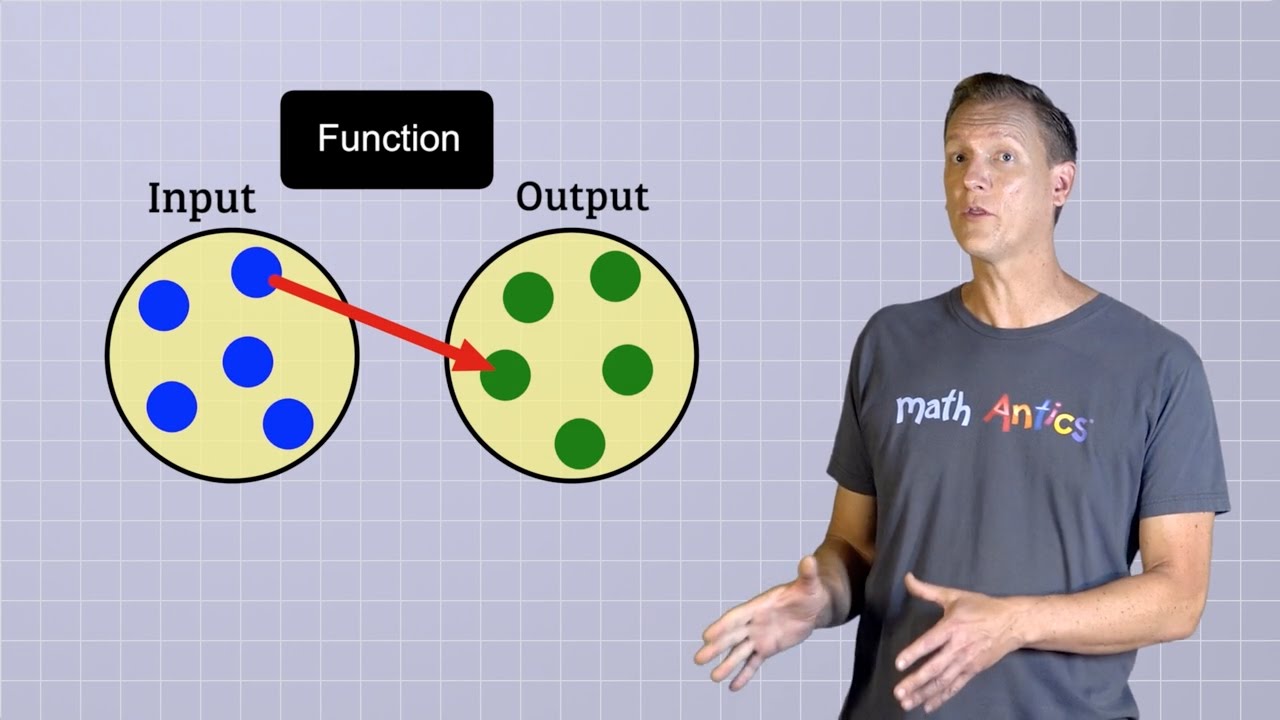
Learn More at mathantics.com
Visit http://www.mathantics.com for more Free math videos and additional subscription based content!
Like, up to the set theory part it's okay
but then it just rapidly deteriorates
It's the first youtube result for "functions" too
pastel sundial
I'd watch it but I'm afraid youtube would start reccomendating me basic math videos
long pelican
Incognito mode maybe!
pastel sundial
Actually idk what youtube would think
long pelican
I should tell the other math professors in the department to google "functions" on youtube and watch some of the videos
it'll be a huge shock to them
It should change the way they approach teaching freshman courses
pastel sundial
Recently watched:
Algebraic Topology lecture 15: Proof of the Excision theorem.
Algebra Basics: What Are Functions?
long pelican

pastel sundial
If only it was a different video like "what is the quadratic formula"
Then I could make an "average category theorist" joke
ok I'm watching this video
time to see how bad it is
a set is just a group
algebraists in shambles
long pelican
I can forgive that, relatively
pastel sundial
yeah I'm meming here
it seems ok so far
2 minutes in
oh no he's giving y=2x as an example of a function
if we treat x as the set of inputs
long pelican
pastel sundial
wait so if the free variables in a function are the set of inputs
does this prove the negation of the Foundation axiom
long pelican
👀
pastel sundial
"let's try to make a function table for the equation y^2 = x"
lmfao wut
holy shit this is deteriorating rapidly
"the equation gave two inputs for a single output so it is not a function"
doesn't explain why
the equation y=2x qualifies as a function
actually shoot me
on the "function" y=x+1
if you watched our last video about graphing on the coordinate plane, you may notice that each row of this function table is basically just an ordered pair. We can even rewrite the inputs and outputs in ordered pair form. And that means you can also graph each of these pairs of inputs and outputs on the coordinate plane. You can graph a function. Here are the points from our function table plotted on the coordinate plane. It forms a straight line and is an example of what is called a linear function.
this presentation is so bad
there's like no motivation for anything what
pulls the vertical line test out of his ass and then only gives a vague justification of why it works after explaining it (also vaguely).
and yeah I definitely see the point with TSM about conflating definitions and results.
pastel sundial
"these are the most common names [of functions], but you can use others if you want to"
doesn't give an example where you write f(y)=x
it's like he's actively trying to create the misconception that y is always the output and x is always the input
long pelican
I think the entire idea of introducing the letter y when discussing function notation is a misconception in itself
pastel sundial
this is like a carefully crated video that's meant to appear like an innocuous explanation of functions but is really a scheme to sabotage future multi students
long pelican
Like people write sqrt(x) all the time in text, do you want them to say sqrt(x) is the same as y? out of nowhere?
pastel sundial
wait is he actaully
going on a long rant about how f(x) is the same thing as y
and that they're "interchangeable"
long pelican
Yeah
pastel sundial
but... why?
long pelican
Just passing on what he learned from TSM
pastel sundial
I wonder if the the issue with reforming math education is just that the vast majority of educators and administrators aren't able to tell the difference between good and bad math education.
long pelican
That's a really big issue indeed
pastel sundial
But also possibly have an implicit distrust of any reform since it's new and scary, especially reforms proposed by mathematicians who they view as wizards.
long pelican
and the failure of 1960s New Math as a history lesson
pastel sundial
like I wonder if there's an element of "of course [teaching math this way] makes sense to YOU, you're a mathematician. Us regular people couldn't possibly hope to handle the level of abstraction you somehow manage to wrap your head around."
long pelican
We should hit them back with
"This functions video we just watched makes no sense to anyone, including us"
pastel sundial
yes
long pelican
It's like Wu said, TSM was made impossible to learn by anything other than memorization
pastel sundial
why was it made this way in the first place?
like historically
how did TSM come to be
I see how its self sustaining, but how did it come into existence in the first place
pastel sundial
long pelican
and the failure of 1960s New Math as a history lesson
also say more about this?
long pelican
I observed something that might explain why TSM continues to exist
I noticed that the following groups of people:
(a) authors of school math videos explaining e.g. functions
(b) authors of discrete math explaining videos and mathematicians
are completely separate and clearly don't mingle with each other
actually
there
pastel sundial
yeah it's weird
long pelican
How is it that almost every single person making a guide for school math is incompetent in understanding what a function is
pastel sundial
my neighbor across the street is a highschool math teacher
at what I'm told is a very good private school
super nice guy
I was talking to him a while ago and he didn't even know what topology was
long pelican
Better not direct him to eigenchris's video
pastel sundial
like not just not knowing the basic definitions, he had literally never even heard one donut equals ONE COFFIS CUP
pastel sundial
right???
and this man has been teaching highschool math for quite some time
and I'm pretty sure he doesn't know anything beyond calc
like I don't think he could say what a linear transformation is
long pelican
pastel sundial
also say more about this?
New Math had a lot of mathematicians' input and tried to have children start with formal set theory, but it failed for 2 reasons
(a) Lack of teacher knowledge, leading to completely messing up the point of it
(b) it might have been too formal and developmentally inappropriate
pastel sundial
I honestly wonder if he even knows the formal definition of a derivative
long pelican
Hmmm I bet that's the same as the answer to the question "does the textbook have it"
pastel sundial
I wouldn't be surprised
though I'm not even sure if he teaches calc
it's weird though
how little math math teachers know
is that as common in other subjects?
oh also I'm taking a cool class next semester
it's called "Issues in Contemporary Education"
winged urchin
Y'all will like this. Just helped a student where the practice test for their big test tomorrow had the problem (essentially)
"Consider y = 1 - (x-1)^2. Which of the following would be a possible restriction to the domain so that f^{-1}(x) is a function?"
pastel sundial
it's about the current US education system and how it could perhaps be improved.
winged urchin
And thennnn the answers were something like
Or choices I mean (it was multiple choice)
pastel sundial
wait did the question use y and f(x) interchangeably
winged urchin
x <= 1
0 <= x <= 1
x >= 0
x <= -1
x <= 2
winged urchin
pastel sundial
wait did the question use y and f(x) interchangeably
Implicitly, yes ahah
And apparently only one of those choices is 'correct' HMMMM

Just so much wrong in one question
long pelican

After reading the question, I conclude the answer is "This makes no sense. f isn't defined."
Also, domain of what? (lol)
I might borrow this for my 10th problem set for this calc 2 class
Except that they are expected to answer "This makes no sense" instead of one of the answer choices
pastel sundial
ok so I guess you were supposed to answer (a)? But b also makes it invertible
actual  question
winged urchin
B and d both make it invertible ahaha