#math-pedagogy
1 messages · Page 47 of 1
 strange bronze
 spark thorn
but first year student never heard the word group before
strange bronze
sure, you shouldnt introduce isomorphisms in the first lecture
strange bronze
i mean
its not a common approach
people dont usually introduce complex numbers through solving cubics either
even if that was the historical development
nor do they introduce integrals before derivatives (except for a couple outliers)
im not sure historical is ALWAYS the best way, but i think it IS a good source of motivations
spark thorn
the thing is how do I share the idea of a group to a newomer to math without being boring
given that materials in my mothertongue (🇫🇷) are bourbakists for most of them
 brisk ruin
I think that group actions are the best way to introduce groups
We are about groups because of how they transform other objects
(Not entirely, but a good reason)
spark thorn
mmh, maybe vectors actions ?
like k V (k scalar V vector)
might be interesting
Ill try to share my courses (latex) open source here or smwhere
if this can help
@brisk ruin @strange bronze thks for the help
 mint lark
strange bronze
nor do they introduce integrals before derivatives (except for a couple outliers...
mint lark
strange bronze
nor do they introduce integrals before derivatives (except for a couple outliers...
they do this at Michigan for the proof based course lol
brisk ruin
Apostol's Calculus does this
 long pelican
I would like to possibly suggest that if these are high school students not specifically selected for math ability, then their mathematical maturity at age 19 is probably extremely similar to their mathematical maturity at age 15
strange bronze
long pelican
I would like to possibly suggest that if these are high school students not spec...
well its more that
in a university context there tends to be a bit of self-selection
like in a high school math class youll deal with students from a variety of mathematical backgrounds, many of whom simply dont care at all
long pelican
I read that they're 19 year old high school students (probably a country where you don't graduate high school until 19 years old?)
strange bronze
but if theyre in a group theory course, theyre at least interested enough in math to self-select into a math-adjacent major
 long pelican
Ok university then
strange bronze
(id imagine the confusion of terminology here is because of the french educational system)
(ie the lycee)
long pelican
Math majors I assume?
strange bronze
idk exactly how the french system works but i wouldnt be surprised if CS students are also funneled into intro group theory
not that its super directly useful, but the proofs are at least
as is the mathematical maturity/problem solving skills
long pelican
In my mind if you're teaching people already interested in math you have a lot more wiggle room to start with abstraction without losing your students' interest, but if you're teaching people who don't have a pre-existing reason to be interested it's a lot trickier
"Group theory [for those who have heard the term and are curious what it's about]"
vs. "group theory for those who have never heard of it or seen anything related to it before"
And then in America there's a 3rd category which is
"Group theory for those who have many holes in their mathematical understanding and who have misconceptions that math is rote memorization or solving equations or 2 column proofs"
Not strictly an American problem of course
For the first group it's safe to start with permutation groups, or the group of symmetries of a shape, or abstract groups
For the second and especially third groups you probably need to introduce things like the Rubik's cube or the 15 puzzle or any easy-to-digest thing which group theory applies to first
spark thorn
strange bronze
idk exactly how the french system works but i wouldnt be surprised if CS student...
well in first year uni, second semester, they study ZFC set theory
Logic predicates
And thats for the first year CS STUDENTS !
brisk ruin
How Bourbakist
spark thorn
Im supposed to talk about a group structure on a set with a law *
spark thorn
long pelican
Math majors I assume?
wrong
CS MAJORS
long pelican
Good thing I asked!
 tawny slate
I really relate with 3b1b's approach in his monster group video
Talk about how intimately connected groups are with the concept of symmetry
You don't necessarily have to bring up the monster group, but maybe show how seemingly different problems have the same group table, like rotations of a square and multiplication mod 5
That gives the abstract motivation in terms of explaining the patterns and connections you are seeing between different math problems
Then find some application of it that makes a problem they understand as difficult that can be easily solved using group theory, such as why polynomials of degree 5 don't have a formula for its solutions, except you probably want to pick something a bit more straightforward with not so many steps
Some small "mind blown" ideas I throw at my students is once I explain the concept of the identity element, I can then draw it back to addition and multiplication under the real numbers
Students often times initially make the mistake of assuming that x^0 = 0 or that 0! = 0, and explaining that because exponentiation and factorials use multiplication, anything involving the zeros should "start" with the identity element 1
 stark pine
Yeah, I really like how he started with group actions then went to groups
 wispy slate
my course and book I used explained group actions quite far into the group stuff
I don't think its that uncommon
 round robin
same i learnt groups through axioms then some example which implicitly encodes group axioms
spark thorn
Do you think this diagram is ok ?
Sorry for the french caption

I can give you the LaTeX code Latex code if you need to learn some tikz
 turbid zenith
I think it would be easier to understand if the a/b/c arrows were a little more clearly separated
mint lark
+1
wispy slate
or maybe do another one under it with Y being ordered 4 2 1 3 so its just straight arrows
spark thorn
wispy slate
or maybe do another one under it with Y being ordered 4 2 1 3 so its just straig...
yes will do 🙂
anywasomeone wants the tikz code ?
 frosty flame
Sure, I don't know how to use tikz so it could be instructive for me
spark thorn
\usetikzlibrary{calc,trees,positioning,arrows,fit,shapes,calc} % EN PREAMBULE
\definecolor{vert}{RGB}{0,181,0}
\definecolor{oran}{RGB}{223,74,0}
\definecolor{viol}{RGB}{134,0,175}
\definecolor{roug}{RGB}{215,15,0}
\definecolor{bleu}{RGB}{0,104,180}
\tikzset{|/.tip={Bar[width=.8ex,round]}}
\begin{figure}[htbp]
    \centering
    \begin{tikzpicture}[
    >=stealth,
    bullet/.style={
        fill=black,
        circle,
        minimum width=1pt,
        inner sep=1pt
    },
    projection/.style={
        ->,
        thick,
        shorten <=2pt,
        shorten >=2pt
    },
    every fit/.style={
        ellipse,
        draw,
        inner sep=2pt
        }]
    \node[bullet,fill=bleu,label=left:$a$] (a1) at (0,4) {};
    \node[bullet,fill=bleu,label=left:$b$] (a2) at (0,3) {};
    \node[bullet,fill=bleu,label=left:$c$] (a3) at (0,2) {};
    \node[bullet,fill=bleu,label=left:$d$] (a4) at (0,1) {};%
    %
    \node[bullet,fill=roug,label=right:$1$] (b1) at (4,4) {};
    \node[bullet,fill=roug,label=right:$2$] (b2) at (4,3) {};
    \node[bullet,fill=roug,label=right:$3$] (b3) at (4,2) {};
    \node[bullet,fill=roug,label=right:$4$] (b4) at (4,1) {};%
%
    \node[fill=bleu,draw=bleu,fill opacity=0.3,fit= (a1) (a2) (a3) (a4),minimum width=2cm, label=above:$X$] (X) {} ;
    \node[fill=roug,draw=roug,fill opacity=0.3,fit= (b1) (b2) (b3) (b4),minimum width=2cm, label=above:$Y$] (Y) {} ;  %
%
    \draw[projection] (a1) to[out=20, in=150] (b4);
    \draw[projection] (a2) to[out=20, in=160] (b2);
    \draw[projection] (a3) to[out=20, in=170] (b1);
    \draw[projection] (a4) to[out=20, in=150] (b3);
%
    \draw[|->,thick,shorten <=1cm,shorten >=1cm] (X.north) -- node [midway,above,align=center]{$f$} (Y.north);
    \end{tikzpicture}%
%
    \caption{diagramme sagittal d'une application bjective.}
    \label{fig:fonctbij}
\end{figure}```Thanks
 inner scroll
this is about determinate 3 polynomials (P,Q and R) that all their coefficients are in R .
PS: the last line is just a Hint.

 austere inlet
inner scroll
this is about determinate 3 polynomials (P,Q and R) that all their coefficient...
austere inlet
inner scroll
this is about determinate 3 polynomials (P,Q and R) that all their coefficient...
wrong channel
brisk ruin

 wise onyx
how do you use color in this
brisk ruin
What
Oh
For Discord codeblocks, after you do the triple `, you can declare the language on the same line and then it will color the rest
strange bronze
example: this
Inductive seq : nat -> Set :=
| niln : seq 0
| consn : forall n : nat, nat -> seq n -> seq (S n).
Fixpoint length (n : nat) (s : seq n) {struct s} : nat :=
  match s with
  | niln => 0
  | consn i _ s' => S (length i s')
  end.
Theorem length_corr : forall (n : nat) (s : seq n), length n s = n.
Proof.
  intros n s.
  induction s.
    simpl.
    trivial.
    simpl.
    rewrite IHs.
    trivial.
Qed.```

is produced by the below image
@wise onyx
replace "coq" with whatever language you want to syntax highlight
wise onyx
based trivial
note that python has two: python and python3
actually wait
seems they removed that
now theres just one lmao
there used to be 2
turbid zenith
https://www.solidangl.es/2021/03/spr21-mat130-the-law-of-sines.html Sharing newest notes because I'm always really happy with these when I'm done with them. :3
turbid zenith
So @shadow basalt I've got something for you
In the vein of having students do something deliberately wrong for a reason
Here are two collaborative group slides for my activity tomorrow

 turbid zenith
Four groups, all have the same triangle but are given a different set of starting data to measure (using virtual tools)
Group 4 has a wrinkle thrown in
So when we compare answers Groups 1, 2, and 3 should have the same answers but if Group 4 follows Law of Sines blindly they'll be wrong
turbid zenith
Because productive struggle is a good thing, it gets good discussions going
 shadow basalt
okay whats the productive part
turbid zenith
Students notice relationships, put things in their own words, etc
And the knowledge gained from it is much stronger as a result than just saying "kay y'all here's the rule, write this down"
shadow basalt
sure but thats a false dichotomy lol
guideless struggle is pointless
at least give them a hint
turbid zenith
Sure
turbid zenith
I'm not just throwing them to the wolves 😛
I disagree that it's totally unrelated -- I see it as part of a larger thing personally
shadow basalt
given that again explaining why something was wrong or doesnt work
is a key part of my entire point
if numberphile ended the video with haha jk that was all totally not valid manipulation
i would care less
if you showed your students this example
and then 2 months later explained it to them
that would be bad teaching as well lol
turbid zenith
People's grades aren't riding on Numberphile. They don't have as immediate an impetus to resolve the mystery, they can afford to let people wrestle with it a bit before the followup.
shadow basalt
its not a mystery
they presented invalid manipulation as valid manipulation
without indication
i could trick a bunch of highschoolers too
like if an authority figure tells you a certain operation is valid
and youre only casually interested
or just young
you just buy it
turbid zenith
Sigh
shadow basalt
theres no mystery youre trying to solve
turbid zenith
Out of curiosity
turbid zenith
Did you watch the followups yourself
shadow basalt
I already told you I did not
turbid zenith
I did but it's been a while
turbid zenith
K well the "gold nugget" video, the mathematician does talk about those kinds of series manipulations being "illegal" on their own but then coming up with other ways to "make them legal" through ideas of analytic continuation etc.
No I won't give you a timestamp. You have to look yourself. But I'll gladly provide you a link.
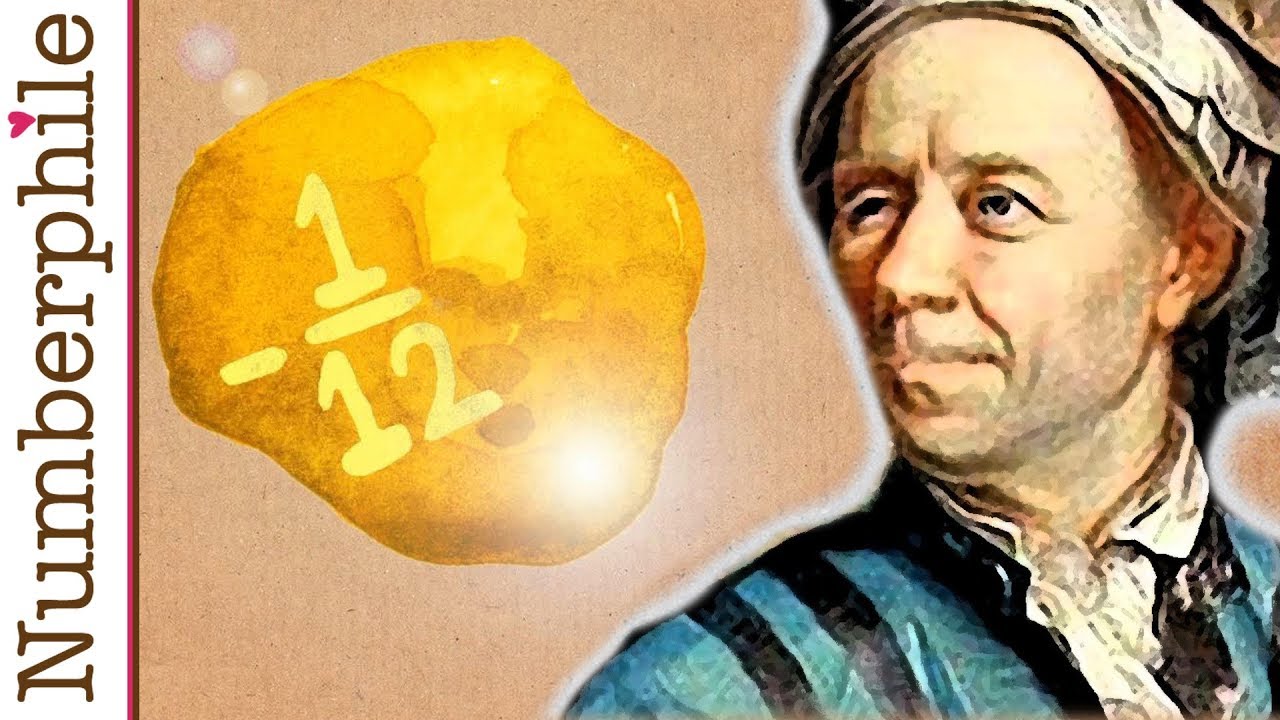
Featuring Professor Edward Frenkel. More links & stuff in full description below ↓↓↓
Okay, the links...
- New vid on the Riemann Hypothesis explains where -1/12 comes from: http://youtu.be/d6c6uIyieoo
2.The original videos at http://youtu.be/w-I6XTVZXww AND http://youtu.be/E-d9mgo8FGk - A useful blog from Tony Padilla: http://bit.ly/TonyResp...
shadow basalt
- copying a video at a time stamp is no more effort so that comes off w major dick vibes
- i will openly admit
that i will not do that
turbid zenith
There are multiple times. I'm not going to find them all.
turbid zenith
shadow basalt
that i will not do that
Okay well at that point you openly admit that you have no basis for saying they didn't address it
If so that's fine
shadow basalt
I have repeatedly said that the issue is the original video having no indication that this is true
and they have done nothing to remedy this
given the difference in view counts
id say the damage was done
turbid zenith
Difference in view counts is irrelevant imo
shadow basalt
how
turbid zenith
Your issue is with the viewers, not the channel
shadow basalt
about the viewers of the original
turbid zenith
between tiny messages
shadow basalt
i always do this
if you have a problem w me idc
but i do think defending that video is silly
turbid zenith
I think it was just as silly to come at me for the crime of mentioning I was watching Numberphile
shadow basalt
sure
brisk ruin
turbid zenith
Like you don't have to say anything
turbid zenith
If you're going to bring it up, I'm going to defend it because I don't think they committed a pedagogical crime, and I don't think you're going to convince me they did
shadow basalt
i teased you for watching it
turbid zenith
Nor am I going to convince you they didn't
But the difference is
I've watched the contextual videos
You haven't bothered.
shadow basalt
i remind you that you are the one who keeps bringing this up
when i genuinely forgot about it
i do not care that much
but if you are going to @ me and I have nothing better to do
ill continue to point out that that video is bad
turbid zenith
Fine
shadow basalt
should i keep checking this channel (i have it muted) or is this over lol
 lucid monolith
Its a little more technical, but Tao has a great article on the analytical continuation method and other information about assigning sums to divergent series: https://terrytao.wordpress.com/2010/04/10/the-euler-maclaurin-formula-bernoulli-numbers-the-zeta-function-and-real-variable-analytic-continuation/

The Riemann zeta function $latex {\zeta(s)}&fg=000000$ is defined in the region $latex {\hbox{Re}(s)>1}&fg=000000$ by the absolutely convergent series $latex \displaystyle \zeta(s) = \su…
turbid zenith
Mhm! Lots of people have written great stuff about it
Tao goes way further with it than I'm comfortable with personally
stark pine
@turbid zenith my personal issue with the sum video is that a lot of people already see math as symbol pushing with no deeper meaning, and that video is kind of the peak of why; they manipulate symbols and get a result that looks like nonsense unless you learn a bunch of math. Analytic continuation is a beautiful, intuitive idea , but they don't reference it at all (at least not as far as I remember); they take a bunch of divergent sums, symbolically manipulate them, and derive the result they were looking for. iirc, you can derive other values if you manipulate "sums" like this differently, but the greater crime is imo that they've just pushed symbols around, without any conceptual or theoretical insight.
Most people don't react to something like that with curiosity, they shake their head and see math as an even more mystical, even more obtuse thing. If you reference analytic continuation and mention that zeta(-1) no longer really represents an infinite sum in the traditional sense, I think you'd get people more intrigued, and you'd make the math behind it clearer.
lucid monolith
I also feel that assinging values to divergent series is pretty accessible anyway, and I feel that sense of mystification really hurts people searching for a understanding. Really, the method of assigning values to a divergent sum is close to something like taking only the constant term in a taylor series, and is accessible to anyone who has seen taylor series before. It would be great if in videos like that they showed how you could approximate sums with polynomials, and then arrived at the 'value' of the sum by assigning the value of the sum to the y-intercept of the polynomial. I totally agree that videos without any theoretical insight is problematic
 tidal drum
My calc 3 prof had us do a worksheet where we rearranged a conditionally convergent sum so that it converged to a different number
He didn’t explain anything else, we just did it in class once, and moved on
This made me wonder wtf anything we were doing was because I was like “bro I summed the same crap and it was something else, how is any of this valid”
And then I just chose to forget about it and pretend I didn’t do that and just stop thinking about it because it made me question everything we did up until then
If we got told that this is an issue with conditionally convergent sums, or we went more into like how infinite sums are weird, we can’t expect them to work as finite sums, etc. it would’ve been good, but we didn’t
I also don’t think things like that are good, because it’s just pop math which leads a bunch of people to come to false conclusions, reinforces the idea that math is just a bunch of totally arbitrary, meaningless bs because how could this be true? It defys all logic, and it’s not being presented like it’s false
Even though it is!
lucid monolith
tidal drum
And then I just chose to forget about it and pretend I didn’t do that and just s...
Just yesterday someone was asking for help on their homework, and they were stuck on finding the sum of (-1)^n/n. It felt weird working with them towards the 'answer', since there isn't really one, but it is also kind of outside of the scope of calc 2 to understand the complexities of what it means to look at the sum of a conditionally convergent series. I definitely feel high school calc 2 often puts itself in a weird stop where its ciriculum goes through things thats are to complicated to explain for calc 2, but are also neccesary to do to get a good grade. I find it unsurpising that math is symbol pushing to so many people, since they are setup to not be able to access the meaning behind the symbols since the barrier to understanding whats fully going on is too great
wise onyx
that series is -ln(2) as series representation of ln is

and is valid for x=1
to get this you wanna integrate a geometric series
lucid monolith
The problem is that its only -ln(2) for that particular order of simplifying terms. If you switch some terms around, or add some parentheses in different places, then sum could add up to something different. In the case of a absolutely convergent series, you just need to know the terms in the series and you can add them up to get to the final answer. With a conditionally convergent series, you need the terms and the order they are added to determine a unique value.
wise onyx
true but if they are asked to find the sum of a series, its typically the limit of partial sums definition
also its possible to give the idea of reimann rearrangement theorem in simple terms
 inner turtle
Is this a cultural thing? Over here in Germany you don't touch series before you learn the rigorous definition of convergence (unless you study engineering or anything else where you only care about the calculational methods)
And at that point the definition of a series is clear, and there's no ambiguity
 ocean oracle
Does anyone use a drawing tablet for online teaching/tutoring? If so I would like some recommendations on which are a good option.
spark thorn
ocean oracle
Does anyone use a drawing tablet for online teaching/tutoring? If so I would lik...
Yep
What's your budget
austere inlet
I used a Huion H610PRO and recently bought a drawing monitor from them (Kamvas 13), generally anything from that brand is good for the price imo
ocean oracle
I would say budget is like 200-300 I could spend more though
But I don't want to lol
austere inlet
that's plenty for a tablet
ocean oracle
Yeah I know
spark thorn
Gaomon M10K
Cheap good size
Screen has a good feel
ocean oracle
Alright Thank you
tawny slate
so
there's technically no problem with this proof right?

im struggling to figure out whether or not to present this proof to students when teaching the topic
because on one hand it's more elegant than drawing the median
but on the other hand it feels almost weirdly unsatisfying, like you're exploiting the logical language in a way that doesn't quite help them visualize or understand it
what do you guys think?
strange bronze
how do you justify that the angles are corresponding?
 vernal willow
tawny slate
vernal willow
tawny slate
i remember someone saying that this proof was found by computer or something of the sort

Mathematics Stack Exchange
The "classic textbook proof" of equality of base angles of an isosceles triangles which I studied in my school days is as follows:
Let $\Delta ABC$ be a triangle with $AB = AC$ and let $D$ be the ...
was in GEB apparently
tawny slate
yeah this is basically the exact same question that I'm asking, amazingly
tawny slate
strange bronze
how do you justify that the angles are corresponding?
the congruent triangles are
ABC and ACB
B and C are clearly corresponding, they are both the middle letter
at least, that's how i would explain it to my students
because this is how you express how the triangles line up with each other
 burnt frost
Looking for a writing tablet for purposes of online tutoring.
I've been writing out everything with a track pad, so slow.
Any suggestions?
 lethal leaf
I have an ipad but those are $$$$
 astral oar
@burnt frost when I tried a bunch at tech stores a couple of years ago, ipad felt the best by far to write on
but yeah it's money
so if budget is an issue, there are lots of inexpensive android tablets that will work well
and feel much better than a track pad
biggest thing to look for is low latency. if latency is high, the ink will lag behind where you pen is and it won't feel good
a secondary thing to look for is having good pressure sensitivity. this makes it look like you're writing with a good pen, so the handwriting will look better
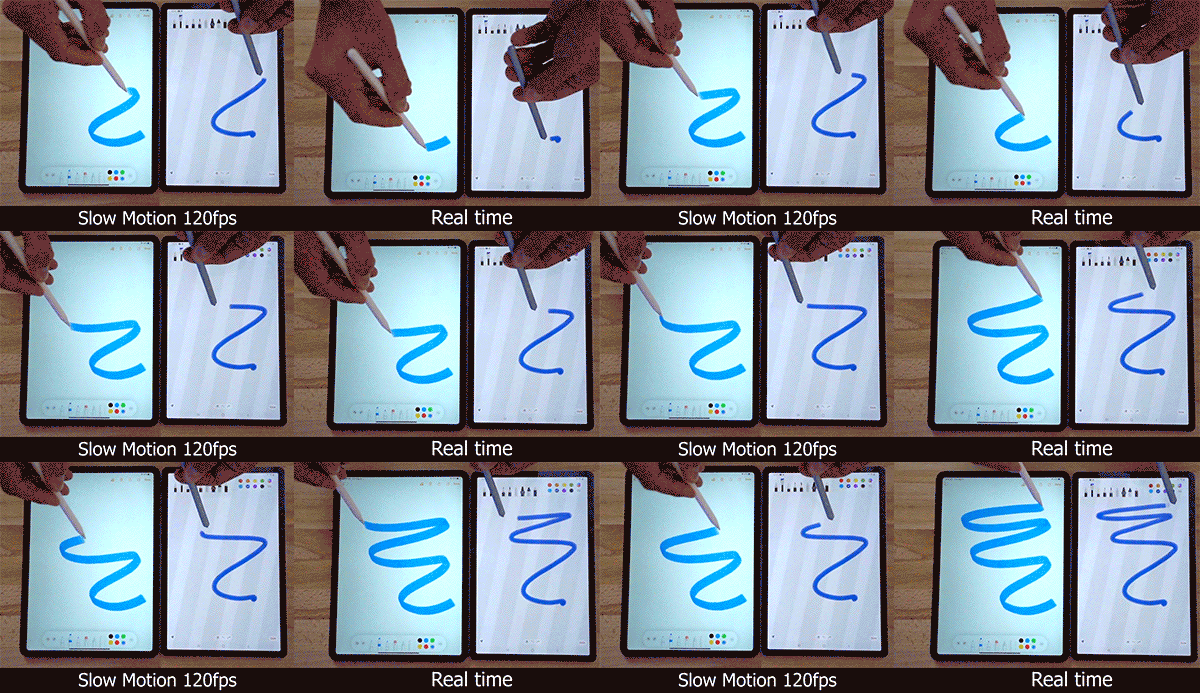
ipad pro on the left here, galaxy tab s7+ on the right
but again: you can spend like $100 and get a cheap android tablet with a stylus, and that'll do fine
austere inlet
iPads are cool and all but keep in mind you're buying a whole device + OS with it, as well as the brand itself, hence the price. If you have a computer a graphics tablet is far cheaper and perfectly fine for tutoring purposes.
+1 to Huion, I've used a H610Pro and now a Kamvas 13 (which is a drawing monitor) with Xournal++ on Linux and they're great
(that aside, a ton of artists use an iPad for illustration which goes to show how handy it can be as a drawing tablet, as well as all the other stuff it does)
ocean oracle
Someone here had suggested me to buy the Gaomon M10k pro and it has been great so far
Too bad my penmanship is awful
burnt frost
Thank you for the suggestions and input! 🙂
I ended up going with a Wacom for around $100 (after shipping).
At one point I was even doing simplex method on an online whiteboard, all by track pad. Afterwards, my clicky finger would be so sore. Talkin like 4 hour stretches of clicky clicks and rewriting matrices.
austere inlet
glad to hear about your investment, hope it's worth it 
turbid zenith
Just finished this
Would really welcome feedback on any ways to break up the "wall of text" better
shadow basalt
This is very geometric so there is plenty of room for pictures
would also make it easy to skim
turbid zenith
Most of the time I do have a lot of images, but proving identities is pretty algebraic
shadow basalt
Oh, they only thing I would say is a wall of text
is the bullet points at the beginning
I think the rest looks pretty clean
Maybe use more of those [expand] thingies if you're worried about it?
turbid zenith
Worth a shot. I should look into seeing if there's a better way to do those, I'll toy with that tonight.
shadow basalt
also just another thing I thought about

I think it might be worth adding that no one really writes down all their failed attempts
like whenever you see a bunch of tricks to solve some problem that seem like magic it normally means someone spent a long ass time trying things that didn't work
but they rarely write that down
turbid zenith
That's a good point.
That was a very annoying thing about real analysis to me at first.
So, that's led to two things. First of all, this:

Second of all, one more question on the Preview Activity:

Trying to have students do a lot of "thinking about their thinking".
turbid zenith

Trying out a new group activity tomorrow in @GoogleDocs Google Slides! Adapted from https://t.co/j408R6VaZH.

 Twitter
·
Twitter
·
 tawny slate
Without diverting too much attention away from your work, I wanted to chime in and mention that it's pretty cool to see how similar our styles are. The way you're presenting your material is almost exactly the same as the way I would do it
Like when you mentioned why trig is most students' real taste of math, that there's not a single method or formula they can just plug in, they have to use a bit of intuition and creativity to solve the problems
I had to explain to my students the exact same idea, but I was introducing them to proving inequalities, like trying to prove which was bigger: 2^81 or 3^49
Explaining to the kids that there is no set method to doing these problems was crucial, as they were even younger and kept trying to parrot the same technique on every problem
turbid zenith
No that's not diverting anything! I'm sharing what I like to do but I love seeing what everyone else does as well
It gives me ideas too
Side note, I'm not sure offhand how I'd prove the thing you gave other than taking logs, and I don't know those logs by hand 😛
tidal drum
So like, the way I kind of vaguely did it
write 3^49 as (2)^49(1.5)^49 and compare to 2^81 = 2^49(2)^32
then you're comparing (1.5)^49 and 2^32 and I think it's kinda clear the latter is bigger, but idk how to prove it
without taking logs like you said haha
vernal willow
The idea i think is to note that 2^81 is a ninth power, and so divide both numbers by the largest power of three that is a ninth power, so 3^45. Now we have to compare (2^9/3^5)^9 and 3^4, and we notice that 2^9/3^5 > 2, and because 2^9 > 4^4 > 3^4 we are done
Using this method you can sharpen the inequality to 2^81 > 3^50 :D
tidal drum
bruh moment
vernal willow
Truly
lucid monolith
tawny slate
Like when you mentioned why trig is most students' real taste of math, that ther...
I think part of this desire to find a single formula is because its difficult to understanding why it is that both sides should be equal. Part of the reason why some people feel lost doing those type of problems isn't always because they can't just plug in chug, but because its not clear why both sides would be equal to each other besides 'Using these bag of tricks to simplify can get you to the right answer.' It kind of reminds me of doing epsilon-delta proofs. Initially, I had struggled a lot with knowing when to apply the triangle inequality, or when to use this-or-that trick. What helped me a ton was realizing that the point of an epsilon delta proof is showing that you can control the error, and shifting from thinking about which tricks I could apply to why the error can be controlled, and then just using the tricks to help me get there.
I think part of the difficult with trig simplification is that its difficult to come up with an intuitive reason that, for instance, tan x * sin x + cos x = sec x. When I did trig simplification in my class, it felt like it was pattern recognition puzzle. I don’t think this is a problem necessarily, since pattern recognition is a really important part and other modules (like finding patterns in arithmetic or more general sequences) are a lot about pattern recognition, but I can sympathize with students wanting to figure out a more unifying principle behind these equations, like what effect multiplying trig functions has, or how to geometric view adding trig functions, or anything along those lines.
tawny slate
oh i understand WHY they feel that way, but im trying to explain to students the hard reality of math, that it often times isn't that way
and they need to start getting used to it
i try to offer motivational points about why this is something to look forward to, not something to be afraid of
fyi, the solution to the 2^81 and 3^49 thing:
2^81 > 2^80 > 3^50 > 3^49
we can easily see that 2^80 > 3^50 because 2^8 > 3^5 (256 > 243)
pappa's method works but i think this is more elegant
lucid monolith
You have a good point that math is just sometimes like that. I still like the aesthetic look of geometric proofs, but its definitely impractical when the identity is too complicated.
 turbid zenith
tawny slate
we can easily see that 2^80 > 3^50 because 2^8 > 3^5 (256 > 243)
turbid zenith
tawny slate
we can easily see that 2^80 > 3^50 because 2^8 > 3^5 (256 > 243)
I'd beware the word "easily"
One of my teacher friends calls it one of the "CEO" words ... "Clearly, Easily, Obviously"
I absolutely despise seeing them in written mathematics
shadow basalt
I tend to see them used to mean "if you think about this too hard you are thinking about it wrong" and in that use case I think its fine
probably should always be avoided when creating materials for newer/younger students though
tawny slate
turbid zenith
I'd beware the word "easily"
yeah but the way i communicate with my students is very different from how i communicate with you guys, don't worry I'm in agreement with you 🙂
im just providing the solution to that problem for you guys
shadow basalt
I think before people get confidence in their mathematics those "CEO" words can really be anxiety-inducing and bad
but if you're talking to experienced people I think they can convey actual meaning
to me they mean something like "follows straight from definitions, follow your nose, no ingenuity involved" etc
turbid zenith
tawny slate
yeah but the way i communicate with my students is very different from how i com...
Point!
turbid zenith
lucid monolith
You have a good point that math is just sometimes like that. I still like the ae...
Oh wow I just saw this
I love it
 quasi musk
I usually use phrases like "If you're quite attentive/clever/crafty/studious" or some variant
tawny slate
noticed something interesting teaching geometry today
suppose you wanted to prove the statement: "If a triangle has two congruent sides, then their corresponding/opposite angles are also congruent."
i mentioned previously this really simple elegant reflection proof, but the classic approach to solving this is to draw the median

but when i went over this with my student, the student first draw the altitude, not the median, and then just asserted that BD = DC
the student assumed that this construction is automatically a perpendicular bisector
 clever jetty
I mean,It looks like a right angle visually
tawny slate
i explained that you could always construct either an altitude or a median, but a perpendicular bisector doesn't necessarily hit the opposite corner
which resulted in the interesting thought: how can you tell if ANY construction is valid?
and i immediately understood why construction is important, even though geometry classes that i know of tend to ignore those lessons and details
the compass/straightedge stuff
 winged urchin
I think this is the problem with diagrams of abstracted situations sometimes. You make one diagram and describe it in general terms and maybe even state that the picture might not be scaled how the student thinks
Ideally you want something that the student can manipulate to see the different possibilities
It's like trying to understand something with only a single example
You want many examples of whatever it is you're trying to understand
 shut mist
is it not simpler to law of sines to prove congruence?
turbid zenith
Geometry students who are proving triangles congruent usually don't know the Law of Sines til much later. Most don't learn it until Precalculus.
 real mauve
i saw a handful of people were discussing touch input tablets for PCs here, like huion and wacom
is there any other good reco around the 25cm x 10cm range?
real mauve
if anyone can offer any comments, please @ me in case i'm away, thanks!
tawny slate
Also law of sines doesn't prove two triangles are congruent
Congruency has nothing to do with law of sines, nowhere in law of sines does it mention congruency
shadow basalt
tawny slate
the compass/straightedge stuff
I feel like "valid construction" and compass-and-straightedge probably aren't synonyms
So I don't think you need to use that formalism (and really I think that the sort of intro-proofs you get in geometry is probably a better approach to proving you can do a construction)
Like the collection of valid geometric constructions is probably easier to reason about without restricting oneself to two specific tools that end up needing like galois theory haha
tawny slate
The point I was trying to make wasn't about formalism, but about how the construction axioms can also be a concept we can use to explain to a student what assumptions they make about the auxillary figures they draw are valid
If we can arbitrarily draw a point B on line AC such that AB=BC, and we can arbitrarily draw a point B on line AC such that AC is perpendicular to BD, why cant we arbitrarily draw a point B that satisfies both?
Traditionally, we use example by contradiction to explain why this assumption isn't valid, but finding a counterexample is a higher-level problem solving strategy, not a step by step method or formula. Using the construction rules allows students to work forwards step by step rather than relying on large leaps of intuition (at least, large from their perspective) and then attempting to find counterexamples to a system they are not comfortable with
This doesn't mean that they should always be relying on the construction axioms, but in an introduction to geometry, this forms a basis for their reasoning in the same way that writing proofs does
shadow basalt
Yeah but you also have issues in the other direction
there are perfectly valid operations a student can do in math that they can't do w/ a ruler or compass
And I feel like historically what is/is-not possible with compass and straightedge is very very not intuitively obvious
shadow basalt
shadow basalt
there are perfectly valid operations a student can do in math that they can't do...
for example trisecting an angle is a mundane mathematical thing to do but impossible with ruler/compass
tawny slate
Oh that's also an excellent point
I think that can be solved with the addition of a protractor/ruler
But yes, you are right
Hmmm
shadow basalt
Yeah I would agree that "could I make this work with a protractor and ruler" is pretty close to good enough
stark pine
turbid zenith
One of my teacher friends calls it one of the "CEO" words ... "Clearly, Easily, ...
yeah it's interesting, I've gotten very used to using Clearly/Trivially/Obviously/Easily/Directly in assignments, but I explicitly need to avoid using those when tutoring because they can feel like shit to hear if it isn't obvious/trivial for you. The words do communicate something, but I think the students I've tutored so far don't have the same association that max mentioned (that those words are just a sign that if you start thinking really deeply about it, you're probably overthinking)
wispy slate
here is a list of words you can use instead of clearly/trivially/obviously etc.
 molten urchin
Galois died in order to show us that
 shadow basalt
@stark pine I think explicitly, you need to have sufficient confidence in your abilities so that your first impresion when you read "obviously" and don't get it is "I am thinking about this wrong" instead of "I am not smart enough to understand this"
I think in general this takes experience and maturity in the subject
For example if I see "obviously" in a physics text I still can get frustrated
so imo it is important to consider your audience before using those terms
stark pine
wispy slate
here is a list of words you can use instead of clearly/trivially/obviously etc.
https://www.reddit.com/r/math/comments/7gqhlc/what_to_say_instead_of_trivially/ similar/same list as a reddit thread instead of a txt file
shadow basalt
"It would be an insult to my time and yours to prove that" honestly i love this
this is like a core part of my writing philosophy lmfao
stark pine
My favourite is "Terry Tao told me in a personal email that..."
shadow basalt
if someone proved something to you in correspondence but never bothered to publish it
you sort of have to cite their email lol
 meager bronze
stark pine
My favourite is "Terry Tao told me in a personal email that..."
meager bronze
stark pine
My favourite is "Terry Tao told me in a personal email that..."
that one was my contribution :^)
stark pine
meager bronze
that one was my contribution :^)
I know :)
Also I can use "By the axiom of choice" when I wanna justify something to a peer but I'm not quite sure how it works because everyone goes "oh choice? oh ok yeah that checks out"
meager bronze
hahaha
stark pine
since we're still at the "choice is fucking magic" stage
meager bronze
i'm still at the "choice is fucking magic" stage
stark pine
shadow basalt
<@!423999192122523648> I think explicitly, you need to have sufficient confidenc...
anyways yeah this is a really good point, I also think that with high school age kids, if they aren't doing well in math they've almost certainly heard that they're stupid because of it. A strange number of people have the weird idea that math = smart. People who have that kind of background really don't need to hear words like trivially and obviously
shadow basalt
For sure
One has to be very careful w self esteem in young math students because the people around them probably aren't
clever jetty
meager bronze
i'm still at the "choice is fucking magic" stage
What's the next stage?
stark pine
clever jetty
What's the next stage?
Witchcraft
clever jetty
So "Choice is obvious"->"Choice is fucking magic"->Witchcraft?
stark pine
The last stage is witchcraft because you know how to use magic (ie choice)
meager bronze
this is an anecdote ive always liked about choice
in the early 20th century (think 1920s or 30s or something) tarski proved that AC is equivalent to "there is a bijection between A and A x A for every infinite set A"
he submitted it to a journal, and both editors (frechet and lebesgue) declined to publish it. frechet wrote "an implication between two well-known true propositions is not a new result" and lebesgue wrote "an implication between false propositions is of no interest"
so basically "this is boring because these are both obviously true" and "this is boring because these are both obviously false" hahaha
mint lark
this is 🧠
molten urchin
You can convert your Android tablet/phone/iPad to an input device by an app/software called Virtual Tablet. I just found it and it seems to work fine, especially if you cannot arrange for a graphics tab for any reason.
It has a free version with ads, and a premium version with probably a feature or two more.
wispy slate
so you're saying i'll be drawing my furry commissions and suddenly an ad will pop up? unacceptable.
molten urchin
No lmao
There's a constant ad bar at the bottom, didn't seem to cause any trouble actually
And the paid version is like $5 anyway?
austere inlet
most people just share screen on Zoom/Meet/etc. from their tablet, though I guess that does require a beefy device
molten urchin
This arrangement is rather low spec imo
The tab I'm using is terribly outdated but seems to work fine for this purpose
turbid zenith
Discussion I gave my students today. Posting it here in case anyone might want to try something similar with their students.

 cosmic bough
my favourite scientist is margaret thatcher
both a women and an inspiring changer in the way society works
real mauve
this is kinda out of the blue, but i ended up getting myself a huion hs611 after seeing some people here praise them highly. i have to say it's really good and defo worth it for the price, it'll allow me to be lazy and not have to typeset a bunch of stuff in latex ahead of time
austere inlet
I too have typed a lot less LaTeX since I got a tablet
 violet mirage
it really helps a lot, I find it much better for zoom to use computer with drawing tablet vs using a full tablet like an ipad
shadow basalt
Ive been using full tablet + computer combo (streaming the tablet to the computer’s zoom)
it works very well
real mauve
you can stream the video of one device to the other, but i don't know if that is what they meant
shadow basalt
Yes I use only one zoom client and stream the ipad to the computers zoom client
no noticeable delay so far
real mauve
nice
shadow basalt
uh you just click the stream tablet button
on the computer zoom client
and then screenshare w ipad
shadow basalt
that i do not kno
turbid zenith
Hot take: We should still teach students to cross-multiply. #mtbos #ITeachMath (1/)
Twitter
·
austere inlet
I don't see how anyone could disagree with that point which I guess attests to how low math education has come in some places
shadow basalt
i do think old methods of teaching cross mult essentially boiled down to use this trick
rather than explaining that that trick is an immediate consequence of how multiplication and division interact
by old methods i mean how i learned it im not an expert in common core or anything
frosty flame
Yeah, when I say I don't like teaching tricks, what I mean is don't teach it as a trick with a special name, because when it's not based on understanding the fundamentals, you get shit like
$$2x+\frac52= \frac23$$
Oh no, what do I do? I see a fraction so cross multiply
$$2x + 15 = 4$$
I like to base solving equations entirely on do helpful operations on both sides, and then you can discuss which operations are helpful when. But you don't need to give it special names.
 burnt vesselBOT
Lunasong
 winged urchin
When avoiding these tricks sometimes I find it's helpful to really go into the minutia
Like if you have (3x5x7)/(2x3x11)
You can just say "Oh the 3's cancel"
Or
You can be like, remember multiplication is commutative so I can move terms around in a product
2x3x11 = 3x2x11
And then, remember also when you multiply fractions you get one bigger fraction? Like 2/3 x 4/9 = (2x4)/(3x9)
This is the opposite, we break it down into at least 2 separate fractions
3/3 x (5x7)/(2x11)
And now here's where we see the "3's cancelling" in that 3/3 is 1 and 1 doesn't change the rest of the expression (1 being the multiplicative identity element)
I find students can be so shaky on fundamental expression manipulation that going into minutia like this can help
turbid zenith
I can get behind that.
 topaz scarab
turbid zenith
https://twitter.com/solidangles/status/1374041156175204362
topaz scarab
turbid zenith
https://twitter.com/solidangles/status/1374041156175204362
teach cross-multiply as opposed to what?
strange bronze
i dont really understand why it needs its own name
certainly the technique should be taught
but is giving it a snazzy name meant to make it more memorable? because i think it creates the opposite effect
(but im not an expert pedagogist)
turbid zenith
topaz scarab
teach cross-multiply as opposed to what?
As opposed to proportional reasoning and equivalent fractions
Or multiplying by the denominators to clear the fractions
strange bronze
wait, maybe i misunderstand
turbid zenith
strange bronze
i dont really understand why it needs its own name
I assume for the same reason that people stop saying "the stuff under the square root" and start saying "radicand"
strange bronze
i thought cross-multiplying WAS multiplying by the denominators
turbid zenith
Cross-multiplying is for example solving 3/x = 7/11 by jumping right to 3 * 11 = 7 * x.
It's equivalent to multiplying by denominators.
strange bronze
okay yeah, i must not understand
whats the difference in how these are presented?
is cross-multiplication just taught as an algorithmic method without justification?
topaz scarab
turbid zenith
Or multiplying by the denominators to clear the fractions
Huh, if that's the case, then that's a really hot take.
turbid zenith
strange bronze
is cross-multiplication just taught as an algorithmic method without justificati...
It's the classic case of how math USED to be taught as mostly procedures without conceptual understanding
"When you see a/b = c/d, you cross-multiply"
"When you see this, do that"
That's something that we've thankfully pushed away from on the whole. But I worry sometimes that we're pushing too hard in some cases.
These are the same people who say "you shouldn't say 'plug in' when you talk about replacing a variable with a number in an expression! Say 'substitute' instead." Like okay, come on, does using a Latinate word REALLY make it better or are you just going with "longer words = more rigorous"?
"Don't say 'top' and 'bottom'! Always say 'numerator' and 'denominator' instead." Cool now how many 3rd graders who are first learning fractions are going to understand why you call them that in the first place?
strange bronze
those... are not complaints im familiar with
but i still dont really follow
are there people who believe algorithmic methods shouldnt be taught at all?
like i think this method should be justified (as "multiplying both sides to clear up the denominator") and then taught
lethal leaf
turbid zenith
These are the same people who say "you shouldn't say 'plug in' when you talk abo...
I had a teacher in HS who hated when we said plugged in
would always correct us to substitute in
never figured out why she hated it
 steep fog
I have some questions for teachers about how i should explain my roleplaying system. Its “mathematically pure” but ive been recieving feedback that people dont want to learn it
There are seven stats, called “talents”
Strength endurance coordination wisdom intelligence luck perception
These all start at somewhere between 1-10 randomly with a dice
Well, you pick one to roll again for so that onces 2-20
Anyway every interaction in the world has a difficulty defined by these talents, which can be combined in different ways, opening a heavy door might be around 5 strength, catching a ball might be 7 coordination + perception, picking a lock might 10 intelligence and then 12 coordination plus perception, it all depends on how the person running it (the umpire) decides to replicate the encounter
When i was thinking more about creating a pass/fail system for individuals, the formula was talent/difficulty = maximum roll for success
But i realized that with multiple people contesting things it makes more since to do talent /(roll/100) which would give you a value that would have to be responded to
Like for example, two players, strength 5 and 10, arm wrestling
At first the player with ten has no contest, the number on their character sheet is the minimum they will perform if needed
So the player with 5 rolls, and lets say they roll a 25
5/.25=20
Now the player with 10 strength has to roll and get a 50 or under
And this keeps going until someone fails
I feel this management is realistic and follows actual probability, but its not very intuitive. How would you help your students to gain a grasp of this relationship
tawny slate
First of all, I'm already confused. Can you explain it more technically or more clearly? I understand how stats are determined but I have no idea how skill checks work
You mix a lot of formulas with your natural language so it becomes difficult to tell where the formulas begin and end, and the terms within the formulas aren't well defined either
Talent / difficulty = maximum roll for success?
What's maximum roll for success? Why maximum?
steep fog
Okay say the talent is 5 and the difficulty is 10, simplest example.
5/10 is .5, or 50%, if you roll a 50 or under you succeed, 50 is the maximum successful roll
I think its intuitive, but for most people in the gaming word higher is better and they don’t understand why it’s different in this situation
And if you are in a contest, that “succeed” turns into “dont fail” and the other entity gets a roll
And they have to roll over the first persons talent divided by the roll in decimal form
So for this case, if the first person, the person with only five strength, rolls a 1/.01 the very best roll they could get, they would present a difficulty of 500 which the person with ten strength would have to face
Which would require them to roll a 1 or a 2
Of course if they roll a 2 they would tie, which would lead to a coin toss which would be called by whoever was being tied
steep fog
Im wondering if this keeps the odds 5:10 while also making it more dynamic
tawny slate
what do you mean roll below a 50? what kind of dice and how many?
aren't all rolls under 50?
how does a difficulty of 500 translate into rolling a 1 or a 2?
there are still a ton of unanswered questions
i think even if your system isn't all that complicated, it is apparent that your explanations are definitely a significant part of the problem
which i think you recognized
steep fog
Okay, ill explain it really simple
The only dice is a d100 (two d10, preferably of different colors so one can be the tens place [with 10 being 0] and one can be the ones place)
You also have talents, numbers which represent the minimum level that a character will be performing at
Lets change the example and say you have 1 strength. The door you want to open is heavy and requires 5 strength
You roll a d100, lets say you got the best roll, a 1
A 1 is equal to 1% which is .01
Divide the talent by .01
1/.01=100
Which is greater than the required five
You swing open the door with ease
However, what if the door could fight back
Change the example to arm wrestling. You with your 1 strength just started pushing at level 100 against a 5 strength opponent
He realized he needs to get serious, and rolls against that 100
5/100 is .05, so he needs to roll a 5 or lower
If he rolls exactly the same then you flip a coin, with whoever got tied calling it

 austere inlet
is it really that calculus-centric?
quasi musk
austere inlet
is it really that calculus-centric?
Yes the math curriculum has been designed for calc for a long time
lethal leaf
Precalc should be called Algebra 3
 wise lodge
I feel like the recent trend is putting more importance on linear algebra.
Calculus is still king, but there is more competition 🙂
 frigid crest
Current Title Real Title
Prealgebra Computation and number sense. (Algebra 0)
Algebra 1 More computation and number sense?
Algebra 2 Why are we still stuck on computation and number sense!!??
Precalculus Algebra 2.5
Calculus This should be calculus but it's actually Algebra 3.
Geometry Not Even Euclid's Elements!!!
Statistics This should not be an A.P. course.
Higher Math New Math, Same as the Old Math.
mint lark
Stats should be an AP course
clever jetty
What is this "Higher Math"?
wispy slate
the relevant section of Lockhart's Lament reads


apparently it's gotten a little bit better since this was published but I think it's pretty accurate lmao
read the whole essay here if you want, might be pinned though actually idk https://www.maa.org/external_archive/devlin/LockhartsLament.pdf
wise onyx
WIt
Wait
When was lockharts lament published
Oh it's different than Hardy's apology
I always confuse the 2
tawny slate


On the math olympiad server someone asked what combinatorial geometry was
its about counting all the different ways geometry sucks as an olympiad subject
wise lodge
Does anyone know why series convergences is such an important topic (so much so that they usually dedicate at least 5 weeks on it) in a typical Calculus II course?
analysis? like real analysis?
(I'm venting here, this is not directed at you). Series convergence is a staple for most Calculus II courses, but its application will only be seen by maybe 0.5% of the students taking the course? Engineers, heath students, business majors, computer science students will all take calculus II, but only a fraction of a fraction of them will take analysis. To me that is absurd. It isn't like its a small topic either, its almost half a semester.
Engineers are not required to take analysis (at my school). I am not an engineer (math major here) so I wouldn't know how important series are.
wise onyx
wise lodge
(I'm venting here, this is not directed at you). Series convergence is a staple ...
Infinte series are a staple tool for representing functions , and thus are widely used in as variety of applied fields.
wise lodge
I'm not far into my degree, so I cannot comment on how important it truly is. All I can say is that 21 math credits since Calculus II and I have not used a convergence test since. I use Taylor series semi frequently.
Thanks for the insight though. I wanted to vent, but at the same time I did learn a thing or two.
wise onyx
I mean, when you first learn about series, and all the rules for convergence, it's not so much that those particular methods will be applied exactly as is. But it's to get you used to the concept of series, understand what they are, so it's not a total shock when you see them later. The fact that you use taylor series semifrequently is pretty much as good an application as you can hope for.
turbid zenith
I'm kinda with @wise lodge on this personally
wise lodge
Yeah, that was my best theory as well. Series are important, and therefore we should get the students to experiment with them via convergence tests. I would wager though, they can cut back and only keep the most important series topics (one or two tests, geometric series, arithmetic series, harmonic series, Taylor series) and instead cover other topics such as polar coordinates, basic differential equations, or basic double integrals.
turbid zenith
I don't think it's necessary to go as far into super-proving all the convergence stuff just to be able to say "okay now we're allowed to talk about Taylor series finally"
But I'm opinionated and don't like the idea of "you have to prove it before you can use it" in general so ¯_(ツ)_/¯
strange bronze
wait, calc 2 courses spend multiple months on series convergence?
how the hell do you even pad it out that long
wise lodge
At my uni, its at least 5 weeks.
turbid zenith
They spend a decent amount of time on it, but "multiple months" is likely an exaggeration
strange bronze
we covered it in 2 lectures in my intro analysis class
and that included developing the theory of formal power series through the language of polynomial rings
strange bronze
this was a first year course
but yeah i guess i expect conventional calc 2 to be a bit slower
but multiple weeks seems ridiculous
wise onyx
The fact that it's a tricky thing to grasp and work with. I dont see the problem in giving it adequate time for students to become comfortable with
turbid zenith
Where is intro analysis with polynomial rings found in a first-year course lol
wise onyx
These are calc 2 students.
wise lodge
I don't want to be that guy, but please don't gatekeep calculus II
strange bronze
turbid zenith
Where is intro analysis with polynomial rings found in a first-year course lol
this is how my first semester analysis course chose to frame derivative properties

it skipped the proof too
wise onyx
I understand what students have trouble with
strange bronze
¯_(ツ)_/¯
turbid zenith
strange bronze
this is how my first semester analysis course chose to frame derivative properti...
wtf lol
That's hard mode
wise lodge
@wise onyx I was not referring about you. I was referring to another comment.
turbid zenith
But yeah calculus is all over the place in how it gets taught, it's like trying to sort of be rigorous but not at the same time and it needs to make up its damn mind
strange bronze
in fairness this course required HS calc as a prereq
so students coming in already knew the derivative properties from that
wise lodge
Okay, that explains a lot
strange bronze
its not like this is the first introduction to the derivative sum rule lmao
turbid zenith
I have no problems with the idea of a mostly conceptual + computational calculus course without it being really proofy
wise lodge
I swear, if your class was my first introduction to calculus, I would cry and drop out.
strange bronze
wise lodge
I don't want to be that guy, but please don't gatekeep calculus II
im not trying to gatekeep it necessarily
its more that just
i genuinely dont understand
how you have enough content
for multiple months on series
wise lodge
its about five weeks, not months
strange bronze
like are you spending 2 lectures per convergence test or something?
wise lodge
 strange bronze
jeez thats a lot of practice problems
wise lodge
its optional
wise onyx
Literally 3 of those weeks are series tests
strange bronze
but yeah that seems excessive
wise onyx
The other 2 are power series representations
wise lodge
wise onyx
Literally 3 of those weeks are series tests
you're right. its been a while.
strange bronze
the power series stuff is valuable i think
wise onyx
The point of teaching series tests in calc 2 is to get them comfortable with the idea that certain series convergence while others dont. It's an important concept and it's not straightforward at all.
strange bronze
i mean theres an argument that introducing general taylor series is overkill
wise lodge
My mistake for exaggerating. My overall point still stands, but yeah not as bad as I remember
strange bronze
and maclaurin series are enough
but i do think power series are important for some disciplines
though certainly not for medicine, im not sure why med schools expect their students to take calc besides "lets make them pass harder math to make sure they understand high school algebra"
which, okay, sure whatever
but i feel like just putting it on the MCAT would be enough motivation
with how batshit premeds are
wise lodge
I think calculus 1 is enough for most schools and even then, its more of a recommendation then a hard requirement
strange bronze
[heres where someone brings up that one trapezoid integral estimate biology paper from the 90s]
wise onyx
wise onyx
Literally 3 of those weeks are series tests
Actually not even 3. The first week is introducing series. Week 2 and week 3 are series tests. Week 4,5 are power series representations. This is reasonable time spent on these topics.
strange bronze
i mean i think you could totally cut out weeks 2 and 3 from that
like certainly mention convergence issues
wise onyx
wise onyx
The point of teaching series tests in calc 2 is to get them comfortable with the...
See
You are suggesting removing series tests from the calc 2 curriculum?
strange bronze
i wouldnt mind having one or two, i think comparison for example should absolutely stay
since its very intuitive and i think also instructive
wise lodge
I was helping someone on convergence tests and I had ptsd from when I took calculus II. I remembered it being a lot worse than it actually was. I didn't mean to exaggerate I just forgot the actual timeline. I still think there is too much weight on convergence test, but its definitely not 5 weeks like a prefaced.
strange bronze
since it encourages students to actually think about what the series represent
rather than just symbol shuffle
but i dont think you need to teach like, absolute convergence stuff or cauchy condensation or whatever
wise onyx
strange bronze
but i dont think you need to teach like, absolute convergence stuff or cauchy co...
No one is teaching this in calc 2.
strange bronze
spend a lecture dedicated to convergence issues, maybe use that to segue into a light discussion on taylor series radius of convergence
uh
 wise onyx
Cauchy condensation is not there
strange bronze
okay sure
substitute that with "or root tests or whatever"
since like, if a student actually needs that material in a later analysis course
its easy enough to prove from sequence limit definitions
in fact it makes a good exercise
not that its totally trivial or whatever, dont get me wrong
but give the students a hint
and they can tacke it in intro analysis
turbid zenith
Absolute convergence is absolutely taught btw
strange bronze
same thing for the integral test
for that matter
the integral test usually isnt even theoretically useful
since proving convergence of integrals tends to be much harder than series
outside of cherry picked cases
turbid zenith
Well it does allow you to prove certain series converge by "passing" them to integrals, at least that's how I see it used
strange bronze
(mind, checking for divergence of integrals is usually easier if the sequence tends to 0)
wise onyx
Again, it's just to get students familiarity witch what type of series converge and what dont
turbid zenith
But really it all comes off as "we have to do all of this so that we're allowed to use taylor series"
strange bronze
pty does that matter much
turbid zenith
I think it's possible to do that with a whole lot less
strange bronze
like i think if you point out that
sum a_n converges -> lim a_n is 0
but also the converse is not true
and demonstrate some uses of the comparison test with the harmonic series
turbid zenith
Maybe geometric series, comparison tests, p-series, and ratio test would be enough
strange bronze
students will get enough of the gist to have a working intuition
wise onyx
turbid zenith
Maybe geometric series, comparison tests, p-series, and ratio test would be enou...
Yes
turbid zenith
Sum of 1/n^p
wise onyx
Zeta function
turbid zenith
Converges iff p>1
turbid zenith
Well you can show it with the integral test
wise lodge
turbid zenith
Maybe geometric series, comparison tests, p-series, and ratio test would be enou...
I like this list.
turbid zenith
So maybe integral test as a good way to compare continuous and discrete stuff
(i.e. Integration is just fancy addition)
strange bronze
i guess i dont mind the integral test a priori
but i dont think much weight should be put on it besides for intuition building
like
idk
maybe cover this but dont focus on it on tests
turbid zenith
Yeah that makes sense
wise onyx
Yeah that's basically what happens in my experience
turbid zenith
but not what I usually see which is like ... Here's like 12 series! Figure out which ones converge and which ones don't, and say what test you used.
strange bronze
the integral test is, from a pragmatic perspective, a really concise way to phrase a bunch of finicky properties of infinite series using ones students already know (those of integrals)
from a theoretical perspective of defining integrals using riemann sums, the process should really go the other way
but most courses either omit riemann sum proofs entirely or butcher them
(which i dont mind FWIW, i think theyre super overengineered for calc 2)
turbid zenith
Well Riemann sum proofs aren't really infinite series
strange bronze
wdym
turbid zenith
You're not really looking at convergence of partial sums
strange bronze
a riemann sum is a partial sum with particular tag vectors though
turbid zenith
I guess?
strange bronze
and the riemann integral exists iff all riemann sums converge to the same value as their upper index -> infinity
turbid zenith
But say, going from the 6th term to the 7th term of a partial sum of an infinite series is a little different from going from a 6-interval Riemann sum to a 7-interval Riemann sum
turbid zenith
One is "going off to the right", the other is "subdividing more"
strange bronze
i mean because the choice of tag vectors is arbitrary you can kind of view it as that
like
if integrating on [0, 1] then look at adding the terms f(0), f(1), f(1/2), f(1/4), f(3/4), f(1/8), f(3/8), f(5/8)...
but this is typically impractical
for obvious reasons
lmao
(the problem is the "mesh size -> 0" thing)
(otherwise we could just to 1, 1/2, 1/3, 1/4, 1/5, 1/6...)
(but of course this doesnt work)
turbid zenith
You know what's fun
Watching how the AP test gives Riemann sum problems
It's usually the last problem on the multiple choice no-calculator section and it's just like "here find a way to finagle this Riemann sum into an integral expression"
And I"m like "what are you honestly expecting people to get out of this"
strange bronze
yikes
i guess i understand your perspective more here though
i guess this is kind of a limitation inherent to how calc 2 is structured
students never see an in-depth tackling of sequence convergence like an analysis course would go through
so series stuff kinda blindsides them
turbid zenith
Yup
It sorta feels like it's trying to be real analysis but doing a half assed job of it
strange bronze
series convergence is "just convergence of sequences of partial sums" except students have no idea how tf sequences behave
and you can try and present them as functions on ℕ instead of ℝ but that doesnt really click for most students either
understandably
it took me a fair bit of time (and a lot of exercises) to really wrap my head around it too
turbid zenith
After all this you do power series and intervals of convergence, and then finally get to Taylor and Maclaurin series
But just before students can get much of a chance to get some intuition for those (oh cool, we're using polynomials — easy functions — to approximate more complicated functions! Isn't that neat!), BAM HIT EM WITH LAGRANGE ERROR BOUND
mint lark
I would say series convergence is not really something to spend too long on
but I think Lagrange error bound is really important for applications @turbid zenith
at least for like STEM fields being able to see how much an approximation throws things off is very very important
gotta draw those error bars
turbid zenith
Yeah I can get behind that
But it's usually just sorta thrown in there with no connection to anything else
There should be a running theme of approximation that's more explicitly called out
lethal leaf
The issue with how series and sequences are taught is that there's no motivation or intuition ever attached to the concepts
Just "btw here's like 20 convergence tests and some error definitions"
austere inlet
making approximations a running theme in calc would help a lot for that
mint lark
turbid zenith
There *should* be a running theme of approximation that's more explicitly called...
yeah. If this were more common (and you can even introduce derivatives this way) then Lagrange Error Bound just "fits" as an extension of stuff
you can even do lagrange error bound for linear approximations without calling it that
at the beginning
turbid zenith
Okay so my head is all of a sudden playing with things and I wanna branch off from the discussion in #math-discussion . Bear with me as I figure out how to word this.
The way that the usual undergrad math curriculum is arranged, everything is silo'd into discrete classes with some sort of required sequence. Like you've got Calc I → Calc II → Calc III( → Calc IV), and then other stuff. You might be able to take some other stuff at the same time as that calc sequence, but at my school at least you have to get through Calc II to be able to take Proof & Logic, which then opens up a whole bunch of other classes
I've wondered occasionally if there are any other ways the curriculum should be arranged
Assuming things like transfer credit weren't an issue
shadow basalt
My only real take is that linalg should be a requirement (potentially simultaneous) for multivariable calculus
shadow basalt
I mean for single var, you've already been taught (to an exhausting extent) about like
y=mx+b
but once you go to multivar you want to approximate cont. functions with general linear ones
you can blackbox this or obscure it but thats what you are doing at the end of the day
and its odd to me to not just explain it
I do think that simultaneous is pretty reasonable for math majors but 2 math classes is a lot for non-math majors.
that said i don't really see why someone would really need to learn multivar but not need to know linear algebra anyway
turbid zenith
I think that also kinda depends on what you're doing in linear algebra though
I remember when I was in Calc II they shoved a bunch of linear algebra into the end of it
But it was all like ... matrix stuff
Row reduction, LU and QR factorization, change of basis, eigenvalues and eigenvectors
By the end of the semester I had no idea what any of it meant
The reason I wonder this though is I wonder if the entire courses could be reshuffled somehow. Back when I was teaching high school I remember our principal one year told us, if we could just like REIMAGINE things at our school what would it be like ... and I had a wave of inspiration and came up with a completely alternate sequence of math courses for high school that looked nothing like the traditional Algebra I -> Geometry -> Algebra II, but had courses that often drew from multiple classes but still had running themes in them
And like bits of linear algebra for example would show up in multiple of these courses as necessary depending on what that theme was
. . . no idea if that's even POSSIBLE
lucid monolith
turbid zenith
The reason I wonder this though is I wonder if the entire courses could be reshu...
I remember someone in another discord talking about something like this. I think they were starting even earlier, and trying to reimagine early math classes with some set theory built in as a theme. I think theres some merit to something like that since union and intersection and other operations like that are in certain ways more intuitive than addition.
turbid zenith
Yeah exactly, that sort of idea
Like ... if y'all could build an entire undergrad math curriculum from absolute scratch, what would it look like
wise onyx
Well, the trouble is that The Calc Sequence is really built with the non-math major in mind. The reason its stretched out so long is because it really is a lot for non-mathematically-oriented students to take in. This is why I view The Calc Sequence as serving a different audience than standard upper division math courses, like Abstract Algebra, Topology, etc.
You cant really build a curriculum in a vacuum. There are different audiences and you have to cater to each of them.
turbid zenith
That makes a lot of sense.
tawny slate
turbid zenith
But I'm opinionated and don't like the idea of "you have to prove it before you ...
yeah and then we go into the rabbit hole of building math from the axioms and then we run into the issues of
- how do we choose our axioms and
- we need like 12 pages of technical to define 1+1 = 2 xD
but in all seriousness though, obviously most everyone here agrees with this sentiment, but i think we should treat the "standard of proof" in math education as a holistic measure, and focus on its function rather than its formality
as long as you can use some kind of analogy or concept to demonstrate the validity of a math statement, I don't actually think you always need a lot of rigor. what's more important is that the student comes out of it with a clearer, stronger understanding, or a better appreciation for the topics
you do kind of have to strike a balance of course, because the formality is the ideal, but specifically for the sake of education, i don't think rigor is end goal, i think learning and maturity is the end goal
in that sense, i totally agree that the series and convergence stuff lacks a motivation, which is something that educators should brainstorm to try and find good explanations for, something accessible and descriptive that students can appreciate
but i also think that it is necessary to explain the convergence concepts, because there are abstract ideas that are necessary to understand what is happening when we do a lot of the calculus stuff that have weird and numerous edge cases
like radius of convergence for instance
if you don't have an understanding of convergence, it's very easy to just assume that all taylor series are ideal for computing functions, but that isn't the case
"oh hey, limit of -ln(x) as x goes to 0 is infinity, so clearly the area underneath must also be infinite"
is another fallacious statement that could easily be understood with a better grasp of concepts pertaining to convergence
it's building a level of maturity before tackling what seems like otherwise really unintuitive conclusions, with little foundation to critically assess what could be correct or incorrect
how many weird facts about limits, series, and calculus have you guys come across that aren't so surprising thanks to your foundational understandings?
One can arbitrarily rearrange the terms in a convergent series without changing its value.
Let S be an infinite family of strictly positive numbers. Then ∑S=∞
A shape with finite volume must have finite surface area.
If a function f(x) has an horizontal asymptote, then lim f'(x)=0
There is no continuous, nowhere-differentiable real function.
There is no real function that is differentiable and not monotonic on any non-trivial interval.
Infinite sums and integrals can be swapped anytime.
Every infinitely-differentiable function is real-analytic somewhere.
A limit that evaluates to 1^∞ = 1.
(btw every single one of the above statements is false 😜 )
not just "many", all of them
shadow basalt
idk i understand the foundations perfectly fine but i still think most of those are unintuitive
tawny slate
sorry, i should clarify: these are still probably unintuitive, but once you are provided an explanation for why they are wrong, it is your foundational understanding that helps you make sense of that explanation
this one should be easy:
Let S be an infinite family of strictly positive numbers. Then ∑S=∞
1/2 + 1/4 + 1/8 + 1/16 + ... = 1
once you understand how infinite sums can work, like the one shown above, then this becomes not only easy to accept, but almost "obviously so"
shadow basalt
Yeah again I know the explanations hahaha
My point is even after understanding them they aren't necessarily intuitive (that one, however, is fine)
tawny slate
yeah some of those are a bit more advanced than others
like this one still eludes my intuitive understanding:
Every infinitely-differentiable function is real-analytic somewhere.
stark pine
tawny slate
yeah and then we go into the rabbit hole of building math from the axioms and th...
a course I took spent a significant amount of time answering that "how do we choose our axioms" question
it was really really interesting
we got to make our own axioms for assignments - the first half of the course was machine verified proofs in Coq, and the professor allowed us to make whatever we wanted an axiom, so long as we could justify it. We were only given the commutative ring axioms, and many assignment questions required more than just those axioms, so we did need to add new axioms. Deciding what to do was really interesting, and the prof spent a lot of time talking about it
shadow basalt
axiom 1 is all rings are fields
tawny slate
yep, but as usual, when you get into the weeds, while that stuff is in fact important and super interesting, it's far too abstract to introduce as the foundation of math. we certainly don't teach that to elementary school students
stark pine
shadow basalt
axiom 1 is all rings are fields
I should mention, we were proving statements about the integers for the most part
tawny slate
i got into that stuff once i read about the axiom of choice controversy, that was my personal entry point into the subject
stark pine
making the statement "all rings are fields" an axiom might make the fundamental theorem of arithmetic a lil hard to prove
stark pine
Hahahahah that's why you needed to justify your axioms
shadow basalt
well you could make it subtle
stark pine
the prof checked very carefully and expected writeups for new axioms so I doubt that that would fly
shadow basalt
damn
stark pine
and since it's very clear what you're doing in coq
if you contradict a contradictory axiom
he would've notied
stark pine
tawny slate
yep, but as usual, when you get into the weeds, while that stuff is in fact impo...
oh god yeah not for elementary students - I was more sharing that a course did teach that
and I found it really interesting
shadow basalt
all students should spend a year of undergrad on the peano axioms
anyway i think that a convincing handwaving is fine justification
although as always i think you have to be honest that that’s what youre doing
turbid zenith
Monday group activity
 wispy slate
it should be such that the emitter and kidney stone are the foci of the ellipse
right?
turbid zenith
Indeed
turbid zenith
How long you think it'll take for them to say "but wait there's no numbers"
real mauve
like 5 minutes
wispy slate
How do I get a kid to write down what he does
He does everything in his head, but makes mistakes often which could be omitted if he just wrote stuff down
I am not a professional, I just tutor. So no pedagogy experience, just years of tutoring experience
Never had this problem though
brisk ruin
What have you tried?
wispy slate
At first I let him because I thought getting a bad grade might make him wake up
He did get a bad grade and it did help him until he fixed it
Now we're back to square 1
I made him a mock test today and timed him, that kind of helped
brisk ruin
What level of math is being done?
brisk ruin
What happens when you ask for an explanation of reasoning?
wispy slate
As to why he doesnt write down?
wispy slate
He says he doesnt feel like it or he's lazy
wispy slate
Nah just says it outloud, but he often gets it wrong
wispy slate
Sometimes he writes stuff down, but minimally
brisk ruin
What about asking him to check his answers?
Like solving an equation
Having him plug it back in
wispy slate
I do that, he realizes it's wrong and then just gives up
brisk ruin
Oh
brisk ruin
How troublesome
wispy slate
I mean I get that he doesn't like it and stuff
wispy slate
Simple aritmetic mistakes yeah
brisk ruin
More arithmetic drills perhaps
wispy slate
Could be avoided if he wrote it down. He does arithmetic well in general
I was thinking of getting him a notebook
Just for practice problems with me
brisk ruin
In my view, doing arithmetic mentally is not the worst thing to do
The main thing is getting it correct
wispy slate
It really isnt, I dont mind
brisk ruin
And to this end, it seems like more practice is the best thing?
wispy slate
If it was right
brisk ruin
So just lots of arithmetic drills
wispy slate
I think he just tries to keep the problem in his head
What happens as well is he would do a part of the problem and forget that this was only one part
Because it takes up a lot of effort to do it in his head, he then forgets what the problem even was to begin with
I made him do khan academy stuff over the winter break, he enjoyed that
I guess Ill just add in arithmetic more for now, thanks
wispy slate
Yeah, I think corona stuff as well
brisk ruin
Yeah
wispy slate
Like he cant enjoy basketball anymore because practice is cancelled
brisk ruin
I think shortened attention spans/loss of interest in things is pretty common
Especially because more screens => more instant gratification
wispy slate
Yeah, which is why I start with Khan normally
But there's a limited amount of materials on Khan in my language. Im not sure if it would be confusing to give him in english
Thanks for talking to me either way
brisk ruin

strange bronze
this is kind of my "white whale" for introducing students to proof-based mathematics: how do you get students to start thinking of mathematics in terms of reasoning from formal definitions?
consistently itll be like, half the class (give or take) immediately takes to reasoning from definitions and axioms and whatnot
and the other half is just totally lost
sitting there in front of their paper not having any clue how to start until you handhold through "okay, what does the definition of _ say? you want to prove _, which means what do you need to show? okay, yes, you need to show it's a _, but what does that mean?" etc
like is the solution just to give them really really handholdy/explicit exercises to ease them into proofs?
like if i asked them to show, idk
a | b and a | c implies a | bc
give them a blank that says "Write out what a | b means using the definition"
"Write out what a | c means using the definition"
"You want to show a | bc. Write out what that means using the definition"
this feels... super overkill
and like the half of students who "get" reasoning from definitions would be slowed down by it
i mean... idk about the pdf thing
students alreeady dont read the syllabus
are they gonna read a pdf of "problem solving tips"
i feel like i have to force them in some way, as antagonistic as that sounds
maybe i dont have enough faith though
or should adopt an attitude of "if they dont put in the work they dont pass"
but like... knowing how to prove things is so foundational to any courses that involve it that that mentality doesn't seem good (or moral) lmao
and if i make it "optional but extra credit", its no longer optional
 crude bay
If you make it optional/extra credit, it can be done outside of class. It encourages students that need the help to work on it while not slowing down the students that don’t need it. My approach has always been to have review sessions outside of class. It’s very hand-holdy
lucid monolith
I think totally lost means some students are looking at the problem totally symbolically and struggling because they can’t apply the usual ‘algorithmic steps, get answer’ strategy. I think it might help to emphasize that they have to really think about the problem and go from there. For instance, instead of looking for the ‘trick’ to solving a|b and a|c implies a|bc, maybe they should look at some examples, try to find what’s going on, and then generalize it enough for a proof. Everywhere should aim to at least be able to get to the last step of trying to formalize their thoughts, and from there I think it’s a lot of practice
shadow basalt
crude bay
If you make it optional/extra credit, it can be done outside of class. It encour...
it is very hard to design an optional credit system that is actually optional
I think post-curve credit application should work? But rarely do I see it applied this way
inner turtle
strange bronze
this is kind of my "white whale" for introducing students to proof-based mathema...
It might be a mixture of „not 100% clear about how the algorithm works“ and „not 100% clear about what the hell we're actually doing here and why this level of detail is necessary“
I think especially in early encounters with math the second point can „bleed over“ to the problem solving capabilities because the feeling of disorientation induces panic (or the subconcious feeling of not having understood something at all) and causes the thoughts to go in circles
Idk about how to solve part one (introducing nomenclature? introducing strong visual patterns? not a pedagogue), but I think the „why“ part can be adressed by laying out all the things that can go wrong if one ignores rigor (russel's paradox, gabriel's horn, …). At least for me things in that domain have been enough to „calm the soul“ and accept why one would bother with such obstruse formal methods of showing things (until you are in the phase of „getting it“)
Like, just general awareness that the „land of no rigor“ is a terrible mess where your children have fifteen feet and you do everything to stay away from that
I know these remarks aren't directly helpful but I think it's worth discussing
wise lodge
I hope this question is appropriate for this channel:
I recently hired a tutor because I am struggling with some of my classes. They are quite expensive (relative to a broke student budget) and I am wondering if there is any advice or tricks to make the most of my tutoring sessions?
winged urchin
I am a tutor myself, for 10+ years at this point
It's pretty obvious but come with questions
shadow basalt
My suggestion is to try to do a lot of problems
and write down for each that you struggle with
what was hard
and what you don’t understand
winged urchin
Yeah, star things you have trouble with or even if you mostly get it but still feel a little shaky
shadow basalt
Then your tutor can help you solve those problems and get rid of those blockers
Perhaps even more efficiently, you can use this server to get ‘easy’ questions out of the way
so that when you go to your tutor, you will only have actually interesting conceptual questions left
winged urchin
Might I also ask what level of mathematics are you studying?
shadow basalt
The more you struggle with problems (and write down those struggles) the more efficient tutoring is as it is easier to pinpoint misunderstandings or gaps
wise lodge
Im currently taking Statistics (Calculus + proof based), complex analysis (intro) and linear algebra (proof based). For reasons, I am behind in all my classes to the point where I can't follow the lectures. I seeked help because at this rate I will be failing.
I was thinking before the session I can start an assignment, learn the theory needed to answer questions, and during the session, I can ask questions about the problems that I couldn't conceptually understand/answer
shadow basalt
Thats a good plan
I would really suggest asking here first as well, since it is free anyway
and lots of good mathematicians waste their time here
wise lodge
haha I tried, but I haven't gotten many biters for some of my past questions. No fault on your community, they weren't exactly easy questions. You folks are amazing. I think I need serious help lol.
winged urchin
You're getting into the higher levels of mathematics where things are less procedural and you need a deeper understanding to swim
It's pretty variable, but sometimes I find my students gleam some insights just from talking about the concepts
It is lesss... directed
But it can be hard to be direct in some of those courses
Especially the proof based stuff
The tutor can't really show you much for the questions without giving things away usually
wise lodge
I tutor myself (kinda ironic) and I know the power of a good tutor, so I was not afraid to seek help.
winged urchin
So instead sometimes they may try to focus more on assessing your understanding of certain concepts
Having tutored elementary, highschool, and low/high-year undergraduate
It's quite different tutoring someone in a proof based linear algebra course compared with like.. first year calculus
I would also encourage you to find questions that are not marked
wise lodge
Would you suggest going over questions or concepts like its your own personal lecture?
winged urchin
If there is no worry of cheating then the tutor might be able to explain how to go about questions more deeply
And sometimes for proofs I think just seeing how someone knowledgeable approaches them can be helpful
Personally? I like questions primarily
And then I use what I observe while looking at those questions to discuss concepts more generally
I don't find just lecturing on things to be very effective in that setting
Needs more back and forth
wise lodge
yes I agree. Back and forth is definitely key.
I thought I had things all figured out after calculus, then the proofs hit me. I enjoy the process... I just wish I was better haha.
Took me 2 years to figure college math, probably take me another 2 years to figure out undergraduate math.
winged urchin
I just think to when I've had to tutor students in proof based stuff
And I always hate having to work on marked work for that stuff, or that they bring me that
Because like I said, it's so hard to talk about some of those problems without giving away the game so to speak
So I would repeat, bringing questions that are not marked may allow your tutor the freedom to speak more clearly about it
There is a pretty big difference between calculus and the more... pure math courses
wise lodge
I see what you mean.
winged urchin
Which I'm sure you're noticing ahah
wise lodge
I haven't even gotten to the really pure stuff yet. Even my linear algebra course is 50% computations. But sometimes I look at my textbook and its straight up elvish.
I wouldn't think working on a solution with a tutor of a marked problem would be an issue (given of course there is a back and forth) but I do see how that can skirt with the academic code of conduct.
@shadow basalt @winged urchin Thank you for your help and advice. Very much appreciated.
winged urchin
wise lodge
I haven't even gotten to the really pure stuff yet. Even my linear algebra cours...
That feeling doesn't really go away. Unless you spend a LOT of time with the specific area of math you won't really be 'fluent' in that area
You're going to find that to understand things you'll need to unfold terms and definitions
wise lodge
I feel like there are a lot of motifs in math, and it will start to get "easier" once I get them down. For example, I remember learning functions (1-1, onto, surjective...etc) in grade school but it was only a foot note, but all of a sudden, this foot note is a pretty big and important concept in many of my courses.
A lot of my time is relearning things I forgot some grade school.
winged urchin
Yep! That's not uncommon and doesn't really go away
Just remember you unfold any defintions or terms you don't understand
If you're reading a question and don't understand something, you have to go look it up, go find the exact theorem or statement it's referring to
Create a study sheet of definitions and theorems and identities
And if you have trouble with a really general problem
Then study a simpler version
Set some variables or parameters if it's tooo... abstract for you to handle at first
Understanding some more... concrete examples can help you to work with the fully abstract problem
wise lodge
I have to go now, but thanks once again for the taking time to helping me out. I'll definitely keep it all in mind.
turbid zenith
Just want to say, reading some of the exchanges that happen in here is what makes me glad that this channel, and the people like y'all in it, exist. 🙂

 next relic
Personally, from a very inexperienced point of view, I always have ppt slides when I'm tutoring. Lecturing isn't really optimal but I want to have the infrastructure in case I have to reexplain the concept, which sadly happens rather regularly. I usually ask students to send me questions ahead of time because that'll tell me whether I have to cover the entire topic or simply focus on bits and pieces here and there.
Any recommendations on how I can improve?
shadow basalt
Are you usually tutoring more than one student at a time?
next relic
Right now I'm doing both 1 on 1 and group tutoring.
turbid zenith
I can't imagine using PPT when I tutor, huh
shadow basalt
Has anyone found any interesting ways of building “classroom community” in the zoom era
I’m helping out w social planning for an REU of ~150 people, and last year the social activities boiled down to about 15 people
which is not an ideal success rate lol
turbid zenith
I found a thing that helps is making sure early on that students often have things to do in breakout rooms
Making it a consistent expectation and always having something specific for them to accomplish
shadow basalt
I am thinking more overtime than within a single zoom meeting
(we also don’t do breakouts)
next relic
shadow basalt
At what level?
I'm teaching calculus 2. I've been experimenting writing directly on the slides. (sorry for interrupting the convo)
shadow basalt
(it wouldnt really make sense to)
shadow basalt
next relic
I'm teaching calculus 2. I've been experimenting writing directly on the slides....
this is the ideal strategy imo for any online talk
prepped slides + writing on the slides to maintain engagement/give them a reason to come to the talk
next relic
Great! I used to type directly on the slides (word equation editor) but students told me that it wasn't as effective as writing; however as long as the students put up with my terrible handwriting and still get something out of the session I'll probably keep it this way. Reccs are always welcome!
shadow basalt
If its a matter of tablet handwriting being bad you could look into the frictional screencovers that make it more similar to normal writing
next relic
Will look into that, thanks!
austere inlet
shadow basalt
Has anyone found any interesting ways of building “classroom community” in the z...
dunno what exactly are the needs for the REU but one teacher in my dept. often does quick pop-quiz type thing using https://www.mentimeter.com/, anyone with a browser can answer and you get live visualizations of the answers
shadow basalt
Hmm, how is it different from just a poll?
austere inlet
not much, just the live visualizations which you can stream for the attendees
brisk ruin
So I'm continuing this off of an earlier conversation in general
How do you expose people to the process of doing math research?
Math classes/papers present a highly idealized picture where no failure is ever mentioned and everything works
But this is not how research is done
Undergraduate theses sort of fill this role
But most of the time they are expository
Because original work is hard as an undergrad
wise onyx
One method is as follows:
- Student finds a paper they are interested in related to your work
- Student reads it and comes to you for understanding checks
- Student formulates their own question based of what they read
- Student tries to answer said question using their own creative ideas
real mauve
although i'm by no means a mathematician, something i've found effective is having students look at different ways of doing the same thing and comparing them