#math-pedagogy
1 messages · Page 33 of 1
 zealous kettle
 halcyon glade
What went wrong?
 turbid zenith
halcyon glade
What went wrong?
turbid zenith
halcyon glade
What went wrong?
Of the 9 students that showed up to class (out of 21), none could explain why 0.5 = 1/2
i.e. it’s 5/10
They were so just-accept-it-pilled that I had to really push them to even question 0.999… equaling 1
halcyon glade
Did they understand the question? I feel like if you asked me on a normal day to explain why 0.5 = 1/2 I wouldn't really be sure what there was to explain
turbid zenith
Or their reason they accepted it was because “just round it”
I asked “where does the 5 come from”
“What does 5 have to do with one half”
It’s not like 0.5 is a magical incantation that makes the number 1/2 materialize… it should MEAN something
halcyon glade
How much time did you give them to think about it
turbid zenith
Enough for the silence to be awkward
There are a lot of awkward silences in that section that don’t happen in the one before it where everyone is excited and engaged etc
Where they’re all looking around seeing who’s going to be the one to answer
I do as much “turn to your neighbor” as I can but I can only milk that for so long before we need to do something as a class
 marsh thistle
I like the question but I would definitely make sure to give two clearly distinct definitions of the LHS and RHS of that equation before asking it
Otherwise it feels like asking students to prove 1+1=2, from which they're probably going to respond "from what?"
turbid zenith
And I try to design the lessons to have as much of them doing or discussing something as possible
turbid zenith
marsh thistle
I like the question but I would definitely make sure to give two clearly distinc...
Makes sense yeah… this all came from wanting to take two “everybody knows” statements of 1/3 = 0.333… and 2/3 = 0.666…
But those were getting blanks
So I was trying to reactivate what should have been prior knowledge and coming up dry
marsh thistle
Yeah makes sense that's a good warmup
turbid zenith
The intent was to frame all this in terms of Aristotle’s potential infinity vs actual infinity, point out that there’s nothing stopping you from asking “what if” questions about infinitesimals, ask further “what if” questions about decimals going to the left… like play with it and see what happens
Keeping it in the realm of familiar computations from back in elementary and middle school but exploring their consequences
But oh well. Test is next week, then we get to do taxicab geometry. That’ll be a good reset. I just needed to vent and commiserate I guess.
 tawny slate
turbid zenith
Of the 9 students that showed up to class (out of 21), none could explain why 0....
tawny slate
turbid zenith
Of the 9 students that showed up to class (out of 21), none could explain why 0....
if life gives you rocks, you're gonna struggle to make lemonade
you do great work, so try not to let this weigh you down too much. you did your best, and that's pretty close to the best you can do
happens
 tall bolt
halcyon glade
Did they understand the question? I feel like if you asked me on a normal day to...
tall bolt
halcyon glade
Did they understand the question? I feel like if you asked me on a normal day to...
Yeah I have to agree with eric on this im not sure id really know how to answer this question
 clever girder
turbid zenith
Of the 9 students that showed up to class (out of 21), none could explain why 0....
clever girder
turbid zenith
Of the 9 students that showed up to class (out of 21), none could explain why 0....
tbh i wouldn't know what to say for this. "they're two representations of the same value"?
 quasi maple
tbh, the other day I did have a student struggle to determine ½ - ¼, while another student suggested converting them into decimals to "make it easier"
 finite ravine
turbid zenith
They were so just-accept-it-pilled that I had to really push them to even questi...
finite ravine
turbid zenith
They were so just-accept-it-pilled that I had to really push them to even questi...
I’ve always wondered about the 0.99999 one and I know they probably taught us that at least in real analysis but still… seemed odd
turbid zenith
quasi maple
tbh, the other day I did have a student struggle to determine ½ - ¼, while anoth...
Decimals do seem easier for some students just because place value I guess
 austere delta
turbid zenith
I wonder how to ask it then
austere delta
turbid zenith
I wonder how to ask it then
Maybe it would be easier to ask about 0.1. Once they realize that's 1/10 it might become more clear that 0.5 is 5/10
 torn apex
turbid zenith
I wonder how to ask it then
torn apex
turbid zenith
I wonder how to ask it then
I'm surprised they didn't enjoy this; could it be that your misreading they're confusion at "what is the right answer supposed to be?" for "disinterest"?
My personal experience/anecdata is quite the opposite. I just have to frame it out the outset that "there is no right answer" and then guide them through a historically motivated first-principles re-discovery process.
My go to in this line of questions is more along the lines of "Hey, what do you guys think life was like before humans discovered the number zero?"
The ultimate goal is to hopefully induce an epipheny in them that:
- at some point, someone had to invent this really complicated thing
- after enough time, that groundbreaking thing can be understood by 5 year olds
- ergo, you too have the potential to invent something!
I find I can only drive the last point home only if they themselves end up "rediscovering" some foundational concept
turbid zenith
That’s sort of what this whole course is about actually!
 quasi musk
I had a conversation with a student, trying to explain what a limit was in pre-calc this past week
After giving multiple examples he said "None of that is realistic -- what can discontinuities model"
And my answer was an off/on switch, but this, he said was not instantaneous. It seemed at every stage of the conversation, the student was just insisting on refuting any possible explanation
Instead of trying to learn...I felt like I wasted 10 minutes; I feel this way because there was a group of students I didn't get to talk to as we ran out of time
halcyon glade
Isn't he right though, nothing irl is discontinuous
tall bolt
Isn’t that sort of a matter of physics and philosophy
But it’s also a moot point because maths isn’t physical, or rather it doesn’t need to be
halcyon glade
Yeah maybe I could rephrase to nothing irl requires discontinuous jumps to be explained
It's just a matter of mathematical simplicity/convenience
quasi musk
halcyon glade
Yeah maybe I could rephrase to nothing irl requires discontinuous jumps to be ex...
I guess the point I was trying to make is that the person wasn't wanting to learn how to do the math to pass the class
But just challenge any possible reasonable explanation, and argue over it
Even saying things like "The function value at x = a"
"Why do you keep saying that? What does that mean?"
austere delta
halcyon glade
Isn't he right though, nothing irl is discontinuous
I'd argue nothing irl is continuous.
tall bolt
Zeno2808
turbid zenith
Hey everyone, meet Connie. She's gonna help me teach my demo lesson on differential equations for my tenure track interview Tuesday. She likes bungee jumping. :3
(The lesson is on higher order linear ordinary differential equations.)
quasi musk
tall bolt
But it’s also a moot point because maths isn’t physical, or rather it doesn’t ne...
Yes this is the issue; the refusal to work with the math on its own terms, because I don't understand how to apply it. Then, when I give potential applications, they all get rejected because nothing is instantaneous or truly continuous/discontinuous
Moreover, when giving multiple examples on how to use it, rejecting the math terminology of "f evaluated at x"
It felt like I was talking to a wall, with no progress being made
turbid zenith
...tbh this is why I personally don't think it makes sense to talk about limits before you've done derivatives and integrals
At least one reason
There isn't an intellectual need for it otherwise
That's really annoying that the student was fighting you like that though ... what do you think their motivation even was?
quasi musk
turbid zenith
That's really annoying that the student was fighting you like that though ... wh...
I think they were just frustrated with not understanding the math. This is a freshman remedial course, for students that scored a C-, C, or C+ in the first quarter pre-calc sequence
We have 3 quarters of pre-calc/intro-calc before they go to calc. This is a lab discussion to support them through active discussions at the whiteboard with their TA
Believe me, I have my own ontological misgivings of the real numbers, validity of limits from a logical point of view, and these infinite sequence stuff
 vestal tangle
quasi musk
After giving multiple examples he said "None of that is realistic -- what can di...
vestal tangle
quasi musk
After giving multiple examples he said "None of that is realistic -- what can di...
maybe explain to him what the word model means
vestal tangle
just about every model involves some idealizations/approximations. maybe the flipping of a switch isn't truly discontinuous, but we can model it that way for simplicity
turbid zenith
quasi musk
I think they were just frustrated with not understanding the math. This is a fre...
Yeah that sounds about right ... fighting for fighting's sake
tall bolt
vestal tangle
just about every model involves some idealizations/approximations. maybe the fli...
Even this I’m a bit iffy about. Like true, every model makes simplifying assumptions and we’d pretty much always assume this to just be actually discontinuous, however I still don’t think that’s fundamentally the issue. The argument that “well this isn’t physical so I’m just not going to engage” is the issue. We’re doing maths, physicality has no bearing on what we’re doing, it can be nice for intuition but it’s a guiding principle only. We talk about points and what not all the time that are infinitely thin, it’s just a construction
tall bolt
quasi musk
Believe me, I have my own ontological misgivings of the real numbers, validity o...
I am interested to hear about your thoughts on limits though
 dim blade
quasi musk
And my answer was an off/on switch, but this, he said was not instantaneous. It ...
dim blade
quasi musk
And my answer was an off/on switch, but this, he said was not instantaneous. It ...
I would ask them "if a transition happens in a nanosecond, but we are measuring the behavior of the system over minutes or seconds or milliseconds, does that nanosecond matter?"
dim blade
halcyon glade
Isn't he right though, nothing irl is discontinuous
There is some pretty solid evidence that electrons moving between energy levels happens discontinuosly
 midnight scarab
tall bolt
Even this I’m a bit iffy about. Like true, every model makes simplifying assumpt...
midnight scarab
tall bolt
Even this I’m a bit iffy about. Like true, every model makes simplifying assumpt...
I don't think discontinuity is unphysical. For a visual example, something like shockwaves has a discontinuity (in velocity), at least at a macroscopic scale. Less visual but more convincing, the dependence on a coupling can be discontinuous at zero (where one switches from stable for positive coupling to unstable to negative coupling). For example, this is why the perturbative expansion in qft cannot be convergent (Dyson's argument)
And also just phase transitions
Though the discontinuity only exists in infinite volume
So yes, in a sense, the discontinuity only arises because you've taken a limit, an approximation
But it's a very useful one, and is physically very meaningful
tall bolt
midnight scarab
But it's a very useful one, and is physically very meaningful
Oh of course, to be clear I think the whole argument is nonsense but I guess they’re arguing for physicality from an engineering/modelling perspective. I think if we told this person how useful the Dirac delta is they’d have a stroke
midnight scarab
tall bolt
Oh of course, to be clear I think the whole argument is nonsense but I guess the...
I mean even in terms of modelling or engineering, you often don't care about the fine resolution of the discontinuity. E.g. when designing a billiard, you just want the ball to bounce back on the edges following the laws of reflection, you don't care about the finer details of how the angle is actually a curve (and the edge of the billiard slightly deforms during the shock)
To quote Kapitsa's intro lecture to 1st year students, if a ship engineer computes stuff to twelve decimal places, you fire him because that's just a massive waste of time (well, now we have calculators but you get the idea), and dumb because he's not taking into account a bunch of effects that would matter at this level of precision
 tight star
midnight scarab
To quote Kapitsa's intro lecture to 1st year students, if a ship engineer comput...
tight star
midnight scarab
To quote Kapitsa's intro lecture to 1st year students, if a ship engineer comput...
Absolutely
torn apex
quasi musk
I think they were just frustrated with not understanding the math. This is a fre...
One "trick" i've found really useful is to redirect the line of questioning:
"Why do you keep saying that? What does that mean?"
to
Why do you think other people defined it this way? What should the foundations of math be? Etc?
I found reorienting their frustration/anger is much easier than trying to abate it. And usually a "hmm, I haven't thought about that. what do you think?" puts them enough of a "teacher" role that it'll perturb theri behavior pattern.
ymmv
vestal tangle
tall bolt
Even this I’m a bit iffy about. Like true, every model makes simplifying assumpt...
what i got from it was that the student didn't think that the flipping of the switch (or anything really) could be modeled by a discontinuous function because it's not truly instantaneous. so that suggests to me that he doesn't understand what a model is. maybe if he knew that models basically always involve simplifying assumptions he wouldn't have objected to it. it didn't sound like he had a problem with the concept of discontinuity per se, just that he thought it was useless
but he definitely could have been fighting just for the sake of fighting
 shadow swift
Is there really a market out there for PhD Qual prep?
quasi musk
shadow swift
Is there really a market out there for PhD Qual prep?
No, not really. Usually the institutions handle it
tawny slate
tall bolt
Even this I’m a bit iffy about. Like true, every model makes simplifying assumpt...
the weakness of this tactic is that some students are already disinterested in math because "when is this ever going to be useful?"
if you then tell them "don't worry about it being useful, it has nothing to do with physical reality" it will only corroborate those initial criticisms, not assuage them
obv the real issue is much more nuanced but the point is that many of them will shut down by this point, need to directly address what they take issue with
and tbh, does anyone really know whether reality is continuous or not? i literally don't think it's possible to know for sure. there's a limit to what we can measure but it doesn't mean there's nothing beyond that
my reaction to the student claiming reality is discontinuous would be a simple "prove it"
tight star
tawny slate
and tbh, does anyone really know whether reality is continuous or not? i literal...
there's always the nielsen-ninomiya theorem
tawny slate
tight star
there's always the nielsen-ninomiya theorem
youre gonna have to eli5 this because i know far too little background to gain anything from this reference lol
tight star
In lattice field theory, the Nielsen–Ninomiya theorem is a no-go theorem about placing chiral fermions on a lattice. In particular, under very general assumptions such as locality, hermiticity, and translational symmetry, any lattice formulation of chiral fermions necessarily leads to fermion doubling, where there are the same number of left-h...
no lattice can support chiral fermions
in particular, you cannot put the standard model on a lattice because the of the weak force
so it's not exactly clear how you'd model reality as a lattice
tawny slate
what does it mean to "put the standard model on a lattice"? i thought the standard model was a theory
tall bolt
tawny slate
the weakness of this tactic is that some students are already disinterested in m...
That’s not at all what I was saying though, it being useful and maths not being constrained by being physical are not mutually exclusive statements
tawny slate
hmm i guess i just didn't see how the statement in context fit then, my bad
tight star
tawny slate
what does it mean to "put the standard model on a lattice"? i thought the standa...
Describe the QFT as a lattice theory
tawny slate
ill jump to the chase here. would it be accurate to simply say the theorem tells us "physics as we know it cannot be modeled by a discrete grid"?
where physics as we know it is "the standard model"?
midnight scarab
tawny slate
what does it mean to "put the standard model on a lattice"? i thought the standa...
The Standard Model a priori does not make sense by itself. It's only defined "with a cut-off", what we call an effective field theory
There are continuous ways to deal with this issue in perturbation theory like dimensional regularisation, but if you want the full thing (which you need for strong interactions, and also to get effects like instantons (though you can see some of it in perturbation theory through resurgence), you need some cut-off definition of a path integral
And the main way to do that, which is also good for numerics, is replacing space-time by a lattice
tawny slate
this is alien language to me, sorry
no clue what any of these words mean, other than "lattice" and "path integral"
midnight scarab
tawny slate
no clue what any of these words mean, other than "lattice" and "path integral"
The tl;dr is that in qft one has to integrate over functions on space-time, which generally we only understand as integtating over functions on a lattice (and taking a scaling limit where the lattice goes to zero, if the limit is well defined (which we don't believe to be the case for the standard model))
So anyway you "need" the lattice
Except we don't really know how to define a "chiral gauge theory" on the lattice
In facf, Nielsen-Ninomiya says it can't be done, at least the way we'd expect
So maybe we actually have to learn to do without the lattice
Working directly in the continuum
Which ig is Pseduo's point
 white fulcrum
I'd like to motivate bijections for things by an example of a bijection between two sets whose size we don't know. It'd show that we get something 'for free', in that once we find the size of one set, we know the size of the other
vestal tangle
yea but you say two sets have the same size if there exists a bijection between them
by definition
white fulcrum
yes, but for finite sets we can just count the elements. an example from chatgpt is the bijection between even perfect numbers and mesernne (sp?) primes
we don't know if either is infinite but we know that both have the same "number" of numbers or are the same size
 lethal hornet
white fulcrum
I'd like to motivate bijections for things by an example of a bijection between ...
lethal hornet
white fulcrum
I'd like to motivate bijections for things by an example of a bijection between ...
if you don't know a priori that for a finite set X, its powerset is of size 2^|X|, you can prove that P(X) and 2^X are in bijection, and so counting the size of one of them gets you the other "for free"
white fulcrum
how is 2^X defined if not as the powerset?
tight star
white fulcrum
how is 2^X defined if not as the powerset?
set of functions from X to a 2-element set, such as {0, 1}
halcyon glade
white fulcrum
I'd like to motivate bijections for things by an example of a bijection between ...
There are a ton of these in combinatorics
The Catalan numbers are one fun example of something that has a ton of different representations you can convert between
But if you flip through an enumerative combinatorics book, you'll get plenty of other examples too
 patent flax
Any last minute tips for teaching word problems to high school students?
white fulcrum
patent flax
Any last minute tips for teaching word problems to high school students?
not really. I teach highschoolers and I just recommend the basics: patience, consistency, empathy, and so on
tawny slate
patent flax
Any last minute tips for teaching word problems to high school students?
make sure they are disciplined in showing their work
example:
Ben has 2 apples, Steve has 3 apples. How many apples do they have total?
let x = number of total apples
2+3 = x
make sure they actually show the middle step where they declare their variables "let var = descriptive name". these habits will both help your teaching/grading as well as get them into good habits
the main resistance to this is its a lot of annoying writing, which students will push back on, so perhaps allow them to abbreviate, without sacrificing descriptive quality
turbid zenith
tawny slate
make sure they are disciplined in showing their work
example:
Ben has 2 apples,...
I have a hard time seeing an intellectual need for variables in a problem like this
I think it depends on what the class is though
dim blade
patent flax
Any last minute tips for teaching word problems to high school students?
In my experience high school kids who aren't good at math often get confused by which words mean which operations
Per, the difference, increased by, quotient, etc
You need to always make sure they're on the same page as you. Ask questions and let them speak instead of lecturing
tawny slate
turbid zenith
I have a hard time seeing an intellectual need for variables in a problem like t...
primitive example improvised, but yes
turbid zenith
Fair point lol
It's a pet peeve with some word problems though
The ones where the algebraic notation doesn't actually help
turbid zenith
dim blade
Per, the difference, increased by, quotient, etc
Also key words are something to be careful of
dim blade
Yes, that's why I always make my students explain what the problem wants them to do
It's also very important to stop every once in a while and ask your class whether anyone has questions so far
turbid zenith
Yeah definitely
There's a piece of advice that I've heard a number of times that goes like
Don't ask "DOES anyone have any questions?" Instead ask "WHAT questions do you have?" See that normalizes the idea that having questions is expected and it means they'll feel more comfortable asking!
(In practice, I always use the second phrasing and often get just as much awkward silence)
So I default to, if they have questions, they're going to come up when they have to DO some math
Which means having them solve problems in class is what'll get those questions to finally bubble up to the top
dim blade
Ye, kids usually struggle formulating a question even if they are confused
 zinc dove
turbid zenith
Which means having them solve problems in class is what'll get those questions t...
zinc dove
turbid zenith
Which means having them solve problems in class is what'll get those questions t...
Less lecture, more problem solving
 upper spire
patent flax
Any last minute tips for teaching word problems to high school students?
upper spire
patent flax
Any last minute tips for teaching word problems to high school students?
I’m not a formal teacher or tutor, but one thing that I've seen help is getting into the habit of finding a ballpark answer beforehand (e.g., should it be closer to −10 or 10,000? should it be bigger or smaller than some value?). Usually catches major errors and forces them to think about the situation, rather than simply manipulating symbols.
 obtuse ember
Hi, I always have difficulty conducting in class review sessions for the exams. What’s the best way to do it for Calculus class? I would appreciate any suggestions
turbid zenith
upper spire
I’m not a formal teacher or tutor, but one thing that I've seen help is getting ...
Or also "What's an answer that's too large? What's an answer that's too small?"
turbid zenith
obtuse ember
Hi, I always have difficulty conducting in class review sessions for the exams. ...
How do you currently do them?
obtuse ember
turbid zenith
How do you currently do them?
first i ask them if they got any questions from quiz or homework or book. If they have I answer them (usually they don’t ask). After that I give them handouts containing a set of questions based on important concepts from each section in the chapters. I have them work on the problems and encourage them to do it in groups. I walk around and answer their questions while they are working. In the last few minutes I go over selective problems from the handouts where most of them were stuck.
zinc dove
obtuse ember
first i ask them if they got any questions from quiz or homework or book. If the...
Do all of them work in class? How do you motivate them to work in class?
obtuse ember
zinc dove
Do all of them work in class? How do you motivate them to work in class?
That’s the problem. Some of them don’t. I feel this technique doesn’t work quite well. Are there any better ways to do reviews before exam?
 reef pulsar
Hi, does anyone have experience in teaching an autistic student? I’d like some advice in how to design the course for them. Appreciate in advance.
My student is at the level of learning LCM and GCF, and I’m trying to find an interactive way to deliver the concepts to them.
turbid zenith
obtuse ember
That’s the problem. Some of them don’t. I feel this technique doesn’t work quite...
This is pretty much what I do :/
And yeah last time I had students who would just wait for me to do the problems
I mean one thing you can SOMETIMES do is a Kahoot (because games = automatic engagement right?) but that only works for certain kinds of problems.
But psychology is, like, a thing...
obtuse ember
Thanks. I can try Kahoot next time
turbid zenith
It’s worth a shot
My students really liked it when I taught Elementary Statistics
And multiple choice questions can be surprisingly good at identifying misconceptions
white fulcrum
obtuse ember
Thanks. I can try Kahoot next time
https://en.wikipedia.org/wiki/Chomp is another great game

Chomp is a two-player strategy game played on a rectangular grid made up of smaller square cells, which can be thought of as the blocks of a chocolate bar. The players take it in turns to choose one block and "eat it" (remove from the board), together with those that are below it and to its right. The top left block is "poisoned" and the player ...
zinc dove
white fulcrum
https://en.wikipedia.org/wiki/Chomp is another great game
Ah yes, one where player 1 needs to be nerfed
white fulcrum
I let the kids go first
obtuse ember
turbid zenith
My students really liked it when I taught Elementary Statistics
Thanks. Just thought to share.
The review session didn’t go smoothly. I did the same technique i shared before: they didn’t have any questions so i gave them a review packet with bunch of questions and had them tried selected problems. Then I went over them on board. But it feels like this method backfired. Students didn’t seem to be happy during the review session. Just a few more things- when i did problems on board, sometimes I did addition type algebra wrong in two or three problems towards the end of a problem, so students caught and corrected me.
I am teaching a full lecture based course for the first time. Sometimes I don’t know what kind of class setup they like.
Also, sometimes I feel like I al not able to anticipate the steps or concepts where they can easily get confused or need more explanation.
I have seen them little frustrated in class sometimes.
Not sure if this is normal for a beginner teacher.
But all this while it isn’t giving me a good feeling. It feels like I am not teaching in the right way maybe, but I don’t know exactly where am I going wrong. I want to improve myself.
quasi musk
turbid zenith
And multiple choice questions can be surprisingly good at identifying misconcept...
The more I've tutored the AP Calc BC exam, the more of a fan I've become of MCQ with diagrams, really measuring if they understand the concepts
Limit, continuity, differentiability, and integral as a model for area
turbid zenith
white fulcrum
https://en.wikipedia.org/wiki/Chomp is another great game
That’s a great game but not so much for a review game
…….I think
turbid zenith
obtuse ember
Thanks. Just thought to share.
The review session didn’t go smoothly. I did the...
What’s the setting?
High school, college? What course? What kind of students?
obtuse ember
turbid zenith
What’s the setting?
College,
Calculus,
Undergrads
tawny slate
quasi musk
Limit, continuity, differentiability, and integral as a model for area
ive also been a fan of MCQ for another reason: you can often cheese MCQ by process of elimination
that would normally be a negative, not a positive, but 1) if you design the test knowing this then you just design around it or embrace it 2) assuming you are using the standard "scoring" of like A=90+, B=80+, etc, this lines up the raw score more closely with common associations of mastery level
the reason i say you can embrace this cheesing is because i genuinely believe we should be teaching students to cheese MCQ as a skill, because eliminating obviously wrong answers is effectively sanity checking, and that's a foundational critical thinking skill that should be used in real life
 rain hawk
https://en.wikipedia.org/wiki/Homology_(mathematics)
I was talking to a bunch of people about this article, and they said that intro section is poorly written. I will talk about more about my thoughts and whatnot, but I'm first curious: does anyone agree or disagree?
In mathematics, the term homology, originally introduced in algebraic topology, has three primary, closely related usages. First, there is the homology of a chain complex, a sequence of abelian groups, called homology groups, which are regarded fundamental invariants of the chain complex. Secondly, when one can associate a chain complex to a dif...
turbid zenith
It does take a while to get an idea of what it's supposed to be about
tall bolt
Yeah it’s a lot of waffle and most of it I don’t think people really need to know, at least not in the introduction.
I would also probably flip the order of things, start with the idea of holes in a topological space, generalise to chain complex’s, mention this has become very useful for ideas in algebraic geometry etc
tight star
I’ve been thinking a little about what people find difficult about early math
A big sticking point is when letters get introduced, and I’m trying to understand why
Is it that you can use the same letter to mean potentially many different things?
quasi maple
tight star
A big sticking point is when letters get introduced, and I’m trying to understan...
Personally I think it's the sheer disconnect
"dafuq you mean that this letter is a number" is a surprisingly persistent thought
tight star
quasi maple
"dafuq you mean that this letter is a number" is a surprisingly persistent thoug...
could you explain that a little more?
tall bolt
tight star
Is it that you can use the same letter to mean potentially many different things...
I think there is quite a bit of research on this and I do believe this is one of the suspected issues as well. I guess it is also just quite a big transition in maths. Until that point your vision of maths is basically just arithmetic, and varibles add in a whole other layer of complexity that you now need to reincorporoate into your understanding. You need to "reconstruct your schema" as they may say in the literature
Im blanking on all of the relevant reading but I know we looked at this in my maths education course
quasi maple
tight star
could you explain that a little more?
/s

A lot of the maths that students learn before algebra tends to focus heavily on numeracy and arithmetic, which are important concepts to learn but IMO ultimately create a false assumption that maths necessarily requires only numbers
Geometry might look astoundingly different in early maths compared to arithmetic, but the association with maths at that stage is still often defined using numbers (e.g. you define a triangle as a 2D shape with 3 sides)
quasi maple
tall bolt
I think there is quite a bit of research on this and I do believe this is one of...
Essentially, yh, IMO it's more or less because of the conceptual leap a student has to make compared with what they've just learnt
tight star
quasi maple
Essentially, yh, IMO it's more or less because of the conceptual leap a student ...
i'm trying to drill down precisely on what that conceptual leap is
as you say, geometry is quite different from arithmetic, but it doesn't appear that it causes the same reactions in students
turbid zenith
This is always weird to me
I remember learning about variables in 6th grade
And my teacher pointed out it’s just like what we had already done in earlier grades with like 6 + [box] = 9, what number goes in the box?
tight star
Interesting - so do students find the box exercises a lot easier than letters?
quasi maple
I recall when I did some TA work in a primary school how I basically managed to teach the basics of algebra in this manner
turbid zenith
I think it depends in part on what they think the = sign means
A lot of students think it means “and the answer is”
So they’ll say that 7 = 2 + 5 is incorrect because it should be 2 + 5 = 7
quasi maple
oh that hurts
turbid zenith
Then I get them years later in college and they will write both sqrt(x) = x^(1/2) but also x^3 = 3x^2 in the same problem
quasi maple
turbid zenith
A lot of students think it means “and the answer is”
I've had to correct that on occasion too
turbid zenith
When asked to find a derivative of a single polynomial like expression
quasi maple
In more subtle ways than that, but the underlying thought process persists
turbid zenith
So their conception of math is “when you see this, do that”
quasi maple
turbid zenith
Then I get them years later in college and they will write both sqrt(x) = x^(1/2...
And this is whee I see it more frequently
I also find it common to have to explain that some answers require writing... like, words and sentences
turbid zenith
Another symptom of that issue is writing 2 + 2 = 4 - 1 = 3 ||quick maths||
quasi maple
quasi maple
A lot of the maths that students learn before algebra tends to focus heavily on ...
I reckon stemming from this mindset still existing ^
tight star
turbid zenith
So they’ll say that 7 = 2 + 5 is incorrect because it should be 2 + 5 = 7
Interesting
How do you resolve this?
turbid zenith
What I try to do is just re emphasize what the equals sign means with lots of examples
It doesn’t always work though
The habits are SO ingrained by that point
tight star
turbid zenith
What I try to do is just re emphasize what the equals sign means with lots of ex...
such as?
turbid zenith
The ones I gave so far
Like in Calc I’ll put up x^3 = 3x^2 and ask, are these literally equal? For all x?
And model better ways to write it more carefully, with d/dx or separately writing y = vs y’ =
But it still too often doesn’t stick :/ I haven’t found a surefire method to dispel that habit
turbid zenith
Okay so I suppose I could ask this here... I'm about to teach the calculus sequence at my university again, and I'm planning on having a "capstone" lesson at the very end of each course, not something I would test them on but something that would either tie what they've learned in a nice bow or give them an interesting new topic that uses many things we've learned. Here's what I've got for my other classes:
- Calculus I — Proving the Fundamental Theorem of Calculus
- Calculus II — The Riemann hypothesis
- Calculus IV — Differential forms and exterior calculus
I'm stuck coming up with a good capstone for Calculus III. For reference the topics we go over in that course fit in five major themes: - Thinking in higher dimensions
- Partial derivatives
- Vector-valued functions
- The gradient
- Multiple integrals
For example one topic that I'd considered was calculus of variations, since you're really rethinking "dimensions" by optimizing over an infinite-dimensional space of functions, and the questions are so interesting. (Hanging chains! The brachistochrone!) But I want something that can also tie into multiple integrals. Any suggestions?
For reference, here's the justification for the other three capstones:
- Calculus I — We start by learning derivatives and integrals, so they already know the FTC by halfway through the course. But in the last part of the course we do limits, showing how to more precisely define derivatives and integrals in terms of limits. We also look at limit theorems: Squeeze, IVT, EVT, and MVT. So the idea of FTC is to bring together all those tools and prove FTC as a culminating experience.
- Calculus II — Since our last unit is about series (Taylor series and a tiny bit of Fourier series), plus we'll have talked some about Euler's formula, it seemed that the Riemann zeta function touches on many of the topics they've been talking about, like p-series, convergence, complex numbers, functions like Γ and Li that need to be defined by an integral, and so on.
- Calculus IV — Since we're ending with Green's theorems, Divergence theorem, and Stokes' theorem, I want to look at how all the various versions of FTC can be unified using the generalized Stokes' theorem.
midnight scarab
turbid zenith
Okay so I suppose I could ask this here... I'm about to teach the calculus seque...
In principle minimal surfaces have multiple integrals, but obviously you'd want to first do all the other examples you mentioned so I'm not sure you'd have time to say much
turbid zenith
Hmm, that makes sense
With minimal surfaces though, are there any that are (1) set up with multiple integrals and (2) are actually solvable?
I'm fine with giving a high-level hand-wavy look if needed
turbid zenith
I'll also say, it may help that when I teach Lagrange multipliers, I actually include the Lagrangian function $$\mathcal{L}(x,y,\lambda,c)=f(x,y)+\lambda(c-g(x,y))$$
 burnt vesselBOT
Solid Angles
 turbid zenith
So that's something they would have already seen
midnight scarab
turbid zenith
With minimal surfaces though, are there any that are (1) set up with multiple in...
I believe the most systematic way is to just prove that minimality is equivalent to zero mean curvature and then just compute the mean curvature and show it vanishes.
However, if you consider the soap bubble hanging on two parallel rings, you can take revolution symmetry as an Ansatz and explicitly reduce the surface integral to a 1d integral and then do Euler-Lagrange on r(z) to find a catenary (and hence a catenoid)
turbid zenith
midnight scarab
I believe the most systematic way is to just prove that minimality is equivalent...
Yeah I believe I've seen that case — it just becomes a surface of revolution
But I could see, say, a ring created by intersecting x^2 + y^2 = 1 with z = xy
That would be an interesting shape that you could imagine a minimal surface for without the rotational symmetry, and you'd be maximizing a double integral
But solving it? No idea XD
midnight scarab
So if you did the catenary, you can just quickly talk about minimal surfaces and soap bubbles and just have a nice quick exercise on surfaces of revolution to reduce to the catenary problem
midnight scarab
turbid zenith
But solving it? No idea XD
Yeah, if you're truly in two variables than I don't think things are very nice
What you can do in two variables is deriving the PDE, perhaps show it implies zero mean curvature, but solving it is a whole other beast
Though Idk if you discussed curvature
turbid zenith
I'm okay with at some point saying "actually solving this by hand is beyond the scope of this course, but it could be done numerically"
turbid zenith
midnight scarab
Though Idk if you discussed curvature
We do talk about curvature and torsion, but not mean curvature. But this would actually be a great time to give a nod to mean curvature.
It's mostly just so they can see something that unifies and/or extends a bunch of the things we've talked about, even if they wouldn't be able to do any problems themselves
I think the more I think of it, Calculus of Variations is the perfect fit. 🙂
midnight scarab
turbid zenith
I'm okay with at some point saying "actually solving this by hand is beyond the ...
Yeah, then you can just derive the Euler-Lagrange equation, say it's proportional to the mean curvature, and then show some nice pictures ig 😅
midnight scarab
turbid zenith
I think the more I think of it, Calculus of Variations is the perfect fit. 🙂
Yeah, I think CoV is very cool
(Definitely not biased as a physicist)
midnight scarab
I'd imagine they just solve the E-L PDE (or Hamilton-Jacobi) but idk
Or maybe some kind of gradient descent
I suppose the question is whether you want a "smooth" solution or a triangulation
turbid zenith
Triangulation would probably be fine in practice I'd imagine
Like getting a picture
turbid zenith
So I’m watching Trefor Bazett’s video on CoV
To derive how you do things, you need to differentiate under the integral sign
How do you prove that?
Fubini’s theorem!! 😄
So even if I don’t do a full on surface area functional, double integrals explain one of the most important steps!
midnight scarab
turbid zenith
To derive how you do things, you need to differentiate under the integral sign
Oh, you prove Leibniz in calculus? Unexpected but nice!
turbid zenith
I mean not normally but this capstone would be a great time to do it
Sort of a "just in time" approach
midnight scarab
I see
turbid zenith
They already have Fubini from doing multiple integrals
midnight scarab
How much stuff do you actually prove in calculus
turbid zenith
Depends on your standards of proof
midnight scarab
Or I guess how much time do you spend on explaining limits
turbid zenith
In my current plan, I spend 7/25 days on them at the end of the course
midnight scarab
Of Calc 1?
turbid zenith
Yes
- Limits and continuity
- Analytic techniques for limits
- Limits and derivatives
- Limits and integrals (includes limits at infinity as part of the lesson)
- L'Hôpital's Rule
- Valuable theorems (Squeeze, IVT, EVT, MVT)
- Capstone: Proving the FTC
midnight scarab
Sounds very nice and makes a lot of sense
As a non-American I assumed most "calc" courses were mostly just about computation, and the real stuff about limits, IVT etc only came in RA
 plain valve
turbid zenith
1. Limits and continuity
2. Analytic techniques for limits
3. Limits and derivat...
plain valve
turbid zenith
1. Limits and continuity
2. Analytic techniques for limits
3. Limits and derivat...
Hm isn't L'Hôpital usually proven after things like IVT
The way I am used to proving it is like cauchy MVT
Or maybe you mean merely to apply it
turbid zenith
You spend a bunch of time learning algebraic techniques for limits, then learn the difference quotient definition of the derivative and trudge through, say, the derivative of x²
Then you learn the Power Rule and promptly forget all of it
plain valve
I guess you can also initially assume your function is C^1 or smth
turbid zenith
plain valve
Hm isn't L'Hôpital usually proven after things like IVT
I wasn't planning on rigorously proving L'H
plain valve
Sure ye
 midnight scarab
turbid zenith
I wasn't planning on rigorously proving L'H
midnight scarab
turbid zenith
I wasn't planning on rigorously proving L'H
Do you do Taylor before or after l'Hopital?
turbid zenith
I do Taylor in Calc II
white fulcrum
I'm looking to refresh myself on the motivation for the turing machine as the definition of a computer program. when we think of a turing machine as a function fron nats to nats, why must it be the case that some of them don't halt? I know that in order to have the functionality we expect a program should have, some programs won't terminate, but I'd like an example. I wanna teach my students the halting problem.
halcyon glade
midnight scarab
As a non-American I assumed most "calc" courses were mostly just about computati...
Even high school calculus (AP calculus) includes IVT, MVT, etc
Even though it doesn't involve proofs on the exam
halcyon glade
white fulcrum
I'm looking to refresh myself on the motivation for the turing machine as the de...
It seems like you have two questions here, one about the motivation and one about the halting problem. The halting problem proof is classic, you can find it here (and it applies not just to Turing machines but any computation process which can be communicated over text): https://www.youtube.com/watch?v=macM_MtS_w4
As for why the Turing machine is a compelling model, Turing argues at length for it in his original paper on the nature of computation, but if you think about the processes of computation you do on a piece of paper and are okay with reducing the 2D paper to a 1D tape (just go down the paper in lines) and sticking to a finite set of symbols (e.g. the symbols on a keyboard), it becomes clear after some playing around that Turing machines can capture anything you can do on the paper. Maybe it would help to demonstrate some sample Turing machines to illustrate this point.
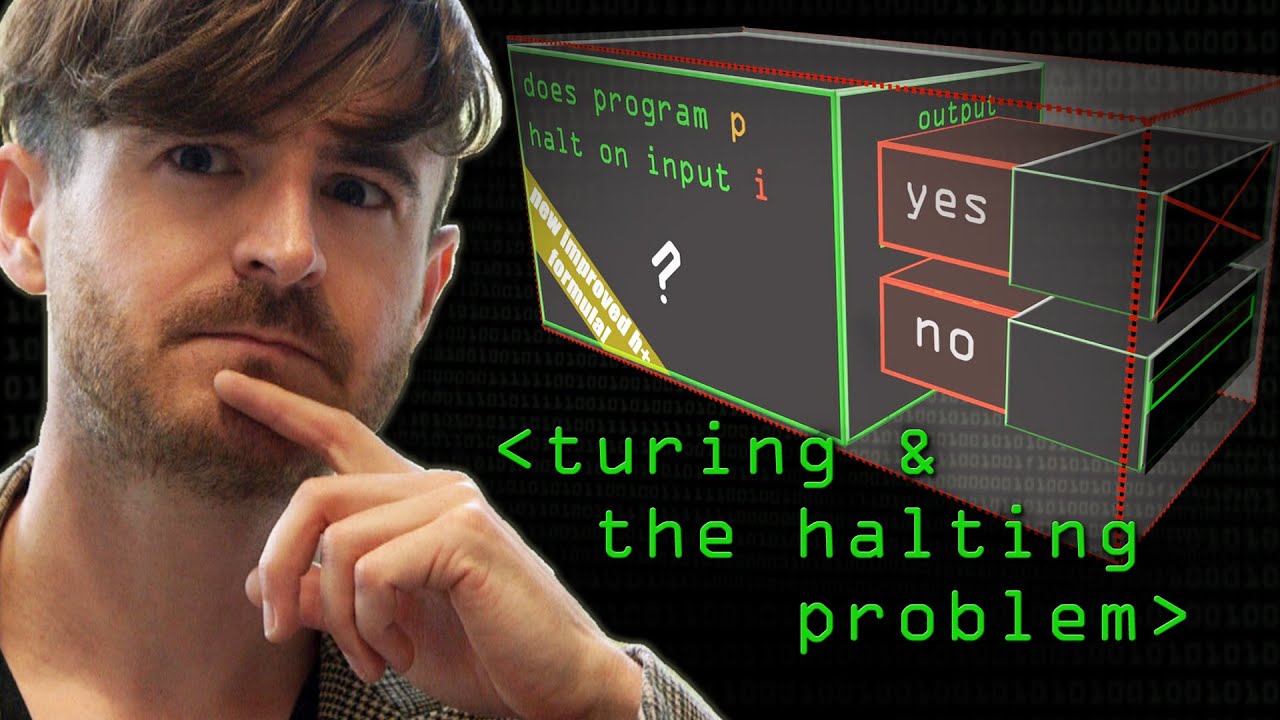
Alan Turing almost accidentally created the blueprint for the modern day digital computer. Here Mark Jago takes us through The Halting Problem.
Turing Machines Explained: https://youtu.be/dNRDvLACg5Q
Busy Beaver: https://youtu.be/CE8UhcyJS0I
VR Simulator: http://youtu.be/Lm0lA0enPSk
What on Earth is Recursion?: http://youtu.be/Mv9NEXX1VHc
T...
There are of course other models of computation (most famously lambda calculus), but they all turn out to be equivalent in power to Turing machines, a statement that goes by the name "Church–Turing thesis"
white fulcrum
halcyon glade
There are of course other models of computation (most famously lambda calculus),...
I'm aware of all of that, my hangup is on why tms can sometimes never halt. for example, in turing's paper, he puts forth a machine that writes the sequence 0010110111011110111110...
we could make a program that takes a number n and prints the nth digit of this sequence instead, which would always halt. same thing for computable numbers like pi and e. printing a result might go on forever, but it seems like figuring out the result doesn't have to. I feel like I'm missing something easy here, I used to know this really well
halcyon glade
white fulcrum
I'm aware of all of that, my hangup is on why tms can sometimes never halt. for ...
Okay tell me if this program halts for all integer inputs n > 0:
Input a number n. Set a counter to 0. Repeat the following until n=1: (If n is odd, calculate 3n+1 and then add 1 to the counter. If n is even, calculate n/2 and then add 1 to the counter.) Now output counter.
halcyon glade
You're welcome, halting is very confusing
white fulcrum
what if we insist that programs that don't terminate instead output -1 or smth like that?
we could say the collatz program exists we just don't know what it is
but we could still program the naive collatz machine couldn't we
so a program would have to know if it would halt which seems too meta
halcyon glade
If you want everything to always halt, you'd have to restrict the capabilities of the programming language, but then there will necessarily be programs that Turing machines can run but you can't
halcyon glade
white fulcrum
we could say the collatz program exists we just don't know what it is
If you don't know what the program is though, how do you execute it
It kind of defeats the point of having a program in the first place
One obvious thing you can do though is write a Turing machine as a "limit" of programs that always halt
Just run the Turing machine for n steps and output -1 if it hasn't halted yet; that gives you a sequence of programs for each n that always halt and get closer and closer to the output of your original program
That sort of method gets used a lot in computability research
white fulcrum
I think i'm asking for "what do we lose if we insist on halting? what sorts of problems can't we express or compute?"
actually I'm gonna think this thru for a bit and then come bacck
halcyon glade
It's a good question
Basically you lose the ability to describe in general sets of the form "{y: there exists x such that (some property of x and y)}"
Those are called Sigma1 sets
A lot of common things you might want to do fall under this category
For example checking whether a number is composite (y is composite iff there exists x1 and x2 such that x1 < y and x2 < y and x1 x2 = y)
In many cases there may be clever things you can do to get rid of the need for the "there exists" quantifier (for example, checking if a number is composite is possinle because you always only need to check a finite number of values for x1 and x2), but in general you can't always do that
"Arithmetical hierarchy" is a good search term here, it's basically a hierarchy of sets that get harder and harder to compute (also "recursive" vs "recursively enumerable" sets)
white fulcrum
my approach with my students is to start from "why don't we just make a supercomputer that can solve all math problems so we never have to learn math anymore?"
I think that's the best motivator for approaching halting and set theory madness
it's basically the irl motivation too
halcyon glade
Yea I think that is a very good question
white fulcrum
so it fits in nicely with historical narratives, and I love the chance to spruce up lessons with things like that
halcyon glade
That sounds like a great throughline for a lesson
Oh here's a good example of something you need halting to be able to compute
You can write a program that, given an input program, will halt and return "YES" if the input program does and will not halt (interpret running forever as a "NO") if the input program doesn't. (Just run the input program.) So in this sense, a program that's allowed to run forever can "solve the halting problem". But one that is guaranteed to always halt can't. So the set of programs that halt is recursively enumerable but not recursive. There's a good number of these types of sets.
 drowsy otter
I have a question. I am doing a side hustle, where I am tutoring an aspiring Data Science student who struggles with mathematics. They are studying degree-prep level Mathematics, but they struggle with a GCSE topic related to factorizing quadratic equations.
So far, I have taught them to use the quadratic formula to find the values of $x_i$ and then express the original function as products of $(x - x_i)$, but this only applies when the coefficient of $x^2$ (which I will call $a$) is equal to 1.
However, when $a$ is not equal to 1 (denoted $a \neq 1$), it doesn't work. I have attached three slides in the form of images (since attaching a Google Slides presentation is technically against the rules) explaining this concept.
Please could you advise me on what I should do to get the student to understand. The student is in their 40's (so much older than me), and this is my first time teaching someone of that age despite having 3 years' experience teaching students younger than me.
 burnt vesselBOT
Kardashiana7
 drowsy otter


Another thing. You may have noticed that the third slide isn't complete. This is because I am struggling to explain why the technique on the second slide works.
drowsy otter
burnt vessel
**Kardashiana7**
Also, I get my words jumbled up sometimes due to having a communication disorder (hence my use of these slides during lessons). I mean screenshots, as opposed to images.
Reference: "I have attached three slides in the form of screenshots"
turbid zenith
There are a few things you might do in such a case
One thing you might want to look for is the “box method” or “area model”
drowsy otter
I'll try the former technique. Thank you very much.
The Box Method (which is the same as the Area model) is actually quite simple, but I'll read up on it anyway to make sure I'm teaching that correctly.
midnight scarab
drowsy otter
Isn't it more natural to say that a polynomial is determined by its roots up to an overall prefactor
And it's clear, looking at the x^2 term when you expand, that the correct expression is a(x-x1)(x-x2)
 marsh compass
drowsy otter
I have a question. I am doing a side hustle, where I am tutoring an aspiring Dat...
marsh compass
drowsy otter
I have a question. I am doing a side hustle, where I am tutoring an aspiring Dat...
Even if the coefficient of x^2 is not 1, you can still get non-integer solutions
drowsy otter
I mean, I am able to factor out the value of $a$, to form $a(x^2 + (b/a)x + c/a)$, but we're talking about someone who isn't a school leaver whom I have only just started tutoring, so it's best I stick to how to get to integer solutions, otherwise they will get confused.
burnt vesselBOT
Kardashiana7
 drowsy otter
marsh compass
Even if the coefficient of x^2 is not 1, you can still get non-integer solutions
drowsy otter
marsh compass
Even if the coefficient of x^2 is not 1, you can still get non-integer solutions
In summary, while I acknowledge that what you say is mathematically correct, I don't think my student will quite get it yet.
midnight scarab
I don't understand how telling your student that "when a neq 1..." instead of just telling them that solutions don't have to be integers is helpful or even less confusing
drowsy otter
It's OK to not understand. I too am beginning to question it. Perhaps I am going about it the wrong way. I'm going to try to change my mindset that "simple first is always good" and not be afraid to delve into more complicated stuff so that it's easier in the long term. After all, my student is, as I said this morning, in their 40's.
marsh compass
I just worry that it might be misleading, attributing "fractional" solutions to non-unit leading coefficients
drowsy otter
To be fair, I'm happy that my way of thinking is being challenged, because that's a sign of me becoming not a good, but a great tutor in the long term.
I've figured it out. Thank you. I'm just glad that the solution to my issue was simple.
midnight scarab
drowsy otter
It's OK to not understand. I too am beginning to question it. Perhaps I am going...
Yeah, I think it's very important not to be misleading. To quote Einstein (😛), "Make it as simple as possible, but not simpler."
drowsy otter
midnight scarab
Yeah, I think it's very important not to be misleading. To quote Einstein (😛), ...
Thanks.
white fulcrum
I'm trying to understand graham's number better to show it to my students, because it's one of the easier big numbers to explain. are there visual examples of various colorings of low dimensions that do and don't contain a single-coloured complete subgraph on four coplanar vertices?
alternatively, are there other big numbers that are easy to explain how big they are?
tawny slate
pedagogy relating to big numbers is an area i'm actively working with right now in my drafts. could you provide some more background as to what your goals are and what you're trying to accomplish with this?
because the main issue with introducing large numbers is 1. it's mostly not useful or practical 2. it leads to misconceptions about mathematics 3. students with low math competency don't know how to appreciate just how massive some of these numbers are, so just telling them this number is huge is underselling it. you don't need to go that far just to have them appreciate big things
and the issue with graham's number specifically is that it is an exceedingly loose upper bound on a problem that has long since been improved on. its appearance in a math paper is socially derived rather than being something inherent about math itself, which makes it harder to justify it being meaningful
white fulcrum
my students are gradeschoolers and highschoolers. I usually save 5-10 min at the end of a session for exploring fascinating but unrelated math concepts. past things include collatz, other open number theory conjectures, https://en.wikipedia.org/wiki/Chomp (and the proof that player 1 wins), the mandelbrot set, and so on
tawny slate
so idk how much you can cover in 5-10 min, this kind of thing is difficult to squeeze in a reasonable amount of time, because of the meta-issue of students not having the intuition framework for understanding large numbers
if you can do a multi-part sort of thing, there are two approaches I think you can take here. you can do a from core principles approach by explaining growth rates of functions, how they apply to the real world, so they can build some intuition and appreciation before going to bigger stuff, or you can just throw them the wild stuff one by one and tease them
so if say you're doing the tease approach, perhaps goodstein sequences are a little bit more accessible, because rather than throwing the students large numbers immediately, you can show them where they may come up in a natural sounding math question
first walk them through how this sequence actually works, using some basic small examples. in fact, i would say probably don't even use hereditary-base notation, just use normal base notation first. then show the smallest example that appears to explode. ask "do you think this sequence goes on forever or stop at some point? what about if started with [some large number]?" most students should reasonably assume the sequence goes on forever here, or at least for some large enough n
then hit them with the "actually all of these sequences are finite, no matter how big a finite n you start with". then you can show them the hereditary-base notation and ask them if now the sequence goes on forever, show them just how much more aggressive the growth rate potentially is, then ask the same question, give the same answer
then to summarize, tell them that in order to prove that no matter what number you start with, that the seqeunce is always finite, you need to use concepts involving infinity. so understanding infinity can sometimes be necessary to better understand finite structures. this gives them an example of an unexpected use case for large numbers, while priming them for potentially going into like infinite ordinals or something later on
white fulcrum
I also taught the hydra as an alternative to goodstein
Same idea, counting with ordinals
tawny slate
if you're doing the core fundamentals approach, i would say they should first learn how growth rates of functions are dominated, that n^2 always outgrows n, what that means
then one layer at a time, explain examples of things that grow linearly, things that grow quadratically, things that grow cubically, things that grow exponentially, and then actually explicitly compare them to hone that intuition. for instance, the rice grains on the chessboard problem demonstrates how exponential > cubic growth (because physical space is cubic), the fact that a well-shuffled deck of playing cards will never see the same order twice, ever (factorial > polynomial > quadratic, because number of seen orderings is time * num of people). this can extend to real world applications, like showing why multi-level marketing is doomed to be unsustainable
once they have a core understanding of growth rates, they are ready to tackle bigger things. challenge the students to write down the largest number they can think of on a small sheet of paper in a short amount of time. now if you introduce to them, say, the slow-growing, fast-growing, or Hardy hierarchy of functions, you can point to where each of these functions live on the hierarchy. for instance, if you show that on the fast-growing hierarchy, f2, is already exponential, then f3 is stupidly massive already. compare some of their answers to values on this hierarchy, and almost certainly their answers are going to be on the "order" of f3
obviously you can go into omega and beyond here, but i think just giving them this much is already enough to get them excited, they'll start doing recusive nestings of the fast-growing hierarchy or something, thinking it's clever, but then you just show them that just ticking the base number/input by 1 already achieves this clever thing they're doing, and they'll realize just how powerful the hierarchy is
tawny slate
white fulcrum
I also taught the hydra as an alternative to goodstein
in my opinion and experience i find goodstein is cleaner than hydra when it comes to connecting to ordinals and the math behind it. the hydra makes for a better story obviously, but more difficult to work out the math, it's more obtuse. so i usually start with goodstein
but ultimately i just think this kind of thing is not plausible to do in a 5-10 min interval, probably needs to be multi-parted at least
even defining the big numbers take like 5-10 min
white fulcrum
maybe I'll do a short intro to encryption. since today is valentine's, I'll make it about texting your secret crush to your bestie
halcyon glade
That's such a good idea
 sacred skiff
Hiii everyone!! I'm new to this chat, so please forgive me if this kind of question has been asked many times before :((.
I'm running a 2-hour uni tutorial (for me, this looks like a classroom of students, maybe 10/15 or so, and a whiteboard for the tutor) this semester. I'm given a worksheet of problems to go through as well! I'm wondering what the best way to get through the worksheet is
I'm new to teaching, so I'd appreciate any suggestions!! My biggest fear is it being a little dry if I'm the one talking most of the time. Is it a good idea to ask students to work on the problems first?
My experience so far has been that I then walk around to help anyone that needs it. But often, everyone is busy trying and no one asks for help
There are lots of times I ask for students to recall definitions, or results, but I get lots of silence in return
halcyon glade
If you're having difficulty getting engagement, sometimes it helps to prompt them to talk about the question with their neighbor
tight star
sacred skiff
There are lots of times I ask for students to recall definitions, or results, bu...
idk if this is the best advice but i always try to call the students' bluff with this
halcyon glade
Even something as simple as bringing desks together into groups if possible can help
tight star
like if i ask a Q, i will not continue until someone gives an answer
halcyon glade
Yeah use silence to your advantage
They are more scared of awkward silence than you
sacred skiff
halcyon glade
If you're having difficulty getting engagement, sometimes it helps to prompt the...
Thank you!! Is there something I should do in the meantime??
sacred skiff
tight star
idk if this is the best advice but i always try to call the students' bluff with...
I'm so curious what you mean by that haha!
tight star
the thing is, if you ask a Q, wait a bit, and then continue without anyone giving an answer
then the students know that they can get away with not answering
halcyon glade
sacred skiff
Thank you!! Is there something I should do in the meantime??
You can go around groups and see if they have questions, you don't have to be active 100% of the time though, often it's good to give students space to think and talk
It's really about their learning after all
sacred skiff
tight star
then the students know that they can get away with not answering
I don't quite understand, because you'd have to continue at some point right??
halcyon glade
sacred skiff
I don't quite understand, because you'd have to continue at some point right??
You don't have to do anything
tight star
yes, when someone answers the Q
halcyon glade
If the students don't say anything, it's their time that they're taking up, you still get paid the same haha
Obviously make sure that they understand what you're asking though, sometimes a question can be unclear
sacred skiff
Do you go through the problem in detail after they have a think?? I'm not sure how you'd get the feel for if the students will get bored from it
halcyon glade
If you're having trouble getting engagement, invite one of the students up to the board to explain the problem, or if that's too much commitment, have the students take turns explaining the steps
That way your role is minimized to just facilitating and supporting the students, and the students are forced to demonstrate their mastery
sacred skiff
halcyon glade
If you're having trouble getting engagement, invite one of the students up to th...
I like that so much!!
halcyon glade
These are all just different strategies you can try, not rules; what works best will differ from classroom to classroom
sacred skiff
For the first class, is it typical to do a self introduction, or an intro to the course?
And for the last class, doing a "where to go from here" kind of thing?
halcyon glade
Yes to both
I also have students make nametags and introduce themselves for the first class
sacred skiff
I've had tutors in my earlier courses do this, but in later courses, they stopped!
halcyon glade
The further you go in math, the more the teaching quality drops tbh
Persistent weird problem with mathematical culture
sacred skiff
Thank you so much for your suggestions @halcyon glade @tight star . I'll give it a try!
halcyon glade
Yw
tall bolt
halcyon glade
If the students don't say anything, it's their time that they're taking up, you ...
I need to get better at this. What I’m giving this semester is supposed to be supervisions, not a support class like last sem, but I often end up basically lecturing, especially with one of my groups, because they just refuse to talk
halcyon glade
Lecturing can be good, it just depends on the situation
tall bolt
Yeah it definitely works well sometimes, like I spoke about how to actually come up with and then write an epsilon delta proof the other week which seemed to work very well. But sometimes I just want to go through some problems, and it ends up with me just saying “ok cool give it a go then we can talk about it in 5-10 minutes” and no one seems to do anything and I just give them the answer
Which works but like, it’s not a productive use of anyone’s time, and I have made that point lol
 white fulcrum
^ From smbc ofc
turbid zenith
halcyon glade
I also have students make nametags and introduce themselves for the first class
I like having the students introduce each other!
turbid zenith
tall bolt
Yeah it definitely works well sometimes, like I spoke about how to actually come...
I feel this
white fulcrum
explaining why a neg minus a neg becomes add a pos is still tricky for me
halcyon glade
white fulcrum
explaining why a neg minus a neg becomes add a pos is still tricky for me
First the first neg doesn't matter so I would abstract to "why is minus a negative the same as plus a positive?" And then I would try to rephrase the minus into a plus and give some concrete numbers. So for example why does 7 - 4 = 3? It's because 7 = 3 + 4. So why does 7 - (-4) = 11? It's because 7 = 11 - 4. So subtracting a minus gives us the same thing as adding a positive. The same applies if the first number is negative too, since it doesn't matter in our argument.
turbid zenith
I really like doing it using tokens or "piles and holes"
If you're trying to show that 7 - (-4) = 11, you can start off with 7 positive tokens:
(+) (+) (+) (+) (+) (+) (+)
Then you want to take away 4 negative tokens ... but you don't have any! But you can always add zero pairs without changing the total value:
(+) (+) (+) (+) (+) (+) (+) (+) (+) (+) (+)
                            (-) (-) (-) (-)
Now you can take away 4 negative tokens:
(+) (+) (+) (+) (+) (+) (+) (+) (+) (+) (+)
And voilà, your result is 11. In order to take away 4 negatives, we had to introduce 4 zero pairs, so we end up with 7 + 4 positives.
white fulcrum
omg I like it
tawny slate
a weaker way to tackle that is to treat numbers as positions on a number line
you add by shifting right, you subtract by doing the opposite, the inverse, shifting left. in this way, the negative is treated as a "direction flip". so subtracting a negative is like taking a left shift and flipping it, shifting right
this is admittedly weaker than the other explanations but i think for completeness sake, i think it's good to mention, because while the other explanations are very good at explaining why the phenomenon is true, this visualization is imo more practical and easier to use when doing calculations
tawny slate
halcyon glade
The further you go in math, the more the teaching quality drops tbh
is it appropriate to start a conversation on this? because i have some of my own hypotheses as to why this might be the case and im curious what others think
halcyon glade
tawny slate
is it appropriate to start a conversation on this? because i have some of my own...
Sure
(I am not a mod though)
tawny slate
so some of my hunches are as follows:
- for early education, teachers don't need to be exceedingly well-versed in math, their main focus is general education, which makes them more informed teachers in the general sense (compared to some professors who are there not to teach but to do research)
- the easier the math concepts, the easier it is to find hands-on activities and practical applications. its easy to motivate why we care about 3+4, its harder to motivate the intermediate value theorem
- math is one of those subjects that requires and depends on prerequisites more than other subjects, so its harder for teachers to keep up when the students are at different levels
- for the individual, often times it is easier to just do math for the sake of math, without too much regard for practical use or purpose, but many students need motivation. and so the ones who are very good at math may be unable to adequately provide this motivation, but they are the ones who are most proficient at math and therefore teach it
wonder if anyone else agrees/disagrees or even has academic support for or against any of these
white fulcrum
a month or so ago I had someone ask why long division worked...
I work at a place that has premade worksheets/problems that guide you thru things so luckily that was handled
I know how to explain it just not how to explain it quickly
turbid zenith
tawny slate
wonder if anyone else agrees/disagrees or even has academic support for or again...
I agree with pretty much all of it
With the caveat that I don't think everything needs a "practical" application
In the "it'll help you paint your fence next Tuesday" sense of practical
I also think it's worth pushing back against the narrative that in order for something to be worth learning it needs to be "practical" ... if you learn to play chess or Fortnite, it's not because you're going to find a "use" for it ... but of course the fact that you're not graded on either of those leads to some incentive problems
All this to say, there are lots of possible motivations, and practicality is oversold but it's only one of them
 rapid tusk
turbid zenith
I also think it's worth pushing back against the narrative that in order for som...
rapid tusk
turbid zenith
I also think it's worth pushing back against the narrative that in order for som...
I always remember that one line from lockhart’s lament about the beauty of math being how irrelevant to our everyday lives it can be
halcyon glade
tawny slate
so some of my hunches are as follows:
- for early education, teachers don't need...
I will say there is also a cultural/structural component—in academia, teaching is often seen as a chore rather than an interesting task, and even if you are interested in it, it's not required or even difficult to find proper training on how to teach in the first place
On the contrary, more introductory subjects like calculus are more likely to be assigned to permanent lecturers instead of research staff
tawny slate
turbid zenith
All this to say, there are lots of possible motivations, and practicality is ove...
i dont disagree, but the point is that it doesn't help the students. they will then just ask "so why should we even waste our time learning this?" and then it makes answering this question harder, not because you cant answer it but because now the explanation is long-winded, esoteric, tedious, confusing
vestal tangle
white fulcrum
explaining why a neg minus a neg becomes add a pos is still tricky for me
i like to say that the positive integers represent piles of marbles (or whatever) made out of matter and that the negative integers represent piles of marbles made out of antimatter.
7 + (-4) means 7 matter marbles plus 4 antimatter marbles. the 4 antimatter marbles annihilate 4 of the matter marbles leaving you with 3 matter marbles.
so adding 4 antimatter marbles to the pile is functionally equivalent to taking away 4 matter marbles. with that as motivation we can define a - b to be a shorthand for a + (-b)
once you know that subtraction isn't a fundamental operation and is really just a shorthand for a certain kind of addition i don't think it gives students much trouble
i like @turbid zenith's approach, i think it fits in nicely with the matter antimatter picture. we can add as many antimatter marbles to the pile as we want as long as they're balanced by an equal number of matter marbles, because this is equivalent to adding nothing, and then we can think of "taking away" the antimatter marbles
turbid zenith
tawny slate
i dont disagree, but the point is that it doesn't help the students. they will t...
I disagree that it doesn’t help the students
One big example being that sometimes you learn math because it ties the other math you’ve learned together
I don’t think dividing polynomials is particularly useful on its own, although some of the things it eventually leads to can be probably
But pointing out that it’s just like what you already did with fractions can be a motivation for why you’re learning it
You can probably also throw in something about it being like weight training for your brain… I’ve told my students before that I don’t actually care if ten years from now they’ve forgotten some random formula, but if they remember how to think through a problem, break it down, look for patterns, etc, then I’ve done my job
tall bolt
Why do anything
turbid zenith

Tufts mathematics professor Christoph Börgers discusses what he believes to be the greatest obstacle to effective mathematics instruction in the United States, drawing from his decades of experience teaching mathematics at several universities. He suggests an unexpected approach to improving mathematics education. Christoph Börgers grew up in ...
tawny slate
turbid zenith
I disagree that it doesn’t help the students
no i mean it doesn't help some of them get motivated
why should we learn fractions?
so that you can learn algebra!
why should we learn algebra?
so you can do trig!
why should we learn trig?
so you can do calculus?
why should we learn calculus?
so you can do multidimensional calculus!
for many students, this will just frustrate them, and you lose trust rather than gain trust. again, i understand the "beauty" of not needing to be practical, doing math for the sake of math, im simply saying that this wont satisfy some students
you can say "it helps problem solving in the abstract", and this is an infinitely better answer you can give from the start that is independent of the point that math can be "detached from reality"
ah whoops this response is blending in someone else's comment too so im taking your point a bit out of context, sorry
anyways the point is typically when students ask why we do math at all, the three biggest answers i give are:
- less likely to be scammed/exploited as you get older
- helps keep your mind active and brain healthy, which also keeps physical body healthy
- helps with problem solving
my answer would never be anything remotely of the form or close to "dont worry about that, just do math for the sake of math, devoid of practicality [in the sense we described it]" unless we were specifically addressing this idea in context
tall bolt
I dont think doing it for the sake of doing it bad though, and I think with context its perfectly ok to say that sometimes we do maths just to do maths. Like youre points are very valid and where id start, but like, we dont need to make up reasons for doing art. We study art because its beautiful, and important as part of a broad education, its part of being human. I dont really understand why maths is the one subject that seems to need to constantly justify its existence with practical application. Its not a complaint I think ive ever really seen directed at any other subject in school (beyond people broadly complaining about needing to go to school at all)
tawny slate
again, fully agreed. but i have had multiple students argue very passionately with me that math is not art
to some extent i can understand why they feel that way, but if i have to explain multiple ideas all in one go:
- math is art
- math doesn't have to be practical
this just makes me look crazy. if i explain one at a time, not convincing unless i can isolate one idea at a time
turbid zenith
tawny slate
no i mean it doesn't help some of them get motivated
> why should we learn frac...
I don’t think that’s what I was saying
I was thinking of it the other way around. Why learn algebra? It explains why fractions work. Among other reasons sure. But what I’m saying is that this is ONE motivation.
turbid zenith
tawny slate
anyways the point is typically when students ask why we do math at all, the thre...
I agree with all of this too
But what I’m saying is that there are some lessons where I’m not going to be able to give a clean practical application of it
And absent those clean practical applications, one possible thing that may help depending on the lesson is, well it ties together some of what you’ve previously learned
I’m not going to claim that polynomial multiplication will help you build a better bridge or whatever, no matter what contrived examples the textbooks use
(I guess I could throw in some hand wavy stuff about Bézier curves)
But I would love my students to walk away thinking polynomials sure are a whole lot like integers, with a lot of uncanny parallels
Any time I CAN give a practical application I’m going to obviously, but sometimes trying to come up with one becomes really ham-fisted 😛
midnight scarab
Also, giving a contrived practical application is likely to backfire
 severe moon
assume i ever have the chance to teach a linear algebra class in the future, a typical first course.
should i change the order of how stuff is taught generally?
tall bolt
That’s a pretty vague question
There’s some things that probably could be quite fluid and others that aren’t
turbid zenith
midnight scarab
Also, giving a contrived practical application is likely to backfire
This, 100%
Dan Meyer has given some great examples of "pseudocontext"
turbid zenith
severe moon
assume i ever have the chance to teach a linear algebra class in the future, a t...
It's up to what your goals are for the course
Shuffling the order of topics is certainly a nice freedom to have, but you should have a clear reason for doing so, and you should be ready to defend why it'll help the students learn it better
severe moon
turbid zenith
It's up to what your goals are for the course
we want some computation ofcourse, i would assume the ones taking this class are stems majors that aren't math majors.
but at the same time, having matrices be introduced without at least spending a class going over linear transformations is downright criminal.
also change of basis is a MUST, it is insane that i went through a linear algebra class that did not cover change of basis at all, it would make diagonalization so much simpler to understand.
i should at the very start discuss vectors and their properties
for the most part, this class would focus on R^n, i can't assume i would be able to cover vector spaces
and honestly, going over guassien elemenation at the very start should still be okey, but it will not be introduced with Ax = b.
determinants should be included, but the usual presentation seen in conventional linear algebra classes should be scraped, it doesn't make sense.
also stuff like the coffactor formula for inverse matrices and Cramer rule should be removed.
so maybe something like this
1-guassien elemenation
2-vectors and 3d geometry 3-linear transformations
4-matrices
5-inverse
6-determinant
7-spanning sets
8-subspace
9-basis and dimension
10-change of basis 11-eigenvectors and eigenvalues
12-inner product in R^n and orthogonality
13-gram schmidt process and orthonormal basis
14- least squares
 tawny shard
I've been a math tutor for almost nine years. I have over 4000 billed hours on Wyzant. I am always trying to improve what I do to better serve math and physics students. I don't want to overthink teaching the times table, but I definitely don't want to underthink it. What kinds of counter-intuitive thinking do you find has helped you working with a student one on one?
quasi maple
I've forgotten who it was who suggested this, it was some speed-calculator person who also apparently coaches; but in some video he'd suggested that the times-tables up to 10x can in practice boil down to having to memorise 6x7 = 42, 6x8 = 48 and 7x8 = 56
Found the name -> Arthur Benjamin
tawny shard
I do tend to focus on the multiples of seven. I didn't have research saying do more drills on 7's.
tawny shard
What was your most effective undergraduate course for teaching you to write rigorous proofs? For me, it was MTH320 at Michigan State, Real Analysis I. As I tutor proof writing techniques at different levels, I find myself repeatedly asking myself what unspoken rules of proof I am not bringing up.
rapid tusk
quasi maple
I've forgotten who it was who suggested this, it was some speed-calculator perso...
anecdotally it was always the 7s that gave me the most trouble when i was memorizing times tables way back when
in terms of rapid recall
halcyon glade
severe moon
we want some computation ofcourse, i would assume the ones taking this class are...
Sorry I feel like I'm missing something, aren't there tons of linear algebra books that discuss linear algebra in R^n, introduce the idea of a linear transformation later on, etc.? This sounds more or less how my first linear algebra class went
Why not follow a linear algebra textbook geared toward applied math
white fulcrum
I'd like examples of pi showing up in unexpected places, but for kids who don't yet know about euler's formula bc they don't know e or i
the leibniz formula for pi/4 converges too slowly to illustrate the point, same with the pi squared over six series
white fulcrum
I also know about buffon's needle but I don't have time to try that out experimentally
 tardy lynx
How would you guys go about teaching an intro to complex numbers? The lesson is supposed to be ca 1 hour and meant for high school students
rapid tusk
whats their assumed knowledge and what context
id cover first the simple case of quadratics with negative discriminant and then some basic complex plane stuff (vector analogue)
and then at least state fundamental theorem of algebra?
depending on what background the students have you could also touch on multiplication/division and how to interpret geometrically
but that requires at least some trig background
and at that point de moivre/exponential form might be a bit out of scope
turbid zenith
You can teach that multiplying by i is rotation by 90 degrees without going full trig
That one little fact carries so much intuition that it opens up complex numbers
I also like to frame it in terms of alternating current for a real world application
Yeah you can’t have “i apples” in your hand, but that’s not what complex numbers are good at — they’re good at describing rotation and fluctuation
I think students would find that take more compelling than “we took a useless problem with no solution and made up an answer anyway” lol
tight star
tardy lynx
How would you guys go about teaching an intro to complex numbers? The lesson is ...
I like teaching them via yoneda
plain valve
Lol
tawny slate
one of the major issues with this topic ive found is students tend to think that real numbers are real, imaginary numbers are fake, and complex numbers are complicated, due to the names
to dispel these myths, i like to demonstrate how all numbers are kind of made up to begin with. we don't say that fractional values or negative values dont exist just because we cant have that amount of people. numbers are useful as long as any kind of useful structure can map onto them, and are equally made up in this way
in this way, i think another utility point to mention, although too complicated to go into full details, is that complex numbers are closed under exponentiation
probably also important to explain to students that 0 is the only number that is real, imaginary, and complex, and visualize this on the complex plane
 brave wave
tawny slate
probably also important to explain to students that 0 is the only number that is...
brave wave
tawny slate
probably also important to explain to students that 0 is the only number that is...
yeah showing 0 as the intersection on the plane makes it click for kids
tawny slate
additionally, once you show the analogy between the real line and the complex plane, it helps to mention how multiplication and division work visually, as someone here mentioned, but if you want to fit it into an hour with students who may have varying skill levels and backgrounds, here are some ways i recommend framing it:
- to explain addition and multiplication visually, it helps to first demonstrate how it works on the real number line, because students need to get comfortable with the idea of treating a number as a transformation as well as something geometric and visual. show that addition is translation and multiplication is scaling, THEN use this: https://m.youtube.com/watch?v=-dhHrg-KbJ0&pp=ygUabWF0aG9sb2dlciBjb21wbGV4IG11bWJlcnM%3D (at 9:20)

NEW (Christmas 2019). Two ways to support Mathologer
Mathologer Patreon: https://www.patreon.com/mathologer
Mathologer PayPal: paypal.me/mathologer
(see the Patreon page for details)
For this Christmas video the Mathologer sets out to explain Euler's identity e to the pi i = -1, the most beautiful identity in math to our clueless friend Homer...
this will explain how rotation works, and this derivation doesn't involve trig at all
make sure to emphasize that the "stretching focal point" is always at 1
- once students understand that complex numbers are essentially "2D" numbers, now you can demonstrate the usefulness of them, a few practical applications. show that the geometric interpretations make calculations involving sliding, rotating, and stretching images almost trivialized. show that the two attributes of polar form, mag and arg, can be mapped onto amplitude and phase of a wave (both arg and phase have a cyclically repeating property)
and honestly, i think if stretched on time, you can handwave a lot of things, i dont think students need a rigorous explanation of everything at this point, they just need to orient themselves in the generally right direction
tardy lynx
Thank you guys so much for the tips! I'll keep all the above in mind when teaching
tawny slate
oh couple more points i just remembered
i literally use a nonstandard notation for polar form complex numbers:
$$r \angle \theta$$
burnt vesselBOT
Cozmogrgdfschkipkhrshtensi
 tawny slate
i find this is just more convenient than using e^it or cis, both being shorter and carrying less baggage
so now it becomes very easy to state the product rule:
$$(r_1 \angle \theta_1 ) (r_2 \angle \theta_2 ) = r_1 r_2 \angle (\theta_1 + \theta_2 )$$
burnt vesselBOT
Cozmogrgdfschkipkhrshtensi
 tawny slate
if they know trig, they may appreciate that translating this equation to rectangular gives the trig sum identities, one of the nastiest identities to memorize and intuit, for free
 rigid coral
Hey guys, I would love some feedback on this video, it's a geometric visualization of the Euclidean algorithm
https://youtu.be/Zi6aTbVN1sM
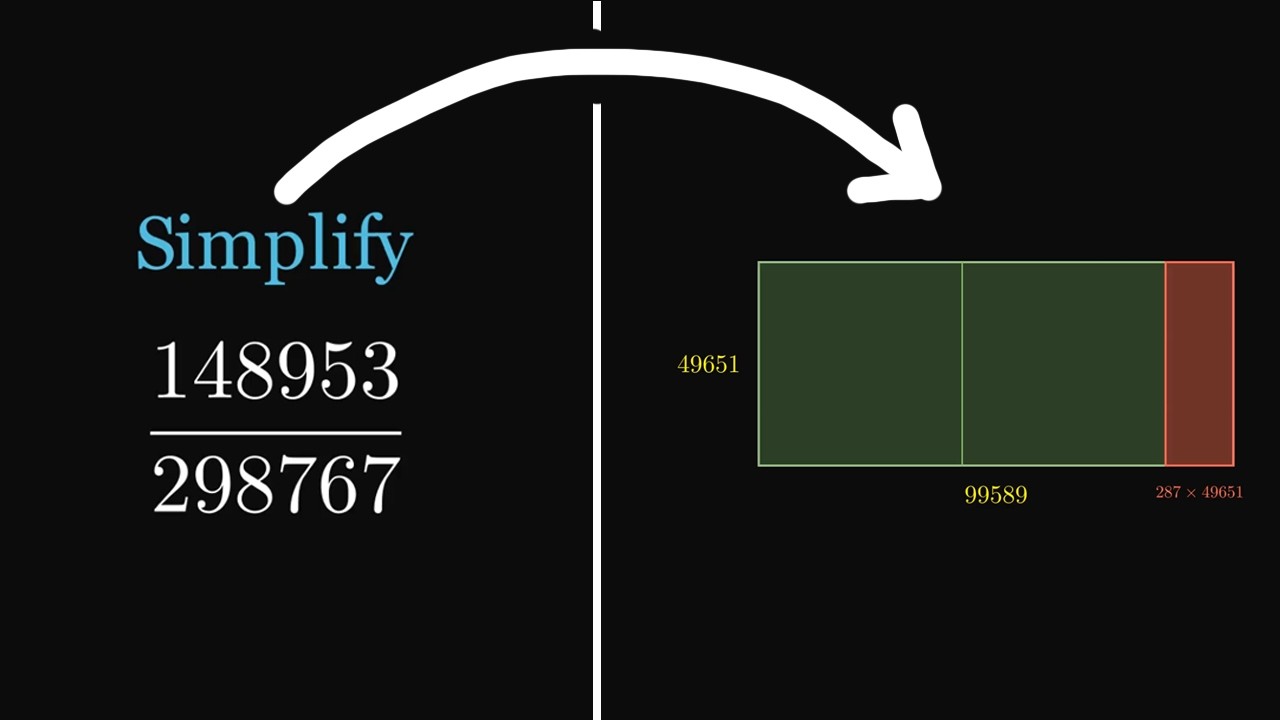
Thanks for watching! This is my first video so I would appreciate any feedback in the comments below!
Music Credits:
Home and Memory from Undertale
Dire Dire Docks Piano Cover by Pianomedic
Moon Men remix by Alex Pyne
Gym Leader Battle from Pokemon Sword/Shield
City of Tears from Hollow Knight
tawny slate
cadence is slightly weird in a few places, where there is actually less pause where there is a period than where there are commas. when taking splices of your recordings and throwing them into the video editor, its very easy to just jam them together, but often this results in cramped pacing, feels unnatural, a bit harder to follow. give the audience a little space to just digest what they just saw and heard, even if its half a second
i think from the viewer's perspective, it may not be entirely obvious why the 3x3's must always tile the original 9x9's, if we were to extend this arbitrarily. its not so easy to visualize this as cleanly for complex examples, and the logic for why this property must hold is not that self-evident
comparing it to the algorithmic view of the euclidean algorithm, this may lose some viewers, because while some viewers might recognize the euclidean algorithm, many might not, and that table just looks obtuse and confusing
additionally, the target audience, someone who struggles to solve the teaser problem in the beginning of the video, is likely to be someone who doesn't know what the euclidean algorithm is, imo
i would be careful of saying "this is the answer" before the actual answer of the original question is solved, because this is a common mistake students will make, solving a major step and assuming the problem is solved, and writing a wrong answer. doing it this way causes a moment of cognitive dissonance; "wait what? i thought that was just gcd"
also in these videos, it helps to go the extra mile to visualize something if you can do it. for example, the last example shows the visualization for the two big squares but then does not show the animations for the smaller squares, even though you had this in the 9/30 example. anywhere where you can just put in a bit of extra work to show something more clearly goes a long way
suddenly introducing finding the gcd as a problem about rectangles might be surprising, yes, but the viewer may be feeling more overwhelmed rather than less. they already found finding the gcd to be intimidating, and now they are being thrown geometry where they dont immediately see any connection.
i think the core point here is that 1) there is an easy way to do this, but 2) its not that easy to understand why this easy way works, and 3) most importantly, this geometric intuition makes this complicated obtuse thing simpler
im not sure I got a feel for any of these three main points in sequence before being introduced to this seemingly irrelevant geometry thing i now have to concern myself with. laying this out more clearly i think would help immensely
and i think my final point might be that if you have a single tiny thing on the screen and nothing else, make it a bit bigger and fill the screen a bit, both for visibility and accessibility. this isnt a whiteboard, people sometimes watch these on their tiny phone screens, use that space
good concept though, and if this is your first attempt at a video its a good one, good luck!
rigid coral
Thank you so much for the detailed feedback, how was the audio btw?
tawny slate
audio is mostly fine i think, not much to say there personally
white fulcrum
rigid coral
Hey guys, I would love some feedback on this video, it's a geometric visualizati...
I am not sure the motivation works very well as I think that's a strange seemingly-out-of-nowhere quesiton even tho it appears on the exam. the visuals are quite nice
white fulcrum
white fulcrum
I'd like examples of pi showing up in unexpected places, but for kids who don't ...
re-upping this one cuz I didn't get responses
white fulcrum
white fulcrum
the leibniz formula for pi/4 converges too slowly to illustrate the point, same ...
halcyon glade
white fulcrum
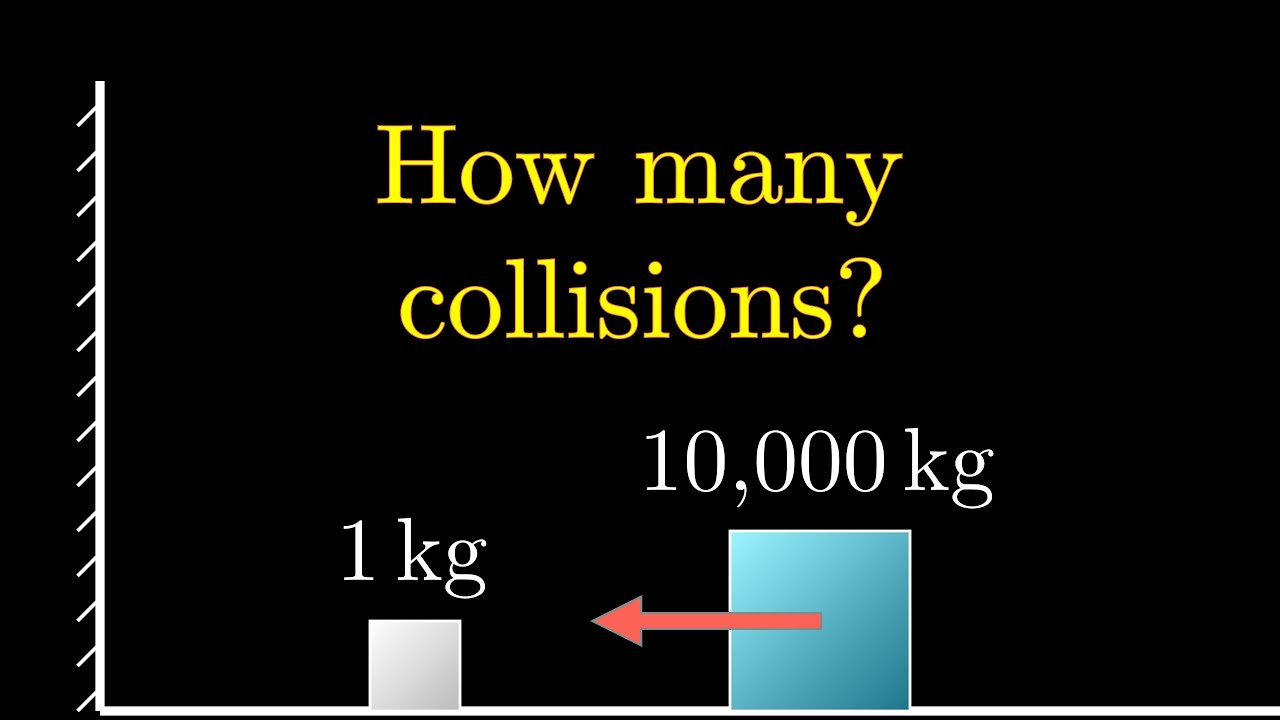
Solution: https://youtu.be/6dTyOl1fmDo
Light-based solution: https://youtu.be/brU5yLm9DZM
Help fund future projects: https://www.patreon.com/3blue1brown
An equally valuable form of support is to simply share some of the videos.
Special thanks to these supporters: http://3b1b.co/clacks-thanks
New to this channel? It's all about teaching math vi...

Where's the circle? And how does it relate to where e^(-x^2) comes from?Help fund future projects: https://www.patreon.com/3blue1brown
Special thanks to these supporters: https://www.3blue1brown.com/lessons/gaussian-integral#thanks
An equally valuable form of support is to simply share the videos.
The artwork in this video is by Kurt Bruns, who...
turbid zenith
tawny slate
i literally use a nonstandard notation for polar form complex numbers:
I use this too!
 lime turret
to this day i don't know what the number pi really means
turbid zenith
Exact same notation!
lime turret
i don't believe it's just about circles anymore
halcyon glade
lime turret
to this day i don't know what the number pi really means
It's half of tau
halcyon glade
lime turret
i don't believe it's just about circles anymore
I think it is all about circles, circles are just really important
lime turret
what about the root pi in the gamma function?
halcyon glade
Oh yeah here's another 3b1b video about pi and finding the secret circle lol he does a lot of these https://www.youtube.com/watch?v=8GPy_UMV-08

A geometric proof of a famous Wallis product for pi.
Help fund future projects: https://www.patreon.com/3blue1brown
An equally valuable form of support is to simply share some of the videos.
Special thanks to these supporters: http://3b1b.co/wallis-thanks
If you want to dive into the relevant ideas required to make this proof more rigorous, the...
halcyon glade
lime turret
what about the root pi in the gamma function?
it's because you get a gaussian integral and gaussians are spherically symmetric (see the 3b1b video above about the normal distribution formula)
lime turret
D:
i was hoping it'd be this deep analytic constant and circles just happen to be one way of expressing it
halcyon glade
hahaha well I think it is still a very deep constant
lime turret
there are number theoretic angles to it too
lime turret
and instead of "find the hidden circle", why can't you just say "find the hidden number theory" or "find the hidden factorial/gamma function"?
brave wave
turbid zenith
If you use taxicab circles then π = 4
taxicab geometry is so trippy, basically just a tilted square
halcyon glade
lime turret
and instead of "find the hidden circle", why can't you just say "find the hidden...
I think that's fine too, but circles are more elementary than any of those and visually intuitive, so it's the easiest to relate everything to
turbid zenith
I’m currently teaching taxicab and other kinds of distance in one of my classes
So that’s fresh on the brain
lime turret
halcyon glade
I think that's fine too, but circles are more elementary than any of those and v...
it's essentially our favourite clothing we like to dress pi in
not the essence of pi!
halcyon glade
turbid zenith
If you use taxicab circles then π = 4
For Euclidean circles too https://www.youtube.com/watch?v=VYQVlVoWoPY

Three false proofs, and what lessons they teach.
New notebooks: https://store.dftba.com/collections/3blue1brown/products/mathematical-quotebook-notebook
Help fund future projects: https://www.patreon.com/3blue1brown
An equally valuable form of support is to simply share the videos.
Here's a nice short video on the false pi = 4 proof
https://www...
:^)
brave wave
halcyon glade
For Euclidean circles too https://www.youtube.com/watch?v=VYQVlVoWoPY
lol that staircase paradox is such a classic trap for calc students
lime turret
the fact that the gamma function shows up in hypersphere surfaces and volumes makes me think gamma is the root
halcyon glade
lime turret
not the essence of pi!
Eh sure, essence is subjective, I think finding the circle gives powerful visual intuition for any problem where pi shows up though
lime turret
nvm spoke too soon, it also nakedly contains pi by itself
 halcyon glade
It's nice that a number relating to the surface areas of 1D spheres also shows up for surface areas of nD spheres
lime turret
what e does is pretty clear, it provides exponentials. you never really encounter a formula where e isn't being exponentiated by something.
pi usually shows up via multiplication, and curiously, it shows up with a bunch of rational powers (pi^1/2, pi^2...). like e, you never add it to anything though
the constant that likes to be added to things is euler-mascheroni. dunno, just thought this was interesting.
brave wave
lime turret
what e does is pretty clear, it provides exponentials. you never really encounte...
lol that's a sick observation, what other constants did you have in mind
lime turret
none really, maybe the feigenbaum ones but i'm neither particularly familiar with them, nor are they arithmetic in any way
pi really likes integrals, harmonic stuff and number theoretic stuff
lime turret

this is what chatgpt has to say
so clearly we should call pi the "square constant" :clue:
white fulcrum
restating that I work with grade/high schoolers and anything I can show them in 10 min tops is greatly appreciated
last time I talked about encryption bc you want to text about your secret valentine
tawny slate
why would that be a square constant though? this makes no sense, this has nothing to do with squares
white fulcrum
tawny slate
why would that be a square constant though? this makes no sense, this has nothin...
chatgpt is dumb
 pure light
it means it has to do with "squaring". although that just comes back to circles when you start adding things which are squared
brave wave
pure light
it means it has to do with "squaring". although that just comes back to circles ...
yeah basel problem is a classic for that, sum of 1/n^2 giving pi^2/6 is wild
lime turret
white fulcrum
restating that I work with grade/high schoolers and anything I can show them in ...
since it was mentioned, maybe the basel problem can be condensed to 10 minutes? that would be cool
lime turret
brave wave
yeah basel problem is a classic for that, sum of 1/n^2 giving pi^2/6 is wild
not just that, but also all of the zeta(2n) yielding funky monomials of pi is funny and absurd
white fulcrum
lime turret
since it was mentioned, maybe the basel problem can be condensed to 10 minutes? ...
but how do I explain it without trig? most of my students don't know that yet
brave wave
white fulcrum
but how do I explain it without trig? most of my students don't know that yet
maybe the light intensity analogy? 3b1b has a sick video on it
lime turret
ah if it's too technical and their prerequisites are too low, then it's not possible
tawny slate
that was i think the initial difficulty, why i think few people responded. if even just presenting the series doesn't qualify, buffon's needle takes too long, then i dont know how many examples there are left that can go any simpler. plenty of examples, just not many that basic
 brave wave
turbid zenith
brave wave
turbid zenith
this is perfect for thederkus, it always takes exactly mn-1 breaks no matter what
turbid zenith
Well we used strong induction to get practice with it
But you can also just count the number of unbroken components
It goes up by 1 after each move
tawny slate
omg im so stupid
now my stupid is on discord permanently for the entire federal government to see gdi
never been so humiliated in all my life
 tardy ember
to be fair i also didn't see that
tawny slate
genuinely feel better now lmfao
lethal hornet
turbid zenith
this reminds me of another game with very little strategy.
alice and bob have a list of numbers on a chalk board. they take turns erasing one number each. a player loses if they erase a number and the xor of the remaining list is 0.
the xor of the singleton list is the only number of that list, the xor of the empty list is 0. if a player starts off with a list whose xor is 0, they win automatically.
lethal hornet
||alice wins if the length of the list is even or the initial list xors to 0, bob wins if the length of the list is odd and the initial list doesn’t xor to 0||
white fulcrum
one of my fave stories is that one where gauss is told to sum 1 to 100 but uses the trick to solve it quickly
turbid zenith
lethal hornet
this reminds me of another game with very little strategy.
alice and bob have ...
Bitwise xor, like in Nim?
lethal hornet
turbid zenith
Bitwise xor, like in Nim?
yea, bitwise
turbid zenith
Gotcha
turbid zenith
So uh
Remember how I said I was working on my own calculus book?
It finally feels like a thing!
Very very very much a WIP (more of an outline right now than anything) but I got the whole thing converted to PreTeXt!
OER here we come
 azure dove
just took a peek at it
is chapter 21-26 for students that are interested in pursuing real analysis?
turbid zenith
Yup yup
Or students in one of the earlier classes who want to look ahead and see on a deeper level why some of the results are true
But formalization coming at the end instead of the beginning is a big part of the overall philosophy
 tame tulip
is there any study comparing how well students would grasp a rings first vs a group first approach for abstract alg
white fulcrum
groups are simpler right? just one operation
 analog oar
though one could argue that people have seen some rings before, e.g. from elementary number theory
turbid zenith
Yeah that's usually the tradeoff ... groups have one operation but are more abstract, rings have two operations but are more familiar
I'm asking my advisor if she knows of any studies
If anybody would know it would be her
(Plus gives me somethign to do other than grading, which I'm getting really tired of)
I had some students multiplying quaternions, and they were given $i\cdot j\cdot i\cdot k\cdot i$
burnt vesselBOT
Solid Angles
 turbid zenith
Here's something a student wrote:
$$i\cdot j=k\cdot i=j\cdot k=i\cdot i=\boxed{-1}$$
burnt vesselBOT
Solid Angles
 turbid zenith
(They still got most of the credit, but uuuuugggggghhhhhhhhhh)
lime turret
loll
dim blade
tame tulip
is there any study comparing how well students would grasp a rings first vs a gr...
I believe there isn't a comparative study, only pedagogical literature arguing for a certain method
tame tulip
turbid zenith
Here's something a student wrote:
$$i\cdot j=k\cdot i=j\cdot k=i\cdot i=\boxed{-...
LOL
tame tulip
turbid zenith
Yeah that's usually the tradeoff ... groups have one operation but are more abst...
Why does # of ops matter
dim blade
tame tulip
Why does # of ops matter
More axioms
Idk, it's really hard to tell where the confusion is inside your student's head if you were never confused yourself to begin with
turbid zenith
The Curse of Knowledge.
tame tulip
Yeah lol
Groups and rings don't seem any diff from vector spaces in the barrier to figure them out
halcyon glade
Groups are def more abstract, in terms of the examples usually given
Rings you can start with asking what holds in common between Z, Q, and R
 halcyon glade
turbid zenith
halcyon glade
turbid zenith
Okay this is hilarious
If I were a student I would be very amused doing this problem
turbid zenith
Maybe so, but I wouldn't call this an application 😛
quasi maple
turbid zenith
"If Linda leaves the squirrels be, they gon fuuuuu"
turbid zenith
Honestly is this kind of curve fitting ever used?
Like using a rational function like this?
As in, you've got the current value f(0) = a, and the intended asymptote y = b, so you'd set up f(t) = (a + bkt)/(1 + kt) for some k
tawny slate
i know for a fact that ive used this before i just cannot remember where or when or why
turbid zenith
See that process would ACTUALLY be interesting
Not just "here's a function handed down from upon high"
tawny slate
oh holy crap i think i remember
so in vertical scrolling rhythm games, like ddr, guitar hero, pop'n music, rift of the necrodancer, etc
there is a pattern where you have to press a single button repeatedly in quick succession. the community defines this pattern as a "jack", short for "jackhammer", so ill call it accordingly call it a jack here
marsh thistle
turbid zenith
As in, you've got the current value f(0) = a, and the intended asymptote y = b, ...
I mean this sounds more like you have boundary conditions for some ode, and the squirrel problem is a perfect example of that because the solution of the logistic equation is expressible in terms of y_0 and y_inf. the rational function looks a bit weird so I doubt there's any significance to it
tawny slate
the question is, if you wanted to define a difficulty metric, how would you do so? it turns out this is an absurdly hard question with so much subjectivity and data analysis required that i will simply metricize one highly specific aspect of this: how would you assign a difficulty to jack speed?
it turns out there is a human limit to how quickly you can press a button, so that is the asymptote. you also have a baseline scaling difficulty, where the speed of the jack is so slow that it functionally shouldn't change anything, so depending on how you utilize this metric, you can set a f(c) = 0 or 1
for the scaling you would basically do some kind of curve fitting. given levels of a particular difficulty, you would expect that speed within a particular range is reasonable, but anything beyond that should impact the difficulty in a significant way, so that gives a specific point
not sure how helpful that is to you, perhaps you can generalize this in some way to, say for instance, assigning difficulty to some other hardcapped feature, like human reaction time
turbid zenith
. . . wow I did NOT expect a connection to rhythm games
I'm very very very familiar with jacks
I remember the early days when Can't Stop Fallin' in Love Speed Mix was notorious for them 😛
turbid zenith
marsh thistle
I mean this sounds more like you have boundary conditions for some ode, and the ...
Logistic does make more sense here
I figure the rational function was just because they wanted to test understanding of limits of rational functions
And so they felt the need to shoehorn an "application" into it
halcyon glade
I think rational functions are natural in any case where you know the asymptotic behaviors
turbid zenith
A lot of the applied rational functions I've seen tend to just be f(x) = k/x
tawny slate
turbid zenith
. . . wow I did *NOT* expect a connection to rhythm games
ah i totally forgot you are part of that, i remember now haha
halcyon glade
turbid zenith
A lot of the applied rational functions I've seen tend to just be f(x) = k/x
although if you allow translations horizontally and vertically though and dilations, that's just the same thing as smth like f(x) = (ax+b)/(cx+d)—maybe a good point to bring up
 quaint basalt
was thinking of trying to make some lecture-style videos for some niche topics in the future but my handwriting is not very good. https://youtu.be/aS6R3epK3ms?t=484, any ideas what software he is using to write and present in this video or is he just writing very small and neatly?

This course is taken in the first two weeks of the first year of the Oxford Mathematics degree. It introduces the concepts and ways of mathematical thinking that students need in the years ahead (if you find the writing difficult please use the captions which have been edited).
Much of the context will be familiar from high school but the way ...
tall bolt
quaint basalt
was thinking of trying to make some lecture-style videos for some niche topics i...
Appears to just be hand written using a writing tablet of some sort
 dense lichen
quaint basalt
was thinking of trying to make some lecture-style videos for some niche topics i...
dense lichen
quaint basalt
was thinking of trying to make some lecture-style videos for some niche topics i...
Google notebook...
vestal tangle
I wouldn't call that neat tbh. I find it hard to read
 hybrid river
as a TA i have to check answer sheets , students are not doing good, how to maximize the marks so that most of them pass
even that is difficult
no we dont get complaint, but failing them isnt an option
okay will try to add hints in paper
halcyon glade
hybrid river
no we dont get complaint, but failing them isnt an option
why?
hybrid river
halcyon glade
why?
students commiting suicides here
 slim path
hybrid river
students commiting suicides here
slim path
hybrid river
students commiting suicides here
Then this is not really an evaluation problem for math educators but for psychological counselors. Doing poorly in math shouldn't equate to suicide unless you are mentally affected by it in a way that merits the help of a professional.
Also, as a TA it might be in your best interest to discuss this with the professor teaching the course.
quasi maple
Yeah, I would strongly suggest this be sought out as a board discussion, especially if it's commonplace enough to be able to drive that sort of fear into a teacher
It's not that beneficial to give people minimum passes if they're still far below that requirement, nor is it beneficial to induce... such a thing from a test paper
 halcyon glade
People are gonna start bringing AI holograms to oral exams
turbid zenith
lol welp
 midnight scarab
Feynman teaching Einstein is a bit anachronistic (yes, this is obviously the only thing wrong with this)
midnight scarab
turbid zenith
lol welp
"teaching busywork", "what actually matters", "reclaim your time" 💀
turbid zenith
midnight scarab
"teaching busywork", "what actually matters", "reclaim your time" 💀
Yeah at first I was like "okay maybe a good use of AI might be identifying patterns in student work that you might not have noticed"
Then I saw it talking about learning to imitate you and teach for you
Uhhhhh no that's what I LIKE doing
tawny slate
hey i have a great idea, why dont we replace teachers with AI, then replace students with AI, win-win
turbid zenith
Okay enough about this
It's making me angry
Something more practical ... has anyone ever found a good way to explain why we have both $\lim\limits_{x\to a}\dfrac{f(x)-f(a)}{x-a}$ and $\lim\limits_{h\to 0}\dfrac{f(x+h)-f(x)}{h}$ for defining the derivative? As an answer to ``why do we need to learn both''?
burnt vesselBOT
Solid Angles
 turbid zenith
Like, we know why they're the same
But I've always found it annoying to try to justify you'd need both when you could just use one the whole time if needed. If anything I often find the former easier, say if you're proving the power rule for integer exponents
You just split up $x^n-a^n$ instead of needing to use the binomial theorem
burnt vesselBOT
Solid Angles
 turbid zenith
So I'd be interested in hearing how y'all frame it
 plain pebble
turbid zenith
But I've always found it annoying to try to justify you'd need both when you cou...
plain pebble
turbid zenith
But I've always found it annoying to try to justify you'd need both when you cou...
You never need both
But like you said, sometimes one form is slightly more convenient
Like almost everything in maths with multiple forms
turbid zenith
Have you ever found the latter form to be the easier one to use in certain situations that you can think of off the top of your head?
midnight scarab
turbid zenith
Have you ever found the latter form to be the easier one to use in certain situa...
More compact if you Taylor expand
More seriously, the 2nd version matches delta f / delta x, delta x -> 0
plain pebble
turbid zenith
Have you ever found the latter form to be the easier one to use in certain situa...
For exponentials it’s easier
turbid zenith
Oh interesting
midnight scarab
I think it's also a question of logic
My starting point is always Taylor expansion
turbid zenith
So yeah for that section of my book what I want to do is show both and, for each, give an example of where one is more convenient than the other
midnight scarab
(Call me a physicist)
So introducing an increment and just expanding f(x+h) is more natural
plain pebble
Because you factor out the b^x, and the remaining term is purely a constant, and that’s more obvious to think of in the f(x+h) - f(x) form
turbid zenith
So the funny thing is, the Taylor series I've learned is closer to using f(a)(x-a) instead of f(x+h)x
midnight scarab
My point is more like, I don't naturally start with the difference f(x) - f(a)
turbid zenith
I know they're equivalent but the version of Taylor series you see in most calculus books is $$\sum_{k=0}^\infty \frac{f^{(k)}(a)}{k!}(x-a)^k$$
burnt vesselBOT
Solid Angles
 midnight scarab
Whether I call the original point x or a is just a matter of if I think of it as fixed or variable
turbid zenith
midnight scarab
Whether I call the original point x or a is just a matter of if I think of it as...
Yeah, that's an interesting conversation
But actually talking about it now, I think I can see why certain functions would be more convenient with the x+h version
I would have a much harder time finding $\lim\limits_{x\to a}\dfrac{\sin x-\sin a}{x-a}$ than I would $\lim\limits_{h\to 0}\frac{\sin(x+h)-\sin x}{h}$
burnt vesselBOT
Solid Angles
 turbid zenith
The latter screams "use the sum identity"
midnight scarab
turbid zenith
I would have a much harder time finding $\lim\limits_{x\to a}\dfrac{\sin x-\sin ...
And here I was thinking of this as an example where the first form is more natural lol
turbid zenith
Okay I think that's the connection I need
turbid zenith
midnight scarab
And here I was thinking of this as an example where the first form is more natur...
LOL really?
What would you do if you were trying to show that the former comes out to cos a?
midnight scarab
Just sin a - sin b identity. I know that's what I have, and I want to rewrite
Ideally as a product
turbid zenith
Huh, I don't think I know the sin a - sin b identity off hand
midnight scarab
With something that depends on x-a
turbid zenith
I would have to look it up
Whereas sin(x + h) = sin x cos h + cos x sin h comes to mind immediately
midnight scarab
turbid zenith
I would have to look it up
Oh in that sense. Yeah that's true
plain pebble
turbid zenith
I would have a much harder time finding $\lim\limits_{x\to a}\dfrac{\sin x-\sin ...
exponentials in disguise /hj
turbid zenith
plain pebble
~~exponentials in disguise /hj~~
That doesn't come in until much later 😛
midnight scarab
I generally derive trig identities from sin(a+b) etc
Though tbf there was a point in life wherebI remembered both, and now I'm not sure of either so yk
halcyon glade
turbid zenith
But I've always found it annoying to try to justify you'd need both when you cou...
Why do we need both 6+7+8 and 8+7+6? Seems to me like they're just two ways of writing the same thing :P
turbid zenith
So you'd have $$\lim\limits_{x\to a}\dfrac{\sin x-\sin a}{x-a}=\lim\limits_{x\to a}\dfrac{2\cos(\frac{x+a}{2})\sin(\frac{x-a}{2})}{x-a}$$
. . . and again it's a dead end I feel like
burnt vesselBOT
Solid Angles
 midnight scarab
halcyon glade
Why do we need both 6+7+8 and 8+7+6? Seems to me like they're just two ways of w...
midnight scarab
halcyon glade
Why do we need both 6+7+8 and 8+7+6? Seems to me like they're just two ways of w...
Yeah. I think it's just about which form is more "inspiring"
turbid zenith
Okay, this I can absolutely get behind
Pick the one that lets you do the thing.
If I've proven the Power Rule using the x-a version, I don't need to redo it using the h version for any kind of completeness's sake. They're not telling me two different things.
midnight scarab
turbid zenith
. . . and again it's a dead end I feel like
Well, now you use sin h/h
Or sin h ~ h
turbid zenith
Yeah I guess you would need to substitute h = x-a anyway
midnight scarab
Yeah, you need to pass to a result about lim at 0 of sinc
lime turret
protip: for all the funky addition theorems, use the exponential description of sin and cos
and if your class is ready for that too, show them
turbid zenith
lime turret
protip: for all the funky addition theorems, use the exponential description of ...
Again, love it, but that's Calc II or later. 😛
That exponential description depends on Taylor series, and I'm talking about a "we just learned limits" environment.
So it's elegant, yeah, but it's elegance in hindsight.
turbid zenith
halcyon glade
Why do we need both 6+7+8 and 8+7+6? Seems to me like they're just two ways of w...
Well see clearly 8+7+6 won't get students laughing
midnight scarab
turbid zenith
If I've proven the Power Rule using the x-a version, I don't need to redo it usi...
Yeah, I think it's important to teach the students that
That you can change variables in limits
I think it's actually a very common point of confusion after a course in calc/analysis
turbid zenith
Hmm, that's a good point
I was actually thinking of using some different variable names when first teaching it:
$$f'(a)=\lim\limits_{b\to a}\dfrac{f(b)-f(a)}{b-a}\overset{h=b-a}{=\joinrel=}\lim\limits_{h\to 0}\dfrac{f(a+h)-f(a)}{h}$$
burnt vesselBOT
Solid Angles
 turbid zenith
To remove some of the baggage of "x" being variable in one definition but fixed in another
Good idea? Bad idea?
white fulcrum
some of my worksheets on funciton notation have variable names like a sun emoji to emphasize the principle that variables can represent whatever we want and we can call them whatever we want
midnight scarab
My year 1 prof be like
 turbid zenith
For all n in R, for all ya > 0, there exists ka greater than 0 such that for all ai in R
Les variables sont ... quoi?
I can understand the rest of the French
midnight scarab
turbid zenith
Je ne comprends pas
It's the French expression to say the name is arbitrary
turbid zenith
C'est une expression idiomatique?
midnight scarab
Or more specifically the variables aren't bound
midnight scarab
turbid zenith
C'est une expression idiomatique?
Oui
turbid zenith
J'apprends encore le français 😛
midnight scarab
So you'd say the variables in a sum/integral are "mute"
I.e. you can rename them
turbid zenith
Interesting!
midnight scarab
Not sure where the expression came from exactly, though I guess it makes a bit of sense
midnight scarab
turbid zenith
J'apprends encore le français 😛
Nice
halcyon glade
turbid zenith
To remove some of the baggage of "x" being variable in one definition but fixed ...
I think that's sensible
midnight scarab
turbid zenith
I was actually thinking of using some different variable names when first teachi...
Idk how "natural" b is since it's more of a parameter name than a variable name. Though it's true it's the natural pair to a.
But in a sense, the definition is not symmetric in a and b, even though the ratio is
marsh compass
variables can represent whatever we want and we can call them whatever we want 
midnight scarab
marsh compass
variables can represent whatever we want and we can call them whatever we want <...
See my prof's example with n in R
Sacrilegious
marsh compass
midnight scarab
But in a sense, the definition _is not_ symmetric in a and b, even though the ra...
i get what you're saying though
midnight scarab
But yeah, variable names are just names, but they carry context from conventions
Which is very important
If someone were to call their functions x,y,... and points f,g,..., that'd be very confusing
marsh compass
midnight scarab
See my prof's example with n in R
That reminded me of my Christmas submission during undergrad 
 pure light
i've seen textbooks use "a" when they want to define the derivative at a point, and "x" when they want to define the derivative as a function. i can agree that using "x" in the limit can be confusing for that context, another solution i've seen was in thomas where they used the limit as z approaches x
white fulcrum
I'm looking to find a paper on why we do math, but it's one that readily admits that most people don't need to know math
it was 3 pages max
it occurrs to me this might not narrow it down a lot but I'll also take anything similar
quasi maple
turbid zenith
C'est une expression idiomatique?
c'est comme en anglais "dummy variable"
-# It's like the English term "dummy variable"
Though ig in formal logic, "bound" is closer
Wikipédia at least contrasts this with "variable libre" / "free variable" (which would make the equiv. English term for "muet" "bound"
marsh compass
turbid zenith
Something more practical ... has anyone ever found a good way to explain why we ...
For me, looking at the generalization to the multivariable or complex case, the former is more in line with a total derivative, while the latter is closer to the definition of a directional derivative.
tame tulip
turbid zenith
Something more practical ... has anyone ever found a good way to explain why we ...
when i took calc bc, the f(x) - f(a)/(x - a) form was useful when i had to evaluate a limit that took that form
so like ummmm
i cant come up with an example on the spot that isnt extremely trivial with normal limit tricks but there were questions that would make you solve a limit of that form by recognizing it was f'(a)
also you probably strengthen the understanding of the derivative by introducing both forms
marsh compass
marsh compass
For me, looking at the generalization to the multivariable or complex case, the ...
Of course, in the one-dimensional real case, one is only interested in the direction of v = 1, so
\[\frac{\del{f}}{\del{v}}(x) = \lim_{t \to 0} \frac{f(x + t v) - f(x)}{t}\]
for the directional derivative, where t v plays the role of h.
tame tulip

burnt vesselBOT
Zan (鹿乃 #1 Fan) ❀
 turbid zenith
burnt vessel
**Zan (鹿乃 #1 Fan) ❀**
turbid zenith
burnt vessel
**Zan (鹿乃 #1 Fan) ❀**
Is it weird that I don’t think I’ve seen this form of the directional derivative?
Does v need to be a unit vector?
tight star
I thought this was the usual definition of the directional derivative
marsh compass
turbid zenith
Does v need to be a unit vector?
v does not have to be a vector of unit length
the term "directional derivative" does not quite fit semantically when you extend it to vectors with arbitrary length, but i can't think of any better name
turbid zenith
tight star
I thought this was the usual definition of the directional derivative
Somehow I missed this in our book
Looking in Stewart, it claims you do need a unit vector
Which I suppose makes sense
But I had always just taught it as gradient dot unit vector
Wow, I feel kind of dumb 😛
marsh compass
turbid zenith
But I had always just taught it as gradient dot unit vector
this would be the case if the function is (totally) differentiable
marsh compass
turbid zenith
Looking in Stewart, it claims you do need a unit vector
then it is also always possible to extend it linearly to non-unit vectors
turbid zenith
Also the $D_{\mathbf{\hat{u}}$ notation always annoyed me, I'd never seen $\displaystyle\pdv{f}{\mathbf{\hat{u}}}$ before. I'm going to have to steal that.
burnt vesselBOT
Solid Angles
Compile Error! Click the  reaction for more information.
(You may edit your message to recompile.)
 tight star
Honestly I’m not sure if I really like the directional derivative
marsh compass
turbid zenith
Also the $D_{\mathbf{\hat{u}}$ notation always annoyed me, I'd never seen $\disp...
\[\frac{\del{f}}{\del{n}}\]
is, for example, a quite common notation in PDEs to denote the derivative in the direction of the normal at the boundary of the domain
burnt vesselBOT
Zan (鹿乃 #1 Fan) ❀
 marsh compass
but there are a lot of other notation like
\[\del_n{f}, \, D_n{f}, \, (D{f}) n, \, (n \cdot \nabla) f, \, \nabla{f} \cdot n, \, \nabla_n{f}, \, \text{etc.}\]
Zan (鹿乃 #1 Fan) ❀
 marsh compass
tight star
Honestly I’m not sure if I really like the directional derivative
marsh compass
tight star
Honestly I’m not sure if I really like the directional derivative
What don't you like about it?
turbid zenith
I"m wondering this too
tight star
marsh compass
What don't you like about it?
I don’t like it as a way to think about the derivative of scalar-valued functions
You already have these issues of what exactly counts as a direction
marsh compass
Yeah, I have an issue with the naming, not with the definition
tight star
But I also think the formula looks a little too similar to the derivative of a vector-valued function
marsh compass
marsh compass
Yeah, I have an issue with the naming, not with the definition
But again, I can't think of a better name
tight star
I actually remember being fairly confused about the difference between the derivative of a function R -> R^n versus R^n -> R
marsh compass
tight star
But I also think the formula looks a little too similar to the derivative of a v...
Oh, so you don't agree with the definition?
tight star
It’s not that, it’s just I think it’s overemphasised maybe
marsh compass
Hmm, I still don't quite get what you want to convey
marsh compass
tight star
But I also think the formula looks a little too similar to the derivative of a v...
I mean, it is the same
turbid zenith
Well, thank you for pointing out that definition that somehow I hadn't processed I didn't include
https://bill-j-shillito.github.io/calculus-scbi/online/sec-directional-derivatives-and-the-gradient.html
This will help with how I treat it in my book, as pointing out that if you write it in this kind of vector form you can generalize to higher dimensions
marsh compass
Oh, did you just include the notation 
turbid zenith
Both the partials notation (more cosmetic than anything) and the vector definition of the limit at the end
tight star
marsh compass
I mean, it *is* the same
Right but they’re quite different objects
tight star
tight star
I actually remember being fairly confused about the difference between the deriv...
This is a big part of it
marsh compass
tight star
Right but they’re quite different objects
What are we comparing again?
tight star
Directional derivative of a function R^n -> R versus ordinary derivative of function R -> R^n
marsh compass
I think I'm too deep in the realm of derivatives of functions between two differentiable manifolds 
marsh compass
tight star
Directional derivative of a function R^n -> R versus ordinary derivative of func...
I would say that the "ordinary" derivative is a special case of the directional derivative in the direction of the chosen one basis vector of R
halcyon glade
turbid zenith
But I had always just taught it as gradient dot unit vector
I'd say this is a theorem
And as a corollary, you can calculate the gradient (direction of steepest ascent) directly from the partial derivatives 
tight star
marsh compass
I would say that the "ordinary" derivative is a special case of the directional ...
Hm I guess I wouldn’t say this
turbid zenith
halcyon glade
I'd say this is a theorem
Or a way to motivate the definition of the gradient
marsh compass
I prefer to introduce the Jacobian matrix first before the gradient 
marsh compass
tight star
Hm I guess I wouldn’t say this
Why not?
marsh compass
tight star
I don’t like it as a way to think about the derivative of scalar-valued function...
What's your preferred way then?
tight star
marsh compass
What's your preferred way then?
i think in terms of the linear approximation point of view
marsh compass
tight star
i think in terms of the linear approximation point of view
Yeah, sure, but I was more talking about the value \lim_{x \to a} (f(x) - f(a)) / (x - a), which is a particular representation of the derivative as a linear mapping and given by the directional derivative in the direction of the standard basis vector
tight star
hm right
turbid zenith
marsh compass
I prefer to introduce the Jacobian matrix first before the gradient <:catthumbsu...
That’s a little too abstract too fast for me
tight star
hm what is abstract about the jacobian matrix?
marsh compass
turbid zenith
That’s a little too abstract too fast for me
The issue I have with introducing the gradient as the vector of partial derivatives is that this is not true anymore if you work with more general coordinate systems and might be potentially confusing for advanced students later on, while the definition of the Jacobian matrix stays the same.
The Jacobian matrix is the more natural notion as it does not depend on the choice of inner product in your space.
But I can see how this might not be so easy to introduce to pre-university or first year students if they haven't dealt with linear mappings and their matrix representations before.
tight star
It does really feel like calculus and linear algebra should go hand-in-hand
They really seem to help each other
marsh compass
tight star
It does really feel like calculus and linear algebra should go hand-in-hand
calculus: linearization, linear algebra: dealing with linear(ized) stuff 😎
halcyon glade
turbid zenith
Or a way to motivate the definition of the gradient
I think the definition is just the direction of steepest ascent
And then the theorem is that you can write it as the vector of partial derivatives
That way I think maximizes the suspense at wanting to figure out how to calculate this mysterious gradient object
marsh compass
halcyon glade
I think the definition is just the direction of steepest ascent
Hmm, I would say that this is a theorem, too. The definition that I would use for the gradient (corresponding to an inner product) is that it is the Riesz representant (a vector as opposed to a linear functional) of the differential (derivative as a linear mapping) in the sense that <∇f(x), v> = df(x) v for all (tangent) vectors v.
halcyon glade
I think I would rather that as a theorem in a multivariable calculus because the definition doesn't seem very well-motivated
Like okay it's just the transpose of the total derivative, why should we study that
marsh compass
halcyon glade
Like okay it's just the transpose of the total derivative, why should we study t...
The total derivative is not an element of the original vector space, so it does not describe a direction in there, while the gradient does
halcyon glade
I understand, that's why I said the transpose (turning the covector to a vector)
I just think it makes sense to introduce something as a question, e.g. if we have a surface how can we figure out which direction will get us up the surface the fastest, so that you can get students engaged with a tangible image and have them start thinking about it themselves and wanting to know the answer
And in this case the answer is just remarkably simple
marsh compass
halcyon glade
And in this case the answer is just remarkably simple
Okay, I can see your point of view. With the steepest ascent interpretation, you would also be able to generalize the intuitive notion of the "gradient" to normed vector spaces without an inner product.
In this case, how would you specify the magnitude of the gradient?
marsh compass
halcyon glade
I think the definition is just the direction of steepest ascent
From this definition, you only get a direction at first. What if you, for example, want to talk about stopping the gradient descent method after the magnitude of the gradient becomes sufficiently small?
I think I would stick to the definition of the gradient that only works for inner product spaces, so that you can still talk about more general spaces that do not admit a gradient.
I would refer to directions of steepest ascent as just that: a direction of steepest ascent.
halcyon glade
marsh compass
In this case, how would you specify the magnitude of the gradient?
How fast you ascend
marsh compass
halcyon glade
How fast you ascend
Okay, so
\[u = \argmax_{\substack{v \in V \\ \norm{v} = 1}}{\norm{\del_v{f}(x)}}, \quad \alpha = \max_{\substack{v \in V \\ \norm{v} = 1}}{\norm{\del_v{f}(x)}}, \quad \nabla{f}(x) = \alpha u\]
Zan (鹿乃 #1 Fan) ❀
 turbid zenith
Okay back XD was teaching
turbid zenith
tight star
hm what is abstract about the jacobian matrix?
So first off for this, the idea of a general linear transformation is definitely on the abstract side
I wouldn't want to go into it until I've worked my way up to functions from R^m to R^n
And a big part of Calculus III for me is building student's intuition on what higher dimensions even are, so I want them to build intuition first with R -> R^n (curves) and R^m -> R (surfaces) before getting into R^m -> R^n in Calculus IV
Then I'd rather introduce the Jacobian as the generalization of all the derivatives we've seen so far
turbid zenith
halcyon glade
I think the definition is just the direction of steepest ascent
This approach I can ABSOLUTELY get behind, it has enough for students to sink their teeth into
And if I understand it right, if $\mathbf{u}$ is the unit vector in the direction of $\nabla f$, then $$\nabla f\cdot \mathbf{u}=\nabla f\cdot\frac{\nabla f}{\Vert\nabla f\Vert}=\Vert\nabla f\Vert$$
burnt vesselBOT
Solid Angles
 turbid zenith
So you could define the gradient as the vector whose direction gives the maximum directional derivative, and whose magnitude is that maximum value
turbid zenith
burnt vessel
**Zan (鹿乃 #1 Fan) ❀**
Okay yeah this!
I just had to work through it on my own lol
marsh compass
turbid zenith
So you could define the gradient as the vector whose direction gives the maximum...
I'm trying to figure out how to derive the characterization <∇f(x), v> = df(x) v for all v from this definition, but this doesn't seem too trivial  (the converse is clear to me)
tight star
turbid zenith
So first off for this, the idea of a general linear transformation is definitely...
Right, but there are lots of specific linear transformations that are easy
vestal tangle
if linear algebra came before calculus in the curriculum multivariable calculus could be taught in a much nicer way
marsh compass
vestal tangle
if linear algebra came before calculus in the curriculum multivariable calculus ...
fortunately, that's how it's done in the programme i took
halcyon glade
turbid zenith
So you could define the gradient as the vector whose direction gives the maximum...
yea!
halcyon glade
vestal tangle
if linear algebra came before calculus in the curriculum multivariable calculus ...
I took calculus -> lin alg -> multivar calc, but unfortunately multivar calc is needed for physics e+m so it's hard to do it in this order if you have to support physicists and mathematicians in the same class
my undergrad teaches calculus -> multivar calc -> lin alg + odes, but starts the multivar calc with a good amount of introductory lin alg, I think it's helpful
turbid zenith
I think what I want to do is drop hints of LA where I can in Calc III and IV
But I’m still opposed to doing the Jacobian first. In general I’m very wary of starting with the most general thing rather than building up to it.
Thinking of a function as transforming the entire line or plane or space is more abstract for students to understand than thinking of them in terms of inputs and outputs.
So starting with Jacobians seems kind of like that SMBC comic about teaching fractions.
midnight scarab
To add to everything that's already been said, I think starting with the definition of directional derivative as derivative of f(x+tv) is a good idea, because it encodes the idea much more directly than the dot product with the gradient, and more importantly reducing a multivar function to a single var in this way is a natural and very important idea that shows up in the proof of many multivar calc results, like the MVT
I also think that the fact that the directional derivative is actually a linear function of v for "nice" functions is non-obvious and "cool"
And I think it's a good idea to present this as a result, not a definition
(Proving continuous partial derivatives along coord axes => directional derivative = v . grad f is also a nice application of MVT)
[Also, a nice thing to show is that the directional derivative only depends on the velocity of the path at the point, i.e. you can replace the line x+tv by any other curve with velocity v at zero. It's a nice illustration of the locality of the derivative]
tight star
midnight scarab
To add to everything that's already been said, I think starting with the definit...
Ok I think I actually like this perspective
white fulcrum
I had the week off due to a combo of snow and sickness, I miss tutoring 💔
 still elm
How do you guys grade proofs that are correct but have missing justification for a step
showing a chain complex is contractable, a short exact sequence arises and it splits
the chain complex is assumed acyclic and free (and bounded below)
however it splis because of an inductive argument at C_2 --> C_1 --> C_0
student writes it splits as C_N is free
rest is okay
turbid zenith
I would mark it as most of the credit, circle the issue, have them revise and resubmit it.
turbid zenith
Yes.
turbid zenith
Students should be able to revise work and get credit for it.
still elm
I agree!
turbid zenith
Fair warning though a lot of people don’t agree ;P
Because something something ✨ RIGOR ✨
still elm
idk i think if the goal is to train students for research (a grad school in pure math?) then assessments should be as "close" to research as possible
making mistakes (both stupid and not stupid) retracting them, reviewing and then making another one is part of it i guess
so i tend to agree haha
in fact, closed book timed exams shouldnt be athing imo
turbid zenith
I’ve had to go back to timed exams but I let students make a cheat sheet
Great way to study
Among other things of course such as working problems
still elm
yeah i see
still elm
still elm
rest is okay
any other opinions?
midnight scarab
turbid zenith
Great way to study
I think it's my mom (or maybe my dad?) who told me the story of a classmate who spent so much time and effort writing a litetal cheat sheet, rewriting it to be tinier, that he ended up remembering the matetial
turbid zenith
midnight scarab
I think it's my mom (or maybe my dad?) who told me the story of a classmate who ...
Happens all the time!
midnight scarab
still elm
any other opinions?
I think everyone agrees this would deserve partial credit. Traditionally, you'd have a gradibg rubric where you assign a certain amount of points for each idea, so the student would get all points except those corresponding to the steps they skipped because they stated something wrong
still elm
the problem is supposed to be out of 5
and i dont have a grading rubric
the original proof instrucotr had in mind was by inductoin
induction
like constructing the chain homotopy itself by induction
midnight scarab
still elm
and i dont have a grading rubric
Well ig I'd just go with a gut feeling of the relative importance of the part the student missed
turbid zenith
Speaking of rubrics I should post my newest iteration of my grading system I’m using in my upcoming calculus courses if anyone wants to see it!
 lethal leaf
midnight scarab
I think it's my mom (or maybe my dad?) who told me the story of a classmate who ...
lethal leaf
midnight scarab
I think it's my mom (or maybe my dad?) who told me the story of a classmate who ...
this is half the reason people allow cheat sheets
My UG analysis class said "two of these 10 proofs from class will be on the exam" so that everyone would sit and memorize like 10 proofs
which made you really understand the material (easier to understand 10 proofs than memorize them word for word)
midnight scarab
Plus you can cover a large span of the material with just 10 thns
tall bolt
lethal leaf
this is half the reason people allow cheat sheets
My UG allowed a sheet into a lot of the exams and they just explicitly said “the sheet probably won’t be useful, but the process of making it will be”
Really useful way to revise, and we just had very little bookwork or like known material in the exams
lethal leaf
yea I think it's a great policy pedagogically
especially when you can no longer feasibly do take home exams with LLM mumbo jumbo all about
tall bolt
If the PhD I’m starting decides to get rid of take home exams the year I start 
tall bolt
For all cheat sheet exams are better, I’m just generally sick of sit down all or nothing exams
lethal leaf
my graduate real analysis 1 class got rid of take homes due to LLMs
basically the prof said "here are the notes, there are many exercises. A portion will be on the homeworks, and I will pick questions from the notes to be on the exams."
rapid tusk
tall bolt
My UG allowed a sheet into a lot of the exams and they just explicitly said “the...
i think the first time i did one of these was back in precalculus
our teacher had us write one up before each test; although we wouldn't be allowed to use it on the test it would be collected and graded along with said test
 empty gull
In my entire UG we never got homework lol
And people wonder why so many ppl fail exams
rapid tusk
bruh
empty gull
And we never got cheat sheets either
Sometimes we'd get formula sheets that were pre made
rapid tusk
the only class where i had no actual hw was calc3 
empty gull
lethal leaf
My UG analysis class said "two of these 10 proofs from class will be on the exam...
It's cool that they tell you which proofs you have to learn
We have oral exams here where you have to know all the proofs and all the lemmas in the entire lecture notes lol
Really makes you understand everything
Tho the amount of stress I go through during exams isn't something I'd recommend
halcyon glade
lethal leaf
my graduate real analysis 1 class got rid of take homes due to LLMs
Do ppl actually use LLMs to cheat in a graduate class, that's so sad
halcyon glade
empty gull
We have oral exams here where you have to know all the proofs and all the lemmas...
I'm a big fan of oral exams but I see why people don't like high-stakes exams in general
lethal leaf
I'd wager people would if they were desperate to satisfy a qualifying requirement necessary to stay in the program
Such as real analysis 1
quasi musk
halcyon glade
Do ppl actually use LLMs to cheat in a graduate class, that's so sad
Yes, I've seen many do that
Many times they don't pass the qualifying exam
and complain that the quals are too hard
I wish my school had an oral examination based on your research topic
We just do a proposal for a thesis, and partial progress for our oral
quasi musk
still elm
I agree!
I'm ok with revision and for credit, but I do question at what point can we expect students to answer basic questions about their major, and answer in a precise way
still elm
yes but i think basic is being worded like
being used in a malueable way
qualifying problems, for examples i woludnt expect them to be too basic
idk
quasi musk
I have many math majors in my real analysis that don't know how to structure an induction proof, or how to set-up epsilon-deltas, etc.
still elm
i see
quasi musk
They can only solve problems they've been explicitly shown before, that is the same. Any tweak to the problems, and it's out the window
I'm ok with revision, and for credit, and it can be a great learning moment. But I also wonder when they can just answer the basic examples or counter-examples without any help
turbid zenith
To some extent I think that’s what a final exam can be good for
That’s when you ask the “okay can you do the thing” questions I think
Oh okay so speaking of this, lemme tell y'all what I've got planned for next semester in calculus for a grading system
. . . . . . . uh, my message got blocked

Can any mods see my post and tell me what happened?
I'm gonna try posting little bits of it and see what's getting blocked...
So let's say we're talking about Calculus I. I've sorted the class into broad Topics, and you can earn Stars (⭐) toward those Topics:
- (0.) Basic skills ⭐
-
- Differentiation ⭐⭐⭐⭐
-
- Applications of derivatives ⭐⭐⭐⭐
-
- Integration ⭐⭐⭐⭐
-
- Differential equations ⭐⭐⭐⭐
-
- Limits ⭐⭐⭐
So there are 20⭐ total. If you get all 20, you get an A+, 19 = A, 18 = A-, 17 = B+, etc, down to 9 or below = F.
- Limits ⭐⭐⭐
The way you earn those Stars is by earning XP. (Yes I like the gaming terminology. :P)
- For Topic 0 (Basic Skills), that's Precalculus stuff that you need to have mastered to do well in Calculus. Basic algebra/geometry stuff. There are some assignments for that online, you need 100% on all of them to get the one Star, but you get unlimited retries.
- For Topics 1-5, let's say there are 100 XP total you can earn; a maximum of 50 XP can be earned through things like classwork or homework (though there's a little bit of flexibility on how in some cases), and 50 XP come from the exams. Exam 1 covers Topics 1 & 2, Exam 2 covers Topics 3 & 4, and the Final Exam covers all Topics 1-5.
So my scale is 50 XP = ⭐, 70 XP = ⭐⭐, 90 XP = ⭐⭐⭐.