#math-pedagogy
1 messages · Page 32 of 1
 solar sorrel
 tight star
solar sorrel
Well, you’re not *wrong*, but knowing what the *right* level of abstraction is f...
tight star
solar sorrel
Well, you’re not *wrong*, but knowing what the *right* level of abstraction is f...
Mhm, I’m just saying that “as abstract as possible” is not often the right level
solar sorrel
tight star
Mhm, I’m just saying that “as abstract as possible” is not often the right level
Tell that to https://en.wikipedia.org/wiki/Jacob_Lurie [higher topos theory moment]

Jacob Alexander Lurie (born December 7, 1977) is an American mathematician who is a professor at the Institute for Advanced Study. In 2014, Lurie received a MacArthur Fellowship. Lurie's research interests are algebraic geometry, topology, and homotopy theory.
(Do wonder if there is a level of abstraction beyond infinity category theory)
tight star
solar sorrel
(Do wonder if there is a level of abstraction beyond infinity category theory)
People are already looking at (infinity, infinity, n) categories
And there’s other kinds of compositional structures you can consider like double infinity categories
solar sorrel
I meant more in terms of the ontological primitives to manipulate [ since that is what you are implicitly trying to transfer/convey to pupils]
Think Emily Reihl on teaching homotopy type theory to undergrads, but even more abstract.
 turbid zenith
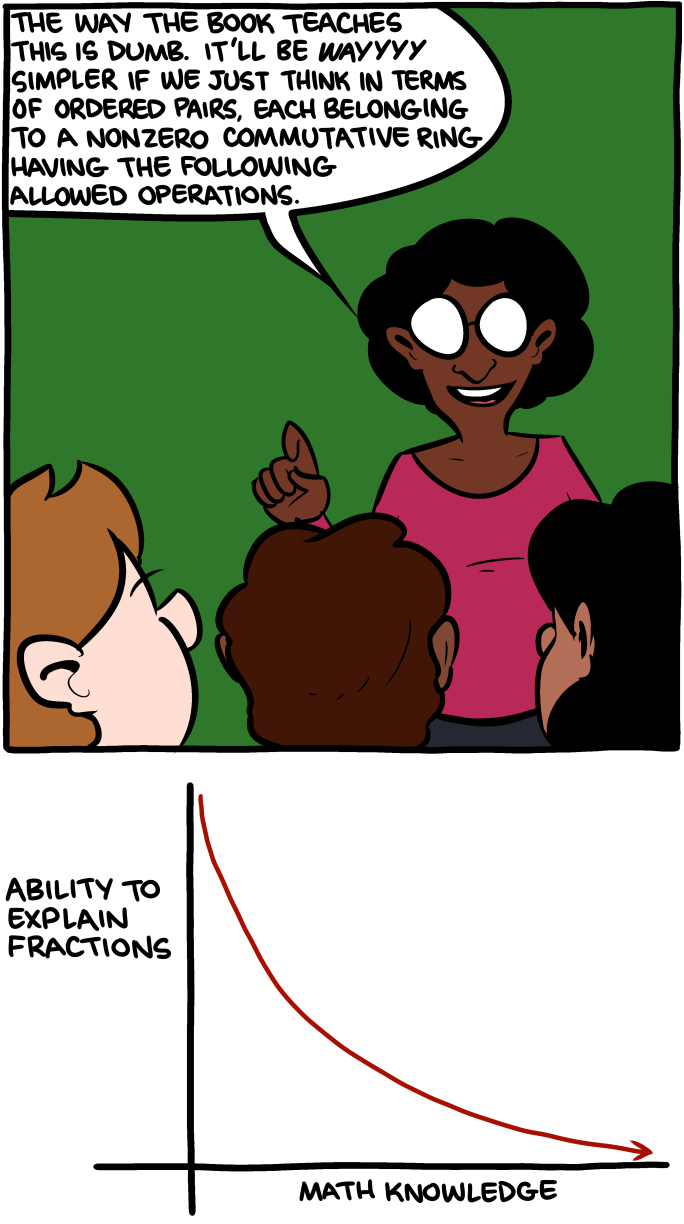
Saturday Morning Breakfast Cereal - 2014-12-06
 stark heron
hahaha stuff like this does make me nervous
i feel like my students understand me but in my head im like what if theyre trying to make me shut up 🤐
also i did enjoy symbol vomit for a while once i learned in discrete math, because it amused my inner middle schooler that liked to write secret code. 😛 maybe thats why students do it
 tawny slate
solar sorrel
Well, you’re not *wrong*, but knowing what the *right* level of abstraction is f...
tawny slate
solar sorrel
Well, you’re not *wrong*, but knowing what the *right* level of abstraction is f...
for a second i read IMO as international mathematical olympiad
got real confused for a second
anyways i think the funny thing about a lot of this is you come to the right conclusions once you learn not only the math but also think broadly about its implications
in the beginning i think there is a romanticized view towards more math abstraction and complexity, but at some point you start to realize that none of that really matters, mastery is depth, not specificity
if you dont come back down to earth to figure out why any of this matters, people are going to think you're an alien
 torn apex
solar sorrel
(Do wonder if there is a level of abstraction beyond infinity category theory)
torn apex
solar sorrel
(Do wonder if there is a level of abstraction beyond infinity category theory)
(∞,∞,..., λ)-category theory. It will take a countably number of years but the proof will be uncountably long
 coral cradle
Oh, really? I also thought that too😅
coral cradle
tight star
People are already looking at (infinity, infinity, n) categories
Man, why abstract so much?
tight star
coral cradle
Man, why abstract so much?
I mean it’s category theory research so it tends to attract that kind of person
But from reading the paper it actually seems pretty natural
It’s exploring the ways in which laxness and “orientation” manifest in higher cat theory
coral cradle
I mean, abstraction is useful, of course, but there may be diminishing returns? Idk
tight star
coral cradle
I mean, abstraction is useful, of course, but there may be diminishing returns? ...
Yes but that’s true of literally every useful thing
 little cave
this is what I literally do in my work most of the time, but MOST students as far as I can tell ALSO have an aversion to...writing words? but if you can give me a good reason to believe that this is a lesser fight than introducing some more symbols, by all means I don't care which way it happens
I am also of the belief that bracket notation is not the cause of discussing sets being potentially confusing
of course you could use bracket notation quite poorly, or even incorrectly, which I've seen in published work lol, but that is true of all notation
now proper subset should have a slashed bar
 halcyon glade
little cave
this is what I literally do in my work most of the time, but MOST students as fa...
halcyon glade
little cave
this is what I literally do in my work most of the time, but MOST students as fa...
I don't know if aversion is the right word, more like they were probably taught that this is how math is? About finding the correct answer and not about communication
turbid zenith
So I just found this ... I might try this framework this upcoming semester.
https://personal.denison.edu/~ludwigl/64_ludwig_final.pdf
torn apex
solar sorrel
I meant more in terms of the ontological primitives to manipulate [ since that i...
Here is a visual essay formulation of what I think you're saying
https://ikrima.github.io/topos.noether/riehl/math-beyond-rigor.html
@turbid zenith I spent the last couple of days templatizing the prompt into something anyone can use so you can copy paste it into an LLM + your presentation and then give it notes
Or If you want, I can run it on some of your own content to see but here are the color choices you asked about earlier
Design Decisions
- Typography: Crimson Pro (elegant serif), DM Sans (clean body), JetBrains Mono (formal mathematics)
- Color System: Amber (pre-rigorous), Blue (rigorous), Green (post-rigorous), Violet (synthesis)
- No external dependencies beyond Google Fonts—completely self-contained
- Responsive layout with CSS Grid adapting to smaller screens


Weird errors aside, I am curious how the website itself is made. It's pretty.
But I don't see at all how this is supposed to resemble a sum of squares
 torn apex
turbid zenith
But I don't see at all how this is supposed to resemble a sum of squares
torn apex
turbid zenith
But I don't see at all how this is supposed to resemble a sum of squares
yeah, I'm still slogging through CSS so all sorts of visual bugs abound. I really really really hate web programming
visual bugs aside, i was trying to also capture the heuristic-nature of visual intuitions, specifically in that they're not necessarily going to give the right answer exactly.
I'm still trying to figure out how to do that or find good examples of it
turbid zenith
What I'm saying is that I don't see how that's a visual intuition for that problem at all
It doesn't in any way resemble adding squares
But okay, what is it generating — HTML, CSS, and JS?
torn apex
turbid zenith
It doesn't in any way resemble adding squares
oh I was agreeing with you
torn apex
turbid zenith
But okay, what is it generating — HTML, CSS, and JS?
yeah, it's a single html file that you can open locally:
https://github.com/ikrima/topos.noether/blob/master/docs/riehl/math-beyond-rigor.html
solar sorrel
torn apex
Here is a visual essay formulation of what I think you're saying
https://ikrima....
yup! some css issues, but apart from that, exactly what I was trying to get across.
thank you very much!
 cyan hollow
hey, i'm a bit unsure on how to explain the motivation behind learning things that seem right out of left field
a common thing like this is complex numbers
and i know that roughly i want to say, but i dont know how to word the idea to someone that doesn't already know the motivation behind all of this
while we might not see examples of complex numbers directly in the real world, they can help us predict the behaviour of things we do know, which is we naturally look at closely associated objects so we can "complete" our understanding
of course, when teaching about them, you do talk about roots of polynomials and shit but my issue is explaining why all of this is useful with regards to what we do know
any help would be appreciated! this is not about complex numbers specifically, but i think it's the easiest example to give
tight star
cyan hollow
hey, i'm a bit unsure on how to explain the motivation behind learning things th...
i think for complex numbers, it's helpful to point out that we do naturally have situations where $x^2 = -1$ needs to be considered
 burnt vesselBOT
Pseudo (Cat theory #1 Fan)
 tight star
namely, if x represents a 90 degree rotation
hence why complex numbers are so useful for describing phenomena to do with rotations, periodicity, circles, waves
it can also be helpful to distinguish between "is" and "does"
the "is" corresponds to internals, intrinsic characteristics, how you construct it, how you define it
while the "does" is more pragmatic - it corresponds to usage, how it interacts with other things, the role it plays, extrinsic characteristics
there are lots of things that live more naturally in the "does" world than the "is" world
so it can be helpful to be upfront about what we want something to "do" before diving into the details of what it "is"
tight star
burnt vessel
**Pseudo (Cat theory #1 Fan)**
also the differential equation for the simple harmonic oscillator
cyan hollow
tight star
so it can be helpful to be upfront about what we want something to "do" before d...
so in your opinion, you think it's better to scrap the overall idea of abstracting the looking around objects to help us understand a central object better and instead just look at the example in question more precisely?
that is, for example, instead of talking directly about how we look at related objects to understand an object we know, i should just talk about this directly? how this helps us with what we know already instead etc to begin with
tight star
hm i don't think you have to scrap that idea per se
in fact what you're talking about is very much tied in to this is-does duality
rather than looking at the central object directly, you look at it indirectly through how it interacts with other things
that's very much a "does" approach
tight star
no worries!
i would say that you see this kind of is-does duality in many situations, not just math
for example the "is" of a word corresponds to its definition, while the "does" corresponds to its usage
the "is" of a machine like a train corresponds to how it works - the details of the engine, the wheels, the doors and brakes
while the "does" corresponds to why you'd use it, what purpose it serves - public transportation, freight etc
what money "is" might just be fancy paper, or 1s and 0s on a bank computer
but what it "does" is let you trade for goods and services; through that it gains value far beyond what it literally "is"
of course, this manifests in math a lot as well, and the "does" pov lines up pretty well with students asking 'but when am i going to use this?'
cyan hollow
tight star
the "is" of a machine like a train corresponds to _how_ it works - the details o...
yeah i was thinking of analogies similar to this as well and how math is no different
e.g when you get hurt, there is only so much you can see on the outside
tight star
I’m familiar with this mostly because it comes up extensively in category theory
cyan hollow
well it comes up everywhere, i think algebra has to be the biggest jump for early undergrads with this concept
tight star
Mhm mhm
The yoneda lemma, which is arguably the fundamental theorem of category theory, states (in a perfectly rigorous sense) that “what something is is isomorphic to what something does”
So they’re equivalent perspectives that you can freely switch between depending on what suits your use-case
The whole idea of universal properties, for example, is focusing on what something “does” over what it is
 tardy ember
tight star
of course, this manifests in math a lot as well, and the "does" pov lines up pre...
tardy ember
tight star
of course, this manifests in math a lot as well, and the "does" pov lines up pre...
the "does" pov lines up pretty well with students asking 'but when am i going to use this?'
...does it?
tight star
Well it’s certainly the more pragmatic one
tardy ember
i feel like even if you explain what an object is entirely in terms of how it interacts with other mathematical objects someone could still just ask "ok but like, why would i be interested in an object that interacts with other mathematical objects in that exact way"
tight star
This is true, but I feel like you make a lot more progress compared to going into the details of its construction
tardy ember
$x \mapsto \sin(\sin(x^{\frac{7 \cdot 14^e}{2\pi}}))$ describes a certain function from nonnegative real numbers to real numbers entirely in terms of what it does to nonnegative real numbers, but that isn't the same thing as describing a real-world application of it
burnt vesselBOT
bee [it/its]
 tight star
I’m not saying it’s a silver bullet, but I maintain it lines up more with that flavour of question asked by students
tardy ember
tight star
This is true, but I feel like you make a lot more progress compared to going int...
well maybe, but i don't think that really means anything beyond "the 'does' perspective is often generally helpful"
tight star
tardy ember
well maybe, but i don't think that really means anything beyond "the 'does' pers...
Which is what I’m saying?
cyan hollow
hmmm i didnt mean real world application per se
but pseudo's answer was satisfactory for what i wanted
tight star
At this level of generality you can’t expect to make particularly strong statements
tardy ember
tight star
Which is what I’m saying?
well from what i could tell it looked like you were giving a justification for that statement that... doesn't actually make any sense
tight star
Seemed to make sense to the person I was helping
I’m not really sure what point you’re trying to make here
tardy ember
tight star
Well it’s certainly the more pragmatic one
well like, this
tardy ember
tight star
while the "does" is more pragmatic - it corresponds to usage, how it interacts w...
and this
tight star
I don’t think those are controversial points
tardy ember
i'm not claiming that your points are wrong, exactly, just that the argument you're making for them is invalid
tight star
That I don’t understand
tardy ember
you have a word that has both "describing a mathematical object in terms of its interactions with other mathematical objects (instead of by an intrinsic construction)" and "describing a concept by how it can be useful for doing things" as instances, and you're using that to act like those are the same thing
tight star
I see - I’m putting both under the banner of “does”, but you feel like they’re meaningfully different
tight star
That I can agree with
For me I find it useful to call them both “does”, but it’s true that one doesn’t necessarily imply the other
You can describe something by how it interacts without that being obviously useful
And you can describe a use for a thing that isn’t necessarily in the style of “here’s how it interacts with other things”
I suppose what I’ve found is that the intersection between the two is large enough to justify lumping them together under “does”
tardy ember
hm
maybe it does turn out that way, but i'm still having some kind of feeling about... reasoning in a way that's invalid just because you expect to get the right answer anyway
tight star
well, i am a physicist :>
tardy ember
tardy ember
maybe it does turn out that way, but i'm still having some kind of feeling about...
although possibly the answer here is actually just "my brain is hypersensitised to people using choice of definitions to make invalid arguments and i should just tell it to chill out"
tight star
though if you think there's a different argument i could make for this, i'd be all ears
little cave
Does deep motivation help much with complex numbers?
In my view if you're just being introduced the intuition can come later
cyan hollow
well complex numbers were just an example
it goes much further than just that
it just happens to be a common chokepoint with motivation for most
little cave
The motivation is sometimes I get sqrt(-1) and the world grinds to a halt
And I'm constantly imposing conditions whenever there's a square root
halcyon glade
https://www.youtube.com/playlist?list=PLiaHhY2iBX9g6KIvZ_703G3KJXapKkNaF My favorite explainer of complex numbers

YouTube
little cave
I think if you really wanted to you could cook up some system to model
but that would probably be overboard
also, it's worth noting that we also don't delve into why a negative times a negative is a positive
at least I didn't when I was in school
which is why we get this weird artifact
halcyon glade
little cave
I think if you really wanted to you could cook up some system to model
Just a wheel would be fine lol
turbid zenith

Sorry, education reformers, it’s still memorization and repetition we need.
 rapid tusk
this broadly tracks with what I’ve experienced
where the biggest thing that has helped any understanding of material im working on was
getting the reps in
turbid zenith
Yeah, it's certainly jived with my experience as well
But as the subtitle says it doesn't seem to be too popular with education reformers
The pendulum always seems to swing all one way or all the other
I certainly feel guilty of thinking "if they understand it conceptually, everything will magically flow from there!"
 mighty stream
a lot of ideas about math education now feel reminiscent of the shift to/from phonics and sight words in literacy education 20 years ago
eventually people will start to realize that there needs to be a balance between rote memorization and application/understanding
 vestal tangle
cyan hollow
hey, i'm a bit unsure on how to explain the motivation behind learning things th...
vestal tangle
cyan hollow
hey, i'm a bit unsure on how to explain the motivation behind learning things th...
a complex number is basically just a 2d vector. and vectors (arrows) seem to show up all over the place
 abstract grove
it’s that and more though - because in most dimensions vectors can’t be multiplied in an analogous way to how complex numbers can
 lethal hornet
this is what makes complex analysis work, the fact that you can multiply and divide complex numbers
abstract grove
yup, and leads to remarkable results like if a function is complex differentiable one time, then it is infinitely many times (and the rest of complex analysis, as you said)
an old buddy of mine said they should rename complex analysis to “introduction to magic”
vestal tangle
yes it has a special multiplication rule
based on 90 degree rotations
which i think is also pretty easy to see the value in
stark heron
turbid zenith
The pendulum always seems to swing all one way or all the other
maybe because you usually grow up with one or the other seeing the flaws more clearly
so each generation is like THAT STUFF SUCKED without seeing the value
i am guilty of that too for sure
tawny slate
i think what makes complex numbers tricky is that to really appreciate the motivation for them, you have to understand the heart of what its doing, and that requires at least basic conceptual understanding of it
 native iron
turbid zenith
https://nautil.us/how-i-rewired-my-brain-to-become-fluent-in-math-235085/
native iron
turbid zenith
https://nautil.us/how-i-rewired-my-brain-to-become-fluent-in-math-235085/
I found the point somewhat confused. Some of the "fluency" she discusses seems a lot like conceptual understanding. For example, she talks about feeling each variable in F = ma and about playing with the magnitude. Isn't that the thing we want students to do when we ask them to build conceptual understanding?
tawny slate
like you could say complex numbers are useful for signal analysis, but this requires understanding the mapping between magnitude/argument of a complex number to magnitude/phase of a wave
but why can these things be mapped to one another and how does this mapping help? gotta know some basics first
so personally how i've been approaching it is simply start from the basics, tell the students that at first this all seems really arbitrary and abstract, ignore that for the time being, go through rectangular form, all the arithmetic operations, then show polar form and go through that, and then draw the connection to applications
for advanced students, additional connections I will make is how they are meaningful in analytic functions and analytic continuation, but my audience here is mostly middle/high school students, so obviously I don't go into the fancy college level complex analysis here, i just give some elementary examples of where we assume analytic continuation if we are being rigorous or aren't paying attention, usually involving function composition
if anyone has a different flow for this topic im happy to hear how anyone else teaches this
 marsh compass
I do think that the fact that the field of complex numbers is algebraically closed should be an important aspect to consider, more so than the geometric interpretation (i corresponds to a 90° rotation, etc.), which can also be done in terms of transformations in a 2d real vector space.
Perhaps the harmonic oscillator would be my favorite introduction to complex numbers, although it requires a lot of other prerequisites from linear algebra and differential equations, so not quite practicable.
 cosmic ibex
In cases like this where a single concept (such as complex numbers) has several nice properties that could each serve as a definition, my immediate feeling is that it would be wrong to elevate either of them to "the" definition/motivation and present the rest as merely consequences. It ought to be a main point that there's a single thing that, almost by magic, gives us all of such-and-such neat properties and that it pays to be able to switch back and forth between the views.
(Determinants are another example of this).
vestal tangle
tawny slate
for advanced students, additional connections I will make is how they are meanin...
your hands are somewhat tied because middle/high school kids don't usually have any exposure to the concept of vectors. i think the best pedagogical approach is to explain complex numbers as 2d vectors with a special multiplication rule that allows for rotations. so previously you could add and scale vectors and now you can rotate (multiply) them too. i think if you do it that way there's nothing that feels arbitrary/abstract/mysterious
 slim path
tawny slate
if anyone has a different flow for this topic im happy to hear how anyone else t...
slim path
tawny slate
if anyone has a different flow for this topic im happy to hear how anyone else t...
I generally show them complex numbers on a plane in terms of co-ordinates first since my audience is familiar with how to plot points on a plane. I develop the algebra entirely using ray diagrams (not calling them vectors since the vector space structure on a field is trivial anyways) on the plane and then use trigonometry to get to all the nice properties (conjugates, modulus and argument) and De Moivre and then Euler's identity. From there it's easy to talk about rotations and then it's also easy to speak about relevant applications particularly since complex exponentials be used as phasors to represent harmonic motion.
It can be very nice to talk about branch cuts in the context of complex logarithms as well. These are all very achievable with just good drawings.
The important part is that the entire usage of the word imaginary is avoided until the very end as a footnote.
In fact it might be a nice way to introduce the Euler number if the students have not seen it before. Same with the natural logarithm.
halcyon glade
I think motivation via some historical stories about mathematical duels and the cubic formula is a good way to go personally
tawny slate
halcyon glade
I think motivation via some historical stories about mathematical duels and the ...
genuinely cant tell if this is serious lol
on one hand it's storytelling, which in general i think is good for pedagogy, but on the other hand it's very silly and not useful
cosmic ibex
Serious or not, my impression was that that is a standard approach.
halcyon glade
I am serious, unless we have different definitions of "motivation"
It's a clear problem in which you work with only real numbers but introducing imaginary numbers allows you to find the solution
Trying to motivate with something like the fundamental theorem of algebra is, I think, something that raises more questions than it answers (why should x^2 + 1 = 0 have any solutions at all?).
vestal tangle
it's not the worst way of introducing them but it doesn't really tell you what they are or give you any kind of intuitive feel for them
 clever girder
halcyon glade
I think motivation via some historical stories about mathematical duels and the ...
clever girder
halcyon glade
I think motivation via some historical stories about mathematical duels and the ...
i love historical information in lectures. it makes the motivation clearer
why did someone come up with this?
marsh compass
halcyon glade
Trying to motivate with something like the fundamental theorem of algebra is, I ...
I don't oppose the historical motivation. That's a good introduction to complex numbers, too. But by the same reasoning, why should a cubic equation have any solutions at all (that can be determined using the cubic formula)?
Was the cubic formula historically only for finding the one root that is guaranteed to exist?
marsh compass
Ah okay, nevermind, there was a particular example x^3 = 8 x + 3, where x = 3 is a known root, but Cardano did not think that the formula is applicable in this case.
marsh compass
Apparently, they did not even have the concept of negative numbers back then 
tight star
marsh compass
Apparently, they did not even have the concept of negative numbers back then <:h...
Yeah that’s why x^3 = ax + b and x^3 + ax = b were considered different kinds of cubics
cosmic ibex
Negative numbers were just about arriving at the same time. Cardano doesn't consider negative coefficients, sticking to the traditional classification of cubics into several cases. But he does consider negative solutions in his Ars Magna, the same book where he presents his cubic formula.
One caveat to the usual simplified teaching story -- Cardano himself did not (according to the secondary source available to me) actually consider complex numbers in connection with the cubic formula. That was only done by Rafael Bombelli a few decades later.
Cardano still gets credit as the first to publish a use of complex numbers, because in a different part of the same book he solves the quadratic system x+y=10, xy=40 and gets the solution 5±sqrt(-15).
 arctic coral
do you think ai models can give a valid evaluation for proposed exams ? please tag me if you have tested
i gave couple of ai models my exam to evaluate the difficulty as well as the pedagogy, but it seems it is so agreeable or it is locked behind one aspect of the answer
- under the same flag, do you think that guided questions are bad? or they are rather fair compromise for the limited time given when there is enough abstract difficulty
native iron
I think ai models might sometimes catch errors but aren't great at giving criticism.
I think guided questions can be a good thing, but I do worry that on exams they're too vulnerable to carrying errors forward.
halcyon glade
marsh compass
I don't oppose the historical motivation. That's a good introduction to complex ...
It's pretty clear if you assume the intermediate value theorem that cubics need to have a real solution. It's not clear at all that the cubic formula should be able to find it in cases where it wasn't designed to, so the fact that it still works exactly the same but only if you allow for the square root of negative numbers is a big reason why it's worth entertaining the possibility of imaginary numbers and further exploring their properties.
arctic coral
native iron
I think guided questions can be a good thing, but I do worry that on exams they'...
ty for your feed, but can you expand more on what you mean by carrying errors forward i don't quite get how
rapid tusk
- you get a wrong (usually numerical) answer on one part of a question
- you then use that wrong answer as part of your solution to a subsequent part
arctic coral
ah i see, i got that kind of situation, i usually evaluate the level of mistake if it is just a simple miscalculation i oversight it as long as there is enough mastery shown through the answer, but yeah now i definitely understand the perspective, but what i really meant by guided questions is for example if a said exercise is based on a certain construction or a certain calculation i split the question into intermediary steps and expect a rigorous justification through those steps, instead of keeping it as one of those hit or miss type of exercises
i don't mind complex exercises as long as they aren't constituting more than 30% and no less than 20% of the exam because i feel it is unfair to students in a way, especially those that put the effort and a bit lack the necessary intuition or adaptability to newer situations
tawny slate
i think that's what they meant by guided question too, that's how i interpreted as well
 limpid rune
Hey did a little bit of searching around the discord, but was wondering if anyone could point me to any resources or current information around "newer accessibility requirements" that have been a point of dicussion recently. Trying to get up to speed with current gaps in LaTeX/document accessibility, and what solutions are being worked on.
My high-level understanding is that LaTeX is lacking in current TTS compatibility, though I've not been able to pin down the extent of this (ie is it edge case packages, core language, etc). I also have heard through the grapevine that many states (possibly countries) have implemented newer legislature upping the requirements for education (assuming university level here, but maybe publications as well?) It sounds like a few different solutions exist, namely MathJax, some HTML converters, etc.
Pretty new to the topic, so appreciate any info available!
 pure light
the latex tagging project is the main place to look for accessibility solutions within latex proper
 lethal leaf
limpid rune
Hey did a little bit of searching around the discord, but was wondering if anyon...
lethal leaf
limpid rune
Hey did a little bit of searching around the discord, but was wondering if anyon...
Some people at my university are really starting to push this and publicly releases these accessibility guidelines
They're in progress still
lethal leaf
pure light
the [latex tagging project](https://latex3.github.io/tagging-project/) is the ma...
Here's an overleaf template for the tagging stuff https://go.osu.edu/latextaggingtemplate

An online LaTeX editor that’s easy to use. No installation, real-time collaboration, version control, hundreds of LaTeX templates, and more.
limpid rune
Thank you both for sharing, will look into this. In a pedagogy seminar this quarter and may share some of these resources 🙂
lethal leaf
Yes feel free to share the OSU stuff. Some of it on the page is OSU specific but there's also some general guidelines
Currently my worry is what if you have a course (such as a topics course) in which you point students to older papers
These PDFs are inherently inaccessible as PDFs are just bad with screen readers
But like the solution can't just be "hey no longer use these papers"
limpid rune
Yeah it's a topic of great interest to me. Admittedly, I haven't followed AI developments nearly as closely as I should, but it seems like there is enough math literature out there to train an image processing model on existing data to create a converter/interpreter of sorts. I'd be pretty surprised if there weren't something like that in development already.
turbid zenith
If anyone in here has taught logic, how do you motivate the idea of the truth table of P → Q, in particular the idea that F → X evaluates to T?
I have an explanation I like to give about a coach promising "If you win the game, I'll take you for pizza" and not specifying what happens if you don't win ... but my problem is, I don't see why that should count as a logical operation on the same level as "and" and "or", rather than a relation between symbols
As in, I'd rather treat → more like = and less like +
tight star
turbid zenith
If anyone in here has taught logic, how do you motivate the idea of the truth ta...
The paradoxes of material implication are a group of classically true formulae involving material conditionals whose translations into natural language are intuitively false when the conditional is translated with English words such as "implies" or "if ... then ...". They are sometimes phrased as arguments, since they are easily turned into argu...
I think it’s quite important to keep this in mind
When I think about P implies Q, my instinct is to interpret it as “in a world where P is true, Q would necessarily be true”
In other words, Q is deductible from P
So for example, “if our solar system has two suns, then the earth is hollow”
This is materially true because the solar system doesn’t have two suns
But in a world where the solar system had two suns, I don’t see any reason why the Earth would have to be hollow
turbid zenith
Yeah that's just confusing.
tight star
The way material implication works is that the truth value of “P implies Q” only depends on the truth value of P and the truth value of Q
Not on whether Q is deductible from P
turbid zenith
Like it's to the point where I'm debating whether there's any value at all to bother going into the truth table of P → Q in an intro proof course.
tight star
For example “1 + 1 = 2 implies the four-Color theorem”
This is materially true but like
I think people would find it odd if you said that in conversation
turbid zenith
Yes exactly
tight star
That’s what the Wikipedia page is trying to illustrate
turbid zenith
And the explanation I've come up with just kind of seems like a stopgap
I want my students to believe math makes sense
 marsh thistle
I think the cleanest approach is to just convince them that what it means for P->Q to be false is that you produce a counterexample where P is true and Q isn't
tight star
tight star
When I think about P implies Q, my instinct is to interpret it as “in a world wh...
There is a way to have this make more sense
marsh thistle
then the other three rows in the truth table have to be true
tight star
I’ve found that material implication makes more sense for predicates than bare propositions
turbid zenith
marsh thistle
I think the cleanest approach is to just convince them that what it means for P-...
I think this only seems to show that T → F should be F
tight star
I.e. a statement of the form “p(x) => q(x)”
turbid zenith
It seems to have no bearing on why T → T should be true, nor F → X
tight star
You can represent this quite nicely with a venn diagram
turbid zenith
Even though I know they're supposed to be
tight star
It says that the set corresponding to p is contained within the set corresponding to q
T -> T means “if you’re in the set for p, you’re in the set for q”
marsh thistle
yeah but what I mean is that intuitively that is the only way to produce a counterexample to the implication, so then you automatically assign T to the other three cases
tight star
F -> F means “if you’re not in the set for p, then you might not be in the set for q”
turbid zenith
Plus when you prove a conditional wrong using a counterexample, it seems like what you're actually doing is disproving a quantified statement ∀x [P(x) → Q(x)]
tight star
F -> T means “if you’re not in the set for p, then you might be in the set for q”
turbid zenith
tight star
F -> F means “if you’re not in the set for p, then you might not be in the set f...
"might" does not have a mathematical definition here
tight star
turbid zenith
Plus when you prove a conditional wrong using a counterexample, it seems like wh...
My point is essentially that if you want to view $\forall x . p(x) \implies q(x)$ as some kind of big conjunction over the individual truth values “p(a) => q(a)”, then the truth table for the material conditional is inevitable
burnt vesselBOT
Pseudo (Cat theory #1 Fan)
 tight star
This is what I’ve found most helpful in practice
Given an element a, there are 4 possibilities for the truths of p(a), q(a)
Three of these are consistent with the set for p being a subset of the set for q
p(a) being true and q(a) being true
p(a) being false and q(a) being false
p(a) being false and q(a) being true
It is only p(a) being true and q(a) being false that is inconsistent with p being a subset of the set for q
turbid zenith
Sure, yes
tight star
Hence if you want to view $\forall x . p(x) \implies q(x)$ both as “the set for p is contained in the set for q”, and as $[p(a_0) \implies q(a_0)] \land [p(a_1) \implies q(a_1)] \land \dots$
burnt vesselBOT
Pseudo (Cat theory #1 Fan)
 tight star
Then the definition of the material conditional must be “F => F, F => T, T => T” as the only true statements
This is usually the approach I take when explaining the material conditional
tight star
tight star
I’ve found that material implication makes more sense for _predicates_ than bare...
.
turbid zenith
tight star
I’ve found that material implication makes more sense for _predicates_ than bare...
Yeah basically this
tight star
hopefully it works for your students!
turbid zenith
I wonder if a better idea would be to define p → q as something other than "p implies q" or "if p then q" and treat those as consequences
Come up with a different way to read p → q out loud that doesn't come loaded with the "if-then" terminology
tight star
materially it's equivalent to "not p or q"
 quasi musk
tight star
materially it's equivalent to "not p or q"
quasi musk
tight star
materially it's equivalent to "not p or q"
Yeah, but this also begs the question of why F -> T is True. If you write down the truth tables, then they spit out the same values
tight star
that's why i offered the previous explanation
quasi musk
I think I've come to accept sometimes math is a little wonky
turbid zenith
:/
turbid zenith
quasi musk
I think I've come to accept sometimes math is a little wonky
This is what I was hoping to avoid but maybe there's no avoiding it
quasi musk
The best non-math explanation I have is: "From a lie, any truth maybe derived"
I'm taking a Harmonic Analysis class, and many of my classmates haven't learned Classical Fourier. So the Prof. is spending a lot of time going over the basics, and I think, is doing a great job of getting to the subtlety of what we mean by summing, what we mean by convergence, etc.
Instead of Definition, theorem, proof, he engages with the class about how to construct examples and counter-examples. I'm a little annoyed that we should be going a bit faster, but enjoying the process as well
 turbid zenith
Okay, I went ahead and bought it
The gist seems to be that all the suggested techniques of teaching the material conditional are essentially trying to justify it based on starting with the truth table and trying to retrofit an explanation, e.g. the common "lying" approach
Their suggested method is to teach the biconditional first, which students are much more willing to accept the truth table for, and then rephrase the biconditional as (P → Q) ∧ (Q → P), use that to partially fill out the truth table for P → Q, and then use the fact that P → Q isn't equivalent to P iff Q to fill in the last bit
tawny slate
turbid zenith
If anyone in here has taught logic, how do you motivate the idea of the truth ta...
so funny side comment before i give my take
there's actually a book called "If" that goes into philosophically how we use the word if
from a linguistics and psychology perspective
this truth value way is just one of like 20+ different interpretations
the book was quite thin but like $120 lmao
here's the way I think about vacuous truths:
suppose I write a proof for a statement
statement 1
statement 2
statement 3
statement 4
conclusion
if each any of these statements are false, then the whole proof breaks
assuming they are relevant to the conclusion
but that's the key, IF they are relevant
what if I throw in an entirely irrelevant statement in there, even if it's false?
then since it's irrelevant, even if we say it's true, it won't impact the proof
but now we can just ignore having to nitpick for these "irrelevant" statements, and just flat out say that as long as the proof contains no false statements, nothing is broken
in this way, it's much easier to just assert that the vacuous statements are true
abstracting slightly, it's kinda like saying true has a value of 1, false is 0
each time you include another statement in the proof, you multiply its truth value
statement 1 is true -> 1
statement 2 is true -> 1 x 1
statement 3 is true -> 1 x 1 x 1
as soon as you include a false statement, it "kills" the proof in the same way it kills the product by multiplying by 0
no amount of statements after that saves it
we want to avoid the vacuous statements "killing" the proof
tawny slate
turbid zenith
Their suggested method is to teach the biconditional first, which students are m...
this is very cute though, gonna steal this one
cosmic ibex
turbid zenith
If anyone in here has taught logic, how do you motivate the idea of the truth ta...
I haven't tried this in a "mass teaching" situation, just when explaining on here, but I like the story I wrote down at https://math.stackexchange.com/questions/48161/in-classical-logic/4385559#4385559.
(Another rant about the teaching of implication: https://math.stackexchange.com/questions/4106526/a-confusion/4106567#4106567).
 cloud zealot
turbid zenith
If anyone in here has taught logic, how do you motivate the idea of the truth ta...
cloud zealot
turbid zenith
If anyone in here has taught logic, how do you motivate the idea of the truth ta...
you can discuss the paradoxes of material implication as pseudo mentioned, but you can also remark that this is the simplest(?) model of truth preservation
maybe you could also ask, why reason from false premises to begin with?
vestal tangle
turbid zenith
If anyone in here has taught logic, how do you motivate the idea of the truth ta...


that might help. hard to imagine something simpler than that
turbid zenith
"Have to agree" ... begrudgingly 😛
Somehow I feel like (∀x)(x < 3 ⇒ x < 5) makes sense but 4 < 3 ⇒ 4 < 5 makes less sense
But I guess it's not that different from, say, definining x⁻¹ as 1/x
vestal tangle
you agree at the start that X -> Y is true
X (4 < 3) is F
Y (4 < 5) is T
so you have to say F -> T = T
turbid zenith
I'm saying, somehow it makes less sense for propositions than predicates.
vestal tangle
ah, yea the author notes that
turbid zenith
Oh yeah? Where's this from?
vestal tangle
 turbid zenith
What's the textbook?
vestal tangle
it's page 4 of advanced calculus by sternberg. he has it freely available on his harvard page: https://people.math.harvard.edu/~shlomo/docs/Advanced_Calculus.pdf
turbid zenith
Wow, did not expect that
vestal tangle
the first chapter is very readable and good mini introduction to logic
turbid zenith
Here's a thought by the way...
If P is a logical proposition, do you ever use a notation for "P is true"?
Somehow writing "P = T" seems wrong.
halcyon glade
turbid zenith
I wonder if a better idea would be to define p → q as something other than "p im...
I've heard it as meaning "consistent with the belief that p implies q" instead
halcyon glade
turbid zenith
If P is a logical proposition, do you ever use a notation for "P is true"?
I would just write P in that case, as its own sentence
e.g Given: P. P implies Q. Therefore: Q.
tawny slate
cosmic ibex
(Another rant about the teaching of implication: <https://math.stackexchange.com...
i kinda dig this explanation. as i mentioned before i read that book on the many ways we use "if" linguistically and i think not talking about that in that teaching negatively impacts that nuance, so i agree. the only thing is i think the way this is written is accessible only to educators, not that that is an issue
tawny slate
vestal tangle
saving this one, clean
cosmic ibex
turbid zenith
If P is a logical proposition, do you ever use a notation for "P is true"?
If you want to distinguish between "P" and "P is true" (I'm not sure in which situation one would need that, though), one possibility might be $\vDash P$.
burnt vesselBOT
Troposphere
 cosmic ibex
vestal tangle
cosmic ibex
vestal tangle
Hmm, if that argument works as written, we'd also "have to agree" that 4<7 => 4<5 is false, which mainstream logic doesn't agree with.
halcyon glade
I think one way you could introduce material implication is to start with the Wason choice task and have students play through it (in both an abstract setting like numbers and colors and a particular setting like ensuring everyone who ordered alcohol is over 21). That way you give students some feel for it, and material implication becomes simpler (A => B is only false when you'd have to reject a card with A and B on it in the Wason choice task). Plus, fun interactive activity. https://en.wikipedia.org/wiki/Wason_selection_task

In psychology, the Wason selection task (or four-card problem) is a logic puzzle devised by Peter Cathcart Wason in 1966. It is one of the most famous tasks in the study of deductive reasoning. An example of the puzzle is:
You are shown a set of four cards placed on a table, each of which has a number on one side and a color on the other. The v...
Most students have an intuitive feel for this when you give a specific scenario but not when you have a more abstract rule
turbid zenith
Had an interesting thought this morning
You know these logic puzzles?

I wonder if those could be used in teaching Boolean logic.
tawny slate
fyi, there is a very, very good competitive board game version of this kind of logic puzzle

BoardGameGeek
Plan, scan, and theorize to find a new planet at the edge of our solar system.
maybe this could be adapted to be an interesting activity in the teaching of this
stark heron
turbid zenith
You know these logic puzzles?
omg i miss these we did so many of those in elementary school i dont know why
tawny slate
stark heron
omg i miss these we did so many of those in elementary school i dont know why
you would love that board game then, its calling out to you
stark heron
haha ok i will give it a try
vestal tangle
cosmic ibex
Hmm, if that argument works as written, we'd also "have to agree" that 4<7 => 4<...
i think they might be trying to say this:
we want to say that the sentence "for all x, x < 7 implies x < 5" is false.
meaning there is some x for which that implication does not hold.
we know at this point that the only values of P and Q that can accommodate a false result are T and F, because the other entries in the table have already been worked out.
and therefore we should say, for example, that 6 < 7 => 6 < 5 is false.
it's definitely vague though you're right
all these textbooks are written by sadists though so its par for the course
 elfin sleet
yeah that part, that's in the second screenshot, isn't quite written correctly, but it's explaining the part that's easily accepted and its mistakes are fixable. It's the first part that provides a way to justify F -> T and I don't think there's issues in that one
turbid zenith
stark heron
omg i miss these we did so many of those in elementary school i dont know why
Me too!
arctic coral
are unguided construction proofs a bad idea in an exam ? i feel like it is unfair to ask that type of questions without providing some guidance / or at least guide the student intuition to the construction
cosmic ibex
vestal tangle
i think they might be trying to say this:
we want to say that the sentence "for ...
Yeah, once we've accepted that => should be (a) a truth-functional operator such that (b) forall x(P(x) => Q(x)) works as desired, then it's smooth sailing the rest of the way. It looks like the book you're quoting from actually does make that point (which in my experience is rare in logic texts). But I still thing I would have liked it to be emphasized more -- perhaps that's just hobby horse of mine, though.
arctic coral
yeah that is the issue that even the same person, sometimes get the idea instantly and sometimes it just doesn't spark
 wise onyx
Are there established practices educators use to achieve inclusive pedagogy?
wise onyx
Okay heres a more specific question: could creating practice exams with solutions be considered an inclusive pedagogical practice?
abstract grove
wise onyx
Okay heres a more specific question: could creating practice exams with solutio...
may I ask how if could possibly not be considered inclusive? Like, could someone say "That gives an advantage to kids who don't mind reading!"?
it's hard to think of a possible criticism of this that's at all reasonable
just seems like an obvious generosity that equally benefits anyone who cares to make use of it
arctic coral
solar sorrel
Is that not standard practice wherever you live?
i am not sure about this, seems it depends from teacher to teacher here
abstract grove
it's something some teachers opt to do out of the kindness of their heart
arctic coral
true I am really thinking a lot about this recently
 vocal phoenix
<@&268886789983436800>
torn apex
I wish someone had told me decades earlier that not only is intuition something that can be built, but you can also learn to use other people's intuition. The brain really is more like a muscle group
For example, Here's a menagerie of my differential calculus visualizations: https://ikrima.github.io/topos.noether/diff-calc/
If you're not a programmer, here's a metaprompt template that you can paste into deepseek/chatgpt/claude/etc:
https://ikrima.github.io/topos.noether/prompts/interactive-visual-essay-metaprompt
Or if you're lazy, just copy/paste this as your first message:
You are an expert creator of interactive mathematical visual essays in the tradition of Bret Victor pedagogy ("Explorable Explanations"), Bartosz Ciechanowski (ciechanow.ski), and Steven Wittens (acko.net). Your mission is to transform abstract mathematical concepts into immediately tangible, manipulable experiences. Use the latest three.js and WebGPU/WebASM technologies to build each artifact. Think really hard and pay attention to the interactive UI components so that they are implemented cleanly and simply, without much boilerplate or concern for backwards compatibility fallbacks.
ymmv since what I personally use is my own homegrown ML solution (about ~34k messages and 20 years of my git history).
If you end up trying it and running into issues, lmk! I've been increasingly spending more time showing my non-programmer friends how to use AI as a natural language programming lang.
cc: @turbid zenith You can use this to beautify your presentations
 quasi maple
torn apex
I wish someone had told me decades earlier that not only is intuition something ...
quasi maple
torn apex
I wish someone had told me decades earlier that not only is intuition something ...
"[Using] other people's intuition"... As per the example you've shown, isn't that already a thing called a visual demonstration?
That's not too different from saying you're "using other people's words" when you mean you're reading imo
torn apex
quasi maple
"[Using] other people's intuition"... As per the example you've shown, isn't tha...
I'm not sure I follow? I agree that visualizations are a great way to build intuition but there are others.
quasi maple
torn apex
For example, Here's a menagerie of my differential calculus visualizations: http...
But how does this follow as an example of "other people's" intuition?
torn apex
quasi maple
But how does this follow as an example of "other people's" intuition?
ah, i didn't articulate it very well. let me try again:
The link was meant to be an example of my own personal intuitions realized as interactive explorable visualizations.
My intention was trying to show how you can use AI with zero programming background to build out your own visualizations that make sense to you.
And the key epipheny that I wish someone told me earlier is that it's the process/time spent of nucleating your own intuitions.
So just perusing my own menagerie won't help you build out your own intuitions
Now as to how to "ingest" other people's intuition, I'm much less sure of how generalizable my own process was
quasi maple
I'm going to posit that this is still a case of using AI to learn a topic, which is still a bit of a slippery slope
Generative AI and LLMs especially are already known to hallucinate, and personally I hold them as a robotic source for r/confidentlyincorrect
Only this is a somewhat worse scenario, since if you're learning a topic, you're not necessarily in a position to recognise when that happens
torn apex
quasi maple
I'm going to posit that this is still a case of using AI to learn a topic, which...
100% this. For context, I've been involved with AI since 2009.
Over the last year, i've seen how unbelievably wide the disconnect is between how senior game devs/engineers/artists/designers in tech use it vs. everybody else
quasi maple
Further [to my original point], supposing that you're in a situation where you wish to "rely on other people's intuition" - if we assume that has a plausible meaning - then in fact you wouldn't have your own intuition to fall back on in the first place; using AI to essentially make an intuition for you is still unfeasible since you haven't been able to cross-check it
torn apex
But to go back to the original point, The two cases I've had success of ingesting other people's intuition that I can communicate are:
- Terence Tao's way of viewing limits as process or an action. That shifted my perspective. I don't really know how it happened but over a span of 3 or 4 years of constantly thinking about it, it finally clicked
- Everything Grothendieck writes
quasi maple
I mean, that's literally what reading is, though?
I should be within my right to assume, if you've been involved with something for 17 years, you've certainly come across the concept of an analogy before, not even in a maths context
It's not really a functionally novel idea in that regard, to be brutally honest
torn apex
Oooo this might be really fun. Do you have aphantasia?
quasi maple
torn apex
100% this. For context, I've been involved with AI since 2009.
Over the last ye...
But regarding this:
There's an underlying problem there already - you've been involved with it for 17 years already; you have the necessary background to spot bullshit when it crops up. Someone with no background in a topic cannot reasonably do the necessary checks.
torn apex
Or rather, do you have an internal monologue and/or visual memory?
quasi maple
I don't have aphantasia, and in earnest I can't tell where you're going with this...
torn apex
Well, the disconnect stems from I'm trying to refer to purely subjective experiences that happen inside your head.
So when I say "intuition", the referent label is clearly mismatching between our own internal semantic maps
torn apex
So when I say you can "build out your intuition", I mean you can expand your mental visualization capabilities. Up until recently, I thought this was a fixed at birth human feature.
Maybe it's not novel to you but it was eye opening to me and everyone i know IRL.
Here are the two talks from Richard Hamming that turned me on to this idea:
As for "AI", don't use it if it doesn't help. Im slowly realizing that on the internet, "AI" literally means ChatGPT to everyone not familiar with the space
torn apex
Ooooh, I really like this; I've been doing some of that for my research where I'm leaning on hallucination or generative AI to nucleate new approaches or tackle a problem from different perspectives.
One thing I've also been experimenting with learning topics using the Moore Method and AI.
My Real Analysis & Logic professors taught the entire class sans textbook with the Moore method; by the end of the year, each of us had our own textbook where we reconstructed Calculus from first principles.
I've been experimenting with using AI as basically as a guide where I'll have it give me the historical context for some field medalist discovery (ex: Kashiwara's D-modules in algebraic geometry) and then I try to re-discover the field. When I get stuck, I ask it to give me hints or nucleate suggestions and then I intermittently check references in the source material (i.e. the textbook or monograph)
I'm also perplexed about the hallucination wrt math b/c the overriding advantage that using AI with math has over other fields is you can validate the AI output yourself
Presumably, if it hallucinates something that doesn't make sense, wouldn't you as a mathematician spot the error in the proof steps? Do people not actively engage with material when they're learning? I'm genuinely puzzled by the disconnect.
Even textbooks have to come with errata, blog posts are even worse, etc
abstract grove
the worry is that people who aren't qualified to tell when the LLM is hallucinating try to use it to learn, especially when they may not be able to provide precise enough prompts to get high quality answers to what they want to know about
and yes, this is a potential problem with self studying from textbooks with possible typos also, though at least a textbook is less likely to have gaping inconsistencies in presentation
that said, blatant hallucinations on simple material have gotten MUCH less frequent in the past year
to the extent I would gladly offer 100 to 1 odds that if we show chatgpt 5.2 extended thinking mode any picture of some problems from a high school math book, it will get them all correct
and I'd offer the bet any number of times people like
did it get it right when you clarified the situation?
torn apex
If you're ok with it, do you mind sharing your prompt with me? It'd help shed some light for me. I can in turn do the same if you think it'd be useful
tawny slate
has this channel turned into "how to use LLMs" or something? what does this have to do with pedagogy
abstract grove
like it or not how to integrate these tools into the classroom is a hot button issue right now
tawny slate
is that what we're discussing
abstract grove
adjacently
tawny slate
were we? it seemed to start with someone sharing their prompt for generating code for simulations, didn't seem to have much to do with pedagogy
abstract grove
it got on "using AI to learn is a slippery slope"
which is broadly related
but fair enough
tawny slate
ok but like
we've had this discussion in this channel like a hundred times already
this conversation happens like every week
do we really need to revisit this again
abstract grove
that's just how social media discussion places work
new people are gonna keep coming and bringing it up
tawny slate
right but that's not an excuse to accept the lowering of standards or breaking of rules
abstract grove
had no such intention, apologies if I did
I'm not really on board with the "eliminate all mention of LLMs" attitude
tawny slate
that's not what I said either
my initial question was why is this conversation in the pedagogy channel, not "why did we mention LLMs at all"
torn apex
abstract grove
had no such intention, apologies if I did
I don't think you need to apologize. LLMs are a big change and I despise the Anti-AI hype as much as the AI hype
The whole conversation is literally about pedagogy and using computers to create explorable explanations. But some guy saw the word AI and got triggered again lol
 tacit adder
the education space is drastically changing in lieu of AI
as someone who's TA'ed across multiple universities, it's become a pretty rampant issue and it's also getting harder to convict someone of AI misconduct
halcyon glade
I think it's also often not clear what the acceptable AI usage policies are
torn apex
The whole point of the prompt was enabling non-programmers to emulate Bret Victor's pedagogy and approach to direct manipulation and his concept of walking up and down the ladder of abstractions:
https://worrydream.com/LadderOfAbstraction/
Or using LLMs to explore your intuitions. Or to use it as an aid for generating classroom materials for teachers
There's also the damage caused by misuse of LLMs in learning (cheating, brain rot, etc). And then the false negatives of being accused of AI plaigarism
imho, these are all in the "pedagogy of math" category but c'est la vie, if no one else thinks so, I won't bring it up again
tacit adder
in places i've seen, it's usually left to the discretion of the instructor and i think it becomes their responsibility to make it clear at the beginning of the semester what constitutes misconduct
but there are some general guidelines at my university
halcyon glade
Yes I think a lot of instructors (at a uni level) don't spell it out clearly which is only asking for trouble
torn apex
tacit adder
as someone who's TA'ed across multiple universities, it's become a pretty rampan...
as someone two decades removed from university, I'm really curious on your perspective. Have you seen or been privy to positive uses? Or is it overwhelmingly bad/hopeless?
halcyon glade
I'd wager that improper conduct is certainly more common
tacit adder
torn apex
as someone two decades removed from university, I'm really curious on your persp...
i've seen people use AI in a positive light (to learn) but its effectiveness really depends on whether students are capable of discerning what is and isn't factual information based on what they've learned in class
unfortunately most students aren't yet capable of figuring that out and as instructors, part of our duty of care is to help students get to a point where they can look at an output and take what is useful to them
halcyon glade
I feel that it's easily used as a crutch for critical thought
torn apex
tacit adder
unfortunately _most_ students aren't yet capable of figuring that out and as ins...
This sounds arrogant or ridiculous to say but....I really feel like critical thinking is just not a skill in students anymore. Cant' tell if it's just me turning into a grumpy old man
halcyon glade
An increasing number of university students (at least this is the way it feels to me, anecdotally) seem to view classes as a contract for work rather than a place to learn and talk about ideas
🤷
tacit adder
torn apex
This sounds arrogant or ridiculous to say but....I really feel like critical thi...
you're honestly not that far off, i teach algorithms classes primarily and some students who come into the class seriously lack the critical thinking needed to succeed
tawny slate
halcyon glade
I feel that it's easily used as a crutch for critical thought
yeah study after study shows that it harms learning
idk why we don't just use traditional sources that we know actually work
like, libraries, textbooks, lectures, they all exist
why turn to an LLM
tacit adder
why think and analyse when you can make AI do that for you
halcyon glade
I think it's difficult for a student to tell whether they need to think more about something or whether they need additional help, which makes responsible LLM use hard
tacit adder
😔
 surreal lily
tacit adder
unfortunately _most_ students aren't yet capable of figuring that out and as ins...
surreal lily
tacit adder
unfortunately _most_ students aren't yet capable of figuring that out and as ins...
I think it also depends on level. Students in intermediate algebra often get correct responses because there’s lots of information on the Internet about how to solve systems of linear equations for the AI model to draw on. Maybe that’s part of the problem, reliance on AI for things where it can give answers might prevent the development of skills needed to learn things where AI isn’t reliable yet
And students are often unable or unwilling to figure out what kind of AI use are beneficial to their learning and which are detrimental. My department tries to have those conversations with students, but we still have lots of cases for students are using AI in a way that is detrimental
tawny slate
at this point why enjoy life? have the AI play your video game for you
halcyon glade
tawny slate
why turn to an LLM
LLMs are interactive, which means you can ask them specific questions about things you are confused about, and nowadays there are ones that can link you to specific sources that talk about it, quote them, reword them with helpful analogies, reformulate them in a table, etc.
halcyon glade
tawny slate
at this point why enjoy life? have the AI play your video game for you
okay wtf <@&268886789983436800> (see deleted message)
torn apex
surreal lily
I think it also depends on level. Students in intermediate algebra often get co...
Thank you for this! This is really helpful for those of us far removed from secondary education settings
 reef thicket
tawny slate
at this point why enjoy life? have the AI play your video game for you
reef thicket
tawny slate
at this point why enjoy life? have the AI play your video game for you
please keep it sfw
torn apex
surreal lily
I think it also depends on level. Students in intermediate algebra often get co...
students are often unable or unwilling to figure out what kind of AI use are beneficial to their learning and which are detrimental.
@tacit adder do you think that this is just a transitory period similar to maybe the invention of calculators? I've been really struggling with how to advise my friends wrt to their kids & LLMs.
I just pessimistically can't imagine highschool and non-math undergrads exercising the will power to not just "phone it in" with AI
halcyon glade
I think partly it's low literacy (in terms of critically examining texts) and partly it's that students might not have the metacognitive skills necessary to assess their learning strategies; I don't think LLMs are comparable to calculators, they're maybe more comparable to Wikipedia but at a much bigger scale
tacit adder
torn apex
> students are often unable or unwilling to figure out what kind of AI use are b...
i think calculators in part were designed to automate the mundane tasks of arithmetic but LLMs have become much more than just automating simple tasks which makes it a detriment for students' developmental period, so it's not a fair comparison
reef thicket
but yeah i think learning is fundamentally a social process, and replacing a human teacher with an llm is a misstep. the more we do this, the more our relationship with learning itself will become distorted and estranged. of course, not everyone has access to a good teacher and so one could argue that llms are a step towards more equitable education. and to that i would say, llms are a shortcut that doesnt actually solve the core issue of inequity itself.
 radiant hemlock
As a software developer I can tell that at the current state LLM is a tool, it is wrong to use it as a substitution to a product, in this case a teacher
And LLM’s becoming a product instead of a tool is nowhere near
quasi maple
torn apex
> students are often unable or unwilling to figure out what kind of AI use are b...
the invention of calculators
At least with calculators the same input gives you the same result
If you spot an error you can at least see what inputs lead to that, or determine what the calculator interpreted the input as in the first place
I see this happen with people I tutor all the time where their working out was flawless but their calc. input was wrong
In such cases it's easy to explain what happened and to teach mitigating practices
This is seldom the case with an LLM
-# FYI I am talking about LLMs in general, because at its core this is a philosophical question on their nature here, meaning it wouldn't really matter that much what LLM you used, fundamentally the same things are going on
If you have the understanding to check a priori, you can check rather easily, sure; if you're learning a new topic in which you have no background, this gets harder to do
Someone said then surely textbooks run into the same roadblock; but textbooks are often peer-reviewed, re-edited and republished, and when errors are spotted they can be updated in new releases of the same textbook
Artificial outputs cannot afford that luxury, in comparison
We often have several people in the help channels of this server ask a question along the lines of "I asked ChatGPT and it said that...", and overwhelmingly the responses I have witnessed from Helpfuls here have been to ignore what ChatGPT said and redo the question again
torn apex
quasi maple
-# FYI I **am** talking about LLMs in general, because at its core this is a phi...
oh no, this lies at the heart of the problem. humbly, this hints at a huge misunderstanding of "LLMs" are, how they work, and what they're capable of.
"I asked ChatGPT and it said that..."
And there's the problem. Retrieval Augmented Generation doesn't "hallucinate". You have to supply the corpus to the model and ask it about the corpus.
I'm dating myself with this but the last year feels exactly like 1999/2000 when I'd constantly hear things like "I asked Google and it said..." and people had to learn that Google was not an all knowing intelligent thing despite having access to "all the world's knowledge."
But to zoom out for a sec, I'm realizing I was conflating the pedagogy of teaching math with the pedagogy of learning math (and I'm much more interested in the latter)
So more broad question for the channel, is this channel supposed to only be at the pedagogy of teaching math or does it include the pedagogy of learning math?
 midnight scarab
The channel description seems to indicate it's about teaching
There's #study-discussion for learning approaches/strategies/...
torn apex
Good to know; out of curiosity, how come teaching learning strategies is not a common topic? Almost all "i hate math" people I've worked with end up realizing they just didn't "know" that there are practical, tangible "techniques" to learning math.
To be concrete, a lot of my artist/non-stem friends think that you either "get" math or you don't. And I'd have to explain to them that no, when I see an equation and I understand it, it's because I spent lots of time outside of class studying it.
So much of my informal "tutoring" ends up being a lot more like therapy than teaching
tawny slate
what even is "pedagogy of learning math"? just "pedagogy"?
isnt that the definition of pedagogy?
 austere delta
I guess other subjects than math exists xD
 obtuse ember
Hi, (I am new to Discord, and apologize if I am messaging in the wrong channel) I like teaching and have taught couple of math course before, but I want to improve my teaching skills, learn making good lecture notes, and also improve the lecture delivery, so that I can help students better. Please share your thoughts or any helpful resources or courses in this regard. Thanks:)
halcyon glade
torn apex
Good to know; out of curiosity, how come teaching learning strategies is not a c...
I think it is a fairly prevalent topic
Metacognitive teaching has to be tailored to the age group you're teaching though, obviously
It's also just not the majority of what teachers/professors do (they teach content, for the most part)
torn apex
halcyon glade
I think it is a fairly prevalent topic
Metacognitive teaching is the perfect description of what I'm looking for; do you have any personal recommendations that I can go learn from?
halcyon glade
No I don't have anything off the top of my head, sorry
obtuse ember
Thanks for sharing it. I appreciate it. I have taught many courses, as a graduate student, but always left unsatisfied with my teaching at the end of every semester. I wish there was some training sessions that helped along all the way, because I feel if I am teaching in a wrong way then it will repeat in every future class if there is nobody to correct me at the right time. Specifically, I feel if I am assigned a course that I have never taught before or is not aligned with my research area the I find myself not very good at delivering (and preparing) heavy lecture based core math courses (such as math and engineering students: Discrete Math, Calculus, ODE,...).
quasi musk
obtuse ember
Hi, (I am new to Discord, and apologize if I am messaging in the wrong channel) ...
If they aren't afraid of you, then they aren't learning P:
In all seriousness, try asking someone where you're at to observe your lesson. See if they have something to add
 strong hearth
fucccccckckkkkkk this might be the best semester yet insofar as student evaluation is concerned
Your Teaching Score: 94/100
Faculty Average: 85/100
Student Experience of This Unit: 64/100
 zinc dove
strong hearth
> Your Teaching Score: 94/100
> Faculty Average: 85/100
> Student Experience of ...
zinc dove
strong hearth
> Your Teaching Score: 94/100
> Faculty Average: 85/100
> Student Experience of ...
"Student Experience of This Unit"?
strong hearth
yes
strong hearth
zinc dove
"Student Experience of This Unit"?
a unit is like a singular unit of subject you take within a given semester
strong hearth
high teaching score and low unit score indicates poor organisation of the unit, which is more reflective of the chief examiner rather than the teaching team
strong hearth
zinc dove
is "Your Teaching Score" an autoevaluation?
no, students voluntarily take surveys comprising multiple questions both quantitative and qualitative
zinc dove
I see, thanks for the comments
strong hearth
no worries, happy to explain 
halcyon glade
obtuse ember
Thanks for sharing it. I appreciate it. I have taught many courses, as a graduat...
I always thought it was criminal that people are expected to teach at a university level with no training at all about how
A lot of people don't even realize it's a learnable skill that you can improve on
tawny slate
obtuse ember
Thanks for sharing it. I appreciate it. I have taught many courses, as a graduat...
no one seems to be offering anything tangible and I think part of the reason is the lack of context and detail, so i'll try and point this in a better direction
you say that you are left "unsatisfied" with your teaching. what makes you feel that way? can you point to any specific examples or instances of where you feel you could have done better? what do you ideally see as being "successful" in teaching in a way that does leave you satisfied?
obtuse ember
@tawny slate Some examples: maybe I lack creativity in creating better ways to introduce any topic, to make topics interesting, digestible and simpler for students, and may be organize the lecture talk better. Often times I feel maybe I need more practice on any topic to be more confident in the class. And I always wondered how other people would have taught this topic/course better. I know others suggested metacognitive teaching (which I am exploring now), but I am curious if there is any systematic way that teachers follow to prepare their classes?
vestal tangle
can you give an example of a specific topic you think you botched
obtuse ember
I remember teaching 'functions' in my class, and that time I felt I didn't do justice with the topic. I had students who were at different learning levels, and most of the time I was confused about my pacing. If I went slow then other students got agitated, and if I went fast then other set of students would show unhappy faces in the class.
vestal tangle
some problems (like that one) probably aren't solvable
you're one person giving one lecture to a bunch of people at different levels, i don't think there's a silver bullet in that case
that's actually a good argument in favor of things like khan academy against traditional lectures
quasi musk
obtuse ember
I remember teaching 'functions' in my class, and that time I felt I didn't do ju...
While not totally solvable, there are things that you can do to try and mitigate its impact. You can look up differentiated instruction practices to see if that helps
obtuse ember
Yeah. but in general, is there any practical way to get better at teaching and being more creative at teaching topics?
quasi musk
I like to intersperse historical side notes, or try to lead the students down a line of questioning where it seems like this totally reasonable thing is very wrong, and why it's wrong, and how to do it properly
The second one has back-fired in that the student only remembers the "wrong" part, and doesn't remember how to do the right part
obtuse ember
I know its not realistic, but I wish there was some online platform
where we could practice delivering lectures to others where they give feedback, to get more practice and get better.
quasi musk
Is there a professional development program available at your work?
obtuse ember
Thats' a good point. I believe yes. But I never joined them thinking they may not be helpful with what I need. Thats my bad. Maybe I should have
vestal tangle
i think you should just go topic by topic and try to work out the simplest way to explain it and you should include a lot of visual intuition and motivation. i doubt you're going to find some generic piece of advice that will help with everything
quasi musk
Well, just reach out and ask what they can help with
obtuse ember
That's agreat advice.Thanks a lot!
quasi musk
Another thing that I've seen is: Give an example with graphical reasoning, symbolic reasoning, and numerical reasoning
obtuse ember
For Calculus and differential equations, do you know of any lecture resources for instructors , where we can get idea of how to teach topics in those subjects.
clever girder
obtuse ember
I remember teaching 'functions' in my class, and that time I felt I didn't do ju...
i've heard as a rule of thumb, your goal is for 90% of the class to be keeping up. if over 10% seem to think you're going too fast, slow down
even if others get bored
tawny slate
another good tip is to just consider how you would frame the subject youre teaching in the form of a story
not necessarily historical anecdotes, but just the abstract form of a story
for instance, when i teach quadratics, i first show a few basic examples that illustrate the difficulty of the problem and some important foundations
then i mention that there is a quadratic formula that trivializes the entire problem into a plug and chug, and that is our goal, what we are working towards
so now it feels like the treasure chest at the end of the rainbow
we then go over the lesson that leads to the formula and when they finally learn it, i give the shock turnaround, that mastery of quadratics actually only begins there rather than ends there
these abstract "emotional" roller coasters and expectations, when handled well, in a way that excites and makes students curious without feeling like they are being pranked or that the topic is obtuse, helps a lot
also maybe feel free to sprinkle mild doses of your own notation and conventions if you find it drastically makes something easier to understand, don't just stick to the existing accepted conventions
obviously dont overdo it, make a value judgment if it could be worth it
turbid zenith
tawny slate
what even is "pedagogy of learning math"? just "pedagogy"?
I took classes specifically on learning theories relevant to learning mathematics, so that is indeed a thing of its own
Let me know if anyone wants to know about it in here :V glad to share if desired
 surreal palm
turbid zenith
I took classes specifically on learning theories relevant to learning mathematic...
surreal palm
turbid zenith
I took classes specifically on learning theories relevant to learning mathematic...
I would love to know about this!
obtuse ember
tawny slate
another good tip is to just consider how you would frame the subject youre teach...
I like that idea. I will try it. Thanks for sharing.
tawny slate
turbid zenith
I took classes specifically on learning theories relevant to learning mathematic...
contextually i was asking about the difference between "pedagogy of teaching math" vs "pedagogy of learning math"
i was extremely confused as to the difference between these in the context which it was used
like is "pedagogy of teaching math" the teaching of how to teach math? but that didn't make sense in the context of the conversation either
 echo tinsel
@teal iris re: algebraic geometry
 teal iris
Hello
 dim arrow
tawny slate
then i mention that there is a quadratic formula that trivializes the entire pro...
dim arrow
tawny slate
then i mention that there is a quadratic formula that trivializes the entire pro...
I always got angry that they taught me quad formula before completing the square
turbid zenith
surreal palm
I would love to know about this!
So there are a lot of frameworks that are used when looking at how students learn math! The two I'm most familiar with (because they're the ones used in my dissertation) are APOS Theory and Proof Schemes.
Dubinsky's APOS Theory is all about how students progress in the level of abstraction. The idea is that students progress through stages in their learning, and they have to pass through them in order or they're going to just be memorizing:
- Action — The student can perform a calculation using some kind of external stimulus, especially following an algorithm or procedure. For example, a student at the Action stage of averages can, if given a set of numbers, add those numbers and divide to find their average.
- Process — When a student has done the Action a bunch of times and can reflect on it, they can interiorize it and reach the Process stage, where they can imagine doing it in their head without actually being given a stimulus. For example a student at the Process stage of averages can imagine adding and dividing a list of unspecified length to get an average. Students at this stage can also form new Processes by reversing a Process (e.g. imagine starting with the average and find what a missing scores is) or coordinating multiple Processes.
- Object — When a student views the result of a Process as a mathematical entity unto itself, one that can have other Actions performed on it, they've encapsulated the Process and reached the Object stage. For example, a student at the Object stage of averages can imagine the concept of THE average as a 'thing'. And for example they could answer a question like "what would happen to the average if you added 10 to all the numbers?" That's performing an Action.
- Schema — Not really a stage, but the idea is that students organize all their Actions, Process, and Objects into a coherent mental structure called a Schema. Also, Schemas can contain other Schemas. For example, a student's Schema of averages might contain how they think of, say, the average value of a function, or they might be contained in larger Schemas for other statistical measures.
And the whole point of coming up with these stages is you can try to get at what mental constructions students might need to make in order to be able to learn a topic, like not just what prerequisite knowledge they'd need but specifically how they'd have to fit things together. Like if they're supposed to learn the ε-δ definition of a limit, APOS Theory says they might have to do something like this:
- Actions: Comparing x-values and y-values for specific values of δ and ε
- Processes: Imagining doing that Action for smaller and smaller ε and δ; notice you're having to coordinate those Processes as they go in parallel
- Object: Thinking of the verified limit as the encapsulated result of that whole Process
The other thing, Harel & Sowder's Proof Schemes, is all about what students use as the basis for their belief something is true. I won't get too far into all the subcategories, but the three broad schemes are:
- External Conviction — A student is convinced of the truth of a statement based on some outside source of knowledge. This might be because they uncritically accepted what their teacher told them, or because they used lots of symbols and think more-symbols-means-more-math, or because they think they have to do something in a certain format like a two-column proof.
- Empirical — A student is convinced of the truth of a statement because of empirical evidence. This might be because they did a whole bunch of examples and assumed it always worked, or because they drew a picture and made a conclusion from the picture.
- Deductive — A student is convinced of the truth of a statement because of deductive reasoning. Think proof-related stuff, although there's a bunch of different levels, with axiomatic reasoning being at the very top.
So yeah, that's my short exposition on a couple of learning theories :V
(The idea on the latter is we'd really like to move students to a Deductive proof scheme, but I think passing through an Empirical proof scheme along the way is just fine of course)
tawny slate
dim arrow
I always got angry that they taught me quad formula before completing the square
im also upset schools dont teach vieta's formulas or even parabola symmetry
turbid zenith
I will say, the APOS Theory thing has very much made me a believer in starting with examples and building up to the abstraction instead of starting with the abstraction like I see waaaaaaay too much of
quasi musk
turbid zenith
So there are a lot of frameworks that are used when looking at how students lear...
Oh man that's good stuff; I've been saying a rudimentary version of this for years now
turbid zenith
quasi musk
Oh man that's good stuff; I've been saying a rudimentary version of this for yea...
Yeah I think it's the kind of thing that you can definitely arrive at through thinking about it and working with students
 patent flax
This First time talking in this channel, so I'll introduce myself.
I am a California high school I. math teacher intern. A lot of my students struggle with mathematics, so my goal is to make mathematics very concise and intuitive and engaging.
Does anyone have a recommendation for explaining composite functions?
turbid zenith
But it helps to know that it's a "thing" and that tons and tons of authors have done validated studies on it that you can pull from
quasi musk
Yeah, different settings, different conclusions, and they've gone through the hard work to try and construct a framework for it all
tawny slate
patent flax
This First time talking in this channel, so I'll introduce myself.
I am a Califo...
dont have any sources but my personal approach has always been to view functions as their own mathematical object. students have to learn to work with this new level of abstraction. it helps here to think of the function as a "verb" or "action" or a "machine" that does the verb/action
emphasizing this mindset helps students not only understand what is happening with something like composite functions better, it also becomes a smoother transition into topics like trigonometry, where viewing the trig functions as functions becomes key
turbid zenith
patent flax
This First time talking in this channel, so I'll introduce myself.
I am a Califo...
Do you already know what kind of trouble your students seem to have with it?
Or is this before you teach it?
tight star
<@&268886789983436800> spam
quasi musk
they are fast
tight star
-# when they want to be
tawny slate
turbid zenith
The other thing, Harel & Sowder's **Proof Schemes**, is all about what students ...
I want to mention two(?) more proof schemes that are important to math (and really almost all) education imo, and i think they are undervalued/ignored
emotional - a student's truth is based on their personal experiences. for instance, if they get frustrated with a topic, they may assert the truth of a statement like "i am not capable of learning this difficult thing". or maybe this is intuition in some form that is distinct from something empirical
moral - the truth is what ought to be, what we desire it to be. a student believes that math should be black and white, right or wrong, no room for subjectivity, because that's "how math should be, that's the definition of what math is". this may deprive them of the recreational applications or the appreciation that many problems require genuine creativity and self-expression to solve, because they need to select and internalize the heuristics and intuition that lead them to an answer
we are dealing with instruction here, so we should treat students as people who engage all of these aspects in how they learn. ignoring or undervaluing these dehumanizes them a little bit, makes it harder to relate and reach them
vestal tangle
patent flax
This First time talking in this channel, so I'll introduce myself.
I am a Califo...
draw some pictures of machines with funnels and spouts
 turbid zenith
tawny slate
I want to mention two(?) more proof schemes that are important to math (and real...
turbid zenith
tawny slate
I want to mention two(?) more proof schemes that are important to math (and real...
Those are a bit more "meta" than the scope of the Proof Schemes framework
But they certainly are important
tawny slate
fair
i guess in the context of math statements students believe or don't believe those wouldn't be as relevant
vestal tangle
obtuse ember
For Calculus and differential equations, do you know of any lecture resources fo...
take a look at this collection of notes called "ordinary differential equations, an intuitive introduction": https://anton-petrunin.github.io/417/lib/ODE.pdf
it has a bunch of intuitive ways of looking at things, for example thinking of the derivative as a local stretch factor:

and take some inspiration from this: https://danielvoconnor.github.io/MathNotes/quickCalc.pdf
a set of notes with very short and intuitive (though somewhat handwavy) proofs of different calculus results
here's a short note on what calculus is all about (big picture): https://danielvoconnor.github.io/MathNotes/What is calculus.pdf
patent flax
turbid zenith
Do you already know what kind of trouble your students seem to have with it?
From previous experience, I know they struggle with function notation of substituting an entire function in another function.
patent flax
tawny slate
dont have any sources but my personal approach has always been to view functions...
I like this idea with the verbs and nouns
patent flax
turbid zenith
Or is this before you teach it?
This is before I teach it. They should have seen it before, but I'm going to teach it as if it's new
patent flax
vestal tangle
draw some pictures of machines with funnels and spouts
I like this visual representation! I'll message here in a day to let you know how it went
turbid zenith
So based on some of the stuff I just gave an exposition of, and assuming they're comfortable with how functions work in general so far
I would give them a particular function f(x) ... ask them f(1), then f(3), then f(n), then f(x+1), then f(x²)
Probably with that funnel-machine visual as you're doing it
And THEN introduce what a composition of functions is.
Also might help to show that hooking up those two machines together is still a new machine


 tight star
turbid zenith
I would give them a particular function f(x) ... ask them f(1), then f(3), then ...
tight star
turbid zenith
I would give them a particular function f(x) ... ask them f(1), then f(3), then ...
How does this fit into APOS
turbid zenith
tight star
How does this fit into APOS
Actions first.
tight star
As in, what part is A, what part is P, what part is O, what part is S
From what you laid out in that message
Or are these all A
turbid zenith
I'd put it something like this
- Action — Plugging in different things into the same particular function f, especially starting to include expressions that aren't numbers
- Process — Understanding that you could hook up ANY function g into f
- Object — Realizing that what you get when you do that is a new function itself, that could have things plugged into it
Again, Schema isn't usually a stage of its own, but rather what you use to keep track of all the Actions, Processes, Objects, and other Schemas
On the other hand, starting with a sanitized definition of g o f, probably in a neat little box with bolded words, and THEN doing examples, probably will lose some students, and they may not see the point of doing it
tight star
turbid zenith
On the other hand, starting with a sanitized definition of g o f, probably in a ...
Understandable
turbid zenith
Reminds me, I remember my partner was learning about the SVD of a matrix in his "Calculus III for CS majors" class
And the author went on for like ten pages proofproofproofing all sorts of things about the SVD
Before he deigned to show you how to find one
(Don't ask me what SVD and Gershgorin disks were doing in a Calc III class, Georgia Tech was wild okay)
tight star
turbid zenith
Before he deigned to show you how to find one
Right right
Do you think that’s always bad though?
One thing that comes to mind is Riemann integration
It takes a fair bit of theory before you can evaluate Riemann integrals in a nice way
turbid zenith
How so?
tight star
Well the main theorem that lets you evaluate them is FTC part 2 right
I don’t think you can jump straight from the definition to proving that
turbid zenith
Oh yeah
tight star
You can do a few explicitly with Riemann sums but it’s quite finicky
turbid zenith
The way I did it last time I taught, we didn't prove the FTC until the very last day of class, but we introduced how it worked about halfway through
tight star
Right right
Another thing that comes to mind is the determinant
You can introduce the expansion formula along rows/columns
turbid zenith
I did some examples with a linear graph, breaking it into smaller and smaller bits, and various other pretty pictures, then used the area of a circle example to motivate FTC and drew a handwavy picture of a small change in area
tight star
But I think it can be helpful to go via the alternating form route
turbid zenith
We mostly focused on using it until the last unit when we did limits and we went into Riemann sums
turbid zenith
tight star
But I think it can be helpful to go via the alternating form route
For determinants, I really don't know the best way to introduce the general definition, but I would probably at the very least start with looking at what happens to the area of a transformed unit square in the 2x2 case
tight star
Hm lemme think about how i want to phrase my point
turbid zenith
Like for a specific example matrix
tight star
The APO thing seems to be about gradually moving from low to high level
But i think the high level stuff can be good for answering “why”
It’s different kinds of skills
Being able to plot a route versus being able to hike
You can get good at calculating determinants but they can be a little impenetrable without the high level view of them
turbid zenith
I think it's often useful to at least talk about where you're gonna be going yeah
tight star
Right, and i think that’s a bit separate to the “action” part
Maybe “how vs why” is a good way to summarise it
turbid zenith
Yeah — I'd think of that as talking about what kind of Process or Object you're eventually going to be teaching
But you can't expect students to be at that level themselves until they've gotten a good feel for the Actions
Some students can do so very quickly and entirely on their own if they've got the mathematical maturity
tight star
I guess - i can think of quite a few examples from my own experience where i had “how” first and found it… unilluminating
turbid zenith
Again, though, this is just one theoretical framework
There are people who'll disagree and use a different framework, and that's fine
I stand behind this one because it jibes with my experience as a student and an instructor at least
tight star
So do you consistently go for “how” first, and only then “why”?
turbid zenith
I don't know if I'd put it that way ... I don't think of Object as "why"
I probably give "why" first, and then "how", and then we consolidate the "what" we've been talking about is overall
Like if I'm teaching about groups, I'm not going to start with "a group is a set with an operation that satisfies these four properties" — I'm going to end there
tight star
But you also wouldn’t start with a list of example calculations in group theory, i assume
turbid zenith
I'm going to start asking students what they think of when they think of symmetry, and bring in the idea of a symmetry being something you can do without something changing
Show them a square, have them close their eyes, rotate the square, open your eyes ... can you tell what I did? No. It could have been any number of things. What are all those possible things anyway? We come up with a list of 8 of them. Then I have them label a square and work in their groups to fill out a Cayley table for D₄ by physically playing with the square.
Finally we notice and wonder about a bunch of properties by looking at the table. Hey look, the do-nothing transformation acts like multiplying by 1. Hey look, every row has the do-nothing transformation in it. Etc. And finally we say, things with these properties are SO common in math, we give it a name. We call it a group. Here's the definition.
(This is a particular lesson I've run multiple times with both high school and undergrad students if that wasn't clear. 😂)
tight star
Does it usually go well
tight star
turbid zenith
Show them a square, have them close their eyes, rotate the square, open your eye...
One thing id be curious about
Why only 8
turbid zenith
Oh yeah, that often comes up — they wonder whether rotating by 360° and doing nothing should really be counted as the same, and I tell them that's a good question, hold that thought
tight star
That’s exactly what i was gonna ask
turbid zenith
And once we label the square (breaking the symmetry), they see that they have the same effect
So we can choose to count them as basically the same, depending what we're paying attention to
tight star
Since there are situations where 360 degrees is different to 0 degrees
tight star
turbid zenith
And once we label the square (breaking the symmetry), they see that they have th...
Yeah, it did use to confuse me how you needed to break the symmetry to get the symmetries
tight star
tight star
Since there are situations where 360 degrees is different to 0 degrees
Like the belt trick
turbid zenith
Yeah that I've heard of but I don't get the math behind it XD spinors right?
tight star
$\pi_1(SO(3)) \cong C_2$
burnt vesselBOT
Pseudo (Cat theory #1 Fan)
 tight star
And related results
 tall bolt
turbid zenith
For determinants, I really *don't* know the best way to introduce the general de...
tall bolt
turbid zenith
For determinants, I really *don't* know the best way to introduce the general de...
Ive been thinking about this since im TAing LA this term, and im also unsure of the best appraoch. I can talk a bit about the deformation of the square and whatever and bring up a nice web app to build some intuition, but im not sure I know how to bridge the gap between that and "its the unique alternating multilinear form thats 1 on the identity"
But also I actually dont know if the course goes as deep as that yet
None the less I think its an interesting question because they are weird, yet very useful (which is why I dislike the Axler approach of pretending they dont exist)
 warm valley
tall bolt
Ive been thinking about this since im TAing LA this term, and im also unsure of ...
warm valley
tall bolt
Ive been thinking about this since im TAing LA this term, and im also unsure of ...
In Linear Algebra Done Wrong, Treil motivates this by explaining via examples what properties that volume (deformations) should have, and then showing these are enough to uniquely determine the determinant
when I have tutored students, I have done something like this and it seemed to work well, the hardest part being (as usual with things that are uniquely determined, in my experience) the abstraction of asserting the existence of some object before we've fully nailed down its construction
tall bolt
That sounds like a nice way to go about it, but yeah its possible that it is just abstract to define properly and people need to learn to live with that
I dont actually think that has to be a bad thing
warm valley
I agree, and the determinant is often one of the first useful examples of this
but it is a consideration one must make when teaching it
turbid zenith
tall bolt
Ive been thinking about this since im TAing LA this term, and im also unsure of ...
Do you need to bridge that gap immediately?
halcyon glade
patent flax
This First time talking in this channel, so I'll introduce myself.
I am a Califo...
YMMV with this, but I think it's helpful to give concrete examples in real-world terms, that way students have something to latch on to that doesn't seem so abstract. For example even a simple question like "What's your dad's phone number?" already involves a composition: you can imagine one function which takes as input a person and outputs their dad, and then another function which takes as input a person and outputs their phone number. That way students see that you can take basic building blocks and chain them together, or take a composite phrase and break it into parts. And then when they do it for mathematical formulae, it doesn't seem as intimidating.
Back when Yahoo Pipes was still a thing, it would've made a good example...
An assembly line is another good analogy that students will already have intuition for I think. One worker in the line passes their output as input to the next worker in the line.
halcyon glade
turbid zenith
For determinants, I really *don't* know the best way to introduce the general de...
(Personally I would introduce it via the geometric route, define it for a collection of n nD vectors as the area of a parallelogram, look at various axioms that has to satisfy (how does it behave when you scale the sides, switch different sides, etc., motivate the idea that you need a signed area for this to work out nicely); then finally look at how different row operations change the signed volume, so that you can calculate the determinant of any system of vectors via row reduction. Once you have that base understanding, you can start trying to figure out how to make formulas for it like cofactor expansion and the Leibniz formula. And introduce the idea that it's a scaling factor for linear transformations, by thinking about the action on a unit square. That's just my taste though.)
halcyon glade
tight star
But you also wouldn’t start with a list of example calculations in group theory,...
Huh, I feel like we started with a lot of examples in my group theory course. Examples of groups, playing around with their calculations and drawing Cayley tables, giving a bunch of examples of homomorphisms. I think my lecturer told us not to read the formal definition of group until he exposed us to enough examples, and most people seemed to find that helpful?
This is just my personal pontificating and experiences though, no idea how it generalizes
turbid zenith
halcyon glade
(Personally I would introduce it via the geometric route, define it for a collec...
I love this
vestal tangle
turbid zenith
I love this
this is a good video detailing that approach: https://www.youtube.com/watch?v=9IswLDsEWFk

An exploration of determinants in linear algebra and their relationship to n-dimensional oriented volume, including:
- History of determinants
- Geometrical motivation and intuition for determinants
- Fundamental algebraic properties of determinants
- Explanation of Leibniz and Laplace expansions
More videos on determinants: https://youtube.com...
halcyon glade
turbid zenith
Yeah that I've heard of but I don't get the math behind it XD spinors right?
The nicest way I've learned to conceptualize it is via quaternion multiplication. If you learn how quaternions act on vectors to produce 3D rotations, it becomes clear why a 360-degree rotation doesn't "bring you back where you started" but a 720-degree rotation does. It has to do with the formula for how a quaternion q acts on a vector v: q v q^-1. Since q appears twice in this formula, you'll notice that q and -q actually have the exact same action on v. So when you trace a path rotating v by 360 degrees, the corresponding path in quaternion space goes from q to -q. It's not until you rotate another 360 degrees in physical space that you return to q in quaternion space. A mathy way to say this is that "the unit quaternions (Spin3) form a double cover of the space of 3D rotations (SO3)", which is the formula Pseudo posted above. You can also generalize this to other dimensions (past 3D) using geometric algebra.
vestal tangle
halcyon glade
The nicest way I've learned to conceptualize it is via quaternion multiplication...
what do you mean by "the corresponding path in quaternion space"?
halcyon glade
vestal tangle
what do you mean by "the corresponding path in quaternion space"?
Let's say you have a continuous path v(t) that starts at v(0) = v0, does a 360 degree rotation, and ends back at v(1) = v0. Then you can trace a continuous path q(t) such that for all times t, q(t) v0 q(t)^-1 = v(t). This gives you a corresponding path in quaternion space. The key is that q(1) will not be q(0); it will actually be -q(0).
vestal tangle
oh ok, so you're keeping the vector you're acting on fixed and varying q
patent flax
Update on composite functions: I used the funnel and spout diagrams but students were still stuck when it came to independent practice
tight star
patent flax
Update on composite functions: I used the funnel and spout diagrams but students...
Interesting, what issues did they seem to have?
lethal hornet
vestal tangle
draw some pictures of machines with funnels and spouts
oh, i love this haha
this is one of the more vivid visualizations of composite functions that I have seen. might try using this when i can
patent flax
patent flax
Update on composite functions: I used the funnel and spout diagrams but students...
They were stuck with plugging in a linear function into a quadratic function and confusion with parentheses
I think I'm gonna have to try a new method, or be more gradual with it
lethal hornet
patent flax
They were stuck with plugging in a linear function into a quadratic function a...
how old/what skill level?
patent flax
Mostly grade 11, 15-16 years old
tall bolt

elfin sleet
did you try getting them to do things like f(2) and f(n) first? I have limited experience but I've found that to be the hardest step, once they've got that they can often figure it out when I then introduce f(x + 1) type things, and then f(g(x))
turbid zenith
elfin sleet
did you try getting them to do things like f(2) and f(n) first? I have limited e...
This is essentially what I was suggesting
slim path
Hi! I had a query that's been bugging me for a while. I'm at a school where the math standards are rather subpar. So some of the math faculty here are working together to begin a maths circles India chapter. I am penning down a proposal for the same that includes a bunch of things. Chief among them being:
- Recreational Mathematics (From concrete puzzles to beginner level abstraction)
- Mathematical Reasoning and Algorithmic Thinking (Puzzles, Patterns, Reasoning and Proofs)
- Development of soft skills (visualising math, graphing, art, understanding data, using spreadsheets, etc.)
This brings me to the problem. I'm not really sure how to use recreational mathematics to go beyond combinatorial problems. Does anyone know of anything recreational when it comes to algebra and Geometry (aside from Origami and similar things)? I would like to use concrete designable puzzle based problems to talk about standard middle to high school level Euclidean Geometry and solve thing like linear and quadratic equations.
abstract grove
the Rubik's cube is a nice way to start talking about group theory
oh sorry, I read too fast
high school algebra I'm not sure
zinc dove
<@&268886789983436800>
halcyon glade
slim path
Hi! I had a query that's been bugging me for a while. I'm at a school where the ...
Depends on what you count as "recreational" but I think the video game Angry Birds is a fun way to teach quadratics, since the paths of the birds being shot out of a cannon forms parabolas.
slim path
halcyon glade
Depends on what you count as "recreational" but I think the video game Angry Bir...
Mostly puzzle solving type of stuff. Gamification is nice as well but we'd like to be able to transition smoothly from cool fun stuff to some level of abstraction as opposed to "okay now here's this shit in general"
I did think of physics related stuff when it comes to quadratics but I fear the transition to math on paper will be very difficult there. Not that difficult is a problem but it's not desirable.
halcyon glade
The connection between Fibonacci numbers and the quadratic x^2 = x + 1 might be interesting to highlight. That might be too advanced though, not sure.
abstract grove
halcyon glade
The connection between Fibonacci numbers and the quadratic x^2 = x + 1 might be ...
I showed this (and how to derive the golden ratio, and relation to that) to a class of 8th graders. Some of them rapidly checked out but most could at least follow, and some really liked it
I couldn’t quite show a complete proof that lim n->infty F_{n+1} / F_n is the golden ratio, but I demonstrated numerically how that’s happening
including how if you start the Fibo sequence from any two positive integers, it still happens
turbid zenith
slim path
Mostly puzzle solving type of stuff. Gamification is nice as well but we'd like ...
Gonna throw Nim type games into the ring as a suggestion.
Or rational tangles would also be fun.
You’d be amazed just how much you can do with even Tic Tac Toe and its bajillion variants.
turbid zenith
halcyon glade
Depends on what you count as "recreational" but I think the video game Angry Bir...
Also, a friendly counterpoint to Angry Birds and parabolas:

dy/dan
I’m extremely happy for all the buzz my blogging brethren have received for their work integrating Angry Birds into the math and science curriculum. No doubt there are intriguing applications…
Also the video on this article:
https://blog.mrmeyer.com/2014/video-games-making-math-more-like-things-students-like/
dy/dan
Here is the talk I gave at CMC-North last weekend: Video Games & Making Math More Like Things Students Like. Students generally prefer video games to our math classes and I wanted to know why.…
It’s an hour but I SO recommend it
(It was this presentation, albeit at a different conference in Georgia, that forever changed how I think of grading, as well as "real world" applications)
patent flax
elfin sleet
did you try getting them to do things like f(2) and f(n) first? I have limited e...
Yes, but I don't think I did enough examples like that. I should have given a lot more easier problems instead of complex ones.
I always feel bad when I try to cover the required content and I don't cover it quickly enough and even still, students don't understand
Idk, guess gotta keep trying
patent flax
turbid zenith
Also, a friendly counterpoint to Angry Birds and parabolas:
I love Dan Meyer
elfin sleet
patent flax
Yes, but I don't think I did enough examples like that. I should have given a lo...
yeah so fair, easy to have happen
halcyon glade
patent flax
Idk, guess gotta keep trying
Yeah I think teaching's just like that
Always hits and misses :<
tawny slate
slim path
Hi! I had a query that's been bugging me for a while. I'm at a school where the ...
i typically use idle games (start with a homecoded minimal example to make the math easy) to demonstrate polynomials through finite differences
figuring out how much you are willing to spend before a certain strategy outpaces another requires solving a polynomial
and then once they get the gist, it will help shape their intuition for heuristics when they start playing deckbuilders, strategy games, roguelikes, etc
i can expand on this if need be or write up something if you like
i might also have some more examples in my notes once i get home after the weekend, thats the first thing that came to mind
slim path
tawny slate
i typically use idle games (start with a homecoded minimal example to make the m...
Could you give me an example of a game that you've used in this regard?
 molten silo
slim path
Hi! I had a query that's been bugging me for a while. I'm at a school where the ...
molten silo
slim path
Hi! I had a query that's been bugging me for a while. I'm at a school where the ...
Hashi (bridges) Is a nice game; I have given it a try and is super fun.
As a thought experiment we wanted w to relate the game to a palpable learning process.
You can encourage students to set some "axioms", definitions and theorems, the twist is that axioms are just necessary rules to avoid inconsistencies throughout the game, definitions are just concepts that hold their meaning in their thought process, and theorems are just strategic plays (e.g. if an island "3" is in a corner, necessarily two bridges will be attached to it). This is not directly linked to Euclidean geometry, but this will give them the basics of proving and generalize. Which is what you want before introducing to them Euclidian theorems.
slim path
molten silo
Hashi (bridges) Is a nice game; I have given it a try and is super fun.
As a tho...
This seems very interesting. Thanks
tawny slate
slim path
Could you give me an example of a game that you've used in this regard?
im assuming you mean after the "lesson", what other "real" games could you apply these ideas to. let me know if i misunderstood
say you're playing Star Realms (this is a deckbuilding board game, standalone digital versions exist on mobile and steam). the goal is to get your opponent to 0 hp first, so effectively, you're trying to see who has more damage per turn. buying economy cards won't give you much damage, but will make it easier to buy even more powerful cards, so econ can be viewed as a 2nd deriv. however, even though it scales better, it needs time, which is why it could be better to rush your opponent down. it also explains why trashing cards from your deck is desirable, which might not be intuitive to new players
at this point its not hard to see how this can be applied to other games, so here's a high-speed overview. applications to other deckbuilders like Slay the Spire are obvious. while playing Monster Train, it will inform how a unit scales as it keeps gaining Rage stacks. while playing Balatro, it helps you value whether the scaling of a joker is enough to clear whatever target you're aiming for. in a strategy game like Starcraft, it informs how much econ to invest in before building other impactful things, depending on your strategy
let me know if you'd like more examples
may also help to mention very briefly that yes, you can use math to analyze these games. yes, that could sometimes take a little bit of the fun out, even if the calculations are approximate and imperfect. but it doesn't mean you have to use them while playing. it's just that as a math lesson, this helps shape your intuition, build number sense, and demonstrate useful applications. its only one specific tool to add to one's toolbox
slim path
tawny slate
im assuming you mean after the "lesson", what other "real" games could you apply...
Thanks. This has been rather helpful
dim arrow
slim path
Hi! I had a query that's been bugging me for a while. I'm at a school where the ...
I don't know if this is what you are looking for.
I can't remember if it's highschool or middle school algebra but I think taxis are a nice way to teach linear equation in concrete way:
You have a taxi with a fixed starting fee, and a cost per kilometer.
In one trip it does I don't know 5 km and charges 7 dollars
In another trip it does 9 km and charges 17
Find the starting fee and cost per kilometer
(I chose the numbers randomly, I'd recommend replacing them so the final solution isn't messy)
slim path
dim arrow
I don't know if this is what you are looking for.
I can't remember if it's high...
Yeah. Something like this is fairly simple to do. But we want this to be more of at an intermediate stage. There's a lot of stigma against mathematics over here due to the boring and mundane way it's being done (and some of the faculty is nigh incompetent). We want to create an appreciation for mathematics through minimal calculations via gamification and recreation first. Then we ease them into more practical usefulness where they're forced to generalise from later on.
obtuse ember
I am trying to make lecture notes (interactive notes) on first class for Cal II. I am trying to start from the bigger picture: The tangent problem and The area problem. In tangent problem, I am not sure how much depth I should cover since they learned derivatives in Calc 1. I am thinking along this way: 1. For the Tangent problem (gave rise to Differential calculus, Calculus 1)-- explain the slop of tangent line at a a point on any general curve , definition of derivative at any point, and that this tangent problem appears in many areas such as velocity/displacement. 2. The Area problem (Integral CalculusCalculus 2) -- how to find area under curve (via approximating with rectangles), state displacement/velocity as an application. Briefly: The relationship between these problems is given FTC. Then start with the first topic of the class 'Approximating areas and definite integrals'. Does it look good?
tight star
<@&268886789983436800> spam
torn apex
vestal tangle
take a look at this collection of notes called "ordinary differential equations,...
This is amazing. Where would I go to find more stuff like this/people who work through this lens?
torn apex
turbid zenith
(It was this presentation, albeit at a different conference in Georgia, that for...
have you ever given thought about picking up programming to augment your teaching pedagogy? Also, have you come across Bret Victor and his explorable explanations? I bring it up jsut b/c I think you might really enjoy his work
halcyon glade
I've seen ppl code up some pretty interactive math demos with a single LLM prompt, it's pretty remarkable
torn apex
halcyon glade
I've seen ppl code up some pretty interactive math demos with a single LLM promp...
I have several that I'd happily share but I've been too negatively conditioned to bring any mention of that here ever again 😅
vestal tangle
torn apex
This is amazing. Where would I go to find more stuff like this/people who work t...
the author of those notes has a really great book on classical mechanics that is full of intuition. here's a list of topics covered in just one of the chapters:


book's called "Classical Mechanics with Calculus of Variations and Optimal Control: An Intuitive Introduction"
some other good books are "visual complex analysis" and "visual differential geometry" by tristan needham
in general whenever you learn a <new thing> just google "<new thing> intuition" and you'll eventually find a good book or at least a good stack exchange post
there are a ton of good youtube channels too. a few are 3blue1brown, mathemaniac, blargoner
 green reef
vestal tangle
some other good books are "visual complex analysis" and "visual differential geo...
green reef
vestal tangle
some other good books are "visual complex analysis" and "visual differential geo...
i have the visual complex analysis book you mention, have not read it yet
turbid zenith
torn apex
have you ever given thought about picking up programming to augment your teachin...
I already do!
vestal tangle
green reef
i have the visual complex analysis book you mention, have not read it yet
it's very good. his amplitwist concept helps make a lot of sense of complex numbers and quaternions
 jaunty yew
<@&268886789983436800> 
 fierce lance
I'm curious. Do any of you guys know how modern math pedagogy practices are implemented in the classroom for people of disabilities?
 quasi musk
Oh the pull of murder mystery is so good
I took a philosophy class on critical reasoning, and he often just pulled logic puzzles from the LSAT
turbid zenith
Yeah Clue is just 3DNFSAT The Game (TM)
clever girder
turbid zenith
i love the motivation for logic
slim path
turbid zenith
Usually logical puzzle statements in murder mysteries typically involve an exclusive or right?
I mean ig here things work out because you can rule out Scarlett by the contrapositive.
quasi maple
"Cluedo" for non-North-Americans, fwiw
turbid zenith
quasi maple
"Cluedo" for non-North-Americans, fwiw
Yup! But I teach in NA so… XD
turbid zenith
slim path
Usually logical puzzle statements in murder mysteries typically involve an exclu...
Yes that’s true but I needed some kind of motivation so admittedly I had to sidestep that XD but if a student asked that I would point out that’s a great point
turbid zenith
quasi maple
I'm saying for the non-NA-ers
Oh in HERE lol
quasi maple
"Clue" doesn't sound like a board game here in the UK for instance lmao
turbid zenith
Oh? What does it sound like?
quasi maple
See, the original name afaik is a pun on the board game Ludo
turbid zenith
Yup
quasi maple
Which ig isn't that well known in the US, so it wasn't marketed as Cluedo there?
turbid zenith
Which if I remember right is related to Pachisi
turbid zenith
Well the only reason I actually learned about it being called Cluedo was because of a book by Marcus du Sautoy
Who went over the whole history
 quasi maple
One true (ideal) Ring to rule them all, innit 
turbid zenith
But yeah I think that's a whole family of games
quasi maple
yeah pretty much
turbid zenith
(And Clue(do) has nothing to do with them in mechanics XD)
quasi maple
I think it's just the "rolling dice and moving some number of steps" mechanic that's being referenced here
turbid zenith
Also I found it fascinating that over here we can't deal with Green being a reverend
Heavens to Betsy
quasi maple
wait wtf
turbid zenith
And he's portrayed as like a businessman
turbid zenith
 turbid zenith
No but apparently Michael Caine starred in a 1988 British comedy film called Without a Clue
IT'S ALL CONNECTED
quasi maple
He is a rather comedian-esque actor
idk why I'm thinking he's the UK's equiv. of Leslie Nielson lol
turbid zenith
By the way, the version they're going to play in class actually doesn't even use a board ... they made just a card game
quasi maple
turbid zenith
back to this, though, one thing I tend to struggle with understanding conceptually (tbh I work with workbooks at a tuition centre so I don't often find myself at liberty to do these sorts of things) is that oftentimes it'd feel like moving to the theory and formal definitions eventually can feel like whiplash
turbid zenith
Yeah, that's difficult ... this is my first time teaching a proofs course in a while so already as I'm teaching I'm like "damn I should have done this lesson before that lesson" etc
My thought this time was to first have them watch a video explaining how Clue(do) works and to present a situation where one player makes a suggestion and another player shows them a card but you can't see which one; what can you conclude? And then introduce the ideas of "and" and "or" (they already did "not") in a previous lesson, show how truth tables work, and eventually show De Morgan's law
i.e. NOT(Miss Scarlett AND Candlestick AND Billiard Room) = NOT Miss Scarlett OR NOT Candlestick OR NOT Billiard Room
Then in class we're gonna go over "Check Your Understanding" questions posted after the video, then they'll actually play the card game, I'll ask in what ways they used AND/OR/NOT/IF-THEN deduction during their games. Then I'll present the scenario above ... introduce the symbols we need, and use that to motivate the concepts we need to cover for the rest of class, with the whole selling point being "this notation etc lets us make things precise and see WHY an argument is valid or not"
So I'm HOPING that (as has often worked with other things I teach before) this kind of "give a motivating context and let students get a feel for it so that we can then see how the math I'm trying to teach presents itself just in time" lesson structure will help it feel less whiplash-y
torn apex
@turbid zenith this is really interesting way to teach proofs that might generalize. what is the target age group/demographic you're teaching?
I'm going to try to experiment with your approach with one minor tweak: i'll try to get the student to build a murder mystery game and use math as the tool to validate their thinking.
Basically instead of asking them to solve problems, ask them to generate problems for other kids
turbid zenith
torn apex
<@209014240848117760> this is really interesting way to teach proofs that might ...
In this case, it's undergraduate students in our MAT 195 (Mathematical Thinking) course ... it used to be a 200-level course but we moved it to 100-level and redesigned it to not have Calculus II as a prerequisite. Because our major is TINY at our already small school.
Man I wish I had the time to do something like what you're saying
I get them twice a week for 90 minutes each
torn apex
turbid zenith
Man I wish I had the *time* to do something like what you're saying
I have time. If you want to give me direction or advice, I can probably make something in a week or so
you can then do what you will with it
turbid zenith
No what I mean is the time to give them an assignment like having them design a murder mystery game
torn apex
aaah gotcha. Yeah, it's a big commitment. It requires lots of "1-1 high-touch" interaction
turbid zenith
They already do have a project where they analyze a game (that they have the option of creating themselves) and write proofs about it
torn apex
*also, my bar is way way way lower. I'm just trying to move the needle from "I hate math/math is impossible" to "Ok, I can do math" for a lot of these kids
turbid zenith
Yeah I remember we have very different audiences
Although in another class I teach, a liberal arts math class for all majors, I'm trying to move the needle in that same way
torn apex
sadly, I think my audience makes up the majority of the world 😛
turbid zenith
Get them out of the "I Hate Math" Club
It's hard
(But games again end up being really useful there too! Games have basically become my primary pedagogy at this point!)
torn apex
yeah, same here. imho, few things in life are as difficult as making games because at the end of the day, you're simulating the world...in 16 milliseconds 😂
turbid zenith
https://youtu.be/2VPjqjOFcFs
BTW here's the vid if anyone wants to see; feel free to critique if you'd like 😛 it's less than the production level on my calculus videos because I want to actually get them done lol
But I'm always up for suggestions
torn apex
they're a fantastic container/vehicle for teaching a lot of subjects, especially if the person is actively engaged in making said game. I've found a lot of artists love learning math if it's just not called "math"
I just have to phrase things in terms of "hey, do you want to improve or make better art? Here's how you can now write your own tools and scripts and character rigs without waiting on annoying programmers" and their eyes light up
turbid zenith
Also here are the Check Your Understanding questions
 torn apex
turbid zenith
Also here are the Check Your Understanding questions
torn apex
turbid zenith
Also here are the Check Your Understanding questions
Thanks for this too; i keep forgetting to do a "check your understanding" validation test to make sure the concepts were understood. I think I got this idea from a veritasium video 10 years ago but I've found that exercising the "recall" brain muscle is much more important than the "recognition" muscle.
(i.e. it's easier to validate a solution is correct than it is to come up with the solution. And a lot of times people mistake the former for the latter and get a false sense of "understanding")
midnight scarab
@turbid zenith I've never taught proofs, but I've always thought negation and implication were easier to motivate from the perspective of sets: it's just the complement and the inclusion. It makes the idea that "not P" is the minimal condition that would disprove P much more natural. At least that worked when I was trying to explain negation of quantifiers to a classmate
So anyway I was wondering if you've ever tried something like this and whether it worked
Actually it might go nicely with this kind of game. Where you draw a Venn diagram with like "murder in the kitchen", "Scarlett did it" etc that represents the different possibilities, and then you shade in the area of possibilities and try to shrink it until it only includes one suspect
turbid zenith
midnight scarab
<@209014240848117760> I've never taught proofs, but I've always thought negation...
I went back and forth about whether to do logic first or sets first
This semester I decided to do logic first so I could use it to explain proofs and so I could recast them in terms of logic
E.g. proving subset stuff by passing it to an implication
I’m not sure how I would do it the other way around but am definitely open to it
midnight scarab
turbid zenith
I’m not sure how I would do it the other way around but am definitely open to it
Yeah I don't think you can do sets without logic. But maybe you can do both together. After all subsets and propositions are the same thing
turbid zenith
Wow
tight star
midnight scarab
Yeah I don't think you can do sets without logic. But maybe you can do both toge...
you mean subsets and predicates?
turbid zenith
That’s a possibility I hadn’t considered
tight star
midnight scarab
<@209014240848117760> I've never taught proofs, but I've always thought negation...
on the other hand, preimage is a lot easier to motivate from the perspective of predicates!
slim path
turbid zenith
I went back and forth about whether to do logic first or sets first
Imho, it's best to put them together. One way to go about it is to intuitively set up propositions first with sentential logic and investigating validity of arguments (like your cluedo stuff). This makes it easy to introduce sets (since you specify them using sentential logic in naive set theory) and in particular operations on sets. Armed with both these things predicates become a lot easier to talk about.
Then you can build towards axiomatic systems, their consistency, completeness, direct proofs, reductio ad absurdum. Specificy the Peano axioms. Inductive proofs. Contrast with direct proofs. Examine cases where proof by contrapositive is useful.
Hilbert's axioms for geometry are another interesting thing on which one can give a long problem sheet to try out simple but different kinds of proofs.
And then hit the nail in the head with Russell's paradox and go back to consistency and Gödel's incompleteness theorems. If time permits, maybe talk about algorithms and decidability as well.
arctic coral
is this a good exercise to end ring/groupe theory, i got some critics giving this as an exam

( finite fields are not part of the curriculum , and in the terminology i used a field isn't necessarily commutative )
slim path
arctic coral
( finite fields are not part of the curriculum , and in the terminology i used ...
That would mean your field is a division ring?
patent flax
turbid zenith
Also here are the Check Your Understanding questions
How many minutes would you give for this check for understanding?
arctic coral
slim path
That would mean your field is a division ring?
yes exactly
turbid zenith
patent flax
How many minutes would you give for this check for understanding?
They’re done at home so I expect them to take no more than an hour to complete
And then we spent a bit under 30 minutes going over them in class… about 10 to 15 minutes of them talking about their answers in groups, and the rest with us going into anywhere they had trouble
That left an hour for the new stuff
torn apex
@turbid zenith I'm curious what you're thoughts are on this prototype math playground/sandbox
I've been mulling over how to apply some of those lessons from the mrmeyer blog that you posted and trying to come up with ways to make math more engaging but in bite-size chunks (e.g. https://blog.mrmeyer.com/2014/video-games-making-math-more-like-things-students-like/)
I'm still fumbling around with it but this is kinda of a proof of concept around the idea of making math manipulatable/visceral to encourage more exploration
It's basic right now but the idea would be to incorporate things like your approach of teaching proofs through the murder mystery games
Since it's a custom DSL that I made, I think i can probably roll in a very rudimentary theorem prover or computer-algebra-system to even do a dynamic generated "check your understanding"
Also, motivating maths/proofs through historical narratives seems like a very big low hanging fruit kind of win. Math already has a rich story full of fascinating characters! I get that some people scoff at this extra fluff but imho, the vast majority of people (i.e. non-mathematicians) need content to be engaging for them to spend time on it
 proven cape

arXiv.org
In response to Jaffe and Quinn [math.HO/9307227], the author discusses forms of progress in mathematics that are not captured by formal proofs of theorems, especially in his own work in the theory of foliations and geometrization of 3-manifolds and dynamical systems.
this channel would probably enjoy this if you haven't seen it already
tall bolt
I read this for my maths education class, really cool
turbid zenith
torn apex
<@209014240848117760> I'm curious what you're thoughts are on this prototype [ma...
I'll look in a moment!
I also made something today (using AI):
https://codepen.io/bill-j-shillito/full/EayvjGz/a3dc3c4c992c291ca4d7d2764dc8e97b

Since I'm about to teach a lesson on the beginnings of linear ODEs, I wanted to have a motivating example I could demo
turbid zenith
torn apex
<@209014240848117760> I'm curious what you're thoughts are on this prototype [ma...
This looks interesting
I'd have to see more of what your'e planning to do with it
tawny slate
I'm not sure what the target audience for that is, because from my personal experience, it would be better to just learn python or something that already exists, but if you're trying to design a friendlier language (i don't recognize that language), that's not nearly intuitive enough for those new to programming to learn
the maps and lambdas are too much for programming newbies
turbid zenith
MY PUBLICATION IS OUT 😄 😄 😄
(My part is on page 15 and 16, the first under Connections)
(Am I allowed to share the PDF in here?)
zinc dove
You may share it via DM I guess
But I don't know how it works if the author sends a copy of a paper that's paywalled
Some authors just sends a copy in response to a request via email
turbid zenith
Ahhh fair point, and I'm not the only author
But I will say if anyone has an MAA membership you can see it
(But if anyone wants the PDF juts DM me)
zinc dove
I think it's normal for paywalled papers, since it's a burden for those in universities without certain subscriptions
torn apex
turbid zenith
I also made something today (using AI):
https://codepen.io/bill-j-shillito/full/...
super cool! this is what LLMs are supposed to help with, by being a programmer in a box that one can program with natural language; I have my own local coding agent that's tailored to my whims but there's no reason why there shouldn't be a more general purpose one or even ones specialized for math pedagogy.
How have your students received your interactive visualizations? Do they find it useful or does it go unappreciated?
turbid zenith
Most of the time they've enjoyed them!
The first one I did with an LLM was as an emergency stopgap because we had a snow day and they were supposed to play games in class
 torn apex
turbid zenith
Most of the time they've enjoyed them!
torn apex
turbid zenith
Most of the time they've enjoyed them!
P.S. Your youtube content's fantastic! I've been trying to learn teaching from watching you teach/your course materials
turbid zenith
I really want to do a lot more of these, but I need to move past CodePen, which means at some point I need something that can look at my whole project split between multiple files
Thank you!
 upper stirrup
i have to teach a couple of 10 graders later today
but i havent found a website i can use
i want something with slideshows so i can put a question in each one
 modern pumice
upper stirrup
i want something with slideshows so i can put a question in each one
modern pumice
upper stirrup
i want something with slideshows so i can put a question in each one
google slides
turbid zenith
Or slides.com
 lunar crescent
upper stirrup
i want something with slideshows so i can put a question in each one
lunar crescent
upper stirrup
i want something with slideshows so i can put a question in each one
there's also kahoot or quizizz (now wayground), but those would need students to have a device such as a laptop or phone that they could access
 white fulcrum
Shalom comrades! I'm a math tutor looking for fun games and facts to show my students. Things I've done so far include collatz (ofc), easy-to-state open problems, so far all of them number theory/prime related, https://en.wikipedia.org/wiki/Chomp, the hydra game. I also share math history like the stories of turing and godel. any suggestions would be super helpful!
abstract grove
if you have some clay / Play-Doh and markers, you can demonstrate euler's V - E + F invariant on different surfaces, by drawing triangulations on them and counting
pretty neat and hands on
white fulcrum
I don't think clay would be appropriate; my boss wouldn't like the mess and it might take too long to go thru. I only have like 5 min at the end of each session for these things
but I like where your head's at
turbid zenith
Chomp is fun! I’m doing that with my proofs course on Wednesday!
Nim is also fun. So are rational tangles.
Honestly literally any combinatorial game.
 novel jasper
white fulcrum
Shalom comrades! I'm a math tutor looking for fun games and facts to show my stu...
novel jasper
white fulcrum
Shalom comrades! I'm a math tutor looking for fun games and facts to show my stu...
there is the centipede game that I found funny https://en.wikipedia.org/wiki/Centipede_game
some stuff on prisonner dilemma, like what's the best strategy if you repeat it (and that can give some insight into some problems in biology)

In game theory, the centipede game, first introduced by Robert Rosenthal in 1981, is an extensive form game in which two players take turns choosing either to take a slightly larger share of an increasing pot, or to pass the pot to the other player. The payoffs are arranged so that if one passes the pot to one's opponent and the opponent takes ...
the halting problem can be explained and be proved quite easily
(there is even a french article that show how to explain it to middle schoolers)
The pythagorean tiplets have a geometric side/ proof that's quite nice
cloud zealot
 unreal viper
hello I'm a math undergrad and I'm trying to become a tutor for Calc I-III, does anyone have any resources/tips for teaching one-on-one or approaches I can take to get started?
white fulcrum
white fulcrum
Shalom comrades! I'm a math tutor looking for fun games and facts to show my stu...
I also like math tidbits that come with lessons or stories. example: the friendship paradox teaches us not to compare ourselves to others
white fulcrum
unreal viper
hello I'm a math undergrad and I'm trying to become a tutor for Calc I-III, does...
no idea, I work at mathnasium with gradeschoolers
lethal hornet
unreal viper
hello I'm a math undergrad and I'm trying to become a tutor for Calc I-III, does...
focus on pinpointing where students are going wrong, explaining or guiding them to see why they are wrong, and guiding them to the right answer. most of the guiding should be done with examples or questions. this is an approach i have found to be successful when tutoring.
 dapper flume
unreal viper
hello I'm a math undergrad and I'm trying to become a tutor for Calc I-III, does...
dapper flume
unreal viper
hello I'm a math undergrad and I'm trying to become a tutor for Calc I-III, does...
I liked to use tutoring time to work with my student to find new methods for organizing their work. A lot of calc 1 students, for example, blunder the most often in the "doing algebra" stage. I remember introducing the "onion method" for the chain rule (drawing a loop around all the nested functions so that we could easily keep track of all the derivatives we need)
unreal viper
given that I have never tutored before; should I just jump into the fire and volunteer, or is it better to learn about pedagogy/cognitive science before hand?
dapper flume
unreal viper
given that I have never tutored before; should I just jump into the fire and vol...
Tutoring is quite a personal process, so learning the science of psychology and learning is not as important as paying attention to the individual's needs. Science is better suited for building strategies that will maximize their effect across a larger number of people, since science is essentially about averages. Every individual person is likely to deviate from the mean substantially in some categories, so while science is a good baseline, it could lead you into a state of tunnel vision.
If you enjoy learning the science of learning, by all means, it will help you. But you don't really need to do all that for tutoring. Jump in, and pay close attention to your clients as individuals. Even if you are not perfect, I am positive that your students will be better off with your tutoring than without.
abstract grove
white fulcrum
Shalom comrades! I'm a math tutor looking for fun games and facts to show my stu...
I just heard a cute one from a Numberphile video: if you have a student think of any 3-digit number, then tell them to glue another copy of that number after itself, the resulting number is evenly divisible by 7, 11, and 13
it's because the "gluing another copy of it to itself" is equivalent to multiplying by 1001 = 7 * 11 * 13
 tepid smelt
unreal viper
hello I'm a math undergrad and I'm trying to become a tutor for Calc I-III, does...
tepid smelt
unreal viper
hello I'm a math undergrad and I'm trying to become a tutor for Calc I-III, does...
Try to realize they likely have a lot of anxiety around math so be mindful of that. Go slower than you think and really work from some basics early on to build some confidence.
It's hard to stress how important just being a calm presence can help a lot.
tawny slate
white fulcrum
Shalom comrades! I'm a math tutor looking for fun games and facts to show my stu...
there is a game where players take turns drafting a number between 1-9, trying to get any three of them to add to 15 first
the game seems very nontrivial and difficult to play optimally. however, this is secretly just tic-tac-toe (draw a magic square and the connection should be obvious)
the lesson here is that two very different-looking problems can be totally identical, if you can distill them. you never know when a math idea will be useful in the real world, because part of the puzzle is figuring that out!
also anything involving topology is always fun and unintuitive
white fulcrum
tawny slate
there is a game where players take turns drafting a number between 1-9, trying t...
like the wason selection task?
tawny slate
no, think of it in the reverse way

two players could play tic tac toe on this 3x3 grid as normal
or instead, an equivalent game would be as such:
suppose you want the center
rather than placing an X or O, you are keeping the 5
the other player can no longer take the 5 in the same way that they cannot go in the center once youve placed your X/O there
winning tic tac toe in this sense is the same as taking 3 numbers that add up to 15
white fulcrum
Gotcha. Some of my students like basketball, id like to offer sports analytics as a way to combine their hobbies with math. Any ideas on what I should introduce in particular?
tawny slate
my personal approach and bias to teaching math like this is to find practical use cases, so my immediate idea would simply be this:
suppose you're trying to maximize your score. how should you approach scoring, with 2 or 3 pointers?
the most straightforward approach is to check how many baskets you make or miss in each zone, to determine your probability of making the shot
then weigh that by multiplying by its point value in order to obtain the expected point value per attempt
from this point on, you can introduce the notion that while math can help in a lot of ways, real life is often far more complicated and the math isn't always reflective of reality
at this point you can point out that when you score, the ball is turned over to the other team, and sometimes when you miss you can still grab the rebound and take another attempt
so before, the strategy may have been to only take 2's, but with this new information, maybe 3's are not only more valuable, but perhaps you want to mix 2's and 3's
what information or context would affect your choices?
for instance, finding out you need to catch up to the opposing team, you might value 3's more. if you have a wide comfortable margin, perhaps you value consistent 2's more
as you begin to unravel the strategy and nuances layer by layer, piece by piece, ask how students would approach a mathematical model
how would you make a determination in the moment? can you generalize it? what is the strategy? explain that there is no real right or wrong answer, they can just be approximations and estimates and guesses
then show them how you can either simulate or test those guesses experimentally or by code
lethal hornet
tawny slate
there is a game where players take turns drafting a number between 1-9, trying t...
i played this today with some of the kids i tutor
it was fun; they couldn't figure out how i kept beating them lol
they liked when i told them it was tic-tac-toe and showed them the magic square
cloud zealot
rxddit.com
I have one, maybe a bit pedantic but it gets to me. I really dislike when a geodesic is defined as “the shortest path between two points”. This isn’t far off from (one of) the ways to define the term, but it misses the cruical word, which is “locally”.
This isn’t something that comes up only in some special cases, in one of the mos...
 cold trench
my coworker (mid-20s) mentioned fond memories playing this game when she was younger and I found that pretty interesting. I've seen this sort of thing in worksheet form, where you have to use the 4 operations to come up with the desired result. however, this is a very interactive way to do it when you're competing against others in a time-based tournament style. any other cool things like this that gamify math? https://a.co/d/bvEZApC

This game provides fabulous math facts practice! It's so simple: just make the number 24 from the four numbers on the card. You can add or subtract or multiply or divide using all four numbers on the card—but use each number only once! Set contains 3 challenge levels, 48 cards. Builds strong ment...
 reef pulsar
Does anyone have experience in tutoring autistic students? I'm looking for some advice and resources on learning how to teach them.
 zealous kettle
reef pulsar
Does anyone have experience in tutoring autistic students? I'm looking for some ...
zealous kettle
reef pulsar
Does anyone have experience in tutoring autistic students? I'm looking for some ...
Meet them where they're at. If they're really excited about something and only want to talk about that one thing, give them a couple minutes to ramble, then try to connect it to the lesson's topic.
lethal leaf
Ok y'all it's time to ask that question
So I am getting alot of student submissions which look like they are handwritten on a tablet
but I can actually select the text
am I being overly paranoid thinking they're using Chatty G?
cause like to OCR handwritten text takes some work, I'm not aware of any of the big notetaking apps (onenote, noteability, etc) which do this automatically
I guess the thing that's making me doubtful that they're using {insert your favorite LLM} is that the formatting of the homeworks is all very different
I would expect the formatting to all look the same if they were using an LLM
tall bolt
lethal leaf
but I can actually select the text
Are you on Mac by any chance? I find my MacBook is actually just wildly good at detecting text and making it highlightable. Like I can even do it for text in a YouTube video
 spiral elbow
I'm not sure, but I think most note taking apps like apple notes and samsung notes does OCR automatically. But if it was chatgpt, how would that work? Are you saying they asked chatgpt to generate a picture of handwritten text? Or a PDF I guess, since you can't embed text in an image. In which case I would be very impressed if chatgpt could generate convincing handwritten text in the form a PDF plus add the OCRed text to it
lethal leaf
tall bolt
Are you on Mac by any chance? I find my MacBook is actually just wildly good at ...
Oooo is that a thing?
I'm on a Mac yes
tall bolt
lethal leaf
Oooo is that a thing?
Yeah, it’s just like actually wildly good, Mac does it automatically. Genuinely you can highlight stuff or click links (not embedded) in YouTube videos and stuff it’s quite cool
This was also news to me when I first got my new laptop
tall bolt
But yeah anyway I can do the same for any students who’ve submitted stuff from like goodnotes etc, it seems to struggle with pictures and scans don’t work but for reasonably written stuff from tablets it’s great
tall bolt
lethal leaf
Ok cool
Very off topic now so I will move on, but im currently shopping for a rice cooker and noticed as I moused over, It even managed to detect the display on this thumbnail as text, cool stuff lol!
 lethal leaf
that's nuts
tawny slate
either way, I think handwritten image gen is pretty easy to detect
if it looks too perfect, then its gen AI, otherwise probably safe
tall bolt
Yeah, its too perfect and just generally has that gen AI "sheen"
tawny slate
no student is going to spend that much effort just to fudge handwriting
first link is an example of handwritten image gen, second is my list of obvious tells
once you see it its really easy, cant miss it
 rain hawk
lethal leaf
cause like to OCR handwritten text takes some work, I'm not aware of any of the ...
rain hawk
lethal leaf
cause like to OCR handwritten text takes some work, I'm not aware of any of the ...
I think basically all of them do? Maybe onenote doesn't, but google keep, apple's thing, and samsung's thing all do.
rain hawk
tawny slate
either way, I think handwritten image gen is pretty easy to detect
also it's not that hard to use chatGPT and also handwrite your answers
lethal leaf
rain hawk
also it's not that hard to use chatGPT and also handwrite your answers
yea but the stuff they're doing right now is so easy that I think the very act of using chat gpt + handwriting may actually force them to learn something anyways
rain hawk
fair enough, idk what you're grading
 plain pebble
lethal leaf
cause like to OCR handwritten text takes some work, I'm not aware of any of the ...
plain pebble
lethal leaf
cause like to OCR handwritten text takes some work, I'm not aware of any of the ...
Goodnotes has an option to do this
Here’s something I took like 3 seconds to do now
 rain hawk
ah ok gotcha
plain pebble
lethal leaf
Aaaaaaaa
I hate this exercise
(It’s basically the same thing, 6 times)
lethal leaf
to us it's the same thing
but for most of them this is the first time seeing these quantifiers
so this is a good exercise
plain pebble
lethal leaf
but for most of them this is the first time seeing these quantifiers
Sure
I’m still not convinced they benefit from more than a couple
Me of then wouldn’t
tall bolt
Its not like massively tedious in any case
Either you know how to do it and it takes less than 5 minutes, or you dont know how to do it and the practice is helpful
tall bolt
Sorry, but we don’t allow any self promotion here, best of luck with it though!
 winter sigil
tall bolt
Sorry, but we don’t allow any self promotion here, best of luck with it though!
winter sigil
tall bolt
Sorry, but we don’t allow any self promotion here, best of luck with it though!
Okayy, thanks ❤️
 vocal phoenix
turbid zenith
vocal phoenix
turbid zenith
that's amusing
turbid zenith
Posted on Matt Enlow’s BlueSky, idea came from Joel David Hamkins
I put it on my first problem set in my proofs class this semester
white fulcrum
turbid zenith
I love this
tall bolt
turbid zenith
Very cute
marsh compass
<@&268886789983436800>
white fulcrum
white fulcrum
Gotcha. Some of my students like basketball, id like to offer sports analytics a...
I'd like to bring this back up with an example: if steph curry shoots 5 free throws, what's the prob he'll make at least 3 of them if he makes 95 percent of his shots? any other problems like this would really help
torn apex
turbid zenith
This is my favorite version of this kind of exercise
I'm was finishing reading/implementing google's GenUI research paper, saw this, and immediately turned it into a joke to troll some friends. Enjoy!
https://ikrima.github.io/topos.noether/solidangles/clippy-quantifier-quest.html
on a more serious note, I think you'd appreciate the GenUI paper as a coding agent assistant to bring your exercises to life for your students (the ones mentioned here and the ones on your youtube channel)
P.S> none of the answers are supposed to work; the inside joke is i'm nerd-snipe my friends to see how long each one spends on this before figuring it out
credit to @white fulcrum 's profile pic for reminding me of clippy, this nostalgic gem of an proto-AI assistant 😂
 white fulcrum
to clarify I tutor students in grade school, and I don't make the exercises, they come from the place where I work
I am looking for more lower level examples to help motivate students
oh gosh I just saw the nerd snipe thing, you cruel bastard
torn apex
it's payback; i have fallen victim to many of these pranks over the last 5 years
turbid zenith
Welp today’s lesson was an utter flop lol
We did infinite decimals and 0.999… which was okay in one class but not the other … but then we did 10-adics and that was a disaster
And I could tell the whole lesson was crashing and burning in the second section but like… it’s on the exam… so I just had to keep going. It sucked.
At least they can skip that question
turbid zenith
Like I'm not even expecting them to do p-adic analysis or whatever. .. I just want them to look at stuff like ...999 + 1
And think "what would that be? What would that mean?" without giving up
midnight scarab
turbid zenith
And I could tell the whole lesson was crashing and burning in the second section...
Can you not leave it for a bit later and try again when the students have matured a bit mathematically?
turbid zenith
I will never see these students again after this semester 😛
This is the liberal arts math class for all majors
So most of what I’m doing is like a survey of math philosophy … I have one unit on “What is a number?”, one on generalizing geometry (taxicab, non-Euclidean, projective, etc), and one on game theory (mostly classical but some combinatorial)
This is also the last math class most will ever take
quasi maple
turbid zenith
So most of what I’m doing is like a survey of math philosophy … I have one unit ...
Liberal arts + "What is a number?" = you're fuxked
Much as I'd like to think otherwise
zealous kettle
Hypothesis: Students can be categorized into "Here to learn", "Here for a piece of paper," and "Directly coerced to be here"
austere delta
zealous kettle
Hypothesis: Students can be categorized into "Here to learn", "Here for a piece ...
What about "turned up because they have a vauge feeling they should be here and otherwise has no idea what they're doing with their life"?
zealous kettle
austere delta
What about "turned up because they have a vauge feeling they should be here and ...
I think that's the second category.