#math-pedagogy
1 messages · Page 7 of 1
 lethal leaf
maybe you grew up in an underfunded school district, lord knows most are
and your math teacher just wasn't adequate or had too many students to deal with
doesn't mean you don't deserve proper teaching because you may be behind the kid who was able to test into their local math and science academy (since they had the resources to do so + had such an academy near them)
 vagrant meadow
LOL oh my god
 tribal tiger
This is so true, there are so many people who dislike math because they had a bad experience in high school mainly from a teacher who was probably underpaid and burnt out so they never developed excitement in the subject or got behind in the fundamentals like algebra and so they continuously struggle
 pure coral
i agree
teaching is all about empathy because you literally have to know how your learner feels and thinks
otherwise you're just really an audiobook
 scarlet pond
Well, I disagree with this. Unless you would suggest that someone with severe mental disabilities and deficits, incapable of tying their own shoes or sealing an envelope (who are more common than you might suspect), can growth mindset their way into mathematical proficiency, which I would also be strongly skeptical of.
But, I get your overall point, dying on that hill is unproductive, and I appreciate your input.
Firstly, I greatly appreciate you giving such a thorough response. There is a lot in there to study and digest. Frankly, my ability to communicate mathematical concepts leaves a great deal to be desired. Things just seem obvious to me, most of the time. So, that is definitely a skill I will have to work on.
But, again, there is much here for me to further digest.
I suppose I do not have much else to do this summer. I have some tutoring connections, so it would not be difficult to "dip my toes", so to speak. I can certainly try it, at least. I may ask questions about how to deal with certain situations here, if that is alright.
I agree with this. If I have to teach, I would prefer to do it at the college level for this reason. I am not good with children, frankly. My hope is that teaching college/grad students will involve less discussions of how many months are in a year.
vagrant meadow
pure coral
teaching is all about empathy because you literally have to know how your learne...
one of my coworkers at the tutoring center I work at says he sort of treats each tutoring interaction like an individual puzzle, where he needs to figure out exactly what pieces of knowledge they are missing. I know that analogy isn't exactly in line with what you're saying, but the point is that it's less about the mathematics itself, and more about empathizing and understanding what and how the student is thinking, and what they do and do not know.
that might be the longest run on sentence I've ever produced
 twin shell
scarlet pond
Well, I disagree with this. Unless you would suggest that someone with severe me...
twin shell
scarlet pond
Well, I disagree with this. Unless you would suggest that someone with severe me...
yes, there are people with these kinds of issues
but most people who fail are not like this
most people who fail are just regular people
for example, there’s my brother
he has anger issues but otherwise mentally he’s fine
still dropped out of CC because he felt the workload was too much for him
 cloud depot
Hello everyone, I would like to ask for some textbooks that include algebraic and trascendental functions. It’s a class for high schoolers, but would appreciate any info
 wide ice
cloud depot
wide ice
cloud depot
Okay, I’ll try there. Thank you
 inner rapids
Hello, I am here wondering if anyone can help me with info on where to get some CSET Math studying? I know this isn't the study channel, but this channel is for teachers or those of that field so I thought I would start here.
 pallid night
inner rapids
Hello, I am here wondering if anyone can help me with info on where to get some ...
pallid night
inner rapids
Hello, I am here wondering if anyone can help me with info on where to get some ...
The core word in your request of what you're asking for does not make sense in this context..
What exactly are you looking for ?
inner rapids
Okay my bad. I’m from California and there’s a state test that those who want to teach have to take. I am trying to find help online and I heard Discord was a good place to start.
pallid night
inner rapids
Okay my bad. I’m from California and there’s a state test that those who want to...
So you're looking for groups focused on people preparing for this particular test and preparing to become teachers generally ?
In Cali
inner rapids
Yes . That is what I’m looking for
I say Cali, because it’s a state test for California and it changes between states
 rugged hemlock
pallid night
The core word in your request of what you're asking for does not make sense in t...
rugged hemlock
pallid night
The core word in your request of what you're asking for does not make sense in t...
It's the exam in cali for math teacher credentials
I used to be interested in taking it but not anymore
pallid night
rugged hemlock
It's the exam in cali for math teacher credentials
It was the bit "CSET Math studying" that threw me way off
inner rapids
rugged hemlock
It's the exam in cali for math teacher credentials
Yeah that happens. Were you able to find any other servers more focused to helping study for the test?
inner rapids
pallid night
It was the bit "CSET Math studying" that threw me way off
My bad lol
rugged hemlock
inner rapids
Yeah that happens. Were you able to find any other servers more focused to helpi...
not really I just looked at the practice tests online but then I kinda didn't want to anymore
pallid night
inner rapids
I say Cali, because it’s a state test for California and it changes between stat...
Got it
rugged hemlock
due to a really awful math teacher that made me not want to be a teacher anymore
inner rapids
Sorry about that. Usually those are the ones that stay forever in teaching too
rugged hemlock
inner rapids
Sorry about that. Usually those are the ones that stay forever in teaching too
That guy actually won a presidential award for his teaching once 🤡
 tawny slate
Weird, bad teachers make me MORE want to become a teacher, not less
Makes me want to fix what they messed up
rugged hemlock
tawny slate
Weird, bad teachers make me MORE want to become a teacher, not less
that was my cs teacher's attitude since he had a bad math teacher
But what threw me off was that even though this guy was so bad he won a pretigious award for his teaching
he probably just put a nice face around his colleagues or whatever
vagrant meadow
rugged hemlock
But what threw me off was that even though this guy was so bad he won a pretigio...
how was he bad?
rugged hemlock
vagrant meadow
how was he bad?
he let another student bully me and didn't do anything when I told him 🤡
not to mention I was his TA and I guess he didn't care that I was also doing parts of his job for him 💀
at think at one point he tried to justify why the bullying was fine as well
so yeah
tawny slate
Can I ask how the other student bullied you? If it's too personal or difficult to talk about I won't pry any further
rugged hemlock
tawny slate
Can I ask how the other student bullied you? If it's too personal or difficult t...
she ran the math club and would sometimes do sketchy stuff
I don't want to give too many details
but like once I got a lower score on a tryout test than I remembered
when I asked her for the paper she said she already threw it away
but basically since she was the president he probably sided with her cause more power
pallid night
Huh 🤔
pure coral
rugged hemlock
she ran the math club and would sometimes do sketchy stuff
yeah this is going to be a pretty common theme in math unfortunately, a lot of people are in it for the ego points
don’t let them get to you though, thats the only thing they have and on the contrary, i’m sure you have a ton in yourself whatever you wanna do 😃
scarlet pond
rugged hemlock
when I asked her for the paper she said she already threw it away
Is... is that it? I do not mean to be rude, but having been bullied, and knowing people who were severely and violently bullied, generally there is more to it than one negative interaction, which sounds like it could be a misunderstanding. I assume there is more to it if it caused you to change career paths. What score did you expect, and how did you find out you received a lower score? Were there consequences to the score discrepancy?
rugged hemlock
scarlet pond
Is... is that it? I do not mean to be rude, but having been bullied, and knowing...
no that's not it
that was the only incident I felt comfortable sharing
pure coral
no need for the cross examination as well
 lethal hornet
im grading a multivariable calc course this summer and its my first time grading.
does anybody have any tips or advice that i should consider?
 quasi musk
Before grading a test, try to solve the test. If you see a lot of "wrong answers" that might be indicative that 1) there was a common misconception (possibly due to an error in the lecture notes) 2) the solutions you're going off is wrong or 3) lots of students made the same mistake (by accident or by cheating)
Try to be as uniform and fair as possible, but don't stress too much about it
vagrant meadow
is there any reason to use the term "null space" or "range" when talking about matrices? why not just always say kernel and image and be consistent with other homomorphism type things. it just seems like extra terms that don't sound as scary. but i'd think that using the abstract algebra terms will lead to students who end up taking abstract algebra finding homomorphisms easier to pick up.
lethal leaf
I don't think my lin alg prof ever used null space or rank and I agree
consistency is good
I will say this class was explicitly taught as an "abstract" linear algebra class (so proof based, not computational)
maybe that had something to do with it
twin shell
“kernel” in the context of integral operators can be ambiguous I think
lethal leaf
do those even appear in first linear algebra classes?
I think by the time you see those you'd be well past the students mentioned in the original question
twin shell
I would say null space is more intuitive
space of objects that get nullified by the operator
idk what’s best if you’re only working with matrices and not pure operators
rugged hemlock
lethal leaf
I don't think my lin alg prof ever used null space or rank and I agree
my lin alg professor used those words left and right 
 shadow flower
mine did as well. i know null space is the kernel of the transformation now, but i don’t know what the rank means in terms of abstract algebra terminology
lethal leaf
It depends on the structure lol
shadow flower
maybe that’s why they use it then lol
vagrant meadow
shadow flower
mine did as well. i know null space is the kernel of the transformation now, but...
i think rank is fine. i still use it for talking about general linear transformations. its handy to have a short word for the dimension of the image. idk is there a special word for it outside of matrices?
shadow flower
nullity as well i wonder
lethal hornet
quasi musk
Before grading a test, try to solve the test. If you see a lot of "wrong answers...
do u have any tips for grading hw?
quasi musk
lethal hornet
do u have any tips for grading hw?
Keep it consistent. I graded each HW set out of 20. I'd pick 3 problems to grade out of 5, then 5 pts for completion
Or I'd pick 4 problems to grade out of 4, four pts for completion
lethal hornet
cool. i’ll try and incorporate some of ur suggestions and see how they work for me. thanks
pallid night
shadow flower
mine did as well. i know null space is the kernel of the transformation now, but...
Dimension of image space
Kernel, Null Space, Rank and dimension of image all got used in the same course by most of my Lin Alg lecturers.
It took me till well into my second Lin Alg course to clock that kernel was null space
It's better to use dim(ker) and dim(im) so that later on when introducing stuff like the isomorphism theorems it's a bit less of a jump
pallid night
pallid night
It's better to use dim(ker) and dim(im) so that later on when introducing stuff ...
My opinion
 halcyon glade
Having a word for "rank" is definitely a good idea
I don't see the necessity of having two terms for kernel/null space and image/column space though
Personally I would just use kernel and image, even though null space and column space are probably easier to remember/more intuitive
vagrant meadow
halcyon glade
Personally I would just use kernel and image, even though null space and column ...
I agree, but I do also think column space is greatly suggestive (not just for what it is, but for emphasizing that matrix multiplication is taking a linear combination of the columns). but I think that after introducing column space, the terminology of image should be used instead.
 drowsy otter
Hello people. I have an 11-year-old student who struggles with the concept of counting zeros to multiply 10x by 10y, for example 30 x 10. How do I make the student understand the reasoning behind the answer (in this case, why is it 300 and not 30?)
quasi musk
drowsy otter
Hello people. I have an 11-year-old student who struggles with the concept of co...
repeated addition, then pattern matching
2*10 = 10 + 10 = 20
3*10 = 10 + 10 + 10 = 30
etc.
They'll pick up on the rule eventually
drowsy otter
Thanks, but I don't see how the rule of repeated addition will help with multiplying, say, 50 by 20.
I see that method working for teaching the 10 times table, but not for teaching how to multiply 10x by 10y, for example, the aforementioned 50 x 20.
vagrant meadow
drowsy otter
Thanks, but I don't see how the rule of repeated addition will help with multipl...
why not
50x20=50+50+...+50 (20 times)
the numbers get a bit big to keep in your head. so that's why i assume MoonBears mentioned pattern matching. start with smaller examples and then once they see the pattern, they don't have to rely on actually doing the repeated addition
start with like 30x10. idk tell them they have 10 boxes of 30 legos or something and ask how many legos they have total.
its not 30 because one box has 30 and they have more than one box
drowsy otter
Oh, okay. I'm sorry for being skeptical at first, but I'll try to teach repeated addition.
quasi musk
Yeah after a few lines they' ll realize "oh just add a zero at the end"
For 50x20 you can do some variant of 5x10x2x10 = 10x10x10 or whatever means you want to do this by
So you can reinforce the adding to zero way. Then in another session you can show them factoring works too
 pastel horizon
drowsy otter
Thanks, but I don't see how the rule of repeated addition will help with multipl...
pastel horizon
drowsy otter
Thanks, but I don't see how the rule of repeated addition will help with multipl...
I think of these as 5×2 then 10×10
And multiply both results together
The other important concept to learn is that ×10ing isn't just adding a zero it's about shifting the place value to the left. Meaning 3.1 becomes 31
drowsy otter
Shifting the place value to the left... Thanks.
 cold trench
yeah you can think of numbers as replacing zeroes in an infinite sequence of zeroes as follows:
...000000.000000...
and then you slide along
pallid night
What's the sentiment on the use of Essays and Sketch Proofs in Maths exams at UG and Masters Level ?
And by essay I mean something like "Write an essay on pullbacks of differential forms"
At my uni they don't use either at 2nd year level, a tiny minority use essays at 3rd year level and a decent fraction use one of the two at 4th year level, with a few using both.
 tawdry venture
drowsy otter
Hello people. I have an 11-year-old student who struggles with the concept of co...
tawdry venture
drowsy otter
Hello people. I have an 11-year-old student who struggles with the concept of co...
you could try to do it with money
like you want to buy 10 items each of which costs $30, which means you'll need $30*10. should make it obvious in this way that just 30 dollars won't be enough
drowsy otter
Thanks.
 fathom furnace
i'm having a bit of an issue; i have a student who wants to go into AP precalculus next year, but they've only studied up until integrated math 2 (equivalently geometry/10th grade math). we've had tutoring sessions over the summer and it's astonishing how much of the 10th grade knowledge they've lost and the necessity of 11th grade math concepts in ap pre calc
do i tell the students and parents that i strongly advise against doing pre calc without doing some higher level math first, or do we keep pushing forward
wide ice
how much time do you have left?
 wide ice
oof
I'd say telling the parents about the situations, but presenting only the facts: what would be needed, what is missing, and what can be done.
Give your opinion only when being asked
You explain the options, how promising each of them is, and let them decide.
fathom furnace
alright sounds good
im just genuinely worried because of two things: ive heard the teacher's a bit rough to deal with mentally as they can be kind of rude, and my student's more on the sensitive side
i've no qualms being nice and being patient but im worried the lack of ability will make the teacher frustrated and then lead to more issues
wide ice
think of a doctor
you can be nice and kind all you want, but at the end of the day, even miracles of modern medicine have their limits. As a doctor, you have the obligation to inform your patients, let them decide, and be as supportive as possible.
scarlet pond
I had my first tutoring session in a while. I know someone who owns a tutoring center, and he let me give a few supervised sessions as a tryout. They went reasonably well, except there was one that I struggled with greatly. The student's English was extremely poor, and it was a real struggle to understand what they were thinking or trying to communicate. He mentioned that he had only recently moved to the US from Mexico. It was difficult because I am someone who is very precise and careful with my speech. I believe that is important in mathematics. However, I could tell that my fastidious vocabulary was confusing and overwhelming him. Things did not really progress much, and eventually he had to go home. I felt that I had failed completely in helping him effectively use the chain rule. Should I have just spoken like "chain rule multiply in function derivative outside here" with lots of gesturing and pointing with my pencil? I did not want to appear condescending or insulting by regressing to a sort of cave man speak, but it felt like that would have been the only way to communicate things in a way he could follow.
 empty gull
scarlet pond
I had my first tutoring session in a while. I know someone who owns a tutoring c...
empty gull
scarlet pond
I had my first tutoring session in a while. I know someone who owns a tutoring c...
Can you write in your own words how you'd explain the chain rule to someone?
In curious to see in what way you're "precise and careful" with words because I kinda don't understand too well what that means?
scarlet pond
Differentiating a composition of functions $f(g(x))$ is done first by differentiating the outer function, leaving the inner function unchanged: $f'(g(x))$. Then, one must multiply by the derivative of the inner function $g'(x)$. The final result being $$\dv{x}f(g(x))=f'(g(x))g'(x)$$
 burnt vesselBOT
st.jamie.
 scarlet pond
empty gull
Can you write in your own words how you'd explain the chain rule to someone?
In ...
scarlet pond
empty gull
Can you write in your own words how you'd explain the chain rule to someone?
In ...
I suppose. Take that with a grain of salt, however. It is difficult for me to accurately convey how I speak through text. How I write and how I speak are not the same, as I believe is true for most people.
 cosmic ibex
Should I have just spoken like "chain rule multiply in function derivative outside here" with lots of gesturing and pointing with my pencil?
Definitely don't attempt to use cartoonish caveman grammar. It's quite possible that you need to simplify how you're speaking -- but that doesn't mean omitting the function words. Instead, split your point into multiple sentences to give the listener time to mentally translate each separately if they need that. Avoid complex nesting structure in each sentence: just one or two clauses per sentence. And try to select content words that are familiar to the listener rather than the maximally nuanced choices that come to mind to you first. But please, please, use actual English grammar in those simpler sentences.
pastel horizon
If anything I think it's more important to stick to technical vocabulary. Sure it might sound confusing at first to students but it helps them understand concepts more precisely
tawny slate
i think it's fine to understand that as a general rule, but i would be a little bit more wary about treating it as a hard rule
sometimes i use nontechnical vocabulary to first lay out the intuition, and then i use vocabulary to make it precise
this way, it is more clear WHY we are making the concept technical in the first place
the primary goal here isn't to be rigorous, the primary goal is to teach
yet again the meme is relevant
 vagrant meadow
tawny slate
https://media.discordapp.net/attachments/541382507656904704/1127449955683024986/...
vagrant meadow
tawny slate
https://media.discordapp.net/attachments/541382507656904704/1127449955683024986/...
at this point we should make this a sticker lol
fathom furnace
wide ice
you can be nice and kind all you want, but at the end of the day, even miracles ...
ended up speaking with the parents today and we've decided to push through with ap pre calc and they will just attend supplementary sessions for the ongoing school year
vagrant meadow
fathom furnace
ended up speaking with the parents today and we've decided to push through with ...
i wish you and them the best of luck. it's not impossible that it will go well. i failed the high school math placement test twice but fought my way into 9th grade geometry with the condition that I did a supplementary morning math support hour. i still nearly failed geometry but it worked out and I got my math act together after that. i started excelling in algebra 2. late math bloomers exist.
fathom furnace
vagrant meadow
i wish you and them the best of luck. it's not impossible that it will go well. ...
thank you! i've faith that we'll push through. to be honest, i may be a little bit harsh considering its the summer and they're not quite in the mindset to be learning anything extra at the moment. i had discussed with the student earlier today that we may need to buckle down and focus a little bit in the coming weeks so that we have less pitfalls to cover throughout the year and they seem somewhat motivated to put in an extra half hour for certain sessions to have more time covering topics
vagrant meadow
that's great! glad to hear it 🙂
pastel horizon
tawny slate
sometimes i use nontechnical vocabulary to first lay out the intuition, and then...
Yeah of course use non technical vocabulary first. I think the problem is when teachers continue to use non technical vocabulary
Like e.g. in primary school the children are explicitly taught what commutative actually means and then can apply that to explain why 2 × 5 = 5 × 2
When they then move on to more advanced topics like simplifying 2a · 5a they can apply the same logic again
 wispy slate
oops, wrong channel
pallid night
Also I swear Precalculus is not an AP
I'm shocked tbh
I'm cynically thinking it's a collegeboard money grab, all of it looks like stuff I'd have done by at least my penultimate year before Uni
I don't see how it's considered college level but I don't live in the states
In any case, it seems to require Algebra 2 and Geo background
cold trench
a lot of people take precalc in college @pallid night
pallid night
cold trench
a lot of people take precalc in college <@335874254778138624>
Got it
empty gull
I'm not too sure how it works in the US but in Europe you learn like calc 1 is HS and that's a mandatory class???
pallid night
empty gull
I'm not too sure how it works in the US but in Europe you learn like calc 1 is H...
UK is weird
But Maths A Level here covers a decent fraction of Calc 1-2 as well as a lot of other core topics
empty gull
That's because America has a lot of educated immigrants that make up the bulk of that statistic imo
Like a lot of people come to the US for graduate school and PhD
pallid night
The US education system breeds insane perceived ability differentials I'd say
halcyon glade
empty gull
Like why are math classes in HS not mandatory???
They are mandatory but calculus is not
halcyon glade
empty gull
I'm not too sure how it works in the US but in Europe you learn like calc 1 is H...
Huh, which country in Europe?
vagrant meadow
empty gull
Like why are math classes in HS not mandatory???
as someone who was in special ed classes pretty much all through HS, there are quite a few students who simply wouldn't graduate in under 5 years if they had to take more than algebra. idk if it's just stupid americans can't do math or what, but for a lot of students math seems utterly hopeless. i like to think that if there were more efforts to improve early math education, then that wouldn't be the case, but i simply don't know.
empty gull
halcyon glade
Huh, which country in Europe?
Croatia
I think every school here has a mandatory 4 years of math in HS and the final section is calculus iirc
vagrant meadow
the question of if decisions about mandatory curriculum should be based on the... extreme lows of the spectrum let's say... is something i can't speak to either. but, generally, i'm concerned that more math isn't required. i expect that will only worsen the prevalent hatred of math, and a lot of potentially great mathematicians/stem students may not ever consider going into the field. idk though, i'm surely no expert.
vagrant meadow
empty gull
Croatia
I think every school here has a mandatory 4 years of math in HS and the...
i'm curious what is the general pass rate for math classes in HS there?
are there a lot of people who end up failing and have to take extra years to graduate HS?
empty gull
vagrant meadow
are there a lot of people who end up failing and have to take extra years to gra...
Generally I don't think so?
empty gull
vagrant meadow
i'm curious what is the general pass rate for math classes in HS there?
I know that people here struggle more on language and physics than math when finals come around (finals here as in a state wide standardized final exam for people - like the SAT but free and more comprehensive)
empty gull
vagrant meadow
are there a lot of people who end up failing and have to take extra years to gra...
Like we also have a mandatory first order logic class junior year and I remember there being like 1-2 people struggling with that
But uhhhhh for math people generally don't fail
I think there's quite a bit of a different academic culture in HS where I'm from in the US maybe?
vagrant meadow
empty gull
But uhhhhh for math people generally don't fail
I think there's quite a bit of ...
that is really interesting. a difference in academic culture sounds likely. i'm really curious to hear more about it if you're willing to share. also fine with going to DMs if it's too far from #math-pedagogy, and it's okay with you (all good if you don't want to talk more about it).
empty gull
vagrant meadow
that is really interesting. a difference in academic culture sounds likely. i'm ...
No problem lol if you have any more like specifics you'd like to hear Abt ask away
vagrant meadow
empty gull
No problem lol if you have any more like specifics you'd like to hear Abt ask aw...
it definitely sounds like the academic culture is different. in the US it feels like nobody except mathematicians like math. it's like there's like the cultural hatred of it, and people just expect to not be good at it. what do you feel the cultural perspective towards mathematics is in Croatia, generally?
empty gull
vagrant meadow
it definitely sounds like the academic culture is different. in the US it feels ...
I wouldn't say people really like it per se
More than they like any other subject lol
It's just that it's deemed "more important" as it's usually seen as a core subject
Alongside Croatian studies
Since these are the two main finals topics
Alongside English but most people find that to kinda be easy and shit
But in our HS system we have very little choice over the curriculum
The extent of our choice is we choose whether to listen to ethics or religious studies
Note here I'm excluding trade schools
Here we have two main types of High schools
You have trade schools that are meant to teach you some specific trade and gymnasiums which are more academically focused
Gymnasiums usually focus on a subject that they're deemed "the best at" but this is a very informal metric and most based on like competition results
So idk my school was the place for math and CS
I know a school that's like "the chemistry one" and "the language one" etc.
Tho idk I'd say on a larger scale it's the same shit just with a different label on it
Like I still had to take math, chem, physics, biology, a load of humanities etc.
I think like at most the difference is like
One school might have an extra math class per week or something lmao
But that's not a huge difference when I have 6 math classes per week anyways
 near harness
Why is calculus required? It seems like it turns a lot of people off from math because it's essentially just a bunch of barely motivated computation techniques.
I always thought that more people would enjoy math if discrete math was taught after trigonometry.
 daring axle
laughs in combinatorics equations
Turns out you can suck all of the joy out of any sort of math by motivating it poorly, calculus isn’t alone there
 meager bronze
i think any kind of math can turn people away if it's not introduced well
i agree that calculus shouldn't be required for the generic student, and that other math courses could be good replacements. honestly, why is trigonometry even required? give students some basic algebra and geometry and then show them some basic graph theory or game theory
pallid night
To the person who shared the cheating device incident in your Complex Analysis class recently ...
I emailed my uni's exams team about the technology shown on that website.
An entire university did not know about it.
 stray grail
url?
 zenith slate
I've always thought the biggest gap in the average national high school math curriculum is the absence of probability and statistics
It's easily motivated and is of use to a much broader group of students than calculus
zenith slate
near harness
Why is calculus required? It seems like it turns a lot of people off from math b...
Like discrete math is also in my mind fairly limited in scope
I feel like this is something of only limited interest to students who aren't drawn toward CS or that kind of math
 austere inlet
zenith slate
I've always thought the biggest gap in the average national high school math cur...
austere inlet
zenith slate
I've always thought the biggest gap in the average national high school math cur...
agreed, though a good pedagogy of that is also necessary -- I think there's recently been a push to evaluate less of that in Chile's uni entrance exams
tawny slate
meager bronze
i agree that calculus shouldn't be required for the generic student, and that ot...
I think knowing the definitions of the trig functions, how to convert between polar and rectangular forms, and solving triangles using law of sines and law of cosines, should be mandatory for almost all students
austere inlet
and it's seen as a hard subject but imo it's mostly because profs are awful at explaining continuous probability
so there's a lot of rote memorization
tawny slate
Rote memorization and probability don't really go together imo
I have personally felt like the field with the least amount of rote memorization pre-uni is discrete plus probability
What do you even need to memorize
tawny slate
zenith slate
Like discrete math is also in my mind fairly limited in scope
It really shouldn't be, discrete math is the foundation of so many things and is used abstractly far more in daily life
twin shell
trig didn’t work for me until I had my first physics class
which is where you start using vector-ish stuff
tawny slate
One of the challenges is that it's hard to explain why math is useful until you actually need it
Then you realize you don't have it and its too late
To understand why trig functions are important, you kinda have to first know what they are and some of their properties, so that you can determine its applications, which gives you some hint as to its more abstract uses
pallid night
zenith slate
It's easily motivated and is of use to a much broader group of students than cal...
Motivating continuous probability without (basic) calculus is rather tough I think
pallid night
stray grail
url?
This was the original message
stray grail
thnx
pastel horizon
Trig gets used quite a bit in construction and basic engineering as well so it does make sense. More so than calc even
I should clarify actually, calculus would be more for advanced technical engineering. I think trig is more suited towards the more blue collar jobs
But the big thing I think that should be included is more on financial mathematics. Like being able to perform cashflow analysis, investments/pensions, budgeting, taxes, etc.
pallid night
I think Trigonometry should be taught in a more applied, physical context from the start
Especially with force vectors and stuff
pure coral
tawny slate
One of the challenges is that it's hard to explain why math is useful until you ...
i think it could be viable to start from examples first, hell all of math teaching could benefit from more examples
teaching the usual definitions, procedures, and (if you're lucky) theorems way is like teaching literature by studying book covers
 devout fable
austere inlet
and it's seen as a hard subject but imo it's mostly because profs are awful at e...
devout fable
austere inlet
and it's seen as a hard subject but imo it's mostly because profs are awful at e...
Wdym?
In discrete probability, it's easy to cook up challenging problems which can be solved by people in a first course, but for continuous random variables, there isn't so much
Although, one does feel the impression that many of the challenging problems in discrete probability is just combinatorial stuff, and there really isn't much probabilistic stuff going on. The same can be sad for continuous, where it's really just calculus and doesn't feel like you're doing probability
I guess to be homest there isn't much interesting probability you can actually do in a first course...
Anything discrete will just feel like an exercise in combinatorics and anything continuous will be an exercise in calculus
 normal aurora
probability is just calculus and combi and I'm tired of pretending it's not
devout fable
I mean...come on
How many undergrad probability classes aren't more or less what I described
fathom furnace
pallid night
I think Trigonometry should be taught in a more applied, physical context from t...
this is so true, it is so frustrating having students come in with just trigonometric identity problems and they don't understand what's going on with it
but then when you display it in a physical context, it suddenly clicks for them
its great that my students mostly understand why trigonometric quantities happen, but for it to not be regularly taught from the getgo is annoying imo
pallid night
devout fable
How many undergrad probability classes aren't more or less what I described
My courses this year weren't
There was a hell of a lot of usage of recurrence relations, generating functions and matrices instead.
A lot of other people's courses that I've seen basically are that though
Mine were 2nd year UG
empty gull
near harness
Why is calculus required? It seems like it turns a lot of people off from math b...
I find discrete math pretty boring ironically lmao
But see what's funny is where I'm from people GOT MORE interested in math because of calculus
I know a few ppl from my class that literally decided to study math because they found calculus so cool when we learned it
and I've heard this is a general story
here calculus is the stuff that people look forward to because it's where math becomes really cool
empty gull
zenith slate
I've always thought the biggest gap in the average national high school math cur...
we had probability both discrete and continuous!
We learned discrete probability before calc and then we had calc and continuous probability was the last thing we covered in math class in HS
tawny slate
Calculus is for sure very cool, but if someone appreciates calculus they should be able to appreciate combi at least
Seeing the connection between binomial coefficients and pascals triangle through gridwalking is such a beautiful concept, as basic as it is
 winged urchin
I feel it's because of infinity =p
You deal with infinity with calculus, limits and such
and infinity is cool! 😮
vagrant meadow
empty gull
I know a few ppl from my class that literally decided to study math because they...
that was me. i had sorta liked math like algebra ii, but calculus is what inspired me to major in it (even if i wasn't super into math at that point). funny enough, though, i find calc a little boring now. other math is just more interesting.
pastel horizon
empty gull
here calculus is the stuff that people look forward to because it's where math b...
I think that and the fact that it's easy to explain it as advanced mathematics for that level of students
 near oriole
Im curious how you found the site if that is shareable. Since you only deduced they were being dictated to, but didn't find the equipment on them.
(eg. couldnt it be another site/device)
 long pelican
near oriole
Im curious how you found the site if that is shareable. Since you only deduced t...
long pelican
near oriole
Im curious how you found the site if that is shareable. Since you only deduced t...
There's probably hundreds or thousands of such sites, not public, not on google 🤷
pallid night
long pelican
There's probably hundreds or thousands of such sites, not public, not on google ...
Well it's only taken one to give an example
My uni exams team had never seen anything like this before.
 native sail
pallid night
Well it's only taken one to give an example
native sail
pallid night
Well it's only taken one to give an example
What mountain is that
vagrant meadow
any suggestions for what to do when it appears that a student just lacks the general (i guess) "mathematical maturity" for the subject they're studying? like if a calc student doesn't understand how apply a derivative formula or something. as in, just showing them how to plug into a formula doesn't actually help much because there's a more fundamental lack of mathematical experience that's going to slow them down for every single problem they do. first it's applying the chain rule ("how do i find f and g for the chain rule?"), but then they don't know how to apply the product rule ("how do i find f and g for the product rule?"), etc. and then when you have to use both the product and chain rule together, they're completely confused because both formulas use f and g and they start writing duplicated f's and g's around in nonsense scribblings.
with every problem i help them with, the next just brings similar or near identical challenges to the previous, and they just don't seem able to use what i've taught them or what they've learned from the previous problems.
at this point i'm at a loss, and it just seems like they're simply out of their depth. i don't think telling them to reread the section is going to help with that.
 undone wagon
It sounds like they don't understand what a function is tbh
When a student is at that level where, after seeing one problem done, they can't apply the exact same reasoning on a similar problem, it's because they are lacking something more foundational
vagrant meadow
undone wagon
It sounds like they don't understand what a function is tbh
yeah, that crossed my mind. the calculus example was uh... well i made it up as something similar to what i'm actually experiencing lol. i don't want to be mean by posting screenshots or a link to the discord messages from this server (it's in a subject a bit higher than calculus). but i'm still wondering what to do. because i'm getting pretty drained having to keep explaining the same things over and over again.
vagrant meadow
undone wagon
When a student is at that level where, after seeing one problem done, they can't...
i guess... what do you do when someone lacks so much foundation? i guess i could just delegate to someone else but idk
undone wagon
uni? Like first or second year?
vagrant meadow
||diff eqs||
the thing that worries me is that with this server, i can just stop responding and let someone else handle it. but if i was tutoring or in a TA session i don't know what i'd do!
undone wagon
Either way, it's quite tough (or at least frustrating) to deal with
vagrant meadow
that's probably what scares me most about the prospect of TAing a lower level class. i figure it's much more common for this to happen there than in upper div courses.
undone wagon
I've had it happen with tutoring several times. Sometimes students just.... don't... seem to get what they're working on.
vagrant meadow
undone wagon
Either way, it's quite tough (or at least frustrating) to deal with
yeah fs
undone wagon
tbh, there's not really much you can do though? Like it's really something more the student would have to deal with on their own
In the sense that, they have to have the commitment to learn the more foundational stuff
In a scenario like this, one would probably want to continuously encourage them to keep working through this (becuase of course, this is also frustrating for the other person to not understand something), as well as helping them identify what part they are struggling with
Explaining stuff to someone can help, but if you're in the role of a tutor/TA and someone is struggling conceptually, a big part of the issue is identifying what they are struggling with
(Which is harder when it's at a more foundational level)
native sail
I thought about tutoring calc, but i had the same fear
undone wagon
So I guess it would just be (1) being available as a helpful resource (of course as a TA/tutor lol), (2) guiding them when they make mistakes, as well as guiding them in what they should be looking at, and (3) positive reinforcement??
But at the same time, if someone doesn't want to put in the work to get better, there's nothing you can do
native sail
How am i gonna teach calc to some student that lacks algebra and trig skills?
undone wagon
native sail
How am i gonna teach calc to some student that lacks algebra and trig skills?
and unfortunately, this seems to be a more and more common issue
twin shell
you just gotta be really patient
vagrant meadow
i've never been a TA before. years ago i did similar stuff like being a course embedded tutor or holding official weekly study sessions. idk how similar that is to being a TA (which i will be for the first time this fall). when one student was way way behind all the others i wasn't sure what to do.
stop everyone else's progress to try (maybe unsuccessfully) and catch that student up, making it almost a waste of time for everyone else? or focus on helping the larger amount of students and then ignoring or delegating that student to someone else? the second option seems kind of cruel if they're coming to their assigned TA for help. but, then again, i don't know how TA sessions are really structured, generally.
pure coral
tons and tons and tons and tons of concrete examples
it’s pretty rare to have students who like to think logically in the first place, and i don’t really like the technical aspects myself even if it’s a necessary evil, so i like to ground things more a bit and go over the cool applications immediately
devout fable
let's be real, who cares about technical aspects???
pure coral
one of my favorite books is was called like “a radical approach to real analysis”, it was basically half history book and half math but it was super useful
undone wagon
vagrant meadow
stop everyone else's progress to *try* (maybe unsuccessfully) and catch that stu...
I imagine you'll have TA training, which would help with some of this? I guess it kinda depends on the structure of the TA session, some TA sessions are basically lessons, and some are drop-in help sessions
vagrant meadow
devout fable
let's be real, who cares about technical aspects???
wdym by technical aspects?
vagrant meadow
undone wagon
I imagine you'll have TA training, which would help with some of this? I guess i...
yeah I will have to take a class, that's true. it'll probably be explained pretty well
pure coral
devout fable
let's be real, who cares about technical aspects???
i’m with the physicists on this one, i refuse to fill out my differential forms until i get charged with fraud, dx and dy are real, living, breathing values until they show their cold, dead corpse to me
vagrant meadow
pure coral
one of my favorite books is was called like “a radical approach to real analysis...
imma check that out because regular approaches to real analysis confuse tf out of me lol
twin shell
technicalities are something to be avoided when they obscure the main message but embraced when they clarify understanding
clarification that could take the form of for instance a nonexample of a theorem, because the hypotheses weren’t properly fulfilled
here’s an example my AP calc BC class actually encountered
is x^3 increasing at x = 0?
up to that point all we knew was “increasing = 📈” and “increasing = dy/dx > 0”
our teacher had to visit an AP teachers conference to learn that “increasing” really, properly means “x <= y -> f(x) <= f(y)”
I felt I learned a lot just from that
devout fable
twin shell
our teacher had to visit an AP teachers conference to learn that “increasing” re...
"non-decreasing at the point x, for all y suff close to x"
otherwise what you said makes no sense
twin shell
ok if you’re going to nitpick that we’ll say “x < y -> f(x) < f(y)”
devout fable
no the nitpick is about how you are talking about x^3 increasing at x=0
pure coral
reasoning with real analysis is like coding in php
devout fable
lesser about increasing vs. non decreasing
twin shell
well the question was really “is x^3 an increasing function”
the trouble was with the behavior of the function near 0 and how that casts doubt on the claim that x^3 is increasing
twin shell
yes
devout fable
like how is a 5 even determined??
and considering how low the bar is to get a 5 in any ap test, there is NO WAY a 3 should be considered passing a college course
unless you concede that college in the US is too expensive to fail people
pallid night
native sail
What mountain is that
Ama Dablam
aka The Matterhorn of The Himalayas
pastel horizon
Yeah this is something I wanted to bring up yesterday and forgot.
There seems to be a problem with institutions bragging about having a high "pass rate". On paper it sounds good but it really means they just lower the standard of the assessments and hand hold students to the point where it's almost impossible to fail
vagrant meadow
pastel horizon
Yeah this is something I wanted to bring up yesterday and forgot.
There seems t...
yeah, the focus on pass rate is really not a good thing. or well... maybe it's great for someone who doesn't care at all about learning and just sees a degree as a key to be able to get a "good job".
but I kinda wish that the focus was more on... learning lol
I don't think that's too much to ask of an educational institution
pallid night
In the UK a pass grade is so low that it basically feels like a fail anyway.
Officially a pass is 40 but most people treat it as being 60 because that's the minimum average asked for by many grad schemes
pallid night
On some essay based courses they very rarely award below 50-ish anyway
pallid night
pastel horizon
The tests are designed for a 60% average
Urm ... let me get the stats for my uni
pallid night
Some of the course averages were very low 50s or occasionally high 40s
Some were much higher
pastel horizon
Ah but then they get curved according to the 60 % average guideline right?
By average I mean median of course
pallid night
pastel horizon
Ah but then they get curved according to the 60 % average guideline right?
No
Not unless it's extremely egregious
The guidance is :
- Good reason needed to not scale up from below 50% and down from above 70%
- Good reason needed to scale at all if between 50% and 70%
We had a course with a 48 average after scaling
 plain valve
pallid night
Officially a pass is 40 but most people treat it as being 60 because that's the ...
plain valve
pallid night
Officially a pass is 40 but most people treat it as being 60 because that's the ...
Lol exact same at my uni ig
pallid night
Scam lol
near oriole
pallid night
Scam lol
Then ping mods rather than letting it sit.
<@&268886789983436800>
pallid night
near oriole
Then ping mods rather than letting it sit.
Didn't know how whoops
 turbid zenith
Hey y'all! Been using ChatGPT to help with my teaching recently, and had to share this. 😄

I've been using @OpenAI's #ChatGPT a LOT recently, and it continues to astound me. So I wanted to share the coolest thing I've made with it so far:
A play script about the drama behind the discovery of the cubic formula. 🧵 [1/n]
 Twitter
·
Twitter
·
 dark mural
pallid night
We had a course with a 48 average after scaling
dark mural
pallid night
We had a course with a 48 average after scaling
we had a lovely module with ~40% average after scaling up 
stats department at my uni is really reluctant to scale up by much apparently
turbid zenith
Scores that low mean something is wrong, yeesh
 mystic sentinel
Sorry for interrupting any discussion currently going on here, but whenever and if someone can help me with what is called "Academic Planning" that would be utmost appreciated!
//
background: I failed in 2019 undergraduate math because of this, same for Computing Science 2 years later; and now since I only got the papers to study math at uni, I'm forced to study it again since my student loan years are "drying" but I absolutely do not feel prepared to start again since I still don't have a system that is ADD proof and now in 4 weeks uni starts and my brain is imploding of stress, desperatly need some real complex mathematical guidance, so whomever can and will help me, please do
vagrant meadow
turbid zenith
Hey y'all! Been using ChatGPT to help with my teaching recently, and had to shar...
why the  s? i think this is pretty cool.
this was for a course called "Spirit of Mathematics"?
turbid zenith
vagrant meadow
this was for a course called "Spirit of Mathematics"?
Yup. Math history course. I’ve always done a lesson about the cubic formula, but this was the most engaged students have ever been.
I’d love to know why the s too!
🙂
 cloud zealot

How does HS math prepare students for college math? What can we do to optimize success? It's a great question - one that we now have a lot of data about. It's complicated & easily-misinterpreted. And what those data reveal is pretty astonishing.
Buckle up.. 1/18
Likes
190
Twitter
·
🧵
vagrant meadow
turbid zenith
I’d love to know why the <:sully:651816820122189834>s too!
i think there's a lot of skepticism that chatgpt or AI can be of any use in math education because chatgpt is not great at mathematics. fair enough. but i think you are on the right track in exploring the potential of AI to give alternative ways to learn math. AI is pretty good at writing readable text, so how about using it to write an entertaining play that conveys the rich history of mathematics? there are some very funny and interesting tales in math history. the discovery of the cubic equation is definitely a good one. the fact you can get an AI to write a whole bunch of text in a matter of seconds is a very efficient use of your time (compared to sitting and writing it yourself, which is wholly unecessary as a math educator).
twin shell
I’m concerned about using chatgpt for historical productions since it doesn’t have a great track record for historical accuracy
as a tool in the hands of someone who knows what they’re doing I think chatgpt is fine
turbid zenith
That's why I fact checked with my other sources. 🙂
twin shell
my biggest concern is handing chatgpt to a new student, who has no ability to tell what is reliable or not
turbid zenith
Certainly just using what it says uncritically would be a bad idea
winged urchin
thats pretty far from what Ashura was doing though to be fair
ChatGPT with supervision/fact-checking is great
turbid zenith
Livio's book has been my main source when it comes to that particular lesson so I was cross-referencing that a good bit.
That's how Zambelli and Gonzaga ended up in the production, though there were some dramatic liberties taken with treating Gonzaga like a full-on judge in a courtroom
turbid zenith
twin shell
my biggest concern is handing chatgpt to a new student, who has no ability to te...
I anticipate that earlier grades will (or at least should) be teaching students how to be critical of what AI tells them, just like my cohort was taught to be critical of what was on the internet when we were in middle school
vagrant meadow
twin shell
my biggest concern is handing chatgpt to a new student, who has no ability to te...
right. that's why i think chatgpt should be managed by the teacher, and not the student.
turbid zenith
(Anyone remember the Pacific Northwest tree octopus?)
twin shell
yeah but I can foresee that going down the same route as “my teacher’s funny and thinks wikipedia isn’t a reliable source”
turbid zenith
twin shell
yeah but I can foresee that going down the same route as “my teacher’s funny and...
What do you mean? That's not parsing right to me.
vagrant meadow
i don't think chatgpt should be used by students related to what they're learning tbh. they don't have the knowledge to distinguish between fact and the BS AI is known to peddle
turbid zenith
vagrant meadow
i don't think chatgpt should be used by students related to what they're learnin...
Yeah, I can get behind that, or at least not without some heavy guardrails.
twin shell
have you had a history teacher tell you that wikipedia isn’t a reliable source
well, whether or not you have, have you used it anyway
turbid zenith
Certainly. "Because ANYBODY can edit it lol"
vagrant meadow
turbid zenith
That's why I fact checked with my other sources. 🙂
exactly. AI is not to be used solely. making sure to double check it's information with reliable sources is essential. i really like how responsibly and creatively you're utilizing AI with your teaching.
twin shell
my view is that students will doubt this “don’t use AI as a source” lesson just as much as “don’t use Wikipedia as a source”
turbid zenith
Meanwhile I'm pretty sure I've read articles showing that Wikipedia's reliability is sometimes greater than print encyclopedias
twin shell
for better or for worse
vagrant meadow
twin shell
my view is that students will doubt this “don’t use AI as a source” lesson just ...
idk i think there's more skepticism for what AI says than stuff on wikipedia.
twin shell
now, yeah
later?
turbid zenith
twin shell
my view is that students will doubt this “don’t use AI as a source” lesson just ...
Yeah, for sure. Which is why I'm for a guardrailed approach
twin shell
I think that’s fine
turbid zenith
Rather than a blanket ban. People need to see examples of it being used judiciously and skeptically.
twin shell
saves a lot of work because writing is a pain
the work turns into verifying quality
turbid zenith
I wouldn't have been comfortable doing the cubic play on ChatGPT if I hadn't already taught a lesson on it like 3 years in a row.
twin shell
well
part of me wonders how it will rub off on the students
just don’t hand it to your english teacher 
turbid zenith
The Comm Arts department at the summer program actually made AI their theme this year — they were having a lot of discussions about it with the students
I just don't think the weeping-and-gnashing-of-teeth is doing anyone any good. AI has the potential to do a lot of good, if good examples are set. It's already revamped the way I've been planning my lessons.
quasi musk
Terry had a great article on Large Language Models and research mathematics
But his point of view was largely "should we train graduate students to use these tools effectively?"
And "How will this impact journals & conferences?"

GPT-4 generated article After giving GPT-4 the parameters of the article – namely, to answer the questions of how might AI technology and its successors contribute to human flourishing, and h…
turbid zenith
TBH I haven't really considered how (or even whether) I would use it either as a grad student or as a researcher.
It has helped me reword things better when I'm writing assignments for my students, but I dunno yet whether I'd be comforable with using it as a tool for writing higher stakes things.
 runic marten
haven’t had much success making it help me learn but it’s made my writing much less dry and verbose
so i imagine it’s more of a problem in lit than stem rn
pure coral
turbid zenith
TBH I haven't really considered how (or even whether) I would use it either as a...
teaching them to not use 20 prepositions in a single phrase is more valuable 😏
kidding aside, you do have a clever use for chatgpt though, it might not be hemingway’s ghost but if it helps convey ideas better, that’s always great
pastel horizon
pallid night
Not unless it's extremely egregious
The guidance is :
1. Good reason needed to...
Ah it might be different rules then.
My uni's scaling wasn't specifically to 60% btw it was essentially anything below 55% is scaled up to 55 and anything above 65 is scaled down to 65.
There was only one exception to this when the average was like 90+ for a unit so they just let the results stand
Of course this was when I was a student so might not have been the official rule anyway
There was another weird situation where apparently a lecturer got bollocked because the average was below 40
And they tried to blame us for being stupid lol
 frail vapor
I'm trying to tutor someone who doesn't have their multiplication, division, factoring...etc. developed. They need to learn algebra, trig and how to interpret graphs. Basically anything that might come up on their college placement test.
I've shown them karatsuba algorithm for multiplying. Gone over some factoring, and also basic multiplication and division. They've gotten better but they still get some wrong and take longer than where they should be at. Now we are doing some trig. I'm trying to go over memorizing the unit circle, but I'm not sure if I should teach understanding the unit circle instead. I'm not exactly sure how to though.
wide ice
How does someone without multiplication and division, have college placement test coming up?
I'm not sure if it's even possible. There's a reason we have years of school for this, not months or days.
twin shell
ask my college
undone wagon
Unfortunately, schools frequenty pass students even if they don't actually learn the material that they were supposed to
So some students end up getting continuously passed to higher math courses, even though they still don't understand the content from several years ago
 silk estuary
wide ice
I'm not sure if it's even possible. There's a reason we have years of school for...
silk estuary
wide ice
I'm not sure if it's even possible. There's a reason we have years of school for...
Something else I've seen, as a learning assistant for my uni's precalculus courses, is that sometimes international students have learned the basic concepts in a way that is so different to how our courses assume they would know it, that they might as well be back at the basics. Those cases are always tricky to navigate, especially with the potential language barrier. It doesn't help that our precalc courses are only offered in english and 100% online-only (though they are finally offering some face-to-face sections this fall, I've heard). This doesn't seem to be quite what DeRainMan is dealing with, but I thought it was an interesting other case that I would have never thought about before encountering it in person when I started working here
pallid night
silk estuary
Something else I've seen, as a learning assistant for my uni's precalculus cours...
Do you have an example of such ?
wide ice
A very common thing is how to deal with complex numbers, there are two schools: trigonometric functions and de Moivre's formula vs complex exponentiation.
A good high school should teach both, but apparently it's often not the case.
It's different than learning from scratch though: it's the same math, they have the concepts and all, just with a different interpretation. Shouldn't take too long to adapt.
silk estuary
pallid night
Do you have an example of such ?
The most extreme case was a student from, iirc, Thailand (or somewhere nearby, it was a year ago) who seemed not to have an understanding of basic algebra, and when I sat down to help them, it became apparent that they had issues with seemingly basic concepts like fractions and the like. I figured they knew, on some level, what all of that was, since they had to pass some sort of placement test to be in precalc. I'm forgetting some of the details, since I wasn't the only person helping this student, but taking a step back to explain the basics from a more concrete pov (eg, using a pie to describe fractions), they were able to understand it quite quickly, and they wrote them down in a notation i that was not familiar with but that worked for them. It required a good chunk of patience, and luckily the student was really trying to grasp it. All of this is on top of the language barrier; they had an okay grasp of English, but I didn't know their language at all
Like Megumi said though, this was very different from a student learning from scratch. They caught on pretty quickly and went on to do just fine in our precalc courses, after getting over that initial hurdle
frail vapor
Yh, I'm just very worried how their academics will go. I mean they did ask me to help them. Different perspectives on how to go about this would help. I really like ideas about different ways to learn singular subjects. I believe when I taught them karatsuba as an alternative to traditional multiplication, they also learned a bit of algebra and distributive property.
I also tried to show them a hand trick for memorizing the unit circle for sine and cosine, but they said it didn't make any sense.
wide ice
frail vapor
I also tried to show them a hand trick for memorizing the unit circle for sine a...
Maybe try a different perspective then. Unit circle only made sense to me when I started to learn about LC-circuit. Have you tried the animation with sine and cosine generated from a stick rotating around?
Idk, an animation makes much more sense to me than a static figure. Even to this day, when I see the static figure of unit circle, I still see that little stick rotating counterclockwise.
frail vapor
Idk, I was thinking about showing them where the values derive from, but I'm not even sure of that.
As in I'm not sure quite exactly how to derive it.
twin shell
deriving the exact values is just a matter of studying the triangles they form
a lot of symmetry is involved
wide ice
https://commons.wikimedia.org/wiki/File:Circle_cos_sin.gif
I was talking about smth like this
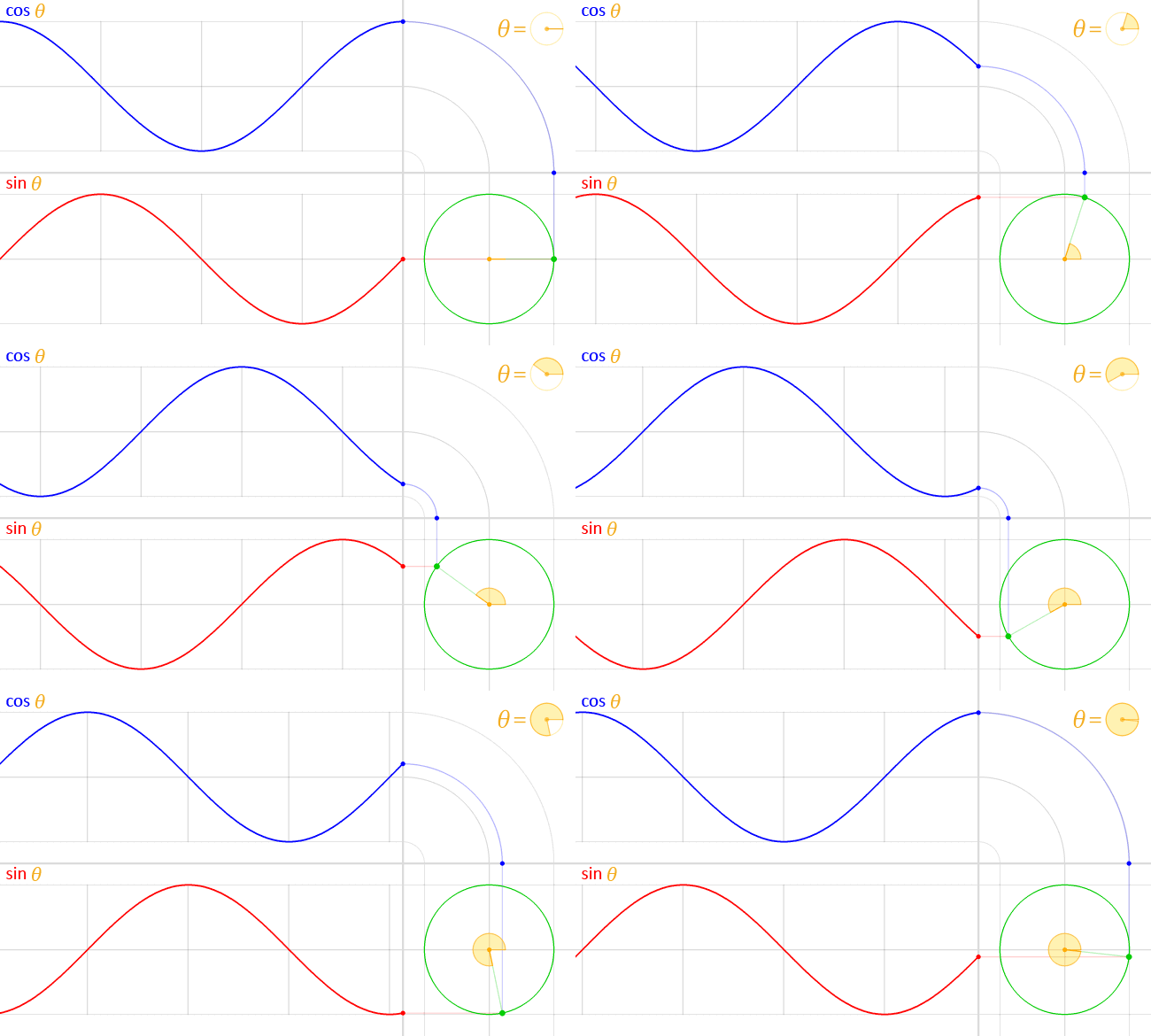
you can explain about what's about unit circle and why the angles are first. Then the student doesn't have to memorise any particular values anymore, they can re-derive them themselves
wide ice
frail vapor
As in I'm not sure quite exactly how to derive it.
😄 you mean something like this?
 frail vapor
Ah yes
wide ice
here's a simpler one not to scare anyone
 frail vapor
Like where sin(pi/4)= sqrt(2)/2
wide ice
so... right isosceles triangle?
frail vapor
Wdym
frail vapor
frail vapor
Like where sin(pi/4)= sqrt(2)/2
How exactly did they solve for the value? Pythagoras?
wide ice
what else can it be 😄
draw a little isoceles right triangle with base of length 1
solve for the leg, via Pythagoras you have 2x^2 = 1 i.e. x = 1/sqrt(2)
you can re-derive most of the essential values on unit circle with classical euclidean geometry like this
frail vapor
Ok
 valid trout
Folks, what kind of apps/websites/software do you use to teach math better today?
And what fonts do you use for teaching?
twin shell
can you be more precise about the level of math/audience you're targeting
in my tutoring sessions I find the most common website I use tends to be https://www.desmos.com/calculator

Desmos
but there's surely lots of good ways to adapt the lesson to a given background
for example if my student has some physics knowledge that makes explaining trig functions easier since they know how to calculate vector components
and so I could just google examples of relevant physical phenomena
turbid zenith
valid trout
And what fonts do you use for teaching?
I personally use a sans-serif font for prose and a serif font for math
I think it makes it easier to tell the math and the non-math apart
valid trout
twin shell
can you be more precise about the level of math/audience you're targeting
SAT / GRE students
pastel horizon
valid trout
Folks, what kind of apps/websites/software do you use to teach math better today...
I haven't battle tested it yet but Google practice sets seems to be a good tool for HW
If you already have problem sheets it's very easy to export them as long as it's a pdf
 modern harness
I'm working with sets of functions, and was wondering if people had attempted ways to visualize the set of functions along with the domain and range sets?
More formally, I have a set of functions S where every f in S is a function from A to B. Is the best thing to do just have two ovals for A and B, then have a large arrow or something representing S? I want to come up with a visual model that can describe epsilon-covers of S too, where an epsilon-cover is a finite subset of S that can approximate every function in S with error epsilon.
turbid zenith
valid trout
Folks, what kind of apps/websites/software do you use to teach math better today...
Also ChatGPT for the lesson planning side of things and writing problems/assignments
pure coral
valid trout
Folks, what kind of apps/websites/software do you use to teach math better today...
unironically, google slides
no easier way to create illustrations
you have shapes, text boxes, arrows
vagrant meadow
turbid zenith
Also ChatGPT for the lesson planning side of things and writing problems/assignm...
can't find it but i remember someone i think in #math-discussion asking for some practice problems to get ready for analysis and chatgpt gave them a problem like "show that sqrt 2 is rational" or something similarly silly. how do you use chatgpt effectively for this?
turbid zenith
Usually I already have an idea of what kind of task I want them to do and ChatGPT helps me flesh it out
https://drive.google.com/drive/folders/1wIh2TxGlhkjuVno7XyNLKDaqxuNFHvqV
These problem sets were made using ChatGPT as part of the process
Having it come up with something ex nihilo isn’t as effective, but giving it a starting point helps immensely
turbid zenith
pure coral
unironically, google slides
Same with PowerPoint for me — it’s my main graphics program
And my Calc series on YT was done in PPT and OBS
But currently my use case for ChatGPT is having it help design lessons for certain topics that are more student-centered and interactive instead of me just standing at the board and lecturing
First day of Calc III they’re gonna do an activity it helped design that’ll get them thinking of multiple dimensions in a way that isn’t just spatial
vagrant meadow
turbid zenith
https://drive.google.com/drive/folders/1wIh2TxGlhkjuVno7XyNLKDaqxuNFHvqV
These ...
LOL the sandwich alignment chart
turbid zenith
#hoagiehomies
pure coral
every actor needs a critic
 white forum
I have recently made a reading group / study group for advanced calc, and I'm having issues with some participants not really understanding how to effectively help others learn. We have these help channels where we can ask questions and recieve feedback, similar to this server, for our study group, but a few individuals seem to always unknowingly respond in a condescending way to everything, like for example a few cliches would just be responses like, "I mean isn't this just by the definition ?", "it follows quite obviously from the definition...", "this even needs a proof..?".. Stuff like that. I don't want to discourage participation, but how can I communicate to them that this is not a helpful form of participation, and it isn't helping anyone learn. I haven't been able to think of a good way to put it into words myself, and I don't want to offend anyone. Thanks for the feedback.
frail vapor
Find a subject/branch that is more humbling. Maybe some reflecting on how it was for them.
Like something that both backgrounds have the same degree of knowledge.
wide ice
white forum
I have recently made a reading group / study group for advanced calc, and I'm ha...
I'd suggest finding a new group. It's not the math that is the issue anymore, it's the people. Had it been something else, I'd expect the same.
twin shell
well
it is almost certainly the people who are the issue
but talking to people effectively is a skill that takes time to develop and mistakes need to be pointed out
adults have classes on these
wispy slate
white forum
I have recently made a reading group / study group for advanced calc, and I'm ha...
Unfortunately for some it takes a while to develop that sort of compassion for people who aren't as fast to learn certain concepts or subjects. Sadly I have known people who were actually turned off of math because they felt condescended to and that they just weren't smart enough. The way I would try to handle it is to explain that other people may not understand things immediately, why their comments are unhelpful, and if you can, some examples of their comments that are actually helpful. I think the best course of action is to just try to get them to understand how to better participate in the discussion, and I understand your fear that you'll discourage them from participation entirely, but in the end it just comes down to that saying that goes "If you don't have anything nice to say, don't say anything at all". And if they can't understand that then maybe it's better to not have them participating in the discussion, at least for a little bit. It's hard, but I don't think there is much worse than hindering another person's learning.
 noble hare
white forum
I have recently made a reading group / study group for advanced calc, and I'm ha...
noble hare
white forum
I have recently made a reading group / study group for advanced calc, and I'm ha...
maybe make an announcement and outline the kind of behaviour you do and do not want to see. that way people won't think you're specifically targeting them and not want to participate. its your study group right? i think you're entitled to request a baseline for discourse
white forum
noble hare
maybe make an announcement and outline the kind of behaviour you do and do not w...
yes it is mine
I have done something similar but it didn't really change much
noble hare
what is it that you said
pure coral
white forum
I have recently made a reading group / study group for advanced calc, and I'm ha...
i'd say just be direct about it and call them out, unfortunately any stem subject attracts those whose entire values revolve around being good at stem
don't be mean, but be honest
turbid zenith
I support this. Let them know that it’s not helpful, and give them direction for how to be more helpful. Give them examples of “here’s what isn’t helpful, here’s what you could do instead.”
white forum
Okay thank you everyone I appreciate the advice and feedback. I'll try to do that next time it happens
 vivid orchid
I’ve experienced this before as well. It’s some sort of superiority complex that happens when people grow their mathematical intuition, they start to disregard questions and confusions they did not have earlier due to simplicity. In my experience it usually happens at the early undegraduate level in analysis and algebra. I see it happen less often as you go higher because everyone understands the intricacies and interest in detail for even the simplest of things, and as such have a more open attitude to helping someone gain that understanding.
As others said, best thing you can really say is that it doesn’t add to a helpful constructive discussion and we should all respect that everyone will have a different mathematical journey.
turbid zenith
What's everyone got on their plate for teaching in Fall 2023? I've got:
- Calculus III (multivariable up through double integrals), 2 sections
- Mathematics & Human Nature (liberal arts math), 2 sections
- Elementary Statistics, 1 section
quasi musk
As of right now I've got:
7th grade Geometry, 8th Grade Geometry, and 10th grade "intro to Calc" we'll do some basic limits, derivatives, and baby integrals
I'm still waiting on my TA assignments
tawny slate
What should you do if someone is bad at math? You try to be as patient and as understanding as possible when helping them
What should you do if someone is bad at teaching math? You try to be as patient and as understanding as possible when helping them
I don't like this attitude of just passing people off as terrible people just because they have a poor attitude when assisting someone with math
Not everyone is good at teaching math and knows how to be careful with their language or is able to place themselves into the positions of the other person effectively
Just as there are people who struggle with math, there are people who struggle with teaching it
Just try to engage with the people bad at teaching math in the same way that you would engage with someone bad at math
pure coral
it’s another thing when the intention isn’t even to teach
tawny slate
Correct, that's a different matter
pure coral
yea, it’s 100% okay to be bad at teaching, everyone’s gotta start somewhere, and not everyone has a gift for words
when it’s passive aggressive though, it should be addressed, and that’s when just a simple, “hey, they’re newer to this stuff, quit it with saying how obvious this stuff is” is fine
i understand that those who do become passive aggressive are just simply looking for validation, but that doesn’t make them a bad person
pastel horizon
Yeah I think this phenomenon is also why you see a lot of students developing imposter syndrome around that point in education
It can be easy to fall in the trap of "well these guys clearly get it maybe I shouldn't be here" even though they are more than qualified
twin shell
maybe show them https://xkcd.com/1053/ 
 sharp beacon
Sounds like more of a debate over how much the bad teachers know what they're doing
Math concepts tend to feel obvious once you already know them, at least for me it's hard to appreciate the difficulty of learning a concept that I already know
It might be good to add a "fudge factor" when estimating people's abilities to learn new concepts, a general rule that they're probably smarter then they're appearing (unless this is just a me problem)
Not that it's helpful to tell them the answer should be obvious, even if it really should be though
tribal tiger
turbid zenith
What's everyone got on their plate for teaching in Fall 2023? I've got:
* Calcul...
I'm just an undergrad but I'm doing some TAing in proof based linear algebra, should be fun!
turbid zenith
Nice!
I haven't gotten to teach many proof based courses ... just Proof & Logic once and Abstract Algebra once. I'll get to teach Abstract Algebra again next semester though.
tribal tiger
turbid zenith
I haven't gotten to teach many proof based courses ... just Proof & Logic once a...
Nice, that seems like a fun class to teach since the material is pretty malleable
wide ice
College profs: how do you prepare your exercises? Especially the harder, non-conventional ones.
I'm tutoring a gifted math student, so I look for some harder exercises. I tried a few approaches so far, even rephrasing and breaking a published theorem into many smaller pieces. Thing is, it's easy for me because I know the topic, but it might not be easy for the student, and I sometimes find it challenging to find a way to break it down reasonably.
empty gull
wide ice
I'm tutoring a gifted math student, so I look for some harder exercises. I tried...
the way I saw it done if you're breaking down theorems is to break it down into like "general steps" of a proof and maybe to provide a hint or two abt what to look out for with each step (this is how our algebra hw worked in uni)
wide ice
Sometimes a step involves an uncommon trick though. I tried sometimes making something up using the same trick to illustrate it, so that the student can get familiar with it. But it doesn't always work. Sometimes it's particular.
turbid zenith
wide ice
College profs: how do you prepare your exercises? Especially the harder, non-con...
Sometimes I like to have students work with a particular example of a phenomenon and ask two questions: "What do you notice?" "What do you wonder?" And then let that fuel the general case.
meager bronze
i find that a lot of my original homework questions (interesting ones, not jsut rote computations) come from class time or interactions with students. maybe i get asked a question, or i just realize as im talking about something "hey this is an interesting concept; let me save it and turn it into an exercise"
 empty lichen
wispy slate
Unfortunately for some it takes a while to develop that sort of compassion for p...
empty lichen
wispy slate
Unfortunately for some it takes a while to develop that sort of compassion for p...
i suggest if they have some issues understanding it they should message you and you could break it up like if your teacing a group of kids but there adults my mother is a teacher for harvard so i mostly try to understad that
undone wagon
<@&268886789983436800> spam
lethal leaf
<@&268886789983436800>
twin shell
they gave up on diff geo and went after the teachers’ union instead
lethal leaf
tawny slate
What should you do if someone is bad at teaching math? You try to be as patient ...
Well the thing is that if you're bad at teaching how do you "get caught"
tawny slate
Huh?
pallid night
lethal leaf
Well the thing is that if you're bad at teaching how do you "get caught"
Be unlucky enough to have an absolute tonne of students file complaints against you, as happened to my Y11 (year before exam) Chemistry teacher, who got moved to teaching Y7-8, didn't improve, and then got fired.
lethal leaf
sure but that takes a whole year of students getting a shit education
pallid night
lethal leaf
sure but that takes a whole year of students getting a shit education
Sadly yes
Though in my case, they got moved after 4 weeks, and were fired by the end of the term.
That may be unusual though, my school was quite on it.
vagrant meadow
pallid night
Be unlucky enough to have an absolute tonne of students file complaints against ...
students file complaints for reasons other than being a poor teacher. for example, there is an excellent prof at my former college who gives difficult exams (difficult because the problems require conceptual knowledge and critical thinking). students file complaints against him all the time because they want an easy class they don't have to try to pass. personally, i like questions that are different/i haven't seen before that show an interesting application of the content we've been covering. most students don't, however.
pallid night
vagrant meadow
students file complaints for reasons other than being a poor teacher. for exampl...
Yeah exam difficulty at my uni is much more centrally regulated because of this.
turbid zenith
C'mon making last minute changes to my Calc III curriculum before the semester starts
Our Calc IV class is supposed to start with triple integrals (because it's set up to just march through Stewart ... ugh)
But I'm thinking of putting them in Calc III, and then pushing polar coordinates to Calc IV so they're closer to cylindrical coordinates, spherical coordinates, and Jacobians
And so that the integration section of Calc III focuses a little longer on visualizing regions and iterated integration
Does that seem like a logical progression?
pallid night
turbid zenith
Does that seem like a logical progression?
Yes
It also allows a somewhat more focused approach to what a change of coordinates actually means with a better grasp of geometry built up from the lengthier focus on triple integrals and visualisation of volumes.
That's just my opinion though
lethal leaf
Writing questions is so annoying 💀
Especially when I want them to be a specific difficulty
Because I have to keep telling myself "I can answer this in 5 minutes but they might not be able to"
turbid zenith
@lethal leaf I feel you on that.
What course are you trying to write questions for?
 oblique bobcat
I'm writing the syllabi for my discussion sections, and I need to put office hours. How should I choose my office hours?
oblique bobcat
lethal leaf
Because I have to keep telling myself "**I** can answer this in 5 minutes but th...
A rule that one of my professors told me in undergrad is, if you're writing an hour-long test, you should be able to do it in 10 minutes.
lethal leaf
turbid zenith
What course are you trying to write questions for?
a discrete math course
just some postlecture questions
they're supposed to be on the level of "if this is your first time seeing the material after watching the lecture videos it should take you < 10 minutes to do 2-3 of these"
oblique bobcat
Write up the questions that to you are so obvious that you can see the answer immediately, maybe?
lethal leaf
that's pretty much what I'm doing
just stuff like this

it's just annoying to come up with questions + varients lol
pallid night
lethal leaf
just stuff like this
That's evil
Will certainly catch out the peeps who think of module as remainder
Well designed
turbid zenith
oblique bobcat
Write up the questions that to you are so obvious that you can see the answer im...
I second this
Plus thinking, "what would be the most common misconceptions"
. . . with the caveat that they are not penalized for wrong answers, and you're just using them for diagnostic purposes
 tacit adder
lethal leaf
Because I have to keep telling myself "**I** can answer this in 5 minutes but th...
tacit adder
lethal leaf
Because I have to keep telling myself "**I** can answer this in 5 minutes but th...
This is how I feel at every problem setting meeting for an algorithms course because I usually want to give interesting problems for students, but they always usually turn out either too hard or too cumbersome to write a solution for
lethal leaf
pallid night
That's evil
Will certainly catch out the peeps who think of module as remainder
How is this evil 😭
lethal leaf
turbid zenith
. . . with the caveat that they are not penalized for wrong answers, and you're ...
Yea these are infinite try type questions
They have other HW on top of this that's actually graded
turbid zenith
Okay that's good!
lethal leaf
turbid zenith
Okay that's good!
if they really wanted they could just spam the answers until they got it right
like there are some true false questions
idgaf too much really. Maybe if I get time I'll make some variants but eh
vagrant meadow
lethal leaf
if they really wanted they could just spam the answers until they got it right
i mean... should one really write their questions based on students like that? i don't think it matters to them
lethal leaf
Yea that's my point
I don't care if the students who do that don't get anything out of this diagnostic type questions
Just hard coming up with questions of the flavor "if I was first learning this, what may I be confused about"
But like not making them super hard
vagrant meadow
i wish infinite try/ungraded questions were more common though. i feel like they're a lot more conducive to learning than "if you get this wrong that means you have to do 5 more questions".
vagrant meadow
any suggestions for what to say to a discouraged student? ex. one who keeps saying "I should drop this class, i can't do this". been trying to tell them that it's hard for everyone, but I'm not sure what they really want or need to hear to hear at that moment. I dunno if what I would want someone to say to me would be helpful for them.
wide ice
vagrant meadow
any suggestions for what to say to a discouraged student? ex. one who keeps sayi...
It's great if you struggled with the subject at some point and have a story to tell. Students love that kind of thing, it reassures them that profs are not some divine powers, and it's ok to struggle, and there are ways to overcome that. But that's what I'd want to hear, idk about others.
Saying it's hard for everyone doesn't cut, you need an example too.
pallid night
lethal leaf
How is this evil 😭
Well, it's not really
Just looks odd till one throws away intuition and looks at the definition, which is exactly the point I'm guessing
empty gull
pallid night
That's evil
Will certainly catch out the peeps who think of module as remainder
But
mod is remainder??
 tardy ember
i think she meant as in, if you're thinking of "x = y mod m" as meaning that y must be the remainder of x mod m, instead of it being the equivalence relation "= mod m"
"the remainder of 3 divided by 2 is 1, therefore 3 isn't 3 mod 2, 3 is 1 mod 2"
twin shell
vagrant meadow
any suggestions for what to say to a discouraged student? ex. one who keeps sayi...
ask what’s going on in their lives
lethal leaf
^^^ very possible that they just don't have the bandwidth to work on the class cause of other shit happening in their lives
vagrant meadow
twin shell
ask what’s going on in their lives
probably shoulda mentioned. yeah I'll say they have very good excuses for struggling, and we did talk about that.
I mean like from my POV, their situation is really tough. and even if they were more comfortable with the prerequisite material, the complete lack of support they have from a purely asynchronous course with no lectures is just awful.
like idek if I could do it if I was in their shoes. but I don't think I should say that.
I told them about Khan Academy for lectures and told them about this discord so they can ask questions whenever they have time rather than just when they can go to online tutoring.
but yeah. it seems like they need a lot more time to dedicate to the class if they want to pass, and they just don't have it.
vagrant meadow
wide ice
It's great if you struggled with the subject at some point and have a story to t...
well it wasn't a cakewalk for me, and it took a lot of work. but I'd feel a bit disingenuous saying I actually struggled in that particular class. if anything, it just got harder to tutor over the years because I don't do certain parts of the material often. I suppose "I still struggle to remember how to do this material, let's figure it out together" is better than "it wasn't that bad for me when I took it". 🤷
 next sinew
@near oriole I think everyone's worried about the future of math education and yet somehow math education is getting better all the time, at least at university level
near oriole
You can reexplain here if you'd like, but I am not convinced at all by the other explanations that were given in #help-22 message
next sinew
Like I definitely think you have a great point and understand your frustration but improving at math doesn't actually follow the type of linear progression that you'd intuitively expect everyone to follow
near oriole
I don't see how that's a point unless it's clear that's how this person's curriculum worked.
next sinew
because if you try to define something completely rigorously before moving on then undergraduates would be proving the completeness of the ZFC axioms or something like that
near oriole
Unless they had roots defined to them in terms of exponents, it's wrong to me.
If you don't make it clear which things are defined in terms of what, you will end up with circular definitions.
how is sqrt2 defined? 2^1/2. 2^1/2? sqrt2.
next sinew
People's understanding of mathematics will always be a little hazy, and the way it works is that the gaps in one's understanding are only filled after-the-fact, because otherwise everyone would just be stuck with seemingly very uninteresting mathematics
building mathematics from the ground-up is the wet dream of any mathematician but unfortunately people just don't learn math that way
next sinew
near oriole
If you don't make it clear which things are defined in terms of what, you will e...
And I don't disagree with any of this, if I were to write a textbook I would explain it exactly as you said
near oriole
You are trying to justify this with how people are (apparently) taught as opposed to how they should be taught.
next sinew
but I think getting mad at people learning math "wrong" is a little counter-productive especially when they probably haven't even entered university yet
if the algebraic manipulations that they're doing are nonetheless correct
near oriole
And I don't see issues with correcting what I'd view as 'wrong' ways of being taught.
near oriole
next sinew
but I think getting mad at people learning math "wrong" is a little counter-prod...
The helpee claimed they understood but I did not understand at all what there was to be understood.
next sinew
Yeah that I agree with
near oriole
And that gave me no confidence at all in them having actually understood.
next sinew
saying "he understood it a different way" makes no sense I agree, what he should've said is "he made progress in his mathematical development"
and I think that's why what he was shown was valuable
even though it was pedagogically not ideal
And I know it's frustrating to see people explain things in ways that aren't pedagogically ideal and not faithful to the spirit of mathematics, but the unfortunate reality is that some teachers/helpers don't know any better, and sometimes the proper explanation requires a lot more time and effort, so it's easier to just leave the learner with something quick and snappy that might not be the whole story but still advances their mathematical thinking
near oriole
In which case the point of me clarifying is not just for the helpee but for also the other helpers to understand.
next sinew
Because the whole story, saying stuff like "sqrt(2) is the positive number whose square is 2", raises all kinds of questions like "well okay but why is that number unique? why does that number even exist? what even are numbers?" and while those are perfectly good questions to ask it's not like we have unlimited time to teach people everything there is to know
near oriole
Those are reasonable questions, and not ones I'd want to stifle in advance by giving the wrong answer.
next sinew
Sometimes algebraic manipulations, even though they end up containing circular logic upon closer inspection, can give a feel for why something might be true, they can convince someone that they know, even if they actually don't, and in some sense that's bad, because it stifles many excellent follow-up questions, but on the other hand, if you're super confused about the square root of two then you're definitely years away from doing any serious mathematics, and I think there's still plenty of time for the right questions to pop up in one's head, and I think bombarding someone with them at the very start, when you can't actually commit to being their personal tutor, is only going to discourage them
near oriole
I believe in going about things constructively - if there is something I think can be improved, I'll point it out. Apart from the helpee apparently understanding in this particular case, I think my objection was perfectly reasonable.
next sinew
I do think your objection was reasonable for sure
and I definitely applaud your approach to mathematics
near oriole
next sinew
Sometimes algebraic manipulations, even though they end up containing circular l...
I fundamentally do not agree in teaching white lies that students later go 'wait that was wrong'
That's how a lot of confusion (and potentially crankery) comes about, in my view.
Wrong ideas about infinity. Wrong ideas about limits.
next sinew
I think you just need to remember that some people will never stop to ask the right questions because they simply don't care, and maybe that's okay, society shoves mathematics down people's throats and not everyone's in for the full ride
for those people, simple mnemonics or satisfying algebraic manipulations or imprecise statements might allow them to at least get some sort of grasp on how to apply mathematics
because at the end of the day most people learn mathematics just because school forces them to and usually only end up using it for very basic things
near oriole
Given some years of hs teaching experience I might see where you're coming from and might agree, but I don't, currently.
 rich prawn
near oriole
I fundamentally do not agree in teaching white lies that students later go 'wait...
rich prawn
near oriole
I fundamentally do not agree in teaching white lies that students later go 'wait...
Is that not how mathmatics develops?
I think it's easy to take for granted the ubiquitous use of set theory in maths that allows you to define things exactly, almost like it's a computer program
near oriole
The subject itself may have taken a winding path to get to where we are today, but today's learners don't need to take the same path.
If that's what you meant.
Knowing the history can be useful, but that's separate from how it should be taught.
rich prawn
Sure, it's better to simplify some things. And you do get anachronistic notation popping up a lot when learning 'classical' maths
turbid zenith
Okay just to make sure I'm understanding what's going on ... this is because somebody explained why $\sqrt{2}\cdot\sqrt{2}=2$ by appealing to rational exponents?
burnt vesselBOT
DM Ashura
 rich prawn
Write off the bat with the way modern education is I think it would be impractical to teach calculus in a first course using epsilons and deltas
near oriole
burnt vessel
**DM Ashura**
There were 2 other explanations in the channel which I thought were bad.
turbid zenith
rich prawn
Write off the bat with the way modern education is I think it would be impractic...
(Oh I hardcore agree with this ... it's a great way to lose most of the students immediately)
near oriole
But unfortunately no one else shared that view at that time 
turbid zenith
What was wrong with the explanations, @near oriole ?

 rich prawn
turbid zenith
(Oh I hardcore agree with this ... it's a great way to lose most of the students...
rich prawn
turbid zenith
(Oh I hardcore agree with this ... it's a great way to lose most of the students...
The reason I think has mainly to do with the fact that most scientists take their first course in calculus in highschool, and that there aren't resources for teaching university rigour mathematics in highschool
near oriole
rt2.rt2 = 2 by definition, and I think anything else is fluff that skirts it
turbid zenith
Ahhh
Based on experience I'm going to say that I disagree
Not that √2 · √2 = 2 "by definition", but that "by definition" is the one right way to fit it into students' heads
rich prawn
There's no 'correct' asnwer here
sqrt 2 can be defined in two different ways
algebraically or analytically
turbid zenith
Learning is highly nonlinear, and a different way of phrasing it or approaching it might be the thing that makes it "click"
rich prawn
they both have their own 'generalisations' but in the particular case of the real numbers they coincide
near oriole
distributing the root over multiplication should not be encountered until it is explained what roots are.
non-natural exponents... uh... I'd be somewhat surprised if you see these in the same school year that roots are introduced (even more so if they are introduced first)
turbid zenith
"You're not allowed to do this until it's 🌟 DEFINED🌟" may be good for a real analysis course, but not for, say, a middle school course
near oriole
But how could it make sense to talk about the properties of the root before knowing what a root is???
'definition' in hs is a synonym for 'explanation', I meant..
turbid zenith
People figured out lots of things about group theory before formally defining what a group is.
rich prawn
Don't most middle schoolers know what a square root is?
I'm not sure I follow what the talk is about
turbid zenith
There's a lot of layers to knowing "what a square root is"
rich prawn
'it's the number such that when you square it you get back the same number'
That's good enough for most if not all of school mathematics
turbid zenith
Right, but I've worked with many students whose eyes glaze over at that definition, but then you put it another way — say, have them play with examples — then it clicks.
rich prawn
You'll get to branch cutting when you get there
yeah exactly
have them plug it in a calculator
near oriole
turbid zenith
Right, but I've worked with many students whose eyes glaze over at that definiti...
That may be true for some, but I see no sense in not introducing the definition as the definition first, before talking about properties/examples that make the thing make more sense.
turbid zenith
And even then, sometimes going right from the definition isn't the thing that makes them understand.
near oriole
Which was what wasn't happening in that channel.
near oriole
near oriole
This was the 1st answer I saw (and objected to)
turbid zenith
To be fair, you have no idea how it was defined "first" to the student. They came in with a particular problem they were trying to do.
near oriole
near oriole
And right, this does do things more in the way you described.
normal aurora
near oriole
This was the 1st answer I saw (and objected to)
I mean that doesn't look so bad
turbid zenith
It's really not so bad. It's not a "definition" but it does have multiple ways to manipulate the expression.
It's most likely not the first time the student has encountered square roots.
rich prawn
turbid zenith
It's most likely not the first time the student has encountered square roots.
Let's be honest. As a child who hasn't played with the sqrt symbol
Every calculator, even the crappy ones have a √ on it
In fact I think that's probably how I learned what it is
And then you would get error when you plug -1 in
near oriole
All the same, I'm still not convinced it was wrong for me to object to the explanations given - more times than not, it would not be helpful, in my view.
turbid zenith
near oriole
All the same, I'm still not convinced it was wrong for me to object to the expla...
Except the student explicitly said that the explanations were helpful despite you doubling down.
near oriole
Right and I could not understand it at the time, but now I somewhat do, at least.
rich prawn
I think the only time until A-level where I got an explicit definition was what a trig function is
turbid zenith
I think an important distinction to make is this (and I say this a lot):
rich prawn
soh cah toa
turbid zenith
Mathematical Foundation ≠ Pedagogical Foundation
 dawn walrus
I think this is interesting because a lot of times people think things are helpful when they actually aren't, and it's just a reinforced misconception, but sometimes that's actually fine
Like the chain rule mnemonic or whatever
rich prawn
dawn walrus
I think this is interesting because a lot of times people think things are helpf...
I think a good example is the definition of a vector space
turbid zenith
I think a better way to tell if they "really understood" it would be to construct questions that would tease out potential misconceptions
rich prawn
I remember the first time seeing it in the 3b1b video series
being extremely intimidated (it's like 9 axioms or something)
dawn walrus
turbid zenith
I think a better way to tell if they "really understood" it would be to construc...
Can you really do that in this case without getting into a can of worms though
turbid zenith
Sure.
rich prawn
then once I had gained more experience and learned group theory it became very striaght forward
turbid zenith
If I'd been around at the time I'd probably have asked, "what does √2 mean to you?"
rich prawn
turbid zenith
If I'd been around at the time I'd probably have asked, "what does √2 mean to yo...
The first irrational number
turbid zenith
XD
rich prawn
Canonically
turbid zenith
https://mathwithbaddrawings.com/2021/05/12/against-mathematical-proof/ ← recommended reading, by the way
 rich prawn
I love theorems that say like. Theorem \textit{$\mathbb{R}\setminus \mathbb{Q}$ is non-empty.}
\textit{proof. $\sqrt{2}\not\in\mathbb{Q} \qedsymbol$}
turbid zenith
You want \setminus
burnt vesselBOT
Philka
 normal aurora
what's \textit
rich prawn
text italic
normal aurora
tfw \emph
rich prawn
what's that
next sinew
turbid zenith
If I'd been around at the time I'd probably have asked, "what does √2 mean to yo...
I very much like this approach
turbid zenith
Would be interesting to see whether they answer the question differently with √9.
normal aurora
I definitely think a lot of people don't spend enough time gathering information from the student
next sinew
yeah now that you mention it I need to start doing that more
rich prawn
Some teachers are just bad..
next sinew
although on this server it's quite difficult because it feels like a pretty competitive atmosphere sometimes
like everyone's rushing in to give a ready-made explanation
turbid zenith
How do you mean?
rich prawn
I remember in highschool the mean value theorem showed up in the syllabus and he said 'I've had an engineering degree for 30 years and I've never seen this theorem before.'
turbid zenith
Ahh okay
rich prawn
and then proceeded to say it was irrelevant
turbid zenith
The main pet peeve I have is when someone asks what's clearly, say, a high school algebra question
And someone responds with an abstract algebra answer
I don't see that as much here on this Discord but I used to see it in other places
rich prawn
I know exactly what you mean
It happens with university questions too sometimes
I've maybe found some old problem sheet questions on maths stack exchange 👀
But the answer uses more sophisticated maths that isn't useful because it's not in the material of the course
tawny slate
i think it's annoying in most cases where you use something more complicated/abstract to explain something simpler
q: why is the pythagorean theorem true?
a: easy, it's an extension of the law of cosines
i think you should generally only use a "top-down" explanation when you're trying to contextualize something you already understand, not when you're trying to understand something for the first time
vagrant meadow
near oriole
I fundamentally do not agree in teaching white lies that students later go 'wait...
what about white lies alongside a disclaimer that the lie is not the whole story?
"this is not entirely true, but this will serve as 'good enough' until chapter x where we will go into more detail on this concept and find where exceptions arise"
or something along those lines
also, sort of unrelated question but someone mentioned vector spaces earlier and it got me thinking.
say one is teaching an intro linear algebra class (where you will eventually discuss complex vector spaces). what would you all think of defining vector spaces just generally over a field F without actually getting into the nitty gritty of defining what a field is? i.e. explain it sorta like "a set of numbers which you can add, subtract, multiply, and divide such as Q, R, and C".
bc like why define just real vector spaces and then later say "guess what, scalars can be complex"? seems easier to just always use F, and it doesn't seem like it'd make that much of a difference how well they understand fields besides knowing that you can divide by scalars.
near oriole
Ive never really understood defining a vector space (and field) before understanding the definition of a group, and then insisting students learn and understand the defn as opposed to going "here it is, don't worry too much about it - think of it as R^n over R"
Linear algebra can be taught over R^n for a beginner's course at say HS level
cloud zealot
vagrant meadow
also, sort of unrelated question but someone mentioned vector spaces earlier and...
this is the approach taken in meckes' linear algebra textbook
but of course the reader is encouraged to think of F as R or C
wide ice
vagrant meadow
also, sort of unrelated question but someone mentioned vector spaces earlier and...
There are differences between fields. Not all are the same. Suppose you mention on the side "oh btw, this is also true for C.", but then which theorems exactly? For example, classifications of quadratic forms are different between vector spaces over R and over C, and the theory of quadratic forms is different if the field has characteristic 2. Either you have to prove everything again, or you make everything abstract from the beginning.
it's good to tell students that "when see F, think of R or C.", but also keep the math reasonably abstract and general, and remind the students of the details.
Almost no students will appreciate the extra effort to make everything abstract, but they have to learn to appreciate it one way or another if they choose to study math
turbid zenith
Depends on the level.
I would not make everything abstract for an intro course. Especially if it's being taken by a variety of majors.
Start concrete, work toward abstract.
. . . I mean technically I do that even for upper courses like abstract algebra 😛
vagrant meadow
wide ice
it's good to tell students that "when see F, think of R or C.", but also keep th...
yeah this is mostly what I was thinking. "F usually means R, but it can also mean C (or Q if we're feeling whimsical)". and then maybe we discuss finite fields as a bonus topic or something.
bc I mean most theorems (especially those in an intro course) apply over every field. and it's not that hard to specify or exempt a specific field when you need to.
vagrant meadow
turbid zenith
I would not make everything abstract for an intro course. **Especially** if it's...
can you elaborate on some of the pitfalls you think might arise from an approach like this at a lower level (like lower div undergrad or maybe even HS)? I suppose a student who isn't paying attention might space out and think "wait, what's F??".
if the idea is mainly "F is a stand in symbol that can mean many things, but mostly means R and often C". I personally don't see that as too abstract. but, granted, I'm often quite blind to seeing how something might be hard for a math-averse student to understand (and you have far more teaching experience than I do).
turbid zenith
It depends when you're introducing it. If you're introducing abstract vector spaces at the end of the course, you could do the whole F thing if you want
But if for some reason you're introducing the vector space rules at the beginning, I would just say that the scalars could be real or complex.
They can be something else, sure, but students can make that leap when they're ready
I just think that with every layer of abstraction you pile on at the beginning, you lose more students. Give them something they can latch onto at the beginning to get a feel for what it all means, and then later you can generalize and abstract it.
I just got done giving a presentation about this idea to the GTA's at GSU. The example I used was quadratic equations.
The way textbooks introduce quadratic functions:

The way I introduce quadratic functions:
 zenith slate
One of the biggest difficulties that students have, in my experience and especially when encountering brand new topics, is understanding why a generalisation exists in the first place. While seasoned mathematicians may see the intrinsic value in developing a general theory of linear operators that functions over any field F, students who are not used to or familiar with axiomatic definitions are likely to be confused as to both the meaning and the purpose of something like "vectors are simply things that act like this".
It is completely natural to ask questions like "okay but why can't it just be R, why does it have to be something arbitrary and abstract?" If you cannot provide a satisfactory answer to this question at a level appropriate for the student, then you may be pitching your content too high
vagrant meadow
turbid zenith
But if for some reason you're introducing the vector space rules at the beginnin...
i'm curious, how exactly would you write down the definition of a vector space on the board, then? if you wouldn't mind, i'm extremely curious how you would phrase it exactly, and the terminology/wording/symbols you would use.
normal aurora
I feel like once you've allowed both R and C
you've sort of opened Pandora's box as far as fields go
turbid zenith
vagrant meadow
i'm curious, how exactly would you write down the definition of a vector space o...
Well if it were up to me, it would be at the end of the semester, and I would say a vector space is a set V of "vectors" that can be added and multiplied by scalars, according to some rules: [insert list of rules]
(Though I'd give them a handout with the definition rather than writing it on the board 😂)
And I might consider introducing the idea of a general field at that point as "things that can be added, subtracted, multiplied, and divided, like Q or R or C"
If I were forced for some reason to introduce vector spaces at the beginning of an intro class I'd probably just stick with real scalars
turbid zenith
In the ideal situation (i.e. vector spaces at the end) the handout might be worded something like this, which they'd get after an exploration activity.
At this point, you've just seen how there are many mathematical objects that "act like vectors," which means we can treat them like vectors. We say that these objects form what's called a vector space.
Formally, a vector space consists of a set V of vectors and a set F of scalars, satisfying the properties listed below. (Note: x, y, and z are arbitrary vectors, while a and b are arbitrary scalars.)
Commutativity of vector addition: x + y = y + x.
Associativity of vector addition: (x + y) + z = x + (y + z).
Identity of vector addition: There exists a zero vector 0 with the property that x + 0 = x.
Invertibility of vector addition: Each vector x has an additive inverse, labeled -x, for which x + (-x) = 0.
Associativity of scalar multiplication: a(b x) = (ab)x
Identity of scalar multiplication: 1x = x
Distributivity of vector sums: a(x + y) = a x + a y
Distributivity of scalar sums: (a + b)x = a x + b x
One more important note is that the set F of scalars should form what's called a field. This means that the scalars should satisfy the commutative, associative, identity, inverse, and distributive properties you're used to. The most common fields we've used in this course are the real numbers ℝ and the complex numbers ℂ.
Note this is an on the fly DRAFT. I’m sure it has typos but I’m about to have dinner. I’ll fix any typos later
wide ice
normal aurora
you've sort of opened Pandora's box as far as fields go
If you do any sorts of olympiad-level or advanced combinatorics, you'll deal with the intricacies of vector spaces over finite fields.
but that's niche. I think 95% of math students don't even know about that.
austere inlet
you can get cool examples from cryptography

In classical cryptography, the Hill cipher is a polygraphic substitution cipher based on linear algebra. Invented by Lester S. Hill in 1929, it was the first polygraphic cipher in which it was practical (though barely) to operate on more than three symbols at once.
The following discussion assumes an elementary knowledge of matrices.
though Z_26 here is not a field
 vernal badger
I mostly work as a tutor in a university context, how do I deal with the fact that a lot of people who come to me have good questions about the material that they are studying that I either:
- do not have the ability to answer because I am not that good at math
- do not want to try to explain to them because I think they need more time than they have until their next exam to think about it
I do not want to encourage bad study habits, but I also want people to get their degree and get paid
(I think 2 overlaps with 1 a lot but a college algebra student doesn't need to understand groups)
 supple quiver
vernal badger
I mostly work as a tutor in a university context, how do I deal with the fact th...
supple quiver
vernal badger
I mostly work as a tutor in a university context, how do I deal with the fact th...
- Your answer will depend on whether the content is outside the scope of the course. If the question is relevant to course, consider doing research to answer the question asked. It is not expected you will be able to answer all questions because the particular unusual way math concepts can be applied.
supple quiver
vernal badger
I mostly work as a tutor in a university context, how do I deal with the fact th...
Maybe for 2 you could suggest resources that they could refer to but mention it may take too much time to understand.
vagrant meadow
vernal badger
I mostly work as a tutor in a university context, how do I deal with the fact th...
as a worker of the university (like at their official tutoring center) or just as a private tutor for university students?
bc i feel like the way one approaches tutoring depends on if someone is paying you specifically for tutoring in math, or are they just coming to a center for free or something
like if i'm tutoring someone privately, then i'll do my darndest to explain it, even if the exam is in two hours. it's their fault they waited so soon before an exam to get help, but i'll give them their money's worth.
i also don't do private tutoring unless I'm actually confident in the subject though so I can't say anything to 1. sometimes when we're short handed at the tutoring center I'll try my hand at a subject I'm not super comfortable with, and I'll do my best. but I'm always up front with the fact that "this isn't my wheel house, and we're short on tutors at the moment".
I had to help a student with physics the other day and it's embarrassing I had to double check that there are 100cm in a meter and 1000g in a kg, but it was pretty busy and there was no one else.
winged urchin
I do just privately tutor and if I ever do have a situation where I cant answer a question or have an inkling that my answer isn't as good as it could be I will tell the student I'll look at it later and send them something to clarify. But that's my personal option
Usually what happens is in the moment I'm a little flustered and as soon as I'm comfortable and away from the session my brain clicks and reminds me of what I forgot
Or I need to do a little scratchwork and then it comes back to me
Though I like to try to explain to the student how I'm approaching the problem when it isnt obvious to me. The students who really want to learn, I think, get a lot out of seeing someone knowledgeable still 'struggle' yet have options to explore. What to do when we are stumped
cold trench
I'll have my first day teaching an intro to business class next week. any general tips for the first day?
vagrant meadow
winged urchin
Though I like to try to explain to the student how I'm approaching the problem w...
yea it's easy to be discouraged when you don't know something, but you can definitely make it a learning opportunity.
 tepid smelt
cold trench
I'll have my first day teaching an intro to business class next week. any genera...
tepid smelt
cold trench
I'll have my first day teaching an intro to business class next week. any genera...
Is this college or high school? It doesn't hurt to go over the syllabus a bit but for college class I hated syllabus days and much preferred getting right into content. At the highschool level I do a little on class expectations and some group math puzzles to identify some stronger/weaker students to help with making a seating chart.
cold trench
college
but ok makes sense
there is a predetermined curriculum but I just wanted pointers for things like making sure the class is engaged and all that
tepid smelt
I mean for college classes the ones who show up will likely not need encouragement to engage. I think it's good to get started right away to not lose time as the pace can be a lot faster and you don't get as much time. I would treat them like the adults they are and get into content. Though it doesn't hurt to ask the department what others do.
cold trench
tepid smelt
I mean for college classes the ones who show up will likely not need encourageme...
attendance is taken, it's a class of 24
but yeah it's only 1 hour a week, the first day is mainly just an intro to the course and to college in general (since it's a freshman class)
still, the info you provided is very helpful
wide ice
cold trench
I'll have my first day teaching an intro to business class next week. any genera...
be absolutely perfectly clear about the grading scheme and your expectation
So that no one would whine about it and beg you for a B at the end of the class
cold trench
right makes sense, fortunately the class is mindbogglingly easy to end with an A/A- in
wide ice
Better be safe than sorry
I assume some students also know that, and they might be tempted to get lazy
It's fine to get lazy, but since it's easy, I'd make no leeway
cold trench
ok ty
pallid night
I just tried to explain the mean value property for harmonic functions to my parents and it went completely and utterly terribly 😅
Prime example of the importance of pedagogy awareness in teaching
undone wagon
Tried explaining homotopy theory to my mom once, that didn't stick very well lmao
vagrant meadow
pallid night
I just tried to explain the mean value property for harmonic functions to my par...
i'm always annoyed when i'm like at a dinner or something and someone's like "hey nix why don't you explain what your research is about". because the math experience of the people there is usually that they took algebra in HS 30+ years ago. so either i say something that sounds like nonsense to them, and get the irritating "oh wow i could never do that. i hated math", or do a very hand-wavy explanation of the core ideas of the field.
ex. i was doing a project on word maps in solvable groups so i sorta talked about symmetries of shapes (dihedral groups) and using them as inputs in a sort of polynomial. after, the person sitting next to me was like "yeah, i'm bad at explaining my research too"
i've given up on trying to be able to explain what i'm studying or working on to people who don't study math.
pallid night
My mum has way more than HS Algebra knowledge
She studied Engineering at a fairly well regarded indian university, however it was 35-ish years ago.
So she knows what a PDE is
I wonder if she was deliberately being pedantic to force me to explain stuff at such a base level that I just completely cracked.
I think the notion of taking a mean value over a circle was weird to explain
vagrant meadow
pallid night
So she knows what a PDE is
I wonder if she was deliberately being pedantic to fo...
well that's kind of the problem. if you go to a level of explanation that is far lower than the topic (or it is something particularly difficult to explain intuitively), it feels like you either have to
- take a lot of time to fully explain the ideas so that they can actually understand it
- be so vague that you can no longer convey the original idea accurately
and i just don't have the patience to do the first. a lot of time, an example can convey the idea well, but what if you're just chatting at a party and can't write anything down? or what if the example is far beyond them (ex. like explaining the continuity/differentiability of x^n sin(1/x) to someone who doesn't even know what a function is)?
pallid night
vagrant meadow
well that's kind of the problem. if you go to a level of explanation that is far...
this exactly
vagrant meadow
this is why i think the SoMEs that Grant Sanderson has been curating are so important. it's encouraging people to do the first thing, in a format where they can easily use visualizations to get around the obstacles i described.
cloud zealot
vagrant meadow
well that's kind of the problem. if you go to a level of explanation that is far...
but have you considered that you don't really understand something until you can explain it to someone like they are five?

twin shell
not exactly true but a good guiding principle
vagrant meadow
cloud zealot
but have you considered that you don't *really* understand something until you c...
tbh i think that's just wrong. i know feynmann says something like that. but imo teaching is itself a skill that isn't equivalent to knowledge. i think you can know something very well, but not be able to explain it well. that said, if you can teach something, that definitely implies you understand it at least pretty well.
i'd say the ability to teach implies understanding, but imo the converse is not necessarily true.
but maybe that's just a skill issue on my part tbh
cloud zealot
twin shell
not exactly true but a good guiding principle
there's a bottom floor for simplifying complex truths before it becomes a falsity
twin shell
I think as long as you don’t take it too literally it’s fine
it leads to accepted methods for deepening understanding
because it forces you to identify the big ideas, which might have gone over your head without you noticing
pallid night
vagrant meadow
this is why i think the SoMEs that Grant Sanderson has been curating are so impo...
yeah someone I know wanted to do an entry for this on symmetries and conservation laws (||Emmy Noether's Theorem||) but unfortunately they couldn't get their diagrams to work in time
pallid night
cloud zealot
there's a bottom floor for simplifying complex truths before it becomes a falsit...
yeah I mean how exactly are you supposed to explain the mean value of a harmonic function over a sphere to someone with no knowledge of what it means to take a mean over a continuum
Like some stuff is so complex it can only be explained at a certain base level
I very often forget that I'm studying material that is so advanced that likely in excess of 99% of the population won't understand anything I am studying ever again. And i've only just finished 2nd year undergrad. I am sure this is going to become even more extreme over the next few years, and if I go into research, likely the rest of my life. And to some extent that's just heartbreaking
Like, not the fact it's advanced, but the fact it's going to become near impossible to explain ideas of such a high level to average people.
because of the sheer number of gargantuan conceptual steps that i'll have subconsciously internalised.
it's only now that i've begun to acknowledge how difficult it must be for lecturers to teach in a way that genuinely understands the pedagogical needs of 1st and 2nd year undergrads, though most of mine did a very good job and I look up to them for it.
vagrant meadow
pallid night
Like, not the fact it's advanced, but the fact it's going to become near impossi...
yeah, math is pretty lonely. I've just sorta accepted that. at least in physics, chem, bio, CS, and engineering you can at least sorta explain things in terms of concrete things they encounter in real life.
pallid night
vagrant meadow
this is why i think the SoMEs that Grant Sanderson has been curating are so impo...
oh yeah this looks superb
If I can learn the skills for this I hope to enter it next year if it happens again.
pallid night
vagrant meadow
yeah, math is pretty lonely. I've just sorta accepted that. at least in physics,...
yeah I mean Maths is the emperor of rebranding commonly used words as completely differnet things, it's elite for randomly dropped pun potential but also quite annoying
And yeah Pure especially is a whole other league of abstraction
zenith slate
Pure math is not basically philosophy
That's just factually incorrect
Sure some people might get philosophical about algebraic varieties but this is very different to saying that algebraic geometry is basically philosophy
 sharp nimbus
zenith slate
Sure some people might get philosophical about algebraic varieties but this is v...
sharp nimbus
zenith slate
Sure some people might get philosophical about algebraic varieties but this is v...
True, math is still maths, lol
 storm quail
cloud zealot
but have you considered that you don't *really* understand something until you c...
storm quail
cloud zealot
but have you considered that you don't *really* understand something until you c...
Grothendieck attempting to explain algebraic geometry to a five year old
undone wagon

tardy ember
a trivial corollary of "you don't understand something unless you can explain it to a five-year-old" is "you don't understand anything a five-year-old can't" which is just nonsense
some things just require familiarity with a big stack of abstractions to properly understand, or involve correctly following a complicated computation
some things involve intuition that can't be communicated, which makes it kind of unclear how you'd teach them at all, and is especially problematic with a five-year-old
wide ice
vagrant meadow
yeah, math is pretty lonely. I've just sorta accepted that. at least in physics,...
I don't think it's about the subject, but about the topic and if someone has any familiarity with it
Explaining how red-black tree works is just as difficult as explaining Sylow's theorems.
Just that we tend to see more of other subjects than of math.
pallid night
zenith slate
Pure math is not basically philosophy
Ok fairs
twin shell
tardy ember
a trivial corollary of "you don't understand something unless you can explain it...
this is why I say not to take it literally
these kinds of strong messages will always go very wrong if you follow it to the letter
what’s important is to think about the meaning behind it, why it exists, and what lessons you can learn from it
pallid night
twin shell
this is why I say not to take it literally
these kinds of strong messages will a...
They are definitely not aimed at mathematicians either
twin shell
and here I thought mathematicians would be good at reading between the lines smh
 echo lodge
I prefer Feynman's test of a bright freshman to a literal 5yo
 wispy slate
twin shell
this is why I say not to take it literally
these kinds of strong messages will a...
wispy slate
twin shell
this is why I say not to take it literally
these kinds of strong messages will a...
Yes clearly that message is to be interpreted as "you don't understand a concept unless you can explain it in clear terms" Feynman itself tells someone in an interview that he cannot explain magnetic forces in simpler terms, because he'd be cheating badly etc.
turbid zenith
Just now getting to this conversation. I think part of it is that often when somebody asks you about something like this, they don’t need a full explanation. So a “hand-wavy” analogy really can do wonders, I think. (Then again I don’t think being “hand-wavy” is as bad a thing as some others do…)
I’ve explained stuff to my parents that, even though they don’t know the full thing, they have SOME kind of idea of what I’m talking about… mostly by coming up with an imaginary situation that they can relate to.
But you have to be okay with knowing that what you’re giving isn’t the full explanation or may really only be like the first step to understanding out of five.
tardy ember
even if we decide being handwavey is fine, there are some concepts that i fully understand and that i have no idea how to be handwavey about
twin shell
yes there will always be things you can’t explain
because in math (and really anywhere), the burden of understanding ultimately falls on the learner
that doesn’t mean you shouldn’t try your best to break it down
turbid zenith
OK I'm proud of this question I'm assigning for Calc III homework so I wanna share it :V


 winged urchin
Uhhh is that a question on their quiz?
Hopefully a bonus question?
It's a bold question to give an 8th grader at the very least
 vapid herald
Yeah it won't count against them
But I decided against it
And deleted the question
vagrant meadow
vapid herald
this would be a cool thing to mention/discuss in the last 10-15 minutes of a class, just to get them thinking. maybe show its connection to the convergent sum 1/2+1/4+...=1
but def not for a quiz. could work as a homework/worksheet where they can just write their thoughts/explanation on why they think about it for completion credit.
zenith slate
I'll be honest I don't really see the point of putting zeno's paradox to 8th graders
Especially not in the context of a quiz
Fundamentally zeno's paradox (though mathematicians will claim otherwise) is not a mathematical problem and, even if you view it just as a math problem, 8th graders are highly unlikely to have the mathematical toolset required to tackle it
Like I think it is a bad idea to try and encourage students to come up with their own intuitions for problems that are ultimately very unintuitive. You risk encouraging students developing incorrect ideas about how infinities work in a way that will be very hard to diagnose and may not manifest for years
vapid herald
It's just for fun
zenith slate
That's not really a good enough justification for its inclusion in something designed to be educational, especially where its inclusion may have myriad unwanted side-effects
vapid herald
Hm I think you're catastrophizing
I tabled zeno's for now though. Introduced them to collatz instead. A few got excited and tried to look for a counterexample
undone wagon
I do not think children need collatz
I worry stuff like that does more harm than good
vapid herald
Does anyone need it lol
empty gull
vapid herald
Hm I think you're catastrophizing
It's called a paradox for a reason lol
It took time for people to figure it out
Because like the idea of being able to sum up infinite numbers would imo sound nuts to an eight grader
vapid herald
It is nuts to them at first but then they have aha moment. Had them try to show that 1/2+1/4+... = 1 by doing the thing with the square. One asked if they fold a paper in half forever why it doesn't disappear which made me happy he was thinking and then i explained the difference and he seemed to get that the sequence has to go to 0. Anyway, if I ever do anything like this it's just to keep them busy while others finish the quiz or whatever. I have a curriculum to follow
zenith slate
vapid herald
Hm I think you're catastrophizing
No, I'm passionate about pedagogy and have read the literature on this kind of thing
zenith slate
Asking students to tackle problems that they don't have the machinery to solve isn't fun, it's a cheap trick to try and get students engaged in something they aren't really ready for. You're making the assumption that students want to be misled in this way and that this isn't going to have an impact on their self esteem when they can't intuit and answer
vapid herald
Cool how many years?
zenith slate
Only one. I taught undergraduate for about six years though so I do admittedly have more experience here
vapid herald
I see I see. In your opinion what makes for better activities for them?
zenith slate
I think exploratory activities are great as long as they have the tools to actually solve them
I just worry about the impact of asking questions that involve things like limits when they're only in 8th grade yknow
Especially for weaker students
In my experience this can make students feel frustrated more than anything
vapid herald
Some seem to like it. I never explicitly mention limits
zenith slate
Like I think there is a context where this zenos paradox discussion could take place I just do not think a quiz is the place for it
vapid herald
You're right. It wasn't for credit but I see your point
vagrant meadow
undone wagon
I worry stuff like that does more harm than good
wtf how though. i don't see anything wrong with showing cool problems/paradoxes in math. collatz is interesting because it is simple enough to pose to grad schoolers, but has stumped mathematicians for almost 90 years. it shows that just because a problem is simple doesn't mean it's easy to solve. how is that a bad thing?
undone wagon
I mean I guess it can be interesting to introduce sure, maybe I'm just dissuaded by the amount of cranks who have "solved" it.
twin shell
when I was tutoring (math) for a summer program (not math) I tried introducing some cool problems to the students
one of them was that one problem with the three houses and the three stations
my efforts to explain that it isn't possible to solve did not convince a few of the students and they ended up wasting like 3 whole sessions trying to construct a solution
relevant: https://xkcd.com/710/
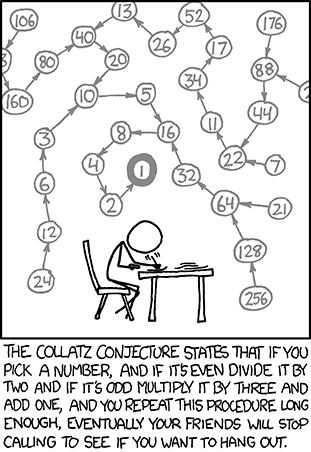
The Strong Collatz Conjecture states that this holds for any set of obsessively-hand-applied rules.
not that I'm trying to pick a side here, just giving my experience
vagrant meadow
undone wagon
I mean I guess it can be interesting to introduce sure, maybe I'm just dissuaded...
just make infinity a power of 2 like GT did
but yeah i like veritasium's video on it because he focuses a lot on the fact that most people think it's unsolvable. the whole "don't tell anyone you're working on it" thing.
https://www.youtube.com/watch?v=094y1Z2wpJg&ab_channel=Veritasium
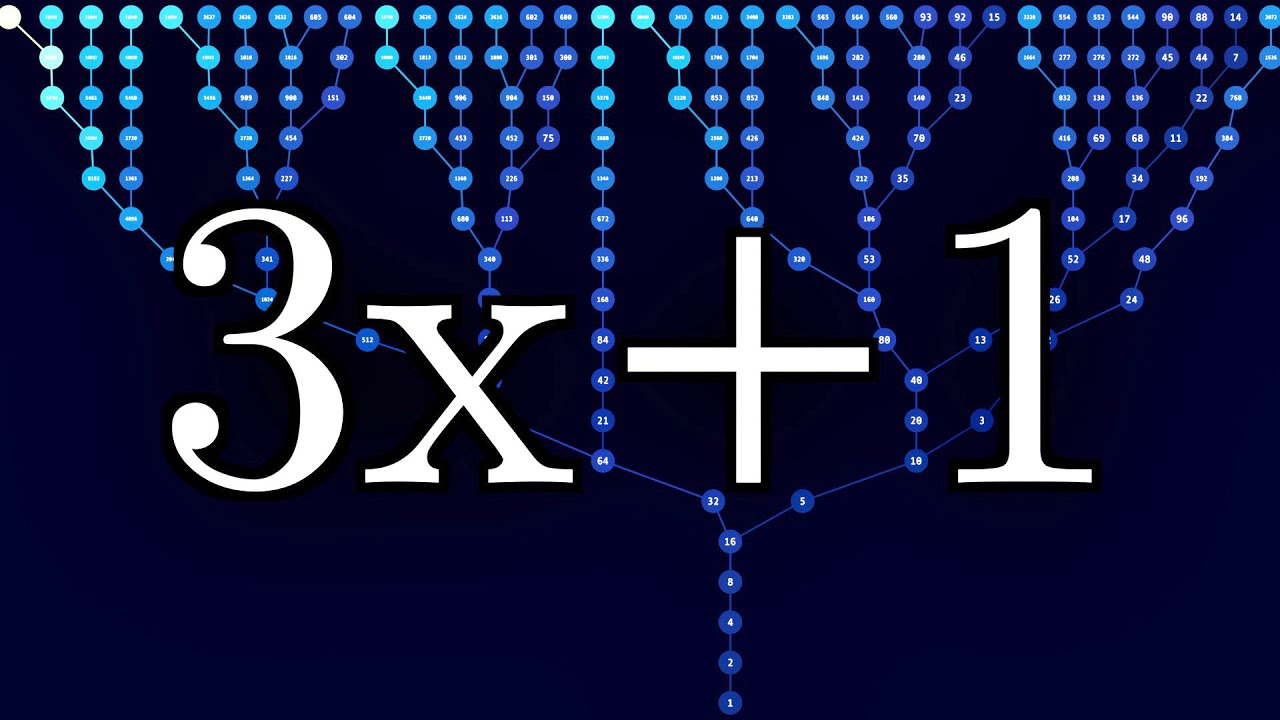
The Collatz Conjecture is the simplest math problem no one can solve — it is easy enough for almost anyone to understand but notoriously difficult to solve. This video is sponsored by Brilliant. The first 200 people to sign up via https://brilliant.org/veritasium get 20% off a yearly subscription.
Special thanks to Prof. Alex Kontorovich for in...
undone wagon
twin shell
my efforts to explain that it isn't possible to solve did not convince a few of ...
This is (at least to some degree) my worry
If you emphasize like "this is unsolvable to you, even though it sounds simple" I guess maybe, so they don't waste time on it or get discouraged. I also just don't want more "divide infinity by 2"
vagrant meadow
undone wagon
If you emphasize like "this is unsolvable to you, even though it sounds simple" ...
i think there could be good from at least giving them a chance to try computing it for a few numbers before telling them how unsolvable everyone believes it is. but yeah, i agree.
 winged oar
zenith slate
Asking students to tackle problems that they don't have the machinery to solve i...
winged oar
zenith slate
Asking students to tackle problems that they don't have the machinery to solve i...
Doesn't every course do this for the immediate problems they solve, though?
I'm not claiming that early education should teach any intuition or ideas about infinity, but an introduction to graph theory typically mentions Seven Bridges of Königsberg. I suppose you mean this for mentioning advanced material for which one has no intention of going through.
Similarly an ODE course might mention relevant DEs at the beginning for which students (assume integral knowledge) might not be able to solve
undone wagon
vagrant meadow
i think there could be good from at least giving them a chance to try computing ...
perhaps I am just being cynical and a collatz hater as usual tho 
twin shell
winged oar
Doesn't every course do this for the immediate problems they solve, though?
I'm ...
the purpose of this kind of early presentation is (usually) to set the stage for the rest of the course
“by the end of this course you should be able to solve this”
oh
do you mean like, solvable-for-professionals level of ODE
long pelican
I’m going to diverge from rat’s advice and say there is a high chance a group of 8th graders can understand what is paradoxical about Zeno’s paradox and a decent (but not guaranteed) chance that they will find it exciting (at least more exciting than applications)
vagrant meadow
zenith slate
Asking students to tackle problems that they don't have the machinery to solve i...
i just disagree with this almost entirely. especially when the problem in question, zeno's paradox, is something so simple to explain, my high school english teacher mentioned it one time. it's just something to think about. that's why i think it could be good for an extra credit homework assignment where the students give an attempt to explain how they think the paradox might be solved (but yes absolutely not on a quiz).
when a problem is difficult but easy to explain, i think that's a sign it could be a great thing to mention for younger students, just to get them thinking about it. it can be inspiring. i remember being in 6th grade and getting really interested in paradoxes. i think a lot of kids find them interesting, at least in my experience. learning about some mathematical paradoxes could be a good way to make math class interesting for them.
undone wagon
vagrant meadow
i just disagree with this almost entirely. especially when the problem in questi...
I think this one is much more interesting and worthwhile to introduce to students (not during a quiz tho, which I think was the original intention?) than collatz. It gets students thinking about something that, while probably confusing for them, requires them to consider something something they haven't though about before. It could also lead to conversations about how our notions of math interact with the real world. Even if they aren't ready for the proper machinery behind it, I think there are still some lessons that could be learned if you spin it right (definitely black-box some stuff for younger students, ofc)
twin shell
interesting, I would’ve sided with collatz over zeno
zeno’s certainly good for like a calc course
undone wagon
I just don't see what's so interesting to say about collatz tho. Like what can you really say beyond "yeah, it's hard for some reason and we don't know how to solve it". And thinking about it doesn't seem particularly enlightening on anything.
Zeno at least does raise some potentially interesting questions. And though a proper explanatin might be better fit for calc, it could still serve as a teaser for calculus
vagrant meadow
undone wagon
I think this one is much more interesting and worthwhile to introduce to student...
tbh i think both are good. idk if i have a strong preference to one over the other. i think there's different things about each one that make it interesting to talk about for 8th graders.
i would want to do both if i was an 8th grade teacher
twin shell
how about goldbach
vagrant meadow
undone wagon
I just don't see what's so interesting to say about collatz tho. Like what can y...
nice thing about collatz is that it's concrete to try. like the student can pick any number they want and then go through the process and see they get to 1.
zeno has something like that with adding successive powers of 1/2. maybe see how long it takes for the calc to give up and just say 1 lol. but it's not quite as fun
undone wagon
twin shell
how about goldbach
I think that would be met with even more confusion lmao. Followed by some "why do people care about this?" questions
vapid herald
Just if you want to know, here's how I presented it today


They got the point right away
vagrant meadow
undone wagon
I think that would be met with even more confusion lmao. Followed by some "why d...
yeeeeeah goldbach is a lil harder than collatz.
undone wagon
vagrant meadow
nice thing about collatz is that it's concrete to try. like the student can pick...
That's fair I suppose, that there is some merit to it being easy to just pick some numbers and try
twin shell
hmm, personally I see collatz as having higher why-care potential
but then again I've always liked primes
vapid herald
A few were saying why does anyone care lol
undone wagon
they're both "why care" lmao (and the answer I would give - "we don't actually" - I don't think would be good lol)
vagrant meadow
vapid herald
i like the idea of this, but i'd prefer if it was worded as "do you think oscar will always end up eventually in room 1". but otherwise i think this is great
just bc collatz hasn't actually been proven yet 😆
like i get the quiz isn't graded but the idea that this question is asking it like it's true or false sits weird with me
vapid herald
Yeah I get you
twin shell
idk in goldbach's case I can see a good reason for it to be interesting
some wise guy once said "primes were not meant to be added"
vapid herald
There were graded problems but that was just something for the early finishers mostly, and I didn't have tons of time to dive into new material today so I thought let them chew on collatz a bit
vagrant meadow
vapid herald
Just if you want to know, here's how I presented it today
but i really respect cool quiz questions that don't count against you (as long as there's no time limit, because it'd be mean to have some students get sucked into the cool participation questions when they could be checking their graded answers). i think exams are an underrated spot to introduce cool applications of things you've been learning. i'll never forget having my mind blown during my calc ii final when we got an extra credit question to prove verify eulers formula, which i had never seen before.
vapid herald
Oh cool
One kid hypothesized you would need to enter a loop for collatz to be false
vagrant meadow
for participation question on homework there's the double goodness of
- raising everyone's grade which makes them happy
- introducing them to cool shit which can inspire or interest them
vapid herald
vagrant meadow
but i really respect cool quiz questions that don't count against you (as long a...
Eulers might be a little beyond their level hahaha
vagrant meadow
vapid herald
One kid hypothesized you would need to enter a loop for collatz to be false
that's awesome! i think that's the real hope for stuff like this. that they might make those important connections on their own.
vagrant meadow
vapid herald
Eulers might be a little beyond their level hahaha
LOL yeah fs i was just talking calc ii, not 8th grade. that said, there was an 8th grader on here the other day who was trying to prove eulers formula in one of the help channels. they said it was their second proof ever, which was kind of adorable.
vapid herald
Love to see it
I would love to introduce the number e at some point but I can't think of where
vagrant meadow
vapid herald
I would love to introduce the number e at some point but I can't think of where
easiest way would be compound interest. I think numberphile introduced it pretty well.

Free trial at The Great Courses Plus: http://ow.ly/tKWt306Gg7a
Dr James Grime discusses "e" - the famed Euler's Number.
More links & stuff in full description below ↓↓↓
A bit extra from this video: https://youtu.be/uawO3-tjP1c
More James Grime videos from Numberphile: http://bit.ly/grimevideos
Support us on Patreon: http://www.patreon.com/numb...
but e is difficult because its essentially the calculus constant lol
so it could be tough to sell 8th graders on it
vapid herald
Right
We've touched on exponential though because they already knew you should take pennies doubling daily for a month over $500000 all at once
vagrant meadow
vapid herald
We've touched on exponential though because they already knew you should take pe...
oh yeah that's excellent. i really like the story version that tells it as like a peasant scamming a king out of rice
vagrant meadow
it's something like a peasant makes a deal with the king. one grain of rice today, and then for the next thirty days you give me twice the amount of rice you gave the day before. the short-sighted and greedy king agrees, thinking "wow i only have to give one grain of rice, and then just two, and then just four. this will be easy." but by the end of the month, it's like over a million grains of rice
i've also heard it as like "i'll take 50,000 grains now, or you do the same thing for thirty days". something along those lines
 left vault
collatz matters a lot since a resolution to it would help in the study of more general difference equations
and difference equations are the way everything (in practice) is calculated. But we all know discrete things are yucky (but that's what makes them interesting)
left vault
vapid herald
I also love this haha
Students are smart enough to know that them checking "yes" or "no" is a bit of a joke
left vault
vagrant meadow
but e is difficult because its essentially the calculus constant lol
so it could...
A good way to do it is to present like 4 different "applications" questions which all mysteriously point to this constant
Which gets people asking "how are they linked 👀"
Like, imagine a 4 part investigation where it's just 4 little applied problems, each problem has various bits and pieces, but in a big black "answer" box, the questions are crafted so that the students always get e as the answer to all 4 questions
So they can visually see something's up, but they maybe don't know the link yet
vagrant meadow
left vault
A good way to do it is to present like 4 different "applications" questions whic...
yeah i was thinking of things @vapid herald might be able to use. and one idea i had was to set h to be very small, like h=.000001. and have them try to find which number to use such that
(x^h-1)/h=1 is as close to 1 as possible
maybe with the hint that it's between 2 and 3.
and if that's after the compound interest activity, they might be surprised to find that it's the same number that (1+1/n)^n approaches as n gets big
perhaps if they know factorials, have them compute 1+1/1!+1/2!+1/3!+... and they'll also approach the same number
left vault
haha that's good
there's some probability/combinatorics stuff which ends up having results like 1/e
i can't remember the difficulty of the questions which result in this
vagrant meadow
left vault
i can't remember the difficulty of the questions which result in this
8th grade
vagrant meadow
left vault
there's some probability/combinatorics stuff which ends up having results like 1...
oh yeah, that's the surprise e haha
zenith slate
vagrant meadow
i just disagree with this almost entirely. especially when the problem in questi...
It depends on the level of the group - for a general mixed-ability class then I quite firmly stand by what I said. While you may personally enjoy this kind of open-ended exploratory mathematical instruction, it is not borne out in the literature as being a sound pedagogical technique. What may be "inspiring" to you may be deeply disheartening to students who may already struggle with and/or dislike math and who will likely not benefit from an activity that is only really accessible to their higher-attaining peers.
As with many pedagogical ideas I see touted in spaces like this, these activities are designed to revolve around students who already possess a like and aptitude for mathematics and leave behind students who are struggling.
Having spent a year teaching specifically those highschool students who struggle with math, I can categorically say these types of activities do not work to "inspire" them - they are questions that they simply do not have the mathematical insight or fortitude to tackle and almost invariably leave them feeling disheartened and frustrated.
zenith slate
winged oar
Doesn't every course do this for the immediate problems they solve, though?
I'm ...
Yes, precisely. I am talking about content that does not serve to motivate or provide insight into the actual core curriculum content being taught in the immediate-to-near future.
zenith slate
long pelican
I’m going to diverge from rat’s advice and say there is a high chance a group of...
I don't doubt they will be able to see the paradox. What I strongly doubt is their ability to appropriately grasp and reason with the solution. Again, if this problem is for a group of high-attaining or """gifted""" students, that's a totally different matter. But for a standard mixed-ability group of 8th graders? Absolutely not.
I'm not just saying this to be contrarian - there is almost 60 years of evidence demonstrating that the 'exploratory' approach to learning mathematics touted by constructivist/progressive/inquiry-based educators is outperformed in essentially every metric by a direct instruction approach.
Students who are shown how to solve problems rather than being made to try to figure it out for themselves (under the strict assumption that they do not have the requisite knowledge to tackle said problems) perform demonstrably better not just in terms of standardised testing but in terms of mathematical self-esteem, confidence, and fluency.
I can provide ample citations for anyone who is actually interested in mathematics pedagogy.
winged oar
zenith slate
Students who are *shown* how to solve problems rather than being made to try to ...
This is interesting. What do you think about trying Socratic method in general? Or are you saying being direct is quite important for the young?
zenith slate
winged oar
This is interesting. What do you think about trying Socratic method in general? ...
I'm not aware of the socratic method being used at all in modern pedagogy
I've not seen any literature on it so I can't comment on its appropriacy
winged oar
The idea is basically asking questions
It's done on this discord all the tiem
Of course there's an art to asking good leading questions
tawdry venture
Students who are shown how to solve problems rather than being made to try to figure it out for themselves
does this mean method-drilling or is explanation of the why behind stuff compatible with that
zenith slate
I wouldn't call what is happening on this discord the socratic method
It is much more accurately described as 'guided discovery' or something
zenith slate
tawdry venture
> Students who are shown how to solve problems rather than being made to try to ...
The why is absolutely a core component of good direct instruction
long pelican
zenith slate
I don't doubt they will be able to see the paradox. What I strongly doubt is the...
No one’s asking them to solve Zeno’s paradox in a fortnight, when it took the original philosophers themselves perhaps millenia to develop the mathematical theory. And in every case imaginable the teacher will be showing them the solution, slowly enough. Which is what you are touting in your next paragraph. What’s the issue?
zenith slate
The difference is that in direct instruction the why comes once the required mathematical drilling has already occurred
The whole idea of this is to segregate out the various cognitive loads that can be an impediment to learning retention by spacing things out in a sensible manner to focus on one thing at a time
I very much advocate for a "present->practice->explore" approach
zenith slate
long pelican
No one’s asking them to solve Zeno’s paradox in a fortnight, when it took the or...
The issue is expecting 8th graders to have anywhere near the mathematical competency, let alone fluency, to form the correct intuitions about this kind of limiting process
long pelican
I’m not expecting that, and I don’t think the original poster is either
In fact it seems much less like discovery-instruction for the goal of teaching specific math and more like merely exposing them to culture
And they fully know some will like it and some won’t for any given specific piece of culture
Hilbert hotel, collatz, zeno’s paradox, mystery of e, etc
zenith slate
winged oar
This is interesting. What do you think about trying Socratic method in general? ...
The research I am specifically talking about here is the "Follow Through" project. This was a US government funded longitudinal study and the largest educational study ever conducted globally. Now there are plenty of criticisms levied against this study but the main conclusion, that direct instruction is king, has largely remained consensus. There is of course much more modern literature that supports this idea, namely the works of the likes of Sweller et al who analyse the matter from a cognitive science perspective.
winged oar
zenith slate
I very much advocate for a "present->practice->explore" approach
I have to say I think there's too much emphasis on the 'practice' in East Asia, especially for places that become exam-focussed. The exploration opportunity is then gone
zenith slate
long pelican
In fact it seems much less like discovery-instruction for the goal of teaching s...
Sure. But my question is what exactly is the purpose of exposing a general group of students to "the culture". I would argue that Zeno's paradox, Hilbert's Hotel, collatz, and whatever the "mystery" of e is, are not at all representative of the wider "mathematical culture". These problems are of interest basically exclusively in popmath circles.
long pelican
This research sounds like it can be explained by the following effect: if you don’t know anything about where someone is in math, direct instruction is a safe option and works to improve scores (mediocrely) in a wide variety of situations, while the discovery approach can backfire a lot if there is any disconnect at all between what you think the student knows and what the student actually knows
zenith slate
winged oar
I have to say I think there's too much emphasis on the 'practice' in East Asia, ...
Yes, rote memorisation and entirely passive learning is bad.
zenith slate
long pelican
This research sounds like it can be explained by the following effect: if you do...
I don't know where you got "safe" and "mediocre" from. The direct instruction approach is demonstrably the best approach for all types of students across all age groups. There is a reason this has been the predominant form of instruction since essentially the beginning of Western academic thought.
long pelican
I got it from the fact that there was never a time period where the preparedness of high school students in math was adequate to college professors
Uh well I can’t speak for before 1900
zenith slate
The discovery approach is absolutely fine if and only if the students have the requisite knowledge to make meaningful discoveries for themselves.
winged oar
Oh Rat I have to ask, any opinion on whether other countries should adopt French's math education?
zenith slate
long pelican
I got it from the fact that there was never a time period where the preparedness...
Have you considered that this might not be a problem with the specific instructional techniques applied but to do with the fact that high-school mathematics is not designed to prepare students for university-level mathematics?
winged oar
For example, teaching (standard) topology on R. I don't think it's axiomatic at the secondary level in France, IDK, but I know they start on topological ideas at secondary education
zenith slate
Changing to a discovery-based approach would not change the fundamental principle on which high-school math education is based - providing as many citizens as possible with as broad a range of mathematical tools as is realistic
winged oar
zenith slate
Have you considered that this might not be a problem with the specific instructi...
And that should better prepare students for uni math!