we should be aiming to teach students neither one formula nor the other but the sufficient understanding
A noble goal.
Now imagine you're the teacher and your prospects of being rehired for the next school year depend on how many students pass the quadratics section on the standardized end-of-year test. About 25% of the kids in your class have so weak preliminaries that it won' t be humanly possible to make all of them understand (perhaps any one or two of them, if you devote all your time to one-on-one instruction), but you can conceivably drill most of them in a paint-by-numbers procedure ...
#math-pedagogy
1 messages · Page 4 of 1
 cosmic ibex
 long pelican
About 25% of the kids in your class have so weak preliminaries
Lucky meyou're too generous
Another reason to eliminate performance-based accountability as we currently have it I suppose
 gray smelt
cosmic ibex
> we should be aiming to teach students neither one formula nor the other but th...
gray smelt
cosmic ibex
> we should be aiming to teach students neither one formula nor the other but th...
never heard someone phrase it better
cosmic ibex
Of course it means the poor sod who gets to teach the same kids next year will now have to deal with 35% students with weak preliminaries, whereas you could probably have made all the 75% with adequate preliminaries keep up if you were willing to sacrifice the test passes from the 25%.
 cloud zealot
yes, i know the method leads to the quadratic formula. that's why the method is valid in the first place. but what i think is interesting is that you only need to "solve" for roots each time instead of guessing factors or finding the right offsetting factor that makes completing the square work.
you don't memorize x=-b/a is the solution to ax+b=0, you just run through the procedure of isolating ax then dividing by a.
cosmic ibex
Hmm, reasonable people can disagree, but I'd feel basing the method on Viête's rules to start with requires first reframing the problem from "find the roots" to "factor the polynomial into linear factors". That seems like a higher cognitive load than completing the square, which can be done without any abstract concept of factoring.
cloud zealot
not directly related to above, but using the distributive property forwards using FOIL is usually easier for students rather than applying it backwards. 2x^2 + 4x + 2 = 2x^2 + 2x + 2x + 2 = 2x(x + 1) + 2(x + 1) = (2x + 2)(x+1) is easier for students to work right to left rather than starting with a simplified sum and working out the factors.
cloud zealot
cosmic ibex
Hmm, reasonable people can disagree, but I'd feel basing the method on Viête's r...
i'm not sure what the required curriculum that you need to teach, but in loh's arxiv article, students generally learn how to expand (u + v)^2 = u^2 + 2uv + v^2 and (u + v)(u-v) = u^2 - v^2 prior to learning the quadratic formula, so they might have an inkling that multiplying out linear factors yields a quadratic. also, he gives his opinion on how his method compares to completing the square. there's an interesting footnote about an assumption going into completing the square, but it's probably not important to current students.

though if one were interested in making math more rigorous while keeping things age-appropriate, i've heard hung hsi-wu's volumes for math teachers are worth reading
 snow shoal
cosmic ibex
> we should be aiming to teach students neither one formula nor the other but th...
snow shoal
cosmic ibex
> we should be aiming to teach students neither one formula nor the other but th...
Can confirm, that’s a large part of my future in Texas. Especially as someone who’s more inclined towards teaching algebra 1/geometry, since we have. The main math end of year exam is the algebra 1 staar and most of the students I’ve observed aren’t getting the basics well
The other method is interesting, but I have a hard time justifying teaching it to on level courses (maybe advanced algebra or something would enjoy taking a crack at it)
Also, Not to derail the conversation at all, but has anyone read Building Thinking Classrooms and what are your thoughts on it? Another question is do you have a favorite teaching book? (preferably aimed at high school math, but any book is good)
cloud zealot
has anyone used paulo freire, or marxist/critical pedagogy in general, as a basis for investigation into math pedagogy?
 pure coral
eh would rather use cognitive psychology as the basis, too much methodology and not enough empirical evidence
pure coral
snow shoal
Also, Not to derail the conversation at all, but has anyone read *Building Think...

SpringerLink
basic recommendations from the book supported by randomized controlled studies is split content into small chunks, explicitly teach knowledge and skills (none of this discovery rhetoric because that's just rhetoric and not evidence), use verbal and visual representations, slowly withdraw instructional support with increasing skill
long pelican
There’s conflicting studies on this subject as you can imagine
pure coral
long pelican
There’s conflicting studies on this subject as you can imagine
except one set of studies tend to be randomized, changes a single variable at a time, and have control groups and the other set tends to be longitudal studies
long pelican
Actually I was going to say that one set of studies tests the kinds of questions you find on standardized tests and other studies test subjects on mathematical reasoning, problem solving, and generalization
pure coral
long pelican
Actually I was going to say that one set of studies tests the kinds of questions...
which are all skills that result from having schemas in long-term memory and thus acquiring them is subject to the same working memory limitations
like sure, those skills involve different parts of long-term memory, but that doesn't mean withhold information and make students spend countless hours on one problem
long pelican
Okay you are jumping topics here; Im saying that if in your study you evaluate students on how they do on “K-12 school math” type problems (a characterization of these is that they are similar to examples in the textbook) what optimizes performance on those types of questions is likely to not be the same thing that optimizes performance on problems that are unsimilar to those in the textbook
So potentially the recommendation may increase performance on school math exams and have no change on new problems
Also (haven’t read it) but cognitive load theory applies to all subjects so they may be testing students in a wide variety of subjects, many of which are memorization and recall based
long pelican
pure coral
like sure, those skills involve different parts of long-term memory, but that do...
Are you currently the recipient of such problems? Lol just asking
Problem sets in grad math classes can be brutal
pure coral
long pelican
Also (haven’t read it) but cognitive load theory applies to all subjects so they...
long-term memory is the main cognitive system responsible both for memorization tasks and higher-order tasks, there is no distinct "higher order problem solving" module other than maybe semantic memory (which is a long-term memory system), and there are plenty of ways to help form better representations of problems, which is one of the main functions of semantic memory, that aren't "withhold guidance"
with regards to transfer of knowledge to new problems, that's a result of extensive knowledge that allows more efficient problem solving without resorting to random search
i'm not defending rote teaching either, teaching that is just do this plug and chug without wider context only improves the plugging and chugging part
long pelican
Is your position that "teaching explicitly and in smaller chunks" is better than "leaving students to discover everything on their own"?
pure coral
yes
pure coral
they're not archimedes
there is no "normal" teaching because there are a lot of ways to approach it, but i would say teaching based on conceptual elaboration and extensive practice applying knowledge is better than pretending to be archimedes
long pelican
Hmm there's not too many practitioners of the Moore method nowadays, anyway
and it's safe to say people know it won't work in a class of unmotivated students
pure coral
i feel like there can be a lot of things improved in k-12 math education, ESPECIALLY the no wider context part
you can know how to do basic algebraic manipulations (procedural memory) without knowing their applications, why they are important, etc.
and that's the part that i would advocate for a bigger emphasis on
long pelican
teaching that is just do this plug and chug without wider context only improves the plugging and chugging part
You got my cautionary message pretty on point
conceptual elaboration and extensive practice applying knowledge
I think everyone (in here) agrees with this as well
pure coral
i'm just arguing against the complete withholding of guidance, and a progression from "don't give answers to give answers" instead of the reverse
long pelican
Are you in a class where there's complete withholding of guidance?
Or wait, does Building Thinking Classrooms advocate for it?
pure coral
long pelican
Or wait, does *Building Thinking Classrooms* advocate for it?
i haven't read that book in particular, but in general the discovery thing just prevalent in math and i feel it's an overreaction to the opposite which is uninspired rote teaching
i used to have the same view but the extensive evidence towards at least a moderate amount of guidance, and also learning more about how cognitive processes work changed my view
here's an instructional design model which does seem promising http://web.mit.edu/xtalks/TenStepsToComplexLearning-Kirschner-VanMerrienboer.pdf
and here's a meta analysis of that model, it's small (k=12) so there does need to be more studies but damn that effect size ^^
snow shoal
long pelican
Or wait, does *Building Thinking Classrooms* advocate for it?
from the brief bit i've read, definitely not
long pelican
Ok, good
snow shoal
I'm not sure I would trust any book that says to completely withhold guidance. Then I'd be out of a job 😆
also I don't think it's a good thing
long pelican
Moore method strikes me as grad math class pedagogy anyway
snow shoal
pure coral
https://link.springer.com/book/10.1007/978-1-4419-8126-4
thank you for the book recommendation btw
I've heard a bit about cognitive load theory, and it'd be nice to hear more from that perspective
pure coral
snow shoal
thank you for the book recommendation btw
no problemo, don't take the book as "just teach like high school" though, it does advocate practices not done in high school
long pelican
pure coral
here's an instructional design model which does seem promising http://web.mit.ed...
I like how it warns against compartmentalization. I had the same warning for "split into small chunks" which many teachers implement as compartmentalization
 winged urchin
long pelican
I like how it warns against compartmentalization. I had the same warning for "sp...
winged urchin
long pelican
I like how it warns against compartmentalization. I had the same warning for "sp...
Yeah I think there's too much of "okay we're learning trig this month then for the rest of the year we won't talk about trig til the final*
pure coral
long pelican
I like how it warns against compartmentalization. I had the same warning for "sp...
yeah for complex skills there's a meta analysis that, even when considering prior knowledge, that is bad https://www.researchgate.net/publication/236926003_Effectiveness_of_Part-Task_Training_and_Increasing-Difficulty_Training_Strategies_A_Meta-Analysis_Approach
ResearchGate
PDF | The objective was to conduct meta-analyses that investigated the effects of two training strategies, increasing difficulty (ID) and part-task... | Find, read and cite all the research you need on ResearchGate
part-task training = extensive compartmentalization
the alternative would be to focus on whole tasks (e.g., could teach basic algebra maybe in the context of something like physics) and try to simplify these tasks instead
winged urchin
When I'm tutoring I try to use questions that practice all the basic skills the student should have.
Algebra with fractions to make sure they remember how to work with fractions. Don't just stick with simple integers
snow shoal
pure coral
i feel like there can be a lot of things improved in k-12 math education, ESPECI...
sorry, just backreading a bit. I've been thinking about a genetic approach to some of the topics that we learn in math as a way of contextualizing it, but i'm not sure if that's just me being incredibly nerdy about history and wondering if we could implement it a little bit in the classroom.
(I don't think contextualizing it like that would ever improve test scores/math flexibility?, so maybe it's a moot point if we're looking at that as a criteria)
pure coral
snow shoal
sorry, just backreading a bit. I've been thinking about a genetic approach to so...
you mean an approach like teaching the content in order of historical discovery?
snow shoal
pure coral
you mean an approach like teaching the content in order of historical discovery?
yeah
or, hmmmm
I don't have any studies to back up that kind of approach, just a wild grab at an idea
pure coral
snow shoal
yeah
i mean yeah that could be a way to organize a course, you have each section of the course focus on a particular time period and have the learner think about how the results (and wild theories once you get to the grothendieck part) from this time period helped solve the problems of the last
winged urchin
You'd have to do geometry nice and proper like it used to be done ahah
Which isn't such a bad thing imo
snow shoal
created tame topology
as opposed to what, feral topology?
just learning about grothendieck a little, haven't heard of him before
pure coral
snow shoal
I don't have any studies to back up that kind of approach, just a wild grab at a...
and from a cognitive standpoint it is compatible: builds off prior knowledge, historical dates and figures act as bonus cues to retrieve and use that knowledge (sounds silly but this is a happy accidental consequence of how memory is structured!), you have to work with whole problems which provide context making it easier to put that knowledge into solving new problems
snow shoal
I guess the downside is that you have to find room to stuff it into a curriculum 😆
pure coral
plus knowledge tends to build off previous knowledge slowly so that would solve cognitive load issues as well
snow shoal
yeah
winged urchin
My brain triggered off this and thought of the difference between presenting a finished polished proof for something versus the process of developing the proof
snow shoal
the steady building and cues to retrieve the knowledge are two things that play around in my head a bit
winged urchin
Which I think the process of wrestling with the proof and all that is valuable to the student
pure coral
snow shoal
I guess the downside is that you have to find room to stuff it into a curriculum...
it could be a partial replacement for all the other fluff they put in math texts like random images of children on bicycles
winged urchin
But that makes it relate-able to the students!! /s
snow shoal
DK's The Math Book (I have a copy) does a pretty good job of doing very high level stuff in a genetic way
thanks for the discussion btw, I wasn't expecting it to branch off in this way but i'm glad it did.
I was just noticing that I hated the textbook for my current class and wanted something that approached teaching (and more specifically math) in a better way
winged urchin
Preaching to the choir aha
snow shoal
doesn't help that one of the chapter headers is "Understanding Brat Behavior"
I've downloaded all the books/research papers and will check them out when have time...
which will not be for a long time...
pure coral
snow shoal
the steady building and cues to retrieve the knowledge are two things that play ...
yeah, how memory is structured in the brain is super super interesting! there's also another phenomenon called chunking where the brain literally combines information together based on patterns and makes it easier to work with
snow shoal
mhm, my psych teacher had us do some chunking when I took that class
8 numbers are hard to remember, but two 4 digit years are easy
pure coral
snow shoal
8 numbers are hard to remember, but two 4 digit years are easy
oh nice, just like the correct horse battery staple password idea as well if you've heard about that
snow shoal
I think yeah, i've heard of it
winged urchin
That's kinda going off of the idea that we can only hold a certain number of ideas at once right?
Like 6 or 7 or something like that?
pure coral
winged urchin
Like 6 or 7 or something like that?
yeah limited working memory but there are two ways to bypass that limitation
one way is to use both verbal and visuospatial representations as there are two different buffers for both in working memory
the other is to use elaborative learning which meaningfully organizes information so once the information is learned, the brain can treat it as a single chunk, i.e., "long-term working memory"
winged urchin
Ohh that second one sounds like what I was thinking just now
Basically I've always thought there was some magic to mathematical notation
The idea that if you tried to write like... A statement involving like an integral or something.. write that into plain English. It would take up far more space that the mathematiccal statement
So we make notation to wrap up many things into one thing
pure coral
winged urchin
So we make notation to wrap up many things into one thing
yep that is a huge huge area of study in psychology, how we represent problems
in this case it would be more a surface level representation but good notation provides a visuospatial representation of knowledge
and then your brain can also convert it into a verbal representation
it's like "alice is X amount of years older than blah blah blah Y years ago"
which you could better represent using elementary algebra
and it's easier to solve that way
pure coral
winged urchin
The idea that if you tried to write like... A statement involving like an integr...
i'll even add that notation is sometimes used to simplify other notation 😄 , commutative diagrams seem like a pointless exercise but even a medium-sized commutative diagram can represent hundreds of equations (involving equality of compositions) at once
and then you have very nice tools you can use with that representation, if you have a functor you just replace each object and arrow with F(object) and F(arrow) while preserving commutativity, you can glue diagrams together, etc.
i think that's what a huge chunk of a math class should be about, finding ways to represent and simplify problems
instead of focusing on the final part with is completing the technical work
winged urchin
Yesss aha. We wrap up English statements into notation then we can wrap that notation into more notation
Of course you have to make food notation or ways of thinking of it but still
pure coral
winged urchin
Of course you have to make food notation or ways of thinking of it but still
physicists are especially terrible at this and that's why their problems are hard 😏
sometimes their ad hoc notation choices make sense but other times they just wanted to save 15 minutes that came to bite hours of their time later down the road
it's something i'd improve even with higher math books, for a reference text definition theorem proof might work, but for an educational text, a concept or a new notation or even a big theorem should be placed along with examples where using it can simplify a problem
and then the exercises, instead of exercises in clever imo tricks, should give some hints on how to use those big concepts to solve them, so that the student can confidently transfer that concept to new problems
pure coral
snow shoal
just learning about grothendieck a little, haven't heard of him before
and forgot to add, but one of the reasons why he was so significant was because he always emphasized representing problems the right way over solving them head first (hence his obsession with stuff like category theory and [co]homology) and that view has permeated fields outside algebraic geometry
his influence has even spread to computer science, for example, haskell programmers focus (some would say too much) on representing stuff the right way, and category theory has led to meaningful advances in haskell development - for example, in 2018, there was a paper that outlined a general theory of data retrieval and modification based on fancy category theory tech, which effectively allows you to treat data structures in haskell almost like databases you can query and change in complex ways
and it’s more than academic nonsense because minecraft uses it to help update your maps to newer versions =)
but what would take a bunch of factory methods and shitty class hierarchies in a language like java just becomes a trivial problem in haskell
snow shoal
pure coral
his influence has even spread to computer science, for example, haskell programm...
mm yep, i'm familiar with haskell (although not a lot of the fancy parts).
makes sense
 tawdry venture
anyone else think the concept of test values for solving rational inequalities is kind of ridiculous
like, it feels like the introduction of an unnecessary set of moving parts
winged urchin
I think it's useful in that you can talk about the equality problem and use test points to get the solution to the inequality problem
And sometimes it's easier to work with equalities or a student may just be more comfortable with them
snow shoal
tawdry venture
like, it feels like the introduction of an unnecessary set of moving parts
How are you thinking of doing it? I don't use test values either, but i'm curious what your thoughts of doing it the right way are
(I haven't had my coffee, so my brain isn't catching up  )
)
tawdry venture
put the equation in the form P(x)/Q(x) ≤ 0 (or with any other inequality sign)
factor everything as far as needed
then write out a sign table in which the rows correspond to factors and the columns correspond to intervals delineated by the sign change points
fill out the sign table row by row, without any plugging-in, instead reasoning along the lines of "x-3 is positive to the right of 3, so we put plus signs all over here, and negative to the left of 3, so the rest of this row is minus signs"
then multiply col by col
snow shoal
hmmmm, yeah, i like that method
iirc I used that same kind of thing during calculus 1 for critical points and points of inflection stuff
The case I'll make for test values is that working it out can help the students realize the connection between a point and the "field" of answers that they get from an inequality
it also requires less conceptual overhead than the sign table, although the sign table is a good indicator if students are getting the higher-order level thinking level of it.
and that's all the good things about it in my mind.
tawdry venture
snow shoal
it also requires less conceptual overhead than the sign table, although the sign...
well i guess it's a tradeoff between conceptual overhead and number of moving parts
students can and will screw up every single plug-and-chug
winged urchin
The problem with inequalities is sometimes applying functions to them can be more difficult than applying functions to the equality form
Welll.. you just have to be more careful but still it's something students can forget. So sometimes I teach them to solve the equality, include discontinuities, then use test points to determine where it is > or <
It's not all I teach but I feel for students already struggling it means they have less to worry abour
Also with inequalities sometimes they multiply or divide both sides by something without realizing that term is actually negative
Also with piecewise functions like absolute value there is a bit of an "if [this] then [this]" kind of structure to it that can be confusing
Though it's usually a pretty perfect time to introduce union and intersection to students too
"if we want A or B then we will union the results but A and B must be intersected!"
Kind of deal
long pelican
In my opinion, the subject of rational inequalities should be approached from a completely different angle and is a great example of the over-teaching of procedures, but as I don't see any interest in that sort of wider discussion yet, I'm only gonna expand on that if someone is interested
Completely unrelated to the point I just made, here's a very efficient procedure I just came up with:
Step 1. Express the inequality as f > 0 or f < 0 where f is a rational function
Step 2. Factor f completely over R, so it'll be factored into linear factors and irreducible quadratics with a positive leading coefficient (these quadratics have no roots over R, else they'd have been able to be factored into linear factors)
Step 3. Reduce all exponents mod 2 (i.e. take squarefree part of f) as well as removing all irreducible quadratics
Step 4. Take S = { zeros or poles of what you get } and you're guaranteed that the sign chart will alternate in sign with points of S as boundaries. Just analyze end behavior at -infinity to figure out what the first sign is
winged urchin
Ahaha, very nice Icy =p
I was generally thinking about any kind of inequality initially
But yes, with polynomials or rationals there is of course ways to sketch or think of the graph very easily just as you described
 fallow siren
tawdry venture
_fill out_ the sign table row by row, without any plugging-in, instead reasoning...
fallow siren
tawdry venture
_fill out_ the sign table row by row, without any plugging-in, instead reasoning...
This is so close to test values that I don't think it's a different thing. It's just filling out the table in rows rather than filling it out in columns.
But yeah, row by row has its advantages.
long pelican
winged urchin
I was generally thinking about any kind of inequality initially
Can be generalized! If you have multiplied a rational function by e^x, then ignore e^x; if you've multiplied by sin(x), add integer multiples of pi to the list and eliminate doubles, etc. If you've added something involving e^x or sin(x) instead of multiplying, ... you're out of luck
winged urchin
fallow siren
This is so close to test values that I don't think it's a different thing. It's ...
Well this shows a more understanding of polynomials/rationals than just testing points. Which is a plus.
winged urchin
long pelican
Can be generalized! If you have multiplied a rational function by e^x, then igno...
Well with rationals you can tell whether the sign should change over a zero or pole based on the multiplicity of the factors.
The more we diverge from rationals the more likely a student would probably need test points to figure out whether the sign changes or not. I think
long pelican
The more we diverge from rationals the more likely a student would probably need test points to figure out whether the sign changes or not. I think
Oh well I'd actually not advocate for teaching any procedure (even my efficient procedure) to students as actual curriculum (this ties into my first point)
winged urchin
Right aha
The Icy way
If you care to elaborate I am interested to read. And I know others here appreciate your views ^^
long pelican
This is because the teaching of procedures should be restricted to things that have value in being automatic processes, for example, multiplication of integers, solving 1 step linear equations, maybe 2x2 determinants, 2x2 matrix inverses, taking a derivative, to list a few. I've navigated math just fine without solving rational function inequality solving being an automatic fast process
winged urchin
Ah I see
I would argue that I do need 'something' to explain to students who are struggling, dont have the time/money for more extensive tutoring, or such
If they need to know how to solve inequalities for a test tomorrow I need to give them some way of doing it even if it is more of a procedure and risking them just learning the procedure
long pelican
I was talking to curriculum designers, not tutors there
winged urchin
Ahhh
 tardy ember
i think in general it seems to be pretty common (and bad) for students to learn more "rules" than there actually are, and this is kind of an instance of that
there isn't a completely independent Procedure For How To Solve An Inequality, any method for solving an inequality will be a consequence of other smaller things that they (hopefully) already know, and use in other contexts
but if it gets treated as actually new knowledge, that means they can misremember it, and make mistakes by blindly following their incorrect memories of The Procedure that are obvious if you look at the actual reason that this is supposed to accomplish anything
gray smelt
I honestly didn't realize that some people learnt how to solve these as like a separate thing
I learnt the laws of inequalities, and then learnt test values for things like the use case in Calc 1
i hadn't heard of "rational inequality" before now, and while these procedures are correct i honestly don't see why you can't teach a student the couple special rules of inequalities and then leverage existing equality-solving-knowledge
tardy ember
yeah that's basically what my suggestion would be
i didn't learn a special procedure for solving inequalities either, i was just reacting to the topic of this discussion
gray smelt
actually, i guess i did learn a procedure: draw the number line and shade in the places where the inequality is true
the only difference nowadays is that i do the drawing in my head
 eager condor
Any ideas on structuring study sessions as a TA over zoom? In person, I feel like it's easier to just do a few problems and walk around. But I'm not too sure what to do online.
pure coral
eager condor
Any ideas on structuring study sessions as a TA over zoom? In person, I feel lik...
elaborative activities - like maybe showing some concept maps for recent content, identifying common features of worked solutions (very notable example would be identifying a good use of the triangle inequality =)) and coming up with heuristics for when to use them
or maybe just touching over lecture material but now trying to show the overall picture instead of sharting definitions and theorems
the main problem is that math tends to be presented in definition theorem format while the students rush to jot down stuff, allowing no time for elaboration
snow shoal
eager condor
Any ideas on structuring study sessions as a TA over zoom? In person, I feel lik...
you can also do breakout rooms and give them a link to a whiteboard type website to do the problems on. That's what I suggested for an Ochem TA and it seemed like a decent idea (although those are just drawings, precision might be difficult with a mouse)
 vale dune
My little brother is in first grade, and he is consistently having trouble with his maths homework. And surprisingly enough, it’s not that he cannot solve the problem. He is crying, quote: “I don’t know how to draw the solution!” end quote. They are taught to solve their maths problems using a certain graphical algorithm. And they have to use it and only it, any other way of showing your working out is “wrong”. The scheme, obviously, ain’t omnipotent, and when a problem doesn’t lend itself well to being drawn in that way, my bro doesn’t even attempt it without significant coaxing. It seems that solving the problem does not matter at all. Seems like they are being taught not maths, but algorithm-following. I wonder, what could be the reasoning behind that didactic choice, and what could I do to prevent him from developing maths-phobia in these circumstances?
(If this sounds like me venting, that’s because it is, and I’m sorry)
tardy ember
i think the reason for this is just some kind of mistake somewhere
either some individual person doesn't know/care how to teach maths effectively (or even what maths is) and everyone else has to deal with them, or this is the accumulation of several mistakes/miscommunications/structural issues (probably at least one application of goodhart's law is involved) and we at the end of it get the most ridiculous version
it just doesn't make sense otherwise
thinking about what i'd do if i had to solve these problems... probably work backwards tbh
solve the problem first, using intuition and whatever method works, then see if i can convert what i did into this particular format
also if there are other people getting the same homework (presumably, in the same class), and they're completing it successfully, find out how they're doing it - you might be able to reverse-engineer their answers to find out aspects of the algorithm you didn't previously know were acceptable (or possibly even new actual maths if their answer encodes an approach you didn't know about)
in terms of not getting maths-phobia...
well the most obvious thing i'd say is: this isn't maths. actual mathematicians do not use this particular algorithm, or any rigid algorithm, mathematics is written in whichever way is easiest to read/write
often you see a mixture of natural language, technical terms, notation, and sometimes diagrams
which of those appear more depends on the nature of the problem
the only thing that's important is that the result you get is correct
or in the case where you want to convince someone else of a result, it should be correct, and you should write down enough reasoning that they can also conclude it's correct (this does inherently depend on the level of knowledge and experience the other person has)
...then there's also this separate rather arbitrary problem given by the school, of solving a problem using this algorithm
tawdry venture
vale dune
My little brother is in first grade, and he is consistently having trouble with ...
say, could you show us the algo in question?
gray smelt
i think the first thing you need to do is to not make the student do any specific method of doing the problem. this is less for any didactic purpose and more to make said student like math more.
if i were you, i would find a math problem that could be explained to a first grader, but also has a lot of ways of looking at it and then i would give the student a hint or so and guide an exploration.
for example...i'm not actually sure what would be a good example
long pelican
I think I can elaborate on the mistakes bee is pointing to: it’s a case of people reading what’s on the common core through the lens of their own understanding of what math is and ignoring all the parts they don’t understand
For example part of the common core is algorithms and part of it is the standards of mathematical practice. The part everyone can understand is algorithms and not everyone understands what the standards of mathematical practice are even about
 turbid zenith
Hey y’all
Would like to ask for some advice
Giving this in Calc II tomorrow: https://jeopardylabs.com/play/integration-techniques
\int\ x\ dx, \int\ \sin x\ dx, int\ 1/xdx, int\ 1/(x sqrt(x^2-1)) dx
I have four teams of 4 people each. But I want to try to make it less about just who gets it the fastest and somehow give opportunities for everyone to get it even if it’s not super fast
 shadow flower
Are you familiar with kahoot? I’ve heard of classes doing kahoots, which is about who gets the right answer the fastest. The difference is you give all the problems out first and give them time to solve them, then they put they select the answers in the kahoot since they’ve already worked them
turbid zenith
shadow flower
Are you familiar with kahoot? I’ve heard of classes doing kahoots, which is abou...
This is an interesting idea
shadow flower
you could do something similar with jeopardy though. just give out the problems before hand and give everyone the chance to do it. then just play the jeopardy as normal
turbid zenith
We’re doing it tomorrow though XD
cloud zealot
Has any math teacher or researcher in math pedagogy read these books?:
Elementary Mathematics from a Higher Standpoint, Volumes I-III, by Felix Klein
Understanding Numbers in Elementary School Mathematics by Hung-Hsi Wu
Teaching School Mathematics: Pre-Algebra by Hung-Hsi Wu
Teaching School Mathematics: Algebra by Hung-Hsi Wu
Rational Numbers to Linear Equations by Hung-Hsi Wu
Algebra and Geometry by Hung-Hsi Wu
Pre-Calculus, Calculus, and Beyond by Hung-Hsi Wu
These books are not addressed to young students, but rather to prospective math teachers or researchers in math pedagogy. So I'm wondering whether anyone has drafted student textbooks inspired by the above texts. Admittedly, the Hung-Hsi Wu books are relatively new, but Klein's books have been around for a while (albeit the books are probably fairly obscure and Springer's translation is the most recent and accurate one, superseding the Dover editions, if the translators are to be believed).
 still rapids
I dont think I have read any of these books, nor have I known this author
but to be there is one book that I use

"Polya reveals how the mathematical method of demonstrating a proof or finding an unknown can be of help in attacking any problem that can be "reasoned" out--from building a bridge to winning a game o
 cedar garden
should math history be more widely taught? im sure the motivation for theory given in class is enough, but i think it could be useful to understand how theory develops more closely
maybe doing research teaches that so it’s not really needed, but i think it’d be good as a “research methods” math class analog
still rapids
cedar garden
should math history be more widely taught? im sure the motivation for theory giv...
I would say so, it is important to know where stuff came from, just like in other subjects, even physics, have some physics history
cosmic ibex
More widely than what? In my university days, there was a mandatory math history course in the undergraduate program, and it feels like an actual historical treatment would just confuse many high school students (who have plenty to do just learning contemporary notation and viewpoints).
cedar garden
maybe my uni is not representative of the actual reqs elsewhere. we have a math history course but it doesn’t even count as an elective for us
i figured that’d be the norm
shadow flower
my school has a math history course which is required for math major. However no professor was willing to advise an independent study so they just waived it.
 tribal tiger
We have a math history elective at my school it's very popular as an easy A course
 austere inlet
same at my undergrad
I feel like math history is a thing that could be incorporated into the syllabi of each course rather than in an isolated one. Pedagogy of adv. math subjects can be inspired by historical development
Myself I've found it interesting to at least mention some of the history behind the concepts I teach, whenever relevant and possible. Like right now I'm doing TA for pointset topology and I started by mentioning how the definition of a topo. space came to be after a long process of generalization and different proposed definitions, which culminated in the easiest to remember and most general one (the one by open sets that is currently taught in books), see e.g. https://hsm.stackexchange.com/a/8415. The point of that remark was to say that even though the definition may seem abstract and unmotivated, it does make sense because of all the examples it covers, being a result of that decades-long process of generalizing and finding the "best" or easiest definition. (By the way, that also shows how in advanced maths you often want different equivalent definitions for different contexts, and how you can then isolate additional properties to prove stronger results, e.g. T_2 spaces in this case which were actually part of Hausdorff's proposed definition of a topo. space, which was later weakened to the current definition.)
I've also done that sort of historical remarks in calculus tutoring (following https://open.umn.edu/opentextbooks/textbooks/200) with positive results -- at least one student thought the definition of limit made a lot more sense after seeing the definitions of continuity and derivative first, because these are limiting processes and historically predated the modern formulation of limit (the epsilon-delta defn.)
So in short: a math history course in itself can be interesting but shouldn't be mandatory, instead history should inspire pedagogy. Probably not by completely altering the flow of the course nor the modern treatment in textbooks, but as a tool to better explain and motivate specific concepts.
that's what I think
 steep fox
austere inlet
I've also done that sort of historical remarks in calculus tutoring (following <...
steep fox
austere inlet
I've also done that sort of historical remarks in calculus tutoring (following <...
wow this book is cool
pure coral
yeah a separate course for math history would really only be for historical interest more than anything
but the content being weaved into existing courses give very important context
in general there needs to be more courses that coordinate knowledge of multiple fields of math (including giving relevant historical context) to solve a specific problem, the current practice of just teaching a single field makes it difficult to apply knowledge to realistic problems
and it also gives the impression that math is all about shuffling symbols around and knowing fancy words, rather than about developing easier ways to represent problems - when taught properly, math should look like it simplifies things instead of complicating things
one example could be, instead of simply teaching calculus as a bunch of rules, show it perhaps in the context of physics, where calculus made it even possible to do physics when the physical quantities can vary arbitrarily
perhaps make students go through a painful ad hoc way of computing areas that are in the end only an approximation, and then tell them there’s one simple trick to never worry about that again 😃
winged urchin
pure coral
perhaps make students go through a painful ad hoc way of computing areas that ar...
I've sometimes thought this might be an interesting idea. As a really simple example, you could make them add 3 + 3 + 3 like... a silly number of times
Maybe make the whole class do different parts of the 3 + 3 + 3 + ... whatever
So it takes some not insignificant amount of time to do then at the end tell them about multiplication and show them we can get the same answer by just doing 3 times however many 3's there were
You could do similar with other math concepts I'm sure. I'm not sure if students would appreciate it or be annoyed ahah
pure coral
winged urchin
You could do similar with other math concepts I'm sure. I'm not sure if students...
i think it'd be appreciated as long as a whole class isn't spent on adding 3s over again lol
you could also simultaneously illustrate the same concept with areas, and then that could lead to a more general study of area consisting of gluing shapes with known areas together
could maybe even go over lebesgue measures with some kids if they're motivated enough lol (overall the idea is pretty simple anyways, the area of a subspace is the most efficient way to cover that subspace with squares, at least in the 2D case - i think areas and more generally n-dimensional volumes should be presented more as objects we can manipulate in their own right, as opposed to mere quantities)
which has clear applications to stuff like measuring the volume of a container that isn't just a nice cylinder
but yeah, i think what makes math a core skill is not doing dirty IMO problem tricks or regurgitating definitions and theorems for an exam, but simply representing our problems in the correct way, which has tons of applications everywhere (linguists love their syntactic and semantic trees for example)
and among all that, it should be presented not as a trove of tricks or procedures, but certain representational patterns that arise again and again - back to our example of measures, a measure space should not be presented just as a list of axioms, but as part of a more general pattern in math where we devise schemes for compressing information (spatial data) in a still somewhat meaningful way (with measures, we lose shape information but we still have some size information) - the procedures are there to be able to effectively work with those representations
long pelican
I always thought of (most) IMO problems as really nice. But I was a high schooler in the 2010’s. So is it that people have been gaming the contest math system more nowadays than 1-2 decades ago and valuing beauty less?
pure coral
long pelican
I always thought of (most) IMO problems as really nice. But I was a high schoole...
oh i was just using it as a metonym for the overemphasis on problem solving and an underemphasis on problem representation
a lot of math contest problems have nice solutions yeah
but overall with how math is assigned and tested in school (regardless of whether it’s k-12 or university), it’s always been about procedures and executing solutions, and rarely introduced at the same time as the meaning behind the words and procedures
it gets better in university but still, definitions theorems and exams
i think using some particularly clever contest problems as course content would be a good thing
because you could go over the ways to represent the problem to make it easier to work with
long pelican
Basically anything ChatGPT-100 (some sufficiently intelligent future iteration of ChatGPT) isn’t capable of doing
pure coral
there was that one cool one about using generating functions and complex numbers to simplify an otherwise intractable probability problem, now that would really resonate
long pelican
This graph is pretty interesting https://media.discordapp.net/attachments/831015731802013706/1085308945113022616/1678826538609236.png

It kinda confirms my belief that contest math is relatively resistant to BS and regurgitation/memorization (and apes is not, haha)
pure coral
i’d love the idea of a course entirely around cool problems like cool contest ones
long pelican
Yeah
pure coral
the putnam problems in particular are really interesting and i think you could teach it to motivated high schoolers
pure coral
long pelican
This graph is pretty interesting https://media.discordapp.net/attachments/831015...
one explanation of this i think would be that gpt-3 can really only represent meaning up to a single word (using word-level embeddings), but essentially relies on learning sequences of procedures to try to create additional meaning, which is not enough for goal-directed behaviors like complex problem solving
this line of ai can do some nice things but tbh i think gpt is a dead end for any type of general intelligence
the next thing in ai research should be semantic understanding and not 10 times extra neurons lol
long pelican
I read something that suggested that ChatGPT's text transformation model actually leads to semantic understanding as an emergent property
pure coral
gpt does produce representations of its input but those representations are optimized to successfully retrieve the next word in a sequence of text, so it'd favor the ability to discriminate between surface features of its input instead of being able to generalize its "knowledge" to new domains
i think because the network is so large, it is simply more efficient to encode semantically similar candidates for the next word associated to a sequence, than to encode a meaningful representation of its input and use that to produce meaningful text (associative instead of semantic links) - for those amc 12 problems, it could be good enough to retrieve cached solutions (or at least things that look like solutions), but it isn't actually converting the problem into a proper representation and using it to solve it
cosmic ibex
"Semantic understanding" sounds like a painfully fuzzy term to defend any claim about, anyway.
pure coral
i mean it's pretty simple: are the links between two things not just time or place relations?
if so it is a semantic link, and to optimize for that, you would probably use a free recall task over a cued recall task (e.g., generating text with minimal cues that is rated on similarity to text in the corpus, over generating the next word from a sequence)
of course you would have an operational definition you have to justify the validity of for research, but most things that are not mathematical don't have clear operational definitions
 tacit adder
pure coral
i’d love the idea of a course entirely around cool problems like cool contest on...
tacit adder
pure coral
i’d love the idea of a course entirely around cool problems like cool contest on...
My university actually has a course like this but in the Computer Science department and it’s a really great course; teaches you lots of valuable skills and some cool theoretical data structures required for some of the competition-level problems. It’d be really interesting to see a mathematics counterpart for IMO, Putnam, Simon Marais, etc
cosmic ibex
That's off topic for this channel. And please don't use this server for enabling unauthorized downloads anyway.
 lone vine
hi I've made this poster as a A level student looking to start doing some tutoring to make some money does anyone have any feedback

 burnt forge
what is the resolution of the file? for me it opens in a small resolution, can be a problem because social media sometimes fucks with it's quality
burnt forge
I would delete the white lines, imo it would look better without them
I feel like the text isn't properly centered, I would blur the background just a little bit on where there is the text just to make it clear
apart from that, I like it!
lone vine
thank you for the feedback thats very helpful !
burnt forge
your welcome!
 arctic dagger
I’m looking towards maybe getting a degree in mathematics of some sort and pry using that to go on and teach but I don’t really know. Any body have pros or cons. Personal experiences? Recommendations?
pure coral
arctic dagger
I’m looking towards maybe getting a degree in mathematics of some sort and pry u...
if you really love mathematics having to teach to the curriculum would be soul crushing
arctic dagger
Why?
pure coral
arctic dagger
Why?
maybe you could find some private schools that have more inspiring curricula to teach in but you’re not mainly teaching concepts, you’re mainly expected to teach procedures or have to adopt the latest fad
arctic dagger
Gotcha
pure coral
tutoring is also an option if you like teaching and you could charge a lot if you have a stacked resume
but not sure about whether that’s a consistent income
it also depends on where you live or plan to teach in, some places criminally underpay teachers, many of whom are really just doing it for the love, not the money
winged urchin
I'm a professional tutor who is mostly by myself. Not under a company or anything anymore. I just have current clients and get new students from recommmendations of old or current ones
I do enjoy the freedom and sometimes I really am allowed to teach their kids what I think is best, but that's only a couple
I also dont charge a crazy high amount, I couldn't fathom charging like 50 or 60 dollars an hour but I see it
I also charge less if the students are less able to pay, but that's my personal choice
It's keeping me afloat with a meager but growing savings. Certainly not six figures ahah. But I anticipate being able to do this... essentially indefinitely
Especially online tutoring, super duper easy to do those
pure coral
winged urchin
I also dont charge a crazy high amount, I couldn't fathom charging like 50 or 60...
haha from the prices i’ve seen $50-60 would be a bargain
but could be looking at the wrong sites lol
winged urchin
I started tutoring in the 3rd year of my undergrad career and I kid you not, I charged $5/hour at first. This was in like... 2012ish but still
And I still felt bad about it ahah
pure coral
there’s an age old adage that if you want cheap tutoring, you check the grad student directory at your nearest university and email a random one
winged urchin
I wish I could just tutor and not have to worry about the payments
long pelican
pure coral
there’s an age old adage that if you want cheap tutoring, you check the grad stu...
I ignore every single of those emails 🙃
winged urchin
And I personally love tutoring. It really fits into the four ideals of a job
Something I am good at, something people want, something I can make a living off of, and something I enjoy
long pelican
I also can't shake the image of the typical tutoring client who is not the student, but their mom whose sole goal in purchasing tutoring is to raise their grades to increase their chances of getting into a good college
pure coral
winged urchin
Something I am good at, something people want, something I can make a living off...
yeah can definitely see why, no need for classroom management, lesson planning, or school board politics lol
pure coral
long pelican
I ignore every single of those emails 🙃
what’s the “offer you can’t refuse” price point
winged urchin
The only tinge of unpleasantness is how the teachers end up marking the students ahah
I had a student in grade 10 doing trig
Right angle stuff
And apparently
The teacher took off a half mark for every time my student didn't draw the right angle symbol in the triangle
Which tanked their mark for that test
Unfortunate and ridiculous
pure coral
winged urchin
The teacher took off a half mark for every time my student didn't draw the right...
the marking schemes are always so ridiculous i agree
sometimes you have to use their shitty problem solving structure or whatever to the letter
long pelican
pure coral
what’s the “offer you can’t refuse” price point
Haven't thought too much about that, but it's possible there is none unless it's ridiculous
arctic dagger
pure coral
sometimes you have to use their shitty problem solving structure or whatever to ...
I’ve got a fun story with this one. My math teacher right now is notorious for giving bad grades for missing work or forfeit g something or not following her method to a t. She is “the” math teacher. For some reason last term she had us take our finals early and I’m top of my class. Literally would have a 100.00% if she didn’t cap grades at 95.00% (because no one can be perfect) yep one of those, anyway she uses my stuff as examples a lot because I “use” her methods. At least I do on the stuff I turn in. And I know how to do the stuff and get it right. I fucking hate it, makes me feel bad for everyone else. Anyway finals come around and I do the final. It’s one problem. With a lot of fucking steps. Any way on one of the steps I didn’t use her method because it didn’t work. She didn’t like that and felt she could embarrass me in front of the class for being so smart and yet not understanding something so simple. We ended up arguing for the next 30 minutes at the front of the room why her method was wrong and why not using her method was no good reason for a bad grade. After that I no joke ended up teaching the rest of that period while she was rethinking her life choices in the corner. I thought simple stuff though I was nice. Yeah and um she is on “Extended personal leave” right now. I k ow a tad bit more because I kinda made it happen. Really she is under review for malintent with grades. And because of that I got everyone’s grades in the class and recalculated them to what they should be and surprise surprise everyone went from barely scraping by to actually being fairly well off. Yeah it’s been a wacky school year…
 mossy yacht
arctic dagger
I’ve got a fun story with this one. My math teacher right now is notorious for g...
mossy yacht
arctic dagger
I’ve got a fun story with this one. My math teacher right now is notorious for g...
This sounds like one of those fake drama posts on Reddit 😄
But I mean, good on you tho 😄
fallow siren
I'm not sure where to ask about this, but I was just told off in the math help forum by someone who said: "They are not here to learn, neither you are here to learn them, just type the answer if you know it and move on."
turbid zenith
fallow siren
I'm not sure where to ask about this, but I was just told off in the math help f...
 ‘d
‘d
Because that is a shitty take
arctic dagger
mossy yacht
This sounds like one of those fake drama posts on Reddit 😄
But I mean, good on...
Ok I mean it is just slightly exaggerated 😂. I didn’t really teach the class, I was just told to keep an eye out while the teacher was gone. I also didn’t really prove her method wrong infront of the class. But I did prove the method wrong. Also my test scores have only been shared by myself so that other people know I’m better than them so they can come to me for help. I am voluntold to go show my work on the whiteboard infront if the class a lot though. And the whole embarrassment thing must have come from a time when I had forgotten to take my adhd meds and hadn’t slept well so not only was it the end of the day but I was tired and could not focus on anything. I did tell her this and specifically requested she not call on me because of that. She called me up anyway and uh yeah. It went as expected, she did apologize after class though and said she had forgotten.
And the part about her being that math teacher I dunno where that came from, almost all the math teachers at my school are kinda shit on because people don’t like math. I must’ve been really tired when I posted that to because I do t remember posting it at all. Looks like I put a bunch of stuff together and exaderated it.
Whoops. Hehe
I would say that I am fairly high above the math level that my school is forcing me to be at. I very much have the ability to have finished all the math classes already but the school won’t let me skip certain “requirements” for classes. Even though I could test out of those classes
 lethal leaf
Hi any tips on making a worksheet?
A class I TA for wants to maybe start doing discussion section type things
where students come in, we have a worksheet, and they can work on that and we walk through problems occasionally answering questions they may have
however this means I need to make a worksheet
and I'm not quite sure how to make good problems, how to spread out between just basic almost definition style questions to more involved questions
 meager bronze
lethal leaf
Hi any tips on making a worksheet?
meager bronze
lethal leaf
Hi any tips on making a worksheet?
Do you have any guidance from the instructor about what difficulty they want? Like is the discussion section meant to be “practice/review basic concepts” or “work on some hard problems in groups to help you refine your understanding”
Is it meant to be solo work or group work?
lethal leaf
It's group work but it's not really for a grade. It should be a mix but maybe more leaning towards basic concepts
Basically the issue is that the way this discrete math class is run is that students watch lecture videos on their own time
And then we have a big "tutorial" section once a week where they come in and try to solve problems and can ask questions to TAs
But they don't really seem to be getting much in the way of someone actually showing them how the solve problems
So me and a bunch of the other undergrad TAs are going to basically run our own discussion section where we make a worksheet and we give them time to work on problems but also actually walk through them ourselves on the board
So really what I need is to make / find questions that are going to force students to check their understanding
And idk how to write questions
The format I have in mind is they spend a little time working on a question, then I walk through it for them answering any questions they may have
Then repeat that for the whole worksheet or until time is up
pure coral
lethal leaf
Hi any tips on making a worksheet?
depends on what the goal is: if you want to improve their ability to represent problems (which should be done if the students seem to have trouble even starting to solve a problem), then you can put problem solutions on the sheet, but force students to actually study those solutions and form their own strategies for similar problems by asking metacognitive questions like "why was this theorem used?" or "how might you represent this geometrically?" or "when might we want to use X trick, like the triangle inequality?", and then putting similar problems for them to solve
if you want to improve their ability to organize their solutions, then you could do problems as usual, but gently guide them through it by writing important substeps and asking them to prove intermediary lemmas on the solution sheet
and finally, if you want to improve their ability to do the technical work with problems (like manipulating inequalities and stuff), then work out the start of a problem (representing the problem and devising a strategy to solve it), but ask them to complete the rest
but in general, partially worked-out problems have the best of both worlds: students can learn the mental models and habits that help with solving problems, but they will also get to practice those things as well at the same time, which means that the knowledge will be easier to activate on an assignment or a test
pure coral
for example, something like this. and the best part is, instead of lagrange’s theorem being something to memorize for an exam, now lagrange’s theorem is put in a realistic context where you get to use the information the theorem gives you about subgroups

 left vault
Has anyone else noticed that chatgpt has completely overhauled/improved the effectiveness their approach teaching
After getting gpt4 I can prepare content at 10x the rate I previously did
And I can also provide extremely rich feedback to each student
austere inlet
that's interesting, I guess you generate some kind of template by giving GPT4 an appropriate prompt and then add some of your own content?
thus far I've only ever heard of concerns about students potentially using GPT to, say, write solutions to psets
left vault
That's their own doom though, because once they sit down in a real test they will not succeed
Same as calculators imo, if students use calculators when they're practicing their non-calculator portion of an exam, they are dooming themselves lol
left vault
austere inlet
that's interesting, I guess you generate some kind of template by giving GPT4 an...
Basically I outline the reasons the student didn't get a high grade: specific types of algebra mistakes, time management, etc and then it can generate suggestions from there
Additionally, if it's conceptual misunderstandings, I can generate a "curriculum" of like 15 questions on that topic from easy to hard.
And once the student has completed all 15 they should hopefully know the content. Of course all this needs to be reinforced with spaced repetition
austere inlet
left vault
That's their own doom though, because once they sit down in a real test they wil...
yeah exactly, the instructor should provide a variety of evaluation methods anyway so in any properly designed course it shouldn't be a big issue
austere inlet
left vault
Additionally, if it's conceptual misunderstandings, I can generate a "curriculum...
now that's interesting -- I think this kind of thing would be very time-consuming with human labor only
left vault
yeah, it takes chatgpt like 20 seconds
I'm totally sold that this is probably going to completely change the way people get educated
lethal leaf
made worksheet. I think it turned out well but that took longer than I expected lol
left vault


So it definitely doesn't "make" a worksheet, but it removes a lot of the tedious aspects
turbid zenith
Me in my pre-class video: “We never say we ‘accept’ the null hypothesis.”
Me in class: “We never say we ‘accept’ the null hypothesis.”
Student, 5 minutes later: “So do we accept the null hypothesis?”
I calmly explained again and gave another analogy but… ugh. It’s hard to feel like anybody cares when stuff like that happens
 quasi musk
I've spent all year telling my 5th graders to show their work, giving constant feedback on writing more steps, and have gradually taken off more & more pts for skipped steps
We had a test last week on negative numbers with absolute values, and nearly all of my students that were getting good marks all year finally got their first B to B- for trying to do negative signs in their head and not writing it on the page
I felt a little bad, one of my boys looked like he was going to cry when he got a B-
I explained it wasn't a moral judgment value, or a reflection of their character; it was simply a matter of showing or not showing your steps
quasi musk
turbid zenith
I calmly explained again and gave another analogy but… ugh. It’s hard to feel li...
I relate to this on so many levels
Teaching is such a weird profession
To be a mentor for your students, but to also be the one that says "No I'm sorry you didn't pass"
It is brutal
winged urchin
Absolute values are such a funny thing too though. Students sometimes seem to think that it just makes everything positive (or 'look' positive I mean writing x even if x is negative)
Or of course distributing the absolute value as if it were linear, another problem
It's also got some logic wound up in their especially when you solve since you go... if BLAH >= 0 then we get blah but then if BLAH < 0 then we get otherBlah
 oak nimbus
One time I got points off for not explaining that e^(xy) was always positive or something obvious like that. Why do students need to show work?
I feel that if there are no errors in logic and the student has proven it to themself then they shouldn’t lose points
winged urchin
The thing is without work shown you can't point to what 'logic' you used
But I do concede that it is annoying in so far as it's sometimes not communicated well what exactly you're meant to show
oak nimbus
However if they say something like |-x| = -|x| = |x| the end result is correct but there was an error along the way so then you would take points
that’s what I mean by error in logic
winged urchin
Sure but what if I didn't show the work of the middle step?
Just said |-x| = |x| but I the student believe the middle step is how I go from one to the other
oak nimbus
Then they must have assumed it was obvious enough.
Every step in a proof is assuming axioms or something that are obvious enough to assume
winged urchin
When proofreading another's paper, it is often the case that a mistake, if there is one, is exactly where the author says "it is obvious that ..." or "it is trivial to show that..." or something to this effect
oak nimbus
Yeah the reader should be the judge if it obvious based on if they already knew it or could easily understand it
And if it is not obvious to the reader then perhaps taking points is appropriate
winged urchin
It just ultimately makes it essentially impossible to catch a mistake in the student's understanding
Like if we take it to a ridiculous extreme
oak nimbus
Well there can be questions that are for the purpose of checking their understanding and in that case perhaps the question/problem should tell the student to explain and show their steps etc
winged urchin
What if we are solving x^2 + 2x - 3 = 0 and the student just writes x = -3 and x = 1? Sure it's right but what if the student believes it's right because they're somehow come to believe that the 'solutions' are just the third number and the negative difference between the second and third numbers?
long pelican
I liked reading this discussion
winged urchin
I do understand some of the frustration however.
In my undergrad career I often wrote too much. Especially as you get into higher years where they start expecting less work shown in between
And it's not entirely clear where the line is
And you waste time by adding details potentially
Or worse! I've seen some cases where a student who writes out their work more detailed makes a tiny mistake or even just notational error somewhere and they take a mark off
Whereas the student who wrote less has no opportunity to make such a mistake
I see this particularly in simplifying the final answer
Where sometimes it's to the student detriment, really, to simplify the answer if they aren't using it later since they might make a mistake
long pelican
One thing I'm curious about is what is usually the case when a student gets the correct answer with no work shown: is it that they're super ahead of the class and can already do the computation mentally, or that they cheated, or that they got lucky?
 cursive elbow
As someone who tends to write less I see the first assignment in any course as an opportunity to test the waters with a given prof/TA, depending on how it goes I adjust accordingly moving forward (either elaborate more or keep it about the same)
long pelican
Also for exams I write, showing work has become a non-issue because points taken off 99% of the time correspond to not being able to come up with the solution to the problem. Granted, having problems where coming up with the solution is the challenge is not the norm in high school classes, but it would be cool to see that change
oak nimbus
winged urchin
Or worse! I've seen some cases where a student who writes out their work more de...
Yeah I don’t like those little errors
turbid zenith
So I’ll share this here too — would be interested in y’all’s thoughts

I had a thought while teaching improper integrals in Calc II today.
The limit notation, especially for ∞, often feels like cumbersome gymnastics.
Could we define notation to let us write improper integrals the way we usually intuitively think about them & still be “rigorous?”

 Twitter
·
quasi musk
oak nimbus
One time I got points off for not explaining that e^(xy) was always positive or ...
Twitter
·
quasi musk
oak nimbus
One time I got points off for not explaining that e^(xy) was always positive or ...
The issue is this: when it's a problem they know how to solve, then there's no point in showing work. What happens when they encounter a problem that they don't know how to solve in their head? They need a model to break down problems into simpler problems that they know how to solve
Then build that back up to a solution
If they don't practice executive function skills like note taking, showing work, etc. then they can't explain their ideas coherently which means there's a level of depth/mastery they haven't achieved yet
So when they move on to the next "topic" or "level" and their previous "knowledge" gets applied to a new situation, they often struggle with this
The best way to learn to solve problems is to clearly outline your steps on problems you do know how to solve so that when you encounter a problem you don't know how to solve you have a systematic way of breaking it down
(This is often more important, in the long run, than solving any given problem itself since it generalizes to solving more problems)
quasi musk
turbid zenith
https://twitter.com/solidangles/status/1641462128262479872?s=46&t=oOrJqXqWA6UuDr...
Bold of you to post on twitter. I actually agree with this simplification of notation
When working with students on calc 3 I often abbreviate $\partial_x$ for $\frac{\partial}}{\partial x}$
 burnt vesselBOT
MoonBears-C-
Compile Error! Click the  reaction for more information.
(You may edit your message to recompile.)

 regal wigeon
I think these simplifications are somewhat more common the higher you go in mathematics 
quasi musk
They are very common among mathematicians & physicists
but should we introduce these to students that are learning calculus for the first time
(Calc 1, calc 2, calc 3, discrete, linear algebra, diffy qs?)
I'd say yeah
I'm not sure there's more "rigor" or more "learning done" if you write the limit every time
regal wigeon
I think it's difficult to really introduce it from a realistic pov since everywhere else in the world would look down on it (since they'd think it's sloppy rather than a 'new' notation)
long pelican
Last year in calc 2, 37% of students (most of whom were taught not by me) got the following right and the rest got it wrong:
Does $\lim_{a\to\infty}\int_{-a}^a x^3,dx$ converge?
ok latex treated % as a comment, ignore that
regal wigeon
you should do \%
long pelican
The answer is yes but 63% said no, because they remembered rules rather than how to read math
burnt vesselBOT
Icy001
 long pelican
Most students pretty much said "I see improper integral on both ends, I MUST split the integral into two parts"
quasi musk
That's actually a great problem
long pelican
"... and if one part diverges, the whole thing diverges"
quasi musk
Also you can only break up the limit of the sum as the sum of the limits if they both converge
lol
That'd be evil on a test with no warning
long pelican
That's why you don't teach improper integrals in a rule-based way
Or anything for that matter
quasi musk
To every exception, there's 3 rules
One thing I'm getting annoyed boy is notation for coordinate systems in an intro linear algebra class
Since I'm running support sections for 3 different instructors, all of whom are employing different textbooks with different notation
oak nimbus
You got to think of anything to the right of the limit as a function of a
And then use epsilon delta definition of a limit
shadow flower
long pelican
The answer is yes but 63% said no, because they remembered rules rather than how...
doesn’t the limit technically diverge, but have the Cauchy principal value of 0?
long pelican
shadow flower
doesn’t the limit technically diverge, but have the Cauchy principal value of 0?
Nope! The thing that has a Cauchy principal value of 0 is the integral with infinities on the top and bottom
$\int_{-\infty}^{\infty} x^3,dx$
burnt vesselBOT
Icy001

 grizzled lion
Hi there. I'm looking for some nice math assignment on differential operator (divergence, curl, gradient, laplacian) for 4 hours of math and numercial computing with some students.
If you may have some idea.
turbid zenith
quasi musk
Bold of you to post on twitter. I actually agree with this simplification of not...
I'm really trying to find if there's a case it breaks down for
meager bronze
What do you mean “break down”?
It’s just an abbreviation for the actual definition
Also i am sadly not a fan. I do so much work to try to convince students that “infinity is not a number, you cant just “plug it in” to a function”
And i dont think most calc 2 students will understand the nuance here and instead of interpreting it as shorthand notation for a limit, they’ll interpret it as
Both sides are meaningful and they happen to be equal
turbid zenith
meager bronze
Also i am sadly not a fan. I do so much work to try to convince students that “i...
I see it as the difference between “here’s what we’d like to say, but we can’t so you have to do it this way” and “here’s what we’d like to say, so how could we make that mean something?”
 upper solar
hi, i was chatting with someone and i've realised I can't give an explanation of why the use of letters to represent variables/unknowns is useful in its own right/in an everyday context.
Accessing higher maths or "describing the relationship between things" seem either not motivational enough, or too hand-wavy
Best I could think of was using them as shorthand for a bunch of points in an object, like the base of a triangle
 clever jetty
upper solar
hi, i was chatting with someone and i've realised I can't give an explanation of...
clever jetty
upper solar
hi, i was chatting with someone and i've realised I can't give an explanation of...
It's useful if you like want to do anything more than just tallying/adding stuff
 wispy slate
bro channel name
cosmic ibex
upper solar
hi, i was chatting with someone and i've realised I can't give an explanation of...
I think there needs to be two layers to a good answer.
First, why are we not satisfied with just showing computations on concrete numbers? There we need to talk of the utility of describing how a calculation goes before we know what the numbers that go into it are.
But we could do that with words too: "subtract the lawn width from 40, halve the result, and multiply the half-difference by the lawn with itself; that gives the area".
So the second level of explanation is that a compact symbolic way of representing the calculation makes it easier to keep things straight when the calculation becomes too involved to fit in a short sentence. Especially if you need to keep track of the relation between several different calculations, such as why this computation for getting from something to something else agrees with that strategy or getting from the something else back to the original something.
Perhaps what you (or your listener) will accept as "everyday contexts" doesn't ever involve calculations that are more involved than what can be comfortably said in words. Then it will be hard to justify symbolic algebra.
clever jetty
Well another way you can think about this is that compact symbolic representation is the first step towards abstraction. Like representing something in a concise way could help you see patterns that were hard to notice without concise rep
 midnight scarab
long pelican
Last year in calc 2, 37\% of students (most of whom were taught not by me) got t...
midnight scarab
long pelican
Last year in calc 2, 37\% of students (most of whom were taught not by me) got t...
Yeah there was something similar on my pde exam in that at some point one had to differentiate twice say f(u(t))*g(t) but f was only one times differentiable, however u was actually constant and several students asked whether there was a mistake
(Context: an alternative proof that there is no global C1 solution to the non-linear transport equation in the case where the maximal time is finite)
 pallid night
long pelican
"... and if one part diverges, the whole thing diverges"
pallid night
long pelican
"... and if one part diverges, the whole thing diverges"
That's what they teach on AP Calculus for some godforsaken utterly horrific reason 😭
I asked about that on a summary video about an AP Calculus exam a while ago and the commentator said my point was valid and existed but they didn't teach it
cosmic ibex
Well, it would be true if only it were an improper integral instead of an explicit limit of proper definite integrals.
turbid zenith
I just sent my department at Oglethorpe an email saying I no longer believe in infinity and am embracing ultrafinitism as a mathematical philosophy 😄
 dull viper
@blissful plover are you in this groupchat?
 carmine agate
call back discord
 blissful plover
dull viper
<@716793232960520272> are you in this groupchat?
blissful plover
dull viper
<@716793232960520272> are you in this groupchat?
Yes
lethal leaf
very small thing but there is something extremely satisfying about making an instructive example for some concept
like "ahh yes this example gets exactly what I want across"
very good feeling
 cloud depot
Hey everyone, do you know of any textbook to introduce high schoolers to notions of central tendency measures, measures of dispersion and statistical graphs?
 rose trellis
What steps can the math community make to improve its communication?
Delivered Thursday, January 5 at the 2023 Joint Mathematics Meetings in Boston, MA.
Reposted here with permission from the AMS
Correction at 50:24 – The measure of transferability score for Class B (3.1) and that for Class A (5.4) should be swapped.
Podcast mentioned in the Q...
 wise onyx
Thats me
Rigor > examples
Everytime i have to choose between presenting a proof of a theorem and presenting examples instead (because of lack of time I can't do both) I choose proofs
And tell my students to read the examples in the book
left vault
You don't have time for even 1 example per theorem
turbid zenith
Thinking of trying something interesting in Calc II. Thoughts?

(The bank is to take away some of the pressure, so the students can have some kind of "yeah okay that checks out" endorphins to help them get through the problems, and to discourage them from just looking up the answers)
And I figure by putting the emphasis on explaining the differences in choices made between the calculations, that's not something that, say, Wolfram Alpha can do for you.
Also, (b) builds on (a), and (c) builds on (b)! 😄
cosmic ibex
"I differentiate each of the bank answers, simplify, and pattern-match". 😆
turbid zenith
That's fine if they wanna do that! But they won't get any credit for just a bunch of correct answers. 🙂 They have to demonstrate they can do the integration and demonstrate conceptual understanding by explaining their choices.
 long pelican
:Ooo you’re teaching them latex? Huge!!
turbid zenith
Sorta! I'm also allowing Microsoft Word Equation Editor
(Since I use that a decent bit, and it's a good WYSIWYG happy-medium, AND it takes LaTeX commands)
BTW, if a student DID get a starting point by differentiating and simplifying all the answers? I'd be ecstatic because it means they're thinking of the relationship between differentiation and integration XD
Here's the other problem from the same assessment. (BTW, I forgot, I decided to take improper integrals off this.)
 long pelican
Ooh that’s pretty unique and not answerable (I think) by semantic reasoning or memorization alone
turbid zenith
We did go over the ideas of underestimate/overestimate in class for each of these, but we did them with example functions to "notice" the relationships at the end of class. So to get this they'll have to realize they can ONLY rely on those understandings, because there are no y-values — they have to explain it rather than just calculate it.
cosmic ibex
What does "semantic reasoning" mean here? I'd have thought that phrase describes exactly what you need to do.
long pelican
Semantic reasoning is when you do logic solely on the level of words (and memorization)
cosmic ibex
You mean, ignoring the graph?
long pelican
Yeah
turbid zenith
"When you see this, do that" sort of thing?
long pelican
Yep
cosmic ibex
That sounds to me like that would be ignoring the semantics of the words.
long pelican
Semantic reasoning here might go like “hmm do I know whether left approximations are always under or overestimates? I’m going to say they are always underestimates because left means lower”
Or instead of guessing the incorrect thing they just think it’s a piece of information they should’ve memorized from the notes
cosmic ibex
I'm struggling to see what that has to do with the sense of "semantic" I was taught -- in my experience that is about what things actually mean rather than just vague associations from single words.
long pelican
Well when an argument “devolves into semantics” it’s understood that means they’re not talking about substance anymore
cosmic ibex
Semanitics is how you define the substance of an argument. Without a semantics for it, you're just bickering about surface syntax.
long pelican
There’s also the term “semantic memory” (I think?) vs. episodic memory
Where semantic memory is terms and words and definitions
So I used semantic reasoning to say things like syllogisms
Or working with dictionary definitions
cosmic ibex
Of course you need to work with the actual definitions of the technical subject rather than the ones you could find in a dictionary of everyday English. But that's for getting the right semantics.
long pelican
Are we arguing about semantics now? Oops…
turbid zenith
So ... I'm trying to figure out some pacing stuff btw ... if students were going to give presentations at the end of class where they talked about another section of the book we didn't cover or some application that interests them, how long would you expect those presentations to be? 10 minutes, 15 minutes?
cosmic ibex
Yes, I'm arguing that semantics is important.
turbid zenith
Examples:
- Calculus and probability
- Calculus and work
- The shell method
- Logistic growth
long pelican
In present day philosophy, the term "semantics" is often used to refer to linguistic formal semantics, which bridges both linguistics and philosophy. There is also an active tradition of metasemantics, which studies the foundations of natural language semantics.
cosmic ibex
I don't get why "semantics" has to be a bad word, and just because you say we're arguing about what it means the discussion about its meaning is apparently over. Definitions are the core of mathematics, and rejecting reasoning from definitions because a definition is "semantics" makes no sense in a mathematical context..;
long pelican
I think this clears up why we had different definitions of “semantics”
cosmic ibex
But we're not doing "present day philosophy" here, are we? We're doing mathematics.
long pelican
I mean, what you think of as semantics and what I think of as semantics is completely different and that’s probably due to different exposure in how we saw other people use the word
That’s all there is to say…
Same word, different meanings in our head.
long pelican
turbid zenith
So ... I'm trying to figure out some pacing stuff btw ... if students were going...
I don’t know but I’m leaning toward even longer, because whenever I lecture (this semester, complex analysis) one bullet point in my notes always takes like 15 minutes alone to discuss
Even though in my head it takes 5 seconds to go through the same thing
High level of compression of math in my head I guess 😆
cosmic ibex
As someone who wrote a PhD in semantics I tend to be annoyed when people use the word to refer to vague mumbo-jumbo instead of to meaning.
long pelican
I had no idea you did your PhD in semantics. Now it all makes sense
I have another thought though
Semantics isn’t the final form of the understanding: words on the page and practice on examples is meant to lead to a highly compressed mental model of the concept
So the idea is that words are an imperfect way of delivering the true meaning
cosmic ibex
That doesn't help a student who's looking at an exam problem where words are all he's given. The only way he can start responding to the problem is by mapping those words into a mental model of what is meant by them.
long pelican
I also got reminded of https://ncatlab.org/nlab/show/syntax-semantics+duality which I don’t understand completely yet
long pelican
cosmic ibex
That doesn't help a student who's looking at an exam problem where _words are al...
Ok maybe a better way to state what’s in my head is that the problem DMAshura showed is impervious to rule-based (instead of semantic) reasoning unless they’ve memorized this type of problem significantly
long pelican
Don't worry about it, I learned something from this conversation which is a net plus
tardy ember
...after reading this conversation i think i might kind of get what the disconnect was
in a context where words are relevant there are three kinds of things that could happen
- you can look at the words, parse what they mean into some internal model of the problem, and then think about the problem in a way that isn't directly linked to words (in the sense that if the problem was phrased differently, it would be converted into an isomorphic internal representation, and you'd solve it the same way)
- you can look at the words, and then start arguing with someone else about the words, rather than about the topic they refer to. in many contexts this is not a useful kind of conversation to have
in this case the topic of the discussion is "semantics" - the mapping between words and meanings
- you can look at the words, and then apply rules that are entirely word-based, without really understanding or using the fact that there's anything these words refer to
in this case there is no semantics at all, any meaning that the words could have had is irrelevant
1 is generally the way that we want students to solve problems, and 3 is what a lot of them seem to end up using
but this question is immune to 3 unless you happen to have seen a "rule" for this exact combination of words, which you probably haven't
quasi musk
turbid zenith
Thinking of trying something interesting in Calc II. Thoughts?
I can see this being great for quizzes
Since there's often times a huge time crunch of what you can give on a quiz
pure coral
turbid zenith
Thinking of trying something interesting in Calc II. Thoughts?
i think this is great, anything that emphasizes representing the problem the right way, and making connections to each other, over mere procedural drilling is good
eventually you could move on to real-world problems where the integral is not given, but you have to find the correct integral to represent the given problem and then compute it
turbid zenith
I don't think we're gonna get to that point sadly
Found out today, my students aren't even doing their Edfinity work in the first place
More than half of them haven't even attempted half the assignments
quasi musk
Sounds like the students I work with :/
long pelican
Why am I not surprised by that 
turbid zenith
Also … honestly at this point I’m not going to shoehorn real world into everything
I gave a real world application for almost every single lesson in Calc I … hell most of the time I STARTED with one
But like right now? I want to know they can reason through the symbol shuffling.
I know that’s not the most progressive thing to say but like they need to do some of it to have any chance of understanding harder topics
left vault
There is a lot of value to being able to crunch algebra fast
and to do it properly without guess and check
it makes me die inside when my students just "stare" at a problem to get the answer
e.g. 2^{x - 5} = 4
Very useless when students just see that "x needs to be 7 for this to work" and they write that
TBH, the question lends itself to doing this, but I can't make the problem too much more complicated otherwise students will freak out at the complexity
quasi musk
My linear algebra/diffy Q students have an exam the day they get back
I've been privately tutoring them (I run a TA discussion/problem solving session for them once/week)
over spring break so they don't fail miserably lol
 rain rain
Have y'all seen 3B1B's talk on rigor and pedagogy
I haven't gotten the chance to watch it thoroughly but I saw some of the beginning and it's awesome
lethal leaf
I should watch it
quasi musk
I watched it, Grant and I have almost identical views on math education/pedagogy and how to explain things
My jaw dropped when I saw his essence of calculus/linear algebra videos because that's often how I explain things to students in tutoring sessions
Which is the point that he's trying to make. Animate the intuition that mathematicians have in their head to think about these things, but sometimes it just feels uncanny
fallow siren
(both from the same person in the math help forum)
- Does this look like a troll?
- Is there a place to report such things?
- Is there a better channel to ask this type of question?

 cursive elbow
fallow siren
(both from the same person in the math help forum)
1) Does this look like a trol...
cursive elbow
fallow siren
(both from the same person in the math help forum)
1) Does this look like a trol...
To give a generous interpretation they are simply less experienced with the material. I don't know if it's worth the time but you could message ModMail if you feel inclined, this channel is not really the place for such questions
fallow siren
Ah, modmail is a the idea I was missing. Thanks.
 lofty lion
What steps can the math community make to improve its communication?
Delivered Thursday, January 5 at the 2023 Joint Mathematics Meetings in Boston, MA.
Reposted here with permission from the AMS
Correction at 50:24 – The measure of transferability score for Class B (3.1) and that for Class A (5.4) should be swapped.
Podcast mentioned in the Q...
long pelican
I feel this heavily when reading papers and slogging through notation. Thinking back, I can see some of my grad school classes and upper level undergrad classes were guilty of it too. I think at the introductory undergraduate and K-12 level the problem has less to do with mathematical rigor and more to do with something else… perhaps it’s too much focus on a different kind of “academic” rigor as in showing your work, and following the right procedure
 next relic
turbid zenith
I know that’s not the most progressive thing to say but like they need to do som...
next relic
turbid zenith
I know that’s not the most progressive thing to say but like they need to do som...
I have a love-hate relationship with real life applications. They're necessary sometimes if it just crops up naturally, say, kinematics, but if it's getting quite unnatural and you have to shoehorn it I think it could be counterproductive.
Eg: I don't know a real life application for the tests for series.
Re the direct comparison, limit comparison, ratio and root, integral test and alternating series test.
So I normally resort to an intuitive explanation and give them a reason on why we care about convergence.
turbid zenith
Sure exactly. I have explained to students that real life applications are not the only point of math.
I’m going to be teaching my students Taylor series Tuesday, and we’ll probably talk about the real world applications of being able to use easy approximations of hard functions
But after that we’re doing convergence tests, and if a student asks what the application of those are, my answer will be “to figure out why Taylor series don’t always converge everywhere”
 novel atlas
Hi everyone🙂.
I really like teaching math (I prepare some students to IMO) and I want to learn how to become better at it.
I heard about George Polya and his books.
What other good books would you recommend to read? Or maybe there are some courses online? Maybe master's degrees. Who are the most talented teachers from whom I can learn?
I know Google could answer me as well but it suggests books for elementary school math for example. I want something more abstract.
pure coral
next relic
I have a love-hate relationship with real life applications. They're necessary _...
the problem is with the superficial real life applications like “sally fell on the ice, how many newtons of force did she experience?” types of questions
on the other hand, it would be much better to use entire applications (an example, a linear algebra course could incorporate some stuff on linear error-correcting codes, or maybe even quantum mechanics) and developing the mathematical competency to work with them
also the applications could just be purely mathematical - for example, showing how quotients of things are intertwined with algebraic theories
 shell sierra
i would often think "if math is so universally useful as people say, then why cant they just give us examples of actual calculations people did, instead of contrived ones"
 dapper flume
I guess motivation and application doesn't always have to mean "here is a tangible example of where this problem exists in physics or computers".
I think it's worth emphasizing the philosophical side of math as an application, too. Like, understanding how the logic and information manipulation that mathematicians perform can be applied to knowledge and language.
I'm not sure, that made sense, so as an example, if you're teaching Taylor series, like Ashura, you can point out how much information about a function can be encoded in one point, given that you know the function and its derivatives. The fact you can approximate many functions to arbitrary precision just by adding up polynomials who only "know" information about one point can in some ways be considered an "application" of that skill in and of itself.
It's the transferrable skill of being able to get the information you want from the information you have in creative ways.
Not to say Taylor series has no real-world application (far from it lol) but I don't see why that shouldn't count for something.
pure coral
yeah pure applications also count for a lot, but often that is missing as well in favor of uninspired definition theorem spam
shell sierra
just seems like a category theory type idea, that it would have a similar structure to other thoughts/concepts or some sort of morphism for part of it
pure coral
shell sierra
just seems like a category theory type idea, that it would have a similar struct...
if there’s anything in category theory, it’s that the objects serve the morphisms and not the other way around 😃
shell sierra
im not sure what that means in this context
pure coral
shell sierra
im not sure what that means in this context
oh as in the relations between concepts matter a lot
shell sierra
oh
 modest badge
turbid zenith
I’m going to be teaching my students Taylor series Tuesday, and we’ll probably t...
modest badge
turbid zenith
I’m going to be teaching my students Taylor series Tuesday, and we’ll probably t...
Tbh I am not sure Taylor series are actually used for that very often. They frequently converge too slowly.
For example computing exponentials is I think best done using Pade approximations (which are ratios of polynomials) rather than Taylor approximations.
dapper flume
I think the point goes across though that it's about what kind of problem they solve, more than the actual method. That is, breaking up hard things into many easy things so that it's easier to do.
turbid zenith
Being a rhythm game player and a math teacher means constantly looking for new places to hide the Konami number. 5⃣7⃣3⃣
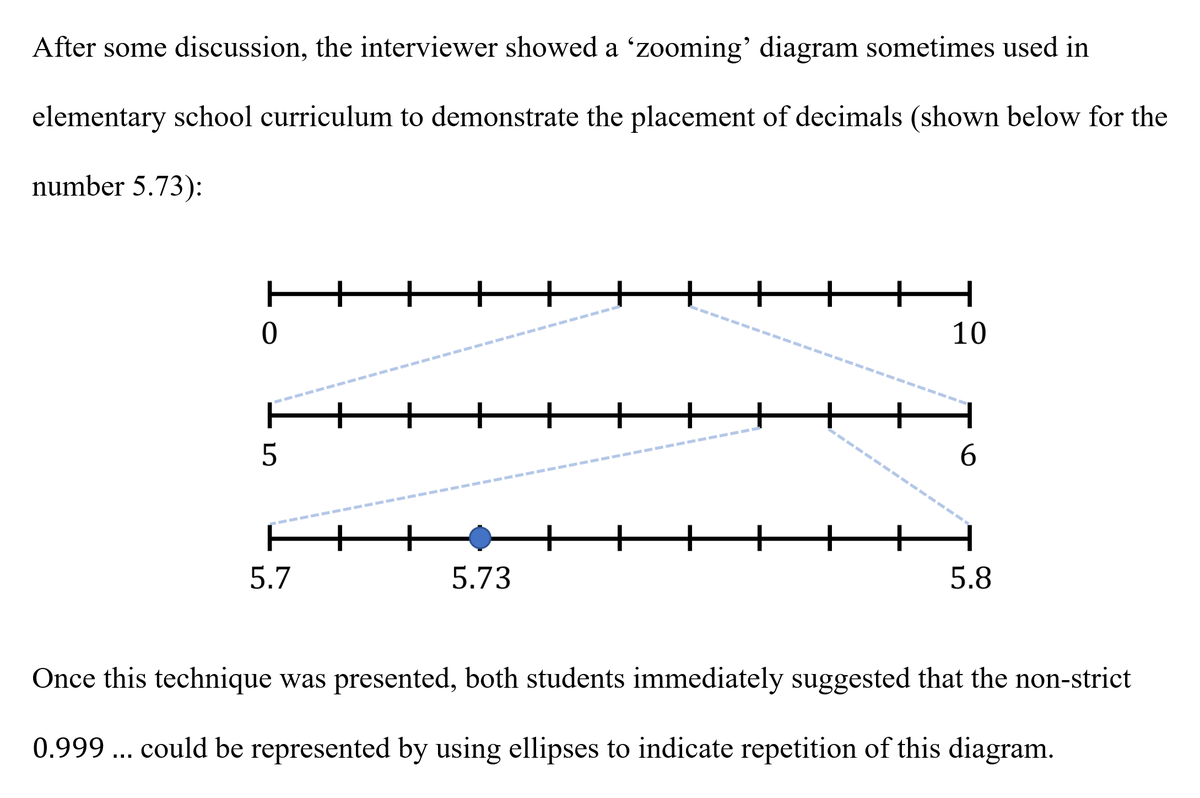 Twitter
·
tawdry venture
Twitter
·
tawdry venture
can someone more familiar than me with the american education system tell me if there's some kind of unspoken rule about the magnitude of the numbers that are allowed or expected to appear in each class in the american mathematical curriculum
quasi musk
I don't understand your question: are you asking about how many explicit numbers (e.g. 2, pi, e, etc.) must show up in every class?
If that's your question, then a general rule of thumb that I follow is you should give enough explicit and computational examples so that students can follow or motivate the theory
cosmic ibex
I think Ann imagined something of the general shape "fourth-graders don't yet understand numbers with more than two digits, so avoid those"?
dapper flume
tawdry venture
can someone more familiar than me with the american education system tell me if ...
Do you mean like the size of numbers? The common core standards do differentiate between lower elementary grades learning basic operations. For example:
1st grade: "Add and subtract within 20."
2nd grade: "Use addition and subtraction within 100 to solve one- and two-step word
problems [and model them]"
3rd grade: "Multiply and divide within 100."
4th grade: "Generalize place value understanding for multi-digit whole numbers... For example, recognize that 700 ÷ 70 = 10 by applying concepts of place value and division."
5th grade: "Find whole-number quotients of whole numbers with up to four-digit dividends
and two-digit divisors"
Just a few examples. Not that the Common Core is not only like this, it's quite vast in its coverage and also deals with reasoning and representation in the math standards.
But to answer your question, yes, place values are gradually introduced through the lower grades as students build up to generality and fluency.
tawdry venture
dapper flume
Do you mean like the size of numbers? The common core standards do differentiate...
yes that's what i was looking for. which grade is algebra 1?
dapper flume
tawdry venture
yes that's what i was looking for. which grade is algebra 1?
Standard 9th, but it can happen as early as 7th depending on math track acceleration
tawdry venture
okay so then an algebra 1 student should, a priori, not have any issues with the occasional three digit number in an equation.
dapper flume
correct
although very rarely are problems exposed to earlier students with 3 digit numbers in them
because algebra classes like to focus more on mental math and the information manipulation stuff
(even though students can do mental math with bigger numbers just fine if taught right early on, but that's just my feeling maybe)
wispy slate
Imma be real I don't think we ever had 3 digit numbers in our equations in highschool
Because I distinctly remember the one time we did I thought it was pretty novel
Everyone can handle it but will probably also be annoyed at it since there's no real reason for the actual calculations to be longer when you're supposed to be trying to learn about some method
The only exception is when we learned stat and were allowed to use calculators


 rose trellis
Dynamical systems / differential equations
 left mesa
What nooo
dapper flume
wispy slate
Everyone can handle it but will probably also be annoyed at it since there's no ...
I think what I mean is that 3x = 24 is the same problem as 300x = 2400
wispy slate
Yeah I'm pretty sure stuff like that would come up more when we did word problems and stuff
If it's a multiple of 10 or 100 or something no one's gonna bat an eye
But if you start throwing weird shit like 14x^2 +283x +127 = 0 (which a friend has in fact told me he got a question like this in a college algebra class) people are just gonna be way annoyed/confused
dapper flume
I think that's still good for performance task-type activities
Real world numbers aren't always multiples of 10, but I'll probably keep it easy on tests
lethal leaf
I guess my point would be like
is there a pedagogical value to increasing the size of the numbers
(size I'm using more to mean the complexity of working with the numbers, similar to the example that @wispy slate used)
or are you just increasing the size to have "variety" for variety's sake?
cause if your only goal is to teach people how to divide numbers to solve for x, then what's the point of 12x = 24 versus 169x = 28561
other than making the latter require some annoying long division unless you happen to know what 13^4 is off the top of your head
winged urchin
Yeah large numbers are not as valuable in my opinion
But I do think including fractions or expressions for numbers other than just writing the digits can be nice to remind them of how certain things work
Although perhaps for like ... Competition math where they should know some divisibility rules larger numbers are valuable for that
dapper flume
that's always a good point. we want to isolate our skill targets a little bit better than asking students to do everything they learned at once for the sake of realism
because counter to what I said myself earlier, even though multiples of 10 aren't realistic, neither are situations without calculators
also depends on your students though, and whether you allow calculators. if you are teaching algebra in physics, for example, you'll need to pull out scientific notation and all that
but for 7th/8th grade pre-algebra i see no point in making the numbers harder
winged urchin
I do generally think that calculators shouldn't be allowed in most cases though
winged urchin
I just think that if a student uses a calculator they don't tend to practice some underlying algebra/arithmetic manipulations
There was actually a question recently I saw about a geometric series where you calculated the value of the sum. The answer ended up being SUPER close to 1/3. Like on most calculators the answer showed as 0.33333333... all 3's for the whole display
And the question asked for the answer to be given in the form of a rational number
So many students put 1/3 and were confused as to why they were wrong
You had to actually manipulate the expression to reduce it down to an integer over an integer
 fading aspen
winged urchin
I just think that if a student uses a calculator they don't tend to practice som...
fading aspen
winged urchin
I just think that if a student uses a calculator they don't tend to practice som...
Couldn't agree more
Sadly here tho they have the idea that math = plug numbers into calculator
 strange bronze
the approach my algebra profs usually took was to ban calculators but provide any relevant nontrivial computations
like a galois theory question might present the student with a factorization of a polynomial or w/e
of course that becomes a "hint" at how to solve the problem inherently
but i dont mind that personally
to me exams are about demonstrating fluency
left vault
I've been using AOPS books for material for one of my students, and I have to say, those books are fantastic
so many great exercises
left vault
low key wish I studied from them when I was in highschool 😓 lolol
lethal leaf
Same
quasi musk
They are very good. I teach at Russian School of Math, and our book problems are almost identical
They do offer a great education, but some students really resent it
:/
long pelican
Can you say more about what they resent about it?
 pale wasp
Probably their parents making them go even if they don't want to
pallid night
Opinions on Q7 for a question on an exam for a first course in Analysis ?

The "With proof" for 7e is meant to make clear that the student is expected to prove convergence fails to occur for all values of c except for those they have found
pallid night
I'm trying to write resources and i'm not that in touch with what is appropriate for first year undergrads now as it's been a while since I did my first year
 calm jewel
It looks like a good problem
quasi musk
long pelican
Can you say more about what they resent about it?
You can't force someone to fall in love w/ math, even with a good curriculum, good teacher, etc.
Lots of students feel pressure to do many things, and often find it hard to focus on any one thing
That with the idea of "oh this extra math doesn't really count"
because there's no real "grade"
long pelican
I meant what they resent about the way the class is designed, and how the problems are similar to AoPS problems. More like, what do they wish the class to be?
 novel kraken
pallid night
Opinions on Q7 for a question on an exam for a first course in Analysis ?
novel kraken
pallid night
Opinions on Q7 for a question on an exam for a first course in Analysis ?
it looks like you're on windows - you can take a screenshot with shift+alt+t and then paste directly into discord
quasi musk
long pelican
I meant what they resent about the way the class is designed, and how the proble...
Not math
They just don't want to be there for more than half to 3/4s of my students
long pelican
😬
pallid night
novel kraken
it looks like you're on windows - you can take a screenshot with shift+alt+t and...
Don't have discord on my laptop
novel kraken
me either I use it in the browser
pale wasp
long pelican
😬
perfect kumon logo face
tawdry venture
is it my place as a teacher to correct my students when they use terminology or wording which i perceive as incorrect or clunky
shadow flower
yes
quasi musk
tawdry venture
is it my place as a teacher to correct my students when they use terminology or ...
I'd say pick and choose your battles. If it's particularly egregious then yes
But if it's like a notational thing, or not very important to the point you're making then don't go for it
One thing I've done with my 6th grade geometry students is that I've only given A+'s to students that not only show their work correctly, but explain their work with complete sentences
I have nitpicked their sentences just yet, only requiring that they have some semblance of sound reasoning
lethal leaf
tawdry venture
is it my place as a teacher to correct my students when they use terminology or ...
Depends on the class also
Is it a class on proof writing? IMO then this is one of the most important things you can do (especially if it's incorrect)
If this like middle / highschool algebra and someone is just explaining their work, pick and choose your battles unless it makes absolutely no sense
cloud zealot

mfw people say derive to mean "take the derivative of" instead of differentiate
What steps can the math community make to improve its communication?
Delivered Thursday, January 5 at the 2023 Joint Mathematics Meetings in Boston, MA.
Reposted here with permission from the AMS
Correction at 50:24 – The measure of transferability score for Class B (3.1) and that for Class A (5.4) should be swapped.
Podcast mentioned in the Q...
quasi musk
cloud zealot
>mfw people say derive to mean "take the derivative of" instead of differentiate
derivatate
cloud zealot

meager bronze
One semester teaching calc 1 I decided that I was not going to make a big deal when students said “derive” instead of “differentiate”. It went smoothly until i asked students to “derive this trig identity” on an exam
And half the class tookt he derivative of both sides
shadow flower
there really amusing
 tepid smelt
left vault
I've been using AOPS books for material for one of my students, and I have to sa...
tepid smelt
left vault
I've been using AOPS books for material for one of my students, and I have to sa...
You can get a teacher account through alcmus(basically pulls problems from those books or various contests but for particular topics) and add students to a class to track their progress. I have used it for a gifted group in the summer but have not yet had a student in my regular public school do it consistently. I have used it as a way to force students to practice a topic until they are proficient to get a retake. If you have any strong students it's an easy way to have them practice the same topic but at a higher level without having to come up with a bunch of problems.
tepid smelt
quasi musk
They just don't want to be there for more than half to 3/4s of my students
I think a lot of parents force math on kids because they realize it helps with certain careers. I have noticed that many extra curricular math programs are full of kids forced to do it rather than actually want to do it.
I just wish regular schools would offer more variety in math education. I think that way you can get kids to at least take more ownership in what type of math they want to do. (At least by high school)
 vagrant meadow
what do you all think about textbook solutions?
-no solutions
-solutions in the back (only for some problems?)
-solutions right under the problems
should every exercise have a solution? is something lost when the solution is included in the problem statement? if so, how important is it? does the answer depend on the level of the class (for example, high school vs graduate level)? should proofs be treated differently from computational problems?
i'd really like to hear all perspectives.
i feel like when no solutions are provided, it really forces you to think about the material. but it can also be very frustrating since you don't know if you're on the right track or not. i had a miserable time with Abbott's analysis for that reason.
i also had a PDEs text that almost always included solutions in the problem statement, and it was really nice because that meant i was never left wondering if i did something wrong. so i guess i'm partial to solutions, but i'd like to hear what more experienced math educators (and non experienced students) think about all this.
tepid smelt
Abbott's analysis comes with full solution's and I found it a really easy introduction to analysis.
I mean I like full solutions when learning. You just have to be careful not to jump to a solution too quickly. I also like to see other approaches. I generally tend to like hints more which stack exchange can be helpful for.
At the high school level I try to avoid giving a solution until the end of class as I want them to eventually be able to convince themselves they are correct. At least for calculation problems. For proofs those have been the most challenging as many approaches can work so I like to give less problems and have them do it in groups and do more full class discussions on them. I'll post the hw solutions as it's not worth much anyways and will go over the test the next class. I feel if I just gave the solutions without a chance to explain them it's not helpful for most.
I guess solutions are good if you can ask questions about them.
tardy ember
i think having solutions somewhere is a good idea, but they shouldn't be too close to the problem - you should be able to read the problem without seeing the solution, and try solving it yourself
not having solutions at all creates two problems:
- you can look at the problem, not be able to solve it, there is no solution provided, now you're just stuck
- you can look at the problem, solve it but it's rather complicated, there is no solution provided, now you don't know if you did it correctly or not
(generally the first one happens more with proof-y problems and the second one happens more with computation-y problems, but also most problems involves both proof and computation in some amount, it's just a spectrum of how much of each type occurs)
but also the solutions shouldn't be presented so immediately that it's difficult to look at a problem and consider it without knowing the solution in advance, because then that kind of negates the existence of the exercise
or more precisely it does that for proof-y stuff
for a large computation, knowing the answer doesn't really help much with doing the computation, beyond checking your work when you're done
but if the difficulty of the question is that it's not obvious what you're supposed to do, seeing the answer means you can't then try to work out what you're meant to do, because you already know
pallid night
vagrant meadow
i feel like when no solutions are provided, it really forces you to think about ...
I guess you are partial to solutions in a book on analysis of pdes 
In all seriousness, I'm a keep the proofs in a separate appendix type person
rain rain
What kind of search terms would I use to research the topic of rigor vs pedagogical clarity in math and science courses/education? Particularly in the field of engineering
Or perhaps what I'm thinking of is slightly different
I was just rewatching Grant Sanderson's speech on "math's pedagogical curse" and it reminds me a lot of a personal problem I've experienced while learning math and science in a rigorous context
A lot of the time I learn stuff in proper rigor, it all kinda just mixes up together into this blob of words and symbols
And the "physical meaning" or intuition behind the concept slowly fades away as you get lost in all the technical jargon
Or it's never introduced or motivated properly in the first place, just kind of a new concept thrown out there
And I feel like a lot of STEM education suffers from that
Anyone else?
Like I love the way Tao puts it here

I think STEM education could be a lot less dry and easier to learn if we incorporate the "post-rigorous" stage of education into the rigorous stage too, just always sort of bringing students back into the "big picture" of things and reminding them of what they're studying and why
I feel the same way as this

Maybe this isn't the best place to ask since I'm wanting to write about this topic in engineering specifically
But I think a good example of what I'm talking about is like
It's a bit of a running joke in engineering that we'll always overcomplicate the problem
And I think part of the reason why is because we get so lost in all the technical concepts and forget the big picture
It's like everything has to be done so hard and "from the basics" and that just presents 200x more opportunities to fuck up and is just harder to understand, when in reality the problem is so simple
cosmic ibex
I generally understand Tao's point of defining the distinction as saying that they really are natural stages of learning, and the general fact that people go through a "rigorous" stage is not something bad that should be blamed on bad teaching.
But teaching still ought to explicitly try to steer students away from the common misconception that the rigorous stage is what good mathematics is exclusively about -- in particular it won't do to believe one is supposed to shun intuition as much as possible.
winged urchin
I've never really understood it as shunning intuition so much as being critical of it
Especially for a young student doing mathematics where their intuition is based on far less experience or sometimes their 'intuition' is more perhaps more arbitrary than it should be
Whenever my students think they 'see' the solution to a problem or have some expectation of where it will go I encourage that but I try to get them to show me the steps.
Okay yes, you think the solution is x=3 but can you show me that that is a solution? Better yet, can you show me the steps to get that solution so you can do it again when your intuition is hazy?
Not even talking about 'intuition' when it comes to more complicated areas
Anything to do with infinity tends to fly in the face of intuition sometimes and many other areas you simply can't rely on intuition to carry you in anything but the simplest of example problems
shadow flower
winged urchin
Especially for a young student doing mathematics where their intuition is based ...
my professor and I went round and round for about 10 minutes on why the intersection of two sylow p subgroup cannot be a sylow p subgroup. I was using my intuition and logic to explain it and he wouldn’t “buy” it unless i manage to show it using the definitions.
long pelican
What was your intuition/logic?
shadow flower
if the intersection of two sylow p subgroups is also of size p then they are the same subgroup and not distinct
so if you take any two sylow p subgroups and intersect them, you cannot get a sylow p subgroup back, since their are only a finite amount of them
i don’t know if i’m explaining it clearly but that was my idea. He preferred a containment argument between two of the subgroups
long pelican
Cannot beat that logic
Wanting the double containment method is too pedantic
Do you even need "there are only a finite amount of them"?
winged urchin
Sometimes I find educators might unfortunately disagree with something because they havent had time to sit down with it
I've probably done something similar or at least felt compelled to
When I usually try to tell them that I am not so good at understanding something in the moment and often need to take some time to mull on it, play with it myself, before I fully agree
But there are definitely times when people say logic/intuition and it's more a gut feeling or not a fully fleshed out argument
And there was that whole 'crisis in math' thing that is overhyped but still partially true
Where mathematicians noticed flaws in what was commonly accepted mathematics
Mathematical history is unfortunately not so familiar to me as to recall without looking up but I believe this around the time of Godel where he had that focus on rigor and proper notation
But I invite anyone to chime in or correct my recollection here
rain rain
winged urchin
Anything to do with infinity tends to fly in the face of intuition sometimes and...
Why is this though?
I think that’s a great example
Riemann Rearrangement Thm
Show a student a trick we use to find the sum of a series, like what we can so with a geometric series
Let them try it with a series that isn’t absolutely convergent
Things go wrong pretty fast, but it’s hard to see why
I’m sure there’s some intuitive explanation for why things break that would make the proof a lot easier to understand
I know that’s what makes math easier to learn for me
When I convert mathspeak into plain English and understand why the theorem is true (even if it’s handwavey or vague or my intuition isn’t always reliable) it helps me digest the proof way easier
winged urchin
rain rain
Why is this though?
Oh boy that's a good question ahah.
I would tend to think infinity causes these kinds of problems because it's so far removed from a person's typical experience in life
Someone has experience with smaller numbers in very many ways in life. Larger numbers become increasingly rarer to be dealt with in life and in any way we can understand
The larger the numbers get the more unknown they get and then infinity is just a whole other beast
Though I think the error in the students calculation with the geometric example is less to do with a lack of understanding and more a product of rote memorization
But then again it's difficult to really understand why an arbitrary convergent sequence does actually converge versus a divergent sequence where the limit of terms still tends to zero
In some cases we can draw some pictures to get insight like with 1/2+1/4+1/8+... And viewing it as just successively halving a unit interval and eventually getting the whole interval
But that kind of insight is not apparent in many convergent sequences
Though even that kind of 'visual intuition' isn't bulletproof either right
Famously demonstrated by taking a piecewise staircase and shrinking the size of the steps until it 'looks' like the hypotenuse
A student might suggest that they have a kind of logic or intuition in claiming the hypotenuse of a triangle with other sides as units would be 2
 hexed sand
are these too hard for an analysis class? I gave them on an exam and basically no one did well on these out of the multiple choice section

we certainly covered all these topics in the class
turbid zenith
Question for y'all. I'm considering going back to making videos soon, but just based on my own mathematical interests I want to share instead of for a course I'm teaching.
When it comes to math videos, do you prefer videos where you can see the person who's speaking (e.g. Numberphile, Infinite Series), or do you prefer videos where it's just the person's voice and the math comes from the void (e.g. 3blue1brown)?
long pelican
Pure animation without voice is my favorite when done well 😛 but it's probably very hard to pull off
turbid zenith
Oh yeah I've seen some channels that do that, but for that you need like CONSTANT motion
Do you have examples?
long pelican
The first ones that came to mind are Mathologer's animations of algebraic and visual proofs
In that example it's not the whole video that's without voice, just the sections where the animated proof is being shown
cosmic ibex
winged urchin
I've never really understood it as shunning intuition so much as being critical ...
What I'm talking about is the misconception by students that they'd be doing something wrong if they let their search for a rigorous argument be guided by any intuition about the problem. I hope we can agree that is unproductive and self-defeating.
I doubt any teachers are deliberately teaching that ideal, but it seems to be a misconception that students are likely to fall into on their own. And I think it can be easy for teachers to inadvertently feed it. Often, I think, the teacher trusts that the students are already sufficiently familiar with the necessary intuition (perhaps because that's easy for the teacher) and just need to learn how to convert that intuition it into a rigorous argument. Then if homework stays at the intuitive level, it gets marked down as wrong (fair enough in itself because that was not what's being trained), but the student extracts the wrong message from that-- instead of "you only did the initial part of what you're supposed to do for the purpose of this exercise" they understand it as "what you did was the wrong way to even start thinking about the problem".
 grave arrow
can anyone think of a useful example for linear approximation? I think that my class may think it is useless when they first learn it but I'd like an applied example where it makes sense to use it
 steady sapphire
Like estimating surface area of countries or the earth
cosmic ibex
Consider a rainwater basin with sloping sides. How much will the surface rise if you add 1000 liters of water?
An exact computation would need to take into account the various shapes of the sides -- just gathering all the necessary data could be cumbersome. On the other hand, for a linear approximation you just divide the extra volume by the current surface area.
austere inlet
hexed sand
are these too hard for an analysis class? I gave them on an exam and basically n...
the thing with these is that they all involve coming up with, or already knowing a (counter)example beforehand. I've found that it's a skill that's often overlooked and thus not too strong in undergraduate students, but it definitely should be taught and evaluated
coming up with (counter)examples to things is a step further from just knowing the definitions since it involves many more skills, such as knowing visual intuition for them (e.g. to know what's going on in 2. or 3. of what you posted) or the interaction between different concepts (e.g. what are some sets with measure zero and why can we show that their Lebesgue measure is zero? can we take one of these examples to answer 6.?)
students should be encouraged in class or through HW to work with the concepts and tools they've learnt and then it makes sense to ask for such things in an exam
austere inlet
turbid zenith
Question for y'all. I'm considering going back to making videos soon, but just b...
I often like to put videos in the background while doing other tasks, so either way is fine. I believe the benefit to having yourself in the video is long-term, in the sense that people can relate to your personality and associate that with your content, and more immediately you could also make use of gesticulation to add an additional dimension to how you express yourself -- but good animation could make it just as clear
turbid zenith
austere inlet
I often like to put videos in the background while doing other tasks, so either ...
That makes sense, I think
I'm looking at starting off with me in the video to introduce, transition, and conclude, but keeping the main stuff just being the math
austere inlet
yeah you could also record yourself in the video for emphasis, that's something people do often in video essays
turbid zenith
Yeah, just at particularly important places.
lethal leaf
long pelican
The first ones that came to mind are Mathologer's animations of algebraic and vi...
actually I love Mathologer for the mix
I like seeing him talk and stuff but also the purely visual stuff with voiceover
 white forum
turbid zenith
Question for y'all. I'm considering going back to making videos soon, but just b...
white forum
turbid zenith
Question for y'all. I'm considering going back to making videos soon, but just b...
I think for mathy-entertainment videos full of animation like 3B1B are better, yet I find myself able to learn better by watching professors lecture on a chalkboard (even if it is through my laptop screen). Perhaps a chalkboard wouldn't be necessary but just live annotation and a voice that could explain steps might be something that a pure animation might be lacking
tawdry venture
tutoring a student who used to come to my after school math things and we got to the topic of quadratic equations. and i talked a little bit about the history of the concept (very brief) and then said this:
"A quadratic equation is an equation of the form ax^2 + bx + c = 0, where a is not zero. Our goal will be to learn how to solve any equation of this kind, and it will be some time before we get there, but there are special cases you already know how to solve:
- if c = 0, then the equation can be rewritten as x(ax+b) = 0, from which we get the roots x=0 and x=-b/a
- if b = 0, then the equation can be written as x^2 = -c/a, [etc.]
and the idea that underlies the methods we'll learn will be to reduce more complicated equations to cases 1 and 2"
thoughts on this?
austere inlet
yeah that's a good way to introduce it, I suppose the natural next step is to complete the square which sort of reduces the problem to case 2.
makes it clear why the end formula is like that
dapper flume
When I taught it, I would start with the symmetry of the parabola, which they already knew was at x = -b/2a. We observed that the zeroes would be symmetrically reflected over this acis. We then went on a hunt together for a formula which a) got x by itself, and b) looked like -b/2a ± "something", and by completing the square we could find that "something." We did the derivation as a class, but guided well, students were able to figure out some steps on their own.
tawdry venture
austere inlet
yeah that's a good way to introduce it, I suppose the natural next step is to co...
yeah thats gonna be for our next sesh probably
tawdry venture
im not sure if i should tackle factorization or cts first
im thinking of first talking about vieta's formulas, then factorization as such
then completing the square and showing an alternative route to factorization
and then maybe after some time build up to the qf
 cold trench
you can also derive the qf :p
tawdry venture
cold trench
you can also derive the qf :p
i am planning to do that but not immediately.
i will not give the qf without derivation.
cold trench
epic
tepid smelt
white forum
I think for mathy-entertainment videos full of animation like 3B1B are better, y...
I personally can't learn anything serious from videos. The exception is contest type problems I can pick up nice techniques I wouldn't consider. I also like to see the thought process when tackling a difficult problem especially when it's there first time seeing it. Evan Chen would do this on twitch a lot and I liked seeing him try different approaches and not instantly walking through a difficult problem that they already have worked out the solution.
So I guess I like seeing hard problems worked through on video but prefer reading for theory. I wish more people would upload college level problems rather than tons of high school level stuff. I do appreciate the interesting problems but there seems to be a lot of Olympiad type problems on YouTube now.
white forum
tepid smelt
I personally can't learn anything serious from videos. The exception is contest ...
That's an interesting stance. I'd agree that I can't learn anything serious from videos with the exception of actual lectures where I take notes and follow with practice. I think maybe the reason for the dearth of videos on college-level problems exists is that the creators who could (and would) go over problems for college-level math courses opt to record lecture-type-videos and teach entire concepts instead of working on individual problems. Not that it lacks utility, I just think as you pointed out that there is a lack of creators willing to put out content like that.
 empty gull
tepid smelt
I personally can't learn anything serious from videos. The exception is contest ...
empty gull
tepid smelt
I personally can't learn anything serious from videos. The exception is contest ...
Since you're looking for college level material on yt there's this channel
https://www.youtube.com/@PhDVlog777
It focuses mostly on analysis but it still does grad level problems pretty often
 empty gull
turbid zenith
Question for y'all. I'm considering going back to making videos soon, but just b...
empty gull
turbid zenith
Question for y'all. I'm considering going back to making videos soon, but just b...
OK so imho both can be done very well and very badly (and not to mention that this is basically all personal preference)
If you're doing the second don't try to cover a huge amount of content in the video, rather try to keep your ideas in some small radius of the thing you started with
Example of this being done well:
https://www.youtube.com/@Aleph0
This whole channel is fantastic and it's one of those time I really felt I learned a lot by watching a yt math video
But now an example of this being done not well
https://www.youtube.com/watch?v=zCU9tZ2VkWc
(This guy usually has very good videos but personally this is one I felt most ppl would get lost pretty easily and it's not even because of the level of the content rather the fact that in 45 mins it covers way too much)
Now as for my personal opinion on lectures...
I prefer irl lectures where I can ask question immediately so my stance probably isn't gonna be too helpful lol
To me watching pre recorded lectures is a pretty big chore, but on the other hand I do have ADHD so that probably invalidates my opinion :P
Realistically my personal favorite way to learn math is through reading books as I never feel like I'm in some rush when reading those

YouTube
Thanks for stopping by! Aleph 0 is a channel devoted to bringing pure mathematics into the hands of learners. So far, this channel has videos on topology, algebraic geometry, PDEs, differential geometry, number theory, and more. If you're excited by pure math, or even if you're just curious about what it is, then you're in the right place.
Twit...
An entry to #SoME2. It is a famous theorem (called Abel-Ruffini theorem) that there is no quintic formula, or quintic equations are not solvable; but very likely you are not told the exact reason why. Here is how traditionally we knew that such a formula cannot exist, using Galois theory.
Correction: At 08:09, I forgot to put ellipsis in betwee...
fallow siren
winged urchin
There was actually a question recently I saw about a geometric series where you ...
Could you share this question?
quasi musk
turbid zenith
Yeah, just at particularly important places.
I just saw your algebraic curves video. It was probably one of the best videos explaining the ideas I've seen
I've tried to describe projective geometry to students before, and I don't think I get the idea across very well
turbid zenith
That video blew up out of nowhere
shadow flower
link it here
turbid zenith
I do not get what happened
Ever wonder what happens when you combine graphing algebraic curves with drawing in perspective? The result uncovers some beautiful relationships between seemingly different shapes, and all because of what happens when you include infinity through projective geometry.
This video was a project for MA 721 - Projective Geometry, as part of the Ma...
But I appreciate the kind words @quasi musk ❤️
long pelican
Are you an algebraic geometer? You should do a series on algebraic geometry!
turbid zenith
I am not! I’ve only learned bits and pieces, mostly computational
long pelican
Dang, what's your specialty then?
turbid zenith
Math education 😛
But recently, combinatorial game theory
That’s been the bug that’s bitten me
long pelican
Nice
turbid zenith
So that’s probably what my next videos will be on.
That’s what I think I can say the most on and make it the most accessible.
tacit adder
Oh this video popped up on my feed but I haven’t taken the time to watch it yet
 south vigil
Okay, so when it comes to teaching / learning abstract math, I have some major beef with textbooks
Who the hell started the tradition of using the most "elegant" proofs to teach things, instead of the ones that use intuition
empty gull
I think the author has his idea of what constitutes simple relative to other methods
tho this is not something I've seen everywhere
A lot of the time (good) authors give you the simplest proof and then usually refer you to some nicer method
south vigil
Hmm, I'm speaking mostly to my own experience here
I just often find that books take a lot of shortcuts in establishing theory
Like who the hell thought it was a good idea to say that a topology is a subset of the power set that contains the full set, empty set, and is closed over intersections
That's a definition that only makes sense if you already know topology
empty gull
This is something I have never seen before in an introductory textbook lol
usually they say something like a topology is a subset of the powerset such that
Empty set, entire set is in the topology
And some open set stuff
or if they're being brave then they define it using closed sets
south vigil
Yeah, I was paraphrasing a bit
But why not instead talk about (first) the reasons you'd want that particular definition of open sets
empty gull
I would say that there is no really good intuition for why the modern definition of a topological space is what it is
south vigil
Begin by pointing out that you can do things like talk about connectedness of intervals through open intervals, then work that up to shapes
Yeah there definitely is
empty gull
here's my personal problem with that idea
we wanna define a topological space in full generality
south vigil
Topology just asks the question of "if you look at only the local properties of a shape, what can you find out"
empty gull
but if you start simplifying what the space can be then you run into problems later on
It's always a slippery slope
south vigil
Yeah it's like a back and forth right?
empty gull
like what happens when you start talking about a space that doesn't have a metric space structure
then you can't really talk abt balls anymore
south vigil
Because topology can be used to do stuff that escapes that intuition
But I think it's still a good starting point. Begin with balls, explain how that motivates the definition of a topology, and then do other shit with it too
cosmic ibex
So would you prefer a textbook that doesn't tell you the definition of a topological space, and leaves it to you to guess at what it's talking about???
south vigil
No, I'd prefer textbooks that motivate the definitions of things
cosmic ibex
Your complaint was literally "this textbook told me what the definition of a topological space is".
south vigil
I'm not saying don't define a topology, I'm saying give reasons first so that the definition doesn't seem arcane initially
Nah, it's a problem with a lot of subjects
Same thing happens with categories, but they're not quite as bad
empty gull
south vigil
No, I'd prefer textbooks that motivate the definitions of things
Ah that is true
But the problem is that it's not always applicable
Sometimes either the motivation can be very complex or just non existent
Like I have seen examples of people trying to give motivation for stuff that personally made me very confused lol
south vigil
Well I feel like that also just points to a larger problem in mathematics
I feel like people often attempt to bypass understanding what's going on in favor of just getting really good at computing things under restrictive rules
empty gull
south vigil
Same thing happens with categories, but they're not quite as bad
ngl I've usually seen categories motivated very well lol
Tho for that you usually need to know abstract algebra already to fully get the motivation
south vigil
Yeah same categories are a bit of a bad example for that
They just are a good example of illustrating how definitions can go back and forth
cosmic ibex
What do you think a textbook should say instead of defining a topological space?
empty gull
cosmic ibex
What do you think a textbook should say instead of defining a topological space?
ngl imho I would maybe like a bit of the discussion of how that definition came about historically
south vigil
Like *hey look categories describe how algebraic objects are related, but also look at all the weird shit you can do"
cosmic ibex
(Assuming it's actually a topology textbook in the first place).
cosmic ibex
empty gull
ngl imho I would maybe like a bit of the discussion of how that definition came ...
Instead of showing the definition itself?
empty gull
cosmic ibex
Instead of showing the definition itself?
no
The definition is important
I thought of the discussion as like a bit of an introduction to the definition
like a paragraph or two
south vigil
cosmic ibex
What do you think a textbook should say instead of defining a topological space?
I think you're misunderstanding me. I'm not saying don't define things, I'm saying more care needs to be made towards making that definition make sense
empty gull
to set up what we're gonna talk abt
cosmic ibex
south vigil
Like who the hell thought it was a good idea to say that a topology is a subset ...
Here Halliday asked who thought it was a good idea for a textbook to tell what the definition is.
empty gull
cosmic ibex
Here Halliday asked who thought it was a good idea for a textbook to tell what t...
I think he's saying that he has problem with that specific way of defining a topology
south vigil
Yup, my point being that that's going to be complete gibberish if you don't already get topology
cosmic ibex
ANd he hasn't proposed an alternative definition he would rather see.
south vigil
But it makes perfect sense if you realize that you're just talking about balls and open intervals and stuff
cosmic ibex
I'm asking which definition you think the textbooks should have given instead of the one actually used by topologists.
south vigil
cosmic ibex
Here Halliday asked who thought it was a good idea for a textbook to tell what t...
I misspoke. I really should have said "who the hell thought it was a good idea to lead off with that". My bad
cosmic ibex
I can't speak for any particular textbook, but I think it is usual for them to assume the reader has already seen a development of topological concepts of metric spaces, as part of real analysis.
south vigil
Because if you get why topologist do the shit they do, that definition becomes almost obvious
south vigil
cosmic ibex
I can't speak for any particular textbook, but I think it is usual for them to a...
I mean, maybe, but I feel like topology isn't the only place where this is problematic. Like, look at delta epsilon limit definitions
It's really motivated, but no one ever tells you that
cosmic ibex
I think you may be projecting your experience with one particular textbook to "this is how all textbooks are, so I can attack textbook authors in general without deigning to name names or titles."
south vigil
I guess I feel like people often don't understand the things they're working with in abstract math, and instead just understand how to use them
And my best guess to the root of that problem is that people often aren't provided with any intuition
empty gull
south vigil
I guess I feel like people often don't understand the things they're working wit...
a lot of intuition comes from using them a lot
south vigil
empty gull
a lot of intuition comes from using them a lot
Not to me. I can't use something until I have the intuition for it
south vigil
cosmic ibex
I think you may be projecting your experience with one particular textbook to "t...
That's fair. Lang's a good example of this, but also a bit of a straw man, so idk
cosmic ibex
How do you propose to build intuition for something without first telling you what it is?
empty gull
Lang is like a legendarily bad algebra text lol
Plus it already assumes a lot of knowledge of the subject to read
so idk
south vigil
That's why I called him a straw man
cosmic ibex
It seems to be completely self-defeating to require that a textbook should somehow manage to give you (several pages of?) intuition before you ever get to see the definition the intuition is intuition about.
I'm not sure how you imagine that would even look. As long as you haven't seen a definition, what can a text book, concretely, start to say that won't just be gibberish?
south vigil
cosmic ibex
How do you propose to build intuition for something _without first telling you w...
First talk about the thing you want to do, like discuss connectedness. Then provide examples of how to look at that, like with open intervals / vs open subsets of the reals. Once you've shown that the connectedness can be shown only by this stuff, draw analogies to similar ideas with other easier topology examples, and then distill the things that are similar about open sets down into a definition
You don't need a precise definition until you use it precisely
cosmic ibex
So you want a textbook in topology to reproduce an entire course in metric spaces (or even just the topology of the reals) before it gets to talk about the thing it will actually teach?
If a textbook starts with the definition of an abstract topology, it's because those subjects are prerequisites for it.
south vigil
Hmm, maybe, but let them complain. Intuition is at least half the equation, and is way too often underemphasized
cosmic ibex
To be sure, the first thing the book should do after defining a topology is to have some discussion or some exercises to let the reader convince themselves that the definition does generalze the metric-space concepts they presumably already know and love.
south vigil
Yeah of course, I'm just saying reverse the order
cosmic ibex
I don't think that is logically possib;le.
south vigil
And give more direct exposition to the fact that they do this, instead of assuming the reader will just get it
cosmic ibex
You can't start on convincing yourself that the abstract definition of a topology fits with your existing knowledge of metric-space concepts until you get to see what that abstract definition is.
south vigil
You can, however, use the concepts to derive the definition
cosmic ibex
How?
south vigil
Well if you couldn't, topology wouldn't exist for one
cosmic ibex
A definition is not something you derive -- that would be a theorem.
A definition is a new thing, and you need to show what the new thing is before you can start arguing that it's a useful new thing.
cosmic ibex
I does not make any sense to me.
How do you propose to give examples of a concept that you're still keeping secret?
south vigil
cosmic ibex
How do you propose to give examples of a concept that you're still keeping secre...
You don't have to keep it secret. You can just use loose non rigorous definitions and explanations initially
cosmic ibex
Even if you're Ottoman, you still need to reveal your abstract definition before you can start explaining how it matches what Galois, Lagrange and Euler have already been doing.
shadow flower
south vigil
You don't have to keep it secret. You can just use loose non rigorous definition...
kinda like gallian did with isomorphisms?
south vigil
Not sure, haven't read Gallian
shadow flower
i’ll send it soon.
south vigil
I went with Lang cause I'm a masochist
cosmic ibex
south vigil
You don't have to keep it secret. You can just use loose non rigorous definition...
You're still contradicting yourself. On one hand you want the book not to tell the reader what the defintion is. On the other hand you want it not to keep the definition secret
Those are each other's negations.
Either the reader gets to know what the heck the author is talking about or he doesn't,.
south vigil
You say that a topology of something is the set of open sets of something, and that open sets behave like open sets of the real line
cosmic ibex
Uh .. I assumed that would be among the six first words of of the definition you don't want the book to lead with.
south vigil
As a quick aside
This isn't a debate. I'm not arguing here for a fixed position, I'm just presenting a frustration and trying to discuss it. It feels like you're trying to win, but there's nothing to win
Like all I'm saying is that definitions being presented in rigorous ways is confusing at first, and approaching them more intuitively would probably help understanding
 elder venture
Do you want to see something like this which initially motivates things and then makes them precise from there?
 south vigil
elder venture
Do you want to see something like this which initially motivates things and then...
south vigil
elder venture
Do you want to see something like this which initially motivates things and then...
I mean that's not really the best explanation, but sure
elder venture
Well for your particular area of study. Obviously this is section 3 so the stuff used is familiar on a intuitive level already to the reader.
south vigil
Well, sure. But my problem with it is more that it doesn't provide reasoning for why it's useful
Obviously I get it, but maybe I wouldn't if I didn't know what torsion or curvature was
Ignore my second sentence, my phone screen is too cracked for this shit lmao
elder venture
Well it tells you curvature is a measure of the rate at which the curve is turning away from its tangent line at a point.
I bring this example up because I’ve seen this given as a definition for curvature (1/R):
 south vigil
I mean yeah, that's obviously significantly better

 south vigil
Trust me my nitpicking here is a consequence of me being the kind of person to go on a math discord
elder venture
The theorem let’s you calculate it but has no intuition whatsoever. The theorem can be derived from the definition.
I find things are way easier to learn if they start with a very easy to understand introductory paragraph for the section instead of you immediately getting stuck and wondering where the stuff comes from so you have to look through crap YouTube videos and they just give you the same theorem as a definition anyway.
south vigil
Yeah exactly
I think there are two main reasons for that
The first is that if you already are familiar with curvature, then the definition feels almost obvious
Like sure it's the rate of change of the angle
And looking at that first equation, its like sure, that derivative is the rate of change we need
elder venture
All you need to know is the tangent line derivation and you can follow and that’s covered just before. Just saying curvature is |x’’(s)| is just criminal to me. The last time I said the same thing I got gas light about it.
south vigil
Yeah, it's awful
Why is it absolute value, why is it 1/R, why is it the second derivative and not the first?
elder venture
It’s useful for radius of curvature I think.
south vigil
So you have to figure out that 1/R is unimportant here, that the absolute value is just cause it's a rate of change, and the second derivative because it's the derivative of the slope of the tangent line, which is the first derivative
elder venture
But there’s loads of areas of maths I think that initial paragraph would help so much for the reader.
south vigil
Yeah, I was just listing the questions that need to be answered for that definition to make sense
elder venture
The book goes on to prove the theorem straight after.
But the reader gets the result people just say is the definition from something which makes sense.
Instead you’d just get told the book tells you what curvature is.
It’s |x’’(s)|.
south vigil
Yeah. It's lazy
It's putting the onus of explaining the idea on the student instead of the author
cosmic ibex
I think my real point here is that a good book ought to show the definition before it launches into a long discussion of why that definition is the right definition to use.
south vigil
Okay, sure, there are advantages to that
My main problem with that idea is mostly that people tend to take math books one step at a time
Like personally, I would have difficulty moving past the definition until I felt I understood it
elder venture
I’d note that I imagine some things are harder to motivate by their nature though.
south vigil
But that's also a me thing. Idk how much that applies to others
south vigil
elder venture
I’d note that I imagine some things are harder to motivate by their nature thoug...
I haven't found a thing math yet
cosmic ibex
south vigil
Like personally, I would have difficulty moving past the definition until I felt...
You'd refuse to even glance at the line after the definition to see if it's the beginning of a discussion of how to think about it?
south vigil
cosmic ibex
You'd refuse to even glance at the line after the definition to see if it's the ...
Well no, of course not. I just don't have a tendency to approach textbooks that way
I'm describing a personal bias, and how it affects how I'm looking at this, not a problem with the idea itself, necessarily
It's only a problem if other people have the same bias
elder venture
south vigil
Like personally, I would have difficulty moving past the definition until I felt...
This is a major problem for me too but I have the belief I know the stuff I learn far better than those who just go through it.
I’ve made far faster progress to the same level of understand when a intuitive introduction has been given though.
south vigil
One trick that you might find helpful is that authors often try to convey intuition, just poorly
Instead of outright explaining it, they give examples that show it, or problems, or so on
But to learn from those you have to actively ask the question of what they're trying to say with it (which should probably be communicated to the reader, but usually isn't.)
elder venture
There is a key problem though. If the author does give everything you can go through it so quick that you won’t remember it.
I think a textbook has to either make it so intuitive it can be remembered that way or if intuition is naturally harder (such as Taylor theorem proof) it needs to be made more difficult for you to work through.
south vigil
Well, that's why it's a bad approach on the authors part
I'm moreover suggesting a good way to navigate poorly written books
turbid zenith
south vigil
I'm not saying don't define a topology, I'm saying give reasons first so that th...
So, the professor I took for Advanced Calculus II wrote his own textbook
And he started off with primarily talking about R, and what open sets act like in there, etc