#linear-algebra
2 messages · Page 314 of 1
 wintry steppe
 umbral spindle
Got it, thank you!
 indigo vigil
wintry steppe
"every infinite dimensional vector space has linearly independent sets of any gi...
indigo vigil
wintry steppe
"every infinite dimensional vector space has linearly independent sets of any gi...
Oh, thank you for explanation of meaning! I'm just trying to understand what does mean symbol bw S and V. x)
 wintry steppe
subset
indigo vigil
Then what's difference bw subset notation with underline and without it? 😅
wintry steppe
strict inclusion, i.e. S is a subset of V and not equal to it. although this usage is not entirely standardized
subset with the line under ($\subseteq$) always means a subset with possible equality, and subset without the line under ($\subset$) means subset, possibly without equality depending on the author. for no ambiguity, use $\subsetneq$
 stoic pythonBOT
TTerra
 indigo vigil
Ok, thank you!!!
indigo vigil
Is there any notation for denoting a fact, that smth is a subspace of another vector space?
 wet stratus
$U\leq V$ ?
stoic pythonBOT
Denascite
 wet stratus
in general <= if often used to denote that something is a substructure of something else. subgroup, subring, subfield, subspace, ...
indigo vigil
ok, thx


 torpid moat
can you give a counterexample on this?
does "semidefinite positive" not imply "normal"?
 zinc timber
depends on def of semi definite
torpid moat
$P\in{M_n}$ is semidefinite positive if $\innerproduct{h}{Ph}\geq0$ for all $h\in\mathbb{C}^n$
stoic pythonBOT
thestonethatrolled
 wintry steppe
How come the transition matrix is said to be from the old basis to the new basis if when you put a vector in the new basis to it then it returns a vector in the old basis 🤪 🤪 this is so confusing.....
if its to the new basis why does it return vectors in the old basis 😐 😐
 eager gull
hello everyone, I am a high school student who will take linear algebra in college. I want to get a deep understanding of the subject
basically, I want this to make sense graphically
 eager gull

 fair wren
wintry steppe
there's no sense in algebra give up on it
fair wren
wintry steppe
there's no sense in algebra give up on it
Kekw
eager gull
I am a bit confused here. When I do 5 - 2.24, I get 2.76 which is not really 2.83
I am not sure if this is the correct interpretation of this formula. Can anyone help?
eager gull
wintry steppe
there's no sense in algebra give up on it
wait, you referring to my text?
eager gull
🤣
wintry steppe
 eager gull
HAHAHAHHAAH
wintry steppe
this shit doesn't make any sense whatsoever
eager gull
imma protest in my school
wintry steppe
a transition matrix from the old basis to the new basis translates the vector from the new basis to the old one lmao
what sense does that make
what a chimpanzee named these objects
 thin crystal
alegbra is stupid
 frigid fiber

 wintry steppe
it's just cramer's rule in the special case n = 2
note that you can solve each equation for x_1 and x_2 by dividing by a_11 a_22 - a_12 a_21 (the determinant of A) if it is non-zero
x_i is det(A_i)/det(A), where A_i is the matrix obtained by replacing the ith column of A by b
this is cramer's rule in general, and the picture you wrote is cramer's rule specialized to n = 2
wintry steppe
Does someone here has a lot of knowledge about differential equations?
 tribal willow
 little crater
probably stupid question do I just assume the left vector in the basis set corresponds to 3 and the right vector in the basis corresponds to the 2?

because say if I had written this basis B = { [2 / -1] , [1,1] } and applied the same logic I would get an answer
The full question was this but just curious as depending which vector is being scaled by what value changes the answer

 gray dust
little crater
probably stupid question do I just assume the left vector in the basis set corre...
gray dust
little crater
probably stupid question do I just assume the left vector in the basis set corre...
yes, in general the coordinates top to down correspond to basis vectors left to right
 restive crane
To prove two spans are equal, do you have to prove that each span is contained in the other?
 mossy escarp
can anyone help me out with my linear alegbra problem? not getting much help from the ordinary help channels
wintry steppe
ask
wintry steppe
restive crane
To prove two spans are equal, do you have to prove that each span is contained i...
since that's how you prove two sets are equal, sure
in linear algebra you can abuse dimension counting to sometimes prove equality when you have an inclusion of subspaces
namely: if W is a subspace of V of the same finite dimension as V then W = V
that is useful
mossy escarp
can anyone give me a hand :(,
 teal grotto
@mossy escarp do you know the parametric equations for a line?
mossy escarp
teal grotto
<@706025617807900683> do you know the parametric equations for a line?
Yes I’m familiar it would be x1=1+t … etc
Correct?
teal grotto
scratch that
first thing to do is check if the two lines intersect
if they do, then you're done
mossy escarp
Yeah I test that buy pairing each coordinate together and solving the linear equation
Correct?
teal grotto
otherwise, its just the shortest distance between two parallel planes containing those lines
teal grotto
mossy escarp
Correct?
yes
mossy escarp
Yeah I think I’ve solved all of that, I have my values etc if you’d like to see I just have no idea what to do for part 3
mossy escarp
No it’s all good haha I appreciate any help I can get 😄
teal grotto
so take your parametric equation for L1 but start it at the point P, P + d_1 t. then find t such that the distance between P and P + d_1 t is 2root(3) (there should be precisely 2 such points on L1 satisfying this).
mossy escarp
Would the point P just be (1,0,1) from the original question?
teal grotto
P is from part 1
mossy escarp
OHHH okay I see so I’d use that in combination with the direction vector of 1,1,1 for my parametric equation
mossy escarp
teal grotto
so take your parametric equation for L1 but start it at the point P, P + d\_1 t....
I feel like i don’t understand a whole lot of the theory tbh for this any vids or anything I could watch on it
teal grotto
mossy escarp
I feel like i don’t understand a whole lot of the theory tbh for this any vids o...
three blue one brown and kahn academy is always good. same with gilbert strang's lectures on youtube. although, i like reading through books and going through suggested examples and problems if im not understanding something
mossy escarp
teal grotto
three blue one brown and kahn academy is always good. same with gilbert strang's...
Okay Thats probably a good idea, is this at all correct?
 teal grotto
im not sure. it would be a lot to check over this rn and im a bit busy atm
mossy escarp
teal grotto
im not sure. it would be a lot to check over this rn and im a bit busy atm
Thats okay it’s all good
mossy escarp
Any chance someone could give me a hand with my problem ?


 dusky epoch
arent these two the same thing tho
i fail to see the difference between your picture and the book
 robust flint
it looks like same for me
wintry steppe
Alright, thank you 👍
wintry steppe
I was reading this part and tried to frame an intuitive example from my understanding.

Is my example correct?


f and g map the sets m and n to the indices of the elements in Matrix A ^
dusky epoch
are you... trying to work through the Formal™️ definition of a matrix
 copper pulsar
Is the linear combination of basis vectors still a basis for the same vector space? Say {a1,a2,a3} is a basis, is {a1+2a2, a2+a3,a3-a1} still a basis?
 native rampart
ah mb
 snow totem
Does anyone know good resources where I can find upper bounds for the solutions of semidefinite programs. Well I'm more specifically looking for bounds of programs optimizing over covariance matrices. Or programs optimizing the max of n semidefinite programs. And I'm wondering what bounds I get based on some constraint structure
wintry steppe
dusky epoch
are you... trying to work through the Formal™️ definition of a matrix
Kind of
I am just trying to get the intuitive idea of a list
 quiet salmon
can somebody do a proof check on this property here

 calm shuttle
This doesn't prove anything and you are also misusing =>
 snow totem
 serene solstice
10 and 11 have essentially the same solution, yes?
serene solstice
10 and 11 have essentially the same solution, yes?
well if you have 11 you also have 10 yes, but 11 is stronger than 10 since you could have an infinite intersection there, so induction proofs don't work
dusky epoch
you don't need induction anyway

 grizzled quiver
quiet salmon
grizzled quiver
quiet salmon
u write each complex number z as a+b*i, where a, b are real numbers.
then u use the properties of real numbers to prove that the properties are still true for complex numbers
little crater
Is there anything special about a matrix in shape such that Q^TQ=I_M


More specifcally does Q^TQ=I_m tell me anything about the shape of the matrix of Q
like upper or lower triangular
or anything like that?
quiet salmon
grizzled quiver
u write each complex number z as a+b*i, where a, b are real numbers.
what do you think?
 grizzled quiver
what property do you prove there?
grizzled quiver
it looks alright if you ask me
grizzled quiver
i guess i would have written let a=0+0*i instead of the first column that you wrlte
grizzled quiver
quiet salmon
ok nice, so that's how you do these
yes
little crater
I have this theorem in my book and was wondering if this means A must be linearly indepedent for it to have a QR factorization

It says If instead of "If and only If" so I am not sure
quiet salmon
grizzled quiver
yes
for $1z = z$ I have to use the definition of multiplication for complex numbers right?
stoic pythonBOT
texaspb
 grizzled quiver
yes
grizzled quiver
little crater
I have this theorem in my book and was wondering if this means A must be linearl...
i'm not sure about it, but if it doesn't say "if and only if" I don't think it is necessary for A to have linearly independent columns in order to have a QR factorization.
little crater
grizzled quiver
i'm not sure about it, but if it doesn't say "if and only if" I don't think it i...
are you famiilar with QR factorization? I have a problem relating to it but we never exactly learned about it and I am not sure what idea I am missing to solve it

IDK if it is just some basic matrix algebra I need to do
To say they have to same null space means they have to same solution set for Ax=0
grizzled quiver
yes
u should take an x in the null space of A
and prove that it is in the null space of R
and u should do the same starting from x in the null space of R
little crater
wdym by an "x"
grizzled quiver
Null(A) is a set
little crater
you just mean like x = [x_1 x_2 x_3 ... x_n] (vertical)
little crater
omg... that is it?
grizzled quiver
you have proven now that null(A) is included in null(R)
you must the other way around as well
little crater

little crater
grizzled quiver
yes
isn't this part wrong? should it not be I_n? Q = mxn then Q^T = nxm. Q^TQ = nxm x m xn = nxn
 grizzled quiver
hmm, yea i think you're right. didn't really pay attention to that sorry
but i think they wanted it to be In
grizzled quiver
it's just doesn't make sense as on the right you have nxn and on the left mxm
grizzled quiver
grizzled quiver
it's just doesn't make sense as on the right you have nxn and on the left mxm
the other way around
i've mistaken right with left sorry :))
little crater
grizzled quiver
i've mistaken right with left sorry :))
The only issue is that Q^TQRx=Q^T*0 doesn't seem to be defined. Idk if this is just an oversight in the question. as Q^T must be nxm since Q is mxn and 0: nx1. We started off with Ax=0 and since A: mxn then 0: nx1
little crater
A: mxn
grizzled quiver
yes
grizzled quiver
A is m×n and x is n×1
little crater

grizzled quiver
and 0 is m×1
little crater
okay I see
wintry steppe
wintry steppe
Is my example correct?
Sorry for asking again, but is the example correct?
 lethal terrace
When showing that a subset is a subspace of a vector space, why do you need to explicitly show that $0 \in subset$? If the set is closed under scalar multiplication, it automatically means that $0 \cdot u = 0 \in subset$, no? Is 0 not a scalar?
stoic pythonBOT
sam
 lethal terrace
Sorry for the stupid question, im refreshing my memory
tribal willow
yes you do have to show 0 in subset
lethal terrace
Yeah I know, but I want to know why
lethal terrace
Then how can they be closed under scalar multiplication?
tribal willow
it doesn’t
but containing 0 does not imply closed under scalar multiplication
consider all vectors x in R3 where the x_1 >= 0
the vector (1,0,0) is clearly in this subset
but assume we multiply this by scalar -1
(-1,0,0) is not in subset
therefore not closed under scalar multiplication, therefore not subspace
oh i see what youre asking
yes being closed under multiplication implies the existence of a 0 vector
thus you really only have to prove that its closed under scalar multiplication and vector addition
 winter harbor
lethal terrace
When showing that a subset is a subspace of a vector space, why do you need to e...
winter harbor
lethal terrace
When showing that a subset is a subspace of a vector space, why do you need to e...
The reason is that in order to be a subspace this subset needs to be non empty. More specifically, we have that the following propositions are equivalent:
\begin{itemize}
\item $S \subset V$ is such that $0 \in S$, is closed under scalar multiplication and under addition.
\item $S \subset V$ is non-empty, is closed under scalar multiplication and under addition.
\end{itemize}
winter harbor
tribal willow
yes being closed under multiplication implies the existence of a 0 vector
Only if your original subsets is non-empty.
The empty set is closed under addition and scalar multiplication.
But doesn't contain 0.
tribal willow
i stand corrected
stoic pythonBOT
MISTERSYSTEM
 lethal terrace
I see
weird that most course sites I saw listed explicitly "has to contain 0-element" instead of "has to be non-empty", when the latter seems easier to check (and makes more sense logically, for me anyway)
 limber forum
I'd like to know if there are any linear algebra aplications to computer science besides ML? Like general software development, algoritm theory, reasoning about states?
I am a programmer who wants to connect this field to my own craft. Only stuff I see is economic problems and 3d stuff.
little crater
lethal terrace
weird that most course sites I saw listed explicitly "has to contain 0-element" ...
checking if it contains zero can be pretty easy
Even if being closed under scalar multiplication may already make that part unnecessary to state on its own.
This was an example where you could show this isn't a subspace by referring to the zero vector.
 serene solstice
Thanks. That's all I need to know to solve this.
 odd sparrow
limber forum
I'd like to know if there are any linear algebra aplications to computer science...
odd sparrow
limber forum
I'd like to know if there are any linear algebra aplications to computer science...
Graphics
wintry steppe
Hi everyone! I’m new here and i recently look linear algebra a couple semester ago but im still a little rough on some topics…I’ll post questions periodically as im reviewing my text
I have one question though how can I do span of 2 3d vectors? How would I do span of 3 3d vectors?
Would I put in a matrix and row reduce?
 blissful vault
wintry steppe
Hi everyone! I’m new here and i recently look linear algebra a couple semester a...
blissful vault
wintry steppe
Hi everyone! I’m new here and i recently look linear algebra a couple semester a...
Hello AstroMars. I would first suggest reviewing the definition of span. That will help you regardless of whether you are in the context of 2d vectors, 3d vectors, etc.
wintry steppe
I sort of understand it it’s like all linear combinations of it, right?
blissful vault
wintry steppe
I sort of understand it it’s like all linear combinations of it, right?
Ya, you're right. If you collect every possible way of adding scaled versions of your vectors, you have the span of the vectors. A word I use to remember this concept is "reach".
wintry steppe
Would it then be possible for two 3D vectors to span the entire R3
teal grotto
wintry steppe
Would it then be possible for two 3D vectors to span the entire R3
no. two 3 dimensional vectors can span either the zero vector space (if both vectors are zero), a line (if the vectors are linearly dependent and at least one is non-zero), or a plane (if both vectors are linearly independent)
wintry steppe
Really so it wouldn’t matter if the vectors had entries in all spaces, no zeros ?
sorry I’m still learning 😦
teal grotto
even if two vectors have all non-zero entries, they still may be linearly dependent, i.e., (1,1,1) and (2,2,2)
 hollow finch
wintry steppe
So what if it’s something like say (1,1,0) and (0,1,1)
hollow finch
wintry steppe
So what if it’s something like say (1,1,0) and (0,1,1)
what about the vector (1,0,1)?
it's not in the span
wintry steppe
I’m so dumb that I don’t know how to do it. 😦
hollow finch
wintry steppe
I’m so dumb that I don’t know how to do it. 😦
how to do what? span a 3d space with 2 vectors?
 wicked dragon
wintry steppe
With any vectors
wicked dragon
wintry steppe
With any vectors
Span is the idea of making all types of new vectors from old ones
So if we have R2 as vectorspace
and we look at span of a vector like (1,1)
this means looking at the linear subspace generated by this vector
which means looking at vectors of the form a*(1,1) for a being a real number
if you look at span of (1,1) and (1,2)
this means all vectors of form a(1,1)+b(1,2) for a,b real numbers
infact this span gives you any vector from R2
@wintry steppe do you understand better?
wintry steppe
Yea but I mean how do I do it procedurally
Like if it asks what’s the span of these vectors how would I do that ?
Either algebraically matrix ?
wicked dragon
wintry steppe
Like if it asks what’s the span of these vectors how would I do that ?
Either al...
If it asks what the span of a set of vectors is
little crater
wintry steppe
Like if it asks what’s the span of these vectors how would I do that ?
Either al...
The span other than the zero vector would be an infinite set. It Is just all possible linear combinations of your vector(s)
wicked dragon
its always the set of all linear combinations formed with the set of vectors
wintry steppe
No I get that just actually doing it is what’s causing my trouble I guess
wicked dragon
Sometimes the set of vectors is linearly dependent
This means that one of the vectors is in the span of the other two
little crater
Are you asking how to define that set?
wintry steppe
I’m just asking how do I do span lol. If the set is two+ vectors
little crater
If you have some vectors u and v, then the span is just cu+dv where c and d are scalars in R
little crater
wintry steppe
I’m just asking how do I do span lol. If the set is two+ vectors
Just call a arbitrary vector as a linear combination of your vectors you are trying to take the span of
wintry steppe
Do I set that to 0?
little crater
What are you trying to find?
wintry steppe
Span
little crater
The problem with what you are asking is that set is infinite unless you have a zero vector so normally you just give a basis.
 hollow finch
you could literally do cu+dv
$\operatorname{span}\left{(1,1,0),(0,1,1)\right}=
\left{(a,a+b,b)\mid a,b\in\bR\right}$
stoic pythonBOT
nix
 hollow finch
that's a very literal definition of the span of those vectors
wintry steppe
Is it because with those specific vectors we don’t get the 0 vector unless a and b are zero!
That it doesn’t span all r3
little crater
@wintry steppe is there a follow question to why you want to find the span?
wintry steppe
It’s just a concept I really don’t understand
Like I understand what you guys are saying
But I don’t
hollow finch
what you're asking for is equivalent to trying to draw a square by only moving your pencil up and down. you can't do it. you need to go left and right too.
I'm not really clear on what you're trying to do. it sounds like you want to span R^3 with two vectors? is that it?
wintry steppe
Sort of?kind of?
What I actually want is to know why those two vectors span a specific plane and not the whole space??
Sorry Im having such trouble
little crater
wintry steppe
Sort of?kind of?
What I actually want is to know why those two vectors span a ...
Depends on the space in question. 2 vectors could if they are in r^2
wintry steppe
No I get that
little crater
Okay an easy way let's say 2 vectors in r^3 don't span all of r^3 is to show a vector that can't be generated by linear combinations of your set of 2 vectors
little crater
I suppose but you don't need to
wintry steppe
Matrices make sense to me. Lol
little crater
@wintry steppe do you have some problem/ example you are trying to work on?
wintry steppe
Not at all
I just want to understand how to do them should I need to
I didn’t understand it when I took Linear algebra
little crater
Okay so maybe you should start with the most basic s vectors but say we only have (1,0,0) and (0,1,0) In R^3
Do you see that the span of those 2 vectors can't be all of r^3
wintry steppe
Yes
little crater
wintry steppe
I just want to understand how to do them should I need to
So did you understand what the column space was (pretty much the same thing as span of the column vectors)?
little crater
wintry steppe
Yes
So when/where are you getting confused?
hollow finch
okay maybe try thinking of it this way:
for $v_1,v_2,y\in\bR^3$ (assume $v_1$ and $v_2$ are linearly independent) take the equation
$$c_1v_1+c_2v_2=y$$
the augmented matrix for this system is
$$
\left[
\begin{array}{cc|c}
v_1&v_2&y
\end{array}\right]
$$
which is a $3\times3$ matrix.
would you agree that we can pick a $y$ such that the rref of the matrix is the identity?
if so, then the augmented matrix reduces to
$$
\left[
\begin{array}{cc|c}
1&0&0\0&1&0\0&0&1
\end{array}\right]
$$
which is a system with no solution. then there is a vector $y\in\bR^3$ such that there do not exist $c_1,c_2$ such that $c_1v_1+c_2v_2=y$. that is to say, $y$ is not in the span of $v_1$ and $v_2$. so two vectors cannot span $\bR^3$.
stoic pythonBOT
nix
 little crater
Maybe this video might help
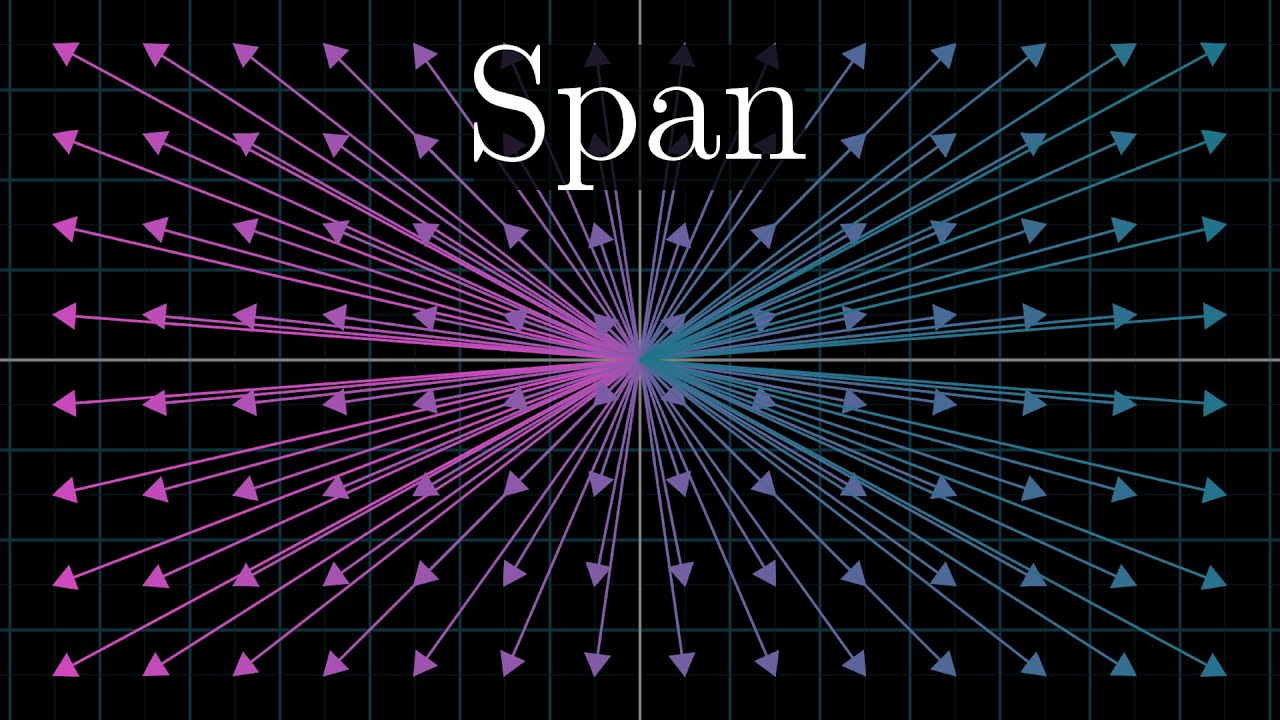
The fundamental concepts of span, linear combinations, linear dependence, and bases.
Help fund future projects: https://www.patreon.com/3blue1brown
An equally valuable form of support is to simply share some of the videos.
Home page: https://www.3blue1brown.com/
Full series: http://3b1b.co/eola
Future series like this are funded by the commun...
hollow finch
god typing latex on a phone sucks
hollow finch
little crater
Maybe this video might help
yes! based 3b1b 
it's not a fully rigorous proof but i tried to go with an approach/perspective that focused on knowledge of matrices
wintry steppe
Ok I think I get it now thanks so much
So basically if we have 3 vectors and want to know the span like if it spans the entire r3
We could say ok is it scalar multiples or
Put into a matrix and reduce row it?
I’ll watch the video tooo
hollow finch
wintry steppe
So basically if we have 3 vectors and want to know the span like if it spans the...
yeah one way to check if it spans R^3 is to see if it reduces to the identity (or at least had rank 3 or, equivalently, 3 pivots when reduced)
if you row reduce a matrix, the number of pivots is the dimension of the span of the column vectors.
i mean it's a lot more general than that and you can say a lot more based on the number of pivots, but that's the main bit for what you're trying to figure out
wintry steppe
Wonderful! Thank you so much
So if it’s r2 you need tw o vectors and it’s a 2x2 matrix that would row reduce to identify matrix if it spans all of r2
hollow finch
wintry steppe
So if it’s r2 you need tw o vectors and it’s a 2x2 matrix that would row reduce ...
yes exactly right
wintry steppe
I think because I want to learn change of basis and I feel span is important for that
little crater
wintry steppe
I think because I want to learn change of basis and I feel span is important for...
Yeah if two set of bases both form the same subspace then they also have the same span
basis let's you describe vectors an of that subspaces in terms of those basis vectors
And if you have a change of basis you can redescribe the same vector relative to a different basis
And you have things called basis coordinates which is just that
wintry steppe
I had trouble with sub spaces too lol
little crater
Well column space and row spaces both relate to the idea of span but just on column vectors or row vectors
And I mean even the null space is related to span once you have your basis vectors
And those you just need to make sure you have a clear definition of what those mean because you could be asked to find all of those subspaces on some given matrix
 versed meadow
wintry steppe
I had trouble with sub spaces too lol
versed meadow
wintry steppe
I had trouble with sub spaces too lol
if u want a good practice problem with this type of thing
like with basis, span, linear independence/depenedece ofvectors
and stuff related to those topics
check out problem M1 on this years PRIMES entrance test
i remember it was a really good problem for these topics
 velvet moss
Why is it that when you row reduce a matrix ( into row reduced echelon form ) that it gives you a basis for some sub space
little crater
velvet moss
Why is it that when you row reduce a matrix ( into row reduced echelon form ) th...
the row echelon form reveals your pivot columns which is what defines your basis for your sub space
all other non pivot column vectors are essentially redundant.
and there are also an infinitely many basis vectors for a subspace (other than zero subspace)
little crater
velvet moss
Why is it that when you row reduce a matrix ( into row reduced echelon form ) th...
well if you are referring to column space it is the pivot columns
idk exactly what subspace in question you are looking for
velvet moss
I think I understand now
little crater
It also tells you that any basis will have that many basis vectors
velvet moss
so all the 0 rows are linear combinations of the others?
little crater
what space are you looking at
velvet moss
I don’t know really
little crater
what do you have a problem or something you are referencing?
little crater
Is there a specific question that asked you for a subspace
little crater
well most likely it is referring to the subspace spanned from some matrix of column vectors.
or it could just be a set of vectors
velvet moss
mm
little crater
all within some R^n
velvet moss
I think I understand ur explanation though
thanks, I just need to go review row reduced matrices some more
little crater
velvet moss
thanks, I just need to go review row reduced matrices some more
It is important that with row reduced matrices to realize that the operations you do on them are reversible and hence row equivalent
All row operations is similar to that of what you do with a system of linear equations
velvet moss
so your really not changing the space at all
little crater
which is doing elimination which is really just substitution
Correct
You are just modifying your vectors in a way that they "look" different I guess
Similar to how you can have 2 linear systems of equations
and you could re arrange terms or add them.
velvet moss
I feel dumb for not realizing that
the matrix notation just confuses me
I need to realize that row equivalent matrices are just the same matrices with some elementary row operations done on them
little crater
yeah so they are "equivalent" but not equal
little crater

in this
are they say x is in R^2
and that all the vectors in R^2 have a mapping to all the vectors in R^3 that lie in the subspace of H via [x]_B?
Here is the H in question

it is a plane in R^3
If all they are saying all the vectors in R^2 can be mapped to some coordinate relative to the basis of H I get that
okay so I think it is saying
H is isomorphic to R^2 in that
velvet moss
the vector in r^2 is coordinates for H
little crater
yeah
I think it is saying You can give it any vector in R^2 and it will map it to a vector in R^3 via the coordinates of the basis for H
and then you can go backwards
little crater
not sure what specific isomorphism they call this though
maybe linear map isomorphism.
tribal willow
you can just say that the linear mapping is an isomorphism
like if T : R^2 -> R^3 is an isomorphism then T is an isomorphism of R^2 onto R^3
wintry steppe
hmmmmmmmmmm
an injective linear map might be an isomorphism onto its image, but no linear map from R^2 to R^3 has image all of R^3
tribal willow
yeah true
little crater
i assume anamono might have meant a subspace in R^3 most likely a plane.
hollow finch
velvet moss
Why is it that when you row reduce a matrix ( into row reduced echelon form ) th...
row operations do not affect column dependencies
take this example
$\begin{pmatrix}
1&2&1&0\
1&2&2&1\
1&2&3&2
\end{pmatrix}\sim
\begin{pmatrix}
1&2&0&-1\
0&0&1&1\
0&0&0&0
\end{pmatrix}$
stoic pythonBOT
nix
 hollow finch
in the rref, column 2 is 2*col1, and col4 is col3-col1
the same is true of the original matrix
(col2=2col1): (2,2,2)=2(1,1,1) and (2,0,0)=2(1,0,0)
(col4=col3-col1): (0,1,2)=(1,2,3)-(1,1,1) and (-1,1,0)=(0,1,0)-(1,0,0)
thus, column 2 is linearly dependent with column 1, so it cannot be a basis vector of the column space if we're already using column 1.
and column 4 is linearly dependent with columns 1 and 3, so it cannot be a basis vector alongside them either.
therefore, a basis for the column space is just columns 1 and 3, since they are linearly independent.
you could use any pair of the columns which are LI in the rref matrix, but the pivots give a very convenient choice. since the columns of the rref are just the coordinate vectors of the original columns with respect to the pivot basis
so thats the column space
the nonzero rows of the rref give a basis for the row space. but be careful, because it is not necessarily the first rank(A) rows of A which give a basis for the row space.
$\begin{pmatrix}
1&2&1&0\
1&2&1&0\
1&2&3&2
\end{pmatrix}\sim
\begin{pmatrix}
1&2&0&-1\
0&0&1&1\
0&0&0&0
\end{pmatrix}$
stoic pythonBOT
nix
 hollow finch
in this example, the row space is the same as the other matrix, but the first two rows of the original matrix are no longer ALSO a basis since they're identical
eager gull
guys, vectors can't be treated like numbers right? We can't cancel B in the numerator and B in the denominator, right?
 eager gull
got it, thank you
 patent fable

Can someone explain to me what this subscript with a comma notation means? I found this online for a proficiency exam that corresponds to a course that uses the Gibert Strang textbook.
$I_{E,B}$
stoic pythonBOT
wsz_fantasy
 wintry steppe
change of basis matrix
 frozen hemlock
does anyone know about work related to gosper’s algorithm for computing continued fraction representations in relation to group theory
specifically the bihomographic algorithms which operate on dual matrices stacked in a cube
 raven badge
wintry steppe
raven badge
wintry steppe
Is that linear algebra!
lethal terrace
Am I right in thinking that $G^v_u = T^v_uG^v_vT^v_v = T^e_vT^v_eG^v_v$, where $e$ is the standard basis and $T$ is the change-of-basis matrix?
 stoic pythonBOT
sam
 lethal terrace
This makes sense in my mind but it doesnt seem to work out when you do the multiplications
Alternative question: How would you solve the question above?
And the definition of G above gives us $G^v_v = \begin{pmatrix}
0 & 0 & 0\
1 & 1 & 1 \
0 & 1 & 0
\end{pmatrix}$, right?
stoic pythonBOT
sam
 lethal terrace
I understand its pretty easy to just use your brain and see that $G^v_u = \begin{pmatrix}
0 & 1 & 0\
1 & 1 & 1
\end{pmatrix}$, but id like to know exactly whats going on there
stoic pythonBOT
sam
 eager gull
hello
is there a difference between projection and component?
if so, what is it?
native rampart
Projection is a linear operator that gives you a component
hollow finch
native rampart
Projection is a linear operator that gives you a component
well certain projections give you just a component of a vector. those would be projections onto an axis. there are other projections that don't do that, since you can project onto just about any subspace of a vector space (including lines, planes, etc.).
wintry steppe
"component" is a vague term anyways
native rampart
Well I interpreted component as
If x=a v_1 + b v_2 , a v_1 and b v_2 are components
eager gull
alright got it
Is it okay if someone gets onto voice chat with me for like 5 minutes to explain something? There's really something I don't get
 rapid ivy

 opaque galleon
is this definition from my linear algebra textbook incorrect? I thought the definition of a strictly triangular system was a system where both the elements on the off diagonal, and the elements on the diagonal are 0?
 opaque galleon
is this definition from my linear algebra textbook incorrect? I thought the defi...
opaque galleon
opaque galleon
is this definition from my linear algebra textbook incorrect? I thought the defi...
For example, this to me is a strictly triangular system
 little crater
opaque galleon
For example, this to me is a strictly triangular system
little crater
opaque galleon
For example, this to me is a strictly triangular system

Basically it is a normal triangular matrix (upper or lower) but now the diagonals must all be 0. (Guess I am replying a bit late  )
)
 trail spear
So from what I understand a vector would be like [17, 54, 65] something like this and each individual numerical values like 17 is a scalar, but then what are entries and components of an array is it the same thing ?
tribal willow
a vector is just an element of a vector space
not sure what you mean by “entries and components of an array”
trail spear
Basically are compenents, scalars and entries all different things ?
I tought they were the same thats why im confused
I just started so im not too good yet
tribal willow
semantically yeah
wintry steppe
tribal willow
a vector is just an element of a vector space
stop
tribal willow
ok
wait why “stop”
uh ok anyways
a “component” is basically what it’s name is
i.e. if i have some vector [a, b, c]
then a is a component, b is a component, c is a component
a “scalar” is just some value which scales a vector
in most cases, it is just a number
an “entry” is also basically what it’s name is
like if i have some matrix
| a b c |
| d e f |
then a, b, c, d, e, f are all just entries of that matrix
trail spear
Oh ok thanks it is more clear now.
tribal willow
yep 👍
wintry steppe
tribal willow
wait why “stop”
"a vector is just an element of a vector space" is technically true but absolutely useless to any beginning linear algebra student who isn't taking a "proof-based course"
it makes me irrationally angry
tribal willow
my bad wont do it again
wintry steppe
How would one define a vector then
Sorry I’m stilll learning
 dire bough
wintry steppe
How would one define a vector then
Sorry I’m stilll learning
dire bough
wintry steppe
How would one define a vector then
Sorry I’m stilll learning
Loosely speaking, a vector is just a mathematical object that has both a direction and a magnitude
Making it a little more concrete, we can view vectors as being columns (or rows) of numbers, called elements/components, which represent an "arrow" in space
To define vectors formally, you need to introduce the notion of a vector space and the axioms that a vector must satisfy. Canonically, there are 8 such axioms, which basically tell us how a vector is allowed to behave. For example, we can add vectors together or multiply them by a number, but we can't multiply two vectors together (well, you can "multiply" vectors, but you need to be careful about what you mean by multiply).
The fact that a vector could literally be anything as long as it obeys the 8 axioms is why you'll often see people say "a vector is simply something that acts like a vector".
I'm not sure how much math so I shalln't go on, but hopefully this clears things up a bit 🙂
 mystic frigate
@dire bough do u need to mention vector spaces when defining a vector
because how can a vector space exist without any vectors
dire bough
Haha, great question. You kinda get both at the same time.
little crater

dire bough
So, you can go ahead write down some columns of numbers. Great. But they're just sitting around doing not really much at all. You don't just want a bunch of columns of numbers, you want vectors. So, you look up your list of rules. As you start doing this, you'll notice that you need to start adding extra vectors to make the rules work. For example, if you started with a column v and a column u to start with, then you also have v + u. You can continue doing this until you've exhausted all of the uncountable possibilities for your columns of numbers. Since you've created a whole set of columns that all obey the "vector rules", you can now confidently call them vectors. And hey, what do you know! You've also ended up with a vector space.
wintry steppe
little crater
🖐️ what would the basis for the V={0} be? I think my book just said it was zero dimensional by definition but would the zero vector be basis for this vector space?
the zero vector would be considered a basis for that vector right?

They only mention the dimension of it.
but if it is zero then how does it have a basis vector
teal grotto
little crater
🖐️ what would the basis for the V={0} be? I think my book just said it was zer...
the empty set
dire bough
Good question. Try using the definition of an axiom to show that the only basis that exists for the trivial vector space is the empty set
little crater
but how does that work in generating a zero vector?
teal grotto
the empty sum
little crater
idk what that is
teal grotto
its a convention that essentially says that a sum of vectors over the empty set is the zero vector
little crater
i mean is it defined like that just to be consistent with other vector spaces
teal grotto
im not quite sure, but it does indeed stay consistent. there are other ways to show that the trivial vector space has empty basis. try doing what rat. suggested
 teal grotto
a basis for a vector space V is a subset of V that is spanning and linearly independent
little crater
yes
teal grotto
so consider some subsets of V = {0}
teal grotto
and find out which ones are spanning and linearly independent
teal grotto
little crater
proper subset?
that doesnt really matter for this
little crater
then how would it not be 0 in this case
if it is the only one in the set
then it must be linearly indepedent with itself
tribal willow
every set has the empty set
teal grotto
there are only two subsets of {0}. just {} and {0}
little crater
yeah
teal grotto
{0} cant be linearly independent
teal grotto
a0 = 0 is satisfied by a = 0 and a = 1
little crater
okay
but it still doesn't seem to make sense to say { } form as a basis for 0
I see the issue with the {0}
but seems weird to think "nothing" forms a basis for zero subspace/vectorspace
teal grotto
go back to your definitions for linearly independent sets and spanning sets and make sure that the empty set is linearly independent and spans {0}
it is a bit odd at first
little crater
our defintions of that don't speak on an empty set
here is what our definitions are

 teal grotto
the indexed set can be empty
little crater
so at least going by this it doesn't really seem to make sense to pick nothing and see how it multiples to zero
I get that
teal grotto
this is where you need the empty sum as a convention
little crater
In linear algebra, a basis of a vector space V is a linearly independent subset B such that every element of V is a linear combination of B. The empty sum convention allows the zero-dimensional vector space V={0} to have a basis, namely the empty set.
teal grotto
in some sense, the empty sum being equal to zero is just a consequence of the definition of addition over a set
little crater
hmm I guess if there is this empty sum thing and by convention the sum of it is zero it makes sense
well this also made me realize I needed to add an * to my solution on my exam
for part (c) I said that the rank of A must be 1 since span{u} was only 1 vector and it must be linearly indepdent

and then applied the rank theorem
saying Null(A) = n-1
but had u = 0
oh wait
this has nothing really to add to basis vectors
actually If you have a zero matrix
So A = zero matrix
what is the dim(null(A)) = n?
hmm I guess i need to to add a comment that u != 0
zinc timber
yes
 dusty meadow
Is it not possible because one column in the matrix will be linearly dependent and so there will be multiple solutions?
 native rampart
Yes
dusty meadow
ty
 keen sierra
or phrasing it somewhat differently, the rank is at most 3, hence the nullity is at least 1, so in particular the null space is nontrivial. So if there is a solution, then that solution plus any element of the null space is also a solution.
 iron harbor
How do you know which order the eigenvalues need to be in to correctly diagonalize a matrix; talking about this type of diagonalization:
$$A=UDU^{-1}$$
stoic pythonBOT
clockworkmurderer
 iron harbor
Where U is the matrix of the eigenvectors
 quartz compass
well diagonalization really is just all the eigenvalue equations wrapped up into one matrix equations
specifically $Av=v\lambda$ (put the scalar on the right to be suggestive) we can put all the eigenvectors as columns of the matrix $U$ and eigenvalues on the diagonal of D to make $AU=UD$
stoic pythonBOT
Merosity
 quartz compass
each column of U gives you a distinct case of Av=v*lambda you should try to think and draw it out a bit to see
iron harbor
right, that part makes sense to me. but while trying to diagonalize this matrix, I managed to put my eigenvectors in the wrong order or something because it doesn't quite work out the way I want:

so I solved the characteristic polynomial and found that lambda1 = 2, and lambda2 = 6
meaning that EV1 = (1,1) and EV2 = (1, -3) or (-1, 3), depending on what solution you choose
but somehow, and this is the part that I don't understand, if you choose (1, -3) as EV2, the equality with UDU-1 doesn't hold
or my algebra is messed up, but I did it three times...
quartz compass
maybe take a break and try it a fourth time later
iron harbor
facepalm
I had my eigenvalues in the D matrix backwards
I knew it had to be something small like that
guess it does kinda help when you make mistakes this way; definitely won't forget that on the exam
quartz compass
yeah I agree, imo this is the best way to learn by working at it gaining experience with it
 zinc copper
In showing that the Moore-Penrose pseudo inverse is unique on complex matrices, you need to show that it satisfies the Penrose conditions, 2 of which make use of the * operator on matrices. It can be shown that these conditions are satisfied by a unique matrix by only using one property of *, namely that (AB)* = B*A*. Hence these conditions can be extended to any operator satisfying these conditions. Now my question is, for such a general operator, does a pseudo inverse always exist?
This could be positively answered by constructing a singular value decomposition that uses matrices “ *-invertible matrices”, ie matrices such that A^* = A^-1
And that could further be answered positively if there was an analogue to the spectral theorem using *-invertible matrices
This is what I’m not sure about in the end
I definitely see how the analogues might work if we simply take the * operator to be conjugation + transposition when we’re working in a quadratic extension of Q or R, but I don’t really know how to think about weirder * operators
quartz compass
sadly I don't think there is a spectral theorem type analogue in general, idk maybe try working through what it should be for Q(sqrt(2)) but I feel like x^2-2y^2 being negative will give you issues
ping me if you ever find anything out for number fields, finite fields, or p-adic fields now or in the future, I'd be curious to see
zinc copper
Aight I might think about it again this evening I don’t really have time rn
quartz compass
I've played around in the past a little with trying it out, it's not unlikely someone here knows about it if it is a thing
 fallen karma
I'm trying to prove that if A is nilpotent, there is an orthogonal matrix Q such that Q^t A Q is upper triangular with zeros on the diagonal. I already know there is a matrix B s.t A= B T B^-1 when T is upper triangular with zeros on the diagonal. Since B has columns that form a basis for my space, I can use Gram Schmidt to get an orthogonal basis from B and make a matrix Q from the column vectors
My Question is can I just say that A=B T B^-1 = Q T Q^-1?
Like, does there exist matrices R,S st SB=Q and B^-1 R= Q^-1?
wet stratus
that's just the QR decomposition of B isn't it?
quiet salmon
I don't understand how could I prove the multiplicative inverse for the complex numbers
can somebody give me a hint on how to start it
for $z \in \bold{C}, z \neq 0$ there exists a unique $w \in \bold{C}$ such that $zw = 1$
stoic pythonBOT
texaspb
 fallen karma
Hint: conjugate
quiet salmon
it wasn't defined yet
wet stratus
how did you define the complex numbers?
but either way, even if you don't yet know from the course what the conjugate is, you can still go through the same algebra to show that it works
quiet salmon

he hasn't explicitly defined the conjugate
but goes on to present the multiplicative inverse
wintry steppe
exhibit an inverse then show uniqueness
eg suppose z = a + bi ... let w = etc
then suppose there are two such w_1 , w_2 and show w_1 = w_2
the algebra is less clunky if you have conjugates but ofc not strictly necessary
lethal terrace

Is this given answer to one of my exam questions true?
I thought you could have a diagonalisable matrix with complx eigenvalues
dusky epoch
the answer is correct but the example they give is shit
better to give $\bmqty{0 & 1 \ 0 & 0}$ as an example of a matrix that is not diagonalizable even over $\bC$
stoic pythonBOT
Ann
 little crater
why are the laplace expansion to find the determinent do we do the (+ - +...) thing
my book doens't really give any insight on to that and just says

and this


I mean even the 2x2 deteriment was just told to be
det [ a b / c d] = ad-bc
without really much insight
wintry steppe
are you asking why the definition of the determinant is what it is with the alternating signs?
little crater
yes
I mean we were seen very briefly about how it relates to some geometric meaning but the prof kinda skipped it
wintry steppe
geometrically speaking, the determinant of a matrix A is the signed volume of the parallelepiped spanned by its columns
you can use this definition to derive the definition of the determinant you see here
little crater
what is a "signed" volume
does this have to do with right hand rule stuff or something?
wintry steppe
and it also motivates right away some things like: why det (identity) = 1, why det(A but with two columns swapped) = - det A, and so on
i dunno what the right hand rule is but it's probably relevant
i mean oriented volume, if you've heard that
little crater
not familiar with the term
wintry steppe
then become familiar with it
little crater
I only recall that that with changes of variables you have a det shows a scaling of some unit square
wintry steppe
it's a good exercise to look at the geometric "axiomatic" definition of the determinant and to translate it into whatever definition you know
little crater
im not getting good results for this "orientation of a volume"
wintry steppe
"signed volume"
if you look at any article on the geometric definition of the determinant you should find something relevant
little crater
okay I kinda see the signed volumne thing so what should I be thinking the determinant represents? Should I look at it geometrically and say the determinant suggest what would happen to a some unit area after it under goes a transformation (regarding orientation)?
Here is what I am looking at

and I guess the det(A)=-1 might be in line with doing a row swap
 keen sierra
 edgy shale
How they do this?
edgy shale
How they do this?
it's just the distributive law
in general, if $a,b,c$ are vectors then $a \cdot (b+c) = a\cdot b + a \cdot c$
stoic pythonBOT
OurBelovedBungo
 wintry steppe
they probably used theorem 1 several times
 runic musk
I’m interested in a matrix’s rate of convergence to the eigenvector in general/from given points, but there isn’t a (non recursive) matrix power formula, and the best I could do would be mapping to a differential equation which are also hard. Anything I try to read of this i don’t understand any symbols used.
wet stratus
do you mean when numerically trying to find eigenvectors? that's not an easy question in general and depends heavily on what algorithm you use
 slim geyser
Considering the determinant of a 2x2 matrix - What is the signature of the quadratic form representing the determinant? I want to say (1,1) because we have ad-bc -> xˆ2-yˆ2 but i'm not sure if this reasoning is correct. Can someone help?
 tranquil steeple
runic musk
I’m interested in a matrix’s rate of convergence to the eigenvector in general/f...
tranquil steeple
runic musk
I’m interested in a matrix’s rate of convergence to the eigenvector in general/f...
do you have some special structure in the matrix?
runic musk
Not really, not really sure what you mean by that, we could go with a markov matrix which I think is all rows and columns sum to 1, but the general case would be nice as well
tranquil steeple
runic musk
Not really, not really sure what you mean by that, we could go with a markov mat...
Here you have some explicit and asymptotic formulas for markov processes, random walks and more https://www.2pi.se/publications/pdf/p13.pdf 🙂
maybe applicable?
runic musk
Yeah any insights are good so I’ll decypher this Thankyou!
tranquil steeple
if you show an example of a matrix, then i can say if it is applicable (or some other approach)
runic musk
Here’s the example that got me thinking, every unit of time 0.2 of humans turn to zombies, and 0.1z vice versa. You can find the stable point, and an analogous diff eq, but the convergence rate/ min matrix power to stabilise is tricky. It’s interesting because it can tell me stuff about both matrices and diff eq
 wintry steppe
this is true. the easier way to see it, if you insist on row operations, is that -A is obtained from A by performing the elementary operation of multiplying each row by -1
slim geyser
Considering the determinant of a 2x2 matrix - What is the signature of the quadratic form representing the determinant? I want to say (1,1) because we have ad-bc -> xˆ2-yˆ2 but i'm not sure if this reasoning is correct. Can someone help?
 prisma socket
Yeah, thanks!
tranquil steeple
runic musk
Here’s the example that got me thinking, every unit of time 0.2 of humans turn ...
I guess you look at how small the eigenvalue that is not equal to 1 is
runic musk
Not sure what you mean by this
tranquil steeple
runic musk
Not sure what you mean by this
take the eigendecomposition of the matrix. the solution will be scaled version of the eigenvector associated with eigenvalue that is 1. the second eigenvalue in this case ios 0.7, and ```
0.7^100
3.2344765096247375e-16
so to get double precision of the converged vector you do about 100 iterations
runic musk
But isn’t this just overkill iteration for continuous variables? If I’m just working discretely isn’t there an analytical way to find the exact power needed?
tranquil steeple
runic musk
But isn’t this just overkill iteration for continuous variables? If I’m just wor...
well the solution is just some scaling of the eigenvector associated with eigenvalue 1 so no need to do the iterations, just find this eigenvector
tranquil steeple
runic musk
But isn’t this just overkill iteration for continuous variables? If I’m just wor...
julia> A^50*[1,1]
2-element Vector{Float64}:
 0.6666666726615524
 1.3333333273384538

julia> A^100*[1,1]
2-element Vector{Float64}:
 0.6666666666666712
 1.3333333333333415
and ```
julia> A^100*[1,1]./eigen(A).vectors[:,2]
2-element Vector{Float64}:
-1.49071198499987
-1.490711984999869
which is 2*sqrt(5)/3so what is happening is that ypu start with 2 eigenvalues 0.7 and 1 and each iteration you take a power of them, obviously 1^k=1 but you want the other one to become zero for it all to converge, that is 0.7^k
runic musk
I’m confused. The unit eigenvector is the ratio of the variables at the end, but this doesn’t tell me how many iterations it takes to get there from a given initial point
tranquil steeple
no how many iterations you need depends on the eigenvalue 0.7 which should become "zero" after k iterations
whatever tolerance you choose
tranquil steeple
runic musk
I’m confused. The unit eigenvector is the ratio of the variables at the end, but...
here is a Rational{BigInt} exact expression for A^100 for example, if you want really analyze exactly ```
2×2 Matrix{Rational{BigInt}}:
1666666666666667744825503208252663781549256366738936952401066301541800311298443797230486545642686667//5000000000000000000000000000000000000000000000000000000000000000000000000000000000000000000000000000 3333333333333332255174496791747336218450743633261063047598933698458199688701556202769513454357313333//10000000000000000000000000000000000000000000000000000000000000000000000000000000000000000000000000000
3333333333333332255174496791747336218450743633261063047598933698458199688701556202769513454357313333//5000000000000000000000000000000000000000000000000000000000000000000000000000000000000000000000000000 6666666666666667744825503208252663781549256366738936952401066301541800311298443797230486545642686667//10000000000000000000000000000000000000000000000000000000000000000000000000000000000000000000000000000
Could you explain why 0.7 is 0 after k iterations, perhaps I’m misunderstanding what an eigenvalue is
tranquil steeple
well it is not zero. you you have to choose what "zero" is. typically you use double precision and then machine epsilon is about 1E-16 and 0.7^100 was about that. but you can choose some other value. mathematically 0.7^k is only 0 at the limit k\to\infty
you have to decide what "converged" means
runic musk
I’m not sure what 0.7means tho, I understand it to be the ratio of x to y at the stable point?
 fringe fjord
It encodes how much smaller the distance to the eventual stable point becomes after one step.
tranquil steeple
runic musk
I’m not sure what 0.7means tho, I understand it to be the ratio of x to y at the...
julia> e
Eigen{Float64, Float64, Matrix{Float64}, Vector{Float64}}
values:
2-element Vector{Float64}:
 0.7000000000000001
 1.0
vectors:
2×2 Matrix{Float64}:
 -0.707107  -0.447214
  0.707107  -0.894427

julia> e.vectors*diagm(e.values)*inv(e.vectors)
2×2 Matrix{Float64}:
 0.8  0.1
 0.2  0.9
0.7 and 1 are the two eigenvalues of A. they have corresponding eigenvectors (above normalized, the two columns). your converged solution will be some scaling of the second column (corresponding to eigenvalue 1)
tranquil steeple
runic musk
How you calculate it then
if you have a computer do it with some eigensolver (eig i matlab, eigen in julia) or do it by hand (not hard for 2x2 case
tranquil steeple
runic musk
How you calculate it then
and side note, to compute the power k of a matrix here you can just take the power of the eigenvalues in the last expression above. for example k=100: ```
julia> e.vectors*diagm(e.values.^100)*inv(e.vectors)≈ A^100
true
so yo don't have to multiply the matrix a 100 times.
runic musk
Ahah Thankyou
wet stratus
If you want to compute matrix powers you shouldn't just multiply them anyway. For example to get A^100 you can just square A^50. See square and multiply/binary exponentiation
tranquil steeple
runic musk
Ahah Thankyou
And to just construct the converged matrix manually do ```
julia> e.vectors*diagm([0,1])*inv(e.vectors)
2×2 Matrix{Float64}:
0.333333 0.333333
0.666667 0.666667
I just set the 0.7 to 0 instead
I feel like I am being to narrow

I am trying to only use this and don't see how it is insight ful
I know that if 2 rows are the same then you can do some row reduction and then you have a zero row and thus you don't have all n pivots and can't be invertible
and if 2 columns are the same then the set is not linearly independent and can't be invertible
but none of what I said has used theorem 3
it uses the Invertible matrix theorem and the extension that det(A) !=0 if it is an invertible matrix
wintry steppe
swapping the two equal rows/columns and applying 3b gives det(A) = -det(A)
little crater
I don't see how that makes it clear that det(A) = 0 though? Are you suggesting some kind of contradiction?
little crater
because doing such a row swap on 2 equal rows will not generate a new matrix so I don't think it would make sense to say det(A) = -det(A)
wintry steppe
why does the matrix have to be "new"?
swapping the two equal rows changes the sign of the determinant, but it also doesn't change the matrix, so det(A) = -det(A).
the matrix "B" is A
wintry steppe
if you're unsure about that, i want to see a proof
little crater
sure.
wintry steppe
but yes, that's the conclusion to make
little crater
start with matrix A. perform a row swap on 2 equivalent rows and call this "new" matrix B. Analysis B and A and see that since B is equivalent to A that B=A. So we can replace the det(B) = -det(A) with det(A) = -det(A) and the only way for a number to be equal to the opposite of itself would if that number is 0
wintry steppe
looks okay
 little crater
what?
little crater
 green trench
is it just me
green trench
is it just me
it says if A is nxn, then det(A^T) = det(A)
not sure what "same thing" you are seeing twice
green trench
oh my bad
i didnt read it fully
i thought it says the detminant of a matrix is its transpose
and it gave reasoning det(aT) = det(A)
wintry steppe
funny how the slogan for this result is longer than the result itself
 trail lintel
What is explicit description and implicit description of the solution sets of linear system? (Linear algebra)
fallen karma
Can someone help me with change of basis? If we start with an arbitrary basis (u_1,u_2) and we want to work in a new basis (v_1, v_2), then we row reduce the augmented matrix (v_1, v_2| u_1, u_2) to obtain a matrix P. Now, does take coordinates from our old basis and give you the same vector with coordinates in the new basis?
wintry steppe
if Q is the change of basis matrix from a basis B to a basis B', then Q[v] = [v]', where [] are the coordinates relative to B and []' for B'
fallen karma
Ok thanks
zinc copper
So I’m looking at quadratic extensions of K a subfield of R, and definining the new transposition in the obvious way of transposing and then conjugating. My main obstacle right now in trying to prove the spectral theorem is that I need my matrix to have at least one eigenvalue in the field we’re working with but I’m not too sure how to go about showing this….
@quartz compass
iron harbor
if you have an nxn matrix, and you get n eigenvectors, are the eigenvectors always a basis?
they would have to be, wouldn't they? because they have to be linearly independent
zinc copper
n linearly independent eigenvectors will form a basis sure, just like n linearly independent vectors will form a basis. If what you’re asking is about n eigenvectors corresponding to n eigenvalues this is also true yes
If your eigenspaces are one dimensional you’re always diagonalisable
 signal solar
 dusky epoch
well it would help to have some familiarity with vector things in 2 and 3 dimensions
wintry steppe
if you're doing a "proof based" course then it might also help to have some familiarity with basic methods of proof and what not
that's a hurdle that a lot of beginning linear algebra students struggle to overcome. but if you just want to learn about systems of equations and vector geometry, you're probably okay
 ocean meadow
Is anyone up?
 alpine ferry


 slender yarrow
@ocean meadow did you try anything ?
ocean meadow
Yeah
I tried making equations
By taking a 3x3 matrix with different variable as it's element
But the problem is if I try making equations for example take the Second eigen vector and the eigen value
Try multiplying it with a matrix [a b c
d e f g h I] 3x3 and equate it to -1(0 0 1) you will only get the third coloumn element and with the first eigen vector you will get the sum of elements of first two coloumns
Which doesn't equate to any result
slender yarrow
i mean the idea behind the question is that you really don't have to know anything else about the matrix to answer
slender yarrow
ocean meadow
Which doesn't equate to any result
you don't have to try and solve for the matrix (and it's probably not possible indeed)
ocean meadow
I tried applying the properties
slender yarrow
but yeah let's simplify the question a little bit
ocean meadow
Ye defi
slender yarrow
(suppose my 1, 2, 0 is a column vector)
ocean meadow
Yeah why not
A3 and the same eigen vector
Then the eigen value will be lembda3
Just multiply 8 (1,2,0)
slender yarrow
yeah indeed
now couldn't you write (1, 2, 2) as a linear combination of (1, 2, 0) and (0, 0, 1)?
ocean meadow
So that will correspond to an eigen vector of A?
ocean meadow
Well I got you
I thought about this but this doesn't lead
To any strong affirmation
slender yarrow
hmm
ocean meadow
Well what according to you might be the answer
slender yarrow
well i'm saying the linear combination path is a very interesting lead
let's say we note e1=(1, 2, 0) and e2=(0,0,1), then (1, 2, 2)=e1+2*e2
ocean meadow
Yeah
slender yarrow
What's A^3(e1+2*e2) then ?
ocean meadow
That's we need to find
slender yarrow
yeah
ocean meadow
Well what will be the eigen value then
slender yarrow
thanks I guess, well you forgot the ^3
ocean meadow
Is that a property by any chance
green trench
slender yarrow
~~thanks I guess, well you forgot the ^3~~
my b
green trench
ocean meadow
Is that a property by any chance
they are linear transformaotions
slender yarrow
yeah it's distributivity
slender yarrow
A(v+w) = Av+Aw for any matrix A, vectors v, w (assuming correct sizes)
ocean meadow
Shit I was so stupid
slender yarrow
so yeah you actually use the two eigenvalues
slender yarrow
ocean meadow
Shit I was so stupid
happens to all of us :/
ocean meadow
But just tell me one thing
You said A^3(122) can be written as A^3(E1+2e2) right
And then you distributed it over addition
Oh okay I got it
A^3(E1)+A^3(2E2)
Right
slender yarrow
then it's A^3(e1) + 2A^3(e2), and you can use the respective eigenvalues for each side
yeah
ocean meadow
Thanks man
I appreciate it
I have one more question
What are the characteristics roots of idempotent matrix
You will be surprised but the answer to the above question is Option A
Not D
slender yarrow
ocean meadow
You will be surprised but the answer to the above question is Option A
should be C tho
I gtg for a bit
ocean meadow
@slender yarrow no we are mutlipying 2 also
 glacial wraith
Hello, I have a quick matrices question. I solved this equation manually, but the professor who had solved this had left some weird equation for finding the Characteristic polynomial of A of Lambda that seems to me like a general formula instead of doing the whole thing. Can anyone help me figure out what it is?

Or perhaps he went through the process of eliminating each other choice. Eitherway, I'm not sure. I'd like to know the "shortcut" or a faster way if possible
wet stratus
the constant term of the char polynomial is always the determinant
the second coefficient (the coefficient of x^(n-1)) is always the trace of the matrix
modulo signs depending on if you use A-lambdaI or lambdaI-A
slender yarrow
@glacial wraith
slender yarrow
ocean meadow
<@177516015033384960> no we are mutlipying 2 also
yeah I forgot the 2 in my head
slender yarrow
ocean meadow
What are the characteristics roots of idempotent matrix
are you ok with this one or not ?
glacial wraith
@wet stratus i see, thanks for the help!
 fossil thistle
How is the distance between two parallel lines effected by a 2x2 matrice?
 empty hemlock
fossil thistle
How is the distance between two parallel lines effected by a 2x2 matrice?
empty hemlock
fossil thistle
How is the distance between two parallel lines effected by a 2x2 matrice?
Do you mean to ask what happens to the parallel lines in a 2D space after transforming the space with a 2x2 matrix?
fossil thistle
what happens to the distance between them
little crater
okay dumb question but with eigenspaces each provided eigenvalue for λ represents its own induvial subspace? Like there is no "general" over all eigenspace with λ being arbitrary.
I guess what I mean is there like spaces that is the union of all the eigen spaces for the various eigenvalues of a matrix or are each one of these there own separate subspaces.
Like when one says an eigenspace they always have to provide an eigenvalue, right?
 hexed urchin
hi friends
I have the problem below and want to determine if the given polynomial is linearly independent

I've come up with this matrix which I was going to reduce to REF and if it was consistent then I would determine that the vectors were linearly dependent. Does that sound like a good idea?
 hollow finch
hexed urchin
I've come up with this matrix which I was going to reduce to REF and if it was c...
hollow finch
hexed urchin
I've come up with this matrix which I was going to reduce to REF and if it was c...
well there's no system to be consistent or not. but yeah row reducing will reveal the linear (in)dependence.
the number of pivots (rank) will tell you the number of linearly independent vectors
row reducing it with the vectors as the rows (like you have it) will give you a simplified basis for the subspace
while row reducing it with the vectors as the columns will tell you the exact relationship the vectors have between each other (if they are linearly dependent)
hollow finch
hollow finch
row reducing it with the vectors as the rows (like you have it) will give you a ...
and when i say "the vectors", i'm talking about the coordinate vectors wrt the standard basis
little crater
In a Eigenspace for a matrix, all vectors are considered eigenvectors other than the zero vector?
but it would still be included in the subspace to be a subspace just that we don't call it an eigenvector?
 robust owl
So, for this: "A vector space A is infinite dimensional iff A has some infinite LI subset". Is the forward direction possible without choice or some equivalent? I see how to do it by well ordering theorem I think since I can pick x_{k+1} to be the least elt of A not in span{x_1,...,x_k} and build up my LI set that way.
Just not sure if there's a way without something like that. 
little crater
@robust owl sorry if this is a basic question but when you speak about an eigenspace you always have an eigenvalue right?
like there is no union of all the various eigenspaces for a given matrix?
robust owl
I have not looked at eigenstuff in a while lol. But FIS defines the eigenspace of a linear operator T corresponding to an eigenvalue lambda so yes I think so.
little crater
just confused if it ever makes sense to think of an arbitrary lambda or that it is always some defined value and we are computing the corresponding eigenspace from it.
I guess I am just confused is the the union of all the various eigenvalues corresponding eigenvectors represent the eigenspace of the matrix A?
or it is just something you define per lambda value
hexed urchin
hollow finch
row reducing it with the vectors as the rows (like you have it) will give you a ...
thanks!
robust owl
So, from the defn I'm talking about I think you need both an operator and one of its eigenvals to talk about the eigenspace of an operator corresponding a given eigenvalue. Like they define $E_\lambda = {x\in V : T(x)=\lambda x}$?
stoic pythonBOT
DootDooter
 robust owl
To be the eigenspace of T corresponding to the eigenvalue lambda
This defn doesn't make any sense without knowing T and lambda.
little crater
okay yeah that is what I was also thinking
robust owl
You can prob start from lambda and find a given operator though?
little crater

I guess this example was just saying with regards to lambda = 7
so it would be the eigenspace of A corresponding to lambda = 7
robust owl
I think the lambda=7 stuff is talking about earlier examples?
hollow finch
well actually i think you can define an encompassing eigenspace. typically, it's just trivially the entire vector space. but in the case of defective eigenvalues, it's not necessarily the case that the eigenvectors span the entire domain.
but you can also discuss the individual eigenspace of each eigenvalue. ill look up the exact definition
robust owl
That's kinda neat lol
little crater
hollow finch
but you can also discuss the individual eigenspace of each eigenvalue. ill look ...
but that might be weird because what would happen if you take an eigne vector from 2 different eigen spaces and add them
I don't think that would be an eigen vector, would it?
hollow finch
no it wouldn't
but you can still define an eigenbasis, which would span the union of the eigenspaces
$A=\begin{pmatrix}0&1\-1&2\end{pmatrix}$
stoic pythonBOT
nix
 little crater
Yeah I wasn't sure if there was just an overall collection set that talks about every possible eigenvector even if they are from different eigenspaces (and if it has a name)
hollow finch
the transformation given by that matrix would be an example where the eigenspaces done add up to the entire domain
little crater
I suppose you could given the induvial bases of all the eigenvalues but that set just wouldn't be a subspaces.
hollow finch
i think it is the individual eigenvalues, typically. it's generally a lot more useful looking at one eigenvalue at a time since (as you mentioned) mixing eigenvectors doesn't usually work.
little crater
Okay I see thanks 
 little crater
I am probably suggesting a bad approach but you could set up an equation in terms of distance from a point on your line and the point [4,7] and minimize it.
wintry steppe
 sinful axle
It has something to do with projections
little crater
sinful axle
It has something to do with projections
I have another approach that doesn't have much to deal with it. Why not just find 2 lines from your given vector and points and find the intersection
but seeing you want projections i guess it is probably not wanted
sinful axle
That could work though, so I'm guessing find the gradient of the two lines then find the point of interescetion
little crater
You already know one of them and it seems to suggest the other line is perpendicular to that line so its slope must be the negative reciprocal
sinful axle
So line m is (-1,1) so the normal vector would then be (1,-1) I'm assuming
little crater
based on your direction vector, it says you have a change of down 1 right 1 which means you would have a slope of -1. Now you have a point (3,1) and you can form a line . Then you know your other line is perpendicular so its slope is 1. You know a point on that so you can also form another line. Find the intersection of those 2 lines and you are done.

Desmos
Anyway I would probably look at your notes and figure out how you could get the same answer with your projection stuff
ocean meadow
Hey guys are you familiar with eigen vectors?
sinful axle
little crater
based on your direction vector, it says you have a change of down 1 right 1 whic...
Thanks finally got it
little crater
ocean meadow
Hey guys are you familiar with eigen vectors?
just learned about them today  so not sure if I am familar
what is your question though
ocean meadow
Wait

Just give me the rough estimate
@slender yarrow discussed it above with me but the answer didn't match
Maybe the given answer is wrong or the approach
@little crater did you get it?
little crater
not yet but I am working on it 🙂
little crater
well lets call that vector [1 / 2/ 2] = c
then we take not that
note*
lets call the eigenvectors a and b respective such that [1 /2 / 0] = a and [0 / 0 / 1] = b
c = a+2b
AAA(c)
AAA(a+2b)
since linear transformations are linear
ocean meadow
Well you got it right
ocean meadow
@slender yarrow did the same thing
Aight solve it
Let me clarify you may know the property of eigen vectors?
little crater
AA[2a-1b]
ocean meadow
But how come you are writing 1 2 2 as sum of 1 2 0 and 0 0 1 isn't it should be a+2b
little crater
you are right...
 grand ginkgo
 ocean meadow
Varun brother
Can you just have a look at my question
@little crater did you get the answer?
little crater
little crater
AA[A(a)+A(2b)]
AA[A(a)+A(2b)]
= AA[A(a)+2A(b)]
=AA[2a-2b]
=A[A(2a-2b)]
=A[2A(a)-2A(b)]
=A[4a+2b]
=A(4a+2b)
=A(4a)+A(2b)
=4A(a)+2A(b)
=4(2a)+2(-b)
=8a-2b
=8 [ 1 / 2/ 0] - 2[ 0 / 0/ 1] = [8 / 16 / -2]
so I guess D?
ocean meadow
Well I got the same answer but it's A
But remember one thing you need not to do all this multiplication
Eigen vector has a property
It states that If A has a Eigen Vector and lembda be the eigen Value of the same Eigen Vector then Any power to A^n will Give the Eigen Value of the same eigen vector as lembda^n
So the above thing can be written as A^3(a+2b)
A^3(a)+A^3(2b)
And A^3 will have two eigen values 2^3 and -1^3
For the vectors 1 2 0 and 0 0 1 respectively
So it all sums up to the last line you wrote
ocean meadow
little crater
so I guess D?
Are you there ?
little crater
ocean meadow
Are you there ?
yes
I see
im not sure how it would be (a) though but again I just learned about them today
unless there is just an error in the paper
ocean meadow
I think the answer is wring
Because @slender yarrow also got the same answer as you
I don't think it can be A because the last value of the vector is positive and we have a negative eigen value
So it cant be 6
little crater
column sums mean that you take that column and sum together each entry in that column?

right?
 wintry steppe
seems right
versed meadow
little crater
column sums mean that you take that column and sum together each entry in that c...
isn't this just the def of column sum?
i mean wut else would u define it as
little crater
versed meadow
isn't this just the def of column sum?
tbh I am just procrastinating trying to figure out this question by making sure I have the right definition.
playing around with some examples to see if I see anything happening before generalizing it.
So far I have done it with the 2 examples (A-sI) =0
and sI substracts the column sum off the main diagonal of A, sI = column sum * Identity matrix
somehow this subtraction across the diagonal assuming the vectors have the same sum results in a set which is not linearly independent so we have solutions to the null space.
wait....
this kinda seems like a system
If I transpose it
little crater
okay

can anyone give me a hint on this problem without giving it away
I don't want to look up the solution and really didn't gain much by my example
The only thing I know is under the case were the columns equal s
is saying suggesting that
$(A-sI)x=0$ has a non-zero solution
stoic pythonBOT
Brandon7716
 little crater
I could tranpose the matrix I suppose to to have a linear system

Desmos
idk what this says about the whole column sum thing but it seems that any variation of a+b+....n = c
will rotate about some point
<@&286206848099549185>
little crater
little crater
bump ^
 dapper crypt
Have you tried induction?
little crater
idk where to even start on this and I don't think the prof was expecting a full proof or anything
and what way would I be using induction?>
like extending it by 1 row and column each time?
 copper pelican
Maybe see if you can always get s to be a factor of the char poly
And yeah something like that, since the char poly comes from the determinant
little crater
but we don't know about that stuff yet
little crater
we only just learned about what an eigenvector and eigen value is
and then how that there is an eigenspace for that eigven value
so basically we learned about $Ax=\lambda x <=> (A-\lambda I)x =0$
stoic pythonBOT
Brandon7716
 copper pelican
So nothing about determinants or the characteristic polynomial?

