#linear-algebra
2 messages · Page 304 of 1
 stuck tendon
 spare widget
it's the solution set of the homogeneous equation
i.e. all vectors that get mapped to 0 by your linear operator
solution as in set of vectors
let's have an example
n dot v = 0
then the solution set of the above is all vectors v perpendicular to n
say you have now
A1 dot v = 0
A2 dot v = 0
...
Am dot v = 0
then the solution set of the above is all vectors v perpendicular to A1, A2, ..., An
if you stack A1,...,Am in a matrix as rows you have
A v = 0
A = [A1; A2; ...; Am]
stuck tendon
From 1st comp, u1 =0, from third comp, u2 = 0. Check with others: u1+u2=0+0=0. u1-u2=0-0=0. So it works.
stuck tendon
No. You can read off the solution
To find the kernel, you need to solve L(x) = 0 for x in the domain.
For example, for b, you would say (u1 + u3, u2 + u4) = (0,0). This would give u1 = -u3, u2 = -u4.
So the kernel is {(-u3,-u4,u3,u4)} = {u3(-1,0,1,0) + u4(0,-1,0,1)}
spare widget
usually you don't have such a nice problem structure
so it's good to practice some row reduction
it's essentially what 1345631 is doing but he's doing it without the matrix
the benefit of row reduction is that you do not have to think
stuck tendon
You didn't post the actual task for exercise 4. The picture just shows a sentence of information
If the question is to calculate L(1,1,1) then use linearity. L(1,1,1) = L(1,0,0) + L(0,1,1)
Then compute it.
spare widget
rref with [A | I]
Then at the end you will have [I | A^{-1} ]
since you are technically computing A X = I
Then X = A^{-1}
Do you know how to solve a system of linear equations with an augmented matrix i.e.
Ax = b -> [A | b]
Well the only difference is that instead of vectors we put matrices in there
AX = I
[A | I] -> [I | X]
And the X that you get in the second part is the inverse A^{-1}
You form the augmented matrix [ A | I] and then rref
Once you do rref you end up with [ I | X]
X is A^{-1} provided the inverse exists
 wintry steppe
y'all talkin to yourselves?
stuck tendon
wintry steppe
y'all talkin to yourselves?
No, it was to Student212. They suspiciously deleted all their messages
wintry steppe
i know
 clear kettle
stuck tendon
No, it was to Student212. They suspiciously deleted all their messages
clear kettle
stuck tendon
No, it was to Student212. They suspiciously deleted all their messages
nope they deleted their messages because no one was answering others
clear kettle
What does the eigenvector help you do
wintry steppe
diagonalization is one
 plush dust
Hi, is there a fast way to write a similar matrix to give matrix A?
 meager harness
how to to 4
 spare widget
Lagrange multipliers
 restive raft
meager harness
how to to 4
restive raft
meager harness
how to to 4
If this is a linear algebra course/problem they probably want you to find the eigenvalues and eigenvectors of the symmetric matrix associated with the quadratic form then the maximum/minimum values are the max/min eigenvalues and the eigenvectors(normalized since it's on a sphere) are where they occur.
wintry steppe
secret lagrange multipliers
meager harness
how to do 2c) and 2d)
 wintry steppe
probably by diagonalizing
 subtle gust
why is it that a homogeneous linear system of equations having more unknowns that equations always has infinitely many solutions?
i understand it's cuz the coefficient matrix is not invertible
but why didn't we draw the same conclusion for homogeneous linear systems having more equation than unknowns
spare widget
subtle gust
but why didn't we draw the same conclusion for homogeneous linear systems having...
because the rank of a mxn matrix can at most be min(m,n)
subtle gust
spare widget
because the rank of a mxn matrix can at most be min(m,n)
oh
yeah got u
ty
meager harness
 spare widget
x^TB^TBx = (Bx)^TBx = y^Ty > 0
y = Bx
since B is invertible, if x!=0 then y=Bx != 0
that's necessary to provide positive definiteness instead of positive semi-definiteness
if B was not invertible
then B^TB is still symmetric and positive semi-definite
in fact B doesn't even need to be symmetric for B^TB to be symmetric and positive semi-definite
I don't know why the mention that B is symmetric actually, not sure what the point of that is
 tame pond
I think the point is that real symmetric matrices are diagonalizable
so in the diagonal form B^2 only has non negative eigenvalues
then the invertibility gives positive definiteness
spare widget
I don't think I need symmetry for B^TB to be symmetric positive semi-definite
so the symmetry of B itself felt redundant
i.e. I don't know why it is in the problem statement
to confuse the students?
restive raft
why are you talking about B^TB the question is about B^2
spare widget
Because the question could have as well been for B^TB without B being symmetric and it would have been more general
tame pond
My impression of the problem was that they work on F = R only and they have a theorem about real symmetric matrices, namely that they are diagonalizable.
Which is admittedly a very negative view of the way they are being taught by being so presumptious
spare widget
In practice you'll run into B^TB all the time, even with B non-square. And B^TB is symmetric positive semi-definite even then. Having B symmetric is a wasted opportunity (and confusing why you would even need it in the derivation except for them using B^2 there, but B^2 = B^TB for B symmetric anyways).
 vivid field
How would I set up number 3 ?

 dawn ocean
multiply each matrix by a variable, add them together and set them equal to zero then you have a system of 3 equations that you solve if there is a solution other than all of your scalar multiples are 0 then they're not linearly independent
they're not linearly independent becuase you can do like 6 the first vector -5 the second +2 the third and that will equal zero
vivid field
Would this be how you work it out
 dawn ocean
vivid field
Would this be how you work it out
dawn ocean
vivid field
Would this be how you work it out
it's redundent to make a matrix with all those zeros and also you messed up with the first vector you have an extra one in htere otherwise your work is fine
dawn ocean
it's a yes/or no question so you don't need to do any work
the reason is because D(2,2) is four dimensional
and you have 3 vectors
so the answer is no
you need at least 4 vectors
and also the other reason you don't need to do work
is because you already check the linear independence even if there were four vectors they wouldn't be independent and wouldn't span all of your space
vivid field
Thanks!
vivid field
I am confused on what this is asking me?

 stoic pythonBOT
TTerra
 vivid field
What would I show to prove it ? just that ? that what I am not sure about
wintry steppe
you figure out what a subspace is and you prove that this is one
restive raft
Proof? What is this “proof” thing you speak of
 burnt rapids
vivid field
What would I show to prove it ? just that ? that what I am not sure about
burnt rapids
vivid field
What would I show to prove it ? just that ? that what I am not sure about
You would show that all linear combinations of 4x4 diagonal matrices are also 4x4 diagonal matrices
Wait. It tells you to show it's a subspace of M_4x4.. Well in that case you show that all linear combinations of 4x4 diagonal matrices are 4x4 matrices.
stuck tendon
burnt rapids
Wait. It tells you to show it's a subspace of M_4x4.. Well in that case you show...
$W$ being a subspace of $\mathbb{M}(4,4)$ means that $W$ is a non-empty subset of $\mathbb{M}(4,4)$ (or equivalently, one that contains the zero vector) that satisfies:
- closure under addition: for any $v,w$ in $W$, $v+w \in W$.
- closure under scalar multiplication: for any $\lambda \in \mathbb{F}$, where $\mathbb{F}$ is the field, we have that $\lambda v \in W$.
stoic pythonBOT
1345631
 stuck tendon
So your first statement was correct. You need to show any linear combination of diagonal matrices is a diagonal matrix
burnt rapids
stuck tendon
So your first statement was correct. You need to show any linear combination of ...
And the second statement was incorrect?
stuck tendon
burnt rapids
And the second statement was incorrect?
I'd say it's imprecise. It's technically not wrong since 4x4 diag matrices are 4x4 matrices. What's needed is that the linear comb of diag matrices are still diag
 worn hawk
Linear algebra awesomeness
So you just started to learn linear algebra. You see simultaneous equations, you are happy. You tell your self this is a territory I know. You see matrices, another old friend. You see vectors, another childhood friend.
By the time you are comfortable, you start using the Gaus elimination. And then you slowly start moving into familiar yet uncharted territories. You visit determinants, you move into all kind of spaces, vector spaces, abstract spaces.
From two dimensions, to three dimensions to n dimensions, you start observing these spaces, what is normal, what is not. And does this really apply to higher dimensions.
You start transforming spaces, you start asking questions. How does a 3d vector look like in a 2d space.
Now when you look at vectors, you can see them as matrices.
You start splitting vectors, to learn the truth within.
You are nearly reaching the end of your journey. You are asking a lot of questions.
You reached the end. You ask where to go from here? What can I do with the power in my hands?
PS : How do I tell someone that linear algebra is awesome?
spare widget
Show them a tangible application of it that they are interested in
I doubt poetry will do it
worn hawk
Mostly computer science students
spare widget
Then pick CS applications that the students may be interested in
I personally do graphics and image processing, so for instance I would show such students applications from graphics and image processing
e.g. image reconstruction by solving a discretised multiharmonic equation
worn hawk
The only one which I have an idea is data science
spare widget
Or transformations in a graphics engine
Or finite element methods for light transport
worn hawk
Can you point to some resources on these?
spare widget


"The Vector Heat Method", Nicholas Sharp, Yousuf Soliman, and Keenan Crane. ACM Trans. on Graph. 2019
Fast forward preview for our SIGGRAPH 2019 talk! Come see it on Wednesday July 31 at 11:30 in Room 153.

📝 The paper "Unifying points, beams, and paths in volumetric light transport simulation" and its implementation are available here:
Eric Veach's thesis with Multiple Importance Sampling is available here:
https://graphics.stanford.edu/papers/veach_t...
Light transport (based on the rendering equation) is linear, i.e. L = Le +TL in operator notation
one considers the L2 space and the solution per pixel is an inner product <We,L> where W is the sensor fubction and L the radiance function
Image reconstruction from sparse data using the harmonic equation (esssentially the solution of a linear system): https://www.shadertoy.com/view/3dGSDw

I don't think it works on mobile though
This is also linear: https://www.shadertoy.com/view/MlcfRM

You have to click to make a wave
Intersections with linear or affine primitives (e.g. triangles): https://www.realtimerendering.com/intersections.html
transformations in graphics engines: https://learnopengl.com/Getting-started/Coordinate-Systems
Learn OpenGL . com provides good and clear modern 3.3+ OpenGL tutorials with clear examples. A great resource to learn modern OpenGL aimed at beginners.
spare widget
Basically pick showy stuff that the students may like, and show them where and how linear algebra is used.
It's not very useful for core CS stuff like compilers or algorithms and data structures though.
Physics simulations solve linear system often even when the model is nonlinear (e.g. it gets linearized)
So simulations like this: https://youtu.be/IPayi38vQws

Check out my Patreon if you'd like to support and help me make more frequent videos! https://www.patreon.com/MobyMotion
Tutorial - https://www.youtube.com/watch?v=FkrB6g3Bbgs
Some rigid body simulations I made in Blender. Simulated using the blender bullet physics engine and inspired by the Phymec tests. Rendered with Blender's cycles render e...
spare widget
interactive image processing using fft (it's linear): https://david.li/filtering/
Light transport in 2d also interactive (the rendering equation is linear and the light transport operator too): https://benedikt-bitterli.me/tantalum/
Benedikt Bitterli's Portfolio
This is also probably good as an intro for CS students: https://youtu.be/2c8XQlQApx8

Full playlist: https://www.youtube.com/playlist?list=PL9_jI1bdZmz2emSh0UQ5iOdT2xRHFHL7E
Course information: http://15462.courses.cs.cmu.edu/
0:00 Linear Algebra in Computer Graphics
3:27 Vector Spaces
— 8:42 Cartesian Coordinates
— 10:46 Vector Operations
— 16:04 Vector Spaces
— 19:48 Functions as Vectors
— 23:54 Vectors in Coordinates
—...
For students interested in neural networks (matrix calc): https://youtu.be/tIeHLnjs5U8
Help fund future projects: https://www.patreon.com/3blue1brown
An equally valuable form of support is to simply share some of the videos.
Special thanks to these supporters: http://3b1b.co/nn3-thanks
Written/interactive form of this series: https://www.3blue1brown.com/topics/neural-networks
This one is a bit more symbol-heavy, and that's actual...
For physics students you can show them einstein's equations and explain the tensors there etc
spare widget

This is the start of a video series on tensors that I'm doing. I hope it helps someone out there on the internet.
I'm sorry that my voice is boring.

Re-upload after I caught a small mistake soon after uploading.
New video series. New opportunities for me to make tons of typos and for everyone to point them out.
wintry steppe
sure. rigorously speaking, the space of second degree polynomials (with coefficients in R, say) is isomorphic to R^3 by the map you've written down
spare widget
 slate hatch
can a polynomial a+bx+cx² be written as a vector like this: (a,b,c)
slate hatch
can a polynomial a+bx+cx² be written as a vector like this: (a,b,c)
You can use $\frac{1}{k!}\left(\frac{d}{dx^k}(\cdot)\right)(0)$ to extract the k-th component (counting from 0). Just substitute dot with the polynomial.
wintry steppe
divide by k factorial
spare widget
Yeah forgot
stoic pythonBOT
criver
 spare widget
This is in one direction, in the opposite direction just make the linear combination of the monomial basis.
clear kettle
Hey guys can you explain how to do this

for number 1 I was thinking of a basis for ker L [1 0 ] but i'm not sure
wintry steppe
what does $P_{2}$ stand for ?
stoic pythonBOT
AimaneSN

 slow scroll
wintry steppe
what does $P_{2}$ stand for ?
slow scroll
wintry steppe
what does $P_{2}$ stand for ?
in the context of linear algebra, P_n is usually the vector space of polynomials of degree <= n
wintry steppe
I see
wintry steppe
clear kettle
for number 1 I was thinking of a basis for ker L [1 0 ] but i'm not sure
For the kernel of L suppose you have to find which vectors span polynomials P such that L(p)=0 e.g. $t^{2} p'(t)=$0 for all t
stoic pythonBOT
AimaneSN
 wintry steppe
looks like Ker L = all constant polynomials
wintry steppe
I think Ker L = span{1}, but not sure.
wintry steppe
clear kettle
t^2 + 2t + 1?
wdym
clear kettle
idk an example of a polynomial
wintry steppe
but this is not a constant polynomial
wintry steppe
do you know what the notation p'(t) means?
clear kettle
the derivative of a function p(t)
clear kettle
span of the vectors for p(t) = 0.
clear kettle
stoic python
**AimaneSN**
i'm referring to this defintion
L is a linear function right
wintry steppe
what does it mean, in terms of L, for a polynomial p(t) to be in the kernel of L?
that's right
clear kettle
I think it is a set of vectors that are equal to 0
clear kettle
Not yet
wintry steppe
then how are you supposed to do the question asking you to find the kernel of a linear map?
you should review your notes and come back to this one
clear kettle
refer to the examples from the book and do the same
wintry steppe
you can't just copy the steps from an example in the book and expect everything to work out
you should actually learn what the things you're being asked to compute are
clear kettle
The kernel of L, ker L, is the subset of V consisting of all elements v of V
such that L(v) = Ow.
wintry steppe
so just L(v) = 0, right?
clear kettle
yeah
wintry steppe
so p(t) in the kernel of L means...
clear kettle
p(t) = 0
wintry steppe
no
clear kettle
I want to learn the definition but I don't understand it enough
wintry steppe
the definition is "v is in the kernel of L if L(v) = 0"
in your exercise, L(p(t)) = t^2 p'(t). what does it mean for p(t) to be in the kernel of L?
clear kettle
all elements in the equation should make the function 0?
clear kettle
yes
wintry steppe
alright
spare widget
clear kettle
all elements in the equation should make the function 0?
what is the vector v in the above (when you compare to L(v) = 0), think about that
wintry steppe
wintry steppe
i want you to say L(p(t)) = 0
I think i's important we should add for all t. but whatever
wintry steppe
wintry steppe
I think i's important we should add for all t. but whatever
it doesn't matter
clear kettle
alright
wintry steppe
cool
clear kettle
so L(p(t)) = 0
wintry steppe
so now you have to figure out what this means in terms of p. this is where you might have to do a little bit of working
wintry steppe
you should, it's one of the most important in linear algebra
"things that a linear map sends to zero"
the problem tells you that p(t) is a quadratic, so you might as well write it as p(t) = at^2 + bt + c. what you should do is figure out what you can say about a, b, c if t^2 p'(t) = 0
alternatively, if you know (and are allowed to use) some calculus, you don't have to do this nonsense with the coefficients (what does it mean for a function to have derivative zero everywhere?)
clear kettle
You know it's a quadratic because of t^2 right?
wintry steppe
i know it's a quadratic because the problem says L is a map from P_2 to something
P_2 being the space of quadratic polynomials (or less, before some pedant corrects me)
clear kettle
I wish to use calculus but i don't know i have to ask the professor
how can i visualize a linear map
wintry steppe
clear kettle
how can i visualize a linear map
in many ways
spare widget
like so for R^2: https://www.youtube.com/watch?v=kYB8IZa5AuE
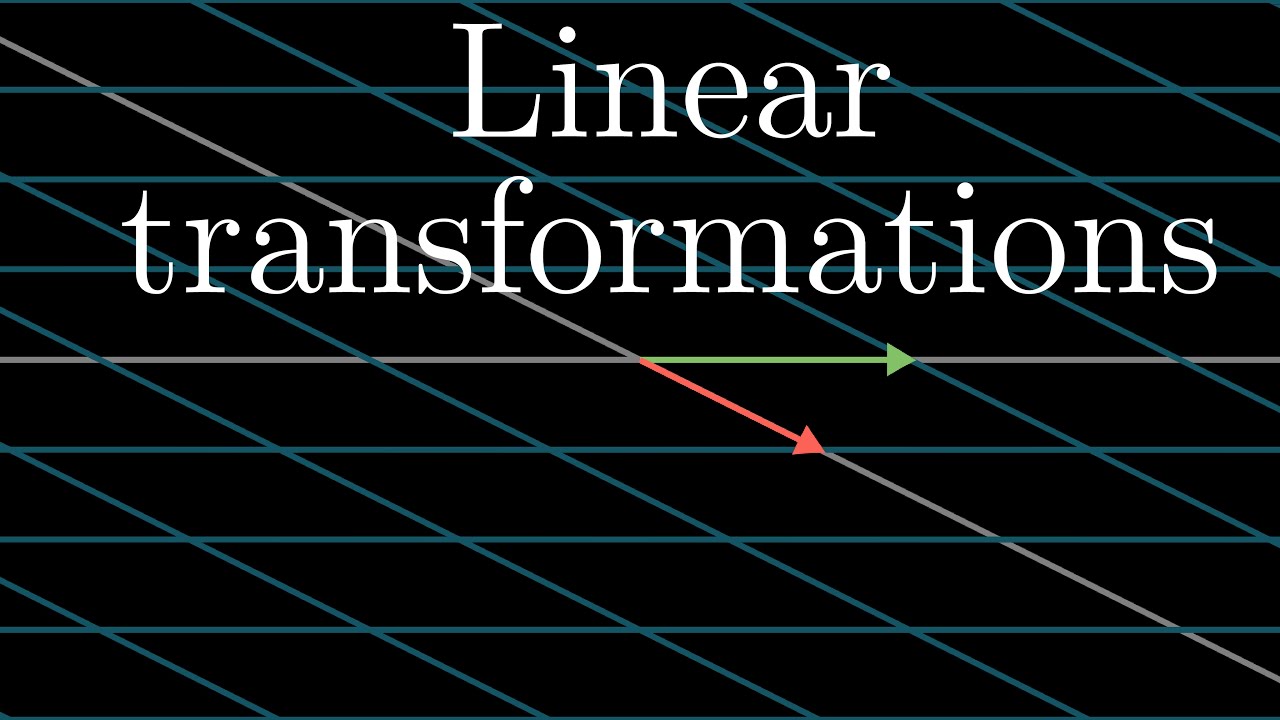
Quite possibly the most important idea for understanding linear algebra.
Help fund future projects: https://www.patreon.com/3blue1brown
An equally valuable form of support is to simply share some of the videos.
Home page: https://www.3blue1brown.com
Full series: http://3b1b.co/eola
Future series like this are funded by the community, through P...
wintry steppe
i don't know if it counts as visualization, but any linear map can be written as a matrix, after choosing bases
worn hawk

How do you think about the column space and null space of a matrix visually? How do you think about the inverse of a matrix?
clear kettle
What would it look like as a matrix , how many columns and rows do i know to put.
spare widget
L : V -> W -> your matrix has dim(W) rows and dim(V) columns
you need to pick bases in V and W to produce a matrix for L though
spare widget
wintry steppe
3b1b shills in chat otday
if you prefer I can "shill" Bazett instead: https://www.youtube.com/watch?v=On6wkamacRE

Matrix multiplication is an algebraic operation. But we cared about that algebraic operation because it represented a core geometric idea: the composition of linear transformations. In this video I introduce my favorite way to visualizing Linear Transformations in 2D (dynamically!). We then can visualizing the composition and track what happens ...
clear kettle
Do i pick random numbres
spare widget
no, you do not pick random numbers
clear kettle
how do i solve the equation for 0 and what about the derivative of the function.
wintry steppe
wintry steppe
the problem tells you that p(t) is a quadratic, so you might as well write it as...
by doing this
you don't need to write anything as a matrix to do this one
(not to dismiss the usefulness of matrix representations)
clear kettle
it could be easily be 0 but I don't think it is
wintry steppe
well, 0 is an option, but of course it is (0 is in the kernel of every linear map)
if p(t) = at^2 + bt + c, figure out what p'(t) is, then figure out what t^2 p'(t) = 0 implies about a, b, c
clear kettle
how did you know you had to write the original equation without the derivative first
or would it make more sense that way because we need to know first how it looks like before
clear kettle
why did you need to write the function without it being derived for p(t) = at^2 + bt + c i mean
spare widget
is an arbitrary vector from P_2
wintry steppe
wintry steppe
i know it's a quadratic because the problem says L is a map from P_2 to somethin...
.
stoic pythonBOT
criver
 spare widget
just by the definition of what P_n is
wintry steppe
no
spare widget
you pick an arbitrary vector from the space
and then check what constraints you need on it
wintry steppe
clear kettle
okay so the derivative is 2at + b ?
still not right
spare widget
for L(p) = 0
clear kettle
haven't done derivatives in a while
wintry steppe
there you go, it's 2at + b. now substitute that into t^2 p'(t) = 0.
what does that imply about a and b?
clear kettle
2at^3 + t^2b = 0
clear kettle
they are 0? scalar multiples?
clear kettle
oh. I have a question
wintry steppe
so you've proven that if p(t) is in the kernel of L, then it only has a constant term.
clear kettle
Why cant t be 0 as well
clear kettle
so for the definition of the kernel when they say elements they mean the ones in the equation
wintry steppe
the ones satisfying L(p(t)) = 0, yes
spare widget
they mean all polynomials that satisfy this, and you just found out that such polynomials have a = b = 0
wintry steppe
wintry steppe
so you've proven that if p(t) is in the kernel of L, then it only has a constant...
can you show yourself that every constant polynomial is in the kernel of L? i think this should be straightforward enough to do yourself. then you've successfully shown that the kernel of L is precisely the set of all constant polynomials.
clear kettle
the p(t) in L is what the derivative was right?
wintry steppe
no, but it's something we're taking the derivative of (which the definition of L demands we do)
wintry steppe
if that's what you mean, yes.
clear kettle
yes, ok.
wintry steppe
wintry steppe
can you show yourself that every constant polynomial is in the kernel of L? i th...
now this is how you should proceed
you've done the hard step
clear kettle
So we still have to prove
wintry steppe
once you've convinced yourself that the kernel of L really is the space of all constant polynomials, you need to find a basis of this
spare widget
your vectors are polynomials here
clear kettle
what does it leave if a and b are 0
wintry steppe
constnat polynoamisl
spare widget
you have p(t) = a t^2 + b t + c, you set a=b=0, what do you get
clear kettle
p(t) = c
spare widget
then what's in the kernel of L?
spare widget
example q(t) = 3 is in the kernel, r(t) = -5 is in the kernel, s(t) = 0 is in the kernel
i.e. any constant polynomial is in the kernel
the kernel is the set of constant polynomials (all of them)
clear kettle
i thought it was a vector equals to 0
spare widget
check L(q) =? 0
or more generally L(c) =? 0
the kernel is associated with the linear map
the kernel itself is the set of vectors
which the linear map sends to 0
clear kettle
L(c) = 0?
spare widget
and now you need to find a basis for this space of constant polynomials that constitute the kernel
clear kettle
p(t) =c right?
spare widget
I don't get the question
spare widget
well that's clear
clear kettle
aren't you left with c
spare widget
I think we established that
and that this is the set of vectors in the kernel
now you need to find a basis for the kernel
for that you have to remember the definition of basis
wintry steppe
clear kettle
so p(t) = c was the kernel because L(p(t)) = 0
if p(t)=c then p is just one element of the kernel, not all of the kernel
clear kettle
ok
spare widget
I think it would have been easier on you if you had tried a problem that involves vectors from R^n beforehand. Directly jumping to polynomials while notions like kernel are not solid is probably difficult.
clear kettle
maybe yeah.
what is the definition of the basis for the kernel
How do you determine the basis from what we know
spare widget
what is the definition of a basis?
clear kettle
set of vectors
clear kettle
i want to imagine linearly independence on a graph
spare widget
what vector(s) span the space of constant functions
clear kettle
and also do you mean the space in this case P2 -> P3
spare widget
remember than span ${v_1,...,v_n} = {\sum_i \alpha_i v_i ,:, \alpha_i \in \mathbb{R}}$
stoic pythonBOT
criver
 spare widget
so what vector(s) span the kernel (the space of constant functions)
clear kettle
v1 v2?
spare widget
if you have a 1D space, then it looks like this ${\alpha v_1 , : , \alpha \in \mathbb{R}}$
stoic pythonBOT
criver
 spare widget
in your case the kernel is ${p(t) = c ,:, c\in\mathbb{R}}$
stoic pythonBOT
criver
 spare widget
what can you choose as a basis vector
what polynomial multiplied by a scalar gives you a constant polynomial
what function multiplied by a scalar gives you a constant?
clear kettle
t^2?
clear kettle
no
spare widget
ok, so what function multiplied by a scalar gives you the constant function
clear kettle
would it be 0
clear kettle
or 1
spare widget
it gives you one constant function, namely the 0 one, but the issue is that it doesn't give you any other constant function
let's try 1
clear kettle
a constant is when it doesn't change right?
spare widget
alpha * 1 = c
what is alpha then
so one option is to pick 1
another option is to pick any constant except 0
let's say I pick d != 0
then alpha * d = c -> alpha = c / d
and I can reproduce any constant
I highly suggest scaling back to R^n
figuring out notions like linear combination, span, basis, kernel, etc. there
clear kettle
what is a constant lol
spare widget
a constant function is one that has the same value for all t
e.g. p(t) = 5
or p(t) = 3.14
or p(t) = 0
or p(t) = the same real number for all t
clear kettle
how do you know in this case
spare widget
how do I know what?
spare widget
Let's say I pick as a basis the constant function v(t) = 2
clear kettle
spare widget
what function multiplied by a scalar gives you a constant?
.
The constant thing was just confusing
spare widget
Then let's say I have a vector p(t)=c in the kernel
Then c/2 * v(t) = p(t)
Since c and consequently p(t) was arbitrary, then v(t) spans the kernel
I could have picked any other constant basis function not equal to 0
e.g. w(t) = 1
Then c * w(t) = p(t)
Then w(t) is another possible basis
clear kettle
so what doesn't work is what i'm asking
and how would i know in this problem , what would constitute a basis
spare widget
Scale back to R^n and solve some problems
clear kettle
can you give an example like what.
spare widget
Do you have a textbook?
clear kettle
yes
 small vigil
I am trying to show the following assertion:
Suppose that any vector of ${y_1,\dots,y_{m+1}}$ over the vector space $X$ can be denoted by the linear combination of vectors ${x_1,\dots,x_m}$ over $X$. Then show that ${y_1,\dots,y_{m+1}}$ are linear dependent.
Could you help me?
stoic pythonBOT
keith_1
 clear kettle
so basically I should have solved problems by hand
spare widget
small vigil
I am trying to show the following assertion:
Suppose that any vector of $\{y_1,\...
Show that a1 y1 + ... + a_{m+1} y_{m+1} = 0 for (a1,...,a_{m+1}) != 0 by expanding the yi in terms of the xi
spare widget
clear kettle
yes
What's the title of the textbook?
I don't know it, but I suppose it has exercise on R^n
Solve some for linear combination, independence, span, basis, kernel
clear kettle
ok
worn hawk
Kernel, just a term used for solving AX=0
Also check these at your own time for visualisation. https://youtube.com/playlist?list=PLZHQObOWTQDPD3MizzM2xVFitgF8hE_ab

YouTube
A geometric understanding of matrices, determinants, eigen-stuffs and more.
spare widget
@small vigil here's a hint, if yi = 0 -> {y1,...,y_{m+1}} lin. dep., so you are left with the case where none of the yi are 0
expand yi = \sum_j b_ij x_j
Then study \sum_i a_i yi = 0 and find a case where not all a_i == 0
small vigil
spare widget
<@394821178146947075> here's a hint, if yi = 0 -> `{y1,...,y_{m+1}}` lin. dep., ...
Yes, I tried following zero of the linear combination as you commented but I have no idea what to do next.
spare widget
expand the expression I mentioned
small vigil
the linear combination of yi can be changed into that of xi with \sum_j a_j b_ij. If the y_1 to y_{m+1} are lin. indep., all the terms must be zero. But this does not imply a_j == 0 immediately.
spare widget
expand the expression properly and group terms by xj
small vigil
\sum_i a_i y_i = \sum_i a_i (\sum_j b_ij x_j) = \sum_j (\sum_i a_i b_ij ) x_j?
spare widget
Yes
And that whole thing must be equal to 0
But x1,...,xm are lin indep
So what follows for the coefficients in front?
small vigil
From the definition of L.I., \sum_i a_i b_ij = 0 for all j?
spare widget
Yes
But that is equivalent to B^T a = 0
And B^T is a m x (m+1) matrix
What follows for the kernel of B^T
small vigil
There exists a nontrivial solution a?
spare widget
small vigil
There exists a nontrivial solution `a`?
Yes the kernel is non-trivial
So there's an a != 0 that satisfies it
So y1,...,y_m+1 are lin dep
small vigil
spare widget
Yes the kernel is non-trivial
Thanks a lot for your kind advice. I got it!
clear kettle
can anyone give me the solution to 1?
clear kettle
clear kettle
.
wintry steppe
clear kettle
can anyone give me the solution to 1?
i spent almost an hour helping you with (i) and you just want the solution?
 crystal parrot
 spare widget
It's clear the user didn't take away much from the explanations. My understanding is that they jumped to a problem they were not ready for without solving simpler problems beforehand. So even if we try to explain it, they get stuck on the simpler concepts used to explain the problem.
spare widget
That's why I recommended that they just solve some simpler problems from their textbook beforehand, as it is close to impossible to solve a problem asking for bases of the kernel and range when they don't know what a basis is.
wintry steppe
assuming people even know what the words mean in the questions they post is surprisingly too high an expectation
 fair wren
spare widget
Show that `a1 y1 + ... + a_{m+1} y_{m+1} = 0` for `(a1,...,a_{m+1}) != 0` by exp...
fair wren
spare widget
Show that `a1 y1 + ... + a_{m+1} y_{m+1} = 0` for `(a1,...,a_{m+1}) != 0` by exp...
since {x_1, ..., x_m} is a generator of X and with only m elements then its a basis for X?
spare widget
fair wren
since {x_1, ..., x_m} is a generator of X and with only m elements then its a ba...
Now that you mention it, I noticed that there's nothing about x1,...,xm being linearly independent in the problem statement #linear-algebra message of @small vigil. This doesn't change the proof by much though.
fair wren
what I said was right tho?
spare widget
If one assumes that $x_1, \ldots, x_m$ are linearly dependent, then without loss of generality let $x_1, \ldots, x_k$ be linearly independent, and any of $x_{k+1},..., x_m$ can be expressed in terms of $x_1,\ldots,x_k$. Then the above system simplifies further, and one gets a matrix $B^T$ with size $k \times (m+1)$, so the null-space is at least of dimension $(m+1)-k$.
fair wren
fair wren
what I said was right tho?
Hm?
stoic pythonBOT
criver
 clear kettle
 zinc timber
what have you tried
zinc timber
what have you tried
wtf have you even read the messages, i can ask for whatever I want , i've been attempting to do this problem for a while and you haven't even contributed.
fair wren
idk wym by null-space , u talking 'bout $X = {0}$?
stoic pythonBOT
alexisreen
 spare widget
@small vigil you should probably modify your solution if these are not assumed to be linearly independent - I guess I didn't read the problem statement properly
spare widget
fair wren
idk wym by null-space , u talking 'bout $X = {0}$?
I am talking about #linear-algebra message
clear kettle
spare widget
It's clear the user didn't take away much from the explanations. My understandin...
The explanations won't make sense if it wasn't applied to the whole problem , part of the question was answered.
fair wren
spare widget
I am talking about https://discord.com/channels/268882317391429632/5402117476137...
I still don't understand what you mean by null-space?
spare widget
spare widget
I am talking about https://discord.com/channels/268882317391429632/5402117476137...
i.e. if one assumes $x_1,...,x_m$ linearly independent, with $y_i = \sum_j b_{ij} x_j$ then $\sum_i a_i y_i = \sum_j x_j (\sum_i a_i b_{ij}) = 0$ and from $x_1, \ldots, x_m$ lin. indep. it follows $\sum_i a_i b_{ij} = 0$ or equivalently $B^Ta = 0$. But $B^T\in\mathbb{R}^{m\times (m+1)}$ so the null-space is at least of dimension 1, and then there is $a\ne 0, , a\in Null(B^T)$ such that the sum is zero, thus $y_1, \ldots, y_{m+1}$ are linearly dependent.
stoic pythonBOT
criver
 clear kettle
I think i found the basis for ker L
fair wren
@spare widget since {x_1, ..., x_m} is a generator of X and with only m elements then its a basis for X? is this correct?
clear kettle
isn't it 2t^3 and t^2?
spare widget
fair wren
<@218360314234798080> `since {x_1, ..., x_m} is a generator of X and with only m...
that's not in the discussed problem statement, I don't even know where it came from
clear kettle
spare widget
that's not in the discussed problem statement, I don't even know where it came f...
?
fair wren
spare widget
that's not in the discussed problem statement, I don't even know where it came f...
But is it wrong?
they said that every vector in X can be denoted as a linear combination of the {x_1, ..., x_m}
spare widget
fair wren
But is it wrong?
we haven't assumed that X is of dimension m, if you assume that dim(X) = m, and that x1,...,xm is a spanning set, then it follows that x1,...,xm are linearly independent, and thus it is a basis
clear kettle
Is my answer right?
spare widget
clear kettle
Is my answer right?
it's not
clear kettle
why not ?
spare widget
trying to guess it won't work
clear kettle
does it have to include c?
spare widget
fair wren
they said that every vector in X can be denoted as a linear combination of the {...
no, they say that the vectors y1,...,y[m+1] can be written as linear combinations of x1,...,xm
Suppose that any vector of ${y_1,\dots,y_{m+1}}$ over the vector space $X$ can be denoted by the linear combination of vectors ${x_1,\ldots,x_m}$ over $X$
fair wren
but the y_i can be written by the combinations of the x_i
also we can deduce that the dimension of X is finite
stoic pythonBOT
criver
 spare widget
fair wren
but the y_i can be written by the combinations of the x_i
spare widget
fair wren
but the y_i can be written by the combinations of the x_i
sure, but I can pick y1=y2=...=y_{m+1}, and x1=x2=...=xm
fair wren
spare widget
sure, but I can pick y1=y2=...=y_{m+1}, and x1=x2=...=xm
how is this relevant?
spare widget
the above satisfy the problem statement and the xi do not form a basis
the problem statement doesn't say that every vector in X can be written as a linear combination of x1,...,xm
it only says that the vectors y1,...,y[m+1] can
fair wren
every vector in {y1,...,y_m+1}
yes but how does falsify that {x_1,...,x_m} forms a basis?
spare widget
yes every vector in y1,...,y[m+1] are just m+1 vectors
spare widget
fair wren
yes but how does falsify that {x_1,...,x_m} forms a basis?
why would an arbitrary set of vectors form a basis?
clear kettle
wait i think i got it
fair wren
{y1,...,y_m+1} is also a vector space right?
spare widget
no
clear kettle
(t^3-2)+(t^2-1)?
fair wren
Why?
clear kettle
Is it right?
spare widget
are we talking past each other, or am I tripping?
fair wren
@spare widget
 clear kettle
I want to know if my answer is right
fair wren
which condition does {y_1,...,y_m+1} breaks?
spare widget
potentially all conditions
fair wren
Hm?
spare widget
or at the very least addition and multiplication by a scalar
if I pick arbitrary m+1 points, they do not form a vector space unless they are all 0
then they form the trivial space {0}
fair wren
ok ok i see
spare widget
for them to form a vector subspace I would need span(y1,...,y[m+1])
spare widget
A generator of a vector space is also known as a spanning set.
fair wren
and what is a spanning set then?
spare widget
it's the same thing as far as I understand
spare widget
again, I think they are exactly the same thing
fair wren
fair wren
a span(y1, ... , y_p) of a vector space X is a generator right?
Is this correct?
spare widget
again, I think they are exactly the same thing
spare widget
I think means I am not certain, but I know that in some books they are used interchangeably
however generator seems to have many other meanings: https://en.wikipedia.org/wiki/Generator_(mathematics)

In mathematics and physics, the term generator or generating set may refer to any of a number of related concepts. The underlying concept in each case is that of a smaller set of objects, together with a set of operations that can be applied to it, that result in the creation of a larger collection of objects, called the generated set. The lar...
fair wren
then i assume its correct
@spare widget since X is a vector space of atleast m+1 element
isn't {x_1, ..., x_m} a generator of {y_1, ..., y[m+1]}?
spare widget
there's nothing saying that X is a vector space of at least m+1 elements
fair wren
Ye typo
fair wren
ah rip
spare widget
unless they are all 0
even this doesn't have to be true:
span(x1,...,xm) = span(y1,...,y[m+1])
since span(y1,...,y[m+1]) may be a proper subspace of span(x1,...,xm)
fair wren
so $\exists \lambda_1, ..., \lambda_{m+1} \in \mathbb{K} : \sum_{i=1}^{m+1} \lambda_i y_i = 0 \iff \lambda_i = 0 ,$ this is what to prove
clear kettle
To prove my answer
fair wren
they asked to prove {y_1,...,y[m+1]} are linearly independent
fair wren
ah dependent
spare widget
but we already went over the proof
fair wren
im trying to do it too
so $\exists \lambda_1, ..., \lambda_{m+1} \in \mathbb{K} : \sum_{i=1}^{m+1} \lambda_i y_i = 0 \iff \lambda_i \neq 0 ,$ this is what to prove
stoic pythonBOT
alexisreen
 spare widget
this is also wrong
fair wren
hm?
spare widget
vectors are linearly dependent if there exists (a1,...,an) such that
sum_i a_i v_i = 0 for (a1,...,an) != 0
clear kettle
i have a question
spare widget
what you wrote is lambda_i != 0, which would imply for all i
fair wren
spare widget
it's enough that a single coefficient is non-zero
I said there is a lambda_i which is non-zero
clear kettle
how would you find the basis from just one polynomial
fair wren
spare widget
what you wrote is lambda_i != 0, which would imply for all i
bro u blind?
XD
spare widget
fair wren
I said there is a lambda_i which is non-zero
yes but you didn't specify the i
fair wren
i said there is a lambda_i from 1 to m+1
clear kettle
fair wren
bro u blind?
he isn't reading so yeah
wintry steppe
there'd be less problems if just one person helped at a time
clear kettle
Can you help me TTerra
spare widget
stoic python
**alexisreen**
this says exists lambda1, ... lambdam+1 in K ... <-> lambda_i !=0, but maybe I missed where you specify that there exists i in {1,...,m+1}
wintry steppe
clear kettle
Can you help me TTerra
no, i'm busy
clear kettle
😦
fair wren
kek
fair wren
spare widget
this says exists lambda1, ... lambdam+1 in K ... <-> lambda_i !=0, but maybe I ...
ah gotcha
clear kettle
like you already know the answer i just want to know if what i did was right @wintry steppe
spare widget
the point is that the negation of x_i lin indep <-> sum_i a_i x_i = 0 only for (a1,...,a[m+1]) = (0,...,0) is:
x_i is lin dep <-> there exists (a1,...,a[m+1]) != (0,...,0) such that \sum_i a_i x_i = 0
fair wren
so $\forall y_p \in {y_1, ... , y_{m+1} } , \exists \alpha_1 , ..., \alpha_m \in \mathbb{K} : y_p = \sum_{k=1}^m \alpha_k x_k$
this is true?
stoic pythonBOT
alexisreen
 spare widget
well I would write it as $y_i = \sum_{k=1}^{m} \alpha_{ik} x_k$
stoic pythonBOT
criver
 fair wren
why?
spare widget
so I would be able to differentiate the coefficients corresponding to different yi
clear kettle
the basis is [1 0]
fair wren
oh ok
spare widget
wintry steppe
at this point it's just you two fighting
they wants to do a proof I already did, we are not fighting
it's not their homework, don't worry
clear kettle
Can you answer me then? :/
wintry steppe
i don't care if it's homework or not, it's just funny
spare widget
stoic python
**criver**
just use this
clear kettle
u guys blame not being to explain things by blaming it on others lool
fair wren
then $\sum_{i=1}^{m+1} \lambda_i y_i = \sum_{i=1}^{m+1} \lambda_i \sum_{k=1}^{m} \alpha_{i k } x_k = \sum_{i=1}^{m+1} \sum_{k=1}^{m} \lambda_i \alpha_{i k } x_k$
is this correct @spare widget ?
spare widget
yes
fair wren
niceee
stoic pythonBOT
alexisreen
 fair wren
still true @spare widget ?
clear kettle
people out here acting like they got phds
spare widget
yes from linearity
fair wren
ok cool
spare widget
clear kettle
people out here acting like they got phds
You could have spent all those hours practicing problems, and by now you would know what a basis is, what a kernel is, and what a range is. I can suggest textbooks if you want.
fair wren
spare widget
You could have spent all those hours practicing problems, and by now you would k...
can u suggest me textbooks too?
clear kettle
spare widget
You could have spent all those hours practicing problems, and by now you would k...
I could practice problems but I have the hw due tonight lol
spare widget
clear kettle
I could practice problems but I have the hw due tonight lol
unfortunate
clear kettle
spare widget
unfortunate
I get to drop three so it doesn't matter anyway
spare widget
fair wren
can u suggest me textbooks too?
hoffman and kunze, friedberg, axler
 halcyon spindle
fair wren
can u suggest me textbooks too?
halcyon spindle
fair wren
can u suggest me textbooks too?
Linear algebra done wrong.
fair wren
$\sum_{i=1}^{m+1} \sum_{k=1}^{m} \lambda_i \alpha_{i k } x_k = 0 \iff \sum_{i=1}^{m+1} \sum_{k=1}^{m} \lambda_i \alpha_{i k } = 0$?
clear kettle
kolman and hill?
stoic pythonBOT
alexisreen
 clear kettle
They suck ass tbh
fair wren
halcyon spindle
Linear algebra done wrong.
lmfao this name is sus
fair wren
stoic python
**alexisreen**
@spare widget can u check?
spare widget
stoic python
**alexisreen**
how did you get this?
fair wren
idk just intuition ?
clear kettle
Why are germans so interested in linear algebra
spare widget
then stop relying on intuition
clear kettle
intuition is sometimes stupid
fair wren
spare widget
then stop relying on intuition
idk how to progress than
clear kettle
I heard someone once give the dumbest proof by relying on their intuition
fair wren
clear kettle
I heard someone once give the dumbest proof by relying on their intuition
still a proof
spare widget
the idea is, that if x1,...,xm are assumed to be linearly independent, then c1x1 + ... + cm xm = 0 <-> c1=0, ..., cm=0
now find out what terms are the ci in the above
clear kettle
fair wren
still a proof
a proof that doesn't work
fair wren
why u assume they are linearly independent?
fair wren
clear kettle
a proof that doesn't work
idc
spare widget
fair wren
why u assume they are linearly independent?
because it's the easier case, later on you can prove the case where they are linearly dependent using a small modification of the above
clear kettle
fair wren
idc
don't respond then , your ego is hurt
spare widget
it reduces to it
fair wren
spare widget
because it's the easier case, later on you can prove the case where they are lin...
oh i see so two cases
clear kettle
You could have spent all this time practicing problems
fair wren
clear kettle
don't respond then , your ego is hurt
wym? im saying its still a proof
spare widget
you'd just have to single out linearly independent vectors from x1,...,xm, wlog x1,..,xk, and the rest should be in their span, then it reduces to the first case with some extra notation
clear kettle
fair wren
wym? im saying its still a proof
It's not a proof , proving nothing isn't counted , is what i mean.
fair wren
gotcha
spare widget
ignore Student212, they are just having a bad day
clear kettle
spare widget
ignore Student212, they are just having a bad day
yeah i'm having a hard time solving this problem you can't explain. My bad for asking a guy with a potato for their pfp.
spare widget
welp I can't explain it so, you'll have to find someone that can
clear kettle
I am in the process of that.
fair wren
spare widget
you'd just have to single out linearly independent vectors from x1,...,xm, wlog ...
i see btw if {x_1, ...,x_m} is linearly independent , then it forms a basis in some way?
clear kettle
honestly you should get a life.
 gray dust
what a lousy convo
spare widget
only if x_1,...,x_m spans X does it form a basis for X, otherwise it forms a basis for some subspace
wintry steppe
hi rokabe!
clear kettle
hi rokabe!
fair wren
spare widget
only if x_1,...,x_m spans X does it form a basis for X, otherwise it forms a bas...
maybe {y_1,...,y_{m+1}} is the subspace that forms a basis for?
spare widget
clear kettle
honestly you should get a life.
potatoes grow in the earth, it's our life
clear kettle
you are a couch potato
fair wren
This is #linear-algebra bruh not potato channel kek
gray dust
@clear kettle drop the attitude
fair wren
_ i feel the ban hammer_
gray dust
@fair wren dont minimod
clear kettle
gray dust
<@869300658233278514> drop the attitude
Who do you think you are bruh? I'm dropping my nut sack on this convo.
gray dust
the question involves prerequisite knowledge
fair wren
gray dust
<@324736074750623748> dont minimod
wym minimod
gray dust
knowledge that tterra & criver have spent way too long trying to convey
spare widget
fair wren
maybe {y_1,...,y_{m+1}} is the subspace that forms a basis for?
not necessarily, span(y1,...,y[m+1]) could be a proper subspace of span(x1,...,x[m]) depending on how the y1,...,y[m+1] are chosen (equivalently how the aij coefficients are chosen)
clear kettle
gray dust
<@869300658233278514> drop the attitude
ching chong ching ba da bing
fair wren
spare widget
not necessarily, span(y1,...,y[m+1]) could be a proper subspace of span(x1,...,x...
ok but it isn't relevant in this problem ig?
spare widget
it isn't, but you asked, so I answered
gray dust
and now you say they cant explain the problem
fair wren
spare widget
it isn't, but you asked, so I answered
yes i see
gray dust
this spoiled behavior, asking to be spoonfed like this, wont fly here
 oblique prairie
very productive discussion in #linear-algebra today
clear kettle
gray dust
this spoiled behavior, asking to be spoonfed like this, wont fly here
spoonfed my asshole
fair wren
oblique prairie
very productive discussion in <#540211747613704221> today
u can tell
woah , something is rysing but isn't the sun its the ban hammer
wintry steppe
rokabe not banning yet is so funny to watch
clear kettle
I love rokabe
gray dust
go read whatever book is assigned to ur class, stop pestering tterra/criver, and grow the hell up
clear kettle
gray dust
go read whatever book is assigned to ur class, stop pestering tterra/criver, and...
I did all three, I'm growing the hell up but if my answer was explained then none of this would have happened
Like instead of complaining the problem is too hard to explain and saying to do other problems lol
gray dust
based on how much info you had going into the convo, fully explaining the problem wouldve taken half a school semester's worth of time
so no thats bullshit
fair wren
spare widget
not necessarily, span(y1,...,y[m+1]) could be a proper subspace of span(x1,...,x...
i think it was necessary to assume the dependence(resp independance) of {x_1, ..., x_m} since we have no info to use in the main problem right?
clear kettle
gray dust
so no thats bullshit
bullshit excuses. they questioned basic shit and didn't get to the point/
gray dust
yeah basic shit that you had a hard time answering
clear kettle
Since when does linear algebra end peacefully?
gray dust
i wouldnt insult you for not knowing the basics
wintry steppe
clear kettle
Since when does linear algebra end peacefully?
unfortunately for you, linear algebra pervades mathematics
clear kettle
gray dust
yeah basic shit that you had a hard time answering
no i didn't have a hard time answering , we just learned this lol
gray dust
but i will for repeatedly asking me to clarify things that were better gained from reading the book
clear kettle
Honestly who uses the book anymore
fair wren
clear kettle
no i didn't have a hard time answering , we just learned this lol
first year engineering's student pain kekw
clear kettle
They summarize it in class notes
spare widget
fair wren
i think it was necessary to assume the dependence(resp independance) of {x_1, .....
in the main problem they can be linearly dependent, but you can reduce this case to the linearly independent case by picking out a set of say k linearly indepndent vectors, wlog x1,...,xk such that span(x1,...,xk) = span(x1,...,xm). Then you need some extra terms in the summation, but the case reduces to the linearly independent one. Then dim(Null(B^T)) >= m+1 - k.
clear kettle
It's so easy to criticize something you knew before
Like I would like to bully a chinese person for not understanding english
wintry steppe
your shitty attitude is being criticized, not your level of linear algebra knowledge
clear kettle
shitty attitude for asking questions and not getting a response? You had an attitude by making fun and not answering me.
gray dust
i wouldnt insult you for not knowing the basics
but i will for repeatedly asking me to clarify things that were better gained from reading the book
clear kettle
gray dust
> i wouldnt insult you for not knowing the basics
> but i will for repeatedly as...
The book is so long
gray dust
that sucks but we're not a substitute for the book
fair wren
spare widget
in the main problem they can be linearly dependent, but you can reduce this case...
still i don't understand this span(x1,...,xk) = span(x1,...,xm)
gray dust
ok im done making my point
fair wren
ban hammer activate
gray dust
ur muted for 24h, go read the notes in the meantime
spare widget
fair wren
still i don't understand this `span(x1,...,xk) = span(x1,...,xm)`
it just means that x[k+1],...,x[m] can be expressed in terms of x1,...xk.
gray dust
come back if u want clarification on any concepts afterward
spare widget
spare widget
it just means that x[k+1],...,x[m] can be expressed in terms of x1,...xk.
If I have a set of linearly dependent vectors: x1,...,xm, I can start taking away vectors such that the dimension of the span is not reduced. This procedure will end when I cannot take away anymore vectors without reducing the span. So at the end I will end up with a subset of the initial linearly dependent vectors, and that subset will be linearly independent.
gray dust
also hi tera, late reply but w/e
fair wren
so ur saying that every vector in {x1,...,xm} can be denoted by a linear combination of span(x1,...xk) ?
spare widget
if span(x1,...,xk) = span(x1,...,xm) then you can write x[k+1],...,xm as linear combinations of x1,...,xk
fair wren
ah since x[k+1],..., xm are dependent?
spare widget
yes
fair wren
nice
spare widget
dependent on {x1,...,xk}
so the problem reduces to the linearly independent case, with some extra terms popping out
fair wren
exactly, so to get into the proof, i shall suppose that {x1, .., xm} is independent right?
spare widget
if anything the above can only increase the nullspace of B^T
fair wren
spare widget
if anything the above can only increase the nullspace of B^T
u see i don't understand this nullspace of B^T we can discuss it later
lets do the first case
spare widget
fair wren
exactly, so to get into the proof, i shall suppose that {x1, .., xm} is independ...
in an actual proof you would have to rigorously deal with the linearly dependent case, since it pops in extra terms
stoic pythonBOT
alexisreen
 spare widget
yes, though for each notation can be better
fair wren

so this RHS will automatically get reduced to 0
for all lambda_i whether they are zero or non-zero
that means {y_1, ..., y_m+1} are linearly dependent
right ?
spare widget
you need to group the terms
fair wren
which ones?
spare widget
stoic python
**alexisreen**
so they have the same form as
fair wren
I don't quite understand what u mean tho?
spare widget
you need something of the form c1 x1 + ... + cm xm = 0
fair wren
ok i see
so we have $\sum_{i=1}^{m+1} b_i y_i = \sum_{i=1}^{m+1} b_i \sum_{k=1}^m a_{ik} x_i = \sum_{i=1}^{m+1} b_i (a_{11} x_1 + ... + a_{ii} x_i + .. + a_{im} x_m)$
what do i group here @spare widget ?
I see
spare widget
$\sum_{i=1}^{m+1}b_i\sum_{k=1}^ma_{ik}x_k = \sum_{k=1}^m \left(\sum_{i=1}^{m+1}b_i a_{ik}\right) x_k = \sum_{k=1}^m \alpha_k x_k = 0$
stoic pythonBOT
alexisreen
 spare widget
now use the linearity to get that the alpha_1=0,...,alpha_m = 0
spare widget
fair wren
how'd u get that?
linearity
stoic pythonBOT
criver
 spare widget
noticed a typo of xi
 spare widget
fair wren
https://cdn.discordapp.com/attachments/540211747613704221/969736838883454977/324...
spare widget
fair wren
https://cdn.discordapp.com/attachments/540211747613704221/969736838883454977/324...
first term should read ai1
fair wren
ye
spare widget
but beyond that it is correct
fair wren
tysm
spare widget
I am not sure why you wrote it though
spare widget
stoic python
**criver**
this is all that you need
 spare widget
stoic python
**criver**
spare widget
stoic python
**criver**
use this instead
fair wren
ok sure but lemme see my idea
spare widget
I am going to go sleep, so I'll just leave you a sketch of what to do next


 fair wren
whatchu think?
spare widget
stoic python
**criver**
From this you get the equations $\sum_i b_i a_{1i} = 0$, ..., $\sum_i b_i a_{im} = 0$, which are equivalent to $A^Tb = 0$. Where $(A^T){ji} = a{ij}$. The matrix $A^T$ is of size $m \times (m+1)$ so its null-space is at least one-dimensional. Then there exists $b\ne 0$ such that $A^Tb = 0$, so $y_1,\ldots,y_{m+1}$ are linearly dependent.
stoic pythonBOT
criver
 fair wren
spare widget
good night
fair wren
spare widget
good night
u2
slate hatch
If we're to check if vector A exist in a plane in R3, we take the cross product of the plane vectors. We then take the scalar product of that and A. If it is zero, A belongs to the plane.
I don't get this. Aren't there an infinite amount of planes in R3, that are perpendicular to the normal?
 fringe fjord
The plane thus defined is in particular the one that contains (0,0,0).
 pseudo cairn
could someone suggest approaches for this question or point me in the right direction with books etc?


 native rampart
No?
fair wren
why
native rampart
F=span{(1,0,0)} G=span{(0,1,0)}
(1,1,0) is in F+G
 sharp idol
Beat me to it
native rampart
Not in F \inter G
sharp idol
Or F U G for that matter.
fair wren
oh gotcha
well i gotta prove something
Let E be a vector space and F,G subspaces of E
prove F inter G is a subspace
so i did this
since F, G are subspaces they contain 0
so F inter G is non-empty
now i need to prove x-y is in F inter G
and a*x is in F inter G
this is what i gotta prove right @native rampart ?
sharp idol
Wouldnt F n G be the vector space that shares the same basis elements as F and G?
fair wren
native rampart
F=span{(1,0,0)} G=span{(0,1,0)}
(1,1,0) is in F+G
How can u addup two spans
fair wren
sharp idol
Wouldnt F n G be the vector space that shares the same basis elements as F and G...
you see i still don't understand the basis stuff very well tho
sharp idol
Okay. Give me a second. I gotta get these dishes done
fair wren
sure take ur time senpai
fringe fjord
fair wren
this is what i gotta prove right <@734020733595942952> ?
If F and G are explictly given by bases, there are not necessarily any basis elements in the intersection.
stoic pythonBOT
dackid
 fair wren
fringe fjord
If F and G are explictly given by bases, there are not necessarily any basis ele...
fair wren
fringe fjord
If F and G are explictly given by bases, there are not necessarily any basis ele...
ye i don't understand
sharp idol
Perhaps Troposphere can explain it more thoroughly.
fair wren
stoic python
**dackid**
the span here is span{(1,0);(0,1)}?
fringe fjord
For example, if F = span{(1,1,0),(1,-1,0)} and G=span{(1,0,1),(1,0,-1)}, then their intersection is nontrivial -- it contains all vectors of the form (t,0,0) -- but you cannot see that simply by intersecting the two bases.
sharp idol
Fair point. My mistake
fair wren
What mistake?
fringe fjord
fair wren
ye i don't understand
Sorry, I meant to reply to Dackid's post below yours instead.
fair wren
Its all good
fringe fjord
But you're right, you need to prove that a·x and x+y (or x-y if you want it that way around) are in the intersection.
fair wren
oh well to prove the second thing - x+y -
i need to the 2 cases
there is no way i can do it directly
so Let x,y in F n G
fringe fjord
Huh? It feels pretty direct to me.
sharp idol
fringe fjord
For example, if F = span{(1,1,0),(1,-1,0)} and G=span{(1,0,1),(1,0,-1)}, then th...
Strange. Dont (1,0,0) and (0,1,0) also span F?
fringe fjord
Suppose x is in the intersection and y is in the intersection.
Because x is in F and y is in F we have x+y in F.
Because x is in G and y is in G we have x+y in G.
Because x+y is in F and it is also in G, it is in the intersection of F and G.
fringe fjord
sharp idol
Strange. Dont (1,0,0) and (0,1,0) also span F?
Yes, for each subspace there are many different possible sets that span it.
fair wren
fringe fjord
Suppose x is in the intersection and y is in the intersection.
Because x is in F...
This is 2 cases ig?
No?
fringe fjord
I only see one case there. There's no division into cases.
fair wren
because u divided the first case
is where u studied x and y in F
secondly in G
then u deduced
fringe fjord
No, every line in the proof is relevant to every choice of x and y.
fair wren
at the end
fair wren
fringe fjord
No, every line in the proof is relevant to every choice of x and y.
exactly
thats two choices
i mean i found a new way to this instead of doing both ax and x+y we can just prove ax+by in F n G
fringe fjord
No. Whenever you have chosen an x and y, you need all the lines to reach the conclusion. Division into cases in when only some of the lines are relevant, based on properties of your choice.
sharp idol
fringe fjord
Yes, for each subspace there are many different possible sets that span it.
That's what I thought. So was my reasoning wrong, or does it just need to be a bit fine tuned to have merit?
fair wren
Let $x,y \in F \cap G$ Then $$x+y \in F$$
stoic pythonBOT
alexisreen

 sharp idol
You can skip to x-y in FnG, which covers two pieces right off the bat
Really the only thing I'd change is your wording, but you got it
fair wren
sharp idol
Really the only thing I'd change is your wording, but you got it
tysm
but how is this related to spans and basis stuffs @sharp idol ?
sharp idol
It wasnt actually that relevant to the problem. That was my bad
fair wren
would be lovely to understand them tho
sharp idol
I was just trying to develop an intuition for what was being asked, but my logic was a bit off.
A basis of F is a collection of linearly independent vectors that span F
fringe fjord
sharp idol
That's what I thought. So was my reasoning wrong, or does it just need to be a b...
It's true that given F and G you can always find bases for them such that the intersections of the bases form a basis for the intersection. But if you already have bases for the subspaces, those bases won't necessarily be ones with that proper. And the only good way to tell is to figure out the intersection first.
sharp idol
Got it! So we'd basically be going in circles to deduce that, making it somewhat irrelevant to this
fair wren
sharp idol
A basis of F is a collection of linearly independent vectors that span F
that means any vector of F, can be written as a linear combination of the vectors from the basis?
sharp idol
sharp idol
A basis of F is a collection of linearly independent vectors that span F
For example, $\Q(\sqrt{2})={ a+b\sqrt{2}: a,b \in \Q}$. Here, a basis for $\Q(\sqrt{2})$ is ${1,\sqrt{2}}$.
sharp idol
fair wren
that means any vector of F, can be written as a linear combination of the vector...
Bingo!
stoic pythonBOT
dackid
 sharp idol
No worries. Q(rt(2)) is the set I described. And since rt(2) is not rational, there is no a in Q s.t. a*1=rt(2)
Yea, vector spaces are a lot more general than you may think
sharp idol
No, if you want to think of it that way, the vectors that span Q(rt(2)) are (1,0) and (0,rt(2)).
sharp idol
You got it :D
fair wren
senpai u explain stuff so ez
ok continue please
is a span the same thing as a generator?
sharp idol
Hmmm, they kind of have the same idea going for it
Because all of the basis elements that span our vector space generate every element in said vector space.
fair wren
whats the relation between a basis and a span tho?
sum a_i x_i = 0 iff forall a_i = 0?
 tribal willow
can someone explain condition (b) of the lemma that is necessary to say that W = W_1 + ... + W_k is a direct sum of W_1, ..., W_k?
 fair wren
bcz they are independent ig?
sharp idol
fair wren
sum a_i x_i = 0 iff forall a_i = 0?
This here shows us that each basis element $x_i$ is linearly independent of the others.
Suppose it we not the case, the $\exists x_i$ s.t. $-\frac{1}{a_j}\sum_{i\neq j} a_i x_i =x_j$, which tells us $x_j$ is a linear combination of the other basis vectors.
stoic pythonBOT
dackid
 fair wren
Yes
sharp idol
A key condition is that the elements that span a subspace are linearly independent of one another
fair wren
so span(v_1, ..., v_n) of a subspace of dimension n , each v_k is independent of others?
sharp idol
Correct
sharp idol
The reason why span isn't quite generate is because you need to equip the vectors with scalar multiplication


 sharp idol
fair wren
so a span is a basis in this case?
sharp idol
fair wren
so a span is a basis in this case?
A basis of F is a "collection" of elements ${v_1,v_2\dots, v_n}$ s.t. each $v_i$ is linearly independent of the others (as your picture states above) and $F=\text{Span}{v_1,\dots ,v_n}$. The span is the collection of all linear combinations of $v_1,\dots, v_n$.
stoic pythonBOT
dackid
 fair wren
same vectors?
 stoic pythonBOT
dackid
 fringe fjord
A "span" is always an entire subspace. A "basis" is just a few strategically selected elements of the (sub)space. The subspace can be the span of a basis, though.
fair wren
so R² = span((1,0); (0,1))?
fringe fjord
You can take the span of any set of elements of a vector space.
sharp idol
Exciting stuff really
fringe fjord
fair wren
so R² = span((1,0); (0,1))?
Yes.
sharp idol
There are many. The typica set is (1,0) and (0,1)
fringe fjord
There are many possible bases. One of them is {(1,0), (0,1)}.
Another is, for example, {(24,33),(sqrt 2, pi)}.
 fleet sun
a set of vectors ${v_1,\ldots,v_k}$ is a basis for $\mbox{Span}(v_1,\ldots,v_k)$ if and only if they are linearly independent
stoic pythonBOT
ManifoldCuriosity
 fringe fjord
Because every vector in R^2 can be written as a linear combination of (24,33) and (sqrt2,pi) in exactly one way.
If you pick two random vectors in R^2, chances are overwhelming that putting them together will form a basis for R^2.
fair wren
fleet sun
a set of vectors $\{v_1,\ldots,v_k\}$ is a basis for $\mbox{Span}(v_1,\ldots,v_k...
wait wait im confused
R² is the vector space right?
fringe fjord
Yes.
fleet sun
that's the relationship between basis and span
fair wren
span({v1,...,vk}) is also vector space?
fleet sun
it's always a subspace of the whole space yes
fringe fjord
It's a subspace, but a subspace is also a vector space in its own right.
fair wren
lmao
a vector space is a collection of vector right
{v1, ..., vk} isn't this also a vector space too?
fringe fjord
No.
fair wren
woah now im confused
fleet sun
a vector space is not just any set of vectors
fair wren
why?
fair wren
fleet sun
a vector space is not just any set of vectors
a set of vectors over a field
fringe fjord
A "vector space" must be closed under addition and scalar multiplication.
fringe fjord
The notation {v1,...,vk} suggests there are only k vectors in your set, which is not enough for it to be closed under multiplication with every scalar (unless in the boring case that all of the vi's are the zero vector).
fair wren
bcz if u add up two vector from that set we're not sure if the result is in there
right?
fringe fjord
That too.
fair wren
Also wait
i've seen a theorem saying
there is always a basis
for a vector space of a finite dimension
fringe fjord
Yes.
fair wren
isn't a span of infinite dimension then?
oh wait no
im so confused about the dimensions
$\dim_{\mathbb{R}} (\mathbb{R}^2) = 2$
stoic pythonBOT
alexisreen
 fair wren
right?
fringe fjord
"Dimension" is now many vectors there are in a basis, so it's pretty trivial that a vector space of finite dimension must have a basis.
fleet sun
yes
fair wren
but what about $\dim_{\mathbb{R}} (Span{v_1, ..., v_k})$
stoic pythonBOT
alexisreen
 fringe fjord
That's somewhere between 0 and k.
fleet sun
more info is needed for that
fair wren
fleet sun
more info is needed for that
what info?
fleet sun
how many of the vectors in that set are linearly independent
fringe fjord
It's k if {v1,...,vk} are linearly independent.
fair wren
fleet sun
how many of the vectors in that set are linearly independent
so its basically the dimension of the basis?
fringe fjord
You have the right idea, but "dimension of the basis" is not a wording we normally use. You can say it's the cardinality of the basis, if you want fancy words.
fleet sun
yeah, or simply size